 filings.tools
Danaher 10-K 2023-12-31
Filed 2024-02-21. 24 sections, 596K characters. Original on sec.gov · Markdown · JSON
Cover and table of contents
UNITED STATES
SECURITIES AND EXCHANGE COMMISSION
Washington, D.C. 20549
FORM 10-K
(Mark One)
| ☒ | ANNUAL REPORT PURSUANT TO SECTION 13 OR 15(d) OF THE SECURITIES EXCHANGE ACT OF 1934 |
For the fiscal year ended December 31, 2023
OR
| ☐ | TRANSITION REPORT PURSUANT TO SECTION 13 OR 15(d) OF THE SECURITIES EXCHANGE ACT OF 1934 | ||||
| For the transition period from to |
Commission File Number: 001-08089

DANAHER CORPORATION
(Exact name of registrant as specified in its charter)
| Delaware | 59-1995548 | ||||||||||
| (State of Incorporation) | (I.R.S. Employer Identification Number) | ||||||||||
| 2200 Pennsylvania Avenue, N.W., Suite 800W | 20037-1701 | ||||||||||
| Washington, | DC | ||||||||||
| (Address of Principal Executive Offices) | (Zip Code) |
Registrant’s telephone number, including area code: 202-828-0850
Securities Registered Pursuant to Section 12(b) of the Act:
| Title of each class | Trading Symbol(s) | Name of each exchange on which registered | ||||||
| Common stock, $0.01 par value | DHR | New York Stock Exchange | ||||||
| 1.700% Senior Notes due 2024 | DHR 24 | New York Stock Exchange | ||||||
| 0.200% Senior Notes due 2026 | DHR/26 | New York Stock Exchange | ||||||
| 2.100% Senior Notes due 2026 | DHR 26 | New York Stock Exchange | ||||||
| 1.200% Senior Notes due 2027 | DHR/27 | New York Stock Exchange | ||||||
| 0.450% Senior Notes due 2028 | DHR/28 | New York Stock Exchange | ||||||
| 2.500% Senior Notes due 2030 | DHR 30 | New York Stock Exchange | ||||||
| 0.750% Senior Notes due 2031 | DHR/31 | New York Stock Exchange | ||||||
| 1.350% Senior Notes due 2039 | DHR/39 | New York Stock Exchange | ||||||
| 1.800% Senior Notes due 2049 | DHR/49 | New York Stock Exchange |
Securities registered pursuant to Section 12(g) of the Act:
NONE
(Title of Class)
Indicate by check mark if the registrant is a well-known seasoned issuer, as defined in Rule 405 of the Securities Act.
Yes ☒ No ☐
Indicate by check mark if the registrant is not required to file reports pursuant to Section 13 or Section 15(d) of the Act.
Yes ☐ No ☒
Indicate by check mark whether the Registrant (1) has filed all reports required to be filed by Section 13 or 15(d) of the Securities Exchange Act of 1934 during the preceding 12 months (or for such shorter period that the Registrant was required to file such reports) and (2) has been subject to such filing requirements for the past 90 days. Yes ☒ No ☐
Indicate by check mark whether the registrant has submitted electronically every Interactive Data File required to be submitted pursuant to Rule 405 of Regulation S-T during the preceding 12 months (or for such shorter period that the registrant was required to submit such files). Yes ☒ No ☐
Indicate by check mark whether the registrant is a large accelerated filer, an accelerated filer, a non-accelerated filer, a smaller reporting company, or an emerging growth company. See the definitions of “large accelerated filer,” “accelerated filer,” “smaller reporting company” and “emerging growth company” in Rule 12b-2 of the Exchange Act.
| Large Accelerated Filer | ☒ | Accelerated Filer | ☐ | ||||||||||||||
| Non-accelerated Filer | ☐ | Smaller Reporting company | ☐ | ||||||||||||||
| Emerging Growth Company | ☐ |
If an emerging growth company, indicate by check mark if the registrant has elected not to use the extended transition period for complying with any new or revised financial accounting standards provided pursuant to Section 13(a) of the Exchange Act. ☐
Indicate by check mark whether the registrant has filed a report on and attestation to its management’s assessment of the effectiveness of its internal control over financial reporting under Section 404(b) of the Sarbanes-Oxley Act (15 U.S.C. 7262(b)) by the registered public accounting firm that prepared or issued its audit report. ☒
If securities are registered pursuant to Section 12(b) of the Act, indicate by check mark whether the financial statements of the registrant included in the filing reflect the correction of an error to previously issued financial statements. ☐
Indicate by check mark whether any of those error corrections are restatements that required a recovery analysis of incentive-based compensation received by any of the registrant's executive officers during the relevant recovery period pursuant to §240.10D-1(b). ☐
Indicate by check mark whether the registrant is a shell company (as defined in Rule 12b-2 of the Exchange Act).
Yes ☐ No ☒
As of February 2, 2024, the number of shares of Registrant’s common stock outstanding was 739,701,725. The aggregate market value of common stock held by non-affiliates of the Registrant on June 30, 2023 was $158.1 billion, based upon the closing price of the Registrant’s common stock as quoted on the New York Stock Exchange on such date.
DOCUMENTS INCORPORATED BY REFERENCE
Part III incorporates certain information by reference from the Registrant’s proxy statement for its 2024 annual meeting of shareholders to be filed pursuant to Regulation 14A within 120 days after Registrant’s fiscal year-end. With the exception of the sections of the 2024 Proxy Statement specifically incorporated herein by reference, the 2024 Proxy Statement is not deemed to be filed as part of this Form 10-K.
TABLE OF CONTENTS
In this Annual Report, the terms “Danaher” or the “Company” refer to Danaher Corporation, Danaher Corporation and its consolidated subsidiaries or the consolidated subsidiaries of Danaher Corporation, as the context requires. Unless otherwise indicated, all financial data in this Annual Report refer to continuing operations only.
INFORMATION RELATING TO FORWARD-LOOKING STATEMENTS
Certain statements included or incorporated by reference in this Annual Report, in other documents we file with or furnish to the Securities and Exchange Commission (“SEC”), in our press releases, webcasts, conference calls, materials delivered to shareholders and other communications, are “forward-looking statements” within the meaning of the U.S. federal securities laws. All statements other than historical factual information are forward-looking statements, including without limitation statements regarding: projections of revenue, expenses, profit, profit margins, pricing, tax rates, tax provisions, cash flows, pension and benefit obligations and funding requirements, our liquidity position or other projected financial measures; management’s plans and strategies for future operations, including statements relating to anticipated operating performance, cost reductions, restructuring activities, new product and service developments, competitive strengths or market position, acquisitions and the integration thereof, divestitures, spin-offs, split-offs, initial public offerings, other securities offerings or other distributions, strategic opportunities, stock repurchases, dividends and executive compensation and potential executive stock sales or purchases; growth, declines and other trends in markets we sell into; new or modified laws, regulations and accounting pronouncements; future regulatory approvals and the timing and conditionality thereof; outstanding claims, legal proceedings, tax audits and assessments and other contingent liabilities; future foreign currency exchange rates and fluctuations in those rates; the potential or anticipated direct or indirect impact of public health crises, climate change, military conflicts or other man-made or natural disasters on our business, results of operations and/or financial condition; general economic and capital markets conditions; the anticipated timing of any of the foregoing; assumptions underlying any of the foregoing; and any other statements that address events or developments that Danaher intends or believes will or may occur in the future. Terminology such as “believe,” “anticipate,” “should,” “could,” “intend,” “will,” “plan,” “expect,” “estimate,” “project,” “target,” “may,” “possible,” “potential,” “forecast” and “positioned” and similar references to future periods are intended to identify forward-looking statements, although not all forward-looking statements are accompanied by such words. Forward-looking statements are based on assumptions and assessments made by our management in light of their experience and perceptions of historical trends, current conditions, expected future developments and other factors they believe to be appropriate. These forward-looking statements are subject to a number of risks and uncertainties, including but not limited to the risks and uncertainties set forth below and under “Item 1A. Risk Factors” in this Annual Report.
Forward-looking statements are not guarantees of future performance and actual results may differ materially from the results, developments and business decisions contemplated by our forward-looking statements. Accordingly, you should not place undue reliance on any such forward-looking statements. Forward-looking statements speak only as of the date of the report, document, press release, webcast, call, materials or other communication in which they are made. Except to the extent required by applicable law, we do not assume any obligation to update or revise any forward-looking statement, whether as a result of new information, future events and developments or otherwise.
Below is a summary of material risks and uncertainties we face, which are discussed more fully in “Item 1A. Risk Factors”:
Business and Strategic Risks
-
Unanticipated, further declines in demand for our COVID-19 related products, and future global health crises could adversely impact our business and financial statements. Other conditions in the global economy, the particular markets we serve and the financial markets can also adversely affect our business and financial statements.
-
We face intense competition and if we are unable to compete effectively, we may experience decreased demand and decreased market share. Even if we compete effectively, we may be required to reduce the prices we charge.
-
Our growth depends on the timely development and commercialization, and customer acceptance, of new and enhanced products and services based on technological innovation. Our growth can also suffer if the markets into which we sell our products and services decline, do not grow as anticipated or experience cyclicality.
-
The health care industry and related industries that we serve are undergoing significant changes in an effort to reduce (and increase the predictability of) costs, which can adversely affect our business and financial statements.
-
Economic, political, geopolitical, legal, compliance, social and business factors (including the impact of military conflicts), both in the U.S. and outside the U.S., can negatively affect our business and financial statements.
-
Uncertainties with respect to the development, deployment, and use of artificial intelligence in our business and products may result in harm to our business and reputation.
-
Collaborative partners and other third-parties we rely on for development, supply and/or marketing of certain products, potential products and technologies could fail to perform sufficiently.
Acquisitions, Divestitures and Investment Risks
-
Any inability to consummate acquisitions at our historical rate and appropriate prices, and to make appropriate investments that support our long-term strategy, could negatively impact our business. Our acquisition of businesses, investments, joint ventures and other strategic relationships could also negatively impact our business and financial statements and our indemnification rights may not fully protect us from liabilities related thereto.
-
Divestitures or other dispositions could negatively impact our business, and contingent liabilities from businesses that we or our predecessors have previously disposed could adversely affect our business and financial statements. For example, we could incur significant liability if any of the split-off or spin-off transactions we have previously consummated are determined to be a taxable transaction or otherwise pursuant to our indemnification obligations with respect to such transactions.
Operational Risks
-
Significant disruptions in, or breaches in security of, our information technology (“IT”) systems or data; data privacy violations; other losses or disruptions to facilities, supply chains, distribution systems or IT systems due to catastrophe; and labor disputes can all adversely affect our business and financial statements.
-
Defects and unanticipated use or inadequate disclosure with respect to our products or services, or allegations thereof, can adversely affect our business and financial statements.
-
Our financial results are subject to fluctuations in the cost and availability of the supplies we use in, and the labor we need for, our operations.
-
Climate change, legal or regulatory measures to address climate change and any inability to address stakeholder expectations with respect to climate change, may negatively affect us.
-
Our success depends on our ability to recruit, retain and motivate talented employees representing diverse backgrounds, experiences and skill sets.
-
Our restructuring actions can have long-term adverse effects on our business and financial statements.
Intellectual Property Risks
-
Any inability to adequately protect or avoid third-party infringement of our intellectual property, and third-party claims we are infringing intellectual property rights, can adversely affect our business and financial statements.
-
The U.S. government has certain rights with respect to incremental production capacity attributable to, and/or the intellectual property we have developed using, government financing. In addition, in times of national emergency the U.S. government could also control our allocation of manufacturing capacity.
Financial and Tax Risks
-
Our outstanding debt has increased significantly as a result of acquisitions, and we may incur additional debt. Such indebtedness may limit our operations and use of cash flow and negatively impact our credit ratings; and failure to comply with our indebtedness-related covenants could adversely affect our business and financial statements.
-
Our business and financial statements can be adversely affected by foreign currency exchange rates, changes in our tax rates (including as a result of changes in tax laws) or income tax liabilities/assessments, the outcome of tax audits, recognition of impairment charges for our goodwill or other intangible assets, and fluctuations in the cost and availability of commodities.
Legal, Regulatory, Compliance and Reputational Risks
-
Significant developments or changes in national laws or policies to protect or promote domestic interests and/or address foreign competition can have an adverse effect on our business and financial statements.
-
Our businesses are subject to extensive regulation (including those applicable to the healthcare industry). Failure to comply with those regulations (including by our employees, agents or business partners) or significant developments or changes in U.S. laws or policies can adversely affect our business and financial statements.
-
With respect to the regulated medical devices we offer, product introductions or modifications may require regulatory clearance or authorizations and we could be required to recall or cease marketing such products; off-label marketing could result in penalties; and clinical trials may have results that are unexpected or are perceived unfavorably by the market, all of which could adversely affect our business and financial statements.
-
We are subject to or otherwise responsible for a variety of litigation and other legal and regulatory proceedings in the course of our business that can adversely affect our business and financial statements.
-
Our operations, products and services also expose us to the risk of environmental, health and safety liabilities, costs and violations that could adversely affect our business and financial statements.
-
Our By-law exclusive forum provisions could limit our stockholders’ ability to choose their preferred judicial forum for disputes.
PART I
Item 1. BUSINESS
General
Danaher is a global science and technology innovator committed to accelerating the power of science and technology to improve human health. Danaher is comprised of more than 15 operating companies with leadership positions in the biotechnology, life sciences and diagnostics sectors, organized under three segments (Biotechnology, Life Sciences and Diagnostics). United by the DANAHER BUSINESS SYSTEM (“DBS”), our businesses are also typically characterized by a high level of products and services that are sold on a recurring basis, primarily through a direct sales model and to a geographically diverse customer base. Our business’ research and development, manufacturing, sales, distribution, service and administrative facilities are located in more than 50 countries.
Danaher strives to create shareholder value primarily through three strategic priorities:
-
strengthening our competitive advantage through consistent application of DBS tools and culture;
-
enhancing our portfolio in attractive science and technology markets through strategic capital allocation; and
-
consistently attracting and retaining exceptional talent.
Danaher measures its progress against these strategic priorities over the long-term based primarily on financial metrics relating to revenue growth, profitability, cash flow and capital returns, as well as certain non-financial metrics. To further the strategic objectives set forth above, the Company also acquires businesses and makes investments that either complement its existing business portfolio or expand its portfolio into new and attractive markets. Given the rapid pace of technological development and the specialized expertise typical of Danaher’s served markets, acquisitions, strategic alliances and investments provide the Company access to important new technologies and domain expertise. Danaher believes there are many acquisition and investment opportunities available within its targeted markets. The extent to which we identify, consummate and effectively integrate appropriate acquisitions and consummate appropriate investments affects our overall growth and operating results. Danaher also continually assesses the strategic fit of its existing businesses and may separate or otherwise dispose businesses based on strategic and other considerations.
On September 30, 2023 (the “Distribution Date”), we completed the separation (“the Separation”) of our former Environmental & Applied Solutions business by distributing to Danaher stockholders on a pro rata basis all of the issued and outstanding common stock of Veralto Corporation (“Veralto”). To effect the Separation, Danaher distributed to its stockholders one share of Veralto common stock for every three shares of Danaher common stock outstanding at the close of business on September 13, 2023, the record date for the distribution. In lieu of fractional shares cash was distributed to Danaher stockholders.
DBS is not only the set of business processes and tools our operating companies use on a daily basis in the pursuit of continuous improvement, but also represents our culture, which is guided by the following core values (the “Core Values”):
1.The Best Team Wins
2.Customers Talk, We Listen
3.Kaizen is our Way of Life
4.Innovation Defines our Future
5.We Compete for Shareholders
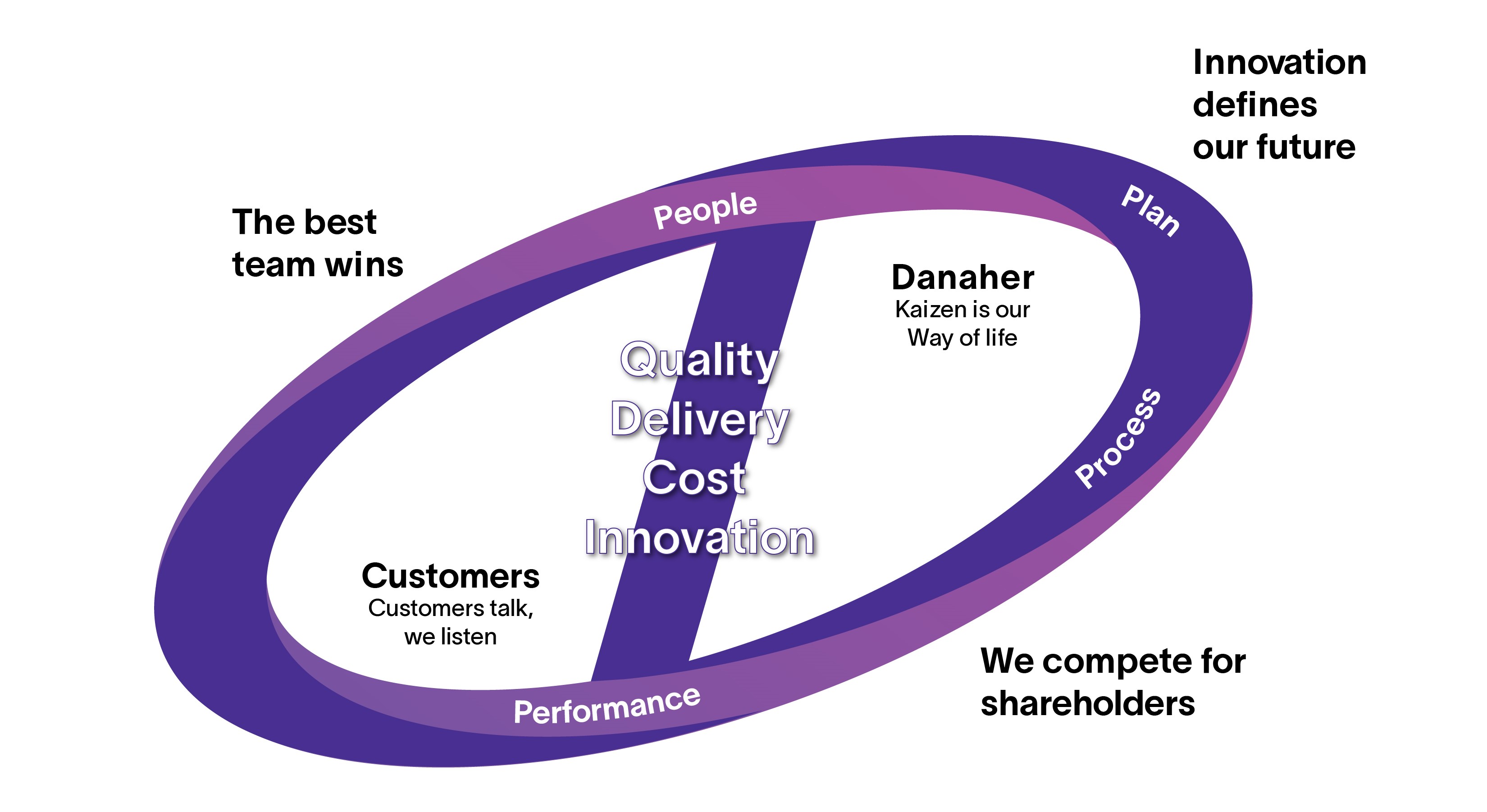
Underpinned by these five Core Values, the DBS tools are organized into four pillars that are designed to apply to every aspect of our business: Growth, Lean, Leadership and the DBS Fundamentals.
The idea for Danaher originated in the early 1980s when the Company’s founders, Steven M. and Mitchell P. Rales, envisioned a business that would generate sustainable long-term value for customers, associates and shareholders. Through a series of acquisitions and divestitures, Danaher has evolved over time into the science and technology innovator it is today. While the operating companies that make up Danaher have changed, DBS continues to be the guiding philosophy for the Company.
Sales in 2023 by geographic destination (geographic destination refers to the geographic area where the final sale to the Company’s unaffiliated customer is made) as a percentage of total 2023 sales were: North America, 42% (including 40% in the United States); Western Europe, 23%; other developed markets, 5%; and high-growth markets, 30%. The Company defines North America as the United States and Canada. The Company defines high-growth markets as developing markets of the world experiencing accelerated growth, over extended periods, in gross domestic product and infrastructure which include Eastern Europe, the Middle East, Africa, Latin America (including Mexico) and Asia (with the exception of Japan, Australia and New Zealand). The Company defines developed markets as all markets of the world that are not high-growth markets.
BIOTECHNOLOGY
The Biotechnology segment includes the bioprocessing and discovery and medical businesses and offers a broad range of equipment, consumables and services that are primarily used by customers to advance and accelerate the research, development, manufacture and delivery of biological medicines. The biotherapeutics that the Company’s solutions support range from replacement therapies such as insulin, vaccines, recombinant proteins and other biologic drugs, to novel cell, gene, mRNA and other nucleic acid therapies. Sales in 2023 for this segment by geographic destination (as a percentage of total 2023 sales) were: North America, 34%; Western Europe, 33%; other developed markets, 5%; and high-growth markets, 28%.
Danaher established the Biotechnology segment, which was previously part of Danaher’s former Life Sciences segment, in 2022. The Biotechnology segment includes the Pall life sciences business, acquired in 2015, and Cytiva, acquired in 2020.
The Biotechnology segment consists of the following businesses:
Bioprocessing—The bioprocessing business is a leading provider of technologies, consumables, services and solutions that advance, accelerate and integrate the development and manufacture of therapeutics. These therapeutics include protein-based and other biological therapies as well as a new emerging class of highly-targeted therapies such as cell and gene therapies, nucleic acid-based therapies, and others requiring viral vectors and lipid nanoparticles in their
manufacture. The business offers tools, solutions and services to support biomanufacturers across their workflows from the earliest stages of process development to large scale commercial and turn-key manufacturing. The bioprocessing business’ offering includes cell line and cell culture media development services; cell culture media, process liquids and buffers for manufacturing, chromatography resins, filtration technologies, aseptic fill finish, as well as single-use hardware and consumables and services such as the design and installation of full manufacturing suites. The bioprocessing business’ offering in data connectivity and automation, advanced process training, process development services and equipment services for maintaining continuous performance, all help to ensure customers’ processes are optimized and compliant. Typical users of these products and services include pharmaceutical and biopharmaceutical companies, translational medicine institutions, biotechnology companies and contract manufacturing organizations.
Discovery and Medical—The discovery and medical business is a leading provider of solutions to accelerate biotherapeutic research and discovery through high quality sample preparation, and reliable diagnostic assays in addition to ensuring sterility and safety in medical liquids and gasses. The business provides solutions and technologies for: lab filtration, separation, and purification; lab-scale protein purification and analytical tools to support bio-mole
Showing the first 8K of 63K characters. Open the full section
Item 1A. RISK FACTORS
You should carefully consider the risks and uncertainties described below, together with the information included elsewhere in this Annual Report on Form 10-K and other documents we file with the SEC. We have identified the risks and uncertainties described below, some of which we have experienced and any of which may occur in the future, as material, but they are not the only risks and uncertainties facing us. Our business is also subject to general risks and uncertainties that affect many other companies, such as market conditions, economic conditions, geopolitical events, changes in laws, regulations or accounting rules, fluctuations in interest rates, terrorism, wars or conflicts, major health concerns including pandemics, natural disasters or other disruptions of expected business conditions. Additional risks and uncertainties not currently known to us or that we currently believe are immaterial also may impair our business and financial statements, including our results of operations, liquidity and financial condition, and our stock price.
Business and Strategic Risks
Unanticipated, further declines in demand for our COVID-19 related products could adversely affect our business and financial statements. Global health crises, pandemics, epidemics or other outbreaks can adversely impact certain elements of our business and our financial statements.
As COVID-19 and the preventive measures related thereto have moderated, demand for the Company’s COVID-19 related products has moderated as well. Further declines in demand for our COVID-19 related products that are unanticipated in timing or magnitude could adversely affect our business and financial statements.
In addition, our global operations expose us to risks associated with public health crises, including epidemics and pandemics such as COVID-19. The global spread of COVID-19 led to unprecedented restrictions on, and disruptions in, business and personal activities, including as a result of preventive and precautionary measures that we, other businesses, our communities and governments undertook to mitigate the spread. Any resurgence of COVID-19 (or the outbreak of any other epidemic or pandemic) or the reinstatement of similar preventive measures in the future could negatively impact the economies and financial markets of the world and our business and financial statements. To the extent we develop and sell products to help address epidemics or pandemics in the future, as such epidemics/pandemics evolve we may experience declines in demand that are unanticipated in timing or magnitude, which could adversely affect our business and financial statements.
Conditions in the global economy, the particular markets we serve and the financial markets can adversely affect our business and financial statements.
Our business is sensitive to general economic conditions, such as the elevated inflation and interest rates experienced in domestic and international markets in 2022 and 2023. Our operational costs, including the cost of energy, materials, labor, distribution and our other operational and facilities costs are subject to market conditions, including inflationary pressures. In addition to inflation and higher interest rates, slower economic growth in the domestic and/or international markets, actual or anticipated default on sovereign debt, volatility in the currency and credit markets, high levels of unemployment or underemployment, labor availability constraints, reduced levels of capital expenditures, changes or anticipation of potential changes in government trade, fiscal, tax and monetary policies (including as a result of upcoming elections in the U.S.), changes in capital requirements for financial institutions, government budget negotiation dynamics, sequestration or government shut-downs, austerity measures and other challenges that affect economies of the world
have in the past adversely affected, and may in the future adversely affect, the Company and its distributors, customers and suppliers, including having the effect of:
-
reducing demand for our products and services (in this Annual Report, references to products and services also includes software), limiting the financing available to our customers and suppliers, increasing order cancellations and resulting in longer sales cycles and slower adoption of new technologies;
-
increasing the difficulty in collecting accounts receivable and the risk of excess and obsolete inventories;
-
increasing price competition in our served markets;
-
supply interruptions, delays or cost increases, which can disrupt our ability to produce or deliver our products and/or increase our costs;
-
increasing the risk of impairment of goodwill and other long-lived assets, and the risk that we may not be able to fully recover the value of other assets such as real estate and tax assets;
-
increasing the risk that counterparties to our contractual arrangements will become insolvent or otherwise unable to fulfill their contractual obligations which, in addition to increasing the risks identified above, could result in preference actions against us; and
-
adversely impacting market sizes and growth rates.
If growth in any key economy of the world or in any of the markets we serve slows for a significant period, if there is significant deterioration in any such economy or such markets or if economic improvements do not benefit the markets we serve, our business and financial statements can be adversely affected.
We face intense competition and if we are unable to compete effectively, we may experience decreased demand and decreased market share. Even if we compete effectively, we may be required to reduce the prices we charge.
Our businesses operate in industries that are intensely competitive and have been subject to increasing consolidation. Because of the range of the products and services we sell and the variety of markets we serve, we encounter a wide variety of competitors; refer to “Item 1. Business—Competition” for additional details. In order to compete effectively, we must retain longstanding relationships with major customers and continue to grow our business by establishing relationships with new customers, continually developing new products and services to maintain and expand our brand recognition and leadership position in various product and service categories and penetrating new markets, including high-growth markets. Our ability to compete can also be impacted by changing customer preferences and requirements (for example increased demand for products incorporating digital capabilities or more environmentally-friendly products and supplier practices) as well as changes in the way healthcare services are delivered (including the movement of some care from acute to non-acute settings and increased focus on chronic disease management). Cost containment efforts by governments and the private sector, particularly in the healthcare industry, are also resulting in increased emphasis on products that reduce costs and improve efficiency and effectiveness. In addition, significant shifts in industry market share have occurred and may in the future occur in connection with product problems, safety alerts and publications about products, reflecting the competitive significance of product quality, product efficacy and quality systems in our industry. Our failure to compete effectively and/or pricing pressures resulting from competition may adversely impact our business and financial statements, and our expansion into new markets may result in greater-than-expected risks, liabilities and expenses. In addition, the Company’s competitors and customers have from time to time introduced, and may in the future introduce, private label, generic or low-cost products that compete with the Company’s products at lower price points. New, disruptive technologies may emerge that displace the Company’s existing technologies. Competitor
Showing the first 8K of 97K characters. Open the full section
Item 1B. UNRESOLVED STAFF COMMENTS
Not applicable.
Item 1C. CYBERSECURITY
Cybersecurity Strategy and Risk Management
Danaher’s cybersecurity strategy and risk management program focuses on maintaining a secure environment for our data that complies with applicable legal requirements and effectively supports our business objectives and customer needs. Our commitment to cybersecurity emphasizes cultivation of a security-minded culture through education and training, and a programmatic and layered approach to prevention and detection of, and response to, cybersecurity threats. Key elements of our program for assessing, identifying and managing material risks from cybersecurity threats are described below.
We maintain cybersecurity policies that articulate Danaher’s expectations and requirements with respect to topics such as acceptable use of technology and data, data privacy, risk management, education and awareness and event and incident management. We regularly conduct exercises, with the support of outside domain experts, to improve the effectiveness of our processes and we periodically assess our processes against recognized cybersecurity frameworks. Consistent with our position that cybersecurity is the responsibility of every Danaher associate, we regularly educate and share best practices with our associates to raise awareness of cybersecurity threats. Every year, associates in applicable job categories are required to take information security and protection training as part of the Danaher Annual Training Program. We also conduct regular education and training for our associates through cyber-event simulations.
We strive to implement and maintain layered controls designed to prevent and, where necessary, detect and respond to cybersecurity threats. Our physical controls are designed to restrict access to locations that house significant physical information technology assets. Our technical preventive controls include access restrictions and network security technologies. Our notification policies and processes are designed so that notifications and alerts are escalated to the appropriate personnel on a timely basis to support effective review, response and compliance with legal requirements. In addition to event-specific notifications, data is aggregated and compiled on a regular basis to support the identification of trends and effective program review and oversight. We also recognize that Danaher is exposed to cybersecurity risks that affect third parties whom we rely on to process, store or transmit our electronic information. To manage these risks, we maintain technical security controls as well as processes designed to facilitate Danaher’s identification of third-party cybersecurity risks.
Key elements of Danaher’s annual Enterprise Risk Management (“ERM”) program include an inventory and classification of key risk areas and topics; a methodology for scoring risks based on the risk’s probability, severity and velocity of impact, and for trending key risks; and a framework for developing and implementing countermeasures for key risks. Information technology/cybersecurity is one of five topical areas required to be addressed as part of the annual ERM program. IT and cybersecurity risks are required to be scored using the same methodology applied to all other risk categories, which facilitates an evaluation of the significance and prioritization of cyber-related risks relative to wider business risks. In addition, Danaher policy requires the reporting of certain cybersecurity incident data to Danaher’s Risk Committee (comprising senior members of the legal, finance, internal audit and compliance functions) for consideration as part of the ERM process. Members of the Danaher Risk Committee present annually to the Danaher Board of Directors a report on the results of the ERM process, including with respect to information technology and cybersecurity risks. As part of our cybersecurity risk management program, we also maintain cyber insurance in amounts and subject to coverage terms that are typical for companies of our type and size, however, such insurance may not be sufficient in type or amount to cover us against claims related to security breaches, cyber-attacks and other related breaches.
We periodically engage external consultants to assess our cybersecurity program. In addition, management’s annual assessment of the effectiveness of the Company’s internal control over financial reporting assesses the effectiveness of certain controls relating to cybersecurity, and the Company’s independent registered public accounting firm audits the effectiveness of the Company’s internal control over financial reporting.
Cybersecurity Governance and Oversight
At the management level, Danaher’s cybersecurity program is led by the Company’s Chief Information Security Officer (“CISO”), who reports to Danaher’s Chief Information Officer (“CIO”), who in turn reports to Danaher’s Chief Financial Officer. Danaher’s CIO has served as a technology leader for over 25 years, leading cybersecurity, engineering, and operational functions as the CIO for two multi-billion dollar businesses prior to assuming the Danaher CIO role. Danaher’s CISO has served for more than 20 years in various information security roles, including serving as the Chief Information Security Officer of two large, publicly-traded companies prior to joining Danaher. The CISO is supported by the Information Risk Steering Committee (“IRSC”), a management committee comprising senior members of the information technology, legal, privacy, finance, internal audit and communications functions. The IRSC supports the CISO and CIO in overseeing and managing information security risks and in the event of a cybersecurity incident provides oversight and leadership with respect to incident investigation, mitigation and remediation.
At the Board level, Danaher’s Board of Directors has delegated to the Audit Committee of the Board responsibility for oversight of risks relating to cybersecurity, as set forth in the Committee’s charter. Multiple members of Danaher’s Audit Committee have prior work experience overseeing or assessing a cybersecurity function. Danaher’s CISO and CIO update the Audit Committee multiple times per year regarding Danaher’s cybersecurity program, including key program metrics, initiatives and developments. The Audit Committee regularly briefs the full Board on these matters. In addition, in the event of a significant cybersecurity incident, Danaher policy and process requires timely engagement of and consultation with the Audit Committee.
Based on the information we have as of the date of this Annual Report, we do not believe any risks from cybersecurity threats, including as a result of any previous cybersecurity incidents, have materially affected or are reasonably likely to materially affect Danaher, including our business strategy, results of operations or financial condition.
Item 2. PROPERTIES
As of December 31, 2023, the Company had facilities in over 50 countries, including approximately 184 significant administrative, sales, research and development, manufacturing and distribution facilities. 70 of these facilities are located in the United States in over 20 states and 114 are located outside the United States, primarily in Europe, and to a lesser extent in Asia, Australia, Canada and South America. Refer to the Consolidated Financial Statements included in this Annual Report for additional information with respect to the Company’s lease commitments.
Item 3. LEGAL PROCEEDINGS
For information regarding legal proceedings, refer to the section titled “Legal Proceedings” in MD&A.
Consistent with SEC Regulation S-K Item 103, we have elected to disclose those environmental proceedings (if any) with a governmental entity as a party where the Company reasonably believes such proceeding would result in monetary sanctions, exclusive of interest and costs, of $1 million or more.
Item 4. MINE SAFETY DISCLOSURES
Not applicable.
INFORMATION ABOUT OUR EXECUTIVE OFFICERS
Set forth below are the names, ages, positions and experience of Danaher’s executive officers as of February 4, 2024. All of Danaher’s executive officers hold office at the pleasure of Danaher’s Board of Directors. Unless otherwise stated, the positions indicated are Danaher positions.
| Name | Age | Position | Officer Since | |||||||||||||||||
| Steven M. Rales | 72 | Chairman of the Board | 1984 | |||||||||||||||||
| Mitchell P. Rales | 67 | Chairman of the Executive Committee | 1984 | |||||||||||||||||
| Rainer M. Blair | 59 | President and Chief Executive Officer | 2014 | |||||||||||||||||
| Matthew R. McGrew | 52 | Executive Vice President and Chief Financial Officer | 2019 | |||||||||||||||||
| Christopher P. Riley | 50 | Executive Vice President | 2024 | |||||||||||||||||
| Joakim Weidemanis | 54 | Executive Vice President | 2017 | |||||||||||||||||
| Georgeann F. Couchara | 47 | Senior Vice President - Human Resources | 2022 | |||||||||||||||||
| Brian W. Ellis | 57 | Senior Vice President – General Counsel | 2016 | |||||||||||||||||
| Jose-Carlos Gutierrez-Ramos | 61 | Senior Vice President – Chief Science Officer | 2020 | |||||||||||||||||
| William H. King | 56 | Senior Vice President – Strategic Development | 2005 | |||||||||||||||||
| Daniel A. Raskas | 57 | Senior Vice President – Corporate Development | 2004 |
Steven M. Rales is a co-founder of Danaher and has served on Danaher’s Board of Directors since 1983, serving as Danaher’s Chairman of the Board since 1984. He was also CEO of the Company from 1984 to 1990. Mr. Rales is a brother of Mitchell P. Rales.
Mitchell P. Rales is a co-founder of Danaher and has served on Danaher’s Board of Directors since 1983, serving as Chairman of the Executive Committee of Danaher since 1984. He was also President of the Company from 1984 to 1990. Mr. Rales is also a member of the board of directors of ESAB Corporation, and is a brother of Steven M. Rales.
Rainer M. Blair has served as President and Chief Executive Officer since September 2020, after serving as Executive Vice President from January 2017 to August 2020.
Matthew R. McGrew has served as Executive Vice President and Chief Financial Officer since January 2019.
Christopher P. Riley has served as Executive Vice President since January 2024 after serving as Vice President – Group Executive of Danaher’s Life Sciences subsidiary from July 2022 to December 2023, Vice President-Group Executive of Danaher’s Diagnostics subsidiary from January 2020 to July 2022 and President of Danaher’s Beckman Coulter Diagnostics subsidiary from August 2017 to January 2020.
Joakim Weidemanis has served as Executive Vice President since December 2017.
Georgeann F. Couchara has served as Senior Vice President – Human Resources since April 2022, after serving as Vice President-Talent from January 2021 to April 2022, Vice President – Human Resources for Danaher’s Life Sciences subsidiary from July 2019 to January 2021 and Senior Vice President-Human Resources and Communications for Danaher’s Pall subsidiary from June 2017 to July 2019.
Brian W. Ellis has served as Senior Vice President – General Counsel since joining Danaher in January 2016.
Jose-Carlos Gutierrez-Ramos has served as Senior Vice President – Chief Science Officer since joining Danaher in December 2020. Prior to joining Danaher, Dr. Gutierrez-Ramos served as Vice President – Drug Discovery for AbbVie, Inc., a biopharmaceutical company, from January 2020 to December 2020; and as President and CEO of Repertoire Immune Medicines, a biotechnology company, from August 2018 until January 2020.
William H. King has served as Senior Vice President – Strategic Development since 2014.
Daniel A. Raskas has served as Senior Vice President – Corporate Development since 2010.
PART II
Item 5. MARKET FOR THE REGISTRANT’S COMMON EQUITY, RELATED STOCKHOLDER MATTERS AND ISSUER PURCHASES OF EQUITY SECURITIES
Our common stock is traded on the New York Stock Exchange under the symbol DHR. As of February 2, 2024, there were 2,191 holders of record of Danaher’s common stock.
Any future payments of dividends on the Company’s common stock will be determined by Danaher’s Board of Directors and will depend on business conditions, Danaher’s earnings and other factors Danaher’s Board deems relevant.
Issuer Purchases of Equity Securities
Refer to Note 19 to the Consolidated Financial Statements included in this Annual Report for a discussion of the Company’s common stock repurchase program. Neither the Company nor any “affiliated purchaser” repurchased any shares of Company common stock during 2023, 2022 or 2021, other than 3,906 shares in July 2022 as described in Note 19.
Recent Issuances of Unregistered Securities
None
Item 6. RESERVED
Item 7. MANAGEMENT’S DISCUSSION AND ANALYSIS OF FINANCIAL CONDITION AND RESULTS OF OPERATIONS
Management’s Discussion and Analysis of Financial Condition and Results of Operations (“MD&A”) is designed to provide material information relevant to an assessment of Danaher’s financial condition and results of operations, including an evaluation of the amounts and certainty of cash flows from operations and from outside sources. The MD&A is designed to focus specifically on material events and uncertainties known to management that are reasonably likely to cause reported financial information not to be necessarily indicative of future operating results or of future financial condition. This includes descriptions and amounts of matters that have had a material impact on reported operations, as well as matters that are reasonably likely based on management’s assessment to have a material impact on future operations. The Company’s MD&A is divided into five sections:
-
Overview
-
Results of Operations
-
Liquidity and Capital Resources
-
Critical Accounting Estimates
-
New Accounting Standards
This discussion and analysis should be read together with Danaher’s audited financial statements and related Notes thereto as of December 31, 2023 and 2022 and for each of the three years in the period ended December 31, 2023 included in this Annual Report. Management's discussion and analysis of financial condition and results of operations for the Biotechnology, Life Sciences and Diagnostics segments for 2022 and 2021 is included in Item 7 of the Company’s Annual Report on Form 10-K with respect to the year ended December 31, 2022 filed with the Securities and Exchange Commission, and should be referred to for segment information regarding these periods.
Unless otherwise indicated, all financial results in this report refer to continuing operations.
OVERVIEW
General
Refer to “Item 1. Business—General” for a discussion of Danaher’s strategic objectives and methodologies for delivering long-term shareholder value. Danaher is a multinational business with global operations. During 2023, approximately 60% of Danaher’s sales were derived from customers outside the United States. As a diversified, global business, Danaher’s operations are affected by worldwide, regional and industry-specific economic, political and geopolitical factors. Danaher’s geographic and industry diversity, as well as the range of its products and services, help mitigate the impact of any one industry or the economy of any single country, other than the United States, on its consolidated operating results. The Company’s individual businesses monitor key competitors and customers, including to the extent possible their sales, to gauge relative performance and the outlook for the future.
As a result of the Company’s geographic and industry diversity, the Company faces a variety of opportunities and challenges, including rapid technological development (particularly with respect to computing, automation, artificial intelligence, mobile connectivity, communications and digitization) in most of the Company’s served markets, the expansion and evolution of opportunities in high-growth markets, trends and costs associated with a global labor force, consolidation of the Company’s competitors and increasing regulation. The Company operates in a highly competitive business environment in most markets, and the Company’s long-term growth and profitability will depend in particular on its ability to expand its business in high-growth geographies and high-growth market segments, identify, consummate and integrate appropriate acquisitions and identify and consummate appropriate investments and strategic partnerships, develop innovative and differentiated new products and services with higher gross profit margins, expand and improve the effectiveness of the Company’s sales force, continue to reduce costs and improve operating efficiency and quality, and effectively address the demands of an increasingly regulated global environment. The Company is making significant investments, organically and through acquisitions and investments, to address the rapid pace of technological change in its served markets and to globalize its manufacturing, research and development and customer-facing resources (particularly in high-growth markets) in order to be responsive to the Company’s customers throughout the world and improve the efficiency of the Company’s operations.
Business Performance
Consolidated revenues for the year ended December 31, 2023 decreased 10.5% and core sales decreased 10.0% as compared to 2022 primarily due to the decline of demand for COVID-19-related products, and to a lesser extent declines in demand for other products and services. The impact of currency translation decreased reported sales by 1.0% and acquisitions contributed 0.5% to sales in 2023 compared to 2022. For the definition of “core sales” refer to “—Results of Operations” below.
Geographically, the Company’s sales in developed markets in 2023 decreased 12% compared to 2022 driven primarily by decreased sales in North America, and to a lesser extent in Western Europe. For the same period, core sales in developed markets declined at a low-double digit rate, with the declines primarily attributable to the same geographic regions. The decline in core sales was primarily driven by reduced demand for products and services related to diagnostic testing associated with COVID-19 in North America and Western Europe and a reduction in year-over-year demand in the Biotechnology segment. For the same period, sales in high-growth markets decreased year-over-year by 7% due primarily to low double-digit core revenue declines in China, led by declines in the Biotechnology segment due to deterioration in the funding environment and lower underlying activity levels. For the same period, core sales in high-growth markets declined at a mid-single digit rate, with the declines primarily attributable to the same geographic factor. High-growth markets represented approximately 30% of the Company’s total sales in 2023.
The Company’s net earnings from continuing operations for the year ended December 31, 2023 totaled approximately $4.2 billion, compared to approximately $6.3 billion for the year ended December 31, 2022. Net earnings attributable to common stockholders for the year ended December 31, 2023 totaled approximately $4.7 billion or $6.38 per diluted common share compared to approximately $7.1 billion or $9.66 per diluted common share for the year ended December 31, 2022. The decrease in net earnings attributable to common stockholders and diluted net earnings per common share in 2023 as compared to 2022 was driven primarily by decreased core sales and lower net earnings contributed by discontinued operations in 2023 compared with 2022. Refer to “—Results of Operations” for further discussion of the year-over-year changes in net earnings and diluted net earnings per common share for the years ended December 31, 2023 and 2022.
The COVID-19 Pandemic
As overall conditions related to COVID-19 improved in 2023 compared to 2022, demand for the Company’s products that support COVID-19 related testing products, vaccines and therapeutics decreased in 2023 compared to 2022 as the COVID-19 pandemic evolved to an endemic status. Refer to “—Results of Operations” for further discussion of the year-over-year impact of COVID-19 on the Company’s operations.
For additional information on the risks of COVID-19 to the Company’s operations, refer to the “Item 1A. Risk Factors” section of this Annual Report.
Acquisitions
On December 6, 2023, the Company acquired Abcam plc (“Abcam”) for a cash purchase price of approximately $5.6 billion (the “Abcam Acquisition”). Abcam is a leading global supplier of protein consumables, including highly validated antibodies, reagents, biomarkers and assays to address targets in biological pathways that are critical for advancing drug discovery, life sciences research and diagnostics. Abcam is now pa
Showing the first 8K of 96K characters. Open the full section
Item 7A. QUANTITATIVE AND QUALITATIVE DISCLOSURES ABOUT MARKET RISK
The information required by this item is included under “Item 7. Management’s Discussion and Analysis of Financial Condition and Results of Operations.”
Item 8. FINANCIAL STATEMENTS AND SUPPLEMENTARY DATA
Report of Management on Danaher Corporation’s Internal Control Over Financial Reporting
The management of the Company is responsible for establishing and maintaining adequate internal control over financial reporting for the Company. Internal control over financial reporting is defined in Rules 13a-15(f) and 15d-15(f) promulgated under the Securities Exchange Act of 1934.
The Company’s management assessed the effectiveness of the Company’s internal control over financial reporting as of December 31, 2023. In making this assessment, the Company’s management used the criteria set forth by the Committee of Sponsoring Organizations of the Treadway Commission (“COSO”) in “Internal Control-Integrated Framework” (2013 framework). Based on this assessment, management concluded that, as of December 31, 2023, the Company’s internal control over financial reporting is effective.
The Company completed the acquisition of Abcam plc (“Abcam”) on December 6, 2023. Since the Company has not yet fully incorporated the internal controls and procedures of Abcam into the Company’s internal control over financial reporting, management excluded Abcam from its assessment of the effectiveness of the Company’s internal control over financial reporting as of December 31, 2023. Abcam constituted 8% of the Company’s total assets as of December 31, 2023 and less than 1% of the Company’s total revenues for the year then ended.
The Company’s independent registered public accounting firm has issued an audit report on the effectiveness of the Company’s internal control over financial reporting. This report dated February 21, 2024 appears on page 56 of this Form 10-K.
Report of Independent Registered Public Accounting Firm
To the Stockholders and the Board of Directors of Danaher Corporation
Opinion on Internal Control Over Financial Reporting
We have audited Danaher Corporation and subsidiaries’ internal control over financial reporting as of December 31, 2023, based on criteria established in Internal Control—Integrated Framework issued by the Committee of Sponsoring Organizations of the Treadway Commission (2013 framework) (the COSO criteria). In our opinion, Danaher Corporation and subsidiaries (the Company) maintained, in all material respects, effective internal control over financial reporting as of December 31, 2023, based on the COSO criteria.
As indicated in the accompanying Report of Management on Danaher Corporation’s Internal Control Over Financial Reporting, management’s assessment of and conclusion on the effectiveness of internal control over financial reporting did not include the internal controls of Abcam plc, acquired on December 6, 2023, which is included in the 2023 consolidated financial statements of the Company and constituted 8% of total assets as of December 31, 2023 and less than 1% of revenues for the year then ended. Our audit of internal control over financial reporting of the Company also did not include an evaluation of the internal control over financial reporting of Abcam plc.
We also have audited, in accordance with the standards of the Public Company Accounting Oversight Board (United States) (PCAOB), the consolidated balance sheets of the Company as of December 31, 2023 and 2022, the related consolidated statements of earnings, comprehensive income, stockholders’ equity and cash flows for each of the three years in the period ended December 31, 2023, and the related notes and financial statement schedule listed in the Index at Item 15(a) and our report dated February 21, 2024 expressed an unqualified opinion thereon.
Basis for Opinion
The Company’s management is responsible for maintaining effective internal control over financial reporting and for its assessment of the effectiveness of internal control over financial reporting included in the accompanying Report of Management on Danaher Corporation’s Internal Control Over Financial Reporting. Our responsibility is to express an opinion on the Company’s internal control over financial reporting based on our audit. We are a public accounting firm registered with the PCAOB and are required to be independent with respect to the Company in accordance with the U.S. federal securities laws and the applicable rules and regulations of the Securities and Exchange Commission and the PCAOB.
We conducted our audit in accordance with the standards of the PCAOB. Those standards require that we plan and perform the audit to obtain reasonable assurance about whether effective internal control over financial reporting was maintained in all material respects.
Our audit included obtaining an understanding of internal control over financial reporting, assessing the risk that a material weakness exists, testing and evaluating the design and operating effectiveness of internal control based on the assessed risk, and performing such other procedures as we considered necessary in the circumstances. We believe that our audit provides a reasonable basis for our opinion.
Definition and Limitations of Internal Control Over Financial Reporting
A company’s internal control over financial reporting is a process designed to provide reasonable assurance regarding the reliability of financial reporting and the preparation of financial statements for external purposes in accordance with generally accepted accounting principles. A company’s internal control over financial reporting includes those policies and procedures that (1) pertain to the maintenance of records that, in reasonable detail, accurately and fairly reflect the transactions and dispositions of the assets of the company; (2) provide reasonable assurance that transactions are recorded as necessary to permit preparation of financial statements in accordance with generally accepted accounting principles, and that receipts and expenditures of the company are being made only in accordance with authorizations of management and directors of the company; and (3) provide reasonable assurance regarding prevention or timely detection of unauthorized acquisition, use, or disposition of the company’s assets that could have a material effect on the financial statements.
Because of its inherent limitations, internal control over financial reporting may not prevent or detect misstatements. Also, projections of any evaluation of effectiveness to future periods are subject to the risk that controls may become inadequate because of changes in conditions, or that the degree of compliance with the policies or procedures may deteriorate.
/s/ Ernst & Young LLP
Tysons, Virginia
February 21, 2024
Report of Independent Registered Public Accounting Firm
To the Stockholders and the Board of Directors of Danaher Corporation
Opinion on the Financial Statements
We have audited the accompanying consolidated balance sheets of Danaher Corporation and subsidiaries (the Company) as of December 31, 2023 and 2022, the related consolidated statements of earnings, comprehensive income, stockholders’ equity and cash flows for each of the three years in the period ended December 31, 2023, and the related notes and financial statement schedule listed in the Index at Item 15(a) (collectively referred to as the “consolidated financial statements”). In our opinion, the consolidated financial statements present fairly, in all material respects, the financial position of the Company at December 31, 2023 and 2022, and the results of its operations and its cash flows for each of the three years in the period ended December 31, 2023, in conformity with U.S. generally accepted accounting principles.
We also have audited, in accordance with the standards of the Public Company Accounting Oversight Board (United States) (PCAOB), the Company’s internal control over financial reporting as of December 31, 2023, based on criteria established in Internal Control-Integrated Framework issued by the Committee of Sponsoring Organizati
Showing the first 8K of 260K characters. Open the full section
Item 9. CHANGES IN AND DISAGREEMENTS WITH ACCOUNTANTS ON ACCOUNTING AND FINANCIAL DISCLOSURE
Not applicable.
Item 9A. CONTROLS AND PROCEDURES
The Company’s management, with the participation of the Company’s President and Chief Executive Officer, and Executive Vice President and Chief Financial Officer, has evaluated the effectiveness of the Company’s disclosure controls and procedures (as such term is defined in Rules 13a-15(e) and 15d-15(e) under the Securities Exchange Act of 1934, as amended (the “Exchange Act”)) as of the end of the period covered by this report. Based on such evaluation, the Company’s President and Chief Executive Officer, and Executive Vice President and Chief Financial Officer, have concluded that, as of the end of such period, the Company’s disclosure controls and procedures were effective.
Management’s annual report on its internal control over financial reporting (as such term is defined in Rules 13a-15(f) and 15d-15(f) under the Exchange Act) and the independent registered public accounting firm’s audit report on the effectiveness of Danaher’s internal control over financial reporting are included in the Company’s financial statements for the year ended December 31, 2023 included in Item 8 of this Annual Report on Form 10-K, under the headings “Report of Management on Danaher Corporation’s Internal Control Over Financial Reporting” and “Report of Independent Registered Public Accounting Firm,” respectively, and are incorporated herein by reference.
There have been no changes in the Company’s internal control over financial reporting (as such term is defined in Rules 13a-15(f) and 15d-15(f) under the Exchange Act) that occurred during the Company’s most recent completed fiscal quarter that have materially affected, or are reasonably likely to materially affect, the Company’s internal control over financial reporting.
Item 9B. OTHER INFORMATION
Disclosure Pursuant to Section 13(r) of the Exchange Act
Pursuant to Section 219 of the Iran Threat Reduction and Syria Human Rights Act of 2012, which amended the Exchange Act to add Section 13(r) thereof, an issuer is required to disclose in its annual or quarterly reports, as applicable, whether, during the relevant reporting period, it or any entity acting on its behalf knowingly engaged in certain activities, transactions or dealings related to parties subject to sanctions administered by the Office of Foreign Assets Control (“OFAC”) within the U.S. Department of the Treasury, even if those transactions are authorized by law.
On March 2, 2021, the U.S. government designated the Russian Federal Security Service (the “FSB”) as a blocked party under Executive Order 13382. On the same day, the U.S. Department of the Treasury’s Office of Foreign Assets Control issued General License No. 1B (the “OFAC General License”), which generally authorizes U.S. companies to engage in certain transactions and dealings with the FSB necessary and ordinarily incident to requesting or obtaining licenses, permits, certifications or notifications issued or registered by the FSB for the importation, distribution or use of information technology products in Russia. Section 13(r) of the Exchange Act now requires disclosure of dealings with FSB, even where the activities were conducted in compliance with applicable laws and regulations.
In the normal course of business, as permitted and authorized by the OFAC General License (but subject to the Company’s suspension of sales prohibited by sanctions and suspension of certain other product shipments to Russia as a result of the conflict with Ukraine), certain of the Company’s subsidiaries may file notifications with, or apply for import licenses and permits from, the FSB as required pursuant to Russian encryption product import controls for the purpose of enabling such subsidiaries or their channel partners to import and distribute certain products in the Russian Federation. There are no gross revenues or net profits directly associated with these activities, and neither the Company nor any of its subsidiaries distribute or sell products or provide services to the FSB.
Director and Officer Trading Arrangements
On November 28, 2023, Rainer M. Blair, Danaher’s President and Chief Executive Officer, adopted a trading plan that is intended to satisfy the affirmative defense conditions of Securities Exchange Act Rule 10b5-1(c) for the sale through November 21, 2024 of up to 103,379 shares of Danaher common stock.
Item 9C. DISCLOSURE REGARDING FOREIGN JURISDICTIONS THAT PREVENT INSPECTIONS
Not applicable.
PART III
Item 10. DIRECTORS, EXECUTIVE OFFICERS AND CORPORATE GOVERNANCE
Other than the information below, the information required by this Item is incorporated by reference from the sections entitled Proposal 1–Election of Directors of Danaher, Corporate Governance and Other Information in the Proxy Statement for the Company’s 2024 annual meeting of shareholders and from the information under the caption “Information About Our Executive Officers” in Part I hereof. No nominee for director was selected pursuant to any arrangement or understanding between the nominee and any person other than the Company pursuant to which such person is or was to be selected as a director or nominee.
Code of Ethics
Danaher has adopted a code of business conduct and ethics for directors, officers (including Danaher’s principal executive officer, principal financial officer and principal accounting officer) and employees, known as the Code of Conduct. The Code of Conduct is available in the “Governance” section of Danaher’s website at www.danaher.com.
Danaher intends to disclose any amendment to the Code of Conduct that relates to any element of the code of ethics definition enumerated in Item 406(b) of Regulation S-K, and any waiver from a provision of the Code of Conduct granted to any director, principal executive officer, principal financial officer, principal accounting officer, or any of its other executive officers, in the “Governance” section of its website, at www.danaher.com, within four business days following the date of such amendment or waiver.
Item 11. EXECUTIVE COMPENSATION
The information required by this Item is incorporated by reference from the sections entitled Director Compensation, Compensation Discussion and Analysis, Compensation Committee Report, Compensation Tables and Information (other than the Pay Versus Performance disclosure) and Summary of Employment Agreements and Plans in the Proxy Statement for the Company’s 2024 annual meeting of shareholders (provided that the Compensation Committee Report shall not be deemed to be “filed” and the Pay-Versus-Performance disclosure shall not be deemed to be incorporated by reference herein).
Item 12. SECURITY OWNERSHIP OF CERTAIN BENEFICIAL OWNERS AND MANAGEMENT AND RELATED STOCKHOLDER MATTERS
The information required by this Item is incorporated by reference from the sections entitled Beneficial Ownership of Danaher Common Stock by Directors, Officers and Principal Shareholders, Summary of Employment Agreements and Plans and Compensation Tables and Information in the Proxy Statement for the Company’s 2024 annual meeting of shareholders (provided that the Pay-Versus-Performance disclosure shall not be deemed to be incorporated by reference herein).
Item 13. CERTAIN RELATIONSHIPS AND RELATED TRANSACTIONS, AND DIRECTOR INDEPENDENCE
The information required by this Item is incorporated by reference from the section entitled Director Independence and Related Person Transactions in the Proxy Statement for the Company’s 2024 annual meeting of shareholders.
Item 14. PRINCIPAL ACCOUNTANT FEES AND SERVICES
Our independent registered public accounting firm is Ernst & Young LLP, Tysons, Virginia, PCAOB ID: 00042.
The information required by this Item is incorporated by reference from the section entitled Proposal 2–Ratification of Independent Registered Public Accounting Firm in the Proxy Statement for the Company’s 2024 annual meeting of shareholders.
PART IV
Item 15. EXHIBITS AND FINANCIAL STATEMENT SCHEDULES
a) The following documents are filed as part of this report.
(1)Financial Statements. The financial statements are set forth under “Item 8. Financial Statements and Supplementary Data” of this Annual Report on Form 10-K.
(2)Schedules. An index of Exhibits and Schedules is on page 108 of this report. Schedules other than those listed below have been omitted from this Annual Report on Form 10-K because they are not required, are not applicable or the required information is included in the financial statements or the notes thereto.
(3)Exhibits. The exhibits listed in the accompanying Exhibit Index are filed or incorporated by reference as part of this Annual Report on Form 10-K.
Item 16. FORM 10-K SUMMARY
Not applicable.
DANAHER CORPORATION
INDEX TO FINANCIAL STATEMENTS, SUPPLEMENTARY DATA AND FINANCIAL STATEMENT SCHEDULE
| Page Number in Form 10-K | |||||
| Schedule: | |||||
| Valuation and Qualifying Accounts | 114 |
EXHIBIT INDEX
Danaher is a party to additional long-term debt instruments under which, in each case, the total amount of debt authorized does not exceed 10% of the total assets of Danaher and its subsidiaries on a consolidated basis. Pursuant to paragraph 4(iii)(A) of Item 601(b) of Regulation S-K, Danaher agrees to furnish a copy of such instruments to the Securities and Exchange Commission upon request.
| * | Indicates management contract or compensatory plan, contract or arrangement. | |||||||
| (1) | In accordance with Instruction 2 to Item 601(a)(4) of Regulation S-K, FJ900, Inc. (a subsidiary of Danaher) has entered into a management agreement with Stonehavens Global LLC that is substantially identical in all material respects to the form of agreement referenced as Exhibit 10.23, except as to the referenced aircraft and the name of the counterparty. | |||||||
| (2) | In accordance with Instruction 2 to Item 601(a)(4) of Regulation S-K, Danaher Corporation or a subsidiary thereof has entered into additional interchange agreements with each of Joust Capital II, LLC and Joust Capital III, LLC that are substantially identical in all material respects to the form of agreement attached as Exhibit 10.24, except as to the referenced aircraft and, in certain cases, the name of the counterparty. | |||||||
| (3) | In accordance with Instruction 2 to Item 601(a)(4) of Regulation S-K, Danaher Corporation has entered into an aircraft time sharing agreement with Matthew R. McGrew that is substantially identical in all material respects to the form of agreement referenced as Exhibit 10.25. | |||||||
| (4) | Attached as Exhibit 101 to this report are the following documents formatted in Inline XBRL (Inline Extensible Business Reporting Language): (i) Consolidated Balance Sheets as of December 31, 2023 and 2022, (ii) Consolidated Statements of Earnings for the years ended December 31, 2023, 2022 and 2021, (iii) Consolidated Statements of Comprehensive Income for the years ended December 31, 2023, 2022 and 2021, (iv) Consolidated Statements of Stockholders’ Equity for the years ended December 31, 2023, 2022 and 2021, (v) Consolidated Statements of Cash Flows for the years ended December 31, 2023, 2022 and 2021 and (vi) Notes to Consolidated Financial Statements. |
SIGNATURES
Pursuant to the requirements of Section 13 or 15(d) of the Securities Exchange Act of 1934, the Registrant has duly caused this report to be signed on its behalf by the undersigned, thereunto duly authorized.
| DANAHER CORPORATION | ||||||||||||||
| Date: | February 21, 2024 | By: | /s/ RAINER M. BLAIR | |||||||||||
| Rainer M. Blair | ||||||||||||||
| President and Chief Executive Officer |
Pursuant to the requirements of the Securities Exchange Act of 1934, this annual report has been signed below by the following persons on behalf of the Registrant and in the capacities and on the date indicated:
| Name, Title and Signature | Date | ||||||||||
| /s/ STEVEN M. RALES | February 21, 2024 | ||||||||||
| Steven M. Rales | |||||||||||
| Chairman of the Board | |||||||||||
| /s/ MITCHELL P. RALES | February 21, 2024 | ||||||||||
| Mitchell P. Rales | |||||||||||
| Chairman of the Executive Committee | |||||||||||
| /s/ RAINER M. BLAIR | February 21, 2024 | ||||||||||
| Rainer M. Blair | |||||||||||
| President, Chief Executive Officer and Director | |||||||||||
| /s/ LINDA FILLER | February 21, 2024 | ||||||||||
| Linda Filler | |||||||||||
| Director | |||||||||||
| /s/ FEROZ DEWAN | February 21, 2024 | ||||||||||
| Feroz Dewan | |||||||||||
| Director | |||||||||||
| /s/ TERI LIST | February 21, 2024 | ||||||||||
| Teri List | |||||||||||
| Director | |||||||||||
| /s/ WALTER G. LOHR, JR. | February 21, 2024 | ||||||||||
| Walter G. Lohr, Jr. | |||||||||||
| Director | |||||||||||
| /s/ JESSICA L. MEGA, M.D., MPH | February 21, 2024 | ||||||||||
| Jessica L. Mega, M.D, MPH | |||||||||||
| Director | |||||||||||
| /s/ PARDIS C. SABETI, M.D., D.Phil | February 21, 2024 | ||||||||||
| Pardis C. Sabeti, M.D., D.Phil | |||||||||||
| Director | |||||||||||
| /s/ A. SHANE SANDERS | February 21, 2024 | ||||||||||
| A. Shane Sanders | |||||||||||
| Director | |||||||||||
| /s/ JOHN T. SCHWIETERS | February 21, 2024 | ||||||||||
| John T. Schwieters | |||||||||||
| Director | |||||||||||
| /s/ ALAN G. SPOON | February 21, 2024 | ||||||||||
| Alan G. Spoon | |||||||||||
| Director | |||||||||||
| /s/ RAYMOND C. STEVENS, Ph.D. | February 21, 2024 | ||||||||||
| Raymond C. Stevens, Ph.D. | |||||||||||
| Director | |||||||||||
| /s/ ELIAS A. ZERHOUNI, M.D. | February 21, 2024 | ||||||||||
| Elias A. Zerhouni, M.D. | |||||||||||
| Director | |||||||||||
| /s/ MATTHEW R. MCGREW | February 21, 2024 | ||||||||||
| Matthew R. McGrew | |||||||||||
| Executive Vice President and Chief Financial Officer | |||||||||||
| /s/ CHRISTOPHER M. BOUDA | February 21, 2024 | ||||||||||
| Christopher M. Bouda | |||||||||||
| Vice President and Chief Accounting Officer |
DANAHER CORPORATION AND SUBSIDIARIES
SCHEDULE II—VALUATION AND QUALIFYING ACCOUNTS
($ in millions)
| Classification | Balance at Beginning of Period (a) | Charged to Costs & Expenses | Impact of Currency | Charged to Other Accounts (b) | Write-Offs, Write-Downs & Deductions | Balance at End of Period (a) | |||||||||||||||||||||||||||||
| Year ended December 31, 2023: | |||||||||||||||||||||||||||||||||||
| Allowances deducted from asset account | |||||||||||||||||||||||||||||||||||
| Allowance for doubtful accounts | $ | 92 | 43 | — | 15 | (29) | $ | 121 | |||||||||||||||||||||||||||
| Year ended December 31, 2022: | |||||||||||||||||||||||||||||||||||
| Allowances deducted from asset account | |||||||||||||||||||||||||||||||||||
| Allowance for doubtful accounts | $ | 90 | 20 | (4) | — | (14) | $ | 92 | |||||||||||||||||||||||||||
| Year ended December 31, 2021: | |||||||||||||||||||||||||||||||||||
| Allowances deducted from asset account | |||||||||||||||||||||||||||||||||||
| Allowance for doubtful accounts | $ | 91 | 27 | (3) | — | (25) | $ | 90 |
(a) Amounts include allowance for doubtful accounts classified as current and noncurrent.
(b) Amounts related to businesses acquired.