 filings.tools
Dollar Tree 10-K 2024-02-03
Filed 2024-03-20. 24 sections, 367K characters. Original on sec.gov · Markdown · JSON
Cover and table of contents
UNITED STATES
SECURITIES AND EXCHANGE COMMISSION
Washington, D.C. 20549
FORM 10-K
(Mark One)
| ☒ | ANNUAL REPORT PURSUANT TO SECTION 13 OR 15(d) OF THE SECURITIES EXCHANGE ACT OF 1934 |
For the fiscal year ended February 3, 2024
or
| ☐ | TRANSITION REPORT PURSUANT TO SECTION 13 OR 15(d) OF THE SECURITIES EXCHANGE ACT OF 1934 |
For the transition period from to
Commission file number: 0-25464

DOLLAR TREE, INC.
(Exact name of registrant as specified in its charter)
| Virginia | 26-2018846 | |||||||
| (State or other jurisdiction of incorporation or organization) | (I.R.S. Employer Identification No.) |
| 500 Volvo Parkway | |||||||||||
| Chesapeake, | Virginia | 23320 | |||||||||
| (Address of principal executive offices) | (Zip Code) |
Registrant’s telephone number, including area code: (757) 321-5000
Securities registered pursuant to Section 12(b) of the Act:
| Title of each class | Trading symbol(s) | Name of each exchange on which registered | ||||||
| Common Stock, par value $.01 per share | DLTR | NASDAQ Global Select Market |
Securities registered pursuant to section 12(g) of the Act:
None
(Title of Class)
Indicate by check mark if the registrant is a well-known seasoned issuer, as defined in Rule 405 of the Securities Act.
| Yes | ☒ | No | ☐ |
Indicate by check mark if the registrant is not required to file reports pursuant to Section 13 or Section 15(d) of the Act.
| Yes | ☐ | No | ☒ |
Indicate by check mark whether the registrant (1) has filed all reports required to be filed by Section 13 or 15(d) of the Securities Exchange Act of 1934 during the preceding 12 months (or for such shorter period that the registrant was required to file such reports), and (2) has been subject to such filing requirements for the past 90 days.
| Yes | ☒ | No | ☐ |
Indicate by check mark whether the registrant has submitted electronically every Interactive Data File required to be submitted pursuant to Rule 405 of Regulation S-T (§ 232.405 of this chapter) during the preceding 12 months (or for such shorter period that the registrant was required to submit such files).
| Yes | ☒ | No | ☐ |
Indicate by check mark whether the registrant is a large accelerated filer, an accelerated filer, a non-accelerated filer, a smaller reporting company, or an emerging growth company. See the definitions of “large accelerated filer,” “accelerated filer,” “smaller reporting company,” and “emerging growth company” in Rule 12b-2 of the Exchange Act.
| Large accelerated filer | ☒ | Accelerated filer | ☐ | ||||||||
| Non-accelerated filer | ☐ | Smaller reporting company | ☐ | ||||||||
| Emerging growth company | ☐ |
If an emerging growth company, indicate by check mark if the registrant has elected not to use the extended transition period for complying with any new or revised financial accounting standards provided pursuant to Section 13(a) of the Exchange Act.
| ☐ |
Indicate by check mark whether the registrant has filed a report on and attestation to its management’s assessment of the effectiveness of its internal control over financial reporting under Section 404(b) of the Sarbanes-Oxley Act (15 U.S.C. 7262(b)) by the registered public accounting firm that prepared or issued its audit report.
| ☒ |
If securities are registered pursuant to Section 12(b) of the Act, indicate by check mark whether the financial statements of the registrant included in the filing reflect the correction of an error to previously issued financial statements.
| ☐ |
Indicate by check mark whether any of those error corrections are restatements that required a recovery analysis of incentive-based compensation received by any of the registrant’s executive officers during the relevant recovery period pursuant to § 240.10D-1(b).
| ☐ |
Indicate by check mark whether the registrant is a shell company (as defined in Rule 12b-2 of the Act).
| Yes | ☐ | No | ☒ |
The aggregate market value of common stock held by non-affiliates of the registrant on July 28, 2023, the last business day of the registrant’s most recently completed second fiscal quarter, was $31,570,609,673, based upon the closing sale price for the registrant’s common stock on such date. For purposes of this computation, all executive officers and directors have been deemed to be affiliates. Such determination should not be deemed to be an admission that such executive officers and directors are, in fact, affiliates of the registrant.
On March 18, 2024, there were 217,983,018 shares of the registrant’s common stock outstanding.
DOCUMENTS INCORPORATED BY REFERENCE
The information called for in Items 10, 11, 12, 13 and 14 of Part III, to the extent not set forth herein, is incorporated by reference to the definitive Proxy Statement for the 2024 Annual Meeting of Stockholders, which will be filed with the Securities and Exchange Commission within 120 days of the registrant’s fiscal year ended February 3, 2024.
DOLLAR TREE, INC.
FORM 10-K
FOR THE FISCAL YEAR ENDED FEBRUARY 3, 2024
TABLE OF CONTENTS
Cautionary Note Regarding Forward-Looking Statements
This Annual Report on Form 10-K contains “forward-looking statements” as that term is used in the Private Securities Litigation Reform Act of 1995. Forward-looking statements can be identified by the fact that they address future events, developments and results and do not relate strictly to historical facts. Any statements contained herein that are not statements of historical facts may be deemed to be forward-looking statements. Forward-looking statements include, without limitation, statements preceded by, followed by or including words such as “believe,” “anticipate,” “expect,” “intend,” “plan,” “view,” “target” or “estimate,” “may,” “will,” “should,” “predict,” “possible,” “potential,” “continue,” “strategy,” and similar expressions. For example, our forward-looking statements include, without limitation, statements regarding:
-
Our plans and expectations regarding our current and future strategic initiatives, and the uncertainty with respect to the amount, timing and impact of those initiatives and investments on our business and results of operations;
-
Our merchandising plans and initiatives and related impacts, including those regarding product and brand assortment, merchandisable space and store layout, cooler and freezer expansions, private brand products and planogram and category resets in the Family Dollar segment, multi-price assortments in the Dollar Tree segment, and our ability to adjust pricing;
-
Our plans to add, renovate and remodel stores, including our plans relating to emerging store formats such as H2.5, rural and XSB formats for Family Dollar stores as discussed under “Item 1. Business,” and our expectations regarding store standards and operations, efficiency initiatives, selling square footage and the performance of those formats;
-
Our customer’s response to our product offerings, value and shopping experience;
-
Our expectations regarding the implementation and impact of investments in supply chain, distribution facilities, trucking fleet and transportation management systems, and store delivery and equipment, including new distribution centers, the expansion of existing distribution centers, and the capabilities of our distribution center network;
-
Our expectations regarding the implementation and impact of investments in our technology infrastructure, our information security and cybersecurity plans, policies and procedures, and the design and implementation of internal controls around our technology transformation;
-
Our plans to close, relocate or re-banner stores as a result of our store portfolio optimization review;
-
The potential effect of general business or economic conditions on our business, including the direct and indirect effects of inflation, labor shortages, consumer spending levels, and unemployment in our markets;
-
Our expectations regarding cost increases in fiscal 2024, shrink and other factors affecting our profitability;
-
Our expectations regarding the implementation and impact of wage investments, enhanced safety and working conditions, and other workforce investments and goals, and increases in wage expenses, including increases in minimum wages by federal, states and localities, and a potential increase in the minimum salary for exempt store managers;
-
Our anticipated net sales, comparable store net sales, net sales growth, gross profit margin, costs of goods sold (including product mix), shrink rates, earnings and earnings growth, inventory levels, selling, general and administrative and other fixed costs, and our ability to leverage those costs;
-
The expected and possible outcome, costs, and impact of pending or potential litigation, arbitrations, other legal proceedings or governmental investigations, including proceedings arising out of or relating to issues associated with Family Dollar’s West Memphis, Arkansas distribution center, our plans regarding these matters, and the availability of indemnification or insurance with respect to such matters;
-
Our cash needs and estimated capital expenditures, our expectations regarding our uses of cash and proceeds of our commercial paper program, and our ability to fund our future capital expenditures, working capital requirements, repayment of indebtedness and repurchases of common stock under our repurchase program, and our expectations regarding potential increases in interest rates and the effect on our revolving credit facility;
-
Our expectations regarding higher commodity and other costs associated with the build-out of new stores and the renovation of existing stores, limitations on the availability of certain fixtures and equipment, and inspection, permitting and contractor delays related to new store openings and renovations of existing stores;
-
Our leasing strategy for future expansion, and our ability to renew leases at existing store locations;
-
Our expectations regarding competition, our market and our potential for long-term growth;
-
Our expectations related to environmental, social and governance matters;
-
Management’s estimates and expectations as they relate to income tax liabilities, effective tax rates, deferred income taxes, uncertain tax positions, and recognition of stock-based compensation; and
-
Management’s estimates associated with our critical accounting estimates, including inventory valuation, self-insurance liabilities and valuations for our goodwill and indefinite-lived intangible assets impairment analyses.
A forward-looking statement is neither a prediction nor a guarantee of future results, events or circumstances. You should not place undue reliance on forward-looking statements, which speak only as of the date of this Annual Report on Form 10-K. Our forward-looking statements are all based on currently available operating, financial and business information. The outcome of the events described in these forward-looking statements is subject to a variety of factors, including, but not limited to, the risks and uncertainties discussed under “Item 1A. Risk Factors,” “Item 7. Management’s Discussion and Analysis of Financial Condition and Results of Operations” and elsewhere in this Form 10-K.
We cannot assure you that the results, events and circumstances reflected in the forward-looking statements will be achieved or occur, and actual results, events or circumstances could differ materially from those described in the forward-looking statements. Moreover, new risks and uncertainties emerge from time to time and it is not possible for us to predict all risks and uncertainties that could have an impact on our forward-looking statements.
We do not undertake to publicly update or revise any forward-looking statements after the date of this Form 10-K, whether as a result of new information, future events, or otherwise.
Investors should also be aware that while we do, from time to time, communicate with securities analysts and others, it is against our policy to disclose to them any material, nonpublic information or other confidential commercial information. Accordingly, shareholders should not assume that we agree with any statement or report issued by any securities analyst regardless of the content of the statement or report. Furthermore, we have a policy against confirming projections, forecasts or opinions issued by others. Thus, to the extent that reports issued by securities analysts contain any projections, forecasts or opinions, such reports are not our responsibility.
Introductory Note
Unless otherwise stated, references to “we,” “our” and “us” generally refer to Dollar Tree, Inc. and its direct and indirect subsidiaries on a consolidated basis. Unless specifically indicated otherwise, any references to “fiscal 2024,” “fiscal 2023,” “fiscal 2022,” and “fiscal 2021,” relate to as of or for the years ended February 1, 2025, February 3, 2024, January 28, 2023 and January 29, 2022, respectively.
PART I
Item 1. Business
Overview
We are a leading operator of retail discount stores operating under the brand names of Dollar Tree, Family Dollar and Dollar Tree Canada. At February 3, 2024, we operated 16,774 retail discount stores across 48 states and five Canadian provinces. Over the long-term, we believe that the market can support more than 10,000 Dollar Tree stores and 15,000 Family Dollar stores across the United States, and approximately 1,000 Dollar Tree stores in Canada. We believe the convenience and value we offer are key factors in serving and growing our base of loyal customers.
We operate in two reporting business segments: Dollar Tree and Family Dollar. For discussion of the operating results of our reporting business segments, refer to “Item 7. Management’s Discussion and Analysis of Financial Condition and Results of Operations” under the caption “Segment Information” and Note 13 to our consolidated financial statements.
We execute a dual-banner strategy that aims to offer the best of our brands in various store formats to serve customers in all types of geographic markets. Dollar Tree is the leading operator of discount variety stores offering merchandise predominantly at the $1.25 price point, with a growing range of additional price points. Dollar Tree stores serve customers with a broad range of income levels in suburban locations, striving continuously to “Wow” the customer with a compelling, fun and fresh merchandise assortment comprised of a variety of the things the customer wants and needs, all at incredible values in bright, clean and friendly stores. Family Dollar operates general merchandise retail discount stores providing customers with a selection of competitively-priced merchandise in convenient neighborhood stores. Family Dollar primarily serves a lower-than-average income customer in urban and rural locations, offering great values on everyday items.
We are committed to growing our business through new store openings, expanded geographies, improved product offerings, store renovations and remodeling, investments in our workforce and other initiatives to modernize and optimize our stores, our supply chain and distribution network and our technology. These initiatives are discussed further below and in “Item 7. Management’s Discussion and Analysis of Financial Condition and Results of Operations.”
Corporate Culture
At Dollar Tree and Family Dollar our core values drive how we treat our customers and each other to support a welcoming shopping experience and an engaging work environment. At every level of our organization, we build our culture by serving with accountability, inspiring belonging, championing empowerment, operating with excellence, and acting with integrity. With new senior leadership throughout the organization, we focus our ways of working on open, frequent communication and approach our roles with a continuous improvement mindset. Our new communication vehicles foster two-way dialogue and offer continuous touchpoints for associates to hear about our strategy, values and ways of working, learn from senior leaders about our business progress and connect with one another. Additionally, our people programs, as well as our meaningful focus on diversity, equity, inclusion and belonging, reinforce our shared values and behaviors. For more information, see the “Our People” section below.
Dollar Tree
The Dollar Tree segment includes 8,415 stores operating under the Dollar Tree and Dollar Tree Canada brands, 15 distribution centers in the United States and two in Canada as of February 3, 2024. Our stores predominantly range from 8,000 - 10,000 selling square feet. We continue to expand our brand assortment at the $1.25 price point to provide greater value for our customers and increase customer traffic and store productivity. We are continuing to expand our multi-price product assortment, which began with our introduction of $3 and $5 Dollar Tree Plus product in select discretionary categories, expanded into $3, $4 and $5 frozen and refrigerated product, and now comprises a wide assortment of other consumable and discretionary product. Through a partnership with Instacart, our customers can shop online and receive same-day delivery from more than 7,500 Dollar Tree stores, as of February 3, 2024, without having to visit a store.
In our Dollar Tree Canada stores, we generally sell items for $1.50(CAD) or less. Our revenue and assets in Canada are not material.
We strive to exceed our customers’ expectations of the variety and quality of products they can purchase by offering items we believe typically sell for higher prices elsewhere. Merchandise imported directly typically accounts for approximately 41% - 43% of our total retail value purchases, with the remaining merchandise purchased domestically. Among our foreign suppliers, China is the source of a vast majority of our direct imports and we believe that a significant portion of our goods purchased from domestic vendors is imported. Our domestic purchases include basic, home, closeouts and promotional merchandise. We believe our mix of imported and domestic merchandise affords our buyers flexibility that enables them to consistently exceed our customers’ expectations. In addition, direct relationships with manufacturers permit us to select from a broad range of products and customize packaging, product sizes and package quantities that best meet our customers’ needs.
We carry approximately 8,000 items in our Dollar Tree stores, and as of the end of fiscal 2023 approximately 27% of our items were automatically replenished. The remaining items are either allocated to the stores or managed by direct store delivery (“DSD”) vendors. Through automatic replenishment, store-specific allocations and DSD vendors, each store is able to satisfy the demands of their particular customer base.
We maintain a balanced selection of products within traditional variety store categories. We offer a wide selection of everyday basic products and we supplement these with seasonal, closeout and promotional merchandise. We attempt to keep certain basic consumable merchandise in our stores continuously to establish our stores as a destination and increase traffic in our stores. Closeout and promotional merchandise is purchased opportunistically and represents less than 10% of our purchases.
The merchandise mix in our Dollar Tree stores consists of:
-
Consumable merchandise, which includes everyday consumables such as household paper and chemicals, food, candy, health and personal care products, and in most stores, frozen and refrigerated food;
-
Discretionary merchandise, which includes the following:
◦Variety merchandise, which includes toys, durable housewares, gifts, stationery, party goods, greeting cards, softlines, arts and crafts supplies and other items; and
◦Seasonal goods, which include, among others, Christmas, Easter, Halloween and Valentine’s Day merchandise.
For information regarding the amounts and percentages of our net sales contributed by the above merchandise categories for the last three fiscal years, please refer to Note 13 to our consolidated financial statements.
Family Dollar
The Family Dollar segment includes 8,359 stores operating under the Family Dollar brand and ten distribution centers as of February 3, 2024. In our Family Dollar stores, we sell merchandise at prices that generally range from $1.00 to $10.00. Historically, our stores have predominantly ranged from 6,000 - 8,000 selling square feet. We are continuing to implement our store design initiatives at Family Dollar which provide significantly improved merchandise offerings and establish a minimum number of cooler doors. We tailor space and assortment to local demographics with emerging formats including H2.5, our primary store format with 6,700 - 8,700 selling square feet, optimized layout and expanded frozen and refrigerated doors; larger rural stores with more than 8,700 selling square feet and assortments that may include Dollar Tree product; and XSB (Extra Small Box), which has less than 6,700 selling square feet and adds elements of H2.5 optimized to our smaller stores, particularly in urban markets. As of February 3, 2024, our customers can shop online via Instacart and receive same-day delivery from more than 7,300 Family Dollar stores without having to visit a store.
Our Family Dollar stores provide customers with a quality, high-value assortment of basic necessities and seasonal merchandise. We offer competitively-priced national brands from leading manufacturers alongside name brand equivalent-value, lower-priced private labels. We continue to introduce new private brands at Family Dollar, convert control brands to private brands and align our “Family” brand message across key categories. We purchase merchandise from a wide base of suppliers and generally have not experienced difficulty in obtaining adequate quantities of merchandise. In fiscal 2023, we purchased approximately 15% of our merchandise at retail value through our relationship with McLane Company, Inc., which distributes consumable merchandise from multiple manufacturers. In addition, merchandise imported directly typically accounts for approximately 15% - 17% of our total retail value purchases. Among our foreign suppliers, China is the source of a vast majority of our direct imports and we believe that a significant portion of our goods purchased from domestic vendors is imported.
While the number of items in a given store can vary based on the store’s size, geographic location, merchandising initiatives and other factors, our typical Family Dollar store generally carries approximately 11,800 items, and as of the end of fiscal 2023 approximately 75% of our items were automatically replenished. Across all of Family Dollar’s formats we are expanding our SKUs, continuing to add cooler doors, increasing our standard shelf profile, and implementing planogram and category resets.
The merchandise mix in our Family Dollar stores consists of:
-
Consumable merchandise, which includes food and beverages, tobacco, health and personal care products, household chemicals, paper products, hardware and automotive supplies, diapers, batteries, and pet food and supplies;
-
Discretionary merchandise, which includes the following:
◦Home products, which include housewares, home décor, giftware, and domestics, including comforters, sheets and towels;
◦Apparel and accessories merchandise, which includes clothing, fashion accessories and shoes; and
◦Seasonal and electronics merchandise, which includes Christmas, Easter, Halloween and Valentine’s Day merchandise, personal electronics, including pre-paid cellular phones and services, stationery and school supplies, and toys.
For information regarding the amounts and percentages of our net sales contributed by the above merchandise categories for the last three fiscal years, please refer to Note 13 to our consolidated financial statements.
During the fourth quarter of fiscal 2023, we announced that we had initiated a comprehensive store portfolio optimization review which involved identifying stores for closure, relocation or re-bannering based on an evaluation of current market conditions and individual store performance, among other factors. As a result of this portfolio optimization review, we plan to close approximately 970 underperforming Family Dollar stores, including approximately 600 stores to be closed in the first half of fiscal 2024, and approximately 370 stores to be closed at the end of each store's current lease term. Additionally, we identified approximately 30 underperforming Dollar Tree stores for closure and plan to close each store at the end of the store's current lease term. See “Item 7. Management’s Discussion and Analysis of Financial Condition and Results of Operations” and Note 16 to our consolidated financial statements for additional information on the store portfolio optimization review.
Marketing & Retail Media
We believe the customer experience is important to the success of our business. Our marketing efforts are focused on providing value to our customers through advancing our capabilities and delivering on our brand promise of ‘Helping you do more.’ In the third quarter of fiscal 2023, we launched a new app for Family Dollar with the goal of offering improved product discovery and engagement with our smart coupon program, as well as to provide opportunities for our vendor partners to market their products through our app. In the fourth quarter of fiscal 2023, we entered into a multi-year sponsorship agreement with a NASCAR Cup Series racing team, which will spotlight the Dollar Tree and Family Dollar brands as well as the brands of our vendor partners.
Purchasing
We believe our substantial buying power and our flexibility in making sourcing decisions contributes to our successful purchasing strategy, which includes targeted merchandise margin goals by category. We leverage our merchandising team to source products that can be sold in both Dollar Tree and Family Dollar stores. We also believe our ability to negotiate with our vendor partners enables us to manage the margin impact of economic pressures. We primarily buy products on an order-by-order basis and have no material long-term purchase contracts or other assurances of continued product supply or guaranteed product cost. Historically, no merchandise vendor has accounted for more than 10% of total merchandise purchased by the company.
Distribution
A strong and efficient distribution network is critical to our ability to grow and to maintain a low-cost operating structure. We currently operate 25 distribution centers in the United States, 15 of which are primarily dedicated to serving our Dollar Tree stores and ten distribution centers serve our Family Dollar stores. New distribution sites are strategically located to reduce the distance between the distribution centers and stores, maintain flexibility and improve efficiency in our store service areas. In fiscal 2024, we expect to re-open our West Memphis, Arkansas distribution center and to complete a significant expansion of our Ocala, Florida distribution center which will include enhanced automation. We continue to make investments in our trucking fleet and transportation management systems and a new RotaCart delivery process to streamline the truck unloading and store delivery process. A RotaCart is a wheeled container that allows quick, easy store deliveries loaded by merchandise family groups. The RotaCarts are nestable, allowing for easy return to the distribution centers.
Our Dollar Tree stores receive approximately 90% of their inventory from our distribution centers and our Family Dollar stores receive approximately 70% of their inventory from our distribution centers. The remaining store inventory, primarily perishable consumable items and other vendor-maintained display items, are delivered directly to our stores from vendors or third party distributors. Approximately 15% of the merchandise in Family Dollar stores is distributed by McLane Company, Inc. For more information on our distribution center network, see “Item 2. Properties.”
Distribution services in Canada are provided by a third party from facilities in British Columbia and Ontario.
Seasonality
For information on the impact of seasonality, see “Item 1A. Risk Factors” and “Item 7. Management’s Discussion and Analysis of Financial Condition and Results of Operations.”
Competition
We operate in the discount retail sector, which is currently and is expected to continue to be highly competitive with respect to price, store location, merchandise quality, assortment and presentation, and customer service, including merchandise delivery and checkout options. Our competitors include dollar stores, mass merchandisers, online retailers, discount retailers, drug stores, convenience stores, independently-operated discount stores, grocery stores and a wide variety of other retailers. These other retail companies operate stores in many of the areas where we operate, and many of them engage in extensive advertising and marketing efforts. We believe we differentiate ourselves from other retailers by providing high-value, high-quality, low-cost merchandise in attractively-designed stores that are conveniently located.
Government Regulation
We are subject to a wide variety of local, state and federal laws and regulations within the United States and Canada. These laws and regulations relate to, among other things, the operation of our facilities and the sale of products, including without limitation product and food safety, marketing and labeling; labor and employment, including wage and hour, benefits, healthcare and workplace safety; pricing; antitrust and fair competition; privacy and information security; tariff and trade; energy and environmental protection; financial reporting and disclosure; licensing; intellectual property; and taxes. We routinely incur significant compliance-related costs, both direct and indirect, with respect to these laws and regulations which may have a material effect on our capital expenditures, earnings or competitive position. For more information, see “Item 1A. Risk Factors.”
Intellectual Property
We are the owners of several trademarks including “Dollar Tree,” the “Dollar Tree” logo, “Family Dollar,” “Family Dollar Stores” and other names and designs of certain merchandise sold in our Dollar Tree and Family Dollar stores. Our trademarks are generally valid and may be renewed indefinitely as long as they are in use and/or their registrations are properly maintained.
Our People
Our business success, customer satisfaction and employee engagement are built upon our dedicated associates who work and live in the communities we serve. Our goal is to provide a work environment that is welcoming and inclusive, offers competitive pay and benefits, supports growth and development, and affirms our corporate values. We recruit and hire in the communities we serve using associate referrals, local job fairs and social media as well as local community service partners to provide part-time and full-time jobs that can become lasting careers. Our Human Resources team, with oversight from our Board of Directors and its committees, develops and executes programs for compensation and benefits, onboarding and training, professional and leadership development, performance management, recognition and succession planning.
We show care for our people by investing in their personal well-being and professional growth through a variety of people programs and initiatives, including:
-
Compensation, benefits and well-being. We are committed to providing market-competitive pay for all positions, and we are a pay-for-performance organization, offering performance-based compensation opportunities at nearly all levels of the organization, including certain hourly-paid positions. In the last year, we made approximately $175.0 million in annualized wage investments across the organization, which includes $60.5 million of statutorily required minimum wage increases. We strive to ensure gender and racial pay equity for associates performing equal or substantially similar work. Eligible associates can participate in our Retirement Savings Plan, which provides a dollar-for-dollar match on the first 5% of associate contributions, and all associates can participate in our Employee Stock Purchase Plan. All full-time and part-time associates are eligible for health and welfare benefits, including medical, dental and vision. Associates may be eligible for other benefits including educational assistance, disability and life insurance as well as paid maternity and parental leave. Financial support to associates recovering from natural disasters and personal hardships as well as a scholarship program for associates with children pursuing higher education are also available. Associates are offered the flexibility to advance their payday earnings to meet their personal bills and expenses.
-
Talent development and retention. We believe in the growth and development of our associates and are committed to building a culture of learning that gives associates the opportunity to enhance their skills at every stage of their career. To support this objective, we provide a multitude of professional and leadership development experiences, including online and instructor-led trainings, tuition reimbursement for graduate, undergraduate, General Educational Development (“GED”) and English as a Second Language classes, and discounted tuition at hundreds of colleges and universities for our associates and their families. Retention of our associates is a focus for all leaders and we continuously aim to improve our turnover rate. To identify high-potential individuals, leadership assesses talent at the store manager level and above on a regular basis through structured talent reviews and succession planning paired with customized development plans. This focus on talent resulted in more than 48,400 promotions in fiscal 2023. In fiscal 2023 we also started building our first
leadership academy, focusing on our field district managers and setting the stage for similar programs for other groups of leaders throughout the organization.
-
Diversity, equity and inclusion (“DEI”). We believe our associates should mirror our highly diverse customer base and the communities we serve, and our DEI efforts strive to inspire belonging both inside and outside our company. Our goal is to create and support a culture of inclusion within a diverse workforce where the unique skills and perspectives of our associates and customers are understood, respected and appreciated. To further this goal, we have continued to build on our DEI Executive Council comprised of senior leaders from every department. The DEI Executive Council provides strategic and tactical leadership support to our Chief Diversity Officer (“CDO”) on all matters related to DEI. The CDO is charged with creating and implementing DEI-focused strategies consistent with our business goals, catalyzing cultural change throughout the organization and driving accountability at the senior management level for progress on key DEI objectives. In addition, we provide associate training on DEI topics and have formed a number of associate resource groups (“ARGs”), including: Asian American Pacific Islander League, Black Advocate Alliance, Champions for Women, Hispanic Heritage Network, Pride, and Veterans Engaging Together in Service. Our objective is to build a platform to encourage professional development, support community outreach, cultivate mentoring, attract diverse talent and promote cross-functional teamwork for all associates. Each ARG is supported by a senior executive sponsor who is a member of the DEI Executive Council, an executive leader and a Human Resources partner to ensure efforts are aligned with the business.
-
Workplace safety. Safety is a foundational part of our culture, embedded in all aspects of how we run our business. Our expanded Asset Protection department, which includes Environmental, Health and Safety and Workplace Violence teams leads our comprehensive safety programming across all areas of our enterprise. Throughout the organization, we operate with a commitment to “Safety First, Safety Always,” with the shared understanding that a safe working environment is the responsibility of every associate. Through training and technology, we are able to implement measures that protect our associates and customers, and leverage predictive analytics to proactively identify and support stores in need of safety assistance. Furthermore, preventing incidents of workplace violence is a critical aspect of our safety program. Our comprehensive workplace violence prevention efforts focus on five foundational areas of training; investigation; response; prevention and community outreach.
-
Communication and engagement. We believe that our associates are the most critical part of our business, and supporting an engaging culture where people can do their best work is a top priority for our leaders. Over the last year we have added new channels to foster two-way dialogue and ensure we are listening to our associates and taking action on their feedback. A comprehensive strategic communication plan has been put in place to ensure our associates across the organization hear directly from our executive leaders on a regular basis to remain aligned with key priorities. And Workplace, our internal communication and collaboration tool introduced in fiscal 2023, gives associates a voice as well as visibility into the great work and progress happening across the company. Our annual associate engagement survey and semiannual pulse survey assess and highlight areas of focus that are important to our people, providing managers with quantitative and qualitative feedback directly from their teams. Our robust associate engagement survey process includes action planning to have meaningful impact on our continued cultural evolution.
As of February 3, 2024, we employed more than 211,800 associates, as follows:
| Store and Distribution Center Associates | ||||||||||||||||||||||||||
| Dollar Tree | Family Dollar | Store Support Center Associates | Total | |||||||||||||||||||||||
| Full-time Associates | 29,997 | 32,844 | 3,053 | 65,894 | ||||||||||||||||||||||
| Part-time Associates | 101,524 | 44,403 | 5 | 145,932 | ||||||||||||||||||||||
| Total | 131,521 | 77,247 | 3,058 | 211,826 |
Part-time associates work an average of less than 30 hours per week, and the number of part-time associates fluctuates depending on seasonal needs.
We consider our relationship with our associates to be good, and have not experienced significant interruptions of operations due to labor disagreements.
Available Information
Our annual reports on Form 10-K, quarterly reports on Form 10-Q, current reports on Form 8-K and amendments to those reports filed or furnished pursuant to Section 13(a) or 15(d) of the Securities Exchange Act of 1934 are available free of charge on our website at www.dollartree.com as soon as reasonably practicable after electronic filing of such reports with the Securities and Exchange Commission (“SEC”).
Item 1A. Risk Factors
An investment in our common stock involves a high degree of risk. Any failure to meet market expectations, including our comparable store net sales growth rate, earnings and earnings per share or new store openings, could cause the market price of our stock to decline. You should carefully consider the specific risk factors listed below together with all other information included or incorporated in this report and other filings that we make from time to time with the SEC, including our consolidated financial statements and accompanying notes. However, the risks and uncertainties that we face are not limited to those described below and those set forth in our SEC filings. Additional risks and uncertainties not presently known to us or that we currently believe to be immaterial may also arise. In such event, our business, financial condition, results of operations or prospects could be materially adversely affected.
Profitability and Operational Risks
Our profitability is vulnerable to increases in merchandise, shipping, freight and fuel costs, wage and benefit and other operating costs.
Future increases in costs such as the cost of merchandise, wage and benefit costs, ocean shipping rates, domestic freight costs, fuel and energy costs, duties and tariffs, and store occupancy costs would reduce our profitability. We experienced material increases in wage rates and labor costs as well as in shipping rates, freight and fuel costs in prior years, and we expect further increases in certain cost categories in fiscal 2024. In addition to pressures from a tight labor market, we have incurred additional costs as a result of recent minimum wage increases by certain states and localities, and we expect additional minimum wage increases by states and localities in fiscal 2024. In addition, the federal minimum wage may increase depending on the outcome of legislation proposed in Congress, and the current administration has announced it will consider raising the minimum salary for associates who currently have exempt status under the Fair Labor Standards Act. Separately, government or industry actions addressing the impact of climate change, or shifts in customer preferences for more sustainable products, or our adoption of goals or initiatives aligned with related stakeholder expectations may result in increases in our merchandise or operating costs.
In our Dollar Tree segment, we raised our primary price point on merchandise to $1.25 in fiscal 2021. We also continue to implement our multi-price initiative which provides our customers with additional categories priced, for example, at $3, $4 and $5. Although we have increased our price points at our Dollar Tree stores, our ability to adjust our product assortment, to operate more efficiently or to increase our comparable store net sales in order to offset cost increases is critical to maintaining our profitability levels. Supply chain constraints and higher commodity costs could make it more difficult for us to obtain sufficient quantities of certain products and could negatively affect our product assortment and merchandise costs. We can give no assurance that we will be able to adjust our product assortment, operate more efficiently or increase our comparable store net sales in the future. Although Family Dollar, unlike Dollar Tree, can more easily raise the price of merchandise, customers may buy fewer products if prices were to increase. Please see “Item 7. Management’s Discussion and Analysis of Financial Condition and Results of Operations” for further discussion of the effect of economic factors on our operations.
Higher costs and disruptions in our distribution network could have an adverse impact on our sales and profitability.
Our success is dependent on our ability to import or transport merchandise to our distribution centers and store, pick and ship merchandise to our stores in a safe, timely and cost-effective manner, and we are relying on a number of initiatives to improve upon our logistics execution, including new management systems. In addition to our internal distribution network, we also rely heavily on third parties including ocean carriers and truckers. Some of the factors that have had and could have an adverse effect on our distribution network or costs are:
-
Efficient operations and management. Distribution centers and other aspects of our distribution network are complex and difficult to operate efficiently. If we fail to execute properly, we may not be able to deliver merchandise at the quality and in the quantities and at the times demanded to successfully meet our customers’ demand. We have also experienced and could continue to experience challenges in attracting and retaining an adequate and reliable workforce. Although we have offered enhanced wages in certain markets to address the shortage of labor at our distribution centers, such measures have increased our costs and are expected to continue to increase our costs, which could have an adverse effect on our margins and profitability.
-
Shipping costs. We have previously experienced significant changes in freight costs. Ocean shipping and other freight costs could increase because of shocks or disruptions in the global supply chain and as freight contracts terminate or renew. A significant increase in our freight costs could have a material adverse impact on our business and results of operations. A return to more normalized costs/rates may lag a decrease in market rates based on the timing of freight contract terms. We have multi-year contracts expiring in 2025 that cover approximately 54% of our import purchase volume.
-
Trucking and diesel fuel costs. We have experienced significant increases in trucking costs in recent years due to a truck driver shortage and other factors. The truck driver shortage also required us to increase our use of more expensive surge carriers to transport our merchandise. We have also experienced volatility in diesel fuel costs and are expecting increases to continue in fiscal 2024 and may worsen, for example, because of the impact of international events such as trade restrictions on Russia on oil prices.
-
Shipping disruptions. We have experienced disruptions in the global supply chain, including issues with shipping capacity, port congestion and pandemic-related port closings and ship diversions. In addition, our supply chain may be disrupted because of other international events such as armed conflict, war, economic sanctions or acts of terrorism. Current tensions in the Red Sea and traffic restrictions through the Panama Canal are causing global supply chain disruptions that could increase ocean shipping costs and transit times. Our receipt of imported merchandise has been and may in the future be disrupted or delayed because of these or other factors. Delays could potentially have a material adverse impact on future product availability, product mix, overall sales, and merchandise margins, especially at Dollar Tree.
-
Labor disagreement. Labor disagreements, disruptions or strikes, including at ports, rail networks, transportation companies, or other parts of our distribution network may result in lost sales due to shipping delays or disruptions in the delivery of merchandise to our distribution centers or stores and increase our costs.
-
Vulnerability to natural or man-made disasters, including climate change. A fire, explosion or natural disaster at a port or any of our distribution or store support facilities could result in a loss of merchandise and impair our ability to adequately stock our stores. Some facilities are vulnerable to earthquakes, hurricanes, tornadoes or floods, and an increase in the severity and frequency of extreme weather events and patterns may increase our operating costs, disrupt manufacturing or our supply chain, change customer buying patterns, result in closures of our stores or distribu
Showing the first 8K of 63K characters. Open the full section
Item 1B. Unresolved Staff Comments
None.
Item 1C. Cybersecurity
Risk Management and Strategy
We understand the importance of cybersecurity in maintaining the confidentiality, integrity, and availability of our systems and data. Our business operations leverage information technology infrastructure and third-party vendors and systems which makes us susceptible to various cyber threats. We have implemented a comprehensive cybersecurity risk management program to mitigate these risks and safeguard our assets.
We have measures in place to prevent, detect, and manage material risks from unauthorized access to our electronic information systems. These include various controls, technologies, and processes that protect confidential, proprietary, business and personal information that we collect, process, store, and transmit as part of our business operation.
We also consider cybersecurity, along with other business risks, within our enterprise risk management framework. Our assessment, identification and management of cybersecurity and data privacy risks are reported as part of our regular enterprise risk assessments, security audits and risk management programs. In addition, we leverage recognized consulting firms to conduct application security and penetration testing assessments annually. We also require employees with access to information systems, including all corporate employees, to undertake cybersecurity training and compliance programs annually.
Our cybersecurity program utilizes the National Institute of Standards and Technology framework along with risk-based analysis and judgment, to choose the most effective security controls to address potential risks. We consider various factors such as likelihood and severity of risk, impact on our organization and others if a risk materializes, feasibility and cost of controls, and the effects of controls on our operations and others.
Because we rely on third-party providers and platforms for many of our computer and technology systems and support, we use a variety of processes and tools to address cybersecurity threats related to the use of third-party technology and services, including pre-acquisition diligence, imposition of contractual obligations, and performance monitoring. As a part of our monitoring, we regularly obtain System Organization and Control Reports (SOC Reports) for key third-party financial systems.
As part of our overall strategic initiatives, we have made significant investments in internal and external resources to support and enhance our technology infrastructure over the next several years. As part of this technology transformation, we plan to continue growing our information security team, enhance our cyber response plan and data privacy policies and evolve our procedures around third-party risk management.
No material cybersecurity incidents occurred in fiscal 2023, but future incidents cannot be predicted. Additionally, in “Item 1A. Risk Factors” under the heading “Cybersecurity and Technology Risks,” forward-looking cybersecurity threats that could have a material impact on our business are discussed. Those sections of Item 1A should be read in conjunction with this Item 1C.
Although we have operational safeguards in place, we still face significant risks from cybersecurity threats, as the number of cyberattacks targeting retailers and corporate networks grows, and the volume, intensity and sophistication of attempted attacks, intrusions, and threats from around the world increase daily. We (and third parties upon whom we rely) may be unable to implement security controls fully, continuously, and effectively as intended. As described above, we utilize a risk-based approach that focuses on proactively preventing security risks followed by prompt detection and containment of risks identified. Security controls, no matter how well designed or implemented, may only mitigate, and not fully eliminate risks. In addition, events, when detected by security tools or third parties, may not always be immediately understood or acted upon. If our technology systems, networks, or information are compromised by malicious software, ransomware, or other cyberattacks, we could lose critical data or confidential information of our customers, vendors or associates, experience disruptions in our ability to distribute and sell merchandise and manage inventories, incur substantial remediation costs and/or become subject to negative publicity, costly government actions or litigation.
Notwithstanding the deliberate approach we take to cybersecurity, we may not be successful in preventing or mitigating a cybersecurity incident that could have a material adverse effect on us. While we maintain cybersecurity insurance, the costs related to cybersecurity threats or disruptions may not be fully insured.
Governance
Our Audit Committee, which includes a member with cybersecurity experience, oversees our management of risks relating to information security and data privacy. At least semiannually, the Audit Committee is responsible for reviewing and discussing our risk exposures related to information security and data privacy with management. These management updates are designed to inform the Audit Committee of any potential risks relating to information security or data privacy and any relevant mitigation or remediation tactics being implemented. In addition, as part of our regular enterprise risk management assessments, cybersecurity risks are reported to and assessed by the Enterprise Risk Committee, comprised of senior leadership from key business functions.
To more effectively prevent, detect and respond to information security threats, we have a dedicated Chief Information Security Officer (“CISO”) whose team is responsible for our overall information security, cyber risk, and business continuity. The CISO brings over 25 years of extensive experience in information technology and information security and serves as the designated executive leader for cyber or data-related incident response activities. Our CISO’s experience includes leading cybersecurity programs for Fortune 100 companies.
In addition to the CISO, the Chief Information Officer and Chief Legal Officer are responsible for overseeing risks related to cybersecurity and data privacy. Our Chief Information Officer’s experience includes more than 25 years of leading all information technology strategies and operations and oversight of IT systems for various Fortune 100 companies, and our Legal Department has personnel specializing in data privacy and cybersecurity who assist our team in assessing and managing cybersecurity risks.
We have a Cybersecurity Incident Response Plan that is integrated into our crisis management program. The plan provides protocols for evaluating and responding to cybersecurity incidents, including incident disclosure and reporting, notification to senior management and relevant committees, and meeting external reporting obligations. The plan is reviewed and updated regularly by our CISO and Chief Legal Officer to ensure its continued effectiveness. We recently performed tabletop exercises where we performed walkthroughs of cyber incident situations to test our response plan. We plan to continue testing on a periodic basis going forward.
Item 2. Properties
As of February 3, 2024, we operated 16,526 stores across the contiguous United States and the District of Columbia and operated 248 stores within five Canadian provinces.
The Dollar Tree segment includes 8,415 stores operating under the Dollar Tree and Dollar Tree Canada brands with stores predominantly ranging from 8,000 - 10,000 selling square feet. The Family Dollar segment includes 8,359 stores operating under the Family Dollar brand with stores predominantly ranging from 6,000 - 8,000 selling square feet. For additional information on store counts and square footage by segment for the years ended February 3, 2024 and January 28, 2023, see “Item 7. Management’s Discussion and Analysis of Financial Condition and Results of Operations” under the caption “Overview.”
We lease the vast majority of our stores and expect to lease the majority of our new stores as we expand. Our leases typically provide for a short initial lease term, generally between five and ten years, with options to extend; in some cases we have initial lease terms of up to fifteen years. We believe this leasing strategy enhances our flexibility to pursue various expansion opportunities resulting from changing market conditions. As current leases expire, we believe that we will be able to obtain lease renewals, if desired, for present store locations, or to obtain leases for equivalent or better locations in the same general area.
Our network of distribution centers is strategically located throughout the United States to support our stores. As of February 3, 2024, we operated 25 distribution centers in the United States occupying a total of 23.2 million square feet, 15 of which are primarily dedicated to serving our Dollar Tree stores and ten of which serve our Family Dollar stores. Except for 0.4 million square feet of our distribution center in San Bernardino, California and short-term leases for offsite facilities, all of our distribution center capacity is owned.
Each of our distribution centers use advanced material handling equipment, warehouse management systems, and radio frequency to track our inventory and ensure efficient operations. With the exception of three of our facilities, each of our distribution centers in the United States also contains automated conveyor and sorting systems. Significant investments are underway to improve climate control conditions in our distribution centers.
Distribution services in Canada are provided by a third party from facilities in British Columbia and Ontario.
Our store support center in Chesapeake, Virginia is located in an approximately 0.5 million square foot office tower that we own.
For more information on financing of our new, expanded and renovated stores, and distribution centers, see “Item 7. Management’s Discussion and Analysis of Financial Condition and Results of Operations” under the caption “Funding Requirements.”
Item 3. Legal Proceedings
From time to time, we have been involved in litigation and other proceedings, including matters related to commercial disputes, as well as trade, regulatory and other claims related to our business. For information regarding legal proceedings in which we are involved, please see Note 5 to our consolidated financial statements under the caption “Contingencies.” For a further description of certain of these matters and their impact, see “Item 1A. Risk Factors”: “Legal proceedings may adversely affect our reputation, business, results of operations or financial condition” on page 18 and “Our failure to comply with applicable law, or to adequately respond to changes to such laws, could increase our expenses, expose us to legal risks or otherwise adversely affect us” on page 19.
Item 4. Mine Safety Disclosures
None.
PART II
Item 5. Market for Registrant’s Common Equity, Related Stockholder Matters and Issuer Purchases of Equity Securities
Our common stock is traded on The Nasdaq Global Select Market® under the symbol “DLTR.” As of March 18, 2024, we had 2,045 shareholders of record.
Issuer Purchases of Equity Securities
We periodically repurchase shares of our common stock under share repurchase programs authorized by our Board of Directors. Under the existing Board repurchase authorization, we may repurchase up to $2.5 billion of our common stock in open market or privately negotiated transactions with financial institutions. The repurchase authorization does not have an expiration date.
We repurchased 3,905,599, 4,613,696 and 9,156,898 shares of common stock on the open market at a cost of $504.3 million, $647.5 million and $950.0 million in fiscal 2023, fiscal 2022 and fiscal 2021, respectively. The fiscal 2023 share repurchases occurred prior to the fourth quarter and the cost incurred includes the applicable excise tax. As of February 3, 2024, we had $1.35 billion remaining under our existing $2.5 billion Board repurchase authorization.
Stockholder Matters
We anticipate that substantially all of our cash flow from operations in the foreseeable future will be retained for the development and expansion of our business, the repayment of indebtedness and, as authorized by our Board of Directors, the repurchase of stock. We do not anticipate paying cash dividends on our common stock in fiscal 2024.
Stock Performance Graph
The following graph sets forth the yearly percentage change in the cumulative total shareholder return on our common stock during the five fiscal years ended February 3, 2024, compared with the cumulative total returns of the S&P 500 Index and the S&P 500 Consumer Discretionary Distribution & Retail Index. The comparison assumes that $100 was invested in our common stock and in each of the foregoing indices at the market close on the last trading day of the fiscal year ended February 2, 2019, and that dividends were reinvested. The stock price performance shown in the graph is not necessarily indicative of future price performance.
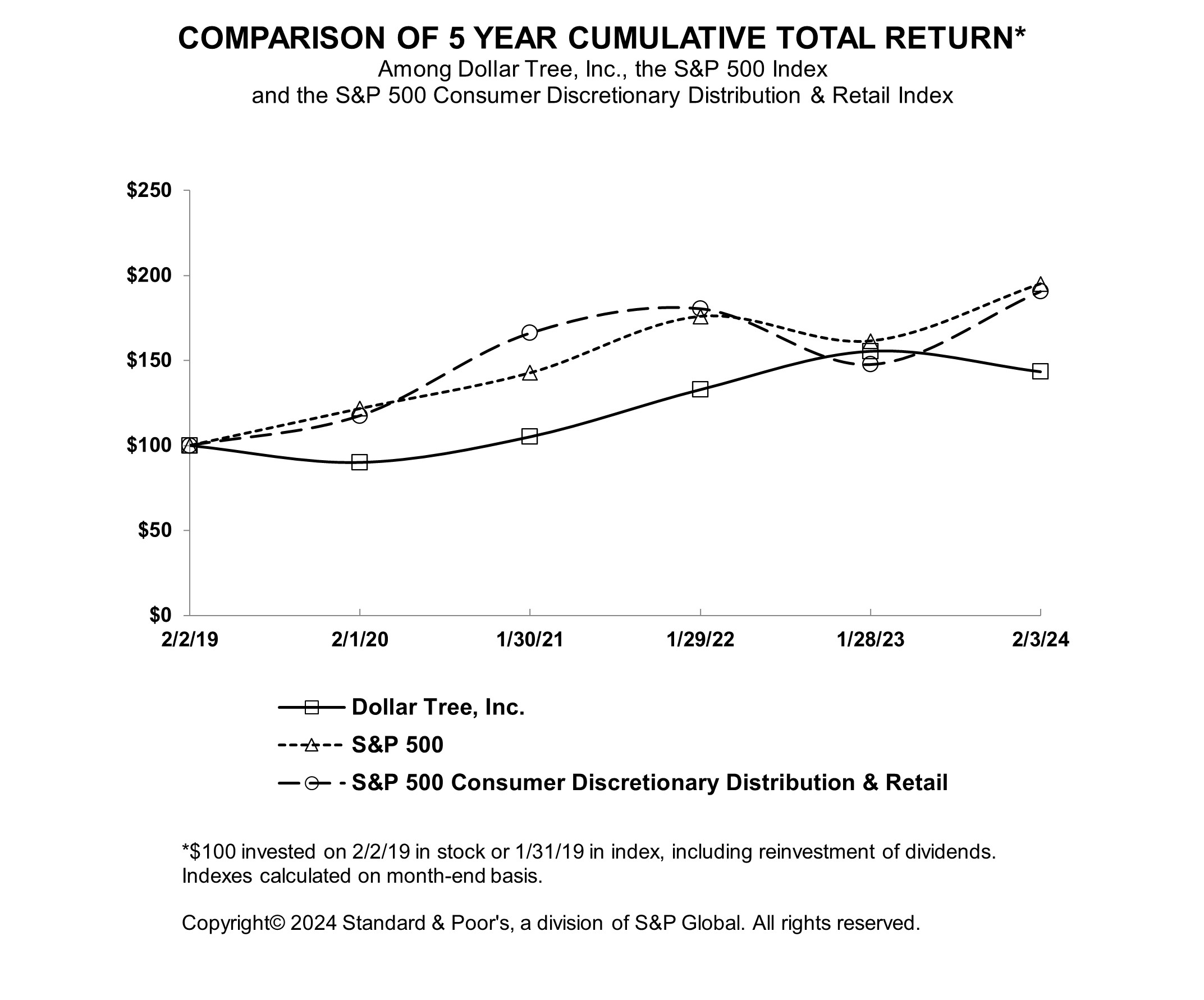
| Year Ended | ||||||||||||||||||||
| February 2, 2019 | February 1, 2020 | January 30, 2021 | January 29, 2022 | January 28, 2023 | February 3, 2024 | |||||||||||||||
| Dollar Tree, Inc. | $ | 100.00 | $ | 90.05 | $ | 105.14 | $ | 132.89 | $ | 155.52 | $ | 143.46 | ||||||||
| S&P 500 Index | 100.00 | 121.68 | 142.67 | 175.90 | 161.45 | 195.06 | ||||||||||||||
| S&P 500 Consumer Discretionary Distribution & Retail Index | 100.00 | 117.54 | 166.19 | 180.56 | 147.66 | 190.67 |
Item 6. Reserved
Item 7. Management’s Discussion and Analysis of Financial Condition and Results of Operations
This section of Form 10-K generally discusses fiscal 2023 and fiscal 2022 events and results, and year-to-year comparisons between fiscal 2023 and fiscal 2022. Discussions of fiscal 2021 items and year-to-year comparisons between fiscal 2022 and fiscal 2021 that are not included in this Form 10-K can be found in “Management’s Discussion and Analysis of Financial Condition and Results of Operations” in Part II, Item 7 of our Annual Report on Form 10-K for the fiscal year ended January 28, 2023.
In Management’s Discussion and Analysis, we explain the general financial condition and the results of operations for our company, including, factors that affect our business, analysis of annual changes in certain line items in the consolidated financial statements, performance of each of our operating segments, expenditures incurred for capital projects and sources of funding for future expenditures. As you read Management’s Discussion and Analysis, please refer to our consolidated financial statements and related notes, included in “Item 8. Financial Statements and Supplementary Data” of this Form 10-K.
Overview
We are a leading operator of more than 16,700 retail discount stores and we conduct our operations through two reporting segments. Our Dollar Tree segment is the leading operator of discount variety stores offering merchandise predominantly at the opening price point of $1.25, with additional offerings at $3, $4 and $5 price points. Our Family Dollar segment operates general merchandise retail discount stores providing consumers with a selection of competitively-priced merchandise in convenient neighborhood stores.
Our net sales are derived from the sale of merchandise. Two major factors tend to affect our net sales trends. First is our success at opening new stores. Second is the performance of stores once they are open which can be impacted by a number of factors including operational performance, competition, inflation and changes in the product assortment, pricing, or quality. Sales vary at our existing stores from one year to the next. We refer to this as a change in comparable store net sales, because we include only those stores that are open throughout both of the periods being compared, beginning after the first fifteen months of operation. We include sales from stores expanded, relocated or remodeled during the year in the calculation of comparable store net sales, which has the effect of increasing our comparable store net sales. Stores that have been re-bannered (i.e., Family Dollar stores converted to Dollar Tree stores, or vice versa) are considered to be new stores and are not included in the calculation of the comparable store net sales change until after the first fifteen months of operation under the new brand. Sales that are excluded from the calculation of comparable store net sales are referred to as non-comparable store sales and consist of sales from new stores open fifteen months or less and stores that are closed permanently or expected to be closed for more than 90 days.
Annual Results
Financial highlights for the fiscal year ended February 3, 2024, as compared to the fiscal year ended January 28, 2023, include:
-
Net sales increased 8.0% to $30,581.6 million, due to a 4.6% enterprise-wide comparable store net sales increase and net sales of $1,184.5 million at non-comparable stores. The 53rd week in fiscal 2023 accounted for $559.3 million of the total net sales increase.
-
Gross profit increased 4.3% to $9,309.6 million as a result of our net store growth and the 53rd week. Gross profit, as a percentage of net sales, decreased 110 basis points to 30.4%, primarily due to higher shrink, distribution and markdown costs, partially offset by lower freight costs and occupancy costs. Excluding $86.2 million of distribution and markdown costs related to the store portfolio optimization review, gross profit, as a percentage of net sales, decreased 80 basis points.
-
Selling, general and administrative expenses increased $3,514.5 million or 52.5%, primarily due to a $1,069.0 million non-cash goodwill impairment charge, a $950.0 million non-cash trade name impairment charge, a $503.9 million non-cash store asset impairment charge, and $56.7 million in DC 202-related litigation charges. Selling, general and administrative expenses, as a percentage of total revenues, increased 980 basis points to 33.4%. Excluding the impairment and litigation charges noted above, selling, general and administrative expenses, as a percentage of total revenues, increased 125 basis points primarily due to higher store-based payroll expenses, unfavorable development of general liability claims, and higher repairs and maintenance expenses.
-
Operating income (loss) was ($881.8) million and as a percentage of total revenues, decreased 1,080 basis points to (2.9)% primarily due to the current year impairments and litigation charges noted above. Excluding the impairments and litigation charges, the operating income (loss), as a percentage of total revenues, decreased 210 basis points.
-
The effective tax rate decreased to (1.0)% compared to 23.5% in the prior year primarily due to the current year goodwill impairment charge which is not tax deductible.
-
Net income (loss) was ($998.4) million, or ($4.55) per diluted share, compared to $1,615.4 million, or $7.21 per diluted share.
At February 3, 2024, we operated stores in 48 states and the District of Columbia, as well as stores in five Canadian provinces. The average size of stores opened in fiscal 2023 was approximately 9,300 selling square feet for the Dollar Tree segment and 9,360 selling square feet for the Family Dollar segment. A breakdown of store counts and square footage by segment for the years ended February 3, 2024 and January 28, 2023 is as follows:
| Year Ended | |||||||||||||||||||||||||||||||||||
| February 3, 2024 | January 28, 2023 | ||||||||||||||||||||||||||||||||||
| Dollar Tree | Family Dollar | Total | Dollar Tree | Family Dollar | Total | ||||||||||||||||||||||||||||||
| Store Count: | |||||||||||||||||||||||||||||||||||
| Beginning | 8,134 | 8,206 | 16,340 | 8,061 | 8,016 | 16,077 | |||||||||||||||||||||||||||||
| New stores | 333 | 308 | 641 | 131 | 333 | 464 | |||||||||||||||||||||||||||||
| Re-bannered stores | 15 | (15) | — | (5) | 9 | 4 | |||||||||||||||||||||||||||||
| Closings | (67) | (140) | (207) | (53) | (152) | (205) | |||||||||||||||||||||||||||||
| Ending | 8,415 | 8,359 | 16,774 | 8,134 | 8,206 | 16,340 | |||||||||||||||||||||||||||||
| Relocations | 31 | 89 | 120 | 28 | 92 | 120 | |||||||||||||||||||||||||||||
| Selling Square Feet (in millions): | |||||||||||||||||||||||||||||||||||
| Beginning | 70.5 | 61.6 | 132.1 | 69.7 | 59.2 |
Showing the first 8K of 63K characters. Open the full section
Item 7A. Quantitative and Qualitative Disclosures About Market Risk
We are exposed to various types of market risk in the normal course of our business, including the impact of interest rate changes, diesel fuel cost changes and inflation. We may enter into interest rate or diesel fuel swaps to manage exposure to interest rate and diesel fuel price changes. We do not enter into derivative instruments for any purpose other than cash flow hedging and we do not hold derivative instruments for trading purposes.
Interest Rate Risk
Our exposure to interest rate risk relates to our revolving credit facility and borrowings under our commercial paper program. At February 3, 2024, there were no borrowings outstanding under the revolving credit facility or the commercial paper program.
Inflation Risk
The primary inflationary factors impacting our business include changes to the costs of merchandise, transportation (including the cost of diesel fuel), and labor. If these inflationary pressures become significant, we may not be able to fully offset such higher costs through price increases on the Family Dollar banner or through adjustments to our product assortment, improvements in operational efficiencies or increases in our comparable store net sales on the Dollar Tree banner. Our inability or failure to do so could harm our business, financial condition and results of operations.
Item 8. Financial Statements and Supplementary Data
INDEX TO THE CONSOLIDATED FINANCIAL STATEMENTS
Report of Independent Registered Public Accounting Firm
To the Shareholders and Board of Directors
Dollar Tree, Inc.:
Opinion on the Consolidated Financial Statements
We have audited the accompanying consolidated balance sheets of Dollar Tree, Inc. and subsidiaries (the Company) as of February 3, 2024 and January 28, 2023, the related consolidated statements of operations, comprehensive income (loss), shareholders’ equity, and cash flows for each of the years in the three‑year period ended February 3, 2024, and the related notes (collectively, the consolidated financial statements). In our opinion, the consolidated financial statements present fairly, in all material respects, the financial position of the Company as of February 3, 2024 and January 28, 2023, and the results of its operations and its cash flows for each of the years in the three‑year period ended February 3, 2024, in conformity with U.S. generally accepted accounting principles.
We also have audited, in accordance with the standards of the Public Company Accounting Oversight Board (United States) (PCAOB), the Company’s internal control over financial reporting as of February 3, 2024, based on criteria established in Internal Control – Integrated Framework (2013) issued by the Committee of Sponsoring Organizations of the Treadway Commission, and our report dated March 20, 2024 expressed an unqualified opinion on the effectiveness of the Company’s internal control over financial reporting.
Basis for Opinion
These consolidated financial statements are the responsibility of the Company’s management. Our responsibility is to express an opinion on these consolidated financial statements based on our audits. We are a public accounting firm registered with the PCAOB and are required to be independent with respect to the Company in accordance with the U.S. federal securities laws and the applicable rules and regulations of the Securities and Exchange Commission and the PCAOB.
We conducted our audits in accordance with the standards of the PCAOB. Those standards require that we plan and perform the audit to obtain reasonable assurance about whether the consolidated financial statements are free of material misstatement, whether due to error or fraud. Our audits included performing procedures to assess the risks of material misstatement of the consolidated financial statements, whether due to error or fraud, and performing procedures that respond to those risks. Such procedures included examining, on a test basis, evidence regarding the amounts and disclosures in the consolidated financial statements. Our audits also included evaluating the accounting principles used and significant estimates made by management, as well as evaluating the overall presentation of the consolidated financial statements. We believe that our audits provide a reasonable basis for our opinion.
Critical Audit Matters
The critical audit matters communicated below are matters arising from the current period audit of the consolidated financial statements that were communicated or required to be communicated to the audit committee and that: (1) relate to accounts or disclosures that are material to the consolidated financial statements and (2) involved our especially challenging, subjective, or complex judgments. The communication of critical audit matters does not alter in any way our opinion on the consolidated financial statements, taken as a whole, and we are not, by communicating the critical audit matters below, providing separate opinions on the critical audit matters or on the accounts or disclosures to which they relate.
Evaluation of estimated self-insurance liability
As discussed in Note 2 to the consolidated financial statements, the Company considers actuarial assumptions to estimate its self-insurance liability. As of February 3, 2024, the Company recorded an estimated liability of $363.5 million.
We identified the evaluation of the estimated self-insurance liability as a critical audit matter. The estimation process involves auditor judgment and actuarial expertise to evaluate the actuarial methods and assumptions that are used to estimate future claim payments. Specifically, the evaluation includes the assumptions related to the loss development factors and expected loss rates which are primarily driven by historical claims paid and incurred data.
The following are the primary procedures we performed to address this critical audi
Showing the first 8K of 137K characters. Open the full section
Item 9. Changes in and Disagreements With Accountants on Accounting and Financial Disclosure
None.
Item 9A. Controls and Procedures
Evaluation of Disclosure Controls and Procedures
We maintain disclosure controls and procedures that are designed to ensure that information required to be disclosed in our reports under the Securities Exchange Act of 1934 (“Exchange Act”) is recorded, processed, summarized and reported within the time periods specified in the rules and forms of the Securities and Exchange Commission, and that such information is accumulated and communicated to our management, including our Chief Executive Officer and Chief Financial Officer, as appropriate, to allow timely decisions regarding required disclosure. In designing and evaluating the disclosure controls and procedures, we recognize that any controls and procedures, no matter how well designed and operated, can provide only reasonable assurance of achieving the desired control objectives, and management necessarily is required to apply our judgment in evaluating the cost-benefit relationship of possible controls and procedures.
Our management has carried out, with the participation of our Chief Executive Officer and Chief Financial Officer, an evaluation of the effectiveness of our disclosure controls and procedures, as defined in Rule 13a-15(e) under the Exchange Act as of the end of the period covered by this report. Based upon this evaluation, our Chief Executive Officer and our Chief Financial Officer concluded that, as of February 3, 2024, our disclosure controls and procedures were designed and functioning effectively to provide reasonable assurance that information required to be disclosed by us in reports that we file or submit under the Exchange Act is (i) recorded, processed, summarized and reported within the time periods specified in Securities and Exchange Commission rules and forms and (ii) accumulated and communicated to our management, including the Chief Executive Officer and Chief Financial Officer, as appropriate to allow timely decisions regarding disclosure.
Management’s Report on Internal Control over Financial Reporting
Our management is responsible for establishing and maintaining adequate internal control over financial reporting, as defined in Exchange Act Rule 13a-15(f). Our management conducted an assessment of our internal control over financial reporting based on the framework established by the Committee of Sponsoring Organizations of the Treadway Commission in Internal Control - Integrated Framework (2013). Based on this assessment, our management has concluded that, as of February 3, 2024, our internal control over financial reporting is effective.
Our independent registered public accounting firm, KPMG LLP, has audited our consolidated financial statements and has issued an attestation report on the effectiveness of our internal control over financial reporting. Their report appears below.
Changes in Internal Controls
We are undergoing a multi-year technology transformation which includes updating our core merchandise, warehouse management, point-of-sale, and human capital management systems. These updates are expected to continue over the next few years and management will continue to evaluate the design and implementation of our internal controls over financial reporting as the transformation continues. There have been no changes in our internal control over financial reporting during the fiscal quarter ended February 3, 2024 that have materially affected, or are reasonably likely to materially affect, our internal control over financial reporting.
Report of Independent Registered Public Accounting Firm
To the Shareholders and Board of Directors
Dollar Tree, Inc.:
Opinion on Internal Control Over Financial Reporting
We have audited Dollar Tree, Inc. and subsidiaries’ (the Company) internal control over financial reporting as of February 3, 2024, based on criteria established in Internal Control – Integrated Framework (2013) issued by the Committee of Sponsoring Organizations of the Treadway Commission. In our opinion, the Company maintained, in all material respects, effective internal control over financial reporting as of February 3, 2024, based on criteria established in Internal Control – Integrated Framework (2013) issued by the Committee of Sponsoring Organizations of the Treadway Commission.
We also have audited, in accordance with the standards of the Public Company Accounting Oversight Board (United States) (PCAOB), the consolidated balance sheets of the Company as of February 3, 2024 and January 28, 2023, the related consolidated statements of operations, comprehensive income (loss), shareholders’ equity, and cash flows for each of the years in the three‑year period ended February 3, 2024, and the related notes (collectively, the consolidated financial statements), and our report dated March 20, 2024 expressed an unqualified opinion on those consolidated financial statements.
Basis for Opinion
The Company’s management is responsible for maintaining effective internal control over financial reporting and for its assessment of the effectiveness of internal control over financial reporting, included in the accompanying Management’s Report on Internal Control over Financial Reporting. Our responsibility is to express an opinion on the Company’s internal control over financial reporting based on our audit. We are a public accounting firm registered with the PCAOB and are required to be independent with respect to the Company in accordance with the U.S. federal securities laws and the applicable rules and regulations of the Securities and Exchange Commission and the PCAOB.
We conducted our audit in accordance with the standards of the PCAOB. Those standards require that we plan and perform the audit to obtain reasonable assurance about whether effective internal control over financial reporting was maintained in all material respects. Our audit of internal control over financial reporting included obtaining an understanding of internal control over financial reporting, assessing the risk that a material weakness exists, and testing and evaluating the design and operating effectiveness of internal control based on the assessed risk. Our audit also included performing such other procedures as we considered necessary in the circumstances. We believe that our audit provides a reasonable basis for our opinion.
Definition and Limitations of Internal Control Over Financial Reporting
A company’s internal control over financial reporting is a process designed to provide reasonable assurance regarding the reliability of financial reporting and the preparation of financial statements for external purposes in accordance with generally accepted accounting principles. A company’s internal control over financial reporting includes those policies and procedures that (1) pertain to the maintenance of records that, in reasonable detail, accurately and fairly reflect the transactions and dispositions of the assets of the company; (2) provide reasonable assurance that transactions are recorded as necessary to permit preparation of financial statements in accordance with generally accepted accounting principles, and that receipts and expenditures of the company are being made only in accordance with authorizations of management and directors of the company; and (3) provide reasonable assurance regarding prevention or timely detection of unauthorized acquisition, use, or disposition of the company’s assets that could have a material effect on the financial statements.
Because of its inherent limitations, internal control over financial reporting may not prevent or detect misstatements. Also, projections of any evaluation of effectiveness to future periods are subject to the risk that controls may become inadequate because of changes in conditions, or that the degree of compliance with the policies or procedures may deteriorate.
/s/ KPMG LLP
Virginia Beach, Virginia
March 20, 2024
Item 9B. Other Information
Rule 10b5-1 Plan and Non-Rule 10b5-1 Trading Arrangement Adoptions, Terminations, and Modifications
During the fiscal quarter ended February 3, 2024, none of our directors or officers (as defined in Rule 16a-1(f) of the Securities Exchange Act of 1934) adopted or terminated a Rule 10b5-1 trading arrangement or non-Rule 10b5-1 trading arrangement (as such terms are defined in Item 408(a) of Regulation S-K).
Item 9C. Disclosure Regarding Foreign Jurisdictions that Prevent Inspections.
Not Applicable.
PART III
Item 10. Directors, Executive Officers and Corporate Governance
The information concerning our directors and executive officers required by this Item is incorporated by reference to Dollar Tree, Inc.’s Proxy Statement relating to our 2024 Annual Meeting (“Proxy Statement”), under the captions “Biographies of Director Nominees” and “Information about our Executive Officers.”
To the extent disclosure of any delinquent report under Section 16(a) of the Securities Exchange Act of 1934 is made by us, such disclosure will be set forth under the caption “Delinquent Section 16(a) Reports” in our Proxy Statement, which is incorporated herein by reference.
The information concerning our audit committee and audit committee financial experts required by this Item is incorporated herein by reference to the Proxy Statement, under the caption “Corporate Governance and Our Board.”
The information concerning our code of ethics required by this Item is incorporated by reference to the Proxy Statement, under the caption “Corporate Governance and Our Board - Code of Business Conduct.”
Item 11. Executive Compensation
Information set forth in the Proxy Statement under the captions “Compensation Committee Report on Executive Compensation,” “Compensation Discussion and Analysis,” “Annual Compensation of Executive Officers,” “Pay Ratio Disclosure,” and “Director Compensation” is incorporated herein by reference.
Item 12. Security Ownership of Certain Beneficial Owners and Management and Related Stockholder Matters
Equity Compensation Plans
The following table summarizes information regarding shares issuable as of February 3, 2024, under our equity compensation plans, including the number of shares of common stock subject to options, restricted stock units, deferred shares and other rights granted to employees and members of our Board of Directors; the weighted-average exercise price of outstanding options; and the number of shares remaining available for future award grants under these plans. Additional information regarding our equity compensation plans can be found in Note 10 to our consolidated financial statements.
| Equity compensation plan category | (a) Number of securities to be issued upon exercise of outstanding options, warrants and rights | (b) Weighted-average exercise price of outstanding options, warrants and rights | (c) Number of securities remaining available for future issuance under equity compensation plans (excluding securities reflected in column (a)) | |||||||||||||||||
| Plans approved by security holders1 | 1,130,635 | $ | 134.52 | 7,478,960 | ||||||||||||||||
| Plans not approved by security holders2 | 2,252,587 | $ | 157.17 | — |
(a)Amounts represent outstanding options, restricted stock units and deferred (“phantom”) shares as of February 3, 2024.
(b)Not included in the calculation of weighted-average exercise price are (i) 999,563 restricted stock units and (ii) 35,925 director deferred shares.
(c)The 7,478,960 shares remaining available for future issuance under our equity-based plans approved by security holders includes 5,065,680 shares remaining under our 2021 Omnibus Incentive Plan and 2,413,280 shares remaining under our 2015 Employee Stock Purchase Plan.
1Equity-based plans approved by our shareholders include: the 2015 Employee Stock Purchase Plan (which replaced a predecessor plan) and the 2021 Omnibus Incentive Plan (which replaced the 2011 Omnibus Incentive Plan). As of March 17, 2021, the 2011 Omnibus Incentive Plan was no longer available for new grants of awards, but all outstanding awards that were granted under the plan prior to March 17, 2021 continue to be governed by the terms and conditions of the plan and applicable award agreements. Effective June 30, 2023, the 2013 Director Deferred Compensation Plan expired. All amounts deferred by directors under the plan on or before June 30, 2023 continue to be administered in accordance with the terms of the plan and applicable deferral elections. Effective July 1, 2023, our directors are permitted to defer all or a portion of fees earned for their service as a director under our Non-Employee Director Deferred Compensation Program, which operates in conjunction with, and under the authority of, the 2021 Omnibus Incentive Plan.
2In connection with our employment of Richard W. Dreiling as Executive Chairman of the Board in March 2022, Mr. Dreiling was granted a one-time award of options to purchase 2,252,587 shares of company common stock as an employment inducement grant within the meaning of Rule 5635(c)(4) of the NASDAQ Listing Rules. The amount shown in the table does not include 12,368 shares to be issued upon the exercise of options with a weighted-average exercise price of $77.01 that were granted under the Family Dollar 2006 Incentive Plan and assumed by us in connection with our merger with Family Dollar.
Information set forth in the Proxy Statement under the caption “Ownership of Common Stock,” with respect to security ownership of certain beneficial owners and management, is incorporated herein by reference.
Item 13. Certain Relationships and Related Transactions, and Director Independence
Information set forth in the Proxy Statement under the caption “Certain Relationships and Related Transactions,” is incorporated herein by reference.
The information concerning the independence of our directors required by this Item is incorporated by reference to the Proxy Statement under the caption “Board Governance - Independence.”
Item 14. Principal Accountant Fees and Services
Information set forth in the Proxy Statement under the caption “Ratification of Appointment of Independent Auditors,” is incorporated herein by reference.
PART IV
Item 15. Exhibit and Financial Statement Schedules
1.Documents filed as part of this report**:**
1.Financial Statements. Reference is made to the Index to the Consolidated Financial Statements set forth under Part II, Item 8 of this Form 10-K.
- Financial Statement Schedules. All schedules for which provision is made in the applicable accounting regulations of the Securities and Exchange Commission are not required under the related instructions, are not applicable, or the information is included in the consolidated financial statements and notes thereto, and therefore have been omitted.
3.Exhibits. The following exhibits are filed as part of, or incorporated by reference into, this report.
| Incorporated by Reference | ||||||||||||||||||||||||||||||||
| Exhibit | Exhibit Description | Form | Exhibit | Filing Date | Filed Herewith | |||||||||||||||||||||||||||
| 3.1 | Amended and Restated Articles of Incorporation of Dollar Tree, Inc., effective October 14, 2022 | 10-Q | 3.1 | 11/22/2022 | ||||||||||||||||||||||||||||
| 3.2 | Amended and Restated By-Laws of Dollar Tree, Inc., effective September 19, 2023 | 8-K | 3.1 | 9/20/2023 | ||||||||||||||||||||||||||||
| 4.1 | Form of Common Stock Certificate | 8-K | 4.1 | 3/13/2008 | ||||||||||||||||||||||||||||
| 4.2.1 | Indenture, dated as of April 2, 2018, between Dollar Tree, Inc., as issuer, and U.S. Bank National Association, as trustee | S-3 ASR | 4.1 | 4/2/2018 | ||||||||||||||||||||||||||||
| 4.2.2 | First Supplemental Indenture, dated as of April 19, 2018, between Dollar Tree, Inc. and U.S. Bank National Association, as trustee | 8-K | 4.1 | 4/20/2018 | ||||||||||||||||||||||||||||
| 4.2.3 | Second Supplemental Indenture, dated as of December 1, 2021, between Dollar Tree, Inc. and U.S. Bank National Association, as trustee | 8-K | 4.1 | 12/1/2021 |
| Incorporated by Reference | ||||||||||||||||||||||||||||||||
| Exhibit | Exhibit Description | Form | Exhibit | Filing Date | Filed Herewith | |||||||||||||||||||||||||||
| 101 | The following financial statements from our Form 10-K for the fiscal year ended February 3, 2024, formatted in Inline XBRL: (i) Consolidated Statements of Operations, (ii) Consolidated Statements of Comprehensive Income (Loss), (iii) Consolidated Balance Sheets, (iv) Consolidated Statements of Shareholders’ Equity, (v) Consolidated Statements of Cash Flows and (vi) Notes to Consolidated Financial Statements | X | ||||||||||||||||||||||||||||||
| 104 | The cover page from our Form 10-K for the fiscal year ended February 3, 2024, formatted in Inline XBRL and contained in Exhibit 101 | X | ||||||||||||||||||||||||||||||
| *Management contract or compensatory plan or arrangement |
Item 16. Form 10-K Summary
None.
SIGNATURES
Pursuant to the requirements of Section 13 or 15(d) of the Securities Exchange Act of 1934, the registrant has duly caused this report to be signed on its behalf by the undersigned, thereunto duly authorized.
| DOLLAR TREE, INC. | ||||||||
| (Registrant) | ||||||||
| March 20, 2024 | By: /s/ Richard W. Dreiling | |||||||
| Date | Richard W. Dreiling | |||||||
| Chairman and Chief Executive Officer | ||||||||
| (Principal Executive Officer) | ||||||||
| March 20, 2024 | By: /s/ Jeffrey A. Davis | |||||||
| Date | Jeffrey A. Davis | |||||||
| Chief Financial Officer | ||||||||
| (Principal Financial Officer) | ||||||||
| March 20, 2024 | By: /s/ Aditya Maheshwari | |||||||
| Date | Aditya Maheshwari | |||||||
| Senior Vice President - Chief Accounting Officer | ||||||||
| (Principal Accounting Officer) |
Pursuant to the requirements of the Securities Exchange Act of 1934, this report has been signed below by the following persons on behalf of the registrant and in the capacities and on the dates indicated. Each of the directors of the registrant whose signature appears below hereby appoints Jeffrey A. Davis, Aditya Maheshwari, and Jonathan B. Leiken, and each of them severally, as his or her attorney-in-fact to sign in his or her name and behalf, in any and all capacities stated below, and to file with the Securities and Exchange Commission any and all amendments to this report, making such changes in this report as appropriate, and generally to do all such things on their behalf in their capacities as directors and/or officers to enable the registrant to comply with the provisions of the Securities Exchange Act of 1934, and all requirements of the Securities and Exchange Commission.
| /s/ Richard W. Dreiling | Chairman and Chief Executive Officer | March 20, 2024 | ||||||
| Richard W. Dreiling | (Principal Executive Officer) | Date | ||||||
| /s/ Paul C. Hilal | Vice Chairman | March 20, 2024 | ||||||
| Paul C. Hilal | Date | |||||||
| /s/ Edward J. Kelly, III | Lead Independent Director | March 20, 2024 | ||||||
| Edward J. Kelly, III | Date | |||||||
| /s/ Cheryl W. Grisé | Director | March 20, 2024 | ||||||
| Cheryl W. Grisé | Date | |||||||
| /s/ Daniel J. Heinrich | Director | March 20, 2024 | ||||||
| Daniel J. Heinrich | Date | |||||||
| /s/ Mary A. Laschinger | Director | March 20, 2024 | ||||||
| Mary A. Laschinger | Date | |||||||
| /s/ Jeffrey G. Naylor | Director | March 20, 2024 | ||||||
| Jeffrey G. Naylor | Date | |||||||
| /s/ Winnie Y. Park | Director | March 20, 2024 | ||||||
| Winnie Y. Park | Date | |||||||
| /s/ Diane E. Randolph | Director | March 20, 2024 | ||||||
| Diane E. Randolph | Date | |||||||
| /s/ Bertram L. Scott | Director | March 20, 2024 | ||||||
| Bertram L. Scott | Date | |||||||
| /s/ Stephanie P. Stahl | Director | March 20, 2024 | ||||||
| Stephanie P. Stahl | Date |