 filings.tools
Healthpeak Properties 10-K 2017-12-31
Filed 2018-02-13. 22 sections, 732K characters. Original on sec.gov · Markdown · JSON
Cover and table of contents
10-K 1 hcp10-k12312017.htm 10-K
UNITED STATES
SECURITIES AND EXCHANGE COMMISSION
Washington, D.C. 20549
FORM 10-K
(Mark One)
| ☒ | ANNUAL REPORT PURSUANT TO SECTION 13 OR 15(d) OF THE SECURITIES EXCHANGE ACT OF 1934. |
For the fiscal year ended December 31, 2017
or
| ☐ | TRANSITION REPORT PURSUANT TO SECTION 13 OR 15(d) OF THE SECURITIES EXCHANGE ACT OF 1934 |
For the transition period from to
Commission file number 001-08895
HCP, Inc.
(Exact name of registrant as specified in its charter)
| Maryland | 33-0091377 | |
| (State or other jurisdiction of incorporation or organization) | (I.R.S. Employer Identification No.) | |
| 1920 Main Street, Suite 1200 Irvine, California | 92614 (Zip Code) | |
| (Address of principal executive offices) |
Registrant’s telephone number, including area code (949) 407-0700
Securities registered pursuant to Section 12(b) of the Act:
| Title of each class | Name of each exchange on which registered | |
| Common Stock | New York Stock Exchange |
Indicate by check mark if the registrant is a well-known seasoned issuer, as defined in Rule 405 of the Securities Act. Yes ☒ No ☐
Indicate by check mark if the registrant is not required to file reports pursuant to Section 13 or Section 15(d) of the Act. Yes ☐ No ☒
Indicate by check mark whether the registrant; (1) has filed all reports required to be filed by Section 13 or 15(d) of the Securities Exchange Act of 1934 during the preceding 12 months (or for such shorter period that the registrant was required to file such reports), and (2) has been subject to such filing requirements for the past 90 days. Yes ☒ No ☐
Indicate by check mark whether the registrant has submitted electronically and posted on its corporate Web site, if any, every Interactive Data File required to be submitted and posted pursuant to Rule 405 of Regulation S-T (§232.405 of this chapter) during the preceding 12 months (or for such shorter period that the registrant was required to submit and post such files). Yes ☒ No ☐
Indicate by check mark if disclosure of delinquent filers pursuant to Item 405 of Regulation S-K (§ 229.405 of this chapter) is not contained herein, and will not be contained, to the best of registrant’s knowledge, in definitive proxy or information statements incorporated by reference in Part III of this Form 10-K or any amendment to this Form 10-K. ☒
Indicate by check mark whether the registrant is a large accelerated filer, an accelerated filer, a non-accelerated filer, a smaller reporting company or an emerging growth company. See the definitions of “large accelerated filer,” “accelerated filer”, “smaller reporting company” and "emerging growth company" in Rule 12b-2 of the Exchange Act. (check one):
| Large accelerated filer ☒ | Accelerated filer ☐ | Non-accelerated filer ☐ (Do not check if a smaller reporting company) | Smaller reporting company ☐ | Emerging growth company ☐ |
If an emerging growth company, indicate by check mark if the registrant has elected not to use the extended transition period for complying with any new or revised financial accounting standards provided pursuant to Section 13(a) of the Exchange Act. ☐
Indicate by check mark whether the registrant is a shell company (as defined by Rule 12b-2 of the Act.) Yes ☐ No ☒
State the aggregate market value of the voting and non-voting common equity held by non-affiliates computed by reference to the price at which the common equity was last sold, or the average bid and asked price of such common equity, as of the last business day of the registrant’s most recently completed second fiscal quarter: $12.8 billion.
As of January 31, 2018 there were 469,443,487 shares of common stock outstanding.
DOCUMENTS INCORPORATED BY REFERENCE
Portions of the definitive Proxy Statement for the registrant’s 2018 Annual Meeting of Stockholders have been incorporated by reference into Part III of this Report.
HCP, Inc.
Form 10-K
For the Fiscal Year Ended December 31, 2017
Table of Contents
All references in this report to “HCP,” the “Company,” “we,” “us” or “our” mean HCP, Inc., together with its consolidated subsidiaries. Unless the context suggests otherwise, references to “HCP, Inc.” mean the parent company without its subsidiaries.
Cautionary Language Regarding Forward-Looking Statements
Statements in this Annual Report on Form 10-K that are not historical factual statements are “forward-looking statements” within the meaning of Section 27A of the Securities Act of 1933, as amended, and Section 21E of the Securities Exchange Act of 1934, as amended. Forward-looking statements include, among other things, statements regarding our and our officers’ intent, belief or expectation as identified by the use of words such as “may,” “will,” “project,” “expect,” “believe,” “intend,” “anticipate,” “seek,” “forecast,” “plan,” “potential,” “estimate,” “could,” “would,” “should” and other comparable and derivative terms or the negatives thereof. Forward-looking statements reflect our current expectations and views about future events and are subject to risks and uncertainties that could significantly affect our future financial condition and results of operations. While forward-looking statements reflect our good faith belief and assumptions we believe to be reasonable based upon current information, we can give no assurance that our expectations or forecasts will be attained. Further, we cannot guarantee the accuracy of any such forward-looking statement contained in this Annual Report, and such forward-looking statements are subject to known and unknown risks and uncertainties that are difficult to predict. As more fully set forth under “Item 1A, Risk Factors” in this report, these risks and uncertainties include, but are not limited to:
| • | our reliance on a concentration of a small number of tenants and operators for a significant percentage of our revenues; |
| • | the financial condition of our existing and future tenants, operators and borrowers, including potential bankruptcies and downturns in their businesses, and their legal and regulatory proceedings, which results in uncertainties regarding our ability to continue to realize the full benefit of such tenants’ and operators’ leases and borrowers’ loans; |
| • | the ability of our existing and future tenants, operators and borrowers to conduct their respective businesses in a manner sufficient to maintain or increase their revenues and to generate sufficient income to make rent and loan payments to us and our ability to recover investments made, if applicable, in their operations; |
| • | competition for the acquisition and financing of suitable healthcare properties as well as competition for tenants and operators, including with respect to new leases and mortgages and the renewal or rollover of existing leases; |
| • | our concentration in the healthcare property sector, particularly in senior housing, life sciences and medical office buildings, which makes our profitability more vulnerable to a downturn in a specific sector than if we were investing in multiple industries; |
| • | our ability to identify replacement tenants and operators and the potential renovation costs and regulatory approvals associated therewith; |
| • | the risks associated with property development and redevelopment, including costs above original estimates, project delays and lower occupancy rates and rents than expected; |
| • | the risks associated with our investments in joint ventures and unconsolidated entities, including our lack of sole decision making authority and our reliance on our partners’ financial condition and continued cooperation; |
| • | our ability to achieve the benefits of acquisitions or other investments within expected time frames or at all, or within expected cost projections; |
| • | the potential impact on us and our tenants, operators and borrowers from current and future litigation matters, including the possibility of larger than expected litigation costs, adverse results and related developments; |
| • | operational risks associated with third party management contracts, including the additional regulation and liabilities of our RIDEA lease structures; |
| • | the effect on us and our tenants and operators of legislation, executive orders and other legal requirements, including compliance with the Americans with Disabilities Act, fire, safety and health regulations, environmental laws, the Affordable Care Act, licensure, certification and inspection requirements, and laws addressing entitlement programs and related services, including Medicare and Medicaid, which may result in future reductions in reimbursements or fines for noncompliance; |
| • | changes in federal, state or local laws and regulations, including those affecting the healthcare industry that affect our costs of compliance or increase the costs, or otherwise affect the operations, of our tenants and operators; |
| • | our ability to foreclose on collateral securing our real estate-related loans; |
| • | volatility or uncertainty in the capital markets, the availability and cost of capital as impacted by interest rates, changes in our credit ratings, and the value of our common stock, and other conditions that may adversely impact our ability to fund our obligations or consummate transactions, or reduce the earnings from potential transactions; |
| • | changes in global, national and local economic and other conditions, including currency exchange rates; |
| • | our ability to manage our indebtedness level and changes in the terms of such indebtedness; |
| • | competition for skilled management and other key personnel; |
| • | the potential impact of uninsured or underinsured losses; |
| • | our reliance on information technology systems and the potential impact of system failures, disruptions or breaches; and |
| • | our ability to maintain our qualification as a real estate investment trust. |
Except as required by law, we do not undertake, and hereby disclaim, any obligation to update any forward-looking statements, which speak only as of the date on which they are made.
PART I
Item 1. Business
General Overview
HCP, an S&P 500 company, invests primarily in real estate serving the healthcare industry in the United States (“U.S.”). We are a Maryland corporation organized in 1985 and qualify as a self-administered real estate investment trust (“REIT”). We are headquartered in Irvine, California, with offices in Nashville and San Francisco. Our diverse portfolio is comprised of investments in the following reportable healthcare segments: (i) senior housing triple-net, (ii) senior housing operating portfolio (“SHOP”), (iii) life science and (iv) medical office. At December 31, 2017, we had 190 full-time employees.
On October 31, 2016, we completed the spin-off (the “Spin-Off”) of Quality Care Properties, Inc. (“QCP”) (NYSE: QCP). The Spin-Off included 338 properties, primarily comprised of the HCR ManorCare, Inc. (“HCRMC”) direct financing lease (“DFL”) investments and an equity investment in HCRMC. QCP is an independent, publicly-traded, self-managed and self-administrated REIT. See Note 5 to the Consolidated Financial Statements for further information on the Spin-Off.
For a description of our significant activities during 2017, see Item 7 in this report.
Business Strategy
We invest and manage our real estate portfolio for the long-term to maximize the benefit to our stockholders and support the growth of our dividends. The core elements of our strategy are: (i) to acquire, develop, lease, own and manage a diversified portfolio of quality healthcare properties across multiple geographic locations and business segments including senior housing, medical office, and life science, among others; (ii) to align ourselves with leading healthcare companies, operators and service providers which, over the long-term, should result in higher relative rental rates, net operating cash flows and appreciation of property values; and (iii) to maintain an investment grade balance sheet with adequate liquidity and long-term fixed rate debt financing with staggered maturities, which supports the longer-term nature of our investments, while reducing our exposure to interest rate volatility and refinancing risk at any point in the interest rate or credit cycles.
Internal Growth Strategies
We believe our real estate portfolio holds the potential for increased future cash flows as it is well-maintained and in desirable locations. Our strategy for maximizing the benefits from these opportunities is to: (i) work with new or existing tenants and operators to address their space and capital needs; and (ii) provide high-quality property management services in order to motivate tenants to renew, expand or relocate into our properties.
We expect to continue our internal growth as a result of our ability to:
| • | Build and maintain long-term leasing and management relationships with quality tenants and operators. In choosing locations for our properties, we focus on their physical environment, adjacency to established businesses (e.g., hospital systems) and educational centers, proximity to sources of business growth and other local demographic factors. |
| • | Replace tenants and operators at the best available market terms and lowest possible transaction costs. We believe that we are well-positioned to attract new tenants and operators and achieve attractive rental rates and operating cash flow as a result of the location, design and maintenance of our properties, together with our reputation for high-quality building services and responsiveness to tenants, and our ability to offer space alternatives within our portfolio. |
| • | Extend and modify terms of existing leases prior to expiration. We structure lease extensions, early renewals or modifications, which reduce the cost associated with lease downtime or the re-investment risk resulting from the exercise of tenants’ purchase options, while securing the tenancy and relationship of our high quality tenants and operators on a long-term basis. |
Investment Strategies
The delivery of healthcare services requires real estate and, as a result, tenants and operators depend on real estate, in part, to maintain and grow their businesses. We believe that the healthcare real estate market provides investment opportunities due to the: (i) compelling long-term demographics driving the demand for healthcare services; (ii) specialized nature of healthcare real estate investing; and (iii) ongoing consolidation of the fragmented healthcare real estate sector.
While we emphasize healthcare real estate ownership, we may also provide real estate secured financing to, or invest in equity or debt securities of, healthcare operators or other entities engaged in healthcare real estate ownership. We may also acquire all or substantially all of the securities or assets of other REITs, operating companies or similar entities where such investments would be consistent with our investment strategies. We may co-invest alongside institutional or development investors through partnerships or limited liability companies.
We monitor, but do not limit, our investments based on the percentage of our total assets that may be invested in any one property type, investment vehicle or geographic location, the number of properties that may be leased to a single tenant or operator, or loans that may be made to a single borrower. In allocating capital, we target opportunities with the most attractive risk/reward profile for our portfolio as a whole. We may take additional measures to mitigate risk, including diversifying our investments (by sector, geography, tenant or operator), structuring transactions as master leases, requiring tenant or operator insurance and indemnifications, and obtaining credit enhancements in the form of guarantees, letters of credit or security deposits.
We believe we are well-positioned to achieve external growth through acquisitions, financing and development. Other factors that contribute to our competitive position include:
| • | our reputation gained through over 30 years of successful operations and the strength of our existing portfolio of properties; |
| • | our relationships with leading healthcare operators and systems, investment banks and other market intermediaries, corporations, private equity firms, non-profits and public institutions seeking to monetize existing assets or develop new facilities; |
| • | our relationships with institutional buyers and sellers of high-quality healthcare real estate; |
| • | our track record and reputation for executing acquisitions responsively and efficiently, which provides confidence to domestic and foreign institutions and private investors who seek to sell healthcare real estate in our market areas; |
| • | our relationships with nationally recognized financial institutions that provide capital to the healthcare and real estate industries; and |
| • | our control of sites (including assets under contract with radius restrictions). |
Financing Strategies
Our REIT qualification requires us to distribute at least 90% of our REIT taxable income (excluding net capital gains); therefore, we don’t retain a significant amount of capital. As a result, we regularly access the public equity and debt markets to raise the funds necessary to finance acquisitions and debt investments, develop and redevelop properties, and refinance maturing debt.
We may finance acquisitions and other investments through the following vehicles:
| • | borrowings under our credit facility; |
| • | issuance or origination of debt, including unsecured notes, term loans and mortgage debt; |
| • | sale of ownership interests in properties or other investments; or |
| • | issuance of common or preferred stock or its equivalent. |
We maintain a disciplined balance sheet by actively managing our debt to equity levels and maintaining multiple sources of liquidity. Our debt obligations are primarily long-term fixed rate with staggered maturities.
We finance our investments based on our evaluation of available sources of funding. For short-term purposes, we may utilize our revolving line of credit facility or arrange for other short-term borrowings from banks or other sources. We arrange for longer-term financing by offering debt and equity securities, placing mortgage debt and obtaining capital from institutional lenders and joint venture partners.
Segments
The following table summarizes our revenues by segment (dollars in thousands):
| Year Ended December 31, | |||||||||||||||||||||
| Segment | 2017 | % | 2016 | % | 2015 | % | |||||||||||||||
| Senior housing triple-net | $ | 313,547 | 17 | $ | 423,118 | 20 | $ | 428,269 | 22 | ||||||||||||
| SHOP | 525,473 | 29 | 686,822 | 32 | 518,264 | 27 | |||||||||||||||
| Life science | 358,816 | 19 | 358,537 | 17 | 342,984 | 18 | |||||||||||||||
| Medical office | 477,459 | 26 | 446,280 | 21 | 415,351 | 21 | |||||||||||||||
| Other non-reportable segments | 173,083 | 9 | 214,537 | 10 | 235,621 | 12 | |||||||||||||||
| Total revenues | $ | 1,848,378 | 100 | $ | 2,129,294 | 100 | $ | 1,940,489 | 100 |
Senior housing (triple-net and SHOP). Our senior housing facilities are managed utilizing triple-net leases and RIDEA structures, which are permitted by the Housing and Economic Recovery Act of 2008 (commonly referred to as “RIDEA”), and include independent living facilities (“ILFs”), assisted living facilities (“ALFs”), and memory care facilities (“MCFs”), and continuing care retirement communities ("CCRCs") which cater to different segments of the elderly population based upon their personal needs. Services provided by our tenants or operators in these facilities are primarily paid for by the residents directly or through private insurance and are less reliant on government reimbursement programs such as Medicare and Medicaid.
We have entered into long-term agreements with operators to manage properties under a RIDEA structure. Under the provisions of RIDEA, a REIT may lease a “qualified healthcare property” on an arm’s length basis to a taxable REIT subsidiary (“TRS”), if the property is managed on behalf of such subsidiary by a person who qualifies as an “eligible independent contractor.” RIDEA structures allow us to own the risks and rewards of the operations of healthcare facilities (as compared to leasing the property for contractual triple-net rents) in a tax efficient manner. We view RIDEA as a structure primarily to be used on properties that present attractive valuation entry points and/or growth profiles by: (i) transitioning the asset to a new operator that can bring scale, operating efficiencies, and/or ancillary services; or (ii) investing capital to reposition the asset. Our operators provide comprehensive facility management and accounting services for a majority of our senior housing RIDEA properties, for which we pay annual management fees pursuant to the aforementioned agreements. Most of the management agreements have terms ranging from 10 to 15 years, with three to four 5-year renewals. The base management fees are 4.5% to 5.0% of gross revenues (as defined) generated by the RIDEA facilities. In addition, there are incentive management fees payable to our operators if operating results of the RIDEA properties exceed pre-established EBITDAR (defined as earnings before interest, taxes, depreciation and amortization, and rent) thresholds.
Our senior housing property types under both triple-net leases and RIDEA structures are further described below:
| • | Independent Living Facilities. ILFs are designed to meet the needs of seniors who choose to live in an environment surrounded socially by their peers with services such as housekeeping, meals and activities. Additionally, the programs and services may include transportation, social activities, exercise and fitness programs, beauty or barber shop access, hobby and craft activities, community excursions, meals in a dining room setting and other activities sought by residents. These residents generally do not need assistance with activities of daily living (“ADL”). However, in some of our facilities, residents have the option to contract for these services. |
| • | Assisted Living Facilities. ALFs are licensed care facilities that provide personal care services, support and housing for those who need help with ADL, such as bathing, eating, dressing and medication management, yet require limited medical care. These facilities are often in apartment-like buildings with private residences ranging from single rooms to large apartments. Certain ALFs may have a dedicated portion of a facility that offers higher levels of personal assistance for residents requiring memory care as a result of Alzheimer’s disease or other forms of dementia. Levels of personal assistance are based in part on local regulations. |
| • | Memory Care Facilities. MCFs address the unique challenges of our residents with Alzheimer’s disease or other forms of dementia. Residents may live in semi-private apartments or private rooms and have structured activities delivered by staff members trained specifically on how to care for residents with memory impairment. These facilities offer programs that provide comfort and care in a secure environment. |
| • | Continuing Care Retirement Communities. CCRCs offer several levels of service, including independent living, assisted living and nursing home care. CCRCs are different from other housing and care options for seniors because they usually provide written agreements or long-term contracts between residents and the communities (frequently lasting the term of the |
resident’s lifetime), which offer a continuum of housing, services and healthcare on one campus or site. CCRCs are appealing as they allow residents to “age in place.” CCRCs typically require the individual to be in relatively good health and independent upon entry.
The following table provides information about our senior housing triple-net tenant concentration for the year ended December 31, 2017:
| Tenant | Percentage of Segment Revenues | Percentage of Total Revenues | ||||
| Brookdale Senior Living, Inc. (“Brookdale”)(1) | 47 | % | 8 | % |
| (1) | Excludes facilities operated by Brookdale in our SHOP segment, as discussed below. Our concentration with respect to Brookdale as a tenant is expected to decrease with the completion of the transaction with Brookdale (see Note 3 in the Consolidated Financial Statements for additional information). |
As of December 31, 2017, Brookdale operated, in our SHOP segment, approximately 13% of our real estate investments based on total assets. Our concentration with respect to Brookdale as an operator in our SHOP segment is expected to decrease with the completion of the transaction with Brookdale (see Note 3 in the Consolidated Financial Statements for additional information) and the sale of our remaining 40% ownership interest in RIDEA II (see Note 5 in the Consolidated Financial Statements for additional information). Because operators manage our facilities in exchange for the receipt of a management fee, we are not directly exposed to the credit risk of the operators in the same manner or to the same extent as our triple-net tenants. However, adverse developments in their business and affairs or financial condition could impair their ability to efficiently and effectively manage our facilities.
Life science. These properties contain laboratory and office space primarily for biotechnology, medical device and pharmaceutical companies, scientific research institutions, government agencies and other organizations involved in the life science industry. While these properties have characteristics similar to commercial office buildings, they generally contain more advanced electrical, mechanical, and heating, ventilating and air conditioning (“HVAC”) systems. The facilities generally have specialty equipment including emergency generators, fume hoods, lab bench tops and related amenities. In many instances, life science tenants make significant investments to improve their leased space, in addition to landlord improvements, to accommodate biology, chemistry or medical device research initiatives.
Life science properties are primarily configured in business park or campus settings and include multiple buildings. The business park and campus settings allow us the opportunity to provide flexible, contiguous/adjacent expansion to accommodate the growth of existing tenants. Our properties are located in well-established geographical markets known for scientific research and drug discovery, including San Francisco (63%) and San Diego (25%), California, Boston, Massachusetts, and Durham, North Carolina (based on square feet). At December 31, 2017, 93% of our life science properties were triple-net leased (based on leased square feet).
The following table provides information about our life science tenant concentration for the year ended December 31, 2017:
| Tenants | Percentage of Segment Revenues | Percentage of Total Revenues | ||||
| Amgen, Inc. | 15 | % | 3 | % | ||
| Google LLC | 10 | % | 2 | % |
Medical office. Medical office buildings (“MOBs”) typically contain physicians’ offices and examination rooms, and may also include pharmacies, hospital ancillary service space and outpatient services such as diagnostic centers, rehabilitation clinics and day-surgery operating rooms. While these facilities are similar to commercial office buildings, they require additional plumbing, electrical and mechanical systems to accommodate multiple exam rooms that may require sinks in every room, and special equipment such as x-ray machines. In addition, MOBs are often built to accommodate higher structural loads for certain equipment and may contain vaults or other specialized construction. Our MOBs are typically multi-tenant properties leased to healthcare providers (hospitals and physician practices), with approximately 81% of our MOBs, based on square feet, located on hospital campuses and 94% affiliated with hospital systems. Occasionally, we invest in MOBs located on hospital campuses, which may be subject to ground leases. At December 31, 2017, approximately 54% of our medical office buildings were net leased (based on leased square feet) with the remaining leased under gross or modified gross leases.
The following table provides information about our medical office tenant concentration for the year ended December 31, 2017:
| Tenant | Percentage of Segment Revenues | Percentage of Total Revenues | ||||
| Hospital Corporation of America ("HCA")(1) | 17 | % | 6 | % |
| (1) | Percentage of total revenues from HCA includes revenues earned from both our medical office and other non-reportable segments. |
Other non-reportable segments. At December 31, 2017, we had interests in 14 hospitals, 61 care homes in the United Kingdom (“U.K.”), one post-acute/skilled nursing facilities (“SNF”) and debt investments. Additionally, we had interests in 72 senior housing facilities, four life science facilities, three MOBs and three SNFs owned and operated by our unconsolidated joint ventures. Services provided by our tenants and operators in hospitals are paid for by private sources, third-party payors (e.g., insurance and HMOs) or through Medicare and Medicaid programs. Our hospital property types include acute care, long-term acute care, and specialty and rehabilitation hospitals. Care homes offer personal care services, such as lodging, meal services, housekeeping and laundry services, medication management and assistance with ADL. Care homes are registered to provide different levels of services, ranging from personal care to nursing care. Some homes can be further registered for a specific care need, such as dementia or terminal illness. SNFs offer restorative, rehabilitative and custodial nursing care for people following a hospital stay or not requiring the more extensive and complex treatment available at hospitals. All of our care homes in the U.K., hospitals and SNFs are triple-net leased.
Competition
Investing in real estate serving the healthcare industry is highly competitive. We face competition from other REITs, investment companies, pension funds, private equity investors, sovereign funds, healthcare operators, lenders, developers and other institutional investors, some of whom may have greater flexibility (e.g., non-REIT competitors), resources and lower costs of capital than we do. Increased competition makes it more challenging for us to identify and successfully capitalize on opportunities that meet our objectives. Our ability to compete may also be impacted by global, national and local economic trends, availability of investment alternatives, availability and cost of capital, construction and renovation costs, existing laws and regulations, new legislation and population trends.
Income from our investments depends on our tenants’ and operators’ ability to compete with other companies on multiple levels, including: the quality of care provided, reputation, success of product or drug development, the physical appearance of a facility, price and range of services offered, alternatives for healthcare delivery, the supply of competing properties, physicians, staff, referral sources, location, the size and demographics of the population in surrounding areas, and the financial condition of our tenants and operators. For a discussion of the risks associated with competitive conditions affecting our business, see “Item 1A, Risk Factors” in this report.
Government Regulation, Licensing and Enforcement
Overview
Our healthcare facility operators (which include our TRSs when we use a RIDEA structure) and tenants are typically subject to extensive and complex federal, state and local healthcare laws and regulations relating to quality of care, licensure and certificate of need, government reimbursement, fraud and abuse practices, and similar laws governing the operation of healthcare facilities, and we expect that the healthcare industry, in general, will continue to face increased regulation and pressure in the areas of fraud, waste and abuse, cost control, healthcare management and provision of services, among others. These regulations are wide ranging and can subject our tenants and operators to civil, criminal and administrative sanctions. Affected tenants and operators may find it increasingly difficult to comply with this complex and evolving regulatory environment because of a relative lack of guidance in many areas as certain of our healthcare properties are subject to oversight from several government agencies, and the laws may vary from one jurisdiction to another. Changes in laws, regulations, reimbursement enforcement activity and regulatory non-compliance by our tenants and operators can all have a significant effect on their operations and financial condition, which in turn may adversely impact us, as detailed below and set forth under “Item 1A, Risk Factors” in this report.
The following is a discussion of certain laws and regulations generally applicable to our operators, and in certain cases, to us.
Fraud and Abuse Enforcement
There are various extremely complex U.S. federal and state laws and regulations (and in relation to our facilities located in the U.K., national laws and regulations of England, Scotland, Northern Ireland, and Wales) governing healthcare providers’ relationships and arrangements and prohibiting fraudulent and abusive practices by such providers. These laws include: (i) U.S. federal and state false claims acts and U.K. anti-fraud legislation and regulation, which, among other things, prohibit providers from filing false claims or making false statements to receive payment from Medicare, Medicaid or other U.S. federal or state or U.K. healthcare programs; (ii) U.S. federal and state anti-kickback and fee-splitting statutes, including the Medicare and Medicaid anti-kickback statute, which prohibit or restrict the payment or receipt of remuneration to induce referrals or recommendations of healthcare items or services, and U.K. legislation and regulations on financial inducements and vested interests; (iii) U.S. federal and state physician self-referral laws (commonly referred to as the “Stark Law”), which generally prohibit referrals by physicians to entities with which the physician or an immediate family member has a financial relationship; and (iv) the federal Civil Monetary Penalties Law, which prohibits, among other things, the knowing presentation of a false or fraudulent claim for certain healthcare services. Violations of U.S. and U.K. healthcare fraud and abuse laws carry civil, criminal and administrative sanctions, including punitive sanctions, monetary penalties, imprisonment, denial of Medicare and Medicaid reimbursement and potential exclusion from Medicare, Medicaid or other federal or state healthcare programs. These laws are enforced by a variety of federal, state and local agencies and in the U.S. can also be enforced by private litigants through, among other things, federal and state false claims acts, which allow private litigants to bring qui tam or “whistleblower” actions. Many of our tenants and operators are subject to these laws, and may become the subject of governmental enforcement actions or whistleblower actions if they fail to comply with applicable laws. Additionally, beginning in November 2019, the licensed operators of our U.S. long-term care facilities will be required to have compliance and ethics programs that meet the requirements of federal regulations. We have begun the process of developing and implementing such programs.
Laws and Regulations Governing Privacy and Security
There are various U.S. federal and state and U.K. privacy laws and regulations, including the privacy and security rules contained in the Health Insurance Portability and Accountability Act of 1996 (commonly referred to as “HIPAA”) and the U.K. Data Protection Act 1998, which provide for the privacy and security of personal health information. An increasing focus of the U. S. Federal Trade Commission’s (“FTC’s”) consumer protection regulation is the impact of technological change on protection of consumer privacy. The FTC has taken enforcement action against companies that do not abide by their representations to consumers regarding electronic security and privacy. To the extent we or our affiliated operating entities are a covered entity or business associate under HIPAA and the Health Information Technology for Economic and Clinical Health Act (the “HITECH Act”), compliance with those requirements would require us to, among other things, conduct a risk analysis, implement a risk management plan, implement policies and procedures, and conduct employee training. In most cases, we are dependent on our tenants and management companies to fulfill our compliance obligations. Because of the far reaching nature of these laws, there can be no assurance that we would not be required to alter one or more of our systems and data security procedures to be in compliance with these laws. Our failure to protect health information could subject us to civil or criminal liability and adverse publicity, and could harm our business and impair our ability to attract new customers and residents. We may be required to notify individuals, as well as government agencies and the media, if we experience a data breach.
Reimbursement
Sources of revenue for some of our tenants and operators include, among others, governmental healthcare programs, such as the federal Medicare programs and state Medicaid programs and, in the U.K., the National Health Service (“NHS”) and local authority funding, and non-governmental third-party payors, such as insurance carriers and HMOs. As federal and state governments focus on healthcare reform initiatives, and as the federal government and many states face significant current and future budget deficits, efforts to reduce costs by these payors will likely continue, which may result in reduced or slower growth in reimbursement for certain services provided by some of our tenants and operators. Similarly, in the U.K., the NHS and the local authorities are undertaking efforts to reduce costs, which may result in reduced or slower growth in reimbursement for certain services provided by our U.K. tenants and operators. Additionally, new and evolving payor and provider programs in the U.S., including but not limited to Medicare Advantage, Dual Eligible, Accountable Care Organizations (“ACO”), and Bundled Payments could adversely impact our tenants’ and operators’ liquidity, financial condition or results of operations.
Healthcare Licensure and Certificate of Need
Certain healthcare facilities in our portfolio (including our facilities located in the U.K.) are subject to extensive national, federal, state and local licensure, certification and inspection laws and regulations. A healthcare facility’s failure to comply with these laws and regulations could result in a revocation, suspension, or non-renewal of the facility’s license, which could adversely affect the facility’s operations and ability to bill for items and services provided at the facility. In addition, various licenses and permits are required to handle controlled substances (including narcotics), operate pharmacies, handle radioactive materials and operate equipment. Many states in the U.S. require certain healthcare providers to obtain a certificate of need, which requires prior approval for the construction, expansion or closure of certain healthcare facilities. The approval process related to state certificate of need laws may impact the ability of some of our tenants and operators to expand or change their businesses.
Life Science Facilities
While our life science tenants include some well-established companies, other tenants are less established and, in some cases, may not yet have a product approved by the Food and Drug Administration, or other regulatory authorities, for commercial sale. Creating a new pharmaceutical product or medical device requires substantial investments of time and capital, in part because of the extensive regulation of the healthcare industry; it also entails considerable risk of failure in demonstrating that the product is safe and effective and in gaining regulatory approval and market acceptance.
Senior Housing Entrance Fee Communities
Certain of our senior housing facilities, primarily the CCRCs in our unconsolidated joint ventures, are operated as entrance fee communities. Generally, an entrance fee is an upfront fee or consideration paid by a resident, a portion of which may be refundable, in exchange for some form of long-term benefit, typically consisting of a right to receive certain personal or health care services. Some of the entrance fee communities are subject to significant state regulatory oversight, including, for example, oversight of each facility’s financial condition, establishment and monitoring of reserve requirements and other financial restrictions, the right of residents to cancel their contracts within a specified period of time, the right of residents to receive a refund of their entrance fees, lien rights in favor of the residents, restrictions on change of ownership and similar matters.
Americans with Disabilities Act (the “ADA”)
Our properties must comply with the ADA and any similar state or local laws to the extent that such properties are “public accommodations” as defined in those statutes. The ADA may require removal of barriers to access by persons with disabilities in certain public areas of our properties where such removal is readily achievable. To date, we have not received any notices of noncompliance with the ADA that have caused us to incur substantial capital expenditures to address ADA concerns. Should barriers to access by persons with disabilities be discovered at any of our properties, we may be directly or indirectly responsible for additional costs that may be required to make facilities ADA-compliant. Noncompliance with the ADA could result in the imposition of fines or an award of damages to private litigants. The obligation to make readily achievable accommodations pursuant to the ADA is an ongoing one, and we continue to assess our properties and make modifications as appropriate in this respect.
Environmental Matters
A wide variety of federal, state and local environmental and occupational health and safety laws and regulations affect healthcare facility operations. These complex federal and state statutes, and their enforcement, involve a myriad of regulations, many of which involve strict liability on the part of the potential offender. Some of these federal and state statutes may directly impact us. Under various federal, state and local environmental laws, ordinances and regulations, an owner of real property or a secured lender, such as us, may be liable for the costs of removal or remediation of hazardous or toxic substances at, under or disposed of in connection with such property, as well as other potential costs relating to hazardous or toxic substances (including government fines and damages for injuries to persons and adjacent property). The cost of any required remediation, removal, fines or personal or property damages and any related liability therefore could exceed or impair the value of the property and/or the assets. In addition, the presence of such substances, or the failure to properly dispose of or remediate such substances, may adversely affect the value of such property and the owner’s ability to sell or rent such property or to borrow using such property as collateral which, in turn, could reduce our earnings. For a description of the risks associated with environmental matters, see “Item 1A, Risk Factors” in this report.
Insurance
We obtain various types of insurance to mitigate the impact of property, business interruption, liability, flood, windstorm, earthquake, environmental and terrorism related losses. We attempt to obtain appropriate policy terms, conditions, limits and deductibles considering the relative risk of loss, the cost of such coverage and current industry practice. There are, however, certain types of extraordinary losses, such as those due to acts of war or other events that may be either uninsurable or not economically
insurable. In addition, we have a large number of properties that are exposed to earthquake, flood and windstorm occurrences which carry higher deductibles.
We maintain property insurance for all of our properties, primary for our SHOP, life science and medical office segments. Tenants under triple-net leases, primarily in our senior housing triple-net segment, are required to provide primary property, business interruption and liability insurance. We maintain separate general and professional liability insurance for our SHOP facilities. Additionally, our corporate general liability insurance program also extends coverage for all of our properties beyond the aforementioned. We periodically review whether we or our RIDEA operators will bear responsibility for maintaining the required insurance coverage for the applicable SHOP properties, but the costs of such insurance are facility expenses paid from the revenues of those properties, regardless of who maintains the insurance.
See Note 16 to the Consolidated Financial Statements for further information relating to casualty-related losses and recoveries incurred as a result of the hurricanes in the third quarter of 2017.
We also maintain directors and officers liability insurance which provides protection for claims against our directors and officers arising from their responsibilities as directors and officers. Such insurance also extends to us in certain situations.
Sustainability
We believe that sustainability initiatives are a vital part of corporate responsibility, which supports our primary goal of increasing stockholder value through profitable growth. We continue to advance our commitment to sustainability, with a focus on achieving goals in each of the Environmental, Social and Governance (“ESG”) dimensions of sustainability.
Our environmental management programs strive to capture cost efficiencies that ultimately benefit our investors, tenants, operators, employees and other stakeholders, while providing a positive impact on the communities in which we operate. Our social responsibility team leads our local philanthropic and volunteer activities, and our transparent corporate governance initiatives incorporate sustainability as a critical component to achieving our business objectives and properly managing risks.
Our 2017 sustainability achievements include being named an ENERGY STAR Partner of the Year and constituency in the FTSE4Good Index series for the sixth consecutive year. We also earned the Green Star designation from the Global Real Estate Sustainability Benchmark, or GRESB, and were named to the Leadership Band by CDP for outstanding ESG performance. We achieved constituency in the North America Dow Jones Sustainability Index (“DJSI”) for the fifth consecutive year, as well as the World DJSI for the third time. Additionally, we were included in The Sustainability Yearbook 2018, a listing of the world’s most sustainable companies. The list is compiled according to the results of RobecoSAM’s annual Corporate Sustainability Assessment, which also determines constituency for the Dow Jones Sustainability Index (“DJSI”) series. For additional information regarding our ESG sustainability initiatives and our approach to climate change, please visit our website at www.hcpi.com/sustainability.
Available Information
Our website address is www.hcpi.com. Our Annual Reports on Form 10-K, Quarterly Reports on Form 10-Q, Current Reports on Form 8-K and any amendments to those reports filed or furnished pursuant to Section 13(a) or 15(d) of the Securities Exchange Act of 1934 (the “Exchange Act”) are available on our website, free of charge, as soon as reasonably practicable after we electronically file such materials with, or furnish them to, the U.S. Securities and Exchange Commission (“SEC”).
Item 1A. Risk Factors
The section below discusses the most significant risk factors that may materially adversely affect our business, results of operations and financial condition.
As set forth below, we believe that the risks we face generally fall into the following categories:
| • | risks related to our business and operations; |
| • | risks related to our capital structure and market conditions; |
| • | risks related to other events; and |
| • | risks related to tax, including REIT-related risks. |
Risks Related to Our Business and Operations
We depend on one tenant and operator, Brookdale, for a significant percentage of our revenues and net operating income. Continuing adverse developments, including operational challenges, in Brookdale’s business and affairs or financial condition would likely have a materially adverse effect on us.
We manage our facilities utilizing RIDEA and triple-net lease structures. As of December 31, 2017, Brookdale leased or managed 78 senior housing facilities that we own and 62 SHOP facilities owned by our unconsolidated joint venture pursuant to long-term leases and management agreements. These properties represent a substantial portion of our portfolio, revenues and operating income.
Properties managed by Brookdale in our SHOP segment as of December 31, 2017, accounted for 13% of our total assets. Although we have various rights as the property owner under our management agreements, we rely on Brookdale’s personnel, expertise, technical resources and information systems, proprietary information, good faith and judgment to manage our related senior living operations efficiently and effectively. We also rely on Brookdale to set appropriate resident fees, manage occupancy, provide accurate and complete property-level financial results for these senior housing communities in a timely manner and otherwise operate them in compliance with the terms of our management agreements and all applicable laws and regulations.
Properties leased by Brookdale accounted for 8% of our revenues for the year ended December 31, 2017. In its capacity as a triple-net tenant, we depend on Brookdale to pay all insurance, tax, utilities, maintenance and repair expenses in connection with the leased properties. Brookdale may not have sufficient assets, income and access to financing to enable it to satisfy its obligations to us, and any failure, inability or unwillingness by Brookdale to do so would have a material adverse effect on us. In addition, we depend on Brookdale’s adequate maintenance and repair of the properties to remain competitive and attract and retain patients and residents. Adverse developments in Brookdale’s business and related declining rent coverage ratios have increased its credit risk. If these adverse developments result in prolonged inadequate property maintenance or improvements, or impair Brookdale’s access to capital necessary for maintenance or improvements, it would likely lead to a significant reduction in occupancy rates and market rents and have a materially adverse effect on us.
Brookdale has experienced significant challenges in recent years, including poor operational performance, ongoing class action litigation, stockholder activism and portfolio restructuring execution, among others. Brookdale has been adversely affected by increased competition that has negatively impacted occupancy rates and, in certain cases, Brookdale has offered additional discounts and incentives to residents. Brookdale, as well as our other operators, have also experienced labor expense pressure and increased labor turnover. Additionally, Brookdale has announced that it is considering corporate strategic alternatives. Brookdale’s operational, legal and financial challenges and its pursuit of strategic alternatives could significantly divert management’s attention, increase employee turnover, and impair its ability to manage our properties or its operations efficiently and effectively. These challenges and any adverse developments in Brookdale’s business, affairs and financial results could result in, among other adverse events, declining operational and financial performance of our properties, acceleration of Brookdale’s indebtedness, impairment of its continued access to capital, the enforcement of default remedies by its counterparties or the commencement of insolvency proceedings by or against it under the U.S. Bankruptcy Code.
In addition, Brookdale depends on private sources for its revenues and the ability of its patients and residents to pay its fees. For example, costs associated with independent and assisted living services are not generally reimbursable under governmental reimbursement programs such as Medicare and Medicaid. Accordingly, Brookdale depends on attracting seniors with appropriate levels of income and assets, which may be affected by many factors including prevailing economic and market trends, consumer confidence and demographics. Consequently, if Brookdale fails to effectively conduct its operations, or to maintain and improve our properties, it would adversely affect its business reputation and its ability to attract and retain patients and residents in our properties, which would have a materially adverse effect on its and our business, results of operations and financial condition.
Brookdale also relies on reimbursements from governmental programs for a portion of its revenues. Changes in reimbursement policies and other governmental regulation, such as potential changes to, or repeal of, the Patient Protection and Affordable Care Act, along with the Health Care and Education Reconciliation Act of 2010 (the “Affordable Care Act”), that may result from actions by Congress or executive orders, may result in reductions in Brookdale’s revenues, operations and cash flows and affect its ability to meet its obligations to us. For a further discussion of the legislation and regulation that are applicable to us and our tenants, operators and borrowers, see “The requirements of, or changes to, governmental reimbursement programs such as Medicare or Medicaid, may adversely affect our tenants’, operators’ and borrowers’ ability to meet their financial and other contractual obligations to us.” While Brookdale generally has also agreed to indemnify us for various claims, litigation and liabilities arising in connection with its business, it may have insufficient assets, income, access to financing and/or insurance coverage to enable them to satisfy its indemnification obligations.
We are currently in the process of reducing our exposure to Brookdale through asset sales and transitions to other operators (see “Management’s Discussion and Analysis of Financial Condition and Results of Operations--2017 Transaction Overview--Master Transactions and Cooperation Agreement with Brookdale” for more information). However, we may not be able to sell or transition assets managed or leased by Brookdale according to our plans or within our anticipated timeframe. In addition, the sale and transition process may divert Brookdale’s attention from the performance of the properties we are selling or transitioning, or from our properties Brookdale will continue to manage or lease from us following the contemplated transactions. This could result in further operational challenges and/or declining financial performance of our properties during or after the transition period. The inability, unwillingness or other failure of Brookdale to pursue the optimal performance of our properties or to meet its obligations to us under its leases and management agreements could materially reduce our cash flow, net operating income and results of operations and have other materially adverse effects on our business, results of operations and financial condition.
The bankruptcy, insolvency or financial deterioration of one or more of our major tenants, operators or borrowers
Showing the first 8K of 94K characters. Open the full section
Item 1B. Unresolved Staff Comments
None.
Item 2. Properties
We are organized to invest in income-producing healthcare-related facilities. In evaluating potential investments, we consider a multitude of factors, including:
| • | location, construction quality, age, condition and design of the property; |
| • | geographic area, proximity to other healthcare facilities, type of property and demographic profile, including new competitive supply; |
| • | whether the expected risk-adjusted return exceeds the incremental cost of capital; |
| • | whether the rent or operating income provides a competitive market return to our investors; |
| • | duration, rental rates, tenant and operator quality and other attributes of in-place leases, including master lease structures and coverage; |
| • | current and anticipated cash flow and its adequacy to meet our operational needs; |
| • | availability of security such as letters of credit, security deposits and guarantees; |
| • | potential for capital appreciation; |
| • | expertise and reputation of the tenant or operator; |
| • | occupancy and demand for similar healthcare facilities in the same or nearby communities; |
| • | the mix of revenues generated at healthcare facilities between privately paid and government reimbursed; |
| • | availability of qualified operators or property managers and whether we can manage the property; |
| • | potential alternative uses of the facilities; |
| • | the regulatory and reimbursement environment in which the properties operate; |
| • | tax laws related to REITs; |
| • | prospects for liquidity through financing or refinancing; and |
| • | our access to and cost of capital. |
Property and Direct Financing Lease Investments
The following table summarizes our consolidated property and direct financing leases ("DFL") investments as of and for the year ended December 31, 2017 (square feet and dollars in thousands):
| Facility Location | Number of Facilities | Capacity | Gross Asset Value(1) | Rental Revenues(2) | Operating Expenses | |||||||||||||
| Senior housing triple-net—real estate: | (Units) | |||||||||||||||||
| California | 17 | 1,727 | $ | 416,949 | $ | 53,589 | $ | (3,139 | ) | |||||||||
| Virginia | 10 | 1,227 | 273,045 | 20,409 | — | |||||||||||||
| Florida | 13 | 1,683 | 258,538 | 25,691 | — | |||||||||||||
| Texas | 16 | 1,762 | 218,137 | 5,058 | — | |||||||||||||
| Washington | 14 | 953 | 190,674 | 16,361 | — | |||||||||||||
| Oregon | 13 | 1,118 | 162,628 | 17,082 | (243 | ) | ||||||||||||
| New Jersey | 7 | 680 | 144,574 | 100 | 3 | |||||||||||||
| Other (25 States) | 64 | 6,063 | 1,082,775 | 138,144 | (392 | ) | ||||||||||||
| 154 | 15,213 | 2,747,320 | 276,434 | (3,771 | ) | |||||||||||||
| Senior housing—DFLs(3): | ||||||||||||||||||
| Other (12 States) | 27 | 3,118 | 629,748 | 37,113 | (48 | ) | ||||||||||||
| Total Senior Housing Triple-Net | 181 | 18,331 | $ | 3,377,068 | $ | 313,547 | $ | (3,819 | ) | |||||||||
| SHOP: | (Units) | |||||||||||||||||
| Texas | 21 | 3,640 | $ | 518,021 | $ | 135,763 | $ | (98,929 | ) | |||||||||
| Florida | 23 | 3,234 | 436,429 | 135,751 | (108,063 | ) | ||||||||||||
| Colorado | 6 | 952 | 203,717 | 46,755 | (27,042 | ) | ||||||||||||
| Illinois | 5 | 1,063 | 203,644 | 42,126 | (32,189 | ) | ||||||||||||
| Maryland | 6 | 590 | 176,702 | 33,292 | (24,341 | ) | ||||||||||||
| Other (16 States) | 41 | 4,265 | 680,298 | 131,786 | (105,927 | ) | ||||||||||||
| Total SHOP | 102 | 13,744 | $ | 2,218,811 | $ | 525,473 | $ | (396,491 | ) |
| Facility Location | Number of Facilities | Capacity | Gross Asset Value(1) | Rental Revenues(2) | Operating Expenses | |||||||||||||
| Life science: | (Sq. Ft.) | |||||||||||||||||
| California | 121 | 6,818 | $ | 3,618,619 | $ | 338,668 | $ | (74,066 | ) | |||||||||
| Other (3 States) | 10 | 909 | 359,157 | 20,148 | (3,935 | ) | ||||||||||||
| Total life science | 131 | 7,727 | $ | 3,977,776 | $ | 358,816 | $ | (78,001 | ) | |||||||||
| Medical office: | (Sq. Ft.) | |||||||||||||||||
| Texas | 67 | 5,867 | $ | 1,078,259 | $ | 135,349 | $ | (55,733 | ) | |||||||||
| California | 18 | 1,031 | 324,021 | 35,418 | (18,532 | ) | ||||||||||||
| Pennsylvania | 4 | 1,059 | 309,085 | 31,326 | (12,523 | ) | ||||||||||||
| Florida | 23 | 1,329 | 235,550 | 31,227 | (12,317 | ) | ||||||||||||
| Other (29 States) | 142 | 9,169 | 1,783,694 | 244,139 | (84,092 | ) | ||||||||||||
| Total medical office | 254 | 18,455 | $ | 3,730,609 | $ | 477,459 | $ | (183,197 | ) | |||||||||
| Other(4): | (Beds) | |||||||||||||||||
| Texas | 4 | 1,035 | $ | 231,645 | $ | 35,650 | $ | (4,489 | ) | |||||||||
| California | 2 | 111 | 143,500 | 19,350 | (172 | ) | ||||||||||||
| Other (7 States) | 8 | 988 | 154,558 | 28,813 | (82 | ) | ||||||||||||
| 14 | 2,134 | $ | 529,703 | $ | 83,813 | $ | (4,743 | ) | ||||||||||
| Other—U.K.: | (Units) | |||||||||||||||||
| Other (U.K.) | 61 | 3,183 | 337,179 | 31,798 | — | |||||||||||||
| Other—Post-acute/skilled nursing.: | (Beds) | |||||||||||||||||
| Virginia | 1 | 120 | 16,596 | 1,235 | — | |||||||||||||
| Total other non-reportable segments | 76 | $ | 883,478 | $ | 116,846 | $ | (4,743 | ) | ||||||||||
| Total properties | 744 | $ | 14,187,742 | $ | 1,792,141 | $ | (666,251 | ) |
| (1) | Represents gross real estate and the carrying value of DFLs. Gross real estate represents the carrying amount of real estate after adding back accumulated depreciation and amortization. Includes real estate held for sale with an aggregate gross asset value of $485 million. |
| (2) | Represent the combined amount of rental and related revenues, tenant recoveries, resident fees and services and income from DFLs. |
| (3) | Represents leased properties that are classified as DFLs. |
| (4) | Includes leased properties that are classified as DFLs. |
Occupancy and Annual Rent Trends
The following table summarizes occupancy and average annual rent trends for our consolidated property and DFL investments for the years ended December 31, (average occupied square feet in thousands). Average annual rent is presented as a ratio of revenues comprised of rental and related revenues, tenant recoveries and income from DFLs divided by the average capacity or average occupied square feet of the facilities and annualized for mergers and acquisitions for the year in which they occurred. Average annual rent for leased properties (including DFLs) excludes termination fees and non-cash revenue adjustments (i.e., straight-line rents, amortization of market lease intangibles and DFL non-cash interest).
| 2017 | 2016 | 2015 | 2014 | 2013 | |||||||||||||||
| Senior Housing Triple-Net: | |||||||||||||||||||
| Average annual rent per unit | $ | 15,352 | $ | 14,604 | $ | 14,544 | $ | 13,907 | $ | 13,361 | |||||||||
| Average capacity (available units) | 21,536 | 28,455 | 28,777 | 33,917 | 35,932 | ||||||||||||||
| SHOP: | |||||||||||||||||||
| Average annual rent per unit | $ | 41,133 | $ | 42,851 | $ | 41,435 | $ | 38,017 | $ | 32,070 | |||||||||
| Average capacity (available units) | 12,758 | 16,028 | 12,704 | 6,408 | 4,620 | ||||||||||||||
| Life science: | |||||||||||||||||||
| Average occupancy percentage | 96 | % | 98 | % | 97 | % | 93 | % | 92 | % | |||||||||
| Average annual rent per square foot | $ | 52 | $ | 48 | $ | 46 | $ | 46 | $ | 44 | |||||||||
| Average occupied square feet | 6,841 | 7,332 | 7,179 | 6,637 | 6,480 | ||||||||||||||
| Medical office: | |||||||||||||||||||
| Average occupancy percentage | 92 | % | 91 | % | 91 | % | 91 | % | 91 | % | |||||||||
| Average annual rent per square foot | $ | 28 | $ | 28 | $ | 28 | $ | 28 | $ | 27 | |||||||||
| Average occupied square feet | 16,674 | 15,697 | 14,677 | 13,136 | 12,767 | ||||||||||||||
| Other non-reportable segments: | |||||||||||||||||||
| Average annual rent per bed - Hospital | $ | 38,017 | $ | 39,076 | $ | 39,834 | $ | 38,756 | $ | 38,089 | |||||||||
| Average capacity (available beds) - Hospital | 2,161 | 2,271 | 2,187 | 2,184 | 2,138 | ||||||||||||||
| Average annual rent per unit - U.K. | 9,097 | 9,200 | 10,048 | 11,240 | — | ||||||||||||||
| Average capacity (available units) - U.K. | 3,188 | 3,190 | 2,515 | 501 | — | ||||||||||||||
| Average annual rent per bed - SNF | 10,298 | 10,803 | 8,292 | 8,062 | 7,537 | ||||||||||||||
| Average capacity (available beds) - SNF | 120 | 426 | 1,047 | 1,022 | 974 |
Tenant Lease Expirations
The following table shows tenant lease expirations, including those related to DFLs, for the next 10 years and thereafter at our consolidated properties, assuming that none of the tenants exercise any of their renewal or purchase options, unless otherwise noted below (dollars and square feet in thousands), and excludes properties in our SHOP segment and assets held for sale. See “Tenant Purchase Options” section of Note 11 to the Consolidated Financial Statements for additional information on leases subject to purchase options.
| Expiration Year | ||||||||||||||||||||||||||||||||||||||||||||||||
| Segment | Total | 2018(1) | 2019 | 2020 | 2021 | 2022 | 2023 | 2024 | 2025 | 2026 | 2027 | Thereafter | ||||||||||||||||||||||||||||||||||||
| Senior housing triple-net: | ||||||||||||||||||||||||||||||||||||||||||||||||
| Properties | 179 | 5 | 2 | 22 | 6 | 1 | 24 | 11 | 5 | 7 | 4 | 92 | ||||||||||||||||||||||||||||||||||||
| Base rent(2) | $ | 304,452 | $ | 6,191 | $ | 2,238 | $ | 39,646 | $ | 10,191 | $ | 1,513 | $ | 44,926 | $ | 18,052 | $ | 9,618 | $ | 5,746 | $ | 12,090 | $ | 154,241 | ||||||||||||||||||||||||
| % of segment base rent | 100 | 2 | 1 | 13 | 3 | — | 15 | 6 | 3 | 2 | 4 | 51 | ||||||||||||||||||||||||||||||||||||
| Life science: | ||||||||||||||||||||||||||||||||||||||||||||||||
| Square feet | 6,900 | 457 | 832 | 556 | 948 | 631 | 1,035 | 83 | 845 | 203 | 373 | 937 | ||||||||||||||||||||||||||||||||||||
| Base rent(2) | $ | 291,683 | $ | 15,081 | $ | 31,693 | $ | 19,598 | $ | 50,307 | $ | 22,656 | $ | 60,929 | $ | 4,618 | $ | 34,653 | $ | 8,991 | $ | 15,328 | $ | 27,829 | ||||||||||||||||||||||||
| % of segment base rent | 100 | 5 | 11 | 7 | 17 | 8 | 21 | 2 | 12 | 3 | 5 | 9 | ||||||||||||||||||||||||||||||||||||
| Medical office: | ||||||||||||||||||||||||||||||||||||||||||||||||
| Square feet | 16,945 | 2,939 | 2,172 | 2,280 | 1,548 | 1,670 | 719 | 809 | 1,926 | 758 | 722 | 1,402 | ||||||||||||||||||||||||||||||||||||
| Base rent(2) | $ | 389,497 | $ | 70,049 | $ | 53,422 | $ | 58,461 | $ | 39,115 | $ | 41,392 | $ | 17,213 | $ | 21,240 | $ | 31,625 | $ | 18,541 | $ | 14,387 | $ | 24,052 | ||||||||||||||||||||||||
| % of segment base rent | 100 | 18 | 14 | 15 | 10 | 11 | 4 | 5 | 8 | 5 | 4 | 6 | ||||||||||||||||||||||||||||||||||||
| Other non-reportable segments: | ||||||||||||||||||||||||||||||||||||||||||||||||
| Properties | 76 | — | 5 | 1 | 1 | 4 | — | 2 | 1 | — | — | 62 | ||||||||||||||||||||||||||||||||||||
| Base rent(2) | $ | 105,051 | $ | — | $ | 7,594 | $ | 7,977 | $ | 1,572 | $ | 13,179 | $ | — | $ | 15,375 | $ | 20,619 | $ | — | $ | — | $ | 38,735 | ||||||||||||||||||||||||
| % of segment base rent | 100 | — | 7 | 8 | 1 | 13 | — | 15 | 20 | — | — | 36 | ||||||||||||||||||||||||||||||||||||
| Total: | ||||||||||||||||||||||||||||||||||||||||||||||||
| Base rent(2) | $ | 1,090,683 | $ | 91,321 | $ | 94,947 | $ | 125,682 | $ | 101,185 | $ | 78,740 | $ | 123,068 | $ | 59,285 | $ | 96,515 | $ | 33,278 | $ | 41,805 | $ | 244,857 | ||||||||||||||||||||||||
| % of total base rent | 100 | 8 | 9 | 12 | 9 | 7 | 11 | 5 | 9 | 3 | 4 | 23 |
| (1) | Includes month-to-month leases. |
| (2) | The most recent month’s (or subsequent month’s if acquired in the most recent month) base rent including additional rent floors and cash income from DFLs annualized for 12 months. Base rent does not include tenant recoveries, additional rents in excess of floors and non-cash revenue adjustments (i.e., straight-line rents, amortization of market lease intangibles, DFL non-cash interest and deferred revenues). |
See Schedule III: Real Estate and Accumulated Depreciation, included in this report, which information is incorporated by reference in this Item 2.
Item 3. Legal Proceedings
Except as described below, we are not aware of any legal proceedings or claims that we believe could have, individually or taken together, a material adverse effect on our financial condition, results of operations or cash flows.
See “Legal Proceedings” section of Note 11 to the Consolidated Financial Statements for information regarding legal proceedings, which information is incorporated by reference in this Item 3.
Item 4. Mine Safety Disclosures
None.
PART II
Item 5. Market for Registrant’s Common Equity, Related Stockholder Matters and Issuer Purchases of Equity Securities
Our common stock is listed on the New York Stock Exchange ("NYSE"). It has been our policy to declare quarterly dividends to common stockholders so as to comply with applicable provisions of the Code governing REITs. For the fiscal quarters indicated below are the reported high and low sales prices per share of our common stock on the NYSE and the cash dividends paid per common share:
| High | Low | Per Share Distribution | |||||||||
| 2017 | |||||||||||
| Fourth Quarter | $ | 27.62 | $ | 25.09 | $ | 0.370 | |||||
| Third Quarter | 32.65 | 27.47 | 0.370 | ||||||||
| Second Quarter | 33.67 | 29.55 | 0.370 | ||||||||
| First Quarter | 32.97 | 29.36 | 0.370 | ||||||||
| 2016(1) | |||||||||||
| Fourth Quarter | $ | 38.09 | $ | 27.61 | $ | 0.370 | |||||
| Third Quarter | 40.43 | 34.56 | 0.575 | ||||||||
| Second Quarter | 36.90 | 31.91 | 0.575 | ||||||||
| First Quarter | 39.25 | 25.11 | 0.575 |
| (1) | Price as originally traded. Does not give effect to the stock dividend of $6.17 per common share related to the Spin-Off (discussed below). |
At January 31, 2018, we had 9,384 stockholders of record, and there were 192,786 beneficial holders of our common stock.
Dividends (Distributions)
Distributions with respect to our common stock can be characterized for federal income tax purposes as taxable ordinary dividends, capital gain dividends, nondividend distributions or a combination thereof. Following is the characterization of our annual common stock distributions per share:
| Year Ended December 31, | |||||||||||
| 2017 | 2016 | 2015 | |||||||||
| Ordinary dividends | $ | 1.4800 | $ | 1.5561 | $ | 2.1184 | |||||
| Capital gain dividends | — | — | 0.0316 | ||||||||
| Nondividend distributions | — | 6.7089 | 0.1100 | ||||||||
| $ | 1.4800 | $ | 8.2650 | (1) | $ | 2.2600 |
| (1) | Consists of $2.095 per common share of quarterly cash dividends and $6.17 per common share of stock dividends related to the Spin-Off (discussed below). |
HCP common stockholders on October 24, 2016, the record date for the Spin-Off (the “Record Date”), received upon the Spin-Off on October 31, 2016 one share of QCP common stock for every five shares of HCP common stock they held (the “Distributed Shares”) and cash in lieu of fractional shares of QCP. For U.S. federal income tax purposes, HCP reported the fair market value of the QCP common stock distributed per each share of HCP common stock outstanding on the Record Date was $6.17, or $30.85 for each share of QCP common stock. Accordingly, every HCP common stockholder who received a Distributed Share has a tax cost basis of $30.85 per Distributed Share.
On February 1, 2018, we announced that our Board of Directors declared a quarterly common stock cash dividend of $0.37 per share. The common stock dividend will be paid on March 2, 2018 to stockholders of record as of the close of business on February 15, 2018.
Recent Sales of Unregistered Securities
On January 6, 2017, we issued 12,143 shares of our common stock upon the redemption of 5,283 non-managing member units of our subsidiary, HCPI/Utah, LLC. The shares of our common stock were issued in a private placement to an accredited investor pursuant to Section 4(a)(2) of the Securities Act of 1933, as amended. We did not receive any cash proceeds from the issuance of shares of our common stock upon redemption of the non-managing member units of HCPI/Utah, LLC, although we did acquire non-managing member units of the subsidiary in exchange for the shares of common stock we issued upon redemption of the units.
Issuer Purchases of Equity Securities
The table below sets forth the information with respect to purchases of our common stock made by or on our behalf during the quarter ended December 31, 2017.
| Period Covered | Total Number of Shares Purchased(1) | Average Price Paid per Share | Total Number of Shares Purchased as Part of Publicly Announced Plans or Programs | Maximum Number (or Approximate Dollar Value) of Shares that May Yet be Purchased Under the Plans or Programs | |||||||||
| October 1-31, 2017 | 12,220 | $ | 25.37 | — | — | ||||||||
| November 1-30, 2017 | — | — | — | — | |||||||||
| December 1-31, 2017 | 590 | 26.10 | — | — | |||||||||
| Total | 12,810 | $ | 25.41 | — | — |
| (1) | Represents restricted shares withheld under our equity incentive plans to offset tax withholding obligations that occur upon vesting of restricted shares. The value of the shares withheld is based on the closing price of our common stock on the last trading day prior to the date the relevant transaction occurred. |
Performance Graph
The graph and table below compare the cumulative total return of HCP, the S&P 500 Index and the Equity REIT Index of NAREIT, from January 1, 2013 to December 31, 2017. Total cumulative return is based on a $100 investment in HCP common stock and in each of the indices at the close of trading on December 31, 2012 and assumes quarterly reinvestment of dividends before consideration of income taxes. Stockholder returns over the indicated periods should not be considered indicative of future stock prices or stockholder returns.
COMPARISON OF FIVE-YEAR CUMULATIVE TOTAL RETURN
AMONG S&P 500, EQUITY REITS AND HCP, INC.
RATE OF RETURN TREND COMPARISON
JANUARY 1, 2013–DECEMBER 31, 2017
(JANUARY 1, 2013 = $100)
Performance Graph Total Stockholder Return
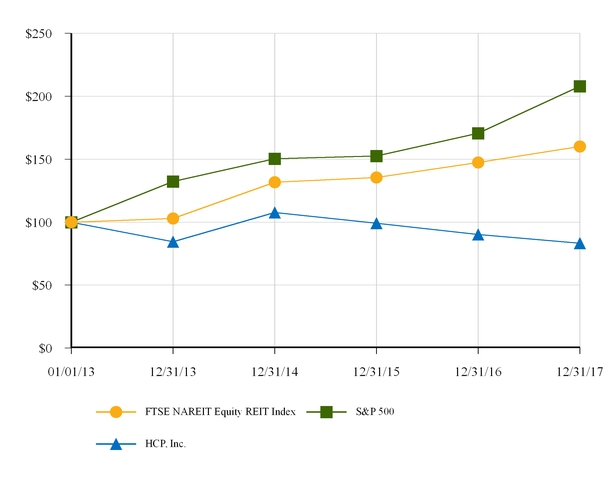
| December 31, | |||||||||||||||||||
| 2013 | 2014 | 2015 | 2016 | 2017 | |||||||||||||||
| FTSE NAREIT Equity REIT Index | $ | 102.88 | $ | 131.68 | $ | 135.42 | $ | 147.35 | $ | 160.11 | |||||||||
| S&P 500 | 132.36 | 150.43 | 152.51 | 170.70 | 207.92 | ||||||||||||||
| HCP, Inc. | 84.35 | 107.66 | 99.15 | 90.20 | 83.15 |
Item 6. Selected Financial Data
Set forth below is our selected financial data as of and for each of the years in the five-year period ended December 31, (dollars in thousands, except per share data):
| Year Ended December 31, | |||||||||||||||||||
| 2017 | 2016 | 2015 | 2014 | 2013 | |||||||||||||||
| Statement of operations data: | |||||||||||||||||||
| Total revenues | $ | 1,848,378 | $ | 2,129,294 | $ | 1,940,489 | $ | 1,636,833 | $ | 1,488,786 | |||||||||
| Income (loss) from continuing operations | 422,634 | 374,171 | 152,668 | 271,315 | 253,526 | ||||||||||||||
| Net income (loss) applicable to common shares | 413,013 | 626,549 | (560,552 | ) | 919,796 | 969,103 | |||||||||||||
| Basic earnings per common share | |||||||||||||||||||
| Continuing operations | 0.88 | 0.77 | 0.30 | 0.56 | 0.52 | ||||||||||||||
| Discontinued operations | — | 0.57 | (1.51 | ) | 1.45 | 1.61 | |||||||||||||
| Net income (loss) attributable to common stockholders | 0.88 | 1.34 | (1.21 | ) | 2.01 | 2.13 | |||||||||||||
| Diluted earnings per common share | |||||||||||||||||||
| Continuing operations | 0.88 | 0.77 | 0.30 | 0.56 | 0.52 | ||||||||||||||
| Discontinued operations | — | 0.57 | (1.51 | ) | 1.44 | 1.61 | |||||||||||||
| Net income (loss) attributable to common stockholders | 0.88 | 1.34 | (1.21 | ) | 2.00 | 2.13 | |||||||||||||
| Balance sheet data: | |||||||||||||||||||
| Total assets | 14,088,461 | 15,759,265 | 21,449,849 | 21,331,436 | 20,040,310 | ||||||||||||||
| Debt obligations(1) | 7,880,466 | 9,189,495 | 11,069,003 | 9,721,269 | 8,626,067 | ||||||||||||||
| Total equity | 5,594,938 | 5,941,308 | 9,746,317 | 10,997,099 | 10,931,134 | ||||||||||||||
| Other data: | |||||||||||||||||||
| Dividends paid | 694,955 | 979,542 | 1,046,638 | 1,001,559 | 956,685 | ||||||||||||||
| Dividends paid per common share(2) | 1.480 | 2.095 | 2.260 | 2.180 | 2.100 | ||||||||||||||
| Funds from operations (“FFO”)(3) | 661,113 | 1,119,153 | (10,841 | ) | 1,381,634 | 1,349,264 | |||||||||||||
| Diluted FFO per common share(3) | 1.41 | 2.39 | (0.02 | ) | 3.00 | 2.95 | |||||||||||||
| FFO as adjusted(3) | 918,402 | 1,282,390 | 1,470,167 | 1,398,691 | 1,382,699 | ||||||||||||||
| Diluted FFO as adjusted per common share(3) | 1.95 | 2.74 | 3.16 | 3.04 | 3.02 | ||||||||||||||
| Funds available for distribution (“FAD”)(3) | 803,720 | 1,215,696 | 1,261,849 | 1,178,822 | 1,158,082 |
| (1) | Includes bank line of credit, term loans, senior unsecured notes, mortgage and other secured debt, and other debt. |
| (2) | Represents cash dividends. Additionally, in October 2016 we issued $6.17 of stock dividends related to the Spin-Off. |
| (3) | For a more detailed discussion and reconciliation of FFO, FFO as adjusted and FAD, see "Results of Operations" and “Non-GAAP Financial Measure Reconciliations” in Item 7. |
Item 7. Management’s Discussion and Analysis of Financial Condition and Results of Operations
The information set forth in this Item 7 is intended to provide readers with an understanding of our financial condition, changes in financial condition and results of operations. We will discuss and provide our analysis in the following order:
| • | 2017 Transaction Overview |
| • | Dividends |
| • | Results of Operations |
| • | Liquidity and Capital Resources |
| • | Contractual Obligations |
| • | Off-Balance Sheet Arrangements |
| • | Inflation |
| • | Non-GAAP Financial Measure Reconciliations |
| • | Critical Accounting Policies |
| • | Recent Accounting Pronouncements |
2017 Transaction Overview
Master Transactions and Cooperation Agreement with Brookdale
On November 1, 2017, HCP and Brookdale entered into a Master Transactions and Cooperation Agreement (the “MTCA”) to provide us with the ability to significantly reduce our concentration of assets leased to and/or managed by Brookdale (the "Brookdale Transaction"). Through a series of dispositions and transitions of assets currently leased to and/or managed by Brookdale, as contemplated by the MTCA, our exposure to Brookdale is expected to be significantly reduced.
In connection with the overall transaction pursuant to the MTCA, HCP (through certain of its subsidiaries), and Brookdale (through certain of its subsidiaries) (the “Lessee”) entered into an Amended and Restated Master Lease and Security Agreement (the “Amended Master Lease”), which amended and restated the then-existing triple-net leases between the parties for 78 assets (before giving effect to the contemplated sale or transition of 34 assets discussed below), which account for primarily all of the assets subject to triple-net leases between HCP and the Lessee. Under the Amended Master Lease, we have the benefit of a guaranty from Brookdale of the Lessee’s obligations and, upon a change in control, will have various additional protections under the MTCA and the Amended Master Lease.
The Amended Master Lease preserves the renewal terms and, with certain exceptions, the rents under the previously existing triple-net leases. In addition, HCP and Brookdale agreed to the following:
| • | We have the right to sell, or transition to other operators, 32 triple-net assets. If such sale or transition does not occur within one year, the triple-net lease with respect to such assets will convert to a cash flow lease (under which we will bear the risks and rewards of operating the assets) with a term of two years, provided that we have the right to terminate the cash flow lease at any time during the term without penalty; |
| • | We have provided an aggregate $5 million annual reduction in rent on three assets, effective January 1, 2018; and |
| • | We will sell two triple-net assets to Brookdale or its affiliates for $35 million, which we anticipate completing during the first half of 2018. |
Also pursuant to the MTCA, HCP and Brookdale agreed to the following:
| • | HCP, which owned 90% of the interests in its RIDEA I and RIDEA III joint ventures with Brookdale at the time the MTCA was executed, agreed to purchase Brookdale’s 10% noncontrolling interest in each joint venture for an aggregate purchase price of $95 million. These joint ventures collectively own and operate 58 independent living, assisted living, memory care and/or skilled nursing facilities (the “RIDEA Facilities”). We completed our acquisition of the RIDEA III noncontrolling interest in December 2017 and anticipate completing our acquisition of the RIDEA I noncontrolling interest during the first half of 2018; |
| • | We have the right to sell, or transition to other managers, 36 of the RIDEA Facilities and terminate related management agreements with an affiliate of Brookdale without penalty. If the related management agreements are not terminated within one year, the base management fee (5% of gross revenues) increases by 1% of gross revenues per year over the following two years to a maximum of 7% of gross revenues; |
| • | We will sell four of the RIDEA Facilities to Brookdale or its affiliates for $239 million, one of which was sold in January 2018 for $27 million. We anticipate completing the sale of the remaining three RIDEA Facilities during the first half of 2018; |
| • | A Brookdale affiliate continues to manage the remaining 18 RIDEA Facilities pursuant to amended and restated management agreements, which provide for extended terms on select assets, modified performance hurdles for extensions and incentive fees, and modified termination rights (including stricter performance-based termination rights, a staggered right to terminate seven agreements over a 10 year period beginning in 2021, and a right to terminate at will upon payment of a termination fee, in lieu of sale-related termination rights), and two other existing facilities managed in separate RIDEA structures; and |
| • | We have the right to sell, to certain permitted transferees, our 49% ownership interest in joint ventures that own and operate a portfolio of continuing care retirement communities and in which Brookdale owns the other 51% interest (the “CCRC JV”), subject to certain conditions and a right of first offer in favor of Brookdale. Brookdale will have a corresponding right to sell its 51% interest in the CCRC JV to certain permitted transferees, subject to certain conditions, a right of first offer and a right to terminate management agreements following such sale of Brookdale’s interest, each in favor of HCP. Following a change in control of Brookdale, we will have the right to initiate a sale of the CCRC portfolio, subject to certain rights of first offer and first refusal in favor of Brookdale. |
See Note 3 to the Consolidated Financial Statements for additional information.
RIDEA II Sale Transaction
In January 2017, we completed the contribution of our ownership interest in RIDEA II to an unconsolidated JV owned by HCP and an investor group led by Columbia Pacific Advisors, LLC (“CPA”) (“HCP/CPA PropCo” and “HCP/CPA OpCo,” together, the “HCP/CPA JV”). In addition, RIDEA II was recapitalized with $602 million of debt, of which $360 million was provided by a third-party and $242 million was provided by HCP. In return for both transaction elements, we received combined proceeds of $480 million from the HCP/CPA JV and $242 million in loan receivables and retained an approximately 40% ownership interest in RIDEA II (the note receivable and 40% ownership interest are herein referred to as the “RIDEA II Investments”). This transaction resulted in us deconsolidating the net assets of RIDEA II and recognizing a net gain on sale of $99 million. The RIDEA II Investments are currently recognized and accounted for as equity method investments.
On November 1, 2017, we entered into a definitive agreement with an investor group led by CPA to sell our remaining 40% ownership interest in RIDEA II. We expect the transaction to close in 2018. CPA has also agreed to refinance our $242 million loan receivables from RIDEA II within one year following the closing of the transaction.
Investment Transactions
During the second quarter of 2017, we acquired a 124,000 square foot campus in the Sorrento Mesa submarket of San Diego, California for $26 million. Upon acquisition, we commenced repositioning one of the buildings into class-A lab space following an office-to-lab conversion strategy.
During the third quarter of 2017, we acquired a portfolio of three medical office buildings in Texas for $49 million and a life science facility in South San Francisco, California for $64 million.
During the
Showing the first 8K of 131K characters. Open the full section
Item 7A. Quantitative and Qualitative Disclosures About Market Risk
We are exposed to various market risks, including the potential loss arising from adverse changes in interest rates and foreign currency exchange rates, specifically the GBP. We use derivative financial instruments in the normal course of business to mitigate interest rate and foreign currency risk. We do not use derivative financial instruments for speculative or trading purposes. Derivatives are recorded on the consolidated balance sheets at fair value (see Note 23 to the Consolidated Financial Statements).
To illustrate the effect of movements in the interest rate and foreign currency markets, we performed a market sensitivity analysis on our hedging instruments. We applied various basis point spreads to the underlying interest rate curves and foreign currency exchange rates of the derivative portfolio in order to determine the change in fair value. Assuming a one percentage point change in the underlying interest rate curve and foreign currency exchange rates, the estimated change in fair value of each of the underlying derivative instruments would not exceed $2 million.
Interest Rate Risk
At December 31, 2017, we are exposed to market risks related to fluctuations in interest rates primarily on variable rate debt. As of December 31, 2017, $44 million of our variable-rate debt was hedged by interest rate swap transactions. The interest rate swaps are designated as cash flow hedges, with the objective of managing the exposure to interest rate risk by converting the interest rates on our variable-rate debt to fixed interest rates.
Interest rate fluctuations will generally not affect our future earnings or cash flows on our fixed rate debt and assets until their maturity or earlier prepayment and refinancing. If interest rates have risen at the time we seek to refinance our fixed rate debt, whether at maturity or otherwise, our future earnings and cash flows could adversely be affected by additional borrowing costs. Conversely, lower interest rates at the time of refinancing may reduce our overall borrowing costs. However, interest rate changes will affect the fair value of our fixed rate instruments. A one percentage point increase or decrease in interest rates would change the fair value of our fixed rate debt by approximately $332 million and $358 million, respectively, and would not materially impact earnings or cash flows. A one percentage point increase or decrease in interest rates would change the fair value of our fixed rate debt investments by approximately $8 million and $9 million, respectively, and would not materially impact earnings or cash flows. Conversely, changes in interest rates on variable rate debt and investments would change our future earnings and cash flows, but not materially impact the fair value of those instruments. Assuming a one percentage point change in the interest rate related to our variable-rate debt and variable-rate investments, and assuming no other changes in the outstanding balance as of December 31, 2017, our annual interest expense and interest income would change by approximately $12 million and $1 million, respectively.
Foreign Currency Exchange Rate Risk
At December 31, 2017, our exposure to foreign currencies primarily relates to U.K. investments in leased real estate and related GBP denominated cash flows. Our foreign currency exposure is partially mitigated through the use of GBP denominated borrowings and foreign currency swap contracts. Based solely on our operating results for the year ended December 31, 2017, including the impact of existing hedging arrangements, if the value of the GBP relative to the U.S. dollar were to increase or decrease by 10% compared to the average exchange rate during the year ended December 31, 2017, the increase or decrease to our cash flows would not be material.
Market Risk
We have investments in marketable debt securities classified as held-to-maturity because we have the positive intent and ability to hold the securities to maturity. Held-to-maturity securities are recorded at amortized cost and adjusted for the amortization of premiums and discounts through maturity. We consider a variety of factors in evaluating an other-than-temporary decline in value, such as: the length of time and the extent to which the market value has been less than our current adjusted carrying value; the issuer’s financial condition, capital strength and near-term prospects; any recent events specific to that issuer and economic conditions of its industry; and our investment horizon in relationship to an anticipated near-term recovery in the market value, if any. At December 31, 2017, both the fair value and carrying value of marketable debt securities were $19 million.
Item 8. Financial Statements and Supplementary Data
HCP, Inc.
Index to Consolidated Financial Statements
REPORT OF INDEPENDENT REGISTERED PUBLIC ACCOUNTING FIRM
To the stockholders and the Board of Directors of HCP, Inc.
Opinion on the Financial Statements
We have audited the accompanying consolidated balance sheets of HCP, Inc. and subsidiaries (the "Company") as of December 31, 2017 and 2016, the related consolidated statements of operations, comprehensive income (loss), equity, and cash flows, for each of the three years in the period ended December 31, 2017, and the related notes and the schedules listed in the Index at Item 15 (collectively referred to as the "financial statements"). In our opinion, the financial statements present fairly, in all material respects, the financial position of the Company as of December 31, 2017 and 2016, and the results of its operations and its cash flows for each of the three years in the period ended December 31, 2017, in conformity with accounting principles generally accepted in the United States of America.
We have also audited, in accordance with the standards of the Public Company Accounting Oversight Board (United States) (PCAOB), the Company's internal control over financial reporting as of December 31, 2017, based on criteria established in Internal Control - Integrated Framework (2013) issued by the Committee of Sponsoring Organizations of the Treadway Commission and our report dated February 13, 2018, expressed an unqualified opinion on the Company's internal control over financial reporting.
As discussed in Note 2 to the financial statements, the Company has changed its method of accounting for real estate acquisitions effective January 1, 2017 due to the adoption of Accounting Standards Update 2017-01, Business Combinations (Topic 805): Clarifying the Definition of a Business.
Basis for Opinion
These financial statements are the responsibility of the Company's management. Our responsibility is to express an opinion on the Company's financial statements based on our audits. We are a public accounting firm registered with the PCAOB and are required to be independent with respect to the Company in accordance with the U.S. federal securities laws and the applicable rules and regulations of the Securities and Exchange Commission and the PCAOB.
We conducted our audits in accordance with the standards of the PCAOB. Those standards require that we plan and perform the audit to obtain reasonable assurance about whether the financial statements are free of material misstatement, whether due to error or fraud. Our audits included performing procedures to assess the risks of material misstatement of the financial statements, whether due to error or fraud, and performing procedures that respond to those risks. Such procedures included examining, on a test basis, evidence regarding the amounts and disclosures in the financial statements. Our audits also included evaluating the accounting principles used and significant estimates made by management, as well as evaluating the overall presentation of the financial statements. We believe that our audits provide a reasonable basis for our opinion.
| /s/ Deloitte & Touche LLP |
Los Angeles, California
February 13, 2018
We have served as the Company's auditor since 2010.
HCP, Inc.
CONSOLIDATED BALANCE SHEETS
(In thousands, except share data)
| December 31, | |||||||
| 2017 | 2016 | ||||||
| ASSETS | |||||||
| Real estate: | |||||||
| Buildings and improvements | $ | 11,239,732 | $ | 11,692,654 | |||
| Development costs and construction in progress | 447,976 | 400,619 | |||||
| Land | 1,785,865 | 1,881,487 | |||||
| Accumulated depreciation and amortization | (2,741,695 | ) | (2,648,930 | ) | |||
| Net real estate | 10,731,878 | 11,325,830 | |||||
| Net investment in direct financing leases | 714,352 | 752,589 | |||||
| Loans receivable, net | 313,326 | 807,954 | |||||
| Investments in and advances to unconsolidated joint ventures | 800,840 | 571,491 | |||||
| Accounts receivable, net of allowance of $4,425 and $4,459, respectively | 40,733 | 45,116 | |||||
| Cash and cash equivalents | 55,306 | 94,730 | |||||
| Restricted cash | 26,897 | 42,260 | |||||
| Intangible assets, net | 410,082 | 479,805 | |||||
| Assets held for sale, net | 417,014 | 927,866 | |||||
| Other assets, net | 578,033 | 711,624 | |||||
| Total assets | $ | 14,088,461 | $ | 15,759,265 | |||
| LIABILITIES AND EQUITY | |||||||
| Bank line of credit | $ | 1,017,076 | $ | 899,718 | |||
| Term loans | 228,288 | 440,062 | |||||
| Senior unsecured notes | 6,396,451 | 7,133,538 | |||||
| Mortgage debt | 144,486 | 623,792 | |||||
| Other debt | 94,165 | 92,385 | |||||
| Intangible liabilities, net | 52,579 | 58,145 | |||||
| Liabilities of assets held for sale, net | 14,031 | 3,776 | |||||
| Accounts payable and accrued liabilities | 401,738 | 417,360 | |||||
| Deferred revenue | 144,709 | 149,181 | |||||
| Total liabilities | 8,493,523 | 9,817,957 | |||||
| Commitments and contingencies | |||||||
| Common stock, $1.00 par value: 750,000,000 shares authorized; 469,435,678 and 468,081,489 shares issued and outstanding, respectively | 469,436 | 468,081 | |||||
| Additional paid-in capital | 8,226,113 | 8,198,890 | |||||
| Cumulative dividends in excess of earnings | (3,370,520 | ) | (3,089,734 | ) | |||
| Accumulated other comprehensive income (loss) | (24,024 | ) | (29,642 | ) | |||
| Total stockholders' equity | 5,301,005 | 5,547,595 | |||||
| Joint venture partners | 117,045 | 214,377 | |||||
| Non-managing member unitholders | 176,888 | 179,336 | |||||
| Total noncontrolling interests | 293,933 | 393,713 | |||||
| Total equity | 5,594,938 | 5,941,308 | |||||
| Total liabilities and equity | $ | 14,088,461 | $ | 15,759,265 |
See accompanying Notes to Consolidated Financial Statements.
HCP, Inc.
CONSOLIDATED STATEMENTS OF OPERATIONS
(In thousands, except per share data)
| Year Ended December 31, | |||||||||||
| 2017 | 2016 | 2015 | |||||||||
| Revenues: | |||||||||||
| Rental and related revenues | $ | 1,071,153 | $ | 1,159,791 | $ | 1,116,830 | |||||
| Tenant recoveries | 142,496 |
Showing the first 8K of 387K characters. Open the full section
Item 9. Changes in and Disagreements with Accountants on Accounting and Financial Disclosure
None.
Item 9A. Controls and Procedures
Disclosure Controls and Procedures. We maintain disclosure controls and procedures that are designed to ensure that information required to be disclosed in our reports under the Exchange Act is recorded, processed, summarized and reported within the time periods specified in the SEC’s rules and forms and that such information is accumulated and communicated to our management, including our Principal Executive Officer and Principal Financial Officer, to allow for timely decisions regarding required disclosure. In designing and evaluating the disclosure controls and procedures, management recognizes that any controls and procedures, no matter how well designed and operated, can provide only reasonable assurance of achieving the desired control objectives, and management is required to apply its judgment in evaluating the cost-benefit relationship of possible controls and procedures.
As required by Rules 13a-15(b) and 15d-15(b) of the Exchange Act, we carried out an evaluation, under the supervision and with the participation of our management, including our Principal Executive Officer and Principal Financial Officer, of the effectiveness of the design and operation of our disclosure controls and procedures as of December 31, 2017. Based upon that evaluation, our Principal Executive Officer and Principal Financial Officer concluded that our disclosure controls and procedures were effective, as of December 31, 2017, at the reasonable assurance level.
Changes in Internal Control Over Financial Reporting. There were no changes in our internal control over financial reporting (as such term is defined in Rules 13a-15(f) and 15d-15(f) under the Exchange Act) during the fourth quarter of 2017 to which this report relates that have materially affected, or are reasonably likely to materially affect, our internal control over financial reporting.
Management’s Annual Report on Internal Control over Financial Reporting. Management is responsible for establishing and maintaining adequate internal control over financial reporting, as such term is defined in Exchange Act Rules 13a-15(f) and 15d-15(f). Under the supervision and with the participation of our management, including our Principal Executive Officer and Principal Financial Officer, we conducted an evaluation of the effectiveness of our internal control over financial reporting based on the framework in Internal Control—Integrated Framework (2013) issued by the Committee of Sponsoring Organizations of the Treadway Commission. Based on our evaluation under the framework in Internal Control—Integrated Framework (2013), our management concluded that our internal control over financial reporting was effective as of December 31, 2017.
The effectiveness of our internal control over financial reporting as of December 31, 2017 has been audited by Deloitte & Touche LLP, an independent registered public accounting firm, as stated in their report, which is included herein.
REPORT OF INDEPENDENT REGISTERED PUBLIC ACCOUNTING FIRM
To the stockholders and the Board of Directors of HCP, Inc.
Opinion on Internal Control over Financial Reporting
We have audited the internal control over financial reporting of HCP, Inc. and subsidiaries (the “Company”) as of December 31, 2017, based on criteria established in Internal Control - Integrated Framework (2013) issued by the Committee of Sponsoring Organizations of the Treadway Commission (COSO). In our opinion, the Company maintained, in all material respects, effective internal control over financial reporting as of December 31, 2017, based on criteria established in Internal Control - Integrated Framework (2013) issued by COSO.
We have also audited, in accordance with the standards of the Public Company Accounting Oversight Board (United States) (PCAOB), the consolidated financial statements as of and for the year ended December 31, 2017, of the Company and our report dated February 13, 2018, expressed an unqualified opinion on those financial statements and included an explanatory paragraph regarding the Company’s adoption of Accounting Standards Update 2017-01, Business Combinations (Topic 805): Clarifying the Definition of a Business.
Basis for Opinion
The Company’s management is responsible for maintaining effective internal control over financial reporting and for its assessment of the effectiveness of internal control over financial reporting, included in the accompanying Management’s Annual Report on Internal Control over Financial Reporting. Our responsibility is to express an opinion on the Company’s internal control over financial reporting based on our audit. We are a public accounting firm registered with the PCAOB and are required to be independent with respect to the Company in accordance with the U.S. federal securities laws and the applicable rules and regulations of the Securities and Exchange Commission and the PCAOB.
We conducted our audit in accordance with the standards of the PCAOB. Those standards require that we plan and perform the audit to obtain reasonable assurance about whether effective internal control over financial reporting was maintained in all material respects. Our audit included obtaining an understanding of internal control over financial reporting, assessing the risk that a material weakness exists, testing and evaluating the design and operating effectiveness of internal control based on the assessed risk, and performing such other procedures as we considered necessary in the circumstances. We believe that our audit provides a reasonable basis for our opinion.
Definition and Limitations of Internal Control over Financial Reporting
A company’s internal control over financial reporting is a process designed to provide reasonable assurance regarding the reliability of financial reporting and the preparation of financial statements for external purposes in accordance with generally accepted accounting principles. A company’s internal control over financial reporting includes those policies and procedures that (1) pertain to the maintenance of records that, in reasonable detail, accurately and fairly reflect the transactions and dispositions of the assets of the company; (2) provide reasonable assurance that transactions are recorded as necessary to permit preparation of financial statements in accordance with generally accepted accounting principles, and that receipts and expenditures of the company are being made only in accordance with authorizations of management and directors of the company; and (3) provide reasonable assurance regarding prevention or timely detection of unauthorized acquisition, use, or disposition of the company’s assets that could have a material effect on the financial statements.
Because of its inherent limitations, internal control over financial reporting may not prevent or detect misstatements. Also, projections of any evaluation of effectiveness to future periods are subject to the risk that controls may become inadequate because of changes in conditions, or that the degree of compliance with the policies or procedures may deteriorate.
| /s/ Deloitte & Touche LLP |
Los Angeles, California
February 13, 2018
Item 9B. Other Information
None.
PART III
Item 10. Directors, Executive Officers and Corporate Governance
We have adopted a Code of Business Conduct and Ethics that applies to all of our directors and employees, including our Chief Executive Officer and all senior financial officers, including our principal financial officer, principal accounting officer and controller. We have also adopted a Vendor Code of Business Conduct and Ethics applicable to our vendors and business partners. Current copies of our Code of Business Conduct and Ethics and Vendor Code of Business Conduct and Ethics are posted on our website at www.hcpi.com/codeofconduct. In addition, waivers from, and amendments to, our Code of Business Conduct and Ethics that apply to our directors and executive officers, including our principal executive officer, principal financial officer, principal accounting officer or persons performing similar functions, will be timely posted in the Investor Relations section of our website at www.hcpi.com.
We hereby incorporate by reference the information appearing under the captions “Proposal No. 1 Election of Directors,” “Our Executive Officers,” “Board of Directors and Corporate Governance” and “Section 16(a) Beneficial Ownership Reporting Compliance” in the Registrant’s definitive proxy statement relating to its 2018 Annual Meeting of Stockholders to be held on April 26, 2018.
Item 11. Executive Compensation
We hereby incorporate by reference the information under the caption “Executive Compensation” in the Registrant’s definitive proxy statement relating to its 2018 Annual Meeting of Stockholders to be held on April 26, 2018.
Item 12. Security Ownership of Certain Beneficial Owners and Management and Related Stockholder Matters
We hereby incorporate by reference the information under the captions “Security Ownership of Principal Stockholders, Directors and Management” and “Equity Compensation Plan Information” in the Registrant’s definitive proxy statement relating to its 2018 Annual Meeting of Stockholders to be held on April 26, 2018.
Item 13. Certain Relationships and Related Transactions, and Director Independence
We hereby incorporate by reference the information under the caption “Board of Directors and Corporate Governance” in the Registrant’s definitive proxy statement relating to its 2018 Annual Meeting of Stockholders to be held on April 26, 2018.
Item 14. Principal Accounting Fees and Services
We hereby incorporate by reference under the caption “Audit and Non-Audit Fees” in the Registrant’s definitive proxy statement relating to its 2018 Annual Meeting of Stockholders to be held on April 26, 2018.
PART IV
Item 15. Exhibits, Financial Statement Schedules
(a) 1. Financial Statement Schedules
The following Consolidated Financial Statements are included in Part II, Item 8-Financial Statements and Supplementary Data of this Annual Report on Form 10-K.
Report of Independent Registered Public Accounting Firm
Consolidated Balance Sheets-December 31, 2017 and 2016
Consolidated Statements of Operations-for the years ended December 31, 2017, 2016 and 2015
Consolidated Statements of Comprehensive Income (Loss)-for the years ended December 31, 2017, 2016 and 2015
Consolidated Statements of Equity-for the years ended December 31, 2017, 2016 and 2015
Consolidated Statements of Cash Flows-for the years ended December 31, 2017, 2016 and 2015
Notes to Consolidated Financial Statements
(a) 2. Financial Statement Schedules
The following Consolidated Financial Statements are included in Part II, Item 8-Financial Statements and Supplementary Data of this Annual Report on Form 10-K.
Schedule II: Valuation and Qualifying Accounts
Schedule III: Real Estate and Accumulated Depreciation
| (a) 3. | Exhibits |
| 4.2.2 | Second Supplemental Indenture, dated November 12, 2013, between HCP and The Bank of New York Mellon Trust Company, N.A., as trustee. | Current Report on Form 8‑K (File No. 001‑08895) | November 13, 2013 | |||
| 4.2.3 | Third Supplemental Indenture dated February 21, 2014, between the Company and The Bank of New York Mellon Trust Company, N.A., as trustee. | Current Report on Form 8‑K (File No. 001‑08895) | February 24, 2014 | |||
| 4.2.4 | Fourth Supplemental Indenture, dated August 14, 2014, between HCP and The Bank of New York Mellon Trust Company, N.A., as trustee. | Current Report on Form 8‑K (File No. 001‑08895) | August 14, 2014 | |||
| 4.2.5 | Fifth Supplemental Indenture, dated January 21, 2015, between HCP and The Bank of New York Mellon Trust Company, N.A., as trustee. | Current Report on Form 8‑K (File No. 001‑08895) | January 21, 2015 | |||
| 4.2.6 | Sixth Supplemental Indenture, dated May 20, 2015, between HCP and The Bank of New York Mellon Trust Company, N.A., as trustee. | Current Report on Form 8‑K (File No. 001‑08895) | May 20, 2015 | |||
| 4.2.7 | Seventh Supplemental Indenture dated December 1, 2015, between HCP and The Bank of New York Mellon Trust Company, N.A., as trustee. | Current Report on Form 8‑K (File No. 001‑08895) | December 1, 2015 | |||
| 4.3 | Form of 5.375% Senior Notes due 2021. | Current Report on Form 8‑K (File No. 001‑08895) | January 24, 2011 | |||
| 4.4 | Form of 6.750% Senior Notes due 2041. | Current Report on Form 8‑K (File No. 001‑08895) | January 24, 2011 | |||
| 4.5 | Form of 3.75% Senior Notes due 2019. | Current Report on Form 8‑K (File No. 001‑08895) | January 23, 2012 | |||
| 4.6 | Form of 3.15% Senior Notes due 2022. | Current Report on Form 8‑K (File No. 001‑08895) | July 23, 2012 | |||
| 4.7 | Form of 2.625% Senior Notes due 2020. | Current Report on Form 8‑K (File No. 001‑08895) | November 19, 2012 | |||
| 4.8 | Form of 4.250% Senior Notes due 2023. | Current Report on Form 8‑K (File No. 001‑08895) | November 13, 2013 | |||
| 4.9 | Form of 4.20% Senior Notes due 2024. | Current Report on Form 8‑K (File No. 001‑08895) | February 24, 2014 | |||
| 4.10 | Form of 3.875% Senior Notes due 2024. | Current Report on Form 8‑K (File No. 001‑08895) | August 14, 2014 | |||
| 4.11 | Form of 3.400% Senior Notes due 2025. | Current Report on Form 8‑K (File No. 001‑08895) | January 21, 2015 | |||
| 4.12 | Form of 4.000% Senior Notes due 2025. | Current Report on Form 8‑K (File No. 001‑08895) | May 20, 2015 | |||
| 4.13 | Form of 4.000% Senior Notes due 2022. | Current Report on Form 8‑K (File No. 001‑08895) | December 1, 2015 | |||
| 10.1 | Second Amended and Restated Director Deferred Compensation Plan.* | Quarterly Report on Form 10‑Q (File No. 001‑08895) | November 3, 2009 | |||
| 10.2 | Non-Employee Directors Stock-for-Fees Program.* | Quarterly Report on Form 10-Q (File No. 001‑08895) | August 5, 2014 | |||
| 10.3 | Executive Severance Plan.* | Quarterly Report on Form 10-Q (File No. 001-08895) | November 1, 2016 | |||
| 10.4 | Executive Change in Control Severance Plan (as Amended and Restated as of May 6, 2016).* | Quarterly Report on Form 10-Q (File No. 001 08895) | November 1, 2016 | |||
| 10.5 | 2006 Performance Incentive Plan, as amended and restated.* | Annex 2 to HCP’s Proxy Statement (File No. 001‑08895) | March 10, 2009 | |||
| 10.5.1 | Form of Employee 2006 Performance Incentive Plan Nonqualified Stock Option Agreement.* | Quarterly Report on Form 10‑Q (File No. 001‑08895) | May 1, 2012 | |||
| 10.6 | HCP, Inc. 2014 Performance Incentive Plan.* | Current Report on Form 8‑K (File No. 001‑08895) | May 6, 2014 |
| * | Management Contract or Compensatory Plan or Arrangement. |
| ** | Portions of this exhibit have been omitted pursuant to a request for confidential treatment with the SEC. |
| *** | Certain schedules or similar attachments have been omitted pursuant to Item 601(b)(2) of Regulation S-K. The Company agrees to furnish supplemental copies of any of the omitted schedules or attachments upon request by the SEC. |
| † | Filed herewith. |
Item 16. Form 10-K Summary
None.
SIGNATURES
Pursuant to the requirements of Section 13 or 15(d) of the Securities Exchange Act of 1934, the Registrant has duly caused this report to be signed on its behalf by the undersigned, thereunto duly authorized.
Dated: February 13, 2018
| HCP, Inc. (Registrant) | |
| /s/ THOMAS M. HERZOG | |
| Thomas M. Herzog, President and Chief Executive Officer (Principal Executive Officer) |
Pursuant to the requirements of the Securities Exchange Act of 1934, this report has been signed below by the following persons on behalf of the Registrant and in the capacities and on the dates indicated.
| Signature | Title | Date | ||
| /s/ THOMAS M. HERZOG | President and Chief Executive Officer | February 13, 2018 | ||
| Thomas M. Herzog | (Principal Executive Officer), Director | |||
| /s/ PETER A. SCOTT | Executive Vice President and Chief Financial Officer | February 13, 2018 | ||
| Peter A. Scott | (Principal Financial Officer) | |||
| /s/ SHAWN G. JOHNSTON | Senior Vice President and Chief Accounting Officer | February 13, 2018 | ||
| Shawn G. Johnston | (Principal Accounting Officer) | |||
| /s/ DAVID B. HENRY | Chairman of the Board | February 13, 2018 | ||
| David B. Henry | ||||
| /s/ BRIAN G. CARTWRIGHT | Director | February 13, 2018 | ||
| Brian G. Cartwright | ||||
| /s/ CHRISTINE N. GARVEY | Director | February 13, 2018 | ||
| Christine N. Garvey | ||||
| /s/ JAMES P. HOFFMANN | Director | February 13, 2018 | ||
| James P. Hoffmann | ||||
| /s/ MICHAEL D. MCKEE | Director | February 13, 2018 | ||
| Michael D. McKee | ||||
| /s/ PETER L. RHEIN | Director | February 13, 2018 | ||
| Peter L. Rhein | ||||
| /s/ JOSEPH P. SULLIVAN | Director | February 13, 2018 | ||
| Joseph P. Sullivan |