 filings.tools
Healthpeak Properties 10-K 2022-12-31
Filed 2023-02-08. 23 sections, 804K characters. Original on sec.gov · Markdown · JSON
Cover and table of contents
UNITED STATES
SECURITIES AND EXCHANGE COMMISSION
Washington, D.C. 20549
FORM 10-K
(Mark One)
| ☒ | ANNUAL REPORT PURSUANT TO SECTION 13 OR 15(d) OF THE SECURITIES EXCHANGE ACT OF 1934 |
For the fiscal year ended December 31, 2022
or
| ☐ | TRANSITION REPORT PURSUANT TO SECTION 13 OR 15(d) OF THE SECURITIES EXCHANGE ACT OF 1934 |
For the transition period from to
Commission file number 001-08895
Healthpeak Properties, Inc.
(Exact name of registrant as specified in its charter)
| Maryland | 33-0091377 | |||||||
| (State or other jurisdiction of incorporation or organization) | (I.R.S. Employer Identification No.) |
4600 South Syracuse Street, Suite 500
Denver, CO 80237
(Address of principal executive offices) (Zip Code)
(720) 428-5050
(Registrant’s telephone number, including area code)
Securities registered pursuant to Section 12(b) of the Act:
| Title of each class | Trading Symbol(s) | Name of each exchange on which registered | ||||||
| Common Stock, $1.00 par value | PEAK | New York Stock Exchange |
Securities registered pursuant to Section 12(g) of the Act:
None
Indicate by check mark if the registrant is a well-known seasoned issuer, as defined in Rule 405 of the Securities Act. Yes ☒ No ☐
Indicate by check mark if the registrant is not required to file reports pursuant to Section 13 or Section 15(d) of the Act. Yes ☐ No ☒
Indicate by check mark whether the registrant (1) has filed all reports required to be filed by Section 13 or 15(d) of the Securities Exchange Act of 1934 during the preceding 12 months (or for such shorter period that the registrant was required to file such reports), and (2) has been subject to such filing requirements for the past 90 days. Yes ☒ No ☐
Indicate by check mark whether the registrant has submitted electronically every Interactive Data File required to be submitted pursuant to Rule 405 of Regulation S-T (§232.405 of this chapter) during the preceding 12 months (or for such shorter period that the registrant was required to submit such files). Yes ☒ No ☐
Indicate by check mark whether the registrant is a large accelerated filer, an accelerated filer, a non-accelerated filer, a smaller reporting company, or an emerging growth company. See the definitions of “large accelerated filer,” “accelerated filer,” “smaller reporting company,” and “emerging growth company” in Rule 12b-2 of the Exchange Act.
| Large accelerated filer | ☒ | Accelerated filer | ☐ | ||||||||
| Non-accelerated filer | ☐ | Smaller reporting company | ☐ | ||||||||
| Emerging growth company | ☐ |
If an emerging growth company, indicate by check mark if the registrant has elected not to use the extended transition period for complying with any new or revised financial accounting standards provided pursuant to Section 13(a) of the Exchange Act. ☐
Indicate by check mark whether the registrant has filed a report on and attestation to its management’s assessment of the effectiveness of its internal control over financial reporting under Section 404(b) of the Sarbanes-Oxley Act (15 U.S.C. 7262(b)) by the registered public accounting firm that prepared or issued its audit report. ☒
Indicate by check mark whether the registrant is a shell company (as defined in Rule 12b-2 of the Act.) Yes ☐ No ☒
State the aggregate market value of the voting and non-voting common equity held by non-affiliates computed by reference to the price at which the common equity was last sold, or the average bid and asked price of such common equity, as of the last business day of the registrant’s most recently completed second fiscal quarter: $10.2 billion.
As of February 6, 2023, there were 546,782,509 shares of the registrant’s $1.00 par value common stock outstanding.
DOCUMENTS INCORPORATED BY REFERENCE
Portions of the definitive Proxy Statement for the registrant’s 2023 Annual Meeting of Stockholders, to be filed with the Securities and Exchange Commission no later than 120 days after December 31, 2022, have been incorporated by reference into Part III of this Report.
Healthpeak Properties, Inc.
Form 10-K
For the Fiscal Year Ended December 31, 2022
Table of Contents
All references in this report to “Healthpeak,” the “Company,” “we,” “us” or “our” mean Healthpeak Properties, Inc., together with its consolidated subsidiaries. Unless the context suggests otherwise, references to “Healthpeak Properties, Inc.” mean the parent company without its subsidiaries.
Cautionary Language Regarding Forward-Looking Statements
Statements in this Annual Report on Form 10-K that are not historical factual statements are “forward-looking statements” within the meaning of Section 27A of the Securities Act of 1933, as amended, and Section 21E of the Securities Exchange Act of 1934, as amended (the “Exchange Act”). Forward-looking statements include, among other things, statements regarding our and our officers’ intent, belief or expectation as identified by the use of words such as “may,” “will,” “project,” “expect,” “believe,” “intend,” “anticipate,” “seek,” “target,” “forecast,” “plan,” “potential,” “estimate,” “could,” “would,” “should” and other comparable and derivative terms or the negatives thereof. Forward-looking statements reflect our current expectations and views about future events and are subject to risks and uncertainties that could cause actual results, including our future financial condition and results of operations, to differ materially from those expressed or implied by any forward-looking statements. You are urged to carefully review the disclosures we make concerning risks and uncertainties that may affect our business and future financial performance, including those made below under “Summary Risk Factors” and in “Item 1A, Risk Factors” in this report.
Forward-looking statements are based on certain assumptions and analysis made in light of our experience and perception of historical trends, current conditions and expected future developments as well as other factors that we believe are appropriate under the circumstances. While forward-looking statements reflect our good faith belief and assumptions we believe to be reasonable based upon current information, we can give no assurance that our expectations or forecasts will be attained. Further, we cannot guarantee the accuracy of any such forward-looking statement contained in this Annual Report. Except as required by law, we do not undertake, and hereby disclaim, any obligation to update any forward-looking statements, which speak only as of the date on which they are made.
Risk Factors Summary
Investors should consider the risks and uncertainties described below that may affect our business and future financial performance. These and other risks and uncertainties are more fully described in “Item 1A, Risk Factors” in this report. Additional risks not presently known to us or that we currently deem immaterial may also affect us. If any of these risks occur, our business, financial condition or results of operations could be materially and adversely affected.
As more fully set forth under “Item 1A, Risk Factors” in this report, principal risks and uncertainties that may affect our business, financial condition, or results of operations include:
-
macroeconomic trends, including inflation, interest rates, labor costs, and unemployment;
-
the ability of our existing and future tenants, operators, and borrowers to conduct their respective businesses in a manner that generates sufficient income to make rent and loan payments to us;
-
the financial condition of our tenants, operators, and borrowers, including potential bankruptcies and downturns in their businesses, and their legal and regulatory proceedings;
-
our concentration of real estate investments in the healthcare property sector, which makes us more vulnerable to a downturn in a specific sector than if we invested across multiple sectors;
-
the illiquidity of real estate investments;
-
our ability to identify and secure new or replacement tenants and operators;
-
our property development, redevelopment, and tenant improvement activity risks, including project abandonments, project delays, and lower profits than expected;
-
changes within the life science industry;
-
significant regulation, funding requirements, and uncertainty faced by our life science tenants;
-
the ability of the hospitals on whose campuses our medical office buildings (“MOBs”) are located and their affiliated healthcare systems to remain competitive or financially viable;
-
our ability to develop, maintain, or expand hospital and health system client relationships;
-
operational risks associated with third party management contracts, including the additional regulation and liabilities of our properties operated through structures permitted by the Housing and Economic Recovery Act of 2008, which includes most of the provisions previously proposed in the REIT Investment Diversification and Empowerment Act of 2007 (commonly referred to as “RIDEA”);
-
economic conditions, natural disasters, weather, and other conditions that negatively affect geographic areas where we have concentrated investments;
-
uninsured or underinsured losses, which could result in significant losses and/or performance declines by us or our tenants and operators;
-
our investments in joint ventures and unconsolidated entities, including our lack of sole decision making authority and our reliance on our partners’ financial condition and continued cooperation;
-
our use of fixed rent escalators, contingent rent provisions, and/or rent escalators based on the Consumer Price Index;
-
competition for suitable healthcare properties to grow our investment portfolio;
-
our ability to foreclose or exercise rights on collateral securing our real estate-related loans;
-
investment of substantial resources and time in transactions that are not consummated;
-
our ability to successfully integrate or operate acquisitions;
-
the potential impact on us and our tenants, operators, and borrowers from litigation matters, including rising liability and insurance costs;
-
environmental compliance costs and liabilities associated with our real estate investments;
-
epidemics, pandemics, or other infectious diseases, including the coronavirus disease (“Covid”), and health and safety measures intended to reduce their spread;
-
the loss or limited availability of our key personnel;
-
our reliance on information technology systems and the potential impact of system failures, disruptions, or breaches;
-
increased borrowing costs, including due to rising interest rates;
-
cash available for distribution to stockholders and our ability to make dividend distributions at expected levels;
-
the availability of external capital on acceptable terms or at all, including due to rising interest rates, changes in our credit ratings and the value of our common stock, volatility or uncertainty in the capital markets, and other factors;
-
our ability to manage our indebtedness level and covenants in and changes to the terms of such indebtedness;
-
the failure of our tenants, operators, and borrowers to comply with federal, state, and local laws and regulations, including resident health and safety requirements, as well as licensure, certification, and inspection requirements;
-
required regulatory approvals to transfer our senior housing properties;
-
compliance with the Americans with Disabilities Act and fire, safety, and other regulations;
-
laws or regulations prohibiting eviction of our tenants;
-
the requirements of, or changes to, governmental reimbursement programs such as Medicare or Medicaid;
-
legislation to address federal government operations and administrative decisions affecting the Centers for Medicare and Medicaid Services;
-
our participation in the Coronavirus Aid, Relief, and Economic Security Act (“CARES Act”) Provider Relief Fund and other Covid-related stimulus and relief programs;
-
our ability to maintain our qualification as a real estate investment trust (“REIT”);
-
changes to U.S. federal income tax laws, and potential deferred and contingent tax liabilities from corporate acquisitions;
-
calculating non-REIT tax earnings and profits distributions;
-
ownership limits in our charter that restrict ownership in our stock; and
-
provisions of Maryland law and our charter that could prevent a transaction that may otherwise be in the interest of our stockholders.
PART I
Item 1. Business
General Overview
Healthpeak Properties, Inc. is a Standard & Poor’s (“S&P”) 500 company that acquires, develops, owns, leases, and manages healthcare real estate across the United States (“U.S.”). Our company was originally founded in 1985. We are a Maryland corporation and qualify as a self-administered REIT. Our corporate headquarters are located in Denver, Colorado, and we have additional offices in California, Tennessee, and Massachusetts.
During 2020, we began the process of disposing of our senior housing triple-net and senior housing operating property (“SHOP”) portfolios. As of December 31, 2020, we concluded that the planned dispositions represented a strategic shift that had and will have a major effect on our operations and financial results. Therefore, the assets are classified as discontinued operations in all periods presented herein. In September 2021, we successfully completed the disposition of both portfolios. See Note 5 to the Consolidated Financial Statements for further information regarding discontinued operations.
In conjunction with the disposal of our senior housing triple-net and SHOP portfolios, we focused our strategy on investing in a diversified portfolio of high-quality healthcare properties across our three core asset classes of life science, medical office, and continuing care retirement community (“CCRC”) real estate. Under the life science and medical office segments, we invest through the acquisition, development, and management of life science facilities, MOBs, and hospitals. Under the CCRC segment, our properties are operated through RIDEA structures. We have other non-reportable segments that are comprised primarily of loans receivable, marketable debt securities, and an interest in an unconsolidated joint venture that owns 19 senior housing assets (our “SWF SH JV”).
At December 31, 2022, our portfolio of investments, including properties in our unconsolidated joint ventures, consisted of interests in 480 properties. The following table summarizes information for our reportable segments, excluding discontinued operations, for the year ended December 31, 2022 (dollars in thousands):
| Segment | Total Portfolio Adjusted NOI**(1)** | Percentage of Total Portfolio Adjusted NOI**(1)** | Number of Properties | |||||||||||||||||
| Life science | $ | 552,533 | 50 | % | 149 | |||||||||||||||
| Medical office | 432,969 | 39 | % | 297 | ||||||||||||||||
| CCRC | 103,841 | 9 | % | 15 | ||||||||||||||||
| Other non-reportable | 16,920 | 2 | % | 19 | ||||||||||||||||
| $ | 1,106,263 | 100 | % | 480 |
_______________________________________
(1)Total Portfolio metrics include results of operations from disposed properties through the disposition date. See “Item 7, Management’s Discussion and Analysis of Financial Condition and Results of Operations—Non-GAAP Financial Measures” for additional information regarding Adjusted NOI and see Note 16 to the Consolidated Financial Statements for a reconciliation of Adjusted NOI by segment to net income (loss).
For a description of our significant activities during 2022, see “Item 7, Management’s Discussion and Analysis of Financial Condition and Results of Operations—Overview of Transactions” in this report.
UPREIT Reorganization
On February 7, 2023, we entered into an Agreement and Plan of Merger (the “Merger Agreement”) with New Healthpeak, Inc., a Maryland corporation (“New Healthpeak”) and our wholly owned subsidiary, and Healthpeak Merger Sub, Inc., a Maryland corporation (“Merger Sub”) that is a wholly owned subsidiary of New Healthpeak. The purpose of the transactions contemplated by the Merger Agreement is for us to implement a corporate reorganization into a new holding company structure commonly referred to as an Umbrella Partnership Real Estate Investment Trust, or UPREIT (the “Reorganization”).
Pursuant to the Merger Agreement, Merger Sub will merge with and into our company, with our company continuing as the surviving corporation and a wholly owned subsidiary of New Healthpeak (the “Merger”). The Merger is expected to be effective as of February 10, 2023 (the “Effective Time”). As part of the Merger, our name will change to Healthpeak Properties Interim, Inc., and, effective immediately after the Effective Time, New Healthpeak’s name will be changed to Healthpeak Properties, Inc. The Merger is expected to be conducted in accordance with Section 3-106.2 of the Maryland General Corporation Law. Accordingly, the Merger will not require the approval of our stockholders, and the Merger will not give rise to statutory dissenters’ rights.
In connection with the Reorganization and immediately following the Merger, we will convert from a Maryland corporation to a Maryland limited liability company named Healthpeak OP, LLC (“Healthpeak OP”).
Following the Merger, the business, management and board of directors of New Healthpeak will be identical to the business, management and board of directors of our company immediately before the Merger, except that the business of the company is expected to be conducted exclusively through Healthpeak OP. The consolidated assets and liabilities of New Healthpeak immediately following the Merger will be identical to the consolidated assets and liabilities of our company immediately prior to the Merger. New Healthpeak will not hold any assets directly other than its ownership interest in Healthpeak OP and certain de minimis assets that may be held for certain administrative functions. None of the properties owned by us or our subsidiaries or any interests therein will be transferred as part of the Reorganization. All material indebtedness of our company immediately prior to the Merger will remain the indebtedness of Healthpeak OP after the Merger.
Business Strategy
We invest in and manage our real estate portfolio for the long-term to maximize benefit to our stockholders and support the growth of our dividends. Our strategy consists of four core elements:
(i)Our real estate: Our portfolio is grounded in high-quality properties in desirable locations. We focus on three purposely selected private pay asset classes—life science, medical office, and continuing care retirement community—to provide stability through inevitable market cycles.
(ii)Our financials: We maintain a strong investment-grade balance sheet with ample liquidity as well as long-term fixed-rate debt financing with staggered maturities to reduce our exposure to interest rate volatility and refinancing risk.
(iii)Our partnerships: We work with leading pharmaceutical and biotechnical companies, healthcare companies, operators, and service providers and are responsive to their space and capital needs. We provide high-quality property management services to encourage tenants to renew, expand, and relocate into our properties, which drives increased occupancy, rental rates, and property values.
(iv)Our platform: We have a people-first culture that we believe attracts, develops, and retains top talent. We continually strive to create and maintain an industry-leading platform with systems and tools that allow us to effectively and efficiently manage our assets and investment activity.
Internal Growth Strategies
We believe our real estate portfolio holds the potential for increased future cash flows as it is well-maintained and in desirable locations. Our strategy for maximizing the benefits from these opportunities is to: (i) work with new or existing tenants and operators to address their space and capital needs and (ii) provide high-quality property management services in order to motivate tenants to renew, expand, or relocate into our properties.
We expect to continue our internal growth as a result of our ability to:
-
Build and maintain long-term leasing and management relationships with quality tenants and operators. In choosing locations for our properties, we focus on the physical environment, adjacency to established businesses (e.g., hospital systems) and educational centers, proximity to sources of business growth, and other local demographic factors.
-
Replace tenants at the best available market terms and lowest possible transaction costs. We believe we are well-positioned to attract new tenants and achieve attractive rental rates and operating cash flow as a result of the location, design, and maintenance of our properties, together with our reputation for high-quality building services, responsiveness to tenants, and our ability to offer space alternatives within our portfolio.
-
Extend and modify terms of existing leases prior to expiration. We structure lease extensions, early renewals, or modifications, which reduce the cost associated with lease downtime, while securing the tenancy and relationship of our high quality tenants on a long-term basis.
Investment Strategies
The delivery of healthcare services requires real estate and, as a result, tenants and operators depend on real estate, in part, to maintain and grow their businesses. We believe the healthcare real estate market provides investment opportunities due to the: (i) compelling long-term demographics driving the demand for healthcare services; (ii) specialized nature of healthcare real estate investing; and (iii) ongoing consolidation of the fragmented healthcare real estate sector.
While we emphasize healthcare real estate ownership, we may also provide real estate secured financing to, or invest in equity or debt securities of, healthcare operators or other entities engaged in healthcare real estate ownership. We may also acquire all or substantially all of the securities or assets of other REITs, operating companies, or similar entities where such investments would be consistent with our investment strategies. We may co-invest alongside institutional or development investors through partnerships or limited liability companies.
We monitor our investments based on the percentage of our total assets that may be invested in any one property type, investment vehicle, or geographic location, the number of properties that may be leased to a single tenant or operator, or loans that may be made to a single borrower. In allocating capital, we target opportunities with the most attractive risk/reward profile for our portfolio as a whole. We may take additional measures to mitigate risk, including diversifying our investments (by sector, geography, tenant, or operator), structuring transactions as master leases, requiring tenant or operator insurance and indemnifications, and/or obtaining credit enhancements in the form of guarantees, letters of credit, or security deposits.
We believe we are well-positioned to achieve external growth through acquisitions, development, and redevelopment. Other factors that contribute to our competitive position include:
-
our reputation gained through over three decades of successful operations and the strength of our existing portfolio of properties;
-
our relationships with leading pharmaceutical and biotechnology tenants, healthcare operators and systems, investment banks and other market intermediaries, corporations, private equity firms, not-for-profit organizations, and companies seeking to monetize existing assets or develop new facilities;
-
our relationships with institutional buyers and sellers of high-quality healthcare real estate;
-
our track record and reputation for executing acquisitions responsively and efficiently, which provides confidence to domestic and foreign institutions and private investors who seek to sell healthcare real estate in our market areas;
-
our relationships with nationally recognized financial institutions that provide capital to the healthcare and real estate industries; and
-
our control of land sites held for future development.
Financing Strategies
Our REIT qualification requires us to distribute at least 90% of our REIT taxable income (excluding net capital gains); therefore, we do not retain a significant amount of earnings. As a result, we regularly access the public equity and debt markets to raise the funds necessary to finance acquisitions and debt investments, develop and redevelop properties, and refinance maturing debt.
We may finance acquisitions and other investments primarily through the following vehicles:
-
cash flow from operations;
-
sale or exchange of ownership interests in properties or other investments;
-
borrowings under our credit facility or commercial paper program;
-
issuance of additional debt, including unsecured notes, term loans, and mortgage debt; and/or
-
issuance of common stock or preferred stock or its equivalent.
We maintain a disciplined investment-grade balance sheet by actively managing our debt to equity levels and maintaining access to multiple sources of liquidity. Our debt obligations are primarily long-term fixed rate with staggered maturities.
We finance our investments based on our evaluation of available sources of funding. For short-term purposes, we may utilize our revolving line of credit facility or commercial paper program, arrange for other short-term borrowings from banks or other sources, or issue equity securities pursuant to our at-the-market equity offering program. We arrange for longer-term financing by offering debt and equity, placing mortgage debt, and obtaining capital from institutional lenders and joint venture partners.
Segments
Life science
Our life science properties, which contain laboratory and office space, are leased primarily to biotechnology, medical device and pharmaceutical companies, scientific research institutions, government agencies, and other organizations involved in the life science industry. While these properties have certain characteristics similar to commercial office buildings, they generally accommodate heavier floor loads and contain more advanced electrical, mechanical, heating, ventilating, and air conditioning systems. The facilities generally have specialty equipment including emergency generators, fume hoods, lab bench tops, and related amenities. In addition to improvements funded by us as the landlord, many of our life science tenants make significant investments to improve their leased space to accommodate biology, chemistry, or medical device research initiatives.
Life science properties are primarily configured in business park or campus settings and include multiple buildings. The business park and campus settings allow us the opportunity to provide flexible, contiguous/adjacent expansion to accommodate the growth of existing tenants. Our properties are located in well-established geographical markets known for scientific research and drug discovery, including San Francisco (49%) and San Diego (24%), California, and Boston, Massachusetts (24%) (based on total square feet). At December 31, 2022, 92% of our life science properties were triple-net leased (based on leased square feet).
The following table provides information about our most significant life science tenant concentration for the year ended December 31, 2022:
| Tenants | Percentage of Segment Revenues | Percentage of Total Revenues | ||||||||||||
| Amgen, Inc. | 6 | % | 2 | % | ||||||||||
Medical office
Our medical office segment includes medical office buildings (MOBs) and hospitals. MOBs typically contain physicians’ offices and examination rooms, and may also include pharmacies, hospital ancillary service space, and outpatient services such as diagnostic centers, rehabilitation clinics, and day-surgery operating rooms. While these facilities have certain similarities to commercial office buildings, they require additional plumbing, electrical, and mechanical systems to accommodate multiple exam rooms that may require sinks in every room and specialized equipment such as x-ray machines and MRIs. MOBs are often built to accommodate higher structural loads for such specialized equipment and may contain vaults or other unique construction. Our MOBs are typically multi-tenant properties leased to healthcare providers (hospitals and physician practices), with approximately 87% of our MOBs located on or adjacent to hospital campuses and 98% affiliated with hospital systems as of December 31, 2022 (based on total square feet). Occasionally, we invest in MOBs located on hospital campuses subject to ground leases. At December 31, 2022, approximately 65% of our MOBs were triple-net leased (based on leased square feet) with the remaining leased under gross or modified gross leases.
The following table provides information about our most significant medical office tenant concentration for the year ended December 31, 2022:
| Tenant | Percentage of Segment Revenues | Percentage of Total Revenues | ||||||||||||
| HCA Healthcare, Inc. (HCA) | 23 | % | 8 | % |
Our medical office segment also includes nine hospitals. Services provided by our tenants and operators in hospitals are paid for by private sources, third-party payors (e.g., insurance and HMOs), or through Medicare and Medicaid programs. Our hospital property types include acute care, long-term acute care, and specialty and rehabilitation hospitals. All of our hospitals are triple-net leased.
Continuing care retirement community, or CCRC
CCRCs are retirement communities that include independent living, assisted living, memory care, and skilled nursing units to provide a continuum of care in an integrated campus. Our CCRCs are owned through RIDEA structures, which is permitted by the Housing and Economic Recovery Act of 2008, and includes most of the provisions previously proposed in the REIT Investment Diversification and Empowerment Act of 2007. The services provided by our third-party manager-operators under a RIDEA structure at our properties are primarily paid for by the residents directly or through private insurance and are less reliant on government reimbursement programs such as Medicare and Medicaid.
A RIDEA structure allows us, through a taxable REIT subsidiary (“TRS”), to receive cash flow from the operations of a healthcare facility in compliance with REIT tax requirements. The criteria for operating a healthcare facility through a RIDEA structure require us to lease the facility to an affiliate TRS and for such affiliate TRS to engage an independent qualifying management company (also known as an eligible independent contractor or third-party operator) to manage and operate the day-to-day business of the facility in exchange for a management fee. As a result, under a RIDEA structure, we are required to rely on a third-party operator to hire and train all facility employees, enter into third-party contracts for the benefit of the facility, including resident/patient agreements, comply with laws, including healthcare laws, and provide resident care. We are substantially limited in our ability to control or influence day-to-day operations under a RIDEA structure, and thus rely on the third-party operator to manage and operate the business.
Through our TRS entities, we bear all operational risks and liabilities associated with the operation of these properties, with limited exceptions, such as a third-party operator’s gross negligence or willful misconduct. These operational risks and liabilities include those relating to any employment matters of our operator, compliance with healthcare and other laws, liabilities relating to personal injury-tort matters, resident-patient quality of care claims, and any governmental reimbursement matters, even though we have limited ability to control or influence our third-party operators’ management of these risks.
The management agreements we have in RIDEA structures related to CCRCs have original terms ranging from 10 to 15 years, with mutual renewal options. There are base management fees and incentive management fees payable to our third-party operators if operating results of the RIDEA properties exceed pre-established thresholds. Conversely, there are also provisions in the management agreements that reduce management fees payable to our third-party operators if operating results do not meet certain pre-established thresholds.
CCRCs are different from other housing and care options for seniors because they typically provide written agreements or long-term contracts between residents and the communities (frequently lasting the term of the resident’s lifetime), which offer a continuum of housing, services, and healthcare on one campus or site. CCRCs are appealing as they allow residents to “age in place” and typically the individual is independent and in relatively good health upon entry.
As third-party operators manage our RIDEA properties in exchange for the receipt of a management fee, we are not directly exposed to the credit risk of these operators in the same manner or to the same extent as a triple-net tenant.
Other non-reportable segment
At December 31, 2022, we had the following investments in our other non-reportable segments: (i) our unconsolidated joint venture with a sovereign wealth fund that owns 19 senior housing assets (which we refer to as our SWF SH JV), (ii) loans receivable, and (iii) marketable debt securities.
The properties in our SWF SH JV are owned through RIDEA structures and include independent living facilities and assisted living facilities, which cater to different segments of the elderly population based upon their personal needs. These facilities are often in apartment-like buildings with private residences ranging from single rooms to large apartments.
Competition
Investing in real estate serving the healthcare industry is highly competitive. We face competition from other REITs, investment companies, pension funds, private equity investors, sovereign funds, healthcare operators, lenders, developers, and other institutional investors, some of whom may have greater flexibility (e.g., non-REIT competitors), greater resources, and lower costs of capital than we do. Increased competition and resulting capitalization rate compression make it more challenging for us to identify and successfully capitalize on opportunities that meet our objectives. Our ability to compete may also be impacted by global, national, and local economic trends, availability of investment alternatives, availability and cost of capital, construction and renovation costs, existing laws and regulations, new legislation, and population trends.
Income from our investments depends on our tenants’ and operators’ ability to compete with other companies on multiple levels, including: (i) the quality of care provided, (ii) reputation, (iii) success of product or drug development, (iv) price, (v) the range of services offered, (vi) the physical appearance of a facility, (vii) alternatives for healthcare delivery, (viii) the supply of competing properties, (ix) physicians, (x) staff, (xi) referral sources, (xii) location, (xiii) the size and demographics of the population in surrounding areas, and (xiv) the financial condition of our tenants and operators. For a discussion of the risks associated with competitive conditions affecting our business, see “Item 1A, Risk Factors” in this report.
Government Regulation, Licensing, and Enforcement
Overview
Our healthcare facility operators (which include our TRS entities when we use a RIDEA structure) and tenants are subject to extensive and complex federal, state, and local healthcare laws and regulations relating to quality of care, licensure and certificate of need, resident rights (including abuse and neglect), consumer protection, government reimbursement, fraud and abuse practices, and similar laws governing the operation of healthcare facilities. We expect the healthcare industry, in general, will continue to face increased regulation and pressure in the areas of fraud, waste and abuse, cost control, healthcare management, and provision of services, among others. Federal, state, and local officials are increasingly focusing their efforts on enforcement of these laws and regulations. In addition, our operators are subject to a variety of laws, regulations, and executive orders relating to operators’ response to the Covid pandemic, which can vary based on the provider type and jurisdiction, complicating compliance efforts. These regulations are wide ranging and can subject our tenants and operators to civil, criminal, and administrative sanctions, including enhanced or additional penalties, sanctions, and other adverse actions that may arise under new regulations adopted in response to Covid. Affected tenants and operators may find it increasingly difficult to comply with this complex and evolving regulatory environment because of a relative lack of guidance in many areas as certain of our healthcare properties are subject to oversight from several government agencies, and the laws may vary from one jurisdiction to another. Changes in laws, regulations, reimbursement enforcement activity, and regulatory non-compliance by our tenants and operators can all have a significant effect on their operations and financial condition, which in turn may adversely impact us, as detailed below and set forth under “Item 1A, Risk Factors” in this report.
The following is a discussion of certain laws and regulations generally applicable to our operators, and in certain cases, to us.
Fraud and Abuse Enforcement
There are various extremely complex U.S. federal and state laws and regulations governing healthcare providers’ referrals, relationships and arrangements and prohibiting fraudulent and abusive practices by such providers. These laws include: (i) U.S. federal and state false claims acts, which, among other things, prohibit providers from filing false claims or making false statements to receive payment from Medicare, Medicaid, or other U.S. federal or state healthcare programs; (ii) U.S. federal and state anti-kickback and fee-splitting statutes, including the Medicare and Medicaid anti-kickback statute, which prohibit or restrict the payment or receipt of remuneration to induce referrals or recommendations of healthcare items or services; (iii) U.S. federal and state physician self-referral laws (commonly referred to as the “Stark Law”), which generally prohibit referrals by physicians to entities with which the physician or an immediate family member has a financial relationship; and (iv) the federal Civil Monetary Penalties Law, which prohibits, among other things, the knowing presentation of a false or fraudulent claim for certain healthcare services. Violations of U.S. healthcare fraud and abuse laws carry civil, criminal, and administrative sanctions, including punitive sanctions, monetary penalties, imprisonment, denial of Medicare and Medicaid reimbursement, payment suspensions, and potential exclusion from Medicare, Medicaid, or other federal or state healthcare programs. These laws are enforced by a variety of federal, state, and local agencies and in the U.S. can also be enforced by private litigants through, among other things, federal and state false claims acts, which allow private litigants to bring qui tam or “whistleblower” actions. Our tenants and operators that participate in government reimbursement programs are subject to these laws and may become the subject of governmental enforcement actions or whistleblower actions if they fail to comply with applicable laws. Additionally, the licensed operators of our U.S. long-term care facilities that participate in government reimbursement programs are required to have compliance and ethics programs that meet the requirements of federal laws and regulations relating to the Social Security Act. Where we have used a RIDEA structure, we are dependent on management companies to fulfill our compliance obligations, and we have developed a program to periodically monitor compliance with such obligations.
Laws and Regulations Governing Privacy and Security
There are various U.S. federal and state privacy laws and regulations, including the privacy and security rules contained in the Health Insurance Portability and Accountability Act of 1996 (commonly referred to as “HIPAA”), that provide for the privacy and security of personal health information. An increasing focus of the U. S. Federal Trade Commission’s (“FTC’s”) consumer protection regulation is the impact of technological change on protection of consumer privacy. The FTC, as well as state attorneys general, have taken enforcement action against companies that do not abide by their representations to consumers regarding electronic security and privacy. To the extent we or our affiliated operating entities are a covered entity or business associate under HIPAA and the Health Information Technology for Economic and Clinical Health Act (the “HITECH Act”), compliance with those requirements require us to, among other things, conduct a risk analysis, implement a risk management plan, implement policies and procedures, and conduct employee training. In most cases, we are dependent on our tenants and management companies to fulfill our compliance obligations, and we have developed a program to periodically monitor compliance with such obligations. Because of the far reaching nature of these laws, there can be no assurance we would not be required to alter one or more of our systems and data security procedures to be in compliance with these laws. Our failure to protect health information could subject us to civil or criminal liability and adverse publicity, and could harm our business and impair our ability to attract new customers and residents. We may be required to notify individuals, as well as government agencies and the media, if we experience a data breach.
Reimbursement
Sources of revenue for some of our tenants and operators include, among others, governmental healthcare programs, such as the federal Medicare programs and state Medicaid programs, and non-governmental third-party payors, such as insurance carriers and HMOs. Our tenants and operators who participate in governmental healthcare programs are subject to government reviews, audits, and investigations to verify compliance with these programs and applicable laws and regulations. As federal and state governments focus on healthcare reform initiatives, and as the federal government and many states face significant current and future budget deficits, efforts to reduce costs by these payors will likely continue, which may result in reduced or slower growth in reimbursement for certain services provided by some of our tenants and operators. Governmental healthcare programs are highly regulated and are subject to frequent and substantial legislative, regulatory, and interpretive changes, which could adversely affect reimbursement rates and the method and timing of payment under these programs. Additionally, new and evolving payor and provider programs in the U.S., including Medicare Advantage, Dual Eligible, Accountable Care Organizations, Post-Acute Care Payment Models, SNF Value-Based Purchasing Programs, and Bundled Payments could adversely impact our tenants’ and operators’ liquidity, financial condition, or results of operations.
Healthcare Licensure and Certificate of Need
Certain healthcare facilities in our portfolio are subject to extensive national, federal, state, and local licensure, certification, and inspection laws and regulations. A healthcare facility’s failure to comply with these laws and regulations could result in a revocation, suspension, restriction, or non-renewal of the facility’s license and loss of a certificate of need, which could adversely affect the facility’s operations and ability to bill for items and services provided at the facility. In addition, various licenses and permits are required to handle controlled substances (including narcotics), operate pharmacies, handle radioactive materials, and operate equipment. Many states in the U.S. require certain healthcare providers to obtain a certificate of need, which requires prior approval for the construction, expansion, or closure of certain healthcare facilities. The approval process related to state certificate of need laws may impact the ability of some of our tenants and operators to expand or change their businesses.
Product Approvals
While our life science tenants include some well-established companies, other tenants are less established and, in some cases, may not yet have a product approved by the Food and Drug Administration, or other regulatory authorities, for commercial sale. Creating a new pharmaceutical product or medical device requires substantial investments of time and capital, in part because of the extensive regulation of the healthcare industry. It also entails considerable risk of failure in demonstrating that the product is safe and effective and in gaining regulatory approval and market acceptance.
Entrance Fee Communities
Our CCRCs are operated as entrance fee communities. Generally, an entrance fee is an upfront fee or consideration paid by a resident, a portion of which may be refundable, in exchange for some form of long-term benefit, typically consisting of a right to receive certain personal or health care services. In certain states (including the ones in which we operate) entrance fee communities are subject to significant state regulatory oversight, including, for example, oversight of each facility’s financial condition, establishment and monitoring of reserve requirements and other financial restrictions, the right of residents to cancel their contracts within a specified period of time, the right of residents to receive a refund of their entrance fees, lien rights in favor of the residents, restrictions on change of ownership, and similar matters.
Americans with Disabilities Act (“ADA”)
Our properties must comply with the ADA and any similar state or local laws to the extent that such properties are “public accommodations” as defined in those statutes. The ADA may require removal of barriers to access by persons with disabilities in certain public areas of our properties where such removal is readily achievable. To date, we have not received any notices of noncompliance with the ADA that have caused us to incur substantial capital expenditures to address ADA concerns. Should barriers to access by persons with disabilities be discovered at any of our properties, we may be directly or indirectly responsible for additional costs that may be required to make facilities ADA-compliant. Noncompliance with the ADA could result in the imposition of fines or an award of damages to private litigants. The obligation to make readily achievable accommodations pursuant to the ADA is an ongoing one, and we continue to assess our properties and make modifications as appropriate in this respect.
Environmental Matters
A wide variety of federal, state, and local environmental and occupational health and safety laws and regulations affect healthcare facility operations. These complex federal and state statutes, and their enforcement, involve a myriad of regulations, many of which involve strict liability on the part of the potential offender. Some of these federal and state statutes may directly impact us. Under various federal, state, and local environmental laws, ordinances, and regulations, an owner of real property or a secured lender, such as us, may be liable for the costs of removal or remediation of hazardous or toxic substances at, under or disposed of in connection with such property, as well as other potential costs relating to hazardous or toxic substances (including government fines and damages for injuries to persons and adjacent property). The cost of any required remediation, removal, fines, personal or property damages, and any related liability therefore could exceed or impair the value of the property and/or the assets. In addition, the presence of such substances, or the failure to properly dispose of or remediate such substances, may adversely affect the value of such property and the owner’s ability to sell or rent such property or to borrow using such property as collateral, which, in turn, could reduce our earnings. For a description of the risks associated with environmental matters, see “Item 1A, Risk Factors” in this report.
Insurance
We obtain various types of insurance to mitigate the impact of property, business interruption, liability, flood, windstorm, earthquake, fire, environmental, and terrorism-related losses. We attempt to obtain appropriate policy terms, conditions, limits, and deductibles considering the relative risk of loss, the cost of such coverage, and current industry practice. There are, however, certain types of extraordinary losses, such as those due to acts of war or other events, that may be either uninsurable or not economically insurable. In addition, we have a large number of properties that are exposed to earthquake, flood, and windstorm occurrences, which carry higher deductibles.
We maintain property insurance for all of our properties. Tenants under triple-net leases are required to provide primary property, business interruption, and liability insurance. We maintain separate general and professional liability insurance for our CCRCs and the senior housing facilities owned by our SWF SH JV. Additionally, our corporate general liability insurance program also extends coverage for all of our properties beyond the aforementioned. We periodically review whether we or our RIDEA operators will bear responsibility for maintaining the required insurance coverage for the applicable CCRCs and senior housing facilities owned by our SWF SH JV, but the costs of such insurance are facility expenses paid from the revenues of those properties, regardless of who maintains the insurance.
We also maintain directors and officers liability insurance, which provides protection for claims against our directors and officers arising from their responsibilities as directors and officers. Such insurance also extends to us in certain situations.
Sustainability
We believe that environmental, social, and governance (“ESG”) initiatives are a vital part of corporate responsibility, which supports our primary goal of increasing stockholder value through profitable growth. We continue to advance our commitment to sustainability, with a focus on achieving goals in each of the ESG dimensions. Our Board of Directors oversees ESG matters, with the Nominating and Corporate Governance Committee overseeing sustainability and corporate governance matters, the Audit Committee overseeing risk management, and the Compensation and Human Capital Committee overseeing human capital management. We use an integrated approach to ESG throughout our business to identify risks and opportunities, capture efficiencies and cost savings, and report on the issues most relevant to stakeholders.
Environment: Our environmental management programs strive to make our buildings more sustainable and capture cost efficiencies that ultimately benefit our investors, employees, tenants, business partners, and other stakeholders, while reducing our carbon footprint and providing a positive impact on the communities in which we operate. We regularly assess the risks and financial impacts to our business posed by climate change, including transition risks, physical climate risks, potential business disruption, and regulatory requirements, and work with our property managers, operators, and tenants to implement projects to mitigate these risks and impacts. For a description of the risks associated with climate risk matters, see “Item 1A, Risk Factors” in this report.
Social: See “—Human Capital Matters” below.
Governance: Our transparent corporate governance initiatives incorporate sustainability as a critical component in achieving our business objectives and properly managing risks.
Our recent ESG highlights include:
-
Reported a reduction of 3.4% in Scope 1 and Scope 2 greenhouse gas emissions (“GHG”) in 2021 compared to 2020 on a like-for-like comparative basis (as defined below)
-
2 new LEED certifications and 65 new ENERGY STAR certifications obtained in 2022
-
Named an ENERGY STAR Partner of the Year in 2022
-
Received a Green Star rating from the Global Real Estate Sustainability Benchmark (“GRESB”) for the eleventh consecutive year, recognizing top ESG performance in our sector
-
Named to CDP’s Leadership band for our climate disclosure for the tenth consecutive year, most recently with a score of “A-” in 2022
-
Named to Newsweek’s America’s Most Responsible Companies list for the fourth consecutive year
-
Named a constituent in the FTSE4Good Index for the eleventh consecutive year and S&P Global North America Dow Jones Sustainability Index for the tenth consecutive year
-
Named to the S&P Global Sustainability Yearbook for the eighth consecutive year
-
Named to the Bloomberg Gender-Equality Index for the fourth consecutive year
-
Named to Fortune’s inaugural Modern Board 25 list for the first time
-
Named a Wall Street Journal Best-Managed Company for the first time
Under our “like-for-like” methodology, direct and indirect GHG emissions are compared on a year-over-year basis using Scope 1 and Scope 2 GHG emissions for the properties that we have owned for two full consecutive calendar years, excluding non-stabilized developments and redevelopments.
In 2021, we completed two green bond offerings with aggregate gross proceeds of $950 million. The aggregate proceeds, net of discounts and debt issuance costs, of $938 million from the two green bonds have been allocated to eligible green projects.
For additional information regarding our ESG initiatives and our approach to climate change, please visit our website at www.healthpeak.com/ESG.
Human Capital Matters
Our employees represent our greatest asset, and as of December 31, 2022, we had 199 full-time employees. Our Board of Directors, through its Compensation and Human Capital Committee, retains oversight of human capital management, including corporate culture, diversity, inclusion, talent acquisition, retention, employee satisfaction, engagement, and succession planning. We report on human capital matters at each regularly scheduled Board of Directors meeting and periodically throughout the year. The most significant human capital measures or objectives that we focus on in managing our business and our related human capital initiatives include the following:
*•*Workforce Diversity: We believe we are a stronger organization when our workforce represents a diversity of ideas and experiences. We value and embrace diversity in our employee recruiting, hiring, and development practices. Our workforce was made up of 46% female employees and 37% racially or ethnically diverse employees as of December 31, 2022. Through our We Stand Together initiative, we launched numerous initiatives to help further our commitment to enhancing racial diversity and awareness, including augmenting recruiting practices to hire more diverse talent; implementing diversity, equity and inclusion training for senior leadership and employees; and sponsoring community outreach programs that support the education of underrepresented groups.
-
Inclusion and Belonging:** We promote a work environment that emphasizes respect, fairness, inclusion, and dignity. We are committed to providing equal opportunity and fair treatment to all individuals based on merit, without discrimination based on race, color, religion, national origin, citizenship, marital status, gender (including pregnancy), gender identity, gender expression, sexual orientation, age, disability, veteran status, or other characteristics protected by law. We do not tolerate discrimination or harassment. All employees are required to attend a biennial training on unconscious bias.
-
Engagement:** High employee engagement and satisfaction are both critical to attracting and retaining top talent and benefit our business in many ways. We conduct an annual employee engagement survey through an independent third party, measuring our progress on important employee issues and identifying opportunities for growth and improvement.
-
Training and Development:** We conduct annual employee training on our Code of Business Conduct and Ethics, as well as biennial training on harassment prevention. We also provide training and development to all employees, focusing on career development, professional development, and REIT essentials.
-
Compensation and Benefits:** We aim to ensure merit-based, equitable compensation practices to attract, retain, and recognize talent. We provide competitive compensation and benefit packages to our employees.
-
Health, Safety, and Wellness:** The health, safety, and wellness of our employees are vital to our success. We are committed to protecting the well-being and safety of employees through special training and other measures. We maintain a hybrid work model, which we believe maximizes company-wide productivity, and provide employees with resources, including virtual tools and ergonomic equipment, to maximize work-from-home efficiency.
-
Community Partnership:** Our Social Responsibility Committee is responsible for oversight of our charitable and volunteer activities. We partner with organizations that share our desire to support research, education, and other activities related to healthcare, senior communities, and disaster relief.
For additional information on human capital matters, please see our most recent proxy statement or ESG report, each of which is available on our website at www.healthpeak.com.
Available Information
Our website address is www.healthpeak.com. Our Annual Reports on Form 10-K, Quarterly Reports on Form 10-Q, Current Reports on Form 8-K and any amendments to those reports filed or furnished pursuant to Section 13(a) or 15(d) of the Exchange Act are available on our website, free of charge, as soon as reasonably practicable after we electronically file such materials with, or furnish them to, the U.S. Securities and Exchange Commission (“SEC”). Additionally, the SEC maintains a website that contains reports, proxy and information statements, and other information regarding issuers that file electronically with the SEC, including us, at www.sec.gov. References to our website throughout this Annual Report on Form 10-K are provided for convenience only and the content on our website does not constitute a part of this Annual Report on Form 10-K.
Item 1A. Risk Factors
The section below discusses the most significant risk factors that may materially adversely affect our business, results of operations, and financial condition.
As set forth below, we believe that the risks we face generally fall into the following categories:
-
risks related to our business and operations;
-
risks related to our capital structure and market conditions;
-
risks related to the regulatory environment; and
-
risks related to tax, including REIT-related risks, and our jurisdiction of incorporation.
Risks Related to Our Business and Operations
We may be negatively impacted by macroeconomic trends, including rising inflation and interest rates, increased labor costs, and historically low unemployment.
Many of our costs, including labor costs, costs of construction materials, interest, utilities, and other operating costs, have been, and may continue to be, affected by inflation and price volatility. In addition, interest rates rose substantially in 2022 and may continue to rise. Increased interest rates have caused, and may continue to cause, increased interest costs for variable rate debt and new debt. We may not be able to offset additional costs caused by inflation, increased interest rates or other macroeconomic trends by passing them through, or increasing the rates we charge, to tenants and residents. These increased costs may adversely affect our business, results of operations, and financial condition.
In addition, rising labor costs and personnel shortages have increased, and may continue to increase, the cost of our, or our tenants’, operators’, and borrowers’, workforce. Competitive pressures, including historically low unemployment, may require that we or our tenants, operators, or borrowers enhance pay and benefits packages to compete effectively for such personnel. To the extent we or our tenants, operators, or borrowers cannot hire a sufficient number of qualified personnel, we or they may need to utilize high-cost alternatives to meet labor needs, including contract and overtime labor, or our business may operate below capacity, which may affect our ability to effectively manage risk and pursue potential revenue and growth opportunities.
Decreases in our tenants’, operators’, or borrowers’ revenues, or increases in their expenses, could affect their ability to meet their financial and other contractual obligations to us.
Occupancy levels at, and rental income from, our medical office and senior housing properties depend on our ability and the ability of our tenants, operators, and borrowers to compete with respect to (i) the quality of care provided, (ii) reputation, (iii) price, (iv) the range of services offered, (v) the physical appearance of a property, (vi) family preference, (vii) referral sources, and (xiii) location.
In addition, our medical office and senior housing tenants, operators, and borrowers compete with certain companies that have superior resources and attributes and/or provide similar healthcare services or alternatives such as home health agencies, telemedicine, life care at home, community-based service programs, retirement communities, and convalescent centers.
Furthermore, these tenants, operators, and borrowers face a competitive labor market. A shortage of care givers or other trained personnel, union activities, wage laws, or general inflationary pressures on wages may require our tenants, operators, and borrowers to enhance pay and benefits packages, or to use more expensive contract personnel, and they may be unable to offset these added costs by increasing the rates charged to residents or patients. An inability to attract and retain qualified personnel, including personnel possessing the expertise needed to operate in the life science, medical office, and senior housing sectors, could negatively impact the ability of our tenants, operators, and borrowers to meet their obligations to us.
Although we generally have the right under specified circumstances to terminate a lease, evict a tenant or terminate our operator, or demand immediate repayment of outstanding loan amounts or other obligations to us, we may be unable to enforce these rights or we may determine not to do so if we believe that doing so would be more detrimental than alternative approaches. If widespread default or nonpayment of outstanding obligations from our tenants, operators, or borrowers occurs at a time when terminating our agreements with them and replacing them would be difficult or impossible, we could elect instead to amend our agreements on materially less favorable terms to us. The failure of our tenants, operators, or borrowers to meet their financial and other contractual obligations to us could have a material adverse effect on our business, results of operations, and financial condition.
We may be negatively impacted by the insolvency or bankruptcy of one or more of our major tenants, operators, or borrowers.
A downturn in our tenants’, operators’, or borrowers’ businesses could lead to voluntary or involuntary bankruptcy or similar insolvency proceedings, including assignment for the benefit of creditors, liquidation, or winding-up. Bankruptcy and insolvency laws afford certain rights to a defaulting tenant, operator, or borrower that has filed for bankruptcy or reorganization that may render certain of our remedies unenforceable or, at the least, delay our ability to pursue such remedies and realize any related recoveries.
A debtor has the right to assume, or to assume and assign to a third party, or to reject its executory contracts and unexpired leases in a bankruptcy proceeding. If a debtor were to reject its leases with us, obligations under such rejected leases would cease. The claim against the rejecting debtor for remaining rental payments due under the lease would be an unsecured claim, which would be limited by the statutory cap set forth in the U.S. Bankruptcy Code. This statutory cap may be substantially less than the remaining rent actually owed under the lease. In addition, a debtor may also assert in bankruptcy proceedings that certain leases should be re-characterized as financing agreements, which could result in our being deemed a lender instead of a landlord. A lender’s rights and remedies, as compared to a landlord’s, generally are materially less favorable, and our rights as a lender may be subject to lower priority for payment under the U.S. Bankruptcy Code.
Furthermore, the automatic stay provisions of the U.S. Bankruptcy Code would preclude us from enforcing our remedies unless we first obtain relief from the court having jurisdiction over the bankruptcy case. This would effectively limit or delay our ability to collect unpaid rent or interest payments, and we may ultimately not receive any payment at all. In addition, we would likely be required to fund certain expenses and obligations (e.g., real estate taxes, insurance, debt costs, and maintenance expenses) to preserve the value of our properties, avoid the imposition of liens on our properties, or transition our properties to a new tenant or operator.
If we are unable to transition affected properties, they would likely experience prolonged operational disruption, leading to lower occupancy rates and further depressed revenues. Publicity about the operator’s financial condition and insolvency proceeds may also negatively impact their and our reputations, decreasing customer demand and revenues. Any or all of these risks could have a material adverse effect on our revenues, results of operations, and cash flows. These risks could be magnified where we lease multiple properties to a single operator under a master lease, as a
Showing the first 8K of 95K characters. Open the full section
Item 1B. Unresolved Staff Comments
None.
Item 2. Properties
We are organized to invest in income-producing healthcare-related facilities. In evaluating potential investments, we consider a multitude of factors, including:
-
location, construction quality, age, condition, and design of the property;
-
geographic area, proximity to other healthcare facilities, type of property, and demographic profile, including new competitive supply;
-
whether the expected risk-adjusted return exceeds the incremental cost of capital;
-
whether the rent or operating income provides a competitive market return to our investors;
-
duration, rental rates, tenant and operator quality, and other attributes of in-place leases, including master lease structures and coverage;
-
current and anticipated cash flow and its adequacy to meet our operational needs;
-
availability of security such as letters of credit, security deposits, and guarantees;
-
potential for capital appreciation;
-
expertise and reputation of the tenant or operator;
-
occupancy and demand for similar healthcare facilities in the same or nearby communities;
-
availability of qualified operators or property managers and whether we can manage the property;
-
potential for environmentally sustainable and/or resilient features of the property;
-
potential alternative uses of the facilities;
-
the regulatory and reimbursement environment in which the properties operate;
-
tax laws related to REITs;
-
prospects for liquidity through financing or refinancing; and
-
our access to and cost of capital.
Properties
The following table summarizes our consolidated property and direct financing lease (“DFL”) investments, excluding investments classified as discontinued operations, as of and for the year ended December 31, 2022 (square feet and dollars in thousands):
| Facility Location | Number of Facilities | Capacity**(1)** | Gross Asset Value**(2)** | Real Estate Revenues**(3)** | Operating Expenses | |||||||||||||||||||||||||||
| Life science: | (Sq. Ft.) | |||||||||||||||||||||||||||||||
| California | 116 | 7,829 | $ | 5,687,333 | $ | 596,288 | $ | (144,384) | ||||||||||||||||||||||||
| Massachusetts | 19 | 2,613 | 2,750,357 | 204,828 | (61,506) | |||||||||||||||||||||||||||
| Other (2 States) | 6 | 240 | 54,236 | 16,457 | (3,253) | |||||||||||||||||||||||||||
| Total life science | 141 | 10,682 | $ | 8,491,926 | $ | 817,573 | $ | (209,143) | ||||||||||||||||||||||||
| Medical office: | (Sq. Ft.) | |||||||||||||||||||||||||||||||
| Texas | 73 | 7,601 | $ | 1,514,204 | $ | 212,591 | $ | (72,310) | ||||||||||||||||||||||||
| Pennsylvania | 4 | 1,270 | 364,825 | 33,764 | (14,913) | |||||||||||||||||||||||||||
| California | 15 | 861 | 352,279 | 39,458 | (18,036) | |||||||||||||||||||||||||||
| South Carolina | 18 | 1,105 | 344,915 | 27,124 | (5,188) | |||||||||||||||||||||||||||
| Colorado | 18 | 1,311 | 344,223 | 43,220 | (16,631) | |||||||||||||||||||||||||||
| Florida | 26 | 1,553 | 316,166 | 42,949 | (15,892) | |||||||||||||||||||||||||||
| Other (29 States)(4) | 140 | 10,006 | 2,546,560 | 326,264 | (110,339) | |||||||||||||||||||||||||||
| Total medical office | 294 | 23,707 | $ | 5,783,172 | $ | 725,370 | $ | (253,309) | ||||||||||||||||||||||||
| CCRC: | (Units) | |||||||||||||||||||||||||||||||
| Florida | 9 | 4,881 | $ | 1,330,325 | $ | 332,601 | $ | (272,629) | ||||||||||||||||||||||||
| Other (5 States) | 6 | 2,302 | 606,198 | 169,099 | (127,910) | |||||||||||||||||||||||||||
| Total CCRC | 15 | 7,183 | $ | 1,936,523 | $ | 501,700 | $ | (400,539) | ||||||||||||||||||||||||
| Total properties | 450 | $ | 16,211,621 | $ | 2,044,643 | $ | (862,991) |
_______________________________________
(1)Excludes capacity associated with developments.
(2)Represents gross real estate which includes the carrying amount of real estate after adding back accumulated depreciation and amortization. Excludes gross real estate related to life science assets held for sale of $68 million.
(3)Represents the combined amount of rental and related revenues, resident fees and services, income from DFLs, and government grant income.
(4)Real estate revenues includes income from DFLs for one leased property classified as a DFL which was sold during the first quarter of 2022.
Occupancy and Annual Rent Trends
The following table summarizes occupancy and average annual rent trends for our consolidated property and DFL investments for the years ended December 31 (average occupied square feet in thousands):
| 2022 | 2021 | 2020 | |||||||||||||||||||||||||||
| Life science: | |||||||||||||||||||||||||||||
| Average occupancy percentage | 98 | % | 97 | % | 96 | % | |||||||||||||||||||||||
| Average annual rent per square foot(1) | $ | 71 | $ | 66 | $ | 63 | |||||||||||||||||||||||
| Average occupied square feet | 10,610 | 10,143 | 8,714 | ||||||||||||||||||||||||||
| Medical office: | |||||||||||||||||||||||||||||
| Average occupancy percentage | 90 | % | 90 | % | 91 | % | |||||||||||||||||||||||
| Average annual rent per square foot(1) | $ | 33 | $ | 31 | $ | 30 | |||||||||||||||||||||||
| Average occupied square feet | 21,472 | 21,046 | 20,225 | ||||||||||||||||||||||||||
| CCRC: | |||||||||||||||||||||||||||||
| Average occupancy percentage | 82 | % | 79 | % | 81 | % | |||||||||||||||||||||||
| Average annual rent per occupied unit(1) | $ | 84,664 | $ | 80,391 | $ | 80,772 | |||||||||||||||||||||||
| Average occupied units | 5,926 | 5,881 | 5,605 | ||||||||||||||||||||||||||
_______________________________________
(1)Average annual rent is presented as a ratio of revenues comprised of rental and related revenues, resident fees and services, income from DFLs, and government grant income divided by the average occupied square feet or average occupied units of the facilities and annualized for acquisitions for the year in which they occurred. Average annual rent excludes termination fees and non-cash revenue adjustments (i.e., straight-line rents, amortization of market lease intangibles, DFL non-cash interest, and the impact of deferred community fee income).
Tenant Lease Expirations
The following table shows tenant lease expirations for the next 10 years and thereafter at our consolidated properties, assuming that none of the tenants exercise any of their renewal or purchase options, and excludes properties in our CCRC segment and assets held for sale as of December 31, 2022 (dollars and square feet in thousands):
| Expiration Year | ||||||||||||||||||||||||||||||||||||||||||||||||||||||||||||||||||||||||||
| Segment | Total | 2023**(1)** | 2024 | 2025 | 2026 | 2027 | 2028 | 2029 | 2030 | 2031 | 2032 | Thereafter | ||||||||||||||||||||||||||||||||||||||||||||||||||||||||||||||
| Life science*:* | ||||||||||||||||||||||||||||||||||||||||||||||||||||||||||||||||||||||||||
| Square feet | 10,391 | 426 | 434 | 1,185 | 595 | 1,502 | 689 | 851 | 1,210 | 1,434 | 716 | 1,349 | ||||||||||||||||||||||||||||||||||||||||||||||||||||||||||||||
| Base rent(2) | $ | 577,446 | $ | 27,000 | $ | 29,065 | $ | 52,416 | $ | 25,919 | $ | 71,660 | $ | 36,699 | $ | 52,804 | $ | 80,566 | $ | 77,799 | $ | 46,268 | $ | 77,250 | ||||||||||||||||||||||||||||||||||||||||||||||||||
| % of segment base rent | 100 | 5 | 5 | 9 | 5 | 12 | 6 | 9 | 14 | 14 | 8 | 13 | ||||||||||||||||||||||||||||||||||||||||||||||||||||||||||||||
| Medical office: | ||||||||||||||||||||||||||||||||||||||||||||||||||||||||||||||||||||||||||
| Square feet | 21,486 | 2,517 | 2,383 | 4,646 | 1,791 | 1,809 | 1,920 | 1,285 | 1,150 | 1,576 | 1,348 | 1,061 | ||||||||||||||||||||||||||||||||||||||||||||||||||||||||||||||
| Base rent(2) | $ | 528,467 | $ | 68,969 | $ | 69,119 | $ | 93,238 | $ | 48,715 | $ | 47,585 | $ | 38,533 | $ | 33,233 | $ | 30,386 | $ | 37,707 | $ | 27,075 | $ | 33,907 | ||||||||||||||||||||||||||||||||||||||||||||||||||
| % of segment base rent | 100 | 13 | 13 | 18 | 9 | 9 | 7 | 6 | 6 | 7 | 5 | 7 | ||||||||||||||||||||||||||||||||||||||||||||||||||||||||||||||
| Total: | ||||||||||||||||||||||||||||||||||||||||||||||||||||||||||||||||||||||||||
| Base rent(2) | $ | 1,105,913 | $ | 95,969 | $ | 98,184 | $ | 145,654 | $ | 74,634 | $ | 119,245 | $ | 75,232 | $ | 86,037 | $ | 110,952 | $ | 115,506 | $ | 73,343 | $ | 111,157 | ||||||||||||||||||||||||||||||||||||||||||||||||||
| % of total base rent | 100 | 9 | 9 | 13 | 7 | 11 | 7 | 8 | 10 | 10 | 6 | 10 |
_______________________________________
(1)Includes month-to-month leases.
(2)The most recent month’s (or subsequent month’s, if acquired in the most recent month) base rent, including additional rent floors, annualized for 12 months. Base rent does not include tenant recoveries, additional rents in excess of floors, and non-cash revenue adjustments (i.e., straight-line rents, amortization of market lease intangibles, and deferred revenues).
Item 3. Legal Proceedings
See the “Legal Proceedings” section of Note 12 to the Consolidated Financial Statements for information regarding legal proceedings, which information is incorporated by reference in this Item 3.
Item 4. Mine Safety Disclosures
Item 5. Market for Registrant’s Common Equity, Related Stockholder Matters and Issuer Purchases of Equity Securities
Our common stock is listed on the New York Stock Exchange under the symbol “PEAK.”
At January 27, 2023, we had 7,206 stockholders of record, and there were 270,018 beneficial holders of our common stock.
Dividends (Distributions)
It has been our policy to declare quarterly dividends to common stockholders so as to comply with applicable provisions of the Code governing REITs. All distributions are made at the discretion of our Board of Directors in accordance with Maryland law. Distributions with respect to our common stock can be characterized for federal income tax purposes as ordinary dividends, capital gains, nondividend distributions, or a combination thereof. The following table shows the characterization of our annual common stock distributions per share:
| Year Ended December 31, | |||||||||||||||||
| 2022 | 2021 | 2020 | |||||||||||||||
| Ordinary dividends(1) | $ | 0.872948 | $ | 0.152336 | $ | 0.713864 | |||||||||||
| Capital gains(2)(3) | 0.183208 | 0.379960 | 0.529796 | ||||||||||||||
| Nondividend distributions | 0.143844 | 0.667704 | 0.236340 | ||||||||||||||
| $ | 1.200000 | $ | 1.200000 | $ | 1.480000 |
______________________________________
(1)For the year ended December 31, 2022, all $0.872948 of ordinary dividends qualified as business income for purposes of Code Section 199A. For the year ended December 31, 2021, the amount includes $0.137064 of ordinary dividends qualified as business income for purposes of Code Section 199A and $0.015272 of qualified dividend income for purposes of Code Section 1(h)(11). For the year ended December 31, 2020, all $0.713864 of ordinary dividends qualified as business income for purposes of Code Section 199A.
(2)For the years ended December 31, 2022, 2021, and 2020, the amount includes $0.017760, $0.379960, and $0.221420, respectively, of Unrecaptured Section 1250 gain. Pursuant to Treasury Regulation Section 1.1061-6(c), we are disclosing additional information related to the capital gain dividends for purposes of Section 1061 of the Code. Code Section 1061 is generally applicable to direct and indirect holders of “applicable partnership interests.” For the year ended December 31, 2022, the “One Year Amounts” and “Three Year Amounts” are 89.6708% of the total capital gain distributions and the remaining capital gain distributions are attributable to Code Section 1231 gains, which are not subject to Code Section 1061. For the years ended December 31, 2021 and 2020, the “One Year Amounts” and “Three Year Amounts” are each zero, since all capital gains relate to Code Section 1231 gains.
(3)For the years ended December 31, 2022, 2021, and 2020, 10.3292%, 100%, and 100%, respectively, of the capital gain distributions represent gains from dispositions of U.S. real property interests pursuant to Code Section 897 for foreign shareholders.
On February 1, 2023, we announced that our Board of Directors declared a quarterly common stock cash dividend of $0.30 per share. The common stock dividend will be paid on February 23, 2023 to stockholders of record as of the close of business on February 9, 2023.
Issuer Purchases of Equity Securities
The following table sets forth information with respect to purchases of our common stock made by or on our behalf during the quarter ended December 31, 2022.
| Period Covered | Total Number of Shares Purchased**(1)** | Average Price Paid per Share | Total Number of Shares Purchased as Part of Publicly Announced Plans or Programs**(2)** | Maximum Number (or Approximate Dollar Value) of Shares that May Yet be Purchased Under the Plans or Programs**(2)** | ||||||||||||||||||||||
| October 1-31, 2022 | 4,853 | $ | 22.92 | — | $ | 444,018,701 | ||||||||||||||||||||
| November 1-30, 2022 | 3,256 | 24.01 | — | 444,018,701 | ||||||||||||||||||||||
| December 1-31, 2022 | 244 | 25.49 | — | 444,018,701 | ||||||||||||||||||||||
| 8,353 | $ | 23.42 | — | $ | 444,018,701 |
_______________________________________
(1)Represents shares of our common stock withheld under our equity incentive plans to offset tax withholding obligations that occur upon vesting of restricted stock units. The value of the shares withheld is based on the closing price of our common stock on the last trading day prior to the date the relevant transaction occurred.
(2)On August 1, 2022, our Board of Directors approved a share repurchase program under which we may acquire shares of our common stock in the open market up to an aggregate purchase price of $500 million (the “Share Repurchase Program”). Purchases of common stock under the Share Repurchase Program may be exercised at our discretion with the timing and number of shares repurchased depending on a variety of factors, including price, corporate and regulatory requirements, and other corporate liquidity requirements and priorities. The Share Repurchase Program expires in August 2024 and may be suspended or terminated at any time without prior notice. In August 2022, we repurchased 2.1 million shares of our common stock at a weighted average price of $27.16 per share. During the fourth quarter of 2022, there were no repurchases; therefore, at December 31, 2022, $444 million of our common stock remained available for repurchase under the Share Repurchase Program. Amounts do not include the shares of our common stock withheld under our equity incentive plans to offset tax withholding obligations as discussed in footnote 1.
Performance Graph
The graph and table below compare the cumulative total return of Healthpeak, the S&P 500 Index, and the Equity REIT Index of Nareit, from January 1, 2018 to December 31, 2022. Total cumulative return is based on a $100 investment in Healthpeak common stock and in each of the indices at the close of trading on December 29, 2017 and assumes quarterly reinvestment of dividends before consideration of income taxes. Stockholder returns over the indicated periods should not be considered indicative of future stock prices or stockholder returns.
COMPARISON OF FIVE-YEAR CUMULATIVE TOTAL RETURN
AMONG S&P 500, EQUITY REITS AND HEALTHPEAK PROPERTIES, INC.
RATE OF RETURN TREND COMPARISON
JANUARY 1, 2018–DECEMBER 31, 2022
(JANUARY 1, 2018 = $100)
Performance Graph Total Stockholder Return
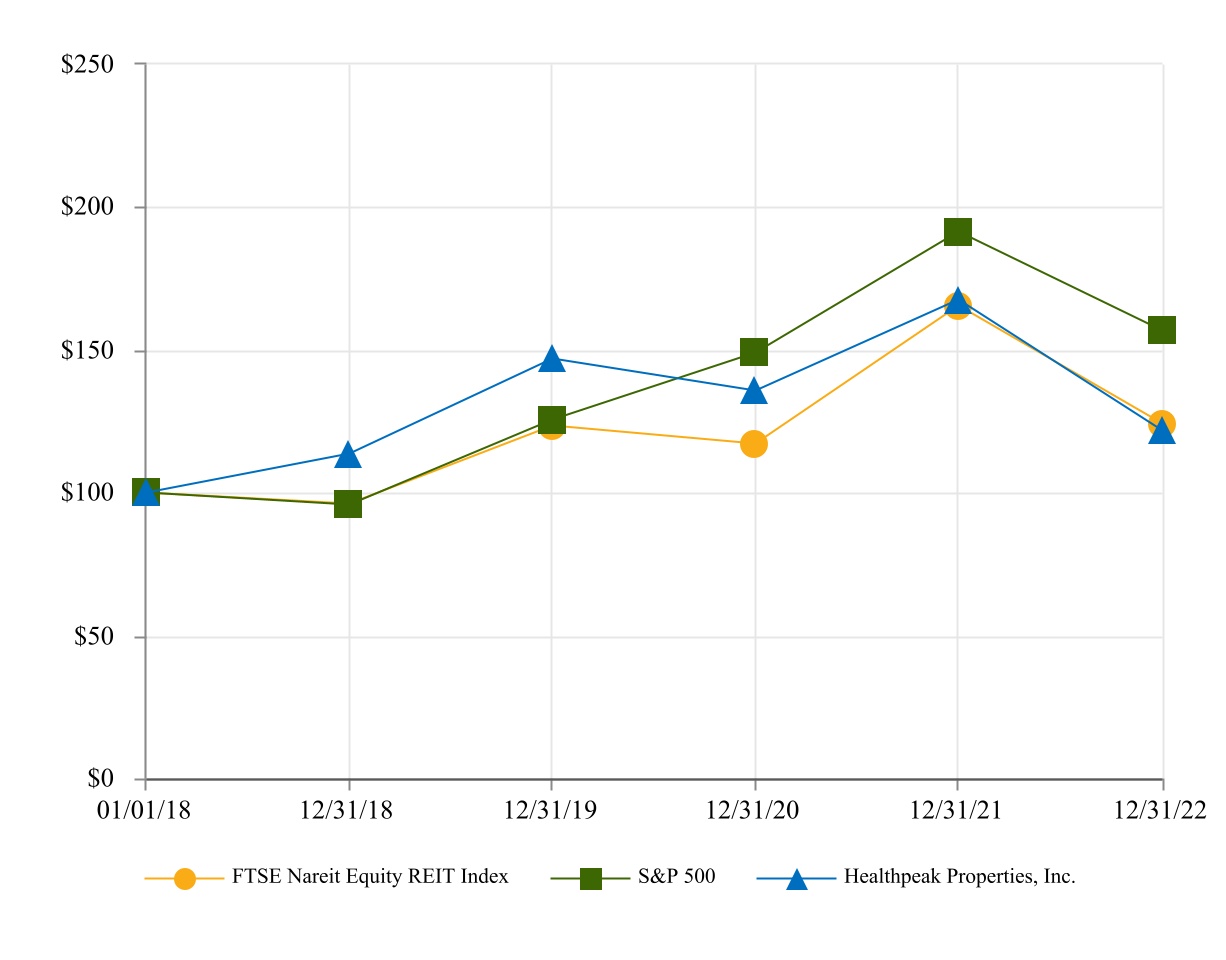
| December 31, | |||||||||||||||||||||||||||||
| 2018 | 2019 | 2020 | 2021 | 2022 | |||||||||||||||||||||||||
| FTSE Nareit Equity REIT Index | $ | 95.96 | $ | 123.46 | $ | 117.14 | $ | 165.51 | $ | 124.22 | |||||||||||||||||||
| S&P 500 | 95.61 | 125.70 | 148.81 | 191.48 | 156.77 | ||||||||||||||||||||||||
| Healthpeak Properties, Inc. | 113.68 | 146.78 | 135.52 | 167.70 | 121.58 |
Item 6. [Reserved]
Item 7. Management’s Discussion and Analysis of Financial Condition and Results of Operations
The information set forth in this Item 7 is intended to provide readers with an understanding of our financial condition, changes in financial condition, and results of operations. This section generally discusses the results of our operations for the year ended December 31, 2022 compared to the year ended December 31, 2021. For a discussion of the year ended December 31, 2021 compared to the year ended December 31, 2020, please refer to Part II, Item 7. “Management’s Discussion and Analysis of Financial Condition and Results of Operations” in our Annual Report on Form 10-K for the fiscal year ended December 31, 2021 filed with the SEC on February 9, 2022.
We will discuss and provide our analysis in the following order:
-
Market Trends and Uncertainties
-
Overview of Transactions
-
Dividends
-
Results of Operations
-
Liquidity and Capital Resources
-
Non-GAAP Financial Measures Reconciliations
-
Critical Accounting Estimates
-
Recent Accounting Pronouncements
Market Trends and Uncertainties
Our operating results have been and will continue to be impacted by global and national economic and market conditions generally and by the local economic conditions where our properties are located, as well as by the Covid pandemic.
Rising interest rates, high inflation, supply chain disruptions, ongoing geopolitical tensions, and increased volatility in public equity and fixed income markets have led to increased costs and limited the availability of capital. To the extent our tenants or operators experience increased costs or financing difficulties due to the foregoing macroeconomic conditions, they may be unable or unwilling to make payments or perform their obligations when due. In addition, increased interest rates could affect our borrowing costs and the fair value of our fixed rate instruments.
We have also been affected by significant inflation in construction costs over the past couple of years, which, together with rising costs of capital, have negatively affected the expected yields on our development and redevelopment projects. In addition, labor shortages and global supply chain disruptions, including procurement delays and long lead times on certain materials, have adversely impacted and could continue to adversely impact the scheduled completion and/or costs of these projects.
Further, the full, long-term economic impact of the Covid pandemic on the operations of our CCRCs and the senior housing facilities owned by our SWF SH JV remains uncertain. Many factors cannot be predicted and will remain unpredictable, including the impact, duration, and severity of new variants and outbreaks. Due to these uncertainties, at this time, we are not able to estimate the full impact of Covid on our consolidated financial position, results of operations, and cash flows in the future.
We continuously monitor the effects of domestic and global events, including but not limited to inflation, labor shortages, supply chain matters, rising interest rates, and other current and expected impacts of the Covid pandemic on our operations and financial position, as well as on the operations and financial position of our tenants, operators, and borrowers, to ensure that we remain responsive and adaptable to the dynamic changes in our operating environment.
See “Item 1A, Risk Factors” in this report for additional discussion of the risks posed by macroeconomic conditions and the Covid pandemic, as well as the uncertainties we and our tenants, operators, and borrowers may face as a result.
Overview of Transactions
South San Francisco Joint Ventures
On August 1, 2022, we sold a 30% interest in seven life science assets in South San Francisco, California to a sovereign wealth fund for cash of $126 million.
67 Smith Place
In January 2022, we closed a life science acquisition in Cambridge, Massachusetts for $72 million.
Vista Sorrento Phase II
In January 2022, we closed a life science acquisition in San Diego, California for $24 million.
Webster MOB Portfolio
In March 2022, we acquired a portfolio of two MOBs in Houston, Texas for $43 million.
Northwest Medical Plaza
In May 2022, we acquired one MOB in Bentonville, Arkansas for $26 million.
Concord Avenue Land Parcels
In December 2022, we closed a life science acquisition in Cambridge, Massachusetts for $18 million.
Land Parcel Acquisition Subsequent to Year-End
In January 2023, we closed a life science acquisition in Cambridge, Massachusetts for $9 million.
Other Real Estate Transactions
-
During the year ended December 31, 2022, we sold one life science facility in Utah for $14 million.
-
During the year ended December 31, 2022, we sold our remaining hospital under a direct financing lease (“DFL”) for $68 million.
-
During the year ended December 31, 2022, we sold five MOBs and one MOB land parcel for $36 million.
-
In January 2023, we sold two life science facilities in Durham, North Carolina for $113 million.
Financing Activities
-
In April 2022, we terminated our existing interest rate cap instruments associated with $142 million of variable rate mortgage debt and entered into two interest rate swap instruments that are designated as cash flow hedges and mature in May 2026.
-
In July 2022, we increased the maximum aggregate face or principal amount that can be outstanding at any one time under the commercial paper program from $1.5 billion to $2.0 billion.
-
In August 2022, we executed a term loan agreement that provides for two senior unsecured delayed draw term loans in an aggregate principal amount of up to $500 million (the “2022 Term Loan Facilities”). In October 2022, the entirety of the $500 million under the 2022 Term Loan Facilities was drawn.
-
In August 2022, we entered into two forward-starting interest rate swap instruments that are designated as cash flow hedges that effectively establish a fixed interest rate for the 2022 Term Loan Facilities.
-
In August 2022, our Board of Directors approved the Share Repurchase Program under which we may acquire shares of our common stock in the open market up to an aggregate purchase price of $500 million. During the year ended December 31, 2022, we repurchased 2.1 million shares of our common stock under our Share Repurchase Program at a weighted average price of $27.16 per share for a total of $56 million.
-
In December 2022, we settled all 9.1 million shares previously outstanding under forward contracts under our ATM Program (as defined below) at a weighted average net price of $34.01 per share, after commissions, resulting in net proceeds of $308 million.
-
In January 2023, we completed a public offering of $400 million aggregate principal amount of 5.25% senior unsecured notes due in 2032.
Development and Redevelopment Activities
- During the year ended December 31, 2022, the following projects were placed in service: (i) three MOB development projects with total costs of $58 million, (ii) three MOB redevelopment projects with total costs of $32 million, (iii) four life science development projects with total costs of $317 million, (iv) two life science redevelopment projects with total costs of $104 million, and (v) a portion of two life science development projects with total costs of $193 million.
Dividends
Quarterly cash dividends paid during 2022 aggregated to $1.20 per share. On February 1, 2023, our Board of Directors declared a quarterly cash dividend of $0.30 per common share. The dividend will be paid on February 23, 2023 to stockholders of record as of the close of business on February 9, 2023.
Results of Operations
We evaluate our business and allocate resources among our reporta
Showing the first 8K of 98K characters. Open the full section
Item 7A. Quantitative and Qualitative Disclosures About Market Risk
We are exposed to various market risks, including the potential loss arising from adverse changes in interest rates. We use derivative and other financial instruments in the normal course of business to mitigate interest rate risk. We do not use derivative financial instruments for speculative or trading purposes. Derivatives are recorded on the Consolidated Balance Sheets at fair value (see Note 22 to the Consolidated Financial Statements).
To illustrate the effect of movements in the interest rate markets, we performed a market sensitivity analysis on our hedging instruments. We applied various basis point spreads to the underlying interest rate curves of our derivative portfolio in order to determine the change in fair value. At December 31, 2022, a one percentage point increase or decrease in the underlying interest rate curve would result in a corresponding increase or decrease in the fair value of the derivative instruments by approximately $23 million.
Interest Rate Risk
At December 31, 2022, our exposure to interest rate risk was primarily on our variable rate debt. At December 31, 2022, $142 million of our variable rate mortgage debt was swapped to fixed through interest rate swap instruments. At December 31, 2022, the $500 million 2022 Term Loan Facilities were swapped to fixed through forward-starting interest rate swap instruments. The interest rate swap instruments are designated as cash flow hedges, with the objective of managing the exposure to interest rate risk by converting the interest rates on our variable rate debt to fixed interest rates. At December 31, 2022, both the fair value and carrying value of the interest rate swap instruments were $30 million.
Our remaining variable rate debt at December 31, 2022 was comprised of our commercial paper program and certain of our mortgage debt. Interest rate fluctuations will generally not affect our future earnings or cash flows on our fixed rate debt and assets until their maturity or earlier prepayment and refinancing. If interest rates have risen at the time we seek to refinance our fixed rate debt, whether at maturity or otherwise, our future earnings and cash flows could be adversely affected by additional borrowing costs. Conversely, lower interest rates at the time of refinancing may reduce our overall borrowing costs. Interest rate changes will affect the fair value of our fixed rate instruments. At December 31, 2022, a one percentage point increase in interest rates would decrease the fair value of our fixed rate debt by approximately $214 million and a one percentage point decrease in interest rates would increase the fair value of our fixed rate debt by approximately $229 million. Additionally, a one percentage point increase or decrease in interest rates would change the fair value of our fixed rate debt investments by approximately $1 million. These changes would not materially impact earnings or cash flows. Conversely, changes in interest rates on variable rate debt and investments would change our future earnings and cash flows, but not materially impact the fair value of those instruments. Assuming a one percentage point increase in the interest rates related to our variable rate debt, and assuming no other changes in the outstanding balance at December 31, 2022, our annual interest expense would increase by approximately $10 million. Lastly, assuming a one percentage point decrease in the interest rates related to our variable rate loans receivable, and assuming no other changes in the outstanding balance at December 31, 2022, our annual interest income would decrease by $2 million.
Market Risk
We have investments in marketable debt securities classified as held-to-maturity because we have the positive intent and ability to hold the securities to maturity. Held-to-maturity securities are recorded at amortized cost and adjusted for the amortization of premiums and discounts through maturity. We consider a variety of factors in evaluating an other-than-temporary decline in value, such as: the length of time and the extent to which the market value has been less than our current adjusted carrying value; the issuer’s financial condition, capital strength, and near-term prospects; any recent events specific to that issuer and economic conditions of its industry; and our investment horizon in relationship to an anticipated near-term recovery in the market value, if any. At December 31, 2022, both the fair value and carrying value of marketable debt securities was $22 million. These securities matured on December 31, 2022, and we received the related proceeds in January 2023.
Item 8. Financial Statements and Supplementary Data
Healthpeak Properties, Inc.
Index to the Consolidated Financial Statements
| Report of Independent Registered Public Accounting Firm (PCAOB ID No. 34) | 59 | ||||
| Consolidated Balance Sheets—December 31, 2022 and 2021 | 61 | ||||
| Consolidated Statements of Operations—for the years ended December 31, 2022, 2021, and 2020 | 62 | ||||
| Consolidated Statements of Comprehensive Income (Loss)—for the years ended December 31, 2022, 2021, and 2020 | 63 | ||||
| Consolidated Statements of Equity and Redeemable Noncontrolling Interests—for the years ended December 31, 2022, 2021, and 2020 | 64 | ||||
| Consolidated Statements of Cash Flows—for the years ended December 31, 2022, 2021, and 2020 | 66 | ||||
| Notes to the Consolidated Financial Statements | 67 |
REPORT OF INDEPENDENT REGISTERED PUBLIC ACCOUNTING FIRM
To the stockholders and the Board of Directors of Healthpeak Properties, Inc.
Opinion on the Financial Statements
We have audited the accompanying Consolidated Balance Sheets of Healthpeak Properties, Inc. and subsidiaries (the “Company”) as of December 31, 2022 and 2021, the related Consolidated Statements of Operations, Comprehensive Income (Loss), Equity and Redeemable Noncontrolling Interests, and Cash Flows, for each of the three years in the period ended December 31, 2022, and the related Notes and the schedules listed in the Index at Item 15 (collectively referred to as the “financial statements”). In our opinion, the financial statements present fairly, in all material respects, the financial position of the Company as of December 31, 2022 and 2021, and the results of its operations and its cash flows for each of the three years in the period ended December 31, 2022, in conformity with accounting principles generally accepted in the United States of America.
We have also audited, in accordance with the standards of the Public Company Accounting Oversight Board (United States) (PCAOB), the Company’s internal control over financial reporting as of December 31, 2022, based on criteria established in Internal Control — Integrated Framework (2013) issued by the Committee of Sponsoring Organizations of the Treadway Commission and our report dated February 8, 2023, expressed an unqualified opinion on the Company’s internal control over financial reporting.
Basis for Opinion
These financial statements are the responsibility of the Company’s management. Our responsibility is to express an opinion on the Company’s financial statements based on our audits. We are a public accounting firm registered with the PCAOB and are required to be independent with respect to the Company in accordance with the U.S. federal securities laws and the applicable rules and regulations of the Securities and Exchange Commission and the PCAOB.
We conducted our audits in accordance with the standards of the PCAOB. Those standards require that we plan and perform the audit to obtain reasonable assurance about whether the financial statements are free of material misstatement, whether due to error or fraud. Our audits included performing procedures to assess the risks of material misstatement of the financial statements, whether due to error or fraud, and performing procedures that respond to those risks. Such procedures included examining, on a test basis, evidence regarding the amounts and disclosures in the financial statements. Our audits also included evaluating the accounting principles used and significant estimates made by management, as well as evaluating the overall presentation of the financial statements. We believe that our audits provide a reasonable basis for our opinion.
Critical Audit Matter
The critical audit matter communicated below is a matter arising from the current-period audit of the financial statements that was communicated or required to be communicated to the audit committee and that (1) relates to accounts or disclosures that are material to the financial statements and (2) involved our especially challenging, subjective, or complex judgments. The communication of critical audit matters does not alter in any way our opinion on the financial statements, taken as a whole, and we are not, by communicating the critical audit matter below, providing a separate opinion on the critical audit matter or on the accounts or disclosures to which it relates.
Impairments — Real Estate — Refer to Notes 2 and 6 to the financial statements
Critical Audit Matter Description
The Company’s evaluation of impairment of real estate involves an assessment of the carrying value of real estate assets and related intangibles (“real estate assets”) when events or changes in circumstances indicate that the carrying value may not be recoverable.
Auditing the Company’s process to evaluate real estate assets for impairment was complex due to the subjectivity in determining whether impairment indicators were present. Additionally, for real estate assets where indicators of impairment were determined to be present, the determination of the future undiscounted cash flows involved significant judgment. In particular, the undiscounted cash flows were forecasted based on significant assumptions such as lease-up periods, lease revenue rates, operating expenses, and revenue and expense growth rates, and included judgments around the intended hold period and terminal capitalization rates.
Given the Company’s evaluation of impairment indicators, forecasted cash flows and sales prices of a long lived asset requires management to make significant estimates and assumptions related to market capitalization rates, market prices per unit, and/or forecasted cash flows, performing audit procedures required a high degree of auditor judgment and an increased extent of effort.
How the Critical Audit Matter Was Addressed in the Audit
Our audit procedures related to real estate asset impairment included the following, among others:
-
We tested the effectiveness of controls over impairment of real estate assets, including those over identifying impairment indicators, and the determination of forecasted undiscounted cash flows and sales prices for real estate assets.
-
We performed an independent search for impairment indicators through the evaluation of several factors including an analysis of industry and market data, a comparison of real estate asset implied capitalization rates to market capitalization rates, and trends in financial performance.
-
For real estate assets where indicators of impairment were determined to be present, we subjected a sample of undiscounted cash flow models to testing by (1) evaluating the source in
Showing the first 8K of 473K characters. Open the full section
Item 9. Changes in and Disagreements with Accountants on Accounting and Financial Disclosure
None.
Item 9A. Controls and Procedures
Disclosure Controls and Procedures. We maintain disclosure controls and procedures that are designed to ensure that information required to be disclosed in our reports under the Exchange Act is recorded, processed, summarized, and reported within the time periods specified in the SEC’s rules and forms and that such information is accumulated and communicated to our management, including our principal executive officer and principal financial officer, to allow for timely decisions regarding required disclosure. In designing and evaluating the disclosure controls and procedures, management recognizes that any controls and procedures, no matter how well designed and operated, can provide only reasonable assurance of achieving the desired control objectives, and management is required to apply its judgment in evaluating the cost-benefit relationship of possible controls and procedures.
As required by Rules 13a-15(b) and 15d-15(b) of the Exchange Act, we carried out an evaluation, under the supervision and with the participation of our management, including our principal executive officer and principal financial officer, of the effectiveness of the design and operation of our disclosure controls and procedures as of December 31, 2022. Based upon that evaluation, our principal executive officer and principal financial officer concluded that our disclosure controls and procedures were effective at the reasonable assurance level as of December 31, 2022.
Management’s Annual Report on Internal Control over Financial Reporting. Management is responsible for establishing and maintaining adequate internal control over financial reporting, as such term is defined in Exchange Act Rules 13a-15(f) and 15d-15(f). Under the supervision and with the participation of our management, including our principal executive officer and principal financial officer, we conducted an evaluation of the effectiveness of our internal control over financial reporting based on the framework in Internal Control—Integrated Framework (2013) issued by the Committee of Sponsoring Organizations of the Treadway Commission. Based on our evaluation under the framework in Internal Control—Integrated Framework (2013), our management concluded that our internal control over financial reporting was effective as of December 31, 2022.
The effectiveness of our internal control over financial reporting as of December 31, 2022 has been audited by Deloitte & Touche LLP, the independent registered public accounting firm that audited the financial statements included in this Annual Report on Form 10-K, as stated in their report, which is included herein.
Changes in Internal Control Over Financial Reporting. There were no changes in our internal control over financial reporting (as such term is defined in Rules 13a-15(f) and 15d-15(f) under the Exchange Act) during the fourth quarter of 2022 that have materially affected, or are reasonably likely to materially affect, our internal control over financial reporting.
REPORT OF INDEPENDENT REGISTERED PUBLIC ACCOUNTING FIRM
To the stockholders and the Board of Directors of Healthpeak Properties, Inc.
Opinion on Internal Control over Financial Reporting
We have audited the internal control over financial reporting of Healthpeak Properties, Inc. and subsidiaries (the “Company”) as of December 31, 2022, based on criteria established in Internal Control — Integrated Framework (2013) issued by the Committee of Sponsoring Organizations of the Treadway Commission (“COSO”). In our opinion, the Company maintained, in all material respects, effective internal control over financial reporting as of December 31, 2022, based on criteria established in Internal Control — Integrated Framework (2013) issued by COSO.
We have also audited, in accordance with the standards of the Public Company Accounting Oversight Board (United States) (PCAOB), the consolidated financial statements as of and for the year ended December 31, 2022, of the Company and our report dated February 8, 2023, expressed an unqualified opinion on those financial statements.
Basis for Opinion
The Company’s management is responsible for maintaining effective internal control over financial reporting and for its assessment of the effectiveness of internal control over financial reporting, included in the accompanying Management’s Annual Report on Internal Control over Financial Reporting. Our responsibility is to express an opinion on the Company’s internal control over financial reporting based on our audit. We are a public accounting firm registered with the PCAOB and are required to be independent with respect to the Company in accordance with the U.S. federal securities laws and the applicable rules and regulations of the Securities and Exchange Commission and the PCAOB.
We conducted our audit in accordance with the standards of the PCAOB. Those standards require that we plan and perform the audit to obtain reasonable assurance about whether effective internal control over financial reporting was maintained in all material respects. Our audit included obtaining an understanding of internal control over financial reporting, assessing the risk that a material weakness exists, testing and evaluating the design and operating effectiveness of internal control based on the assessed risk, and performing such other procedures as we considered necessary in the circumstances. We believe that our audit provides a reasonable basis for our opinion.
Definition and Limitations of Internal Control over Financial Reporting
A company’s internal control over financial reporting is a process designed to provide reasonable assurance regarding the reliability of financial reporting and the preparation of financial statements for external purposes in accordance with generally accepted accounting principles. A company’s internal control over financial reporting includes those policies and procedures that (1) pertain to the maintenance of records that, in reasonable detail, accurately and fairly reflect the transactions and dispositions of the assets of the company; (2) provide reasonable assurance that transactions are recorded as necessary to permit preparation of financial statements in accordance with generally accepted accounting principles, and that receipts and expenditures of the company are being made only in accordance with authorizations of management and directors of the company; and (3) provide reasonable assurance regarding prevention or timely detection of unauthorized acquisition, use, or disposition of the company’s assets that could have a material effect on the financial statements.
Because of its inherent limitations, internal control over financial reporting may not prevent or detect misstatements. Also, projections of any evaluation of effectiveness to future periods are subject to the risk that controls may become inadequate because of changes in conditions, or that the degree of compliance with the policies or procedures may deteriorate.
| /s/ DELOITTE & TOUCHE LLP |
Costa Mesa, California
February 8, 2023
Item 9B. Other Information
None.
Item 9C. Disclosure Regarding Foreign Jurisdictions that Prevent Inspections
Not applicable.
PART III
Item 10. Directors, Executive Officers and Corporate Governance
Except as provided below, the information required under Item 10 is incorporated herein by reference to our definitive proxy statement to be filed with the SEC within 120 days after the end of our fiscal year ended December 31, 2022 in connection with our 2023 Annual Meeting of Stockholders.
We have adopted a Code of Business Conduct and Ethics that applies to all of our directors and employees, including our principal executive officer, principal financial officer, principal accounting officer, and controller. We have also adopted a Vendor Code of Business Conduct and Ethics applicable to our vendors and business partners. Current copies of our Code of Business Conduct and Ethics and Vendor Code of Business Conduct and Ethics are posted on our website at www.healthpeak.com/esg/governance. In addition, waivers from, and amendments to, our Code of Business Conduct and Ethics that apply to our directors and executive officers, including our principal executive officer, principal financial officer, principal accounting officer, or persons performing similar functions, will be timely posted in the Investors section of our website at www.healthpeak.com.
Item 11. Executive Compensation
The information required under Item 11 is incorporated herein by reference to our definitive proxy statement to be filed with the SEC within 120 days after the end of our fiscal year ended December 31, 2022 in connection with our 2023 Annual Meeting of Stockholders.
Item 12. Security Ownership of Certain Beneficial Owners and Management and Related Stockholder Matters
The information required under Item 12 is incorporated herein by reference to our definitive proxy statement to be filed with the SEC within 120 days after the end of our fiscal year ended December 31, 2022 in connection with our 2023 Annual Meeting of Stockholders.
Item 13. Certain Relationships and Related Transactions, and Director Independence
The information required under Item 13 is incorporated herein by reference to our definitive proxy statement to be filed with the SEC within 120 days after the end of our fiscal year ended December 31, 2022 in connection with our 2023 Annual Meeting of Stockholders.
Item 14. Principal Accountant Fees and Services
The information required under Item 14 is incorporated herein by reference to our definitive proxy statement to be filed with the SEC within 120 days after the end of our fiscal year ended December 31, 2022 in connection with our 2023 Annual Meeting of Stockholders.
PART IV
Item 15. Exhibits and Financial Statement Schedules
(a) 1. Financial Statements
The following Consolidated Financial Statements are included in Part II, Item 8, Financial Statements and Supplementary Data of this Annual Report on Form 10-K.
Report of Independent Registered Public Accounting Firm
Consolidated Balance Sheets - December 31, 2022 and 2021
Consolidated Statements of Operations - for the years ended December 31, 2022, 2021, and 2020
Consolidated Statements of Comprehensive Income (Loss) - for the years ended December 31, 2022, 2021, and 2020
Consolidated Statements of Equity and Redeemable Noncontrolling Interests - for the years ended December 31, 2022, 2021, and 2020
Consolidated Statements of Cash Flows - for the years ended December 31, 2022, 2021, and 2020
Notes to the Consolidated Financial Statements
(a) 2. Financial Statement Schedules
The following Consolidated Financial Statement Schedules are included in Part II, Item 8, Financial Statements and Supplementary Data of this Annual Report on Form 10-K.
Schedule II: Valuation and Qualifying Accounts
Schedule III: Real Estate and Accumulated Depreciation
Schedule IV: Mortgage Loans on Real Estate
(a) 3. Exhibits
| 101.CAL† | XBRL Taxonomy Extension Calculation Linkbase Document. | |||||||||||||||||||
| 101.DEF† | XBRL Taxonomy Extension Definition Linkbase Document. | |||||||||||||||||||
| 101.LAB† | XBRL Taxonomy Extension Label Linkbase Document. | |||||||||||||||||||
| 101.PRE† | XBRL Taxonomy Extension Presentation Linkbase Document. | |||||||||||||||||||
| 104 | Cover Page Interactive Data File (formatted as Inline XBRL document and contained in Exhibit 101). |
_______________________________________
- Management Contract or Compensatory Plan or Arrangement.
† Filed herewith.
†† Furnished herewith.
Item 16. Form 10-K Summary
None.
SIGNATURES
Pursuant to the requirements of Section 13 or 15(d) of the Securities Exchange Act of 1934, the Registrant has duly caused this report to be signed on its behalf by the undersigned, thereunto duly authorized.
Dated: February 8, 2023
| Healthpeak Properties, Inc. (Registrant) | |||||
| /s/ SCOTT M. BRINKER | |||||
| Scott M. Brinker, President and Chief Executive Officer (Principal Executive Officer) |
Pursuant to the requirements of the Securities Exchange Act of 1934, this report has been signed below by the following persons on behalf of the Registrant and in the capacities and on the dates indicated.
| Signature | Title | Date | ||||||||||||
| /s/ SCOTT M. BRINKER | President and Chief Executive Officer, Director | February 8, 2023 | ||||||||||||
| Scott M. Brinker | (Principal Executive Officer) | |||||||||||||
| /s/ PETER A. SCOTT | Chief Financial Officer | February 8, 2023 | ||||||||||||
| Peter A. Scott | (Principal Financial Officer) | |||||||||||||
| /s/ SHAWN G. JOHNSTON | Executive Vice President and Chief Accounting Officer | February 8, 2023 | ||||||||||||
| Shawn G. Johnston | (Principal Accounting Officer) | |||||||||||||
| /s/ BRIAN G. CARTWRIGHT | Chairman of the Board | February 8, 2023 | ||||||||||||
| Brian G. Cartwright | ||||||||||||||
| /s/ KATHERINE M. SANDSTROM | Vice Chair of the Board | February 8, 2023 | ||||||||||||
| Katherine M. Sandstrom | ||||||||||||||
| /s/ CHRISTINE N. GARVEY | Director | February 8, 2023 | ||||||||||||
| Christine N. Garvey | ||||||||||||||
| /s/ R. KENT GRIFFIN, JR. | Director | February 8, 2023 | ||||||||||||
| R. Kent Griffin, Jr. | ||||||||||||||
| /s/ DAVID B. HENRY | Director | February 8, 2023 | ||||||||||||
| David B. Henry | ||||||||||||||
| /s/ SARA GROOTWASSINK LEWIS | Director | February 8, 2023 | ||||||||||||
| Sara Grootwassink Lewis | ||||||||||||||