 filings.tools
Dow 2023 10-K Annual Report
DOW · CIK 1751788 · Form 10-K · Fiscal year ended December 31, 2023 · Filed January 31, 2024
22 sections, 608K characters. Original on sec.gov · Markdown · JSON
Risk FactorsBusinessMD&AFinancial StatementsWhat changed vs 2022
Cover and table of contents
UNITED STATES
SECURITIES AND EXCHANGE COMMISSION
Washington, D.C. 20549
FORM 10-K
☑ ANNUAL REPORT PURSUANT TO SECTION 13 OR 15(d) OF THE SECURITIES EXCHANGE ACT OF 1934
For the fiscal year ended December 31, 2023
or
☐ TRANSITION REPORT PURSUANT TO SECTION 13 OR 15(d) OF THE SECURITIES EXCHANGE ACT OF 1934
For the transition period from to
| Commission File Number | Exact Name of Registrant as Specified in its Charter, Principal Office Address and Telephone Number | State of Incorporation or Organization | I.R.S. Employer Identification No. | ||||||||
| 001-38646 | Dow Inc. | Delaware | 30-1128146 | ||||||||
| 2211 H.H. Dow Way, Midland, MI 48674 | |||||||||||
| 989 636-1000 | |||||||||||
| 001-03433 | The Dow Chemical Company | Delaware | 38-1285128 | ||||||||
| 2211 H.H. Dow Way, Midland, MI 48674 | |||||||||||
| 989 636-1000 |
Securities registered pursuant to Section 12(b) of the Act:
| Registrant | Title of each class | Trading Symbol(s) | Name of each exchange on which registered | ||||||||
| Dow Inc. | Common Stock, par value $0.01 per share | DOW | New York Stock Exchange | ||||||||
| The Dow Chemical Company | 0.500% Notes due March 15, 2027 | DOW/27 | New York Stock Exchange | ||||||||
| The Dow Chemical Company | 1.125% Notes due March 15, 2032 | DOW/32 | New York Stock Exchange | ||||||||
| The Dow Chemical Company | 1.875% Notes due March 15, 2040 | DOW/40 | New York Stock Exchange | ||||||||
| The Dow Chemical Company | 4.625% Notes due October 1, 2044 | DOW/44 | New York Stock Exchange |
Securities registered pursuant to Section 12(g) of the Act: None
Indicate by check mark if the registrant is a well-known seasoned issuer, as defined in Rule 405 of the Securities Act.
| Dow Inc. | ☑ | Yes | ☐ | No | |||||||||||||
| The Dow Chemical Company | ☑ | Yes | ☐ | No |
Indicate by check mark if the registrant is not required to file reports pursuant to Section 13 or Section 15(d) of the Act.
| Dow Inc. | ☐ | Yes | ☑ | No | |||||||||||||
| The Dow Chemical Company | ☐ | Yes | ☑ | No |
Indicate by check mark whether the registrant (1) has filed all reports required to be filed by Section 13 or 15(d) of the Securities Exchange Act of 1934 during the preceding 12 months (or for such shorter period that the registrant was required to file such reports), and (2) has been subject to such filing requirements for the past 90 days.
| Dow Inc. | ☑ | Yes | ☐ | No | |||||||||||||
| The Dow Chemical Company | ☑ | Yes | ☐ | No |
Indicate by check mark whether the registrant has submitted electronically every Interactive Data File required to be submitted pursuant to Rule 405 of Regulation S-T (§232.405 of this chapter) during the preceding 12 months (or for such shorter period that the registrant was required to submit such files).
| Dow Inc. | ☑ | Yes | ☐ | No | |||||||||||||
| The Dow Chemical Company | ☑ | Yes | ☐ | No |
Indicate by check mark whether the registrant is a large accelerated filer, an accelerated filer, a non-accelerated filer, a smaller reporting company, or an emerging growth company. See the definitions of “large accelerated filer,” “accelerated filer,” “smaller reporting company,” and "emerging growth company" in Rule 12b-2 of the Exchange Act.
| Dow Inc. | Large accelerated filer | ☑ | Accelerated filer | ¨ | Non- accelerated filer | ¨ | Smaller reporting company | ¨ | Emerging growth company | ¨ | |||||||||||||||||||||||||
| The Dow Chemical Company | Large accelerated filer | ¨ | Accelerated filer | ¨ | Non- accelerated filer | ☑ | Smaller reporting company | ¨ | Emerging growth company | ¨ |
If an emerging growth company, indicate by check mark if the registrant has elected not to use the extended transition period for complying with any new or revised financial accounting standards provided pursuant to Section 13(a) of the Exchange Act.
| Dow Inc. | ☐ | ||||||||||
| The Dow Chemical Company | ☐ |
Indicate by check mark whether the registrant has filed a report on and attestation to its management's assessment of the effectiveness of its internal control over financial reporting under Section 404(b) of the Sarbanes-Oxley Act (15 U.S.C. 7262(b)) by the registered public accounting firm that prepared or issued its audit report.
| Dow Inc. | ☑ | ||||||||||
| The Dow Chemical Company | ☑ |
If securities are registered pursuant to Section 12(b) of the Act, indicate by check mark whether the financial statements of the registrant included in the filing reflect the correction of an error to previously issued financial statements.
| Dow Inc. | ☐ | ||||||||||
| The Dow Chemical Company | ☐ |
Indicate by check mark whether any of those error corrections are restatements that required a recovery analysis of incentive-based compensation received by any of the registrant's executive officers during the relevant recovery period pursuant to §240.10D-1(b).
| Dow Inc. | ☐ | ||||||||||
| The Dow Chemical Company | ☐ |
Indicate by check mark whether the registrant is a shell company (as defined in Rule 12b-2 of the Act).
| Dow Inc. | ☐ | Yes | ☑ | No | |||||||||||||
| The Dow Chemical Company | ☐ | Yes | ☑ | No |
As of June 30, 2023, the aggregate market value of the common stock of Dow Inc. held by non-affiliates of Dow Inc. was approximately $37.4 billion based on the last reported closing price of $53.26 per share as reported on the New York Stock Exchange.
Dow Inc. had 702,293,433 shares of common stock, $0.01 par value, outstanding at December 31, 2023. The Dow Chemical Company had 100 shares of common stock, $0.01 par value, outstanding at December 31, 2023, all of which were held by the registrant’s parent, Dow Inc.
The Dow Chemical Company meets the conditions set forth in General Instruction I(1)(a) and (b) for Form 10-K and therefore is filing this form in the reduced disclosure format.
DOCUMENTS INCORPORATED BY REFERENCE
Dow Inc.: Portions of Dow Inc.'s Proxy Statement for the 2024 Annual Meeting of Stockholders are incorporated herein by reference in Part III of this Annual Report on Form 10-K to the extent stated herein. Such proxy statement will be filed with the Securities and Exchange Commission within 120 days of Dow Inc.'s fiscal year ended December 31, 2023.
The Dow Chemical Company: None.
Dow Inc. and Subsidiaries
The Dow Chemical Company and Subsidiaries
ANNUAL REPORT ON FORM 10-K
For the fiscal year ended December 31, 2023
TABLE OF CONTENTS
| Dow Inc. and Subsidiaries The Dow Chemical Company and Subsidiaries |
This Annual Report on Form 10-K is a combined report being filed by Dow Inc. and The Dow Chemical Company and its consolidated subsidiaries (“TDCC” and together with Dow Inc., “Dow” or the "Company"). This Annual Report on Form 10-K reflects the results of Dow and its consolidated subsidiaries. As a result of the parent/subsidiary relationship between Dow Inc. and TDCC, and considering that the financial statements and disclosures of each company are substantially similar, the companies are filing a combined report for this Annual Report on Form 10-K. The information reflected in this report is equally applicable to both Dow Inc. and TDCC, except where otherwise noted. Each of Dow Inc. and TDCC is filing information in this report on its own behalf and neither company makes any representation to the information relating to the other company.
CAUTIONARY STATEMENT REGARDING FORWARD-LOOKING STATEMENTS
Certain statements in this report are “forward-looking statements” within the meaning of the federal securities laws, including Section 27A of the Securities Act of 1933, as amended, and Section 21E of the Securities Exchange Act of 1934, as amended. Such statements often address expected future business and financial performance, financial condition, and other matters, and often contain words or phrases such as “anticipate,” “believe,” “estimate,” “expect,” “intend,” “may,” “opportunity,” “outlook,” “plan,” “project,” “seek,” “should,” “strategy,” "target," “will,” “will be,” “will continue,” “will likely result,” “would” and similar expressions, and variations or negatives of these words or phrases.
Forward-looking statements are based on current assumptions and expectations of future events that are subject to risks, uncertainties and other factors that are beyond Dow’s control, which may cause actual results to differ materially from those projected, anticipated or implied in the forward-looking statements and speak only as of the date the statements were made. These factors include, but are not limited to: sales of Dow’s products; Dow’s expenses, future revenues and profitability; any global and regional economic impacts of a pandemic or other public health-related risks and events on Dow’s business; any sanctions, export restrictions, supply chain disruptions or increased economic uncertainty related to the ongoing conflicts between Russia and Ukraine and in the Middle East; capital requirements and need for and availability of financing; unexpected barriers in the development of technology, including with respect to Dow's contemplated capital and operating projects; Dow's ability to realize its commitment to carbon neutrality on the contemplated timeframe, including the completion and success of its integrated ethylene cracker and derivatives facility in Alberta, Canada; size of the markets for Dow’s products and services and ability to compete in such markets; failure to develop and market new products and optimally manage product life cycles; the rate and degree of market acceptance of Dow’s products; significant litigation and environmental matters and related contingencies and unexpected expenses; the success of competing technologies that are or may become available; the ability to protect Dow’s intellectual property in the United States and abroad; developments related to contemplated restructuring activities and proposed divestitures or acquisitions such as workforce reduction, manufacturing facility and/or asset closure and related exit and disposal activities, and the benefits and costs associated with each of the foregoing; fluctuations in energy and raw material prices; management of process safety and product stewardship; changes in relationships with Dow’s significant customers and suppliers; changes in public sentiment and political leadership; increased concerns about plastics in the environment and lack of a circular economy for plastics at scale; changes in consumer preferences and demand; changes in laws and regulations, political conditions or industry development; global economic and capital markets conditions, such as inflation, market uncertainty, interest and currency exchange rates, and equity and commodity prices; business or supply disruptions; security threats, such as acts of sabotage, terrorism or war, including the ongoing conflicts between Russia and Ukraine and in the Middle East; weather events and natural disasters; disruptions in Dow’s information technology networks and systems, including the impact of cyberattacks; and risks related to Dow’s separation from DowDuPont Inc. such as Dow’s obligation to indemnify DuPont de Nemours, Inc. and/or Corteva, Inc. for certain liabilities.
Where, in any forward-looking statement, an expectation or belief as to future results or events is expressed, such expectation or belief is based on the current plans and expectations of management and expressed in good faith and believed to have a reasonable basis, but there can be no assurance that the expectation or belief will result or be achieved or accomplished. A detailed discussion of principal risks and uncertainties which may cause actual results and events to differ materially from such forward-looking statements is included in the section of this Annual Report on Form 10-K titled “Risk Factors.” These are not the only risks and uncertainties that Dow faces. There may be other risks and uncertainties that Dow is unable to identify at this time or that Dow does not currently expect to have a material impact on its business. If any of those risks or uncertainties develops into an actual event, it could have a material adverse effect on Dow’s business. Dow Inc. and TDCC assume no obligation to update or revise publicly any forward-looking statements whether because of new information, future events, or otherwise, except as required by securities and other applicable laws.
| Dow Inc. and Subsidiaries | ||||||||
| The Dow Chemical Company and Subsidiaries | ||||||||
| PART I |
Item 1. BUSINESS
THE COMPANY
Dow Inc. was incorporated on August 30, 2018, under Delaware law, to serve as a holding company for The Dow Chemical Company and its consolidated subsidiaries ("TDCC" and together with Dow Inc., "Dow" or the "Company"). Dow Inc. operates all of its businesses through TDCC, a wholly owned subsidiary, which was incorporated in 1947 under Delaware law and is the successor to a Michigan corporation, of the same name, organized in 1897. The Company's principal executive offices are located at 2211 H.H. Dow Way, Midland, Michigan 48674.
Available Information
The Company's Annual Reports on Form 10-K, Quarterly Reports on Form 10-Q and Current Reports on Form 8-K, and amendments to those reports filed or furnished pursuant to Section 13(a) or 15(d) of the Securities Exchange Act of 1934, are available free of charge at www.dow.com/investors, as soon as reasonably practicable after the reports are electronically filed or furnished with the U.S. Securities and Exchange Commission ("SEC"). The SEC maintains a website that contains these reports as well as proxy statements and other information regarding issuers that file electronically. The SEC's website is www.sec.gov. Dow's website and its content are not deemed incorporated by reference into this report.
Except as otherwise indicated by the context, the term "Union Carbide" means Union Carbide Corporation and the term "Dow Silicones" means Dow Silicones Corporation, both wholly owned subsidiaries of the Company.
ABOUT DOW
Dow is one of the world’s leading materials science companies, serving customers in high-growth markets such as packaging, infrastructure, mobility and consumer applications. The Company's global breadth, asset integration and scale, focused innovation, leading business positions and commitment to sustainability enables the Company to achieve profitable growth and help deliver a sustainable future. Dow operates manufacturing sites in 31 countries and employs approximately 35,900 people. In 2023, Dow delivered sales of approximately $45 billion. Learn more about Dow's ambition to be the most innovative, customer-centric, inclusive and sustainable materials science company in the world by visiting www.dow.com.
BUSINESS SEGMENTS AND PRODUCTS
The Company conducts its worldwide operations through six global businesses which are organized into the following operating segments: Packaging & Specialty Plastics, Industrial Intermediates & Infrastructure and Performance Materials & Coatings. Corporate contains the reconciliation between the totals for the operating segments and the Company's totals. The Company did not aggregate any operating segments when determining its reportable segments. See Part II, Item 7. Management’s Discussion and Analysis of Financial Condition and Results of Operations and Note 24 to the Consolidated Financial Statements for additional information concerning the Company’s operating segments.
PACKAGING & SPECIALTY PLASTICS
The Packaging & Specialty Plastics operating segment consists of two highly integrated global businesses: Hydrocarbons & Energy and Packaging and Specialty Plastics. The segment employs the industry’s broadest polyolefin product portfolio, supported by the Company’s proprietary catalyst and manufacturing process technologies. These differentiators, plus collaboration at the customer’s design table, enable the segment to deliver more reliable, durable, higher-performing solutions designed for recyclability and enhanced plastics circularity and sustainability. The segment serves customers, brand owners and ultimately consumers in key markets including food and specialty packaging; industrial and consumer packaging; health and hygiene; caps, closures and pipe applications; consumer durables; mobility and transportation; and infrastructure.
The Company’s unique advantages compared with its competitors include: extensive low-cost feedstock positions around the world; unparalleled scale, global footprint and market reach; world-class manufacturing sites in every geographic region; deep customer and brand owner understanding; portfolio of higher-value functional polymers, such as polyolefin elastomers, semiconductive and jacketing compound solutions and wire and cable insulation; and market-driven application development and technical support.
The segment remains agile by participating in the entire ethylene-to-polyethylene chain integration, enabling the Company to manage market swings with industry-leading feedstock and derivative flexibility, and therefore optimize returns while reducing long-term earnings volatility. The Company’s unrivaled value chain ownership is further strengthened by its Pack Studio locations in every geographic region, which help customers and brand owners deliver faster and more efficient packaging product commercialization through a global network of laboratories, technical experts and testing equipment.
Hydrocarbons & Energy
Hydrocarbons & Energy is a leading global producer of ethylene, a key chemical building block that the Company consumes primarily within the Packaging & Specialty Plastics segment. Ethylene is transferred to downstream derivative businesses at market-based prices, which are generally equivalent to prevailing market prices for large volume purchases. In addition to ethylene, the business is a leading producer of propylene and aromatics products that are used to manufacture materials consumers use every day. The business also produces and procures the power, steam and feedstocks used by the Company’s manufacturing sites.
Packaging and Specialty Plastics
Packaging and Specialty Plastics serves growing, high-value sectors using world-class technology, broad existing product lines, and a rich product pipeline that creates competitive advantages for the entire packaging value chain. The business is a recognized leader in the production, marketing and innovation of polyethylene. The business is also a leader in other ethylene derivatives, such as polyolefin elastomers, ethylene vinyl acetate and ethylene propylene diene monomer ("EPDM") rubber serving mobility and transportation, consumer, wire and cable and construction end-markets. Market growth is expected to be driven by major shifts in population demographics; improving socioeconomic status in emerging geographic regions; consumer and brand owner demand for increased functionality including sustainable offerings through lower-carbon and circular solutions; global efforts to reduce food waste; growth in telecommunications networks; global development of electrical transmission and distribution infrastructure; and renewable energy applications such as wind power and solar (photovoltaic).
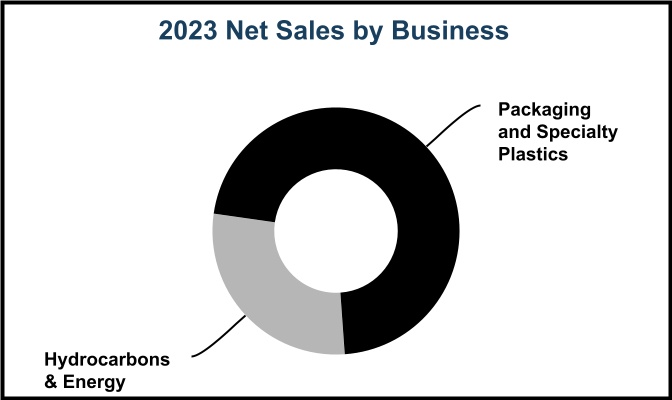
Details on Packaging & Specialty Plastics' 2023 net sales, by business and geographic region, are as follows:
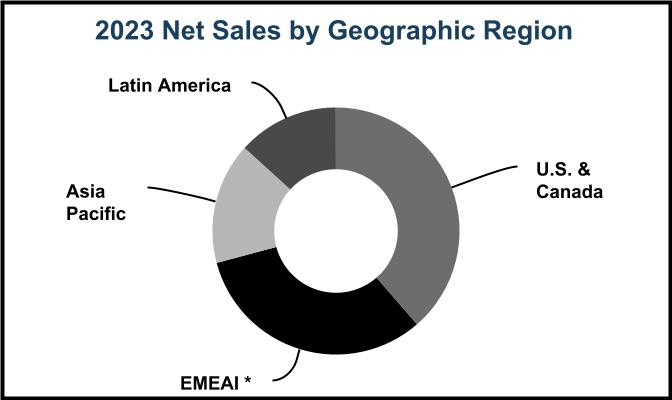
- Europe, Middle East, Africa and India ("EMEAI")
Products
Major applications/market segments and products are listed below by business:
| Business | Applications/Market Segments | Major Products | Key Raw Materials | Key Competitors | ||||||||||
| Hydrocarbons & Energy | Purchaser of feedstocks; production of cost competitive hydrocarbon monomers utilized by Dow's derivative businesses; and energy, principally for use in Dow’s global operations | Ethylene, propylene, benzene, butadiene, octene, aromatics co-products, power, steam, other utilities | Butane, condensate, ethane, naphtha, natural gas, prop |
Showing the first 8K of 62K characters. Open the full section
Item 1A. RISK FACTORS
The factors described below represent the Company's principal risks.
CLIMATE CHANGE - RELATED RISKS
Climate Change: Climate change-related risks and uncertainties, legal or regulatory responses to climate change and failure to meet the Company’s climate change commitments could negatively impact the Company’s results of operations, financial condition and/or reputation.
The Company is subject to increasing climate-related risks and uncertainties, many of which are outside of its control. Climate change may result in more frequent and damaging severe weather and weather-related events, potential changes in precipitation patterns and extreme variability in weather patterns. These short- and long-term weather and weather-related events can disrupt the operations of the Company as well as those of its customers, partners and vendors due to damage to local infrastructure and other property damage limiting site access, and causing water scarcity and lack of access to high-quality water, among other factors. These risks and uncertainties may also directly or indirectly impact decisions to invest in the construction and/or renovation of new or existing manufacturing sites and other Company facilities and locations.
The transition to lower greenhouse gas emissions technology, the effects of carbon pricing and changes in public sentiment, regulations, taxes, public mandates or requirements and increases in climate-related lawsuits, insurance premiums and implementation of more robust disaster recovery and business continuity plans could increase costs to maintain or resume the Company’s operations or achieve its sustainability commitments in the expected timeframes, which would negatively impact the Company’s results of operations.
In 2020, the Company announced commitments to reduce its net annual Scope 1 and 2 CO2e emissions by an additional 5 million metric tons, or 15 percent compared with its 2020 baseline, by 2030 (the 2020 baseline represents a 15 percent reduction in greenhouse gas emissions since 2005) and its intention to be carbon neutral by 2050 (Scope 1+2+3, as defined by the Greenhouse Gas Protocol Corporate Accounting and Reporting Standard, plus product benefits). In November 2023, the Board approved the final investment decision to build the world's first net-zero Scope 1 and 2 CO2e emissions integrated ethylene cracker and derivatives facility in Alberta, Canada, a key element for the Company to achieve its 2030 greenhouse gas emissions reduction commitment.
The commitments reflect the Company's current plans and targets and are not guarantees that it will be able to achieve them. The execution and achievement of the Company's commitments within projected cost estimates and expected timeframes, including the success of the Company's integrated ethylene cracker and derivatives facility in Alberta, Canada, are subject to risks and uncertainties which include, but are not limited to: advancement, availability, development and affordability of technology necessary to achieve these commitments; unforeseen design, operational and technological difficulties; availability and cost of necessary materials and components; adapting products to customer preferences and customer acceptance of sustainable supply chain solutions; changes in public sentiment and political leadership; and the Company’s ability to comply with changing regulations, taxes, mandates or requirements related to greenhouse gas emissions or other climate-related matters, including prescriptive reporting of climate-related matters. In addition, standards for tracking and reporting on sustainability matters have not been harmonized, continue to evolve and may change over time, which could result in significant revisions to the Company's performance metrics, commitments or reported progress in achieving such commitments. Given the focus on sustainable investing, if the Company fails to meet its climate change commitments within the committed timeframe, coupled with its significant investments to meet those commitments, and adopt policies and practices to enhance sustainability, the Company’s reputation and its customer and other stakeholder relationships could be negatively impacted, reducing demand for the Company's products, and it may be more difficult for the Company to compete effectively or gain access to financing on acceptable terms when needed, which could negatively impact the Company’s financial condition, results of operations and cash flows.
PANDEMIC - RELATED RISKS
Public Health Crisis: A public health crisis or global outbreak of disease could have a negative effect on the Company's manufacturing operations, supply chain and workforce, creating business disruptions that could have a substantial negative impact on the Company’s results of operations, financial condition and cash flows.
A public health crisis, including a pandemic similar in nature to coronavirus disease 2019, could impact all geographic regions where Dow products are produced and sold. The global, regional and local spread of a public health crisis could result in, and in the past has resulted in, significant global mitigation measures, including government-directed quarantines, social distancing and shelter-in-place mandates, travel restrictions and/or bans,
mask and vaccination mandates, restrictions on large gatherings and restricted access to certain corporate facilities and manufacturing sites. Business disruptions and market volatility resulting from a public health crisis could have a substantial negative impact on the Company’s results of operations, financial condition and cash flows. The adverse impact of a pandemic could include, and in the past has included, without limitation, fluctuations in the Company’s stock price due to market volatility; a decrease in demand for certain Company products; price declines; reduced profitability; supply chain disruptions impeding the Company’s ability to ship and/or receive product; temporary idling or permanent closure of select manufacturing facilities and/or manufacturing assets; asset impairment charges; interruptions or limitations to manufacturing operations imposed by local, state or federal governments; reduced market liquidity and increased borrowing costs; workforce absenteeism and distraction; labor shortages; customer credit concerns; increased cybersecurity risk and data accessibility disruptions due to remote working arrangements; workforce reductions and fluctuations in foreign currency markets. Additional risks may include, but are not limited to: shortages of key raw materials; potential impairment in the carrying value of goodwill; additional asset impairment charges; increased obligations related to the Company’s pension and other postretirement benefit plans; and tax valuation allowance; and may also have the effect of heightening many of the other risks described in this "Risk Factors" section.
MACROECONOMIC RISKS
Financial Commitments and Credit Markets: Market conditions could reduce the Company's flexibility to respond to changing business conditions or fund capital needs.
Adverse economic conditions, such as high interest rates, could reduce the Company’s flexibility to respond to changing business and economic conditions or to fund capital expenditures or working capital needs. The economic environment could result in a contraction in the availability of credit in the marketplace and reduce sources of liquidity for the Company. This could result in higher borrowing costs.
Global Economic Considerations: The Company operates in a global, competitive environment which gives rise to operating and market risk exposure.
The Company sells its broad range of products and services in a competitive, global environment, and competes worldwide for sales on the basis of product quality, price, technology and customer service. Increased levels of competition could result in lower prices or lower sales volume, which could have a negative impact on the Company’s results of operations. Sales of the Company's products are also subject to extensive federal, state, local and foreign laws and regulations; trade agreements; import and export controls; taxes; and duties and tariffs. The imposition of additional regulations, controls, taxes and duties and tariffs or changes to bilateral and regional trade agreements could result in lower sales volume, which could negatively impact the Company’s results of operations.
Economic conditions around the world, and in certain industries in which the Company does business, also impact sales price and volume and affect the efficacy of the Company's supply chain. For example, market uncertainty and an economic downturn driven by inflationary pressures have recently reduced demand for the Company's products, resulting in decreased sales volume. Adverse economic conditions also caused supply chain constraints. These factors have had a negative impact on the Company's results of operations. Additionally, political tensions; war, including the ongoing conflicts in the Middle East and between Russia and Ukraine with the related sanctions and export restrictions; terrorism; epidemics; pandemics; or political instability in the geographic regions or industries in which the Company sells its products could also reduce demand for the Company's products and result in decreased sales volume or supply chain disruptions, which could have a negative impact on the Company’s results of operations.
In February 2022, Russia invaded Ukraine resulting in the United States, Canada, the European Union and other countries imposing economic sanctions on Russia. Dow suspended purchases of feedstocks and energy from Russia and has significantly reduced its operations and product offerings in the country. Dow has also stopped all investments in Russia and is only supplying limited essential goods to Russia. These actions have not had and are not expected to have a material impact on the Company's financial condition or results of operations. However, the fluidity and continuation of the conflict may result in additional economic sanctions and other impacts which could have a negative impact on the Company’s financial condition, results of operations and cash flows. These include decreased sales; supply chain and logistics disruptions; volatility in foreign exchange rates and interest rates; inflationary pressures on and availability of raw materials and energy, most notably in Europe; and heightened cybersecurity threats. Further, the intensity and duration of the conflict in the Middle East and potential expansion of the hostilities in the region are difficult to predict and could disrupt the Company's supply chain operations, which could have a negative impact on the Company's results of operations.
In addition, volatility and disruption of financial markets could limit customers’ ability to obtain adequate financing to maintain operations, which could result in a decrease in sales volume and have a negative impact on the Company’s results of operations. The Company’s global business operations also give rise to market risk exposure related to changes in inflation, foreign currency exchange rates, including the impact of foreign currency exchange rates resulting from highly inflationary economies such as Argentina, interest rates, commodity prices and other market factors such as equity prices. To manage such risks, the Company enters into hedging and other investment transactions, where deemed appropriate, pursuant to established guidelines and policies. If the Company fails to effectively manage such risks, it could have a negative impact on its results of operations.
Pension and Other Postretirement Benefits: Increased obligations and expenses related to the Company's defined benefit pension plans and other postretirement benefit plans could negatively impact its financial condition and results of operations.
While the Company has frozen its defined benefit plans and other postretirement benefit plans in the United States, the Company continues to sponsor these plans as well as defined benefit pension plans and other postretirement benefit plans in a number of other countries (together with U.S. plans, the “plans”). The assets of the Company's funded plans are primarily invested in fixed income securities, equity securities of U.S. and foreign issuers and alternative investments, including investments in real estate, private equity and absolute return strategies. Changes in the market value of plan assets, investment returns, discount rates, mortality rates and regulations may affect the funded status of the Company's plans and could cause volatility in the net periodic benefit cost, future funding requirements of the plans and the funded status of the plans. A significant increase in the Company's obligations or future funding requirements could have a negative impact on the Company's results of operations and cash flows for a particular period and on the Company's financial condition.
Supply/Demand Balance: Earnings generated by the Company's products vary based in part on the balance of supply relative to demand within the industry.
The balance of supply relative to demand within the industry may be significantly impacted by the addition of new capacity, especially for basic commodities where capacity is generally added in large increments as world-scale facilities are built. This may result in excess capacity which can disrupt regional industry supply and demand balances, particularly in Europe, Middle East, Africa and India ("EMEAI") and Asia Pacific, resulting in downward pressure on prices and decreased operating rates, which could negatively impact the Company’s results of operations.
LEGAL AND REGULATORY RISKS
Environmental Compliance: The costs of complying with evolving regulatory requirements could negatively impact the Company's financial results. Actual or alleged violations of environmental laws or permit requirements could result in restrictions or prohibitions on plant operations, substantial civil or criminal sanctions, as well as the assessment of strict liability and/or joint and several liability.
The Company is subject to extensive federal, state, local and foreign laws, regulations, rules and ordinances relating to pollution, protection of the environment, climate change, greenhouse gas emissions, and the generation, storage, handling, transportation, treatment, disposal and remediation of hazardous substances and waste materials. In addition, the Company may have costs related to environmental remediation and restoration obligations associated with past and current sites as well as related to its past or current waste disposal practices or other hazardous materials handling. Although management will estimate and accrue liabilities for these obligations, it is reasonably possible that the Company’s ultimate cost with respect to these matters could be significantly higher, which could negatively impact the Company’s financial condition and results of operations. Costs and capital expenditures relating to environmental, health or safety matters are subject to evolving regulatory requirements and depend on the timing of the promulgation and enforcement of specific standards which impose the requirements. Moreover, changes in environmental regulations could inhibit or interrupt the Company’s operations, or require modifications to its facilities. Accordingly, environmental, health or safety regulatory matters could result in significant unanticipated costs or liabilities. For additional information, see Part II, Item 7. Other Matters, Environmental Matters in Management’s Discussion and Analysis of Financial Condition and Results of Operations.
Health and Safety: Increased concerns regarding the safe use of chemicals and plastics in commerce and their potential impact on the environment have resulted in more restrictive regulations and could lead to new regulations.
Concerns regarding the safe use of chemicals and plastics in commerce and their potential impact on health and the environment reflect a growing trend in societal demands for increasing levels of product safety and environmental protection. These concerns could manifest themselves in stockholder proposals, preferred purchasing, delays or failures in obtaining or retaining regulatory approvals, delayed product launches, lack of
market acceptance and continued pressure for more stringent regulatory intervention and litigation. These concerns could also influence public perceptions, the viability or continued sales of certain of the Company's products, its reputation and the cost to comply with regulations. In addition, terrorist attacks and natural disasters have increased concerns about the security and safety of chemical production and distribution. These concerns could have a negative impact on the Company's results of operations.
Local, state, federal and foreign governments continue to propose new regulations related to the security of chemical plant locations and the transportation of hazardous chemicals, which could result in higher operating costs.
Litigation: The Company is party to a number of claims and lawsuits arising out of the normal course of business with respect to product liability, patent infringement, employment matters, governmental tax and regulation disputes, contract and commercial litigation, and other actions.
Certain of the claims and lawsuits facing the Company purport to be class actions and seek damages in very large amounts. All such claims are contested. With the exception of the possible effect of the asbestos-related liability of Union Carbide Corporation (“Union Carbide”) as described below, it is the opinion of the Company’s management that the possibility is remote that the aggregate of all such claims and lawsuits will have a material adverse impact on the Company’s consolidated financial statements.
Union Carbide is and has been involved in a large number of asbestos-related suits filed primarily in state courts during the past four decades. At December 31, 2023, Union Carbide's total asbestos-related liability, including future defense and processing costs, was $867 million ($947 million at December 31, 2022).
Plastic Waste: Increased concerns regarding plastic waste in the environment, resulting in the demand for substitute materials; brand owners selectively reducing their use of plastic products; a lack of plastic waste collection and recycling infrastructure and a failure to develop circular plastic materials or a circular economy for plastics; and/or the development of new or more restrictive regulations and rules related to plastic waste and related emissions could reduce demand for the Company’s plastic products and could negatively impact the Company’s financial results.
Plastics have faced increasing public scrutiny due to low recycling rates and the presence of plastic waste in the environment, including the world’s oceans and rivers, and pollution associated with the manufacture of plastics. Accordingly, regulators, manufacturers, brand owners and consumers are driving demand for materials made with recycled content, bio-based materials and materials made with low or zero carbon emission options, and local, state, federal and foreign governments are proposing and implementing regulations to address the global plastic waste challenge, including, but not limited to, extended producer responsibility fees, recycled content mandates, taxes on plastics at the national level and bans on non-essential items. Further, an intergovernmental negotiation committee is in the process of negotiating an international legally binding instrument to end plastic pollution.
Dow is one of the world’s largest plastics producers and sells plastic products that continue to enable increasing quality and standards of living and offer significant greenhouse gas reductions compared with alternative solutions. In order to both maintain the benefits of plastics, meet growing demand for circular and renewable plastics and advance efforts to end plastic pollution in the environment, the Company is partnering with other organizations to bring the waste back into the circular economy. The Company's Transform the Waste target (announced in October 2022) aims to transform plastic waste and other forms of waste to commercialize 3 million metric tons of circular and renewable solutions by 2030. Further, the Company has committed to reducing its net annual greenhouse gas emissions and intends to be carbon neutral by 2050 (Scope 1+2+3, as defined by the Greenhouse Gas Protocol Corporate Accounting and Reporting Standard, plus product benefits).
Without the expansion of proper waste collection and recycling infrastructure and the development of a circular economy for plastics at scale, along with increased pressure to reduce the use of plastics, the Company could experience reduced demand for its polyethylene products, which could negatively impact the Company’s financial condition, results of operations and cash flows.
OPERATIONAL AND STRATEGIC RISKS
Company Strategy: Implementing certain elements of the Company's strategy could negatively impact its financial results.
The Company currently has manufacturing operations, sales and marketing activities, and joint ventures in emerging geographic regions. Activities in these geographic regions are accompanied by uncertainty and risks including: navigating different government regulatory environments; relationships with new, local partners; project
funding commitments and guarantees; expropriation, military actions, war, terrorism and political instability; sabotage; uninsurable risks; suppliers not performing as expected resulting in increased risk of extended project timelines; and determining raw material supply and other details regarding product movement.
Additionally, disruptions to supply chains, distribution chains and/or public and private infrastructure and services, including those caused by industry capacity constraints, material availability, global logistics delays, and third party service and material providers; and constraints arising from, among other things, the transportation capacity of ocean shipping containers; global labor availability constraints; and/or disruptions to the Company's site operations caused by tenant and neighboring manufacturing operations, as well as the Company's ability to attract and retain a talented workforce, could materially and adversely impact the Company's business operations.
If the manufacturing operations, supply chains, sales and marketing activities are not reliable and/or the implementation of the Company's projects is not successful, it could adversely affect the Company’s financial condition, cash flows and results of operations.
Cybersecurity Threat: Disruption of the Company's information technology, data security, and other operating or third-party systems, including disruption of the ability to safely and reliably operate the Company's facilities; the risk of loss of the Company’s proprietary information including trade secrets, know-how or other sensitive business information; and the risk of loss or security of the private data of the Company, its customers and its employees could negatively impact the Company’s business strategy, results of operations, financial condition and reputation.
The Company relies on various information systems, including information systems operated by third-parties, to support safe, efficient and reliable business and operating processes and activities and to safeguard its proprietary information assets, including trade secrets, know-how and other sensitive, business critical information. These systems are critical to the Company's process to accurately report financial results for management and external reporting purposes and to ensure compliance with financial reporting, legal and tax requirements in the United States and around the world. These systems may also be used to collect and process sensitive customer and personal employee data the Company may be legally required to protect.
Increased global cybersecurity vulnerabilities, threats and more sophisticated and targeted cyberattacks continue to pose risks to the Company’s products, systems and networks, and the confidentiality, availability and integrity of the Company’s data. These vulnerabilities also expose the Company’s customers, suppliers and third-party service providers to loss. In addition, the Company is exposed to similar risks resulting from cyberattacks that are experienced by its suppliers and other vendors. As a result, cyberattacks, internal and external security breaches, and attacks and security breaches of third-party systems could disrupt the Company's operations, compromise Dow’s proprietary and confidential, business critical information, jeopardize the Company's ability to safeguard and maintain accurate data, including personal data, and harm the Company's reputation which could result in litigation, enforcement actions, including fines, penalties and disruption of the Company's right to operate in certain jurisdictions, and significant remediation costs. Additionally, the Company’s use of artificial intelligence software may create additional risks related to the unintentional disclosure of proprietary, confidential, personal or otherwise sensitive information.
While the Company has a comprehensive cybersecurity program that is continuously reviewed, maintained and upgraded, cyberattacks by nation-state organizations, crime organizations and other hackers have become increasingly sophisticated, and it is possible for such attacks to remain undetected for an extended period of time. Such attacks could have a material negative impact on the Company’s business strategy, results of operations, financial position and reputation. More information on the Company’s processes for assessing, identifying and managing material risks from cybersecurity threats, including management’s role and the Board's oversight of such processes, can be found in Item 1C. Cybersecurity.
Goodwill: An impairment of goodwill could negatively impact the Company’s financial results.
At least annually, the Company assesses goodwill for impairment. If testing indicates that goodwill is impaired, the carrying value is written down based on fair value with a charge against earnings. Where the Company utilizes a discounted cash flow methodology in determining fair value, continued weak demand for a specific product line or business could result in an impairment. Accordingly, any determination requiring the write-off of a significant portion of goodwill could negatively impact the Company's results of operations. See Note 11 to the Consolidated Financial Statements for additional information regarding the Company's goodwill impairment testing.
Operational Event: A significant operational event could negatively impact the Company's results of operations.
As a diversified chemical manufacturing company, the Company's operations at each site, including maintenance of its facilities, the transportation of supplies and products, cyberattacks, pandemics and other public health-related events or severe weather conditions and other natural phenomena (such as freezing, drought, hurricanes, earthquakes, tsunamis, floods, etc.) could result in an unplanned event that could be significant in scale and could negatively impact operations, neighbors or the public at large, which could have a negative impact on the Company's results of operations.
Major hurricanes and other weather-related events have caused significant disruption in the Company's operations on the U.S. Gulf Coast, logistics across the region, and the supply of certain raw materials, which had an adverse impact on volume and cost for some of its products. Due to the Company's substantial presence on the U.S. Gulf Coast, similar severe weather conditions or other natural phenomena in the future could negatively impact the Company's results of operations. Other non-weather-related unplanned events have also caused disruptions in the Company’s operations at various sites. While the Company has processes in place to minimize the risks and impacts of such events, such unplanned future events could negatively impact the Company’s results of operations.
Raw Materials: Availability of purchased feedstock and energy, and the volatility of these costs, impact Dow’s operating costs and add variability to earnings.
Purchased feedstock and energy costs account for a substantial portion of the Company’s total production costs and operating expenses. The Company purchases hydrocarbon raw materials including ethane, propane, butane, naphtha and condensate as feedstocks and purchases certain monomers, primarily ethylene and propylene, to supplement internal production, as well as other raw materials. The Company also purchases natural gas, primarily to generate electricity, electric power to supplement internal generation, and steam.
Feedstock and energy costs generally follow price trends in crude oil and natural gas, which are sometimes volatile. Power prices often follow general energy trends, and are additionally subject to short-term surfeits and shortages related to, for example, intermittent wind and solar generation, and power generation and transmission outages. While the Company uses its feedstock flexibility and financial and physical hedging programs to help mitigate feedstock cost increases, the Company is not always able to immediately raise selling prices. Ultimately, the ability to pass on underlying cost increases is dependent on market conditions. Conversely, when feedstock and energy costs decline, selling prices generally decline as well. As a result, volatility in these costs could impact the Company’s results of operations.
While the Company expects abundant and cost-advantaged supplies of natural gas liquids ("NGLs") in the United States to persist for the foreseeable future, if NGLs become significantly less advantaged than crude oil-based feedstocks, it could have a negative impact on the Company’s results of operations and future investments. Also, if the Company’s key suppliers of feedstock and energy are unable to provide the raw materials required for production, it could have a negative impact on the Company’s results of operations.
Item 1B. UNRESOLVED STAFF COMMENTS
None.
Item 1C. CYBERSECURITY
Risk Management and Strategy
The Company has processes in place to identify, assess and monitor material risks from cybersecurity threats, which are part of the Company’s overall enterprise risk management process and have been embedded in the Company’s operating procedures, internal controls and information systems.
Dow's comprehensive cybersecurity and information security framework includes risk assessment and mitigation through a threat intelligence-driven approach, application controls, and enhanced security with ransomware defense. The framework leverages International Organization for Standardizations 27001/27002 standards for general information technology controls, International Society of Automation/International Electrotechnical Commission standards for industrial automation, the National Institute of Standards and Technology Cyber Security
Framework ("NIST CSF") for measuring overall readiness to respond to cyber threats, and Sarbanes-Oxley for assessment of internal controls.
Dow contracts with external firms to assess Dow’s cybersecurity controls relative to its peers using the NIST CSF. Dow also has a third-party risk management program that assesses risks from vendors and suppliers. In addition, the Company maintains business continuity and disaster recovery plans as well as a cybersecurity insurance policy.
Dow has established cybersecurity and information security awareness training programs. Formal training on topics relating to the Company’s cybersecurity, data privacy and information security policies and procedures is mandatory at least annually for all employees, contractors and third parties with access to the Company’s network. Training is administered and tracked through online learning modules. Training topics include how to escalate suspicious activities including phishing, viruses, spams, insider threats, suspect human behaviors or safety issues. Based on role and location, some employees receive additional in-depth training to provide more comprehensive knowledge on potential risks related to their individual job responsibilities. Training is supplemented through regular Company communications with frequent updates to educate on the latest adversary trends and social engineering techniques.
Additionally, Dow engages in cyber crisis response simulations to assess Dow’s ability to adapt to information and operational technology threats. Improper or illegitimate use of the Company’s information system resources or violation of the Company’s information security policies and procedures is subject to disciplinary action. Dow’s security posture is supported by a comprehensive defense-in-depth strategy that relies on layers of technology including Multi-Factor Authentication and principles of Zero Trust to ensure that access to information and communication is vetted and secure.
Dow also utilizes internal and external audits and assessments, vulnerability testing, governance processes over outsourced service providers, active risk management and benchmarking against peers in the industry to validate Dow’s security posture. The Company also engages external firms to measure Dow’s NIST CSF maturity level.
No risks from cybersecurity threats, including those resulting from any previous cybersecurity incidents, have materially affected, or are reasonably likely to materially affect, the Company, including its business strategy, results of operations or financial condition.
Governance
Role of Management
Dow’s Information Systems organization led by Dow’s Chief Information and Digital Officer, is responsible for administration of the cybersecurity and information security framework and risk management, with oversight by the Audit Committee.
The Company’s Chief Information and Digital Officer has formal education in information technology and extensive experience working in and leading Dow’s information systems and technology function. The Chief Information and Digital Officer receives regular updates on cybersecurity matters, results of mitigation efforts and cybersecurity incident response and remediation.
The Company’s management responsible for developing and executing Dow’s cybersecurity policies is comprised of individuals with either formal education and degrees in information technology or cybersecurity, or with experience working in information technology and cybersecurity, including relevant industry experience in security related industries. Additionally, leaders in the Company’s information technology function receive periodic training and education on cybersecurity related topics. Certain leaders also obtain industry certifications, such as Certified Information Systems Security Professional or Certified Information Security Manager.
The Company’s Cyber Security Operations Center (“CSOC”) serves as the central point for all cybersecurity incidents and reporting, including incidents that directly target employees or Dow internal information systems and incidents originating from third parties. The CSOC provides end-to-end operations for purposes of monitoring, detecting, alerting and responding to cybersecurity incidents. The CSOC evaluates each incident in terms of its impact on the Company’s operations, ability to conduct business with customers and suppliers, brand reputation and health, safety or the environment, and the speed and degree to which the incident has been contained. The CSOC is also responsible for activating the containment and resolution efforts and third-party service providers are engaged where appropriate to support the Company through the resolution of the incident. The CSOC escalates incidents with significant impact and pervasiveness to the Company’s Corporate Crisis Management Team for
further action. After initial identification, the CSOC monitors all cybersecurity incidents for changes in degree of impact or pervasiveness.
Role of the Board
Dow's Board recognizes the importance of cybersecurity in safeguarding the Company’s sensitive data. The Board is responsible for overseeing overall risk management for the Company, including review and approval of the enterprise risk management approach and processes implemented by management to identify, assess, manage and mitigate risk, at least annually. The Board has delegated responsibility for oversight of the Company’s cybersecurity and information security framework and risk management to the Audit Committee of the Board. The Audit Committee receives information and updates at least quarterly and actively engages with senior leaders, including the Chief Information and Digital Officer and Chief Information Security Officer, with respect to the effectiveness of the Company’s cybersecurity and information security framework, data privacy, and risk management. In addition, the Audit Committee receives reports summarizing threat detection and mitigation plans, audits of internal controls, training and certification, and other cyber priorities and initiatives, as well as timely updates from senior leaders on material incidents relating to information systems security, including cybersecurity incidents. The Audit Committee includes members with significant experience and/or expertise in technology or cybersecurity, including information systems.
Item 2. PROPERTIES
The Company's corporate headquarters are located in Midland, Michigan. The Company's manufacturing, processing, marketing and research and development facilities, as well as regional purchasing offices and distribution centers are located throughout the world. The Company has investments in property, plant and equipment related to global manufacturing operations. Collectively, the Company operates 98 manufacturing sites in 31 countries. The following table includes the major manufacturing sites by operating segment, including consolidated variable interest entities:
| Major Manufacturing Sites by Segment | Packaging & Specialty Plastics | Industrial Intermediates & Infrastructure | Performance Materials & Coatings | ||||||||
| Location | |||||||||||
| Bahia Blanca, Argentina | X | ||||||||||
| Candeias, Brazil | X | X | |||||||||
| Canada: | |||||||||||
| Fort Saskatchewan, Alberta | X | ||||||||||
| Prentiss, Alberta | X | ||||||||||
| Joffre, Alberta | X | ||||||||||
| Zhangjiagang, China | X | X | X | ||||||||
| Germany: | |||||||||||
| Boehlen | X | X | |||||||||
| Leuna | X | ||||||||||
| Schkopau | X | X | |||||||||
| Stade | X | ||||||||||
| Terneuzen, The Netherlands | X | X | |||||||||
| Tarragona, Spain | X | X | |||||||||
| Map Ta Phut, Thailand | X | X | |||||||||
| Barry, United Kingdom | X | ||||||||||
| United States: | |||||||||||
| Carrollton, Kentucky | X | ||||||||||
| Hahnville, Louisiana | X | X | X | ||||||||
| Plaquemine, Louisiana | X | X | |||||||||
| Midland, Michigan | X | ||||||||||
| Deer Park, Texas | X | X | |||||||||
| Freeport, Texas | X | X | X | ||||||||
| Orange, Texas | X | ||||||||||
| Seadrift, Texas | X | X | |||||||||
| Texas City, Texas | X | X |
Including the major manufacturing sites, the Company has manufacturing sites and holdings in all geographic regions as follows:
| Manufacturing Sites by Region | |||||
| Asia Pacific | 16 manufacturing sites in 10 countries | ||||
| EMEAI 1 | 35 manufacturing sites in 15 countries | ||||
| Latin America | 15 manufacturing sites in 4 countries | ||||
| U.S. & Canada | 32 manufacturing sites in 2 countries |
1.Europe, Middle East, Africa and India.
Properties of the Company include facilities which, in the opinion of management, are suitable and adequate for their use and will have sufficient capacity for the Company’s current needs and expected near-term growth. All of the Company’s plants are owned or leased, subject to certain easements of other persons which, in the opinion of management, do not substantially interfere with the continued use of such properties or materially affect their value. No title examination of the properties has been made for the purpose of this report. Additional information with respect to the Company's property, plant and equipment and leases is contained in Notes 9, 13 and 15 to the Consolidated Financial Statements.
Item 3. LEGAL PROCEEDINGS
Asbestos-Related Matters of Union Carbide Corporation
Union Carbide Corporation (“Union Carbide”), a wholly owned subsidiary of the Company, is and has been involved in a large number of asbestos-related suits filed primarily in state courts during the past four decades. These suits principally allege personal injury resulting from exposure to asbestos-containing products and frequently seek both actual and punitive damages. The alleged claims primarily relate to products that Union Carbide sold in the past, alleged exposure to asbestos-containing products located on Union Carbide’s premises, and Union Carbide’s responsibility for asbestos suits filed against a former Union Carbide subsidiary, Amchem Products, Inc.
For additional information, see Part II, Item 7. Other Matters, Asbestos-Related Matters of Union Carbide Corporation in Management’s Discussion and Analysis of Financial Condition and Results of Operations, and Notes 1 and 14 to the Consolidated Financial Statements.
Environmental Proceedings
On May 17, 2021, the Company received a civil complaint from the State of Texas ("State") on behalf of the Texas Commission on Environmental Quality, filed in the 250th District Court of Travis County, Texas. The suit alleges environmental violations at the Company's Freeport, Texas, site involving several air emissions events, which allegedly occurred at the site between 2016 and 2021. The State is seeking monetary and injunctive relief to prevent recurrence. Discussions between the Company and the Texas Office of the Attorney General are ongoing.
On December 16, 2022, the U.S. Department of Justice filed a complaint and proposed consent decree on behalf of the EPA relating to environmental contamination at the Lower Passaic River Study Area Superfund Site in New Jersey. The EPA filed an amended complaint and proposed consent decree on January 17, 2024. The proposed consent decree includes a requirement that 85 settling defendants, including the Company’s Essex Chemical Corporation subsidiary ("Essex"), make a collective payment of $150 million for the EPA’s past and anticipated future response costs, with Essex’s share of the group settlement costs being $1.15 million.
In June 2023, INEMA, the Bahia, Brazil, state environmental agency notified Dow Brasil Indústria e Comércio de Produtos Químicos Ltda of its intention to impose penalties relating to Dow’s historic brine mining operations on Matarandiba Island, which INEMA alleges have contributed to environmental issues at the location. Discussions between Dow and the relevant government agencies are ongoing.
Item 4. MINE SAFETY DISCLOSURES
Not applicable.
| Dow Inc. and Subsidiaries | ||||||||
| The Dow Chemical Company and Subsidiaries | ||||||||
| PART II |
Item 5. MARKET FOR REGISTRANT'S COMMON EQUITY, RELATED STOCKHOLDER MATTERS AND ISSUER PURCHASES OF EQUITY SECURITIES
Dow Inc. is the direct parent company of The Dow Chemical Company and its consolidated subsidiaries, ("TDCC" and together with Dow Inc., "Dow" or the "Company"), owning all of the outstanding common shares of TDCC. The principal market for Dow Inc.'s common stock is the New York Stock Exchange, traded under the symbol “DOW.”
Dow Inc. has paid dividends on a quarterly basis and expects to continue to do so, subject to approval by the Dow Inc. Board of Directors ("Board"). Additional dividend information can be found in Note 16 to the Consolidated Financial Statements and Liquidity and Capital Resources in Item 7. Management's Discussion and Analysis of Financial Condition and Results of Operations.
At December 31, 2023, there were 64,818 stockholders of record.
See Part III, Item 11. Executive Compensation for information relating to shares authorized for issuance under Dow Inc.'s equity compensation plans.
The Company grants stock-based compensation to employees and non-employee directors under stock incentive plans, in the form of stock options, stock appreciation rights, performance stock units and restricted stock units. See Note 19 to the Consolidated Financial Statements for additional information.
Issuer Purchases of Equity Securities
The following table provides information regarding purchases of Dow Inc. common stock by the Company during the three months ended December 31, 2023. The Company makes such purchases only during open windows subject to its insider trading policy.
| Issuer Purchases of Equity Securities | Total number of shares purchased as part of the Company's publicly announced share repurchase program | Approximate dollar value of shares that may yet be purchased under the Company's publicly announced share repurchase program 1 (In millions) | ||||||||||||
| Period | Total number of shares purchased | Average price paid per share | ||||||||||||
| October 2023 | 486,206 | $ | 48.06 | 486,206 | $ | 1,526 | ||||||||
| November 2023 | 2,074,955 | $ | 48.98 | 2,074,955 | $ | 1,425 | ||||||||
| December 2023 | — | $ | — | — | $ | 1,425 | ||||||||
| Fourth quarter 2023 | 2,561,161 | $ | 48.81 | 2,561,161 | $ | 1,425 |
1.On April 13, 2022, the Board approved a share repurchase program authorizing up to $3.0 billion for the repurchase of the Company's common stock, with no expiration date.
Item 7. MANAGEMENT'S DISCUSSION AND ANALYSIS OF FINANCIAL CONDITION AND RESULTS OF OPERATIONS
STATEMENT ON CURRENCY EXCHANGE RATES
The Company's global business operations give rise to market risk exposure related to changes in foreign currency exchange rates and international capital flows that may be affected by extensive regulations and controls, especially in developing or highly inflationary countries such as Argentina. In December 2023, the Argentina government devalued the Argentine peso, which resulted in pretax charges for foreign currency exchange losses and inventory valuation impacts of $177 million ($52 million related to Packaging & Specialty Plastics, $16 million related to Industrial Intermediates & Infrastructure and $109 million related to Corporate). The Company continues to monitor these situations and take appropriate actions as necessary to manage the financial impact pursuant to established guidelines and policies. If the Company is unable to manage certain exposures in a cost-effective manner it could have a significant negative impact on its future results of operations and cash flows. A detailed discussion of these and other principal risks and uncertainties, which may negatively impact the future results of the Company, are included in Part I, Item 1A. Risk Factors.
ABOUT DOW
Dow is one of the world’s leading materials science companies, serving customers in high-growth markets such as packaging, infrastructure, mobility and consumer applications. The Company's global breadth, asset integration and scale, focused innovation, leading business positions and commitment to sustainability enables the Company to achieve profitable growth and help deliver a sustainable future. Dow operates manufacturing sites in 31 countries and employs approximately 35,900 people.
In 2023, the Company had annual sales of $45 billion, of which 37 percent were to customers in the U.S. & Canada; 33 percent were in Europe, Middle East, Africa and India ("EMEAI"); while the remaining 30 percent were to customers in Asia Pacific and Latin America.
In 2023, the Company and its consolidated subsidiaries did not operate in countries subject to U.S. economic sanctions and export controls as imposed by the U.S. State Department or in countries designated by the U.S. State Department as state sponsors of terrorism, including Cuba, Iran, the Democratic People's Republic of Korea (North Korea) and Syria. The Company has policies and procedures in place designed to ensure that it and its consolidated subsidiaries remain in compliance with applicable U.S. laws and regulations.
OVERVIEW
The following is a summary of the results for the Company for the year ended December 31, 2023:
The Company reported net sales in 2023 of $45 billion, down 22 percent from $57 billion in 2022, with decreases across all geographic regions and operating segments, and driven by a decrease in local price of 16 percent and a volume decrease of 6 percent.
Local price decreased 16 percent compared with 2022, with decreases in all operating segments and geographic regions, driven by slower global macroeconomic activity creating unfavorable supply and demand dynamics, industry supply additions and lower global energy and feedstocks costs. Local price decreased in Packaging & Specialty Plastics (down 16 percent), Industrial Intermediates & Infrastructure (down 14 percent) and Performance Materials & Coatings (down 15 percent).
Volume decreased 6 percent compared with 2022, with decreases in Packaging & Specialty Plastics (down 5 percent), Industrial Intermediates & Infrastructure (down 9 percent) and Performance Materials & Coatings (down 5 percent). Volume decreased in the U.S. & Canada (down 6 percent), EMEAI (down 9 percent), and Asia Pacific (down 4 percent), which was partially offset by an increase in Latin America (up 4 percent).
Currency impact on net sales was flat compared with 2022.
Restructuring and asset related charges - net were $528 million in 2023 primarily reflecting restructuring actions approved by the Board in January 2023. The restructuring charges consisted of severance and related benefit costs of $344 million and asset write-downs and write-offs of $191 million and were partially offset by other asset related credit adjustments of $7 million related to a prior restructuring program.
Equity in losses of nonconsolidated affiliates was $119 million in 2023, compared with earnings of $268 million in 2022, primarily due to declines at Sadara and the Kuwait joint ventures.
Sundry income (expense) - net for Dow Inc. and TDCC was expense of $280 million and $327 million, respectively, in 2023, compared with income of $727 million and $714 million, respectively, in 2022. Sundry income (expense) - net decreased primarily due to a non-cash settlement charge related to the Company's pension de-risking activities and higher foreign currency exchange losses, which included the impact of the December 2023 devaluation of the Argentine peso. Income from the successful and final resolution and recognition of a long-running patent infringement award was included in 2022.
Net income available for Dow Inc. and TDCC common stockholder(s) was $589 million and $556 million, respectively, in 2023, compared with $4,582 million and $4,583 million, respectively, in 2022. Earnings per share for Dow Inc. was $0.82 per share in 2023, compared with $6.28 per share in 2022.
In 2023, Dow Inc. declared and paid dividends to common stockholders of $2.80 per share ($1,972 million).
In 2023, Dow Inc. repurchased $625 million of the Company's common stock.
Other notable events and highlights from the year ended December 31, 2023 include:
- On January 25, 2023, the Board approved restructuring actions ("2023 Restructuring Program") to achieve the Company's structural cost improvement initiatives in response to the continued economic impact from the global recessionary environment and to enhance its agility and long-term competitiveness across the economic cycle. This program included a global workforce cost reduction program, decreased
Showing the first 8K of 124K characters. Open the full section
Item 7A. QUANTITATIVE AND QUALITATIVE DISCLOSURES ABOUT MARKET RISK
The Company’s business operations give rise to market risk exposure due to changes in foreign exchange rates, interest rates, commodity prices and other market factors such as equity prices. To manage such risks effectively, the Company enters into hedging transactions, pursuant to established guidelines and policies that enable it to mitigate the adverse effects of financial market risk. Derivatives used for this purpose are designated as hedges per the accounting guidance related to derivatives and hedging activities, where appropriate. A secondary objective is to add value by creating additional non-specific exposure within established limits and policies; derivatives used for this purpose are not designated as hedges. The potential impact of creating such additional exposures is not material to the Company’s results.
The global nature of the Company’s business requires active participation in the foreign exchange markets. The Company has assets, liabilities and cash flows in currencies other than the U.S. dollar. The primary objective of the Company’s foreign currency risk management is to optimize the U.S. dollar value of net assets and cash flows. To achieve this objective, the Company hedges on a net exposure basis using foreign currency forward contracts, over-the-counter option contracts, cross-currency swaps and nonderivative instruments in foreign currencies. Exposures primarily relate to assets, liabilities and bonds denominated in foreign currencies, as well as economic exposure, which is derived from the risk that currency fluctuations could affect the dollar value of future cash flows related to operating activities. The largest exposures are denominated in European currencies, the Chinese yuan, the Japanese yen, the Thai baht and the Argentinian peso, although exposures also exist in other currencies in Asia Pacific, Canada, Latin America, the Middle East, Africa and India.
The main objective of interest rate risk management is to reduce the total funding cost to the Company and to alter the interest rate exposure to the desired risk profile. To achieve this objective, the Company hedges using interest rate swaps, “swaptions,” and exchange-traded instruments. The Company’s primary exposure is to the U.S. dollar yield curve.
The Company has a portfolio of debt and equity securities derived primarily from the investment activities of its insurance subsidiaries. This exposure is managed in a manner consistent with the Company’s market risk policies and procedures.
Inherent in the Company’s business is exposure to price changes for several commodities. Some exposures can be hedged effectively through liquid tradable financial instruments. Natural gas and crude oil, along with feedstocks for ethylene and propylene production, constitute the main commodity exposures. Over-the-counter and exchange traded instruments are used to hedge these risks, when feasible.
The Company uses value-at-risk (“VAR”), stress testing and scenario analysis for risk measurement and control purposes. VAR estimates the maximum potential loss in fair market values, given a certain move in prices over a certain period of time, using specified confidence levels. The VAR methodology used by the Company is a variance/covariance model. This model uses a 97.5 percent confidence level and includes at least one year of historical data.
The 2023 and 2022 year-end and average daily VAR for the aggregate of all positions are shown below. These amounts are immaterial relative to the total equity of the Company.
| Total Daily VAR by Exposure Type at Dec 31 | 2023 | 2022 | ||||||||||||
| In millions | Year-end | Average | Year-end | Average | ||||||||||
| Commodities | $ | 14 | $ | 11 | $ | 72 | $ | 56 | ||||||
| Equity securities | 6 | 8 | 10 | 9 | ||||||||||
| Foreign exchange | 20 | 17 | 7 | 18 | ||||||||||
| Interest rate | 139 | 177 | 252 | 230 | ||||||||||
| Composite | $ | 179 | $ | 213 | $ | 341 | $ | 313 |
The Company’s daily VAR for the aggregate of all positions decreased from a composite VAR of $341 million at December 31, 2022 to a composite VAR of $179 million at December 31, 2023. The interest rate VAR decreased due to a decrease in interest rate volatility and a decrease in interest rate exposure. The equity securities VAR decreased due to a decrease in equity volatility and a decrease in equity exposure. The foreign exchange VAR increased due to an increase in outstanding derivatives and bonds designated as hedging instruments. The commodities VAR decreased due to a decrease in managed exposures and a decrease in commodity volatility. See Note 20 to the Consolidated Financial Statements for further disclosure regarding market risk.
Item 8. FINANCIAL STATEMENTS AND SUPPLEMENTARY DATA
REPORT OF INDEPENDENT REGISTERED PUBLIC ACCOUNTING FIRM
To the Stockholders and the Board of Directors of Dow Inc.
Opinion on the Financial Statements
We have audited the accompanying consolidated balance sheets of Dow Inc. and subsidiaries (the "Company") as of December 31, 2023 and 2022, the related consolidated statements of income, comprehensive income, equity, and cash flows, for each of the three years in the period ended December 31, 2023, and the related notes and the schedule listed in the Index at Item 15(a)(2) (collectively referred to as the "financial statements"). In our opinion, the financial statements present fairly, in all material respects, the financial position of the Company as of December 31, 2023 and 2022, and the results of its operations and its cash flows for each of the three years in the period ended December 31, 2023, in conformity with accounting principles generally accepted in the United States of America.
We have also audited, in accordance with the standards of the Public Company Accounting Oversight Board (United States) (“PCAOB”), the Company's internal control over financial reporting as of December 31, 2023, based on criteria established in Internal Control — Integrated Framework (2013) issued by the Committee of Sponsoring Organizations of the Treadway Commission and our report dated January 31, 2024, expressed an unqualified opinion on the Company's internal control over financial reporting.
Basis for Opinion
These financial statements are the responsibility of the Company's management. Our responsibility is to express an opinion on the Company's financial statements based on our audits. We are a public accounting firm registered with the PCAOB and are required to be independent with respect to the Company in accordance with the U.S. federal securities laws and the applicable rules and regulations of the Securities and Exchange Commission and the PCAOB.
We conducted our audits in accordance with the standards of the PCAOB. Those standards require that we plan and perform the audit to obtain reasonable assurance about whether the financial statements are free of material misstatement, whether due to error or fraud. Our audits included performing procedures to assess the risks of material misstatement of the financial statements, whether due to error or fraud, and performing procedures that respond to those risks. Such procedures included examining, on a test basis, evidence regarding the amounts and disclosures in the financial statements. Our audits also included evaluating the accounting principles used and significant estimates made by management, as well as evaluating the overall presentation of the financial statements. We believe that our audits provide a reasonable basis for our opinion.
Critical Audit Matters
The critical audit matter communicated below is a matter arising from the current-period audit of the financial statements that was communicated or required to be communicated to the audit committee and that (1) relate to accounts or disclosures that are material to the financial statements and (2) involved our especially challenging, subjective, or complex judgments. The communication of critical audit matters does not alter in any way our opinion on the financial statements, taken as a whole, and we are not, by communicating the critical audit matter below, providing separate opinions on the critical audit matter or on the accounts or disclosures to which it relates.
Uncertain Tax Positions — Refer to Notes 1 and 6 to the financial statements
Critical Audit Matter Description
The Company has a complex legal structure involving numerous domestic and foreign locations with constantly changing tax laws, regulations, and legal interpretations. The Company’s management is required to interpret and apply these tax laws and regulations in determining the amount of its income tax liability and provision. When an uncertain tax position is identified by management, the Company must evaluate if it is more likely than not, based on the technical merits, that the uncertain tax position will be sustained upon examination. The Company recognizes a benefit for tax positions using the highest cumulative tax benefit that is more likely than not to be
realized. The Company establishes a liability for unrecognized tax benefits that do not meet this threshold. The evaluation of each uncertain tax position requires management to apply specialized skill, knowledge, and significant judgment related to the identified position. The Company’s liability for unrecognized tax benefits and related accrued interest and penalties as of December 31, 2023 was $513 million and $561 million, respectively.
Because of the complexity of tax laws, regulations and legal interpretations relevant to numerous taxing jurisdictions in which the Company operates, auditing uncertain tax positions and the determination of whether the more likely than not threshold was met requires a high degree of auditor judgment and increased extent of effort, including the involvement of our income tax specialists.
How the Critical Audit Matter Was Addressed in the Audit
Our audit procedures related to uncertain tax positions included the following, among others:
-
We tested the effectiveness of internal controls over income taxes, including those over identifying uncertain tax positions and measuring liabilities.
-
We evaluated, with the assistance of our income tax specialists, the Company’s uncertain tax positions by performing the following:
–Obtaining Company and third-party opinions or memoranda regarding the uncertain tax positions.
–Identifying key judgements underlying the Company’s position and evaluating whether the conclusions are consistent with our interpretation of the relevant laws and regulations.
–Evaluating the Company’s method of measuring its liability for unrecognized tax benefits, including underlying data and assumptions.
–Evaluating the basis for certain intercompany transactions, such as transfer pricing, by comparison to economic studies performed by management and third-party data.
–Evaluating matters raised by taxing authorities in former and ongoing tax audits.
–Assessing changes and interpretation of applicable tax law.
| /s/ DELOITTE & TOUCHE LLP | ||
| Midland, Michigan | ||
| January 31, 2024 |
We have served as the Company's auditor since 1905.
REPORT OF INDEPENDENT REGISTERED PUBLIC ACCOUNTING FIRM
To the Stockholder and the Board of Directors of The Dow Chemical Company
Opinion on the Financial Statements
We have audited the accompanying consolidated balance sheets of The Dow Chemical Company and subsidiaries (the "Company") as of December 31, 2023 and 2022, the related consolidated statements of income, comprehensive income, equity, and cash flows, for each of the three years in the period ended December 31, 2023, and the related notes and the schedule listed in the Index at Item 15(a)(2) (collectively referred to as the "financial statements"). In our opinion, the financial statements present fairly, in all material respects, the financial position of the Company as of December 31, 2023 and 2022, and the results of its operations and its cash flows for each of the three years in the period ended December 31, 2023, in conformity with accounting principles generally accepted in the United States of America.
We have also audited, in accordance with the standards of the Public Company Accounting Oversight Board (United States) (“PCAOB”), the Company's internal control over financial reporting as of December 31, 2023, based on criteria established in Internal Control — Integrated Framework (2013) issued by the Committee of Sponsoring Organizations of the Treadway Commission and our report dated
Showing the first 8K of 299K characters. Open the full section
Item 9. CHANGES IN AND DISAGREEMENTS WITH ACCOUNTANTS ON ACCOUNTING AND FINANCIAL DISCLOSURE
Not applicable.
Item 9A. CONTROLS AND PROCEDURES
Evaluation of Disclosure Controls and Procedures
As of the end of the period covered by this Annual Report on Form 10-K, Dow Inc. and The Dow Chemical Company (the "Companies") carried out an evaluation, under the supervision and with the participation of the Companies' Disclosure Committee and the Companies' management, including the Chief Executive Officer and the Chief Financial Officer, of the effectiveness of the design and operation of the Companies' disclosure controls and procedures pursuant to paragraph (b) of Exchange Act Rules 13a-15 and 15d-15. Based upon that evaluation, the Chief Executive Officer and the Chief Financial Officer concluded that the Companies' disclosure controls and procedures were effective.
Changes in Internal Control Over Financial Reporting
There were no changes in the Companies' internal control over financial reporting identified in connection with the evaluation required by paragraph (d) of Exchange Act Rules 13a-15 and 15d-15 that was conducted during the quarter ended December 31, 2023, that have materially affected, or are reasonably likely to materially affect, the Companies' internal control over financial reporting.
Management’s Report on Internal Control Over Financial Reporting
Management is responsible for establishing and maintaining adequate internal control over financial reporting. The Companies' internal control framework and processes are designed to provide reasonable assurance to management and the Board regarding the reliability of financial reporting and the preparation of the Companies' consolidated financial statements in accordance with accounting principles generally accepted in the United States of America.
The Companies' internal control over financial reporting includes those policies and procedures that:
-
pertain to the maintenance of records that, in reasonable detail, accurately and fairly reflect the transactions and dispositions of the assets of the Companies;
-
provide reasonable assurance that transactions are recorded as necessary to permit preparation of financial statements in accordance with generally accepted accounting principles, and that receipts and expenditures of the Companies are being made only in accordance with authorizations of management and Directors of the Companies; and
-
provide reasonable assurance regarding prevention or timely detection of unauthorized acquisition, use or disposition of the Companies' assets that could have a material effect on the consolidated financial statements.
Because of its inherent limitations, any system of internal control over financial reporting can provide only reasonable assurance and may not prevent or detect misstatements.
Management assessed the effectiveness of the Companies' internal control over financial reporting and concluded that, as of December 31, 2023, such internal control is effective. In making this assessment, management used the criteria set forth by the Committee of Sponsoring Organizations of the Treadway Commission in Internal Control—Integrated Framework (2013).
The Companies' independent auditors, Deloitte & Touche LLP, with direct access to the Board of Directors through the Audit Committee of Dow Inc., have audited the consolidated financial statements prepared by the Companies. Their reports on the consolidated financial statements are included in Part II, Item 8. Financial Statements and Supplementary Data. Deloitte & Touche LLP’s reports on the Companies' internal control over financial reporting are referenced therein and included herein.
REPORT OF INDEPENDENT REGISTERED PUBLIC ACCOUNTING FIRM
To the Stockholders and the Board of Directors of Dow Inc.
Opinion on Internal Control over Financial Reporting
We have audited the internal control over financial reporting of Dow Inc. and subsidiaries (the “Company”) as of December 31, 2023, based on criteria established in Internal Control — Integrated Framework (2013) issued by the Committee of Sponsoring Organizations of the Treadway Commission (“COSO”). In our opinion, the Company maintained, in all material respects, effective internal control over financial reporting as of December 31, 2023, based on criteria established in Internal Control — Integrated Framework (2013) issued by COSO.
We have also audited, in accordance with the standards of the Public Company Accounting Oversight Board (United States) (“PCAOB”), the consolidated financial statements as of and for the year ended December 31, 2023, of the Company and the financial statement schedule listed in the Index at Item 15(a)2 and our report dated January 31, 2024, expressed an unqualified opinion on those financial statements and financial statement schedule.
Basis for Opinion
The Company’s management is responsible for maintaining effective internal control over financial reporting and for its assessment of the effectiveness of internal control over financial reporting, included in the accompanying Management's Report on Internal Control over Financial Reporting. Our responsibility is to express an opinion on the Company’s internal control over financial reporting based on our audit. We are a public accounting firm registered with the PCAOB and are required to be independent with respect to the Company in accordance with the U.S. federal securities laws and the applicable rules and regulations of the Securities and Exchange Commission and the PCAOB.
We conducted our audit in accordance with the standards of the PCAOB. Those standards require that we plan and perform the audit to obtain reasonable assurance about whether effective internal control over financial reporting was maintained in all material respects. Our audit included obtaining an understanding of internal control over financial reporting, assessing the risk that a material weakness exists, testing and evaluating the design and operating effectiveness of internal control based on the assessed risk, and performing such other procedures as we considered necessary in the circumstances. We believe that our audit provides a reasonable basis for our opinion.
Definition and Limitations of Internal Control over Financial Reporting
A company’s internal control over financial reporting is a process designed to provide reasonable assurance regarding the reliability of financial reporting and the preparation of financial statements for external purposes in accordance with generally accepted accounting principles. A company’s internal control over financial reporting includes those policies and procedures that (1) pertain to the maintenance of records that, in reasonable detail, accurately and fairly reflect the transactions and dispositions of the assets of the company; (2) provide reasonable assurance that transactions are recorded as necessary to permit preparation of financial statements in accordance with generally accepted accounting principles, and that receipts and expenditures of the company are being made only in accordance with authorizations of management and directors of the company; and (3) provide reasonable assurance regarding prevention or timely detection of unauthorized acquisition, use, or disposition of the company’s assets that could have a material effect on the financial statements.
Because of its inherent limitations, internal control over financial reporting may not prevent or detect misstatements. Also, projections of any evaluation of effectiveness to future periods are subject to the risk that controls may become inadequate because of changes in conditions, or that the degree of compliance with the policies or procedures may deteriorate.
| /S/ DELOITTE & TOUCHE LLP | ||
| Midland, Michigan | ||
| January 31, 2024 |
REPORT OF INDEPENDENT REGISTERED PUBLIC ACCOUNTING FIRM
To the Stockholder and the Board of Directors of The Dow Chemical Company
Opinion on Internal Control over Financial Reporting
We have audited the internal control over financial reporting of The Dow Chemical Company and subsidiaries (the “Company”) as of December 31, 2023, based on criteria established in Internal Control — Integrated Framework (2013) issued by the Committee of Sponsoring Organizations of the Treadway Commission (“COSO”). In our opinion, the Company maintained, in all material respects, effective internal control over financial reporting as of December 31, 2023, based on criteria established in Internal Control — Integrated Framework (2013) issued by COSO.
We have also audited, in accordance with the standards of the Public Company Accounting Oversight Board (United States) (“PCAOB”), the consolidated financial statements as of and for the year ended December 31, 2023, of the Company and the financial statement schedule listed in the Index at Item 15(a)2 and our report dated January 31, 2024, expressed an unqualified opinion on those financial statements and financial statement schedule.
Basis for Opinion
The Company’s management is responsible for maintaining effective internal control over financial reporting and for its assessment of the effectiveness of internal control over financial reporting, included in the accompanying Management's Report on Internal Control over Financial Reporting. Our responsibility is to express an opinion on the Company’s internal control over financial reporting based on our audit. We are a public accounting firm registered with the PCAOB and are required to be independent with respect to the Company in accordance with the U.S. federal securities laws and the applicable rules and regulations of the Securities and Exchange Commission and the PCAOB.
We conducted our audit in accordance with the standards of the PCAOB. Those standards require that we plan and perform the audit to obtain reasonable assurance about whether effective internal control over financial reporting was maintained in all material respects. Our audit included obtaining an understanding of internal control over financial reporting, assessing the risk that a material weakness exists, testing and evaluating the design and operating effectiveness of internal control based on the assessed risk, and performing such other procedures as we considered necessary in the circumstances. We believe that our audit provides a reasonable basis for our opinion.
Definition and Limitations of Internal Control over Financial Reporting
A company’s internal control over financial reporting is a process designed to provide reasonable assurance regarding the reliability of financial reporting and the preparation of financial statements for external purposes in accordance with generally accepted accounting principles. A company’s internal control over financial reporting includes those policies and procedures that (1) pertain to the maintenance of records that, in reasonable detail, accurately and fairly reflect the transactions and dispositions of the assets of the company; (2) provide reasonable assurance that transactions are recorded as necessary to permit preparation of financial statements in accordance with generally accepted accounting principles, and that receipts and expenditures of the company are being made only in accordance with authorizations of management and directors of the company; and (3) provide reasonable assurance regarding prevention or timely detection of unauthorized acquisition, use, or disposition of the company’s assets that could have a material effect on the financial statements.
Because of its inherent limitations, internal control over financial reporting may not prevent or detect misstatements. Also, projections of any evaluation of effectiveness to future periods are subject to the risk that controls may become inadequate because of changes in conditions, or that the degree of compliance with the policies or procedures may deteriorate.
| /S/ DELOITTE & TOUCHE LLP | ||
| Midland, Michigan | ||
| January 31, 2024 |
Item 9B. OTHER INFORMATION
Item 10. DIRECTORS, EXECUTIVE OFFICERS AND CORPORATE GOVERNANCE
Information relating to Directors, certain executive officers and certain corporate governance matters (including identification of members of the Audit Committee of the Board and financial expert(s)) is contained in the definitive Proxy Statement for the 2024 Annual Meeting of Stockholders of Dow Inc. and is incorporated herein by reference. See also the information regarding executive officers of the registrant set forth in Part I, Item 1. Business under the caption "Executive Officers of the Registrant" in reliance on General Instruction G to Form 10-K.
This information is omitted for The Dow Chemical Company pursuant to General Instruction I of Form 10-K.
Item 11. EXECUTIVE COMPENSATION
Information relating to executive compensation and the Company's equity compensation plans is contained in the definitive Proxy Statement for the 2024 Annual Meeting of Stockholders of Dow Inc. and is incorporated herein by reference.
This information is omitted for The Dow Chemical Company pursuant to General Instruction I of Form 10-K.
Item 12. SECURITY OWNERSHIP OF CERTAIN BENEFICIAL OWNERS AND MANAGEMENT AND RELATED STOCKHOLDER MATTERS
Information with respect to beneficial ownership of Dow Inc. common stock by each Director and all Directors and executive officers of the Company as a group is contained in the definitive Proxy Statement for the 2024 Annual Meeting of Stockholders of Dow Inc. and is incorporated herein by reference.
Information relating to any person who beneficially owns in excess of 5 percent of the total outstanding shares of Dow Inc. common stock is contained in the definitive Proxy Statement for the 2024 Annual Meeting of the Stockholders of Dow Inc. and is incorporated herein by reference.
Information with respect to compensation plans under which equity securities are authorized for issuance is contained in the definitive Proxy Statement for the 2024 Annual Meeting of Stockholders of Dow Inc. and is incorporated herein by reference.
This information is omitted for The Dow Chemical Company pursuant to General Instruction I of Form 10-K.
Item 13. CERTAIN RELATIONSHIPS AND RELATED TRANSACTIONS, AND DIRECTOR INDEPENDENCE
Reportable relationships and related transactions, if any, as well as information relating to director independence are contained in the definitive Proxy Statement for the 2024 Annual Meeting of Stockholders of Dow Inc. and are incorporated herein by reference.
This information is omitted for The Dow Chemical Company pursuant to General Instruction I of Form 10-K.
Item 14. PRINCIPAL ACCOUNTING FEES AND SERVICES
Independent Registered Public Accountants
Information with respect to fees and services related to the Company's independent auditors, Deloitte & Touche LLP ("Deloitte"), and the disclosure of the preapproval policies and procedures of the Audit Committee of the Board are contained in the definitive Proxy Statement for the 2024 Annual Meeting of Stockholders of Dow Inc. and are incorporated herein by reference.
| Dow Inc. and Subsidiaries | ||
| The Dow Chemical Company and Subsidiaries | ||
| PART IV |
Item 15. EXHIBITS, FINANCIAL STATEMENT SCHEDULES
(a) The following documents are filed as part of this report:
(1) The Company’s 2023 Consolidated Financial Statements and the Report of Independent Registered Public Accounting Firm (PCAOB ID: 34) are included in Part II, Item 8. Financial Statements and Supplementary Data.
(2) Financial Statement Schedules – The following Financial Statement Schedule should be read in conjunction with the Consolidated Financial Statements and Report of Independent Registered Public Accounting Firm included in Part II, Item 8. Financial Statements and Supplementary Data:
| Schedule II | Valuation and Qualifying Accounts |
Schedules other than the one listed above are omitted due to the absence of conditions under which they are required or because the information called for is included in the Consolidated Financial Statements or the Notes to the Consolidated Financial Statements.
(3) The following exhibits are filed with or incorporated by reference into this Annual Report on Form 10-K:
| 23.2* | Ankura Consulting Group, LLC's Consent. | |||||||||||||
| 31.1* | Certification Pursuant to Section 302 of the Sarbanes-Oxley Act of 2002. | |||||||||||||
| 31.2* | Certification Pursuant to Section 302 of the Sarbanes-Oxley Act of 2002. | |||||||||||||
| 32.1* | Certification Pursuant to Section 906 of the Sarbanes-Oxley Act of 2002. | |||||||||||||
| 32.2* | Certification Pursuant to Section 906 of the Sarbanes-Oxley Act of 2002. | |||||||||||||
| 97* | Compensation Clawback Policy effective as of December 1, 2023. | |||||||||||||
| 101.INS | The instance document does not appear in the Interactive Data File because its XBRL tags are embedded within the Inline XBRL document. | |||||||||||||
| 101.SCH | Inline XBRL Taxonomy Extension Schema Document. | |||||||||||||
| 101.CAL | Inline XBRL Taxonomy Extension Calculation Linkbase Document. | |||||||||||||
| 101.DEF | Inline XBRL Taxonomy Extension Definition Linkbase Document. | |||||||||||||
| 101.LAB | Inline XBRL Taxonomy Extension Label Linkbase Document. | |||||||||||||
| 101.PRE | Inline XBRL Taxonomy Extension Presentation Linkbase Document. | |||||||||||||
| 104 | The cover page interactive data file does not appear in the Interactive Data File because its XBRL tags are embedded within the Inline XBRL document. |
*Filed herewith
A copy of any exhibit can be obtained via the Internet through the Investor Relations section of the Company's website (www.dow.com/investors), or the Company will provide a copy of any exhibit upon receipt of a written request for the particular exhibit or exhibits desired. All requests should be addressed to the Controller and Vice President of Controllers and Tax of the Company at the address of the Company’s principal executive offices. The referenced website and its content are not deemed incorporated by reference into this report.
Item 16. FORM 10-K SUMMARY
Not applicable.
| Dow Inc. and Subsidiaries | ||||||||
| The Dow Chemical Company and Subsidiaries | ||||||||
| Valuation and Qualifying Accounts | Schedule II |
| (In millions) For the years ended Dec 31, | 2023 | 2022 | 2021 | ||||||||
| Accounts Receivable - Allowance for Doubtful Receivables | |||||||||||
| Balance at beginning of year | $ | 110 | $ | 54 | $ | 51 | |||||
| Additions charged to expenses | 21 | 61 | 16 | ||||||||
| Deductions from reserves 1 | (50) | (5) | (13) | ||||||||
| Balance at end of year | $ | 81 | $ | 110 | $ | 54 | |||||
| Inventory - Obsolescence Reserve | |||||||||||
| Balance at beginning of year | $ | 57 | $ | 14 | $ | 23 | |||||
| Additions charged to expenses | 20 | 50 | 3 | ||||||||
| Deductions from reserves 2 | (7) | (7) | (12) | ||||||||
| Balance at end of year | $ | 70 | $ | 57 | $ | 14 | |||||
| Reserves for Other Investments and Noncurrent Receivables | |||||||||||
| Balance at beginning of year | $ | 1,950 | $ | 2,033 | $ | 2,093 | |||||
| Additions charged to expenses 3 | 31 | 17 | 19 | ||||||||
| Deductions from reserves 4 | (230) | (100) | (79) | ||||||||
| Balance at end of year | $ | 1,751 | $ | 1,950 | $ | 2,033 | |||||
| Deferred Tax Assets - Valuation Allowance | |||||||||||
| Balance at beginning of year | $ | 1,269 | $ | 1,391 | $ | 1,302 | |||||
| Additions charged to expenses 5 | 1,864 | 120 | 201 | ||||||||
| Deductions from reserves | (185) | (242) | (112) | ||||||||
| Balance at end of year | $ | 2,948 | $ | 1,269 | $ | 1,391 |
1.Deductions included write-offs, recoveries, currency translation adjustments and other miscellaneous items, including a $23 million reclassification to "Reserves for Other Investments and Noncurrent Receivables" in 2023.
2.Deductions included disposals and currency translation adjustments.
3.Additions included a $23 million reclassification from "Accounts Receivable - Allowance for Doubtful Receivables" in 2023.
4.Deductions included $143 million in 2023 related to the Company's investment in AgroFresh Solutions Inc., which was converted to cash, and $77 million in 2023, 2022 and 2021 related to the Company's investment in Sadara. See Note 10 to the Consolidated Financial Statements for additional information.
5.Additions in 2023 include increases in valuation allowances related to foreign tax assets that are expected to expire without being utilized.
| Dow Inc. and Subsidiaries The Dow Chemical Company and Subsidiaries | ||||||||||||||
| Signatures |
Pursuant to the requirements of Section 13 or 15(d) of the Securities Exchange Act of 1934, the registrant has duly caused this Annual Report on Form 10-K to be signed on its behalf by the undersigned, thereunto duly authorized, on January 31, 2024.
| DOW INC. | ||
| THE DOW CHEMICAL COMPANY | ||
| /s/ RONALD C. EDMONDS | ||
| Ronald C. Edmonds, Controller and Vice President of Controllers and Tax (Authorized Signatory and Principal Accounting Officer) |
Pursuant to the requirements of the Securities Exchange Act of 1934, this Annual Report on Form 10-K has been signed below on January 31, 2024, by the following persons on behalf of the registrant and in the capacities indicated.
| /s/ SAMUEL R. ALLEN | /s/ JEFF M. FETTIG | |||||||
| Samuel R. Allen, Director, Dow Inc. | Jeff M. Fettig, Director, Dow Inc. | |||||||
| /s/ GAURDIE E. BANISTER JR. | /s/ JIM FITTERLING | |||||||
| Gaurdie E. Banister Jr., Director, Dow Inc. | Jim Fitterling, Director, Chair and Chief Executive Officer, Dow Inc. and TDCC (Principal Executive Officer) | |||||||
| /s/ WESLEY G. BUSH | /s/ JACQUELINE C. HINMAN | |||||||
| Wesley G. Bush, Director, Dow Inc. | Jacqueline C. Hinman, Director, Dow Inc. | |||||||
| /s/ RICHARD K. DAVIS | /s/ LUIS ALBERTO MORENO MEJIA | |||||||
| Richard K. Davis, Lead Director, Dow Inc. | Luis Alberto Moreno Mejia, Director, Dow Inc. | |||||||
| /s/ JERRI DEVARD | /s/ JEFFREY L. TATE | |||||||
| Jerri DeVard, Director, Dow Inc. | Jeffrey L. Tate, Chief Financial Officer, Dow Inc. and TDCC; Director, TDCC (Principal Financial Officer) | |||||||
| /s/ DEBRA L. DIAL | /s/ JILL S. WYANT | |||||||
| Debra L. Dial, Director, Dow Inc. | Jill S. Wyant, Director, Dow Inc. | |||||||
| /s/ RONALD C. EDMONDS | /s/ DANIEL W. YOHANNES | |||||||
| Ronald C. Edmonds, Controller and Vice President of Controllers and Tax, Dow Inc. and TDCC (Authorized Signatory and Principal Accounting Officer) | Daniel W. Yohannes, Director, Dow Inc. | |||||||
| Dow Inc. and Subsidiaries The Dow Chemical Company and Subsidiaries | ||
| Trademark Listing |
The following trademarks or service marks of The Dow Chemical Company and certain affiliated companies of Dow appear in this report: ACOUSTICRYL, ACRYSOL, ACUSOL, AMPLIFY, AQUASET, AVANSE, CARBOWAX, DECARBIA, DOW, DOWANOL, DOWSIL, DOWTHERM, ECOFAST, ECOSENSE, EVOQUE, EVOWASH, FASTRACK, FORMASHIELD, LP OXO, LUXSENSE, MAINCOTE, MOBILITYSCIENCE, PRIMAL, RENUVA, REVOLOOP, RHOPLEX, SENTRY, SILASTIC, SUNSPHERES, SURLYN, SYL-OFF, TAMOL, TERGITOL, TRITON, UCAR, UCON, UNIFINITY, VERSENE, WALOCEL
The following registered service mark of American Chemistry Council in the United States appears in this report:
Responsible Care®
The following trademark of the Business Intelligence Group™ appears in this report: BIG Innovation Awards
The following trademark of Clarivate™ appears in this report: Top 100 Global Innovators™
The following registered trademark of US Business Leadership Network, Inc. appears in this report: Disability Equality Index™, Best Places to Work for Disability Inclusion™
The following trademark of The Edison Awards™ appears in this report: Edison Awards™
The following trademark of Evonik Operations GmbH appears in this report: HYPROSYN™
The following trademarks and registered trademarks of Great Place to Work® Institute, Inc. appears in this report: Great Place to Work®, Fortune 100 Best Companies to Work For®
The following trademarks of Ti Gotham Inc. appears in this report: PEOPLE®, PEOPLE® Companies that Care
The following registered trademark of InspereX Holdings LLC appears in this report: InterNotes®
The following trademark of Mura Technology Limited appears in this report: HydroPRS™
® ™ Trademark of The Dow Chemical Company ("TDCC") or an affiliated company, except as otherwise specified.