 filings.tools
Devon Energy 10-K 2023-12-31
Filed 2024-02-28. 21 sections, 388K characters. Original on sec.gov · Markdown · JSON
Cover and table of contents
UNITED STATES
SECURITIES AND EXCHANGE COMMISSION
Washington, D.C. 20549
Form 10-K
(Mark One)
| ☒ | ANNUAL REPORT PURSUANT TO SECTION 13 OR 15(d) OF THE SECURITIES EXCHANGE ACT OF 1934 |
For the fiscal year ended December 31, 2023
or
| ☐ | TRANSITION REPORT PURSUANT TO SECTION 13 OR 15(d) OF THE SECURITIES EXCHANGE ACT OF 1934 |
Commission File Number 001-32318
DEVON ENERGY CORPORATION
(Exact name of registrant as specified in its charter)
| Delaware | 73-1567067 | |
| (State or other jurisdiction of incorporation or organization) | (I.R.S. Employer identification No.) | |
| 333 West Sheridan Avenue**,** Oklahoma City**,** Oklahoma | 73102-5015 | |
| (Address of principal executive offices) | (Zip code) |
Registrant’s telephone number, including area code: (405) 235-3611
Securities registered pursuant to Section 12(b) of the Act:
| Title of each class | Trading Symbol | Name of each exchange on which registered | ||
| Common stock, par value $0.10 per share | DVN | The New York Stock Exchange |
Securities registered pursuant to Section 12(g) of the Act: None
Indicate by check mark if the registrant is a well-known seasoned issuer, as defined in Rule 405 of the Securities Act. Yes ☑ No ☐
Indicate by check mark if the registrant is not required to file reports pursuant to Section 13 or Section 15(d) of the Act. Yes ☐ No ☑
Indicate by check mark whether the registrant (1) has filed all reports required to be filed by Section 13 or 15(d) of the Securities Exchange Act of 1934 during the preceding 12 months (or for such shorter period that the registrant was required to file such reports), and (2) has been subject to such filing requirements for the past 90 days. Yes ☑ No ☐
Indicate by check mark whether the registrant has submitted electronically every Interactive Data File required to be submitted pursuant to Rule 405 of Regulation S-T (§232.405 of this chapter) during the preceding 12 months (or for such shorter period that the registrant was required to submit such files). Yes ☑ No ☐
Indicate by check mark whether the registrant is a large accelerated filer, an accelerated filer, a non-accelerated filer, a smaller reporting company or an emerging growth company. See the definitions of “large accelerated filer,” “accelerated filer,” “smaller reporting company,” and “emerging growth company” in Rule 12b-2 of the Exchange Act.
| Large accelerated filer | ☑ | Accelerated filer | ☐ | Non-accelerated filer | ☐ | |||
| Smaller reporting company | ☐ | Emerging growth company | ☐ |
If an emerging growth company, indicate by check mark if the registrant has elected not to use the extended transition period for complying with any new or revised financial accounting standards provided pursuant to Section 13(a) of the Exchange Act. ☐
Indicate by check mark whether the registrant has filed a report on and attestation to its management’s assessment of the effectiveness of its internal control over financial reporting under Section 404(b) of the Sarbanes-Oxley Act (15 U.S.C. 7262(b)) by the registered public accounting firm that prepared or issued its audit report. ☑
If securities are registered pursuant to Section 12(b) of the Act, indicate by check mark whether the financial statements of the registrant included in the filing reflect the correction of an error to previously issued financial statements. ☐
Indicate by check mark whether any of those error corrections are restatements that required a recovery analysis of incentive-based compensation received by any of the registrant’s executive officers during the relevant recovery period pursuant to §240.10D-1(b). ☐
Indicate by check mark whether the registrant is a shell company (as defined in Rule 12b-2 of the Act). Yes ☐ No ☑
The aggregate market value of the voting common stock held by non-affiliates of the registrant as of June 30, 2023 was approximately $30.8 billion, based upon the closing price of $48.34 per share as reported by the New York Stock Exchange on such date. On February 14, 2024, 635 million shares of common stock were outstanding.
DOCUMENTS INCORPORATED BY REFERENCE
Portions of Registrant’s definitive Proxy Statement relating to Registrant’s 2024 annual meeting of stockholders have been incorporated by reference in Part III of this Annual Report on Form 10-K.
| Auditor Name: KPMG LLP | Auditor Location: Oklahoma City, Oklahoma | Audit Firm ID: 185 |
DEVON ENERGY CORPORATION
FORM 10-K
TABLE OF CONTENTS
DEFINITIONS
Unless the context otherwise indicates, references to “us,” “we,” “our,” “ours,” “Devon,” the “Company” and “Registrant” refer to Devon Energy Corporation and its consolidated subsidiaries. All monetary values, other than per unit and per share amounts, are stated in millions of U.S. dollars unless otherwise specified. In addition, the following are other abbreviations and definitions of certain terms used within this Annual Report on Form 10-K:
“2017 Plan” means the Devon Energy Corporation 2017 Long-Term Incentive Plan.
“2018 Senior Credit Facility” means Devon’s syndicated unsecured revolving line of credit, effective as of October 5, 2018.
“2022 Plan” means the Devon Energy Corporation 2022 Long-Term Incentive Plan.
“2023 Senior Credit Facility” means Devon’s syndicated unsecured revolving line of credit, effective as of March 24, 2023.
“AFSI” means adjusted financial statement income.
“ASU” means Accounting Standards Update.
“Bbl” or “Bbls” means barrel or barrels.
“Bcf” means billion cubic feet.
“BLM” means the United States Bureau of Land Management.
“Boe” means barrel of oil equivalent. Gas proved reserves and production are converted to Boe, at the pressure and temperature base standard of each respective state in which the gas is produced, at the rate of six Mcf of gas per Bbl of oil, based upon the approximate relative energy content of gas and oil. Bitumen and NGL proved reserves and production are converted to Boe on a one-to-one basis with oil.
“Btu” means British thermal units, a measure of heating value.
“CAMT” means corporate alternative minimum tax.
“Catalyst” means Catalyst Midstream Partners, LLC.
“CDM” means Cotton Draw Midstream, L.L.C.
“DD&A” means depreciation, depletion and amortization expenses.
“EHS” means environmental, health and safety.
“EPA” means the United States Environmental Protection Agency.
“ESG” means environmental, social and governance.
“FASB” means Financial Accounting Standards Board.
“G&A” means general and administrative expenses.
“GAAP” means U.S. generally accepted accounting principles.
“GHG” means greenhouse gas.
“Inside FERC” refers to the publication Inside F.E.R.C.’s Gas Market Report.
“IRA” refers to the Inflation Reduction Act of 2022.
“LOE” means lease operating expenses.
“Matterhorn” refers to Matterhorn Express Pipeline, LLC and as applicable, its direct parent, MXP Parent, LLC.
“MBbls” means thousand barrels.
“MBoe” means thousand Boe.
“Mcf” means thousand cubic feet.
“Merger” means the merger of Merger Sub with and into WPX, with WPX continuing as the surviving corporation and a wholly-owned subsidiary of the Company, pursuant to the terms of the Merger Agreement.
“Merger Agreement” means that certain Agreement and Plan of Merger, dated September 26, 2020, by and among the Company, Merger Sub and WPX.
“Merger Sub” means East Merger Sub, Inc., a wholly-owned subsidiary of the Company.
“MMBbls” means million barrels.
“MMBoe” means million Boe.
“MMBtu” means million Btu.
“MMcf” means million cubic feet.
“N/M” means not meaningful.
“NCI” means noncontrolling interests.
“NGL” or “NGLs” means natural gas liquids.
“NYMEX” means New York Mercantile Exchange.
“NYSE” means New York Stock Exchange.
“OPEC” means Organization of the Petroleum Exporting Countries.
“SEC” means United States Securities and Exchange Commission.
“Standardized measure” means the present value of after-tax future net revenues discounted at 10% per annum.
“STEM” means science, technology, engineering and mathematics.
“S&P 500 Index” means Standard and Poor’s 500 index.
“TSR” means total shareholder return.
“U.S.” means United States of America.
“VIE” means variable interest entity.
“Water JV” means NDB Midstream L.L.C.
“WPX” means WPX Energy, Inc.
“WTI” means West Texas Intermediate.
“/Bbl” means per barrel.
“/d” means per day.
“/MMBtu” means per MMBtu.
INFORMATION REGARDING FORWARD-LOOKING STATEMENTS
This report includes “forward-looking statements” within the meaning of the federal securities laws. Such statements include those concerning strategic plans, our expectations and objectives for future operations, as well as other future events or conditions, and are often identified by use of the words and phrases “expects,” “believes,” “will,” “would,” “could,” “continue,” “may,” “aims,” “likely to be,” “intends,” “forecasts,” “projections,” “estimates,” “plans,” “expectations,” “targets,” “opportunities,” “potential,” “anticipates,” “outlook” and other similar terminology. All statements, other than statements of historical facts, included in this report that address activities, events or developments that Devon expects, believes or anticipates will or may occur in the future are forward-looking statements. Such statements are subject to a number of assumptions, risks and uncertainties, many of which are beyond our control. Consequently, actual future results could differ materially and adversely from our expectations due to a number of factors, including, but not limited to:
the volatility of oil, gas and NGL prices;
uncertainties inherent in estimating oil, gas and NGL reserves;
the extent to which we are successful in acquiring and discovering additional reserves;
the uncertainties, costs and risks involved in our operations;
risks related to our hedging activities;
our limited control over third parties who operate some of our oil and gas properties;
midstream capacity constraints and potential interruptions in production, including from limits to the build out of midstream infrastructure;
competition for assets, materials, people and capital;
regulatory restrictions, compliance costs and other risks relating to governmental regulation, including with respect to federal lands, environmental matters and seismicity;
climate change and risks related to regulatory, social and market efforts to address climate change;
governmental interventions in energy markets;
counterparty credit risks;
risks relating to our indebtedness;
cybersecurity risks;
risks relating to global pandemics;
the extent to which insurance covers any losses we may experience;
risks related to shareholder activism;
our ability to successfully complete mergers, acquisitions and divestitures;
our ability to pay dividends and make share repurchases; and
any of the other risks and uncertainties discussed in this report.
The forward-looking statements included in this filing speak only as of the date of this report, represent management’s current reasonable expectations as of the date of this filing and are subject to the risks and uncertainties identified above as well as those described elsewhere in this report and in other documents we file from time to time with the SEC. We cannot guarantee the accuracy of our forward-looking statements, and readers are urged to carefully review and consider the various disclosures made in this report and in other documents we file from time to time with the SEC. All subsequent written and oral forward-looking statements attributable to Devon, or persons acting on its behalf, are expressly qualified in their entirety by the cautionary statements above. We do not undertake, and expressly disclaim, any duty to update or revise our forward-looking statements based on new information, future events or otherwise.
PAR****T I
Items 1 and 2. Busin****ess and Properties
General
A Delaware corporation formed in 1971 and publicly held since 1988, Devon (NYSE: DVN) is an independent energy company engaged primarily in the exploration, development and production of oil, natural gas and NGLs. Our operations are concentrated in various onshore areas in the U.S.
On January 7, 2021, Devon and WPX completed an all-stock merger of equals. WPX was an oil and gas exploration and production company with assets in the Delaware Basin in Texas and New Mexico and the Williston Basin in North Dakota. Our principal and administrative offices are located at 333 West Sheridan, Oklahoma City, OK 73102-5015 (telephone 405-235-3611).
Devon files or furnishes annual reports on Form 10-K, quarterly reports on Form 10-Q and current reports on Form 8-K, as well as any amendments to these reports, with the SEC. Through our website, www.devonenergy.com, we make available electronic copies of the documents we file or furnish to the SEC, the charters of the committees of our Board of Directors and other documents related to our corporate governance. The corporate governance documents available on our website include our Code of Ethics for Chief Executive Officer, Chief Financial Officer and Chief Accounting Officer, and any amendments to and waivers from any provision of that Code will also be posted on our website. Access to these electronic filings is available free of charge as soon as reasonably practicable after filing or furnishing them to the SEC. Printed copies of our committee charters or other governance documents and filings can be requested by writing to our corporate secretary at the address on the cover of this report. Reports filed with the SEC are also made available on its website at www.sec.gov.
Our Strategy
Our business strategy is focused on delivering a consistently competitive shareholder return among our peer group. Because the business of exploring for, developing and producing oil and natural gas is capital intensive, delivering sustainable, capital efficient cash flow growth is a key tenet to our success. While our cash flow is highly dependent on volatile and uncertain commodity prices, we pursue our strategy throughout all commodity price cycles with four fundamental principles.
Proven and responsible operator – We operate our business with the interests of our stakeholders and our ESG values in mind. With our vision to be a premier independent oil and natural gas exploration and production company, the work our employees do every day contributes to the local, national and global economies. We produce a valuable commodity that is fundamental to society, and we endeavor to do so in a safe, environmentally responsible and ethical way, while striving to deliver strong returns to our shareholders. We have an ongoing commitment to transparency in reporting our ESG performance. We continue to establish new environmental performance targets for our Company and further incorporate ESG initiatives into our compensation structure.
Premier, sustainable portfolio of assets – As discussed in more detail later in this section, we own a portfolio of assets located in the Delaware Basin, Eagle Ford, Anadarko Basin, Williston Basin and Powder River Basin. We strive to own premier assets capable of generating cash flows in excess of our capital and operating requirements, as well as competitive rates of return. We also desire to own a portfolio of assets that can deliver sustainable production extending many years into the future and provide reliable and affordable energy needed to support the world's growing population and energy demands.
Superior execution – As we pursue cash flow growth, we continually work to optimize the efficiency of our capital programs and production operations, with an underlying objective of reducing absolute and per unit costs and enhancing our returns. We also strive to leverage our culture of health, safety and environmental stewardship in all aspects of our business.
Financial strength and flexibility – Commodity prices are uncertain and volatile, so we strive to maintain a strong balance sheet, as well as adequate liquidity and financial flexibility, in order to operate competitively in all commodity price cycles. Our capital allocation decisions are made with attention to these financial stewardship principles, as well as the priorities of funding our core operations, protecting our investment-grade credit ratings and paying and growing our shareholder dividend. While maintaining financial strength is a top priority, we remain committed to maximizing shareholder value which is evidenced by making opportunistic share repurchases, growing our fixed dividend and paying a variable dividend.
Environmental, Social and Governance
Devon is focused on producing reliable, affordable and accessible energy that the world needs, while continuing to find ways to produce and deliver it more responsibly. We consider the potential impacts of our operations when planning activities and making decisions. We promote a culture of compliance with environmental laws and regulations and encourage performance that often goes above and beyond what is required. In the process, Devon incorporates technology, tools and processes that enable us to minimize or avoid effects on air, water, land and wildlife. We are also evaluating and selectively investing in opportunities to generate value in a world that is transitioning to ever-cleaner forms of energy.
We have a strong organization in place to manage environmental performance, encompassing our Board of Directors, our EHS/ESG and Sustainability leadership teams, and our field-level EHS and operations teams. Our governance philosophy in this space elevates EHS and ESG oversight and discussion, including matters related to climate change and energy transition opportunities. Our Board and the Board's Governance, Environmental, and Public Policy Committee frequently review our environmental initiatives and are keenly interested in the operational measures, technological advancements, planning, forecasting and other actions the Company takes in advancing our status in this important area. We have established standalone teams of subject matter experts on sustainability and ESG. Those teams provide advisory support across Devon to continue our progress with ESG and sustainability.
Our organizational efforts assure that our environmental objectives and targets are considered in capital allocation decisions, corporate and business unit planning and team strategies to integrate sustainability into our business activities. To support our commitment to improve our environmental footprint, we spent approximately $115 million in 2023 on capital projects that will directly or indirectly result in emissions reduction, and we anticipate similar spending in 2024.
Devon has established environmental performance targets that reflect our dedication and commitment to continuing to provide affordable energy while achieving meaningful emissions reductions and pursuing our ultimate goal of net zero GHG emissions for Scopes 1 and 2. Our GHG and methane targets shown below are calculated from a 2019 baseline. Devon’s emission reduction strategy involves a range of potential actions, including expanding our leak detection and repair program; deploying advanced leak detection technologies; reducing the volume of natural gas that is flared; electrifying facilities to reduce the use of natural gas and diesel consumed onsite; and optimizing facility design to minimize leaks and eliminate common equipment failures.

Devon is also focused on conserving and reusing water and interacting with our value chain on our overall environmental goals. We have set a target to advance our recycled water rate by using 90% or more non-freshwater for completions activities in our most active operating areas within the Delaware Basin. We are confident we can deliver strong operational and financial results and reduce our environmental impact while safeguarding our workforce and the communities in which we operate.
Human Capital
Delivering strong operational and financial results in a safe, environmentally and socially responsible way requires the expertise and positive contributions of every Devon employee. Our people are the Company’s most important resource and we seek to hire people who share and demonstrate our core values of integrity, relationships, courage and results. We value our people and invest in their success. Devon focuses on providing personally and professionally fulfilling careers, meaningful benefits and compensation, and a sense of belonging and inclusion. Our workforce is central to and drives our long-term success. Devon’s Executive Committee and Compensation Committee of the Board routinely engage in discussions regarding a wide range of human capital strategies, outcomes and activities. As of December 31, 2023, Devon and its consolidated subsidiaries had approximately 1,900 employees, all located in the U.S.
Employee Safety and Wellness
We prepare our workforce to work safely with comprehensive training and orientation, on-the-job guidance and tools, safety engagements, recognition and other resources. Employees and contractors are expected to comply with safety rules and regulations and are accountable for stopping at-risk work, immediately reporting incidents and near-miss events and informing visitors of emergency alarms and evacuation plans. To safeguard workers on our well sites and neighbors nearby, we plan, design, drill, complete and produce wells using proven best practices, technologies, tools and materials. We work continuously to prevent disruptions and provide training and drills so our employees are prepared and ready to respond to a wide variety of issues.
Devon also prioritizes the physical, mental and financial wellness of our employees. We offer competitive health and financial benefits with incentives designed to promote well-being, including an Employee Assistance Program (“EAP”) that provides counseling services for employees and their family members free of charge. Access to experienced counselors, financial experts, staff attorneys, elder-care consultants and other services are included in EAP services available 365 days a year, 24 hours a day. Devon also provides virtual mental health counseling resources available through talk and text, as well as a digital mental health platform providing mental health assessment and education. Devon encourages employees to take advantage of our wellness programs and activities by getting an annual physical exam, attending preventive health screenings and completing a financial wellness series, all at no cost to our workforce.
Employee Compensation, Benefits, Development and Retention
We strive to attract and retain high-performing individuals across our workforce. One way we do this is by providing competitive compensation and benefits, including annual bonuses; a 401(k) savings plan with a Devon contribution up to 14% of the employee’s earnings; stock awards for all employees; medical, dental and vision health care coverage; health savings and dependent-care flexible spending accounts; maternity and parental leave for the birth or adoption of a child; an adoption assistance program; alternate work schedules; flexible work hours; part-time work options; and telecommuting support; among other benefits. Devon also provides a four-week Paid Family and Medical Leave Policy for all employees to take care of themselves and their families. In 2022, Devon suspended collection of all employee health care premiums, and has elected to maintain this practice. We believe these benefits help contribute to strong productivity, low absenteeism and high retention rates.
Devon also looks to our core values to build the workforce we need. We develop our employees’ knowledge and creativity and advance continual learning and career development through ongoing performance, training and development conversations.
Diversity, Equity and Inclusion
Devon’s success depends on employees who demonstrate integrity, accountability, perseverance and a passion for building our business and delivering results. Our efforts to create a workforce with these qualities start with offering equal opportunity in all aspects of employment. We do this with company policies and leadership commitment, and by providing employees opportunities to help shape Devon’s diversity, equity and inclusion direction and actions.
We strive to demonstrate inclusion, equity and diversity throughout the Company to bring a range of thoughts, experiences and points of view to our problem-solving and decision-making. Along with senior leadership efforts, Devon’s Diversity, Equity and Inclusion (“DEI”) Team works to proactively increase diversity and inclusion awareness, identify challenges and find innovative ways to achieve Devon’s inclusion and diversity vision and priorities. In 2023, our workforce was comprised of 24% females and 24% minorities. Along with our workforce efforts, we invest in DEI through community partnerships. One way we are achieving this is by creating STEM centers in elementary schools in the areas in which we operate. Devon has helped open 160 STEM centers that orient children of all backgrounds to skills that will be essential for the future workforce. Devon works with school districts to ensure all students have access to the same state-of-the-art STEM tools and resources in each STEM Center. In 2023, Devon awarded 28 DEI grants to diverse community organizations throughout New Mexico, North Dakota, Oklahoma, Texas and Wyoming, totaling $280,000.
Compliance Culture
Devon reinforces the high expectations we have for ethical conduct by our employees through our Code of Business Conduct and Ethics (“Code”). The Code sets out basic principles for all employees to follow and incorporates specific guidance on critical areas such as our prohibition of harassment and discrimination, our protocols for avoiding conflicts of interest and our policies related to anti-corruption laws, privacy, cybersecurity and confidential information. On an annual basis, Devon employees, as well as our
directors and officers, are required to acknowledge and agree to abide by our Code and complete a training course on the Code and its related policies. We encourage our employees to help enforce the Code, and we maintain reporting systems that are designed to minimize concerns that reports will result in retaliation.
Oil and Gas Properties
Property Profiles
Key summary data from each of our areas of operation as of and for the year ended December 31, 2023 are detailed in the map below.
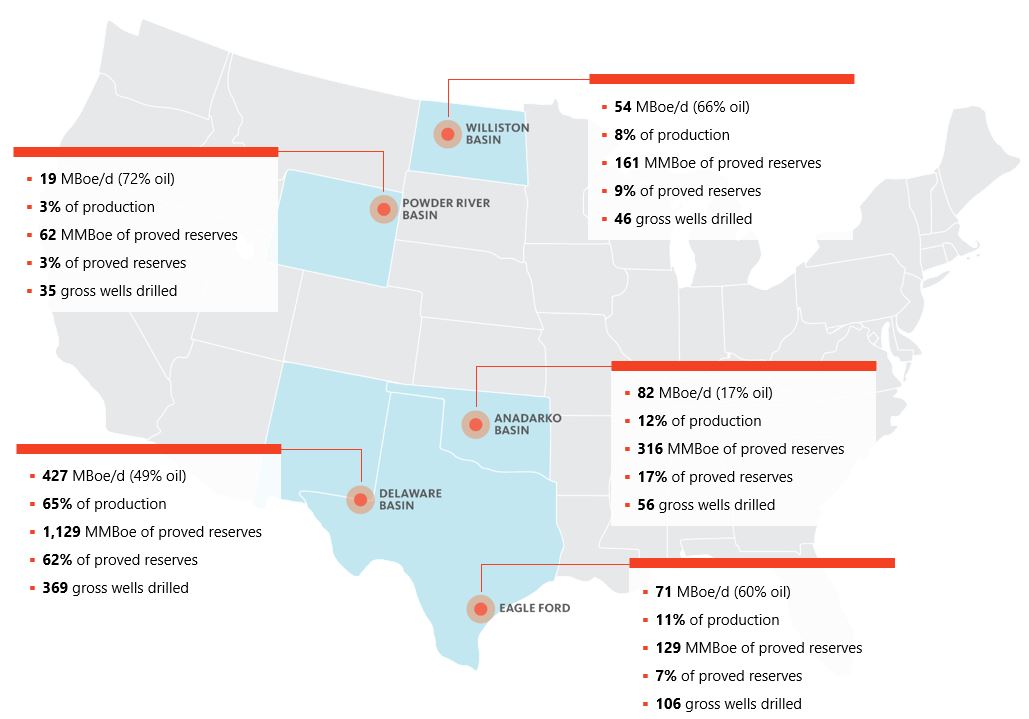
Delaware Basin – The Delaware Basin is our largest and most active program in the portfolio with operations in southeast New Mexico and across the state line into west Texas. Over the past several years, we have built an industry-leading position in this basin. Through capital efficient drilling programs, it offers exploration and low-risk development opportunities from many geologic reservoirs and play types, including the oil-rich Wolfcamp, Bone Spring, Avalon and Delaware formations. With a significant inventory of oil and liquids-rich drilling opportunities that have multi-zone development potential, Devon has a robust platform to deliver high-margin drilling programs for many years to come. At December 31, 2023, we had 17 operated rigs developing this asset in the Wolfcamp and Bone Spring formations. The Delaware Basin is our top funded asset and is expected to receive approximately 60% of our capital allocation in 2024.
Eagle Ford – Our Eagle Ford operations are located in Texas' DeWitt and Karnes counties, situated in the economic core of this south Texas play. Its production is leveraged to oil and has low-cost access to premium Gulf Coast pricing, providing for strong operating margins. At December 31, 2023, we had one operated and two non-operated rigs developing this asset.
Anadarko Basin – Our Anadarko Basin development, located primarily in western Oklahoma’s Canadian, Kingfisher and Blaine counties, is one of the largest in the industry, providing substantial long-term inventory optionality. We have an agreement with Dow to jointly develop a portion of our Anadarko Basin acreage and, as of December 31, 2023, we had a four-operated rig program associated with this joint venture.
Williston Basin – Our position in the Williston is located entirely on the Fort Berthold Indian Reservation in North Dakota, and its operations are focused in the oil-prone Bakken and Three Forks formations. Our Williston Basin asset is a high-margin oil resource located in the core of the play and generated substantial cash flow in 2023.
Powder River Basin – This asset is focused on emerging oil opportunities in Wyoming's Powder River Basin. We are currently targeting several Cretaceous oil objectives, including the Turner, Parkman, Teapot and Niobrara formations. Recent drilling success in this basin has expanded our drilling inventory, and we expect further growth as we continue to de-risk this emerging light-oil opportunity. At December 31, 2023, we had one operated rig developing this asset.
Proved Reserves
Proved oil and gas reserves are those quantities of oil, gas and NGLs which can be estimated with reasonable certainty to be economically producible from known reservoirs under existing economic conditions, operating methods and government regulations. To be considered proved, oil and gas reserves must be economically producible before contracts providing the right to operate expire, unless evidence indicates that renewal is reasonably certain. Also, the project to extract the hydrocarbons must have commenced or the operator must be reasonably certain that it will commence within a reasonable time. We establish our proved reserves estimates using standard geological and engineering technologies and computational methods, which are generally accepted by the petroleum industry. We primarily prepare our proved reserves additions by analogy using type curves that are based on decline curve analysis of wells in analogous reservoirs. We further establish reasonable certainty of our proved reserves estimates by using one or more of the following methods: geological and geophysical information to establish reservoir continuity between penetrations, rate-transient analysis, analytical and numerical simulations, or other proprietary technical and statistical methods. For estimates of our proved developed and proved undeveloped reserves and the discussion of the contribution by each property, see Note 20 in “Item 8. Financial Statements and Supplementary Data” of this report.
The process of estimating oil, gas and NGL reserves is complex and requires significant judgment, as discussed in “Item 1A. Risk Factors” of this report. As a result, we have developed internal policies for estimating and recording reserves in compliance with applicable SEC definitions and guidance. Our policies assign responsibilities for compliance in reserves bookings to our Reserve Evaluation Group (the “Group”). The Group, which is led by Devon’s Manager of Reserves and Economics, is responsible for the internal review and certification of reserves estimates. We ensure the Manager and key members of the Group have appropriate technical qualifications to oversee the preparation of reserves estimates and are independent of the operating groups. The Manager of the Group has over 15 years of industry experience, a degree in engineering and is a registered professional engineer. The Group also oversees audits and reserves estimates performed by a qualified third-party petroleum consulting firm. During 2023, we engaged DeGolyer and MacNaughton to audit approximately 90% of our proved reserves. Additionally, our Board of Directors has a Reserves Committee that provides additional oversight of our reserves process. The committee consists of five independent members of our Board of Directors who collectively have skills and backgrounds that are relevant to the reserves estimation processes, reporting systems and disclosure requirements.
The following tables present production, price and cost information for each significant field in our asset portfolio and the total company.
| Production | ||||||||||||||||
| Year Ended December 31, | Oil (MMBbls) | Gas (Bcf) | NGLs (MMBbls) | Total (MMBoe) | ||||||||||||
| 2023 | ||||||||||||||||
| Delaware Basin | 77 | 240 | 39 | 156 | ||||||||||||
| Anadarko Basin | 5 | 87 | 10 | 30 | ||||||||||||
| Total | 117 | 385 | 59 | 240 | ||||||||||||
| 2022 | ||||||||||||||||
| Delaware Basin | 77 | 222 | 38 | 151 | ||||||||||||
| Anadarko Basin | 5 | 81 | 9 | 28 | ||||||||||||
| Total | 109 | 356 | 54 | 223 | ||||||||||||
| 2021 | ||||||||||||||||
| Delaware Basin | 72 | 195 | 32 | 136 | ||||||||||||
| Anadarko Basin | 5 | 79 | 9 | 27 | ||||||||||||
| Total | 106 | 325 | 48 | 209 |
| Average Sales Price | ||||||||||||||||
| Year Ended December 31, | Oil (Per Bbl) | Gas (Per Mcf) | NGLs (Per Bbl) | Production Cost (Per Boe) (1) | ||||||||||||
| 2023 | ||||||||||||||||
| Delaware Basin | $ | 76.24 | $ | 1.70 | $ | 20.54 | $ | 7.67 | ||||||||
| Anadarko Basin | $ | 75.48 | $ | 2.34 | $ | 22.82 | $ | 9.30 | ||||||||
| Total | $ | 75.98 | $ | 1.83 | $ | 20.48 | $ | 8.87 | ||||||||
| 2022 | ||||||||||||||||
| Delaware Basin | $ | 94.87 | $ | 5.44 | $ | 34.33 | $ | 6.58 | ||||||||
| Anadarko Basin | $ | 93.41 | $ | 6.36 | $ | 36.40 | $ | 10.10 | ||||||||
| Total | $ | 94.11 | $ | 5.47 | $ | 34.18 | $ | 7.92 | ||||||||
| 2021 | ||||||||||||||||
| Delaware Basin | $ | 66.67 | $ | 3.47 | $ | 30.02 | $ | 5.97 | ||||||||
| Anadarko Basin | $ | 66.29 | $ | 3.80 | $ | 29.73 | $ | 9.26 | ||||||||
| Total | $ | 65.98 | $ | 3.40 | $ | 29.52 | $ | 7.02 |
(1)
Represents production expense per Boe excluding production and property taxes.
Drilling Statistics
The following table summarizes our development and exploratory drilling results.
| Development Wells (1) | Exploratory Wells (1) | Total Wells (1) | ||||||||||||||||||||||||||
| Year Ended December 31, | Productive | Dry | Productive | Dry | Productive | Dry | Total | |||||||||||||||||||||
| 2023 (2) | 293.0 | 0.7 | 42.2 | — | 335.2 | 0.7 | 335.9 | |||||||||||||||||||||
| 2022 | 263.8 | — | 47.3 | — | 311.1 | — | 311.1 | |||||||||||||||||||||
| 2021 | 236.3 | — | 18.8 | — | 255.1 | — | 255.1 |
(1)
Well counts represent net wells completed during each year. Gross wells are the sum of all wells in which we own a working interest. Net wells are gross wells multiplied by our fractional working interests in each well.
(2)
As of December 31, 2023, there were 371 gross and 190 net wells that have been spud and are in the process of drilling, completing or waiting on completion.
Productive Wells
The following table sets forth our producing wells as of December 31, 2023.
| Oil Wells | Natural Gas Wells | Total Wells | ||||||||||||||||||||||
| Gross (1)(3) | Net (2) | Gross (1)(3) | Net (2) | Gross (1)(3) | Net (2) | |||||||||||||||||||
| Total | 11,416 | 4,207 | 3,737 | 1,604 | 15,153 | 5,811 |
(1)
Gross wells are the sum of all wells in which we own a working interest.
(2)
Net wells are gross wells multiplied by our fractional working interests in each well.
(3)
Includes 20 and 36 gross oil and gas wells, respectively, which had multiple completions.
The day-to-day operations of oil and gas properties are the responsibility of an operator designated under pooling or operating agreements. The operator supervises production, maintains production records, employs field personnel and performs other functions. We are the operator of approximately 6,482 gross wells. As operator, we receive reimbursement for direct expenses incurred to perform our duties, as well as monthly per-well producing, drilling and construction overhead reimbursement at rates customarily charged in the respective areas. In presenting our financial data, we record the monthly overhead reimbursements as a reduction of G&A, which is a common industry practice.
Acreage Statistics
The following table sets forth our developed and undeveloped lease and mineral acreage as of December 31, 2023. Of our 2.0 million net acres, approximately 1.3 million acres are held by production. The acreage in the table below does not include any material net acres subject to leases that are scheduled to expire during 2024, 2025 and 2026. For the net acres that are set to expire by December 31, 2026, we anticipate performing operational and administrative actions to continue the lease terms for portions of the acreage that we intend to further assess. However, we do expect to allow a portion of the acreage to expire in the normal course of business. Less than 20% of our total net acres are located on federal lands.
| Developed | Undeveloped | Total | ||||||||||||||||||||||
| Gross (1) | Net (2) | Gross (1) | Net (2) | Gross (1) | Net (2) | |||||||||||||||||||
| (Thousands) | ||||||||||||||||||||||||
| Total | 1,237 | 743 | 3,103 | 1,285 | 4,340 | 2,028 |
(1)
Gross acres are the sum of all acres in which we own a working interest.
(2)
Net acres are gross acres multiplied by our fractional working interests in the acreage.
Title to Properties
Title to properties is subject to contractual arrangements customary in the oil and gas industry, liens for taxes not yet due and, in some instances, other encumbrances. We believe that such burdens do not materially detract from the value of properties or from the respective interests therein or materially interfere with their use in the operation of the business.
As is customary in the industry, a preliminary title investigation, typically consisting of a review of local title records, is made at the time of acquisitions of undeveloped properties. More thorough title investigations, which generally include a review of title records and the preparation of title opinions by outside legal counsel, are made prior to the consummation of an acquisition of producing properties and before commencement of drilling operations on undeveloped properties.
Marketing Activities
Oil, Gas and NGL Marketing
The spot markets for oil, gas and NGLs are subject to volatility as supply and demand factors fluctuate. As detailed below, we sell our production under both long-term (one year or more) and short-term (less than one year) agreements at prices negotiated with third parties. Regardless of the term of the contract, the vast majority of our production is sold at variable, or market-sensitive, prices.
Additionally, we may enter into financial hedging arrangements or fixed-price contracts associated with a portion of our oil, gas and NGL production. These activities are intended to support targeted price levels and to manage our exposure to price fluctuations. See Note 3 in “Item 8. Financial Statements and Supplementary Data” of this report for further information.
As of January 2024, our production was sold under the following contract terms.
| Short-Term | Long-Term | |||||||||||||||
| Variable | Fixed | Variable | Fixed | |||||||||||||
| Oil | 39 | % | — | 61 | % | — | ||||||||||
| Natural gas | 59 | % | 4 | % | 37 | % | — | |||||||||
| NGLs | 59 | % | 16 | % | 25 | % | — |
Delivery Commitments
A portion of our production is sold under certain contractual arrangements that specify the delivery of a fixed and determinable quantity. As of December 31, 2023, we were committed to deliver the following fixed quantities of production.
| Total | Less Than 1 Year | 1-3 Years | 3-5 Years | More Than 5 Years | ||||||||||||||||
| Oil (MMBbls) | 32 | 24 | 7 | 1 | — | |||||||||||||||
| Natural gas (Bcf) | 412 | 148 | 100 | 73 | 91 | |||||||||||||||
| NGLs (MMBbls) | 11 | 11 | — | — | — | |||||||||||||||
| Total (MMBoe) | 112 | 60 | 24 | 13 | 15 |
We expect to fulfill our delivery commitments primarily with production from our proved developed reserves. Moreover, our proved reserves have generally been sufficient to satisfy our delivery commitments during the three most recent years, and we expect such reserves will continue to be the primary means of fulfilling our future commitments. However, where our proved reserves are not sufficient to satisfy our delivery commitments, we can and may use spot market purchases to satisfy the commitments.
Competition
See “Item 1A. Risk Factors.”
Public Policy and Government Regulation
Our industry is subject to a wide range of governmental regulation and oversight. Laws, regulations, taxes, fees and other policy implementation actions affecting our industry have been pervasive and are under constant review for amendment or expansion. Numerous government agencies have issued extensive regulations which are binding on our industry and its individual members, some of which carry substantial penalties for failure to comply. These laws and regulations increase the cost of doing business and consequently affect profitability. Public policy changes are commonplace, and changes to existing laws and regulations are frequently proposed or implemented. Moreover, it is often difficult to quantify all associated compliance costs as such amounts may be indistinguishable components of our general capital expenditures and operating expenses. Accordingly, we are unable to predict the future cost or impact of regulatory compliance, though we do not expect such compliance costs or impacts to affect our operations materially differently than other similarly situated companies. However, based on regulatory trends and increasingly stringent laws and permitting requirements, our capital expenditures and operating expenses related to environmental and other regulations have
increased over the years and will likely continue to increase. For more information on our environmental capital expenditures specifically, see the environmental, social and governance discussion earlier in this Annual Report.
The following are significant areas of government control and regulation affecting our operations. For additional information on the Company’s regulatory risks, see “Item 1A. Risk Factors—Legal, Regulatory and Environmental Risks” of this report.
Exploration and Production Regulation
Our operations are subject to various federal, state, tribal and local laws and regulations relating to exploration and production activities, including with respect to:
acquisition of seismic data;
design, location, drilling and casing of wells;
hydraulic fracturing;
well production, and the gathering and transportation of such production;
spill prevention plans;
emissions and discharge permitting;
use, transportation, storage and disposal of fluids and materials incidental to oil and gas operations;
surface usage and the restoration of properties upon which wells have been drilled;
calculation and disbursement of royalty payments and production taxes;
plugging and abandoning of wells; and
endangered species and habitat.
Our operations are also subject to conservation regulations, including the regulation of the size of drilling and spacing units or proration units; the number of wells that may be drilled in a unit; the rate of production allowable from oil and gas wells; and the unitization or pooling of oil and gas properties. Some states allow the forced pooling or unitization of tracts to facilitate exploration and development, while other states rely on voluntary pooling of lands and leases. Such rules often impact the ultimate timing of our exploration and development plans. In addition, federal and state conservation laws generally limit the venting or flaring of natural gas, and state conservation laws impose certain requirements regarding the ratable purchase of production. These regulations limit the amounts of oil and gas we can produce from our wells and the number of wells or the locations at which we can drill.
Certain of our leases are granted or approved by the federal government and administered by the BLM or Bureau of Indian Affairs of the Department of the Interior. Such leases require compliance with detailed federal regulations and orders that regulate, among other matters, drilling and operations on lands covered by these leases and calculation and disbursement of royalty payments to the federal government, tribes or tribal members. Moreover, the permitting process for oil and gas activities on federal and Indian lands can sometimes be subject to delay, including as a result of challenges to permits or other regulatory decisions brought by non-governmental organizations or other parties, which can hinder development activities or otherwise adversely impact operations. The federal government has, from time to time, evaluated and, in some cases, promulgated new rules and regulations regarding competitive lease bidding, venting and flaring, oil and gas measurement and royalty payment obligations for production from federal lands.
Environmental, Health and Safety Regulations
We strive to conduct our operations in a socially and environmentally responsible manner, which includes compliance with applicable law. We are subject to many federal, state, tribal and local laws and regulations concerning occupational safety and health as well as the discharge of materials into, and the protection of, the environment and natural resources. Environmental, health and safety laws and regulations relate to, among other things:
the discharge of pollutants into federal and state waters;
assessing the environmental impact of seismic acquisition, drilling or construction activities;
the generation, storage, transportation and disposal of waste materials, including hazardous substances and wastes;
the emission of methane and certain other gases into the atmosphere;
the monitoring, abandonment, reclamation and remediation of well and other sites, including sites of former operations;
the development of emergency response and spill contingency plans;
the monitoring, repair and design of pipelines used for the transportation of oil and natural gas;
the protection of threatened and endangered species; and
worker protection.
Failure to comply with these laws and regulations can lead to the imposition of remedial liabilities, administrative, civil or criminal fines or penalties or injunctions limiting our operations in affected areas. Moreover, multiple environmental laws provide for citizen suits, which can allow environmental organizations to sue operators for alleged violations of environmental law. Environmental organizations also can assert legal and administrative challenges to certain actions of oil and gas regulators, such as the BLM, for allegedly failing to comply with environmental laws, which can result in delays in obtaining permits or other necessary authorizations. In recent years, federal and state policy makers and regulators have increasingly implemented or proposed new laws and regulations designed to reduce methane emissions and other GHG, which have included mandates for new leak detection and retrofitting requirements, stricter emission standards and a fee on methane emissions. For example, in November 2022, the BLM proposed a rule that would limit flaring as well as allow the delay or denial of permits upon a finding that an operator’s methane waste minimization plan is insufficient. This rule could be finalized in 2024. In addition, in December 2023, the EPA finalized more stringent methane rules for new, modified and reconstructed facilities and, for the first time ever, established standards for existing sources.
Item 1A. Risk Factors
Our business and operations, and our industry in general, are subject to a variety of risks. The risks described below may not be the only risks we face, as our business and operations may also be subject to risks that we do not yet know of, or that we currently believe are immaterial. If any of the following risks should occur, our business, financial condition, results of operations and liquidity could be materially and adversely impacted. As a result, holders of our securities could lose part or all of their investment in Devon.
Risks Related to Our Industry
Volatile Oil, Gas and NGL Prices Significantly Impact Our Business
Our financial condition, results of operations and the value of our properties are highly dependent on the general supply and demand for oil, gas and NGLs, which impact the prices we ultimately realize on our sales of these commodities. Historically, market prices and our realized prices have been volatile. For example, over the last five years, monthly NYMEX WTI oil and NYMEX Henry Hub gas prices ranged from highs of over $120 per Bbl and $9.50 per MMBtu, respectively, to lows of under $30 per Bbl and $1.50 per MMBtu, respectively. Such volatility is likely to continue in the future due to numerous factors beyond our control, including, but not limited to:
the domestic and worldwide supply of and demand for oil, gas and NGLs, including the impact of releases from the U.S. Strategic Petroleum Reserve;
volatility and trading patterns in the commodity-futures markets;
climate change incentives and conservation and environmental protection efforts;
production levels of members of OPEC, Russia, the U.S. or other producing countries;
geopolitical risks, including the conflict between Russia and Ukraine, the Israel-Hamas conflict and hostilities in Yemen and the Red Sea, as well as other hostilities or political and civil unrest in the Middle East, Africa, Europe and South America;
adverse weather conditions, natural disasters, public health crises and other catastrophic events, such as tornadoes, earthquakes, hurricanes and epidemics of infectious diseases;
regional pricing differentials, including in the Delaware Basin and other areas of our operations;
differing quality of production, including NGL content of gas produced;
the level of imports and exports of oil, gas and NGLs and the level of global oil, gas and NGL inventories;
the price and availability of alternative energy sources;
technological advances affecting energy consumption and production, including with respect to electric vehicles;
stockholder activism or activities by non-governmental organizations to restrict the exploration and production of oil and natural gas in order to reduce GHG emissions;
the overall economic environment, including inflationary pressures and rising interest rates;
changes in trade relations and policies, such as restrictions on oil, gas and NGL exports by the U.S. or economic sanctions, including embargoes, on Russia or other producing countries, as well as the imposition of tariffs by the U.S. or China; and
other governmental regulations and taxes.
Estimates of Oil, Gas and NGL Reserves Are Uncertain and May Be Subject to Revision
The process of estimating oil, gas and NGL reserves is complex and requires significant judgment in the evaluation of available geological, engineering and economic data for each reservoir, particularly for new discoveries. Because of the high degree of judgment involved, different reserve engineers may develop different estimates of reserve quantities and related revenue based on the same data. In addition, the reserve estimates for a given reservoir may change substantially over time as a result of several factors, including additional development and appraisal activity and the related impact to spacing assumptions for future drilling locations, the viability of production under varying economic conditions, including commodity price declines, and variations in production levels and associated costs. Consequently, material revisions to our existing reserves estimates may occur as a result of changes in any of these or other factors. Such revisions to proved reserves could have an adverse effect on our financial condition and the value of our properties, as well as the estimates of our future net revenue and profitability. Our policies and internal controls related to estimating and recording reserves are included in “Items 1 and 2. Business and Properties” of this report.
Discoveries or Acquisitions of Reserves Are Needed to Avoid a Material Decline in Reserves and Production, and Such Activities Are Capital Intensive
The production rates from oil and gas properties generally decline as reserves are depleted, while related per unit production costs generally increase due to decreasing reservoir pressures and other factors. Moreover, our current development activity is focused on unconventional oil and gas assets, which generally have significantly higher decline rates as compared to conventional assets. Therefore, our estimated proved reserves and future oil, gas and NGL production will decline materially as reserves are produced unless we conduct successful exploration and development activities, such as identifying additional producing zones in existing properties, utilizing secondary or tertiary recovery techniques or acquiring additional properties containing proved reserves. Consequently, our future oil, gas and NGL production and related per unit production costs are highly dependent upon our level of success in finding or acquiring additional reserves.
Our business requires significant capital to find and acquire new reserves. Although we plan to primarily fund these activities from cash generated by our operations, we have also from time to time relied on other sources of capital, including by accessing the debt and equity capital markets. There can be no assurance that these or other financing sources will be available in the future on acceptable terms, or at all. If we are unable to generate sufficient funds from operations or raise additional capital for any reason, we may be unable to replace our reserves, which would adversely affect our business, financial condition and results of operations.
Our Operations Are Uncertain and Involve Substantial Costs and Risks
Our operating activities are subject to numerous costs and risks, including the risk that we will not encounter commercially productive oil or gas reservoirs. Drilling for oil, gas and NGLs can be unprofitable, not only from dry holes, but from productive wells that do not return a profit because of insufficient revenue from production or high costs. Substantial costs are required to locate, acquire and develop oil and gas properties, and we are often uncertain as to the amount and timing of those costs. Our cost of drilling, completing, equipping and operating wells is often uncertain before drilling commences. Declines in commodity prices and overruns in budgeted expenditures are common risks that can make a particular project uneconomic or less economic than forecasted. While both exploratory and developmental drilling activities involve these risks, exploratory drilling involves greater risks of dry holes or
failure to find commercial quantities of hydrocarbons. In addition, our oil and gas properties can become damaged, our operations may be curtailed, delayed or canceled and the costs of such operations may increase as a result of a variety of factors, including, but not limited to:
unexpected drilling conditions, pressure conditions or irregularities in reservoir formations;
equipment failures or accidents;
fires, explosions, blowouts, cratering or loss of well control, as well as the mishandling or underground migration of fluids and chemicals;
adverse weather conditions, such as tornadoes, hurricanes, severe thunderstorms and extreme temperatures, the severity and frequency of which could potentially increase as a consequence of climate change;
other natural disasters, such as earthquakes, floods and wildfires;
terrorism, vandalism, equipment theft, extreme activism directed against fossil fuel operations or assets, cybersecurity incidents and pandemics or other widespread health concerns;
issues with title or in receiving governmental permits or approvals;
restricted takeaway capacity for our production, including due to inadequate midstream infrastructure or constrained downstream markets;
environmental hazards or liabilities;
restrictions in access to, or disposal of, water used or produced in drilling and completion operations;
limited access to electrical power sources or other infrastructure used in our operations; and
shortages or delays in the availability of services or delivery of equipment.
Many of the factors described above have negatively impacted and currently impact our operations and may do so again in the future. The occurrence of one or more of these factors could result in a partial or total loss of our investment in a particular property, as well as significant liabilities. Moreover, certain of these events historically have, and in the future could, result in environmental pollution and impact to third parties, including persons living in proximity to our operations, our employees and employees of our contractors, leading to possible injuries, death or significant damage to property and natural resources. For example, we have from time to time experienced well-control events that have resulted in various remediation and clean-up costs and certain of the other impacts described above.
In addition, we rely on our employees, consultants and independent contractors to conduct our operations in compliance with applicable laws and standards. Any violation of such laws or standards by these individuals, whether through negligence, harassment, discrimination or other misconduct, could result in significant liability for us and adversely affect our business. For example, negligent operations by employees could result in serious injury, death or property damage, and sexual harassment or racial, gender or age discrimination could result in legal claims and reputational harm.
Our Hedging Activities Limit Participation in Commodity Price Increases and Involve Other Risks
We enter into financial derivative instruments with respect to a portion of our production to manage our exposure to oil, gas and NGL price volatility. To the extent that we engage in price risk management activities to protect ourselves from commodity price declines, we will be prevented from fully realizing the benefits of commodity price increases above the prices established by our hedging contracts. In addition, our hedging arrangements may expose us to the risk of financial loss in certain circumstances, including instances in which the contract counterparties fail to perform under the contracts. Moreover, many of our contract counterparties have become subject to increasing governmental oversight and regulations in recent years, which could adversely affect the cost and availability of our hedging arrangements.
We Have Limited Control Over Properties and Investments Operated by Others or through Joint Ventures
Certain of the properties and investments in which we have an interest are operated by other companies and may involve third-party working interest owners. We have limited influence and control over the operation or future development of such properties and investments, including compliance with environmental, health and safety regulations or the amount and timing of required future
capital expenditures. In addition, we conduct certain of our operations through joint ventures in which we may share control with third parties, and the other joint venture participants may have interests or goals that are inconsistent with those of the joint venture or us. These limitations and our dependence on such third parties could result in unexpected future costs or liabilities and unplanned changes in operations or future development, which could adversely affect our financial condition and results of operations. Moreover, any bankruptcy involving, or any misconduct or other improper activities committed by, our business partners or other counterparties could negatively impact our own business or reputation.
Midstream Capacity Constraints and Interruptions Impact Commodity Sales
We rely on midstream facilities and systems owned and operated by others to process our gas production and to gather and transport our oil, gas and NGL production to downstream markets. All or a portion of our production in one or more regions may be interrupted or shut in from time to time due to losing access to plants, pipelines or gathering systems. Such access could be lost due to a number of factors, including, but not limited to, weather conditions and natural disasters, terrorism or sabotage, cybersecurity incidents, accidents, field labor issues or strikes. Additionally, midstream operators have in the past been, and in the future may be, subject to constraints that limit their ability to construct, maintain or repair the facilities needed to gather, process and transport our production. Such interruptions or constraints could adversely impact our operations, including by requiring us to curtail our production or obtain alternative takeaway capacity on less favorable terms.
Competition for Assets, Materials, People and Capital Can Be Significant
Strong competition exists in all sectors of the oil and gas industry. We compete with major integrated and independent oil and gas companies for the acquisition of oil and gas leases and properties. We also compete for the equipment, services and personnel required to explore, develop and operate properties, such as drilling rigs and oilfield services. The rising costs and scarcity caused by this competitive pressure will generally increase during periods of higher commodity prices and can be further exacerbated by higher inflation rates and supply chain disruptions in the broader economy. For example, we experienced higher operating costs throughout 2023 due to steep cost inflation, and these inflationary pressures could continue in 2024. Competition is also prevalent in the marketing of oil, gas and NGLs. Certain of our competitors have resources substantially greater than ours and may have established superior strategic long-term positions and relationships. As a consequence, we may be at a competitive disadvantage in bidding for assets or services and accessing capital and downstream markets. In addition, many of our larger competitors may have a competitive advantage when responding to factors that affect demand for oil and gas production, such as changing worldwide price and production levels, the cost and availability of alternative energy sources and the application of government regulations.
Legal, Regulatory and Environmental Risks
We Are Subject to Extensive Governmental Regulation, Which Can Change and Could Adversely Impact Our Business
Our operations are subject to extensive federal, state, tribal and local laws and regulations, including with respect to environmental matters, worker health and safety, wildlife conservation, the gathering and transportation of oil, gas and NGLs, conservation policies, reporting obligations, royalty payments, unclaimed property and the imposition of taxes. Such regulations include requirements for permits to drill and to conduct other operations and for provision of financial assurances (such as surety bonds) covering drilling, completion and well operations and decommissioning obligations. If permits are not issued, or if unfavorable restrictions or conditions are imposed on our drilling or completion activities, we may not be able to conduct our operations as planned. Moreover, certain regulations require the plugging and abandonment of wells, removal of production facilities and other restorative actions by current and former operators, including corporate successors of former operators, which means that we are exposed to the risk that owners or operators of assets acquired from us (or our predecessors) become unable to satisfy plugging or abandonment and other restorative obligations that attach to those assets. In that event, due to operation of law, we may be required to assume such obligations, which could be material. We have incurred and will continue to incur substantial capital, operating and remediation costs as a result of these and other laws, regulations, permits and orders to which we are subject.
Changes in public policy have affected, and in the future could further affect, our operations. For example, President Biden and certain members of his administration and Congress have expressed support for, and have taken steps to implement, efforts to transition the economy away from fossil fuels and to promote stricter environmental regulations, and such proposals could impose new and more onerous burdens on our industry and business. The IRA, for instance, contains hundreds of billions of dollars in incentives for the development of renewable energy, clean fuels and carbon capture and sequestration, among other provisions, potentially further accelerating the transition toward lower-or zero-carbon emissions alternatives to fossil fuels. These and other regulatory and public policy developments could, among other things, restrict production levels, delay necessary permitting, impose
price controls, change environmental protection requirements, impose restrictions on pipelines or other necessary infrastructure, raise taxes, royalties and other amounts payable to governments or governmental agencies and otherwise increase our operating costs. In addition, changes in public policy may indirectly impact our operations by, among other things, increasing the cost of supplies and equipment and fostering general economic uncertainty. Although we are unable to predict changes to existing laws and regulations, such changes could significantly impact our profitability, financial condition and liquidity, particularly changes related to the matters discussed in more detail below.
Federal Lands – President Biden and certain members of his administration have expressed support for, and have taken steps to implement, additional regulation of oil and gas leasing and permitting on federal lands. For example, President Biden issued an executive order in January 2021, imposing a near total pause on entering new oil and gas leases on public lands. Although the pause on leasing was subsequently lifted in April 2022, the Department of the Interior issued a report on the federal leasing program in November 2021 that recommended various changes, including, among other things, enhancing bonding requirements and applying a more rigorous land-use planning process prior to leasing. The IRA responded, in part, to the report’s recommendations by increasing onshore royalty rates on all new federal leases. In July 2023, the Department of Interior released a proposed rule revising various terms for future federal leases and wells, including bonding requirements, royalty rates, rental rates and minimum bids, of the onshore federal oil and gas leasing program, integrating recommendations from the November 2021 report. While it is not possible at this time to predict the ultimate impact of these actions or any other future regulatory changes, any additional restrictions or burdens on our ability to operate on federal lands could adversely impact our business in the Delaware and Powder River Basins, as well as other areas where we operate under federal leases.
Hydraulic Fracturing – Various federal agencies have asserted regulatory authority over certain aspects of the hydraulic fracturing process. For example, the EPA has issued regulations under the federal Clean Air Act establishing performance standards for oil and gas activities, including standards for the capture of air emissions released during hydraulic fracturing, and it previously finalized regulations that prohibit the discharge of wastewater from hydraulic fracturing operations to publicly owned wastewater treatment plants. Moreover, several state and local governments in areas in which we operate have adopted, or stated intentions to adopt, laws or regulations that mandate further restrictions on hydraulic fracturing, such as requiring disclosure of chemicals used in hydraulic fracturing, imposing more stringent permitting, disclosure and well-construction requirements on hydraulic fracturing operations and establishing standards for the capture of air emissions released during hydraulic fracturing. Beyond these regulatory efforts, various policy makers, regulatory agencies and political leaders at the federal, state and local levels have proposed implementing even further restrictions on hydraulic fracturing, including prohibiting the technology outright. Although it is not possible at this time to predict the outcome of these or other proposals, any new restrictions on hydraulic fracturing that may be imposed in areas in which we conduct business could potentially result in increased compliance costs, delays or cessation in development or other restrictions on our operations.
Environmental Laws Generally – In addition to regulatory efforts focused on hydraulic fracturing, we are subject to various other federal, state, tribal and local laws and regulations relating to discharge of materials into, and protection of, the environment. These laws and regulations may, among other things, impose liability on us for the cost of remediating pollution that results from our operations or prior operations on assets we have acquired. Environmental laws may impose strict, joint and several liability, and failure to comply with environmental laws and regulations can result in the imposition of administrative, civil or criminal fines and penalties, as well as injunctions limiting operations in affected areas. Any future environmental costs of fulfilling our commitments to the environment are uncertain and will be governed by several factors, including future changes to regulatory requirements. Any such changes could have a significant impact on our operations and profitability.
Seismic Activity – Earthquakes in southeastern New Mexico, western Texas, northern and central Oklahoma and elsewhere have prompted concerns about seismic activity and possible relationships with the oil and gas industry, particularly the disposal of wastewater in salt-water disposal wells. Legislative and regulatory initiatives intended to address these concerns may result in additional levels of regulation or other requirements that could lead to operational delays, increase our operating and compliance costs or otherwise adversely affect our operations. For example, New Mexico implemented protocols in November 2021 requiring operators to take various actions with respect to salt-water disposal wells within a specified proximity of certain seismic activity, including a requirement to limit injection rates if the seismic event is of a certain magnitude. Separately, the Railroad Commission of Texas has shown increasing regulatory focus on seismicity and the oil and gas industry in recent years, and has imposed limits on certain salt-water disposal well activities in portions of the Delaware and Midland Basins. For example, effective January 2024, the Railroad Commission suspended all disposal well permits that inject into deep strata within the Northern Culberson-Reeves area due to increasing seismicity concerns. These or similar actions directed at our operating areas could limit the takeaway capacity for produced water in the impacted area, which could increase our operating expense, require us to curtail our development plans or otherwise adversely impact our operations.
Changes to Tax Laws – We are subject to U.S. federal income tax as well as income or capital taxes in various state and foreign jurisdictions, and our operating cash flow is sensitive to the amount of income taxes we must pay. In the jurisdictions in which we operate or previously operated, income taxes are assessed on our earnings after consideration of all allowable deductions and credits. Changes in the types of earnings that are subject to income tax, the types of costs that are considered allowable deductions and the timing of such deductions, or the rates assessed on our taxable earnings could significantly increase our tax obligations, adversely impacting our financial condition, results of operations and cash flows. In addition, the IRA includes various changes to the federal tax laws beginning in 2023, including a new 15% CAMT imposed on certain financial statement income of “applicable corporations.” Incremental taxes attributable to the CAMT are possible and such taxes may be significant.
Climate Change and Related Regulatory, Social and Market Actions May Adversely Affect Our Business
Continuing and increasing political and social attention to the issue of climate change has resulted in legislative, regulatory and other initiatives, including international agreements, to reduce GHG emissions, such as carbon dioxide and methane. Policy makers and regulators at both the U.S. federal and state levels have already imposed, or stated intentions to impose, laws and regulations designed to quantify and limit the emission of GHG. For example, in December 2023, the EPA finalized more stringent methane rules for new, modified and reconstructed facilities, known as OOOOb, as well as standards for existing sources for the first time ever, known as OOOOc. The final rule includes, among other things, enhanced leak detection survey requirements using optical gas imaging and other advanced monitoring, zero-emission requirements for certain devices, and reduction of emissions by 95% through capture and control systems. The final rule also establishes a “super emitter” response program that allows third parties to make reports to the EPA of large methane emissions events, triggering certain investigation and repair requirements. Moreover, in August 2022, the IRA was passed into law, imposing a new charge or fee with respect to excess methane emissions from certain petroleum and natural gas facilities starting in 2024 and annually increasing through 2026. In addition to these federal efforts, several states where we operate, including New Mexico, Texas and Wyoming, have already imposed, or stated intentions to impose, laws or regulations designed to reduce methane emissions from oil and gas exploration and production activities, including by mandating new leak detection and retrofitting requirements.
Policy makers have also advocated for expanding existing, or creating new, reporting and disclosure requirements regarding GHG emissions and other climate-related matters. For example, the EPA proposed amendments in June 2022 to its Green House Gas Reporting Program, which would, among other things, add well blowouts and other abnormal events as new categories of sources for GHG emissions reporting. In addition, the SEC proposed rules in March 2022 that would require public companies to include extensive climate-related disclosures in their SEC filings. Among other things, the proposed SEC rules, if adopted as written, would mandate disclosures on (i) GHG emissions, including Scope 3 emissions if material or part of a company’s emissions goal, (ii) financial impact and expenditure metrics relating to severe weather and climate change and (iii) a company’s use of scenario analysis and climate targets. Similarly, California enacted legislation in October 2023 requiring extensive climate-related disclosures for companies deemed to be doing business in California, and other states are considering similar laws. While we are assessing the applicability of the California legislation and await further SEC rulemaking, we would expect to incur substantial additional compliance costs to the extent these or similar disclosure requirements apply to us. We further anticipate the costs and other risks associated with any such disclosure requirements to be particularly heightened, given that reporting frameworks on GHG emissions and other climate-related metrics are still maturing and often require the use of numerous assumptions and judgments.
Additionally, public statements with respect to emissions reduction goals, environmental targets or, more broadly, ESG-related goals, are becoming increasingly subject to heightened scrutiny from public and governmental authorities with respect to the risk of potential “greenwashing,” i.e., misleading information or false claims overstating potential ESG benefits. For example, the SEC has established a Climate and ESG Task Force in the Division of Enforcement to identify and address potential ESG-related misconduct, including greenwashing. Certain non-governmental organizations and other private actors have filed lawsuits under various securities and consumer protection laws alleging that certain ESG-statements were misleading, false, or otherwise deceptive. As a result, we may face increased litigation risks which could, in turn, lead to further negative sentiment against us and our industry.
With respect to more comprehensive regulation, policy makers and political leaders have made, or expressed support for, a variety of proposals, such as the development of cap-and-trade or carbon tax programs. In addition, President Biden has continued to highlight addressing climate change as a priority of his administration, and he previously released an energy plan calling for a number of sweeping changes to address climate change, including, among other measures, a national mobilization effort to achieve net-zero emissions for the U.S. economy by 2050, through increased use of renewable power, stricter fuel-efficiency standards and support for zero-emission vehicles. President Biden issued a number of executive orders in January 2021 with the purpose of implementing certain of these changes, including the rejoining of the Paris Agreement. President Biden subsequently announced a target of reducing economy-wide net GHG emissions in the U.S. by 50% to 52% below 2005 levels by 2030. At the international level, the United States
and the European Union jointly announced the launch of a Global Methane Pledge at the 26th Conference of the Parties in 2021, pursuant to which over 130 participating countries have pledged to a collective goal of reducing global methane emissions by at least 30% from 2020 levels by 2030. At the 28th Conference of the Parties in 2023, parties signed onto an agreement to transition “away from fossil fuels in energy systems in a just, orderly and equitable manner” and increase renewable energy capacity so as to achieve net zero by 2050, though no timeline for doing so was set. Although the full impact of these actions is uncertain at this time, the adoption and implementation of these or other initiatives may result in the restriction or cancellation of oil and natural gas activities, greater costs of compliance or consumption (thereby reducing demand for our products) or an impairment in our ability to continue our operations in an economic manner.
In addition to regulatory risk, other market and social initiatives relating to climate change present risks for our business. For example, in an effort to promote a lower-carbon economy, there are various public and private initiatives subsidizing or otherwise encouraging the development and adoption of alternative energy sources and technologies, including by mandating the use of specific fuels or technologies. These initiatives may reduce the competitiveness of carbon-based fuels, such as oil and gas. Moreover, an increasing number of financial institutions, funds and other sources of capital have begun restricting or eliminating their investment in oil and natural gas activities due to their concern regarding climate change. Such restrictions in capital could decrease the value of our business and make it more difficult to fund our operations. In addition, governmental entities and other plaintiffs have brought, and may continue to bring, claims against us and other oil and gas companies for purported damages caused by the alleged effects of climate change. The increasing attention to climate change may result in further claims or investigations against us, and heightened societal or political pressures may increase the possibility that liability could be imposed on us in such matters without regard to our causation of, or contribution to, the asserted damage or violation, or to other mitigating factors.
Finally, climate change may also result in various enhanced physical risks, such as an increased frequency or intensity of extreme weather events or changes in meteorological and hydrological patterns, that may adversely impact our operations. Such physical risks may result in damage to our facilities or otherwise adversely impact our operations, such as if we are subject to water use curtailments in response to drought, or demand for our products, such as to the extent warmer winters reduce demand for energy for heating purposes. These and the other risks discussed above could result in additional costs, new restrictions on our operations and reputational harm to us, as well as reduce the actual and forecasted demand for our products. These effects in turn could impair or lower the value of our assets, including by resulting in uneconomic or “stranded” assets, and otherwise adversely impact our profitability, liquidity and financial condition.
Price Controls, Export Restrictions and Other Governmental Interventions in Energy Markets May Adversely Impact our Business
Domestic and foreign governmental bodies have from time to time intervened in energy markets by imposing price controls, restricting exports, limiting production or otherwise taking actions to impact the availability and price of oil, natural gas and NGLs. For instance, members of the European Union agreed to a price-cap framework in December 2022 for the trading of natural gas in response to rising energy costs in Europe. Similarly, during 2021 and 2022, President Biden authorized several releases from the U.S. Strategic Petroleum Reserve in an effort to lower domestic energy prices. More recently, in January 2024, the Biden Administration announced a temporary pause on any new approvals of liquified natural gas export projects, pending a Department of Energy review of its evaluation process for such authorizations. Governments may take similar actions in the future, particularly in the event of disruption in energy markets or national emergency. Any such interventions could adversely impact our business, including by depressing the price of our production and generally introducing greater uncertainty to our operations.
General and Other Risks Facing our Business
The Credit Risk of Our Counterparties Could Adversely Affect Us
We enter into a variety of transactions that expose us to counterparty credit risk. For example, we have exposure to financial institutions and insurance companies through our hedging arrangements, our 2023 Senior Credit Facility and our insurance policies. Disruptions in the financial markets or otherwise may impact these counterparties and affect their ability to fulfill their existing obligations and their willingness to enter into future transactions with us.
In addition, we are exposed to the risk of financial loss from trade, joint interest billing and other receivables. We sell our oil, gas and NGLs to a variety of purchasers, and, as an operator, we pay expenses and bill our non-operating partners for their respective share of costs. We also frequently look to buyers of oil and gas properties from us or our predecessors to perform certain obligations associated with the disposed assets, including the removal of production facilities and plugging and abandonment of wells. Certain of these counterparties or their successors may experience insolvency, liquidity problems or other issues and may not be able to meet
their obligations and liabilities (including contingent liabilities) owed to, and assumed from, us, particularly during a depressed or volatile commodity price environment. Any such default may result in us being forced to cover the costs of those obligations and liabilities. Our business has been adversely impacted by counterparty defaults in the past, and we may experience similar defaults again in the future.
Our Debt May Limit Our Liquidity and Financial Flexibility, and Any Downgrade of Our Credit Rating Could Adversely Impact Us
As of December 31, 2023, we had total indebtedness of $6.2 billion. Our indebtedness and other financial commitments have important consequences to our business, including, but not limited to:
requiring us to dedicate a portion of our liquidity to debt service payments, thereby limiting our ability to fund working capital, capital expenditures, investments or acquisitions and other general corporate purposes;
increasing our vulnerability to general adverse economic and industry conditions, including low commodity price environments; and
limiting our ability to obtain additional financing due to higher costs and more restrictive covenants.
In addition, we receive credit ratings from rating agencies in the U.S. with respect to our debt. Factors that may impact our credit ratings include, among others, debt levels, planned asset sales and purchases, liquidity, size and scale of our production and commodity prices. Certain of our contractual obligations require us to provide letters of credit or other assurances. Any credit downgrades could adversely impact our ability to access financing and trade credit, require us to provide additional letters of credit or other assurances under contractual arrangements and increase our interest rate under the 2023 Senior Credit Facility as well as the cost of any other future debt.
Cybersecurity Incidents May Adversely Impact Our Operations
We rely heavily on information systems and other digital technologies to conduct our business, and we anticipate expanding the use of and reliance on these systems and technologies, including through artificial intelligence, process automation and data analytics. Concurrent with the growing dependence on technology is a greater sensitivity to cyberattack related activities, which have increasingly targeted our industry. Perpetrators of cyberattacks often attempt to gain unauthorized access to digital systems for purposes of misappropriating confidential and proprietary information, intellectual property or financial assets, corrupting data or causing operational disruptions as well as preventing users from accessing systems or information for the purpose of demanding payment in order for users to regain access. A wide variety of individuals or groups may perpetuate cyberattacks, ranging from highly sophisticated criminal organizations and state-sponsored actors to disgruntled employees, and the nature of, and methods used in, cyberattacks are similarly diverse and constantly evolving, with examples including phishing attempts, distributed denial of service attacks or ransomware. The increase in remote working practices may also increase the risk of cybersecurity incidents, both from deliberate attacks and unintentional events. In addition, our vendors (including third-party cloud and IT service providers), midstream providers and other business partners may separately suffer disruptions or breaches from cyberattacks, which, in turn, could adversely impact our operations and compromise our information. Moreover, we and other upstream companies rely on extensive oil and gas infrastructure and distribution systems to deliver our production to market, which in turn depend upon digital technologies. Any cyberattack directed at such infrastructure or systems could adversely impact our business and operations, including by limiting our ability to transport and market our production. Geopolitical instability may also increase our cybersecurity risk.
Although we have experienced cybersecurity incidents from time to time, none have had a material effect on our business, operations or reputation; however, there is no assurance that such a breach has not already occurred and we are unaware of it, or that we will not suffer such a loss in the future. We devote significant resources to prevent cybersecurity incidents and protect our data, but our systems and procedures for identifying and protecting against such attacks and mitigating such risks may prove to be insufficient due to system vulnerabilities, human error or malfeasance or other factors. Any such attacks could have an adverse impact on our business, operations or reputation and lead to remediation costs, litigation or regulatory actions. Moreover, as the sophistication and volume of cyberattacks continue to increase, we may be required to expend significant additional resources to further enhance our digital security or to remediate vulnerabilities, and we may face difficulties in fully anticipating or implementing adequate preventive measures or mitigating potential harm.
Global Pandemics Have Previously and May in the Future Adversely Impact Our Business
Global pandemics and the actions taken by third parties, including, but not limited to, governmental authorities, businesses and consumers, in response to such pandemics, including the COVID-19 pandemic, have previously adversely impacted and may in the future adversely impact the global economy, resulting in significant volatility in the oil and gas industry. A continued, prolonged or a renewed period of reduced demand for oil and other commodities and other adverse impacts from a pandemic may adversely affect our business, financial condition, cash flows and results of operations. Further, to the extent COVID-19 or any other pandemic adversely affects our business or the global economic conditions more generally, it may also have the effect of heightening many of the other risks described in this report.
Insurance Does Not Cover All Risks
As discussed above, our business is hazardous and is subject to all of the operating risks normally associated with the exploration, development and production of oil, gas and NGLs. To mitigate financial losses resulting from these operational hazards, we maintain comprehensive general liability insurance, as well as insurance coverage against certain losses resulting from physical damages, loss of well control, business interruption and pollution events that are considered sudden and accidental. We also maintain workers’ compensation and employer’s liability insurance. However, our insurance coverage does not provide 100% reimbursement of potential losses resulting from these operational hazards and, in the future, we may not be able to maintain or obtain insurance of the type and amount we desire at reasonable rates. Additionally, we have limited or no insurance coverage for a variety of other risks, including pollution events that are considered gradual, war and political risks and fines or penalties assessed by governmental authorities. The occurrence of a significant event against which we are not fully insured could have an adverse effect on our profitability, financial condition and liquidity.
Our Business Could Be Adversely Impacted by Shareholder Activism, Proxy Contests or Similar Actions
In recent years, proxy contests and other forms of shareholder activism have been directed against numerous public companies. Investors may from time to time seek to involve themselves in the governance, strategic direction and operations of the Company, whether by stockholder proposals, public campaigns, proxy solicitations or otherwise. These actions may be prompted or exacerbated by unfavorable recommendations or ratings from proxy advisory firms or other third parties, including with respect to our performance (or the perception of our performance) under ESG metrics. Such actions could adversely impact our business by distracting our Board of Directors and employees from our long-term strategy, requiring us to incur increased advisory fees and related costs, interfering with our ability to successfully execute on core business operations and strategic transactions or plans and provoking perceived uncertainty about the future direction of our business. Such perceived uncertainty may, in turn, make it more difficult to retain employees and could result in significant fluctuation in the market price of our common stock.
Our Acquisition and Divestiture Activities Involve Substantial Risks
Our business depends, in part, on making acquisitions, including by merger and other similar transactions, that complement or expand our current business and successfully integrating any acquired assets or businesses. If we are unable to make attractive acquisitions, our future growth could be limited. Furthermore, even if we do make acquisitions, they may not result in an increase in our cash flow from operations or otherwise result in the benefits anticipated due to various risks, including, but not limited to:
mistaken estimates or assumptions about reserves, potential drilling locations, revenues and costs, including synergies and the overall costs of equity or debt;
difficulties in integrating the operations, technologies, products and personnel of the acquired assets or business; and
unknown and unforeseen liabilities or other issues related to any acquisition for which contractual protections prove inadequate, including environmental liabilities and title defects.
In addition, from time to time, we may sell or otherwise dispose of certain of our properties or businesses as a result of an evaluation of our asset portfolio and to help enhance our liquidity. These transactions also have inherent risks, including possible delays in closing, the risk of lower-than-expected sales proceeds for the disposed assets or business and potential post-closing liabilities and claims for indemnification, as well as secondary liability for any obligations to third parties guaranteed by us. Moreover, volatility in commodity prices may result in fewer potential bidders, unsuccessful sales efforts and a higher risk that buyers may seek to terminate a transaction prior to closing.
Our Ability to Declare and Pay Dividends and Repurchase Shares Is Subject to Certain Considerations
Dividends, whether fixed or variable, and share repurchases are authorized and determined by our Board of Directors in its sole discretion and depend upon a number of factors, including the Company’s financial results, cash requirements and future prospects, as well as such other factors deemed relevant by our Board of Directors. We can provide no assurance that we will continue to pay dividends or execute share repurchases at the current rate or at all. Any elimination of, or downward revision in, our dividend payout or share repurchase program could have an adverse effect on the market price of our common stock.
Furthermore, the IRA imposed a 1% non-deductible U.S. federal excise tax (the “Stock Buyback Tax”) on certain repurchases of stock by publicly traded U.S. corporations, such as Devon, after December 31, 2022. The Biden Administration has proposed increasing the amount of the Stock Buyback Tax from 1% to 4%; however, it is unclear whether and when such a change in the amount of the Stock Buyback Tax could be enacted and take effect.
Item 1B. Unresolved Staff Comments
Not applicable.
Item 1. C. Cybersecurity
We maintain a corporate information security policy and program (the “Program”) designed to identify, assess and appropriately manage risk from cybersecurity threats to help maintain operational continuity and protect Devon’s networks, systems and other assets, as well as the significant amount of information we use to run our business. We employ a variety of tools designed to identify, assess and manage cybersecurity threats, including monitoring and detection programs, network security measures, firewall monitoring devices and encryption of critical data. As part of the Program, we perform cybersecurity risk assessments of certain third-party vendors of the Company, including technology vendor and key operational suppliers and service providers. These assessments are intended to identify potential risks to Devon associated with our use of third-party vendors and, where appropriate, to recommend and implement mitigating controls or solutions. In addition, Devon maintains disaster recovery plans related to cybersecurity incidents as part of our broader corporate emergency preparedness program, and our employees receive cybersecurity awareness training as part of both new-hire onboarding and through periodic refresher courses.
We have made efforts to align the Program with the National Institute of Standards and Technology Cybersecurity Framework for risk management, and we conduct an annual assessment to identify areas for potential improvement and benchmark maturity relative to peers and other companies, as well as industry and other relevant standards. Moreover, we perform regular internal testing of our systems and programs, including disaster recovery exercises and tabletop exercises. We supplement these internal efforts by periodically engaging third-party organizations to separately review and stress-test the Program.
The Program is administered by our Digital Security team, which is led by our Manager of Digital Security. The Digital Security team meets at least weekly to discuss any cybersecurity incidents and related response actions, emerging cybersecurity threats facing the Company and preventative measures. It is important to Devon that members of our Digital Security team have the necessary expertise to oversee the Program and its related technologies, platforms and applications, whether through educational background, experience, technical certifications or other training. The Manager of Digital Security has over 12 years of cybersecurity experience, a degree in management information systems and multiple certifications relating to security, risk and information systems, including a security leadership certification.
Cybersecurity risk is an area of focus for our Board of Directors, and we include cybersecurity and related risks in our enterprise-wide risk-management framework that annually assesses risks to the Company. This year-round assessment of risk is guided by our Internal Audit team and involves our Board of Directors, management and certain internal subject matter experts. The Audit Committee of our Board of Directors has oversight of Devon’s risks from cybersecurity threats and reviews the steps management has taken to monitor and address such risks. Our management team provides quarterly updates to the Audit Committee on activities and other developments impacting Devon’s cybersecurity. These updates cover a variety of topics, including, among other things, (i) regular reviews of certain cybersecurity metrics for the Company, (ii) status reviews of our cybersecurity initiatives and the results of benchmarking or other assessments of the Program and (iii) briefings on current events or trends relating to cybersecurity. Our full Board of Directors also receives regular updates from our management team regarding the Program, as well as reports from the Audit Committee.
As of the date of this report, Devon is not aware of any previous cybersecurity threats that have materially affected or are reasonably likely to materially affect Devon. For information on the risks associated with cybersecurity threats, see “Item 1A. Risks Factors.”
Item 3. Legal Proceedings
We are involved in various legal proceedings incidental to our business. However, to our knowledge as of the date of this report and subject to the matters noted below, there were no material pending legal proceedings to which we are a party or to which any of our property is subject. For more information on our legal contingencies, see Note 18 in “Item 8. Financial Statements and Supplementary Data” of this report.
On April 7, 2020, WPX Energy, Inc., a wholly-owned subsidiary of the Company, received a notice of violation from the EPA relating to specific historical air emission events occurring on the Fort Berthold Indian Reservation in North Dakota. On July 22, 2022, we received an updated notice of violation from the EPA relating to the same underlying events. On June 4, 2021, we received a notice of violation from the EPA relating to alleged air permit violations by WPX Energy Permian, LLC, a wholly-owned subsidiary of the Company, during 2020 in western Texas. On February 1, 2023, we received a notice of violation from the EPA relating to alleged air permit violations by WPX Energy Permian, LLC during 2020 in New Mexico. On June 1, 2023, we received a notice of violation from the EPA relating to alleged air permit violations by Devon Energy Production Company, L.P., a wholly-owned subsidiary of the Company, during 2020 and 2022 in New Mexico. The Company has been engaging with the EPA to resolve each of these matters. Although these matters are ongoing and management cannot predict their ultimate outcome, the resolution of each of these matters may result in a fine or penalty in excess of $300,000.
Item 4. Mine Safety Disclosures
Item 5. Market for Common Equity, Related Stockholder Matters and Issuer Purchases of Equity Securities
Our common stock is traded on the NYSE under the “DVN” ticker symbol. On February 14, 2024, there were 11,446 holders of record of our common stock. We began paying regular quarterly cash dividends in the second quarter of 1993. Devon currently has a strategy to return approximately 70% of our free cash flow to shareholders through a fixed dividend, variable dividend and share repurchases. Under this strategy, Devon plans to pay, on a quarterly basis, a fixed dividend. Additionally, Devon could potentially return cash to shareholders through a variable dividend amount and share repurchases. The declaration and payment of any future dividend, whether fixed or variable, will remain at the full discretion of the Board of Directors and will depend on Devon’s financial results, cash requirements, future prospects and other factors deemed relevant by the Devon Board. In determining the amount of the quarterly fixed dividend, the Board expects to consider a number of factors, including Devon’s financial condition, the commodity price environment and a general target of paying out up to 15% of operating cash flow through the fixed dividend. Each quarter's free cash flow, which is a non-GAAP measure, is computed as operating cash flow (a GAAP measure) before balance sheet changes less capital expenditures. A number of factors will be considered when determining if a variable dividend payment and share repurchases will be made. Devon expects that the most critical factors will consist of Devon’s financial condition, including its cash balances and leverage metrics, as well as the commodity price outlook. Additional information on our dividends can be found in Note 17 in “Item 8. Financial Statements and Supplementary Data” of this report.
Performance Graph
The following graph compares the cumulative TSR over a five-year period on Devon’s common stock with the cumulative total returns of the S&P 500 Index and the SPDR Oil and Gas Exploration & Production ETF (“XOP U.S. Equity”). The graph was prepared assuming $100 was invested on December 31, 2018 in Devon’s common stock, the S&P 500 Index and the XOP U.S. Equity Index and dividends have been reinvested subsequent to the initial investment.
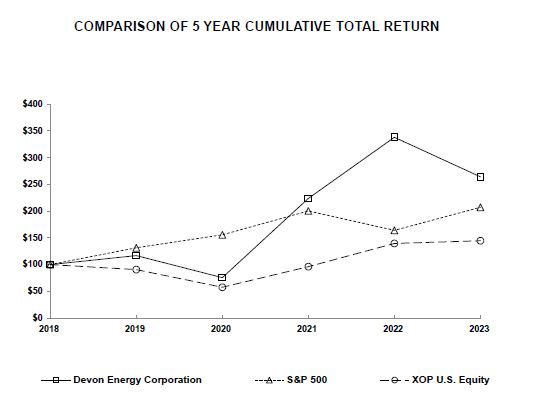
The graph and related information should not be deemed “soliciting material” or to be “filed” with the SEC, nor should such information be incorporated by reference into any future filing under the Securities Act of 1933, as amended, or the Securities Exchange Act of 1934, as amended, except to the extent that we specifically incorporate such information by reference into such a filing. The graph and information are included for historical comparative purposes only and should not be considered indicative of future stock performance.
Issuer Purchases of Equity Securities
The following table provides information regarding purchases of our common stock that were made by us during the fourth quarter of 2023 (shares in thousands).
| Period | Total Number of Shares Purchased (1) | Average Price Paid per Share | Total Number of Shares Purchased As Part of Publicly Announced Plans or Programs (2) | Maximum Dollar Value of Shares that May Yet Be Purchased Under the Plans or Programs (2) | ||||||||||||
| October 1 - October 31 | 2 | $ | 46.49 | — | $ | 948 | ||||||||||
| November 1 - November 30 | 2,918 | $ | 45.27 | 2,917 | $ | 816 | ||||||||||
| December 1 - December 31 | 2,549 | $ | 45.05 | 2,548 | $ | 701 | ||||||||||
| Total | 5,469 | $ | 45.17 | 5,465 |
(1)
In addition to shares purchased under the share repurchase program described below, these amounts also include approximately 3,000 shares received by us from employees for the payment of personal income tax withholding on vesting transactions.
(2)
On November 2, 2021, we announced a $1.0 billion share repurchase program that would expire on December 31, 2022. In 2022, we announced the expansions of this program ultimately to $2.0 billion and extended the expiration date to May 4, 2023. In 2023, we announced a further expansion to $3.0 billion and extended the expiration date to December 31, 2024. In the fourth quarter of 2023, we repurchased 5.5 million common shares for $247 million, or $45.17 per share, under this share repurchase program. For additional information, see Note 17 in “Item 8. Financial Statements and Supplementary Data” of this report.
Item 6. [Reserved]
Item 7. Management’s Discussion and Analysis of Financial Condition and Results of Operations
Introduction
The following discussion and analysis presents management’s perspective of our business, financial condition and overall performance. This information is intended to provide investors with an understanding of our past performance, current financial condition and outlook for the future and should be read in conjunction with “Item 8. Financial Statements and Supplementary Data” of this report.
The following discussion and analyses primarily focus on 2023 and 2022 items and year-to-year comparisons between 2023 and 2022. Discussions of 2021 items and year-to-year comparisons between 2022 and 2021 that are not included in this report can be found in “Management’s Discussion and Analysis of Financial Condition and Results of Operations” in Part II, Item 7 of our 2022 Annual Report on Form 10-K.
Executive Overview
We are a leading independent oil and natural gas exploration and production company whose operations are focused onshore in the United States. Our operations are currently focused in five core areas: the Delaware Basin, Eagle Ford, Anadarko Basin, Williston Basin and Powder River Basin. Our asset base is underpinned by premium acreage in the economic core of the Delaware Basin and our diverse, top-tier resource plays provide a deep inventory of opportunities for years to come. In the third quarter of 2022, we acquired additional producing properties and leasehold interests in both the Williston Basin and Eagle Ford that were complementary to our existing acreage, offered operational synergies and added additional high-quality inventory to our portfolio. Moving forward into 2024, we plan to refine our capital allocation by further concentrating investment in the Delaware Basin. By shifting more capital to the core of this world-class basin and high-grading activity across the rest of our diversified portfolio, we anticipate delivering meaningful improvements to our capital efficiency which will position us to generate growth in free cash flow which can be returned to shareholders.
We remain focused on building economic value by executing on our strategic priorities of moderating production growth, emphasizing capital and operational efficiencies, optimizing reinvestment rates to maximize free cash flow, maintaining low leverage, delivering cash returns to our shareholders and pursuing ESG excellence. Our recent performance highlights for these priorities include the following items for 2023:
Oil production totaled 320 MBbls/d, which is a 7% increase year over year.
Through 2023, completed approximately 77% of our authorized $3.0 billion share repurchase program, with approximately 45 million of our common shares repurchased for approximately $2.3 billion, or $51.05 per share, since inception of the plan.
Retired $242 million of senior notes.
Exited with $3.9 billion of liquidity, including $0.9 billion of cash.
Generated $6.5 billion of operating cash flow.
Including variable dividends, paid dividends of approximately $1.9 billion.
Earnings attributable to Devon were $3.7 billion, or $5.84 per diluted share.
Core earnings (Non-GAAP) were $3.7 billion, or $5.71 per diluted share.
We remain committed to capital discipline and delivering the objectives that underpin our current plan. Those objectives prioritize value creation through moderated capital investment and production growth, particularly with a view of the volatility in commodity prices, supply chain constraints and the economic uncertainty arising from inflation and geopolitical events. Our cash-return objectives remain focused on opportunistic share repurchases, funding our fixed and variable dividends, repaying debt at upcoming maturities and building cash balances.
Our net earnings and operating cash flow are highly dependent upon oil, gas and NGL prices which can be incredibly volatile due to several varying factors. Commodity prices strengthened during 2022 as the continued recovery from the COVID-19 pandemic increased demand for oil and gas commodities, while economic sanctions imposed on Russia and restraint from OPEC+ on production
growth both simultaneously impacted the supply of these commodities. In 2023, commodity prices weakened primarily due to economic uncertainty surrounding inflation and increased interest rates as well as certain geopolitical events. The graphs below show the trends in commodity prices over the past three years and their related impact on our net earnings, operating cash flow and capital investments.

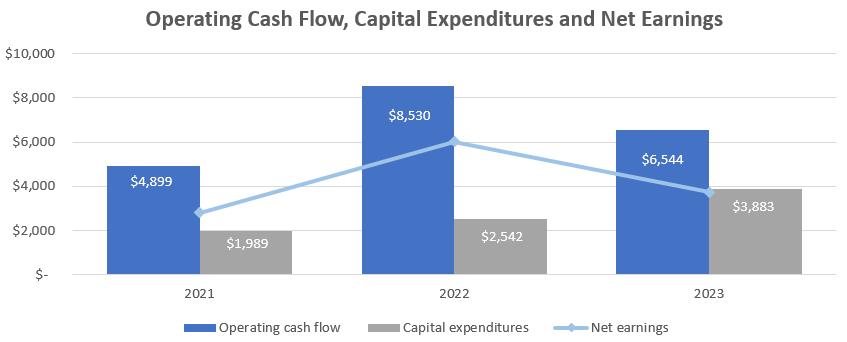
As we dependably generate strong cash flow results as shown above, we will continue to prioritize delivering cash returns to shareholders through share repurchases and our fixed plus variable dividend strategy while maintaining a strong liquidity position. Since the inception of our authorized $3.0 billion share repurchase program, we have repurchased approximately 45 million common shares for approximately $2.3 billion, or $51.05 per share. We also returned value to shareholders by paying dividends of approximately $1.9 billion during 2023. We exited 2023 with $3.9 billion of liquidity, comprised of $0.9 billion of cash and $3.0 billion of available credit under our 2023 Senior Credit Facility. We currently have $6.2 billion of debt outstanding, of which approximately $483 million is classified as short-term. Additionally, to help mitigate the volatility of commodity prices and protect ourselves from downside risk, we currently have approximately 30% and 20% of our anticipated 2024 oil and gas production hedged, respectively.
Business and Industry Outlook
In 2023, Devon marked its 52nd anniversary in the oil and gas business and its 35th year as a public company. We generated nearly $6.5 billion of operating cash flow in 2023 as a result of the strength of our portfolio of assets and our operational execution. Our portfolio benefited from highly complementary assets that were acquired in 2022. Our 2023 operating cash flow was materially lower than 2022 as commodity prices declined from 2022 highs and cost inflation increased in 2023.
We remain committed to continuing our track record of industry leading return of capital to our shareholders, underpinned by low capital reinvestment rates and a disciplined, returns-driven strategy which is designed to be successful through economic cycles. In line with this strategy, we returned $2.8 billion of cash to shareholders through fixed and variable cash dividends and share repurchases in 2023. For 2024, we are targeting approximately 70% of our free cash flow to be returned to shareholders through cash dividends and share repurchases.
In 2023, WTI oil prices averaged $77.62 per Bbl versus $94.39 per Bbl in 2022, reflecting a downward trend as oil prices remained volatile even with continued capital discipline by global oil producers. The market price for crude oil is currently expected to be lower in 2024 due to concerns of a global economic slowdown driven by high interest rates and high inflation that could weaken economic activity and oil demand. Additionally, oil prices could remain volatile as uncertainty still exists from the impact of sanctioned Russian oil in the global market, as well as actions taken by OPEC+ countries in supporting a balanced global crude supply. Growing supply from U.S. oil producers could also weigh down prices in 2024 by dampening the impact of OPEC+ supply cuts. Henry Hub natural gas prices fell in 2023, averaging $2.74 per Mcf compared to $6.65 per Mcf in 2022. For 2024, natural gas
Showing the first 8K of 61K characters. Open the full section
Item 7A. Quantitative and Qualitative Disclosures about Market Risk
The primary objective of the following information is to provide forward-looking quantitative and qualitative information about our potential exposure to market risks. The term “market risk” refers to our risk of loss arising from adverse changes in oil, gas and NGL prices, interest rates and foreign currency exchange rates. The following disclosures are not meant to be precise indicators of expected future losses but rather indicators of reasonably possible losses. This forward-looking information provides indicators of how we view and manage our ongoing market risk exposures. All of our market risk sensitive instruments were entered into for purposes other than speculative trading.
Commodity Price Risk
Our major market risk exposure is the pricing applicable to our oil, gas and NGL production. Realized pricing is primarily driven by the prevailing worldwide price for crude oil and spot market prices applicable to our gas and NGL production. Pricing for oil and gas production has been volatile and unpredictable as discussed in “Item 1A. Risk Factors” of this report. Consequently, we systematically hedge a portion of our production through various financial transactions. The key terms to our oil and gas derivative financial instruments as of December 31, 2023 are presented in Note 3 in “Item 8. Financial Statements and Supplementary Data” of this report.
The fair values of our commodity derivatives are largely determined by estimates of the forward curves of the relevant price indices. At December 31, 2023, a 10% change in the forward curves associated with our commodity derivative instruments would have changed our net positions by approximately $200 million.
Interest Rate Risk
At December 31, 2023, we had total debt of $6.2 billion. All of our debt is based on fixed interest rates averaging 5.7%.
Item 8. Financial Statements and Supplementary Data
INDEX TO CONSOLIDATED FINANCIAL STATEMENTS
AND CONSOLIDATED FINANCIAL STATEMENT SCHEDULES
All financial statement schedules are omitted as they are inapplicable or the required information has been included in the consolidated financial statements or notes thereto.
Report of Independent Regist****ered Public Accounting Firm
To the Stockholders and Board of Directors Devon Energy Corporation:
Opinions on the Consolidated Financial Statements and Internal Control Over Financial Reporting
We have audited the accompanying consolidated balance sheets of Devon Energy Corporation and subsidiaries (the Company) as of December 31, 2023 and 2022, the related consolidated statements of comprehensive earnings, equity, and cash flows for each of the years in the three-year period ended December 31, 2023, and the related notes (collectively, the consolidated financial statements). We also have audited the Company’s internal control over financial reporting as of December 31, 2023, based on criteria established in Internal Control – Integrated Framework (2013) issued by the Committee of Sponsoring Organizations of the Treadway Commission.
In our opinion, the consolidated financial statements referred to above present fairly, in all material respects, the financial position of the Company as of December 31, 2023 and 2022, and the results of its operations and its cash flows for each of the years in the three-year period ended December 31, 2023, in conformity with U.S. generally accepted accounting principles. Also in our opinion, the Company maintained, in all material respects, effective internal control over financial reporting as of December 31, 2023 based on criteria established in Internal Control – Integrated Framework (2013) issued by the Committee of Sponsoring Organizations of the Treadway Commission.
Basis for Opinions
The Company’s management is responsible for these consolidated financial statements, for maintaining effective internal control over financial reporting, and for its assessment of the effectiveness of internal control over financial reporting, included in the accompanying Management’s Annual Report on Internal Control Over Financial Reporting. Our responsibility is to express an opinion on the Company’s consolidated financial statements and an opinion on the Company’s internal control over financial reporting based on our audits. We are a public accounting firm registered with the Public Company Accounting Oversight Board (United States) (PCAOB) and are required to be independent with respect to the Company in accordance with the U.S. federal securities laws and the applicable rules and regulations of the Securities and Exchange Commission and the PCAOB.
We conducted our audits in accordance with the standards of the PCAOB. Those standards require that we plan and perform the audits to obtain reasonable assurance about whether the consolidated financial statements are free of material misstatement, whether due to error or fraud, and whether effective internal control over financial reporting was maintained in all material respects.
Our audits of the consolidated financial statements included performing procedures to assess the risks of material misstatement of the consolidated financial statements, whether due to error or fraud, and performing procedures that respond to those risks. Such procedures included examining, on a test basis, evidence regarding the amounts and disclosures in the consolidated financial statements. Our audits also included evaluating the accounting principles used and significant estimates made by management, as well as evaluating the overall presentation of the consolidated financial statements. Our audit of internal control over financial reporting included obtaining an understanding of internal control over financial reporting, assessing the risk that a material weakness exists, and testing and evaluating the design and operating effectiveness of internal control based on the assessed risk. Our audits also included performing such other procedures as we considered necessary in the circumstances. We believe that our audits provide a reasonable basis for our opinions.
Definition and Limitations of Internal Control Over Financial Reporting
A company’s internal control over financial reporting is a process designed to provide reasonable assurance regarding the reliability of financial reporting and the preparation of financial statements for external purposes in accordance with generally accepted accounting principles. A company’s internal control over financial reporting includes those policies and procedures that (1) pertain to the maintenance of records that, in reasonable detail, accurately and fairly reflect the transactions and dispositions of the assets of the company; (2) provide reasonable assurance that transactions are recorded as necessary to permit preparation of financial statements in accordance with generally accepted accounting principles, and that receipts and expenditures of the company are being made only in accordance with authorizations of management and directors of the company; and (3) provide reasonable assurance regarding prevention or timely detection of unauthorized acquisition, use, or disposition of the company’s assets that could have a material effect on the financial statements.
Because of its inherent limitations, internal control over financial reporting may not prevent or detect misstatements. Also, projections of any evaluation of effectiveness to future periods are subject to the risk that controls may become inadequate because of changes in conditions, or that the degree of compliance with the policies or procedures may deteriorate.
Critical Audit Matter
The critical audit matter communicated below is a matter arising from the current period audit of the consolidated fi
Showing the first 8K of 167K characters. Open the full section
Item 9A. Controls and Procedures
Disclosure Controls and Procedures
We have established disclosure controls and procedures to ensure that material information relating to Devon, including its consolidated subsidiaries, is made known to the officers who certify Devon’s financial reports and to other members of senior management and the Board of Directors.
Based on their evaluation, our principal executive and principal financial officers have concluded that our disclosure controls and procedures (as defined in Rules 13a-15(e) and 15d-15(e) under the Securities Exchange Act of 1934) were effective as of December 31, 2023 to ensure that the information required to be disclosed by Devon in the reports that it files or submits under the Securities Exchange Act of 1934 is recorded, processed, summarized and reported within the time periods specified in the SEC rules and forms.
Management’s Annual Report on Internal Control Over Financial Reporting
Our management is responsible for establishing and maintaining adequate internal control over financial reporting for Devon, as such term is defined in Rules 13a-15(f) and 15d-15(f) under the Securities Exchange Act of 1934. Under the supervision and with the participation of Devon’s management, including our principal executive and principal financial officers, we conducted an evaluation of the effectiveness of our internal control over financial reporting based on the framework in Internal Control – Integrated Framework issued in 2013 by the Committee of Sponsoring Organizations of the Treadway Commission (the “2013 COSO Framework”). Based on this evaluation under the 2013 COSO Framework, which was completed on February 28, 2024, management concluded that its internal control over financial reporting was effective as of December 31, 2023.
The effectiveness of our internal control over financial reporting as of December 31, 2023 has been audited by KPMG LLP, an independent registered public accounting firm who audited our consolidated financial statements as of and for the year ended December 31, 2023, as stated in their report, which is included under “Item 8. Financial Statements and Supplementary Data” of this report.
Changes in Internal Control Over Financial Reporting
There was no change in our internal control over financial reporting during the fourth quarter of 2023 that has materially affected, or is reasonably likely to materially affect, our internal control over financial reporting.
Item 9B. Other Information
Not applicable.
Item 9. C. Disclosure Regarding Foreign Jurisdictions that Prevent Inspections
Item 10. Directors, Executive Officers and Corporate Governance
The information called for by this Item 10 is incorporated herein by reference to the definitive Proxy Statement to be filed by Devon pursuant to Regulation 14A of the General Rules and applicable information in Regulations under the Securities Exchange Act of 1934 no later than 120 days following the fiscal year ended December 31, 2023.
Item 11. Executive Compensation
The information called for by this Item 11 is incorporated herein by reference to the definitive Proxy Statement to be filed by Devon pursuant to Regulation 14A of the General Rules and applicable information in Regulations under the Securities Exchange Act of 1934 no later than 120 days following the fiscal year ended December 31, 2023.
Item 12. Security Ownership of Certain Beneficial Owners and Management and Related Stockholder Matters
The information called for by this Item 12 is incorporated herein by reference to the definitive Proxy Statement to be filed by Devon pursuant to Regulation 14A of the General Rules and applicable information in Regulations under the Securities Exchange Act of 1934 no later than 120 days following the fiscal year ended December 31, 2023.
Item 13. Certain Relationships and Related Transactions, and Director Independence
The information called for by this Item 13 is incorporated herein by reference to the definitive Proxy Statement to be filed by Devon pursuant to Regulation 14A of the General Rules and applicable information in Regulations under the Securities Exchange Act of 1934 no later than 120 days following the fiscal year ended December 31, 2023.
Item 14. Principal Accountant Fees and Services
The information called for by this Item 14 is incorporated herein by reference to the definitive Proxy Statement to be filed by Devon pursuant to Regulation 14A of the General Rules and applicable information in Regulations under the Securities Exchange Act of 1934 no later than 120 days following the fiscal year ended December 31, 2023.
PAR****T IV
Item 15. Exhibits and Financial Statement Schedules
(a) The following documents are included as part of this report:
- Consolidated Financial Statements
Reference is made to the Index to Consolidated Financial Statements and Consolidated Financial Statement Schedules appearing at “Item 8. Financial Statements and Supplementary Data” in this report.
- Consolidated Financial Statement Schedules
All financial statement schedules are omitted as they are inapplicable, or the required information has been included in the consolidated financial statements or notes thereto.
- Exhibits
| Exhibit No. | Description | |
| 2.1 | Purchase and Sale Agreement, dated December 17, 2019, by and between Devon Energy Production Company, L.P. and BKV Barnett, LLC (incorporated by reference to Exhibit 2.1 to Registrant’s Form 8-K filed December 18, 2019; File No. 001-32318).* | |
| 2.2 | First Amendment to Purchase and Sale Agreement, dated April 13, 2020, by and between Devon Energy Production Company, L.P., BKV Barnett, LLC, and solely with respect to certain provisions therein, BKV Oil & Gas Capital Partners, L.P. (incorporated by reference to Exhibit 2.1 to Registrant’s Current Report on Form 8-K filed April 14, 2020; File No. 001-32318). | |
| 2.3 | Agreement and Plan of Merger, dated September 26, 2020, by and among Registrant, East Merger Sub, Inc., and WPX Energy, Inc. (incorporated by reference to Exhibit 2.1 to Registrant’s Current Report on Form 8-K, filed September 28, 2020; File No. 001-32318). | |
| 3.1 | Registrant’s Restated Certificate of Incorporation (incorporated by reference to Exhibit 3.1 to Registrant’s Form 8-K filed June 12, 2023; File No. 001-32318). | |
| 3.2 | Registrant’s Bylaws (incorporated by reference to Exhibit 3.2 to Registrant’s Form 8-K filed June 12, 2023; File No. 001-32318). | |
| 4.1 | Indenture, dated as of July 12, 2011, between Registrant and UMB Bank, National Association, as Trustee (incorporated by reference to Exhibit 4.1 to Registrant’s Form 8-K filed July 12, 2011; File No. 001-32318). | |
| 4.2 | Supplemental Indenture No. 1, dated as of July 12, 2011, to Indenture dated as of July 12, 2011, between Registrant and UMB Bank, National Association, as Trustee, relating to the 5.60% Senior Notes due 2041 (incorporated by reference to Exhibit 4.2 to Registrant’s Form 8-K filed July 12, 2011; File No. 001-32318). | |
| 4.3 | Supplemental Indenture No. 2, dated as of May 14, 2012, to Indenture dated as of July 12, 2011, between Registrant and UMB Bank, National Association, as Trustee, relating to the 4.750% Senior Notes due 2042 (incorporated by reference to Exhibit 4.1 to Registrant’s Form 8-K filed May 14, 2012; File No. 001-32318). | |
| 4.4 | Supplemental Indenture No. 4, dated as of June 16, 2015, to Indenture dated as of July 12, 2011, between Registrant and UMB Bank, National Association, as Trustee, relating to the 5.000% Senior Notes due 2045 (incorporated by reference to Exhibit 4.1 to Registrant’s Form 8-K filed June 16, 2015; File No. 001-32318). | |
| 4.5 | Supplemental Indenture No. 5, dated as of December 15, 2015, to Indenture dated as of July 12, 2011, between Registrant and UMB Bank, National Association, as Trustee, relating to the 5.850% Senior Notes due 2025 (incorporated by reference to Exhibit 4.1 to Registrant’s Form 8-K filed December 15, 2015; File No. 001-32318). | |
| 4.6 | Supplemental Indenture No. 6, dated as of June 9, 2021, between Registrant and UMB Bank, National Association, as Trustee, relating to the 5.250% Senior Notes due 2024 (incorporated by reference to Exhibit 4.2 to Registrant's Form 8-K filed June 9, 2021; File No. 001-32318). | |
| 4.7 | Supplemental Indenture No. 7, dated as of June 9, 2021, between Registrant and UMB Bank, National Association, as Trustee, relating to the 5.250% Senior Notes due 2027, 5.875% Senior Notes due 2028 and 4.500% Senior Notes due 2030 (incorporated by reference to Exhibit 4.3 to Registrant’s Form 8-K filed June 9, 2021; File No. 001-32318). | |
| 4.8 | Indenture, dated as of March 1, 2002, between Registrant and The Bank of New York Mellon Trust Company, N.A. (as successor to The Bank of New York), as Trustee (incorporated by reference to Exhibit 4.1 of Registrant’s Form 8-K filed April 9, 2002; File No. 000-30176). | |
| 4.9 | Supplemental Indenture No. 1, dated as of March 25, 2002, to Indenture dated as of March 1, 2002, between Registrant and The Bank of New York Mellon Trust Company, N.A., as Trustee, relating to the 7.95% Senior Debentures due 2032 (incorporated by reference to Exhibit 4.2 to Registrant’s Form 8-K filed April 9, 2002; File No. 000-30176). | |
| 4.10 | Supplemental Indenture No. 4, dated as of March 22, 2018, to Indenture dated as of March 1, 2002, between Registrant and The Bank of New York Mellon Trust Company, N.A., as Trustee, relating to the 7.95% Senior Notes due 2032 (incorporated by reference to Exhibit 4.1 to Registrant’s Form 8-K filed March 22, 2018; File No. 000-32318). | |
| 4.11 | Indenture, dated as of October 3, 2001, among Devon Financing Company, L.L.C. (f/k/a Devon Financing Corporation, U.L.C.), as Issuer, Registrant, as Guarantor, and The Bank of New York Mellon Trust Company, N.A., originally The Chase Manhattan Bank, as Trustee, relating to the 7.875% Debentures due 2031 (incorporated by reference to Exhibit 4.7 to Registrant’s Registration Statement on Form S-4 filed October 31, 2001; File No. 333-68694). | |
| 4.12 | Assignment and Assumption Agreement, dated as of June 19, 2019, by and between Devon Financing Company, L.L.C. and Registrant, relating to that certain Indenture, dated as of October 3, 2001, by and among Devon Financing Company, L.L.C. (f/k/a Devon Financing Company, U.L.C.), as Issuer, Devon Energy Corporation, as Guarantor, and The Bank of New York Mellon Trust Company, N.A., as successor to The Chase Manhattan Bank, as Trustee, and the 7.875% Debentures due 2031 issued thereunder (incorporated by reference to Exhibit 4.1 to Registrant’s Form 10-Q filed August 7, 2019; File No. 001-32318). | |
| 4.13 | Senior Indenture, dated as of September 1, 1997, between Devon OEI Operating, L.L.C. (as successor to Seagull Energy Corporation) and The Bank of New York Mellon Trust Company, N.A. (as successor to The Bank of New York), as Trustee, and related Specimen of 7.50% Senior Notes due 2027 (incorporated by reference to Exhibit 4.4 to Ocean Energy Inc.’s Form 10-K filed March 23, 1998; File No. 001-08094). | |
| 4.14 | First Supplemental Indenture, dated as of March 30, 1999, to Senior Indenture dated as of September 1, 1997, by and among Devon OEI Operating, L.L.C., its Subsidiary Guarantor, and The Bank of New York Mellon Trust Company, N.A., as Trustee, relating to the 7.50% Senior Notes due 2027 (incorporated by reference to Exhibit 4.10 to Ocean Energy, Inc.’s Form 10-Q filed May 17, 1999; File No. 001-08094). | |
| 4.15 | Second Supplemental Indenture, dated as of May 9, 2001, to Senior Indenture dated as of September 1, 1997, by and among Devon OEI Operating, L.L.C., its Subsidiary Guarantor, and The Bank of New York Mellon Trust Company, N.A., as Trustee, relating to the 7.50% Senior Notes due 2027 (incorporated by reference to Exhibit 99.4 to Ocean Energy, Inc.’s Form 8-K filed May 14, 2001; File No. 033-06444). | |
| 4.16 | Third Supplemental Indenture, dated as of December 31, 2005, to Senior Indenture dated as of September 1, 1997, by and among Devon OEI Operating, L.L.C., as Issuer, Devon Energy Production Company, L.P., as Successor Guarantor, and The Bank of New York Mellon Trust Company, N.A., as Trustee, relating to the 7.50% Senior Notes due 2027 (incorporated by reference to Exhibit 4.27 of Registrant’s Form 10-K filed March 3, 2006; File No. 001-32318). | |
| 4.17 | Indenture, dated as of September 8, 2014, between WPX Energy, Inc. and The Bank of New York Mellon Trust Company, N.A., as Trustee (incorporated herein by reference to Exhibit 4.1 to WPX Energy, Inc.’s Form 8-K filed September 8, 2014; File No. 001-35322). | |
| 4.18 | First Supplemental Indenture, dated as of September 8, 2014, between WPX Energy, Inc. and The Bank of New York Mellon Trust Company, N.A., as Trustee, relating to the 5.25% Senior Notes due 2024 (incorporated herein by reference to Exhibit 4.2 to WPX Energy, Inc.’s Form 8-K filed September 8, 2014; File No. 001-35322). | |
| 4.19 | Fourth Supplemental Indenture, dated as of September 24, 2019, between WPX Energy, Inc. and The Bank of New York Mellon Trust Company, N.A. as Trustee, relating to the 5.250% Senior Notes due 2027 (incorporated herein by reference to Exhibit 4.1 to WPX Energy, Inc.'s Form 8-K filed on September 24, 2019; File No. 001-35322). | |
| 4.20 | Fifth Supplemental Indenture, dated as of January 10, 2020, between WPX Energy, Inc. and The Bank of New York Mellon Trust Company, N.A. as Trustee, relating to the 4.500% Senior Notes due 2030 (incorporated herein by reference to Exhibit 4.1 to WPX Energy, Inc.’s Form 8-K filed January 10, 2020; File No. 001-35322). | |
| 4.21 | Sixth Supplemental Indenture, dated as of June 17, 2020, between WPX Energy, Inc. and the Bank of New York Mellon Trust Company, N.A. as Trustee, relating to the 5.875% Senior Notes due 2028 (incorporated herein by reference to Exhibit 4.1 to WPX Energy, Inc.’s Form 8-K filed June 17, 2020; File No. 001-35322). | |
| 4.22 | Supplemental Indenture No. 7, dated as of June 9, 2021, between WPX Energy, Inc. and The Bank of New York Mellon Trust Company, N.A., as Trustee, relating to the 8.250% Senior Notes due 2023, the 5.250% Senior Notes due 2024, the 5.250% Senior Notes due 2027, the 5.875% Senior Notes due 2028 and the 4.500% Senior Notes due 2030 (incorporated by reference to Exhibit 4.5 to Registrant’s Form 8-K filed June 9, 2021; File No. 001-32318). | |
| 4.23 | Description of Securities Registered under Section 12 of the Securities Exchange Act of 1934. | |
| 10.1 | Amended and Restated Credit Agreement, dated as of March 24, 2023, among Registrant, as Borrower, Bank of America, N.A., as Administrative Agent, Swing Line Lender and an L/C Issuer, and each Lender and L/C Issuer from time to time party thereto (incorporated by reference to Exhibit 10.1 to Registrant’s Form 8-K filed March 28, 2023; File No. 001-32318). | |
| 10.2 | Devon Energy Corporation 2022 Long-Term Incentive Plan (amended and restated effective as of November 30, 2022) (incorporated by reference to Exhibit 10.3 to Registrant’s Form 10-K filed February 15, 2023; File No. 001-32318).** | |
| 10.3 | Devon Energy Corporation 2017 Long-Term Incentive Plan (incorporated by reference to Exhibit 99.1 to Registrant’s Form S-8 filed June 7, 2017; File No. 333-218561).** | |
| 10.4 | 2021 Amendment (effective as of January 7, 2021) to the Devon Energy Corporation 2017 Long-Term Incentive Plan (incorporated by reference to Exhibit 10.7 to the Company’s Form 10-K filed February 17, 2021; File No. 001-32318).** | |
| 10.5 | WPX Energy, Inc. 2013 Incentive Plan, and amendments No. 1 and No. 2 thereto (incorporated by reference to Exhibit 10.1 to WPX Energy, Inc.’s Form 8-K filed on February 19, 2018; File No. 001-35322).** | |
| 10.6 | Amendment No. 3 to the WPX Energy, Inc. 2013 Incentive Plan (incorporated by reference to Appendix A to WPX Energy, Inc.’s definitive proxy statement on Schedule 14A filed March 29, 2018; File No. 001-35322).** |
| 10.21 | Amendment 2019-1, executed June 19, 2019, to the Devon Energy Corporation Supplemental Executive Retirement Plan (incorporated by reference to Exhibit 10.3 to Registrant’s Form 10-Q filed August 7, 2019; File No. 001-32318).** | |
| 10.22 | Amendment 2020-1, executed December 23, 2020, to the Devon Energy Corporation Supplemental Executive Retirement Plan (incorporated by reference to Exhibit 10.35 to Registrant’s Form 10-K filed February 17, 2021; File No. 001-32318).** | |
| 10.23 | Devon Energy Corporation Supplemental Retirement Income Plan (amended and restated effective January 1, 2012) (incorporated by reference to Exhibit 10.19 to Registrant’s Form 10-K filed February 24, 2012; File No. 001-32318).** | |
| 10.24 | Amendment 2014-1, executed March 7, 2014, to the Devon Energy Corporation Supplemental Retirement Income Plan (incorporated by reference to Exhibit 10.9 to Registrant’s Form 10-Q filed May 9, 2014; File No. 001-32318).** | |
| 10.25 | Amendment 2016-1, executed October 20, 2016, to the Devon Energy Corporation Supplemental Retirement Income Plan (incorporated by reference to Exhibit 10.28 to Registrant’s Form 10-K filed February 15, 2017; File No. 001-32318).** | |
| 10.26 | Amendment 2019-1, effective September 10, 2019, to the Devon Energy Corporation Supplemental Retirement Income Plan (incorporated by reference to Exhibit 10.2 to Registrant’s Form 10-Q filed November 6, 2019; File No. 001-32318).** | |
| 10.27 | Amendment 2020-1, executed December 23, 2020, to the Devon Energy Corporation Supplemental Retirement Income Plan (incorporated by reference to Exhibit 10.40 to the Company’s Form 10-K filed February 17, 2021; File No. 001-32318).** | |
| 10.28 | Devon Energy Corporation Incentive Savings Plan (amended and restated effective as of January 1, 2022) (incorporated by reference to Exhibit 10.26 of Registrant’s Form 10-K filed February 16, 2022; File No. 001-32318).** | |
| 10.29 | Amendment 2022-1, effective July 21, 2022, to the Devon Energy Corporation Incentive Savings Plan (incorporated by reference to Exhibit 10.27 to Registrant’s Form 10-K filed February 15, 2023; File No. 001-32318).** | |
| 10.30 | Amendment 2022-2, effective September 28, 2022, to the Devon Energy Corporation Incentive Savings Plan (incorporated by reference to Exhibit 10.28 to Registrant’s Form 10-K filed February 15, 2023; File No. 001-32318).** | |
| 10.31 | Employment Agreement, dated effective April 19, 2017, by and between Registrant and Jeffrey L. Ritenour (incorporated by reference to Exhibit 10.1 to Registrant’s Form 8-K, filed on April 20, 2017; File No. 001-32318).** | |
| 10.32 | Employment Agreement, dated effective September 13, 2019, by and between Registrant and David G. Harris (incorporated by reference to Exhibit 10.1 to Registrant’s Form 8-K filed September 16, 2019; File No. 001-32318).** | |
| 10.33 | Employment Agreement, dated January 7, 2021, by and between Registrant and Richard E. Muncrief (incorporated by reference to Exhibit 10.3 to Registrant’s Form 8-K filed January 7, 2021; File No. 001-32318).** | |
| 10.34 | Employment Agreement, dated January 7, 2021, by and between Registrant and Clay M. Gaspar (incorporated by reference to Exhibit 10.4 to Registrant’s Form 8-K filed January 7, 2021; File No. 001-32318).** | |
| 10.35 | Employment Agreement, dated January 7, 2021, by and between Registrant and Dennis C. Cameron (incorporated by reference to Exhibit 10.5 to Registrant’s Form 8-K filed January 7, 2021; File No. 001-32318).** | |
| 10.36 | Employment Agreement, dated March 2, 2022, by and between Devon Energy Corporation and Tana K. Cashion (incorporated by reference to Exhibit 10.1 of Registrant’s Form 8-K filed March 7, 2022; File No. 001-32318).** | |
| 10.37 | WPX Energy Nonqualified Deferred Compensation Plan, effective January 1, 2013 (incorporated herein by reference to Exhibit 10.16 to WPX Energy, Inc.’s Form 10-K filed February 28, 2013; File No. 001-35322).** | |
| 10.38 | First Amendment to the WPX Energy Nonqualified Deferred Compensation Plan, executed January 4, 2021 (incorporated by reference to Exhibit 10.37 of Registrant’s Form 10-K filed February 16, 2022; File No. 001-32318).** | |
| 10.39 | Second Amendment to the WPX Energy Nonqualified Deferred Compensation Plan, executed December 15, 2021 (incorporated by reference to Exhibit 10.38 of Registrant’s Form 10-K filed February 16, 2022; File No. 001-32318).** | |
| 10.40 | WPX Energy Board of Directors Nonqualified Deferred Compensation Plan, effective January 1, 2013 (incorporated herein by reference to Exhibit 10.17 to WPX Energy, Inc.’s Form 10-K filed February 28, 2013; File No. 001-35322).** | |
| 10.41 | First Amendment to the WPX Energy Board of Directors Nonqualified Deferred Compensation Plan, executed December 9, 2021 (incorporated by reference to Exhibit 10.40 of Registrant’s Form 10-K filed February 16, 2022; File No. 001-32318).** | |
| 10.42 | WPX Energy Nonqualified Restoration Plan, effective January 1, 2015 (incorporated by reference to Exhibit 10.41 of Registrant’s Form 10-K filed February 16, 2022; File No. 001-32318).** | |
| 10.43 | First Amendment to the WPX Energy Nonqualified Restoration Plan, executed January 4, 2021 (incorporated by reference to Exhibit 10.42 of Registrant’s Form 10-K filed February 16, 2022; File No. 001-32318).** | |
| 10.44 | Second Amendment to the WPX Energy Nonqualified Restoration Plan, executed December 15, 2021 (incorporated by reference to Exhibit 10.43 of Registrant’s Form 10-K filed February 16, 2022; File No. 001-32318).** | |
| 10.45 | Form of Indemnity Agreement between Registrant and non-management directors (incorporated by reference to Exhibit 10.40 to Registrant’s Form 10-K filed February 19, 2020; File No. 001-32318).** | |
| 10.46 | 2020 Form of Notice of Grant of Restricted Stock Award and Award Agreement under the 2017 Long-Term Incentive Plan between Registrant and certain officers for restricted stock awarded (CEO and EVP form) (incorporated by reference to Exhibit 10.1 to Registrant’s Form 10-Q filed May 6, 2020; File No. 001-32318).** | |
| 10.47 | 2020 Form of Notice of Grant of Restricted Stock Award and Award Agreement under the 2017 Long-Term Incentive Plan between Registrant and certain officers for restricted stock awarded (SVP form) (incorporated by reference to Exhibit 10.3 to Registrant’s Form 10-Q filed May 6, 2020; File No. 001-32318).** | |
| 10.48 | 2021 Form of Notice of Grant of Restricted Stock Award and Award Agreement under the 2017 Long-Term Incentive Plan between Devon Energy Corporation and certain officers for restricted |
| stock awarded (incorporated by reference to Exhibit 10.1 to Registrant’s Form 10-Q filed May 5, 2021; File No. 001-32318).** | ||
| 10.49 | 2022 Form of Notice of Grant of Restricted Stock Award and Award Agreement under the 2017 Long-Term Incentive Plan between Devon Energy Corporation and certain officers for restricted stock awarded (incorporated by reference to Exhibit 10.1 of Registrant’s Form 10-Q filed May 3, 2022; File No. 001-32318).** | |
| 10.50 | 2023 Form of Notice of Grant of Restricted Stock Award and Award Agreement under the 2022 Long-Term Incentive Plan between Devon Energy Corporation and certain officers for restricted stock awarded (incorporated by reference to Exhibit 10.2 of Registrant’s Form 10-Q filed May 9, 2023; File No. 001-32318).** | |
| 10.51 | 2021 Form of Notice of Grant of Performance Share Unit Award and Award Agreement under the 2017 Long-Term Incentive Plan between Devon Energy Corporation and certain officers for performance based restricted share units awarded (incorporated by reference to Exhibit 10.2 to the Company’s Form 10-Q filed May 5, 2021; File No. 001-32318).** | |
| 10.52 | 2022 Form of Notice of Grant of Performance Share Unit Award and Award Agreement under the 2017 Long-Term Incentive Plan between Devon Energy Corporation and certain officers for performance based restricted share units awarded (incorporated by reference to Exhibit 10.2 of Registrant’s Form 10-Q filed May 3, 2022; File No. 001-32318).** | |
| 10.53 | 2023 Form of Notice of Grant of Performance Share Unit Award and Award Agreement under the 2022 Long-Term Incentive Plan between Devon Energy Corporation and certain officers for performance based restricted share units awarded (incorporated by reference to Exhibit 10.3 to Registrant’s Form 10-Q filed May 9, 2023; File No. 001-32318).** | |
| 10.54 | 2023 Form of Notice of Grant of Restricted Stock Award and Award Agreement under the 2022 Long-Term Incentive Plan between the Company and non-management directors for restricted stock awarded (incorporated by reference to Exhibit 10.1 of Registrant’s Form 10-Q filed August 2, 2023; File No. 001-32318).** | |
| 10.55 | 2023 Form of Notice of Grant of Restricted Stock Unit Award and Award Agreement under the 2022 Long-Term Incentive Plan between the Company and non-management directors for restricted stock units awarded (incorporated by reference to Exhibit 10.2 to Registrant’s Form 10-Q filed August 2, 2023, File No. 001-32318). ** | |
| 10.56 | Form of Nonqualified Stock Option Agreement between WPX Energy, Inc. and Richard E. Muncrief (incorporated herein by reference to Exhibit 10.2 to WPX Energy, Inc.’s Form 8-K filed May 2, 2014; File No. 001-35322).** | |
| 10.57 | Form of Restricted Stock Unit Award between WPX Energy, Inc. and non-employee directors (incorporated herein by reference to Exhibit 10.1 to WPX Energy, Inc.’s Form 8-K filed September 3, 2014; File No. 001-35322).** | |
| 10.58 | Form of Amended and Restated Restricted Stock Unit Award Agreement between WPX Energy, Inc. and non-employee directors (incorporated herein by reference to Exhibit 10.38 to WPX Energy, Inc.’s Form 10-Q filed August 6, 2019; File No. 001-35322).** | |
| 21 | List of Subsidiaries. | |
| 23.1 | Consent of KPMG LLP. | |
| 23.2 | Consent of DeGolyer and MacNaughton. |
| 31.1 | Certification of principal executive officer pursuant to Section 302 of the Sarbanes-Oxley Act of 2002. | |
| 31.2 | Certification of principal financial officer pursuant to Section 302 of the Sarbanes-Oxley Act of 2002. | |
| 32.1 | Certification of principal executive officer pursuant to Section 906 of the Sarbanes-Oxley Act of 2002. | |
| 32.2 | Certification of principal financial officer pursuant to Section 906 of the Sarbanes-Oxley Act of 2002. | |
| 97 | Devon Energy Corporation Clawback Policy, adopted on November 29, 2023. | |
| 99 | Report of DeGolyer and MacNaughton. | |
| 101.INS | Inline XBRL Instance Document – the XBRL Instance Document does not appear in the Interactive Data File because its XBRL tags are embedded within the Inline XBRL document. | |
| 101.SCH | Inline XBRL Taxonomy Extension Schema with Embedded Linkbases Document. | |
| 104 | Cover Page Interactive Data File (formatted as Inline XBRL and contained in Exhibit 101). | |
- Portions of this exhibit have been omitted in accordance with Item 601(b)(2)(ii) of Regulation S-K.
** Indicates management contract or compensatory plan or arrangement.
Item 16. Form 10-K Summary
Not applicable.
SIG****NATURES
Pursuant to the requirements of Section 13 or 15(d) of the Securities Exchange Act of 1934, the Registrant has duly caused this report to be signed on its behalf by the undersigned, thereunto duly authorized.
| DEVON ENERGY CORPORATION | ||
| By: | /s/ JEFFREY L. RITENOUR | |
| Jeffrey L. Ritenour | ||
| Executive Vice President and Chief Financial Officer |
February 28, 2024
Pursuant to the requirements of the Securities Exchange Act of 1934, this report has been signed below by the following persons on behalf of the Registrant and in the capacities and on the dates indicated.
| /s/ RICHARD E. MUNCRIEF | President, Chief Executive Officer and | February 28, 2024 | |
| Richard E. Muncrief | Director (Principal executive officer) | ||
| /s/ JEFFREY L. RITENOUR | Executive Vice President | February 28, 2024 | |
| Jeffrey L. Ritenour | and Chief Financial Officer (Principal financial officer) | ||
| /s/ JEREMY D. HUMPHERS | Senior Vice President | February 28, 2024 | |
| Jeremy D. Humphers | and Chief Accounting Officer (Principal accounting officer) | ||
| /s/ BARBARA M. BAUMANN | Chair and Director | February 28, 2024 | |
| Barbara M. Baumann | |||
| /s/ JOHN E. BETHANCOURT | Director | February 28, 2024 | |
| John E. Bethancourt | |||
| /s/ ANN G. FOX | Director | February 28, 2024 | |
| Ann G. Fox | |||
| /s/ GENNIFER F. KELLY | Director | February 28, 2024 | |
| Gennifer F. Kelly | |||
| /s/ KELT KINDICK | Director | February 28, 2024 | |
| Kelt Kindick | |||
| /s/ JOHN KRENICKI JR. | Director | February 28, 2024 | |
| John Krenicki Jr. | |||
| /s/ KARL F. KURZ | Director | February 28, 2024 | |
| Karl F. Kurz | |||
| /s/ MICHAEL N. MEARS | Director | February 28, 2024 | |
| Michael N. Mears | |||
| /s/ ROBERT A. MOSBACHER, JR. | Director | February 28, 2024 | |
| Robert A. Mosbacher, Jr. | |||
| /s/ VALERIE M. WILLIAMS | Director | February 28, 2024 | |
| Valerie M. Williams |