 filings.tools
Dexcom 2022 10-K Annual Report
DXCM · CIK 1093557 · Form 10-K · Fiscal year ended December 31, 2022 · Filed February 9, 2023
23 sections, 667K characters. Original on sec.gov · Markdown · JSON
Risk FactorsBusinessMD&AFinancial StatementsWhat changed vs 2021
Cover and table of contents
UNITED STATES
SECURITIES AND EXCHANGE COMMISSION
Washington, D.C. 20549
FORM 10-K
| ☒ | ANNUAL REPORT PURSUANT TO SECTION 13 OR 15(d) OF THE SECURITIES EXCHANGE ACT OF 1934 |
For the fiscal year ended December 31, 2022
| ☐ | TRANSITION REPORT PURSUANT TO SECTION 13 OR 15(d) OF THE SECURITIES EXCHANGE ACT OF 1934 |
For the transition period from to
Commission File Number 000-51222

DEXCOM, INC.
(Exact name of registrant as specified in its charter)
| Delaware | 33-0857544 | |||||||
| (State or other jurisdiction of incorporation or organization) | (I.R.S. Employer Identification No.) | |||||||
6340 Sequence Drive, San Diego, CA 92121
(Address of principal executive offices)
(858) 200-0200
(Registrant’s telephone number, including area code)
Securities registered pursuant to Section 12(b) of the Act:
| Title of each class | Trading Symbol(s) | Name of each exchange on which registered | ||||||
| Common Stock, $0.001 Par Value Per Share | DXCM | The Nasdaq Stock Market LLC | ||||||
| (Nasdaq Global Select Market) |
Securities registered pursuant to Section 12(g) of the Act: None
Indicate by check mark if the registrant is a well-known seasoned issuer, as defined in Rule 405 of the Securities Act. Yes ☒ No ☐
Indicate by check mark if the registrant is not required to file reports pursuant to Section 13 or 15(d) of the Act. Yes ☐ No ☒
Indicate by check mark whether the registrant (1) has filed all reports required to be filed by Section 13 or 15(d) of the Securities Exchange Act of 1934 during the preceding 12 months (or for such shorter period that the registrant was required to file such reports), and (2) has been subject to such filing requirements for the past 90 days. Yes ☒ No ☐
Indicate by check mark whether the registrant has submitted electronically every Interactive Data File required to be submitted pursuant to Rule 405 of Regulation S-T (§232.405 of this chapter) during the preceding 12 months (or for such shorter period that the registrant was required to submit such files). Yes ☒ No ☐
Indicate by check mark whether the registrant is a large accelerated filer, an accelerated filer, a non-accelerated filer, a smaller reporting company, or an emerging growth company. See the definitions of “large accelerated filer,” “accelerated filer,” “smaller reporting company,” and “emerging growth company” in Rule 12b-2 of the Exchange Act.
Large accelerated filer ☒ Accelerated filer ☐ Non-accelerated filer ☐ Smaller reporting company ☐ Emerging growth company ☐
If an emerging growth company, indicate by check mark if the registrant has elected not to use the extended transition period for complying with any new or revised financial accounting standards provided pursuant to Section 13(a) of the Exchange Act. ☐
Indicate by check mark whether the registrant has filed a report on and attestation to its management’s assessment of the effectiveness of its internal control over financial reporting under Section 404(b) of the Sarbanes-Oxley Act (15 U.S.C. 7262(b)) by the registered public accounting firm that prepared or issued its audit report. ☒
Indicate by check mark whether the registrant is a shell company (as defined in Rule 12b-2 of the Act). Yes ☐ No ☒
As of June 30, 2022, the last business day of the registrant’s most recently completed second fiscal quarter, the aggregate market value of the registrant’s common stock held by non-affiliates of the registrant was approximately $29.1 billion based on the closing sales price of $74.53 per share as reported on the Nasdaq Global Select Market.
Indicate the number of shares outstanding of each of the registrant’s classes of common stock, as of the latest practicable date.
| Class | Outstanding at February 2, 2023 | |||||||
| Common stock, $0.001 par value per share | 386,413,690 |
DOCUMENTS INCORPORATED BY REFERENCE
Portions of the registrant’s definitive proxy statement relating to its 2023 Annual Meeting of Stockholders (the “Proxy Statement”) are incorporated by reference in Part III, Items 10 through 14 of this Annual Report on Form 10-K, as specified in the responses to those item numbers. Except with respect to information specifically incorporated by reference in the Form 10-K, the Proxy Statement is not deemed to be filed as part hereof.
| DexCom, Inc. | ||
| Table of Contents |
| CAUTIONARY NOTE REGARDING FORWARD-LOOKING STATEMENTS |
Except for historical financial information contained herein, the matters discussed in this Form 10-K may be considered forward-looking statements within the meaning of Section 27A of the Securities Act of 1933, as amended, and Section 21E of the Securities Exchange Act of 1934, as amended, and subject to the safe harbor created by the Securities Litigation Reform Act of 1995. Such statements include declarations regarding our intent, belief, or current expectations and those of our management. Prospective investors are cautioned that any such forward-looking statements are not guarantees of future performance and involve a number of risks, uncertainties and other factors, some of which are beyond our control; actual results could differ materially from those indicated by such forward-looking statements. Important factors that could cause actual results to differ materially from those indicated by such forward-looking statements include, but are not limited to: (i) that the information is of a preliminary nature and may be subject to further adjustment; (ii) those risks and uncertainties identified under “Risk Factors”; and (iii) the other risks detailed from time-to-time in our reports and registration statements filed with the Securities and Exchange Commission, or SEC. Except as required by law, we undertake no obligation to revise or update publicly any forward-looking statements, whether as a result of new information, future events or otherwise.
| Summary of Risk Factors |
The below summary of risk factors provides an overview of many of the risks we are exposed to in the normal course of our business activities. As a result, the below summary risks do not contain all of the information that may be important to you, and you should read the summary risks together with the more detailed discussion of risks set forth following this section under the heading “Risk Factors,” as well as elsewhere in this Annual Report on Form 10-K. Additional risks, beyond those summarized below or discussed elsewhere in this Annual Report on Form 10-K, may apply to our activities or operations as currently conducted or as we may conduct them in the future or in the markets in which we operate or may in the future operate. Consistent with the foregoing, we are exposed to a variety of risks, including risks associated with the following:
-
If we experience decreasing prices for our products and we are unable to reduce our expenses, including the per unit cost of producing our products, there may be a material adverse effect on our business, results of operations, financial condition and cash flows.
-
We are subject to cost-containment efforts by third-party payors that could result in reduced product pricing and/or sales of our products and cause a reduction in future revenue.
-
Although many third-party payors have adopted some form of coverage policy for continuous glucose monitoring devices, our products do not always have such coverage, including simple broad-based contractual coverage, and we frequently experience administrative challenges in obtaining coverage or reimbursement for our products. If we are unable to secure adequately broad coverage or reimbursement for our products or any future products from third-party payors, our revenue may be negatively impacted.
-
The research and development efforts we undertake independently, and in some instances in connection with our collaborations with third parties, may not result in the development of commercially viable products, the generation of significant future revenues or adequate profitability.
-
Our products may not achieve or maintain market acceptance.
-
If our manufacturing capabilities are insufficient to produce an adequate supply of product at appropriate quality levels, our growth could be limited and our business could be harmed.
-
Manufacturing difficulties and/or any disruption at our facilities may adversely affect our manufacturing operations and related product sales, and increase our expenses.
-
We depend upon third-party suppliers and outsource to other parties, making us vulnerable to supply disruptions, suboptimal quality, non-compliance and/or price fluctuations, which could harm our business.
-
If we are unable to establish and maintain adequate sales, marketing and distribution capabilities or enter into and maintain arrangements with third parties to sell, market and distribute our products, we may have difficulty achieving market awareness and selling our products in the future.
-
We operate in a highly competitive market and face competition from large, well-established companies with significant resources, and, as a result, we may not be able to compete effectively.
-
The outbreak of the SARS-CoV-2 virus and its variants and the COVID-19 disease that it causes, or similar public health crises, could have a material adverse impact on our business, financial condition and results of operations, including our manufacturing, commercial operations and sales.
-
We are subject to a variety of risks due to our international operations that could adversely affect our business, our operations or profitability and operating results.
-
We have incurred significant losses in the past and may incur losses in the future.
-
We are subject to complex and evolving U.S. and foreign laws and regulations and other requirements and policy initiatives regarding privacy, data protection, security, data access and other matters. Many of these laws and regulations are subject to change and uncertain or evolving guidance and interpretation, and could result in claims, changes to our business practices, product development impacts, monetary penalties, increased cost of operations, or declines in user growth or engagement, or otherwise harm our business.
-
Cybersecurity risks and cyber incidents could result in the compromise of confidential data or critical data systems and give rise to potential harm to customers, remediation and other expenses, expose us to costs, negative attention, or liability under HIPAA, FDA standards and requirements, consumer protection laws, or other common law theories, subject us to litigation and federal and state governmental inquiries, damage our reputation, and otherwise be disruptive to our business and operations.
-
We conduct business in a heavily regulated industry and if we fail to comply with applicable laws and government regulations, we could become subject to government investigation, litigation, penalties, be excluded from participation in government programs, and/or be required to make significant changes to our operations.
-
Managed care trends and consolidation in the health care industry could have an adverse effect on our revenues and results of operations.
-
Health care policy changes, including U.S. health care reform legislation, may have a material adverse effect on our business.
-
If we are unable to successfully complete the pre-clinical studies or clinical trials or otherwise develop the data necessary to support additional marketing authorizations, we may be unable to commercialize additional or modified CGM candidate systems under development, which could impair our business, financial condition and operating results.
-
We are subject to claims of infringement or misappropriation of the intellectual property rights of others, which could prohibit us from shipping affected products, require us to obtain licenses from third parties or to develop non-infringing alternatives, and subject us to substantial monetary damages and injunctive relief. We may also be subject to other claims or suits.
-
Our inability to adequately protect our intellectual property could allow our competitors and others to produce products based on our technology, which could substantially impair our ability to compete.
-
We face the risk of product liability claims and may be subject to damages, fines, penalties and injunctions, among other things.
-
We could become the subject of governmental investigations, claims and litigation.
-
Our stock price is highly volatile and investing in our stock involves a high degree of risk, which could result in substantial losses for investors.
-
We have indebtedness in the form of convertible senior notes, which could adversely affect our financial health and our ability to respond to changes in our business.
-
Environmental, social and governance, or ESG, regulations, policies, provisions, initiatives and goals, and disclosures related thereto, could expose us to numerous risks, and climate change may have a long-term impact on our business.
PART I
Item 1. BUSINESS
| Overview |
We are a medical device company primarily focused on the design, development and commercialization of continuous glucose monitoring, or CGM, systems for use by people with diabetes and by healthcare providers. We received approval from the United States Food and Drug Administration, or FDA, and commercialized our first product in 2006. We received FDA marketing authorization and launched our latest generation system, the Dexcom G6*®* integrated Continuous Glucose Monitoring System, or G6, in 2018 and more recently received marketing clearance from the FDA on the Dexcom G7*®* in December 2022. Unless the context requires otherwise, the terms “we,” “us,” “our,” the “company,” or “Dexcom” refer to DexCom, Inc. and its subsidiaries. The mailing address of our headquarters is 6340 Sequence Drive, San Diego, California, 92121 and our telephone number at that location is (858) 200-0200. Our Internet website address is www.dexcom.com. We provide free access to various reports that we file with or furnish to the SEC through our website, as soon as reasonably practicable after they have been filed or furnished. These reports include, but are not limited to, our annual reports on Form 10-K, quarterly reports on Form 10-Q, current reports on Form 8-K, and any amendments to those reports. Information on our website does not constitute part of this Annual Report on Form 10-K or other report we file or furnish with the SEC. The reports are also available at www.sec.gov. Also available on our website are printable versions of our Audit Committee charter, Compensation Committee charter, Nominating and Corporate Governance Committee charter, Technology Committee charter, Corporate Governance Guidelines and Code of Conduct and Business Ethics. Stockholders may request copies of these documents by mail or telephone, at the address or phone number provided above.
Products
Dexcom G6*®*
In March 2018, we obtained marketing authorization from the FDA for the G6 via the de novo process. The G6 was the first type of CGM system permitted by the FDA to be used as part of an integrated system with other compatible medical devices and electronic interfaces, which may include automated insulin delivery systems, insulin pumps, blood glucose meters or other electronic devices used for diabetes management. G6 and substantially equivalent devices of this generic type that may later receive marketing authorization are referred to as integrated continuous glucose monitoring systems, or iCGMs, and have been classified as Class II devices by the FDA. Along with this classification, the FDA established criteria, called special controls, which outline requirements for assuring CGM accuracy, reliability and clinical relevance, and which also describe the type of studies and data required to demonstrate acceptable CGM performance. The G6 is designed to allow our transmitter to run an algorithm to generate a glucose value and to communicate directly to a patient’s compatible mobile device, including iPhone®, iPod touch®, iPad®, and certain Android® mobile devices. A patient’s glucose data can also be displayed on wearable devices, like the Apple Watch® and Wear OS by Google devices. The G6 transmitter has a labeled useful life of three months. Data from the G6 can be integrated with Dexcom CLARITY®, our cloud-based reporting software, for personalized, easy-to-understand analysis of trends that may improve diabetes management. In the United States, the G6 is covered by Medicare and Medicaid in the majority of states and by commercial insurers, subject to satisfaction of certain eligibility and coverage criteria for individuals with both Type 1 and Type 2 diabetes.
In June 2018, we received Conformité Européenne Marking, or CE Mark, approval for the G6, which allows us to market the system in the European Union and the countries in Asia and Latin America that recognize the CE Mark, as well as New Zealand, though certain countries may require compliance with certain local administrative requirements and/or additional marketing authorizations (for example, the inclusion of medical devices on the Australian Register of Therapeutic Goods in Australia).
In October 2019, we also received marketing authorization from the FDA for the Dexcom G6 Pro, or G6 Pro, which allows healthcare professionals to purchase the G6 for use with their patients. The G6 Pro has many of same features as the G6 and is intended for healthcare professionals to use with their patients ages two years and up. The G6 Pro may be used in a blinded or unblinded mode for up to 10 days.
For the G6, the sensor is inserted by the user and is intended to be used continuously for up to 10 days, after which it may be replaced with a new disposable sensor. Our transmitter is reusable until it reaches the end of its use life, labeled as three months. Our receiver is also reusable. As we establish an installed base of customers using our products, we expect to generate an increasing portion of our revenues through recurring sales of our disposable sensors.
The G6 carries forward important features of prior generation Dexcom CGM systems:
-
Continuous glucose readings.** Automatically sends glucose readings to a Dexcom receiver or compatible display device every five minutes.
-
Mobile app and sharing.** Compatibility with mobile device applications allows for sharing glucose information with up to 10 other people for added support and care coordination.
-
Integration with the world’s largest connected CGM ecosystem** (including Apple Watch, Garmin and other digital health apps).
-
Customizable alarms and alerts.** Personalized alert schedule immediately warns the user of pending dangerous high and low blood sugar levels.
The G6 also has a number of new or improved features compared to our prior generation devices:
-
Finger stick elimination.** No finger sticks are needed for calibration or diabetes treatment decisions, consistent with the instructions for use, unless symptoms do not match readings.
-
Easy sensor application.** Complete redesign of the sensor applicator allows for one-touch, simple self-insertion.
-
Discreet and low profile.** A redesigned transmitter with a 28% lower profile than the previous generation Dexcom CGM system makes the device comfortable and easy to wear under clothing.
-
Medication blocking.** Allows for more accurate glucose readings without interference from common medications taken at typical indication doses, such as acetaminophen.
-
Predictive low alert.** Alert feature intended to predict hypoglycemia before it hits to help avoid dangerous low blood sugar events.
-
Extended 10-day disposable sensor.** Up to 10-day sensor use allows for 43% longer wear than previous generation Dexcom CGM systems.
Other than the foregoing, the features of the G6 are generally consistent with our prior generation CGM systems in its technical capabilities and its indications. Since the G6 is classified by the FDA as a Class II device, it is subject to special controls and modifications of, or revisions to, the device may be made under the 510(k) process.
Dexcom G7*®*
In March 2022, we obtained CE Mark approval for G7. In December 2022, we obtained marketing authorization from the FDA for the G7 via the 510(k) review process. Like the G6, the G7 is an iCGM, is classified as a Class II device by the FDA, and is subject to special controls. The glucose value algorithm, ability to communicate with approved display and mobile devices, and compatibility with CLARITY® are all substantially equivalent in technical performance and capability to the G6. We are working to obtain reimbursement coverage by Medicare and Medicaid and by commercial insurers in the United States.
Dexcom G7 is now cleared in the United
Showing the first 8K of 111K characters. Open the full section
Item 1A. RISK FACTORS
Our short and long-term success is subject to numerous risks and uncertainties, many of which involve factors that are difficult to predict or beyond our control. Before making a decision to invest in, hold or sell our common stock, stockholders and potential stockholders should carefully consider the risks and uncertainties described below, in addition to the other information contained in or incorporated by reference into this Annual Report on Form 10-K, as well as the other information we file with the Securities and Exchange Commission. If any of the following risks are realized, our business, financial condition, results of operations and prospects could be materially and adversely affected. In that case, the value of our common stock could decline and stockholders may lose all or part of their investment. Furthermore, additional risks and uncertainties of which we are currently unaware, or which we currently consider to be immaterial, could have a material adverse effect on our business, financial condition or results of operations. Refer to our disclaimer regarding forward-looking statements at the beginning of Management’s Discussion and Analysis of Financial Condition and Results of Operations in Item 7 of this Annual Report.
| Risks Related to Our Business and Operations |
| Risks Related to Pricing and Reimbursement |
If we experience decreasing prices for our products and we are unable to reduce our expenses, including the per unit cost of producing our products, there may be a material adverse effect on our business, results of operations, financial condition and cash flows.
We have experienced, and anticipate that we will continue to experience, decreasing prices for our products due to pricing pressure from managed care organizations and other third-party payors, increased market power of our payors, and increased competition among suppliers, including manufacturing services providers, as the medical device industry consolidates. If the prices for our products and services decrease and we are unable to reduce our expenses, including the cost of sourcing materials, logistics and the cost to manufacture our products, our business, results of operations, financial condition and cash flows will be adversely affected. The ongoing COVID-19 pandemic may result in increased costs for manufacturing and outsourced services while also causing additional pressure to reduce the prices for our products if a recession or depression occurs and people are unable to afford our products. We cannot predict the ultimate impact that the ongoing COVID-19 pandemic, economic conditions, or their effects could have on our business operations, financial condition and cash flows.
We are subject to cost-containment efforts by third-party payors that could result in reduced product pricing and/or sales of our products and cause a reduction in future revenue.
In the United States and other countries, government and private sector access to health care products continues to be a subject of focus, and efforts to reduce health care costs are being made by third-party payors. Most of our customers rely on third-party payors, including government programs and private health insurance plans, to cover the cost of our products. We expect that the continuing cost reduction and containment measures may reduce the cost or utilization of health care products and could lead to patients being unable to obtain approval for coverage or payment from these third-party payors or to costs being shifted to patients for our products. Additionally, as a result of the ongoing COVID-19 pandemic, and economic slowdown, some customers have lost access and others may lose access to their private health insurance plan if they lose their job, and an impact to job status may extend for a prolonged period of time, beyond possible coverage periods through COBRA, or where the cost to maintain coverage may not be affordable to our customer. As most of our customers rely on third-party payors, including government programs and private health insurance plans, to cover the cost of our products, our customers may lose coverage or reimbursement for our products, which may harm our business and results of operations.
We have experienced, and anticipate that we will continue to experience, downward pressure on product pricing. To the extent these cost containment efforts are not offset by greater patient access to our products, our future revenue may be reduced and our business may be harmed.
Although many third-party payors have adopted some form of coverage policy for continuous glucose monitoring devices, our products do not always have such coverage, including simple broad-based contractual coverage, with third-party payors and we frequently experience administrative challenges in obtaining coverage or reimbursement for our products. If we are unable to obtain adequately broad coverage or reimbursement for our products or any future products from third-party payors, our revenue may be negatively impacted.
As a medical device company, reimbursement from government and/or commercial third-party healthcare payors, including Medicare and Medicaid, is an important element of our success. The Centers for Medicare & Medicaid Services, or CMS, provides coverage for “Therapeutic Continuous Glucose Monitors” as durable medical equipment eligible for coverage under Medicare Part B. Coverage criteria for therapeutic CGMs is determined by CMS under national coverage determinations as well as by local Medicare Administrative Contractors under local coverage determinations. Therefore, Medicare reimbursement for our CGM devices is subject to various coverage conditions and often requires a patient-specific coverage analysis. Medicare does not cover any items or services that are not “reasonable and necessary.” Medicare covers the CGM system, which includes supplies necessary for the use of the device, under the Durable Medical Equipment, or DME, benefit category. In order to be covered under this benefit, one component of the CGM system must meet the criteria for a durable medical device. To date, the receiver satisfied this criteria. To the extent that a receiver is not used by a Medicare beneficiary or CMS otherwise determines that the items and supplies ordered are not medically necessary, Medicare may not cover that CGM system or any associated supplies.
A number of regulatory and commercial hurdles remain relating to wide-scale sales where a government or commercial third-party payor provides reimbursement, including sales to Medicare beneficiaries. If we are unable to successfully address these hurdles, reimbursement of our products may be limited to a smaller subset of people with diabetes covered by Medicare or to those people with diabetes covered by other third-party payors that have adopted policies for CGM devices allowing for coverage of these devices if certain conditions are met. Adverse coverage or reimbursement decisions relating to our products, or rescission or limitation of favorable determinations, by CMS, its Medicare Administrative Contractors, other state, federal or international payors, and/or third-party commercial payors could significantly reduce reimbursement, which could have an impact on the acceptance of, and demand for, our products and the prices that our customers are willing to pay for them.
As of December 31, 2022, the eight largest private third-party payors, in terms of the number of covered lives, have issued coverage policies for the category of CGM devices. In addition, we have negotiate
Showing the first 8K of 233K characters. Open the full section
Item 1B. UNRESOLVED STAFF COMMENTS
None.
Item 2. PROPERTIES
We lease real property to support our business, including manufacturing, research and development, sales, marketing and administration. We believe our facilities are suitable and adequate for our current and near-term needs, and that we will be able to locate additional facilities as needed. The following table sets forth the locations of our manufacturing facilities:
| Location | Lease Expiration Dates | |||||||
| San Diego, California | 2028 (1) | |||||||
| Mesa, Arizona | 2030 (2) | |||||||
| Penang, Malaysia | 2082 (3) |
(1) Excludes renewals that would be at our option to extend the term of a lease expiring in 2028 for one additional three to five-year term.
(2) Excludes renewals that would be at our option to extend the term of a lease expiring in 2028 for four additional five-year terms and also excludes renewals that would be at our option to extend the term of a lease expiring in 2030 for two additional five-year terms.
(3) Represents 60-year land leases with the state authority expiring at varying dates through 2082.
Our headquarters, research and development, and certain of our manufacturing operations are located in San Diego, California. We also lease various manufacturing, administrative, warehouse and customer support real properties throughout the world including North America, Europe, and the Asia-Pacific region.
As of December 31, 2022, we had approximately 46,800 square feet of laboratory space and approximately 85,200 square feet of controlled environment rooms. In 2020, we commenced construction of a new facility in Malaysia that we anticipate will add substantial manufacturing capacity. We expect to begin operations out of the new Malaysia manufacturing facility in 2023.
Item 3. LEGAL PROCEEDINGS
We are subject to various claims, complaints and legal actions that arise from time to time in the normal course of business, including commercial insurance, product liability, intellectual property and employment related matters. In addition, from time to time we may bring claims or initiate lawsuits against various third parties with respect to matters arising out of the ordinary course of our business, including commercial and employment related matters.
During the year ended December 31, 2022, we and certain Abbott Diabetes Care, Inc. (“Abbott”) entities served complaints for patent infringement, validity and other patent related actions against each other in multiple jurisdictions, inside and outside the United States. We intend to vigorously pursue our claims and defenses in these cases to protect our intellectual property and to defend against Abbott’s infringement allegations.
We do not believe we are party to any other currently pending legal proceedings, the outcome of which could have a material adverse effect on our business, financial condition or results of operations. There can be no assurance that existing or future legal proceedings arising in the ordinary course of business or otherwise will not have a material adverse effect on our business, financial condition or results of operations.
Item 4. MINE SAFETY DISCLOSURES
Not applicable.
PART II
Item 5. MARKET FOR REGISTRANT’S COMMON EQUITY, RELATED STOCKHOLDER MATTERS AND ISSUER PURCHASES OF EQUITY SECURITIES
Market Information for Common Stock
Our common stock is traded on the Nasdaq Global Select Market under the symbol “DXCM.”
Stockholders
We had fewer than 40 stockholders of record as of December 31, 2022. The number of beneficial owners of our common stock at that date was substantially greater than the number of record holders because a large portion of our common stock is held of record through brokerage firms in “street name.”
Dividend Policy
We have never declared or paid any cash dividends on our capital stock. We currently intend to retain any future earnings to finance the operation and expansion of our business, and we do not expect to declare or pay any dividends in the foreseeable future.
Recent Sales of Unregistered Securities
There were no unregistered sales of equity securities which have not been previously disclosed in a quarterly report on Form 10-Q or a current report on Form 8-K during the fiscal year ended December 31, 2022.
Purchases of Equity Securities by the Issuer and Affiliated Purchasers
On July 28, 2022, we announced that a duly authorized committee of our Board of Directors authorized and approved a share repurchase program of up to $700 million of our outstanding common stock, with a repurchase period ending no later than June 30, 2023. As of December 31, 2022, approximately $142.3 million remained available for repurchase pursuant to our share repurchase program.
The following table provides information about purchases by the Company of its shares of common stock during the three months ended December 31, 2022:
| Period | Total number of shares purchased | Average price paid per share | Total number of shares purchased as part of publicly announced program | Maximum dollar value of shares that may yet be purchased under the program (in millions) | ||||||||||||||||||||||
| 10/01/2022 - 10/31/2022 | — | — | — | $ | 142.3 | |||||||||||||||||||||
| 11/01/2022 - 11/30/2022 | — | — | — | $ | 142.3 | |||||||||||||||||||||
| 12/01/2022 - 12/31/2022 | — | — | — | $ | 142.3 | |||||||||||||||||||||
See Note 9, “Share Repurchase Program and Treasury Shares” to the consolidated financial statements in Part II, Item 8 of this Annual Report for information about purchases for the year ended December 31, 2022.
Company Stock Price Performance
The graph below compares the cumulative total stockholder return on our common stock with the cumulative total returns on the Nasdaq Composite Index and the Nasdaq Medical Equipment Index over the five-year period ended December 31, 2022. The graph assumes that $100 was invested in Dexcom common stock and in each of the other indices on December 31, 2017 and that all dividends were reinvested. The comparisons in the graph below are based on historical data and are not intended to forecast the possible future performance of Dexcom’s common stock.
The graph below and related information shall not be deemed “soliciting material” or be deemed to be “filed” with the SEC, nor shall such information be incorporated by reference into any future filing, except to the extent that we specifically incorporate it by reference into such filing.
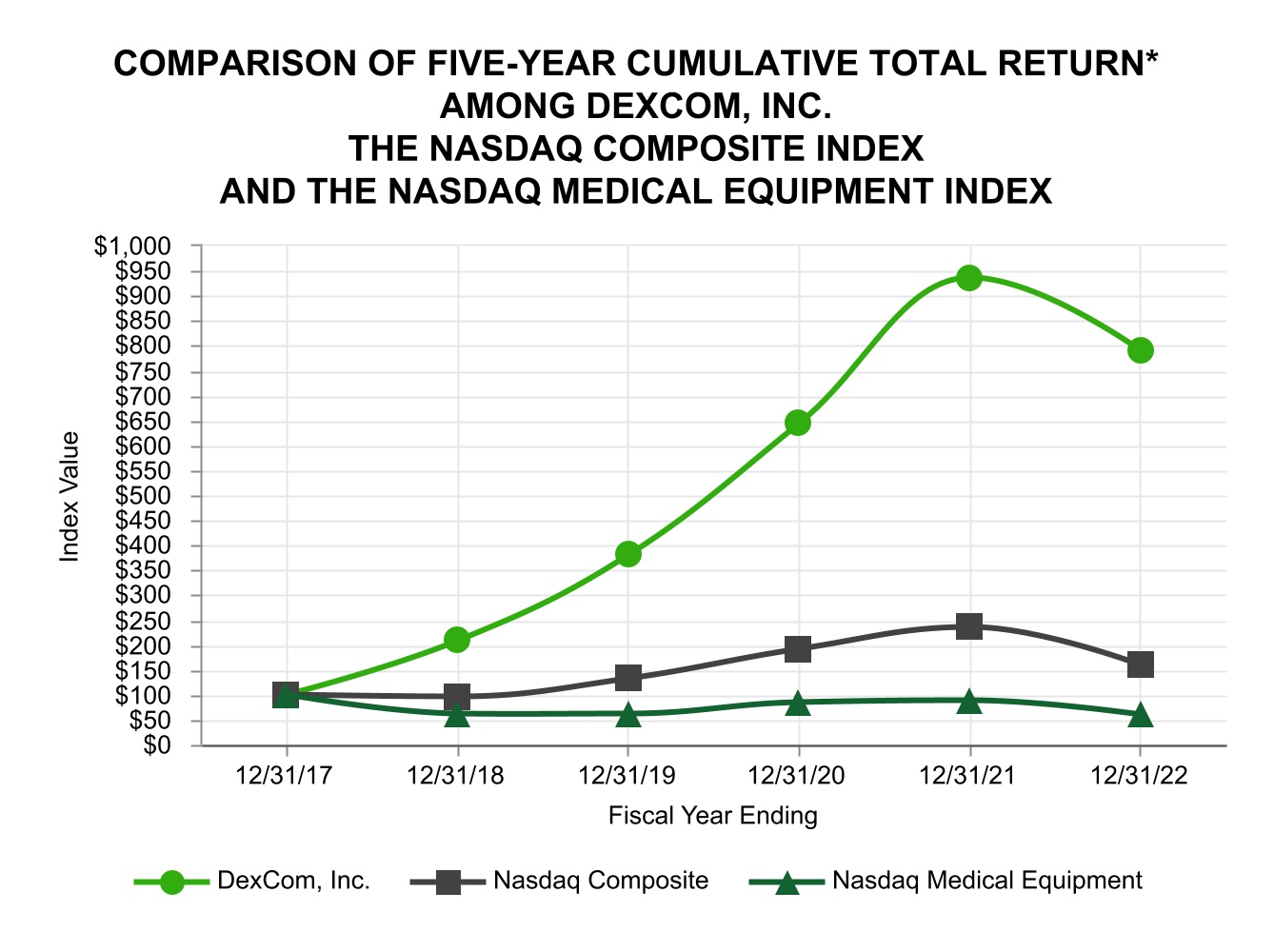
- $100 invested on December 31, 2017 in stock or index, including reinvestment of any dividends.
| December 31, 2017 | December 31, 2018 | December 31, 2019 | December 31, 2020 | December 31, 2021 | December 31, 2022 | |||||||||||||||||||||||||||||||||
| DexCom, Inc. | $ | 100.00 | $ | 208.75 | $ | 381.15 | $ | 644.22 | $ | 935.62 | $ | 789.27 | ||||||||||||||||||||||||||
| Nasdaq Composite | $ | 100.00 | $ | 97.16 | $ | 132.81 | $ | 192.47 | $ | 235.15 | $ | 158.65 | ||||||||||||||||||||||||||
| Nasdaq Medical Equipment | $ | 100.00 | $ | 62.72 | $ | 61.17 | $ | 85.34 | $ | 88.20 | $ | 59.54 |
Item 6. [RESERVED]
Item 7. MANAGEMENT’S DISCUSSION AND ANALYSIS OF FINANCIAL CONDITION AND RESULTS OF OPERATIONS
This document, including the following Management’s Discussion and Analysis of Financial Condition and Results of Operations, contains forward-looking statements that are not purely historical regarding Dexcom’s or its management’s intentions, beliefs, expectations and strategies for the future. These forward-looking statements fall within the meaning of the federal securities laws that relate to future events or our future financial performance. In some cases, you can identify forward-looking statements by terminology such as “may,” “will,” “expect,” “plan,” “anticipate,” “believe,” “estimate,” “intend,” “potential” or “continue” or the negative of these terms or other comparable terminology. Forward-looking statements are made as of the date of this report, deal with future events, are subject to various risks and uncertainties, and actual results could differ materially from those anticipated in those forward looking statements. The risks and uncertainties include, among other things, impacts on our business due to health pandemics or other contagious outbreaks, such as the ongoing COVID-19 pandemic. The risks and uncertainties that could cause actual results to differ materially are more fully described under “Risk Factors” in Part I, Item 1A of this Annual Report, elsewhere in this Annual Report, and in our other reports filed with the SEC. We assume no obligation to update any of the forward-looking statements after the date of this report or to conform these forward-looking statements to actual results. You should read the following discussion and analysis together with our consolidated financial statements and related notes in Part II, Item 8 of this Annual Report.
| Overview |
| Who We Are | |||||
| We are a medical device company primarily focused on the design, development and commercialization of continuous glucose monitoring, or CGM, systems for the management of diabetes by patients, caregivers, and clinicians around the world. We received approval from the Food and Drug Administration, or FDA, and commercialized our first product in 2006. We launched our latest generation system, the Dexcom G6*®* integrated Continuous Glucose Monitoring System, or G6, in 2018 and more recently received marketing clearance from the FDA on the Dexcom G7*®* in December 2022. Unless the context requires otherwise, the terms “we,” “us,” “our,” the “company,” or “Dexcom” refer to DexCom, Inc. and its subsidiaries. |
| Global Presence | |||||
| We have built a direct sales organization in North America and certain international markets to call on health care professionals, such as endocrinologists, physicians and diabetes educators, who can educate and influence patient adoption of continuous glucose monitoring. To complement our direct sales efforts, we have entered into distribution arrangements in North America and several international markets that allow distributors to sell our products. | |||||
| Future Developments | |||||
| Product Development: We plan to develop future generations of technologies that are focused on improved performance and convenience and that will enable intelligent insulin administration. Over the longer term, we plan to continue to develop and improve networked platforms with open architecture, connectivity and transmitters capable of communicating with other devices. We also intend to expand our efforts to accumulate CGM patient data and metrics and apply predictive modeling and machine learning to generate interactive CGM insights that can inform patient behavior. | |||||
| Partnerships: We also continue to pursue and support development partnerships with insulin pump companies and companies or institutions developing insulin delivery systems, including automated insulin delivery systems. | |||||
| New Opportunities: We are also exploring how to extend our offerings to other opportunities, including for people with Type 2 diabetes that are non-insulin using, people with pre-diabetes, people who are obese, people who are pregnant, and people in the hospital setting. Eventually, we may apply our technological expertise to products beyond glucose monitoring. |
| Impact of Current Events | |||||||||||
| During 2020, 2021, and 2022, we have been subject to challenging social and economic conditions created as a result of the novel strain of coronavirus, SARS-CoV-2 and its variants, or COVID-19. These conditions continue to create various financial impacts to our operations by necessitating precautions for our personnel to operate safely both in person as well as remotely. Costs incurred include items like incremental payroll costs, consulting support, IT infrastructure and facilities-related costs. | |||||||||||
| As the result of the COVID-19 pandemic, and in coordination with an FDA communication of enforcement discretion, we made Dexcom CGM systems available for use in hospital settings and other healthcare facilities. The extent of the impact of the ongoing COVID-19 pandemic on our operational and financial performance will depend on certain developments, including the duration and spread of the outbreak, impact on our customers and our sales cycles, employee or industry events, and effect on our vendors, all of which are uncertain and cannot be predicted. The ongoing COVID-19 pandemic and its adverse effects have become more prevalent in the locations where we, our customers, suppliers or third-party business partners conduct business and as a result, we have experienced moderate disruptions in our global operations. We have experienced and may experience constrained supply or curtailed customer demand, including due to customer loss of private health insurance coverage for our products, that could materially adversely impact our business, results of operations and overall financial performance in future periods. We currently utilize third parties to, among other things, manufacture components and materials for our devices, and to provide services such as sterilization services and we purchase these materials and services from numerous suppliers worldwide. | |||||||||||
| The ongoing COVID-19 pandemic has and may continue to have an adverse impact on our manufacturing and distribution capabilities. Disruptions relating to the ongoing COVID-19 pandemic, including shelter-in-place orders in the U.S. and other countries, could prevent employees, suppliers, distributors, and others from accessing manufacturing facilities and from transporting our products or the components required to manufacture our products. For example, we have experienced some supply chain disruption due to the global restrictions resulting from the ongoing COVID-19 pandemic in the manufacturing of our next-generation CGM product. Further, worldwide supply chain disruption relating to the ongoing COVID-19 pandemic has resulted in product shortages that has and may continue to impact our ability to manufacture our devices. As of the filing date of this Annual Report, the extent to which the ongoing COVID-19 pandemic may impact our financial condition or results of operations or guidance is uncertain. The effect of the ongoing COVID-19 pandemic will not be fully reflected in our results of operations and overall financial performance until future periods. See “Risk Factors” in Part I, Item 1A of this Annual Report for further discussion of the possible impact of the ongoing COVID-19 pandemic on our business. | |||||||||||
| In addition, the global supply chain shortages and disruptions are impacting our ability to obtain certain raw materials and components used in our products. We depend on single- or sole-source suppliers to obtain sufficient quantities of these components that are critical to manufacturing our products. Disruptions at these suppliers could lead to a similar disruption in our ability to manufacture products on time to meet consumer demand. In addition, these supply chain constraints may result in higher costs due to a more competitive supply environment. These conditions may impact our gross margin. |
| Critical Accounting Estimates |
The discussion and analysis of our financial condition and results of operations are based on our consolidated financial statements, which we have prepared in accordance with U.S. GAAP. The preparation of these consolidated financial statements requires us to make estimates and assumptions that affect the reported amounts of assets and liabilities and the disclosure of contingent assets and liabilities at the date of the consolidated financial statements as well as the reported revenue and expenses during the reporting periods. On an ongoing basis, we evaluate our estimates and judgments. We base our estimates on historical experience and on various other factors that we believe are reasonable under the circumstances, the results of which form the basis for making judgments about the carrying value of assets and liabilities that are not readily apparent from other sources. Actual results may differ from these estimates under different assumptions or conditions.
While our significant accounting policies are described in Note 1 “Organization and Significant Accounting Policies” to the consolidated financial statements in Part II, Item 8 of this Annual Report, we believe that the following accounting estimates are most critical to a full understanding and evaluation of our reported financial results. Members of our senior management have discussed the development and selection of these critical accounting estimates and their disclosure in this Annual Report with the Audit Committee of our Board of Directors.
Pharmacy Rebates
We estimate provisions for pharmacy rebates based on contractual arrangements, estimates of products sold subject to rebate, known events or trends and channel inventory data. Estimates associated with rebates on products sold through our distributors under pharmacy benefits are the most significant component of our variable consideration estimates and most at risk for material adjustment because of the time delay between the recording of the provision and its ultimate settlement, an interval that generally ranges from 30 to 90 days, but can last up to one year. Due to this time lag, in any given period, our adjustments to reflect actual amounts can incorporate changes of estimates related to prior periods.
Historically, adjustments to these estimates to reflect actual results or updated expectations, have not been material to our overall business and generally have been less than 1% of revenue. An increase or decrease of 1% in our estimate of products sold subject to rebate during 2022, holding all other assumptions constant, would increase or decrease revenue by approximately $19.1 million.
For more information, see Revenue Recognition in Note 1 “Organization and Significant Accounting Policies” to the consolidated financial statements in Part II, Item 8 of this Annual Report.
Excess and Obsolete Inventory
We assess the value of our inventory on a quarterly basis and write down those inventories based on quality control testing data, obsolescence, or in excess of our forecasted demand to the lower of their cost or net realizable value. Our estimates of forecasted demand are based upon our analysis and assumptions including, but not limited to, expected product lifecycles, product development plans and historical usage by product. If actual market conditions are less favorable than our forecasts, or actual demand from our customers is lower than our estimates, we may be required to record additional inventory write-downs. If actual market conditions are more favorable than anticipated, inventory previously written down may be sold, resulting in lower cost of sales and higher income from operations than expected in that period.
Income Taxes
We estimate our income taxes based on the various jurisdictions where we conduct business. Significant judgment is required in determining our worldwide income tax provision. The calculation of our tax liabilities involves dealing with uncertainties in the application of complex tax laws and regulations and the potential for future adjustment of our uncertain tax positions by the Internal Revenue Service or other taxing jurisdictions. While we believe we have appropriate support for the positions taken on our tax returns, we regularly assess the potential outcomes of examinations by tax authorities in determining the adequacy of our provision for income taxes. We continually assess the likelihood and amount of potential adjustments and adjust the income tax provision, income taxes payable, and deferred taxes in the period in which the facts that give rise to a revision become known.
We use the asset and liability approach to recognize deferred tax assets and liabilities for the expected future tax consequences of temporary differences between the carrying amounts and the tax basis of assets and liabilities as described in Note 1 “Organization and Significant Accounting Policies” to the consolidated financial statements in Part II, Item 8 of this Annual Report. Significant judgment is required to evaluate the need for a valuation allowance against deferred tax assets. A valuation allowance is established when it is more likely than not that some or all of the deferred tax assets will not be realized. Realization of deferred tax assets is dependent upon future earnings in applicable tax jurisdictions. We maintain a valuation allowance on our California research and development tax credits and certain foreign intangible assets, as it is more likely than not that those deferred tax assets will not be realized.
We recognize and measure benefits for uncertain tax positions using a two-step approach as described in Note 1 “Organization and Significant Accounting Policies” to the consolidated financial statements in Part II, Item 8 of this Annual Report. Significant judgment is required to evaluate uncertain tax positions and is based upon a number of factors, including changes in facts or circumstances, changes in tax law, correspondence with tax authorities during the course of audits and effective settlement of audit issues. Changes in the recognition or measurement of uncertain tax positions could result in material increases or decreases in our income tax expense in the period in which we make the change, which could have a material impact on our effective tax rate and operating results.
Loss Contingencies
We are subject to certain legal proceedings, as well as demands, claims and threatened litigation that arise in the normal course of our business. We review the status of each significant matter quarterly and assess our potential financial exposure. Significant judgment is required in the determination of whether a potential loss is probable, reasonably possible, or remote as well as in the determination of whether a potential exposure is reasonably estimable. We base our judgments on the best information available at the time. As additional information becomes available, we reassess the potential liability related to our pending claims and litigation and may revise our estimates. Any revision of our estimates of potential liability could have a material impact on our financial position and operating results.
| Overview of Financial Results | ||||||||||||||||||||||||||||||||||||||
| The most important financial indicators that we use to assess our business are revenue, gross profit, operating income, net income, and operating cash flow. | ||||||||||||||||||||||||||||||||||||||
| Key Highlights for fiscal 2022 include the following: | ||||||||||||||||||||||||||||||||||||||
| Revenue | Gross Profit | Operating Income | Net Income | Operating Cash Flow | ||||||||||||||||||||||||||||||||||
| $2.91 billion | $1.88 billion | $391.2 million | $341.2 million | $669.5 million | ||||||||||||||||||||||||||||||||||
| up 19% from 2021 | up 12% from 2021 | up 47% from 2021 | up 57% from 2021 | up 51% from 2021 | ||||||||||||||||||||||||||||||||||
We ended fiscal 2022 with cash, cash equivalents and short-term marketable securities totaling $2.46 billion.
| Business Trends |
In addition to the general impacts of current events on our company as described in the Overview, looking ahead we expect our business could be affected by the following:
-
Increase in the worldwide incidence of people diagnosed with diabetes and costs related to the management and treatment of diabetes.
-
Changes in medical reimbursement policies and programs.
-
Growing demand for digital health technologies by both healthcare providers and consumers to reduce costs.
-
An expected interest in empowering consumers to make better-informed decisions about their own health and new potential options for facilitating prevention, early diagnosis of life-threatening diseases, and management of chronic conditions outside of traditional health care settings.
-
Growing research and interest in the use of CGM technology outside of the ambulatory care setting, including use by hospital systems.
-
Continued product innovation and competition from other CGM device makers.
-
Our ability to scale efficiently with the construction of our production facility in Malaysia.
| Results of Operations |
| Financial Overview |
For discussion related to the results of operations and changes in financial condition for fiscal 2021 compared to fiscal 2020 refer to “Management’s Discussion and Analysis of Financial Condition and Results of Operations” in Part II, Item 7 of our 2021 Annual Report on Form 10-K, which was filed with the United States Securities and Exchange Commission on February 14, 2022.
| Twelve Months Ended December 31, 2022 Compared to Twelve Months Ended December 31, 2021 | |||||||||||||||||||||||||||||||||||
| Twelve Months Ended December 31, | 2022 - 2021 | ||||||||||||||||||||||||||||||||||
| 2022 | % of Revenue (1) | 2021 | % of Revenue (1) | $ Change | % Change | ||||||||||||||||||||||||||||||
| (In millions, except per share amounts) | (As Adjusted)* | ||||||||||||||||||||||||||||||||||
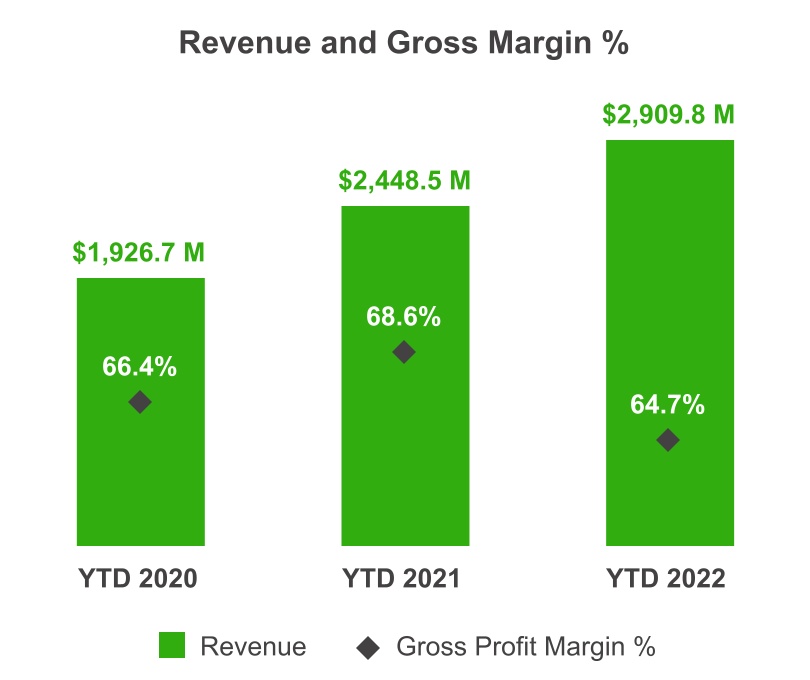
| Revenue | $ | 2,909.8 | 100 | % | $ | 2,448.5 | 100 | % | $ | 461.3 | 19 | % | |||||||||||||||||||||||
| Cost of sales | 1,026.7 | 35 | % | 768.0 | 31 | % | 258.7 | 34 | % | ||||||||||||||||||||||||||
| Gross profit | 1,883.1 | 64.7 | % | 1,680.5 | 68.6 | % | 202.6 | 12 | % | ||||||||||||||||||||||||||
| Operating expenses: | |||||||||||||||||||||||||||||||||||
| Research and development | 484.2 | 17 | % | 517.1 | 21 | % | (32.9) | (6) | % | ||||||||||||||||||||||||||
| Collaborative research and development fee | — | — | % | 87.1 | 4 | % | (87.1) | ** | |||||||||||||||||||||||||||
| Amortization of intangible assets | 7.5 | — | % | 3.7 | — | % | 3.8 | ** | |||||||||||||||||||||||||||
| Selling, general and administrative | 1,000.2 | 34 | % | 806.8 | 33 | % | 193.4 | 24 | % | ||||||||||||||||||||||||||
| Total operating expenses | 1,491.9 | 51 | % | 1,414.7 | 58 | % | 77.2 | 5 | % | ||||||||||||||||||||||||||
| Operating income | 391.2 | 13 | % | 265.8 | 11 | % | 125.4 | 47 | % | ||||||||||||||||||||||||||
| Interest expense | (18.6) | (1) | % | (18.8) | (1) | % | 0.2 | (1) | % | ||||||||||||||||||||||||||
| Loss on extinguishment of debt | — | — | % | (0.1) | — | % | 0.1 | ** | |||||||||||||||||||||||||||
| Income from equity investments | 0.2 | — | % | 11.6 | — | % | (11.4) | (98) | % | ||||||||||||||||||||||||||
| Interest and other income (expense), net | 18.0 | 1 | % | (1.7) | — | % | 19.7 | ** | |||||||||||||||||||||||||||
| Income before income taxes | 390.8 | 13 | % | 256.8 | 10 | % | 134.0 | 52 | % | ||||||||||||||||||||||||||
| Income tax expense | 49.6 | 2 | % | 39.9 | 2 | % | 9.7 | 24 | % | ||||||||||||||||||||||||||
| Net income | $ | 341.2 | 12 | % | $ | 216.9 | 9 | % | $ | 124.3 | 57 | % | |||||||||||||||||||||||
| Basic net income per share | $ | 0.88 | ** | $ | 0.56 | ** | $ | 0.32 | 57 | % | |||||||||||||||||||||||||
| Diluted net income per share | $ | 0.82 | ** | $ | 0.53 | ** | $ | 0.29 | 55 | % | |||||||||||||||||||||||||
| (1) The sum of the individual percentages may not equal the total due to rounding. | |||||||||||||||||||||||||||||||||||
| * We adjusted our 2021 amounts to reflect the simplified convertible instruments accounting guidance, which we adopted on a full retrospective basis. All periods presented have also been adjusted to reflect the four-for-one stock split. Refer to Note 1, “Organization and Significant Accounting Policies,” to the consolidated financial statements in Part II, Item 8 of this Annual Report for further information. | |||||||||||||||||||||||||||||||||||
| ** Not meaningful |
Revenue
We expect that revenue we generate from the sales of our products will fluctuate from quarter to quarter. We typically experience seasonality, with lower sales in the first quarter of each year compared to the immediately preceding fourth quarter. This seasonal sales pattern relates to U.S. annual insurance deductible resets and unfunded flexible spending accounts.
Cost of sales
Cost of sales includes direct labor and materials costs related to each product sold or produced, including assembly, test labor and scrap, as well as factory overhead supporting our manufacturing operations. Factory overhead includes facilities, material procurement and control, manufacturing engineering, quality assurance, supervision and management. These costs are primarily salary, fringe benefits, share-based compensation, facility expense, supplies and purchased services. All of our manufacturing costs are included in cost of sales. In addition, amortization of certain licensing related intangibles are also included in cost of sales.
Research and development
Our research and development expenses primarily consist of engineering and research expenses related to our continuous glucose monitoring technology, clinical trials, regulatory expenses, quality assurance programs, materials and products for clinical trials. Research and development expenses are primarily related to employee compensation, including salary, fringe benefits, share-based compensation, and temporary employee expenses. We also incur significant expenses to operate our clinical trials including budgeted clinical site compensation and reimbursement, study monitoring and oversight expenses, clinical trial product and associated travel expenses. Our research and development expenses also include fees for design services, contractors and development materials.
Amortization of intangible assets
Our amortization expense primarily relates to acquired technology and intellectual property and other acquired intangible assets.
Selling, general and administrative
Our selling, general and administrative expenses primarily consist of salary, fringe benefits and share-based compensation for our executive, financial, sales, marketing, information technology and administrative functions. Other significant expenses include commissions, marketing and advertising, IT software license costs, insurance, professional fees for our outside legal counsel and independent auditors, litigation expenses, patent application expenses and consulting expenses.
Interest expense
Interest expense is comprised primarily of costs related to our senior convertible notes.
Income from equity investments
Income from equity investments is comprised of realized gains from the sale of an equity investment.
Interest and other income (expense), net
Interest and other income (expense), net consists primarily of interest income on our cash, cash equivalents and short-term marketable securities portfolio and foreign currency transaction gains and losses due to the effects of foreign currency fluctuations.
| Twelve Months Ended December 31, 2022 Compared to Twelve Months Ended December 31, 2021 | ||||||||
| Revenue | The revenue increase was primarily driven by increased sales volume of our disposable sensors due to the continued growth of our worldwide customer base, partially offset by mix shift and price associated with the evolution of our channel and product strategy. Disposable sensor and other revenue comprised approximately 87% of total revenue and Reusable Hardware revenue comprised approximately 13% of total revenue for the twelve months ended December 31, 2022. Disposable sensor and other revenue comprised approximately 84% of total revenue and Reusable Hardware revenue comprised approximately 16% of total revenue for the twelve months ended December 31, 2021. | |||||||
| Cost of Sales & Gross Profit | Cost of sales and gross profit increased primarily due to an increase in sales volume. The decrease in gross profit margin in 2022 compared to 2021 was primarily driven by price, product, and channel mix changes and impact of foreign currencies on revenue. | |||||||
| Research and Development Expense | Research and development expense decreased primarily due to $43.0 million in lower third party and consulting fees most notably related to software development for new products and significant enhancements, $19.9 million in lower costs related to set-up and validation costs for new CGM equipment, and $9.7 million in lower clinical trials costs, partially offset by $26.5 million in compensation-related costs due to higher headcount. We continue to believe that focused investments in research and development are critical to our future growth and competitive position in the marketplace, and to the development of new and updated products and services that are central to our core business strategy. | |||||||
| Collaborative Research and Development Fee | Collaborative research and development fees of $87.1 million for the twelve months ended December 31, 2021 represents expense incurred in the fourth quarter of 2021 associated with a contingent milestone for regulatory approval under the Restated Collaboration Agreement. See Note 2 “Collaboration with Verily Life Sciences” to the consolidated financial statements in Part II, Item 8 of this Annual Report for more information. | |||||||
| Selling, General and Administrative Expense | Selling, general and administrative expense increased primarily due to $54.1 million in compensation-related costs most notably due to higher headcount, $26.0 million in advertising and marketing costs due to an increase in worldwide marketing campaigns, $23.0 million in long-lived asset impairment charges, $21.5 million in legal expense related to litigation, $13.0 million in travel and entertainment expenses, and $5.8 million in depreciation expense due to higher property and equipment balances and accelerated depreciation related to business transition activities. | |||||||
| Income from Equity Investments | Income from equity investments of $11.6 million for the twelve months ended December 31, 2021 consisted solely of realized gains from the sale of an equity investment. | |||||||
| Interest and Other Income (Expense), Net | Interest and other income (expense), net, increased primarily due to $22.1 million in interest income on our short-term marketable securities portfolio, partially offset by foreign currency transaction gains and losses due to the effects of foreign currency fluctuations. The increase in interest income was primarily related to a significant increase in market interest rates, as well as an increase in the average invested balances during 2022 compared to 2021. | |||||||
| Income Tax Expense | We recorded income tax expense on pre-tax book income for the twelve months ended December 31, 2022 and December 31, 2021. The income tax expense we recorded for 2022 is primarily attributable to income tax expense from normal, recurring operations offset by excess tax benefits recognized for share-based compensation for employees (net of disallowed executive compensation) and the Verily milestone payment, and generation of research and development tax credits. The income tax expense we recorded for 2021 is primarily attributable to income tax expense from normal, recurring operations offset by excess tax benefits recognized for employee share-based compensation, generation of research and development tax credits, and a one-time tax benefit related to tax law changes. |
| Liquidity and Capital Resources |
| Overview, Capital Resources, and Capital Requirements |
Our principal sources of liquidity are our existing cash, cash equivalents and marketable securities, cash generated from operations, proceeds from our senior convertible notes issuances, and access to our Credit Facility. Our primary uses of cash have been for research and development programs, selling and marketing activities, capital expenditures, acquisitions of businesses, and debt service costs.
We expect that cash provided by our operations may fluctuate in future periods as a result of a number of factors, including fluctuations in our operating results, working capital requirements and capital deployment decisions. We have historically invested our cash primarily in U.S. dollar-denominated, investment grade, highly liquid obligations of U.S. government agencies, commercial paper, corporate debt, and money market funds. Certain of these investments are subject to general credit, liquidity and other market risks. The general condition of the financial markets and the economy may increase those risks and may affect the value and liquidity of investments and restrict our ability to access the capital markets.
Our future capital requirements will depend on many factors, including but not limited to:
| The evolution of the international expansion of our business and the revenue generated by sales of our approved products and other future products; | Our ability to efficiently scale our operations to meet demand for our current and any future products; | The success of our research and development efforts; | ||||||||||||||||||||||||
| The expenses we incur in manufacturing, developing, selling and marketing our products; | The costs, timing and risks of delays of additional regulatory approvals; | The costs of filing, prosecuting, defending and enforcing any patent claims and other intellectual property rights; | ||||||||||||||||||||||||
| The quality levels of our products and services; | The emergence of competing or complementary technological developments; | The terms and timing of any collaborative, licensing and other arrangements that we may establish; and | ||||||||||||||||||||||||
| The third-party reimbursement of our products for our customers; | The rate of progress and cost of our clinical trials and other development activities; | The acquisition of businesses, products and technologies and our ability to integrate and manage any acquired businesses, products and technologies. |
We expect that existing cash and short-term investments and cash flows from our future operations will generally be sufficient to fund our ongoing core business. As current borrowing sources become due, we may be required to access the capital markets for additional funding. As we assess inorganic growth strategies, we may need to supplement our internally generated cash flow with outside sources. In the event that we are required to access the debt market, we believe that we will be able to secure reasonable borrowing rates. As part of our liquidity strategy, we will continue to monitor our current level of earnings and cash flow generation as well as our ability to access the market in light of those earning levels.
A substantial portion of our operations are located in the United States, and the majority of our sales since inception have been made in U.S. dollars. We will be exposed to additional foreign currency exchange risk related to our foreign operations when we begin manufacturing in Malaysia and as our business continues to increase in
markets outside of the United States. See “Foreign Currency Exchange Risk” in Part II, Item 7A of this Annual Report for more information.
Main Sources of Liquidity
Cash, cash equivalents and short-term marketable securities
Our cash, cash equivalents and short-term marketable securities totaled $2.46 billion as of December 31, 2022. None of those funds were restricted and $2.29 billion (approximately 93%) of those funds were located in the United States.
Cash flow from Operations
For the twelve months ended December 31, 2022, we had positive cash flows of $669.5 million from operating activities. We anticipate that we will continue to generate positive cash flow from operations for the foreseeable future.
Senior Convertible Notes
We received net proceeds of $836.6 million in November 2018 from the 2023 Notes offering and net proceeds of $1.19 billion in May 2020 from the 2025 Notes offering. We used $100.0 million of the net proceeds from the offering of the 2023 Notes to repurchase a portion of our common stock in 2018. We used $282.6 million of the net proceeds from the offering of the 2025 Notes to repurchase a portion of our senior convertible notes due 2022, or 2022 Notes. We intend to use the remainder of the net proceeds from the 2023 Notes and 2025 Notes offerings for general corporate purposes and capital expenditures, including working capital needs. We may also use the net proceeds to expand our current business through in-licensing or acquisitions of, or investments in, other businesses, products or technologies; however, we do not have any significant commitments with respect to any such acquisitions or investments at this time.
The 2023 Note Hedge is expected to reduce the potential equity dilution upon any conversion of the 2023 Notes and/or offset any cash payments we are required to make in excess of the principal amount of converted 2023 Notes. See Note 5 “Debt” to the consolidated financial statements in Part II, Item 8 of this Annual Report for conversion activity related to the 2023 Notes and shares received as the result of exercising a portion of the 2023 Note Hedge as well as for more information about the 2023 Notes and the 2025 Notes, the 2023 Note Hedge, and the 2023 Warrants.
Revolving Credit Agreement
As of December 31, 2022, we had no outstanding borrowings, $7.3 million in outstanding letters of credit, and a total available balance of $192.7 million under the Amended Credit Agreement. We monitor counterparty risk associated with the institutional lenders that are providing the Credit Facility. We currently believe that the Credit Facility will be available to us should we choose to borrow under it. Revolving loans will be available for general corporate purposes, including working capital and capital expenditures. See Note 5 “Debt” to the consolidated financial statements in Part II, Item 8 of this Annual Report for more details on the Revolving Credit Agreement.
Short-term Liquidity Requirements
Our short-term liquidity requirements primarily consist of regular operating costs, interest payments related to our senior convertible notes, capital expenditures for the development of our manufacturing facilities and office spaces, and short-term material cash requirements as described below. As of December 31, 2022, we had a working capital ratio of 1.99 and a quick ratio of 1.72, which indicates that our current assets are more than enough to cover our short-term liabilities. We expect to have significant capital expenditures for the next year to drive our strategic initiative of building out our manufacturing facility and equipment in Malaysia and the capacity scale-up in Mesa, Arizona.
We believe that our cash, cash equivalents, and marketable securities balances, projected cash contributions from our commercial operations, and borrowings under our Credit Facility will be sufficient to meet our anticipated seasonal working capital needs, all capital expenditure requirements, material cash requirements as described below, and other liquidity requirements associated with our operations for at least the next 12 months.
We may use cash to repurchase Dexcom shares or for strategic initiatives that strengthen our foundation for long-term growth. On July 26, 2022, a duly authorized committee of our Board of Directors authorized a share repurchase program of up to $700.0 million of our outstanding common stock, with a repurchase period ending no later than June 30, 2023. As of December 31, 2022, approximately $142.3 million remained available for repurchase pursuant to our share repurchase program. See Note 9 “Employee Benefit Plans and Stockholders’ Equity” to the consolidated financial statements in Part II, Item 8 of this Annual Report for more details.
As of December 31, 2022, we have outstanding senior convertible notes that will mature in December 2023. We may elect to settle the remaining principal amount outstanding of the 2023 Notes with cash and/ or shares of Dexcom common stock prior to maturity once certain conditions are met.
Long-term Liquidity Requirements
Our long-term liquidity requirements primarily consist of interest and principal payments related to our senior convertible notes, capital expenditures for the development of our manufacturing facilities and office spaces, and long-term material cash requirements as described below. As of December 31, 2022, we had a debt-to-assets ratio of 0.37, which indicates that our total assets are more than enough to cover our short-term and long-term debts. As demand grows for our products, we will continue to expand global operations to meet demand through investments in manufacturing and operations. We expect to meet our long-term liquidity requirements from our main sources of liquidity as described above to support our future operations, capital expenditures, acquisitions, and other liquidity requirements associated with our operations beyond the next 12 months.
As of December 31, 2022, we have outstanding senior convertible notes that will mature in November 2025 for the 2025 Notes. However, the outstanding principal of our senior convertible notes could be converted into cash and/or shares of our common stock prior to maturity once certain conditions are met. See Note 5 “Debt” to the consolidated financial statements in Part II, Item 8 of this Annual Report for information on conversion rights prior to maturity.
Material Cash Requirements
From time to time in the ordinary course of business, we enter into a variety of purchase arrangements including but not limited to, purchase arrangements related to capital expenditures, components used in manufacturing for the United States and Malaysia, and research and development activities. See Purchase Commitments in Note 6 “Leases and Other Commitments” to the consolidated financial statements in Part II, Item 8 of this Annual Report for more information.
As of January 1, 2022, for U.S. tax purposes, research and development expenses are required to be capitalized and amortized rather than immediately deducted. As a result, our annual cash tax payments to the United States Treasury have increased in the current year.
We issued senior convertible notes in November 2018 and May 2020. The aforementioned obligations include both principal and interest for these notes. Although these notes mature in December 2023 and November 2025, they may be converted into cash and shares of our common stock prior to maturity if certain conditions are met. Any conversion prior to maturity can result in repayment of the principal amounts sooner than the scheduled repayment. As of December 31, 2022, we had outstanding letters of credit of $7.3 million for which we cannot forecast with certainty the amount and timing of repayments. See Note 5 “Debt” to the consolidated financial statements in Part II, Item 8 of this Annual Report for further discussion of the terms of our senior convertible notes.
We are party to various leasing arrangements, primarily for office, manufacturing and warehouse space that expire at various times through December 2030, excluding any renewal options. We also have land leases in Penang, Malaysia for the build-out of our international manufacturing facility lease that expire through 2082. We anticipate incurring significant expenditures related to the build-out of the Malaysia manufacturing facility and equipment in the next two years. See Leases in Note 6 “Leases and Other Commitments” to the consolidated financial statements in Part II, Item 8 of this Annual Report for more information.
Under our Restated Collaboration Agreement with Verily, additional sales-based milestone payments equivalent to 5,154,640 shares of our common stock, calculated based on the $175.0 million initial milestone amount divided by the volume-weighted average trading price during the 15 consecutive days ending on the date of the Restated Collaboration Agreement, may become due and payable by us upon achievement of certain sales-based milestones. All milestones may be paid in cash or shares of our common stock, at our election. If we elect to make these milestone payments in cash, any such cash payment would be equal to the number of shares that would otherwise be issued for the given milestone payment multiplied by the value of our stock on the date the relevant milestone is achieved, adjusted for stock splits, dividends, and the like. We intend to pay these milestones in shares of our common stock and as such we do not expect to have a material cash requirement for this agreement. See Note 2 “Development and Other Agreements” to the consolidated financial statements in Part II, Item 8 of this Annual Report for further discussion of the Collaboration Agreement with Verily.
See Note 5 “Debt” to the consolidated financial statements in Part II, Item 8 of this Annual Report for more information about the terms of the Credit Agreement, our senior convertible notes, the 2023 Note Hedge, and the 2023 Warrants.
| Cash Flows |
The following table sets forth a summary of our cash flows for the periods indicated. See the consolidated financial statements in Part II, Item 8 of this Annual Report for complete statements of cash flows for these periods.

As of December 31, 2022, we had $2.46 billion in cash, cash equivalents and short-term marketable securities, which is a decrease of $275.0 million compared to $2.73 billion as of December 31, 2021.
The primary cash flows during the twelve months ended December 31, 2022 and 2021 are described below. See the consolidated financial statements in Part II, Item 8 of this Annual Report for complete consolidated statements of cash flows for these periods.
| Twelve Months Ended | ||||||||||||||||||||
| December 31, 2022 | December 31, 2021 | |||||||||||||||||||
| As Adjusted | ||||||||||||||||||||
| Operating Cash Flows | + | $341.2 million of net income and $301.6 million of net non-cash adjustments, partially offset by $26.7 million of net changes in working capital balances | + | $216.9 million of net income and $357.6 million of net non-cash adjustments, partially offset by $132.0 million of net changes in working capital balances | ||||||||||||||||
| Net non-cash adjustments were primarily related to share-based compensation and depreciation and amortization. | Net non-cash adjustments were primarily related to collaborative research and development fees, share-based compensation, non-cash interest expense for our senior convertible notes, and depreciation and amortization. | |||||||||||||||||||
| Investing Cash Flows | - | $364.8 million capital expenditures | + | $193.2 million net proceeds from marketable securities | ||||||||||||||||
| - | $138.5 million net purchases of marketable securities | + | $15.7 million in proceeds from the sale of an equity investment | |||||||||||||||||
| - | $14.5 million in purchases of equity investments | - | $389.2 million capital expenditures | |||||||||||||||||
| - | $30.2 million in acquisitions, net of cash acquired | |||||||||||||||||||
| - | $5.0 million in purchases of equity investments | |||||||||||||||||||
| Financing Cash Flows | + | $22.5 million in proceeds from the issuance of common stock under our employee stock plans | + | $20.3 million in proceeds from the issuance of common stock under our employee stock plans | ||||||||||||||||
| - | $557.7 million in purchases of treasury stock | - | $9.9 million in payments for financing leases | |||||||||||||||||
| - | $15.6 million in payments for financing leases | |||||||||||||||||||
| Recent Accounting Guidance |
For a description of recently issued accounting guidance that is applicable to our financial statements, see Note 1 “Organization and Significant Accounting Policies” to the consolidated financial statements in Part II, Item 8 of this Annual Report.
Item 7A. QUANTITATIVE AND QUALITATIVE DISCLOSURES ABOUT MARKET RISK
Interest Rate Risk
The primary objective of our investment activities is to preserve our capital for the purpose of funding operations while at the same time maximizing the income we receive from our investments without significantly increasing risk. To achieve these objectives, our investment policy allows us to maintain a portfolio of cash equivalents and short-term investments in a variety of securities, including money market funds, U.S. Treasury debt and corporate debt securities. Due to the short-term nature of our investments, we believe that we have no material exposure to interest rate risk.
Market Price Sensitive Instruments
In order to reduce potential equity dilution, in connection with the issuance of the 2023 Notes we entered into the 2023 Note Hedge which entitles us to purchase shares of our common stock. Upon conversion of the 2023 Notes, the 2023 Note Hedge is expected to reduce the equity dilution if the daily volume-weighted average price per share of our common stock exceeds the strike price of the hedge. We also entered into warrant transactions with the counterparties of the 2023 Note Hedge entitling them to acquire shares of our common stock. The warrant
transactions could have a dilutive effect on our earnings per share to the extent that the price of our common stock during a given quarterly or annual measurement period exceeds the strike price of the warrants. See Note 5 “Debt” to the consolidated financial statements in Part II, Item 8 of this Annual Report for more information.
Foreign Currency Exchange Risk
A substantial portion of our operations are located in the United States, and the majority of our sales since inception have been made in U.S. dollars. Historically, our exposure to foreign currency fluctuations is more significant with respect to our revenue than our expenses, as a significant portion of our expenses are denominated in U.S. dollars, such as cost of sales and operating expenses. Changes in foreign currencies impact currency translation and had a slightly negative effect on our revenues and gross profit margins.
We will be exposed to additional foreign currency exchange risk related to our foreign operations when we begin manufacturing in Malaysia and as our business continues to increase in markets outside of the United States. Fluctuations in the rate of exchange between the U.S. dollar and foreign currencies, primarily the Australian Dollar, the British Pound, the Canadian Dollar, the Euro, and the Malaysian Ringgit, could adversely affect our financial results, including income and losses as well as assets and liabilities in addition to risks to our revenues, revenue growth rates, and gross profit margins.
We translate the financial statements of our international subsidiaries with functional currencies other than the U.S. dollar into the U.S. dollar for consolidation using end-of-period exchange rates for assets and liabilities and average exchange rates during each reporting period for results of operations. We record net gains or losses resulting from the translation of these financial statements and the effect of exchange rate changes on intercompany receivables and payables of a long-term nature as a separate component of stockholders’ equity. These adjustments will affect net income only upon sale or liquidation of the underlying investment in international subsidiaries. We also record exchange rate fluctuations resulting from the translation of the short-term intercompany balances between domestic entities and our international subsidiaries as foreign currency transaction gains or losses and include them in interest and other income (expense), net in our consolidated statements of operations.
We enter into foreign currency forward contracts to hedge monetary assets and liabilities denominated in foreign currencies. These forward contracts are not designated as hedging instruments and generally mature in one month. The derivative gains and losses are included in interest and other income (expense), net in our consolidated statements of operations. See Note 3 “Fair Value Measurements” to the consolidated financial statements in Part II, Item 8 of this Annual Report for more information.
Notional principal amounts provide one measure of the transaction volume outstanding as of period end, but they do not represent the amount of our exposure to market loss. Estimates of fair value are based on applicable and commonly used pricing models using prevailing financial market information. The amounts ultimately realized upon settlement of these financial instruments, together with the gains and losses on the underlying exposures, will depend on actual market conditions during the remaining life of the instruments. We monitor and manage our financial exposures due to exchange rate fluctuations as an integral part of our overall risk management program, which recognizes the unpredictability of financial markets and seeks to reduce potentially adverse effects on our financial results.
Item 8. FINANCIAL STATEMENTS AND SUPPLEMENTARY DATA
The information required is set forth under “Report of Independent Registered Public Accounting Firm,” “Consolidated Balance Sheets,” “Consolidated Statements of Operations,” “ Consolidated Statements of Comprehensive Income,” “Consolidated Statements of Stockholders’ Equity,” “Consolidated Statements of Cash Flows” and “Notes to Consolidated Financial Statements” on pages F-10 to F-44 of this Annual Report and is incorporated into this Item 8 by reference.
The report of Dexcom’s independent registered public accounting firm (PCAOB ID:42) with respect to the above-referenced financial statements and their report on internal control over financial reporting are included in Item 8 and Item 9A of this Form 10-K. Their consent appears as Exhibit 23.01 of this Form 10-K.
Item 9. CHANGES IN AND DISAGREEMENTS WITH ACCOUNTANTS ON ACCOUNTING AND FINANCIAL DISCLOSURE
Not applicable.
Item 9A. CONTROLS AND PROCEDURES
Evaluation of Disclosure Controls and Procedures
Regulations under the Securities Exchange Act of 1934 require public companies to maintain “disclosure controls and procedures,” which are defined to mean a company’s controls and other procedures that are designed to ensure that information required to be disclosed in the reports that it files or submits under the Securities Exchange Act of 1934 is accumulated and timely communicated to management, including our Chief Executive Officer and Chief Financial Officer, recorded, processed, summarized, and reported within the time periods specified in the Securities and Exchange Commission’s rules and forms. Our management, including our Chief Executive Officer and our Chief Financial Officer, conducted an evaluation as of the end of the period covered by this report of the effectiveness of our disclosure controls and procedures. Based on their evaluation as of December 31, 2022, our Chief Executive Officer and our Chief Financial Officer concluded that our disclosure controls and procedures were effective as of such date for this purpose.
Changes in Internal Control over Financial Reporting
There were no changes in our internal control over financial reporting during our last fiscal quarter that have materially affected, or are reasonably likely to materially affect our internal control over financial reporting.
Management’s Report on Internal Control over Financial Reporting
Our management is responsible for establishing and maintaining adequate internal control over financial reporting as defined in Rule 13a-15(f) under the Securities Exchange Act of 1934. Our internal control over financial reporting is designed to provide reasonable assurance to our management and Board of Directors regarding the preparation and fair presentation of published financial statements.
Our management, with the participation of the Chief Executive and Chief Financial Officers, assessed the effectiveness of our internal control over financial reporting as of December 31, 2022. In making this assessment, our management used the criteria set forth by the 2013 Committee of Sponsoring Organizations of the Treadway Commission (COSO) in Internal Control—Integrated Framework. Based on this assessment, our management, with the participation of the Chief Executive and Chief Financial Officers, believes that, as of December 31, 2022, our internal control over financial reporting is effective based on those criteria. The effectiveness of our internal control over financial reporting as of December 31, 2022 has been audited by Ernst & Young LLP an Independent Registered Public Accounting Firm, as stated in their report which is included herein.
The certifications of our Chief Executive Officer and Chief Financial Officer required under Section 302 of the Sarbanes-Oxley Act have been filed as Exhibits 31.01 and 31.02 to this report.
Because of its inherent limitations, internal control over financial reporting may not prevent or detect misstatements. Therefore, even those systems determined to be effective can provide only reasonable assurance with respect to financial statement preparation and presentation.
Limitation on Effectiveness of Controls
It should be noted that any system of controls, however well designed and operated, can provide only reasonable, and not absolute, assurance that the objectives of the system are met. The design of any control system is based, in part, upon the benefits of the control system relative to its costs. Control systems can be circumvented by the individual acts of some persons, by collusion of two or more people, or by management override of the control. In addition, over time, controls may become inadequate because of changes in conditions, or the degree of compliance with the policies or procedures may deteriorate. Because of these and other inherent limitations of control systems, we cannot guarantee that any design will succeed in achieving its stated goals under all potential future conditions, regardless of how remote.
REPORT OF INDEPENDENT REGISTERED PUBLIC ACCOUNTING FIRM
The Board of Directors and Stockholders of DexCom, Inc.
Opinion on Internal Control over Financial Reporting
We have audited DexCom, Inc.’s internal control over financial reporting as of December 31, 2022, based on criteria established in Internal Control—Integrated Framework issued by the Committee of Sponsoring Organizations of the Treadway Commission (2013 Framework) (the COSO criteria). In our opinion, DexCom, Inc. (the Company) maintained, in all material respects, effective internal control over financial reporting as of December 31, 2022, based on the COSO criteria.
We also have audited, in accordance with the standards of the Public Company Accounting Oversight Board (United States) (PCAOB), the consolidated balance sheets of DexCom, Inc. as of December 31, 2022 and 2021, the related consolidated statements of operations, comprehensive income, stockholders’ equity and cash flows for each of the three years in the period ended December 31, 2022, and the related notes and financial statement schedule listed in the Index at Item 15(a) and our report dated February 9, 2023 expressed an unqualified opinion thereon.
Basis for Opinion
The Company’s management is responsible for maintaining effective internal control over financial reporting and for its assessment of the effectiveness of internal control over financial reporting included in the accompanying Management’s Report on Internal Control over Financial Reporting. Our responsibility is to express an opinion on the Company’s internal control over financial reporting based on our audit. We are a public accounting firm registered with the PCAOB and are required to be independent with respect to the Company in accordance with the U.S. federal securities laws and the applicable rules and regulations of the Securities and Exchange Commission and the PCAOB.
We conducted our audit in accordance with the standards of the PCAOB. Those standards require that we plan and perform the audit to obtain reasonable assurance about whether effective internal control over financial reporting was maintained in all material respects.
Our audit included obtaining an understanding of internal control over financial reporting, assessing the risk that a material weakness exists, testing and evaluating the design and operating effectiveness of internal control based on the assessed risk, and performing such other procedures as we considered necessary in the circumstances. We believe that our audit provides a reasonable basis for our opinion.
Definition and Limitations of Internal Control Over Financial Reporting
A company’s internal control over financial reporting is a process designed to provide reasonable assurance regarding the reliability of financial reporting and the preparation of financial statements for external purposes in accordance with generally accepted accounting principles. A company’s internal control over financial reporting includes those policies and procedures that (1) pertain to the maintenance of records that, in reasonable detail, accurately and fairly reflect the transactions and dispositions of the assets of the company; (2) provide reasonable assurance that transactions are recorded as necessary to permit preparation of financial statements in accordance with generally accepted accounting principles, and that receipts and expenditures of the company are being made only in accordance with authorizations of management and directors of the company; and (3) provide reasonable assurance regarding prevention or timely detection of unauthorized acquisition, use, or disposition of the company’s assets that could have a material effect on the financial statements.
Because of its inherent limitations, internal control over financial reporting may not prevent or detect misstatements. Also, projections of any evaluation of effectiveness to future periods are subject to the risk that controls may become inadequate because of changes in conditions, or that the degree of compliance with the policies or procedures may deteriorate.
/s/ Ernst & Young LLP
San Diego, California
February 9, 2023
Item 9B. OTHER INFORMATION
None.
Item 9C. DISCLOSURE REGARDING FOREIGN JURISDICTIONS THAT PREVENT INSPECTIONS
None.
PART III
Item 10. DIRECTORS, EXECUTIVE OFFICERS AND CORPORATE GOVERNANCE
The information concerning our directors required by this Item is incorporated by reference to the section in the Proxy Statement entitled “Proposal No. 1 – Election of Directors.”
The information concerning our executive officers required by this Item is incorporated by reference to the section in the Proxy Statement entitled “Executive Officers.”
We have adopted a written code of ethics for financial employees that applies to our principal executive officer, principal financial officer, principal accounting officer, controller and other employees of the finance department designated by our Chief Financial Officer. This code of ethics, titled the “Code of Conduct and Ethics for Chief Executive Officer and Senior Finance Personnel,” is publicly available on our Internet website at https://dexcom.gcs-web.com/corporate-governance. The information contained on our Internet website is not incorporated by reference into this Annual Report on Form 10-K.
The information concerning the Audit Committee of the Board of Directors required by this Item is incorporated by reference to information set forth in the Proxy Statement.
The information concerning material changes to the procedures by which stockholders may recommend nominees to the Board of Directors required by this Item is incorporated by reference to information set forth in the Proxy Statement.
Item 11. EXECUTIVE COMPENSATION
The information required by this Item concerning executive compensation and our Compensation Committee is incorporated by reference to information set forth in the Proxy Statement under the heading “Executive Compensation.”
Item 12. SECURITY OWNERSHIP OF CERTAIN BENEFICIAL OWNERS AND MANAGEMENT AND RELATED STOCKHOLDER MATTERS
The information required by this Item is incorporated by reference to information set forth in the Proxy Statement under the headings “Principal Stockholders and Stock Ownership by Management” and “Equity Compensation Plan Information.”
Item 13. CERTAIN RELATIONSHIPS AND RELATED TRANSACTIONS, AND DIRECTOR INDEPENDENCE
The information required by this Item with respect to director independence is incorporated by reference to information set forth in the Proxy Statement.
The information concerning certain relationships and related transactions required by this Item is incorporated by reference to the section in the Proxy Statement entitled “Certain Transactions.”
Item 14. PRINCIPAL ACCOUNTANT FEES AND SERVICES
The information concerning principal accountant fees and services required by this Item is incorporated by reference to the section in the Proxy Statement entitled “Ratification of Selection of Independent Registered Public Accounting Firm.”
PART IV
Item 15. EXHIBITS AND FINANCIAL STATEMENT SCHEDULES
(a)The following documents are filed as part of this Annual Report:
- Financial Statements.
The consolidated financial statements listed in Part II, Item 8 of this Annual Report.
- Financial Statement Schedules.
For the three fiscal years ended December 31, 2022, Schedule II – Valuation and Qualifying Accounts.
Financial statement schedules not listed above have been omitted because information required to be set forth therein is not applicable, not required, or the information required by such schedules is shown in the consolidated financial statements or the notes thereto.
- Exhibits.
| * | Represents a management contract or compensatory plan, contract or arrangement. | ||||
| ** | Portions of this exhibit have been omitted pursuant to Item 601(b)(10)(iv) of Regulation S-K. | ||||
| *** | This certification is not deemed “filed” for purposes of Section 18 of the Securities Exchange Act, or otherwise subject to the liability of that section. Such certification will not be deemed to be incorporated by reference into any filing under the Securities Act of 1933 or the Securities Exchange Act of 1934, except to the extent that Dexcom specifically incorporates it by reference. |
Item 16. FORM 10-K SUMMARY
None.
SIGNATURES
Pursuant to the requirements of Section 13 or 15(d) of the Securities Exchange Act of 1934, the registrant has duly caused this report to be signed on its behalf by the undersigned thereunto duly authorized.
| DEXCOM, INC. (Registrant) | ||||||||||||||||||||
| Dated: February 9, 2023 | By: | /s/ JEREME M. SYLVAIN | ||||||||||||||||||
| Jereme M. Sylvain, Executive Vice President and Chief Financial Officer (Principal Financial and Accounting Officer) |
POWER OF ATTORNEY
KNOW ALL PERSONS BY THESE PRESENTS, that each person whose signature appears below constitutes and appoints Kevin R. Sayer and Jereme M. Sylvain, jointly and severally, his attorneys-in-fact, each with the power of substitution, for him in any and all capacities, to sign any amendments to this Report on Form 10-K and to file same, with exhibits thereto and other documents in connection therewith, with the Securities and Exchange Commission, hereby ratifying and confirming all that each of said attorneys-in-fact, or his substitutes, may do or cause to be done by virtue hereof.
Pursuant to the requirements of the Securities Exchange Act of 1934, this Report has been signed below by the following persons on behalf of the Registrant and in the capacities and on the dates indicated.
| Signature | Title | Date | ||||||||||||
| /s/ KEVIN R. SAYER | Chairman of the Board of Directors, President and Chief Executive Officer (Principal Executive Officer) | February 9, 2023 | ||||||||||||
| Kevin R. Sayer | ||||||||||||||
| /s/ JEREME M. SYLVAIN | Executive Vice President and Chief Financial Officer (Principal Financial and Accounting Officer) | February 9, 2023 | ||||||||||||
| Jereme M. Sylvain | ||||||||||||||
| /s/ MARK G. FOLETTA | Lead Independent Director | February 9, 2023 | ||||||||||||
| Mark G. Foletta | ||||||||||||||
| /s/ STEVEN R. ALTMAN | Director | February 9, 2023 | ||||||||||||
| Steven R. Altman | ||||||||||||||
| /s/ NICHOLAS AUGUSTINOS | Director | February 9, 2023 | ||||||||||||
| Nicholas Augustinos | ||||||||||||||
| /s/ RICHARD A. COLLINS | Director | February 9, 2023 | ||||||||||||
| Richard A. Collins | ||||||||||||||
| /s/ KAREN DAHUT | Director | February 9, 2023 | ||||||||||||
| Karen Dahut | ||||||||||||||
| /s/ BRIDGETTE P. HELLER | Director | February 9, 2023 | ||||||||||||
| Bridgette P. Heller | ||||||||||||||
| /s/ BARBARA E. KAHN | Director | February 9, 2023 | ||||||||||||
| Barbara E. Kahn | ||||||||||||||
| /s/ KYLE MALADY | Director | February 9, 2023 | ||||||||||||
| Kyle Malady | ||||||||||||||
| /s/ JAY S. SKYLER | Director | February 9, 2023 | ||||||||||||
| Jay S. Skyler, M.D. | ||||||||||||||
| /s/ ERIC J. TOPOL | Director | February 9, 2023 | ||||||||||||
| Eric J. Topol, M.D. |
| DexCom, Inc. | ||
| Index to Consolidated Financial Statements |
F-1
REPORT OF INDEPENDENT REGISTERED PUBLIC ACCOUNTING FIRM
The Board of Directors and Stockholders of DexCom, Inc.
Opinion on the Financial Statements
We have audited the accompanying consolidated balance sheets of DexCom, Inc. (the Company) as of December 31, 2022 and 2021, the related consolidated statements of operations, comprehensive income, stockholders’ equity and cash flows for each of the three years in the period ended December 31, 2022, and the related notes and financial statement schedule listed in the Index at Item 15(a) (collectively referred to as the “consolidated financial statements”). In our opinion, the consolidated financial statements present fairly, in all material respects, the financial position of the Company at December 31, 2022 and 2021, and the results of its operations and its cash flows for each of the three years in the period ended December 31, 2022, in conformity with U.S. generally accepted accounting principles.
We also have audited, in accordance with the standards of the Public Company Accounting Oversight Board (United States) (PCAOB), the Company’s internal control over financial reporting as of December 31, 2022, based on criteria established in Internal Control-Integrated Framework issued by the Committee of Sponsoring Organizations of the Treadway Commission (2013 Framework) and our report dated February 9, 2023 expressed an unqualified opinion thereon.
Basis for Opinion
These financial statements are the responsibility of the Company’s management. Our responsibility is to express an opinion on the Company’s financial statements based on our audits. We are a public accounting firm registered with the PCAOB and are required to be independent with respect to the Company in accordance with the U.S. federal securities laws and the applicable rules and regulations of the Securities and Exchange Commission and the PCAOB.
We conducted our audits in accordance with the standards of the PCAOB. Those standards require that we plan and perform the audit to obtain reasonable assurance about whether the financial statements are free of material misstatement, whether due to error or fraud
Showing the first 8K of 202K characters. Open the full section