 filings.tools
Everest Group 10-K 2024-12-31
Filed 2025-02-27. 23 sections, 717K characters. Original on sec.gov · Markdown · JSON
Cover and table of contents
UNITED STATES
SECURITIES AND EXCHANGE COMMISSION
Washington, D.C. 20549
FORM 10-K
| X | Annual Report Pursuant to Section 13 or 15(d) of the Securities Exchange Act of 1934 | ||||||||||
| For the fiscal year ended December 31, 2024 | |||||||||||
| Transition Report Pursuant to Section 13 or 15(d) of the Securities Exchange Act of 1934 |
Commission file number 1-15731
EVEREST GROUP, LTD.
(Exact name of registrant as specified in its charter)
| Bermuda | 98-0365432 | |||||||
| (State or other jurisdiction of incorporation or organization) | (I.R.S. Employer Identification No.) |
| Seon Place – 4th Floor 141 Front Street PO Box HM 845 Hamilton, Bermuda | HM 19 | |||||||
| (Address of principal executive offices) | (Zip Code) |
441-295-0006
(Registrant’s telephone number, including area code)
Securities registered pursuant to Section 12(b) of the Act:
| Class | Trading Symbol | Name of Exchange where Registered | ||||||||||||
| Common Shares, $0.01 par value | EG | New York Stock Exchange |
Securities registered pursuant to Section 12(g) of the Act: None
Indicate by check mark if the registrant is a well-known seasoned issuer, as defined in Rule 405 of the Securities Act.
| Yes | X | No |
Indicate by check mark if the registrant is not required to file reports pursuant to Section 13 or Section 15(d) of the Act.
| Yes | No | X |
Indicate by check mark whether the registrant: (1) has filed all reports required to be filed by Section 13 or 15(d) of the Securities Exchange Act of 1934 during the preceding 12 months (or for such shorter period that the registrant was required to file such reports), and (2) has been subject to such filing requirements for the past 90 days.
| Yes | X | No |
Indicate by check mark whether the registrant has submitted electronically every Interactive Data File required to be submitted pursuant to Rule 405 of Regulation S-T (§232.405 of this chapter) during the preceding 12 months (or for such shorter period that the registrant was required to submit such files).
| Yes | X | No |
Indicate by check mark whether the registrant is a large accelerated filer, an accelerated filer, a non-accelerated filer, a smaller reporting company or an emerging growth company. See the definitions of “large accelerated filer,” “accelerated filer,” “smaller reporting company” and “emerging growth company” in Rule 12b-2 of the Exchange Act.
| Large accelerated filer | X | Accelerated filer | ||||||||||||||||||
| Non-accelerated filer | Smaller reporting company | |||||||||||||||||||
| Emerging growth company |
If an emerging growth company, indicate by check mark if the registrant has elected not to use the extended transition period for complying with any new or revised financial accounting standards provided pursuant to Section 13(a) of the Exchange Act.
| Yes | No | X |
Indicate by check mark whether the registrant has filed a report on and attestation to its management’s assessment of the effectiveness of its internal control over financial reporting under Section 404(b) of the Sarbanes-Oxley Act (15 U.S.C. 7262(b)) by the registered public accounting firm that prepared or issued its audit report.
| Yes | X | No |
If securities are registered pursuant to Section 12(b) of the Act, indicate by check mark whether the financial statements of the registrant included in the filing reflect the correction of an error to previously issued financial statements.
| o |
Indicate by check mark whether any of those error corrections are restatements that required a recovery analysis of incentive-based compensation received by any of the registrant’s executive officers during the relevant recovery period pursuant to §240.10D-1(b).
| o |
Indicate by check mark whether the registrant is a shell company (as defined in Rule 12b-2 of the Exchange Act).
| Yes | No | X |
The aggregate market value as of June 30, 2024, the last business day of the registrant’s most recently completed second quarter, of the voting shares held by non-affiliates of the registrant was $16.5 billion.
Securities registered pursuant to Section 12(b) of the Act:
| Class | Number of Shares Outstanding At February 1, 2025 | |||||||||||||||||||
| Common Shares, $0.01 par value | 42,934,097 |
DOCUMENTS INCORPORATED BY REFERENCE
Certain information required by Items 10, 11, 12, 13 and 14 of Form 10-K is incorporated by reference into Part III hereof from the registrant’s proxy statement for the 2025 Annual General Meeting of Shareholders, which will be filed with the Securities and Exchange Commission within 120 days of the close of the registrant’s fiscal year ended December 31, 2024.
EVEREST GROUP, LTD
TABLE OF CONTENTS
FORM 10-K
Safe Harbor Disclosure
This report contains forward-looking statements within the meaning of the United States Private Securities Litigation Reform Act of 1995 and other U.S. federal securities laws. We intend these forward-looking statements to be covered by the safe harbor provisions for forward-looking statements in the federal securities laws. In some cases, these statements can be identified by the use of forward-looking words such as “may”, “will”, “should”, “could”, “anticipate”, “estimate”, “expect”, “plan”, “believe”, “predict”, “potential” and “intend”. Forward-looking statements only reflect our expectations and are not guarantees of performance. These statements involve risks, uncertainties and assumptions. Actual events or results may differ materially from those expressed in forward-looking statements. Important factors that could cause actual events or results to be materially different from our forward-looking statements include, but are not limited to:
-
the effects of catastrophic events on our financial results;
-
losses from catastrophe exposure that exceed our projections;
-
insufficient reserves for losses and loss adjustment expenses (“LAE”) due to the impact of social inflation;
-
greater-than-expected loss ratios on business written by us and adverse development on claim and/or claim expense liabilities related to business written by our insurance and reinsurance subsidiaries;
-
our failure to accurately assess underwriting risk and establish adequate premium rates;
-
decreases in pricing for property and casualty reinsurance and insurance;
-
our inability or failure to purchase reinsurance;
-
our ability to maintain our financial strength ratings;
-
the failure of our insured, intermediaries and reinsurers to satisfy their obligations to us;
-
decline in our investment values and investment income due to exposure to financial markets conditions;
-
the failure to maintain enough cash to meet near-term financial obligations;
-
our ability to pay dividends, interest and principal, which is dependent on our ability to receive dividends, loan payments and other funds from subsidiaries in our holding company structure;
-
reduced net income and capital levels due to foreign currency exchange losses;
-
our sensitivity to unanticipated levels of inflation;
-
the effects of measures taken by domestic or foreign governments on our business;
-
our ability to retain our key executive officers and to attract or retain the executives and employees necessary to manage our business;
-
the effect of cybersecurity risks, including technology breaches or failure, and regulatory and legislative developments related to cybersecurity on our business;
-
our dependence on brokers and agents for business developments;
-
material variation of analytical models used in decision making from actual results;
-
the effects of business continuation risk on our operations;
-
the effect on our business of the highly competitive nature of our industry, including the effects of new entrants to, competing products for and consolidation in the (re)insurance industry;
-
an anti-takeover effect caused by insurance laws and provisions in the bye-laws of Group (as defined in Part I below);
-
the difficulty investors in Group may have in protecting their interests compared to investors in a U.S. corporation;
-
our failure to comply with insurance laws and regulations and other regulatory challenges;
-
the ability of Bermuda Re (as defined in Part I below) to obtain licenses or admittance in additional jurisdictions to develop its business;
-
the ability of Bermuda Re to arrange for security to back its reinsurance impacting its ability to write reinsurance;
-
changes in international and U.S. tax laws;
-
the effect on Group and/or Bermuda Re should it/they become subject to taxes in jurisdictions where not currently subject to taxation; and
-
the ability of subsidiary entities to pay dividends.
The above list is not exhaustive. Please refer to the factors described under the caption ITEM 1A, “Risk Factors” and those risks and uncertainties discussed in our filings with the U.S. Securities and Exchange Commission (the “SEC”). We undertake no obligation to update or revise publicly any forward-looking statements, whether as a result of new information, future events or otherwise.
PART I
Unless otherwise indicated, all financial data in this document have been prepared using accounting principles generally accepted in the United States of America (“GAAP”). As used in this document, “Group” means Everest Group, Ltd.; “Bermuda Re” means Everest Reinsurance (Bermuda), Ltd.; “Holdings Ireland” means Everest Underwriting Group (Ireland) Limited; “Ireland Re” means Everest Reinsurance Company (Ireland), Designated Activity Company or “dac”; “Ireland Insurance” means Everest Insurance (Ireland), dac; “Holdings” means Everest Reinsurance Holdings, Inc.; “Everest Re” means Everest Reinsurance Company and its subsidiaries (unless the context otherwise requires); and the “Company”, “Everest”, “we”, “us” and “our” means Everest Group, Ltd. and its consolidated subsidiaries.
Unless noted otherwise, all tabular dollar amounts are in millions of United States (“U.S.”) dollars (“U.S. dollars” or “$”). Some amounts may not reconcile due to rounding.
Item 1. BUSINESS
The Company.
Everest is a Bermuda-based reinsurance and insurance organization. As part of the Standard & Poor’s (“S&P”) 500 Index, we are a leading financial services institution focused on diversifying our portfolio and geographic presence. Through our direct and indirect subsidiaries operating in the U.S. and internationally, we serve a diverse group of clients worldwide, providing what we believe are extensive product and distribution capabilities, a strong balance sheet, an innovative culture and access to world-class talent.
At December 31, 2024, we had shareholders’ equity of $13.9 billion and total assets of $56.3 billion.
Our Operations.
The Company’s principal business, conducted through its Reinsurance and Insurance reportable segments, is the underwriting of reinsurance and insurance in the U.S., Bermuda and other international markets. Our global network of operations spans more than 100 countries across six continents. In 2024, the Company had gross written premiums of $18.2 billion with approximately 71.0% representing Reinsurance and 27.9% representing Insurance with the remaining 1.1% of gross written premium coming from our “Other” operating segment. The Company underwrites reinsurance both through brokers and directly with ceding companies, giving it the flexibility to pursue business based on the ceding company’s preferred reinsurance purchasing method. The Company underwrites insurance principally through brokers, including for surplus lines, and general agent relationships. Group’s active operating subsidiaries are each rated A+ (“Superior”) by A.M. Best Company (“A.M. Best”), a leading provider of insurer ratings that assigns financial strength ratings to insurance companies based on their ability to meet their obligations to policyholders.
Following is a summary of the Company’s principal operating subsidiaries:
-
Bermuda Re, a Bermuda insurance company and a direct subsidiary of Group, is registered in Bermuda as a Class 4 insurer and long-term insurer and is authorized to write both reinsurance and insurance property and casualty business. Bermuda Re’s United Kingdom (“U.K.”) branch writes property and casualty reinsurance to the U.K., China and European markets. As of December 31, 2024, Bermuda Re had shareholder’s equity of $4.3 billion.
-
Everest International Reinsurance, Ltd. (“Everest International”), a Bermuda insurance company and a direct subsidiary of Group, is registered in Bermuda as a Class 4 insurer and is authorized to write property and casualty business. Everest International has branch locations in Singapore and Australia. The Singapore branch has a direct insurer license and writes property and casualty business to the Singapore market. The Australian branch has a general insurance license and writes property and casualty business to the Australian market. A majority of Everest International’s business is assumed reinsurance from its affiliates: Everest Re, Bermuda Re - U.K. Branch, Ireland Re and Ireland Insurance. As of December 31, 2024, Everest International had shareholder’s equity of $1.7 billion.
-
Ireland Re, an Ireland reinsurance company and an indirect subsidiary of Group, is licensed to write non-life reinsurance, both directly and through brokers, for the London and European markets through its Ireland office as well as through its Zurich branch.
-
Ireland Insurance, an Ireland insurance company and an indirect subsidiary of Group, is licensed to write insurance for the European markets through its Ireland office as well as through its branches in the U.K., the Netherlands, Spain, France, Germany and Italy. In addition, Ireland Insurance is considered an approved/eligible alien surplus lines insurer in all 50 states and the District of Columbia.
-
Lloyd's of London (“Lloyd's”) Syndicate 2786, a wholly-owned Everest syndicate supported by funds at Lloyd’s provided by Everest Corporate Member Limited, was established in 2015 as a platform to facilitate the further expansion of Everest's international insurance operations. The syndicate is managed by a third-party managing agency.
-
Everest Compañia de Seguros Generales Chile S.A., a Chile based insurance company, is licensed to write insurance and reinsurance within Chile.
-
Everest Compañia de Seguros Generales Colombia S.A., a Colombia based insurance company and a direct subsidiary of Everest International, is licensed to write property and casualty business within Colombia.
-
Compañia de Seguros Generales Everest Mexico S.A. de C.V., a Mexico based insurance company, is licensed to write property and casualty business within Mexico.
-
Everest Insurance Company of Canada (“Everest Canada”), a Canadian insurance company and direct subsidiary of Holdings Ireland, is licensed to write property and casualty insurance in all Canadian provinces.
-
Everest Reinsurance Company, a Delaware reinsurance company and a direct subsidiary of Holdings, is a licensed property and casualty insurer and/or reinsurer in all 50 states, the District of Columbia, Puerto Rico and Guam and is authorized to conduct reinsurance business in Canada, Singapore and Brazil. Everest Reinsurance Company underwrites property and casualty reinsurance for insurance and reinsurance companies in the U.S. and international markets, through its U.S. offices as well as through its branches in Canada and Singapore. As of December 31, 2024, Everest Reinsurance Company had statutory surplus of $8.1 billion.
-
Everest National Insurance Company (“Everest National”), a Delaware insurance company and a direct subsidiary of Everest Reinsurance Company, is licensed in all 50 states, the District of Columbia and Puerto Rico and is authorized to write property and casualty insurance on an admitted basis in the jurisdictions in which it is licensed. The majority of Everest National’s business is reinsured by its parent, Everest Reinsurance Company.
-
Everest Indemnity Insurance Company (“Everest Indemnity”), a Delaware insurance company and a direct subsidiary of Everest Reinsurance Company, writes excess and surplus lines insurance business in the U.S. on a non-admitted basis. Excess and surplus lines insurance is specialty property and liability coverage that an insurer not licensed to write insurance in a particular jurisdiction is permitted to provide to insureds when the specific specialty coverage is unavailable from admitted insurers. Everest Indemnity is a Delaware domestic surplus lines insurer and is eligible to write business on a non-admitted basis in all 50 states, the District of Columbia and Puerto Rico. The majority of Everest Indemnity’s business is reinsured by its parent, Everest Reinsurance Company.
-
Everest Security Insurance Company (“Everest Security”), a Delaware insurance company and a direct subsidiary of Everest Reinsurance Company, is licensed to write property and casualty insurance on an admitted basis in Delaware, Georgia and Alabama. The majority of Everest Security’s business is reinsured by its parent, Everest Reinsurance Company.
-
Everest Premier Insurance Company (“Everest Premier”), a Delaware insurance company and a direct subsidiary of Everest Reinsurance Company, is licensed to write property and casualty insurance in all 50 states and the District of Columbia. The majority of Everest Premier’s business is reinsured by its parent, Everest Reinsurance Company.
-
Everest Denali Insurance Company (“Everest Denali”), a Delaware insurance company and a direct subsidiary of Everest Reinsurance Company, is licensed to write property and casualty insurance in all 50 states and the District of Columbia. The majority of Everest Denali’s business is reinsured by its parent, Everest Reinsurance Company.
-
Everest International Assurance, Ltd. (“Everest Assurance”), a Bermuda company and a direct subsidiary of Holdings is registered in Bermuda as a Class 3A general business insurer and as a Class C long-term insurer. Everest Assurance has m
Showing the first 8K of 86K characters. Open the full section
Item 1A. RISK FACTORS
Our business, results of operations and financial conditions are subject to numerous risks and uncertainties. While we seek to identify, manage and mitigate risks to our business, risk and uncertainty cannot be eliminated or necessarily predicted. In connection with any investment decision with respect to our securities, you should carefully consider the following risk factors, as well as the other information contained in this report and our other filings with the SEC. Additional risks and uncertainties not presently known to us or that we currently deem immaterial may also impair our business operations. Should any of these risks materialize, actual results may differ materially from the disclosed information, the trading value of our securities could be negatively impacted and our business, financial condition and results of operations could be materially and adversely affected.
UNDERWRITING
Our results could be adversely affected by catastrophic events.
We are exposed to unpredictable catastrophic events, including, but not limited to, weather-related and other natural catastrophes, as well as acts of terrorism and wars. The frequency and/or severity of catastrophic events may be impacted in the future by the continued effects of climate change. Climate change and resulting changes in global temperatures, weather patterns, and sea levels may both increase the frequency and severity of natural catastrophes and the resulting losses in the future and impact our risk modeling assumptions. We cannot predict the impact that changing climate conditions, if any, may have on our results of operations or our financial condition. Additionally, we cannot predict how legal, regulatory and/or social responses to concerns around global climate change and the resulting impact on various sectors of the economy may impact our business. Any material reduction in our operating results caused by the occurrence of one or more catastrophes could inhibit our ability to pay dividends or to meet our interest and principal payment obligations. By way of illustration, during the past five calendar years, pre-tax catastrophe losses, net of reinsurance, were as follows:
| Calendar year: | Pre-tax net catastrophe losses | ||||
| (Dollars in millions) | |||||
| 2024 | $ | 755 | |||
| 2023 | 470 | ||||
| 2022 | 1,055 | ||||
| 2021 | 1,135 | ||||
| 2020 | 425 |
Our losses from future catastrophic events could exceed our projections.
We use projections of possible losses from future catastrophic events of varying types and magnitudes as a strategic underwriting tool. We use these loss projections to estimate our potential catastrophe losses in certain geographic areas and decide on the placement of retrocessional coverage or other actions to limit the extent of potential losses in a given geographic area. These loss projections are approximations, reliant on a mix of quantitative and qualitative processes, and actual losses may exceed the projections by a material amount.
Unfavorable loss development may adversely affect our business, financial condition, results of operations or liquidity.
We are required to maintain reserves to cover our ultimate liability of losses and LAE for both reported and unreported claims. These reserves are only estimates of what we believe the ultimate settlement and administration of claims will cost based on facts and circumstances known to us and actuarial and statistical analysis. Loss reserve estimates are reconsidered, as necessary, as experience develops and to reflect other changes in circumstances that may affect our estimate of ultimate loss, and this could potentially result in increases to our reserves. In setting reserves for our reinsurance liabilities, we rely on claims data supplied by our ceding companies and brokers, along with other data that may affect our estimate of ultimate loss and actuarial and statistical analysis to arrive at an estimate of ultimate liability for losses and LAE. The information received from our ceding companies is not always timely or accurate, which can contribute to inaccuracies in our loss projections. For the insurance and reinsurance businesses, ultimate losses may differ materially from our expectations at the time we underwrite the business. Because of the uncertainties that surround our estimates of loss and LAE reserves, we cannot be certain that ultimate losses and LAE payments will not exceed the estimates we make at any given time. For example, in the quarter ended December 31, 2024, the Company increased its loss reserves by $1.7 billion, pre-tax, primarily driven by unfavorable development in U.S. casualty insurance lines of business. Loss experience in these lines of business is very unpredictable and has been exacerbated by social inflation factors such as uncertain legal system outcomes, increased frequency of high-severity claims and third-party litigation funding. If our reserves are deficient in future periods, we may be required to increase loss reserves in the period in which such deficiencies are identified which would cause a charge to our earnings, a reduction of capital and could result in adverse effects on our business, financial condition, results of operation or liquidity.
During the past five calendar years, the reserve refinement process resulted in a decrease to our pre-tax net income in 2024 and 2020 and resulted in an increase to our pre-tax net income in 2023, 2022 and 2021:
| Calendar year: | Effect on pre-tax net income | |||||||
| (Dollars in millions) | ||||||||
| 2024 | $ | 1,337 | decrease | |||||
| 2023 | 5 | increase | ||||||
| 2022 | 1 | increase | ||||||
| 2021 | 9 | increase | ||||||
| 2020 | 401 | decrease |
The difficulty in estimating our reserves is significantly more challenging as it relates to reserving for potential A&E liabilities. As of December 31, 2024, 0.9% of our gross reserves were comprised of A&E reserves. A&E liabilities are especially hard to estimate for many reasons, including the long delays between exposure and manifestation of any bodily injury or property damage, difficulty in identifying the source of the asbestos or environmental contamination, long reporting delays and difficulty in properly allocating liability for the asbestos or environmental damage. Legal tactics and judicial and legislative developments affecting the scope of insurers’ liability, which can be difficult to predict, also contribute to uncertainties in estimating reserves for A&E liabilities. In addition, since reserve estimates of aggregate loss costs for prior years are sometimes factored into pricing our insurance products, inaccurate reserves can lead to our products not being priced adequately to cover actual losses and related loss expenses in order to generate a profit.
The failure to accurately assess underwriting risk and establish adequate premium rates could reduce our net income or result in a net loss.
Our success depends on our ability to accurately assess the risks associated with the businesses on which the risk is retained. If we fail to accurately assess the risks we retain, we may fail to establish adequate premium rates or contract terms (i.e. limits, deductibles, etc.) to cover our losses and LAE. This could reduce our net income and even result in a net loss.
In addition, losses may arise from events or exposures that are not anticipated when the coverage is priced. In addition to such unanticipated events, we also face the unanticipated expansion of our exposures, particularly in long-tail liability lines. An example of this is the expansion over time of the scope of insurers’ legal liability within the mass tort cases, particularly for
Showing the first 8K of 65K characters. Open the full section
Item 1B. UNRESOLVED STAFF COMMENTS
None.
Item 1C. CYBERSECURITY
Cybersecurity Risk Management and Strategy
Everest has aligned and operationalized its cybersecurity program and controls to the National Institute of Standards and Technology (“NIST”) Cybersecurity Incident Response Framework to provide preventative, detective and responsive measures that are timely, comprehensive, systematic, and in alignment with industry standards, regulatory requirements, and the Company’s risk management framework. As part of the Company’s cybersecurity program, Everest has established cross-functional teams with roles and responsibilities for cybersecurity incident response. The Company has a formal incident response escalation process, which involves a dedicated Security Operation Center (“SOC”) as well as a incident response team (“IRT”), to further escalate to senior management and the Board, as appropriate. While the actual methods of incident response employed may differ based on the type and nature of the incident, our approach uses a combination of internal teams, external advisors and vendors with specialized skills to support the response and recovery efforts, including a process for escalating issues as needed to senior management and providing timely notification of incidents to law enforcement and regulatory bodies, as appropriate.
Everest uses a multi-layered process for assessing, identifying and managing material risks from cybersecurity threats and manages its systems and processes both internally and with the assistance of specialized third-party service providers. The Company obtains timely cyber-threat intelligence from various sources and maintains intrusion detection, network firewall protections, advanced threat protection, endpoint detection and response, email filtering, distributed denial-of-service and other protections to secure the company’s critical infrastructure. The SOC provides enhanced early detection of threat intelligence services, actively manages security tools, and monitors and responds to security alerts. The SOC also initiates incident response protocols, including escalating threats as needed to the IRT, including the Chief Information Security Officer (“CISO“), who can further escalate to other members of senior management and the Board, as may be appropriate. Various processes, including compiling security metrics, vulnerability scans, regular patching of software and hardware vulnerabilities, external penetration testing, internal phishing tests, red team exercises and incident response exercises are used to test the effectiveness of the overall cybersecurity control environment. In addition to periodic self-assessment of various cybersecurity controls, the Company conducts annual independent NIST assessments to review its cybersecurity posture and to identify opportunities to enhance its cybersecurity controls and mitigate cybersecurity risk.
Everest outsources certain business, technological and administrative functions and relies on third-party vendors to perform certain functions or provide certain services on its behalf. The Company negotiates contractual provisions to address identified cybersecurity risk(s) with third-party vendors. Third party security assessments of these vendors are also performed as part of the Company’s third-party vendor management processes. The Company also maintains processes to oversee and manage material risks from cybersecurity threats associated with its use of third-party service providers.
Everest provides resources and learning opportunities to educate all of our colleagues on how to identify, report and be vigilant against cybersecurity threats in the workplace. In addition, we conduct cybersecurity incident simulation exercises with business, information technology, management and other key stakeholders to practice and test response processes. Furthermore, the Company collaborates with industry associations, government and regulatory authorities, peer companies and external advisors to monitor the threat environment and to inform its cybersecurity practices.
For the year ended December 31, 2024, Everest has not experienced any cybersecurity incident that materially affected the Company, including its business strategy, results of operations or financial conditions.
Governance
Cybersecurity threats present a persistent and dynamic threat to our entire industry. The Company views cybersecurity risk as an enterprise-wide concern that involves people, processes and technology. The Company’s Board, through its committees, referenced above in ITEM 1 “Business” - Enterprise Risk Management, has ultimate responsibility for risk oversight. In 2024, a Technology and Cyber Board Committee was established to further assist the Company Board’s oversight responsibilities with respect to information technology governance, strategy, delivery and risk management, including cybersecurity and data privacy. Management is tasked with the day-to-day management of the Company’s cybersecurity risks. The Company’s Board has a practical understanding of information systems and technology use in our business operations and processes, as well as a recognition of the risk management aspects of cyber risks and cybersecurity. In addition, the Company’s subsidiary boards of directors may also provide additional oversight.
The Company also appointed a certified CISO who has significant public and private cybersecurity experience. The CISO is dedicated to assessing the Company’s data security risk, monitoring cyber threat intelligence and taking the steps
necessary to implement pertinent safeguards and protocols to manage the risk. In addition, the ERC, referenced above in ITEM 1 “Business” - Enterprise Risk Management, annually reviews the Company’s cyber exposure across all lines of business and security safeguards for privacy-protected data held by the Company. The ERC, through its sub-committees, including the Operational Risk Committee and the Global IT and Cyber Risk Management Committee, works in conjunction with the Company’s CISO to assess the Company’s vulnerabilities to cybersecurity threats, including the operational risk of such threats to our business, as continuous dialogue throughout the year is essential in assessing the operational risk to our business. The Operational Risk Committee and the Global IT and Cyber Risk Management Committee sub-committees meet quarterly in advance of the quarterly ERC meetings to, among other things, review overall cybersecurity strategies and policies and to report on material cybersecurity risks.
From a governance perspective, in addition to the CISO, senior members of Information Technology provide briefs on cybersecurity matters, the overall cyber resiliency posture of the Company and the effectiveness of the Company’s cybersecurity program to the Board’s Technology and Cyber Committee. The topics covered by these updates include the Company's activities, policies and procedures to prevent, detect and respond to cybersecurity incidents, as well as lessons learned from cybersecurity incidents and internal and external testing of our cyber defenses.
Item 2. PROPERTIES
Everest Re’s corporate offices are located in approximately 321,500 square feet of leased office space in Warren, New Jersey. Bermuda Re’s corporate offices are located in approximately 12,300 total square feet of leased office space in Hamilton, Bermuda. The Company’s 33 other locations occupy a total of approximately 335,300 square feet, all of which are leased.
Item 3. LEGAL PROCEEDINGS
In the ordinary course of business, the Company is involved in lawsuits, arbitrations and other formal and informal dispute resolution procedures, the outcomes of which will determine the Company’s rights and obligations under insurance and reinsurance agreements. In some disputes, the Company seeks to enforce its rights under an agreement or to collect funds owing to it. In other matters, the Company is resisting attempts by others to collect funds or enforce alleged rights. These disputes arise from time to time and are ultimately resolved through both informal and formal means, including negotiated resolution, arbitration and litigation. In all such matters, the Company believes that its positions are legally and commercially reasonable. The Company considers the statuses of these proceedings when determining its reserves for unpaid loss and LAE.
Aside from litigation and arbitrations related to these insurance and reinsurance agreements, the Company is not a party to any other material litigation or arbitration.
Item 4. MINE SAFETY DISCLOSURES
Not applicable.
PART II
Item 5. MARKET FOR REGISTRANT’S COMMON EQUITY, RELATED SHAREHOLDER MATTERS AND ISSUER PURCHASES OF EQUITY SECURITIES
Market Information.
The common shares of Group trade on the NYSE under the symbol, “EG”.
Number of Holders of Common Shares.
The number of record holders of common shares as of February 1, 2025 was 1,012. That number does not include the beneficial owners of shares held in “street” name or held through participants in depositories, such as The Depository Trust Company.
Dividend History and Restrictions.
The Company’s Board has an established policy of declaring regular quarterly cash dividends and has paid a regular quarterly dividend in each quarter since the fourth quarter of 1995. The Company declared and paid its quarterly cash dividend of $1.65 per share for the first quarter and second quarter of 2023, declared and paid its quarterly cash dividend of $1.75 per share for the third quarter of 2023 through the first quarter of 2024, and declared and paid its quarterly cash dividend of $2.00 per share for the remaining three quarters of 2024.
The declaration and payment of future dividends, if any, by the Company will be at the discretion of the Board and will depend upon many factors, including the Company’s earnings, financial condition, business needs and growth objectives, capital and surplus requirements of its operating subsidiaries, regulatory restrictions, rating agency considerations and other factors. As an insurance holding company, the Company is partially dependent on dividends and other permitted payments from its subsidiaries to pay cash dividends to its shareholders. The payment of dividends to Group by Holdings and to Holdings by Everest Re is subject to Delaware regulatory restrictions and the payment of dividends to Group by Bermuda Re is subject to Bermuda insurance regulatory restrictions. See “Regulatory Matters - Dividends” and ITEM 8, “Financial Statements and Supplementary Data”- Note 17 of Notes to Consolidated Financial Statements.
Purchases of Equity Securities by the Issuer and Affiliated Purchasers
| Issuer Purchases of Equity Securities | ||||||||||||||
| (a) | (b) | (c) | (d) | |||||||||||
| Period | Total Number of Shares (or Units) Purchased | Average Price Paid per Share (or Unit) | Total Number of Shares (or Units) Purchased as Part of Publicly Announced Plans or Programs | Maximum Number of Shares (or Units) that May Yet Be Purchased Under the Plans or Programs (1) | ||||||||||
| January 1 - 31, 2024 | 154 | $ | 374.3245 | — | 1,228,908 | |||||||||
| February 1 - 29, 2024 | 45,250 | $ | 369.7883 | — | 1,228,908 | |||||||||
| March 1 - 31, 2024 | 101,438 | $ | 387.5345 | 90,291 | 1,138,617 | |||||||||
| April 1 - 30, 2024 | 40 | $ | 356.4350 | — | 1,138,617 | |||||||||
| May 1 - 31, 2024 | 174,202 | $ | 374.1937 | 173,718 | 964,899 | |||||||||
| June 1 - 30, 2024 | 42 | $ | 380.4150 | — | 964,899 | |||||||||
| July 1 - 31, 2024 | — | $ | — | — | 964,899 | |||||||||
| August 1 - 31, 2024 | 208,144 | $ | 360.5101 | 208,039 | 756,860 | |||||||||
| September 1 - 30, 2024 | 69,623 | $ | 388.1102 | 64,421 | 692,439 | |||||||||
| October 1 - 31, 2024 | — | $ | — | — | 692,439 | |||||||||
| November 1 - 30, 2024 | 3,449 | $ | 370.0066 | — | 692,439 | |||||||||
| December 1 - 31, 2024 | — | $ | — | — | 692,439 | |||||||||
| Total | 602,342 | $ | — | 536,469 | 692,439 |
(1) On November 7, 2024, the Company’s Board approved an amendment to the share repurchase program authorizing the Company and/or its subsidiary Holdings, to purchase up to an additional 10.0 million shares to a current aggregate of 42.0 million of the Company’s shares (recognizing that the number of shares authorized for repurchase has been reduced by those shares that have already been purchased) in open market transactions, privately negotiated transactions or both. As of December 31, 2024, the Company and/or its subsidiary Holdings have repurchased 31.3 million of the Company’s shares.
Recent Sales of Unregistered Securities.
None.
Performance Graph.
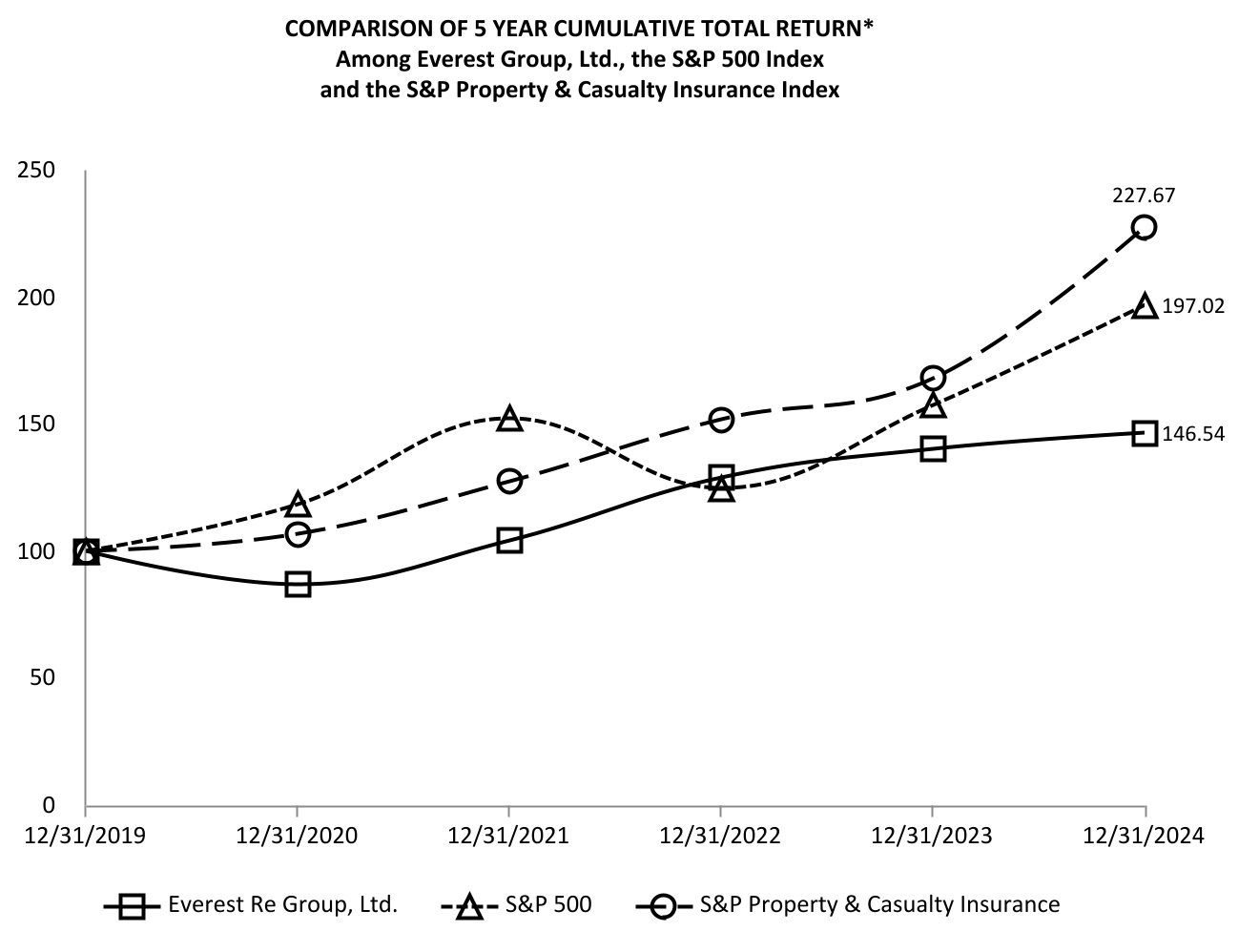
The following performance graph compares cumulative total shareholder returns on the common shares (assuming reinvestment of dividends) from December 31, 2019 through December 31, 2024, with the cumulative total return of the S&P 500 Index and the S&P Insurance (Property and Casualty) Index.
| 12/19 | 12/20 | 12/21 | 12/22 | 12/23 | 12/24 | ||||||||||||||||||||||||||||||
| Everest Group, Ltd. | 100.00 | 86.94 | 104.19 | 128.89 | 140.12 | 146.54 | |||||||||||||||||||||||||||||
| S&P 500 | 100.00 | 118.40 | 152.39 | 124.79 | 157.59 | 197.02 | |||||||||||||||||||||||||||||
| S&P Property & Casualty Insurance | 100.00 | 106.96 | 127.58 | 151.65 | 168.05 | 227.67 |
*$100 invested on December 31, 2019 in stock or index, including reinvestment of dividends.
Fiscal year ending December 31.
Copyright© 2025 Standard & Poor's, a division of S&P Global. All rights reserved.
Item 6. [RESERVED]
Item 7. MANAGEMENT’S DISCUSSION AND ANALYSIS OF FINANCIAL CONDITION AND RESULTS OF OPERATION
Overview.
Everest is a global underwriting leader providing best-in-class property, casualty and specialty reinsurance and insurance solutions. As part of the Standard & Poor’s (“S&P”) 500 Index, we are a leading financial services institution focused on value creation for our shareholders while diversifying our portfolio and geographic presence. Through our direct and indirect subsidiaries operating in the U.S. and internationally, we serve a diverse group of clients worldwide, providing what we believe are extensive product and distribution capabilities, a strong balance sheet, an innovative culture and access to world-class talent.
As a global leader with a 50-year track record, we are a preferred Reinsurance partner in the markets we serve, and with
our growing Insurance franchise we strive to deliver consistent value to all our stakeholders. We continue to grow and develop our Insurance business, investing in our global platform and strengthening our portfolio and its potential to deliver on our customer promise.
During 2024, we formed a new “Other” segment, primarily comprised of the results of our sports and leisure business sold in October 2024, consisting of policies written prior to the sale and polices renewed and certain new business written on the Company’s paper post-sale. It also includes run-off asbestos and environmental (“A&E”) exposures, certain discontinued insurance programs primarily written prior to 2012 and certain discontinued insurance and reinsurance coverage classes. The Other segment does not generally sell insurance or reinsurance products but is responsible for the management of existing policies and settlement of related losses. These segment presentation changes have been reflected retrospectively. The Company will continue to have two reportable segments that actively sell products, Reinsurance and Insurance, consistent with how the on-going business is managed. See Note 6 of the Notes to the Consolidated Financial Statements for a summary of segment results.
Our current year net income of $1.4 billion is inclusive of unfavorable development of prior-year loss reserves of $1.5 billion. Following a comprehensive reserve review, we have significantly fortified our U.S. casualty reserves, while taking aggressive underwriting action in certain classes exposed to social inflation, bolstering talent and investing in our platform as we head into 2025. Refer to management’s discussion of consolidated and segment results below.
The following is a discussion and analysis of our results of operations, financial condition and liquidity and capital resources for the years ended December 31, 2024 and 2023. This discussion should be read in conjunction with the consolidated financial statements and related notes, under ITEM 8 of this Form 10-K. Pursuant to the Fixing America’s Surface Transportation Act Modernization and Simplification of Regulation S-K, comparisons between 2023 and 2022 have been omitted from this Form 10-K but can be found in "Management's Discussion and Analysis of Financial Condition and Results of Operations" in Part II, Item 7 of our Form 10-K for the year ended December 31, 2023.
All comparisons in this discussion are to the corresponding prior year unless otherwise indicated.
Financial Summary.
We monitor and evaluate our overall performance based upon financial results. The following table displays a summary of the consolidated net income (loss), ratios and shareholders’ equity for the periods indicated:
| Years Ended December 31, | Percentage Increase/(Decrease) | ||||||||||||||||||||||||||||
| (Dollars in millions) | 2024 | 2023 | 2022 | 2024/2023 | 2023/2022 | ||||||||||||||||||||||||
| Gross written premiums | $ | 18,232 | $ | 16,637 | $ | 13,952 | 9.6 | % | 19.2 | % | |||||||||||||||||||
| Net written premiums | 15,814 | 14,730 | 12,344 | 7.4 | % | 19.3 | % | ||||||||||||||||||||||
| REVENUES: | |||||||||||||||||||||||||||||
| Premiums earned | $ | 15,187 | $ | 13,443 | $ | 11,787 | 13.0 | % | 14.0 | % | |||||||||||||||||||
| Net investment income | 1,954 | 1,434 | 830 | 36.3 | % | 72.7 | % | ||||||||||||||||||||||
| Net gains (losses) on investments | 19 | (276) | (455) | NM | (39.3) | % | |||||||||||||||||||||||
| Other income (expense) | 121 | (14) | (102) | NM | (86.3) | % | |||||||||||||||||||||||
| Total revenues | 17,281 | 14,587 | 12,060 | 18.5 | % | 20.9 | % | ||||||||||||||||||||||
| CLAIMS AND EXPENSES: | |||||||||||||||||||||||||||||
| Incurred losses and loss adjustment expenses | 11,305 | 8,427 | 8,100 | 34.1 | % | 4.0 | % | ||||||||||||||||||||||
| Commission, brokerage, taxes and fees | 3,300 | 2,952 | 2,528 | 11.8 | % | 16.7 | % | ||||||||||||||||||||||
| Other underwriting expenses | 938 | 846 | 682 | 10.9 | % | 24.1 | % | ||||||||||||||||||||||
| Corporate expenses | 95 | 73 | 61 | 30.5 | % | 19.9 | % | ||||||||||||||||||||||
| Interest, fees and bond issue cost amortization expense | 149 | 134 | 101 | 11.1 | % | 33.2 | % | ||||||||||||||||||||||
| Total claims and expenses | 15,787 | 12,432 | 11,472 | 27.0 | % | 8.4 | % | ||||||||||||||||||||||
| INCOME (LOSS) BEFORE TAXES | 1,493 | 2,154 | 588 | (30.7) | % | NM | |||||||||||||||||||||||
| Income tax expense (benefit) | 120 | (363) | (9) | NM | NM | ||||||||||||||||||||||||
| NET INCOME (LOSS) | $ | 1,373 | $ | 2,517 | $ | 597 | (45.4) | % | NM | ||||||||||||||||||||
| RATIOS: | Point Change | ||||||||||||||||||||||||||||
| Loss ratio | 74.4 | % | 62.7 | % | 68.7 | % | 11.7 | (6.0) | |||||||||||||||||||||
| Commission and brokerage ratio | 21.7 | % | 22.0 | % | 21.4 | % | (0.3) | 0.6 | |||||||||||||||||||||
| Other underwriting expense ratio | 6.2 | % | 6.3 | % | 5.8 | % | (0.1) | 0.5 | |||||||||||||||||||||
| Combined ratio | 102.3 | % | 90.9 | % | 96.0 | % | 11.4 | (5.1) |
| At December 31, | Percentage Increase/(Decrease) |
Showing the first 8K of 143K characters. Open the full section
Item 7A. QUANTITATIVE AND QUALITATIVE DISCLOSURES ABOUT MARKET RISK
See “Market Sensitive Instruments” in ITEM 7.
Item 8. FINANCIAL STATEMENTS AND SUPPLEMENTARY DATA
The financial statements and schedules listed in the accompanying Index to Financial Statements and Schedules on page F-1 are filed as part of this report.
Item 9. CHANGES IN AND DISAGREEMENTS WITH ACCOUNTANTS ON ACCOUNTING AND FINANCIAL DISCLOSURE
None.
Item 9A. CONTROLS AND PROCEDURES
Disclosure Controls and Procedures.
As required by Rule 13a-15(b) of the Exchange Act, our management, including our Chief Executive Officer and Chief Financial Officer, has evaluated the effectiveness of our disclosure controls and procedures (as defined in Rule 13a-15(e) under the Exchange Act). Based on that evaluation, the Chief Executive Officer and Chief Financial Officer have concluded that our disclosure controls and procedures were effective as of the end of the period covered by this annual report.
Management’s Report on Internal Control Over Financial Reporting.
Our management is responsible for establishing and maintaining adequate internal control over financial reporting. Our internal control over financial reporting is designed to provide reasonable assurance regarding the reliability of financial reporting and the preparation of our financial statements for external purposes in accordance with generally accepted accounting principles.
Because of its inherent limitations, internal control over financial reporting may not prevent or detect misstatements. Also, projections of any evaluation of effectiveness to future periods are subject to the risk that controls may become inadequate because of changes in conditions, or that the degree of compliance with the policies or procedures may deteriorate.
Management has assessed the effectiveness of our internal control over financial reporting as of December 31, 2024. In making this assessment, we used the criteria set forth by the Committee of Sponsoring Organizations of the Treadway Commission in Internal Control - Integrated Framework (2013). Based on our assessment we concluded that, as of December 31, 2024, our internal control over financial reporting is effective based on those criteria.
The effectiveness of the Company’s internal control over financial reporting as of December 31, 2024, has been audited by KPMG LLP, an independent registered public accounting firm, as stated in their report, which appears herein.
Changes in Internal Control over Financial Reporting.
As required by Rule 13a-15(d) of the Exchange Act, our management, including our Chief Executive Officer and Chief Financial Officer, has evaluated our internal control over financial reporting to determine whether any changes occurred during the fourth fiscal quarter covered by this annual report that have materially affected, or are reasonably likely to materially affect, our internal control over financial reporting. Based on that evaluation, we have determined that there has been no such change during the fourth quarter.
Item 9B. OTHER INFORMATION
During the fiscal quarter ended December 31, 2024, none of our directors or officers adopted, modified or terminated a “Rule 10b5-1 trading arrangement” or “non-Rule 10b5-1 trading arrangement,” as those terms are defined in Regulation S-K, Item 408.
Additionally, as part of Everest’s commitment to ethical standards of business and compliance with applicable laws, rules and regulations, we have an Insider Trading Policy governing the purchase, sale, and/or other dispositions of our securities by our directors, officers, employees and third-party contractors that we believe is reasonably designed to promote compliance with insider trading laws, rules and regulations, and the exchange listing standards applicable to us. A copy of our Insider Trading Policy is included in the Ethics and Guidelines and Index to Compliance Policies and Procedures filed as Exhibit 14.1 to the Annual Report on Form 10-K for the period ended December 31, 2023 and incorporated by reference in “ITEM 15 - Exhibits and Financial Statement Schedules” below.
Item 9C. DISCLOSURE REGARDING FOREIGN JURISDICTIONS THAT PREVENT INSPECTIONS
Not Applicable.
PART III
Item 10. DIRECTORS, EXECUTIVE OFFICERS AND CORPORATE GOVERNANCE
Reference is made to the sections captioned “Information Concerning Director Nominees”, “Information Concerning Executive Officers”, “Audit Committee”, “Nominating and Governance Committee”, “Ethics Guidelines and Code of Ethics for CEO and Senior Financial Officers” and “Delinquent Section 16(a) Reports” in our proxy statement for the 2025 Annual General Meeting of Shareholders, which will be filed with the Commission within 120 days of the close of our fiscal year ended December 31, 2024 (the “Proxy Statement”), which sections are incorporated herein by reference.
Item 11. EXECUTIVE COMPENSATION
Reference is made to the sections captioned “Compensation Committee Report”, “Directors’ Compensation”, “Compensation of Executive Officers”, “Compensation Committee Interlocks and Insider Participation” and to all other applicable sections in the Proxy Statement, which are incorporated herein by reference.
On November 1, 2023, the Company’s Board adopted an updated Clawback Policy (the “Clawback Policy”) in order to comply with Section 10D of the Exchange Act, Rule 10D-1 of the Exchange Act and the listing standards adopted by the NYSE.
The Clawback Policy provides for the mandatory recovery of erroneously awarded incentive-based compensation from current and former executive officers (as defined in the Clawback Policy) of the Company (“Section 16 Officers”) in the event that the Company is required to prepare an accounting restatement.
The foregoing description of the Clawback Policy is a summary only and is qualified in its entirety by reference to the full text of the Clawback Policy and the form of Acknowledgment, copies of which are filed in Exhibit 97 to the Annual Report on Form 10-K for the period ended December 31, 2023 and are incorporated by reference in “ITEM 15 - Exhibits and Financial Statement Schedules” below.
Item 12. SECURITY OWNERSHIP OF CERTAIN BENEFICIAL OWNERS AND MANAGEMENT AND RELATED SHAREHOLDER MATTERS
Reference is made to the applicable sections in the Proxy Statement, which are incorporated herein by reference.
Item 13. CERTAIN RELATIONSHIPS AND RELATED TRANSACTIONS, AND DIRECTOR INDEPENDENCE
Reference is made to the applicable sections in the Proxy Statement, which are incorporated herein by reference.
Item 14. PRINCIPAL ACCOUNTANT FEES AND SERVICES
Reference is made to the section captioned “Audit Committee Report” in the Proxy Statement, which is incorporated herein by reference.
PART IV
Item 15. EXHIBITS AND FINANCIAL STATEMENT SCHEDULES
Financial Statements and Schedules.
The financial statements and schedules listed in the accompanying Index to Financial Statements and Schedules on page F-1 are filed as part of this report.
Exhibits.
The exhibits listed on the accompanying Index to Exhibits on page E-1 are filed as part of this report except that the certifications in Exhibit 32 are being furnished to the SEC, rather than filed with the SEC, as permitted under applicable SEC rules.
INDEX TO EXHIBITS
E-1
Showing the first 8K of 384K characters. Open the full section