 filings.tools
Elevance Health (ELV) 10-K risk factor changes: FY2016 vs FY2015
The 2016-12-31 10-K against the 2015-12-31 one, compared heading by heading and sentence by sentence. One of these filings carries no fiscal year tag, so its year is the calendar year of the period end.
Item 1A98 rewritten42 added29 removed315 unchanged
All filing items1,318 rewritten1,076 added931 removed2,979 unchanged
Summary
counted, not written
- Item 1A headings could not be compared: only 0 carried over between the two years, which usually means one filing was read wrongly, so none is reported as new or removed.
- Sentence by sentence, 1,076 added, 931 removed, 1,318 rewritten and 2,979 unchanged across 18 items that differ.
- New this year: Item 16. FORM 10-K SUMMARY..
Sentences by item
22 items, with every count and a link to each item that changed
Underlined words on a shaded ground are new in FY2016; struck-through words were in FY2015. Sentences that are wholly new or wholly gone are labelled rather than marked.
Item 1A. RISK FACTORS.
98 rewritten, 42 added, 29 removed, 315 unchanged
Read the full itemFY2016 item · filed February 22, 2017FY2015 item · filed February 19, 2016
[added: Consequently, you] should not consider any such list to be a complete statement of all our potential risks or uncertainties.
[removed: Federal] Health Care Reform, together with the changes in federal and state regulations that have been, and continue to be, enacted to implement it, [added: or future changes involving the significant modification, repeal or replacement of Health Care Reform] could adversely affect our business, cash flows, financial condition and results of operations.
The passage of Health Care Reform [removed: during 2010] and subsequent regulations represent significant changes to the U.S. health care system.
The legislation and regulations are far-reaching and are intended to expand access to health insurance coverage over time by mandating that most individuals obtain health insurance coverage, increasing the eligibility thresholds for most state Medicaid programs and providing certain [removed: other] individuals and small businesses with tax credits to subsidize a portion of the cost of health insurance coverage.
In addition, [removed: the new] [added: these] laws impose significant fees, assessments and taxes on us and other health insurers, health plans and other industry participants.
[added: One of our most significant costs under] Health Care Reform [removed: imposes an] [added: is the] annual industry-wide HIP Fee.
The total amount [removed: collected] [added: due] from allocations to health insurers in [added: 2016,] 2015 and 2014 was $11.3 [added: billion, $11.3] billion and $8.0 billion, [removed: respectively] [added: respectively,] and our portion of the HIP Fee for [added: 2016,] 2015 and 2014 was $1.2 [added: billion, $1.2] billion and $0.9 billion, respectively.
The [removed: annual] HIP Fee [removed: remains at $11.3 billion for 2016,] has been suspended for 2017 and [removed: will] [added: is currently scheduled to] resume [removed: and be] [added: in 2018 at the] increased [removed: to] [added: amount of] $14.3 [removed: billion for 2018,] [added: billion,] with annual adjustments thereafter.
Health Care Reform also [removed: imposes] [added: imposed] industry-wide reinsurance assessments under a temporary three year program which were [added: $5.0 billion,] $8.0 billion and $12.0 billion for [added: 2016,] 2015 and 2014, [removed: respectively, and decrease to $5.0 billion for 2016.][added: respectively.]
Health Care Reform [removed: also] imposes [removed: new] regulations on the health insurance sector, including, but not limited to, guaranteed coverage and expanded benefit requirements; prohibitions on some annual and all lifetime limits on amounts paid on behalf of or to our members; increased restrictions on rescinding coverage; establishment of minimum MLR and customer rebate requirements; creation of a federal rate review process; a requirement to cover preventive services on a first dollar basis; the establishment of public exchanges and essential benefit packages and greater limitations on how we price certain of our products.
If we are not able to successfully design and implement operational and strategic initiatives to adapt to these changes in [removed: certain of our markets, our financial condition and results of operations may be adversely affected.]
For example, [removed: in 2015,] [added: through 2016,] the risk corridor program [removed: fell] [added: has fallen] short of expectations and, as a result, [removed: the] payments from the program were approximately [removed: 12.6%] [added: 14.9%] of the [removed: amount] [added: amounts] that [removed: was] [added: were] requested by health insurance [removed: issuers.][added: issuers for 2014.]
Although [removed: the majority of] Health Care [removed: Reform’s provisions have] [added: Reform has] been [added: substantially] implemented, [removed: as the remaining provisions are phased in, we] [added: further regulations and modifications to Health Care Reform, including repeal or replacement,] could [removed: be impacted] [added: have a significant impact on us] through potential disruption to the employer-based market, [removed: potential] cost shifting in the health care delivery system to insurance companies and limitations on the ability to increase premiums to meet costs.
We have dedicated material resources and incurred material expenses to implement and comply with Health Care Reform at both the [removed: state and] federal [added: and state] levels, [added: including significant investments in new products, services] and [added: technologies, and] we expect to dedicate material resources and incur material expenses going forward to implement and comply with future regulations that provide guidance and clarification on significant portions of the legislation.
[removed: The] Health Care Reform [removed: law] and [added: associated] regulations are likely to have significant effects on our future operations, which, in turn, could impact the value of our business model and results of operations, including potential impairments of our goodwill and other intangible assets.
We are subject to significant government regulation, and changes in the regulation of our business by [removed: state and] federal [added: and state] regulators may adversely affect our business, cash flows, financial condition and results of operations.
Our business is subject to regulation at the [removed: state and] federal [added: and state] level.
In addition, changes in tax laws and regulations, or changes in the interpretation of tax laws and regulations by federal and/or state authorities may have a material adverse effect on our business, [added: cash flows,] operations or financial condition.
State legislatures will continue to focus on health care delivery and financing [removed: issues.][added: issues, especially given proposals for the significant modification, repeal or replacement of Health Care Reform.]
Such issues are sometimes addressed directly by voters in ballot initiatives, such as the [removed: upcoming] [added: recent] ballot initiative in Colorado that [removed: would] [added: attempted to] replace health insurers in the state with a single government payer.
Others have enacted, or are [removed: contemplating enacting,] [added: contemplating,] significant reform of their health insurance markets to include provisions affecting both public programs and privately-financed health insurance arrangements.
In addition, a number of states in which we offer Medicaid products, including Florida, Georgia, Kansas, [removed: Louisiana,] South Carolina, Tennessee, Texas, Virginia and Wisconsin, have indicated their current decision to opt out of Medicaid expansion, at least for the present time.
[removed: If] [added: Where] states allow certain programs to expire or [removed: choose to] opt out of Medicaid expansion, we could experience reduced Medicaid enrollment and reduced growth opportunities.
Our inability to contain health care costs, implement increases in premium rates on a timely basis, [added: appropriately price our public exchange products,] maintain adequate reserves for policy benefits or maintain cost effective provider agreements may adversely affect our business and profitability.
[added: Changes in health care practices, demographic characteristics, inflation,] new technologies, the cost of prescription drugs, clusters of high cost cases, changes in the regulatory environment and numerous other factors affecting the cost of health care may adversely affect our ability to predict and manage health care costs, as well as our business, financial condition and results of operations.
[removed: The] [added: For 2016, we experienced losses in our] public [removed: exchanges may increase the risk that] [added: exchange business as] our products [removed: will be] [added: were] selected by individuals who have a higher risk profile or utilization rate than the pool of participants we anticipated when we established the pricing for these public exchange products.
Although federal risk adjustment mechanisms, including risk adjustment payments, [removed: risk corridors and reinsurance,] could help offset health care benefit costs in excess of our projections if our assumptions regarding cost trends, utilization, enrollment, adverse selection, acuity and other assumptions utilized in setting our premium rates are significantly different than actual results, our income statement and financial position could be adversely affected.
Fiscal concerns regarding the continued viability of programs such as Medicare and Medicaid may cause decreasing reimbursement rates, [added: including retroactive decreases in Medicaid reimbursement rates,] delays in premium payments or a lack of sufficient increase in reimbursement rates for government-sponsored programs in which we participate.
[removed: A limitation on our] ability to increase or maintain our premium or reimbursement levels or a significant loss of membership resulting from our need to increase or maintain premium or reimbursement levels could adversely affect our business, cash flows, financial condition and results of operations.
To the extent the actual claims experience is [removed: less favorable than estimated based on] [added: unfavorable as compared to] our underlying assumptions, our incurred losses would increase and future earnings could be adversely affected.
Our profitability is dependent in part upon our ability to contract on favorable terms with hospitals, [removed: physicians] [added: physicians, PBM service providers] and other health care providers.
[removed: The failure] [added: Physicians, hospitals and other health care providers may refuse] to [removed: maintain or] [added: contract with us, and the failure] to secure [added: or maintain] cost-effective health care provider contracts on competitive terms may result in a loss of membership or higher medical costs, which could adversely affect our business.
In addition, [added: consolidation among health care providers,] ACO practice management companies, which aggregate physician practices for administrative efficiency and marketing leverage, and other organizational structures that physicians, hospitals and other care providers choose may change the way that these providers interact with us and may change the competitive landscape.
Such organizations or groups of physicians may compete directly with us, which may impact our relationship with these providers or affect the way that we price our products and estimate our costs and may require us to incur costs to change our operations, and our [removed: results of operations,] [added: business, cash flows,] financial [removed: position] [added: condition] and [removed: cash flow] [added: results of operations] could be adversely affected.
[removed: Further, our] [added: Our] inability to contract with providers, or if providers attempt to use their market position to negotiate more favorable contracts or place us at a competitive disadvantage, or the inability of providers to provide adequate care, could adversely affect our business.
In addition, we do not have contracts with all providers that render services to our members and, as a result, do not have a pre-established agreement about the amount of compensation those out-of-network providers will accept for the services they render, which can result in significant litigation or arbitration [removed: proceedings.][added: proceedings, or provider attempts to obtain payment from our members for the difference between the amount we have paid and the amount they have charged.]
A significant reduction in the number of enrollees in our health benefits programs could adversely affect our business, [added: cash flows,] financial condition and results of operations.
Factors that could contribute to a reduction in enrollment include: reductions in workforce by existing customers; general economic downturn that results in business failures and high unemployment rates; employers no longer offering certain health care coverage as an employee benefit or electing to offer [removed: this] coverage on a [added: voluntary, employee-funded basis; participation on public exchanges; federal and state regulatory changes; failure to obtain new customers or retain existing customers; premium increases and benefit changes; our exit from a specific market; negative publicity and news coverage; and failure to attain or maintain nationally recognized accreditations.]
We contract with various [removed: state and] federal [added: and state] agencies, including CMS, to provide managed health care services, including Medicare Advantage plans, Medicare Supplement plans, Medicare approved prescription drug plans, Medicaid, TANF, SPD, LTSS, CHIP and ACA-related Medicaid expansion programs.
These programs in our Government Business segment have been the subject of recent regulatory reform initiatives, including Health Care [removed: Reform, which are still in the process of being implemented.][added: Reform.]
Similarly, a number of elected officials at both the federal and state level have proposed substantial changes to the United States’ health care system, including the significant modification, repeal or replacement of Health Care Reform, which could have far-reaching consequences for our business.
Due to the suspension of the HIP Fee for 2017, we may be unable to appropriately price 2017 renewals with policy months occurring in 2018 to appropriately include our portion of the 2018 HIP Fee.
The reinsurance assessments were based on a national contribution rate assessed, per covered enrollee, upon the commercial health insurance market and sponsors of self-funded health benefit plans.
certain of our markets, our financial condition and results of operations may be adversely affected.
No payments from the program have been made by HHS against the amounts owed for 2015 and 2016.
Although HHS has stated that future collections under the program will be applied to shortfalls from previous years prior to making payments for subsequent years, there can be no assurance that any remaining funds due under this program will be recovered.
As we have consistently done since 2014, we have continued our conservative posture of recording a 100% valuation allowance against any unpaid receivables owed to us under the risk corridor program for the 2014, 2015 and 2016 benefit years.
Similarly, the significant modification, repeal or replacement of Health Care Reform would likely have significant effects on our business and future operations, some of which may adversely affect our results of operations.
If future modifications to Health Care Reform significantly reduce the Medicaid expansion program, this will negatively impact our Medicaid business.
Further, the public exchange market is currently experiencing significant disruptions, as many insurers have incurred significant losses and announced their withdrawal from public exchange markets in a number of states.
Although we increased our public exchange premiums for 2017, there can be no assurance that these increases in premiums will adequately address the risk that our products continue to be selected by individuals who utilize medical services at a greater rate than anticipated.
If future modifications to Health Care Reform significantly reduce the federal risk adjustment mechanisms, this will impact our assumptions for the next several years.
A limitation on our
Finally, there is the possibility that the Medicare Advantage program could be significantly impacted by any future modification, repeal or replacement of Health Care Reform,
Further, certain of our CMS and state Medicaid contracts are subject to a competitive procurement process.
Further, the Medicare Advantage Star Ratings System utilized by CMS to evaluate Medicare Advantage Plans may have a significant effect on our results of operations, as higher rated plans tend to experience increased enrollment and plans with a star rating of 4.0 or higher are eligible for quality-based bonus payments.
Our star ratings may be negatively impacted if we fail to meet the quality, performance and regulatory compliance criteria established by CMS.
If our star ratings decline, fail to meet or exceed our competitors’ ratings or fall short of our expectations, or if quality-based bonus payments associated with star ratings are reduced or eliminated, our financial performance may be adversely impacted.
government funded programs.
In addition to these federal programs, a number of states have implemented Medicaid RAC programs which were authorized by the ACA.
The acquisition is also subject to other risks and uncertainties.
Cigna’s pursuit of litigation to terminate the Merger Agreement and seeking damages against us, together with our own litigation against Cigna, could cause us to incur substantial costs, may present material distractions and, if decided adverse to Anthem, could negatively impact our financial position.
As described in Note 3, Business Acquisitions and Divestiture - Pending Acquisition of Cigna Corporation, to our audited consolidated financial statements included in Part II, Item 8 of this Annual Report on Form 10-K, on February 14, 2017, Cigna commenced litigation for a declaratory judgment that its purported termination of the Merger Agreement was lawful and seeking damages against us.
We promptly filed our own litigation against Cigna seeking to compel Cigna’s specific performance of the Merger Agreement and damages against Cigna.
These lawsuits could result in substantial costs to us, including litigation costs and potential settlement costs.
Further, due to the potential significance of the allegations and damages claimed by Cigna, we expect that our officers will spend substantial time focused on the litigation.
Our defense against Cigna’s claims, the pursuit of our claims or the settlement, or failure to reach a settlement, for any claims may result in negative media attention, and may adversely affect our business, reputation, financial condition, results of operations, cash flows and market price.
If we fail to adequately adapt to changes in our industry and develop and implement strategic growth opportunities, our ability to grow may be adversely affected.
As a result of significant changes to traditional health insurance in recent years brought about by Health Care Reform and other factors, the health insurance industry has experienced a significant shift in membership to insurance products with lower margins.
Moreover, the significant modification, repeal or replacement of Health Care Reform could have far-reaching consequences for our business.
In order to profitably grow our business in the future, we need to not only grow our profitable medical membership, but also continue to diversify our sources of revenue and earnings, including through the increased sale of our specialty products, such as dental, vision and other supplemental products, expansion of our non-insurance assets and establishment of new cost of care solutions, including innovations in PBM services.
If we are unable to acquire or develop and successfully manage new opportunities that further our strategic objectives and differentiate our products from our competitors, our ability to profitably grow our business could be adversely affected.
Furthermore,
We may continue to experience increased assessments in the future if premiums established by other companies for their health insurance products, including certain long-term care products, are inadequate to cover the cost of care.
we would be assessed approximately $2.9 billion by the BCBSA.
The states in which we operate that have the largest concentrations of revenues include California, Georgia, Indiana, New York, Ohio, Texas and Virginia.
The value we place on intangible assets may be adversely impacted if acquired businesses fail to perform in a manner consistent with our assumptions.
During periods in which interest rates are relatively low, as in recent years, our investment income could be adversely impacted.
condition and results of operations.
As more fully described under Note 13, “Commitments and
Consequently, you
\-22\-
The reinsurance assessments are based on an insurer’s total number of insured members.
Insurance companies will pay the fees based upon insured members whereas self-insured entities will pay them directly to HHS.
Changes in health care practices, demographic characteristics, inflation,
voluntary, employee-funded basis; participation on public exchanges and related underwriting changes; state and federal regulatory changes; failure to obtain new customers or retain existing customers; premium increases and benefit changes; our exit from a specific market; negative publicity and news coverage; and failure to attain or maintain nationally recognized accreditations.
Changes in Health Care Reform to date have required us to make investments in new products, services and technologies, which investments may not be realized if certain provisions are delayed or substantially modified.
There is also
Without Congressional action, these plans will expire on December 31, 2016.
The ACA also established recovery audit programs for Medicare Parts C and D.
The Medicare Part D Recovery Audit Contractor, or RAC, has been auditing Medicare Part D claims since 2012, and a Medicare Part C RAC is expected to be named in 2016, which could increase the volume of audits and subsequent recoupments by the federal government.
The ACA authorized state Medicaid programs to implement RAC programs similar to Medicare RAC programs and a number of states have done so.
The acquisition is also subject to other risks and uncertainties, such as the possibility that Cigna could receive an unsolicited proposal from a third party or that either we or Cigna could exercise our respective termination rights.
our consumer-focused sales and marketing, customer interfaces and product offerings.
ability of our regulated subsidiaries to pay dividends.
In that event, we may experience increased guaranty association assessments, the amount and timing of which cannot be predicted with certainty.
and/or Blue Shield enrollees.
Most of our revenues are generated in California, Colorado, Connecticut, Georgia, Indiana, Kentucky, Maine, Maryland, Missouri, Nevada, New Hampshire, New York, Ohio, Tennessee, Texas, Virginia and Wisconsin.
The securities and credit markets have been experiencing higher than normal volatility.
Current and long-term
Also, in accordance with applicable FASB accounting guidance, we review our investment securities to determine if declines in fair value below cost are other-than-temporary.
This review is subjective and requires a high degree of judgment.
We conduct this review on a quarterly basis analyzing both quantitative and qualitative factors.
Such factors considered include the length of time and the extent to which market value has been less than cost, financial condition and near term prospects of the issuer, recommendations of investment advisors and forecasts of economic, market or industry trends.
We are addressing the impact of this cyber attack and supporting federal law enforcement efforts to identify the responsible parties.
and other claims have been or may be asserted against us, allegedly arising out of the cyber attack.
In addition, federal regulations required us to begin using ICD-10 on October 1, 2015, which has required and will continue to require significant information technology investment.
If we fail to adequately implement ICD-10 or encounter difficulties in providers' implementation of ICD-10, we may incur losses with respect to the resources invested and have other material adverse effects on our business and results of operations.
Also, as we convert or migrate members to our more efficient and effective systems, the risk of disruption in our customer service is increased during the migration or conversion process and such disruption could have a material adverse effect on our business, cash flow, financial condition and results of operations.
An excerpt. Shown here: 40 of 98 rewritten, 40 of 42 added and all 29 removed. The counts are complete. For every sentence, read Item 1A. RISK FACTORS. in the FY2016 filing and the FY2015 filing.
Item 7. MANAGEMENT’S DISCUSSION AND ANALYSIS OF FINANCIAL CONDITION AND RESULTS OF OPERATIONS.
268 rewritten, 132 added, 125 removed, 607 unchanged
Read the full itemFY2016 item · filed February 22, 2017FY2015 item · filed February 19, 2016
[removed: Therefore,] [added: As a result,] these reportable segments may change in the future.
Our Other segment includes other businesses that do not [added: individually] meet the quantitative thresholds for an operating segment as defined by Financial Accounting Standards Board, or FASB, guidance, as well as corporate expenses not allocated to the other reportable segments.
Other variable costs, such as salaries and benefits, do not vary directly with changes in [removed: premium,] [added: premium] but are more aligned with changes in membership.
The acquisition or loss of a significant block of business would likely impact staffing [removed: levels,] [added: levels] and [removed: thus] [added: thus,] associated compensation expense.
[removed: The] [added: This] Acquisition will further our goal of creating a premier health benefits company with critical diversification and scale to lead the transformation of health care delivery for consumers.
We expect to finance the cash portion of the Acquisition through available cash on [removed: hand and the issuance of new debt.]
We [removed: entered into] [added: are party to] a bridge facility commitment letter and a joinder agreement with a group of lenders which [removed: will provide] [added: provides] up to [removed: $22,500.0] [added: $19,500.0] under a 364\-day senior unsecured bridge term loan credit facility to finance the Acquisition in the event that we have not received proceeds from any combination of (i) senior unsecured term loans, (ii) common or preferred equity or equity-linked securities and/or (iii) senior unsecured notes in a public offering or private placement in an aggregate principal amount of at least [removed: $22,500.0] [added: $19,500.0] prior to the consummation of the Acquisition.
The commitment of the lenders to provide the bridge facility and the term loan facility is subject to several conditions, [added: including the completion of the acquisition of Cigna.]
We expect that our pro forma debt-to-capital ratio will approximate 49% [removed: at] [added: following] the closing of the Acquisition and we are committed to deleveraging to the low 40% range approximately twenty-four months following the closing.
On February 17, 2015, we completed our acquisition of Simply [added: Healthcare Holdings, Inc., or Simply] Healthcare, a leading managed care company for people enrolled in Medicaid and Medicare programs in [added: the state of] Florida.
For additional information [added: about this acquisition,] see Note 3, “Business Acquisitions and Divestiture - Acquisition of Simply Healthcare" included in Part II, Item 8 of this Annual Report on Form 10-K.
The operating results for 1-800 CONTACTS for the one month ended January 31, 2014 are reported as discontinued [removed: operations.][added: operations within the consolidated statements of income included in Part II, Item 8 of this Annual Report on Form 10-K.]
For additional information regarding these transactions, see Note 3, [removed: "Business] [added: “Business] Acquisitions and Divestiture - Divestiture of 1-800 CONTACTS," [added: to our audited consolidated financial statements] included in Part II, Item 8 of this Annual Report on Form 10-K.
[removed: Our] [added: The] future results of [added: our] operations will also be impacted by certain external forces and resulting changes in our business model and strategy.
The legislation and regulations are far-reaching and are intended to expand access to health insurance coverage over time by mandating that most individuals obtain health insurance coverage, increasing the eligibility thresholds for most state Medicaid programs and providing certain [removed: other] individuals and small businesses with tax credits to subsidize a portion of the cost of health insurance coverage.
As a result of the complexity of the law, its impact on health care in the United [removed: States and] [added: States,] the continuing modification and interpretation of Health Care Reform [removed: rules,] [added: rules and the potential for significant future changes to the law,] we continue to analyze and refine our estimates of the ultimate impact of Health Care Reform on our business, cash flows, financial condition and results of operations.
Health Care Reform [removed: presents] [added: presented] us with new growth opportunities, but also [removed: introduces] [added: introduced] new risks, regulatory challenges and uncertainties, and required changes in the way products are designed, underwritten, priced, distributed and administered.
We believe our pricing strategy, based on predictive modeling, proprietary research and data-driven [removed: processes, as well as our overall investments for Health Care Reform,] [added: processes] have positioned us to benefit from the potential growth opportunities available in fully-insured commercial products as a result of Health Care [removed: Reform.][added: Reform and any subsequent changes to the current regulatory scheme.]
Federal premium subsidies are available [removed: only] for certain [removed: members] [added: members, subject to income and family size,] who purchase [removed: certain] public exchange products.
In our Small Group markets, we offer bronze, silver and gold products, off the public exchanges, in California, Colorado, Connecticut, Georgia, Indiana, Kentucky, Maine, Missouri, Nevada, New Hampshire, [added: New York,] Ohio, Virginia and Wisconsin.
We offer bronze, silver and gold products, on the public exchanges, in Colorado, Connecticut, Georgia, Indiana, Kentucky, Maine, Missouri, [added: Nevada,] New Hampshire, Ohio and Virginia.
[removed: Additionally, we] [added: We] offer platinum products, off the public exchanges, in California, [added: Colorado,] Connecticut, Georgia, [added: Indiana,] Kentucky, [removed: Maine, Nevada] [added: New York, Virginia] and [removed: Virginia.][added: Wisconsin.]
While private exchanges have been a distribution channel in the Medicare and Individual markets for some time, [added: in more recent years] the [removed: heightened] [added: Commercial market has received an increased] level of [removed: activity and investment among] [added: attention from] the consulting and broker communities [removed: and other] [added: as well as] health insurance [removed: carriers has generated an increasing level of interest among employers in the Commercial market.][added: carriers.]
To date, adoption levels [added: in the Commercial market overall] have been lower than analyst predictions.
While the ultimate volume, pace of growth and winning business models remain highly [removed: uncertain,] [added: uncertain in this space,] we [added: continue to] believe [removed: private exchanges will provide opportunities for growth.][added: we are well positioned to adapt with the market as it evolves.]
Health Care Reform [removed: also] imposes [removed: new] regulations on the health insurance sector, including, but not limited to, guaranteed coverage and expanded benefit requirements; prohibitions on some annual and all lifetime limits on amounts paid on behalf of or to our members; increased restrictions on rescinding coverage; establishment of minimum medical loss ratio, or MLR, and customer rebate requirements; establishment of a mandatory annual Health Insurance Provider Fee, or HIP Fee; creation of a federal rate review process; a requirement to cover preventive services on a first dollar basis; the establishment of public exchanges and essential benefit packages and greater limitations on how we price certain of our products.
Medicare Advantage or Medicare Part D plans that do not meet this threshold will have to pay a [added: minimum] MLR rebate.
If a plan’s MLR is below 85% for three consecutive years beginning with 2014, enrollment will [removed: be restricted.]
The total amount collected from allocations to health insurers [removed: in 2015 and 2014] was $11,300.0 [added: for each of 2016] and [removed: $8,000.0, respectively.][added: 2015 and $8,000.0 for 2014.]
The final calculation and payment of the annual HIP Fee occurs in the third quarter each year and our portion of the HIP Fee for [added: 2016,] 2015 and 2014 was [added: $1,176.3,] $1,207.5 and $893.3, respectively.
The annual HIP Fee to be allocated to all health insurers [removed: remains at $11,300.0 for 2016,] has been suspended for [removed: 2017,] [added: 2017] and [removed: will] [added: is scheduled to] resume and be increased to $14,300.0 for [removed: 2018.][added: 2018, without subsequent legislative or regulatory action.]
[removed: We are aware that] [added: In 2009,] the Pennsylvania Insurance [removed: Commissioner, or Insurance Commissioner, has] [added: Commissioner] placed Penn Treaty Network America Insurance Company and its subsidiary American Network Insurance Company, or collectively Penn Treaty, in rehabilitation, an intermediate action before insolvency.
[removed: In the event rehabilitation of Penn Treaty is unsuccessful and] [added: When] Penn Treaty is [removed: declared insolvent and] placed in liquidation, we and other insurers [removed: may] [added: will] be [removed: required] [added: obligated] to pay a portion of their policyholder claims through state guaranty association assessments in future periods.
We are one of the largest health benefits companies in [added: the United States in] terms of medical [removed: membership in the United States,] [added: membership,] serving [removed: 38.6] [added: 39.9] medical members through our affiliated health plans as of December 31, [removed: 2015.][added: 2016.]
We serve our members as the Blue Cross licensee for California and as the Blue Cross and Blue Shield, or BCBS, licensee for Colorado, Connecticut, Georgia, Indiana, Kentucky, Maine, Missouri (excluding 30 counties in the Kansas City area), Nevada, New Hampshire, New York (as BCBS in 10 New York City metropolitan and surrounding counties, and as Blue Cross or BCBS in selected upstate [added: counties), Ohio, Virginia (excluding the Northern Virginia suburbs of Washington, D.C.) and Wisconsin.]
In a majority of these service areas we do business as Anthem Blue Cross, Anthem Blue Cross and Blue Shield, Blue Cross and Blue Shield of Georgia, and Empire Blue Cross Blue [removed: Shield,] [added: Shield] or Empire Blue Cross (in our New York service areas).
[removed: We conduct business through] [added: Through] our AMERIGROUP Corporation, or Amerigroup, subsidiary, [added: we conduct business] in Florida, Georgia, [added: Iowa,] Kansas, Louisiana, Maryland, Nevada, New Jersey, New Mexico, New York, Tennessee, Texas, [removed: Washington] and [removed: effective January 1, 2016, in Iowa.][added: Washington.]
In addition, we conduct business through our [removed: recently acquired] Simply Healthcare Holdings, Inc., or Simply Healthcare, subsidiary in Florida.
For additional [removed: information regarding these transactions,] [added: information,] see Note [removed: 3, “Business Acquisitions and Divestiture,"] [added: 19, “Segment Information,”] to our audited consolidated financial statements included in Part II, Item 8 of this Annual Report on Form 10-K.
Operating revenue for the year ended December 31, [removed: 2015] [added: 2016] was [removed: $78,404.8,] [added: $84,194.0,] an increase of [removed: $5,383.1,] [added: $5,789.2,] or 7.4%, from the year ended December 31, [removed: 2014.][added: 2015.]
In March 2016, we filed a lawsuit against our vendor for pharmacy benefit management services, Express Scripts, Inc., or Express Scripts, seeking to recover damages for pharmacy pricing that is higher than competitive benchmark pricing and damages related to operational breaches, and seeking various declarations under the agreement between the parties.
In April 2016, Express Scripts filed an answer to the lawsuit disputing our contractual claims and alleging various defenses and counterclaims.
hand and the issuance of new debt.
The Acquisition is subject to certain state regulatory approvals, other standard closing conditions and customary approvals required under the Hart-Scott-Rodino Antitrust Improvements Act.
In July 2016, the U.S. Department of Justice, or DOJ, along with certain state attorneys general, filed a civil antitrust lawsuit in the U.S. District Court for the District of Columbia, or District Court, seeking to block the Acquisition.
Trial commenced in November 2016 and concluded in January 2017.
On January 18, 2017, we provided notice to Cigna that we had elected to extend the termination date under the Merger Agreement from January 31, 2017 until April 30, 2017.
On February 8, 2017, the District Court ruled in favor of the DOJ, and following our motion to expedite the appeal, which was granted on February 17, 2017, we promptly appealed the District Court's ruling to the U.S. Circuit Court of Appeals for the District of Columbia Circuit, or the Appellate Court.
On February 14, 2017, Cigna purported to terminate the Merger Agreement and commenced litigation against us in the Delaware Court of Chancery, or Delaware Court, seeking damages and a declaratory judgment that its purported termination of the Merger Agreement was lawful, among other claims.
We believe Cigna’s allegations are without merit.
Also on February 14, 2017, we initiated our own litigation against Cigna in the Delaware Court seeking a temporary restraining order to enjoin Cigna from terminating the Merger Agreement, specific performance compelling Cigna to comply with the Merger Agreement and damages.
On February 15, 2017, the Delaware Court granted our motion for a temporary restraining order and issued an order enjoining Cigna from terminating the Merger Agreement.
The temporary restraining order became effective immediately and will remain in place pending any further order from the Delaware Court.
A hearing will be scheduled the week of April 10, 2017.
We intend to vigorously defend the Acquisition in both the Circuit Court and the Delaware Court and remain committed to completing the Acquisition as soon as practicable.
If the Merger Agreement is terminated because the required regulatory approvals cannot be obtained, under certain conditions, we could be obligated to pay a $1,850.0 termination fee to Cigna.
Changes to our business are likely to continue for the next several years as elected officials at the national and state level have proposed significant modification to existing laws and regulations, including the potential repeal or
replacement of Health Care Reform.
Additionally, we offer platinum products on the public exchange in Connecticut.
In response, we have continued our broad-based strategy of offering Anthem Health Marketplace's consumer experience platform to groups, while also participating in four large national consultant-led exchanges, several regional broker-led exchanges and various Individual, Commercial and Medicare exchanges.
be restricted.
We will continue to evaluate the impact of Health Care Reform including any substantial changes to existing laws or regulations that may impact our business.
After failing to develop a viable rehabilitation plan, the Pennsylvania Insurance Commissioner filed a petition to convert the rehabilitation to a liquidation, with the liquidation expected to commence following the coordination of certain scheduling matters.
At December 31, 2016, we estimate our portion of the assessments for the Penn Treaty insolvency will approximate $190.0 to $220.0.
In accordance with FASB guidance, the ultimate amount of the assessments will be recognized as an expense in the period in which a court ordered liquidation is entered.
Payment of the assessments will be largely recovered through premium billing surcharges and premium tax credits over future years.
We have continued to implement security enhancements since this incident.
We also conduct business through arrangements with other BCBS licensees in South Carolina and Western New York.
The decrease in operating cash flow from 2015 of $911.5 was primarily attributable to an increase in claims payments due to higher medical cost experience and growth in membership.
The decrease was further due to the timing of claim reimbursements from our self-insured customers.
We define operating revenue as premium income, administrative fees and other revenues.
| • | Pending acquisition of Cigna; |
departments.
Most of the premium for Medicare Advantage is paid directly by the federal government on behalf of the participant who may also be charged a small premium.
Medicare Supplement and Medicare Advantage products are marketed in the same manner, primarily through independent agents and brokers.
December 31, 2016 Compared to December 31, 2015
Self-funded medical membership increased 1,022, or 4.3%, primarily due to increases in our National Accounts, Large Group accounts and BlueCard® membership.
Fully-insured membership increased 298, or 2.0%, primarily due to growth in our Medicaid business, partially offset by declines in Local Group fully-insured membership.
Local Group membership increased 188, or 1.2%, primarily due to growth in our Large Group self-funded accounts as a result of new sales and conversions of fully-insured contracts to self-funded administrative service only, or ASO contracts.
The increase was partially offset by attrition in our fully-insured product offerings resulting from competitive pressures and conversions to self-funded ASO contracts.
\-44\-
including the completion of the Acquisition.
As a result, we serve more than six hundred thousand members in Florida through our affiliated Amerigroup and Simply Healthcare Medicaid and Medicare plans.
These results were previously reported in the Commercial and Specialty Business segment.
Unless otherwise specified, all financial and membership information, other than cash flows, disclosed in this MD&A is from continuing operations.
In accordance with Financial Accounting Standards Board, or FASB, guidance, we have elected to not separately disclose net cash provided by or used in operating, investing, and financing activities and the net effect of those cash flows on cash and cash equivalents for discontinued operations during the periods presented.
The public exchanges have increased the risk that our products will be selected by individuals who have a higher risk profile or utilization rate than the pool of participants we anticipated when we established the pricing for these public exchange products.
We will continue to evaluate the impact of Health Care Reform as key aspects go into
effect and additional guidance is made available.
The state court denied the Insurance Commissioner’s petition for the liquidation of Penn Treaty and ordered the Insurance Commissioner to file an updated plan of rehabilitation.
The state court commenced a hearing in connection with the updated plan in July 2015, which has been adjourned.
The state court has begun scheduling settlement conferences to resolve outstanding issues with the plan.
Given the uncertainty around whether Penn Treaty will ultimately be declared insolvent and, if so, the amount of the insolvency, the amount and timing of any associated future guaranty fund assessments, and the availability and amount of any potential premium tax and other offsets, we currently cannot estimate our net exposure, if any, to this potential insolvency.
We will continue to monitor the situation and may record a liability and expense in future reporting periods, which could be material to our cash flows and results of operations.
We have continued to implement security enhancements since this incident and are supporting federal law enforcement efforts to identify the responsible parties.
counties only), Ohio, Virginia (excluding the Northern Virginia suburbs of Washington, D.C.) and Wisconsin.
We also conduct business through an arrangement with another BCBS licensee in South Carolina.
In preparation for the recent and ongoing changes to the U.S. health care system and to focus on our core growth opportunities across our Commercial and Specialty Business and Government Business segments, we entered into a definitive agreement in December 2013 to sell our 1-800 CONTACTS, Inc., or 1-800 CONTACTS, business to the private equity firm Thomas H.
Lee Partners, L.P. Concurrently, we entered into an asset purchase agreement with Luxottica Group to sell our glasses.com related assets.
The divestitures were completed on January 31, 2014.
The operating results for 1-800 CONTACTS are reported as discontinued operations within the consolidated statements of income included in Part II, Item 8 of this Annual Report on Form 10-K.
The decrease in net income was partially offset by an increase in the operating results of our Government Business segment and lower realized losses on the extinguishment of debt.
The increase in cash provided by operating activities was further attributable to the receipt of the reinsurance recoveries payment related to the 2014 Health Care Reform reinsurance premium stabilization program and payments made in 2014 that did not recur in 2015 for the adjudication of claims relating to the New York State contract conversion from our fully-insured Local Group business to a self-funded ASO contract.
The increase in cash provided by operating activities was partially offset by an increase in claims payments, primarily as a result of membership growth, an increase in income tax payments and an increase in the annual HIP Fee payment.
| • | Pending acquisition of Cigna expected to close in the second half of 2016; |
and our ability to effectively service large complex accounts.
December 31, 2014 Compared to December 31, 2013
Self-funded medical membership increased 2,506, or 12.3%, primarily due to increases in our Local Group self-funded accounts including the New York State contract conversion from a fully-insured contract to a self-funded ASO contract and the acquisition of a large state ASO contract, which both occurred in the first quarter of 2014.
Fully-insured membership decreased 660, or 4.3%, primarily due to the New York State contract conversion and Local Group membership losses as a result of affordability challenges affecting healthcare consumers.
The decrease was partially offset by growth in our Medicaid business.
Local Group membership increased 412, or 2.8%, primarily due to the acquisition of a large ASO state contract.
This increase was partially offset by fully-insured membership declines resulting from affordability challenges affecting healthcare consumers.
Individual membership increased 38, or 2.2%, primarily due to public exchange sales in the majority of our markets, partially offset by off-exchange lapses.
National Accounts membership increased 378, or 5.6%, primarily due to new sales and in-group change partially offset by lapses.
Medicare membership decreased 37, or 2.6%, primarily due to our product repositioning strategy toward HMO product offerings and select service area reductions.
FEP membership increased 11, or 0.7%, primarily due to favorable open enrollment.
Medicare Advantage Part D membership increased 62, or 9.9%, primarily due to the addition of a new state contract, partially offset by decreases in various markets due to our product repositioning strategy toward HMO product offerings and select service area reductions.
One example of the programs we have developed to mitigate outpatient costs is our Cancer Care Quality Program.
deductible HIP Fee, increased income before income taxes and increased state tax expense as a result of an adverse California franchise tax ruling.
The increase in premiums was offset, in part, by fully-insured membership declines in our Local Group business as a result of the New York State contract conversion and affordability challenges affecting healthcare consumers.
An excerpt. Shown here: 40 of 268 rewritten, 40 of 132 added and 40 of 125 removed. The counts are complete. For every sentence, read Item 7. MANAGEMENT’S DISCUSSION AND ANALYSIS OF FINANCIAL CONDITION AND RESULTS OF OPERATIONS. in the FY2016 filing and the FY2015 filing.
Item 7A. QUANTITATIVE AND QUALITATIVE DISCLOSURES ABOUT MARKET RISK.
14 rewritten, 1 added, 1 removed, 38 unchanged
Read the full itemFY2016 item · filed February 22, 2017FY2015 item · filed February 19, 2016
Potential impacts discussed below are based upon sensitivity analyses performed on our financial position as of December 31, [removed: 2015.][added: 2016.]
Our available-for-sale investment portfolio includes corporate securities which account for [removed: 41.7%] [added: 42.2%] of the total portfolio at December 31, [removed: 2015] [added: 2016] and are subject to credit/default risk.
As of December 31, [removed: 2015,] [added: 2016,] 92.2% of our available-for-sale investments were fixed maturity securities.
A 100 basis point increase in interest rates would result in an approximate [removed: $776.2] [added: $696.3] decrease in fair value, whereas a 100 basis point decrease in interest rates would result in an approximate [removed: $732.9] [added: $696.3] increase in fair value.
As of December 31, [removed: 2015,] [added: 2016,] 7.8% of our available-for-sale investments were equity securities.
An immediate 10% decrease in each equity investment’s value, arising from market movement, would result in a fair value decrease of [removed: $147.3.][added: $150.0.]
Alternatively, an immediate 10% increase in each equity investment’s value, attributable to the same factor, would result in a fair value increase of [removed: $147.3.][added: $150.0.]
For additional information regarding our investments, see Part II, Item 8, Note 4, [removed: “Investments”,] [added: “Investments,”] to our audited consolidated financial statements and “Critical Accounting Policies and Estimates - Investments” within Part II, Item 7 “Management’s Discussion and Analysis of Financial Condition and Results of Operations” included in this Annual Report on Form 10-K.
Our total long-term debt at December 31, [removed: 2015] [added: 2016] consists of senior unsecured notes, remarketable subordinated notes, convertible debentures, commercial paper and subordinated surplus notes by one of our insurance subsidiaries.
At December 31, [removed: 2015,] [added: 2016,] the carrying value and estimated fair value of our long-term debt was [removed: $15,324.5] [added: $15,286.9] and [removed: $16,185.5,] [added: $16,507.6,] respectively.
As of December 31, [removed: 2015,] [added: 2016,] we recorded a net [removed: liability] [added: asset] of [removed: $69.0,] [added: $526.1,] the estimated fair value of the swaps at that date.
A 100 basis point increase in interest rates would result in an approximate [removed: $655.2] [added: $782.4] decrease in fair value, whereas a 100 basis point decrease in interest rates would result in an approximate [removed: $655.2] [added: $765.7] increase in fair value.
[removed: Accordingly, a decrease] [added: An increase] in the S&P 500 index of 10% would result in an approximate [removed: increase] [added: decrease] of $24.3 in the fair value of these derivatives.
[removed: An increase] [added: Accordingly, a decrease] in the S&P 500 index of 10% would result in an approximate [removed: decrease] [added: increase] of [removed: $23.7] [added: $42.6] in the fair value of these derivatives.
\-79\-
\-77\-
Item 1. BUSINESS.
114 rewritten, 40 added, 45 removed, 450 unchanged
Read the full itemFY2016 item · filed February 22, 2017FY2015 item · filed February 19, 2016
We are one of the largest health benefits companies in [added: the United States in] terms of medical [removed: membership in the United States,] [added: membership,] serving [removed: 38.6] [added: 39.9] million medical members through our affiliated health plans as of December 31, [removed: 2015.][added: 2016.]
We serve our members as the Blue Cross licensee for California and as the Blue Cross and Blue Shield, or BCBS, licensee for Colorado, Connecticut, Georgia, Indiana, Kentucky, Maine, Missouri (excluding 30 counties in the Kansas City area), Nevada, New Hampshire, New York (as BCBS in 10 New York City metropolitan and surrounding counties, and as Blue Cross or BCBS in selected upstate [removed: counties only),] [added: counties),] Ohio, Virginia (excluding the Northern Virginia suburbs of Washington, D.C.) and Wisconsin.
In a majority of these service areas we do business as Anthem Blue Cross, Anthem Blue Cross and Blue Shield, Blue Cross and Blue Shield of Georgia, and Empire Blue Cross Blue [removed: Shield,] [added: Shield] or Empire Blue Cross (in our New York service areas).
[removed: We conduct business through] [added: Through] our AMERIGROUP Corporation, or Amerigroup, subsidiary, [added: we conduct business] in Florida, Georgia, [added: Iowa,] Kansas, Louisiana, Maryland, Nevada, New Jersey, New Mexico, New York, Tennessee, Texas, [removed: Washington] and [removed: effective January 1, 2016, in Iowa.][added: Washington.]
In addition, we conduct business through our [removed: recently acquired] Simply Healthcare Holdings, Inc., or Simply Healthcare, subsidiary in Florida.
[removed: The] [added: This] Acquisition will further our goal of creating a premier health benefits company with critical diversification and scale to lead the transformation of health care delivery for consumers.
The Acquisition is [removed: expected to close in the second half of 2016 and is] subject to certain state regulatory approvals, other standard closing conditions and customary approvals required under the Hart-Scott-Rodino Antitrust Improvements Act.
[added: For additional information, see Note] 13, “Commitments and Contingencies - [removed: Cyber Attack Incident,”] [added: Litigation,”] to our audited consolidated financial statements included in Part II, Item 8 of this Annual Report on Form 10-K.
For additional [removed: information,] [added: information regarding this lawsuit,] see Note [removed: 3, “Business Acquisitions] [added: 13, “Commitments] and [removed: Divestiture] [added: Contingencies] - [removed: Acquisition of Simply Healthcare"] [added: Litigation,” to our audited consolidated financial statements] included in Part II, Item 8 of this Annual Report on Form 10-K.
[removed: We have a] [added: Our] vision [removed: of becoming] [added: is to become] America's valued health partner.
[removed: While the distinctions between the various types of plans have lessened over recent years, PPO, POS and CDHP] products generally provide reduced benefits for out-of-network services, while traditional HMO products generally provide little to no reimbursement for non-emergency out-of-network utilization, but often offer more generous benefit coverage.
Economic factors, greater consumer and employer [removed: sophistication,] [added: sophistication] and accountability have resulted in an increased demand for choice in both product/benefit designs and provider network configurations.
As a result we continue to offer our broad access PPO networks with multiple benefit designs, but are also focused on leveraging our [removed: emerging] provider collaboration initiatives with our Accountable Care Organization, or ACO, partnerships to develop both narrow and tiered network offerings.
[added: This array of network] and [added: product configurations allows both the employer and the employee to design and] select the combination of benefit designs (e.g., traditional PPOs, high deductibles, HRAs, HSAs, PCP based products, tiered copays) and networks (e.g., broad, narrow, tiered, closed [added: or exclusive provider,] and open) that optimize choice, quality and price at the consumer, employer and market level.
Under self-funded [removed: and partially-insured] products, we charge a fee for [removed: services,] [added: services] and the employer or plan sponsor reimburses us for [removed: all or most of] the health care costs.
In addition, we charge a premium to [removed: provide administrative services to] [added: underwrite stop loss insurance for] Large Group and National Account employers that maintain self-funded health [removed: plans and we underwrite stop loss insurance for self-funded] plans.
Federal premium subsidies are available only for certain [removed: members who purchase certain] public exchange [added: Individual] products.
Being a [removed: member] [added: licensee] of the BCBS [added: association of] companies, of which there were 36 independent primary licensees as of December 31, [removed: 2015, creates] [added: 2016, provides] significant market [removed: advantages,] [added: value,] especially when competing for very large multi-state employer groups.
For example, each BCBS member company is able to [removed: take advantage of] [added: utilize] other BCBS licensees’ substantial provider networks and discounts when any BCBS member works or travels outside of the state in which their policy is written.
Advances in medical technology, increases in specialty drug costs, [added: increases in hospital expenditures and other provider costs,] the aging of the population and other demographic characteristics continue to contribute to rising health care costs.
[added: Our significant market share and] high business retention rates enable us to realize the long-term benefits of investing in preventive and early detection programs.
[removed: Our] [added: The] future results of [added: our] operations will also be impacted by certain external forces and resulting changes in our business model and strategy.
The legislation and regulations are far-reaching and are intended to expand access to health insurance coverage over time by mandating that most individuals obtain health insurance coverage, increasing the eligibility thresholds for most state Medicaid programs and providing certain [removed: other] individuals and small businesses with tax credits to subsidize a portion of the cost of health insurance coverage.
As a result of the complexity of the law, its impact on health care in the United [removed: States and] [added: States,] the continuing modification and interpretation of Health Care Reform [removed: rules,] [added: rules and the potential for significant future changes to the law,] we continue to analyze and refine our estimates of the ultimate impact of Health Care Reform on our business, cash flows, financial condition and results of operations.
Health Care Reform [removed: presents] [added: presented] us with new growth opportunities, but also [removed: introduces] [added: introduced] new risks, regulatory challenges and uncertainties, and required changes in the way products are designed, underwritten, priced, distributed and administered.
While private exchanges have been a distribution channel in the Medicare and Individual markets for some time, [added: in more recent years] the [removed: heightened] [added: Commercial market has received an increased] level of [removed: activity and investment among] [added: attention from] the consulting and broker communities [removed: and other] [added: as well as] health insurance [removed: carriers has generated an increasing level of interest among employers in the Commercial market.][added: carriers.]
To date, adoption levels [added: in the Commercial market overall] have been lower than analyst predictions.
While the ultimate volume, pace of growth and winning business models remain highly [removed: uncertain,] [added: uncertain in this space,] we [added: continue to] believe [removed: private exchanges will provide opportunities for growth.][added: we are well positioned to adapt with the market as it evolves.]
[removed: We] [added: In response, we have continued our broad-based strategy of offering Anthem Health Marketplace's consumer experience platform to groups, while] also [removed: currently participate] [added: participating] in four large national consultant-led exchanges, several regional broker-led exchanges and various [removed: individual, commercial] [added: Individual, Commercial] and Medicare exchanges.
We [removed: continue to] believe health care is local and that we have the strong local presence required to understand and meet local customer needs.
[removed: We] [added: Further, we] believe we are well-positioned to deliver what customers want: innovative, choice-based and affordable products; distinctive service; simplified transactions; and better access to information for quality care.
[removed: We] [added: Ultimately, we] believe that [removed: an essential ingredient for] practical and sustainable improvements in health care [removed: is raising] [added: must focus on improving] health care quality while managing costs for total [removed: cost] affordability.
[removed: These include] [added: We have implemented initiatives] driving [added: payment] innovation [removed: in paying] and partnering with providers to compel improved cost, quality and [removed: health along with finding new, effective] [added: health, and we continue to develop new and innovative] ways to [added: effectively] manage risk and engage [removed: the member as a consumer.][added: our members.]
In addition, we [removed: seek to achieve] [added: are focused on achieving] efficiencies from our national scale while optimizing service performance for our customers.
Finally, we [removed: seek] [added: expect] to continue to rationalize our portfolio of businesses and [removed: products,] [added: products] and align our investments to capitalize on new opportunities to drive growth in [removed: both] our existing [added: markets] and [added: expand into] new markets in the future.
Our approach includes not only sales and distribution of health benefits products on the Internet, but also [removed: implementation of] [added: implementing] advanced capabilities that improve services benefiting customers, agents, brokers, and providers while optimizing administrative costs.
[removed: We intend to continue] [added: In] pursuing our vision of becoming America's valued health [removed: partner by transforming] [added: partner, we intend to transform] health care [removed: with] [added: by providing] trusted and caring solutions and [removed: by] delivering quality products and services that give [removed: members] [added: customers] access to the care they need.
At the same time, we will focus on earnings per share, or EPS, growth through organic membership [removed: gains,] [added: growth,] improvements in our operating cost structure, strategic acquisitions and the efficient use of capital.
While Health Care Reform has caused significant changes to the U.S. health care system in recent years, the [removed: more] significant transactions that have occurred over the last five years that have impacted or will impact our capital structure or that have or will influence how we conduct our business operations include:
| • | Use of Capital—Board of Directors declaration of dividends on common stock [removed: (2011] [added: (2012] through February [removed: 2016) and an increase in the quarterly dividend to $0.6500 per share (February 2016);] [added: 2017);] authorization for repurchases of our common stock [removed: (2015] [added: (2017] and prior); and debt repurchases and new debt issuance (2015 and prior); |
We also conduct business through arrangements with other BCBS licensees in South Carolina and Western New York.
In March 2016, we filed a lawsuit against our vendor for pharmacy benefit management services, Express Scripts, Inc., or Express Scripts, seeking to recover damages for pharmacy pricing that is higher than competitive benchmark pricing and damages related to operational breaches, and seeking various declarations under the agreement between the parties.
In April 2016, Express Scripts filed an answer to the lawsuit disputing our contractual claims and alleging various defenses and counterclaims.
In July 2016, the U.S. Department of Justice, or DOJ, along with certain state attorneys general, filed a civil antitrust lawsuit in the U.S. District Court for the District of Columbia, or District Court, seeking to block the Acquisition.
Trial commenced in November 2016 and concluded in January 2017.
On January 18, 2017, we provided notice to Cigna that we had elected to extend the termination date under the Merger Agreement from January 31, 2017 until April 30, 2017.
On February 8, 2017, the District Court ruled in favor of the DOJ, and following our motion to expedite the appeal, which was granted on February 17, 2017, we promptly appealed the District Court's ruling to the U.S. Circuit Court of Appeals for the District of Columbia Circuit, or the Appellate Court.
On February 14, 2017, Cigna purported to terminate the Merger Agreement and commenced litigation against us in the Delaware Court of Chancery, or Delaware Court, seeking damages and a declaratory judgment that its purported termination of the Merger Agreement was lawful, among other claims.
We believe Cigna’s allegations are without merit.
Also on February 14, 2017, we initiated our own litigation against Cigna in the Delaware Court seeking a temporary restraining order to enjoin Cigna from terminating the Merger Agreement, specific performance compelling Cigna to comply with the Merger Agreement and damages.
On February 15, 2017, the Delaware Court granted our motion for a temporary restraining order and issued an order enjoining Cigna from terminating the Merger Agreement.
The temporary restraining order became effective immediately and will remain in place pending any further order from the Delaware Court.
A hearing will be scheduled the week of April 10, 2017.
We intend to vigorously defend the Acquisition in both the Circuit Court and the Delaware Court and remain committed to completing the Acquisition as soon as practicable.
If the Merger Agreement is terminated because the required regulatory approvals cannot be obtained, under certain conditions, we could be obligated to pay a $1.85 billion termination fee to Cigna.
While the distinctions between the various types of plans have lessened over recent years, PPO, POS and CDHP
Changes to our business are likely to continue for the next several years as elected officials at the national and state level have proposed significant modification to existing laws and regulations, including the potential repeal or replacement of Health Care Reform.
| • | Pending acquisition of Cigna; |
Children’s Health Insurance Programs, or CHIP; and ACA-related Medicaid expansion programs.
Increasingly, customers are choosing our PPO products offered with an exclusive provider organization which eliminates coverage out of network.
Additionally, we offer platinum products on the public exchange in Connecticut.
We provide Medicaid and other State-
In March 2016, we filed a lawsuit against Express Scripts seeking to recover damages for pharmacy pricing that is higher than competitive benchmark pricing.
A key element of this transformation involves a transition from traditional fee-for-
The following is a general description of our medical management programs, which are available to our members depending on the particular plan or product in which they participate:
We are also working to move increasing aspects of this work to the providers we work with via our provider collaboration programs such as Togetherworks, a set of capabilities, offerings, programs and products that help us partner with providers to leverage data, insights and technology to deliver the right care, at the right time, in the right place.
Behavioral Health Case Management is an integrated component of the health plan, supporting a wide range of members who are impacted by their behavioral health condition including specialty areas such as eating disorders, co-morbid medical/behavioral health, minors, substance use, and maternity.
The program assists members and their families with obtaining appropriate behavioral health treatment, offering community resources, providing education and telephonic support, and promoting provider collaboration.
Additionally, HealthCore has taken a thought-leadership position in the development of pragmatic clinical trials.
caused by potential legislation, regulation or court rulings.
The ACA significantly changed health insurance markets by prohibiting lifetime limits, certain annual limits, member cost-sharing on specified preventive benefits and pre-existing condition exclusions.
As a number of elected officials at both the national and state level have proposed significant modification, repeal or replacement of Health Care Reform, changes to the health care system are expected which could have far-reaching consequences for our business.
In general, individuals participating in the public exchange markets have had a higher acuity level than the pool of participants we anticipated when we established pricing.
Based on our experience in public exchange markets to date, we have made adjustments to our premium rates, and we will continue to evaluate the performance of our public exchange plans going forward.
Finally, the 2016 presidential and congressional election results have created additional uncertainty regarding the future of the ACA and increased the potential for substantial and potentially unforeseen changes to the law that may have a material effect on our business.
| • | The ACA created an incentive payment program for Medicare Advantage plans. CMS developed the Medicare Advantage Star Ratings System, which awards between 1.0 and 5.0 stars to Medicare Advantage plans based on performance in several categories, including quality of care and customer service. The star ratings are used by CMS to award quality-based bonus payments to plans that receive a rating of 4.0 or higher. The methodology and measures included in the star ratings system can be modified by CMS annually. As of December 31, 2016, all of our Medicare Advantage plans have received a rating of 3.0 or higher. |
The 2016 presidential and congressional election results have created additional uncertainty regarding the future of the Dodd-Frank Act and increased the potential for changes to the law that may affect our business.
depending on the size and nature of the transactions.
\-22\-
of Directors.
We also conduct business through an arrangement with another BCBS licensee in South Carolina.
On December 3, 2015, both our and Cigna's shareholders approved the proposals necessary to proceed with the Acquisition.
In February 2015, we reported that we were the target of a sophisticated external cyber attack.
The attackers gained unauthorized access to certain of our information technology systems and obtained personal information related to many individuals and employees.
We have continued to implement security enhancements since this incident and are supporting federal law enforcement efforts to identify the responsible parties.
For additional information about the cyber attack, see Note
On February 17, 2015, we completed our acquisition of Simply Healthcare, a leading managed care company for people enrolled in Medicaid and Medicare programs in Florida.
This acquisition aligns with our strategy for continued growth in our Government Business segment.
As a result, we serve more than six hundred thousand members in Florida through our affiliated Amerigroup and Simply Healthcare Medicaid and Medicare plans.
This array of network and product configurations allows both the employer and the employee to design
Each business unit is responsible for product design, pricing, enrolling, underwriting and servicing customers in specific customer types.
Our significant market share and
Our approach to the private exchange market has been broad-based and we believe we are well-positioned to adapt with the market as it evolves.
In 2011, we jointly acquired Bloom Health with Health Care Service Corporation and Blue Cross Blue Shield of Michigan, and today it offers an advanced consumer experience platform to employers as Anthem Health Marketplace.
We will continue to assess this highly dynamic market, build out internal capabilities and enhance partnerships to ensure we are best positioned to capitalize on future growth.
We
have identified initiatives that we believe will deliver better health care while reducing costs.
| • | Pending acquisition of Cigna expected to close in the second half of 2016; |
| • | Acquisition of CareMore (2011). |
The public exchanges have increased the risk that our products will be selected by individuals who have a higher risk profile or utilization rate than the pool of participants we anticipated when we established the pricing for these public exchange products.
Since December 1, 2009, we have delegated certain functions and administrative services related to our integrated prescription drug
cost-effective networks that are designed to be attractive to a more price-sensitive customer segment, such as public exchange customers.
We have demonstrated our leadership in developing hospital quality programs.
Behavioral Health Case Management provides oversight of the delivery of mental health and substance abuse services as an integrated component of the health plan.
The program assists providers and members with referrals, transitional care, episodic emergency care and other needs.
SHI presents a comprehensive picture of a community’s health in the 24 states served by our affiliated health plans.
As a notable contributor to the health outcomes
Where allowed by law and regulation, we underwrite large groups based on each group’s aggregate claim experience.
Also, we employ credit underwriting procedures with respect to our self-funded products.
See Part I, Item 1A “Risk Factors” in this Annual
The ACA has created significant changes and will continue to create significant changes for health insurance markets for the next several years.
Specifically, many of the near-term changes were effective for certain groups and individuals in 2010, including a prohibition on lifetime limits, certain annual limits, member cost-sharing on specified preventive benefits, pre-existing condition exclusions for children, increased restrictions on rescinding coverage and extension of coverage of dependents to the age of 26.
Most of the provisions of the ACA with more significant effects on the health insurance marketplace, both state and federal, went into effect on January 1, 2014, including a requirement that insurers guarantee the issuance of coverage to all individuals regardless of health status, strict rules on how
Due to the impact of the transitional policies, insurers in the ACA compliant Individual market, including Anthem, may be adversely selected by individuals who will have a higher acuity level than the anticipated pool of participants in the public exchange markets.
These regulatory agencies continue to consider recommendations from external groups, such as the National Association of Insurance Commissioners, or NAIC.
Many provisions have final rules available for review while some proposed regulations have been released for comment or have yet to be released and others are in-process.
We continue to carefully evaluate each rule as it is issued.
$8.0 billion and $5.0 billion in 2014, 2015 and 2016, respectively.
The final premium stabilization program is the temporary risk corridor program, also a three year program through 2016, that protects insurers from inaccurate pricing of Individual and Small Group qualified health plans and substantially similar off-exchange products.
Beginning in 2014, MLR rebate calculations are adjusted to reflect the impact of the Health Care Reform Premium Stabilization Programs.
An excerpt. Shown here: 40 of 114 rewritten, all 40 added and 40 of 45 removed. The counts are complete. For every sentence, read Item 1. BUSINESS. in the FY2016 filing and the FY2015 filing.
Cover and table of contents
29 rewritten, 6 added, 5 removed, 71 unchanged
Read the full itemFY2016 item · filed February 22, 2017FY2015 item · filed February 19, 2016
10-K 1 [removed: antm-2015123110kforq4.htm] [added: antm-2016123110k.htm] FORM 10-K
For the fiscal year ended December 31, [removed: 2015][added: 2016]
Indicate by check mark if disclosure of delinquent filers pursuant to Item 405 of Regulation S-K (§229.405 of this chapter) is not contained herein, and will not be contained, to the best of registrant’s knowledge, in definitive proxy or information statements incorporated by reference in Part III of this Form 10-K or any amendment to this Form 10-K. [removed: x]
The aggregate market value of the voting and non-voting common equity held by non-affiliates of the registrant (assuming solely for the purposes of this calculation that all Directors and executive officers of the registrant are “affiliates”) as of June 30, [removed: 2015] [added: 2016] was approximately [removed: $42,815,533,599.][added: $34,510,272,302.]
As of February [removed: 4, 2016, 261,351,781] [added: 10, 2017, 264,378,577] shares of the Registrant’s Common Stock were outstanding.
Part III of this Annual Report on Form 10-K incorporates by reference information from the registrant’s Definitive Proxy Statement for the Annual Meeting of Shareholders to be held May [removed: 19, 2016.][added: 18, 2017.]
For the Year Ended December 31, [removed: 2015][added: 2016]
| ITEM 1. | [removed: [BUSINESS](#sF5290A425635583F90EF3D276A68F428)] [added: [BUSINESS](#s1AA1D2C0470E5D40A65C1156DCCB610F)] | [removed: [3](#sF5290A425635583F90EF3D276A68F428)] [added: [3](#s1AA1D2C0470E5D40A65C1156DCCB610F)] |
| ITEM 1A. | [RISK [removed: FACTORS](#s13F7E94B440C5C658F68B0050278BCA7)] [added: FACTORS](#sBDA1FF09090E50819F17A9C4189C9329)] | [removed: [22](#s13F7E94B440C5C658F68B0050278BCA7)] [added: [23](#sBDA1FF09090E50819F17A9C4189C9329)] |
| ITEM 1B. | [UNRESOLVED SEC STAFF [removed: COMMENTS](#s7725911B0F6255068C344D6EBE710E04)] [added: COMMENTS](#s3C9A78624B3E502698C442E3A6E851C8)] | [removed: [39](#s7725911B0F6255068C344D6EBE710E04)] [added: [40](#s3C9A78624B3E502698C442E3A6E851C8)] |
| ITEM 2. | [removed: [PROPERTIES](#s10EB3828F4C352CB9BD03A2E8826A9D4)] [added: [PROPERTIES](#s89E9229A172E58439EDAB74CF382F615)] | [removed: [39](#s10EB3828F4C352CB9BD03A2E8826A9D4)] [added: [40](#s89E9229A172E58439EDAB74CF382F615)] |
| ITEM 3. | [LEGAL [removed: PROCEEDINGS](#s7CCCE2F26B4A58F1ACC22BA895F79174)] [added: PROCEEDINGS](#sF79FA7426E1655AF89E5E1A17CF18A72)] | [removed: [39](#s7CCCE2F26B4A58F1ACC22BA895F79174)] [added: [40](#sF79FA7426E1655AF89E5E1A17CF18A72)] |
| ITEM 4. | [MINE SAFETY [removed: DISCLOSURES](#sC59919D47BFC59EA8F57C3FEB4D00ABC)] [added: DISCLOSURES](#s8FCC63D8642E5C1ABDF3E9F6D0D9BB36)] | [removed: [39](#sC59919D47BFC59EA8F57C3FEB4D00ABC)] [added: [40](#s8FCC63D8642E5C1ABDF3E9F6D0D9BB36)] |
| ITEM 5. | [MARKET FOR REGISTRANT’S COMMON EQUITY, RELATED STOCKHOLDER MATTERS AND ISSUER PURCHASES OF EQUITY [removed: SECURITIES](#sF00F52C289E95B62BB519A7903CE9AAD)] [added: SECURITIES](#s0729C263D3115524B6AB788C93A4D5F5)] | [removed: [40](#sF00F52C289E95B62BB519A7903CE9AAD)] [added: [41](#s0729C263D3115524B6AB788C93A4D5F5)] |
| ITEM 6. | [SELECTED FINANCIAL [removed: DATA](#sBB567CAFE17D5636B7FF4EBAD86E69EF)] [added: DATA](#s4ACF4B03B2105E57B43EB16E44580ADF)] | [removed: [43](#sBB567CAFE17D5636B7FF4EBAD86E69EF)] [added: [44](#s4ACF4B03B2105E57B43EB16E44580ADF)] |
| ITEM 7. | [MANAGEMENT’S DISCUSSION AND ANALYSIS OF FINANCIAL CONDITION AND RESULTS OF [removed: OPERATIONS](#s97750187D3785B68934484FC92D77891)] [added: OPERATIONS](#sB3CB1660049A5CCC9A57B2C5F46BD3B9)] | [removed: [44](#s97750187D3785B68934484FC92D77891)] [added: [45](#sB3CB1660049A5CCC9A57B2C5F46BD3B9)] |
| ITEM 7A. | [QUANTITATIVE AND QUALITATIVE DISCLOSURES ABOUT MARKET [removed: RISK](#s767034D1A20F5510B8A2465EC9B6864F)] [added: RISK](#s339CEB8E6BCC52A8B0B2B5019A4EEC4B)] | [removed: [77](#s767034D1A20F5510B8A2465EC9B6864F)] [added: [78](#s339CEB8E6BCC52A8B0B2B5019A4EEC4B)] |
| ITEM 8. | [FINANCIAL STATEMENTS AND SUPPLEMENTARY [removed: DATA](#sEF557AB6272E51A78F312EC0F0D79B76)] [added: DATA](#s751B2EE3476459029AB1EFBC82B13C47)] | [removed: [79](#sEF557AB6272E51A78F312EC0F0D79B76)] [added: [80](#s751B2EE3476459029AB1EFBC82B13C47)] |
| ITEM 9. | [CHANGES IN AND DISAGREEMENTS WITH ACCOUNTANTS ON ACCOUNTING AND FINANCIAL [removed: DISCLOSURE](#s19F07B6682265B4881EE3D41BBEAD0CE)] [added: DISCLOSURE](#s65395B9729C0526CA3C5830E05CFEEA1)] | [removed: [145](#s19F07B6682265B4881EE3D41BBEAD0CE)] [added: [150](#s65395B9729C0526CA3C5830E05CFEEA1)] |
| ITEM 9A. | [CONTROLS AND [removed: PROCEDURES](#s36E7F8A36F975BF381C9CB4777A4E321)] [added: PROCEDURES](#s8289623ED7845196A285533495BA0B67)] | [removed: [145](#s36E7F8A36F975BF381C9CB4777A4E321)] [added: [150](#s8289623ED7845196A285533495BA0B67)] |
| ITEM 9B. | [OTHER [removed: INFORMATION](#sD07F11BFB6825D6EBC0B4E522A7A01F8)] [added: INFORMATION](#s1FCB25B93AB354E592D20A097CDBFBD5)] | [removed: [148](#sD07F11BFB6825D6EBC0B4E522A7A01F8)] [added: [153](#s1FCB25B93AB354E592D20A097CDBFBD5)] |
| [PART [removed: III](#s74D2513401E450E79244FB8009E7DDA0)] [added: III](#sF4B975BB00E359D4870178A733FA524C)] | | |
| ITEM 10. | [DIRECTORS, EXECUTIVE OFFICERS AND CORPORATE [removed: GOVERNANCE](#s6BF1051433D2523487332840AB03998C)] [added: GOVERNANCE](#sBF1EB39446865865A97461ECBE5033FC)] | [removed: [148](#s6BF1051433D2523487332840AB03998C)] [added: [153](#sBF1EB39446865865A97461ECBE5033FC)] |
| ITEM 11. | [EXECUTIVE [removed: COMPENSATION](#s2F6DE4B9916B561E94A57C608DF32344)] [added: COMPENSATION](#s19883167C96C593E80D6075612DE1559)] | [removed: [148](#s2F6DE4B9916B561E94A57C608DF32344)] [added: [153](#s19883167C96C593E80D6075612DE1559)] |
| ITEM 12. | [SECURITY OWNERSHIP OF CERTAIN BENEFICIAL OWNERS AND MANAGEMENT AND RELATED STOCKHOLDER [removed: MATTERS](#sD64FFCC48E88593FAF27FF81D0349644)] [added: MATTERS](#sD77A15A32AA55A76BDEBC954640DB5FB)] | [removed: [148](#sD64FFCC48E88593FAF27FF81D0349644)] [added: [153](#sD77A15A32AA55A76BDEBC954640DB5FB)] |
| ITEM 13. | [CERTAIN RELATIONSHIPS AND RELATED TRANSACTIONS, AND DIRECTOR [removed: INDEPENDENCE](#s649E84456D8250EFAE76577807B46309)] [added: INDEPENDENCE](#s841B9C1AF3015BBA9364CCCA9E0A9D24)] | [removed: [148](#s649E84456D8250EFAE76577807B46309)] [added: [153](#s841B9C1AF3015BBA9364CCCA9E0A9D24)] |
| ITEM 14. | [PRINCIPAL ACCOUNTANT FEES AND [removed: SERVICES](#sAF216B71F245598EB9F3BB950EED3198)] [added: SERVICES](#sDF831C45B5D4503496E53A4FA6A4E52F)] | [removed: [148](#sAF216B71F245598EB9F3BB950EED3198)] [added: [153](#sDF831C45B5D4503496E53A4FA6A4E52F)] |
| ITEM 15. | [EXHIBITS AND FINANCIAL STATEMENT [removed: SCHEDULES](#s06C95F1B13E75D36858800A66B3B0198)] [added: SCHEDULES](#s702741F870DE5D6E8BC9B68A4DB655D7)] | [removed: [149](#s06C95F1B13E75D36858800A66B3B0198)] [added: [154](#s702741F870DE5D6E8BC9B68A4DB655D7)] |
When used in this report, the words “expect,” “feel,” “believe,” “will,” “may,” “should,” “anticipate,” “intend,” “estimate,” [removed: “project”] [added: “project,”] “forecast,” “plan,” and similar expressions are intended to identify forward-looking statements, which are generally not historical in nature.
| [PART I](#s350C3B225BAE5A37BFDE09529A5D219B) | | |
| [PART II](#sB399E7171EC250ACAC0C329FFFFB0296) | | |
| [PART IV](#s01268E166C4E549B92430413A1B87940) | | |
| ITEM 16. | FORM 10-K SUMMARY | [154](#sc3238d45d07149b1bf19d4cbf4c0b304) |
| [SIGNATURES](#s46AB6486760B54F3AADA29577B9E8A03) | | [161](#s46AB6486760B54F3AADA29577B9E8A03) |
| [INDEX TO EXHIBITS](#sD22D0B9F3EBB5BF787EF123CFBF7F091) | | [162](#sD22D0B9F3EBB5BF787EF123CFBF7F091) |
| [PART I](#s726F397ED9C850F18395FE118862F04F) | | |
| [PART II](#s3C52BAD88F03570EA3DBE57F97686006) | | |
| [PART IV](#s49BAF29DB77C55D6A6C9A534463EFA29) | | |
| [SIGNATURES](#s50805EF21B3D596EA86C04127110B9B0) | | [156](#s50805EF21B3D596EA86C04127110B9B0) |
| [INDEX TO EXHIBITS](#s2B7687BBD01D53A9992BEEB2747FCBE4) | | [157](#s2B7687BBD01D53A9992BEEB2747FCBE4) |
Item 2. PROPERTIES.
1 rewritten, 0 added, 0 removed, 4 unchanged
Read the full itemFY2016 item · filed February 22, 2017FY2015 item · filed February 19, 2016
In addition to this location, we have significant operating facilities located in each of the fourteen states where we operate as licensees of the BCBSA, in each of the additional ten states where Amerigroup conducts business and in [added: the additional state of] Arizona where CareMore [removed: maintains a branch office.][added: conducts business.]
Item 4. MINE SAFETY DISCLOSURES.
0 rewritten, 1 added, 1 removed, 2 unchanged
Read the full itemFY2016 item · filed February 22, 2017FY2015 item · filed February 19, 2016
\-40\-
\-39\-
Item 5. MARKET FOR REGISTRANT’S COMMON EQUITY, RELATED STOCKHOLDER MATTERS AND ISSUER PURCHASES OF EQUITY SECURITIES.
13 rewritten, 13 added, 13 removed, 41 unchanged
Read the full itemFY2016 item · filed February 22, 2017FY2015 item · filed February 19, 2016
Our common stock, par value $0.01 per share, is listed on the NYSE under the symbol “ANTM.” On February [removed: 4, 2016,] [added: 10, 2017,] the closing price on the NYSE was [removed: $126.64.][added: $162.32.]
As of February [removed: 4, 2016,] [added: 10, 2017,] there were [removed: 71,430] [added: 67,279] shareholders of record of our common stock.
The quarterly cash dividend declared by our Board of Directors was [added: $0.6500,] $0.6250, [removed: $0.4375,] and [removed: $0.3750] [added: $0.4375,] per share in [removed: 2015, 2014] [added: 2016, 2015] and [removed: 2013,] [added: 2014,] respectively.
On February [removed: 18, 2016,] [added: 22, 2017,] our Board of Directors declared a quarterly cash dividend to shareholders of $0.6500 per share.
Further, our ability to pay dividends to our shareholders, if authorized by our Board of Directors, is significantly dependent upon the receipt of dividends from our subsidiaries, including Anthem Insurance Companies, Inc., Anthem Southeast, Inc., Anthem Holding Corp., WellPoint Holding Corp., WellPoint Acquisition, LLC, WellPoint Insurance Services, Inc., ATH Holding Company, [added: LLC, Anthem Partnership Holding Company,] LLC and SellCore, Inc. The payment of dividends by our insurance subsidiaries without prior approval of the insurance department of each subsidiary’s domiciliary jurisdiction is limited by formula.
Under the terms of the Merger Agreement with Cigna, during the period before completion of the merger, we will not declare, set aside, make or pay any dividend with respect to our capital stock, other than (1) regular quarterly cash dividends [removed: not exceeding,] with [removed: respect to any quarter, $0.6250 per share, (as such amount may be increased in the ordinary course of business), with] declaration, record and payment dates consistent with past practice and in accordance with our dividend policy as of the date of the Merger Agreement and (2) dividends payable by a directly or indirectly wholly owned subsidiary to Anthem or to another directly or indirectly wholly owned subsidiary of Anthem.
The cash dividend declared by our Board of Directors on February [removed: 18, 2016] [added: 22, 2017] was in accordance with the terms of the Merger Agreement.
| 2 | Represents the number of shares repurchased through the common stock repurchase program authorized by our Board of Directors, which the Board evaluates periodically. [removed: During] [added: There were no share repurchases under] the [added: common stock repurchase program during the] year ended December 31, [removed: 2015, we repurchased 10,417,248 shares at a cost of $1,515.8 under the program, including the cost of options to purchase shares.] [added: 2016.] The Board of Directors has authorized our common stock repurchase program since 2003. The Board's most recent authorized increase to the program was $5,000.0 on October 2, 2014. No duration has been placed on our common stock repurchase program and we reserve the right to discontinue the program at any time. |
The following Performance Graph and related information compares the cumulative total return to shareholders of our common stock for the period from December 31, [removed: 2010] [added: 2011] through December 31, [removed: 2015,] [added: 2016,] with the cumulative total return over such period of (i) the Standard & Poor’s 500 Stock Index (the “S&P 500 Index”) and (ii) the Standard & Poor’s Managed Health Care Index (the “S&P Managed Health Care Index”).
The graph assumes an investment of $100 on December 31, [removed: 2010] [added: 2011] in each of our common stock, the S&P 500 Index and the S&P Managed Health Care Index (and the reinvestment of all dividends).
[removed: ][added: 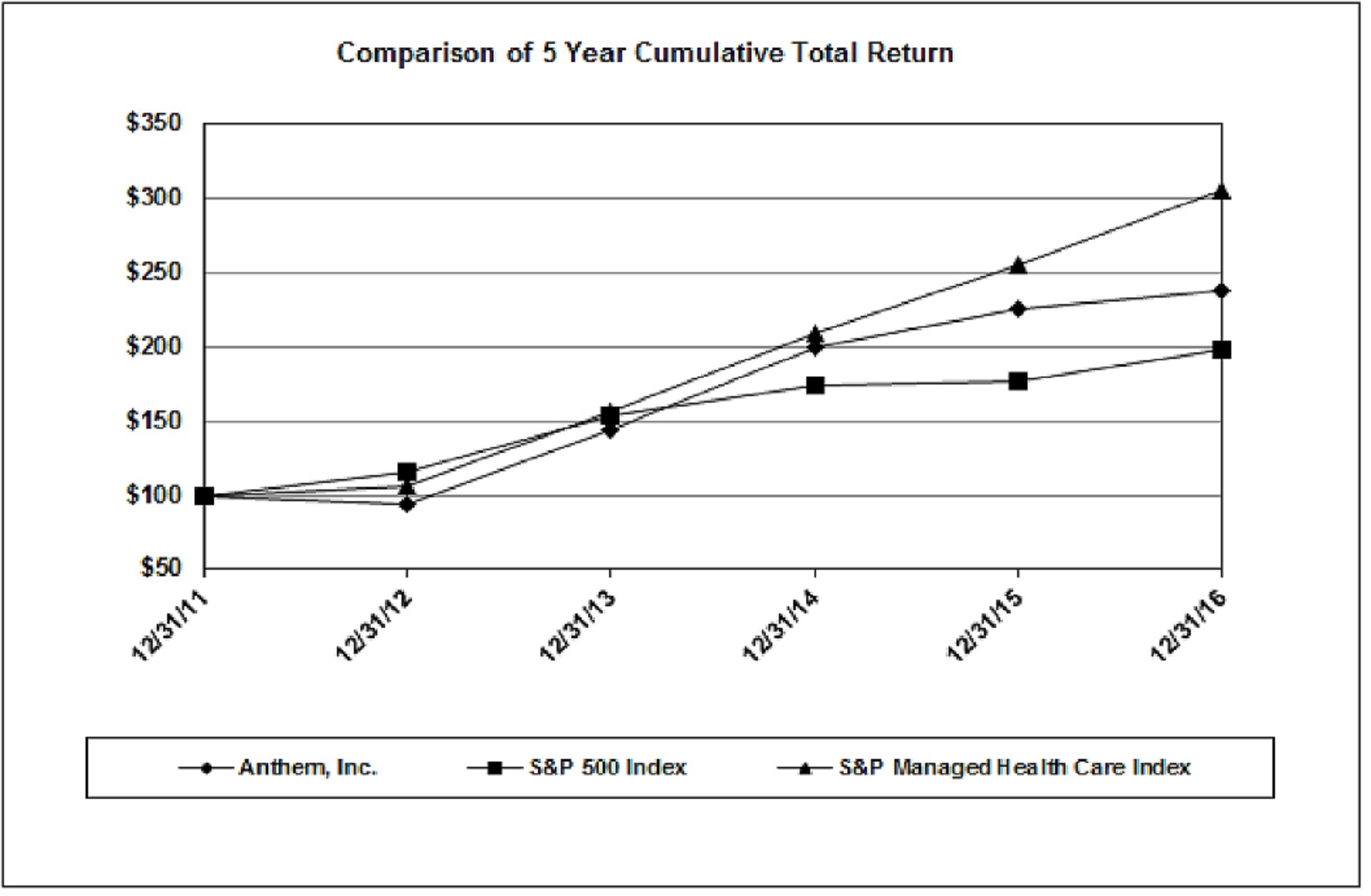]
| | | [removed: 2010 | | | |] 2011 | | | | 2012 | | | | 2013 | | | | 2014 | | | | 2015 | | | [added: | 2016 | | |]
Based upon an initial investment of $100 on December 31, [removed: 2010] [added: 2011] with dividends reinvested.
| 2016 | | | | | | | |
| First Quarter | $ | 144.69 | | | $ | 115.63 | |
| Second Quarter | 148.00 | | | | 122.91 | | |
| Third Quarter | 143.18 | | | | 122.52 | | |
| Fourth Quarter | 148.26 | | | | 114.85 | | |
| October 1, 2016 to October 31, 2016 | | | 7,712 | | | $ | 123.03 | | | — | | | $ | 4,175.9 | |
| November 1, 2016 to November 30, 2016 | | | 963 | | | 121.52 | | | | — | | | 4,175.9 | | |
| December 1, 2016 to December 31, 2016 | | | 7,765 | | | 144.80 | | | | — | | | 4,175.9 | | |
| | | | 16,440 | | | | | | | — | | | | | |
| Anthem, Inc. | | $ | 100 | | | $ | 94 | | | $ | 145 | | | $ | 200 | | | $ | 226 | | | $ | 237 | |
| S&P 500 Index | | 100 | | | | 116 | | | | 154 | | | | 175 | | | | 177 | | | | 198 | | |
| S&P Managed Health Care Index | | 100 | | | | 106 | | | | 157 | | | | 209 | | | | 255 | | | | 305 | | |
\-43\-
| 2014 | | | | | | | |
| First Quarter | $ | 102.56 | | | $ | 81.84 | |
| Second Quarter | 110.03 | | | | 90.75 | | |
| Third Quarter | 124.58 | | | | 106.52 | | |
| Fourth Quarter | 129.96 | | | | 108.92 | | |
\-40\-
| October 1, 2015 to October 31, 2015 | | | 7,561 | | | $ | 139.03 | | | — | | | $ | 4,175.9 | |
| November 1, 2015 to November 30, 2015 | | | 893 | | | 138.66 | | | | — | | | 4,175.9 | | |
| December 1, 2015 to December 31, 2015 | | | 9,096 | | | 135.08 | | | | — | | | 4,175.9 | | |
| | | | 17,550 | | | | | | | — | | | | | |
| Anthem, Inc. | | $ | 100 | | | $ | 118 | | | $ | 111 | | | $ | 171 | | | $ | 236 | | | $ | 267 | |
| S&P 500 Index | | 100 | | | | 102 | | | | 118 | | | | 157 | | | | 178 | | | | 181 | | |
| S&P Managed Health Care Index | | 100 | | | | 134 | | | | 142 | | | | 211 | | | | 281 | | | | 343 | | |
Item 6. SELECTED FINANCIAL DATA.
21 rewritten, 1 added, 7 removed, 25 unchanged
Read the full itemFY2016 item · filed February 22, 2017FY2015 item · filed February 19, 2016
The information has been derived from our consolidated financial statements for each of the years in the five year period ended December 31, [removed: 2015.][added: 2016.]
You should read this selected consolidated financial data in conjunction with the audited consolidated financial statements and notes as of and for the year ended December 31, [removed: 2015] [added: 2016] included in Part II, Item 8 “Financial Statements and Supplementary [removed: Data”,] [added: Data,”] and Part II, Item 7 “Management’s Discussion and Analysis of Financial Condition and Results of Operations” included in this Annual Report on Form 10-K.
| | | [added: 2016 | | | |] 2015 1 | | | | 2014 2 | | | | 2013 2 | | | | 2012 1, 2 | | | [removed: | 2011 1 | | |]
| Total operating revenue3 | | $ | [removed: 78,404.8] [added: 84,194.0] | | | $ | [removed: 73,021.7] [added: 78,404.8] | | | $ | [removed: 70,191.4] [added: 73,021.7] | | | $ | [removed: 60,514.0] [added: 70,191.4] | | | $ | [removed: 59,865.2] [added: 60,514.0] | |
| Total revenues | | [removed: 79,156.5] [added: 84,863.0] | | | | [removed: 73,874.1] [added: 79,156.5] | | | | [removed: 71,023.5] [added: 73,874.1] | | | | [removed: 61,497.2] [added: 71,023.5] | | | | [removed: 60,710.7] [added: 61,497.2] | | |
| Income from continuing operations | | [removed: 2,560.0] [added: 2,469.8] | | | | [removed: 2,560.1] [added: 2,560.0] | | | | [removed: 2,634.3] [added: 2,560.1] | | | | [removed: 2,651.0] [added: 2,634.3] | | | | [removed: 2,646.7] [added: 2,651.0] | | |
| Net income | | [removed: 2,560.0] [added: 2,469.8] | | | | [removed: 2,569.7] [added: 2,560.0] | | | | [removed: 2,489.7] [added: 2,569.7] | | | | [removed: 2,655.5] [added: 2,489.7] | | | | [removed: 2,646.7] [added: 2,655.5] | | |
| Basic net income per share - continuing operations | | $ | [removed: 9.73] [added: 9.39] | | | $ | [removed: 9.28] [added: 9.73] | | | $ | [removed: 8.83] [added: 9.28] | | | $ | [removed: 8.25] [added: 8.83] | | | $ | [removed: 7.35] [added: 8.25] | |
| Diluted net income per share - continuing operations | | [removed: 9.38] [added: 9.21] | | | | [removed: 8.96] [added: 9.38] | | | | [removed: 8.67] [added: 8.96] | | | | [removed: 8.17] [added: 8.67] | | | | [removed: 7.25] [added: 8.17] | | |
| Dividends per share | | [removed: 2.50] [added: 2.60] | | | | [removed: 1.75] [added: 2.50] | | | | [removed: 1.50] [added: 1.75] | | | | [removed: 1.15] [added: 1.50] | | | | [removed: 1.00] [added: 1.15] | | |
| Benefit expense ratio4 | | [removed: 83.3] [added: 84.8] | | % | | [removed: 83.1] [added: 83.3] | | % | | [removed: 85.1] [added: 83.1] | | % | | [removed: 85.3] [added: 85.1] | | % | | [removed: 85.1] [added: 85.3] | | % |
| Selling, general and administrative expense ratio5 | | [removed: 16.0] [added: 14.9] | | % | | [removed: 16.1] [added: 16.0] | | % | | [removed: 14.2] [added: 16.1] | | % | | [removed: 14.3] [added: 14.2] | | % | | [removed: 14.1] [added: 14.3] | | % |
| Income from continuing operations before income taxes as a percentage of total revenues | | [removed: 5.9] [added: 5.4] | | % | | 5.9 | | % | | [removed: 5.4] [added: 5.9] | | % | | [removed: 6.3] [added: 5.4] | | % | | [removed: 6.5] [added: 6.3] | | % |
| Net income as a percentage of total revenues | | [removed: 3.2] [added: 2.9] | | % | | [removed: 3.5] [added: 3.2] | | % | | 3.5 | | % | | [removed: 4.3] [added: 3.5] | | % | | [removed: 4.4] [added: 4.3] | | % |
| Medical membership (in thousands) | | [removed: 38,599] [added: 39,919] | | | | [removed: 37,499] [added: 38,599] | | | | [removed: 35,653] [added: 37,499] | | | | [removed: 36,130] [added: 35,653] | | | | [removed: 34,251] [added: 36,130] | | |
| Cash and investments | | $ | [removed: 23,124.7] [added: 25,519.0] | | | $ | [removed: 23,777.7] [added: 23,124.7] | | | $ | [removed: 22,395.9] [added: 23,777.7] | | | $ | [removed: 22,464.6] [added: 22,395.9] | | | $ | [removed: 20,696.5] [added: 22,464.6] | |
| Total [removed: assets6, 7] [added: assets] | | [removed: 61,717.8] [added: 65,083.1] | | | | [removed: 61,676.3] [added: 61,717.8] | | | | [removed: 59,095.3] [added: 61,676.3] | | | | [removed: 58,610.7] [added: 59,095.3] | | | | [removed: 51,693.6] [added: 58,610.7] | | |
| Long-term debt, less current [removed: portion6] [added: portion] | | [removed: 15,324.5] [added: 14,358.5] | | | | [removed: 14,019.6] [added: 15,324.5] | | | | [removed: 13,477.4] [added: 14,019.6] | | | | [removed: 14,069.3] [added: 13,477.4] | | | | [removed: 8,420.9] [added: 14,069.3] | | |
| Total [removed: liabilities6, 7] [added: liabilities] | | [removed: 38,673.7] [added: 39,982.7] | | | | [removed: 37,425.0] [added: 38,673.7] | | | | [removed: 34,330.1] [added: 37,425.0] | | | | [removed: 34,808.0] [added: 34,330.1] | | | | [removed: 28,405.4] [added: 34,808.0] | | |
| Total shareholders’ equity | | [removed: 23,044.1] [added: 25,100.4] | | | | [removed: 24,251.3] [added: 23,044.1] | | | | [removed: 24,765.2] [added: 24,251.3] | | | | [removed: 23,802.7] [added: 24,765.2] | | | | [removed: 23,288.2] [added: 23,802.7] | | |
| 1 | The net assets of and results of operations for Simply Healthcare Holdings, [removed: Inc.,] [added: Inc. and] AMERIGROUP Corporation [removed: and CareMore Health Group, Inc.] are included from their respective acquisition dates of February 17, [removed: 2015,] [added: 2015 and] December 24, [removed: 2012 and August 22, 2011.] [added: 2012.] |
\-44\-
| | |
| --- | --- |
| | |
| --- | --- |
| 6 | Amounts as of December 31, 2014, 2013, 2012 and 2011 have been retroactively restated to reflect the reclassification of unamortized debt issuance costs from an asset to a contra-liability as a result of the adoption of Accounting Standards Update No. 2015-03, Interest—Imputation of Interest (Subtopic 835-30): Simplifying the Presentation of Debt Issuance Costs, during the year ended December 31, 2015. |
| 7 | Amounts as of December 31, 2014, 2013, 2012 and 2011 have been retroactively restated to reflect the reclassification of current deferred tax assets from an asset to a contra-liability as a result of the adoption of Accounting Standards Update No. 2015-07, Balance Sheet Classification of Deferred Taxes, during the year ended December 31, 2015. |
\-43\-
Item 8. FINANCIAL STATEMENTS AND SUPPLEMENTARY DATA.
738 rewritten, 421 added, 297 removed, 1,378 unchanged
Read the full itemFY2016 item · filed February 22, 2017FY2015 item · filed February 19, 2016
Years ended December 31, [removed: 2015, 2014] [added: 2016, 2015] and [removed: 2013][added: 2014]
| Report of Independent Registered Public Accounting Firm | [removed: [80](#s7F70D43D0167528DAA0F39044ED6F902)] [added: [81](#s6512EF9664B35DFBBDA437BC8D8D1273)] |
| Consolidated Balance Sheets | [removed: [81](#s7D4DD6E42D0F5C7180A342615B62AA08)] [added: [82](#sBEAE202D755B5E61B036F4E797346CC3)] |
| Consolidated Statements of Income | [removed: [82](#s78C880E752E7581FB3CB6B9717CFA92C)] [added: [83](#s0DC9CFAF0A105701B5A18FB3F6AC7A67)] |
| Consolidated Statements of Comprehensive Income | [removed: [83](#s96441C34C6BB57F38C50D4708AC89E79)] [added: [84](#sE1DCD9D02E9E56208AE87A8FBC2B862D)] |
| Consolidated Statements of Cash Flows | [removed: [84](#s5B91749A84AB573B953D9607A6D26AC6)] [added: [85](#sB6B2118F9EF2575ABD85BFFD7B5D5E9A)] |
| Consolidated Statements of Shareholders’ Equity | [removed: [85](#s4CCF27FABA4E5A6A8FC922976FB152AF)] [added: [86](#sC84144B5513A5419A0C545EA4C0645F6)] |
| Notes to Consolidated Financial Statements | [removed: [86](#s1D2457CD151356A795034579EFC47472)] [added: [87](#s8959725BAD0451D286B093B4640C5C2E)] |
We have audited the accompanying consolidated balance sheets of Anthem, Inc. (the “Company”) as of December 31, [removed: 2015] [added: 2016] and [removed: 2014,] [added: 2015,] and the related consolidated statements of income, comprehensive income, shareholders’ equity, and cash flows for each of the three years in the period ended December 31, [removed: 2015.][added: 2016.]
In our opinion, the financial statements referred to above present fairly, in all material respects, the consolidated financial position of Anthem, Inc. at December 31, [removed: 2015] [added: 2016] and [removed: 2014,] [added: 2015,] and the consolidated results of its operations and its cash flows for each of the three years in the period ended December 31, [removed: 2015,] [added: 2016,] in conformity with U.S. generally accepted accounting principles.
We also have audited, in accordance with the standards of the Public Company Accounting Oversight Board (United States), Anthem, Inc.’s internal control over financial reporting as of December 31, [removed: 2015,] [added: 2016,] based on criteria established in Internal Control—Integrated Framework issued by the Committee of Sponsoring Organizations of the Treadway Commission (2013 framework) and our report dated February [removed: 19, 2016] [added: 22, 2017] expressed an unqualified opinion thereon.
[added: |] February [removed: 19,] [added: 18,] 2016 [added: | | March 10, 2016 | | March 25, 2016 | | $ | 0.6500 | | | $ | 170.7 | |]
| | December 31, [removed: 2015] [added: 2016] | | | | December 31, [removed: 2014] [added: 2015] | | |
| Cash and cash equivalents | $ | [removed: 2,113.5] [added: 4,075.3] | | | $ | [removed: 2,151.7] [added: 2,113.5] | |
| Fixed maturity securities (amortized cost of [removed: $16,950.0] [added: $16,991.8] and [removed: $17,120.4)] [added: $16,950.0)] | [removed: 16,920.0] [added: 17,163.1] | | | | [removed: 17,467.4] [added: 16,920.0] | | |
| Equity securities (cost of [removed: $1,055.8] [added: $1,076.1] and [removed: $1,303.7)] [added: $1,055.8)] | [removed: 1,441.8] [added: 1,468.5] | | | | [removed: 1,906.6] [added: 1,441.8] | | |
| Other invested assets, current | [removed: 19.1] [added: 15.8] | | | | [removed: 20.2] [added: 19.1] | | |
| Accrued investment income | [removed: 170.8] [added: 164.5] | | | | [removed: 161.4] [added: 170.8] | | |
| Premium and self-funded receivables | [removed: 4,602.8] [added: 5,860.8] | | | | [removed: 4,825.5] [added: 4,602.8] | | |
| Other receivables | [removed: 2,421.4] [added: 2,536.6] | | | | [removed: 2,117.0] [added: 2,421.4] | | |
| Income taxes receivable | [removed: 316.6] [added: 168.7] | | | | [removed: 308.9] [added: 316.6] | | |
| Securities lending collateral | [removed: 1,300.4] [added: 1,079.8] | | | | [removed: 1,515.2] [added: 1,300.4] | | |
| Other current assets | [removed: 1,555.7] [added: 1,781.8] | | | | [removed: 1,473.9] [added: 1,555.7] | | |
| Total current assets | [removed: 30,862.1] [added: 34,314.9] | | | | [removed: 31,947.8] [added: 30,862.1] | | |
| Fixed maturity securities (amortized cost of [removed: $550.4] [added: $524.6] and [removed: $500.7)] [added: $550.4)] | [removed: 558.2] [added: 524.4] | | | | [removed: 504.4] [added: 558.2] | | |
| Equity securities (cost of [removed: $27.3] [added: $27.2] and [removed: $27.0)] [added: $27.3)] | [removed: 31.0] [added: 31.4] | | | | [removed: 31.5] [added: 31.0] | | |
| Other invested assets, long-term | [removed: 2,041.1] [added: 2,240.5] | | | | [removed: 1,695.9] [added: 2,041.1] | | |
| Property and equipment, net | [removed: 2,019.8] [added: 1,977.9] | | | | [removed: 1,944.3] [added: 2,019.8] | | |
| Goodwill | [removed: 17,562.2] [added: 17,561.2] | | | | [removed: 17,082.0] [added: 17,562.2] | | |
| Other intangible assets | [removed: 8,158.0] [added: 7,964.9] | | | | [removed: 7,958.1] [added: 8,158.0] | | |
| Other noncurrent assets | [removed: 485.4] [added: 467.9] | | | | [removed: 512.3] [added: 485.4] | | |
| Total assets | $ | [removed: 61,717.8] [added: 65,083.1] | | | $ | [removed: 61,676.3] [added: 61,717.8] | |
| Medical claims payable | $ | [removed: 7,569.8] [added: 7,892.6] | | | $ | [removed: 6,861.2] [added: 7,569.8] | |
| Reserves for future policy benefits | [removed: 71.9] [added: 71.8] | | | | [removed: 68.1] [added: 71.9] | | |
| Other policyholder liabilities | [removed: 2,256.5] [added: 2,221.1] | | | | [removed: 2,626.5] [added: 2,256.5] | | |
| Total policy liabilities | [removed: 9,898.2] [added: 10,185.5] | | | | [removed: 9,555.8] [added: 9,898.2] | | |
| Unearned income | [removed: 1,145.5] [added: 971.9] | | | | [removed: 1,078.1] [added: 1,145.5] | | |
| Accounts payable and accrued expenses | [removed: 3,318.8] [added: 4,014.9] | | | | [removed: 3,651.8] [added: 3,318.8] | | |
| Security trades pending payable | [removed: 73.1] [added: 93.5] | | | | [removed: 66.2] [added: 73.1] | | |
| Securities lending payable | [removed: 1,300.9] [added: 1,078.9] | | | | [removed: 1,515.3] [added: 1,300.9] | | |
February 22, 2017
| Change in collateral and settlements of debt-related derivatives | (360.4 | | ) | | — | | | | — | | |
| Equity Units issuance costs adjustment | — | | | — | | | | 0.3 | | | | — | | | | — | | | | 0.3 | | |
| December 31, 2016 | 263.7 | | | $ | 2.6 | | | $ | 8,805.1 | | | $ | 16,560.6 | | | $ | (267.9 | ) | | $ | 25,100.4 | |
December 31, 2016
We also conduct business through arrangements with other BCBS licensees in South Carolina and Western New York.
Under this process, historical paid claims data is formatted into “claim triangles,” which compare claim incurred dates to the dates of claim payments.
This information is analyzed to create “completion factors” that represent the average percentage of total incurred claims that have been paid through a given date after being incurred.
Completion factors are applied to claims paid through the period end date to estimate the ultimate claim expense incurred for the period.
Actuarial estimates of incurred but not paid claim liabilities are then determined by subtracting the actual paid claims from the estimate of the ultimate incurred claims.
For the most recent incurred months (typically the most recent two months), the percentage of claims paid for claims incurred in those months is generally low.
This makes the completion factor methodology less reliable for such months.
Therefore, incurred claims for recent months are not projected from historical completion and payment patterns; rather they
are projected by estimating the claims expense for those months based on recent claims expense levels and health care trend levels, or “trend factors.”
Benefit expense includes incurred medical claims as well as quality improvement expenses for our fully-insured members.
Quality improvement activities are those designed to improve member health outcomes, prevent hospital readmissions and improve patient safety.
They also include expenses for wellness and health promotion provided to our members.
adjustment, reinsurance and risk corridor or contractual premium stabilization programs.
For 2019 and beyond, the annual HIP
ASU 2015-05 became effective January 1, 2016 and we elected to adopt the provisions of the new guidance prospectively to all arrangements entered into or materially modified on or after January 1, 2016.
We adopted the provisions of ASU 2015-02 effective January 1, 2016 and re-evaluated all legal entity investments under the revised consolidation model.
Recent Accounting Guidance Not Yet Adopted: In December 2016, the FASB issued Accounting Standards Update No. 2016-20, Technical Corrections and Improvements to Topic 606, Revenue from Contracts with Customers, or ASU 2016-20.
In May 2016, the FASB issued Accounting Standards Update No. 2016-12, Revenue from Contracts With Customers (Topic 606): Narrow-Scope Improvements and Practical Expedients, or ASU 2016-12.
In March 2016, the FASB issued Accounting Standards Update No. 2016-08, Revenue from Contracts with Customers (Topic 606): Principal versus Agent Considerations (Reporting Revenue Gross verses Net), or ASU 2016-08.
The amendments in ASU 2016-20 provide technical corrections to various implementation examples and clarifying guidance on the treatment of capitalized advertising costs, impairment testing of capitalized contract costs, performance obligation disclosures and scope exceptions.
The amendments in ASU 2016-12 provide clarifying guidance on assessing collectability; noncash consideration; presentation of sales taxes; and transition.
The amendments in ASU 2016-10 provide clarifying guidance on the materiality and evaluation of performance obligations; treatment of shipping and handling costs; and determining whether an entity's promise to grant a license provides a customer with either a right to use or a right to access an entity's intellectual property.
The amendments in ASU 2016-08 clarify how an entity should identify the specified good or service for the principal versus agent evaluation and how it should apply the control principle to certain types of
arrangements.
Our administrative service and other contracts that will be subject to these Accounting Standards Updates are recorded in the Administrative fees and Other revenue line items on our consolidated statements of income and represent approximately 6.0% of our consolidated total operating revenue on our consolidated statements of income at December 31, 2016.
The new guidance permits adoption through either a full retrospective approach or a modified retrospective approach with a cumulative effect adjustment to retained earnings.
We are still in the process of evaluating the impact that these updates will have on our results of operations, cash flows, consolidated financial position and related disclosures and the method of adoption we will ultimately choose.
In November 2016, the FASB issued Accounting Standards Update No. 2016-18, Statement of Cash Flows (Topic 230): Restricted Cash, or ASU 2016-18.
This update amends ASC Topic 230 to add or clarify guidance on the classification and presentation of restricted cash in the statement of cash flows.
The guidance requires entities to show the changes in the total of cash, cash equivalents, restricted cash and restricted cash equivalent in the statement of cash flows.
The guidance will be applied retrospectively and is effective for annual periods beginning after December 15, 2017, and interim periods within those years, with early adoption permitted.
We are currently evaluating the effects the adoption of ASU 2016-18 will have on our consolidated statements of cash flows, if any.
ASU 2016-18 will not impact our results of operations.
In August 2016, the FASB issued Accounting Standards Update No. 2016-15, Statement of Cash Flows (Topic 230): Classification of Certain Cash Receipts and Cash Payments, or ASU 2016-15.
This update addresses the presentation and classification on the statement of cash flows for eight specific items, with the objective of reducing existing diversity in practice in how certain cash receipts and cash payments are presented and classified.
\-79\-
| Less cash and cash equivalents of discontinued operations at end of year | — | | | | — | | | | (4.8 | | ) |
| Cash and cash equivalents of continuing operations at end of year | $ | 2,113.5 | | | $ | 2,151.7 | | | $ | 1,582.1 | |
| January 1, 2013 | 304.7 | | | $ | 3.0 | | | $ | 10,853.5 | | | $ | 12,647.1 | | | $ | 299.1 | | | $ | 23,802.7 | |
| Premiums paid on equity options | — | | | — | | | | (7.9 | | ) | | — | | | | — | | | | (7.9 | | ) |
| Repurchase and retirement of common stock | (20.7 | ) | | (0.1 | | ) | | (749.5 | | ) | | (870.5 | | ) | | — | | | | (1,620.1 | | ) |
| Convertible debentures tax adjustment | — | | | — | | | | (3.3 | | ) | | — | | | | — | | | | (3.3 | | ) |
December 31, 2015
We also conduct business through an arrangement with another BCBS licensee in South Carolina.
Determination of
We charge these self-funded groups an
Recently Adopted Accounting Guidance: In November 2015, the FASB issued Accounting Standards Update No. 2015-17, Balance Sheet Classification of Deferred Taxes, or ASU 2015-17.
This amendment requires that all deferred tax assets and liabilities, along with any related valuation allowance, be classified as noncurrent on the balance sheet.
Prior to the
issuance of ASU 2015-17, deferred taxes were required to be presented as a net current asset or liability and a net noncurrent asset or liability.
We adopted the provisions of ASU 2015-17 upon issuance and prior period amounts have been reclassified to conform to the current period presentation.
As of December 31, 2014, the previously reported balance of our net current deferred tax assets of $280.4 was reclassified in the consolidated balance sheet and netted against the net long-term deferred tax liabilities.
In September 2015, the FASB issued Accounting Standards Update No. 2015-16, Business Combinations (Topic 805): Simplifying the Accounting for Measurement-Period Adjustments, or ASU 2015-16.
This amendment requires the acquirer in a business combination to recognize in the reporting period in which adjustment amounts are determined, any adjustments to provisional amounts that are identified during the measurement period, calculated as if the accounting had been completed at the acquisition date.
Prior to the issuance of ASU 2015-16, an acquirer was required to restate prior period financial statements as of the acquisition date for adjustments to provisional amounts.
The amendments in ASU 2015-16 are to be applied prospectively upon adoption.
In April 2015, the FASB issued Accounting Standards Update No. 2015-03, Interest - Imputation of Interest (Subtopic 835-30): Simplifying the Presentation of Debt Issuance Costs, or ASU 2015-03.
ASU 2015-03 amends current presentation guidance by requiring that debt issuance costs related to a recognized debt liability be presented in the balance sheet as a direct deduction from the carrying amount of that debt liability, consistent with debt discounts.
Prior to the issuance of ASU 2015-03, debt issuance costs were required to be presented as an asset in the balance sheet.
We adopted the provisions of ASU 2015-03 upon issuance and prior period amounts have been reclassified to conform to the current period presentation.
As of December 31, 2014, $0.7 of debt issuance costs were reclassified in the consolidated balance sheet from other current assets to current portion of long-term debt and $107.6 was reclassified from other noncurrent assets to long-term debt, less current portion.
In June 2014, the FASB issued Accounting Standards Update No. 2014-11, Transfers and Servicing (Topic 860): Repurchase-to-Maturity Transactions, Repurchase Financings, and Disclosures, or ASU 2014-11.
This amendment requires repurchase-to-maturity transactions to be accounted for as secured borrowings and eliminates previous guidance for repurchase financings.
The amendment also expands the disclosure requirements related to certain transactions accounted for as secured borrowings and certain transfers accounted for as sales when the transferor also retains substantially all of the exposure to the economic return on the transferred financial assets throughout the term of the transaction.
The amendments related to the accounting of, and disclosure requirements for, certain transactions accounted for as a sale became effective as of January 1, 2015 and did not have an impact on our consolidated financial position, results of operations, cash flows or disclosures.
The new disclosure requirements for repurchase agreements, securities lending transactions and repurchase-to-maturity transactions accounted for as secured borrowings became effective as of April 1, 2015.
See Note 4, "Investments - Securities Lending Programs," for additional disclosure information related to the adoption of ASU 2014-11.
Earlier application is permitted for interim and annual reporting
periods beginning after December 15, 2016.
An entity has the option to apply the provisions of ASU 2014-09 either retrospectively to each prior reporting period presented or retrospectively with the cumulative effect of initially applying the new guidance recognized at the date of initial application.
Upon adoption, an entity has the option to apply the provisions of ASU 2015-05 either prospectively to all arrangements entered into or materially modified, or retrospectively.
The adoption of ASU 2015-05 is not expected to have a material impact on our consolidated financial position, results of operations or cash flows.
All legal entities are subject to reevaluation under the revised consolidation model.
The adoption of ASU 2015-02 is not expected to have a material impact on our consolidated financial position, results of operations or cash flows.
vision, supplemental benefits, and other related products including group life, accident and disability insurance.
An excerpt. Shown here: 40 of 738 rewritten, 40 of 421 added and 40 of 297 removed. The counts are complete. For every sentence, read Item 8. FINANCIAL STATEMENTS AND SUPPLEMENTARY DATA. in the FY2016 filing and the FY2015 filing.
Item 9A. CONTROLS AND PROCEDURES.
12 rewritten, 7 added, 10 removed, 25 unchanged
Read the full itemFY2016 item · filed February 22, 2017FY2015 item · filed February 19, 2016
We carried out an evaluation as of December 31, [removed: 2015,] [added: 2016,] under the supervision and with the participation of our management, including our Chief Executive Officer and Chief Financial Officer, of the effectiveness of the design and operation of our disclosure controls and procedures as defined in Rule 13a-15(e) of the Exchange Act.
Based upon that evaluation, [removed: the] [added: our] Chief Executive Officer and Chief Financial Officer concluded that our disclosure controls and procedures are effective in timely alerting them to material information relating to us (including our consolidated subsidiaries) required to be disclosed in our reports under the Exchange Act.
In addition, based on that evaluation, [removed: the] [added: our] Chief Executive Officer and Chief Financial Officer concluded that our disclosure controls and procedures were effective in ensuring that information required to be disclosed by us in the reports that we file or submit under the Exchange Act is accumulated and communicated to our management, including [removed: the] [added: our] Chief Executive Officer and Chief Financial Officer, as appropriate to allow timely decisions regarding required disclosures.
[removed: The Company’s Internal Control includes those policies and procedures that (i) pertain to the maintenance of records that in reasonable detail accurately and fairly reflect the transactions and] dispositions of the assets of the [removed: Company; (ii)] [added: company; (2)] provide reasonable assurance that transactions are recorded as necessary to permit preparation of financial statements in accordance with [removed: GAAP,] [added: generally accepted accounting principles,] and that receipts and expenditures of the [removed: Company] [added: company] are being made only in accordance with authorizations of management and directors of the [removed: Company;] [added: company;] and [removed: (iii)] [added: (3)] provide reasonable assurance regarding prevention or timely detection of unauthorized acquisition, [removed: use] [added: use,] or disposition of the [removed: Company’s] [added: company’s] assets that could have a material effect on the financial statements.
Management, under the supervision and with the participation of the principal executive officer and principal financial officer, assessed the effectiveness of the Company’s Internal Control as of December 31, [removed: 2015.][added: 2016.]
Based on management’s assessment, [removed: which excluded an assessment of Internal Control of the acquired operations of Simply Healthcare Holdings, Inc.,] management has concluded that the Company’s Internal Control was effective as of December 31, [removed: 2015] [added: 2016] to provide reasonable assurance regarding the reliability of financial reporting and the preparation of financial statements for external reporting purposes in accordance with GAAP.
Ernst & Young LLP, the Company’s independent registered public accounting firm, has audited the consolidated financial statements of the Company for the year ended December 31, [removed: 2015,] [added: 2016,] and has also issued an audit report dated February [removed: 19, 2016,] [added: 22, 2017,] on the effectiveness of the Company’s internal control over financial reporting as of December 31, [removed: 2015,] [added: 2016,] which is included in this Annual Report on Form 10-K.
There have been no changes in our internal control over financial reporting that occurred during the three months ended December 31, [removed: 2015] [added: 2016] that have materially affected, or are reasonably likely to materially affect, our internal control over financial reporting.
We have audited Anthem, Inc.’s internal control over financial reporting as of December 31, [removed: 2015,] [added: 2016,] based on criteria established in Internal Control–Integrated Framework issued by the Committee of Sponsoring Organizations of the Treadway Commission (2013 framework) (the COSO criteria).
[removed: A company’s internal control over financial reporting includes those policies and procedures that (1) pertain to the maintenance of records that, in reasonable detail, accurately and fairly reflect the transactions and dispositions of the assets of the company; (2) provide reasonable assurance that transactions are recorded as necessary to permit preparation of financial statements in] accordance with [removed: generally accepted accounting principles,] [added: GAAP,] and that receipts and expenditures of the [removed: company] [added: Company] are being made only in accordance with authorizations of management and directors of the [removed: company;] [added: Company;] and [removed: (3)] [added: (iii)] provide reasonable assurance regarding prevention or timely detection of unauthorized acquisition, [removed: use,] [added: use] or disposition of the [removed: company’s] [added: Company’s] assets that could have a material effect on the financial statements.
In our opinion, Anthem, Inc. maintained, in all material respects, effective internal control over financial reporting as of December 31, [removed: 2015,] [added: 2016,] based on the COSO criteria.
We also have audited, in accordance with the standards of the Public Company Accounting Oversight Board (United States), the consolidated balance sheets of Anthem, Inc. as of December 31, [removed: 2015] [added: 2016] and [removed: 2014,] [added: 2015,] and the related consolidated statements of income, comprehensive income, shareholders’ equity, and cash flows for each of the three years in the period ended December 31, [removed: 2015] [added: 2016] of Anthem, Inc. and our report dated February [removed: 19, 2016] [added: 22, 2017] expressed an unqualified opinion thereon.
The Company’s Internal Control includes those policies and procedures that (i) pertain to the maintenance of records that in reasonable detail accurately and fairly reflect the transactions and dispositions of the assets of the Company; (ii) provide reasonable assurance that transactions are recorded as necessary to permit preparation of financial statements in
\-150\-
| /S/ JOSEPH R. SWEDISH | | /S/ JOHN E. GALLINA |
A company’s internal control over financial reporting includes those policies and procedures that (1) pertain to the maintenance of records that, in reasonable detail, accurately and fairly reflect the transactions and
\-151\-
February 22, 2017
\-152\-
\-145\-
The Company completed its acquisition of Simply Healthcare Holdings, Inc. on February 17, 2015.
As permitted by the U.S. Securities and Exchange Commission, management's assessment as of December 31, 2015 did not include the Internal Control of the former Simply Healthcare Holdings, Inc., whose balance sheet is included in the Company's consolidated financial statements as of December 31, 2015.
Such operations of Simply Healthcare Holdings, Inc. constituted $249.6 million and $87.2 million of the Company's total assets and net assets, respectively, as of December 31, 2015, and $1,090.6 million and $18.7 million of the Company's operating revenue and net income, respectively, for the year then ended.
| /S/ JOSEPH R. SWEDISH | | /S/ WAYNE S. DEVEYDT |
\-146\-
As indicated in the accompanying Management's Report on Internal Control Over Financial Reporting, management's assessment of and conclusion on the effectiveness of internal control over financial reporting did not include the internal controls of the former Simply Healthcare Holdings, Inc., which is included in the 2015 consolidated financial statements of Anthem, Inc. and constituted $249.6 million and $87.2 million of total and net assets, respectively, as of December 31, 2015 and $1,090.6 million and $18.7 million of operating revenues and net income, respectively, for the year then ended.
Our audit of internal controls over financial reporting of Anthem, Inc. also did not include an evaluation of the internal controls over financial reporting of Simply Healthcare Holdings, Inc.
February 19, 2016
\-147\-
Item 10. DIRECTORS, EXECUTIVE OFFICERS AND CORPORATE GOVERNANCE.
1 rewritten, 0 added, 0 removed, 0 unchanged
Read the full itemFY2016 item · filed February 22, 2017FY2015 item · filed February 19, 2016
The information required by this Item concerning our Executive Officers, Directors and nominees for Director, Audit Committee members and financial expert(s) and concerning disclosure of delinquent filers under Section 16(a) of the Exchange Act and our Standards of Business Conduct is incorporated herein by reference from our definitive Proxy Statement for our [removed: 2016] [added: 2017] Annual Meeting of Shareholders, which will be filed with the SEC pursuant to Regulation 14A within 120 days after the end of our last fiscal year.
Item 11. EXECUTIVE COMPENSATION.
1 rewritten, 0 added, 0 removed, 0 unchanged
Read the full itemFY2016 item · filed February 22, 2017FY2015 item · filed February 19, 2016
The information required by this Item concerning remuneration of our Executive Officers and Directors, material transactions involving such Executive Officers and Directors and Compensation Committee interlocks, as well as the Compensation Committee Report, are incorporated herein by reference from our definitive Proxy Statement for our [removed: 2016] [added: 2017] Annual Meeting of Shareholders, which will be filed with the SEC pursuant to Regulation 14A within 120 days after the end of our last fiscal year.
Item 12. SECURITY OWNERSHIP OF CERTAIN BENEFICIAL OWNERS AND MANAGEMENT AND RELATED STOCKHOLDER MATTERS.
1 rewritten, 0 added, 0 removed, 0 unchanged
Read the full itemFY2016 item · filed February 22, 2017FY2015 item · filed February 19, 2016
The information required by this Item concerning the stock ownership of management and five percent beneficial owners and securities authorized for issuance under equity compensation plans is incorporated herein by reference from our definitive Proxy Statement for our [removed: 2016] [added: 2017] Annual Meeting of Shareholders, which will be filed with the SEC pursuant to Regulation 14A within 120 days after the end of our last fiscal year.
Item 13. CERTAIN RELATIONSHIPS AND RELATED TRANSACTIONS, AND DIRECTOR INDEPENDENCE.
1 rewritten, 0 added, 0 removed, 0 unchanged
Read the full itemFY2016 item · filed February 22, 2017FY2015 item · filed February 19, 2016
The information required by this Item concerning certain relationships and related person transactions and director independence is incorporated herein by reference from our definitive Proxy Statement for our [removed: 2016] [added: 2017] Annual Meeting of Shareholders, which will be filed with the SEC pursuant to Regulation 14A within 120 days after the end of our last fiscal year.
Item 14. PRINCIPAL ACCOUNTANT FEES AND SERVICES.
1 rewritten, 1 added, 1 removed, 1 unchanged
Read the full itemFY2016 item · filed February 22, 2017FY2015 item · filed February 19, 2016
The information required by this Item concerning principal accounting fees and services is incorporated herein by reference from our definitive Proxy Statement for our [removed: 2016] [added: 2017] Annual Meeting of Shareholders, which will be filed with the SEC pursuant to Regulation 14A within 120 days after the end of our last fiscal year.
\-153\-
\-148\-
Item 15. EXHIBITS AND FINANCIAL STATEMENT SCHEDULES.
5 rewritten, 0 added, 397 removed, 17 unchanged
Read the full itemFY2016 item · filed February 22, 2017FY2015 item · filed February 19, 2016
Consolidated Balance Sheets as of December 31, [removed: 2015] [added: 2016] and [removed: 2014][added: 2015]
Consolidated Statements of Income for the years ended December 31, [added: 2016,] 2015, [removed: 2014,] and [removed: 2013][added: 2014]
Consolidated Statements of Comprehensive Income for the years ended December 31, [added: 2016,] 2015, [removed: 2014,] and [removed: 2013][added: 2014]
Consolidated Statements of Shareholders’ Equity for the years ended December 31, [removed: 2015, 2014] [added: 2016, 2015] and [removed: 2013][added: 2014]
Consolidated Statements of Cash Flows for the years ended December 31, [removed: 2015, 2014] [added: 2016, 2015] and [removed: 2013][added: 2014]
2.
3.
\-149\-
Schedule II—Condensed Financial Information of Registrant
Anthem, Inc. (Parent Company Only)
Balance Sheets
| | | | | | | | |
| --- | --- | --- | --- | --- | --- | --- | --- |
| | | | | | | | |
| (In millions, except share data) | December 31, 2015 | | | | December 31, 2014 | | |
| Assets | | | | | | | |
| Current assets: | | | | | | | |
| Cash and cash equivalents | $ | 492.3 | | | $ | 739.8 | |
| Investments available-for-sale, at fair value: | | | | | | | |
| Fixed maturity securities (amortized cost of $889.6 and $1,798.8) | 794.0 | | | | 1,753.4 | | |
| Equity securities (cost of $53.0 and $148.7) | 82.0 | | | | 206.7 | | |
| Other invested assets, current | 5.9 | | | | 5.7 | | |
| Other receivables | 77.0 | | | | 44.6 | | |
| Income taxes receivable | 236.5 | | | | 227.9 | | |
| Net due from subsidiaries | — | | | | 327.3 | | |
| Securities lending collateral | 130.6 | | | | 224.8 | | |
| Other current assets | 394.0 | | | | 232.5 | | |
| Total current assets | 2,212.3 | | | | 3,762.7 | | |
| Long-term investments available-for-sale, at fair value: | | | | | | | |
| Equity securities (cost of $6.5 and $6.6) | 6.5 | | | | 6.6 | | |
| Other invested assets, long-term | 630.1 | | | | 654.5 | | |
| Property and equipment, net | 116.8 | | | | 134.0 | | |
| Deferred tax assets, net | 146.6 | | | | — | | |
| Investments in subsidiaries | 36,524.4 | | | | 35,647.2 | | |
| Other noncurrent assets | 129.8 | | | | 113.0 | | |
| Total assets | $ | 39,766.5 | | | $ | 40,318.0 | |
| Liabilities and shareholders’ equity | | | | | | | |
| Liabilities | | | | | | | |
| Current liabilities: | | | | | | | |
| Accounts payable and accrued expenses | $ | 615.5 | | | $ | 599.9 | |
| Security trades pending payable | 13.4 | | | | 14.0 | | |
| Securities lending payable | 130.6 | | | | 224.8 | | |
| Net due to subsidiaries | 93.2 | | | | — | | |
| Current portion of long-term debt | — | | | | 624.3 | | |
| Other current liabilities | 278.1 | | | | 280.1 | | |
An excerpt. Shown here: all 5 rewritten, all 0 added and 40 of 397 removed. The counts are complete. For every sentence, read Item 15. EXHIBITS AND FINANCIAL STATEMENT SCHEDULES. in the FY2016 filing and the FY2015 filing.
Item 16. FORM 10-K SUMMARY.
0 rewritten, 411 added, 0 removed, 0 unchanged
New section this year
Read the full itemFY2016 item · filed February 22, 2017
None.
\-154\-
Schedule II—Condensed Financial Information of Registrant
Anthem, Inc. (Parent Company Only)
Balance Sheets
| | | | | | | | |
| --- | --- | --- | --- | --- | --- | --- | --- |
| | | | | | | | |
| (In millions, except share data) | December 31, 2016 | | | | December 31, 2015 | | |
| Assets | | | | | | | |
| Current assets: | | | | | | | |
| Cash and cash equivalents | $ | 882.7 | | | $ | 492.3 | |
| Investments available-for-sale, at fair value: | | | | | | | |
| Fixed maturity securities (amortized cost of $463.4 and $889.6) | 477.6 | | | | 794.0 | | |
| Equity securities (cost of $35.7 and $53.0) | 85.5 | | | | 82.0 | | |
| Other invested assets, current | 4.6 | | | | 5.9 | | |
| Other receivables | 47.8 | | | | 77.0 | | |
| Income taxes receivable | 69.0 | | | | 236.5 | | |
| Net due from subsidiaries | 1,394.6 | | | | — | | |
| Securities lending collateral | 39.7 | | | | 130.6 | | |
| Other current assets | 277.0 | | | | 394.0 | | |
| Total current assets | 3,278.5 | | | | 2,212.3 | | |
| Long-term investments available-for-sale, at fair value: | | | | | | | |
| Equity securities (cost of $6.4 and $6.5) | 6.4 | | | | 6.5 | | |
| Other invested assets, long-term | 632.4 | | | | 630.1 | | |
| Property and equipment, net | 142.8 | | | | 116.8 | | |
| Deferred tax assets, net | 107.5 | | | | 146.6 | | |
| Investments in subsidiaries | 37,378.8 | | | | 36,524.4 | | |
| Other noncurrent assets | 87.6 | | | | 129.8 | | |
| Total assets | $ | 41,634.0 | | | $ | 39,766.5 | |
| Liabilities and shareholders’ equity | | | | | | | |
| Liabilities | | | | | | | |
| Current liabilities: | | | | | | | |
| Accounts payable and accrued expenses | $ | 690.2 | | | $ | 615.5 | |
| Security trades pending payable | 18.2 | | | | 13.4 | | |
| Securities lending payable | 39.7 | | | | 130.6 | | |
| Net due to subsidiaries | — | | | | 93.2 | | |
| Current portion of long-term debt | 928.4 | | | | — | | |
| Other current liabilities | 301.4 | | | | 278.1 | | |
| Total current liabilities | 1,977.9 | | | | 1,130.8 | | |
An excerpt. Shown here: all 0 rewritten, 40 of 411 added and all 0 removed. The counts are complete. For every sentence, read Item 16. FORM 10-K SUMMARY. in the FY2016 filing.