 filings.tools
Elevance Health 10-K 2021-12-31
Filed 2022-02-16. 23 sections, 709K characters. Original on sec.gov · Markdown · JSON
Cover and table of contents
UNITED STATES
SECURITIES AND EXCHANGE COMMISSION
Washington, D.C. 20549
FORM 10-K
(Mark One)
| ☒ | ANNUAL REPORT PURSUANT TO SECTION 13 OR 15(d) OF THE SECURITIES EXCHANGE ACT OF 1934 |
For the fiscal year ended December 31, 2021
OR
| ☐ | TRANSITION REPORT PURSUANT TO SECTION 13 OR 15(d) OF THE SECURITIES EXCHANGE ACT OF 1934 |
For the transition period from to
Commission file number: 001-16751
ANTHEM, INC.
(Exact name of registrant as specified in its charter)
| Indiana | 35-2145715 | |||||||
| (State or other jurisdiction of incorporation or organization) | (I.R.S. Employer Identification Number) | |||||||
220 Virginia Avenue
Indianapolis, Indiana 46204
(Address of principal executive offices) (Zip Code)
Registrant’s telephone number, including area code: (800) 331-1476
Securities registered pursuant to Section 12(b) of the Act:
| Title of each class | Trading symbol(s) | Name of each exchange on which registered | ||||||||||||
| Common Stock, Par Value $0.01 | ANTM | New York Stock Exchange |
Securities registered pursuant to Section 12(g) of the Act: NONE
Indicate by check mark if the registrant is a well-known seasoned issuer, as defined in Rule 405 of the Securities Act. Yes x No ¨
Indicate by check mark if the registrant is not required to file reports pursuant to Section 13 or Section 15(d) of the Act. Yes ¨ No x
Indicate by check mark whether the registrant (1) has filed all reports required to be filed by Section 13 or 15(d) of the Securities Exchange Act of 1934 during the preceding 12 months (or for such shorter period that the registrant was required to file such reports), and (2) has been subject to such filing requirements for the past 90 days. Yes x No ¨
Indicate by check mark whether the registrant has submitted electronically every Interactive Data File required to be submitted pursuant to Rule 405 of Regulation S-T (§232.405 of this chapter) during the preceding 12 months (or for such shorter period that the registrant was required to submit such files). Yes x No ¨
Indicate by check mark whether the registrant is a large accelerated filer, an accelerated filer, a non-accelerated filer, a smaller reporting company, or an emerging growth company. See the definitions of “large accelerated filer,” “accelerated filer,” “smaller reporting company,” and “emerging growth company” in Rule 12b-2 of the Exchange Act.
| Large accelerated filer | ☒ | Accelerated filer | ☐ | ||||||||||||||
| Non-accelerated filer | ☐ | Smaller reporting company | ☐ | ||||||||||||||
| Emerging growth company | ☐ |
If an emerging growth company, indicate by check mark if the registrant has elected not to use the extended transition period for complying with any new or revised financial accounting standards provided pursuant to Section 13(a) of the Exchange Act. ¨
Indicate by check mark whether the registrant has filed a report on and attestation to its management’s assessment of the effectiveness of its internal control over financial reporting under Section 404(b) of the Sarbanes-Oxley Act (15 U.S.C. 7262(b)) by the registered public accounting firm that prepared or issued its audit report. x
Indicate by check mark whether the registrant is a shell company (as defined in Rule 12b-2 of the Exchange Act). Yes ☐ No x
The aggregate market value of the voting and non-voting common equity held by non-affiliates of the registrant (assuming solely for the purposes of this calculation that all directors and executive officers of the registrant are “affiliates”) as of June 30, 2021 was approximately $93,007,966,095.
As of February 3, 2022, 241,304,369 shares of the registrant’s common stock were outstanding.
DOCUMENTS INCORPORATED BY REFERENCE
Part III of this Annual Report on Form 10-K incorporates by reference information from the registrant’s Definitive Proxy Statement for the Annual Meeting of Shareholders to be held May 18, 2022.
Anthem, Inc.
Annual Report on Form 10-K
For the Year Ended December 31, 2021
Table of Contents
-1-
References in this Annual Report on Form 10-K to the terms “we,” “our,” “us,” “Anthem” or the “Company” refer to Anthem, Inc., an Indiana corporation, and, unless the context otherwise requires, its direct and indirect subsidiaries. References to the term “states” include the District of Columbia, unless the context otherwise requires.
CAUTIONARY STATEMENT REGARDING FORWARD-LOOKING STATEMENTS
This Annual Report on Form 10-K, including Part II, Item 7, “Management’s Discussion and Analysis of Financial Condition and Results of Operations,” contains certain forward-looking statements within the meaning of the Private Securities Litigation Reform Act of 1995. Forward-looking statements reflect our views about future events and financial performance and are generally not historical facts. Words such as “expect,” “feel,” “believe,” “will,” “may,” “should,” “anticipate,” “intend,” “estimate,” “project,” “forecast,” “plan” and similar expressions are intended to identify forward-looking statements. These statements include, but are not limited to: financial projections and estimates and their underlying assumptions; statements regarding plans, objectives and expectations with respect to future operations, products and services; and statements regarding future performance. Such statements are subject to certain risks and uncertainties, many of which are difficult to predict and generally beyond our control, that could cause actual results to differ materially from those expressed in, or implied or projected by, the forward-looking statements. You are cautioned not to place undue reliance on these forward-looking statements that speak only as of the date hereof. You are also urged to carefully review and consider the various risks and other disclosures discussed in our reports filed with the U.S. Securities and Exchange Commission from time to time, which attempt to advise interested parties of the factors that affect our business. Except to the extent otherwise required by federal securities laws, we do not undertake any obligation to republish revised forward-looking statements to reflect events or circumstances after the date hereof. These risks and uncertainties include, but are not limited to: the impact of large scale medical emergencies, such as public health epidemics and pandemics, including COVID-19, and catastrophes; trends in healthcare costs and utilization rates; our ability to secure sufficient premium rates, including regulatory approval for and implementation of such rates; the impact of federal, state and international law and regulation, including ongoing changes in the Patient Protection and Affordable Care Act and the Health Care and Education Reconciliation Act of 2010, as amended; changes in economic and market conditions, as well as regulations that may negatively affect our liquidity and investment portfolios; our ability to contract with providers on cost-effective and competitive terms; competitive pressures and our ability to adapt to changes in the industry and develop and implement strategic growth opportunities; reduced enrollment; the impact of a cyber-attack or other cyber security breach resulting in unauthorized disclosure of member or employee sensitive or confidential information, including the impact and outcome of any investigations, inquiries, claims and litigation related thereto; risks and uncertainties regarding Medicare and Medicaid programs, including those related to non-compliance with the complex regulations imposed thereon; our ability to maintain and achieve improvement in Centers for Medicare and Medicaid Services Star ratings and other quality scores and funding risks with respect to revenue received from participation therein; a negative change in our healthcare product mix; costs and other liabilities associated with litigation, government investigations, audits or reviews; risks and uncertainties related to our pharmacy benefit management (“PBM”) business, including non-compliance by any party with the PBM services agreement between us and CaremarkPCS Health, L.L.C.; medical malpractice or professional liability claims or other risks related to healthcare and PBM services provided by our subsidiaries; general risks associated with mergers, acquisitions, joint ventures and strategic alliances; changes in tax laws; possible impairment of the value of our intangible assets if future results do not adequately support goodwill and other intangible assets; possible restrictions in the payment of dividends from our subsidiaries and increases in required minimum levels of capital; our ability to repurchase shares of our common stock and pay dividends on our common stock due to the adequacy of our cash flow and earnings and other considerations; the potential negative effect from our substantial amount of outstanding indebtedness; a downgrade in our financial strength ratings; the effects of any negative publicity related to the health benefits industry in general or us in particular; failure to effectively maintain and modernize our information systems; events that may negatively affect our licenses with the Blue Cross and Blue Shield Association; intense competition to attract and retain employees; risks associated with our international operations; and various laws and provisions in our governing documents that may prevent or discourage takeovers and business combinations.
-2-
PART I
Item 1. BUSINESS.
General
At Anthem, our purpose – to improve the health of humanity – is central to who we are. It inspires all we do and is the driving force behind our unique approach to health. We know to meaningfully improve health we must take a broader view. That is why our foundational approach looks at whole health and its most critical drivers: social, behavioral and physical. We believe in working together to achieve our goals of improving lives and communities, simplifying healthcare and expecting more. We strive to accomplish these goals through a collaborative focus on execution and delivering for those we serve in order to become a lifetime, trusted health partner. With an unyielding commitment to meeting the needs of our diverse customers, we are guided by the following values:
-
Leadership – Redefine what is possible
-
Community – Committed, connected, invested
-
Integrity – Do the right thing, with a spirit of excellence
-
Agility – Delivery today, transform tomorrow
-
Diversity – Open your hearts and minds
In pursuing our strategy and becoming a lifetime, trusted health partner, we intend to transform healthcare by taking a whole health approach and providing trusted and caring solutions, delivering quality products and services that give customers access to the care they need and removing barriers to health.
We are one of the largest health benefits companies in the United States in terms of medical membership, serving greater than 45 million medical members through our affiliated health plans as of December 31, 2021. We offer a broad spectrum of network-based managed care risk-based plans to Individual, Group, Medicaid and Medicare markets. In addition, we provide a broad array of managed care services to fee-based customers, including claims processing, stop loss insurance, provider network access, medical management, care management and wellness programs, actuarial services and other administrative services. We also provide services to the federal government in connection with our Federal Health Products & Services business, which administers the Federal Employees Health Benefits (“FEHB”) Program. We provide an array of specialty services both to our subsidiary health plans and also unaffiliated health plans, including pharmacy benefit management (“PBM”) services and dental, vision, life, disability and supplemental health insurance benefits, as well as integrated health services.
We are an independent licensee of the Blue Cross and Blue Shield Association (“BCBSA”), an association of independent health benefit plans. We serve our members as the Blue Cross licensee for California and as the Blue Cross and Blue Shield (“BCBS”) licensee for Colorado, Connecticut, Georgia, Indiana, Kentucky, Maine, Missouri (excluding 30 counties in the Kansas City area), Nevada, New Hampshire, New York (in the New York City metropolitan area and upstate New York), Ohio, Virginia (excluding the Northern Virginia suburbs of Washington, D.C.) and Wisconsin. In a majority of these service areas, we do business as Anthem Blue Cross, Anthem Blue Cross and Blue Shield, and Empire Blue Cross Blue Shield or Empire Blue Cross. We also conduct business through arrangements with other BCBS licensees as well as other strategic partners. Through our subsidiaries, we also serve customers in numerous states and Puerto Rico as AIM Specialty Health, Amerigroup, Aspire Health, Beacon, CareMore, Freedom Health, HealthLink, HealthSun, MMM, Optimum HealthCare, Simply Healthcare, and/or UniCare. PBM services are offered through our IngenioRx, Inc. (“IngenioRx”) subsidiary. We are licensed to conduct insurance operations in all 50 states, the District of Columbia and Puerto Rico through our subsidiaries.
We believe healthcare is local and that we have the strong local presence required to understand and meet local customer needs with regard to any product they are enrolled in with us. Further, we believe we are well-positioned to deliver what customers want: innovative, choice-based and affordable products; distinctive service; simplified transactions; and better access to information for quality care. Our local presence, combined with our national expertise, has created opportunities for collaborative programs that reward physicians and hospitals for clinical quality and excellence. We feel that our commitment to health improvement and care management provides added value to customers and healthcare professionals. Ultimately, we believe that practical and sustainable improvements in healthcare must focus on improving healthcare quality while managing
-3-
costs for total affordability. We have implemented initiatives driving payment innovation and partnered with providers to lower cost and improve the quality of healthcare for our members, and we continue to develop new and innovative ways to effectively manage risk and engage our members. Further, we are expanding our financial arrangements with providers to include payment models that encourage value-based care. We believe focusing on quality of care rather than volume of care is the foundation for improving patient outcomes. Our value-based payment model supports patient-centered care by improving collaboration between providers and health partners and delivering to our patients the right care, at the right time, in the right place. In addition, we are focused on achieving efficiencies from our national scale while optimizing service performance for our customers. Finally, we expect to continue to rationalize our portfolio of businesses and products and align our investments to capitalize on new opportunities to drive growth in our existing markets and expand into new markets in the future.
Impact on Our Results of Operations
Our results of operations depend in large part on our ability to accurately predict and effectively manage healthcare costs through effective contracting with providers of care to our members, product pricing, medical management and health and wellness programs, including service coordination and case management for addressing complex and specialized healthcare needs, innovative product design and our ability to maintain or achieve improvement in our Centers for Medicare and Medicaid Services (“CMS”) Star ratings. CMS Star ratings affect Medicare Advantage plan reimbursements as well as our eligibility to earn quality-based bonus payments for those plans. See “Regulation” below in this “Business” section for additional information on our CMS Star ratings. For additional information on our networks and provider relations, product pricing and healthcare cost management programs, see “Pricing and Underwriting of Our Products,” “Networks and Provider Relations,” “Medical Management Programs,” “Care Management and Wellness Products and Programs” and “Healthcare Quality Initiatives” below in this “Business” section.
Advances in medical technology, increases in specialty drug costs, increases in hospital expenditures and other provider costs, the aging of the population, other demographic characteristics and the COVID-19 pandemic continue to contribute to rising healthcare costs. Our managed care plans and products are designed to encourage providers and members to participate in quality, cost-effective health benefit programs by using the full range of our innovative medical management services, quality initiatives and financial incentives. We believe our market position and high business retention rates will enable us to realize the long-term benefits of investing in preventive and early detection programs. Our ability to provide cost-effective health benefits products and services is enhanced through a disciplined approach to internal cost containment, prudent management of our risk exposure and successful integration of acquired businesses. In addition, our ability to manage selling, general and administrative costs continues to be a driver of our overall profitability.
The f
Showing the first 8K of 99K characters. Open the full section
Item 1A. RISK FACTORS.
In evaluating our business, the risks described below, as well as the other information contained in this Annual Report on Form 10-K, should be carefully considered. Any one or more of such risks could materially and adversely affect our business, financial condition, results of operations and stock price and could cause our actual results of operations and financial condition to vary materially from past or anticipated future results of operations and financial condition. Additional risks and uncertainties not presently known to us or that we currently believe to be immaterial may also adversely affect us.
BUSINESS RISKS
The outbreak of the COVID-19 pandemic and measures taken to prevent its spread are adversely affecting our business in a number of ways, and we are unable to predict the full extent of those impacts on our business, cash flows, financial condition and results of operations, but the impact could be material.
The COVID-19 pandemic continues to evolve, and the impact of COVID-19, and the actions taken to contain its spread or address its impact, have adversely impacted our business and could have a material adverse effect on our operations and financial results in the future. The extent of this impact will depend on future developments, which are highly uncertain and cannot be predicted at this time, including, but not limited to, the transmission rate, duration and spread of the outbreak, its severity, the emergence of variants of the virus which could be more contagious, more severe or less responsive to treatment or vaccines, the extent and effectiveness of the actions taken to contain the spread of the virus and address its impacts, including widespread availability of vaccines, the exercise of emergency powers by governments, and how quickly and to what extent normal economic and operating conditions can resume. Factors that could negatively impact our ability to operate successfully, or that could otherwise materially adversely impact and disrupt our business, cash flows, financial condition and results of operations include, but are not limited to, the following:
-
Continued increases in healthcare costs due to higher utilization rates of medical facilities and services, medical expenses and other increases in associated hospital and pharmaceutical costs, as well as COVID-19 related testing, treatment, and the administration of vaccines and other therapeutics. We continue to offer our members expanded benefit coverage, such as providing coverage for COVID-19 testing (including over-the-counter testing in accordance with state and federal requirements) and vaccine administration, and governmental action has required, and may continue to require, us to provide additional coverage. In addition, we may experience an increase in medical care costs as people seek care that was deferred during the pandemic, or during periods of increased infection, and individuals with chronic conditions may require additional care resulting from missed treatments.
-
Decreased predictability of Medicare and Medicaid rates due to changes in utilization of medical facilities and services, medical expenses and other costs as a result of the impact of COVID-19. We experienced rate adjustments from certain state Medicaid regulators in 2021 in response to decreased utilization of medical facilities and services, and we may experience further adjustments in the future with regard to current and prior year rates.
-
Increased estimation uncertainty on our claims liability due to the impact of COVID-19 on healthcare utilization and medical claims submission.
-
A reduction in enrollment in our health benefits, products and services or a continued change in membership mix to less profitable lines of business as a result of reductions in workforce by existing customers and other impacts of an economic downturn.
-
Cash flow volatility or shortfalls caused by an increase in delayed, delinquent or non-collectable payments from customers and government payers.
-
Reductions in our operating effectiveness as our employees continue to work from home or otherwise are impacted by COVID-19. The majority of our workforce continues to work remotely, which may exacerbate certain risks to our business, including increased risk of cybersecurity attacks, phishing and unauthorized dissemination of sensitive, proprietary or confidential information.
-23-
-
Disruptions in our normal business operations due to disruptions in public and private infrastructure, including communications, financial services and supply chains.
-
Loss of functionality due to the disruption of services provided to us by third-party vendors, including due to financial, staffing or supply chain difficulties.
-
Disruption and volatility in the financial markets, which may cause a decrease in the value of our investments, increased cost of capital or a downgrade in our credit ratings.
If we fail to appropriately predict, price for and manage healthcare costs, the profitability of our products and services could decline, which could materially adversely affect our business, cash flows, financial condition and results of operations.
Our profitability depends in large part on accurately predicting and pricing healthcare costs and on our ability to manage future healthcare costs through medical management, product design, negotiation of favorable provider contracts and underwriting criteria. Total healthcare costs are affected by the number of individual services rendered, the cost of each service and the type of service rendered. Numerous factors affecting the cost of healthcare may adversely affect our ability to predict and manage healthcare costs, as well as our business, cash flows, financial condition and results of operations. These factors include, among others, changes in healthcare practices, demographic characteristics including the aging population, medical cost inflation, the introduction of new technologies, drugs and treatments, increased cost of individual services, increases in the cost and number of prescription drugs, clusters of high cost cases, increased use of services, including due to natural catastrophes or other large-scale medical emergencies, epidemics or pandemics such as COVID-19, new treatment guidelines, new mandated benefits (such as the expansion of essential benefits coverage) and changes to other regulations impacting our business.
Relatively small differences between predicted and actual medical costs or utilization rates as a percentage of premium revenues can result in significant changes in our results of operations. Generally, our premiums on Commercial policies and Medicaid contracts are fixed for a 12-month period and may be determined based on data from several months prior to the commencement of the premium period. Our revenue on Medicare policies is based on bids submitted to CMS six months prior to the start of the contract year. Accordingly, the costs we incur in excess of our benefit cost projections generally are not recovered in the contract year through higher premiums. Existing Medicaid contract rates are often established by the applicable state, and our actual costs may exceed those rates. Although we base our Commercial premiums, our Medicare and Medicaid bids, and our acceptance of state-established Medicaid rates on our estimates of future medical costs over the fixed contract period, many factors, including those discussed above, may cause actual costs to exceed those estimated and reflected in premiums and bids.
Although federal and state premium and risk adjustment mechanisms could help offset health benefit costs in excess of our projections if our assumptions utilized in setting our premium rates are significantly different than actual results, our results of operations and financial condition could still be adversely affected. The reserves that we establish for health insurance policy benefits and other contractual rights
Showing the first 8K of 79K characters. Open the full section
Item 1B. UNRESOLVED SEC STAFF COMMENTS.
None.
Item 2. PROPERTIES.
We lease our principal executive offices located at 220 Virginia Avenue, Indianapolis, Indiana. In addition to this location, we have operating facilities located in each state where we operate as licensees of the BCBSA, in each state where Amerigroup conducts business and in certain other states and countries where our other subsidiaries operate. A majority of these locations are also leased properties. Our facilities support our various business segments. We modified certain of our workforce practices in 2020 in response to the COVID-19 pandemic, including having the majority of our workforce work remotely. In the third quarter of 2020, our management introduced enterprise-wide initiatives to streamline our operations and optimize our business, including a reduction of our office space footprint. In the fourth quarter of 2021, we identified additional reductions of office space. We believe that our properties are adequate and suitable for our business as presently conducted; however, we are continuing to evaluate our real estate strategy as it relates to the impact of the COVID-19 pandemic and the changing needs of a more hybrid remote and in-office workforce.
Item 3. LEGAL PROCEEDINGS.
For information regarding our legal proceedings, see Note 14, “Commitments and Contingencies - Litigation and Regulatory Proceedings,” of the Notes to Consolidated Financial Statements included in Part II, Item 8 of this Annual Report on Form 10-K, which information is incorporated herein by reference.
Item 4. MINE SAFETY DISCLOSURES.
Not applicable.
-38-
PART II
Item 5. MARKET FOR REGISTRANT’S COMMON EQUITY, RELATED STOCKHOLDER MATTERS AND ISSUER PURCHASES OF EQUITY SECURITIES.
Market Information
Our common stock, par value $0.01 per share, is listed on the NYSE under the symbol “ANTM.”
Holders
As of February 3, 2022, there were 53,071 shareholders of record of our common stock.
Securities Authorized for Issuance under Equity Compensation Plans
The information required by this Item concerning securities authorized for issuance under our equity compensation plans is set forth in Part III, Item 12 “Security Ownership of Certain Beneficial Owners and Management and Related Stockholder Matters” in this Annual Report on Form 10-K.
Issuer Purchases of Equity Securities
The following table presents information related to our repurchases of common stock for the periods indicated (in millions, except share and per share data):
| Period | Total Number of Shares Purchased****1 | Average Price Paid per Share | Total Number of Shares Purchased as Part of Publicly Announced Programs****2 | Approximate Dollar Value of Shares that May Yet Be Purchased Under the Programs | |||||||||||||||||||||||||
| October 1, 2021 to October 31, 2021 | 338,170 | $ | 392.65 | 337,300 | $ | 4,582 | |||||||||||||||||||||||
| November 1, 2021 to November 30, 2021 | 335,984 | 426.02 | 334,722 | 4,439 | |||||||||||||||||||||||||
| December 1, 2021 to December 31, 2021 | 580,970 | 428.08 | 578,005 | 4,192 | |||||||||||||||||||||||||
| 1,255,124 | 1,250,027 | ||||||||||||||||||||||||||||
1Total number of shares purchased includes 5,097 shares delivered to or withheld by us in connection with employee payroll tax withholding upon exercise or vesting of stock awards. Stock grants to employees and directors and stock issued for stock option plans and stock purchase plans in the consolidated statements of shareholders’ equity are shown net of these shares purchased.
2Represents the number of shares repurchased through the common stock repurchase program authorized by our Board of Directors, which the Board evaluates periodically. During the year ended December 31, 2021, we repurchased 5,115,180 shares at an aggregate cost of $1,900 under the program, including the cost of options to purchase shares. The Board of Directors has authorized our common stock repurchase program since 2003. On January 26, 2021, our Audit Committee, pursuant to authorization granted by the Board of Directors, authorized a $5,000 increase to our common stock repurchase program. No duration has been placed on our common stock repurchase program, and we reserve the right to discontinue the program at any time.
-39-
Performance Graph
The following Performance Graph and related information compares the cumulative total return to shareholders of our common stock for the period from December 31, 2016 through December 31, 2021, with the cumulative total return over such period of (i) the Standard & Poor’s 500 Stock Index (the “S&P 500 Index”) and (ii) the Standard & Poor’s Managed Health Care Index (the “S&P Managed Health Care Index”). The graph assumes an investment of $100 on December 31, 2016 in each of our common stock, the S&P 500 Index and the S&P Managed Health Care Index (and the reinvestment of all dividends).
The comparisons shown in the graph below are based on historical data, and we caution that the stock price performance shown in the graph below is not indicative of, and is not intended to forecast, the potential future performance of our common stock. Information used in the graph was obtained from S&P Global Market Intelligence, a source believed to be reliable, but we are not responsible for any errors or omissions in such information. The following graph and related information shall not be deemed “soliciting materials” or to be “filed” with the SEC, nor shall such information be incorporated by reference into any future filing under the Exchange Act, except to the extent that we specifically incorporate it by reference into such filing.
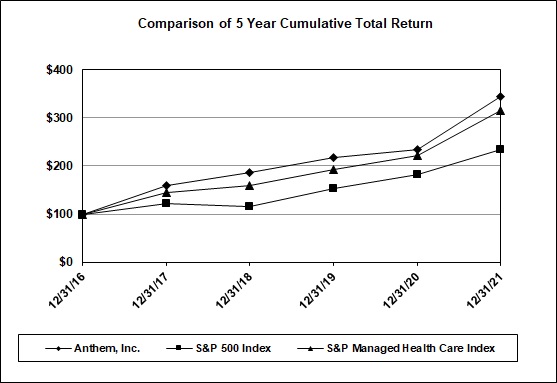
| December 31, | ||||||||||||||||||||||||||||||||||||||
| 2016 | 2017 | 2018 | 2019 | 2020 | 2021 | |||||||||||||||||||||||||||||||||
| Anthem, Inc. | $ | 100 | $ | 159 | $ | 187 | $ | 218 | $ | 235 | $ | 343 | ||||||||||||||||||||||||||
| S&P 500 Index | 100 | 122 | 116 | 153 | 181 | 233 | ||||||||||||||||||||||||||||||||
| S&P Managed Health Care Index | 100 | 144 | 160 | 192 | 222 | 314 | ||||||||||||||||||||||||||||||||
Based upon an initial investment of $100 on December 31, 2016 with dividends reinvested.
Item 6. [RESERVED]
-40-
Item 7. MANAGEMENT’S DISCUSSION AND ANALYSIS OF FINANCIAL CONDITION AND RESULTS OF OPERATIONS.
(In Millions, Except Per Share Data or As Otherwise Stated Herein)
This Management’s Discussion and Analysis of Financial Condition and Results of Operations (“MD&A”), should be read in conjunction with our audited consolidated financial statements included in Part II, Item 8 of this Annual Report on Form 10-K. References to the terms “we,” “our,” “us,” “Anthem” or the “Company” used throughout this MD&A refer to Anthem, Inc., an Indiana corporation, and, unless the context otherwise requires, its direct and indirect subsidiaries. References to the “states” include the District of Columbia and Puerto Rico, unless the context otherwise requires.
This section of this Annual Report on Form 10-K generally discusses 2021 and 2020 items and year-over-year comparisons between 2021 and 2020. A detailed discussion of 2019 items and year-over-year comparisons between 2020 and 2019 that are not included in this Annual Report on Form 10-K can be found in “Management’s Discussion and Analysis of Financial Condition and Results of Operations” in Part II, Item 7 of our Annual Report on Form 10-K for the year ended December 31, 2020.
Overview
We are one of the largest health benefits companies in the United States in terms of medical membership, serving greater than 45 million medical members through our affiliated health plans as of December 31, 2021. We are an independent licensee of the Blue Cross and Blue Shield Association (“BCBSA”), an association of independent health benefit plans. We serve our members as the Blue Cross licensee for California and as the Blue Cross and Blue Shield (“BCBS”) licensee for Colorado, Connecticut, Georgia, Indiana, Kentucky, Maine, Missouri (excluding 30 counties in the Kansas City area), Nevada, New Hampshire, New York (in the New York City metropolitan area and upstate New York), Ohio, Virginia (excluding the Northern Virginia suburbs of Washington, D.C.) and Wisconsin. In a majority of these service areas, we do business as Anthem Blue Cross, Anthem Blue Cross and Blue Shield, and Empire Blue Cross Blue Shield or Empire Blue Cross. In addition, we conduct business through arrangements with other BCBS licensees as well as other strategic partners. Through our subsidiaries, we also serve customers in numerous states across the country as AIM Specialty Health, Amerigroup, Aspire Health, Beacon, CareMore, Freedom Health, HealthLink, HealthSun, MMM, Optimum HealthCare, Simply Healthcare, and/or UniCare. We offer pharmacy benefits management (“PBM”) services through our IngenioRx, Inc. (“IngenioRx”) subsidiary. We are licensed to conduct insurance operations in all 50 states, the District of Columbia and Puerto Rico through our subsidiaries.
We manage our operations by customer types through four reportable segments: Commercial & Specialty Business, Government Business, IngenioRx and Other.
Our results of operations discussed throughout this MD&A are determined in accordance with generally accepted accounting principles (“GAAP”). We also calculate operating gain and operating margin to further aid investors in understanding and analyzing our core operating results. Operating gain is calculated as total operating revenue less benefit expense, cost of products sold and selling, general and administrative expense. Operating margin is calculated as operating gain divided by operating revenue. Our definition of operating gain and operating margin may not be comparable to similarly titled measures reported by other companies. We use these measures as a basis for evaluating segment performance, allocating resources, forecasting future operating periods and setting incentive compensation targets. This information is not intended to be considered in isolation or as a substitute for income before income tax expense, net income or fully-diluted earnings per share (“EPS”) prepared in accordance with GAAP. For additional details on operating gain, see our “Reportable Segments Results of Operations” discussion included in this MD&A. For a reconciliation of reportable segment operating revenue to the amounts of total revenue included in the consolidated statements of income and a reconciliation of reportable segment operating gain to income before income tax expense, see Note 20, “Segment Information,” of the Notes to Consolidated Financial Statements included in Part II, Item 8 of this Annual Report on Form 10-K.
Our operating revenue consists of premiums, product revenue, and administrative fees and other revenue. Premium revenue is generated from risk-based contracts where we indemnify our policyholders against costs for covered health and life insurance benefits. Product revenue represents services performed by IngenioRx for unaffiliated PBM customers and includes ingredient costs (net of any rebates or discounts), including co-payments made by or on behalf of the customer, and
-41-
administrative fees. Unaffiliated PBM customers include our fee-based groups that contract with IngenioRx for PBM services and external customers outside of the health plans we own. Administrative fees and other revenue come from fees from our fee-based customers for the processing of transactions or network discount savings realized, revenues from our Medicare processing business and revenues from other health-related businesses, including care management programs and miscellaneous other income.
Our benefit expense primarily includes costs of care for health services consumed by our risk-based members, such as outpatient care, inpatient hospital care, professional services (primarily physician care) and pharmacy benefit costs. All four components are affected both by unit costs and utilization rates. Unit costs include the cost of outpatient medical procedures per visit, inpatient hospital care per admission, physician fees per office visit and prescription drug prices. Utilization rates represent the volume of consumption of health services and typically vary with the age and health status of our members and their social and lifestyle choices, along with clinical protocols and medical practice patterns in each of our markets. A portion of benefit expense recognized in each reporting period consists of actuarial estimates of claims incurred but not yet paid by us. Any changes in these estimates are recorded in the period the need for such an adjustment arises. While we offer a diversified mix of managed care products and services through our managed care plans, our aggregate cost of care can fluctuate based on a change in the overall mix of these products and services. Our managed care plans include: Preferred Provider Organizations; Health Maintenance Organizations; Point-of-Service plans; traditional indemnity plans and other hybrid plans, including Consumer-Driven Health Plans; and hospital only and limited benefit products.
We classify certain quality improvement costs as benefit expense. Quality improvement activities are those designed to improve member health outcomes, prevent hospital readmissions and improve patient safety. They also include expenses for wellness and health promotion provided to our members. These quality improvement costs may be comprised of expenses incurred for: (i) medical management, including care coordination and case management; (ii) health and wellness, including disease management services for such conditions as diabetes, high-risk pregnancies, congestive heart failure and asthma management and wellness initiatives like weight-loss programs and smoking cessation treatments; and (iii) clinical health policy, such as identification and use of best clinical practices to avoid harm, identifying clinical errors and safety concerns, and identifying potential adverse drug interactions.
Our cost of products sold represents the cost of pharmaceuticals dispensed by IngenioRx for our unaffiliated PBM customers (net of rebates or discounts), including any co-payments made by or on behalf of the customer, per-claim admini
Showing the first 8K of 127K characters. Open the full section
Item 7A. QUANTITATIVE AND QUALITATIVE DISCLOSURES ABOUT MARKET RISK.
(In Millions, Except As Otherwise Stated Herein)
As a result of our investing and borrowing activities, we are exposed to financial market risks, including those resulting from changes in interest rates and changes in market valuations. Potential impacts discussed below are based upon sensitivity analyses performed on our financial position as of December 31, 2021. Actual results could vary from these estimates. Our primary objectives with our investment portfolio are to provide safety and preservation of capital, sufficient liquidity to meet cash flow requirements, the integration of investment strategy with the business operations and an attainment of a competitive after-tax total return.
Investments
Our investment portfolio is exposed to three primary sources of risk: credit quality risk, interest rate risk and market valuation risk.
The primary risks associated with our fixed maturity securities, which are classified as available-for-sale, are credit quality risk and interest rate risk. Credit quality risk is defined as the risk of a credit event, such as a ratings downgrade or default, to an individual fixed maturity security and the potential loss attributable to that event. Credit quality risk is managed through our investment policy, which establishes credit quality limitations on the overall portfolio as well as diversification and percentage limits on securities of individual issuers. The result is a well-diversified portfolio of fixed maturity securities, with an average credit rating of approximately “A.” Interest rate risk is defined as the potential for economic losses on fixed maturity securities due to a change in market interest rates. Our fixed maturity portfolio is invested primarily in U.S. government securities, corporate bonds, asset-backed bonds, mortgage-related securities and municipal bonds, all of which have exposure to changes in the level of market interest rates. Interest rate risk is managed by maintaining asset duration within a band based upon our liabilities, operating performance and liquidity needs. Additionally, we have the capability of holding any security to maturity, which would allow us to realize full par value.
Investments in fixed maturity securities include corporate securities, which account for 46.0% of our total fixed maturity securities at December 31, 2021 and are subject to credit/default risk. In a declining economic environment, corporate yields will usually increase, prompted by concern over the ability of corporations to make interest payments, thus causing a decrease in the price of corporate securities, and the decline in value of the corporate fixed maturity portfolio. We manage this risk through fundamental credit analysis, diversification of issuers and industries and an average credit rating of our corporate fixed maturity portfolio of approximately “BBB.”
Market risk for fixed maturity securities is addressed by actively managing the duration, allocation and diversification of our investment portfolio. We have evaluated the impact on the fixed maturity portfolio’s fair value considering an immediate 100 basis point change in interest rates. A 100 basis point increase in interest rates would result in an approximate $1,114 decrease in fair value, whereas a 100 basis point decrease in interest rates would result in an approximate $1,152 increase in fair value. While we classify our fixed maturity securities as “available-for-sale” for accounting purposes, we believe our cash flows and the duration of our portfolio should allow us to hold securities to maturity, thereby avoiding the recognition of losses should interest rates rise significantly.
Our equity portfolio is comprised of large capitalization and small capitalization domestic equities, foreign equities, exchange-traded funds and index mutual funds. Our equity portfolio is subject to the volatility inherent in the stock market,
-66-
driven by concerns over economic conditions, earnings and sales growth, inflation, and consumer confidence. These systemic risks cannot be managed through diversification alone. However, more routine risks, such as stock/industry specific risks, are managed by investing in a diversified equity portfolio.
Our other invested assets, reported within our long-term investments, are primarily subject to private market exposures, including private equity, real estate, and private credit investments. These investments are also indirectly subject to market valuation risk, as public market valuations will form a basis for valuations for these investments. Given their illiquid nature, we focus on appropriate sizing of these investments relative to our liquidity needs and risk tolerance. Our risk tolerance is formed by the level of illiquidity and short-term price movements from market valuation risk we are willing to accept relative to the higher long-term expected returns over the life of these investments.
As of December 31, 2021, 6.5% of our marketable investments were equity securities. An immediate 10% decrease in each equity investment’s value, arising from market movement, would result in a fair value decrease of $188. Alternatively, an immediate 10% increase in each equity investment’s value, attributable to the same factor, would result in a fair value increase of $188.
For additional information regarding our investments, see Note 5, “Investments,” of the Notes to Consolidated Financial Statements included in Part II, Item 8 and “Critical Accounting Policies and Estimates - Investments” within Part II, Item 7 “Management’s Discussion and Analysis of Financial Condition and Results of Operations” included in this Annual Report on Form 10-K.
Long-Term Debt
Our total long-term debt at December 31, 2021 consisted of senior unsecured notes, convertible debentures, commercial paper and subordinated surplus notes issued by one of our insurance subsidiaries. At December 31, 2021, the carrying value and estimated fair value of our long-term debt was $22,756 and $26,136, respectively. This debt is subject to interest rate risk, as these instruments have fixed interest rates and the fair value is affected by changes in market interest rates. Should interest rates increase or decrease in the future, the estimated fair value of our fixed rate debt would decrease or increase accordingly.
For additional information regarding our long-term debt, see Note 7, “Fair Value” and Note 13, “Debt,” of the Notes to Consolidated Financial Statements included in Part II, Item 8 of this Annual Report on Form 10-K.
Derivatives
We have exposure to economic losses due to interest rate risk arising from changes in the level or volatility of interest rates. We attempt to mitigate our exposure to interest rate risk through the use of derivative financial instruments. These strategies include the use of interest rate swaps and forward contracts, which are used to lock-in interest rates or to hedge (on an economic basis) interest rate risks associated with variable rate debt. We have used these types of instruments as designated hedges against specific liabilities.
Changes in interest rates will affect the estimated fair value of these derivatives. As of December 31, 2021, we recorded a net asset of $18, the estimated fair value of the swaps at that date. We have evaluated the impact on the interest rate swaps’ fair value considering an immediate 100 basis point change in interest rates. A 100 basis point increase in interest rates would result in an approximate $32 decrease in fair value, whereas a 100 basis point decrease in interest rates would result in an approximate $32 increase in fair value.
For additional information regarding our derivatives, see Note 6, “Derivative Financial Instruments” of the Notes to Consolidated Financial Statements included in Part II, Item 8 of this Annual Report on Form 10-K.
-67-
Item 8. FINANCIAL STATEMENTS AND SUPPLEMENTARY DATA.
ANTHEM, INC.
CONSOLIDATED FINANCIAL STATEMENTS
Years ended December 31, 2021, 2020 and 2019
Contents
| Report of Independent Registered Public Accounting Firm (PCAOB ID:42) | 69 | ||||
| Audited Consolidated Financial Statements: | |||||
| Consolidated Balance Sheets | 71 | ||||
| Consolidated Statements of Income | 72 | ||||
| Consolidated Statements of Comprehensive Income | 73 | ||||
| Consolidated Statements of Cash Flows | 74 | ||||
| Consolidated Statements of Shareholders’ Equity | 75 | ||||
| Notes to Consolidated Financial Statements | 76 |
-68-
Report of Independent Registered
Public Accounting Firm
To the Shareholders and the Board of Directors of Anthem, Inc.
Opinion on the Financial Statements
We have audited the accompanying consolidated balance sheets of Anthem, Inc. (the Company) as of December 31, 2021 and 2020, the related consolidated statements of income, comprehensive income, shareholders’ equity, and cash flows for each of the three years in the period ended December 31, 2021, and the related notes and financial statement schedule listed in the Index at Item 15(c) (collectively referred to as the “consolidated financial statements”). In our opinion, the consolidated financial statements present fairly, in all material respects, the financial position of the Company at December 31, 2021 and 2020, and the results of its operations and its cash flows for each of the three years in the period ended December 31, 2021, in conformity with U.S. generally accepted accounting principles.
We also have audited, in accordance with the standards of the Public Company Accounting Oversight Board (United States) (PCAOB), the Company’s internal control over financial reporting as of December 31, 2021, based on criteria established in Internal Control-Integrated Framework issued by the Committee of Sponsoring Organizations of the Treadway Commission (2013 framework), and our report dated February 16, 2022 expressed an unqualified opinion thereon.
Basis for Opinion
These financial statements are the responsibility of the Company’s management. Our responsibility is to express an opinion on the Company’s financial statements based on our audits. We are a public accounting firm registered with the PCAOB and are required to be independent with respect to the Company in accordance with the U.S. federal securities laws and the applicable rules and regulations of the Securities and Exchange Commission and the PCAOB.
We conducted our audits in accordance with the standards of the PCAOB. Those standards require that we plan and perform the audit to obtain reasonable assurance about whether the financial statements are free of material misstatement, whether due to error or fraud. Our audits included performing procedures to assess the risks of material misstatement of the financial statements, whether due to error or fraud, and performing procedures that respond to those risks. Such procedures included examining, on a test basis, evidence regarding the amounts and disclosures in the financial statements. Our audits also included evaluating the accounting principles used and significant estimates made by management, as well as evaluating the overall presentation of the financial statements. We believe that our audits provide a reasonable basis for our opinion.
Critical Audit Matter
The critical audit matter communicated below is a matter arising from the current period audit of the financial statements that was communicated or required to be communicated to the audit committee and that: (1) relates to accounts or disclosures that are material to the financial statements and (2) involved our especially challenging, subjective, or complex judgments. The communication of the critical audit matter does not alter in any way our opinion on the consolidated financial statements, taken as a whole, and we are not, by communicating the critical audit matter below, providing a separate opinion on the critical audit matter or on the account or disclosures to which it relates.
-69-
| Valuation of Incurred but Not Paid Claims | ||||||||
| Description of the Matter | Medical claims payable was $13,518 million at December 31, 2021, a significant portion of which related to the Company’s estimate for claims that are incurred but not paid. As discussed in Note 2 to the consolidated financial statements, the Company’s liability for incurred but not paid claims is determined using actuarial methods that include a number of factors and assumptions, including completion factors, which represent the average percentage of total incurred claims that have been paid through a given date after being incurred based on historical paid claims data, and trend factors, which represent an estimate of claims expense based on recent claims expense levels and healthcare cost levels. There is significant uncertainty inherent in determining management’s best estimate of completion and trend factors, which are used to calculate actuarial estimates of incurred but not paid claims. | |||||||
| Auditing management’s estimate of incurred but not paid claims was complex and required the involvement of our actuarial specialists due to the highly judgmental nature of the completion and trend factor assumptions used in the valuation process. The significant judgment was primarily due to the sensitivity of management’s best estimate of completion and trend factor assumptions, which have a significant impact on the valuation of incurred but not paid claims. | ||||||||
| How We Addressed the Matter in Our Audit | We obtained an understanding, evaluated the design and tested the operating effectiveness of controls over the Company’s actuarial process for estimating the liability for incurred but not paid claims. These audit procedures included among others, testing management review controls over completion and trend factor assumptions and the review and approval processes that management has in place for estimating the liability for incurred but not paid claims. | |||||||
| To test the Company’s liability for incurred but not paid claims, our audit procedures included, among others, testing the completeness and accuracy of the underlying claims and membership data recorded in the source claims processing and disbursement systems to the data used by management in developing completion and trend factor assumptions and agreeing a sample of incurred and paid claims to source documentation. With the support of actuarial specialists, we analyzed the Company’s completion and trend factor assumptions based on historical claim experience and emerging cost trends, and independently calculated a range of reasonable reserve estimates for comparison to management’s best estimate of the liability for incurred but not paid claims. Additionally, we performed a review of the prior period liabilities for incurred but not paid claims to subsequent claims development. |
/s/ Ernst & Young LLP
We have served as the Company’s auditor since 1944.
Indianapolis, Indiana
February 16, 2022
-70-
Anthem, Inc.
Consolidated Balance Sheets
| December 31, 2021 | December 31, 2020 |
Showing the first 8K of 311K characters. Open the full section
Item 9. CHANGES IN AND DISAGREEMENTS WITH ACCOUNTANTS ON ACCOUNTING AND FINANCIAL DISCLOSURE.
There have been no changes in or disagreements with our independent registered public accounting firm on accounting or financial disclosures.
Item 9A. CONTROLS AND PROCEDURES.
Evaluation of Disclosure Controls and Procedures
We carried out an evaluation as of December 31, 2021, under the supervision and with the participation of our management, including our Chief Executive Officer and Chief Financial Officer, of the effectiveness of the design and operation of our disclosure controls and procedures as defined in Rule 13a-15(e) of the Exchange Act. Based upon that evaluation, our Chief Executive Officer and Chief Financial Officer concluded that our disclosure controls and procedures are effective in timely alerting them to material information relating to us (including our consolidated subsidiaries) required to be disclosed in our reports under the Exchange Act. In addition, based on that evaluation, our Chief Executive Officer and Chief Financial Officer concluded that our disclosure controls and procedures were effective in ensuring that information required to be disclosed by us in the reports that we file or submit under the Exchange Act is accumulated and communicated to our management, including our Chief Executive Officer and Chief Financial Officer, as appropriate to allow timely decisions regarding required disclosures.
Management’s Report on Internal Control over Financial Reporting
Management, under the supervision and with the participation of the principal executive officer and principal financial officer, of Anthem, Inc. (the “Company”) is responsible for establishing and maintaining effective internal control over financial reporting (“Internal Control”), as such term is defined in the Exchange Act. The Company’s Internal Control is designed to provide reasonable assurance regarding the reliability of the Company’s financial reporting and the preparation of financial statements for external reporting purposes in accordance with GAAP. The Company’s Internal Control includes those policies and procedures that (i) pertain to the maintenance of records that in reasonable detail accurately and fairly reflect the transactions and dispositions of the assets of the Company; (ii) provide reasonable assurance that transactions are recorded as necessary to permit preparation of financial statements in accordance with GAAP, and that receipts and expenditures of the Company are being made only in accordance with authorizations of management and directors of the Company; and (iii) provide reasonable assurance regarding prevention or timely detection of unauthorized acquisition, use or disposition of the Company’s assets that could have a material effect on the financial statements.
Because of inherent limitations in any Internal Control, no matter how well designed, misstatements due to error or fraud may occur and not be detected. Accordingly, even effective Internal Control can provide only reasonable assurance regarding the reliability of financial reporting and the preparation of financial statements for external purposes in accordance with GAAP.
Management, under the supervision and with the participation of the principal executive officer and principal financial officer, assessed the effectiveness of the Company’s Internal Control as of December 31, 2021. Management’s assessment was based on criteria established in Internal Control—Integrated Framework (2013) issued by the Committee of Sponsoring Organizations of the Treadway Commission.
The Company completed its acquisitions of myNEXUS, Inc. and MMM Holdings, LLC on April 28, 2021 and June 29, 2021, respectively. As permitted by the U.S. Securities and Exchange Commission, management’s assessment as of December 31, 2021 did not include the Internal Control of myNEXUS, Inc. and MMM Holdings, LLC, which are included in the Company's consolidated financial statements as of December 31, 2021. Such operations of myNEXUS, Inc. and MMM Holdings, LLC constituted 5% and 11% of the Company’s total assets and net assets, respectively, as of December 31, 2021, and 2% and 0% of the Company's total revenues and net income for the year then ended.
-138-
Based on management’s assessment, which excluded assessments of Internal Control of myNEXUS, Inc. and MMM Holdings, LLC, management has concluded that the Company’s Internal Control was effective as of December 31, 2021 to provide reasonable assurance regarding the reliability of financial reporting and the preparation of financial statements for external reporting purposes in accordance with GAAP.
Ernst & Young LLP, the Company’s independent registered public accounting firm, has audited the consolidated financial statements of the Company for the year ended December 31, 2021, and has also issued an audit report dated February 16, 2022, on the effectiveness of the Company’s Internal Control as of December 31, 2021, which is included in this Annual Report on Form 10-K.
| /S/ GAIL K. BOUDREAUX | /S/ JOHN E. GALLINA | |||||||
| President and Chief Executive Officer | Executive Vice President and Chief Financial Officer |
Changes in Internal Control Over Financial Reporting
There have been no changes in our internal control over financial reporting that occurred during the three months ended December 31, 2021 that have materially affected, or are reasonably likely to materially affect, our internal control over financial reporting.
Report of Independent Registered Public Accounting Firm
To the Shareholders and the Board of Directors of Anthem, Inc.
Opinion on Internal Control Over Financial Reporting
We have audited Anthem, Inc.’s internal control over financial reporting as of December 31, 2021, based on criteria established in Internal Control–Integrated Framework issued by the Committee of Sponsoring Organizations of the Treadway Commission (2013 framework) (the COSO criteria). In our opinion, Anthem, Inc. (the Company) maintained, in all material respects, effective internal control over financial reporting as of December 31, 2021, based on the COSO criteria.
As indicated in the accompanying Management’s Report on Internal Control Over Financial Reporting, management’s assessment of and conclusion on the effectiveness of internal control over financial reporting did not include the internal controls of myNEXUS, Inc. and MMM Holdings, LLC, which are included in the 2021 consolidated financial statements of the Company and constituted 5% and 11% of total and net assets, respectively, as of December 31, 2021 and 2% and 0% of revenues and net income, respectively, for the year then ended. Our audit of internal control over financial reporting of the Company also did not include evaluations of the internal control over financial reporting of myNEXUS, Inc. and MMM Holdings, LLC.
We also have audited, in accordance with the standards of the Public Company Accounting Oversight Board (United States) (PCAOB), the consolidated balance sheets of Anthem, Inc. as of December 31, 2021 and 2020, the related consolidated statements of income, comprehensive income, shareholders’ equity and cash flows for each of the three years in the period ended December 31, 2021, and the related notes and financial statement schedule listed in the Index at Item 15(c) and our report dated February 16, 2022 expressed an unqualified opinion thereon.
Basis for Opinion
The Company’s management is responsible for maintaining effective internal control over financial reporting and for its assessment of the effectiveness of internal control over financial reporting included in the accompanying Management’s Report on Internal Control Over Financial Reporting. Our responsibility is to express an opinion on the Company’s internal control over financial reporting based on our audit. We are a public accounting firm registered with the PCAOB and are required to be independent with respect to the Company in accordance with the U.S. federal securities laws and the applicable rules and regulations of the Securities and Exchange Commission and the PCAOB.
We conducted our audit in accordance with the standards of the PCAOB. Those standards require that we plan and perform the audit to obtain reasonable assurance about whether effective internal control over financial reporting was maintained in all material respects.
Our audit included obtaining an understanding of internal control over financial reporting, assessing the risk that a material weakness exists, testing and evaluating the design and operating effectiveness of internal control based on the assessed risk,
-139-
and performing such other procedures as we considered necessary in the circumstances. We believe that our audit provides a reasonable basis for our opinion.
Definition and Limitations of Internal Control Over Financial Reporting
A company’s internal control over financial reporting is a process designed to provide reasonable assurance regarding the reliability of financial reporting and the preparation of financial statements for external purposes in accordance with generally accepted accounting principles. A company’s internal control over financial reporting includes those policies and procedures that (1) pertain to the maintenance of records that, in reasonable detail, accurately and fairly reflect the transactions and dispositions of the assets of the company; (2) provide reasonable assurance that transactions are recorded as necessary to permit preparation of financial statements in accordance with generally accepted accounting principles, and that receipts and expenditures of the company are being made only in accordance with authorizations of management and directors of the company; and (3) provide reasonable assurance regarding prevention or timely detection of unauthorized acquisition, use, or disposition of the company’s assets that could have a material effect on the financial statements.
Because of its inherent limitations, internal control over financial reporting may not prevent or detect misstatements. Also, projections of any evaluation of effectiveness to future periods are subject to the risk that controls may become inadequate because of changes in conditions, or that the degree of compliance with the policies or procedures may deteriorate.
/s/ Ernst & Young LLP
Indianapolis, Indiana
February 16, 2022
-140-
Item 9B. OTHER INFORMATION.
None.
Item 9C. DISCLOSURE REGARDING FOREIGN JURISDICTIONS THAT PREVENT INSPECTIONS.
None.
PART III
Item 10. DIRECTORS, EXECUTIVE OFFICERS AND CORPORATE GOVERNANCE.
The information required by this Item concerning our Executive Officers is included in Part I, Item 1, “Business - Information about our Executive Officers.” The information required by this Item concerning our Directors and nominees for Director, information about our Audit Committee members and financial expert(s), disclosure of any delinquent filers under Section 16(a) of the Exchange Act and our Code of Conduct is incorporated herein by reference from our definitive Proxy Statement for our 2022 Annual Meeting of Shareholders, which will be filed with the SEC pursuant to Regulation 14A within 120 days after the end of our last fiscal year.
Item 11. EXECUTIVE COMPENSATION.
The information required by this Item concerning remuneration of our Executive Officers and Directors, material transactions involving such Executive Officers and Directors and Compensation Committee interlocks, as well as the Compensation and Talent Committee Report and CEO Pay Ratio disclosure are incorporated herein by reference from our definitive Proxy Statement for our 2022 Annual Meeting of Shareholders, which will be filed with the SEC pursuant to Regulation 14A within 120 days after the end of our last fiscal year.
Item 12. SECURITY OWNERSHIP OF CERTAIN BENEFICIAL OWNERS AND MANAGEMENT AND RELATED STOCKHOLDER MATTERS.
Securities Authorized for Issuance under Equity Compensation Plans
Securities authorized for issuance under our equity compensation plans as of December 31, 2021 are as follows:
| Plan Category****1 | Number of securities to be issued upon exercise of outstanding options, warrants and rights****2 (a) | Weighted-average exercise price of outstanding options, warrants and rights****3 (b) | Number of securities remaining available for future issuance under equity **compensation plans (excluding securities reflected in column (a))**4 (c) | ||||||||
| Equity compensation plans approved by shareholders as of December 31, 2021 | 4,797,556 | $255.49 | 20,283,759 | ||||||||
1We have no equity compensation plans pursuant to which awards may be granted in the future that have not been approved by shareholders.
2Includes shares that may be issued under the Anthem Incentive Compensation Plan and the Anthem 2017 Incentive Compensation Plan pursuant to the following outstanding awards: 2,878,054 stock options, 600,636 unvested restricted stock units, and 1,318,866 performance stock units (assuming that the outstanding performance stock units are earned at the maximum award level).
3Represents the weighted average exercise price of outstanding stock options. Does not take into consideration outstanding restricted stock units or performance stock units, which, once vested, may be converted into shares of our common stock on a one-for-one basis upon distribution at no additional cost.
4Excludes securities reflected in the first column, “Number of securities to be issued upon exercise of outstanding options, warrants and rights”. Includes 15,811,636 shares of common stock available for issuance as stock options, restricted stock awards, performance stock awards, performance awards and stock appreciation rights under the Anthem 2017 Incentive Compensation Plan at December 31, 2021. Includes 4,472,123 shares of common stock available for issuance under the Stock Purchase Plan at December 31, 2021.
The information required by this Item concerning the stock ownership of management and five percent beneficial owners is incorporated herein by reference from our definitive Proxy Statement for our 2022 Annual Meeting of
-141-
Shareholders, which will be filed with the SEC pursuant to Regulation 14A within 120 days after the end of our last fiscal year.
Item 13. CERTAIN RELATIONSHIPS AND RELATED TRANSACTIONS, AND DIRECTOR INDEPENDENCE.
The information required by this Item concerning certain relationships and related person transactions and Director independence is incorporated herein by reference from our definitive Proxy Statement for our 2022 Annual Meeting of Shareholders, which will be filed with the SEC pursuant to Regulation 14A within 120 days after the end of our last fiscal year.
Item 14. PRINCIPAL ACCOUNTANT FEES AND SERVICES.
The information required by this Item concerning principal accountant fees and services is incorporated herein by reference from our definitive Proxy Statement for our 2022 Annual Meeting of Shareholders, which will be filed with the SEC pursuant to Regulation 14A within 120 days after the end of our last fiscal year.
-142-
PART IV
Item 15. EXHIBITS AND FINANCIAL STATEMENT SCHEDULES.
(a) 1. Financial Statements:
The following consolidated financial statements of the Company are set forth in Part II, Item 8:
Report of Independent Registered Public Accounting Firm
Consolidated Balance Sheets as of December 31, 2021 and 2020
Consolidated Statements of Income for the years ended December 31, 2021, 2020, and 2019
Consolidated Statements of Comprehensive Income for the years ended December 31, 2021, 2020, and 2019
Consolidated Statements of Cash Flows for the years ended December 31, 2021, 2020 and 2019
Consolidated Statements of Shareholders’ Equity for the years ended December 31, 2021, 2020 and 2019
Notes to Consolidated Financial Statements
- Financial Statement Schedule:
The following financial statement schedule of the Company is included in Item 15(c):
Schedule II—Condensed Financial Information of Registrant (Parent Company Only).
All other schedules for which provision is made in the applicable accounting regulations of the SEC are not required under the related instructions, are inapplicable, or the required information is included in the consolidated financial statements, and therefore, have been omitted.
- Exhibits required to be filed as part of this report:
-143-
-144-
-145-
-146-
(b) Exhibits
The response to this portion of Item 15 is set forth in paragraph (a) 3 above.
(c) Financial Statement Schedule
Schedule II—Condensed Financial Information of Registrant (Parent Company Only).
Item 16. FORM 10-K SUMMARY.
None.
-147-
Schedule II—Condensed Financial Information of Registrant
Anthem, Inc. (Parent Company Only)
Balance Sheets
| (In millions, except share data) | December 31, 2021 | December 31, 2020 | |||||||||
| Assets | |||||||||||
| Current assets: | |||||||||||
| Cash and cash equivalents | $ | 630 | $ | 700 | |||||||
| Fixed maturity securities (amortized cost of $512 and $594; allowance for credit losses of $1 and $0) | 515 | 608 | |||||||||
| Equity securities | 49 | 439 | |||||||||
| Other receivables | 40 | 41 | |||||||||
| Net due from subsidiaries | 446 | — | |||||||||
| Other current assets | 655 | 800 | |||||||||
| Total current assets | 2,335 | 2,588 | |||||||||
| Other invested assets | 808 | 664 | |||||||||
| Property and equipment, net | 207 | 209 | |||||||||
| Deferred tax assets, net | 77 | 391 | |||||||||
| Investments in subsidiaries | 56,375 | 51,739 | |||||||||
| Other noncurrent assets | 265 | 211 | |||||||||
| Total assets | $ | 60,067 | $ | 55,802 | |||||||
| Liabilities and shareholders’ equity | |||||||||||
| Liabilities | |||||||||||
| Current liabilities: | |||||||||||
| Accounts payable and accrued expenses | $ | 559 | $ | 429 | |||||||
| Net due to subsidiaries | — | 1,239 | |||||||||
| Current portion of long-term debt | 1,599 | 700 | |||||||||
| Other current liabilities | 344 | 494 | |||||||||
| Total current liabilities | 2,502 | 2,862 | |||||||||
| Long-term debt, less current portion | 21,132 | 19,310 | |||||||||
| Other noncurrent liabilities | 373 | 431 | |||||||||
| Total liabilities | 24,007 | 22,603 | |||||||||
| Commitments and contingencies—Note 5 | |||||||||||
| Shareholders’ equity | |||||||||||
| Preferred stock, without par value, shares authorized - 100,000,000; shares issued and outstanding - none | — | — | |||||||||
| Common stock, par value $0.01, shares authorized - 900,000,000; shares issued and outstanding - 241,770,746 and 245,401,430 | 2 | 3 | |||||||||
| Additional paid-in capital | 9,148 | 9,244 | |||||||||
| Retained earnings | 27,088 | 23,802 | |||||||||
| Accumulated other comprehensive (loss) income | (178) | 150 | |||||||||
| Total shareholders’ equity | 36,060 | 33,199 | |||||||||
| Total liabilities and shareholders’ equity | $ | 60,067 | $ | 55,802 |
See accompanying notes.
-148-
Anthem, Inc. (Parent Company Only)
Statements of Income
| Years ended December 31 | |||||||||||||||||
| (In millions) | 2021 | 2020 | 2019 | ||||||||||||||
| Revenues | |||||||||||||||||
| Net investment income | $ | 6 | $ | 65 | $ | 81 | |||||||||||
| Net gains (losses) on financial instruments | 6 | 28 | (85) | ||||||||||||||
| Administrative fees and other revenue | 24 | 22 | 22 | ||||||||||||||
| Total revenues | 36 | 115 | 18 | ||||||||||||||
| Expenses | |||||||||||||||||
| General and administrative expense | 119 | 169 | 88 | ||||||||||||||
| Interest expense | 794 | 779 | 723 | ||||||||||||||
| Loss on extinguishment of debt | 21 | 36 | 2 | ||||||||||||||
| Total expenses | 934 | 984 | 813 | ||||||||||||||
| Loss before income tax credits and equity in net income of subsidiaries | (898) | (869) | (795) | ||||||||||||||
| Income tax credits | (244) | (386) | (251) | ||||||||||||||
| Equity in net income of subsidiaries | 6,758 | 5,055 | 5,351 | ||||||||||||||
| Shareholders’ net income | $ | 6,104 | $ | 4,572 | $ | 4,807 |
See accompanying notes.
-149-
Anthem, Inc. (Parent Company Only)
Statements of Comprehensive Income
| Years ended December 31 | |||||||||||||||||
| (in millions) | 2021 | 2020 | 2019 | ||||||||||||||
| Shareholders' net income | $ | 6,104 | $ | 4,572 | $ | 4,807 | |||||||||||
| Other comprehensive (loss) income, net of tax: | |||||||||||||||||
| Change in net unrealized gains/losses on investments | (455) | 428 | 680 | ||||||||||||||
| Change in non-credit component of impairment losses on investments | 2 | — | — | ||||||||||||||
| Change in net unrealized gains/losses on cash flow hedges | 11 | 12 | (16) | ||||||||||||||
| Change in net periodic pension and postretirement costs | 123 | (1) | 26 | ||||||||||||||
| Foreign currency translation adjustments | (9) | 7 | — | ||||||||||||||
| Other comprehensive (loss) income | (328) | 446 | 690 | ||||||||||||||
| Total shareholders’ comprehensive income | $ | 5,776 | $ | 5,018 | $ | 5,497 |
See accompanying notes.
-150-
Anthem, Inc. (Parent Company Only)
Statements of Cash Flows
| Years ended December 31 | |||||||||||||||||
| (In millions) | 2021 | 2020 | 2019 | ||||||||||||||
| Net cash provided by operating activities | $ | 2,038 | $ | 4,810 | $ | 2,411 | |||||||||||
| Investing activities | |||||||||||||||||
| Purchases of investments | (2,059) | (2,729) | (9,682) | ||||||||||||||
| Proceeds from sales, maturities, calls and redemptions of investments | 2,449 | 2,593 | 9,457 | ||||||||||||||
| Issuance of note to subsidiary | (1,500) | — | — | ||||||||||||||
| Capitalization of subsidiaries | (807) | (2,460) | (232) | ||||||||||||||
| Changes in securities lending collateral | 173 | (234) | 18 | ||||||||||||||
| Purchases of property and equipment, net of sales | (77) | (107) | (54) | ||||||||||||||
| Other, net | — | 11 | — | ||||||||||||||
| Net cash used in investing activities | (1,821) | (2,926) | (493) | ||||||||||||||
| Financing activities | |||||||||||||||||
| Net proceeds from (repayments of) commercial paper borrowings | 50 | (150) | (297) | ||||||||||||||
| Proceeds from long-term borrowings | 3,462 | 2,484 | 2,473 | ||||||||||||||
| Repayments of long-term borrowings | (1,068) | (1,932) | (1,123) | ||||||||||||||
| Changes in securities lending payable | (173) | 234 | (18) | ||||||||||||||
| Repurchase and retirement of common stock | (1,900) | (2,700) | (1,701) | ||||||||||||||
| Cash dividends | (1,158) | (1,000) | (856) | ||||||||||||||
| Proceeds from issuance of common stock under employee stock plans | 203 | 176 | 187 | ||||||||||||||
| Taxes paid through withholding of common stock under employee stock plans | (102) | (128) | (84) | ||||||||||||||
| Other, net | 399 | 14 | 29 | ||||||||||||||
| Net cash used in financing activities | (287) | (3,002) | (1,390) | ||||||||||||||
| Change in cash and cash equivalents | (70) | (1,118) | 528 | ||||||||||||||
| Cash and cash equivalents at beginning of year | 700 | 1,818 | 1,290 | ||||||||||||||
| Cash and cash equivalents at end of year | $ | 630 | $ | 700 | $ | 1,818 |
See accompanying notes.
-151-
Anthem, Inc.
(Parent Company Only)
Notes to Condensed Financial Statements
December 31, 2021
(In Millions, Except Per Share Data)
1. Basis of Presentation and Significant Accounting Policies
In the parent company only financial statements of Anthem, Inc. (“Anthem”), Anthem’s investment in subsidiaries is stated at cost plus equity in undistributed earnings of the subsidiaries. Anthem’s share of net income of its unconsolidated subsidiaries is included in income using the equity method of accounting.
Certain amounts presented in the parent company only financial statements are eliminated in the consolidated financial statements of Anthem.
Anthem’s parent company only financial statements should be read in conjunction with Anthem’s audited consolidated financial statements and the accompanying notes included in Part II, Item 8 of this Annual Report on Form 10-K.
2. Subsidiary Transactions
Dividends from Subsidiaries
Anthem received cash dividends from subsidiaries of $3,134, $3,618 and $3,790 during 2021, 2020 and 2019, respectively.
Dividends to Subsidiaries
Certain subsidiaries of Anthem own shares of Anthem common stock. Anthem paid cash dividends to subsidiaries related to these shares of common stock in the amount of $54, $46 and $38 during 2021, 2020 and 2019, respectively.
Investments in Subsidiaries
Capital contributions to subsidiaries were $3,271, $2,460 and $232 during 2021, 2020 and 2019, respectively.
Amounts Due From and To Subsidiaries
At December 31, 2021 and 2020, Anthem reported amounts due from and to subsidiaries of $446 and $1,239, respectively. The amounts due from subsidiaries primarily include amounts for allocated administrative expenses or daily cash management activities. These items are routinely settled, and as such, are classified as current assets or liabilities.
On June 29, 2021 Anthem entered into a short-term loan agreement with a subsidiary for the amount of $1,500, which is also included in amounts due from subsidiaries.
Guarantees on Behalf of Subsidiaries
Anthem guarantees contractual or financial obligations or solvency requirements for certain of its subsidiaries. These guarantees approximated $530 at December 31, 2021. There were no payments made on these guarantees in 2021.
3. Derivative Financial Instruments
The information regarding derivative financial instruments contained in Note 6, “Derivative Financial Instruments,” of the Notes to Consolidated Financial Statements of Anthem and its subsidiaries, included in Part II, Item 8 of this Annual Report on Form 10-K, is incorporated herein by reference.
-152-
4. Long-Term Debt
The information regarding long-term debt contained in Note 13, “Debt,” of the Notes to Consolidated Financial Statements of Anthem and its subsidiaries, included in Part II, Item 8 of this Annual Report on Form 10-K, is incorporated herein by reference.
5. Commitments and Contingencies
The information regarding commitments and contingencies contained in Note 14, “Commitments and Contingencies,” of the Notes to Consolidated Financial Statements of Anthem and its subsidiaries, included in Part II, Item 8 of this Annual Report on Form 10-K, is incorporated herein by reference.
6. Capital Stock
The information regarding capital stock contained in Note 15, “Capital Stock,” of the Notes to Consolidated Financial Statements of Anthem and its subsidiaries, included in Part II, Item 8 of this Annual Report on Form 10-K, is incorporated herein by reference.
-153-
SIGNATURES
Pursuant to the requirements of Section 13 or 15(d) of the Securities Exchange Act of 1934, the registrant has duly caused this report to be signed on its behalf by the undersigned, thereunto duly authorized.
| ANTHEM, INC. | |||||
| By: | /s/ GAIL K. BOUDREAUX | ||||
| Gail K. Boudreaux President and Chief Executive Officer |
Dated: February 16, 2022
Pursuant to the requirements of the Securities Exchange Act of 1934, this report has been signed below by the following persons on behalf of the registrant and in the capacities and on the dates indicated.
| Signature | Title | Date | |||||||||
| /s/ GAIL K. BOUDREAUX | President and Chief Executive Officer, Director (Principal Executive Officer) | February 16, 2022 | |||||||||
| Gail K. Boudreaux | |||||||||||
| /s/ JOHN E. GALLINA | Executive Vice President and Chief Financial Officer (Principal Financial Officer) | February 16, 2022 | |||||||||
| John E. Gallina | |||||||||||
| /s/ RONALD W. PENCZEK | Chief Accounting Officer and Controller (Principal Accounting Officer) | February 16, 2022 | |||||||||
| Ronald W. Penczek | |||||||||||
| /s/ ELIZABETH E. TALLETT | Chair of the Board | February 16, 2022 | |||||||||
| Elizabeth E. Tallett | |||||||||||
| /s/ R. KERRY CLARK | Director | February 16, 2022 | |||||||||
| R. Kerry Clark | |||||||||||
| /s/ SUSAN D. DEVORE | Director | February 16, 2022 | |||||||||
| Susan D. DeVore | |||||||||||
| /s/ ROBERT L. DIXON, JR. | Director | February 16, 2022 | |||||||||
| Robert L. Dixon, Jr. | |||||||||||
| /s/ LEWIS HAY III | Director | February 16, 2022 | |||||||||
| Lewis Hay III | |||||||||||
| /s/ BAHIJA JALLAL | Director | February 16, 2022 | |||||||||
| Bahija Jallal | |||||||||||
| /s/ ANTONIO F. NERI | Director | February 16, 2022 | |||||||||
| Antonio F. Neri | |||||||||||
| /s/ RAMIRO G. PERU | Director | February 16, 2022 | |||||||||
| Ramiro G. Peru | |||||||||||
| /s/ RYAN M. SCHNEIDER | Director | February 16, 2022 | |||||||||
| Ryan M. Schneider | |||||||||||
-154-