 filings.tools
Equinix 10-Q 2022-09-30
Filed 2022-11-04. 8 sections, 470K characters. Original on sec.gov · Markdown · JSON
Cover and table of contents
UNITED STATES
SECURITIES AND EXCHANGE COMMISSION
Washington, D.C. 20549
FORM 10-Q
| ☒ | QUARTERLY REPORT PURSUANT TO SECTION 13 OR 15(d) OF THE SECURITIES EXCHANGE ACT OF 1934 |
For the quarterly period ended September 30, 2022
OR
| ☐ | TRANSITION REPORT PURSUANT TO SECTION 13 OR 15(d) OF THE SECURITIES EXCHANGE ACT OF 1934 |
For the transition period from to
Commission File Number 001-40205

EQUINIX, INC.
(Exact name of registrant as specified in its charter)
| Delaware | 77-0487526 | |||||||
| (State of incorporation) | (I.R.S. Employer Identification No.) |
One Lagoon Drive, Redwood City, California 94065
(Address of principal executive offices, including ZIP code)
(650) 598-6000
(Registrant's telephone number, including area code)
Securities registered pursuant to Section 12(b) of the Act:
| Title of each class | Trading symbol | Name of each exchange on which registered | ||||||||||||
| Common Stock, $0.001 | EQIX | The Nasdaq Stock Market LLC | ||||||||||||
| 0.250% Senior Notes due 2027 | The Nasdaq Stock Market LLC | |||||||||||||
| 1.000% Senior Notes due 2033 | The Nasdaq Stock Market LLC |
Indicate by check mark whether the registrant (1) has filed all reports required to be filed by Section 13 or 15(d) of the Securities Exchange Act of 1934 during the preceding 12 months (or for such shorter period that the registrant was required to file such reports) and (2) has been subject to such filing requirements for the past 90 days. Yes ☒ No ☐
Indicate by check mark whether the registrant has submitted electronically and posted on its corporate Web site, if any, every Interactive Data File required to be submitted and posted pursuant to Rule 405 of Regulation S-T during the preceding 12 months (or for such shorter period that the registrant was required to submit and post such files). Yes ☒ No ☐
Indicate by check mark whether the registrant is a large accelerated filer, an accelerated filer, a non-accelerated filer, a smaller reporting company or an emerging growth company. See definitions of "large accelerated filer," "accelerated filer," "smaller reporting company," and "emerging growth company" in Rule 12b-2 of the Exchange Act. (Check one):
| Large accelerated filer | ☒ | Accelerated filer | ☐ | ||||||||
| Non-accelerated filer | ☐ | Smaller reporting company | ☐ | ||||||||
| Emerging growth company | ☐ |
If an emerging growth company, indicate by check mark if the registrant has elected not to use the extended transition period for complying with any new or revised financial accounting standards provided pursuant to Section 13(a) of the Exchange Act. ☐
Indicate by check mark whether the registrant is a shell company (as defined in Rule 12b-2 of the Exchange Act). Yes ☐ No ☒
The number of shares outstanding of the registrant's Common Stock as of November 3, 2022 was 92,538,115.
EQUINIX, INC.
INDEX
Summary of Risk Factors
Our business is subject to numerous risks and uncertainties that make an investment in our securities speculative or risky, any one of which could materially adversely affect our results of operations, financial condition or business. These risks include, but are not limited to, those listed below. This list is not complete, and should be read together with the section titled “Risk Factors” in this Quarterly Report on Form 10-Q, as well as the other information in this Quarterly Report on Form 10-Q and the other filings that we make with the U.S. Securities and Exchange Commission (the “SEC”).
Risks Related to Our Business and Our Operations
-
Inflation in the global economy, increased interest rates and adverse global economic conditions, like the ones we are currently experiencing, could negatively affect our business and financial condition.
-
We are currently operating in a period of economic uncertainty and capital markets disruption, which has been the result of many global macro-economic factors including the ongoing military conflict between Russia and Ukraine. These macro-economic and other factors could negatively affect our business and financial condition.
-
The effects of the COVID-19 pandemic could have a negative effect on our business, results of operations and financial condition.
-
Our business could be harmed by increased costs to procure power, prolonged power outages, shortages or capacity constraints as well as restrictions on access to power.
-
Fluctuations in foreign currency exchange rates, especially the strength of the U.S. dollar, in the markets in which we operate internationally could harm our results of operations.
-
We experienced an information technology security breach in the past and may be vulnerable to future security breaches, which could disrupt our operations and have a material adverse effect on our business, results of operation and financial condition.
-
Our offerings have a long sales cycle that may harm our revenue and results of operations.
-
Any failure of our physical infrastructure or negative impact on our ability to meet our obligations to our customers, or damage to customer infrastructure within our IBX data centers, could lead to significant costs and disruptions that could reduce our revenue and harm our business reputation and financial condition.
-
We are currently making significant investments in our back-office information technology systems and processes. Difficulties from or disruptions to these efforts may interrupt our normal operations and adversely affect our business and results of operations.
-
The level of insurance coverage that we purchase may prove to be inadequate.
-
If we are unable to implement our evolving organizational structure or if we are unable to recruit or retain key executives and qualified personnel, our business could be harmed.
-
We may not be able to compete successfully against current and future competitors.
-
If we cannot continue to develop, acquire, market and provide new offerings or enhancements to existing offerings that meet customer requirements and differentiate us from our competitors, our results of operations could suffer.
-
Our results of operations may fluctuate.
-
We may incur goodwill and other intangible asset impairment charges, or impairment charges to our property, plant and equipment, which could result in a significant reduction to our earnings.
-
We have incurred substantial losses in the past and may incur additional losses in the future.
-
The failure to obtain favorable terms when we renew our IBX data center leases, or the failure to renew such leases, could harm our business and results of operations.
-
We depend on a number of third parties to provide internet connectivity to our IBX data centers; if connectivity is interrupted or terminated, our results of operations and cash flow could be materially and adversely affected.
-
We have government customers, which subjects us to risks including early termination, audits, investigations, sanctions and penalties.
-
Because we depend on the development and growth of a balanced customer base, including key magnet customers, failure to attract, grow and retain this base of customers could harm our business and results of operations.
-
Industry consolidation may have a negative impact on our business model.
-
The use of high power density equipment may limit our ability to fully utilize our older IBX data centers.
Risks Related to Our Expansion Plans
-
Our construction of new IBX data centers or IBX data center expansions could involve significant risks to our business.
-
Acquisitions present many risks, and we may not realize the financial or strategic goals that were contemplated at the time of any transaction.
-
The anticipated benefits of our joint ventures may not be fully realized, or take longer to realize than expected.
-
Joint venture investments could expose us to risks and liabilities in connection with the formation of the new joint ventures, the operation of such joint ventures without sole decision-making authority, and our reliance on joint venture partners who may have economic and business interests that are inconsistent with our business interests.
-
If we cannot effectively manage our international operations, and successfully implement our international expansion plans, or comply with evolving laws and regulations, our revenues may not increase, our costs may increase and our business and results of operations would be harmed.
-
We continue to invest in our expansion efforts but may not have sufficient customer demand in the future to realize expected returns on these investments.
Risks Related to Our Capital Needs and Capital Strategy
-
Our substantial debt could adversely affect our cash flows and limit our flexibility to raise additional capital.
-
Sales or issuances of shares of our common stock may adversely affect the market price of our common stock.
-
If we are not able to generate sufficient operating cash flows or obtain external financing, our ability to fund incremental expansion plans may be limited.
-
Our derivative transactions expose us to counterparty credit risk.
Risks Related to Environmental Laws and Climate Change Impacts
-
Environmental regulations may impose upon us new or unexpected costs.
-
Our business may be adversely affected by climate change and responses to it.
-
We may fail to achieve our environmental goals which may adversely affect public perception of our business and affect our relationship with our customers, our stockholders and/or other stakeholders.
Risks Related to Certain Regulations and Laws, Including Tax Laws
-
Changes in U.S. or foreign tax laws, regulations, or interpretations thereof, including changes to tax rates, may adversely affect our financial statements and cash taxes.
-
Government regulation or failure to comply with laws and regulations may adversely affect our business.
Risks Related to Our Taxation as a REIT
- We have a number of risks related to our intended qualification as a real estate investment trust for federal income tax purposes ("REIT"), including the risk that we may not be able to maintain our qualification as a REIT which could expose us to substantial corporate income tax and have a materially adverse effect on our business, financial condition, and results of operations.
PART I - FINANCIAL INFORMATION
Item 1. Condensed Consolidated Financial Statements
EQUINIX, INC.
CONDENSED CONSOLIDATED BALANCE SHEETS
(in thousands, except share and per share data)
| September 30, 2022 | December 31, 2021 | ||||||||||
| (Unaudited) | |||||||||||
| Assets | |||||||||||
| Current assets: | |||||||||||
| Cash and cash equivalents | $ | 2,500,816 | $ | 1,536,358 | |||||||
| Accounts receivable, net of allowance of $12,725 and $11,635 | 778,858 | 681,809 | |||||||||
| Other current assets | 656,865 | 462,739 | |||||||||
| Assets held for sale | 80,516 | 276,195 | |||||||||
| Total current assets | 4,017,055 | 2,957,101 | |||||||||
| Property, plant and equipment, net | 15,140,597 | 15,445,775 | |||||||||
| Operating lease right-of-use assets | 1,377,195 | 1,282,418 | |||||||||
| Goodwill | 5,393,708 | 5,372,071 | |||||||||
| Intangible assets, net | 1,892,781 | 1,935,267 | |||||||||
| Other assets | 1,504,530 | 926,066 | |||||||||
| Total assets | $ | 29,325,866 | $ | 27,918,698 | |||||||
| Liabilities and Stockholders' Equity | |||||||||||
| Current liabilities: | |||||||||||
| Accounts payable and accrued expenses | $ | 922,545 | $ | 879,144 | |||||||
| Accrued property, plant and equipment | 275,348 | 187,334 | |||||||||
| Current portion of operating lease liabilities | 136,848 | 144,029 | |||||||||
| Current portion of finance lease liabilities | 140,010 | 147,841 | |||||||||
| Current portion of mortgage and loans payable | 9,810 | 33,087 | |||||||||
| Other current liabilities | 211,428 | 214,519 | |||||||||
| Total current liabilities | 1,695,989 | 1,605,954 | |||||||||
| Operating lease liabilities, less current portion | 1,227,543 | 1,107,180 | |||||||||
| Finance lease liabilities, less current portion | 1,902,060 | 1,989,668 | |||||||||
| Mortgage and loans payable, less current portion | 599,132 | 586,577 | |||||||||
| Senior notes, less current portion | 12,008,125 | 10,984,144 | |||||||||
| Other liabilities | 738,924 | 763,411 | |||||||||
| Total liabilities | 18,171,773 | 17,036,934 | |||||||||
| Commitments and contingencies (Note 11) | |||||||||||
| Equinix stockholders' equity | |||||||||||
| Common stock, $0.001 par value per share: 300,000,000 shares authorized; 92,786,363 issued and 92,536,979 outstanding in 2022 and 90,872,826 issued and 90,571,406 outstanding in 2021 | 93 | 91 | |||||||||
| Additional paid-in capital | 17,193,805 | 15,984,597 | |||||||||
| Treasury stock, at cost; 249,384 shares in 2022 and 301,420 shares in 2021 | (92,845) | (112,208) | |||||||||
| Accumulated dividends | (7,026,832) | (6,165,140) | |||||||||
| Accumulated other comprehensive loss | (1,755,917) | (1,085,751) | |||||||||
| Retained earnings | 2,836,075 | 2,260,493 | |||||||||
| Total Equinix stockholders' equity | 11,154,379 | 10,882,082 | |||||||||
| Non-controlling interests | (286) | (318) | |||||||||
| Total stockholders' equity | 11,154,093 | 10,881,764 | |||||||||
| Total liabilities and stockholders' equity | $ | 29,325,866 | $ | 27,918,698 |
See accompanying notes to condensed consolidated financial statements.
EQUINIX, INC.
CONDENSED CONSOLIDATED STATEMENTS OF OPERATIONS
(in thousands, except per share data)
| Three Months Ended September 30, | Nine Months Ended September 30, | ||||||||||||||||||||||
| 2022 | 2021 | 2022 | 2021 | ||||||||||||||||||||
| (Unaudited) | |||||||||||||||||||||||
| Revenues | $ | 1,840,659 | $ | 1,675,176 | $ | 5,392,260 | $ | 4,929,159 | |||||||||||||||
| Costs and operating expenses: | |||||||||||||||||||||||
| Cost of revenues | 934,669 | 885,650 | 2,780,801 | 2,561,987 | |||||||||||||||||||
| Sales and marketing | 193,089 | 182,997 | 579,327 | 551,434 | |||||||||||||||||||
| General and administrative | 375,483 | 334,625 | 1,098,518 | 958,086 | |||||||||||||||||||
| Transaction costs | 2,007 | 5,197 | 11,310 | 13,364 | |||||||||||||||||||
| (Gain) loss on asset sales | 2,252 | (15,414) | 3,976 | (14,149) | |||||||||||||||||||
| Total costs and operating expenses | 1,507,500 | 1,393,055 | 4,473,932 | 4,070,722 | |||||||||||||||||||
| Income from operations | 333,159 | 282,121 | 918,328 | 858,437 | |||||||||||||||||||
| Interest income | 11,192 | 411 | 17,806 | 1,514 | |||||||||||||||||||
| Interest expense | (91,346) | (78,943) | (262,137) | (255,855) | |||||||||||||||||||
| Other income (expense) | (6,735) | 1,482 | (22,522) | (44,845) | |||||||||||||||||||
| Gain (loss) on debt extinguishment | 75 | 179 | 184 | (115,339) | |||||||||||||||||||
| Income before income taxes | 246,345 | 205,250 | 651,659 | 443,912 | |||||||||||||||||||
| Income tax expense | (34,606) | (53,224) | (75,985) | (67,325) | |||||||||||||||||||
| Net income | 211,739 | 152,026 | 575,674 | 376,587 | |||||||||||||||||||
| Net (income) loss attributable to non-controlling interests | 68 | 190 | (92) | 330 | |||||||||||||||||||
| Net income attributable to Equinix | $ | 211,807 | $ | 152,216 | $ | 575,582 | $ | 376,917 | |||||||||||||||
| Earnings per share ("EPS") attributable to Equinix: | |||||||||||||||||||||||
| Basic EPS | $ | 2.30 | $ | 1.69 | $ | 6.31 | $ | 4.21 | |||||||||||||||
| Weighted-average shares for basic EPS | 91,896 | 89,858 | 91,234 | 89,614 | |||||||||||||||||||
| Diluted EPS | $ | 2.30 | $ | 1.68 | $ | 6.29 | $ | 4.18 | |||||||||||||||
| Weighted-average shares for diluted EPS | 92,135 | 90,467 | 91,519 | 90,202 |
See accompanying notes to condensed consolidated financial statements.
EQUINIX, INC.
CONDENSED CONSOLIDATED STATEMENTS OF COMPREHENSIVE INCOME (LOSS)
(in thousands)
| | | | | | | | | | | | | | | | |
Showing the first 8K of 159K characters. Open the full section
Item 2. Management's Discussion and Analysis of Financial Condition and Results of Operations
The information in this discussion contains forward-looking statements within the meaning of Section 27A of the Securities Act of 1933, as amended, and Section 21E of the Securities Exchange Act of 1934, as amended. Such statements are based upon current expectations that involve risks and uncertainties. Any statements contained herein that are not statements of historical fact may be deemed to be forward-looking statements. For example, the words "believes," "anticipates," "plans," "expects," "intends" and similar expressions are intended to identify forward-looking statements. Our actual results and the timing of certain events may differ significantly from the results discussed in the forward-looking statements. Factors that might cause such a discrepancy include, but are not limited to, those discussed in "Liquidity and Capital Resources" below and "Risk Factors" in Item 1A of Part II of this Quarterly Report on Form 10-Q. All forward-looking statements in this document are based on information available to us as of the date of this Report and we assume no obligation to update any such forward-looking statements.
Our management's discussion and analysis of financial condition and results of operations is intended to assist readers in understanding our financial information from our management's perspective and is presented as follows:
-
Overview
-
Results of Operations
-
Non-GAAP Financial Measures
-
Liquidity and Capital Resources
-
Contractual Obligations and Off-Balance-Sheet Arrangements
-
Critical Accounting Policies and Estimates
-
Recent Accounting Pronouncements
Overview
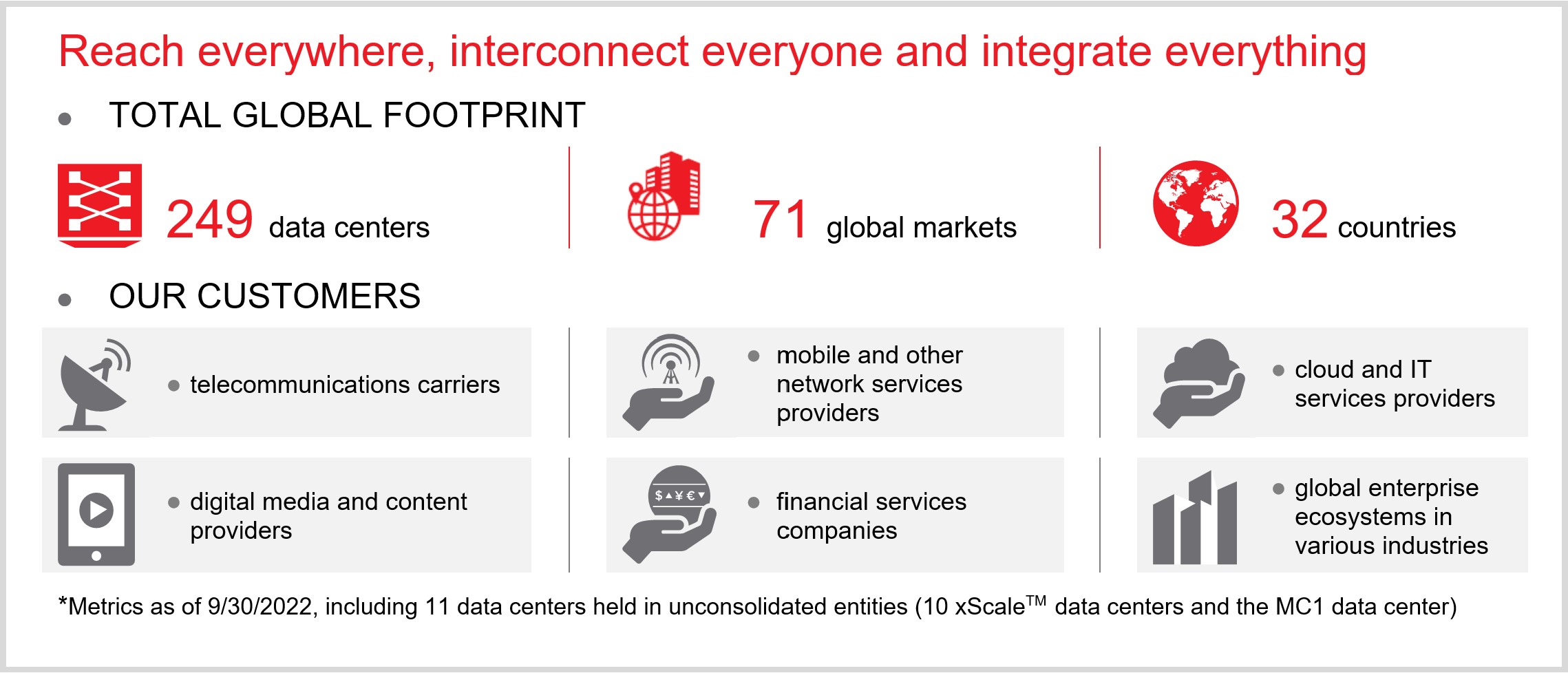
We provide a global, vendor-neutral data center, interconnection and edge services platform with offerings that aim to enable our customers to reach everywhere, interconnect everyone and integrate everything. Global enterprises, service providers and business ecosystems of industry partners rely on our IBX data centers and expertise around the world for the safe housing of their critical IT equipment and to protect and connect the world's most valued information assets. They also look to Platform Equinix® for the ability to directly and securely interconnect to the networks, clouds and content that enable today's information-driven global digital economy. Our recent IBX data center openings and acquisitions, as well as xScaleTM data center investments, have expanded our total global footprint to 249 IBXs, including 10 xScale data centers and the MC1 data center that are held in unconsolidated joint ventures, across 71 markets around the world. We offer the following solutions:
-
premium data center colocation;
-
interconnection and data exchange solutions;
-
edge services for deploying networking, security and hardware; and
-
remote expert support and professional services.
Our interconnected data centers around the world allow our customers to increase information and application delivery performance to users, and quickly access distributed IT infrastructures and business and digital ecosystems, while significantly reducing costs. Our global platform and the quality of our IBX data centers, interconnection offerings and edge services have enabled us to establish a critical mass of customers. As more customers choose Platform Equinix for bandwidth cost and performance reasons, it benefits their suppliers and business partners to colocate in the same data centers. This adjacency creates a “network effect” that enables our customers to capture the full economic and performance benefits of our offerings. These partners, in turn, pull in their business partners, creating a "marketplace" for their services. Our global platform enables scalable, reliable and cost-effective interconnection that increases data traffic exchange while lowering overall cost and increasing flexibility. Our focused business model is built on our critical mass of enterprise and service provider customers and the resulting "marketplace" effect. This global platform, combined with our strong financial position, has continued to drive new customer growth and bookings.
Historically, our market was served by large telecommunications carriers who bundled their products and services with their colocation offerings. The data center market landscape has evolved to include private and vendor-neutral multi-tenant data center ("MTDC") providers, hyperscale cloud providers, managed infrastructure and application hosting providers, and systems integrators. It is estimated that Equinix is one of more than 2,200 companies that provide MTDC offerings around the world. Each of these data center solutions providers can bundle various colocation, interconnection and network offerings and outsourced IT infrastructure solutions. We are able to offer our customers a global platform that reaches 32 countries with the industry’s largest and most active ecosystem of partners in our sites, proven operational reliability, improved application performance and a highly scalable set of offerings.
The cabinet utilization rate represents the percentage of cabinet space billed versus total cabinet capacity, which is used to measure how efficiently we are managing our cabinet capacity. Our cabinet utilization rate varies from market to market among our IBX data centers across our Americas, EMEA and Asia-Pacific regions. Our cabinet utilization rates were approximately 81% and 79% as of September 30, 2022 and 2021, respectively. Excluding the impact of our IBX data center expansion projects that have opened during the last 12 months, our cabinet utilization rate would have increased to approximately 82% as of September 30, 2022. We continue to monitor the available capacity in each of our selected markets. To the extent we have limited capacity available in a given market, it may limit our ability for growth in that market. We perform demand studies on an ongoing basis to determine if future expansion is warranted in a market. In addition, power and cooling requirements for most customers are growing on a per unit basis. As a result, customers are consuming an increasing amount of power per cabinet. Although we generally do not control the amount of power our customers draw from installed circuits, we have negotiated power consumption limitations with certain high power-demand customers. This increased power consumption has driven us to build out our new IBX data centers to support power and cooling needs twice that of previous IBX data centers. We could face power limitations in our IBX data centers, even though we may have additional physical cabinet capacity available within a specific IBX data center. This could have a negative impact on the available utilization capacity of a given IBX data center, which could have a negative impact on our ability to grow revenues, affecting our financial performance, results of operations and cash flows.
To serve the needs of the growing hyperscale data center market, including the world's largest cloud service providers, we have entered into joint ventures to develop and operate xScale data centers. In the past two years, we closed multiple joint ventures in the form of limited liability partnerships with GIC Private Limited, Singapore's sovereign wealth fund ("GIC") and an additional joint venture in the form of a limited liability partnership with PGIM Real Estate, ("PGIM").
Strategically, we will continue to look at attractive opportunities to grow our market share and selectively improve our footprint and offerings. As was the case with our recent expansions and acquisitions, our expansion criteria will be dependent on a number of factors, including but not limited to demand from new and existing customers, quality of the design, p
Showing the first 8K of 107K characters. Open the full section
Item 3. Quantitative and Qualitative Disclosures about Market Risk
Market Risk
There have been no significant changes to our exposure management and procedures in relation to our market risk, investment portfolio risk, interest rate risk, foreign currency risk and commodity price risk exposures and procedures during the nine months ended September 30, 2022 as compared to the respective risk exposures and procedures disclosed in Quantitative and Qualitative Disclosures About Market Risk, set forth in Part II Item 7A, of our Annual Report on Form 10-K for the year ended December 31, 2021, other than factors discussed below.
The uncertainty that exists with respect to the economic impact of the COVID-19 pandemic and geopolitical instability due to the ongoing military conflict between Russia and Ukraine has introduced significant volatility in the financial markets. See Part II, Item 1A. Risk Factors for additional information regarding potential risks to our business, financial condition and results of operations related to the COVID-19 pandemic.
Foreign Currency Risk
To help manage the exposure to foreign currency exchange rate fluctuations, we have implemented a number of hedging programs, in particular (i) a cash flow hedging program to hedge the forecasted revenues and expenses in our EMEA region, (ii) a balance sheet hedging program to hedge the re-measurement of monetary assets and liabilities denominated in foreign currencies, and (iii) a net investment hedging program to hedge the long term investments in our foreign subsidiaries. Our hedging programs reduce, but do not entirely eliminate, the impact of currency exchange rate movements and its impact on the condensed consolidated statements of operations.
We have entered into various foreign currency debt obligations. As of September 30, 2022, the total principal amount of foreign currency debt obligations was $1.6 billion, including $1.1 billion denominated in Euro and $557.8 million denominated in British Pound. As of September 30, 2022, we have designated $1.6 billion of the total principal amount of foreign currency debt obligations as net investment hedges against our net investments in foreign subsidiaries. For a net investment hedge, changes in the fair value of the hedging instrument designated as a net investment hedge are recorded as a component of other comprehensive income (loss) in the condensed consolidated balance sheets. Fluctuations in the exchange rates between these foreign currencies and the U.S. Dollar will impact the amount of U.S. Dollars that we will require to settle the foreign currency debt obligations at maturity. If the U.S. Dollar would have been weaker or stronger by 10% in comparison to these foreign currencies as of September 30, 2022, we estimate our obligation to cash settle the principal of these foreign currency debt obligations in U.S. Dollars would have increased or decreased by approximately $181.8 million and $148.7 million, respectively.
We are also party to cross-currency interest rate swaps. As of September 30, 2022, the total notional amount of cross-currency interest rate swap contracts outstanding was $3.9 billion. The cross-currency interest rate swaps are designated as hedges of our net investment in foreign subsidiaries and changes in the fair value of these swaps are recorded as a component of accumulated other comprehensive income (loss) in the condensed consolidated balance sheets. If the U.S. dollar weakened or strengthened by 10% in comparison to foreign currencies, we estimate our obligation to cash settle these hedges would have increased or decreased by approximately $345.9 million and $283.0 million, respectively.
The U.S. Dollar strengthened relative to certain of the currencies of the foreign countries in which we operate during the nine months ended September 30, 2022. This has impacted our condensed consolidated financial position and results of operations during this period, including the amount of revenues that we reported. Continued strengthening or weakening of the U.S. Dollar will continue to impact us in future periods.
With the existing cash flow hedges in place, a hypothetical additional 10% strengthening of the U.S. Dollar for the nine months ended September 30, 2022 would have resulted in a reduction of our revenues and a reduction of our operating expenses including depreciation and amortization expense by approximately $167.6 million and $165.5 million, respectively.
With the existing cash flow hedges in place, a hypothetical additional 10% weakening of the U.S. Dollar for the nine months ended September 30, 2022 would have resulted in an increase of our revenues and an increase of our operating expenses including depreciation and amortization expense by approximately $211.0 million and $208.4 million, respectively.
Interest Rate Risk
We are exposed to interest rate risk related to our outstanding debt. An immediate increase or decrease in current interest rates from their position as of September 30, 2022 would not have a material impact on our interest expense due to the fixed coupon rate on the majority of our debt obligations. However, the interest expense associated with our senior credit facility and term loans that bear interest at variable rates could be affected. For every 100-basis point increase or decrease in interest rates, our annual interest expense could increase by approximately $5.6 million or decrease by approximately $5.6 million based on the total balance of our term loan borrowings as of September 30, 2022. As of September 30, 2022, we had not employed any interest rate derivative products to hedge our variable rate debt obligations. However, we may enter into interest rate hedging agreements in the future to mitigate our exposure to interest rate risk.
We periodically enter into interest rate locks to hedge the interest rate exposure created by anticipated fixed rate debt issuances, which are designated as cash flow hedges. When interest rate locks are settled, any accumulated gain or loss included as a component of other comprehensive income (loss) will be amortized to
interest expense over the term of the forecasted hedged transaction which is equivalent to the term of the interest rate locks.
Item 4. Controls and Procedures
(a) Evaluation of Disclosure Controls and Procedures. Our management, with the participation of our Chief Executive Officer and our Chief Financial Officer, conducted an evaluation, pursuant to Rule 13a-15 promulgated under the Securities Exchange Act of 1934, as amended (the "Exchange Act"), of the effectiveness of our "disclosure controls and procedures" as of the end of the period covered by this quarterly report. Based on this evaluation, the Chief Executive Officer and Chief Financial Officer concluded that the disclosure controls and procedures were effective as of the end of the period covered by this quarterly report.
(b) Changes in Internal Control over Financial Reporting. In the third quarter of 2022, as part of our multi-year project to move the backbone of our finance systems to the Cloud, we completed deployment of certain modules in our new cloud enterprise resource planning (“ERP”) system to support financial close and reporting. As a result of the ERP system implementation, in the third quarter of 2022 certain internal controls over financial reporting have been automated, modified, or implemented to address the new control environment and processes associated with the ERP system.
There have been no other changes in our internal control over financial reporting identified in connection with the evaluation required by Rules 13a-15(d) and 15d-15(d) of the Exchange Act that occurred during the nine months ended September 30, 2022 that have materially affected, or are reasonably likely to materially affect, our internal control over financial reporting.
(c) Limitations on the Effectiveness of Controls. Our management, including our Chief Executive Officer and Chief Financial Officer, believes that our disclosure controls and procedures and internal control over financial reporting are designed and operated to be effective at the reasonable assurance level. However, our management does not expect that our disclosure controls and procedures or our internal control over financial reporting will prevent all errors and all fraud. A control system, no matter how well conceived and operated, can provide only reasonable, not absolute, assurance that the objectives of the control system are met. Further, the design of a control system must reflect the fact that there are resource constraints, and the benefits of controls must be considered relative to their costs. Because of the inherent limitations in all control systems, no evaluation of controls can provide absolute assurance that all control issues and instances of fraud, if any, have been detected. These inherent limitations include the realities that judgments in decision making can be faulty, and that breakdowns can occur because of a simple error or mistake. Additionally, controls can be circumvented by the individual acts of some persons, by collusion of two or more people or by management override of the controls. The design of any system of controls also is based in part upon certain assumptions about the likelihood of future events, and there can be no assurance that any design will succeed in achieving its stated goals under all potential future conditions; over time, controls may become inadequate because of changes in conditions, or the degree of compliance with policies or procedures may deteriorate. Because of the inherent limitations in a cost-effective control system, misstatements due to error or fraud may occur and not be detected.
PART II - OTHER INFORMATION
| Item 1. Legal Proceedings |
None.
Item 1A. Risk Factors
In addition to the other information contained in this report, the following risk factors should be considered carefully in evaluating our business:
Risks Related to Our Business and Our Operations
Inflation in the global economy, increased interest rates and adverse global economic conditions, like the ones we are currently experiencing, could negatively affect our business and financial condition.
Inflation in the United States, Europe and other geographies has risen to levels not experienced in recent decades and we are seeing its impact on various aspects of our business. We are also experiencing an increase in our costs to procure power and supply chain issues globally. Rising prices for materials related to our IBX data center construction and our data center offerings, energy and gas prices, as well as rising wages and benefits costs negatively impact our business by increasing our operating costs. The levels of inflation we are currently experiencing may cause a decrease in sales of our offerings should customers scale back their operations and could result in churn in our customer base, reductions in revenues from our offerings, adverse effects to our DSO, longer sales cycles, slower adoption of new technologies and increased price competition, which could adversely affect our liquidity. Customers and vendors filing for bankruptcy could also lead to costly and time-intensive actions with adverse effects, including greater difficulty or delay in accounts receivable collection. The uncertain economic environment could also have an impact on our foreign exchange forward contracts if our counterparties' credit deteriorates or if they are otherwise unable to perform their obligations. Finally, volatility in the financial markets like we are currently experiencing could affect our ability to access the capital markets at a time when we desire, or need, to do so which could have an impact on our flexibility to pursue additional expansion opportunities and maintain our desired level of revenue growth in the future. Adverse global economic conditions like the ones we are currently experiencing with global inflation, the increased cost of power, and supply chain issues have created, and in the future may increase, risk to our business and financial outlook.
Our efforts to mitigate the risks associated with these adverse conditions may not be successful and our business and growth could be adversely affected.
We are currently operating in a period of economic uncertainty and capital markets disruption, which has been the result of many global macro-economic factors including the ongoing military conflict between Russia and Ukraine. These macro-economic and other factors could negatively affect our business and financial condition.
U.S. and global markets have experienced volatility and disruption following the escalation of geopolitical tensions and the ongoing military conflict between Russia and Ukraine. Although the length and impact of the ongoing military conflict is highly unpredictable, the conflict in Ukraine has led to market disruptions, including significant volatility in commodity prices, credit and capital markets, an increase in cyber security incidents as well as supply chain disruptions.
Additionally, various of Russia’s actions have led to sanctions and other penalties being levied by the U.S., the European Union, the United Kingdom, and other countries, as well as other public and private actors and companies, against Russia and certain other geographic areas, including agreement to remove certain Russian financial institutions from the Society for Worldwide Interbank Financial Telecommunication payment system and restrictions on imports of Russian oil, liquified natural gas and coal. These disruptions in the oil and gas markets have caused, and could continue to cause, significant increases in energy prices, which could have a material effect on our business. Additional potential sanctions and penalties have also been proposed and/or threatened. Some of our IBX data centers in EMEA partially rely on energy produced in-part from fossil fuels originating from Russia, which Russia has reduced. If Russia further reduces or turns off energy supplies to Europe, our EMEA operations could be affected adversely. Russian military actions and the resulting sanctions could further adversely affect the
global economy and financial markets and lead to instability and lack of liquidity in capital markets, potentially making it more difficult for us to obtain additional debt or equity financing on attractive terms in the future.
We do not have operations in Russia or Ukraine and historically we have had a limited number of Russian and Ukrainian customers, which we continue to screen against applicable sanctions lists per our standard processes. In addition to compliance with applicable sanctions laws, we are currently limiting the ability of Russian customers to place orders for our offerings unless, after reviewing these orders, we believe they are aligned with our stated objectives in support of Ukraine. We have suspended all activities and purchasing with and through Russian partners and suppliers and to not make any direct or indirect investment in Russia absent an end to this conflict. In addition, for our customers located in Ukraine, we are currently providing offerings free of charge and may continue to do so in the future.
Prolonged unfavorable economic conditions or uncertainty as a result of the military conflict between Russia and Ukraine may adversely affect our business, financial condition, and results of operations. Any of the foregoing may also magnify the impact of other risks described in this Quarterly Report on Form 10-Q.
The effects of the COVID-19 pandemic could have a negative effect on our business, results of operations and financial condition.
We have continuously monitored our global operations in light of the COVID-19 pandemic. We have implemented procedures focusing on the health and safety of our employees, customers, partners and communities, the continuity of our business offerings and compliance with governmental regulations and local public health guidance and ordinances. While our business operations have continued without interruption and our IBX data centers have remained fully operational to date, we cannot guarantee our business operations or our IBX data centers will not be negatively impacted in the future because of the COVID-19 pandemic.
Our business could be harmed by increased costs to procure power, prolonged power outages, shortages or capacity constraints as well as restrictions on access to power.
Any power outages, shortages, capacity constraints or significant increases in the cost of power may have an adverse effect on our business and our results of operations.
In each of our markets, we rely on third parties, third party infrastructure, governments, and global suppliers to provide a sufficient amount of power to maintain our IBX data centers and meet the needs of our current and future customers. Any limitation on the delivered energy supply could limit our ability to operate our IBX data centers. These limitations could have a negative impact on a given IBX data center(s) or limit our ability to grow our business which could negatively affect our financial performance and results of operations.
Our IBX data centers are affected by problems accessing electricity sources, such as planned or unplanned power outages and limitations on transmission or distribution. Unplanned power outages, including, but not limited to those relating to large storms, earthquakes, fires, tsunamis, cyberattacks, war, and any failures of electrical power grids more generally, and planned power outages by public utilities, such as those related to Pacific Gas and Electric Company's planned outages in California to minimi
Showing the first 8K of 117K characters. Open the full section
Item 5. Other Information
Item 6. Exhibits
**[Table of Contents](#i8f38d362
Showing the first 8K of 61K characters. Open the full section