 filings.tools
EQT 10-K 2023-12-31
Filed 2024-02-14. 24 sections, 588K characters. Original on sec.gov · Markdown · JSON
Cover and table of contents
UNITED STATES
SECURITIES AND EXCHANGE COMMISSION
Washington, D.C. 20549
FORM 10-K
| ☒ | ANNUAL REPORT PURSUANT TO SECTION 13 OR 15(d) OF THE SECURITIES EXCHANGE ACT OF 1934 | |||||||
| FOR THE FISCAL YEAR ENDED DECEMBER 31, 2023 |
or
| ☐ | TRANSITION REPORT PURSUANT TO SECTION 13 OR 15(d) OF THE SECURITIES EXCHANGE ACT OF 1934 | |||||||
| FOR THE TRANSITION PERIOD FROM ___________ TO __________ |
COMMISSION FILE NUMBER 001-03551
EQT CORPORATION
(Exact name of registrant as specified in its charter)
| Pennsylvania | 25-0464690 | |||||||
| (State or other jurisdiction of incorporation or organization) | (IRS Employer Identification No.) | |||||||
| 625 Liberty Avenue, Suite 1700 | ||||||||
| Pittsburgh, Pennsylvania | 15222 | |||||||
| (Address of principal executive offices) | (Zip Code) |
(412) 553-5700
(Registrant's telephone number, including area code)
Securities registered pursuant to Section 12(b) of the Act:
| Title of each class | Trading symbol(s) | Name of each exchange on which registered | ||||||||||||
| Common Stock, no par value | EQT | New York Stock Exchange |
Securities registered pursuant to Section 12(g) of the Act: None
Indicate by check mark if the registrant is a well-known seasoned issuer, as defined in Rule 405 of the Securities Act. Yes ☒ No ☐
Indicate by check mark if the registrant is not required to file reports pursuant to Section 13 or Section 15(d) of the Act. Yes ☐ No ☒
Indicate by check mark whether the registrant: (1) has filed all reports required to be filed by Section 13 or 15(d) of the Securities Exchange Act of 1934 during the preceding 12 months (or for such shorter period that the registrant was required to file such reports), and (2) has been subject to such filing requirements for the past 90 days. Yes ☒ No ☐
Indicate by check mark whether the registrant has submitted electronically every Interactive Data File required to be submitted pursuant to Rule 405 of Regulation S-T (§ 232.405 of this chapter) during the preceding 12 months (or for such shorter period that the registrant was required to submit such files). Yes ☒ No ☐
Indicate by check mark whether the registrant is a large accelerated filer, an accelerated filer, a non-accelerated filer, a smaller reporting company or an emerging growth company. See the definitions of "large accelerated filer," "accelerated filer," "smaller reporting company" and "emerging growth company" in Rule 12b-2 of the Exchange Act.
| Large accelerated filer | ☒ | Accelerated filer | ☐ | ||||||||
| Non-accelerated filer | ☐ | Smaller reporting company | ☐ | ||||||||
| Emerging growth company | ☐ |
If an emerging growth company, indicate by check mark if the registrant has elected not to use the extended transition period for complying with any new or revised financial accounting standards provided pursuant to Section 13(a) of the Exchange Act. ☐
Indicate by check mark whether the registrant has filed a report on and attestation to its management’s assessment of the effectiveness of its internal control over financial reporting under Section 404(b) of the Sarbanes-Oxley Act (15 U.S.C. 7262(b)) by the registered public accounting firm that prepared or issued its audit report. ☒
If securities are registered pursuant to Section 12(b) of the Act, indicate by check mark whether the financial statements of the registrant included in the filing reflect the correction of an error to previously issued financial statements. ☐
Indicate by check mark whether any of those error corrections are restatements that required a recovery analysis of incentive-based compensation received by any of the registrant’s executive officers during the relevant recovery period pursuant to §240.10D-1(b). ☐
Indicate by check mark whether the registrant is a shell company (as defined in Rule 12b-2 of the Exchange Act). Yes ☐ No ☒
The aggregate market value of common stock, no par value, held by non-affiliates of the registrant as of June 30, 2023: $14.7 billion
The number of shares of common stock, no par value, of the registrant outstanding (in thousands) as of February 9, 2024: 440,427
DOCUMENTS INCORPORATED BY REFERENCE
EQT Corporation's definitive proxy statement relating to its 2024 annual meeting of shareholders will be filed with the Securities and Exchange Commission within 120 days after the close of EQT Corporation's fiscal year ended December 31, 2023 and is incorporated by reference into Part III of this Annual Report on Form 10-K to the extent described therein.
TABLE OF CONTENTS
Glossary of Commonly Used Terms, Abbreviations and Measurements
Unless the context otherwise indicates, all references in this report to "EQT," the "Company," "we," "us," or "our" are to EQT Corporation and its subsidiaries, collectively.
Commonly Used Terms
Appalachian Basin – the area of the United States composed of those portions of West Virginia, Pennsylvania, Ohio, Maryland, Kentucky and Virginia that lie in the Appalachian Mountains.
basis – when referring to commodity pricing, the difference between the futures price for a commodity and the corresponding sales price at various regional sales points. The differential commonly is related to factors such as product quality, location, transportation capacity availability and contract pricing.
British thermal unit – a measure of the amount of energy required to raise the temperature of one pound of water by one degree Fahrenheit.
collar – a financial arrangement that effectively establishes a price range for the underlying commodity. The producer bears the risk and benefit of fluctuation between the minimum (floor) price and the maximum (ceiling) price.
continuous accumulations – natural gas and oil resources that are pervasive throughout large areas, have ill-defined boundaries and typically lack, or are unaffected by, hydrocarbon-water contacts near the base of the accumulation.
development well – a well drilled within the proved area of an oil or gas reservoir to the depth of a stratigraphic horizon known to be productive.
exploratory well – a well drilled to find a new field or new reservoir in a field previously found to be productive of oil or gas in another reservoir. Generally, an exploratory well is any well that is not a development well, an extension well, a service well or a stratigraphic test well.
extension well – a well drilled to extend the limits of a known reservoir.
gas – all references to "gas" in this report refer to natural gas.
gross – "gross" natural gas and oil wells or "gross" acres equal the total number of wells or acres in which we have a working interest.
hedging – the use of derivative commodity and interest rate instruments to reduce financial exposure to commodity price and interest rate volatility.
horizontal drilling – drilling that ultimately is horizontal or near horizontal to increase the length of the well bore penetrating the target formation.
horizontal wells – wells that are drilled horizontal or near horizontal to increase the length of the well bore penetrating the target formation.
natural gas liquids (NGLs) – those hydrocarbons in natural gas that are separated from the gas as liquids through the process of absorption, condensation or other methods in gas processing plants. Natural gas liquids include primarily ethane, propane, butane and isobutane.
net – "net" natural gas and oil wells or "net" acres equals the sum of our fractional ownership working interests we have in gross wells or acres.
net revenue interest – the interest retained by us in the revenues from a well or property after giving effect to all third-party interests (equal to 100% minus all royalties on a well or property).
option – a contract that gives the buyer the right, but not the obligation, to buy or sell a specified quantity of a commodity or other instrument at a specific price within a specified period of time.
play – a proven geological formation that contains commercial amounts of hydrocarbons.
productive well – a well that is producing oil or gas or that is capable of production.
proved reserves – quantities of natural gas, NGLs and oil, which, by analysis of geoscience and engineering data, can be estimated with reasonable certainty to be economically producible from a given date forward, from known reservoirs and under existing economic conditions, operating methods and government regulations, prior to the time at which contracts providing the right to operate expire, unless evidence indicates that renewal is reasonably certain, regardless of whether deterministic or probabilistic methods are used for the estimation.
proved developed reserves – proved reserves that can be expected to be recovered through existing wells with existing equipment and operating methods.
proved undeveloped reserves (PUDs) – proved reserves that can be estimated with reasonable certainty to be recovered from new wells on undrilled proved acreage or from existing wells where a relatively major expenditure is required for completion.
reliable technology – a grouping of one or more technologies (including computational methods) that has been field tested and
has been demonstrated to provide reasonably certain results with consistency and repeatability in the formation being evaluated or in an analogous formation.
reservoir – a porous and permeable underground formation containing a natural accumulation of producible natural gas and/or oil that is confined by impermeable rock or water barriers and is separate from other reservoirs.
service well – a well drilled or completed for the purpose of supporting production in an existing field. Specific purposes of service wells include, among other things, gas injection, water injection and salt-water disposal.
stratigraphic test well – a hole drilled for the sole purpose of gaining structural or stratigraphic information to aid in exploring for oil and gas.
turned-in-line – when a well is completed, producing and initially turned to sales.
well pad – an area of land that has been cleared and leveled to enable a drilling rig to operate in the exploration and development of a natural gas or oil well.
working interest – an interest that gives the owner the right to drill, produce and conduct operating activities on a property and receive a share of any production.
Abbreviations
| CFTC – Commodity Futures Trading Commission | ||
| EPA – U.S. Environmental Protection Agency | ||
| ESG – environmental, social and governance | ||
| FERC – Federal Energy Regulatory Commission | ||
| FTC – Federal Trade Commission | ||
| GAAP – U.S. Generally Accepted Accounting Principles | ||
| IRS – Internal Revenue Service | ||
| NYMEX – New York Mercantile Exchange | ||
| OTC – over the counter | ||
| SEC – U.S. Securities and Exchange Commission | ||
| WTI – West Texas Intermediate crude oil |
Measurements
| Bbl = barrel | ||
| Bcf = billion cubic feet | ||
| Bcfe = billion cubic feet of natural gas equivalents, with one barrel of NGLs and oil being equivalent to 6,000 cubic feet of natural gas | ||
| Btu = one British thermal unit | ||
| Dth = dekatherm or million British thermal units | ||
| Mbbl = thousand barrels | ||
| Mcf = thousand cubic feet | ||
| Mcfe = thousand cubic feet of natural gas equivalents, with one barrel of NGLs and oil being equivalent to 6,000 cubic feet of natural gas | ||
| MMbbl = million barrels | ||
| MMBtu = million British thermal units | ||
| MMcf = million cubic feet | ||
| MMcfe = million cubic feet of natural gas equivalents, with one barrel of NGLs and oil being equivalent to 6,000 cubic feet of natural gas | ||
| MMDth = million dekatherm | ||
| Tcfe = trillion cubic feet of natural gas equivalents, with one barrel of NGLs and oil being equivalent to 6,000 cubic feet of natural gas |
SUMMARY OF RISK FACTORS
We believe that the principal risks associated with our business, and consequently the principal risks associated with an investment in our equity or debt securities, generally fall within the following categories:
-
Risks Associated with Natural Gas Drilling, Transmission and Processing Operations.** As a natural gas producer, and an operator of certain transmission pipelines and processing facilities, there are risks inherent in our primary business operations. These risks are not necessarily unique to us, but rather, these are risks that most operators in our industry have at least some exposure to.
-
Financial and Market Risks.** Given that our primary product and source of revenue is the sale of natural gas and NGLs, one of our most material risks is the commodity market and the price of natural gas and NGLs, which is often volatile. Additionally, our operations are capital intensive. Pressures on the market as a whole, or our specific financial position – whether due to depressed commodity prices, our hedge positions, leverage, credit ratings, tax law changes or otherwise – could make it difficult for us to obtain the funding necessary to conduct our operations.
-
Risks Associated with Our Human Capital, Technology and Other Resources and Service Providers.** Our business, and the U.S. energy grid, is predominately operated on a digital system. Our employees rely on our cloud-based digital work environment to communicate and access data that is necessary to conduct our day-to-day operations. While these systems and infrastructure enable us to efficiently supply our natural gas, NGLs and oil to the market, they are also susceptible to physical and cybersecurity threats. Likewise, as a digitally-focused organization, we seek employees with a high degree of both technical skill and digital literacy, and it can be difficult to attract and retain personnel who satisfy these criteria. Further, we operate in the Appalachian Basin, and a substantial majority of our midstream and water services are provided by one provider, Equitrans Midstream Corporation (Equitrans Midstream), making us vulnerable to risks associated with operating primarily in one major geographic area and obtaining a substantial amount of our services from a single provider within that operating area.
-
Legal and Regulatory Risks.** There are many environmental, energy, financial, real property and other regulations that we are required to comply with in the context of conducting our operations; otherwise, we may be exposed to fines, penalties, investigations, litigation or other legal proceedings. Additionally, negative public perception of us or the natural gas industry, or increasing consumer demand for alternatives to natural gas, could adversely impact our earnings, cash flows and financial position.
-
Risks Associated with Strategic Transactions.** We have historically been involved in, and anticipate that we will continue to explore, opportunities to create value through strategic transactions, whether through mergers and acquisitions, divestitures, joint ventures or similar business transactions. There are risks inherent in any strategic transaction, and such risks could negatively affect the benefits, outcomes and synergies anticipated to be obtained from executing such strategic transactions.
We describe these risks in greater detail under Item 1A., "Risk Factors."
CAUTIONARY STATEMENTS
This Annual Report on Form 10-K contains certain forward-looking statements within the meaning of Section 21E of the Securities Exchange Act of 1934, as amended (the Exchange Act), and Section 27A of the Securities Act of 1933, as amended. Statements that do not relate strictly to historical or current facts are forward-looking and are usually identified by the use of words such as "anticipate," "estimate," "could," "would," "will," "may," "forecast," "approximate," "expect," "project," "intend," "plan," "believe" and other words of similar meaning, or the negative thereof. Without limiting the generality of the foregoing, forward-looking statements contained in this Annual Report on Form 10-K include the matters discussed in sections "Strategy" and "Outlook" in Item 1., "Business," the section "Trends and Uncertainties" in Item 7., "Management's Discussion and Analysis of Financial Condition and Results of Operations," and expectations of our plans, strategies, objectives and growth and anticipated financial and operational performance, including guidance regarding our strategy to develop our reserves; drilling plans and programs, including availability of capital to complete these plans and programs; total resource potential and drilling inventory duration; projected production and sales volume, including liquified natural gas (LNG) volumes and sales; natural gas prices; changes in basis and the impact of commodity prices on our business; potential future impairments of our assets; projected well costs and capital expenditures; infrastructure programs; the cost, capacity and timing of obtaining regulatory approvals; our ability to successfully implement and execute our operational, organizational, technological and ESG initiatives, and achieve the anticipated results of such initiatives; projected gathering and compression rates; potential acquisitions or other strategic transactions, the timing thereof and our ability to achieve the intended operational, financial and strategic benefits from any such transactions or from any recently completed strategic transactions; the amount and timing of any repayments, redemptions or repurchases of our common stock, outstanding debt securities or other debt instruments; our ability to retire our debt and the timing of such retirements, if any; the projected amount and timing of dividends; projected cash flows and free cash flow, and the timing thereof; liquidity and financing requirements, including funding sources and availability; our ability to maintain or improve our credit ratings, leverage levels and financial profile; our hedging strategy and projected margin posting obligations; the effects of litigation, government regulation and tax position; and the expected impact of changes to tax laws.
The forward-looking statements included in this Annual Report on Form 10-K involve risks and uncertainties that could cause actual results to differ materially from projected results. Accordingly, investors should not place undue reliance on forward-looking statements as a prediction of actual results. We have based these forward-looking statements on current expectations and assumptions about future events, taking into account all information currently known by us. While we consider these expectations and assumptions to be reasonable, they are inherently subject to significant business, economic, competitive, regulatory and other risks and uncertainties, many of which are difficult to predict and beyond our control. These risks and uncertainties include, but are not limited to, those set forth in Item 1A., "Risk Factors" in this Annual Report on Form 10-K, and other documents we file from time to time with the SEC.
Any forward-looking statement speaks only as of the date on which such statement is made, and, except as required by law, we do not intend to correct or update any forward-looking statement, whether as a result of new information, future events or otherwise.
Reserve engineering is a process of estimating underground accumulations of natural gas, NGLs and oil that cannot be measured in an exact way. The accuracy of any reserve estimate depends on the quality of available data, the interpretation of such data and price and cost assumptions made by reserve engineers. In addition, the results of drilling, testing and production activities may justify revisions of estimates that were made previously. If significant, such revisions would change the schedule of any further production and our development program. Accordingly, reserve estimates may differ significantly from the quantities of natural gas, NGLs and oil that are ultimately recovered.
In reviewing any agreements incorporated by reference in or filed with this Annual Report on Form 10-K, remember such agreements are included to provide information regarding the terms of such agreements and are not intended to provide any other factual or disclosure information about us. The agreements may contain representations and warranties by us, which should not in all instances be treated as categorical statements of fact, but rather as a way of allocating the risk to one of the parties to such agreements should those statements prove to be inaccurate. The representations and warranties were intended to be relied upon solely by the applicable party to such agreement and were made only as of the date of the relevant agreement or such other date or dates as may be specified in such agreement and are subject to more recent developments. Accordingly, such representations and warranties alone may not describe our actual state of affairs or the affairs of our affiliates as of the date they were made or at any other time and should not be relied upon as statements of fact.
PART I
Item 1. Business
General
We are a natural gas production company with operations focused in the Appalachian Basin. As of December 31, 2023, we had 27.6 Tcfe of proved natural gas, NGLs and oil reserves across approximately 2.1 million gross acres, and, based on average daily sales volume, we were the largest producer of natural gas in the United States.
Strategy
We are committed to responsibly developing our world-class asset base and being the operator of choice for all stakeholders. By promoting a culture that prioritizes operational efficiency, technology, sustainability and safety, we seek to continuously improve the way we produce environmentally responsible, reliable low-cost energy. We measure sustainability through consideration of our best-in-class team and culture, the ESG performance of our operations, our substantial inventory of core drilling locations and our investment grade balance sheet. We believe that the scale and contiguity of our acreage position differentiates us from our Appalachian Basin peers and that our digitally-enabled exploration and production business enhances our strategic advantage.
Our operational strategy focuses on the successful execution of combo-development projects. Combo-development refers to the development of several multi-well pads in tandem. Combo-development generates value across all levels of the reserves development process by maximizing operational and capital efficiencies. In the drilling stage, rigs spend more time drilling and less time transitioning to new sites. Advanced planning, a prerequisite to pursuing combo-development, facilitates the delivery of bulk hydraulic fracturing sand and piped fresh and recycled water (as opposed to truck-transported water), and provides the ability to continuously meet completions supply needs and the use of environmentally friendly technologies. Operational efficiencies realized from combo-development are passed on to our service providers, which reduces overall contract rates.
The benefits of combo-development extend beyond financial gains to include environmental and social interests. We have developed an integrated ESG program that interplays with our combo-development-driven operational strategy. Core tenets of our ESG program include investing in technology and human capital; improving data collection, analysis and reporting; and engaging with stakeholders to understand, and align our actions with, their needs and expectations. Combo-development, when compared to similar production from non-combo-development operations, translates into fewer trucks on the road, decreased fuel usage, shorter periods of noise pollution, fewer areas impacted by midstream pipeline construction and shortened duration of site operations, all of which fosters a greater focus on safety, environmental protection and social responsibility.
We believe that combo-development projects are key to delivering sustainably low well costs and higher returns on invested capital. Our business model has been developed to enable us to generate sustainable free cash flow and correspondingly, we have implemented a robust capital allocation strategy directed at responsibly developing our assets while also returning capital to our shareholders through a combination of debt retirements, dividends and strategic share repurchases. We are also focused on maintaining investment grade credit metrics, which allows us to capture a lower cost of capital and further enhance shareholder returns.
Our strategy, and combo-development projects in particular, requires significant advanced planning, including the establishment of a large, contiguous leasehold position; the advanced acquisition of regulatory permits and sourcing of fracturing sand and water; timely midstream connectivity; and the ability to quickly respond to internal and external stimuli. Without a digitally-connected operating model or an acreage position that enables operations of this scale, combo-development would not be possible. Furthermore, we believe the benefits of our operating model can be magnified through select strategic transactions, and part of our strategy includes creating value through mergers and acquisitions, divestitures, joint ventures and similar business transactions, as well as investing in energy transition opportunities directed at complementing, and in certain cases diversifying, our core business operations.
We believe that our proprietary digital work environment, in conjunction with the size and contiguity of our asset base, uniquely position us to execute on a multi-year inventory of combo-development projects in our core acreage position. Our operational strategy employs this differentiation to advance our mission of being the operator of choice for all stakeholders, while simultaneously helping to address energy security and affordability both domestically and globally.
2023 Highlights
-
Generated $3.2 billion of net cash provided by operating activities with an average NYMEX price of $2.74 per MMBtu.
-
Retired $1.1 billion aggregate principal of debt.
-
Increased quarterly base dividend by 5% to $0.1575 per share ($0.63 per share annualized).
-
Paid $228 million in dividends to shareholders.
-
Repurchased $200 million of common stock, reducing our outstanding share count by 5.9 million shares.
-
Completed the Tug Hill and XcL Midstream Acquisition (defined and discussed in Note 6 to the Consolidated Financial Statements).
-
Increased total proved reserves by 2,594 Bcfe, or 10.4%, compared to 2022.
-
Achieved investment grade credit rating from Moody's Investors Services, making us investment grade rated by all three credit rating agencies.
Outlook
In 2024, we expect to spend approximately $2.15 billion to $2.35 billion in total capital expenditures. We expect to allocate the total planned capital expenditures as follows: approximately $1,685 million to $1,775 million to fund reserve development, approximately $220 million to $250 million to fund midstream and other infrastructure, approximately $125 million to $190 million to fund land and lease acquisitions, approximately $70 million to $80 million towards capitalized overhead and approximately $50 million to $55 million towards capitalized interest and other items. Included in total planned capital expenditures is approximately $200 million to $300 million for strategic growth projects composed of approximately $70 million to $90 million for water infrastructure within reserve development, approximately $50 million to $70 million for growth projects within midstream and other infrastructure and approximately $80 million to $140 million for in-fill leasing and mineral purchases within land and lease acquisitions. In 2024, we expect our sales volume to be 2,200 Bcfe to 2,300 Bcfe.
We are committed to maintaining investment grade credit metrics, and we have a goal to reduce our absolute debt to $3.5 billion, subject to the overall performance of the commodity markets. Our capital allocation plan is focused on maintaining production volumes while also returning capital to shareholders, including through our quarterly cash dividend and share repurchase program, pursuant to which we are authorized to repurchase shares of our outstanding common stock for an aggregate purchase price of up to $2 billion, excluding fees, commissions and expenses. Furthermore, we have aligned our hedge strategy in a manner that we believe will mitigate the risk of volatility of future natural gas and NGLs prices, thereby enabling us to execute on our capital expenditure, debt retirement and shareholder return strategy.
Our revenues, earnings and liquidity are substantially dependent on the prices we receive for, and our ability to develop our reserves of, natural gas, NGLs and oil. Due to the volatility of commodity prices, we are unable to predict future potential movements in the market prices for natural gas, NGLs and oil at our ultimate sales points and, thus, c
Showing the first 8K of 89K characters. Open the full section
Item 1A. Risk Factors
In addition to the other information contained in this Annual Report on Form 10-K, the following risk factors should be considered in evaluating our business and future prospects. Note that additional risks not presently known to us or that are currently considered immaterial may also have a negative impact on our business and operations. If any of the events or circumstances described below actually occur, our business, financial condition or results of operations could suffer and the trading price of our common stock could decline.
Risks Associated with Natural Gas Drilling, Transmission and Processing Operations
Drilling for and producing natural gas is a high-risk and costly activity with many uncertainties. Our future financial position, cash flows and results of operations depend on the success of our development and acquisition activities, which are subject to numerous risks beyond our control, including the risk that drilling will not result in commercially viable natural gas production or that we will not recover all or any portion of our investment in drilled wells.
Many factors may curtail, delay or cancel our scheduled drilling projects, or the development schedule of wells which we do not operate but in which we have a working interest (referred to as non-operated wells), including the following:
-
delays imposed by or resulting from compliance with regulatory requirements, including limitations resulting from permitting, wastewater disposal, emission of GHGs, and limitations on hydraulic fracturing;
-
shortages of or delays in obtaining equipment, rigs, materials, qualified personnel or water (for hydraulic fracturing activities);
-
supply chain disruptions or labor shortage impacts;
-
equipment failures, accidents or other unexpected operational events;
-
lack of available gathering and water facilities or delays in the construction of gathering and water facilities;
-
lack of available capacity on interconnecting transportation pipelines;
-
adverse weather conditions, such as flooding, droughts, freeze-offs, landslides, blizzards and ice storms;
-
issues related to compliance with environmental regulations;
-
environmental hazards, such as natural gas leaks, oil and diesel spills, pipeline and tank ruptures, encountering naturally occurring radioactive materials, and unauthorized discharges of brine, well stimulation and completion fluids, toxic gases or other pollutants into the surface and subsurface environment;
-
declines in natural gas, NGLs and oil market prices;
-
limited availability of financing at acceptable terms;
-
ongoing litigation or adverse court rulings;
-
public opposition to our operations;
-
title, surface access, coal mining and right of way issues; and
-
limitations in the market for natural gas, NGLs and oil.
Any of these risks can cause a delay in our development program or the scheduled development of non-operated wells in which we have a working interest, or result in substantial financial losses, personal injury or loss of life, damage to or destruction of property, natural resources and equipment, pollution, environmental contamination or loss of wells and other regulatory penalties. Additionally, we cannot control or otherwise influence the development schedule of non-operated wells in which we have a working interest. Adjustments to our planned development schedule or the development schedule of non-operated wells in which we have a working interest could impact our future sales volume, operating revenues and expenses, per unit metrics and capital expenditures.
We are subject to risks associated with the operation of our wells, pipelines and facilities.
Our business is subject to all of the inherent hazards and risks normally incidental to drilling for, producing, transporting, storing, processing, gathering and compressing natural gas, NGLs and oil, such as fires, explosions, slips, landslides, blowouts, and well cratering; pipe and other equipment and system failures; delays imposed by, or resulting from, compliance with regulatory requirements; formations with abnormal or unexpected pressures; shortages of, or delays in, obtaining equipment and qualified personnel or in obtaining water for hydraulic fracturing activities; adverse weather conditions, such as freeze offs of wells and pipelines due to cold weather; issues related to compliance with environmental regulations; environmental hazards, such as natural gas leaks, oil and diesel spills, pipeline and tank ruptures, encountering naturally occurring radioactive materials, and unauthorized releases of brine, well stimulation and completion fluids, wastewater, toxic gases or other pollutants into the environment, especially those that reach surface water or groundwater; inadvertent third-party damage to our assets; and natural disasters. We also face various risks or threats to the operation and security of our or third parties' facilities and
infrastructure, such as processing plants, compressor stations and pipelines. Any of these risks could result in substantial losses due to personal injury and/or loss of life, severe damage to and destruction of property, equipment and natural resources, pollution or other environmental damage, loss of hydrocarbons, disruptions to our operations, regulatory investigations and penalties, suspension of our operations, repair and remediation costs, and loss of sensitive confidential information. Moreover, in the event that one or more of these hazards occur, there can be no assurance that a response will be adequate to limit or reduce damage.
As a result of these risks, we are also sometimes a defendant in legal proceedings and litigation arising in the ordinary course of business. There can be no assurance that the insurance policies we maintain to limit our liability for such losses will be adequate to protect us from all material expenses related to potential future claims for personal injury and property damage or that such levels of insurance will be available in the future at economical prices or to cover all risks. In addition, pollution and environmental risks generally are not fully insurable, and we may elect not to obtain insurance for any or all of these risks if we believe that the cost of available insurance is excessive relative to the risks presented. The occurrence of an event that is not fully covered by insurance could materially adversely affect our business, results of operations, cash flows and financial position.
Additionally, our investment in midstream infrastructure development and maintenance programs is intended, among other items, to connect our wells to other existing gathering and transmission pipelines and can involve significant risks, including those relating to timing, cost overruns and operational efficiency. Significant portions of our natural gas production are dependent on a small number of key compression and processing stations. An operational issue at any of those stations would materially impact our production, cash flow and results of operation.
A terrorist attack or armed conflict targeting our systems or natural gas infrastructure generally could materially adversely impact our operations.
Growing geopolitical instability and armed conflicts (including between Russia and Ukraine and in the Middle East) has resulted in energy infrastructure becoming a more prominent target of attack by terrorists and conflicting countries. Natural gas, NGLs and oil related facilities, including those operated by us or our service providers, could be direct targets of physical or cyber-attacks, and, if infrastructure integral to our operations is destroyed or damaged, we may experience a significant disruption in our operations. Any such disruption could materially adversely affect our financial condition, results of operations and cash flows. Costs for insurance and other security may increase as a result of increased threats, and certain insu
Showing the first 8K of 102K characters. Open the full section
Item 1B. Unresolved Staff Comments
None.
Item 1C. Cybersecurity
We maintain an Enterprise Risk Committee, composed of our Chief Financial Officer, General Counsel, Chief Information Officer and other members of senior management, which oversees the identification and management of corporate-level risks, including cybersecurity risk, using the COSO Enterprise Risk Management Framework. To support the identification of emerging risks and align our focus on our primary business risks, our Manager Enterprise Risk, whose job responsibilities are dedicated to enterprise risk management, surveys senior leaders at least annually to assess our most significant, or "Tier 1," enterprise risks. Based in part on this survey, our Enterprise Risk Committee assesses our most significant risks and considers the effectiveness of our risk mitigation efforts, and the Manager Enterprise Risk leads a presentation to our Board of Directors covering this information on an annual basis. Our Enterprise Risk Committee also oversees periodic follow-up assessments to analyze changes in existing, evolving and emerging risks and identify new or more effective measures for mitigation.
Cybersecurity risk was classified as a Tier 1 enterprise risk for our company by our Enterprise Risk Committee for 2023. Our Manager Enterprise Risk, with oversight by our Enterprise Risk Committee, facilitates the monitoring of all Tier 1 enterprise risks within our digital work environment for changes in risk drivers and supports the evaluation of the potential impacts of each Tier 1 enterprise risk on our company, taking into consideration the effectiveness of our identified risk mitigants.
As part of its regular oversight role, our Board of Directors, with a primary focus on policy, oversight and strategic direction, oversees management's development and maintenance of the enterprise cybersecurity program and its actions to identify, assess, mitigate and remediate cybersecurity threats to our company. Our Board of Directors has delegated to its Audit Committee primary responsibility for regular oversight of cybersecurity risk at the Board-level and this delegation is reflected in the Audit Committee's Charter. Our Chief Information Officer provides a regular quarterly report to the Audit Committee of our Board of Directors regarding cybersecurity matters and our enterprise cybersecurity program.
Our management-level Enterprise Risk Committee has delegated to our Chief Information Officer primary responsibility for identifying, assessing and managing cybersecurity-related risks. Our Chief Information Officer has a Bachelor of Science in Computer Science from the University of Kentucky and a Master of Business Administration in Finance from the Wharton School of Business at the University of Pennsylvania. He has served in his current role at EQT since 2019 and has over twenty years of information technology experience within the energy industry.
Our Information Security team, led by our Vice President, Information Technology, who reports directly to our Chief Information Officer, manages our enterprise cybersecurity program and is responsible for managing all reported cybersecurity threats and addressing matters related to cybersecurity risk, information security and technology risk.
We maintain a Cybersecurity Incident Management Policy (Cybersecurity Policy), which provides guidance and processes for identifying, reporting, assessing, resolving and ensuring timely public disclosure, when appropriate, of cybersecurity threats, including both cybersecurity threats directed at our company and those associated with our use of third-party service providers. We have retained a leading cybersecurity incident response vendor to assist us in responding to cybersecurity incidents and we maintain relationships with integration vendors to help us recover or rebuild technology systems in the event of a large-scale cybersecurity incident.
Our Cybersecurity Policy requires that all of our employees, contractors and vendors report any suspected cybersecurity threat to our Information Security team using reporting functions within our digital work environment. Once reported, our Information Security team begins investigating the incident and assigns an alert classification to the incident, based on the perceived level of threat to our company and our technology network. The team updates the alert classification, as appropriate, throughout the incident response process.
In the event our Information Security team classifies a cybersecurity incident as posing a "critical risk," our Disclosure Committee, which includes our General Counsel and Chief Accounting Officer, is immediately notified of such classification via functions within our digital work environment. The Disclosure Committee, in consultation with our Information Security team and Chief Information Officer, engages in an assessment of the materiality of the cybersecurity incident, under applicable disclosure standards, including material developments throughout the incident response process. Our Board of Directors would be promptly informed upon identification of any material cybersecurity event.
Our Information Security team is responsible for managing all reported cybersecurity threats until final resolution. We maintain a record of reported cybersecurity incidents and the management and resolution of such incidents.
Our Information Security team, with support from our Legal Department, annually reviews our Cybersecurity Policy to ensure alignment with cybersecurity best practices.
Cybersecurity threats, including as a result of any previous cybersecurity incidents, have not materially affected our company, including our business strategy, results of operations or financial condition. However, we face certain ongoing risks from cybersecurity threats that, if realized, may be reasonably likely to materially affect our operations and, therefore, our results of operations and/or financial condition. For more information about these risks, see Item 1A., "Risk Factors - Cyber incidents targeting our digital work environment or other technologies or energy infrastructure may adversely impact our operations."
Item 2. Properties
See Item 1., "Business" for a description of our properties. Our corporate headquarters is located in leased office space in Pittsburgh, Pennsylvania. We also own or lease office space in Pennsylvania, West Virginia and Texas.
Item 3. Legal Proceedings
In the ordinary course of business, various legal and regulatory claims and proceedings are pending or threatened against us. While the amounts claimed may be substantial, we are unable to predict with certainty the ultimate outcome of such claims and proceedings. We accrue legal and other direct costs related to loss contingencies when actually incurred. We have established reserves in amounts that we believe to be appropriate for pending matters and, after consultation with counsel and giving appropriate consideration to available insurance, we believe that the ultimate outcome of any pending matter involving us will not materially affect our financial position, results of operations or liquidity.
Item 4. Mine Safety Disclosures
Not Applicable.
Information about our Executive Officers (as of February 14, 2024)
| Name and Age | Current Title (Year Initially Elected an Executive Officer) | Business Experience | ||||||||||||
| Tony Duran (45) | Chief Information Officer (2019) | Mr. Duran was appointed as the Chief Information Officer of EQT Corporation in July 2019. Prior to joining EQT Corporation, Mr. Duran ran PH6 Labs, a technology incubator he founded, from December 2017 to July 2019. Prior to that, he served as the Chief Information Officer of Rice Energy Inc. (independent natural gas and oil company acquired by EQT Corporation in November 2017) from January 2016 to November 2017; and as the Interim Chief Information Officer of Express Energy Services (oilfield services company for well construction and well testing services) from September 2015 to December 2015. Additionally, Mr. Duran held various positions at National Oilwell Varco (multinational corporation that provides equipment and components used in oil and gas drilling and production operations, oilfield services, and supply chain integration services to the upstream oil and gas industry) from May 2002 to August 2015, where he last held the role of Assistant Chief Information Officer. | ||||||||||||
| Lesley Evancho (46) | Chief Human Resources Officer (2019) | Ms. Evancho was appointed as the Chief Human Resources Officer of EQT Corporation in July 2019. Prior to joining EQT Corporation, Ms. Evancho served as Vice President, Global Talent Management at Westinghouse Electric Company, LLC (nuclear power, fuel and services company) from April 2019 to July 2019; Senior Director, Human Resources at Thermo Fisher Scientific, Inc. (biotechnology product development company) from August 2018 to March 2019; Vice President, Human Resources at Edward Marc Brands (food services company) from March 2018 to August 2018; and Vice President, Human Resources at Rice Energy Inc. from April 2017 to November 2017. Additionally, Ms. Evancho served as Global Director, Talent Management at MSA Safety, Inc. (manufacturer of industrial safety equipment) from November 2011 to April 2017. | ||||||||||||
| Todd M. James (41) | Chief Accounting Officer (2019) | Mr. James was appointed as the Chief Accounting Officer of EQT Corporation in November 2019. Prior to joining EQT Corporation, Mr. James served as the Corporate Controller and Chief Accounting Officer of L.B. Foster Company (manufacturer and distributor of products and services for transportation and energy infrastructure) from April 2018 to October 2019. Prior to that he served as the Senior Director, Technical Accounting and Financial Reporting at Rice Energy Inc. from December 2014 through its acquisition by EQT Corporation in November 2017 and until February 2018. Prior to joining Rice Energy, Mr. James was a Senior Manager, Assurance at PricewaterhouseCoopers LLP (public accounting firm), where he worked from August 2005 to November 2014. | ||||||||||||
| William E. Jordan (43) | Executive Vice President, General Counsel and Corporate Secretary (2019) | Mr. Jordan was appointed as the Executive Vice President and General Counsel of EQT Corporation in July 2019 and assumed the role of Corporate Secretary in November 2020. Mr. Jordan served as an advisor to the Rice Investment Group (multi-strategy investment fund investing in all verticals of the oil and gas sector) from May 2018 until July 2019. Prior to that, he served as the Senior Vice President, General Counsel and Corporate Secretary of Rice Energy Inc. and Senior Vice President, General Counsel and Corporate Secretary of Rice Midstream Partners LP (former midstream services affiliate of Rice Energy Inc.), in each case from January 2014 until their acquisition by EQT Corporation in November 2017. From September 2005 to December 2013, Mr. Jordan was an associate at Vinson & Elkins LLP (an international law firm) representing public and private companies in capital markets offerings and mergers and acquisitions, primarily in the oil and natural gas industry. | ||||||||||||
| Jeremy T. Knop (35) | Chief Financial Officer (2023) | Mr. Knop was appointed as the Chief Financial Officer of EQT Corporation in July 2023. Prior to becoming Chief Financial Officer, Mr. Knop was responsible for the development and execution of EQT Corporation’s mergers and acquisitions strategy, serving as Executive Vice President of Corporate Development beginning in March 2022 and as Senior Vice President of Corporate Development from January 2021 through March 2022. Prior to joining EQT Corporation, from August 2012 to January 2021, Mr. Knop was employed by The Blackstone Group (a global investment firm whose asset management business includes investment vehicles focused on real estate, private equity, infrastructure, life sciences, growth equity, credit, real assets and secondary funds), where he served in several capacities on the energy credit team, including as Principal from January 2019 to January 2021, Vice President from January 2017 to December 2018, Associate from January 2014 to December 2016, and Analyst from August 2012 to December 2013. Earlier in his career, Mr. Knop served as an Analyst in Global Natural Resources Investment Banking at Barclays Capital (a multinational investment bank) from June 2010 to August 2012. | ||||||||||||
| Toby Z. Rice (42) | President and Chief Executive Officer (2019) | Mr. Rice was appointed as President and Chief Executive Officer of EQT Corporation in July 2019, when he also was elected to EQT Corporation's Board of Directors. Mr. Rice has served as a Partner at the Rice Investment Group, a multi-strategy fund investing in all verticals of the oil and gas sector, since May 2018. From October 2014 until its acquisition by EQT Corporation in November 2017, Mr. Rice was President and Chief Operating Officer of Rice Energy Inc. and served on the Board of Directors of Rice Energy Inc. from October 2013 to November 2017. Prior to that, he served in a number of positions with Rice Energy Inc., its affiliates and predecessor entities beginning in February 2007, including as President and Chief Executive Officer of a predecessor entity from February 2008 through September 2013. Mr. Rice is the brother of Daniel J. Rice IV, a member of EQT Corporation's Board of Directors since November 2017. |
All executive officers have either elected to participate in the EQT Corporation Executive Severance Plan, which includes confidentiality and non-compete provisions, or executed non-compete agreements with EQT Corporation, and each of the executive officers serve at the pleasure of our Board of Directors. Officers are appointed annually to serve during the ensuing year or until their successors are elected and qualified, or until death, resignation or removal.
PART II
Item 5. Market for Registrant's Common Equity, Related Stockholder Matters and Issuer Purchases of Equity Securities
Our common stock is traded on the New York Stock Exchange under the symbol "EQT."
As of February 9, 2024, there were 1,735 shareholders of record of our common stock.
On February 8, 2024, our Board of Directors declared a quarterly cash dividend of $0.1575 per share of EQT Corporation common stock, payable on March 1, 2024, to shareholders of record at the close of business on February 20, 2024.
The amount and timing of dividends declared and paid by us, if any, are subject to the discretion of our Board of Directors and depends on business conditions, such as our results of operations and financial condition, strategic direction and other factors. Our Board of Directors has the discretion to change the dividend rate at any time for any reason.
Recent Sales of Unregistered Securities
We did not repurchase any equity securities registered under Section 12 of the Exchange Act during the three months ended December 31, 2023.
On December 13, 2021, we announced that our Board of Directors approved a share repurchase program (the Share Repurchase Program) authorizing us to repurchase shares of our outstanding common stock for an aggregate purchase price of up to $1 billion, excluding fees, commissions and expenses. On September 6, 2022, we announced that our Board of Directors approved a $1 billion increase to the Share Repurchase Program, pursuant to which approval we are authorized to repurchase shares of our outstanding common stock for an aggregate purchase price of up to $2 billion, excluding fees, commissions and expenses. Repurchases under the Share Repurchase Program may be made from time to time in amounts and at prices we deem appropriate and will be subject to a variety of factors, including the market price of our common stock, general market and economic conditions, applicable legal requirements and other considerations. The Share Repurchase Program was originally scheduled to expire on December 31, 2023; however, on April 26, 2023, we announced that our Board of Directors approved a one-year extension of the Share Repurchase Program. As a result of such extension, the Share Repurchase Program will expire on December 31, 2024, but it may be suspended, modified or discontinued at any time without prior notice. As of December 31, 2023, we had purchased shares for an aggregate purchase price of $622.1 million, excluding fees, commissions and expenses, under the Share Repurchase Program since its inception, and the approximate dollar value of shares that may yet be purchased under the Share Repurchase Program is $1.4 billion.
Stock Performance Graph
The graph below compares the most recent cumulative five-year total return provided to shareholders of our common stock relative to the cumulative five-year total returns of the S&P 500 Index, the S&P MidCap 400 Index and two customized peer groups, the 2022 Self-Constructed Peer Group and the 2023 Self-Constructed Peer Group, whose company composition is discussed in footnotes (a) and (b), respectively, below. Our common stock was included in the S&P 500 Index until November 2018, at which time our common stock was added to the S&P MidCap 400 Index. Our common stock was added back to the S&P 500 Index in October 2022. Accordingly, we have presented both indices for comparison in the following graph. An investment of $100, with reinvestment of all dividends, is assumed to have been made in our common stock, in the S&P 500 Index, the S&P MidCap 400 Index and in each of the peer groups on December 31, 2018 and its relative performance is tracked through December 31, 2023. The stock price performance shown in the graph below is not necessarily indicative of future stock price performance.
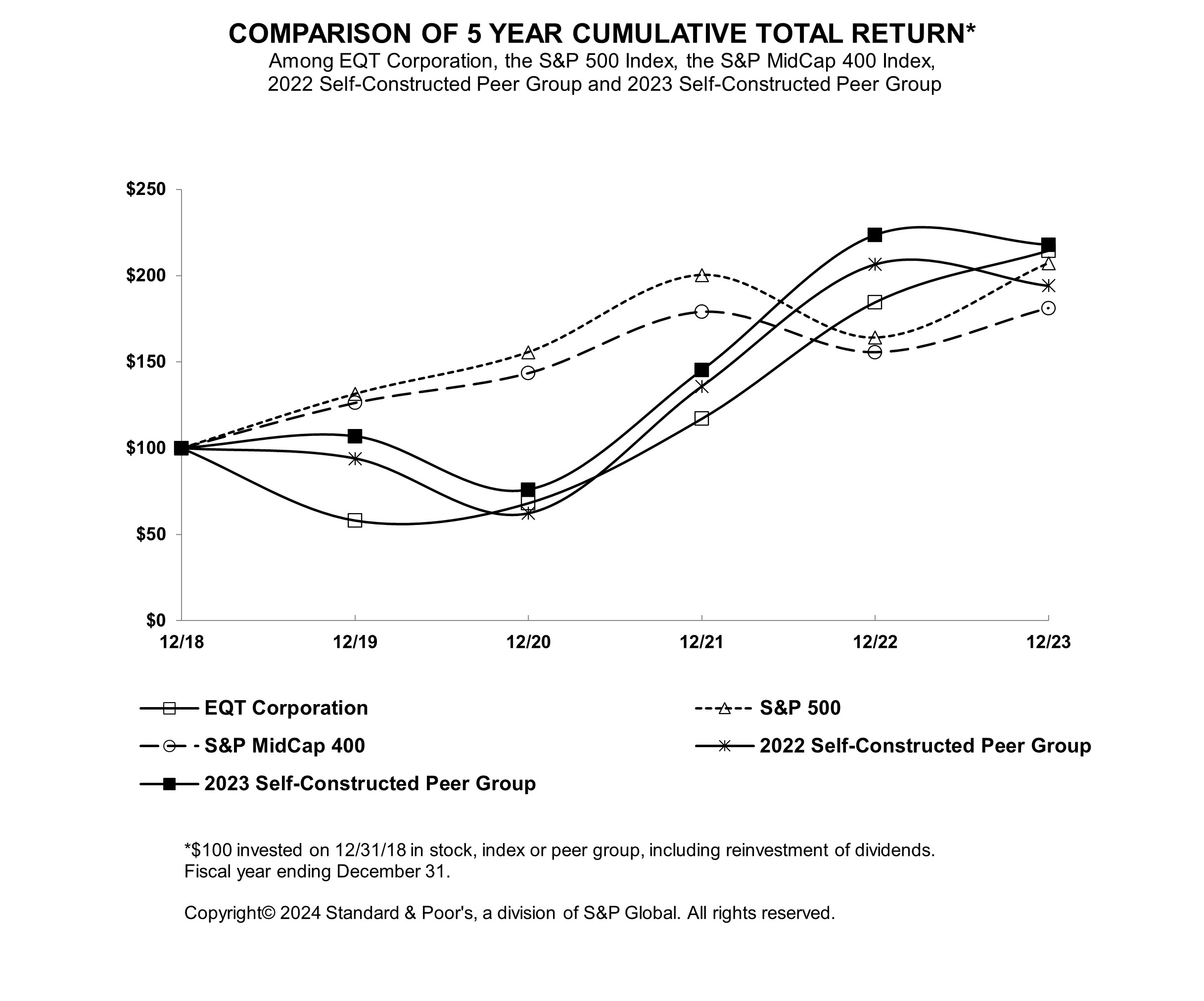
| 12/18 | 12/19 | 12/20 | 12/21 | 12/22 | 12/23 | ||||||||||||||||||||||||||||||
| EQT Corporation | $ | 100.00 | $ | 58.18 | $ | 68.21 | $ | 117.05 | $ | 184.46 | $ | 214.36 | |||||||||||||||||||||||
| S&P 500 Index | 100.00 | 131.49 | 155.68 | 200.37 | 164.08 | 207.21 | |||||||||||||||||||||||||||||
| S&P MidCap 400 Index | 100.00 | 126.20 | 143.44 | 178.95 | 155.58 | 181.15 | |||||||||||||||||||||||||||||
| 2022 Self-Constructed Peer Group (a) | 100.00 | 94.04 | 62.22 | 135.86 | 206.58 | 194.10 | |||||||||||||||||||||||||||||
| 2023 Self-Constructed Peer Group (b) | 100.00 | 106.87 | 75.96 | 145.21 | 223.56 | 217.88 |
(a)The 2022 Self-Constructed Peer Group includes the following fourteen companies: Antero Resources Corp., APA Corp. (US), Chesapeake Energy Corp., CNX Resources Corp., Comstock Resources, Inc., Coterra Energy Inc., Devon Energy Corp., Diamondback Energy, Inc., Marathon Oil Corp., Matador Resources Co., Murphy Oil Corp., Ovintiv Inc., Range Resources Corp. and Southwestern Energy Co. The 2022 Self-Constructed Peer Group is comprised of the companies included in our 2022 performance peer group (with the exception of (i) Continental Resources, Inc., which was excluded for purposes of the stock performance graph because its stock ceased to be publicly traded beginning in November 2022, and (ii) PDC Energy Inc., which was excluded for purposes of the stock performance graph because it was acquired by Chevron Corp. in August 2023), as selected by the Management Development and Compensation Committee of our Board of Directors for purposes of evaluating our relative total shareholder return under the 2022 Incentive Performance Share Unit Program.
(b)The 2023 Self-Constructed Peer Group includes the following sixteen companies: Antero Resources Corp., APA Corp. (US), Chesapeake Energy Corp., CNX Resources Corp., Comstock Resources Inc., Coterra Energy Inc., Devon Energy Corp., Diamondback Energy, Inc., Hess Corp., Marathon Oil Corp., Matador Resources Co., Murphy Oil Corp., Ovintiv Inc., Pioneer Natural Resources Co., Range Resources Corp. and Southwestern Energy Co. The 2023 Self-Constructed Peer Group is comprised of the companies included in our 2023 performance peer group (with the exception of PDC Energy Inc., which was excluded for purposes of the stock performance graph because it was acquired by Chevron Corp. in August 2023), as selected by the Management Development and Compensation Committee of our Board of Directors for purposes of evaluating our relative total shareholder return under the 2023 Incentive Performance Share Unit Program.
Item 6. [Reserved]
Item 7. Management's Discussion and Analysis of Financial Condition and Results of Operations
The following discussion and analysis of financial condition and results of operations should be read in conjunction with the Consolidated Financial Statements and the notes thereto included in Item 8., "Financial Statements and Supplementary Data."
Consolidated Results of Operations
Net income attributable to EQT Corporation for 2023 was $1,735 million, $4.22 per diluted share, compared to $1,771 million, $4.38 per diluted share, for 2022. The decrease was attributable primarily to decreased sales of natural gas, NGLs and oil, partly offset by a gain on derivatives in 2023 compared to a loss on derivatives in 2022, impairment of the contract asset (discussed in Note 5 to the Consolidated Financial Statements) in 2022, decreased income tax expense and a loss on debt extinguishment in 2022.
See Item 7., "Management's Discussion and Analysis of Financial Condition and Results of Operations" included in our Annual Report on Form 10-K for the year ended December 31, 2022, which is incorporated herein by reference, for discussion and analysis of consolidated results of operations for the year ended December 31, 2021.
Results of operations for the period beginning August 22, 2023 through December 31, 2023 include the results of our operation of assets acquired in the Tug Hill and XcL Midstream Acquisition. See Note 6 to the Consolidated Financial Statements for further discussion of the Tug Hill and XcL Midstream Acquisition.
See "Sales Volume and Revenues" and "Operating Expenses" for discussions of items affecting operating income and "Other Income Statement Items" for a discussion of other income statement items. See "Investing Activities" under "Capital Resources and Liquidity" for a discussion of capital expenditures.
Trends and Uncertainties
Our sales volume and operating expenses on a per Mcfe basis during the first half of 2023 were negatively impacted by fewer wells turned-in-line during 2022 compared to our 2022 planned development schedule due to third-party supply chain constraints. In addition, as a result of third-party supply chain constraints in 2022, we shifted the planned development of approximately 30 wells from 2022 to 2023 (the Rescheduled Wells). All of the Rescheduled Wells were completed and turned-to-sales as of July 2023, resulting in our third quarter 2023 sales volumes returning to our normalized level of production; however, our sales volume during the second half of 2023 was negatively impacted by approximately 13 Bcfe of curtailments (inclusive of non-operated wells in which we have a working interest) principally in response to lower natural gas prices in the Appalachian Basin. Future supply chain constraints or declines in natural gas prices may result in adjustments to our 2024 planned development schedule or the development schedule of non-operated wells in which we have a working interest. Further, we cannot control or otherwise influence the development schedule of non-operated wells in which we have a working interest. Adjustments to our 2024 planned development schedule or the development schedule of non-operated wells in which we have a working interest, including due to declines in natural gas prices, the pace of well completions, access to sand and water to conduct drilling operations, access to sufficient pipeline takeaway capacity, unscheduled downtime at processing facilities or otherwise, could impact our future sales volume, operating revenues and expenses, per unit metrics and capital expenditures.
The annual inflation rate in the United States increased rapidly during 2022, and, although the inflation rate decreased through 2023, it still remains elevated compared to the rate of inflation over the prior five years. Inflationary pressures have multiple impacts on our business, including increasing our operating expenses and our cost of capital. While the prices for certain of the raw materials and services we use in our operations have generally decreased from the peak prices experienced during 2022, we will not fully realize the benefit of such reduced prices until we enter into new contracts for such materials and services, and inflationary pressures may cause prices to fluctuate. Additionally, certain of our commitments for demand charges under our existing long-term contracts and processing capacity are subject to consumer price index adjustments. Although we believe our scale and supply chain contracting strategy of using multi-year sand and frac crew contracts allows us to maximize capital and operating efficiencies, future increases in the inflation rate will negatively impact our long-term contracts with consumer price index adjustments.
While the prices for natural gas, NGLs and oil have historically been volatile, price volatility was especially pronounced during 2022, with natural gas prices peaking in August 2022, then steadily declining into the first half of 2023. The second half of 2023 saw moderate increases in natural gas prices; however, on average, prices in 2023 remained lower than in 2022. We expect commodity prices to be volatile throughout 2024 due to macroeconomic uncertainty and geopolitical tensions, including developments pertaining to Russia's invasion of Ukraine and conflicts in the Middle East. Our revenue, profitability, liquidity and financial position will continue to be impacted in the future by the market prices for natural gas and, to a lesser extent, NGLs and oil.
Additionally, after several years of delays, in the third quarter of 2023, Equitrans Midstream resumed forward construction of the Mountain Valley Pipeline following the approval of federal legislation ratifying and approving all permits and authorizations necessary for the construction and initial operation of the project. The fee structure and various conditions precedent specified in certain of our agreements with Equitrans Midstream, including but not limited to the Consolidated GGA, are tied to the date on which the Mountain Valley Pipeline is placed in service. As a result, the timing of the date on which the Mountain Valley Pipeline is ultimately placed in service, which is outside of our control, could impact our operating results during 2024, including our operating expenses and per unit metrics, average differential and any payments required to settle the Henry Hub Cash Bonus (defined and described in Note 3 to the Consolidated Financial Statements), if required.
Average Realized Price Reconciliation
The following table presents detailed natural gas and liquids operational information to assist in the understanding of our consolidated operations, including the calculation of our average realized price ($/Mcfe), which is based on adjusted operating revenues, a non-GAAP supplemental financial measure. Adjusted operating revenues is presented because it is an important measure we use to evaluate period-to-period comparisons of earnings trends. Adjusted operating revenues should not be considered as an alternative to total operating revenues. See "Non-GAAP Financial Measures Reconciliation" for a reconciliation of adjusted operating revenues with total operating revenues, the most directly comparable financial measure calculated in accordance with GAAP.
| Years Ended December 31, | |||||||||||
| 2023 | 2022 | ||||||||||
| (Thousands, unless otherwise noted) | |||||||||||
| NATURAL GAS | |||||||||||
| Sales volume (MMcf) | 1,907,343 | 1,842,044 | |||||||||
| NYMEX price ($/MMBtu) | $ | 2.74 | $ | 6.64 | |||||||
| Btu uplift | 0.14 | 0.35 | |||||||||
| Natural gas price ($/Mcf) | $ | 2.88 | $ | 6.99 | |||||||
| Basis ($/Mcf) (a) | $ | (0.51) | $ | (0.77) | |||||||
| Cash settled basis swaps ($/Mcf) | (0.03) | (0.02) | |||||||||
| Average differential, including cash settled basis swaps ($/Mcf) | $ | (0.54) | $ | (0.79) | |||||||
| Average adjusted price ($/Mcf) | $ | 2.34 | $ | 6.20 | |||||||
| Cash settled derivatives ($/Mcf) | 0.34 | (3.20) | |||||||||
| Average natural gas price, including cash settled derivatives ($/Mcf) | $ | 2.68 | $ | 3.00 | |||||||
| Natural gas sales, including cash settled derivatives | $ | 5,112,278 | $ | 5,529,963 | |||||||
| LIQUIDS | |||||||||||
| NGLs, excluding ethane: | |||||||||||
| Sales volume (MMcfe) (b) | 64,859 | 56,735 | |||||||||
| Sales volume (Mbbl) | 10,810 | 9,456 | |||||||||
| NGLs price ($/Bbl) | $ | 36.39 | $ | 53.26 | |||||||
| Cash settled derivatives ($/Bbl) | (1.27) | (3.91) | |||||||||
| Average NGLs price, including cash settled derivatives ($/Bbl) | $ | 35.12 | $ | 49.35 | |||||||
| NGLs sales, including cash settled derivatives | $ | 379,663 | $ | 466,664 | |||||||
| Ethane: | |||||||||||
| Sales volume (MMcfe) (b) | 34,441 | 35,100 | |||||||||
| Sales volume (Mbbl) | 5,740 | 5,850 | |||||||||
| Ethane price ($/Bbl) | $ | 6.00 | $ | 14.20 | |||||||
| Ethane sales | $ | 34,417 | $ | 83,096 | |||||||
| Oil: | |||||||||||
| Sales volume (MMcfe) (b) | 9,630 | 6,164 | |||||||||
| Sales volume (Mbbl) | 1,605 | 1,027 | |||||||||
| Oil price ($/Bbl) | $ | 59.93 | $ | 77.06 | |||||||
| Oil sales | $ | 96,191 | $ | 79,160 | |||||||
| Total liquids sales volume (MMcfe) (b) | 108,930 | 97,999 | |||||||||
| Total liquids sales volume (Mbbl) | 18,155 | 16,333 | |||||||||
| Total liquids sales | $ | 510,271 | $ | 628,920 | |||||||
| TOTAL | |||||||||||
| Total natural gas and liquids sales, including cash settled derivatives (c) | $ | 5,622,549 | $ | 6,158,883 | |||||||
| Total sales volume (MMcfe) | 2,016,273 | 1,940,043 | |||||||||
| Average realized price ($/Mcfe) | $ | 2.79 | $ | 3.17 |
(a)Basis represents the difference between the ultimate sales price for natural gas, including the effects of delivered price benefit or deficit associated with our firm transportation agreements, and the NYMEX natural gas price.
(b)NGLs, ethane and oil were converted to Mcfe at a rate of six Mcfe per barrel.
(c)Total natural gas and liquids sales, including cash settled derivatives, is also referred to in this report as adjusted operating revenues, a non-GAAP supplemental financial measure.
Non-GAAP Financial Measures Reconciliation
The table below reconciles adjusted operating revenues, a non-GAAP supplemental financial measure, with total operating revenues, its most directly comparable financial measure calculated in accordance with GAAP. Adjusted operating revenues (also referred to in this report as total natural gas and liquids sales, including cash settled derivatives) is presented because it is an important measure we use to evaluate period-to-period comparisons of earnings trends. Adjusted operating revenues excludes the revenue impacts of changes in the fair value of derivative instruments prior to settlement and net marketing services and other. We use adjusted operating revenues to evaluate earnings trends because, as a result of the measure's exclusion of the often-volatile changes in the fair value of derivative instruments prior to settlement, the measure reflects only the impact of settled derivative contracts. Net marketing services and other consists of the costs of, and recoveries on, pipeline capacity releases, revenues for gathering and processing services provided to third parties and other revenues. Because we consider net marketing services and other to be unrelated to our natural gas and liquids production activities, adjusted operating revenues excludes net marketing services and other. We believe that adjusted operating revenues provides useful information to investors for evaluating period-to-period comparisons of earnings trends.
| Years Ended December 31, | |||||||||||
| 2023 | 2022 | ||||||||||
| (Thousands, unless otherwise noted) | |||||||||||
| Total operating revenues | $ | 6,908,923 | $ | 7,497,689 | |||||||
| (Deduct) add: | |||||||||||
| (Gain) loss on derivatives | (1,838,941) | 4,642,932 | |||||||||
| Net cash settlements received (paid) on derivatives | 900,650 | (5,927,698) | |||||||||
| Premiums paid for derivatives that settled during the period | (322,869) | (27,587) | |||||||||
| Net marketing services and other | (25,214) | (26,453) | |||||||||
| Adjusted operating revenues, a non-GAAP financial measure | $ | 5,622,549 | $ | 6,158,883 | |||||||
| Total sales volume (MMcfe) | 2,016,273 | 1,940,043 | |||||||||
| Average realized price ($/Mcfe) | $ | 2.79 | $ | 3.17 |
Sales Volume and Revenues
| Years Ended December 31, | |||||||||||||||||||||||
| 2023 | 2022 | Change | % Change | ||||||||||||||||||||
| (Thousands, unless otherwise noted) | |||||||||||||||||||||||
| Sales volume (MMcfe) | 2,016,273 | 1,940,043 | 76,230 | 3.9 | |||||||||||||||||||
| Average daily sales volume (MMcfe/d) | 5,524 | 5,315 | 209 | 3.9 | |||||||||||||||||||
| Operating revenues: | |||||||||||||||||||||||
| Sales of natural gas, NGLs and oil | $ | 5,044,768 | $ | 12,114,168 | $ | (7,069,400) | (58.4) | ||||||||||||||||
| Gain (loss) on derivatives | 1,838,941 | (4,642,932) | 6,481,873 | (139.6) | |||||||||||||||||||
| Net marketing services and other | 25,214 | 26,453 | (1,239) | (4.7) | |||||||||||||||||||
| Total operating revenues | $ | 6,908,923 | $ | 7,497,689 | $ | (588,766) | (7.9) |
Sales of natural gas, NGLs and oil. Sales of natural gas, NGLs and oil decreased for 2023 compared to 2022 due to lower average realized price, partly offset by increased sales volume.
Average realized price decreased for 2023 compared to 2022 due to lower NYMEX and liquids prices, partly offset by favorable cash settled derivatives and favorable differential. The following table presents the composition of net cash settlements that we received (paid) on derivatives.
| Years Ended December 31, | |||||||||||
| 2023 | 2022 | ||||||||||
| (Thousands) | |||||||||||
| Net cash settlements received (paid) on NYMEX natural gas hedge positions | $ | 976,432 | $ | (5,855,959) | |||||||
| Net cash settlements paid on basis and liquids hedge positions | (75,782) | (71,739) | |||||||||
| Net cash settlements received (paid) on derivatives | $ | 900,650 | $ | (5,927,698) |
Net cash settlements received (paid) on derivatives are included in average realized price but may not be included in operating revenues.
For 2023 and 2022, we paid premiums for derivatives that settled during the period of $322.9 million and $27.6 million, respectively.
Sales volume increased for 2023 compared to 2022 due to sales volume increases of 90 Bcfe from the assets acquired in the Tug Hill and XcL Midstream Acquisition, partly offset by sales volume decreases from the natural decline of producing wells and fewer wells turned-in-line during 2022 as a result of third-party supply chain constraints and delays in the development schedule of certain non-operated wells in which we have a working interest.
Gain (loss) on derivatives. For 2023, we recognized a gain on derivatives of $1,838.9 million related primarily to increases in the fair market value of our NYMEX swaps and options due to decreases in NYMEX forward prices, partly offset by a loss on the derivative liability related to the Henry Hub Cash Bonus. For 2022, we recognized a loss on derivatives of $4,642.9 million related primarily to decreases in the fair market value of our NYMEX swaps and options due to increases in NYMEX forward prices, partly offset by a gain on the derivative liability related to the Henry Hub Cash Bonus.
Operating Expenses
| Years Ended December 31, | |||||||||||||||||||||||
| 2023 | 2022 | Change | % Change | ||||||||||||||||||||
| (Thousands, unless otherwise noted) | |||||||||||||||||||||||
| Operating expenses: | |||||||||||||||||||||||
| Gathering | $ | 1,282,402 | $ | 1,316,213 | $ | (33,811) | (2.6) | ||||||||||||||||
| Transmission | 642,688 | 601,497 | 41,191 | 6.8 | |||||||||||||||||||
| Processing | 232,170 | 199,266 | 32,904 | 16.5 | |||||||||||||||||||
| Lease operating expenses (LOE) | 158,973 | 156,523 | 2,450 | 1.6 | |||||||||||||||||||
| Production taxes | 95,727 | 144,462 | (48,735) | (33.7) | |||||||||||||||||||
| Exploration | 3,330 | 3,438 | (108) | (3.1) | |||||||||||||||||||
| Selling, general and administrative | 236,171 | 252,645 | (16,474) | (6.5) | |||||||||||||||||||
| Production depletion | $ | 1,702,198 | $ | 1,644,625 | $ | 57,573 | 3.5 | ||||||||||||||||
| Other depreciation and depletion | 29,944 | 21,337 | 8,607 | 40.3 | |||||||||||||||||||
| Total depreciation and depletion | $ | 1,732,142 | $ | 1,665,962 | $ | 66,180 | 4.0 | ||||||||||||||||
| Per Unit ($/Mcfe): | |||||||||||||||||||||||
| Gathering | $ | 0.64 | $ | 0.68 | $ | (0.04) | (5.9) | ||||||||||||||||
| Transmission | 0.32 | 0.31 | 0.01 | 3.2 | |||||||||||||||||||
| Processing | 0.12 | 0.10 | 0.02 | 20.0 | |||||||||||||||||||
| LOE | 0.08 | 0.08 | — | — | |||||||||||||||||||
| Production taxes | 0.05 | 0.07 | (0.02) | (28.6) | |||||||||||||||||||
| Selling, general and administrative | 0.12 | 0.13 | (0.01) | (7.7) | |||||||||||||||||||
| Production depletion | 0.84 | 0.85 | (0.01) | (1.2) |
Gathering. Gathering expense decreased on an absolute basis for 2023 compared to 2022 due primarily to lower gathering rates on certain contracts indexed to price. Gathering expense decreased on a per Mcfe basis for 2023 compared to 2022 due primarily to lower gathering rates on certain contracts indexed to price, which decreased in 2023, as well as the impact of the gathering assets acquired in the Tug Hill and XcL Midstream Acquisition, which are wholly owned by us and, therefore, reduce our gathering cost structure.
Transmission. Transmission expense increased on an absolute and per Mcfe basis for 2023 compared to 2022 due primarily to additional capacity acquired, partly offset by increased credits received from the Texas Eastern Transmission Pipeline.
Processing. Processing expense increased on an absolute and per Mcfe basis for 2023 compared to 2022 due primarily to processing expenses for the liquids-rich assets acquired in the Tug Hill and XcL Midstream Acquisition as well as inflation of third-party-contracted processing rates.
LOE. LOE increased on an absolute basis for 2023 compared to 2022 due primarily to increased LOE from the assets acquired in the Tug Hill and XcL Midstream Acquisition, partly offset by lower saltwater disposal costs and increased recycling. Saltwater disposal costs and recycle rates were favorably impacted by increased use of our internally developed produced water gathering and storage system, which was placed in service during the fourth quarter of 2022.
Production taxes. Production taxes decreased on an absolute and per Mcfe basis for 2023 compared to 2022 due to lower West Virginia severance taxes due to lower TETCO M2 price and lower Pennsylvania impact fees due to lower NYMEX price, partly offset by higher West Virginia property taxes due to assets acquired in the Tug Hill and XcL Midstream Acquisition and higher rates.
Selling, general and administrative. Selling, general and administrative expense decreased on an absolute and per Mcfe basis for 2023 compared to 2022 due primarily to lower long-term incentive compensation costs as a result of decreases in awards outstanding and changes in the fair value of awards. Long-term incentive compensation may fluctuate with changes in our stock price and performance conditions.
Depreciation and depletion. Production depletion expense increased on an absolute basis for 2023 compared to 2022 due to increased sales volume, partly offset by a lower annual depletion rate.
Loss (gain) on sale/exchange of long-lived assets. During 2023, we recognized a loss on sale/exchange of long-lived assets of $17.4 million related to acreage trade agreements where the carrying value of the acres traded exceeded the fair value of the acres received.
Impairment of contract asset. During 2022, we recognized impairment of our contract asset of $214.2 million. See Note 5 to the Consolidated Financial Statements.
Impairment and expiration of leases. During 2023 and 2022, we recognized impairment and expiration of leases of $109.4 million and $176.6 million, respectively, related primarily to leases that we no longer expect to extend or develop prior to their expiration based on our development plan.
Other operating expenses. Other operating expenses increased for 2023 compared to 2022 due primarily to transaction costs associated with the Tug Hill and XcL Midstream Acquisition, partly offset by decreased legal and environmental reserves, including from settlements. See Note 1 to the Consolidated Financial Statements for a summary of other operating expenses.
Other Income Statement Items
(Income) loss from investments. The change in (income) loss from investments was due primarily to a loss on our sale of our investment in Equitrans Midstream in 2022, partly offset by lower equity earnings recognized on our investment in LMM (defined in Note 1 to the Consolidated Financial Statements).
Dividend and other income. Dividend and other income decreased for 2023 compared to 2022 due primarily to lower dividends received on our investment in the Investment Fund (defined in Note 1 to the Consolidated Financial Statements) as well as dividends received on our investment in Equitrans Midstream in 2022.
Loss on debt extinguishment. During 2022, we recognized a loss on debt extinguishment of $140.0 million due to our repayment and repurchase of debt, including our 3.00% notes due October 1, 2022.
Interest expense, net. Interest expense decreased for 2023 compared to 2022 due primarily to higher interest income earned on cash on hand and lower interest expense on lower revolving credit facility borrowings, partly offset by higher interest expense on debt as a result of the August 2023 draw down of the Term Loan Facility (defined and discussed in Note 8 to the Consolidated Financial Statements) and October 2022 senior notes issuances. The higher interest expense on debt was partly offset by our repayment and repurchase of debt disclosed in Note 8 to the Consolidated Financial Statements.
Income tax expense (benefit). See Note 7 to the Consolidated Financial Statements.
See "Critical Accounting Estimates" and Note 1 to the Consolidated Financial Statements for a discussion of our significant accounting policies and assumptions related to accounting for natural gas, NGLs and oil producing activities and impairment of our oil and gas properties. See also Item 1A., "Risk Factors – Natural gas, NGLs and oil price declines, and changes in our development strategy, have resulted in impairment of certain of our assets. Future declines in commodity prices, increases in operating costs or adverse changes in well performance or additional changes in our development strategy may result in additional write-downs of the carrying amounts of our assets, including long-lived intangible assets, which could materially and adversely affect our results of operations in future periods."
Capital Resources and Liquidity
Although we cannot provide any assurance, we believe cash flows from operating activities and availability under our revolving credit facility should be sufficient to meet our cash requirements inclusive of, but not limited to, normal operating needs, debt service obligations, planned capital expenditures and commitments for at least the next twelve months and, based on current expectations, for the long term.
Revolving Credit Facility
We primarily use borrowings under our revolving credit facility to fund working capital needs, timing differences between capital expenditures and other cash uses and cash flows from operating activities, margin deposit requirements on our derivative instruments and credit assurance requirements, including collateral, in support of our midstream service contracts, joint venture arrangements or construction contracts. See Note 8 to the Consolidated Financial Statements for further discussion of our revolving credit facility.
Known Contractual and Other Obligations; Planned Capital Expenditures
Purchase Obligations. We have commitments for demand charges under existing long-term contracts and binding precedent agreements with various pipelines, some of which extend up to 20 years or longer. We have entered into agreements to release some of our capacity under these long-term contracts, subject to certain conditions that are currently unsatisfied. We also have commitments for processing capacity in order to extract heavier liquid hydrocarbons from the natural gas stream. In addition, we have commitments to pay for services and materials related to our operations, which primarily include minimum volume commitments to obtain water services and electric hydraulic fracturing services and commitments to purchase equipment, materials and sand. See Note 11 to the Consolidated Financial Statements for further discussion, including details regarding aggregate future payments for these items.
Contractual Commitments. We have contractual commitments under our debt agreements, including interest payments and principal repayments. See Note 8 to the Consolidated Financial Statements for further discussion of the contractual commitments under our debt agreements, including the timing of principal repayments.
Unrecognized Tax Benefits. As discussed further in Note 7 to the Consolidated Financial Statements, as of December 31, 2023, we had a total reserve for unrecognized tax benefits of $8.5 million and an additional reserve of $77.0 million that was offset against deferred tax assets for general business tax credit carryforwards and net operating losses (NOLs). We settled our consolidated U.S. federal income tax liability with the IRS through 2017 in January of 2023. We are currently unable to make reasonably reliable estimates of the period of cash settlement of these potential liabilities with taxing authorities.
Planned Capital Expenditures and Sales Volume. In 2024, we expect to spend approximately $2.15 billion to $2.35 billion in total capital expenditures. We expect to fund our capital expenditures with cash generated from operations and, if required, borrowings under our revolving credit facility. Because we are the operator of a high percentage of our developed acreage, the amount and timing of certain of our capital expenditures is largely discretionary. We could choose to defer a portion of our planned 2024 capital expenditures depending on a variety of factors, including prevailing and anticipated prices for natural gas, NGLs and oil; the availability of necessary equipment, infrastructure and capital; the receipt and timing of required regulatory permits and approvals; and drilling, completion and acquisition costs. In 2024, we expect our sales volume to be 2,200 Bcfe to 2,300 Bcfe.
Operating Activities
Net cash provided by operating activities was $3,179 million and $3,466 million for 2023 and 2022, respectively. The decrease in 2023 compared to 2022 was due primarily to lower cash operating revenues, partly offset by net cash settlements received on derivatives in 2023 compared to net cash settlements paid on derivatives in 2022, favorable changes in working capital driven by declining accounts receivable and lower margin postings.
Our cash flows from operating activities are affected by movements in the market price for commodities. We are unable to predict such movements outside of the current market view as reflected in forward strip pricing. For a discussion of potential commodity market risks, refer to Item 1A., "Risk Factors – Natural gas, NGLs and oil price volatility, or a prolonged period of low natural gas, NGLs and oil prices, may have an adverse effect on our revenue, profitability, future rate of growth, liquidity and financial position."
Investing Activities
Net cash used in investing activities was $4,314 million and $1,422 million for 2023 and 2022, respectively. The increase in 2023 compared to 2022 was attributable primarily to cash paid for the Tug Hill and XcL Midstream Acquisition in 2023 and increased capital expenditures.
The following table summarizes our capital expenditures.
| Years Ended December 31, | |||||||||||
| 2023 | 2022 | ||||||||||
| (Millions) | |||||||||||
| Reserve development (a) | $ | 1,587 | $ | 1,131 | |||||||
| Land and lease (b) | 130 | 138 | |||||||||
| Other production infrastructure | 63 | 82 | |||||||||
| Midstream | 31 | 6 | |||||||||
| Capitalized overhead | 60 | 51 | |||||||||
| Capitalized interest | 41 | 28 | |||||||||
| Other | 13 | 4 | |||||||||
| Total capital expenditures | 1,925 | 1,440 | |||||||||
| Add (deduct): Non-cash items (c) | 94 | (40) | |||||||||
| Total cash capital expenditures | $ | 2,019 | $ | 1,400 |
(a)Includes capital expenditures for water infrastructure of $35.9 million and $44.5 million for 2023 and 2022, respectively.
(b)Capital expenditures attributable to noncontrolling interests were $8.5 million and $12.8 million for 2023 and 2022, respectively.
(c)Represents the net impact of non-cash capital expenditures, including the effect of timing of receivables from working interest partners, accrued capital expenditures and capitalized share-based compensation costs. The impact of accrued capital expenditures includes the current period estimate, net of the reversal of the prior period accrual.
Financing Activities
Net cash used in financing activities was $243 million and $699 million for 2023 and 2022, respectively. For 2023, the primary uses of financing cash flows were repayment and retirement of debt, payment of dividends and repurchase and retirement of EQT Corporation common stock, and the primary source of financing cash flows was proceeds from the Term Loan Facility borrowings. For 2022, the primary uses of financing cash flows were repayment and retirement of debt, repurchase and retirement of EQT Corporation common stock and payment of dividends, and the primary source of financing cash flows was proceeds from the issuance of debt.
See Note 8 to the Consolidated Financial Statements for further discussion of our debt and borrowings under our revolving credit facility and the Term Loan Facility, including discussion of events that occurred subsequent to December 31, 2023.
On February 8, 2024, our Board of Directors declared a quarterly cash dividend of $0.1575 per share of EQT Corporation common stock, payable on March 1, 2024, to shareholders of record at the close of business on February 20, 2024.
Depending on our actual and anticipated sources and uses of liquidity, prevailing market conditions and other factors, we may from time to time seek to redeem or repurchase our outstanding debt or equity securities through tender offers or other cash purchases in the open market or privately negotiated transactions. The amounts involved in any such transactions may be material. See Note 8 to the Consolidated Financial Statements for discussion of redemptions and repurchases of debt and Note 9 to the Consolidated Financial Statements for discussion of repurchases of EQT Corporation common stock.
Security Ratings and Financing Triggers
The table below reflects the credit ratings and rating outlooks assigned to our debt instruments as of December 31, 2023. Our credit ratings and rating outlooks are subject to revision or withdrawal at any time by the assigning rating agency, and each rating should be evaluated independent from any other rating. We cannot ensure that a rating will remain in effect for any given period of time or that a rating will not be lowered or withdrawn by a rating agency if, in the rating agency's judgment, circumstances so warrant. See Note 3 to the Consolidated Financial Statements for a description of what is deemed investment grade.
| Rating agency | Senior notes | Outlook | ||||||||||||
| Moody's Investors Service (Moody's) | Baa3 | Stable | ||||||||||||
| Standard & Poor's Ratings Service (S&P) | BBB– | Stable | ||||||||||||
| Fitch Ratings Service (Fitch) | BBB– | Stable |
Changes in credit ratings may affect our access to the capital markets, the cost of short-term debt through interest rates and fees under our revolving credit facility, the interest rate on the Term Loan Facility and senior notes with adjustable rates, the rates available on new long-term debt, our pool of investors and funding sources, the borrowing costs and margin deposit requirements on our OTC derivative instruments and credit assurance requirements, including collateral, in support of our midstream service contracts, joint venture arrangements or construction contracts. Margin deposits on our OTC derivative instruments are also subject to factors other than credit rating, such as natural gas prices and credit thresholds set forth in the agreements between us and our hedging counterparties.
Our debt agreements and other financial obligations contain various provisions that, if not complied with, could result in default or event of default under our revolving credit facility and the Term Loan Facility, mandatory partial or full repayment of amounts outstanding, reduced loan capacity or other similar actions. The most significant covenants and events of default under our debt agreements relate to maintenance of a debt-to-total capitalization ratio, limitations on transactions with affiliates, insolvency events, nonpayment of scheduled principal or interest payments, acceleration of other financial obligations and change of control provisions. Our revolving credit facility and the Term Loan Facility contain financial covenants that require us to have a total debt-to-total capitalization ratio no greater than 65%. As of December 31, 2023, we were in compliance with all debt provisions and covenants under our debt agreements.
See Note 8 to the Consolidated Financial Statements for a discussion of borrowings under our revolving credit facility and the Term Loan Facility.
Commodity Risk Management
The substantial majority of our commodity risk management program is related to hedging sales of our produced natural gas. The overall objective of our hedging program is to protect cash flows from undue exposure to the risk of changing commodity prices. The derivative commodity instruments that we use are primarily swap, collar and option agreements. The following table summarizes the approximate volume and prices of our NYMEX hedge positions as of February 9, 2024. The difference between the fixed price and NYMEX price is included in average differential presented in our price reconciliation in "Average Realized Price Reconciliation." The fixed price natural gas sales agreements can be physically or financially settled.
| Q1 2024(a) | Q2 2024 | Q3 2024 | Q4 2024 | ||||||||||||||||||||||||||
| Hedged Volume (MMDth) | 283 | 260 | 237 | 127 | |||||||||||||||||||||||||
| Hedged Volume (MMDth/d) | 3.1 | 2.9 | 2.6 | 1.4 | |||||||||||||||||||||||||
| Swaps – Short | |||||||||||||||||||||||||||||
| Volume (MMDth) | 136 | 215 | 192 | 95 | |||||||||||||||||||||||||
| Avg. Price ($/Dth) | $ | 3.52 | $ | 3.26 | $ | 3.27 | $ | 3.26 | |||||||||||||||||||||
| Calls – Long | |||||||||||||||||||||||||||||
| Volume (MMDth) | 13 | 13 | 13 | 13 | |||||||||||||||||||||||||
| Avg. Strike ($/Dth) | $ | 3.20 | $ | 3.20 | $ | 3.20 | $ | 3.20 | |||||||||||||||||||||
| Calls – Short | |||||||||||||||||||||||||||||
| Volume (MMDth) | 162 | 61 | 62 | 46 | |||||||||||||||||||||||||
| Avg. Strike ($/Dth) | $ | 6.16 | $ | 4.22 | $ | 4.22 | $ | 4.27 | |||||||||||||||||||||
| Puts – Long | |||||||||||||||||||||||||||||
| Volume (MMDth) | 147 | 45 | 45 | 32 | |||||||||||||||||||||||||
| Avg. Strike ($/Dth) | $ | 4.20 | $ | 4.05 | $ | 4.05 | $ | 4.10 | |||||||||||||||||||||
| Option Premiums | |||||||||||||||||||||||||||||
| Cash Settlement of Deferred Premiums (millions) | $ | (34) | $ | (4) | $ | (4) | $ | — |
(a)January 1 through March 31.
We have also entered into derivative instruments to hedge basis. We may use other contractual agreements to implement our commodity hedging strategy from time to time.
See Item 7A., "Quantitative and Qualitative Disclosures About Market Risk" and Note 3 to the Consolidated Financial Statements for further discussion of our hedging program.
Off-Balance Sheet Arrangements
As of December 31, 2023, we did not have any material off-balance sheet arrangements other than the commitments described in Note 11 to the Consolidated Financial Statements.
Commitments and Contingencies
See Note 11 to the Consolidated Financial Statements for a discussion of our commitments and contingencies.
Recently Issued Accounting Standards
Our recently issued accounting standards are described in Note 1 to the Consolidated Financial Statements.
Critical Accounting Estimates
Our significant accounting policies are described in Note 1 to the Consolidated Financial Statements. Management's discussion and analysis of the Consolidated Financial Statements and results of operations are based on our Consolidated Financial Statements, which have been prepared in accordance with GAAP. The preparation of the Consolidated Financial Statements requires management to make estimates and judgments that affect the reported amounts of assets, liabilities, revenues and expenses and the related disclosure of contingent assets and liabilities. The following critical accounting estimates, which were reviewed by the Audit Committee of our Board of Directors (the Audit Committee), relate to our more significant judgments and estimates used in the preparation of our Consolidated Financial Statements. Actual results could differ from our estimates.
Accounting for Gas, NGLs and Oil Producing Activities. We use the successful efforts method of accounting for our oil and gas producing activities. See Note 1 to the Consolidated Financial Statements for a discussion of the fair value measurement and any subsequent impairments of our proved and unproved oil and gas properties and other long-lived assets as well as evaluation of the recoverability of capitalized costs of unproved oil and gas properties.
We believe accounting for natural gas, NGLs and oil producing activities is a "critical accounting estimate" because the evaluations of impairment of proved properties involve significant judgment about future events, such as future sales prices of natural gas and NGLs and future production costs, as well as the amount of natural gas and NGLs recorded and timing of recoveries. Significant changes in these estimates could result in the costs of our proved and unproved properties not being recoverable; therefore, we would be required to recognize impairment. An estimate of the sensitivity to changes in our assumptions is not practicable given the numerous assumptions that can materially affect our estimates.
See Note 1 to the Consolidated Financial Statements for additional information on impairments of our proved and unproved oil and gas properties. See also Item 1A., "Risk Factors – Natural gas, NGLs and oil price declines, and changes in our development strategy, have resulted in impairment of certain of our assets. Future declines in commodity prices, increases in operating costs or adverse changes in well performance or additional changes in our development strategy may result in additional write-downs of the carrying amounts of our assets, including long-lived intangible assets, which could materially and adversely affect our results of operations in future periods."
Oil and Gas Reserves. Proved oil and gas reserves, as defined by SEC Regulation S-X Rule 4-10, are those quantities of oil and gas that, by analysis of geoscience and engineering data, can be estimated with reasonable certainty to be economically producible from a given date forward from known reservoirs and under existing economic conditions, operating methods and government regulations prior to the time at which contracts providing the right to operate expire unless evidence indicates that renewal is reasonably certain regardless of whether deterministic or probabilistic methods are used for the estimation.
Our estimates of proved reserves are reassessed annually using geological, reservoir and production performance data. Reserve estimates are prepared by our engineers and audited by independent engineers. Revisions may result from changes in, among other things, reservoir performance, development plans, prices, operating costs, economic conditions and governmental restrictions. Decreases in prices, for example, may cause a reduction in certain proved reserves due to reaching economic limits sooner. A material change in the estimated volume of reserves could have an impact on the depletion rate calculation and our Consolidated Financial Statements.
We estimate future net cash flows from natural gas, NGLs and oil reserves based on selling prices and costs using a twelve-month average price, which is calculated as the unweighted arithmetic average of the first-day-of-the-month price for each month within the twelve-month period and, as such, is subject to change in subsequent periods. Operating costs, production and ad valorem taxes and future development costs are based on current costs with no escalation. Income tax expense is based on currently enacted statutory tax rates and tax deductions and credits available under current laws.
We believe oil and gas reserves is a "critical accounting estimate" because we must periodically reevaluate proved reserves along with estimates of future production rates, production costs and the timing of development expenditures. Future results of operations and the strength of our Consolidated Balance Sheet for any quarterly or annual period could be materially affected by changes in our assumptions. Based on proved reserves as of December 31, 2023, we estimate that a 1% change in proved reserves would decrease or increase 2024 depletion expense by approximately $15 million and $27 million, respectively, based on current production estimates for 2024.
See also Item 1A., "Risk Factors – Natural gas, NGLs and oil price volatility, or a prolonged period of low natural gas, NGLs and oil prices, may have an adverse effect on our revenue, profitability, future rate of growth, liquidity and financial position."
Income Taxes. We recognize deferred tax assets and liabilities for the expected future tax consequences of events that have been included in our Consolidated Financial Statements or tax returns. See Note 1 to the Consolidated Financial Statements for a discussion of significant accounting policies related to income taxes and Note 7 to the Consolidated Financial Statements for a discussion of deferred tax assets, valuation allowances and the amount of financial statement benefit recorded for uncertain tax positions.
We believe income taxes are "critical accounting estimates" because we must assess the likelihood that our deferred tax assets will be recovered from future taxable income and exercise judgment on the amount of financial statement benefit recorded for uncertain tax positions. To the extent that a valuation allowance or uncertain tax position is established or increased or decreased during a period, we record an expense or benefit in income tax expense in our Statements of Consolidated Operations. Future results of operations for any quarterly or annual period could be materially affected by changes in our assumptions. A change to future taxable income or tax planning strategies could impact our ability to utilize deferred tax assets, which would increase or decrease our income tax expense and taxes paid. An estimate of the sensitivity to changes in our assumptions is not practicable given the numerous assumptions that can materially affect our estimates.
Derivative Instruments. We enter into derivative commodity instrument contracts primarily to reduce exposure to commodity price risk associated with future sales of our natural gas production. See Note 4 to the Consolidated Financial Statements for a description of the fair value hierarchy. The values reported in the Consolidated Financial Statements change as these estimates are revised to reflect actual results or as market conditions or other factors, many of which are beyond our control, change.
We believe derivative instruments are "critical accounting estimates" because our financial condition and results of operations can be significantly impacted by changes in the market value of our derivative instruments due to the volatility of both NYMEX natural gas prices and basis. Future results of operations for any quarterly or annual period could be materially affected by changes in our assumptions. Refer to Item 7A., "Quantitative and Qualitative Disclosures about Market Risk" for discussion of a hypothetical increase or decrease of 10% in the market price of natural gas.
Business Combinations. Accounting for a business combination requires a company to record the identifiable assets and liabilities acquired at fair value. In the third quarter of 2023, we completed the Tug Hill and XcL Midstream Acquisition, and in the third quarter of 2021, we completed the Alta Acquisition (defined and discussed in Note 6 to the Consolidated Financial Statements). See Note 6 to the Consolidated Financial Statements for a discussion of the most significant assumptions used to estimate the fair value of the assets acquired and liabilities assumed.
We believe business combinations are "critical accounting estimates" because the valuation of acquired assets and assumed liabilities involves significant judgment about future events. Future results of operations for any quarterly or annual period could be materially affected by changes in our assumptions. An estimate of the sensitivity to changes in our assumptions is not practicable given the numerous assumptions that can materially affect our estimates.
Contingencies and Asset Retirement Obligations. We are involved in various legal and regulatory proceedings that arise in the ordinary course of business. We record a liability for contingencies based on our assessment that a loss is probable and the amount of the loss can be reasonably estimated. We consider many factors in making these assessments, including historical experience and matter specifics. Estimates are developed in consultation with legal counsel and are based on an analysis of potential results. See Note 11 to the Consolidated Financial Statements.
We accrue a liability for asset retirement obligations based on an estimate of the amount and timing of settlement. For oil and gas wells, the fair value of our plugging and abandonment obligations is recorded at the time the obligation is incurred, which is typically at the time the well is spud. See Note 1 to the Consolidated Financial Statements.
We believe contingencies and asset retirement obligations are "critical accounting estimates" because we must assess the probability of loss related to contingencies and the expected amount and timing of asset retirement obligation settlement. In addition, we must determine the estimated present value of future liabilities. Future results of operations for any quarterly or annual period could be materially affected by changes in our assumptions. If we incur losses related to contingencies that are higher than we expect, we could incur additional costs to settle such obligations. If the expected amount and timing of our asset retirement obligations change, we will be required to adjust the carrying value of our liabilities in future periods. An estimate of the sensitivity to changes in our assumptions is not practicable given the numerous assumptions that can materially affect our estimates.
Item 7A. Quantitative and Qualitative Disclosures About Market Risk
Commodity Price Risk and Derivative Instruments. Our primary market risk exposure is the volatility of future prices for natural gas and NGLs. Due to the volatility of commodity prices, we are unable to predict future potential movements in the market prices for natural gas and NGLs at our ultimate sales points and, thus, cannot predict the ultimate impact of prices on our operations. Prolonged low, or significant, extended declines in, natural gas and NGLs prices could adversely affect, among other things, our development plans, which would decrease the pace of development and the level of our proved reserves. Increases in natural gas and NGLs prices may be accompanied by, or result in, increased well drilling costs, increased production taxes, increased LOE, increased volatility in seasonal gas price spreads for our storage assets and increased end-user conservation or conversion to alternative fuels. In addition, to the extent we have hedged our production at prices below the current market price, we will not benefit fully from an increase in the price of natural gas, and, depending on our then-current credit ratings and the terms of our hedging contracts, we may be required to post additional margin with our hedging counterparties.
The overall objective of our hedging program is to protect our cash flows from undue exposure to the risk of changing commodity prices. Our use of derivatives is further described in Note 3 to the Consolidated Financial Statements and "Commodity Risk Management" under "Capital Resources and Liquidity" in Item 7., "Management's Discussion and Analysis of Financial Condition and Results of Operations." Our OTC derivative commodity instruments are placed primarily with financial institutions and the creditworthiness of those institutions is regularly monitored. We primarily enter into derivative instruments to hedge forecasted sales of production. We also enter into derivative instruments to hedge basis. Our use of derivative instruments is implemented under a set of policies approved by our management-level Hedge and Financial Risk Committee and is reviewed by our Board of Directors.
For derivative commodity instruments used to hedge our forecasted sales of production, which are at, for the most part, NYMEX natural gas prices, we set policy limits relative to the expected production and sales levels that are exposed to price risk. We have an insignificant amount of financial natural gas derivative commodity instruments for trading purposes.
The derivative commodity instruments we use are primarily swap, collar and option agreements. These agreements may require payments to, or receipt of payments from, counterparties based on the differential between two prices for the commodity. We use these agreements to hedge our NYMEX and basis exposure. We may also use other contractual agreements when executing our commodity hedging strategy.
We monitor price and production levels on a continuous basis and adjust quantities hedged as warranted.
A hypothetical decrease of 10% in the NYMEX natural gas price on December 31, 2023 and 2022 would increase the fair value of our natural gas derivative commodity instruments by approximately $204 million and $727 million, respectively. A hypothetical increase of 10% in the NYMEX natural gas price on December 31, 2023 and 2022 would decrease the fair value of our natural gas derivative commodity instruments by approximately $482 million and $333 million, respectively. For purposes of this analysis, we applied the 10% change in the NYMEX natural gas price on December 31, 2023 and 2022 to our natural gas derivative commodity instruments as of December 31, 2023 and 2022 to calculate the hypothetical change in fair value. The change in fair value was determined using a method similar to our normal process for determining derivative commodity instrument fair value described in Note 4 to the Consolidated Financial Statements.
The above analysis of our derivative commodity instruments does not include the offsetting impact that the same hypothetical price movement may have on our physical sales of natural gas. The portfolio of derivative commodity instruments held to hedge our forecasted produced natural gas approximates a portion of our expected physical sales of natural gas; therefore, an adverse impact to the fair value of the portfolio of derivative commodity instruments held to hedge our forecasted production associated with the hypothetical changes in commodity prices referenced above should be offset by a favorable impact on our physical sales of natural gas, assuming that the derivative commodity instruments are not closed in advance of their expected term and the derivative commodity instruments continue to function effectively as hedges of the underlying risk.
If the underlying physical transactions or positions are liquidated prior to the maturity of the derivative commodity instruments, a loss on the financial instruments may occur or the derivative commodity instruments might be worthless as determined by the prevailing market value on their termination or maturity date, whichever comes first.
Interest Rate Risk. Changes in market interest rates affect the amount of interest we earn on cash, cash equivalents and short-term investments and the interest rate we pay on borrowings under our revolving credit facility and the Term Loan Facility. None of the interest we pay on our senior notes fluctuates based on changes to market interest rates. A 1% increase in interest rates for the borrowings under our revolving credit facility and the Term Loan Facility during 2023 would have increased interest expense by approximately $12.9 million.
Interest rates for our revolving credit facility, the Term Loan Facility, our 6.125% senior notes due 2025 and our 7.000% senior notes due 2030 fluctuate based on changes to the credit ratings assigned to our senior notes by Moody's, S&P and Fitch. Interest rates for our other outstanding senior notes do not fluctuate based on changes to the credit ratings assigned to our senior notes by Moody's, S&P and Fitch. For a discussion of credit rating downgrade risk, see Item 1A., "Risk Factors – Our operations have substantial capital requirements, and we may not be able to obtain needed capital or financing on satisfactory terms." Changes in interest rates affect the fair value of our fixed rate debt. See Note 8 to the Consolidated Financial Statements for further discussion of our debt and Note 4 to the Consolidated Financial Statements for a discussion of fair value measurements, including the fair value measurement of our debt.
Other Market Risks. We are exposed to credit loss in the event of nonperformance by counterparties to our derivative contracts. This credit exposure is limited to derivative contracts with a positive fair value, which may change as market prices change. Our OTC derivative instruments are primarily with financial institutions and, thus, are subject to events that would impact those companies individually as well as the financial industry as a whole. We use various processes and analyses to monitor and evaluate our credit risk exposures, including monitoring current market conditions and counterparty credit fundamentals. Credit exposure is controlled through credit approvals and limits based on counterparty credit fundamentals. To manage the level of credit risk, we enter into transactions primarily with financial counterparties that are of investment grade, enter into netting agreements whenever possible and may obtain collateral or other security.
Approximately 86%, or $912 million, of our OTC derivative contracts outstanding at December 31, 2023 had a positive fair value. Approximately 36%, or $710 million, of our OTC derivative contracts outstanding at December 31, 2022 had a positive fair value.
As of December 31, 2023, we were not in default under any derivative contracts and had no knowledge of default by any counterparty to our derivative contracts. During 2023, we made no adjustments to the fair value of our derivative contracts due to credit related concerns outside of the normal non-performance risk adjustment included in our established fair value procedure. We monitor market conditions that may impact the fair value of our derivative contracts.
We are exposed to the risk of nonperformance by credit customers on physical sales of natural gas, NGLs and oil. Revenues and related accounts receivable from our operations are generated primarily from the sale of our produced natural gas, NGLs and oil to marketers, utilities and industrial customers located in the Appalachian Basin and in markets that are accessible through our transportation portfolio, which includes markets in the Gulf Coast, Midwest and Northeast United States and Canada. We also contract with certain processors to market a portion of our NGLs on our behalf.
No one lender of the large group of financial institutions in the syndicate for our revolving credit facility and the Term Loan Facility holds more than 10% of the financial commitments under either facility. The large syndicate group and relatively low percentage of participation by each lender are expected to limit our exposure to disruption or consolidation in the banking industry.
Item 8. Financial Statements and Supplementary Data
Report of Independent Registered Public Accounting Firm
To the Shareholders and the Board of Directors of EQT Corporation
Opinion on the Financial Statements
We have audited the accompanying consolidated balance sheets of EQT Corporation and subsidiaries (the Company) as of December 31, 2023 and 2022, the related consolidated statements of operations, comprehensive income (loss), cash flows and equity for each of the three years in the period ended December 31, 2023, and the related notes and financial statement schedule listed in the Index at Item 15(a) (collectively referred to as the "consolidated financial statements"). In our opinion, the consolidated financial statements present fairly, in all material respects, the financial position of the Company at December 31, 2023 and 2022, and the results of its operations and its cash flows for each of the three years in the period ended December 31, 2023, in conformity with U.S. generally accepted accounting principles.
We also have audited, in accordance with the standards of the Public Company Accounting Oversight Board (United States) (PCAOB), the Company's internal control over financial reporting as of December 31, 2023, based on criteria established in Internal Control – Integrated Framework issued by the Committee of Sponsoring Organizations of the Treadway Commission (2013 framework), and our report dated February 14, 2024 expressed an unqualified opinion thereon.
Basis for Opinion
These financial statements are the responsibility of the Company's management. Our responsibility is to express an opinion on the Company’s financial statements based on our audits. We are a public accounting firm registered with the PCAOB and are required to be independent with respect to the Company in accordance with the U.S. federal securities laws and the applicable rules and regulations of the Securities and Exchange Commission and the PCAOB.
We conducted our audits in accordance with the standards of the PCAOB. Those standards require that we plan and perform the audit to obtain reasonable assurance about whether the financial statements are free of material misstatement, whether due to error or fraud. Our audits included performing procedures to assess the risks of material misstatement of the financial statements, whether due to error or fraud, and performing procedures that respond to those risks. Such procedures included examining, on a test basis, evidence regarding the amounts and disclosures in the financial statements. Our audits also included evaluating the accounting principles used and significant estimates made by management, as well as evaluating the overall presentation of the financial statements. We believe that our audits provide a reasonable basis for our opinion.
Critical Audit Matters
The critical audit matters communicated below are matters arising from the current period audit of the financial statements that were communicated or required to be communicated to the audit committee and that: (1) relate to accounts or disclosures that are material to the financial statements and (2) involved our especially challenging, subjective or complex judgments. The communication of critical audit matters does not alter in any way our opinion on the consolidated financial statements, taken as a whole, and we are not, by communicating the critical audit matters below, providing separate opinions on the critical audit matters or on the accounts or disclosures to which they relate.
Depreciation, depletion and amortization ('DD&A') of proved oil and natural gas properties
| Description of the Matter | At December 31, 2023, the net book value of the Company's proved oil and natural gas properties was $19,737 million, and depreciation, depletion and amortization (DD&A) expense was $1,732 million for the year then ended. As described in Note 1, under the successful efforts method of accounting, DD&A is recorded on a cost center basis using the units-of-production method. Proved developed reserves, as estimated by the Company's internal engineers, are used to calculate depreciation of wells and related equipment and facilities and amortization of intangible drilling costs. Total proved reserves, also estimated by the Company's engineers, are used to calculate depletion on property acquisitions. Proved natural gas, natural gas liquids (NGLs) and oil reserve estimates are prepared using standard geological and engineering methods generally recognized in the petroleum industry based on evaluations of estimated in-place hydrocarbon volumes using financial and non-financial inputs. Significant judgment is required by the Company's engineers in interpreting the data when estimating proved natural gas, NGLs and oil reserves. Estimating reserves also requires the selection of inputs, including natural gas, NGLs and oil price assumptions, and future operating and capital costs assumptions, among others. Because of the complexity involved in estimating natural gas, NGLs and oil reserves, management used independent engineers to audit the estimates prepared by the Company's internal engineers as of December 31, 2023. Auditing the Company's DD&A calculation is especially complex because of the use of the work of the internal engineers and the independent engineers and the evaluation of management's determination of the inputs described above used by the specialists in estimating proved natural gas, NGLs and oil reserves. | ||||
| How We Addressed the Matter in Our Audit | We obtained an understanding, evaluated the design and tested the operating effectiveness of the Company's controls over its process to calculate DD&A, including management’s controls over the completeness and accuracy of the financial data provided to the specialists for use in estimating the proved natural gas, NGLs and oil reserves. Our audit procedures included, among others, evaluating the professional qualifications and objectivity of the Company engineer primarily responsible for overseeing the preparation of the reserve estimates by the internal engineering staff and the independent engineers used to audit the estimates. In addition, we evaluated the completeness and accuracy of the financial data and inputs described above used by the specialists in estimating proved natural gas, NGLs and oil reserves by agreeing them to source documentation and we identified and evaluated corroborative and contrary evidence. For proved undeveloped reserves, we evaluated management's development plan for compliance with the SEC rule that undrilled locations are scheduled to be drilled within |
Showing the first 8K of 219K characters. Open the full section
Item 9. Changes in and Disagreements with Accountants on Accounting and Financial Disclosure
Not applicable.
Item 9A. Controls and Procedures
Evaluation of Disclosure Controls and Procedures
Under the supervision and with the participation of management, including our Principal Executive Officer and Principal Financial Officer, an evaluation of our disclosure controls and procedures (as defined in Rule 13a-15(e) under the Exchange Act) was conducted as of the end of the period covered by this report. Based on that evaluation, the Principal Executive Officer and Principal Financial Officer concluded that our disclosure controls and procedures were effective as of the end of the period covered by this report.
Management's Report on Internal Control over Financial Reporting
Management is responsible for establishing and maintaining adequate internal control over financial reporting (as such term is defined in Rule 13a-15(f) under the Exchange Act). Our internal control system is designed to provide reasonable assurance to management and our Board of Directors regarding the reliability of financial reporting and the preparation of financial statements for external purposes in accordance with generally accepted accounting principles. All internal control systems, no matter how well designed, have inherent limitations. Accordingly, even effective controls can provide only reasonable assurance with respect to financial statement preparation and presentation.
Our management assessed the effectiveness of our internal control over financial reporting as of December 31, 2023. In making this assessment, management used the criteria set forth by the Committee of Sponsoring Organizations of the Treadway Commission in Internal Control – Integrated Framework (2013). Based on this assessment, our management concluded that we maintained effective internal control over financial reporting as of December 31, 2023.
Ernst & Young LLP (Ernst & Young), the independent registered public accounting firm that audited our Consolidated Financial Statements, has issued an attestation report on our internal control over financial reporting. Ernst & Young's attestation report on our internal control over financial reporting appears in Part II, Item 8., of this Annual Report on Form 10-K and is incorporated herein by reference.
Changes in Internal Control over Financial Reporting
There were no changes in internal control over financial reporting (as such term is defined in Rule 13a-15(f) under the Exchange Act) that occurred during the fourth quarter of 2023 that have materially affected, or are reasonably likely to materially affect, our internal control over financial reporting.
Item 9B. Other Information
During the three months ended December 31, 2023, none of our directors or "officers" (as defined in Rule 16a-1(f) under the Exchange Act) adopted or terminated a "Rule 10b5-1 trading arrangement" or "non-Rule 10b5-1 trading arrangement" (as each term is defined in Item 408(a) of Regulation S-K).
Item 9C. Disclosure Regarding Foreign Jurisdictions that Prevent Inspections
Not Applicable.
PART III
Item 10. Directors, Executive Officers and Corporate Governance
The following information is incorporated herein by reference from our definitive proxy statement relating to the 2024 annual meeting of shareholders, which proxy statement is expected to be filed with the SEC within 120 days after the close of our fiscal year ended December 31, 2023:
-
Information required by Item 401 of Regulation S-K with respect to directors;
-
Information required by Item 405 of Regulation S-K with respect to our compliance with Section 16(a) of the Exchange Act, if any;
-
Information required by Item 407(d)(4) of Regulation S-K with respect to disclosure of the existence of our separately-designated standing Audit Committee and the identification of the members of the Audit Committee; and
-
Information required by Item 407(d)(5) of Regulation S-K with respect to disclosure of our Audit Committee financial expert.
Information required by Item 401 of Regulation S-K with respect to executive officers is included after Item 4 at the end of Part I of this Annual Report on Form 10-K under the caption "Information about our Executive Officers (as of February 14, 2024)."
We have adopted a code of business conduct and ethics applicable to all directors and employees, including the principal executive officer, principal financial officer and principal accounting officer. Our code of business conduct and ethics is posted on our website http://www.eqt.com (accessible by clicking on the "About" link on the main page, followed by the "Governance" heading, then the "Charters and Governance Documents" link), and a printed copy will be delivered free of charge on request by writing to the Corporate Secretary at EQT Corporation, c/o Corporate Secretary, 625 Liberty Avenue, Suite 1700, Pittsburgh, Pennsylvania 15222. We intend to satisfy the disclosure requirement regarding certain amendments to, or waivers from, provisions of our code of business conduct and ethics by posting such information on our website.
Item 11. Executive Compensation
The following information is incorporated herein by reference from our definitive proxy statement relating to the 2024 annual meeting of shareholders, which proxy statement is expected to be filed with the SEC within 120 days after the close of our fiscal year ended December 31, 2023:
-
Information required by Item 402 of Regulation S-K with respect to named executive officer and director compensation; and
-
Information required by paragraphs (e)(4) and (e)(5) of Item 407 of Regulation S-K with respect to certain matters related to the Management Development and Compensation Committee of our Board of Directors.
Item 12. Security Ownership of Certain Beneficial Owners and Management and Related Stockholder Matters
Information required by Item 403 of Regulation S-K with respect to stock ownership of significant shareholders, directors and executive officers is incorporated herein by reference from our definitive proxy statement relating to the 2024 annual meeting of shareholders, which is expected to be filed with the SEC within 120 days after the close of our fiscal year ended December 31, 2023.
Equity Compensation Plan Information
The following table and related footnotes provide information as of December 31, 2023 with respect to shares of our common stock that may be issued under our existing equity compensation plans, including the 2020 Long-Term Incentive Plan (2020 LTIP), 2019 Long-Term Incentive Plan (2019 LTIP), 2014 Long-Term Incentive Plan (2014 LTIP), the 2009 Long-Term Incentive Plan (2009 LTIP), the 2008 Employee Stock Purchase Plan (2008 ESPP), and the 2005 Directors' Deferred Compensation Plan (2005 DDCP):
| Plan Category | Number Of Securities To Be Issued Upon Exercise Of Outstanding Options, Warrants and Rights (A) | Weighted Average Exercise Price Of Outstanding Options, Warrants and Rights (B) | Number Of Securities Remaining Available For Future Issuance Under Equity Compensation Plans, Excluding Securities Reflected In Column A (C) | ||||||||||||||||||||
| Equity Compensation Plans Approved by Shareholders (1) | 5,822,737 | (2) | $ | 18.75 | (3) | 15,640,280 | (4) | ||||||||||||||||
| Equity Compensation Plans Not Approved by Shareholders (5) | 69,775 | (6) | N/A | 107,061 | (7) | ||||||||||||||||||
| Total | 5,892,512 | $ | 18.75 | 15,747,341 |
(1)Consists of the 2020 LTIP, 2019 LTIP, 2014 LTIP, 2009 LTIP, and the 2008 ESPP. Effective as of May 1, 2020, with the adoption of the 2020 LTIP, we ceased making new grants under the 2019 LTIP. Effective as of July 10, 2019 in connection with the adoption of the 2019 LTIP, we ceased making new grants under the 2014 LTIP. Effective as of April 30, 2014, in connection with the adoption of the 2014 LTIP, we ceased making new grants under the 2009 LTIP. The 2019 LTIP, 2014 LTIP, and the 2009 LTIP remain effective solely for the purpose of issuing shares upon the exercise or payout of awards outstanding under such plans on May 1, 2020 (for the 2019 LTIP), July 10, 2019 (for the 2014 LTIP) and April 30, 2014 (for the 2009 LTIP).
(2)Consists of (i) 3,958,316 shares subject to outstanding performance awards under the 2020 LTIP, inclusive of dividend reinvestments thereon (counted at a 2X multiple assuming maximum performance is achieved under the awards (representing 1,920,768 target awards and dividend reinvestments thereon)), (ii) 186,341 shares subject to outstanding directors' deferred stock units under the 2020 LTIP, inclusive of dividend reinvestments thereon, (iii) 1,000,000 shares subject to outstanding stock options under the 2019 LTIP, (iv) 40,661 shares subject to outstanding directors' deferred stock units under the 2019 LTIP, inclusive of dividend reinvestments thereon, (v) 388,231 shares subject to outstanding stock options under the 2014 LTIP, (vi) 63,122 shares subject to outstanding directors' deferred stock units under the 2014 LTIP, inclusive of dividend reinvestments thereon, (vii) 176,886 shares subject to outstanding stock options under the 2009 LTIP; and (viii) 9,180 shares subject to outstanding directors' deferred stock units under the 2009 LTIP, inclusive of dividend reinvestments thereon.
(3)The weighted-average exercise price is calculated solely based on outstanding stock options under the 2019 LTIP, 2014 LTIP and the 2009 LTIP and excludes deferred stock units under the 2020 LTIP, 2019 LTIP, 2014 LTIP and the 2009 LTIP and performance awards under the 2020 LTIP, 2019 LTIP and 2014 LTIP. The weighted average remaining term of the outstanding stock options was 2.7 years as of December 31, 2023.
(4)Consists of (i) 15,464,915 shares available for future issuance under the 2020 LTIP and (ii) 175,365 shares available for future issuance under the 2008 ESPP. As of December 31, 2023, no shares were subject to purchase under the 2008 ESPP.
(5)Consists of the 2005 DDCP which is described below.
(6)Consists entirely of shares invested in the EQT Corporation common stock fund, payable in shares of common stock, allocated to non-employee directors' accounts under the 2005 DDCP as of December 31, 2023.
(7)Consists entirely of shares available for future issuance under the 2005 DDCP as of December 31, 2023.
2005 Directors' Deferred Compensation Plan
The 2005 DDCP was adopted by the Compensation Committee, effective January 1, 2005. Neither the original adoption of the plan nor its amendments required approval by our shareholders. The plan allows non-employee directors to defer all or a portion of their directors' fees and retainers. Amounts deferred are payable on or following retirement from our Board of Directors unless an early payment is authorized after the director suffers an unforeseeable financial emergency. In addition to deferred directors' fees and retainers, the deferred stock units granted to directors on or after January 1, 2005 under the 2009 LTIP and the 2014 LTIP are administered under this plan.
Item 13. Certain Relationships and Related Transactions, and Director Independence
Information required by Items 404 and 407(a) of Regulation S-K with respect to related person transactions and director independence is incorporated herein by reference from our definitive proxy statement relating to the 2024 annual meeting of shareholders, which proxy statement is expected to be filed with the SEC within 120 days after the close of our fiscal year ended December 31, 2023.
Item 14. Principal Accountant Fees and Services
Information required by Item 9(e) of Schedule 14A is incorporated herein by reference from our definitive proxy statement relating to the 2024 annual meeting of shareholders, which proxy statement is expected to be filed with the SEC within 120 days after the close of our fiscal year ended December 31, 2023.
PART IV
Item 15. Exhibits and Financial Statements Schedules
| (a) | 1 | Financial Statements | Page Reference | ||||||||
| Statements of Consolidated Operations | 69 | ||||||||||
| Statements of Consolidated Comprehensive Income (Loss) | 70 | ||||||||||
| Consolidated Balance Sheets | 71 | ||||||||||
| Statements of Consolidated Cash Flows | 72 | ||||||||||
| Statements of Consolidated Equity | 73 | ||||||||||
| Notes to the Consolidated Financial Statements | 74 | ||||||||||
| 2 | Financial Statements Schedule | ||||||||||
| Schedule II – Valuation and Qualifying Accounts and Reserves for the Three Years Ended December 31, 2023 |
EQT CORPORATION AND SUBSIDIARIES
SCHEDULE II – VALUATION AND QUALIFYING ACCOUNTS AND RESERVES
FOR THE THREE YEARS ENDED DECEMBER 31, 2023
| Column A | Column B | Column C | Column D | Column E | ||||||||||||||||||||||||||||
| Description | Balance at Beginning of Period | Additions Charged to Costs and Expenses | Deductions Charged to Other Accounts | Deductions | Balance at End of Period | |||||||||||||||||||||||||||
| (Thousands) | ||||||||||||||||||||||||||||||||
| Valuation allowance for deferred tax assets: | ||||||||||||||||||||||||||||||||
| 2023 | $ | 365,140 | $ | 12,549 | $ | — | $ | (86,877) | $ | 290,812 | ||||||||||||||||||||||
| 2022 | $ | 550,967 | $ | 869 | $ | — | $ | (186,696) | $ | 365,140 | ||||||||||||||||||||||
| 2021 | $ | 529,992 | $ | 38,556 | $ | — | $ | (17,581) | $ | 550,967 |
See Note 7 to the Consolidated Financial Statements for a discussion of the change in valuation allowance.
All other schedules are omitted since the subject matter thereof is either not present or is not present in amounts sufficient to require submission of the schedules.
| 3 | Exhibits |
| Exhibit | Description | Method of Filing | ||||||||||||
| 2.01(a)** | Amended and Restated Purchase Agreement, dated December 23, 2022, among THQ Appalachia I, LLC, THQ-XcL Holdings I, LLC, the subsidiaries of the foregoing entities named on the signature pages thereto, EQT Production Company and EQT Corporation. | Incorporated herein by reference to Exhibit 2.1 to Form 8-K (#001-3551) filed on December 27, 2022. | ||||||||||||
| 2.01(b) | First Amendment to Amended and Restated Purchase Agreement, dated April 21, 2023, among THQ Appalachia I, LLC, THQ-XcL Holdings I, LLC, the subsidiaries of the foregoing entities named on the signature pages thereto, EQT Production Company and EQT Corporation. | Incorporated herein by reference to Exhibit 2.2 to Form 8-K (#001-3551) filed on August 22, 2023. | ||||||||||||
| 2.01(c) | Second Amendment to Amended and Restated Purchase Agreement, dated August 21, 2023, among THQ Appalachia I, LLC, THQ-XcL Holdings I, LLC, the subsidiaries of the foregoing entities named on the signature pages thereto, EQT Production Company and EQT Corporation. | Incorporated herein by reference to Exhibit 2.3 to Form 8-K (#001-3551) filed on August 22, 2023. | ||||||||||||
| 3.01(a) | Restated Articles of Incorporation of EQT Corporation (as amended through November 13, 2017). | Incorporated herein by reference to Exhibit 3.1 to Form 8-K (#001-3551) filed on November 14, 2017. | ||||||||||||
| 3.01(b) | Articles of Amendment to the Restated Articles of Incorporation of EQT Corporation (effective May 1, 2020). | Incorporated herein by reference to Exhibit 3.1 to Form 8-K (#001-3551) filed on May 4, 2020. | ||||||||||||
| 3.01(c) | Articles of Amendment to the Restated Articles of Incorporation of EQT Corporation (effective July 23, 2020). | Incorporated herein by reference to Exhibit 3.1 to Form 8-K (#001-3551) filed on July 23, 2020. | ||||||||||||
| 3.02 | Amended and Restated Bylaws of EQT Corporation (as amended through December 12, 2023). | Incorporated herein by reference to Exhibit 3.2 to Form 8-K (#001-3551) filed on December 12, 2023. | ||||||||||||
| 4.01 | Description of Capital Stock. | Incorporated herein by reference to Exhibit 4.01 to Form 10-K (#001-3551) for the year ended December 31, 2021. | ||||||||||||
| 4.02(a) | Indenture, dated July 1, 1996, between EQT Corporation (as successor to Equitable Resources, Inc.) and The Bank of New York (as successor to Bank of Montreal Trust Company), as trustee. | Incorporated herein by reference to Exhibit 4.01(a) to Form S-4 Registration Statement (#333-103178) filed on February 13, 2003. |
| Exhibit | Description | Method of Filing | ||||||||||||
| 4.02(b) | Resolutions adopted January 18 and July 18, 1996 by the Board of Directors of Equitable Resources, Inc. and Resolution adopted July 18, 1996 by the Executive Committee of the Board of Directors of Equitable Resources, Inc., establishing the terms and provisions of the 7.75% Debentures issued July 29, 1996. | Incorporated herein by reference to Exhibit 4.01(j) to Form 10-K (#001-3551) for the year ended December 31, 1996. | ||||||||||||
| 4.02(c) | First Supplemental Indenture, dated June 30, 2008, between EQT Corporation, Equitable Resources, Inc., and The Bank of New York, as trustee, pursuant to which EQT Corporation assumed the obligations of Equitable Resources, Inc. under the related Indenture. | Incorporated herein by reference to Exhibit 4.02(f) to Form 8-K (#001-3551) filed on July 1, 2008. | ||||||||||||
| 4.03(a) | Indenture, dated March 18, 2008, between EQT Corporation (as successor to Equitable Resources, Inc.) and The Bank of New York, as trustee. | Incorporated herein by reference to Exhibit 4.1 to Form 8-K (#001-3551) filed on March 18, 2008. | ||||||||||||
| 4.03(b) | Cross-reference table for Indenture dated March 18, 2008 (listed as Exhibit 4.04(a) above) and the Trust Indenture Act of 1939, as amended. | Incorporated herein by reference to Exhibit 4.03(b) to Form 10-K (#001-3551) for the year ended December 31, 2019. | ||||||||||||
| 4.03(c) | Second Supplemental Indenture, dated June 30, 2008, between EQT Corporation, Equitable Resources, Inc. and The Bank of New York, as trustee, pursuant to which EQT Corporation assumed the obligations of Equitable Resources, Inc. under the related Indenture. | Incorporated herein by reference to Exhibit 4.03(c) to Form 8-K (#001-3551) filed on July 1, 2008. | ||||||||||||
| 4.03(d) | Eighth Supplemental Indenture, dated October 4, 2017, between EQT Corporation and The Bank of New York Mellon, as trustee, pursuant to which the 3.900% Senior Notes due 2027 were issued. | Incorporated herein by reference to Exhibit 4.9 to Form 8-K (#001-3551) filed on October 4, 2017. | ||||||||||||
| 4.03(e) | Ninth Supplemental Indenture, dated January 21, 2020, between EQT Corporation and The Bank of New York Mellon, as trustee, pursuant to which the 6.125% Senior Notes due 2025 were issued. | Incorporated herein by reference to Exhibit 4.3 to Form 8-K (#001-3551) filed on January 21, 2020. | ||||||||||||
| 4.03(f) | Tenth Supplemental Indenture, dated January 21, 2020, between EQT Corporation and The Bank of New York Mellon, as trustee, pursuant to which the 7.000% Senior Notes due 2030 were issued. | Incorporated herein by reference to Exhibit 4.5 to Form 8-K (#001-3551) filed on January 21, 2020. | ||||||||||||
| 4.03(g) | Eleventh Supplemental Indenture, dated November 16, 2020, between EQT Corporation and The Bank of New York Mellon, as trustee, pursuant to which the 5.00% Senior Notes due 2029 were issued. | Incorporated herein by reference to Exhibit 4.3 to Form 8-K (#001-3551) filed on November 16, 2020. | ||||||||||||
| 4.03(h) | Twelfth Supplemental Indenture, dated May 17, 2021, between EQT Corporation and The Bank of New York Mellon, as trustee, pursuant to which the 3.125% Senior Notes due 2026 were issued. | Incorporated herein by reference to Exhibit 4.3 to Form 8-K (#001-3551) filed on May 18, 2021. | ||||||||||||
| 4.03(i) | Thirteenth Supplemental Indenture, dated May 17, 2021, between EQT Corporation and The Bank of New York Mellon, as trustee, pursuant to which the 3.625% Senior Notes due 2031 were issued. | Incorporated herein by reference to Exhibit 4.4 to Form 8-K (#001-3551) filed on May 18, 2021. | ||||||||||||
| 4.03(j) | Fifteenth Supplemental Indenture, dated October 4, 2022, between EQT Corporation and The Bank of New York Mellon, as trustee, pursuant to which the 5.700% Senior Notes due 2028 were issued. | Incorporated herein by reference to Exhibit 4.5 to Form 8-K (#001-3551) filed on October 4, 2022. | ||||||||||||
| 4.03(k) | Sixteenth Supplemental Indenture, dated May 10, 2023, between EQT Corporation and The Bank of New York Mellon, as trustee, relating to EQT Corporation’s 5.700% Senior Notes due 2028. | Incorporated herein by reference to Exhibit 4.1 to Form 8-K (#001-3551) filed on May 11, 2023. | ||||||||||||
| 4.03(l) | Seventeenth Supplemental Indenture, dated January 19, 2024, between EQT Corporation and The Bank of New York Mellon, as trustee, pursuant to which the 5.750% Senior Notes due 2034 were issued. | Incorporated herein by reference to Exhibit 4.3 to Form 8-K (#001-3551) filed on January 19, 2024. | ||||||||||||
| 9** | Voting Trustee Agreement, dated August 24, 2023, by and among U.S. Bank Trust Company, National Association, as voting trustee, Q-XcL Holdings I (VI) Investment Partners, LLC, Q-TH Appalachia (VI) Investment Partners, LLC and, for the limited purposes set forth therein, EQT Corporation. | Filed herewith as Exhibit 9. | ||||||||||||
| 10.01** | Third Amended and Restated Credit Agreement, dated June 28, 2022, among EQT Corporation, PNC Bank, National Association, as administrative agent, swing line lender and L/C issuer, and the other lenders party thereto. | Incorporated herein by reference to Exhibit 10.1 to Form 8-K (#001-3551) filed on June 28, 2022. |
| Exhibit | Description | Method of Filing | ||||||||||||
| 10.02(a)** | Credit Agreement, dated November 9, 2022, among EQT Corporation, PNC Bank, National Association, as administrative agent, and the other lenders party thereto. | Incorporated herein by reference to Exhibit 10.1 to Form 8-K (#001-3551) filed on November 9, 2022. | ||||||||||||
| 10.02(b) | First Amendment to Credit Agreement, dated December 23, 2022, among EQT Corporation, PNC Bank, National Association, as administrative agent, and the other lenders party thereto. | Incorporated herein by reference to Exhibit 10.1 to Form 8-K (#001-3551) filed on December 27, 2022. | ||||||||||||
| 10.02(c) | Second Amendment to Credit Agreement, dated April 25, 2023, among EQT Corporation, PNC Bank, National Association, as administrative agent, and the other lenders party thereto. | Incorporated herein by reference to Exhibit 10.1 to Form 8-K (#001-3551) filed on April 26, 2023. | ||||||||||||
| 10.02(d) | Third Amendment to Credit Agreement, dated as of January 16, 2024, by and among EQT Corporation, PNC Bank, National Association, as administrative agent, and the other lenders party thereto. | Incorporated herein by reference to Exhibit 10.1 to Form 8-K (#001-3551) filed on January 17, 2024. | ||||||||||||
| 10.03(a)** | Gas Gathering and Compression Agreement, dated February 26, 2020, among EQT Corporation, EQT Production Company, Rice Drilling B LLC, EQT Energy, LLC and EQM Gathering OpCo, LLC. | Incorporated herein by reference to Exhibit 10.01 to Form 10-Q (#001-3551) for the quarter ended March 31, 2020. | ||||||||||||
| 10.03(b)** | First Amendment to Gas Gathering and Compression Agreement, dated August 26, 2020, among EQT Corporation, EQT Production Company, Rice Drilling B LLC, EQT Energy, LLC and EQM Gathering OpCo, LLC. | Incorporated herein by reference to Exhibit 10.01 to Form 10-Q (#001-3551) for the quarter ended September 30, 2020. | ||||||||||||
| 10.03(c)** | Second Amendment to Gas Gathering and Compression Agreement, dated December 6, 2021, among EQT Corporation, EQT Production Company, Rice Drilling B LLC, EQT Energy, LLC and EQM Gathering OpCo, LLC. | Incorporated herein by reference to Exhibit 10.02(k) to Form 10-K (#001-3551) for the year ended December 31, 2021. | ||||||||||||
| 10.03(d)** | Third Amendment to Gas Gathering and Compression Agreement, dated December 21, 2021 and made effective January 1, 2022, among EQT Corporation, EQT Production Company, Rice Drilling B LLC, EQT Energy, LLC and EQM Gathering OpCo, LLC. | Incorporated herein by reference to Exhibit 10.02(l) to Form 10-K (#001-3551) for the year ended December 31, 2021. | ||||||||||||
| 10.03(e)** | Letter Agreement (Carnegie North Well Pad), dated December 14, 2022, among EQT Corporation, EQT Production Company, Rice Drilling B LLC, EQT Energy, LLC and EQM Gathering Opco, LLC, amending that certain Gas Gathering and Compression Agreement, dated February 26, 2020, as amended. | Incorporated herein by reference to Exhibit 10.03(q) to Form 10-K (#001-3551) for the year ended December 31, 2022. | ||||||||||||
| 10.03(f)** | Letter Agreement (Construction and Development), dated January 23, 2023, among EQT Corporation, EQT Production Company, Rice Drilling B LLC, EQT Energy, LLC and EQM Gathering Opco, LLC, amending that certain Gas Gathering and Compression Agreement, dated February 26, 2020, as amended. | Incorporated herein by reference to Exhibit 10.03(r) to Form 10-K (#001-3551) for the year ended December 31, 2022. | ||||||||||||
| 10.03(g)** | Fourth Amendment to Gas Gathering and Compression Agreement, dated January 23, 2023 and made effective December 31, 2022, among EQT Corporation, EQT Production Company, Rice Drilling B LLC, EQT Energy, LLC and EQM Gathering OpCo, LLC. | Incorporated herein by reference to Exhibit 10.03(s) to Form 10-K (#001-3551) for the year ended December 31, 2022. | ||||||||||||
| 10.03(h)** | Letter Agreement (Franklin Denny Gas), dated January 27, 2023, among EQT Corporation, EQT Production Company, Rice Drilling B LLC, EQT Energy, LLC and EQM Gathering Opco, LLC, amending that certain Gas Gathering and Compression Agreement, dated February 26, 2020, as amended. | Incorporated herein by reference to Exhibit 10.03(t) to Form 10-K (#001-3551) for the year ended December 31, 2022. | ||||||||||||
| 10.03(i)** | Letter Agreement (Trust North Well Pad), dated June 1, 2023, among EQT Corporation, EQT Production Company, Rice Drilling B LLC, EQT Energy, LLC, EQM Gathering Opco, LLC and Equitrans Water Services (PA), LLC, amending that certain Gas Gathering and Compression Agreement, dated February 26, 2020, as amended. | Incorporated herein by reference to Exhibit 10.02 to Form 10-Q (#001-3551) for the quarter ended June 30, 2023. | ||||||||||||
| 10.03(j)** | Letter Agreement, dated October 3, 2023, among EQT Corporation, EQT Production Company, Rice Drilling B LLC, EQT Energy, LLC and EQM Gathering Opco, LLC, amending that certain Gas Gathering and Compression Agreement, dated February 26, 2020, as amended. | Incorporated herein by reference to Exhibit 10.02(a) to Form 10-Q (#001-3551) for the quarter ended September 30, 2023. | ||||||||||||
| 10.03(k)** | Fifth Amendment to Gas Gathering and Compression Agreement, dated October 4, 2023, among EQT Corporation, EQT Production Company, Rice Drilling B LLC, EQT Energy, LLC and EQM Gathering OpCo, LLC. | Incorporated herein by reference to Exhibit 10.02(b) to Form 10-Q (#001-3551) for the quarter ended September 30, 2023. |
| Exhibit | Description | Method of Filing | ||||||||||||
| 10.03(l)** | Letter Agreement (Fuel Gas), dated October 5, 2023, among EQT Corporation, EQT Production Company, Rice Drilling B LLC, EQT Energy, LLC, EQM Gathering Opco, LLC and Equitrans, L.P., relating to that certain Fifth Amendment to Gas Gathering and Compression Agreement, dated October 4, 2023. | Incorporated herein by reference to Exhibit 10.02(c) to Form 10-Q (#001-3551) for the quarter ended September 30, 2023. | ||||||||||||
| 10.03(m)** | Amended and Restated Letter Agreement, dated October 12, 2023, among EQT Corporation, EQT Production Company, Rice Drilling B LLC, EQT Energy, LLC and EQM Gathering Opco, LLC, amending that certain Letter Agreement, dated October 3, 2023 and further that certain Gas Gathering and Compression Agreement, dated February 26, 2020, as amended. | Incorporated herein by reference to Exhibit 10.02(d) to Form 10-Q (#001-3551) for the quarter ended September 30, 2023. | ||||||||||||
| 10.04 | Tax Matters Agreement, dated November 12, 2018, between EQT Corporation and Equitrans Midstream Corporation. | Incorporated herein by reference to Exhibit 2.3 to Form 8-K (#001-3551) filed on November 13, 2018. | ||||||||||||
| 10.05(a) | Registration Rights Agreement, dated July 21, 2021, among EQT Corporation and certain security holders thereof parties thereto, and Form of Lock-Up Agreement. | Incorporated herein by reference to Exhibit 10.1 to Form 8-K (#001-3551) filed on July 22, 2021. | ||||||||||||
| 10.05(b) | Registration Rights Agreement, dated August 22, 2023, among EQT Corporation and certain security holders thereof party thereto, including THQ Appalachia I, LLC and THQ-XcL Holdings I, LLC. | Incorporated herein by reference to Exhibit 4.3 to Form S-3ASR (#333-274147) filed on August 22, 2023. | ||||||||||||
| 10.06(a)* | EQT Corporation 2009 Long-Term Incentive Plan (as amended and restated through July 11, 2012). | Incorporated herein by reference to Exhibit 10.2 to Form 10-Q (#001-3551) for the quarter ended June 30, 2012. | ||||||||||||
| 10.06(b)* | Form of Participant Award Agreement (Phantom Stock Unit Awards) under 2009 Long-Term Incentive Plan (pre-2013 grants). | Incorporated herein by reference to Exhibit 10.02(b) to Form 10-K (#001-3551) for the year ended December 31, 2012. | ||||||||||||
| 10.06(c)* | Form of Participant Award Agreement (Phantom Stock Unit Awards) under 2009 Long-Term Incentive Plan (2013 and 2014 grants). | Incorporated herein by reference to Exhibit 10.02(s) to Form 10-K (#001-3551) for the year ended December 31, 2012. | ||||||||||||
| 10.07(a)* | EQT Corporation 2014 Long-Term Incentive Plan. | Incorporated herein by reference to Exhibit 10.1 to Form 8-K (#001-3551) filed on May 1, 2014. | ||||||||||||
| 10.07(b)* | Form of Participant Award Agreement (Phantom Stock Unit Awards) under 2014 Long-Term Incentive Plan. | Incorporated herein by reference to Exhibit 10.03(b) to Form 10-K (#001-3551) for the year ended December 31, 2014. | ||||||||||||
| 10.07(c)* | Form of Restricted Stock Award Agreement (Standard) under 2014 Long-Term Incentive Plan (2019 grants). | Incorporated herein by reference to Exhibit 10.02(aa) to Form 10-K (#001-3551) for the year ended December 31, 2018. | ||||||||||||
| 10.08(a)* | EQT Corporation 2019 Long-Term Incentive Plan. | Incorporated herein by reference to Exhibit 99.1 to Form S-8 (#001-3551) filed on July 15, 2019. | ||||||||||||
| 10.08(b)* | Form of Restricted Stock Unit Award Agreement (Standard) under 2019 Long-Term Incentive Plan. | Incorporated herein by reference to Exhibit 10.06(c) to Form 10-K (#001-3551) for the year ended December 31, 2019. | ||||||||||||
| 10.08(c)* | Form of Incentive Performance Share Unit Program under 2019 Long-Term Incentive Plan. | Incorporated herein by reference to Exhibit 10.06(d) to Form 10-K (#001-3551) for the year ended December 31, 2019. | ||||||||||||
| 10.08(d)* | Form of Participant Award Agreement under 2020 Incentive Performance Share Unit Program. | Incorporated herein by reference to Exhibit 10.06(e) to Form 10-K (#001-3551) for the year ended December 31, 2019. | ||||||||||||
| 10.08(e)* | Form of Stock Appreciation Rights Award Agreement under 2019 Long-Term Incentive Plan. | Incorporated herein by reference to Exhibit 10.06(f) to Form 10-K (#001-3551) for the year ended December 31, 2019. |
| Exhibit | Description | Method of Filing | ||||||||||||
| 10.08(f)* | Form of Participant Award Agreement (Stock Option) under 2019 Long-Term Incentive Plan. | Incorporated herein by reference to Exhibit 10.06(g) to Form 10-K (#001-3551) for the year ended December 31, 2019. | ||||||||||||
| 10.09(a)* | EQT Corporation 2020 Long-Term Incentive Plan. | Incorporated herein by reference to Exhibit 99.1 to Form S-8 (#333-237953) filed on May 1, 2020. | ||||||||||||
| 10.09(b)* | Amendment to EQT Corporation 2020 Long-Term Incentive Plan. | Incorporated by reference to Exhibit 99.2 to Form S-8 (#333-264423) filed on April 21, 2022. | ||||||||||||
| 10.10(a)* | Form of Restricted Stock Unit Award Agreement (Standard). | Incorporated herein by reference to Exhibit 10.10(a) to Form 10-K (#001-3551) for the year ended December 31, 2020. | ||||||||||||
| 10.10(b)* | Form of Restricted Stock Unit Award Agreement (Non-Employee Directors). | Incorporated herein by reference to Exhibit 10.06(b) to Form 10-K (#001-3551) for the year ended December 31, 2019. | ||||||||||||
| 10.11* | Form of EQT Corporation Short-Term Incentive Plan. | Incorporated herein by reference to Exhibit 10.1 to Form 8-K (#001-3551) filed on May 4, 2020. | ||||||||||||
| 10.12(a)* | Form of Incentive Performance Share Unit Program. | Incorporated herein by reference to Exhibit 10.12(a) to Form 10-K (#001-3551) for the year ended December 31, 2020. | ||||||||||||
| 10.12(b)* | Form of Participant Award Agreement under Incentive Performance Share Unit Program. | Incorporated herein by reference to Exhibit 10.12(b) to Form 10-K (#001-3551) for the year ended December 31, 2020. | ||||||||||||
| 10.13* | Form of Participant Award Agreement (Stock Option). | Incorporated herein by reference to Exhibit 10.06(g) to Form 10-K (#001-3551) for the year ended December 31, 2019. | ||||||||||||
| 10.14* | EQT Corporation Executive Severance Plan and Form of Participation Notice. | Incorporated herein by reference to Exhibit 10.1 to Form 8-K (#001-3551) filed on May 20, 2020. | ||||||||||||
| 10.15(a)* | 2005 Directors' Deferred Compensation Plan (as amended and restated December 3, 2014). | Incorporated herein by reference to Exhibit 10.09 to Form 10-K (#001-3551) for the year ended December 31, 2014. | ||||||||||||
| 10.15(b)* | Amendment to 2005 Directors' Deferred Compensation Plan (as amended October 2, 2018). | Incorporated herein by reference to Exhibit 10.5 to Form 10-Q (#001-3551) for the quarter ended September 30, 2018. | ||||||||||||
| 10.16* | Form of Indemnification Agreement between EQT Corporation and executive officers and outside directors. | Incorporated herein by reference to Exhibit 10.18 to Form 10-K (#001-3551) for the year ended December 31, 2008. | ||||||||||||
| 10.17* | Separation and Release Agreement, dated November 13, 2017, among EQT Corporation, EQT RE, LLC and Daniel J. Rice IV. | Incorporated herein by reference to Exhibit 10.1 to Form 8-K (#001-3551) filed on November 17, 2017. | ||||||||||||
| 10.18(a)* | Offer Letter, dated December 18, 2019, between EQT Corporation and David M. Khani. | Incorporated herein by reference to Exhibit 10.28(a) to Form 10-K (#001-3551) for the year ended December 31, 2019. | ||||||||||||
| 10.18(b)* | Confidentiality, Non-Solicitation and Non-Competition Agreement, dated January 3, 2020, between EQT Corporation and David M. Khani. | Incorporated herein by reference to Exhibit 10.28(b) to Form 10-K (#001-3551) for the year ended December 31, 2019. | ||||||||||||
| 10.18(c)* | Transition Agreement and General Release, dated February 11, 2023, between EQT Corporation and David M. Khani. | Incorporated herein by reference to Exhibit 10.1 to Form 8-K (#001-3551) filed on February 13, 2023. |
| Exhibit | Description | Method of Filing | ||||||||||||
| 10.19* | Offer Letter, dated January 6, 2020, between EQT Corporation and William E. Jordan. | Incorporated herein by reference to Exhibit 10.29(a) to Form 10-K (#001-3551) for the year ended December 31, 2019. | ||||||||||||
| 10.20(a)* | Offer Letter, dated July 18, 2019, between EQT Corporation and Richard Anthony Duran. | Incorporated herein by reference to Exhibit 10.30(a) to Form 10-K (#001-3551) for the year ended December 31, 2019. | ||||||||||||
| 10.20(b)* | Confidentiality, Non-Solicitation and Non-Competition Agreement, dated August 5, 2019, between EQT Corporation and Richard Anthony Duran. | Incorporated herein by reference to Exhibit 10.30(b) to Form 10-K (#001-3551) for the year ended December 31, 2019. | ||||||||||||
| 10.20(c)* | Relocation Expense Reimbursement Agreement, dated July 24, 2019, between EQT Corporation and Richard Anthony Duran. | Incorporated herein by reference to Exhibit 10.30(c) to Form 10-K (#001-3551) for the year ended December 31, 2019. | ||||||||||||
| 10.21* | Offer Letter, dated July 16, 2019, between EQT Corporation and Lesley Evancho. | Incorporated herein by reference to Exhibit 10.31(a) to Form 10-K (#001-3551) for the year ended December 31, 2019. | ||||||||||||
| 21 | Schedule of Subsidiaries. | Filed herewith as Exhibit 21. | ||||||||||||
| 23.01 | Consent of Independent Registered Public Accounting Firm. | Filed herewith as Exhibit 23.01. | ||||||||||||
| 23.02 | Consent of Netherland, Sewell & Associates, Inc. | Filed herewith as Exhibit 23.02. | ||||||||||||
| 31.01 | Rule 13(a)-14(a) Certification of Principal Executive Officer. | Filed herewith as Exhibit 31.01. | ||||||||||||
| 31.02 | Rule 13(a)-14(a) Certification of Principal Financial Officer. | Filed herewith as Exhibit 31.02. | ||||||||||||
| 32 | Section 1350 Certification of Principal Executive Officer and Principal Financial Officer. | Furnished herewith as Exhibit 32. | ||||||||||||
| 97 | EQT Corporation Clawback Policy. | Filed herewith as Exhibit 97. | ||||||||||||
| 99 | Independent Petroleum Engineers' Audit Report. | Incorporated herein by reference to Exhibit 99.2 to Form 8-K (#001-3551) filed on January 17, 2024. | ||||||||||||
| 101 | Interactive Data File. | Filed herewith as Exhibit 101. | ||||||||||||
| 104 | Cover Page Interactive Data File. | Formatted as Inline XBRL and contained in Exhibit 101. |
*Management contract or compensatory arrangement.
**Certain schedules and similar attachments to this exhibit have been omitted pursuant to Item 601(a)(5) and/or Item 601(b)(10)(iv), as applicable, of Regulation S-K. EQT Corporation agrees to furnish an unredacted, supplemental copy (including any omitted schedule or attachment) to the SEC upon request. Redactions and omissions are designated with brackets containing asterisks.
Certain instruments evidencing long-term debt have not been filed as exhibits hereto because none of the debt authorized under any such instruments exceeds 10% of the Company's total assets. EQT Corporation agrees to furnish to the SEC, upon request, a copy of any such instruments.
Item 16. Form 10-K Summary
None.
SIGNATURES
Pursuant to the requirements of Section 13 or 15(d) of the Securities Exchange Act of 1934, the registrant has duly caused this report to be signed on its behalf by the undersigned, thereunto duly authorized.
| EQT CORPORATION | |||||||||||
| By: | /s/ Toby Z. Rice | ||||||||||
| Toby Z. Rice | |||||||||||
| President and Chief Executive Officer | |||||||||||
| February 14, 2024 |
Pursuant to the requirements of the Securities Exchange Act of 1934, this report has been signed below by the following persons on behalf of the registrant and in the capacities and on the dates indicated.
| /s/ TOBY Z. RICE | President, | February 14, 2024 | ||||||||||||
| Toby Z. Rice | Chief Executive Officer and | |||||||||||||
| (Principal Executive Officer) | Director | |||||||||||||
| /s/ JEREMY T. KNOP | Chief Financial Officer | February 14, 2024 | ||||||||||||
| Jeremy T. Knop | ||||||||||||||
| (Principal Financial Officer) | ||||||||||||||
| /s/ TODD M. JAMES | Chief Accounting Officer | February 14, 2024 | ||||||||||||
| Todd M. James | ||||||||||||||
| (Principal Accounting Officer) | ||||||||||||||
| /s/ LYDIA I. BEEBE | Chair | February 14, 2024 | ||||||||||||
| Lydia I. Beebe | ||||||||||||||
| /s/ LEE M. CANAAN | Director | February 14, 2024 | ||||||||||||
| Lee M. Canaan | ||||||||||||||
| /s/ JANET L. CARRIG | Director | February 14, 2024 | ||||||||||||
| Janet L. Carrig | ||||||||||||||
| /s/ FRANK C. HU | Director | February 14, 2024 | ||||||||||||
| Frank C. Hu | ||||||||||||||
| /s/ KATHRYN J. JACKSON | Director | February 14, 2024 | ||||||||||||
| Kathryn J. Jackson | ||||||||||||||
| /s/ JOHN F. MCCARTNEY | Director | February 14, 2024 | ||||||||||||
| John F. McCartney | ||||||||||||||
| /s/ JAMES T. MCMANUS II | Director | February 14, 2024 | ||||||||||||
| James T. McManus II | ||||||||||||||
| /s/ ANITA M. POWERS | Director | February 14, 2024 | ||||||||||||
| Anita M. Powers | ||||||||||||||
| /s/ DANIEL J. RICE IV | Director | February 14, 2024 | ||||||||||||
| Daniel J. Rice IV | ||||||||||||||
| /s/ HALLIE A. VANDERHIDER | Director | February 14, 2024 | ||||||||||||
| Hallie A. Vanderhider |