 filings.tools
Erie Indemnity 10-K 2021-12-31
Filed 2022-02-24. 22 sections, 405K characters. Original on sec.gov · Markdown · JSON
Cover and table of contents
Review UNITED STATES SECURITIES AND EXCHANGE COMMISSION
WASHINGTON, D.C. 20549
FORM 10-K
☒ ANNUAL REPORT PURSUANT TO SECTION 13 OR 15(d) OF THE SECURITIES EXCHANGE ACT OF 1934
For the fiscal year ended December 31, 2021
OR
☐ TRANSITION REPORT PURSUANT TO SECTION 13 OR 15(d) OF THE SECURITIES EXCHANGE ACT OF 1934
Commission File Number 0-24000
| ERIE INDEMNITY COMPANY | ||||||||
| (Exact name of registrant as specified in its charter) |
| Pennsylvania | 25-0466020 | |||||||||||||
| (State or other jurisdiction of | (IRS Employer | |||||||||||||
| incorporation or organization) | Identification No.) |
| 100 Erie Insurance Place, | Erie, | Pennsylvania | 16530 | |||||||||||||||||
| (Address of principal executive offices) | (Zip Code) |
| 814 | 870-2000 | ||||||||||
| (Registrant’s telephone number, including area code) |
Securities registered pursuant to Section 12(b) of the Act:
| Class A common stock, | stated value $0.0292 per share | ERIE | NASDAQ Stock Market, LLC | ||||||||||||||
| (Title of each class) | (Trading Symbol) | (Name of each exchange on which registered) |
Securities registered pursuant to Section 12(g) of the Act: None
Indicate by check mark if the registrant is a well-known seasoned issuer, as defined in Rule 405 of the Securities Act. Yes ☒ No ☐
Indicate by check mark if the registrant is not required to file reports pursuant to Section 13 or Section 15(d) of the Act. Yes ☐ No ☒
Indicate by check mark whether the registrant (1) has filed all reports required to be filed by Section 13 or 15(d) of the Securities Exchange Act of 1934 during the preceding 12 months (or for such shorter period that the registrant was required to file such reports), and (2) has been subject to such filing requirements for the past 90 days. Yes ☒ No ☐
Indicate by check mark whether the registrant has submitted electronically every Interactive Data File required to be submitted pursuant to Rule 405 of Regulation S-T during the preceding 12 months (or for such shorter period that the registrant was required to submit such files). Yes ☒ No ☐
Indicate by check mark whether the registrant is a large accelerated filer, an accelerated filer, a non-accelerated filer, smaller reporting company, or an emerging growth company. See the definitions of "large accelerated filer," "accelerated filer," "smaller reporting company," and "emerging growth company" in Rule 12b-2 of the Exchange Act. (Check one):
| Large accelerated filer | ☒ | Accelerated filer | ☐ | Non-accelerated filer | ☐ | |||||||||||||||||||||
| Smaller reporting company | ☐ | Emerging growth company | ☐ |
If an emerging growth company, indicate by check mark if the registrant has elected not to use the extended transition period for complying with any new or revised financial accounting standards provided pursuant to Section 13(a) of the Exchange Act. ☐
Indicate by check mark whether the registrant has filed a report on and attestation to its management’s assessment of the effectiveness of its internal control over financial reporting under Section 404(b) of the Sarbanes-Oxley Act (15 U.S.C. 7262(b)) by the registered public accounting firm that prepared or issued its audit report. ☒
Indicate by check mark whether the registrant is a shell company (as defined in Rule 12b-2 of the Exchange Act). Yes ☐ No ☒
Aggregate market value of voting and non-voting common stock held by non-affiliates as of the last business day of the registrant's most recently completed second fiscal quarter: $4.9 billion of Class A non-voting common stock as of June 30, 2021. There is no active market for the Class B voting common stock. The Class B common stock is closely held by few shareholders.
Indicate the number of shares outstanding of each of the registrant's classes of common stock, as of the latest practicable date:
46,189,068 shares of Class A common stock and 2,542 shares of Class B common stock outstanding on February 18, 2022.
DOCUMENTS INCORPORATED BY REFERENCE
Portions of Part III of this Form 10-K (Items 10, 11, 12, 13, and 14) are incorporated by reference to the information statement on Schedule 14C to be filed with the Securities and Exchange Commission no later than 120 days after December 31, 2021.
INDEX
PART I
Item 1. BUSINESS
General
Erie Indemnity Company ("Indemnity", "we", "us", "our") is a publicly held Pennsylvania business corporation that has since its incorporation in 1925 served as the attorney-in-fact for the subscribers (policyholders) at the Erie Insurance Exchange ("Exchange"). The Exchange, which also commenced business in 1925, is a Pennsylvania-domiciled reciprocal insurer that writes property and casualty insurance. The Exchange has wholly owned property and casualty subsidiaries including: Erie Insurance Company, Erie Insurance Company of New York, Erie Insurance Property & Casualty Company and Flagship City Insurance Company, and a wholly owned life insurance company, Erie Family Life Insurance Company ("EFL").
Our primary function as attorney-in-fact is to perform policy issuance and renewal services on behalf of the subscribers at the Exchange. We also act as attorney-in-fact on behalf of the Exchange with respect to all claims handling and investment management services, as well as the service provider for all claims handling, life insurance, and investment management services for its insurance subsidiaries, collectively referred to as "administrative services". Acting as attorney-in-fact in these two capacities is done in accordance with a subscriber's agreement (a limited power of attorney) executed individually by each subscriber (policyholder), which appoints us as their common attorney-in-fact to transact certain business on their behalf. Pursuant to the subscriber’s agreement for acting as attorney-in-fact in these two capacities, we earn a management fee calculated as a percentage, not to exceed 25%, of the direct and affiliated assumed premiums written by the Exchange. The management fee rate is set at least annually by our Board of Directors. The process of setting the management fee rate includes the evaluation of current year operating results compared to both prior year and industry estimated results for both Indemnity and the Exchange, and consideration of several factors for both entities including: their relative financial strength and capital position; projected revenue, expense and earnings for the subsequent year; future capital needs; as well as competitive position.
Services
The policy issuance and renewal services we provide to the Exchange are related to the sales, underwriting and issuance of policies. The sales related services we provide include agent compensation and certain sales and advertising support services. Agent compensation includes scheduled commissions to agents based upon premiums written as well as additional commissions and bonuses to agents, which are earned by achieving targeted measures. Agent compensation comprised approximately 66% of our 2021 policy issuance and renewal expenses. The underwriting services we provide include underwriting and policy processing and comprised approximately 10% of our 2021 policy issuance and renewal expenses. The remaining services we provide include customer service and administrative support. We also provide information technology services that support all the functions listed above that comprised approximately 11% of our 2021 policy issuance and renewal expenses. Included in these expenses are allocations of costs for departments that support these policy issuance and renewal functions.
By virtue of its legal structure as a reciprocal insurer, the Exchange does not have any employees or officers. Therefore, it enters into contractual relationships by and through an attorney-in-fact. Indemnity serves as the attorney-in-fact on behalf of the Exchange with respect to its administrative services. The Exchange's insurance subsidiaries also utilize Indemnity for these services in accordance with the service agreements between each of the subsidiaries and Indemnity. Claims handling services include costs incurred in the claims process, including the adjustment, investigation, defense, recording and payment functions. Life insurance management services include costs incurred in the management and processing of life insurance business. Investment management services are related to investment trading activity, accounting and all other functions attributable to the investment of funds. Included in these expenses are allocations of costs for departments that support these administrative functions. The amounts incurred for these services are reimbursed to Indemnity at cost in accordance with the subscriber's agreement and the service agreements. State insurance regulations require that intercompany service agreements and any material amendments be approved in advance by the state insurance department.
Erie Insurance Exchange
As our primary purpose is to manage the affairs at the Exchange for the benefit of the subscribers (policyholders) through the policy issuance and renewal services and administrative services, the Exchange is our sole customer. Our earnings are largely generated from management fees based on the direct and affiliated assumed premiums written by the Exchange. We have no direct competition in providing these services to the Exchange.
The Exchange generates revenue by insuring preferred and standard risks, with personal lines comprising 70% of the 2021 direct and affiliated assumed written premiums and commercial lines comprising the remaining 30%. The principal personal lines products are private passenger automobile and homeowners. The principal commercial lines products are commercial multi-peril, commercial automobile and workers compensation. Historically, due to policy renewal and sales patterns, the Exchange's direct and affiliated assumed written premiums are greater in the second and third quarters than in the first and fourth quarters of the calendar year.
The Exchange is represented by independent agencies that serve as its sole distribution channel. In addition to their principal role as salespersons, the independent agents play a significant role as underwriting and service providers and are an integral part of the Exchange's success.
Our results of operations are tied to the growth and financial condition of the Exchange. If any events occurred that impaired the Exchange's ability to grow or sustain its financial condition, including but not limited to reduced financial strength ratings, disruption in the independent agency relationships, significant catastrophe losses, or products not meeting customer demands, the Exchange could find it more difficult to retain its existing business and attract new business. A decline in the business of the Exchange almost certainly would have as a consequence a decline in the total premiums paid and a correspondingly adverse effect on the amount of the management fees we receive. We also have an exposure to a concentration of credit risk related to the unsecured receivables due from the Exchange for its management fee and cost reimbursements. See Part II, Item 8. "Financial Statements and Supplementary Data - Note 15, Concentrations of Credit Risk, of Notes to Financial Statements" contained within this report. See the risk factors related to our dependency on the growth and financial condition of the Exchange in Item 1A. "Risk Factors" contained within this report.
Competition
Our primary function as attorney-in-fact is to perform policy issuance and renewal services on behalf of the subscribers at the Exchange. We also act as attorney-in-fact on behalf of the Exchange, as well as the service provider for its insurance subsidiaries, with respect to all administrative services. There are a limited number of companies that provide services under a reciprocal insurance exchange structure. We do not directly compete against other such companies, given we are appointed by the subscribers at the Exchange to provide these services.
The direct and affiliated assumed premiums written by the Exchange drive our management fee which is our primary source of revenue. The property and casualty insurance industry is highly competitive. Property and casualty insurers generally compete on the basis of customer service, price, consumer recognition, coverages offered, claims handling, financial stability and geographic coverage. Vigorous competition, particularly in the personal lines automobile and homeowners lines of business, is provided by large, well-capitalized national companies, some of which have broad distribution networks of employed or captive agents, by smaller regional insurers, and by large companies who market and sell personal lines products directly to consumers. Innovations by competitors or other market participants may also increase the level of competition in the industry. In addition, because the insurance products of the Exchange are marketed exclusively through independent insurance agents, the Exchange faces competition within its appointed agencies based upon ease of doing business, product, price, and service
relationships.
Market competition bears directly on the price charged for insurance products and services subject to regulatory limitations. Industry capital levels can also significantly affect prices charged for coverage. Growth is driven by a company's ability to provide insurance services and competitive prices while maintaining target profit margins. Growth is a product of a company's ability to retain existing customers and to attract new customers, as well as movement in the average premium per policy.
The Exchange's business model is designed to provide the advantages of localized marketing and claims servicing with the economies of scale and low cost of operations from centralized support services. The Exchange also carefully selects the independent agencies that represent it and seeks to be the lead insurer with its agents in order to enhance the agency relationship and the likelihood of receiving the most desirable underwriting opportunities from its agents.
The Exchange’s strategic focus as a reciprocal insurer is to employ a disciplined underwriting philosophy and to leverage its strong surplus position to generate higher risk adjusted investment returns. The goal is to produce acceptable returns, on a long-term basis, through careful risk selection, rational pricing and superior investment returns. This focus allows the Exchange to accomplish its mission of providing as near perfect protection, as near perfect service as is humanly possible at the lowest possible costs.
See the risk factors related to our dependency on the growth and financial condition of the Exchange in Item 1A. "Risk Factors" contained within this report for further discussion on competition in the insurance industry.
Human Capital Management
Our success is largely dependent upon our ability to attract, retain, and develop diverse talent while maintaining our service-based culture. We strive to create a value proposition for our employees through trust and collaboration while providing competitive compensation, benefits, and other reward programs. Our low turnover and high tenure are reflective of our culture and the mutual commitment that exists between employees and the company.
Our human capital management strategy, including initiatives to shape our workforce and workplace, is designed to ensure we are well positioned for the future. Areas of focus include talent acquisition, performance management, succession planning, learning and development, and diversity and inclusion. Our investments in human capital include comprehensive total rewards and programs aimed at developing our employees to be successful in their current and future roles. We hold a shared responsibility view of retirement planning whereby the company provides tools and resources that employees are expected to use to achieve their retirement goals. We set ourselves apart by offering both a 401(k) plan and a noncontributory defined benefit pension plan.
We use the following human capital metrics as part of managing our business:
| Years ended December 31, | ||||||||||||||||||||
| 2021 | 2020 | 2019 | ||||||||||||||||||
| Workforce size | ||||||||||||||||||||
| Full-time (1) | 5,805 | 5,849 | 5,772 | |||||||||||||||||
| Part-time | 30 | 31 | 41 | |||||||||||||||||
| Temporary (2) | 41 | 34 | 32 | |||||||||||||||||
| Turnover (3) | 8.0 | % | 5.3 | % | 5.6 | % | ||||||||||||||
| Average tenure (4) | 12.6 | 12.5 | 12.3 |
(1) Includes 50% of employees who provide claims and life insurance management services exclusively for the Exchange and its subsidiaries. The Exchange and its subsidiaries reimburse us monthly for the cost of these services.
(2) Temporary employees are hired for short-term work and paid directly by us.
(3) The percentage of employees who left voluntarily or involuntarily, including retirements. Calculated using the number of employees who exited, divided by the average headcount of the period.
(4) The average number of years employees have been employed with the organization. Total number of years divided by average headcount of full-time and part-time employees for the period.
The tightening labor market during the COVID-19 pandemic has increased competition to attract and retain talent. In 2021, a large portion of the increase in our turnover can be attributed to voluntary turnover, which increased from 3.0% and 2.4% in 2019 and 2020, respectively, to 4.8% in 2021. ERIE continues to monitor its turnover trends to determine the appropriate actions to ensure we are well positioned for the future.
As we recognize the importance of employee engagement on the outcomes we achieve as an organization, we also work with independent external partners to administer confidential surveys to collect feedback on the employee experience. We have partnered with the Great Place to Work® ("GPTW") Institute since 2012. We received the honor of being Great Place to Work-Certified™ in 2020 and 2017, and Great-rated in 2014. Our overall GPTW score has trended upwards over the last three surveys and is favorable compared to the benchmark of the companies ranked on the Great Place to Work® Top 100 Companies List. Since our last full survey in 2020, we have conducted several employee pulse surveys to continue to monitor employee engagement.
Government Regulation
Most states have enacted legislation that regulates insurance holding company systems, defined as two or more affiliated persons, one or more of which is an insurer. Indemnity and the Exchange, and its wholly owned subsidiaries, meet the definition of an insurance holding company system.
Each insurance company in the holding company system is required to register with the insurance supervisory authority of its state of domicile and furnish information regarding the operations of companies within the holding company system that may materially affect the operations, management, or financial condition of the insurers within the system. Pursuant to these laws, the respective insurance departments may examine us and the Exchange and its wholly owned subsidiaries at any time, and may require disclosure and/or prior approval of certain transactions with the insurers and us, as an insurance holding company.
All transactions within a holding company system affecting the member insurers of the holding company system must be fair and reasonable and any charges or fees for services performed must be reasonable. Approval by the applicable insurance commissioner is required prior to the consummation of transactions affecting the members within a holding company system.
Website Access
Our annual reports on Form 10-K, quarterly reports on Form 10-Q, current reports on Form 8-K, and any amendments to those reports are available free of charge on our website at www.erieinsurance.com as soon as reasonably practicable after such material is filed electronically with the Securities and Exchange Commission. Additionally, copies of our annual report on Form 10-K are available free of charge, upon written request, by contacting Investor Relations, Erie Indemnity Company, 100 Erie Insurance Place, Erie, PA 16530, or calling (800) 458-0811.
Item 1A. RISK FACTORS
Our business involves various risks and uncertainties, including, but not limited to those discussed in this section. The risks and uncertainties described in the risk factors below, or any additional risk outside of those discussed below, could have a material adverse effect on our business, financial condition, operating results, cash flows, or liquidity if they were to develop into actual events. This information should be considered carefully together with the other information contained in this report and in other reports and materials we file periodically with the Securities and Exchange Commission.
Our risks have been divided into the following categories:
Risks related to Erie Insurance Exchange – risks related to our dependence on our relationship with the Exchange associated with management fees, premium growth, and financial condition, as the Exchange is our sole customer and principal source of revenue
Operating risks – risks stemming from events or circumstances that directly or indirectly affect our operations, including our operations as attorney-in-fact for the Exchange
Market, Capital, and Liquidity risks – risks that may impact the values or results of our investment portfolio, ability to meet financial obligations or covenants, or obtain capital as necessary
Although we have organized risks generally according to these categories in the discussion below, risks may have impacts in more than one category and are included where the impact is most significant.
Risks related to Erie Insurance Exchange
If the management fee rate paid by the Exchange is reduced or if there is a significant decrease in the amount of direct and affiliated assumed premiums written by the Exchange, revenues and profitability could be materially adversely affected.
We are dependent upon management fees paid by the Exchange, which represent our principal source of revenue. Pursuant to the subscriber's agreement with the subscribers at the Exchange, we may retain up to 25% of all direct and affiliated assumed premiums written by the Exchange. Therefore, management fee revenue from the Exchange is calculated by multiplying the management fee rate by the direct and affiliated assumed premiums written by the Exchange. Accordingly, any reduction in direct and affiliated assumed premiums written by the Exchange and/or the management fee rate would have a negative effect on our revenues and net income.
The management fee rate is determined by our Board of Directors and may not exceed 25% of the direct and affiliated assumed premiums written by the Exchange. The Board of Directors sets the management fee rate each December for the following year. At their discretion, the rate can be changed at any time. The process of setting the management fee rate includes the evaluation of current year operating results compared to both prior year and industry estimated results for both Indemnity and the Exchange, and consideration of several factors for both entities including: their relative financial strength and capital position; projected revenue, expense and earnings for the subsequent year; future capital needs; as well as competitive position. The evaluation of these factors could result in a reduction to the management fee rate and our revenues and profitability could be materially adversely affected.
Serving as the attorney-in-fact in the reciprocal insurance exchange structure results in the Exchange being our sole customer. We have an interest in the growth of the Exchange as our earnings are largely generated from management fees based on the direct and affiliated assumed premiums written by the Exchange. If the Exchange's ability to grow or renew policies were adversely impacted, the premium revenue of the Exchange would be adversely affected which would reduce our management fee revenue. The circumstances or events that might impair the Exchange's ability to grow include, but are not limited to, the items discussed below.
Unfavorable changes in macroeconomic conditions for any reason, including declining consumer confidence, inflation, high unemployment, lower demand for certain services, reduced personal income, and recession, among others, may lead the Exchange's customers to modify coverage, not renew policies, or even cancel policies, which could adversely affect the premium revenue of the Exchange, and consequently our management fee.
The Exchange faces significant competition from other regional and national insurance companies. The property and casualty insurance industry is highly competitive on the basis of product, price and service. If the Exchange's competitors offer property and casualty products with more coverage or offer lower rates, and the Exchange is unable to implement product improvements quickly enough to keep pace, its ability to grow and renew its business may be adversely impacted. In addition, due to the Exchange's premium concentration in the automobile and homeowners insurance markets, it may be more sensitive to trends that could affect auto and home insurance coverages and rates over time, for example changing vehicle usage, usage-based methods of determining premiums, ownership and driving patterns such as ride sharing or remote work, advancements in vehicle or home technology or safety features such as accident and loss prevention technologies, the development of autonomous vehicles, or residential occupancy patterns, among other factors. Innovations by competitors or other market participants may increase the level of competition in the industry. If the Exchange fails to respond to those innovations on a timely basis, its competitive position and results may be materially adversely affected.
The Exchange markets and sells its insurance products through independent, non-exclusive insurance agencies. These agencies are not obligated to sell only the Exchange's insurance products, and generally also sell products of the Exchange's competitors. If agencies do not maintain their current levels of marketing efforts, bind the Exchange to unacceptable risks, or place business with competing insurers, or if the Exchange is unsuccessful in attracting or retaining agencies in its distribution system or maintaining its relationships with those agencies, the Exchange's ability to grow and renew its business may be adversely impacted. More broadly, if independent agents face challenges sustaining their own business operations due to unfavorable economic conditions, it could result in the sale or closure of their businesses, thereby reducing the agency force of the Exchange. Additionally, shifting consumer behaviors toward increased digital interactions may cause the insurance industry as a whole to migrate to a delivery system other than independent agencies.
The Exchange maintains a brand recognized for customer service. The perceived performance, actions, conduct and behaviors of employees, independent insurance agency representatives, and third-party service partners may result in reputational harm to the Exchange's brand. Specific incidents which may cause harm include but are not limited to disputes, long customer wait times, errors in processing a claim, failure to protect sensitive customer data, and negative or inaccurate social media or traditional media communications. Likewise, an inability to match or exceed the service provided by competitors, which is increasingly relying on digital delivery and enhanced distribution technology, may impede the Exchange's ability to maintain and/or grow its customer base. If third-party service providers fail to perform as anticipated, the Exchange may experience operational difficulties, increased costs and reputational damage. If an extreme catastrophic event were to occur in a heavily concentrated geographic area of subscribers/policyholders, an extraordinarily high number of claims could have the potential to strain claims processing and affect the Exchange's ability to satisfy its customers. Also, we, or the Exchange, may fail to meet environmental, social, and governance (ESG) expectations of our customers or other interested parties. Failure to satisfy expectations in these areas may result in negative publicity or other adverse outcomes. Any reputational harm to the Exchange could have the potential to impair its ability to grow and renew its business.
We have an interest in the financial condition of the Exchange based on serving as the attorney-in-fact in the reciprocal insurance exchange structure and the Exchange being our sole customer. If the Exchange were to fail to maintain acceptable financial strength ratings, its competitive position in the insurance industry would be adversely affected. If a rating downgrade led to customers not renewing or canceling policies, or impacted the Exchange's ability to attract new customers, the premium revenue of the Exchange would be adversely affected which would reduce our management fee revenue. The circumstances or events that might impair the Exchange's financial condition include, but are not limited to, the items discussed below.
Financial strength ratings are an important factor in establishing the competitive position of insurance companies such as the Exchange. Higher ratings generally indicate greater financial stability and a stronger ability to meet ongoing obligations to policyholders. The Exchange's A.M. Best rating is currently A+ ("Superior"). A.M. Best periodically reviews the Exchange’s ratings and changes their rating criteria; therefore, the Exchange's current rating may not be maintained in the future. A significant downgrade in the A.M. Best rating could reduce the competitive position of the Exchange, making it more difficult to attract profitable business in the highly competitive property and casualty insurance market and potentially result in reduced sales of its products and lower premium revenue.
The performance of the Exchange's investment portfolio is subject to a variety of investment risks. The Exchange's investment portfolio is comprised principally of fixed income securities, equity securities and limited partnerships. The fixed income portfolio is subject to a number of risks including, but not limited to, interest rate risk, investment credit risk, sector/concentration risk and liquidity risk. The Exchange's common stock and preferred equity securities have exposure to price risk, the risk of potential loss in estimated fair value resulting from an adverse change in prices. Limited partnerships are significantly less liquid and generally involve higher degrees of price risk than publicly traded securities. Limited partnerships, like publicly traded securities, have exposure to market volatility; but unlike fixed income securities, cash flows and return expectations are less predictable. If any investments in the Exchange's investment portfolio were to suffer a substantial decrease in value, the Exchange's financial position could be materially adversely affected through increased unrealized losses or impairments. A significant decrease in the Exchange's portfolio could also put it, or its subsidiaries, at risk of failing to satisfy regulatory or rating agency minimum capital requirements.
Property and casualty insurers are subject to extensive regulatory supervision in the states in which they do business. This regulatory oversight includes, by way of example, matters relating to licensing, examination, rate setting, market conduct, policy forms, limitations on the nature and amount of certain investments, claims practices, mandated participation in involuntary markets and guaranty funds, reserve adequacy, insurer solvency, restrictions on underwriting standards, accounting standards, and transactions between affiliates. Such regulation and supervision are primarily for the benefit and protection of policyholders. Changes in applicable insurance laws, tax statutes, regulations, or changes in the way regulators administer those laws, tax statutes, or regulations could adversely impact the Exchange's business, cash flows, results of operations, financial condition, or operating environment and increase its exposure to loss or put it at a competitive disadvantage, which could result in reduced sales of its products and lower premium revenue.
Property and casualty insurers face a significant risk of litigation and regulatory investigations and actions in the ordinary course of operating their businesses including the risk of class action lawsuits. The Exchange and its subsidiaries have also been named as defendants in a number of pandemic-related lawsuits and, therefore, are subject to the risks and uncertainties of such litigation. Plaintiffs in class action and other lawsuits against the Exchange may seek large or indeterminate amounts of damages, including punitive and treble damages, which may remain unknown for substantial periods of time. The Exchange is also subject to various regulatory inquiries, such as information requests, subpoenas, and books and record examinations from state and federal regulators and authorities.
The uncertainty of risks that emerge upon the occurrence of significant unexpected events, such as pandemics, may cause additional challenges in the process of estimating loss and loss adjustment expense reserves. For example, the behavior of claimants and policyholders may change in unexpected ways, the disruption to the court system may impact the timing and amounts of claims settlements, and the actions taken by governmental bodies, both legislative and regulatory, in reaction to a pandemic or other significant unexpected events, and their related impacts, are hard to predict. Among other things, this may result in changes to the Exchange's estimated level of loss and loss adjustment expense reserves.
As insurance industry practices and legal, judicial, social and other environmental conditions change, unexpected and unintended issues related to claims and coverage may emerge. In some instances, these emerging issues may not become apparent for some time after the Exchange has issued the affected insurance policies. As a result, the full extent of liability under the Exchange's insurance policies may not be known for many years after the policies are issued. These issues may adversely affect the Exchange's business by either extending coverage beyond its underwriting intent or by increasing the number or size of claims. If there were legislative action in response to a pandemic or other significant unexpected event that retroactively mandated coverage irrespective of terms, exclusions or other conditions included in policies, such as business interruption, that would otherwise preclude coverage, it could have a material impact on the financial condition, results of operations and cash flows of the Exchange.
The Exchange's insurance operations are exposed to claims arising out of catastrophes. Common natural catastrophic events include hurricanes, earthquakes, tornadoes, hail storms, and severe winter weather. The frequency and severity of these catastrophes is inherently unpredictable. Changing climate conditions have added to the unpredictability, frequency and severity of natural disasters and have created additional uncertainty as to future trends and exposures. A single catastrophic occurrence or aggregation of multiple smaller occurrences within the geographical region of the Exchange or its assumed property reinsurance portfolio could adversely affect the financial condition of the Exchange. Man-made disasters such as terrorist attacks and riots could also cause losses from insurance claims related to the property and casualty insurance operations, which could adversely affect its financial condition.
Operating risks
If the costs of providing services to the Exchange are not controlled, our profitability could be materially adversely affected.
Pursuant to the subscriber's agreement, we perform policy issuance and renewal services for the subscribers at the Exchange and we serve as the attorney-in-fact on behalf of the Exchange with respect to its administrative services. The most significant costs we incur in providing policy issuance and renewal services are commissions, employee costs, and technology costs.
Commissions to independent agents are our largest expense. Commissions include scheduled commissions to agents based upon premiums written as well as additional commissions and bonuses to agents, which are earned by achieving certain targeted measures. Changes to commission rates or bonus programs may result in increased future costs and lower profitability. Our agent incentive bonuses include a profitability component. If claims frequency and loss expenses were to decrease significantly as a result of an unexpected event, such as a pandemic, the profitability component of our agent incentive bonuses would improve, and our agent compensation costs would increase. Our second largest expense is employee costs, including salaries, healthcare, pension, and other benefit costs. Regulatory developments, provider relationships, pandemics and demographic and economic factors that are beyond our control indicate that employee healthcare costs could continue to increase which could reduce our profitability. The defined benefit pension plan we offer to our employees is affected by variable factors such as the interest rate used to discount pension liabilities, asset performance and changes in retirement patterns, which are beyond our control and any related future costs increases would reduce our profitability.
Technological development is necessary to facilitate ease of doing business for employees, agents and customers. Our technological developments are focused on simplifying and improving the employee, agent and customer experiences, increasing efficiencies, redesigning products and addressing other potentially disruptive changes in the insurance industry. As we continue to develop technology initiatives in order to remain competitive, our profitability could be negatively impacted as we invest in system development. We may also experience increased technology costs as we re-design hybrid work models for our employees.
If we are unable to attract, develop, and retain talented executives, key managers, and employees our financial conditions and results of operations could be adversely affected.
Our success is largely dependent upon our ability to attract and retain talented executives and other key management. Talent is defined as people with the right skills, knowledge, abilities, character, and motivation. The loss of the services and leadership of certain key officers and the failure to plan for turnover or retirement or to attract and develop talented new executives and managers could prevent us from successfully communicating, implementing, and executing business strategies.
Our success also depends on our ability to attract, develop, and retain a talented employee base. The inability to staff all functions of our business with employees possessing the appropriate talent or failure to instill appropriate cultural expectations and behavioral norms within our employees could have an adverse effect on our business performance. Additionally, failure to recognize, evaluate, and respond to changing workforce trends including current labor market conditions and new ways of managing in hybrid work environments, or failure to execute proactive retention and replacement strategies could also have an adverse effect on our business performance. Staffing appropriately talented employees for the handling of claims and servicing of customers, rendering of disciplined underwriting, and effective sales and marketing are critical to the core functions of our business. In addition, talented employees in the actuarial, finance, human resources, information technology, law, and risk management areas are also essential to support our core functions.
If we are unable to ensure system availability or effectively manage technology initiatives, we may experience adverse financial consequences and/or may be unable to compete effectively.
Our business is highly dependent upon the effectiveness of our technology and information systems which support key functions of our core business operations including processing applications and premium payments, providing customer support, performing actuarial and financial analysis, and maintaining key data. Additionally, the Exchange relies heavily on technology systems for processing claims. In order to support our business processes and strategic initiatives in a cost and resource efficient manner, we must maintain the effectiveness of existing technology systems and continue to identify and develop new, and enhance existing, technology systems. As we invest in the development of our systems, costs and completion times could exceed original estimates, and/or the project may not deliver the anticipated benefit or perform as expected. If we do not effectively and efficiently manage and upgrade our technology systems, our ability to serve our customers and implement our strategic initiatives could be adversely impacted.
Additionally, we depend on a large amount of data to price policies appropriately, track exposures, perform financial analysis, report to regulatory bodies, and ultimately make business decisions. Should this data be inaccurate or insufficient, risk exposure may be underestimated and/or poor business decisions may be made. This may in turn lead to adverse operational or financial performance and adverse customer or investor confidence.
If we experience difficulties with technology, data and network security, including as a result of cyber attacks, third-party relationships or cloud-based relationships, our ability to conduct our business could be adversely impacted.
In the normal course of business, we collect, use, store and where appropriate, disclose data concerning individuals and businesses. We also conduct business using third parties who may provide software, data storage, cloud-based computing and other technology services. We have on occasion experienced, and will continue to experience, cyber threats to our data and systems. Cyber threats can create significant risks such as destruction of systems or data, denial or interruption of service, disruption of transaction execution, loss or exposure of customer data, theft or exposure of our intellectual property, theft of funds or disruption of other important business functions. Our interactions with third parties may expose us to increased risk related to data security, service disruptions or effectiveness of our control system.
In addition, we are subject to numerous federal and state data privacy laws relating to the privacy of the nonpublic personal information of our customers, employees and others. The improper access, disclosure, or misuse or mishandling of information sent to or received from a customer, employee or third party could result in legal liability, regulatory action and reputational damage. Third parties on whom we rely for certain business processing functions are also subject to these risks, and their failure to adhere to these laws and regulations could negatively impact us.
Our Board of Directors oversees our activities with respect to managing cyber risk through its Risk Committee. Management regularly reports on our cybersecurity risk management program including our risk evaluation and the results of independent third-party security assessments, and our efforts to manage cyber related risks.
We employ a company-wide cybersecurity program of technical, administrative, physical and disclosure controls intended to reduce the risk of cyber threats and protect our information, as well as to communicate potential material threats and incidents. Our cybersecurity philosophy and approach align to the National Institute of Standards and Technology Cybersecurity Framework and its core elements to identify, protect, detect, respond and recover from the various forms of cyber threats. Our practices include, but are not limited to, cybersecurity protocols and controls, system monitoring and detection, communication of incidents to appropriate management, third-party risk management, including assessments of emerging threats and vulnerabilities, and ongoing privacy and cybersecurity training for employees and contractors concerning cyber risk. We periodically assess the effectiveness of our cybersecurity efforts including independent validation and verification and security assessments conducted by independent third parties.
The number, complexity and sophistication of cyber threats continue to increase over time. While we maintain cyber liability insurance to mitigate the financial risk around cyber incidents, such insurance may not cover all costs associated with the consequences of information or systems being compromised. Additionally, while we have dedicated resources with security incident response capabilities, our response process may not be adequate, may fail to accurately assess the severity of an incident, may not respond quickly enough or may fail to sufficiently remediate an incident. As a result, we may suffer significant legal, reputational, or financial losses, which could adversely affect our business, cash flows, financial condition or results of operations.
To date, we are not aware of any material cybersecurity breach with respect to our systems or data. Additionally, we are not aware of any cybersecurity breach experienced by anyone with whom we have a third-party relationship that has had a material impact on our systems or data.
If events occurred causing interruption of our operations, facilities, systems or business functions, it could have a material adverse effect on our operations and financial results.
We have established business continuity and disaster recovery plans to ensure the continuation of core business operations in the event that normal business operations could not be performed due to catastrophic or other events, including pandemics. While we continue to test and assess our business continuity and disaster recovery plans to validate they meet the needs of our core business operations and addresses multiple business interruption events, there is no assurance that core business operations could be performed upon the occurrence of such an event. Employee absence, physical premises damage, systems failures or outages could compromise our ability to perform our business functions in a timely manner, which could harm our ability to conduct business and hurt our relationships with our business partners and customers. Our operational resiliency is also dependent on third-party personnel, infrastructure and systems on which we rely. Our operations and those of our third parties may become vulnerable to damage or disruption due to circumstances beyond our or their control, such as from catastrophic events, power anomalies or outages, natural disasters, pandemics, supply chain interruptions, network failures, and cyber attacks. Additionally, we are more dependent on internet and telecommunications access and capabilities. Indemnity’s workforce is largely concentrated in Erie, Pennsylvania. If a significant event affects the labor force in this area, it could impact the policy acquisition, underwriting, claims and/or support services provided to the policyholders and/or independent agents of the Exchange. Disruptions to our workforce or our operations for any reason could result in a material adverse effect on our business, cash flows, financial condition, or results of operations.
We are subject to applicable insurance laws, tax statutes, and regulations, as well as claims and legal proceedings, which, if determined unfavorably, could have a material adverse effect on our business, results of operations, or financial condition.
We face a significant risk of litigation and regulatory investigations and actions in the ordinary course of operating our businesses including the risk of class action lawsuits. We are, have been, or may become subject to class actions and individual suits alleging breach of fiduciary or other duties, including our obligations to indemnify directors and officers in connection with certain legal matters. We are also subject to litigation arising out of our general business activities such as contractual and employment relationships and claims regarding the infringement of the intellectual property of others. Plaintiffs in class action and other lawsuits against us may seek large or indeterminate amounts of damages, including punitive and treble damages, which may remain unknown for substantial periods of time. We are also subject to various regulatory inquiries, such as information requests, subpoenas, and books and record examinations from state and federal regulators and authorities. In addition, changes in the way regulators administer applicable laws, tax statutes, or regulations could adversely impact our business, cash flows, results of operations, or financial condition. It is also possible that changes in economic conditions and steps taken by federal, state and local governments in response to a pandemic or other significant events could cause an increase in taxes at the federal, state and local levels, which would adversely impact our results of operations.
Market, Capital, and Liquidity risks
The performance of our investment portfolio is subject to a variety of investment risks, which may in turn have a material adverse effect on our results of operations or financial condition.
At December 31, 2021, our investment portfolio consisted of approximately 83% fixed maturity securities, with the remaining 17% invested in equity securities and other investments.
General economic conditions and other factors beyond our control can adversely affect the value of our investments and the realization of net investment income, or result in realized investment losses. In addition, downward economic trends also may have an adverse effect on our investment results by negatively impacting the business conditions and impairing credit for the issuers of securities held in our respective investment portfolios. This could reduce fair values of investments and generate significant unrealized losses or impairment charges which may adversely affect our financial results.
The performance of the fixed income portfolio is subject to a number of risks including, but not limited to:
-
Interest rate risk - the risk of adverse changes in the value of fixed income securities as a result of increases in market interest rates.
-
Investment credit risk - the risk that the value of certain investments may decrease due to the deterioration in financial condition of, or the liquidity available to, one or more issuers of those securities or, in the case of structured securities, due to the deterioration of the loans or other assets that underlie the securities, which, in each case, also includes the risk of permanent loss.
-
Sector/Concentration risk - the risk that the portfolio may be too heavily concentrated in the securities of one or more issuers, sectors, or industries. Events or developments that have a negative impact on any particular industry, group of related industries, or geographic region may have a greater adverse effect on our investment portfolio to the extent that the portfolio is concentrated within those issuers, sectors, or industries.
-
Liquidity risk - the risk that we will not be able to convert investment securities into cash on favorable terms and on a timely basis, or that we will not be able to sell them at all, when desired. Disruptions in the financial markets or a lack of buyers for the specific securities that we are trying to sell, could prevent us from liquidating securities or cause a reduction in prices to levels that are not acceptable to us.
-
Reinvestment risk - the possibility that the cash flows produced by an investment will have to be reinvested at a reduced rate of return. Approximately 42% of our fixed maturity portfolio is expected to mature over the next three years.
Our equity securities have exposure to price risk. Equity markets, sectors, industries, and individual securities may also be subject to some of the same risks that affect our fixed income portfolio, as discussed above.
All of our fixed income and equity securities are subject to market volatility. To the extent that future market volatility negatively impacts our investments, our financial condition will be negatively impacted. We review the fixed income portfolio on a continuous basis to evaluate positions that are in an unrealized loss position to determine whether impairments are a result of credit loss or other factors. Inherent in management's evaluation of a security are assumptions and estimates about the operations of the issuer and its future earnings potential. The primary factors considered in our review of investment valuation include the extent to which fair value is less than cost, historical operating performance and financial condition of the issuer, short- and long-term prospects of the issuer and its industry, specific events that occurred affecting the issuer, including rating downgrades, and, depending on the type of security, our intent to sell or our ability and intent to retain the investment for a period of time sufficient to allow for a recovery in value. As the process for determining impairments is highly subjective, changes in our assessments may have a material effect on our operating results and financial condition. See also Part II, Item 7A. "Quantitative and Qualitative Disclosures about Market Risk".
In July 2017, the United Kingdom’s Financial Conduct Authority ("FCA"), which regulates the London Interbank Offered Rate (“LIBOR”), announced that it intends to phase out LIBOR by the end of 2021. After this date, the FCA would no longer require banks to make LIBOR submissions. Following discussions with the FCA and other official sector bodies, the Intercontinental Exchange Benchmark Administration announced in March 2021 the publication of certain USD LIBOR settings will continue through June 30, 2023. The Alternative Reference Rates Committee of the Federal Reserve Board (ARRC), a group of market participants convened to help ensure a successful transition away from LIBOR, has recommended the Secured Overnight Financing Rate (SOFR) as its preferred alternative reference rate and has proposed a transition plan and timeline designed to encourage the adoption of SOFR from LIBOR. Volume in SOFR-linked products has increased significantly during 2021; however, LIBOR continues to be the dominant reference rate in use in the market today.
We have identified our population of contracts that contain a LIBOR reference and have determined that our primary exposure is in fixed income securities within our investment portfolio. Approximately 23% of our investment portfolio includes securities with LIBOR exposure where the stated final maturity date extends beyond June 30, 2023. Many of our LIBOR indexed securities have fallback provisions that provide for an alternative reference rate when LIBOR ceases to exist. For securities without adequate fallback provisions already in place, legislation governing securities under New York law has been enacted to provide a safe harbor for transition to the recommended alternative reference rate. In addition, federal legislation has been introduced to provide the same protection for securities not governed by New York law.
While our preliminary analysis does not indicate that the transition of our investments to alternative reference rates will result in adverse changes to the net investment income, fair market value and return on those investments, we are still in the process of evaluation. We continually monitor the risks associated with the LIBOR transition which include identifying and monitoring our exposure to LIBOR, monitoring the market adoption of alternative reference rates and ensuring operational processes are updated to accommodate alternative rates. Due to uncertainty surrounding alternative rates, we are unable to predict the overall impact of this change at this time.
Deteriorating capital and credit market conditions or a failure to accurately estimate capital needs may significantly affect our ability to meet liquidity needs and access capital.
Sufficient liquidity and capital levels are required to pay operating expenses, income taxes, and to provide the necessary resources to fund future growth opportunities, satisfy certain financial covenants, pay dividends on common stock, and repurchase common stock. Management estimates the appropriate level of capital necessary based upon current and projected results, which includes evaluating potential risks. Failure to accurately estimate our capital needs may have a material adverse effect on our financial condition until additional sources of capital can be obtained. Further, a deteriorating financial condition may create a negative perception of us by third parties, including investors, and financial institutions, which could impact our ability to access additional capital in the debt or equity markets.
Our primary sources of liquidity are management fee revenue and cash flows generated from our investment portfolio. In the event our current sources do not satisfy our liquidity needs, we have the ability to access our $100 million bank revolving line of credit, from which there were no borrowings as of December 31, 2021, or liquidate assets in our investment portfolio. Volatility in the financial markets could limit our ability to sell certain fixed income securities or cause such investments to sell at deep discounts.
In the event these traditional sources of liquidity are not available, we may have to seek additional financing. Our access to funds will depend upon a number of factors including current market conditions, the availability of credit, market liquidity, and the timing of obtaining credit ratings. In deteriorating market conditions, there can be no assurance that we will obtain additional financing, or, if available, that the cost of financing will not substantially increase and affect our overall profitability.
Item 1B. UNRESOLVED STAFF COMMENTS
None.
Item 2. PROPERTIES
Indemnity and the Exchange share a corporate home office campus in Erie, Pennsylvania, which comprises approximately 996,000 square feet. Additionally, we lease two office buildings and one warehouse facility from third parties. We are charged rent for the related square footage we occupy.
Indemnity and the Exchange also operate 25 field offices in 12 states to perform primarily claims-related activities. The Exchange owns seven field offices, Indemnity owns property, a portion of which houses one field office, and leases the remaining field offices from third parties. Commitments for properties leased from other parties expire periodically through 2027. We expect that most leases will be renewed or replaced upon expiration. Rental costs of shared facilities are allocated based upon usage or square footage occupied.
Due to the uncertainty of the COVID-19 pandemic, approximately 90% of our workforce has been working remote since March 2020. We have a dedicated team responsible for the development and implementation of a return to office plan. We began returning some employees to our offices in July 2021, but paused as a result of the national increase in infections. We plan to resume returning employees to our offices in phases when we consider it appropriate.
Item 3. LEGAL PROCEEDINGS
Erie Indemnity Company ("Indemnity") was named as a defendant in a complaint filed on August 24, 2021, by alleged subscribers of the Erie Insurance Exchange (the "Exchange") in the Court of Common Pleas Civil Division of Allegheny County, Pennsylvania captioned TROY STEPHENSON, CHRISTINA STEPHENSON, SUSAN RUBEL, and STEVEN BARNETT, individually and on behalf of all others similarly situated (Plaintiffs) v. Erie Indemnity Company (Defendant).
The complaint seeks relief for alleged breaches of fiduciary duty by Indemnity in connection with the setting of the management fee it receives, pursuant to the terms of the Subscribers Agreement executed between Indemnity and all policyholders of the Exchange, as compensation for acting as the attorney-in-fact in the management of the Exchange. The relief sought is for the period beginning two years prior to the date of the filing of the complaint and continuing through 2021.
The complaint seeks (i) a finding that Indemnity has breached its fiduciary duties; (ii) an award of damages in an amount to be determined at trial; and (iii) such other relief, including disgorgement of profits or other injunctive relief, that the Court deems just and proper.
Service of the complaint was effectuated on September 20, 2021. A Notice of Removal to the United States District Court for the Western District of Pennsylvania was filed on October 20, 2021. On November 2, 2021, Plaintiffs filed a Notice of Voluntary Dismissal. As a result, the action was dismissed without prejudice.
On December 6, 2021, another Complaint was filed in the Court of Common Pleas of Allegheny County, Pennsylvania captioned ERIE INSURANCE EXCHANGE, an unincorporated association, by TROY STEPHENSON, CHRISTINA STEPHENSON, and STEVEN BARNETT, trustees ad litem, and alternatively, ERIE INSURANCE EXCHANGE, by TROY STEPHENSON, CHRISTINA STEPHENSON, and STEVEN BARNETT, (Plaintiff), v. ERIE INDEMNITY COMPANY, (Defendant).
This most recent complaint has the same allegation of breach of fiduciary duty by Indemnity in connection with the setting of the management fee it receives, pursuant to the terms of the Subscribers Agreement executed between Indemnity and all policyholders of the Exchange, as compensation for acting as the attorney-in-fact in the management of the Exchange.
This most recent complaint seeks the same relief, specifically, (i) a finding that Indemnity has breached its fiduciary duties; (ii) an award of damages in an amount to be determined at trial; and (iii) such other relief, including disgorgement of profits or other injunctive relief, that the Court deems just and proper.
A Notice of Removal to the United States District Court for the Western District of Pennsylvania was filed on January 27, 2022. Indemnity intends to vigorously defend against all of the allegations and requests for relief in the complaint.
For additional information on contingencies, see Part II, Item 8. "Financial Statements and Supplementary Data - Note 16, Commitment and Contingencies, of Notes to Financial Statements".
Item 4. MINE SAFETY DISCLOSURES
Not applicable.
PART II
Item 5. MARKET FOR REGISTRANT'S COMMON EQUITY, RELATED STOCKHOLDER MATTERS AND ISSUER PURCHASES OF EQUITY SECURITIES
Common Stock Market Prices and Dividends
Our Class A, non-voting common stock trades on The NASDAQ Stock MarketSM LLC under the symbol "ERIE". No established trading market exists for the Class B voting common stock. Broadridge Corporate Issuer Solutions, Inc. serves as our transfer agent and registrar. As of February 18, 2022, there were approximately 542 shareholders of record for the Class A non-voting common stock and 9 shareholders of record for the Class B voting common stock.
Historically, we have declared and paid cash dividends on a quarterly basis at the discretion of the Board of Directors. The payment and amount of future dividends on the common stock will be determined by the Board of Directors and will depend upon, among other things, our operating results, financial condition, cash requirements, and general business conditions at the time such payment is considered.
Stock Performance
The following graph depicts the cumulative total shareholder return, assuming reinvestment of dividends, for the periods indicated for our Class A common stock compared to the Standard & Poor's 500 Stock Index and the Standard & Poor's Supercomposite Insurance Industry Group Index. The Standard & Poor's Supercomposite Insurance Industry Group Index is made up of 57 constituent members represented by property and casualty insurers, insurance brokers, and life insurers, and is a capitalization weighted index.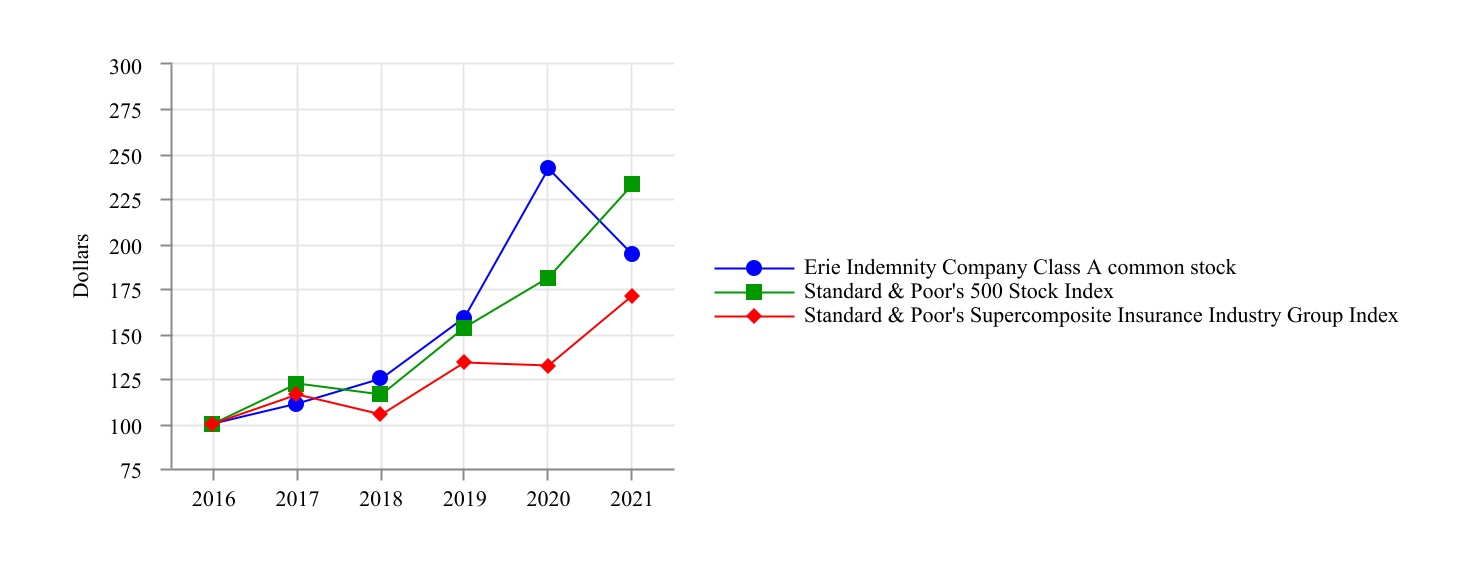
| 2016 | 2017 | 2018 | 2019 | 2020 | 2021 | |||||||||||||||||||||||||||||||||
| Erie Indemnity Company Class A common stock | $ | 100 | (1) | $ | 111 | $ | 125 | $ | 159 | $ | 242 | $ | 194 | |||||||||||||||||||||||||
| Standard & Poor's 500 Stock Index | 100 | (1) | 122 | 116 | 153 | 181 | 233 | |||||||||||||||||||||||||||||||
| Standard & Poor's Supercomposite Insurance Industry Group Index | 100 | (1) | 116 | 105 | 134 | 132 | 171 |
(1) Assumes $100 invested at the close of trading, including reinvestment of dividends, on the last trading day preceding the first day of the fifth preceding fiscal year, in our Class A common stock, the Standard & Poor's 500 Stock Index, and the Standard & Poor's Supercomposite Insurance Industry Group Index.
Issuer Purchases of Equity Securities
We may purchase shares, from time-to-time, in the open market, through trading plans entered into with one or more brokerage firms pursuant to Rule 10b5-1 under the Securities Exchange Act of 1934, or through privately negotiated transactions. The purchase of shares is dependent upon prevailing market conditions and alternate uses of capital, and at times and in a manner that is deemed appropriate.
Our Board of Directors authorized a stock repurchase program effective January 1, 1999, allowing the repurchase of our outstanding Class A nonvoting common stock. Various approvals for continuation of this program have since been authorized, with the most recent occurring in 2011 for $150 million, which was authorized with no time limitation. There were no repurchases of our Class A common stock under this program during the quarter ending December 31, 2021. We had approximately $17.8 million of repurchase authority remaining under this program, based upon trade date, at both December 31, 2021 and February 18, 2022.
See Item 8. "Financial Statements and Supplementary Data – Note 12, Capital Stock, of Notes to Financial Statements" contained within this report for discussion of additional shares purchased outside of this program.
Item 6. SELECTED FINANCIAL DATA
Not applicable.
Item 7. MANAGEMENT'S DISCUSSION AND ANALYSIS OF FINANCIAL CONDITION AND RESULTS OF OPERATIONS
The following discussion of financial condition and results of operations highlights significant factors influencing Erie Indemnity Company ("Indemnity", "we", "us", "our"). This discussion should be read in conjunction with the audited financial statements and related notes and all other items contained within this Annual Report on Form 10-K as these contain important information helpful in evaluating our financial condition and results of operations.
INDEX
CAUTIONARY STATEMENT REGARDING FORWARD-LOOKING INFORMATION
"Safe Harbor" Statement under the Private Securities Litigation Reform Act of 1995:
Statements contained herein that are not historical fact are forward-looking statements and, as such, are subject to risks and uncertainties that could cause actual events and results to differ, perhaps materially, from those discussed herein. Forward-looking statements relate to future trends, events or results and include, without limitation, statements and assumptions on which such statements are based that are related to our plans, strategies, objectives, expectations, intentions, and adequacy of resources. Examples of forward-looking statements are discussions relating to premium and investment income, expenses, operating results, and compliance with contractual and regulatory requirements. Forward-looking statements are not guarantees of future performance and involve risks and uncertainties that are difficult to predict. Therefore, actual outcomes and results may differ materially from what is expressed or forecasted in such forward-looking statements. Among the risks and
uncertainties, in addition to those set forth in our filings with the Securities and Exchange Commission, that could cause actual results and future events to differ from those set forth or contemplated in the forward-looking statements include the following:
-
dependence upon our relationship with the Erie Insurance Exchange ("Exchange") and the management fee under the agreement with the subscribers at the Exchange;
-
dependence upon our relationship with the Exchange and the growth of the Exchange, including:
◦general business and economic conditions;
◦factors affecting insurance industry competition;
◦dependence upon the independent agency system; and
◦ability to maintain our reputation for customer service;
- dependence upon our relationship with the Exchange and the financial condition of the Exchange, including:
◦the Exchange's ability to maintain acceptable financial strength ratings;
◦factors affecting the quality and liquidity of the Exchange's investment portfolio;
◦changes in government regulation of the insurance industry;
◦litigation and regulatory actions;
◦emergence of significant unexpected events, including pandemics;
◦emerging claims and coverage issues in the industry; and
◦severe weather conditions or other catastrophic losses, including terrorism;
-
costs of providing policy issuance and renewal services to the Exchange under the subscriber's agreement;
-
ability to attract and retain talented management and employees;
-
ability to ensure system availability and effectively manage technology initiatives;
-
difficulties with technology or data security breaches, including cyber attacks;
-
ability to maintain uninterrupted business operations;
-
outcome of pending and potential litigation;
-
factors affecting the quality and liquidity of our investment portfolio; and
-
our ability to meet liquidity needs and access capital.
A forward-looking statement speaks only as of the date on which it is made and reflects our analysis only as of that date. We undertake no obligation to publicly update or revise any forward-looking statement, whether as a result of new information, future events, changes in assumptions, or otherwise.
RECENT ACCOUNTING STANDARDS
See Item 8. "Financial Statements and Supplementary Data - Note 2, Significant Accounting Policies, of Notes to Financial Statements" contained within this report for a discussion of recently adopted accounting standards and the impact on our financial statements.
OPERATING OVERVIEW
Overview
We are a Pennsylvania business corporation that since 1925 has been the managing attorney-in-fact for the subscribers (policyholders) at the Exchange, a reciprocal insurer that writes property and casualty insurance. Our primary function as attorney-in-fact is to perform policy issuance and renewal services on behalf of the subscribers at the Exchange. We also act as attorney-in-fact on behalf of the Exchange, as well as the service provider for its insurance subsidiaries, with respect to all administrative services.
The Exchange is a reciprocal insurance exchange, which is an unincorporated association of individuals, partnerships and corporations that agree to insure one another. Each applicant for insurance to the Exchange signs a subscriber's agreement, which contains an appointment of Indemnity as their attorney-in-fact to transact the business of the Exchange on their behalf.
Pursuant to the subscriber’s agreement for acting as attorney-in-fact in these two capacities, we earn a management fee. Management fee revenue is based upon all direct and affiliated assumed premiums written by the Exchange and the management fee rate, which is not to exceed 25%. Our Board of Directors establishes the management fee rate at least annually, generally in December for the following year. The process of setting the management fee rate includes the evaluation of current year operating results compared to both prior year and industry estimated results for both Indemnity and the Exchange, and consideration of several factors for both entities including: their relative financial strength and capital position; projected revenue, expense and earnings for the subsequent year; future capital needs; as well as competitive position. The management fee rate was set at 25% for 2021, 2020 and 2019. Our Board of Directors set the 2022 management fee rate again at 25%, its maximum level.
Our earnings are primarily driven by the management fee revenue generated for the services we provide to the Exchange. The policy issuance and renewal services we provide to the Exchange are related to the sales, underwriting and issuance of policies. The sales related services we provide include agent compensation and certain sales and advertising support services. Agent compensation includes scheduled comm
Showing the first 8K of 98K characters. Open the full section
Item 7A. QUANTITATIVE AND QUALITATIVE DISCLOSURES ABOUT MARKET RISK
The significant volatility in the financial markets and uncertainty resulting from the COVID-19 pandemic continues to evolve and the pandemic’s ultimate impact and duration remain uncertain. We could experience future losses and/or impairments to the portfolio given the pandemic’s impact on market conditions.
Market Risk
Market risk is the risk of loss arising from adverse changes in interest rates, credit spreads, equity prices, or foreign exchange rates, as well as other relevant market rate or price changes. The volatility and liquidity in the markets in which the underlying assets are traded directly influence market risk. The following is a discussion of our primary risk exposures, including interest rate risk, investment credit risk, concentration risk, liquidity risk, and equity price risk, and how those exposures are currently managed as of December 31, 2021.
Interest Rate Risk
We invest primarily in fixed maturity investments, which comprised 83% of our invested assets at December 31, 2021. The value of the fixed maturity portfolio is subject to interest rate risk. As market interest rates decrease, the value of the portfolio increases with the opposite holding true in rising interest rate environments. We do not hedge our exposure to interest rate risk. A common measure of the interest sensitivity of fixed maturity assets is effective duration, a calculation that utilizes maturity, coupon rate, yield, and call terms to calculate an expected change in fair value given a change in interest rates. The longer the duration, the more sensitive the asset is to market interest rate fluctuations. Duration is analyzed quarterly to ensure that it remains in the targeted range.
A sensitivity analysis is used to measure the potential loss in future earnings, fair values, or cash flows of interest-sensitive instruments resulting from one or more selected hypothetical changes in interest rates and other market rates or prices over a selected period. The following pro forma information is presented assuming a 100-basis point parallel increase in interest rates across the yield curve at December 31 of each year and reflects the estimated effect on the fair value of our fixed maturity portfolio.
Fixed maturities interest-rate sensitivity analysis
| (dollars in thousands) | At December 31, | |||||||||||||
| 2021 | 2020 | |||||||||||||
| Fair value of fixed maturity portfolio | $ | 946,085 | $ | 928,236 | ||||||||||
| Fair value assuming 100-basis point rise in interest rates | $ | 921,642 | $ | 904,287 | ||||||||||
| Effective duration (as a percentage) | 2.6 | 2.7 | ||||||||||||
While the fixed maturity portfolio is sensitive to interest rates, the future principal cash flows that will be received by contractual maturity date are presented below at December 31, 2021 and 2020. Actual cash flows may differ from those stated as a result of calls, prepayments, or defaults.
Contractual repayments of principal by maturity date
| (in thousands) | ||||||||||||||
| Fixed maturities: | December 31, 2021 | |||||||||||||
| 2022 | $ | 38,122 | ||||||||||||
| 2023 | 89,184 | |||||||||||||
| 2024 | 131,577 | |||||||||||||
| 2025 | 108,165 | |||||||||||||
| 2026 | 71,375 | |||||||||||||
| Thereafter | 472,350 | |||||||||||||
| Total | $ | 910,773 | ||||||||||||
| Fair value | $ | 946,085 |
| (in thousands) | ||||||||||||||
| Fixed maturities: | December 31, 2020 | |||||||||||||
| 2021 | $ | 17,403 | ||||||||||||
| 2022 | 48,958 | |||||||||||||
| 2023 | 107,507 | |||||||||||||
| 2024 | 142,707 | |||||||||||||
| 2025 | 110,105 | |||||||||||||
| Thereafter | 452,168 | |||||||||||||
| Total | $ | 878,848 | ||||||||||||
| Fair value | $ | 928,236 |
Investment Credit Risk
Our objective is to earn competitive returns by investing in a diversified portfolio of securities. Our portfolios of fixed maturity securities, equity securities and, to a lesser extent, short-term investments are subject to credit risk. This risk is defined as the potential loss in fair value resulting from adverse changes in the borrower's ability to repay the debt. We manage this risk by performing upfront underwriting analysis and ongoing reviews of credit quality by position and for the portfolio in total. We do not hedge the credit risk inherent in our fixed maturity and equity securities investments.
Generally, the fixed maturities in our portfolio are rated by external rating agencies. If not externally rated, we rate them internally on a basis consistent with that used by the rating agencies. We classify all fixed maturities as available-for-sale securities, allowing us to meet our liquidity needs and provide greater flexibility to appropriately respond to changes in market conditions.
The following tables show our fixed maturity investments by rating*(1)*:
| At December 31, 2021 | ||||||||||||||||||||
| (dollars in thousands) | Amortized cost | Fair value | Percent of total | |||||||||||||||||
| AAA, AA, A | $ | 506,271 | $ | 508,610 | 54 | % | ||||||||||||||
| BBB | 295,681 | 299,270 | 31 | |||||||||||||||||
| Total investment grade | 801,952 | 807,880 | 85 | |||||||||||||||||
| BB | 45,541 | 46,922 | 5 | |||||||||||||||||
| B | 76,144 | 76,913 | 8 | |||||||||||||||||
| CCC, CC, C, and below | 14,642 | 14,370 | 2 | |||||||||||||||||
| Total non-investment grade | 136,327 | 138,205 | 15 | |||||||||||||||||
| Total | $ | 938,279 | $ | 946,085 | 100 | % | ||||||||||||||
| At December 31, 2020 | |||||||||||||||||||||||||||||||||||
| (dollars in thousands) | Amortized cost | Fair value | Percent of total | ||||||||||||||||||||||||||||||||
| AAA, AA, A | $ | 487,752 | $ | 502,408 | 54 | % | |||||||||||||||||||||||||||||
| BBB | 283,219 | 294,917 | 32 | ||||||||||||||||||||||||||||||||
| Total investment grade | 770,971 | 797,325 | 86 | ||||||||||||||||||||||||||||||||
| BB | 47,870 | 50,399 | 5 | ||||||||||||||||||||||||||||||||
| B | 63,397 | 64,611 | 7 | ||||||||||||||||||||||||||||||||
| CCC, CC, C, and below | 16,552 | 15,901 | 2 | ||||||||||||||||||||||||||||||||
| Total non-investment grade | 127,819 | 130,911 | 14 | ||||||||||||||||||||||||||||||||
| Total | $ | 898,790 | $ | 928,236 | 100 | % |
(1) Ratings are supplied by S&P, Moody's, and Fitch. The table is based upon the lowest rating for each security.
We are also exposed to a concentration of credit risk with the Exchange. See the "Transactions/Agreements with Related Parties, Intercompany Receivables" section of Item 7. "Management's Discussion and Analysis of Financial Condition and Results of Operations" contained within this report for further discussion of this risk.
Concentration Risk
While our portfolio is well diversified within each market sector, there is an inherent risk of concentration in a particular industry or sector. We continually monitor our level of exposure to individual issuers as well as our allocation to each industry and market sector against internally established policies. See the "Financial Condition" section of Item 7. "Management's Discussion and Analysis of Financial Condition and Results of Operations" contained within this report for details of investment holdings by sector.
Liquidity Risk
Periods of volatility in the financial markets can create conditions where fixed maturity investments, despite being publicly traded, can become illiquid. However, we actively manage the maturity profile of our fixed maturity portfolio such that scheduled repayments of principal occur on a regular basis.
Equity Price Risk
Our portfolio of equity securities, which primarily includes nonredeemable preferred stock, is carried on the Statements of Financial Position at estimated fair value. Equity securities are exposed to the risk of potential loss in estimated fair value resulting from an adverse change in prices ("price risk"). We do not hedge our exposure to price risk inherent in our equity investments.
Item 8. FINANCIAL STATEMENTS AND SUPPLEMENTARY DATA
INDEX TO FINANCIAL STATEMENTS
Report of Independent Registered Public Accounting Firm
To the Shareholders and Board of Directors of Erie Indemnity Company
Opinion on the Financial Statements
We have audited the accompanying statements of financial position of Erie Indemnity Company (the Company) as of December 31, 2021 and 2020, the related statements of operations, comprehensive income, shareholders’ equity and cash flows for each of the three years in the period ended December 31, 2021, and the related notes (collectively referred to as the “financial statements”). In our opinion, the financial statements present fairly, in all material respects, the financial position of the Company as of December 31, 2021 and 2020, and the results of its operations and its cash flows for each of the three years in the period ended December 31, 2021, in conformity with U.S. generally accepted accounting principles.
We also have audited, in accordance with the standards of the Public Company Accounting Oversight Board (United States) (PCAOB), the Company’s internal control over financial reporting as of December 31, 2021, based on criteria established in Internal Control-Integrated Framework issued by the Committee of Sponsoring Organizations of the Treadway Commission (2013 framework) and our report dated February 24, 2022 expressed an unqualified opinion thereon.
Basis for Opinion
These financial statements are the responsibility of the Company’s management. Our responsibility is to express an opinion on the Company’s financial statements based on our audits. We are a public accounting firm registered with the PCAOB and are required to be independent with respect to the Company in accordance with the U.S. federal securities laws and the applicable rules and regulations of the Securities and Exchange Commission and the PCAOB.
We conducted our audits in accordance with the standards of the PCAOB. Those standards require that we plan and perform the audit to obtain reasonable assurance about whether the financial statements are free of material misstatement, whether due to error or fraud. Our audits included performing procedures to assess the risks of material misstatement of the financial statements, whether due to error or fraud, and performing procedures that respond to those risks. Such procedures include examining, on a test basis, evidence regarding the amounts and disclosures in the financial statements. Our audits also included evaluating the accounting principles used and significant estimates made by management, as well as evaluating the overall presentation of the financial statements. We believe that our audits provide a reasonable basis for our opinion.
Critical Audit Matter
The critical audit matter communicated below is a matter arising from the current period audit of the financial statements that was communicated or required to be communicated to the audit committee and that: (1) relates to accounts or disclosures that are material to the financial statements and (2) involved our especially challenging, subjective or complex judgments. The communication of the critical audit matter does not alter in any way our opinion on the financial statements, taken as a whole, and we are not, by communicating the critical audit matter below, providing a separate opinion on the critical audit matter or on the accounts or disclosures to which it relates.
| Proportional Cost Allocation | ||||||||
| Description of the Matter | For the year ended December 31, 2021, the Company’s administrative services reimbursement revenue totaled $638.5 million. The Company’s primary function, as attorney-in-fact, is to perform certain services on behalf of the subscribers at the Erie Insurance Exchange (Exchange) and its insurance subsidiaries, in accordance with the Subscriber’s Agreement and the service agreements with each of the Exchange’s insurance subsidiaries. As explained in Note 2 of the financial statements, pursuant to approved service agreements, administrative services, which include costs associated with claims handling services, life insurance related operating activities, investment management, and operating overhead incurred by the Company on behalf of the Exchange and its insurance subsidiaries, are reimbursed to the Company at cost and recorded as administrative services reimbursement revenue. To determine the proportional cost allocation to each entity, the Company determines utilization statistics using numerous variables including, among others, employee count, square footage, vehicle count, and project hours. Auditing management’s proportional cost allocations was complex due to the number of costs that are included in the allocations and the judgment applied in determining the utilization statistics used to determine the proportional allocations to each entity. | |||||||
| How We Addressed the Matter in Our Audit | We obtained an understanding, evaluated the design and tested the operating effectiveness of controls over the Company’s proportional cost allocations process. This included, among others, testing management’s review controls over the determination of the utilization statistics and ultimate allocation of costs to the Exchange and its insurance subsidiaries. To test the Company’s proportional cost allocations, our procedures included, among others, evaluating that the costs included in the allocations are in accordance with the Subscriber’s Agreement and the service agreements with each of the Exchange’s insurance subsidiaries. We tested the completeness and accuracy of the costs subjected to allocation through testing of the reconciliation of the costs recorded in the source systems to the costs that are allocated. We evaluated the allocation of costs to the Exchange and its insurance subsidiaries with the costs allocated in prior periods. |
/s/ Ernst & Young LLP
We have served as the Company's auditor since 2003.
Cleveland, OH
February 24, 2022
ERIE INDEMNITY COMPANY
STATEMENTS OF OPERATIONS
Years ended December 31, 2021, 2020 and 2019
(dollars in thousands, except per share data)
| 2021 | 2020 | 2019 | ||||||||||||||||||
| Operating revenue |
Showing the first 8K of 172K characters. Open the full section
Item 9. CHANGES IN AND DISAGREEMENTS WITH ACCOUNTANTS ON ACCOUNTING AND FINANCIAL DISCLOSURE
None.
Item 9A. CONTROLS AND PROCEDURES
Evaluation of Disclosure Controls and Procedures
We maintain disclosure controls and procedures designed to ensure that information required to be disclosed in our reports filed under the Securities Exchange Act of 1934, as amended, is recorded, processed, summarized and reported within the time periods specified in the Securities and Exchange Commission rules and forms, and that such information is accumulated and communicated to management, including our Chief Executive Officer and Chief Financial Officer, as appropriate, to allow for timely decisions regarding required disclosures.
As required by the Securities and Exchange Commission Rule 13a-15(e), we carried out an evaluation, under the supervision and with the participation of management, including our Chief Executive Officer and Chief Financial Officer, of the effectiveness of the design and operation of our disclosure controls and procedures as of December 31, 2021. Based upon the foregoing, our Chief Executive Officer and Chief Financial Officer concluded that our disclosure controls and procedures were effective.
Changes in Internal Control over Financial Reporting
There has been no change in our internal controls over financial reporting during our most recent fiscal quarter that has materially affected, or is reasonably likely to materially affect our internal controls over financial reporting. Our process for evaluating controls and procedures is continuous and encompasses constant improvement of the design and effectiveness of established controls and procedures.
Management's Report on Internal Control over Financial Reporting
Management is responsible for establishing and maintaining adequate internal control over financial reporting of Erie Indemnity Company, as defined in Rules 13a-15(f) under the Exchange Act. Under the supervision and with the participation of our management, including our Chief Executive Officer and Chief Financial Officer, we conducted an evaluation of the effectiveness of the Erie Indemnity Company's internal control over financial reporting based upon the framework in the Internal Control-Integrated Framework issued in 2013 by the Committee of Sponsoring Organizations of the Treadway Commission. Based upon our evaluation under the framework in the Internal Control-Integrated Framework issued in 2013, management has concluded that Erie Indemnity Company's internal control over financial reporting was effective as of December 31, 2021.
| /s/ Timothy G. NeCastro | /s/ Gregory J. Gutting | /s/ Julie M. Pelkowski | |||||||||||||||
| Timothy G. NeCastro | Gregory J. Gutting | Julie M. Pelkowski | |||||||||||||||
| President and | Executive Vice President | Senior Vice President | |||||||||||||||
| Chief Executive Officer | and Chief Financial Officer | and Controller | |||||||||||||||
| February 24, 2022 | February 24, 2022 | February 24, 2022 |
Our independent auditor, Ernst & Young LLP, a registered public accounting firm, has issued an attestation report on our internal control over financial reporting. This report appears on the following page.
Item 9B. OTHER INFORMATION
There was no additional information in the fourth quarter of 2021 that has not already been filed in a Form 8-K.
Report of Independent Registered Public Accounting Firm
To the Shareholders and Board of Directors of Erie Indemnity Company
Opinion on Internal Control over Financial Reporting
We have audited Erie Indemnity Company’s internal control over financial reporting as of December 31, 2021, based on criteria established in Internal Control-Integrated Framework issued by the Committee of Sponsoring Organizations of the Treadway Commission (2013 framework) (the COSO criteria). In our opinion, Erie Indemnity Company (the Company) maintained, in all material respects, effective internal control over financial reporting as of December 31, 2021, based on the COSO criteria.
We also have audited, in accordance with the standards of the Public Company Accounting Oversight Board (United States) (PCAOB), the statements of financial position of the Company as of December 31, 2021 and 2020, and the related statements of operations, comprehensive income, shareholders’ equity, and cash flows for each of the three years in the period ended December 31, 2021 and the related notes of the Company and our report dated February 24, 2022 expressed an unqualified opinion thereon.
Basis for Opinion
The Company’s management is responsible for maintaining effective internal control over financial reporting and for its assessment of the effectiveness of internal control over financial reporting included in the accompanying Management’s Report on Internal Control over Financial Reporting. Our responsibility is to express an opinion on the Company’s internal control over financial reporting based on our audit. We are a public accounting firm registered with the PCAOB and are required to be independent with respect to the Company in accordance with the U.S. federal securities laws and the applicable rules and regulations of the Securities and Exchange Commission and the PCAOB.
We conducted our audit in accordance with the standards of the PCAOB. Those standards require that we plan and perform the audit to obtain reasonable assurance about whether effective internal control over financial reporting was maintained in all material respects.
Our audit included obtaining an understanding of internal control over financial reporting, assessing the risk that a material weakness exists, testing and evaluating the design and operating effectiveness of internal control based on the assessed risk, and performing such other procedures as we considered necessary in the circumstances. We believe that our audit provides a reasonable basis for our opinion.
Definition and Limitations of Internal Control Over Financial Reporting
A company’s internal control over financial reporting is a process designed to provide reasonable assurance regarding the reliability of financial reporting and the preparation of financial statements for external purposes in accordance with generally accepted accounting principles. A company’s internal control over financial reporting includes those policies and procedures that (1) pertain to the maintenance of records that, in reasonable detail, accurately and fairly reflect the transactions and dispositions of the assets of the company; (2) provide reasonable assurance that transactions are recorded as necessary to permit preparation of financial statements in accordance with generally accepted accounting principles, and that receipts and expenditures of the company are being made only in accordance with authorizations of management and directors of the company; and (3) provide reasonable assurance regarding prevention or timely detection of unauthorized acquisition, use, or disposition of the company’s assets that could have a material effect on the financial statements.
Because of its inherent limitations, internal control over financial reporting may not prevent or detect misstatements. Also, projections of any evaluation of effectiveness to future periods are subject to the risk that controls may become inadequate because of changes in conditions, or that the degree of compliance with the policies or procedures may deteriorate.
/s/ Ernst & Young LLP
Cleveland, OH
February 24, 2022
PART III
Item 10. DIRECTORS, EXECUTIVE OFFICERS AND CORPORATE GOVERNANCE
The information with respect to our outside directors, audit committee and audit committee financial experts and Section 16(a) beneficial ownership reporting compliance, is incorporated herein by reference to the information statement on Schedule 14C to be filed with the Securities and Exchange Commission no later than 120 days after December 31, 2021.
We have adopted a Code of Conduct that applies to all of our outside directors, officers and employees. We have previously filed a copy of the Code of Conduct as Exhibit 14.3 to the Registrant's Form 10-K filed with the Securities and Exchange Commission on February 25, 2016. In addition to this, we have adopted a Code of Ethics for Senior Financial Officers that also applies to our Chief Executive Officer, Chief Financial Officer, Chief Accounting Officer and any other person performing similar functions. We have previously filed a copy of the Code of Ethics for Senior Financial Officers as Exhibit 14.4 to the Registrant's Form 8-K filed with the Securities and Exchange Commission on June 1, 2016. Our Code of Conduct and Code of Ethics for Senior Financial Officers are also available on our website at www.erieinsurance.com.
Executive Officers of the Registrant
| Name | Age as of 12/31/2021 | Principal Occupation and Positions for Past Five Years | ||||||||||||
| President & Chief Executive Officer: | ||||||||||||||
| Timothy G. NeCastro | 61 | President and Chief Executive Officer since January 2017; Chief Executive Officer, August 2016 through December 2016; President and Chief Executive Officer Designate, June 2016 through July 2016; Senior Vice President, West Region, February 2010 through June 2016; Director, Erie Family Life Insurance Company ("EFL"), Erie Insurance Company ("EIC"), Flagship City Insurance Company ("Flagship"), Erie Insurance Company of New York ("ENY") and Erie Insurance Property & Casualty Company ("EPC"). | ||||||||||||
| Executive Vice Presidents: | ||||||||||||||
| Lorianne Feltz | 52 | Executive Vice President, Claims & Customer Service since November 2016; Senior Vice President, Customer Service, January 2011 through October 2016. | ||||||||||||
| Gregory J. Gutting | 58 | Executive Vice President and Chief Financial Officer since August 2016; Interim Executive Vice President and Chief Financial Officer, October 2015 through July 2016; Senior Vice President and Controller, March 2009 through September 2015; Director, EFL, EIC, Flagship, ENY and EPC. | ||||||||||||
| Robert C. Ingram, III * | 63 | Executive Vice President and Chief Information Officer since August 2012; Director, EFL, EIC, Flagship, ENY and EPC. | ||||||||||||
| Douglas E. Smith | 47 | Executive Vice President, Sales & Products since November 2016; Senior Vice President, Personal Lines, November 2008 through October 2016. | ||||||||||||
- Retired effective December 31, 2021
Item 11. EXECUTIVE COMPENSATION
The information required by this item with respect to executive compensation is incorporated by reference to the information statement on Schedule 14C to be filed with the Securities and Exchange Commission no later than 120 days after December 31, 2021.
Item 12. SECURITY OWNERSHIP OF CERTAIN BENEFICIAL OWNERS AND MANAGEMENT AND RELATED STOCKHOLDER MATTERS
The information with respect to security ownership of certain beneficial owners and management and securities authorized for issuance under equity compensation plans, is incorporated by reference to the information statement on Schedule 14C to be filed with the Securities and Exchange Commission no later than 120 days after December 31, 2021.
Item 13. CERTAIN RELATIONSHIPS AND RELATED TRANSACTIONS, AND DIRECTOR INDEPENDENCE
Information with respect to certain relationships with our outside directors is incorporated by reference to the information statement on Schedule 14C to be filed with the Securities and Exchange Commission no later than 120 days after December 31, 2021.
Item 14. PRINCIPAL ACCOUNTANT FEES AND SERVICES
The information required by this item is incorporated by reference to the information statement on Schedule 14C to be filed with the Securities and Exchange Commission no later than 120 days after December 31, 2021.
PART IV
Item 15. EXHIBITS AND FINANCIAL STATEMENT SCHEDULES
(a) The following documents are filed as part of this report:
- Financial Statements
Included in Part II, Item 8. "Financial Statements and Supplementary Data" contained in this report.
Erie Indemnity Company*:*
-
Report of Independent Registered Public Accounting Firm on the Effectiveness of Internal Control over Financial Reporting
-
Report of Independent Registered Public Accounting Firm on the Financial Statements
-
Statements of Operations for the three years ended December 31, 2021, 2020 and 2019
-
Statements of Comprehensive Income for the three years ended December 31, 2021, 2020 and 2019
-
Statements of Financial Position as of December 31, 2021 and 2020
-
Statements of Shareholders' Equity for the three years ended December 31, 2021, 2020 and 2019
-
Statements of Cash Flows for the three years ended December 31, 2021, 2020 and 2019
-
Notes to Financial Statements
- Financial Statement Schedules
All schedules are not required, not applicable, or the information is included in the financial statements or notes thereto.
| Page | |||||
| 3. Exhibit Index | 80 |
Item 16. FORM 10-K SUMMARY
None.
EXHIBIT INDEX
(Pursuant to Item 601 of Regulation S-K)
| Exhibit | ||||||||
| Number | Description of Exhibit | |||||||
| 101.DEF* | Inline XBRL Taxonomy Extension Definition Linkbase Document. | |||||||
| 101.LAB* | Inline XBRL Taxonomy Extension Label Linkbase Document. | |||||||
| 101.PRE* | Inline XBRL Taxonomy Extension Presentation Linkbase Document. | |||||||
| 104* | Cover Page Interactive Data File (formatted as Inline XBRL and contained in Exhibit 101). |
- Filed herewith.
SIGNATURES
Pursuant to the requirements of Section 13 or 15(d) of the Securities Exchange Act of 1934, the Registrant has duly caused this report to be signed on its behalf by the undersigned, thereunto duly authorized.
| February 24, 2022 | ERIE INDEMNITY COMPANY | |||||||
| (Registrant) | ||||||||
| By: | /s/ Timothy G. NeCastro | |||||||
| Timothy G. NeCastro, President and CEO | ||||||||
| (Principal Executive Officer) |
Pursuant to the requirements of the Securities Exchange Act of 1934, this report has been signed below by the following persons on behalf of the Registrant and in the capacities and on the date indicated.
| February 24, 2022 | /s/ Timothy G. NeCastro | |||||||||||||
| Timothy G. NeCastro, President and CEO | ||||||||||||||
| (Principal Executive Officer) | ||||||||||||||
| /s/ Gregory J. Gutting | ||||||||||||||
| Gregory J. Gutting, Executive Vice President and CFO | ||||||||||||||
| (Principal Financial Officer) | ||||||||||||||
| /s/ Julie M. Pelkowski | ||||||||||||||
| Julie M. Pelkowski, Senior Vice President and Controller | ||||||||||||||
| (Principal Accounting Officer) |
Board of Directors:
| /s/ J. Ralph Borneman, Jr. | /s/ C. Scott Hartz | |||||||
| J. Ralph Borneman, Jr. | C. Scott Hartz | |||||||
| /s/ Eugene C. Connell | /s/ Brian A. Hudson, Sr. | |||||||
| Eugene C. Connell | Brian A. Hudson, Sr. | |||||||
| /s/ Salvatore Correnti | /s/ George R. Lucore | |||||||
| Salvatore Correnti | George R. Lucore | |||||||
| /s/ LuAnn Datesh | /s/ Thomas W. Palmer | |||||||
| LuAnn Datesh | Thomas W. Palmer | |||||||
| /s/ Jonathan Hirt Hagen | ||||||||
| Jonathan Hirt Hagen | Elizabeth Hirt Vorsheck | |||||||
| /s/ Thomas B. Hagen | ||||||||
| Thomas B. Hagen, Chairman | ||||||||