 filings.tools
Essex Property Trust 10-K 2012-12-31
Filed 2013-02-25. 21 sections, 414K characters. Original on sec.gov · Markdown · JSON
Cover and table of contents
10-K 1 form10k.htm ESSEX PROPERTY TRUST, INC 10-K 12-31-2012
UNITED STATES
SECURITIES AND EXCHANGE COMMISSION
Washington, D.C. 20549
FORM 10-K
(MARK ONE)
| x | ANNUAL REPORT PURSUANT TO SECTION 13 OR 15(d) OF THE SECURITIES EXCHANGE ACT OF 1934 |
|---|
For the fiscal year ended December 31, 2012
OR
| o | TRANSITION REPORT PURSUANT TO SECTION 13 OR 15(d) OF THE SECURITIES EXCHANGE ACT OF 1934 |
|---|
FOR THE TRANSITION PERIOD FROM ___________ TO _____________
Commission file number 1-13106

Essex Property Trust, Inc.
(Exact name of Registrant as Specified in its Charter)
| Maryland | 77-0369576 | |
|---|---|---|
| (State or Other Jurisdiction of Incorporation or Organization) | (I.R.S. Employer Identification Number) |
925 East Meadow Drive
Palo Alto, California 94303
(Address of Principal Executive Offices including Zip Code)
(650) 494-3700
(Registrant's Telephone Number, Including Area Code)
Securities registered pursuant to Section 12(b) of the Act:
| Title of each class | Name of each exchange on which registered | |
|---|---|---|
| Common Stock, $.0001 par value | New York Stock Exchange | |
| 4.875% Series G Cumulative Convertible Preferred Stock | New York Stock Exchange | |
| 7.125% Series H Cumulative Redeemable Preferred Stock | New York Stock Exchange |
Securities registered pursuant to Section 12(g) of the Act: None
Indicate by check mark if the registrant is a well-known seasoned issuer, as defined in Rule 405 of the Securities Act.Yesx No o
Indicate by check mark if the registrant is not required to file reports pursuant to Section 13 or Section 15(d) of the Act. Yes o No x
Indicate by check mark whether the registrant (1) has filed all reports required to be filed by Section 13 or 15(d) of the Securities Exchange Act of 1934 during the preceding 12 months (or for such shorter period that the registrant was required to file such reports), and (2) has been subject to such filing requirements for the past 90 days. Yes x No o
Indicate by check mark whether the registrant has submitted electronically and posted on its corporate Web site, if any, every Interactive Data File required to be submitted and posted pursuant to Rule 405 of Regulation S-T (§232.405 of this chapter) during the preceding 12 months (or for such shorter period that the registrant was required to submit and post such files). Yes x No o
Indicate by check mark if disclosure of delinquent filers pursuant to Item 405 of Regulation S-K is not contained herein, and will not be contained, to the best of Registrant's knowledge, in definitive proxy or information statements incorporated by reference in Part III of this Form 10-K, or any amendment to this Form 10-K. o
Indicate by check mark whether the registrant is a large accelerated filer, an accelerated filer, a non-accelerated filer, or a smaller reporting company. See the definitions of “large accelerated filer,” “accelerated filer” and “smaller reporting company” in Rule 12b-2 of the Exchange Act. (Check one):
| Large accelerated filer x | Accelerated filer o | Non-accelerated filer o (Do not check if a smaller reporting company) | Smaller reporting company o |
|---|
Indicate by check mark whether the registrant is a shell company (as defined in Rule 12b-2 of the Act). Yes o No x
As of June 30, 2012, the aggregate market value of the voting stock held by non-affiliates of the registrant was $5,325,843,948. The aggregate market value was computed with reference to the closing price on the New York Stock Exchange on such date. Shares of common stock held by executive officers, directors and holders of more than ten percent of the outstanding common stock have been excluded from this calculation because such persons may be deemed to be affiliates. This exclusion does not reflect a determination that such persons are affiliates for any other purposes.
As of February 20, 2013, 37,907,305 shares of common stock ($.0001 par value) were outstanding.
DOCUMENTS INCORPORATED BY REFERENCE:
The following document is incorporated by reference in Part III of the Annual Report on Form 10-K: Proxy statement for the annual meeting of stockholders of Essex Property Trust, Inc. to be held May 14, 2013.
ii
Essex Property Trust, Inc.
2012 ANNUAL REPORT ON FORM 10-K
TABLE OF CONTENTS
iii
PART I
Forward Looking Statements
This Form 10-K contains forward-looking statements within the meaning of Section 27A of the Securities Act of 1933 and Section 21E of the Securities Exchange Act of 1934. Such forward-looking statements are described in Item 7, Management’s Discussion and Analysis of Financial Condition and Results of Operations, in the section, “Forward Looking Statements.” Actual results could differ materially from those set forth in each forward-looking statement. Certain factors that might cause such a difference are discussed in this report, including Item 1A, Risk Factors of this Form 10-K.
Item 1. Business
OVERVIEW
Essex Property Trust, Inc. (“Essex” or the “Company”) is a Maryland corporation that operates as a self-administered and self-managed real estate investment trust (“REIT”). The Company owns all of its interest in its real estate investments directly or indirectly through Essex Portfolio, L.P. (the “Operating Partnership” or “EPLP”). The Company is the sole general partner of the Operating Partnership and as of December 31, 2012 owns a 94.5% general partnership interest. In this report, the terms “Essex” or the “Company” also refer to Essex Property Trust, Inc., its Operating Partnership and the Operating Partnership’s subsidiaries.
The Company has elected to be treated as a REIT for federal income tax purposes, commencing with the year ended December 31, 1994 as the Company completed an initial public offering on June 13, 1994. In order to maintain compliance with REIT tax rules, the Company utilizes taxable REIT subsidiaries for various revenue generating or investment activities. All taxable REIT subsidiaries are consolidated by the Company.
The Company is engaged primarily in the ownership, operation, management, acquisition, development and redevelopment of predominantly apartment communities. As of December 31, 2012, the Company owned or held an interest in 163 communities, aggregating 33,468 units, located along the West Coast, as well as five commercial buildings (totaling approximately 315,900 square feet), and nine active development projects with 2,495 units in various stages of development (collectively, the “Portfolio”).
The Company’s website address is http://www.essexpropertytrust.com. The Company’s annual reports on Form 10-K, quarterly reports on Form 10-Q, current reports on Form 8-K and all amendments to those reports, and the Proxy Statement for its Annual Meeting of Stockholders are available, free of charge, on its website as soon as practicable after the Company files the reports with the Securities and Exchange Commission (“SEC”).
BUSINESS STRATEGIES
The following is a discussion of the Company’s business strategies in regards to real estate investment and management.
Business Strategies
Research Driven Approach to Investments – The Company believes that successful real estate investment decisions and portfolio growth begin with extensive regional economic research and local market knowledge. The Company continually assesses markets where the Company operates, as well as markets where the Company considers future investment opportunities by evaluating the following:
| · | Focus on markets in major metropolitan areas that have regional population in excess of one million; |
|---|
| · | Constraints on new supply driven by: (i) low availability of developable land sites where competing housing could be economically built; (ii) political growth barriers, such as protected land, urban growth boundaries, and potential lengthy and expensive development permit processes; and (iii) natural limitations to development, such as mountains or waterways; |
|---|
| · | Rental demand is enhanced by affordability of rents relative to costs of for-sale housing; and |
|---|
| · | Housing demand that is based on proximity to jobs, high median incomes, the quality of life and related commuting factors, as well as potential job growth. |
|---|
Recognizing that all real estate markets are cyclical, the Company regularly evaluates the results of its regional economic, and its local market research, and adjusts the geographic focus of its portfolio accordingly. The Company seeks to increase its Portfolio allocation in markets projected to have the strongest local economies and to decrease such allocations in markets projected to have declining economic conditions. Likewise, the Company also seeks to increase its portfolio allocation in markets that have attractive property valuations and to decrease such allocations in markets that have inflated valuations and low relative yields.
Property Operations – The Company manages its communities by focusing on activities that generate above-average rental growth, tenant retention/satisfaction and long-term asset appreciation. The Company intends to achieve this by utilizing the strategies set forth below:
| · | Property Management – Oversee delivery of and quality of the housing provided to our residents and are responsible for the properties financial performance. |
|---|
| · | Capital Preservation –Asset Management is responsible for the planning, budgeting and completion of major capital improvement projects at the Company’s communities. |
|---|
| · | Business Planning and Control – Comprehensive business plans are implemented in conjunction with every investment decision. These plans include benchmarks for future financial performance, based on collaborative discussions between on-site managers and senior management. |
|---|
| · | Development and Redevelopment – The Company focuses on acquiring and developing apartment communities in supply constrained markets, and redeveloping its existing communities to improve the financial and physical aspects of the Company’s communities. |
|---|
CURRENT BUSINESS ACTIVITIES
Acquisitions of Real Estate
Acquisitions are an important component of the Company’s business plan, and during 2012, the Company acquired ownership interests in fifteen communities totaling $801.9 million. The following is a summary of its 2012 acquisitions:
| Essex | Assumed | Assumed | Assumed | ||||||||||||||||||||||||||||
|---|---|---|---|---|---|---|---|---|---|---|---|---|---|---|---|---|---|---|---|---|---|---|---|---|---|---|---|---|---|---|---|
| Ownership | Purchase | Debt | Debt Stated | Debt Effective | |||||||||||||||||||||||||||
| Property Name | Location | Units | Percentage | Ownership | Date | Price | Principal | Rate | Rate | ||||||||||||||||||||||
| Bon Terra | Redmond, WA | 60 | 100 | % | EPLP | Q1 2012 | $ | 16,000 | $ | - | - | - | |||||||||||||||||||
| Reed Square | Sunnyvale, CA | 100 | 100 | % | EPLP | Q1 2012 | 23,000 | - | - | - | |||||||||||||||||||||
| Park Catalina | Los Angeles, CA | 90 | 100 | % | EPLP | Q2 2012 | 23,650 | - | - | - | |||||||||||||||||||||
| Skyline (1) | Santa Ana, CA | 349 | 100 | % | EPLP | Q2 2012 | 85,000 | - | - | - | |||||||||||||||||||||
| The Huntington | Huntington Beach, CA | 276 | 100 | % | EPLP | Q2 2012 | 48,250 | 30,300 | 5.7 | % | 3.3 | % | |||||||||||||||||||
| Domaine | Seattle, WA | 92 | 100 | % | EPLP | Q3 2012 | 34,000 | 14,600 | 5.7 | % | 3.0 | % | |||||||||||||||||||
| Montebello | Kirkland, WA | 248 | 100 | % | EPLP | Q3 2012 | 52,000 | 26,515 | 5.6 | % | 3.1 | % | |||||||||||||||||||
| Park West | San Francisco, CA | 126 | 100 | % | EPLP | Q3 2012 | 31,600 | - | - | - | |||||||||||||||||||||
| Riley Square | Santa Clara, CA | 156 | 50 | % | Wesco I | Q3 2012 | 38,250 | 17,500 | 5.2 | % | 3.1 | % | |||||||||||||||||||
| Ascent | Kirkland, WA | 90 | 100 | % | EPLP | Q4 2012 | 15,850 | - | - | - | |||||||||||||||||||||
| Bennett Lofts (2) | San Francisco, CA | 113 | 100 | % | EPLP | Q4 2012 | 73,730 | - | - | - | |||||||||||||||||||||
| Haver Hill | Fullerton, CA | 264 | 50 | % | Wesco III | Q4 2012 | 45,600 | - | - | - | |||||||||||||||||||||
| Madrid | Mission Viejo, CA | 230 | 50 | % | Wesco I | Q4 2012 | (3 | ) | 33,266 | 5.3 | % | 2.6 | % | ||||||||||||||||||
| Pacific Electric Lofts | Los Angeles, CA | 314 | 50 | % | Wesco I | Q4 2012 | (3 | ) | 46,939 | 4.0 | % | 2.5 | % | ||||||||||||||||||
| Willow Lake | San Jose, CA | 508 | 100 | % | EPLP | Q4 2012 | 148,000 | - | - | - | |||||||||||||||||||||
| Total 2012 | 3,016 | $ | 801,930 | $ | 169,120 |
| (1) In April 2012, the Company purchased the joint venture partner's remaining membership interest in the co-investment Essex Skyline at MacArthur Place for a purchase price of $85 million. The property is now consolidated. |
|---|
| (2) Approximately 75% of the property was acquired in December and the remainder in January 2013 for $22.2 million. |
|---|
| (3) In accordance with terms of the purchase agreements, purchase price of the properties are not being disclosed by the Company. |
|---|
Dispositions of Real Estate
As part of its strategic plan to own quality real estate in supply-constrained markets, the Company continually evaluates all the communities and sells those which no longer meet its strategic criteria. The Company may use the capital generated from the dispositions to invest in higher-return communities or other real estate investments, or repay debts. The Company believes that the sale of these communities will not have a material impact on its future results of operations or cash flows nor will their sale materially affect its ongoing operations. Generally, the Company seeks to have any impact of earnings dilution resulting from these dispositions offset by the positive impact of its acquisitions, development and redevelopment activities.
During 2012, the Company sold two apartment communities, for a total of $28.3 million resulting in a gain of $10.9 million. Also, Essex Apartment Value Fund II sold seven communities for a total of $413.0 million. The total gain on the transaction was $106 million, of which the Company’s pro-rata share was $29.1 million.
Development Pipeline
The Company defines development projects as new communities that are in various stages of active development, or the community is in lease-up and phases of the project are not completed. As of December 31, 2012, the Company had two consolidated development projects and seven joint venture development projects comprised of 2,495 units for an estimated cost of $928.4 million, of which $463.9 million remains to be expended.
The Company defines the predevelopment projects as proposed communities in negotiation or in the entitlement process with a high likelihood of becoming entitled development projects. As of December 31, 2012, the Company had two consolidated predevelopment projects and one unconsolidated joint venture predevelopment project aggregating 449 units. The Company may also acquire land for future development purposes or sale.
The following table sets forth information regarding the Company’s development pipeline:
| Essex | As of 12/31/12 ($ in millions) | |||||||||||||||||||||
|---|---|---|---|---|---|---|---|---|---|---|---|---|---|---|---|---|---|---|---|---|---|---|
| Ownership | Incurred | Estimated | Estimated | Projected | ||||||||||||||||||
| Development Pipeline | Location | % | Units | Project Cost | Remaining Cost | Project Cost(1) | Stabilization | |||||||||||||||
| Development Projects - Consolidated | ||||||||||||||||||||||
| 64th & Christie | Emeryville, CA | 100 | % | 190 | $ | 18.1 | $ | 40.1 | $ | 58.2 | Feb-15 | |||||||||||
| Valley Village | Valley Village, CA | (2 | ) | 121 | 1.5 | 36.1 | 37.6 | Jun-14 | ||||||||||||||
| Total - Consolidated Development Projects | 311 | 19.6 | 76.2 | 95.8 | ||||||||||||||||||
| Development Projects - Joint Venture | ||||||||||||||||||||||
| Expo | Seattle, WA | 50 | % | 275 | 64.5 | 5.5 | 70.0 | Apr-13 | ||||||||||||||
| Epic - Phase I and II | San Jose, CA | 55 | % | 569 | 128.2 | 63.4 | 191.6 | Dec-14 | ||||||||||||||
| Connolly Station (fka Linc) | Dublin, CA | 55 | % | 309 | 51.6 | 42.9 | 94.5 | May-14 | ||||||||||||||
| The Huxley (fka Fountain at La Brea) | West Hollywood, CA | 50 | % | 187 | 46.2 | 28.8 | 75.0 | Jul-14 | ||||||||||||||
| The Dylan (fka Santa Monica at La Brea) | West Hollywood, CA | 50 | % | 184 | 41.3 | 34.1 | 75.4 | Oct-14 | ||||||||||||||
| Folsom and Fifth | San Francisco, CA | 55 | % | 463 | 88.5 | 161.5 | 250.0 | Mar-15 | ||||||||||||||
| Elkhorn | San Mateo, CA | 55 | % | 197 | 24.6 | 51.5 | 76.1 | Dec-14 | ||||||||||||||
| Total - Joint Venture Development Projects | 2,184 | 444.9 | 387.7 | 832.6 | ||||||||||||||||||
| Predevelopment Projects | ||||||||||||||||||||||
| City Centre | Moorpark, CA | 100 | % | 200 | 9.7 | - | 9.7 | |||||||||||||||
| Epic - Phase III | San Jose, CA | 55 | % (3) | 200 | 19.8 | - | 19.8 | |||||||||||||||
| Main Street | Walnut Creek, CA | 50 | % | 49 | 28.5 | - | 28.5 | |||||||||||||||
| Other Projects | - | 1.6 | - | 1.6 | ||||||||||||||||||
| Total - Predevelopment Projects | 449 | 59.6 | - | 59.6 | ||||||||||||||||||
| Land Held for Future Development or Sale | ||||||||||||||||||||||
| Park Boulevard | Palo Alto, CA | (4 | ) | 50 | 7.5 | - | 7.5 | |||||||||||||||
| Grand Total - Development Pipeline | 2,994 | $ | 531.6 | $ | 463.9 | $ | 995.5 |
| (1) | Includes incurred costs and estimated costs to complete these development projects. |
|---|
| (2) | The Company invested $1.0 million and has incurred $0.5 million of additional internal costs as part of an agreement to purchase the property upon receipt of temporary certificate of occupancy for total estimated cost of $37.6 million, which is expected in the first quarter of 2014. |
|---|
| (3) | The Company accounts for this joint venture predevelopment project on the equity method. |
|---|
| (4) | This property was sold in January 2013 for $9.1 million, representing a gain on sale of $1.5 million. |
|---|
Redevelopment Pipeline
The Company defines redevelopment pipeline as existing properties owned or recently acquired, which have been targeted for additional investment by the Company with the expectation of increased financial returns through property improvement. During redevelopment, apartment units may not be available for rent and, as a result, may have less than stabilized operations. As of December 31, 2012, the Company had ownership interests in five redevelopment communities aggregating 1,056 apartment units with estimated redevelopment costs of $64.9 million, of which approximately $20.7 million remains to be expended.
Long Term Debt
During 2012, the Company paid off $237.7 million in secured debt including secured mortgage debt totaling $202.6 million at an average interest rate of 5.5% and $35.1 million of tax-exempt bonds. Also, the Essex Skyline secured loan was repaid for $80.0 million.
During 2012, the Company issued $200 million of unsecured bonds through private placement offerings at an average rate of 4.3%.
In August 2012, the Company issued $300.0 million of senior unsecured bonds due August 2022 with a coupon rate of 3.625% per annum.
Bank Debt
During 2012, the Company increased the capacity of the unsecured line of credit facility from $425.0 million to $500.0 million, and the facility was increased to $600.0 million in January 2013. This facility matures in December 2015 with two one-year extension options. In November, Fitch Ratings upgraded the Company’s credit rating to BBB+ with a stable outlook from BBB with a positive outlook. As a result, the pricing on the Company’s unsecured credit facility was reduced from LIBOR + 120 basis points to LIBOR + 107.5 basis points, and the pricing for the Company’s $350.0 term loan was reduced from LIBOR + 130 basis points to LIBOR + 120 basis points.
During 2012, the Company increased the size of the unsecured term loan from $200 million to $350 million. The Company entered into interest rate swap contracts for a term of five years with a notional amount totaling $300 million, which effectively converted the interest rate on $300 million of the term loan to a fixed rate. As of December 31, 2012, the Company had $350 million outstanding on the unsecured term loan outstanding at an average interest rate of 2.7%.
Equity Transactions
During 2012, the Company issued 2,404,096 million shares of common stock at an average share price of $150.26 for $357.7 million, net of fees and commissions. During the first quarter of 2013 through February 21, 2013, the Company has issued 758,644 shares of common stock at an average price of $151.70 for $114.0 million, net of fees and commissions. The Company used the net proceeds from the stock offerings to pay down debt, fund redevelopment and development pipelines, fund acquisitions, and for general corporate purposes.
ESSEX APARTMENT VALUE FUND II
Essex Apartment Value Fund II, L.P. (“Fund II”) is an investment fund formed by the Company to add value through rental growth and asset appreciation, utilizing the Company's development, redevelopment, and property and asset management capabilities.
Fund II has eight institutional investors, and the Company, with combined partner equity contributions of $265.9 million. The Company contributed $75.0 million to Fund II, which represents a 28.2% interest as general partner and limited partner, and the Company uses the equity method of accounting for its investment in Fund II. Fund II utilized leverage equal to approximately 55% upon the initial acquisition of the underlying real estate. Fund II invested in fourteen apartment communities in the Company’s targeted West Coast markets and sold seven of those communities in 2012. As of December 31, 2012, Fund II owned seven apartment communities with 1,284 units. The Company records revenue for its asset management, property management, development, and redevelopment services when earned, and promote income when realized, if Fund II exceeds certain financial return benchmarks.
WESCO
In 2011, the Company entered into a 50/50 programmatic joint venture, Wesco I LLC (“Wesco I”), with an institutional partner for a total equity commitment of $300.0 million. Each partner’s equity commitment was $150.0 million, and Wesco I utilized debt as leverage equal to approximately 50% of the underlying real estate. The Company has contributed $150.0 million to Wesco I, and as of December 31, 2012, Wesco I owned nine apartment communities with 2,713 units with an aggregate carrying value of $660.5 million. Investments must meet certain criteria to qualify for inclusion in the joint venture and both partners must approve any new acquisitions and material dispositions. The Company receives asset and property management fees, and may earn a promoted interest.
During 2012, the Company entered into a 50/50 programmatic joint venture, Wesco III LLC (“Wesco III”), with an institutional partner for a total equity commitment from the parties of $120.0 million. Wesco III will utilize debt as leverage equal to approximately 50% of the underlying real estate. The Company has contributed $10.0 million to Wesco III, and provided a $26.0 million short term bridge loan to Wesco III at a rate of LIBOR + 2.5%. As of December 31, 2012, Wesco III owned one apartment community with 264 units for a purchase price of $45.6 million. Permanent secured financing is expected to be placed on the property in the first quarter of 2013. Investments must meet certain criteria to qualify for inclusion in the joint venture and both partners must approve any new acquisitions and material dispositions. The joint venture has an investment period of up to two years. The Company receives asset and property management fees, and may earn a promoted interest.
OFFICES AND EMPLOYEES
The Company is headquartered in Palo Alto, California, and has regional offices in Woodland Hills, California; Irvine, California; San Diego, California and Bellevue, Washington. As of December 31, 2012, the Company had 1,144 employees.
INSURANCE
The Company carries comprehensive liability, fire, extended coverage and rental loss insurance for each of the communities. Under comprehensive liability claims, the Company has insurance to cover claims in excess of $100,000 per incident. Under property casualty claims, the Company reinsures the primary carrier for losses up to $5.0 million deductible per incident. There are, however, certain types of extraordinary losses, such as, losses from terrorism and earthquakes, for which the Company does not have insurance. Substantially all of the communities are located in areas that are subject to earthquakes.
The Company believes it has a proactive approach to its potential earthquake losses. The Company utilizes third-party seismic consultants for its acquisitions and may perform seismic upgrades to those acquisitions that are determined to have a higher level of potential loss from an earthquake. The Company utilizes third-party loss models to help to determine its exposure. The majority of the communities are lower density garden-style apartments which may be less susceptible to material earthquake damage. The Company will continue to monitor third-party earthquake insurance pricing and conditions and may consider obtaining third-party coverage if it deems it cost effective.
Although the Company may carry insurance for potential losses associated with its communities, employees, residents, and compliance with applicable laws, it may still incur losses due to uninsured risks, deductibles, co-payments or losses in excess of applicable insurance coverage and those losses may be material.
COMPETITION
There are numerous housing alternatives that compete with the Company’s communities in attracting residents. These include other apartment communities, and single-family homes. The communities also compete for residents with new and existing condominiums. If the demand for the Company’s communities is reduced or if competitors develop and/or acquire competing housing, rental rates and occupancy may drop which may have a material adverse affect on the Company’s financial condition and results of operations.
The Company faces competition from other real estate investment trusts, businesses and other entities in the acquisition, development and operation of apartment communities. Some competitors are larger and have greater financial resources than the Company. This competition may result in increased costs of apartment communities the Company acquires and or develops.
WORKING CAPITAL
The Company believes that cash flows generated by its operations, existing cash and marketable securities balances, availability under existing lines of credit, access to capital markets and the ability to generate cash from the disposition of real estate are sufficient to meet all of its reasonably anticipated cash needs during 2013. The timing, source and amounts of cash flows provided by financing activities and used in investing activities are sensitive to changes in interest rates and other fluctuations in the capital markets environment, which can affect its plans for acquisitions, dispositions, development and redevelopment activities.
ENVIRONMENTAL CONSIDERATIONS
See the discussion under the caption, “The Company’s Portfolio may have unknown environmental liabilities” in Item 1A, Risk Factors, for information concerning the potential effect of environmental regulations on its operations, which discussion under the caption “The Company’s Portfolio may have unknown environmental liabilities” is incorporated by reference into this Item 1.
OTHER MATTERS
Certain Policies of the Company
The Company intends to continue to operate in a manner that will not subject it to regulation under the Investment Company Act of 1940. The Company has in the past five years and may in the future (i) issue securities senior to its common stock, (ii) fund acquisition activities with borrowings under its line of credit and (iii) offer shares of common stock and/or units of limited partnership interest in the Operating Partnership or affiliated partnerships as partial consideration for property acquisitions. The Company from time to time acquires partnership interests in partnerships and joint ventures, either directly or indirectly through subsidiaries of the Company, when such entities’ underlying assets are real estate.
The Company invests primarily in apartment communities that are located in predominantly coastal markets within Southern California, the San Francisco Bay Area, and the Seattle metropolitan area. The Company currently intends to continue to invest in apartment communities in such regions. However, these practices may be reviewed and modified periodically by management.
Item 1A. Risk Factors
The Company’s business, operating results, cash flows and financial condition are subject to various risks and uncertainties, including, without limitation, those set forth below, any one of which could cause the Company’s actual results to vary materially from recent results or from the Company’s anticipated future results.
The Company depends on its key personnel. The Company’s success depends on its ability to attract and retain executive officers, senior officers and company managers. There is substantial competition for qualified personnel in the real estate industry and the loss of any of the Company’s key personnel could have an adverse effect on the Company.
Capital and credit market conditions may affect the Company’s access to sources of capital and/or the cost of capital, which could negatively affect the Company’s business, results of operations, cash flows and financial condition. In periods when the capital and credit markets experience significant volatility, the amounts, sources and cost of capital available to the Company may be adversely affected. The Company’s strong balance sheet, the debt capacity available on the unsecured line of credit with a bank group and access to the private placement market and Fannie Mae and Freddie Mac secured debt financing provides some insulation from volatile markets. The Company has benefited from borrowing from Fannie Mae and Freddie Mac, and there are no assurances that these entities will lend to the Company in the future. To the extent that the Company’s access to capital and credit is at a higher cost than the Company has experienced in recent years (reflected in higher interest rates for debt financing or a lower stock price for equity financing) the Company’s ability to make acquisitions, develop communities, obtain new financing, and refinance existing borrowing at competitive rates could be adversely impacted. For the past two years the Company has primarily issued unsecured debt and repaid secured debt when it has matured to place less reliance on mortgage debt financing.
Debt financing has inherent risks. At December 31, 2012, the Company had approximately $2.82 billion of indebtedness (including $692.9 million of variable rate indebtedness, of which $300.0 million is subject to interest rate swaps effectively fixing the interest rate and $187.8 million is subject to interest rate protection agreements). The Company is subject to the risks normally associated with debt financing, including the following:
| · | cash flow may not be sufficient to meet required payments of principal and interest; |
|---|
| · | inability to refinance maturing indebtedness on encumbered apartment communities; |
|---|
| · | inability to comply with debt covenants could cause an acceleration of the maturity date; and |
|---|
| · | repaying debt before the scheduled maturity date could result in prepayment penalties. |
|---|
The Company may not be able to refinance its indebtedness. The communities subject to these mortgages could be foreclosed upon or otherwise transferred to the lender. This could cause the Company to lose income and asset value. The Company may be required to refinance the debt at higher interest rates or on terms that may not be as favorable as the terms of existing indebtedness.
Debt financing of communities may result in insufficient cash flow to service debt. Where appropriate, the Company intends to continue to use leverage to increase the rate of return on the Company’s investments and to provide for additional investments that the Company could not otherwise make. There is a risk that the cash flow from the communities will be insufficient to meet both debt payment obligations and the distribution requirements of the real estate investment trust provisions of the Internal Revenue Code of 1986, as amended. The Company may obtain additional debt financing in the future through mortgages on some or all of the communities. These mortgages may be recourse, non-recourse, or cross-collateralized.
Our ability to make payments on and to refinance our indebtedness and to fund our operations, working capital and capital expenditures, depends on our ability to generate cash in the future. To a certain extent, our cash flow is subject to general economic, industry, regional, financial, competitive, operating, legislative, regulatory and other factors, many of which are beyond our control.
As of December 31, 2012, the Company had 55 of its 139 consolidated communities encumbered by debt. With respect to the 55 communities encumbered by debt, all of them are secured by deeds of trust relating solely to those communities. The holders of this indebtedness will have rights with respect to these communities and lenders may seek foreclosure of communities which would reduce the Company’s income and net asset value.
Rising interest rates may affect the Company’s costs of capital and financing activities and results of operation. Interest rates could increase, which could result in higher interest expense on the Company’s variable rate indebtedness or increase interest rates when refinancing maturing fixed rate debt. Prolonged interest rate increases could negatively impact the Company’s ability to make acquisitions and develop apartment communities with positive economic returns on investment and the Company’s ability to refinance existing borrowings.
Interest rate hedging arrangements may result in losses. Periodically, the Company has entered into agreements to reduce the risks associated with increases in interest rates, and may continue to do so. Although these agreements may partially protect against rising interest rates, they also may reduce the benefits to the Company if interest rates decline. If a hedging arrangement is not indexed to the same rate as the indebtedness that is hedged, the Company may be exposed to losses to the extent that the rate governing the indebtedness and the rate governing the hedging arrangement change independently of each other. Finally, nonperformance by the other party to the hedging arrangement may subject the Company to increased credit risks. In order to minimize counterparty credit risk, the Company’s policy is to enter into hedging arrangements only with financial institutions that have a current rating of A or higher.
Bond compliance requirements may limit income from certain communities. At December 31, 2012, the Company had approximately $201.9 million of variable rate tax-exempt financing. This tax-exempt financing provides for certain deed restrictions and restrictive covenants. The Company expects to engage in tax-exempt financings in the future. The Internal Revenue Code and rules and regulations thereunder impose various restrictions, conditions and requirements in order to allow the noteholder to exclude interest on qualified bond obligations from gross income for federal income tax purposes. The Internal Revenue Code also requires that at least 20% of apartment units be made available to residents with gross incomes that do not exceed a specified percentage, generally 50%, of the median income for the applicable family size as determined by the Housing and Urban Development Department of the federal government. Certain state and local authorities may impose additional rental restrictions. These restrictions may limit income from the tax-exempt financed communities if the Company is required to lower rental rates to attract residents who satisfy the median income test. If the Company does not reserve the required number of apartment homes for residents satisfying these income requirements, the tax-exempt status of the bonds may be terminated, the obligations under the bond documents may be accelerated and the Company may be subject to additional contractual liability.
General real estate investment risks may adversely affect property income and values. Real estate investments are subject to a variety of risks. If the communities do not generate sufficient income to meet operating expenses, including debt service and capital expenditures, cash flow and the ability to make distributions to stockholders will be adversely affected. Income from the communities may be further adversely affected by, among other things, the following factors:
| · | the general economic climate; |
|---|
| · | local economic conditions in which the communities are located, such as oversupply of housing or a reduction in demand for rental housing; |
|---|
| · | the attractiveness of the communities to tenants; |
|---|
| · | competition from other available housing; and |
|---|
| · | the Company’s ability to provide for adequate maintenance and insurance. |
|---|
As leases at the communities expire, tenants may enter into new leases on terms that are less favorable to the Company. Income and real estate values also may be adversely affected by such factors as applicable laws (e.g., the Americans with Disabilities Act of 1990 and tax laws). Real estate investments are relatively illiquid and, therefore, the Company’s ability to vary its portfolio promptly in response to changes in economic or other conditions may be quite limited.
National and regional economic environments can negatively impact the Company’s operating results. During recent years, a confluence of factors has resulted in job losses, turmoil and volatility in the capital markets, and caused a national and global recession. The Company's forecast for the national economy assumes the return of growth, with estimated gross domestic product growth of the national economy and the economies of the western states. In the event of another recession, the Company could incur reduction in rental rates, occupancy levels, property valuations and increases in operating costs such as advertising and turnover expenses.
Inflation/Deflation may affect rental rates and operating expenses. Substantial inflationary or deflationary pressures could have a negative effect on rental rates and property operating expenses.
Acquisitions of communities may fail to meet expectations. The Company intends to continue to acquire apartment communities. However, there are risks that acquisitions will fail to meet the Company’s expectations. The Company’s estimates of future income, expenses and the costs of improvements or redevelopment that is necessary to allow the Company to market an acquired apartment community as originally intended may prove to be inaccurate. The Company expects to finance future acquisitions, in whole or in part, under various forms of secured or unsecured financing or through the issuance of partnership units by the Operating Partnership or related partnerships or additional equity by the Company. The use of equity financing, rather than debt, for future developments or acquisitions could dilute the interest of the Company’s existing stockholders. If the Company finances new acquisitions under existing lines of credit, there is a risk that, unless the Company obtains substitute financing, the Company may not be able to secure further lines of credit for new development or such lines of credit may be not available on advantageous terms.
Development and redevelopment activities may be delayed, not completed, and/or not achieve expected results. The Company pursues development and redevelopment projects and these projects generally require various governmental and other approvals, which have no assurance of being received. The Company’s development and redevelopment activities generally entail certain risks, including the following:
| · | funds may be expended and management's time devoted to projects that may not be completed; |
|---|
| · | construction costs of a project may exceed original estimates possibly making the project economically unfeasible; |
|---|
| · | projects may be delayed due to, without limitation, adverse weather conditions, labor or material shortage; |
|---|
| · | occupancy rates and rents at a completed project may be less than anticipated; and |
|---|
| · | expenses at completed development projects may be higher than anticipated. |
|---|
These risks may reduce the funds available for distribution to the Company’s stockholders. Further, the development and redevelopment of communities is also subject to the general risks associated with real estate investments. For further information regarding these risks, please see the risk factor “General real estate investment risks may adversely affect property income and values.”
The geographic concentration of the Company’s communities and fluctuations in local markets may adversely impact the Company’s financial condition and operating results. The Company generated significant amounts of rental revenues for the year ended December 31, 2012, from the Company’s communities concentrated in Southern California (Los Angeles, Orange, Santa Barbara, San Diego, and Ventura counties), Northern California (the San Francisco Bay Area), and the Seattle metropolitan area. For the year ended December 31, 2012, 82% of the Company’s rental revenues were generated from communities located in California. This geographic concentration could present risks if local property market performance falls below expectations. The economic condition of these markets could affect occupancy, property revenues, and expenses, from the communities and their underlying asset values. The financial results of major local employers also may impact the cash flow and value of certain of the communities. This could have a negative impact on the Company’s financial condition and operating results, which could affect the Company’s ability to pay expected dividends to its stockholders.
Competition in the apartment community market may adversely affect operations and the rental demand for the Company’s communities. There are numerous housing alternatives that compete with the Company’s communities in attracting residents. These include other apartment communities and single-family homes that are available for rent in the markets in which the communities are located. If the demand for the Company’s communities is reduced or if competitors develop and/or acquire competing apartment communities, rental rates may drop, which may have a material adverse effect on the Company’s financial condition and results of operations. The Company also faces competition from other real estate investment trusts, businesses and other entities in the acquisition, development and operation of apartment communities. This competition may result in an increase in costs and prices of apartment communities that the Company acquires and/or develops.
The price per share of the Company’s stock may fluctuate significantly. The market price per share of the Company’s common stock may fluctuate significantly in response to many factors, including without limitation:
| · | regional, national and global economic conditions; |
|---|
| · | actual or anticipated variations in the Company’s quarterly operating results or dividends; |
|---|
| · | changes in the Company’s funds from operations or earnings estimates; |
|---|
| · | issuances of common stock, preferred stock or convertible debt securities; |
|---|
| · | publication of research reports about the Company or the real estate industry; |
|---|
| · | the general reputation of real estate investment trusts and the attractiveness of their equity securities in comparison to other equity securities (including securities issued by other real estate based companies); |
|---|
| · | general stock and bond market conditions, including changes in interest rates on fixed income securities, that may lead prospective purchasers of the Company’s stock to demand a higher annual yield from dividends; |
|---|
| · | availability to capital markets and cost of capital; |
|---|
| · | a change in analyst ratings or the Company’s credit ratings; |
|---|
| · | terrorist activity may adversely affect the markets in which the Company’s securities trade, possibly increasing market volatility and causing erosion of business and consumer confidence and spending; and |
|---|
| · | Natural disasters such as earthquakes. |
|---|
Many of the factors listed above are beyond the Company’s control. These factors may cause the market price of shares of the Company’s common stock to decline, regardless of the Company’s financial condition, results of operations, or business prospects.
The Company’s future issuances of common stock, preferred stock or convertible debt securities could adversely affect the market price of the Company’s common stock. In order to finance the Company’s acquisition and development activities, the Company has issued and sold common stock, preferred stock and convertible debt securities. For example, during 2012 and 2011, the Company issued and sold 2.4 million and 2.5 million shares of common stock for $357.7 million and $323.9 million, net of fees and commissions, respectively. The Company may in the future sell further shares of common stock, including pursuant to its equity distribution programs with Cantor Fitzgerald & Co., KeyBanc Capital Markets Inc., Barclays Capital Inc., BMO Capital Markets Corp., Liquidnet, Inc., and Mitsubishi UFJ Securities (USA), Inc, and Citigroup Global Markets Inc. In 2011, the Company issued 2,950,000 shares of 7.125% Series H Cumulative Redeemable Preferred Stock at a price of $25.00 per share for net proceeds of $71.2 million, net of costs and original issuance discounts.
In 2010, the Company filed a new shelf registration statement with the SEC, allowing the Company to sell an undetermined number of equity and debt securities as defined in the prospectus. Future sales of common stock, preferred stock or convertible debt securities may dilute stockholder ownership in the Company and could adversely affect the market price of the common stock.
The indenture governing the notes, which we issued in August 2012, contains restrictive covenants that limit our operating flexibility. In August 2012, the Company, through the Operating Partnership, issued $300 million of senior notes. The Operating Partnership has also agreed to conduct an offer to exchange these senior notes for a new series of publicly registered notes (the “exchange notes”) with substantially identical terms. The indenture, which governs both the senior notes issued in August 2012 and the exchange notes, contains financial and operating covenants that, among other things, restrict our ability to take specific actions, even if we believe them to be in our best interest, including restrictions on our ability to:
| · | consummate a merger, consolidation or sale of all or substantially all of our assets; and |
|---|
| · | incur additional secured and unsecured indebtedness. |
|---|
In addition, the instruments governing our other unsecured indebtedness require us to meet specified financial covenants, including covenants relating to net worth, fixed charge coverage, debt service coverage, the amounts of total indebtedness and secured indebtedness, leverage and certain investment limitations. These covenants may restrict our ability to expand or fully pursue our business strategies. Our ability to comply with these provisions and those contained in the indenture governing the notes, may be affected by changes in our operating and financial performance, changes in general business and economic conditions, adverse regulatory developments or other events adversely impacting us. The breach of any of these covenants, including those contained in our indenture, could result in a default under our indebtedness, which could cause those and other obligations to become due and payable. If any of our indebtedness is accelerated, we may not be able to repay it.
A downgrade in our investment grade credit rating could materially and adversely affect our business and financial condition. The Company plans to manage its operations to maintain its investment grade credit rating with a capital structure consistent with its current profile, but there can be no assurance that it will be able to maintain its current credit ratings. Any downgrades in terms of ratings or outlook by any of the rating agencies could have a material adverse impact on the Company’s cost and availability of capital, which could in turn have a material adverse impact on its financial condition, results of operations and liquidity.
The Company’s Chairman is involved in other real estate activities and investments, which may lead to conflicts of interest. The Company’s Chairman, George M. Marcus is not an employee of the Company, and is involved in other real estate activities and investments, which may lead to conflicts of interest. Mr. Marcus owns interests in various other real estate-related businesses and investments. He is the Chairman of the Marcus & Millichap Company (“TMMC”), which is a holding company for certain real estate brokerage and services companies. TMMC has an interest in Pacific Urban Residential and Summerhill Homes, companies that invest in apartment communities.
Mr. Marcus has agreed not to divulge any confidential or proprietary information that may be received by him in his capacity as Chairman of the Company to any of his affiliated companies and that he will abstain his vote on any and all resolutions by the Company Board of Directors regarding any proposed acquisition and/or development of an apartment community where it appears that there may be a conflict of interest with any of his affiliated companies. Notwithstanding this agreement, Mr. Marcus and his affiliated entities may potentially compete with the Company in acquiring and/or developing apartment communities, which competition may be detrimental to the Company. In addition, due to such potential competition for real estate investments, Mr. Marcus and his affiliated entities may have a conflict of interest with the Company, which may be detrimental to the interests of the Company’s stockholders.
The influence of executive officers, directors and significant stockholders may be detrimental to holders of common stock. As of December 31, 2012, George M. Marcus, the Chairman of the Company’s Board of Directors, wholly or partially owned 1.6 million shares of common stock (including shares issuable upon exchange of limited partnership interests in the Operating Partnership and certain other partnerships and assuming exercise of all vested options). This represents approximately 4.4% of the outstanding shares of the Company’s common stock. Mr. Marcus currently does not have majority control over the Company. However, he currently has, and likely will continue to have, significant influence with respect to the election of directors and approval or disapproval of significant corporate actions. Consequently, his influence could result in decisions that do not reflect the interests of all the Company’s stockholders.
Under the partnership agreement of the Operating Partnership, the consent of the holders of limited partnership interests is generally required for any amendment of the agreement and for certain extraordinary actions. Through their ownership of limited partnership interests and their positions with the Company, the Company’s directors and executive officers, including Mr. Marcus, have substantial influence on the Company. Consequently, their influence could result in decisions that do not reflect the interests of all stockholders.
The voting rights of preferred stock may allow holders of preferred stock to impede actions that otherwise benefit holders of common stock. Essex currently has outstanding shares of 7.125% Series H Cumulative Redeemable Preferred Stock (“Series H Preferred Stock”). In general, the holders of the Company’s outstanding shares of Series H Preferred Stock do not have any voting rights. However, if full distributions are not made on outstanding Series H Preferred Stock for six quarterly distributions periods, the holders of Series H Preferred Stock, together with holders of other series of preferred stock upon which like voting rights have been conferred, will have the right to elect two additional directors to serve on Essex’s Board of Directors.
These voting rights continue until all distributions in arrears and distributions for the current quarterly period on the Series H Preferred Stock have been paid in full. At that time, the holders of the Series H Preferred Stock are divested of these voting rights, and the term of office of the directors so elected immediately terminates.
While any shares of the Company’s Series H Preferred Stock are outstanding, the Company may not, without the consent of the holders of two-thirds of the outstanding shares of Series H Preferred Stock:
| · | authorize or create any class or series of stock that ranks senior to the Series H Preferred Stock with respect to the payment of dividends, rights upon liquidation, dissolution or winding-up of the Company’s business; or |
|---|
| · | amend, alter or repeal the provisions of the Company’s Charter, including by merger or consolidation, that would materially and adversely affect the rights of the Series H Preferred Stock; provided that in the case of a merger or consolidation, so long as the Series H Preferred Stock remains outstanding with the terms thereof materially unchanged or the holders of shares of Series H Preferred Stock receive shares of stock or other equity securities with rights, preferences, privileges and voting powers substantially similar to that of the Series H Preferred Stock, the occurrence of such merger or consolidation shall not be deemed to materially and adversely affect the rights of the holders of the Series H Preferred Stock. |
|---|
These voting rights of the holders of the Series H Preferred Stock and of other preferred stock may allow such holders to impede or veto actions that would otherwise benefit the holders of the Company’s common stock.
The Maryland business combination law may not allow certain transactions between the Company and its affiliates to proceed without compliance with such law. Under Maryland law, “business combinations” between a Maryland corporation and an interested stockholder or an affiliate of an interested stockholder are prohibited for five years after the most recent date on which the interested stockholder becomes an interested stockholder. These business combinations include a merger, consolidation, share exchange, or, in circumstances specified in the statute, an asset transfer or issuance or reclassification of equity securities. An interested stockholder is defined as any person (and certain affiliates of such person) who beneficially owns ten percent or more of the voting power of the then-outstanding voting stock. The law also requires a supermajority stockholder vote for such transactions. This means that the transaction must be approved by at least:
| · | 80% of the votes entitled to be cast by holders of outstanding voting shares; and |
|---|
| · | Two-thirds of the votes entitled to be cast by holders of outstanding voting shares other than shares held by the interested stockholder with whom the business combination is to be effected. |
|---|
The statute permits various exemptions from its provisions, including business combinations that are exempted by the board of directors prior to the time that the interested stockholder becomes an interested stockholder. These voting provisions do not apply if the stockholders receive a minimum price, as defined under Maryland law. As permitted by the statute, the Board of Directors of the Company irrevocably has elected to exempt any business combination by the Company, George M. Marcus, who is the chairman of the Company, and TMMC or any entity owned or controlled by Mr. Marcus and TMMC. Consequently, the five-year prohibition and supermajority vote requirement described above will not apply to any business combination between the Company, Mr. Marcus, or TMMC. As a result, the Company may in the future enter into business combinations with Mr. Marcus and TMMC, without compliance with the supermajority vote requirements and other provisions of the Maryland General Corporation Law.
Anti-takeover provisions contained in the Operating Partnership agreement, charter, bylaws, and certain provisions of Maryland law could delay, defer or prevent a change in control. While the Company is the sole general partner of the Operating Partnership, and generally has full and exclusive responsibility and discretion in the management and control of the Operating Partnership, certain provisions of the Operating Partnership agreement place limitations on the Company’s ability to act with respect to the Operating Partnership. Such limitations could delay, defer or prevent a transaction or a change in control that might involve a premium price for the Company’s stock or otherwise be in the best interest of the stockholders or that could otherwise adversely affect the interest of the Company’s stockholders. The partnership agreement provides that if the limited partners own at least 5% of the outstanding units of partnership interest in the Operating Partnership, the Company cannot, without first obtaining the consent of a majority-in-interest of the limited partners in the Operating Partnership, transfer all or any portion of the Company’s general partner interest in the Operating Partnership to another entity. Such limitations on the Company’s ability to act may result in the Company’s being precluded from taking action that the Board of Directors believes is in the best interests of the Company’s stockholders. As of December 31, 2012, the limited partners held or controlled approximately 5.5% of the outstanding units of partnership interest in the Operating Partnership, allowing such actions to be blocked by the limited partners.
The Company’s Charter authorizes the issuance of additional shares of common stock or preferred stock and the setting of the preferences, rights and other terms of such preferred stock without the approval of the holders of the common stock. The Company may establish one or more series of preferred stock that could delay defer or prevent a transaction or a change in control. Such a transaction might involve a premium price for the Company’s stock or otherwise be in the best interests of the holders of common stock. Also, such a class of preferred stock could have dividend, voting or other rights that could adversely affect the interest of holders of common stock.
The Company’s Charter contains other provisions that may delay, defer or prevent a transaction or a change in control that might be in the best interest of the Company’s stockholders. The Charter contains ownership provisions limiting the transferability and ownership of shares of capital stock, which may have the effect of delaying, deferring or preventing a transaction or a change in control. For example, subject to receiving an exemption from the Board of Directors, potential acquirers may not purchase more than 6% in value of the stock (other than qualified pension trusts which can acquire 9.9%). This may discourage tender offers that may be attractive to the holders of common stock and limit the opportunity for stockholders to receive a premium for their shares of common stock.
The Maryland General Corporations Law restricts the voting rights of shares deemed to be “control shares.” Under the Maryland General Corporations Law, “control shares” are those which, when aggregated with any other shares held by the acquirer, entitle the acquirer to exercise voting power within specified ranges. Although the Bylaws exempt the Company from the control share provisions of the Maryland General Corporations Law, the Board of Directors may amend or eliminate the provisions of the Bylaws at any time in the future. Moreover, any such amendment or elimination of such provision of the Bylaws may result in the application of the control share provisions of the Maryland General Corporations Law not only to control shares which may be acquired in the future, but also to control shares previously acquired. If the provisions of the Bylaws are amended or eliminated, the control share provisions of the Maryland General Corporations Law could delay, defer or prevent a transaction or change in control that might involve a premium price for the stock or otherwise be in the best interests of the Company’s stockholders.
The Company’s Charter and bylaws also contain other provisions that may impede various actions by stockholders without approval of the Company’s board of directors, which in turn may delay, defer or prevent a transaction, including a change in control. Those provisions include:
| · | the Company’s directors have terms of office of three years and the board of directors is divided into three classes with staggered terms; as a result, less than a majority of directors are up for re-election to the board in any one year; |
|---|
| · | directors may be removed, without cause, only upon a two-thirds vote of stockholders, and with cause, only upon a majority vote of stockholders; |
|---|
| · | the Company’s board can fix the number of directors and fill vacant directorships upon the vote of a majority of the directors; |
|---|
| · | stockholders must give advance notice to nominate directors or propose business for consideration at a stockholders’ meeting; and |
|---|
| · | for stockholders to call a special meeting, the meeting must be requested by not less than a majority of all the votes entitled to be cast at the meeting. |
|---|
The Company’s joint ventures and joint ownership of communities and partial interests in corporations and limited partnerships could limit the Company’s ability to control such communities and partial interests. Instead of purchasing and developing apartment communities directly, the Company has invested and may continue to invest in joint ventures. Joint venture partners often have shared control over the development and operation of the joint venture assets. Therefore, it is possible that a joint venture partner in an investment might become bankrupt, or have economic or business interests or goals that are inconsistent with the Company’s business interests or goals, or be in a position to take action contrary to the Company’s instructions or requests, or its policies or objectives. Consequently, a joint venture partners’ actions might subject property owned by the joint venture to additional risk. Although the Company seeks to maintain sufficient influence over any joint venture to achieve its objectives, the Company may be unable to take action without its joint venture partners’ approval, or joint venture partners could take actions binding on the joint venture without its consent. Should a joint venture partner become bankrupt, the Company could become liable for such partner’s share of joint venture liabilities. In some instances, the Company and the joint venture partner may each have the right to trigger a buy-sell arrangement, which could cause the Company to sell its interest, or acquire a partner’s interest, at a time when the Company otherwise would have not have initiated such a transaction.
From time to time, the Company, through the Operating Partnership, invests in corporations, limited partnerships, limited liability companies or other entities that have been formed for the purpose of acquiring, developing, financing, or managing real property. In certain circumstances, the Operating Partnership’s interest in a particular entity may be less than a majority of the outstanding voting interests of that entity. Therefore, the Operating Partnership’s ability to control the daily operations of such an entity may be limited. Furthermore, the Operating Partnership may not have the power to remove a majority of the board of directors (in the case of a corporation) or the general partner or partners (in the case of a limited partnership) of such an entity in the event that its operations conflict with the Operating Partnership’s objectives. The Operating Partnership may not be able to dispose of its interests in such an entity. In the event that such an entity becomes insolvent, the Operating Partnership may lose up to its entire investment in and any advances to the entity. The Company may also incur losses if any guarantees were made by the Company. The Company has, and in the future may, enter into transactions that could require the Company to pay the tax liabilities of partners, which contribute assets into joint ventures or the Operating Partnership, in the event that certain taxable events, which are within the Company’s control, occur. Although the Company plans to hold the contributed assets or defer recognition of gain on sale pursuant to the like-kind exchange rules under Section 1031 of the Internal Revenue Code, the Company can provide no assurance that the Company will be able to do so and if such tax liabilities were incurred they can expect to have a material impact on its financial position.
There are risks that Fund II may operate in ways that may adversely impact the Company’s interests. The Company is the general partner of Essex Apartment Value Fund II, L.P. (“Fund II”), and with Fund II there are the following risks:
| · | the Company’s partners in Fund II might remove the Company as the general partner of Fund II; |
|---|
| · | the Company’s partners in Fund II might have economic or business interests or goals that are inconsistent with the Company’s business interests or goals; or |
|---|
| · | the Company’s partners in Fund II might fail to approve decisions regarding Fund II that are in the Company’s best interest. |
|---|
Investments in mortgages and other real estate securities could affect the Company’s ability to make distributions to stockholders. The Company may invest in securities related to real estate, which could adversely affect the Company’s ability to make distributions to stockholders. The Company may purchase securities issued by entities which own real estate and invest in mortgages or unsecured debt obligations. These mortgages may be first, second or third mortgages that may or may not be insured or otherwise guaranteed. In general, investments in mortgages include the following risks:
| · | that the value of mortgaged property may be less than the amounts owed, causing realized or unrealized losses; |
|---|
| · | the borrower may not pay indebtedness under the mortgage when due, requiring the Company to foreclose, and the amount recovered in connection with the foreclosure may be less than the amount owed; |
|---|
| · | that interest rates payable on the mortgages may be lower than the Company’s cost of funds; and |
|---|
| · | in the case of junior mortgages, that foreclosure of a senior mortgage could eliminate the junior mortgage. |
|---|
If any of the above were to occur, cash flows from operations and the Company’s ability to make expected dividends to stockholders could be adversely affected.
Compliance with laws benefiting disabled persons may require the Company to make significant unanticipated expenditures or impact the Company’s investment strategy. A number of federal, state and local laws (including the Americans with Disabilities Act) and regulations exist that may require modifications to existing buildings or restrict certain renovations by requiring improved access to such buildings by disabled persons and may require other structural features which add to the cost of buildings under construction. Legislation or regulations adopted in the future may impose further burdens or restrictions on the Company with respect to improved access by disabled persons. The costs of compliance with these laws and regulations may be substantial.
The Company’s Portfolio may have unknown environmental liabilities. Under various federal, state and local laws, ordinances and regulations, an owner or operator of real estate is liable for the costs of removal or remediation of certain hazardous or toxic substances on, in, to or migrating from such property. Such laws often impose liability without regard as to whether the owner or operator knew of, or was responsible for, the presence of such hazardous or toxic substances. The presence of such substances, or the failure to properly remediate such substances, may adversely affect the owner’s or operator’s ability to sell or rent such property or to borrow using such property as collateral. Persons exposed to such substances, either through soil vapor or ingestion of the substances may claim personal injury damages. Persons who arrange for the disposal or treatment of hazardous or toxic substances or wastes also may be liable for the costs of removal or remediation of such substances at the disposal or treatment facility to which such substances or wastes were sent, whether or not such facility is owned or operated by such person. Certain environmental laws impose liability for release of asbestos-containing materials (“ACMs”) into the air, and third parties may seek recovery from owners or operators of apartment communities for personal injury associated with ACMs. In connection with the ownership (direct or indirect), operation, management and development of apartment communities, the Company could be considered an owner or operator of such properties or as having arranged for the disposal or treatment of hazardous or toxic substances and, therefore, may be potentially liable for removal or remediation costs, as well as certain other costs, including governmental fines and costs related to injuries of persons and property.
Investments in real property create a potential for environmental liabilities on the part of the owner of such real property. The Company carries certain limited insurance coverage for this type of environmental risk. The Company has conducted environmental studies which revealed the presence of groundwater contamination at certain communities. Such contamination at certain of these apartment communities was reported to have migrated on-site from adjacent industrial manufacturing operations. The former industrial users of the communities were identified as the source of contamination. The environmental studies noted that certain communities are located adjacent to or possibly down gradient from sites with known groundwater contamination, the lateral limits of which may extend onto such apartment communities. The environmental studies also noted that at certain of these apartment communities, contamination existed because of the presence of underground fuel storage tanks, which have been removed. In general, in connection with the ownership, operation, financing, management and development of apartment communities, the Company may be potentially liable for removal or clean-up costs, as well as certain other costs and environmental liabilities. The Company may also be subject to governmental fines and costs related to injuries to persons and property.
There have been an increasing number of lawsuits against owners and managers of apartment communities alleging personal injury and property damage caused by the presence of mold in residential real estate. Some of these lawsuits have resulted in substantial monetary judgments or settlements. The Company has been sued for mold related matters and has settled some, but not all, of such matters. Insurance carriers have reacted to mold related liability awards by excluding mold related claims from standard policies and pricing mold endorsements at prohibitively high rates. The Company has, however, purchased pollution liability insurance, which includes some coverage for mold. The Company has adopted policies for promptly addressing and resolving reports of mold when it is detected, and to minimize any impact mold might have on residents of the property. The Company believes its mold policies and proactive response to address any known existence, reduces its risk of loss from these cases. There can be no assurance that the Company has identified and responded to all mold occurrences. Liabilities resulting from such mold related matters are not expected to have a material adverse effect on the Company’s financial condition, results of operations or cash flows. As of December 31, 2012, potential liabilities for mold and other environmental liabilities are not considered probable or the loss cannot be quantified or estimated.
California has enacted legislation commonly referred to as “Proposition 65” requiring that “clear and reasonable” warnings be given to consumers who are exposed to chemicals known to the State of California to cause cancer or reproductive toxicity, including tobacco smoke. Although the Company has sought to comply with Proposition 65 requirements, the Company cannot assure you that the Company will not be adversely affected by litigation relating to Proposition 65.
Methane gas is a naturally-occurring gas that is commonly found below the surface in several areas, particularly in the Southern California coastal areas. Methane is a non-toxic gas, but can be ignitable in confined spaces. Although naturally-occurring, methane gas is not regulated at the state or federal level, however some local governments, such as the County of Los Angeles, have imposed requirements that new buildings install detection systems in areas where methane gas is known to be located. Methane gas is also associated with certain industrial activities, such as former municipal waste landfills. Radon is also a naturally-occurring gas that is found below the surface. The Company cannot assure you that it will not be adversely affected by costs related to its compliance with methane or radon gas related requirements or litigation costs related to methane or radon gas.
The Company has almost no indemnification agreements from third parties for potential environmental clean-up costs at its communities. The Company has no way of determining at this time the magnitude of any potential liability to which it may be subject arising out of unknown environmental conditions or violations with respect to communities formerly owned by the Company. No assurance can be given that existing environmental studies with respect to any of the communities reveal all environmental liabilities, that any prior owner or operator of an apartment community did not create any material environmental condition not known to the Company, or that a material environmental condition does not exist as to any one or more of the communities. The Company has limited insurance coverage for the types of environmental liabilities described above.
The Company may incur general uninsured losses. The Company carries comprehensive liability, fire, extended coverage and rental loss insurance for each of the communities. There are, however, certain types of extraordinary losses, such as, for example, losses from terrorism or earthquakes, for which the Company does not have insurance coverage. Substantially all of the communities are located in areas that are subject to earthquake activity. In January 2007, the Company canceled its then existing earthquake policy and established a wholly owned insurance subsidiary, Pacific Western Insurance LLC (“PWI”). Through PWI, the Company is self-insured as it relates to earthquake related losses. Additionally, since January 2008, PWI has provided property and casualty insurance coverage for the first $5.0 million of the Company’s property level insurance claims per incident.
Although the Company may carry insurance for potential losses associated with its communities, employees, residents, and compliance with applicable laws, it may still incur losses due to uninsured risks, deductibles, co-payments or losses in excess of applicable insurance coverage and those losses may be material. In the event of a substantial loss, insurance coverage may not be able to cover the full replacement cost of the Company’s lost investment, or the insurance carrier may become insolvent and not be able to cover the full amount of the insured losses. Changes in building codes and ordinances, environmental considerations and other factors might also affect the Company’s ability to replace or renovate an apartment community after it has been damaged or destroyed.
Changes in real estate tax and other laws may adversely affect the Company’s results of operations. Generally, the Company does not directly pass through costs resulting from changes in real estate tax laws to residential property tenants. The Company also does not generally pass through increases in income, service or other taxes, to tenants under leases. These costs may adversely affect funds from operations and the ability to make distributions to stockholders. Similarly, compliance with changes in (i) laws increasing the potential liability for environmental conditions existing on apartment communities or the restrictions on discharges or other conditions or (ii) rent control or rent stabilization laws or other laws regulating housing may result in significant unanticipated decrease in revenue or increase in expenditures, which would adversely affect funds from operations and the ability to make distributions to stockholders.
Adverse changes in laws may affect our liability relating to our properties and our operations. Increases in real estate taxes and income, service and transfer taxes cannot always be passed through to residents or users in the form of higher rents, and may adversely affect our cash available for distribution and our ability to make distributions to our shareholders and pay amounts due on our debt. Similarly, changes in laws increasing the potential liability for environmental conditions existing on properties or increasing the restrictions on discharges or other conditions, as well as changes in laws affecting development, construction and safety requirements, may result in significant unanticipated expenditures, which could have a material adverse effect on us and our ability to make distributions to our shareholders and pay amounts due on our debt. In addition, future enactment of rent control or rent stabilization laws or other laws regulating multifamily housing may reduce rental revenues or increase operating costs.
Changes in the Company’s financing policy may lead to higher levels of indebtedness. The Company has adopted a policy of maintaining a limit on debt financing consistent with the existing covenants required to maintain the Company’s unsecured line of credit bank facility, unsecured debt and senior unsecured bonds. The Company’s organizational documents do not limit the amount or percentage of indebtedness that may be incurred. If the Company changed this policy, the Company could incur more debt, resulting in an increased risk of default on the Company’s obligations and the obligations of the Operating Partnership, and an increase in debt service requirements that could adversely affect the Company’s financial condition and results of operations. Such increased debt could exceed the underlying value of the communities.
The Company is subject to various tax risks. The Company has elected to be taxed as a REIT under the Internal Revenue Code. The Company’s qualification as a REIT requires it to satisfy numerous requirements (some on an annual and quarterly basis) established under highly technical and complex Internal Revenue Code provisions for which there are only limited judicial or administrative interpretations, and involves the determination of various factual matters and circumstances not entirely within the Company’s control. Although the Company intends that its current organization and method of operation enables it to qualify as a REIT, it cannot assure you that it so qualifies or that it will be able to remain so qualified in the future. Future legislation, new regulations, administrative interpretations or court decisions (any of which could have retroactive effect) could adversely affect the Company’s ability to qualify as a REIT or adversely affect the Company’s stockholders. If the Company fails to qualify as a REIT in any taxable year, the Company would be subject to U.S. federal income tax (including any applicable alternative minimum tax) on the Company’s taxable income at corporate rates, and the Company would not be allowed to deduct dividends paid to its shareholders in computing its taxable income. The Company may also be disqualified from treatment as a REIT for the four taxable years following the year in which the Company failed to qualify. The additional tax liability would reduce its net earnings available for investment or distribution to stockholders, and the Company would no longer be required to make distributions to its stockholders. Even if the Company continues to qualify as a REIT, it will continue to be subject to certain federal, state and local taxes on the Company’s income and property.
The Company has established several taxable REIT subsidiaries (“TRSs”). Despite its qualification as a REIT, the Company’s TRSs must pay U.S. federal income tax on their taxable income. While the Company will attempt to ensure that its dealings with its TRSs do not adversely affect its REIT qualification, it cannot provide assurance that it will successfully achieve that result. Furthermore, it may be subject to a 100% penalty tax, or its TRSs may be denied deductions, to the extent its dealings with its TRSs are not deemed to be arm’s length in nature. No assurances can be given that the Company’s dealings with its TRSs will be arm’s length in nature.
From time to time, the Company may transfer or otherwise dispose of some of its Properties. Under the Internal Revenue Code, any gain resulting from transfers of Properties that the Company holds as inventory or primarily for sale to customers in the ordinary course of business would be treated as income from a prohibited transaction subject to a 100% penalty tax. Since the Company acquires properties for investment purposes, it does not believe that its occasional transfers or disposals of property are prohibited transactions. However, whether property is held for investment purposes is a question of fact that depends on all the facts and circumstances surrounding the particular transaction. The Internal Revenue Service may contend that certain transfers or disposals of properties by the Company are prohibited transactions. If the Internal Revenue Service were to argue successfully that a transfer or disposition of property constituted a prohibited transaction, then the Company would be required to pay a 100% penalty tax on any gain allocable to it from the prohibited transaction and the Company’s ability to retain future gains on real property sales may be jeopardized. Income from a prohibited transaction might adversely affect the Company’s ability to satisfy the income tests for qualification as a REIT for U.S. federal income tax purposes. Therefore, no assurances can be given that the Company will be able to satisfy the income tests for qualification as a REIT.
The U.S. federal tax rate on certain corporate dividends paid to certain individuals and other non-corporate taxpayers is at a reduced rate of 15%; a rate of 20% applies to certain high-income individual taxpayers. Dividends paid by REITs to individuals and other non-corporate stockholders are not eligible for the reduced 15% dividend rates. This may cause investors to view REIT investments to be less attractive than investments in non-REIT corporations, which in turn may adversely affect the value of stock in REITs, including the Company’s stock.
Item 1B. Unresolved Staff Comments
None.
Item 2. Properties
The Company’s Portfolio as of December 31, 2012 (including communities owned by unconsolidated joint ventures, but excluding communities underlying preferred equity investments) was comprised of 163 apartment communities (comprising 33,468 apartment units), of which 15,444 units are located in Southern California, 10,189 units are located in the San Francisco Bay Area, and 7,835 units are located in the Seattle metropolitan area. The Company’s apartment communities accounted for 98.4% of the Company’s revenues for the year ended December 31, 2012.
Occupancy Rates
The Company’s average financial occupancies for the Company’s stabilized communities or “2012/2011 Same-Properties” (stabilized properties consolidated by the Company for the years ended December 31, 2012 and 2011) was unchanged at 96.3% for the years ended December 31, 2012, and 2011. Financial occupancy is defined as the percentage resulting from dividing actual rental revenue by total possible rental revenue. When calculating actual rents for occupied units and market rents for vacant units, delinquencies and concessions are not taken into account. Total possible rental revenue represents the value of all apartment units, with occupied units valued at contractual rental rates pursuant to leases and vacant units valued at estimated market rents. The Company believes that financial occupancy is a meaningful measure of occupancy because it considers the value of each vacant unit at its estimated market rate. Financial occupancy may not completely reflect short-term trends in physical occupancy and financial occupancy rates as disclosed by other REITs may not be comparable to the Company’s calculation of financial occupancy. Market rates are determined using a variety of factors such as effective rental rates at the property based on recently signed leases and asking rates for comparable properties in the market. The recently signed effective rates at the property are used as the starting point in the determination of the market rates of vacant units. The Company then increases or decreases these rates based on the supply and demand in the apartment community’s market. The Company will check the reasonableness of these rents based on its position within the market and compare the rents against the asking rents by comparable properties in the market.
For communities that are development properties in lease-up without stabilized occupancy figures, the Company believes the physical occupancy rate is the appropriate performance metric. While a community is in the lease-up phase, the Company’s primary motivation is to stabilize the property which may entail the use of rent concessions and other incentives, and thus financial occupancy which is based on contractual revenue is not considered the best metric to quantify occupancy.
Communities
The Company’s communities are primarily suburban garden-style communities and town homes comprising multiple clusters of two and three-story buildings situated on three to fifteen acres of land. As of December 31, 2012, the Company’s communities include 117 garden-style, 43 mid-rise, and 3 high-rise communities. The communities have an average of approximately 206 units, with a mix of studio, one, two and some three-bedroom units. A wide variety of amenities are available at the Company’s communities, including covered parking, fireplaces, swimming pools, clubhouses with fitness facilities, volleyball and playground areas and tennis courts.
The Company hires, trains and supervises on-site service and maintenance personnel. The Company believes that the following primary factors enhance the Company’s ability to retain tenants:
| · | located near employment centers; |
|---|
| ● | attractive communities that are well maintained; and |
|---|
| ● | proactive customer service approach. |
|---|
Commercial Buildings
The Company’s corporate headquarters is located in two office buildings with approximately 31,900 square feet located at 925/935 East Meadow Drive, Palo Alto, California. The Company owns an office building with approximately 110,000 square feet located in Irvine, California, of which the Company occupies approximately 7,150 square feet at December 31, 2012. The Company owns Essex-Hollywood, a 35,000 square foot commercial building as a future development site that is currently 100% leased as a production studio.
During 2011, the Company purchased a retail site in Santa Clara for $20.6 million. The plans for this project are to entitle the site for 494 apartment units. The site is currently improved with a 139,000 square foot retail space that is 100% leased.
The following tables describe the Company’s Portfolio as of December 31, 2012. The first table describes the Company’s communities and the second table describes the Company’s other real estate assets. (See Note 7 of the Company’s consolidated financial statements for more information about the Company’s secured mortgage debt and Schedule III for a list of secured mortgage loans related to the Company’s Portfolio.)
| Rentable | ||||||||||||||||||||||
|---|---|---|---|---|---|---|---|---|---|---|---|---|---|---|---|---|---|---|---|---|---|---|
| Square | Year | Year | ||||||||||||||||||||
| Communities (1) | Location | Units | Footage | Built | Acquired | Occupancy(2) | ||||||||||||||||
| Southern California | ||||||||||||||||||||||
| Alpine Village | Alpine, CA | 301 | 254,400 | 1971 | 2002 | 97 | % | |||||||||||||||
| Anavia | Anaheim, CA | 250 | 312,343 | 2009 | 2010 | 95 | % | |||||||||||||||
| Barkley, The(3)(4) | Anaheim, CA | 161 | 139,800 | 1984 | 2000 | 97 | % | |||||||||||||||
| Bonita Cedars | Bonita, CA | 120 | 120,800 | 1983 | 2002 | 96 | % | |||||||||||||||
| Camarillo Oaks | Camarillo, CA | 564 | 459,000 | 1985 | 1996 | 96 | % | |||||||||||||||
| Camino Ruiz Square | Camarillo, CA | 160 | 105,448 | 1990 | 2006 | 97 | % | |||||||||||||||
| Cambridge | Chula Vista, CA | 40 | 22,100 | 1965 | 2002 | 95 | % | |||||||||||||||
| Mesa Village | Clairemont, CA | 133 | 43,600 | 1963 | 2002 | 97 | % | |||||||||||||||
| Regency at Encino | Encino, CA | 75 | 78,487 | 1989 | 2009 | 97 | % | |||||||||||||||
| Valley Park(4) | Fountain Valley, CA | 160 | 169,700 | 1969 | 2001 | 97 | % | |||||||||||||||
| Capri at Sunny Hills(4) | Fullerton, CA | 100 | 128,100 | 1961 | 2001 | 95 | % | |||||||||||||||
| Haver Hill(5) | Fullerton, CA | 264 | 224,130 | 1973 | 2012 | 96 | % | |||||||||||||||
| Wilshire Promenade | Fullerton, CA | 149 | 128,000 | 1992 | 1997 | 96 | % | |||||||||||||||
| Montejo(4) | Garden Grove, CA | 124 | 103,200 | 1974 | 2001 | 97 | % | |||||||||||||||
| CBC Apartments | Goleta, CA | 148 | 91,538 | 1962 | 2006 | 95 | % | |||||||||||||||
| Sweeps, The (Chimney Sweep Apartments) | Goleta, CA | 91 | 88,370 | 1967 | 2006 | 84 | % | |||||||||||||||
| 416 on Broadway | Glendale, CA | 115 | 126,782 | 2009 | 2010 | 95 | % | |||||||||||||||
| Hampton Court | Glendale, CA | 83 | 71,500 | 1974 | 1999 | 97 | % | |||||||||||||||
| Hampton Place | Glendale, CA | 132 | 141,500 | 1970 | 1999 | 97 | % | |||||||||||||||
| Devonshire | Hemet, CA | 276 | 207,200 | 1988 | 2002 | 92 | % | |||||||||||||||
| Huntington Breakers | Huntington Beach, CA | 342 | 241,700 | 1984 | 1997 | 95 | % | |||||||||||||||
| The Huntington | Huntington Beach, CA | 276 | 202,256 | 1975 | 2012 | 97 | % | |||||||||||||||
| Axis 2300 | Irvine, CA | 115 | 170,714 | 2010 | (6) | 2010 | 95 | % | ||||||||||||||
| Hillsborough Park | La Habra, CA | 235 | 215,500 | 1999 | 1999 | 96 | % | |||||||||||||||
| Trabuco Villas | Lake Forest, CA | 132 | 131,000 | 1985 | 1997 | 96 | % | |||||||||||||||
| Madrid Apartments(7) | Mission Viejo, CA | 230 | 228,099 | 2000 | 2012 | 97 | % | |||||||||||||||
| Marbrisa | Long Beach, CA | 202 | 122,800 | 1987 | 2002 | 97 | % | |||||||||||||||
| Pathways | Long Beach, CA | 296 | 197,700 | 1975 | (8) | 1991 | 96 | % | ||||||||||||||
| Belmont Station | Los Angeles, CA | 275 | 225,000 | 2008 | 2008 | 96 | % | |||||||||||||||
| Bellerive | Los Angeles, CA | 63 | 79,296 | 2011 | 2011 | 98 | % | |||||||||||||||
| Bunker Hill | Los Angeles, CA | 456 | 346,600 | 1968 | 1998 | 96 | % | |||||||||||||||
| Cochran Apartments | Los Angeles, CA | 58 | 51,400 | 1989 | 1998 | 96 | % | |||||||||||||||
| Kings Road | Los Angeles, CA | 196 | 132,100 | 1979 | 1997 | 96 | % | |||||||||||||||
| Marbella, The | Los Angeles, CA | 60 | 50,108 | 1991 | 2005 | 96 | % | |||||||||||||||
| Pacific Electric Lofts(7) | Los Angeles, CA | 314 | 277,980 | 2006 | 2012 | 100 | % | |||||||||||||||
| Park Catalina | Los Angeles, CA | 90 | 72,864 | 2002 | 2012 | 98 | % | |||||||||||||||
| Park Place | Los Angeles, CA | 60 | 48,000 | 1988 | 1997 | 96 | % | |||||||||||||||
| Renaissance, The(9) | Los Angeles, CA | 169 | 154,268 | 1990 | (10) | 2006 | 98 | % | ||||||||||||||
| Santee Court | Los Angeles, CA | 165 | 132,040 | 2004 | 2010 | 97 | % | |||||||||||||||
| Santee Village | Los Angeles, CA | 73 | 69,817 | 2011 | 2010 | 97 | % | |||||||||||||||
| Windsor Court | Los Angeles, CA | 58 | 46,600 | 1988 | 1997 | 96 | % | |||||||||||||||
| Marina City Club(11) | Marina Del Rey, CA | 101 | 127,200 | 1971 | 2004 | 97 | % | |||||||||||||||
| Mirabella | Marina Del Rey, CA | 188 | 176,800 | 2000 | 2000 | 96 | % | |||||||||||||||
| Mira Monte | Mira Mesa, CA | 355 | 262,600 | 1982 | 2002 | 97 | % | |||||||||||||||
| Hillcrest Park | Newbury Park, CA | 608 | 521,900 | 1973 | 1998 | 97 | % | |||||||||||||||
| Fairways(12) | Newport Beach, CA | 74 | 107,100 | 1972 | 1999 | 95 | % | |||||||||||||||
| Muse | North Hollywood, CA | 152 | 135,292 | 2011 | 2011 | 96 | % | |||||||||||||||
| Country Villas | Oceanside, CA | 180 | 179,700 | 1976 | 2002 | 96 | % | |||||||||||||||
| Mission Hills | Oceanside, CA | 282 | 244,000 | 1984 | 2005 | 97 | % | |||||||||||||||
| Mariners Place | Oxnard, CA | 105 | 77,200 | 1987 | 2000 | 98 | % | |||||||||||||||
| Monterey Villas | Oxnard, CA | 122 | 122,100 | 1974 | 1997 | 97 | % | |||||||||||||||
| Tierra Vista | Oxnard, CA | 404 | 387,100 | 2001 | 2001 | 96 | % | |||||||||||||||
| Arbors Parc Rose(7) | Oxnard, CA | 373 | 503,196 | 2001 | 2011 | 96 | % | |||||||||||||||
| Monterra del Mar | Pasadena, CA | 123 | 74,400 | 1972 | 1997 | 97 | % | |||||||||||||||
| Monterra del Rey | Pasadena, CA | 84 | 73,100 | 1972 | 1999 | 97 | % | |||||||||||||||
| Monterra del Sol | Pasadena, CA | 85 | 69,200 | 1972 | 1999 | 97 | % | |||||||||||||||
| Villa Angelina(4) | Placentia, CA | 256 | 217,600 | 1970 | 2001 | 97 | % |
(continued)
| Rentable | ||||||||||||||||||||||
|---|---|---|---|---|---|---|---|---|---|---|---|---|---|---|---|---|---|---|---|---|---|---|
| Square | Year | Year | ||||||||||||||||||||
| Communities (1) | Location | Units | Footage | Built | Acquired | Occupancy(2) | ||||||||||||||||
| Southern California (continued) | ||||||||||||||||||||||
| Fountain Park | Playa Vista, CA | 705 | 608,900 | 2002 | 2004 | 97 | % | |||||||||||||||
| Highridge(4) | Rancho Palos Verdes, CA | 255 | 290,200 | 1972 | (13) | 1997 | 94 | % | ||||||||||||||
| CentrePointe (The Bluffs II) | San Diego, CA | 224 | 126,700 | 1974 | (14) | 1997 | 94 | % | ||||||||||||||
| Summit Park | San Diego, CA | 300 | 229,400 | 1972 | 2002 | 96 | % | |||||||||||||||
| Vista Capri - North | San Diego, CA | 106 | 51,800 | 1975 | 2002 | 97 | % | |||||||||||||||
| Brentwood(4) | Santa Ana, CA | 140 | 154,800 | 1970 | 2001 | 98 | % | |||||||||||||||
| Essex Skyline at MacArthur Place (15) | Santa Ana, CA | 349 | 512,791 | 2008 | (6) | 2010 | 95 | % | ||||||||||||||
| Fairhaven (Treehouse)(4) | Santa Ana, CA | 164 | 135,700 | 1970 | 2001 | 96 | % | |||||||||||||||
| Hope Ranch Collection | Santa Barbara, CA | 108 | 126,700 | 1965 &73 | 2007 | 98 | % | |||||||||||||||
| Hidden Valley(16) | Simi Valley, CA | 324 | 310,900 | 2004 | 2004 | 96 | % | |||||||||||||||
| Meadowood | Simi Valley, CA | 320 | 264,500 | 1986 | 1996 | 96 | % | |||||||||||||||
| Shadow Point | Spring Valley, CA | 172 | 131,200 | 1983 | 2002 | 96 | % | |||||||||||||||
| Coldwater Canyon | Studio City, CA | 39 | 34,125 | 1979 | 2007 | 96 | % | |||||||||||||||
| Allegro | Valley Village, CA | 97 | 127,812 | 2010 | (6) | 2010 | 97 | % | ||||||||||||||
| Lofts at Pinehurst, The | Ventura, CA | 118 | 71,100 | 1971 | 1997 | 96 | % | |||||||||||||||
| Pinehurst(17 | Ventura, CA | 28 | 21,200 | 1973 | 2004 | 99 | % | |||||||||||||||
| Woodside Village | Ventura, CA | 145 | 136,500 | 1987 | 2004 | 97 | % | |||||||||||||||
| Walnut Heights | Walnut, CA | 163 | 146,700 | 1964 | 2003 | 96 | % | |||||||||||||||
| Reveal(7) | Woodland Hills, CA | 438 | 414,892 | 2010 | 2011 | 93 | % | |||||||||||||||
| Avondale at Warner Center | Woodland Hills, CA | 446 | 331,000 | 1970 | (18) | 1997 | 97 | % | ||||||||||||||
| 15,444 | 13,717,248 | 96 | % | |||||||||||||||||||
| Northern California | ||||||||||||||||||||||
| Belmont Terrace | Belmont, CA | 71 | 72,951 | 1974 | 2006 | 98 | % | |||||||||||||||
| Carlmont Woods(9) | Belmont, CA | 195 | 107,200 | 1971 | 2004 | 96 | % | |||||||||||||||
| Davey Glen(9) | Belmont, CA | 69 | 65,974 | 1962 | 2006 | 96 | % | |||||||||||||||
| Fourth and U | Berkeley, CA | 171 | 146,255 | 2010 | 2010 | 96 | % | |||||||||||||||
| Commons, The | Campbell, CA | 264 | 153,168 | 1973 | 2010 | 97 | % | |||||||||||||||
| Pointe at Cupertino, The | Cupertino, CA | 116 | 135,200 | 1963 | (19) | 1998 | 97 | % | ||||||||||||||
| Harbor Cove(9) | Foster City, CA | 400 | 306,600 | 1971 | 2004 | 96 | % | |||||||||||||||
| Stevenson Place | Fremont, CA | 200 | 146,200 | 1971 | 1983 | 97 | % | |||||||||||||||
| Boulevard | Fremont, CA | 172 | 131,200 | 1978 | (20) | 1996 | 95 | % | ||||||||||||||
| Briarwood(7) | Fremont, CA | 160 | 111,160 | 1975 | 2011 | 96 | % | |||||||||||||||
| The Woods(7) | Fremont, CA | 160 | 105,280 | 1978 | 2011 | 97 | % | |||||||||||||||
| City View | Hayward, CA | 572 | 462,400 | 1975 | (21) | 1998 | 96 | % | ||||||||||||||
| Alderwood Park(9) | Newark, CA | 96 | 74,624 | 1987 | 2006 | 97 | % | |||||||||||||||
| Bridgeport | Newark, CA | 184 | 139,000 | 1987 | (22) | 1987 | 97 | % | ||||||||||||||
| The Grand | Oakland, CA | 243 | 205,026 | 2009 | 2009 | 99 | % | |||||||||||||||
| San Marcos | Richmond, CA | 432 | 407,600 | 2003 | 2003 | 98 | % | |||||||||||||||
| Mt. Sutro | San Francisco, CA | 99 | 64,000 | 1973 | 2001 | 96 | % | |||||||||||||||
| Park West | San Francisco, CA | 126 | 90,060 | 1958 | 2012 | 82 | % | |||||||||||||||
| Bennett Lofts | San Francisco, CA | 113 | 142,667 | 2004 | 2012 | 93 | % | |||||||||||||||
| 101 San Fernando | San Jose, CA | 323 | 296,078 | 2001 | 2010 | 97 | % | |||||||||||||||
| Willow Lake | San Jose, CA | 508 | 471,744 | 1989 | 2012 | 95 | % | |||||||||||||||
| Bella Villagio | San Jose, CA | 231 | 227,511 | 2004 | 2010 | 98 | % | |||||||||||||||
| Carlyle, The | San Jose, CA | 132 | 129,200 | 2000 | 2000 | 97 | % | |||||||||||||||
| Esplanade | San Jose, CA | 278 | 279,000 | 2002 | 2004 | 97 | % | |||||||||||||||
| Waterford, The | San Jose, CA | 238 | 219,600 | 2000 | 2000 | 97 | % | |||||||||||||||
| Hillsdale Garden | San Mateo, CA | 697 | 611,505 | 1948 | 2006 | 97 | % | |||||||||||||||
| Bel Air | San Ramon, CA | 462 | 391,000 | 1988/2000 | 1997 | 96 | % | |||||||||||||||
| Canyon Oaks | San Ramon, CA | 250 | 237,894 | 2005 | 2007 | 97 | % | |||||||||||||||
| Foothill Gardens | San Ramon, CA | 132 | 155,100 | 1985 | 1997 | 95 | % | |||||||||||||||
| Mill Creek at Windermere | San Ramon, CA | 400 | 381,060 | 2005 | 2007 | 96 | % | |||||||||||||||
| Twin Creeks | San Ramon, CA | 44 | 51,700 | 1985 | 1997 | 95 | % | |||||||||||||||
| 1000 Kiely | Santa Clara, CA | 121 | 128,486 | 1971 | 2011 | 96 | % | |||||||||||||||
| Le Parc Luxury Apartments | Santa Clara, CA | 140 | 113,200 | 1975 | 1994 | 97 | % | |||||||||||||||
| Marina Cove(23) | Santa Clara, CA | 292 | 250,200 | 1974 | (24) | 1994 | 96 | % | ||||||||||||||
| Riley Square(7) | Santa Clara, CA | 156 | 126,900 | 1972 | 2012 | 94 | % | |||||||||||||||
| Chestnut Street | Santa Cruz, CA | 96 | 87,640 | 2002 | 2008 | 95 | % | |||||||||||||||
| Harvest Park | Santa Rosa, CA | 104 | 116,628 | 2004 | 2007 | 97 | % | |||||||||||||||
| Bristol Commons | Sunnyvale, CA | 188 | 142,600 | 1989 | 1997 | 97 | % |
(continued)
| Rentable | ||||||||||||||||||||||
|---|---|---|---|---|---|---|---|---|---|---|---|---|---|---|---|---|---|---|---|---|---|---|
| Square | Year | Year | ||||||||||||||||||||
| Communities (1) | Location | Units | Footage | Built | Acquired | Occupancy(2) | ||||||||||||||||
| Northern California (continued) | ||||||||||||||||||||||
| Brookside Oaks(4) | Sunnyvale, CA | 170 | 119,900 | 1973 | 2000 | 96 | % | |||||||||||||||
| Magnolia Lane(25) | Sunnyvale, CA | 32 | 31,541 | 2001 | (26) | 2007 | 96 | % | ||||||||||||||
| Montclaire, The | Sunnyvale, CA | 390 | 294,100 | 1973 | (27) | 1988 | 97 | % | ||||||||||||||
| Reed Square | Sunnyvale, CA | 100 | 95,440 | 1970 | 2011 | 96 | % | |||||||||||||||
| Summerhill Park | Sunnyvale, CA | 100 | 78,500 | 1988 | 1988 | 98 | % | |||||||||||||||
| Magnolia Square (4) | Sunnyvale, CA | 156 | 110,824 | 1969 | (26) | 2007 | 96 | % | ||||||||||||||
| Windsor Ridge | Sunnyvale, CA | 216 | 161,800 | 1989 | 1989 | 97 | % | |||||||||||||||
| Via | Sunnyvale, CA | 284 | 309,421 | 2011 | 2011 | 97 | % | |||||||||||||||
| Vista Belvedere | Tiburon, CA | 76 | 78,300 | 1963 | 2004 | 96 | % | |||||||||||||||
| Tuscana | Tracy, CA | 30 | 29,088 | 2007 | 2007 | 93 | % | |||||||||||||||
| 10,189 | 8,792,525 | 97 | % | |||||||||||||||||||
| Seattle, Washington Metropolitan Area | ||||||||||||||||||||||
| Cedar Terrace | Bellevue, WA | 180 | 174,200 | 1984 | 2005 | 96 | % | |||||||||||||||
| Courtyard off Main | Bellevue, WA | 109 | 108,388 | 2000 | 2010 | 97 | % | |||||||||||||||
| Emerald Ridge | Bellevue, WA | 180 | 144,000 | 1987 | 1994 | 96 | % | |||||||||||||||
| Foothill Commons | Bellevue, WA | 388 | 288,300 | 1978 | (28) | 1990 | 94 | % | ||||||||||||||
| Palisades, The | Bellevue, WA | 192 | 159,700 | 1977 | 1990 | 97 | % | |||||||||||||||
| Sammamish View | Bellevue, WA | 153 | 133,500 | 1986 | 1994 | 98 | % | |||||||||||||||
| Woodland Commons | Bellevue, WA | 236 | 172,300 | 1978 | (29) | 1990 | 88 | % | ||||||||||||||
| Canyon Pointe | Bothell, WA | 250 | 210,400 | 1990 | 2003 | 96 | % | |||||||||||||||
| Inglenook Court | Bothell, WA | 224 | 183,600 | 1985 | 1994 | 96 | % | |||||||||||||||
| Salmon Run at Perry Creek | Bothell, WA | 132 | 117,100 | 2000 | 2000 | 98 | % | |||||||||||||||
| Stonehedge Village | Bothell, WA | 196 | 214,800 | 1986 | 1997 | 98 | % | |||||||||||||||
| Highlands at Wynhaven | Issaquah, WA | 333 | 424,674 | 2000 | 2008 | 96 | % | |||||||||||||||
| Park Hill at Issaquah | Issaquah, WA | 245 | 277,700 | 1999 | 1999 | 97 | % | |||||||||||||||
| Wandering Creek | Kent, WA | 156 | 124,300 | 1986 | 1995 | 98 | % | |||||||||||||||
| Ascent | Kirkland, WA | 90 | 75,840 | 1988 | 2012 | 94 | % | |||||||||||||||
| Bridle Trails | Kirkland, WA | 108 | 99,700 | 1986 | (30) | 1997 | 97 | % | ||||||||||||||
| Corbella at Juanita Bay | Kirkland, WA | 169 | 103,339 | 1978 | 2010 | 97 | % | |||||||||||||||
| Evergreen Heights | Kirkland, WA | 200 | 188,300 | 1990 | 1997 | 95 | % | |||||||||||||||
| Montebello | Kirkland, WA | 248 | 272,734 | 1996 | 2012 | 96 | % | |||||||||||||||
| Laurels at Mill Creek, The | Mill Creek, WA | 164 | 134,300 | 1981 | 1996 | 95 | % | |||||||||||||||
| Morning Run(9) | Monroe, WA | 222 | 221,786 | 1991 | 2005 | 97 | % | |||||||||||||||
| The Elliot at Mukilteo (Anchor Village)(4) | Mukilteo, WA | 301 | 245,900 | 1981 | 1997 | 95 | % | |||||||||||||||
| Castle Creek | Newcastle, WA | 216 | 191,900 | 1997 | 1997 | 97 | % | |||||||||||||||
| Delano/Bon Terra | Redmond, WA | 126 | 116,340 | 2011/2005 | 2011/2012 | 96 | % | |||||||||||||||
| Elevation | Redmond, WA | 157 | 138,916 | 1986 | 2010 | 94 | % | |||||||||||||||
| Vesta (Redmond Hill East)(7) | Redmond, WA | 440 | 381,675 | 1998 | 2011 | 96 | % | |||||||||||||||
| Redmond Hill West(7) | Redmond, WA | 442 | 350,275 | 1985 | 2011 | 96 | % | |||||||||||||||
| Brighton Ridge | Renton, WA | 264 | 201,300 | 1986 | 1996 | 97 | % | |||||||||||||||
| Fairwood Pond | Renton, WA | 194 | 189,200 | 1997 | 2004 | 96 | % | |||||||||||||||
| Forest View | Renton, WA | 192 | 182,500 | 1998 | 2003 | 97 | % | |||||||||||||||
| Bernard, The | Seattle, WA | 63 | 43,151 | 2008 | 2011 | 97 | % | |||||||||||||||
| Cairns, The | Seattle, WA | 100 | 70,806 | 2006 | 2007 | 96 | % | |||||||||||||||
| Domaine | Seattle, WA | 92 | 79,421 | 2012 | 2012 | 88 | % | |||||||||||||||
| Eastlake 2851(9) | Seattle, WA | 133 | 234,086 | 2008 | 2008 | 96 | % | |||||||||||||||
| Fountain Court | Seattle, WA | 320 | 207,000 | 2000 | 2000 | 95 | % | |||||||||||||||
| Joule (31) | Seattle, WA | 295 | 191,109 | 2010 | 2010 | 96 | % | |||||||||||||||
| Linden Square | Seattle, WA | 183 | 142,200 | 1994 | 2000 | 96 | % | |||||||||||||||
| Wharfside Pointe | Seattle, WA | 142 | 119,200 | 1990 | 1994 | 95 | % | |||||||||||||||
| 7,835 | 6,913,940 | 96 | % | |||||||||||||||||||
| Total/Weighted Average | 33,468 | 29,423,713 | 96 | % |
| Rentable | ||||||||||||||||||||||
|---|---|---|---|---|---|---|---|---|---|---|---|---|---|---|---|---|---|---|---|---|---|---|
| Square | Year | Year | ||||||||||||||||||||
| Other real estate assets(1) | Location | Tenants | Footage | Built | Acquired | Occupancy(2) | ||||||||||||||||
| Office Buildings | ||||||||||||||||||||||
| 925 / 935 East Meadow Drive(32) | Palo Alto, CA | 1 | 31,900 | 1988 / 1962 | 1997 / 2007 | 100 | % | |||||||||||||||
| 6230 Sunset Blvd(33) | Los Angeles, CA | 1 | 35,000 | 1938 | 2006 | 100 | % | |||||||||||||||
| 17461 Derian Ave(34) | Irvine, CA | 6 | 110,000 | 1983 | 2000 | 93 | % | |||||||||||||||
| Santa Clara Retail | Santa Clara, CA | 3 | 139,000 | 1970 | 2011 | 100 | % | |||||||||||||||
| Total Office Buildings | 11 | 315,900 | 99 | % |
Footnotes to the Company’s Portfolio Listing as of December 31, 2012
| (1) | Unless otherwise specified, the Company has a 100% ownership interest in each community. |
|---|
| (2) | For communities, occupancy rates are based on financial occupancy for the year ended December 31, 2012; for the commercial buildings or properties which have not yet stabilized, or have insufficient operating history, occupancy rates are based on physical occupancy as of December 31, 2012. For an explanation of how financial occupancy and physical occupancy are calculated, see “Properties-Occupancy Rates” in this Item 2. |
|---|
| (3) | The community is subject to a ground lease, which, unless extended, will expire in 2082. |
|---|
| (4) | The Company holds a 1% special limited partner interest in the partnerships which own these apartment communities. These investments were made under arrangements whereby EMC became the 1% sole general partner and the other limited partners were granted the right to require the applicable partnership to redeem their interest for cash. Subject to certain conditions, the Company may, however, elect to deliver an equivalent number of shares of the Company’s common stock in satisfaction of the applicable partnership’s cash redemption obligation. |
|---|
| (5) | This community is owned by Wesco III. The Company has a 50% interest in Wesco III which is accounted for using the equity method of accounting. |
|---|
| (6) | The Company completed development of the property in 2010. |
|---|
| (7) | This community is owned by Wesco I. The Company has a 50% interest in Wesco I which is accounted for using the equity method of accounting. |
|---|
| (8) | The Company completed a $10.8 million redevelopment in 2009. |
|---|
| (9) | This community is owned by Fund II. The Company has a 28.2% interest in Fund II which is accounted for using the equity method of accounting. |
|---|
| (10) | Fund II completed a $5.3 million redevelopment in 2008. |
|---|
| (11) | This community is subject to a ground lease, which, unless extended, will expire in 2067. |
|---|
| (12) | This community is subject to a ground lease, which, unless extended, will expire in 2027. |
|---|
| (13) | The Company completed a $16.6 million redevelopment in 2009. |
|---|
| (14) | The Company is in the process of performing a $10.2 million redevelopment. |
|---|
| (15) | The Company has a 97% interest. A 50% voting interest was acquired in April 2012 when the Company acquired the joint venture partner’s membership interest. |
|---|
| (16) | The Company and EMC have a 74.0% and a 1% member interest, respectively. |
|---|
| (17) | The Community is subject to a ground lease, which, unless extended, will expire in 2028. |
|---|
| (18) | The Company completed a $12.0 million redevelopment in 2008. |
|---|
| (19) | The Company is in the process of performing a $10.0 million redevelopment |
|---|
| (20) | The Company completed an $8.9 million redevelopment in 2008. |
|---|
| (21) | The Company completed a $9.4 million redevelopment in 2009. |
|---|
| (22) | The Company completed a $4.6 million redevelopment in 2009. |
|---|
| (23) | A portion of this community on which 84 units are presently located is subject to a ground lease, which, unless extended, will expire in 2028. |
|---|
| (24) | The Company is in the process of performing a $9.9 million redevelopment. |
|---|
| (25) | The community is subject to a ground lease, which, unless extended, will expire in 2070. |
|---|
| (26) | The Company is in the process of performing a $13.3 million redevelopment. |
|---|
| (27) | The Company completed a $12.5 million redevelopment in 2009. |
|---|
| (28) | The Company completed a $36.3 million redevelopment in 2012, which included the construction of 28 in-fill units in 2009. |
|---|
| (29) | The Company completed the construction of 66 additional apartment homes in 2012 and is in the process of performing a redevelopment for a total cost of $21.6 million. |
|---|
| (30) | The Company completed a $5.1 million redevelopment and completed construction of 16 units of the community’s 108 units in 2006. |
|---|
| (31) | The Company has 99% ownership in this community. |
|---|
| (32) | The Company occupies 100% of this property. |
|---|
| (33) | The property is leased through July 2014 to a single tenant. |
|---|
| (34) | The Company occupies 7% of this property. |
|---|
Item 3. Legal Proceedings
There have been have been an increasing number of lawsuits against owners and managers of apartment communities alleging personal injury and property damage caused by the presence of mold in residential real estate. Some of these lawsuits have resulted in substantial monetary judgments or settlements. The Company has been sued for mold related matters and has settled some, but not all, of such matters. Insurance carriers have reacted to mold related liability awards by excluding mold related claims from standard policies and pricing mold endorsements at prohibitively high rates. The Company has, however, purchased pollution liability insurance, which includes some coverage for mold. The Company has adopted policies for promptly addressing and resolving reports of mold when it is detected, and to minimize any impact mold might have on residents of the property. The Company believes its mold policies and proactive response to address any known existence, reduces its risk of loss from these cases. There can be no assurances that the Company has identified and responded to all mold occurrences, but the Company promptly addresses all known reports of mold. Liabilities resulting from such mold related matters are not expected to have a material adverse effect on the Company’s financial condition, results of operations or cash flows. As of December 31, 2012, potential liabilities for mold and other environmental liabilities are not quantifiable and an estimate of possible loss cannot be made.
The Company is subject to various other lawsuits in the normal course of its business operations. Such lawsuits are not expected to have a material adverse effect on the Company’s financial condition, results of operations or cash flows.
Item 4. Mine Safety Disclosures
Not Applicable.
Part II
Item 5. Market for Registrant’s Common Equity, Related Stockholder Matters and Issuer Purchases of Equity Securities
The shares of the Company’s common stock are traded on the New York Stock Exchange (“NYSE”) under the symbol ESS.
Market Information
The Company’s common stock has been traded on the NYSE since June 13, 1994. The high, low and closing price per share of common stock reported on the NYSE for the quarters indicated are as follows:
| Quarter Ended | High | Low | Close | |||||||||
|---|---|---|---|---|---|---|---|---|---|---|---|---|
| December 31, 2012 | $ | 150.71 | $ | 136.38 | $ | 146.65 | ||||||
| September 30, 2012 | $ | 160.64 | $ | 147.38 | $ | 148.24 | ||||||
| June 30, 2012 | $ | 161.53 | $ | 146.05 | $ | 153.92 | ||||||
| March 31, 2012 | $ | 151.54 | $ | 136.43 | $ | 151.51 | ||||||
| December 31, 2011 | $ | 148.44 | $ | 111.25 | $ | 140.51 | ||||||
| September 30, 2011 | $ | 145.40 | $ | 119.15 | $ | 120.04 | ||||||
| June 30, 2011 | $ | 138.31 | $ | 122.67 | $ | 135.29 | ||||||
| March 31, 2011 | $ | 124.41 | $ | 109.98 | $ | 124.00 |
The closing price as of February 20, 2013 was $152.41.
Holders
The approximate number of holders of record of the shares of the Company’s common stock was 259 as of February 20, 2013. This number does not include stockholders whose shares are held in investment accounts by other entities. The Company believes the actual number of stockholders is greater than the number of holders of record.
Return of Capital
Under provisions of the Internal Revenue Code of 1986, as amended, the portion of the cash dividend, if any, that exceeds earnings and profits is considered a return of capital. The return of capital is generated due to a variety of factors, including the deduction of non-cash expenses, primarily depreciation, in the determination of earnings and profits.
The status of the cash dividends distributed for the years ended December 31, 2012, 2011, and 2010 related to common stock, and Series F, G and Series H preferred stock for tax purposes are as follows:
| 2012 | 2011 | 2010 | ||||||||||
|---|---|---|---|---|---|---|---|---|---|---|---|---|
| Common Stock | ||||||||||||
| Ordinary income | 70.58 | % | 63.68 | % | 82.46 | % | ||||||
| Capital gain | 8.75 | % | 11.16 | % | 5.61 | % | ||||||
| Unrecaptured section 1250 capital gain | 7.97 | % | 0.74 | % | 0.00 | % | ||||||
| Return of capital | 12.70 | % | 24.42 | % | 11.93 | % | ||||||
| 100.00 | % | 100.00 | % | 100.00 | % |
| 2012 | 2011 | 2010 | ||||||||||
|---|---|---|---|---|---|---|---|---|---|---|---|---|
| Series F, G, and H Preferred stock | ||||||||||||
| Ordinary income | 80.85 | % | 100.00 | % | 93.63 | % | ||||||
| Capital gains | 10.02 | % | 0.00 | % | 6.37 | % | ||||||
| Unrecaptured section 1250 capital gain | 9.13 | % | 0.00 | % | 0.00 | % | ||||||
| 100.00 | % | 100.00 | % | 100.00 | % |
Dividends and Distributions
Since its initial public offering on June 13, 1994, the Company has paid regular quarterly dividends to its stockholders. The Company has paid the following dividends per share of common stock:
| Year Ended | Annual Dividend | Quarter Ended | 2012 | 2011 | 2010 | ||||||||||||||
|---|---|---|---|---|---|---|---|---|---|---|---|---|---|---|---|---|---|---|---|
| 1995 | $ | 1.685 | March 31, | $ | 1.100 | $ | 1.040 | $ | 1.033 | ||||||||||
| 1996 | $ | 1.720 | June 30, | 1.100 | 1.040 | 1.033 | |||||||||||||
| 1997 | $ | 1.770 | September 30, | 1.100 | 1.040 | 1.033 | |||||||||||||
| 1998 | $ | 1.950 | December 31, | 1.100 | 1.040 | 1.033 | |||||||||||||
| 1999 | $ | 2.150 | |||||||||||||||||
| 2000 | $ | 2.380 | Annual Dividend | $ | 4.400 | $ | 4.160 | $ | 4.130 | ||||||||||
| 2001 | $ | 2.800 | |||||||||||||||||
| 2002 | $ | 3.080 | |||||||||||||||||
| 2003 | $ | 3.120 | |||||||||||||||||
| 2004 | $ | 3.160 | |||||||||||||||||
| 2005 | $ | 3.240 | |||||||||||||||||
| 2006 | $ | 3.360 | |||||||||||||||||
| 2007 | $ | 3.720 | |||||||||||||||||
| 2008 | $ | 4.080 | |||||||||||||||||
| 2009 | $ | 4.120 |
Future distributions by the Company will be at the discretion of the Board of Directors and will depend on the actual cash flows from operations of the Company, its financial condition, capital requirements, the annual distribution requirements under the REIT provisions of the Internal Revenue Code, applicable legal restrictions and such other factors as the Board of Directors deem relevant. There are currently no contractual restrictions on the Company’s present or future ability to pay dividends.
On February 20, 2013, the Company announced the Board of Directors approved a $0.44 per share increase to the annualized cash dividend. Accordingly, the first quarter dividend distribution, payable on April 12, 2013 to stockholders as of record as of March 28, 2013, will be $1.21 per share. On an annualized basis, the dividend represents a distribution of $4.84 per common share.
Dividend Reinvestment and Share Purchase Plan
The Company has adopted a dividend reinvestment and share purchase plan designed to provide holders of common stock with a convenient and economical means to reinvest all or a portion of their cash dividends in shares of common stock and to acquire additional shares of common stock through voluntary purchases. Computershare, LLC, which serves as the Company’s transfer agent, administers the dividend reinvestment and share purchase plan. For a copy of the plan, contact Computershare, LLC at (312) 360-5354.
Securities Authorized for Issuance under Equity Compensation Plans
See the Company’s disclosure in the 2013 Proxy Statement under the heading “Equity Compensation Plan Information”, which disclosure is incorporated herein by reference.
Issuance of Registered Equity Securities
During 2012, the Company sold 2,404,096 shares of common stock for $357.7 million, net of commissions, at an average price of $150.26. During the first quarter of 2013 through February 21, 2013, the Company has issued 758,644 shares of common stock at an average price of $151.70 for $114.0 million, net of fees and commissions. These sales were pursuant to a registration statement and the Company used the net proceeds from the stock offerings to pay down debt, fund redevelopment and development pipelines, fund acquisitions, and for general corporate purposes.
Issuer Purchases of Equity Securities – Common Stock, Series G Cumulative Convertible Preferred Stock
In August 2007, the Company’s Board of Directors authorized a stock repurchase plan to allow the Company to acquire shares in an aggregate of up to $200 million. The Company did not repurchase any shares during 2012, 2011 and 2010. Since the Company announced the inception of the stock repurchase plan, the Company has repurchased and retired 816,659 shares for $66.6 million at an average stock price of $81.56 per share, including commissions as of December 31, 2012.
Performance Graph
The line graph below compares the cumulative total stockholder return on the Company’s common stock for the last five years with the cumulative total return on the S&P 500 and the NAREIT All Equity REIT index over the same period. This comparison assumes that the value of the investment in the common stock and each index was $100 on December 31, 2007 and that all dividends were reinvested (1).
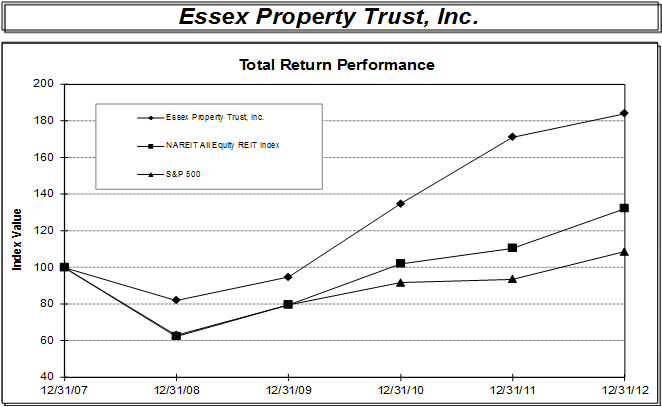
| Period Ending | ||||||||||||||||||||||||
|---|---|---|---|---|---|---|---|---|---|---|---|---|---|---|---|---|---|---|---|---|---|---|---|---|
| Index | 12/31/07 | 12/31/08 | 12/31/09 | 12/31/10 | 12/31/11 | 12/31/12 | ||||||||||||||||||
| Essex Property Trust, Inc. | 100.00 | 81.99 | 94.78 | 134.70 | 171.15 | 183.99 | ||||||||||||||||||
| NAREIT All Equity REIT Index | 100.00 | 62.27 | 79.70 | 101.98 | 110.42 | 132.18 | ||||||||||||||||||
| S&P 500 | 100.00 | 63.00 | 79.68 | 91.68 | 93.61 | 108.59 |
(1) Common stock performance data is provided by SNL Financial.
The graph and other information furnished under the above caption “Performance Graph” in this Part II Item 5 of this Form 10-K shall not deemed to be “soliciting material” or to be “filed” with the SEC or subject to Regulation 14A or 14C, or to the liabilities of the Exchange Act, as amended.
Item 6. Selected Financial Data
The following tables set forth summary financial and operating information for the Company from January 1, 2008 through December 31, 2012.
| Years Ended December 31, | ||||||||||||||||||||
|---|---|---|---|---|---|---|---|---|---|---|---|---|---|---|---|---|---|---|---|---|
| 2012 | 2011 | 2010 | 2009 | 2008 | ||||||||||||||||
| ($ in thousands, except per share amounts) | ||||||||||||||||||||
| OPERATING DATA: | ||||||||||||||||||||
| REVENUES | ||||||||||||||||||||
| Rental and other property | $ | 531,936 | $ | 465,713 | $ | 405,728 | $ | 401,550 | $ | 397,673 | ||||||||||
| Management and other fees from affiliates | 11,489 | 6,780 | 4,551 | 4,325 | 5,166 | |||||||||||||||
| 543,425 | 472,493 | 410,279 | 405,875 | 402,839 | ||||||||||||||||
| EXPENSES | ||||||||||||||||||||
| Property operating expenses | 174,088 | 159,234 | 143,164 | 137,457 | 130,328 | |||||||||||||||
| Depreciation | 170,592 | 151,428 | 128,221 | 116,540 | 108,221 | |||||||||||||||
| General and administrative | 23,307 | 20,694 | 23,255 | 24,966 | 24,725 | |||||||||||||||
| Cost of management and other fees | 6,513 | 4,610 | 2,707 | 3,096 | 2,959 | |||||||||||||||
| Impairment and other charges | - | - | 2,302 | 13,084 | 650 | |||||||||||||||
| 374,500 | 335,966 | 299,649 | 295,143 | 266,883 | ||||||||||||||||
| Earnings from operations | 168,925 | 136,527 | 110,630 | 110,732 | 135,956 | |||||||||||||||
| Interest expense before amortization expense | (100,244 | ) | (91,694 | ) | (82,756 | ) | (81,196 | ) | (78,203 | ) | ||||||||||
| Amortization expense | (11,644 | ) | (11,474 | ) | (4,828 | ) | (4,820 | ) | (6,860 | ) | ||||||||||
| Interest and other income | 13,833 | 17,139 | 27,841 | 13,040 | 11,337 | |||||||||||||||
| Equity income (loss) from co-investments | 41,745 | (467 | ) | (1,715 | ) | 670 | 7,820 | |||||||||||||
| Gain on remeasurement of co-investment | 21,947 | - | - | - | - | |||||||||||||||
| (Loss) gain on early retirement of debt | (5,009 | ) | (1,163 | ) | (10 | ) | 4,750 | 3,997 | ||||||||||||
| Gain on the sales of real estate | - | - | - | 103 | 4,578 | |||||||||||||||
| Income before discontinued operations | 129,553 | 48,868 | 49,162 | 43,279 | 78,625 | |||||||||||||||
| Income from discontinued operations | 10,037 | 8,648 | 1,620 | 10,460 | 5,770 | |||||||||||||||
| Net income | 139,590 | 57,516 | 50,782 | 53,739 | 84,395 | |||||||||||||||
| Net income attributable to noncontrolling interest | (14,306 | ) | (10,446 | ) | (14,848 | ) | (16,631 | ) | (22,255 | ) | ||||||||||
| Net income attributable to controlling interest | 125,284 | 47,070 | 35,934 | 37,108 | 62,140 | |||||||||||||||
| Dividends to preferred stockholders | (5,472 | ) | (4,753 | ) | (2,170 | ) | (4,860 | ) | (9,241 | ) | ||||||||||
| Excess (deficit) of the carrying amount of preferred stock redeemed over the cash paid to redeem preferred stock | - | (1,949 | ) | - | 49,952 | - | ||||||||||||||
| Net income available to common stockholders | $ | 119,812 | $ | 40,368 | $ | 33,764 | $ | 82,200 | $ | 52,899 | ||||||||||
| Per share data: | ||||||||||||||||||||
| Basic: | ||||||||||||||||||||
| Income before discontinued operations available to common stockholders | $ | 3.15 | $ | 0.99 | $ | 1.09 | $ | 2.66 | $ | 1.88 | ||||||||||
| Net income available to common stockholders | $ | 3.42 | $ | 1.24 | $ | 1.14 | $ | 3.01 | $ | 2.10 | ||||||||||
| Weighted average common stock outstanding | 35,032 | 32,542 | 29,667 | 27,270 | 25,205 | |||||||||||||||
| Diluted: | ||||||||||||||||||||
| Income before discontinued operations available to common stockholders | $ | 3.14 | $ | 0.99 | $ | 1.09 | $ | 2.56 | $ | 1.87 | ||||||||||
| Net income available to common stockholders | $ | 3.41 | $ | 1.24 | $ | 1.14 | $ | 2.91 | $ | 2.09 | ||||||||||
| Weighted average common stock outstanding | 35,125 | 32,629 | 29,734 | 29,747 | 25,347 | |||||||||||||||
| Cash dividend per common share | $ | 4.40 | $ | 4.16 | $ | 4.13 | $ | 4.12 | $ | 4.08 |
| As of December 31, | ||||||||||||||||||||
|---|---|---|---|---|---|---|---|---|---|---|---|---|---|---|---|---|---|---|---|---|
| 2012 | 2011 | 2010 | 2009 | 2008 | ||||||||||||||||
| ($ in thousands) | ||||||||||||||||||||
| BALANCE SHEET DATA: | ||||||||||||||||||||
| Investment in rental properties (before accumulated depreciation) | $ | 5,033,672 | $ | 4,313,064 | $ | 3,964,561 | $ | 3,412,930 | $ | 3,279,788 | ||||||||||
| Net investment in rental properties | 3,952,155 | 3,393,038 | 3,189,008 | 2,663,466 | 2,639,762 | |||||||||||||||
| Real estate under development | 66,851 | 44,280 | 217,531 | 274,965 | 272,273 | |||||||||||||||
| Total assets | 4,847,223 | 4,036,964 | 3,732,887 | 3,254,637 | 3,164,823 | |||||||||||||||
| Total secured indebtedness | 1,565,599 | 1,745,858 | 2,082,745 | 1,832,549 | 1,588,931 | |||||||||||||||
| Total unsecured indebtedness | 1,253,084 | 615,000 | 176,000 | 14,893 | 165,457 | |||||||||||||||
| Cumulative convertible preferred stock | 4,349 | 4,349 | 4,349 | 4,349 | 145,912 | |||||||||||||||
| Cumulative redeemable preferred stock | 73,750 | 73,750 | 25,000 | 25,000 | 25,000 | |||||||||||||||
| Stockholders' equity | 1,764,804 | 1,437,527 | 1,149,946 | 1,053,096 | 852,227 |
| As of and for the years ended December 31, | ||||||||||||||||||||
|---|---|---|---|---|---|---|---|---|---|---|---|---|---|---|---|---|---|---|---|---|
| 2012 | 2011 | 2010 | 2009 | 2008 | ||||||||||||||||
| OTHER DATA: | ||||||||||||||||||||
| Net income | $ | 139,590 | $ | 57,516 | $ | 50,782 | $ | 53,739 | $ | 84,395 | ||||||||||
| Interest expense before amortization expense | 100,244 | 91,694 | 82,756 | 81,196 | 78,203 | |||||||||||||||
| Amortization expense | 11,644 | 11,474 | 4,828 | 4,820 | 6,860 | |||||||||||||||
| Tax benefit | - | (1,682 | ) | - | - | - | ||||||||||||||
| Depreciation (1) | 170,686 | 152,543 | 129,712 | 118,522 | 113,294 | |||||||||||||||
| EBITDA(2) | $ | 422,164 | $ | 311,545 | $ | 268,078 | $ | 258,277 | $ | 282,752 |
| (1) | Includes amounts classified within discontinued operations. |
|---|
| (2) | EBITDA is an operating measure and is defined as net income before interest expense, income taxes, depreciation and amortization. EBITDA, as defined by the Company, is not a recognized measurement under U.S. generally accepted accounting principles, or GAAP. This measurement should not be considered in isolation or as a substitute for net income, cash flows from operating activities and other income or cash flow statement data prepared in accordance with GAAP, or as a measure of profitability or liquidity. The Company’s definition may not be comparable to that of other companies. |
|---|
Item 7. Management’s Discussion and Analysis of Financial Condition and Results of Operations
The following discussion and analysis should be read in conjunction with the accompanying consolidated financial statements and notes thereto. These consolidated financial statements include all adjustments which are, in the opinion of management, necessary to reflect a fair statement of the results and all such adjustments are of a normal recurring nature.
OVERVIEW
The Company is a self-administered and self-managed REIT that acquires, develops, redevelops and manages apartment communities in selected residential areas located primarily in the West Coast of the United States. The Company owns all of its interests in its real estate investments, directly or indirectly, through the Operating Partnership. The Company is the sole general partner of the Operating Partnership and, as of December 31, 2012, had an approximately 94.5% general partner interest in the Operating Partnership.
The Company’s investment strategy has two components: constant monitoring of existing markets, and evaluation of new markets to identify areas with the characteristics that underlie rental growth. The Company’s strong financial condition supports its investment strategy by enhancing its ability to quickly shift acquisition, development, and disposition activities to markets that will optimize the performance of the portfolio.
As of December 31, 2012, the Company had ownership interests in 163 communities, comprising 33,468 apartment units, and the apartment communities are located in the following major West Coast regions:
Southern California (Los Angeles, Orange, Riverside, Santa Barbara, San Diego, and Ventura counties)
Northern California (the San Francisco Bay Area)
Seattle Metro (Seattle metropolitan area)
As of December 31, 2012, the Company also had ownership interests in five commercial buildings (with approximately 315,900 square feet).
As of December 31, 2012, the Company’s development pipeline was comprised of two consolidated projects under development, seven unconsolidated joint venture projects under development, two consolidated predevelopment project, one unconsolidated joint venture predevelopment project and one consolidated land parcel held for future development or sale aggregating 2,994 units, with total incurred costs of $531.6 million, and estimated remaining project costs of approximately $463.9 million for total estimated project costs of $995.5 million. By region, the Company's operating results for 2012 and 2011 and projections for 2013 new housing supply, job growth, and rental income are as follows:
Southern California Region: As of December 31, 2012, this region represented 47% of the Company’s consolidated apartment units. During the year ended December 31, 2012, revenues for “2012/2011 Same-Properties” (as defined below), or “Same-Property revenues,” increased 4.2% in 2012 as compared to 2011. In 2013, the Company expects new residential supply of 11,500 multifamily and 7,135 single family homes, which represents a total new multifamily supply of 0.5% and 0.3% of total housing stock, respectively. The Company assumes an increase of 117,500 jobs or 1.7%, and an increase in rental income of 3.8% to 5.3% in 2013.
Northern California Region: As of December 31, 2012, this region represented 31% of the Company’s consolidated apartment units. Same-Property revenues increased 9.6% in 2012 as compared to 2011. In 2013, the Company expects new residential supply of 9,900 multifamily and 4,479 single family homes, which represents a total new multifamily supply of 1.1% and 0.6%, respectively, of total housing stock. The Company assumes an increase of 68,500 jobs or 2.4%, and an increase in rental income of 6.5% to 8.0% in 2013.
Seattle Metro Region: As of December 31, 2012, this region represented 22% of the Company’s consolidated apartment units. Same-Property revenues increased 8.4% in 2012 as compared to 2011. In 2013, the Company expects new residential supply of 6,900 multifamily and 5,888 single family homes, which represents a total new multifamily supply of 1.7% and 1.1%, respectively, of total housing stock. The Company assumes an increase of 41,000 jobs or 2.8%, and an increase in rental income of 6.0% to 7.5% in 2013.
The Company expects 2013 Same-Property revenues to increase between 5.0% and 6.5% compared to 2012 results, as renewal and new leases are signed at higher rents in 2013 than 2012. The Company expects 2013 Same-Property financial occupancy to be consistent with 2012 at 96.3%, and thus 2013 revenues will increase 5.0% to 6.5% due to a similar increase in scheduled rent. Same-Property operating expenses are expected to increase from 2.0% in 2012, to a range of 3.0% to 4.0% in 2013, and forecasted increases in property taxes account for approximately 45% of the forecasted increase in property expenses in 2013 compared to 2012. Finally, Same-Property net operating income (“NOI”) which is defined as Same-Property revenues less Same-Property operating expenses is expected to moderate from a 9.2% increase for 2012 to a range of an increase of 6.0% to 8.0% in 2013.
The Company’s consolidated communities are as follows:
| As of December 31, 2012 | As of December 31, 2011 | |||||||||||||||
|---|---|---|---|---|---|---|---|---|---|---|---|---|---|---|---|---|
| Apartment Units | % | Apartment Units | % | |||||||||||||
| Southern California | 13,656 | 47 | % | 13,205 | 48 | % | ||||||||||
| Northern California | 8,987 | 31 | % | 8,106 | 30 | % | ||||||||||
| Seattle Metro | 6,598 | 22 | % | 6,108 | 22 | % | ||||||||||
| Total | 29,241 | 100 | % | 27,419 | 100 | % |
Co-investments including Fund II, Wesco I and Wesco III communities, and preferred equity co-investment communities are not included in the table presented above for both years.
RESULTS OF OPERATIONS
Comparison of Year Ended December 31, 2012 to the Year Ended December 31, 2011
The Company’s average financial occupancies for the Company’s stabilized apartment communities or “2012/2011 Same-Properties” (stabilized properties consolidated by the Company for the years ended December 31, 2012 and 2011) remained consistent at 96.3% for 2012 and 2011. Financial occupancy is defined as the percentage resulting from dividing actual rental revenue by total possible rental revenue. Actual rental revenue represents contractual rental revenue pursuant to leases without considering delinquency and concessions. Total possible rental revenue represents the value of all apartment units, with occupied units valued at contractual rental rates pursuant to leases and vacant units valued at estimated market rents. We believe that financial occupancy is a meaningful measure of occupancy because it considers the value of each vacant unit at its estimated market rate.
Market rates are determined using a variety of factors such as effective rental rates at the property based on recently signed leases and asking rates for comparable properties in the market. The recently signed effective rates at the property are used as the starting point in the determination of the market rates of vacant units. The Company then increases or decreases these rates based on the supply and demand in the apartment community’s market. The Company will check the reasonableness of these rents based on its position within the market and compare the rents against the asking rents by comparable properties in the market. Financial occupancy may not completely reflect short-term trends in physical occupancy and financial occupancy rates as disclosed by other REITs may not be comparable to the Company’s calculation of financial occupancy.
The Company does not take into account delinquency and concessions to calculate actual rent for occupied units and market rents for vacant units. The calculation of financial occupancy compares contractual
Showing the first 8K of 68K characters. Open the full section
Item 7A. Quantitative and Qualitative Disclosures About Market Risks
Interest Rate Hedging Activities
The Company’s objective in using derivatives is to add stability to interest expense and to manage its exposure to interest rate movements or other identified risks. To accomplish this objective, the Company uses interest rate swaps as part of its cash flow hedging strategy. As of December 31, 2012, the Company has entered into ten interest rate swap contracts to mitigate the risk of changes in the interest-related cash outflows on $300.0 million of the five-year unsecured term debt. As of December 31, 2012, the Company also had $201.9 million of variable rate indebtedness, of which $187.8 million is subject to interest rate cap protection. All of the Company’s derivative instruments are designated as cash flow hedges, and the Company does not have any fair value hedges as of December 31, 2012. The following table summarizes the notional amount, carrying value, and estimated fair value of the Company’s derivative instruments used to hedge interest rates as of December 31, 2012. The notional amount represents the aggregate amount of a particular security that is currently hedged at one time, but does not represent exposure to credit, interest rates or market risks. The table also includes a sensitivity analysis to demonstrate the impact on the Company’s derivative instruments from an increase or decrease in 10-year Treasury bill interest rates by 50 basis points, as of December 31, 2012.
| Carrying and | Estimated Carrying Value | |||||||||||||||||||
|---|---|---|---|---|---|---|---|---|---|---|---|---|---|---|---|---|---|---|---|---|
| Notional | Maturity | Estimate Fair | + 50 | - 50 | ||||||||||||||||
| ($ in thousands) | Amount | Date Range | Value | Basis Points | Basis Points | |||||||||||||||
| Cash flow hedges: | ||||||||||||||||||||
| Interest rate swaps | $ | 300,000 | 2016-2017 | $ | (6,606 | ) | $ | (474 | ) | $ | (11,619 | ) | ||||||||
| Interest rate caps | 187,788 | 2013-2018 | - | 102 | - | |||||||||||||||
| Total cash flow hedges | $ | 487,788 | 2013-2018 | $ | (6,606 | ) | $ | (372 | ) | $ | (11,619 | ) |
Interest Rate Sensitive Liabilities
The Company is exposed to interest rate changes primarily as a result of its line of credit and long-term debt used to maintain liquidity and fund capital expenditures and expansion of the Company’s real estate investment portfolio and operations. The Company’s interest rate risk management objective is to limit the impact of interest rate changes on earnings and cash flows and to lower its overall borrowing costs. To achieve its objectives the Company borrows primarily at fixed rates and may enter into derivative financial instruments such as interest rate swaps, caps and treasury locks in order to mitigate its interest rate risk on a related financial instrument. The Company does not enter into derivative or interest rate transactions for speculative purposes.
The Company’s interest rate risk is monitored using a variety of techniques. The table below presents the principal amounts and weighted average interest rates by year of expected maturity to evaluate the expected cash flows. Management has estimated that the fair value of the Company’s $2.13 billion and $1.77 billion of fixed rate debt at December 31, 2012 and 2011 respectively, to be $2.24 billion and $1.88 billion. Management has estimated the fair value of the Company’s $692.9 million and $593.7 million of variable rate debt at December 31, 2012 and 2011, respectively, is $671.7 million and $572.3 million based on the terms of existing mortgage notes payable and variable rate demand notes compared to those available in the marketplace ($ in thousands).
| For the Years Ended December 31, | |||||||||||||||||||||||||||||||||
|---|---|---|---|---|---|---|---|---|---|---|---|---|---|---|---|---|---|---|---|---|---|---|---|---|---|---|---|---|---|---|---|---|---|
| 2013 | 2014 | 2015 | 2016 | 2017 | Thereafter | Total | Fair value | ||||||||||||||||||||||||||
| Fixed rate debt | $ | 38,201 | $ | 47,994 | $ | 68,926 | $ | 162,656 | $ | 225,301 | $ | 1,582,737 | $ | 2,125,815 | $ | 2,237,462 | |||||||||||||||||
| Average interest rate | 5.6 | % | 5.2 | % | 5.2 | % | 4.5 | % | 5.5 | % | 5.4 | % | |||||||||||||||||||||
| Variable rate debt | $ | 19,420 | $ | - | $ | 141,000 | $ | 200,000 | $ | 150,000 | $ | 182,448 | (1 | ) | $ | 692,868 | $ | 671,651 | |||||||||||||||
| Average interest rate | 1.5 | % | - | 2.3 | % | 2.6 | % | 2.7 | % | 1.9 | % |
(1) $187.8 million subject to interest rate caps.
The table incorporates only those exposures that exist as of December 31, 2012; it does not consider those exposures or positions that could arise after that date. As a result, the Company’s ultimate realized gain or loss, with respect to interest rate fluctuations and hedging strategies would depend on the exposures that arise during the period.
Item 8. Financial Statements and Supplementary Data
The response to this item is submitted as a separate section of this Form 10-K. See Item 15.
Item 9. Changes in and Disagreements with Accountants on Accounting and Financial Disclosure
Not applicable.
Item 9A. Controls and Procedures
As of December 31, 2012, the Company carried out an evaluation, under the supervision and with the participation of management, including its Chief Executive Officer and Chief Financial Officer, of the effectiveness of the design and operation of its disclosure controls and procedures (as defined in Rules 13a-15(e) and 15d-15(e) under the Securities Exchange Act of 1934, as amended (the “Exchange Act”)). Based upon that evaluation, the Company’s Chief Executive Officer and Chief Financial Officer concluded that as of December 31, 2012, the Company’s disclosure controls and procedures were effective to ensure that the information required to be disclosed by the Company in the reports that the Company files or submits under the Exchange Act were recorded, processed, summarized and reported within the time periods specified in the SEC's rules and forms and that such disclosure controls and procedures were also effective to ensure that information required to be disclosed in the reports that the Company files or submits under the Exchange Act is accumulated and communicated to the Company’s management, including the Company’s Chief Executive Officer and Chief Financial Officer, to allow timely decisions regarding required disclosure.
There were no changes in the Company's internal control over financial reporting, that occurred during the quarter ended December 31, 2012, that have materially affected, or are reasonably likely to materially affect, the Company's internal control over financial reporting.
Management’s Report on Internal Control Over Financial Reporting
The Company’s management is responsible for establishing and maintaining adequate internal control over financial reporting (as defined in Rule 13a-15(f) under the Securities Exchange Act of 1934, as amended). The Company’s management assessed the effectiveness of the Company’s internal control over financial reporting as of December 31, 2012. In making this assessment, the Company’s management used the criteria set forth by the Committee of Sponsoring Organizations of the Treadway Commission (“COSO”) in Internal Control-Integrated Framework. The Company’s management has concluded that, as of December 31, 2012, its internal control over financial reporting was effective based on these criteria. The Company’s independent registered public accounting firm, KPMG LLP, has issued an audit report on the effectiveness of its internal control over financial reporting, which is included herein.
Item 9B. Other Information
None.
PART III
Item 10. Directors, Executive Officers and Corporate Governance
The information required by Item 10 is incorporated by reference from the Company’s definitive proxy statement for its annual stockholders’ meeting to be held on May 14, 2013.
Item 11. Executive Compensation
The information required by Item 11 is incorporated by reference from the Company’s definitive proxy statement for its annual stockholders’ meeting to be held on May 14, 2013.
Item 12. Security Ownership of Certain Beneficial Owners and Management and Related Stockholder Matters
The information required by Item 12 is incorporated by reference from the Company’s definitive proxy statement for its annual stockholders’ meeting to be held on May 14, 2013.
Item 13. Certain Relationships and Related Transactions and Director Independence
The information required by Item 13 is incorporated by reference from the Company’s definitive proxy statement for its annual stockholders’ meeting to be held on May 14, 2013.
Item 14. Principal Accounting Fees and Services
The information required by Item 14 is incorporated by reference from the Company’s definitive proxy statement for its annual stockholders’ meeting to be held on May 14, 2013.
PART IV
Item 15. Exhibits and Financial Statement Schedules
(A) Financial Statements
| (1) Consolidated Financial Statements | Page |
|---|---|
| Reports of Independent Registered Public Accounting Firm | F-1 |
| Consolidated Balance Sheets: As of December 31, 2012 and 2011 | F-4 |
| Consolidated Statements of Operations: Years ended December 31, 2012, 2011, and 2010 | F-5 |
| Consolidated Statements of Comprehensive Income (Loss): Years ended December 31, 2012, 2011, and 2010 | F-6 |
| Consolidated Statements of Equity: Years ended December 31, 2012, 2011, and 2010 | F-7 |
| Consolidated Statements of Cash Flows: Years ended December 31, 2012, 2011, and 2010 | F-8 |
| Notes to the Consolidated Financial Statements | F-10 |
| (2) Financial Statement Schedule - Schedule III - Real Estate and Accumulated Depreciation as of December 31, 2011 | F-38 |
| (3) See the Exhibit Index immediately following the signature page and certifications for a list of exhibits filed or incorporated by reference as part of this report. |
(B) Exhibits
The Company hereby files, as exhibits to this Form 10-K, those exhibits listed on the Exhibit Index referenced in Item 15(A)(3) above.
Report of Independent Registered Public Accounting Firm
The Board of Directors and Stockholders
Essex Property Trust, Inc.:
We have audited the accompanying consolidated balance sheets of Essex Property Trust, Inc. and subsidiaries as of December 31, 2012 and 2011, and the related consolidated statements of operations, comprehensive income (loss), equity, and cash flows for each of the years in the three-year period ended December 31, 2012. In connection with our audits of the consolidated financial statements, we have also audited the accompanying financial statement schedule III. These consolidated financial statements and the accompanying financial statement schedule III are the responsibility of Essex Property Trust Inc.’s management. Our responsibility is to express an opinion on these consolidated financial statements and the accompanying financial statement schedule III based on our audits.
We conducted our audits in accordance with the standards of the Public Company Accounting Oversight Board (United States). Those standards require that we plan and perform the audit to obtain reasonable assurance about whether the financial statements are free of material misstatement. An audit includes examining, on a test basis, evidence supporting the amounts and disclosures in the financial statements. An audit also includes assessing the accounting principles used and significant estimates made by management, as well as evaluating the overall financial statement presentation. We believe that our audits provide a reasonable basis for our opinion.
In our opinion, the consolidated financial statements referred to above present fairly, in all material respects, the financial position of Essex Property Trust, Inc. and subsidiaries as of December 31, 2012 and 2011, and the results of their operations and their cash flows for each of the years in the three-year period ended December 31, 2012, in conformity with U.S. generally accepted accounting principles. Also in our opinion, the related financial statement schedule III, when considered in relation to the basic consolidated financial statements taken as a whole, presents fairly, in all material respects, the information set forth therein.
We also have audited, in accordance with the standards of the Public Company Accounting Oversight Board (United States), Essex Property Trust, Inc.’s internal control over financial reporting as of December 31, 2012, based on criteria established in Internal Control–Integrated Framework issued by the Committee of Sponsoring Organizations of the Treadway Commission (COSO), and our report dated February 22, 2013 expressed an unqualified opinion on the effectiveness of Essex Property Trust, Inc.’s internal control over financial reporting.
| /S/ KPMG LLP | |
|---|---|
| KPMG LLP |
San Francisco, California
February 22, 2013
F-1
Report of Independent Registered Public Accounting Firm
The Board of Directors and Stockholders
Essex Property Trust, Inc.:
We have audited Essex Property Trust, Inc.’s internal control over financial reporting as of December 31, 2012, based on criteria established in Internal Control–Integrated Framework issued by the Committee of Sponsoring Organizations of the Treadway Commission (COSO). Essex Property Trust, Inc.’s management is responsible for maintaining effective internal control over financial reporting and for its assessment of the effectiveness of internal control over financial reporting, included in Management’s Report on Internal Control over Financial Reporting, appearing under Item 9A. Our responsibility is to express an opinion on Essex Property Trust Inc.'s internal control over financial reporting based on our audit.
We conducted our audit in accordance with the standards of the Public Company Accounting Oversight Board (United States). Those standards require that we plan and perform the audit to obtain reasonable assurance about whether effective internal control over financial reporting was maintained in all material respects. Our audit included obtaining an understanding of internal control over financial reporting, assessing the risk that a material weakness exists, and testing and evaluating the design and operating effectiveness of internal control, based on the assessed risk. Our audit also included performing such other procedures as we considered necessary in the circumstances. We believe that our audit provides a reasonable basis for our opinion.
A company’s internal control over financial reporting is a process designed to provide reasonable assurance regarding the reliability of financial reporting and the preparation of financial statements for external purposes in accordance with generally accepted accounting principles. A company’s internal control over financial reporting includes those policies and procedures that (1) pertain to the maintenance of records that, in reasonable detail, accurately and fairly reflect the transactions and dispositions of the assets of the company; (2) provide reasonable assurance that transactions are recorded as necessary to permit preparation of financial statements in accordance with generally accepted accounting principles, and that receipts and expenditures of the company are being made only in accordance with authorizations of management and directors of the company; and (3) provide reasonable assurance regarding prevention or timely detection of unauthorized acquisition, use, or disposition of the company’s assets that could have a material effect on the financial statements.
Because of its inherent limitations, internal control over financial reporting may not prevent or detect misstatements. Also, projections of any evaluation of effectiveness to future periods are subject to the risk that controls may become inadequate because of changes in conditions, or that the degree of compliance with the policies or procedures may deteriorate.
In our opinion, Essex Property Trust, Inc. maintained, in all material respects, effective internal control over financial reporting as of December 31, 2012, based on criteria established in Internal Control–Integrated Framework issued by the Committee of Sponsoring Organizations of the Treadway Commission (COSO).
F-2
We also have audited, in accordance with the standards of the Public Company Accounting Oversight Board (United States), the consolidated balance sheets of Essex Property Trust, Inc. and subsidiaries as of December 31, 2012 and 2011, and the related consolidated statements of operations, comprehensive income (loss), equity, and cash flows for each of the years in the three-year period ended December 31, 2012, and our report dated February 22, 2013, expressed an unqualified opinion on those consolidated financial statements.
|
Showing the first 8K of 194K characters. Open the full section