 filings.tools
Essex Property Trust 10-K 2020-12-31
Filed 2021-02-19. 22 sections, 713K characters. Original on sec.gov · Markdown · JSON
Cover and table of contents
UNITED STATES
SECURITIES AND EXCHANGE COMMISSION
Washington, D.C. 20549
FORM 10-K
(MARK ONE)
☒ ANNUAL REPORT PURSUANT TO SECTION 13 OR 15(d) OF THE SECURITIES EXCHANGE ACT OF 1934
For the fiscal year ended December 31, 2020
OR
☐ TRANSITION REPORT PURSUANT TO SECTION 13 OR 15(d) OF THE SECURITIES EXCHANGE ACT OF 1934
For the transition period from ___________ to _____________
001-13106 (Essex Property Trust, Inc.)
333-44467-01 (Essex Portfolio, L.P.)
(Commission File Number)
ESSEX PROPERTY TRUST, INC.
ESSEX PORTFOLIO, L.P.
(Exact name of Registrant as Specified in its Charter)
| Maryland | 77-0369576 | |||||||
| (Essex Property Trust, Inc.) | (Essex Property Trust, Inc.) | |||||||
| California | 77-0369575 | |||||||
| (Essex Portfolio, L.P.) | (Essex Portfolio, L.P.) | |||||||
| (State or Other Jurisdiction of Incorporation or Organization) | (I.R.S. Employer Identification Number) |
1100 Park Place, Suite 200
San Mateo, California 94403
(Address of Principal Executive Offices including Zip Code)
(650) 655-7800
(Registrant's Telephone Number, Including Area Code)
Securities registered pursuant to Section 12(b) of the Act:
| Title of each class | Trading Symbol(s) | Name of each exchange on which registered | ||||||||||||
| Common Stock, $.0001 par value (Essex Property Trust, Inc.) | ESS | New York Stock Exchange |
Securities registered pursuant to Section 12(g) of the Act: None
Indicate by check mark if the registrant is a well-known seasoned issuer, as defined in Rule 405 of the Securities Act.
| Essex Property Trust, Inc. | Yes | ☒ | No | ☐ | Essex Portfolio, L.P. | Yes | ☐ | No | ☒ |
Indicate by check mark if the registrant is not required to file reports pursuant to Section 13 or Section 15(d) of the Act.
| Essex Property Trust, Inc. | Yes | ☐ | No | ☒ | Essex Portfolio, L.P. | Yes | ☐ | No | ☒ |
Indicate by check mark whether the registrant (1) has filed all reports required to be filed by Section 13 or 15(d) of the Securities Exchange Act of 1934 during the preceding 12 months (or for such shorter period that the registrant was required to file such reports), and (2) has been subject to such filing requirements for the past 90 days.
| Essex Property Trust, Inc. | Yes | ☒ | No | ☐ | Essex Portfolio, L.P. | Yes | ☒ | No | ☐ |
Indicate by check mark whether the registrant has submitted electronically every Interactive Data File required to be submitted pursuant to Rule 405 of Regulation S-T (§232.405 of this chapter) during the preceding 12 months (or for such shorter period that the registrant was required to submit such files).
| Essex Property Trust, Inc. | Yes | ☒ | No | ☐ | Essex Portfolio, L.P. | Yes | ☒ | No | ☐ |
Indicate by check mark whether the registrant is a large accelerated filer, an accelerated filer, a non-accelerated filer, a smaller reporting company, or an emerging growth company. See the definitions of "large accelerated filer," "accelerated filer," "smaller reporting company," and "emerging growth company" in Rule 12b-2 of the Exchange Act.
Essex Property Trust, Inc.:
| Large accelerated filer | ☒ | Accelerated filer | ☐ | Non-accelerated filer | ☐ | Smaller reporting company | ☐ | ||||||||||||||||
| Emerging growth company | ☐ |
Essex Portfolio, L.P.:
| Large accelerated filer | ☐ | Accelerated filer | ☐ | Non-accelerated filer | ☒ | Smaller reporting company | ☐ | ||||||||||||||||
| Emerging growth company | ☐ |
If an emerging growth company, indicate by check mark if the registrant has elected not to use the extended transition period for complying with any new or revised financial accounting standards provided pursuant to Section 13(a) of the Exchange Act.
| Essex Property Trust, Inc. | ☐ | Essex Portfolio, L.P. | ☐ |
Indicate by check mark whether the registrant has filed a report on and attestation to its management’s assessment of the effectiveness of its internal control over financial reporting under Section 404(b) of the Sarbanes-Oxley Act (15 U.S.C. 7262(b)) by the registered public accounting firm that prepared or issued its audit report.
| Essex Property Trust, Inc. | ☒ | Essex Portfolio, L.P. | ☐ |
Indicate by check mark whether the registrant is a shell company (as defined in Rule 12b-2 of the Act).
| Essex Property Trust, Inc. | Yes | ☐ | No | ☒ | Essex Portfolio, L.P. | Yes | ☐ | No | ☒ |
As of June 30, 2020, the aggregate market value of the voting stock held by non-affiliates of Essex Property Trust, Inc. was $14,874,979,309. The aggregate market value was computed with reference to the closing price on the New York Stock Exchange on the last trading day preceding such date. Shares of common stock held by executive officers, directors and holders of more than ten percent of the outstanding common stock have been excluded from this calculation because such persons may be deemed to be affiliates. This exclusion does not reflect a determination that such persons are affiliates for any other purposes. There is no public trading market for the common units of Essex Portfolio, L.P. As a result, the aggregate market value of the common units held by non-affiliates of Essex Portfolio, L.P. cannot be determined.
As of February 17, 2021, 64,994,503 shares of common stock ($.0001 par value) of Essex Property Trust, Inc. were outstanding.
DOCUMENTS INCORPORATED BY REFERENCE:
Portions of the definitive Proxy Statement to be filed with the Securities and Exchange Commission (the "SEC") pursuant to Regulation 14A in connection with the 2021 annual meeting of stockholders of Essex Property Trust, Inc. are incorporated by reference in Part III of this Annual Report on Form 10-K. Such Proxy Statement will be filed with the SEC within 120 days of December 31, 2020.
EXPLANATORY NOTE
This report combines the annual reports on Form 10-K for the year ended December 31, 2020 of Essex Property Trust, Inc., a Maryland corporation, and Essex Portfolio, L.P., a Delaware limited partnership of which Essex Property Trust, Inc. is the sole general partner.
Unless stated otherwise or the context otherwise requires, references to the "Company," "we," "us," or "our" mean collectively Essex Property Trust, Inc. and those entities/subsidiaries owned or controlled by Essex Property Trust, Inc., including Essex Portfolio, L.P., and references to the "Operating Partnership," or "EPLP" mean Essex Portfolio, L.P. and those entities/subsidiaries owned or controlled by Essex Portfolio, L.P. Unless stated otherwise or the context otherwise requires, references to "Essex" mean Essex Property Trust, Inc., not including any of its subsidiaries.
Essex operates as a self-administered and self-managed real estate investment trust ("REIT"), and is the sole general partner of the Operating Partnership. As of December 31, 2020, Essex owned approximately 96.6% of the ownership interest in the Operating Partnership with the remaining 3.4% interest owned by limited partners. As the sole general partner of the Operating Partnership, Essex has exclusive control of the Operating Partnership's day-to-day management.
The Company is structured as an umbrella partnership REIT ("UPREIT") and Essex contributes all net proceeds from its various equity offerings to the Operating Partnership. In return for those contributions, Essex receives a number of Operating Partnership limited partnership units ("OP Units," and the holders of such OP Units, "Unitholders") equal to the number of shares of common stock it has issued in the equity offerings. Contributions of properties to the Company can be structured as tax-deferred transactions through the issuance of OP Units, which is one of the reasons why the Company is structured in the manner outlined above. Based on the terms of the Operating Partnership's partnership agreement, OP Units can be exchanged into Essex common stock on a one-for-one basis. The Company maintains a one-for-one relationship between the OP Units issued to Essex and shares of common stock.
The Company believes that combining the reports on Form 10-K of Essex and the Operating Partnership into this single report provides the following benefits:
-
enhances investors' understanding of Essex and the Operating Partnership by enabling investors to view the business as a whole in the same manner as management views and operates the business;
-
eliminates duplicative disclosure and provides a more streamlined and readable presentation since a substantial portion of the disclosure applies to both Essex and the Operating Partnership; and
-
creates time and cost efficiencies through the preparation of one combined report instead of two separate reports.
Management operates Essex and the Operating Partnership as one business. The management of Essex consists of the same members as the management of the Operating Partnership.
All of the Company's property ownership, development, and related business operations are conducted through the Operating Partnership and Essex has no material assets, other than its investment in the Operating Partnership. Essex's primary function is acting as the general partner of the Operating Partnership. As general partner with control of the Operating Partnership, Essex consolidates the Operating Partnership for financial reporting purposes. Therefore, the assets and liabilities of Essex and the Operating Partnership are the same on their respective financial statements. Essex also issues equity from time to time and guarantees certain debt of the Operating Partnership, as disclosed in this report. The Operating Partnership holds substantially all of the assets of the Company, including the Company's ownership interests in its co-investments. The Operating Partnership conducts the operations of the business and is structured as a partnership with no publicly traded equity. Except for the net proceeds from equity offerings by the Company, which are contributed to the capital of the Operating Partnership in exchange for OP Units (on a one-for-one share of common stock per OP Unit basis), the Operating Partnership generates all remaining capital required by the Company's business. These sources of capital include the Operating Partnership's working capital, net cash provided by operating activities, borrowings under its revolving credit facilities, the issuance of secured and unsecured debt and equity securities and proceeds received from disposition of certain properties and co-investments.
The Company believes it is important to understand the few differences between Essex and the Operating Partnership in the context of how Essex and the Operating Partnership operate as a consolidated company. Stockholders' equity, partners' capital and noncontrolling interest are the main areas of difference between the consolidated financial statements of Essex and those of the Operating Partnership. The limited partners of the Operating Partnership are accounted for as partners' capital in the Operating Partnership's consolidated financial statements and as noncontrolling interest in Essex's consolidated financial statements. The noncontrolling interest in the Operating Partnership's consolidated financial statements include the interest of unaffiliated partners in various consolidated partnerships and co-investment partners. The noncontrolling interest in Essex's
iii
consolidated financial statements include (i) the same noncontrolling interest as presented in the Operating Partnership’s consolidated financial statements and (ii) OP Unitholders. The differences between stockholders' equity and partners' capital result from differences in the equity issued at Essex and Operating Partnership levels.
To help investors understand the significant differences between Essex and the Operating Partnership, this report provides separate consolidated financial statements for Essex and the Operating Partnership; a single set of consolidated notes to such financial statements that includes separate discussions of stockholders' equity or partners' capital, and earnings per share/unit, as applicable; and a combined Management's Discussion and Analysis of Financial Condition and Results of Operations.
This report also includes separate Part II, Item 9A. Controls and Procedures sections and separate Exhibits 31 and 32 certifications for each of Essex and the Operating Partnership in order to establish that the requisite certifications have been made and that Essex and the Operating Partnership are compliant with Rule 13a-15 or Rule 15d-15 of the Securities Exchange Act of 1934 (the "Exchange Act") and 18 U.S.C. §1350.
In order to highlight the differences between Essex and the Operating Partnership, the separate sections in this report for Essex and the Operating Partnership specifically refer to Essex and the Operating Partnership. In the sections that combine disclosure of Essex and the Operating Partnership, this report refers to actions or holdings as being actions or holdings of the Company. Although the Operating Partnership is generally the entity that directly or indirectly enters into contracts and co-investments and holds assets and debt, reference to the Company is appropriate because the Company is one business and the Company operates that business through the Operating Partnership. The separate discussions of Essex and the Operating Partnership in this report should be read in conjunction with each other to understand the results of the Company on a consolidated basis and how management operates the Company.
The information furnished in the accompanying consolidated balance sheets, statements of income, comprehensive income, equity, capital, and cash flows of the Company and the Operating Partnership reflect all adjustments which are, in the opinion of management, necessary for a fair presentation of the aforementioned consolidated financial statements for the periods and are normal and recurring in nature, except as otherwise noted.
The accompanying consolidated financial statements should be read in conjunction with the notes to such consolidated financial statements and Management's Discussion and Analysis of Financial Condition and Results of Operations herein.
iv
ESSEX PROPERTY TRUST, INC.
ESSEX PORTFOLIO, L.P.
2020 ANNUAL REPORT ON FORM 10-K
TABLE OF CONTENTS
v
PART I
Forward-Looking Statements
- This Form 10-K contains forward-looking statements within the meaning of Section 27A of the Securities Act of 1933, as amended (the "Securities Act") and Section 21E of the Exchange Act. Such forward-looking statements are described in Item 7, Management’s Discussion and Analysis of Financial Condition and Results of Operations, "Forward-Looking Statements." Actual results could differ materially from those set forth in each forward-looking statement. Certain factors that might cause such a difference are discussed in this report, including in Item 1A, Risk Factors of this Form 10-K.
Risk Factors Summary
The following is a summary of the principal risks that could adversely affect our business, operating results, cash flows and financial conditions.
Risks Related to Our Real Estate Investments and Operations
-
General real estate investment risks may adversely affect property income and values.
-
Short-term leases expose us to the effects of declining market rents, and the Company may be unable to renew leases or relet units as leases expire.
-
National and regional economic environments can negatively impact the Company’s liquidity and operating results.
Rent control, or other changes in applicable laws, or noncompliance with applicable laws, could adversely affect the Company's operations or expose us to liability.
-
The current COVID-19 pandemic, or the future outbreak of other highly infectious or contagious diseases, and the timing and effectiveness of vaccine distribution, could materially and adversely affect our business, financial condition and results of operations.
-
Acquisition of communities as well as development and redevelopment activities each involve various risks and may be delayed, not completed, and/or not achieve expected results.
-
Our apartment communities may be subject to unknown or contingent liabilities which could cause us to incur substantial costs, including environmental liabilities or general uninsured losses.
-
The geographic concentration of the Company’s communities and fluctuations in local markets may adversely impact the Company’s financial condition and operating results.
-
The Company may experience various increased costs, including increased property taxes or costs associated with complying with legislation, to own and maintain its properties.
-
Competition in the apartment community market and other housing alternatives may adversely affect operations and the rental demand for the Company’s communities.
-
Investments in mortgages, mezzanine loans, subordinated debt, other real estate, and other marketable securities could adversely affect the Company’s cash flow from operations.
-
The Company’s ownership of co-investments could limit the Company’s ability to control such communities and may restrict our ability to finance, sell or otherwise transfer our interests in these properties and expose us to loss of the properties if such agreements are breached by us or terminated.
-
We may pursue acquisitions of other REITs and real estate companies, which may not yield anticipated results and could adversely affect our results of operations.
-
Real estate investments are relatively illiquid and, therefore, the Company's ability to vary its portfolio promptly in response to changes in economic or other conditions may be limited.
-
The Company may not be able to lease its retail/commercial space consistent with its projections or at market rates.
-
Climate change may adversely affect our business.
-
Accidental death or severe injuries at our communities due to fires, floods, other natural disasters or hazards could adversely affect our business and results of operations.
-
Adverse changes in laws may adversely affect the Company's liabilities and/or operating costs relating to its properties and its operations.
-
Failure to succeed in new markets may limit the Company’s growth.
-
Our business and reputation depend on our ability to continue providing high quality housing and consistent operation of our communities, the failure of which could adversely affect our business, financial condition and results of operations.
-
We rely on information technology in our operations, and any material failure, inadequacy, interruption or breach of the Company’s privacy or information security systems, or those of our vendors or other third parties, could materially adversely affect the Company’s business and financial condition.
-
Reliance on third party software providers to host systems critical to our operations and to provide the Company with data.
Risks Relating to Our Indebtedness and Financings
-
Capital and credit market conditions may affect the Company’s access to sources of capital and/or the cost of capital, which could negatively affect the Company’s business, results of operations, cash flows and financial condition. Debt financing has inherent risks, and may result in insufficient cash flow to service debt and fund distributions.
-
The indentures governing our notes and other financing arrangements contain restrictive covenants that limit our operating flexibility.
-
A downgrade in the Company's investment grade credit rating could materially and adversely affect its business and financial condition.
-
The Company could be negatively impacted by the condition of Fannie Mae or Freddie Mac and by changes in government support for multifamily housing.
Risks Related to Personnel
-
The Company depends on its key personnel, whose continued service is not guaranteed.
-
The Company’s Chairman is involved in other real estate activities and investments, which may lead to conflicts of interest.
-
The influence of executive officers, directors and significant stockholders may be detrimental to holders of common stock.
Risks Related to Taxes and REIT Status
-
Failure to generate sufficient revenue or other liquidity needs could limit cash flow available for distributions to Essex's stockholders or the Operating Partnership's unitholders.
-
The Maryland Business Combination Act and the Company’s governing documents may delay, defer or prevent a transaction or change in control of the Company that might involve a premium price for the Company's stock or otherwise be in the best interest of our stockholders.
-
Loss of the Company's REIT status would have significant adverse consequences to the Company and the value of the Company's common stock.
-
The tax imposed on REITs engaging in "prohibited transactions" may limit the Company’s ability to engage in transactions which would be treated as sales for federal income tax purposes.
-
Dividends payable by REITs may be taxed at higher rates than dividends of non-REIT corporations, which could reduce the net cash received by stockholders and may be detrimental to the Company’s ability to raise additional funds through any future sale of its stock.
Item 1. Business
OVERVIEW
Essex Property Trust, Inc. ("Essex"), a Maryland corporation, is an S&P 500 company that operates as a self-administered and self-managed real estate investment trust ("REIT"). Essex owns all of its interest in its real estate and other investments directly or indirectly through Essex Portfolio, L.P. (the "Operating Partnership" or "EPLP"). Essex is the sole general partner of the Operating Partnership and as of December 31, 2020, had an approximately 96.6% general partnership interest in the Operating Partnership. In this report, the terms the "Company," "we," "us," and "our" also refer to Essex Property Trust, Inc., the Operating Partnership and those entities/subsidiaries owned or controlled by Essex and/or the Operating Partnership.
Essex has elected to be treated as a REIT for federal income tax purposes, commencing with the year ended December 31, 1994. Essex completed its initial public offering on June 13, 1994. In order to maintain compliance with REIT tax rules, the Company utilizes taxable REIT subsidiaries for various revenue generating or investment activities. All taxable REIT subsidiaries are consolidated by the Company for financial reporting purposes.
The Company is engaged primarily in the ownership, operation, management, acquisition, development and redevelopment of predominantly apartment communities, located along the West Coast of the United States. As of December 31, 2020, the Company owned or had ownership interests in 246 operating apartment communities, aggregating 60,272 apartment homes, excluding the Company's ownership in preferred equity co-investments, loan investments, one operating commercial building, and a development pipeline comprised of three consolidated projects and three unconsolidated joint venture projects aggregating 1,853 apartment homes (collectively, the "Portfolio").
The Company’s website address is http://www.essex.com. The Company’s annual reports on Form 10-K, quarterly reports on Form 10-Q, current reports on Form 8-K and all amendments to those reports, and the Proxy Statement for its Annual Meeting of Stockholders are available, free of charge, on its website as soon as practicable after the Company files the reports with the U.S. Securities and Exchange Commission ("SEC"). The information contained on the Company's website shall not be deemed to be incorporated into this report.
BUSINESS STRATEGIES
The following is a discussion of the Company’s business strategies in regards to real estate investment and management.
Business Strategies
Research Driven Approach to Investments – The Company believes that successful real estate investment decisions and portfolio growth begin with extensive regional economic research and local market knowledge. The Company continually assesses markets where the Company operates, as well as markets where the Company considers future investment opportunities by evaluating markets and focusing on the following strategic criteria:
-
Major metropolitan areas that have regional population in excess of one million;
-
Constraints on new supply driven by: (i) low availability of developable land sites where competing housing could be economically built; (ii) political growth barriers, such as protected land, urban growth boundaries, and potential lengthy and expensive development permit processes; and (iii) natural limitations to development, such as mountains or waterways;
-
Rental demand enhanced by affordability of rents relative to costs of for-sale housing; and
-
Housing demand based on job growth, proximity to jobs, high median incomes and the quality of life including related commuting factors.
Recognizing that all real estate markets are cyclical, the Company regularly evaluates the results of its regional economic, and local market research, and adjusts the geographic focus of its portfolio accordingly. The Company seeks to increase its portfolio allocation in markets projected to have the strongest local economies and to decrease allocations in markets projected to have declining economic conditions. Likewise, the Company also seeks to increase its portfolio allocation in markets that have attractive property valuations and to decrease allocations in markets that have inflated valuations and low relative yields.
Property Operations – The Company manages its communities by focusing on activities that may generate above-average rental growth, tenant retention/satisfaction and long-term asset appreciation. The Company intends to achieve this by utilizing the strategies set forth below:
-
Property Management – Oversee delivery and quality of the housing provided to our tenants and manage the properties financial performance.
-
Capital Preservation – The Company's asset management services are responsible for the planning, budgeting and completion of major capital improvement projects at the Company’s communities.
-
Business Planning and Control – Comprehensive business plans are implemented in conjunction with significant investment decisions. These plans include benchmarks for future financial performance based on collaborative discussions between on-site managers, the operations leadership team, and senior management.
-
Development and Redevelopment – The Company focuses on acquiring and developing apartment communities in supply constrained markets, and redeveloping its existing communities to improve the financial and physical aspects of the Company’s communities.
CURRENT BUSINESS ACTIVITIES
Acquisitions of Real Estate Interests
Acquisitions are an important component of the Company’s business plan. The table below summarizes acquisition activity for the year ended December 31, 2020 ($ in millions):
| Property Name | Location | Apartment Homes | Essex Ownership Percentage | Ownership | Quarter in 2020 | Purchase Price | ||||||||||||||||||||||||||||||||
| CPPIB Portfolio(1) | Various | 2,020 | 100 | % | EPLP | Q1 | $ | 463.4 | ||||||||||||||||||||||||||||||
| Total 2020 | 2,020 | $ | 463.4 |
(1)In January 2020, the Company purchased the joint venture partner's 45% membership interest in a land parcel and six communities representing 2,020 apartment homes based on a total valuation of approximately $1.0 billion.
Dispositions of Real Estate
As part of its strategic plan to own quality real estate in supply-constrained markets, the Company continually evaluates all of its communities and sells those which no longer meet its strategic criteria. The Company may use the capital generated from the dispositions to invest in higher-return communities or other real estate investments, or to repay debts. The Company believes that the sale of these communities will not have a material impact on its future results of operations or cash flows nor will their sale materially affect its ongoing operations. In general, the Company seeks to offset the dilutive impact on long-term earnings and funds from operations from these dispositions through the positive impact of reinvestment of proceeds.
In June 2020, the Company completed a portfolio sale which consisted of two apartment communities with 429 apartment homes, One South Market and Museum Park, both located in San Jose, CA, for a total contract price of $232.0 million, resulting in a gain of $16.6 million for the Company.
In July 2020, the Company sold Delano, a 126 apartment home community located in Redmond, WA, for a total contract price of $51.5 million. The Company recognized a $22.7 million gain on sale.
In October 2020, the Company sold 416 on Broadway, a 115 apartment home community located in Glendale, CA, for a total contract price of $60.0 million. The Company recognized a $25.7 million gain on sale.
Development Pipeline
The Company defines development projects as new communities that are being constructed, or are newly constructed and are in a phase of lease-up and have not yet reached stabilized operations. As of December 31, 2020, the Company's development pipeline was comprised of three consolidated projects under development and three unconsolidated joint venture projects under development aggregating 1,853 apartment homes, with total incurred costs of $948.0 million, and estimated remaining project costs of approximately $174.0 million, $118.0 million of which represents the Company's estimated remaining costs, for total estimated project costs of $1.1 billion.
The Company defines predevelopment projects as proposed communities in negotiation or in the entitlement process with an expected high likelihood of becoming entitled development projects. As of December 31, 2020, the Company had various consolidated predevelopment projects. The Company may also acquire land for future development purposes or sale.
The following table sets forth information regarding the Company’s development pipeline ($ in millions):
| As of | ||||||||||||||||||||||||||||||||
| 12/31/2020 | ||||||||||||||||||||||||||||||||
| Essex | Estimated | Incurred | Estimated | |||||||||||||||||||||||||||||
| Development Pipeline | Location | Ownership% | Apartment Homes | Project Cost (1) | Project Cost**(1)** | |||||||||||||||||||||||||||
| Development Projects - Consolidated | ||||||||||||||||||||||||||||||||
| Station Park Green - Phase IV | San Mateo, CA | 100% | 107 | 66 | 94 | |||||||||||||||||||||||||||
| Mylo | Santa Clara, CA | 100% | 476 | 213 | 226 | |||||||||||||||||||||||||||
| Wallace on Sunset (2) | Hollywood, CA | 100% | 200 | 97 | 116 | |||||||||||||||||||||||||||
| Total Development Projects - Consolidated | 783 | 376 | 436 | |||||||||||||||||||||||||||||
| Development Projects - Joint Venture | ||||||||||||||||||||||||||||||||
| Patina at Midtown | San Jose, CA | 50% | 269 | 135 | 148 | |||||||||||||||||||||||||||
| 500 Folsom (3) | San Francisco, CA | 50% | 537 | 400 | 415 | |||||||||||||||||||||||||||
| Scripps Mesa Apartments (3) | San Diego, CA | 51% | 264 | 16 | 102 | |||||||||||||||||||||||||||
| Total Development Projects - Joint Venture | 1,070 | 551 | 665 | |||||||||||||||||||||||||||||
| Predevelopment Projects - Consolidated | ||||||||||||||||||||||||||||||||
| Other Projects | Various | 100% | — | 21 | 21 | |||||||||||||||||||||||||||
| Total - Consolidated Predevelopment Projects | — | 21 | 21 | |||||||||||||||||||||||||||||
| Grand Total - Development and Predevelopment Pipeline | 1,853 | $ | 948 | $ | 1,122 |
(1)Includes costs related to the entire project, including both the Company's and joint venture partners' costs. Includes incurred costs and estimated costs to complete these development projects. For predevelopment projects, only incurred costs are included in estimated costs.
(2)Incurred and estimated project costs for this development is net of cost incurred on the adjacent theatre at the property.
(3)Estimated project cost for this development is net of a projected value for low-income housing tax credit proceeds and the value of the tax exempt bond structure.
Redevelopment Pipeline
The Company defines redevelopment communities as existing properties owned or recently acquired, which have been targeted for additional investment by the Company with the expectation of increased financial returns through property improvement. During redevelopment, apartment homes may not be available for rent and, as a result, the related apartment community may have less than stabilized operations. As of December 31, 2020, the Company had ownership interests in three major redevelopment communities aggregating 1,112 apartment homes with estimated redevelopment costs of $109.1 million, of which approximately $4.5 million remains to be expended.
Long Term Debt
During 2020, the Company made regularly scheduled principal payments and loan payoffs of $316.2 million to its secured mortgage notes payable at an average interest rate of 4.4%.
In February 2020, the Operating Partnership issued $500.0 million of senior unsecured notes due on March 15, 2032, with a coupon rate of 2.650% (the "2032 Notes"), which are payable on March 15 and September 15 of each year, beginning on September 15, 2020. The 2032 Notes were offered to investors at a price of 99.628% of par value. The 2032 Notes are general
unsecured senior obligations of the Operating Partnership, rank equally in right of payment with all other senior unsecured indebtedness of the Operating Partnership and are unconditionally guaranteed by Essex. The Company used the net proceeds of this offering to repay indebtedness under its unsecured lines of credit, which had been used to fund the buyout of the Canada Pension Plan Investment Board's ("CPPIB" or "CPP") 45.0% joint venture interests, as well as repay $100.3 million of secured debt during the quarter that ended March 31, 2020. In June 2020, the Operating Partnership issued an additional $150.0 million of the 2032 Notes at a price of 105.660% of par value, plus accrued interest from February 2020 up to, but not including, the date of delivery of the additional notes, with an effective yield of 2.093%. These additional notes have substantially identical terms as the 2032 Notes issued in February 2020. The proceeds were used to repay indebtedness under the Company's unsecured credit facilities and for other general corporate and working capital purposes.
In April 2020, the Company obtained a $200.0 million unsecured term loan with a one-year maturity and two 12-month extension options, exercisable at the Company’s option. The unsecured term loan bears a variable interest rate of the London Interbank Offered Rate ("LIBOR") plus 1.20% and the proceeds were used to repay all remaining consolidated debt maturing in 2020.
In August 2020, the Operating Partnership issued $600.0 million of senior unsecured notes, consisting of $300.0 million aggregate principal amount due on January 15, 2031 with a coupon rate of 1.650% (the “2031 Notes”) and $300.0 million aggregate principal amount due on September 1, 2050 with a coupon rate of 2.650% (the “2050 Notes” and together with the 2031 Notes, the “Notes”). The 2031 Notes were offered to investors at a price of 99.035% of par value and the 2050 Notes at 99.691% of par value. Interest is payable on the 2031 Notes semiannually on January 15 and July 15 of each year, beginning on January 15, 2021. Interest is payable on the 2050 Notes semiannually on March 1 and September 1 of each year, beginning on March 1, 2021. The Notes are general unsecured senior obligations of the Operating Partnership, rank equally in right of payment with all other senior unsecured indebtedness of the Operating Partnership and are unconditionally guaranteed by Essex. The Company used the net proceeds of this offering to repay debt maturities, including certain unsecured private placement notes, secured mortgage notes, and to fund the redemption of $300.0 million aggregate principal amount of
its outstanding 3.625% senior unsecured notes due August 2022, and for other general corporate and working capital purposes.
Bank Debt
As of December 31, 2020, Moody’s Investor Service and Standard and Poor's ("S&P") credit agencies rated Essex Property Trust, Inc. and Essex Portfolio, L.P. Baa1/Stable and BBB+/Stable, respectively.
At December 31, 2020, the Company had two unsecured lines of credit aggregating $1.24 billion. The Company's $1.2 billion credit facility had an interest rate of LIBOR plus 0.825%, with a scheduled maturity date in December 2023 with one 18-month extension, exercisable at the Company's option. The Company's $35.0 million working capital unsecured line of credit had an interest rate of LIBOR plus 0.825%, with a scheduled maturity date in February 2023.
Equity Transactions
During the year ended December 31, 2020, the Company did not issue any shares of common stock through its equity distribution program. As of December 31, 2020, there were no outstanding forward sale agreements, and $826.6 million of shares remain available to be sold under this program.
During the year ended December 31, 2020, the Company repurchased and retired 1,197,190 shares totaling $269.3 million, including commissions. In each of May and December 2020, the board of directors approved the replenishment of the stock repurchase plan such that, as of each of those dates, the Company had $250.0 million of purchase authority remaining under the replenished plan. As a result, as of December 31, 2020, the Company had $223.6 million of purchase authority remaining under its $250.0 million stock repurchase plan.
Co-investments
The Company has entered into, and may continue in the future to enter into, joint ventures or partnerships (including limited liability companies) through which we own an indirect economic interest in less than 100% of the community or land or other investments owned directly by the joint venture or partnership. For each joint venture the Company holds a non-controlling interest in the venture and earns customary management fees and may earn development fees, asset property management fees, and a promote interest.
The Company has also made, and may continue in the future to make, preferred equity investments in various multifamily development projects. The Company earns a preferred rate of return on these investments.
HUMAN CAPITAL MANAGEMENT
Company Overview and Values
The Company is headquartered in San Mateo, CA, and has regional offices in Woodland Hills, CA; Irvine, CA; San Diego, CA and Bellevue, WA. As of December 31, 2020, the Company had 1,799 employees, ninety-eight percent (98%) of which were full-time employees, and of which 1,483 employees worked in operations and 316 were employed in the corporate offices. The Company's mission is to create quality communities in premier locations and it is critical to the Company's mission that it attracts, trains and retains a talented and diverse team by providing a better place to work and significant opportunities for professional growth. The Company's culture supports its mission and is guided by its core values: to act with integrity, to care about what matters, to do right with urgency, to lead at every level and to seek fairness. The Company seeks to reinforce those values within its workforce.
Workplace Diversity
The Company undertakes a wide spectrum of initiatives to support a diverse workforce particularly in regards to ethnic, gender and age diversity as well as fair treatment of all our associates. The Company has one of the most diverse workforces among its peers in the real estate industry. As of December 31, 2020, the Company's workforce was approximately 44% Hispanic or Latino, 29% White, 12% Asian, 7% Black or African American, 1% Native Hawaiian or other Pacific Islander, 1% American Indian or Alaska Native, and 6% two or more races. As of December 31, 2020, the Company's workforce was 42% female and 58% male, of which corporate associates were 54% female and on-site operational associates were 40% female. The Company had 365 females in positions of manager or higher, representing 67% of managerial positions. The tables below detail the gender representation by position in the Company and the age diversity of its workforce.
The Company recently implemented additional training programs as well as employee committees to strengthen and further promote diversity, equal opportunity, and fair treatment for all Company associates. In 2019, the Company formed the Diversity and Inclusion Committee, whose chairperson reports directly to the CEO on the Committee’s activities, and further expanded the initiatives and members in 2020. In 2020 the Company formed Women at Essex, an employee-led affinity group, fostering a sense of community and inclusion for a diverse mix of women and men at the Company through discussions and activities that are intended to engage, educate, enable, and empower the Company's employees. All associates are offered training aimed at preventing workplace harassment, including harassment based on age, gender or ethnicity. In 2020, the Company provided 2,850 hours of training covering the foundations of Diversity, Equity & Inclusion and awareness of unconscious bias in the workplace. Additionally, the Company implemented Diversity, Equity & Inclusion listening sessions where associates were invited to engage with one another through sharing personal and professional experiences involving diversity, equity, and inclusion, fostering a more positive and inclusive environment throughout the Company.
The Company is committed to pay equity and conducts a pay equity analysis on an annual basis. The Company's pay equity analysis for 2020 indicated a zero percent (0%) pay gap between men and women.
The Company was awarded the National Association of Real Estate Investment Trusts’ (“NAREIT"), which is the leading REIT industry association, Diversity and Inclusion Corporate Recognition Award for 2020. This annual recognition is designed to recognize strong commitments and outstanding contributions to the advancement of diversity and inclusion within our Company, our professional network, and in the REIT community
| Gender Representation by Position | 2020 | |||||||||||||||||||||||||
| Male # | Female # | Male % | Female % | |||||||||||||||||||||||
| Corporate - Top Executives, VPs, Assistant VPs, Directors, & Managers | 63 | 65 | 49% | 51% | ||||||||||||||||||||||
| Corporate - Below manager position | 82 | 106 | 44% | 56% | ||||||||||||||||||||||
| Field - Regional Directors/Managers, Community Managers and Assistant Managers | 114 | 299 | 28% | 72% | ||||||||||||||||||||||
| Field - Leasing Specialists, Leasing Managers, Relationship Reps, Bookkeepers | 109 | 191 | 36% | 64% | ||||||||||||||||||||||
| Field - Maintenance Supervisors and Techs | 562 | 10 | 98% | 2% | ||||||||||||||||||||||
| Field - Porter, Landscaper, Painter, Security Guard, Amenities Attendant | 110 | 88 | 56% | 44% |
| Total Workforce by Age Group | 2020 | |||||||||||||
| # | % | |||||||||||||
| <= 25 | 180 | 10% | ||||||||||||
| 26-35 | 544 | 30% | ||||||||||||
| 36-45 | 426 | 24% | ||||||||||||
| 46-55 | 375 | 21% | ||||||||||||
| 56-65 | 232 | 13% | ||||||||||||
| > 65 | 42 | 2% |
Training and Development
The Company values leadership at every level and demonstrates such value with respect to its associates by providing opportunities for all associates to develop personal and professional skills and by offering programs to encourage employee retention and advancement. In 2020, over 50,000 hours of training and development programs were provided to associates, with our investment in training totaling almost $400,000. These programs include: leadership training, communication training, individual learning plans, Community Manager and Maintenance Manager training, The Berkeley Executive Leadership Program, and mentorship programs. Since its introduction in 2018, over 1,500 on-site associates have participated in our Steps to Success career development program, a learning program that supports associates with their career growth by providing the fundamental knowledge required for success in a particular specialty. Additionally, the Company provides its associates with outside educational benefits by offering an annual $3,000 tuition reimbursement to further support professional growth. To identify, retain and reward top performers, the Company offers a tenure program, which involves a cash gift for every five years of service, as well as excellence awards and a spot bonus recognition program to reward associates for good teamwork, good ideas and good service. The Company encourages internal promotions and hiring for open positions. In 2020, the Company promoted 10% of its employees to higher positions in the Company. Additionally, the Company engages in succession planning for its leadership and managerial positions and its executive team identifies and mentors the Company's top talent in order to ensure strong leadership at the Company for the future.
Employee Well-Being
The Company's compensation and benefits program and safety practices further reinforce its commitment to investing in the well-being of its associates while ensuring that its employees are fairly incentivized to ensure fulfillment of the Company’s mission. The Company offers competitive compensation and a standard suite of benefits, including health insurance, a retirement plan with a $6,000 annual matching benefit, life and disability coverage, and commuter benefits. Additionally, the Company offers a housing discount for associates that live at Company communities, and additionally offers retirement support, associate discount programs, and health benefit credits for participation in wellness programs. The Company engages in an annual compensation study to ensure that its compensation is aligned with market standards and that the Company is appropriately compensating its top performers. In 2019, the Company accomplished its goal of raising the minimum wage for all associates to $15 per hour.
Providing a safe working environment and ensuring employee safety is imperative to the Company. The Company has safety policies in place that coincide with an Injury & Illness Prevention Program, which seeks to prevent workplace accidents and protect the health and safety of the Company's associates. In 2020, the Company provided safety training to Community Managers, Maintenance Supervisors, and Maintenance Technicians on topics including Industrial Safety and Health, Confined Space Awareness, Electrical Safety and Protection, Active Shooter Event, Fire Extinguishing, Safety Data Sheets, Safe Lifting the E-Way, Ladder Safety, and Heat Stress in the Workplace.
As an essential business operating in 2020, the Company's on-site teams supported its residents by providing administrative, operational and maintenance assistance during the COVID-19 pandemic. In order to best protect and support the Company's associates working on-site, the Company spent over $4.1 million on new COVID-19 related protocols and other costs. The Company undertook various COVID-19 safety measures, including implementing work from home where possible, purchasing personal protective equipment and establishing physical distancing and other health safety procedures for its on-site employees, providing paid leave to employees affected by COVID-19, increasing cleaning protocols at its sites and offices, prohibiting all non-essential work-related travel, requiring masks to be worn at all offices and when entering resident homes, and providing regular communication about COVID-19 impacts and protocols to its associates. Keeping the Company's associates healthy and safe continues to be critical, and the Company hopes its actions contributed toward minimizing the impact of the COVID-19 pandemic.
Community and Social Impact
The Company believes volunteering can create positive change in the communities where our associates live and work and that the Company's commitment to giving back helps it attract and retain associates. The Company's Essex Volunteer Program is aimed at supporting and encouraging eligible associates to become actively involved in their communities through the Company's support of charity initiatives and offering paid hours for volunteer time. Additionally, in 2020 the Company established the Essex Cares program for the purpose of supporting the Company’s residents and communities that are experiencing financial hardships caused by the COVID-19 pandemic
Essex raised over $400,000 through employee and director contributions and the Company committed $3,000,000, raising a total fund in 2020 of $3.4 million and began making donations to our residents in need. Additionally, in 2020, Essex established an Employee Emergency Relief Program, which is designed to provide contributions to employees and families experiencing hardships such as a death or disability.
Employee Engagement
In order to engage and promote communication with our associates and solicit meaningful feedback on our efforts to create a positive work environment, the Company has issued engagement surveys to all associates annually, and has begun transitioning to a shorter and more frequent pulse survey format in 2020. The results of the 2020 survey indicate that 93% of surveyed associates consider that their day-to-day work directly impacts the Company’s mission and vision, 91% believe that their opinions and ideas matter at Essex, and 93% feel that the Company supports diversity, equity and inclusion in the workplace.
INSURANCE
The Company purchases general liability and property insurance coverage, including loss of rent, for each of its communities. The Company also purchases limited earthquake, terrorism, environmental and flood insurance. There are certain types of losses which may not be covered or could exceed coverage limits. The insurance programs are subject to deductibles and self-insured retentions in varying amounts. The Company utilizes a wholly owned insurance subsidiary, Pacific Western Insurance LLC ("PWI") to self-insure certain earthquake and property losses. As of December 31, 2020, PWI had cash and marketable securities of approximately $152.8 million, and is consolidated in the Company's financial statements.
All of the Company's communities are located in areas that are subject to earthquake activity. The Company evaluates its financial loss exposure to seismic events by using actuarial loss models developed by the insurance industry and in most cases property vulnerability analysis based on structural evaluations by seismic consultants. The Company manages this exposure, where considered appropriate, desirable, and cost-effective, by upgrading properties to increase their resistance to forces caused by seismic events, by considering available funds and coverages provided by PWI and/or by purchasing seismic insurance. In most cases the Company also purchases limited earthquake insurance for certain properties owned by the Company's co-investments.
In addition, the Company carries other types of insurance coverage related to a variety of risks and exposures.
Based on market conditions, the Company may change or potentially eliminate insurance coverages, or increase levels of self-insurance. Further, the Company may incur losses, which could be material, due to uninsured risks, deductibles and self-insured retentions, and/or losses in excess of coverage limits.
COMPETITION
There are numerous housing alternatives that compete with the Company’s communities in attracting tenants. These include other apartment communities, condominiums and single-family homes. If the demand for the Company’s communities is reduced or if competitors develop and/or acquire competing housing, rental rates and occupancy may drop which may have a material adverse effect on the Company’s financial condition and results of operations.
The Company faces competition from other REITs, businesses and other entities in the acquisition, development and operation of apartment communities. Some competitors are larger and have greater financial resources than the Company. This competition may result in increased costs of apartment communities the Company acquires and/or develops.
WORKING CAPITAL
The Company believes that cash flows generated by its operations, existing cash and cash equivalents, marketable securities balances, availability under existing lines of credit, access to capital markets and the ability to generate cash from the disposition of real estate are sufficient to meet all of its reasonably anticipated cash needs during 2021.
The timing, source and amounts of cash flows provided by financing activities and used in investing activities are sensitive to changes in interest rates, stock price, and other fluctuations in the capital markets environment, which can affect the Company’s plans for acquisitions, dispositions, development and redevelopment activities.
ENVIRONMENTAL CONSIDERATIONS
See the discussion under the caption, "Risks Related to Real Estate Investments and Our Operations - The Company’s Portfolio may have environmental liabilities" in Item 1A, Risk Factors, for information concerning the potential effect of environmental regulations on its operations, which discussion is incorporated by reference into this Item 1.
OTHER MATTERS
Certain Policies of the Company
The Company intends to continue to operate in a manner that will not subject it to regulation under the Investment Company Act of 1940. The Company may in the future (i) issue securities senior to its common stock, (ii) fund acquisition activities with borrowings under its line of credit and (iii) offer shares of common stock and/or units of limited partnership interest in the Operating Partnership or affiliated partnerships as partial consideration for property acquisitions. The Company from time to time acquires partnership interests in partnerships and joint ventures, either directly or indirectly through subsidiaries of the Company, when such entities’ underlying assets are real estate.
The Company invests primarily in apartment communities that are located in predominantly coastal markets within Southern California, Northern California, and the Seattle metropolitan area. The Company currently intends to continue to invest in apartment communities in such regions. However, these practices may be reviewed and modified periodically by management.
Item 1A. RISK FACTORS
For purposes of this section, the term "stockholders" means the holders of shares of Essex Property Trust, Inc.’s common stock. Set forth below are the risks that we believe are material to Essex Property Trust, Inc.’s stockholders and Essex Portfolio, L.P.’s unitholders. You should carefully consider the following factors in evaluating our Company, our properties and our business.
Our business, operating results, cash flows and financial condition are subject to various risks and uncertainties, including, without limitation, those set forth below, any one of which could cause our actual operating results to vary materially from recent results or from our anticipated future results.
Risks Related to Our Real Estate Investments and Operations
General real estate investment risks may adversely affect property income and values. Real estate investments are subject to a variety of risks. If the communities and other real estate investments do not generate sufficient income to meet operating expenses, including debt service and capital expenditures, cash flow and the ability to make distributions to Essex's stockholders or the Operating Partnership's unitholders will be adversely affected. Income from the communities may be further adversely affected by, among other things, the following factors:
-
changes in the general or local economic climate, including layoffs, plant closings, industry slowdowns, relocations of significant local employers and other events negatively impacting local employment rates and wages and the local economy;
-
local economic conditions in which the communities are located, such as oversupply of housing or a reduction in demand for rental housing;
-
adverse economic or market conditions due to the COVID-19 pandemic leading to a temporary or permanent move by tenants and/or prospective tenants from locations in which our communities are located;
-
the attractiveness and desirability of our communities to tenants, including, without limitation, the size and amenity offerings of our units, our technology offerings and our ability to identify and cost effectively implement new, relevant technologies, and to keep up with constantly changing consumer demand for the latest innovations, including any increased requirements due to the significant increase in the number of people who continue to “work from home”;
-
inflationary environments in which the costs to operate and maintain communities increase at a rate greater than our ability to increase rents, or deflationary environments where we may be exposed to declining rents more quickly under our short-term leases;
-
competition from other available housing alternatives;
-
changes in rent control or stabilization laws or other laws regulating housing and other increasing regulations on people and businesses in locations where our communicates are located;
-
the Company’s ability to provide for adequate maintenance and insurance;
-
declines in the financial condition of our tenants, which may make it more difficult for us to collect rents from some tenants;
-
any decline in or tenants' perceptions of the safety, convenience and attractiveness of our communities and the neighborhoods where they are located; and
-
changes in interest rates and availability of financing.
As leases at the communities expire, tenants may enter into new leases on terms that are less favorable to the Company. Income and real estate values also may be adversely affected by such factors as applicable laws, including, without limitation, the Americans with Disabilities Act of 1990 (the "Disabilities Act"), Fair Housing Amendment Act of 1988 (the "FHAA"), permanent and temporary rent control laws, rent stabilization laws, other laws regulating housing that may prevent the Company from raising rents to offset increased operating expenses, and tax laws.
Short-term leases expose us to the effects of declining market rents, and the Company may be unable to renew leases or relet units as leases expire. Substantially all of our apartment leases are for a term of one year or less. If the Company is unable to promptly renew the leases or relet the units, or if the rental rates upon renewal or reletting are significantly lower than expected rates, then the Company’s results of operations and financial condition will be adversely affected. With these short term leases, our rental revenues are impacted by declines in market rents more quickly than if our leases were for longer terms.
National and regional economic environments can negatively impact the Company’s liquidity and operating results. The Company's forecast for the national economy assumes growth of the gross domestic product of the national economy and the economies of the west coast states. In the event of a recession or other negative economic effects, including as a result of the COVID-19 pandemic, the Company could incur reductions in rental rates, occupancy levels, property valuations and increases in operating costs such as advertising and turnover expenses. Any such recession or similar event may affect consumer confidence and spending and negatively impact the volume and pricing of real estate transactions, which could negatively affect
the Company’s liquidity and its ability to vary its portfolio promptly in response to changes to the economy. Furthermore, if residents do not experience increases in their income, they may be unable or unwilling to pay rent increases, and delinquencies in rent payments and rent defaults may increase.
Rent control, or other changes in applicable laws, or noncompliance with applicable laws, could adversely affect the Company's operations or expose us to liability. The Company must own, operate, manage, acquire, develop and redevelop its properties in compliance with numerous federal, state and local laws and regulations, some of which may conflict with one another or be subject to limited judicial or regulatory interpretations. These laws and regulations may include zoning laws, building codes, rent control or stabilization laws, laws benefiting disabled persons, federal, state and local tax laws, landlord tenant laws, environmental laws, employment laws, immigration laws and other laws regulating housing or that are generally applicable to the Company's business and operations. Noncompliance with laws could expose the Company to liability. If the Company does not comply with any or all of these requirements, it may have to pay fines to government authorities or damage awards to private litigants, and/or may have to decrease rents in order to comply with such requirements. The Company does not know whether these requirements will change or whether new requirements will be imposed. Changes in, or noncompliance with, these regulatory requirements could require the Company to make significant unanticipated expenditures to address noncompliance, which could have a material adverse effect on the Company's financial condition, results of operations or cash flows.
In addition, rent control or rent stabilization laws and other regulatory restrictions may limit our ability to increase rents and pass through new or increased operating costs to our tenants. There has been a recent increase in municipalities, including those in which we own properties, considering or being urged by advocacy groups to consider rent control or rent stabilization laws and regulations or take other actions which could limit our ability to raise rents based solely on market conditions. These initiatives and any other future enactments of rent control or rent stabilization laws or other laws regulating multifamily housing, as well as any lawsuits against the Company arising from such rent control or other laws, may reduce rental revenues or increase operating costs. Such laws and regulations limit our ability to charge market rents, increase rents, evict te
Showing the first 8K of 133K characters. Open the full section
Item 1B. Unresolved Staff Comments
None**.**
Item 2. Properties
The Company’s portfolio as of December 31, 2020 (including communities owned by unconsolidated joint ventures, but excluding communities underlying preferred equity investments) was comprised of 246 stabilized operating apartment communities (comprising 60,272 apartment homes), of which 26,581 apartment homes are located in Southern California, 21,584 apartment homes are located in Northern California, and 12,107 apartment homes are located in the Seattle metropolitan area. The Company’s apartment communities accounted for 99.4% of the Company’s revenues for the year ended December 31, 2020.
Occupancy Rates
Financial occupancy is defined as the percentage resulting from dividing actual rental income by total potential rental income. Total potential rental income represents the value of all apartment homes, with occupied apartment homes valued at contractual rental rates pursuant to leases and vacant apartment homes valued at estimated market rents. When calculating actual rents for occupied apartment homes and market rents for vacant apartment homes, delinquencies and concessions are not taken into account. The Company believes that financial occupancy is a meaningful measure of occupancy because it considers the value of each vacant unit at its estimated market rate. Financial occupancy may not completely reflect short-term trends in physical occupancy and financial occupancy rates, and the Company's calculation of financial occupancy may not be comparable to financial occupancy as disclosed by other REITs. Market rates are determined using the recently signed effective rates on new leases at the property and are used as the starting point in the determination of the market rates of vacant apartment homes. The Company may increase or decrease these rates based on a variety of factors, including overall supply and demand for housing, concentration of new apartment deliveries within the same submarket which can cause periodic disruption due to greater rental concessions to increase leasing velocity, and rental affordability.
For communities that are development properties in lease-up without stabilized occupancy figures, the Company believes the physical occupancy rate is the appropriate performance metric. While a community is in the lease-up phase, the Company’s primary motivation is to stabilize the property, which may entail the use of rent concessions and other incentives, and thus financial occupancy which is based on contractual income is not considered the best metric to quantify occupancy.
Communities
The Company’s communities are primarily urban and suburban high density wood frame communities comprising of three to seven stories above grade construction with structured parking situated on 1-10 acres of land with densities averaging between 30-80+ units per acre. As of December 31, 2020, the Company’s communities include 103 garden-style, 134 mid-rise, and 9 high-rise communities. Garden-style communities are generally defined as on-grade properties with two and/or three-story buildings with no structured parking while mid-rise communities are generally defined as properties with three to seven story buildings and some structured parking. High-rise communities are typically defined as properties with buildings that are greater than seven stories, are steel or concrete framed, and frequently have structured parking. The communities have an average of approximately 245 apartment homes, with a mix of studio, one-, two- and some three-bedroom apartment homes. A wide variety of amenities are available at the Company’s communities, including covered parking, fireplaces, swimming pools, clubhouses with fitness facilities, playground areas and dog parks.
The Company hires, trains and supervises on-site service and maintenance personnel. The Company believes that the following primary factors enhance the Company’s ability to retain tenants:
-
located near employment centers;
-
attractive communities that are well maintained; and
-
proactive customer service.
Commercial Buildings
The Company owns an office building with approximately 107,000 square feet located in Irvine, CA, of which the Company occupied approximately 14,000 square feet as of December 31, 2020. Furthermore, as of December 31, 2020, the office building's physical occupancy rate was 100% consisting of 7 tenants, including the Company.
Operating Portfolio
The table below describes the Company’s operating portfolio as of December 31, 2020. (See Note 8, "Mortgage Notes Payable" to the Company’s consolidated financial statements included in Part IV, Item 15 of this Annual Report on Form 10-K for more
information about the Company’s secured mortgage debt and Schedule III thereto for a list of secured mortgage loans related to the Company’s portfolio.)
| Apartment | Year | Year | ||||||||||||||||||||||||||||||||||||
| Communities (1) | Location | Type | Homes | Built | Acquired | Occupancy**(2)** | ||||||||||||||||||||||||||||||||
| Southern California | ||||||||||||||||||||||||||||||||||||||
| Alpine Village | Alpine, CA | Garden | 301 | 1971 | 2002 | 98% | ||||||||||||||||||||||||||||||||
| Anavia | Anaheim, CA | Mid-rise | 250 | 2009 | 2010 | 97% | ||||||||||||||||||||||||||||||||
| Barkley, The (3)(4) | Anaheim, CA | Garden | 161 | 1984 | 2000 | 98% | ||||||||||||||||||||||||||||||||
| Park Viridian | Anaheim, CA | Mid-rise | 320 | 2008 | 2014 | 97% | ||||||||||||||||||||||||||||||||
| Bonita Cedars | Bonita, CA | Garden | 120 | 1983 | 2002 | 97% | ||||||||||||||||||||||||||||||||
| Village at Toluca Lake (5) | Burbank, CA | Mid-rise | 145 | 1974 | 2017 | 95% | ||||||||||||||||||||||||||||||||
| Camarillo Oaks | Camarillo, CA | Garden | 564 | 1985 | 1996 | 97% | ||||||||||||||||||||||||||||||||
| Camino Ruiz Square | Camarillo, CA | Garden | 159 | 1990 | 2006 | 98% | ||||||||||||||||||||||||||||||||
| Pinnacle at Otay Ranch I & II | Chula Vista, CA | Mid-rise | 364 | 2001 | 2014 | 98% | ||||||||||||||||||||||||||||||||
| Mesa Village | Clairemont, CA | Garden | 133 | 1963 | 2002 | 96% | ||||||||||||||||||||||||||||||||
| Villa Siena | Costa Mesa, CA | Garden | 272 | 1974 | 2014 | 96% | ||||||||||||||||||||||||||||||||
| Emerald Pointe | Diamond Bar, CA | Garden | 160 | 1989 | 2014 | 98% | ||||||||||||||||||||||||||||||||
| Regency at Encino | Encino, CA | Mid-rise | 75 | 1989 | 2009 | 94% | ||||||||||||||||||||||||||||||||
| The Havens (6) | Fountain Valley, CA | Garden | 440 | 1969 | 2014 | 96% | ||||||||||||||||||||||||||||||||
| Valley Park | Fountain Valley, CA | Garden | 160 | 1969 | 2001 | 98% | ||||||||||||||||||||||||||||||||
| Capri at Sunny Hills (4) | Fullerton, CA | Garden | 102 | 1961 | 2001 | 97% | ||||||||||||||||||||||||||||||||
| Haver Hill (7) | Fullerton, CA | Garden | 264 | 1973 | 2012 | 97% | ||||||||||||||||||||||||||||||||
| Pinnacle at Fullerton | Fullerton, CA | Mid-rise | 192 | 2004 | 2014 | 96% | ||||||||||||||||||||||||||||||||
| Wilshire Promenade | Fullerton, CA | Mid-rise | 149 | 1992 | 1997 | 95% | ||||||||||||||||||||||||||||||||
| Montejo Apartments | Garden Grove, CA | Garden | 124 | 1974 | 2001 | 98% | ||||||||||||||||||||||||||||||||
| The Henley I | Glendale, CA | Mid-rise | 83 | 1974 | 1999 | 95% | ||||||||||||||||||||||||||||||||
| The Henley II | Glendale, CA | Mid-rise | 132 | 1970 | 1999 | 95% | ||||||||||||||||||||||||||||||||
| CBC and The Sweeps | Goleta, CA | Garden | 239 | 1962 | 2006 | 92% | ||||||||||||||||||||||||||||||||
| Devonshire | Hemet, CA | Garden | 276 | 1988 | 2002 | 98% | ||||||||||||||||||||||||||||||||
| Huntington Breakers | Huntington Beach, CA | Mid-rise | 342 | 1984 | 1997 | 97% | ||||||||||||||||||||||||||||||||
| The Huntington | Huntington Beach, CA | Garden | 276 | 1975 | 2012 | 96% | ||||||||||||||||||||||||||||||||
| Axis 2300 | Irvine, CA | Mid-rise | 115 | 2010 | 2010 | 96% | ||||||||||||||||||||||||||||||||
| Hillsborough Park (8) | La Habra, CA | Garden | 235 | 1999 | 1999 | 98% | ||||||||||||||||||||||||||||||||
| Village Green | La Habra, CA | Garden | 272 | 1971 | 2014 | 97% | ||||||||||||||||||||||||||||||||
| The Palms at Laguna Niguel | Laguna Niguel, CA | Garden | 460 | 1988 | 2014 | 97% | ||||||||||||||||||||||||||||||||
| Trabuco Villas | Lake Forest, CA | Mid-rise | 132 | 1985 | 1997 | 98% | ||||||||||||||||||||||||||||||||
| Marbrisa | Long Beach, CA | Mid-rise | 202 | 1987 | 2002 | 96% | ||||||||||||||||||||||||||||||||
| Pathways at Bixby Village | Long Beach, CA | Garden | 296 | 1975 | 1991 | 96% | ||||||||||||||||||||||||||||||||
| 5600 Wilshire | Los Angeles, CA | Mid-rise | 284 | 2008 | 2014 | 95% | ||||||||||||||||||||||||||||||||
| Alessio | Los Angeles, CA | Mid-rise | 624 | 2001 | 2014 | 94% | ||||||||||||||||||||||||||||||||
| Ashton Sherman Village | Los Angeles, CA | Mid-rise | 264 | 2014 | 2016 | 96% | ||||||||||||||||||||||||||||||||
| Avant | Los Angeles, CA | Mid-rise | 440 | 2014 | 2015 | 97% | ||||||||||||||||||||||||||||||||
| The Avery | Los Angeles, CA | Mid-rise | 121 | 2014 | 2014 | 97% | ||||||||||||||||||||||||||||||||
| Bellerive | Los Angeles, CA | Mid-rise | 63 | 2011 | 2011 | 96% | ||||||||||||||||||||||||||||||||
| Belmont Station | Los Angeles, CA | Mid-rise | 275 | 2009 | 2009 | 95% | ||||||||||||||||||||||||||||||||
| Bunker Hill | Los Angeles, CA | High-rise | 456 | 1968 | 1998 | 94% | ||||||||||||||||||||||||||||||||
| Catalina Gardens | Los Angeles, CA | Mid-rise | 128 | 1987 | 2014 | 95% | ||||||||||||||||||||||||||||||||
| Cochran Apartments | Los Angeles, CA | Mid-rise | 58 | 1989 | 1998 | 91% | ||||||||||||||||||||||||||||||||
| Emerson Valley Village | Los Angeles, CA | Mid-rise | 144 | 2012 | 2016 | 96% |
| Apartment | Year | Year | ||||||||||||||||||||||||||||||||||||
| Communities (1) | Location | Type | Homes | Built | Acquired | Occupancy**(2)** | ||||||||||||||||||||||||||||||||
| Gas Company Lofts (7) | Los Angeles, CA | High-rise | 251 | 2004 | 2013 | 95% | ||||||||||||||||||||||||||||||||
| The Blake LA | Los Angeles, CA | Mid-rise | 196 | 1979 | 1997 | 96% | ||||||||||||||||||||||||||||||||
| Marbella | Los Angeles, CA | Mid-rise | 60 | 1991 | 2005 | 91% | ||||||||||||||||||||||||||||||||
| Pacific Electric Lofts (9) | Los Angeles, CA | High-rise | 314 | 2006 | 2012 | 93% | ||||||||||||||||||||||||||||||||
| Park Catalina | Los Angeles, CA | Mid-rise | 90 | 2002 | 2012 | 96% | ||||||||||||||||||||||||||||||||
| Park Place | Los Angeles, CA | Mid-rise | 60 | 1988 | 1997 | 91% | ||||||||||||||||||||||||||||||||
| Regency Palm Court (7) | Los Angeles, CA | Mid-rise | 116 | 1987 | 2014 | 94% | ||||||||||||||||||||||||||||||||
| Santee Court | Los Angeles, CA | High-rise | 165 | 2004 | 2010 | 95% | ||||||||||||||||||||||||||||||||
| Santee Village | Los Angeles, CA | High-rise | 73 | 2011 | 2011 | 95% | ||||||||||||||||||||||||||||||||
| Tiffany Court | Los Angeles, CA | Mid-rise | 101 | 1987 | 2014 | 95% | ||||||||||||||||||||||||||||||||
| Wilshire La Brea | Los Angeles, CA | Mid-rise | 478 | 2014 | 2014 | 94% | ||||||||||||||||||||||||||||||||
| Windsor Court (7) | Los Angeles, CA | Mid-rise | 95 | 1987 | 2014 | 93% | ||||||||||||||||||||||||||||||||
| Windsor Court | Los Angeles, CA | Mid-rise | 58 | 1988 | 1997 | 91% | ||||||||||||||||||||||||||||||||
| Aqua Marina Del Rey | Marina Del Rey, CA | Mid-rise | 500 | 2001 | 2014 | 94% | ||||||||||||||||||||||||||||||||
| Marina City Club (10) | Marina Del Rey, CA | Mid-rise | 101 | 1971 | 2004 | 95% | ||||||||||||||||||||||||||||||||
| Mirabella | Marina Del Rey, CA | Mid-rise | 188 | 2000 | 2000 | 94% | ||||||||||||||||||||||||||||||||
| Mira Monte | Mira Mesa, CA | Garden | 354 | 1982 | 2002 | 97% | ||||||||||||||||||||||||||||||||
| Hillcrest Park | Newbury Park, CA | Garden | 608 | 1973 | 1998 | 97% | ||||||||||||||||||||||||||||||||
| Fairway Apartments at Big Canyon (11) | Newport Beach, CA | Mid-rise | 74 | 1972 | 1999 | 91% | ||||||||||||||||||||||||||||||||
| Muse | North Hollywood, CA | Mid-rise | 152 | 2011 | 2011 | 95% | ||||||||||||||||||||||||||||||||
| Country Villas | Oceanside, CA | Garden | 180 | 1976 | 2002 | 98% | ||||||||||||||||||||||||||||||||
| Mission Hills | Oceanside, CA | Garden | 282 | 1984 | 2005 | 98% | ||||||||||||||||||||||||||||||||
| Renaissance at Uptown Orange | Orange, CA | Mid-rise | 460 | 2007 | 2014 | 96% | ||||||||||||||||||||||||||||||||
| Mariner's Place | Oxnard, CA | Garden | 105 | 1987 | 2000 | 97% | ||||||||||||||||||||||||||||||||
| Monterey Villas | Oxnard, CA | Garden | 122 | 1974 | 1997 | 98% | ||||||||||||||||||||||||||||||||
| Tierra Vista | Oxnard, CA | Mid-rise | 404 | 2001 | 2001 | 97% | ||||||||||||||||||||||||||||||||
| Arbors at Parc Rose (9) | Oxnard, CA | Mid-rise | 373 | 2001 | 2011 | 98% | ||||||||||||||||||||||||||||||||
| The Hallie | Pasadena, CA | Mid-rise | 292 | 1972 | 1997 | 95% | ||||||||||||||||||||||||||||||||
| The Stuart | Pasadena, CA | Mid-rise | 188 | 2007 | 2014 | 96% | ||||||||||||||||||||||||||||||||
| Villa Angelina | Placentia, CA | Garden | 256 | 1970 | 2001 | 97% | ||||||||||||||||||||||||||||||||
| Fountain Park | Playa Vista, CA | Mid-rise | 705 | 2002 | 2004 | 94% | ||||||||||||||||||||||||||||||||
| Highridge (4) | Rancho Palos Verdes, CA | Mid-rise | 255 | 1972 | 1997 | 96% | ||||||||||||||||||||||||||||||||
| Cortesia | Rancho Santa Margarita, CA | Garden | 308 | 1999 | 2014 | 97% | ||||||||||||||||||||||||||||||||
| Pinnacle at Talega | San Clemente, CA | Mid-rise | 362 | 2002 | 2014 | 97% | ||||||||||||||||||||||||||||||||
| Allure at Scripps Ranch | San Diego, CA | Mid-rise | 194 | 2002 | 2014 | 97% | ||||||||||||||||||||||||||||||||
| Bernardo Crest | San Diego, CA | Garden | 216 | 1988 | 2014 | 96% | ||||||||||||||||||||||||||||||||
| Cambridge Park | San Diego, CA | Mid-rise | 320 | 1998 | 2014 | 97% | ||||||||||||||||||||||||||||||||
| Carmel Creek | San Diego, CA | Garden | 348 | 2000 | 2014 | 96% | ||||||||||||||||||||||||||||||||
| Carmel Landing | San Diego, CA | Garden | 356 | 1989 | 2014 | 96% | ||||||||||||||||||||||||||||||||
| Carmel Summit | San Diego, CA | Mid-rise | 246 | 1989 | 2014 | 97% | ||||||||||||||||||||||||||||||||
| CentrePointe | San Diego, CA | Garden | 224 | 1974 | 1997 | 97% | ||||||||||||||||||||||||||||||||
| Esplanade (6) | San Diego, CA | Garden | 616 | 1986 | 2014 | 95% | ||||||||||||||||||||||||||||||||
| Form 15 | San Diego, CA | Mid-rise | 242 | 2014 | 2016 | 93% | ||||||||||||||||||||||||||||||||
| Montanosa | San Diego, CA | Garden | 472 | 1990 | 2014 | 96% | ||||||||||||||||||||||||||||||||
| Summit Park | San Diego, CA | Garden | 300 | 1972 | 2002 | 98% | ||||||||||||||||||||||||||||||||
| Essex Skyline (12) | Santa Ana, CA | High-rise | 350 | 2008 | 2010 | 94% | ||||||||||||||||||||||||||||||||
| Fairhaven Apartments (4) | Santa Ana, CA | Garden | 164 | 1970 | 2001 | 97% |
| Apartment | Year | Year | ||||||||||||||||||||||||||||||||||||
| Communities (1) | Location | Type | Homes | Built | Acquired | Occupancy**(2)** | ||||||||||||||||||||||||||||||||
| Parkside Court (6) | Santa Ana, CA | Mid-rise | 210 | 1986 | 2014 | 97% | ||||||||||||||||||||||||||||||||
| Pinnacle at MacArthur Place | Santa Ana, CA | Mid-rise | 253 | 2002 | 2014 | 97% | ||||||||||||||||||||||||||||||||
| Hope Ranch | Santa Barbara, CA | Garden | 108 | 1965 | 2007 | 96% | ||||||||||||||||||||||||||||||||
| Bridgeport Coast (13) | Santa Clarita, CA | Mid-rise | 188 | 2006 | 2014 | 97% | ||||||||||||||||||||||||||||||||
| Hidden Valley | Simi Valley, CA | Garden | 324 | 2004 | 2004 | 97% | ||||||||||||||||||||||||||||||||
| Meadowood (8) | Simi Valley, CA | Garden | 320 | 1986 | 1996 | 97% | ||||||||||||||||||||||||||||||||
| Shadow Point | Spring Valley, CA | Garden | 172 | 1983 | 2002 | 97% | ||||||||||||||||||||||||||||||||
| The Fairways at Westridge (13) | Valencia, CA | Mid-rise | 234 | 2004 | 2014 | 97% | ||||||||||||||||||||||||||||||||
| The Vistas of West Hills (13) | Valencia, CA | Mid-rise | 220 | 2009 | 2014 | 97% | ||||||||||||||||||||||||||||||||
| Allegro | Valley Village, CA | Mid-rise | 97 | 2010 | 2010 | 95% | ||||||||||||||||||||||||||||||||
| Lofts at Pinehurst, The | Ventura, CA | Garden | 118 | 1971 | 1997 | 97% | ||||||||||||||||||||||||||||||||
| Pinehurst (14) | Ventura, CA | Garden | 28 | 1973 | 2004 | 99% | ||||||||||||||||||||||||||||||||
| Woodside Village | Ventura, CA | Garden | 145 | 1987 | 2004 | 98% | ||||||||||||||||||||||||||||||||
| Walnut Heights | Walnut, CA | Garden | 163 | 1964 | 2003 | 97% | ||||||||||||||||||||||||||||||||
| The Dylan | West Hollywood, CA | Mid-rise | 184 | 2014 | 2014 | 94% | ||||||||||||||||||||||||||||||||
| The Huxley | West Hollywood, CA | Mid-rise | 187 | 2014 | 2014 | 93% | ||||||||||||||||||||||||||||||||
| Reveal | Woodland Hills, CA | Mid-rise | 438 | 2010 | 2011 | 97% | ||||||||||||||||||||||||||||||||
| Avondale at Warner Center | Woodland Hills, CA | Mid-rise | 446 | 1970 | 1999 | 97% | ||||||||||||||||||||||||||||||||
| 26,581 | 96% | |||||||||||||||||||||||||||||||||||||
| Northern California | ||||||||||||||||||||||||||||||||||||||
| Belmont Terrace | Belmont, CA | Mid-rise | 71 | 1974 | 2006 | 96% | ||||||||||||||||||||||||||||||||
| Fourth & U | Berkeley, CA | Mid-rise | 171 | 2010 | 2010 | 95% | ||||||||||||||||||||||||||||||||
| The Commons | Campbell, CA | Garden | 264 | 1973 | 2010 | 96% | ||||||||||||||||||||||||||||||||
| Pointe at Cupertino | Cupertino, CA | Garden | 116 | 1963 | 1998 | 98% | ||||||||||||||||||||||||||||||||
| Connolly Station | Dublin, CA | Mid-rise | 309 | 2014 | 2014 | 97% | ||||||||||||||||||||||||||||||||
| Avenue 64 | Emeryville, CA | Mid-rise | 224 | 2007 | 2014 | 94% | ||||||||||||||||||||||||||||||||
| The Courtyards at 65th Street (15) | Emeryville, CA | Mid-rise | 331 | 2004 | 2019 | 94% | ||||||||||||||||||||||||||||||||
| Emme | Emeryville, CA | Mid-rise | 190 | 2015 | 2015 | 94% | ||||||||||||||||||||||||||||||||
| Foster's Landing | Foster City, CA | Garden | 490 | 1987 | 2014 | 96% | ||||||||||||||||||||||||||||||||
| Stevenson Place | Fremont, CA | Garden | 200 | 1975 | 2000 | 95% | ||||||||||||||||||||||||||||||||
| Mission Peaks | Fremont, CA | Mid-rise | 453 | 1995 | 2014 | 96% | ||||||||||||||||||||||||||||||||
| Mission Peaks II | Fremont, CA | Garden | 336 | 1989 | 2014 | 96% | ||||||||||||||||||||||||||||||||
| Paragon Apartments | Fremont, CA | Mid-rise | 301 | 2013 | 2014 | 96% | ||||||||||||||||||||||||||||||||
| Boulevard | Fremont, CA | Garden | 172 | 1978 | 1996 | 97% | ||||||||||||||||||||||||||||||||
| Briarwood (9) | Fremont, CA | Garden | 160 | 1978 | 2011 | 97% | ||||||||||||||||||||||||||||||||
| The Woods (9) | Fremont, CA | Garden | 160 | 1978 | 2011 | 96% | ||||||||||||||||||||||||||||||||
| City Centre (13) | Hayward, CA | Mid-rise | 192 | 2000 | 2014 | 97% | ||||||||||||||||||||||||||||||||
| City View | Hayward, CA | Garden | 572 | 1975 | 1998 | 96% | ||||||||||||||||||||||||||||||||
| Lafayette Highlands | Lafayette, CA | Garden | 150 | 1973 | 2014 | 96% | ||||||||||||||||||||||||||||||||
| 777 Hamilton (16) | Menlo Park, CA | Mid-rise | 195 | 2017 | 2019 | 97% | ||||||||||||||||||||||||||||||||
| Apex | Milpitas, CA | Mid-rise | 366 | 2014 | 2014 | 96% | ||||||||||||||||||||||||||||||||
| Regency at Mountain View (7) | Mountain View, CA | Mid-rise | 142 | 1970 | 2013 | 95% | ||||||||||||||||||||||||||||||||
| Bridgeport (8) | Newark, CA | Garden | 184 | 1987 | 1987 | 97% | ||||||||||||||||||||||||||||||||
| The Landing at Jack London Square | Oakland, CA | Mid-rise | 282 | 2001 | 2014 | 95% | ||||||||||||||||||||||||||||||||
| The Grand | Oakland, CA | High-rise | 243 | 2009 | 2009 | 96% | ||||||||||||||||||||||||||||||||
| The Galloway | Pleasanton, CA | Mid-rise | 506 | 2016 | 2016 | 97% | ||||||||||||||||||||||||||||||||
| Radius | Redwood City, CA | Mid-rise | 264 | 2015 | 2015 | 96% |
| Apartment | Year | Year | ||||||||||||||||||||||||||||||||||||
| Communities (1) | Location | Type | Homes | Built | Acquired | Occupancy**(2)** | ||||||||||||||||||||||||||||||||
| Township | Redwood City, CA | Mid-rise | 132 | 2014 | 2019 | 96% | ||||||||||||||||||||||||||||||||
| San Marcos | Richmond, CA | Mid-rise | 432 | 2003 | 2003 | 97% | ||||||||||||||||||||||||||||||||
| Bennett Lofts | San Francisco, CA | Mid-rise | 165 | 2004 | 2012 | 93% | ||||||||||||||||||||||||||||||||
| Fox Plaza | San Francisco, CA | High-rise | 445 | 1968 | 2013 | 90% | ||||||||||||||||||||||||||||||||
| MB 360 | San Francisco, CA | Mid-rise | 360 | 2014 | 2014 | 96% | ||||||||||||||||||||||||||||||||
| Park West | San Francisco, CA | Mid-rise | 126 | 1958 | 2012 | 96% | ||||||||||||||||||||||||||||||||
| 101 San Fernando | San Jose, CA | Mid-rise | 323 | 2001 | 2010 | 95% | ||||||||||||||||||||||||||||||||
| 360 Residences (15) | San Jose, CA | Mid-rise | 213 | 2010 | 2017 | 95% | ||||||||||||||||||||||||||||||||
| Bella Villagio | San Jose, CA | Mid-rise | 231 | 2004 | 2010 | 97% | ||||||||||||||||||||||||||||||||
| Century Towers (17) | San Jose, CA | High-rise | 376 | 2017 | 2017 | 95% | ||||||||||||||||||||||||||||||||
| Enso | San Jose, CA | Mid-rise | 183 | 2014 | 2015 | 97% | ||||||||||||||||||||||||||||||||
| Epic | San Jose, CA | Mid-rise | 769 | 2013 | 2013 | 97% | ||||||||||||||||||||||||||||||||
| Esplanade | San Jose, CA | Mid-rise | 278 | 2002 | 2004 | 97% | ||||||||||||||||||||||||||||||||
| Fountains at River Oaks | San Jose, CA | Mid-rise | 226 | 1990 | 2014 | 96% | ||||||||||||||||||||||||||||||||
| Marquis | San Jose, CA | Mid-rise | 166 | 2015 | 2016 | 97% | ||||||||||||||||||||||||||||||||
| Meridian at Midtown (15) | San Jose, CA | Mid-rise | 218 | 2015 | 2018 | 95% | ||||||||||||||||||||||||||||||||
| Mio | San Jose, CA | Mid-rise | 103 | 2015 | 2016 | 97% | ||||||||||||||||||||||||||||||||
| Palm Valley | San Jose, CA | Mid-rise | 1,099 | 2008 | 2014 | 97% | ||||||||||||||||||||||||||||||||
| Sage at Cupertino (4) | San Jose, CA | Garden | 230 | 1971 | 2017 | 96% | ||||||||||||||||||||||||||||||||
| The Carlyle (8) | San Jose, CA | Garden | 132 | 2000 | 2000 | 96% | ||||||||||||||||||||||||||||||||
| The Waterford | San Jose, CA | Mid-rise | 238 | 2000 | 2000 | 97% | ||||||||||||||||||||||||||||||||
| Willow Lake | San Jose, CA | Mid-rise | 508 | 1989 | 2012 | 96% | ||||||||||||||||||||||||||||||||
| Lakeshore Landing | San Mateo, CA | Mid-rise | 308 | 1988 | 2014 | 96% | ||||||||||||||||||||||||||||||||
| Hillsdale Garden | San Mateo, CA | Garden | 697 | 1948 | 2006 | 96% | ||||||||||||||||||||||||||||||||
| Park 20 | San Mateo, CA | Mid-rise | 197 | 2015 | 2015 | 97% | ||||||||||||||||||||||||||||||||
| Station Park Green - Phases I, II, and III | San Mateo, CA | Mid-rise | 492 | 2018 | 2018 | 95% | ||||||||||||||||||||||||||||||||
| Deer Valley | San Rafael, CA | Garden | 171 | 1996 | 2014 | 95% | ||||||||||||||||||||||||||||||||
| Bel Air | San Ramon, CA | Garden | 462 | 1988 | 1995 | 97% | ||||||||||||||||||||||||||||||||
| Canyon Oaks | San Ramon, CA | Mid-rise | 250 | 2005 | 2007 | 97% | ||||||||||||||||||||||||||||||||
| Crow Canyon | San Ramon, CA | Mid-rise | 400 | 1992 | 2014 | 98% | ||||||||||||||||||||||||||||||||
| Foothill Gardens | San Ramon, CA | Garden | 132 | 1985 | 1997 | 98% | ||||||||||||||||||||||||||||||||
| Mill Creek at Windermere | San Ramon, CA | Mid-rise | 400 | 2005 | 2007 | 97% | ||||||||||||||||||||||||||||||||
| Twin Creeks | San Ramon, CA | Garden | 44 | 1985 | 1997 | 98% | ||||||||||||||||||||||||||||||||
| 1000 Kiely | Santa Clara, CA | Garden | 121 | 1971 | 2011 | 97% | ||||||||||||||||||||||||||||||||
| Le Parc | Santa Clara, CA | Garden | 140 | 1975 | 1994 | 97% | ||||||||||||||||||||||||||||||||
| Marina Cove (18) | Santa Clara, CA | Garden | 292 | 1974 | 1994 | 96% | ||||||||||||||||||||||||||||||||
| Riley Square (9) | Santa Clara, CA | Garden | 156 | 1972 | 2012 | 96% | ||||||||||||||||||||||||||||||||
| Villa Granada | Santa Clara, CA | Mid-rise | 270 | 2010 | 2014 | 96% | ||||||||||||||||||||||||||||||||
| Chestnut Street Apartments | Santa Cruz, CA | Garden | 96 | 2002 | 2008 | 95% | ||||||||||||||||||||||||||||||||
| Bristol Commons | Sunnyvale, CA | Garden | 188 | 1989 | 1995 | 96% | ||||||||||||||||||||||||||||||||
| Brookside Oaks (4) | Sunnyvale, CA | Garden | 170 | 1973 | 2000 | 96% | ||||||||||||||||||||||||||||||||
| Lawrence Station | Sunnyvale, CA | Mid-rise | 336 | 2012 | 2014 | 97% | ||||||||||||||||||||||||||||||||
| Magnolia Lane (19) | Sunnyvale, CA | Garden | 32 | 2001 | 2007 | 96% | ||||||||||||||||||||||||||||||||
| Magnolia Square (4) | Sunnyvale, CA | Garden | 156 | 1963 | 2007 | 96% | ||||||||||||||||||||||||||||||||
| Montclaire | Sunnyvale, CA | Mid-rise | 390 | 1973 | 1988 | 96% | ||||||||||||||||||||||||||||||||
| Reed Square | Sunnyvale, CA | Garden | 100 | 1970 | 2011 | 97% | ||||||||||||||||||||||||||||||||
| Solstice | Sunnyvale, CA | Mid-rise | 280 | 2014 | 2014 | 96% |
| Apartment | Year | Year | ||||||||||||||||||||||||||||||||||||
| Communities (1) | Location | Type | Homes | Built | Acquired | Occupancy**(2)** | ||||||||||||||||||||||||||||||||
| Summerhill Park | Sunnyvale, CA | Garden | 100 | 1988 | 1988 | 97% | ||||||||||||||||||||||||||||||||
| Via | Sunnyvale, CA | Mid-rise | 284 | 2011 | 2011 | 96% | ||||||||||||||||||||||||||||||||
| Windsor Ridge | Sunnyvale, CA | Mid-rise | 216 | 1989 | 1989 | 95% | ||||||||||||||||||||||||||||||||
| Vista Belvedere | Tiburon, CA | Mid-rise | 76 | 1963 | 2004 | 98% | ||||||||||||||||||||||||||||||||
| Verandas (13) | Union City, CA | Mid-rise | 282 | 1989 | 2014 | 98% | ||||||||||||||||||||||||||||||||
| Agora | Walnut Creek, CA | Mid-rise | 49 | 2016 | 2016 | 97% | ||||||||||||||||||||||||||||||||
| Brio (4) | Walnut Creek, CA | Mid-rise | 300 | 2015 | 2019 | 96% | ||||||||||||||||||||||||||||||||
| 21,584 | 96% | |||||||||||||||||||||||||||||||||||||
| Seattle, Washington Metropolitan Area | ||||||||||||||||||||||||||||||||||||||
| Belcarra | Bellevue, WA | Mid-rise | 296 | 2009 | 2014 | 95% | ||||||||||||||||||||||||||||||||
| BellCentre | Bellevue, WA | Mid-rise | 248 | 2001 | 2014 | 96% | ||||||||||||||||||||||||||||||||
| Cedar Terrace | Bellevue, WA | Garden | 180 | 1984 | 2005 | 95% | ||||||||||||||||||||||||||||||||
| Courtyard off Main | Bellevue, WA | Mid-rise | 110 | 2000 | 2010 | 97% | ||||||||||||||||||||||||||||||||
| Ellington | Bellevue, WA | Mid-rise | 220 | 1994 | 2014 | 95% | ||||||||||||||||||||||||||||||||
| Emerald Ridge | Bellevue, WA | Garden | 180 | 1987 | 1994 | 97% | ||||||||||||||||||||||||||||||||
| Foothill Commons | Bellevue, WA | Mid-rise | 394 | 1978 | 1990 | 96% | ||||||||||||||||||||||||||||||||
| Palisades, The | Bellevue, WA | Garden | 192 | 1977 | 1990 | 96% | ||||||||||||||||||||||||||||||||
| Park Highland | Bellevue, WA | Mid-rise | 250 | 1993 | 2014 | 96% | ||||||||||||||||||||||||||||||||
| Piedmont | Bellevue, WA | Garden | 396 | 1969 | 2014 | 96% | ||||||||||||||||||||||||||||||||
| Sammamish View | Bellevue, WA | Garden | 153 | 1986 | 1994 | 97% | ||||||||||||||||||||||||||||||||
| Woodland Commons | Bellevue, WA | Garden | 302 | 1978 | 1990 | 96% | ||||||||||||||||||||||||||||||||
| Bothell Ridge (6) | Bothell, WA | Garden | 214 | 1988 | 2014 | 97% | ||||||||||||||||||||||||||||||||
| Canyon Pointe | Bothell, WA | Garden | 250 | 1990 | 2003 | 97% | ||||||||||||||||||||||||||||||||
| Inglenook Court | Bothell, WA | Garden | 224 | 1985 | 1994 | 95% | ||||||||||||||||||||||||||||||||
| Pinnacle Sonata | Bothell, WA | Mid-rise | 268 | 2000 | 2014 | 96% | ||||||||||||||||||||||||||||||||
| Salmon Run at Perry Creek | Bothell, WA | Garden | 132 | 2000 | 2000 | 97% | ||||||||||||||||||||||||||||||||
| Stonehedge Village | Bothell, WA | Garden | 196 | 1986 | 1997 | 97% | ||||||||||||||||||||||||||||||||
| Highlands at Wynhaven | Issaquah, WA | Mid-rise | 333 | 2000 | 2008 | 97% | ||||||||||||||||||||||||||||||||
| Park Hill at Issaquah | Issaquah, WA | Garden | 245 | 1999 | 1999 | 97% | ||||||||||||||||||||||||||||||||
| Wandering Creek | Kent, WA | Garden | 156 | 1986 | 1995 | 98% | ||||||||||||||||||||||||||||||||
| Ascent | Kirkland, WA | Garden | 90 | 1988 | 2012 | 97% | ||||||||||||||||||||||||||||||||
| Bridle Trails | Kirkland, WA | Garden | 108 | 1986 | 1997 | 97% | ||||||||||||||||||||||||||||||||
| Corbella at Juanita Bay | Kirkland, WA | Garden | 169 | 1978 | 2010 | 96% | ||||||||||||||||||||||||||||||||
| Evergreen Heights | Kirkland, WA | Garden | 200 | 1990 | 1997 | 96% | ||||||||||||||||||||||||||||||||
| Slater 116 | Kirkland, WA | Mid-rise | 108 | 2013 | 2013 | 97% | ||||||||||||||||||||||||||||||||
| Montebello | Kirkland, WA | Garden | 248 | 1996 | 2012 | 97% | ||||||||||||||||||||||||||||||||
| Aviara (20) | Mercer Island, WA | Mid-rise | 166 | 2013 | 2014 | 96% | ||||||||||||||||||||||||||||||||
| Laurels at Mill Creek | Mill Creek, WA | Garden | 164 | 1981 | 1996 | 97% | ||||||||||||||||||||||||||||||||
| Parkwood at Mill Creek | Mill Creek, WA | Garden | 240 | 1989 | 2014 | 97% | ||||||||||||||||||||||||||||||||
| The Elliot at Mukilteo (4) | Mukilteo, WA | Garden | 301 | 1981 | 1997 | 96% | ||||||||||||||||||||||||||||||||
| Castle Creek | Newcastle, WA | Garden | 216 | 1998 | 1998 | 97% | ||||||||||||||||||||||||||||||||
| Elevation | Redmond, WA | Garden | 158 | 1986 | 2010 | 96% | ||||||||||||||||||||||||||||||||
| Pure Redmond | Redmond, WA | Mid-rise | 105 | 2016 | 2019 | 94% | ||||||||||||||||||||||||||||||||
| Redmond Hill (9) | Redmond, WA | Garden | 442 | 1985 | 2011 | 96% | ||||||||||||||||||||||||||||||||
| Shadowbrook | Redmond, WA | Garden | 418 | 1986 | 2014 | 95% | ||||||||||||||||||||||||||||||||
| The Trails of Redmond | Redmond, WA | Garden | 423 | 1985 | 2014 | 96% | ||||||||||||||||||||||||||||||||
| Vesta (9) | Redmond, WA | Garden | 440 | 1998 | 2011 | 96% |
| Apartment | Year | Year | ||||||||||||||||||||||||||||||||||||
| Communities (1) | Location | Type | Homes | Built | Acquired | Occupancy**(2)** | ||||||||||||||||||||||||||||||||
| Brighton Ridge | Renton, WA | Garden | 264 | 1986 | 1996 | 96% | ||||||||||||||||||||||||||||||||
| Fairwood Pond | Renton, WA | Garden | 194 | 1997 | 2004 | 98% | ||||||||||||||||||||||||||||||||
| Forest View | Renton, WA | Garden | 192 | 1998 | 2003 | 97% | ||||||||||||||||||||||||||||||||
| Pinnacle on Lake Washington | Renton, WA | Mid-rise | 180 | 2001 | 2014 | 97% | ||||||||||||||||||||||||||||||||
| 8th & Republican (15) | Seattle, WA | Mid-rise | 211 | 2016 | 2017 | 95% | ||||||||||||||||||||||||||||||||
| Annaliese | Seattle, WA | Mid-rise | 56 | 2009 | 2013 | 96% | ||||||||||||||||||||||||||||||||
| The Audrey at Belltown | Seattle, WA | Mid-rise | 137 | 1992 | 2014 | 95% | ||||||||||||||||||||||||||||||||
| The Bernard | Seattle, WA | Mid-rise | 63 | 2008 | 2011 | 95% | ||||||||||||||||||||||||||||||||
| Cairns, The | Seattle, WA | Mid-rise | 99 | 2006 | 2007 | 93% | ||||||||||||||||||||||||||||||||
| Collins on Pine | Seattle, WA | Mid-rise | 76 | 2013 | 2014 | 95% | ||||||||||||||||||||||||||||||||
| Domaine | Seattle, WA | Mid-rise | 92 | 2009 | 2012 | 96% | ||||||||||||||||||||||||||||||||
| Expo (17) | Seattle, WA | Mid-rise | 275 | 2012 | 2012 | 93% | ||||||||||||||||||||||||||||||||
| Fountain Court | Seattle, WA | Mid-rise | 320 | 2000 | 2000 | 93% | ||||||||||||||||||||||||||||||||
| Patent 523 | Seattle, WA | Mid-rise | 295 | 2010 | 2010 | 95% | ||||||||||||||||||||||||||||||||
| Taylor 28 | Seattle, WA | Mid-rise | 197 | 2008 | 2014 | 95% | ||||||||||||||||||||||||||||||||
| Velo and Ray (15) | Seattle, WA | Mid-rise | 308 | 2014 | 2019 | 94% | ||||||||||||||||||||||||||||||||
| Vox Apartments | Seattle, WA | Mid-rise | 58 | 2013 | 2013 | 96% | ||||||||||||||||||||||||||||||||
| Wharfside Pointe | Seattle, WA | Mid-rise | 155 | 1990 | 1994 | 96% | ||||||||||||||||||||||||||||||||
| 12,107 | 96% | |||||||||||||||||||||||||||||||||||||
| Total/Weighted Average | 60,272 | 96% |
Footnotes to the Company’s Portfolio Listing as of December 31, 2020
(1)Unless otherwise specified, the Company consolidates each community in accordance with U.S. GAAP.
(2)For communities, occupancy rates are based on financial occupancy for the year ended December 31, 2020. For an explanation of how financial occupancy is calculated, see "Occupancy Rates" in this Item 2.
(3)The community is subject to a ground lease, which, unless extended, will expire in 2082.
(4)Each of these communities is part of a DownREIT structure in which the Company is the general partner or manager and the other limited partners or members are granted rights of redemption for their interests.
(5)This community is owned by BEX III, LLC ("BEX III"). The Company has a 50% interest in BEX III, which is accounted for using the equity method of accounting.
(6)This community is owned by BEXAEW. The Company has a 50% interest in BEXAEW, which is accounted for using the equity method of accounting.
(7)This community is owned by Wesco III, LLC ("Wesco III"). The Company has a 50% interest in Wesco III, which is accounted for using the equity method of accounting.
(8)This community is owned by BEX II, LLC ("BEX II"). The Company has a 50% interest in BEX II, which is accounted for using the equity method of accounting.
(9)This community is owned by Wesco I, LLC ("Wesco I"). The Company has a 58% interest in Wesco I, which is accounted for using the equity method of accounting.
(10)This community is subject to a ground lease, which, unless extended, will expire in 2067.
(11)This community is subject to a ground lease, which, unless extended, will expire in 2027.
(12)The Company has a 97% interest and a former Executive Vice President of the Company has a 3% interest in this community.
(13)This community is owned by Wesco IV, LLC ("Wesco IV") The Company has a 50% interest in Wesco IV, which is accounted for using the equity method of accounting.
(14)This community is subject to a ground lease, which, unless extended, will expire in 2028.
(15)This community is owned by Wesco V, LLC ("Wesco V"). The Company has a 50% interest in Wesco V, which is accounted for using the equity method of accounting.
(16)This community is owned by BEX IV, LLC ("BEX IV"). The Company has a 50.1% interest in BEX IV, which is accounted for using the equity method of accounting.
(17)The Company has 50% ownership in this community, which is accounted for using the equity method of accounting.
(18)A portion of this community on which 84 apartment homes are presently located is subject to a ground lease, which, unless extended, will expire in 2028.
(19)The community is subject to a ground lease, which, unless extended, will expire in 2070.
(20)This community is subject to a ground lease, which, unless extended, will expire in 2070.
Item 3. Legal Proceedings
The information regarding lawsuits, other proceedings and claims, set forth in Note 17, "Commitments and Contingencies", to our consolidated financial statements included in Part IV, Item 15 of this Annual Report on Form 10-K is incorporated by reference into this Item 3. In addition to such matters referred to in Note 17, the Company is subject to various other legal and/or regulatory proceedings arising in the course of its business operations. We believe that, with respect to such matters that we are currently a party to, the ultimate disposition of any such matter will not result in a material adverse effect on the Company’s financial condition, results of operations or cash flows.
Item 4. Mine Safety Disclosures
Item 5. Market for Registrant’s Common Equity, Related Stockholder Matters and Issuer Purchases of Equity Securities
Market Information
The shares of the Company’s common stock are traded on the New York Stock Exchange under the symbol ESS.
There is no established public trading market for the Operating Partnership's limited partnership units ("OP Units").
Holders
The approximate number of holders of record of the shares of Essex's common stock was 1,191 as of February 17, 2021. This number does not include stockholders whose shares are held in investment accounts by other entities. Essex believes the actual number of stockholders is greater than the number of holders of record.
As of February 17, 2021, there were 67 holders of record of OP Units, including Essex.
Return of Capital
Under provisions of the Code, the portion of the cash dividend, if any, that exceeds earnings and profits is considered a return of capital. The return of capital is generated due to a variety of factors, including the deduction of non-cash expenses, primarily depreciation, in the determination of earnings and profits.
The status of the cash dividends distributed for the years ended December 31, 2020, 2019, and 2018 related to common stock are as follows:
| 2020 | 2019 | 2018 | ||||||||||||||||||
| Common Stock | ||||||||||||||||||||
| Ordinary income | 85.23 | % | 83.81 | % | 79.72 | % | ||||||||||||||
| Capital gain | 10.68 | % | 13.78 | % | 15.35 | % | ||||||||||||||
| Unrecaptured section 1250 capital gain | 4.09 | % | 2.41 | % | 4.93 | % | ||||||||||||||
| 100.00 | % | 100.00 | % | 100.00 | % | |||||||||||||||
Dividends and Distributions
Future dividends/distributions by Essex and the Operating Partnership will be at the discretion of the Board of Directors of Essex and will depend on the actual cash flows from operations of the Company, its financial condition, capital requirements, the annual distribution requirements under the REIT provisions of the Code, applicable legal restrictions and such other factors as the Board of Directors deems relevant. There are currently no contractual restrictions on Essex's and the Operating Partnership's present or future ability to pay dividends and distributions, and we do not anticipate that our ability to pay dividends/distributions will be impaired; however, there can be no assurances in that regard.
The Board of Directors declared a dividend/distribution for the fourth quarter of 2020 of $2.0775 per share. The dividend/distribution was paid on January 15, 2021 to stockholders/unitholders of record as of January 4, 2021.
Dividend Reinvestment and Share Purchase Plan
Essex has adopted a dividend reinvestment and share purchase plan designed to provide holders of common stock with a convenient and economical means to reinvest all or a portion of their cash dividends in shares of common stock and to acquire additional shares of common stock through voluntary purchases. Computershare, LLC, which serves as Essex's transfer agent, administers the dividend reinvestment and share purchase plan. For a copy of the plan, contact Computershare, LLC at (312) 360-5354.
Securities Authorized for Issuance under Equity Compensation Plans
The information required by this section is incorporated herein by reference from our Proxy Statement, relating to our 2021 Annual Meeting of Shareholders, under the headings "Equity Compensation Plan Information," to be filed with the SEC within 120 days of December 31, 2020.
Issuance of Registered Equity Securities
During the year ended December 31, 2020, the Company did not issue any shares of common stock through its equity distribution program. As of December 31, 2020, there were no outstanding forward sale agreements, and $826.6 million of shares remains available to be sold under this program.
Issuer Purchases of Equity Securities
In December 2015, Essex's Board of Directors authorized a stock repurchase plan to allow Essex to acquire shares in an aggregate of up to $250.0 million. In February 2019, the Board of Directors approved the replenishment of the stock repurchase plan such that, as of such date, the Company had $250.0 million of purchase authority remaining under the stock repurchase plan. During the year ended December 31, 2020, the Company repurchased and retired 1,197,190 shares of its common stock totaling $269.3 million, including commissions, at an average price of $224.96 per share. In each of May and December 2020, the Board of Directors approved the replenishment of the stock repurchase plan such that, as of each such date, Essex had $250.0 million of purchase authority remaining under the replenished plan. As of December 31, 2020, the Company had $223.6 million of purchase authority remaining under the stock repurchase plan.
Performance Graph
The line graph below compares the cumulative total stockholder return on Essex's common stock for the last five years with the cumulative total return on the S&P 500 and the NAREIT All Equity REIT index over the same period. This comparison assumes that the value of the investment in the common stock and each index was $100 on December 31, 2015 and that all dividends were reinvested.
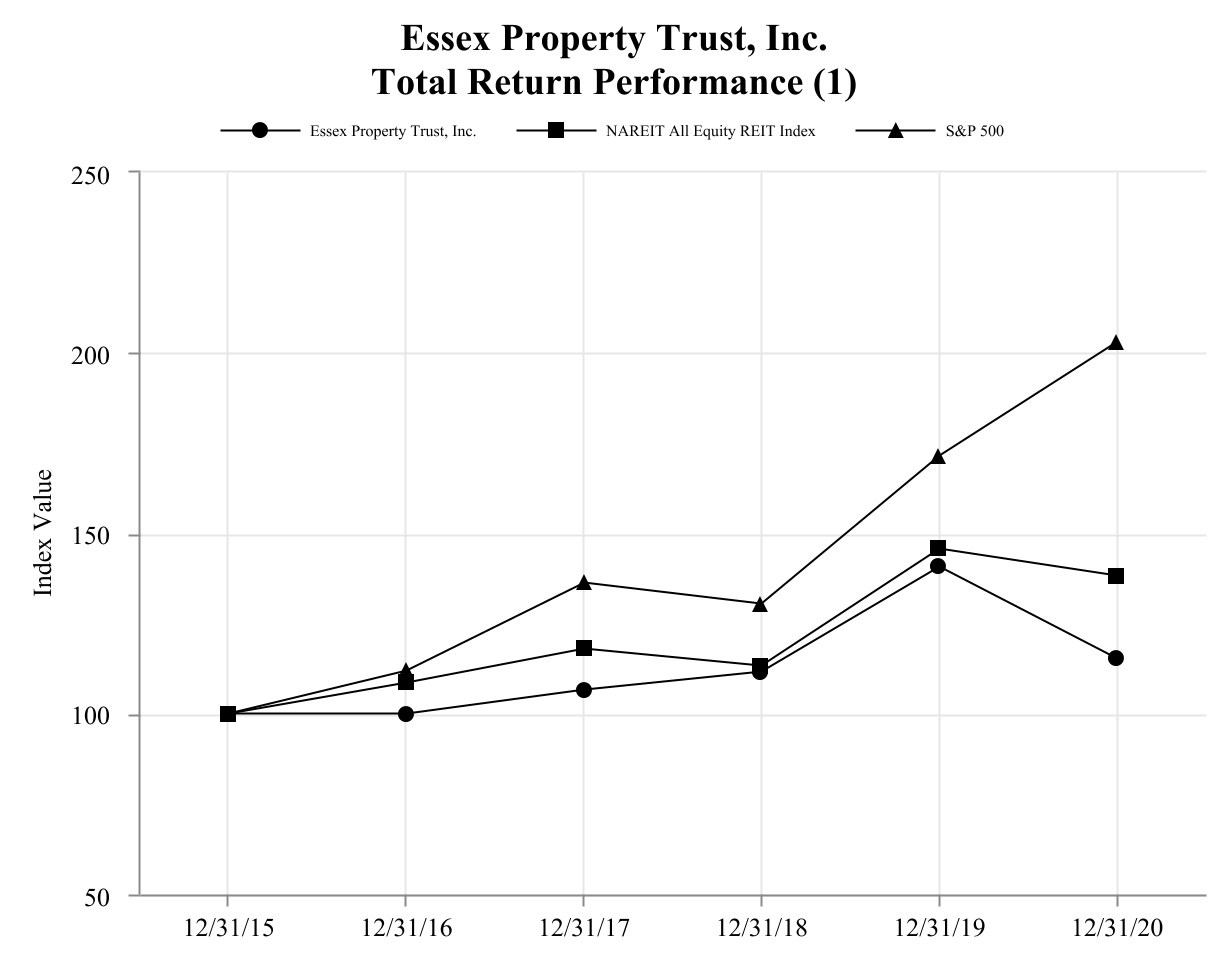
| Period Ending | ||||||||||||||||||||||||||||||||||||||
| Index | 12/31/2015 | 12/31/2016 | 12/31/2017 | 12/31/2018 | 12/31/2019 | 12/31/2020 | ||||||||||||||||||||||||||||||||
| Essex Property Trust, Inc. | 100.00 | 99.87 | 106.66 | 111.75 | 140.70 | 115.26 | ||||||||||||||||||||||||||||||||
| NAREIT All Equity REIT Index | 100.00 | 108.63 | 118.05 | 113.28 | 145.75 | 138.28 | ||||||||||||||||||||||||||||||||
| S&P 500 Index | 100.00 | 111.96 | 136.40 | 130.42 | 171.49 | 203.04 |
(1)Common stock performance data is provided by S&P Global Market Intelligence.
The graph and other information furnished under the above caption "Performance Graph" in this Part II Item 5 of this Form 10-K shall not deemed to be "soliciting material" or to be "filed" with the SEC or subject to Regulation 14A or 14C, or to the liabilities of the Exchange Act.
Unregistered Sales of Equity Securities
During the years ended December 31, 2020 and 2019, the Operating Partnership issued OP Units in private placements in reliance on the exemption from registration provided by Section 4(a)(2) of the Securities Act, in the amounts and for the consideration set forth below:
During the years ended December 31, 2020 and 2019, Essex issued an aggregate of 70,802 and 178,675 shares of its common stock upon the exercise of stock options, respectively. Essex contributed the proceeds from the option exercises of $14.9 million and $37.5 million to the Operating Partnership in exchange for an aggregate of 70,802 and 178,675 OP Units, as required by the Operating Partnership’s partnership agreement, during the years ended December 31, 2020 and 2019, respectively.
During the years ended December 31, 2020 and 2019, Essex issued an aggregate of 24,666 and 16,114 shares of its common stock in connection with restricted stock awards for no cash consideration, respectively. For each share of common stock issued by Essex in connection with such awards, the Operating Partnership issued OP Units to Essex as required by the Operating
Partnership's partnership agreement, for an aggregate of 24,666 and 16,114 OP Units during the years ended December 31, 2020 and 2019, respectively.
During the years ended December 31, 2020 and 2019, Essex issued an aggregate of 8,783 and 12,633 shares of its common stock in connection with the exchange of OP Units and DownREIT units by limited partners or members into shares of common stock, respectively. For each share of common stock issued by Essex in connection with such exchange, the Operating Partnership issued OP Units to Essex as required by the Operating Partnership's partnership agreement, for an aggregate of 8,783 and 12,633 OP Units during the year ended December 31, 2020 and 2019, respectively.
Essex may sell shares through its equity distribution program, then contribute the net proceeds from these share issuances to the Operating Partnership in exchange for OP Units as required by the Operating Partnership's partnership agreement. During the year ended December 31, 2020, the Company did not issue any shares of common stock through its equity distribution program. As of December 31, 2020, there were no outstanding forward purchase agreements. During the year ended December 31, 2019, 228,271 shares of the Company's common stock were issued or sold by Essex pursuant to its equity distribution programs.
Stock Repurchases
The following table summarizes the Company's purchase of its common stock during the three months ended December 31, 2020:
| Total Number of Shares Purchased | Average Price Paid Per Share | Total Number of Shares Purchased as Part of a Publicly Announced Program**(1)** | Maximum Dollar Value of Shares that May Yet Be Purchased Under the Program (in millions)****(1) | |||||||||||||||||||||||
| October 1, 2020 - October 31, 2020 | 56,600 | $ | 191.05 | 56,600 | $ | 192.5 | ||||||||||||||||||||
| November 1, 2020 - November 30, 2020 | 33,182 | 196.59 | 33,182 | 186.0 | ||||||||||||||||||||||
| December 1, 2020 - December 31, 2020 | 121,899 | 237.80 | 121,899 | 223.6 | ||||||||||||||||||||||
| Total | 211,681 | $ | 218.84 | 211,681 | $ | 223.6 |
(1) In December 2020, the Board of Directors approved the replenishment of the stock repurchase plan such that, as of such date, the Company had $250.0 million of purchase authority remaining under the replenished plan.
Item 6. Selected Financial Data
Not applicable.
Item 7. Management’s Discussion and Analysis of Financial Condition and Results of Operations
The following discussion and analysis should be read in conjunction with the accompanying consolidated financial statements and notes thereto. These consolidated financial statements include all adjustments which are, in the opinion of management, necessary to reflect a fair statement of the results and all such adjustments are of a normal recurring nature.
OVERVIEW
Essex is a self-administered and self-managed REIT that acquires, develops, redevelops, and manages apartment communities in selected residential areas located on the West Coast of the United States. Essex owns all of its interests in its real estate investments, directly or indirectly, through the Operating Partnership. Essex is the sole general partner of the Operating Partnership and, as of December 31, 2020, had an approximately 96.6% general partner interest in the Operating Partnership.
The Company’s investment strategy has two components: constant monitoring of existing markets, and evaluation of new markets to identify areas with the characteristics that underlie rental growth. The Company’s strong financial condition supports its investment strategy by enhancing its ability to quickly shift acquisition, development, redevelopment, and disposition activities to markets that will optimize the performance of the Company's portfolio.
As of December 31, 2020, the Company owned or had ownership interests in 246 operating apartment communities, comprising 60,272 apartment homes, excluding the Company's ownership in preferred equity co-investments, loan investments, one operating commercial building and a development pipeline comprised of three consolidated projects and three unconsolidated joint venture projects.
The Company’s apartment communities are predominately located in the following major regions:
Southern California (primarily Los Angeles, Orange, San Diego, and Ventura counties)
Northern California (the San Francisco Bay Area)
Seattle Metro (Seattle metropolitan area)
As of December 31, 2020, the Company’s development pipeline was comprised of three consolidated projects under development, three unconsolidated joint venture projects under development, and various predevelopment projects aggregating 1,853 apartment homes, with total incurred costs of $948.0 million, and estimated remaining project costs of approximately $174.0 million, $118.0 million of which represents the Company's estimated remaining costs, for total estimated project costs of $1.1 billion.
As of December 31, 2020, the Company also had an ownership interest in one operating commercial building (totaling approximately 107,000 square feet).
By region, the Company's operating results for 2020 and 2019 and projection for 2021 new housing supply (defined as new multifamily apartment homes and single family homes, excluding developments with fewer than 50 apartment homes as well as student, senior and 100% affordable housing), projection for 2021 job growth, and 2021 estimated Same-Property revenue decline are as follows:
Southern California Region: As of December 31, 2020, this region represented 43% of the Company’s consolidated operating apartment homes. Revenues for "2020 Same-Properties" (as defined below), or "Same-Property revenues," decreased 4.4% in 2020 as compared to 2019. In 2021, the Company projects new residential supply of 26,500 apartment homes and single family homes, which represents 0.4% of the total housing stock. The Company projects an increase of 231,000 jobs or 3.1% in the Southern California region.
Northern California Region: As of December 31, 2020, this region represented 37% of the Company’s consolidated operating apartment homes. Same-Property revenues decreased 4.9% in 2020 as compared to 2019. In 2021, the Company projects new residential supply of 16,800 apartment homes and single family homes, which represents 0.7% of the total housing stock. The Company projects an increase of 110,500 jobs or 3.4% in the Northern California region.
Seattle Metro Region**:** As of December 31, 2020, this region represented 20% of the Company’s consolidated operating apartment homes. Same-Property revenues decreased 0.6% in 2020 as compared to 2019. In 2021, the Company projects new residential supply of 13,800 apartment homes and single family homes, which represents 1.1% of the total housing stock. The Company projects an increase of 55,000 jobs or 3.3% in the Seattle Metro region.
In total, the Company projects a decrease in 2021 Same-Property revenues of between 1.5% to 3.5%. Same-Property operating expenses are projected to increase in 2021 by 2.0% to 3.0%.
The Company’s consolidated operating communities are as follows:
| As of | As of | ||||||||||||||||||||||
| December 31, 2020 | December 31, 2019 | ||||||||||||||||||||||
| Apartment Homes | % | Apartment Homes | % | ||||||||||||||||||||
| Southern California | 22,560 | 43 | % | 22,674 | 45 | % | |||||||||||||||||
| Northern California | 19,319 | 37 | % | 17,556 | 35 | % | |||||||||||||||||
| Seattle Metro | 10,217 | 20 | % | 10,343 | 20 | % | |||||||||||||||||
| Total | 52,096 | 100 | % | 50,573 | 100 | % |
Co-investments, including Wesco I, Wesco III, Wesco IV, Wesco V, BEXAEW, BEX II, BEX III, and BEX IV communities, developments under construction, and preferred equity interest co-investment communities are not included in the table presented above for both periods.
Current Material Development – the COVID-19 Pandemic
The United States and other countries around the world are continuing to experience an unprecedented health pandemic related to COVID-19, which has created considerable instability, disruption, and uncertainty. Governmental authorities in impacted regions are taking dramatic and unpredictable actions in an effort to slow COVID-19’s spread. Federal, state and local jurisdictions have issued and revised varying forms of "Shelter-in-Place" orders, halted or restricted public gatherings and restricted business to only those that are considered "essential" or requiring businesses to make changes to their operations in a manner that negatively affects profitability, resulting in extraordinary job losses and related financial impacts that will affect future operations to an unknown extent. Moreover, eviction moratoriums and, laws that limit rent increases during times of emergency and prohibit the ability to collect unpaid rent during certain timeframes, have been enacted in various formats at various levels of government, including regions in which Essex's communities are located, impacting Essex properties. The Company is working to comply with the stated intent of local, county, state and federal laws. In that regard, the Company has implemented a wide range of practices to protect and support its employees and residents. Such measures include:
-
closing the Company's corporate offices and instituting “work from home” measures for corporate associates;
-
closing leasing offices to non-Essex personnel, reducing on-site staff so that hygiene and “social distancing” standards can be effectively managed and applied, and requiring face coverings to be worn;
-
transitioning most public interactions with leasing staff to on-line and telephonic communications;
-
increasing cleaning practices for common areas and community amenities and temporarily closing common areas and community amenities or
Showing the first 8K of 71K characters. Open the full section
Item 7A. Quantitative and Qualitative Disclosures About Market Risks
Interest Rate Hedging Activities
The Company’s objective in using derivatives is to add stability to interest expense and to manage its exposure to interest rate movements or other identified risks. To accomplish this objective, the Company uses interest rate swaps as part of its cash flow hedging strategy. As of December 31, 2020, the Company had entered into five interest rate swap contracts to mitigate the risk of changes in the interest-related cash outflows on $175.0 million of the unsecured term debt. As of December 31, 2020, the Company also had $225.1 million of secured variable rate indebtedness. All of the Company’s interest rate swaps are designated as cash flow hedges as of December 31, 2020. The following table summarizes the notional amount, carrying value, and estimated fair value of the Company’s cash flow hedge derivative instruments used to hedge interest rates as of December 31, 2020. The notional amount represents the aggregate amount of a particular security that is currently hedged at one time, but does not represent exposure to credit, interest rates or market risks. The table also includes a sensitivity analysis to demonstrate the impact on the Company’s derivative instruments from an increase or decrease in 10-year Treasury bill interest rates by 50 basis points, as of December 31, 2020.
| Carrying and | Estimated Carrying Value | |||||||||||||||||||||||||||||||
| Maturity | Estimated | + 50 | - 50 | |||||||||||||||||||||||||||||
| ($ in thousands**)** | Notional Amount | Date Range | Fair Value | Basis Points | Basis Points | |||||||||||||||||||||||||||
| Cash flow hedges: | ||||||||||||||||||||||||||||||||
| Interest rate swaps | $ | 175,000 | 2022 | $ | (2,373) | $ | (1,412) | $ | (3,350) | |||||||||||||||||||||||
| Total cash flow hedges | $ | 175,000 | 2022 | $ | (2,373) | $ | (1,412) | $ | (3,350) |
Additionally, the Company has entered into total return swap contracts, with an aggregate notional amount of $254.8 million that effectively convert $225.1 million of fixed mortgage notes payable and $29.7 million of mortgage notes payable related to real estate held for sale that is included in liabilities associated with real estate held for sale on the consolidated balance sheet to a floating interest rate based on the SIFMA plus a spread and have a carrying value of zero at December 31, 2020. The Company is exposed to insignificant interest rate risk on these swaps as the related mortgages are callable, at par, by the Company, co-terminus with the termination of any related swap. These derivatives do not qualify for hedge accounting.
Interest Rate Sensitive Liabilities
The Company is exposed to interest rate changes primarily as a result of its lines of credit and long-term debt used to maintain liquidity and fund capital expenditures and expansion of the Company’s real estate investment portfolio and operations. The Company’s interest rate risk management objective is to limit the impact of interest rate changes on earnings and cash flows and to lower its overall borrowing costs. To achieve its objectives, the Company borrows primarily at fixed rates and may enter into derivative financial instruments such as interest rate swaps, caps and treasury locks in order to mitigate its interest rate risk on a related financial instrument. The Company does not enter into derivative or interest rate transactions for speculative purposes.
The Company’s interest rate risk is monitored using a variety of techniques. The table below presents the principal amounts and weighted average interest rates by year of expected maturity to evaluate the expected cash flows. Management has estimated the fair value of the Company’s $5.5 billion of fixed rate debt at December 31, 2020, to be $6.0 billion. Management has estimated the fair value of the Company’s $775.1 million of variable rate debt at December 31, 2020, to be $770.1 million based on the terms of existing mortgage notes payable and variable rate demand notes compared to those available in the marketplace. The following table represents scheduled principal payments ($ in thousands):
| For the Years Ended December 31, | ||||||||||||||||||||||||||||||||||||||||||||
| ($ in thousands, except for interest rates) | 2021 | 2022 | 2023 | 2024 | 2025 | Thereafter | Total | Fair value | ||||||||||||||||||||||||||||||||||||
| Fixed rate debt | $202,788 | $42,408 | $602,093 | $402,177 | $632,035 | $3,634,849 | $5,516,350 | $6,030,203 | ||||||||||||||||||||||||||||||||||||
| Average interest rate | 4.3% | 3.7% | 3.7% | 4.0% | 3.5% | 3.3% | ||||||||||||||||||||||||||||||||||||||
| Variable rate debt (1) | $713 | $350,780 | $200,852 | $932 | $1,019 | $220,780 | $775,076 | $770,075 | ||||||||||||||||||||||||||||||||||||
| Average interest rate | 1.3% | 1.8% | 1.5% | 1.3% | 1.3% | 1.1% |
(1)$175.0 million is subject to interest rate protection agreements ($175.0 million is subject to interest rate swaps). $225.1 million of variable rate debt in the table above excludes $29.7 million of variable rate debt related to real estate held for sale that is included in liabilities associated with real estate held for sale on the consolidated balance sheet and both amounts are subject to total return swaps.
The table incorporates only those exposures that exist as of December 31, 2020; it does not consider those exposures or positions that could arise after that date. As a result, the Company’s ultimate realized gain or loss, with respect to interest rate fluctuations and hedging strategies would depend on the exposures that arise prior to settlement.
Item 8. Financial Statements and Supplementary Data
The response to this item is submitted as a separate section of this Form 10-K. See Item 15.
Item 9. Changes in and Disagreements with Accountants on Accounting and Financial Disclosure
Not applicable.
Item 9A. Controls and Procedures
Essex Property Trust, Inc.
As of December 31, 2020, Essex carried out an evaluation, under the supervision and with the participation of management, including Essex's Chief Executive Officer and Chief Financial Officer, of the effectiveness of the design and operation of Essex's disclosure controls and procedures (as defined in Rules 13a-15(e) and 15d-15(e) under the Exchange Act). Based upon that evaluation, Essex’s Chief Executive Officer and Chief Financial Officer concluded that as of December 31, 2020, Essex’s disclosure controls and procedures were effective to ensure that the information required to be disclosed by Essex in the reports that Essex files or submits under the Exchange Act was recorded, processed, summarized and reported within the time periods specified in the SEC's rules and forms and that such disclosure controls and procedures were also effective to ensure that information required to be disclosed in the reports that Essex files or submits under the Exchange Act is accumulated and communicated to Essex’s management, including Essex’s Chief Executive Officer and Chief Financial Officer, to allow timely decisions regarding required disclosure.
There were no changes in Essex’s internal control over financial reporting, that occurred during the quarter ended December 31, 2020, that have materially affected, or are reasonably likely to materially affect, Essex’s internal control over financial reporting.
Management’s Report on Internal Control Over Financial Reporting
Essex’s management is responsible for establishing and maintaining adequate internal control over financial reporting (as defined in Rule 13a-15(f) under the Exchange Act). Essex’s management assessed the effectiveness of Essex’s internal control over financial reporting as of December 31, 2020. In making this assessment, Essex’s management used the criteria set forth in the report entitled "Internal Control-Integrated Framework (2013)" published by the Committee of Sponsoring Organizations of the Treadway Commission ("COSO"). Essex’s management has concluded that, as of December 31, 2020, its internal control over financial reporting was effective based on these criteria. Essex’s independent registered public accounting firm, KPMG LLP, has issued an attestation report over Essex’s internal control over financial reporting, which is included herein.
Essex Portfolio, L.P.
As of December 31, 2020, the Operating Partnership carried out an evaluation, under the supervision and with the participation of management, including Essex's Chief Executive Officer and Chief Financial Officer, of the effectiveness of the design and operation of the Operating Partnership's disclosure controls and procedures (as defined in Rules 13a-15(e) and 15d-15(e) under the Exchange Act). Based upon that evaluation, the Chief Executive Officer and Chief Financial Officer concluded that as of December 31, 2020, the Operating Partnership’s disclosure controls and procedures were effective to ensure that the information required to be disclosed by the Operating Partnership in the reports that the Operating Partnership files or submits under the Exchange Act was recorded, processed, summarized and reported within the time periods specified in the SEC's rules and forms and that such disclosure controls and procedures were also effective to ensure that information required to be disclosed in the reports that the Operating Partnership files or submits under the Exchange Act is accumulated and communicated to the Operating Partnership’s management, including Essex's Chief Executive Officer and Chief Financial Officer, to allow timely decisions regarding required disclosure.
There were no changes in the Operating Partnership’s internal control over financial reporting, that occurred during the quarter ended December 31, 2020, that have materially affected, or are reasonably likely to materially affect, the Operating Partnership’s internal control over financial reporting.
Management’s Report on Internal Control Over Financial Reporting
The Operating Partnership’s management is responsible for establishing and maintaining adequate internal control over financial reporting (as defined in Rule 13a-15(f) under the Exchange Act). The Operating Partnership’s management assessed the effectiveness of the Operating Partnership’s internal control over financial reporting as of December 31, 2020. In making this assessment, the Operating Partnership’s management used the criteria set forth in the report entitled "Internal Control-Integrated Framework (2013)" published by COSO. The Operating Partnership’s management has concluded that, as of December 31, 2020, its internal control over financial reporting was effective based on these criteria.
Item 9B. Other Information
Item 10. Directors, Executive Officers and Corporate Governance
The information required by this Item is incorporated herein by reference from our Proxy Statement, relating to our 2021 Annual Meeting of Stockholders, under the heading "Board and Corporate Governance Matters," to be filed with the SEC within 120 days of December 31, 2020.
Item 11. Executive Compensation
The information required by this Item is incorporated herein by reference from our Proxy Statement, relating to our 2021 Annual Meeting of Stockholders, under the headings "Executive Compensation" and "Director Compensation," to be filed with the SEC within 120 days of December 31, 2020.
Item 12. Security Ownership of Certain Beneficial Owners and Management and Related Stockholder Matters
The information required by this Item is incorporated herein by reference from our Proxy Statement, relating to our 2021 Annual Meeting of Stockholders, under the heading "Security Ownership of Certain Beneficial Owners and Management," to be filed with the SEC within 120 days of December 31, 2020.
Item 13. Certain Relationships and Related Transactions and Director Independence
The information required by this Item is incorporated herein by reference from our Proxy Statement, relating to our 2021 Annual Meeting of Stockholders, under the heading "Certain Relationships and Related Persons Transactions," to be filed with the SEC within 120 days of December 31, 2020.
Item 14. Principal Accounting Fees and Services
The information required by this Item is incorporated herein by reference from our Proxy Statement, relating to our 2021 Annual Meeting of Stockholders, under the headings "Report of the Audit Committee" and "Fees Paid to KPMG LLP," to be filed with the SEC within 120 days of December 31, 2020.
PART IV
Item 15. Exhibits and Financial Statement Schedules
(A) Financial Statements
| (1) Consolidated Financial Statements of Essex Property Trust, Inc. | Page | ||||
| Reports of Independent Registered Public Accounting Firm | F-1 | ||||
| Consolidated Balance Sheets: As of December 31, 2020 and 2019 | F-6 | ||||
| Consolidated Statements of Income: Years ended December 31, 2020, 2019, and 2018 | F-7 | ||||
| Consolidated Statements of Comprehensive Income: Years ended December 31, 2020, 2019, and 2018 | F-8 | ||||
| Consolidated Statements of Equity: Years ended December 31, 2020, 2019, and 2018 | F-9 | ||||
| Consolidated Statements of Cash Flows: Years ended December 31, 2020, 2019, and 2018 | F-11 | ||||
| Notes to Consolidated Financial Statements | F-20 | ||||
| (2) Consolidated Financial Statements of Essex Portfolio, L.P. | |||||
| Report of Independent Registered Public Accounting Firm | F-4 | ||||
| Consolidated Balance Sheets: As of December 31, 2020 and 2019 | F-13 | ||||
| Consolidated Statements of Income: Years ended December 31, 2020, 2019, and 2018 | F-14 | ||||
| Consolidated Statements of Comprehensive Income: Years ended December 31, 2020, 2019, and 2018 | F-15 | ||||
| Consolidated Statements of Capital: Years ended December 31, 2020, 2019, and 2018 | F-16 | ||||
| Consolidated Statements of Cash Flows: Years ended December 31, 2020, 2019, and 2018 | F-18 | ||||
| Notes to Consolidated Financial Statements | F-20 | ||||
| (3) Financial Statement Schedule – Schedule III – Real Estate and Accumulated Depreciation as of December 31, 2020 | F-58 | ||||
| (4) See the Exhibit Index immediately preceding the signature page and certifications for a list of exhibits filed or incorporated by reference as part of this report. |
(B) Exhibits
The Company hereby files, as exhibits to this Form 10-K, those exhibits listed on the Exhibit Index referenced in Item 15(A)(4) above.
Item 16. Form 10-K Summary
None.
Report of Independent Registered Public Accounting Firm
To the Stockholders and Board of Directors
Essex Property Trust, Inc.:
Opinion on the Consolidated Financial Statements
We have audited the accompanying consolidated balance sheets of Essex Property Trust, Inc. and subsidiaries (the Company) as of December 31, 2020 and 2019, the related consolidated statements of income, comprehensive income, equity, and cash flows for each of the years in the three‑year period ended December 31, 2020, and the related notes and financial statement schedule III (collectively, the consolidated financial statements). In our opinion, the consolidated financial statements present fairly, in all material respects, the financial position of the Company as of December 31, 2020 and 2019, and the results of its operations and its cash flows for each of the years in the three‑year period ended December 31, 2020, in conformity with U.S. generally accepted accounting principles.
We also have audited, in accordance with the standards of the Public Company Accounting Oversight Board (United States) (PCAOB), the Company’s internal control over financial reporting as of December 31, 2020, based on criteria established in Internal Control – Integrated Framework (2013) issued by the Committee of Sponsoring Organizations of the Treadway Commission, and our report dated February 19, 2021 expressed an unqualified opinion on the effectiveness of the Company’s internal control over financial reporting.
Change in Accounting Principle
As discussed in Note 2 to the consolidated financial statements, the Company has changed its method of accounting for leases as of January 1, 2019 due to the adoption of Accounting Standards Update No. 2016-02, Leases (Topic 842) and Accounting Standards Update No. 2018-11, Leases (Topic 842): Targeted Improvements.
Basis for Opinion
These consolidated financial statements are the responsibility of the Company’s management. Our responsibility is to express an opinion on these consolidated financial statements based on our audits. We are a public accounting firm registered with the PCAOB and are required to be independent with respect to the Company in accordance with the U.S. federal securities laws and the applicable rules and regulations of the Securities and Exchange Commission and the PCAOB.
We conducted our audits in accordance with the standards of the PCAOB. Those standards require that we plan and perform the audit to obtain reasonable assurance about whether the consolidated financial statements are free of material misstatement, whether due to error or fraud. Our audits included performing procedures to assess the risks of material misstatement of the consolidated financial statements, whether due to error or fraud, and performing procedures that respond to those risks. Such procedures included examining, on a test basis, evidence regarding the amounts and disclosures in the consolidated financial statements. Our audits also included evaluating the accounting principles used and significant estimates made by management, as well as evaluating the overall presentation of the consolidated financial statements. We believe that our audits provide a reasonable basis for our opinion.
Critical Audit Matters
The critical audit matters communicated below are matters arising from the current period audit of the consolidated financial statements that were communicated or required to be communicated to the audit committee and that: (1) relate to accounts or disclosures that are material to the consolidated financial statements and (2) involved our especially challenging, subjective, or complex judgments. The communication of critical audit matters does not alter in any way our opinion on the consolidated financial statements, taken as a whole, and we are not, by communicating the critical audit matters below, providing separate opinions on the critical audit matters or on the accounts or disclosures to which they relate.
Evaluation of events or changes in circumstances that indicate rental properties may be impaired
As discussed in Note 2 to the consolidated financial statements, the Company evaluates the carrying amount of rental properties for impairment whenever events or changes in circumstances indicate that the carrying amount of a rental property may not be fully recoverable. The Company had $10.9 billion in rental properties as of December 31, 2020.
F- 1
We identified the evaluation of events or changes in circumstances that indicate rental properties may be impaired as a critical audit matter. Specifically, a high degree of subjective and complex auditor judgment was required to evaluate the intent regarding the expected period the Company will receive cash flows from the rental property. Changes to shorten the expected period the Company will receive cash flows from the rental property could indicate a potential impairment.
The following are the primary procedures we performed to address this critical audit matter. We evaluated the design and tested the operating effectiveness of certain internal controls over the Company’s process to evaluate events or changes in circumstances that would indicate rental properties may be impaired. This included controls over the process for determining the expected period the Company will receive cash flows from the rental property. We evaluated the Company’s assessment by (1) inquiring with the Company about events or changes in circumstances considered by the Company, (2) considering certain factors related to the current economic environment, and (3) reading board of director’s minutes and external communications with investors and analysts. In addition, we observed the property conditions at certain rental property sites and inquired of property management personnel regarding events or changes in circumstances that indicate the rental properties may be impaired.
Evaluation of the value allocated to land and buildings in certain asset acquisitions
As discussed in Notes 2 and 3 to the consolidated financial statements, the Company acquired $463.4 million of real estate properties recorded as asset acquisitions for the year ended December 31, 2020. In asset acquisitions, the Company determines the value allocated to land and buildings using their relative estimated fair values.
We identified the evaluation of the value allocated to land and buildings in certain asset acquisitions as a critical audit matter. There was a high degree of subjective and complex auditor judgment in evaluating the fair value amounts used in the allocation of the purchase price to land and building, which required the assistance of valuation professionals with specialized skills and knowledge. Specifically, the relevance and reliability of market information including comparable land sales identified and replacement costs used to determine the building value.
The following are the primary procedures we performed to address this critical audit matter. We evaluated the design and tested the operating effectiveness of certain internal controls over the Company’s land and building value estimation process in asset acquisitions. This included controls over the identification of publicly available and comparable land sales and the key input used to estimate the replacement cost of the building. For certain asset acquisitions, with the assistance of valuation professionals with specialized skills and knowledge, we (1) compared the Company’s determination of the fair value of land to independently developed ranges of estimates based on publicly available land sales, and (2) compared the key input in the Company’s replacement building cost value to ranges of estimates of market data such as industry guides used for developing replacement building values.
| | | | | --- | ---
Showing the first 8K of 357K characters. Open the full section