 filings.tools
Expeditors International of Washington (EXPD) 10-K risk factor changes: FY2021 vs FY2020
The 2021-12-31 10-K against the 2020-12-31 one, compared heading by heading and sentence by sentence.
Item 1A30 rewritten45 added13 removed110 unchanged
All filing items546 rewritten341 added383 removed1,313 unchanged
Summary
counted, not written
- Item 1A headings could not be compared: only 0 carried over between the two years, which usually means one filing was read wrongly, so none is reported as new or removed.
- Sentence by sentence, 341 added, 383 removed, 546 rewritten and 1,313 unchanged across 22 items that differ.
- New this year: Item 9C. DISCLOSURE REGARDING FOREIGN JURISDICTIONS THAT PREVENT INSPECTIONS.
Sentences by item
23 items, with every count and a link to each item that changed
Underlined words on a shaded ground are new in FY2021; struck-through words were in FY2020. Sentences that are wholly new or wholly gone are labelled rather than marked.
Item 1A. RISK FACTORS
30 rewritten, 45 added, 13 removed, 110 unchanged
Read the full itemFY2021 item · filed March 15, 2022FY2020 item · filed February 19, 2021
As a result, throughout 2020 [added: and 2021 and continuing into 2022,] governments have implemented travel restrictions, mandated lockdowns and other precautionary measures that resulted in significant business and supply chain disruptions and [removed: a slowdown in] [added: has had direct impacts on] international trade.
Our facilities and employees are operating under the constraints of special protective measures and many [removed: are] [added: have been] working remotely.
[removed: Many of our customers are experiencing disruptions in their revenue and cash flow, prompting these] [added: This has caused some] customers to renegotiate contractual [removed: terms and] [added: terms,] increasing our accounts receivable collection [added: and extended liability] risks.
Such conditions could result in the loss of business and additional [removed: bad debt allowances] [added: credit losses] in the future if our customers’ ability to pay deteriorates.
As a [removed: non-asset based] [added: non-asset-based] provider of global logistics services, Expeditors depends on a variety of [removed: asset-based] [added: carriers and other] service providers, including air, ocean and ground freight carriers.
COVID-19 places significant stress on our air, ocean and freight ground carriers, [added: as well as other service providers,] which may continue to result in reduced carrier capacity or availability, pricing volatility or more limited carrier transportation schedules [added: and other services that we utilize,] which could adversely impact our operations and financial results.
During the pandemic, air carriers have been particularly affected having to cancel flights due to travel restrictions resulting in [removed: dramatic drops in revenues, historical losses and liquidity challenges.]
Prior to [removed: 2020,] [added: 2021,] ocean carriers have incurred significant operating losses are still highly leveraged with debt.
Additionally, several [added: industry service providers, including] ocean [removed: carriers] [added: carriers,] have consolidated, with the potential for more to occur in the future.
[removed: The global] [added: Global] economic [removed: recession has] [added: uncertainty] impacted trade and could affect demand for our services or the financial stability of our service providers and customers.
The global economy [removed: has] entered a recession as a result of the pandemic, which [removed: has] [added: initially] affected trade and [removed: could affect] [added: negatively affected] demand for our [removed: services.][added: services for a period of time, before rebounding in 2021.]
[removed: Continued] [added: Future] unfavorable economic conditions [added: and high inflation] could result in lower freight volumes and adversely affect Expeditors' revenues, operating results and cash flows.
These [removed: conditions] [added: conditions,] should they [removed: continue] [added: occur] for [added: an] extended period of [removed: time would further] [added: time, could] adversely affect our customers and service providers.
Should our customers’ ability to pay deteriorate, additional [removed: bad debts] [added: credit losses] may be incurred.
| | • | changes in labor and other [removed: costs;] [added: costs, including the potential impacts of inflation;] |
Nevertheless, many of these competitors have significantly more resources than [removed: Expeditors,] [added: Expeditors] and are actively pursuing acquisition opportunities and are developing new technologies to gain competitive advantages.
Depending on the location of the shipper and the importer, we must compete against [removed: both the] niche players, larger entities including carriers, and emerging technology companies.
Increased competition and competitors' acceptance of expanded contractual terms [added: coupled with customers’ dissatisfaction with elevated rates, scarce capacity, and extended transit times] could result in [added: loss of business,] reduced revenues, reduced margins, higher operating costs or loss of market share, any of which would damage our results of operations, cash flows and financial condition.
We are dependent on our personnel and any inability to [added: hire,] develop or retain our key employees may have a negative impact on our operations.
Identifying, [removed: training] [added: recruiting, hiring, training,] and retaining employees is essential to [removed: continued growth] [added: our ability to operate] and [added: deliver our services, ability to grow and ultimately our] future profitability.
We believe that our compensation [removed: programs, which have been in place since we became a publicly traded entity,] [added: programs] are among the unique characteristics responsible for differentiating our performance from that of many of our competitors.
[removed: We cannot predict how this may affect employees’ habits, preferences nor the] impact it may have on our Company’s culture and our ability to continue to retain and attract talented employees who have become accustomed to a remote work environment.
Development and maintenance of these systems must be accomplished in a cost-effective manner and support the use of secure protocols, including integration and availability of [removed: third party] [added: third-party] technology.
This [added: cyber-attack] could [removed: include loss of revenue; business disruptions (such as the inability] [added: also result in increased vulnerability] to [removed: timely process shipments); loss] [added: attempts] of [removed: property, including trade secrets and confidential information;] [added: fraud,] legal claims and [removed: proceedings;] [added: proceedings including potential breach of contract claims,] reporting delays or errors; interference with regulatory reporting; [removed: significant remediation costs;] an increase in costs to protect our systems and technology; or damage to our reputation.
We rely on [removed: our] service providers, [removed: such as] [added: including] air, [removed: ocean and] [added: ocean,] ground freight [removed: carriers,] [added: carriers] and [removed: as] [added: others, and if] they [removed: are experiencing increases in operating costs] [added: have insufficient capacity available relative to market demand, or reduce our capacity allotments,] it may [added: adversely] impact our [removed: profitability.][added: business and operating results.]
Expeditors is subject to [added: income and non-income] taxation in the United States (Federal, state and local) as well as many foreign jurisdictions including the People’s Republic of China, including Hong Kong, Taiwan, Vietnam, India, Mexico, Canada, Netherlands and the United Kingdom.
The timing of the resolution of income [added: and non-income] tax examinations can be highly uncertain, and the amounts ultimately paid, if any, upon resolution of the issues raised by the taxing authorities may differ from the amounts recorded.
[removed: In December 2017, the United States made significant] [added: Often, those] changes [removed: to its tax laws, still] [added: are] subject to [added: the] issuance of new regulations and [removed: interpretation,] [added: interpretations,] which [removed: added] [added: adds] complexity and uncertainty in calculating [removed: corporate] tax liabilities.
Changes in tax laws or statutory tax rates, competing tax regimes, variability in the mix of pretax earnings we generate in the U.S, as compared to other countries, or new taxes in the United States or foreign jurisdictions could result in additional tax liabilities, or increased volatility in our effective tax [removed: rate.][added: rate and total tax expense.]
Investigations and litigation could require management time and or incur substantial legal costs or fines, penalties or damages, any of which could [removed: materially adverse] [added: adversely] impact on our financial results.
As discussed in more detail under “Results of Operations”, there are significant constraints on current capacity for both air freight and ocean freight.
This is due to a number of factors, including reduced flight schedules from pre-pandemic levels and new regulations, which limited available belly space for cargo, congestion at ports resulting from labor and equipment shortages and insufficient warehousing space at destinations.
Air freighters and charters, container ships and gateway infrastructure are operating at near maximum capacity.
While we believe these constraints are not long-term in nature, they impact our current ability to move increased air and ocean volumes in these capacity-constrained regions.
Many of our customers are experiencing disruptions in their revenues and cash flows and have incurred higher operating expenses as a result of supply chain cost increases and other inflationary pressures.
Throughout 2021 and into 2022, transportation rates have risen to historically high levels.
We believe that as Covid-19 disruptions recede, and passenger air travel rebounds, that port congestion will improve.
This will result in additional transportation capacity becoming available.
Rates will likely decline as this occurs.
On a limited basis, we have entered in to fixed-rate buy agreements to secure space in the air and ocean markets.
Future declines of sell rates will negatively affect our operating income and cash flows.
dramatic drops in revenues, historical losses, high leverage and liquidity challenges.
As the pandemic restrictions ease, we are requiring employees to return to the office.
As a result, for those individuals that prefer working remotely, we may experience a higher degree of turnover and lower employee satisfaction in the near future.
Further, this could inhibit our ability to identify, recruit, and hire new employees.
We cannot predict how this may affect employees’ habits, preferences nor the
Additionally, we may incur higher compensation-related expense to recruit and retain employees.
In February 2022, we were the subject of a targeted cyber-attack.
Upon discovering the incident, we shut down most of our operating systems globally to manage the safety of our overall global systems environment.
This shutdown and any such future events will result in loss of revenue; business disruptions (such as the inability to timely process shipments); and significant remediation costs.
As a non-asset-based provider of global logistics services, Expeditors depends on a variety of carriers and other service providers, including air, ocean and ground freight carriers.
Our ability to deliver our services depends on service providers’ having sufficient capacity available to purchase.
When market demand significantly exceeds available capacity in a given market, which has been increasingly the case for various services and markets since the beginning of the pandemic in 2020, we may not always be able to find acceptable transportation or other service solutions to meet our customers’ needs or the routing and delivery of freight may be subject to delays that are outside of our control.
Quality customer service is a key element of the Company’s success, and such challenges in meeting our customers’ needs and requirements may result in loss of business and consequently negatively affect our operating results.
See “*Any significant disruptions to our network and systems continuity could have an adverse impact to our business and financial results”* above*.*
We Face Risks Associated with the Handling of Customer Inventory
Under some of our agreements, we maintain the inventory of our customers.
Our failure to properly handle and safeguard such inventory exposes us to unexpected claims and expenses as well as potential harm to our business and reputation.
Our insurance coverage does not cover all potential losses and significant uninsured losses could adversely impact our financial results.
We carry insurance coverage for property damage and other insurable events resulting from certain events such as fire as well as other perils under extended coverage policies.
Our insurance coverages contain policy specifications and insured limits customarily carried for similar locations, business activities and markets.
We believe we are adequately insured.
Certain losses, however, including losses from floods, earthquakes, acts of war, acts of terrorism or riots, cybersecurity events and pandemics, generally are not insured against or not fully insured against because it is not deemed economically feasible or prudent to do so.
If an uninsured loss or a loss in excess of insured limits occurs with respect to one or more of our facilities in the future, we could experience a significant loss of assets, including customer inventory, and future operations could be harmed resulting in a loss of revenues or higher claims and operating expenses.
Furthermore, we cannot be sure that the insurance companies will be able to continue to offer products with sufficient coverage at commercially reasonable rates.
If we experience a loss that is uninsured or that exceeds insured limits then we could incur additional expenses or a loss of future revenues from a facility that is damaged.
Any such losses or higher insurance costs could adversely affect our business.
Climate change, including measures to address climate change, could adversely impact our business and financial results.
The long-term effects of climate change are difficult to predict and may be widespread.
The impacts of climate change may include physical risks (such as rising sea levels, which could affect port operations or frequency and severity of extreme weather conditions, which could disrupt our operations and damage cargo and our facilities), compliance costs and transition risks (such as increased regulation and taxation to support carbon emissions’ reduction investments), shifts in customer demands (such as customers requiring more fuel efficient transportation modes or transparency to carbon emissions in their supply chains) and other adverse effects.
These disruptions are also threatening the financial stability of our service providers and the ability to efficiently and profitably route our customers’ freight.
Reduced flight schedules and cancellations have significantly reduced available space for airfreight, while ocean carriers have continued to manage their operating capacity.
Certain freight lanes have presented severe shortages of capacity compared to demand at various times over the year while ocean ports congestion in the second half of the year also hampered the routing of freight.
Expeditors' carriers are subject to increasingly stringent laws, which could, directly or indirectly, have a material adverse effect on our business.
Future regulatory developments in the U.S. and abroad could adversely affect operations and increase operating costs in the transportation industry, which in turn could increase our purchased transportation costs.
If we are unable to pass such costs on to our customers, our business and results of operations could be materially adversely affected.
Changes in the financial stability, operating capabilities and capacity of asset-based carriers and capacity allotment made available to Expeditors by asset-based carriers affects us in unpredictable ways.
Any combination of reduced carrier capacity or availability, pricing volatility
or more limited carrier transportation schedules, such as those caused by the pandemic, could further negatively affect our ability to execute services and maintain profitability.
Expeditors cannot predict whether relief measures extended by certain governments will be effective in supporting the financial viability of carriers nor can we predict the long-term effects of this crisis on carriers’ financial stability and ability to provide services.
In 2020, the United Kingdom and the European Union negotiated the terms of the United Kingdom's exit from the European Union (EU), which were effective on January 1, 2021.
These rules and regulations are in the process of being implemented and are subject to further interpretation and change.
The full impact of the United Kingdom’s departure, and impact to international trade is still uncertain.
An excerpt. Shown here: all 30 rewritten, 40 of 45 added and all 13 removed. The counts are complete. For every sentence, read Item 1A. RISK FACTORS in the FY2021 filing and the FY2020 filing.
Item 7. MANAGEMENT’S DISCUSSION AND ANALYSIS OF FINANCIAL CONDITION AND RESULTS OF OPERATIONS
93 rewritten, 71 added, 121 removed, 146 unchanged
Read the full itemFY2021 item · filed March 15, 2022FY2020 item · filed February 19, 2021
As a [removed: non-asset based] [added: non-asset-based] carrier, we do not own or operate transportation assets.
The significant impacts are discussed under Item 1 Business [removed: section] and below within Results of operations.
Customs brokerage and other services involve providing services at destination, such as helping customers clear shipments through customs by preparing and filing required documentation, calculating and providing for payment of duties and other taxes on behalf of customers as well as arranging for any required inspections by governmental agencies, and import services such as arranging for [removed: delivery.][added: local pick up, storage and delivery at destinations.]
We also provide other [removed: value added] [added: value-added] services at destination, such as warehousing and distribution, time-definitive transportation services and consulting.
The following chart shows revenues by geographic areas of responsibility for the years ended December 31, [removed: 2020, 2019] [added: 2021, 2020] and [removed: 2018:][added: 2019:]
[removed: 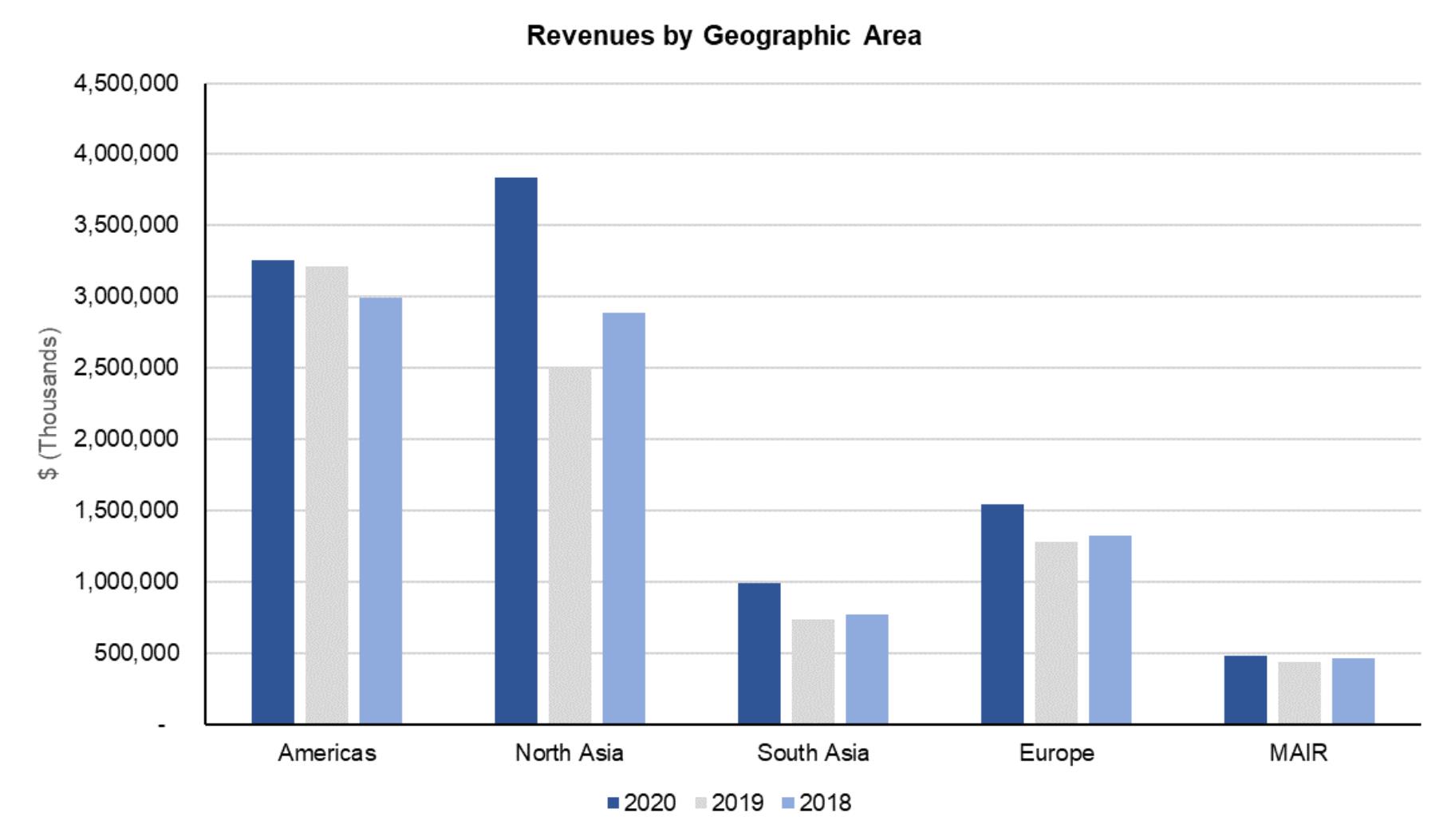][added: 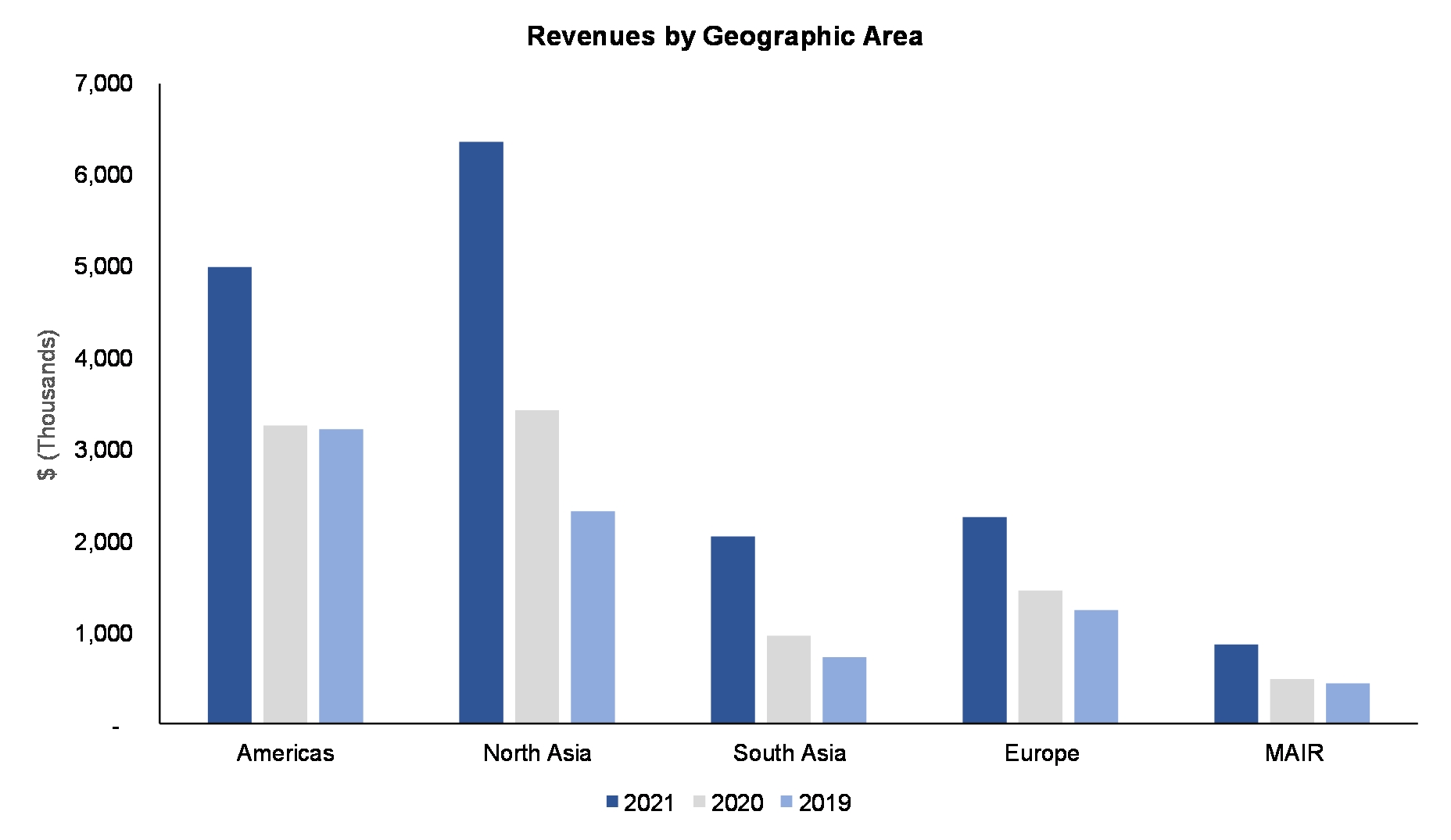]
North Asia is our largest [removed: export oriented] [added: export-oriented] region and accounted for [removed: 38%] [added: 39%] of revenues, 44% of directly related cost of transportation and other expenses and [removed: 37%] [added: 29%] of operating income for the year ended December 31, [removed: 2020.][added: 2021.]
Our ability to provide services to [added: our] customers is highly dependent on good working relationships with a variety of [removed: entities] [added: entities,] including [removed: airlines,] [added: airlines;] ocean [removed: carriers,] [added: carrier lines and] ground transportation [removed: providers and] [added: providers, as well as] governmental agencies.
[removed: Further] [added: However,] changes in the financial [removed: stability,] [added: stability and] operating capabilities and capacity of asset-based carriers, capacity allotments available from carriers, governmental [removed: regulations,] [added: regulation or deregulation efforts, modernization of the regulations governing customs brokerage,] and/or [added: changes in governmental restrictions, quota restrictions or] trade accords could [removed: adversely] affect our business in unpredictable ways.
[removed: International Trade] [added: Industry trends, trade conditions] and [removed: Competition][added: competition]
International trade is influenced by many factors, including economic and political conditions in the United States and abroad, currency exchange rates, laws and policies relating to tariffs, trade restrictions, foreign [removed: investments] [added: investment] and taxation.
In 2020, the United Kingdom and the European Union negotiated the terms of the United [removed: Kingdom's] [added: Kingdom’s] exit from the European Union [removed: (EU),] [added: (Brexit),] which were effective on January 1, 2021.
[removed: Air] [added: Many air] carriers are experiencing significant cash flow challenges as a result of travel restrictions resulting in cancellation of flights and have [added: received government relief and] incurred record operating losses in [removed: 2020.][added: 2020 and 2021.]
These conditions have resulted in multiple carrier acquisitions and carrier alliance [removed: formations.][added: formations and certain carriers are expanding into onshore services.]
To the extent that future fuel prices [removed: increases] [added: increase] and we are unable to pass through the [removed: increases] [added: increase] to our customers, [removed: this] [added: fuel price increases] could adversely affect our operating income.
We cannot predict the impact of future changes in global trade on our operating results, freight volumes, pricing, [added: inflation,] changes in consumer demand, carrier stability and capacity, customers’ abilities to pay or on changes in competitors' behavior.
Additionally, we cannot predict the direct or indirect impact that further changes in [removed: consumer] [added: and] purchasing behavior, such as online shopping, could have on our business.
While judgments and estimates are a necessary component of any system of accounting, the use of estimates is limited primarily to [added: accrual of loss contingencies, accrual of various tax liabilities and contingencies, accrual of insurance liabilities for] the [removed: following areas:][added: portion of the related exposure that we have self-insured, and accounts receivable valuation.]
Management believes that the methods utilized in all of these areas are non-aggressive in approach and consistent in [removed: application.][added: application, and that there are limited, if any, alternative accounting principles or methods which could be applied to these transactions.]
An estimated loss from a contingency, such as a legal proceeding, [removed: claim or] [added: claim,] government [removed: investigation,] [added: investigation or audit,] is recorded by a charge to income if it is probable that an asset has been impaired or a liability has been incurred and the amount of the loss can be reasonably estimated.
Management believes that our tax positions, including intercompany transfer pricing policies, are reasonable and [removed: that they] are [added: consistent with established transfer pricing methodologies and norms.]
The total amount of our [added: income and non-income] tax contingencies may increase in [removed: 2021.][added: 2022.]
The timing of the resolution of [removed: income] tax examinations can be highly uncertain, and the amounts ultimately paid, if any, upon resolution of the issues raised by the taxing authorities may differ significantly from the amounts recorded.
Our effective tax rate will [removed: largely depend on the mix of pretax earnings that we generate in the U.S. as compared] [added: continue] to [removed: the rest of the world and the impact of] [added: be impacted by] any discrete items for events occurring in [removed: the] [added: a future] period or future changes in tax regulations and related interpretations.
[removed: Discussions] [added: For a discussion] of [removed: 2018 items and year-to-year comparisons between 2019 and 2018 that are not included in this Form 10-K can be found in] [added: the year ended December 31, 2020 compared to the year ended December 31, 2019, please refer to Part II, Item 7,] “Management’s Discussion and Analysis of Financial Condition and Results of Operations” in [removed: Part II, Item 7 of the Company’s] [added: our] Annual Report on Form 10-K for the [removed: fiscal] year ended December 31, [removed: 2019.][added: 2020 and see “Correction of immaterial error” note, below.]
The following table shows the revenues, the directly related cost of transportation and other expenses for our principal services and our overhead expenses for [removed: 2020, 2019] [added: 2021, 2020] and [removed: 2018.][added: 2019.]
The table, chart and the accompanying discussion and analysis should be read in conjunction with the consolidated financial statements and related notes thereto in [added: Part II, Item 8 of] this report.
| In thousands | | [removed: 2020] [added: 2021] | | | | [removed: 2019] [added: 2020] | | | | [removed: 2018] [added: 2019] | | | | [removed: 2020] [added: 2021] vs. [removed: 2019] [added: 2020] |
| Salaries and related costs | | | [removed: 1,538,104] [added: 2,062,351] | | | | [removed: 1,422,315] [added: 1,538,104] | | | | [removed: 1,393,259] [added: 1,422,315] | | | [removed: 8%] [added: 34%] |
| Other | | | [removed: 449,150] [added: 493,685] | | | | [removed: 447,461] [added: 449,150] | | | | [removed: 430,551] [added: 447,461] | | | [removed: —%] [added: 10%] |
| Total overhead expenses | | | [removed: 1,987,254] [added: 2,556,036] | | | | [removed: 1,869,776] [added: 1,987,254] | | | | [removed: 1,823,810] [added: 1,869,776] | | | [removed: 6%] [added: 29%] |
| Operating income | | | [removed: 940,437] [added: 1,909,326] | | | | [removed: 766,692] [added: 940,437] | | | | [removed: 796,563] [added: 766,692] | | | [removed: 23%] [added: 103%] |
| Other income, net | | | [removed: 16,127] [added: 15,290] | | | | [removed: 29,102] [added: 16,127] | | | | [removed: 21,766] [added: 29,102] | | | [removed: (45)%] [added: (5)%] |
| Earnings before income taxes | | | [removed: 956,564] [added: 1,924,616] | | | | [removed: 795,794] [added: 956,564] | | | | [removed: 818,329] [added: 795,794] | | | [removed: 20%] [added: 101%] |
| Income tax expense | | | [removed: 258,350] [added: 505,771] | | | | [removed: 203,778] [added: 258,350] | | | | [removed: 198,539] [added: 203,778] | | | [removed: 27%] [added: 96%] |
| Net earnings | | | [removed: 698,214] [added: 1,418,845] | | | | [removed: 592,016] [added: 698,214] | | | | [removed: 619,790] [added: 592,016] | | | [removed: 18%] [added: 103%] |
| Less net earnings attributable to the noncontrolling interest | | | [removed: 2,074] [added: 3,353] | | | | [removed: 1,621] [added: 2,074] | | | | [removed: 1,591] [added: 1,621] | | | [removed: 28%] [added: 62%] |
| Net earnings attributable to shareholders | | $ | [removed: 696,140] [added: 1,415,492] | | | $ | [removed: 590,395] [added: 696,140] | | | $ | [removed: 618,199] [added: 590,395] | | | [removed: 18%] [added: 103%] |
[removed: 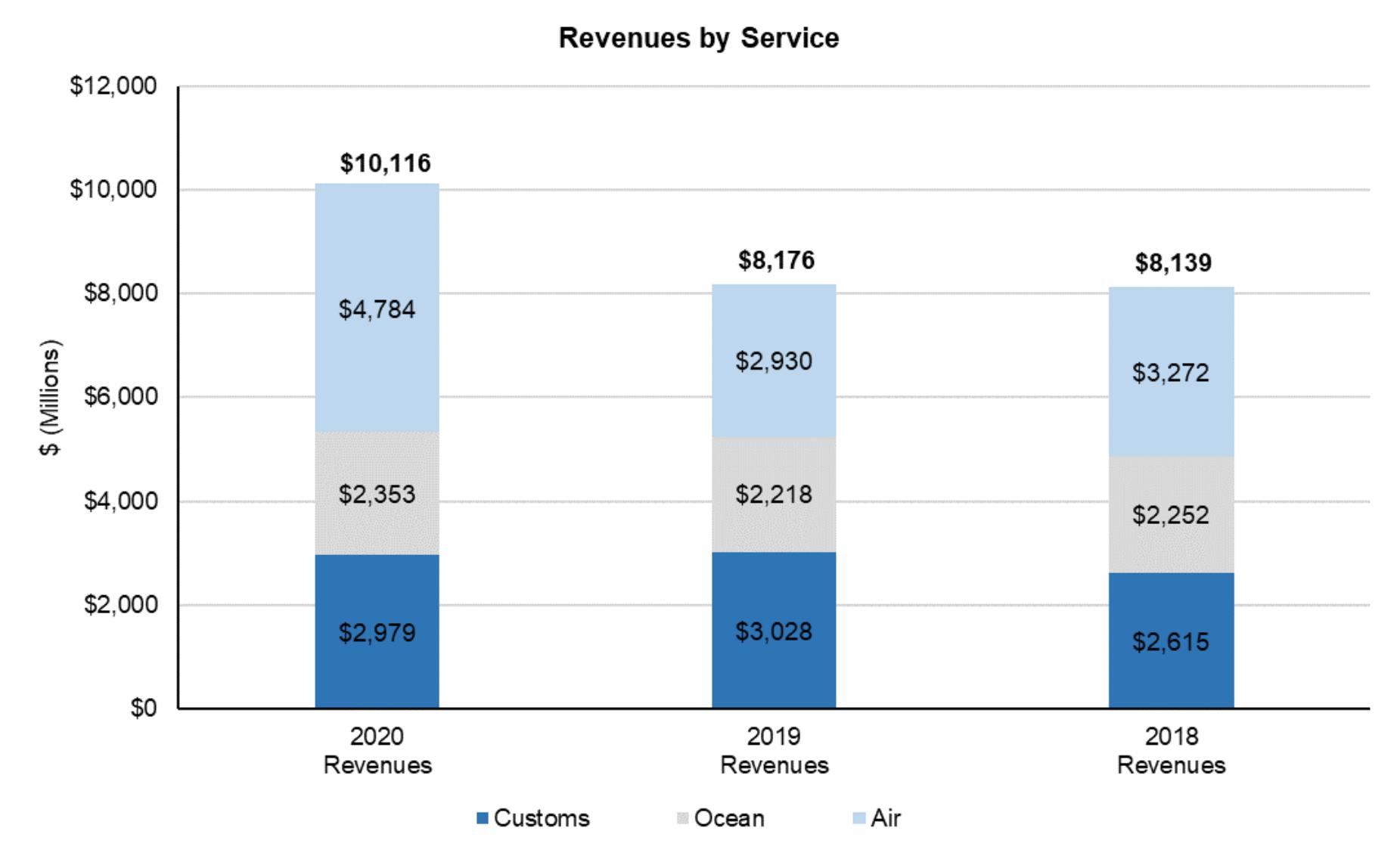][added: 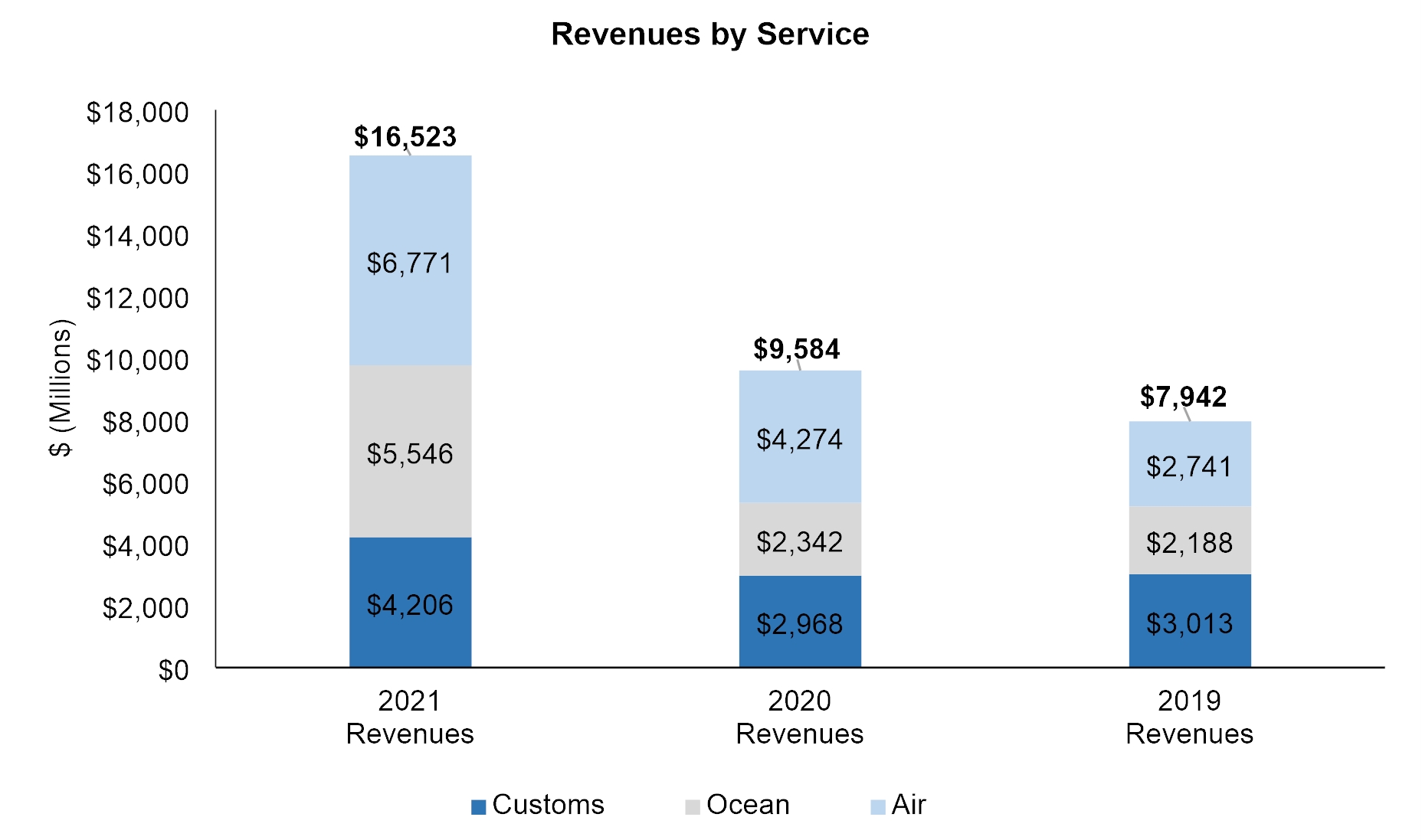]
In [removed: the second quarter] [added: 2020] and [removed: continuing through the remainder of 2020,] [added: 2021,] airfreight services experienced unprecedented events in response to the global pandemic.
Highlights from 2021
In 2021, the COVID-19 pandemic and resulting disruptions on supply chains continued to significantly affect our business operations and financial results, and we expect these disruptive conditions to continue at least through the first half of 2022.
The COVID-19 pandemic may continue to impact our business operations and financial operating results, and there is uncertainty in the nature and degree of its continued effects over time.
Refer to Risk Factors (Part I, Item 1A) for a discussion of these factors and other risks.
| | • | Revenues and directly related operating expenses increased 72% and 81%, respectively, from strong growth in all services propelled by high average rates and growth in volumes transacted. |
| | • | Severe imbalances between carrier available capacity and customer demand resulted in record high average buy and sell rates resulting in higher revenues, operating expenses and need for working capital to support the growth. |
| | • | Significant congestion at ocean ports and airport gateways from continued shortages in equipment, labor and warehousing space at destinations and disruptions from COVID-19 precautionary measures, resulted in longer transportation times and created challenging conditions to find availability to meet the growing customer demand. |
| | • | Salaries and related expenses increased 34% as a result of higher incentive compensation from higher operating income. |
| | • | Net earnings to shareholders increased 103% and we returned $710 million to shareholders in common stock repurchases and dividends. |
| --- | --- | --- |
On February 20, 2022, we determined that our company was the subject of a targeted cyber-attack.
Upon discovering the incident, we shut down most of our operating systems globally to manage the safety of our entire global systems environment.
We had limited ability to conduct operations during this time, including but not limited to arranging for shipments of freight or managing customs and distribution activities for our customers’ shipments.
The situation is evolving and while the Company has partially resumed operations, at this time the Company is unable to estimate when it will resume full operations.
We are incurring expenses relating to the cyber-attack to investigate and remediate this matter and expect to continue to incur expenses of this nature in the future.
The Company expects that the impact of the shutdown and the ongoing impacts of the cyber-attack will have a material adverse impact on its business, revenues, expenses, results of operations, cash flows and reputation.
At this early stage, the Company is unable to estimate the ultimate direct and indirect financial impacts of this cyber-attack.
We select and engage with best-in-class, compliance-focused, efficiently run, growth-oriented partners, based upon defined value elements and are intentional in our relationship and performance management activity, reinforcing success by awarding service providers who consistently achieve at the highest levels with additional business.
The 2017 Tax Act significantly changed U.S. corporate income tax laws including, among other things, the creation of a territorial tax system.
Our effective tax rate is significantly impacted by the mix of pretax earnings that we generate in the U.S. as compared to countries in the rest of the world, and the tax rates in effect in those locations relative to the pre-tax earnings generated in those countries and jurisdictions.
We believe it is reasonably possible that many countries and jurisdictions will increase their tax rates or otherwise
implement tax reforms that would be expected to increase the total tax expense that we will incur in those locations.
This section of this Form 10-K generally discusses year-to-year comparisons between the results of operations for the year ended December 31, 2021 compared to the year ended December 31, 2020.
| Revenues1 | | $ | 6,771,402 | | | $ | 4,274,026 | | | $ | 2,740,938 | | | 58% |
| Expenses1 | | | 5,067,380 | | | | 3,168,808 | | | | 1,955,054 | | | 60% |
| Revenues1 | | | 5,545,818 | | | | 2,342,344 | | | | 2,188,149 | | | 137% |
| Expenses1 | | | 4,364,160 | | | | 1,751,850 | | | | 1,584,240 | | | 149% |
| Revenues1 | | | 4,206,297 | | | | 2,968,023 | | | | 3,013,330 | | | 42% |
| Expenses1 | | | 2,626,615 | | | | 1,736,044 | | | | 1,766,655 | | | 51% |
1 See Note 11 – Correction of Immaterial Errors to the consolidated financial statements included in Part II, Item 8 of this report.
Demand started growing in the second quarter of 2020 and continued to remain high throughout 2021, amplified by a strong economy and customers converting to air shipments due to disruptions in ocean transportation, creating additional competition for limited available capacity.
In order to execute and meet the transportation needs of our customers we significantly increased utilization of chartered flights while still routinely purchasing capacity in advance and on the spot market.
This resulted in sustained high average buy and sell rates.
Freighters, charters and gateway infrastructure are operating at near maximum capacity, which is continuing the pressure on buy rates and limiting the ability to move additional volume.
Airfreight services revenues and expenses increased 58% and 60%, respectively, in 2021, as compared with 2020, due to a 26% increase in tonnage and 28% and 29% increases in average sell and buy rates, respectively.
Tonnage increased in all regions, with the largest increase coming from exports out of North America and North Asia, affected also by low levels of activity in the first half of 2020 in the United States and first quarter of 2020 in China as a result of pandemic-related closures.
Should customer demand decrease and rates return to pre-pandemic levels, it will result in a significant decrease in our revenues, expenses and operating income compared to 2021.
The deficiency in available capacity continues to be affected by unprecedented congestion at ports due to labor and equipment shortages and insufficient storage at destinations.
These factors disrupted sailing schedules and resulted in record high average buy rates.
When compared to the fourth quarter of 2020, average buy and sell rates increased 211% and 219%, respectively.
The COVID-19 pandemic has significantly affected our business operations for the year ended December 31, 2020, and we expect these disruptive conditions to continue into 2021.
In these transactions, we evaluate whether it is appropriate to record the gross or net amount as revenue.
Generally, revenue is recorded on a gross basis when we are primarily responsible for fulfilling the promise to provide the services, when we assume risk of loss, when we have discretion in setting the prices for the services to the customers, and we have the ability to direct the use of the services provided by the third party.
When revenue is recorded on a net basis, the amounts earned are determined using a fixed fee, a per unit of activity fee or a combination thereof.
For revenues earned in other capacities, for instance, when we do not issue a HAWB, a HOBL, or a House Seaway Bill or otherwise act solely as an agent for the shipper, only the commissions and fees earned for such services are included in revenues.
In these transactions, we are not a principal and report only commissions and fees earned in revenue.
The People’s Republic of China, including Hong Kong, represented more than 84% of North Asia revenues, 85% of directly related cost of transportation and other expenses and 79% operating income for the year ended December 31, 2020.
Expeditors' Culture
We believe that our unique culture, at the center of which are our employees, is a critical component to our continued success.
We strongly believe that it is nearly impossible to predict events that, individually or in the aggregate, could have a positive or a negative impact on our future operations.
As a result, management's focus is on building and maintaining a global corporate culture and an environment where well-trained employees and managers are prepared to identify and react to changes as they develop and thereby help us adapt and thrive as major trends emerge.
Global consistency and compliance is fundamental to preserving our culture and network of people, processes, technology and locations
Our business growth strategy emphasizes a focus on the right markets and, within each market, on the right customers that lead to profitable business growth through the aggressive marketing of our service offerings.
Innovative solutions, integrated platforms and data quality are vital to achieving a competitive advantage.
Expeditors' teams are aligned on the specific markets; on the targeted accounts within those markets; and on ways that we can continue to differentiate ourselves from our competitors.
The significance of maintaining acceptable working relationships with these entities has gained increased importance as a result of ongoing concern over terrorism, security, changes in governmental regulation and oversight of international trade.
A good reputation helps to develop practical working understandings that will assist in meeting security requirements while minimizing potential international trade obstacles, especially as governments promulgate new regulations in reaction to the pandemic and increase oversight and enforcement of new and existing laws.
Our business is also highly dependent on the financial stability and operational capabilities of the carriers we utilize.
Carriers are highly leveraged with debt and many are incurring, or have recently incurred, operating losses.
As a result, carriers are facing significant liquidity challenges exacerbated by the pandemic and are seeking relief under various government support programs.
This environment requires that we be selective in determining which carriers to utilize.
As a knowledge-based global provider of logistics services, we have often concluded over the course of our history that it is better to grow organically rather than by acquisition.
However, when we have made acquisitions, it has generally been to obtain technology, geographic coverage or specialized industry expertise that could be leveraged to benefit our entire network.
In May 2020, we acquired a less-than-truckload digital online shipping platform which aligns with our focus on enhancing our digital solutions.
The global economy entered into a recession as a result of the pandemic and related precautionary measures including government lockdowns, shutdown of manufacturing and operations for non-essential businesses and travel restrictions.
These rules and regulations are in the process of being implemented and are subject to further interpretation and change.
The full impact of the United Kingdom’s departure, and impact to international trade is still uncertain.
The global logistics services industry is intensely competitive and is expected to remain so for the foreseeable future.
Our pricing and terms continue to be pressured by uncertainty in global trade and economic conditions, concerns over availability of airfreight and ocean freight
capacity, volatile carrier pricing, disruptions in port services, political unrest and fluctuating currency exchange rates.
We expect these operating and competitive conditions to continue.
| | • | accrual of loss contingencies; |
| | • | accrual of various tax liabilities and contingencies; |
| | • | accounts receivable valuation; and |
| | • | accrual of insurance liabilities for the portion of the related exposure that we have self-insured. |
Management believes that there are limited, if any, alternative accounting principles or methods which could be applied to these transactions.
consistently applied.
See Note 7 to the consolidated financial statements for impacts associated with U.S. tax reform under the Tax Cuts and Jobs Act (2017 Tax Act).
The 2017 Tax Act, which is also commonly referred to as “U.S. tax reform,” significantly changed U.S. corporate income tax laws by, among other things, reducing the U.S. corporate income tax rate to 21% starting in 2018 and creating a territorial tax system with a one-time mandatory tax on previously undistributed foreign earnings of non-U.S. subsidiaries.
This section of this Form 10-K generally discusses 2020 and 2019 items and year-to-year comparisons between 2020 and 2019.
An excerpt. Shown here: 40 of 93 rewritten, 40 of 71 added and 40 of 121 removed. The counts are complete. For every sentence, read Item 7. MANAGEMENT’S DISCUSSION AND ANALYSIS OF FINANCIAL CONDITION AND RESULTS OF OPERATIONS in the FY2021 filing and the FY2020 filing.
Item 7A. QUANTITATIVE AND QUALITATIVE DISCLOSURES ABOUT MARKET RISK
10 rewritten, 3 added, 1 removed, 16 unchanged
Read the full itemFY2021 item · filed March 15, 2022FY2020 item · filed February 19, 2021
All other things being equal, an average 10% weakening of the U.S. dollar, throughout the year ended December 31, [removed: 2020,] [added: 2021,] would have had the effect of raising operating income by approximately [removed: $69] [added: $120] million.
An average 10% strengthening of the U.S. dollar, for the same period, would have the effect of reducing operating income by approximately [removed: $56] [added: $98] million.
[removed: Any such hedging activity] throughout the year ended December 31, [removed: 2020,] [added: 2021,] was insignificant.
Net foreign currency losses were approximately [removed: $25 million, $9] [added: $12] million and [removed: $2] [added: $25] million in [removed: 2020, 2019] [added: 2021] and [removed: 2018,] [added: 2020,] respectively.
We had no foreign currency derivatives outstanding at December 31, [removed: 2020] [added: 2021] and [removed: 2019.][added: 2020.]
As of December 31, [removed: 2020,] [added: 2021,] we had [removed: $117] [added: $237] million of net unsettled intercompany transactions.
At December 31, [removed: 2020,] [added: 2021,] we had cash and cash equivalents of [removed: $1,528] [added: $1,729] million, of which [removed: $926] [added: $487] million was invested at various short-term market interest rates.
We had no long-term debt at December 31, [removed: 2020.][added: 2021.]
A hypothetical change in the interest rate of 10 basis points at December 31, [removed: 2020] [added: 2021] would not have a significant impact on our earnings.
In management’s opinion, there has been no material change in our interest rate risk exposure between [removed: 2020] [added: 2021] and [removed: 2019.][added: 2020.]
Any such hedging activity
33.
34.
35.
Item 1. BUSINESS
116 rewritten, 58 added, 48 removed, 279 unchanged
Read the full itemFY2021 item · filed March 15, 2022FY2020 item · filed February 19, 2021
As a [removed: third party] [added: third-party] logistics provider, we purchase cargo space from carriers (such as airlines, ocean shipping lines, and trucking lines) on a volume basis and resell that space to our customers.
In addition, our Project Cargo unit handles special project shipments that move via a single method or combination of air, ocean, and/or ground transportation and generally [removed: requires] [added: require] a high level of specialized attention because of the unusual size or nature of what is being shipped.
Ocean [removed: Freight Consolidation:] [added: freight consolidation: Expeditors, when acting] as an ocean freight consolidator, [removed: Expeditors] contracts with ocean shipping carriers to obtain transportation for a fixed number of containers between various points during a specified time period at agreed-upon rates.
We handle both full container loads as well as Less-than Container Load (LCL) freight, offering a wider range of shipping options and rates than available with the [added: carriers directly.]
We also generate fees for ancillary [removed: origin] services such as the preparation of documentation to comply with local export and import laws.
[removed: Direct Ocean Forwarding:] [added: *Direct ocean forwarding*: Expeditors acts as the agent] when [removed: a] [added: its] customer contracts directly with the ocean carrier, [removed: Expeditors acts as that customer’s agent] and we may receive a commission from the carrier in addition to customer handling fees and ancillary services.
Customs Brokerage [added: and Import] Services: Expeditors helps importers clear shipments through customs by preparing required documentation, calculating and paying duties and other taxes on behalf of the importer, arranging for any required inspections by governmental agencies, and [added: import services such as] arranging for local pickup, storage and [removed: delivery.][added: delivery at destinations.]
Such services can include [removed: review of] [added: screening] commercial [removed: documentation, assessment of information regarding] [added: documentation for assessed] value, country of origin, [added: application of] special trade programs, and classification.
Our target market is primarily comprised of customers looking to reduce the number of [added: customs] brokers [removed: utilized globally;] [added: used,] those looking to improve compliance and [removed: reporting;] [added: reporting,] and those seeking opportunities to participate in special [removed: trade-incentive programs.][added: trade programs globally.]
Warehousing and Distribution Services: Expeditors’ [removed: distribution and warehousing] services include [removed: distribution center management,] inventory management, [added: multi-channel] order fulfillment, [removed: returns] [added: vendor management] programs, and other value-added services.
[removed: Coronavirus (COVID-19) impact] [added: Cyber-Attack Impact] on our [removed: business][added: Business]
We are unable to predict how these uncertainties [removed: and any future disruptions, such as the urgent distribution of COVID-19 vaccines,] will affect our future operations or financial [removed: results.][added: results, but these conditions could result in lower operating income.]
The following chart shows our [added: 2021 and] 2020 revenues by service type:
[removed: 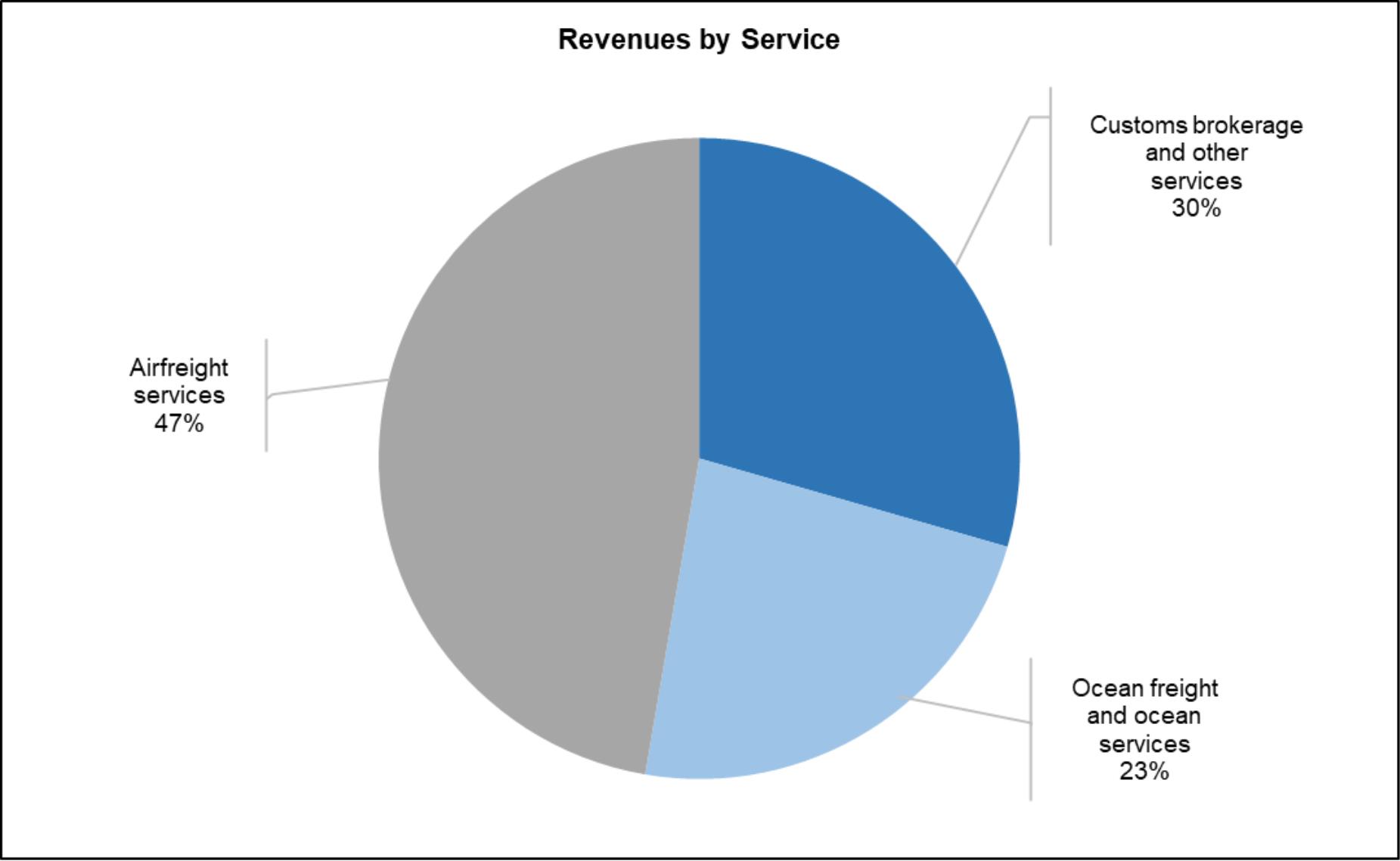][added: 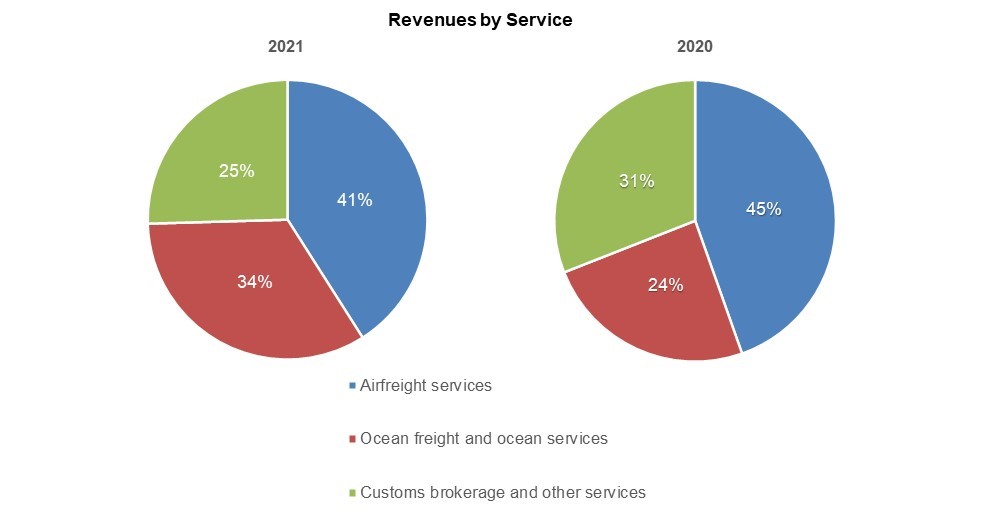]
[removed: Today] Expeditors has approximately [removed: 17,500] [added: 19,000] employees and provides a complete range of global logistics services to a diversified group of [removed: customers, both] [added: customers that vary] in [removed: terms of] [added: size,] industry [removed: specialization] and geographic location.
[removed: At January 31, 2021,] Expeditors, including its majority-owned subsidiaries, is organized functionally in geographic operating segments and operates district offices in the regions identified below.
Our district offices [added: are defined by geographic boundaries and] have been established in locations where Expeditors maintains unilateral control over [removed: assets and operations] [added: operations,] and where the existence of the parent-subsidiary relationship is maintained by means other than record ownership of voting stock.
We also maintain branch offices, which are aligned with and dependent [removed: on] [added: upon] one district [removed: office.][added: office, where practical benefit is gained by having staff located closer to the customers they are serving.]
Our [added: Culture and] Strategy
[removed: Expeditor’s] [added: Expeditors’] strategic plan is to achieve long-term, sustainable and profitable growth by focusing on the right markets and, within each market, on the right [removed: customers.][added: customers that lead to profitable business growth through the aggressive marketing of our service offerings.]
| | 1. | [removed: Ensure] [added: Ensuring] that base-line strategies for air, ocean and customs services for every district office and region lead to growth at the relevant market rates, profits and volumes by services. |
| | 2. | [removed: Grow] [added: Growing] our business services into and out of Europe, with particular focus on certain defined markets beyond our base-line growth expectations. |
| | 3. | [removed: Continue] [added: Continuing] to leverage our long and deeply entrenched presence in China - as well as the reputation that we have with the strategic carriers servicing China - to build a stronger customs brokerage and in-country presence. Our main focus remains on developing and integrating our customs systems, expertise and talent, and making investments that enhance and improve our import brokerage infrastructure and our ability to provide local delivery and support services in China. |
| | 4. | [removed: Grow] [added: Growing] our customs brokerage offering in South Asia and India by leveraging our strength and expertise in customs brokerage services and developing critical talent, processes and tools. |
The platform is comprised of proprietary, third party and [removed: open source] [added: open-source] technologies.
We utilize a [removed: globally consistent] [added: globally-consistent] infrastructure supporting both centralized and distributed technology strategies that incorporate security, disaster recovery and high availability.
We are not dependent on third parties for developing or enhancing our core [added: transportation] technology platforms to address our needs or those of our customers.
[removed: However, when] [added: When] we have made acquisitions, it has generally been to obtain technology, [added: increase] geographic coverage [added: by acquiring] or [added: establishing joint ventures with agents or others within the industry, or gain] specialized industry expertise that could be leveraged to benefit our entire network.
As a [removed: non-asset based] [added: non-asset-based] logistics services provider, we have considerable flexibility to tailor customer-specific [removed: solutions.][added: solutions by product.]
These services include our core [added: product] offerings of transportation, customs clearance, warehousing and distribution, and order management, along with expertise in supply chain analysis and optimization, trade compliance consulting, cargo insurance, cargo security, and solutions for oversized and heavy-lift freight.
[removed: We offer] [added: Our trained professional employees deliver] these services across the globe [removed: on] [added: through our network of district offices using] a [removed: single] [added: common] technology platform, in conjunction with consistent and efficient operational processes that adhere to the highest standards of compliance while focusing on the individual needs of each customer.
Because Expeditors is in the business of optimizing [removed: customer] [added: our customers’ freight] logistics and supply chains, we focus our sales [removed: strategies] and [removed: efforts] [added: engagement strategies] on professionals in logistics and supply chain management [removed: roles.][added: roles inside of customer organizations.]
At Expeditors, we create [removed: strategy, process,] [added: our strategy and develop our global products, processes,] technology and compliance programs at the corporate level, in order to drive consistency across all levels of the organization.
We leverage regional and local expertise by staffing our districts principally with local managers and personnel who are from the regions in which they operate and who [added: often] have extensive experience in logistics, coupled with a deep understanding of their local market.
District offices are responsible for selling and executing Expeditors' [added: products and] services directly to customers and [removed: prospects and] are involved in the selection of logistics service [removed: providers, in addition to ensuring that customers receive timely and effective services.][added: providers.]
Defining our strategy at a global level while executing it at [removed: a] [added: the] regional and local [removed: level] [added: levels] with customized supply chain solutions enables us to drive consistency and [removed: efficiency.][added: efficiency for our network and customers.]
We believe that focus on hiring and developing a diverse and talented workforce with an emphasis on exceptional customer service, along with our incentive-based compensation program, enables us to [removed: provide exceptional service and] [added: achieve] superior financial [removed: results.][added: results and provide for ongoing career advancement opportunities.]
These goods include products from [removed: multiple] [added: diverse] industries, including electronics, high technology, healthcare, aerospace and aviation, manufacturing, oil and energy, automotive, retail [added: consumer goods] and fashion.
Airfreight services accounted for approximately [removed: 47, 36] [added: 41%] and [removed: 40 percent] [added: 45%] of Expeditors' total revenues in [removed: 2020, 2019] [added: 2021] and [removed: 2018,] [added: 2020,] respectively.
We then issue a House Airway Bill (HAWB) to our customers as the contract of carriage [removed: and,] [added: and] separately, we receive a Master Airway Bill from the airline when the freight is physically tendered.
Our warehousing services are generally offered globally in multi-client facilities so that customers may benefit from cost savings related to shared space, labor, equipment, and other efficiencies.
Supply Chain Disruptions and Ongoing COVID-19 Impact on our Business
The disruptions on supply chain and transportation continued to significantly affect our business operations and operating results in 2021.
Continued imbalances between demand and available capacity for all transportation modes have resulted in historically high average buy and sell rates in 2021 from already record high rates in 2020 and creates significant challenges for our network to meet our customers’ needs.
Continued congestion at ports and gateways and equipment and labor shortages have disrupted sailing schedules and limited the ability to increase capacity while demand grew from a rebounding economy.
We expect these disruptive market conditions to continue at least through the first half of 2022.
As discussed in more detail under “Results of Operations”, there are significant constraints on current capacity for both air freight and ocean freight.
This is due to a number of factors, including reduced flight schedules from pre-pandemic levels and new regulations, which limited available belly space for cargo, congestion at ports resulting from labor and equipment shortages and insufficient warehousing space at destinations.
Air freighters and charters, container ships and gateway infrastructure are operating at near maximum capacity.
While we believe these constraints are not long-term in nature, they impact our current ability to move increased air and ocean volumes in these capacity-constrained regions.
In addition, in an effort to protect the health and safety of our employees, we continue to operate under our global business continuity plan that we implemented in the first quarter of 2020.
See Item 1A: “Risk Factors” below for additional details.
On February 20, 2022, we determined that our company was the subject of a targeted cyber-attack.
Upon discovering the incident, we shut down most of our operating systems globally to manage the safety of our overall global systems environment.
We had limited ability to conduct operations during this time, including but not limited to arranging for shipments of freight or managing customs and distribution activities for our customers’ shipments.
The situation is evolving and while the Company has partially resumed operations, at this time the Company is unable to estimate when it will resume full operations.
We are incurring expenses relating to the cyber-attack to investigate and remediate this matter and expect to continue to incur expenses of this nature in the future.
The Company expects that the impact of the shutdown and the ongoing impacts of the cyber-attack will have a material adverse impact on its business, revenues, expenses, results of operations, cash flows and reputation.
At this early stage, the Company is unable to estimate the ultimate direct and indirect financial impacts of this cyber-attack.
As opportunities for profitable growth arise, we will continue to open new offices where it makes sense to support existing global customers and serve new local markets.
Additionally, we contract with independent agents in locations where we do not have our own offices to provide required services for our existing customers.
We have established 36 such relationships worldwide.
Global consistency and compliance is fundamental to preserving our culture and network of people, processes, technology and locations.
We believe that our unique culture, at the center of which are our employees, is a critical component to our continued success.
We strongly believe that it is nearly impossible to predict events that, individually or in the aggregate, could have a positive or a negative impact on our future operations.
As a result, management's focus is on building and maintaining a global corporate culture and an environment where well-trained employees and managers are prepared to identify and react to changes as they develop and thereby help us adapt and thrive as major trends emerge.
Innovative solutions, integrated platforms and data quality are vital to achieving a competitive advantage.
Our four key strategic initiatives are:
We utilize internally developed and third-party technology to perform our customs brokerage services, to address country and regional specifications.
We also employ dedicated account management staff who work with existing customers to improve operations and grow new business opportunities.
We expect to continue to utilize chartered aircraft as long as international passenger flights remain insufficient to meet the demand for freight capacity.
As a result, by aggregating shipments and presenting them
We also charter vessels to support both our customers’ special projects and our container capacity needs.
effort to improve profitability.
Our warehousing services are generally offered in facilities utilized by multiple customers so that customers may benefit from cost savings related to shared space, labor, equipment and other efficiencies.
In retrospect, we know it was the right thing to do for both our employees and our business as it allowed us to have experienced teams in place to operate during challenging supply chain conditions in 2021.
| | | 2021 | | |
| Europe | | | 3,930 | |
| Corporate | | | 380 | |
| Total | | | 19,070 | |
| --- | --- | --- |
| --- | --- | --- |
| --- | --- | --- |
carriers directly.
Our warehousing services are offered primarily in leased facilities utilized by multiple customers.
Customers benefit from cost savings related to space, labor, equipment and other efficiencies delivered in a transactional pricing model.
The COVID-19 pandemic has significantly affected our business operations for the year ended December 31, 2020, and we expect these disruptive conditions to continue into 2021.
At this time, the main elements of its impact on our business are summarized below:
| | • | Governments have designated our operations as essential business in all regions where we operate because of our important role in supply chains operations worldwide. As such, our districts continue to serve our customers while operating within the regulations established in those countries. |
| --- | --- | --- |
| | • | We activated our global business continuity plan in the first quarter of 2020 and are continuing to operate under this plan. Our business continuity plan includes measures to protect and safeguard the health of our employees and service providers, such as sanitization of our facilities, providing protective equipment to employees, restricting travel and requiring all employees to work remotely if they are able to. Our plan includes measures to minimize adverse impacts to our operations and those of our customers’ businesses. We have identified areas of the supply chain process that can be supported remotely and through automation, and those that require physical operations and handling. We continue to monitor the continuously rapidly changing situation and adjust our actions, as needed, based on recommendations from governments and local and national health authorities. Subsequent to the first quarter of 2020, we deployed a global recovery plan regionally following local regulations. Our recovery plan is intended to allow employees to gradually and safely move back into offices when health risks subside and governments around the world lift restrictions. Our districts around the world are at different phases of the recovery plan depending on local conditions. |
| --- | --- | --- |
| | • | Travel restrictions, government mandated lockdowns and additional precautionary measures resulted in business and supply chain disruption, and limited operations in China in the first quarter of 2020, and worldwide starting in March 2020, resulting in sharp decreases in international trade. We have also seen a shift in the goods we handle with a substantial portion of shipments comprising of technology products to support social distancing and working remotely, and to a lesser degree, medical equipment and supplies. In contrast, we have seen significant declines in shipments from our customers in the aerospace, automotive, oil and energy and certain portions of the retail sectors. With the exception of airfreight exports out of North Asia and ocean exports from South Asia, declines in freight volumes have negatively impacted our results of operations for the year ended December 31, 2020, especially in the first three quarters of the year. |
| --- | --- | --- |
| | • | The above disruptions are threatening the financial stability of our service providers and our ability to efficiently route customer freight. Reduced passenger flight schedules and cancellations have significantly impacted available belly space, limiting our ability to utilize space under our existing capacity agreements with carriers and requiring us to buy space in a tight airfreight market and utilize chartered planes. Subsequent to the first quarter of 2020, there was limited airfreight space capacity, combined with high global demand for shipping Personal Protective Equipment (PPE), medical equipment and supplies and technology products, which created such an imbalance that buy rates increased to unprecedented levels, in particular on |
| | | exports out of North Asia. Most ocean carriers continued to manage their capacity according to market demand through most of the year and experienced excess demand compared to available capacity in the fourth quarter. These freight market conditions create pricing volatility that further challenges Expeditors’ ability to maintain historical unitary profitability. |
| | • | Many of our customers are experiencing disruptions in their revenue and cash flow, including an increased number of bankruptcies, prompting these customers to attempt to renegotiate contractual terms and increasing our accounts receivable collection risk. The growth in our accounts receivable and consequently customer credit exposure have also increased as a result of historically high freight rates. We have continued to apply our established credit control procedures and collection monitoring that have historically been effective in limiting credit losses. These conditions could result in the loss of business and additional bad debt allowances in the future if our customers’ ability to pay further deteriorates. |
These conditions are expected to continue into 2021.
A prolonged recession in the global economy and slowdown in trade would negatively affect our operations in the future.
Beginning in 1981, Expeditors’ primary business focus was on airfreight shipments from Asia to the United States and related customs brokerage and other services.
In the mid-1980’s, we began to expand our service capabilities in airfreight, ocean freight and distribution services.
As opportunities for profitable growth arise, we plan to
open new offices.
While Expeditors has historically expanded through organic growth, we have also been open to growth through acquisition of, or establishing joint ventures with existing agents or others within the industry.
Additionally, we contract with independent agents to provide required services and have established 38 such relationships worldwide.
In 2020, in light of recent market disruptions, including the impact of the COVID-19, we reviewed and refreshed our strategy to focus on four key strategic initiatives going forward:
Organic Versus Acquired Growth
In May 2020, we acquired a less-than-truckload digital online shipping platform that aligns with our focus on enhancing our digital solutions.
All employees are responsible for customer service and retention.
Leveraging Global, Regional and Local Expertise
At the distribution point, either we or an Expeditors'
We expect to continue to utilize charted aircrafts until such time as passenger air traffic returns to historic levels.
As a result, carriers are facing liquidity challenges exacerbated by the global pandemic and are seeking relief under various government support programs.
In particular air carriers are experiencing significant cash flow challenges as a result of passenger flights cancellations.
shipping and customs documentation, packing, crating, insurance services, and the preparation of documentation to comply with local export and import laws.
Our warehousing services are offered primarily in leased facilities utilized by multiple customers.
Customers benefit from cost savings related to space, labor, equipment and other efficiencies delivered in a transactional pricing model.
Looking back on that decision, we know it was the right thing to do for both our employees and our business.
During that time, we redeployed employees to analyze and improve our operational processes and work on strategic projects.
In 2020 during the early stages of the pandemic, we again adopted a “no lay off” policy for many of the same reasons as in 2008-2009.
An excerpt. Shown here: 40 of 116 rewritten, 40 of 58 added and 40 of 48 removed. The counts are complete. For every sentence, read Item 1. BUSINESS in the FY2021 filing and the FY2020 filing.
Item 3. LEGAL PROCEEDINGS
2 rewritten, 0 added, 0 removed, 2 unchanged
Read the full itemFY2021 item · filed March 15, 2022FY2020 item · filed February 19, 2021
As of December 31, [removed: 2020,] [added: 2021,] the amounts recorded for these claims, lawsuits, government investigations and other legal matters are not significant to our operations, cash flows or financial position.
At this time, we are unable to estimate any additional loss or range of reasonably possible losses, if any, beyond the amounts recorded, that might result from the resolution of these [removed: matters.][added: matters, including potential claims resulting from a cyber-attack in February 2022.]
Cover and table of contents
17 rewritten, 4 added, 1 removed, 70 unchanged
Read the full itemFY2021 item · filed March 15, 2022FY2020 item · filed February 19, 2021
For the fiscal year ended December 31, [removed: 2020][added: 2021]
The aggregate market value of the registrant’s Common Stock held by non-affiliates of the registrant, based upon the closing price as of the last business day of the most recently completed second fiscal quarter ended June 30, [removed: 2020,] [added: 2021,] was approximately [removed: $12,607,970,514.][added: $21,309,503,040.]
At [removed: February 16, 2021,] [added: March 8, 2022,] the number of shares outstanding of registrant’s Common Stock was [removed: 169,370,882.][added: 167,398,064.]
Portions of the definitive proxy statement for the Registrant’s [removed: 2020] Annual Meeting of Shareholders to be held on May [removed: 4, 2021] [added: 3, 2022] are incorporated by reference into Part III of this Form 10-K.
For the Fiscal Year Ended December 31, [removed: 2020][added: 2021]
| | Item 1B | [Unresolved Staff Comments](#ITEM_1B_UNRESOLVED_STAFF_COMMENTS) | [removed: 19] [added: 20] |
| | Item 5 | [Market for Registrant's Common Equity, Related Stockholder Matters and Issuer Purchases of Equity Securities](#ITEM_5_MARKET_FOR_REGISTRANTS_COMMON_EQU) | [removed: 21] [added: 20] |
| | Item 7A | [Quantitative and Qualitative Disclosures about Market Risk](#ITEM_7A_QUANTITATIVE_QUALITATIVE_DISCLOS) | [removed: 35] [added: 33] |
| | Item 8 | [Financial Statements and Supplementary Data](#ITEM_8_FINANCIAL_STATEMENTS_SUPPLEMENTAR) | [removed: 36] [added: 35] |
| | Item 9B | [Other Information](#ITEM_9B_OR_INFORMATION) | [removed: 37] [added: 36] |
| | Item 10 | [Directors, Executive Officers and Corporate Governance](#ITEM_10_DIRECTORS_EXECUTIVE_FICERS_CORPO) | [removed: 37] [added: 38] |
| | Item 11 | [Executive Compensation](#ITEM_11_EXECUTIVE_COMPENSATION) | [removed: 37] [added: 38] |
| | Item 13 | [Certain Relationships and Related Transactions and Director Independence](#ITEM_13_CERTAIN_RELATIONSHIPS_RELATED_TR) | [removed: 38] [added: 39] |
| | Item 14 | [Principal Accounting Fees and Services](#ITEM_14_PRINCIPAL_ACCOUNTING_FEES_SERVIC) | [removed: 38] [added: 39] |
| | Item 15 | [Exhibits, Financial Statement Schedules](#ITEM_15_EXHIBITS_FINANCIAL_STATEMENT_SCH) | [removed: 39] [added: 40] |
| | Item 16 | [Form 10-K Summary](#ITEM_16_FORM_10K_SUMMARY) | [removed: 41] [added: 42] |
| | | [Signatures](#SIGNATURES) | [removed: 42] [added: 43] |
Auditor Firm ID: 185 Auditor Name: KPMG, LLP Auditor Location: Seattle, WA, USA
| | | | |
| | Item 6 | [\[Reserved\]](#ITEM_6_RESERVED) | 23 |
| | Item 9C | [Disclosures Regarding Foreign Jurisdictions That Prevent Inspections](#ITEM_9C_DISCLOSURE_REGARDING_FOREIGN_JUR) | 37 |
| | Item 6 | [Selected Financial Data](#ITEM_6_SELECTED_FINANCIAL_DATA) | 23 |
Item 1B. UNRESOLVED STAFF COMMENTS
0 rewritten, 0 added, 1 removed, 1 unchanged
Read the full itemFY2021 item · filed March 15, 2022FY2020 item · filed February 19, 2021
19.
Item 2. PROPERTIES
2 rewritten, 0 added, 0 removed, 5 unchanged
Read the full itemFY2021 item · filed March 15, 2022FY2020 item · filed February 19, 2021
[removed: Expeditor’s] [added: Expeditors’] corporate headquarters are located in Seattle, Washington.
We conduct operations in approximately 450 locations worldwide, of which approximately 100 are in the United States and [removed: 21] [added: 20] are owned.
Item 4. MINE SAFETY DISCLOSURES
0 rewritten, 0 added, 1 removed, 2 unchanged
Read the full itemFY2021 item · filed March 15, 2022FY2020 item · filed February 19, 2021
20.
Item 5. MARKET FOR REGISTRANT’S COMMON EQUITY, RELATED STOCKHOLDER MATTERS AND ISSUER PURCHASES OF EQUITY SECURITIES
4 rewritten, 11 added, 13 removed, 19 unchanged
Read the full itemFY2021 item · filed March 15, 2022FY2020 item · filed February 19, 2021
There were [removed: 655] [added: 623] registered holders of record as of [removed: February 16, 2021.][added: March 8, 2022.]
The Board of Directors declared semi-annual dividends per share during the two most recent fiscal years [removed: paid] as follows:
The graph assumes that the value of the investment in our common stock and in each of the indexes (including reinvestment of dividends) was $100 on [removed: 12/31/2015] [added: 12/31/2016] and tracks it through [removed: 12/31/2020.][added: 12/31/2021.]
[removed: 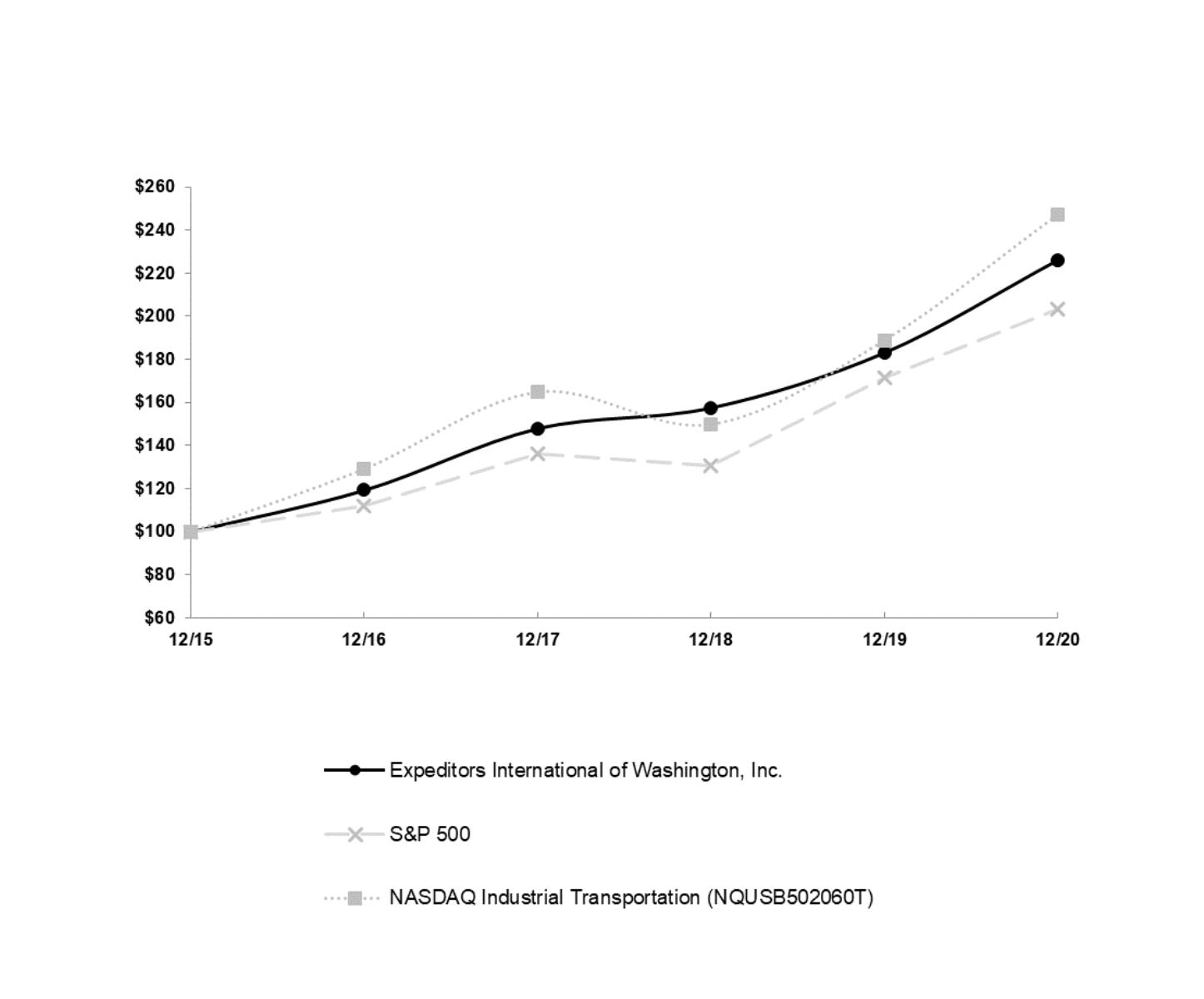][added: 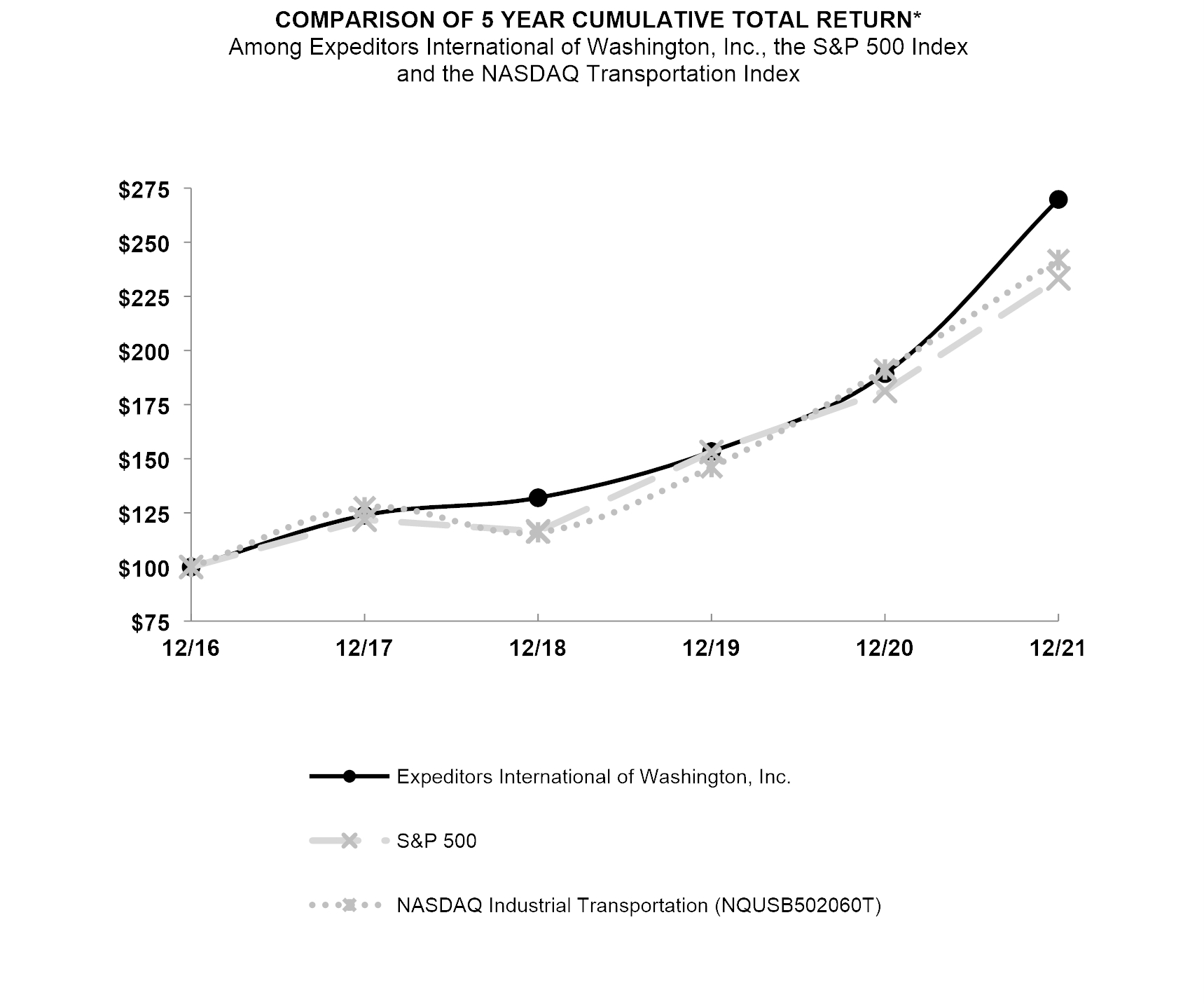]
| June 15, 2021 | | $ | 0.58 | |
| December 15, 2021 | | $ | 0.58 | |
20.
| October 1-31, 2021 | | | — | | | $ | — | | | | — | | | | 9,404,267 | |
| November 1-30, 2021 | | | 1,834,385 | | | $ | 123.89 | | | | 1,834,385 | | | | 7,899,491 | |
| December 1-31, 2021 | | | 505,969 | | | $ | 123.08 | | | | 505,969 | | | | 7,210,353 | |
| Total | | | 2,340,354 | | | $ | 123.71 | | | | 2,340,354 | | | | 7,210,353 | |
| | | 12/16 | | | | 12/17 | | | | 12/18 | | | | 12/19 | | | | 12/20 | | | | 12/21 | | |
| Expeditors International of Washington, Inc. | | $ | 100.00 | | | $ | 123.91 | | | $ | 131.99 | | | $ | 153.34 | | | $ | 189.30 | | | $ | 269.80 | |
| Standard and Poor's 500 Index | | | 100.00 | | | | 121.82 | | | | 116.47 | | | | 153.13 | | | | 181.29 | | | | 233.28 | |
| NASDAQ Industrial Transportation (NQUSB502060T) | | | 100.00 | | | | 127.55 | | | | 116.02 | | | | 146.11 | | | | 191.19 | | | | 241.77 | |
| June 17, 2019 | | $ | 0.50 | |
| December 16, 2019 | | $ | 0.50 | |
| October 1-31, 2020 | | | — | | | $ | — | | | | — | | | | 9,265,637 | |
| November 1-30, 2020 | | | — | | | $ | — | | | | — | | | | 9,450,287 | |
| December 1-31, 2020 | | | 200,000 | | | $ | 90.81 | | | | 200,000 | | | | 9,293,647 | |
| Total | | | 200,000 | | | $ | 90.81 | | | | 200,000 | | | | 9,293,647 | |
COMPARISON OF 5-YEAR CUMULATIVE TOTAL RETURN
Among Expeditors International of Washington, Inc., the S&P 500 Index
and the NASDAQ Industrial Transportation Index.
| | | 12/15 | | | | 12/16 | | | | 12/17 | | | | 12/18 | | | | 12/19 | | | | 12/20 | | |
| Expeditors International of Washington, Inc. | | $ | 100.00 | | | $ | 119.29 | | | $ | 147.82 | | | $ | 157.45 | | | $ | 182.93 | | | $ | 225.82 | |
| Standard and Poor's 500 Index | | | 100.00 | | | | 111.96 | | | | 136.40 | | | | 130.42 | | | | 171.49 | | | | 203.04 | |
| NASDAQ Industrial Transportation (NQUSB502060T) | | | 100.00 | | | | 129.22 | | | | 164.82 | | | | 149.92 | | | | 188.80 | | | | 247.07 | |
Item 6. [RESERVED]
2 rewritten, 1 added, 16 removed, 14 unchanged
Read the full itemFY2021 item · filed March 15, 2022FY2020 item · filed February 19, 2021
This Annual Report on Form 10-K for the fiscal year ended [removed: December 31, 2020] contains “forward-looking statements,” as defined in Section 27A of the Securities Act of 1933, as amended, and Section 21E [removed: of] [added: f] the Securities Exchange Act of 1934, as amended.
Statements including those preceded by, followed by or that include the words or phrases [removed: “will] [added: “will”,] likely result”, “are expected to”, "would expect", "would not expect", “will continue”, “is anticipated”, “estimate”, “project”, "provisional", "plan", "believe", "probable", "reasonably possible", "may", "could", "should", "intends", "foreseeable future" or similar expressions are intended to identify “forward-looking statements” within the meaning of the Private Securities Litigation Reform Act of 1995.
Not applicable.
Financial Highlights
| in thousands, except per share data | | 2020 | | | | 2019 | | | | 2018 | | | | 2017 | | | | 2016 | | |
| --- | --- | --- | --- | --- | --- | --- | --- | --- | --- | --- | --- | --- | --- | --- | --- | --- | --- | --- | --- | --- |
| Revenues | | $ | 10,116,481 | | | | 8,175,426 | | | | 8,138,365 | | | | 6,920,948 | | | | 6,098,037 | |
| Operating income | | $ | 940,437 | | | | 766,692 | | | | 796,563 | | | | 700,260 | | | | 670,163 | |
| Net earnings attributable to shareholders | | $ | 696,140 | | | | 590,395 | | | | 618,199 | | | | 489,345 | | | | 430,807 | |
| Diluted earnings attributable to shareholders per share | | $ | 4.07 | | | | 3.39 | | | | 3.48 | | | | 2.69 | | | | 2.36 | |
| Basic earnings attributable to shareholders per share | | $ | 4.14 | | | | 3.45 | | | | 3.55 | | | | 2.73 | | | | 2.38 | |
| Dividends declared and paid per common share | | $ | 1.04 | | | | 1.00 | | | | 0.90 | | | | 0.84 | | | | 0.80 | |
| Cash used for dividends | | $ | 174,929 | | | | 170,553 | | | | 156,840 | | | | 150,495 | | | | 145,123 | |
| Cash used for share repurchases | | $ | 332,387 | | | | 389,060 | | | | 647,898 | | | | 478,258 | | | | 337,658 | |
| Working capital | | $ | 2,070,501 | | | | 1,601,605 | | | | 1,407,977 | | | | 1,448,333 | | | | 1,288,648 | |
| Total assets | | $ | 4,927,503 | | | | 3,691,884 | | | | 3,314,559 | | | | 3,117,008 | | | | 2,790,871 | |
| Shareholders’ equity | | $ | 2,659,637 | | | | 2,195,028 | | | | 1,986,838 | | | | 1,991,858 | | | | 1,844,638 | |
| Weighted average diluted shares outstanding | | | 170,896 | | | | 174,209 | | | | 177,833 | | | | 181,666 | | | | 182,704 | |
| Weighted average basic shares outstanding | | | 168,333 | | | | 170,899 | | | | 174,133 | | | | 179,247 | | | | 181,282 | |
Item 8. FINANCIAL STATEMENTS AND SUPPLEMENTARY DATA
5 rewritten, 1 added, 0 removed, 16 unchanged
Read the full itemFY2021 item · filed March 15, 2022FY2020 item · filed February 19, 2021
| | | | [Balance Sheets as of December 31, [removed: 2020] [added: 2021] and [removed: 2019](#CONSOLIDATED_BALANCE_SHEETS)] [added: 2020](#CONSOLIDATED_BALANCE_SHEETS)] | | F-4 |
| | | | [Statements of Earnings for the Years Ended December 31, [removed: 2020, 2019] [added: 2021, 2020] and [removed: 2018](#CONSOLIDATED_STATEMENTS_EARNINGS)] [added: 2019](#CONSOLIDATED_STATEMENTS_EARNINGS)] | | F-5 |
| | | | [Statements of Comprehensive Income for the Years Ended December 31, [removed: 2020, 2019] [added: 2021, 2020] and [removed: 2018](#CONSOLIDATED_STATEMENTS_COMPREHENSIVE_IN)] [added: 2019](#CONSOLIDATED_STATEMENTS_COMPREHENSIVE_IN)] | | F-6 |
| | | | [Statements of Equity for the Years Ended December 31, [removed: 2020, 2019] [added: 2021, 2020] and [removed: 2018](#CONSOLIDATED_STATEMENTS_EQUITY)] [added: 2019](#CONSOLIDATED_STATEMENTS_EQUITY)] | | F-7 |
| | | | [Statements of Cash Flows for the Years Ended December 31, [removed: 2020, 2019] [added: 2021, 2020] and [removed: 2018](#Consolidated_Statements_of_Cash_Flows)] [added: 2019](#Consolidated_Statements_of_Cash_Flows)] | | F-8 |
35.
Item 9A. CONTROLS AND PROCEDURES
3 rewritten, 2 added, 1 removed, 18 unchanged
Read the full itemFY2021 item · filed March 15, 2022FY2020 item · filed February 19, 2021
Management, including the Chief Executive Officer and Chief Financial Officer, conducted an assessment of the effectiveness of the Company's internal control over financial reporting, as of December 31, [removed: 2020,] [added: 2021,] based on the framework in *Internal Control — Integrated Framework (2013)* issued by the Committee of Sponsoring Organizations of the Treadway Commission (COSO).
Based on this assessment, management has concluded that, as of December 31, [removed: 2020,] [added: 2021,] our internal control over financial reporting was effective.
KPMG LLP, an independent registered public accounting firm, has issued an attestation report on our internal control over financial reporting as of December 31, [removed: 2020,] [added: 2021,] which is included on page F-3.
Starting on February 20, 2022, as a result of a cyber-attack, the Company shut down most of its operating systems globally, including its accounting systems to manage the safety of its entire global systems environment.
We are bringing our enterprise systems online and are expecting to implement enhancements to our existing cybersecurity systems and processes beginning in the first quarter of 2022.
36.
Item 9B. OTHER INFORMATION
0 rewritten, 1 added, 1 removed, 1 unchanged
Read the full itemFY2021 item · filed March 15, 2022FY2020 item · filed February 19, 2021
36.
PART III
Item 9C. DISCLOSURE REGARDING FOREIGN JURISDICTIONS THAT PREVENT INSPECTIONS
0 rewritten, 3 added, 0 removed, 0 unchanged
New section this year
Read the full itemFY2021 item · filed March 15, 2022
Not applicable.
37.
PART III
Item 10. DIRECTORS, EXECUTIVE OFFICERS AND CORPORATE GOVERNANCE
2 rewritten, 6 added, 2 removed, 12 unchanged
Read the full itemFY2021 item · filed March 15, 2022FY2020 item · filed February 19, 2021
The information required by this item is set forth below or incorporated by reference to information under the caption “Proposal No. 1: Election of Directors” and to the information under the caption “Board Operations" in Expeditors' definitive Proxy Statement for its annual meeting of shareholders to be held on May [removed: 4, 2021.][added: 3, 2022.]
[removed: Carlile, Chairman of the Audit Committee, is] [added: Polius, are] the audit committee financial [removed: expert] [added: experts] as defined by Item 407(d)(5) of Regulation S-K under the Exchange Act and that each member of the Audit Committee is independent under the NASDAQ independence standards applicable to audit committee members.
Dubois, Brandon S.
Pedersen, Liane J.
Pelletier and Olivia D.
Polius.
Carlile, Chairman of the Audit Committee, Brandon S.
Pedersen, and Olivia D.
Dubois and Liane J.
Pelletier.
Item 11. EXECUTIVE COMPENSATION
1 rewritten, 0 added, 1 removed, 0 unchanged
Read the full itemFY2021 item · filed March 15, 2022FY2020 item · filed February 19, 2021
The information required by this item is incorporated by reference to information under the captions “Director Compensation Program” and “Compensation Discussion and Analysis” in Expeditors' definitive Proxy Statement for its annual meeting of shareholders to be held on May [removed: 4, 2021.][added: 3, 2022.]
37.
Item 12. SECURITY OWNERSHIP OF CERTAIN BENEFICIAL OWNERS AND MANAGEMENT AND RELATED STOCKHOLDER MATTERS
4 rewritten, 3 added, 2 removed, 9 unchanged
Read the full itemFY2021 item · filed March 15, 2022FY2020 item · filed February 19, 2021
The information required by this item is incorporated by reference to information under the captions “Shareholder Engagement & Stock Ownership Information” in Expeditors' definitive Proxy Statement for its annual meeting of shareholders to be held on May [removed: 4, 2021.][added: 3, 2022.]
The following table provides information as of December 31, [removed: 2020,] [added: 2021,] regarding compensation plans under which equity securities of Expeditors are authorized for issuance.
| (1) | Represents shares issuable upon exercise of outstanding stock options, vesting of outstanding restricted stock units [removed: under the Omnibus Incentive Plan] and performance stock units that will vest if target levels are [removed: achieved.] [added: achieved under the Omnibus Incentive Plan.] |
| (3) | Includes [removed: 2,480,805] [added: 1,782,334] available for issuance under the employee stock purchase plans and [removed: 3,027,906] [added: 2,566,988] available for future grants of equity awards under the Amended and Restated 2017 Omnibus Incentive Plan. |
| Equity Compensation Plans Approved by Security Holders | | | 3,592,463 | | | $ | 44.07 | | | | 4,349,322 | |
| Total | | | 3,592,463 | | | $ | 44.07 | | | | 4,349,322 | |
38.
| Equity Compensation Plans Approved by Security Holders | | | 4,746,798 | | | $ | 44.49 | | | | 5,508,711 | |
| Total | | | 4,746,798 | | | $ | 44.49 | | | | 5,508,711 | |
Item 13. CERTAIN RELATIONSHIPS AND RELATED TRANSACTIONS, AND DIRECTOR INDEPENDENCE
1 rewritten, 0 added, 0 removed, 0 unchanged
Read the full itemFY2021 item · filed March 15, 2022FY2020 item · filed February 19, 2021
The information required by this item is incorporated by reference to information under the captions “Certain Relationships and Related Transactions” in Expeditors' definitive Proxy Statement for its annual meeting of shareholders to be held on May [removed: 4, 2021.][added: 3, 2022.]
Item 14. PRINCIPAL ACCOUNTING FEES AND SERVICES
1 rewritten, 1 added, 1 removed, 1 unchanged
Read the full itemFY2021 item · filed March 15, 2022FY2020 item · filed February 19, 2021
The information required by this item is incorporated by reference to information under the caption “Relationship with Independent Registered Public Accounting Firm” in Expeditors' definitive Proxy Statement for its annual meeting of shareholders to be held on May [removed: 4, 2021.][added: 3, 2022.]
39.
38.
Item 15. EXHIBITS, FINANCIAL STATEMENT SCHEDULES
26 rewritten, 1 added, 10 removed, 108 unchanged
Read the full itemFY2021 item · filed March 15, 2022FY2020 item · filed February 19, 2021
| | | [Consolidated Balance Sheets as of December 31, [removed: 2020] [added: 2021] and [removed: 2019](#CONSOLIDATED_BALANCE_SHEETS)] [added: 2020](#CONSOLIDATED_BALANCE_SHEETS)] | | F-4 |
| | | [Consolidated Statements of Earnings for the Years Ended December 31, [removed: 2020, 2019] [added: 2021, 2020] and [removed: 2018](#CONSOLIDATED_STATEMENTS_EARNINGS)] [added: 2019](#CONSOLIDATED_STATEMENTS_EARNINGS)] | | F-5 |
| | | [Consolidated Statements of Comprehensive Income for the Years Ended December 31, [removed: 2020, 2019] [added: 2021, 2020] and [removed: 2018](#CONSOLIDATED_STATEMENTS_COMPREHENSIVE_IN)] [added: 2019](#CONSOLIDATED_STATEMENTS_COMPREHENSIVE_IN)] | | F-6 |
| | | [Consolidated Statements of Equity for the Years Ended December 31, [removed: 2020, 2019] [added: 2021, 2020] and [removed: 2018](#CONSOLIDATED_STATEMENTS_EQUITY)] [added: 2019](#CONSOLIDATED_STATEMENTS_EQUITY)] | | F-7 |
| | | [Consolidated Statements of Cash Flows for the Years Ended December 31, [removed: 2020, 2019] [added: 2021, 2020] and [removed: 2018](#Consolidated_Statements_of_Cash_Flows)] [added: 2019](#Consolidated_Statements_of_Cash_Flows)] | | F-8 |
| | [removed: (6)] [added: (7)] | Expeditors' [removed: 2010] [added: 2011] Stock Option Plan. See Exhibit [removed: 10.55.] [added: 10.57.] |
| | [removed: (7)] [added: (8)] | Form of Stock Option Agreement used in connection with options granted under [removed: Expeditors’ 2010] [added: Expeditors' 2011] Stock Option Plan. See Exhibit [removed: 10.56.] [added: 10.58.] |
| | [removed: (8)] [added: (9)] | Expeditors' [removed: 2011] [added: 2012] Stock Option Plan. See Exhibit [removed: 10.57.] [added: 10.59.] |
| | [removed: (9)] [added: (10)] | Form of Stock Option Agreement used in connection with options granted under Expeditors' [removed: 2011] [added: 2012] Stock Option Plan. See Exhibit [removed: 10.58.] [added: 10.60.] |
| | [removed: (10)] [added: (11)] | Expeditors' [removed: 2012] [added: 2013] Stock Option Plan. See Exhibit [removed: 10.59.] [added: 10.61.] |
| | [removed: (11)] [added: (12)] | Form of Stock Option Agreement used in connection with options granted under Expeditors' [removed: 2012] [added: 2013] Stock Option Plan. See Exhibit [removed: 10.60.] [added: 10.62.] |
| | [removed: (12)] [added: (13)] | Expeditors' [removed: 2013] [added: 2014] Stock Option Plan. See Exhibit [removed: 10.61.] [added: 10.63.] |
| | [removed: (13)] [added: (14)] | Form of Stock Option Agreement used in connection with options granted under [removed: Expeditors' 2013] [added: Expeditors; 2014] Stock Option Plan. See Exhibit [removed: 10.62.] [added: 10.64.] |
| | [removed: (14)] [added: (15)] | Expeditors' [removed: 2014] [added: 2015] Stock Option Plan. See Exhibit [removed: 10.63.] [added: 10.65.] |
| | [removed: (15)] [added: (16)] | Form of Stock Option Agreement used in connection with options granted under [removed: Expeditors; 2014] [added: Expeditors' 2015] Stock Option Plan. See Exhibit [removed: 10.64.] [added: 10.66.] |
| | [removed: (16)] [added: (17)] | Expeditors' [removed: 2015] [added: 2016] Stock Option Plan. See Exhibit [removed: 10.65.] [added: 10.67.] |
| | [removed: (17)] [added: (18)] | Form of Stock Option Agreement used in connection with options granted under Expeditors' [removed: 2015] [added: 2016] Stock Option Plan. See Exhibit [removed: 10.66.] [added: 10.68.] |
| | [removed: (19)] [added: (21)] | Form of [removed: Stock Option] [added: Performance Share Award] Agreement used in connection with [removed: options] [added: performance share units] granted under Expeditors' [removed: 2016] [added: Amended and Restated 2017 Omnibus Incentive] Stock [removed: Option] Plan. See Exhibit [removed: 10.68.] [added: 10.69] |
| | [removed: (20)] [added: (19)] | Expeditors' Amended and Restated 2017 Omnibus Incentive Plan. See Exhibit 10.69 |
| | [removed: (21)] [added: (20)] | Form of Executive Restricted Stock Unit Award Agreement used in connection with executive restricted stock units granted under Expeditors' Amended and Restated 2017 Omnibus Incentive Stock Plan. See Exhibit 10.69 |
| [removed: [21.1](https://www.sec.gov/Archives/edgar/data/746515/000156459021006925/expd-ex211_7.htm)] [added: [21.1](https://www.sec.gov/Archives/edgar/data/746515/000156459022010381/expd-ex211_7.htm)] | | Subsidiaries of the registrant. |
| [removed: [23.1](https://www.sec.gov/Archives/edgar/data/746515/000156459021006925/expd-ex231_11.htm)] [added: [23.1](https://www.sec.gov/Archives/edgar/data/746515/000156459022010381/expd-ex231_6.htm)] | | Consent of Independent Registered Public Accounting Firm. |
| [removed: [31.1](https://www.sec.gov/Archives/edgar/data/746515/000156459021006925/expd-ex311_6.htm)] [added: [31.1](https://www.sec.gov/Archives/edgar/data/746515/000156459022010381/expd-ex311_9.htm)] | | Certification of Chief Executive Officer pursuant to Section 302 of the Sarbanes-Oxley Act of 2002. |
| [removed: [31.2](https://www.sec.gov/Archives/edgar/data/746515/000156459021006925/expd-ex312_10.htm)] [added: [31.2](https://www.sec.gov/Archives/edgar/data/746515/000156459022010381/expd-ex312_8.htm)] | | Certification of Chief Financial Officer pursuant to Section 302 of the Sarbanes-Oxley Act of 2002. |
| [removed: [32](https://www.sec.gov/Archives/edgar/data/746515/000156459021006925/expd-ex32_9.htm)] [added: [32](https://www.sec.gov/Archives/edgar/data/746515/000156459022010381/expd-ex32_10.htm)] | | Certification pursuant to 18 U.S.C. Section 1350, as adopted pursuant to Section 906 of the Sarbanes-Oxley Act of 2002. |
| 104 | | The cover page from the Company’s Yearly Report on Form 10-K for the year ended December 31, [removed: 2020,] [added: 2021,] has been formatted in Inline XBRL |
41.
| --- | --- | --- |
| --- | --- | --- |
| | (18) | Expeditors' 2016 Stock Option Plan. See Exhibit 10.67. |
39.
| | (23) | Form of Performance Share Award Agreement used in connection with performance share units granted under Expeditors' Amended and Restated 2017 Omnibus Incentive Stock Plan. See Exhibit 10.69 |
| | | |
| | | |
| | | |
| [10.55](http://www.sec.gov/Archives/edgar/data/746515/000119312510061569/ddef14a.htm) | | Expeditors' 2010 Stock Option Plan. (Incorporated by reference to Appendix A of Expeditors' Notice of Annual Meeting of Shareholders and Proxy Statement pursuant to Regulation 14A filed on or about March 19, 2010.) |
| [10.56](http://www.sec.gov/Archives/edgar/data/746515/000119312510061569/ddef14a.htm) | | Form of Stock Option Agreement used in connection with options granted under Expeditors' 2010 Stock Option Plan. (Incorporated by reference to Appendix B of Expeditors' Notice of Annual Meeting of Shareholders and Proxy Statement pursuant to Regulation 14A filed on or about March 19, 2010.) |
Item 16. FORM 10-K SUMMARY
227 rewritten, 130 added, 150 removed, 483 unchanged
Read the full itemFY2021 item · filed March 15, 2022FY2020 item · filed February 19, 2021
Pursuant to the requirements of the Securities Exchange Act of 1934, this report has been signed below by the following persons on behalf of the registrant and in the capacities indicated on [removed: February 16, 2021.][added: March 14, 2022.]
YEARS ENDED DECEMBER 31, [added: 2021,] 2020, [removed: 2019,] AND [removed: 2018][added: 2019]
We have audited the accompanying consolidated balance sheets of Expeditors International of Washington, Inc. and subsidiaries (the Company) as of December 31, [removed: 2020] [added: 2021] and [removed: 2019,] [added: 2020,] the related consolidated statements of earnings, comprehensive income, equity, and cash flows for each of the years in the [removed: three‑year] [added: three-year] period ended December 31, [removed: 2020,] [added: 2021,] and the related notes (collectively, the consolidated financial statements).
In our opinion, the consolidated financial statements present fairly, in all material respects, the financial position of the Company as of December 31, [removed: 2020] [added: 2021] and [removed: 2019,] [added: 2020,] and the results of its operations and its cash flows for each of the years in the [removed: three‑year] [added: three-year] period ended December 31, [removed: 2020,] [added: 2021,] in conformity with U.S. generally accepted accounting principles.
We also have audited, in accordance with the standards of the Public Company Accounting Oversight Board (United States) (PCAOB), the Company’s internal control over financial reporting as of December 31, [removed: 2020,] [added: 2021,] based on criteria established in [removed: *Internal] [added: Internal] Control – Integrated Framework [removed: (2013)*] [added: (2013)] issued by the Committee of Sponsoring Organizations of the Treadway Commission, and our report dated [removed: February 19, 2021] [added: March 15, 2022] expressed an unqualified opinion on the effectiveness of the Company’s internal control over financial reporting.
We identified the assessment of [added: certain] gross unrecognized tax benefits as a critical audit matter.
| [removed: February 19,] [added: |] 2021 | [added: | | | | | | | | | | | |]
We have audited Expeditors International of Washington, [removed: Inc.’s] [added: Inc.] and [removed: subsidiaries’] [added: subsidiaries'] (the Company) internal control over financial reporting as of December 31, [removed: 2020,] [added: 2021,] based on criteria established in [removed: *Internal] [added: Internal] Control – Integrated Framework [removed: (2013)*] [added: (2013)] issued by the Committee of Sponsoring Organizations of the Treadway Commission.
In our opinion, the Company maintained, in all material respects, effective internal control over financial reporting as of December 31, [removed: 2020,] [added: 2021,] based on criteria established in [removed: *Internal] [added: Internal] Control – Integrated Framework [removed: (2013)*] [added: (2013)] issued by the Committee of Sponsoring Organizations of the Treadway Commission.
We also have audited, in accordance with the standards of the Public Company Accounting Oversight Board (United States) (PCAOB), the consolidated balance sheets of the Company as of December 31, [removed: 2020] [added: 2021] and [removed: 2019,] [added: 2020,] the related consolidated statements of earnings, comprehensive income, equity, and cash flows for each of the years in the three-year period ended December 31, [removed: 2020,] [added: 2021,] and the related notes (collectively, the consolidated financial statements), and our report dated [removed: February 19, 2021] [added: March 15, 2022] expressed an unqualified opinion on those consolidated financial statements.
| [removed: February 19,] [added: |] 2021 | [added: | | | | | | | | | | | | | | | |]
| [added: | | Year ended] December 31, [added: 2020] | | [removed: 2020] | | | | [added: | | | | | | Year ended December 31,] 2019 | | | [added: | | | | | | | |]
| Cash and cash equivalents [added: at beginning of period] | | [removed: $] | 1,527,791 | | | [removed: $] | 1,230,491 | | [added: | | 923,735 | |]
| Accounts receivable, net | | | [removed: 1,998,055] [added: 3,810,286] | | | | [removed: 1,315,091] [added: 1,998,055] | |
| Deferred contract costs | | | [removed: 327,448] [added: 987,266] | | | | [removed: 131,783] [added: 327,448] | |
| Other | | | [removed: 110,250] [added: 108,801] | | | | [removed: 92,558] [added: 110,250] | |
| Total current assets | | | [removed: 3,963,544] [added: 6,635,045] | | | | [removed: 2,769,923] [added: 3,963,544] | |
| Property and equipment, net | | | [removed: 506,425] [added: 487,870] | | | | [removed: 499,344] [added: 506,425] | |
| Operating lease right-of-use assets | | | [removed: 432,723] [added: 459,158] | | | | [removed: 390,035] [added: 432,723] | |
| Deferred federal and state income taxes, net | | | [removed: —] [added: 729] | | | | [removed: 8,034] [added: —] | |
| Other assets, net | | | [removed: 16,884] [added: 19,200] | | | | [removed: 16,621] [added: 16,884] | |
| Total assets | | $ | [removed: 4,927,503] [added: 7,609,929] | | | $ | [removed: 3,691,884] [added: 4,927,503] | |
| Accounts payable | | $ | [removed: 1,136,859] [added: 2,012,461] | | | $ | [removed: 735,695] [added: 1,136,859] | |
| Accrued expenses, primarily salaries and related costs | | | [removed: 257,021] [added: 403,625] | | | | [removed: 189,446] [added: 257,021] | |
| Contract liabilities | | | [removed: 379,722] [added: 1,142,026] | | | | [removed: 154,183] [added: 379,722] | |
| Current portion of operating lease liabilities | | | [removed: 74,004] [added: 82,019] | | | | [removed: 65,367] [added: 74,004] | |
| Federal, state and foreign income taxes | | | [removed: 45,437] [added: 86,166] | | | | [removed: 23,627] [added: 45,437] | |
| Total current liabilities | | | [removed: 1,893,043] [added: 3,726,297] | | | | [removed: 1,168,318] [added: 1,893,043] | |
| Noncurrent portion of operating lease liabilities | | | [removed: 364,185] [added: 385,641] | | | | [removed: 326,347] [added: 364,185] | |
| Deferred federal and state income taxes, net | | | [removed: 7,048] [added: —] | | | | [removed: —] [added: 7,048] | |
| Common stock, par value $0.01 per share, authorized 640,000. Issued and [removed: outstanding:169,294] [added: outstanding: 167,210] shares [removed: at December 31, 2020] and [removed: 169,622] [added: 169,294] shares at December 31, [removed: 2019] [added: 2021 and 2020, respectively] | | | [removed: 1,693] [added: 1,672] | | | | [removed: 1,696] [added: 1,693] | |
| Additional paid-in capital | | | [removed: 157,496] [added: 3,160] | | | | [removed: 3,203] [added: 157,496] | |
| Retained earnings | | | [removed: 2,600,201] [added: 3,620,008] | | | | [removed: 2,321,316] [added: 2,600,201] | |
| Accumulated other comprehensive loss | | | [removed: (99,753] [added: (130,414] | ) | | | [removed: (131,187] [added: (99,753] | ) |
| Total shareholders’ equity | | | [removed: 2,659,637] [added: 3,494,426] | | | | [removed: 2,195,028] [added: 2,659,637] | |
| Noncontrolling interest | | | [removed: 3,590] [added: 3,565] | | | | [removed: 2,191] [added: 3,590] | |
| Total equity | | | [removed: 2,663,227] [added: 3,497,991] | | | | [removed: 2,197,219] [added: 2,663,227] | |
| Total liabilities and equity | | $ | [removed: 4,927,503] [added: 7,609,929] | | | $ | [removed: 3,691,884] [added: 4,927,503] | |
| Years ended December 31, | | [removed: 2020] [added: 2021] | | | | [removed: 2019] [added: 2020] | | | | [removed: 2018] [added: 2019] | | |
| Ocean freight and ocean services | | | 2,353,247 | | | | [added: 10,903 | | | | 2,342,344 | | | |] 2,217,554 | | | | [removed: 2,251,754] [added: 29,405] | | [added: | | 2,188,149 | |]
Date: March 15, 2022
| /s/ Brandon S. Pedersen | | Director |
| (Brandon S. Pedersen) | | |
| /s/ Olivia D. Polius | | Director |
| (Olivia D. Polius) | | |
43.
44.
F-1
| March 15, 2022 |
F-2
| March 15, 2022 |
F-3
| Cash and cash equivalents | | $ | 1,728,692 | | | $ | 1,527,791 | |
F-4
| Airfreight services | | $ | 6,771,402 | | | $ | 4,274,026 | | | $ | 2,740,938 | |
| Ocean freight and ocean services | | | 5,545,818 | | | | 2,342,344 | | | | 2,188,149 | |
| Customs brokerage and other services | | | 4,206,297 | | | | 2,968,023 | | | | 3,013,330 | |
| Total revenues | | | 16,523,517 | | | | 9,584,393 | | | | 7,942,417 | |
| Airfreight services | | | 5,067,380 | | | | 3,168,808 | | | | 1,955,054 | |
| Ocean freight and ocean services | | | 4,364,160 | | | | 1,751,850 | | | | 1,584,240 | |
| Customs brokerage and other services | | | 2,626,615 | | | | 1,736,044 | | | | 1,766,655 | |
| Total operating expenses | | | 14,614,191 | | | | 8,643,956 | | | | 7,175,725 | |
F-5
F-6
| Shares repurchased under provisions of stock repurchase plan | | | (4,378 | ) | | | (44 | ) | | | (315,565 | ) | | | (198,985 | ) | | | — | | | | (514,594 | ) | | | — | | | | (514,594 | ) |
| Net earnings | | | — | | | | — | | | | — | | | | 1,415,492 | | | | — | | | | 1,415,492 | | | | 3,353 | | | | 1,418,845 | |
| Other comprehensive loss | | | — | | | | — | | | | — | | | | — | | | | (30,661 | ) | | | (30,661 | ) | | | (1,747 | ) | | | (32,408 | ) |
| Dividends paid ($1.16) | | | — | | | | — | | | | 934 | | | | (196,700 | ) | | | — | | | | (195,766 | ) | | | — | | | | (195,766 | ) |
| Distribution to noncontrolling interest | | | — | | | | — | | | | — | | | | — | | | | — | | | | — | | | | (1,631 | ) | | | (1,631 | ) |
| Balance at December 31, 2021 | | | 167,210 | | | $ | 1,672 | | | $ | 3,160 | | | $ | 3,620,008 | | | $ | (130,414 | ) | | $ | 3,494,426 | | | $ | 3,565 | | | $ | 3,497,991 | |
F-7
| Net cash from operating activities | | | 868,494 | | | | 654,969 | | | | 771,689 | |
| Proceeds from borrowing on lines of credit, net | | | 7,512 | | | | 43 | | | | 246 | |
| Distribution to noncontrolling interest | | | (1,631 | ) | | | — | | | | — | |
| Net cash from financing activities | | | (613,546 | ) | | | (331,494 | ) | | | (417,796 | ) |
F-8
Certain prior year amounts have been reclassified to conform to the current year presentation, including revisions to correct for immaterial errors.
F-9
F-10
In most cases we act as an indirect carrier.
41.
Date: February 19, 2021
| --- | --- | --- |
Change in Accounting Principle
As discussed in Notes 1E and 4 to the consolidated financial statements, the Company has changed its method of accounting for leases as of January 1, 2019 due to the adoption of Financial Accounting Standards Board’s Accounting Standards Codification Topic 842.
F-1.
| --- | --- | --- |
| --- | --- | --- |
| --- | --- | --- |
| --- | --- | --- |
| --- | --- | --- |
| --- | --- | --- |
F-2.
F-3.
F-4.
| Airfreight services | | $ | 4,784,402 | | | $ | 2,929,882 | | | $ | 3,271,932 | |
| Total revenues | | | 10,116,481 | | | | 8,175,426 | | | | 8,138,365 | |
| Airfreight services | | | 3,679,185 | | | | 2,143,999 | | | | 2,410,793 | |
| Total operating expenses | | | 9,176,044 | | | | 7,408,734 | | | | 7,341,802 | |
F-5.
F-6.
| Balance at December 31, 2017 | | | 176,374 | | | $ | 1,764 | | | $ | 546 | | | $ | 2,063,512 | | | $ | (73,964 | ) | | $ | 1,991,858 | | | $ | 2,515 | | | $ | 1,994,373 | |
| Cumulative adjustment for adoption of new accounting pronouncement | | | — | | | | — | | | | — | | | | (22,357 | ) | | | — | | | | (22,357 | ) | | | (105 | ) | | | (22,462 | ) |
| Share repurchased under provisions of stock repurchase plan | | | (9,047 | ) | | | (90 | ) | | | (234,160 | ) | | | (413,648 | ) | | | — | | | | (647,898 | ) | | | — | | | | (647,898 | ) |
| Net earnings | | | — | | | | — | | | | — | | | | 618,199 | | | | — | | | | 618,199 | | | | 1,591 | | | | 619,790 | |
| Other comprehensive loss | | | — | | | | — | | | | — | | | | — | | | | (31,517 | ) | | | (31,517 | ) | | | (873 | ) | | | (32,390 | ) |
| Dividends paid ($0.90) | | | — | | | | — | | | | 159 | | | | (156,999 | ) | | | — | | | | (156,840 | ) | | | — | | | | (156,840 | ) |
| Purchase of noncontrolling interest | | | — | | | | — | | | | (238 | ) | | | — | | | | — | | | | (238 | ) | | | (450 | ) | | | (688 | ) |
| Distributions to noncontrolling interest | | | — | | | | — | | | | — | | | | — | | | | — | | | | — | | | | (1,796 | ) | | | (1,796 | ) |
F-7.
| Net cash from operating activities | | | 655,012 | | | | 771,935 | | | | 572,804 | |
| Purchase of noncontrolling interest | | | — | | | | — | | | | (688 | ) |
| Distributions to noncontrolling interest | | | — | | | | — | | | | (1,796 | ) |
| Net cash from financing activities | | | (331,537 | ) | | | (418,042 | ) | | | (627,738 | ) |
| Cash and cash equivalents at beginning of period | | | 1,230,491 | | | | 923,735 | | | | 1,051,099 | |
F-8.
Certain prior year amounts in the notes to the consolidated financial statements have been revised to conform to the 2020 presentation.
Effective January 1, 2020 the Company adopted a new accounting standard for measurement of credit losses on financial instruments and made a reduction to the opening balance of allowance for credit loss of $8 million.
See Note 1.N below for further information.
F-9.
An excerpt. Shown here: 40 of 227 rewritten, 40 of 130 added and 40 of 150 removed. The counts are complete. For every sentence, read Item 16. FORM 10-K SUMMARY in the FY2021 filing and the FY2020 filing.