 filings.tools
Expeditors International of Washington 10-K 2022-12-31
Filed 2023-03-01. 23 sections, 281K characters. Original on sec.gov · Markdown · JSON
Cover and table of contents
UNITED STATES
SECURITIES AND EXCHANGE COMMISSION
Washington, D.C. 20549
FORM 10-K
☒ ANNUAL REPORT PURSUANT TO SECTION 13 OR 15(d) OF THE SECURITIES EXCHANGE ACT OF 1934
For the fiscal year ended December 31, 2022
OR
☐ TRANSITION REPORT PURSUANT TO SECTION 13 OR 15(d) OF THE SECURITIES EXCHANGE ACT OF 1934
For the transition period from to
Commission File Number: 0-13468
EXPEDITORS INTERNATIONAL OF WASHINGTON, INC.
(Exact name of registrant as specified in its charter)
| Washington | 91-1069248 | |
| (State or other jurisdiction of incorporation or organization) | (I.R.S. Employer Identification Number) | |
| 1015 Third Avenue**,** Seattle**,** Washington | 98104 | |
| (Address of principal executive offices) | (Zip Code) |
(206) 674-3400
(Registrant’s telephone number, including area code)
Securities registered pursuant to Section 12(b) of the Act:
| Title of each class | Trading Symbol(s) | Name of each exchange on which registered | ||
| Common Stock, par value $.01 per share | EXPD | NASDAQ Global Select Market |
Securities registered pursuant to Section 12(g) of the Act: None
Indicate by check mark if the registrant is a well-known seasoned issuer, as defined in Rule 405 of the Securities Act. Yes ☒ No ☐
Indicate by check mark if the registrant is not required to file reports pursuant to Section 13 or Section 15(d) of the Act. Yes ☐ No ☒
Indicate by check mark whether the registrant (1) has filed all reports required to be filed by Section 13 or 15(d) of the Securities Exchange Act of 1934 during the preceding 12 months (or for such shorter period that the registrant was required to file such reports), and (2) has been subject to such filing requirements for the past 90 days. Yes ☒ No ☐
Indicate by check mark whether the registrant has submitted electronically, if any, every Interactive Data File required to be submitted pursuant to Rule 405 of Regulation S-T (§232.405 of this chapter) during the preceding 12 months (or for such shorter period that the registrant was required to submit such files). Yes ☒ No ☐
Indicate by check mark whether the registrant is a large accelerated filer, an accelerated filer, a non-accelerated filer, a smaller reporting company, or emerging growth company. See the definitions of “large accelerated filer,” “accelerated filer,” “smaller reporting company,” and "emerging growth company" in Rule 12b-2 of the Exchange Act.
| Large accelerated filer | ☒ | Accelerated filer | ☐ | |
| Non-accelerated filer | ☐ | Smaller reporting company | ☐ | |
| Emerging growth company | ☐ |
If an emerging growth company, indicate by check mark if the registrant has elected not to use the extended transition period for complying with any new or revised financial accounting standards provided pursuant to Section 13(a) of the Exchange Act. ☐
Indicate by check mark whether the registrant has filed a report on and attestation to its management’s assessment of the effectiveness of its internal control over financial reporting under Section 404(b) of the Sarbanes-Oxley Act (15 U.S.C. 7262(b)) by the registered public accounting firm that prepared or issued its audit report. ☒
If securities are registered pursuant to Section 12(b) of the Act, indicate by check mark whether the financial statements of the registrant included in the filing reflect the correction of an error to previously issued financial statements. ☐
Indicate by check mark whether any of those error corrections are restatements that required a recovery analysis of incentive-based compensation received by any of the registrant’s executive officers during the relevant recovery period pursuant to §240.10D-1(b). ☐
Indicate by check mark whether the registrant is a shell company (as defined in Rule 12b-2 of the Act). Yes ☐ No ☒
The aggregate market value of the registrant’s Common Stock held by non-affiliates of the registrant, based upon the closing price as of the last business day of the most recently completed second fiscal quarter ended June 30, 2022, was approximately $15,790,525,926.
At February 24, 2023, the number of shares outstanding of registrant’s Common Stock was 154,398,044.
DOCUMENTS INCORPORATED BY REFERENCE
Portions of the definitive proxy statement for the Registrant’s Annual Meeting of Shareholders to be held on May 2, 2023 are incorporated by reference into Part III of this Form 10-K.
Auditor Firm ID: 185 Auditor Name: KPMG, LLP Auditor Location: Seattle, WA, USA
EXPEDITORS INTERNATIONAL OF WASHINGTON, INC.
Form 10-K
For the Fiscal Year Ended December 31, 2022
INDEX
Forward-Looking Statements
In accordance with the provisions of the Private Securities Litigation Reform Act of 1995, the Company is making readers aware that forward-looking statements, because they relate to future events, are by their very nature subject to many important risk factors that could cause actual results to differ materially from those contained in the forward-looking statements. For additional information about forward-looking statements and for an identification of risk factors and their potential significance, see “Safe Harbor for Forward-Looking Statements Under Private Securities Litigation Reform Act of 1995; Certain Cautionary Statements” immediately preceding Part II, Item 7 “Management’s Discussion and Analysis of Financial Condition and Results of Operations” and Item 1A - "Risk Factors" in this report. Forward-looking statements speak only as of the date they were made. The Company undertakes no obligation to update these statements in light of subsequent events or developments.
PART I
Item 1. BUSINESS
Overview
Expeditors International of Washington, Inc. (herein referred to as "Expeditors,” the "Company," "we," "us," "our") provides a full suite of global logistics services, offering customers a seamless international network of people and integrated information systems to support the movement and strategic positioning of goods. As a third-party logistics provider, we purchase cargo space from carriers (such as airlines, ocean shipping lines, and trucking lines) on a volume basis and resell that space to our customers. We do not compete for overnight courier or small parcel business and do not own aircraft or ships.
We provide a broad range of transportation services and customer solutions, such as customs brokerage, order management, time-definite transportation, warehousing and distribution, temperature-controlled transit, cargo insurance, specialized cargo monitoring and tracking, and other customized logistics and consulting solutions. In addition, our Project Cargo unit handles special project shipments that move via a single method or combination of air, ocean, and/or ground transportation and generally require a high level of specialized attention because of the unusual size or nature of what is being shipped.
Expeditors' primary services include:
Airfreight Services
Ocean Freight and Ocean Services
Customs Brokerage and Other Services
Airfreight Services: Within airfreight, Expeditors typically acts either as a freight consolidator or as an agent for the airline that carries the shipment. Whether acting as a consolidator or agent, we offer our customers routing expertise, familiarity with local business practices, knowledge of export and import documentation and procedures, the ability to arrange for ancillary services and to assist with securing capacity during periods of high demand.
Solutions within Airfreight Services include:
Airfreight Consolidation: as an airfreight consolidator, Expeditors purchases cargo capacity from airlines on a volume basis and resells that space to our customers at lower rates than what those customers could negotiate directly from the airlines on an individual shipment. Expeditors determines the routing, consolidates shipments bound for a particular airport distribution point, and then selects the airline for transportation to the distribution point, where either we or one of our agents then arranges for the consolidated lot to be broken down into its component shipments and for the transportation of each individual shipment to its final destination.
Airfreight Forwarding: as a freight forwarder, Expeditors receives and forwards individual, unconsolidated shipments, and arranges the transportation with the airline that carries the shipment.
Ocean Freight and Ocean Services: Within ocean services, Expeditors offers three basic services: ocean freight consolidation, direct ocean forwarding, and order management:
Ocean freight consolidation: Expeditors, when acting as an ocean freight consolidator, contracts with ocean shipping carriers to obtain transportation for a fixed number of containers between various points during a specified time period at agreed-upon rates. We handle both full container loads as well as Less-than Container Load (LCL) freight, offering a wider range of shipping options and rates than available with the carriers directly. We also generate fees for ancillary services such as the preparation of documentation to comply with local export and import laws.
Direct ocean forwarding: Expeditors acts as the agent when its customer contracts directly with the ocean carrier, and we may receive a commission from the carrier in addition to customer handling fees and ancillary services.
Order management: Expeditors provides a range of order management services including consolidation of cargo from many suppliers in a particular origin into the fewest possible number of containers, putting more product into larger and fewer containers in order to maximize space, minimize cost and help our customers reduce their carbon footprint.
Customs Brokerage and Other Services: Expeditors offers a range of custom solutions, including:
Customs Brokerage and Import Services: Expeditors helps customers clear shipments through customs by preparing and filing required documentation, calculating, and providing for payment of duties and other taxes on behalf of the customer as well as arranging for any required inspections by governmental agencies, and import services such as arranging for local pick up, storage and delivery at destinations. Such services can include screening commercial documentation for assessed value, country of origin, application of special trade programs, and classification. Our target market is primarily comprised of customers looking to reduce the number of customs brokers used, those looking to improve compliance and reporting, and those seeking opportunities to participate in special trade programs globally.
Transcon: Expeditors' Transcon consists of multi-modal, intra-continental ground transportation and delivery services and includes value-added, white glove, and time-definite services.
Warehousing and Distribution Services: Expeditors’ services include inventory management, multi-channel order fulfillment, vendor management programs, and other value-added services. Our warehousing services are generally offered globally in multi-client facilities so that customers may benefit from cost savings related to shared space, labor, equipment, and other efficiencies.
Supply Chain Disruptions and Ongoing COVID-19 Impact on our Business
In 2022, the COVID-19 pandemic, including the effect of ongoing quarantine requirements in China and resulting disruptions on supply chains continued to affect our business operations and financial results in particular in the first half of 2022. As experienced in the fourth quarter of 2022, these unprecedented operating conditions dissipated as supply chains operations normalized.
Cyber-Attack Impact on our Business
In February 2022, we determined that our Company was the subject of a targeted cyber-attack which resulted in having to shut down most of our connectivity, operating and accounting systems globally to manage the safety of our entire global systems environment, and we initiated our cybersecurity incident response plan. We had limited ability to conduct operations for a period of approximately three weeks, including but not limited to arranging for shipments of freight or managing customs and distribution activities for our customers’ shipments. While we continued to navigate through the residual effects and incorporate learnings from the cyber-attack, our core systems were utilized to deliver our services from the second quarter and on. We do not expect to have further material adverse impact on the Company’s business from this cyber-attack.
Revenues
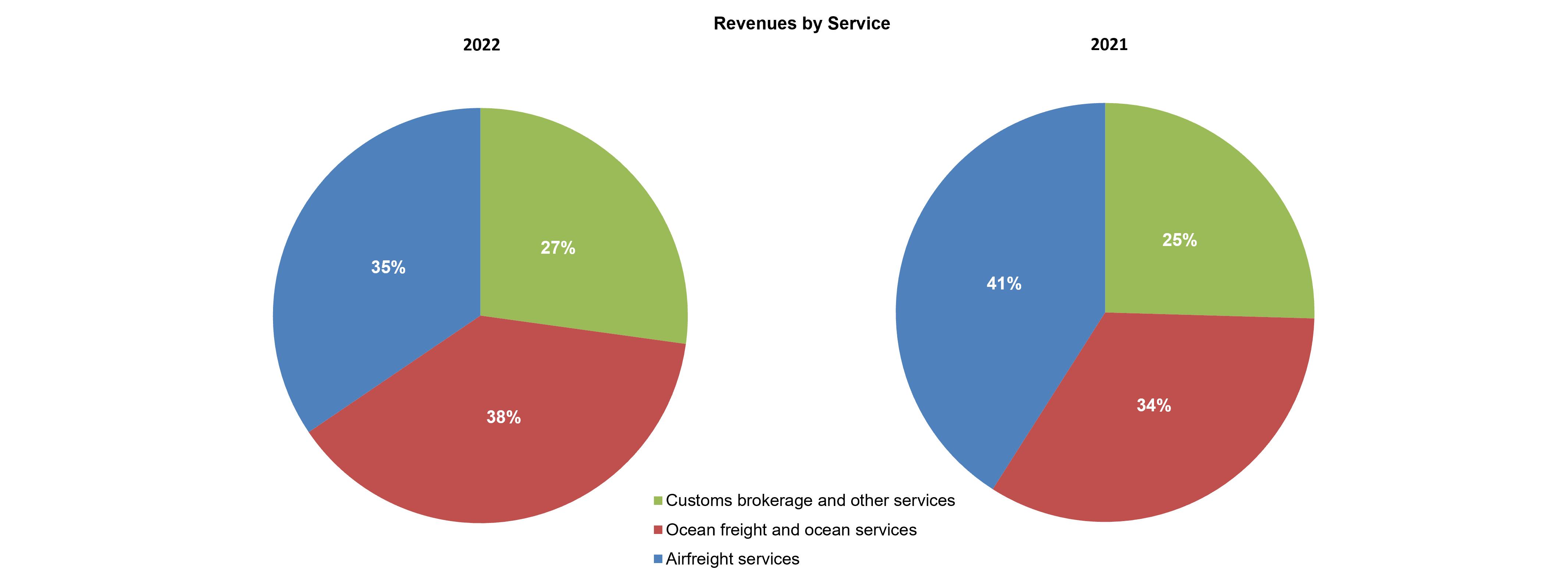
The following chart shows our 2022 revenues by service type:
The Expeditors Network
Expeditors has approximately 20,000 employees and provides a complete range of global logistics services to a diversified group of customers that vary in size, industry and geographic location. As opportunities for profitable growth arise, we will continue to open new offices where it makes sense to support existing global customers and serve new local markets. As a knowledge-based global provider of logistics services, we have often concluded over the course of our history that it is better to grow organically rather than by acquisition. When we have made acquisitions, it has generally been to obtain technology, increase geographic coverage by acquiring or establishing joint ventures with agents or others within the industry, or gain specialized industry expertise that could be leveraged to benefit our entire network.
Expeditors, includi
Showing the first 8K of 62K characters. Open the full section
Item 1A. RISK FACTORS
In addition to the other information set forth in this report, you should carefully consider the following factors, which could materially affect our business, financial condition or results of operations in future periods. The risks described below are not the only risks facing our Company. Additional risks not currently known to us or that we currently deem to be immaterial also may materially adversely affect our business, financial condition or results of operations in future periods.
COVID-19 Risks
COVID-19 significantly impacted worldwide economic conditions and global trade and may continue to have a disruptive effect on our operations, and the operations of our service providers and our customers, which may further impact our business.
We may be impacted by residual effects of the COVID-19 pandemic or a new and similarly disruptive global health emergency. In early 2020, COVID-19 was declared a global health emergency and later declared a global pandemic by the World Health Organization, prompting governments around the world to mandate lockdowns and other restrictions that had direct impacts on international trade. The COVID-19 pandemic and various government reactions to it contributed to shortages of labor and capacity, and increased costs that continue to impact our operations. While many of the COVID-19 restrictions have been eased or discontinued entirely, various protocols and policies continue to be implemented or contemplated in early 2023, as a resurgence of COVID-19 remains a possibility. There is no guarantee that a continuation or resurgence of COVID-19 or a variant, or a similarly disruptive health emergency, would impact us similar to how COVID-19 has impacted our operations since 2020. Any significant disruption on the scale of the COVID-19 pandemic over an extended period could negatively affect our business and our financial results. Such a disruption could also have the effect of heightening many of the other risks described below.
We rely on service providers, such as air, ocean and ground freight carriers, and if they become financially unstable or have reduced capacity to provide service because of COVID-19 or other factors, it may adversely impact our business and operating results.
As a non-asset-based provider of global logistics services, Expeditors depends on a variety of carriers and other service providers, including air, ocean and ground freight carriers. The quality and profitability of our services depend upon effective selection and oversight of our service providers. During the pandemic, air carriers have been particularly affected having to cancel flights due to travel restrictions resulting in dramatic drops in revenues, historical losses, high leverage and liquidity challenges. Uncertainty over recovery of demand for passenger air travel, in particular business travel, to pre-pandemic levels means air carriers’ operations and financial stability may be adversely affected long term. Additionally, several industry service providers, including ocean carriers, have consolidated, with the potential for more to occur in the future. Disruptions such as COVID-19 place significant stress on our air, ocean and freight ground carriers, as well as other service providers, which may result in reduced carrier capacity or availability, pricing volatility or more limited carrier transportation schedules and other services that we utilize, which could adversely impact our operations and financial results.
Global economic uncertainty impacted trade and could affect demand for our services or the financial stability of our service providers and customers.
The global economy entered a recession as a result of the pandemic, which initially affected trade and negatively affected demand for our services for a period of time, before rebounding in 2021 and continuing into 2022. Future unfavorable economic conditions, rising interest rates and high inflation could result in lower freight volumes, reduced sell rates, higher operating expenses and may adversely affect Expeditors' revenues, operating results and cash flows. These conditions, should they occur for an extended period of time, could adversely affect our customers and service providers. Should our customers’ ability to pay deteriorate, additional credit losses may be incurred.
Industry Risks
Any reduction in international commerce or disruption in global trade may adversely impact our business and operating results.
Expeditors primarily provides services to customers engaged in international commerce. Everything that affects international trade has the potential to expand or contract our primary market and adversely impact our operating results. For example, international trade is influenced by:
currency exchange rates and currency control regulations;
interest rate fluctuations;
changes and uncertainties in governmental policies and inter-governmental disputes, which could result in increased tariff rates, quota restrictions, trade barriers and other types of restrictions;
changes in and application of international and domestic customs, trade and security regulations;
wars, strikes, civil unrest, acts of terrorism, and other conflicts;
changes in labor and other costs, including the impacts of inflation;
increased global concerns regarding working conditions and environmental sustainability;
changes in consumer attitudes regarding goods made in countries other than their own;
changes in availability of credit; and
changes in the price and readily available quantities of oil and other petroleum-related products.
Our industry is highly competitive, and failure to compete or respond to customer requirements could damage our business and results of operations.
The global logistics services industry is intensely competitive and is expected to remain so for the foreseeable future. There are a large number of companies competing in one or more segments of the industry, but the number of firms with a global network that offer a full complement of logistics services is more limited. Nevertheless, many of these competitors have significantly more resources than Expeditors and may pursue acquisition opportunities and are developing new technologies to gain competitive advantages. Depending on the location of the shipper and the importer, we must compete against niche players, larger entities including carriers, and emerging technology companies. The primary competitive factors are price and quality of service. Many larger customers utilize the services of multiple logistics providers. Customers regularly solicit bids from competitors in order to improve service and to secure favorable pricing and contractual terms such as: longer payment terms; fixed-price arrangements; higher or unlimited liability limits; heightened cybersecurity and data privacy obligations; and performance penalties. Increased competition and competitors' acceptance of expanded contractual terms coupled with customers’ dissatisfaction with elevated rates, scarce capacity, and extended transit times could result in loss of business, reduced revenues, reduced margins, higher operating costs or loss of market share, any of which would damage our results of operations, cash flows and financial condition.
Operational Risks
We are dependent on our personnel and any inability to hire, develop or retain our key employees may have a negative impact on our operations.
In the long term, identifying, recruiting, hiring, training, and retaining employees is essential to our ability to operate and deliver our services, ability to grow and ultimately our future profitability. The global pandemic caused disruptions to our work environment by requiring the majority of employees to work remotely during the height of the pandemic. As pandemic restrictions eased, we required employees to return to the office. As a result, for those individuals that prefer working remotely, we may experience a higher degree of turnover of key employees and lower employee satisfaction in the near future. Further, this could inhibit our ability to identify, recruit, and hire new employees over time. We cannot predict how this may affect employees’ habits, preferences nor the impact it may have on our Company’s culture and our ability to continue to retain and attract talented employees who have become accustomed to a remote work environment. Additionally, we may incur higher compensation-related expense to recruit and retain and incur additional significant expense to hire third parties to perform tasks that have historically been performed by our employees.
We believe that our compensation programs are among the unique characteristics responsible for differentiating our performance from that of many of our competitors. Significant changes to compensation programs or significant declines in our operating income or operating losses could impact our ability to attract and retain key personnel.
Effective succession planning is an important element of our programs. Failure to ensure an effective transfer of knowledge and smooth transitions involving key employees could adversely affect our business by hindering our ability to execute our business strategies and impacting our level of service. We must continue to develop and retain management personnel to address issues of succession planning.
The pandemic caused significant disruptions in global supply chain operations that were further exacerbated by congestion at destination ports and shortages of equipment, labor and warehouse space. In response to these conditions, we hired additional employees in 2021 and 2022 to be able to service customers and navigate through these challenges. Though these disruptions substantially cleared by the fourth quarter of 2022, our number of employees at December 31, 2022, remain at historically high levels.
In the short term, any reductions in our workforce could result in significant additional expenses. Conversely, a failure to reduce compensation expense and other expenses in periods when the business environment does not support our workforce level will result in substantially lower compensation earned by the majority of employees. This may challenge our ability to retain and attract key employees to conduct our business successfully. We cannot predict how management’s responses to these challenges will ultimately impact our Company culture, financial position, results of operations and cash flows nor our ability to successfully attract and retain key employees in the future.
We rely heavily upon the flexibility and sophistication of the technologies used in our core business and failure to properly manage, enhance and update technologies could lead to disruptions in our operations or our ability to remain competitive.
Expeditors relies heavily and must compete based upon the flexibility and sophistication of the technologies utilized in performing our core businesses. Future results depend on our success in developing competitive and reliable systems to address the needs of our customers and suppliers. Development and maintenance of these systems must be accomplished in a cost-effective manner and support the use of secure protocols, including integration and availability of third-party technology. We are continually enhancing our systems, including significant upgrades to core operating and accounting systems. These efforts are inherently complex and if not managed properly could lead to disruptions in our operations or our ability to remain competitive.
Any significant disruptions to our network and systems continuity could have an adverse impact to our business and financial results.
As Expeditors, our customers and suppliers continue to increase reliance on systems, and as additional features are added, the risks also increase. Any significant disruptions to our global systems or the internet for any reason, which could include equipment or network failures; co-location facility failures; power outages; sabotage; employee error or other actions; cyber-attacks or other security breaches; reliance on third party technology; geo-political activity or natural disasters; all of which could have a material negative effect on our results. In February 2022, we were the subject of a targeted cyber-attack. Upon discovering the incident, we shut down most of our operating systems globally to manage the safety of our overall global systems environment. This shutdown and any such future events will result in loss of revenue; business disruptions (such as the inability to timely process shipments); and significant remediation costs. This cyber-attack, or any future cyber-attack could also result in increased vulnerability to attempts of fraud, legal claims and proceedings including potential breach of contract claims, reporting delays or errors; interference with regulatory reporting; an increase in costs to protect our systems and technology; or damage to our reputation.
We rely on service providers, including air, ocean, ground freight carriers and others, and if they have insufficient capacity available relative to market demand, or reduce our capacity allotments, it may adversely impact our business and operating results.
As a non-asset-based provider of global logistics services, Expeditors depends on a variety of carriers and other service providers, including air, ocean and ground freight carriers. Our ability to deliver our services depends on service providers having sufficient capacity available to purchase. When market demand significantly exceeds available capacity in a given market, which was the case for various services and markets at the beginning of the pandemic in 2020 and that continued through the first half of 2022, we may not always be able to find acceptable transportation or other service solutions to meet our customers’ needs or the routing and delivery of freight may be subject to delays that are outside of our control. Quality customer service is a key element of the Company’s success, and such challenges in meeting our customers’ needs and requirements may result in loss of business and consequently negatively affect our operating results.
Failure to grow and gain profitable market share could adversely impact our ability to remain competitive and could adversely impact our business.
Expeditors has historically relied primarily upon organic growth and has tended to avoid growth through acquisition. Future results will depend upon our ability to anticipate and adapt to constantly evolving supply chain requirements and innovations. To continue to grow organically, we must gain profitable market share in a highly competitive environment and successfully develop and market new service offerings. When investment opportunities arise, our success could be dependent on our ability to evaluate and integrate acquisitions.
Any disruption of our business caused by a catastrophic event, could harm our ability to conduct normal business operations and impact our operating results.
A disruption or failure of Expeditors' systems or operations in the event of a major earthquake, weather event, cyber-attack, terrorist attack, strike, civil unrest, mass population dislocations, pandemic or other catastrophic event could cause delays in providing services or performing other mission-critical functions. Our corporate headquarters and certain other critical business operations are in the Seattle, Washington area, which is near major earthquake faults. A catastrophic event that results in the destruction or disruption of any of our critical business or information technology systems could harm our ability to conduct normal business operations and our operating results. See “Any significant disruptions to our network and systems continuity could have an adverse impact to our business and financial results” above*.*
We face risks associated with the handling of customer inventory
Under some of our agreements, we maintain the inventory of our customers, some of which may be significant in value. Our failure to properly handle and safeguard such inventory exposes us to potential claims and expenses as well as harm to our business and reputation.
Our insurance coverage does not cover all potential losses and significant uninsured losses could adversely impact our financial results.
We carry insurance coverage for property damage, personal injury and other insurable events resulting from certain events such as fire, accidents, and other perils under extended coverage policies. Our insurance coverages contain policy specifications and insured limits customarily carried for similar locations, business activities and markets. We believe we are adequately insured. Certain losses, however, including losses from floods, earthquakes, acts of war, acts of terrorism or riots, cybersecurity events and pandemics, generally are not insured against or not fully insured against because it is not deemed economically feasible or prudent to do so. If an uninsured loss or a loss in excess of insured limits occurs with respect to one or more of our facilities in the future, we could experience a significant loss of assets, including customer inventory, and future operations could be harmed resulting in a loss of revenues or higher claims and operating expenses.
Furthermore, we cannot be sure that the insurance companies will be able to continue to offer products with sufficient coverage at commercially reasonable rates. If we experience a loss that is uninsured or that exceeds insured limits, then we could incur additional expenses or a loss of future revenues from a facility that is damaged. Any such losses or higher insurance costs could adversely affect our business.
Difficulty in forecasting timing or volumes of customer shipments or rate changes by carriers could adversely impact our margins and operating results.
Expeditors is not aware of any accurate means of forecasting short-term customer requirements. However, long-term customer satisfaction depends upon our ability to meet these unpredictable short-term customer requirements. Personnel costs, our single largest expense, are always less flexible in the very near term as we must staff to meet uncertain demand. As a result, short-term operating results could be disproportionately affected.
A significant portion of Expeditors' revenues is derived from customers in retail and technology industries whose shipping patterns are tied closely to consumer demand and from customers in industries whose shipping patterns are dependent upon just-in-time production schedules. Therefore, the timing of our revenues is, to a large degree, impacted by factors out of our control, such as a sudden change in consumer demand for retail goods, changes in trade tariffs, product launches and/or manufacturing production delays. Additionally, many customers ship a significant portion of their goods at or near the end of a quarter, and therefore, we may not learn of a shortfall in revenues until late in a quarter. To the extent that a shortfall in revenues or earnings was not expected by securities analysts or investors, any such shortfall from levels predicted by securities analysts or investors could have an immediate and adverse effect on the trading price of our stock.
Volatile market conditions can create situations where rate increases charged by carriers and other service providers are implemented with little or no advance notice. We often cannot pass these rate increases on to our customers in the same time frame, if at all. As a result, our yields and margins can be negatively impacted.
Climate change, including measures to address climate change, could adversely impact our business and financial results.
The long-term effects of climate change are difficult to predict and may be widespread. The impacts of climate change may include physical risks (such as rising sea levels, which could affect port operations or frequency and severity of extreme weather conditions, which could disrupt our operations and damage cargo and our facilities), compliance costs and transition risks (such as increased regulation and taxation to support carbon emissions reduction investments), shifts in customer demands (such as customers requiring more fuel efficient transportation modes or transparency to carbon emissions in their supply chains) and customer contractual requirements around environmental initiatives and other adverse effects. Our non-asset-based model gives us a flexibility and an ability to change locations, modes, and carriers based on evolving operating conditions, however, such impacts may disrupt our operations by adversely affecting our ability to procure services that meet regulatory or customer requirements, depending on the availability of sufficient appropriate logistics solutions.
In addition, the increasing concern over climate change has resulted and may continue to result in more regulations relating to climate change, including regulating greenhouse gas emissions, restrictions on modes of transportation, alternative energy policies and sustainability initiatives, such as the FuelEU Maritime initiative. If legislation or regulations are enacted or promulgated in the United States or in any other jurisdictions in which we operate, that impose more stringent restrictions and requirements than our current legal or regulatory obligations, we may experience disruptions in, or increases in the costs associated with delivering our services, which may negatively affect our operating our results of operations, cash flows and financial condition.
Government Regulation and Tax Risks
We are subject to a complex regulatory environment, and failure to comply with and adapt to these regulations could result in penalties or otherwise adversely impact our business.
Expeditors is affected by ever increasing regulations from a number of sources in the United States and in foreign locations in which we operate. Many of these regulations are complex and require varying degrees of interpretation, including those related to handling dangerous and hazardous materials, trade compliance, data privacy, environmental, employment, compensation and competition, and may result in unforeseen costs.
In reaction to the continuing global terrorist threat, governments around the world are continuously enacting or updating security regulations. These regulations are multi-layered, increasingly technical in nature and characterized by a lack of harmonization of substantive requirements among various governmental authorities. Furthermore, the implementation of these regulations, including deadlines and substantive requirements, can be driven by regulatory urgencies rather than industry's realistic ability to comply.
Failure to consistently and timely comply with these regulations, or the failure, breach or compromise of our policies and procedures or those of our service providers or agents, may result in increased operating costs, damage to our reputation, difficulty in attracting and retaining key personnel, restrictions on operations or fines and penalties.
We operate globally and any inability to safeguard our operations or comply with anti-corruption laws and trade compliance regulations would adversely impact our reputation and business.
The majority of Expeditors' revenues and operating income comes from operations conducted outside the United States. To maintain a global service network, we may be required to operate in hostile locations and in dangerous situations. Doing business in foreign locations also subjects us to a variety of risks and considerations not normally encountered by domestic enterprises.
In addition, we operate in parts of the world where common business practices could constitute violations of the anti-corruption laws, rules, regulations and decrees of the United States and of other countries in which we conduct business, including the U.S. Foreign Corrupt Practices Act and the UK Bribery Act; as well as trade and exchange control laws, or laws, regulations and Executive Orders imposing embargoes and sanctions; and anti-boycott laws and regulations. Compliance with these laws, rules, regulations and decrees is dependent on our employees, service providers, agents, third party brokers and customers, whose individual actions could violate these laws, rules, regulations and decrees. Failure to comply could result in substantial penalties and additional expenses, damage to our reputation and restrictions on our ability to conduct business.
We are subject to taxation in multiple jurisdictions, and although we believe our tax estimates are reasonable, any adverse determinations in tax audits could negatively impact our financial results.
Expeditors is subject to income and non-income taxation in the United States (Federal, state and local) as well as many foreign jurisdictions including the People’s Republic of China, including Hong Kong, Taiwan, Vietnam, India, Mexico, Canada, Netherlands and the United Kingdom. In many of these jurisdictions, the tax laws are very complex and are open to different interpretations and application. Tax authorities frequently implement new taxes and change their tax rates and rules, including interpretations of those rules. The timing of the resolution of income and non-income tax examinations can be highly uncertain, and the amounts ultimately paid, if any, upon resolution of the issues raised by the taxing authorities may differ from the amounts recorded.
It is reasonably possible that within the next twelve months we will undergo further audits and examinations by various tax authorities and possibly may reach resolution related to income tax examinations covering one or more jurisdictions and years. In recent years, the United States and other foreign governments have made significant changes to tax laws, and more changes are anticipated in future periods. Often, those changes are subject to the issuance of new regulations and interpretations, which adds complexity and uncertainty in calculating tax liabilities. We are regularly under audit by tax authorities, including transfer pricing inquiries. Although we believe our tax estimates are reasonable, the final determination of tax audits, including any potential penalties and interest, could be materially different from our tax provisions and accruals and negatively impact our financial results. We cannot currently provide an estimate of the range of possible outcomes.
Current economic and political conditions make tax laws and regulations, or their interpretation and application, in any jurisdiction subject to significant change. Changes in tax laws or statutory tax rates, competing tax regimes, variability in the mix of pretax earnings we generate in the U.S, as compared to other countries, or new taxes in the United States or foreign jurisdictions could result in additional tax liabilities, or increased volatility in our effective tax rate and total tax expense.
General Risks
Investigations and litigation could require management time and or incur substantial legal costs or fines, penalties or damages, any of which could adversely impact on our financial results.
As a multinational corporation, Expeditors is subject to formal or informal investigations from governmental authorities or others in the countries in which we do business. In addition, we may become subject to civil litigation with our customers, service providers and other parties with whom we do business. These investigations and litigation may require significant management time and could cause us to incur substantial additional legal and related costs, which may include fines, penalties or damages that could have a materially adverse impact on our financial results.
We identified a material weakness in our internal control related to an ineffective information technology general control which, if not remediated appropriately or timely, could result in loss of investor confidence and adversely impact our stock price.
Internal controls related to the operation of technology systems are critical to maintaining adequate internal control over financial reporting. As disclosed in Part II, Item 9A, during the fourth quarter of 2022, management identified a material weakness in internal control related to certain database changes made to an information technology (IT) system that supports the Company’s financial reporting processes. As a result, management concluded that our internal control over financial reporting was not effective as of December 31, 2022. Subsequent to the identification of the material weakness and prior to the issuance of these financial statements included in this Form 10-K, the Company (i) performed a lookback review of all direct changes made to the database subject to the control operating ineffectiveness for the full year 2022, and (ii) conducted supplemental procedures and found no evidence of improper changes or changes with direct or consequential impact on internal controls over financial reporting. As a result of identifying this issue, management will be implementing certain enhancements designed to strengthen IT program change management processes and will continue to conduct monthly supplemental lookback review procedures of direct database changes until improvements are fully in place. We expect that such enhancements will be completed prior to the end of 2023. To the extent management is unable to remediate the identified issue timely, our ability to record, process and report financial information accurately, and to prepare financial statements within required time periods, could be adversely affected, which could subject us to litigation or investigations requiring management resources and payment of legal and other expenses, negatively affect investor confidence in our financial statements and adversely impact our stock price.
Item 1B. UNRESOLVED STAFF COMMENTS
Not applicable.
Item 2. PROPERTIES
Expeditors’ corporate headquarters are located in Seattle, Washington. We conduct operations in approximately 440 locations worldwide, of which approximately 100 are in the United States and 19 are owned. These owned and leased locations are primarily located close to an airport, ocean port, or on an important border crossing. These facilities are strategically located to cover the geographic areas served by Expeditors. The majority of these facilities contain warehouse facilities. We will from time to time investigate the possibility of building or buying suitable facilities. We believe that current leases can be extended and that suitable alternative facilities are available in the vicinity of each present facility should extensions be unavailable at the conclusion of current leases.
Item 3. LEGAL PROCEEDINGS
Expeditors is involved in claims, lawsuits, government investigations and other legal matters that arise in the ordinary course of business and are subject to inherent uncertainties. Currently, in management's opinion and based upon advice from legal advisors, none of these matters are expected to have a significant effect on our operations, cash flows or financial position. In 2022, amounts recorded for claims, lawsuits, government investigations and other legal matters are not significant to our operations, cash flows or financial position. At this time, we are unable to estimate any additional loss or range of reasonably possible losses, if any, beyond the amounts recorded, that might result from the resolution of these matters, including potential claims resulting from a cyber-attack in February 2022.
Item 4. MINE SAFETY DISCLOSURES
Not applicable.
PART II
Item 5. MARKET FOR REGISTRANT’S COMMON EQUITY, RELATED STOCKHOLDER MATTERS AND ISSUER PURCHASES OF EQUITY SECURITIES
Expeditors' common stock trades on The NASDAQ Global Select Market under the symbol EXPD.
There were 600 registered holders of record as of February 24, 2023. This figure does not include a substantially greater number of beneficial holders of our common stock, whose shares are held of record by banks, brokers and other financial institutions.
The Board of Directors declared semi-annual dividends per share during the two most recent fiscal years as follows:
| June 15, 2022 | $ | 0.67 | ||
| December 15, 2022 | $ | 0.67 | ||
| June 15, 2021 | $ | 0.58 | ||
| December 15, 2021 | $ | 0.58 |
ISSUER PURCHASES OF EQUITY SECURITIES
| Period | Total number of shares purchased | Average price paid per share | Total number of shares purchased as part of publicly announced plans | Maximum number of shares that may yet be purchased under the plans | ||||||||||||
| October 1-31, 2022 | — | $ | — | — | 9,134,478 | |||||||||||
| November 1-30, 2022 | 4,345,240 | $ | 113.00 | 4,345,240 | 4,901,190 | |||||||||||
| December 1-31, 2022 | 654,760 | $ | 111.14 | 654,760 | 4,312,871 | |||||||||||
| Total | 5,000,000 | $ | 112.76 | 5,000,000 | 4,312,871 |
In November 2001, under a Discretionary Stock Repurchase Plan, Expeditors' Board of Directors authorized the repurchase of our common stock in the open market to reduce the issued and outstanding stock down to 200 million shares. Subsequently, the Board of Directors has from time to time increased the amount of our common stock that may be repurchased. The Board of Directors last authorized repurchases from 150 million shares of common stock down to 140 million on February 20, 2023. The maximum number of shares available for repurchase under this plan will increase as the total number of outstanding shares increases. This authorization has no expiration date.
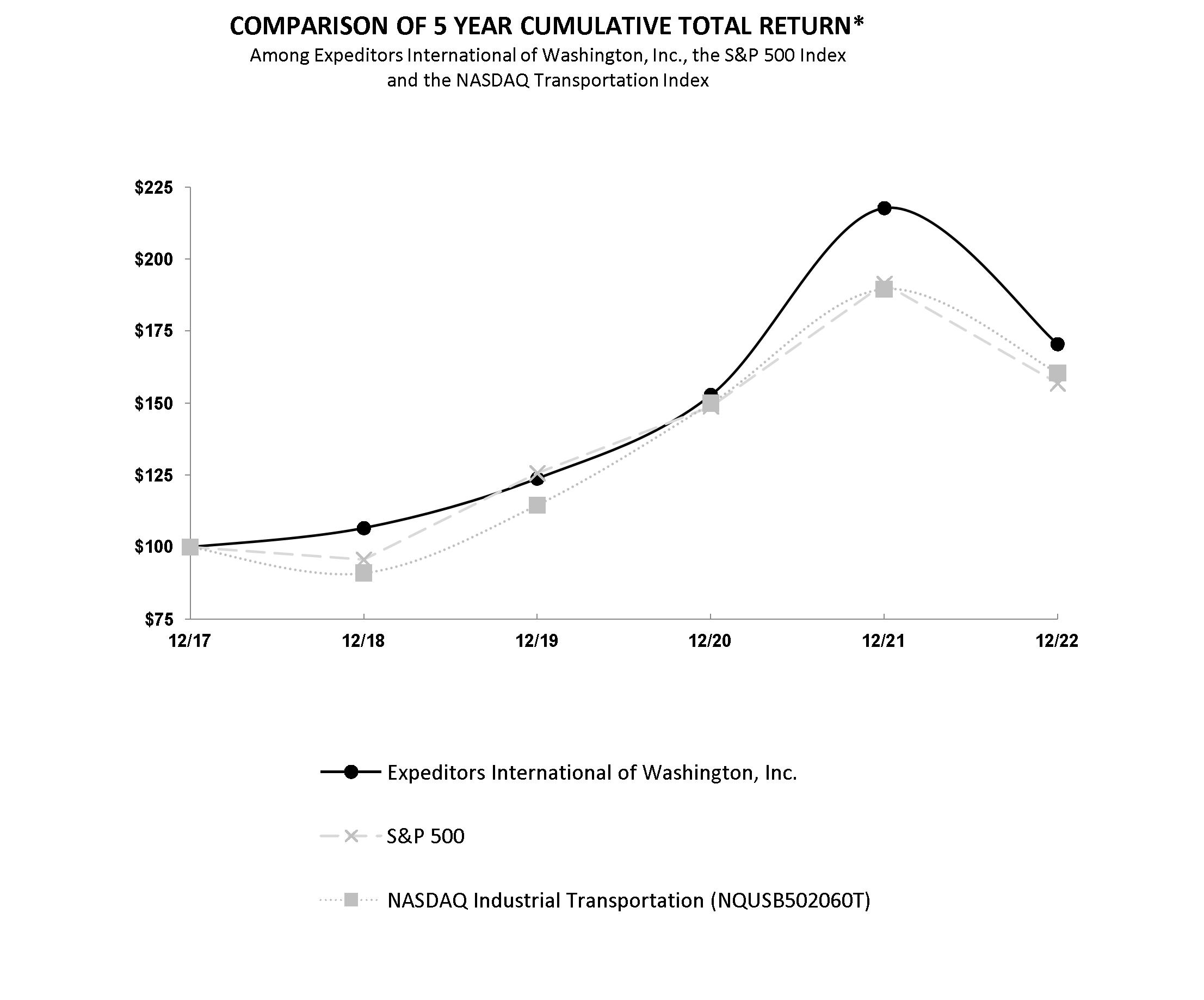
The graph below compares Expeditors International of Washington, Inc.'s cumulative 5-Year total shareholder return on common stock with the cumulative total returns of the S&P 500 index and the NASDAQ Industrial Transportation index (NQUSB502060T). The graph assumes that the value of the investment in our common stock and in each of the indexes (including reinvestment of dividends) was $100 on 12/31/2017 and tracks it through 12/31/2022. Total return assumes reinvestment of dividends in each of the indices indicated.
| 12/17 | 12/18 | 12/19 | 12/20 | 12/21 | 12/22 | |||||||||||||||||||
| Expeditors International of Washington, Inc. | $ | 100.00 | 106.52 | 123.75 | 152.77 | 217.73 | 170.51 | |||||||||||||||||
| Standard and Poor's 500 Index | 100.00 | 95.61 | 125.70 | 148.81 | 191.48 | 156.77 | ||||||||||||||||||
| NASDAQ Industrial Transportation (NQUSB502060T) | 100.00 | 90.96 | 114.55 | 149.90 | 189.54 | 160.39 |
The stock price performance included in this graph is not necessarily indicative of future stock price performance.
Item 6. [RESERVED]
Not applicable.
SAFE HARBOR FOR FORWARD-LOOKING STATEMENTS UNDER PRIVATE SECURITIES LITIGATION REFORM ACT OF 1995; CERTAIN CAUTIONARY STATEMENTS
This Annual Report on Form 10-K for the fiscal year ended contains “forward-looking statements,” as defined in Section 27A of the Securities Act of 1933, as amended, and Section 21E f the Securities Exchange Act of 1934, as amended. From time to time, Expeditors or its representatives have made or may make forward-looking statements, orally or in writing. Such forward-looking statements may be included in, but not limited to, press releases, presentations, oral statements made with the approval of an authorized executive officer or in various filings made by Expeditors with the Securities and Exchange Commission. Statements including those preceded by, followed by or that include the words or phrases “will”, likely result”, “are expected to”, "would expect", "would not expect", “will continue”, “is anticipated”, “estimate”, “project”, "provisional", "plan", "believe", "probable", "reasonably possible", "may", "could", "should", "would", "intends", "foreseeable future" or similar expressions are intended to identify “forward-looking statements” within the meaning of the Private Securities Litigation Reform Act of 1995. Such statements are qualified in their entirety by reference to and are accompanied by the discussion under Risk Factors in Item 1A of certain important factors that could cause actual results to differ materially from such forward-looking statements.
The risks included in Item 1A are not exhaustive. Furthermore, reference is also made to other sections of this report, including Management’s Discussion and Analysis of Financial Condition and Results of Operations in Item 7 and Quantitative and Qualitative Disclosures About Market Risk in Item 7A, which include additional factors that could adversely impact Expeditors' business and financial performance. Moreover, Expeditors operates in a very competitive, complex and rapidly changing global environment. New risk factors emerge from time to time and it is not possible for management to predict all of such risk factors, nor can it assess the impact of all of such risk factors on Expeditors' business or the extent to which any factor, or combination of factors, may cause actual results to differ materially from those contained in any forward-looking statements. Accordingly, forward-looking statements cannot be relied upon as a guarantee of actual results.
Shareholders should be aware that while Expeditors does, from time to time, communicate with securities analysts, it is against Expeditors' policy to disclose to such analysts any material non-public information or other confidential commercial information. Accordingly, shareholders should not assume that Expeditors agrees with any statement or report issued by any analyst irrespective of the content of such statement or report. Furthermore, Expeditors has a policy against issuing financial forecasts or projections or confirming the accuracy of forecasts or projections issued by others. Accordingly, to the extent that reports issued by securities analysts contain any projections, forecasts or opinions, such reports are not the responsibility of Expeditors.
Item 7. MANAGEMENT’S DISCUSSION AND ANALYSIS OF FINANCIAL CONDITION AND RESULTS OF OPERATIONS
Overview
Expeditors International of Washington, Inc. provides a full suite of global logistics services. Our services include air and ocean freight consolidation and forwarding, customs brokerage, warehousing and distribution, purchase order management, vendor consolidation, time-definite transportation services, temperature-controlled transit, cargo insurance, specialized cargo monitoring and tracking, and other supply chain solutions. We do not compete for overnight courier or small parcel business. As a non-asset-based carrier, we do not own or operate transportation assets.
We derive our revenues by entering into agreements that are generally comprised of a single performance obligation, which is that freight is shipped for and received by our customer. Each performance obligation is comprised of one or more of the Company's services. We typically satisfy our performance obligations as services are rendered over time. A typical shipment would include services rendered at origin, such as pick-up and delivery to port, freight services from origin to destination port and destination services, such as customs clearance and final delivery. Our three principal services are the revenue categories presented in our financial statements: 1) airfreight services, 2) ocean freight and ocean services, and 3) customs brokerage and other services. The most significant drivers of changes in gross revenues and related transportation expenses are volume, sell rates and buy rates. Volume has a similar effect on the change in both gross revenues and related transportation expenses in each of our three primary sources of revenue.
We generate the major portion of our air and ocean freight revenues by purchasing transportation services on a volume basis from direct (asset-based) carriers and then reselling that space to our customers. The rate billed to our customers (the sell rate) is recognized as revenues and the rate we pay to the carrier (the buy rate) is recognized in operating expenses as the directly related cost of transportation and other expenses. By consolidating shipments from multiple customers and concentrating our buying power, we are able to negotiate favorable buy rates from the direct carriers, while at the same time offering lower sell rates than customers would otherwise be able to negotiate themselves.
In most cases we act as an indirect carrier. When acting as an indirect carrier, we issue a House Airway Bill (HAWB), a House Ocean Bill of Lading (HOBL) or a House Seaway Bill to customers as the contract of carriage. In turn, when the freight is physically tendered to a direct carrier, we receive a contract of carriage known as a Master Airway Bill for airfreight shipments and a Master Ocean Bill of Lading (MOBL) for ocean shipments.
Customs brokerage and other services involve providing services at destination, such as helping customers clear shipments through customs by preparing and filing required documentation, calculating and providing for payment of duties and other taxes on behalf of customers as well as arranging for any required inspections by governmental agencies, and import services such as arranging for local pick up, storage and delivery at destinations. These are complicated functions requiring technical knowledge of customs rules and regulations in the multitude of countries in which we have offices. We also provide other value-added services at destination, such as warehousing and distribution, time-definitive transportation services and consulting.
We manage our company along five geographic areas of responsibility: Americas; North Asia; South Asia; Europe; and Middle East, Africa and India (MAIR). Each area is divided into sub-regions that are composed of operating units with individual profit and loss responsibility. Our business involves shipments between operating units and typically touches more than one geographic area. The nature of the international logistics business necessitates a high degree of communication and cooperation among operating units. Because of this inter-relationship between operating units, it is very difficult to examine any one geographic area and draw meaningful conclusions as to its contribution to our overall success on a stand-alone basis.
Our operating units share revenue using the same arms-length pricing methodologies that we use when our offices transact business with independent agents. Certain costs are allocated among the segments based on the relative value of the underlying services, which can include allocation based on actual costs incurred or estimated cost plus a profit margin. Our strategy closely links compensation with operating unit profitability, which includes shared revenues and allocated costs. Therefore, individual success is closely linked to cooperation with other operating units within our network. The mix of services varies by segment based primarily on the import or export orientation of local operations in each of our regions. North Asia is our largest export-oriented region and accounted for 34% of revenues, 39% of directly related cost of transportation and other expenses and 25% of operating income for the year ended December 31, 2022.
Highlights from 2022
Revenues and directly related operating expenses increased 3% and 4%, respectively, from higher average buy and sell rates, while operating income and net earnings to shareholders both declined 4% due to higher operating expenses.
Operational conditions remained challenging and uncertain in 2022. The COVID-19 pandemic, including the effect of ongoing quarantine requirements in China and resulting disruptions on supply chains, continued to affect our business operations and financial results. Imbalances between carrier available capacity and customer demand that were severe at the beginning of the year gradually eased throughout the year. Congestion at destination ports, shortages in equipment, labor and warehouse space that were significant at the beginning of the year cleared by the fourth quarter.
Volumes transacted in most services were down due to softening customer demand and from a slowdown in the global economy and retail customers' inventory build-up early in the year.
Average buy and sell rates, while still higher than historical levels, progressively declined throughout the year as imbalances between available capacity for transportation and demand and major port congestion have dissipated.
In the first quarter of 2022, our company was the subject of a targeted cyber-attack which resulted in having to shut down most of our connectivity, operating and accounting systems globally to manage the safety of our entire global systems environment. We had limited ability to conduct operations for a period of approximately three weeks, including but not limited to arranging for shipments of freight or managing customs and distribution activities for our customers’ shipments. While we continued to navigate residual effects and incorporate learnings from the cyber-attack, our core systems were utilized to deliver our services from the second quarter and on. We incurred additional expenses of $65 million, net of recoveries, and experienced a loss of revenues that cannot be quantified as a result of this attack.
Operating cash flows were $2,130 million and we returned $1,796 million to shareholders through common stock repurchases and dividends.
Industry trends, trade conditions and competition
We operate in over 60 countries in the competitive global logistics industry and our activities are closely tied to the global economy. International trade is influenced by many factors, including economic and political conditions in the United States and abroad, currency exchange rates, laws and policies relating to tariffs, trade restrictions, foreign investment and taxation. Periodically, governments consider a variety of changes to tariffs and impose trade restrictions and accords. Currently, the United States and China have increased concerns affecting certain imports and exports and have implemented additional tariffs. We cannot predict the outcome of changes in tariffs, or interpretations, and trade restrictions and accords and the effects they will have on our business. As governments implement restrictions on imports and exports, manufacturers may change sourcing patterns, to the extent possible, and, over time, may shift manufacturing to other countries. Doing business in foreign locations also subjects us to a variety of risks and considerations not normally encountered by domestic enterprises. In addition to being influenced by governmental policies and inter-governmental disputes concerning international trade, our business may also be negatively affected by political developments and changes in government personnel or policies in the United States and other countries, as well as economic turbulence, political unrest and security concerns in the nations and on the trade shipping lanes in which we conduct business and the future impact that these events may have on international trade, oil prices and security costs. We do not have employees, assets, or operations in Russia or Ukraine. While very limited, any shipment activity is conducted with independent agents in those countries in compliance with all applicable trade sanctions, laws and regulations.
Our ability to provide services to our customers is highly dependent on good working relationships with a variety of entities, including airlines; ocean carrier lines and ground transportation providers, as well as governmental agencies. We select and engage with best-in-class, compliance-focused, efficiently run, growth-oriented partners, based upon defined value elements and are intentional in our relationship and performance management activity, reinforcing success by awarding service providers who consistently achieve at the highest levels with additional business. We consider our current working relationships with these entities to be satisfactory. However, changes in the financial stability and operating capabilities and capacity of asset-based carriers, capacity allotments available from carriers, governmental regulation or deregulation efforts, modernization of the regulations governing customs brokerage, and/or changes in governmental restrictions, quota restrictions or trade accords could affect our business in unpredictable ways. Many air carriers are recovering from significant cash flow challenges and record operating losses incurred in 2020 and 2021 as a result of travel restrictions resulting in cancellation of flights. Uncertainty over recovery of demand for trans-pacific passenger air travel, in particular business travel, compared to pre-pandemic levels may impact air carriers’ operations and financial stability long term. When the market experiences seasonal peaks or any sort of disruption, the carriers often increase their pricing suddenly. This carrier behavior creates pricing volatility that could impact Expeditors' ability to maintain historical unitary profitability.
The global economic and trade environments remain uncertain, including the potential future impacts of the pandemic, higher inflation and oil prices, rising interest rates and the conflict in Ukraine. Starting in the second quarter and continuing through the fourth quarter, we saw a slowdown in the global economy and a softening of customer demand resulting in declines in average buy and sell rates. As demand softened and pandemic restrictions subsided, port congestion cleared, availability of labor and equipment eased resulting in excess carrier capacity over demand. These conditions could result in further declines in average sell and buy rates in 2023. We also expect that pricing volatility will continue as carriers adapt to lower demand, changing fuel prices and react to governmental trade policies and other regulations. Additionally, we cannot predict the direct or indirect impact that further changes in and purchasing behavior, such as online shopping, could have on our business. In response to governments implementing higher tariffs on imports, as well as responses to the pandemic’s disruptions, some customers have begun shifting manufacturing to other countries which could negatively impact us.
Critical Accounting Estimates
Our consolidated financial statements and accompanying notes are prepared in accordance with accounting principles generally accepted in the United States (U.S. GAAP). Preparing our consolidated financial statements requires management to make estimates and assumptions that affect the reported amounts of assets, liabilities and expenses. A summary of our significant accounting policies can be found in Note 1 to the consolidated financial statements in this report. Management believes that the nature of our business is such that there are few complex challenges in accounting for operations. While judgments and estimates are a necessary component of any system of accounting, the use of estimates is limited primarily to accrual of loss contingencies, accrual of various tax liabilities and contingencies, accrual of insurance liabilities for the portion of the related exposure that we have self-insured, and accounts receivable valuation.
These estimates, other than the accrual of loss contingencies and tax liabilities and contingencies, are not highly uncertain and have not historically been subject to significant change. Management believes that the methods utilized in all of these areas are non-aggressive in approach and consistent in application, and that there are limited, if any, alternative accounting principles or methods which could be applied to these transactions. While the use of estimates means that actual future results may be different from those contemplated by the estimates, management believes that alternative principles and methods used for making such estimates would not produce materially different results than those reported.
The outcome of loss contingencies, including legal proceedings and claims and government investigations, brought against us are subject to significant uncertainty. An estimated loss from a contingency, including a legal or tax proceeding, claim, government investigation or audit, or a customer claim, is recorded by a charge to income if it is probable that an asset has been impaired, or a liability has been incurred and the amount of the loss can be reasonably estimated. Disclosure of a loss contingency is made if there is at least a reasonable possibility that a significant loss has been incurred. In determining whether a loss should be recorded, management evaluates several factors, including advice from outside legal counsel and qualified tax advisors, in order to estimate the likelihood of an unfavorable outcome and to make a reasonable estimate of the amount of loss or range of reasonably possible loss. Changes in these factors could have a material impact on our financial position, results of operations and operating cash flows for any particular quarter or year.
Accounting for income taxes involves significant estimates and judgments. We are subject to taxation in various states and in many foreign jurisdictions including the People’s Republic of China, including Hong Kong, Taiwan, Vietnam, India, Mexico, Canada, Netherlands and the United Kingdom. Management believes that our tax positions, including intercompany transfer pricing policies, are reasonable and are consistent with established transfer pricing methodologies and norms. We are under, or may be subject to, audit or examination and assessments by the relevant authorities in respect of these particular jurisdictions primarily for 2009 and thereafter. Sometimes audits and examinations result in proposed assessments where the ultimate resolution could result in significant additional tax, penalties and interest payments being required. We establish liabilities when, despite our belief that the tax return positions are appropriate and consistent with tax law, we conclude that we may not be successful in realizing the tax position. In evaluating a tax position, we determine whether it is more likely than not that the position will be sustained upon examination, including resolution of any related appeals or litigation processes, based on the technical merits of the position and in consultation with qualified tax advisors.
The total amount of our income and non-income tax contingencies may increase in 2023. In addition, changes in state, federal, and foreign tax laws and changes in interpretations of these laws may increase our existing tax contingencies. The timing of the resolution of tax examinations can be highly uncertain, and the amounts ultimately paid, if any, upon resolution of the issues raised by the taxing authorities may differ significantly from the amounts recorded. It is reasonably possible that within the next 12 months we may undergo further audits and examinations by various tax authorities, and it is also possible that we may reach resolution related to income tax and non-income tax examinations in one or more jurisdictions. These assessments or settlements could result in changes to our contingencies related to positions on tax filings in future years and may increase the amount of tax expense we recognize as well as the potential for penalties and interest being incurred. Our estimate of any ultimate tax liability contains assumptions based on our experience, judgments about potential actions by taxing jurisdictions as well as judgments about the likely outcome of issues that have been raised by the taxing jurisdiction. Though we believe the estimates and assumptions used to support the evaluation of our tax positions are reasonable, the actual amount of any change could vary significantly depending on the ultimate timing and nature of its resolution. We cannot currently provide an estimate of the range of possible outcomes.
As discussed in Note 1.G to the consolidated financial statements, earnings of our foreign subsidiaries are not considered to be indefinitely reinvested outside of the United States. U.S. corporate income tax laws and regulations include a territorial tax framework and provisions for Global Intangible Low-Taxed Income (GILTI) under which taxes on foreign income are imposed on the excess of a deemed return on tangible assets of certain foreign subsidiaries, Base Erosion and Anti-Abuse Tax (BEAT) under which taxes are imposed on certain base eroding payments to affiliated foreign companies as well as U.S. income tax deductions for Foreign-derived intangible income (FDII). Our effective tax rate is significantly impacted by the mix of pretax earnings that we generate in the U.S. as compared to countries in the rest of the world, and the tax rates in effect in those locations relative to the pre-tax earnings generated in those countries and jurisdictions. We believe it is reasonably possible that many countries and jurisdictions will increase their tax rates or otherwise implement tax reforms that would be expected to increase the total tax expense that we will incur in those locations. Our effective tax rate will continue to be impacted by any discrete items for events occurring in a future period or future changes in tax regulations and related interpretations.
Results of Operations
This section of this Form 10-K generally discusses year-to-year comparisons between the results of operations for the year ended December 31, 2022 compared to the year ended December 31, 2021. For a discussion of the year ended December 31, 2021 compared to the year ended December 31, 2020, please refer to Part II, Item 7, “Management’s Discussion and Analysis of Financial Condition and Results of Operations” in our Annual Report on Form 10-K for the year ended December 31, 2021.
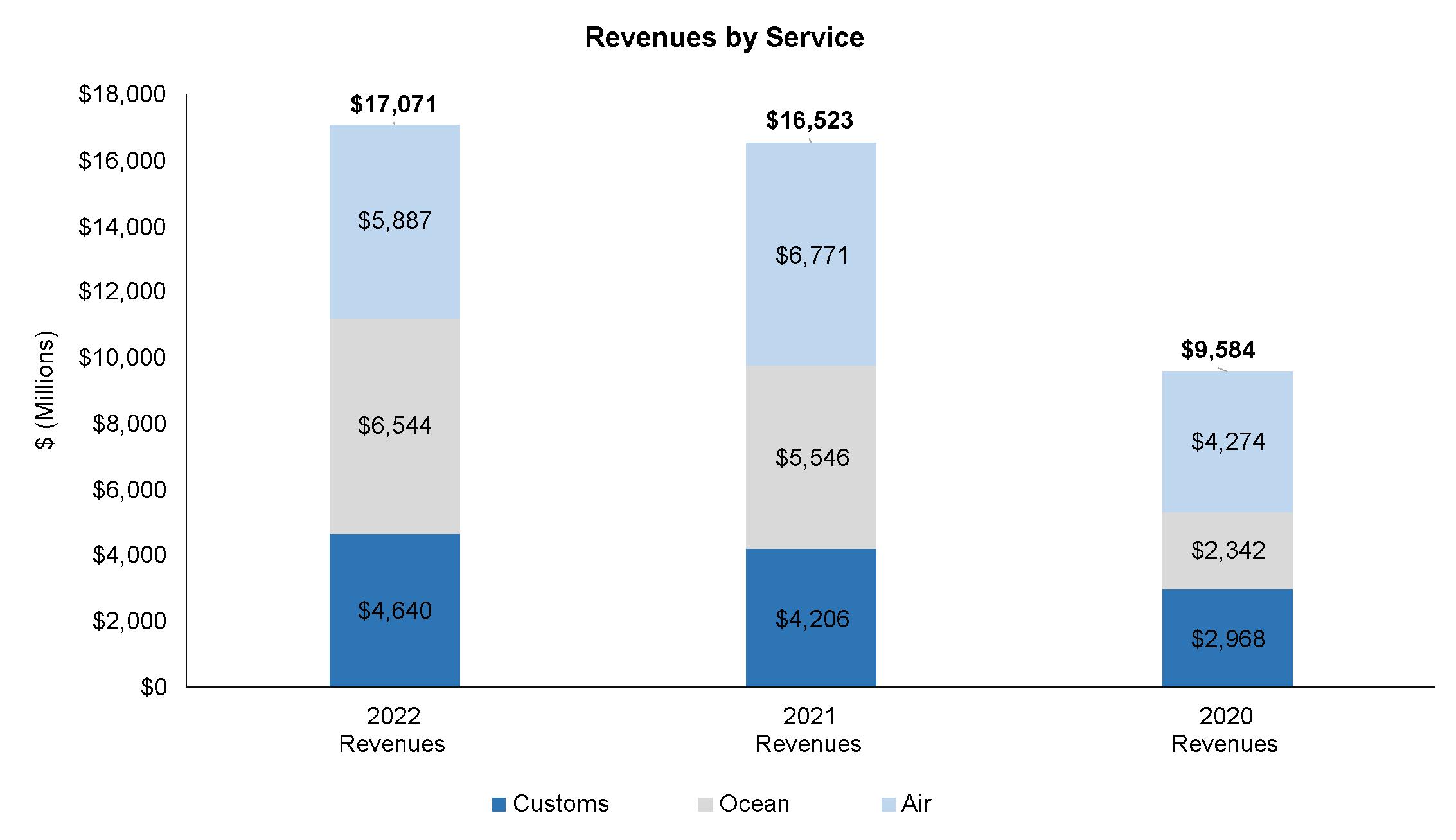
The following table shows the revenues, the directly related cost of transportation and other expenses for our principal services and our overhead expenses for 2022, 2021 and 2020. The table, chart and the accompanying discussion and analysis should be read in conjunction with the consolidated financial statements and related notes thereto in Part II, Item 8 of this report.
| Percentage change | ||||||||||||||
| In thousands | 2022 | 2021 | 2020 | 2022 vs. 2021 | ||||||||||
| Airfreight services: | ||||||||||||||
| Revenues | $ | 5,886,886 | $ | 6,771,402 | $ | 4,274,026 | (13)% | |||||||
| Expenses | 4,359,726 | 5,067,380 | 3,168,808 | (14)% | ||||||||||
| Ocean freight and ocean services: | ||||||||||||||
| Revenues | 6,544,559 | 5,545,818 | 2,342,344 | 18% | ||||||||||
| Expenses | 5,188,066 | 4,364,160 | 1,751,850 | 19% | ||||||||||
| Customs brokerage and other services: | ||||||||||||||
| Revenues | 4,639,839 | 4,206,297 | 2,968,023 | 10% | ||||||||||
| Expenses | 3,029,105 | 2,626,615 | 1,736,044 | 15% | ||||||||||
| Overhead expenses: | ||||||||||||||
| Salaries and related costs | 2,056,387 | 2,062,351 | 1,538,104 | — | ||||||||||
| Other | 613,629 | 493,685 | 449,150 | 24% | ||||||||||
| Total overhead expenses | 2,670,016 | 2,556,036 | 1,987,254 | 4% | ||||||||||
| Operating income | 1,824,371 | 1,909,326 | 940,437 | (4)% | ||||||||||
| Other income, net | 11,520 | 15,290 | 16,127 | (25)% | ||||||||||
| Earnings before income taxes | 1,835,891 | 1,924,616 | 956,564 | (5)% | ||||||||||
| Income tax expense | 475,286 | 505,771 | 258,350 | (6)% | ||||||||||
| Net earnings | 1,360,605 | 1,418,845 | 698,214 | (4)% | ||||||||||
| Less net earnings attributable to the noncontrolling interest | 3,206 | 3,353 | 2,074 | (4)% | ||||||||||
| Net earnings attributable to shareholders | $ | 1,357,399 | $ | 1,415,492 | $ | 696,140 | (4)% |
Airfreight services:
Airfreight services revenues and expenses decreased 13% and 14%, respectively, in 2022, as compared with 2021, due to a 17% decrease in tonnage offset by 3% increases in both average sell and buy rates, respectively. Volumes were lower in 2022 as a result of softening overall demand and compared to strong volumes in the same period in 2021 from customers converting to air shipments due to ocean port congestion. In 2022, demand for airfreight services softened compared to 2021 but rates remained high as available capacity was limited compared to pre-pandemic levels. Airlines increased passenger flight schedules as restrictions were lifted which added available belly space throughout 2022. Continued restrictions from the pandemic in China and other countries have resulted in airlines not increasing passenger flight schedules to pre-pandemic levels in certain lanes. Additionally, capacity was further limited due to the conflict in Ukraine and the related route restrictions in Asia and Europe lanes and sanctions on Russian carriers. In order to meet the transportation needs of our customers, we continued to purchase capacity in advance and on the spot market in the first half of the year.
Tonnage decreased in almost all regions due to softening demand, pandemic related lockdowns in China and downtime caused by the cyber-attack with the largest decrease coming from exports out of North Asia, South Asia and North America. Though we continued to process air shipments on a limited basis during the downtime caused by the cyber-attack, our volumes were negatively affected. Subsequent to the downtime in March, our volumes began to recover as customers gradually returned but were negatively affected through the second quarter. Average sell and buy rates started declining in the second half of the year and accelerated in the fourth quarter as demand softened from an overall slowdown in the economy and as more cargo capacity on passenger flights became available.
Compared to the fourth quarter of 2021, airfreight services revenues and expenses decreased 47% and 48%, respectively, due to 38% and 37% decreases in average sell and buy rates, respectively, and a 20% decrease in tonnage compared to high demand for airfreight while capacity was constrained in particular on exports from North Asia in 2021. Declines in tonnage and rates were most significant on export out of North Asia and South Asia. As air carriers bring back additional flights, in some cases ahead of passenger demand, supply and demand imbalances may occur, resulting in further pressure on rates.
The continued high average buy and sell rates caused by the pandemic and supply chain disruptions have significantly contributed to the growth in our revenues, expenses and operating income in 2021 and 2022. As experienced in the fourth quarter of 2022, these unprecedented disruptions improved as supply chain operations normalized. Buy rates and sell rates have been declining since the second quarter of 2022 and are expected to further decline in 2023, which could result in further decrease in our revenues, expenses and operating income. We are unable to predict how these uncertainties and any future disruptions will affect our future operations or financial results.
Ocean freight and ocean services:
Ocean freight consolidation, direct ocean forwarding, and order management are the three basic services that constitute and are collectively referred to as ocean freight and ocean services. Ocean freight and ocean services revenues and expenses increased 18% and 19%, respectively, in 2022, as compared with 2021. The largest component of our ocean freight and ocean services revenue is derived from ocean freight consolidation, which represented 85% and 82% of ocean freight and ocean services revenue in 2022 and 2021, respectively.
Ocean freight consolidation revenues and expenses increased across all regions and were both up 23% in 2022, as compared with 2021, primarily due to 36% and 35% increases in average sell and buy rates, respectively, partially offset by a 10% decrease in containers shipped. For the majority of the year, rising fuel prices, congestion at ports due to labor, truck and equipment shortages and disrupted sailing schedules resulted in continued high average buy rates in 2022. As demand softened, port congestion cleared and shortages of labor and equipment at ports eased, resulting in available capacity from carriers that exceeded demand. This resulted in a sharp decline in average buy rates in the fourth quarter of 2022 and average sell rates declined to adjust to market conditions.
Containers shipped were lower in all regions, most significantly on exports out of North Asia. The slowdown in the economy resulted in softening demand and a buildup of retail inventories that began in the second quarter of 2022 in the United States, negatively affected containers shipped. When compared to the fourth quarter of 2021, ocean freight consolidation revenues and expenses decreased 44% and 46%, respectively, due to 34% and 37% decreases in average buy and sell rates, respectively and a 15% decrease in containers shipped. North Asia ocean freight consolidation revenues and expenses decreased 57% and 59%, respectively, due to a 23% decrease in containers shipped and lower average rates.
Direct ocean freight forwarding revenues and expenses both increased 5% in 2022, principally due to higher volumes and increased ancillary services provided at higher rates. Order management revenues and expenses both decreased 17% in 2022, due to lower volumes from retail customers and the impact of downtime and lost customers caused by the cyber-attack. Our ability to provide order management services in the first quarter of 2022 was significantly affected by limited system connectivity during the downtime caused by the cyber-attack.
As global economic conditions slow, we expect available capacity to exceed demand and continue downward pressure on sell and buy rates in 2023. While supply-chain congestion has cleared, uncertainty remains around labor, rail, truck and equipment shortages and pandemic related restrictions, which could result in volatility in average buy and sell rates. We also expect that pricing volatility will continue as carriers adapt to increases in fuel prices and customers react to governmental trade policies and other regulations. The high average buy and sell rates have significantly contributed to the growth in our revenues and expenses in the first part of 2022. As experienced in the fourth quarter of 2022, these unprecedented disruptions improved as supply chains operations normalized. Buy rates and sell rates have been declining throughout 2022, sharply in the fourth quarter, and are expected to further decline in 2023, which could result in further decrease in our revenues, expenses and operating income.
Customs brokerage and other services:
Customs brokerage and other services revenues and expenses increased 10% and 15%, respectively, in 2022, as compared with 2021, primarily due to higher charges on import services due to supply chain congestion and costs related to the downtime caused by the cyber-attack. Revenues and expenses for import services increased significantly due to high drayage, storage, delivery, demurrage, and detention costs incurred at destinations caused by supply chains congestion, shortages in warehousing space and delays in retrieving and delivering cargo and were partially offset by a decrease in revenue from customs clearance due to fewer shipments. Additionally, as a result of our inability to timely process and move shipments through ports during the cyber-attack downtime, we directly incurred approximately $47 million in incremental demurrage charges in 2022. Road freight, warehousing and distribution services also grew due to higher volumes and higher trucking, storage and labor costs. While customers continue to value our brokerage services due to changing tariffs and increasing complexity in the declaration process, some customers opt to use multiple customs brokerage service providers to reduce their risk. Customers continue to seek knowledgeable customs brokers with sophisticated computerized capabilities critical to an overall logistics management program that are necessary to rapidly respond to changes in the regulatory and security environment. Additionally, as supply-chains congestion subsides and international trade slows, volumes shipped and pricing could be negatively affected resulting in lower revenues and expenses.
North America revenues and directly related expenses increased 16% and 22%, respectively in 2022, as compared with 2021, primarily as a result of higher charges on import services due to port congestion. Additionally, $43 million in demurrage charges related to the downtime caused by the cyber-attack also contributed to the increase in expenses in 2022.
Overhead expenses:
Salaries and related costs were constant in 2022, as compared with 2021, principally due to decreases in bonuses earned from lower operating income and were offset by increases in base salaries and a 4% increase in headcount.
Historically, the relatively consistent relationship between salaries and operating income has been the result of a compensation philosophy that has been maintained since the inception of our company: offer a modest base salary and the opportunity to share in a fixed and determinable percentage of the operating profit of the business unit controlled by each key employee. Using this compensation model, changes in individual incentive compensation occur in proportion to changes in our operating income, creating an alignment between branch and corporate performance and shareholder interests.
Our management compensation programs have always been incentive-based and performance driven. Bonuses to field and executive management in 2022 decreased 9% when compared to the same period in 2021 primarily due a 4% decrease in operating income and by unused bonus allocations and reductions in bonuses awarded to senior management.
Because our management incentive compensation programs are also cumulative, generally no management bonuses can be paid unless the relevant business unit is, from inception, cumulatively profitable. Any operating losses must be offset in their entirety by operating profits before management is eligible for a bonus. Executive management, in limited circumstances, makes exceptions at the branch operating unit level. Since the most significant portion of management compensation comes from the incentive bonus programs, we believe that this cumulative feature is a disincentive to excessive risk taking by our managers. The outcome of any higher risk transactions, such as overriding established credit limits, would be known in a relatively short time frame. Management believes that when the potential and certain impact on the bonus is fully considered in light of the short operating cycle of our services, the potential for short-term gains that could be generated by engaging in risky business practices is sufficiently mitigated to discourage excessive and inappropriate risk taking. Management believes that both the stability and the long-term growth in operating income and net earnings are a result of the incentives inherent in our compensation programs.
Other overhead expenses increased 24% in 2022, as compared with 2021. We incurred $18 million of incremental costs in relation with the cyber-attack in 2022. These costs comprised of various consulting services including cybersecurity experts, outside legal advisors, and other IT professional expenses; and estimated liabilities for potential shipment-related claims. The remaining increases in other overhead expenses are the result of certain operational expenses, renting additional space to accommodate changing market conditions, increased technology-related costs and higher local tax expenses, including a non-income tax contingency of $22 million, and an increase in travel and entertainment expenses. We expect to continue to enhance the effectiveness and security of our systems and deploy additional protection technologies and processes which will result in increased expenses in the future. We will also continue to make important investments in people, processes and technology, as well as to invest in our strategic efforts to explore new areas for profitable growth.
Other income, net:
Other income and expense is comprised of interest expense, including $22 million on non-income tax contingencies recognized in 2022, and interest income.
Income tax expense:
Our consolidated effective income tax rate was 25.9% in 2022, as compared to 26.3% in 2021. The earnings of our U.S. operations were proportionally higher than that of our international subsidiaries in 2022 which resulted in a benefit to our effective tax rate as average U.S. federal and state tax rates are lower than average tax rates of our international subsidiaries. In 2022 and 2021, we benefited from U.S. Federal tax credits totaling $41.6 million and $27.9 million, respectively principally because of withholding taxes related to our foreign operations, as well as U.S. income tax deductions for foreign-derived intangible income (FDII) of $41.7 million and $22.6 million, respectively. This was offset by a lower benefit from tax deductions for share-based compensation in 2022, principally stock option exercises of our employees, as well as the impact of certain expenses that are not deductible including certain executive compensation in excess of amounts allowed.
Our effective tax rate is subject to variation and the effective tax rate may be more or less volatile based on the amounts of pre-tax income or loss. For example, the impact of discrete items and non-deductible expenses on the effective rate is greater when pre-tax income is lower. Total consolidated foreign income tax expense is composed of the income tax expense of our non-U.S. subsidiaries as well as income based withholding taxes paid by our non-U.S. subsidiaries on behalf of its parent for intercompany payments, including the remittance of dividends, some of which do not qualify for tax credits under U.S. income tax laws and regulations. The tax benefit associated with non-qualified stock option and restricted stock unit grants is recorded when the related compensation expense is recorded (excess tax benefits are recorded upon the exercise of non-qualified stock options and vesting of restricted stock units and performance share units), while the tax benefit received for employee stock purchase plan shares cannot be anticipated and are therefore recognized if and when a disqualifying disposition occurs.
Some elements of the recorded impacts of enacted tax laws and regulation could be impacted by further legislative action as well as additional interpretations and guidance issued by the Internal Revenue Service or Treasury. See Note 7 to the consolidated financial statements for additional information.
Currency and Other Risk Factors
The nature of our worldwide operations necessitates transacting in a multitude of currencies other than the U.S. dollar. That exposes us to the inherent risks of volatile international currency markets and governmental interference. Some of the countries where we maintain offices and/or have agency relationships maintain strict currency control regulations that influence our ability to hedge foreign currency exposure. We try to compensate for these exposures by accelerating international currency settlements among our offices and agents. We may enter into foreign currency hedging transactions where there are regulatory or commercial limitations on our ability to move money freely around the world or the short-term financial outlook in any country is such that hedging is the most time-sensitive way to mitigate short-term exchange losses. Any such hedging activity during 2022 and 2021 was insignificant. We had no foreign currency derivatives outstanding at December 31, 2022 and 2021. Net foreign currency losses were approximately $2 million and $12 million for 2022 and 2021, respectively.
Historically, our business has not been adversely affected by inflation. However, starting in 2021 and continuing in 2022, many countries including the United States experienced higher inflation than in recent years. In 2022 our business has experienced rising labor costs, significant service provider rate increases, higher rent and occupancy and other expenses, which could continue to increase in 2023. Due to the high degree of competition in the marketplace we may not be able to increase our prices to our customers to offset this inflationary pressure, which could lead to an erosion in our margins and operating income in the future. Conversely, raising our prices to keep pace with inflationary pressure may result in a decrease in customer demand. As we are not required to purchase or maintain extensive property and equipment and have not otherwise incurred substantial interest rate-sensitive indebtedness, we currently have limited direct exposure to increased costs resulting from increases in interest rates.
There is uncertainty as to how new regulatory requirements and volatility in oil prices will continue to impact future buy rates. Because fuel is an integral part of carriers' costs and impacts both our buy rates and sell rates, we would expect our revenues and costs to be impacted as carriers adjust rates for the effect of changing fuel prices. To the extent that future fuel prices increase and we are unable to pass through the increase to our customers, fuel price increases could adversely affect our operating income.
Liquidity and Capital Resources
Our principal source of liquidity is cash and cash equivalents and cash generated from operating activities. Net cash provided by operating activities for the year ended December 31, 2022 was $2,130 million, as compared with $868 million for 2021. This $1,262 million increase is primarily due to collection of accounts receivable when compared to the same period in 2021. At December 31, 2022, working capital was $2,464 million, including cash and cash equivalents of $2,034 million. Other than our recorded lease liabilities, we had no long-term obligations or debt at December 31, 2022. Management believes that our current cash position and operating cash flows will be sufficient to meet our capital and liquidity requirements for at least the next 12 months and thereafter for the foreseeable future, including meeting any contingent liabilities related to standby letters of credit and other obligations.
As a customs broker, we make significant cash advances for a select group of our credit-worthy customers. These cash advances are for customer obligations such as the payment of duties and taxes to customs authorities in various countries throughout the world. Increases in duty rates could result in increases in the amounts we advance on behalf of our customers. Cash advances are a “pass through” and are not recorded as a component of revenue and expense. The billings of such advances to customers are accounted for as a direct increase in accounts receivable from the customer and a corresponding increase in accounts payable to governmental customs authorities. As a result of these “pass through” billings, the conventional Days Sales Outstanding or DSO calculation does not directly measure collection efficiency. For customers that meet certain criteria, we have agreed to extend payment terms beyond our customary terms. Our accounts receivable and consequently our customer credit exposure increased as a result of historically high freight rates in 2021 and 2022. Management believes that it has established effective credit control procedures, and historically has experienced relatively insignificant collection problems.
Our business historically has been subject to seasonal fluctuations, and this is expected to continue in the future. Cash flows fluctuate as a result of this seasonality. Historically, the first quarter shows an excess of customer collections over customer billings. This results in positive cash flow. The increased activity associated with periods of higher demand (typically commencing late second or early third quarter and continuing well into the fourth quarter) causes an excess of customer billings over customer collections. This cyclical growth in customer receivables consumes available cash. However, there is no assurance that this seasonal trend will occur in the future or to what degree it will continue to be impacted in 2023 by the softening of the global economy.
Cash used in investing activities for the year ended December 31, 2022 was $88 million, as compared with $37 million in 2021. Capital expenditures were $87 million in 2022 compared to $36 million in 2021. Total anticipated capital expenditures in 2023 are currently estimated to be $100 million. This includes routine capital expenditures, leasehold and building improvements and investments in technology.
Cash used in financing activities for the year ended December 31, 2022 was $1,685 million as compared with $614 million in 2021. We have a Discretionary Stock Repurchase Plan under which management is allowed to repurchase shares to reduce the issued and outstanding stock to 140 million shares of common stock, down from 150 million at December 31, 2022 as authorized by the Board of Directors in February 2023. We used the proceeds from stock option exercises, employee stock purchases and available cash to repurchase our common stock on the open market to reduce issued and outstanding shares. During 2022 and 2021, we used cash to repurchase 14.5 million shares of common stock at an average price of $108.88 per share and 4.4 million shares of common stock at an average price of $117.54 per share, respectively. In addition, during 2022 and 2021, we paid cash dividends of $1.34 and $1.16 per share, respectively.
We follow established guidelines relating to credit quality, diversification and maturities of our investments to preserve principal and maintain liquidity. Historically, our investment portfolio has not been adversely impacted by disruptions occurring in the credit markets. However, there can be no assurance that our investment portfolio will not be adversely affected in the future.
We cannot predict what further impact ongoing uncertainties in the global economy, inflation, rising interest rates, political uncertainty nor the pandemic may have on our operating results, freight volumes, pricing, amounts advanced on behalf of our customers, changes in consumer demand, carrier stability and capacity, customers’ abilities to pay or changes in competitors' behavior. The Company expects that the February 2022 cyber-attack will not have a material adverse impact on its future business, revenues, expenses, results of operations and cash flows.
We maintain international unsecured bank lines of credit for short-term working capital purposes. A few of these credit lines are supported by standby letters of credit issued by a United States bank or guarantees issued by the Company to the foreign banks issuing the credit line. At December 31, 2022, borrowings under these credit lines were $58 million and we were contingently liable for $78 million from standby letters of credit and guarantees. The standby letters of credit and guarantees relate to obligations of our foreign subsidiaries for credit extended in the ordinary course of business by direct carriers, primarily airlines, and for duty and tax deferrals available from governmental entities responsible for customs and value-added-tax. The total underlying amounts due and payable for transportation and governmental excises are properly recorded as obligations in the accounting records of the respective foreign subsidiaries, and there would be no need to record additional expense in the unlikely event the parent company is required to perform.
We have lease arrangements primarily for office and warehouse space in all districts where we conduct business. As of December 31, 2022, we had fixed lease payment obligations of $686 million, with $112 million payable within 12 months.
We typically enter into unconditional purchase obligations with asset-based providers (generally short-term in nature) reserving space on a guaranteed basis. The pricing of these obligations varies to some degree with market conditions. We only enter into agreements that management believes we can fulfill. In the regular course of business, we also enter into agreements with service providers to maintain or operate equipment, facilities or software that can be longer than one year. We also regularly have contractual obligations for specific projects related to improvements of our owned or leased facilities and information technology infrastructure. Purchase obligations outstanding as of December 31, 2022 totaled $150 million.
Our foreign subsidiaries regularly remit dividends to the U.S. parent company after evaluating their working capital requirements and funds necessary to finance local capital expenditures. In some cases, our ability to repatriate funds from foreign operations may be subject to foreign exchange controls. At December 31, 2022, cash and cash equivalent balances of $722 million were held by our non-United States subsidiaries, of which $20 million was held in banks in the United States. Earnings of our foreign subsidiaries are not considered to be indefinitely reinvested outside of the United States.
As of December 31, 2022, we did not have any material off-balance-sheet arrangements, as defined in Item 303(a)(2) of SEC Regulation S-K.
Item 7A. QUANTITATIVE AND QUALITATIVE DISCLOSURES ABOUT MARKET RISK
We are exposed to market risks in the ordinary course of our business. These risks are primarily related to foreign exchange risk and changes in short-term interest rates. The potential impact of our exposure to these risks is presented below:
Foreign Exchange Risk
We conduct business in many different countries and currencies. Our business often results in billings issued in a country and currency that differs from that where the expenses related to the service are incurred. In the ordinary course of business, we create numerous intercompany transactions and may have receivables, payables and currencies that are not denominated in the local functional currency. This brings foreign exchange risk to our earnings. The principal foreign exchange risks to which Expeditors is exposed include Chinese Yuan, Euro, Mexican Peso, Canadian Dollar and British Pound.
Foreign exchange rate sensitivity analysis can be quantified by estimating the impact on our earnings as a result of hypothetical changes in the value of the U.S. dollar, our functional currency, relative to the other currencies in which we transact business. All other things being equal, an average 10% weakening of the U.S. dollar, throughout the year ended December 31, 2022, would have had the effect of raising operating income by approximately $94 million. An average 10% strengthening of the U.S. dollar, for the same period, would have the effect of reducing operating income by approximately $77 million. This analysis does not take into account changes in shipping patterns based upon this hypothetical currency fluctuation. For example, a weakening in the U.S. dollar would be expected to increase exports from the United States and decrease imports into the United States over some relevant period of time, but the exact effect of this change cannot be quantified without making speculative assumptions.
We currently do not use derivative financial instruments to manage foreign currency risk and only enter into foreign currency hedging transactions in limited locations where regulatory or commercial limitations restrict our ability to move money freely. Any such hedging activity throughout the year ended December 31, 2022, was insignificant. Net foreign currency losses were approximately $2 million and $12 million in 2022 and 2021, respectively. We had no foreign currency derivatives outstanding at December 31, 2022 and 2021. We instead follow a policy of accelerating international currency settlements to manage foreign exchange risk relative to intercompany billings. As of December 31, 2022, we had $73 million of net unsettled intercompany transactions. The majority of intercompany billings are resolved within 30 days.
Interest Rate Risk
At December 31, 2022, we had cash and cash equivalents of $2,034 million, of which $995 million was invested at various short-term market interest rates. We had no long-term debt at December 31, 2022. A hypothetical change in the interest rate of 10 basis points at December 31, 2022 would not have a significant impact on our earnings.
In management’s opinion, there has been no material change in our interest rate risk exposure between 2022 and 2021.
Item 8. FINANCIAL STATEMENTS AND SUPPLEMENTARY DATA
The following documents are filed on the pages listed below, as part of Part II, Item 8 of this report.
| Document | Page | ||||
| 1 | Financial Statements and Reports of Independent Registered Public Accounting Firm: | ||||
| Reports of Independent Registered Public Accounting Firm | F-1 through F-4 | ||||
| Consolidated Financial Statements: | |||||
| Balance Sheets as of December 31, 2022 and 2021 | F-5 | ||||
| Statements of Earnings for the Years Ended December 31, 2022, 2021 and 2020 | F-6 | ||||
| Statements of Comprehensive Income for the Years Ended December 31, 2022, 2021 and 2020 | F-7 | ||||
| Statements of Equity for the Years Ended December 31, 2022, 2021 and 2020 | F-8 | ||||
| Statements of Cash Flows for the Years Ended December 31, 2022, 2021 and 2020 | F-9 | ||||
| Notes to Consolidated Financial Statements | F-10 through F-24 |
Item 9. CHANGES IN AND DISAGREEMENTS WITH ACCOUNTANTS ON ACCOUNTING AND FINANCIAL DISCLOSURE
None.
Item 9A. CONTROLS AND PROCEDURES
Evaluation of Disclosure Controls and Procedures
We carried out an evaluation, under the supervision and with the participation of our management, including the Chief Executive Officer and Chief Financial Officer, of the effectiveness of the design and operation of our disclosure controls and procedures (as defined in the Exchange Act Rule 13a-15(e)) as of the end of the period covered by this report. Based upon that evaluation, the Chief Executive Officer and Chief Financial Officer concluded that our disclosure controls and procedures were not effective as of December 31, 2022, due to a material weakness in internal control over financial reporting described below.
Management Report on Internal Control Over Financial Reporting
Management is responsible for establishing and maintaining adequate internal control over financial reporting as required by the Sarbanes-Oxley Act of 2002 and as defined in Exchange Act Rule 13a-15(f). Our system of internal control over financial reporting is designed to provide reasonable assurance to our management and Board of Directors regarding the reliability of our financial reporting and the preparation of financial statements for external purposes in accordance with U.S. generally accepted accounting principles. Internal control over financial reporting includes those policies and procedures that (i) pertain to the maintenance of records that in reasonable detail accurately and fairly reflect the transactions and dispositions of the assets; (ii) provide reasonable assurance that transactions are recorded as necessary to permit preparation of financial statements in accordance with U.S. generally accepted accounting principles, and that receipts and expenditures are being made only in accordance with authorizations of management and our Board of Directors; and (iii) provide reasonable assurance regarding prevention or timely detection of unauthorized acquisition, use or disposition of the Company’s assets that could have a material effect on the financial statements.
A system of internal control can provide only reasonable, not absolute, assurance that the objectives of the control system are met. Management, including the Chief Executive Officer and Chief Financial Officer, under the oversight of our Board of Directors, evaluated the effectiveness of the Company's internal control over financial reporting, as of December 31, 2022, based on the framework in Internal Control — Integrated Framework (2013) issued by the Committee of Sponsoring Organizations of the Treadway Commission (COSO). A material weakness is a deficiency, or a combination of deficiencies, in internal control over financial reporting, such that there is a reasonable possibility that a material misstatement of our annual or interim financial statements will not be prevented or detected on a timely basis.
In the fourth quarter of 2022, management identified a material weakness in internal control related to certain database changes made to an information technology (IT) system that supports the Company’s financial reporting processes. A control to review and authorize direct changes to databases that support several key operational and accounting systems did not capture the complete population of database changes and, as such did not operate effectively as designed. Management concluded that unauthorized database changes could have gone undetected, could have resulted in errors in the financial statements for the year ended 2022 and could have had a direct or indirect impact on financial reporting controls, as there were no alternate information technology general control (ITGC) or processes operating at a sufficient level of precision that would have timely detected improper -- database changes. Management believes that this control deficiency was a result of IT control processes lacking sufficient precision to support the successful operation of this ITGC and was overly dependent upon interpretation, knowledge and actions of certain individuals with IT expertise performing the control. The material weakness did not result in any identified misstatements to the financial statements, and there were no changes to previously released financial results. Based on this material weakness, the Company’s management concluded that at December 31, 2022, the Company’s internal control over financial reporting was not effective.
KPMG LLP, an independent registered public accounting firm, has issued an attestation report on our internal control over financial reporting as of December 31, 2022, which is included on page F-3.
Remediation
Subsequent to the identification of the material weakness and prior to the issuance of these financial statements on Form 10-K, the Company (i) performed a lookback review of all direct changes made to the database subject to the control operating ineffectiveness for the full year 2022 and (ii) conducted supplemental procedures and found no evidence of improper changes or changes with direct or consequential impact on internal controls over financial reporting. As a result of identifying this issue management will be implementing certain enhancements designed to strengthen IT program change management processes and will continue to conduct monthly supplemental lookback review procedures of direct database changes until improvements are fully in place. We expect that such enhancements will be completed prior to the end of 2023.
Changes in Internal Controls
Except for the material weakness identified during the quarter, as of December 31, 2022, there were no changes in our internal control over financial reporting that occurred during the most recent fiscal quarter that have materially affected, or are reasonably likely to materially affect, our internal control over financial reporting other than related to the cyber-attack as discussed below.
With respect to the cyber-attack that is discussed in Note 11 to the consolidated financial statements in this report, starting on February 20, 2022, we shut down most of our operating systems globally, including our accounting information systems, to manage the safety of our entire global systems environment. We engaged third-party cybersecurity experts to investigate and assist in the remediation. Our Board of Directors was regularly apprised of, and directors with experience in cybersecurity participated in, the critical investigation and remediation activities. Subsequently, we restored and strengthened the security of our systems and networks and enhanced the continuous monitoring of the entire information security environment. Additionally, we have continued to implement various improvements to our network and processes to mitigate the risk of recurrence and severity of such incidents in the future.
During the disruption caused by the cyber-attack, we deployed interim procedures and controls to maintain our systems of internal control over financial reporting. As a result of this cyber-attack and based on information known at this date, management determined that our disclosure controls and procedures were effective and the cyber-attack did not materially affect, nor was it reasonably likely to affect the effectiveness of the Company’s internal control over financial reporting.
We are developing a new accounting system, which is being implemented on a worldwide basis over the next several years. This system is expected to improve the efficiency of certain financial and transactional processes and reporting. This transition affects the processes that constitute our internal control over financial reporting and requires testing for operating effectiveness.
Our management has confidence in our internal controls and procedures. Nevertheless, our management, including Expeditors’ Chief Executive Officer and Chief Financial Officer, does not expect that our disclosure controls and procedures or our internal controls will prevent all errors or intentional fraud. An internal control system, no matter how well-conceived and operated, can provide only reasonable, not absolute, assurance that the objectives of such internal controls are met. Further, the design of an internal control system must reflect the fact that there are resource constraints, and the benefits of controls must be considered relative to their costs. Because of the inherent limitations in all internal control systems, no evaluation of controls can provide absolute assurance that all of our control issues and instances of fraud, if any, have been detected.
Item 9B. OTHER INFORMATION
Not applicable.
Item 9C. DISCLOSURE REGARDING FOREIGN JURISDICTIONS THAT PREVENT INSPECTIONS
Not applicable.
PART III
Item 10. DIRECTORS, EXECUTIVE OFFICERS AND CORPORATE GOVERNANCE
The information required by this item is set forth below or incorporated by reference to information under the caption “Proposal No. 1: Election of Directors” and to the information under the caption “Board Operations" in Expeditors' definitive Proxy Statement for its annual meeting of shareholders to be held on May 2, 2023. See also Part I - Item 1 – Information about our Executive Officers.
Audit Committee and Audit Committee Financial Expert
Expeditors' Board has a separately-designated standing Audit Committee established in accordance with Section 3(a)(58)(A) of the Exchange Act. The members of the Audit Committee are Brandon S. Pedersen, James M. Dubois, and Olivia D. Polius. Expeditors' Board has determined that Brandon S. Pedersen, Chair of the Audit Committee, and Olivia D. Polius, are the audit committee financial experts as defined by Item 407(d)(5) of Regulation S-K under the Exchange Act and that each member of the Audit Committee is independent under the NASDAQ independence standards applicable to audit committee members.
Code of Ethics and Governance Guidelines
Expeditors has adopted a Code of Business Conduct that applies to all Expeditors employees including, of course, its principal executive officer and principal financial and accounting officer. The Code of Business Conduct is posted with the governance documents on Expeditors' website at https://investor.expeditors.com. Expeditors will post any amendments to the Code of Business Conduct at that location. In the unlikely event that the Board of Directors approves any sort of waiver to the Code of Business Conduct for Expeditors' executive officers or directors, information concerning such waiver will also be posted at that location. No such waivers have been granted.
Item 11. EXECUTIVE COMPENSATION
The information required by this item is incorporated by reference to information under the captions “Director Compensation Program” and “Compensation Discussion and Analysis” in Expeditors' definitive Proxy Statement for its annual meeting of shareholders to be held on May 2, 2023.
Item 12. SECURITY OWNERSHIP OF CERTAIN BENEFICIAL OWNERS AND MANAGEMENT AND RELATED STOCKHOLDER MATTERS
The information required by this item is incorporated by reference to information under the captions “Shareholder Engagement & Stock Ownership Information” in Expeditors' definitive Proxy Statement for its annual meeting of shareholders to be held on May 2, 2023.
Securities Authorized for Issuance under Equity Compensation Plans
The following table provides information as of December 31, 2022, regarding compensation plans under which equity securities of Expeditors are authorized for issuance.
| (a) | (b) | (c) | ||||||||||
| Plan Category | Number of Securities to be Issued Upon Exercise of Outstanding Options, Warrants and Rights (1) | Weighted- Average Exercise Price of Outstanding Options, Warrants and Rights (2) | Number of Securities Available for Future Issuance Under Equity Compensation Plans (Excluding Securities Reflected in Column (a)) (3) | |||||||||
| Equity Compensation Plans Approved by Security Holders | 2,861,347 | $ | 44.86 | 3,172,538 | ||||||||
| Equity Compensation Plans Not Approved by Security Holders | — | — | — | |||||||||
| Total | 2,861,347 | $ | 44.86 | 3,172,538 |
(1)
Represents shares issuable upon exercise of outstanding stock options, vesting of outstanding restricted stock units and performance stock units that will vest if target levels are achieved under the Omnibus Incentive Plan.
(2)
The weighted average exercise price does not take into account the shares issuable upon vesting of outstanding restricted stock units and performance stock units, which have no exercise price.
(3)
Includes 1,131,713 available for issuance under the employee stock purchase plans and 2,040,825 available for future grants of equity awards under the Amended and Restated 2017 Omnibus Incentive Plan.
Item 13. CERTAIN RELATIONSHIPS AND RELATED TRANSACTIONS, AND DIRECTOR INDEPENDENCE
The information required by this item is incorporated by reference to information under the captions “Certain Relationships and Related Transactions” in Expeditors' definitive Proxy Statement for its annual meeting of shareholders to be held on May 2, 2023.
Item 14. PRINCIPAL ACCOUNTING FEES AND SERVICES
The information required by this item is incorporated by reference to information under the caption “Relationship with Independent Registered Public Accounting Firm” in Expeditors' definitive Proxy Statement for its annual meeting of shareholders to be held on May 2, 2023.
PART IV
Item 15. EXHIBITS, FINANCIAL STATEMENT SCHEDULES
| Page | ||||
| (a) | 1. | FINANCIAL STATEMENTS | ||
| Reports of Independent Registered Public Accounting Firm | F-1 through F-4 | |||
| Consolidated Balance Sheets as of December 31, 2022 and 2021 | F-5 | |||
| Consolidated Statements of Earnings for the Years Ended December 31, 2022, 2021 and 2020 | F-6 | |||
| Consolidated Statements of Comprehensive Income for the Years Ended December 31, 2022, 2021 and 2020 | F-7 | |||
| Consolidated Statements of Equity for the Years Ended December 31, 2022, 2021 and 2020 | F-8 | |||
| Consolidated Statements of Cash Flows for the Years Ended December 31, 2022, 2021 and 2020 | F-9 | |||
| Notes to Consolidated Financial Statements | F-10 through F-24 | |||
| 2. | FINANCIAL STATEMENT SCHEDULES | |||
| Schedules are omitted because of the absence of conditions under which they are required or because the required information is given in the consolidated financial statements or notes thereto. | ||||
| 3. | EXECUTIVE COMPENSATION PLANS AND ARRANGEMENTS |
The following list is a subset of the list of exhibits described below and contains all compensatory plans, contracts or arrangements in which any director or executive officer of Expeditors is a participant, unless the method of allocation of benefits thereunder is the same for management and non-management participants:
(1)
Form of Employment Agreement executed by Jeffrey S. Musser, Expeditors' President and Chief Executive Officer. See Exhibit 10.23.
(2)
Form of Employment Agreement executed by Expeditors' Chief Financial Officer. See Exhibit 10.25.
(3)
General Form of Executive Employment Agreement. See Exhibit 10.27.
(4)
Expeditors' 2008 Executive Incentive Compensation Plan. See Exhibit 10.35.
(5)
Expeditors' 2002 Amended and Restated Employee Stock Purchase Plan. See Exhibit 10.42.
(6)
Expeditors' 2012 Stock Option Plan. See Exhibit 10.59.
(7)
Form of Stock Option Agreement used in connection with options granted under Expeditors' 2012 Stock Option Plan. See Exhibit 10.60.
(8)
Expeditors' 2013 Stock Option Plan. See Exhibit 10.61.
(9)
Form of Stock Option Agreement used in connection with options granted under Expeditors' 2013 Stock Option Plan. See Exhibit 10.62.
(10)
Expeditors' 2014 Stock Option Plan. See Exhibit 10.63.
(11)
Form of Stock Option Agreement used in connection with options granted under Expeditors; 2014 Stock Option Plan. See Exhibit 10.64.
(12)
Expeditors' 2015 Stock Option Plan. See Exhibit 10.65.
(13)
Form of Stock Option Agreement used in connection with options granted under Expeditors' 2015 Stock Option Plan. See Exhibit 10.66.
(14)
Expeditors' 2016 Stock Option Plan. See Exhibit 10.67.
(15)
Form of Stock Option Agreement used in connection with options granted under Expeditors' 2016 Stock Option Plan. See Exhibit 10.68.
(16)
Expeditors' Amended and Restated 2017 Omnibus Incentive Plan. See Exhibit 10.69
(17)
Form of Executive Restricted Stock Unit Award Agreement used in connection with executive restricted stock units granted under Expeditors' Amended and Restated 2017 Omnibus Incentive Stock Plan. See Exhibit 10.70
(18)
Form of Performance Share Award Agreement used in connection with performance share units granted under Expeditors' Amended and Restated 2017 Omnibus Incentive Stock Plan. See Exhibit 10.72
(b)
EXHIBITS
| Exhibit Number | Exhibit | |
| 3.1 | Expeditors' Restated Articles of Incorporation and the Articles of Amendment as amended. (Incorporated by reference to Exhibit 3.1 to Form 10-K, filed on or about February 23, 2018.) | |
| 3.2 | Expeditors' Amended and Restated Bylaws. (Incorporated by reference to Exhibit 3.2 to Form 8-K, filed on or about November 9, 2022.) | |
| 4.1 | Description of Registrant’s Securities. (Incorporated by reference to the Company’s Form 10-K for the year ended December 31, 2019, filed on or about February 21, 2020.) | |
| 10.23 | Form of Employment Agreement executed by Jeffrey S. Musser, Expeditors' President and Chief Executive Officer dated December 31, 2008. (Incorporated by reference to Exhibit 10.23 to Form 10-K, filed on or about February 26, 2015.) | |
| 10.25 | Form of Employment Agreement executed by Expeditors' Chief Financial Officer dated December 31, 2008. (Incorporated by reference to Exhibit 10.25 to Form 10-K, filed on or about February 27, 2009.) | |
| 10.27 | General Form of Executive Employment Agreement (Incorporated by reference to Exhibit 10.27 to Form 10-Q, filed on or about August 6, 2015.) | |
| 10.35 | Expeditors' 2008 Executive Incentive Compensation Plan. (Incorporated by reference to Appendix C of Expeditors' Notice of Annual Meeting of Shareholders and Proxy Statement pursuant to Regulation 14A filed on or about March 21, 2008.) | |
| 10.42 | Expeditors' Amended and Restated 2002 Employee Stock Purchase Plan. (Incorporated by reference to Appendix A of Expeditors' Notice of Annual Meeting of Shareholders and Proxy Statement pursuant to Regulation 14A filed on or about March 27, 2019.) | |
| 10.59 | Expeditors' 2012 Stock Option Plan. (Incorporated by reference to Appendix A of Expeditors' Notice of Annual Meeting of Shareholders and Proxy Statement pursuant to Regulation 14A filed on or about March 20, 2012.) | |
| 10.60 | Form of Stock Option Agreement used in connection with options granted under Expeditors' 2012 Stock Option Plan. (Incorporated by reference to Appendix B of Expeditors' Notice of Annual Meeting of Shareholders and Proxy Statement pursuant to Regulation 14A filed on or about March 20, 2012.) | |
| 10.61 | Expeditors' 2013 Stock Option Plan. (Incorporated by reference to Appendix A of Expeditors' Notice of Annual Meeting of Shareholders and Proxy Statement pursuant to Regulation 14A filed on or about March 29, 2013.) | |
| 10.62 | Form of Stock Option Agreement used in connection with options granted under Expeditors' 2013 Stock Option Plan. (Incorporated by reference to Appendix B of Expeditors' Notice of Annual Meeting of Shareholders and Proxy Statement pursuant to Regulation 14A filed on or about March 29, 2013.) | |
| 10.63 | Expeditors' 2014 Stock Option Plan. (Incorporated by reference to Appendix A of Expeditors' Notice of Annual Meeting of Shareholders and Proxy Statement pursuant to Regulation 14A filed on or about March 21, 2014.) | |
| 10.64 | Form of Stock Option Agreement used in connection with options granted under Expeditors' 2014 Stock Option Plan. (Incorporated by reference to Appendix B of Expeditors' Notice of Annual Meeting of Shareholders and Proxy Statement pursuant to Regulation 14A filed on or about March 21, 2014.) | |
| 10.65 | Expeditors' 2015 Stock Option Plan. (Incorporated by reference to Appendix A of Expeditors' Notice of Annual Meeting of Shareholders and Proxy Statement pursuant to Regulation 14A filed on or about April 9, 2015.) | |
| 10.66 | Form of Stock Option Agreement used in connection with options granted under Expeditors' 2015 Stock Option Plan. (Incorporated by reference to Appendix B of Expeditors' Notice of Annual Meeting of Shareholders and Proxy Statement pursuant to Regulation 14A filed on or about April 9, 2015.) | |
| 10.67 | Expeditors' 2016 Stock Option Plan. (Incorporated by reference to Appendix A of Expeditors' Notice of Annual Meeting of Shareholders and Proxy Statement pursuant to Regulation 14A filed on or about March 24, 2016.) | |
| 10.68 | Form of Stock Option Agreement used in connection with options granted under Expeditors' 2016 Stock Option Plan. (Incorporated by reference to Appendix B of Expeditors' Notice of Annual Meeting of Shareholders and Proxy Statement pursuant to Regulation 14A filed on or about March 24, 2016.) | |
| 10.69 | Expeditors' Amended and Restated 2017 Omnibus Incentive Plan. (Incorporated by reference to Appendix B of Expeditors' Notice of Annual Meeting of Shareholders and Proxy Statement pursuant to Regulation 14A filed on or about March 24, 2020.) | |
| 10.70 | Form of Executive Restricted Stock Unit Award Agreement used in connection with executive restricted stock units granted under Expeditors' Amended and Restated 2017 Omnibus Incentive Plan. (Incorporated by reference to Exhibit 10.70 to Form S-8 filed on or about May 16, 2017.) | |
| 10.72 | Form of Performance Share Award Agreement used in connection with performance share units granted under Expeditors' Amended and Restated 2017 Omnibus Incentive Plan. (Incorporated by reference to Exhibit 10.72 to Form 10-Q filed on or about August 7, 2019.) | |
| 21.1 | Subsidiaries of the registrant. | |
| 23.1 | Consent of Independent Registered Public Accounting Firm. | |
| 31.1 | Certification of Chief Executive Officer pursuant to Section 302 of the Sarbanes-Oxley Act of 2002. | |
| 31.2 | Certification of Chief Financial Officer pursuant to Section 302 of the Sarbanes-Oxley Act of 2002. | |
| 32 | Certification pursuant to 18 U.S.C. Section 1350, as adopted pursuant to Section 906 of the Sarbanes-Oxley Act of 2002. | |
| 101.INS | Inline XBRL Instance Document - the instance document does not appear in the Interactive Data File because its XBRL tags are embedded within the Inline XBRL document. | |
| 101.SCH | Inline XBRL Taxonomy Extension Schema Document. | |
| 101.CAL | Inline XBRL Taxonomy Extension Calculation Linkbase Document. | |
| 101.LAB | Inline XBRL Taxonomy Extension Label Linkbase Document. | |
| 101.PRE | Inline XBRL Taxonomy Extension Presentation Linkbase Document. | |
| 101.DEF | Inline XBRL Taxonomy Extension Definition Linkbase Document. | |
| 104 | The cover page from the Company’s Yearly Report on Form 10-K for the year ended December 31, 2022, has been formatted in Inline XBRL. |
Item 16. FORM 10-K SUMMARY
None.
SIGNATURES
Pursuant to the requirements of Section 13 or 15(d) of the Securities Exchange Act of 1934, the registrant has duly caused this report to be signed on its behalf by the undersigned, thereunto duly authorized.
Date: March 1, 2023
| EXPEDITORS INTERNATIONAL OF WASHINGTON, INC. | |||
| By: | /s/ Bradley S. Powell | ||
| Bradley S. Powell | |||
| Senior Vice President and Chief Financial Officer |
Pursuant to the requirements of the Securities Exchange Act of 1934, this report has been signed below by the following persons on behalf of the registrant and in the capacities indicated on February 28, 2023.
| Signature | Title | |
| /s/ Jeffrey S. Musser | President, Chief Executive Officer and Director | |
| (Jeffrey S. Musser) | (Principal Executive Officer) | |
| /s/ Bradley S. Powell | Senior Vice President and Chief Financial Officer | |
| (Bradley S. Powell) | (Principal Financial and Accounting Officer) | |
| /s/ Robert P. Carlile | Chairman of the Board and Director | |
| (Robert P. Carlile) | ||
| /s/ Glenn M. Alger | Director | |
| (Glenn M. Alger) | ||
| /s/ James M. DuBois | Director | |
| (James M. DuBois) | ||
| /s/ Mark A. Emmert | Director | |
| (Mark A. Emmert) | ||
| /s/ Diane H. Gulyas | Director | |
| (Diane H. Gulyas) | ||
| /s/ Brandon S. Pedersen | Director | |
| (Brandon S. Pedersen) | ||
| /s/ Liane J. Pelletier | Director | |
| (Liane J. Pelletier) | ||
| /s/ Olivia D. Polius | Director | |
| (Olivia D. Polius) |
EXPEDITORS INTERNATIONAL OF WASHINGTON, INC.
AND SUBSIDIARIES
CONSOLIDATED FINANCIAL STATEMENTS
COMPRISING ITEM 8
ANNUAL REPORT ON FORM 10-K
TO SECURITIES AND EXCHANGE COMMISSION FOR THE
YEARS ENDED DECEMBER 31, 2022, 2021, AND 2020
Report of Independent Registered Public Accounting Firm
To the Shareholders and Board of Directors
Expeditors International of Washington, Inc.:
Opinion on the Consolidated Financial Statements
We have audited the accompanying consolidated balance sheets of Expeditors International of Washington, Inc. and subsidiaries (the Company) as of December 31, 2022 and 2021, the related consolidated statements of earnings, comprehensive income, equity, and cash flows for each of the years in the three-year period ended December 31, 2022, and the related notes (collectively, the consolidated financial statements). In our opinion, the consolidated financial statements present fairly, in all material respects, the financial position of the Company as of December 31, 2022 and 2021, and the results of its operations and its cash flows for each of the years in the three-year period ended December 31, 2022, in conformity with U.S. generally accepted accounting principles.
We also have audited, in accordance with the standards of the Public Company Accounting Oversight Board (United States) (PCAOB), the Company’s internal control over financial reporting as of December 31, 2022, based on criteria established in Internal Control – Integrated Framework (2013) issued by the Committee of Sponsoring Organizations of the Treadway Commission, and our report dated March 1, 2023 expressed an adverse opinion on the effectiveness of the Company’s internal control over financial reporting.
Basis for Opinion
These consolidated financial statements are the responsibility of the Company’s management. Our responsibility is to express an opinion on these consolidated financial statements based on our audits. We are a public accounting firm registered with the PCAOB and are required to be independent with respect to the Company in accordance with the U.S. federal securities laws and the applicable rules and regulations of the Securities and Exchange Commission and the PCAOB.
We conducted our audits in accordance with the standards of the PCAOB. Those standards require that we plan and perform the audit to obtain reasonable assurance about whether the consolidated financial statements are free of material misstatement, whether due to error or fraud. Our audits included performing procedures to assess the risks of material misstatement of the consolidated financial statements, whether due to error or fraud, and performing procedures that respond to those risks. Such procedures included examining, on a test basis, evidence regarding the amounts and disclosures in the consolidated financial statements. Our audits also included evaluating the accounting principles used and significant estimates made by management, as well as evaluating the overall presentation of the consolidated financial statements. We believe that our audits provide a reasonable basis for our opinion.
Critical Audit Matter
The critical audit matter communicated below is a matter arising from the current period audit of the consolidated financial statements that was communicated or required to be communicated to the audit committee and that: (1) relates to accounts or disclosures that are material to the consolidated financial statements and (2) involved our especially challenging, subjective, or complex judgments. The communication of a critical audit matter does not alter in any way our opinion on the consolidated financial statements, taken as a whole, and we are not, by communicating the critical audit matter below, providing a separate opinion on the critical audit matter or on the accounts or disclosures to which it relates.
Assessment of gross unrecognized tax benefits
As discussed in Note 7 to the consolidated financial statements, the Company is subject to examination by taxing authorities throughout the world in the normal course of business. The Company estimates additional tax expense, as well as interest and penalties that could arise from certain tax audits.
We identified the assessment of certain gross unrecognized tax benefits as a critical audit matter. Complex auditor judgment was required in evaluating the Company’s interpretation of tax law and its estimate of the ultimate resolution of tax positions.
The primary procedures we performed to address this critical audit matter included the following. We tested certain internal controls over the Company’s unrecognized tax benefit process. This included controls related to the interpretation of tax law and its application in the liability estimation process. Since tax law is complex and often subject to interpretations, we involved tax professionals with specialized skills and knowledge, who assisted in:
F-1
evaluating the Company’s interpretation of tax laws,
assessing transfer pricing positions for compliance with applicable laws and regulations,
inspecting settlement documents with applicable taxing authorities and appeals documents with applicable tax courts,
assessing the expiration of statutes of limitations,
comparing historical gross unrecognized tax benefits to actual results upon conclusion of tax audits or expiration of the statute of limitations, and
performing an independent assessment of the Company’s tax positions and comparing the results to the Company’s assessment.
In addition, we assessed the responses received directly from the Company’s external legal counsel regarding tax positions for which they had been engaged.
| /s/ KPMG LLP |
| We have served as the Company's auditor since 1982. |
| Seattle, Washington |
| March 1, 2023 |
F-2
Report of Independent Registered Public Accounting Firm
To the Shareholders and Board of Directors
Expeditors International of Washington, Inc.:
Opinion on Internal Control Over Financial Reporting
We have audited Expeditors International of Washington, Inc. and subsidiaries' (the Company) internal control over financial reporting as of December 31, 2022, based
Showing the first 8K of 92K characters. Open the full section