 filings.tools
Expeditors International of Washington (EXPD) 10-K risk factor changes: FY2024 vs FY2023
The 2024-12-31 10-K against the 2023-12-31 one, compared heading by heading and sentence by sentence.
Item 1A21 rewritten9 added14 removed139 unchanged
All filing items480 rewritten205 added175 removed1,520 unchanged
Summary
counted, not written
- Item 1A lists 19 risk factor headings: 1 new, 3 reworded and 15 unchanged since FY2023. 1 heading from FY2023 no longer appears.
- Sentence by sentence, 205 added, 175 removed, 480 rewritten and 1,520 unchanged across 20 items that differ.
New Item 1A headings (1)
- We face risks associated with the handling, transporting, and storing of customer inventory including classified dangerous goods and high value commodities.
Removed Item 1A headings (1)
- We face risks associated with the handling of customer inventory.
Reworded Item 1A headings (3)
- Any significant disruptions [added: or unapproved third-party access] to our network and systems continuity could have an adverse impact to our business and financial results.
- Investigations and litigation could require management time and or [added: to] incur substantial legal costs or fines, penalties or damages, any of which could adversely impact on our financial results.
- We identified
[removed: a]material[removed: weakness][added: weaknesses] in our internal control over financial reporting related to[removed: an]ineffective information technology general[removed: control][added: controls] which, if not remediated appropriately or timely, could result in loss of investor confidence and adversely impact our stock price.
A heading is new when no FY2023 heading matches it after ignoring case and punctuation, and reworded when it shares at least 60 percent of its words with one that went away. All current risk factor headings.
Sentences by item
24 items, with every count and a link to each item that changed
Underlined words on a shaded ground are new in FY2024; struck-through words were in FY2023. Sentences that are wholly new or wholly gone are labelled rather than marked.
Item 1A. RISK FACTORS
21 rewritten, 9 added, 14 removed, 139 unchanged
Additional risks not currently known to us or that we currently deem to be immaterial [removed: also] may [added: also] materially adversely affect our business, financial condition or results of operations in future periods.
Customers regularly solicit bids from competitors in order to improve service and to secure favorable pricing and contractual terms such as: longer payment terms; fixed-price arrangements; higher or unlimited liability limits; [added: broad indemnity undertakings;] heightened cybersecurity and data privacy obligations; and performance penalties.
[removed: As pandemic restrictions eased, we required] [added: We require] employees to [removed: return to] [added: work in] the office, while other companies may [removed: have maintained] [added: allow] fully or partially remote-work policies.
As a result of those individuals who prefer working remotely, we may experience a higher degree of turnover of [removed: key] employees and [removed: lower employee satisfaction in the near future.][added: this could inhibit our ability to identify, recruit, and hire new employees over time.]
Additionally, we may incur higher compensation-related expense to recruit and retain [added: employees] and incur additional significant expense to hire third parties to perform tasks that have historically been performed by our employees.
We are continually [added: improving and] enhancing our [removed: systems,] [added: systems and processes,] including meaningful upgrades to core operating and accounting [removed: systems.][added: systems and remediation of internal control deficiencies.]
Any significant disruptions [added: or unapproved third-party access] to our network and systems continuity could have an adverse impact to our business and financial results.
Any significant disruptions [added: or unapproved third-party access] to our global systems or the internet for any reason, which could include equipment or network failures; co-location facility failures; power outages; sabotage; [added: government interference,] employee error or other actions; cyber-attacks or other security breaches; reliance on third party technology; geo-political activity or natural disasters; all of which could have a material negative effect on our results.
This shutdown and any such future events [removed: will] [added: are likely to] result in loss of revenue; business disruptions (such as the inability to timely process shipments); and significant remediation costs.
When market demand significantly exceeds available capacity in a given market, [removed: which was the case for various services and markets at the beginning of the pandemic in 2020 and that continued through the first half of 2022,] we may not always be able to find acceptable transportation or other service solutions to meet our customers’ needs, or the routing and delivery of freight may be subject to delays that are outside of our control.
Under some of our agreements, we maintain [added: and transport] the inventory of our customers, some of which may be [removed: significant] [added: classified as dangerous goods or high value] in [removed: value.][added: nature.]
[removed: Certain] [added: Though we believe we are adequately insured, certain] losses, [removed: however,] including losses from floods, earthquakes, acts of war, acts of terrorism or riots, cybersecurity events and pandemics, generally are not insured against or not fully insured against because it is not deemed economically feasible or prudent to do so.
If an uninsured loss or a loss in excess of insured limits occurs with respect to one or more of our facilities in the future, we could experience a significant loss of assets, including customer [removed: inventory,] [added: inventory (inclusive of high value commodities),] and future operations could be harmed resulting in a loss of revenues or higher claims and operating expenses.
The impacts of climate change may include physical risks (such as rising sea levels, which could affect port operations or frequency and severity of extreme weather conditions, which could disrupt our operations and damage cargo and our facilities), compliance costs and transition risks (such as increased regulation and taxation to support carbon emissions reduction investments), shifts in customer demands (such as customers requiring more fuel efficient transportation modes or transparency to carbon emissions in their supply chains) and customer contractual requirements around environmental initiatives [added: (such as greenhouse gas emission reduction target setting)] and other adverse effects.
If, in the United States or in any other jurisdictions in which we operate, legislation or regulations are enacted or promulgated that impose more stringent restrictions and requirements than our current legal or regulatory obligations, we may experience disruptions in, or increases in the costs associated with delivering our services, which may negatively affect our [removed: operating our] results of operations, cash flows and financial condition.
The timing of the resolution of income and non-income tax examinations can be highly uncertain, and the amounts ultimately paid, if any, upon resolution of the issues raised by the taxing authorities, [removed: which] may differ [added: significantly] from the amounts recorded.
Investigations and litigation could require management time and or [added: to] incur substantial legal costs or fines, penalties or damages, any of which could adversely impact on our financial results.
We identified [removed: a] material [removed: weakness] [added: weaknesses] in our internal control over financial reporting related to [removed: an] ineffective information technology general [removed: control] [added: controls] which, if not remediated appropriately or timely, could result in loss of investor confidence and adversely impact our stock price.
As disclosed in Part II, Item 9A, during the fourth quarter of 2022, management identified [removed: a] material [removed: weakness] [added: weaknesses] in internal control related to certain database changes made to [removed: an] information technology (IT) [removed: system] [added: systems] that [removed: supports] [added: support] the Company’s financial reporting processes.
As a result, management concluded that our internal control over financial reporting was not effective as of December 31, [removed: 2022] [added: 2022, 2023] and [removed: 2023.][added: 2024.]
[removed: However, to] [added: To] the extent management is unable to [removed: remediate] [added: ultimately conclude that] the identified [removed: issue,] [added: issues have been remediated,] our ability to record, process and report financial information accurately, and to prepare financial statements within required time periods, could be adversely affected, which could subject us to litigation or investigations requiring management resources and payment of legal and other expenses, negatively affect investor confidence in our financial statements and adversely impact our stock price.
A future cyber-attack may also result in the destruction or exfiltration of our data as well as that of our customers and service providers.
We face risks associated with the handling, transporting, and storing of customer inventory including classified dangerous goods and high value commodities.
In some instances, the value of our customers’ goods stored in a single facility or contained in a single shipment may be high in nature and may exceed our general property damage insurance policy limits.
As management continued the remediation process and reviews, we identified additional IT controls that were not designed or operated appropriately that relate to these material weaknesses.
Management concluded that unauthorized access and changes to databases and related applications could have gone undetected as controls to review and authorize access and direct changes that support several key operational and accounting systems excluded certain changes from review or were not captured, and as such were either not designed properly or did not operate effectively as designed.
In addition, the system logic used to record direct changes excluded certain changes from being captured for review.
We are currently unable to estimate when full remediation of these material weaknesses will be completed.
The material weaknesses will not be considered fully remediated, until the applicable controls operate for a sufficient period of time and management has concluded through additional testing that these controls are operating effectively.
22.
The global pandemic caused disruptions to our work environment by requiring the majority of our employees to work remotely during the height of the pandemic.
Further, this could inhibit our ability to identify, recruit, and hire new employees over time.
We cannot predict how this may affect employees’ habits, preferences nor the impact it may have on our Company’s culture and our ability to continue to retain and attract talented employees who have become accustomed to a remote work environment.
The pandemic caused significant disruptions in global supply chain operations that were further exacerbated by congestion at destination ports and shortages of equipment, labor and warehouse space.
In response to these conditions, we hired additional employees in 2021 and 2022 to be able to service customers and navigate through these challenges.
Though these disruptions substantially cleared by the fourth quarter of 2022, our number of employees at December 31, 2023, remains high relative to our volumes and our operating income.
In the short term, any reductions in our workforce could result in additional expenses.
Conversely, a failure to reduce compensation expense and other expenses in periods when the business environment does not support our workforce level will result in lower compensation earned by the majority of employees.
This may challenge our ability to retain and attract key employees to conduct our business successfully.
During the COVID-19 pandemic, air carriers were particularly affected, having to cancel flights due to travel restrictions resulting in dramatic drops in revenues, historical losses, high leverage and liquidity challenges.
We face risks associated with the handling of customer inventory.
We believe we are adequately insured.
As a result of identifying this issue, management will continue to implement certain enhancements designed to strengthen IT program change management processes.
We expect that necessary enhancements will be completed prior to the end of 2024.
Item 7. MANAGEMENT’S DISCUSSION AND ANALYSIS OF FINANCIAL CONDITION AND RESULTS OF OPERATIONS
83 rewritten, 45 added, 43 removed, 163 unchanged
The following chart shows revenues by geographic areas of responsibility for the years ended December 31, [removed: 2023, 2022] [added: 2024, 2023] and [removed: 2021:][added: 2022:]
[removed: 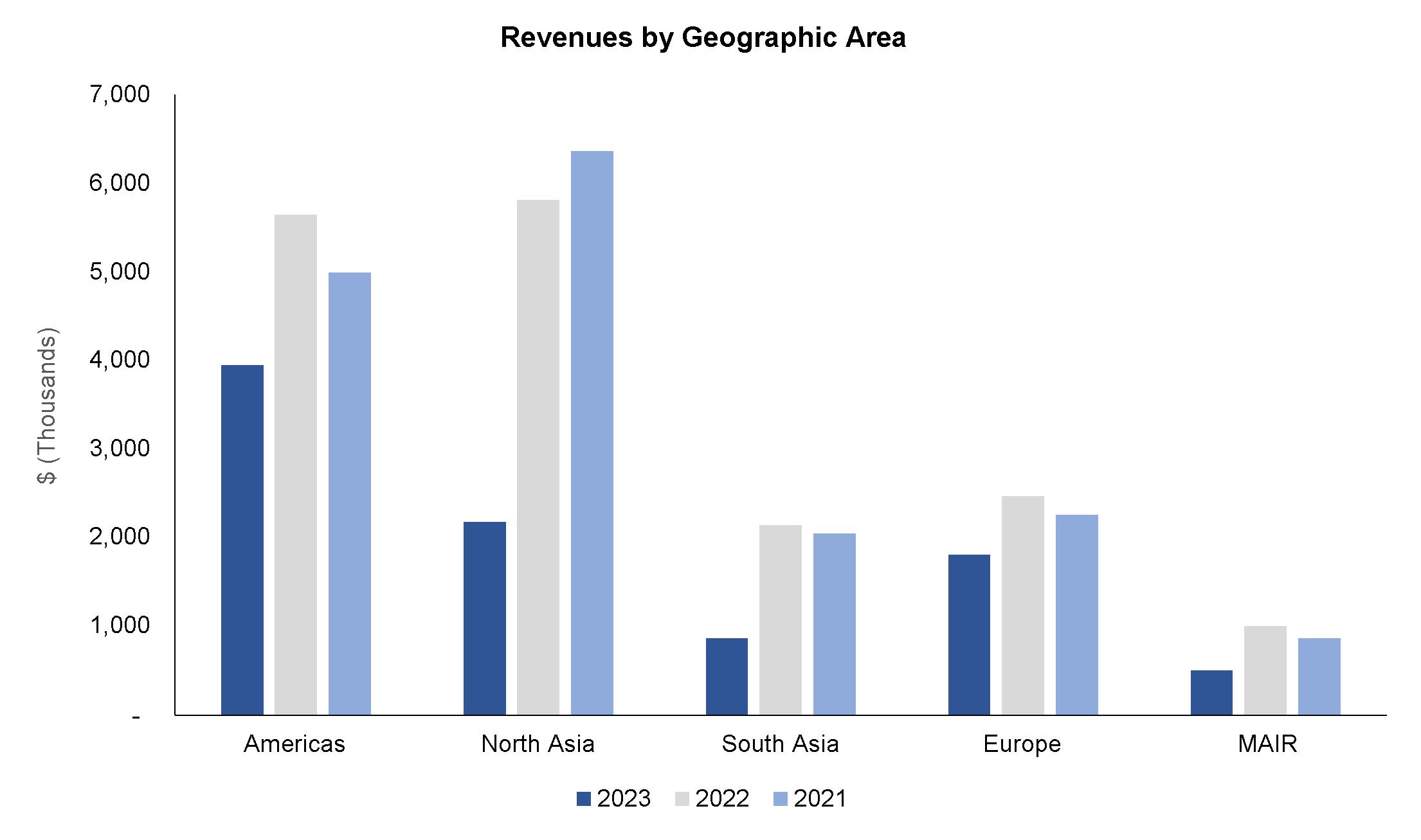][added: ]
North Asia is our largest export-oriented region and accounted for [removed: 23%] [added: 28%] of revenues, [removed: 28%] [added: 33%] of directly related cost of transportation and other expenses and [removed: 22%] [added: 23%] of operating income for the year ended December 31, [removed: 2023.][added: 2024.]
[removed: Operating cash flows were $1,053 million and we] [added: We] returned [removed: $1,595] [added: $1,059] million to shareholders through common stock repurchases and dividends.
International trade is influenced by many factors, including economic and political conditions in the United States and abroad, currency exchange rates, laws and policies relating to tariffs, trade restrictions, foreign [removed: investment] [added: investment,] and taxation.
Periodically, governments consider [removed: a variety of] [added: various] changes to tariffs and impose trade restrictions and accords.
We cannot predict [removed: the outcome of] [added: how] changes in tariffs, [removed: or interpretations, and] trade [removed: restrictions] [added: restrictions,] and accords [removed: and the effects they] will [removed: have on] [added: affect] our business.
The global economic and trade environments remain uncertain, including [removed: higher] inflation [removed: and] [added: remaining higher than historical levels, volatility in] oil prices, high interest rates and the conflicts in the Middle East and Ukraine.
We also expect that pricing volatility will continue as carriers adapt to [removed: lower] [added: changes in] demand, changing fuel prices, security risks and react to governmental trade policies and other regulations.
Additionally, we cannot predict the direct or indirect impact that further changes in and purchasing behavior, such as [removed: online shopping,] [added: the evolution of international direct e-commerce platforms,] could have on our business.
Some customers [removed: have begun shifting] [added: are relocating their] manufacturing to other countries [removed: in response] to [removed: governments implementing] [added: mitigate the impact of] higher tariffs on imports, [removed: to] reduce [removed: their] supply chain risks, and [removed: in response to pandemic disruptions, or] [added: address disruptions caused by pandemics and] geopolitical [removed: risks, which could negatively impact us.][added: issues.]
The total amount of our income and non-income tax contingencies may increase in [removed: 2024.][added: 2025.]
In addition, changes in state, federal, and foreign tax laws [added: including transfer pricing] and changes in interpretations of these laws may increase our existing tax contingencies.
It is reasonably possible that within the next [removed: 12] [added: twelve] months we may undergo further audits and examinations by various tax authorities, and it is also possible that we may reach resolution related to income tax and non-income tax examinations in one or more jurisdictions.
This section of this Form 10-K generally discusses year-to-year comparisons between the results of operations for the year ended December 31, [removed: 2023] [added: 2024] compared to the year ended December 31, [removed: 2022.][added: 2023.]
For a discussion of the year ended December 31, [removed: 2022] [added: 2023] compared to the year ended December 31, [removed: 2021,] [added: 2022,] please refer to Part II, Item 7, “Management’s Discussion and Analysis of Financial Condition and Results of Operations” in our Annual Report on Form 10-K for the year ended December 31, [removed: 2022.][added: 2023.]
The following table shows the revenues, the directly related cost of transportation and other expenses for our principal services and our overhead expenses for [removed: 2023, 2022] [added: 2024, 2023] and [removed: 2021.][added: 2022.]
| In thousands | | [removed: 2023] [added: 2024] | | | | [removed: 2022] [added: 2023] | | | | [removed: 2021] [added: 2022] | | | | [removed: 2023] [added: 2024] vs. [removed: 2022] [added: 2023] |
| Revenues | | $ | [removed: 3,246,527] [added: 3,669,673] | | | $ | [removed: 5,886,886] [added: 3,246,527] | | | $ | [removed: 6,771,402] [added: 5,886,886] | | | [removed: (45)%] [added: 13%] |
| Expenses | | | [removed: 2,347,293] [added: 2,731,552] | | | | [removed: 4,359,726] [added: 2,347,293] | | | | [removed: 5,067,380] [added: 4,359,726] | | | [removed: (46)%] [added: 16%] |
| Revenues | | | [removed: 2,363,243] [added: 3,148,514] | | | | [removed: 6,544,559] [added: 2,363,243] | | | | [removed: 5,545,818] [added: 6,544,559] | | | [removed: (64)%] [added: 33%] |
| Expenses | | | [removed: 1,634,947] [added: 2,356,952] | | | | [removed: 5,188,066] [added: 1,634,947] | | | | [removed: 4,364,160] [added: 5,188,066] | | | [removed: (68)%] [added: 44%] |
| Revenues | | | [removed: 3,690,340] [added: 3,782,328] | | | | [removed: 4,639,839] [added: 3,690,340] | | | | [removed: 4,206,297] [added: 4,639,839] | | | [removed: (20)%] [added: 2%] |
| Expenses | | | [removed: 2,071,760] [added: 2,098,214] | | | | [removed: 3,029,105] [added: 2,071,760] | | | | [removed: 2,626,615] [added: 3,029,105] | | | [removed: (32)%] [added: 1%] |
| Salaries and related costs | | | [removed: 1,700,516] [added: 1,762,654] | | | | [removed: 2,056,387] [added: 1,700,516] | | | | [removed: 2,062,351] [added: 2,056,387] | | | [removed: (17)%] [added: 4%] |
| Other | | | [removed: 605,661] [added: 609,820] | | | | [removed: 613,629] [added: 605,661] | | | | [removed: 493,685] [added: 613,629] | | | [removed: (1)%] [added: 1%] |
| Total overhead expenses | | | [removed: 2,306,177] [added: 2,372,474] | | | | [removed: 2,670,016] [added: 2,306,177] | | | | [removed: 2,556,036] [added: 2,670,016] | | | [removed: (14)%] [added: 3%] |
| Operating income | | | [removed: 939,933] [added: 1,041,323] | | | | [removed: 1,824,371] [added: 939,933] | | | | [removed: 1,909,326] [added: 1,824,371] | | | [removed: (48)%] [added: 11%] |
| Other income, net | | | [removed: 75,095] [added: 53,477] | | | | [removed: 11,520] [added: 75,095] | | | | [removed: 15,290] [added: 11,520] | | | [removed: 552%] [added: (29)%] |
| Earnings before income taxes | | | [removed: 1,015,028] [added: 1,094,800] | | | | [removed: 1,835,891] [added: 1,015,028] | | | | [removed: 1,924,616] [added: 1,835,891] | | | [removed: (45)%] [added: 8%] |
| Income tax expense | | | [removed: 263,249] [added: 283,167] | | | | [removed: 475,286] [added: 263,249] | | | | [removed: 505,771] [added: 475,286] | | | [removed: (45)%] [added: 8%] |
| Net earnings | | | [removed: 751,779] [added: 811,633] | | | | [removed: 1,360,605] [added: 751,779] | | | | [removed: 1,418,845] [added: 1,360,605] | | | [removed: (45)%] [added: 8%] |
| Less net [removed: (losses)] earnings [added: (losses)] attributable to the noncontrolling interest | | | [removed: (1,104] [added: 1,560] | [removed: )] | | | [removed: 3,206] [added: (1,104] | [added: )] | | | [removed: 3,353] [added: 3,206] | | | [removed: (134)%] [added: (241)%] |
| Net earnings attributable to shareholders | | $ | [removed: 752,883] [added: 810,073] | | | $ | [removed: 1,357,399] [added: 752,883] | | | $ | [removed: 1,415,492] [added: 1,357,399] | | | [removed: (45)%] [added: 8%] |
[removed: 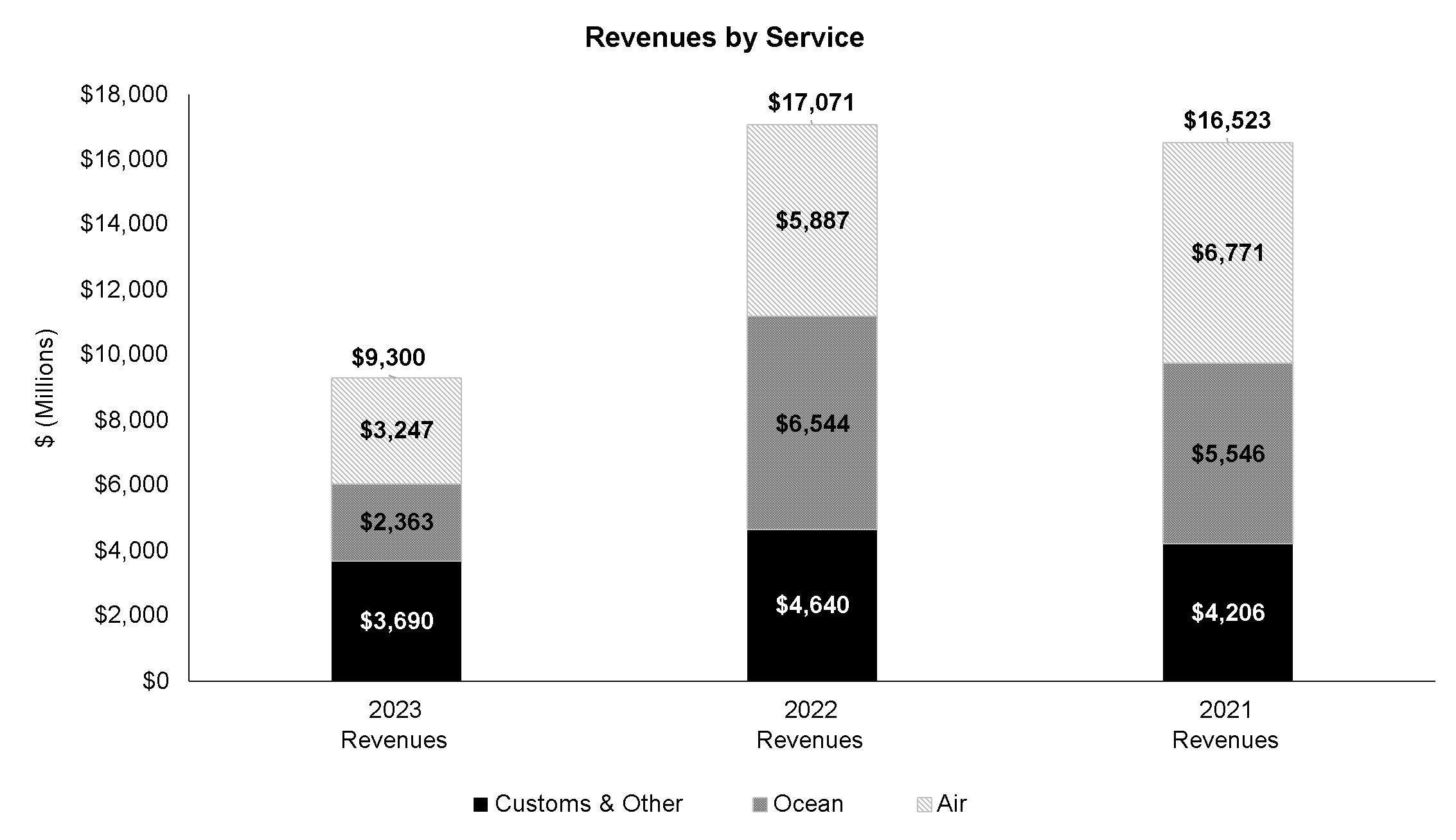][added: ]
Airfreight services revenues and expenses [removed: decreased 45%] [added: increased 13%] and [removed: 46%,] [added: 16%,] respectively, in [removed: 2023,] [added: 2024,] as compared with [removed: 2022,] [added: 2023,] due to [removed: 43% decreases] [added: a 12% increase] in [removed: both] [added: tonnage and 2% and 5% increase in] average sell and buy [removed: rates and a 10% decrease in tonnage.][added: rates, respectively.]
Average sell and buy rates decreased [removed: in all regions in 2023, as compared with 2022 with most significant decreases] on exports out of North [removed: Asia] [added: America] and [removed: South Asia] [added: Europe] due to excess available capacity [removed: over] [added: relative to soft] demand.
Tonnage [removed: decreased] [added: increased] in [removed: almost] all [removed: regions due to softening demand] [added: regions,] with the largest [removed: decrease] [added: increase] coming from exports out of [removed: North Asia, down 17%] [added: South Asia] and North [removed: America, down 8%.][added: Asia.]
These conditions could result in [removed: further] decreases in our revenues, expenses and operating income.
Ocean freight and ocean services revenues and expenses [removed: decreased 64%] [added: increased 33%] and [removed: 68%,] [added: 44%,] respectively, in [removed: 2023,] [added: 2024,] as compared with [removed: 2022.][added: 2023.]
Summary of 2024
Strong demand for ocean transportation combined with longer transit times and capacity issues caused by the disruptions in the Red Sea resulted in significant increases in overall average buy rates and sell rates.
Demand for airfreight out of Asia was high due in part to direct e-commerce business demand on airfreight capacity and increased demand in the technology sector.
This resulted in growth in volumes and overall increases in buy and sell rates.
Ocean containers shipped increased 7%, airfreight tonnage was up 12% and volumes transacted for customs brokerage and other services grew as well, compared to a slow 2023.
Cash from operations was $723 million, down from $1,053 million in 2023.
This decrease in cash from operations was driven by a significant investment in working capital to finance our growth in the second half of 2024.
The United States has imposed increased tariffs on China, and is considering imposing increased tariffs on imports from Canada, Mexico, and other countries.
These measures will likely face retaliatory tariffs from these countries.
The potential for further tariff increases and trade restrictions remains high, creating an unpredictable environment for international trade.
Additionally, changes to import and export regulations may impact the flow of trade.
As governments impose import and export restrictions, shippers may adjust their sourcing patterns and potentially shift manufacturing to other countries over time.
We have a branch and employees in Lebanon but no significant assets.
In the second and the third quarter of 2024, we saw capacity constraints on exports out of Asia resulting in increases in average buy and sell rates.
However, if demand softens or safe passage through the Red Sea resumes, then additional ocean transportation capacity will become available.
These conditions could result in declines in average sell and buy rates.
These changes could negatively affect our business.
Average sell rates increased in South Asia, North Asia and MAIR as a result of higher buy rates while they decreased in North America and Europe as a result of lower buy rates.
Tonnage increased in all regions as a result of increased market demand driven by the technology sector compared to a soft 2023.
South Asia revenues and expenses increased 66% and 82%, respectively, in 2024 as compared with 2023 due to a 40% increase in tonnage and significant increases in average sell and buy rates.
This was driven by elevated demand for airfreight as a result of manufacturing relocations into the region and shippers shifting to airfreight due to the conflicts in the Middle East.
North Asia revenues and expenses increased 16% and 17%, respectively, in 2024 as compared with 2023 due to a 9% increase in tonnage driven by demand in technology sectors and higher average sell and buy rates driven by high demand from international direct e-commerce.
Seasonal changes in demand, impact from disruptions in the ocean market due to security and port congestion concerns and variable demand for airfreight capacity from direct e-commerce business cause volatility in average buy rates on certain lanes.
Additionally, continued uncertainty in the economy, geopolitical concerns, as well as potential inter-governmental trade disputes and tariff changes could negatively affect demand for airfreight services which could reduce our volumes and average sell rates.
Average buy rates per container increased due to strong demand and longer transit times, congestion and capacity issues caused by the disruptions in the Red Sea.
Importers front loaded shipments creating a peak in demand starting in June 2024 in anticipation of potential US East and Gulf Coast ports disruptions, concerns over tariffs and factoring in longer transit times.
These conditions boosted volumes and caused sharp increases in buy rates in 2024.
We expect the rate declines that started in the fourth quarter of 2024 to continue into at least the first half of 2025 as demand softens and capacity increases as additional vessels are delivered.
South Asia ocean services revenues and expenses increased 85% and 109%, respectively, due to a 19% increase in containers shipped and higher average rates due to the factors above.
North America and Europe ocean freight and ocean services revenues decreased 6% and 13%, respectively, and expenses decreased 16% and 15%, respectively, in 2024, compared to 2023.
Decreases were primarily due to lower average sell and buy rates and declines in containers shipped partially offset by higher revenues on import shipments.
Order management revenues increased 29% and expenses increased 32% in 2024, due to higher volumes from new and existing customers.
Global economic conditions and trade policies remain uncertain.
Further, carriers are adding new vessels which will increase capacity.
In addition, if safe passage through the Red Sea resumes, additional capacity will become available due to shorter transit times.
These conditions could depress sell and buy rates.
Customs brokerage and other services revenues and expenses increased 2% and 1%, respectively, in 2024 as compared with 2023, primarily due to increases in customs clearances, import services and road freight from higher shipment volumes, principally in Europe and MAIR offset by decreases in warehousing and distribution primarily in North America.
With the exception of detention and demurrage, these services rebounded in the second half of 2024.
Europe and MAIR revenues increased 5% and 15%, respectively, and expenses increased 2% and 15%, respectively, in 2024 as compared with 2023, primarily as a result of higher shipment volumes.
Bonuses to field and executive management in 2024 increased 7% when compared to 2023 primarily due to a 11% increase in operating income.
Summary of 2023
Volumes transacted in all services were down due to continued softening customer demand from a slowdown in the global economy and international trade as customers' inventory levels remained high.
Average buy and sell rates declined through most of the year, as available capacity for transportation exceeded demand.
As a result of volume and rate trends above, revenues and expenses in airfreight and ocean services were significantly down compared to 2022 and 2021, particularly affecting revenues in our North Asia region.
As port congestion has cleared our customs brokerage and other services revenues declined significantly but operating results benefited from lower costs and a reduction in costs related to the cyber-attack incurred in 2022.
Net earnings to shareholders decreased 45%.
Currently, the United States and China have increased concerns affecting certain imports and exports and have implemented additional tariffs.
As governments implement restrictions on imports and exports, manufacturers may change sourcing patterns, to the extent possible, and, over time, may shift manufacturing to other countries.
Starting in the second quarter of 2002 and continuing throughout 2023, we saw a slowdown in the global economy and a softening of customer demand resulting in declines in average buy and sell rates.
As demand softened and port congestion cleared, availability of labor and equipment eased resulting in excess carrier capacity over demand.
Average sell rates decreased as a result of lower buy rates driven by declining market rates.
Buy rates declined as supply chain congestion cleared, shippers have shifted back to using ocean shipments and available capacity exceeds pre-pandemic levels while demand continued to soften.
Volumes were lower in 2023 as a result of softening demand and uncertainty in the economy.
In 2023 air carriers added flights to meet strong passenger travel demand and freighter capacity remains high creating a supply and demand imbalance which resulted in continued pressure on rates.
The historically high average buy and sell rates caused by the pandemic and unprecedented supply chain disruptions which contributed to the growth in our revenues, expenses and operating income in 2021 and 2022 have cleared as supply chain operations normalized.
Buy rates and sell rates have been declining since the second quarter of 2022 and continued to decline for the first three quarters of 2023.
Rates stabilized in the fourth quarter of 2023 due to an increase in seasonal demand.
Additionally, uncertainty in the economy including the impacts of inflation and interest rates together with the attractiveness of declining ocean transportation rates are expected to continue to negatively affect demand for airfreight services which could further reduce our volumes.
High fuel prices, congestion at ports due to labor, truck and equipment shortages and disrupted sailing schedules resulted in high average buy rates in 2022.
Starting in the second half of 2022, as demand softened, port congestion cleared and shortages of labor and equipment at ports eased, this resulted in available capacity from carriers that exceeded demand.
These factors drove a decline in average buy rates starting in the fourth quarter of 2022, which continued throughout most of 2023.
Containers shipped decreased as compared to 2022 as demand softened, customer inventory levels remained high and there are uncertainties in the global economy.
We also experienced exceptionally high ocean freight consolidation volumes in 2022 from customers transferring from direct carrier shipping due to lack of available capacity.
In 2023 customers have reverted back to utilizing direct carrier shipping as capacity became available.
Order management revenues and expenses decreased 21% and 26%, respectively in 2023, due to lower volumes from retail customers and also due to loss of customers caused by the cyber-attack.
Our ability to provide order management services in the first quarter of 2022 was significantly affected by limited system connectivity during the downtime caused by the cyber-attack.
The historically high average buy and sell rates caused by the pandemic and unprecedented supply chain disruptions which contributed to the growth in our revenues, expenses and operating income in 2021 and 2022 have significantly declined as supply chain operations normalized.
Buy rates and sell rates started declining in the second half of 2022, decreased sharply beginning in the fourth quarter of 2022 and throughout 2023.
As global economic conditions remain uncertain and carriers add new vessels, available capacity may continue to exceed demand and may further depress sell and buy rates into 2024.
Customs brokerage and other services revenues and expenses decreased 20% and 32%, respectively, in 2023 as compared with 2022, primarily due to declining shipments from a slowdown in the economy.
Expenses also decreased due to the impact of the cyber-attack which resulted in additional expenses in the first half of 2022.
In 2022, as a result of our inability to timely process and move shipments though ports during the downtime caused by the cyber-attack, we directly incurred approximately $47 million in incremental demurrage charges that were not recoverable from the customers.
North America revenues and expenses decreased 27% and 41%, respectively, in 2023 as compared with 2022, primarily as a result of declining shipments and significant decrease in detention, drayage, terminal charges and delivery charges.
Additionally, $43 million in demurrage charges related to the downtime caused by the cyber-attack also contributed to the increase in expenses in 2022.
Bonuses to field and executive management in 2023 decreased 43% when compared to the same period in 2022 primarily due to a 48% decrease in operating income and reduced bonus payouts to senior management in 2022.
We incurred $18 million of incremental costs in relation with the cyber-attack and $22 million related to a non-income tax contingency in 2022.
In 2023 rent and occupancy costs were higher due to leasing additional space, depreciation expense increased related to software and leasehold improvements, and higher technology-related costs.
We expect to continue to enhance the effectiveness and security of our systems and deploy additional protection technologies and processes which will result in increased expenses in the future.
Any such hedging activity during 2023 and 2022 was insignificant.
This $1,077 million decrease is primarily due to lower net earnings and changes to working capital attributable to a slowdown in operations and declining sell and buy rates.
An excerpt. Shown here: 40 of 83 rewritten, 40 of 45 added and 40 of 43 removed. The counts are complete. For every sentence, read Item 7. MANAGEMENT’S DISCUSSION AND ANALYSIS OF FINANCIAL CONDITION AND RESULTS OF OPERATIONS in the FY2024 filing and the FY2023 filing.
Item 7A. QUANTITATIVE AND QUALITATIVE DISCLOSURES ABOUT MARKET RISK
10 rewritten, 1 added, 4 removed, 14 unchanged
The principal foreign exchange risks to which Expeditors is exposed include Chinese Yuan, Euro, Mexican Peso, Canadian [removed: Dollar and] [added: Dollar,] British [removed: Pound.][added: Pound and Vietnamese Dong.]
All other things being equal, an average 10% weakening of the U.S. dollar, throughout the year ended December 31, [removed: 2023,] [added: 2024,] would have had the effect of raising operating income by approximately [removed: $54] [added: $63] million.
An average 10% strengthening of the U.S. dollar, for the same period, would have the effect of reducing operating income by approximately [removed: $44] [added: $52] million.
Net foreign currency [removed: losses] [added: gains] were approximately [removed: $15] [added: $12] million [added: in 2024] and [removed: $2] [added: net foreign currency losses were $15] million in [removed: 2023 and 2022, respectively.][added: 2023.]
[removed: We] [added: In lieu of the use of foreign currency derivatives, we] instead follow a policy of accelerating international currency settlements to manage foreign exchange risk relative to intercompany billings.
As of December 31, [removed: 2023,] [added: 2024,] we had [removed: $82] [added: $153] million of net unsettled intercompany transactions.
At December 31, [removed: 2023,] [added: 2024,] we had cash and cash equivalents of [removed: $1,513] [added: $1,148] million, of which [removed: $912] [added: $525] million was invested at various short-term market interest rates.
We had no long-term debt at December 31, [removed: 2023.][added: 2024.]
A hypothetical change in the interest rate of 10 basis points at December 31, [removed: 2023] [added: 2024] would not have a significant impact on our earnings.
In management’s opinion, there has been no material change in our interest rate risk exposure between [removed: 2023] [added: 2024] and [removed: 2022.][added: 2023.]
Historically, derivative financial instruments have not been used to manage foreign currency risk.
We currently do not use derivative financial instruments to manage foreign currency risk and only enter into foreign currency hedging transactions in limited locations where regulatory or commercial limitations restrict our ability to move money freely.
Any such hedging activity throughout the year ended December 31, 2023, was insignificant.
We had no foreign currency derivatives outstanding at December 31, 2023 and 2022.
40.
Item 1. BUSINESS
53 rewritten, 19 added, 10 removed, 337 unchanged
Expeditors International of Washington, Inc. (herein referred to as "Expeditors,” the "Company," "we," "us," "our") provides a full suite of global logistics services, offering customers [removed: a seamless] [added: access to an] international network of people and integrated information systems to support the movement and strategic positioning of goods.
*Ocean freight consolidation*: Expeditors, when acting as an ocean freight consolidator, contracts with ocean shipping carriers to obtain transportation for [removed: a fixed number] [added: an allocation] of containers between various points during a specified time period at agreed-upon rates.
We handle both full container loads as well as Less-than Container Load (LCL) freight, offering a [removed: wider] [added: wide] range of shipping options and [removed: rates than available with the carriers directly.][added: rates.]
*Direct ocean forwarding*: [removed: Expeditors acts as] [added: When] the [removed: agent when its] customer contracts directly with the ocean carrier, [removed: and we may receive a commission from] [added: EIO acts as an agent of] the [removed: carrier in addition to] customer [added: and derives its revenues from] handling fees [removed: and ancillary services.][added: paid by the customer and, in some cases, commissions paid by the carrier.]
The following chart shows our [removed: 2023] [added: 2024] revenues by service type:
[removed: 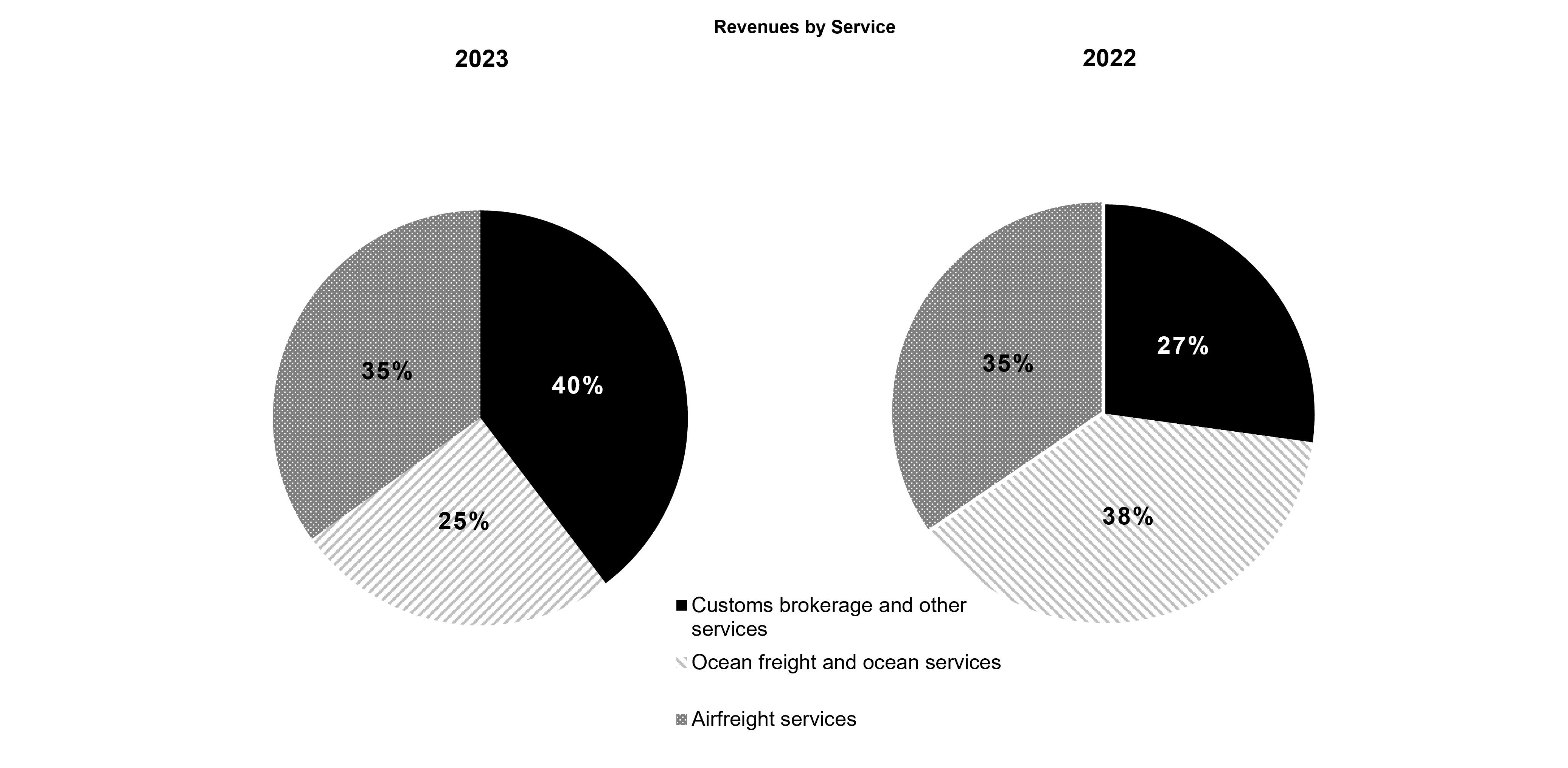][added: ]
Expeditors operates [removed: 176] [added: 172] district offices in the following geographic areas of responsibility:
North Asia [removed: (21)][added: (17)]
We have established [removed: 36] [added: 35] such relationships worldwide.
Ensuring that base-line strategies for air, ocean and customs services for every district office and region lead to growth at [removed: the relevant] [added: sustainable and competitive] market rates, profits and volumes by services.
Airfreight services accounted for approximately [added: 34% and] 35% of Expeditors' total revenues in [removed: 2023] [added: 2024] and [removed: 2022.][added: 2023, respectively.]
Our airfreight revenues less directly related costs of transportation and other expenses for a consolidated shipment include the differential between the rate that the airline charges Expeditors and the rate that we, in turn, charge our customers, in addition to [removed: commissions that the airline pays us and] fees that we charge our customers for ancillary services.
Ocean freight services accounted for approximately [removed: 25%] [added: 30%] and [removed: 38%] [added: 25%] of Expeditors' total revenues in [removed: 2023] [added: 2024] and [removed: 2022,] [added: 2023,] respectively.
EIO [removed: also] provides [removed: service, on a smaller scale,] [added: service] to and from any location where we have an office or an agent.
*Ocean freight consolidation*: As an NVOCC, EIO contracts with ocean shipping lines to obtain transportation for [removed: a fixed number] [added: an allocation] of containers between various points during a specified time period at an agreed rate.
EIO provides full container load services to companies that need [removed: flexibility and] access to vessel capacity [removed: that they may not necessarily achieve by dealing directly with the shipping lines.][added: and flexibility via multiple sailing and service options.]
EIO issues a House Ocean Bill of Lading (HOBL) or a House Sea Waybill to customers as the contract of carriage and receives a separate Master Ocean Bill of Lading (MOBL) [added: from the contracted shipping line] when freight is physically tendered.
Revenues from fees charged to customers for ancillary services that EIO may provide include the preparation of shipping and customs documentation, [added: booking arrangements,] packing, crating, insurance services, and the preparation of documentation to comply with local export and import laws.
We also charter vessels to support [removed: both] our customers’ special projects [removed: and our container capacity] needs.
*Direct ocean forwarding*: [removed: When] [added: Expeditors acts as] the [added: agent when its] customer contracts directly with the ocean [removed: carrier, EIO acts as an agent of the customer and derives its revenues from commissions paid by the ocean carrier and handling fees paid by the customer.][added: carrier.]
The MOBL shows the customer as the [removed: shipper.][added: shipper or consignee.]
Consequently, when the market goes through seasonal peaks or significant disruption and demand exceeds supply, the carriers react by increasing their [removed: pricing as quickly as possible.][added: pricing.]
We offer our customers [removed: a wide carrier footprint] [added: multiple sailing options and services] globally to meet their changing needs.
Customs brokerage and other services accounted for approximately [removed: 40%] [added: 36%] and [removed: 27%] [added: 40%] of Expeditors' total revenues in [removed: 2023] [added: 2024] and [removed: 2022,] [added: 2023,] respectively.
At December 31, [removed: 2023,] [added: 2024,] Expeditors employed [removed: approximately] [added: more than] 18,000 people, of which approximately 12,000 were employed in international locations.
We have summarized below, the number of employees based on individual headcount as of December 31, [removed: 2023,] [added: 2024,] including corporate and information services employees.
| United States | | | [removed: 6,300] [added: 6,350] | |
| Other North America | | | [removed: 1,500] [added: 1,550] | |
| Latin America | | | [removed: 700] [added: 750] | |
| South Asia | | | [removed: 1,650] [added: 1,750] | |
Certain air and ocean carriers [removed: are entering] [added: periodically enter] into onshore services as they pursue more profitable and less commoditized market segments to provide balance against their incumbent asset-based offerings.
Expeditors emphasizes quality customer service, underscored by a strong commitment to compliance, and believes that our prices are [removed: competitive with the prices of others in the industry.][added: market competitive.]
These digital [removed: products and] solutions can be [removed: delivered] [added: enabled] through Electronic Data Interface (EDI), Application Programming Interfaces (API), and browser-based web applications or mobile applications.
[removed: COVID-19 and supply chain disruptions have had a profound impact on] [added: As] a [removed: large number of customers across different industries, and] [added: result,] many companies [removed: are now exploring] [added: explore] options to build a strategy around supply chain resiliency, agility, sourcing, and inventory optimization.
While our customers’ supply chain strategies may [removed: shift as a result of current conditions,] [added: evolve,] we believe that the industry will remain highly competitive with a mix of large, niche, and new entrants, competing aggressively for customers’ business.
Unlike many of our competitors, who have tended to grow by merger and acquisition, Expeditors operates fully integrated transportation, customs brokerage, and accounting systems, running on a common hardware platform, in all [removed: of our] districts.
Historically, growth through aggressive acquisition has proven to be a challenge for many of our competitors and typically involves the purchase of significant “goodwill.” In contrast, Expeditors has pursued a strategy emphasizing organic growth supplemented by [removed: certain] [added: select] strategic acquisitions.
[removed: In] [added: Beginning in] 2021 and continuing [removed: in 2022 and 2023,] [added: into 2024,] many [removed: countries] [added: countries,] including the United States experienced increasing levels of inflation.
[removed: In 2022,] [added: As a result,] our business experienced rising labor costs, significant service provider rate increases, [removed: and] higher rent and occupancy and other expenses.
Historically, our operating results have been subject to seasonal demand trends, with the first quarter being the weakest and the third and fourth quarters being the strongest; however, there is no assurance that this seasonal trend will occur in the future or to what degree it [removed: was] [added: will be] impacted [removed: in 2022] by [removed: the downtime caused by the cyber-attack and impacts of a slowing] [added: an uncertain] economy.
We receive fees for customer handling and ancillary services and may also receive a commission from the carrier.
| | | 2024 | | |
| Europe | | | 3,850 | |
| Total | | | 18,400 | |
Supply chain disruptions stemming from various factors, including geopolitical tensions and port labor disruptions impact our customers across different industries.
We continue to monitor the evolving features and capabilities of new technologies such as artificial intelligence.
As we are not required to purchase or maintain extensive property and equipment and have not otherwise incurred substantial interest rate-sensitive indebtedness, we currently have limited direct exposure to increased costs resulting from increases in interest rates.
There is uncertainty as to how future regulatory requirements and volatility in oil prices will continue to impact future buy rates.
Because fuel is an integral part of carriers' costs and impacts both our buy rates and sell rates, we would expect our revenues and costs to be impacted as carriers adjust rates for the effect of changing fuel prices.
To the extent that future fuel prices increase, and we are unable to pass through the increase to our customers, fuel price increases could adversely affect our operating income.
On February 17, 2025, Mr. Musser notified the Board of Directors of his plans to retire and step down from the Board of Directors, effective March 31, 2025.
On February 17, 2025, the Board of Directors elected Mr. Wall to President and Chief Executive Officer effective April 1, 2025.
Mr. Wall will be appointed to the Board of Directors.
Effective January 1, 2025, Mr. Bell was appointed President, Global Business Development.
Courtney A.
Hawkins joined Expeditors as Senior Vice President and Chief Information Officer in September 2024, having previously served as Senior Vice President of Customer & Retail Technology for Starbucks Corporation since 2023.
From 2021 to 2023, Ms. Hawkins served as Chief Technology Officer for Zulily, Inc. From 2014 to 2021, Ms. Hawkins served in various technology vice president roles with NIKE, Inc., Starbucks Corporation, and Nordstrom, Inc.
In January 2025, he was appointed Senior Vice President – Global Enterprise Services and Chief Strategy Officer.
From 2002 through 2014, Mr. Clark served as Deputy General Counsel for Celanese Corporation, and in various progressively senior roles within Honeywell International, Inc.
| | | 2023 | | |
| Europe | | | 3,800 | |
| Total | | | 18,100 | |
While buy rates for freight transportation capacity started declining in the second half of 2022, purchase prices for labor and other expenditures have continued to increase throughout 2023.
Christopher J.
McClincy joined Expeditors in July 1998 and was promoted to Vice President - Information Services in April 2009.
In February 2014, Mr. McClincy was promoted to Senior Vice President and Chief Information Officer.
From January 2014 until joining Expeditors, Mr. Clark served as Executive Vice President and General Counsel of the Dematic Group, a global provider of intelligent intralogistics and materials handling solutions.
Prior to his experience with Dematic, Mr. Clark spent four years as the Vice President and Deputy General Counsel for the publicly traded Celanese Corporation, a global technologies and specialty materials company.
From 2002 to 2009 Mr. Clark worked for Honeywell International, Inc., where he held progressively responsible roles concluding as the Vice President and General Counsel, Aerospace Global Operations.
An excerpt. Shown here: 40 of 53 rewritten, all 19 added and all 10 removed. The counts are complete. For every sentence, read Item 1. BUSINESS in the FY2024 filing and the FY2023 filing.
Item 3. LEGAL PROCEEDINGS
2 rewritten, 0 added, 0 removed, 2 unchanged
Expeditors is involved in claims, lawsuits, government investigations, [removed: income] [added: income, transfer pricing] and indirect tax audits and other legal matters that arise in the ordinary course of business and are subject to inherent uncertainties.
In [removed: 2023,] [added: 2024,] amounts recorded for claims, lawsuits, government investigations and other legal matters are not significant to our operations, cash flows or financial position.
Cover and table of contents
17 rewritten, 2 added, 1 removed, 76 unchanged
For the fiscal year ended December 31, [removed: 2023][added: 2024]
| (State or other jurisdiction [removed: of incorporation] [added: of incorporation] or organization) | | (I.R.S. [removed: Employer Identification] [added: Employer Identification] Number) |
The aggregate market value of the registrant’s Common Stock held by non-affiliates of the registrant, based upon the closing price as of the last business day of the most recently completed second fiscal quarter ended June 30, [removed: 2023,] [added: 2024,] was approximately [removed: $17,717,749,906.][added: $17,435,031,444.]
At February [removed: 16, 2024,] [added: 18, 2025,] the number of shares outstanding of registrant’s Common Stock was [removed: 143,899,291.][added: 138,032,017.]
Portions of the definitive proxy statement for the Registrant’s Annual Meeting of Shareholders to be held on May [removed: 7, 2024] [added: 6, 2025] are incorporated by reference into Part III of this Form 10-K.
| | Item 1B | [Unresolved Staff Comments](#item_1b_unresolved_staff_comments) | [removed: 22] [added: 23] |
| | Item 8 | [Financial Statements and Supplementary Data](#item_8_financial_statements_supplementar) | [removed: 41] [added: 40] |
| | Item 9 | [Changes in and Disagreements with Accountants on Accounting and Financial Disclosure](#item_9_changes_in_disagreements_with_acc) | [removed: 42] [added: 41] |
| | Item 9A | [Controls and Procedures](#item_9a_controls_procedures) | [removed: 42] [added: 41] |
| | Item 10 | [Directors, Executive Officers and Corporate Governance](#item_10_directors_executive_ficers_corpo) | [removed: 44] [added: 43] |
| | Item 11 | [Executive Compensation](#item_11_executive_compensation) | [removed: 44] [added: 43] |
| | Item 12 | [Security Ownership of Certain Beneficial Owners and Management and Related Stockholder Matters](#item_12_security_ownership_certain_benef) | [removed: 44] [added: 43] |
| | Item 13 | [Certain Relationships and Related Transactions and Director Independence](#item_13_certain_relationships_related_tr) | [removed: 45] [added: 44] |
| | Item 14 | [Principal Accounting Fees and Services](#item_14_principal_accounting_fees_servic) | [removed: 45] [added: 44] |
| | Item 15 | [Exhibits, Financial Statement Schedules](#item_15_exhibits_financial_statement_sch) | [removed: 46] [added: 45] |
| | Item 16 | [Form 10-K [removed: Summary](#item_16_form_10k_summary)] [added: Summary](#form_10k_summary)] | 48 |
| | | [Signatures](#signatures) | [removed: 49] [added: 48] |
| Sterling Plaza 2, 3rd Floor3545 Factoria Blvd. SE, Bellevue, Washington | | 98006 |
For the Fiscal Year Ended December 31, 2024
| 1015 Third Avenue, Seattle, Washington | | 98104 |
Item 1B. UNRESOLVED STAFF COMMENTS
0 rewritten, 0 added, 1 removed, 1 unchanged
22.
Item 1C. CYBERSECURITY
1 rewritten, 0 added, 0 removed, 35 unchanged
We also maintain a third party [added: continuous monitoring] security program to identify, prioritize, assess, mitigate and remediate third party risks, which is part of our overall cybersecurity risk management framework.
Item 2. PROPERTIES
2 rewritten, 0 added, 0 removed, 5 unchanged
Expeditors’ corporate headquarters are located in [removed: Seattle,] [added: Bellevue,] Washington.
We conduct operations in approximately [removed: 440] [added: 435] locations worldwide, of which approximately 105 are in the United States and [removed: 19] [added: 18] are owned.
Item 5. MARKET FOR REGISTRANT’S COMMON EQUITY, RELATED STOCKHOLDER MATTERS AND ISSUER PURCHASES OF EQUITY SECURITIES
4 rewritten, 11 added, 12 removed, 22 unchanged
There were [removed: 574] [added: 553] registered holders of record as of February [removed: 16, 2024.][added: 18, 2025.]
The graph below compares Expeditors International of Washington, Inc.'s cumulative 5-Year total shareholder return on common stock with the cumulative total returns of the S&P 500 [removed: index, the NASDAQ Industrial Transportation] index [removed: (NQUSB502060T)] and the Dow Jones Transportation [removed: Average as a replacement for the NASDAQ Industrial Transportation index.][added: Average.]
The graph assumes that the value of the investment in our common stock and in each of the indexes (including reinvestment of dividends) was $100 on [removed: 12/31/2018] [added: 12/31/2019] and tracks it through [removed: 12/31/2023.][added: 12/31/2024.]
[removed: 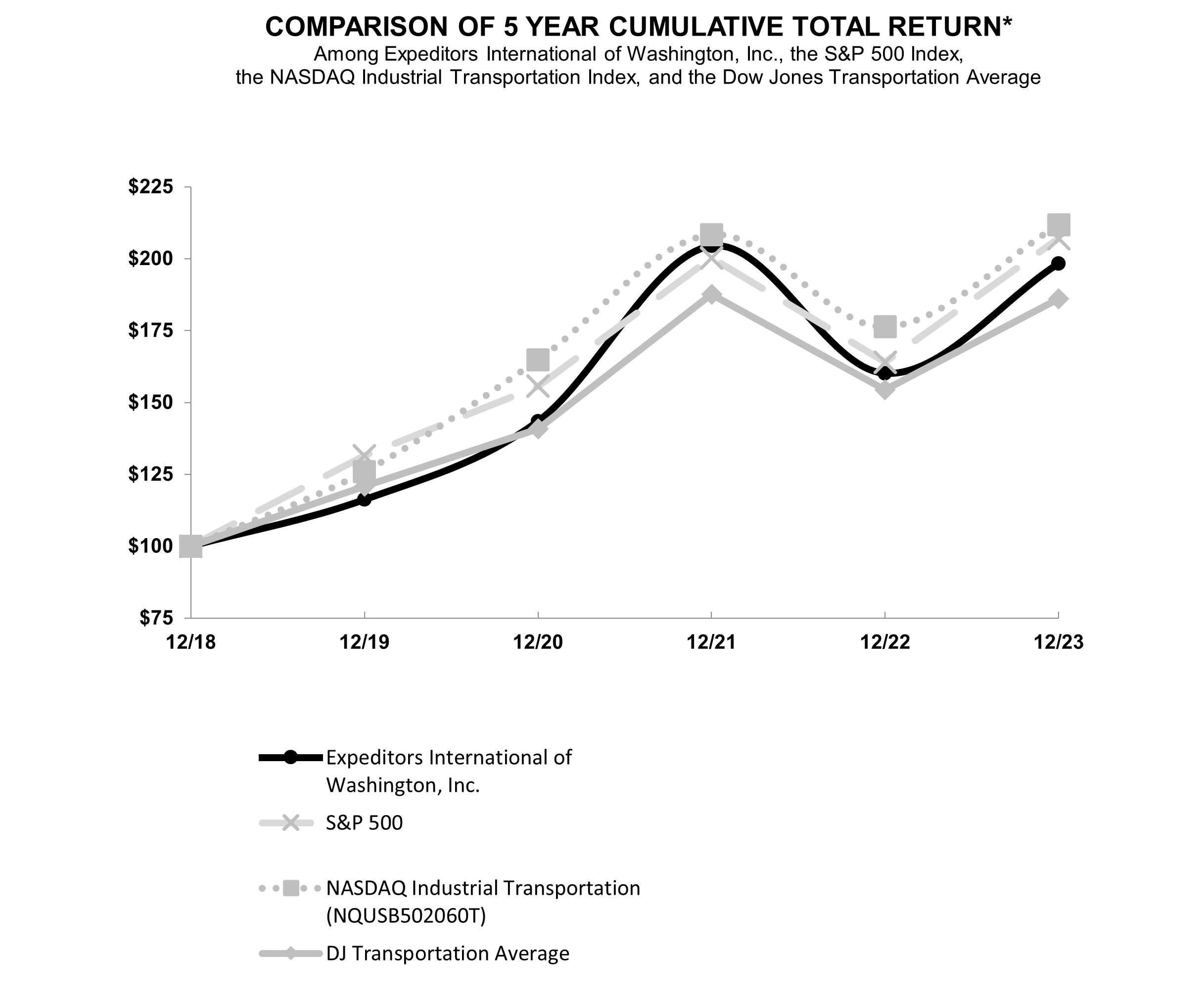][added: ]
| June 17, 2024 | | $ | 0.73 | |
| December 16, 2024 | | $ | 0.73 | |
(shares in thousands)
| October 1-31, 2024 | | | — | | | $ | — | | | | — | | | | 9,976 | |
| November 1-30, 2024 | | | 1,022 | | | $ | 119.91 | | | | 1,022 | | | | 8,971 | |
| December 1-31, 2024 | | | 978 | | | $ | 120.39 | | | | 978 | | | | 8,003 | |
| Total | | | 2,000 | | | $ | 120.14 | | | | 2,000 | | | | 8,003 | |
| | | 12/19 | | | | 12/20 | | | | 12/21 | | | | 12/22 | | | | 12/23 | | | | 12/24 | | |
| Expeditors International of Washington, Inc. | | $ | 100.00 | | | | 123.45 | | | | 175.94 | | | | 137.78 | | | | 170.68 | | | | 150.42 | |
| Standard and Poor's 500 Index | | | 100.00 | | | | 118.39 | | | | 152.34 | | | | 124.73 | | | | 157.48 | | | | 196.85 | |
| Dow Jones Transportation Average | | $ | 100.00 | | | | 116.52 | | | | 155.22 | | | | 127.86 | | | | 154.05 | | | | 156.33 | |
| June 15, 2022 | | $ | 0.67 | |
| December 15, 2022 | | $ | 0.67 | |
| October 1-31, 2023 | | | — | | | $ | — | | | | — | | | | 5,389 | |
| November 1-30, 2023 | | | 1,131 | | | $ | 118.90 | | | | 1,131 | | | | 4,803 | |
| December 1-31, 2023 | | | 493 | | | $ | 119.94 | | | | 493 | | | | 3,866 | |
| Total | | | 1,624 | | | $ | 119.22 | | | | 1,624 | | | | 3,866 | |
The Company is making the modification as a result of having transferred the listing of its common stock to the New York Stock Exchange from the Nasdaq Stock Market on November 21, 2023.
| | | 12/18 | | | | 12/19 | | | | 12/20 | | | | 12/21 | | | | 12/22 | | | | 12/23 | | |
| Expeditors International of Washington, Inc. | | $ | 100.00 | | | | 116.18 | | | | 143.42 | | | | 204.41 | | | | 160.07 | | | | 198.29 | |
| Standard and Poor's 500 Index | | | 100.00 | | | | 131.47 | | | | 155.65 | | | | 200.29 | | | | 163.98 | | | | 207.04 | |
| NASDAQ Industrial Transportation (NQUSB502060T) | | | 100.00 | | | | 125.94 | | | | 164.80 | | | | 208.39 | | | | 176.34 | | | | 211.72 | |
| Dow Jones Transportation Average | | | 100.00 | | | | 120.83 | | | | 140.80 | | | | 187.56 | | | | 154.50 | | | | 186.15 | |
Item 8. FINANCIAL STATEMENTS AND SUPPLEMENTARY DATA
6 rewritten, 1 added, 1 removed, 16 unchanged
| | | | [Balance Sheets as of December 31, [removed: 2023] [added: 2024] and [removed: 2022](#consolidated_balance_sheets)] [added: 2023](#consolidated_balance_sheets)] | | F-5 |
| | | | [Statements of Earnings for the Years Ended December 31, [removed: 2023, 2022] [added: 2024, 2023] and [removed: 2021](#consolidated_statements_earnings)] [added: 2022](#consolidated_statements_earnings)] | | F-6 |
| | | | [Statements of Comprehensive Income for the Years Ended December 31, [removed: 2023, 2022] [added: 2024, 2023] and [removed: 2021](#consolidated_statements_comprehensive_in)] [added: 2022](#consolidated_statements_comprehensive_in)] | | F-7 |
| | | | [Statements of Equity for the Years Ended December 31, [removed: 2023, 2022] [added: 2024, 2023] and [removed: 2021](#consolidated_statements_equity)] [added: 2022](#consolidated_statements_equity)] | | F-8 |
| | | | [Statements of Cash Flows for the Years Ended December 31, [removed: 2023, 2022] [added: 2024, 2023] and [removed: 2021](#consolidated_statements_of_cash_flows)] [added: 2022](#consolidated_statements_of_cash_flows)] | | F-9 |
| | | | [Notes to Consolidated Financial Statements](#notes_to_consolidated_financial_statemen) | | F-10 through [removed: F-24] [added: F-26] |
40.
41.
Item 9A. CONTROLS AND PROCEDURES
11 rewritten, 9 added, 6 removed, 23 unchanged
We carried out an evaluation, under the supervision and with the participation of our management, including the Chief Executive Officer and Chief Financial Officer, of the effectiveness of the design and operation of our disclosure controls and procedures (as defined in the Exchange Act Rules 13a-15(e) and 15d-15(e) as of December 31, [removed: 2023.][added: 2024.]
Based upon that evaluation, the Chief Executive Officer and Chief Financial Officer concluded that our disclosure controls and procedures were not effective as of December 31, [removed: 2023,] [added: 2024,] due to material weaknesses in internal control over financial reporting described below.
Management, including the Chief Executive Officer and Chief Financial Officer, under the oversight of our Board of Directors, evaluated the effectiveness of the Company's internal control over financial reporting, as of December 31, [removed: 2023,] [added: 2024,] based on the framework in Internal Control — Integrated Framework (2013) issued by the Committee of Sponsoring Organizations of the Treadway Commission (COSO).
Management concluded that unauthorized [added: access and] changes to [removed: custom] databases [added: and related applications] could have gone undetected as [removed: a control] [added: controls] to review and authorize [added: access and] direct changes [removed: to databases] that support several key operational and accounting systems excluded certain [removed: database] changes from review, [added: or were not captured,] and as such [added: were either not designed properly or] did not operate effectively as designed.
In addition, the system logic used to record direct [removed: database] changes excluded certain changes from being captured [removed: within the change logs used as the basis] for [removed: population of the manual] review.
These control deficiencies related to personnel without specific training and experience to fulfill internal control responsibilities related to information technology general controls over [removed: custom databases] [added: systems and processes] resulting in an ineffective [removed: information and communication process that identifies and assesses the source] [added: design] of [removed: and] controls necessary to ensure the reliability of information used in financial reporting.
Therefore, we concluded that the deficiencies represent material weaknesses in the Company’s internal control over financial reporting and our internal control over financial reporting was not effective as of December 31, [removed: 2023.][added: 2024.]
[removed: Increasing the number of] [added: Continuing to hire additional] qualified personnel [removed: involved in] [added: to support] the remediation process and the design and implementation of IT controls;
[removed: Performing supplemental procedures and implementing] [added: Continuing to implement] certain enhancements designed to strengthen IT [removed: program] change management [added: and logical access] processes; [added: and]
[removed: Improving] [added: Continuing to conduct our] entity wide risk assessments [removed: conducted] to identify relevant process risk points, IT systems and the information used in the operation of controls; [removed: and]
These material weaknesses will not be considered fully remediated, until the applicable controls operate for a sufficient period of time and management has concluded, through [added: additional] testing, that these controls are operating effectively.
41.
Engaged PwC US Consulting, LLP to assist management with our entity-wide risk assessment, assessment of control design, and remediation process;
Examining additional third-party developed software solutions that aid in tracking changes to databases and related applications and improve controls over system access and monitoring;
Continuing to train personnel to fulfill internal control responsibilities relative to information technology.
Certain steps laid out in our 2023 Annual Report on Form 10-K and quarterly reports filed in 2024 were completed, but as we continued our remediation process and review, we identified additional controls that were not designed or operated appropriately that relate to the above-described material weaknesses.
Primarily due to the complexities and interdependencies of our internally developed legacy and current systems and time needed to evaluate and implement third-party software solutions, we are currently unable to estimate when full remediation of these material weaknesses will be completed.
We will continue to perform supplemental review procedures for direct database changes and perform additional analysis to supplement our existing controls and other procedures to ensure that our consolidated financial statements are prepared in accordance with U.S. GAAP.
The Audit Committee has increased oversight of actions being taken by management to remediate and strengthen information technology controls.
This oversight includes monthly reports and formal comprehensive presentations at all Audit Committee meetings from the Chief Information Officer, Chief Information Security Officer and Chief Technology Officer.
Conducting supplemental review procedures for direct database changes until the improvements are fully in place and operating;
Conducting additional training relative to information technology in the operation of controls.
We expect that necessary enhancements and remediation of these material weaknesses will be completed in 2024.
We are developing a new accounting system, which is being implemented on a worldwide basis over the next several years.
This system is expected to improve the efficiency of certain financial and transactional processes and reporting.
This transition affects the processes that constitute our internal control over financial reporting and requires testing for operating effectiveness.
Item 9C. DISCLOSURE REGARDING FOREIGN JURISDICTIONS THAT PREVENT INSPECTIONS
0 rewritten, 0 added, 1 removed, 2 unchanged
43.
Item 10. DIRECTORS, EXECUTIVE OFFICERS AND CORPORATE GOVERNANCE
1 rewritten, 0 added, 0 removed, 16 unchanged
The information required by this item is set forth below or incorporated by reference to information under the caption “Proposal No. 1: Election of Directors” and to the information under the caption “Board Operations" in Expeditors' definitive Proxy Statement for its annual meeting of shareholders to be held on May [removed: 7, 2024.][added: 6, 2025.]
Item 11. EXECUTIVE COMPENSATION
1 rewritten, 0 added, 0 removed, 0 unchanged
The information required by this item is incorporated by reference to information under the captions “Director Compensation Program” and “Compensation Discussion and Analysis” in Expeditors' definitive Proxy Statement for its annual meeting of shareholders to be held on May [removed: 7, 2024.][added: 6, 2025.]
Item 12. SECURITY OWNERSHIP OF CERTAIN BENEFICIAL OWNERS AND MANAGEMENT AND RELATED STOCKHOLDER MATTERS
3 rewritten, 3 added, 3 removed, 11 unchanged
The information required by this item is incorporated by reference to information under the captions “Shareholder Engagement & Stock Ownership Information” in Expeditors' definitive Proxy Statement for its annual meeting of shareholders to be held on May [removed: 7, 2024.][added: 6, 2025.]
The following table provides information as of December 31, [removed: 2023,] [added: 2024,] regarding compensation plans under which equity securities of Expeditors are authorized for issuance.
Includes [removed: 491,466] [added: 4,004,051] available for issuance under the employee stock purchase plan and [removed: 1,577,353] [added: 1,243,141] available for future grants of equity awards under the Amended and Restated 2017 Omnibus Incentive Plan.
43.
| Equity Compensation Plans Approved by Security Holders | | | 1,571,408 | | | $ | 47.35 | | | | 5,247,192 | |
| Total | | | 1,571,408 | | | $ | 47.35 | | | | 5,247,192 | |
44.
| Equity Compensation Plans Approved by Security Holders | | | 2,000,916 | | | $ | 46.46 | | | | 2,068,819 | |
| Total | | | 2,000,916 | | | $ | 46.46 | | | | 2,068,819 | |
Item 13. CERTAIN RELATIONSHIPS AND RELATED TRANSACTIONS, AND DIRECTOR INDEPENDENCE
1 rewritten, 0 added, 0 removed, 0 unchanged
The information required by this item is incorporated by reference to information under the captions “Certain Relationships and Related Transactions” in Expeditors' definitive Proxy Statement for its annual meeting of shareholders to be held on May [removed: 7, 2024.][added: 6, 2025.]
Item 14. PRINCIPAL ACCOUNTING FEES AND SERVICES
1 rewritten, 1 added, 1 removed, 1 unchanged
The information required by this item is incorporated by reference to information under the caption “Relationship with Independent Registered Public Accounting Firm” in Expeditors' definitive Proxy Statement for its annual meeting of shareholders to be held on May [removed: 7, 2024.][added: 6, 2025.]
44.
45.
Item 15. EXHIBITS, FINANCIAL STATEMENT SCHEDULES
16 rewritten, 2 added, 8 removed, 107 unchanged
| | | [Consolidated Balance Sheets as of December 31, [removed: 2023] [added: 2024] and [removed: 2022](#consolidated_balance_sheets)] [added: 2023](#consolidated_balance_sheets)] | | F-5 |
| | | [Consolidated Statements of Earnings for the Years Ended December 31, [removed: 2023, 2022] [added: 2024, 2023] and [removed: 2021](#consolidated_statements_earnings)] [added: 2022](#consolidated_statements_earnings)] | | F-6 |
| | | [Consolidated Statements of Comprehensive Income for the Years Ended December 31, [removed: 2023, 2022] [added: 2024, 2023] and [removed: 2021](#consolidated_statements_comprehensive_in)] [added: 2022](#consolidated_statements_comprehensive_in)] | | F-7 |
| | | [Consolidated Statements of Equity for the Years Ended December 31, [removed: 2023, 2022] [added: 2024, 2023] and [removed: 2021](#consolidated_statements_equity)] [added: 2022](#consolidated_statements_equity)] | | F-8 |
| | | [Consolidated Statements of Cash Flows for the Years Ended December 31, [removed: 2023, 2022] [added: 2024, 2023] and [removed: 2021](#consolidated_statements_of_cash_flows)] [added: 2022](#consolidated_statements_of_cash_flows)] | | F-9 |
| | | [Notes to Consolidated Financial Statements](#notes_to_consolidated_financial_statemen) | | F-10 through [removed: F-24] [added: F-26] |
See Exhibit [removed: 10.61.][added: 97]
Incentive Compensation Recovery [removed: Policy][added: Policy.]
| [removed: [10.42](https://www.sec.gov/Archives/edgar/data/746515/000074651519000009/a2019def14a.htm#s887bef6947b0445bac08527e1ccf618a)] [added: [10.42](https://www.sec.gov/ix?doc=/Archives/edgar/data/746515/000095017024036522/expd-20240326.htm)] | | Expeditors' Amended and Restated 2002 Employee Stock Purchase Plan. (Incorporated by reference to Appendix [removed: A] [added: B] of Expeditors' [removed: Notice of Annual Meeting of Shareholders and Proxy Statement] [added: definitive proxy statement] pursuant to Regulation 14A filed on [removed: or about] March [removed: 27, 2019.)] [added: 26, 2024.)] |
| [removed: [21.1](https://www.sec.gov/Archives/edgar/data/746515/000095017024019394/expd-ex21_1.htm)] [added: [21.1](https://www.sec.gov/Archives/edgar/data/746515/000095017025024750/expd-ex21_1.htm)] | | Subsidiaries of the registrant. |
| [removed: [23.1](https://www.sec.gov/Archives/edgar/data/746515/000095017024019394/expd-ex23_1.htm)] [added: [23.1](https://www.sec.gov/Archives/edgar/data/746515/000095017025024750/expd-ex23_1.htm)] | | Consent of Independent Registered Public Accounting Firm. |
| [removed: [31.1](https://www.sec.gov/Archives/edgar/data/746515/000095017024019394/expd-ex31_1.htm)] [added: [31.1](https://www.sec.gov/Archives/edgar/data/746515/000095017025024750/expd-ex31_1.htm)] | | Certification of Chief Executive Officer pursuant to Section 302 of the Sarbanes-Oxley Act of 2002. |
| [removed: [31.2](https://www.sec.gov/Archives/edgar/data/746515/000095017024019394/expd-ex31_2.htm)] [added: [31.2](https://www.sec.gov/Archives/edgar/data/746515/000095017025024750/expd-ex31_2.htm)] | | Certification of Chief Financial Officer pursuant to Section 302 of the Sarbanes-Oxley Act of 2002. |
| [removed: [32](https://www.sec.gov/Archives/edgar/data/746515/000095017024019394/expd-ex32.htm)] [added: [32](https://www.sec.gov/Archives/edgar/data/746515/000095017025024750/expd-ex32.htm)] | | Certification pursuant to 18 U.S.C. Section 1350, as adopted pursuant to Section 906 of the Sarbanes-Oxley Act of 2002. |
| [removed: [97](https://www.sec.gov/Archives/edgar/data/746515/000095017024019394/expd-ex97.htm)] [added: [97](https://www.sec.gov/ix?doc=/Archives/edgar/data/746515/000095017024019394/expd-20231231.htm)] | | Incentive Compensation Recovery Policy [added: (Incorporated by reference to Exhibit 97 to Form 10-K filed on or about February 23, 2024.)] |
| 104 | | The cover page from the Company’s Yearly Report on Form 10-K for the year ended December 31, [removed: 2023,] [added: 2024,] has been formatted in Inline XBRL. |
45.
| [19.1](https://www.sec.gov/Archives/edgar/data/746515/000095017025024750/expd-ex19_1.htm) | | Company Trading Standard |
Expeditors' 2013 Stock Option Plan.
Form of Stock Option Agreement used in connection with options granted under Expeditors' 2013 Stock Option Plan.
See Exhibit 10.62.
(16)
(17)
| | | |
| [10.61](https://www.sec.gov/Archives/edgar/data/746515/000074651513000008/a2013def14a.htm) | | Expeditors' 2013 Stock Option Plan. (Incorporated by reference to Appendix A of Expeditors' Notice of Annual Meeting of Shareholders and Proxy Statement pursuant to Regulation 14A filed on or about March 29, 2013.) |
| [10.62](https://www.sec.gov/Archives/edgar/data/746515/000074651513000008/a2013def14a.htm) | | Form of Stock Option Agreement used in connection with options granted under Expeditors' 2013 Stock Option Plan. (Incorporated by reference to Appendix B of Expeditors' Notice of Annual Meeting of Shareholders and Proxy Statement pursuant to Regulation 14A filed on or about March 29, 2013.) |
Item 16. FORM 10-K SUMMARY
247 rewritten, 102 added, 70 removed, 528 unchanged
Date: February [removed: 23, 2024][added: 21, 2025]
Pursuant to the requirements of the Securities Exchange Act of 1934, this report has been signed below by the following persons on behalf of the registrant and in the capacities indicated on February [removed: 20, 2024.][added: 17, 2025.]
YEARS ENDED DECEMBER 31, [added: 2024,] 2023, [removed: 2022,] AND [removed: 2021][added: 2022]
To the Shareholders and [added: the] Board of Directors
*Opinion on [removed: the Consolidated] [added: the* *Consolidated] Financial Statements*
We have audited the accompanying consolidated balance sheets of Expeditors International of Washington, Inc. and subsidiaries (the Company) as of December 31, [removed: 2023] [added: 2024] and [removed: 2022,] [added: 2023,] the related consolidated statements of earnings, comprehensive income, equity, and cash flows for each of the years in the three-year period ended December 31, [removed: 2023,] [added: 2024,] and the related notes (collectively, the consolidated financial statements).
In our opinion, the consolidated financial statements present fairly, in all material respects, the financial position of the Company as of December 31, [removed: 2023] [added: 2024] and [removed: 2022,] [added: 2023,] and the results of its operations and its cash flows for each of the years in the three-year period ended December 31, [removed: 2023,] [added: 2024,] in conformity with U.S. generally accepted accounting principles.
We also have audited, in accordance with the standards of the Public Company Accounting Oversight Board (United States) (PCAOB), the Company’s internal control over financial reporting as of December 31, [removed: 2023,] [added: 2024,] based on criteria established in [added: the] *Internal Control – Integrated Framework (2013)* issued by the Committee of Sponsoring Organizations of the Treadway Commission, and our report dated February [removed: 23, 2024] [added: 21, 2025] expressed an adverse opinion on the effectiveness of the Company’s internal control over financial reporting.
[removed: *Assessment] [added: Assessment] of gross unrecognized tax [removed: benefits*][added: benefits]
As discussed in Note 7 to the consolidated financial statements, the Company is [added: under, or may be] subject [removed: to] [added: to, audit or] examination [added: and assessments] by [removed: taxing] [added: relevant tax] authorities [removed: throughout the world] in [removed: the normal course of business.][added: many jurisdictions.]
Complex auditor [removed: judgement] [added: judgment] was required in evaluating the Company’s interpretation of tax law and its estimate of the ultimate resolution of tax positions.
This included controls related to the interpretation of tax [added: law and its application in the liability estimation process.]
| [removed: February 23,] [added: |] 2024 | [added: | | | | | | | | | | | | | | | |]
We have audited Expeditors International of Washington, Inc. and subsidiaries' (the Company) internal control over financial reporting as of December 31, [removed: 2023,] [added: 2024,] based on criteria established in *Internal Control – Integrated Framework (2013)* issued by the Committee of Sponsoring Organizations of the Treadway Commission.
In our opinion, because of the effect of the material weaknesses, described below, on the achievement of the objectives of the control criteria, the Company has not maintained effective internal control over financial reporting as of December 31, [removed: 2023,] [added: 2024,] based on criteria established in *Internal Control – Integrated Framework (2013)* issued by the Committee of Sponsoring Organizations of the Treadway Commission.
We also have audited, in accordance with the standards of the Public Company Accounting Oversight Board (United States) (PCAOB), the consolidated balance sheets of the Company as of December 31, [removed: 2023] [added: 2024] and [removed: 2022,] [added: 2023,] the related consolidated statements of earnings, comprehensive income, equity, and cash flows for each of the years in the three-year period ended December 31, [removed: 2023,] [added: 2024,] and the related notes (collectively, the consolidated financial statements), and our report dated February [removed: 23, 2024] [added: 21, 2025] expressed an unqualified opinion on those consolidated financial statements.
The material weaknesses related to unauthorized [added: access and] changes to [removed: custom] databases [added: and related applications which] could have gone undetected as [removed: a control] [added: controls] to review and authorize [added: access and] direct changes [removed: to databases] that support several key operational and accounting systems excluded certain [removed: database] changes from review, [added: or were not captured,] and as such [added: were either not designed properly or] did not operate effectively as designed.
In addition, the system logic used to record direct [removed: database] changes excluded certain changes from being captured [removed: within the change logs used as the basis] for [removed: population of the manual] review.
These control deficiencies related to personnel without specific training and experience to fulfill internal control responsibilities related to information technology general controls over [removed: custom databases] [added: systems and processes] resulting in an ineffective [removed: information and communication process that identifies and assesses the source] [added: design] of [removed: and] controls necessary to ensure the reliability of information used in financial reporting.
The material weaknesses were considered in determining the nature, timing, and extent of audit tests applied in our audit of the [removed: 2023] [added: 2024] consolidated financial statements, and this report does not affect our report on those consolidated financial statements.
The Company’s management is responsible for maintaining effective internal control over financial reporting and for its assessment of the effectiveness of internal control over financial reporting, included in the accompanying Management Report on Internal Control [removed: over] [added: Over] Financial [removed: Reporting (Item 9A).][added: Reporting.]
| December 31, | | [removed: 2023] [added: 2024] | | | | [removed: 2022] [added: 2023] | | |
| Cash and cash equivalents [added: at beginning of period] | | [removed: $] | 1,512,883 | | | [removed: $] | 2,034,131 | | [added: | | 1,728,692 | |]
| Accounts receivable, net | | | [removed: 1,532,599] [added: 1,997,840] | | | | [removed: 2,107,645] [added: 1,532,599] | |
| Deferred contract costs | | | [removed: 218,807] [added: 349,343] | | | | [removed: 257,545] [added: 218,807] | |
| Other | | | [removed: 170,907] [added: 164,272] | | | | [removed: 118,696] [added: 170,907] | |
| Total current assets | | | [removed: 3,435,196] [added: 3,659,775] | | | | [removed: 4,518,017] [added: 3,435,196] | |
| Property and equipment, net | | | [removed: 479,225] [added: 449,404] | | | | [removed: 501,916] [added: 479,225] | |
| Operating lease right-of-use assets | | | [removed: 516,280] [added: 551,652] | | | | [removed: 507,503] [added: 516,280] | |
| Deferred federal and state income taxes, net | | | [removed: 63,690] [added: 70,671] | | | | [removed: 37,449] [added: 63,690] | |
| Other assets, net | | | [removed: 21,491] [added: 15,029] | | | | [removed: 17,622] [added: 21,491] | |
| Total assets | | $ | [removed: 4,523,809] [added: 4,754,458] | | | $ | [removed: 5,590,434] [added: 4,523,809] | |
| Accounts payable | | $ | [removed: 860,856] [added: 1,036,749] | | | $ | [removed: 1,108,996] [added: 860,856] | |
| Accrued expenses, primarily salaries and related costs | | | [removed: 447,336] [added: 451,921] | | | | [removed: 479,262] [added: 447,336] | |
| Contract liabilities | | | [removed: 280,909] [added: 441,927] | | | | [removed: 323,101] [added: 280,909] | |
| Current portion of operating lease liabilities | | | [removed: 99,749] [added: 106,736] | | | | [removed: 95,621] [added: 99,749] | |
| Federal, state and foreign income taxes | | | [removed: 15,562] [added: 29,140] | | | | [removed: 47,075] [added: 15,562] | |
| Total current liabilities | | | [removed: 1,704,412] [added: 2,066,473] | | | | [removed: 2,054,055] [added: 1,704,412] | |
| Noncurrent portion of operating lease liabilities | | | [removed: 427,984] [added: 462,201] | | | | [removed: 422,844] [added: 427,984] | |
| Common stock, par value $0.01 per [removed: share,] [added: share] authorized 640,000. Issued and outstanding: [removed: 143,866] [added: 138,003] shares and [removed: 154,313] [added: 143,866] shares at December 31, [removed: 2023] [added: 2024] and [removed: 2022,] [added: 2023,] respectively | | | [removed: 1,439] [added: 1,380] | | | | [removed: 1,543] [added: 1,439] | |
| February 21, 2025 |
To the Shareholders and the Board of Directors
| February 21, 2025 |
| Cash and cash equivalents | | $ | 1,148,320 | | | $ | 1,512,883 | |
| Total shareholders’ equity | | | 2,223,012 | | | | 2,390,350 | |
| Other, net | | | 6,771 | | | | 4,644 | | | | (14,034 | ) |
| Beginning of period | | | 1,439 | | | | 1,543 | | | | 1,672 | |
| End of period | | | 1,380 | | | | 1,439 | | | | 1,543 | |
| Additional Paid-In Capital | | | | | | | | | | | | |
| Beginning of period | | | — | | | | 139 | | | | 3,160 | |
| Shares repurchased under provisions of stock repurchase plan | | | (119,288 | ) | | | (125,153 | ) | | | (130,212 | ) |
| Dividend equivalents paid | | | 1,027 | | | | 1,249 | | | | 1,165 | |
| End of period | | | — | | | | — | | | | 139 | |
| Retained Earnings | | | | | | | | | | | | |
| Beginning of period | | | 2,580,968 | | | | 3,310,892 | | | | 3,620,008 | |
| Net earnings | | | 810,073 | | | | 752,883 | | | | 1,357,399 | |
| End of period | | | 2,455,132 | | | | 2,580,968 | | | | 3,310,892 | |
| Beginning of period | | | (192,057 | ) | | | (202,553 | ) | | | (130,414 | ) |
| End of period | | | (233,500 | ) | | | (192,057 | ) | | | (202,553 | ) |
| Total Shareholders' Equity | | | | | | | | | | | | |
| End of period | | | 2,223,012 | | | | 2,390,350 | | | | 3,110,021 | |
| Beginning of period | | | 1,063 | | | | 3,514 | | | | 3,565 | |
| End of period | | | 2,772 | | | | 1,063 | | | | 3,514 | |
| Total Equity | | | | | | | | | | | | |
| End of period | | $ | 2,225,784 | | | $ | 2,391,413 | | | $ | 3,113,535 | |
| Common Shares Outstanding | | | | | | | | | | | | |
| Beginning of period | | | 143,866 | | | | 154,313 | | | | 167,210 | |
| End of period | | | 138,003 | | | | 143,866 | | | | 154,313 | |
| Net earnings | | $ | 811,633 | | | $ | 751,779 | | | $ | 1,360,605 | |
| Depreciation and amortization | | | 61,090 | | | | 67,760 | | | | 57,338 | |
Certain prior year amounts have been reclassified to conform to the current year presentation of other income (expense) in the consolidated statement of earnings and in the business segment information note as explained in Note 1 N.
Historically, derivative financial instruments have not been used to manage foreign currency risk.
The President and Chief Executive Officer was determined to be the Chief Operating Decision Maker (CODM), as in his capacity he is responsible for setting company strategies and initiatives, establishing company policies, allocating company resources and assessing the performance of the Company’s business segments.
Operating income is the primary measure of business segments' profit or loss that is most consistent with the measurement principles of U.S. GAAP and no items below operating income are allocated to segments.
The CODM uses operating income to review financial performance, progress of the Company's strategic initiatives and to determine compensation of segment managers.
There were no significant changes to allocate or measure expenses used to determine segment profit or loss.
The Company adopted new improvements to reportable segment disclosures on a retrospective basis for the 2024 annual period, and for interim periods beginning January 1, 2025.
The adoption of this standard resulted in identifying directly related cost of transportation and other expenses and salaries and related costs as significant segment expenses to be disclosed in the business segment information note.
*Disaggregation of Income Statement Expenses*
In November 2024, the FASB issued an ASU which requires disaggregated disclosures of certain costs and expenses on the income statement expenses on an annual and interim basis.
50.
law and its application in the liability estimation process.
| Interest expense | | | (4,800 | ) | | | (23,277 | ) | | | (411 | ) |
| Other, net | | | 9,444 | | | | 9,243 | | | | 6,894 | |
| | | | | | | | | | | | | | | | | | | | | | | | | | | | | | | | | |
| --- | --- | --- | --- | --- | --- | --- | --- | --- | --- | --- | --- | --- | --- | --- | --- | --- | --- | --- | --- | --- | --- | --- | --- | --- | --- | --- | --- | --- | --- | --- | --- | --- |
| | | Shares | | | | Par value | | | | Additional paid-in capital | | | | Retained earnings | | | | Accumulated other comprehensive loss | | | | Total shareholders’ equity | | | | Noncontrolling interest | | | | Total equity | | |
| Balance at December 31, 2020 | | | 169,294 | | | | 1,693 | | | | 157,496 | | | | 2,600,201 | | | | (99,753 | ) | | | 2,659,637 | | | | 3,590 | | | $ | 2,663,227 | |
| Net earnings | | | — | | | | — | | | | — | | | | 1,415,492 | | | | — | | | | 1,415,492 | | | | 3,353 | | | | 1,418,845 | |
| Dividends and dividend equivalents paid ($1.16) | | | — | | | | — | | | | 934 | | | | (196,700 | ) | | | — | | | | (195,766 | ) | | | — | | | | (195,766 | ) |
| Balance at December 31, 2021 | | | 167,210 | | | | 1,672 | | | | 3,160 | | | | 3,620,008 | | | | (130,414 | ) | | | 3,494,426 | | | | 3,565 | | | | 3,497,991 | |
| Net earnings | | | — | | | | — | | | | — | | | | 1,357,399 | | | | — | | | | 1,357,399 | | | | 3,206 | | | | 1,360,605 | |
| Balance at December 31, 2022 | | | 154,313 | | | | 1,543 | | | | 139 | | | | 3,310,892 | | | | (202,553 | ) | | | 3,110,021 | | | | 3,514 | | | | 3,113,535 | |
| Stock compensation expense | | | — | | | | — | | | | 58,399 | | | | — | | | | — | | | | 58,399 | | | | — | | | | 58,399 | |
| Dividends and dividend equivalents paid ($1.38) | | | — | | | | — | | | | 1,249 | | | | (203,278 | ) | | | — | | | | (202,029 | ) | | | — | | | | (202,029 | ) |
| Balance at December 31, 2023 | | | 143,866 | | | $ | 1,439 | | | $ | \- | | | $ | 2,580,968 | | | $ | (192,057 | ) | | $ | 2,390,350 | | | $ | 1,063 | | | $ | 2,391,413 | |
| Stock compensation expense | | | 58,399 | | | | 64,397 | | | | 69,385 | |
| Distribution to noncontrolling interest | | | (1,089 | ) | | | (1,945 | ) | | | (1,631 | ) |
| Cash and cash equivalents at beginning of period | | | 2,034,131 | | | | 1,728,692 | | | | 1,527,791 | |
Such hedging activity during 2023, 2022 and 2021 was insignificant.
The Company expects to adopt this standard effective January 1, 2024 in its 2024 annual report on Form 10-K and for interim periods starting on January 1, 2025, including retrospective presentation to all prior periods presented in the financial statements.
| 2024 | | $ | 119,565 | |
| 2025 | | | 112,117 | |
| 2026 | | | 93,952 | |
| 2027 | | | 73,521 | |
| 2028 | | | 55,430 | |
| Thereafter | | | 150,445 | |
| Lease liability | | $ | 527,733 | |
As of December 31, 2023, the Company had $90 million in operating lease obligations with maturities through 2034 for several office and warehouse locations not included in the lease liabilities, as the lease had not yet commenced.
On February 19, 2024, the Board of Directors amended the plan to further authorize repurchases down to 130,000 shares.
| | Nonvested at December 31, 2022 | | | 707 | | | $ | 99.09 | |
| | RSUs granted | | | 365 | | | $ | 113.28 | |
| | RSUs vested | | | (410 | ) | | $ | 94.54 | |
| | Outstanding at December 31, 2022 | | | 1,784 | | | $ | 44.86 | | | | | | | | | |
| | Options exercised | | | (640 | ) | | $ | 42.15 | | | | | | | | | |
| | Exercisable at December 31, 2023 | | | 1,135 | | | $ | 46.46 | | | | 1.66 | | | $ | 91,645 | |
| | | | Net earnings attributable to shareholders | | | | Weighted average shares | | | | Earnings per share | | |
| | Basic earnings attributable to shareholders | | $ | 752,883 | | | | 149,141 | | | $ | 5.05 | |
| | Effect of dilutive potential common shares | | | — | | | | 1,045 | | | | — | |
| | Diluted earnings attributable to shareholders | | $ | 752,883 | | | | 150,186 | | | $ | 5.01 | |
An excerpt. Shown here: 40 of 247 rewritten, 40 of 102 added and 40 of 70 removed. The counts are complete. For every sentence, read Item 16. FORM 10-K SUMMARY in the FY2024 filing and the FY2023 filing.