 filings.tools
Expedia Group 10-K 2018-12-31
Filed 2019-02-08. 22 sections, 578K characters. Original on sec.gov · Markdown · JSON
Cover and table of contents
10-K 1 q42018-10k.htm 10-K
UNITED STATES
SECURITIES AND EXCHANGE COMMISSION
Washington, D.C. 20549
Form 10-K
| þ | ANNUAL REPORT PURSUANT TO SECTION 13 OR 15(d) OF THE SECURITIES EXCHANGE ACT OF 1934 |
For the fiscal year ended December 31, 2018
OR
| ¨ | TRANSITION REPORT PURSUANT TO SECTION 13 OR 15(d) OF THE SECURITIES EXCHANGE ACT OF 1934 |
For the transition period from to
Commission file number: 001-37429
EXPEDIA GROUP, INC.
(Exact name of registrant as specified in its charter)
| Delaware | 20-2705720 | |
| (State or other jurisdiction of incorporation or organization) | (I.R.S. Employer Identification No.) |
333 108th Avenue NE
Bellevue, WA 98004
(Address of principal executive office) (Zip Code)
Registrant’s telephone number, including area code:
(425) 679-7200
Securities registered pursuant to Section 12(b) of the Act:
| Title of each class: | Name of each exchange on which registered: | |
| Common stock, $0.0001 par value | The Nasdaq Global Select Market | |
| Expedia Group, Inc. 2.500% Senior Notes due 2022 | New York Stock Exchange |
Securities registered pursuant to Section 12(g) of the Act:
None
Indicate by check mark if the registrant is a well-known seasoned issuer, as defined in Rule 405 of the Securities Act. Yes þ No ¨
Indicate by check mark if the registrant is not required to file reports pursuant to Section 13 or Section 15(d) of the Act. Yes ¨ No þ
Indicate by check mark whether the registrant (1) has filed all reports required to be filed by Section 13 or 15(d) of the Securities Exchange Act of 1934 during the preceding 12 months (or for such shorter period that the registrant was required to file such reports), and (2) has been subject to such filing requirements for the past 90 days. Yes þ No ¨
Indicate by check mark whether the registrant has submitted electronically every Interactive Data File required to be submitted pursuant to Rule 405 of Regulation S-T (§ 232.405 of this chapter) during the preceding 12 months (or for such shorter period that the registrant was required to submit such files). Yes þ No ¨
Indicate by check mark if disclosure of delinquent filers pursuant to Item 405 of Regulation S-K is not contained herein, and will not be contained, to the best of registrant’s knowledge, in definitive proxy or information statements incorporated by reference in Part III of this Form 10-K or any amendment to this Form 10-K. ¨
Indicate by check mark whether the registrant is a large accelerated filer, an accelerated filer, a non-accelerated filer, a smaller reporting company, or an emerging growth company. See the definitions of “large accelerated filer,” “accelerated filer,” “smaller reporting company,” and “emerging growth company” in Rule 12b-2 of the Exchange Act. (Check one):
| Large accelerated filer | þ | Accelerated filer | ¨ | |||
| Non-accelerated filer | ¨ | Smaller reporting company | ¨ | |||
| Emerging growth company | ¨ |
If an emerging growth company, indicate by check mark if the registrant has elected not to use the extended transition period for complying with any new or revised financial accounting standards provided pursuant to Section 13(a) of the Exchange Act. o
Indicate by check mark whether the registrant is a shell company (as defined in Rule 12b-2 of the Exchange Act). Yes ¨ No þ
As of June 30, 2018, the aggregate market value of the registrant’s common equity held by non-affiliates was approximately $14,376,116,000. For the purpose of the foregoing calculation only, all directors and executive officers of the registrant are assumed to be affiliates of the registrant.
| Class | Outstanding Shares at January 25, 2019 were approximately, | |
| Common stock, $0.0001 par value per share | 134,390,305 shares | |
| Class B common stock, $0.0001 par value per share | 12,799,999 shares |
Documents Incorporated by Reference
| Document | Parts Into Which Incorporated | |
| Portions of the definitive Proxy Statement for the 2019 Annual Meeting of Stockholders (Proxy Statement) | Part III | |
Expedia Group, Inc.
Form 10-K
For the Year Ended December 31, 2018
Contents
Expedia Group, Inc.
Form 10-K
For the Year Ended December 31, 2018
Item 1. Business
We refer to Expedia Group, Inc. and its subsidiaries (formerly "Expedia, Inc.") collectively as “Expedia Group,” the “Company,” “us,” “we” and “our” in this Annual Report on Form 10-K.
Forward-Looking Statements
This Annual Report on Form 10-K contains “forward-looking statements” within the meaning of the Private Securities Litigation Reform Act of 1995. These forward-looking statements reflect the views of our management regarding current expectations and projections about future events and are based on currently available information. Actual results could differ materially from those contained in these forward-looking statements for a variety of reasons, including, but not limited to, those discussed in the section entitled “Risk Factors” as well as those discussed elsewhere in this report. Other unknown or unpredictable factors also could have a material adverse effect on our business, financial condition and results of operations. Accordingly, readers should not place undue reliance on these forward-looking statements. The use of words such as “anticipates,” “estimates,” “expects,” “intends,” “plans” and “believes,” among others, generally identify forward-looking statements; however, these words are not the exclusive means of identifying such statements. In addition, any statements that refer to expectations, projections or other characterizations of future events or circumstances are forward-looking statements. These forward-looking statements are inherently subject to uncertainties, risks and changes in circumstances that are difficult to predict. We are not under any obligation and do not intend to publicly update or review any of these forward-looking statements, whether as a result of new information, future events or otherwise, even if experience or future events make it clear that any expected results expressed or implied by those forward-looking statements will not be realized. Please carefully review and consider the various disclosures made in this report and in our other reports filed with the Securities and Exchange Commission (“SEC”) that attempt to advise interested parties of the risks and factors that may affect our business, prospects and results of operations.
Management Overview
General Description of our Business
Expedia Group, Inc. is an online travel company, empowering business and leisure travelers through technology with the tools and information they need to efficiently research, plan, book and experience travel. We seek to grow our business through a dynamic portfolio of travel brands, including our majority-owned subsidiaries that feature the world’s broadest supply portfolio — with more than one million properties, including more than 370,000 of HomeAway's over 1.8 million online bookable vacation rental listings, in 200 countries and territories, over 500 airlines, packages, rental cars, cruises, insurance, as well as destination services and activities. Travel suppliers distribute and market products via our desktop and mobile offerings, as well as through alternative distribution channels, our private label business and our call centers in order to reach our extensive, global audience. In addition, our advertising and media businesses help other businesses, primarily travel providers, reach a large audience of travelers around the globe.
Our portfolio of brands includes:
| • | Expedia.com®, a leading full service online travel company with localized websites in over 30 countries; |
| • | Hotels.com®, a leading global lodging expert operating 90 localized websites in 41 languages with its award winning Hotels.com® Rewards loyalty program; |
| • | Expedia® Partner Solutions, a global business-to-business ("B2B") brand that powers the hotel business of hundreds of leading airlines, travel agencies, loyalty and corporate travel companies plus several top consumer brands through its API and template solutions; |
| • | trivago®, a leading online hotel metasearch platform with websites in 55 countries worldwide; |
| • | HomeAway®, a global online marketplace for the alternative accommodations industry, which also includes the VRBO brand, among others; |
| • | Egencia®, a leading corporate travel management company; |
| • | Orbitz® and CheapTickets®, leading U.S. travel websites, as well as ebookers®, a full-service travel brand with websites in seven European countries; |
| • | Travelocity®, a leading online travel brand in the United States and Canada; |
| • | Hotwire®, a leading online travel website offering spontaneous travel through Hot Rate® deals; |
| • | Wotif Group, a leading portfolio of travel brands including Wotif.com®, Wotif.co.nz, lastminute.com.au®, lastminute.co.nz and travel.com.au®; |
| • | Expedia® Group Media Solutions, the advertising sales division of Expedia Group that builds creative media partnerships and enables brand advertisers to target a highly-qualified audience of travel consumers; |
| • | CarRentals.com™, a premier online car rental booking company with localized websites in four countries; |
| • | Classic Vacations®, a top luxury travel specialist; |
| • | Expedia Local Expert®, a provider of online and in-market concierge services, activities, experiences and ground transportation in over 2,000 destinations worldwide; |
| • | Expedia® CruiseShipCenters®, a provider of exceptional value and expert advice for travelers booking cruises and vacations through its network of more than 270 retail travel agency franchises across North America; and |
| • | SilverRail Technologies, Inc., provider of a global rail retail and distribution platform connecting rail carriers and suppliers to both online and offline travel distributors. |
Equity Ownership and Voting Control
As of December 31, 2018, there were 134,334,400 shares of Expedia Group common stock and 12,799,999 shares of Expedia Class B common stock outstanding. Expedia Group stockholders are entitled to one vote for each share of common stock and ten votes for each share of Class B common stock outstanding. As of December 31, 2018, Liberty Expedia Holdings, Inc. (“Liberty Expedia Holdings”), through its wholly-owned subsidiaries, held approximately 8% of Expedia Group’s outstanding common stock and 100% of Expedia Group’s outstanding Class B common stock (or, assuming conversion of all shares of Class B common stock into shares of common stock, held 16% of Expedia Group’s outstanding common stock). Barry Diller, Chairman and Senior Executive of Expedia Group holds an irrevocable proxy granted by Liberty Expedia Holdings, pursuant to which Mr. Diller has the right to vote the Expedia Group securities held by Liberty Expedia Holdings and its subsidiaries (the “Diller Proxy”), which proxy has been assigned by Mr. Diller to Liberty Expedia Holdings until the earlier of May 4, 2019 or the occurrence of certain termination events. As of December 31, 2018, as a result of their agreements and respective holdings in Expedia Group, Mr. Diller and Liberty Expedia Holdings may be deemed to share voting power over securities representing approximately 55% of the combined voting power of the outstanding Expedia Group capital stock.
By virtue of the voting power of an irrevocable proxy granted to Mr. Diller by John C. Malone and Leslie Malone over their shares in Liberty Expedia Holdings and the governance arrangements at Liberty Expedia Holdings, during the period the assignment of the Diller Proxy and the proxy granted him by the Malones are in effect, Mr. Diller is effectively able to control the outcome of nearly all matters submitted to a vote or for the consent of Expedia Group’s stockholders (other than with respect to the election by the Expedia Group common stockholders of 25% of the members of Expedia Group’s Board of Directors and certain matters as to which a separate class vote of the holders of Expedia Group common stock or Expedia Group preferred stock is required under Delaware law). Upon the termination or expiration of the assignment of the Diller Proxy (unless the Diller Proxy itself has terminated), Mr. Diller will continue to be able to control the outcome of such matters. In addition, pursuant to the Amended and Restated Governance Agreement, dated as of December 20, 2011, as amended, among Expedia Group, Liberty Expedia Holdings and Mr. Diller, each of Mr. Diller and Liberty Expedia Holdings generally has the right to consent to certain significant corporate actions in the event that Expedia Group or any of its subsidiaries incurs any new obligations for borrowed money within the definition of “total debt” set forth in the Governance Agreement for as long as Expedia Group’s ratio of total debt to EBITDA, as defined therein, equals or exceeds eight to one.
On February 4, 2019, Expedia Group filed a Current Report on Form 8-K (the “Form 8-K”) reporting that Liberty Expedia Holdings and Mr. Diller filed an amended statement on Schedule 13D/A that included a description of discussions that had taken place between a member of Expedia Group management (as authorized by a special committee of disinterested directors formed by the Expedia Group Board of Directors) and a member of Liberty Expedia Holdings management (as authorized by a committee of the Board of Directors of Liberty Expedia Holdings composed of all of Liberty Expedia Holdings’ Series A common stock directors) regarding a potential business combination transaction in which the outstanding shares of Liberty Expedia Holdings’ Series A common stock and Series B common stock would be exchanged for newly issued shares of Expedia Group common stock. The Form 8-K also described expectations regarding (i) the exchange, in connection with the consummation of any such transaction with Liberty Expedia Holdings, of Expedia Group common stock beneficially owned by Mr. Diller and a charitable foundation formed by Mr. Diller for shares of Expedia Group Class B common stock currently owned by Liberty Expedia Holdings, as would be permitted under certain circumstances by the governance and shareholder agreements relating to Expedia Group currently in effect and (ii) the entry, in connection with the consummation of any such transaction, into certain amendments to the Governance Agreement currently in effect relating to Mr. Diller’s ability
to exchange for or purchase in the future additional shares of Expedia Group Class B common stock, as well as other governance arrangements and transfer restrictions.
Market Opportunity & Business Strategy
Expedia Group is one of the world’s largest online travel companies, yet our gross bookings represent only about 6% of total worldwide travel spending. Phocuswright estimates global travel spending at approximately $1.7 trillion in 2018, with an increasing share booked through online channels each year. We have built, and continue to build, a broad and deep supply portfolio which today includes more than one million properties, including over 370,000 of HomeAway's over 1.8 million online bookable vacation rental listings, over 500 airlines and numerous car rental companies, cruise companies and other travel suppliers.
We believe the strength of our brand portfolio as well as our enhanced product offerings and new channel penetration drives customer demand, which when combined with our global scale and broad based supply, give us a unique advantage in addressing the ongoing migration of travel bookings from offline to online around the world. With our unmatched global audience of travelers, and our deep and broad selection of travel products, there is a rich interplay between supply and demand in our global marketplace that helps us provide value to both travelers planning trips and supply partners wanting to grow their business through a better understanding of travel retailing and consumer demand in addition to reaching consumers in markets beyond their reach. Our primary growth drivers are global expansion, including of our supply portfolio, technology and product innovation, and new channel penetration and expansion.
Portfolio of Brands
Expedia Group operates a strong brand portfolio with global reach, targeting a broad range of travelers, travel suppliers and advertisers. We know that consumers typically visit multiple travel websites prior to booking travel, and having a multi-brand strategy increases the likelihood that those consumers will visit one or more of our websites. We also market to consumers through a variety of channels, including internet search and metasearch and social media websites, and having multiple brands appear in search results also increases the likelihood of attracting visitors. In addition, our brands tailor their product offerings and websites to particular traveler demographics. For example, Hotwire finds deep discount deals for the budget-minded travel shopper while our Classic Vacations brand targets high-end, luxury travelers. Brand Expedia spans the widest swath of potential customers with multi-product travel options across a broad value spectrum, while our Hotels.com brand focuses specifically on a hotel only product offering.
Brand Expedia. A leading full-service online travel brand with localized websites in over 30 countries covering 18 languages offering a wide selection of travel products and services. Through an award-winning mobile app and Expedia-branded websites, travelers have access to the latest technology that delivers airline tickets, lodging, car rentals, cruises, insurance and other travel needs, such as airport transfers, tickets to attractions and tours, from hundreds of thousands of suppliers, on both a standalone and package basis. Across the more than 20 years that Expedia has been helping people travel with confidence and ease, the company has learned that travelers benefit when Expedia continually improves and optimizes its offering, to ensure that travelers the world over can book the trip they need, in the manner they choose, at any point and save. That commitment has propelled Expedia to a leadership position within travel, and ensures that Expedia can continue to help millions of travelers experience the world.
Hotels.com. Hotels.com focuses entirely on marketing and distributing lodging accommodations. Hotels.com, with 90 localized websites worldwide in 41 languages worldwide and market leading mobile apps on all major platforms, offers travelers a broad selection of lodging options. Because of its single product offering, Hotels.com is often our first entry point into a region allowing us to evaluate the market opportunity prior to adding additional brands and product offerings. Hotels.com Rewards®, the loyalty program established in 2008, offers travelers the ability to earn one free night for every ten nights stayed.
Expedia Partner Solutions. Expedia Partner Solutions is the purely partner-focused arm of Expedia Group. Expedia Partner Solutions partners with businesses across a wide range of verticals including loyalty programs, airlines, travel agents and online retailers who remarket Expedia Partner Solutions' accommodation rates and availabilities to their travelers. Partners can access its accommodations in the way that best suits their business, whether that is a fully customizable environment through Expedia Partner Solutions' API, Rapid; an ‘off-the-shelf,’ white-label or co-branded online template solution Hotels.com for partners; or a powerful agent tool, Expedia TAAP.
trivago. trivago is our majority-owned hotel metasearch company, based in Dusseldorf, Germany. The online platform gives travelers access to price comparisons from more than 400 booking websites for over 3.0 million hotels and other accommodations, including over 1.5 million units of alternative accommodations, in over 190 countries. Officially launched in 2005, trivago is a leading global brand in hotel search and can be accessed worldwide via 55 localized websites and apps in 33
languages. Subsequent to its initial public offering ("IPO") in December 2016, the company is listed on the Nasdaq Global Select Market and trades under the symbol "TRVG."
HomeAway. In December 2015, we acquired HomeAway, which operates an online marketplace for the alternative accommodations industry. The HomeAway portfolio includes the vacation rental websites HomeAway, which operates 55 localized websites around the world, and VRBO. In addition, HomeAway operates several regional brands around the world and offers software solutions to property managers.
Egencia. Our full-service travel management company offers travel products and services to businesses and their corporate travelers. Egencia maintains a global presence in more than 60 countries across North America, Europe and Asia Pacific. Egencia provides, among other things, a global technology platform coupled with local telephone assistance with expert travel consultants, relevant supply targeted at business travelers, and consolidated reporting for its clients. Egencia charges its corporate clients account management fees, as well as transactional fees for various contacts made as part of the travel process. In addition, Egencia provides on-site agents to some corporate clients to provide in-house, seamless support. Egencia also offers consulting and meeting management services as well as advertising opportunities. We believe the corporate travel sector represents a significant opportunity for Expedia through Egencia’s compelling technology solution for businesses seeking to improve employees’ travel experiences and optimize travel costs by moving the focus of the corporate travel program to online and mobile services versus the traditional call center approach.
Orbitz, CheapTickets, ebookers. In September 2015, we acquired Orbitz Worldwide, Inc., including all of its assets and portfolio brands, including Orbitz, CheapTickets and ebookers. The Orbitz Reward program allows travelers to earn rewards on flights, hotels and packages that can be instantly redeemed on tens of thousands of hotels worldwide. Budget travel site CheapTickets gives customers more ways to save on their next trip with last minute deals and discounts, while also offering travelers event tickets to top concerts, theater, sporting events and more. ebookers is a leading online travel agent in EMEA offering travelers an array of travel options across flights, accommodations, packages, car hire providers and destination activities. With ebookers, travelers have the flexibility to build their perfect trip by booking a combination of elements in the same place.
Travelocity. Travelocity is a pioneer in the online travel industry and celebrated its 20th anniversary in 2016. Travelocity and its famous Roaming Gnome encourage travelers in the United States and Canada to “Wander Wisely™”.
Hotwire. Hotwire offers a travel booking service that matches flexible, value-oriented travelers with suppliers who have excess seats, rooms and cars they offer at lower rates than retail. Hotwire’s Hot Rate® Hotels, Hot Rate® Cars and Hot Rate® Flights offer travelers an extra low price as the supplier name is not revealed until after the traveler books and pays. With Hotwire’s unique model, suppliers create value from excess availability without diluting their core, brand-loyal traveler base. Hotwire partners with leading hotel companies worldwide, brand-name domestic and international airlines, and major car rental companies in the United States.
Wotif Group. Wotif Group is a leading Australian online travel company, comprised of the Wotif.com, lastminute.com.au and travel.com.au brands in Australia, and Wotif.co.nz and lastminute.co.nz in New Zealand. Wotif.com launched in 2000, and was listed on the Australian Securities Exchange in June 2006 as Wotif.com Holdings Limited, under the ASX code “WTF,” prior to being acquired by Expedia in 2014.
CarRentals.com. CarRentals.com is an online car rental marketing and retail firm offering a diverse selection of car rentals direct to consumers. CarRentals.com is able to provide our customers more choices across the globe and help our supply partners expand their marketing reach.
Classic Vacations. Classic Vacations offers individually tailored vacations primarily through a national network of third-party retail travel agents. Classic delivers a full line of premium vacation packages — air, hotels, car rentals, activities, cruises and private transportation — to create customized luxury vacations in Hawaii, the Caribbean, Mexico, Costa Rica, Europe, Australia, New Zealand, Fiji, Maldives, Dubai, Seychelles and Tahiti. Travel agents and travelers can preview our product offering through our website www.classicvacations.com.
Expedia Local Expert. Our Expedia Local Expert network offers online and in-market concierge services, activities, experiences, attractions and ground transportation. With access to a rich portfolio of more than 35,000 tours and adventures, LX can be found on more than 70 Expedia Group websites, and operates more than 100 concierge and activity desks in major resort destinations.
Expedia CruiseShipCenters. Expedia CruiseShipCenters is North America’s leading cruise specialist, providing a full range of travel products through its network of independently owned retail travel franchises. With over 270 points of sale across North America and a team of over 6,000 professionally-trained vacation consultants, the franchise company has been
recognized as a top seller with every major cruise line and is consistently ranked as a top-rated franchise organization year after year.
SilverRail Technologies, Inc. SilverRail technology is built for rail, uniting the ecosystem of rail carriers and travel distributors around the world’s most comprehensive rail search and booking platform. The product suite spans the full customer experience: journey planning, booking, payment, ticketing, scheduling, pricing and inventory management, reporting and administration. SilverRail's technology platform, SilverCore, is the world’s first unified platform for global rail distribution, connecting carriers and suppliers to both online and offline travel distributors.
Growth Strategy
Global Expansion. Our Brand Expedia, Hotels.com, Egencia, and Expedia Partner Solutions brands operate both domestically and through international points of sale, including in Europe, Asia Pacific, Canada and Latin America. In addition, ebookers offers multi-product online travel reservations in Europe and Wotif.com, Wotif.co.nz, lastminute.com.au, lastminute.co.nz and travel.com.au are focused principally on the Australia and New Zealand markets. The HomeAway portfolio has 55 vacation rental websites all around the world. We own a majority share of trivago, a leading metasearch company. Officially launched in 2005, trivago is one of the best known travel brands in Europe and North America. In December 2016, trivago successfully completed its initial public offering and trades on the Nasdaq Global Select Market under the symbol "TRVG." In addition, we have commercial agreements in place with Ctrip and eLong in China, Traveloka in Southeast Asia, as well as Despegar in Latin America, among many others. In conjunction with the commercial arrangements with Traveloka and Despegar, we have also made strategic investments in both companies. In 2018, approximately 38% of our worldwide gross bookings and 45% of worldwide revenue were through international points of sale compared to just 21% for both worldwide gross bookings and revenue in 2005. We have a goal of generating more than two-thirds of our revenue through businesses and points of sale outside of the United States.
In expanding our global reach, we leverage significant investments in technology, operations, brand building, supplier relationships and other initiatives that we have made since the launch of Expedia.com in 1996. More recently, we have invested in migrating parts of our technology platform to the cloud, as well as focused on expanding our lodging supply in key focus markets around the world. Our scale of operations enhances the value of technology innovations we introduce on behalf of our travelers and suppliers. We believe that our size and scale afford the company the ability to negotiate competitive rates with our supply partners, provide breadth of choice and travel deals to our traveling customers through an expanding supply portfolio and create opportunities for new value added offers for our customers such as our loyalty programs. The size of Expedia Group’s worldwide traveler base makes our websites an increasingly appealing channel for travel suppliers to reach customers. In addition, the sheer size of our user base and search query volume allows us to test new technologies very quickly to determine which innovations are most likely to improve the travel research and booking process, and then roll those features out to our worldwide audience to drive improvements in conversion.
Product Innovation. Each of our leading brands was a pioneer in online travel and has been responsible for driving key innovations in the space for more than two decades. Each Expedia Group technology platform is operated by a dedicated technology team, which drives innovations that make researching and shopping for travel increasingly easier and helps customers find and book the best possible travel options. We have made key investments in technology, including significant development of our technical platforms, that make it possible for us to deliver innovations at a faster pace. Improvements in our global platforms for Hotels.com and Brand Expedia continue to enable us to significantly increase the innovation cycle, thereby improving conversion and driving faster growth rates for those brands. Since 2014, we have acquired Travelocity, Wotif Group and Orbitz Worldwide, including Orbitz, CheapTickets and ebookers, and migrated their brands to the Brand Expedia technology platform. In addition, Orbitz for Business customers were migrated to the Egencia technology platform in 2016. In 2015, we acquired HomeAway, Inc., including all of its brands. We intend to continue leveraging these technology investments when launching additional points of sale in new countries, introducing new website features, adding supplier products and services including new business model offerings, as well as proprietary and user-generated content for travelers.
Channel Expansion. Technological innovations and developments continue to create new opportunities for travel bookings. In the past few years, each of our brands made significant progress creating new mobile websites and mobile applications that are receiving strong reviews and solid download trends, and many of our brands now see more traffic via mobile devices than via traditional PCs. Mobile bookings continue to present an opportunity for incremental growth as they are often completed with a much shorter booking window than we historically experienced via more traditional online booking methods. Additionally, our brands are implementing new technologies like voice-based search, chatbots and messaging apps as mobile-based options for travelers. In addition, we are seeing significant cross-device usage among our customers, who connect to our websites and apps across multiple devices and platforms throughout their travel planning process. We also believe mobile represents an efficient marketing channel given the opportunity for direct traffic acquisition, increase in share of wallet and in repeat customers, particularly through mobile applications. During 2018, more than one in three Expedia Group transactions globally were booked on a mobile device.
Business Models
We make travel products and services available both on a stand-alone and package basis, primarily through the following business models: the merchant model, the agency model and the advertising model. In addition, our HomeAway business facilitates vacation rental bookings, earning per transaction commissions, traveler service fees or a combination, and provides subscription-based and other ancillary services to property owners and managers.
Under the merchant model, we facilitate the booking of hotel rooms, alternative accommodations, airline seats, car rentals and destination services from our travel suppliers and we are the merchant of record for such bookings. The majority of our merchant transactions relate to hotel bookings. Under the agency model, we facilitate travel bookings and act as the agent in the transaction, passing reservations booked by the traveler to the relevant travel provider. We receive commissions or ticketing fees from the travel supplier and/or traveler.
We continue to see closer integration of the agency hotel product with our core merchant product through our Expedia Traveler Preference (ETP) program by offering, for participating hotels, customers the choice of whether to pay Expedia Group in advance under our merchant contract (Expedia Collect) or pay at the hotel at the time of the stay (Hotel Collect). Growth in our ETP contracts has generally resulted in reduced negotiated economics to compensate for hotel supply partners absorbing expenses such as credit card fees and customer service costs, and as we continue to expand the breadth and depth of our global hotel offering, we have made adjustments to our economics in various geographies including changes based on local market conditions. Based on these dynamics, we expect our revenue per room night to remain under pressure in the future.
Through various of our Expedia Group-branded and other multi-product websites, travelers can dynamically assemble multiple component travel packages for a specified period at a lower price as compared to booking each component separately. Packages assembled by travelers through the packaging model on these websites primarily include a merchant hotel component and an air or car component. Travelers typically select packages based on the total package price, without being provided component pricing, and we have started to introduce a "shopping cart" style feature that incorporates an overall package discount after a traveler selects multiple products. The use of the merchant travel components in packages enables us to make certain travel products available at prices lower than those charged on an individual component basis by travel suppliers without impacting their other pricing models. In addition, we also offer third-party pre-assembled package offerings, primarily through our international points of sale, further broadening our scope of products and services to travelers. We expect the package product to continue to be marketed primarily using the merchant model.
Under the advertising model, we offer travel and non-travel advertisers access to a potential source of incremental traffic and transactions through our various media and advertising offerings on trivago and our transaction-based websites.
Relationships with Travel Partners
Overview. We make travel products and services available from a variety of hotel companies, large and small commercial airlines, car rental companies, cruise lines, destination service providers, HomeAway property owners and managers and other travel partners. We seek to build and maintain long-term, strategic relationships with travel suppliers and global distribution system (“GDS”) partners. An important component of the success of our business depends on our ability to maintain our existing, as well as build new, relationships with travel suppliers and GDS partners.
Travel Suppliers. We strive to deliver value to our travel supply partners through a wide range of innovative, targeted merchandising and promotional strategies designed to generate consumer demand and increase their revenue, while simultaneously reducing their overall marketing transaction and customer service costs. Our strategic account managers and local hotel market managers work directly with travel suppliers to optimize the exposure of their travel products and brands through our points of sale, including participation in need-based, seasonal and event-driven promotions and experimentation within the new channels we are building.
We developed proprietary technology to assist hotel suppliers in managing, pricing and marketing their supply. Our “direct connect” technology allows hotels to upload information about available products and services and rates directly from their central reservation systems and to automatically confirm hotel reservations made by our travelers. Proprietary marketing tools assist hotels in tailoring demand to their requirements and our revenue management product provides pricing insight based on Expedia Group data and analytics. Our suite of white label website offerings power hotel, package and meeting space booking on suppliers' own websites.
In addition, HomeAway’s vacation rental listing services includes a set of tools for property owners or managers, which enables them to manage an availability calendar, reservations, inquiries and the content of the listing, as well as provide various other services for property owners or managers to manage reservations or drive incremental sales volume.
Distribution Partners. GDSs, also referred to as computer reservation services, provide a centralized, comprehensive repository of travel suppliers’ ‘content’ — such as availability and pricing of seats on various airline point-to-point flights, or ‘segments.’ The GDSs act as intermediaries between the travel suppliers and travel agencies, allowing agents to reserve and book flights, rooms or other travel products. Our relationships with GDSs primarily relate to our air business. We use Sabre, Amadeus and Travelport as our GDS segment providers in order to ensure the widest possible supply of content for our travelers.
Marketing and Promotions
Our marketing programs are intended to build and maintain the value of our various brands, drive traffic and ultimately bookings through our various brands and businesses, optimize ongoing traveler acquisition costs and strategically position our brands in relation to one another. Our long-term success and profitability depends on our continued ability to maintain and increase the overall number of traveler transactions flowing through our brand and shared global platforms in a cost-effective manner, as well as our ability to attract repeat customers to our websites.
Our marketing channels primarily include online advertising, including search engine marketing and optimization as well as metasearch, social media websites, offline advertising, loyalty programs, mobile apps and direct and/or personalized traveler communications on our websites as well as through direct e-mail communication with our travelers. Our marketing programs and initiatives include promotional offers such as coupons as well as seasonal or periodic special offers from our travel suppliers based on our supplier relationships. Our traveler loyalty programs include Hotels.com Rewards on Hotels.com global websites and Expedia®Rewards on over 30 Brand Expedia points of sale, as well as Orbitz Rewards on Orbitz.com. The cost of these loyalty programs is recorded as a reduction of revenue in our consolidated financial statements.
We also make use of affiliate marketing. The Brand Expedia, Hotels.com, Hotwire, Travelocity, Orbitz, CheapTickets, HomeAway, Wotif and lastminute.com.au branded websites receive bookings from consumers who have clicked-through to the respective websites through links posted on affiliate partner websites. Affiliate partners can also make travel products and services available on their own websites through a Brand Expedia, Hotels.com or HomeAway co-branded offering or a private label website. Our Expedia Partner Solutions business provides our affiliates with technology and access to a wide range of products and services. We manage agreements with thousands of third-party affiliate partners, including a number of leading travel companies, pursuant to which we pay a commission for bookings originated from their websites.
Operations and Technology
We operate several technology platforms that support our brands. The Brand Expedia technology platform supports our full-service and multi-product brands, including Brand Expedia, Orbitz, Travelocity, Wotif Group, CheapTickets, ebookers and Expedia Local Expert, as well as certain parts of the Hotwire brand. The Hotels.com technology platform supports our hotel-only offering, including Hotels.com and Expedia Partner Solutions. In addition, we operate Egencia, our corporate travel platform; HomeAway, our alternative accommodations platform; and trivago, the metasearch platform.
All of our transaction-based brands share and benefit from our eCommerce platform infrastructure, including customer support, data centers and transaction processing capabilities.
We provide 24-hour-a-day, seven-day-a-week traveler sales and support by telephone or via e-mail. For purposes of operational flexibility, we use a combination of outsourced and in-house call centers. Our call centers are located throughout the world, including outsourced operations in the Philippines, El Salvador, Egypt and India. We invested significantly in our call center technologies, with the goal of improving customer experience and increasing the efficiency of our call center agents, and have plans to continue reaping the benefits of these investments going forward.
Our systems infrastructure and web and database servers are housed in various locations, mainly in the United States, which have 24-hour monitoring and engineering support. These data centers have their own generators and multiple back-up systems. Significant amounts of our owned computer hardware for operating the websites are located at these facilities. Additionally, we are in the midst of a multi-year project to migrate products, data storage and functionality and significantly increase our utilization of public cloud computing services, such as Amazon Web Services. For some critical systems, we have both production and disaster-recovery facilities. Our technology systems are subject to certain risks, which are described below in Part I, Item 1A — Risk Factors.
Competition
Our brands compete in rapidly evolving and intensely competitive markets. We believe international markets represent especially large opportunities for Expedia Group and those of our competitors that wish to expand their brands and businesses abroad to achieve global scale. We also believe that Expedia Group is one of only a few companies that are focused on building a truly global, travel marketplace.
Our competition, which is strong and increasing, includes online and offline travel companies that target leisure and corporate travelers, including travel agencies, tour operators, travel supplier direct websites and their call centers, consolidators and wholesalers of travel products and services, large online portals and search websites, certain travel metasearch websites, mobile travel applications, social media websites, as well as traditional consumer eCommerce and group buying websites. We face these competitors in local, regional, national and/or international markets. In some cases, competitors are offering more favorable terms and improved interfaces to suppliers and travelers which make competition increasingly difficult. We also face competition for customer traffic on internet search engines and metasearch websites, which impacts our customer acquisition and marketing costs.
We believe that maintaining and enhancing our brands is a critical component of our effort to compete. We differentiate our brands from our competitors primarily based on the multiple channels we use to generate demand, quality and breadth of travel products, channel features and usability, price or promotional offers, traveler service and quality of travel planning content and advice as well as offline brand efforts. The emphasis on one or more of these factors varies, depending on the brand or business and the related target demographic. Our brands face increasing competition from travel supplier direct websites. In some cases, supplier direct channels offer advantages to travelers, such as long standing loyalty programs, complimentary services such as Wi-Fi, and better pricing. Our websites feature travel products and services from numerous travel suppliers, and allow travelers to combine products and services from multiple providers in one transaction. We face competition from airlines, hotels, alternative accommodation websites, rental car companies, cruise operators and other travel service providers, whether working individually or collectively, some of which are suppliers to our websites. Our business is generally sensitive to changes in the competitive landscape, including the emergence of new competitors or business models, and supplier consolidation.
Intellectual Property Rights
Our intellectual property rights, including our patents, trademarks, copyright, domain names, trade dress, proprietary technology, and trade secrets, are an important component of our business. For example, we rely heavily upon our intellectual property and proprietary information in our content, brands, domain names and website URLs, software code, proprietary technology, ratings indexes, informational databases, images, graphics and other components that make up our services. We have acquired some of our intellectual property rights and proprietary information through acquisitions, as well as licenses and content agreements with third parties.
We protect our intellectual property and proprietary information through registration and by relying on our terms of use, confidentiality procedures and contractual provisions, as well as international, national, state and common law rights. In addition, we enter into confidentiality and invention assignment agreements with employees and contractors, and license and confidentiality agreements with other third parties. Despite these precautions, it may be possible for a third party to copy or otherwise obtain and use our trade secrets or our intellectual property and proprietary information without authorization which, if discovered, might require the uncertainty of legal action to correct. In addition, there can be no assurance that others will not independently and lawfully develop substantially similar properties.
We maintain our trademark portfolio by filing trademark applications with national trademark offices, maintaining appropriate registrations, securing contractual trademark rights when appropriate, and relying on common law trademark rights when appropriate. We also register copyrights and domain names as we deem appropriate. We protect our trademarks, copyrights and domain names with an enforcement program and use of intellectual property licenses. Trademark and intellectual property protection may not be available or may not be sought, sufficient or effective in every jurisdiction where we operate. Contractual disputes or limitations may affect the use of trademarks and domain names governed by private contract.
We have considered, and will continue to consider, the appropriateness of filing for patents to protect inventions, as circumstances may warrant. However, patents protect only specific inventions and there can be no assurance that others may not create new products or methods that achieve similar results without infringing upon patents owned by us. We also protect some inventions and methods by maintaining them as trade secrets, either because it provides superior and potentially longer-termed protection, or because the invention is not patentable but provides us with a competitive advantage.
In connection with our copyrightable content, we post and institute procedures under the Digital Millennium Copyright Act and similar Host Privilege statutes worldwide to gain immunity from copyright liability for photographs, text and other
content uploaded by users. However, differences between statutes, limitations on immunity, and moderation efforts may affect our ability to claim immunity.
From time to time, we may be subject to legal proceedings and claims in the ordinary course of our business, including claims of alleged infringement or infringement by us of the trademarks, copyrights, patents and other intellectual property rights of third parties. In addition, litigation may be necessary in the future to enforce our intellectual property rights, protect our trade secrets or determine the validity and scope of proprietary rights claimed by others. Any such litigation, regardless of outcome or merit, could result in substantial costs and diversion of management and technical resources, any of which could materially harm our business.
Regulation
We must comply with laws and regulations relating to the travel industry, the vacation rental industry and the provision of travel services, including registration in various states as “sellers of travel” and compliance with certain disclosure requirements and participation in state restitution funds In addition, our businesses are subject to regulation by the U.S. Department of Transportation and must comply with various rules and regulations governing the provision of air transportation, including those relating to advertising and accessibility.
As we continue to expand the reach of our brands into the European, Asia-Pacific and other international markets, we are increasingly subject to laws and regulations applicable to travel agents or tour operators in those markets, including, in some countries, pricing display requirements, licensing and registration requirements, mandatory bonding and travel indemnity fund contributions, industry specific value-added tax regimes and laws regulating the provision of travel packages. For example, the European Economic Community Council Directive on Package Travel, Package Holidays and Package Tours imposes various obligations upon marketers of travel packages, such as disclosure obligations to consumers and liability to consumers for improper performance of the package, including supplier failure.
We are also subject to consumer protection, privacy and consumer data, labor, economic and trade sanction programs, tax, and anti-trust and competition laws and regulations around the world that are not specific to the travel industry. For example, the European Union adopted a new regulation in May 2018 called the General Data Protection Regulation (“GDPR”). The GDPR requires companies, including ours, to meet enhanced requirements regarding the handling of personal data. Similar laws are currently under discussion in other jurisdictions. In addition, certain laws and regulations have not historically been applied in the context of online travel companies, so there can be uncertainty regarding how these requirements relate to our business.
Additional Information
Company Website and Public Filings. We maintain a corporate website at www.expediagroup.com. Except as explicitly noted, the information on our website, as well as the websites of our various brands and businesses, is not incorporated by reference in this Annual Report on Form 10-K, or in any other filings with, or in any information furnished or submitted to, the SEC. We make available, free of charge through our website, our Annual Reports on Form 10-K, Quarterly Reports on Form 10-Q and Current Reports on Form 8-K, and amendments to those reports, filed or furnished pursuant to Sections 13(a) or Section 15(d) of the Securities Exchange Act of 1934, as amended, as soon as reasonably practicable after they have been electronically filed with, or furnished to, the SEC. In addition, the SEC’s website, www.sec.gov, contains reports, proxy and information statements, and other information regarding issuers that file electronically with the SEC. The content on the SEC's website referred to above in this Form 10-K is not incorporated by reference in this Form 10-K unless expressly noted.
Code of Ethics. We have adopted a Code of Business Conduct and Ethics for Directors and Senior Financial Officers (the “Code of Ethics”) that applies to our Chief Executive officer, Chief Financial Officer, Chief Accounting Officer and Controller, and is a “code of ethics” as defined by applicable rules of the SEC. The Code of Ethics is posted on our corporate website at www.expediagroup.com/Investors under the “Corporate Governance” tab. If we make any substantive amendments to the Code of Ethics or grant any waiver, including any implicit waiver, from a provision of the Code of Ethics to our Chief Executive Officer, Chief Financial Officer, or Chief Accounting Officer and Controller, we will disclose the nature of the amendment or waiver on that website or in a report on Form 8-K filed with the SEC.
Employees
As of December 31, 2018, we employed approximately 24,500 full-time and part-time employees. We believe we have good relationships with our employees, including relationships with employees represented by works councils or other similar organizations.
Item 1A. Risk Factors
You should carefully consider each of the following risks and uncertainties associated with our company and the ownership of our securities. If any of the following risks occur, our business and/or financial performance could be materially adversely affected. Additional risks and uncertainties not presently known to us or that we currently deem immaterial may also impair our business and/or financial performance.
Industry and Operational Risks
We operate in an increasingly competitive global environment.
The market for the services we offer is increasingly and intensely competitive. We compete with both established and emerging online and traditional providers of travel-related services, including:
| • | Online and traditional travel agencies, wholesalers and tour operators; |
| • | Travel product suppliers, including hotels, airlines and car rental companies; |
| • | Search engines and large online portal websites; |
| • | Travel metasearch websites; |
| • | Corporate travel management service providers; |
| • | Mobile platform travel applications; |
| • | Social media websites; |
| • | eCommerce and group buying websites; |
| • | Alternative accommodation websites; and |
| • | Other participants in the travel industry. |
Online and traditional travel agencies: We face increasing competition from other online travel agencies (“OTAs”) in many regions, such as Booking Holdings and its subsidiaries Booking.com and Agoda.com, as well as regional competitors such as Ctrip, which in some cases may have more favorable offerings for travelers or suppliers, including pricing and supply breadth. In addition, the global OTA segment continues to consolidate, with certain competitors merging or forming strategic partnerships. We also compete with traditional travel agencies (operating both offline and online), wholesalers and tour operators for both travelers and the acquisition and retention of supply.
Travel suppliers: Travel suppliers may offer products and services on more favorable terms to consumers who transact directly with them. Many of these competitors, such as hotels, airlines and rental car companies, have been steadily focusing on increasing online demand on their own websites and mobile applications in lieu of third-party distributors such as the various Expedia Group sites. For instance, several large hotel chains have combined to establish a single online hotel search platform with links directly to their own websites and mobile applications, some low-cost airlines, which are having increasing success in the marketplace, distribute their online supply exclusively through their own websites, and some airlines have attempted to apply or may apply surcharges for bookings made outside their own websites. In recent years, certain hotel chains have launched advertising campaigns expressly designed to drive consumer traffic directly to their websites. Suppliers who sell on their own websites, in some instances, offer advantages such as favorable rates, increased or exclusive product availability, complimentary Wi-Fi, and their own bonus miles or loyalty points, or in the case of airlines promote hotel supply at their websites, which could make their offerings more attractive to consumers than ours. Consolidation of travel suppliers may tend to exacerbate such negative effects on our businesses.
Search engines and large online portal websites: We also face increasing competition from search engines, including Google. To the extent that leading or dominant search engines that have a significant presence in our key market use their leading or dominant positions to disintermediate online travel agencies or travel content providers by offering comprehensive travel planning, shopping or booking capabilities, or increasingly refer those leads directly to suppliers or other favored partners, increase the cost of traffic directed to our websites, or offer the ability to transact on their own website, there could be a material adverse impact on our business and financial performance. In recent years search engines have increased their focus on acquiring or launching travel products that provide increasingly comprehensive travel planning content and direct booking capabilities, comparable to OTAs. For example, Google has continued to add features and functionality to its flight and hotel metasearch products (“Google Flights” and “Hotel Ads”), which are growing rapidly, and has also further integrated its “Book on Google” reservation functionality into the Hotel Ads product. In addition, these search engines continue to expand their voice and artificial intelligence capabilities. To the extent these actions have a negative effect on our search traffic or the cost of acquiring such traffic, our business and financial performance could be adversely affected.
In addition, our brands, or brands in which we hold a significant ownership position, including trivago, compete for advertising revenue with these search engines, as well as with large internet portal sites that offer advertising opportunities for travel-related companies. Several of these competitors have significantly greater financial, technical, marketing and other resources and larger client bases than we do. We expect to face additional competition as other established and emerging companies enter the online advertising market. Competition could result in higher traffic acquisition costs, reduced margins on our advertising services, loss of market share, reduced customer traffic to our websites and reduced advertising by travel companies on our websites.
Travel metasearch websites: Travel metasearch websites, including Kayak.com (a subsidiary of Booking Holdings), trivago (a majority-owned subsidiary of Expedia Group), TripAdvisor, Skyscanner and Qunar (both are subsidiaries of Ctrip), aggregate travel search results for a specific itinerary across supplier, travel agent and other websites. In addition, some metasearch websites have added or intend to add various forms of direct or assisted booking functionality to their sites in direct competition with certain of our brands. To the extent metasearch websites limit our participation within their search results, or consumers utilize a metasearch website for travel services and bookings instead of ours, our traffic-generating arrangements could be affected in a negative manner, or we may be required to increase our marketing costs to maintain market share, either of which could have an adverse effect on our business and results of operations. In addition, as a result of our majority ownership interest in trivago, we also now compete more directly with other metasearch engines and content aggregators for advertising revenue. To the extent that trivago’s ability to aggregate travel search results for a specific itinerary across supplier, travel agent and other websites is hampered, whether due to its affiliation with us or otherwise, or if OTA advertisers or suppliers choose to limit their participation in trivago’s metasearch marketplace, trivago’s business and therefore our results of operations could be adversely affected and the value of our investment in trivago could be negatively impacted.
Corporate travel management service providers: Egencia, our full-service corporate travel management company, competes with online and traditional corporate travel providers, including Carlson Wagonlit and American Express Global Business Travel (GBT), as well as vendors of corporate travel and expense management software and services, including Concur. Some of these competitors may have more financial resources, greater name recognition, well-established client bases, differentiated business models or a broader global presence, w
Showing the first 8K of 96K characters. Open the full section
Item 1B. Unresolved Staff Comments
None.
Item 2. Properties
We lease approximately 4.9 million square feet of office space worldwide, pursuant to leases with expiration dates through March 2031.
We lease approximately 580,000 square feet for our headquarters in Bellevue, Washington, the majority of which ends by mid-2020 with the exception of 70,000 square feet which expires in January 2023. We also lease approximately 1.5 million square feet of office space for our domestic operations in various other cities and locations pursuant to leases with expiration dates through March 2031.
We also lease approximately 2.8 million square feet of office space for our international operations in various cities and locations pursuant to leases with expiration dates through June 2030.
In addition to our leased space, on April 30, 2015, we acquired our future corporate headquarters, consisting of multiple office and lab buildings located in Seattle, Washington. The build out of the headquarters is significant as we convert lab facilities into office space. We expect employees to begin to move into the new campus at the end of 2019.
Item 3. Legal Proceedings
In the ordinary course of business, Expedia Group and its subsidiaries are parties to legal proceedings and claims involving property, personal injury, contract, alleged infringement of third-party intellectual property rights and other claims. The amounts that may be recovered in such matters may be subject to insurance coverage.
Rules of the SEC require the description of material pending legal proceedings, other than ordinary, routine litigation incident to the registrant’s business, and advise that proceedings ordinarily need not be described if they primarily involve damages claims for amounts (exclusive of interest and costs) not individually exceeding 10% of the current assets of the registrant and its subsidiaries on a consolidated basis. In the judgment of management, none of the pending litigation matters that the Company and its subsidiaries are defending, including those described below, involves or is likely to involve amounts of that magnitude. The litigation matters described below involve issues or claims that may be of particular interest to our stockholders, regardless of whether any of these matters may be material to our financial position or results of operations based upon the standard set forth in the SEC’s rules.
Litigation Relating to Occupancy and Other Taxes
A number of jurisdictions in the United States have filed lawsuits against online travel companies, including Expedia Group companies such as Hotels.com, Expedia, Hotwire, Orbitz and HomeAway, claiming that such travel companies have failed to collect and/or pay taxes (e.g., occupancy taxes, business privilege taxes, excise taxes, sales taxes, etc.), as well as related claims such as unjust enrichment, restitution, conversion and violation of consumer protection statutes and seeking monetary (including tax, interest, and penalties) and/or declaratory relief. In addition, we may file complaints contesting tax assessments made by states, counties and municipalities seeking to obligate online travel companies, including certain Expedia Group companies, to collect and remit certain taxes, either retroactively or prospectively, or both. Moreover, certain jurisdictions may require us to pay tax assessments prior to contesting any such assessments. This requirement is commonly referred to as “pay-to-play.” Payment of these amounts is not an admission that we believe we are subject to such taxes and, even when such payments are made, we continue to defend our position vigorously.
Actions Filed by Individual States, Cities and Counties
City of Los Angeles Litigation. On December 30, 2004, the city of Los Angeles filed a purported class action in California state court against a number of online travel companies, including Hotels.com, Expedia, Hotwire and Orbitz, alleging that the defendants failed to pay hotel occupancy taxes. The complaint alleged violation of those ordinances and also included various ancillary statutory and common law claims. In the administrative process preceding the litigation, the City of Los Angeles had issued assessments in September 2009 totaling $29.5 million against certain Expedia Group companies (Expedia, Hotels.com and Hotwire). The trial court held that the online travel companies are not liable to remit hotel occupancy taxes to the city of Los Angeles and the city appealed. On March 28, 2018, the Court of Appeals affirmed the trial court decision reversing the tax assessments issued against the defendant online travel companies, thereby ending the case.
City of San Antonio, Texas Litigation. On May 8, 2006, the city of San Antonio filed a putative statewide class action in federal court against a number of online travel companies, including Expedia, Hotels.com, Hotwire, and Orbitz. The complaint alleged that the defendants failed to pay hotel accommodations taxes as required by municipal ordinance. On October 30, 2009, a jury verdict was entered finding that defendant online travel companies “control hotels,” and awarding approximately $15 million for historical damages against the Expedia Group companies. The jury also found that defendants were not liable for conversion or punitive damages. On April 4, 2013, the court entered a final judgment holding the online travel companies liable for hotel occupancy taxes to counties and cities in the statewide class action. On April 11, 2016, the court entered an amended judgment including approximately $68 million in tax, interest and penalty amounts for the Expedia Group companies,
including Orbitz, and the defendants appealed. On November 29, 2017, the Fifth Circuit issued an opinion reversing the district court and rendering judgment for the defendant online travel companies, finding that the amounts charged by the defendants for their services are not subject to the hotel accommodations taxes at issue. The district court entered final judgment in favor of the defendant online travel companies on March 28, 2018, and the defendants submitted their request for an award of reimbursable costs, which remains pending.
Nassau County, New York Litigation. On October 24, 2006, the county of Nassau, New York filed a putative statewide class action in federal court against a number of online travel companies, including Expedia, Hotels.com, Hotwire, and Orbitz, which was subsequently dismissed and refiled in state court. The complaint alleged that the defendants failed to pay hotel accommodation taxes as required by local ordinances to certain local governments in New York. The trial court certified the case as a class action but the New York Supreme Court Appellate Division reversed that order. Additional county/city plaintiffs subsequently joined the case as intervenor plaintiffs. On December 2, 2016, the court granted defendants’ motion for summary judgment with respect to Nassau County’s claims on the grounds that the enabling statute for plaintiff’s tax ordinance did not impose a tax on defendants’ fees. On March 22, 2017, the court granted defendants’ motion for summary judgment against the additional intervenor plaintiffs. Nassau County and the intervenor-plaintiffs appealed the court’s dismissal of their claims and that appeal remains pending.
Pine Bluff, Arkansas Litigation. On September 25, 2009, Pine Bluff Advertising and Promotion Commission and Jefferson County filed a class action against a number of online travel companies, including Expedia, Hotels.com, Hotwire and Orbitz alleging that defendants failed to collect and/or pay taxes under hotel tax occupancy ordinances. The court denied defendants' motion to dismiss and granted plaintiffs' motion for class certification. Defendants appealed the class certification decision and, on October 10, 2013, the Arkansas Supreme Court affirmed that decision. On February 1, 2018, the trial court granted plaintiffs’ motion for summary judgment and denied defendants’ motion for summary judgment on the issue of tax liability. Defendants appealed and the plaintiffs filed a motion to dismiss the appeal as premature. On October 4, 2018, the Arkansas Supreme Court deferred ruling on the plaintiffs’ motion to dismiss the defendants’ appeal, combining it with defendants’ appeal on the merits. The motion and appeal remain pending.
Town of Breckenridge, Colorado Litigation. On July 25, 2011, the Town of Breckenridge, Colorado brought suit on behalf of itself and other home rule municipalities against a number of online travel companies, including Expedia, Hotels.com, Hotwire and Orbitz. The complaint included claims for declaratory judgment, violations of municipal ordinances, conversion, civil conspiracy and unjust enrichment. The trial court dismissed the Town's sales tax claims on June 8, 2012. On March 26, 2014, the court denied the Town's motion for class certification. On April 20, 2016, the court granted the online travel companies' motion for summary judgment, holding that the Breckenridge Accommodations Tax does not apply to the online travel companies or the amounts they charge for their services. The Town appealed from this decision, as well as the trial court’s prior rulings denying class certification and dismissing claims for state sales tax. On January 25, 2018, the Colorado Court of Appeals affirmed the trial court’s decision on all grounds, finding that the defendant online travel companies are not liable for accommodations taxes, that the Town’s sales tax claims were properly dismissed for lack of subject matter jurisdiction and that class certification was properly denied. The Town filed a petition for writ of certiorari to the Colorado Supreme Court seeking review of the Court of Appeals’ decisions and, on August 20, 2018, that court granted the petition as to local accommodations tax issues, but denied the petition as to class certification and state sales tax issues. The appeal remains pending.
State of Mississippi Litigation. On December 29, 2011, the State of Mississippi brought suit against a number of online travel companies, including Expedia, Hotels.com, Hotwire and Orbitz. The complaint included claims for declaratory judgment, injunctive relief, violations of state sales tax statute and local ordinances, violation of Consumer Protection Act, conversion, unjust enrichment, constructive trust, money had and received and joint venture liability. On October 19, 2018, the court entered an agreed order dismissing the Consumer Protection Act claim. The parties filed cross motions for summary judgment and the court heard argument on February 4, 2019. The parties await a ruling.
State of New Hampshire Litigation. On October 16, 2013, the State of New Hampshire filed a lawsuit against a number of online travel companies, including Expedia, Hotels.com, Hotwire, Orbitz and Egencia. The complaint alleged claims for declaratory judgment, injunctive relief, violation of state meals and room tax law, violation of Consumer Protection Act, breach of fiduciary duty, accounting, conversion, unjust enrichment, assumpsit for money had and received, civil conspiracy, and constructive trust. The case went to trial in May 2017. On October 18, 2017, the trial court issued its post-trial order finding that the defendant online travel companies are not subject to the New Hampshire meals and room tax and that their business practices do not violate the state consumer protection act. The plaintiff appealed. The New Hampshire Supreme Court heard argument on the appeal on January 10, 2019 and the parties await a ruling.
Arizona Cities Litigation. Tax assessments were issued in 2013 by 12 Arizona cities (Apache Junction, Chandler, Flagstaff, Glendale, Mesa, Nogales, Peoria, Phoenix, Prescott, Scottsdale, Tempe and Tucson) against a group of online travel companies including Expedia, Hotels.com, Hotwire and Orbitz. The online travel companies protested and petitioned for redetermination of the assessments. On May 28, 2014, the Municipal Tax Hearing Officer granted the online travel companies'
protests and ordered the cities to abate the assessments. The cities appealed to the Arizona Tax Court. On April 20, 2016, the Arizona Tax Court granted the cities' motion for summary judgment in part and denied it in part. The parties filed cross appeals and, on September 6, 2018, the Arizona Court of Appeals affirmed in part and reversed in part the Arizona Tax Court’s decision. The parties have filed petitions for writ of certiorari seeking leave to appeal to the Arizona Supreme Court, which remain pending.
State of Louisiana/City of New Orleans Litigation. On August 24, 2016, the State of Louisiana Department of Revenue and the City of New Orleans filed a lawsuit in Louisiana state court against a number of online travel companies, including Expedia, Hotels.com, Hotwire, Orbitz and Egencia. The complaint alleges claims for declaratory judgment, violation of state and city tax laws, unfair trade practices, breach of fiduciary duty, and imposition of a constructive trust. The defendant online travel companies filed a motion for judgment on the pleadings seeking dismissal of plaintiffs’ common law and unfair trade practices claims. On March 6, 2017, the court denied the motion. Defendants' applications for a supervisory writ to appeal the court's decision were denied by the Louisiana Court of Appeals and the Louisiana Supreme Court.
Jefferson Parish, Louisiana Litigation. On January 2, 2019, Jefferson Parish, Louisiana filed a lawsuit in Louisiana state court against a number of online travel companies, including Expedia, Hotels.com, Hotwire, Orbitz and Egencia. The complaint alleges claims for declaratory judgment, violation of state and local tax laws, unfair trade practices, breach of fiduciary duty, and imposition of a constructive trust.
In addition, HomeAway is a party in the following proceedings:
Palm Beach, Florida Litigation. On January 13, 2014, Palm Beach County, Florida filed a lawsuit in Florida state court against HomeAway and other vacation rental listing businesses seeking tourist development taxes imposed by Palm Beach County. The parties filed cross motions for summary judgment and, on January 23, 2019, the court granted defendants’ motion, finding that defendants are not responsible for the tax.
Miami Dade County, Florida Litigation. On October 30, 2018, Miami-Dade County, Florida filed a lawsuit in Florida state court against HomeAway and Expedia for a declaratory judgment and supplemental relief. The lawsuit seeks a declaration that HomeAway is obligated to collect and remit transient rental taxes imposed by Miami-Dade County. On January 11, 2019, defendants filed a motion to dismiss, which remains pending.
Broward County, Florida Litigation. On January 11, 2019, Broward County, Florida filed a lawsuit in Florida state court against HomeAway for a declaratory judgment and supplemental relief. The lawsuit seeks a declaration that HomeAway is obligated to collect and remit tourist development taxes imposed by Broward County and also seeks enforcement of a subpoena.
Notices of Audit or Tax Assessments
At various times, the Company has also received notices of audit, or tax assessments from over 15 states or counties and over 80 municipalities concerning its possible obligations with respect to state and local occupancy or other taxes.
Actions Filed by Expedia Group
Hawaii Tax Court Litigation (General Excise Tax). During 2013, certain Expedia Group companies were required to “pay-to-play” and paid a total of $171 million in advance of litigation relating to general excise taxes for merchant model hotel reservations in the State of Hawaii. In September 2015, following a ruling by the Hawaii Supreme Court, the State of Hawaii refunded the Expedia Group companies $132 million of the original “pay-to-play” amount. Orbitz also received a similar refund of $22 million from the State of Hawaii in September 2015. The amount paid, net of refunds, by the Expedia Group companies and Orbitz to the State of Hawaii in satisfaction of past general excise taxes on their services for merchant model hotel reservations was $44 million. The parties reached a settlement relating to Orbitz merchant model hotel tax liabilities, and on October 5, 2016, the Expedia Group companies paid the State of Hawaii for the tax years 2012 through 2015. The Expedia Group companies and Orbitz have now resolved all assessments by the State of Hawaii for merchant model hotel taxes through 2015.
The Hawaii Department of Taxation also issued final assessments for general excise taxes against certain Expedia Group companies, including Orbitz, dated December 23, 2015 for the time period 2000 to 2014 for hotel and car rental revenue for “agency model” transactions. Those assessments are currently under review in the Hawaii tax court, which has stayed proceedings in the agency hotel and car rental case pending a decision by the Hawaii Supreme Court in the merchant model car rental case addressed below.
Final assessments by the Hawaii Department of Taxation for general exercise taxes against certain Expedia Group companies, including Orbitz, relating to merchant car rental transactions during the years 2000 to 2014 are also under review. With respect to merchant model car rental transactions at issue for the tax years 2000 through 2013, the Hawaii tax court held on August 5, 2016 that general excise tax is due on the online travel companies’ services to facilitate car rentals. The court further ruled that for merchant model car rentals in Hawaii, the online travel companies are required to pay general excise tax on the total amount paid by consumers, with no credit for tax amounts already remitted by car rental companies to the State of
Hawaii for tax years 2000 through 2013, thus resulting in a double tax on the amount paid by consumers to car rental companies for the rental of the vehicle. The court, however, ruled that when car rentals are paid for as part of a vacation package, tax is only due once on the amount paid by consumers to the car rental company for the rental of the vehicle. In addition, the court ruled that the online travel companies are required to pay interest and certain penalties on the amounts due. On April 25, 2017, the court entered a stipulated order and final judgment. On May 15, 2017, the Expedia Group companies paid under protest the full amount claimed due, or approximately $16.7 million, as a condition of appeal. The parties filed notices of cross-appeal from the order. The Hawaii Supreme Court heard argument on the appeals on April 5, 2018 and the parties await a ruling. The Hawaii tax court’s decision did not resolve “merchant model” car rental transactions for the tax year 2014, which also remain under review.
Colorado Department of Revenue Tax Litigation. On January 11, 2019, a number of online travel companies, including Expedia, Hotels.com, Hotwire and Orbitz filed a complaint in Colorado state court appealing a final determination issued by the Executive Director of the Colorado Department of Revenue upholding tax assessments for state and state-collected local taxes against the companies. The complaint seeks cancellation of the assessments in whole or in part.
In addition, HomeAway has brought the following proceeding:
Palm Beach County (Ordinance Tax Amendments Challenge). On November 20, 2018, HomeAway filed a lawsuit in Florida state court seeking a declaratory judgment and injunctive relief against Palm Beach County, Florida and its Tax Collector in connection with recently enacted amendments to the County’s tax ordinance. The lawsuit seeks a declaration that the amendments, as they relate to violations for the failure to collect and remit taxes, are void, invalid and unenforceable because they exceed the taxing authority granted to the County under state law, violate state and federal constitutional provisions and were passed without a valid referendum as required by state law. The lawsuit also seeks temporary and permanent injunctive relief prohibiting the defendants from enforcing the challenged portions of the ordinance.
Non-Tax Litigation and Other Legal Proceedings
Putative Class Action Litigation
Buckeye Tree Lodge Lawsuit. On August 17, 2016, a putative class action lawsuit was filed in federal district court in the Northern District of California against Expedia, Hotels.com, Orbitz, Expedia Australia Investments Pty Ltd. and trivago relating to alleged false advertising. The putative class is comprised of hotels and other providers of overnight accommodations whose names appeared on the Expedia Group defendants’ websites with whom the defendants allegedly did not have a booking agreement during the relevant time period. The complaint asserts claims against the Expedia Group defendants for violations of the Lanham Act, the California Business & Professions Code, intentional and negligent interference with prospective economic advantage, unjust enrichment and restitution. On January 12, 2017, the court granted defendants’ motion to dismiss plaintiff’s claims for intentional and negligent interference with prospective economic advantage without prejudice. On March 7, 2017, a related putative class action was filed in the same court asserting similar claims. The cases were consolidated and an amended consolidated complaint was filed (which did not name trivago as a defendant). On May 17, 2018, the court denied plaintiffs’ motion for class certification. Plaintiffs filed a renewed motion for class certification; the court heard argument on the motion on December 6, 2018 and the parties await a ruling.
Israeli Putative Class Action Lawsuit (Silis). In or around September 2016, a putative class action lawsuit was filed in the District Court in Tel Aviv, Israel against Hotels.com. The plaintiff generally alleges that Hotels.com violated Israeli consumer protection laws in various ways by failing to calculate and display VAT charges in pricing displays shown to Israeli consumers. On March 15, 2017, Hotels.com filed an application with the District Court challenging service, which the court registrar rejected. Hotels.com appealed that decision but its appeal was denied. Hotels.com sought leave to appeal to the Supreme Court of Israel but, on January 9, 2019, withdrew its application for leave to appeal.
Israeli Putative Class Action Lawsuit (Ze’ev). In or around January 2018, a putative class action lawsuit was filed in the District Court in Lod, Israel against a number of online travel companies including Expedia, Inc. and Hotels.com. The plaintiff generally alleges that the defendants violated Israeli consumer laws by limiting hotel price competition.
Cases against HomeAway.com, Inc. On March 15, 2016, a putative class action suit was filed in federal district court in Texas against HomeAway.com, Inc. related to its implementation of a service fee. The putative class was comprised of homeowners that list their properties on HomeAway’s websites for rent. The complaint asserted claims against HomeAway for breach of contract, breach of the duty of good faith and fair dealing, fraud, fraudulent concealment, and violations of the state consumer protection statutes. Subsequently, three other putative class action lawsuits were filed making similar claims. After a series of motions and appeals, three of the four lawsuits were dismissed and compelled to individual arbitration; one (Kirkpatrick) is proceeding as a putative class action in the Texas federal district court. In the Kirkpatrick case, on May 16, 2018, the district court dismissed plaintiff’s breach of contract claim with prejudice. The district court has scheduled a class certification hearing for October 16, 2019.
Other Legal Proceedings
Santa Monica, California Litigation. On September 2, 2016, HomeAway filed a lawsuit against the City of Santa Monica requesting a declaration that certain sections of a Santa Monica ordinance violate the Communications Decency Act of 1996, the Storage Communications Act, and the First, Fourth, and Fourteenth Amendments of the U.S. Constitution. The case was stayed and the city passed an amended ordinance. HomeAway filed a motion for preliminary injunction, which the court denied on March 12, 2018. The court granted the city’s motion to dismiss on June 14, 2018. HomeAway appealed those decisions to the United States Ninth Circuit Court of Appeals, which heard argument on October 12, 2018. The parties await a ruling.
Palm Beach County, Florida Litigation (Ordinance Regulatory Amendments Challenge). On November 16, 2018, HomeAway filed a lawsuit against the Palm Beach County, Florida seeking a declaration that certain sections of the City’s amended ordinance violate the Communications Decency Act of 1996, the Stored Communications Act, the Fourth and Fourteenth Amendments of the United States Constitution, and related state law provisions. On January 4, 2019, the County filed a motion asking the court to abstain from exercising jurisdiction, which it later withdrew. Thereafter, on January 8, 2019, the County filed a motion for a more definite statement or, in the alternative, a motion to dismiss certain of HomeAway’s claims. On January 17, 2019, HomeAway filed a motion for preliminary injunction seeking to enjoin enforcement of part of the ordinance pending resolution of the lawsuit. These motions remain pending.
New York City Litigation. On August 24, 2018, HomeAway filed a lawsuit against the City of New York seeking a declaration that the City’s ordinance governing hosting platforms violates the Stored Communications Act, the First and Fourth Amendments of the United States Constitution, and the New York Constitution. On September 4, 2018, HomeAway filed a motion for a preliminary injunction to enjoin enforcement of the law on the same grounds. On January 3, 2019, the court granted HomeAway’s motion for a preliminary injunction based on Fourth Amendment grounds, which stays enforcement of the City’s law pending a final ruling on the merits of the lawsuit.
Ryanair Lawsuit (Ireland). On or around February 15, 2017, Ryanair D.A.C. filed a lawsuit against Expedia in the Irish High Court. The case involves claims over alleged bookings of Ryanair flight reservations with data that has been scraped from Ryanair’s website.
Ryanair Lawsuit (United States). On November 29, 2017, Ryanair D.A.C. filed a lawsuit against Expedia in federal court in Washington alleging violation of the Computer Fraud and Abuse Act. The case involves claims relating to alleged bookings of Ryanair flight reservations with data that has been scraped from Ryanair’s website. Expedia filed motions to dismiss the complaint, which the court denied on August 6, 2018. After the court certified its decisions for interlocutory appeal Expedia filed a motion for interlocutory review with the Unites States Ninth Circuit Court of Appeals. On December 20, 2018, the Ninth Circuit denied the motion.
IBM Lawsuit. On December 29, 2017, IBM filed a complaint against Expedia, Inc. (DE), Expedia, Inc. (WA), Travelscape, Hotels.com, Hotwire, Orbitz, and HomeAway in federal court in Delaware. The Complaint alleged that the defendants infringe four patents held by IBM. On May 29, 2018, defendants filed motions to dismiss. Subsequently, on July 12, 2018, IBM filed an amended complaint including the assertion of infringement of an additional patent. On August 27, 2018, defendants filed motions to dismiss, which remain pending.
Fee Disclosure Class Actions. On December 17, 2018, Joseph Church filed a putative class action complaint alleging a RICO violation and other common law claims against Expedia, Expedia Affiliate Network, Travelscape and Hotels.com in federal district court in Washington. On January 11, 2019, a copycat Complaint was filed by Patricia Woodell, also asserting a RICO violation, common law claims, and a claim under the Washington Consumer Protection Act, against the same defendants.
United Airlines Litigation. On February 4, 2019, Expedia, Inc. filed suit against United Airlines, Inc. in federal district court in New York alleging that United breached the parties’ ticketing agreement by threatening to cease providing content for flights departing after the termination date of the agreement. The Complaint seeks declaratory relief and a preliminary injunction requiring United to comply with the terms of the agreement.
Derivative Litigation
In Re Orbitz Worldwide, Inc. Consolidated Stockholder Litigation, Case No. 10711-VCP (Court of Chancery of the State of Delaware). On April 8, 2015, an amended class action complaint was brought against Expedia, Inc. and Orbitz Worldwide, Inc. relating to the merger agreement signed by the parties. Plaintiffs asserted claims for breach of fiduciary duty by the Orbitz Board of Directors and claims against Expedia for aiding and abetting in the Orbitz directors’ alledged breach of their duties. Orbitz, its Board of Directors, and the plaintiffs entered into an agreement in principle to settle the lawsuit and on August 29, 2016, plaintiffs filed a notice of dismissal reserving their rights to seek an award of attorneys’ fees.
Competition and Consumer Matters
Over the last several years, the online travel industry has become the subject of investigations by various national competition authorities (“NCAs”), particularly in Europe. Expedia Group companies are or have been involved in investigations predominately related to whether certain parity clauses in contracts between Expedia Group entities and accommodation providers, sometimes also referred to as “most favored nation” or “MFN” provisions, are anti-competitive.
In Europe, investigations or inquiries into contractual parity provisions between hotels and online travel companies, including Expedia Group companies, were initiated in 2012, 2013 and 2014 by NCAs in Austria, Belgium, Czech Republic, Denmark, France, Germany, Greece, Hungary, Ireland, Italy, Poland, Sweden and Switzerland. While the ultimate outcome of some of these investigations or inquiries remains uncertain, and the Expedia Group companies’ circumstances are distinguishable from other online travel companies subject to similar investigations and inquiries, we note in this context that on April 21, 2015, the French, Italian and Swedish NCAs, working in close cooperation with the European Commission, announced that they had accepted formal commitments offered by Booking.com to resolve and close the investigations against Booking.com in France, Italy and Sweden by Booking.com removing and/or modifying certain rate, conditions and availability parity provisions in its contracts with accommodation providers in France, Italy and Sweden as of July 1, 2015, among other commitments. Booking.com voluntarily extended the geographic scope of these commitments to accommodation providers throughout Europe as of the same date.
With effect from August 1, 2015, Expedia Group companies waived certain rate, conditions and availability parity clauses in agreements with European hotel partners for a period of five years. While the Expedia Group companies maintain that their parity clauses have always been lawful and in compliance with competition law, these waivers were nevertheless implemented as a positive step towards facilitating the closure of the open investigations into such clauses on a harmonized pan-European basis. Following the implementation of the Expedia Group companies' waivers, nearly all NCAs in Europe have announced either the closure of their investigation or inquiries involving Expedia Group companies or a decision not to open an investigation or inquiry involving Expedia Group companies. Below are descriptions of additional rate parity-related matters of note in Europe.
The German Federal Cartel Office (“FCO”) has required another online travel company, Hotel Reservation Service (“HRS”), to remove certain clauses from its contracts with hotels. HRS’ appeal of this decision was rejected by the Higher Regional Court Düsseldorf on January 9, 2015. On December 23, 2015, the FCO announced that it had also required Booking.com by way of an infringement decision to remove certain clauses from its contracts with German hotels. Booking.com has appealed the decision and the appeal was heard by the Higher Regional Court Düsseldorf on February 8, 2017. Those proceedings remain ongoing.
The Italian competition authority's case closure decision against Booking.com and Expedia Group companies has subsequently been appealed by two Italian hotel trade associations, i.e. Federalberghi and AICA. These appeals remain at an early stage and no hearing date has been fixed.
On November 6, 2015, the Swiss competition authority announced that it had issued a final decision finding certain parity terms existing in previous versions of agreements between Swiss hotels and each of certain Expedia Group companies, Booking.com and HRS to be prohibited under Swiss law. The decision explicitly notes that the Expedia Group companies' current contract terms with Swiss hotels are not subject to this prohibition. The Swiss competition authority imposed no fines or other sanctions against the Expedia Group companies and did not find an abuse of a dominant market position by the Expedia Group companies. The FCO’s case against the Expedia Group companies’ contractual parity provisions with accommodation providers in Germany remains open but is still at a preliminary stage with no formal allegations of wrong-doing having been communicated to the Expedia Group companies to date.
The Directorate General for Competition, Consumer Affairs and Repression of Fraud (the “DGCCRF”), a directorate of the French Ministry of Economy and Finance with authority over unfair trading practices, brought a lawsuit in France against Expedia Group companies objecting to certain parity clauses in contracts between Expedia Group companies and French hotels. In May 2015, the French court ruled that certain of the parity provisions in certain contracts that were the subject of the lawsuit were not in compliance with French commercial law, but imposed no fine and no injunction. The DGCCRF appealed the decision and, on June 21, 2017, the Paris Court of Appeal published a judgment overturning the decision. The court annulled parity clauses contained in the agreements at issue, ordered the Expedia Group companies to amend their contracts, and imposed a fine. The Expedia Group companies have appealed the decision. The appeal will not stay payment of the fine.
Hotelverband Deutschland (“IHA”) e.V. (a German hotel association) brought proceedings before the Cologne regional court against Expedia, Inc., Expedia.com GmbH and Expedia Lodging Partner Services Sàrl. IHA applied for a ‘cease and desist’ order against these companies in relation to the enforcement of certain rate and availability parity clauses contained in contracts with hotels in Germany. On or around February 16, 2017, the court dismissed IHA’s action and declared the claimant liable for the Expedia Group defendants’ statutory costs. IHA appealed the decision and, on December 4, 2017, the Court of Appeals rejected IHA’s appeal. The Court of Appeals expressly confirmed that Expedia Group’s MFNs are in compliance both
with European and German competition law. While IHA had indicated an intention to appeal the decision to the Federal Supreme Court, it has not lodged an appeal within the applicable deadline, with the consequence that the Court of Appeals judgment has now become final.
A working group of 10 European NCAs (Belgium, Czech Republic, Denmark, France, Hungary, Ireland, Italy, Netherlands, Sweden and the United Kingdom) and the European Commission has been established by the European Competition Network (“ECN”) at the end of 2015 to monitor the functioning of the online hotel booking sector, following amendments made by a number of online travel companies (including Booking.com and Expedia Group companies) in relation to certain parity provisions in their contracts with hotels. The working group issued questionnaires to online travel agencies including Expedia Group companies, metasearch sites and hotels in 2016. The underlying results of the ECN monitoring exercise were published on April 6, 2017.
Legislative bodies in France (July 2015), Austria (December 2016) and Italy (August 2017) have also adopted new domestic anti-parity clause legislation. Expedia Group believes each of these pieces of legislation violates both EU and national legal principles and therefore, Expedia Group companies have challenged these laws at the European Commission. Moreover, in Belgium, new domestic anti-parity legislation entered into force on August 20, 2018. A motion requesting the Swiss government to take action on narrow price parity has been adopted in the Swiss parliament. The Swiss government is now required to draft legislation implementing the motion. The Company is unable to predict whether and with what content legislation will ultimately be adopted and, if so, when this might be the case. It is not yet clear how any adopted domestic anti-parity clause legislations and/or any possible future legislation in this area may affect Expedia Group's business.
Outside of Europe, a number of NCAs have also opened investigations or inquired about contractual parity provisions in contracts between hotels and online travel companies in their respective territories, including Expedia Group companies. A Brazilian hotel sector association -- Forum de Operadores Hoteleiros do Brasil -- filed a complaint with the Brazilian Administrative Council for Economic Defence (“CADE”) against a number of online travel companies, including Booking.com, Decolar.com and Expedia Group companies, on July 27, 2016 with respect to parity provisions in contracts between hotels and online travel companies. On September 13, 2016, the Expedia Group companies submitted a response to the complaint to CADE. On March 27, 2018, the Expedia Group companies resolved CADE’s concerns based on a settlement implementing waivers substantially similar to those provided to accommodation providers in Europe. In late 2016, Expedia Group companies resolved the concerns of the Australia and New Zealand NCAs based on implementation of the waivers substantially similar to those provided to accommodation providers in Europe (on September 1, 2016 in Australia and on October 28, 2016 in New Zealand). More recently, however, the Australian NCA has reopened its investigation. Expedia Group companies are in ongoing discussions with a limited number of NCAs in other countries in relation to their contracts with hotels. Expedia Group is currently unable to predict the impact the implementation of the waivers both in Europe and elsewhere will have on Expedia Group's business, on investigations or inquiries by NCAs in other countries, or on industry practice more generally.
In addition, regulatory authorities in Europe (including the UK Competition and Markets Authority, or “CMA”), Australia, and elsewhere have initiated legal proceedings and/or undertaken market studies, inquiries or investigations relating to online marketplaces and how information is presented to consumers using those marketplaces, including practices such as search results rankings and algorithms, discount claims, disclosure of charges, and availability and similar messaging.
On June 28, 2018, the CMA announced that it will be requiring hotel booking websites to take action to address concerns identified in the course of its ongoing investigation. After consulting with the CMA, on January 31, 2019, we agreed to offer certain voluntary undertakings with respect to the presentation of information on certain of our UK consumer-facing websites in order to address the CMA’s concerns. The CMA has confirmed that, as a result of the undertakings offered, it will close its investigation without any admission or finding of liability. The undertakings become effective on September 1, 2019. On August 23, 2018, the Australian Competition and Consumer Commission, or "ACCC", instituted proceedings in the Australian Federal Court against trivago. The ACCC alleged breaches of Australian consumer law relating to trivago’s advertisements in Australia concerning the hotel prices available on trivago’s Australian site and trivago’s strike-through pricing practice. A trial date is set for September 9, 2019 and an appropriate reserve has been accrued in respect of this matter.
We are cooperating with regulators in the investigations described above where applicable, but we are unable to predict what, if any, effect such actions will have on our business, industry practices or online commerce more generally. Other than described above, we have not accrued a reserve in connection with the market studies, investigations, inquiries or legal proceedings described above either because the likelihood of an unfavorable outcome is not probable or the amount of any loss is not estimable.
Item 4. Mine Safety Disclosures
Not applicable.
Item 5. Market for Registrant’s Common Equity, Related Stockholder Matters and Issuer Purchases of Equity Securities
Market Information
Our common stock is quoted on the Nasdaq Global Select Market under the ticker symbol “EXPE.” Our Class B common stock is not listed and there is no established public trading market. As of January 25, 2019, there were approximately 2,014 holders of record of our common stock and the closing price of our common stock was $117.11 on Nasdaq. As of January 25, 2019, all of our Class B common stock was held by a subsidiary of Liberty Expedia Holdings.
Dividend Policy
In 2018 and 2017, the Executive Committee, acting on behalf of the Board of Directors, declared the following dividends:
| Declaration Date | Dividend Per Share | Record Date | Total Amount (in millions) | Payment Date | |||||||||
| Year ended December 31, 2018: | |||||||||||||
| February 7, 2018 | $ | 0.30 | March 8, 2018 | $ | 46 | March 28, 2018 | |||||||
| April 24, 2018 | 0.30 | May 24, 2018 | 45 | June 14, 2018 | |||||||||
| July 23, 2018 | 0.32 | August 23, 2018 | 47 | September 13, 2018 | |||||||||
| October 19, 2018 | 0.32 | November 15, 2018 | 48 | December 6, 2018 | |||||||||
| Year ended December 31, 2017: | |||||||||||||
| February 7, 2017 | $ | 0.28 | March 9, 2017 | $ | 42 | March 30, 2017 | |||||||
| April 26, 2017 | 0.28 | May 25, 2017 | 43 | June 15, 2017 | |||||||||
| July 26, 2017 | 0.30 | August 24, 2017 | 45 | September 14, 2017 | |||||||||
| October 25, 2017 | 0.30 | November 16, 2017 | 46 | December 7, 2017 |
In February 2019, the Executive Committee, acting on behalf of the Board of Directors, declared a quarterly cash dividend of $0.32 per share of outstanding common stock payable on March 27, 2019 to the stockholders of record as of the close of business on March 7, 2019.
Declaration and payment of future dividends, if any, is at the discretion of the Board of Directors and will depend on, among other things, our results of operations, cash requirements and surplus, financial condition, share dilution management, legal risks, tax policies, capital requirements relating to research and development, investments and acquisitions, challenges to our business model and other factors that the Board of Directors may deem relevant. In addition, our credit agreement limits our ability to pay cash dividends under certain circumstances.
Unregistered Sales of Equity Securities
During the quarter ended December 31, 2018, we did not issue or sell any shares of our common stock or other equity securities pursuant to unregistered transactions in reliance upon an exemption from the registration requirements of the Securities Act of 1933, as amended.
Issuer Purchases of Equity Securities
A summary of the repurchase activity for the fourth quarter of 2018 is as follows:
| Period | Total Number of Shares Purchased | Average Price Paid Per Share | Total Number of Shares Purchased as Part of Publicly Announced Plans or Programs | Maximum Number of Shares that May Yet Be Purchased Under Plans or Programs | |||||||||
| (In thousands, except per share data) | |||||||||||||
| October 1-31, 2018 | 252 | $ | 129.35 | 252 | 14,496 | ||||||||
| November 1-30, 2018 | 1,128 | 119.41 | 1,128 | 13,368 | |||||||||
| December 1-31, 2018 | 1,145 | 117.46 | 1,145 | 12,223 | |||||||||
| Total | 2,525 | 2,525 |
In 2018, the Executive Committee, acting on behalf of the Board of Directors, authorized a repurchase of up to 15 million outstanding shares of our common stock. As of December 31, 2018, 12.2 million shares remain authorized for repurchase under the 2018 authorization. There is no fixed termination date for the repurchases.
Performance Comparison Graph
The graph shows a five-year comparison of cumulative total return, calculated on a dividend reinvested basis, for Expedia Group common stock, the NASDAQ Composite Index, the RDG (Research Data Group) Internet Composite Index and the S&P 500. The graph assumes an investment of $100 in each of the above on December 31, 2013. The stock price performance shown in the graph is not necessarily indicative of future price performance.
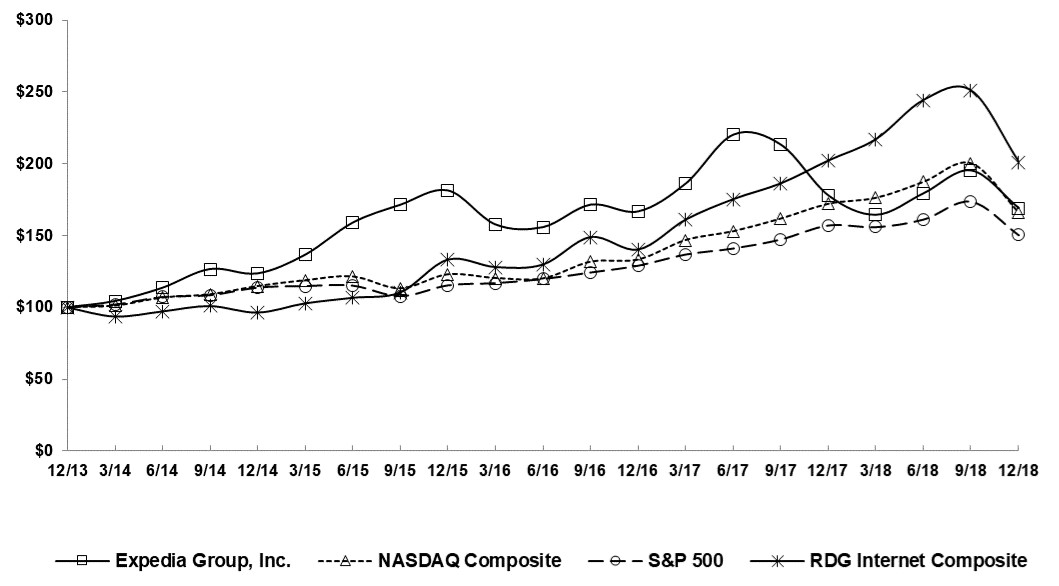
Item 6. Selected Financial Data
We have derived the following selected financial data presented below from the consolidated financial statements and related notes. The information set forth below is not necessarily indicative of future results and should be read in conjunction with the consolidated financial statements and related notes and Part II, Item 7, Management’s Discussion and Analysis of Financial Condition and Results of Operations.
SELECTED FINANCIAL DATA
| Year Ended December 31, | |||||||||||||||||||
| 2018 | 2017 | 2016 | 2015 | 2014 | |||||||||||||||
| (in millions, except per share data) | |||||||||||||||||||
| Consolidated Statements of Operations Data: | |||||||||||||||||||
| Revenue | $ | 11,223 | $ | 10,060 | $ | 8,774 | $ | 6,672 | $ | 5,763 | |||||||||
| Operating income | 714 | 625 | 462 | 414 | 518 | ||||||||||||||
| Net income attributable to Expedia Group, Inc.(1) | 406 | 378 | 282 | 764 | 398 | ||||||||||||||
| Earnings per share attributable to Expedia Group, Inc. available to common stockholders: | |||||||||||||||||||
| Basic | $ | 2.71 | $ | 2.49 | $ | 1.87 | $ | 5.87 | $ | 3.09 | |||||||||
| Diluted | 2.65 | 2.42 | 1.82 | 5.70 | 2.99 | ||||||||||||||
| Shares used in computing earnings per share: | |||||||||||||||||||
| Basic | 149,961 | 151,619 | 150,367 | 130,159 | 128,912 | ||||||||||||||
| Diluted | 152,889 | 156,385 | 154,517 | 134,018 | 133,168 | ||||||||||||||
| Dividends declared per common share | $ | 1.24 | $ | 1.16 | $ | 1.00 | $ | 0.84 | $ | 0.66 | |||||||||
| December 31, | |||||||||||||||||||
| 2018 | 2017 | 2016 | 2015 | 2014 | |||||||||||||||
| Consolidated Balance Sheet Data: | |||||||||||||||||||
| Working deficit | $ | (2,863 | ) | $ | (2,339 | ) | $ | (2,677 | ) | $ | (2,950 | ) | $ | (1,263 | ) | ||||
| Total assets | 18,033 | 18,516 | 15,778 | 15,486 | 9,012 | ||||||||||||||
| Senior notes debt(2) | 3,717 | 4,249 | 3,159 | 3,183 | 1,739 | ||||||||||||||
| Non-redeemable non-controlling interest(3) | 1,547 | 1,606 | 1,561 | 65 | 109 | ||||||||||||||
| Total stockholders’ equity | 5,651 | 6,129 | 5,693 | 4,930 | 1,894 |
| (1) | On May 22, 2015, we completed the sale of our 62.4% ownership stake in eLong, Inc. We recognized an after tax gain of $395 million (or $509 million pre-tax gain) during 2015. |
| (2) | Includes current and long-term portion of senior notes. |
| (3) | On December 16, 2016, our majority-owned subsidiary, trivago, completed its IPO. In conjunction with the IPO, Expedia Group and trivago's founders entered into an Amended and Restated Shareholders' Agreement under which the original put/call rights were no longer effective and, as such, we reclassified the redeemable non-controlling interest into non-redeemable non-controlling interest on the consolidated balance sheet. See NOTE 11 — Redeemable Non-controlling Interests in the notes to consolidated financial statements for further information. |
Item 7. Management’s Discussion and Analysis of Financial Condition and Results of Operations
Overview
Expedia Group is one of the world's largest travel companies. We help knock down the barriers to travel, making it easier, more enjoyable, more attainable and more accessible. We bring the world within reach for customers and partners around the globe. We leverage our platform and technology capabilities across an extensive portfolio of businesses and brands to orchestrate the movement of people and the delivery of travel experiences on both a local and global basis. We make available, on a stand-alone and package basis, travel services provided by numerous lodging properties, airlines, car rental companies, destination service providers, cruise lines, vacation rental property owners and managers, and other travel product and service companies. We also offer travel and non-travel advertisers access to a potential source of incremental traffic and transactions through our various media and advertising offerings on our websites. For additional information about our portfolio of brands, see the disclosure set forth in Part I, Item 1, Business, under the caption “Management Overview.”
All percentages within this section are calculated on actual, unrounded numbers.
Trends
The travel industry, including offline agencies, online agencies and other suppliers of travel products and services, has historically been characterized by intense competition, as well as rapid and significant change. Generally, 2017 and 2018 represented years of continuing growth for the travel industry. However, political instability, geopolitical conflicts, acts of terrorism, significant fluctuations in currency values, sovereign debt issues, natural disasters and macroeconomic concerns are examples of events that contribute to a somewhat uncertain environment, which could have a negative impact on the travel industry in the future. For additional information about our growth strategy for Expedia Group, see the disclosure set forth in Part I, Item 1, Business, under the caption “Growth Strategy.”
Online Travel
Increased usage and familiarity with the internet are driving rapid growth in online penetration of travel expenditures. According to Phocuswright, an independent travel, tourism and hospitality research firm, in 2019, over 45% of U.S. and European leisure and unmanaged corporate travel expenditures are expected to occur online. Online penetration rates in the emerging markets, such as Asia Pacific and Latin American regions, are lagging behind that of the United States and Europe, and are estimated to be in the range of 35% to 45% in 2019. These penetration rates increased over the past few years, and are expected to continue growing, which presents an attractive growth opportunity for our business, while also attracting many competitors to online travel. This competition intensified in recent years, and the industry is expected to remain highly competitive for the foreseeable future. In addition to the growth of online travel agencies, airlines and lodging companies aggressively pursued direct online distribution of their products and services. Competitive entrants such as “metasearch” companies, including Kayak.com (owned by Booking Holdings), trivago (in which Expedia Group owns a majority interest) as well as TripAdvisor, introduced differentiated features, pricing and content compared with the legacy online travel agency companies, as well as various forms of direct or assisted booking tools. In addition, the increasing popularity of the “sharing economy,” accelerated by online penetration, has had a direct impact on the travel and lodging industry. Businesses such as Airbnb, HomeAway (which Expedia acquired in December 2015) and Booking.com (owned by Booking Holdings) have emerged as the leaders, bringing incremental alternative accommodation and vacation rental inventory to the market. Many other competitors, including vacation rental metasearch players, continue to emerge in this space, which is expected to continue to grow as a percentage of the global accommodation market. Furthermore, we see increased interest in the online travel industry from search engine companies as evidenced by recent innovations including direct booking functionality and product enhancements by companies such as Google. Finally, traditional consumer eCommerce and group buying websites expanded their local offerings into the travel market by adding hotel offers to their websites. For additional detail regarding the competitive trends and risks we face, see Part I Item 1 Business - "Competition," and Part I, Item 1A, Risk Factors - "We operate in an increasingly competitive global environment.”
The online travel industry also saw the development of alternative business models and variations in the timing of payment by travelers and to suppliers, which in some cases place pressure on historical business models. In particular, the agency hotel model saw rapid adoption in Europe. Expedia Group distributes both merchant (Expedia Collect) and agency (Hotel Collect) hotel offerings for our hotel supply partners through both agency-only contracts as well as our hybrid ETP program, which offers travelers the choice of whether to pay Expedia Group at the time of booking or pay the hotel at the time of stay.
Intense competition also historically led to aggressive marketing efforts by the travel suppliers and intermediaries, and a meaningful unfavorable impact on our overall marketing efficiencies and operating margins. We manage our selling and marketing spending on a brand basis, making decisions in each applicable market that we think are appropriate based on the relative growth opportunity and the expected returns and the competitive environment. In certain cases, particularly in
emerging markets, we are pursuing and expect to continue to pursue long-term growth opportunities for which our marketing efficiency is less favorable than that for our consolidated business, but for which we still believe the opportunity to be attractive. In addition, the crowded online travel environment is now driving certain secondary and tertiary online travel companies to establish marketing agreements with global players in order to leverage distribution and technology capabilities while focusing resources on capturing traveler mind share. For more detail, see Part I, Item 1A, Risk Factors - "We rely on the value of our brands, and the cost of maintaining and enhancing our brand awareness are increasing” and “Our international operations involve additional risks and our exposure to these risks will increase as our business expands globally.”
Lodging
Lodging includes hotel accommodations as well as alternative accommodations primarily made available through HomeAway. As a percentage of our total worldwide revenue in 2018, lodging accounted for 69%. Our room night growth has been healthy, with room nights 32% in 2016 (excluding eLong), 16% in 2017 and 13% in 2018. ADRs for rooms booked on Expedia and HomeAway websites increased 5% in 2016 (excluding eLong) due to the acquisition of HomeAway, 3% in 2017 and 5% in 2018.
Hotel. We generate the majority of our revenue through the facilitation of hotel reservations (stand-alone and package bookings). Although our relationships with our hotel supply partners remained broadly stable in the past few years, as part of the global rollout of ETP, we reduced negotiated economics in certain instances to compensate for hotel supply partners absorbing expenses such as credit card fees and customer service costs, which has negatively impacted the margin of revenue we earn per booking. In addition, as we continue to expand the breadth and depth of our global hotel offering, in some cases we have reduced our economics in various geographies based on local market conditions. These impacts are due to specific initiatives intended to drive greater global size and scale through faster overall room night growth. Additionally, increased promotional activities such as grow
Showing the first 8K of 100K characters. Open the full section
Item 7A. Quantitative and Qualitative Disclosures About Market Risk
Market Risk Management
Market risk is the potential loss from adverse changes in interest rates, foreign exchange rates and market prices. Our exposure to market risk includes our long-term debt, our revolving credit facility, derivative instruments and cash and cash equivalents, accounts receivable, intercompany receivables, investments, merchant accounts payable and deferred merchant bookings denominated in foreign currencies. We manage our exposure to these risks through established policies and procedures. Our objective is to mitigate potential income statement, cash flow and market exposures from changes in interest and foreign exchange rates.
Interest Rate Risk
In August 2010, we issued $750 million senior unsecured notes with a fixed rate of 5.95%. In August 2014, we issued $500 million senior unsecured notes with a fixed rate of 4.5%. In June 2015, we issued Euro 650 million of senior unsecured notes with a fixed rate of 2.5%. (See “Foreign Exchange Risk” below for further discussion or our 2.5% Notes.) In December 2015, we issued $750 million of senior unsecured notes with a fixed rate of 5.0%. In September 2017, we issued $1 billion of senior unsecured notes with a fixed rate of 3.8%. As a result, if market interest rates decline, our required payments will exceed those based on market rates. The fair values of our 5.95% Notes, 2.5% Notes, 4.5% Notes, 5.0% Notes and 3.8% Notes were approximately $778 million, $771 million, $504 million, $760 million and $915 million as of December 31, 2018 as calculated based on quoted market prices in less active markets at year end. A 50 basis point increase or decrease in interest rates would decrease or increase the fair value of our 5.95% Notes by approximately $6 million, our 2.5% Notes by approximately $12 million, our 4.5% Notes by approximately $12 million, our 5.0% Notes by approximately $22 million and our 3.8% Notes by approximately $35 million.
We maintain a $2 billion revolving credit facility, which bears interest based on market rates plus a spread determined by our credit ratings. Because our interest rate is tied to a market rate, we will be susceptible to fluctuations in interest rates if, consistent with our practice to date, we do not hedge the interest rate exposure arising from any borrowings under our revolving credit facility. As of December 31, 2018 and 2017, we had no revolving credit facility borrowings outstanding.
We did not experience any significant impact from changes in interest rates for the years ended December 31, 2018, 2017 or 2016.
Foreign Exchange Risk
We conduct business in certain international markets, primarily in Australia, Canada, China and the European Union. Because we operate in international markets, we have exposure to different economic climates, political arenas, tax systems and regulations that could affect foreign exchange rates. Our primary exposure to foreign currency risk relates to transacting in foreign currency and recording the activity in U.S. dollars. Changes in exchange rates between the U.S. dollar and these other currencies will result in transaction gains or losses, which we recognize in our consolidated statements of operations.
To the extent practicable, we minimize our foreign currency exposures by maintaining natural hedges between our current assets and current liabilities in similarly denominated foreign currencies. Additionally, we use foreign currency forward contracts to economically hedge certain merchant revenue exposures, foreign denominated liabilities related to certain of our loyalty programs and our other foreign currency-denominated operating liabilities. These instruments are typically short-term and are recorded at fair value with gains and losses recorded in other, net. As of December 31, 2018 and 2017, we had a net forward asset of $22 million and $6 million included in prepaid expenses and other current assets. We may enter into additional foreign exchange derivative contracts or other economic hedges in the future. Our goal in managing our foreign exchange risk is to reduce to the extent practicable our potential exposure to the changes that exchange rates might have on our earnings, cash flows and financial position. We make a number of estimates in conducting hedging activities including in some cases the level of future bookings, cancellations, refunds, customer stay patterns and payments in foreign currencies. In the event those estimates differ significantly from actual results, we could experience greater volatility as a result of our hedges.
In June 2015, we issued Euro 650 million of registered senior unsecured notes that are due in June 2022 and bear interest at 2.5%. The aggregate principal value of the 2.5% Notes is designated as a hedge of our net investment in certain Euro functional currency subsidiaries. The notes are measured at Euro to U.S. Dollar exchange rates at each balance sheet date and transaction gains or losses due to changes in rates are recorded in accumulated other comprehensive income (loss). The Euro-denominated net assets of these subsidiaries are translated into U.S. Dollars at each balance sheet date, with effects of foreign currency changes also reported in accumulated other comprehensive income (loss). Since the notional amount of the recorded Euro-denominated debt is less than the notional amount of our net investment, we do not expect to incur any ineffectiveness on this hedge.
Future net transaction gains and losses are inherently difficult to predict as they are reliant on how the multiple currencies in which we transact fluctuate in relation to the U.S. dollar, the relative composition and denomination of current assets and liabilities each period, and our effectiveness at forecasting and managing, through balance sheet netting or the use of derivative contracts, such exposures. As an example, if the foreign currencies in which we hold net asset balances were to all weaken 10% against the U.S. dollar and foreign currencies in which we hold net liability balances were to all strengthen 10% against the U.S. dollar, we would recognize foreign exchange losses of approximately $23 million based on our foreign currency forward positions (including the impact of forward positions economically hedging our merchant revenue exposures) and the net asset or liability balances of our foreign denominated cash and cash equivalents, accounts receivable, deferred merchant bookings and merchant accounts payable balances as of December 31, 2018. As the net composition of these balances fluctuate
frequently, even daily, as do foreign exchange rates, the example loss could be compounded or reduced significantly within a given period.
During 2018, 2017 and 2016, we recorded net foreign exchange rate gains of approximately $3 million ($38 million loss excluding the contracts economically hedging our forecasted merchant revenue), net foreign exchange rate losses of approximately $46 million ($40 million loss excluding the contracts economically hedging our forecasted merchant revenue) and net foreign exchange rate losses of approximately $15 million ($30 million loss excluding the contracts economically hedging our forecasted merchant revenue). As we increase our operations in international markets, our exposure to fluctuations in foreign currency exchange rates increases. The economic impact to us of foreign currency exchange rate movements is linked to variability in real growth, inflation, interest rates, governmental actions and other factors. These changes, if material, could cause us to adjust our financing and operating strategies.
Item 8. Consolidated Financial Statements and Supplementary Data
The Consolidated Financial Statements and Schedule listed in the Index to Financial Statements, Schedules and Exhibits on page F-1 are filed as part of this report.
Item 9. Changes in and Disagreements with Accountants on Accounting and Financial Disclosure
None.
Item 9A. Controls and Procedures
Changes in Internal Control over Financial Reporting.
There were no changes to our internal control over financial reporting that occurred during the quarter ended December 31, 2018 that have materially affected, or are reasonably likely to materially affect, our internal control over financial reporting.
Evaluation of Disclosure Controls and Procedures.
As required by Rule 13a-15(b) under the Securities Exchange Act of 1934, as amended (the “Exchange Act”), our management, including our Chairman and Senior Executive, Chief Executive Officer and Chief Financial Officer, evaluated the effectiveness of the design and operation of our disclosure controls and procedures (as defined in Rule 13a-15(e) under the Exchange Act). Based upon that evaluation, our Chairman and Senior Executive, Chief Executive Officer and Chief Financial Officer concluded that, as of the end of the period covered by this report, our disclosure controls and procedures were effective.
Management’s Report on Internal Control over Financial Reporting.
Our management is responsible for establishing and maintaining adequate internal control over financial reporting, as defined in Rule 13a-15(f) of the Exchange Act. Internal control over financial reporting is a process to provide reasonable assurance regarding the reliability of our financial reporting for external purposes in accordance with accounting principles generally accepted in the United States of America. Management conducted an evaluation of the effectiveness of our internal control over financial reporting based on the criteria for effective control over financial reporting described in Internal Control — Integrated Framework (2013) issued by the Committee of Sponsoring Organizations of the Treadway Commission. Based on this evaluation, management has concluded that, as of December 31, 2018, the Company’s internal control over financial reporting was effective. Management has reviewed its assessment with the Audit Committee. Ernst & Young, LLP, an independent registered public accounting firm, has audited the effectiveness of our internal control over financial reporting as of December 31, 2018, as stated in their report which is included below.
Limitations on Controls.
Management does not expect that our disclosure controls and procedures or our internal control over financial reporting will prevent or detect all error and fraud. Any control system, no matter how well designed and operated, is based upon certain assumptions and can provide only reasonable, not absolute, assurance that its objectives will be met. Further, no evaluation of controls can provide absolute assurance that misstatements due to error or fraud will not occur or that all control issues and instances of fraud, if any, within the Company have been detected.
Report of Independent Registered Public Accounting Firm
The Board of Directors and Stockholders
Expedia Group, Inc.
Opinion on Internal Control over Financial Reporting
We have audited Expedia Group, Inc.’s internal control over financial reporting as of December 31, 2018, based on criteria established in Internal Control-Integrated Framework issued by the Committee of Sponsoring Organizations of the Treadway Commission (2013 framework) (the COSO criteria). In our opinion, Expedia Group, Inc. (the Company) maintained, in all material respects, effective internal control over financial reporting as of December 31, 2018, based on the COSO criteria.
We also have audited, in accordance with the standards of the Public Company Accounting Oversight Board (United States) (PCAOB), the consolidated balance sheets of the Company as of December 31, 2018 and 2017, the related consolidated statements of operations, comprehensive income, changes in stockholders’ equity and cash flows for each of the three years in the period ended December 31, 2018, and the related notes and our report dated February 7, 2019 expressed an unqualified opinion thereon.
Basis for Opinion
The Company’s management is responsible for maintaining effective internal control over financial reporting and for its assessment of the effectiveness of internal control over financial reporting included in the accompanying Management’s Report on Internal Control over Financial Reporting. Our responsibility is to express an opinion on the Company’s internal control over financial reporting based on our audit. We are a public accounting firm registered with the PCAOB and are required to be independent with respect to the Company in accordance with the U.S. federal securities laws and the applicable rules and regulations of the Securities and Exchange Commission and the PCAOB.
We conducted our audit in accordance with the standards of the PCAOB. Those standards require that we plan and perform the audit to obtain reasonable assurance about whether effective internal control over financial reporting was maintained in all material respects.
Our audit included obtaining an understanding of internal control over financial reporting, assessing the risk that a material weakness exists, testing and evaluating the design and operating effectiveness of internal control based on the assessed risk, and performing such other procedures as we considered necessary in the circumstances. We believe that our audit provides a reasonable basis for our opinion.
Definition and Limitations of Internal Control Over Financial Reporting
A company’s internal control over financial reporting is a process designed to provide reasonable assurance regarding the reliability of financial reporting and the preparation of financial statements for external purposes in accordance with generally accepted accounting principles. A company’s internal control over financial reporting includes those policies and procedures that (1) pertain to the maintenance of records that, in reasonable detail, accurately and fairly reflect the transactions and dispositions of the assets of the company; (2) provide reasonable assurance that transactions are recorded as necessary to permit preparation of financial statements in accordance with generally accepted accounting principles, and that receipts and expenditures of the company are being made only in accordance with authorizations of management and directors of the company; and (3) provide reasonable assurance regarding prevention or timely detection of unauthorized acquisition, use, or disposition of the company’s assets that could have a material effect on the financial statements.
Because of its inherent limitations, internal control over financial reporting may not prevent or detect misstatements. Also, projections of any evaluation of effectiveness to future periods are subject to the risk that controls may become inadequate because of changes in conditions, or that the degree of compliance with the policies or procedures may deteriorate.
/s/Ernst & Young LLP
Seattle, Washington
February 7, 2019
Item 9B. Other Information
None.
Part III.
We are incorporating by reference the information required by Part III of this report on Form 10-K from our proxy statement relating to our 2019 annual meeting of stockholders (the “2019 Proxy Statement”), which will be filed with the Securities and Exchange Commission within 120 days after the end of our fiscal year ended December 31, 2018.
Item 10. Directors, Executive Officers and Corporate Governance
The information required by this item is included under the captions “Election of Directors — Nominees,” “Election of Directors — Board Meetings and Committees,” “Information Concerning Executive Officers” and “Section 16(a) Beneficial Ownership Reporting Compliance” in the 2019 Proxy Statement and incorporated herein by reference.
Item 11. Executive Compensation
The information required by this item is included under the captions “Election of Directors —Compensation of Non-Employee Directors,” “Election of Directors — Compensation Committee Interlocks and Insider Participation,” “Compensation Discussion and Analysis,” “Compensation Committee Report” and “Executive Compensation” in the 2019 Proxy Statement and incorporated herein by reference.
Item 12. Security Ownership of Certain Beneficial Owners and Management and Related Stockholder Matters
The information required by this item is included under the captions “Security Ownership of Certain Beneficial Owners and Management” and “Equity Compensation Plan Information” in the 2019 Proxy Statement and incorporated herein by reference.
Item 13. Certain Relationships and Related Transactions, and Director Independence
The information required by this item is included under the captions “Certain Relationships and Related Person Transactions” and “Election of Directors — Board Meetings and Committees” in the 2019 Proxy Statement and incorporated herein by reference.
Item 14. Principal Accounting Fees and Services
The information required by this item is included under the caption “Audit Committee Report” in the 2019 Proxy Statement and incorporated herein by reference.
Item 15. Exhibits, Consolidated Financial Statements and Financial Statement Schedules
(a)(1) Consolidated Financial Statements
We have filed the consolidated financial statements listed in the Index to Consolidated Financial Statements, Schedules and Exhibits on page F-1 as a part of this report.
(a)(2) Financial Statement Schedules
All financial statement schedules have been omitted because they are not applicable, not material or the required information is shown in the consolidated financial statements or the notes thereto.
(a)(3) Exhibits
The exhibits listed below are filed as part of this Annual Report on Form 10-K.
| Exhibit No. | Filed Herewith | Incorporated by Reference | ||||||||||
| Exhibit Description | Form | SEC File No. | Exhibit | Filing Date | ||||||||
| 1.1 | Underwriting Agreement, dated Expedia, Inc., as Issuer, the Guarantors party thereto, and BNP Paribas, Goldman, Sachs & Co., J.P. Morgan Securities plc, as Representatives of the several Underwriters (relating to the Fourth Supplemental Indenture on Exhibit 4.6) | 8-K | 000-51447 | 1.1 | 6/3/2015 |
| * | Indicates a management contract or compensatory plan or arrangement. |
| *† | Indicates reference to filing of Liberty Expedia Holdings, Inc. |
| *** | Furnished herewith |
Item 16. Form 10-K Summary
Not applicable.
Signatures
Pursuant to the requirements of the Section 13 or 15(d) Securities Exchange Act of 1934, the Registrant has duly caused this report to be signed on its behalf by the undersigned hereunto duly authorized.
| Expedia Group, Inc. | ||
| By: | /s/ MARK D. OKERSTROM | |
| Mark D. Okerstrom Chief Executive Officer |
February 7, 2019
Pursuant to the requirements of the Securities Exchange Act of 1934, this report has been signed below by the following persons on behalf of the Registrant and in the capacities indicated on February 7, 2019.
| Signature | Title | |
| /s/ MARK D. OKERSTROM | Chief Executive Officer, President and Director | |
| Mark D. Okerstrom | (Principal Executive Officer) | |
| /s/ ALAN PICKERILL | Chief Financial Officer | |
| Alan Pickerill | (Principal Financial Officer) | |
| /s/ LANCE A. SOLIDAY | Chief Accounting Officer and Controller | |
| Lance A. Soliday | (Principal Accounting Officer) | |
| /s/ BARRY DILLER | Director (Chairman of the Board) | |
| Barry Diller | ||
| /s/ PETER M. KERN | Director (Vice Chairman) | |
| Peter M. Kern | ||
| /s/ SUSAN C. ATHEY | Director | |
| Susan C. Athey | ||
| /s/ A. GEORGE BATTLE | Director | |
| A. George Battle | ||
| /s/ COURTNEE A. CHUN | Director | |
| Courtnee A. Chun | ||
| /s/ CHELSEA CLINTON | Director | |
| Chelsea Clinton | ||
| /s/ PAMELA L. COE | Director | |
| Pamela L. Coe | ||
| /s/ JONATHAN L. DOLGEN | Director | |
| Jonathan L. Dolgen | ||
| /s/ CRAIG A. JACOBSON | Director | |
| Craig A. Jacobson | ||
| /s/ VICTOR A. KAUFMAN | Director | |
| Victor A. Kaufman | ||
| /s/ DARA KHOSROWSHAHI | Director | |
| Dara Khosrowshahi | ||
| /s/ SCOTT RUDIN | Director | |
| Scott Rudin | ||
| /s/ CHRISTOPHER W. SHEAN | Director | |
| Christopher W. Shean | ||
| /s/ ALEXANDER VON FURSTENBERG | Director | |
| Alexander von Furstenberg |
INDEX TO CONSOLIDATED FINANCIAL STATEMENTS, SCHEDULES AND EXHIBITS
F- 1
Report of Independent Registered Public Accounting Firm
The Board of Directors and Stockholders
Expedia Group, Inc.
Opinion on the Financial Statements
We have audited the accompanying consolidated balance sheets of Expedia Group, Inc. (the Company) as of December 31, 2018 and 2017, the related consolidated statements of operations, comprehensive income, changes in stockholders' equity and cash flows for each of the three years in the period ended December 31, 2018, and the related notes (collectively referred to as the “consolidated financial statements”). In our opinion, the consolidated financial statements present fairly, in all material respects, the financial position of the Company at December 31, 2018 and 2017, and the results of its operations and its cash flows for each of the three years in the period ended December 31, 2018, in conformity with U.S. generally accepted accounting principles.
We also have audited, in accordance with the standards of the Public Company Accounting Oversight Board (United States) (PCAOB), the Company's internal control over financial reporting as of December 31, 2018, based on criteria established in Internal Control-Integrated Framework issued by the Committee of Sponsoring Organizations of the Treadway Commission (2013 framework), and our report dated February 7, 2019 expressed an unqualified opinion thereon.
Basis for Opinion
These financial statements are the responsibility of the Company's management. Our responsibility is to express an opinion on the Company’s financial statements based on our audits. We are a public accounting firm registered with the PCAOB and are required to be independent with respect to the Company in accordance with the U.S. federal securities laws and the applicable rules and regulations of the Securities and Exchange Commission and the PCAOB.
We conducted our audits in accordance with the standards of the PCAOB. Those standards require that we plan and perform the audit to obtain reasonable assurance about whether the financial statements are free of material misstatement, whether due to error or fraud. Our audits included performing procedures to assess the risks of material misstatement of the financial statements, whether due to error or fraud, and performing procedures that respond to those risks. Such procedures included examining, on a test basis, evidence regarding the amounts and disclosures in the financial statements. Our audits also included evaluating the accounting principles used and significant estimates made by management, as well as evaluating the overall presentation of the financial statements. We believe that our audits provide a reasonable basis for our opinion.
/s/ Ernst & Young LLP
We have served as the Company’s auditor since 2004.
Seattle, Washington
February 7, 2019
F- 2
Consolidated Financial Statements
EXPEDIA GROUP, INC.
CONSOLIDATED STATEMENTS OF OPERATIONS
| Year ended December 31, | |||||||||||
| 2018 | 2017 | 2016 | |||||||||
| (In millions, except for per share data) | |||||||||||
| Revenue | $ | 11,223 | $ | 10,060 | $ | 8,774 | |||||
| Costs and expenses: | |||||||||||
| Cost of revenue (1) | 1,965 | 1,757 | 1,597 | ||||||||
| Selling and marketing (1) | 5,767 | 5,298 | 4,367 | ||||||||
| Technology and content (1) | 1,617 | 1,387 | 1,235 | ||||||||
| General and administrative (1) | 808 | 676 | 678 | ||||||||
| Amortization of intangible assets | 283 | 275 | 317 | ||||||||
| Impairment of goodwill | 86 | — | — | ||||||||
| Impairment of intangible assets | 42 | — | 35 | ||||||||
| Legal reserves, occupancy tax and other | (59 | ) | 25 | 27 | |||||||
| Restructuring and related reorganization charges (1) | — | 17 | 56 | ||||||||
| Operating income | 714 | 625 | 462 | ||||||||
| Other income (expense): | |||||||||||
| Interest income | 71 | 34 | 20 | ||||||||
| Interest expense | (190 | ) | (182 | ) | (173 | ) | |||||
| Other, net | (110 | ) | (60 | ) | (32 | ) | |||||
| Total other expense, net | (229 | ) | (208 | ) | (185 | ) | |||||
| Income before income taxes | 485 | 417 | 277 | ||||||||
| Provision for income taxes | (87 | ) | (45 | ) | (16 | ) | |||||
| Net income | 398 |
Showing the first 8K of 235K characters. Open the full section