 filings.tools
Expedia Group 10-K 2021-12-31
Filed 2022-02-11. 22 sections, 570K characters. Original on sec.gov · Markdown · JSON
Cover and table of contents
UNITED STATES
SECURITIES AND EXCHANGE COMMISSION
Washington, D.C. 20549
_______________________________________________
Form 10-K
| ☑ | ANNUAL REPORT PURSUANT TO SECTION 13 OR 15(d) OF THE SECURITIES EXCHANGE ACT OF 1934 |
For the fiscal year ended December 31, 2021
OR
| ☐ | TRANSITION REPORT PURSUANT TO SECTION 13 OR 15(d) OF THE SECURITIES EXCHANGE ACT OF 1934 |
For the transition period from to
Commission file number: 001-37429
_______________________________________________
EXPEDIA GROUP, INC.
(Exact name of registrant as specified in its charter)
| Delaware | 20-2705720 | |||||||
| (State or other jurisdiction of incorporation or organization) | (I.R.S. Employer Identification No.) |
1111 Expedia Group Way W
Seattle, WA 98119
(Address of principal executive office) (Zip Code)
Registrant’s telephone number, including area code:
(206) 481-7200
_______________________________________________
Securities registered pursuant to Section 12(b) of the Act:
| Title of each class | Trading symbol(s) | Name of each exchange on which registered | ||||||||||||
| Common stock, $0.0001 par value | EXPE | The Nasdaq Global Select Market | ||||||||||||
| Expedia Group, Inc. 2.500% Senior Notes due 2022 | EXPE22 | New York Stock Exchange |
Indicate by check mark if the registrant is a well-known seasoned issuer, as defined in Rule 405 of the Securities Act. Yes þ No ¨
Indicate by check mark if the registrant is not required to file reports pursuant to Section 13 or Section 15(d) of the Act. Yes ¨ No þ
Indicate by check mark whether the registrant (1) has filed all reports required to be filed by Section 13 or 15(d) of the Securities Exchange Act of 1934 during the preceding 12 months (or for such shorter period that the registrant was required to file such reports), and (2) has been subject to such filing requirements for the past 90 days. Yes þ No ¨
Indicate by check mark whether the registrant has submitted electronically every Interactive Data File required to be submitted pursuant to Rule 405 of Regulation S-T (§ 232.405 of this chapter) during the preceding 12 months (or for such shorter period that the registrant was required to submit such files). Yes þ No ¨
Indicate by check mark whether the registrant is a large accelerated filer, an accelerated filer, a non-accelerated filer, a smaller reporting company, or an emerging growth company. See the definitions of “large accelerated filer,” “accelerated filer,” “smaller reporting company,” and “emerging growth company” in Rule 12b-2 of the Exchange Act. (Check one):
| Large accelerated filer | ☑ | Accelerated filer | ☐ | |||||||||||||||||
| Non-accelerated filer | ☐ | Smaller reporting company | ☐ | |||||||||||||||||
| Emerging growth company | ☐ |
If an emerging growth company, indicate by check mark if the registrant has elected not to use the extended transition period for complying with any new or revised financial accounting standards provided pursuant to Section 13(a) of the Exchange Act. o
Indicate by check mark whether the registrant has filed a report on and attestation to its management’s assessment of the effectiveness of its internal control over financial reporting under Section 404(b) of the Sarbanes-Oxley Act (15 U.S.C. 7262(b)) by the registered public accounting firm that prepared or issued its audit report. ☑
Indicate by check mark whether the registrant is a shell company (as defined in Rule 12b-2 of the Exchange Act). Yes ☐ No ☑
As of June 30, 2021, the aggregate market value of the registrant’s common equity held by non-affiliates was approximately $23,665,358,000. For the purpose of the foregoing calculation only, all directors and executive officers of the registrant are assumed to be affiliates of the registrant.
| Class | Outstanding Shares at January 28, 2022 were approximately, | ||||||||||
| Common stock, $0.0001 par value per share | 150,230,905 | shares | |||||||||
| Class B common stock, $0.0001 par value per share | 5,523,452 | shares |
Documents Incorporated by Reference
| Document | Parts Into Which Incorporated | |||||||
| Portions of the definitive Proxy Statement for the 2022 Annual Meeting of Stockholders (Proxy Statement) | Part III | |||||||
Expedia Group, Inc.
Form 10-K
For the Year Ended December 31, 2021
Contents
Expedia Group, Inc.
Form 10-K
For the Year Ended December 31, 2021
Item 1. Business
We refer to Expedia Group, Inc. and its subsidiaries collectively as “Expedia Group,” the “Company,” “us,” “we” and “our” in this Annual Report on Form 10-K.
Forward-Looking Statements
This Annual Report on Form 10-K contains “forward-looking statements” within the meaning of the Private Securities Litigation Reform Act of 1995. These forward-looking statements reflect the views of our management regarding current expectations and projections about future events and are based on currently available information. Actual results could differ materially from those contained in these forward-looking statements for a variety of reasons, including, but not limited to, those discussed in the section entitled “Risk Factors” as well as those discussed elsewhere in this report. COVID-19, and the volatile regional and global economic conditions stemming from it, and additional or unforeseen effects from the COVID-19 pandemic, could also give rise to or aggravate these risk factors, which in turn could materially adversely affect our business, financial condition, liquidity, results of operations (including revenues and profitability) and/or stock price. Further, COVID-19 may also continue to affect our operating and financial results in a manner that is not presently known to us or that we currently do not consider to present significant risks to our operations. Other unknown or unpredictable factors also could have a material adverse effect on our business, financial condition and results of operations. Accordingly, readers should not place undue reliance on these forward-looking statements. The use of words such as “anticipates,” “believes,” “could,” “estimates,” “expects,” “goal,” “intends,” “likely,” “may,” “plans,” “potential,” “predicts,” “projected,” “seeks,” “should” and “will,” or the negative of these terms or other similar expressions, among others, generally identify forward-looking statements; however, these words are not the exclusive means of identifying such statements. In addition, any statements that refer to expectations, projections or other characterizations of future events or circumstances are forward-looking statements. These forward-looking statements are inherently subject to uncertainties, risks and changes in circumstances that are difficult to predict. We are not under any obligation to, and do not intend to, publicly update or review any of these forward-looking statements, whether as a result of new information, future events or otherwise, even if experience or future events make it clear that any expected results expressed or implied by those forward-looking statements will not be realized. Please carefully review and consider the various disclosures made in this report and in our other reports filed with the Securities and Exchange Commission ("SEC") that attempt to advise interested parties of the risks and factors that may affect our business, prospects and results of operations.
Management Overview
COVID-19
The COVID-19 pandemic has severely restricted the level of economic activity around the world, had an unprecedented effect on the global travel industry and materially and negatively impacted our business, financial results and financial condition. Since the first quarter of 2020, the governments of many countries, states, cities and other geographic regions have implemented, and continue to implement, a variety of containment measures, including travel restrictions, bans and advisories, instructions to practice social distancing, curfews, quarantine advisories, including quarantine restrictions after travel in certain locations, “shelter-in-place” orders, required closures of non-essential businesses, vaccination mandates or requirements for businesses to confirm employees’ vaccination status, and other restrictions. While the process of vaccinating their residents against COVID-19 is underway in many countries, with various levels of success, the large scale and challenging logistics of distributing the vaccines, the unavailability of vaccines in many regions, the impact of vaccine hesitancy, as well as uncertainty over the efficacy of the vaccine against new variants of the virus, may all contribute to delays in economic recovery, particularly for the travel industry.
Overall, the full duration and total impact of COVID-19 remains uncertain and it is difficult to predict how the recovery will unfold for the travel industry and, in particular, our business, going forward.
General Description of Our Business
Expedia Group, Inc. is an online travel company, and our mission is to power global travel for everyone, everywhere. We believe travel is a force for good. Travel is an essential human experience that strengthens connections, broadens horizons and bridges divides. We leverage our supply portfolio, platform and technology capabilities across an extensive portfolio of consumer brands, and provide solutions to our business partners, to empower travelers to efficiently research, plan, book and experience travel. We seek to grow our business through a dynamic portfolio of travel brands, including our majority-owned subsidiaries, that feature a broad multi-product supply portfolio — with approximately 3 million lodging properties available, including over 2 million online bookable alternative accommodations listings and approximately 875,000 hotels, over 500
airlines, packages, rental cars, cruises, insurance, as well as activities and experiences across most countries. Travel suppliers distribute and market products via our desktop and mobile offerings, as well as through alternative distribution channels, our business partnerships and our call centers in order to reach our extensive global audience. In addition, our advertising and media businesses help other businesses, primarily travel providers, reach a large multi-platform audience of travelers around the globe.
Over 25 years ago, we began operations as one of the first online travel agencies (“OTAs”) and played a significant role in revolutionizing and democratizing travel, by empowering customers to manage their own travel plans. We did so by building and then leveraging proprietary technology to connect partners and their respective inventory to those travelers, while unlocking the marketplace for travel to other businesses as well. Since then, the travel industry has experienced significant transformation, including the material shift from offline to online travel booking. This transformation led to many years of exciting growth for OTAs along with increased competition. In order to remain innovative and competitive, we made several strategic acquisitions, which materially expanded the breadth and depth of our Company. Much of our strategy leading up to the COVID-19 pandemic focused on our brands competing aggressively for share all the around the world, each with their own offerings and benefits. While this avoided potential disruptions from integrating the acquired brands, it also created certain complexities and inefficiencies over time.
As a result, in 2020, we shifted to a platform operating model, which enabled us to deliver more scalable services and operate more efficiently. For example, we now manage our marketing investments holistically across the brand portfolio, allowing us to optimize results better, while running on a unified marketing technology platform has improved our performance marketing capabilities. More recently, we shifted to a more unified brand strategy within our Retail business where we have a combined team making decisions across all our brands. These changes were made in an effort to simplify and streamline our organization, improve our cost structure, and the operation of our business.
Within our B2B business, on November 1, 2021, the sale of Egencia to American Express Global Business Travel (“GBT”) was completed. As part of the transaction, Expedia Group received a minority ownership position in the combined business and entered into a 10-year lodging supply agreement with GBT. Moreover, to help streamline activities and focus on our core businesses, we have closed, shut down or sold a number of businesses since the beginning of 2020, the largest of which was Egencia. Overall, we have made good progress on the foundational work to help streamline and simplify the organization over roughly the past two years and therefore can now increase our focus on further improving the travel experience, which was also the Company’s underlying goal more than two decades ago.
Market Opportunity and Business Strategy
Expedia Group is one of the world’s largest online travel companies, yet our gross bookings represent a single-digit percentage of total worldwide travel spending highlighting the size of our market opportunity. Phocuswright estimated global travel spending, inclusive of alternative accommodations at approximately $1.9 trillion in 2020 prior to the onset of COVID-19 with an increasing share booked through online channels each year.
As we endeavor to power global travel for everyone, everywhere our focus is to: leverage our brand and supply strength, and our platform, to provide greater services and value to our travelers, suppliers and business partners, and generate sustained, profitable growth.
Leverage Brand and Supply Strength to Power the Travel Ecosystem. We believe the strength of our brand portfolio and consistent enhancements to product and service offerings, combined with our global scale and broad-based supply, drive increasing value to customers and customer demand. With our significant global audience of travelers, and our deep and broad selection of travel products, we are also able to provide value to supply partners wanting to grow their business through a better understanding of travel retailing and consumer demand in addition to reaching consumers in markets beyond their reach. Our deep product and supply footprint allows us to tailor offerings to target different types of consumers and travel needs, employ geographic segmentation in markets around the world, and leverage brand differentiation, among other benefits. Recently, we shifted to more of a unified brand strategy with an increased focus on uniting our retail brands and teams under one centralized group, which we believe will enable us to drive further value to travelers. For example, in 2021, we announced plans to unify and expand our existing loyalty programs into one global rewards platform spanning all products and global brands. We also market to consumers through a variety of channels, including internet search, metasearch and social media websites, and having multiple brands appear in search results also increases the likelihood of attracting new visitors.
Our portfolio of brands, operated and organized by reportable segment are as follows:
Retail. Our Retail segment provides a full range of travel and advertising services to our worldwide customers through recognized consumer brands that target a variety of customer segments and geographic regions with tailored offerings. Our portfolio of retail brands include:
- Brand Expedia. Brand Expedia is a leading full-service online travel brand with localized websites in a wide range of countries around the world offering a wide selection of travel products and services. Across the more than 25 years
that Brand Expedia has been helping people travel with confidence and ease, we have learned that travelers benefit when Brand Expedia continually improves and optimizes its offering, to ensure that travelers the world over can book the trip they need, in the manner they choose, at any point and save.
-
Hotels.com. Hotels.com focuses on marketing lodging accommodations with a vast footprint of localized websites worldwide.
-
Vrbo. Vrbo (previously HomeAway), operates an online marketplace for the alternative accommodations industry. The Vrbo portfolio includes the vacation rental website, Vrbo, which operates localized websites around the world as well as other regional brands. Vrbo's mission is to find every family the space they need to relax, reconnect, and enjoy precious time away together.
-
Our other brands include Orbitz, Travelocity, ebookers and Wotif Group. These brands enable further connection to customers worldwide through targeted and unique marketing campaigns and access to various travel services and products.
B2B. Our B2B segment encompasses our Expedia Business Services organization, which includes Expedia Partner Solutions. Expedia Partner Solutions partners with businesses in a wide spectrum of countries across a wide range of travel and non-travel verticals including corporate travel management, airlines, travel agents, online retailers and financial institutions, who market Expedia Group rates and availabilities to their travelers. Expedia Partner Solutions' partners can benefit from Expedia Group technology and supply in the way that best suits their business. This includes connecting to Expedia Group's travel content through Expedia Partner Solutions’ API, Rapid; adopting one of Expedia Partner Solutions’ customized white label or co-branded ecommerce template solutions Hotels.com for partners; or Expedia.com for partners; or a powerful agent booking tool, Expedia TAAP. Prior to its sale on November 1, 2021, our B2B segment also included Egencia, which was our full-service travel management company.
trivago. Our trivago segment generates advertising revenue primarily from sending referrals to online travel companies and travel service providers from its hotel metasearch websites. trivago is our majority-owned hotel metasearch company, based in Dusseldorf, Germany. The online platform gives travelers access to price comparisons from hundreds of booking websites for millions of hotels and other accommodations. Officially launched in 2005, trivago is a leading global brand in hotel search and can be accessed worldwide. Subsequent to its initial public offering ("IPO") in December 2016, the company is listed on the Nasdaq Global Select Market and trades under the symbol "TRVG."
Leverage Our Platform to Deliver More Rapid Product Innovation Resulting in Better Traveler Experiences. During 2020, Expedia Group shifted to a platform operating model with more unified technology, product, data engineering and data science teams building services and capabilities that are leveraged across our business units to serve our end customers and provide value-add services to our travel suppliers. This model enables us to deliver more scalable services and operate more efficiently. All of our transaction-based businesses share and benefit from our platform infrastructure, including customer servicing and support, data centers, search capabilities and transaction processing functions, including payment processing and fraud operations.
As we continue to evolve our platform infrastructure, our focus is on developing technical capabilities that support various travel products while using common applications and frameworks. We believe this strategy will enable us to: build in parallel because of simpler, standard architecture; ship products faster; create more innovative solutions; and achieve greater scale. And ultimately, we believe this will result in faster product innovation and therefore better traveler experiences, which is a bigger focus for the Company going forward. In addition, over time, as we enable domains around application development frameworks, we believe we can unlock additional platform service opportunities beyond our internal brands and other business travel partners.
We provide 24-hour-a-day, seven-day-a-week traveler sales and support by our virtual agent platform, telephone or e-mail. For purposes of operational flexibility, we use a combination of outsourced and in-house contact centers. Our contact centers are located in several countries throughout the world. We invested significantly in our contact center technologies, with the goal of improving customer experience and increasing the efficiency of our contact center agents, and have plans to continue reaping the benefits of these investments going forward. In addition, we have continued to invest in our conversation platform, which leverages technology and artificial intelligence to provide online customer service options and self-service capabilities to our customers through our websites and apps.
Our systems infrastructure and web and database servers are housed in various locations, mainly in the United States, which have 24-hour monitoring and engineering support. These data centers have their own generators and multiple back-up systems. Significant amounts of our owned computer hardware for operating the websites are located at these facilities. Additionally, we are in the midst of a multi-year project to migrate products, data storage and functionality and significantly increase our utilization of public cloud computing services, such as Amazon Web Services ("AWS"). For some critical systems,
we have both production and disaster-recovery facilities. Our technology systems are subject to certain risks, which are described below in Part I, Item 1A — Risk Factors.
Business Models
We make travel products and services available both on a stand-alone and package basis, primarily through the following business models: the merchant model, the agency model and the advertising model.
-
Merchant Model. Under the merchant model, we facilitate the booking of hotel rooms, alternative accommodations, airline seats, car rentals and destination services from our travel suppliers and we are the merchant of record for such bookings. For example, we provide travelers access to book hotel room reservations through our contracts with lodging suppliers, which provide us with rates and availability information for rooms but for which we have no control over the rooms and do not bear inventory risk. Our travelers pay us for merchant hotel transactions prior to departing on their trip, generally when they book the reservation. The majority of our merchant transactions relate to lodging bookings.
-
Agency Model. Under the agency model, we facilitate travel bookings and act as the agent in the transaction, passing reservations booked by the traveler to the relevant travel provider. We receive commissions or ticketing fees from the travel supplier and/or traveler. We record revenue on air transactions when the traveler books the transaction, as we do not typically provide significant post booking services to the traveler and payments due to and from air carriers are typically due at the time of ticketing. Additionally, we generally record agency revenue from the hotel when the stayed night occurs as we provide post booking services to the traveler and, thus consider the stay as when our performance obligation is satisfied; and
-
Advertising Model. Under the advertising model we offer travel and non-travel advertisers access to a potential source of incremental traffic and transactions through our various media and advertising offerings across several of our transaction-based websites, as well as on our majority-owned metasearch site, trivago.
For the year ended December 31, 2021, we had total revenue of $8.6 billion, with merchant, agency and advertising, media and other accounting for 64%, 27%, and 9% of total revenue, respectively.
We continue to see closer integration of the agency hotel product with our core merchant product through our Expedia Traveler Preference (ETP) program by offering, for participating hotels, customers the choice of whether to pay Expedia Group in advance under our merchant model (Expedia Collect) or pay at the hotel at the time of the stay under the agency model (Hotel Collect).
In addition, through various of our Expedia Group-branded and other multi-product websites, travelers can dynamically assemble multiple component travel packages for a specified period at a lower price as compared to booking each component separately. Travelers typically select packages based on the total package price or by purchasing one product and receiving a discounted price to attach additional products. The use of the merchant travel components in packages and multi-product purchases enable us to make certain travel products available at prices lower than those charged on an individual component basis by travel suppliers without impacting their other pricing models. In addition, we also offer third-party pre-assembled package offerings, primarily through our international points of sale, further broadening our scope of products and services to travelers. We expect the package product to continue to be marketed primarily using the merchant model.
Marketing and Promotions
Our marketing programs are intended to build and maintain the value of our various brands, drive traffic and ultimately bookings through our various brands and businesses, optimize ongoing traveler acquisition costs and strategically position our brands in relation to one another. Our long-term success and profitability depends on our continued ability to maintain and increase the overall number of traveler transactions flowing through our brand and shared global platforms in a cost-effective manner, as well as our ability to attract repeat customers and customers that come directly to our websites. We manage our marketing investments holistically across the brand portfolio in our Retail segment to optimize results for the Company, and making decisions on a market by market and customer segment basis that we think are appropriate based on the relative growth opportunity, the expected returns and the competitive environment.
Our marketing channels primarily include online advertising, including search engine marketing and optimization as well as metasearch, social media websites, brand advertising through online and offline channels, loyalty programs, mobile apps and direct and/or personalized traveler communications on our websites as well as through direct e-mail communication with our travelers. Our marketing programs and initiatives include promotional offers such as coupons as well as seasonal or periodic special offers from our travel suppliers based on our supplier relationships. Our current traveler loyalty programs include Hotels.com Rewards on Hotels.com global websites and Expedia®Rewards on a wide array of Brand Expedia points of sale, as well as Orbitz Rewards on Orbitz.com. In 2021, we announced plans to unify and expand our existing loyalty programs into
one global rewards platform spanning all products and global brands. The cost of our loyalty programs is recorded as a reduction of revenue in our consolidated financial statements.
We also make use of affiliate marketing. Several of our branded websites receive bookings from consumers who have clicked-through to the respective websites through links posted on affiliate partner websites. Affiliate partners can also make travel products and services available on their own websites through a Brand Expedia, Hotels.com or Vrbo co-branded offering or a private label website. Our Expedia Partner Solutions business provides our affiliates with technology and access to a wide range of products and services. We manage agreements with thousands of third-party affiliate partners pursuant to which we pay a commission for bookings originated from their websites.
Travel Suppliers
Overview. We make travel products and services available from a variety of hotel companies, property owners and managers, large and small commercial airlines, car rental companies, cruise lines, destination service providers, and other travel partners. We seek to build and maintain long-term, strategic relationships with travel suppliers and global distribution system (“GDS”) partners. An important component of the success of our business depends on our ability to maintain our existing, as well as build new, relationships with travel suppliers and GDS partners.
We strive to deliver value to our travel supply partners through a wide range of innovative, targeted merchandising and promotional strategies designed to generate consumer demand and increase their revenue, while simultaneously reducing their overall marketing transaction and customer service costs. Our strategic account managers and local hotel market managers work directly with travel suppliers to optimize the exposure of their travel products and brands through our points of sale, including participation in need-based, seasonal and event-driven promotions and experimentation within the new channels we are building.
We developed proprietary technology to assist hotel suppliers in managing, pricing and marketing their supply. Our “direct connect” technology allows hotels to upload information about available products and services and rates directly from their central reservation systems and to automatically confirm hotel reservations made by our travelers. Proprietary marketing tools assist hotels in tailoring demand to their requirements and our revenue management product provides pricing insight based on Expedia Group data and analytics. Our suite of white label website offerings power hotel, package and meeting space booking on suppliers' own websites.
In addition, Vrbo's alternative accommodation listing services includes a set of tools for property owners or managers, which enables them to manage an availability calendar, reservations, inquiries and the content of the listing, as well as provide various other services for property owners or managers to manage reservations or drive incremental sales volume.
Distribution Partners. GDSs, also referred to as computer reservation services, provide a centralized, comprehensive repository of travel suppliers’ ‘content’ — such as availability and pricing of seats on various airline point-to-point flights, or ‘segments.’ The GDSs act as intermediaries between the travel suppliers and travel agencies, allowing agents to reserve and book flights, rooms or other travel products. Our relationships with GDSs primarily relate to our air business. We use Sabre, Amadeus and Travelport as our GDS segment providers in order to ensure the widest possible supply of content for our travelers.
Competition
Our brands compete in rapidly evolving and intensely competitive markets. We believe international markets represent especially large opportunities for Expedia Group and those of our competitors that wish to expand their brands and businesses abroad to achieve global scale. We also believe that Expedia Group is one of only a few companies that are focused on building a truly global, travel marketplace.
Our competition, which is strong and increasing, includes online and offline travel companies that target leisure and corporate travelers, including travel agencies, tour operators, travel supplier direct websites and their call centers, consolidators and wholesalers of travel products and services, large online portals and search websites, certain travel metasearch websites, mobile travel applications, social media websites, as well as traditional consumer ecommerce and group buying websites. We face these competitors in local, regional, national and/or international markets. In some cases, competitors are offering more favorable terms and improved interfaces to suppliers and travelers which make competition increasingly difficult. We also face competition for customer traffic on internet search engines and metasearch websites, which impacts our customer acquisition and marketing costs.
We believe that maintaining and enhancing our brands is a critical component of our effort to compete. We differentiate our brands from our competitors primarily based on the multiple channels we use to generate demand, quality and breadth of travel products, channel features and usability, price or promotional offers, traveler service and quality of travel planning content and advice as well as offline brand efforts. The emphasis on one or more of these factors varies, depending on the brand or business and the related target demographic. Our brands face increasing competition from travel supplier direct websites. In
some cases, supplier direct channels offer advantages to travelers, such as long standing loyalty programs, complimentary services such as Wi-Fi, and better pricing. Our websites feature travel products and services from numerous travel suppliers, and allow travelers to combine products and services from multiple providers in one transaction. We face competition from airlines, hotels, alternative accommodation websites, rental car companies, cruise operators and other travel service providers, whether working individually or collectively, some of which are suppliers to our websites. Our business is generally sensitive to changes in the competitive landscape, including the emergence of new competitors or business models, and supplier consolidation.
Intellectual Property Rights
Our intellectual property and appurtenant rights, including our patents, trademarks, copyright rights, domain names, trade dress, proprietary technology, and trade secrets, are important components of our business. For example, we rely heavily upon our intellectual property and proprietary information in our content, brands, domain names and website URLs, software code, proprietary technology, ratings indexes, informational databases, images, graphics and other components that support and make up our services. We have acquired some of our intellectual property rights and proprietary information through acquisitions, as well as licenses and content agreements with third parties.
We protect our intellectual property and proprietary information through registration and by relying on our terms of use, confidentiality procedures and contractual provisions, as well as international, national, state and common law rights. In addition, we enter into confidentiality and invention assignment agreements with employees and contractors, and license and confidentiality agreements with other third parties. Despite these precautions, it may be possible for a third party to copy or otherwise obtain and use our trade secrets or our intellectual property and proprietary information without authorization which, if discovered, might require the uncertainty of legal action to correct. In addition, there can be no assurance that others will not independently and lawfully develop substantially similar properties.
We maintain our trademark portfolio by filing trademark applications with national trademark offices, maintaining appropriate registrations, securing contractual trademark rights when appropriate, and relying on common law trademark rights when appropriate. We also register copyrights and domain names as we deem appropriate and necessary, respectively. We protect our trademarks, copyrights and domain names with an enforcement program and use of intellectual property licenses. Trademark and intellectual property protection may not be available or may not be sought, sufficient or effective in every jurisdiction where we operate. Contractual disputes or limitations may affect the use of trademarks and domain names governed by private contract.
We have considered, and will continue to consider, the appropriateness of filing for patents to protect inventions and obtaining licenses in patents as circumstances may warrant. However, patents protect only specific inventions and there can be no assurance that others may not create new products or methods that achieve similar results without infringing upon patents owned by us. We also protect some inventions and methods by maintaining them as trade secrets, either because it provides superior and potentially longer-termed protection, or because the invention is not patentable but provides us with a competitive advantage.
In connection with our copyrightable content, we post and institute procedures under the Digital Millennium Copyright Act and similar Host Privilege statutes worldwide to gain immunity from copyright liability for photographs, text and other content uploaded by users. However, differences between statutes, limitations on immunity, and moderation efforts may affect our ability to claim immunity.
From time to time, we may be subject to legal proceedings and claims in the ordinary course of our business, including claims of alleged infringement or infringement by us of the trademarks, copyrights, patents and other intellectual property rights of third parties. In addition, litigation may be necessary in the future to enforce our intellectual property rights, protect our trade secrets or determine the validity and scope of proprietary rights claimed by others. Any such litigation, regardless of outcome or merit, could result in substantial costs and diversion of management and technical resources, any of which could materially harm our business.
Regulation
We must comply with laws and regulations relating to the travel industry, the alternative accommodation industry and the provision of travel services, including registration in various states as “sellers of travel” and compliance with certain disclosure requirements and participation in state restitution funds In addition, our businesses are subject to regulation by the U.S. Department of Transportation and must comply with various rules and regulations governing the provision of air transportation, including those relating to advertising and accessibility.
In international markets, we are increasingly subject to laws and regulations applicable to travel agents or tour operators in those markets, including, in some countries, pricing display requirements, licensing and registration requirements, mandatory bonding and travel indemnity fund contributions, industry specific value-added tax regimes and laws regulating the provision of travel packages. For example, the European Economic Community Council Directive on Package Travel, Package Holidays and Package Tours imposes various obligations upon marketers of travel packages, such as disclosure obligations to consumers and liability to consumers for improper performance of the package, including supplier failure.
We are also subject to consumer protection, privacy and consumer data, labor, economic and trade sanction programs, tax, and anti-trust and competition laws and regulations around the world that are not specific to the travel industry. For example, the California Consumer Privacy Act (CCPA) came into force in January 2020, which applies enhanced data protection requirements in the State of California similar to those that have existed since 2018 under the European Union's General Data Protection Regulation (GDPR). Similar laws are currently under discussion in other jurisdictions.
Compliance with these laws, rules and regulation has not had, and is not expected to have, a material effect on our capital expenditures, results of operations and competitive position as compared to prior periods. However, certain laws and regulations have not historically been applied in the context of online travel companies, so there can be uncertainty regarding how these requirements may relate to our business in the future.
Human Capital Management
People, Company Culture and Total Rewards
At Expedia Group, our mission is to power global travel for everyone, everywhere. We believe travel is a force for good, and we are committed to making it more accessible and enjoyable for everyone. As of December 31, 2021, we have a team of 14,800 employees across more than 50 countries focused on using our extensive data and technology to create amazing travel experiences. As of December 31, 2021, nearly one half of our people work in technology roles.
We aim to go above and beyond to take care of our people – giving them opportunities to grow and develop, and provide benefits that allow them to fuel their passion for travel and resources to help them take care of their well-being. While the competition for talent is fierce, particularly in the United States and Seattle, where our headquarters are located, we believe we offer something different: An opportunity to strengthen connections, broaden horizons and bridge divides through travel. We know the power of travel and understand the amazing things we can achieve by making it more accessible to everyone. And we are focused on attracting and retaining the best and brightest people to help us do that. To that end, we offer competitive compensation and differentiated benefits, including healthcare and retirement programs, wellness and travel reimbursement, an employee assistance program, an employee stock purchase program, time-off programs, volunteer days off, a transportation program, onsite medical care and travel discounts, among others.
Inclusion and Diversity
To best serve our employees, customers, partners and community, we aim to build inclusive and diverse workplaces that prioritize and value a sense of belonging, respect, voice and equal opportunity with initiatives such as:
-
Employee-led Inclusion Business Groups, which are employee resource groups focused on promoting awareness related to race, ethnicity, sexual orientation, military status, disability and gender, as well as allyship for underrepresented identities;
-
Learning programs addressing bias and exclusive practices within traditional recruitment, hiring and marketing processes;
-
An employee onboarding program that includes a robust focus on intercultural awareness, ally skills and our Inclusion Business Groups;
-
Employment and hiring targets for women to occupy 50% of roles at all levels by the end of 2025 and for 25% of U.S. external hires to come from racially and ethnically underrepresented groups;
-
The utilization of employee surveys and external benchmarking to understand and address identity-based trends in order to set clear goals, create strategies and measure progress for increased headcount, hiring, compensation, advancement and retention of underrepresented employee groups; and
-
Programs with our travel partners to focus on underserved travelers and drive industry engagement related to inclusion and diversity, and participation in outreach related to these efforts in local and global communities.
COVID-19 Response
As the COVID-19 pandemic has continued, our employees remain focused on providing positive experiences for travelers. Most of our offices were closed to ensure the health and safety for our employees who transitioned to working from their homes. Subsequently, we have opened the majority of our global offices with additional safety measures including contact tracing, enhanced cleaning, and ongoing communications. We continue to actively monitor health and safety guidance from local governments. We also took several actions to provide additional support to our employees during this period, including:
-
The continued expansion of our wellness reimbursement program, which provides reimbursement for certain health and wellness expenses, to allow employees to use the benefit for the purchase of home office equipment, virtual mental and emotional health services amongst providing the flexibility to avail any well-being related goods and services for themselves and their families;
-
Recognizing the need for greater wellness assistance, we provided employees with the flexibility to use our travel reimbursement benefit program for health and wellness expenses and vice versa. We also launched a global chat-based mental health clinical support resource for employees to expand access to these services;
-
Maintaining a COVID-19 Resource Center, providing quick access to important resources for employees working from home, including mental and physical health resources, access to our employee assistance program, regular updates from our Inclusion & Diversity Team, social discussion forums, locally organized vaccination drives, and regular updates on office closings and re-openings; and
-
A Junior Journeys and a YMCA partnership, focused on connecting employees who are caregivers to resources that provide needed support for children, including homework help, IT support and storytelling.
Equity Ownership and Voting Control
As of December 31, 2021, there were approximately 150.1 million shares of Expedia Group common stock and approximately 5.5 million shares of Expedia Class B common stock outstanding. Expedia Group stockholders are entitled to one vote for each share of common stock and ten votes for each share of Class B common stock outstanding. As of December 31, 2021, Mr. Diller and The Diller Foundation d/b/a The Diller - von Furstenberg Family Foundation (the “Family Foundation”), on whose board of directors Mr. Diller and certain of his family members serve as directors, collectively owned 100% of Expedia Group’s outstanding Class B common stock (or, assuming conversion of all shares of Class B common stock into shares of common stock, collectively owned approximately 4% of Expedia Group’s outstanding common stock), representing approximately 27% of the total voting power of all shares of Expedia Group common stock and Class B common stock outstanding. Mr. Diller and the Family Foundation acquired the 5.5 million shares of Expedia Class B common stock they currently own (the “Original Shares”) pursuant to an exchange of the same number of shares of Expedia Group common stock with Liberty Expedia Holdings, Inc. (“Liberty Expedia Holdings”) in connection with Expedia Group’s acquisition of Liberty Expedia Holdings on July 26, 2019.
As a result of his ownership interests and voting power, Mr. Diller is in a position to influence, and potentially control, significant corporate actions, including corporate transactions such as mergers, business combinations or dispositions of assets.
The foregoing summary is qualified in its entirety by reference to the full text of the Settlement Order entered January 19, 2022, and the Stipulation of Compromise and Settlement dated November 2, 2021 filed as Exhibit 99.1 and Exhibit 99.2, respectively, to this Annual Report on Form 10-K.
Additional Information
Company Website and Public Filings. We maintain a corporate website at www.expediagroup.com. Except as explicitly noted, the information on our website, as well as the websites of our various brands and businesses, is not incorporated by reference in this Annual Report on Form 10-K, or in any other filings with, or in any information furnished or submitted to, the SEC. We make available, free of charge through our website, our Annual Reports on Form 10-K, Quarterly Reports on Form 10-Q and Current Reports on Form 8-K, and amendments to those reports, filed or furnished pursuant to Sections 13(a) or Section 15(d) of the Securities Exchange Act of 1934, as amended, as soon as reasonably practicable after they have been electronically filed with, or furnished to, the SEC. In addition, the SEC’s website, www.sec.gov, contains reports, proxy and information statements, and other information regarding issuers that file electronically with the SEC. The content on the SEC's website referred to above in this Form 10-K is not incorporated by reference in this Form 10-K unless expressly noted.
Code of Ethics. We have adopted a Code of Business Conduct and Ethics for Directors and Senior Financial Officers (the “Code of Ethics”) that applies to our Chief Executive Officer, Chief Financial Officer, Chief Accounting Officer and Controller, and is a “code of ethics” as defined by applicable rules of the SEC. The Code of Ethics is posted on our corporate website at www.expediagroup.com/Investors under the “Corporate Governance” tab. If we make any substantive amendments to the Code of Ethics or grant any waiver, including any implicit waiver, from a provision of the Code of Ethics to our Chief
Executive Officer, Chief Financial Officer, or Chief Accounting Officer and Controller, we will disclose the nature of the amendment or waiver on that website or in a report on Form 8-K filed with the SEC.
Item 1A. Risk Factors
You should carefully consider each of the following risks and uncertainties associated with our company and the ownership of our securities. If any of the following risks occur, our business and/or financial performance could be materially adversely affected. Additional risks and uncertainties not presently known to us or that we currently deem immaterial may also impair our business and/or financial performance.
COVID-19 Pandemic and Travel Industry Risks
The COVID-19 pandemic has had, and is expected to continue to have, a material adverse impact on the travel industry and our business, financial performance and liquidity position.
The COVID-19 pandemic has severely restricted the level of economic activity around the world, had an unprecedented effect on the global travel industry and materially and negatively impacted our business, financial results and financial condition.
Since the first quarter of 2020, the governments of many countries, states, cities and other geographic regions have implemented, and continue to implement, a variety of containment measures, including travel restrictions, bans and advisories, instructions to practice social distancing, curfews, quarantine advisories, including quarantine restrictions after travel in certain locations, “shelter-in-place” orders, required closures of non-essential businesses, vaccination mandates or requirements for businesses to confirm employees’ vaccination status, and other restrictions. During the course of the pandemic, governments have implemented additional containment measures in response to new variants of the virus, including most-recently in response to the Omicron variant. Individuals’ ability to travel has also been curtailed through border closures, mandated travel restrictions and limited operations of hotels and airlines, and may be further limited through additional voluntary or mandated closures of travel-related businesses. While the process of vaccinating their residents against COVID-19 is underway in many countries, with various levels of success, the large scale and challenging logistics of distributing the vaccines, the unavailability of vaccines in many regions, the impact of vaccine hesitancy, as well as uncertainty over the efficacy of the vaccine against new variants of the virus, may all contribute to delays in economic recovery, particularly for the travel industry.
The measures implemented to contain the COVID-19 pandemic have at times led to significantly heightened levels of cancellations and continues to have a negative impact on the number of new travel bookings. Moreover, we have modified our cancellation policies in light of the COVID-19 pandemic and will continue to adapt our cancellation policies as the situation evolves. The significant increase in refunds that we experienced in 2020 and may continue to experience has led to materially negative cash flow, which has and will continue to negatively impact our cash balance and overall liquidity position until travel demand begins to recover from current levels. We also may be negatively impacted by the loss of opportunity to cross-sell or market products and services to customers who originally booked air travel with us, but who will ultimately redeem air travel credits received during the COVID-19 pandemic directly from the airlines. We may also face inquiries and investigations from government regulators who claim that we should have refunded travelers or taken actions to otherwise provide redress to travelers who could not travel due to COVID-19 restrictions.
The pandemic has impeded global economic activity for an extended period and could continue to do so, even as restrictions are moderated or lifted and vaccines become more widely distributed, leading to a continuation of the already significant decrease in per capita income and disposable income, increased and sustained unemployment or a decline in consumer confidence, all of which could significantly reduce discretionary spending by individuals and businesses on travel. In turn, that could have a negative impact on demand for our services and could lead our partners, or us, to reduce prices or offer incentives to attract travelers. We also cannot predict the long-term effects of the COVID-19 pandemic on our partners and their business and operations or the ways that the pandemic may fundamentally alter the travel industry. In particular, we may need to adapt to a travel industry with fewer and different suppliers as well as structural changes to certain types of travel.
While we have undertaken certain actions to attempt to mitigate the effects of COVID-19 on our business, our cost-savings activities may lead to disruptions in our business, inability to enhance or preserve our brand awareness, reduced employee morale and productivity, increased attrition, and problems retaining existing and recruiting future employees, all of which could have a material adverse impact on our business, financial condition, results of operations and cash flows.
For the reasons set forth above and other reasons that may come to light as the COVID-19 pandemic and containment measures evolve over time, it is difficult to estimate with accuracy the impact to our future revenues, results of operations, cash flows, liquidity or financial condition, but such impacts have been and will continue to be significant and could continue to have a material adverse effect on our business, financial condition, results of operations, cash flows and liquidity position for the foreseeable future.
We operate in an intensely competitive global environment and we may be unable to compete successfully with our current or future competitors.
The market for the services we offer is intensely competitive. We compete with both established and emerging online and traditional providers of travel-related services, including online travel agencies; alternative accommodation providers, wholesalers and tour operators; travel product suppliers (including hotels, airlines and car rental companies); search engines and large online portal websites; travel metasearch services; corporate travel management service providers; mobile platform travel applications; social media websites; eCommerce and group buying websites; and other participants in the travel industry.
Online travel agencies and alternative accommodations providers. In particular, we face increasing competition from other OTAs and alternative accommodations in many regions, such as Booking Holdings (through its Booking.com and Agoda.com websites), Trip.com, and Airbnb, any of which may have more favorable offerings for travelers or suppliers, including pricing and supply breadth. Our OTA competitors are increasingly expanding the range of travel services they offer and the global OTA segment continues to consolidate, with certain competitors merging or forming strategic partnerships. Airbnb, Booking Holdings and other providers of alternative accommodations provide an alternative to hotel rooms and compete with alternative accommodation properties available through Expedia Group brands, including Vrbo. The continued growth of alternative accommodation providers could affect overall travel patterns generally, and the demand for our services specifically, in facilitating reservations at hotels and alternative accommodations. Furthermore, Airbnb has, and similar providers could, increasingly look to add other travel services, such as tours, activities, hotel and flight bookings, any of which could further extend their reach into the travel market as they seek to compete with the traditional OTAs.
Travel suppliers. Travel suppliers, such as hotels, airlines and rental car companies, may offer products and services on more favorable terms to consumers who transact directly with them. Many of these competitors have been st
Showing the first 8K of 88K characters. Open the full section
Item 1B. Unresolved Staff Comments
None.
Item 2. Properties
We own our corporate headquarters located in Seattle, Washington, which is approximately 650,000 square feet of office space.
In addition, we lease approximately 2.7 million square feet of office space worldwide in various cities and locations, pursuant to leases with expiration dates through May 2038, of which 1.1 million square feet is leased for domestic operations and 1.6 million for international operations.
Item 3. Legal Proceedings
In the ordinary course of business, Expedia Group and its subsidiaries are parties to legal proceedings and claims involving property, personal injury, contract, alleged infringement of third-party intellectual property rights and other statutory and common law claims. The amounts that may be recovered in such matters may be subject to insurance coverage.
Rules of the SEC require the description of material pending legal proceedings, other than ordinary, routine litigation incident to the registrant’s business, and advise that proceedings ordinarily need not be described if they primarily involve damages claims for amounts (exclusive of interest and costs) not individually exceeding 10% of the current assets of the registrant and its subsidiaries on a consolidated basis. In the judgment of management, none of the pending litigation matters that the Company and its subsidiaries are defending, including those described below, involves or is likely to involve amounts of that magnitude. The litigation matters described below involve issues or claims that may be of particular interest to our stockholders, regardless of whether any of these matters may be material to our financial position or results of operations based upon the standard set forth in the SEC’s rules.
Litigation Relating to Occupancy and Other Taxes
A number of jurisdictions in the United States have filed lawsuits against online travel companies, including Expedia Group companies such as Hotels.com, Expedia, Hotwire, Orbitz and HomeAway, claiming that such travel companies have failed to collect and/or pay taxes (e.g., occupancy taxes, business privilege taxes, excise taxes, sales taxes, etc.), as well as related claims such as unjust enrichment, restitution, conversion and violation of consumer protection statutes, and seeking monetary (including tax, interest, and penalties), injunctive and/or declaratory relief. In addition, we may file complaints contesting tax assessments made by states, counties and municipalities seeking to obligate online travel companies, including certain Expedia Group companies, to collect and remit certain taxes, either retroactively or prospectively, or both. Moreover, certain jurisdictions may require us to pay tax assessments prior to contesting any such assessments. This requirement is commonly referred to as “pay-to-play.” Payment of these amounts is not an admission that we believe we are subject to such taxes and, even when such payments are made, we continue to defend our position vigorously.
Actions Filed by Individual States, Cities and Counties
Pine Bluff, Arkansas Litigation. In September 2009, Pine Bluff Advertising and Promotion Commission and Jefferson County filed a putative class action against a number of online travel companies, including Expedia, Hotels.com, Hotwire and Orbitz, alleging that defendants failed to collect and/or pay taxes under hotel tax occupancy ordinances. In February 2018, the trial court granted plaintiffs’ motion for summary judgment and denied defendants’ motion for summary judgment on the issue of tax liability. The matter is currently pending in the trial court on damages issues.
State of Mississippi Litigation. In December 2011, the State of Mississippi brought suit against a number of online travel companies, including Expedia, Hotels.com, Hotwire and Orbitz, for declaratory judgment, injunctive relief, violations of the state sales tax statute and local ordinances, violation of Consumer Protection Act (subsequently dismissed), conversion, unjust enrichment, constructive trust, money had and received and joint venture liability. In October 2018, the trial court granted the State of Mississippi’s motion for summary judgment on the issue of liability, after which the case proceeded to a damages phase in the trial court. In a July 12, 2021 final judgment, the trial court found the defendant online travel companies liable for state and local sales taxes and interest and also held the defendants liable for penalties. An appeal of the final judgment to the Mississippi Supreme Court remains pending.
Arizona Cities Litigation. Tax assessments were issued in 2013 by 12 Arizona cities against a group of online travel companies including Expedia, Hotels.com, Hotwire and Orbitz. The online travel companies protested and petitioned for redetermination of the assessments. On May 28, 2014, the Municipal Tax Hearing Officer granted the online travel companies' protests and ordered the cities to abate the assessments. The cities appealed to the Arizona Tax Court, which granted the cities' motion for summary judgment in part and denied it in part in April 2016. The matter is currently pending in the Arizona Tax Court on damages issues. The parties filed cross motions for summary judgment on damages issues in 2020. On December 17,
2021, the Tax Court granted the parties’ motions in part and denied the parties’ motions in part. On January 3, 2022, plaintiffs filed a motion to reconsider a portion of the December 17, 2021 ruling; that motion remains pending.
State of Louisiana/City of New Orleans Litigation. In August 2016, the State of Louisiana Department of Revenue and the city of New Orleans filed a lawsuit in Louisiana state court against a number of online travel companies, including Expedia, Hotels.com, Hotwire, Orbitz and Egencia. The complaint alleges claims for declaratory judgment, violation of state and city tax laws, unfair trade practices, breach of fiduciary duty, and imposition of a constructive trust. On January 26, 2022, the defendants filed a motion to reconsider the court’s prior denial of their motion for summary judgment and motion for judgment on the pleadings based on the recent decision by the Louisiana court of appeals in the Jefferson Parrish litigation. That motion remains pending. Trial in the case is scheduled to begin April 4, 2022.
Jefferson Parish, Louisiana Litigation. In January 2019, Jefferson Parish, Louisiana filed a lawsuit in Louisiana state court against a number of online travel companies, including Expedia, Hotels.com, Hotwire, Orbitz and Egencia. The complaint alleges claims for declaratory judgment, violation of state and local tax laws, unfair trade practices, breach of fiduciary duty, and imposition of a constructive trust. In September 2020, the court granted the defendants’ motion for summary judgment, and dismissed all remaining claims (certain claims had previously been dismissed on a motion for judgment on the pleadings) by the plaintiff with prejudice. Plaintiff appealed the court’s decision. On December 23, 2021, the court of appeals affirmed the lower court’s judgment, thereby ending the matter.
Clark County, Nevada Litigation. On May 14, 2021, Clark County, Nevada filed a lawsuit in state court against a number of online travel companies, including a number of Expedia Group companies such as Expedia, Hotels.com, Orbitz, Travelscape, and Hotwire. The complaint alleges the defendants failed to comply with state and local transient occupancy tax statutes, as well as claims for conversion, breach of fiduciary duty, unjust enrichment, fraud and violation of the Nevada Deceptive Trade Practices Act. Plaintiffs purport to seek compensatory and punitive damages, declaratory relief and imposition of a constructive trust. The case was removed to federal district court. On September 13, 2021, defendants filed a motion to dismiss the common law and Nevada Deceptive Trade Practices Act claims, which remains pending.
In addition, HomeAway is a party in the following proceedings:
Broward County, Florida Litigation. In January 2019, Broward County, Florida filed a lawsuit in Florida state court against HomeAway seeking a declaration that HomeAway is obligated to collect and remit tourist development taxes imposed by Broward County and enforcement of a subpoena. The parties reached a settlement agreement and the case was dismissed on November 15, 2021, thereby ending the matter.
Jasper County Development District #1, Texas Litigation. On August 17, 2020, Jasper County Development District # 1 filed a lawsuit in Texas state court against Expedia and HomeAway. The complaint alleges claims for declaratory judgment, damages and an accounting. The parties have reached a tentative settlement agreement.
City of Charleston, South Carolina Litigation. On April 9, 2021, nine local governmental entities in South Carolina filed a lawsuit in state circuit court against HomeAway.com, Inc. and many other vacation rental listing companies. The complaint alleges the defendants failed to register with, and remit taxes and business license fees to, the plaintiffs as allegedly required by certain local accommodations tax and business license ordinances. The complaint further alleges claims for violation of the South Carolina Unfair Trade Practices Act. Plaintiffs purport to seek declaratory and injunctive relief, a legal accounting and damages. On May 27, 2021, plaintiffs filed an amended complaint adding five additional local government entities as plaintiffs. On September 24, 2021, plaintiffs filed a motion for leave to file a second amended complaint seeking to add, among other things, two additional local government entities as plaintiffs (which would bring the total number of plaintiffs to 16). That motion remains pending.
Notices of Audit or Tax Assessments
At various times, the Company has also received notices of audit or tax assessments from states, counties, municipalities and other local taxing jurisdictions concerning its possible obligations with respect to state and local taxes (e.g. occupancy taxes, business privilege taxes, excise taxes, sales taxes, etc.).
Non-Tax Litigation and Other Legal Proceedings
Putative Class Action Litigation
Israeli Putative Class Action Lawsuit (Silis). In or around September 2016, a putative class action lawsuit was filed in the District Court in Tel Aviv, Israel against Hotels.com. The plaintiff generally alleges that Hotels.com violated Israeli consumer protection laws in various ways by failing to calculate and display VAT charges in pricing displays shown to Israeli consumers. The plaintiff has filed a motion for class certification which Hotels.com has opposed.
Israeli Putative Class Action Lawsuit (Ze’ev). In or around January 2018, a putative class action lawsuit was filed in the District Court in Lod, Israel against a number of online travel companies including Expedia, Inc. and Hotels.com. The plaintiff
generally alleges that the defendants violated Israeli consumer laws by limiting hotel price competition. The plaintiff has filed a motion for class certification which defendants have opposed.
Other Legal Proceedings
Helms-Burton Litigation. A number of complaints have been filed by parties alleging violations of Title III of the Cuban Liberty and Democratic Solidarity Act, also known as the Helms-Burton Act. Plaintiffs are currently appealing dismissals of their claims in the Third and Eleventh Circuit Courts of Appeal. Other cases remain pending in the U.S. District Court for the Southern District of Florida.
Stockholder Litigation
In re Expedia Group, Inc. Stockholders Litigation. On August 12, 2019, the Delaware Court of Chancery granted a stipulated motion consolidating three lawsuits that had been filed by Expedia Group shareholders in the Delaware Court of Chancery in connection with the Company’s acquisition of Liberty Expedia Holdings, Inc. (“LEXE”): (1) Teamsters Union Local No. 142 Pension Fund v. Barry Diller, et. al.; (2) Plaut v. Diller, et al.; and (3) Steamfitters local 449 Pension Plan v. Diller et al. These actions purported to assert, among other things, direct and derivative claims against current and former members of the Company’s board of directors, the Diller-von Furstenberg Family Foundation, and against the Company as a nominal defendant. Plaintiffs allege that the individual defendants violated their fiduciary duties by, among other things, wrongfully causing the Company to enter into certain agreements with the Company’s Executive Chairman, in connection with the Company’s acquisition of LEXE on July 26, 2019. On September 20, 2019, the court appointed a lead plaintiff and its counsel, and ordered the filing of a consolidated amended complaint. On December 11, 2019, a Special Litigation Committee of the Board of Directors of Expedia Group, Inc. (“SLC”) filed a motion to stay the litigation pending completion of the SLC’s investigation into the allegations in the consolidated amended complaint. Plaintiffs opposed the motion to stay and filed a motion for leave to file an amended consolidated complaint. On January 9, 2020, the court granted the SLC’s motion for a stay, ordered the action stayed for six months from the filing date of the motion, and granted Plaintiffs’ motion for leave to file an amended consolidated complaint. On April 13, 2020, the court granted the SLC’s motion for an extension and extended the stay until September 11, 2020. By letter dated September 10, 2020, the SLC informed the court that it had completed its investigation and sought a further extension of time until October 13, 2020, to finalize its investigative report and to file a motion to dismiss the action. That same day, the court granted the SLC’s motion and extended the stay until October 13, 2020. On October 16, 2020, the court granted the SLC’s motion for a further extension of the stay until October 23, 2020. On October 23, 2020, the SLC filed a motion to dismiss the action along with a report of the SLC’s investigation. A public version of the SLC’s report was filed on October 30, 2020. On December 11, 2020, pursuant to a scheduling order of the court, the SLC filed its opening brief in support of the motion to dismiss. A public version of the SLC’s opening brief was filed on December 18, 2020. On July 28, 2021, the SLC filed a letter informing the court that the parties to the litigation had reached an agreement in principle to resolve the action and requesting a stay of further proceedings while that agreement was formalized. The July 28, 2021 letter was publicly filed on August 4, 2021.
On November 2, 2021, the parties to the litigation and the SLC entered into a Stipulation of Compromise and Settlement (the “Stipulation of Compromise and Settlement”) which set forth the terms and conditions for a proposed settlement and dismissal with prejudice of the litigation, subject to review and approval by the court upon notice to the stockholder class and the current stockholders of the Company. On November 3, 2021, the court entered its Scheduling Order with Respect to Notice of Settlement Hearing (the “Scheduling Order”), which scheduled a hearing on the proposed settlement for January 19, 2022 to determine, among other things, whether the proposed settlement is fair, reasonable, adequate and in the best interests of the Company, the class and the current stockholders of the Company, and to consider an application for an award of attorneys’ fees and expenses by plaintiff’s counsel.
The Scheduling Order also approved the form of Notice of Pendency and Proposed Settlement of Class and Derivative Action, Settlement Hearing and Right to Appear, which was mailed to stockholders and posted to the “Investors/Resources” section of the Company’s corporate website.
Following a hearing held on January 19, 2022, the court entered its Order and Final Judgment (the “Settlement Order”) approving the proposed settlement set forth in the Stipulation of Compromise and Settlement, dismissing the litigation with prejudice and extinguishing and releasing the claims that were or would have been asserted in the litigation against the defendants and related persons. The court also awarded plaintiff’s attorneys’ fees and expenses in the sum of $6.5 million, thereby ending the matter.
Pursuant to the Stipulation of Compromise and Settlement, Mr. Diller, the other defendants, the SLC, and the Company agreed to certain governance and related provisions, which are summarized in NOTE 18 — Related Party Transactions in the notes to the consolidated financial statements, which summary is qualified in its entirety by reference to the full text of the Settlement Order entered January 19, 2022, and the Stipulation of Compromise and Settlement, dated November 2, 2021, filed as Exhibit 99.1 and Exhibit 99.2, respectively, to this Annual Report on Form 10-K.
Competition and Consumer Matters
Over the last several years, the online travel industry has become the subject of investigations by various national competition authorities (“NCAs”), particularly in Europe.
Matters Relating to Contractual Provisions with Accommodations Providers
Expedia Group companies are or have been involved in a number of investigations by European NCAs predominately related to whether certain parity clauses in contracts between Expedia Group entities and accommodation providers (sometimes also referred to as “most favored nation” or “MFN” provisions) are anti-competitive.
With effect from August 1, 2015, Expedia Group companies waived certain rate, conditions and availability parity clauses in agreements with European hotel partners. While the Expedia Group companies maintain that their parity clauses have always been lawful and in compliance with competition law, these waivers were nevertheless implemented as a positive step towards facilitating the closure of the open investigations into such clauses on a harmonized pan-European basis. Following the implementation of the Expedia Group companies' waivers, nearly all NCAs in Europe announced either the closure of their investigation or inquiries involving Expedia Group companies or a decision not to open an investigation or inquiry involving Expedia Group companies. However, certain related matters remain ongoing, including cases brought by the German Federal Cartel Office and the Italian competition authority, as well as a review by a working group of 10 European NCAs and the European Commission. Legislative bodies in France, Austria, Italy, and Belgium have also adopted domestic anti-parity clause legislation, which we believe in each case violates both EU and national legal principles. In addition, a motion requesting the Swiss government to take action on narrow price parity has been adopted in the Swiss parliament. The Swiss government is now in the process of drafting legislation implementing the motion.
A number of NCAs outside of Europe have also opened investigations or inquired about contractual parity provisions in contracts between hotels and online travel companies in their respective territories, including Expedia Group companies. In certain of these jurisdictions, including Australia, Brazil, Hong Kong, South Korea and New Zealand, the concerns were resolved with Expedia Group companies’ waiver of certain rate, conditions and availability parity clauses in agreements with hotel partners in the respective jurisdictions. In other cases, Expedia Group companies are in ongoing discussions with NCAs. For example, in April 2019, the Japan Fair Trade Commission (“JFTC”) launched an investigation into certain practices of a number of online travel companies, including Expedia Group companies. Expedia Group is cooperating with the JFTC.
Matters Relating to Online Marketplaces
Regulatory authorities in Europe (including the UK Competition and Markets Authority, or “CMA”), Australia, and elsewhere have also initiated legal proceedings and/or undertaken market studies, inquiries or investigations relating to online marketplaces and how information is presented to consumers using those marketplaces, including practices such as search results rankings and algorithms, discount claims, disclosure of charges, and availability and similar messaging. In response, we agreed to offer certain voluntary undertakings with respect to the presentation of information on certain of our UK and European Union consumer-facing websites in order to address the regulatory authorities’ concerns.
On August 23, 2018, the Australian Competition and Consumer Commission, or "ACCC", instituted proceedings in the Australian Federal Court against trivago. The ACCC alleged breaches of Australian Consumer Law, or "ACL," relating to trivago’s advertisements in Australia concerning the hotel prices available on trivago’s Australian site, trivago’s strike-through pricing practice and other aspects of the way offers for accommodation were displayed on trivago's Australian website. The matter went to trial in September 2019 and, on January 20, 2020, the Australian Federal Court issued a judgment finding trivago had engaged in conduct in breach of the ACL. On October 18 and 19, 2021, the Australian Federal Court heard submissions from the parties regarding penalties and other orders. In its submissions, the ACCC proposed a penalty of at least AU$90 million and an injunction restraining trivago from engaging in misleading conduct of the type found by the Australian Federal Court to be in contravention of the ACL. trivago submitted that an appropriate penalty for the court to impose would be in the order of up to AU$15 million. The parties await a ruling. We recorded an estimated probable loss of approximately $11 million with respect to these proceedings in a previous period. An estimate for the reasonable possible loss or range of loss in excess of the amount reserved cannot be made.
We are cooperating with regulators in the investigations described above where applicable, but we are unable to predict what, if any, effect such actions will have on our business, industry practices or online commerce more generally.
Item 4. Mine Safety Disclosures
Not applicable.
Item 5. Market for Registrant’s Common Equity, Related Stockholder Matters and Issuer Purchases of Equity Securities
Market Information
Our common stock is quoted on the Nasdaq Global Select Market under the ticker symbol “EXPE.” Our Class B common stock is not listed and there is no established public trading market. As of January 28, 2022, there were approximately 2,525 holders of record of our common stock and the closing price of our common stock was $174.36 on Nasdaq. As of January 28, 2022, all of our Class B common stock was held by Mr. Diller, Chairman and Senior Executive of Expedia Group and the Diller Foundation d/b/a The Diller - von Furstenberg Family Foundation.
Dividend Policy
In 2020, the Executive Committee, acting on behalf of the Board of Directors, declared the following common stock dividends:
| Declaration Date | Dividend Per Share | Record Date | Total Amount (in millions) | Payment Date | |||||||||||||||||||||||||
| Year ended December 31, 2020: | |||||||||||||||||||||||||||||
| February 13, 2020 | $ | 0.34 | March 10, 2020 | $ | 48 | March 26, 2020 |
During the second quarter of 2020, we suspended quarterly dividends on our common stock. During 2021 and 2020, we paid $67 million (or $74.96 per share of Series A Preferred Stock) and $75 million (or $62.47 per share of Series A Preferred Stock) of dividends on the Series A Preferred Stock.
At this time, we do not currently expect to declare future dividends on our common stock. Declaration and payment of future dividends, if any, is at the discretion of the Board of Directors and will depend on, among other things, our results of operations, cash requirements and surplus, financial condition, share dilution management, legal risks, tax policies, capital requirements relating to research and development, investments and acquisitions, challenges to our business model and other factors that the Board of Directors may deem relevant. In addition, our credit agreements limit our ability to pay cash dividends under certain circumstances.
Unregistered Sales of Equity Securities
During the quarter ended December 31, 2021, we did not issue or sell any shares of our common stock or other equity securities pursuant to unregistered transactions in reliance upon an exemption from the registration requirements of the Securities Act of 1933, as amended.
Issuer Purchases of Equity Securities
We did not make any purchases of our outstanding common stock during the quarter ended December 31, 2021.
During 2019, our Board of Directors, or the Executive Committee, acting on behalf of the Board of Directors, authorized a repurchase of up to 20 million outstanding shares of our common stock and, during 2018, authorized a repurchase of up to 15 million shares of our common stock. As of December 31, 2021, there were approximately 23.3 million shares remaining under the 2018 and 2019 repurchase authorizations. There is no fixed termination date for the repurchases.
Performance Comparison Graph
The graph shows a five-year comparison of cumulative total return, calculated on a dividend reinvested basis, for Expedia Group common stock, the NASDAQ Composite Index, the RDG (Research Data Group) Internet Composite Index and the S&P 500. The graph assumes an investment of $100 in each of the above on December 31, 2016. The stock price performance shown in the graph is not necessarily indicative of future price performance.
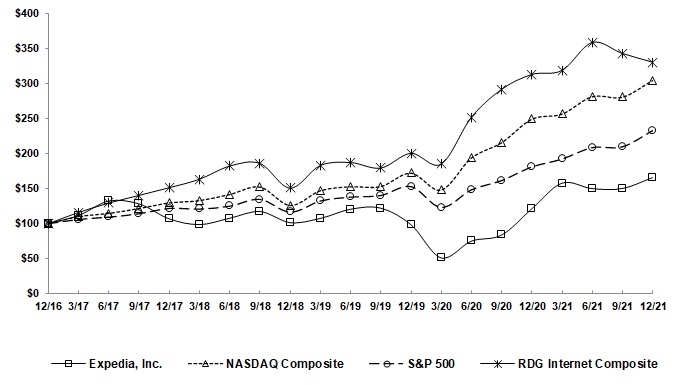
Item 6. Reserved
Item 7. Management’s Discussion and Analysis of Financial Condition and Results of Operations
Overview
Expedia Group's mission is to power global travel for everyone, everywhere. We believe travel is a force for good. Travel is an essential human experience that strengthens connections, broadens horizons and bridges divides. We help reduce the barriers to travel, making it easier, more enjoyable, more attainable and more accessible. We bring the world within reach for customers and partners around the globe. We leverage our supply portfolio, platform and technology capabilities across an extensive portfolio of consumer brands, and provide solutions to our business partners, to orchestrate the movement of people and the delivery of travel experiences on both a local and global basis. We make available, on a stand-alone and package basis, travel services provided by numerous lodging properties, airlines, car rental companies, activities and experiences providers, cruise lines, alternative accommodations property owners and managers, and other travel product and service companies. We also offer travel and non-travel advertisers access to a potential source of incremental traffic and transactions through our various media and advertising offerings on our websites. For additional information about our portfolio of brands, see the disclosure set forth in Part I, Item 1, Business, under the caption “Management Overview.”
This section of this Form 10-K generally discusses the years ended December 31, 2021 and 2020 items and year over year comparisons between 2021 and 2020. Discussions of the year ended December 31, 2019 items and the year over year comparisons between 2020 and 2019 that are not included in this Form 10-K can be found in "Management's Discussion and Analysis of Financial Condition and Results of Operations" in Part II, Item 7 of the Company's Annual Report on Form 10-K for the fiscal year ended December 31, 2020 ("2020 Form 10-K"). All percentages within this section are calculated on actual, unrounded numbers.
Trends
The COVID-19 pandemic, and measures to contain the virus, including government travel restrictions and quarantine orders, have had a significant negative impact on the travel industry. COVID-19 has negatively impacted consumer sentiment and consumer’s ability to travel, and many of our supply partners, particularly airlines and hotels, continue to operate at reduced service levels.
As the spread of the virus has been contained to varying degrees in certain countries during different times, travel restrictions have been lifted and consumers have become more comfortable traveling, particularly to domestic locations. This led to a moderation of the declines in travel bookings and in cancellation rates at certain points in 2021. However, travel bookings remain below and cancellation rates still remain elevated compared to pre-COVID levels due largely to the most recent Omicron variant.
The degree of containment of the virus, and the recovery in travel, has varied country by country. During the recovery period, there have been instances where cases of COVID-19 have started to increase again after a period of decline, which in some cases impacted the recovery of travel in certain countries. Additionally, there continues to be uncertainty over the impact of the Omicron or other new variants of the virus, including the efficacy of the vaccines against such variants, which has contributed, and may continue to contribute, to delays in economic recovery. COVID-19 has also had broader economic impacts, including an increase in unemployment levels and reduction in economic activity globally, which if COVID-19 starts to increase again, could lead to a reduction in consumer or business spending on travel activities, which may negatively impact the timing and level of a recovery in travel demand. Broader, sustained negative economic impacts could also put strain on our suppliers, business and service partners which increases the risk of credit losses and service level or other disruptions.
Our financial and operating results for 2021 were significantly impacted due to the continued decrease in travel demand related to COVID-19. The full duration and total impact of COVID-19 remains uncertain and it is difficult to predict how the recovery will unfold for the travel industry and, in particular, our business.
Additionally, further health-related events, political instability, geopolitical conflicts, acts of terrorism, significant fluctuations in currency values, sovereign debt issues, and natural disasters, are examples of other events that could have a negative impact on the travel industry in the future.
Prior to the onset of COVID-19, we began to execute a cost savings initiative aimed at simplifying the organization and increasing efficiency. Following the onset of COVID-19, we accelerated execution on several of these cost savings initiatives and took additional actions to reduce costs to help mitigate the impact to demand from COVID-19 and reduce our monthly cash usage. While some cost actions during COVID-19 are temporary and intended to minimize cash usage during this disruption, we expect to continue to benefit from the majority of the savings when business conditions return to more normalized levels. In 2021, we successfully achieved the previously outlined annualized run-rate fixed cost savings of $700 to $750 million compared to the fourth quarter of 2019 exit rate, as well as the greater than $200 million in variable costs savings, at 2019 volume levels. We also believe we have improved our marketing efficiency and continue to evaluate additional opportunities to increase efficiency and improve operational effectiveness across the Company.
As a result of these cost savings initiatives, we expect Adjusted EBITDA margins to increase compared to historical levels when revenue returns to more normalized levels.
For additional information about our business strategy for Expedia Group, see the disclosure set forth in Part I, Item 1, Business, under the caption “Marketing Opportunity and Business Strategy.”
Online Travel
Increased usage and familiarity with the internet has continued to drive rapid growth in online penetration of travel expenditures. Online penetration is higher in the U.S. and European markets with online penetration rates in the emerging markets, such as Asia Pacific and Latin American regions, historically lagging behind those regions. The emerging market penetration rates increased over the past few years, and are expected to continue growing, which presents an attractive growth opportunity for our business, while also attracting many competitors to online travel. This competition intensified in recent years, and the industry is expected to remain highly competitive for the foreseeable future. In addition to the growth of online travel agencies, we see increased interest in the online travel industry from search engine companies such as Google, evidenced by continued product enhancements, including new trip planning features for users and the integration of its various travel products into the Google Travel offering, as well as further prioritizing its own products in search results. Competitive entrants such as “metasearch” companies, including Kayak.com (owned by Booking Holdings), trivago (in which Expedia Group owns a majority interest) as well as TripAdvisor, introduced differentiated features, pricing and content compared with the legacy online travel agency companies, as well as various forms of direct or assisted booking tools. Further, airlines and lodging companies are aggressively pursuing direct online distribution of their products and services. In addition, the increasing popularity of the “sharing economy,” accelerated by online penetration, has had a direct impact on the travel and lodging industry. Businesses such as Airbnb, Vrbo (previously HomeAway, which Expedia Group
Showing the first 8K of 99K characters. Open the full section
Item 7A. Quantitative and Qualitative Disclosures About Market Risk
Market Risk Management
Market risk is the potential loss from adverse changes in interest rates, foreign exchange rates and market prices. Our exposure to market risk includes our long-term debt, our revolving credit facilities, derivative instruments and cash and cash equivalents, accounts receivable, intercompany receivables, investments, merchant accounts payable and deferred merchant bookings denominated in foreign currencies. We manage our exposure to these risks through established policies and procedures. Our objective is to mitigate potential income statement, cash flow and market exposures from changes in interest and foreign exchange rates.
Interest Rate Risk
In August 2014, we issued $500 million senior unsecured notes with a fixed rate of 4.5%. In June 2015, we issued Euro 650 million of senior unsecured notes with a fixed rate of 2.5%. (See “Foreign Exchange Risk” below for further discussion or our 2.5% Notes.) In December 2015, we issued $750 million of senior unsecured notes with a fixed rate of 5.0%. In September 2017, we issued $1 billion of senior unsecured notes with a fixed rate of 3.8%. In September 2019, we issued $1.25 billion of senior unsecured notes with a fixed rate of 3.25%. In May 2020, we issued $2 billion of senior unsecured notes due May 2025 that bear interest at 6.25%, of which $956 million in aggregate principal was subsequently repaid in 2021. In July 2020, we issued $500 million of senior unsecured notes due December 2023 that bear interest at 3.6% and $750 million of senior unsecured notes due August 2027 that bear interest at 4.625%. In March 2021, we issued $1 billion of senior unsecured notes due March 2031 that bear interest at 2.95%. The 2.5%, 3.6%, 4.5%, 6.25%, 5.0%, 4.625%, 3.8%, 3.25%, and 2.95% senior unsecured notes are collectively the “Senior Notes.” In February 2021, we issued $1 billion of convertible senior unsecured notes due February 2026 with a fixed rate of 0% (the “Convertible Notes”). As a result, if market interest rates decline, our required payments will exceed those based on market rates. Additionally, the senior unsecured notes issued in May and July 2020, and March 2021 are subject to interest rate adjustments should our credit ratings be adjusted downwards, which would result in increased interest expense in the future. The total estimated fair value of our Senior Notes and Convertible Notes was approximately $9.2 billion and $9.1 billion as of December 31, 2021 and December 31, 2020. The fair value was determined based on quoted market prices in less active markets and is categorized accordingly as Level 2 in the fair value hierarchy. A 50 basis point increase or decrease in interest rates would decrease or increase the fair value of our Notes by approximately $200 million.
We maintain revolving credit facilities of $2 billion, which bear interest based on market rates plus a spread determined by our credit ratings. Because our interest rate is tied to a market rate, we will be susceptible to fluctuations in interest rates if, consistent with our practice to date, we do not hedge the interest rate exposure arising from any borrowings under our revolving credit facilities. We had no revolving credit facilities borrowings outstanding as of December 31, 2021 and December 31, 2020.
Foreign Exchange Risk
We conduct business in certain international markets, primarily in Australia, Canada, China, the United Kingdom, and the European Union. Because we operate in international markets, we have exposure to different economic climates, political arenas, tax systems and regulations that could affect foreign exchange rates. Our primary exposure to foreign currency risk relates to transacting in foreign currency and recording the activity in U.S. dollars. Changes in exchange rates between the U.S. dollar and these other currencies will result in transaction gains or losses, which we recognize in our consolidated statements of operations.
To the extent practicable, we minimize our foreign currency exposures by maintaining natural hedges between our current assets and current liabilities in similarly denominated foreign currencies. Additionally, we use foreign currency forward contracts to economically hedge certain merchant revenue exposures, foreign denominated liabilities related to certain of our loyalty programs and our other foreign currency-denominated operating liabilities. These instruments are typically short-term and are recorded at fair value with gains and losses recorded in other, net. As of December 31, 2021 and 2020, we had a net forward asset of $3 million included in prepaid expenses and other current assets and a net forward liability of $14 million included in accrued expenses and other current liabilities, respectively. We may enter into additional foreign exchange derivative contracts or other economic hedges in the future. Our goal in managing our foreign exchange risk is to reduce to the extent practicable our potential exposure to the changes that exchange rates might have on our earnings, cash flows and financial position. We make a number of estimates in conducting hedging activities including in some cases the level of future bookings, cancellations, refunds, customer stay patterns and payments in foreign currencies. In the event those estimates differ significantly from actual results, we could experience greater volatility as a result of our hedges.
In June 2015, we issued Euro 650 million of registered senior unsecured notes that are due in June 2022 and bear interest at 2.5%. The aggregate principal value of the 2.5% Notes is designated as a hedge of our net investment in certain Euro functional currency subsidiaries. The notes are measured at Euro to U.S. Dollar exchange rates at each balance sheet date and transaction gains or losses due to changes in rates are recorded in accumulated other comprehensive income (loss). The Euro-denominated net assets of these subsidiaries are translated into U.S. Dollars at each balance sheet date, with effects of foreign currency changes also reported in accumulated other comprehensive income (loss). Since the notional amount of the recorded Euro-denominated debt is less than the notional amount of our net investment, we do not expect to incur any ineffectiveness on this hedge.
Future net transaction gains and losses are inherently difficult to predict as they are reliant on how the multiple currencies in which we transact fluctuate in relation to the U.S. dollar, the relative composition and denomination of current assets and liabilities each period, and our effectiveness at forecasting and managing, through balance sheet netting or the use of derivative contracts, such exposures. As an example, if the foreign currencies in which we hold net asset balances were to all weaken 10% against the U.S. dollar and foreign currencies in which we hold net liability balances were to all strengthen 10% against the U.S. dollar, we would recognize foreign exchange losses of approximately $13 million based on our foreign currency forward positions (including the impact of forward positions economically hedging our merchant revenue exposures) and the net asset or liability balances of our foreign denominated cash and cash equivalents, accounts receivable, deferred merchant bookings and merchant accounts payable balances as of December 31, 2021. As the net composition of these balances fluctuate frequently, even daily, as do foreign exchange rates, the example loss could be compounded or reduced significantly within a given period.
During 2021, 2020 and 2019, we recorded net foreign exchange rate losses of approximately $48 million ($37 million loss excluding the contracts economically hedging our forecasted merchant revenue), net foreign exchange rate gains of approximately $71 million ($2 million gain excluding the contracts economically hedging our forecasted merchant revenue) and net foreign exchange rate losses of approximately $34 million ($34 million loss excluding the contracts economically hedging our forecasted merchant revenue). As we increase our operations in international markets, our exposure to fluctuations in foreign currency exchange rates increases. The economic impact to us of foreign currency exchange rate movements is linked to variability in real growth, inflation, interest rates, governmental actions and other factors. These changes, if material, could cause us to adjust our financing and operating strategies.
Item 8. Consolidated Financial Statements and Supplementary Data
The Consolidated Financial Statements and Schedule listed in the Index to Financial Statements, Schedules and Exhibits on page F-1 are filed as part of this report.
Item 9. Changes in and Disagreements with Accountants on Accounting and Financial Disclosure
None.
Item 9A. Controls and Procedures
Changes in Internal Control over Financial Reporting.
There were no changes to our internal control over financial reporting that occurred during the quarter ended December 31, 2021 that have materially affected, or are reasonably likely to materially affect, our internal control over financial reporting.
Evaluation of Disclosure Controls and Procedures.
As required by Rule 13a-15(b) under the Securities Exchange Act of 1934, as amended (the “Exchange Act”), our management, including our Chairman and Senior Executive, Chief Executive Officer and Chief Financial Officer, evaluated the effectiveness of the design and operation of our disclosure controls and procedures (as defined in Rule 13a-15(e) under the Exchange Act). Based upon that evaluation, our Chairman and Senior Executive, Chief Executive Officer and Chief Financial Officer concluded that, as of the end of the period covered by this report, our disclosure controls and procedures were effective.
Management’s Report on Internal Control over Financial Reporting.
Our management is responsible for establishing and maintaining adequate internal control over financial reporting, as defined in Rule 13a-15(f) of the Exchange Act. Internal control over financial reporting is a process to provide reasonable assurance regarding the reliability of our financial reporting for external purposes in accordance with accounting principles generally accepted in the United States of America. Management conducted an evaluation of the effectiveness of our internal control over financial reporting based on the criteria for effective control over financial reporting described in Internal Control — Integrated Framework (2013) issued by the Committee of Sponsoring Organizations of the Treadway Commission. Based on this evaluation, management has concluded that, as of December 31, 2021, the Company’s internal control over financial reporting was effective. Management has reviewed its assessment with the Audit Committee. Ernst & Young, LLP, an independent registered public accounting firm, has audited the effectiveness of our internal control over financial reporting as of December 31, 2021, as stated in their report which is included below.
Limitations on Controls.
Management does not expect that our disclosure controls and procedures or our internal control over financial reporting will prevent or detect all error and fraud. Any control system, no matter how well designed and operated, is based upon certain assumptions and can provide only reasonable, not absolute, assurance that its objectives will be met. Further, no evaluation of controls can provide absolute assurance that misstatements due to error or fraud will not occur or that all control issues and instances of fraud, if any, within the Company have been detected.
Report of Independent Registered Public Accounting Firm
To the Stockholders and the Board of Directors of Expedia Group, Inc.
Opinion on Internal Control Over Financial Reporting
We have audited Expedia Group, Inc.’s internal control over financial reporting as of December 31, 2021, based on criteria established in Internal Control-Integrated Framework issued by the Committee of Sponsoring Organizations of the Treadway Commission (2013 framework) (the COSO criteria). In our opinion, Expedia Group, Inc. (the Company) maintained, in all material respects, effective internal control over financial reporting as of December 31, 2021, based on the COSO criteria.
We also have audited, in accordance with the standards of the Public Company Accounting Oversight Board (United States) (PCAOB), the consolidated balance sheets of the Company as of December 31, 2021 and 2020, the related consolidated statements of operations, comprehensive income, changes in stockholders’ equity and cash flows for each of the three years in the period ended December 31, 2021, and the related notes and our report dated February 10, 2022 expressed an unqualified opinion thereon.
Basis for Opinion
The Company’s management is responsible for maintaining effective internal control over financial reporting and for its assessment of the effectiveness of internal control over financial reporting included in the accompanying Management’s Report on Internal Control over Financial Reporting. Our responsibility is to express an opinion on the Company’s internal control over financial reporting based on our audit. We are a public accounting firm registered with the PCAOB and are required to be independent with respect to the Company in accordance with the U.S. federal securities laws and the applicable rules and regulations of the Securities and Exchange Commission and the PCAOB.
We conducted our audit in accordance with the standards of the PCAOB. Those standards require that we plan and perform the audit to obtain reasonable assurance about whether effective internal control over financial reporting was maintained in all material respects.
Our audit included obtaining an understanding of internal control over financial reporting, assessing the risk that a material weakness exists, testing and evaluating the design and operating effectiveness of internal control based on the assessed risk, and performing such other procedures as we considered necessary in the circumstances. We believe that our audit provides a reasonable basis for our opinion.
Definition and Limitations of Internal Control Over Financial Reporting
A company’s internal control over financial reporting is a process designed to provide reasonable assurance regarding the reliability of financial reporting and the preparation of financial statements for external purposes in accordance with generally accepted accounting principles. A company’s internal control over financial reporting includes those policies and procedures that (1) pertain to the maintenance of records that, in reasonable detail, accurately and fairly reflect the transactions and dispositions of the assets of the company; (2) provide reasonable assurance that transactions are recorded as necessary to permit preparation of financial statements in accordance with generally accepted accounting principles, and that receipts and expenditures of the company are being made only in accordance with authorizations of management and directors of the company; and (3) provide reasonable assurance regarding prevention or timely detection of unauthorized acquisition, use, or disposition of the company’s assets that could have a material effect on the financial statements.
Because of its inherent limitations, internal control over financial reporting may not prevent or detect misstatements. Also, projections of any evaluation of effectiveness to future periods are subject to the risk that controls may become inadequate because of changes in conditions, or that the degree of compliance with the policies or procedures may deteriorate.
/s/Ernst & Young LLP
Seattle, Washington
February 10, 2022
Item 9B. Other Information
None.
Part III.
We are incorporating by reference the information required by Part III of this report on Form 10-K from our proxy statement relating to our 2022 annual meeting of stockholders (the “2022 Proxy Statement”), which will be filed with the Securities and Exchange Commission within 120 days after the end of our fiscal year ended December 31, 2021.
Item 10. Directors, Executive Officers and Corporate Governance
The information required by this item is included under the captions “Election of Directors — Nominees,” “Election of Directors — Board Meetings and Committees,” “Information Concerning Executive Officers” and “Section 16(a) Beneficial Ownership Reporting Compliance” in the 2022 Proxy Statement and incorporated herein by reference.
Item 11. Executive Compensation
The information required by this item is included under the captions “Election of Directors —Compensation of Non-Employee Directors,” “Election of Directors — Compensation Committee Interlocks and Insider Participation,” “Compensation Discussion and Analysis,” “Compensation Committee Report” and “Executive Compensation” in the 2022 Proxy Statement and incorporated herein by reference.
Item 12. Security Ownership of Certain Beneficial Owners and Management and Related Stockholder Matters
The information required by this item is included under the captions “Security Ownership of Certain Beneficial Owners and Management” and “Equity Compensation Plan Information” in the 2022 Proxy Statement and incorporated herein by reference.
Item 13. Certain Relationships and Related Transactions, and Director Independence
The information required by this item is included under the captions “Certain Relationships and Related Person Transactions” and “Election of Directors — Board Meetings and Committees” in the 2022 Proxy Statement and incorporated herein by reference.
Item 14. Principal Accounting Fees and Services
The information required by this item is included under the caption “Audit Committee Report” in the 2022 Proxy Statement and incorporated herein by reference.
Item 15. Exhibits, Consolidated Financial Statements and Financial Statement Schedules
(a)(1) Consolidated Financial Statements
We have filed the consolidated financial statements listed in the Index to Consolidated Financial Statements, Schedules and Exhibits on page F-1 as a part of this report.
(a)(2) Financial Statement Schedules
All financial statement schedules have been omitted because they are not applicable, not material or the required information is shown in the consolidated financial statements or the notes thereto.
(a)(3) Exhibits
The exhibits listed below are filed as part of this Annual Report on Form 10-K.
| Exhibit No. | Filed Herewith | Incorporated by Reference | ||||||||||||||||||||||||||||||||||||
| Exhibit Description | Form | SEC File No. | Exhibit | Filing Date | ||||||||||||||||||||||||||||||||||
| 1.1 | Underwriting Agreement, dated as of May 28, 2015, Expedia, Inc., as Issuer, the Guarantors party thereto, and BNP Paribas, Goldman, Sachs & Co., J.P. Morgan Securities plc, as Representatives of the several Underwriters (relating to the Fourth Supplemental Indenture on Exhibit 4.6) | 8-K | 000-51447 | 1.1 | 6/3/2015 |
| * | Indicates a management contract or compensatory plan or arrangement. | ||||
| *† | Indicates reference to filing of Liberty Expedia Holdings, Inc. | ||||
| *^ | Indicates reference to filing of Qurate Retail, Inc. | ||||
| *** | Furnished herewith |
Item 16. Form 10-K Summary
Not applicable.
Signatures
Pursuant to the requirements of the Section 13 or 15(d) Securities Exchange Act of 1934, the Registrant has duly caused this report to be signed on its behalf by the undersigned hereunto duly authorized.
| Expedia Group, Inc. | ||||||||
| By: | /s/ PETER M. KERN | |||||||
| Peter M. Kern Chief Executive Officer and Vice Chairman |
February 10, 2022
Pursuant to the requirements of the Securities Exchange Act of 1934, this report has been signed below by the following persons on behalf of the Registrant and in the capacities indicated on February 10, 2022.
| Signature | Title | |||||||
| /s/ PETER M. KERN | Chief Executive Officer, Vice Chairman and Director | |||||||
| Peter M. Kern | (Principal Executive Officer) | |||||||
| /s/ ERIC HART | Chief Financial Officer | |||||||
| Eric Hart | (Principal Financial Officer) | |||||||
| /s/ LANCE A. SOLIDAY | Senior Vice President, Chief Accounting | |||||||
| Lance A. Soliday | Officer and Controller | |||||||
| (Principal Accounting Officer) | ||||||||
| /s/ BARRY DILLER | Chairman of the Board, Senior Executive and Director | |||||||
| Barry Diller | ||||||||
| /s/ SAMUEL ALTMAN | Director | |||||||
| Samuel Altman | ||||||||
| /s/ BEVERLY ANDERSON | Director | |||||||
| Beverly Anderson | ||||||||
| /s/ SUSAN C. ATHEY | Director | |||||||
| Susan C. Athey | ||||||||
| /s/ CHELSEA CLINTON | Director | |||||||
| Chelsea Clinton | ||||||||
| /s/ CRAIG A. JACOBSON | Director | |||||||
| Craig A. Jacobson | ||||||||
| /s/ DARA KHOSROWSHAHI | Director | |||||||
| Dara Khosrowshahi | ||||||||
| /s/ PATRICIA MENENDEZ CAMBO | Director | |||||||
| Patricia Menendez Cambo | ||||||||
| /s/ ALEXANDER VON FURSTENBERG | Director | |||||||
| Alexander von Furstenberg | ||||||||
| /s/ JULIE WHALEN | Director | |||||||
| Julie Whalen | ||||||||
INDEX TO CONSOLIDATED FINANCIAL STATEMENTS, SCHEDULES AND EXHIBITS
Report of Independent Registered Public Accounting Firm
To the Stockholders and the Board of Directors of Expedia Group, Inc.
Opinion on the Financial Statements
We have audited the accompanying consolidated balance sheets of Expedia Group, Inc. (the Company) as of December 31, 2021 and 2020, the related consolidated statements of operations, comprehensive income, changes in stockholders’ equity and cash flows for each of the three years in the period ended December 31, 2021, and the related notes (collectively referred to as the “consolidated financial statements”). In our opinion, the consolidated financial statements present fairly, in all material respects, the financial position of the Company at December 31, 2021 and 2020, and the results of its operations and its cash flows for each of the three years in the period ended December 31, 2021, in conformity with U.S. generally accepted accounting principles.
We also have audited, in accordance with the standards of the Public Company Accounting Oversight Board (United States) (PCAOB), the Company's internal control over financial reporting as of December 31, 2021, based on criteria established in Internal Control-Integrated Framework issued by the Committee of Sponsoring Organizations of the Treadway Commission (2013 framework), and our report dated February 10, 2022 expressed an unqualified opinion thereon.
Basis for Opinion
These financial statements are the responsibility of the Company's management. Our responsibility is to express an opinion on the Company’s financial statements based on our audits. We are a public accounting firm registered with the PCAOB and are required to be independent with respect to the Company in accordance with the U.S. federal securities laws and the applicable rules and regulations of the Securities and Exchange Commission and the PCAOB.
We conducted our audits in accordance with the standards of the PCAOB. Those standards require that we plan and perform the audit to obtain reasonable assurance about whether the financial statements are free of material misstatement, whether due to error or fraud. Our audits included performing procedures to assess the risks of material misstatement of the financial statements, whether due to error or fraud, and performing procedures that respond to those risks. Such procedures included examining, on a test basis, evidence regarding the amounts and disclosures in the financial statements. Our audits also included evaluating the accounting principles used and significant estimates made by management, as well as evaluating the overall presentation of the financial statements. We believe that our audits provide a reasonable basis for our opinion.
Critical Audit Matters
The critical audit matters communicated below are matters arising from the current period audit of the financial statements that were communicated or required to be communicated to the audit committee and that: (1) relate to accounts or disclosures that are material to t
Showing the first 8K of 247K characters. Open the full section