 filings.tools
Ford Motor 10-K 2019-12-31
Filed 2020-02-05. 23 sections, 645K characters. Original on sec.gov · Markdown · JSON
Cover and table of contents
UNITED STATES
SECURITIES AND EXCHANGE COMMISSION
Washington, DC 20549
FORM 10-K
☑ Annual report pursuant to Section 13 or 15(d) of the Securities Exchange Act of 1934
For the fiscal year ended December 31, 2019
or
☐ Transition report pursuant to Section 13 or 15(d) of the Securities Exchange Act of 1934
For the transition period from __________ to __________
Commission file number 1-3950
Ford Motor Co****mpany
(Exact name of Registrant as specified in its charter)
| Delaware | 38-0549190 | ||
| (State of incorporation) | (I.R.S. Employer Identification No.) | ||
| One American Road | |||
| Dearborn, | Michigan | 48126 | |
| (Address of principal executive offices) | (Zip Code) |
313**-**322-3000
(Registrant’s telephone number, including area code)
Securities registered pursuant to Section 12(b) of the Act:
| Title of each class | Trading symbols | Name of each exchange on which registered | ||
| Common Stock, par value $.01 per share | F | New York Stock Exchange | ||
| 6.200% Notes due June 1, 2059 | FPRB | New York Stock Exchange | ||
| 6.000% Notes due December 1, 2059 | FPRC | New York Stock Exchange |
Securities registered pursuant to Section 12(g) of the Act: None.
Indicate by check mark if the registrant is a well-known seasoned issuer, as defined in Rule 405 of the Securities Act. Yes ☑ No ☐
Indicate by check mark if the registrant is not required to file reports pursuant to Section 13 or Section 15(d) of the Act. Yes ☐ No ☑
Indicate by check mark if the registrant (1) has filed all reports required to be filed by Section 13 or 15(d) of the Securities Exchange Act of 1934 during the preceding 12 months (or for such shorter period that the registrant was required to file such reports), and (2) has been subject to such filing requirements for the past 90 days. Yes ☑ No ☐
Indicate by check mark whether the registrant has submitted electronically every Interactive Data File required to be submitted pursuant to Rule 405 of Regulation S-T (§ 232.405 of this chapter) during the preceding 12 months (or for such shorter period that the registrant was required to submit such files). Yes ☑ No ☐
Indicate by check mark whether the registrant is a large accelerated filer, an accelerated filer, a non-accelerated filer, a smaller reporting company, or emerging growth company. See the definitions of “large accelerated filer,” “accelerated filer,” “smaller reporting company,” and “emerging growth company” in Rule 12b-2 of the Exchange Act.
Large accelerated filer ☑ Accelerated filer ☐ Non-accelerated filer ☐ Smaller reporting company ☐
Emerging growth company ☐
If an emerging growth company, indicate by check mark if the registrant has elected not to use the extended transition period for complying with any new or revised financial accounting standards provided pursuant to Section 13(a) of the Exchange Act.
Indicate by check mark whether the registrant is a shell company (as defined in Rule 12b-2 of the Act). Yes ☐ No ☑
As of June 28, 2019, Ford had outstanding 3,918,987,194 shares of Common Stock and 70,852,076 shares of Class B Stock. Based on the New York Stock Exchange Composite Transaction closing price of the Common Stock on that date ($10.23 per share), the aggregate market value of such Common Stock was $40,091,238,995. Although there is no quoted market for our Class B Stock, shares of Class B Stock may be converted at any time into an equal number of shares of Common Stock for the purpose of effecting the sale or other disposition of such shares of Common Stock. The shares of Common Stock and Class B Stock outstanding at June 28, 2019 included shares owned by persons who may be deemed to be “affiliates” of Ford. We do not believe, however, that any such person should be considered to be an affiliate. For information concerning ownership of outstanding Common Stock and Class B Stock, see the Proxy Statement for Ford’s Annual Meeting of Stockholders currently scheduled to be held on May 14, 2020 (our “Proxy Statement”), which is incorporated by reference under various Items of this Report as indicated below.
As of January 31, 2020, Ford had outstanding 3,894,078,249 shares of Common Stock and 70,852,076 shares of Class B Stock. Based on the New York Stock Exchange Composite Transaction closing price of the Common Stock on that date ($8.82 per share), the aggregate market value of such Common Stock was $34,345,770,156.
DOCUMENTS INCORPORATED BY REFERENCE
| Document | Where Incorporated | |
| Proxy Statement* | Part III (Items 10, 11, 12, 13, and 14) |
| * | As stated under various Items of this Report, only certain specified portions of such document are incorporated by reference in this Report. |
Exhibit Index begins on page
| 84 |
FORD MOTOR COMPANY
ANNUAL REPORT ON FORM 10-K
For the Year Ended December 31, 2019
| Table of Contents | Page | ||
| Part I | |||
| Item 1 | Business | 1 | |
| Overview | 2 | ||
| Automotive Segment | 2 | ||
| Mobility Segment | 6 | ||
| Ford Credit Segment | 6 | ||
| Governmental Standards | 7 | ||
| Employment Data | 12 | ||
| Item 1A | Risk Factors | 12 | |
| Item 1B | Unresolved Staff Comments | 19 | |
| Item 2 | Properties | 20 | |
| Item 3 | Legal Proceedings | 21 | |
| Item 4 | Mine Safety Disclosures | 23 | |
| Item 4A | Executive Officers of Ford | 24 | |
| Part II | |||
| Item 5 | Market for Registrant’s Common Equity, Related Stockholder Matters and Issuer Purchases of Equity Securities | 25 | |
| Item 6 | Selected Financial Data | 26 | |
| Item 7 | Management’s Discussion and Analysis of Financial Condition and Results of Operations | 27 | |
| Results of Operations - 2019 | 30 | ||
| Automotive Segment | 32 | ||
| Mobility Segment | 37 | ||
| Ford Credit Segment | 38 | ||
| Corporate Other | 41 | ||
| Interest on Debt | 41 | ||
| Taxes | 41 | ||
| Results of Operations - 2018 | 42 | ||
| Automotive Segment | 44 | ||
| Mobility Segment | 47 | ||
| Ford Credit Segment | 48 | ||
| Corporate Other | 48 | ||
| Interest on Debt | 48 | ||
| Taxes | 48 | ||
| Liquidity and Capital Resources | 49 | ||
| Credit Ratings | 57 | ||
| Outlook | 58 | ||
| Cautionary Note on Forward-Looking Statements | 59 | ||
| Non-GAAP Financial Measures That Supplement GAAP Measures | 60 | ||
| Non-GAAP Financial Measure Reconciliations | 62 | ||
| 2019 Supplemental Financial Information | 65 | ||
| Critical Accounting Estimates | 69 | ||
| Accounting Standards Issued But Not Yet Adopted | 76 | ||
| Aggregate Contractual Obligations | 77 | ||
| Item 7A | Quantitative and Qualitative Disclosures About Market Risk | 78 |
i
Table of Contents
(continued)
| Item 8 | Financial Statements and Supplementary Data | 81 | |
| Item 9 | Changes in and Disagreements with Accountants on Accounting and Financial Disclosure | 81 | |
| Item 9A | Controls and Procedures | 82 | |
| Item 9B | Other Information | 82 | |
| Part III | |||
| Item 10 | Directors, Executive Officers of Ford, and Corporate Governance | 83 | |
| Item 11 | Executive Compensation | 83 | |
| Item 12 | Security Ownership of Certain Beneficial Owners and Management and Related Stockholder Matters | 83 | |
| Item 13 | Certain Relationships and Related Transactions, and Director Independence | 83 | |
| Item 14 | Principal Accounting Fees and Services | 83 | |
| Part IV | |||
| Item 15 | Exhibits and Financial Statement Schedules | 84 | |
| Item 16 | Form 10-K Summary | 87 | |
| Signatures | 88 | ||
| Ford Motor Company and Subsidiaries Financial Statements | |||
| Report of Independent Registered Public Accounting Firm | FS-1 | ||
| Consolidated Statement of Cash Flows | FS-5 | ||
| Consolidated Income Statement | FS-6 | ||
| Consolidated Statement of Comprehensive Income | FS-6 | ||
| Consolidated Balance Sheet | FS-7 | ||
| Consolidated Statement of Equity | FS-8 | ||
| Notes to the Financial Statements | FS-9 | ||
| Schedule II — Valuation and Qualifying Accounts | FSS-1 |
ii
PART I.
ITEM 1. Business.
Ford Motor Company was incorporated in Delaware in 1919. We acquired the business of a Michigan company, also known as Ford Motor Company, which had been incorporated in 1903 to produce and sell automobiles designed and engineered by Henry Ford. We are a global company based in Dearborn, Michigan. With about 190,000 employees worldwide, the Company designs, manufactures, markets, and services a full line of Ford cars, trucks, sport utility vehicles (“SUVs”), electrified vehicles, and Lincoln luxury vehicles, provides financial services through Ford Motor Credit Company LLC (“Ford Credit”), and is pursuing leadership positions in electrification; mobility solutions, including self-driving services; and connected vehicle services.
In addition to the information about Ford and our subsidiaries contained in this Annual Report on Form 10-K for the year ended December 31, 2019 (“2019 Form 10-K Report” or “Report”), extensive information about our Company can be found at http://corporate.ford.com, including information about our management team, brands, products, services, and corporate governance principles.
The corporate governance information on our website includes our Corporate Governance Principles, Code of Ethics for Senior Financial Personnel, Code of Ethics for the Board of Directors, Code of Corporate Conduct for all employees, and the Charters for each of the Committees of our Board of Directors. In addition, any amendments to our Code of Ethics or waivers granted to our directors and executive officers will be posted on our corporate website. All of these documents may be accessed by going to our corporate website, or may be obtained free of charge by writing to our Shareholder Relations Department, Ford Motor Company, One American Road, P.O. Box 1899, Dearborn, Michigan 48126-1899.
Our recent periodic reports filed with the Securities and Exchange Commission (“SEC”) pursuant to Section 13(a) or 15(d) of the Securities Exchange Act of 1934, as amended, are available free of charge at http://shareholder.ford.com. This includes recent Annual Reports on Form 10-K, Quarterly Reports on Form 10-Q, and Current Reports on Form 8-K, as well as any amendments to those reports, and our Section 16 filings. We post each of these documents on our website as soon as reasonably practicable after it is electronically filed with the SEC. Our reports filed with the SEC also may be found on the SEC’s website at www.sec.gov.
Our Sustainability Report, which details our performance and progress toward our sustainability and corporate responsibility goals, is available at http://sustainability.ford.com.
The foregoing information regarding our website and its content is for convenience only and not deemed to be incorporated by reference into this Report nor filed with the SEC.
Item 1. Business (Continued)
OVERVIEW
Segments. We report our results in three operating segments that represent the primary businesses reported in our consolidated financial statements: Automotive, Mobility, and Ford Credit.
AUTOMOTIVE SEGMENT
Our Automotive segment primarily includes the sale of Ford and Lincoln vehicles, service parts, and accessories worldwide, together with the associated costs to develop, manufacture, distribute, and service the vehicles, parts, and accessories. This segment includes revenues and costs related to our electrification vehicle programs. The segment includes the following regional business units: North America, South America, Europe, China (including Taiwan), Asia Pacific Operations, and Middle East & Africa.
In the first quarter of 2020, we changed our business units in the Automotive segment to align with the way we now manage the business. As a result of the change, beginning with our first quarter 2020 10-Q report, we will report in the Automotive segment the following business units: North America, South America, Europe, China (including Taiwan), and the International Markets Group (which will include what we reported in 2019 in the Asia Pacific Operations and Middle East & Africa business units, and the results of our joint venture in Russia).
General
Our vehicle brands are Ford and Lincoln. In 2019, we sold approximately 5,386,000 vehicles at wholesale throughout the world. See “Item 7. Management’s Discussion and Analysis of Financial Condition and Results of Operations” (“Item 7”) for a discussion of our calculation of wholesale unit volumes.
Substantially all of our vehicles, parts, and accessories are sold through distributors and dealers (collectively, “dealerships”), the substantial majority of which are independently owned. At December 31, the approximate number of dealerships worldwide distributing our vehicle brands was as follows:
| Brand | 2018 | 2019 | |||
| Ford | 10,466 | 9,883 | |||
| Ford-Lincoln (combined) | 858 | 759 | |||
| Lincoln | 210 | 279 | |||
| Total | 11,534 | 10,921 |
We do not depend on any single customer or a few customers to the extent that the loss of such customers would have a material adverse effect on our business.
In addition to the products we sell to our dealerships for retail sale, we also sell vehicles to our dealerships for sale to fleet customers, including commercial fleet customers, daily rental car companies, and governments. We also sell parts and accessories, primarily to our dealerships (which in turn sell these products to retail customers) and to authorized parts distributors (which in turn primarily sell these products to retailers). We also offer extended service contracts.
The worldwide automotive industry is affected significantly by general economic and political conditions over which we have little control. Vehicles are durable goods, and consumers and businesses have latitude in determining whether and when to replace an existing vehicle. The decision whether to purchase a vehicle may be affected significantly by slowing economic growth, geopolitical events, and other factors (including the cost of purchasing and operating cars, trucks, and SUVs and the availability and cost of financing and fuel). As a result, the number of cars, trucks, and SUVs sold may vary substantially from year to year. Further, the automotive industry is a highly competitive business that has a wide and growing variety of product and service offerings from a growing number of manufacturers.
Item 1. Business (Continued)
Our wholesale unit volumes vary with the level of total industry demand and our share of that industry demand. Our wholesale unit volumes also are influenced by the level of dealer inventory. Our share is influenced by how our products are perceived by customers in comparison to those offered by other manufacturers based on many factors, including price, quality, styling, reliability, safety, fuel efficiency, functionality, and reputation. Our share also is affected by the timing and frequency of new model introductions. Our ability to satisfy changing consumer and business preferences with respect to type or size of vehicle, as well as design and performance characteristics, affects our sales and earnings significantly.
As with other manufacturers, the profitability of our business is affected by many factors, including:
| • | Wholesale unit volumes |
| • | Margin of profit on each vehicle sold - which in turn is affected by many factors, such as: |
| ◦ | Market factors - volume and mix of vehicles and options sold, and net pricing (reflecting, among other factors, incentive programs) |
| ◦ | Costs of components and raw materials necessary for production of vehicles |
| ◦ | Costs for customer warranty claims and additional service actions |
| ◦ | Costs for safety, emissions, and fuel economy technology and equipment |
| • | A high proportion of relatively fixed structural costs, so that small changes in wholesale unit volumes can significantly affect overall profitability |
Our industry has a very competitive pricing environment, driven in part by industry excess capacity. For the past several decades, manufacturers typically have given price discounts and other marketing incentives to provide value for customers and maintain market share and production levels. The decline in value of foreign currencies in the past has contributed significantly to competitive pressures in many of our markets. In 2019, the U.S. administration sought to address this issue with currency provisions that were included in the recently negotiated United States-Mexico-Canada Agreement and United States-China trade deals.
Competitive Position. The worldwide automotive industry consists of many producers, with no single dominant producer. Certain manufacturers, however, account for the major percentage of total sales within particular countries, especially their countries of origin.
Seasonality. We manage our vehicle production schedule based on a number of factors, including retail sales (i.e., units sold by our dealerships to their customers at retail) and dealer stock levels (i.e., the number of units held in inventory by our dealerships for sale to their customers). Historically, we have experienced some seasonal fluctuation in the business, with production in many markets tending to be higher in the first half of the year to meet demand in the spring and summer (typically the strongest sales months of the year).
Backlog Orders. We generally produce and ship our products on average within approximately 20 days after an order is deemed to become firm. Therefore, no significant amount of backlog orders accumulates during any period.
Raw Materials. We purchase a wide variety of raw materials from numerous suppliers around the world for use in production of our vehicles. These materials include base metals (e.g., steel and aluminum), precious metals (e.g., palladium), energy (e.g., natural gas), and plastics/resins (e.g., polypropylene). We believe we have adequate supplies or sources of availability of raw materials necessary to meet our needs; however, there always are risks and uncertainties with respect to the supply of raw materials that could impact availability in sufficient quantities and at cost effective prices to meet our needs. See the “Overview” section of Item 7 for a discussion of commodity and energy price trends, and “Item 7A. Quantitative and Qualitative Disclosures about Market Risk” (“Item 7A”) for a discussion of commodity price risks.
Intellectual Property. We own or hold licenses to use numerous patents, trade secrets, copyrights, and trademarks on a global basis. We expect to continue building this portfolio as we actively pursue innovation in every part of our business. We also own numerous trademarks and service marks that contribute to the identity and recognition of our Company and its products and services globally. While our intellectual property rights in the aggregate are important to the operation of each of our businesses, we do not believe that our business would be materially affected by the expiration of any particular intellectual property right or termination of any particular intellectual property agreement.
Item 1. Business (Continued)
Warranty Coverage, Field Service Actions, and Customer Satisfaction Actions. We provide warranties on vehicles we sell. Warranties are offered for specific periods of time and/or mileage, and vary depending upon the type of product and the geographic location of its sale. Pursuant to these warranties, we will repair, replace, or adjust all parts on a vehicle that are defective in factory-supplied materials or workmanship during the specified warranty period. In addition to the costs associated with this warranty coverage provided on our vehicles, we also incur costs as a result of field service actions (i.e., safety recalls, emission recalls, and other product campaigns), and for customer satisfaction actions.
For additional information regarding warranty and related costs, see “Critical Accounting Estimates” in Item 7 and Note 27 of the Notes to the Financial Statements.
Wholesales
Wholesales consist primarily of vehicles sold to dealerships. For the majority of such sales, we recognize revenue when we ship the vehicles to our dealerships from our manufacturing facilities. See Item 7 for additional discussion of revenue recognition practices. Wholesales in each region and in certain key markets within each region during the past three years were as follows:
| Wholesales (a) | ||||||||
| (in thousands of units) | ||||||||
| 2017 | 2018 | 2019 | ||||||
| United States | 2,566 | 2,540 | 2,412 | |||||
| Canada | 308 | 295 | 289 | |||||
| Mexico | 82 | 69 | 53 | |||||
| North America | 2,967 | 2,920 | 2,765 | |||||
| Brazil | 215 | 235 | 218 | |||||
| Argentina | 115 | 86 | 47 | |||||
| South America | 373 | 365 | 295 | |||||
| United Kingdom | 418 | 387 | 367 | |||||
| Germany | 277 | 313 | 328 | |||||
| EU21 (b) | 1,429 | 1,439 | 1,345 | |||||
| Russia | 54 | 51 | 28 | |||||
| Turkey | 116 | 65 | 47 | |||||
| Europe | 1,582 | 1,533 | 1,418 | |||||
| Middle East & Africa | 119 | 109 | 94 | |||||
| China (c) | 1,235 | 732 | 535 | |||||
| Australia | 78 | 65 | 64 | |||||
| India | 88 | 98 | 73 | |||||
| ASEAN (d) | 122 | 117 | 102 | |||||
| Asia Pacific Operations | 331 | 323 | 279 | |||||
| Total Company | 6,607 | 5,982 | 5,386 |
| (a) | Wholesale unit volumes include sales of medium and heavy trucks. Wholesale unit volumes also include all Ford and Lincoln badged units (whether produced by Ford or by an unconsolidated affiliate) that are sold to dealerships, units manufactured by Ford that are sold to other manufacturers, units distributed by Ford for other manufacturers, and local brand units produced by our unconsolidated Chinese joint venture Jiangling Motors Corporation, Ltd. (“JMC”) that are sold to dealerships. Vehicles sold to daily rental car companies that are subject to a guaranteed repurchase option (i.e., rental repurchase), as well as other sales of finished vehicles for which the recognition of revenue is deferred (e.g., consignments), also are included in wholesale unit volumes. Revenue from certain vehicles in wholesale unit volumes (specifically, Ford badged vehicles produced and distributed by our unconsolidated affiliates, as well as JMC brand vehicles) are not included in our revenue. |
| (b) | EU21 markets are United Kingdom, Germany, France, Italy, Spain, Austria, Belgium, Czech Republic, Denmark, Finland, Greece, Hungary, Ireland, the Netherlands, Norway, Poland, Portugal, Romania, Russia, Sweden, and Switzerland. |
| (c) | China includes Taiwan. |
| (d) | ASEAN includes Philippines, Thailand, and Vietnam. |
Item 1. Business (Continued)
Retail Sales, Industry Volume, and Market Share
Retail sales, industry volume, and market share in each region and in certain key markets within each region during the past three years were as follows:
| Retail Sales (a) | Industry Volume (b) | Market Share (c) | ||||||||||||||||||||||||
| (in millions of units) | (in millions of units) | (as a percentage) | ||||||||||||||||||||||||
| 2017 | 2018 | 2019 | 2017 | 2018 | 2019 | 2017 | 2018 | 2019 | ||||||||||||||||||
| United States | 2.6 | 2.5 | 2.4 | 17.6 | 17.7 | 17.5 | 14.7 | % | 14.1 | % | 13.8 | % | ||||||||||||||
| Canada | 0.3 | 0.3 | 0.3 | 2.1 | 2.0 | 2.0 | 14.9 | 14.7 | 14.6 | |||||||||||||||||
| Mexico | 0.1 | 0.1 | 0.1 | 1.6 | 1.5 | 1.4 | 5.3 | 4.8 | 4.4 | |||||||||||||||||
| North America | 3.0 | 2.9 | 2.8 | 21.5 | 21.5 | 21.1 | 13.9 | 13.4 | 13.2 | |||||||||||||||||
| Brazil | 0.2 | 0.2 | 0.2 | 2.2 | 2.6 | 2.8 | 9.6 | 9.2 | 8.1 | |||||||||||||||||
| Argentina | 0.1 | 0.1 | 0.1 | 0.9 | 0.8 | 0.5 | 12.9 | 12.1 | 11.4 | |||||||||||||||||
| South America | 0.4 | 0.4 | 0.3 | 4.2 | 4.5 | 4.3 | 8.9 | 8.3 | 7.2 | |||||||||||||||||
| United Kingdom | 0.4 | 0.4 | 0.4 | 3.0 | 2.8 | 2.7 | 13.8 | 13.7 | 13.0 | |||||||||||||||||
| Germany | 0.3 | 0.3 | 0.3 | 3.8 | 3.8 | 4.0 | 7.7 | 7.9 | 8.3 | |||||||||||||||||
| EU21 (d) | 1.4 | 1.4 | 1.4 | 19.3 | 19.6 | 19.7 | 7.3 | 7.2 | 6.9 | |||||||||||||||||
| Russia | 0.1 | 0.1 | — | 1.6 | 1.8 | 1.8 | 3.1 | 2.9 | 1.6 | |||||||||||||||||
| Turkey | 0.1 | 0.1 | — | 1.0 | 0.6 | 0.5 | 11.9 | 10.9 | 10.1 | |||||||||||||||||
| Europe | 1.6 | 1.5 | 1.4 | 20.9 | 20.9 | 21.0 | 7.5 | 7.2 | 6.8 | |||||||||||||||||
| Middle East & Africa | 0.1 | 0.1 | 0.1 | 3.6 | 3.8 | 3.1 | 3.8 | 3.0 | 3.2 | |||||||||||||||||
| China (e) | 1.2 | 0.8 | 0.6 | 28.6 | 26.7 | 26.1 | 4.2 | 2.9 | 2.2 | |||||||||||||||||
| Australia | 0.1 | 0.1 | 0.1 | 1.2 | 1.2 | 1.1 | 6.6 | 6.0 | 6.0 | |||||||||||||||||
| India | 0.1 | 0.1 | 0.1 | 4.1 | 4.4 | 3.8 | 2.2 | 2.2 | 2.0 | |||||||||||||||||
| ASEAN (f) | 0.1 | 0.1 | 0.1 | 1.6 | 1.7 | 1.8 | 7.5 | 6.6 | 5.9 | |||||||||||||||||
| Asia Pacific Operations (e) | 0.3 | 0.3 | 0.3 | 16.2 | 16.8 | 16.3 | 2.0 | 1.9 | 1.7 | |||||||||||||||||
| Global / Total Company | 6.6 | 6.0 | 5.5 | 95.0 | 94.2 | 91.9 | 7.0 | % | 6.3 | % | 6.0 | % |
| (a) | Retail sales represents primarily sales by dealers and is based, in part, on estimated vehicle registrations; includes medium and heavy trucks. |
| (b) | Industry volume is an internal estimate based on publicly-available data collected from various government, private, and public sources around the globe; includes medium and heavy trucks. |
| (c) | Market share represents reported retail sales of our brands as a percent of total industry volume in the relevant market or region. |
| (d) | EU21 markets are United Kingdom, Germany, France, Italy, Spain, Austria, Belgium, Czech Republic, Denmark, Finland, Greece, Hungary, Ireland, Netherlands, Norway, Poland, Portugal, Romania, Russia, Sweden, and Switzerland. |
| (e) | China includes Taiwan; China and Asia Pacific Operations market share includes Ford brand and JMC brand vehicles produced and sold by our unconsolidated affiliates. |
| (f) | ASEAN includes Philippines, Thailand, and Vietnam. |
U.S. Sales by Type
The following table shows U.S. retail sales volume and U.S. wholesales segregated by truck, SUV, and car sales. U.S. retail sales volume reflects transactions with (i) retail and fleet customers (as reported by dealers), (ii) government, and (iii) Ford management. U.S. wholesales reflect sales to dealers.
| U.S. Retail Sales | U.S. Wholesales | ||||||||||
| 2018 | 2019 | 2018 | 2019 | ||||||||
| Trucks | 1,139,079 | 1,243,136 | 1,156,022 | 1,285,859 | |||||||
| SUVs | 872,215 | 830,471 | 937,845 | 816,933 | |||||||
| Cars | 486,024 | 349,091 | 445,999 | 309,413 | |||||||
| Total Vehicles | 2,497,318 | 2,422,698 | 2,539,866 | 2,412,205 |
Item 1. Business (Continued)
MOBILITY SEGMENT
Our Mobility segment primarily includes development costs related to our autonomous vehicles and our investment in mobility through Ford Smart Mobility LLC (“FSM”). Autonomous vehicles includes self-driving systems development and vehicle integration, autonomous vehicle research and advanced engineering, autonomous vehicle transportation-as-a-service network development, user experience, and business strategy and business development teams. FSM designs and builds mobility products and subscription and other services on its own, and collaborates with service providers and technology companies.
FORD CREDIT SEGMENT
The Ford Credit segment is comprised of the Ford Credit business on a consolidated basis, which is primarily vehicle-related financing and leasing activities.
Ford Credit offers a wide variety of automotive financing products to and through automotive dealers throughout the world. The predominant share of Ford Credit’s business consists of financing our vehicles and supporting our dealers. Ford Credit earns its revenue primarily from payments made under retail installment sale and finance lease (retail financing) and operating lease contracts that it originates and purchases; interest rate supplements and other support payments from us and our affiliates; and payments made under dealer financing programs.
As a result of these financing activities, Ford Credit has a large portfolio of finance receivables and operating leases which it classifies into two portfolios—“consumer” and “non-consumer.” Finance receivables and operating leases in the consumer portfolio include products offered to individuals and businesses that finance the acquisition of our vehicles from dealers for personal and commercial use. Retail financing includes retail installment sale contracts for new and used vehicles and finance leases (comprised of sales-type and direct financing leases) for new vehicles to retail and commercial customers, including leasing companies, government entities, daily rental companies, and fleet customers. Finance receivables in the non-consumer portfolio include products offered to automotive dealers. Ford Credit makes wholesale loans to dealers to finance the purchase of vehicle inventory, also known as floorplan financing, as well as loans to dealers to finance working capital and improvements to dealership facilities, finance the purchase of dealership real estate, and finance other dealer vehicle programs. Ford Credit also purchases receivables generated by us and our affiliates, primarily related to the sale of parts and accessories to dealers and certain used vehicles from daily rental fleet companies. Ford Credit also provides financing to us for vehicles that we lease to our employees.
Ford Credit does business in the United States and Canada through business centers. Outside of the United States, Europe is Ford Credit’s largest operation. Ford Credit’s European operations are managed primarily through its United Kingdom-based subsidiary, FCE Bank plc (“FCE”). Within Europe, FCE’s largest markets are the United Kingdom and Germany.
The following table shows Ford Credit’s retail financing and operating lease share of new Ford and Lincoln vehicle sales as well as its wholesale financing share of new Ford and Lincoln vehicles acquired by dealers in the United States and Europe:
| Years Ended December 31, | ||||||||
| 2017 | 2018 | 2019 | ||||||
| United States | ||||||||
| Share of Ford and Lincoln sales (excl. Fleet) | 55 | % | 58 | % | 51 | % | ||
| Wholesale share | 76 | 76 | 75 | |||||
| Europe - Financing Share | ||||||||
| Share of Ford sales (incl. Fleet) | 37 | % | 38 | % | 37 | % | ||
| Wholesale share | 98 | 98 | 98 |
In 2019, the lower year-over-year share of Ford and Lincoln sales in the United States primarily reflects changes in Ford’s marketing programs.
See Item 7 and Notes 10, 11, and 13 of the Notes to the Financial Statements for a detailed discussion of Ford Credit’s receivables, credit losses, allowance for credit losses, loss-to-receivables ratios, funding sources, and funding strategies. See Item 7A for a discussion of how Ford Credit manages its financial market risks.
Item 1. Business (Continued)
We routinely sponsor special retail financing and lease incentives to dealers’ customers who choose to finance or lease our vehicles from Ford Credit. In order to compensate Ford Credit for the lower interest or lease payments offered to the retail customer, we pay the discounted value of the incentive directly to Ford Credit when it originates the retail finance or lease contract with the dealer’s customer. These programs increase Ford Credit’s financing volume and share. See Note 2 of the Notes to the Financial Statements for information about our accounting for these programs.
We have an Amended and Restated Relationship Agreement with Ford Credit, pursuant to which, if Ford Credit’s managed leverage for a calendar quarter were to be higher than 11.5:1 (as reported in its most recent periodic report), Ford Credit could require us to make or cause to be made a capital contribution to it in an amount sufficient to have caused such managed leverage to have been 11.5:1. No capital contributions have been made pursuant to this agreement. The agreement also allocates to Ford Credit $3 billion of commitments under our $13.4 billion corporate credit facility. In a separate agreement with FCE, Ford Credit has agreed to maintain FCE’s net worth in excess of $500 million. No payments have been made pursuant to that agreement.
Ford Credit files periodic reports with the SEC that contain additional information regarding Ford Credit. The reports are available through Ford Credit’s website located at www.fordcredit.com/investor-center and can also be found on the SEC’s website located at www.sec.gov.
The foregoing information regarding Ford Credit’s website and its content is for convenience only and not deemed to be incorporated by reference into this Report nor filed with the SEC.
GOVERNMENTAL STANDARDS
Many governmental standards and regulations relating to safety, fuel economy, emissions control, noise control, vehicle recycling, substances of concern, vehicle damage, and theft prevention are applicable to new motor vehicles, engines, and equipment manufactured for sale. In addition, manufacturing and other automotive assembly facilities are subject to stringent standards regulating air emissions, water discharges, and the handling and disposal of hazardous substances. The most significant of the standards and regulations affecting us are discussed below:
Vehicle Emissions Control
U.S. Requirements - Federal and California Emission Standards. Both the U.S. Environmental Protection Agency (“EPA”) and the California Air Resources Board (“CARB”) have established motor vehicle tailpipe and evaporative emissions standards that become increasingly stringent over time. Thirteen states have adopted the California standards, and other states may join them. Both federal and California regulations also require motor vehicles to be equipped with on-board diagnostic (“OBD”) systems that monitor emission-related systems and components. In addition, vehicles and heavy-duty engines must be certified by EPA prior to sale in the United States and Canada, and by CARB prior to sale in California and the relevant states. Compliance with emissions standards, OBD requirements, and related regulations can be challenging and can drive increased product development costs, warranty costs, and vehicle recalls.
Both EPA and CARB have announced that they intend to promulgate new emissions regulations applicable to future heavy-duty engines. These rules are likely to include more stringent emissions standards as well as new requirements affecting durability testing, warranty, and OBD. The new rules are expected to impose increased challenges and costs on the development of heavy-duty engines.
Compliance with automobile emission standards depends in part on the widespread availability of high-quality and consistent automotive fuels that the vehicles were designed to use. Legislative, regulatory, and judicial developments related to fuel quality at both the national and state levels could affect vehicle manufacturers’ warranty costs as well as their ability to comply with vehicle emission standards.
The California vehicle emissions program also includes requirements for manufacturers to produce and deliver for sale zero-emission vehicles (“ZEVs”). The current ZEV regulations mandate substantial annual increases in the production and sale of battery-electric, fuel cell, and plug-in hybrid vehicles through the 2025 model year. By the 2025 model year, approximately 15% of a manufacturer’s total California sales volume will need to be made up of such vehicles. California is now in the process of promulgating future ZEV regulations aimed at medium- and heavy-duty vehicles. These rules, which could entail significant costs and compliance challenges, are also expected to include complex warranty and recall requirements. Compliance with ZEV rules depends on market conditions as well as the availability of adequate infrastructure to support vehicle charging.
Item 1. Business (Continued)
European Requirements. European Union (“EU”) directives and related legislation limit the amount of regulated pollutants that may be emitted by new motor vehicles and engines sold in the EU. Regulatory stringency has increased significantly since 2014 when Stage VI emission standards were introduced. Since then, a laboratory test cycle for CO2 and emissions was implemented in 2017, followed by the introduction of on-road emission testing using portable emission analyzers (Real Driving Emission or “RDE”). These on-road emission tests are in addition to the laboratory-based tests. The divergence between the regulatory limit that is tested in laboratory conditions and the values measured in RDE tests will ultimately be reduced to zero as the regulatory demands increase. The costs associated with complying with these requirements are significant, and following the EU Commission’s indication of its intent to accelerate emissions rules in its new road map publication “EU Green Deal,” the challenges will continue. In addition, the Whole Vehicle Type Approval (“WVTA”) regulation has been updated to increase the stringency of in-market surveillance.
There is an increasing trend of city access restrictions for internal combustion engine powered vehicles, particularly in European cities that do not meet air quality limits. The access rules being introduced are developed by individual cities based on their specific concerns, resulting in rapid deployment of access rules that differ greatly among cities. The speed of implementation of access rules may directly influence customer vehicle residual values and choice of next purchase, and there is a risk that these rules may result in the need for customers to retrofit their vehicles with emission after-treatment systems. In an effort to achieve country specific targets supporting the Paris Accord, some countries are adopting yearly increases in CO2 taxes, where such a system is in place, and publishing dates by when internal combustion powered vehicles may no longer be registered, e.g., Norway 2025 and the Netherlands 2030.
Other National Requirements. Many countries, in an effort to address air quality and climate change concerns, are adopting previous versions of European or United Nations Economic Commission for Europe (“UN-ECE”) mobile source emission regulations. Some countries have adopted more advanced regulations based on the most recent version of European or U.S. regulations. For example, the China Stage VI emission standards, based on European Stage VI emission standards for light duty vehicles, U.S. evaporative and refueling emissions standards, and CARB OBD II requirements, incorporate two levels of stringency for tailpipe emissions. Level one is slated for implementation by July 1, 2020, and the more stringent level two is slated for implementation by July 1, 2023. The government has encouraged the more developed cities to pull-ahead implementation. The earliest implementation began in July 2019.
Canadian criteria emissions regulations are largely aligned with U.S. requirements; however, Quebec’s ZEV regulations are more stringent than those in place in California. In addition, in May 2019, the Province of British Columbia passed legislation regarding regulation of ZEV sales. Final regulations are expected in 2020.
In South America, there is a mix of regulations and processes based on U.S. and European standards. Brazil has established more stringent requirements for light duty vehicle tailpipe and evaporative emissions based on U.S. regulations, including onboard refueling vapor recovery (“ORVR”) systems and OBD monitors, and adopted RDE requirements based on European Stage VI regulations. New requirements to be implemented in two stages (PROCONVE L7 by January 1, 2022 and PROCONVE L8 by January 1, 2025) include fleet average emissions standards based on U.S. EPA’s requirements. For heavy-duty vehicles, PROCONVE P8 established new requirements effective January 1, 2022 based on European Stage VI regulations.
Elsewhere, there is a mix of regulations and processes based on U.S. and EU standards. Not all countries have adopted appropriate fuel quality standards to accompany the stringent emission standards adopted. This could lead to compliance problems, particularly if OBD or in-use surveillance requirements are implemented.
Global Developments. In recent years, EPA and CARB have increased their focus on the use of “defeat devices.” Defeat devices are elements of design (typically embedded in software) that improperly cause the emission control system to function less effectively during normal on-road driving than during an official laboratory emissions test, without justification. They are prohibited by law in many jurisdictions, and we do not use defeat devices in our vehicles.
Item 1. Business (Continued)
Regulators around the world continue to scrutinize automakers’ emission testing, which has led to a number of defeat device settlements by various manufacturers. EPA is carrying out additional non-standard tests as part of its vehicle certification program. CARB has also been conducting extensive non-standard emission tests, which in some cases have resulted in certification delays for diesel vehicles. In the past, several European countries have conducted non-standard emission tests and published the results, and, in some cases, this supplemental testing has triggered investigations of manufacturers for possible defeat devices. Testing is expected to continue on an ongoing basis. In addition, plaintiffs’ attorneys are pursuing consumer class action lawsuits based on alleged excessive emissions from cars and trucks, which could, in turn, prompt further investigations by regulators.
Vehicle Fuel Economy and Greenhouse Gas Standards
U.S. Requirements - Light Duty Vehicles. Federal law requires that light duty vehicles meet minimum corporate average fuel economy (“CAFE”) standards set by the National Highway Traffic Safety Administration (“NHTSA”). Manufacturers are subject to substantial civil penalties if they fail to meet the CAFE standard in any model year, after taking into account all available credits for the preceding three model years and expected credits for the five succeeding model years. The law requires NHTSA to promulgate and enforce separate CAFE standards applicable to each manufacturer’s fleet of domestic passenger cars, imported passenger cars, and light-duty trucks.
EPA also regulates vehicle greenhouse gas (“GHG”) emissions under the Clean Air Act. Because the vast majority of GHGs emitted by a vehicle are the result of fuel combustion, GHG emission standards are similar to fuel economy standards. Thus, it is necessary for NHTSA and EPA to coordinate with each other on their fuel economy and GHG standards, respectively, to avoid potential inconsistencies.
Since the 2012 model year, EPA and NHTSA have jointly promulgated harmonized GHG and fuel economy regulations under what came to be known as the “One National Program” (“ONP”) framework. California, which had promulgated its own state-specific set of GHG regulations, agreed that compliance with the federal program would satisfy compliance with its own GHG requirements, thereby avoiding a patchwork of potentially conflicting federal and state GHG standards. ONP has required manufacturers to achieve increasingly stringent year-over-year standards.
ONP was envisioned to continue at least through the 2025 model year. The ONP rules provided for a midterm evaluation process under which, by April 2018, EPA and NHTSA would re-evaluate the standards for model years 2022-2025 in order to ensure that they are feasible and optimal in light of intervening events. As a result of the mid-term evaluation process, the federal government issued a proposed rule to significantly reduce the stringency of future GHG standards. The federal government also took the position that California’s vehicle GHG standards are preempted by federal law. California, which continues to assert its authority to regulate vehicle GHGs, took steps to withdraw from ONP and return to enforcing its own state-specific GHG standard beginning with the 2021 model year. Litigation over the preemption issue is underway. The federal government is expected to release a final rule setting fuel economy and GHG standards; this rule is likely to be challenged in court by a coalition of states and non-governmental organizations (“NGOs”).
The anticipated litigation over both standards and preemption, with uncertain outcomes, creates difficulty for purposes of Ford’s future product planning. One plausible outcome is a “bifurcated” scenario in which California, along with the 13 states that have adopted California’s GHG standards, enforce one set of rules, while a different set of rules applies in the rest of the country. Such an outcome would impose a layer of complexity on Ford’s product planning, testing, certification, and distribution activities. In an effort to avoid such an outcome and mitigate the current regulatory uncertainty, Ford reached an agreement with California on a set of terms for an alternative framework. Under this framework, Ford will meet a designated set of standards on a national basis in lieu of the California regulatory program. This framework enables Ford to continue its product planning on a nationwide basis, and it is also consistent with Ford’s environmental goals. Ford is in the process of finalizing a formal agreement with California and the relevant states based on the framework terms.
While the pending framework agreement helps mitigate the current regulatory uncertainty, it does not resolve all potential risks or litigation outcomes. Ford would face increased costs and complexity should a “bifurcated” set of fuel economy/GHG regulations be imposed in the future. If any federal or state agency imposes and enforces fuel economy and GHG standards that are misaligned with market conditions, Ford would likely be forced to take various actions that could have substantial adverse effects on our sales volumes and results of operations. Such actions likely would include restricting offerings of selected engines and popular options; increasing market support programs for Ford’s most fuel-efficient vehicles; and ultimately curtailing the production and sale of certain vehicles, such as high-performance cars, utilities, and/or full-size light trucks in order to maintain compliance.
Item 1. Business (Continued)
U.S. Requirements - Heavy*-*Duty Vehicles. EPA and NHTSA have jointly promulgated GHG and fuel economy standards for heavy-duty vehicles (generally, vehicles over 8,500 pounds gross vehicle weight rating) through the 2027 model year. In Ford’s case, the standards primarily affect heavy-duty pickup trucks and vans, plus vocational vehicles such as shuttle buses and delivery trucks. As the heavy-duty standards increase in stringency, it may become more difficult to comply while continuing to offer a full lineup of heavy-duty trucks.
European Requirements. The EU regulates passenger car and light commercial vehicle CO2 emissions using sliding scales with different CO2 targets for each manufacturer based on the respective average vehicle weight for its fleet of vehicles first registered in a calendar year, with separate targets for passenger cars and light commercial vehicles. A penalty system applies to manufacturers failing to meet the individual CO2 targets. Pooling agreements between manufacturers are possible under certain conditions. For “multi-stage vehicles” (e.g., Ford’s Transit chassis cabs), the base manufacturer (e.g., Ford) is fully responsible for the CO2 performance of the final up-fitted vehicles. The initial target levels get significantly more stringent every five years (2020, 2025, 2030), requiring significant investments in propulsion technologies and extensive fleet management forcing low CO2 volume. Delayed launches, supply shortages, or lower demand for low CO2 emission vehicles, as well as a limited charging infrastructure, can trigger compliance risks.
The EU Commission is investigating the introduction of Real Driving CO2 and Life Cycle Assessment elements, and heavy-duty vehicles are addressed in separate regulations with analogous requirements and challenges. As discussed above, the EU Commission has announced a “Green Deal” that is likely to trigger more stringent requirements for CO2 emissions and regulated emissions and include recycling and substance restrictions. The announcement also included a pull ahead of revision dates for the CO2 fleet regulation. The EU Commission targets net climate neutrality by 2050 and a more ambitious 2030 interim target (a 50-55% instead of 40% CO2 reduction compared to 1990).
Outside of the EU, Switzerland has introduced similar rules. Ford faces the risk of advance premium payment requirements for both passenger cars as well as for light commercial vehicles due to, for example, unexpected market fluctuations and shorter lead times impacting average fleet performance.
The United Nations developed a technical regulation for passenger car emissions and CO2. This new world light duty test procedure (“WLTP”) is focused primarily on better aligning laboratory CO2 and fuel consumption figures with customer-reported figures. The introduction of WLTP in Europe started in September 2017 and requires updates to CO2 labeling, thereby impacting taxes in countries with a CO2 tax scheme as well as CO2 fleet regulations for passenger cars and light commercial vehicles. Costs associated with new or incremental testing for WLTP are significant.
Some European countries have implemented or are considering other initiatives for reducing CO2 vehicle emissions, including fiscal measures and CO2 labeling to address country specific targets associated with the Paris Accord. For example, the United Kingdom, France, Germany, Spain, Portugal, and the Netherlands, among others, have introduced taxation based on CO2 emissions. The EU CO2 requirements are likely to trigger further measures.
Other National Requirements. The Canadian federal government regulates vehicle GHG emissions under the Canadian Environmental Protection Act. In October 2014, the Canadian federal government published the final changes to the regulation for light-duty vehicles, which maintain alignment with U.S. EPA vehicle GHG standards for the 2017-2025 model years. Canada is also undertaking a mid-term evaluation of the standards for the 2022 model year and beyond, the outcome of which remains uncertain and may be influenced by U.S. actions. The final regulation for 2014-2018 heavy-duty vehicles was published in February 2013. The 2018 model year standards will remain in place through the 2020 model year. Final regulations for the 2021 model year and beyond were published in May 2018 and are in line with U.S. requirements. In Mexico, fuel economy and CO2 regulation is based on a combination of NHTSA and U.S. EPA standards, with modifications that take into consideration local conditions; however, the current administration is seeking to implement more stringent regulations.
The China fuel consumption requirement uses a weight-based approach to establish targets, specifies year-over-year target reductions, and requires New Energy Vehicle (“NEV”) mandated volumes of plug-in hybrids, battery electric vehicles, or fuel cell vehicles to generate credits equivalent to 12% in 2020 of the year’s production or import fleet volume. China has set the 2020 fuel consumption fleet average at 5.0L/100km and 4.0L/100km in 2025. The government is projecting further fuel consumption reductions in 2030 and is targeting 3.2L/100km. The fuel efficiency targets and NEV mandate will impact the costs of vehicle technology in the future.
Item 1. Business (Continued)
In South America, Brazil was the first country to establish an energy efficiency policy for light-duty vehicles with a spark ignition engine. Targets had to be achieved for 2017 and must be maintained through 2020. Additional tax reductions are available if further fuel efficiency targets are achieved, and penalties may be applied if the efficiency levels are not maintained. In December 2018, the next phase of the fuel efficiency program was published. It includes light-duty diesel and heavy-duty vehicles, and it will be effective in 2022. Other countries in the region are considering a similar approach, such as the fuel efficiency labeling program in Argentina and Chile.
Vehicle Safety
U.S. Requirements. The National Traffic and Motor Vehicle Safety Act of 1966 (the “Safety Act”) regulates vehicles and vehicle equipment in two primary ways. First, the Safety Act prohibits the sale in the United States of any new vehicle or equipment that does not conform to applicable vehicle safety standards established by NHTSA. Meeting or exceeding many safety standards is costly and has continued to evolve as global compliance and public domain (e.g., New Car Assessment Programs (“NCAPs”), Insurance Institute for Highway Safety (“IIHS”)) requirements continue to evolve, are increasing in demands, and lack harmonization globally. As we expand our business priorities to include autonomous vehicles and broader mobility products and services, our financial exposure has increased. Second, the Safety Act requires that defects related to motor vehicle safety be remedied through safety recall campaigns. A manufacturer is obligated to recall vehicles if it determines the vehicles do not comply with a safety standard. Should we or NHTSA determine that either a safety defect or noncompliance issue exists with respect to any of our vehicles, the cost of such recall campaigns could be substantial.
Other National Requirements. The EU and many countries have established vehicle safety standards and regulations and are likely to adopt additional or more stringent requirements in the future. The European General Safety Regulation introduced UN-ECE regulations, which will be required for the European Type Approval process and will require the mandatory introduction of multiple active and passive safety features with limited lead time. EU regulators also are focusing on active safety features, such as lane departure warning systems, electronic stability control, and automatic brake assist. Globally, governments generally have been adopting UN-ECE based regulations with minor variations to address local concerns. Any difference between North American and UN-ECE based regulations can add complexity and costs to the development of global platform vehicles, and we continue to support efforts to harmonize regulations to reduce vehicle design complexity while providing a common level of safety performance; several on-going bilateral negotiations on free trade can potentially contribute to this goal. New safety and recall requirements in Brazil, China, India, and Gulf Cooperation Council countries also may add substantial costs and complexity to our global recall practice. Brazil has set mandatory fleet safety targets, and penalties are applied, if these levels are not maintained, while a tax reduction may be available for over-performance. In Canada, regulatory requirements are currently aligned with U.S. regulations; however, under the Canadian Motor Vehicle Safety Act, the Minister of Transport has broad powers to order manufacturers to submit a notice of defect or non-compliance when the Minister considers it to be in the interest of safety. In China, a new mandatory Event Data Recorder regulation is under development that is more complex than U.S. requirements, and in China, Malaysia, and South Korea, mandatory e-Call requirements are being drafted. E-Call is mandatory in the UAE for new vehicles beginning with the 2021 model year.
New Car Assessment Programs. Organizations around the world rate and compare motor vehicles in NCAPs to provide consumers and businesses with additional information about the safety of new vehicles. NCAPs use crash tests and other evaluations that are different than what is required by applicable regulations, and use stars to rate vehicle safety, with five stars awarded for the highest rating and one for the lowest. Achieving high NCAP ratings, which may vary by country or region, can add complexity and cost to vehicles. Similarly, environmental rating systems exist in various regions, e.g., Green NCAP in Europe.
Item 1. Business (Continued)
EMPLOYMENT DATA
The approximate number of individuals employed by us and entities that we consolidated as of December 31 was as follows (in thousands):
| 2018 | 2019 | ||||
| Automotive | 183 | 173 | |||
| Ford Credit | 8 | 7 | |||
| Mobility | 1 | 3 | |||
| Corporate and Other | 7 | 7 | |||
| Total Company | 199 | 190 |
Substantially all of the hourly employees in our Automotive operations are represented by unions and covered by collective bargaining agreements. In the United States, approximately 99% of these unionized hourly employees in our Automotive segment are represented by the International Union, United Automobile, Aerospace and Agricultural Implement Workers of America (“UAW” or “United Auto Workers”). At December 31, 2019, approximately 56,000 hourly employees in the United States were represented by the UAW.
ITEM 1A. Risk Factors.
We have listed below the most significant risk factors applicable to us grouped into the following categories: Operational Risks; Macroeconomic, Market, and Strategic Risks; Financial Risks; and Legal and Regulatory Risks.
Operational Risks
Ford’s long-term competitiveness depends on the successful execution of global redesign and fitness actions. We previously announced plans for our global redesign and fitness actions to transform the operational fitness of our business by becoming more customer centric and adopting processes that emphasize simplicity, speed and agility, efficiency, and accountability. In addition, to further improve our fitness and overall competitiveness, we are attempting to leverage relationships with third parties, including various alliances and joint ventures as discussed below under “Ford may not realize the anticipated benefits of existing or pending strategic alliances, joint ventures, acquisitions, divestitures, or new business strategies.” If our global redesign actions are not successful or are delayed for reasons outside of our control, particularly in Europe and South America, or our fitness actions are not successful, we may not be able to materially lower costs in the near term or improve our competitiveness in the long term, which could have an adverse effect on our financial condition or results of operations.
Ford’s vehicles could be affected by defects that result in delays in new model launches, recall campaigns, or increased warranty costs. Government safety standards require manufacturers to remedy defects related to vehicle safety through safety recall campaigns, and a manufacturer is obligated to recall vehicles if it determines that the vehicles do not comply with a safety standard. NHTSA’s enforcement strategy has shifted to a significant increase in civil penalties levied and the use of consent orders requiring direct oversight by NHTSA of certain manufacturers’ safety processes, a trend that could continue. Should we or government safety regulators determine that a safety or other defect or a noncompliance exists with respect to certain of our vehicles prior to the start of production, the launch of such vehicle could be delayed until such defect is remedied. The cost of recall and customer satisfaction actions to remedy defects in vehicles that have been sold could be substantial, particularly if the actions relate to global platforms or involve defects that are identified years after production (e.g., Takata airbag inflators). Such recall and customer satisfaction actions may relate to defective components we receive from suppliers, and our ability to recover from the suppliers may be limited by the suppliers’ financial condition. We accrue the estimated cost of both base warranty coverages and field service actions at the time a vehicle is sold, and we reevaluate the adequacy of our accruals on a regular basis. In addition, from time to time, we issue extended warranties at our expense, the estimated cost of which is accrued at the time of issuance. For additional information regarding warranty and field service action costs, including our process for establishing our reserves, see “Critical Accounting Estimates” in Item 7 and Note 27 of the Notes to the Financial Statements. If warranty costs are greater than anticipated as a result of increased vehicle and component complexity, the adoption of new technologies, or otherwise, such costs could have an adverse effect on our financial condition or results of operations. Furthermore, launch delays, recall actions, and increased warranty costs could adversely affect our reputation or market acceptance of our products as discussed below under “Ford’s new and existing products and mobility services are subject to market acceptance.”
Item 1A. Risk Factors (Continued)
Ford may not realize the anticipated benefits of existing or pending strategic alliances, joint ventures, acquisitions, divestitures, or new business strategies. We have invested in, formed strategic alliances with, and announced or formed joint ventures with a number of companies, and we may expand those relationships or enter into similar relationships with additional companies. These initiatives typically involve enormous complexity and we may not be able to complete anticipated alliance or joint venture transactions, the anticipated benefits of these transactions may not be realized, or the benefits may be delayed. For example, we may not successfully integrate an alliance or joint venture with our operations, including the implementation of our controls, systems, procedures, and policies, or unforeseen expenses or liabilities may arise that were not discovered during due diligence prior to an investment or entry into a strategic alliance, or a misalignment of interests may develop between us and the other party. Further, to the extent we share ownership, control, or management with another party in a joint venture, our ability to influence the joint venture may be limited, and we may be unable to prevent misconduct or implement our compliance or internal control systems. In addition, implementation of a new business strategy may lead to the disruption of our existing business operations, including distracting management from current operations. Results of operations from new activities may be lower than our existing activities, and, if a strategy is unsuccessful, we may not recoup our investments in that strategy. Failure to successfully and timely realize the anticipated benefits of these transactions or strategies could have an adverse effect on our financial condition or results of operations.
Operational systems, security systems, and vehicles could be affected by cyber incidents. We rely on information technology networks and systems, including in-vehicle systems and mobile devices, some of which are managed by suppliers, to process, transmit, and store electronic information that is important to the operation of our business and our vehicles. Despite security measures, we are at risk for interruptions, outages, and compromises of: (i) operational systems (including business, financial, accounting, product development, consumer receivables, data processing, or manufacturing processes); (ii) facility security systems; and/or (iii) in-vehicle systems or mobile devices. Such cyber incidents could materially disrupt operational systems; result in loss of trade secrets or other proprietary or competitively sensitive information; compromise the privacy of personal information of consumers, employees, or others; jeopardize the security of our facilities; affect the performance of in-vehicle systems; and/or impact the safety of our vehicles. The cyber risk exposure rises as we continue to develop and produce vehicles with increased connectivity. We, our suppliers, and our dealers have been the target of cyber attacks in the past, and such attacks will continue to evolve in the future, which may cause cyber incidents to be more difficult to detect for periods of time. Our networks and in-vehicle systems, sharing similar architectures, could also be impacted by the negligence or misconduct of insiders or third parties who have access to our networks and systems. We continually employ capabilities, processes, and other security measures designed to reduce and mitigate the risk of cyber attacks; however, such preventative measures cannot provide absolute security and may not be sufficient in all circumstances or mitigate all potential risks. Moreover, a cyber incident could harm our reputation and/or subject us to regulatory actions or litigation, and a cyber incident involving us or one of our suppliers could impact production.
Ford’s production, as well as Ford’s suppliers’ production, could be disrupted by labor issues, natural or man-made disasters, financial distress, production difficulties, or other factors. A work stoppage or other limitation on production could occur at Ford’s or its suppliers’ facilities for any number of reasons, including as a result of labor issues, including disputes under existing collective bargaining agreements with labor unions or in connection with negotiation of new collective bargaining agreements, absenteeism, public health issues, or in response to potential restructuring actions (e.g., plant closures); as a result of supplier financial distress or other production constraints, quality issues, or other difficulties; as a result of a natural disaster (including climate-related physical risk); or for other reasons. Many components used in our vehicles are available only from a single supplier and, therefore, cannot be re-sourced quickly or inexpensively to another supplier (due to long lead times, new contractual commitments that may be required by another supplier before ramping up to provide the components or materials, etc.). Such single-source suppliers also could threaten to disrupt our production as leverage in negotiations. In addition, when we undertake a model changeover, significant downtime at one or more of our production facilities may be required, and our ability to return to full production may be delayed if we experience production difficulties at one of our facilities or a supplier’s facility. Moreover, as vehicles, components, and their integration become more complex, we may face an increased risk of a delay in production of new vehicles. A significant disruption to our production schedule could have a substantial adverse effect on our financial condition or results of operations.
Item 1A. Risk Factors (Continued)
Ford’s ability to maintain a competitive cost structure could be affected by labor or other constraints. Substantially all of the hourly employees in our Automotive operations in the United States and Canada are represented by unions and covered by collective bargaining agreements. These agreements provide guaranteed wage and benefit levels throughout the contract term and some degree of income security, subject to certain conditions. These agreements may restrict our ability to close plants and divest businesses. A substantial number of our employees in other regions are represented by unions or government councils, and legislation or custom promoting retention of manufacturing or other employment in the state, country, or region may constrain as a practical matter our ability to sell or close manufacturing or other facilities.
Ford’s ability to attract and retain talented, diverse, and highly skilled employees is critical to its success and competitiveness. Our success depends on our ability to continue to recruit and retain talented and diverse employees who are highly skilled in engineering, software, and technology, among other areas. Competition for such employees is intense, and the loss of existing employees or our inability to recruit new employees, particularly with the introduction of new technologies, could have a substantial adverse effect on our business.
Macroeconomic, Market, and Strategic Risks
Ford’s new and existing products and mobility services are subject to market acceptance. Although we conduct extensive market research before launching new or refreshed vehicles and introducing new services, many factors both within and outside our control affect the success of new or existing products and services in the marketplace and we may not be able to accurately predict trends or the success of new products or services in the market. It takes years to design and develop a new vehicle or change an existing vehicle. Because customers’ preferences may change quickly, our new and existing products may not generate sales in sufficient quantities and at costs low enough to be profitable. Offering vehicles and services that customers want and value can mitigate the risks of increasing price competition and declining demand, but products and services that are perceived to be less desirable (whether in terms of price, quality, styling, safety, overall value, fuel efficiency, or other attributes) can exacerbate these risks. For example, if we are unable to differentiate our products from those of our competitors or sufficiently tailor our products to customers in markets like China, there could be insufficient demand for our products, which could have an adverse impact on our financial condition or results of operations.
With increased consumer interconnectedness through the internet, social media, and other media, mere allegations relating to quality, safety, fuel efficiency, corporate social responsibility, or other key attributes can negatively impact our reputation or market acceptance of our products or services, even where such allegations prove to be inaccurate or unfounded. Further, our ability to successfully grow through investments in the area of mobility and electrification depends on many factors, including advancements in technology, regulatory changes, and other factors that are difficult to predict, that may significantly affect the future of autonomous vehicles and mobility services. The automotive and mobility businesses are very competitive, and rapid changes to our industry, including the introduction of new types of competitors that may possess technological innovations, increase the importance that we are able to anticipate, develop, and deliver products and services that customers desire on a timely basis and at costs low enough to be profitable. If the propulsion choices (such as electrified vehicles) or autonomous vehicles and services we offer do not gain market acceptance or at the rate we expect, there could be an adverse impact on our financial condition or results of operations. Moreover, new offerings may present technological challenges that could be costly to implement and overcome and may subject us to customer claims if they do not operate as anticipated. In addition, since new technologies are subject to market acceptance, a malfunction involving any manufacturer’s autonomous vehicle may negatively impact the perception of autonomous vehicles and erode customer trust.
Ford’s results are dependent on sales of larger, more profitable vehicles, particularly in the United States. A shift in consumer preferences away from larger, more profitable vehicles (including trucks and utilities) at levels beyond our current planning assumption, whether because of spiking fuel prices, a decline in the construction industry, government actions or incentives, or other reasons, could result in an immediate and substantial adverse effect on our financial condition or results of operations.
Item 1A. Risk Factors (Continued)
With a global footprint, Ford’s results could be adversely affected by economic, geopolitical, protectionist trade policies, or other events, including tariffs and Brexit. With the increasing interconnectedness of the global economy, a financial crisis, economic downturn or recession, natural disaster, geopolitical crisis, or other significant event in one area of the world can have an immediate and material adverse impact on markets around the world. Changes in international trade policy can also have a substantial adverse effect on our financial condition or results of operations. For example, steps taken by the U.S. government to apply or consider applying tariffs on automobiles, parts, and other products and materials have the potential to disrupt existing supply chains, impose additional costs on our business, affect the demand for our products, and make us less competitive. Further, other countries attempting to retaliate by imposing tariffs would increase the cost for us to import our vehicles into such countries. In addition, changes to and withdrawals from existing trade agreements and the entry into new trade agreements between governments may impact our results of operations.
China, in particular, presents unique risks to automakers due to its unique competitive and regulatory landscape. For example, we have established joint ventures in China, and, as discussed above under “Ford may not realize the anticipated benefits of existing or pending strategic alliances, joint ventures, acquisitions, divestitures, or new business strategies,” we do not have the ability to control or operate those joint ventures for our sole benefit. Changes in the Chinese economy, and the automotive market in particular, are driving significant changes to our business model for operating in China. Moreover, changes in U.S.-China trade policy and new or increased tariffs, as well as a further economic slowdown, may have an adverse effect on our financial condition or results of operations.
In Europe, the United Kingdom withdrew from the European Union effective as of January 31, 2020, and is now in a period of transition until the end of 2020. The transition period maintains all existing trading arrangements. During the transition period, the United Kingdom and European Union will negotiate future trading arrangements. Until a final agreement has been reached, an exit without a trade agreement in place, which would result in the United Kingdom losing access to free trade agreements for goods and services with the European Union and other countries, continues to be a risk. An exit from the European Union without an agreement in place would likely result in a significant reduction in industry volumes in the United Kingdom, increased tariffs on U.K. imports and exports, and delays at the U.K. border, which could have a substantial adverse impact on our financial condition or results of operations. To the extent there is a negotiated Brexit, the implementation of any agreements reached, and the changes to current operations and processes resulting therefrom, could have an adverse impact on our operations.
We have operations in various markets with volatile economic or political environments and are pursuing growth opportunities in a number of newly developed and emerging markets. These investments may expose us to heightened risks of economic, geopolitical, or other events, including governmental takeover (i.e., nationalization) of our manufacturing facilities or intellectual property, restrictive exchange or import controls, disruption of operations as a result of systemic political or economic instability, outbreak of war or expansion of hostilities, and acts of terrorism, each of which could have a substantial adverse effect on our financial condition or results of operations. Further, the U.S. government, other governments, and international organizations could impose additional sanctions that could restrict us from doing business directly or indirectly in or with certain countries or parties, which could include affiliates.
Industry sales volume in any of our key markets can be volatile and could decline if there is a financial crisis, recession, or significant geopolitical event. Because we, like other manufacturers, have a high proportion of relatively fixed structural costs, relatively small changes in industry sales volume can have a substantial effect on our cash flow and results of operations. Industry vehicle sales are affected by overall economic and market conditions. If industry vehicle sales were to decline to levels significantly below our planning assumption for key markets including the United States, Europe, or China, the decline could have a substantial adverse effect on our financial condition, results of operations, and cash flow. For a discussion of economic trends, see Item 7.
Item 1A. Risk Factors (Continued)
Ford may face increased price competition or a reduction in demand for its products resulting from industry excess capacity, currency fluctuations, competitive actions, or other factors. The global automotive industry is intensely competitive, with manufacturing capacity far exceeding current demand. Industry overcapacity has resulted in many manufacturers offering marketing incentives on vehicles in an attempt to maintain and grow market share; these incentives historically have included a combination of subsidized financing or leasing programs, price rebates, and other incentives. As a result, we are not necessarily able to set our prices to offset higher costs of marketing incentives, commodity or other cost increases, tariffs, or the impact of adverse currency fluctuations, including pricing advantages foreign competitors may have because of their weaker home market currencies. Continuation of or increased excess capacity, particularly for trucks and utilities, could have a substantial adverse effect on our financial condition or results of operations.
Fluctuations in commodity prices, foreign currency exchange rates, interest rates, and market value of our investments can have a significant effect on results. We are exposed to a variety of market risks, including the effects of changes in commodity prices, foreign currency exchange rates, and interest rates. We monitor and manage these exposures as an integral part of our overall risk management program, which recognizes the unpredictability of markets and seeks to reduce potentially adverse effects on our business. Changes in commodity prices (from tariffs, as discussed above under “With a global footprint, Ford’s results could be adversely affected by economic, geopolitical, protectionist trade policies, or other events, including tariffs and Brexit,” or otherwise), currency exchange rates, and interest rates cannot always be predicted, hedged, or offset with price increases to eliminate earnings volatility. As a result, significant changes in commodity prices, foreign currency exchange rates, or interest rates could have a substantial adverse effect on our financial condition or results of operations. See Item 7 and Item 7A for additional discussion of currency, commodity price, and interest rate risks. In addition, our results are impacted by fluctuations in the market value of our investments, which are included in Corporate Other.
Financial Risks
Ford and Ford Credit’s access to debt, securitization, or derivative markets around the world at competitive rates or in sufficient amounts could be affected by credit rating downgrades, market volatility, market disruption, regulatory requirements, or other factors. Ford and Ford Credit’s ability to obtain unsecured funding at a reasonable cost is dependent on their credit ratings or their perceived creditworthiness. Further, Ford Credit’s ability to obtain securitized funding under its committed asset-backed liquidity programs and certain other asset-backed securitization transactions is subject to having a sufficient amount of assets eligible for these programs, as well as Ford Credit’s ability to obtain appropriate credit ratings and, for certain committed programs, derivatives to manage the interest rate risk. Over time, and particularly in the event of credit rating downgrades, market volatility, market disruption, or other factors, Ford Credit may reduce the amount of receivables it purchases or originates because of funding constraints. The potential discontinuance of LIBOR is one such risk that could cause market volatility or disruption. In July 2017, the chief executive of the United Kingdom Financial Conduct Authority (the “FCA”), which regulates LIBOR, announced that the FCA intends to stop compelling banks to submit rates for the calculation of LIBOR after 2021. It is unknown whether any banks will continue to voluntarily submit rates for the calculation of LIBOR after 2021 or whether LIBOR will continue to be published by its administrator based on these submissions or on any other basis. It is not possible to predict the effect of these changes, other reforms, or the establishment of alternative reference rates, but the potential discontinuance of LIBOR could adversely affect Ford Credit’s access to the debt, securitization, or derivative markets and its cost of funding and hedging. In addition, Ford Credit may reduce the amount of receivables it purchases or originates if there is a significant decline in the demand for the types of securities it offers or Ford Credit is unable to obtain derivatives to manage the interest rate risk associated with its securitization transactions. A significant reduction in the amount of receivables Ford Credit purchases or originates would significantly reduce its ongoing results of operations and could adversely affect its ability to support the sale of Ford vehicles.
Item 1A. Risk Factors (Continued)
Ford’s receipt of government incentives could be subject to reduction, termination, or clawback. We receive economic benefits from national, state, and local governments in various regions of the world in the form of incentives designed to encourage manufacturers to establish, maintain, or increase investment, workforce, or production. These incentives may take various forms, including grants, loan subsidies, or tax abatements or credits. The impact of these incentives can be significant in a particular market during a reporting period. For example, most of our manufacturing facilities in South America are located in Brazil, where the state or federal governments have historically offered, and continue to offer, significant incentives to manufacturers to encourage capital investment, increase manufacturing production, and create jobs. As a result, the performance of our South American operations has been impacted favorably by government incentives to a substantial extent. In Brazil, however, the federal government has levied assessments against us concerning our calculation of federal incentives we received, and certain states have challenged the grant to us of tax incentives by the State of Bahia. A decrease in, expiration without renewal of, or other cessation or clawback of government incentives for any of our business units, as a result of administrative decision or otherwise, could have a substantial adverse impact on our financial condition or results of operations. See Note 2 of the Notes to the Financial Statements for discussion of our accounting for government incentives, and “Item 3. Legal Proceedings” for a discussion of tax proceedings in Brazil and the potential requirement for us to post collateral.
Ford Credit could experience higher-than-expected credit losses, lower-than-anticipated residual values, or higher-than-expected return volumes for leased vehicles. Credit risk is the possibility of loss from a customer’s or dealer’s failure to make payments according to contract terms. Credit risk (which is heavily dependent upon economic factors including unemployment, consumer debt service burden, personal income growth, dealer profitability, and used car prices) has a significant impact on Ford Credit’s business. The level of credit losses Ford Credit may experience could exceed its expectations and adversely affect its financial condition or results of operations. In addition, Ford Credit projects expected residual values (including residual value support payments from Ford) and return volumes for the vehicles it leases. Actual proceeds realized by Ford Credit upon the sale of returned leased vehicles at lease termination may be lower than the amount projected, which would reduce Ford Credit’s return on the lease transaction. Among the factors that can affect the value of returned lease vehicles are the volume and mix of vehicles returned, economic conditions, marketing programs, and quality or perceived quality, safety, fuel efficiency, or reliability of the vehicles, or changes in propulsion technology and related legislative changes. Actual return volumes may be influenced by these factors, as well as by contractual lease-end values relative to auction values. Each of these factors, alone or in combination, has the potential to adversely affect Ford Credit’s results of operations if actual results were to differ significantly from Ford Credit’s projections. See “Critical Accounting Estimates” in Item 7 for additional discussion.
Economic and demographic experience for pension and other postretirement benefit plans (e.g., discount rates or investment returns) could be worse than Ford has assumed**.** The measurement of our obligations, costs, and liabilities associated with benefits pursuant to our pension and other postretirement benefit plans requires that we estimate the present value of projected future payments to all participants. We use many assumptions in calculating these estimates, including assumptions related to discount rates, investment returns on designated plan assets, and demographic experience (e.g., mortality and retirement rates). We generally remeasure these estimates at each year end and recognize any gains or losses associated with changes to our plan assets and liabilities in the year incurred. To the extent actual results are less favorable than our assumptions, we may recognize a substantial remeasurement loss in our results. For discussion of our assumptions, see “Critical Accounting Estimates” in Item 7 and Note 18 of the Notes to the Financial Statements.
Pension and other postretirement liabilities could adversely affect Ford’s liquidity and financial condition. We have defined benefit retirement plans in the United States that cover many of our hourly and salaried employees. We also provide pension benefits to non-U.S. employees and retirees, primarily in Europe. In addition, we and certain of our subsidiaries sponsor plans to provide other postretirement benefits (“OPEB”) for retired employees (primarily health care and life insurance benefits). See Note 18 of the Notes to the Financial Statements for more information about these plans. These benefit plans impose significant liabilities on us and could require us to make additional cash contributions, which could impair our liquidity. If our cash flows and capital resources were insufficient to meet any pension or OPEB obligations, we could be forced to reduce or delay investments and capital expenditures, suspend dividend payments, seek additional capital, or restructure or refinance our indebtedness.
Item 1A. Risk Factors (Continued)
Legal and Regulatory Risks
Ford could experience unusual or significant litigation, governmental investigations, or adverse publicity arising out of alleged defects in products, perceived environmental impacts, or otherwise. We spend substantial resources ensuring that we comply with governmental safety regulations, mobile and stationary source emissions regulations, and other standards, but we cannot ensure that employees or other individuals affiliated with us will not violate such laws or regulations. Moreover, compliance with governmental standards does not necessarily prevent individual or class action lawsuits, which can entail significant cost and risk. In certain circumstances, courts may permit tort claims even where our vehicles comply with federal and/or other applicable law. Furthermore, simply responding to actual or threatened litigation or government investigations of our compliance with regulatory standards, whether related to our products or business or commercial relationships, requires significant expenditures of time and other resources. Litigation also is inherently uncertain, and we could experience significant adverse results, which could have an adverse effect on our financial condition or results of operations. In addition, adverse publicity surrounding an allegation may cause significant reputational harm that could have a significant adverse effect on our sales.
Ford may need to substantially modify its product plans to comply with safety, emissions, fuel economy, autonomous vehicle, and other regulations that may change in the future. The worldwide automotive industry is governed by a substantial amount of government regulation, which often differs by state, region, and country, while proposals for additional regulation continue, primarily out of concern for the environment (including concerns about global climate change and its impact), vehicle safety, and energy independence. The regulatory landscape is in flux and can change on short notice. For example, as discussed above under “Item 1. Business - Governmental Standards,” the European Union recently imposed stringent new regulations governing motor vehicle fleet CO2 emissions beginning in 2020, with significant potential penalties for excess emissions. In the United States, legal battles are taking shape over environmental regulatory standards. California, which has an ambitious plan to reduce overall GHG emissions to 40% below 1990 levels by 2030, is vigorously opposing an effort by the federal government to preempt state regulations governing motor vehicle GHG emissions. With the backing of other states, California continues to assert its right to promulgate and enforce stringent motor vehicle GHG and ZEV regulations. These conflicts give rise to regulatory uncertainty and create the possibility that applicable regulatory standards may change quickly as a result of court rulings. In addition, many governments regulate local product content and/or impose import requirements with the intent of creating jobs, protecting domestic producers, and influencing the balance of payments.
We are continuing to make changes to our product cycle plan to improve the fuel economy of our petroleum-powered vehicles and to offer more propulsion choices, such as electrified vehicles, with lower GHG emissions. There are limits on our ability to achieve fuel economy improvements over a given time frame, however, primarily relating to the cost and effectiveness of available technologies, consumer acceptance of new technologies and changes in vehicle mix (as described in more detail above under “Ford’s new and existing products and mobility services are subject to market acceptance”), willingness of consumers to absorb the additional costs of new technologies, the appropriateness (or lack thereof) of certain technologies for use in particular vehicles, the widespread availability (or lack thereof) of supporting infrastructure for new technologies, and the human, engineering, and financial resources necessary to deploy new technologies across a wide range of products and powertrains in a short time. If fuel prices remain relatively low and market conditions do not drive consumers to purchase electric vehicles and other highly fuel-efficient vehicles in large numbers, it may be difficult to meet applicable environmental standards without compromising results.
Increased scrutiny of automaker emission testing by regulators around the world has led to new regulations, more stringent enforcement programs, requests for field actions, and/or delays in regulatory approvals. The cost to comply with existing government regulations is substantial and additional regulations or changes in consumer preferences that affect vehicle mix could have a substantial adverse impact on our financial condition or results of operations. In addition, a number of governments, as well as NGOs, publicly assess vehicles to their own protocols. The protocols could change, and any negative perception regarding the performance of our vehicles subjected to such tests could reduce future sales. Court decisions arising out of consumer and investor litigation could give rise to de facto changes in the interpretation of existing emission laws and regulations, thereby imposing new burdens on manufacturers. For more discussion of the impact of standards on our global business, see the “Governmental Standards” discussion in “Item 1. Business” above.
Item 1A. Risk Factors (Continued)
We and other companies continue to develop autonomous vehicle technologies, and the U.S. and foreign governments are continuing to develop the regulatory framework that will govern autonomous vehicles. The evolution of the regulatory framework for autonomous vehicles, and the pace of the development of such regulatory framework, may subject us to increased costs and uncertainty, and may ultimately impact our ability to deliver autonomous vehicles and related services that customers want.
Ford and Ford Credit could be affected by the continued development of more stringent privacy, data use, and data protection laws and regulations as well as consumer expectations for the safeguarding of personal information. We are subject to laws, rules, and regulations in the United States and other countries (such as the European Union’s General Data Protection Regulation and the California Consumer Privacy Act) relating to the collection, use, and security of personal information of consumers, employees, or others, including laws that may require us to notify regulators and affected individuals of a data security incident. Complying with newly developed laws and regulations, which are subject to change and uncertain interpretations and may be inconsistent from state to state or country to country, may lead to a decline in consumer engagement or cause us to incur substantial costs or modify our operations or business practices. Moreover, regulatory actions seeking to impose significant financial penalties for noncompliance and/or legal actions could be brought against us in the event of a data compromise, misuse of consumer information, or perceived or actual non-compliance with data protection or privacy requirements. Further, any unauthorized release of personally identifiable information could harm our reputation, disrupt our business, cause us to expend significant resources, and lead consumers to withhold consent for our use of data.
Ford Credit could be subject to new or increased credit regulations, consumer protection regulations, or other regulations. As a finance company, Ford Credit is highly regulated by governmental authorities in the locations in which it operates, which can impose significant additional costs and/or restrictions on its business. In the United States, for example, Ford Credit’s operations are subject to regulation and supervision under various federal, state, and local laws, including the federal Truth-in-Lending Act, Consumer Leasing Act, Equal Credit Opportunity Act, and Fair Credit Reporting Act.
The Dodd-Frank Act directs federal agencies to adopt rules to regulate the finance industry and the capital markets and gives the Consumer Financial Protection Bureau (“CFPB”) broad rule-making and enforcement authority for a wide range of consumer financial protection laws that regulate consumer finance businesses, such as Ford Credit’s automotive financing business. Exercise of these powers by the CFPB may increase the costs of, impose additional restrictions on, or otherwise adversely affect companies in the automotive finance business. The CFPB has authority to supervise and examine the largest nonbank automotive finance companies, such as Ford Credit, for compliance with consumer financial protection laws.
Item 1B. Unresolved Staff Comments.
None.
Item 2. Properties.
Our principal properties include manufacturing and assembly facilities, distribution centers, warehouses, sales or administrative offices, and engineering centers.
We own substantially all of our U.S. manufacturing and assembly facilities. Our facilities are situated in various sections of the country and include assembly plants, engine plants, casting plants, metal stamping plants, transmission plants, and other component plants. Most of our distribution centers are leased (we own approximately 40% of the total square footage, and lease the balance). The majority of the warehouses that we operate are leased, although many of our manufacturing and assembly facilities contain some warehousing space. Substantially all of our sales offices are leased space. Approximately 90% of the total square footage of our engineering centers and our supplementary research and development space is owned by us.
In addition, we maintain and operate manufacturing plants, assembly facilities, parts distribution centers, and engineering centers outside of the United States. We own substantially all of our non-U.S. manufacturing plants, assembly facilities, and engineering centers. The majority of our parts distribution centers outside of the United States are either leased or provided by vendors under service contracts.
We and the entities that we consolidated as of December 31, 2019 use eight regional engineering, research, and development centers, and 55 manufacturing and assembly plants, which includes plants that are operated by us or our consolidated joint ventures that support our Automotive segment.
The significant consolidated joint ventures and the number of plants each owns are as follows:
| • | Ford Lio Ho Motor Company Ltd. (“FLH”) — a joint venture in Taiwan among Ford (70% partner), the Lio Ho Group (25% partner), and individual shareholders (5% ownership in aggregate) that assembles a variety of Ford vehicles sourced from Ford. In addition to domestic assembly, FLH imports Ford brand built-up vehicles from Asia Pacific, Europe, and the United States. The joint venture operates one plant in Taiwan. |
| • | Ford Vietnam Limited — a joint venture between Ford (75% partner) and Diesel Song Cong One Member Limited Liability Company (a subsidiary of the Vietnam Engine and Agricultural Machinery Corporation, which in turn is majority owned (87.43%) by the State of Vietnam represented by the Ministry of Industry and Trade) (25% partner). Ford Vietnam Limited assembles and distributes a variety of Ford passenger and commercial vehicle models. The joint venture operates one plant in Vietnam. |
In addition to the plants that we operate directly or that are operated by our consolidated joint ventures, additional plants that support our Automotive segment are operated by unconsolidated joint ventures of which we are a partner. The most significant of the automotive unconsolidated joint ventures are as follows:
| • | AutoAlliance (Thailand) Co., Ltd. (“AAT”) — a 50/50 joint venture between Ford and Mazda that owns and operates a manufacturing plant in Rayong, Thailand. AAT produces Ford and Mazda products for domestic and export sales. |
| • | Changan Ford Automobile Corporation, Ltd. (“CAF”) — a 50/50 joint venture between Ford and Chongqing Changan Automobile Co., Ltd. (“Changan”). CAF operates five assembly plants, an engine plant, and a transmission plant in China where it produces and distributes a variety of Ford passenger vehicle models. |
| • | Ford Otomotiv Sanayi Anonim Sirketi (“Ford Otosan”) — a joint venture in Turkey among Ford (41% partner), the Koc Group of Turkey (41% partner), and public investors (18%) that is the sole supplier to us of the Transit, Transit Custom, and Transit Courier commercial vehicles for Europe and is our sole distributor of Ford vehicles in Turkey. Ford Otosan also manufactures the Cargo truck for the Turkish and certain export markets and certain engines and transmissions, as well as certain components mainly for the Transit for supply to other regions. The joint venture owns three plants, a parts distribution depot, and a research and development center in Turkey. |
| • | Ford Sollers Netherlands B.V. (“Ford Sollers”) — a joint venture between Ford (49% shareholder) and Sollers PJSC (“Sollers”) (51% shareholder). The joint venture is primarily engaged in manufacturing light commercial vehicles for sale in Russia, and has an exclusive right to manufacture, assemble, and distribute light commercial Ford vehicles in Russia through the licensing of certain trademarks and intellectual property rights. The joint venture operates one manufacturing facility in Russia. |
Item 2. Properties (Continued)
| • | Getrag Ford Transmissions GmbH (“GFT”) — a 50/50 joint venture with Magna PT International GmbH (formerly Getrag International GmbH), a German company owned by Magna Powertrain GmbH. GFT operates plants in Halewood, England; Cologne, Germany; and Bordeaux, France and produces, among other things, manual transmissions for our Europe business unit. |
| • | JMC — a publicly-traded company in China with Ford (32% shareholder) and Nanchang Jiangling Investment Co., Ltd. (41% shareholder) as its controlling shareholders. Nanchang Jiangling Investment Co., Ltd. is a 50/50 joint venture between Changan and Jiangling Motors Company Group. The public investors in JMC own 27% of its total outstanding shares. JMC assembles Ford Transit, Ford Everest, Ford Territory, Ford engines, and non-Ford vehicles and engines for distribution in China and in other export markets. JMC operates two assembly plants and one engine plant in Nanchang, and is constructing a new vehicle assembly plant in Nanchang. JMC also operates a plant in Taiyuan that assembles heavy duty trucks and engines. |
The facilities described above are, in the opinion of management, suitable and adequate for the manufacture and assembly of our and our joint ventures’ products.
The furniture, equipment, and other physical property owned by our Ford Credit operations are not material in relation to the operations’ total assets.
ITEM 3. Legal Proceedings.
The litigation process is subject to many uncertainties, and the outcome of individual matters is not predictable with assurance. See Note 27 of the Notes to the Financial Statements for a discussion of loss contingencies. Following is a discussion of our significant pending legal proceedings:
PRODUCT LIABILITY MATTERS
We are a defendant in numerous actions in state and federal courts within and outside of the United States alleging damages from injuries resulting from (or aggravated by) alleged defects in our vehicles. In many actions, no monetary amount of damages is specified or the specific amount alleged is the jurisdictional minimum. Our experience with litigation alleging a specific amount of damages suggests that such amounts, on average, bear little relation to the actual amount of damages, if any, that we will pay in resolving such matters.
In addition to pending actions, we assess the likelihood of incidents that likely have occurred but not yet been reported to us. We also take into consideration specific matters that have been raised as claims but have not yet proceeded to litigation. Individual product liability matters which, if resolved unfavorably to the Company, likely would involve a significant cost would be described herein. Currently there are no such matters to report.
ASBESTOS MATTERS
Asbestos was used in some brakes, clutches, and other automotive components from the early 1900s. Along with other vehicle manufacturers, we have been the target of asbestos litigation and, as a result, are a defendant in various actions for injuries claimed to have resulted from alleged exposure to Ford parts and other products containing asbestos. Plaintiffs in these personal injury cases allege various health problems as a result of asbestos exposure, either from component parts found in older vehicles, insulation or other asbestos products in our facilities, or asbestos aboard our former maritime fleet. We believe that we are targeted more aggressively in asbestos suits because many previously targeted companies have filed for bankruptcy or emerged from bankruptcy relieved of liability for such claims.
Most of the asbestos litigation we face involves individuals who claim to have worked on the brakes of our vehicles. We are prepared to defend these cases and believe that the scientific evidence confirms our long-standing position that there is no increased risk of asbestos-related disease as a result of exposure to the type of asbestos formerly used in the brakes on our vehicles. The extent of our financial exposure to asbestos litigation remains very difficult to estimate and could include both compensatory and punitive damage awards. The majority of our asbestos cases do not specify a dollar amount for damages; in many of the other cases the dollar amount specified is the jurisdictional minimum, and the vast majority of these cases involve multiple defendants, sometimes more than one hundred. Many of these cases also involve multiple plaintiffs, and often we are unable to tell from the pleadings which plaintiffs are making claims against us (as opposed to other defendants). Annual payout and defense costs may become significant in the future. Our accrual for asbestos matters includes probable losses for both asserted and unasserted claims.
Item 3. Legal Proceedings (Continued)
CONSUMER MATTERS
We provide warranties on the vehicles we sell. Warranties are offered for specific periods of time and/or mileage and vary depending upon the type of product and the geographic location of its sale. Pursuant to these warranties, we will repair, replace, or adjust all parts on a vehicle that are defective in factory-supplied materials or workmanship during the specified warranty period. We are a defendant in numerous actions in state and federal courts alleging damages based on state and federal consumer protection laws and breach of warranty obligations. Remedies under these statutes may include vehicle repurchase, civil penalties, and plaintiff’s attorney fees. In some cases, plaintiffs also include an allegation of fraud. Remedies for a fraud claim may include contract rescission, vehicle repurchase, and punitive damages.
The cost of these matters is included in our warranty costs. We accrue obligations for warranty costs at the time of sale using a patterned estimation model that includes historical information regarding the nature, frequency, and average cost of claims for each vehicle line by model year. We reevaluate the adequacy of our accruals on a regular basis.
We are currently a defendant in a significant number of litigation matters relating to the performance of vehicles, including those equipped with DPS6 transmissions.
ENVIRONMENTAL MATTERS
We have received notices under various federal and state environmental laws that we (along with others) are or may be a potentially responsible party for the costs associated with remediating numerous hazardous substance storage, recycling, or disposal sites in many states and, in some instances, for natural resource damages. We also may have been a generator of hazardous substances at a number of other sites. The amount of any such costs or damages for which we may be held responsible could be significant.
We have one environmental legal proceeding to which a governmental authority is a party and in which we believe there is the possibility of monetary sanctions in excess of $100,000:
Notice of Violation to Ford Chicago Assembly Plant. On August 17, 2015, U.S. EPA issued a notice of violation to our Chicago Assembly Plant. EPA alleges that the plant violated several requirements related to its air permit. Monetary sanctions, if any, have not yet been determined.
CLASS ACTIONS
In light of the fact that very few of the purported class actions filed against us in the past have ever been certified by the courts as class actions, in general we list those actions that (i) have been certified as a class action by a court of competent jurisdiction (and any additional purported class actions that raise allegations substantially similar to an existing and certified class), and (ii) likely would involve a significant cost if resolved unfavorably to the Company. At this time, other than as described below, we have no such class actions filed against us.
In re: Takata Airbag Product Liability Litigation; Economic Loss Track Cases Against Ford Motor Company. On July 16, 2018, Ford entered into a settlement agreement related to a consumer economic loss class action pending before the U.S. District Court for the Southern District of Florida. The first case was originally filed on October 27, 2014, against Ford, Takata, and several other automotive manufacturers, and was brought by consumers who own or owned vehicles equipped with Takata airbag inflators. Additional cases were subsequently filed in courts throughout the United States and consolidated into a multidistrict case before the Florida court, which also included personal injury claims and claims by automotive recyclers. Ford’s July 16, 2018 settlement relates only to the consumer economic loss matters. In these cases, plaintiffs allege that Ford vehicles equipped with Takata airbags are defective and that Ford did not disclose this defect to consumers. Plaintiffs allege that they suffered several forms of economic damages as a result of purchasing vehicles with defective airbags. The settlement is for $299 million, which is subject to certain discounts, and is subject to court approval. On December 20, 2018, the court overruled all objections and entered a final order approving the settlement. Several objectors then filed notices of appeal of the trial court’s order. On December 10, 2019, plaintiffs filed a motion with the court indicating they reached an agreement with the objectors to resolve the dispute. The agreement does not increase the total cost to Ford of the settlement. On January 23, 2020, the court held a hearing on the motion to approve the agreement, and on January 27, 2020, the court entered an “Indicative Ruling” indicating it would approve the agreement. The U.S. Court of Appeals for the Eleventh Circuit will review this ruling and consider whether to dismiss the objectors’ appeal.
Item 3. Legal Proceedings (Continued)
OTHER MATTERS
Brazilian Tax Matters. Two Brazilian states and the Brazilian federal tax authority currently have outstanding substantial tax assessments against Ford Brazil related to state and federal tax incentives Ford Brazil receives for its operations in the Brazilian state of Bahia. All assessments have been appealed to the relevant administrative court of each jurisdiction. Our appeals with the State of São Paulo and the federal tax authority remain at the administrative level. In the State of Minas Gerais, where three cases are pending, one remains at the administrative level and two have been appealed to the judicial court. To proceed with an appeal within the judicial court system, an appellant may be required to post collateral, which would likely be significant. To date we have not been required to post any collateral.
The state assessments are part of a broader conflict among various states in Brazil. The federal legislature enacted laws designed to encourage the states to end that conflict, and in 2017 the states reached an agreement on a framework for resolution. Ford Brazil continues to pursue a resolution under the framework and expects the amount of any remaining assessments by the states to be resolved under that framework. The federal assessments are outside the scope of the legislation.
Transit Connect Customs Ruling. On March 8, 2013, U.S. Customs and Border Protection (“CBP”) ruled that Transit Connects imported as passenger wagons and later converted into cargo vans are subject to the 25% duty applicable to cargo vehicles, rather than the 2.5% duty applicable to passenger vehicles. As a result of the ruling, CBP is requiring Ford to pay the 25% duty upon importation of Transit Connects that will be converted to cargo vehicles, and is seeking the difference in duty rates for prior imports. Our protest of the ruling within CBP was denied, and we filed a challenge in the U.S. Court of International Trade (“CIT”). On August 9, 2017, the CIT ruled in our favor. On October 6, 2017, CBP filed a notice of appeal to the U.S. Court of Appeals for the Federal Circuit (the “Federal Circuit”), and on June 7, 2019, a panel of three Federal Circuit judges ruled in favor of CBP. On July 22, 2019, we filed a petition for rehearing and rehearing en banc with the Federal Circuit. On October 16, 2019, the Federal Circuit denied our petition. We intend to file a petition for a writ of certiorari with the U.S. Supreme Court. If we prevail, we will receive a refund of the contested amounts paid, plus interest. If we do not prevail, CBP would recover the increased duties for prior imports, plus interest, and might assert a claim for penalties.
European Competition Law Matter. On October 5, 2018, FCE Bank plc (“FCE”) received a notice from the Italian Competition Authority (the “ICA”) concerning an alleged violation of Article 101 of the Treaty on the Functioning of the European Union. The ICA alleges that FCE and other parties engaged in anti-competitive practices in relation to the automotive finance market in Italy. On January 9, 2019, FCE received a decision from the ICA, which included an assessment of a fine against FCE in the amount of €42 million. On March 8, 2019, FCE appealed the decision and the fine, and a hearing has been scheduled for February 26, 2020. The ultimate resolution of the matter may potentially take several years.
Emissions Certification. The Company has been investigating a potential concern involving its U.S. emissions certification process. This matter currently focuses on issues relating to road load estimations, including analytical modeling and coastdown testing. The potential concern does not involve the use of defeat devices (see Item 1, Governmental Standards for a definition of defeat devices). We voluntarily disclosed this matter to the U.S. Environmental Protection Agency and the California Air Resources Board on February 18, 2019 and February 21, 2019, respectively. Subsequently, the U.S. Department of Justice opened a criminal investigation into the matter. In addition, we notified a number of other state and federal agencies. We continue to cooperate fully with these government agencies. Environment and Climate Change Canada also has opened an investigation that is in a preliminary stage. At this stage, we cannot predict the outcome of these investigations, and we cannot provide assurance that they will not have a material adverse effect on us.
Item 4. Mine Safety Disclosures.
Not applicable.
Item 4A. Executive Officers of Ford.
Our executive officers are as follows, along with each executive officer’s position and age at February 1, 2020:
| Name | Position | Position Held Since | Age | |||
| William Clay Ford, Jr. (a) | Executive Chairman and Chairman of the Board | September 2006 | 62 | |||
| James P. Hackett (b) | President and Chief Executive Officer | May 2017 | 64 | |||
| James D. Farley, Jr. | President, New Businesses, Technology & Strategy | May 2019 | 57 | |||
| Joseph R. Hinrichs | President, Automotive | May 2019 | 53 | |||
| Tim Stone | Chief Financial Officer | June 2019 | 53 | |||
| Hau Thai-Tang | Chief Product Development and Purchasing Officer | June 2017 | 53 | |||
| Bradley M. Gayton | Chief Administrative Officer and General Counsel | June 2017 | 56 | |||
| Kiersten Robinson | Chief Human Resources Officer | April 2018 | 49 | |||
| Cathy O’Callaghan | Controller and Chief Financial Officer, Automotive | September 2019 | 51 |
| (a) | Also a Director, Chair of the Office of the Chairman and Chief Executive, Chair of the Finance Committee, and a member of the Sustainability Committee of the Board of Directors. |
| (b) | Also a Director and member of the Office of the Chairman and Chief Executive. |
Except as noted below, each of the officers listed above has been employed by Ford or its subsidiaries in one or more capacities during the past five years. Prior to becoming President and Chief Executive Officer of Ford, Jim Hackett was a member of Ford’s Board of Directors from 2013 to 2016 and the chairman of Ford Smart Mobility LLC from March 2016 to May 2017. Tim Stone joined Ford in April 2019. Prior to becoming Chief Financial Officer, Tim Stone held various positions at Amazon.com, Inc., most recently as Vice President of Finance until May 2018, and was Chief Financial Officer of Snap Inc. from May 2018 to February 2019.
Under our by-laws, executive officers are elected by the Board of Directors at an annual meeting of the Board held for this purpose or by a resolution to fill a vacancy. Each officer is elected to hold office until a successor is chosen or as otherwise provided in the by-laws.
PART II.
Item 5. Market for Registrant’s Common Equity, Related Stockholder Matters and Issuer Purchases of Equity Securities.
Market for Registrant’s Stock
Our Common Stock is listed on the New York Stock Exchange in the United States under the symbol F. As of January 31, 2020, stockholders of record of Ford included approximately 112,618 holders of Common Stock and 3 holders of Class B Stock. We believe that the number of beneficial owners is substantially greater than the number of record holders because a large portion of our Common Stock is held in “street name” by brokers.
Stock Performance Graph
The information contained in this Stock Performance Graph section shall not be deemed to be “soliciting material” or “filed” or incorporated by reference in future filings with the SEC, or subject to the liabilities of Section 18 of the Exchange Act, except to the extent that we specifically incorporate it by reference into a document filed under the Securities Act or the Exchange Act.
The following graph compares the cumulative total shareholder return on our Common Stock with the total return on the S&P 500 Index and the Dow Jones Automobiles & Parts Titans 30 Index for the five year period ended December 31, 2019. It shows the growth of a $100 investment on December 31, 2014, including the reinvestment of all dividends.
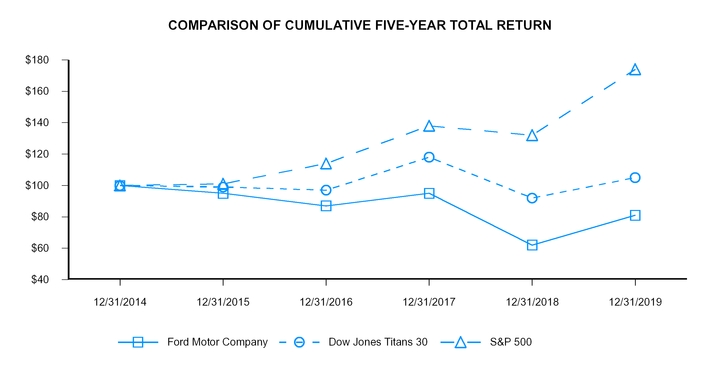
| Base Period | Years Ending | |||||||||||
| Company / Index | 2014 | 2015 | 2016 | 2017 | 2018 | 2019 | ||||||
| Ford Motor Company | 100 | 95 | 87 | 95 | 62 | 81 | ||||||
| S&P 500 | 100 | 101 | 114 | 138 | 132 | 174 | ||||||
| Dow Jones Automobiles & Parts Titans 30 | 100 | 99 | 97 | 118 | 92 | 105 |
Item 5. Market for Registrant’s Common Equity, Related Stockholder Matters and Issuer Purchases of Equity Securities (Continued)
Issuer Purchases of Securities
We completed no share repurchases during the fourth quarter of 2019.
Dividends
The table below shows the dividends we paid per share of Common and Class B Stock for each quarterly period in 2018 and 2019:
| 2018 | 2019 | ||||||||||||||||||||||||||||||
| First Quarter | Second Quarter | Third Quarter | Fourth Quarter | First Quarter | Second Quarter | Third Quarter | Fourth Quarter | ||||||||||||||||||||||||
| Dividends per share of Ford Common and Class B Stock | $ | 0.28 | $ | 0.15 | $ | 0.15 | $ | 0.15 | $ | 0.15 | $ | 0.15 | $ | 0.15 | $ | 0.15 |
Subject to legally available funds, we intend to continue to pay a quarterly cash dividend on our outstanding Common Stock and Class B Stock. The declaration and payment of future dividends is at the sole discretion of our Board of Directors after taking into account various factors, including our financial condition, operating results, available cash, and current and anticipated cash needs.
Item 6. Selected Financial Data.
The following table sets forth selected financial data for each of the last five years (dollar amounts in millions, except for per share amounts):
| SUMMARY OF INCOME | 2015 | 2016 | 2017 | 2018 | 2019 | ||||||||||||||
| Total revenues | $ | 149,558 | $ | 151,800 | $ | 156,776 | $ | 160,338 | $ | 155,900 | |||||||||
| Income/(Loss) before income taxes | $ | 10,179 | $ | 6,784 | $ | 8,159 | $ | 4,345 | $ | (640 | ) | ||||||||
| Provision for/(Benefit from) income taxes | 2,854 | 2,184 | 402 | 650 | (724 | ) | |||||||||||||
| Net income | 7,325 | 4,600 | 7,757 | 3,695 | 84 | ||||||||||||||
| Less: Income/(Loss) attributable to noncontrolling interests | (2 | ) | 11 | 26 | 18 | 37 | |||||||||||||
| Net income attributable to Ford Motor Company | $ | 7,327 | $ | 4,589 | $ | 7,731 | $ | 3,677 | $ | 47 | |||||||||
| Earnings Per Share Attributable to Ford Motor Company Common and Class B Stock | |||||||||||||||||||
| Average number of shares of Ford Common and Class B Stock outstanding (in millions) | 3,969 | 3,973 | 3,975 | 3,974 | 3,972 | ||||||||||||||
| Basic income | $ | 1.85 | $ | 1.16 | $ | 1.94 | $ | 0.93 | $ | 0.01 | |||||||||
| Diluted income | 1.83 | 1.15 | 1.93 | 0.92 | 0.01 | ||||||||||||||
| Cash dividends declared | 0.60 | 0.85 | 0.65 | 0.73 | 0.60 | ||||||||||||||
| BALANCE SHEET DATA AT YEAR END | |||||||||||||||||||
| Total assets | $ | 225,491 | $ | 238,510 | $ | 258,496 | $ | 256,540 | $ | 258,537 | |||||||||
| Automotive debt | $ | 12,839 | $ | 15,907 | $ | 15,931 | $ | 13,547 | $ | 14,678 | |||||||||
| Ford Credit debt | 119,417 | 126,464 | 137,757 | 140,066 | 140,029 | ||||||||||||||
| Other debt | 598 | 599 | 599 | 600 | 600 | ||||||||||||||
| Total equity | $ | 29,223 | $ | 29,746 | $ | 35,606 | $ | 35,966 | $ | 33,230 |
ITEM 7. Management’s Discussion and Analysis of Financial Condition and Results of Operations.
Revenue
Our Automotive segment revenue is generated primarily by sales of vehicles, parts, and accessories. Revenue is recorded when control is transferred to our customers (generally, our dealers and distributors). For the majority of sales, this occurs when products are shipped from our manufacturing facilities. This is not the case, however, with respect to vehicles produced for sale to daily rental car companies with an obligation to repurchase the vehicle for a guaranteed amount, exercisable at the option of the customer. These contracts are accounted for as operating leases, with lease revenue and profits recognized over the term of the lease. Proceeds from the sale of vehicles at auction are recognized in revenue upon transfer of control of the vehicle to the buyer.
Most of the vehicles sold by us to our dealers and distributors are financed at wholesale by Ford Credit. Upon Ford Credit originating the wholesale receivable related to a dealer’s purchase of a vehicle, Ford Credit pays cash to the relevant Automotive legal entity in payment of the dealer’s obligation for the purchase price of the vehicle. The dealer then pays the wholesale finance receivable to Ford Credit when it sells the vehicle to a retail customer.
Our Ford Credit segment revenue is generated primarily from interest on finance receivables, net of certain deferred origination costs that are included as a reduction of financing revenue, and such revenue is recognized over the term of the receivable using the interest method. Also, revenue from operating leases is recognized on a straight-line basis over the term of the lease. Income is generated to the extent revenues exceed expenses, most of which are interest, depreciation, and operating expenses.
Transactions between our Automotive and Ford Credit segments occur in the ordinary course of business. For example, we offer special retail financing and lease incentives to dealers’ customers who choose to finance or lease our vehicles from Ford Credit. The cost for these incentives is included in our estimate of variable consideration at the date the related vehicle sales to our dealers are recorded. In order to compensate Ford Credit for the lower interest or lease payments offered to the retail customer, we pay the discounted value of the incentive directly to Ford Credit when it originates the retail finance or lease contract with the dealer’s customer. Ford Credit recognizes the incentive amount over the life of retail finance contracts as an element of financing revenue and over the life of lease contracts as a reduction to depreciation. See Note 1 of the Notes to the Financial Statements for a more detailed discussion of transactions between our Automotive and Ford Credit segments.
Costs and Expenses
Our income statement classifies our Automotive segment total costs and expenses into two categories: (i) cost of sales, and (ii) selling, administrative, and other expenses. We include within cost of sales those costs related to the development, manufacture, and distribution of our vehicles, parts, and accessories. Specifically, we include in cost of sales each of the following: material costs (including commodity costs); freight costs; warranty, including product recall costs; labor and other costs related to the development and manufacture of our products; depreciation and amortization; and other associated costs. We include within selling, administrative, and other expenses labor and other costs not directly related to the development and manufacture of our products, including such expenses as advertising and sales promotion costs.
Certain of our costs, such as material costs, generally vary directly with changes in volume and mix of production. In our industry, production volume often varies significantly from quarter to quarter and year to year. Quarterly production volumes experience seasonal shifts throughout the year (including peak retail sales seasons and the impact on production of model changeover and new product launches). Annual production volumes are heavily impacted by external economic factors, including the pace of economic growth and factors such as the availability of consumer credit and cost of fuel.
Item 7. Management’s Discussion and Analysis of Financial Condition and Results of Operations (Continued)
As a result, we analyze the profit impact of certain cost changes holding constant present-year volume and mix and currency exchange, in order to evaluate our cost trends absent the impact of varying production and currency exchange levels. We analyze these cost changes in the following categories:
| • | Contribution Costs – these costs typically vary with production volume. These costs include material (including commodity), warranty, and freight and duty costs. |
| • | Structural Costs – these costs typically do not have a directly proportionate relationship to prod |
Showing the first 8K of 134K characters. Open the full section
Item 7. Management’s Discussion and Analysis of Financial Condition and Results of Operations (Continued)
2019 SUPPLEMENTAL INFORMATION
The tables below provide supplemental consolidating financial information and other financial information. Company excluding Ford Credit includes our Automotive and Mobility reportable segments, Corporate Other, Interest on Debt, and Special Items. Eliminations, where presented, primarily represent eliminations of intersegment transactions and deferred tax netting.
Selected Cash Flow Information. The following tables provide supplemental cash flow information (in millions):
| For the Year Ended December 31, 2019 | ||||||||||||||||
| Cash flows from operating activities | Company excluding Ford Credit | Ford Credit | Eliminations | Consolidated | ||||||||||||
| Net income/(loss) | $ | (2,144 | ) | $ | 2,228 | $ | — | $ | 84 | |||||||
| Depreciation and tooling amortization | 6,023 | 3,666 | — | 9,689 | ||||||||||||
| Other amortization | 48 | (1,247 | ) | — | (1,199 | ) | ||||||||||
| Held-for-sale impairment charges | 804 | — | — | 804 | ||||||||||||
| Provision for credit and insurance losses | 14 | 399 | — | 413 | ||||||||||||
| Pension and OPEB expense/(income) | 2,625 | — | — | 2,625 | ||||||||||||
| Equity investment dividends received in excess of (earnings)/losses | 233 | (30 | ) | — | 203 | |||||||||||
| Foreign currency adjustments | (18 | ) | (36 | ) | — | (54 | ) | |||||||||
| Net (gain)/loss on changes in investments in affiliates | (36 | ) | 7 | — | (29 | ) | ||||||||||
| Stock compensation | 220 | 8 | — | 228 | ||||||||||||
| Provision for deferred income taxes | (1,407 | ) | 37 | — | (1,370 | ) | ||||||||||
| Decrease/(Increase) in finance receivables (wholesale and other) | — | 1,554 | — | 1,554 | ||||||||||||
| Decrease/(Increase) in intersegment receivables/payables | (193 | ) | 193 | — | — | |||||||||||
| Decrease/(Increase) in accounts receivable and other assets | (971 | ) | 155 | — | (816 | ) | ||||||||||
| Decrease/(Increase) in inventory | 206 | — | — | 206 | ||||||||||||
| Increase/(Decrease) in accounts payable and accrued and other liabilities | 5,228 | 32 | — | 5,260 | ||||||||||||
| Other | 157 | (116 | ) | — | 41 | |||||||||||
| Interest supplements and residual value support to Ford Credit | (4,681 | ) | 4,681 | — | — | |||||||||||
| Net cash provided by/(used in) operating activities | $ | 6,108 | $ | 11,531 | $ | — | $ | 17,639 |
| Cash flows from investing activities | ||||||||||||||||
| Capital spending | $ | (7,580 | ) | $ | (52 | ) | $ | — | $ | (7,632 | ) | |||||
| Acquisitions of finance receivables and operating leases | — | (55,576 | ) | — | (55,576 | ) | ||||||||||
| Collections of finance receivables and operating leases | — | 50,182 | — | 50,182 | ||||||||||||
| Purchases of marketable and other investments | (11,589 | ) | (5,883 | ) | — | (17,472 | ) | |||||||||
| Sales and maturities of marketable and other investments | 12,998 | 3,931 | — | 16,929 | ||||||||||||
| Settlements of derivatives | 107 | (221 | ) | — | (114 | ) | ||||||||||
| Other | (34 | ) | (4 | ) | — | (38 | ) | |||||||||
| Investing activity (to)/from other segments | 2,980 | — | (2,980 | ) | — | |||||||||||
| Net cash provided by/(used in) investing activities | $ | (3,118 | ) | $ | (7,623 | ) | $ | (2,980 | ) | $ | (13,721 | ) |
| Cash flows from financing activities | ||||||||||||||||
| Cash payments for dividends and dividend equivalents | $ | (2,389 | ) | $ | — | $ | — | $ | (2,389 | ) | ||||||
| Purchases of common stock | (237 | ) | — | — | (237 | ) | ||||||||||
| Net changes in short-term debt | (186 | ) | (1,198 | ) | — | (1,384 | ) | |||||||||
| Proceeds from issuance of long-term debt | 3,082 | 44,522 | — | 47,604 | ||||||||||||
| Principal payments on long-term debt | (1,832 | ) | (44,665 | ) | — | (46,497 | ) | |||||||||
| Other | (110 | ) | (116 | ) | — | (226 | ) | |||||||||
| Financing activity to/(from) other segments | — | (2,980 | ) | 2,980 | — | |||||||||||
| Net cash provided by/(used in) financing activities | $ | (1,672 | ) | $ | (4,437 | ) | $ | 2,980 | $ | (3,129 | ) | |||||
| Effect of exchange rate changes on cash, cash equivalents, and restricted cash | $ | (5 | ) | $ | 50 | $ | — | $ | 45 |
Item 7. Management’s Discussion and Analysis of Financial Condition and Results of Operations (Continued)
Selected Income Statement Information. The following table provides supplemental income statement information (in millions):
| For the Year Ended December 31, 2019 | ||||||||||||||||||||||||
| Company excluding Ford Credit | ||||||||||||||||||||||||
| Automotive | Mobility | Other (a) | Subtotal | Ford Credit | Consolidated | |||||||||||||||||||
| Revenues | $ | 143,599 | $ | 41 | $ | — | $ | 143,640 | $ | 12,260 | $ | 155,900 | ||||||||||||
| Total costs and expenses | 140,736 | 1,379 | 3,739 | 145,854 | 9,472 | 155,326 | ||||||||||||||||||
| Operating income/(loss) | 2,863 | (1,338 | ) | (3,739 | ) | (2,214 | ) | 2,788 | 574 | |||||||||||||||
| Interest expense on Automotive debt | — | — | 963 | 963 | — | 963 | ||||||||||||||||||
| Interest expense on Other debt | — | — | 57 | 57 | — | 57 | ||||||||||||||||||
| Other income/(loss), net | 2,074 | 140 | (2,619 | ) | (405 | ) | 179 | (226 | ) | |||||||||||||||
| Equity in net income of affiliated companies | (11 | ) | 12 | — | 1 | 31 | 32 | |||||||||||||||||
| Income/(loss) before income taxes | 4,926 | (1,186 | ) | (7,378 | ) | (3,638 | ) | 2,998 | (640 | ) | ||||||||||||||
| Provision for/(Benefit from) income taxes | 444 | (284 | ) | (1,654 | ) | (1,494 | ) | 770 | (724 | ) | ||||||||||||||
| Net income/(loss) | 4,482 | (902 | ) | (5,724 | ) | (2,144 | ) | 2,228 | 84 | |||||||||||||||
| Less: Income attributable to noncontrolling interests |
Showing the first 8K of 64K characters. Open the full section
Item 7A. Quantitative and Qualitative Disclosures About Market Risk (Continued)
FORD CREDIT MARKET RISK
Market risk for Ford Credit is the possibility that changes in interest and currency exchange rates will adversely affect cash flow and economic value.
Interest Rate Risk. Generally, Ford Credit’s assets and the related debt have different re-pricing periods, and consequently, respond differently to changes in interest rates.
Ford Credit’s assets consist primarily of fixed-rate retail financing and operating lease contracts and floating-rate wholesale receivables. Fixed-rate retail financing and operating lease contracts generally require customers to make equal monthly payments over the life of the contract. Wholesale receivables are originated to finance new and used vehicles held in dealers’ inventory and generally require dealers to pay a floating rate.
Debt consists primarily of short- and long-term unsecured and securitized debt. Ford Credit’s term debt instruments are principally fixed-rate and require fixed and equal interest payments over the life of the instrument and a single principal payment at maturity.
Ford Credit’s interest rate risk management objective is to reduce volatility in its cash flows and volatility in its economic value from changes in interest rates based on an established risk tolerance that may vary by market.
Ford Credit uses economic value sensitivity analysis and re-pricing gap analysis to evaluate potential long-term effects of changes in interest rates. It then enters into interest rate swaps to convert portions of its floating-rate debt to fixed or its fixed-rate debt to floating to ensure that Ford Credit’s exposure falls within the established tolerances. Ford Credit also uses pre-tax cash flow sensitivity analysis to monitor the level of near-term cash flow exposure. The pre-tax cash flow sensitivity analysis measures the changes in expected cash flows associated with Ford Credit’s interest-rate-sensitive assets, liabilities, and derivative financial instruments from hypothetical changes in interest rates over a twelve-month horizon. Ford Credit’s Asset-Liability Committee reviews the re-pricing mismatch and exposure every month and approves interest rate swaps required to maintain exposure within approved thresholds prior to execution.
To provide a quantitative measure of the sensitivity of its pre-tax cash flow to changes in interest rates, Ford Credit uses interest rate scenarios that assume a hypothetical, instantaneous increase or decrease of one percentage point in all interest rates across all maturities (a “parallel shift”), as well as a base case that assumes that all interest rates remain constant at existing levels. In reality, interest rate changes are rarely instantaneous or parallel and rates could move more or less than the one percentage point assumed in Ford Credit’s analysis. As a result, the actual impact to pre-tax cash flow could be higher or lower than the results detailed in the table below. These interest rate scenarios are purely hypothetical and do not represent Ford Credit’s view of future interest rate movements.
Under these interest rate scenarios, Ford Credit expects more debt and liabilities than assets to re-price in the next twelve months. Other things being equal, this means that during a period of rising interest rates, the interest received on Ford Credit’s assets will increase less than the interest paid on Ford Credit’s debt, thereby initially decreasing Ford Credit’s pre-tax cash flow. During a period of falling interest rates, Ford Credit would expect its pre-tax cash flow to initially increase. Ford Credit’s pre-tax cash flow sensitivity to interest rate movement is highlighted in the table below.
Pre-tax cash flow sensitivity at December 31 was as follows (in millions):
| Pre-Tax Cash Flow Sensitivity | 2018 | 2019 | ||||||
| One percentage point instantaneous increase in interest rates | $ | 51 | $ | (26 | ) | |||
| One percentage point instantaneous decrease in interest rates (a) | (51 | ) | 26 |
| (a) | Pre-tax cash flow sensitivity given a one percentage point decrease in interest rates requires an assumption of negative interest rates in markets where existing interest rates are below one percent. |
While the sensitivity analysis presented is Ford Credit’s best estimate of the impacts of the specified assumed interest rate scenarios, its actual results could differ from those projected. The model Ford Credit uses to conduct this analysis is heavily dependent on assumptions. Embedded in the model are assumptions regarding the reinvestment of maturing asset principal, refinancing of maturing debt, replacement of maturing derivatives, exercise of options embedded in debt and derivatives, and predicted repayment of retail financing and operating lease contracts ahead of contractual maturity. Ford Credit’s repayment projections ahead of contractual maturity are based on historical experience. If interest rates or other factors change, Ford Credit’s actual prepayment experience could be different than projected.
Item 7A. Quantitative and Qualitative Disclosures About Market Risk (Continued)
Foreign Currency Risk. Ford Credit’s policy is to minimize exposure to changes in currency exchange rates. To meet funding objectives, Ford Credit borrows in a variety of currencies, principally U.S. dollars, Canadian dollars, euros, sterling, and renminbi. Ford Credit faces exposure to currency exchange rates if a mismatch exists between the currency of receivables and the currency of the debt funding those receivables. When possible, receivables are funded with debt in the same currency, minimizing exposure to exchange rate movements. When a different currency is used, Ford Credit may use foreign currency swaps and foreign currency forwards to convert substantially all of its foreign currency debt obligations to the local country currency of the receivables. As a result of this policy, Ford Credit believes its market risk exposure, relating to changes in currency exchange rates at December 31, 2019, is insignificant.
Derivative Fair Values. The net fair value of Ford Credit’s derivative financial instruments was an asset of $772 million and $7 million at December 31, 2019 and 2018, respectively.
COUNTERPARTY RISK
Counterparty risk relates to the loss we could incur if an obligor or counterparty defaulted on an investment or a derivative contract. We enter into master agreements with counterparties that allow netting of certain exposures in order to manage this risk. Exposures primarily relate to investments in fixed income instruments and derivative contracts used for managing interest rate, foreign currency exchange rate, and commodity price risk. We, together with Ford Credit, establish exposure limits for each counterparty to minimize risk and provide counterparty diversification.
Our approach to managing counterparty risk is forward-looking and proactive, allowing us to take risk mitigation actions before risks become losses. Exposure limits are established based on our overall risk tolerance, which is calculated from counterparty credit ratings and market-based credit default swap (“CDS”) spreads. The exposure limits are lower for smaller and lower-rated counterparties, counterparties that have relatively higher CDS spreads, and for longer dated exposures. Our exposures are monitored on a regular basis and included in periodic reports to our Treasurer.
Substantially all of our counterparty exposures are with counterparties that have an investment grade rating. Investment grade is our guideline for minimum counterparty long-term ratings.
Item 8. Financial Statements and Supplementary Data.
The Report of Independent Registered Public Accounting Firm, our Financial Statements, the accompanying Notes to the Financial Statements, and the Financial Statement Schedule that are filed as part of this Report are listed under “Item 15. Exhibits and Financial Statement Schedules” and are set forth beginning on page FS-1 immediately following the signature pages of this Report.
Selected quarterly financial data for 2018 and 2019 are provided in Note 29 of the Notes to the Financial Statements.
Item 9. Changes in and Disagreements with Accountants on Accounting and Financial Disclosure.
None.
Item 9A. Controls and Procedures.
Evaluation of Disclosure Controls and Procedures. James P. Hackett, our Chief Executive Officer (“CEO”), and Tim Stone, our Chief Financial Officer (“CFO”), have performed an evaluation of the Company’s disclosure controls and procedures, as that term is defined in Rule 13a-15(e) of the Securities Exchange Act of 1934, as amended (“Exchange Act”), as of December 31, 2019, and each has concluded that such disclosure controls and procedures are effective to ensure that information required to be disclosed in our periodic reports filed under the Exchange Act is recorded, processed, summarized, and reported within the time periods specified by SEC rules and forms, and that such information is accumulated and communicated to the CEO and CFO to allow timely decisions regarding required disclosures.
Management’s Report on Internal Control Over Financial Reporting. Our management is responsible for establishing and maintaining adequate internal control over financial reporting, as such term is defined in Exchange Act Rule 13a-15(f). The Company’s internal control over financial reporting is a process designed to provide reasonable assurance regarding the reliability of financial reporting and the preparation of financial statements for external purposes in accordance with generally accepted accounting principles.
Because of its inherent limitations, internal control over financial reporting may not prevent or detect misstatements. Also, projections of any evaluation of effectiveness to future periods are subject to the risk that controls may become inadequate because of changes in conditions or because the degree of compliance with policies or procedures may deteriorate.
Under the supervision and with the participation of our management, including our CEO and CFO, we conducted an assessment of the effectiveness of our internal control over financial reporting as of December 31, 2019. The assessment was based on criteria established in the framework Internal Control - Integrated Framework (2013), issued by the Committee of Sponsoring Organizations of the Treadway Commission. Based on this assessment, management concluded that our internal control over financial reporting was effective as of December 31, 2019.
The effectiveness of the Company’s internal control over financial reporting as of December 31, 2019 has been audited by PricewaterhouseCoopers LLP, an independent registered public accounting firm, as stated in its report included herein.
Changes in Internal Control Over Financial Reporting. There were no changes in internal control over financial reporting during the quarter ended December 31, 2019 that have materially affected, or are reasonably likely to materially affect, our internal control over financial reporting.
Item 9B. Other Information.
None.
PART III.
Item 10. Directors, Executive Officers of Ford, and Corporate Governance.
The information required by Item 10 regarding our directors is incorporated by reference from the information under the captions “Proposal 1. Election of Directors” and “Beneficial Stock Ownership” in our Proxy Statement. The information required by Item 10 regarding our executive officers appears as Item 4A under Part I of this Report. The information required by Item 10 regarding an audit committee financial expert is incorporated by reference from the information under the caption “Corporate Governance – Audit Committee Financial Expert and Auditor Rotation” in our Proxy Statement. The information required by Item 10 regarding the members of our Audit Committee of the Board of Directors is incorporated by reference from the information under the captions “Proxy Summary,” “Corporate Governance – Board Committee Functions,” “Corporate Governance – Audit Committee Financial Expert and Auditor Rotation,” and “Proposal 1 – Election of Directors” in our Proxy Statement. The information required by Item 10 regarding the Audit Committee’s review and discussion of the audited financial statements is incorporated by reference from information under the caption “Audit Committee Report” in our Proxy Statement. The information required by Item 10 regarding our codes of ethics is incorporated by reference from the information under the caption “Corporate Governance – Codes of Ethics” in our Proxy Statement. In addition, we have included in Item 1 instructions for how to access our codes of ethics on our website and our Internet address. Amendments to, and waivers granted under, our Code of Ethics for Senior Financial Personnel, if any, will be posted to our website as well.
Item 11. Executive Compensation.
The information required by Item 11 is incorporated by reference from the information under the following captions in our Proxy Statement: “Director Compensation in 2019,” “Compensation Discussion and Analysis,” “Compensation Committee Report,” “Compensation Committee Interlocks and Insider Participation,” “Compensation of Executive Officers,” “Summary Compensation Table,” “Grants of Plan-Based Awards in 2019,” “Outstanding Equity Awards at 2019 Fiscal Year-End,” “Option Exercises and Stock Vested in 2019,” “Pension Benefits in 2019,” “Nonqualified Deferred Compensation in 2019,” and “Potential Payments Upon Termination or Change in Control.”
Item 12. Security Ownership of Certain Beneficial Owners and Management and Related Stockholder Matters.
The information required by Item 12 is incorporated by reference from the information under the captions “Equity Compensation Plan Information” and “Corporate Governance – Beneficial Stock Ownership” in our Proxy Statement.
Item 13. Certain Relationships and Related Transactions, and Director Independence.
The information required by Item 13 is incorporated by reference from the information under the captions “Certain Relationships and Related Party Transactions” and “Corporate Governance – Independence of Directors and Relevant Facts and Circumstances” in our Proxy Statement.
Item 14. Principal Accounting Fees and Services.
The information required by Item 14 is incorporated by reference from the information under the caption “Proposal 2. Ratification of Independent Registered Public Accounting Firm” in our Proxy Statement.
PART IV.
Item 15. Exhibits and Financial Statement Schedules.
(a) 1. Financial Statements – Ford Motor Company and Subsidiaries
The following are contained in this 2019 Form 10-K Report:
| • | Report of Independent Registered Public Accounting Firm. |
| • | Consolidated Statement of Cash Flows for the years ended December 31, 2017, 2018, and 2019. |
| • | Consolidated Income Statement for the years ended December 31, 2017, 2018, and 2019. |
| • | Consolidated Statement of Comprehensive Income for the years ended December 31, 2017, 2018, and 2019. |
| • | Consolidated Balance Sheet at December 31, 2018 and 2019. |
| • | Consolidated Statement of Equity for the years ended December 31, 2017, 2018, and 2019. |
| • | Notes to the Financial Statements. |
The Report of Independent Registered Public Accounting Firm, the Consolidated Financial Statements, and the Notes to the Financial Statements listed above are filed as part of this Report and are set forth beginning on page FS-1 immediately following the signature pages of this Report.
(a) 2. Financial Statement Schedules
| Designation | Description |
| Schedule II | Valuation and Qualifying Accounts for the years ended 2017, 2018, and 2019 |
Schedule II is filed as part of this Report and is set forth on page FSS-1 immediately following the Notes to the Financial Statements referred to above. The other schedules are omitted because they are not applicable, the information required to be contained in them is disclosed elsewhere on our Consolidated Financial Statements, or the amounts involved are not sufficient to require submission.
(a) 3. Exhibits
| Designation | Description | Method of Filing | ||
| Exhibit 3-A | Restated Certificate of Incorporation, dated August 2, 2000. | Filed as Exhibit 3-A to our Annual Report on Form 10-K for the year ended December 31, 2000.* | ||
| Exhibit 3-A-1 | Certificate of Designations of Series A Junior Participating Preferred Stock filed on September 11, 2009. | Filed as Exhibit 3.1 to our Current Report on Form 8-K filed September 11, 2009.* | ||
| Exhibit 3-B | By-laws. | Filed as Exhibit 3.2 to our Form 8-A/A filed on September 11, 2015.* | ||
| Exhibit 4-A | Tax Benefit Preservation Plan (“TBPP”) dated September 11, 2009 between Ford Motor Company and Computershare Trust Company, N.A. | Filed as Exhibit 4.1 to our Current Report on Form 8-K filed September 11, 2009.* | ||
| Exhibit 4-A-1 | Amendment No. 1 to TBPP dated September 11, 2012. | Filed as Exhibit 4 to our Current Report on Form 8-K filed September 12, 2012.* | ||
| Exhibit 4-A-2 | Amendment No. 2 to TBPP dated September 9, 2015. | Filed as Exhibit 4 to our Current Report on Form 8-K filed September 11, 2015.* | ||
| Exhibit 4-A-3 | Amendment No. 3 to TBPP dated September 13, 2018. | Filed as Exhibit 4 to our Current Report on Form 8-K filed September 14, 2018.* | ||
| Exhibit 4-B | Description of Securities. | Filed with this Report. | ||
| Exhibit 10-A | Executive Separation Allowance Plan, as amended and restated effective as of January 1, 2018** | Filed as Exhibit 10.1 to our Current Report on Form 8-K filed February 7, 2018.* | ||
| Exhibit 10-B | Deferred Compensation Plan for Non-Employee Directors, as amended and restated as of January 1, 2012.** | Filed as Exhibit 10-B to our Annual Report on Form 10-K for the year ended December 31, 2011.* | ||
| Exhibit 10-C | 2014 Stock Plan for Non-Employee Directors** | Filed as Exhibit 10-C to our Annual Report on Form 10-K for the year ended December 31, 2013.* |
| Designation | Description | Method of Filing | ||
| Exhibit 10-D | Benefit Equalization Plan, as amended and restated effective as of January 1, 2018.** | Filed as Exhibit 10.2 to our Current Report on Form 8-K filed February 7, 2018.* | ||
| Exhibit 10-E | Description of financial counseling services provided to certain executives.** | Filed with this Report. | ||
| Exhibit 10-F | Defined Benefit Supplemental Executive Retirement Plan, as amended and restated effective as of January 1, 2018.** | Filed as Exhibit 10.3 to our Current Report on Form 8-K filed February 7, 2018.* | ||
| Exhibit 10-F-1 | Defined Contribution Supplemental Executive Retirement Plan, as amended and restated effective as of January 1, 2017.** | Filed as Exhibit 10.4 to our Quarterly Report on Form 10-Q for the quarter ended March 31, 2017.* | ||
| Exhibit 10-G | Description of Director Compensation as of July 13, 2006.** | Filed as Exhibit 10-G-3 to our Quarterly Report on Form 10-Q for the quarter ended September 30, 2006.* | ||
| Exhibit 10-G-1 | Amendment to Description of Director Compensation as of February 8, 2012.** | Filed as Exhibit 10-F-3 to our Annual Report on Form 10-K for the year ended December 31, 2011.* | ||
| Exhibit 10-G-2 | Amendment to Description of Director Compensation as of July 1, 2013.** | Filed as Exhibit 10-G-2 to our Annual Report on Form 10-K for the year ended December 31, 2013.* | ||
| Exhibit 10-G-3 | Amendment to Description of Director Compensation as of January 1, 2017.** | Filed as Exhibit 10-G-3 to our Annual Report on Form 10-K for the year ended December 31, 2016.* | ||
| Exhibit 10-H | 2008 Long-Term Incentive Plan.** | Filed as Exhibit 10.1 to our Quarterly Report on Form 10-Q for the quarter ended June 30, 2008.* | ||
| Exhibit 10-I | Description of Matching Gift Program and Vehicle Evaluation Program for Non-Employee Directors.** | Filed as Exhibit 10-I to our Annual Report on Form 10-K/A for the year ended December 31, 2005.* | ||
| Exhibit 10-J | Non-Employee Directors Life Insurance and Optional Retirement Plan as amended and restated as of December 31, 2010.** | Filed as Exhibit 10-I to our Annual Report on Form 10-K for the year ended December 31, 2010.* | ||
| Exhibit 10-K | Description of Non-Employee Directors Accidental Death, Dismemberment and Permanent Total Disablement Indemnity.** | Filed as Exhibit 10-S to our Annual Report on Form 10-K for the year ended December 31, 1992.* | ||
| Exhibit 10-K-1 | Description of Amendment to Basic Life Insurance and Accidental Death & Dismemberment Insurance.** | Filed as Exhibit 10-K-1 to our Annual Report on Form 10-K for the year ended December 31, 2013.* | ||
| Exhibit 10-L | Description of Compensation Arrangements for Mark Fields.** | Filed as Exhibit 10-L to our Annual Report on Form 10-K for the year ended December 31, 2014.* | ||
| Exhibit 10-L-1 | Executive Separation Waiver and Release Agreement between Ford Motor Company and Mark Fields dated May 21, 2017.** | Filed as Exhibit 10 to our Quarterly Report on Form 10-Q for the quarter ended June 30, 2017.* | ||
| Exhibit 10-M | Offer Letter to Tim Stone dated March 11, 2019.** | Filed as Exhibit 99 to our Current Report on Form 8-K filed June 4, 2019.* | ||
| Exhibit 10-N | Select Retirement Plan, as amended and restated effective as of January 1, 2018.** | Filed as Exhibit 10.4 to our Current Report on Form 8-K filed February 7, 2018.* | ||
| Exhibit 10-O | Deferred Compensation Plan, as amended and restated as of December 31, 2010.** | Filed as Exhibit 10-M to our Annual Report on Form 10-K for the year ended December 31, 2010.* | ||
| Exhibit 10-O-1 | Suspension of Open Enrollment in Deferred Compensation Plan.** | Filed as Exhibit 10-M-1 to our Annual Report on Form 10-K for the year ended December 31, 2009.* | ||
| Exhibit 10-P | Annual Incentive Compensation Plan, as amended and restated effective as of March 1, 2018.** | Filed as Exhibit 10-O-2 to our Annual Report on Form 10-K for the year ended December 31, 2017.* | ||
| Exhibit 10-P-1 | Annual Incentive Compensation Plan Metrics for 2018.** | Filed as Exhibit 10.1 to our Quarterly Report on Form 10-Q for the quarter ended March 31, 2018.* | ||
| Exhibit 10-P-2 | Annual Incentive Compensation Plan Metrics for 2019.** | Filed as Exhibit 10.1 to our Quarterly Report on Form 10-Q for the quarter ended March 31, 2019.* | ||
| Exhibit 10-P-3 | Performance-Based Restricted Stock Unit Metrics for 2016.** | Filed as Exhibit 10-O-9 to our Annual Report on Form 10-K for the year ended December 31, 2015.* | ||
| Exhibit 10-P-4 | Performance-Based Restricted Stock Unit Metrics for 2017.** | Filed as Exhibit 10-O-10 to our Annual Report on Form 10-K for the year ended December 31, 2016.* | ||
| Exhibit 10-P-5 | Performance-Based Restricted Stock Unit Metrics for 2018.** | Filed as Exhibit 10.2 to our Quarterly Report on Form 10-Q for the quarter ended March 31, 2018.* | ||
| Exhibit 10-P-6 | Performance-Based Restricted Stock Unit Metrics for 2019.** | Filed as Exhibit 10.2 to our Quarterly Report on Form 10-Q for the quarter ended March 31, 2019.* | ||
| Exhibit 10-P-7 | Executive Compensation Recoupment Policy.** | Filed as Exhibit 10-N-8 to our Annual Report on Form 10-K for the year ended December 31, 2010.* | ||
| Exhibit 10-P-8 | Incremental Bonus Description.** | Filed as Exhibit 10-N-9 to our Annual Report on Form 10-K for the year ended December 31, 2010.* | ||
| Exhibit 10-Q | 2018 Long-Term Incentive Plan.** | Filed as Exhibit 4.1 to Registration Statement No. 333-226348.* | ||
| Exhibit 10-Q-1 | Form of Stock Option Terms and Conditions for Long-Term Incentive Plan.** | Filed as Exhibit 10-P-2 to our Annual Report on Form 10-K for the year ended December 31, 2017.* | ||
| Exhibit 10-Q-2 | Form of Stock Option Agreement for Long-Term Incentive Plan.** | Filed as Exhibit 10-P-3 to our Annual Report on Form 10-K for the year ended December 31, 2017.* | ||
| Exhibit 10-Q-3 | Form of Stock Option Agreement (ISO) for Long-Term Incentive Plan.** | Filed as Exhibit 10-P-4 to our Annual Report on Form 10-K for the year ended December 31, 2017.* |
| Designation | Description | Method of Filing | ||
| Exhibit 10-Q-4 | Form of Stock Option Agreement (U.K. NQO) for Long-Term Incentive Plan.** | Filed as Exhibit 10-P-5 to our Annual Report on Form 10-K for the year ended December 31, 2017.* | ||
| Exhibit 10-Q-5 | Form of Stock Option (U.K.) Terms and Conditions for Long-Term Incentive Plan.** | Filed as Exhibit 10-P-6 to our Annual Report on Form 10-K for the year ended December 31, 2017.* | ||
| Exhibit 10-Q-6 | Form of Restricted Stock Grant Letter.** | Filed as Exhibit 10-P-7 to our Annual Report on Form 10-K for the year ended December 31, 2017.* | ||
| Exhibit 10-Q-7 | Form of Final Award Notification Letter for Performance-Based Restricted Stock Units.** | Filed as Exhibit 10-P-8 to our Annual Report on Form 10-K for the year ended December 31, 2017.* | ||
| Exhibit 10-Q-8 | Form of Annual Equity Grant Letter V.1.** | Filed as Exhibit 10-P-9 to our Annual Report on Form 10-K for the year ended December 31, 2017.* | ||
| Exhibit 10-Q-9 | Form of Annual Equity Grant Letter V.2.** | Filed as Exhibit 10-P-10 to our Annual Report on Form 10-K for the year ended December 31, 2017.* | ||
| Exhibit 10-Q-10 | Long-Term Incentive Plan Restricted Stock Unit Agreement.** | Filed as Exhibit 10-P-11 to our Annual Report on Form 10-K for the year ended December 31, 2017.* | ||
| Exhibit 10-Q-11 | Long-Term Incentive Plan Restricted Stock Unit Terms and Conditions.** | Filed as Exhibit 10-P-12 to our Annual Report on Form 10-K for the year ended December 31, 2017.* | ||
| Exhibit 10-Q-12 | Form of Final Award Agreement for Performance-Based Restricted Stock Units under Long-Term Incentive Plan.** | Filed as Exhibit 10-P-13 to our Annual Report on Form 10-K for the year ended December 31, 2017.* | ||
| Exhibit 10-Q-13 | Form of Final Award Terms and Conditions for Performance-Based Restricted Stock Units under Long-Term Incentive Plan.** | Filed as Exhibit 10-P-14 to our Annual Report on Form 10-K for the year ended December 31, 2017.* | ||
| Exhibit 10-Q-14 | Form of Notification Letter for Time-Based Restricted Stock Units.** | Filed as Exhibit 10-P-15 to our Annual Report on Form 10-K for the year ended December 31, 2017.* | ||
| Exhibit 10-R | Agreement dated January 13, 1999 between Ford Motor Company and Edsel B. Ford II.** | Filed as Exhibit 10-X to our Annual Report on Form 10-K for the year ended December 31, 1998.* | ||
| Exhibit 10-R-1 | Amendment dated May 5, 2010 to the Consulting Agreement between Ford Motor Company and Edsel B. Ford II.** | Filed as Exhibit 10.3 to our Quarterly Report on Form 10-Q for the quarter ended March 31, 2010.* | ||
| Exhibit 10-R-2 | Amendment dated January 1, 2012 to the Consulting Agreement between Ford Motor Company and Edsel B. Ford II.** | Filed as Exhibit 10-P-2 to our Annual Report on Form 10-K for the year ended December 31, 2011.* | ||
| Exhibit 10-S | Amended and Restated Relationship Agreement dated April 30, 2015 between Ford Motor Company and Ford Motor Credit Company LLC. | Filed as Exhibit 10.2 to our Current Report on Form 8-K filed May 1, 2015.* | ||
| Exhibit 10-T | Form of Trade Secrets/Non-Compete Statement between Ford and certain of its Executive Officers.** | Filed as Exhibit 10-V to our Annual Report on Form 10-K for the year ended December 31, 2003.* | ||
| Exhibit 10-U | Arrangement between Ford Motor Company and William C. Ford, Jr., dated February 24, 2009.** | Filed as Exhibit 10-V to our Annual Report on Form 10-K for the year ended December 31, 2008.* | ||
| Exhibit 10-V | Description of Company Practices regarding Club Memberships for Executives.** | Filed as Exhibit 10-BB to our Annual Report on Form 10-K for the year ended December 31, 2006.* | ||
| Exhibit 10-W | Amended and Restated Credit Agreement dated as of November 24, 2009. | Filed as Exhibit 99.2 to our Current Report on Form 8-K filed November 25, 2009.* | ||
| Exhibit 10-W-1 | Seventh Amendment dated as of March 15, 2012 to our Credit Agreement dated as of December 15, 2006, as amended and restated as of November 24, 2009, and as further amended. | Filed as Exhibit 99.2 to our Current Report on Form 8-K filed March 15, 2012.* | ||
| Exhibit 10-W-2 | Ninth Amendment dated as of April 30, 2013 to our Credit Agreement dated as of December 15, 2006, as amended and restated as of November 24, 2009, and as further amended. | Filed as Exhibit 10 to our Quarterly Report on Form 10-Q for the quarter ended March 31, 2013.* | ||
| Exhibit 10-W-3 | Tenth Amendment dated as of April 30, 2014 to our Credit Agreement dated as of December 15, 2006, as amended and restated as of November 24, 2009, and as further amended. | Filed as Exhibit 10.1 to our Quarterly Report on Form 10-Q for the quarter ended March 31, 2014.* | ||
| Exhibit 10-W-4 | Eleventh Amendment dated as of April 30, 2015 to our Credit Agreement dated as of December 15, 2006, as amended and restated as of November 24, 2009, as amended and restated as of April 30, 2014, and as further amended, including the Third Amended and Restated Credit Agreement. | Filed as Exhibit 10.1 to our Current Report on Form 8-K filed May 1, 2015.* | ||
| Exhibit 10-W-5 | Twelfth Amendment dated as of April 29, 2016 to our Credit Agreement dated as of December 15, 2006, as amended and restated as of November 24, 2009, as amended and restated as of April 30, 2014, and as further amended and restated as of April 30, 2015. | Filed as Exhibit 10 to our Current Report on Form 8-K filed April 29, 2016.* | ||
| Exhibit 10-W-6 | Thirteenth Amendment dated as of April 28, 2017 to our Credit Agreement dated as of December 15, 2006, as amended and restated as of November 24, 2009, as amended and restated as of April 30, 2014, and as further amended and restated as of April 30, 2015. | Filed as Exhibit 10 to our Current Report on Form 8-K filed April 28, 2017.* |
| Designation | Description | Method of Filing | ||
| Exhibit 10-W-7 | Fourteenth Amendment dated as of April 26, 2018 to our Credit Agreement dated as of December 15, 2006, as amended and restated as of November 24, 2009, as amended and restated as of April 30, 2014, and as further amended and restated as of April 30, 2015. | Filed as Exhibit 10 to our Current Report on Form 8-K filed April 26, 2018.* | ||
| Exhibit 10-W-8 | Fifteenth Amendment dated as of April 23, 2019 to our Credit Agreement dated as of December 15, 2006, as amended and restated as of November 24, 2009, as amended and restated as of April 30, 2014, and as further amended and restated as of April 30, 2015. | Filed as Exhibit 10.1 to our Current Report on Form 8-K filed April 26, 2019.* | ||
| Exhibit 10-X | Revolving Credit Agreement dated as of April 23, 2019. | Filed as Exhibit 10.2 to our Current Report on Form 8-K filed April 26, 2019.* | ||
| Exhibit 10-Y | Term Loan Credit Agreement dated as of April 23, 2019. | Filed as Exhibit 10.3 to our Current Report on Form 8-K filed April 26, 2019.* | ||
| Exhibit 10-Z | Loan Arrangement and Reimbursement Agreement between Ford Motor Company and the U.S. Department of Energy dated as of September 16, 2009. | Filed as Exhibit 10.1 to our Current Report on Form 8-K filed September 22, 2009.* | ||
| Exhibit 10-AA | Note Purchase Agreement dated as of September 16, 2009 among the Federal Financing Bank, Ford Motor Company, and the U.S. Secretary of Energy. | Filed as Exhibit 10.2 to our Current Report on Form 8-K filed September 22, 2009.* | ||
| Exhibit 21 | List of Subsidiaries of Ford as of January 31, 2020. | Filed with this Report. | ||
| Exhibit 23 | Consent of Independent Registered Public Accounting Firm. | Filed with this Report. | ||
| Exhibit 24 | Powers of Attorney. | Filed with this Report. | ||
| Exhibit 31.1 | Rule 15d-14(a) Certification of CEO. | Filed with this Report. | ||
| Exhibit 31.2 | Rule 15d-14(a) Certification of CFO. | Filed with this Report. | ||
| Exhibit 32.1 | Section 1350 Certification of CEO. | Furnished with this Report. | ||
| Exhibit 32.2 | Section 1350 Certification of CFO. | Furnished with this Report. | ||
| Exhibit 101.INS | XBRL Instance Document. | *** | ||
| Exhibit 101.SCH | XBRL Taxonomy Extension Schema Document. | *** | ||
| Exhibit 101.CAL | XBRL Taxonomy Extension Calculation Linkbase Document. | *** | ||
| Exhibit 101.LAB | XBRL Taxonomy Extension Label Linkbase Document. | *** | ||
| Exhibit 101.PRE | XBRL Taxonomy Extension Presentation Linkbase Document. | *** | ||
| Exhibit 101.DEF | XBRL Taxonomy Extension Definition Linkbase Document. | *** | ||
| Exhibit 104 | Cover Page Interactive Data File (formated in Inline XBRL contained in Exhibit 101). | *** |
- Incorporated by reference as an exhibit to this Report (file number reference 1-3950, unless otherwise indicated).
** Management contract or compensatory plan or arrangement.
*** Submitted electronically with this Report in accordance with the provisions of Regulation S-T.
Instruments defining the rights of holders of certain issues of long-term debt of Ford and of certain consolidated subsidiaries and of any unconsolidated subsidiary, for which financial statements are required to be filed with this Report, have not been filed as exhibits to this Report because the authorized principal amount of any one of such issues does not exceed 10% of the total assets of Ford and our subsidiaries on a consolidated basis. Ford agrees to furnish a copy of each of such instrument to the Securities and Exchange Commission upon request.
Item 16. Form 10-K Summary.
None.
SIGNATURES
Pursuant to the requirements of Section 13 or 15(d) of the Securities Exchange Act of 1934, as amended, Ford has duly caused this Report to be signed on its behalf by the undersigned, thereunto duly authorized.
FORD MOTOR COMPANY
| By: | /s/ Cathy O’Callaghan |
| Cathy O’Callaghan, Controller | |
| (principal accounting officer) | |
| Date: | February 5, 2020 |
Pursuant to the requirements of the Securities Exchange Act of 1934, as amended, this Report has been signed below by the following persons on behalf of Ford and in the capacities on the date indicated:
| Signature | Title | Date | ||
| /s/ WILLIAM CLAY FORD, JR. | Director, Chairman of the Board, Executive Chairman, Chair of the Office of the Chairman and Chief Executive, and Chair of the Finance Committee | February 5, 2020 | ||
| William Clay Ford, Jr. | ||||
| /s/ JAMES P. HACKETT | Director, President and Chief Executive Officer | February 5, 2020 | ||
| James P. Hackett | (principal executive officer) | |||
| STEPHEN G. BUTLER* | Director and Chair of the Audit Committee | February 5, 2020 | ||
| Stephen G. Butler | ||||
| KIMBERLY A. CASIANO* | Director | February 5, 2020 | ||
| Kimberly A. Casiano | ||||
| ANTHONY F. EARLEY, JR.* | Director and Chair of the Compensation Committee | February 5, 2020 | ||
| Anthony F. Earley, Jr. | ||||
| EDSEL B. FORD II* | Director | February 5, 2020 | ||
| Edsel B. Ford II | ||||
| WILLIAM W. HELMAN IV* | Director and Chair of the Sustainability and Innovation Committee | February 5, 2020 | ||
| William W. Helman IV | ||||
| WILLIAM E. KENNARD* | Director and Chair of the Nominating and Governance Committee | February 5, 2020 | ||
| William E. Kennard | ||||
| JOHN C. LECHLEITER* | Director | February 5, 2020 | ||
| John C. Lechleiter | ||||
| BETH E. MOONEY* | Director | February 5, 2020 | ||
| Beth E. Mooney | ||||
| JOHN L. THORNTON* | Director | February 5, 2020 | ||
| John L. Thornton | ||||
| Signature | Title | Date | ||
| JOHN B. VEIHMEYER* | Director | February 5, 2020 | ||
| John B. Veihmeyer | ||||
| LYNN M. VOJVODICH* | Director | February 5, 2020 | ||
| Lynn M. Vojvodich | ||||
| JOHN S. WEINBERG* | Director | February 5, 2020 | ||
| John S. Weinberg | ||||
| /s/ TIM STONE | Chief Financial Officer | February 5, 2020 | ||
| Tim Stone | (principal financial officer) | |||
| /s/ CATHY O’CALLAGHAN | Controller | February 5, 2020 | ||
| Cathy O’Callaghan | (principal accounting officer) | |||
| *By: /s/ JONATHAN E. OSGOOD | February 5, 2020 | |||
| Jonathan E. Osgood | ||||
| Attorney-in-Fact | ||||
Report of Independent Registered Public Accounting Firm
To the Board of Directors and Stockholders of
Ford Motor Company
Opinions on the Financial Statements and Internal Control over Financial Reporting
We have audited the accompanying consolidated balance sheet of Ford Motor Company and its subsidiaries (the “Company”) as of December 31, 2019 and 2018, and the related consolidated statements of income, of comprehensive income, of equity and of cash flows for each of the three years in the period ended December 31, 2019, including the related notes and financial statement schedule listed in the index appearing under Item 15(a)(2) (collectively referred to as the “consolidated financial statements”). We also have audited the Company’s internal control over financial reporting as of December 31, 2019, based on criteria established in Internal Control - Integrated Framework (2013) issued by the Committee of Sponsoring Organizations of the Treadway Commission (COSO).
In our opinion, the consolidated financial statements referred to above present fairly, in all material respects, the financial position of the Company as of December 31, 2019 and 2018, and the results of its operations and its cash flows for each of the three years in the period ended December 31, 2019 in conformity with accounting principles generally accepted in the United States of America. Also in our opinion, the Company maintained, in all material respects, effective internal control over financial reporting as of December 31, 2019, based on criteria established in Internal Control - Integrated Framework (2013) issued by the COSO.
Changes in Accounting Principles
As discussed in Notes 1 and 3 to the consolidated financial statements, the Company changed its method for reporting early termination losses related to customer defaults on Ford Credit’s vehicles subject to operating leases and the manner in which it accounts for leases, respectively, in 2019.
Basis for Opinions
The Company’s management is responsible for these consolidated financial statements, for maintaining effective internal control over financial reporting, and for its assessment of the effectiveness of internal control over financial reporting, included in Management’s Report on Internal Control Over Financial Reporting appearing under Item 9A. Our responsibility is to express opinions on the Company’s consolidated financial statements and on the Company's internal control over financial reporting based on our audits. We are a public accounting firm registered with the Public Company Accounting Oversight Board (United States) (PCAOB) and are required to be independent with respect to the Company in accordance with the U.S. federal securities laws and the applicable rules and regulations of the Securities and Exchange Commission and the PCAOB.
We conducted our audits in accordance with the standards of the PCAOB. Those standards require that we plan and perform the audits to obtain reasonable assurance about whether the consolidated financial statements are free of material misstatement, whether due to error or fraud, and whether effective internal control over financial reporting was maintained in all material respects.
Our audits of the consolidated financial statements included performing procedures to assess the risks of material misstatement of the consolidated financial statements, whether due to error or fraud, and performing procedures that respond to those risks. Such procedures included examining, on a test basis, evidence regarding the amounts and disclosures in the consolidated financial statements. Our audits also included evaluating the accounting principles used and significant estimates made by management, as well as evaluating the overall presentation of the consolidated financial statements. Our audit of internal control over financial reporting included obtaining an understanding of internal control over financial reporting, assessing the risk that a material weakness exists, and testing and evaluating the design and operating effectiveness of internal control based on the assessed risk. Our audits also included performing such other procedures as we considered necessary in the circumstances. We believe that our audits provide a reasonable basis for our opinions.
FS-1
Definition and Limitations of Internal Control over Financial Reporting
A company’s internal control over financial reporting is a process designed to provide reasonable assurance regarding the reliability of financial reporting and the preparation of financial statements for external purposes in accordance with generally accepted accounting principles. A company’s internal control
Showing the first 8K of 279K characters. Open the full section