 filings.tools
Ford Motor 10-K 2020-12-31
Filed 2021-02-05. 23 sections, 764K characters. Original on sec.gov · Markdown · JSON
Cover and table of contents
UNITED STATES
SECURITIES AND EXCHANGE COMMISSION
Washington, DC 20549
FORM 10-K
☑ Annual report pursuant to Section 13 or 15(d) of the Securities Exchange Act of 1934
For the fiscal year ended December 31, 2020
or
☐ Transition report pursuant to Section 13 or 15(d) of the Securities Exchange Act of 1934
For the transition period from __________ to __________
Commission file number 1-3950
Ford Motor Company
(Exact name of Registrant as specified in its charter)
| Delaware | 38-0549190 | ||||||||||
| (State of incorporation) | (I.R.S. Employer Identification No.) | ||||||||||
| One American Road | |||||||||||
| Dearborn, | Michigan | 48126 | |||||||||
| (Address of principal executive offices) | (Zip Code) |
313-322-3000
(Registrant’s telephone number, including area code)
Securities registered pursuant to Section 12(b) of the Act:
| Title of each class | Trading symbols | Name of each exchange on which registered | ||||||||||||
| Common Stock, par value $.01 per share | F | New York Stock Exchange | ||||||||||||
| 6.200% Notes due June 1, 2059 | FPRB | New York Stock Exchange | ||||||||||||
| 6.000% Notes due December 1, 2059 | FPRC | New York Stock Exchange |
Securities registered pursuant to Section 12(g) of the Act: None.
Indicate by check mark if the registrant is a well-known seasoned issuer, as defined in Rule 405 of the Securities Act. Yes ☑ No ☐
Indicate by check mark if the registrant is not required to file reports pursuant to Section 13 or Section 15(d) of the Act. Yes ☐ No ☑
Indicate by check mark if the registrant (1) has filed all reports required to be filed by Section 13 or 15(d) of the Securities Exchange Act of 1934 during the preceding 12 months (or for such shorter period that the registrant was required to file such reports), and (2) has been subject to such filing requirements for the past 90 days. Yes ☑ No ☐
Indicate by check mark whether the registrant has submitted electronically every Interactive Data File required to be submitted pursuant to Rule 405 of Regulation S-T (§ 232.405 of this chapter) during the preceding 12 months (or for such shorter period that the registrant was required to submit such files). Yes ☑ No ☐
Indicate by check mark whether the registrant is a large accelerated filer, an accelerated filer, a non-accelerated filer, a smaller reporting company, or emerging growth company. See the definitions of “large accelerated filer,” “accelerated filer,” “smaller reporting company,” and “emerging growth company” in Rule 12b-2 of the Exchange Act.
Large accelerated filer ☑ Accelerated filer ☐ Non-accelerated filer ☐ Smaller reporting company ☐
Emerging growth company ☐
If an emerging growth company, indicate by check mark if the registrant has elected not to use the extended transition period for complying with any new or revised financial accounting standards provided pursuant to Section 13(a) of the Exchange Act. ☐
Indicate by check mark whether the registrant has filed a report on and attestation to its management’s assessment of the effectiveness of its internal control over financial reporting under Section 404(b) of the Sarbanes-Oxley Act (15 U.S.C. 7262(b)) by the registered public accounting firm that prepared or issued its audit report. ☑
Indicate by check mark whether the registrant is a shell company (as defined in Rule 12b-2 of the Act). Yes ☐ No ☑
As of June 30, 2020, Ford had outstanding 3,907,530,652 shares of Common Stock and 70,852,076 shares of Class B Stock. Based on the New York Stock Exchange Composite Transaction closing price of the Common Stock on that date ($6.08 per share), the aggregate market value of such Common Stock was $23,757,786,364. Although there is no quoted market for our Class B Stock, shares of Class B Stock may be converted at any time into an equal number of shares of Common Stock for the purpose of effecting the sale or other disposition of such shares of Common Stock. The shares of Common Stock and Class B Stock outstanding at June 30, 2020 included shares owned by persons who may be deemed to be “affiliates” of Ford. We do not believe, however, that any such person should be considered to be an affiliate. For information concerning ownership of outstanding Common Stock and Class B Stock, see the Proxy Statement for Ford’s Annual Meeting of Stockholders currently scheduled to be held on May 13, 2021 (our “Proxy Statement”), which is incorporated by reference under various Items of this Report as indicated below.
As of January 29, 2021, Ford had outstanding 3,907,842,941 shares of Common Stock and 70,852,076 shares of Class B Stock. Based on the New York Stock Exchange Composite Transaction closing price of the Common Stock on that date ($10.53 per share), the aggregate market value of such Common Stock was $41,149,586,169.
DOCUMENTS INCORPORATED BY REFERENCE
| Document | Where Incorporated | |||||||
| Proxy Statement* | Part III (Items 10, 11, 12, 13, and 14) |
- As stated under various Items of this Report, only certain specified portions of such document are incorporated by reference in this Report.
Exhibit Index begins on page 92
FORD MOTOR COMPANY
ANNUAL REPORT ON FORM 10-K
For the Year Ended December 31, 2020
| Table of Contents | Page | ||||||||||
| Part I | |||||||||||
| Item 1 | Business | 1 | |||||||||
| Overview | 2 | ||||||||||
| Automotive Segment | 2 | ||||||||||
| Mobility Segment | 6 | ||||||||||
| Ford Credit Segment | 6 | ||||||||||
| Corporate Other | 7 | ||||||||||
| Interest on Debt | 7 | ||||||||||
| Governmental Standards | 7 | ||||||||||
| Human Capital Resources | 12 | ||||||||||
| Item 1A | Risk Factors | 15 | |||||||||
| Item 1B | Unresolved Staff Comments | 24 | |||||||||
| Item 2 | Properties | 25 | |||||||||
| Item 3 | Legal Proceedings | 26 | |||||||||
| Item 4 | Mine Safety Disclosures | 28 | |||||||||
| Item 4A | Executive Officers of Ford | 29 | |||||||||
| Part II | |||||||||||
| Item 5 | Market for Registrant’s Common Equity, Related Stockholder Matters and Issuer Purchases of Equity Securities | 30 | |||||||||
| Item 6 | Selected Financial Data | 31 | |||||||||
| Item 7 | Management’s Discussion and Analysis of Financial Condition and Results of Operations | 32 | |||||||||
| Key Trends and Economic Factors Affecting Ford and the Automotive Industry | 32 | ||||||||||
| Results of Operations - 2020 | 37 | ||||||||||
| Automotive Segment | 39 | ||||||||||
| Mobility Segment | 45 | ||||||||||
| Ford Credit Segment | 45 | ||||||||||
| Corporate Other | 47 | ||||||||||
| Interest on Debt | 47 | ||||||||||
| Taxes | 47 | ||||||||||
| Results of Operations - 2019 | 48 | ||||||||||
| Automotive Segment | 50 | ||||||||||
| Mobility Segment | 54 | ||||||||||
| Ford Credit Segment | 54 | ||||||||||
| Corporate Other | 55 | ||||||||||
| Interest on Debt | 55 | ||||||||||
| Taxes | 55 | ||||||||||
| Liquidity and Capital Resources | 56 | ||||||||||
| Credit Ratings | 66 | ||||||||||
| Outlook | 67 | ||||||||||
| Cautionary Note on Forward-Looking Statements | 68 | ||||||||||
| Non-GAAP Financial Measures That Supplement GAAP Measures | 69 | ||||||||||
| Non-GAAP Financial Measure Reconciliations | 71 | ||||||||||
| 2020 Supplemental Financial Information | 74 | ||||||||||
| Critical Accounting Estimates | 78 | ||||||||||
| Accounting Standards Issued But Not Yet Adopted | 85 | ||||||||||
| Aggregate Contractual Obligations | 85 |
i
Table of Contents
(continued)
| Item 7A | Quantitative and Qualitative Disclosures About Market Risk | 86 | |||||||||
| Item 8 | Financial Statements and Supplementary Data | 89 | |||||||||
| Item 9 | Changes in and Disagreements with Accountants on Accounting and Financial Disclosure | 89 | |||||||||
| Item 9A | Controls and Procedures | 90 | |||||||||
| Item 9B | Other Information | 90 | |||||||||
| Part III | |||||||||||
| Item 10 | Directors, Executive Officers of Ford, and Corporate Governance | 91 | |||||||||
| Item 11 | Executive Compensation | 91 | |||||||||
| Item 12 | Security Ownership of Certain Beneficial Owners and Management and Related Stockholder Matters | 91 | |||||||||
| Item 13 | Certain Relationships and Related Transactions, and Director Independence | 91 | |||||||||
| Item 14 | Principal Accounting Fees and Services | 91 | |||||||||
| Part IV | |||||||||||
| Item 15 | Exhibits and Financial Statement Schedules | 92 | |||||||||
| Item 16 | Form 10-K Summary | 95 | |||||||||
| Signatures | 96 | ||||||||||
| Ford Motor Company and Subsidiaries Financial Statements | |||||||||||
| Report of Independent Registered Public Accounting Firm | 98 | ||||||||||
| Consolidated Statements of Cash Flows | 102 | ||||||||||
| Consolidated Income Statements | 103 | ||||||||||
| Consolidated Statements of Comprehensive Income | 103 | ||||||||||
| Consolidated Balance Sheets | 104 | ||||||||||
| Consolidated Statements of Equity | 105 | ||||||||||
| Notes to the Financial Statements | 106 | ||||||||||
| Schedule II — Valuation and Qualifying Accounts | 170 |
ii
PART I.
ITEM 1. Business.
Ford Motor Company was incorporated in Delaware in 1919. We acquired the business of a Michigan company, also known as Ford Motor Company, which had been incorporated in 1903 to produce and sell automobiles designed and engineered by Henry Ford. We are a global company based in Dearborn, Michigan. With about 186,000 employees worldwide, the Company designs, manufactures, markets, and services a full line of Ford trucks, utility vehicles, and cars – increasingly including electrified versions – and Lincoln luxury vehicles; provides financial services through Ford Motor Credit Company LLC (“Ford Credit”); and is pursuing leadership positions in electrification; mobility solutions, including self-driving services; and connected vehicle services.
In addition to the information about Ford and our subsidiaries contained in this Annual Report on Form 10-K for the year ended December 31, 2020 (“2020 Form 10-K Report” or “Report”), extensive information about our Company can be found at http://corporate.ford.com, including information about our management team, brands, products, services, and corporate governance principles.
The corporate governance information on our website includes our Corporate Governance Principles, Code of Ethics for Senior Financial Personnel, Code of Ethics for the Board of Directors, Code of Corporate Conduct for all employees, and the Charters for each of the Committees of our Board of Directors. In addition, any amendments to our Code of Ethics or waivers granted to our directors and executive officers will be posted on our corporate website. All of these documents may be accessed by going to our corporate website, or may be obtained free of charge by writing to our Shareholder Relations Department, Ford Motor Company, One American Road, P.O. Box 1899, Dearborn, Michigan 48126-1899.
Our recent periodic reports filed with the Securities and Exchange Commission (“SEC”) pursuant to Section 13(a) or 15(d) of the Securities Exchange Act of 1934, as amended, are available free of charge at http://shareholder.ford.com. This includes recent Annual Reports on Form 10-K, Quarterly Reports on Form 10-Q, and Current Reports on Form 8-K, as well as any amendments to those reports, and our Section 16 filings. We post each of these documents on our website as soon as reasonably practicable after it is electronically filed with the SEC. Our reports filed with the SEC also may be found on the SEC’s website at www.sec.gov.
Our Sustainability Report, which details our performance and progress toward our sustainability and corporate responsibility goals, is available at http://sustainability.ford.com.
The foregoing information regarding our website and its content is for convenience only and not deemed to be incorporated by reference into this Report nor filed with the SEC.
Item 1. Business (Continued)
OVERVIEW
Below is a description of our reportable segments and other activities.
AUTOMOTIVE SEGMENT
The Automotive segment primarily includes the sale of Ford and Lincoln vehicles, service parts, and accessories worldwide, together with the associated costs to develop, manufacture, distribute, and service the vehicles, parts, and accessories. This segment includes revenues and costs related to our electrification vehicle programs. The segment includes the following regional business units: North America, South America, Europe, China (including Taiwan), and the International Markets Group.
General
Our vehicle brands are Ford and Lincoln. In 2020, we sold approximately 4,187,000 vehicles at wholesale throughout the world. See “Item 7. Management’s Discussion and Analysis of Financial Condition and Results of Operations” (“Item 7”) for a discussion of our calculation of wholesale unit volumes.
Substantially all of our vehicles, parts, and accessories are sold through distributors and dealers (collectively, “dealerships”), the substantial majority of which are independently owned. At December 31, the approximate number of dealerships worldwide distributing our vehicle brands was as follows:
| Brand | 2019 | 2020 | |||||||||
| Ford | 9,883 | 9,618 | |||||||||
| Ford-Lincoln (combined) | 759 | 707 | |||||||||
| Lincoln | 279 | 392 | |||||||||
| Total | 10,921 | 10,717 |
We do not depend on any single customer or a few customers to the extent that the loss of such customers would have a material adverse effect on our business.
In addition to the products we sell to our dealerships for retail sale, we also sell vehicles to our dealerships for sale to fleet customers, including commercial fleet customers, daily rental car companies, and governments. We also sell parts and accessories, primarily to our dealerships (which, in turn, sell these products to retail customers) and to authorized parts distributors (which, in turn, primarily sell these products to retailers). We also offer extended service contracts.
The worldwide automotive industry is affected significantly by general economic and political conditions over which we have little control. Vehicles are durable goods, and consumers and businesses have latitude in determining whether and when to replace an existing vehicle. The decision whether to purchase a vehicle may be affected significantly by slowing economic growth, geopolitical events, and other factors (including the cost of purchasing and operating cars, trucks, and utility vehicles and the availability and cost of financing and fuel). As a result, the number of cars, trucks, and utility vehicles sold may vary substantially from year to year. Further, the automotive industry is a highly competitive business that has a wide and growing variety of product and service offerings from a growing number of manufacturers.
Item 1. Business (Continued)
Our wholesale unit volumes vary with the level of total industry demand and our share of that industry demand. Our wholesale unit volumes also are influenced by the level of dealer inventory. Our share is influenced by how our products are perceived by customers in comparison to those offered by other manufacturers based on many factors, including price, quality, styling, reliability, safety, fuel efficiency, functionality, and reputation. Our share also is affected by the timing and frequency of new model introductions. Our ability to satisfy changing consumer and business preferences with respect to type or size of vehicle, as well as design and performance characteristics, affects our sales and earnings significantly.
As with other manufacturers, the profitability of our business is affected by many factors, including:
-
Wholesale unit volumes
-
Margin of profit on each vehicle sold - which, in turn, is affected by many factors, such as:
◦Market factors - volume and mix of vehicles and options sold, and net pricing (reflecting, among other factors, incentive programs)
◦Costs of components and raw materials necessary for production of vehicles
◦Costs for customer warranty claims and additional service actions
◦Costs for safety, emissions, and fuel economy technology and equipment
- A high proportion of relatively fixed structural costs, so that small changes in wholesale unit volumes can significantly affect overall profitability
Our industry has a very competitive pricing environment, driven in part by industry excess capacity. For the past several decades, manufacturers typically have given price discounts and other marketing incentives to provide value for customers and maintain market share and production levels. The decline in value of foreign currencies in the past has contributed significantly to competitive pressures in many of our markets. The U.S. administration has sought to address this issue with currency provisions that were included in the United States-Mexico-Canada Agreement and United States-China trade deals.
Competitive Position. The worldwide automotive industry consists of many producers, with no single dominant producer. Certain manufacturers, however, account for the major percentage of total sales within particular countries, especially their countries of origin.
Seasonality. We manage our vehicle production schedule based on a number of factors, including retail sales (i.e., units sold by our dealerships to their customers at retail) and dealer stock levels (i.e., the number of units held in inventory by our dealerships for sale to their customers). Historically, we have experienced some seasonal fluctuation in the business, with production in many markets tending to be higher in the first half of the year to meet demand in the spring and summer (typically the strongest sales months of the year). In 2020, because of production disruptions in the first half of the year due to COVID-19, production was higher in the second half of the year.
Backlog Orders. We generally produce and ship our products on average within approximately 20 days of an order becoming firm. Therefore, no significant amount of backlog orders accumulates during any period.
Raw Materials. We purchase a wide variety of raw materials from numerous suppliers around the world for use in the production of, and development of technologies in, our vehicles. These materials include base metals (e.g., steel and aluminum), precious metals (e.g., palladium), energy (e.g., natural gas), and plastics/resins (e.g., polypropylene). We believe we have adequate supplies or sources of availability of raw materials necessary to meet our needs; however, there always are risks and uncertainties with respect to the supply of raw materials that could impact availability in sufficient quantities and at cost effective prices to meet our needs. See the “Key Trends and Economic Factors Affecting Ford and the Automotive Industry” section of Item 7 for a discussion of supplier disruptions caused by a shortage of key components, as well as commodity and energy price changes, and “Item 7A. Quantitative and Qualitative Disclosures about Market Risk” (“Item 7A”) for a discussion of commodity price risks.
Intellectual Property. We own or hold licenses to use numerous patents, trade secrets, copyrights, and trademarks on a global basis. We expect to continue building this portfolio as we actively pursue innovation in every part of our business. We also own numerous trademarks and service marks that contribute to the identity and recognition of our Company and its products and services globally. While our intellectual property rights in the aggregate are important to the operation of each of our businesses, we do not believe that our business would be materially affected by the expiration of any particular intellectual property right or termination of any particular intellectual property agreement.
Item 1. Business (Continued)
Warranty Coverage, Field Service Actions, and Customer Satisfaction Actions. We provide warranties on vehicles we sell. Warranties are offered for specific periods of time and/or mileage, and vary depending upon the type of product and the geographic location of its sale. Pursuant to these warranties, we will repair, replace, or adjust all parts on a vehicle that are defective in factory-supplied materials or workmanship during the specified warranty period. In addition to the costs associated with this warranty coverage provided on our vehicles, we also incur costs as a result of field service actions (i.e., safety recalls, emission recalls, and other product campaigns), and for customer satisfaction actions.
For additional information regarding warranty and related costs, see “Critical Accounting Estimates” in Item 7 and Note 25 of the Notes to the Financial Statements.
Wholesales
Wholesales consist primarily of vehicles sold to dealerships. For the majority of such sales, we recognize revenue when we ship the vehicles to our dealerships from our manufacturing facilities. See Item 7 for additional discussion of revenue recognition practices. Wholesales in each region and in certain key markets within each region during the past three years were as follows:
| Wholesales (a) | |||||||||||||||||
| (in thousands of units) | |||||||||||||||||
| 2018 | 2019 | 2020 | |||||||||||||||
| United States | 2,540 | 2,412 | 1,826 | ||||||||||||||
| Canada | 295 | 289 | 210 | ||||||||||||||
| Mexico | 69 | 53 | 34 | ||||||||||||||
| North America | 2,920 | 2,765 | 2,081 | ||||||||||||||
| Brazil | 235 | 218 | 135 | ||||||||||||||
| Argentina | 86 | 47 | 31 | ||||||||||||||
| South America | 365 | 295 | 185 | ||||||||||||||
| United Kingdom | 387 | 367 | 208 | ||||||||||||||
| Germany | 313 | 328 | 211 | ||||||||||||||
| EU20 (b) | 1,388 | 1,317 | 904 | ||||||||||||||
| Turkey | 65 | 47 | 102 | ||||||||||||||
| Europe | 1,482 | 1,390 | 1,020 | ||||||||||||||
| China (c) | 732 | 535 | 617 | ||||||||||||||
| Australia | 65 | 64 | 57 | ||||||||||||||
| India | 98 | 73 | 46 | ||||||||||||||
| ASEAN (d) | 117 | 102 | 67 | ||||||||||||||
| Russia | 51 | 28 | 14 | ||||||||||||||
| International Markets Group | 483 | 401 | 284 | ||||||||||||||
| Total Company | 5,982 | 5,386 | 4,187 |
(a)Wholesale unit volumes include sales of medium and heavy trucks. Wholesale unit volumes also include all Ford and Lincoln badged units (whether produced by Ford or by an unconsolidated affiliate) that are sold to dealerships, units manufactured by Ford that are sold to other manufacturers, units distributed by Ford for other manufacturers, and local brand units produced by our unconsolidated Chinese joint venture Jiangling Motors Corporation, Ltd. (“JMC”) that are sold to dealerships. Vehicles sold to daily rental car companies that are subject to a guaranteed repurchase option (i.e., rental repurchase), as well as other sales of finished vehicles for which the recognition of revenue is deferred (e.g., consignments), also are included in wholesale unit volumes. Revenue from certain vehicles in wholesale unit volumes (specifically, Ford badged vehicles produced and distributed by our unconsolidated affiliates, as well as JMC brand vehicles) are not included in our revenue.
(b)EU20 markets are United Kingdom, Germany, France, Italy, Spain, Austria, Belgium, Czech Republic, Denmark, Finland, Greece, Hungary, Ireland, the Netherlands, Norway, Poland, Portugal, Romania, Sweden, and Switzerland.
(c)China includes Taiwan.
(d)ASEAN includes Philippines, Thailand, and Vietnam.
Item 1. Business (Continued)
Retail Sales, Industry Volume, and Market Share
Retail sales, industry volume, and market share in each region and in certain key markets within each region during the past three years were as follows:
| Retail Sales (a) | Industry Volume (b) | Market Share (c) | |||||||||||||||||||||||||||||||||||||||||||||||||||
| (in millions of units) | (in millions of units) | (as a percentage) | |||||||||||||||||||||||||||||||||||||||||||||||||||
| 2018 | 2019 | 2020 | 2018 | 2019 | 2020 | 2018 | 2019 | 2020 | |||||||||||||||||||||||||||||||||||||||||||||
| United States | 2.5 | 2.4 | 2.0 | 17.7 | 17.5 | 14.9 | 14.1 | % | 13.8 | % | 13.7 | % | |||||||||||||||||||||||||||||||||||||||||
| Canada | 0.3 | 0.3 | 0.2 | 2.0 | 2.0 | 1.6 | 14.7 | 14.6 | 15.1 | ||||||||||||||||||||||||||||||||||||||||||||
| Mexico | 0.1 | 0.1 | — | 1.5 | 1.4 | 1.0 | 4.8 | 4.4 | 4.0 | ||||||||||||||||||||||||||||||||||||||||||||
| North America | 2.9 | 2.8 | 2.3 | 21.5 | 21.1 | 17.6 | 13.4 | 13.2 | 13.2 | ||||||||||||||||||||||||||||||||||||||||||||
| Brazil | 0.2 | 0.2 | 0.1 | 2.6 | 2.8 | 2.1 | 9.2 | 8.1 | 6.8 | ||||||||||||||||||||||||||||||||||||||||||||
| Argentina | 0.1 | 0.1 | — | 0.8 | 0.5 | 0.3 | 12.1 | 11.4 | 9.7 | ||||||||||||||||||||||||||||||||||||||||||||
| South America | 0.4 | 0.3 | 0.2 | 4.5 | 4.3 | 3.1 | 8.3 | 7.2 | 6.2 | ||||||||||||||||||||||||||||||||||||||||||||
| United Kingdom | 0.4 | 0.4 | 0.2 | 2.8 | 2.7 | 1.9 | 13.7 | 13.0 | 12.9 | ||||||||||||||||||||||||||||||||||||||||||||
| Germany | 0.3 | 0.3 | 0.2 | 3.8 | 4.0 | 3.3 | 7.9 | 8.3 | 7.4 | ||||||||||||||||||||||||||||||||||||||||||||
| EU20 (d) | 1.4 | 1.3 | 1.0 | 17.7 | 17.9 | 13.7 | 7.6 | 7.4 | 7.1 | ||||||||||||||||||||||||||||||||||||||||||||
| Turkey | 0.1 | — | 0.1 | 0.6 | 0.5 | 0.8 | 10.9 | 10.1 | 12.4 | ||||||||||||||||||||||||||||||||||||||||||||
| Europe | 1.5 | 1.4 | 1.1 | 19.0 | 19.2 | 15.1 | 7.6 | 7.3 | 7.2 | ||||||||||||||||||||||||||||||||||||||||||||
| China (e) | 0.8 | 0.6 | 0.6 | 26.7 | 26.1 | 25.2 | 2.9 | 2.2 | 2.4 | ||||||||||||||||||||||||||||||||||||||||||||
| Australia | 0.1 | 0.1 | 0.1 | 1.2 | 1.1 | 0.9 | 6.0 | 6.0 | 6.5 | ||||||||||||||||||||||||||||||||||||||||||||
| India | 0.1 | 0.1 | 0.1 | 4.4 | 3.8 | 2.8 | 2.2 | 2.0 | 1.7 | ||||||||||||||||||||||||||||||||||||||||||||
| ASEAN (f) | 0.1 | 0.1 | 0.1 | 1.7 | 1.8 | 1.3 | 6.6 | 5.9 | 5.3 | ||||||||||||||||||||||||||||||||||||||||||||
| Russia | 0.1 | — | — | 1.8 | 1.8 | 1.5 | 2.9 | 1.6 | 0.9 | ||||||||||||||||||||||||||||||||||||||||||||
| International Markets Group | 0.5 | 0.4 | 0.3 | 22.5 | 21.2 | 17.5 | 2.2 | 1.9 | 1.7 | ||||||||||||||||||||||||||||||||||||||||||||
| Global / Total Company | 6.0 | 5.5 | 4.5 | 94.2 | 91.9 | 78.5 | 6.3 | % | 6.0 | % | 5.8 | % |
(a)Retail sales represents primarily sales by dealers and is based, in part, on estimated vehicle registrations; includes medium and heavy trucks.
(b)Industry volume is an internal estimate based on publicly available data collected from various government, private, and public sources around the globe; includes medium and heavy trucks.
(c)Market share represents reported retail sales of our brands as a percent of total industry volume in the relevant market or region.
(d)EU20 markets are United Kingdom, Germany, France, Italy, Spain, Austria, Belgium, Czech Republic, Denmark, Finland, Greece, Hungary, Ireland, the Netherlands, Norway, Poland, Portugal, Romania, Sweden, and Switzerland.
(e)China includes Taiwan; China market share includes Ford brand and JMC brand vehicles produced and sold by our unconsolidated affiliates.
(f)ASEAN includes Philippines, Thailand, and Vietnam.
U.S. Sales by Type
The following table shows U.S. retail sales volume and U.S. wholesales segregated by truck, sport utility vehicle (“SUV”), and car sales. U.S. retail sales volume reflects transactions with (i) retail and fleet customers (as reported by dealers), (ii) government, and (iii) Ford management. U.S. wholesales reflect sales to dealers.
| U.S. Retail Sales | U.S. Wholesales | ||||||||||||||||||||||
| 2019 | 2020 | 2019 | 2020 | ||||||||||||||||||||
| Trucks | 1,243,136 | 1,102,097 | 1,285,859 | 953,165 | |||||||||||||||||||
| SUVs | 830,471 | 749,583 | 816,933 | 712,623 | |||||||||||||||||||
| Cars | 349,091 | 193,064 | 309,413 | 160,449 | |||||||||||||||||||
| Total Vehicles | 2,422,698 | 2,044,744 | 2,412,205 | 1,826,237 |
Item 1. Business (Continued)
MOBILITY SEGMENT
The Mobility segment primarily includes development costs for Ford’s autonomous vehicles and related businesses, Ford’s equity ownership in Argo AI (a developer of autonomous driving systems), and other mobility businesses and investments (including Spin, a micro-mobility service provider). Effective January 1, 2021, the costs and benefits related to Ford’s enterprise connectivity activities included in the Mobility segment will be reported in the Automotive segment.
FORD CREDIT SEGMENT
The Ford Credit segment is comprised
Showing the first 8K of 72K characters. Open the full section
Item 1A. Risk Factors (Continued)
Macroeconomic, Market, and Strategic Risks
Ford’s new and existing products and mobility services are subject to market acceptance and face significant competition from existing and new entrants in the automotive and mobility industries. Although we conduct extensive market research before launching new or refreshed vehicles and introducing new services, many factors both within and outside our control affect the success of new or existing products and services in the marketplace, and we may not be able to accurately predict trends or the success of new products or services in the market. It takes years to design and develop a new vehicle or change an existing vehicle. Because customers’ preferences may change quickly, our new and existing products may not generate sales in sufficient quantities and at costs low enough to be profitable. Offering vehicles and services that customers want and value can mitigate the risks of increasing price competition and declining demand, but products and services that are perceived to be less desirable (whether in terms of price, quality, styling, safety, overall value, fuel efficiency, or other attributes) can exacerbate these risks. For example, if we are unable to differentiate our products from those of our competitors or sufficiently tailor our products to customers in markets like China, there could be insufficient demand for our products, which could have an adverse impact on our financial condition or results of operations.
With increased consumer interconnectedness through the internet, social media, and other media, mere allegations relating to quality, safety, fuel efficiency, corporate social responsibility, or other key attributes can negatively impact our reputation or market acceptance of our products or services, even where such allegations prove to be inaccurate or unfounded. Further, our ability to successfully grow through investments in the areas of mobility and electrification depends on many factors, including advancements in technology, regulatory changes, and other factors that are difficult to predict, that may significantly affect the future of autonomous vehicles and mobility services. The automotive and mobility businesses are very competitive and are undergoing rapid changes. Traditional competitors are expanding their offerings, and new types of competitors (particularly in our areas of strength, e.g., pick-up trucks and utilities) that may possess superior technology, may have business models with certain aspects that are more efficient, and are not subject to the same level of fixed costs as us, are entering the market. This level of competition increases the importance that we are able to anticipate, develop, and deliver products and services that customers desire on a timely basis, in quantities in line with demand, and at costs low enough to be profitable.
We have announced our intent to continue making multi-billion dollar investments in electrification and mobility. Our plans include offering electrified versions of many of our vehicles, including the F-150. If the market for electrified vehicles does not develop at the rate we expect, even if the regulatory framework encourages a rapid adoption of electrified vehicles, or if consumers prefer our competitors’ vehicles, there could be an adverse impact on our financial condition or results of operations. Further, as discussed below under “Ford may need to substantially modify its product plans to comply with safety, emissions, fuel economy, autonomous vehicle, and other regulations,” lower than planned market acceptance of our vehicles may impact our strategy to comply with fuel economy standards. Moreover, new offerings, including those related to autonomous vehicles, may present technological challenges that could be costly to implement and overcome and may subject us to customer claims if they do not operate as anticipated. In addition, since new technologies are subject to market acceptance, a malfunction involving any manufacturer’s autonomous vehicle may negatively impact the perception of autonomous vehicles and erode customer trust.
Ford’s results are dependent on sales of larger, more profitable vehicles, particularly in the United States. A shift in consumer preferences away from larger, more profitable vehicles (including trucks and utilities), whether because of spiking fuel prices, a decline in the construction industry, government actions or incentives, or other reasons, could result in an immediate and substantial adverse effect on our financial condition or results of operations. Moreover, our ability to develop and sell these vehicles may be limited for the reasons discussed below under “Ford may need to substantially modify its product plans to comply with safety, emissions, fuel economy, autonomous vehicle, and other regulations.”
With a global footprint, Ford’s results could be adversely affected by economic, geopolitical, protectionist trade policies, or other events, including tariffs. With the increasing interconnectedness of the global economy, a financial crisis, economic downturn or recession, natural disaster, geopolitical crisis, or other significant event in one area of the world can have an immediate and material adverse impact on markets around the world. Changes in international trade policy can also have a substantial adverse effect on our financial condition or results of operations. For example, steps taken by the U.S. government to apply or consider applying tariffs on automobiles, parts, and other products and materials have the potential to disrupt existing supply chains, impose additional costs on our business, affect the demand for our products, and make us less competitive. Further, other countries attempting to retaliate by imposing tariffs would increase the cost for us to import our vehicles into such countries. In addition, changes to and withdrawals from existing trade agreements and the entry into new trade agreements between governments may impact our results of operations.
Item 1A. Risk Factors (Continued)
China, in particular, presents unique risks to automakers due to its unique competitive and regulatory landscape. For example, we have established joint ventures in China, and, as discussed above under “Ford may not realize the anticipated benefits of existing or pending strategic alliances, joint ventures, acquisitions, divestitures, or new business strategies,” we do not have the ability to control or operate those joint ventures for our sole benefit. Changes in the Chinese economy, and the automotive market in particular, are driving significant changes to our business model for operating in China. While the change in the U.S. administration is expected to reduce volatility in U.S.-China relations, early signals from the incoming administration indicate a continuity in China policy that may impact our business model for operating in China.
We have operations in various markets with volatile economic or political environments and are pursuing growth opportunities in a number of newly developed and emerging markets. These investments may expose us to heightened risks of economic, geopolitical, or other events, including governmental takeover (i.e., nationalization) of our manufacturing facilities or intellectual property, restrictive exchange or import controls, disruption of operations as a result of systemic political or economic instability, outbreak of war or expansion of hostilities, and acts of terrorism, each of which could have a substantial adverse effect on our financial condition or results of operations. Further, the U.S. government, other governments, and international organizations could impose additional sanctions that could restrict us from doing business directly or indirectly in or with certain countries or parties, which could include affiliates.
Industry sales volume in any of Ford’s key markets can be volatile and could decline if there is a financial crisis, recession, or significant geopolitical event. Because we, like other manufacturers, have a high proportion of relatively fixed structural costs, relatively small changes in industry sales volume can have a substantial effect on our cash flow and results of operations. Industry vehicle sales are affected by overall economic and market conditions. If industry vehicle sales were to decline to levels significantly below our planning assumption for key markets including the United States, Europe, or China, the decline could have a substantial adverse effect on our financial condition, results of operations, and cash flow. For a discussion of economic trends, see Item 7.
Ford may face increased price competition or a reduction in demand for its products resulting from industry excess capacity, currency fluctuations, competitive actions, or other factors. The global automotive industry is intensely competitive, with manufacturing capacity generally far exceeding current demand (the recent capacity constraints as a result of the impacts of COVID-19 being a temporary exception). Industry overcapacity has resulted in many manufacturers offering marketing incentives on vehicles in an attempt to maintain and grow market share; these incentives historically have included a combination of subsidized financing or leasing programs, price rebates, and other incentives. As a result, we are not necessarily able to set our prices to offset higher marketing incentives, commodity or other cost increases, tariffs, or the impact of adverse currency fluctuations, including cost advantages foreign competitors may have because of their weaker home market currencies, which may, in turn, enable those competitors to offer their products at lower prices. Continuation of or increased excess capacity, particularly for trucks and utilities, could have a substantial adverse effect on our financial condition or results of operations.
Fluctuations in commodity prices, foreign currency exchange rates, interest rates, and market value of Ford or Ford Credit’s investments can have a significant effect on results. We are exposed to a variety of market risks, including the effects of changes in commodity prices, foreign currency exchange rates, and interest rates. We monitor and manage these exposures as an integral part of our overall risk management program, which recognizes the unpredictability of markets and seeks to reduce potentially adverse effects on our business. Changes in commodity prices (from tariffs, as discussed above under “With a global footprint, Ford’s results could be adversely affected by economic, geopolitical, protectionist trade policies, or other events, including tariffs,” or otherwise), currency exchange rates, and interest rates cannot always be predicted, hedged, or offset with price increases to eliminate earnings volatility. As a result, significant changes in commodity prices, foreign currency exchange rates, or interest rates could have a substantial adverse effect on our financial condition or results of operations. See Item 7 and Item 7A for additional discussion of currency, commodity price, and interest rate risks. In addition, our results are impacted by fluctuations in the market value of our investments.
Item 1A. Risk Factors (Continued)
Financial Risks
Ford and Ford Credit’s access to debt, securitization, or derivative markets around the world at competitive rates or in sufficient amounts could be affected by credit rating downgrades, market volatility, market disruption, regulatory requirements, or other factors. Ford and Ford Credit’s ability to obtain unsecured funding at a reasonable cost is dependent on their credit ratings or their perceived creditworthiness. Further, Ford Credit’s ability to obtain securitized funding under its committed asset-backed liquidity programs and certain other asset-backed securitization transactions is subject to having a sufficient amount of assets eligible for these programs, as well as Ford Credit’s ability to obtain appropriate credit ratings and, for certain committed programs, derivatives to manage the interest rate risk. Over time, and particularly in the event of credit rating downgrades, market volatility, market disruption, or other factors, Ford Credit may reduce the amount of receivables it purchases or originates because of funding constraints. As a result of LIBOR reform, the potential discontinuance of LIBOR is one such risk that could cause market volatility or disruption. It is difficult to predict the effect of these changes, other reforms, or the adoption of alternative reference rates, but the discontinuance of LIBOR could adversely affect Ford Credit’s access to the debt, securitization, or derivative markets and its cost of funding and hedging. In addition, Ford Credit may reduce the amount of receivables it purchases or originates if there is a significant decline in the demand for the types of securities it offers or Ford Credit is unable to obtain derivatives to manage the interest rate risk associated with its securitization transactions. A significant reduction in the amount of receivables Ford Credit purchases or originates would significantly reduce its ongoing results of operations and could adversely affect its ability to support the sale of Ford vehicles.
Ford’s receipt of government incentives could be subject to reduction, termination, or clawback. We receive economic benefits from national, state, and local governments in various regions of the world in the form of incentives designed to encourage manufacturers to establish, maintain, or increase investment, workforce, or production. These incentives may take various forms, including grants, loan subsidies, or tax abatements or credits. The impact of these incentives can be significant in a particular market during a reporting period. A decrease in, expiration without renewal of, or other cessation or clawback of government incentives for any of our business units, as a result of administrative decision or otherwise, could have a substantial adverse impact on our financial condition or results of operations. Until 2021, most of our manufacturing facilities in South America were located in Brazil, where the state or federal governments historically offered significant incentives to manufacturers to encourage capital investment, increase manufacturing production, and create jobs. As a result, the performance of our South American operations had been impacted favorably by government incentives to a substantial extent. The federal government in Brazil has levied assessments against us concerning the federal incentives we previously received, and certain states have challenged the grant to us of tax incentives by the State of Bahia. See Note 2 of the Notes to the Financial Statements for discussion of our accounting for government incentives, and “Item 3. Legal Proceedings” for a discussion of tax proceedings in Brazil and the potential requirement for us to post collateral.
Ford Credit could experience higher-than-expected credit losses, lower-than-anticipated residual values, or higher-than-expected return volumes for leased vehicles. Credit risk is the possibility of loss from a customer’s or dealer’s failure to make payments according to contract terms. Credit risk (which is heavily dependent upon economic factors including unemployment, consumer debt service burden, personal income growth, dealer profitability, and used car prices) has a significant impact on Ford Credit’s business. The level of credit losses Ford Credit may experience could exceed its expectations and adversely affect its financial condition or results of operations. In addition, Ford Credit projects expected residual values (including residual value support payments from Ford) and return volumes for the vehicles it leases. Actual proceeds realized by Ford Credit upon the sale of returned leased vehicles at lease termination may be lower than the amount projected, which would reduce Ford Credit’s return on the lease transaction. Among the factors that can affect the value of returned lease vehicles are the volume and mix of vehicles returned, economic conditions, marketing programs, and quality or perceived quality, safety, fuel efficiency, or reliability of the vehicles, or changes in propulsion technology and related legislative changes. Actual return volumes may be influenced by these factors, as well as by contractual lease-end values relative to auction values. Each of these factors, alone or in combination, has the potential to adversely affect Ford Credit’s results of operations if actual results were to differ significantly from Ford Credit’s projections. See “Critical Accounting Estimates” in Item 7 for additional discussion.
Item 1A. Risk Factors (Continued)
Economic and demographic experience for pension and other postretirement benefit plans (e.g., discount rates or investment returns) could be worse than Ford has assumed**.** The measurement of our obligations, costs, and liabilities associated with benefits pursuant to our pension and other postretirement benefit plans requires that we estimate the present value of projected future payments to all participants. We use many assumptions in calculating these estimates, including assumptions related to discount rates, investment returns on designated plan assets, and demographic experience (e.g., mortality and retirement rates). We generally remeasure these estimates at each year end and recognize any gains or losses associated with changes to our plan assets and liabilities in the year incurred. To the extent actual results are less favorable than our assumptions, we may recognize a remeasurement loss in our results, which could be substantial. For additional information regarding our assumptions, see “Critical Accounting Estimates” in Item 7 and Note 17 of the Notes to the Financial Statements.
Pension and other postretirement liabilities could adversely affect Ford’s liquidity and financial condition. We have defined benefit retirement plans in the United States that cover many of our hourly and salaried employees. We also provide pension benefits to non-U.S. employees and retirees, primarily in Europe. In addition, we sponsor plans to provide other postretirement benefits (“OPEB”) for retired employees (primarily health care and life insurance benefits). See Note 17 of the Notes to the Financial Statements for more information about these plans. These benefit plans impose significant liabilities on us and could require us to make additional cash contributions, which could impair our liquidity. If our cash flows and capital resources are insufficient to meet any pension or OPEB obligations, we could be forced to reduce or delay investments and capital expenditures, suspend dividend payments, seek additional capital, or restructure or refinance our indebtedness.
Legal and Regulatory Risks
Ford could experience unusual or significant litigation, governmental investigations, or adverse publicity arising out of alleged defects in products, perceived environmental impacts, or otherwise. We spend substantial resources ensuring that we comply with governmental safety regulations, mobile and stationary source emissions regulations, and other standards, but we cannot ensure that employees or other individuals affiliated with us will not violate such laws or regulations. In addition, as discussed below under “Ford may need to substantially modify its product plans to comply with safety, emissions, fuel economy, autonomous vehicle, and other regulations,” regulatory standards and interpretations may change on short notice and impact our compliance status. Moreover, compliance with governmental standards does not necessarily prevent individual or class action lawsuits, which can entail significant cost and risk. In certain circumstances, courts may permit tort claims even where our vehicles comply with federal and/or other applicable law. Furthermore, simply responding to actual or threatened litigation or government investigations of our compliance with regulatory standards, whether related to our products or business or commercial relationships, requires significant expenditures of time and other resources. Litigation also is inherently uncertain, and we could experience significant adverse results, which could have an adverse effect on our financial condition or results of operations. In addition, adverse publicity surrounding an allegation may cause significant reputational harm that could have a significant adverse effect on our sales.
Ford may need to substantially modify its product plans to comply with safety, emissions, fuel economy, autonomous vehicle, and other regulations. The automotive industry is subject to regulations worldwide that govern product characteristics and that differ by global region, country, and sometimes within national boundaries. Further, additional and new regulations continue to be proposed to address concerns regarding the environment (including concerns about global climate change and its impact), vehicle safety, and energy independence, and the regulatory landscape can change on short notice. In the United States, legal and policy debates are continuing, with a primary focus on reducing GHG emissions and increasing vehicle electrification. The Trump administration rolled back aggressive Obama administration GHG standards and blocked California’s authority to adopt its own regulations as well as other states’ authority to opt in to California’s standards. States, environmental groups, and others are challenging both of those Trump administration actions in court. The Trump administration’s actions also are subject to reconsideration and revision by the Biden administration. California has an ambitious plan to reduce overall GHG emissions to 40% below 1990 levels by 2030. Court rulings and actions by federal, California, and other state regulators create regulatory uncertainty and the potential for applicable regulatory standards to change quickly. In addition, many governments regulate local product content and/or impose import requirements with the aim of creating jobs, protecting domestic producers, and influencing the balance of payments.
Item 1A. Risk Factors (Continued)
We are continuing to make changes to our product cycle plan to improve the fuel economy of our petroleum-powered vehicles and to offer more propulsion choices, such as electrified vehicles, with lower GHG emissions. There are limits on our ability to achieve fuel economy improvements over a given time frame, however, primarily relating to the cost and effectiveness of available technologies, consumer acceptance of new technologies and changes in vehicle mix (as described in more detail above under “Ford’s new and existing products and mobility services are subject to market acceptance and face significant competition from existing and new entrants in the automotive and mobility industries”), willingness of consumers to absorb the additional costs of new technologies, the appropriateness (or lack thereof) of certain technologies for use in particular vehicles, the widespread availability (or lack thereof) of supporting infrastructure for new technologies, and the human, engineering, and financial resources necessary to deploy new technologies across a wide range of products and powertrains in a short time. If fuel prices remain relatively low and market conditions do not drive consumers to purchase electric vehicles and other highly fuel-efficient vehicles in large numbers, it may be difficult to meet applicable environmental standards without compromising results. Moreover, a production disruption, stop ship, lower than planned market acceptance of our vehicles, or other intervening events may cause us to modify our product plans, or, in some cases, purchase credits, in order to comply with fuel economy standards, which could have an adverse effect on our financial condition or results of operations and/or cause reputational harm.
Increased scrutiny of automaker emission testing by regulators around the world has led to new regulations, more stringent enforcement programs, requests for field actions, demands for reporting on the field performance of emissions components and higher scrutiny of field data, and/or delays in regulatory approvals. The cost to comply with existing government regulations (in addition to the cost of any field service actions that may result from regulatory actions) is substantial and additional regulations, changes in regulatory interpretations, or changes in consumer preferences that affect vehicle mix could have a substantial adverse impact on our financial condition or results of operations. In addition, a number of governments, as well as NGOs, publicly assess vehicles to their own protocols. The protocols could change, and any negative perception regarding the performance of our vehicles subjected to such tests could reduce future sales. Court decisions arising out of consumer and investor litigation could give rise to de facto changes in the interpretation of existing emission laws and regulations, thereby imposing new burdens on manufacturers. For more discussion of the impact of standards on our global business, see the “Governmental Standards” discussion in “Item 1. Business” above.
We and other companies continue to develop autonomous vehicle technologies, and the U.S. and foreign governments are continuing to develop the regulatory framework that will govern autonomous vehicles. The evolution of the regulatory framework for autonomous vehicles, and the pace of the development of such regulatory framework, may subject us to increased costs and uncertainty, and may ultimately impact our ability to deliver autonomous vehicles and related services that customers want.
Ford and Ford Credit could be affected by the continued development of more stringent privacy, data use, and data protection laws and regulations as well as consumers’ heightened expectations to safeguard their personal information. We are subject to laws, rules, guidelines from privacy regulators, and regulations in the United States and other countries (such as the European Union’s General Data Protection Regulation and the California Consumer Privacy Act) relating to the collection, use, cross-border data transfer, and security of personal information of consumers, employees, or others, including laws that may require us to notify regulators and affected individuals of a data security incident. Existing and newly developed laws and regulations may contain broad definitions of personal information, are subject to change and uncertain interpretations by courts and regulators, and may be inconsistent from state to state or country to country. Accordingly, complying with such laws and regulations may lead to a decline in consumer engagement or cause us to incur substantial costs to modify our operations or business practices. Moreover, regulatory actions seeking to impose significant financial penalties for noncompliance and/or legal actions (including pursuant to laws providing for private rights of action by consumers) could be brought against us in the event of a data compromise, misuse of consumer information, or perceived or actual non-compliance with data protection or privacy requirements. Further, any unauthorized release of personal information could harm our reputation, disrupt our business, cause us to expend significant resources, and lead to a loss of consumer confidence resulting in an adverse impact on our business and/or consumers deciding to withhold or withdraw consent for our collection or use of data.
Item 1A. Risk Factors (Continued)
Ford Credit could be subject to new or increased credit regulations, consumer protection regulations, or other regulations. As a finance company, Ford Credit is highly regulated by governmental authorities in the locations in which it operates, which can impose significant additional costs and/or restrictions on its business. In the United States, for example, Ford Credit’s operations are subject to regulation and supervision under various federal, state, and local laws, including the federal Truth-in-Lending Act, Consumer Leasing Act, Equal Credit Opportunity Act, and Fair Credit Reporting Act.
The Dodd-Frank Act directs federal agencies to adopt rules to regulate the finance industry and the capital markets and gives the Consumer Financial Protection Bureau (“CFPB”) broad rule-making and enforcement authority for a wide range of consumer financial protection laws that regulate consumer finance businesses, such as Ford Credit’s automotive financing business. Exercise of these powers by the CFPB may increase the costs of, impose additional restrictions on, or otherwise adversely affect companies in the automotive finance business. The CFPB has authority to supervise and examine the largest nonbank automotive finance companies, such as Ford Credit, for compliance with consumer financial protection laws.
Failure to comply with applicable laws and regulations could subject Ford Credit to regulatory enforcement actions, including consent orders or similar orders where Ford Credit may be required to revise practices, remunerate customers, or pay fines. An enforcement action against Ford Credit could harm Ford Credit’s reputation or lead to further litigation.
Item 1B. Unresolved Staff Comments.
None.
Item 2. Properties.
Our principal properties include manufacturing and assembly facilities, distribution centers, warehouses, sales or administrative offices, and engineering centers.
We own substantially all of our U.S. manufacturing and assembly facilities. Our facilities are situated in various sections of the country and include assembly plants, engine plants, casting plants, metal stamping plants, transmission plants, and other component plants. Most of our distribution centers are leased (we own approximately 35% of the total square footage, and lease the balance). The majority of the warehouses that we operate are leased, although many of our manufacturing and assembly facilities contain some warehousing space. Substantially all of our sales offices are leased space. Approximately 93% of the total square footage of our engineering centers and our supplementary research and development space is owned by us.
In addition, we maintain and operate manufacturing plants, assembly facilities, parts distribution centers, and engineering centers outside of the United States. We own substantially all of our non-U.S. manufacturing plants, assembly facilities, and engineering centers. The majority of our parts distribution centers outside of the United States are either leased or provided by vendors under service contracts.
We and the entities that we consolidated as of December 31, 2020 use eight regional engineering, research, and development centers, and 54 manufacturing and assembly plants, which includes plants that are operated by us or our consolidated joint ventures that support our Automotive segment.
The significant consolidated joint ventures and the number of plants each owns are as follows:
*•*Ford Lio Ho Motor Company Ltd. (“FLH”) — a joint venture in Taiwan among Ford (70% partner), the Lio Ho Group (25% partner), and individual shareholders (5% ownership in aggregate) that assembles a variety of Ford vehicles sourced from Ford. In addition to domestic assembly, FLH imports Ford brand built-up vehicles from Asia Pacific, Europe, and the United States. The joint venture operates one plant in Taiwan.
*•*Ford Vietnam Limited — a joint venture between Ford (75% partner) and Diesel Song Cong One Member Limited Liability Company (a subsidiary of the Vietnam Engine and Agricultural Machinery Corporation, which in turn is majority owned (87.43%) by the State of Vietnam represented by the Ministry of Industry and Trade) (25% partner). Ford Vietnam Limited assembles and distributes a variety of Ford passenger and commercial vehicle models. The joint venture operates one plant in Vietnam.
In addition to the plants that we operate directly or that are operated by our consolidated joint ventures, additional plants that support our Automotive segment are operated by unconsolidated joint ventures of which we are a partner. The most significant of our Automotive and Mobility segment unconsolidated joint ventures are as follows:
- Argo AI, LLC — Argo AI is a self-driving technology platform company with offices in Pittsburgh, PA, Palo Alto, CA, Allen Park, MI, Cranbury, NJ, and Munich, Germany. Ford and Volkswagen each hold 42% of the ownership interests in Argo AI, with the remaining interests consisting of incentive units and founders’ equity.
*•*AutoAlliance (Thailand) Co., Ltd. (“AAT”) — a 50/50 joint venture between Ford and Mazda that owns and operates a manufacturing plant in Rayong, Thailand. AAT produces Ford and Mazda products for domestic and export sales.
-
Changan Ford Automobile Corporation, Ltd. (“CAF”) — a 50/50 joint venture between Ford and Chongqing Changan Automobile Co., Ltd. (“Changan”). CAF operates five assembly plants, an engine plant, and a transmission plant in China where it produces and distributes a variety of Ford passenger vehicle models.
-
Ford Otomotiv Sanayi Anonim Sirketi (“Ford Otosan”) — a joint venture in Turkey among Ford (41% partner), the Koc Group of Turkey (41% partner), and public investors (18%) that is the sole supplier to us of the Transit, Transit Custom, and Transit Courier commercial vehicles for Europe and is our sole distributor of Ford vehicles in Turkey. Ford Otosan also manufactures Ford heavy trucks for markets in Europe, the Middle East, and Africa. The joint venture owns three plants, a parts distribution depot, and a research and development center in Turkey.
Item 2. Properties (Continued)
- Ford Sollers Netherlands B.V. (“Ford Sollers”) — a joint venture between Ford (49% shareholder) and Sollers PJSC (“Sollers”) (51% shareholder). The joint venture is primarily engaged in manufacturing light commercial vehicles for sale in Russia, and has an exclusive right to manufacture, assemble, and distribute light commercial Ford vehicles in Russia through the licensing of certain trademarks and intellectual property rights. The joint venture operates one manufacturing facility in Russia.
*•*Getrag Ford Transmissions GmbH (“GFT”) — a 50/50 joint venture with Magna PT International GmbH (formerly Getrag International GmbH), a German company owned by Magna Powertrain GmbH. GFT operates plants in Halewood, England; Cologne, Germany; and Bordeaux, France and produces, among other things, manual transmissions for our Europe business unit.
- JMC — a publicly-traded company in China with Ford (32% shareholder) and Nanchang Jiangling Investment Co., Ltd. (41% shareholder) as its controlling shareholders. Nanchang Jiangling Investment Co., Ltd. is a 50/50 joint venture between Changan and Jiangling Motors Company Group. The public investors in JMC own 27% of its total outstanding shares. JMC assembles Ford Transit, a series of Ford SUVs, Ford engines, and non-Ford vehicles and engines for distribution in China and in other export markets. JMC operates two assembly plants and one engine plant in Nanchang. JMC also operates a plant in Taiyuan that assembles heavy duty trucks and engines.
The facilities described above are, in the opinion of management, suitable and adequate for the manufacture and assembly of our and our joint ventures’ products.
The furniture, equipment, and other physical property owned by our Ford Credit operations are not material in relation to the operations’ total assets.
ITEM 3. Legal Proceedings.
The litigation process is subject to many uncertainties, and the outcome of individual matters is not predictable with assurance. See Note 25 of the Notes to the Financial Statements for a discussion of loss contingencies. Following is a discussion of our significant pending legal proceedings:
PRODUCT LIABILITY MATTERS
We are a defendant in numerous actions in state and federal courts within and outside of the United States alleging damages from injuries resulting from (or aggravated by) alleged defects in our vehicles. In many actions, no monetary amount of damages is specified or the specific amount alleged is the jurisdictional minimum. Our experience with litigation alleging a specific amount of damages suggests that such amounts, on average, bear little relation to the actual amount of damages, if any, that we will pay in resolving such matters.
In addition to pending actions, we assess the likelihood of incidents that likely have occurred but not yet been reported to us. We also take into consideration specific matters that have been raised as claims but have not yet proceeded to litigation. Individual product liability matters which, if resolved unfavorably to the Company, likely would involve a significant cost would be described herein. Currently there are no such matters to report.
ASBESTOS MATTERS
Asbestos was used in some brakes, clutches, and other automotive components from the early 1900s. Along with other vehicle manufacturers, we have been the target of asbestos litigation and, as a result, are a defendant in various actions for injuries claimed to have resulted from alleged exposure to Ford parts and other products containing asbestos. Plaintiffs in these personal injury cases allege various health problems as a result of asbestos exposure, either from component parts found in older vehicles, insulation or other asbestos products in our facilities, or asbestos aboard our former maritime fleet. We believe that we are targeted more aggressively in asbestos suits because many previously targeted companies have filed for bankruptcy or emerged from bankruptcy relieved of liability for such claims.
Item 3. Legal Proceedings (Continued)
Most of the asbestos litigation we face involves individuals who claim to have worked on the brakes of our vehicles. We are prepared to defend these cases and believe that the scientific evidence confirms our long-standing position that there is no increased risk of asbestos-related disease as a result of exposure to the type of asbestos formerly used in the brakes on our vehicles. The extent of our financial exposure to asbestos litigation remains very difficult to estimate and could include both compensatory and punitive damage awards. The majority of our asbestos cases do not specify a dollar amount for damages; in many of the other cases the dollar amount specified is the jurisdictional minimum, and the vast majority of these cases involve multiple defendants, sometimes more than one hundred. Many of these cases also involve multiple plaintiffs, and often we are unable to tell from the pleadings which plaintiffs are making claims against us (as opposed to other defendants). Annual payout and defense costs may become significant in the future. Our accrual for asbestos matters includes probable losses for both asserted and unasserted claims.
CONSUMER MATTERS
We provide warranties on the vehicles we sell. Warranties are offered for specific periods of time and/or mileage and vary depending upon the type of product and the geographic location of its sale. Pursuant to these warranties, we will repair, replace, or adjust all parts on a vehicle that are defective in factory-supplied materials or workmanship during the specified warranty period. We are a defendant in numerous actions in state and federal courts alleging damages based on state and federal consumer protection laws and breach of warranty obligations. Remedies under these statutes may include vehicle repurchase, civil penalties, and plaintiff’s attorney fees. In some cases, plaintiffs also include an allegation of fraud. Remedies for a fraud claim may include contract rescission, vehicle repurchase, and punitive damages.
The cost of these matters is included in our warranty costs. We accrue obligations for warranty costs at the time of sale using a patterned estimation model that includes historical information regarding the nature, frequency, and average cost of claims for each vehicle line by model year. We reevaluate the adequacy of our accruals on a regular basis.
We are currently a defendant in a significant number of litigation matters relating to the performance of vehicles, including those equipped with DPS6 transmissions.
ENVIRONMENTAL MATTERS
We have received notices under various federal and state environmental laws that we (along with others) are or may be a potentially responsible party for the costs associated with remediating numerous hazardous substance storage, recycling, or disposal sites in many states and, in some instances, for natural resource damages. We also may have been a generator of hazardous substances at a number of other sites. The amount of any such costs or damages for which we may be held responsible could be significant. At this time, we have no legal proceedings arising under any federal, state, or local provisions that have been enacted or adopted regulating the discharge of materials into the environment or primarily for the purpose of protecting the environment, in which (i) a governmental authority is a party, and (ii) we believe there is the possibility of monetary sanctions (exclusive of interest and costs) in excess of $1,000,000.
CLASS ACTIONS
In light of the fact that very few of the purported class actions filed against us in the past have ever been certified by the courts as class actions, in general we list those actions that (i) have been certified as a class action by a court of competent jurisdiction (and any additional purported class actions that raise allegations substantially similar to an existing and certified class), and (ii) likely would involve a significant cost if resolved unfavorably to the Company. At this time, we have no such class actions filed against us.
Item 3. Legal Proceedings (Continued)
OTHER MATTERS
Brazilian Tax Matters. One Brazilian state (São Paulo) and the Brazilian federal tax authority currently have outstanding substantial tax assessments against Ford Motor Company Brasil Ltda. (“Ford Brazil”) related to state and federal tax incentives Ford Brazil received for its operations in the Brazilian state of Bahia. The state assessments are part of a broader conflict among various states in Brazil. The federal legislature enacted laws designed to encourage the states to end that conflict, and in 2017 the states reached an agreement on a framework for resolution. Ford Brazil continues to pursue a resolution under the framework and expects the amount of any remaining assessments by the states to be resolved under that framework. The federal assessments are outside the scope of the legislation.
All of the assessments have been appealed to the relevant administrative court of each jurisdiction. In the State of Minas Gerais, one case that had been pending at the administrative level was dismissed on April 1, 2020, and on July 13, 2020, the other two cases that were on appeal to the judicial court were dismissed. Our appeals with the State of São Paulo and the federal tax authority remain at the administrative level. To proceed with an appeal within the judicial court system, an appellant may be required to post collateral. To date, we have not been required to post any collateral. If we are required to post collateral, which could be in excess of $1 billion, we expect it to be in the form of fixed assets, surety bonds, and/or letters of credit, but we may be required to post cash collateral. Although the ultimate resolution of these matters may take many years, we consider our overall risk of loss to be remote.
European Competition Law Matter. On October 5, 2018, FCE Bank plc (“FCE”) received a notice from the Italian Competition Authority (the “ICA”) concerning an alleged violation of Article 101 of the Treaty on the Functioning of the European Union. The ICA alleged that FCE and other parties engaged in anti-competitive practices in relation to the automotive finance market in Italy. On January 9, 2019, FCE received a decision from the ICA, which included an assessment of a fine against FCE in the amount of €42 million. On March 8, 2019, FCE appealed the decision and the fine to the Italian administrative court, and on November 24, 2020, the Italian administrative court ruled in favor of FCE. On December 23, 2020, the ICA filed an appeal of the Italian administrative court’s decision to the Italian Council of State.
Emissions Certification. Beginning in 2018 and continuing into 2020, the Company investigated a potential concern involving its U.S. emissions certification process. The matter focused on issues related to road load estimations, including analytical modeling and coastdown testing. The potential concern did not involve the use of defeat devices (see Item 1, Governmental Standards for a definition of defeat devices). We voluntarily disclosed this matter to the U.S. Environmental Protection Agency (“EPA”) and the California Air Resources Board (“CARB”) on February 18, 2019 and February 21, 2019, respectively. Subsequently, the U.S. Department of Justice (“DOJ”) opened a criminal investigation into the matter. In addition, we notified a number of other state and federal agencies. We cooperated fully with these government agencies. We received notifications from CARB and DOJ that these agencies have closed their inquiries into the matter referenced above and do not intend to take any further action. Reviews opened by EPA and Environment and Climate Change Canada remain open.
Item 4. Mine Safety Disclosures.
Not applicable.
Item 4A. Executive Officers of Ford.
Our executive officers are as follows, along with each executive officer’s position and age at February 1, 2021:
| Name | Position | Position Held Since | Age | |||||||||||||||||
| William Clay Ford, Jr. (a) | Executive Chairman and Chairman of the Board | September 2006 | 63 | |||||||||||||||||
| James D. Farley, Jr. (b) | President and Chief Executive Officer | October 2020 | 58 | |||||||||||||||||
| John Lawler | Chief Financial Officer | October 2020 | 54 | |||||||||||||||||
| Hau Thai-Tang | Chief Product Platform and Operations Officer | October 2020 | 54 | |||||||||||||||||
| Kiersten Robinson | Chief People and Employee Experience Officer | October 2020 | 50 | |||||||||||||||||
| Anning Chen | President and Chief Executive Officer, Ford of China | December 2018 | 59 | |||||||||||||||||
| Kumar Galhotra | President, Americas and International Markets Group | April 2020 | 56 | |||||||||||||||||
| Stuart Rowley | President, Ford of Europe | April 2019 | 53 | |||||||||||||||||
| John F. Mellen | General Counsel | August 2020 | 65 | |||||||||||||||||
| Cathy O’Callaghan | Controller | June 2018 | 52 |
(a)Also a Director, Chair of the Office of the Chairman and Chief Executive, Chair of the Finance Committee, and a member of the Sustainability Committee of the Board of Directors.
(b)Also a Director and member of the Office of the Chairman and Chief Executive.
Except as noted below, each of the officers listed above has been employed by Ford or its subsidiaries in one or more capacities during the past five years. Prior to becoming President and Chief Executive Officer, Ford of China, from 2010 to 2018, Anning Chen held several leadership roles in Chery Automobile LTD, China including: Chief Executive Officer; Executive Vice President and Chief Operating Officer; and Vice President of Products and Engineering. He also held the positions of Chairman of the Board of Directors, Chery Jaguar Land Rover Automotive, China; and Chairman of the Board, Qoros Automotive, China.
Under our by-laws, executive officers are elected by the Board of Directors at an annual meeting of the Board held for this purpose or by a resolution to fill a vacancy. Each officer is elected to hold office until a successor is chosen or as otherwise provided in the by-laws.
PART II.
Item 5. Market for Registrant’s Common Equity, Related Stockholder Matters and Issuer Purchases of Equity Securities.
Market for Registrant’s Stock
Our Common Stock is listed on the New York Stock Exchange in the United States under the symbol F. As of January 29, 2021, stockholders of record of Ford included approximately 110,702 holders of Common Stock and 3 holders of Class B Stock. We believe that the number of beneficial owners is substantially greater than the number of record holders because a large portion of our Common Stock is held in “street name” by brokers.
Stock Performance Graph
The information contained in this Stock Performance Graph section shall not be deemed to be “soliciting material” or “filed” or incorporated by reference in future filings with the SEC, or subject to the liabilities of Section 18 of the Exchange Act, except to the extent that we specifically incorporate it by reference into a document filed under the Securities Act or the Exchange Act.
The following graph compares the cumulative total shareholder return on our Common Stock with the total return on the S&P 500 Index and the Dow Jones Automobiles & Parts Titans 30 Index for the five year period ended December 31, 2020. It shows the growth of a $100 investment on December 31, 2015, including the reinvestment of all dividends.
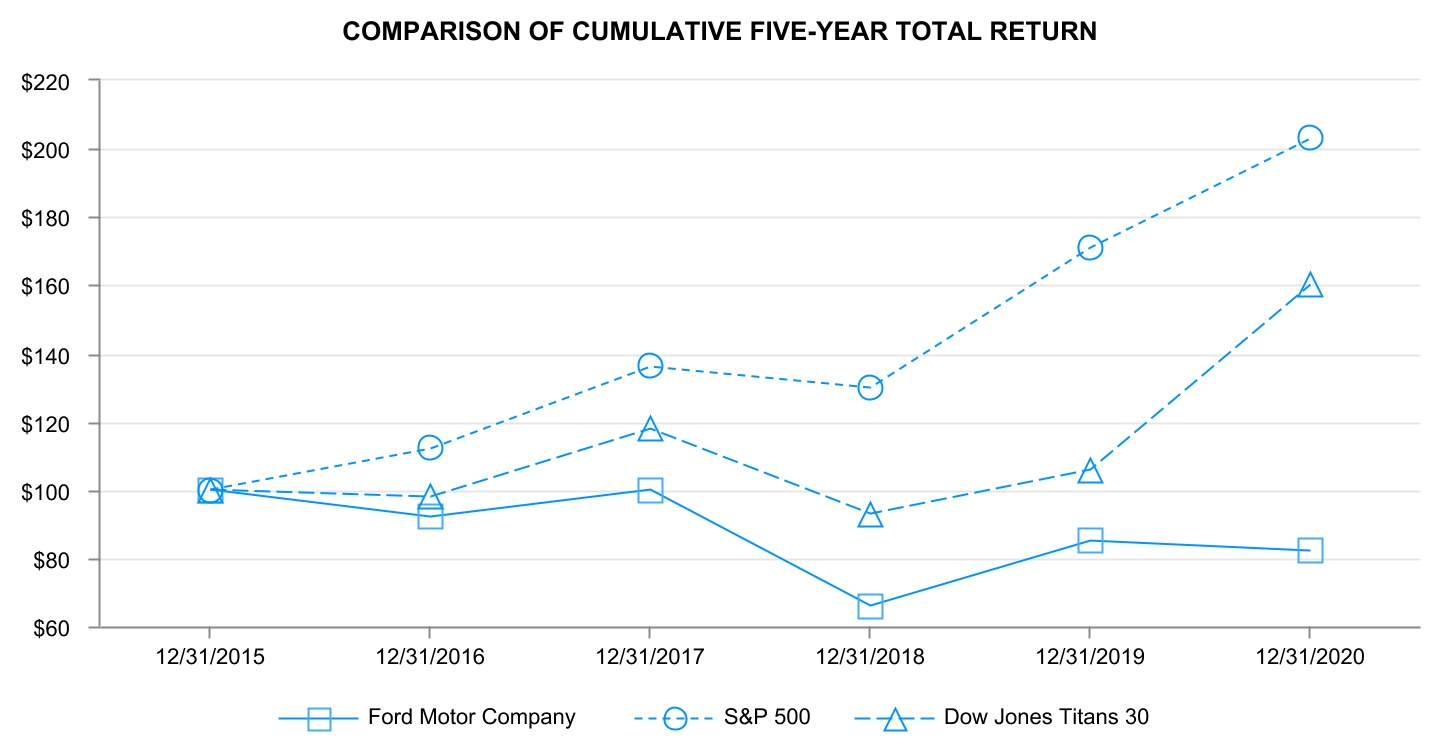
| Base Period | Years Ending | |||||||||||||||||||||||||||||||||||||
| Company/Index | 2015 | 2016 | 2017 | 2018 | 2019 | 2020 | ||||||||||||||||||||||||||||||||
| Ford Motor Company | 100 | 92 | 100 | 66 | 85 | 82 | ||||||||||||||||||||||||||||||||
| S&P 500 | 100 | 112 | 136 | 130 | 171 | 203 | ||||||||||||||||||||||||||||||||
| Dow Jones Automobiles & Parts Titans 30 | 100 | 98 | 118 | 93 | 106 | 160 |
Item 5. Market for Registrant’s Common Equity, Related Stockholder Matters and Issuer Purchases of Equity Securities (Continued)
Issuer Purchases of Securities
We completed no share repurchases during the fourth quarter of 2020.
Dividends
The table below shows the dividends we paid per share of Common and Class B Stock for each quarterly period in 2019 and 2020:
| 2019 | 2020 | ||||||||||||||||||||||||||||||||||||||||||||||
| First Quarter | Second Quarter | Third Quarter | Fourth Quarter | First Quarter | Second Quarter | Third Quarter | Fourth Quarter | ||||||||||||||||||||||||||||||||||||||||
| Dividends per share of Ford Common and Class B Stock | $ | 0.15 | $ | 0.15 | $ | 0.15 | $ | 0.15 | $ | 0.15 | $ | 0.00 | $ | 0.00 | $ | 0.00 |
To ensure we maintained sufficient cash reserves during the COVID-19 pandemic, suspension of the regular quarterly dividend was announced on March 19, 2020. The declaration and payment of future dividends is at the sole discretion of our Board of Directors after taking into account various factors, including our financial condition, operating results, available cash, and current and anticipated cash needs.
Item 6. Selected Financial Data.
The following table sets forth selected financial data for each of the last five years (dollar amounts in millions, except for per share amounts):
| SUMMARY OF INCOME/(LOSS) | 2016 | 2017 | 2018 | 2019 | 2020 | ||||||||||||||||||||||||
| Total revenues | $ | 151,800 | $ | 156,776 | $ | 160,338 | $ | 155,900 | $ | 127,144 | |||||||||||||||||||
| Income/(Loss) before income taxes | $ | 6,784 | $ | 8,159 | $ | 4,345 | $ | (640) | $ | (1,116) | |||||||||||||||||||
| Provision for/(Benefit from) income taxes | 2,184 | 402 | 650 | (724) | 160 | ||||||||||||||||||||||||
| Net income/(loss) | 4,600 | 7,757 | 3,695 | 84 | (1,276) | ||||||||||||||||||||||||
| Less: Income/(Loss) attributable to noncontrolling interests | 11 | 26 | 18 | 37 | 3 | ||||||||||||||||||||||||
| Net income/(loss) attributable to Ford Motor Company | $ | 4,589 | $ | 7,731 | $ | 3,677 | $ | 47 | $ | (1,279) | |||||||||||||||||||
| Earnings/(Loss) Per Share Attributable to Ford Motor Company Common and Class B Stock | |||||||||||||||||||||||||||||
| Average number of shares of Ford Common and Class B Stock outstanding (in millions) | 3,973 | 3,975 | 3,974 | 3,972 | 3,973 | ||||||||||||||||||||||||
| Basic income/(loss) | $ | 1.16 | $ | 1.94 | $ | 0.93 | $ | 0.01 | $ | (0.32) | |||||||||||||||||||
| Diluted income/(loss) | 1.15 | 1.93 | 0.92 | 0.01 | (0.32) | ||||||||||||||||||||||||
| Cash dividends declared | 0.85 | 0.65 | 0.73 | 0.60 | 0.15 | ||||||||||||||||||||||||
| BALANCE SHEET DATA AT YEAR END | |||||||||||||||||||||||||||||
| Total assets | $ | 238,510 | $ | 258,496 | $ | 256,540 | $ | 258,537 | $ | 267,261 | |||||||||||||||||||
| Automotive debt | $ | 15,907 | $ | 15,931 | $ | 13,547 | $ | 14,678 | $ | 23,536 | |||||||||||||||||||
| Ford Credit debt | 126,464 | 137,757 | 140,066 | 140,029 | 137,677 | ||||||||||||||||||||||||
| Other debt | 599 | 599 | 600 | 600 | 471 | ||||||||||||||||||||||||
| Total equity | $ | 29,746 | $ | 35,606 | $ | 35,966 | $ | 33,230 | $ | 30,811 |
ITEM 7. Management’s Discussion and Analysis of Financial Condition and Results of Operations.
Key Trends and Economic Factors Affecting Ford and the Automotive Industry
COVID-19. The impact of COVID-19, including changes in consumer behavior, pandemic fears and market downturns, and restrictions on business and individual activities, has created significant volatility in the global economy and led to reduced economic activity. There have been extraordinary actions taken by international, federal, state, and local public health and governmental authorities to contain and combat the outbreak and spread of COVID-19 in regions throughout the world, including travel bans, quarantines, “stay-at-home” orders, and similar mandates for many individuals to substantially restrict daily activities and for many businesses to curtail or cease normal operations. Although restrictions have been eased in many locations, some areas that had previously eased restrictions have reverted to more stringent limitations on daily activities. Further, if new strains of COVID-19 develop or sufficient amounts of vaccines are not available, not widely administered for a significant period of time, or otherwise prove ineffective, the impact of COVID-19 on the global economy, and, in turn, on Ford, could be material.
Consistent with the actions taken by governmental authorities, in late March 2020, we idled our manufacturing operations in regions around the world other than China, where manufacturing operations were suspended in January and February before beginning to resume operations in March. A successful phased restart of our manufacturing plants, supply network, and other dependent functions occurred in the second quarter of 2020.
The remote work arrangements that we implemented in 2020 remain in place in most locations. Our remote work arrangements have been designed to allow for continued operation of non-production business-critical functions, including financial reporting systems and internal control. Our controls and procedures have incorporated remote work arrangements using appropriate digital tools.
When we returned to work, we established new protocols to help protect the health and safety of our workforce. Those measures remain in place today, including a daily, online health self-certification, a no-touch temperature scan upon entering our facilities, a policy requiring the use of face masks in our facilities, and measures to provide additional personal protective equipment, including face shields, when employees’ jobs do not allow them to socially distance. We have also enhanced our cleaning protocols and adjusted our operating patterns and breaks to reduce potential employee interaction where possible.
We continue to produce medical masks for our employees and dealers. To date, we have produced more than 50 million medical-grade face masks, and we are more than halfway to reaching our goal of donating 100 million masks to communities in need across the United States.
The full impact of COVID-19 on future results depends on future developments, such as the ultimate duration and scope of the outbreak (including any potential future waves and the success of vaccination programs) and its impact on our customers, dealers, and suppliers. Despite the successful restart of our manufacturing operations in 2020, we continue to experience higher than normal levels of absenteeism at our manufacturing facilities and intermittent COVID-19-related disruptions in our supply chain. Moreover, new restrictions could have an adverse effect on production, supply chains, distribution, and demand for vehicles. For additional information on the impact and potential impact of COVID-19 on us, please see Item 1A. Risk Factors on page 15.
Item 7. Management’s Discussion and Analysis of Financial Condition and Results of Operations (Continued)
Supplier Disruptions. The automotive industry has a complex supply network with each manufacturers’ products containing components sourced from suppliers who, in turn, source components from their suppliers. When there is a shortage of a key component in our supply chain, and the component cannot be easily
Showing the first 8K of 166K characters. Open the full section
Item 7. Management’s Discussion and Analysis of Financial Condition and Results of Operations (Continued)
2020 SUPPLEMENTAL INFORMATION
The tables below provide supplemental consolidating financial information and other financial information. Company excluding Ford Credit includes our Automotive and Mobility reportable segments, Corporate Other, Interest on Debt, and Special Items. Eliminations, where presented, primarily represent eliminations of intersegment transactions and deferred tax netting.
Selected Cash Flow Information. The following tables provide supplemental cash flow information (in millions):
| For the Year Ended December 31, 2020 | ||||||||||||||||||||||||||
| Cash flows from operating activities | Company excluding Ford Credit | Ford Credit | Eliminations | Consolidated | ||||||||||||||||||||||
| Net income/(loss) | $ | (3,200) | $ | 1,924 | $ | — | $ | (1,276) | ||||||||||||||||||
| Depreciation and tooling amortization | 5,482 | 3,269 | — | 8,751 | ||||||||||||||||||||||
| Other amortization | 95 | (1,389) | — | (1,294) | ||||||||||||||||||||||
| Held-for-sale impairment charges | 23 | — | — | 23 | ||||||||||||||||||||||
| Brazil manufacturing exit non-cash charges (excluding accelerated depreciation of $145) | 1,159 | — | — | 1,159 | ||||||||||||||||||||||
| Provision for credit and insurance losses | 19 | 910 | — | 929 | ||||||||||||||||||||||
| Pension and OPEB expense/(income) | 1,027 | — | — | 1,027 | ||||||||||||||||||||||
| Equity investment dividends received in excess of (earnings)/losses | 136 | (6) | — | 130 | ||||||||||||||||||||||
| Foreign currency adjustments | (354) | (66) | — | (420) | ||||||||||||||||||||||
| Net (gain)/loss on changes in investments in affiliates | (3,474) | 28 | — | (3,446) | ||||||||||||||||||||||
| Stock compensation | 193 | 6 | — | 199 | ||||||||||||||||||||||
| Provision for deferred income taxes | (648) | 379 | — | (269) | ||||||||||||||||||||||
| Decrease/(Increase) in finance receivables (wholesale and other) | — | 12,104 | — | 12,104 | ||||||||||||||||||||||
| Decrease/(Increase) in intersegment receivables/payables | 578 | (578) | — | — | ||||||||||||||||||||||
| Decrease/(Increase) in accounts receivable and other assets | (65) | 2 | — | (63) | ||||||||||||||||||||||
| Decrease/(Increase) in inventory | 148 | — | — | 148 | ||||||||||||||||||||||
| Increase/(Decrease) in accounts payable and accrued and other liabilities | 6,790 | 19 | — | 6,809 | ||||||||||||||||||||||
| Other | (165) | (77) | — | (242) | ||||||||||||||||||||||
| Interest supplements and residual value support to Ford Credit | (4,192) | 4,192 | — | — | ||||||||||||||||||||||
| Net cash provided by/(used in) operating activities | $ | 3,552 | $ | 20,717 | $ | — | $ | 24,269 |
| Cash flows from investing activities | ||||||||||||||||||||||||||
| Capital spending | $ | (5,702) | $ | (40) | $ | — | $ | (5,742) | ||||||||||||||||||
| Acquisitions of finance receivables and operating leases | — | (55,901) | — | (55,901) | ||||||||||||||||||||||
| Collections of finance receivables and operating leases | — | 48,746 | — | 48,746 | ||||||||||||||||||||||
| Proceeds from sale of business | — | 1,340 | — | 1,340 | ||||||||||||||||||||||
| Purchases of marketable securities and other investments | (28,648) | (10,976) | — | (39,624) | ||||||||||||||||||||||
| Sales and maturities of marketable securities and other investments | 22,959 | 9,436 | — | 32,395 | ||||||||||||||||||||||
| Settlements of derivatives | (171) | (152) | — | (323) | ||||||||||||||||||||||
| Other | 494 | — | — | 494 | ||||||||||||||||||||||
| Investing activity (to)/from other segments | 2,415 | 110 | (2,525) | — | ||||||||||||||||||||||
| Net cash provided by/(used in) investing activities | $ | (8,653) | $ | (7,437) | $ | (2,525) | $ | (18,615) |
| Cash flows from financing activities | ||||||||||||||||||||||||||
| Cash payments for dividends and dividend equivalents | $ | (596) | $ | — | $ | — | $ | (596) | ||||||||||||||||||
| Purchases of common stock | — | — | — | — | ||||||||||||||||||||||
| Net changes in short-term debt | 204 | (2,495) | — | (2,291) | ||||||||||||||||||||||
| Proceeds from issuance of long-term debt | 24,157 | 41,743 | — | 65,900 | ||||||||||||||||||||||
| Principal payments on long-term debt | (15,956) | (44,558) | — | (60,514) | ||||||||||||||||||||||
| Other | (78) | (106) | — | (184) | ||||||||||||||||||||||
| Financing activity to/(from) other segments | (110) | (2,415) | 2,525 | — | ||||||||||||||||||||||
| Net cash provided by/(used in) financing activities | $ | 7,621 | $ | (7,831) | $ | 2,525 | $ | 2,315 | ||||||||||||||||||
| Effect of exchange rate changes on cash, cash equivalents, and restricted cash | $ | (54) | $ | 279 | $ | — | $ | 225 |
Item 7. Management’s Discussion and Analysis of Financial Condition and Results of Operations (Continued)
Selected Income Statement Information. The following table provides supplemental income statement information (in millions):
| For the Year Ended December 31, 2020 |
Showing the first 8K of 65K characters. Open the full section
Item 7A. Quantitative and Qualitative Disclosures About Market Risk (Continued)
FORD CREDIT MARKET RISK
Market risk for Ford Credit is the possibility that changes in interest and currency exchange rates will adversely affect cash flow and economic value.
Interest Rate Risk. Generally, Ford Credit’s assets and the related debt have different re-pricing periods, and consequently, respond differently to changes in interest rates.
Ford Credit’s assets consist primarily of fixed-rate retail financing and operating lease contracts and floating-rate wholesale receivables. Fixed-rate retail financing and operating lease contracts generally require customers to make equal monthly payments over the life of the contract. Wholesale receivables are originated to finance new and used vehicles held in dealers’ inventory and generally require dealers to pay a floating rate.
Debt consists primarily of short- and long-term unsecured and securitized debt. Ford Credit’s term debt instruments are principally fixed-rate and require fixed and equal interest payments over the life of the instrument and a single principal payment at maturity.
Ford Credit’s interest rate risk management objective is to reduce volatility in its cash flows and volatility in its economic value from changes in interest rates based on an established risk tolerance that may vary by market. Ford Credit uses economic value sensitivity analysis and re-pricing gap analysis to evaluate potential long-term effects of changes in interest rates. It then enters into interest rate swaps to convert portions of its floating-rate debt to fixed or its fixed-rate debt to floating to ensure that Ford Credit’s exposure falls within the established tolerances. Ford Credit also uses pre-tax cash flow sensitivity analysis to monitor the level of near-term cash flow exposure. The pre-tax cash flow sensitivity analysis measures the changes in expected cash flows associated with Ford Credit’s interest-rate-sensitive assets, liabilities, and derivative financial instruments from hypothetical changes in interest rates over a twelve-month horizon. Ford Credit’s Asset-Liability Committee reviews the re-pricing mismatch and exposure every month and approves interest rate swaps required to maintain exposure within approved thresholds prior to execution.
To provide a quantitative measure of the sensitivity of its pre-tax cash flow to changes in interest rates, Ford Credit uses interest rate scenarios that assume a hypothetical, instantaneous increase or decrease of one percentage point in all interest rates across all maturities (a “parallel shift”), as well as a base case that assumes that all interest rates remain constant at existing levels. In reality, interest rate changes are rarely instantaneous or parallel and rates could move more or less than the one percentage point assumed in Ford Credit’s analysis. As a result, the actual impact to pre-tax cash flow could be higher or lower than the results detailed in the table below. These interest rate scenarios are purely hypothetical and do not represent Ford Credit’s view of future interest rate movements.
Under these interest rate scenarios, Ford Credit expects more debt and liabilities than assets to re-price in the next twelve months. Other things being equal, this means that during a period of rising interest rates, the interest received on Ford Credit’s assets will increase less than the interest paid on Ford Credit’s debt, thereby initially decreasing Ford Credit’s pre-tax cash flow. During a period of falling interest rates, Ford Credit would expect its pre-tax cash flow to initially increase. Ford Credit’s pre-tax cash flow sensitivity to interest rate movement is highlighted in the table below.
Pre-tax cash flow sensitivity at December 31 was as follows (in millions):
| Pre-Tax Cash Flow Sensitivity | 2019 | 2020 | ||||||||||||
| One percentage point instantaneous increase in interest rates | $ | (26) | $ | (3) | ||||||||||
| One percentage point instantaneous decrease in interest rates (a) | 26 | 3 |
(a)Pre-tax cash flow sensitivity given a one percentage point decrease in interest rates requires an assumption of negative interest rates in markets where existing interest rates are below one percent.
While the sensitivity analysis presented is Ford Credit’s best estimate of the impacts of the specified assumed interest rate scenarios, its actual results could differ from those projected. The model Ford Credit uses to conduct this analysis is heavily dependent on assumptions. Embedded in the model are assumptions regarding the reinvestment of maturing asset principal, refinancing of maturing debt, replacement of maturing derivatives, exercise of options embedded in debt and derivatives, and predicted repayment of retail financing and operating lease contracts ahead of contractual maturity. Ford Credit’s repayment projections ahead of contractual maturity are based on historical experience. If interest rates or other factors change, Ford Credit’s actual prepayment experience could be different than projected.
Item 7A. Quantitative and Qualitative Disclosures About Market Risk (Continued)
Foreign Currency Risk. Ford Credit’s policy is to minimize exposure to changes in currency exchange rates. To meet funding objectives, Ford Credit borrows in a variety of currencies, principally U.S. dollars, Canadian dollars, euros, sterling, and renminbi. Ford Credit faces exposure to currency exchange rates if a mismatch exists between the currency of receivables and the currency of the debt funding those receivables. When possible, receivables are funded with debt in the same currency, minimizing exposure to exchange rate movements. When a different currency is used, Ford Credit may use foreign currency swaps and foreign currency forwards to convert substantially all of its foreign currency debt obligations to the local country currency of the receivables. As a result of this policy, Ford Credit believes its market risk exposure, relating to changes in currency exchange rates at December 31, 2020, is insignificant.
Derivative Fair Values. The net fair value of Ford Credit’s derivative financial instruments was an asset of $2.1 billion and $772 million at December 31, 2020 and 2019, respectively.
COUNTERPARTY RISK
Counterparty risk relates to the loss we could incur if an obligor or counterparty defaulted on an investment or a derivative contract. We enter into master agreements with counterparties that allow netting of certain exposures in order to manage this risk. Exposures primarily relate to investments in fixed income instruments and derivative contracts used for managing interest rate, foreign currency exchange rate, and commodity price risk. We, together with Ford Credit, establish exposure limits for each counterparty to minimize risk and provide counterparty diversification.
Our approach to managing counterparty risk is forward-looking and proactive, allowing us to take risk mitigation actions before risks become losses. Exposure limits are established based on our overall risk tolerance, which is calculated from counterparty credit ratings and market-based credit default swap (“CDS”) spreads. The exposure limits are lower for smaller and lower-rated counterparties, counterparties that have relatively higher CDS spreads, and for longer dated exposures. Our exposures are monitored on a regular basis and included in periodic reports to our Treasurer.
Substantially all of our counterparty exposures are with counterparties that have an investment grade rating. Investment grade is our guideline for minimum counterparty long-term ratings.
Item 8. Financial Statements and Supplementary Data.
The Report of Independent Registered Public Accounting Firm, our Financial Statements, the accompanying Notes to the Financial Statements, and the Financial Statement Schedule that are filed as part of this Report are listed under “Item 15. Exhibits and Financial Statement Schedules” and are set forth beginning on page 98 immediately following the signature pages of this Report.
Selected quarterly financial data for 2019 and 2020 are provided in Note 27 of the Notes to the Financial Statements.
Item 9. Changes in and Disagreements with Accountants on Accounting and Financial Disclosure.
None.
Item 9A. Controls and Procedures.
Evaluation of Disclosure Controls and Procedures. James D. Farley, Jr., our Chief Executive Officer (“CEO”), and John T. Lawler, our Chief Financial Officer (“CFO”), have performed an evaluation of the Company’s disclosure controls and procedures, as that term is defined in Rule 13a-15(e) of the Securities Exchange Act of 1934, as amended (“Exchange Act”), as of December 31, 2020, and each has concluded that such disclosure controls and procedures are effective to ensure that information required to be disclosed in our periodic reports filed under the Exchange Act is recorded, processed, summarized, and reported within the time periods specified by SEC rules and forms, and that such information is accumulated and communicated to the CEO and CFO to allow timely decisions regarding required disclosures.
Management’s Report on Internal Control Over Financial Reporting. Our management is responsible for establishing and maintaining adequate internal control over financial reporting, as such term is defined in Exchange Act Rule 13a-15(f). The Company’s internal control over financial reporting is a process designed to provide reasonable assurance regarding the reliability of financial reporting and the preparation of financial statements for external purposes in accordance with generally accepted accounting principles.
Because of its inherent limitations, internal control over financial reporting may not prevent or detect misstatements. Also, projections of any evaluation of effectiveness to future periods are subject to the risk that controls may become inadequate because of changes in conditions or because the degree of compliance with policies or procedures may deteriorate.
Under the supervision and with the participation of our management, including our CEO and CFO, we conducted an assessment of the effectiveness of our internal control over financial reporting as of December 31, 2020. The assessment was based on criteria established in the framework Internal Control - Integrated Framework (2013), issued by the Committee of Sponsoring Organizations of the Treadway Commission. Based on this assessment, management concluded that our internal control over financial reporting was effective as of December 31, 2020.
The effectiveness of the Company’s internal control over financial reporting as of December 31, 2020 has been audited by PricewaterhouseCoopers LLP, an independent registered public accounting firm, as stated in its report included herein.
Changes in Internal Control Over Financial Reporting. There were no changes in internal control over financial reporting during the quarter ended December 31, 2020 that have materially affected, or are reasonably likely to materially affect, our internal control over financial reporting.
Item 9B. Other Information.
None.
PART III.
Item 10. Directors, Executive Officers of Ford, and Corporate Governance.
The information required by Item 10 regarding our directors is incorporated by reference from the information under the captions “Proposal 1. Election of Directors,” “Corporate Governance – Beneficial Stock Ownership,” and “Corporate Governance – Delinquent Section 16(a) Reports” in our Proxy Statement. The information required by Item 10 regarding our executive officers appears as Item 4A under Part I of this Report. The information required by Item 10 regarding an audit committee financial expert is incorporated by reference from the information under the caption “Corporate Governance – Audit Committee Financial Expert and Auditor Rotation” in our Proxy Statement. The information required by Item 10 regarding the members of our Audit Committee of the Board of Directors is incorporated by reference from the information under the captions “Proxy Summary,” “Corporate Governance – Board Committee Functions,” “Corporate Governance – Audit Committee Financial Expert and Auditor Rotation,” and “Proposal 1 – Election of Directors” in our Proxy Statement. The information required by Item 10 regarding the Audit Committee’s review and discussion of the audited financial statements is incorporated by reference from information under the caption “Audit Committee Report” in our Proxy Statement. The information required by Item 10 regarding our codes of ethics is incorporated by reference from the information under the caption “Corporate Governance – Codes of Ethics” in our Proxy Statement. In addition, we have included in Item 1 instructions for how to access our codes of ethics on our website and our Internet address. Amendments to, and waivers granted under, our Code of Ethics for Senior Financial Personnel, if any, will be posted to our website as well.
Item 11. Executive Compensation.
The information required by Item 11 is incorporated by reference from the information under the following captions in our Proxy Statement: “Director Compensation in 2020,” “Compensation Discussion and Analysis,” “Compensation Committee Report,” “Compensation Committee Interlocks and Insider Participation,” “Compensation of Named Executives,” “Summary Compensation Table,” “Grants of Plan-Based Awards in 2020,” “Outstanding Equity Awards at 2020 Fiscal Year-End,” “Option Exercises and Stock Vested in 2020,” “Pension Benefits in 2020,” “Nonqualified Deferred Compensation in 2020,” “Potential Payments Upon Termination or Change-in-Control,” and “Pay Ratio.”
Item 12. Security Ownership of Certain Beneficial Owners and Management and Related Stockholder Matters.
The information required by Item 12 is incorporated by reference from the information under the captions “Equity Compensation Plan Information” and “Corporate Governance – Beneficial Stock Ownership” in our Proxy Statement.
Item 13. Certain Relationships and Related Transactions, and Director Independence.
The information required by Item 13 is incorporated by reference from the information under the captions “Corporate Governance – Certain Relationships and Related Party Transactions” and “Corporate Governance – Independence of Directors and Relevant Facts and Circumstances” in our Proxy Statement.
Item 14. Principal Accounting Fees and Services.
The information required by Item 14 is incorporated by reference from the information under the caption “Proposal 2. Ratification of Independent Registered Public Accounting Firm” in our Proxy Statement.
PART IV.
Item 15. Exhibits and Financial Statement Schedules.
(a) 1. Financial Statements – Ford Motor Company and Subsidiaries
The following are contained in this 2020 Form 10-K Report:
-
Report of Independent Registered Public Accounting Firm.
-
Consolidated Statements of Cash Flows for the years ended December 31, 2018, 2019, and 2020.
-
Consolidated Income Statements for the years ended December 31, 2018, 2019, and 2020.
-
Consolidated Statements of Comprehensive Income for the years ended December 31, 2018, 2019, and 2020.
-
Consolidated Balance Sheets at December 31, 2019 and 2020.
-
Consolidated Statements of Equity for the years ended December 31, 2018, 2019, and 2020.
-
Notes to the Financial Statements.
The Report of Independent Registered Public Accounting Firm, the Consolidated Financial Statements, and the Notes to the Financial Statements listed above are filed as part of this Report and are set forth beginning on page 98 immediately following the signature pages of this Report.
(a) 2. Financial Statement Schedules
| Designation | Description | |||||||
| Schedule II | Valuation and Qualifying Accounts for the years ended 2018, 2019, and 2020 |
Schedule II is filed as part of this Report and is set forth on page 170 immediately following the Notes to the Financial Statements referred to above. The other schedules are omitted because they are not applicable, the information required to be contained in them is disclosed elsewhere on our Consolidated Financial Statements, or the amounts involved are not sufficient to require submission.
(a) 3. Exhibits
| Designation | Description | Method of Filing | ||||||||||||
| Exhibit 3-A | Restated Certificate of Incorporation, dated August 2, 2000. | Filed as Exhibit 3-A to our Annual Report on Form 10-K for the year ended December 31, 2000. (a) | ||||||||||||
| Exhibit 3-A-1 | Certificate of Designations of Series A Junior Participating Preferred Stock filed on September 11, 2009. | Filed as Exhibit 3.1 to our Current Report on Form 8-K filed September 11, 2009. (a) | ||||||||||||
| Exhibit 3-B | By-laws. | Filed as Exhibit 3.2 to our Form 8-A/A filed on September 11, 2015. (a) | ||||||||||||
| Exhibit 4-A | Tax Benefit Preservation Plan (“TBPP”) dated September 11, 2009 between Ford Motor Company and Computershare Trust Company, N.A. | Filed as Exhibit 4.1 to our Current Report on Form 8-K filed September 11, 2009. (a) | ||||||||||||
| Exhibit 4-A-1 | Amendment No. 1 to TBPP dated September 11, 2012. | Filed as Exhibit 4 to our Current Report on Form 8-K filed September 12, 2012. (a) | ||||||||||||
| Exhibit 4-A-2 | Amendment No. 2 to TBPP dated September 9, 2015. | Filed as Exhibit 4 to our Current Report on Form 8-K filed September 11, 2015. (a) | ||||||||||||
| Exhibit 4-A-3 | Amendment No. 3 to TBPP dated September 13, 2018. | Filed as Exhibit 4 to our Current Report on Form 8-K filed September 14, 2018. (a) | ||||||||||||
| Exhibit 4-B | Description of Securities. | Filed with this Report. | ||||||||||||
| Exhibit 10-A | Executive Separation Allowance Plan, as amended and restated effective as of January 1, 2018. (b) | Filed as Exhibit 10.1 to our Current Report on Form 8-K filed February 7, 2018. (a) | ||||||||||||
| Exhibit 10-B | Deferred Compensation Plan for Non-Employee Directors, as amended and restated as of January 1, 2012. (b) | Filed as Exhibit 10-B to our Annual Report on Form 10-K for the year ended December 31, 2011. (a) | ||||||||||||
| Exhibit 10-C | 2014 Stock Plan for Non-Employee Directors (b) | Filed as Exhibit 10-C to our Annual Report on Form 10-K for the year ended December 31, 2013. (a) |
| Designation | Description | Method of Filing | ||||||||||||
| Exhibit 10-D | Benefit Equalization Plan, as amended and restated effective as of January 1, 2018. (b) | Filed as Exhibit 10.2 to our Current Report on Form 8-K filed February 7, 2018. (a) | ||||||||||||
| Exhibit 10-E | Description of financial counseling services provided to certain executives. (b) | Filed as Exhibit 10-E to our Annual Report on Form 10-K for the year ended December 31, 2019. (a) | ||||||||||||
| Exhibit 10-F | Defined Benefit Supplemental Executive Retirement Plan, as amended and restated effective as of January 1, 2018. (b) | Filed as Exhibit 10.3 to our Current Report on Form 8-K filed February 7, 2018. (a) | ||||||||||||
| Exhibit 10-F-1 | Defined Contribution Supplemental Executive Retirement Plan, as amended and restated effective as of July 9, 2020. (b) | Filed as Exhibit 10 to our Quarterly Report on Form 10-Q for the quarter ended June 30, 2020. (a) | ||||||||||||
| Exhibit 10-G | Description of Director Compensation as of July 13, 2006. (b) | Filed as Exhibit 10-G-3 to our Quarterly Report on Form 10-Q for the quarter ended September 30, 2006. (a) | ||||||||||||
| Exhibit 10-G-1 | Amendment to Description of Director Compensation as of February 8, 2012. (b) | Filed as Exhibit 10-F-3 to our Annual Report on Form 10-K for the year ended December 31, 2011. (a) | ||||||||||||
| Exhibit 10-G-2 | Amendment to Description of Director Compensation as of July 1, 2013. (b) | Filed as Exhibit 10-G-2 to our Annual Report on Form 10-K for the year ended December 31, 2013. (a) | ||||||||||||
| Exhibit 10-G-3 | Amendment to Description of Director Compensation as of January 1, 2017. (b) | Filed as Exhibit 10-G-3 to our Annual Report on Form 10-K for the year ended December 31, 2016. (a) | ||||||||||||
| Exhibit 10-H | 2008 Long-Term Incentive Plan. (b) | Filed as Exhibit 10.1 to our Quarterly Report on Form 10-Q for the quarter ended June 30, 2008. (a) | ||||||||||||
| Exhibit 10-I | Description of Matching Gift Program and Vehicle Evaluation Program for Non-Employee Directors. (b) | Filed as Exhibit 10-I to our Annual Report on Form 10-K/A for the year ended December 31, 2005. (a) | ||||||||||||
| Exhibit 10-J | Non-Employee Directors Life Insurance and Optional Retirement Plan as amended and restated as of December 31, 2010. (b) | Filed as Exhibit 10-I to our Annual Report on Form 10-K for the year ended December 31, 2010. (a) | ||||||||||||
| Exhibit 10-K | Description of Non-Employee Directors Accidental Death, Dismemberment and Permanent Total Disablement Indemnity. (b) | Filed as Exhibit 10-S to our Annual Report on Form 10-K for the year ended December 31, 1992. (a) | ||||||||||||
| Exhibit 10-K-1 | Description of Amendment to Basic Life Insurance and Accidental Death & Dismemberment Insurance. (b) | Filed as Exhibit 10-K-1 to our Annual Report on Form 10-K for the year ended December 31, 2013. (a) | ||||||||||||
| Exhibit 10-L | Executive Waiver and Release Agreement between Ford Motor Company and Joseph R. Hinrichs dated February 21, 2020. (b) | Filed as Exhibit 10.3 to our Quarterly Report on Form 10-Q for the quarter ended March 31, 2020. (a) | ||||||||||||
| Exhibit 10-M | Offer Letter to Tim Stone dated March 11, 2019. (b) | Filed as Exhibit 99 to our Current Report on Form 8-K filed June 4, 2019. (a) | ||||||||||||
| Exhibit 10-M-1 | Executive Separation Waiver and Release Agreement between Ford Motor Company and Tim Stone dated September 30, 2020. (b) | Filed as Exhibit 10.3 to our Quarterly Report on Form 10-Q for the quarter ended September 30, 2020. (a) | ||||||||||||
| Exhibit 10-N | Agreement between Ford Motor Company and James D. Farley, Jr. dated August 3, 2020. (b) | Filed as Exhibit 10.1 to our Quarterly Report on Form 10-Q for the quarter ended September 30, 2020. (a) | ||||||||||||
| Exhibit 10-O | Select Retirement Plan, as amended and restated effective as of January 1, 2018. (b) | Filed as Exhibit 10.4 to our Current Report on Form 8-K filed February 7, 2018. (a) | ||||||||||||
| Exhibit 10-P | Deferred Compensation Plan, as amended and restated as of December 31, 2010. (b) | Filed as Exhibit 10-M to our Annual Report on Form 10-K for the year ended December 31, 2010. (a) | ||||||||||||
| Exhibit 10-P-1 | Suspension of Open Enrollment in Deferred Compensation Plan. (b) | Filed as Exhibit 10-M-1 to our Annual Report on Form 10-K for the year ended December 31, 2009. (a) | ||||||||||||
| Exhibit 10-Q | Annual Incentive Compensation Plan, as amended and restated effective as of September 9, 2020. (b) | Filed as Exhibit 10.2 to our Quarterly Report on Form 10-Q for the quarter ended September 30, 2020. (a) | ||||||||||||
| Exhibit 10-Q-1 | Annual Incentive Compensation Plan Metrics for 2019. (b) | Filed as Exhibit 10.1 to our Quarterly Report on Form 10-Q for the quarter ended March 31, 2019. (a) | ||||||||||||
| Exhibit 10-Q-2 | Annual Incentive Compensation Plan Metrics for 2020. (b) | Filed as Exhibit 10.1 to our Quarterly Report on Form 10-Q for the quarter ended March 31, 2020. (a) | ||||||||||||
| Exhibit 10-Q-3 | Performance-Based Restricted Stock Unit Metrics for 2017. (b) | Filed as Exhibit 10-O-10 to our Annual Report on Form 10-K for the year ended December 31, 2016. (a) | ||||||||||||
| Exhibit 10-Q-4 | Performance-Based Restricted Stock Unit Metrics for 2018. (b) | Filed as Exhibit 10.2 to our Quarterly Report on Form 10-Q for the quarter ended March 31, 2018. (a) | ||||||||||||
| Exhibit 10-Q-5 | Performance-Based Restricted Stock Unit Metrics for 2019. (b) | Filed as Exhibit 10.2 to our Quarterly Report on Form 10-Q for the quarter ended March 31, 2019. (a) | ||||||||||||
| Exhibit 10-Q-6 | Performance-Based Restricted Stock Unit Metrics for 2020. (b) | Filed as Exhibit 10.2 to our Quarterly Report on Form 10-Q for the quarter ended March 31, 2020. (a) | ||||||||||||
| Exhibit 10-Q-7 | Executive Compensation Recoupment Policy. (b) | Filed as Exhibit 10-N-8 to our Annual Report on Form 10-K for the year ended December 31, 2010. (a) | ||||||||||||
| Exhibit 10-Q-8 | Incremental Bonus Description. (b) | Filed as Exhibit 10-N-9 to our Annual Report on Form 10-K for the year ended December 31, 2010. (a) | ||||||||||||
| Exhibit 10-R | 2018 Long-Term Incentive Plan. (b) | Filed as Exhibit 4.1 to Registration Statement No. 333-226348. (a) | ||||||||||||
| Exhibit 10-R-1 | Form of Stock Option Terms and Conditions for Long-Term Incentive Plan. (b) | Filed as Exhibit 10.4 to our Quarterly Report on Form 10-Q for the quarter ended September 30, 2020. (a) |
| Designation | Description | Method of Filing | ||||||||||||
| Exhibit 10-R-2 | Form of Stock Option Agreement for Long-Term Incentive Plan. (b) | Filed as Exhibit 10-P-3 to our Annual Report on Form 10-K for the year ended December 31, 2017. (a) | ||||||||||||
| Exhibit 10-R-3 | Form of Stock Option Agreement (ISO) for Long-Term Incentive Plan. (b) | Filed as Exhibit 10-P-4 to our Annual Report on Form 10-K for the year ended December 31, 2017. (a) | ||||||||||||
| Exhibit 10-R-4 | Form of Stock Option Agreement (U.K. NQO) for Long-Term Incentive Plan. (b) | Filed as Exhibit 10-P-5 to our Annual Report on Form 10-K for the year ended December 31, 2017. (a) | ||||||||||||
| Exhibit 10-R-5 | Form of Stock Option (U.K.) Terms and Conditions for Long-Term Incentive Plan. (b) | Filed with this Report. | ||||||||||||
| Exhibit 10-R-6 | Form of Restricted Stock Grant Letter. (b) | Filed as Exhibit 10-P-7 to our Annual Report on Form 10-K for the year ended December 31, 2017. (a) | ||||||||||||
| Exhibit 10-R-7 | Form of Final Award Notification Letter for Performance-Based Restricted Stock Units. (b) | Filed as Exhibit 10-P-8 to our Annual Report on Form 10-K for the year ended December 31, 2017. (a) | ||||||||||||
| Exhibit 10-R-8 | Form of Annual Equity Grant Letter V.1. (b) | Filed as Exhibit 10-P-9 to our Annual Report on Form 10-K for the year ended December 31, 2017. (a) | ||||||||||||
| Exhibit 10-R-9 | Form of Annual Equity Grant Letter V.2. (b) | Filed as Exhibit 10-P-10 to our Annual Report on Form 10-K for the year ended December 31, 2017. (a) | ||||||||||||
| Exhibit 10-R-10 | Long-Term Incentive Plan Restricted Stock Unit Agreement. (b) | Filed as Exhibit 10-P-11 to our Annual Report on Form 10-K for the year ended December 31, 2017. (a) | ||||||||||||
| Exhibit 10-R-11 | Long-Term Incentive Plan Restricted Stock Unit Terms and Conditions. (b) | Filed as Exhibit 10-P-12 to our Annual Report on Form 10-K for the year ended December 31, 2017. (a) | ||||||||||||
| Exhibit 10-R-12 | Form of Final Award Agreement for Performance-Based Restricted Stock Units under Long-Term Incentive Plan. (b) | Filed as Exhibit 10-P-13 to our Annual Report on Form 10-K for the year ended December 31, 2017. (a) | ||||||||||||
| Exhibit 10-R-13 | Form of Final Award Terms and Conditions for Performance-Based Restricted Stock Units under Long-Term Incentive Plan. (b) | Filed as Exhibit 10-P-14 to our Annual Report on Form 10-K for the year ended December 31, 2017. (a) | ||||||||||||
| Exhibit 10-R-14 | Form of Notification Letter for Time-Based Restricted Stock Units. (b) | Filed as Exhibit 10-P-15 to our Annual Report on Form 10-K for the year ended December 31, 2017. (a) | ||||||||||||
| Exhibit 10-S | Agreement dated January 13, 1999 between Ford Motor Company and Edsel B. Ford II. (b) | Filed as Exhibit 10-X to our Annual Report on Form 10-K for the year ended December 31, 1998. (a) | ||||||||||||
| Exhibit 10-S-1 | Amendment dated May 5, 2010 to the Consulting Agreement between Ford Motor Company and Edsel B. Ford II. (b) | Filed as Exhibit 10.3 to our Quarterly Report on Form 10-Q for the quarter ended March 31, 2010. (a) | ||||||||||||
| Exhibit 10-S-2 | Amendment dated January 1, 2012 to the Consulting Agreement between Ford Motor Company and Edsel B. Ford II. (b) | Filed as Exhibit 10-P-2 to our Annual Report on Form 10-K for the year ended December 31, 2011. (a) | ||||||||||||
| Exhibit 10-T | Second Amended and Restated Relationship Agreement dated March 19, 2020 between Ford Motor Company and Ford Motor Credit Company LLC. | Filed as Exhibit 10 to our Current Report on Form 8-K filed March 19, 2020. (a) | ||||||||||||
| Exhibit 10-U | Form of Trade Secrets/Non-Compete Statement between Ford and certain of its Executive Officers. (b) | Filed as Exhibit 10-V to our Annual Report on Form 10-K for the year ended December 31, 2003. (a) | ||||||||||||
| Exhibit 10-V | Arrangement between Ford Motor Company and William C. Ford, Jr., dated February 24, 2009. (b) | Filed as Exhibit 10-V to our Annual Report on Form 10-K for the year ended December 31, 2008. (a) | ||||||||||||
| Exhibit 10-W | Description of Company Practices regarding Club Memberships for Executives. (b) | Filed as Exhibit 10-BB to our Annual Report on Form 10-K for the year ended December 31, 2006. (a) | ||||||||||||
| Exhibit 10-X | Amended and Restated Credit Agreement dated as of November 24, 2009. | Filed as Exhibit 99.2 to our Current Report on Form 8-K filed November 25, 2009. (a) | ||||||||||||
| Exhibit 10-X-1 | Seventh Amendment dated as of March 15, 2012 to our Credit Agreement dated as of December 15, 2006, as amended and restated as of November 24, 2009, and as further amended. | Filed as Exhibit 99.2 to our Current Report on Form 8-K filed March 15, 2012. (a) | ||||||||||||
| Exhibit 10-X-2 | Ninth Amendment dated as of April 30, 2013 to our Credit Agreement dated as of December 15, 2006, as amended and restated as of November 24, 2009, and as further amended. | Filed as Exhibit 10 to our Quarterly Report on Form 10-Q for the quarter ended March 31, 2013. (a) | ||||||||||||
| Exhibit 10-X-3 | Tenth Amendment dated as of April 30, 2014 to our Credit Agreement dated as of December 15, 2006, as amended and restated as of November 24, 2009, and as further amended. | Filed as Exhibit 10.1 to our Quarterly Report on Form 10-Q for the quarter ended March 31, 2014. (a) | ||||||||||||
| Exhibit 10-X-4 | Eleventh Amendment dated as of April 30, 2015 to our Credit Agreement dated as of December 15, 2006, as amended and restated as of November 24, 2009, as amended and restated as of April 30, 2014, and as further amended, including the Third Amended and Restated Credit Agreement. | Filed as Exhibit 10.1 to our Current Report on Form 8-K filed May 1, 2015. (a) | ||||||||||||
| Exhibit 10-X-5 | Twelfth Amendment dated as of April 29, 2016 to our Credit Agreement dated as of December 15, 2006, as amended and restated as of November 24, 2009, as amended and restated as of April 30, 2014, and as further amended and restated as of April 30, 2015. | Filed as Exhibit 10 to our Current Report on Form 8-K filed April 29, 2016. (a) |
| Designation | Description | Method of Filing | ||||||||||||
| Exhibit 10-X-6 | Thirteenth Amendment dated as of April 28, 2017 to our Credit Agreement dated as of December 15, 2006, as amended and restated as of November 24, 2009, as amended and restated as of April 30, 2014, and as further amended and restated as of April 30, 2015. | Filed as Exhibit 10 to our Current Report on Form 8-K filed April 28, 2017. (a) | ||||||||||||
| Exhibit 10-X-7 | Fourteenth Amendment dated as of April 26, 2018 to our Credit Agreement dated as of December 15, 2006, as amended and restated as of November 24, 2009, as amended and restated as of April 30, 2014, and as further amended and restated as of April 30, 2015. | Filed as Exhibit 10 to our Current Report on Form 8-K filed April 26, 2018. (a) | ||||||||||||
| Exhibit 10-X-8 | Fifteenth Amendment dated as of April 23, 2019 to our Credit Agreement dated as of December 15, 2006, as amended and restated as of November 24, 2009, as amended and restated as of April 30, 2014, and as further amended and restated as of April 30, 2015. | Filed as Exhibit 10.1 to our Current Report on Form 8-K filed April 26, 2019. (a) | ||||||||||||
| Exhibit 10-X-9 | Sixteenth Amendment dated as of July 27, 2020 to our Credit Agreement dated as of December 15, 2006, as amended and restated as of November 24, 2009, as amended and restated as of April 30, 2014, and as further amended and restated as of April 30, 2015. | Filed as Exhibit 10.1 to our Current Report on Form 8-K filed July 30, 2020. (a) | ||||||||||||
| Exhibit 10-Y | Revolving Credit Agreement dated as of April 23, 2019. | Filed as Exhibit 10.2 to our Current Report on Form 8-K filed April 26, 2019. (a) | ||||||||||||
| Exhibit 10-Y-1 | First Amendment dated July 27, 2020 to the Revolving Credit Agreement dated April 23, 2019. | Filed as Exhibit 10.2 to our Current Report on Form 8-K filed July 30, 2020. (a) | ||||||||||||
| Exhibit 10-Z | Term Loan Credit Agreement dated as of April 23, 2019. | Filed as Exhibit 10.3 to our Current Report on Form 8-K filed April 26, 2019. (a) | ||||||||||||
| Exhibit 10-AA | Loan Arrangement and Reimbursement Agreement between Ford Motor Company and the U.S. Department of Energy dated as of September 16, 2009. | Filed as Exhibit 10.1 to our Current Report on Form 8-K filed September 22, 2009. (a) | ||||||||||||
| Exhibit 10-BB | Note Purchase Agreement dated as of September 16, 2009 among the Federal Financing Bank, Ford Motor Company, and the U.S. Secretary of Energy. | Filed as Exhibit 10.2 to our Current Report on Form 8-K filed September 22, 2009. (a) | ||||||||||||
| Exhibit 21 | List of Subsidiaries of Ford as of January 31, 2021. | Filed with this Report. | ||||||||||||
| Exhibit 23 | Consent of Independent Registered Public Accounting Firm. | Filed with this Report. | ||||||||||||
| Exhibit 24 | Powers of Attorney. | Filed with this Report. | ||||||||||||
| Exhibit 31.1 | Rule 15d-14(a) Certification of CEO. | Filed with this Report. | ||||||||||||
| Exhibit 31.2 | Rule 15d-14(a) Certification of CFO. | Filed with this Report. | ||||||||||||
| Exhibit 32.1 | Section 1350 Certification of CEO. | Furnished with this Report. | ||||||||||||
| Exhibit 32.2 | Section 1350 Certification of CFO. | Furnished with this Report. | ||||||||||||
| Exhibit 101.INS | Interactive Data Files pursuant to Rule 405 of Regulation S-T formatted in Inline Extensible Business Reporting Language (“Inline XBRL”). | (c) | ||||||||||||
| Exhibit 101.SCH | XBRL Taxonomy Extension Schema Document. | (c) | ||||||||||||
| Exhibit 101.CAL | XBRL Taxonomy Extension Calculation Linkbase Document. | (c) | ||||||||||||
| Exhibit 101.LAB | XBRL Taxonomy Extension Label Linkbase Document. | (c) | ||||||||||||
| Exhibit 101.PRE | XBRL Taxonomy Extension Presentation Linkbase Document. | (c) | ||||||||||||
| Exhibit 101.DEF | XBRL Taxonomy Extension Definition Linkbase Document. | (c) | ||||||||||||
| Exhibit 104 | Cover Page Interactive Data File (formatted in Inline XBRL contained in Exhibit 101). | (c) |
(a)Incorporated by reference as an exhibit to this Report (file number reference 1-3950, unless otherwise indicated).
(b)Management contract or compensatory plan or arrangement.
(c)Submitted electronically with this Report in accordance with the provisions of Regulation S-T.
Instruments defining the rights of holders of certain issues of long-term debt of Ford and of certain consolidated subsidiaries and of any unconsolidated subsidiary, for which financial statements are required to be filed with this Report, have not been filed as exhibits to this Report because the authorized principal amount of any one of such issues does not exceed 10% of the total assets of Ford and our subsidiaries on a consolidated basis. Ford agrees to furnish a copy of each of such instrument to the Securities and Exchange Commission upon request.
Item 16. Form 10-K Summary.
None.
SIGNATURES
Pursuant to the requirements of Section 13 or 15(d) of the Securities Exchange Act of 1934, as amended, Ford has duly caused this Report to be signed on its behalf by the undersigned, thereunto duly authorized.
FORD MOTOR COMPANY
| By: | /s/ Cathy O’Callaghan | ||||
| Cathy O’Callaghan, Controller | |||||
| (principal accounting officer) | |||||
| Date: | February 4, 2021 |
Pursuant to the requirements of the Securities Exchange Act of 1934, as amended, this Report has been signed below by the following persons on behalf of Ford and in the capacities on the date indicated:
| Signature | Title | Date | ||||||||||||
| /s/ WILLIAM CLAY FORD, JR. | Director, Chairman of the Board, Executive Chairman, Chair of the Office of the Chairman and Chief Executive, and Chair of the Finance Committee | February 4, 2021 | ||||||||||||
| William Clay Ford, Jr. | ||||||||||||||
| /s/ JAMES D. FARLEY, JR. | Director, President and Chief Executive Officer | February 4, 2021 | ||||||||||||
| James D. Farley, Jr. | (principal executive officer) | |||||||||||||
| KIMBERLY A. CASIANO* | Director | February 4, 2021 | ||||||||||||
| Kimberly A. Casiano | ||||||||||||||
| ANTHONY F. EARLEY, JR.* | Director and Chair of the Compensation Committee | February 4, 2021 | ||||||||||||
| Anthony F. Earley, Jr. | ||||||||||||||
| EDSEL B. FORD II* | Director | February 4, 2021 | ||||||||||||
| Edsel B. Ford II | ||||||||||||||
| WILLIAM W. HELMAN IV* | Director and Chair of the Sustainability and Innovation Committee | February 4, 2021 | ||||||||||||
| William W. Helman IV | ||||||||||||||
| JON M. HUNTSMAN, JR.* | Director | February 4, 2021 | ||||||||||||
| Jon M. Huntsman, Jr. | ||||||||||||||
| WILLIAM E. KENNARD* | Director and Chair of the Nominating and Governance Committee | February 4, 2021 | ||||||||||||
| William E. Kennard | ||||||||||||||
| JOHN C. LECHLEITER* | Director | February 4, 2021 | ||||||||||||
| John C. Lechleiter | ||||||||||||||
| BETH E. MOONEY* | Director | February 4, 2021 | ||||||||||||
| Beth E. Mooney | ||||||||||||||
| JOHN L. THORNTON* | Director | February 4, 2021 | ||||||||||||
| John L. Thornton | ||||||||||||||
| Signature | Title | Date | ||||||||||||
| JOHN B. VEIHMEYER* | Director and Chair of the Audit Committee | February 4, 2021 | ||||||||||||
| John B. Veihmeyer | ||||||||||||||
| LYNN M. VOJVODICH* | Director | February 4, 2021 | ||||||||||||
| Lynn M. Vojvodich | ||||||||||||||
| JOHN S. WEINBERG* | Director | February 4, 2021 | ||||||||||||
| John S. Weinberg | ||||||||||||||
| /s/ JOHN T. LAWLER | Chief Financial Officer | February 4, 2021 | ||||||||||||
| John T. Lawler | (principal financial officer) | |||||||||||||
| /s/ CATHY O’CALLAGHAN | Controller | February 4, 2021 | ||||||||||||
| Cathy O’Callaghan | (principal accounting officer) | |||||||||||||
| *By: /s/ JONATHAN E. OSGOOD | February 4, 2021 | |||||||||||||
| Jonathan E. Osgood | ||||||||||||||
| Attorney-in-Fact | ||||||||||||||
Report of Independent Registered Public Accounting Firm
To the Board of Directors and Stockholders of Ford Motor Company
Opinions on the Financial Statements and Internal Control over Financial Reporting
We have audited the accompanying consolidated balance sheets of Ford Motor Company and its subsidiaries (the “Company”) as of December 31, 2020 and 2019, and the related consolidated statements of income, of comprehensive income, of equity and of cash flows for each of the three years in the period ended December 31, 2020, including the related notes and financial statement schedule listed in the index appearing under Item 15(a)(2) (collectively referred to as the “consolidated financial statements”). We also have audited the Company’s internal control over financial reporting as of December 31, 2020, based on criteria established in Internal Control - Integrated Framework (2013) issued by the Committee of Sponsoring Organizations of the Treadway Commission (COSO).
In our opinion, the consolidated financial statements referred to above present fairly, in all material respects, the financial position of the Company as of December 31, 2020 and 2019, and the results of its operations and its cash flows for each of the three years in the period ended December 31, 2020 in conformity with accounting principles generally accepted in the United States of America. Also in our opinion, the Company maintained, in all material respects, effective internal control over financial reporting as of December 31, 2020, based on criteria established in Internal Control - Integrated Framework (2013) issued by the COSO.
Changes in Accounting Principles
As discussed in Note 3 to the consolidated financial statements, the Company changed the manner in which it accounts for credit losses in 2020.
Basis for Opinions
The Company’s management is responsible for these consolidated financial statements, for maintaining effective internal control over financial reporting, and for its assessment of the effectiveness of internal control over financial reporting, included in Management’s Report on Internal Control Over Financial Reporting appearing under Item 9A. Our responsibility is to express opinions on the Company’s consolidated financial statements and on the Company's internal control over financial reporting based on our audits. We are a public accounting firm registered with the Public Company Accounting Oversight Board (United States) (PCAOB) and are required to be independent with respect to the Company in accordance with the U.S. federal securities laws and the applicable rules and regulations of the Securities and Exchange Commission and the PCAOB.
We conducted our audits in accordance with the standards of the PCAOB. Those st
Showing the first 8K of 323K characters. Open the full section