 filings.tools
Ford Motor 2023 10-K Annual Report
F · CIK 37996 · Form 10-K · Fiscal year ended December 31, 2023 · Filed February 7, 2024
25 sections, 794K characters. Original on sec.gov · Markdown · JSON
Risk FactorsBusinessMD&AFinancial StatementsWhat changed vs 2022
Cover and table of contents
UNITED STATES
SECURITIES AND EXCHANGE COMMISSION
Washington, DC 20549
FORM 10-K
☑ Annual report pursuant to Section 13 or 15(d) of the Securities Exchange Act of 1934
For the fiscal year ended December 31, 2023
or
☐ Transition report pursuant to Section 13 or 15(d) of the Securities Exchange Act of 1934
For the transition period from __________ to __________
Commission file number 1-3950
Ford Motor Company
(Exact name of Registrant as specified in its charter)
| Delaware | 38-0549190 | ||||||||||
| (State of incorporation) | (I.R.S. Employer Identification No.) | ||||||||||
| One American Road | |||||||||||
| Dearborn, | Michigan | 48126 | |||||||||
| (Address of principal executive offices) | (Zip Code) |
313-322-3000
(Registrant’s telephone number, including area code)
Securities registered pursuant to Section 12(b) of the Act:
| Title of each class | Trading symbols | Name of each exchange on which registered | ||||||||||||
| Common Stock, par value $.01 per share | F | New York Stock Exchange | ||||||||||||
| 6.200% Notes due June 1, 2059 | FPRB | New York Stock Exchange | ||||||||||||
| 6.000% Notes due December 1, 2059 | FPRC | New York Stock Exchange | ||||||||||||
| 6.500% Notes due August 15, 2062 | FPRD | New York Stock Exchange |
Securities registered pursuant to Section 12(g) of the Act: None.
Indicate by check mark if the registrant is a well-known seasoned issuer, as defined in Rule 405 of the Securities Act. Yes ☑ No ☐
Indicate by check mark if the registrant is not required to file reports pursuant to Section 13 or Section 15(d) of the Act. Yes ☐ No ☑
Indicate by check mark whether the registrant (1) has filed all reports required to be filed by Section 13 or 15(d) of the Securities Exchange Act of 1934 during the preceding 12 months (or for such shorter period that the registrant was required to file such reports), and (2) has been subject to such filing requirements for the past 90 days. Yes ☑ No ☐
Indicate by check mark whether the registrant has submitted electronically every Interactive Data File required to be submitted pursuant to Rule 405 of Regulation S-T (§ 232.405 of this chapter) during the preceding 12 months (or for such shorter period that the registrant was required to submit such files). Yes ☑ No ☐
Indicate by check mark whether the registrant is a large accelerated filer, an accelerated filer, a non-accelerated filer, a smaller reporting company, or emerging growth company. See the definitions of “large accelerated filer,” “accelerated filer,” “smaller reporting company,” and “emerging growth company” in Rule 12b-2 of the Exchange Act.
Large accelerated filer ☑ Accelerated filer ☐ Non-accelerated filer ☐ Smaller reporting company ☐
Emerging growth company ☐
If an emerging growth company, indicate by check mark if the registrant has elected not to use the extended transition period for complying with any new or revised financial accounting standards provided pursuant to Section 13(a) of the Exchange Act. ☐
Indicate by check mark whether the registrant has filed a report on and attestation to its management’s assessment of the effectiveness of its internal control over financial reporting under Section 404(b) of the Sarbanes-Oxley Act (15 U.S.C. 7262(b)) by the registered public accounting firm that prepared or issued its audit report. ☑
If securities are registered pursuant to Section 12(b) of the Act, indicate by check mark whether the financial statements of the registrant included in the filing reflect the correction of an error to previously issued financial statements. ☐
Indicate by check mark whether any of those error corrections are restatements that required recovery analysis of incentive-based compensation received by any of the registrant’s executive officers during the relevant recovery period pursuant to §240.10D-1(b). ☐
Indicate by check mark whether the registrant is a shell company (as defined in Rule 12b-2 of the Act). Yes ☐ No ☑
As of June 30, 2023, Ford had outstanding 3,931,183,222 shares of Common Stock and 70,852,076 shares of Class B Stock. Based on the New York Stock Exchange Composite Transaction closing price of the Common Stock on that date ($15.13 per share), the aggregate market value of such Common Stock was $59,478,802,149. Although there is no quoted market for our Class B Stock, shares of Class B Stock may be converted at any time into an equal number of shares of Common Stock for the purpose of effecting the sale or other disposition of such shares of Common Stock. The shares of Common Stock and Class B Stock outstanding at June 30, 2023 included shares owned by persons who may be deemed to be “affiliates” of Ford. We do not believe, however, that any such person should be considered to be an affiliate. For information concerning ownership of outstanding Common Stock and Class B Stock, see the Proxy Statement for Ford’s Annual Meeting of Stockholders currently scheduled to be held on May 9, 2024 (our “Proxy Statement”), which is incorporated by reference under various Items of this Report as indicated below.
As of February 2, 2024, Ford had outstanding 3,902,781,032 shares of Common Stock and 70,852,076 shares of Class B Stock. Based on the New York Stock Exchange Composite Transaction closing price of the Common Stock on that date ($12.14 per share), the aggregate market value of such Common Stock was $47,379,761,728.
DOCUMENTS INCORPORATED BY REFERENCE
| Document | Where Incorporated | |||||||
| Proxy Statement* | Part III (Items 10, 11, 12, 13, and 14) |
- As stated under various Items of this Report, only certain specified portions of such document are incorporated by reference in this Report.
Exhibit Index begins on page 98
FORD MOTOR COMPANY
ANNUAL REPORT ON FORM 10-K
For the Year Ended December 31, 2023
| Table of Contents | Page | ||||||||||
| Part I | |||||||||||
| Item 1 | Business | 1 | |||||||||
| Overview | 2 | ||||||||||
| Ford Blue, Ford Model e, and Ford Pro Segment | 2 | ||||||||||
| Ford Next Segment | 6 | ||||||||||
| Ford Credit Segment | 7 | ||||||||||
| Corporate Other | 8 | ||||||||||
| Interest on Debt | 8 | ||||||||||
| Governmental Standards | 8 | ||||||||||
| Human Capital Resources | 14 | ||||||||||
| Item 1A | Risk Factors | 17 | |||||||||
| Item 1B | Unresolved Staff Comments | 30 | |||||||||
| Item 1C | Cybersecurity | 31 | |||||||||
| Item 2 | Properties | 33 | |||||||||
| Item 3 | Legal Proceedings | 34 | |||||||||
| Item 4 | Mine Safety Disclosures | 36 | |||||||||
| Item 4A | Information about our Executive Officers | 37 | |||||||||
| Part II | |||||||||||
| Item 5 | Market for Registrant’s Common Equity, Related Stockholder Matters and Issuer Purchases of Equity Securities | 38 | |||||||||
| Item 6 | [Reserved] | 39 | |||||||||
| Item 7 | Management’s Discussion and Analysis of Financial Condition and Results of Operations | 40 | |||||||||
| Key Trends and Economic Factors Affecting Ford and the Automotive Industry | 40 | ||||||||||
| Results of Operations - 2023 | 43 | ||||||||||
| Ford Blue Segment | 45 | ||||||||||
| Ford Model e Segment | 46 | ||||||||||
| Ford Pro Segment | 46 | ||||||||||
| Ford Next Segment | 48 | ||||||||||
| Ford Credit Segment | 49 | ||||||||||
| Corporate Other | 52 | ||||||||||
| Interest on Debt | 52 | ||||||||||
| Taxes | 52 | ||||||||||
| Results of Operations - 2022 | 53 | ||||||||||
| Ford Blue Segment | 55 | ||||||||||
| Ford Model e Segment | 56 | ||||||||||
| Ford Pro Segment | 56 | ||||||||||
| Ford Next Segment | 57 | ||||||||||
| Ford Credit Segment | 57 | ||||||||||
| Corporate Other | 58 | ||||||||||
| Interest on Debt | 58 | ||||||||||
| Taxes | 58 | ||||||||||
| Liquidity and Capital Resources | 59 | ||||||||||
| Credit Ratings | 71 | ||||||||||
| Outlook | 72 | ||||||||||
| Cautionary Note on Forward-Looking Statements | 73 | ||||||||||
| Non-GAAP Financial Measures That Supplement GAAP Measures | 75 |
Table of Contents
(continued)
| Non-GAAP Financial Measure Reconciliations | 77 | ||||||||||
| 2023 Supplemental Financial Information | 79 | ||||||||||
| Critical Accounting Estimates | 83 | ||||||||||
| Accounting Standards Issued But Not Yet Adopted | 90 | ||||||||||
| Item 7A | Quantitative and Qualitative Disclosures About Market Risk | 91 | |||||||||
| Item 8 | Financial Statements and Supplementary Data | 94 | |||||||||
| Item 9 | Changes in and Disagreements with Accountants on Accounting and Financial Disclosure | 94 | |||||||||
| Item 9A | Controls and Procedures | 95 | |||||||||
| Item 9B | Other Information | 95 | |||||||||
| Item 9C | Disclosure Regarding Foreign Jurisdictions that Prevent Inspections | 95 | |||||||||
| Part III | |||||||||||
| Item 10 | Directors, Executive Officers of Ford, and Corporate Governance | 96 | |||||||||
| Item 11 | Executive Compensation | 96 | |||||||||
| Item 12 | Security Ownership of Certain Beneficial Owners and Management and Related Stockholder Matters | 96 | |||||||||
| Item 13 | Certain Relationships and Related Transactions, and Director Independence | 96 | |||||||||
| Item 14 | Principal Accounting Fees and Services | 96 | |||||||||
| Part IV | |||||||||||
| Item 15 | Exhibits and Financial Statement Schedules | 97 | |||||||||
| Item 16 | Form 10-K Summary | 102 | |||||||||
| Signatures | 103 | ||||||||||
| Ford Motor Company and Subsidiaries Financial Statements | |||||||||||
| Report of Independent Registered Public Accounting Firm | 105 | ||||||||||
| Consolidated Statements of Cash Flows | 108 | ||||||||||
| Consolidated Income Statements | 109 | ||||||||||
| Consolidated Statements of Comprehensive Income | 109 | ||||||||||
| Consolidated Balance Sheets | 110 | ||||||||||
| Consolidated Statements of Equity | 111 | ||||||||||
| Notes to the Financial Statements | 112 | ||||||||||
| Schedule II — Valuation and Qualifying Accounts | 179 |
PART I.
Item 1. Business.
Ford Motor Company was incorporated in Delaware in 1919. We acquired the business of a Michigan company, also known as Ford Motor Company, which had been incorporated in 1903 to produce and sell automobiles designed and engineered by Henry Ford. We are a global company based in Dearborn, Michigan. With about 177,000 employees worldwide, the Company is committed to helping build a better world, where every person is free to move and pursue their dreams. The Company’s Ford+ plan for growth and value creation combines existing strengths, new capabilities, and always-on relationships with customers to enrich experiences for customers and deepen their loyalty. Ford develops and delivers innovative, must-have Ford trucks, sport utility vehicles, commercial vans and cars, and Lincoln luxury vehicles, along with connected services. The Company does that through three customer-centered business segments: Ford Blue, engineering iconic gas-powered and hybrid vehicles; Ford Model e, inventing breakthrough electric vehicles (“EVs”) along with embedded software that defines always-on digital experiences for all customers; and Ford Pro, helping commercial customers transform and expand their businesses with vehicles and services tailored to their needs. Additionally, the Company provides financial services through Ford Motor Credit Company LLC (“Ford Credit”).
In addition to the information about Ford and our subsidiaries contained in this Annual Report on Form 10-K for the year ended December 31, 2023 (“2023 Form 10-K Report” or “Report”), extensive information about our Company can be found at http://corporate.ford.com, including information about our management team, brands, products, services, and corporate governance principles.
The corporate governance information on our website includes our Corporate Governance Principles, Code of Ethics for Senior Financial Personnel, Code of Ethics for the Board of Directors, Code of Corporate Conduct for all employees, and the Charters for each of the Committees of our Board of Directors. In addition, any amendments to our Code of Ethics or waivers granted to our directors and executive officers will be posted on our corporate website. All of these documents may be accessed by going to our corporate website, or may be obtained free of charge by writing to our Shareholder Relations Department, Ford Motor Company, One American Road, P.O. Box 1899, Dearborn, Michigan 48126-1899.
Our recent periodic reports filed with the Securities and Exchange Commission (“SEC”) pursuant to Section 13(a) or 15(d) of the Securities Exchange Act of 1934, as amended, are available free of charge at http://shareholder.ford.com. This includes recent Annual Reports on Form 10-K, Quarterly Reports on Form 10-Q, and Current Reports on Form 8-K, as well as any amendments to those reports, and our Section 16 filings. We post each of these documents on our website as soon as reasonably practicable after it is electronically filed with the SEC. Our reports filed with the SEC also may be found on the SEC’s website at www.sec.gov.
Our Integrated Sustainability and Financial Report, which details our performance and progress toward our sustainability and corporate responsibility goals, is available at http://sustainability.ford.com.
The foregoing information regarding our website and its content is for convenience only and not deemed to be incorporated by reference into this Report nor filed with the SEC.
Item 1. Business (Continued)
OVERVIEW
On January 1, 2023, we implemented a new operating model and reporting structure. As a result of this change, we analyze the results of our business through the following segments: Ford Blue, Ford Model e, and Ford Pro (combined, replacing the previous Automotive segment); Ford Next (previously the Mobility segment); and Ford Credit. Company adjusted earnings before interest and taxes (“EBIT”) includes the financial results of these five reportable segments and Corporate Other, and net income comprises the financial results of the five reportable segments and Corporate Other, as well as Interest on Debt, Special Items, and Taxes.
Below is a description of our reportable segments and other activities as of December 31, 2023.
FORD BLUE SEGMENT
Ford Blue primarily includes the sale of Ford and Lincoln internal combustion engine (“ICE”) and hybrid vehicles, service parts, accessories, and digital services for retail customers, together with the associated costs of development, manufacture, and distribution of the vehicles, parts, accessories, and services. This segment focuses on developing Ford and Lincoln ICE and hybrid vehicles. Additionally, this segment provides hardware engineering and manufacturing capabilities to Ford Model e and manufactures vehicles on behalf of Ford Pro and, in certain cases, Ford Model e. Ford Blue also includes:
-
All sales for markets not presently in scope for Ford Model e or Ford Pro (as further described below)
-
In markets outside of the United States and Canada, sales to commercial, government, and rental customers of ICE and hybrid vehicles not considered core to Ford Pro
-
Sales of electric vehicles (“EVs”) by our unconsolidated affiliates in China
-
All sales of vehicles manufactured and sold to other OEMs
FORD MODEL E SEGMENT
Ford Model e primarily includes the sale of our electric vehicles, service parts, accessories, and digital services for retail customers, together with the associated costs of development, manufacture, and distribution of the vehicles, parts, accessories, and services. This segment focuses on developing EV and digital vehicle technologies, as well as software development. Additionally, Ford Model e provides software and connected vehicle technologies on behalf of the enterprise, and manufactures certain EVs, including for Ford Pro. Ford Model e operates in North America, Europe, and China. Ford Model e also includes EV and related sales not considered core to Ford Pro to commercial, government, and rental customers in Europe, China, and Mexico.
FORD PRO SEGMENT
Ford Pro primarily includes the sale of Ford and Lincoln vehicles, service parts, accessories, and services for commercial, government, and rental customers. Included in this segment are sales of all core Ford Pro vehicles, such as Super Duty and the Transit range of vans in North America and Europe and all sales of Ranger in Europe. In the United States and Canada, Ford Pro also includes all vehicle sales to commercial, government, and rental customers. This segment focuses on selling ICE, hybrid, and electric vehicles, and providing digital and physical services to optimize and maintain fleets, including telematics and EV charging solutions. This segment reflects external sales of vehicles produced by Ford Blue and Ford Model e and the costs (including intersegment markup) associated with acquiring vehicles for sale and providing services. Ford Pro operates in North America and Europe.
General
Our vehicle brands are Ford and Lincoln. In 2023, we sold approximately 4,413,000 vehicles at wholesale throughout the world. See “Item 7. Management’s Discussion and Analysis of Financial Condition and Results of Operations” (“Item 7”) for a discussion of our calculation of wholesale unit volumes.
Item 1. Business (Continued)
Substantially all of our vehicles, parts, and accessories are sold through distributors and dealers (collectively, “dealerships”), the substantial majority of which are independently owned. At December 31, the approximate number of dealerships worldwide distributing our vehicle brands was as follows:
| Brand | 2022 | 2023 | |||||||||
| Ford | 8,596 | 8,639 | |||||||||
| Ford-Lincoln (combined) | 607 | 503 | |||||||||
| Lincoln | 408 | 385 | |||||||||
Showing the first 8K of 73K characters. Open the full section
Item 1A. Risk Factors.
We have listed below the material risk factors applicable to us grouped into the following categories: Operational Risks; Macroeconomic, Market, and Strategic Risks; Financial Risks; and Legal and Regulatory Risks.
Operational Risks
Ford is highly dependent on its suppliers to deliver components in accordance with Ford’s production schedule and specifications, and a shortage of or inability to acquire key components or raw materials, such as lithium, cobalt, nickel, graphite, and manganese, can disrupt Ford’s production of vehicles. Our products contain components that we source globally from suppliers who, in turn, source components from their suppliers. If there is a shortage of a key component in our supply chain or a supplier is unable to deliver a component to us in accordance with our specifications, because of a production issue, limited availability of materials, shipping problems, restrictions on transactions with certain countries or companies, or other reason, and the component cannot be easily sourced from a different supplier, or we are unable to obtain a component on a timely basis, the shortage may disrupt our operations or increase our costs of production.
For the production of our electric vehicles, we are dependent on the supply of batteries and the raw materials (e.g., lithium, cobalt, nickel, graphite, and manganese) used by our suppliers to produce those batteries. As we increase our production of electric vehicles, we expect our need for such materials to increase significantly. At the same time, other companies are increasing their production of electric vehicles, which will further increase the demand for such raw materials. As a result, we may be unable to acquire raw materials needed for electric vehicle production in sufficient amounts that are responsibly sourced or at reasonable prices. As described below under “To facilitate access to the raw materials and other components necessary for the production of electric vehicles, Ford has entered into and may, in the future, enter into multi-year commitments to raw material and other suppliers that subject Ford to risks associated with lower future demand for such items as well as costs that fluctuate and are difficult to accurately forecast” as well as in the Liquidity and Capital Resources section in Item 7 below, we have entered into and we may, in the future, enter into offtake agreements and other long-term purchase contracts that obligate us, subject to certain conditions such as quality or minimum output, to purchase a certain percentage or minimum amount of output from certain raw materials suppliers. In the event the supplier under those agreements or any of our or our suppliers’ raw material supply contracts is unable to deliver sufficient quantities of raw materials needed for our or our suppliers’ production operations, e.g., if a mine does not produce at expected levels, or the raw materials do not otherwise satisfy our requirements, and we or our suppliers are unable to find an alternative resource with sufficient quantities, at reasonable prices, responsibly sourced (e.g., in compliance with the Uyghur Forced Labor Prevention Act and similar regulations and standards), and in a timely manner, it could impact our ability to produce electric vehicles.
A shortage of, or our inability to acquire or find adequate suppliers of, key components or raw materials as a result of disruptions in the supply chain, capacity constraints, limited availability, competition for those items within the automotive industry and other sectors, or otherwise can cause a significant disruption to our production schedule and have a substantial adverse effect on our financial condition or results of operations. Further, as a result of lower-than-anticipated industrywide electric vehicle adoption rates or otherwise, suppliers of such raw materials or components may become distressed.
To facilitate access to the raw materials and other components necessary for the production of electric vehicles, Ford has entered into and may, in the future, enter into multi-year commitments to raw material and other suppliers that subject Ford to risks associated with lower future demand for such items as well as costs that fluctuate and are difficult to accurately forecast. We have announced plans to significantly increase our electric vehicle production volumes; however, our ability to produce higher volumes of electric vehicles is dependent upon the availability of raw materials and other components necessary for the production of batteries, e.g., lithium, cobalt, nickel, graphite, and manganese, among others. As described above under “Ford is highly dependent on its suppliers to deliver components in accordance with Ford’s production schedule and specifications, and a shortage of or inability to acquire key components or raw materials, such as lithium, cobalt, nickel, graphite, and manganese, can disrupt Ford’s production of vehicles,” to facilitate our access to such raw materials, we have entered into and we may, in the future, enter into offtake agreements and other long-term purchase contracts. Such agreements obligate us, subject to certain conditions such as quality or minimum output, to purchase a certain percentage or minimum amount of output from raw material suppliers over an agreed upon period of time pursuant to an agreed upon purchase price mechanism that is typically based upon the market price of the material at the time of delivery.
Item 1A. Risk Factors (Continued)
Unlike our historical arrangements with suppliers, under multi-year offtake agreements and other long-term purchase contracts, the risks associated with lower-than-expected electric vehicle production volumes or changes in battery technology that reduce the need for certain raw materials, batteries, or their components are borne by Ford rather than our suppliers. In the event we do not purchase the materials or components pursuant to the terms of these agreements, we may be obligated to reimburse the supplier for costs it incurs. We have incurred and we may continue to incur such charges. This may be the case even if the supplier finds another purchaser, as we may be responsible for the costs of finding the new purchaser as well as any lost revenue attributable to the replacement purchaser paying a lower price than required under the pricing mechanism in our agreement.
As a result of the competition for and limited availability of the raw materials needed for our electric vehicle business, the costs of such materials are difficult to accurately forecast as they may fluctuate during the term of the offtake agreements and other long-term purchase contracts based on market conditions. Accordingly, we may be subject to increases in the prices we pay for those raw materials, and our ability to recoup such costs through increased pricing to our customers may be limited. As a result, our margins, results of operations, financial condition, and reputation may be adversely impacted by commitments we make pursuant to offtake agreements and other long-term purchase contracts.
Ford’s long-term competitiveness depends on the successful execution of Ford+. We previously announced our plan for growth and value creation – Ford+. Ford+ is focused on delivering distinctive and increasingly electric products plus “Always-On” customer relationships and user experiences. Our Ford+ plan is designed to leverage our foundational strengths to build new capabilities – enriching customer experiences and deepening loyalty. As we undertake this transformation of our business, we must integrate our strategic initiatives into a cohesive business model, and balance competing priorities, or we will not be successful. To facilitate this transformation, we are making substantial investments, recruiting new talent, and optimizing our business model, management system, and organization. Accordingly, maintaining discipline in our ca
Showing the first 8K of 77K characters. Open the full section
Item 1B. Unresolved Staff Comments.
None.
Item 1C. Cybersecurity.
While no organization can eliminate cybersecurity risk entirely, we devote significant resources to our security program that we believe is reasonably designed to mitigate our cybersecurity and information technology risk. Our efforts focus on protecting and enhancing the security of our information systems, software, networks, and other assets. These efforts are designed to protect against, and mitigate the effects of, among other things, cybersecurity incidents where unauthorized parties attempt to access confidential, sensitive, or personal information; potentially hold such information for ransom; destroy data; disrupt or degrade service or our operations; sabotage systems; or otherwise cause harm to the Company, our customers, suppliers, or dealers, or other key stakeholders. We employ capabilities, processes, and other security measures we believe are designed to reduce and mitigate these risks, and have requirements for our suppliers to do the same. Despite having thorough due diligence, onboarding, and cybersecurity assessment processes in place for our suppliers, the responsibility ultimately rests with our suppliers to establish and uphold their respective cybersecurity programs. Our ability to monitor the cybersecurity practices of our suppliers is limited and there can be no assurance that we can prevent or mitigate the risk of any compromise or failure in the information systems, software, networks, and other assets owned or controlled by our suppliers. When we become aware that a supplier’s cybersecurity has been compromised, we attempt to mitigate the risk to the Company, including, if appropriate and feasible, by terminating the supplier’s connection to our information systems. Notwithstanding our efforts to mitigate any such risk, there can be no assurance that the compromise or failure of supplier information systems, technology assets, or cybersecurity programs would not have an adverse effect on the security of the Company’s information systems.
In an effort to effectively prevent, detect, and respond to cybersecurity threats, we employ a multi-layered cybersecurity risk management program supervised by our Chief Information Security Officer, whose team is responsible for leading enterprise-wide cybersecurity strategy, policy, architecture, and processes. This responsibility includes identifying, considering, and assessing potentially material cybersecurity incidents on an ongoing basis, establishing processes designed to prevent and monitor potential cybersecurity risks, implementing mitigation and remedial measures, and maintaining our cybersecurity program. To do so, our program leverages both internal and external techniques and expertise. Internally, among other things, we perform penetration tests, internal tests/code reviews, and simulations using cybersecurity professionals (often referred to as “white hat hackers” or a “Red Team”), to assess vulnerabilities in our information systems and evaluate our cyber defense capabilities. We also perform phishing and social engineering simulations with, and provide cybersecurity training for, personnel with Company email and access to Company assets. On a monthly basis, we disseminate security awareness newsletters to employees to highlight emerging or urgent cybersecurity threats and best practices. Externally, we monitor notifications from the U.S. Computer Emergency Readiness Team (“CERT”) and various Information Sharing and Analysis Centers (each an “ISAC”); review customer, media, and third-party cybersecurity reports; and offer bounties to responsible third-parties who notify us of vulnerabilities they are able to detect in our cyber defenses (commonly referred to as a “Bug Bounty”). Our capabilities, processes, and other security measures also include, without limitation:
-
Security Information and Event Management (“SIEM”) software, which provides a threat detection, compliance, and security incident management system;
-
Endpoint Detection and Response (“EDR”) software, which monitors for malicious activities on external-facing endpoints (e.g., Windows workstations, servers, MAC clients, and Linux endpoints);
-
Cloud monitoring, running on primary public and private cloud environments; and
-
Disaster recovery and incident response plans, including a ransomware response plan.
We invest in enhancing our cybersecurity capabilities and strengthening our partnerships with appropriate business partners, service partners, and government and law enforcement agencies to understand the range of cybersecurity risks in the operating environment, enhance defenses, and improve resiliency against cybersecurity threats. Additionally, we are a member of the Financial Services and Information Technology ISACs and both a founding member and board member of the Automotive ISAC. Our membership with these industry cybersecurity groups assists in our efforts to protect the Company against both enterprise and in-vehicle security risks.
The Company’s global cybersecurity incident response is overseen by our Chief Information Security Officer. Our Chief Information Security Officer has served in that role for over 6 years and has over a decade of engineering and operations expertise with cybersecurity technologies and services. Our Chief Information Security Officer reports to our Chief Enterprise Technology Officer who has spent over two decades leading digital and technology organizations at both enterprise software companies and Fortune 50 enterprises. Our Chief Enterprise Technology Officer reports directly to the Chief Executive Officer.
ITEM 1C. Cybersecurity (Continued)
When a cybersecurity threat or incident is identified, our policy is to review and triage the threat or incident, and to then manage it to conclusion in accordance with our cybersecurity incident response processes. When a cybersecurity incident is determined to be significant, it is addressed by management committees using processes that leverage subject-matter expertise from across the Company. Further, we may engage third-party advisors, from time to time, as part of our incident management processes. All cybersecurity incidents that are identified as reasonably having the potential to be highly significant to the Company are brought to the attention of both the Chief Enterprise Technology Officer and General Counsel by the Chief Information Security Officer as part of our cybersecurity incident response processes.
Cybersecurity risk management is an integral part of our overall enterprise risk management program. As part of its enterprise risk management efforts, the Board meets with senior management, including the executive leadership team, to assess and respond to critical business risks. Critical enterprise risks are assessed by senior management annually and discussed with the Board. Once identified, each of the risks we view as most significant is assigned an executive risk owner who is responsible to oversee risk assessment, develop and implement mitigation plans, and provide regular updates to the Board (and/or Board committee assigned to the risk). Cybersecurity threats have been and continue to be identified as one of the Company’s top risks, with our Chief Enterprise Technology Officer and Chief Information Security Officer assigned as the executive risk owners. The Board has delegated primary responsibility for the oversight of cybersecurity and information technology risks, and the Company’s preparedness for these risks, to the Audit Committee.
As part of its oversight responsibilities, the Audit Committee receives regular updates on our cybersecurity practices as well as cybersecurity and information technology risks from our Chief Information Security Officer. These regular updates include topics related to cybersecurity practices, cyber risks, and risk management processes, such as updates to our cybersecurity programs and mitigation strategies, and other cybersecurity developments. In addition to these regular updates, as part of our incident response processes, the Chief Enterprise Technology Officer, in collaboration with the Chief Information Security Officer and General Counsel, provides updates on certain cybersecurity incidents to the Audit Committee and, in some cases, the Board. The Audit Committee reviews and provides input into and oversight of our cybersecurity processes, and in the event Ford determines it has experienced a material cybersecurity incident, the Audit Committee is notified about the incident in advance of filing a Current Report on Form 8-K.
In 2023, we did not identify any cybersecurity threats that have materially affected or are reasonably likely to materially affect our business strategy, results of operations, or financial condition. However, despite the capabilities, processes, and other security measures we employ that we believe are designed to detect, reduce, and mitigate the risk of cybersecurity incidents, we may not be aware of all vulnerabilities or might not accurately assess the risks of incidents, and such preventative measures cannot provide absolute security and may not be sufficient in all circumstances or mitigate all potential risks. Moreover, we, our suppliers, and our dealers have been the target of cybersecurity incidents and such threats are continuing and evolving, which may cause cybersecurity incidents to be more difficult to detect for periods of time. Our networks and in-vehicle systems, sharing similar architectures, could also be impacted by, or a cybersecurity incident may result from, the negligence or misconduct of insiders or third parties who have access to our networks and systems. A cybersecurity incident could harm our reputation, cause customers to lose trust in our security measures, and/or subject us to regulatory actions or litigation, which may result in fines, penalties, judgments, or injunctions, and a cybersecurity incident involving us or one of our suppliers could impact our business strategy, results of operations, financial condition, or our reputation. For additional information, see “Operational information systems, security systems, vehicles, and services could be affected by cybersecurity incidents, ransomware attacks, and other disruptions and impact Ford and Ford Credit as well as their suppliers and dealers” on page 20.
Item 2. Properties.
Our principal properties include manufacturing and assembly facilities, distribution centers, warehouses, sales or administrative offices, and testing, prototype, and operations space.
We own substantially all of our U.S. manufacturing and assembly facilities. Our facilities are situated in various sections of the country and include assembly plants, engine plants, casting plants, metal stamping plants, transmission plants, and other component plants. Most of our distribution centers are leased (we own approximately 32% of the total square footage and lease the balance). The majority of the warehouses that we operate are leased, although many of our manufacturing and assembly facilities contain some warehousing space. Substantially all of our sales offices are leased space. Approximately 85% of the total square footage of our testing, prototype, and operations space is owned by us.
In addition, we maintain and operate manufacturing plants, assembly facilities, parts distribution centers, and engineering centers outside of the United States. We own substantially all of our non-U.S. manufacturing plants, assembly facilities, and engineering centers. The majority of our parts distribution centers outside of the United States are either leased or provided by vendors under service contracts.
We and the entities that we consolidated as of December 31, 2023 use over 300 operations facilities globally, including testing and prototype, across 24 countries, and 41 manufacturing and assembly plants, which includes plants that are operated by us or our consolidated joint venture that support our Ford Blue, Ford Model e, and Ford Pro segments.
We have one significant consolidated joint venture, which is in our Ford Blue segment:
*•*Ford Vietnam Limited — a joint venture between Ford (75% partner) and Diesel Song Cong One Member Limited Liability Company (a subsidiary of the Vietnam Engine and Agricultural Machinery Corporation, which in turn is majority owned (87.43%) by the State of Vietnam represented by the Ministry of Industry and Trade) (25% partner). Ford Vietnam Limited assembles and distributes a variety of Ford passenger and commercial vehicle models. The joint venture operates one plant in Vietnam.
In addition to the plants that we operate directly or that are operated by our consolidated joint venture, additional plants that support our Ford Blue, Ford Model e, and Ford Pro segments are operated by unconsolidated joint ventures of which we are a partner. The most significant of those unconsolidated joint ventures are as follows:
*•*AutoAlliance (Thailand) Co., Ltd. (“AAT”) — a 50/50 joint venture between Ford and Mazda that owns and operates a manufacturing plant in Rayong, Thailand. AAT produces Ford and Mazda products for domestic and export sales.
-
BlueOval SK, LLC — a 50/50 joint venture among Ford, SK On Co., Ltd., and SK Battery America, Inc. (a wholly owned subsidiary of SK On) that will build and operate electric vehicle battery plants in Tennessee and Kentucky to supply batteries to Ford and Ford affiliates.
-
Changan Ford Automobile Corporation, Ltd. (“CAF”) — a 50/50 joint venture between Ford and Chongqing Changan Automobile Co., Ltd. (“Changan”). CAF operates four assembly plants, an engine plant, and a transmission plant in China where it produces and distributes a variety of Ford passenger vehicle models.
-
Ford Otomotiv Sanayi Anonim Sirketi (“Ford Otosan”) — a joint venture in Türkiye among Ford (41% partner), the Koc Group of Türkiye (41% partner), and public investors (18%) that is the sole supplier to us of the Transit, Transit Custom, and Transit Courier commercial vehicles and the Puma for Europe and the sole distributor of Ford vehicles in Türkiye. Ford Otosan also manufactures Ford heavy trucks for markets in Europe, the Middle East, and Africa. The joint venture owns three plants, a parts distribution depot, and a research and development center in Türkiye, and a combined vehicle and engine plant in Romania.
*•*JMC — a publicly-traded company in China with Ford (32% shareholder) and Nanchang Jiangling Investment Co., Ltd. (41% shareholder) as its controlling shareholders. Nanchang Jiangling Investment Co., Ltd. is a 50/50 joint venture between Changan and Jiangling Motors Company Group. The public investors in JMC own 27% of its total outstanding shares. JMC assembles Ford Transit, a series of Ford SUVs, Ford engines, and non-Ford vehicles and engines for distribution in China and in other export markets. JMC operates two assembly plants and one engine plant in Nanchang.
Item 2. Properties (Continued)
The facilities described above are, in the opinion of management, suitable and adequate for the manufacture and assembly of our and our joint ventures’ products.
The furniture, equipment, and other physical property owned by our Ford Credit operations are not material in relation to the operations’ total assets.
Item 3. Legal Proceedings.
The litigation process is subject to many uncertainties, and the outcome of individual matters is not predictable with assurance. See Note 25 of the Notes to the Financial Statements for a discussion of loss contingencies. Following is a discussion of our significant pending legal proceedings:
PRODUCT LIABILITY MATTERS
We are a defendant in numerous actions in state and federal courts within and outside of the United States alleging damages from injuries resulting from (or aggravated by) alleged defects in our vehicles. In many actions, no monetary amount of damages is specified or the specific amount alleged is the jurisdictional minimum. Our experience with litigation alleging a specific amount of damages suggests that such amounts, on average, bear little relation to the actual amount of damages, if any, that we will pay in resolving such matters.
In addition to pending actions, we assess the likelihood of incidents that likely have occurred but not yet been reported to us. We also take into consideration specific matters that have been raised as claims but have not yet proceeded to litigation. Individual product liability matters that have more than a remote risk of loss and such loss would likely be significant if the matter is resolved unfavorably to us would be described herein. Currently there are no such matters to report.
Below is a product liability matter currently pending against Ford:
Hill v. Ford. Plaintiffs in this product liability action pending in Georgia state court allege that the roof of a 2002 Ford F-250 involved in a rollover accident was defectively designed. During the first trial in 2018, the judge declared a mistrial, ruled that Ford’s attorneys had violated pre-trial rulings while presenting evidence, and sanctioned Ford by prohibiting Ford from introducing any evidence at the second trial to show that the roof design of the F-250 was not defective. During the second trial in August 2022, a jury found that Pep Boys (the party that sold the tires on the vehicle involved in the rollover accident) was responsible for 30% of the damages, and Ford, as a direct result of the sanctions order prohibiting Ford from presenting its defense, was responsible for 70% of the damages, resulting in $16.8 million in damages being apportioned to Ford. The jury subsequently awarded punitive damages against Ford in the amount of $1.7 billion. We filed post-trial motions seeking a new trial, and on September 14, 2023, the trial court denied our post-trial motions. On October 13, 2023, Ford filed a notice of appeal with the Georgia Court of Appeals. We believe the law supports our position that Ford is entitled to a new trial with the right to present evidence in its defense.
ASBESTOS MATTERS
Asbestos was used in some brakes, clutches, and other automotive components from the early 1900s. Along with other vehicle manufacturers, we have been the target of asbestos litigation and, as a result, are a defendant in various actions for injuries claimed to have resulted from alleged exposure to Ford parts and other products containing asbestos. Plaintiffs in these personal injury cases allege various health problems as a result of asbestos exposure, either from component parts found in older vehicles, insulation or other asbestos products in our facilities, or asbestos aboard our former maritime fleet. We believe that we are targeted more aggressively in asbestos suits because many previously targeted companies have filed for bankruptcy or emerged from bankruptcy relieved of liability for such claims.
Most of the asbestos litigation we face involves individuals who claim to have worked on the brakes of our vehicles. We are prepared to defend these cases and believe that the scientific evidence confirms our long-standing position that there is no increased risk of asbestos-related disease as a result of exposure to the type of asbestos formerly used in the brakes on our vehicles. The extent of our financial exposure to asbestos litigation remains very difficult to estimate and could include both compensatory and punitive damage awards. The majority of our asbestos cases do not specify a dollar amount for damages; in many of the other cases the dollar amount specified is the jurisdictional minimum, and the vast majority of these cases involve multiple defendants. Some of these cases may also involve multiple plaintiffs, and we may be unable to tell from the pleadings which plaintiffs are making claims against us (as opposed to other defendants). Annual payout and defense costs may become significant in the future. Our accrual for asbestos matters includes probable losses for both asserted and unasserted claims.
Item 3. Legal Proceedings (Continued)
CONSUMER MATTERS
We provide warranties on the vehicles we sell. Warranties are offered for specific periods of time and/or mileage and vary depending upon the type of product and the geographic location of its sale. Pursuant to these warranties, we will repair, replace, or adjust parts on a vehicle that are defective in factory-supplied materials or workmanship during the specified warranty period. We are a defendant in numerous actions in state and federal courts alleging breach of warranty and claiming damages based on state and federal consumer protection laws. Remedies under these statutes may include vehicle repurchase, civil penalties, and payment by Ford of the plaintiff’s attorneys’ fees. In some cases, plaintiffs also include an allegation of fraud. Remedies for a fraud claim may include contract rescission, vehicle repurchase, and punitive damages.
The cost of these litigation matters is included in our warranty costs. We accrue obligations for warranty costs at the time of sale using a patterned estimation model that includes historical information regarding the nature, frequency, and average cost of claims for each vehicle line by model year. We reevaluate the adequacy of our accruals on a regular basis.
We are currently a defendant in a significant number of litigation matters relating to the performance of vehicles, including those equipped with DPS6 transmissions.
ENVIRONMENTAL MATTERS
We have received notices under various federal and state environmental laws that we (along with others) are or may be a potentially responsible party for the costs associated with remediating numerous hazardous substance storage, recycling, or disposal sites in many states and, in some instances, for natural resource damages. We also may have been a generator of hazardous substances at a number of other sites. The amount of any such costs or damages for which we may be held responsible could be significant. Any legal proceeding arising under any federal, state, or local provisions that have been enacted or adopted regulating the discharge of materials into the environment or primarily for the purpose of protecting the environment, in which (i) a governmental authority is a party, and (ii) we believe there is the possibility of monetary sanctions (exclusive of interest and costs) in excess of $1,000,000 is described herein.
On June 16, 2022, the New Jersey Department of Environmental Protection (“NJDEP”) filed a complaint in the Superior Court of New Jersey (Bergen County) seeking natural resource damages and other claims related to the Ringwood Mines/Landfill Site located in Ringwood, New Jersey. On February 21, 2023, the court denied our motion to dismiss. We continue to defend against the NJDEP’s allegations.
CLASS ACTIONS
In light of the fact that few of the purported class actions filed against us in the past have been certified by the courts as class actions, in general we list those actions that (i) have been certified as a class action by a court of competent jurisdiction (and any additional purported class actions that raise allegations substantially similar to an existing and certified class), and (ii) have more than a remote risk of loss, and such loss would likely be significant if the action is resolved unfavorably to us. At this time, we have no such class actions filed against us.
OTHER MATTERS
Brazilian Tax Matters. One Brazilian state (São Paulo) and the Brazilian federal tax authority currently have outstanding substantial tax assessments against Ford Motor Company Brasil Ltda. (“Ford Brazil”) related to state and federal tax incentives Ford Brazil received for its operations in the Brazilian state of Bahia. The São Paulo assessment is part of a broader conflict among various states in Brazil. The federal legislature enacted laws designed to encourage the states to end that conflict, and in 2017 the states reached an agreement on a framework for resolution. Ford Brazil continues to pursue a resolution under the framework and expects the amount of any remaining assessments by the states to be resolved under that framework. The federal assessments are outside the scope of the legislation.
All of the outstanding assessments have been appealed to the relevant administrative court of each jurisdiction. To proceed with an appeal within the judicial court system, an appellant may be required to post collateral. To date, we have not been required to post any collateral. If we are required to post collateral, which could be in excess of $1 billion, we expect it to be in the form of fixed assets, surety bonds, and/or letters of credit, but we may be required to post cash collateral. Although the ultimate resolution of these matters may take many years, we consider our overall risk of loss to be remote.
Item 3. Legal Proceedings (Continued)
Transit Connect Customs Penalty Notice. U.S. Customs and Border Protection (“CBP”) ruled in 2013 that Transit Connects imported as passenger wagons and later converted into cargo vans are subject to the 25% duty applicable to cargo vehicles, rather than the 2.5% duty applicable to passenger vehicles. We filed a challenge in the U.S. Court of International Trade (“CIT”), and CIT ruled in our favor in 2017. CBP subsequently filed a notice of appeal to the U.S. Court of Appeals for the Federal Circuit, which ruled in favor of CBP. Following the U.S. Supreme Court’s denial of our petition for a writ of certiorari in 2020, we paid the increased duties for certain prior imports, plus interest, and disclosed that CBP might assert a claim for penalties. Subsequently, CBP issued a penalty notice to us dated July 22, 2021, and on November 18, 2021, CBP assessed against us a monetary penalty of $1.3 billion and additional duties of $181 million, plus interest. We are vigorously defending our actions and contesting payment of the penalty and the additional duties.
European Commission and U.K. Competition and Markets Authority Matter. On March 15, 2022, the European Commission (the “Commission”) and the U.K. Competition and Markets Authority (the “CMA”) conducted unannounced inspections at the premises of, and sent formal requests for information to, several companies and associations active in the automotive sector, including Ford. The inspections and requests for information concern possible collusion in relation to the collection, treatment, and recovery of end-of-life cars and vans (“ELVs”). We understand that the scope of the investigations includes determining whether manufacturers and importers of passenger cars and vans agreed to an approach to (i) the compensation of ELV collection, treatment, and recovery companies, and (ii) the use of data relating to the recyclability or recoverability of ELVs in marketing materials, and whether such conduct violates relevant competition laws. If a violation is found, a broad range of remedies is potentially available to the Commission and/or CMA, including imposing a fine and/or the prohibition or restriction of certain business practices. Given that this investigation is in its early stages, it is difficult to predict the outcome or what remedies, if any, may be imposed. We are cooperating with the Commission and the CMA as they complete their investigations.
Item 4. Mine Safety Disclosures.
Not applicable.
Item 4A. Information About Our Executive Officers.
Our executive officers are as follows, along with each executive officer’s position and age at February 1, 2024:
| Name | Position | Position Held Since | Age | |||||||||||||||||
| William Clay Ford, Jr. (a) | Executive Chair and Chair of the Board | September 2006 | 66 | |||||||||||||||||
| James D. Farley, Jr. (b) | President and Chief Executive Officer | October 2020 | 61 | |||||||||||||||||
| John Lawler | Chief Financial Officer | October 2020 | 57 | |||||||||||||||||
| Ashwani (“Kumar”) Galhotra | Chief Operating Officer | October 2023 | 58 | |||||||||||||||||
| Michael Amend | Chief Enterprise Technology Officer | September 2021 | 46 | |||||||||||||||||
| Theodore Cannis | CEO, Ford Pro and Ford Customer Service Division | September 2023 | 57 | |||||||||||||||||
| Steven P. Croley | Chief Policy Officer and General Counsel | July 2021 | 58 | |||||||||||||||||
| J. Doug Field | Chief EV, Digital, and Design Officer | October 2023 | 58 | |||||||||||||||||
| Andrew Frick | President, Ford Blue | October 2023 | 50 | |||||||||||||||||
| Marin Gjaja | Chief Operating Officer, Ford Model e | September 2023 | 54 | |||||||||||||||||
| Peter C. Stern | President, Integrated Services | August 2023 | 52 | |||||||||||||||||
| Jennifer Waldo | Chief People and Employee Experience Officer | May 2022 | 47 | |||||||||||||||||
| Shengpo (“Sam”) Wu | President and Chief Executive Officer, Ford of China | March 2023 | 57 | |||||||||||||||||
| Cathy O’Callaghan | Controller | June 2018 | 55 |
(a)Also a Director, Chair of the Office of the Chair and Chief Executive, Chair of the Finance Committee, and a member of the Sustainability, Innovation and Policy Committee of the Board of Directors. Mr. Ford’s daughter, Alexandra Ford English, is a member of the Board of Directors.
(b)Also a Director and member of the Office of the Chair and Chief Executive.
Except as noted below, each of the officers listed above has been employed by Ford or its subsidiaries in one or more capacities during the past five years.
Prior to joining Ford:
-
Michael Amend was President, Online, at Lowe’s from 2018 to 2021. From 2015 to 2018, Mr. Amend served as Executive Vice President, Omnichannel, at JCPenney.
-
Steven Croley was a partner in the Washington, D.C., office of Latham & Watkins from 2017 to 2021. From 2014 to 2017, Mr. Croley served as General Counsel for the U.S. Department of Energy.
-
J. Doug Field was Vice President, Special Projects Group, at Apple from 2018 to 2021. From 2013 to 2018, Mr. Field served as Tesla’s Senior Vice President of Engineering.
-
Marin Gjaja was Senior Partner and Managing Director at Boston Consulting Group (“BCG”). He had been at BCG since 1996.
-
Peter C. Stern was Vice President, Services at Apple from 2016 to 2023.
-
Jennifer Waldo was Vice President, People Business Partners at Apple from 2019 to 2022. From 2015 to 2019, Ms. Waldo was Chief Human Resources Officer at GE Digital.
-
Shengpo “Sam” Wu was Executive Vice President and President, Whirlpool Asia from 2019 until he retired from that position in 2022. He served in an advisory role and as the Vice-Chairman of Whirlpool China Co., Ltd. from 2022 to 2023. Mr. Wu joined Whirlpool Corporation in 2017 as President, Whirlpool Asia and a member of the company’s Executive Committee.
Under our by-laws, executive officers are elected by the Board of Directors at an annual meeting of the Board held for this purpose or by a resolution to fill a vacancy. Each officer is elected to hold office until a successor is chosen or as otherwise provided in the by-laws.
PART II.
Item 5. Market for Registrant’s Common Equity, Related Stockholder Matters and Issuer Purchases of Equity Securities.
Market for Registrant’s Stock
Our Common Stock is listed on the New York Stock Exchange in the United States under the symbol F. As of February 2, 2024, stockholders of record of Ford included approximately 100,089 holders of Common Stock and 3 holders of Class B Stock. We believe that the number of beneficial owners is substantially greater than the number of record holders because a large portion of our Common Stock is held in “street name” by brokers.
Stock Performance Graph
The information contained in this Stock Performance Graph section shall not be deemed to be “soliciting material” or “filed” or incorporated by reference in future filings with the SEC, or subject to the liabilities of Section 18 of the Exchange Act, except to the extent that we specifically incorporate it by reference into a document filed under the Securities Act or the Exchange Act.
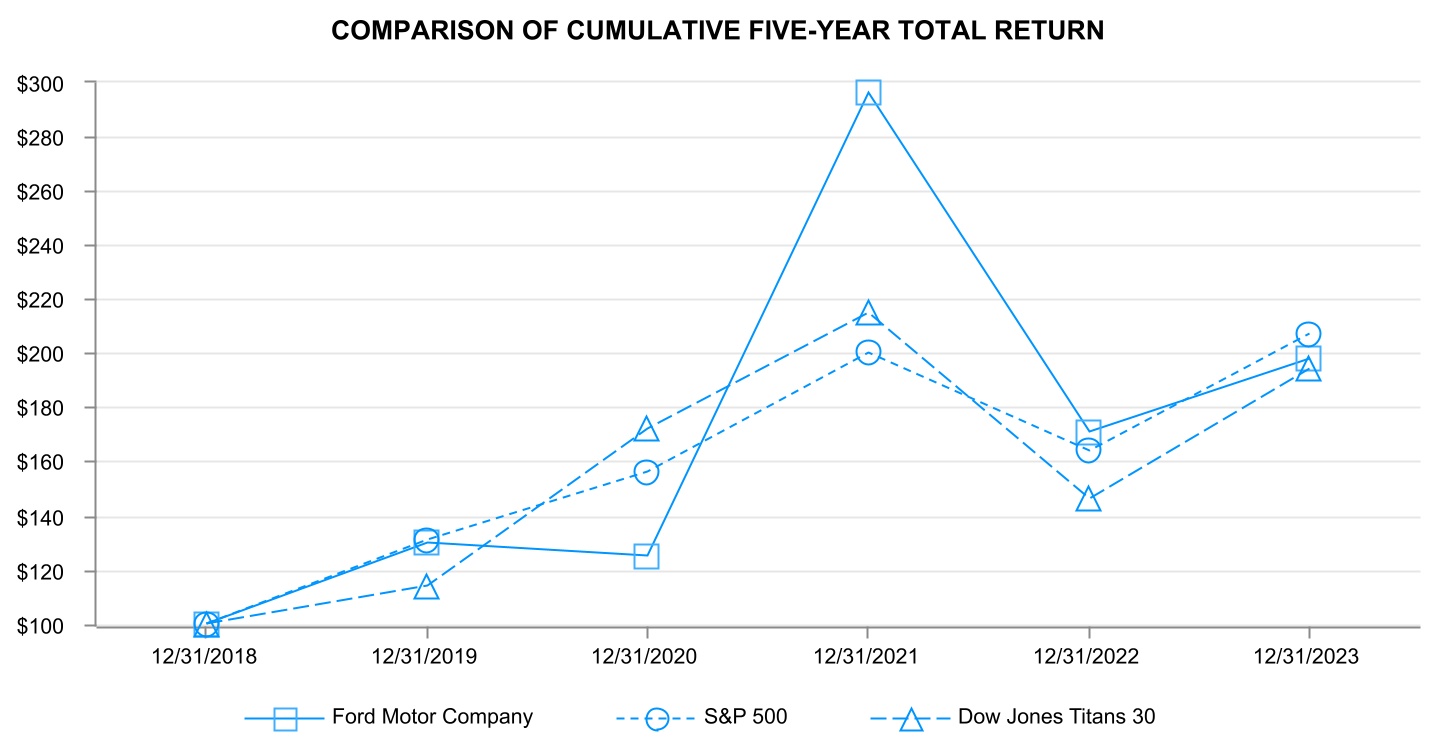
The following graph compares the cumulative total shareholder return on our Common Stock with the total return on the S&P 500 Index and the Dow Jones Automobiles & Parts Titans 30 Index for the five year period ended December 31, 2023. It shows the growth of a $100 investment on December 31, 2018, including the reinvestment of all dividends.
| Base Period | Years Ending | |||||||||||||||||||||||||||||||||||||
| Company/Index | 2018 | 2019 | 2020 | 2021 | 2022 | 2023 | ||||||||||||||||||||||||||||||||
| Ford Motor Company | 100 | 130 | 125 | 296 | 171 | 198 | ||||||||||||||||||||||||||||||||
| S&P 500 | 100 | 131 | 156 | 200 | 164 | 207 | ||||||||||||||||||||||||||||||||
| Dow Jones Automobiles & Parts Titans 30 | 100 | 114 | 172 | 215 | 146 | 194 |
Item 5. Market for Registrant’s Common Equity, Related Stockholder Matters and Issuer Purchases of Equity Securities (Continued)
Issuer Purchases of Equity Securities
In the fourth quarter of 2023, we completed a modest anti-dilutive share repurchase program to offset the dilutive effect of share-based compensation granted during 2023. The program authorized repurchases of up to 51 million shares of Ford Common Stock. As shown in the rightmost column of the table below, we do not intend to make any further purchases under this program because its anti-dilutive purpose was fulfilled after purchasing only 31 million shares.
| Period | Total Number of Shares Purchased | Average Price Paid per Share | Total Number of Shares Purchased as Part of Publicly-Announced Plans or Programs | Maximum Number (or Approximate Dollar Value) of Shares that May Yet Be Purchased Under the Plans or Programs | ||||||||||||||||||||||
| October 1, 2023 through October 31, 2023 | — | $ | — | — | — | |||||||||||||||||||||
| November 1, 2023 through November 30, 2023 | 6,713,291 | 10.25 | 6,713,291 | 44,286,709 | ||||||||||||||||||||||
| December 1, 2023 through December 31, 2023 | 24,286,709 | 10.95 | 24,286,709 | 20,000,000 (a) | ||||||||||||||||||||||
| Total / Average | 31,000,000 | $ | 10.80 | 31,000,000 |
(a)The share repurchase program announced November 20, 2023 authorized repurchases of up to 51 million shares of Ford Common Stock. Although we have repurchased 31 million shares and the program was authorized for up to 51 million, we do not intend to make any further purchases under this program because its anti-dilutive purpose has been fulfilled.
In December 2023, our Board of Directors approved a modest anti-dilutive share repurchase program to offset the dilutive effect of share-based compensation expected to be granted during 2024. The program authorizes repurchases of up to 53 million shares of Ford Common Stock. The Company may repurchase shares of Common Stock from time to time through open market purchases, in privately negotiated transactions, or by other means, including through the use of trading plans intended to satisfy the conditions of Rule 10b5-1(c) under the Securities Exchange Act of 1934, as amended, in accordance with applicable securities laws and other restrictions. The timing and total amount of repurchases of Ford Common Stock under this program will depend upon business, economic, and market conditions, corporate, legal, and regulatory requirements, prevailing stock prices, trading volume, and other considerations. The share repurchase program may be suspended or discontinued at any time, and does not obligate the Company to acquire any amount of Common Stock. To the extent the Company elects to make purchases under the share repurchase program, the Company expects to utilize its existing cash and cash equivalents to fund such repurchases.
Dividends
The table below shows the dividends we paid per share of Common and Class B Stock for each quarterly period in 2022 and 2023:
| 2022 | 2023 | ||||||||||||||||||||||||||||||||||||||||||||||
| First Quarter | Second Quarter | Third Quarter | Fourth Quarter | First Quarter**(a)** | Second Quarter | Third Quarter | Fourth Quarter | ||||||||||||||||||||||||||||||||||||||||
| Dividends per share of Ford Common and Class B Stock | $ | 0.10 | $ | 0.10 | $ | 0.15 | $ | 0.15 | $ | 0.80 | $ | 0.15 | $ | 0.15 | $ | 0.15 |
(a)In the first quarter of 2023, in addition to a regular dividend of $0.15 per share, we paid a supplemental dividend of $0.65 per share.
On February 6, 2024, we declared a regular dividend of $0.15 per share and a supplemental dividend of $0.18 per share.
Subject to legally available funds, we intend to continue to pay a regular quarterly cash dividend on our outstanding Common Stock and Class B Stock. The declaration and payment of future dividends is at the sole discretion of our Board of Directors after taking into account various factors, including our financial condition, operating results, available cash, and current and anticipated cash needs.
Item 6. [Reserved.]
Item 7. Management’s Discussion and Analysis of Financial Condition and Results of Operations.
Key Trends and Economic Factors Affecting Ford and the Automotive Industry
Production and Supply Chain. Although we saw improvements in our supply chain throughout 2023, including easing of the semiconductor shortage, we continue to face some production issues due to, among other things, labor shortages at our suppliers. Moreover, we have received and continue to receive claims from our supply base related to inflationary pressure and production disruption. Upon receipt, we evaluate those claims, and, in certain circumstances, in order to ensure continuity of supply and mitigate the impact on our production, have made payments to our suppliers, sometimes under duress. We continue to reevaluate our supply base and sourcing decisions and may in the future incur charges to improve flexibility and cost competitiveness.
Currency Exchange Rate Volatility. Globally, central banks have begun shifting from tightening policy by raising interest rates to holding rates steady or, in some markets, beginning to cut rates. As they do, they need to carefully balance the risk that inflation remains elevated against the heightened financial and economic risks associated with high interest rates. This is notable for many emerging markets, which may also face increased exposure to commodity prices and political instability, contributing to unpredictable movements in the value of their exchange rates. In addition to direct impacts on the financial flows of global automotive companies, currency movements can also impact pricing of vehicles exported to overseas markets. In most markets, exchange rates are market-determined, and all are impacted by many different macroeconomic and policy factors, and thus likely to remain volatile. However, in some markets, exchange rates are heavily influenced or controlled by governments.
Pricing Pressure. Despite vehicle pricing remaining elevated over the last year due to strong demand, supply shortages, and inflationary costs, we have already observed moderation in the rate of new and used vehicle price increases as auto production recovers from the semiconductor shortage, but it is unclear whether prices will decline fully to pre-COVID-19 pandemic levels. Over the long term, intense competition and excess capacity are likely to put downward pressure on inflation-adjusted prices for similarly-contented vehicles and contribute to a challenging pricing environment for the automotive industry in most major markets.
Electric Vehicle Market. Although we continue to invest in our electric vehicle strategy, we have observed lower-than-anticipated industrywide electric vehicle adoption rates and near-term pricing pressures, which has led us and may in the future lead us to adjust our spending, production, and/or product launches to better match the pace of electric vehicle adoption. As a result of the lower-than-anticipated adoption rates, near-term pricing pressures, and other factors, we recorded about $0.7 billion of charges in 2023 and may continue to incur charges, which could be substantial, related to payments to our electric vehicle-related suppliers (battery, raw material, or otherwise), inventory adjustments, or other matters. See Item 1A. Risk Factors for additional discussion of the risks related to lower-than-anticipated electric vehicle volumes and our planned transition to a greater mix of electric vehicles.
Commodity and Energy Prices. Prices for commodities remain volatile. In some cases, spot prices for various commodities have recently diverged somewhat, as anticipated weakening in global industrial activity mitigates price increases for base metals such as steel and aluminum, while precious metals (e.g., palladium), and raw materials that are used in batteries for electric vehicles (e.g., lithium, cobalt, nickel, graphite, and manganese, among other materials, for batteries) remain elevated. The net impact on us and our suppliers has been higher material costs overall. To help ensure supply of raw materials for critical components (e.g., batteries), we, like others in the industry, have entered into multi-year sourcing agreements and may enter into additional agreements. Similar dynamics are impacting energy markets, with Europe particularly exposed to the risk of both higher prices and constraints on supply of natural gas due to the ongoing conflict in Ukraine. Such shortages may impact facilities operated by us or our suppliers, which could have an impact on us in Europe and other regions. In the long term, the outcome of de-carbonization and electrification of the vehicle fleet may depress oil demand, but the global energy transition will also contribute to ongoing volatility of oil and other energy prices.
Vehicle Profitability. Our financial results depend on the profitability of the vehicles we sell, which may vary significantly by vehicle line. In general, larger vehicles tend to command higher prices and be more profitable than smaller vehicles. For example, in Ford Blue, our larger, more profitable vehicles had an average contribution margin that was 139% of our total average contribution margin across all vehicles, whereas our smaller vehicles had significantly lower contribution margins. In addition, government regulations aimed at reducing emissions and increasing fuel efficiency (e.g., ZEV mandates and low emission zones), and other factors that accelerate the transition to electrified vehicles, may increase the cost of vehicles by more than the perceived benefit to consumers and dampen margins.
Item 7. Management’s Discussion and Analysis of Financial Condition and Results of Operations (Continued)
Trade Policy. To the extent governments in various regions implement or intensify barriers to imports, such as erecting tariff or non-tariff barriers or manipulating their currency, and provide advantages to local exporters selling into the global marketplace, there can be a significant negative impact on manufacturers based in other markets. While we believe the long-term trend will support the growth of free trade, we will continue to monitor and address the developing role that geopolitical, climate, and labor concerns are playing in trade relations.
Inflation and Interest Rates. We continue to see near-term impacts on our business due to inflation, including ongoing global price pressures in the wake of geopolitical volatility, driving up energy prices, freight premiums, and other operating costs above normal rates. Although headline inflation in the United States and Europe appears to have peaked, as gasoline and natural gas prices recede from the latest spike, core inflation (excluding food and energy prices) remains elevated and is a source of continued cost pressure on businesses and households. Interest rates have increased significantly as central banks in developed countries attempt to subdue inflation while government deficits and debt remain at high levels in many global markets. Accordingly, the eventual implications of higher government deficits and debt, tighter monetary policy, and potentially higher long-term interest rates may drive a higher cost of capital for the business. At Ford Credit, rising interest rates may impact its ability to source funding and offer financing at competitive rates, which could reduce its financing margin.
Revenue
Company excluding Ford Credit revenue is generated primarily by sales of vehicles, parts, accessories, and services from our Ford Blue, Ford Model e, and Ford Pro segments. Revenue is recorded when control is transferred to our customers (generally, our dealers and distributors). For the majority of sales, this occurs when products are shipped from our manufacturing facilities. However, we defer a portion of the consideration received when there is a separate future or stand-ready performance obligation, such as extended service contracts or ongoing vehicle connectivity. Revenue related to extended service contracts is re
Showing the first 8K of 195K characters. Open the full section
Item 7A. Quantitative and Qualitative Disclosures About Market Risk
OVERVIEW
We are exposed to a variety of market and other risks, including the effects of changes in foreign currency exchange rates, commodity prices, and interest rates, as well as risks to availability of funding sources, hazard events, and specific asset risks.
We monitor and manage these exposures as an integral part of our overall risk management program, which includes regular reports to a central management committee, the Global Risk Management Committee (“GRMC”). The GRMC is chaired by our Chief Financial Officer, and the committee includes our Controller and Treasurer.
We are exposed to liquidity risk, including the possibility of having to curtail business or being unable to meet financial obligations as they come due because funding sources may be reduced or become unavailable. Our plan is to maintain funding sources to ensure liquidity through a variety of economic or business cycles. As discussed in greater detail in Item 7, our funding sources include sales of receivables in securitizations and other structured financings, unsecured debt issuances, equity and equity-linked issuances, and bank borrowings.
We are exposed to a variety of other risks, such as loss or damage to property, liability claims, and employee injury. We protect against these risks through the purchase of commercial insurance that is designed to protect us above our self-insured retentions against events that could generate significant losses.
Direct responsibility for the execution of our market risk management strategies resides with our Treasurer’s Office and is governed by written policies and procedures. Separation of duties is maintained between the development and authorization of derivative trades, the transaction of derivatives, and the settlement of cash flows. Regular audits are conducted to ensure that appropriate controls are in place and that they remain effective. In addition, our market risk exposures and our use of derivatives to manage these exposures are approved by the GRMC, and reviewed by the Audit Committee of our Board of Directors.
In accordance with our corporate risk management policies, we use derivative instruments, when available, such as forward contracts, swaps, and options that economically hedge certain exposures (foreign currency, commodity, and interest rates). We do not use derivative contracts for trading, market-making, or speculative purposes. In certain instances, we forgo hedge accounting, and in certain other instances, our derivatives do not qualify for hedge accounting. Either situation results in unrealized gains and losses that are recognized in income. For additional information on our derivatives, see Note 20 of the Notes to the Financial Statements.
The market and counterparty risks of the Company excluding Ford Credit as well as our Ford Credit segment are discussed and quantified below.
COMPANY EXCLUDING FORD CREDIT MARKET RISK
We frequently have expenditures and receipts denominated in foreign currencies, including the following: purchases and sales of finished vehicles and production parts, debt and other payables, subsidiary dividends, and investments in foreign operations. These expenditures and receipts create exposures to changes in exchange rates. We also are exposed to changes in prices of commodities used in the production of our vehicles and changes in interest rates.
Foreign currency risk, commodity risk, and interest rate risk are measured and quantified using a model to evaluate the sensitivity of market value to instantaneous, parallel shifts in rates and/or prices.
Foreign Currency Risk. Foreign currency risk is the possibility that our financial results could be worse than planned because of changes in currency exchange rates. Accordingly, our practice is to use derivative instruments to hedge our economic exposure with respect to forecasted revenues and costs, assets, liabilities, and firm commitments denominated in certain foreign currencies consistent with our overall risk management strategy. In our hedging actions, we use derivative instruments commonly used by corporations to reduce foreign exchange risk (e.g., forward contracts). The extent to which we hedge is also impacted by materiality of the risk in the context of our overall portfolio, market liquidity, and/or our ability to achieve designated hedge accounting.
Item 7A. Quantitative and Qualitative Disclosures About Market Risk (Continued)
The net fair value of foreign exchange forward contracts (including adjustments for credit risk) as of December 31, 2023, was a liability of $319 million, compared with an asset of $236 million as of December 31, 2022. The potential change in the fair value from a 10% change in the underlying exchange rates, in U.S. dollar terms, would have been $3.1 billion at December 31, 2023, compared with $1.9 billion at December 31, 2022. The sensitivity analysis presented is hypothetical and assumes foreign exchange rate changes are instantaneous and adverse across all currencies. In reality, some of our exposures offset and foreign exchange rates move in different magnitudes and at different times, and any changes in fair value would generally be offset by changes in the underlying exposure. See Note 20 of the Notes to the Financial Statements for more information regarding our foreign currency exchange contracts.
Commodity Price Risk. Commodity price risk is the possibility that our financial results could be worse than planned because of changes in the prices of commodities used in the production of motor vehicles, such as base metals (e.g., steel, copper, and aluminum), precious metals (e.g., palladium), energy (e.g., natural gas and electricity), and plastics/resins (e.g., polypropylene). As we transition to a greater mix of electric vehicles, we expect to increase our reliance on lithium, cobalt, nickel, graphite, and manganese, among other materials, for batteries. Our practice is to use derivative instruments to hedge the price risk with respect to forecasted purchases of certain commodities consistent with our overall risk management strategy. In our hedging actions, we use derivative instruments commonly used by corporations to reduce commodity price risk (e.g., financially settled forward contracts). The extent to which we hedge is also impacted by materiality of the risk in the context of our overall portfolio, market liquidity, and/or our ability to achieve designated hedge accounting.
The net fair value of commodity forward contracts (including adjustments for credit risk) as of December 31, 2023, was a liability of $9 million, compared with a liability of $49 million as of December 31, 2022. The potential change in the fair value from a 10% change in the underlying commodity prices would have been $203 million at December 31, 2023, compared with $178 million at December 31, 2022. The sensitivity analysis presented is hypothetical and assumes commodity price changes are instantaneous and adverse across all commodities. In reality, commodity prices move in different magnitudes and at different times, and any changes in fair value would generally be offset by changes in the underlying exposure.
In addition, our purchasing organization (with guidance from the GRMC, as appropriate) negotiates contracts for the continuous supply of raw materials. In some cases, these contracts stipulate minimum purchase amounts and specific prices, and, therefore, play a role in managing commodity price risk.
Interest Rate Risk. Interest rate risk relates to the loss we could incur in our Company cash investment portfolios due to a change in interest rates. Our interest rate sensitivity analysis on our investment portfolios includes cash and cash equivalents and net marketable securities. At December 31, 2023, we had Company cash of $28.8 billion in our investment portfolios, compared to $32.3 billion at December 31, 2022. We invest the portfolios in securities of various types and maturities, the value of which are subject to fluctuations in interest rates. The investment strategy is based on clearly defined risk and liquidity guidelines to maintain liquidity, minimize risk, and earn a reasonable return on the short-term investments. In investing the cash in our investment portfolios, safety of principal is the primary objective and risk-adjusted return is the secondary objective.
At any time, a rise in interest rates could have a material adverse impact on the fair value of our portfolios. Assuming a hypothetical increase in interest rates of one percentage point, the value of our portfolios would be reduced by $222 million, as calculated as of December 31, 2023. This compares to $256 million, as calculated as of December 31, 2022. While these are our best estimates of the impact of the specified interest rate scenario, actual results could differ from those projected. The sensitivity analysis presented assumes interest rate changes are instantaneous, parallel shifts in the yield curve. In reality, interest rate changes of this magnitude are rarely instantaneous or parallel.
Item 7A. Quantitative and Qualitative Disclosures About Market Risk (Continued)
FORD CREDIT MARKET RISK
Market risk for Ford Credit is the possibility that changes in interest and currency exchange rates will adversely affect cash flow and economic value.
Interest Rate Risk. Generally, Ford Credit’s assets and the related debt have different re-pricing periods, and consequently, respond differently to changes in interest rates.
Ford Credit’s assets consist primarily of fixed-rate retail financing and operating lease contracts and floating-rate wholesale receivables. Fixed-rate retail financing and operating lease contracts generally require customers to make equal monthly payments over the life of the contract. Wholesale receivables are originated to finance new and used vehicles held in dealers’ inventory and generally require dealers to pay a floating rate.
Debt consists primarily of short- and long-term unsecured and securitized debt. Ford Credit’s term debt instruments are principally fixed-rate and require fixed and equal interest payments over the life of the instrument and a single principal payment at maturity.
Ford Credit’s interest rate risk management objective is to reduce volatility in its cash flows and volatility in its economic value from changes in interest rates based on an established risk tolerance that may vary by market. Ford Credit uses economic value sensitivity analysis and re-pricing gap analysis to evaluate potential long-term effects of changes in interest rates. It then enters into interest rate swaps to convert portions of its floating-rate debt to fixed or its fixed-rate debt to floating to ensure that Ford Credit’s exposure falls within the established tolerances. Ford Credit also uses pre-tax cash flow sensitivity analysis to monitor the level of near-term cash flow exposure. The pre-tax cash flow sensitivity analysis measures the changes in expected cash flows associated with Ford Credit’s interest-rate-sensitive assets, liabilities, and derivative financial instruments from hypothetical changes in interest rates over a twelve-month horizon. Interest rate swaps are placed to maintain exposure within approved thresholds and the Asset-Liability Committee reviews the re-pricing mismatch monthly.
To provide a quantitative measure of the sensitivity of its pre-tax cash flow to changes in interest rates, Ford Credit uses interest rate scenarios that assume a hypothetical, instantaneous increase or decrease of one percentage point in all interest rates across all maturities (a “parallel shift”), as well as a base case that assumes that all interest rates remain constant at existing levels. In reality, interest rate changes are rarely instantaneous or parallel and rates could move more or less than the one percentage point assumed in Ford Credit’s analysis. As a result, the actual impact to pre-tax cash flow could be higher or lower than the results detailed in the table below. These interest rate scenarios are purely hypothetical and do not represent Ford Credit’s view of future interest rate movements.
Under these interest rate scenarios, Ford Credit expects more assets than debt and liabilities to re-price in the next twelve months. Other things being equal, this means that during a period of rising interest rates, the interest received on Ford Credit’s assets will increase more than the interest paid on Ford Credit’s debt, thereby initially increasing Ford Credit’s pre-tax cash flow. During a period of falling interest rates, Ford Credit would expect its pre-tax cash flow to initially decrease. Ford Credit’s pre-tax cash flow sensitivity to interest rate movement at December 31 was as follows (in millions):
| Pre-Tax Cash Flow Sensitivity | 2022 | 2023 | ||||||||||||
| One percentage point instantaneous increase in interest rates | $ | 127 | $ | 78 | ||||||||||
| One percentage point instantaneous decrease in interest rates | (127) | (78) |
While the sensitivity analysis presented is Ford Credit’s best estimate of the impacts of the specified assumed interest rate scenarios, its actual results could differ from those projected. The model Ford Credit uses to conduct this analysis is heavily dependent on assumptions. Embedded in the model are assumptions regarding the reinvestment of maturing asset principal, refinancing of maturing debt, replacement of maturing derivatives, exercise of options embedded in debt and derivatives, and predicted repayment of retail financing and operating lease contracts ahead of contractual maturity. Ford Credit’s repayment projections ahead of contractual maturity are based on historical experience. If interest rates or other factors change, Ford Credit’s actual prepayment experience could be different than projected.
Item 7A. Quantitative and Qualitative Disclosures About Market Risk (Continued)
Foreign Currency Risk. Ford Credit’s policy is to minimize exposure to changes in currency exchange rates. To meet funding objectives, Ford Credit borrows in a variety of currencies, principally U.S. dollars, Canadian dollars, euros, sterling, and renminbi. Ford Credit faces exposure to currency exchange rates if a mismatch exists between the currency of receivables and the currency of the debt funding those receivables. When possible, receivables are funded with debt in the same currency, minimizing exposure to exchange rate movements. When a different currency is used, Ford Credit may use foreign currency swaps and foreign currency forwards to convert substantially all of its foreign currency debt obligations to the local country currency of the receivables. As a result of this policy, Ford Credit believes its market risk exposure, relating to changes in currency exchange rates at December 31, 2023, is insignificant.
Derivative Fair Values. The net fair value of Ford Credit’s derivative financial instruments at December 31, 2023 was a liability of $1.3 billion, compared to a liability of $2.0 billion at December 31, 2022.
COUNTERPARTY RISK
Counterparty risk relates to the loss we could incur if an obligor or counterparty defaulted on an investment or a derivative contract. We enter into master agreements with counterparties that allow netting of certain exposures in order to manage this risk. Exposures primarily relate to investments in fixed income instruments and derivative contracts used for managing interest rate, foreign currency exchange rate, and commodity price risk. We, together with Ford Credit, establish exposure limits for each counterparty to minimize risk and provide counterparty diversification.
Our approach to managing counterparty risk is forward-looking and proactive, allowing us to take risk mitigation actions before risks become losses. Exposure limits are established based on our overall risk tolerance, which is calculated from counterparty credit ratings and market-based credit default swap (“CDS”) spreads. The exposure limits are lower for smaller and lower-rated counterparties, counterparties that have relatively higher CDS spreads, and for longer dated exposures. Our exposures are monitored on a regular basis and included in periodic reports to our Treasurer.
Substantially all of our counterparty exposures are with counterparties that have an investment grade rating. Investment grade is our guideline for minimum counterparty long-term ratings.
Item 8. Financial Statements and Supplementary Data.
The Report of Independent Registered Public Accounting Firm, our Financial Statements, the accompanying Notes to the Financial Statements, and the Financial Statement Schedule that are filed as part of this Report are listed under “Item 15. Exhibits and Financial Statement Schedules” and are set forth beginning on page 105 immediately following the signature pages of this Report.
Item 9. Changes in and Disagreements with Accountants on Accounting and Financial Disclosure.
None.
Item 9A. Controls and Procedures.
Evaluation of Disclosure Controls and Procedures. James D. Farley, Jr., our Chief Executive Officer (“CEO”), and John T. Lawler, our Chief Financial Officer (“CFO”), have performed an evaluation of the Company’s disclosure controls and procedures, as that term is defined in Rule 13a-15(e) or 15d-15(e) of the Securities Exchange Act of 1934, as amended (“Exchange Act”), as of December 31, 2023, and each has concluded that such disclosure controls and procedures are effective to ensure that information required to be disclosed in our periodic reports filed under the Exchange Act is recorded, processed, summarized, and reported within the time periods specified by SEC rules and forms, and that such information is accumulated and communicated to the CEO and CFO to allow timely decisions regarding required disclosures.
Management’s Report on Internal Control Over Financial Reporting. Our management is responsible for establishing and maintaining adequate internal control over financial reporting, as such term is defined in Exchange Act Rule 13a-15(f) or 15d-15(f). The Company’s internal control over financial reporting is a process designed to provide reasonable assurance regarding the reliability of financial reporting and the preparation of financial statements for external purposes in accordance with generally accepted accounting principles.
Because of its inherent limitations, internal control over financial reporting may not prevent or detect misstatements. Also, projections of any evaluation of effectiveness to future periods are subject to the risk that controls may become inadequate because of changes in conditions or because the degree of compliance with policies or procedures may deteriorate.
Under the supervision and with the participation of our management, including our CEO and CFO, we conducted an assessment of the effectiveness of our internal control over financial reporting as of December 31, 2023. The assessment was based on criteria established in the framework Internal Control - Integrated Framework (2013), issued by the Committee of Sponsoring Organizations of the Treadway Commission. Based on this assessment, management concluded that our internal control over financial reporting was effective as of December 31, 2023.
The effectiveness of the Company’s internal control over financial reporting as of December 31, 2023 has been audited by PricewaterhouseCoopers LLP (PCAOB ID 238), an independent registered public accounting firm, as stated in its report included herein.
Changes in Internal Control Over Financial Reporting. There were no changes in internal control over financial reporting during the quarter ended December 31, 2023 that have materially affected, or are reasonably likely to materially affect, our internal control over financial reporting.
Item 9B. Other Information.
During the three months ended December 31, 2023, no director or officer of the Company adopted, modified, or terminated a “Rule 10b5-1 trading arrangement” or a “non-Rule 10b5-1 trading arrangement” as each term is defined in Item 408(a) of Regulation S-K.
Item 9C. Disclosure Regarding Foreign Jurisdictions that Prevent Inspections.
Not applicable.
PART III.
Item 10. Directors, Executive Officers of Ford, and Corporate Governance.
The information required by Item 10 regarding our directors is incorporated by reference from the information under the captions “Proposal 1. Election of Directors,” “Corporate Governance – Beneficial Stock Ownership,” and “Corporate Governance – Delinquent Section 16(a) Reports” in our Proxy Statement. The information required by Item 10 regarding our executive officers appears as Item 4A under Part I of this Report. The information required by Item 10 regarding an audit committee financial expert is incorporated by reference from the information under the caption “Corporate Governance – Audit Committee Financial Expert and Auditor Rotation” in our Proxy Statement. The information required by Item 10 regarding the members of our Audit Committee of the Board of Directors is incorporated by reference from the information under the captions “Proxy Summary,” “Corporate Governance – Board Committee Functions,” “Corporate Governance – Audit Committee Financial Expert and Auditor Rotation,” and “Proposal 1. Election of Directors” in our Proxy Statement. The information required by Item 10 regarding the Audit Committee’s review and discussion of the audited financial statements is incorporated by reference from information under the caption “Audit Committee Report” in our Proxy Statement. The information required by Item 10 regarding our codes of ethics is incorporated by reference from the information under the caption “Corporate Governance – Codes of Ethics” in our Proxy Statement. In addition, we have included in Item 1 instructions for how to access our codes of ethics on our website and our Internet address. Amendments to, and waivers granted under, our Code of Ethics for Senior Financial Personnel, if any, will be posted to our website as well.
Item 11. Executive Compensation.
The information required by Item 11 is incorporated by reference from the information under the following captions in our Proxy Statement: “Director Compensation in 2023,” “Compensation Discussion and Analysis,” “Compensation Committee Report,” “Compensation Committee Interlocks and Insider Participation,” “Compensation of Named Executives,” “Summary Compensation Table,” “Grants of Plan-Based Awards in 2023,” “Outstanding Equity Awards at 2023 Fiscal Year-End,” “Option Exercises and Stock Vested in 2023,” “Pension Benefits in 2023,” “Nonqualified Deferred Compensation in 2023,” “Potential Payments Upon Termination or Change-in-Control,” and “Pay Ratio.”
Item 12. Security Ownership of Certain Beneficial Owners and Management and Related Stockholder Matters.
The information required by Item 12 is incorporated by reference from the information under the captions “Equity Compensation Plan Information” and “Corporate Governance – Beneficial Stock Ownership” in our Proxy Statement.
Item 13. Certain Relationships and Related Transactions, and Director Independence.
The information required by Item 13 is incorporated by reference from the information under the captions “Corporate Governance – Certain Relationships and Related Party Transactions” and “Corporate Governance – Independence of Directors and Relevant Facts and Circumstances” in our Proxy Statement.
Item 14. Principal Accounting Fees and Services.
The information required by Item 14 is incorporated by reference from the information under the caption “Proposal 2. Ratification of Independent Registered Public Accounting Firm” in our Proxy Statement.
PART IV.
Item 15. Exhibits and Financial Statement Schedules.
(a) 1. Financial Statements – Ford Motor Company and Subsidiaries
The following are contained in this 2023 Form 10-K Report:
-
Report of Independent Registered Public Accounting Firm.
-
Consolidated Statements of Cash Flows for the years ended December 31, 2021, 2022, and 2023.
-
Consolidated Income Statements for the years ended December 31, 2021, 2022, and 2023.
-
Consolidated Statements of Comprehensive Income for the years ended December 31, 2021, 2022, and 2023.
-
Consolidated Balance Sheets at December 31, 2022 and 2023.
-
Consolidated Statements of Equity for the years ended December 31, 2021, 2022, and 2023.
-
Notes to the Financial Statements.
The Report of Independent Registered Public Accounting Firm, the Consolidated Financial Statements, and the Notes to the Financial Statements listed above are filed as part of this Report and are set forth beginning on page 105 immediately following the signature pages of this Report.
(a) 2. Financial Statement Schedules
| Designation | Description | |||||||
| Schedule II | Valuation and Qualifying Accounts for the years ended 2021, 2022, and 2023 |
Schedule II is filed as part of this Report and is set forth on page 179 immediately following the Notes to the Financial Statements referred to above. The other schedules are omitted because they are not applicable, the information required to be contained in them is disclosed elsewhere on our Consolidated Financial Statements, or the amounts involved are not sufficient to require submission.
(a) 3. Exhibits
| Designation | Description | Method of Filing | ||||||||||||
| Exhibit 3-A | Restated Certificate of Incorporation, dated August 2, 2000. | Filed as Exhibit 3-A to our Annual Report on Form 10-K for the year ended December 31, 2000. (a) | ||||||||||||
| Exhibit 3-A-1 | Certificate of Designations of Series A Junior Participating Preferred Stock filed on September 11, 2009. | Filed as Exhibit 3.1 to our Current Report on Form 8-K filed September 11, 2009. (a) | ||||||||||||
| Exhibit 3-B | By-laws. | Filed as Exhibit 3.1 to our Form 8-K filed on December 9, 2022. (a) | ||||||||||||
| Exhibit 4-A | Tax Benefit Preservation Plan (“TBPP”) dated September 11, 2009 between Ford Motor Company and Computershare Trust Company, N.A. | Filed as Exhibit 4.1 to our Current Report on Form 8-K filed September 11, 2009. (a) | ||||||||||||
| Exhibit 4-A-1 | Amendment No. 1 to TBPP dated September 11, 2012. | Filed as Exhibit 4 to our Current Report on Form 8-K filed September 12, 2012. (a) | ||||||||||||
| Exhibit 4-A-2 | Amendment No. 2 to TBPP dated September 9, 2015. | Filed as Exhibit 4 to our Current Report on Form 8-K filed September 11, 2015. (a) | ||||||||||||
| Exhibit 4-A-3 | Amendment No. 3 to TBPP dated September 13, 2018. | Filed as Exhibit 4 to our Current Report on Form 8-K filed September 14, 2018. (a) | ||||||||||||
| Exhibit 4-A-4 | Amendment No. 4 to TBPP dated September 9, 2021. | Filed as Exhibit 4 to our Current Report on Form 8-K filed September 10, 2021. (a) | ||||||||||||
| Exhibit 4-B | Description of Securities. | Filed with this Report. | ||||||||||||
| Exhibit 10-A | Executive Separation Allowance Plan, as amended and restated effective as of January 1, 2018. (b) | Filed as Exhibit 10.1 to our Current Report on Form 8-K filed February 7, 2018. (a) | ||||||||||||
| Exhibit 10-B | Deferred Compensation Plan for Non-Employee Directors, as amended and restated as of January 1, 2012. (b) | Filed as Exhibit 10-B to our Annual Report on Form 10-K for the year ended December 31, 2011. (a) | ||||||||||||
| Exhibit 10-C | 2014 Stock Plan for Non-Employee Directors (b) | Filed as Exhibit 10-C to our Annual Report on Form 10-K for the year ended December 31, 2013. (a) | ||||||||||||
| Exhibit 10-D | Benefit Equalization Plan, as amended and restated effective as of January 1, 2022. (b) | Filed as Exhibit 10.3 to our Quarterly Report on Form 10-Q for the quarter ended March 31, 2022. (a) | ||||||||||||
| Exhibit 10-E | Description of financial counseling services provided to certain executives. (b) | Filed as Exhibit 10-E to our Annual Report on Form 10-K for the year ended December 31, 2019. (a) | ||||||||||||
| Exhibit 10-F | Defined Benefit Supplemental Executive Retirement Plan, as amended and restated effective as of January 1, 2022. (b) | Filed as Exhibit 10.4 to our Quarterly Report on Form 10-Q for the quarter ended March 31, 2022. (a) | ||||||||||||
| Exhibit 10-F-1 | Defined Contribution Supplemental Executive Retirement Plan, as amended and restated effective as of January 1, 2022. (b) | Filed as Exhibit 10.5 to our Quarterly Report on Form 10-Q for the quarter ended March 31, 2022. (a) | ||||||||||||
| Exhibit 10-G | Description of Director Compensation as of July 13, 2006. (b) | Filed as Exhibit 10-G-3 to our Quarterly Report on Form 10-Q for the quarter ended September 30, 2006. (a) | ||||||||||||
| Exhibit 10-G-1 | Amendment to Description of Director Compensation as of February 8, 2012. (b) | Filed as Exhibit 10-F-3 to our Annual Report on Form 10-K for the year ended December 31, 2011. (a) | ||||||||||||
| Exhibit 10-G-2 | Amendment to Description of Director Compensation as of July 1, 2013. (b) | Filed as Exhibit 10-G-2 to our Annual Report on Form 10-K for the year ended December 31, 2013. (a) | ||||||||||||
| Exhibit 10-G-3 | Amendment to Description of Director Compensation as of January 1, 2017. (b) | Filed as Exhibit 10-G-3 to our Annual Report on Form 10-K for the year ended December 31, 2016. (a) | ||||||||||||
| Exhibit 10-H | 2008 Long-Term Incentive Plan. (b) | Filed as Exhibit 10.1 to our Quarterly Report on Form 10-Q for the quarter ended June 30, 2008. (a) | ||||||||||||
| Exhibit 10-I | Description of Vehicle Evaluation Program for Non-Executive Directors. (b) | Filed as Exhibit 10-I to our Annual Report on Form 10-K for the year ended December 31, 2021. (a) | ||||||||||||
| Exhibit 10-J | Non-Employee Directors Life Insurance and Optional Retirement Plan as amended and restated as of December 31, 2010. (b) | Filed as Exhibit 10-I to our Annual Report on Form 10-K for the year ended December 31, 2010. (a) | ||||||||||||
| Exhibit 10-K | Description of Non-Employee Directors Accidental Death, Dismemberment and Permanent Total Disablement Indemnity. (b) | Filed as Exhibit 10-S to our Annual Report on Form 10-K for the year ended December 31, 1992. (a) | ||||||||||||
| Exhibit 10-K-1 | Description of Amendment to Basic Life Insurance and Accidental Death & Dismemberment Insurance. (b) | Filed as Exhibit 10-K-1 to our Annual Report on Form 10-K for the year ended December 31, 2013. (a) | ||||||||||||
| Exhibit 10-L | Offer Letter to Peter Stern dated July 21, 2023. (b) | Filed with this Report. | ||||||||||||
| Exhibit 10-M | Offer Letter to Doug Field dated August 26, 2021. (b) | Filed as Exhibit 10-N to our Annual Report on Form 10-K for the year ended December 31, 2021. (a) | ||||||||||||
| Exhibit 10-N | Agreement between Ford Motor Company and James D. Farley, Jr. dated August 3, 2020. (b) | Filed as Exhibit 10.1 to our Quarterly Report on Form 10-Q for the quarter ended September 30, 2020. (a) | ||||||||||||
| Exhibit 10-O | Select Retirement Plan, as amended and restated effective as of January 1, 2018. (b) | Filed as Exhibit 10.4 to our Current Report on Form 8-K filed February 7, 2018. (a) | ||||||||||||
| Exhibit 10-P | Deferred Compensation Plan, as amended and restated as of December 31, 2010. (b) | Filed as Exhibit 10-M to our Annual Report on Form 10-K for the year ended December 31, 2010. (a) | ||||||||||||
| Exhibit 10-P-1 | Suspension of Open Enrollment in Deferred Compensation Plan. (b) | Filed as Exhibit 10-M-1 to our Annual Report on Form 10-K for the year ended December 31, 2009. (a) | ||||||||||||
| Exhibit 10-Q | Annual Performance Bonus Plan, as amended May 10, 2023. (b) | Filed as Exhibit 10.1 to our Quarterly Report on Form 10-Q for the quarter ended June 30, 2023. (a) |
| Designation | Description | Method of Filing | ||||||||||||
| Exhibit 10-Q-1 | Annual Incentive Compensation Plan Metrics for 2022. (b) | Filed as Exhibit 10.1 to our Quarterly Report on Form 10-Q for the quarter ended March 31, 2022. (a) | ||||||||||||
| Exhibit 10-Q-2 | Annual Performance Bonus Plan Metrics for 2023. (b) | Filed as Exhibit 10.1 to our Quarterly Report on Form 10-Q for the quarter ended March 31, 2023. (a) | ||||||||||||
| Exhibit 10-Q-3 | Performance-Based Restricted Stock Unit Metrics for 2020. (b) | Filed as Exhibit 10.2 to our Quarterly Report on Form 10-Q for the quarter ended March 31, 2020. (a) | ||||||||||||
| Exhibit 10-Q-4 | Performance-Based Restricted Stock Unit Metrics for 2021. (b) | Filed as Exhibit 10.2 to our Quarterly Report on Form 10-Q for the quarter ended March 31, 2021. (a) | ||||||||||||
| Exhibit 10-Q-5 | Performance-Based Restricted Stock Unit Metrics for 2022. (b) | Filed as Exhibit 10.2 to our Quarterly Report on Form 10-Q for the quarter ended March 31, 2022. (a) | ||||||||||||
| Exhibit 10-Q-6 | Performance-Based Restricted Stock Unit Metrics for 2023. (b) | Filed as Exhibit 10.2 to our Quarterly Report on Form 10-Q for the quarter ended March 31, 2023. (a) | ||||||||||||
| Exhibit 10-Q-7 | Corporate Officer Compensation Recoupment Policy. (b) | Filed with this Report. | ||||||||||||
| Exhibit 10-R | 2018 Long-Term Incentive Plan. (b) | Filed as Exhibit 4.1 to Registration Statement No. 333-226348. (a) | ||||||||||||
| Exhibit 10-S | 2023 Long-Term Incentive Plan. (b) | Filed as Exhibit 4.9 to Registration Statement No. 333-271592. (a) | ||||||||||||
| Exhibit 10-S-1 | Form of Stock Option Terms and Conditions for 2023 Long-Term Incentive Plan. (b) | Filed as Exhibit 10.2 to our Quarterly Report on Form 10-Q for the quarter ended June 30, 2023. (a) | ||||||||||||
| Exhibit 10-S-2 | Form of Stock Option Agreement for 2023 Long-Term Incentive Plan. (b) | Filed as Exhibit 10.3 to our Quarterly Report on Form 10-Q for the quarter ended June 30, 2023. (a) | ||||||||||||
| Exhibit 10-S-3 | Form of Stock Option Agreement (ISO) for 2023 Long-Term Incentive Plan. (b) | Filed as Exhibit 10.4 to our Quarterly Report on Form 10-Q for the quarter ended June 30, 2023. (a) | ||||||||||||
| Exhibit 10-S-4 | Form of Stock Option Agreement (U.K. NQO) for 2023 Long-Term Incentive Plan. (b) | Filed as Exhibit 10.5 to our Quarterly Report on Form 10-Q for the quarter ended June 30, 2023. (a) | ||||||||||||
| Exhibit 10-S-5 | Form of Stock Option (U.K.) Terms and Conditions for 2023 Long-Term Incentive Plan. (b) | Filed as Exhibit 10.6 to our Quarterly Report on Form 10-Q for the quarter ended June 30, 2023. (a) | ||||||||||||
| Exhibit 10-S-6 | Form of Restricted Stock Grant Letter for 2023 Long-Term Incentive Plan. (b) | Filed as Exhibit 10.7 to our Quarterly Report on Form 10-Q for the quarter ended June 30, 2023. (a) | ||||||||||||
| Exhibit 10-S-7 | Form of Final Award Notification Letter for Performance Stock Units. (b) | Filed as Exhibit 10.8 to our Quarterly Report on Form 10-Q for the quarter ended June 30, 2023. (a) | ||||||||||||
| Exhibit 10-S-8 | Form of Annual Equity Grant Letter for 2023 Long-Term Incentive Plan V.1. (b) | Filed as Exhibit 10.9 to our Quarterly Report on Form 10-Q for the quarter ended June 30, 2023. (a) | ||||||||||||
| Exhibit 10-S-9 | Form of Annual Equity Grant Letter for 2023 Long-Term Incentive Plan V.2. (b) | Filed as Exhibit 10.10 to our Quarterly Report on Form 10-Q for the quarter ended June 30, 2023. (a) | ||||||||||||
| Exhibit 10-S-10 | Form of 2023 Long-Term Incentive Plan Restricted Stock Unit Agreement. (b) | Filed as Exhibit 10.11 to our Quarterly Report on Form 10-Q for the quarter ended June 30, 2023. (a) | ||||||||||||
| Exhibit 10-S-11 | Form of 2023 Long-Term Incentive Plan Restricted Stock Unit Terms and Conditions. (b) | Filed as Exhibit 10.12 to our Quarterly Report on Form 10-Q for the quarter ended June 30, 2023. (a) | ||||||||||||
| Exhibit 10-S-12 | Form of Final Award Agreement for Performance Stock Units under 2023 Long-Term Incentive Plan. (b) | Filed as Exhibit 10.13 to our Quarterly Report on Form 10-Q for the quarter ended June 30, 2023. (a) | ||||||||||||
| Exhibit 10-S-13 | Form of Final Award Terms and Conditions for Performance Stock Units under 2023 Long-Term Incentive Plan. (b) | Filed as Exhibit 10.14 to our Quarterly Report on Form 10-Q for the quarter ended June 30, 2023. (a) | ||||||||||||
| Exhibit 10-S-14 | Form of Notification Letter for Time-Based Restricted Stock Units under 2023 Long-Term Incentive Plan. (b) | Filed as Exhibit 10.15 to our Quarterly Report on Form 10-Q for the quarter ended June 30, 2023. (a) | ||||||||||||
| Exhibit 10-T | Description of Company Practices regarding Club Memberships for Executives. (b) | Filed as Exhibit 10-V to our Annual Report on Form 10-K for the year ended December 31, 2021. (a) | ||||||||||||
| Exhibit 10-U | Amended and Restated Credit Agreement dated as of November 24, 2009. | Filed as Exhibit 99.2 to our Current Report on Form 8-K filed November 25, 2009. (a) | ||||||||||||
| Exhibit 10-U-1 | Seventh Amendment dated as of March 15, 2012 to our Credit Agreement dated as of December 15, 2006, as amended and restated as of November 24, 2009, and as further amended. | Filed as Exhibit 99.2 to our Current Report on Form 8-K filed March 15, 2012. (a) | ||||||||||||
| Exhibit 10-U-2 | Ninth Amendment dated as of April 30, 2013 to our Credit Agreement dated as of December 15, 2006, as amended and restated as of November 24, 2009, and as further amended. | Filed as Exhibit 10 to our Quarterly Report on Form 10-Q for the quarter ended March 31, 2013. (a) | ||||||||||||
| Exhibit 10-U-3 | Tenth Amendment dated as of April 30, 2014 to our Credit Agreement dated as of December 15, 2006, as amended and restated as of November 24, 2009, and as further amended. | Filed as Exhibit 10.1 to our Quarterly Report on Form 10-Q for the quarter ended March 31, 2014. (a) | ||||||||||||
| Exhibit 10-U-4 | Eleventh Amendment dated as of April 30, 2015 to our Credit Agreement dated as of December 15, 2006, as amended and restated as of November 24, 2009, as amended and restated as of April 30, 2014, and as further amended, including the Third Amended and Restated Credit Agreement. | Filed as Exhibit 10.1 to our Current Report on Form 8-K filed May 1, 2015. (a) |
| Designation | Description | Method of Filing | ||||||||||||
| Exhibit 10-U-5 | Twelfth Amendment dated as of April 29, 2016 to our Credit Agreement dated as of December 15, 2006, as amended and restated as of November 24, 2009, as amended and restated as of April 30, 2014, and as further amended and restated as of April 30, 2015. | Filed as Exhibit 10 to our Current Report on Form 8-K filed April 29, 2016. (a) | ||||||||||||
| Exhibit 10-U-6 | Thirteenth Amendment dated as of April 28, 2017 to our Credit Agreement dated as of December 15, 2006, as amended and restated as of November 24, 2009, as amended and restated as of April 30, 2014, and as further amended and restated as of April 30, 2015. | Filed as Exhibit 10 to our Current Report on Form 8-K filed April 28, 2017. (a) | ||||||||||||
| Exhibit 10-U-7 | Fourteenth Amendment dated as of April 26, 2018 to our Credit Agreement dated as of December 15, 2006, as amended and restated as of November 24, 2009, as amended and restated as of April 30, 2014, and as further amended and restated as of April 30, 2015. | Filed as Exhibit 10 to our Current Report on Form 8-K filed April 26, 2018. (a) | ||||||||||||
| Exhibit 10-U-8 | Fifteenth Amendment dated as of April 23, 2019 to our Credit Agreement dated as of December 15, 2006, as amended and restated as of November 24, 2009, as amended and restated as of April 30, 2014, and as further amended and restated as of April 30, 2015. | Filed as Exhibit 10.1 to our Current Report on Form 8-K filed April 26, 2019. (a) | ||||||||||||
| Exhibit 10-U-9 | Sixteenth Amendment dated as of July 27, 2020 to our Credit Agreement dated as of December 15, 2006, as amended and restated as of November 24, 2009, as amended and restated as of April 30, 2014, and as further amended and restated as of April 30, 2015. | Filed as Exhibit 10.1 to our Current Report on Form 8-K filed July 30, 2020. (a) | ||||||||||||
| Exhibit 10-U-10 | Seventeenth Amendment dated as of March 16, 2021 to our Credit Agreement dated as of December 15, 2006, as amended and restated as of November 24, 2009, as amended and restated as of April 30, 2014, and as further amended and restated as of April 30, 2015. | Filed as Exhibit 10.1 to our Current Report on Form 8-K filed March 17, 2021. (a) | ||||||||||||
| Exhibit 10-U-11 | Eighteenth Amendment dated as of September 29, 2021 to our Credit Agreement dated as of December 15, 2006, as amended and restated as of November 24, 2009, as amended and restated as of April 30, 2014, as amended and restated as of April 30, 2015, and as further amended, including the Fourth Amended and Restated Credit Agreement. | Filed as Exhibit 10.1 to our Current Report on Form 8-K filed September 29, 2021. (a) | ||||||||||||
| Exhibit 10-U-12 | Nineteenth Amendment dated as of June 23, 2022 to our Credit Agreement dated as of December 15, 2006, as amended and restated as of November 24, 2009, as amended and restated as of April 30, 2014, as amended and restated as of April 30, 2015, as amended and restated as of September 29, 2021, and as further amended. | Filed as Exhibit 10.1 to our Current Report on Form 8-K filed June 23, 2022. (a) | ||||||||||||
| Exhibit 10-U-13 | Twentieth Amendment dated as of April 26, 2023 to our Credit Agreement dated as of December 15, 2006, as amended and restated as of November 24, 2009, as amended and restated as of April 30, 2014, as amended and restated as of April 30, 2015, as amended and restated as of September 29, 2021, and as further amended. | Filed as Exhibit 10.1 to our Current Report on Form 8-K filed April 26, 2023. (a) | ||||||||||||
| Exhibit 10-V | Revolving Credit Agreement dated as of April 23, 2019. | Filed as Exhibit 10.2 to our Current Report on Form 8-K filed April 26, 2019. (a) | ||||||||||||
| Exhibit 10-V-1 | First Amendment dated July 27, 2020 to the Revolving Credit Agreement dated April 23, 2019. | Filed as Exhibit 10.2 to our Current Report on Form 8-K filed July 30, 2020. (a) | ||||||||||||
| Exhibit 10-V-2 | Second Amendment dated March 16, 2021 to the Revolving Credit Agreement dated April 23, 2019. | Filed as Exhibit 10.2 to our Current Report on Form 8-K filed March 17, 2021. (a) | ||||||||||||
| Exhibit 10-V-3 | Third Amendment dated September 29, 2021 to the Revolving Credit Agreement dated April 23, 2019, and as further amended, including the First Amended and Restated Revolving Credit Agreement. | Filed as Exhibit 10.2 to our Current Report on Form 8-K filed September 29, 2021. (a) | ||||||||||||
| Exhibit 10-V-4 | Fourth Amendment dated June 23, 2022 to the Revolving Credit Agreement dated April 23, 2019, as amended and restated as of September 29, 2021, and as further amended. | Filed as Exhibit 10.2 to our Current Report on Form 8-K filed June 23, 2022. (a) | ||||||||||||
| Exhibit 10-V-5 | Fifth Amendment dated April 26, 2023 to the Revolving Credit Agreement dated April 23, 2019, as amended and restated as of September 29, 2021, and as further amended. | Filed as Exhibit 10.2 to our Current Report on Form 8-K filed April 26, 2023. (a) | ||||||||||||
| Exhibit 10-W | 364-Day Revolving Credit Agreement dated as of June 23, 2022. | Filed as Exhibit 10.3 to our Current Report on Form 8-K filed June 23, 2022. (a) | ||||||||||||
| Exhibit 10-W-1 | First Amendment dated October 26, 2022 to the 364-Day Revolving Credit Agreement dated as of June 23, 2022. | Filed as Exhibit 10 to our Current Report on Form 8-K filed October 28, 2022. (a) | ||||||||||||
| Exhibit 10-W-2 | Second Amendment dated April 26, 2023 to the 364-Day Revolving Credit Agreement dated as of June 23, 2022. | Filed as Exhibit 10.3 to our Current Report on Form 8-K filed April 26, 2023. (a) | ||||||||||||
| Exhibit 21 | List of Subsidiaries of Ford as of January 31, 2024. | Filed with this Report. |
| Designation | Description | Method of Filing | ||||||||||||
| Exhibit 23 | Consent of Independent Registered Public Accounting Firm. | Filed with this Report. | ||||||||||||
| Exhibit 24 | Powers of Attorney. | Filed with this Report. | ||||||||||||
| Exhibit 31.1 | Rule 15d-14(a) Certification of CEO. | Filed with this Report. | ||||||||||||
| Exhibit 31.2 | Rule 15d-14(a) Certification of CFO. | Filed with this Report. | ||||||||||||
| Exhibit 32.1 | Section 1350 Certification of CEO. | Furnished with this Report. | ||||||||||||
| Exhibit 32.2 | Section 1350 Certification of CFO. | Furnished with this Report. | ||||||||||||
| Exhibit 97 | Financial Statement Compensation Recoupment Policy. (b) | Filed with this Report. | ||||||||||||
| Exhibit 101.INS | Interactive Data Files pursuant to Rule 405 of Regulation S-T formatted in Inline Extensible Business Reporting Language (“Inline XBRL”). | (c) | ||||||||||||
| Exhibit 101.SCH | XBRL Taxonomy Extension Schema Document. | (c) | ||||||||||||
| Exhibit 101.CAL | XBRL Taxonomy Extension Calculation Linkbase Document. | (c) | ||||||||||||
| Exhibit 101.LAB | XBRL Taxonomy Extension Label Linkbase Document. | (c) | ||||||||||||
| Exhibit 101.PRE | XBRL Taxonomy Extension Presentation Linkbase Document. | (c) | ||||||||||||
| Exhibit 101.DEF | XBRL Taxonomy Extension Definition Linkbase Document. | (c) | ||||||||||||
| Exhibit 104 | Cover Page Interactive Data File (formatted in Inline XBRL contained in Exhibit 101). | (c) |
(a)Incorporated by reference as an exhibit to this Report (file number reference 1-3950, unless otherwise indicated).
(b)Management contract or compensatory plan or arrangement.
(c)Submitted electronically with this Report in accordance with the provisions of Regulation S-T.
Instruments defining the rights of holders of certain issues of long-term debt of Ford and of certain consolidated subsidiaries and of any unconsolidated subsidiary, for which financial statements are required to be filed with this Report, have not been filed as exhibits to this Report because the authorized principal amount of any one of such issues does not exceed 10% of the total assets of Ford and our subsidiaries on a consolidated basis. Ford agrees to furnish a copy of each of such instrument to the Securities and Exchange Commission upon request.
Item 16. Form 10-K Summary.
None.
SIGNATURES
Pursuant to the requirements of Section 13 or 15(d) of the Securities Exchange Act of 1934, as amended, Ford has duly caused this Report to be signed on its behalf by the undersigned, thereunto duly authorized.
FORD MOTOR COMPANY
| By: | /s/ Cathy O’Callaghan | ||||
| Cathy O’Callaghan, Controller | |||||
| (principal accounting officer) | |||||
| Date: | February 6, 2024 |
Pursuant to the requirements of the Securities Exchange Act of 1934, as amended, this Report has been signed below by the following persons on behalf of Ford and in the capacities on the date indicated:
| Signature | Title | Date | ||||||||||||
| /s/ WILLIAM CLAY FORD, JR. | Director, Chair of the Board, Executive Chair, Chair of the Office of the Chair and Chief Executive, and Chair of the Finance Committee | February 6, 2024 | ||||||||||||
| William Clay Ford, Jr. | ||||||||||||||
| /s/ JAMES D. FARLEY, JR. | Director, President and Chief Executive Officer | February 6, 2024 | ||||||||||||
| James D. Farley, Jr. | (principal executive officer) | |||||||||||||
| KIMBERLY A. CASIANO* | Director | February 6, 2024 | ||||||||||||
| Kimberly A. Casiano | ||||||||||||||
| ALEXANDRA FORD ENGLISH* | Director | February 6, 2024 | ||||||||||||
| Alexandra Ford English | ||||||||||||||
| HENRY FORD III* | Director | February 6, 2024 | ||||||||||||
| Henry Ford III | ||||||||||||||
| WILLIAM W. HELMAN IV* | Director and Chair of the Sustainability, Innovation and Policy Committee | February 6, 2024 | ||||||||||||
| William W. Helman IV | ||||||||||||||
| JON M. HUNTSMAN, JR.* | Director | February 6, 2024 | ||||||||||||
| Jon M. Huntsman, Jr. | ||||||||||||||
| WILLIAM E. KENNARD* | Director and Chair of the Nominating and Governance Committee | February 6, 2024 | ||||||||||||
| William E. Kennard | ||||||||||||||
| JOHN C. MAY II* | Director | February 6, 2024 | ||||||||||||
| John C. May II | ||||||||||||||
| BETH E. MOONEY* | Director | February 6, 2024 | ||||||||||||
| Beth E. Mooney | ||||||||||||||
| LYNN VOJVODICH RADAKOVICH* | Director and Chair of the Compensation, Talent and Culture Committee | February 6, 2024 | ||||||||||||
| Lynn Vojvodich Radakovich | ||||||||||||||
| JOHN L. THORNTON* | Director | February 6, 2024 | ||||||||||||
| John L. Thornton |
| Signature | Title | Date | ||||||||||||
| JOHN B. VEIHMEYER* | Director and Chair of the Audit Committee | February 6, 2024 | ||||||||||||
| John B. Veihmeyer | ||||||||||||||
| JOHN S. WEINBERG* | Director | February 6, 2024 | ||||||||||||
| John S. Weinberg | ||||||||||||||
| /s/ JOHN T. LAWLER | Chief Financial Officer | February 6, 2024 | ||||||||||||
| John T. Lawler | (principal financial officer) | |||||||||||||
| /s/ CATHY O’CALLAGHAN | Controller | February 6, 2024 | ||||||||||||
| Cathy O’Callaghan | (principal accounting officer) | |||||||||||||
| *By: /s/ JONATHAN E. OSGOOD | February 6, 2024 | |||||||||||||
| Jonathan E. Osgood | ||||||||||||||
| Attorney-in-Fact | ||||||||||||||
Report of Independent Registered Public Accounting Firm
To the Board of Directors and Stockholders of Ford Motor Company
Opinions on the Financial Statements and Internal Control over Financial Reporting
We have audited the accompanying consolidated balance sheets of Ford Motor Company and its subsidiaries (the “Company”) as of December 31, 2023 and 2022, and the related consolidated statements of income, of comprehensive income, of equity and of cash flows for each of the three years in the period ended December 31, 2023, including the related notes and financial statement schedule listed in the index appearing under Item 15(a)(2) (collectively referred to as the “consolidated financial statements”). We also have audited the Company’s internal control over financial reporting as of December 31, 2023, based on criteria established in Internal Control - Integrated Framework (2013) issued by the Committee of Sponsoring Organizations of the Treadway Commission (COSO).
In our opinion, the consolidated financial statements referred to above present fairly, in all material respects, the financial position of the Company as of December 31, 2023 and 2022, and the results of its operations and its cash flows for each of the three years in the period ended December 31, 2023 in conformity with accounting principles generally accepted in the United States of America. Also in our opinion, the Company maintained, in all material respects, effective internal control over financial reporting as of December 31, 2023, based on criteria established in Internal Control - Integrated Framework (2013) issued by the COSO.
Basis for Opinions
The Company’s management is responsible for these consolidated financial statements, for maintaining effective internal control over financial reporting, and for its assessment of the effectiveness of internal control over financial reporting, included in Management’s Report on Internal Control Over Financial Reporting appearing under Item 9A. Our responsibility is to express opinions on the Company’s consolidated financial statements and on the Company's internal control over financial reporting based on our audits. We are a public accounting firm registered with the Public Company Accounting Oversight Board (United States) (PCAOB) and are required to be independent with respect to the Company in accordance with the U.S. federal securities laws and the applicable rules and regulations of the Securities and Exchange Commission and the PCAOB.
We conducted our audits in accordance with the standards of the PCAOB. Those standards require that we plan and perform the audits to obtain reasonable assurance about whether the consolidated financial statements are free of material misstatement, whether due to error or fraud, and
Showing the first 8K of 335K characters. Open the full section