 filings.tools
FactSet Research Systems 10-K 2021-08-31
Filed 2021-10-22. 22 sections, 412K characters. Original on sec.gov · Markdown · JSON
Cover and table of contents
UNITED STATES
SECURITIES AND EXCHANGE COMMISSION
WASHINGTON, D.C. 20549
Form 10-K
| ☒ | Annual Report pursuant to Section 13 or 15(d) of the Securities Exchange Act of 1934 |
For the fiscal year ended August 31, 2021
| ☐ | Transition Report pursuant to Section 13 or 15(d) of the Securities Exchange Act of 1934 |
For the transition period from to
Commission File Number: 1-11869
FACTSET RESEARCH SYSTEMS INC.
(Exact name of Registrant as specified in its charter)

| Delaware | 13-3362547 | |||||||
| (State or other jurisdiction of incorporation or organization) | (I.R.S. Employer Identification No.) |
45 Glover Avenue, Norwalk, Connecticut 06850
(Address of principal executive office, including zip code)
Registrant’s telephone number, including area code: (203) 810-1000
Securities registered pursuant to Section 12(b) of the Act:
| Title of each class | Trading Symbols(s) | Name of each exchange on which registered | ||||||
| Common Stock, $0.01 Par Value | FDS | New York Stock Exchange | ||||||
| NASDAQ Global Select Market |
Indicate by check mark if the registrant is a well-known seasoned issuer, as defined in Rule 405 of the Securities Act.
Yes x No o
Indicate by check mark if the registrant is not required to file reports pursuant to Section 13 or Section 15(d) of the Act.
Yes o No x
Indicate by check mark whether the registrant (1) has filed all reports required to be filed by Section 13 or 15(d) of the Securities Exchange Act of 1934 during the preceding 12 months (or for such shorter period that the registrant was required to file such reports), and (2) has been subject to such filing requirements for the past 90 days. Yes x No o
Indicate by check mark whether the registrant has submitted electronically, if any, every Interactive Data File required to be submitted pursuant to Rule 405 of Regulation S-T (§232.405 of this chapter) during the preceding 12 months (or for such shorter period that the registrant was required to submit such files). Yes x No o
Indicate by check mark if disclosure of delinquent filers pursuant to Item 405 of Regulation S-K (§229.405 of this chapter) is not contained herein, and will not be contained, to the best of registrant's knowledge, in definitive proxy or information statements incorporated by reference in Part III of this Form 10-K or any amendment to this Form 10-K. o
Indicate by check mark whether the registrant is a large accelerated filer, an accelerated filer, a non-accelerated filer, a smaller reporting company, or emerging growth company. See the definitions of "large accelerated filer," "accelerated filer," "smaller reporting company" and "emerging growth company" in Rule 12b-2 of the Exchange Act.
| Large accelerated filer | ☒ | Accelerated filer | ☐ | |||||||||||
| Non-accelerated filer | ☐ | Smaller reporting company | ☐ | |||||||||||
| Emerging growth company | ☐ |
If an emerging growth company, indicate by check mark if the registrant has elected not to use the extended transition period for complying with any new or revised financial accounting standards provided pursuant to Section 13(a) of the Exchange Act.o
Indicate by check mark whether the registrant has filed a report on and attestation to its management's assessment of the effectiveness of its internal control over financial reporting under Section 404(b) of the Sarbanes-Oxley Act (15 U.S.C. 7262(b)) by the registered public accounting firm that prepared or issued its audit report. x
Indicate by check mark whether the registrant is a shell company (as defined in Rule 12b-2 of the Act). Yes o No x
The aggregate market value of the registrant’s common stock held by non-affiliates of the registrant based upon the closing price of a share of the registrant’s common stock on February 26, 2021, the last business day of the registrant’s most recently completed second fiscal quarter, as reported by the New York Stock Exchange on that date, was $11,494,529,303.
As of October 15, 2021, there were 37,640,632 shares of the registrant's common stock outstanding.
DOCUMENTS INCORPORATED BY REFERENCE
Certain information required by Part III of this annual report on Form 10-K is incorporated by reference to our definitive Proxy Statement for our 2021 Annual Meeting of Stockholders, which will be filed with the Securities and Exchange Commission not later than 120 days after August 31, 2021.
FACTSET RESEARCH SYSTEMS INC.
FORM 10-K
For The Fiscal Year Ended August 31, 2021
Special Note Regarding Forward-Looking Statements
FactSet Research Systems Inc. has made statements under the captions Item 1. Business, Item 1A. Risk Factors, Item 7. Management’s Discussion and Analysis of Financial Condition and Results of Operations and in other sections of this Annual Report on Form 10-K that are forward-looking statements. In some cases, you can identify these statements by words such as "may," "might," "will," "should," "expects," "plans," "anticipates," "believes," "estimates," "intends," "projects," "indicates," "predicts," "potential," or "continue," and similar expressions.
These forward-looking statements, which are subject to risks, uncertainties and assumptions about us, may include projections of our future financial performance and anticipated trends in our business. These statements are only predictions based on our current expectations, estimates, forecasts and projections about future events. These statements are not guarantees of future performance and involve a number of risks, uncertainties and assumptions. There are many important factors that could cause our actual results, level of activity, performance or achievements to differ materially from the results, level of activity, performance or achievements expressed or implied by the forward-looking statements, including the numerous factors discussed under Item 1A. Risk Factors in this Annual Report on Form 10-K, that should be specifically considered.
Although we believe the expectations reflected in the forward-looking statements are reasonable, we cannot guarantee future results, level of activity, performance or achievements. Moreover, neither we nor any other person assumes responsibility for the accuracy and completeness of any of these forward-looking statements. Forward-looking statements speak only as of the date they are made, and actual results could differ materially from those anticipated in forward-looking statements. We do not intend, and are under no duty, to update any of these forward-looking statements after the date of this Annual Report on Form 10-K to reflect actual results, future events or circumstances, or revised expectations.
We intend that all forward-looking statements we make will be subject to safe harbor protection of the federal securities laws as found in Section 27A of the Securities Act of 1933 and Section 21E of the Securities Exchange Act of 1934.
Part I
Item 1. BUSINESS
Business Overview
FactSet Research Systems Inc. and its wholly-owned subsidiaries (collectively, "we," "our," "us," the "Company" or "FactSet") is a global financial data and analytics company with open and flexible technology and a purpose to drive the investment community to see more, think bigger, and do their best work. Our strategy is to become the leading open content and financial analytics platform in the industry that delivers differentiated advantage for our clients’ success.
For over 40 years, the FactSet platform has delivered expansive data, sophisticated analytics, and flexible technology that global financial professionals need to power their critical investment workflows. Over 160,000 asset managers and owners, bankers, wealth managers, corporate firms, including private equity and venture capital firms, and others, use our personalized solutions to identify opportunities, explore ideas, and gain a competitive advantage, in areas spanning investment research, portfolio construction and analysis, trade execution, performance measurement, risk management, and reporting across the investment lifecycle.
We provide financial data and market intelligence on securities, companies and industries to enable our clients to research investment ideas, as well as offering them the capabilities to analyze, monitor and manage their portfolios. We combine dedicated client service with open and flexible technology offerings, such as a configurable desktop and mobile platform, comprehensive data feeds, cloud-based digital solutions, and application programming interfaces ("APIs"). Our revenue is primarily derived from subscriptions to our products and services such as workstations, portfolio analytics, and market data.
We advance our industry by comprehensively understanding our clients’ workflows, solving their most complex challenges, and helping them achieve their goals. By providing them with the leading open content and analytics platform, an expansive universe of concorded data they can trust, next-generation workflow support designed to help them grow and see their next best action, and the industry’s most committed service specialists, FactSet puts our clients in a position to outperform.
We are focused on growing our business through three reportable segments ("segments"): the Americas, EMEA and Asia Pacific. Refer to Note 19, Segment Information, in the Notes to the Consolidated Financial Statements included in Part II, Item 8. of this Annual Report on Form 10-K for further discussion. Within each of our segments, we primarily deliver insight and information through our three workflow solutions: Research & Advisory; Analytics & Trading; and Content & Technology ("CTS").
Corporate History
FactSet was founded in 1978 and has been publicly traded since June 1996. We are dual listed on the New York Stock Exchange ("NYSE") and the NASDAQ Stock Market ("NASDAQ") under the symbol "FDS". Fiscal 2021 marked our 43rd year of operations and, while much has changed in both markets and technology, our focus has always been to provide best-in-class products and exceptional client service.
Business Strategy
Client needs and market dynamics continue to evolve at an accelerated pace with an increasing demand for differentiated, personalized, and connected data, an ongoing shift to multi-asset class investing, and cost rationalization, as the shift from active to passive investing continues. Clients are seeking new cloud-based solutions that enable self-service and automation, open and flexible systems, and increased efficiencies when integrating and managing data as part of their own broader digital transformations.
FactSet’s strategy focuses on building the leading open content and analytics platform that delivers differentiated advantages for our clients’ success – in keeping with our purpose of enabling the investment community to see more, think bigger and do their best work. We want to be the trusted partner of choice for clients, to anticipate their needs and provide them with the most innovative solutions to make them more efficient. This includes transforming the way our clients discover, decide, and act on an opportunity using our digital platform; purposefully increasing our pace and speed to market by streamlining how we work; and investing in our future workforce. To execute on our strategy, we plan on the following:
- Growing our digital platform:** Scaling up our content refinery by providing the most comprehensive and connected inventory of industry, proprietary, and third-party data for the financial community, including granular data for key industry verticals, private companies, wealth, and environmental social and governance ("ESG"). We are driving next-generation workflow solutions by creating personalized and integrated workflows which include targeted solutions for
asset managers, asset owners, sell side, wealth and corporate clients. Our goal is to deliver tangible efficiencies to our clients by connecting data and analytics with a cloud based eco-system, enabling them to manage work more effectively through an integrated investment lifecycle.
-
Delivering execution excellence:** Building a more agile and digital first-minded organization that increases the speed of our product creation and go-to-market strategy. To capitalize on market trends and give our clients innovative tools, we plan to release new products built on a cloud-based digital foundation as well as migrating our existing data and applications to the cloud. Additionally, we expect to rationalize our existing product portfolio to reinvest in higher return products.
-
Driving a growth mindset:** Recruiting, training and empowering a diverse and operationally efficient workforce to drive sustainable growth. To drive a more performance-based culture, we are investing in talent who can create leading technological solutions, efficiently execute our go-to-market strategy and achieve our growth targets.
At the center of our strategy is the relentless focus on our clients and their FactSet experience. We want to be a trusted partner and service provider, offering hyper-personalized digital products for clients to research ideas, uncover relevant insights, and leverage cognitive computing to help get the most out of their data and analytics. Additionally, we continually evaluate business opportunities such as acquisitions and partnerships to help us expand our capabilities and competitive differentiators across the investment portfolio lifecycle.
We are focused on growing our global business in three segments: the Americas, EMEA and Asia Pacific. We believe this geographical strategic alignment helps us better manage our resources, target our solutions and interact with our clients. We further execute on our growth strategy by offering data, products, and analytical applications within our three workflow solutions: Research & Advisory; Analytics & Trading; and CTS.
Research & Advisory
Our Research & Advisory workflow is designed to personalize and automate vital aspects of the research process, providing idea generation, company and market analysis, presentation building and distribution, and research management. Research offerings focus on providing tools that optimize workflows of portfolio managers, buy and sell side analysts, investments bankers, investment relationship professionals and other clients within our expanding user base. Our workstation, mobile, API, and Research Management Solutions ("RMS") easily integrate with our clients’ ecosystems, powering a streamlined workflow and enabling users to focus more time on high-value tasks. Our RMS & advisory solutions also enable our wealth clients to provide market leading support across their entire enterprise, including home office, advisory, and client engagement. These solutions deliver essential and integrated content into one flexible platform with global coverage, deep history, and transparency through both FactSet and third-party sourced databases.
Analytics & Trading
Analytics & Trading provides solutions for institutional asset managers and asset owners across the investment portfolio lifecycle, connecting all essential front and middle office investment functions. Fundamental and quantitative research, portfolio construction, order management and trade execution tie into advanced portfolio attribution and performance measurement, risk management, and reporting. The proprietary and third-party models, concorded data, analytics and reporting are in an open framework supporting flexible access through the platform and APIs, and can be deployed as an enterprise system that meets evolving, holistic multi-asset class needs or as individual workflow components that can connect into our clients’ investment technology ecosystems.
CTS
CTS focuses on delivering data directly to our clients by leveraging FactSet's core content and technology. Clients seamlessly discover, explore, and access organized and connected content via multiple delivery channels. Whether a client needs market, company, alternative data, or customized client facing digital solutions, we provide structured data through a variety of technologies, such as APIs and cloud infrastructures. Through our Data Management Services ("DMS"), we provide entity mapping and integration of client data. Our symbology links and aggregates a diverse set of content sources to ensure consistency, transparency, and data integrity across a client’s business. By enabling our clients to utilize their preferred choice of cloud infrastructure and industry standard databases, programming languages, and data visualization tools, our clients can centralize, integrate, and analyze disparate data sources for faster and more cost-effective decision making.
FactSet Clients
Buy-side
Buy-side clients continue to shift increasingly towards multi-asset class investment strategies and we are well-positioned to be a partner of choice in this space. Our ability to provide enterprise-wide solutions to our clients across their entire workflow, covering virtually every asset class, enables us to compete for greater market share. Buy-side clients primarily include asset managers, asset owners, wealth managers, hedge funds, corporate firms and channel partners. They access our multi-asset-class tools by utilizing our workstations, Analytics & Trading tools, proprietary content, data feeds, APIs and portfolio services.
The buy-side annual subscription value ("ASV") growth rate for fiscal 2021 was 6.5%. Buy-side clients accounted for 83.2% of our ASV as of August 31, 2021. ASV at any point in time represents the forward-looking revenue for the next 12 months from all subscription services currently being supplied to clients and excludes professional service fees, which are not subscription-based.
Sell-side
We deliver comprehensive solutions to sell-side clients including workstation, proprietary and third-party content, productivity tools for Microsoft® Office, web and mobile, and RMS for research authoring and publishing. Our focus remains on expanding the depth of content offered and increasing workflow efficiency for sell-side firms. These firms primarily include broker-dealers, banking and advisory, private equity and venture capital firms.
The sell-side ASV growth rate for fiscal 2021 was 12.0%. Sell-side clients accounted for 16.8% of our ASV as of August 31, 2021.
Client and User Additions
Our total client count as of August 31, 2021 was 6,453, representing a net increase of 578 or 9.8% in the last 12 months. primarily driven by an increase in wealth management and corporate clients as well as third-party data providers. The count includes clients with ASV of $10,000 and above. As of August 31, 2021 there were 160,932 professionals using FactSet, representing a net increase of 19,796 or 14.0% in the last 12 months, primarily driven by an increase in research, wealth and corporate solutions users.
Annual ASV retention was greater than 95% for the period ended August 31, 2021 and August 31, 2020. When expressed as a percentage of clients, annual retention increased to approximately 91% for the period ended August 31, 2021, compared with approximately 90% for the period ended August 31, 2020.
Organic ASV plus Professional Services Growth
Organic ASV plus Professional Services at any point in time equals our forward-looking revenue for the next 12 months from all subscription services currently being supplied to clients, excluding ASV from acquisitions and dispositions completed within the last 12 months and the effects of foreign currency movements on the current year period, plus professional services.
As of August 31, 2021, our Organic ASV plus Professional Services totaled $1.68 billion, up 7.2% over the prior year comparable period. Organic ASV increased across all our geographic segments, with the majority of the increase related to the Americas, followed by EMEA and Asia Pacific. This increase was driven by additional sales in our workflow solutions, primarily in Analytics & Trading, CTS and Research.
The following chart provides a snapshot of our historic Organic ASV plus Professional Services growth:

Financial Information on Geographic Areas
Operating segments are defined as components of an enterprise that have the following characteristics: (i) they engage in business activities from which they may earn revenue and incur expense, (ii) their operating results are regularly reviewed by the chief operating decision maker ("CODM") for resource allocation decisions and performance assessment, and (iii) their discrete financial information is available. At FactSet, our Chief Executive Officer ("CEO") functions as our CODM.
Our operating segments are aligned with how our CODM manages the business and the geographic markets in which we serve, with a primary focus on providing integrated global financial and economic information. Our internal financial reporting structure is based on three reportable segments: the Americas; EMEA; and Asia Pacific. Through fiscal 2021, within each of our segments, we delivered insight and information based on four workflow solutions: Research; Analytics & Trading; CTS; and Wealth. Beginning with our 2022 fiscal year, we have reorganized our workflows into three solutions: Research & Advisory; Analytics & Trading; and CTS, to better align our products and go-to-market strategy. These workflow solutions provide global financial and economic information to investment managers, investment banks and other financial services professionals.
The Americas segment serves our clients throughout North, Central, and South America, with offices in 13 states throughout the United States ("U.S."), including our corporate headquarters in Norwalk, Connecticut, and an office in both Brazil and Canada. The EMEA segment serves our clients in countries in Europe, the Middle East and Africa and maintains office locations in Bulgaria, England, France, Germany, Italy, Latvia, Luxembourg, the Netherlands, South Africa, Spain, Switzerland and the UAE. The Asia Pacific segment serves our clients in countries in Asia and Australia and includes office locations in Australia, China, Hong Kong, India, Japan, the Philippines, and Singapore. Segment revenue reflects sales to our clients based in these respective geographic locations.
Each segment records expenses related to its individual operations with the exception of expenditures associated with our data centers, third-party data costs and corporate headquarters charges, which are recorded by the Americas segment and are not allocated to the other segments. The content collection centers, located in India, the Philippines, and Latvia, benefit all our operating segments, and thus the expenses incurred at these locations are allocated to each segment based on a percentage of revenue. Refer to Note 19, Segment Information in the Notes to the Consolidated Financial Statements included in Part II, Item 8. of this Annual Report on Form 10-K for the results of operations and financial information for each of our segments.
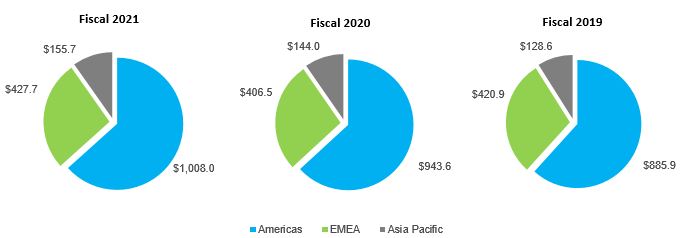
The following charts depict revenue related to our reportable segments.
(in millions)
Human Capital Management
Who We Are
As of August 31, 2021, we had 37 offices across 20 countries with 10,892 employees, representing an increase of 3.9% in the last twelve months. Of our total employees, 7,080 (65%) were located in Asia Pacific, 2,439 (22%) in the Americas and 1,373 (13%) in EMEA. In order to optimize productivity, we have invested in expanding our footprint and talent pool in India and the Philippines, where we now have a combined workforce of approximately 6,800 employees. Functionally, 22% of our employees are in Sales and Client Solutions; 30% are in Technology & Product Development; 44% are in Content Operations; and 4% are in Corporate Support. As of August 31, 2021 and August 31, 2020, 460 of our employees were represented by mandatory works councils within certain of our French and German subsidiaries. No other FactSet employees are represented by collective bargaining agreements.
Our Purpose and Values
Our purpose is to drive the investment community to see more, think bigger, and do their best work. Intense client focus and support is a critical component of our strategic aim and operational approach. Our employees are critical to our success and enable us to execute at a high level. We have built a collaborative culture that recognizes and rewards innovation and offers employees a variety of opportunities and experiences. We believe that our continued focus on making our employees a top priority helps us provide high quality insights and information to clients globally.

Employee Engagement
We conduct an annual, anonymous and confidential global employee engagement survey administered by a third party to capture our employees’ constructive feedback on a broad range of topics. The survey's scores and comments provide insight on appropriate action to improve our employees’ experience and our overall effectiveness as an organization. Aggregated survey results are reviewed by executive and senior leadership and direct managers to analyze and identify company-wide and
individual operational unit focus areas and action plans for improvement. We share survey results with all employees to highlight areas that employees believe are strengths of FactSet and reflect on areas where employees feel there are opportunities for positive change. Progress on initiatives is tracked to ensure that the actions taken address the underlying issues and promote an environment of continuous improvement.
In our fiscal 2021 employee engagement survey, we achieved a 92% response rate, indicating that we heard from the vast majority of our employees. Our overall engagement at the Company level was our highest since we implemented this survey. We increased scores for all questions at the Company level, and in over 10,000 comments received, employees told us that they felt supported through the COVID-19 pandemic and continue to have pride in their work, colleagues, and company. Our highest scores were in the areas of diversity, equity and inclusion and employee’s understanding of how they contribute to FactSet’s success, reflecting our culture where employees feel that they are treated fairly and are comfortable being themselves.
Diversity, Equity & Inclusion
We recognize that our best ideas can come from anyone, anywhere, at any time, and help us provide the best solutions for our clients around the globe. We continually seek to expand our workforce with diverse perspectives, backgrounds, and experiences. By fostering a globally inclusive culture, we enable our people to be themselves at work and to join in, be heard, contribute, and grow. Together, we work to recruit, advance, and engage talent at FactSet with an inclusive culture unified by the FactSet spirit of going above and beyond.
In fiscal 2021, we continued our strong commitment to Diversity, Equity & Inclusion ("DE&I") in the following ways:
Governance & Leadership Commitment
DE&I at FactSet begins with a commitment from our CEO and the entire FactSet leadership team to improve diversity representation as part of our DE&I strategy. In Fiscal 2021, we strengthened our DE&I governance by creating the FactSet Global DE&I Council, consisting of over 20 senior leaders from across FactSet who are empowered to drive our DE&I progress and create strategic accountability for DE&I results. In addition, our senior leaders serve as Executive Sponsors for our Business Resource Groups ("BRGs"), or employee networks.
Global DE&I Strategy
In fiscal 2021 we refreshed our DE&I strategy and expanded its scope. Our new DE&I strategy consists of three impact areas - Workforce, Marketplace and Society - with twelve levers to drive these impact areas. For Workforce, the levers are leadership commitment, transparency and accountability, people processes, retention and advancement, recruitment, education and engagement, leading ultimately to inclusion, equity and belonging. For Marketplace, our levers are supplier diversity and collaboration with clients, with a goal to increase economic opportunity. For Society, our levers are investments, contributions and corporate voice, designed to drive social justice.
Investment in DE&I Resources
In order to deliver on our commitments, we have significantly increased our investment in DE&I, both in staffing and budget. This includes the appointment of our first ever Chief DE&I Officer who leads a team of five dedicated DE&I staff globally.
Key DE&I Actions Taken in FY2021
During fiscal 2021, for the first time, we published our workforce demographics (including sharing our EEO-1 Federal data) in our annual Corporate Responsibility report. By reporting our workforce demographics, we made a visible step in our DE&I commitment as we aspire to change the composition of our employee demographics by 2023 to better include underrepresented groups. For example, we aim to increase the percentage of women at FactSet overall, and specifically the percentage of women in our leadership group (vice president level and above) and in our technical areas. We will continue to report on our progress annually to increase transparency and to facilitate accountability.
Other DE&I actions taken during Fiscal 2021 included: launching new BRGs globally; providing education on DE&I topics across our organization; joining the Human Rights Campaign Business Coalition for the Equality Act and MLT Black Equity At Work; providing opportunities for two employees, on full pay/benefits, to join the CEO Action for Racial Equity Fellowship; holding all-staff DE&I events such as #StopAsianHate; launching our Racial Justice Allies initiative; creating a new Diversity Recruitment role and changing our recruitment processes to mandate diverse interview slates while developing relationships with historically black colleges and universities (HBCUs); and observing Juneteenth as a paid holiday in the U.S.
Supporting Our Employees Through COVID-19
As the onset and spread of the COVID-19 pandemic created uncertainty and anxiety, our highest priority concern has been the health and safety of our employees, our families and our communities. During fiscal 2021, we required the vast majority of our employees at our offices across the globe (including corporate headquarters) to work remotely on a temporary basis, and provided them with support to be able to continue to work productively while being remote. We presented regular all-company meetings led by our CEO and offered extensive benefit resources and mental health support. Employees were offered additional paid time off for COVID-19 illness and family care and to receive and recover from COVID-19 vaccinations.
We have begun to re-open offices and welcome employees back, utilizing a three-phased approach to provide flexibility for employees with a focus on safety. Our offices will not re-open until local authorities permit us to do so and our own criteria and conditions to ensure employees health and safety are satisfied. Additionally, we have been implementing and will continue to support a variety of work options, such as flexible work arrangements permitting remote working or “hybrid” arrangements with the ability to split time between working remotely and in the office.
Learning & Development
At FactSet, we are lifelong learners. We believe that learning and development emboldens our employees, fosters outperformance with a growth mindset, demonstrates our commitment to core values, and contributes to the success of FactSet’s culture and business.
This year we centralized and expanded our Global Learning & Development department, allowing us to better leverage the training, content, product, and technology expertise that exists across our business lines to provide all employees with more opportunities to learn and grow their careers with FactSet. As a commitment to making learning accessible for employees around the world, our CEO and Executive Leadership Team strongly encourage all employees to set aside four hours each month for active learning.
During fiscal 2021, we launched LinkedIn Learning for all FactSet employees, providing curated content by experts in numerous fields, allowing employees to take courses based on their interests, performance goals, and/or professional enrichment. In addition to LinkedIn Learning and other third-party eLearning providers, we create hundreds of in-house eLearnings each year to help our employees learn about our business, industry, clients, and products. In response to the COVID-19 pandemic, all employee education was quickly transitioned to virtual classrooms. As employees adjusted to remote work and a changing world, we offered eLearning on remote working, remote collaboration tools, and mental health.
Compensation, Benefits and Well-being
FactSet offers our employees a broad range of competitive compensation, benefits and well-being programs which are designed to meet the diverse needs of our global employee population and which are reflective of our Company’s values and culture. Offering competitive and performance-focused compensation is essential to our talent strategies regarding recruitment, development, and retention. Programs are designed to be competitive in the markets in which we compete for talent and align with the short and long-term objectives of FactSet and our individual business units.
Our employee compensation may include one or more of the following elements: base salaries, annual incentive awards, sales incentive awards, and equity awards. We differentiate individual salary, bonus and equity awards based on performance against key objectives and how effectively our managers and employees demonstrate behaviors consistent with our values and culture.
FactSet is committed to offering high-quality, affordable, locally competitive benefits options designed to meet the needs of our employees and their families and to support our employees’ physical, emotional, financial, and social well-being at every stage of life. Employees in all FactSet locations globally have access to an Employee Assistance Program, providing employees and their immediate family members access to experienced professional counselors for personal and professional support. In addition to offering access to professional counseling services, we provide our employees and families with education and resources. We provide regular updates on health coverage and resources available through our health plans.
Third-Party Content
We aggregate content from third-party data suppliers, news sources, exchanges, brokers and contributors into our dedicated managed database, which our clients access through our flexible delivery platforms to perform their analysis. We seek to maintain contractual relationships with a minimum of two content providers for each major type of financial data, though certain data sets on which we rely have a limited number of suppliers. We make every effort to assure that, where reasonable, alternative sources are available. We are not dependent on any one third-party data supplier in order to meet the needs of our clients. We have entered into third-party content agreements of varying lengths, which in some cases can be terminated on one
year’s notice, at predefined dates, and in other cases on shorter notice. We are not dependent on any one third-party data supplier in order to meet the needs of our clients, with only two data suppliers representing more than 10% of our total data costs for the twelve months ended August 31, 2021.
Data Centers and Cloud Computing
Our business is dependent on our ability to process substantial volumes of data and transactions rapidly and efficiently on our networks and systems. Our global technology infrastructure supports our operations and is designed to facilitate the reliable and efficient processing and delivery of data and analytics to our clients. Our data centers contain multiple layers of redundancy to enhance system performance, including maintaining, processing and storing data at multiple data centers. User connections are load balanced between data centers. In the event of a site failure, equipment problem or localized disaster, the remaining centers have the capacity to handle the additional load. We continue to be focused on maintaining a global technological infrastructure that allows us to support our growing business.
We continue to operate fully redundant data centers in both Virginia and New Jersey in the U.S. that can handle our entire client capacity. In addition, as we look to host more of our infrastructure and products on the cloud, we are migrating select systems and applications to diverse cloud computing regions utilizing premier, market-leading cloud providers.
The Competitive Landscape
We are a part of the financial information services industry, providing financial data, analytics and workflow solutions to the global investment community. This competitive market is comprised of both large, well-capitalized companies and smaller, niche firms including market data suppliers, news and information providers and many third-party content providers that supply us with financial information included in our products. Our largest competitors are Bloomberg L.P., Refinitiv (a London Stock Exchange Group business) and Market Intelligence (an S&P Global business). Other competitors and competitive products include online database suppliers and integrators and their applications, such as BlackRock Solutions, Morningstar Inc. and MSCI Inc. Many of these firms provide products or services similar to our own offerings.
We believe there are high barriers to entry and we expect it would be difficult for another vendor to quickly replicate the extensive data we currently offer. Through our in-depth analytics and client service, we believe we can offer clients a more comprehensive solution with one of the broadest sets of functionalities delivered through a desktop or mobile user interface or through a standardized or bespoke data feed as well as an API. In addition, our applications, including our client support and service offerings, are entrenched in the workflow of many financial professionals given the downloadable functionality, instant data refresh and portfolio analysis/screening capabilities offered. We are entrusted with significant amounts of our clients' own proprietary data, including portfolio holdings. As a result, we believe our products are central to our clients’ investment analysis and decision-making.
Intellectual Property
We have registered trademarks and copyrights for many of our products and services and will continue to evaluate the registration of additional trademarks and copyrights as appropriate. We enter into confidentiality agreements with our employees, clients, data suppliers and vendors. We seek to protect our workflow solutions, documentation and other written materials under trade secret, copyright and patent laws. While we do not believe we are dependent on any one of our intellectual property rights, we do rely on the combination of intellectual property rights and other measures to protect our proprietary rights. Despite these efforts, existing intellectual property laws may afford only limited protection.
Research & Product Development Costs
A key aspect of our growth strategy is to offer new solutions and enhance our existing products and applications by making them faster with more reliable data. We strive to rapidly adopt new technology that can improve our products and services. We do not have a separate research and product development department, but rather rely on these departments to work closely with our strategists, product managers, sales and other client-facing specialists to develop new products and process innovations and enhance existing products. These costs primarily consist of personnel-related expenses, such as salaries and related benefits for our product development, software engineering and technical support departments and, if not capitalized, are included in employee compensation (found within of Cost of Services expense and Selling, general, and administrative ("SG&A") in the Consolidated Statements of Income). Research and product development costs include the salary and benefits for our product development, software engineering and technical support staff working on these initiatives. We incurred research and product development costs of $250.1 million, $224.0 million, and $214.7 million during fiscal years 2021, 2020, and 2019, respectively.
Government Regulation
We are subject to reporting requirements, disclosure obligations and other recordkeeping requirements of the Securities and Exchange Commission ("SEC") and the various local authorities that regulate each location in which we operate. Our P.A.N. Securities, LP subsidiary is a member of the Financial Industry Regulatory Authority, Inc. and is a registered broker-dealer under Section 15 of the Securities Exchange Act of 1934. P.A.N. Securities, LP, as a registered broker-dealer, is subject to Rule 15c3-1 under the Securities Exchange Act of 1934, which requires that we maintain minimum net capital requirements. We claim exemption under Rule 15c3-3(k)(2)(i).
Corporate Contact Information
FactSet was founded as a Delaware corporation in 1978, and our principal executive office is in Norwalk, Connecticut.
Mailing address of FactSet's headquarters: 45 Glover Avenue Norwalk, CT 06850
Telephone number: +1 (203) 810-1000
Website address: www.factset.com
Available Information
Through the Investor Relations section of our website (https://investor.factset.com), we make available free of charge the following filings as soon as practicable after they are electronically filed with, or furnished to, the SEC: our Annual Report on Form 10-K, Quarterly Reports on Form 10-Q, Current Reports on Form 8-K, Proxy Statements for the annual stockholder meetings, Reports on Forms 3, 4 and 5, and any amendments to those reports filed or furnished pursuant to Section 13(a) or 15(d) of the Securities Exchange Act of 1934, as amended. The SEC maintains a website that contains reports, proxy and information statements and other information that we file with the SEC at www.sec.gov.
Additionally, we broadcast our quarterly earnings calls live via the investor relations section of our website. We also provide notifications of news or announcements regarding our financial performance, including investor events and press and earnings releases on our investor relations website. The contents of this website section are not intended to be incorporated by reference into this Annual Report on Form 10-K or in any other report or document we file with the SEC and any reference to this section of our website is intended to be inactive textual references only.
Executive Officers of the Registrant
The following table shows FactSet’s current executive officers:
| Name of Officer | Age | Office Held with FactSet | Officer Since | ||||||||
| F. Philip Snow | 57 | Chief Executive Officer | 2014 | ||||||||
| Linda S. Huber | 63 | Executive Vice President, Chief Financial Officer | 2021 | ||||||||
| Rachel R. Stern | 56 | Executive Vice President, Chief Legal Officer, Global Head of Strategic Resources and Secretary | 2009 | ||||||||
| Gene D. Fernandez | 54 | Executive Vice President, Chief Technology and Content Officer | 2017 | ||||||||
| Robert J. Robie | 43 | Executive Vice President, Head of Analytics & Trading Solutions | 2018 | ||||||||
| Helen L. Shan | 54 | Executive Vice President, Chief Revenue Officer | 2018 | ||||||||
| Daniel Viens | 64 | Executive Vice President, Chief Human Resources Officer | 2018 | ||||||||
| Goran Skoko | 60 | Executive Vice President, Managing Director EMEA and Asia Pacific, Head of Research & Advisory Solutions | 2019 | ||||||||
| Kristina W. Karnovsky | 42 | Executive Vice President, Chief Product Officer | 2021 | ||||||||
| Jonathan Reeve | 53 | Executive Vice President, Head of Content & Technology Solutions | 2021 |
F. Philip Snow – Chief Executive Officer**.** Mr. Snow was named Chief Executive Officer effective July 1, 2015. Prior to that, Mr. Snow held the title of President. He began his career at FactSet in 1996 as a Consultant, before moving to Asia to hold positions in the Tokyo and Sydney offices. Following his move back to the U.S. in 2000, Mr. Snow held various sales leadership roles prior to assuming the role of Senior Vice President, Director of U.S. Investment Management Sales in 2013. Mr. Snow received a Bachelor of Arts in Chemistry from the University of California at Berkeley and a Master of International Management from the Thunderbird School of Global Management. He has earned the right to use the Chartered Financial Analyst designation.
Linda S. Huber - Executive Vice President, Chief Financial Officer. Ms. Huber was appointed Executive Vice President, Chief Financial Officer of FactSet in October 2021. As Chief Financial Officer, she is responsible for FactSet’s global finance organization and oversees all financial functions, including accounting, corporate development, financial planning and analysis (FP&A), treasury, tax, and investor and media relations. Prior to joining FactSet, Ms. Huber served as Chief Financial Officer and Treasurer at MSCI Inc. Prior to joining MSCI, she served as Executive Vice President and Chief Financial Officer of Moody’s Corporation from May 2005 to June 2018. Earlier in her career, Ms. Huber served in several increasingly senior roles in financial services, including Executive Vice President and Chief Financial Officer at U.S. Trust Company, a subsidiary of Charles Schwab & Company, Inc.; Managing Director at Freeman & Co.; Vice President of Corporate Strategy and Development and Vice President and Assistant Treasurer at PepsiCo.; Vice President of Energy Investment Banking Group at Bankers Trust Co.; and Associate in the Natural Resources Group at The First Boston Corp. Ms. Huber also held the rank of Captain in the U.S. Army. Ms. Huber earned an MBA from the Stanford Graduate School of Business and a B.S. degree in business and economics from Lehigh University.
Rachel R. Stern – Executive Vice President, Chief Legal Officer, Global Head of Strategic Resources and Secretary. Ms. Stern was appointed Executive Vice President, Chief Legal Officer and Global Head of Strategic Resources and Secretary in October 2018. In addition to her role in the Legal Department, Ms. Stern is also responsible for Compliance, Facilities Management and Real Estate Planning and the administration of our offices in Hyderabad, Manila and Riga. Ms. Stern joined FactSet in January 2001 as General Counsel. Ms. Stern is admitted to practice in New York, Washington D.C., and as House Counsel in Connecticut. Ms. Stern received a Bachelor of Arts from Yale University, a Master of Arts from the University of London and a Juris Doctor from the University of Pennsylvania Law School.
Gene D. Fernandez – Executive Vice President, Chief Technology and Content Officer. Mr. Fernandez was appointed Chief Technology and Content Officer in July 2021. He joined FactSet as Chief Technology and Product Officer in November 2017 from J.P. Morgan, where he served as the Chief Technology Officer, New Product Development. In this role, he developed the strategy and built the engineering function responsible for new product innovation. During a decade at J.P. Morgan, Mr. Fernandez held various other roles, including Chief Technology Officer for Client Technology and Research and Banking
Information Technology. Prior to J.P. Morgan, he worked at Credit Suisse and Merrill Lynch. Mr. Fernandez received a Bachelor of Science in Computer Science and Economics from Rutgers University.
Robert J. Robie – Executive Vice President, Head of Analytics & Trading Solutions. Mr. Robie was appointed Executive Vice President, Head of Analytics & Tradition Solutions in September 2018. In his current role, he oversees strategy, research, development and engineering for Analytics & Trading platforms. Mr. Robie joined FactSet in July 2000 as a Product Sales Specialist. During his tenure at FactSet, Mr. Robie has held several positions of increased responsibility, including Senior Director of Analytics and Director of Global Fixed Income. Although Mr. Robie joined FactSet in 2000, he did work at BTN Partners from 2004 through 2005 in their quantitative portfolio management and performance division, before returning to continue his career with FactSet. Mr. Robie holds a Bachelor of Arts in Economics and Fine Arts from Beloit College.
Helen L. Shan – Executive Vice President, Chief Revenue Officer. Ms. Shan was appointed Executive Vice President, Chief Revenue Officer effective May 3, 2021. As the Chief Revenue Officer, she is responsible for driving revenue growth by managing global sales, client solutions, and marketing. Ms. Shan joined FactSet as Chief Financial Officer in September 2018 where she oversaw all financial functions at FactSet. Prior to that, she was at Marsh McLennan Companies, where she served in a variety of roles, including as the company's Corporate Treasurer and also as Chief Financial Officer for Mercer, a professional services firm where she was responsible for global financial reporting and performance, operational finance, investments, and corporate strategy. Preceding that, Ms. Shan also served as the Vice President and Treasurer for Pitney Bowes Inc. and served as a Managing Director at J.P. Morgan. In September 2018, Ms. Shan joined the Board of Directors of EPAM Systems Inc., a global provider of digital platform engineering and software development services. Ms. Shan holds dual degrees with a Bachelor of Science and a Bachelor of Applied Science from the University of Pennsylvania’s Wharton School of Business and School of Applied Science and Engineering. Ms. Shan also has a Master of Business Administration from Cornell University’s SC Johnson College of Business.
Daniel Viens – Executive Vice President, Chief Human Resources Officer. Mr. Viens was appointed Executive Vice President Chief Human Resources Officer in October 2021. Mr. Viens joined FactSet in September 1998 as a Vice President, Director of Human Resources and has held several leadership positions of increased responsibility in Human Resources. Prior to joining FactSet, Mr. Viens was a Director of Human Resources for First Data Solutions and Donnelly Marketing (a former company of Dun & Bradstreet), where he developed significant Human Resources acumen. Mr. Viens graduated from Boston University, and holds both a Master's Degree from Eastern Illinois University in Clinical Psychology and a Master of Business Administration from Columbia University.
Goran Skoko – Executive Vice President, Managing Director EMEA and Asia Pacific, Head of Research & Advisory Solutions. Mr. Skoko was appointed Executive Vice President, Managing Director EMEA and Asia Pacific and Head of Research & Advisory in July 2021. In his current role, Mr. Skoko is responsible for providing direction to address the product and content needs for EMEA and Asia Pacific clients while also focusing on increased deployment and building community with our Research & Advisory solutions. Prior to that, Mr. Skoko was Executive Vice President, Managing Director EMEA and Asia Pacific and Head of Wealth Solutions. He joined FactSet in 2004 as a Senior Product developer and has held a number of positions of increased responsibility. Prior to FactSet, he spent 16 years in various engineering and product management roles at Thomson Financial. Mr. Skoko earned his B.S. in Physics and Computer Science from Fordham University.
Kristina W. Karnovsky – Executive Vice President, Chief Product Officer. Ms. Karnovsky was appointed Executive Vice President, Chief Product Officer in July 2021. In her current role she works across the entire product portfolio to deliver a differentiated advantage for clients and support their success. Prior to this role, Ms. Karnovsky was Head of Research Solutions. Ms. Karnovsky joined FactSet in 2001 as a Consultant and spent over a decade building FactSet's sell-side business in Sales leadership roles. Ms. Karnovsky earned a bachelor's degree from the University of Scranton.
Jonathan Reeve – Executive Vice President, Head of Content & Technology Solutions. Mr. Reeve was appointed Executive Vice President, Head of Content & Technology Solutions at FactSet in October 2021. As Head of Content & Technology Solutions, he oversees and leads the development of FactSet’s off-platform products, including financial data solutions, application technologies, and the delivery of FactSet proprietary and third-party content over our data feeds, API’s, Open FactSet Marketplace, and cloud-delivery solutions. Mr. Reeve joined FactSet in April 2020 as Senior Vice President and Head of Content & Technology Solutions. Prior to joining FactSet, Mr. Reeve led Connectivity, Feeds and Desktop Businesses at Intercontinental Exchange (ICE). Earlier in his career, he held various positions at S&P Global, including Chief Data Officer and Head of Product & Content for the S&P Market Intelligence Division. Mr. Reeve earned a B.A in Economics from Concordia University in Montreal.
Additional Information
Additional information with respect to our business is included in the following pages and is incorporated herein by reference:
Item 1A. RISK FACTORS
The following risks could materially and adversely affect our business, financial condition, results of operations, and cash flows and, as a result, the trading price of our common stock could decline. These risk factors do not identify all risks that we face; our operations could also be affected by factors that are not presently known to us or that we currently consider to be immaterial to our operations. Due to risks and uncertainties, known and unknown, our past financial results may not be a reliable indicator of future performance, and historical trends should not be used to anticipate results or trends in future periods. Investors should also refer to the other information set forth in this Annual Report on Form 10-K, including Item 7. Management’s Discussion and Analysis of Financial Condition and Results of Operations and our Consolidated Financial Statements including the related Notes. Investors should carefully consider all risks, including those disclosed here, before making an investment decision.
Technology & Data Security Risks
Loss, corruption and misappropriation of data and information relating to clients and others
Many of our products, as well as our internal systems and processes, involve the collection, retrieval, processing, storage and transmission through a variety of media channels of our own, as well as supplier and customer, proprietary information and sensitive or confidential data. We rely on, and continuously invest in, a complex system of internal processes and controls, along with policies, procedures and training, designed to protect data that we receive in the ordinary course of business, including information from client portfolios and strategies. However, these measures do not guarantee security, and improper access to or release of confidential information may still occur through, for example, employee error or malfeasance, system error, other inadvertent release, failure to properly purge and protect data, or cyberattack. Additionally, the maintenance and enhancement of our systems may not be completely effective in preventing loss, unauthorized access or misappropriation. Data misappropriation, unauthorized access or data loss could instill a lack of confidence in our products and systems and damage our brand, reputation and business. Breaches of security measures could expose us, our clients or the individuals affected to a risk of loss or misuse of this information, potentially resulting in litigation and liability for us, as well as the loss of existing or potential clients and suppliers. Many jurisdictions in which we operate have laws and regulations relating to data privacy and protection of personal information, including the European Union General Data Protection Regulation, which became effective May 25, 2018, California's Consumer Privacy Act, which became effective January 1, 2020, and China's Personal Information Protection Law, which becomes effective November 1, 2021. These laws contain requirements regarding the handling of personal and sensitive data, including our use, protection and the ability of persons whose data is stored to correct or delete such data about themselves. The law in this area continues to develop and the changing nature of privacy laws could impact our processing of personal and sensitive information related to our content, operations, employees, clients, and suppliers, and may expose us to claims of violations.
Successful prohibited data access and other cyber-attacks and the failure of cyber-security systems and procedures
In providing our digital-enabled services to clients, we rely on information technology infrastructure that is managed internally along with placing reliance on third-party service providers for critical functions. We and these third-party service providers are subject to the risks of system failures and security breaches, including cyber-attacks (including those sponsored by nation-states, terrorist organizations, or global corporations seeking to illicitly obtain technology or other intellectual property), such as phishing scams, hacking, viruses, denials of service attacks, tampering, intrusions, physical break-ins, ransomware and malware as well as employee errors or malfeasance. In some cases, these risks might be heightened when employees are working remotely. Our and our vendors' use of mobile and cloud technologies may increase our risk for such threats. Our protective systems and procedures and those of third parties to which we are connected, such as cloud computing providers, may not be effective against these threats. Our information technology systems must be constantly updated and patched to protect against known vulnerabilities and to optimize performance. While we have dedicated resources responsible for maintaining appropriate levels of cybersecurity and implemented systems and processes intended to help identify cyberattacks and protect and remediate our network infrastructure, we are aware that these attacks have become increasingly frequent, sophisticated, and difficult to
detect and, as a result, we may not be able to anticipate, prevent or detect all such attacks. We also may be impacted by a cyberattack targeting one of our vendors or within our technology supply chain or infrastructure. Our contracts with service providers typically require them to implement and maintain adequate security controls, but we may not have the ability to effectively monitor these security measures. As a result, inadequacies of the third-party security technologies and practices may not be detected until after a security breach has occurred. These risks may be heightened in connection with employees working from remote work environments, as our dependency on certain service providers, such as video conferencing and web conferencing services, has significantly increased. In addition, to access our network, products and services, customers and other third parties may use personal mobile devices or computing devices that are outside of our network environment and are subject to their own security risk. We could suffer significant damage to our brand and reputation: if a cyber-attack or other security incident were to allow unauthorized access to, or modification of, clients’ or suppliers’ data, other external data, internal data or information technology systems; if the services provided to clients were disrupted; or if products or services were perceived as having security vulnerabilities. The costs we would incur to address and resolve these security incidents would increase our expenses. These types of security incidents could also lead to lawsuits, regulatory investigations and claims, loss of business and increased legal liability. Cyberattacks, security breaches or third-party reports of perceived security vulnerability to our systems, even if no breach has occurred, also could damage our brand and reputation, result in litigation, regulatory actions, loss of client confidence and increased legal liability. We also make acquisitions periodically. While significant effort is placed on addressing information technology security issues with respect to the acquired companies, we may inherit such risks when these acquisitions are integrated into our infrastructure.
A prolonged or recurring outage at our data centers and other business continuity disruptions at facilities could result in reduced service and the loss of clients
Our clients rely on us for the delivery of time-sensitive, up-to-date data and applications. Our business is dependent on our ability to process substantial volumes of data and transactions rapidly and efficiently on our computer-based networks, database storage facilities, and other network infrastructure, which are located across multiple facilities globally. If we experience significant growth of our customer base or increases in the number of products or services or in the speed at which we are required to provide products and services, it may strain our systems. Additionally, our systems and networks may become strained due to aging or end-of-life technology that we have not yet updated or replaced. Our computer operations, as well as our other business centers, and those of our suppliers and clients, are vulnerable to interruption by fire, natural disaster, power loss, telecommunications failures, terrorist attacks, acts of war, civil unrest, internet failures, computer viruses, security breaches, and other events beyond our reasonable control. In addition, in the remote work environments, the daily activities and productivity of our workforce is now more closely tied to key vendors, such as video conferencing services, consistently delivering their services without material disruption. Our ability to deliver information using the internet and to operate in a remote working environment may be impaired because of infrastructure failures, service outages at third-party internet providers, malicious attacks, or other factors. We maintain back-up facilities and certain other redundancies for each of our major data centers to minimize the risk that any such event will disrupt those operations. However, a loss of our services involving our significant facilities may materially disrupt our business and may induce our clients to seek alternative data suppliers. Any such losses or damages we incur could have a material adverse effect on our business. Although we seek to minimize these risks through security measures, controls, back-up data centers and emergency planning, there can be no assurance that such efforts will be successful or effective. Additionally, we may also face significant increases in our use of power and data storage and may experience a shortage of capacity and increased costs associated with such usage.
Transition to new technologies, applications and processes could expose us to unanticipated disruptions
The technology landscape is constantly evolving. To remain competitive, we must adapt and migrate to new technologies, applications and processes. Use of more advanced technologies and infrastructure is critical to the development of our products and services, the scaling of our business for future growth, and the accurate maintenance of our data and operations. The implementation of new technologies and infrastructure, such as migration to new cloud-based systems, is complex and can involve substantial expenditures as well as risks inherent in the conversion to any new system, including potential loss of information and disruption to operations. We may experience unanticipated interruption and delay in the performance and delivery of certain of our products and services. Certain of our technologies are also dependent upon third-party providers to maintain adequate systems to protect the security of our confidential information and data. Failure by our providers to maintain appropriate security could result in unauthorized access to our systems or a network disruption that could further lead to improper disclosure of confidential information or data, regulatory penalties and remedial costs. Any disruption to either the provider’s systems or the communication links between us and the provider could negatively affect our ability to operate our data systems and could impair our ability to provide services to our clients. If the services to our clients are disrupted, or if there is unauthorized access to the confidential information of our clients or our vendors, we could suffer significant damage to our brand and reputation and lose clients. We also may incur increased operating expenses to recover data, repair or remediate systems, equipment or facilities, and to protect ourselves from such disruptions. As we increase our reliance on third-party
systems, our exposure to damages from services disruptions may increase, and we may incur additional costs to remedy damages caused by these disruptions.
Use of open source software could introduce security vulnerabilities, impose unanticipated restrictions on our ability to commercialize our products and services, and subject us to increased costs
We use open source code in our software development and incorporate it into our products and internal systems. The use of open source code may entail greater risks than the use of third-party commercial software. Open source licensors generally do not provide warranties or other contractual protections regarding infringement claims or the quality or security of the code. Some open source licenses provide that if we combine our proprietary applications with the open source software in a certain manner, we could be required to release the source code of our proprietary applications to the public. This would allow our competitors to create similar products with less development effort and time and ultimately put us at a competitive disadvantage. We have implemented procedures to control the use of source code so as to mitigate this risk; however, the terms of many open source licenses are also ambiguous and have not been interpreted by U.S. or other courts. Therefore, there is a risk that our internal procedures controlling the use of open source code could fail, or that the licenses could be construed in a manner that imposes unanticipated conditions or restrictions on us. If any of this were to occur, we could be required to seek alternative third-party licenses at increased costs or reduced scope, to re-engineer products or systems, or potentially to discontinue the licensing of certain products. Any remedial actions could divert resources away from our development efforts, be time intensive and have a significant cost.
Strategy & Market Demand Risks
Competition in our industry may cause price reductions or loss of market share
We continue to experience intense competition across all markets for our products, with competitors ranging in size from smaller, highly specialized, single-product businesses to multi-billion-dollar companies. While we believe the breadth and depth of our suite of products and applications offer benefits to our clients that are a competitive advantage, our competitors may offer price incentives to attract new business. Future competitive pricing pressures may result in decreased sales volumes and price reductions, resulting in lower revenue and ASV. Weak economic conditions may also result in clients seeking to utilize lower-cost information that is available from alternative sources. The impact of cost-cutting pressures across the industries we serve could lower demand for our products. Clients within the financial services industry that strive to reduce their operating costs may seek to reduce their spending on financial market data and related services, such as ours. If our clients consolidate their spending with fewer suppliers, by selecting suppliers with lower-cost offerings or by self-sourcing their needs for financial market data, our business could be negatively affected.
The continued shift from active to passive investing could negatively impact user count growth and revenue
The predominant investment strategy today is still active investing, which attempts to outperform the market. The main advantage of active management is the expectation that the investment managers will be able to outperform market indices. They make informed investment decisions based on their experiences, insights, knowledge and ability to identify opportunities that can translate into superior performance. The main advantage of passive investing is that it closely matches the performance of market indices. Passive investing requires little decision-making by investment managers and low operating costs which result in lower fees for the investor. A continued shift to passive investing, resulting in an increased outflow to passively managed index funds, could reduce demand for the services of active investment managers and consequently, the demand of our clients for our services.
A decline in equity and/or fixed income returns may impact the buying power of investment management clients
Approximately 83% of our ASV is derived from our investment management clients. The profitability and management fees of these clients are tied to assets under management. An equity market decline not only depresses the value of assets under management but also could cause a significant increase in redemption requests from our clients’ customers, further reducing their assets under management. Reduced client profits and management fees may cause our clients to cut costs. Moreover, extended declines in the equity and fixed income markets may reduce new fund or client creation. Each of these developments may result in lower demand from investment managers for our services and workstations, which could negatively affect our business.
Uncertainty in the global economy and consolidation in the financial services industry may cause us to lose clients and users
Many of our clients are investment banks, asset managers, wealth advisors, and other financial services entities. Uncertainty in the global economy or a lack of confidence in the global financial system could negatively impact our clients, which could cause a corresponding negative impact on our business results. Mergers, consolidation or contraction of our clients in the financial services industry also could directly impact the number of clients and prospective clients and users of our products and services. If our clients merge with or are acquired by other entities that are not our clients, or that use fewer of our products and services, they may discontinue or reduce their use of our products and services. Thus, economic uncertainty, lack of confidence in the global financial system, and consolidation in this sector could adversely affect our business, financial results and future growth.
Volatility in the financial markets may delay the spending pattern of clients and reduce future ASV growth
The decision on the part of large institutional clients to purchase our services often requires management-level sponsorship and typically depends upon the size of the client, with larger clients having more complex and time-consuming purchasing processes. The process is also influenced by market volatility. These characteristics often lead us to engage in relatively lengthy sales efforts. Purchases (and incremental ASV) may therefore be delayed as uncertainties in the financial markets may cause clients to remain cautious about capital and data content expenditures, particularly in uncertain economic environments. The COVID-19 pandemic may increase this risk as it may curtail our client's spending and lead them to delay or defer purchasing decisions or product service implementations, or cause them to cancel or reduce their spending with us, which could negatively impact our revenues and future growth.
Failure to develop and market new products and enhancements that maintain our technological and competitive position and failure to anticipate and respond to changes in the marketplace for our products and customer demands
The market for our products is characterized by rapid technological change, including methods and speed of delivery, changes in client demands, development of new investment instruments and evolving industry standards. The direction of these trends can render our existing products less competitive, obsolete or unmarketable. As a result, our future success will continue to depend upon our ability to identify and develop new products and enhancements that address the future needs of our target markets and to respond to their changing standards and practices. We may not be successful in developing, introducing, marketing, licensing and implementing new products and enhancements on a timely and cost-effective basis or without impacting the stability and efficiency of existing products and customer systems. Further, any new products and enhancements may not adequately meet the requirements of the marketplace or achieve market acceptance. We must make long-term investments and commit significant resources before knowing whether these investments will eventually result in products and services that satisfy our clients' needs and generate revenues required to provide the desired results. Our failure or inability to anticipate and respond to changes in the marketplace, including competitor and supplier developments, may also adversely affect our business, operations and growth.
Errors or defects can exist at any point in a product's life cycle, but are more frequently found after the introduction of new products or enhancements to existing products. Despite internal testing and testing by clients, our products may contain errors. We may also experience delays while developing and introducing new products for various reasons, such as difficulties in licensing data inputs. Defects, errors, or delays in our products that are significant, or are perceived to be significant, could result in rejection or delay in market acceptance, damage to our reputation, loss of revenue, lower rate of license renewals or upgrades, diversion of development resources, product liability claims or regulatory actions, or increases in service and support costs.
We have provisions in our client contracts to limit our exposure to potential liability claims brought by clients based on the use of our products or services or our delay or failure to provide services. Contracts with customers also increasingly include service level requirements and audit rights to review our security. Many of our customers in the financial services sector are also subject to regulations and requirements to adopt risk management processes commensurate with the level of risk and complexity of their third-party relationships, and provide rigorous oversight of relationships that involve certain "critical activities," some of which may be deemed to be provided by us. Any failure on our part to comply with the specific provisions in customer contracts could result in the imposition of various penalties, which may include termination of contracts, service credits, suspension of payments, contractual penalties, adverse monetary judgments, and, in the case of government contracts, suspension from future government contracting. Even if the outcome of any claims brought against us were ultimately favorable, such a claim would require the time and attention of our management, personnel, as well as financial and other resources and potentially pose a significant disruption to our normal business operations.
Failure to identify, integrate, or realize anticipated benefits of acquisitions and strains on resources as a result of growth
There can be no assurance that we will be able to identify suitable candidates for successful acquisition at acceptable prices. Additionally, there may be integration risks or other risks resulting from acquired businesses. Our ability to achieve the expected returns and synergies from past and future acquisitions and alliances depends in part upon our ability to integrate the offerings, technology, sales, administrative functions and personnel of these businesses effectively into our core business. We cannot guarantee that our acquired businesses will perform at the levels anticipated. In addition, past and future acquisitions may subject us to unanticipated risks or liabilities or disrupt operations.
Growth, such as the addition of new clients and acquisitions, puts demands on our resources, including our internal systems and infrastructure. These may require improvements or replacement to meet the additional demands of a larger organization. Further, the addition of new clients and the implementation of such improvements would require additional management time and resources. These needs may result in increased costs that could negatively impact results of operations. Failure to implement needed improvements, such as improved scalability, could result in a deterioration in the performance of our internal systems and negatively impact the performance of our business.
Failure to maintain reputation
We enjoy a positive reputation in the marketplace. Our ability to attract and retain clients and employees is affected by external perceptions of our brand and reputation. Reputational damage from negative perceptions or publicity could affect our ability to attract and retain clients and employees and our ability to maintain our pricing for our products. Although we monitor developments for areas of potential risk to our reputation and brand, negative perceptions or publicity could have a material adverse effect on our business and financial results.
Operational Risks
Failure to enter into, renew or comply with contracts supplying new and existing data sets or products on competitive terms
We collect and aggregate third-party content from data suppliers, news sources, exchanges, brokers and contributors into our own dedicated online service, which clients access to perform their analyses. We combine the data from these sources into our own dedicated databases. Clients have access to the data and content found within our databases. These databases are important to our operations as they provide clients with key information. We have entered into third-party content agreements of varying lengths, which in some cases can be terminated on one year’s notice at predefined dates, and in other cases on shorter notice. Some of our content provider agreements are with competitors, who may attempt to make renewals difficult or expensive. We seek to maintain favorable contractual relationships with our data suppliers, including those that are also competitors. However, we cannot control the actions and policies of our data suppliers and we may have data suppliers who provide us with notice of termination, or exclude or restrict us from use of their content, or only license such content at prohibitive cost. Additionally, despite our efforts to comply with our third-party data supplier agreements, there can be no assurances that third-parties may not challenge our use of their content, which could result in increased licensing costs, loss of rights, and costly legal actions. Certain data sets that we rely on have a limited number of suppliers, although we make every effort to assure that, where reasonable, alternative sources are available. We are not dependent on any one third-party data supplier in order to meet the needs of our clients, with only two data suppliers representing more than 10% of our total data costs for the twelve months ended August 31, 2021. Our failure to be able to maintain these relationships, or the failure of our suppliers to deliver accurate data or in a timely manner, or the occurrence of a dispute with a vendor over use of their content, could increase our costs and reduce the type of content and products available to our clients, which could harm our reputation in the marketplace and adversely affect our business.
Increased accessibility to free or relatively inexpensive information sources may reduce demand for our products
Each year, an increasing amount of free or relatively inexpensive information becomes available, particularly through the internet, and this trend may continue. The availability of free or relatively inexpensive information may reduce demand for our products. While we believe our service offering is distinguished by such factors as customization, timeliness, accuracy, ease-of-use, completeness and other value-added factors, if users choose to obtain the information they need from public or other sources, our business, results of operations, and cash flows could be adversely affected.
Inability to hire and retain key qualified personnel
Our business is based on successfully attracting, motivating and retaining talented and diverse employees. Creating a diverse and inclusive environment that promotes empowerment and engagement is key to our ability to attract, retain, and develop talent. Competition for talent, especially engineering personnel, is strong. We need technical resources such as engineers to help
develop new products and enhance existing services. We rely upon sales personnel to sell our products and services and maintain healthy business relationships. Our future success also is dependent on the continued service and performance of the members of our senior leadership team. All of these personnel possess business and technical capabilities that are difficult to replace. If we are unsuccessful in our recruiting efforts, or if we are unable to retain key employees, our ability to develop and deliver successful products and services may be adversely affected and could have a material, adverse effect on our business.
Operations outside the United States involve additional requirements and burdens that we may not be able to control or manage successfully
In fiscal 2021, approximately 40% of our revenue related to operations located outside the U.S. In addition, a significant number of our employees, approximately 78%, are located in offices outside the U.S. We expect our growth to continue outside the U.S., with non-U.S. revenues accounting for an increased portion of our total revenue in the future. Our non-U.S. operations involve risks that differ from or are in addition to those faced by our U.S. operations. These risks include difficulties in developing products, services and technology tailored to the needs of non-U.S. clients, including in emerging markets; different employment laws and rules; rising labor costs in lower-wage countries; difficulties in staffing and managing personnel that are located outside the U.S.; different regulatory, legal and compliance requirements, including in the areas of privacy and data protection, anti-bribery and anti-corruption, trade sanctions and currency controls, marketing and sales and other barriers to conducting business; social and cultural differences, such as language; diverse or less stable political, operating and economic environments and market fluctuations; civil disturbances or other catastrophic events that reduce business activity; limited recognition of our brand and intellectual property protection; differing accounting principles and standards; restrictions on or adverse tax consequences from entity management efforts; and changes in U.S. or foreign tax laws. If we are not able to adapt efficiently or manage the business effectively in markets outside the U.S., our business prospects and operating results could be materially and adversely affected.
The current COVID-19 pandemic and other global public health epidemics may adversely impact our business, our future results of operations and our overall financial performance
Our business could be materially and adversely affected by the risk, or the public perception of risk, related to a pandemic or widespread health crisis, such as the current COVID-19 pandemic. A significant outbreak, epidemic or pandemic of contagious diseases in the human population could result in a widespread health crisis adversely affecting the broader economies, financial markets and overall demand for our products. In addition, any preventative or protective actions that governments implement or that we take in respect of a global health crisis, such as travel restrictions, quarantines or site closures, may interfere with the ability of our employees, vendors, and data suppliers to perform their respective responsibilities and obligations relative to the conduct of our business, including our ability to gather content. Such results could have a material adverse effect on our operations, business, financial condition, results of operations, or cash flows.
Our operations have been affected by a range of external factors related to the COVID-19 pandemic that are not within our control. For example, many jurisdictions have imposed a wide range of restrictions on the physical movement of our employees and vendors to limit the spread of COVID-19. While to date the COVID-19 pandemic has not had a material negative impact on our financial condition, results of operations, or cash flows, due to the ongoing uncertainty related to the duration, magnitude and impact of the COVID-19 pandemic, its potential effects on our business remain uncertain. The COVID-19 pandemic may still have a substantial impact on our employees' or vendors' productivity, which could result in our operations, including our ability to gather content, suffering, and in turn our results of operations, cash flows, and overall financial performance may be impacted. Furthermore, if our employees incur substantial medical expenses due to COVID-19, our expenses may increase due to our self-funded employee medical insurance model. Our management is focused on mitigating the effects of COVID-19 on our business, which has required and will continue to require a substantial investment of their time and may delay their other efforts. The continued impact of COVID-19 may also increase the severity or likelihood of the other risks described in this Item, any of which could have a material effect on us.
We continue to closely monitor the impact of the COVID-19 pandemic and continually assess its potential effects on our business. In response to the COVID-19 pandemic, we implemented a business continuity plan with a dedicated incident management team to respond quickly and provide ongoing guidance. However, given the dynamic nature of these circumstances, the full impact of the COVID-19 pandemic cannot be reasonably estimated at this time. The extent to which our business, financial condition, results of operations, or cash flows are affected by COVID-19 will depend in part on future developments which cannot be accurately predicted and are uncertain, as there are no comparable recent events that provide guidance as to the potential effect of the spread of a global pandemic. The impact of the COVID-19 pandemic depends upon various uncertainties, including the ultimate geographic spread of the virus, the severity of the virus, the duration of the outbreak, and actions that may be taken by governmental authorities to contain the virus. This situation is changing continually, and additional effects may arise that we are not presently aware of or that we currently do not consider to be significant risks to our operations. If we are not able to respond to and manage the impact of such events effectively, our business and financial
condition could be negatively impacted. Refer to Item 7. Management’s Discussion and Analysis of Financial Condition and Results of Operations - COVID-19 Update for additional information.
Legal & Regulatory Risks
Legislative and regulatory changes in the environments in which we and our clients operate
As a business, we are subject to numerous laws and regulations in the U.S. and in the other countries in which we operate. These laws, rules, and regulations, and their interpretations, may change in the future or conflict, and compliance with these changes may increase our costs or cause us to make changes in or otherwise limit our business practices. In addition, the global nature and scope of our business operations make it more difficult to monitor areas that may be subject to regulatory and compliance risk. If we fail to comply with any applicable law, rule, or regulation, we could be subject to claims and fines and suffer reputational damage. Uncertainty caused by political change globally, and complex relationships across countries, including the U.S. and nations in Europe and Asia, heightens the risk of regulatory uncertainty.
Many of our clients operate within a highly regulated environment and must comply with governmental legislation and regulations. The U.S. regulators have increased their focus on the regulation of the financial services industry. Increased regulation of our clients may increase their expenses, causing them to seek to limit or reduce their costs from outside services such as ours. Additionally, if our clients are subjected to investigations or legal proceedings they may be adversely impacted, possibly leading to their liquidation, bankruptcy, receivership, reduction in assets under management, or diminished operations, which would adversely affect our revenue. Recent regulatory changes that we believe might materially impact us and our clients include:
MiFID
In the European Union, the new version of the Markets in Financial Instruments Directive (recast), also known as "MiFID II" became effective in January 2018. Prior to the effectiveness of the UK's withdrawal from the European Union on January 1, 2021, the UK laws and regulations implementing MiFID II were modified to transpose aspects of EU law and address deficiencies that would have otherwise been created as a result of the withdrawal. MiFID II built upon many of the initiatives introduced through MiFID and is intended to help improve the functioning of the European Union single market by achieving a greater consistency of regulatory standards. MiFID originally became effective in 2007. We believe that compliance with MiFID II requirements is time-consuming and costly for the investment managers who are subject to it and will cause clients to adapt their pricing models and business practices significantly. These increased costs may impact our clients’ spending and may cause some investment managers to lose business or withdraw from the market, which may adversely affect demand for our services. However, MiFID II may also present us with new business opportunities for new service offerings. We continue to monitor the impact of MiFID II on the investment process and trade lifecycle. We also continue to review the application of key MiFID II requirements and plan to work with our clients to navigate through them.
Brexit
On January 31, 2020, the United Kingdom formally left the European Union when the UK-EU Withdrawal Agreement became effective. Under the Withdrawal Agreement, a transition period began that ran until December 31, 2020. On January 1, 2021, the UK left the EU Single Market and Customs Union, as well as all EU policies and international agreements. As a result, the free movement of persons, goods, services and capital between the UK and the EU ended, and the EU and the UK formed two separate markets. On December 24, 2020, the EU reached a trade agreement with the UK (the "Trade Agreement") The Trade Agreement offers UK and EU companies preferential access to each other's markets, ensuring imported goods will be free of tariffs and quotas; however, economic relations between the UK and EU will now be on more restricted terms than existed previously. The Trade Agreement does not incorporate the full scope of the services sector, and businesses such as banking and finance face uncertainty. In March, 2021, the UK and EU have agreed on a framework for voluntary regulatory cooperation and dialogue on financial services issues between the two countries in a Memorandum of Understanding (the "MOU"), which is expected to be signed after formal steps are completed, although this has not yet occurred. At this time, we cannot predict the impact that the Trade Agreement, the MOU or any future agreements on services, particularly financial services, will have on our business and our clients. It is possible that new terms may adversely affect our operations and financial results. We continue to evaluate our own risks and uncertainty related to Brexit, and partner with our clients to help them navigate the fluctuating international markets. This uncertainty may have an impact on our clients’ expansion or spending plans, which may in turn negatively impact our revenue or growth.
Adverse resolution of litigation or governmental investigations
We are party to lawsuits in the normal course of our business. Litigation and governmental investigations can be expensive, lengthy and disruptive to normal business operations. Moreover, the results of complex legal proceedings are difficult to predict. Unfavorable resolution of lawsuits could have a material adverse effect on our business, operating results or financial condition. For additional information regarding legal matters, see Item 3. Legal Proceedings, of this Annual Report on Form 10-K.
Third parties may claim we infringe upon their intellectual property rights or may infringe upon our intellectual property rights
We may receive notice from others claiming that we have infringed upon their intellectual property rights. Responding to these claims may require us to enter into royalty and licensing agreements on unfavorable terms, incur litigation costs, enter into settlements, stop selling or redesign affected products, or pay damages and satisfy indemnification commitments with our clients or suppliers under contractual provisions of various license arrangements. Additionally, third parties may copy, infringe or otherwise profit from the unauthorized use of our intellectual property rights, requiring us to litigate to protect our rights. Certain countries may not offer adequate protection of proprietary rights. If we are required to defend ourselves or assert our rights or take such actions mentioned, our operating margins may decline as a result. We have incurred, and expect to continue to incur, expenditures to acquire the use of technology and intellectual property rights as part of our strategy to manage this risk.
Additional cost due to tax assessments resulting from ongoing and future audits by tax authorities as well as changes in tax laws
In the ordinary course of business, we are subject to changes in tax laws as well as tax examinations by various governmental tax authorities. The global and diverse nature of our business means that there could be additional examinations by governmental tax authorities and the resolution of ongoing and other probable audits which could impose a future risk to the results of our business. In August 2019 and July 2021, we received Notices of Intent to Assess (the "Notices") additional sales/use taxes, interest and underpayment penalties from the Commonwealth of Massachusetts Department of Revenue relating to prior tax periods. Based upon a review of the Notices, we believe the Commonwealth may assess sales/use tax, interest and underpayment penalties on previously recorded sales transactions. We filed an appeal to the Notices and we intend to contest any such assessment, if assessed, and continue to cooperate with the Commonwealth’s inquiry. Further, on August 10, 2021, we received a letter (the “Letter”) from the Commonwealth relating to additional prior tax periods, requesting sales information to determine if a notice of intent to assess should be issued to FactSet with respect to these tax periods. Based upon a preliminary review of the Letter, we believe the Commonwealth might seek to assess sales/use tax, interest and underpayment penalties on previously recorded sales transactions. Due to the uncertainty surrounding the assessment process, we are unable to reasonably estimate the ultimate outcome of these matters and, as such, have not recorded a liability as of August 31, 2021. We believe that we ultimately will prevail if we are presented with a formal assessment; however, if we do not prevail, the amount could have a material impact on our consolidated financial position, results of operations and cash flows.
Changes in tax laws or the terms of tax treaties in a jurisdiction where we are subject to tax could have an impact on our taxes payable.
Financial Market Risks
Exposure to fluctuations in currency exchange rates and the failure of hedging arrangements
Due to the global nature of our operations, we conduct business outside the U.S. in several currencies including the British Pound Sterling, Euro, Indian Rupee, and Philippine Peso. To the extent our international activities increase in the future, our exposure to fluctuations in currency exchange rates may increase as well. To manage this exposure, we utilize derivative instruments (such as foreign currency forward contracts). By their nature, all derivative instruments involve elements of market and credit risk. The market risk associated with these instruments resulting from currency exchange movements is expected to offset the market risk of the underlying transactions, assets and liabilities being hedged. Credit risk is managed through the continuous monitoring of exposure to the counterparties associated with these instruments. Our primary objective in holding derivatives is to reduce the volatility of earnings with changes in foreign currency. Although we believe that our foreign exchange hedging policies are reasonable and prudent under the circumstances, our attempt to hedge against these risks may not be successful, which could cause an adverse impact on both our results of operations and cash flows.
Business performance may not be sufficient to meet financial guidance or publicly disclosed long-term targets
We provide public, full-year financial guidance based upon assumptions regarding our expected financial performance, including our ability to grow revenue and organic ASV plus professional services, to meet our planned expenses and maintain a certain tax rate, and our ability to achieve our profitability targets. We can provide no assurances that we will be able to maintain the levels of growth and profitability that we have experienced in the past, or that our growth strategies will be successful. If we are unable to successfully execute on our strategies to achieve our growth objectives and retain our existing clients, or if we experience higher than expected operating costs or taxes, we risk not meeting our full-year financial guidance or may find it necessary to revise such guidance during the year.
Item 1B. UNRESOLVED STAFF COMMENTS
None.
Item 2. PROPERTIES
Our corporate headquarters is located at 45 Glover Avenue in Norwalk, Connecticut. We lease our headquarters location, which is 173,164 square feet, and also lease the other locations listed in the table below. We have data content collection offices located in India, the Philippines and Latvia. Additionally, we have data centers that support our technological infrastructure located in New Jersey and Virginia.
We believe the amount of leased space as of August 31, 2021 is adequate for our current needs and that additional space can be available to meet any future needs.
| Segment | Leased Location | ||||
| Americas | Austin, Texas | ||||
| Boston, Massachusetts | |||||
| Chicago, Illinois | |||||
| Jackson, Wyoming | |||||
| Lakewood, Colorado | |||||
| Los Angeles, California | |||||
| Minneapolis, Minnesota | |||||
| New York, New York | |||||
| Norwalk, Connecticut | |||||
| Piscataway, New Jersey | |||||
| Reston, Virginia | |||||
| San Francisco, California | |||||
| Toronto, Canada | |||||
| Youngstown, Ohio | |||||
| EMEA | Amsterdam, the Netherlands | ||||
| Avon, France | |||||
| Cologne, Germany | |||||
| Dubai, United Arab Emirates | |||||
| Frankfurt, Germany | |||||
| Johannesburg, South Africa | |||||
| London, England | |||||
| Luxembourg City, Luxembourg | |||||
| Milan, Italy | |||||
| Paris, France | |||||
| Riga, Latvia | |||||
| Sofia, Bulgaria | |||||
| Zurich, Switzerland | |||||
| Asia Pacific | Chennai, India | ||||
| Hong Kong, China | |||||
| Hyderabad, India | |||||
| Manila, the Philippines | |||||
| Melbourne, Australia | |||||
| Mumbai, India | |||||
| Shanghai, China | |||||
| Singapore | |||||
| Sydney, Australia | |||||
| Tokyo, Japan |
Item 3. LEGAL PROCEEDINGS
From time to time, we are subject to legal proceedings, claims and litigation arising in the ordinary course of business, including intellectual property litigation. Based on currently available information, our management does not believe that the ultimate outcome of these unresolved matters against us, individually or in the aggregate, is likely to have a material adverse effect on our consolidated financial position, annual results of operations and cash flows. However, these matters are subject to inherent uncertainties and management’s view of these matters may change in the future.
Item 4. MINE SAFETY DISCLOSURES
Item 5. MARKET FOR REGISTRANT’S COMMON EQUITY, RELATED STOCKHOLDER MATTERS AND ISSUER PURCHASES OF EQUITY SECURITIES
*(a)*Market Information, Holders and Dividends
Market Information – Our common stock is listed on the NYSE and NASDAQ under the symbol FDS. The following table sets forth, for each fiscal period indicated, the high and low sales prices per share of our common stock as reported on the NYSE:
| First | Second | Third | Fourth | ||||||||||||||||||||
| 2021 | |||||||||||||||||||||||
| High | $ | 357.92 | $ | 357.69 | $ | 365.77 | $ | 383.21 | |||||||||||||||
| Low | $ | 303.11 | $ | 294.21 | $ | 302.92 | $ | 319.65 | |||||||||||||||
| 2020 | |||||||||||||||||||||||
| High | $ | 289.98 | $ | 310.25 | $ | 307.97 | $ | 363.64 | |||||||||||||||
| Low | $ | 233.09 | $ | 275.12 | $ | 195.22 | $ | 279.01 |
Holders of Record – As of October 15, 2021, we had approximately 2,346 holders of record of our common stock. However, because many of our shares of common stock are held by brokers and other institutions on behalf of stockholders, we are unable to estimate the total number of stockholders represented by these record holders. The closing price of our common stock on October 15, 2021, was $380.22 per share as reported on the NYSE.
Dividends - During fiscal years 2021 and 2020, our Board of Directors declared the following dividends on our common stock:
| Year Ended | Dividends per Share of Common Stock | Record Date | Total $ Amount (in thousands) | Payment Date | |||||||||||||||||||
| Fiscal 2021 | |||||||||||||||||||||||
| First Quarter | $ | 0.77 | November 30, 2020 | $ | 29,266 | December 17, 2020 | |||||||||||||||||
| Second Quarter | $ | 0.77 | February 26, 2021 | $ | 29,141 | March 18, 2021 | |||||||||||||||||
| Third Quarter | $ | 0.82 | May 31, 2021 | $ | 30,972 | June 17, 2021 | |||||||||||||||||
| Fourth Quarter | $ | 0.82 | August 31, 2021 | $ | 30,845 | September 16, 2021 | |||||||||||||||||
| Fiscal 2020 | |||||||||||||||||||||||
| First Quarter | $ | 0.72 | November 29, 2019 | $ | 27,291 | December 19, 2019 | |||||||||||||||||
| Second Quarter | $ | 0.72 | February 28, 2020 | $ | 27,251 | March 19, 2020 | |||||||||||||||||
| Third Quarter | $ | 0.77 | May 29, 2020 | $ | 29,188 | June 18, 2020 | |||||||||||||||||
| Fourth Quarter | $ | 0.77 | August 31, 2020 | $ | 29,283 | September 17, 2020 |
Future dividend payments will depend on our earnings, capital requirements, financial condition and other factors considered relevant by us, and is subject to final determination by our Board of Directors.
(b) Recent Sales of Unregistered Securities
There were no sales of unregistered equity securities during fiscal 2021.
*(c)*Issuer Purchases of Equity Securities
The following table provides a month-to-month summary of the share repurchase activity under our current share repurchase program during the three months ended August 31, 2021:
(in thousands, except per share data)
| Period | Total number of shares purchased(1) | Average price paid per share | Total number of shares purchased as part of publicly announced plans or programs(2) | Maximum number of shares (or approximate dollar value) that may yet be purchased under the plans or programs(2) | ||||||||||||||||||||||
| June 2021 | 7,721 | $ | 336.66 | 5,000 | $ | 290,699 | ||||||||||||||||||||
| July 2021 | 173,398 | $ | 342.32 | 172,526 | $ | 231,635 | ||||||||||||||||||||
| August 2021 | 89,870 | $ | 360.83 | 88,000 | $ | 199,893 | (3) | |||||||||||||||||||
| 270,989 | 265,526 |
*(1)*Includes 265,526 shares purchased under the existing share repurchase program, as well as 5,463 shares repurchased from employees to cover their cost of taxes due upon the vesting or exercise of stock-based awards.
*(2)*Repurchases may be made from time to time in the open market and privately negotiated transactions, subject to market conditions. No minimum number of shares to be repurchased has been fixed. There is no timeframe to complete the share repurchase program and it is expected that share repurchases will be paid using existing and future cash generated by operations.
*(3)*On March 23, 2021, the Board of Directors of FactSet approved a $205.6 million increase to the existing share repurchase program. As of August 31, 2021, a total of $199.9 million remained available for future share repurchases under the program.
Securities Authorized for Issuance under Equity Compensation Plans – refer to Item 12. Security Ownership of Certain Beneficial Owners and Management and Related Stockholder Matters of this Annual Report on Form 10-K.
Stock Performance Graph
The annual changes for the five-year period shown in the graph below assume $100 had been invested in our common stock, the Standard & Poor’s 500 Index, the Dow Jones U.S. Financial Services Index, and the S&P 500 Financial Exchange and Data Index on August 31, 2016, or the origination date of each respective index.
The total cumulative dollar returns shown on the graph represent the value that such investments would have had on August 31, 2021. Stockholder returns over the indicated period are based on historical data and should not be considered indicative of future stockholder returns.

| 2016 | 2017 | 2018 | 2019 | 2020 | 2021 | |||||||||||||||
| FactSet Research Systems Inc. | $ | 100 | $ | 88 | $ | 129 | $ | 153 | $ | 197 | $ | 214 | ||||||||
| S&P 500 Index | $ | 100 | $ | 114 | $ | 134 | $ | 135 | $ | 161 | $ | 208 | ||||||||
| Dow Jones U.S. Financial Services Index | $ | 100 | $ | 126 | $ | 153 | $ | 147 | $ | 142 | $ | 212 | ||||||||
| S&P 500 Financial Exchanges and Data | $ | 100 | $ | 119 | $ | 155 | $ | 191 | $ | 222 | $ | 276 |
The information contained in the above graph shall not be deemed to be soliciting material or filed or incorporated by reference in future filings with the SEC, or subject to the liabilities of Section 18 of the Securities Exchange Act of 1934, except to the extent that we specifically incorporate it by reference into a document filed under the Securities Act of 1933 or the Securities Exchange Act of 1934.
Item 6. SELECTED FINANCIAL DATA
Item 7. MANAGEMENT’S DISCUSSION AND ANALYSIS OF FINANCIAL CONDITION AND RESULTS OF OPERATIONS
This Management’s Discussion and Analysis of Financial Condition and Results of Operations ("MD&A") should be read in conjunction with the Consolidated Financial Statements and related Notes included in Item 8. Financial Statements and Supplementary Data, of this Annual Report on Form 10-K. For a similar detailed discussion comparing fiscal 2020 and 2019, refer to Item 7. Management's Discussion and Analysis of Financial Condition and Results of Operations within our Annual Report on Form 10-K for the year ended August 31, 2020. This discussion contains forward-looking statements that involve risks and uncertainties. Our actual results could differ materially from those discussed below. Factors that could cause such differences include, but are not limited to, those identified below and those discussed in Item 1A. Risk Factors of this Annual Report on Form 10-K.
MD&A is designed to provide a reader of our financial statements with a narrative from the perspective of our management on our financial condition, results of operations, liquidity and certain other factors that may affect our future results. Our MD&A is presented in the following sections:
-
Executive Overview
-
Annual Subscription Value ("ASV")
-
Client and User Additions
-
Employee Headcount
-
Results of Operations
-
Non-GAAP Financial Measures
-
Liquidity and Capital Resources
-
Off-Balance Sheet Arrangements
-
Foreign Currency
-
Critical Accounting Estimates
-
New Accounting Pronouncements
Executive Overview
FactSet Research Systems Inc. and its wholly-owned subsidiaries (collectively, "we," "our," "us," the "Company" or "FactSet") is a global financial data and analytics company with open and flexible technology and a purpose to drive the investment community to see more, think bigger, and do their best work. Our strategy is to become the leading open content and financial analytics platform in the industry that delivers differentiated advantage for our clients’ success.
For over 40 years, the FactSet platform has delivered expansive data, sophisticated analytics, and flexible technology that global financial professionals need to power their critical investment workflows. Over 160,000 asset managers and owners, bankers, wealth managers, corporate firms, including private equity and venture capital firms, and others use our personalized solutions to identify opportunities, explore ideas, and gain a competitive advantage, in areas spanning investment research, portfolio construction and analysis, trade execution, performance measurement, risk management, and reporting across the investment lifecycle.
We provide financial data and market intelligence on securities, companies and industries to enable our clients to research investment ideas, as well as offering them the capabilities to analyze, monitor and manage their portfolios. We combine dedicated client service with open and flexible technology offerings, such as a configurable desktop and mobile platform, comprehensive data feeds, cloud-based digital solutions, and application programming interfaces ("APIs"). Our revenue is primarily derived from subscriptions to our products and services such as workstations, portfolio analytics, and market data.
We advance our industry by comprehensively understanding our clients’ workflows, solving their most complex challenges, and helping them achieve their goals. By providing them with the leading open content and analytics platform, an expansive universe of concorded data they can trust, next-generation workflow support designed to help them grow and see their next best action, and the industry’s most committed service specialists, FactSet puts our clients in a position to outperform.
We are focused on growing our business through three reportable segments ("segments"): the Americas, EMEA and Asia Pacific. Refer to Note 19, Segment Information, in the Notes to the Consolidated Financial Statements included in Part II, Item 8. of this Annual Report on Form 10-K for further discussion. Within each of our segments, we primarily deliver insight and information through our three workflow solutions: Research & Advisory; Analytics & Trading; and Content & Technology ("CTS").
Business Strategy
Client needs and market dynamics continue to evolve at an accelerated pace with an increasing demand for differentiated, personalized, and connected data, an ongoing shift to multi-asset class investing, and cost rationalization as the shift from active to passive investing continues. Clients are seeking new cloud-based solutions that enable self-service and automation, open and flexible systems, and increased efficiencies when integrating and managing data as part of their own broader digital transformations.
FactSet’s strategy focuses on building the leading open content and analytics platform that delivers differentiated advantages for our clients’ success – in keeping with our purpose of enabling the investment community to see more, think bigger and do their best work. We want to be the trusted partner of choice for clients, to anticipate their needs and provide them with the most innovative solutions to make them more efficient. This includes transforming the way our clients discover, decide, and act on an opportunity using our digital platform; purposefully increasing our pace and speed to market by streamlining how we work; and investing in our future workforce. To execute on our strategy, we plan on the following:
-
Growing our digital platform:** Scaling up our Content Refinery by providing the most comprehensive and connected inventory of industry, proprietary, and third-party data for the financial community, including granular data for key industry verticals, private companies, wealth, and environmental social and governance ("ESG"). Driving next-generation workflow solutions by creating personalized and integrated solutions to streamline workflows which includes solutions for asset managers, asset owners, sell side, wealth and corporate clients. Our goal is to deliver tangible efficiencies to our clients by connecting data and analytics with a cloud based eco-system, enabling them to manage work more effectively through an integrated investment lifecycle.
-
Delivering execution excellence:** Building a more agile and digital first-minded organization that increases the speed of our product creation and go-to-market strategy. To capitalize on market trends and give our clients innovative tools, we plan to release new products built on a cloud-based digital foundation as well as migrating our existing data and applications to the cloud. Additionally, we expect to rationalize our existing product portfolio to reinvest in higher return products.
-
Driving a growth mindset:** Recruiting, training and empowering a diverse and operationally efficient workforce to drive sustainable growth. To drive a more performance-based culture, we are investing in talent who can create leading technological solutions, efficiently execute our go-to-market strategy and achieve our growth targets.
At the center of our strategy is the relentless focus on our clients and their FactSet experience. We want to be a trusted partner and service provider, offering hyper-personalized digital products for clients to research ideas, uncover relevant insights, and leverage cognitive computing to help get the most out of their data and analytics. Additionally, we continually evaluate business opportunities such as acquisitions and partnerships to help us expand our capabilities and competitive differentiators across the investment portfolio lifecycle.
We are focused on growing our global business in three segments: the Americas, EMEA and Asia Pacific. We believe this geographical strategic alignment helps us better manage our resources, target our solutions and
Showing the first 8K of 84K characters. Open the full section
Item 7A. QUANTITATIVE AND QUALITATIVE DISCLOSURES ABOUT MARKET RISK
Foreign Currency Exchange Risk
In the normal course of business, we are exposed to foreign currency exchange risk as we conduct business outside the U.S. in several currencies including the British Pound Sterling, Euro, Indian Rupee, and Philippine Peso. Changes in the exchange rates for such currencies into U.S. dollars can affect our revenues, earnings, and the carrying values of our assets and liabilities in our consolidated balance sheet, either positively or negatively.
To manage the exposures related to the effects of foreign exchange rate fluctuations, we utilize derivative instruments (foreign currency forward contracts). The changes in fair value for these foreign currency forward contracts are initially reported as a component of Accumulated other comprehensive loss ("AOCL") and subsequently reclassified into operating expenses when the hedged exposure affects earnings.
A sensitivity analysis was performed based on the estimated fair value of all foreign currency forward contracts outstanding at August 31, 2021. If the U.S. dollar had been 10% weaker, the fair value of outstanding foreign currency forward contracts would have increased by $15.3 million, which would have had an immaterial impact on our Consolidated Balance Sheet. Such a change in fair value of our financial instruments would be substantially offset by changes in our expense base. If we had no hedges in place as of August 31, 2021, a hypothetical 10% weaker U.S. dollar against all foreign currencies from the quoted foreign currency exchange rates at August 31, 2021, with operating results held constant in local currencies, would result in a decrease in operating income of $38.2 million over the next 12 months. A hypothetical 10% weaker U.S. dollar against all foreign currencies at August 31, 2021 would have increased the fair value of total assets by $71.4 million and equity by $46.7 million.
Refer to Note 6, Derivative Instruments in the Notes to the Consolidated Financial Statements included in Item 8. of this Annual Report on Form 10-K for more information on our foreign currency exposures and our foreign currency forward contracts.
Interest Rate Risk
Cash and Cash Equivalents and Investments
The fair market value of our cash and cash equivalents and investments at August 31, 2021 was $717.8 million. Our cash and cash equivalents consist of demand deposits and money market funds with original maturities of three months or less and are reported at fair value. We are exposed to interest rate risk through fluctuations of interest rates on our investments. As we have a restrictive investment policy, our financial exposure to fluctuations in interest rates is expected to remain low. Refer to Note 3, Summary of Significant Accounting Policies in the Notes to the Consolidated Financial Statements included in Item 8. of this Annual Report on Form 10-K for more information on our cash and cash equivalents.
Debt
As of August 31, 2021, we had long term debt outstanding under the 2019 Revolving Credit Facility with a principal balance of $575.0 million. The debt bears interest on the outstanding principle at a rate equal to LIBOR plus a spread, using a debt leverage pricing grid. The variable rate of interest on our long-term debt can expose us to interest rate volatility due to changes in LIBOR. To mitigate this exposure, on March 5, 2020, we entered into an interest rate swap agreement with a notional amount of $287.5 million to hedge the variable interest rate obligation, effectively converting the floating interest rate to fixed for the hedged portion. Thus, we are only exposed to base interest rate risk on floating rate borrowings in excess of any amounts that are not hedged, or $287.5 million of our outstanding principal balance. Assuming all terms of our outstanding long-term debt remained the same, a hypothetical 25 basis point change (up or down) in the one-month LIBOR would result in a $0.7 million change to our annual interest expense for the portion of the long-term debt not hedged by the interest rate swap agreement. Refer to Note 13, Debt in the Notes to the Consolidated Financial Statements included in Item 8. of this Annual Report on Form 10-K for additional information regarding our outstanding debt obligations.
Item 8. FINANCIAL STATEMENTS AND SUPPLEMENTARY DATA
Management’s Statement of Responsibility for Financial Statements
FactSet’s Consolidated Financial Statements are prepared by management, which is responsible for their fairness, integrity and objectivity. The accompanying Consolidated Financial Statements have been prepared in conformity with accounting principles generally accepted in the United States of America and include amounts based on management’s estimates and judgments. All financial information in this Report on Form 10-K has been presented on a basis consistent with the information included in the accompanying financial statements.
FactSet’s policies and practices reflect corporate governance initiatives that are compliant with the listing requirements of the New York Stock Exchange, the NASDAQ Stock Market and the corporate governance requirements of the Sarbanes-Oxley Act of 2002. Management, with oversight by our Board of Directors, has established and maintains a strong ethical climate so that our affairs are conducted to the highest standards of personal and corporate conduct.
FactSet maintains accounting systems, including internal accounting controls, designed to provide reasonable assurance of the reliability of financial records and the protection of assets. The concept of reasonable assurance is based on recognition that the cost of a system should not exceed the related benefits. The effectiveness of those systems depends primarily upon the careful selection of financial and other managers, clear delegation of authority and assignment of accountability, inculcation of high business ethics and conflict-of-interest standards, policies and procedures for coordinating the management of corporate resources, and the leadership and commitment of top management. In compliance with the Sarbanes-Oxley Act of 2002, FactSet assessed its internal control over financial reporting as of August 31, 2021 and issued a report (see below).
Management’s Report on Internal Control over Financial Reporting
Management is responsible for establishing and maintaining adequate internal control over financial reporting for FactSet. Internal control over financial reporting is a process designed to provide reasonable assurance regarding the reliability of financial reporting and the preparation of financial statements for external purposes in accordance with generally accepted accounting principles. Internal control over financial reporting includes those policies and procedures that (i) pertain to the maintenance of records that in reasonable detail accurately and fairly reflect the transactions and dispositions of the assets of FactSet; (ii) provide reasonable assurance that transactions are recorded as necessary to permit preparation of financial statements in accordance with generally accepted accounting principles and that receipts and expenditures of FactSet are being made only in accordance with authorizations of management and directors of FactSet; and (iii) provide reasonable assurance regarding prevention or timely detection of unauthorized acquisition, use, or disposition of our assets that could have a material effect on the financial statements.
Because of its inherent limitations, internal control over financial reporting may not prevent or detect misstatements. Also, projections of any evaluation of effectiveness to future periods are subject to the risk that controls may become inadequate because of changes in conditions or that the degree of compliance with the policies or procedures may deteriorate.
Management (with the participation of the Chief Executive Officer and Chief Financial Officer) conducted an evaluation of the effectiveness of FactSet’s internal control over financial reporting based on the framework in Internal Control—Integrated Framework (2013) issued by the Committee of Sponsoring Organizations of the Treadway Commission. Based on this evaluation, management concluded that FactSet’s internal control over financial reporting was effective as of August 31, 2021. Ernst & Young LLP, an independent registered public accounting firm, has audited the effectiveness of FactSet’s internal control over financial reporting and has issued a report on FactSet’s internal control over financial reporting, which is included in their report on the subsequent page.
| /s/ F. PHILIP SNOW | /s/ LINDA S. HUBER | |||||||
| F. Philip Snow | Linda S. Huber | |||||||
| Chief Executive Officer | Executive Vice President, Chief Financial Officer | |||||||
| October 22, 2021 | October 22, 2021 |
Report of Independent Registered Public Accounting Firm
To the Board of Directors and Stockholders of FactSet Research Systems Inc.
Opinion on the Financial Statements
We have audited the accompanying consolidated balance sheets of FactSet Research Systems Inc. (the Company) as of August 31, 2021 and 2020, and the related consolidated statements of income, comprehensive income, stockholders’ equity and cash flows for each of the three years in the period ended August 31, 2021, and the related notes and financial statement schedule listed in the Index at Item 8 (collectively referred to as the “Consolidated Financial Statements”). In our opinion, the Consolidated Financial Statements present fairly, in all material respects, the financial position of the Company at August 31, 2021 and 2020, and the results of its operations and its cash flows for each of the three years in the period ended August 31, 2021, in conformity with U.S. generally accepted accounting principles.
We also have audited, in ac
Showing the first 8K of 178K characters. Open the full section
Item 9. CHANGES IN AND DISAGREEMENTS WITH ACCOUNTANTS ON ACCOUNTING AND FINANCIAL DISCLOSURE
None.
Item 9A. CONTROLS AND PROCEDURES
Evaluation of Disclosure Controls and Procedures
Our management, including our principal executive officer and principal financial officer, have evaluated the effectiveness of our disclosure controls and procedures pursuant to Rules 13a-15(e) and 15d-15(e) under the Securities Exchange Act of 1934, as amended (the "Exchange Act"), as of the end of the annual period covered by this report. Based on that evaluation, the principal executive officer and principal financial officer have concluded that our disclosure controls and procedures are effective as of the end of the annual period covered by this report.
Changes in Internal Control over Financial Reporting
There have been no other changes in our internal control over financial reporting (as such term is defined in Rules 13a-15(f) and 15d-15(f) under the Exchange Act) during our fourth quarter of fiscal 2021 that have materially affected, or are reasonably likely to materially affect, our internal control over financial reporting.
Management’s Report on Internal Control over Financial Reporting
See Item 8. Management’s Report on Internal Control over Financial Reporting of this Annual Report on Form 10-K, which is incorporated herein by reference.
Report of Independent Registered Public Accounting Firm
See Item 8. Report of Independent Registered Public Accounting Firm of this Annual Report on Form 10-K, which is incorporated herein by reference.
Item 9B. OTHER INFORMATION
Item 10. DIRECTORS, EXECUTIVE OFFICERS AND CORPORATE GOVERNANCE
The information required to be furnished by this Item 10. is incorporated herein by reference to our Notice of Annual Meeting of Stockholders and Proxy Statement to be filed within 120 days of August 31, 2021 (the "Proxy Statement").
Pursuant to General Instruction G(3) of Form 10-K, the information required by this item relating to our executive officers is included in Item 1. Executive Officers of the Registrant of this Annual Report on Form 10-K.
Item 11. EXECUTIVE COMPENSATION
The information required to be furnished by this Item 11. is incorporated herein by reference to our Proxy Statement.
Item 12. SECURITY OWNERSHIP OF CERTAIN BENEFICIAL OWNERS AND MANAGEMENT AND RELATED STOCKHOLDER MATTERS
The information required to be furnished by this Item 12. is incorporated herein by reference to our Proxy Statement.
Equity Compensation Plan Information
The following table summarizes as of August 31, 2021, the number of outstanding equity awards granted to employees and non-employee directors, as well as the number of equity awards remaining available for future issuance, under our equity compensation plans:
| (In thousands, except per share data) | ||||||||||||||||||||
| Plan category | Number of securities to be issued upon exercise of outstanding options, warrants and rights (a) | Weighted-average exercise price of outstanding options, warrants and rights (b) | Number of securities remaining available for future issuances under equity compensation plans (excluding securities reflected in column (a)) (c) | |||||||||||||||||
| Equity compensation plans approved by security holders | 2,474 | (1) | $ | 214.89 | (2) | 5,456 | (3) | |||||||||||||
| Equity compensation plans not approved by security holders | — | — | — | |||||||||||||||||
| Total | 2,474 | (1) | $ | 214.89 | (2) | 5,456 | (3) |
(1)Includes 2,277 shares issuable upon exercise of outstanding options, 128 sh**ares issuable upon vesting of awards of restricted stock units and 69 shares issuable upon the conversion of outstanding performance share units.
*(2)*Weighted average exercise price of outstanding options only.
*(3)*Includes 5,079,693 shares available for future issuance under the FactSet Research Systems Inc. Stock Option and Award Plan, as Amended and Restated, 237,749 shares available for future issuance under the FactSet Research Systems Inc. Non-Employee Directors’ Stock Option and Award Plan, as Amended and Restated, and 138,956 shares available for purchase under the FactSet Research Systems Inc. 2008 Employee Stock Purchase Plan, as Amended and Restated.
Item 13. CERTAIN RELATIONSHIPS AND RELATED TRANSACTIONS, AND DIRECTOR INDEPENDENCE
The information required to be furnished by this Item 13. is incorporated herein by reference to our Proxy Statement.
Item 14. PRINCIPAL ACCOUNTING FEES AND SERVICES
Item 15. EXHIBITS, FINANCIAL STATEMENT SCHEDULES
(a)Documents filed as part of this Annual Report on Form 10-K:
1.Financial Statements
The information required by this item is included in Item 8. Financial Statements and Supplementary Data, of this Annual Report on Form 10-K which is incorporated herein.
2.Financial Statements Schedule
Schedule II – Valuation and Qualifying Accounts
Years ended August 31, 2021, 2020 and 2019 (in thousands):
| Receivable reserve and billing adjustments | Balance at Beginning of Year | Charged to Expense/ Against Revenue(1) | Write-offs, Net of Recoveries | Balance at End of Year | |||||||||||||||||||
| 2021 | $ | 7,987 | $ | 918 | $ | (2,474) | $ | 6,431 | |||||||||||||||
| 2020 | $ | 10,511 | $ | 754 | $ | (3,278) | $ | 7,987 | |||||||||||||||
| 2019 | $ | 3,490 | $ | 11,474 | $ | (4,453) | $ | 10,511 |
(1) Additions to the receivable reserve for doubtful accounts are charged to bad debt expense. Additions to the receivable reserve for billing adjustments are charged against revenue.
Additional financial statement schedules are omitted since they are either not required, not applicable, or the information is otherwise included.
3.Exhibits
The information required by this Item is set forth below.
| Incorporated by Reference | ||||||||||||||||||||||||||||||||||||||
| Exhibit Number | Exhibit Description | Form | File No. | Exhibit No. | Filing Date | Filed Herewith | ||||||||||||||||||||||||||||||||
| 3.1 | Restated Certificate of Incorporation | S-1/A | 333-04238 | 3.1 | 6/26/1996 | |||||||||||||||||||||||||||||||||
| 3.2 | Certificate of Amendment of Certificate of Incorporation | 10-K | 333-22319 | 3.12 | 11/20/2001 | |||||||||||||||||||||||||||||||||
| 3.3 | Second Amendment to the Restated Certificate of Incorporation | 8-K | 001-11869 | 3.1 | 12/16/2011 | |||||||||||||||||||||||||||||||||
| 3.4 | Amended and Restated By-laws of FactSet Research Systems Inc. as amended September 1, 2018 | 8-K | 001-11869 | 3.1 | 9/6/2018 | |||||||||||||||||||||||||||||||||
| 3.5 | Amendment to Amended and Restated By-laws of FactSet Research Systems Inc. effective September 27, 2021 | 8-K | 001-11869 | 3.1 | 10/1/2021 | |||||||||||||||||||||||||||||||||
| 4.0 | Form of Common Stock | S-1/A | 333-04238 | 4.1 | 6/26/1996 | |||||||||||||||||||||||||||||||||
| 10.1 | FactSet Research Systems Inc. 2004 Employee Stock Option and Award Plan(1) | DEF-14A | 001-11869 | Exhibit A | 11/10/2004 | |||||||||||||||||||||||||||||||||
| 10.2 | FactSet Research Systems Inc. 2004 Stock Option and Award Plan, as Amended and Restated(1) | DEFR-14A | 001-11869 | Appendix A | 12/6/2010 | |||||||||||||||||||||||||||||||||
| 10.3 | FactSet Research Systems Inc. Stock Option and Award Plan as Amended and Restated(1) | 8-K | 001-11869 | 10.1 | 12/21/2017 |
| 101.PRE | XBRL Taxonomy Extension Presentation Linkbase | X | ||||||||||||||||||||||||||||||||||||
| 104 | Cover page Interactive Data File (formatted as Inline XBRL and contained in Exhibit 101 | X |
*(1)*Indicates a management contract or compensatory plan or arrangement
*(2)*Confidential treatment has been granted for portions of this exhibit.
Item 16. FORM 10-K SUMMARY
None.
SIGNATURES
Pursuant to the requirements of Section 13 or 15(d) of the Securities Exchange Act of 1934, the Registrant has duly caused this Report on Form 10-K to be signed on its behalf by the undersigned, thereunto duly authorized.
| FACTSET RESEARCH SYSTEMS INC. | ||||||||
| (Registrant) | ||||||||
| Date: October 22, 2021 | /s/ F. PHILIP SNOW | |||||||
| F. Philip Snow | ||||||||
| Chief Executive Officer |
Pursuant to the requirements of the Securities Exchange Act of 1934, this Report on Form 10-K has been signed below by the following persons on behalf of the Registrant and in the capacities and on the dates indicated.
| Name | Title | Date | ||||||||||||
| /s/ F. PHILIP SNOW | Chief Executive Officer and Director | October 22, 2021 | ||||||||||||
| F. Philip Snow | (Principal Executive Officer) | |||||||||||||
| /s/ LINDA S. HUBER | Executive Vice President, Chief Financial Officer | October 22, 2021 | ||||||||||||
| Linda S. Huber | (Principal Financial Officer) | |||||||||||||
| /s/ GREGORY T. MOSKOFF | Senior Vice President, Controller and Chief Accounting Officer | October 22, 2021 | ||||||||||||
| Gregory T. Moskoff | (Principal Accounting Officer) | |||||||||||||
| /s/ ROBIN A. ABRAMS | Chair | October 22, 2021 | ||||||||||||
| Robin A. Abrams | ||||||||||||||
| /s/ SIEW KAI CHOY | Director | October 22, 2021 | ||||||||||||
| Siew Kai Choy | ||||||||||||||
| /s/ MALCOLM FRANK | Director | October 22, 2021 | ||||||||||||
| Malcolm Frank | ||||||||||||||
| /s/ SHEILA B. JORDAN | Director | October 22, 2021 | ||||||||||||
| Sheila B. Jordan | ||||||||||||||
| /s/ JAMES J. MCGONIGLE | Director | October 22, 2021 | ||||||||||||
| James J. McGonigle | ||||||||||||||
| /s/ LEE SHAVEL | Director | October 22, 2021 | ||||||||||||
| Lee Shavel | ||||||||||||||
| /s/ LAURIE SIEGEL | Director | October 22, 2021 | ||||||||||||
| Laurie Siegel | ||||||||||||||
| /s/ JOSEPH R. ZIMMEL | Director | October 22, 2021 | ||||||||||||
| Joseph R. Zimmel |