 filings.tools
Item 16. Form 10-K Summary
474K characters. Original on sec.gov · Markdown
Item 16. Form 10-K Summary
None.
- 29 -
SIGNATURES
Pursuant to the requirements of Section 13 or 15(d) of the Securities Exchange Act of 1934, as amended, the Registrant has duly caused this Report to be signed on its behalf by the undersigned, thereunto duly authorized.
| FEDEX CORPORATION | |||
|---|---|---|---|
| Dated: July 17, 2017 | By: | /s/ Frederick W. Smith | |
| Frederick W. Smith | |||
| Chairman and Chief Executive Officer |
Power of Attorney. KNOW ALL PERSONS BY THESE PRESENTS, that each person whose signature appears below hereby constitutes and appoints Frederick W. Smith, Alan B. Graf, Jr. and John L. Merino, and each of them, his or her true and lawful attorneys-in-fact and agents, with full power of substitution and resubstitution, for him or her and in his or her name, place and stead, in any and all capacities, to sign any and all amendments to this Annual Report on Form 10-K, and to file the same, with any and all exhibits thereto, and other documents in connection therewith, with the Securities and Exchange Commission, and hereby grants to such attorneys-in-fact and agents, and each of them, full power and authority to do and perform each and every act and thing requisite and necessary to be done in connection therewith, as fully to all intents and purposes as he or she might or could do in person, hereby ratifying and confirming all that said attorneys-in-fact and agents, or any of them, or their or his substitute or substitutes, may lawfully do or cause to be done by virtue hereof.
Pursuant to the requirements of the Securities Exchange Act of 1934, as amended, this Report has been signed below by the following persons on behalf of the Registrant and in the capacities and on the dates indicated.
| Signature | Capacity | Date |
|---|---|---|
| /s/ Frederick W. Smith | Chairman and Chief Executive Officer and Director (Principal Executive Officer) | July 17, 2017 |
| Frederick W. Smith | ||
| /s/ Alan B. Graf, Jr. | Executive Vice President and Chief Financial Officer (Principal Financial Officer) | July 17, 2017 |
| Alan B. Graf, Jr. | ||
| /s/ John L. Merino | Corporate Vice President and Principal Accounting Officer (Principal Accounting Officer) | July 17, 2017 |
| John L. Merino | ||
| /s/ James L. Barksdale | Director | July 17, 2017 |
| James L. Barksdale | ||
| /s/ John A. Edwardson | Director | July 17, 2017 |
| John A. Edwardson | ||
| /s/ Marvin R. Ellison | Director | July 17, 2017 |
| Marvin R. Ellison |
- 30 -
| Signature | Capacity | Date |
|---|---|---|
| /s/ John C. (“Chris”) Inglis | Director | July 17, 2017 |
| John C. (“Chris”) Inglis | ||
| /s/ Kimberly A. Jabal | Director | July 17, 2017 |
| Kimberly A. Jabal | ||
| /s/ Shirley Ann Jackson | Director | July 17, 2017 |
| Shirley Ann Jackson | ||
| /s/ R. Brad Martin | Director | July 17, 2017 |
| R. Brad Martin | ||
| /s/ Joshua Cooper Ramo | Director | July 17, 2017 |
| Joshua Cooper Ramo | ||
| /s/ Susan C. Schwab | Director | July 17, 2017 |
| Susan C. Schwab | ||
| /s/ David P. Steiner | Director | July 17, 2017 |
| David P. Steiner | ||
| /s/ Paul S. Walsh | Director | July 17, 2017 |
| Paul S. Walsh |
- 31 -
FINANCIAL SECTION TABLE OF CONTENTS
- 32 -
MANAGEMENT’S DISCUSSION AND ANALYSIS OF RESULTS OF OPERATIONS AND
FINANCIAL CONDITION
OVERVIEW OF FINANCIAL SECTION
The financial section of the FedEx Corporation (“FedEx” or the “Company”) Annual Report on Form 10-K (“Annual Report”) consists of the following: Management’s Discussion and Analysis of Results of Operations and Financial Condition (“MD&A”), the Consolidated Financial Statements and the notes to the Consolidated Financial Statements, and Other Financial Information, all of which include information about our significant accounting policies and practices and the transactions that underlie our financial results. The following MD&A describes the principal factors affecting the results of operations, liquidity, capital resources, contractual cash obligations and critical accounting estimates of FedEx. The discussion in the financial section should be read in conjunction with the other sections of this Annual Report, particularly “Item 1. Business” and our detailed discussion of risk factors included in this MD&A.
ORGANIZATION OF INFORMATION
Our MD&A is composed of three major sections: Results of Operations, Financial Condition and Critical Accounting Estimates. These sections include the following information:
| • | Results of operations includes an overview of our consolidated 2017 results compared to 2016 results, and 2016 results compared to 2015 results. This section also includes a discussion of key actions and events that impacted our results, as well as our outlook for 2018. |
|---|
| • | The overview is followed by a financial summary and analysis (including a discussion of both historical operating results and our outlook for 2018) for each of our transportation segments. |
|---|
| • | Our financial condition is reviewed through an analysis of key elements of our liquidity, capital resources and contractual cash obligations, including a discussion of our cash flows and our financial commitments. |
|---|
| • | Critical accounting estimates discusses those financial statement elements that we believe are most important to understanding the material judgments and assumptions incorporated in our financial results. |
|---|
| • | We conclude with a discussion of risks and uncertainties that may impact our financial condition and operating results. |
|---|
DESCRIPTION OF BUSINESS
We provide a broad portfolio of transportation, e-commerce and business services through companies competing collectively, operating independently and managed collaboratively, under the respected FedEx brand. Our primary operating companies are Federal Express Corporation (“FedEx Express”), the world’s largest express transportation company; TNT Express B.V. (“TNT Express”), an international express, small-package ground delivery and freight transportation company; FedEx Ground Package System, Inc. (“FedEx Ground”), a leading North American provider of small-package ground delivery services; and FedEx Freight, Inc. (“FedEx Freight”), a leading U.S. provider of less-than-truckload (“LTL”) freight services. These companies represent our major service lines and, along with FedEx Corporate Services, Inc. (“FedEx Services”), form the core of our reportable segments.
Our FedEx Services segment provides sales, marketing, information technology, communications, customer service, technical support, billing and collection services, and certain back-office functions that support our transportation segments. In addition, the FedEx Services segment provides customers with retail access to FedEx Express and FedEx Ground shipping services through FedEx Office and Print Services, Inc. (“FedEx Office”). See “Reportable Segments” for further discussion and refer to “Item 1. Business” for a more detailed description of each of our operating companies.
- 33 -
The key indicators necessary to understand our operating results include:
| • | the overall customer demand for our various services based on macroeconomic factors and the global economy; |
|---|
| • | the volumes of transportation services provided through our networks, primarily measured by our average daily volume and shipment weight and size; |
|---|
| • | the mix of services purchased by our customers; |
|---|
| • | the prices we obtain for our services, primarily measured by yield (revenue per package or pound or revenue per shipment or hundredweight for LTL freight shipments); |
|---|
| • | our ability to manage our cost structure (capital expenditures and operating expenses) to match shifting volume levels; and |
|---|
| • | the timing and amount of fluctuations in fuel prices and our ability to recover incremental fuel costs through our fuel surcharges. |
|---|
Many of our operating expenses are directly impacted by revenue and volume levels. Accordingly, we expect these operating expenses to fluctuate on a year-over-year basis consistent with changes in revenues and volumes. Therefore, the discussion of operating expense captions focuses on the key drivers and trends impacting expenses other than changes in revenues and volumes. The line item “Other operating expenses” predominantly includes costs associated with outside service contracts (such as security, facility services and cargo handling), insurance, professional fees and uniforms.
Except as otherwise specified, references to years indicate our fiscal year ended May 31, 2017 or ended May 31 of the year referenced and comparisons are to the prior year. References to our transportation segments include, collectively, our FedEx Express group, which includes the FedEx Express and TNT Express segments, the FedEx Ground segment and the FedEx Freight segment. In 2017, TNT Express’s results are disclosed as a reportable segment and are also combined with the FedEx Express segment to reflect a management reporting structure referred to as the FedEx Express group. Because TNT Express was acquired near the end of 2016, its financial results were immaterial and were included in “Eliminations, corporate and other” in that period.
- 34 -
RESULTS OF OPERATIONS AND OUTLOOK
CONSOLIDATED RESULTS
The following table compares summary operating results (dollars in millions, except per share amounts) for the years ended May 31.
| Percent Change | |||||||||||||||||||||
|---|---|---|---|---|---|---|---|---|---|---|---|---|---|---|---|---|---|---|---|---|---|
| 2017(1) | 2016(2) | 2015 | 2017/2016 | 2016/2015 | |||||||||||||||||
| Consolidated revenues | $ | 60,319 | $ | 50,365 | $ | 47,453 | 20 | 6 | |||||||||||||
| Operating income: | |||||||||||||||||||||
| FedEx Express segment(3) | 2,678 | 2,519 | 1,584 | 6 | 59 | ||||||||||||||||
| TNT Express segment | 84 | — | — | NM | NM | ||||||||||||||||
| FedEx Ground segment | 2,292 | 2,276 | 2,172 | 1 | 5 | ||||||||||||||||
| FedEx Freight segment | 397 | 426 | 484 | (7 | ) | (12 | ) | ||||||||||||||
| Eliminations, corporate and other(4)(5) | (414 | ) | (2,144 | ) | (2,373 | ) | 81 | 10 | |||||||||||||
| Consolidated operating income(5) | 5,037 | 3,077 | 1,867 | 64 | 65 | ||||||||||||||||
| Operating margin: | |||||||||||||||||||||
| FedEx Express segment(3) | 9.8 | % | 9.5 | % | 5.8 | % | 30 | bp | 370 | bp | |||||||||||
| TNT Express segment | 1.1 | % | — | — | NM | NM | |||||||||||||||
| FedEx Ground segment | 12.7 | % | 13.7 | % | 16.7 | % | (100 | ) | bp | (300 | ) | bp | |||||||||
| FedEx Freight segment | 6.2 | % | 6.9 | % | 7.8 | % | (70 | ) | bp | (90 | ) | bp | |||||||||
| Consolidated operating margin(4)(5) | 8.4 | % | 6.1 | % | 3.9 | % | 230 | bp | 220 | bp | |||||||||||
| Consolidated net income(5) | $ | 2,997 | $ | 1,820 | $ | 1,050 | 65 | 73 | |||||||||||||
| Diluted earnings per share | $ | 11.07 | $ | 6.51 | $ | 3.65 | 70 | 78 |
- 35 -
The following table shows changes in revenues and operating income by reportable segment for 2017 compared to 2016 and 2016 compared to 2015 (in millions).
| Year-over-Year Changes | ||||||||||||||||
|---|---|---|---|---|---|---|---|---|---|---|---|---|---|---|---|---|
| Revenues | Operating Income | |||||||||||||||
| 2017/2016 | 2016/2015 | 2017/2016(1)(2) | 2016/2015(2) | |||||||||||||
| FedEx Express segment(3) | $ | 907 | $ | (788 | ) | $ | 159 | $ | 935 | |||||||
| TNT Express segment | 7,401 | — | 84 | — | ||||||||||||
| FedEx Ground segment | 1,501 | 3,590 | 16 | 104 | ||||||||||||
| FedEx Freight segment | 243 | 9 | (29 | ) | (58 | ) | ||||||||||
| FedEx Services segment | 28 | 48 | — | — | ||||||||||||
| Eliminations, corporate and other(4)(5) | (126 | ) | 53 | 1,730 | 229 | |||||||||||
| $ | 9,954 | $ | 2,912 | $ | 1,960 | $ | 1,210 |
| (1) | Operating income in 2017 includes TNT Express integration expenses and restructuring charges of $327 million ($121 million in “Eliminations, corporate and other,” $117 million at FedEx Express and $89 million at TNT Express) and increased intangible asset amortization of $74 million as a result of the TNT Express acquisition. Operating income for 2017 also includes $39 million of charges for legal reserves related to certain pending U.S. Customs and Border Protection matters involving FedEx Trade Networks and $22 million of charges in connection with the settlement of and certain expected losses relating to independent contractor litigation matters at FedEx Ground. See Note 18 of the accompanying consolidated financial statements for additional information. |
|---|
| (2) | Includes transaction, financing and integration-planning expenses related to our TNT Express acquisition, as well as the immaterial financial results of TNT Express from the date of acquisition, aggregating $132 million during 2016. These expenses are predominantly included in “Eliminations, corporate and other.” |
|---|
| (3) | FedEx Express segment 2015 expenses include impairment and related charges of $276 million resulting from the decision to permanently retire and adjust the retirement schedule of certain aircraft and related engines. |
|---|
| (4) | Operating income includes a gain of $24 million in 2017 and losses of $1.5 billion in 2016 and $2.2 billion in 2015 associated with our mark-to-market pension accounting further discussed in Note 13 of the accompanying consolidated financial statements. |
|---|
| (5) | Operating income in 2016 includes provisions related to independent contractor litigation matters at FedEx Ground for $256 million and expenses related to the settlement of a U.S. Customs and Border Protection notice of action in the amount of $69 million, in each case net of recognized immaterial insurance recovery. Operating income for 2015 includes a $197 million charge in the fourth quarter to increase the legal reserve associated with the settlement of a legal matter at FedEx Ground to the amount of the settlement, which is further discussed in Note 18 of the accompanying consolidated financial statements. |
|---|
Overview
Our segment results improved in 2017 as a result of yield and volume growth and continued cost management at our FedEx Express segment, as well as the inclusion of TNT Express. In addition, tax benefits from the implementation of new foreign currency tax regulations and the adoption of a new accounting standard for share-based payments, further discussed in the “Income Taxes” section below, benefited results. These factors were partially offset by TNT Express integration expenses, including restructuring charges (described below), network expansion costs at FedEx Ground, one fewer operating day at FedEx Express and FedEx Ground and higher operating expenses at FedEx Freight.
We incurred an aggregate of $327 million ($245 million, net of tax, or $0.91 per diluted share) in 2017 of TNT Express integration expenses, including restructuring charges. The integration expenses are predominantly incremental costs directly associated with the integration of TNT Express, including professional and legal fees, salaries and wages, advertising expenses and travel. Internal salaries and wages are included only to the extent the individuals are assigned full time to integration activities. These costs were incurred at FedEx Corporation, FedEx Express and TNT Express. The identification of these costs as integration-related expenditures is subject to our disclosure controls and procedures. In addition, we incurred $74 million ($57 million, net of tax, or $0.21 per diluted share) in 2017 of increased intangible asset amortization as a result of the TNT Express acquisition.
Operating income in 2017 includes a $24 million gain ($6 million, net of tax, or $0.02 per diluted share) associated with our fourth quarter mark-to-market (“MTM”) retirement plans adjustment. Our 2017 results also include $39 million ($24 million, net of tax, or $0.09 per diluted share) of charges for legal reserves related to certain pending U.S. Customs and Border Protection (“CBP”) matters involving FedEx Trade Networks and $22 million ($13 million, net of tax, or $0.05 per diluted share) of charges related to the settlement of and certain expected losses relating to independent contractor litigation matters involving FedEx Ground. These items are included in “Eliminations, corporate and other.”
- 36 -
Our results for 2016 include a $1.5 billion loss ($946 million, net of tax, or $3.39 per diluted share) associated with our fourth quarter MTM retirement plans adjustment, provisions for the settlement of and expected losses related to independent contractor litigation matters involving FedEx Ground of $256 million ($158 million, net of tax, or $0.57 per diluted share), and expenses related to the settlement of a CBP notice of action in the amount of $69 million ($43 million, net of tax, or $0.15 per diluted share). These items are included in “Eliminations, corporate and other.” Also during 2016, we incurred transaction, financing and integration-planning expenses related to our TNT Express acquisition of $132 million ($125 million, net of tax, or $0.45 per diluted share), which includes the impact of certain costs not deductible for tax purposes as a result of the acquisition. These expenses also include TNT Express’s financial results from the time of acquisition, which are immaterial, and are predominantly included in “Eliminations, corporate and other.” While these items had a significant impact to our consolidated results, our 2016 segment performance benefited from higher operating income at FedEx Express as our profit improvement program that commenced in 2013 continued to constrain expense growth while improving revenue quality, and the positive net impact of fuel. Two additional operating days also benefited all our transportation segments in 2016. These factors were partially offset by lower than anticipated revenue at FedEx Freight and network expansion costs, higher self-insurance expenses and increased purchased transportation rates at FedEx Ground. In addition, higher incentive compensation accruals, which were not impacted by the charges and credits described above, negatively impacted our overall results.
During 2016, a favorable tax impact from an internal corporate legal entity restructuring to facilitate the integration of FedEx Express and TNT Express was recorded in the amount of $76 million (or $0.27 per diluted share).
Our results for 2015 include a $2.2 billion loss ($1.4 billion, net of tax, or $4.81 per diluted share) associated with our MTM retirement plans adjustment.
- 37 -
The following graphs for FedEx Express, FedEx Ground and FedEx Freight show selected volume trends (in thousands) for the years ended May 31 (TNT Express volume trends are not presented, as it was acquired on May 25, 2016):
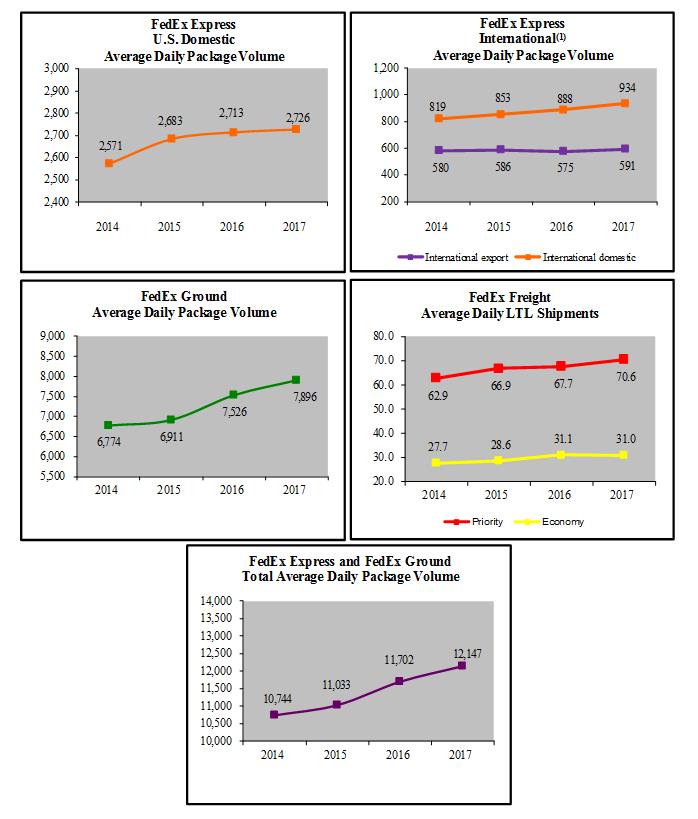
| (1) | International domestic average daily package volume represents our international intra-country operations. |
|---|
- 38 -
The following graphs for FedEx Express, FedEx Ground and FedEx Freight show selected yield trends for the years ended May 31 (TNT Express yield trends are not presented, as it was acquired on May 25, 2016):
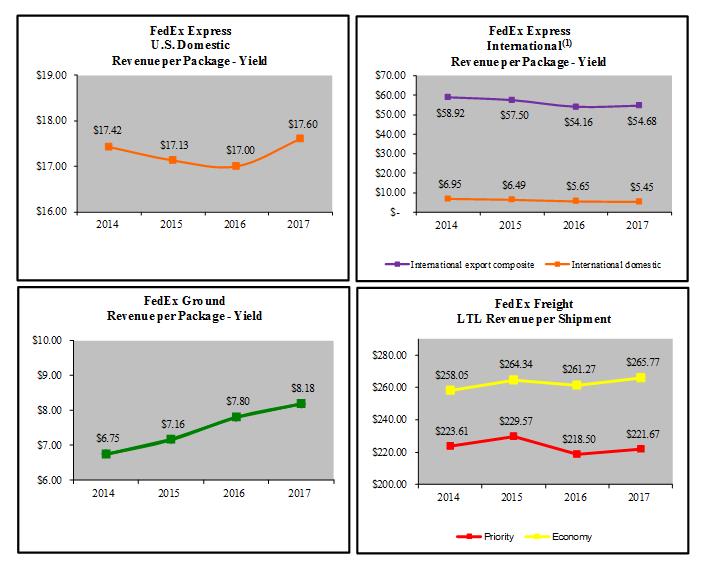
| (1) | International domestic revenue per package represents our international intra-country operations. |
|---|
Revenue
Revenues increased 20% in 2017 due to the inclusion of TNT Express and improvements at our other transportation segments. At FedEx Ground, revenues increased 9% in 2017 due to improved yield and volume growth. Revenues at FedEx Express increased 3% in 2017 due to yield and package volume growth partially offset by unfavorable exchange rates. Revenues in 2017 were negatively impacted by one fewer operating day at FedEx Express and FedEx Ground. FedEx Freight revenues increased 4% due to higher average daily LTL shipments and higher LTL revenue per shipment. Higher fuel surcharges benefited revenues at all our transportation segments in 2017, but had a minimal net impact on operating income.
Revenues increased 6% in 2016 driven by the FedEx Ground segment due to volume growth in our residential services coupled with rate increases, and the inclusion of FedEx Supply Chain Distribution System, Inc. (“FedEx Supply Chain”) revenue for a full year. In addition, revenues increased approximately $1.2 billion in 2016 as a result of recording FedEx SmartPost service revenues on a gross basis, versus our previous net treatment due to operational changes that occurred in 2016, which resulted in us being the principal in all cases for the FedEx SmartPost service. Lower fuel surcharges had a significant negative impact on revenues at all of our transportation segments in 2016. Unfavorable exchange rates also negatively impacted revenues at FedEx Express in 2016. Two additional operating days benefited revenues at all our transportation segments in 2016.
- 39 -
Retirement Plans MTM Adjustments
We incurred a non-cash pre-tax MTM gain of $24 million in 2017 ($6 million, net of tax, or $0.02 per diluted share) and losses of $1.5 billion in 2016 ($946 million, net of tax, or $3.39 per diluted share) and $2.2 billion in 2015 ($1.4 billion, net of tax, or $4.81 per diluted share) from actuarial adjustments to pension and postretirement healthcare plans related to the measurement of plan assets and liabilities. The gain in 2017 reflects higher-than-expected pension asset returns, particularly in the equity markets. The losses in 2016 and 2015 are attributable to declining discount rates and demographic assumption experience changes. For more information, see the “Critical Accounting Estimates” section of this MD&A and Note 1 and Note 13 of the accompanying consolidated financial statements.
Operating Expenses
The following tables compare operating expenses expressed as dollar amounts (in millions) and as a percent of revenue for the years ended May 31:
| 2017(1) | 2016(2) | 2015 | ||||||||||
|---|---|---|---|---|---|---|---|---|---|---|---|---|
| Operating expenses: | ||||||||||||
| Salaries and employee benefits | $ | 21,542 | $ | 18,581 | $ | 17,110 | ||||||
| Purchased transportation | 13,630 | 9,966 | 8,483 | |||||||||
| Rentals and landing fees | 3,240 | 2,854 | 2,682 | |||||||||
| Depreciation and amortization | 2,995 | 2,631 | 2,611 | |||||||||
| Fuel | 2,773 | 2,399 | 3,720 | |||||||||
| Maintenance and repairs | 2,374 | 2,108 | 2,099 | |||||||||
| Impairment and other charges(3) | — | — | 276 | |||||||||
| Retirement plans mark-to-market adjustment | (24 | ) | 1,498 | 2,190 | ||||||||
| Other(4) | 8,752 | 7,251 | 6,415 | |||||||||
| Total operating expenses | $ | 55,282 | $ | 47,288 | $ | 45,586 | ||||||
| Total operating income | $ | 5,037 | $ | 3,077 | $ | 1,867 |
| Percent of Revenue | ||||||||||||
|---|---|---|---|---|---|---|---|---|---|---|---|---|
| 2017(1) | 2016(2) | 2015 | ||||||||||
| Operating expenses: | ||||||||||||
| Salaries and employee benefits | 35.7 | % | 36.9 | % | 36.1 | % | ||||||
| Purchased transportation | 22.6 | 19.8 | 17.9 | |||||||||
| Rentals and landing fees | 5.3 | 5.7 | 5.7 | |||||||||
| Depreciation and amortization | 5.0 | 5.2 | 5.5 | |||||||||
| Fuel | 4.6 | 4.7 | 7.8 | |||||||||
| Maintenance and repairs | 3.9 | 4.2 | 4.4 | |||||||||
| Impairment and other charges(3) | — | — | 0.6 | |||||||||
| Retirement plans mark-to-market adjustment | — | 3.0 | 4.6 | |||||||||
| Other(4) | 14.5 | 14.4 | 13.5 | |||||||||
| Total operating expenses | 91.6 | 93.9 | 96.1 | |||||||||
| Operating margin | 8.4 | % | 6.1 | % | 3.9 | % |
| (1) | Includes TNT Express integration expenses and restructuring charges of $327 million and increased intangible asset amortization of $74 million as a result of the TNT Express acquisition. |
|---|
| (2) | Includes transaction and integration-planning expenses related to our TNT Express acquisition of $113 million. |
|---|
| (3) | Includes charges resulting from the decision to permanently retire and adjust the retirement schedule of certain aircraft and related engines at FedEx Express. |
|---|
| (4) | Other expenses in 2017 include $39 million of charges for legal reserves related to certain pending CBP matters involving FedEx Trade Networks and $22 million of charges in connection with the settlement of and certain expected losses relating to independent contractor litigation matters at FedEx Ground. Included in 2016 are provisions for the settlement of and expected losses related to independent contractor litigation matters involving FedEx Ground for $256 million and $69 million in expenses related to the settlement of a CBP notice of action, in each case net of recognized immaterial insurance recovery. Included in 2015 is a $197 million charge in the fourth quarter to increase the legal reserve associated with the settlement of a legal matter at FedEx Ground to the amount of the settlement. |
|---|
- 40 -
Our operating income and margin benefited from the slight positive impact of our MTM adjustment in 2017, compared to large MTM losses in the prior two years, the year-over-year decreases associated with the independent contractor litigation matters and CBP matters, and the continued growth and cost management initiatives at the FedEx Express segment. However, operating margin was negatively impacted in 2017 by the inclusion of TNT Express, TNT Express integration expenses and network expansion costs at FedEx Ground.
Our operating expenses include an increase in purchased transportation costs of 37% in 2017 due to the inclusion of TNT Express and higher volume and increased purchased transportation rates at FedEx Ground. Salaries and employee benefits expense increased 16% in 2017 due to the inclusion of TNT Express, volume growth and staffing to support network expansion at FedEx Ground, merit increases at FedEx Express, and higher staffing levels to support volume growth and merit increases at FedEx Freight. Other expenses increased 21% in 2017 primarily due to outside service contracts at TNT Express and the reserves for the legal matters involving FedEx Trade Networks and FedEx Ground, which were offset by the inclusion of independent contractor litigation expenses and the CBP matter in the prior year.
Our operating expenses for 2016 include a $1.5 billion loss ($946 million, net of tax, or $3.39 per diluted share) associated with our annual MTM retirement plans adjustment described above. In addition, we recorded corporate level provisions for the settlement of and expected losses related to independent contractor litigation matters involving FedEx Ground and the settlement of the CBP matter, and expenses related to our acquisition of TNT Express as described above. Operating expenses also increased due to higher salaries and employee benefits at FedEx Freight, and higher purchased transportation expenses due to the recording of FedEx SmartPost revenues on a gross basis, network expansion costs, higher self-insurance expenses and increased purchased transportation rates at FedEx Ground. In addition, higher incentive compensation accruals impacted our overall operating expenses.
Our 2016 operating margin benefited from the reduced year-over-year loss from our MTM retirement plans adjustment, the strong performance of our FedEx Express segment due to the continued execution of our profit improvement program and the positive net impact of fuel. However, operating margin was negatively impacted in 2016 by higher salaries and employee benefits at FedEx Freight, and network expansion costs, higher self-insurance expenses and the recording of FedEx SmartPost revenues on a gross basis at FedEx Ground, transaction and integration-planning expenses related to our TNT Express acquisition, and higher incentive compensation accruals.
Our operating expenses include an increase in purchased transportation costs of 17% in 2016 due to the recording of FedEx SmartPost service revenues on a gross basis (including postal fees in revenues and expenses) due to operational changes that occurred in 2016, which resulted in us being the principal in all cases for the FedEx SmartPost service and higher volumes and increased rates at FedEx Ground. Salaries and employee benefits expense increased 9% in 2016 due to the inclusion of FedEx Supply Chain results for a full year, pay initiatives coupled with increased staffing at FedEx Freight, higher healthcare costs and higher incentive compensation accruals. Other expenses were 13% higher in 2016 due to the inclusion of FedEx Supply Chain results for a full year, higher self-insurance costs at FedEx Ground and the CBP matter described above. Rentals and landing fees increased 6% in 2016 due to network expansion and the inclusion of FedEx Supply Chain results for a full year at FedEx Ground. Retirement plans MTM adjustment expenses decreased 32% in 2016, as favorable demographic assumption experience partially offset the actuarial loss on pension plan asset returns in 2016.
- 41 -
Fuel
The following graph for our transportation segments shows our average cost of jet and vehicle fuel per gallon for the years ended May 31:
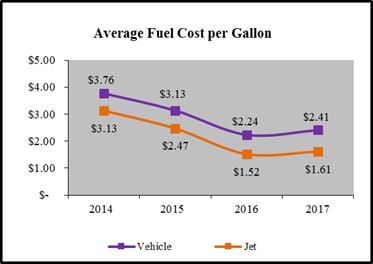
Fuel expense increased 16% during 2017 due to the inclusion of TNT Express and higher fuel prices. However, fuel prices represent only one component of the two factors we consider meaningful in understanding the impact of fuel on our business. Consideration must also be given to the fuel surcharge revenue we collect. Accordingly, we believe discussion of the net impact of fuel on our results, which is a comparison of the year-over-year change in these two factors, is important to understand the impact of fuel on our business. In order to provide information about the impact of fuel surcharges on the trend in revenue and yield growth, we have included the comparative weighted-average fuel surcharge percentages in effect for 2017, 2016 and 2015 in the accompanying discussions of each of our transportation segments.
Effective February 6, 2017, FedEx Express and FedEx Ground fuel surcharges are adjusted on a weekly basis. The fuel surcharge is based on a weekly fuel price from two weeks prior to the week in which it is assessed. The index used to determine the fuel surcharge percentage for our FedEx Freight business continues to adjust weekly. TNT Express’s fuel surcharges incorporate a timing lag of approximately six to eight weeks.
Prior to February 6, 2017, our fuel surcharges for the FedEx Express and FedEx Ground businesses incorporated a timing lag of approximately six to eight weeks before they were adjusted for changes in fuel prices. For example, the fuel surcharge index in effect at FedEx Express in January 2017 was set based on November 2016 fuel prices. In addition, on November 2, 2015 we updated the tables used to determine our fuel surcharges at FedEx Express and FedEx Ground.
Beyond these factors, the manner in which we purchase fuel also influences the net impact of fuel on our results. For example, our contracts for jet fuel purchases at FedEx Express are tied to various indices, including the U.S. Gulf Coast index. While many of these indices are aligned, each index may fluctuate at a different pace, driving variability in the prices paid for jet fuel. Furthermore, under these contractual arrangements, approximately 75% of our jet fuel is purchased based on the index price for the preceding week, with the remainder of our purchases tied to the index price for the preceding month, rather than based on daily spot rates. These contractual provisions mitigate the impact of rapidly changing daily spot rates on our jet fuel purchases.
Because of the factors described above, our operating results may be affected should the market price of fuel suddenly change by a significant amount or change by amounts that do not result in an adjustment in our fuel surcharges, which can significantly affect our earnings either positively or negatively in the short-term.
The net impact of fuel had minimal impact to operating income in 2017 as higher fuel surcharges were more than offset by increased fuel prices.
The net impact of fuel on our operating results does not consider the effects that fuel surcharge levels may have on our business, including changes in demand and shifts in the mix of services purchased by our customers. While fluctuations in fuel surcharge percentages can be significant from period to period, fuel surcharges represent one of the many individual components of our pricing structure that impact our overall revenue and yield. Additional components include the mix of services sold, the base price and extra service charges we obtain for these services and the level of pricing discounts offered.
- 42 -
Fuel expense decreased 36% during 2016 primarily due to lower aircraft fuel prices. The net impact of fuel had a modest benefit to operating income in 2016. This was driven by decreased fuel prices during 2016 versus the prior year, which was partially offset by the year-over-year decrease in fuel surcharge revenue during these periods.
Other Income and Expense
Interest expense increased $176 million in 2017 primarily due to our U.S. and Euro debt issuances in fiscal 2016, which was partially offset by a gain of $35 million from the sale of an investment during 2017 in other expense. The weighted average interest rate on our long-term debt was 3.6% in 2017, reflecting the favorable interest rates obtained in the recent debt offerings. Interest expense increased $101 million in 2016 primarily due to increased interest expense from our 2016 and 2015 debt offerings used to fund our share repurchase programs and business acquisitions.
Income Taxes
Our effective tax rate was 34.6% in 2017, 33.6% in 2016 and 35.5% in 2015. Due to its effect on income before income taxes, the adjustment for MTM pension accounting increased our 2017 effective tax rate by 20 basis points and reduced our 2016 and 2015 effective tax rates by 120 and 80 basis points, respectively.
Our 2017 tax rate was favorably impacted by $62 million as a result of the implementation of new U.S. foreign currency tax regulations and $55 million from the adoption of the Accounting Standards Update on share-based payments. Our 2016 tax rate was favorably impacted by $76 million from an internal corporate legal entity restructuring done in anticipation of the integration of the foreign operations of FedEx Express and TNT Express. A lower state tax rate primarily due to the resolution of a state tax matter also provided a benefit to our 2016 tax rate.
Cumulative permanently reinvested foreign earnings were $2.1 billion at the end of 2017 and $1.6 billion at the end of 2016.
Additional information on income taxes, including our effective tax rate reconciliation, liabilities for uncertain tax positions and our global tax profile can be found in Note 12 of the accompanying consolidated financial statements.
Business Acquisitions
On May 25, 2016, we acquired TNT Express for €4.4 billion (approximately $4.9 billion). Cash acquired in the acquisition was approximately €250 million ($280 million). All shares associated with the transaction were tendered or transferred as of the third quarter of 2017. We funded the acquisition with proceeds from an April 2016 debt issuance and existing cash balances. The financial results of this business for 2017 are included in the FedEx Express group and the TNT Express segment. Financial results for 2016 were immaterial from the time of acquisition and are included in “Eliminations, corporate and other.”
TNT Express collects, transports and delivers documents, parcels and freight to over 200 countries. This strategic acquisition broadens our portfolio of international transportation solutions with the combined strength of TNT Express’s strong European road platform and FedEx Express’s strength in other regions globally.
For more information, see Note 3 of the accompanying consolidated financial statements.
During 2015, we acquired two businesses, expanding our portfolio in e-commerce and supply chain solutions. On January 30, 2015, we acquired GENCO Distribution System, Inc., now FedEx Supply Chain, a leading North American third-party logistics provider, for $1.4 billion, which was funded using a portion of the proceeds from our January 2015 debt issuance. The financial results of this business are included in the FedEx Ground segment from the date of acquisition.
In addition, on December 16, 2014, we acquired Bongo International, LLC, now FedEx Cross Border, a leader in cross-border enablement technologies and solutions, for $42 million in cash from operations. The financial results of this business are included in the FedEx Express segment from the date of acquisition.
TNT Express Cyber-Attack
On June 28, 2017, we announced that the worldwide operations of TNT Express were significantly affected by the cyber-attack known as Petya, which involved the spread of an information technology virus through a Ukrainian tax software product. The systems and data of all other FedEx companies are currently unaffected by the attack. TNT Express operates in Ukraine and uses the software that was compromised, which allowed the virus to infiltrate TNT Express systems and encrypt its data. While TNT Express operations and communications were significantly affected, no data breach or data loss to third parties is known to have occurred as of the date of this filing.
- 43 -
Immediately following the attack, contingency plans were implemented to recover TNT Express operations and communications systems. As of the date of this filing, all TNT Express depots, hubs and facilities are operational and most TNT services are available. Nevertheless, customers are still experiencing widespread service delays, including invoicing, and manual processes are being used to facilitate a significant portion of TNT Express operations and customer service functions. We cannot estimate when TNT Express services will be fully restored. Contingency plans that make use of both FedEx Express and TNT Express networks remain in place to minimize the impacts to customers, including transporting TNT Express packages within the FedEx Express network and offering the full range of FedEx Express services as alternatives to TNT Express customers.
Our information technology teams have been focused on the recovery of critical systems and continue to make progress in resuming full services and restoring critical systems. Currently, we are focused on restoring remaining operational systems as well as finance, back-office and secondary business systems. At this time, we cannot estimate how long it will take to restore the systems that were impacted and it is reasonably possible that TNT Express will be unable to fully restore all of the affected systems and recover all of the critical business data that was encrypted by the virus.
Given the recent timing and magnitude of the attack, in addition to our initial focus on restoring TNT Express operations and customer service functions, we are still evaluating the financial impact of the attack, but it is likely that it will be material. We do not have cyber or other insurance in place that covers this attack. Although we cannot currently quantify the amounts, we have experienced loss of revenue due to decreased volumes at TNT Express and incremental costs associated with the implementation of contingency plans and the remediation of affected systems. Additional consequences and risks associated with the cyber-attack that could negatively impact our results of operations and financial condition are described in the corresponding risk factor included in this MD&A. In addition to financial consequences, the cyber-attack may materially impact our disclosure controls and procedures and internal control over financial reporting in future periods.
Outlook
During 2018, we expect yield and volume growth at all our transportation segments to support revenue and earnings growth, prior to any MTM retirement plans adjustment. Our 2018 results will be negatively affected by our TNT Express integration and restructuring activities, as well as the impact of the TNT Express cyber-attack. Our expectations for earnings growth in 2018 are dependent on key external factors, including fuel prices and moderate economic growth. We expect segment level pension expense to decline by approximately $86 million in 2018 due to improved funded status in our tax-qualified U.S. domestic pension plans (“U.S. Pension Plans”).
During 2018, we will continue to execute our TNT Express integration plans. The integration process is complex as it spans over 200 countries and involves combining our pickup and delivery operations at a local level, our global and regional air and ground networks, and our extensive operations, customs clearance, sales and customer-facing and back-office information technology systems. The integration is expected to be completed by the end of 2020. We expect the aggregate integration program expense, including restructuring charges at TNT Express, over the four years to be approximately $800 million and expect to incur approximately $275 million of these costs during 2018. We continue to refine our integration plans, however, particularly in light of the recent cyber-attack at TNT Express. As a result, the timing and amount of integration expenses and capital investments in any future period may change as we implement our plans.
The integration process has proceeded in a manner such that in the first quarter of 2018 we will report one combined FedEx Express segment (currently reported as the FedEx Express group). This one segment is the result of combining the financial information of the FedEx Express and TNT Express segments (see discussion in the Reportable Segments section below). We are targeting operating income improvement at the FedEx Express group of $1.2 billion to $1.5 billion in 2020 from 2017, assuming moderate economic growth and current accounting and tax rules.
Our capital expenditures for 2018 are expected to be approximately $5.9 billion, largely for our fleet modernization program at FedEx Express and investments in facilities and sort equipment to support volume growth at FedEx Ground, including certain projects deferred from 2017. In addition, our capital expenditure forecast includes $160 million for the TNT Express integration. These capital expenditure forecasts are subject to change as we refine and implement our TNT Express integration plans. We will continue to evaluate our investments in critical long-term strategic projects to ensure our capital expenditures generate high returns on investment and are balanced with our outlook for global economic conditions. For additional details on key 2018 capital projects, refer to the “Capital Resources” and “Liquidity Outlook” sections of this MD&A.
We expect our effective tax rate for 2018 to be between 32% and 35%. Our 2018 effective tax rate will likely be higher in the first quarter and vary from quarter to quarter as tax benefits and costs related to the TNT Express integration are recognized.
Substantial activities and legal entity restructuring are ongoing with respect to the integration of the foreign operations of FedEx Express and TNT Express. As we continue to integrate these businesses over the next few years, there could be material favorable and unfavorable impacts to our effective tax rate. However, once the businesses are integrated, the expected increase in international earnings should contribute to a reduction in our effective tax rate.
- 44 -
Our outlook is dependent upon a stable pricing environment for fuel, as volatility in fuel prices impacts our fuel surcharge levels, fuel expense and demand for our services. Due to the change in fuel surcharge methodology discussed above, the volatility in fuel costs will have less of an impact on earnings as the timing lag of adjustments to our fuel surcharges has been reduced by several weeks at FedEx Express and FedEx Ground.
Other Outlook Matters
We are involved in a number of lawsuits and other proceedings that challenge the status of FedEx Ground’s owner-operators as independent contractors. For a description of these proceedings, see Note 18 of the accompanying consolidated financial statements for additional information.
FedEx Ground previously announced plans to implement the Independent Service Provider (“ISP”) model throughout its entire U.S. pickup and delivery network, including the 29 states that had not yet begun transitioning to the ISP model. The transition to the ISP model in these 29 states is being accomplished on a district-by-district basis and is expected to be completed in the second half of calendar 2020. As of May 31, 2017, more than 45% of FedEx Ground volume was being delivered by small businesses operating under the ISP model. The costs associated with these transitions will be recognized in the periods incurred and are not expected to be material to any future quarter.
See “Risk Factors” and “Forward Looking Statements” for a discussion of these and other potential risks and uncertainties that could materially affect our future performance.
Seasonality of Business
Our businesses are cyclical in nature, as seasonal fluctuations affect volumes, revenues and earnings. Historically, the U.S. express package business experiences an increase in volumes in late November and December. International business, particularly in the Asia-to-U.S. market, peaks in October and November in advance of the U.S. holiday sales season. Our first and third fiscal quarters, because they are summer vacation and post winter-holiday seasons, have historically experienced lower volumes relative to other periods. Normally, the fall is the busiest shipping period for FedEx Ground, while late December, June and July are the slowest periods. For FedEx Freight, the spring and fall are the busiest periods and the latter part of December through February is the slowest period. Shipment levels, operating costs and earnings for each of our companies can also be adversely affected by inclement weather, particularly the impact of severe winter weather in our third fiscal quarter.
RECENT ACCOUNTING GUIDANCE
New accounting rules and disclosure requirements can significantly impact our reported results and the comparability of our financial statements. We believe the following new accounting guidance is relevant to the readers of our financial statements.
During the first quarter of 2017, we retrospectively adopted the authoritative guidance issued by the Financial Accounting Standards Board (“FASB”) to simplify the presentation of debt issuance costs. This new guidance requires entities to present debt issuance costs related to a recognized debt liability as a direct deduction from the carrying amount of that debt liability, rather than as an asset. This new guidance had a minimal impact on our accounting and financial reporting.
During the second quarter of 2017, we adopted the Accounting Standards Update issued by the FASB in March 2016 to simplify the accounting for share-based payment transactions. The new guidance requires companies to recognize the income tax effects of awards that vest or are settled as income tax expense or benefit in the income statement as opposed to additional paid-in capital. The guidance also provides clarification of the presentation of certain components of share-based awards in the statement of cash flows. Additionally, the guidance allows companies to make a policy election to account for forfeitures either upon occurrence or by estimating forfeitures. We have elected to continue estimating forfeitures expected to occur in order to determine the amount of compensation cost to be recognized each period and to apply the cash flow classification guidance prospectively. Excess tax benefits are now classified as an operating activity rather than a financing activity. The adoption of the new standard resulted in a benefit to net income of $55 million ($0.17 per diluted share) for the year ended May 31, 2017. The first quarter of 2017 was not recast due to immateriality.
On May 28, 2014, the FASB and International Accounting Standards Board issued a new accounting standard that will supersede virtually all existing revenue recognition guidance under generally accepted accounting principles in the United States. This standard will be effective for us beginning in fiscal 2019. The fundamental principles of the new guidance are that companies should recognize revenue in a manner that reflects the timing of the transfer of services to customers and the amount of revenue recognized reflects the consideration that a company expects to receive for the goods and services provided. The new guidance establishes a five-step approach for the recognition of revenue. We are continuing to assess the impact of this new standard on our consolidated financial statements and related disclosures, including ongoing contract reviews. We do not anticipate that the new guidance will have a material impact on our revenue recognition policies, practices or systems.
- 45 -
On February 25, 2016, the FASB issued a new lease accounting standard which requires lessees to put most leases on their balance sheets but recognize the expenses on their income statements in a manner similar to current practice. The new standard states that a lessee will recognize a lease liability for the obligation to make lease payments and a right-of-use asset for the right to use the underlying asset for the lease term. Expenses related to leases determined to be operating leases will be recognized on a straight-line basis, while those determined to be financing leases will be recognized following a front-loaded expense profile in which interest and amortization are presented separately in the income statement. Based on our lease portfolio, we currently anticipate recognizing a lease liability and related right-of-use asset on the balance sheet in excess of $13 billion with an immaterial impact on our income statement compared to the current lease accounting model. However, the ultimate impact of the standard will depend on the company’s lease portfolio as of the adoption date. We are currently in the process of evaluating our existing lease portfolios, including accumulating all of the necessary information required to properly account for the leases under the new standard. Additionally, we are implementing an enterprise-wide lease management system to assist in the accounting and are evaluating additional changes to our processes and internal controls to ensure we meet the standard’s reporting and disclosure requirements. These changes will be effective for our fiscal year beginning June 1, 2019 (fiscal 2020), with a modified retrospective adoption method to the beginning of 2018.
In March 2017, the FASB issued an Accounting Standards Update that changes how employers that sponsor defined benefit pension or other postretirement benefit plans present the net periodic benefit cost in the income statement. This new guidance requires entities to report the service cost component in the same line item or items as other compensation costs. The other components of net benefit cost are required to be presented in the income statement separately from the service cost component outside of income from operations. This standard will impact our operating income but will have no impact on our net income or earnings per share. For example, adoption of this guidance would have reduced 2017 operating income by $471 million but would not have impacted our net income. This new guidance will be effective for our fiscal year beginning June 1, 2018 (fiscal 2019) and will be applied retrospectively.
- 46 -
REPORTABLE SEGMENTS
FedEx Express, TNT Express, FedEx Ground and FedEx Freight represent our major service lines and, along with FedEx Services, form the core of our reportable segments. Our reportable segments include the following businesses:
FedEx Express Group:
| FedEx Express Segment | FedEx Express (express transportation) |
|---|---|
| FedEx Trade Networks (air and ocean freight forwarding, customs brokerage and cross-border enablement technology and solutions) | |
| FedEx SupplyChain Systems (logistics services) | |
| TNT Express Segment | TNT Express (international express transportation, small-package ground delivery and freight transportation) |
| FedEx Ground Segment | FedEx Ground (small-package ground delivery) |
| FedEx Supply Chain (third-party logistics) (formerly GENCO) | |
| FedEx Freight Segment | FedEx Freight (LTL freight transportation) |
| FedEx Custom Critical (time-critical transportation) | |
| FedEx Services Segment | FedEx Services (sales, marketing, information technology, communications, customer service, technical support, billing and collection services and back-office functions) |
| FedEx Office (document and business services and package acceptance) |
During 2017, we announced that products and solutions offered by FedEx SupplyChain Systems would be combined with similar offerings within FedEx Custom Critical, FedEx Express and FedEx Supply Chain (formerly GENCO) effective June 1, 2017. In addition, during 2017, we rebranded GENCO to FedEx Supply Chain.
In 2017, TNT Express’s results are disclosed as a reportable segment and are also combined with the FedEx Express reportable segment to reflect a management reporting structure referred to as the FedEx Express group. As integration began in 2017, these segments continued to have discrete financial information that was regularly reviewed when evaluating performance and making resource allocation decisions. However, they were combined into the FedEx Express group for financial reporting purposes into a collective business as a result of their management reporting structure.
In the first quarter of 2018, we will report one FedEx Express segment (currently reported as the FedEx Express group). This new segment is the result of combining the financial information of the FedEx Express and TNT Express segments as part of the operational integration of these two businesses. As integration activities have progressed, the FedEx Express and TNT Express businesses have begun to lose their historical discrete financial profiles, as some TNT Express businesses are merging into FedEx Express businesses, and some FedEx Express businesses are merging into TNT Express businesses. Therefore, discrete financial information for FedEx Express and TNT Express will no longer be used to evaluate performance and make resource allocation decisions. In addition, this new reporting structure aligns with our management reporting structure and our internal financial reporting and compensation plans for the new segment.
FEDEX SERVICES SEGMENT
The operating expenses line item “Intercompany charges” on the accompanying consolidated financial statements of our transportation segments reflects the allocations from the FedEx Services segment to the respective transportation segments. The allocations of net operating costs are based on metrics such as relative revenues or estimated services provided.
The FedEx Services segment provides direct and indirect support to our transportation businesses, and we allocate all of the net operating costs of the FedEx Services segment (including the net operating results of FedEx Office) to reflect the full cost of operating our transportation businesses in the results of those segments. Within the FedEx Services segment allocation, the net operating results of FedEx Office, which are an immaterial component of our allocations, are allocated to FedEx Express and FedEx Ground. We review and evaluate the performance of our transportation segments based on operating income (inclusive of FedEx Services segment allocations). For the FedEx Services segment, performance is evaluated based on the impact of its total allocated net operating costs on our transportation segments. We believe these allocations approximate the net cost of providing these functions. Our allocation methodologies are refined periodically, as necessary, to reflect changes in our businesses.
- 47 -
ELIMINATIONS, CORPORATE AND OTHER
Certain FedEx operating companies provide transportation and related services for other FedEx companies outside their reportable segment. Billings for such services are based on negotiated rates, which we believe approximate fair value, and are reflected as revenues of the billing segment. These rates are adjusted from time to time based on market conditions. Such intersegment revenues and expenses are eliminated in our consolidated results and are not separately identified in the following segment information, because the amounts are not material.
Corporate and other includes corporate headquarters costs for executive officers and certain legal and financial functions, as well as certain other costs and credits not attributed to our core business. These costs are not allocated to the business segments. In 2017, the year-over-year decrease in these costs was driven by the change in the MTM retirement plans adjustment and the year-over-year decrease in charges for legal reserves, which were partially offset by the TNT Express integration expenses discussed above. In 2016, the year-over-year decrease in these costs was driven by a lower MTM retirement plans adjustment.
- 48 -
FEDEX EXPRESS GROUP
The FedEx Express group consists of the combined results of the FedEx Express and TNT Express segments. As discussed above, we have combined these segments for financial reporting discussion purposes into a collective business as a result of their management reporting structure. Furthermore, over time their operations will be integrated, therefore presenting a group view provides a basis for future year-over-year comparisons. We acquired TNT Express in the fourth quarter of 2016, which has impacted the year-over-year comparability of revenue and operating income. Because TNT Express was acquired near the end of 2016, its financial results were immaterial and were included in “Eliminations, corporate and other” in that period. The following table compares revenues, operating income (dollars in millions) and operating margin for the years ended May 31:
| Percent Change | |||||||||||||||||||||
|---|---|---|---|---|---|---|---|---|---|---|---|---|---|---|---|---|---|---|---|---|---|
| 2017 | 2016 | 2015 | 2017/2016 | 2016/2015 | |||||||||||||||||
| Revenues: | |||||||||||||||||||||
| FedEx Express segment | $ | 27,358 | $ | 26,451 | $ | 27,239 | 3 | (3 | ) | ||||||||||||
| TNT Express segment | 7,401 | — | — | NM | NM | ||||||||||||||||
| FedEx Express group | 34,759 | 26,451 | 27,239 | 31 | (3 | ) | |||||||||||||||
| Operating income: | |||||||||||||||||||||
| FedEx Express segment | 2,678 | 2,519 | 1,584 | 6 | 59 | ||||||||||||||||
| TNT Express segment | 84 | — | — | NM | NM | ||||||||||||||||
| FedEx Express group | $ | 2,762 | $ | 2,519 | $ | 1,584 | 10 | 59 | |||||||||||||
| Operating margin: | |||||||||||||||||||||
| FedEx Express segment | 9.8 | % | 9.5 | % | 5.8 | % | 30 | bp | 370 | bp | |||||||||||
| TNT Express segment | 1.1 | % | — | — | NM | bp | NM | bp | |||||||||||||
| FedEx Express group | 7.9 | % | 9.5 | % | 5.8 | % | (160 | ) | bp | 370 | bp |
FedEx Express Group Results
FedEx Express group revenues increased 31% in 2017 due to the inclusion of the TNT Express segment, as well as improved base yield and package volume at our FedEx Express segment.
Operating income increased 10% in 2017 driven by our FedEx Express segment and the inclusion of the TNT Express segment. The TNT Express segment reported an operating profit in 2017, which was negatively impacted by integration and restructuring expenses and intangible asset amortization. Operating margin decreased in 2017 due to the inclusion of the TNT Express segment.
FedEx Express group results include $206 million of TNT Express integration expenses in 2017. In addition, 2017 expenses include increased TNT Express intangible asset amortization of $74 million as a result of the TNT Express acquisition.
FedEx Express Group Outlook
The integration process is proceeding in a manner such that commencing in the first quarter of 2018 we will report one FedEx Express segment (currently reported as the FedEx Express group) when the financial information for the FedEx Express and TNT Express segments will begin to merge and only the results of the FedEx Express group will be regularly reviewed when evaluating performance and making resource allocation decisions.
Revenues and earnings are expected to increase at the FedEx Express group during 2018. We expect revenues to increase primarily due to higher international volumes and U.S. domestic yields, as we continue to focus on revenue quality while managing costs. These benefits will be partially offset in 2018 by TNT Express integration expenses and intangible asset amortization expense.
During 2018, we will continue to execute our TNT Express integration plans. The integration process is complex as it spans over 200 countries and involves our pickup and delivery operations at a local level, our global and regional air and ground networks, and our extensive operations, customs clearance, sales and back office information technology systems. The integration is expected to be completed by the end of 2020.
We are targeting operating income improvement at the FedEx Express group of $1.2 billion to $1.5 billion in 2020 from 2017, assuming moderate economic growth and current accounting and tax rules. This target includes expected synergies from the integration of TNT Express and base business and other operational improvements across the global FedEx Express network.
- 49 -
Capital expenditures at the FedEx Express group are expected to increase in 2018, driven by our aircraft fleet modernization programs, as we add new aircraft that are more reliable, fuel-efficient and technologically advanced and retire older, less-efficient aircraft. Capital expenditures for 2018 will also include integration-related investments. FedEx Express group capital expenditures for 2018 are subject to change as we refine and implement our TNT Express integration plans, particularly in light of the TNT Express cyber-attack.
- 50 -
FEDEX EXPRESS SEGMENT
FedEx Express offers a wide range of U.S. domestic and international shipping services for delivery of packages and freight including priority services, which provide time-definite delivery within one, two or three business days worldwide, and deferred or economy services, which provide time-definite delivery within five business days worldwide. The following tables compare revenues, operating expenses, operating expenses as a percent of revenue, operating income (dollars in millions) and operating margin for the years ended May 31:
| Percent Change | |||||||||||||||||||||
|---|---|---|---|---|---|---|---|---|---|---|---|---|---|---|---|---|---|---|---|---|---|
| 2017 | 2016 | 2015 | 2017/2016 | 2016/2015 | |||||||||||||||||
| Revenues: | |||||||||||||||||||||
| Package: | |||||||||||||||||||||
| U.S. overnight box | $ | 6,958 | $ | 6,763 | $ | 6,704 | 3 | 1 | |||||||||||||
| U.S. overnight envelope | 1,750 | 1,662 | 1,629 | 5 | 2 | ||||||||||||||||
| U.S. deferred | 3,528 | 3,379 | 3,342 | 4 | 1 | ||||||||||||||||
| Total U.S. domestic package revenue | 12,236 | 11,804 | 11,675 | 4 | 1 | ||||||||||||||||
| International priority | 5,827 | 5,697 | 6,251 | 2 | (9 | ) | |||||||||||||||
| International economy | 2,412 | 2,282 | 2,301 | 6 | (1 | ) | |||||||||||||||
| Total international export package revenue | 8,239 | 7,979 | 8,552 | 3 | (7 | ) | |||||||||||||||
| International domestic(1) | 1,299 | 1,285 | 1,406 | 1 | (9 | ) | |||||||||||||||
| Total package revenue | 21,774 | 21,068 | 21,633 | 3 | (3 | ) | |||||||||||||||
| Freight: | |||||||||||||||||||||
| U.S. | 2,528 | 2,481 | 2,300 | 2 | 8 | ||||||||||||||||
| International priority | 1,502 | 1,384 | 1,588 | 9 | (13 | ) | |||||||||||||||
| International airfreight | 118 | 126 | 180 | (6 | ) | (30 | ) | ||||||||||||||
| Total freight revenue | 4,148 | 3,991 | 4,068 | 4 | (2 | ) | |||||||||||||||
| Other(2) | 1,436 | 1,392 | 1,538 | 3 | (9 | ) | |||||||||||||||
| Total revenues | 27,358 | 26,451 | 27,239 | 3 | (3 | ) | |||||||||||||||
| Operating expenses: | |||||||||||||||||||||
| Salaries and employee benefits | 10,536 | 10,240 | 10,104 | 3 | 1 | ||||||||||||||||
| Purchased transportation | 2,337 | 2,301 | 2,544 | 2 | (10 | ) | |||||||||||||||
| Rentals and landing fees | 1,618 | 1,688 | 1,693 | (4 | ) | — | |||||||||||||||
| Depreciation and amortization | 1,431 | 1,385 | 1,460 | 3 | (5 | ) | |||||||||||||||
| Fuel | 2,153 | 2,023 | 3,199 | 6 | (37 | ) | |||||||||||||||
| Maintenance and repairs | 1,414 | 1,294 | 1,357 | 9 | (5 | ) | |||||||||||||||
| Impairment and other charges(3) | — | — | 276 | NM | NM | ||||||||||||||||
| Intercompany charges | 1,881 | 1,846 | 1,842 | 2 | — | ||||||||||||||||
| Other | 3,310 | 3,155 | 3,180 | 5 | (1 | ) | |||||||||||||||
| Total operating expenses | 24,680 | 23,932 | 25,655 | 3 | (7 | ) | |||||||||||||||
| Operating income | $ | 2,678 | $ | 2,519 | $ | 1,584 | 6 | 59 | |||||||||||||
| Operating margin | 9.8 | % | 9.5 | % | 5.8 | % | 30 | bp | 370 | bp |
- 51 -
| Percent of Revenue | |||||||||||||
|---|---|---|---|---|---|---|---|---|---|---|---|---|---|
| 2017 | 2016 | 2015 | |||||||||||
| Operating expenses: | |||||||||||||
| Salaries and employee benefits | 38.5 | % | 38.7 | % | 37.1 | % | |||||||
| Purchased transportation | 8.5 | 8.7 | 9.3 | ||||||||||
| Rentals and landing fees | 5.9 | 6.4 | 6.2 | ||||||||||
| Depreciation and amortization | 5.2 | 5.2 | 5.4 | ||||||||||
| Fuel | 7.9 | 7.7 | 11.7 | ||||||||||
| Maintenance and repairs | 5.2 | 4.9 | 5.0 | ||||||||||
| Impairment and other charges(3) | — | — | 1.0 | ||||||||||
| Intercompany charges | 6.9 | 7.0 | 6.8 | ||||||||||
| Other | 12.1 | 11.9 | 11.7 | ||||||||||
| Total operating expenses | 90.2 | 90.5 | 94.2 | ||||||||||
| Operating margin | 9.8 | % | 9.5 | % | 5.8 | % |
| (1) | International domestic revenues represent our international intra-country operations. |
|---|
| (2) | Includes FedEx Trade Networks and FedEx SupplyChain Systems. |
|---|
| (3) | 2015 includes $276 million of impairment and related charges resulting from the decision to permanently retire and adjust the retirement schedule of certain aircraft and related engines. |
|---|
- 52 -
The following table compares selected statistics (in thousands, except yield amounts) for the years ended May 31:
| Percent Change | ||||||||||||||||||||
|---|---|---|---|---|---|---|---|---|---|---|---|---|---|---|---|---|---|---|---|---|
| 2017 | 2016 | 2015 | 2017/2016 | 2016/2015 | ||||||||||||||||
| Package Statistics(1) | ||||||||||||||||||||
| Average daily package volume (ADV): | ||||||||||||||||||||
| U.S. overnight box | 1,265 | 1,271 | 1,240 | — | 3 | |||||||||||||||
| U.S. overnight envelope | 561 | 541 | 527 | 4 | 3 | |||||||||||||||
| U.S. deferred | 900 | 901 | 916 | — | (2 | ) | ||||||||||||||
| Total U.S. domestic ADV | 2,726 | 2,713 | 2,683 | — | 1 | |||||||||||||||
| International priority | 405 | 394 | 410 | 3 | (4 | ) | ||||||||||||||
| International economy | 186 | 181 | 176 | 3 | 3 | |||||||||||||||
| Total international export ADV | 591 | 575 | 586 | 3 | (2 | ) | ||||||||||||||
| International domestic(2) | 934 | 888 | 853 | 5 | 4 | |||||||||||||||
| Total ADV | 4,251 | 4,176 | 4,122 | 2 | 1 | |||||||||||||||
| Revenue per package (yield): | ||||||||||||||||||||
| U.S. overnight box | $ | 21.57 | $ | 20.79 | $ | 21.29 | 4 | (2 | ) | |||||||||||
| U.S. overnight envelope | 12.24 | 11.99 | 12.15 | 2 | (1 | ) | ||||||||||||||
| U.S. deferred | 15.37 | 14.66 | 14.36 | 5 | 2 | |||||||||||||||
| U.S. domestic composite | 17.60 | 17.00 | 17.13 | 4 | (1 | ) | ||||||||||||||
| International priority | 56.44 | 56.47 | 60.05 | — | (6 | ) | ||||||||||||||
| International economy | 50.83 | 49.15 | 51.54 | 3 | (5 | ) | ||||||||||||||
| International export composite | 54.68 | 54.16 | 57.50 | 1 | (6 | ) | ||||||||||||||
| International domestic(2) | 5.45 | 5.65 | 6.49 | (4 | ) | (13 | ) | |||||||||||||
| Composite package yield | 20.09 | 19.71 | 20.66 | 2 | (5 | ) | ||||||||||||||
| Freight Statistics(1) | ||||||||||||||||||||
| Average daily freight pounds: | ||||||||||||||||||||
| U.S. | 8,190 | 8,178 | 7,833 | — | 4 | |||||||||||||||
| International priority | 2,670 | 2,510 | 2,887 | 6 | (13 | ) | ||||||||||||||
| International airfreight | 641 | 623 | 684 | 3 | (9 | ) | ||||||||||||||
| Total average daily freight pounds | 11,501 | 11,311 | 11,404 | 2 | (1 | ) | ||||||||||||||
| Revenue per pound (yield): | ||||||||||||||||||||
| U.S. | $ | 1.21 | $ | 1.19 | $ | 1.16 | 2 | 3 | ||||||||||||
| International priority | 2.21 | 2.15 | 2.17 | 3 | (1 | ) | ||||||||||||||
| International airfreight | 0.72 | 0.79 | 1.04 | (9 | ) | (24 | ) | |||||||||||||
| Composite freight yield | 1.41 | 1.38 | 1.40 | 2 | (1 | ) |
| (1) | Package and freight statistics include only the operations of FedEx Express. |
|---|
| (2) | International domestic statistics represent our international intra-country operations. |
|---|
FedEx Express Segment Revenues
FedEx Express segment revenues increased 3% in 2017 primarily due to improved base yields and package volume growth and higher fuel surcharges, which were partially offset by unfavorable exchange rates and one fewer operating day.
U.S. domestic package yields increased 4% in 2017 due to higher rates, package weights and fuel surcharges. U.S. domestic average daily volume slightly increased in 2017 driven by our overnight envelope service offering. International export package yields increased 1% in 2017 due to favorable service mix and higher fuel surcharges, partially offset by unfavorable exchange rates. International export average daily volumes increased 3% in 2017 due to increased international priority box shipments and growth in international export from Asia and Europe. Freight yields increased 2% in 2017 primarily due to higher base rates. Freight average daily pounds increased 2% in 2017 primarily due to international priority freight volume.
FedEx Express segment revenues decreased 3% in 2016 primarily due to lower fuel surcharges and unfavorable exchange rates, which were partially offset by improved U.S. domestic and international export yield management and U.S. domestic volume and pounds growth. Two additional operating days also benefited revenues in 2016.
- 53 -
During 2016, lower fuel surcharges resulted in decreased package and freight yields. Unfavorable exchange rates also contributed to the decrease in international package and freight yields. Higher base rates partially offset the yield decrease for our U.S. domestic package, international export and freight services. U.S. domestic volumes increased 1% in 2016 driven by our overnight service offerings. International domestic revenues declined 9% in 2016 due to the negative impact of unfavorable exchange rates, which were partially offset by increased volumes.
Our U.S. domestic and outbound fuel surcharge and the international fuel surcharges ranged as follows for the years ended May 31:
| 2017 | 2016 | 2015 | ||||||||||
|---|---|---|---|---|---|---|---|---|---|---|---|---|
| U.S. Domestic and Outbound Fuel Surcharge: | ||||||||||||
| Low | 1.00 | % | — | % | 1.50 | % | ||||||
| High | 3.38 | 4.00 | 9.50 | |||||||||
| Weighted-average | 2.51 | 1.84 | 6.34 | |||||||||
| International Fuel Surcharges: | ||||||||||||
| Low | 1.00 | — | 0.50 | |||||||||
| High | 10.50 | 12.00 | 18.00 | |||||||||
| Weighted-average | 6.92 | 6.09 | 12.80 |
Effective February 6, 2017, FedEx Express fuel surcharges are adjusted on a weekly basis compared to the previous monthly adjustment. On January 2, 2017, FedEx Express implemented a 3.9% average list price increase for U.S. domestic, U.S. export and U.S. import services and a change to the U.S. domestic dimensional weight divisor. On January 4, 2016 and January 5, 2015, FedEx Express implemented a 4.9% average list price increase for FedEx Express U.S. domestic, U.S. export and U.S. import services. In addition, effective November 2, 2015 and February 2, 2015, FedEx Express updated certain tables used to determine fuel surcharges.
FedEx Express Segment Operating Income
FedEx Express continued to increase operating income and operating margin in 2017 due to yield and volume growth and the ongoing benefit of cost management initiatives, which were partially offset by one fewer operating day. Results in 2017 include $117 million of TNT Express integration expenses. FedEx Express continues to focus on managing network capacity to match customer demand, reducing structural costs, modernizing its fleet and driving productivity increases throughout its operations.
Salaries and employee benefits increased 3% in 2017 primarily due to merit increases. Other expenses increased 5% in 2017 primarily due to TNT Express integration expenses, self-insurance costs and outside service contracts. Maintenance and repairs increased 9% in 2017 primarily due to the timing of aircraft maintenance events. Rentals decreased 4% in 2017 due to a reduction in aircraft leases.
Fuel expense increased 6% in 2017 due to higher fuel prices. The net impact of fuel had a slightly positive impact on operating income in 2017. See the “Fuel” section of this MD&A for a description and additional discussion of the net impact of fuel on our operating results.
In 2016, FedEx Express operating income and operating margin increased despite lower revenues. This increase was primarily driven by profit improvement program initiatives, which continued to constrain expense growth while improving revenue quality, the positive net impact of fuel and lower international expenses due to currency exchange rates. Also, operating income benefited from two additional operating days in 2016. Results for 2015 were negatively impacted by $276 million ($175 million, net of tax) of impairment and related charges, of which $246 million was non-cash, resulting from the decision to permanently retire and adjust the retirement schedule of certain aircraft and related engines.
Salaries and employee benefits increased 1% in 2016 due to merit increases and higher incentive compensation accruals, which were partially offset by a favorable exchange rate impact. Purchased transportation decreased 10% in 2016 driven primarily by a favorable exchange rate impact. Accelerated aircraft retirements during 2015 caused depreciation and amortization expense to decrease 5% in 2016. Maintenance and repairs expense decreased 5% in 2016 primarily due to the timing of aircraft maintenance events.
Fuel expense decreased 37% in 2016 due to lower aircraft fuel prices. The net impact of fuel had a significant benefit to operating income in 2016. See the “Fuel” section of this MD&A for a description and additional discussion of the net impact of fuel on our operating results.
- 54 -
TNT EXPRESS SEGMENT
TNT Express collects, transports and delivers documents, parcels and freight on a day-definite or time-definite basis. Services are primarily classified by the speed, distance, weight and size of shipments. While the majority of shipments are between businesses, TNT Express also offers business-to-consumer services to select key customers. Because TNT Express was acquired near the end of 2016, its financial results were immaterial and were included in “Eliminations, corporate and other” in that period. The following tables present revenues, operating expenses, operating expenses as a percent of revenue, operating income (dollars in millions), operating margin and selected package statistics (in thousands, except yield amounts) for the years ended May 31:
| Percent of Revenue | |||||||||
|---|---|---|---|---|---|---|---|---|---|
| 2017 | 2017 | ||||||||
| Revenues | $ | 7,401 | 100.0 | % | |||||
| Operating expenses: | |||||||||
| Salaries and employee benefits | 2,077 | 28.1 | |||||||
| Purchased transportation | 3,049 | 41.2 | |||||||
| Rentals | 353 | 4.8 | |||||||
| Depreciation and amortization | 239 | 3.2 | |||||||
| Fuel | 225 | 3.1 | |||||||
| Maintenance and repairs | 143 | 1.9 | |||||||
| Intercompany charges | 17 | 0.2 | |||||||
| Other | 1,214 | 16.4 | |||||||
| Total operating expenses | 7,317 | 98.9 | % | ||||||
| Operating income | $ | 84 | |||||||
| Operating margin | 1.1 | % | |||||||
| Package: | |||||||||
| Average daily packages | 1,022 | ||||||||
| Revenue per package (yield) | $ | 24.77 | |||||||
| Freight: | |||||||||
| Average daily pounds | 3,608 | ||||||||
| Revenue per pound (yield) | $ | 0.56 |
TNT Express fuel surcharges are indexed to the spot price for jet fuel. Using this index, the international fuel surcharge percentages ranged as follows for the periods ended May 31:
| 2017 | |||||
|---|---|---|---|---|---|
| International Fuel Surcharges: | |||||
| Low | 5.25 | % | |||
| High | 19.00 | ||||
| Weighted-average | 12.85 |
TNT Express Segment Results
The TNT Express segment was formed in the fourth quarter of 2016, following the acquisition of TNT Express on May 25, 2016. Since the date of acquisition, TNT Express has focused on maintaining its customer base while executing integration activities with FedEx Express.
TNT Express results include revenues of $7.4 billion and operating income of $84 million in 2017. These results include integration costs of $89 million. Costs associated with the integration, including restructuring charges, are expected to continue through fiscal year 2020. In addition, operating expenses include intangible asset amortization of $74 million in 2017.
- 55 -
FEDEX GROUND SEGMENT
FedEx Ground service offerings include day-certain delivery to businesses in the U.S. and Canada and to 100% of U.S. residences. The following tables compare revenues, operating expenses, operating expenses as a percent of revenue, operating income (dollars in millions) and operating margin and selected package statistics (in thousands, except yield amounts) for the years ended May 31:
| Percent Change | |||||||||||||||||||||
|---|---|---|---|---|---|---|---|---|---|---|---|---|---|---|---|---|---|---|---|---|---|
| 2017 | 2016 | 2015 | 2017/2016 | 2016/2015 | |||||||||||||||||
| Revenues: | |||||||||||||||||||||
| FedEx Ground | $ | 16,497 | $ | 15,050 | $ | 12,568 | 10 | 20 | |||||||||||||
| FedEx Supply Chain | 1,578 | 1,524 | 416 | 4 | NM | ||||||||||||||||
| Total revenues | 18,075 | 16,574 | 12,984 | 9 | 28 | ||||||||||||||||
| Operating expenses: | |||||||||||||||||||||
| Salaries and employee benefits | 3,228 | 2,834 | 2,146 | 14 | 32 | ||||||||||||||||
| Purchased transportation | 7,406 | 6,817 | 5,021 | 9 | 36 | ||||||||||||||||
| Rentals | 764 | 639 | 485 | 20 | 32 | ||||||||||||||||
| Depreciation and amortization | 684 | 608 | 530 | 13 | 15 | ||||||||||||||||
| Fuel | 10 | 10 | 12 | — | (17 | ) | |||||||||||||||
| Maintenance and repairs | 322 | 288 | 244 | 12 | 18 | ||||||||||||||||
| Intercompany charges | 1,317 | 1,230 | 1,123 | 7 | 10 | ||||||||||||||||
| Other | 2,052 | 1,872 | 1,251 | 10 | 50 | ||||||||||||||||
| Total operating expenses | 15,783 | 14,298 | 10,812 | 10 | 32 | ||||||||||||||||
| Operating income | $ | 2,292 | $ | 2,276 | $ | 2,172 | 1 | 5 | |||||||||||||
| Operating margin | 12.7 | % | 13.7 | % | 16.7 | % | (100 | ) | bp | (300) | bp | ||||||||||
| Average daily package volume: | |||||||||||||||||||||
| FedEx Ground | 7,896 | 7,526 | 6,911 | 5 | 9 | ||||||||||||||||
| Revenue per package (yield): | |||||||||||||||||||||
| FedEx Ground | $ | 8.18 | $ | 7.80 | $ | 7.16 | 5 | 9 |
| Percent of Revenue | |||||||||||||
|---|---|---|---|---|---|---|---|---|---|---|---|---|---|
| 2017 | 2016 | 2015 | |||||||||||
| Operating expenses: | |||||||||||||
| Salaries and employee benefits | 17.8 | % | 17.1 | % | 16.5 | % | |||||||
| Purchased transportation | 41.0 | 41.1 | 38.7 | ||||||||||
| Rentals | 4.2 | 3.9 | 3.7 | ||||||||||
| Depreciation and amortization | 3.8 | 3.7 | 4.1 | ||||||||||
| Fuel | 0.1 | 0.1 | 0.1 | ||||||||||
| Maintenance and repairs | 1.8 | 1.7 | 1.9 | ||||||||||
| Intercompany charges | 7.3 | 7.4 | 8.7 | ||||||||||
| Other | 11.3 | 11.3 | 9.6 | ||||||||||
| Total operating expenses | 87.3 | 86.3 | 83.3 | ||||||||||
| Operating margin | 12.7 | % | 13.7 | % | 16.7 | % |
FedEx Ground Segment Revenues
FedEx Ground segment revenues increased 9% in 2017 due to yield and volume growth, partially offset by one fewer operating day. FedEx Ground yield increased 5% in 2017 due to higher base yields for our commercial business and residential services. Average daily volume at FedEx Ground increased 5% in 2017 primarily due to continued growth in our commercial business and residential services.
FedEx Ground segment revenues increased 28% in 2016 due to volume and yield growth at FedEx Ground and the inclusion of FedEx Supply Chain revenue for a full year, which were partially offset by lower fuel surcharges. Revenues increased approximately $1.2 billion in 2016 as a result of recording FedEx SmartPost revenues on a gross basis, versus our previous net treatment. In addition, revenues benefited from two additional operating days in 2016.
- 56 -
Average daily volume at FedEx Ground increased 9% in 2016 primarily due to continued growth in our residential services driven by e-commerce. FedEx Ground yield increased 9% in 2016 primarily due to the recording of FedEx SmartPost revenues on a gross basis, versus our previous net treatment, and increased base rates, which include additional dimensional weight charges. These factors were partially offset by lower fuel surcharges.
The FedEx Ground fuel surcharge is based on a rounded average of the national U.S. on-highway average price for a gallon of diesel fuel, as published by the Department of Energy. Our fuel surcharge ranged as follows for the years ended May 31:
| 2017 | 2016 | 2015 | |||||||||||
|---|---|---|---|---|---|---|---|---|---|---|---|---|---|
| Low | 3.25 | % | 2.75 | % | 4.50 | % | |||||||
| High | 4.50 | 4.50 | 7.00 | ||||||||||
| Weighted-average | 4.03 | 3.82 | 5.90 |
Effective February 6, 2017, FedEx Ground fuel surcharges are adjusted on a weekly basis compared to the previously monthly adjustment. On January 2, 2017, FedEx Ground implemented a 4.9% average list price increase and a change to the U.S. domestic dimensional weight divisor. On January 4, 2016 and January 5, 2015, FedEx Ground implemented a 4.9% increase in average list price. In addition, on November 2, 2015, FedEx Ground increased surcharges for shipments that exceed the published maximum weight or dimensional limits and updated certain tables used to determine fuel surcharges. On February 2, 2015, FedEx Ground updated the tables used to determine fuel surcharges. On January 5, 2015, FedEx Ground began applying dimensional weight pricing to all shipments.
FedEx Ground Segment Operating Income
FedEx Ground segment operating income increased 1% in 2017 due to yield and volume growth partially offset by network expansion and staffing costs. Operating margin declined in 2017 primarily due to network expansion. In addition, FedEx Supply Chain results continue to negatively impact segment margins.
Purchased transportation increased 9% due to higher volumes and increased service provider and U.S. Postal Service rates. Salaries and employee benefits expense increased 14% in 2017 primarily due to volume growth and additional staffing to support network expansion. Rent and depreciation and amortization expense increased in 2017 due to network expansion. Other expenses increased 10% in 2017 due to increased property taxes as a result of network expansion and higher self-insurance costs.
FedEx Ground segment operating income increased 5% in 2016 due to higher volumes and increased yield, as well as the benefit from two additional operating days. These factors were partially offset by network expansion costs, higher self-insurance expenses and increased purchased transportation rates.
Operating margin decreased in 2016 primarily due to the recording of FedEx SmartPost revenues on a gross basis (including postal fees in revenues and expenses), the inclusion of FedEx Supply Chain results for a full year, and higher self-insurance expenses. The change in FedEx SmartPost revenue recognition and the inclusion of FedEx Supply Chain collectively decreased operating margin by 190 basis points in 2016.
FedEx Ground Segment Outlook
We expect FedEx Ground segment revenues and operating income to increase in 2018, driven by continued yield and volume growth in our commercial business and residential services. We are focused on balancing capacity and volume growth with yield management. In addition, we anticipate results in 2018 will continue to be impacted by network expansion, as well as additional staffing costs. Beginning in 2018, FedEx Ground will include safety technology requirements in all linehaul contracts.
Capital expenditures at FedEx Ground are expected to increase in 2018 due to certain network expansion projects that were deferred from 2017 to 2018. We will continue to make investments to grow our highly profitable FedEx Ground network.
- 57 -
FEDEX FREIGHT SEGMENT
FedEx Freight service offerings include priority LTL services when speed is critical and economy services when time can be traded for savings. The following table compares revenues, operating expenses, operating expenses as a percent of revenue, operating income (dollars in millions), operating margin and selected statistics for the years ended May 31:
| Percent Change | |||||||||||||||||||||
|---|---|---|---|---|---|---|---|---|---|---|---|---|---|---|---|---|---|---|---|---|---|
| 2017 | 2016 | 2015 | 2017/2016 | 2016/2015 | |||||||||||||||||
| Revenues | $ | 6,443 | $ | 6,200 | $ | 6,191 | 4 | — | |||||||||||||
| Operating expenses: | |||||||||||||||||||||
| Salaries and employee benefits | 3,058 | 2,925 | 2,698 | 5 | 8 | ||||||||||||||||
| Purchased transportation | 988 | 962 | 1,045 | 3 | (8 | ) | |||||||||||||||
| Rentals | 136 | 142 | 129 | (4 | ) | 10 | |||||||||||||||
| Depreciation and amortization | 269 | 248 | 230 | 8 | 8 | ||||||||||||||||
| Fuel | 384 | 363 | 508 | 6 | (29 | ) | |||||||||||||||
| Maintenance and repairs | 215 | 206 | 201 | 4 | 2 | ||||||||||||||||
| Intercompany charges | 497 | 456 | 444 | 9 | 3 | ||||||||||||||||
| Other | 499 | 472 | 452 | 6 | 4 | ||||||||||||||||
| Total operating expenses | 6,046 | 5,774 | 5,707 | 5 | 1 | ||||||||||||||||
| Operating income | $ | 397 | $ | 426 | $ | 484 | (7 | ) | (12 | ) | |||||||||||
| Operating margin | 6.2 | % | 6.9 | % | 7.8 | % | (70 | ) | bp | (90 | ) | bp | |||||||||
| Average daily LTL shipments (in thousands): | |||||||||||||||||||||
| Priority | 70.6 | 67.7 | 66.9 | 4 | 1 | ||||||||||||||||
| Economy | 31.0 | 31.1 | 28.6 | — | 9 | ||||||||||||||||
| Total average daily LTL shipments | 101.6 | 98.8 | 95.5 | 3 | 3 | ||||||||||||||||
| Weight per LTL shipment: | |||||||||||||||||||||
| Priority | 1,176 | 1,191 | 1,272 | (1 | ) | (6 | ) | ||||||||||||||
| Economy | 1,129 | 1,145 | 1,003 | (1 | ) | 14 | |||||||||||||||
| Composite weight per LTL shipment | 1,161 | 1,177 | 1,191 | (1 | ) | (1 | ) | ||||||||||||||
| LTL revenue per shipment: | |||||||||||||||||||||
| Priority | $ | 221.67 | $ | 218.50 | $ | 229.57 | 1 | (5 | ) | ||||||||||||
| Economy | 265.77 | 261.27 | 264.34 | 2 | (1 | ) | |||||||||||||||
| Composite LTL revenue per shipment | $ | 235.20 | $ | 232.11 | $ | 240.09 | 1 | (3 | ) | ||||||||||||
| LTL revenue per hundredweight: | |||||||||||||||||||||
| Priority | $ | 18.85 | $ | 18.35 | $ | 18.05 | 3 | 2 | |||||||||||||
| Economy | 23.55 | 22.81 | 26.34 | 3 | (13 | ) | |||||||||||||||
| Composite LTL revenue per hundredweight | $ | 20.25 | $ | 19.73 | $ | 20.15 | 3 | (2 | ) |
| Percent of Revenue | |||||||||||||
|---|---|---|---|---|---|---|---|---|---|---|---|---|---|
| 2017 | 2016 | 2015 | |||||||||||
| Operating expenses: | |||||||||||||
| Salaries and employee benefits | 47.5 | % | 47.2 | % | 43.6 | % | |||||||
| Purchased transportation | 15.3 | 15.5 | 16.9 | ||||||||||
| Rentals | 2.1 | 2.3 | 2.1 | ||||||||||
| Depreciation and amortization | 4.2 | 4.0 | 3.7 | ||||||||||
| Fuel | 6.0 | 5.8 | 8.2 | ||||||||||
| Maintenance and repairs | 3.3 | 3.3 | 3.2 | ||||||||||
| Intercompany charges | 7.7 | 7.4 | 7.2 | ||||||||||
| Other | 7.7 | 7.6 | 7.3 | ||||||||||
| Total operating expenses | 93.8 | 93.1 | 92.2 | ||||||||||
| Operating margin | 6.2 | % | 6.9 | % | 7.8 | % |
- 58 -
FedEx Freight Segment Revenues
FedEx Freight segment revenues increased 4% in 2017 primarily due to higher average daily LTL shipments and higher LTL revenue per shipment. Average daily LTL shipments increased 3% in 2017 due to higher demand for our LTL service offerings. LTL revenue per shipment increased 1% due to higher base rates and fuel surcharges, partially offset by lower weight per shipment. Base rate increases were the result of our ongoing yield management initiatives.
FedEx Freight segment revenues were flat in 2016 as higher average daily shipments were offset by lower revenue per shipment. Average daily LTL shipments increased 3% in 2016 due to increased volume primarily related to small and mid-sized customers. LTL revenue per shipment decreased 3% in 2016 due to lower fuel surcharges and lower weight per shipment.
The weekly indexed LTL fuel surcharge is based on the average of the U.S. on-highway prices for a gallon of diesel fuel, as published by the Department of Energy. The indexed LTL fuel surcharge ranged as follows for the years ended May 31:
| 2017 | 2016 | 2015 | |||||||||||
|---|---|---|---|---|---|---|---|---|---|---|---|---|---|
| Low | 20.20 | % | 18.50 | % | 20.90 | % | |||||||
| High | 21.60 | 23.10 | 26.20 | ||||||||||
| Weighted-average | 21.00 | 20.60 | 24.30 |
On January 2, 2017, FedEx Freight implemented a 4.9% average increase in certain U.S. and other shipping rates. On January 4, 2016, FedEx Freight implemented zone-based pricing on U.S. and other LTL shipping rates. Also, on January 4, 2016 and January 5, 2015, FedEx Freight implemented a 4.9% average increase in certain U.S. and other shipping rates. On February 2, 2015, FedEx Freight updated the tables used to determine fuel surcharges.
FedEx Freight Segment Operating Income
FedEx Freight segment operating income and operating margin decreased in 2017 primarily due to higher operating expenses that more than offset base rate increases and volume growth. Within operating expenses, salaries and employee benefits increased 5% in 2017 due to higher staffing levels to support volume growth and merit increases. Intercompany charges increased 9% in 2017 due to higher allocated information technology costs. Other expenses increased 6% in 2017 due to higher self-insurance costs and increased real estate taxes. Purchased transportation increased 3% in 2017 due to higher volumes. Depreciation and amortization increased 8% in 2017 due to increased vehicle purchases. Rentals decreased 4% in 2017 primarily due to a charge related to a facility closure in the prior year and a credit related to the favorable sublease of the facility in the current year.
Fuel expense increased 6% in 2017 due to higher fuel prices and volume growth. See the “Fuel” section of this MD&A for a description and additional discussion of the net impact of fuel on our operating results.
FedEx Freight segment operating income and operating margin decreased in 2016 primarily due to salaries and employee benefits expense outpacing revenue growth, which was driven by weaker than anticipated industrial production. Within operating expenses, salaries and employee benefits increased 8% in 2016 due to pay initiatives and increased staffing levels for higher shipment volumes. Other expenses increased 4% in 2016 primarily due to higher insurance claims, a legal reserve, and higher operating supplies. Depreciation and amortization increased 8% in 2016 due to investments in transportation equipment. Rentals increased 10% in 2016 driven primarily by a charge related to a facility closure. Purchased transportation expense decreased 8% in 2016 due to lower rates and increased use of lower-cost rail transportation. Fuel expense decreased 29% in 2016 due to lower average price per gallon of diesel fuel. See the “Fuel” section of this MD&A for a description and additional discussion of the net impact of fuel on our operating results.
FedEx Freight Segment Outlook
During 2018 we expect revenue, operating income and operating margin improvement driven by effective yield management, as well as modest volume growth from small and mid-sized customers. FedEx Freight earnings are also expected to be positively impacted by improvement in productivity and the benefits of technology investments.
Capital expenditures at FedEx Freight are expected to increase in 2018 primarily due to investments in vehicles, facilities and technology. Our capital expenditures include investments in the latest safety technology such as collision mitigation, lane departure detection and rollover stability systems.
- 59 -
FINANCIAL CONDITION
LIQUIDITY
Cash and cash equivalents totaled $4.0 billion at May 31, 2017, compared to $3.5 billion at May 31, 2016. The following table provides a summary of our cash flows for the years ended May 31 (in millions).
| 2017 | 2016 | 2015 | ||||||||||
|---|---|---|---|---|---|---|---|---|---|---|---|---|
| Operating activities: | ||||||||||||
| Net income | $ | 2,997 | $ | 1,820 | $ | 1,050 | ||||||
| Retirement plans mark-to-market adjustment | (24 | ) | 1,498 | 2,190 | ||||||||
| Gain from sale of investment | (35 | ) | — | — | ||||||||
| Impairment and other charges | — | — | 246 | |||||||||
| Other noncash charges and credits | 4,194 | 2,927 | 2,317 | |||||||||
| Changes in assets and liabilities | (2,202 | ) | (537 | ) | (437 | ) | ||||||
| Cash provided by operating activities | 4,930 | 5,708 | 5,366 | |||||||||
| Investing activities: | ||||||||||||
| Capital expenditures | (5,116 | ) | (4,818 | ) | (4,347 | ) | ||||||
| Business acquisitions, net of cash acquired | — | (4,618 | ) | (1,429 | ) | |||||||
| Proceeds from asset dispositions and other | 135 | (10 | ) | 24 | ||||||||
| Cash used in investing activities | (4,981 | ) | (9,446 | ) | (5,752 | ) | ||||||
| Financing activities: | ||||||||||||
| Purchase of treasury stock | (509 | ) | (2,722 | ) | (1,254 | ) | ||||||
| Principal payments on debt | (82 | ) | (41 | ) | (5 | ) | ||||||
| Proceeds from debt issuances | 1,190 | 6,519 | 2,491 | |||||||||
| Dividends paid | (426 | ) | (277 | ) | (227 | ) | ||||||
| Other | 355 | 132 | 344 | |||||||||
| Cash provided by financing activities | 528 | 3,611 | 1,349 | |||||||||
| Effect of exchange rate changes on cash | (42 | ) | (102 | ) | (108 | ) | ||||||
| Net increase (decrease) in cash and cash equivalents | $ | 435 | $ | (229 | ) | $ | 855 | |||||
| Cash and cash equivalents at end of period | $ | 3,969 | $ | 3,534 | $ | 3,763 |
Cash Provided by Operating Activities. Cash flows from operating activities decreased $778 million in 2017 primarily due to higher pension contributions partially offset by lower income tax payments.
Cash flows from operating activities increased $342 million in 2016 primarily due to higher segment operating income at FedEx Express and lower tax payments due to bonus depreciation on aircraft purchases and other qualifying assets. During the fourth quarter of 2016, we defeased the underlying debt of certain leveraged operating leases, which was accounted for as a prepayment of the lease obligations that reduced our operating cash flows by $501 million. We made contributions of $2.0 billion in 2017 and $660 million in 2016 and 2015 to our U.S. Pension Plans. Most of these contributions were voluntary. Some of the 2017 contributions were used by our U.S. Pension Plans to fund $1.3 billion of incremental benefit payments made during the fourth quarter of 2017 to former employees who elected to receive their benefit payments early in a lump sum under a voluntary program offered to qualifying participants.
Cash Used in Investing Activities. Capital expenditures were 6% higher in 2017 largely due to the inclusion of TNT Express and increased spending at FedEx Express for aircraft and related equipment as part of our fleet modernization program, and were 11% higher in 2016 than in 2015 due to increased spending for sort facility expansion at FedEx Ground. See “Capital Resources” for a more detailed discussion of capital expenditures during 2017 and 2016.
Financing Activities. We had various senior unsecured debt issuances in 2017 and 2016. See Note 6 of the accompanying consolidated financial statements for more information on these issuances. Interest on our U.S. dollar fixed-rate notes is paid semi-annually. Interest on our Euro fixed-rate notes is paid annually. Our floating-rate Euro senior notes bear interest at three-month EURIBOR plus a spread of 55 basis points and resets quarterly. We utilized the net proceeds of our 2017 debt issuances for a voluntary incremental contribution in January 2017 to our U.S. Pension Plans and for working capital and general corporate purposes. We utilized the net proceeds of our 2016 debt issuances for working capital and general corporate purposes, our acquisition of TNT Express, share repurchases and the redemption and the prepayment and defeasance of the underlying debt of certain leveraged operating leases. See Note 3 of the accompanying consolidated financial statements for further discussion of business acquisitions.
- 60 -
The following table provides a summary of repurchases of our common stock for the periods ended May 31 (dollars in millions, except per share amounts):
| 2017 | 2016 | |||||||||||||||||||||||
|---|---|---|---|---|---|---|---|---|---|---|---|---|---|---|---|---|---|---|---|---|---|---|---|---|
| Total Number of Shares Purchased | Average Price Paid per Share | Total Purchase Price | Total Number of Shares Purchased | Average Price Paid per Share | Total Purchase Price | |||||||||||||||||||
| Common stock repurchases | 2,955,000 | $ | 172.13 | $ | 509 | 18,225,000 | $ | 149.35 | $ | 2,722 |
On January 26, 2016, our Board of Directors approved a share repurchase program of up to 25 million shares. Shares under this repurchase program may be repurchased from time to time in the open market or in privately negotiated transactions. The timing and volume of repurchases are at the discretion of management, based on the capital needs of the business, the market price of FedEx common stock and general market conditions. No time limit was set for the completion of the program, and the program may be suspended or discontinued at any time. See additional information on the share repurchase program in Note 1 of the accompanying consolidated financial statements. As of May 31, 2017, 16 million shares remained under the current share repurchase authorization.
CAPITAL RESOURCES
Our operations are capital intensive, characterized by significant investments in aircraft, vehicles, technology, facilities, and package-handling and sort equipment. The amount and timing of capital additions depend on various factors, including pre-existing contractual commitments, anticipated volume growth, domestic and international economic conditions, new or enhanced services, geographical expansion of services, availability of satisfactory financing and actions of regulatory authorities.
The following table compares capital expenditures by asset category and reportable segment for the years ended May 31 (in millions):
| Percent Change | ||||||||||||||||||||
|---|---|---|---|---|---|---|---|---|---|---|---|---|---|---|---|---|---|---|---|---|
| 2017 | 2016 | 2015 | 2017/2016 | 2016/2015 | ||||||||||||||||
| Aircraft and related equipment | $ | 1,808 | $ | 1,697 | $ | 1,866 | 7 | (9 | ) | |||||||||||
| Package handling and ground support equipment | 1,093 | 1,196 | 752 | (9 | ) | 59 | ||||||||||||||
| Vehicles | 895 | 723 | 604 | 24 | 20 | |||||||||||||||
| Information technology | 594 | 471 | 377 | 26 | 25 | |||||||||||||||
| Facilities and other | 726 | 731 | 748 | (1 | ) | (2 | ) | |||||||||||||
| Total capital expenditures | $ | 5,116 | $ | 4,818 | $ | 4,347 | 6 | 11 | ||||||||||||
| FedEx Express segment | $ | 2,525 | $ | 2,356 | $ | 2,380 | 7 | (1 | ) | |||||||||||
| TNT Express segment | 205 | — | — | NM | NM | |||||||||||||||
| FedEx Ground segment | 1,539 | 1,597 | 1,248 | (4 | ) | 28 | ||||||||||||||
| FedEx Freight segment | 431 | 433 | 337 | — | 28 | |||||||||||||||
| FedEx Services segment | 416 | 432 | 381 | (4 | ) | 13 | ||||||||||||||
| Other | — | — | 1 | NM | NM | |||||||||||||||
| Total capital expenditures | $ | 5,116 | $ | 4,818 | $ | 4,347 | 6 | 11 |
Capital expenditures during 2017 were higher than the prior-year period primarily due to the inclusion of TNT Express and increased spending at FedEx Express for aircraft and related equipment, partially offset by the deferral of certain FedEx Ground network expansion projects to 2018. Aircraft and related equipment purchases at FedEx Express during 2017 included the delivery of 14 Boeing 767-300 Freighter (“B767F”) aircraft, as well as increased spending on existing orders for Boeing 777 Freighter (“B777F”) aircraft, offset by decreased spending related to the modification of certain aircraft before being placed into service. Capital expenditures during 2016 were higher than the prior-year period primarily due to increased spending for sort facility expansion at FedEx Ground. Aircraft and related equipment purchases at FedEx Express during 2016 included the delivery of 11 B767F aircraft and two B777F aircraft, as well as the modification of certain aircraft before being placed into service.
LIQUIDITY OUTLOOK
We believe that our cash and cash equivalents, which totaled $4.0 billion at May 31, 2017, cash flow from operations and available financing sources will be adequate to meet our liquidity needs, including working capital, capital expenditure requirements, debt payment obligations, pension contributions and TNT Express integration expenses. Our cash and cash equivalents balance at May 31, 2017 includes $1.2 billion of cash in offshore jurisdictions associated with our permanent reinvestment strategy. We do not believe that the indefinite reinvestment of these funds offshore impairs our ability to meet our U.S. domestic debt or working capital obligations.
- 61 -
Our capital expenditures are expected to be approximately $5.9 billion in 2018. We anticipate that our cash flow from operations will be sufficient to fund our increased capital expenditures in 2018, which will include spending for aircraft modernization at FedEx Express, spending on certain FedEx Ground network expansion projects that were deferred from 2017 to 2018 and spending for TNT Express integration-related investments. We expect approximately 40% of capital expenditures in 2018 to be designated for growth initiatives. Our expected capital expenditures for 2018 include $2.2 billion in investments for delivery of aircraft and progress payments toward future aircraft deliveries at FedEx Express. Our capital expenditure forecast for 2018, however, could change as we continue to evaluate the impact of the recent TNT Express cyber-attack described above.
We have several aircraft modernization programs underway that are supported by the purchase of B777F and B767F aircraft. These aircraft are significantly more fuel-efficient per unit than the aircraft types previously utilized, and these expenditures are necessary to achieve significant long-term operating savings and to replace older aircraft. Our ability to delay the timing of these aircraft-related expenditures is limited without incurring significant costs to modify existing purchase agreements.
In July 2015, FedEx Express entered into a supplemental agreement to purchase 50 additional B767F aircraft from Boeing. Four of the 50 additional B767F aircraft purchases are conditioned upon there being no event that causes FedEx Express or its employees not to be covered by the Railway Labor Act of 1926, as amended (“RLA”). The 50 additional B767F aircraft are expected to be delivered from fiscal 2018 through fiscal 2023 and will enable FedEx Express to continue to improve the efficiency and reliability of its aircraft fleet. In September 2014, FedEx Express entered into an agreement to purchase four additional B767F aircraft, the delivery of which began in 2017 and will continue through 2019.
During 2017, FedEx Express entered into agreements to accelerate the delivery of two B767F to 2017 from 2018 and two B777F aircraft to 2018 from 2023.
We have a shelf registration statement filed with the Securities and Exchange Commission (“SEC”) that allows us to sell, in one or more future offerings, any combination of our unsecured debt securities and common stock.
We have a five-year $1.75 billion revolving credit facility that expires in November 2020. The facility, which includes a $500 million letter of credit sublimit, is available to finance our operations and other cash flow needs. The agreement contains a financial covenant, which requires us to maintain a ratio of debt to consolidated earnings (excluding non-cash pension MTM adjustments and non-cash asset impairment charges) before interest, taxes, depreciation and amortization (“adjusted EBITDA”) of not more than 3.5 to 1.0, calculated as of the end of the applicable quarter on a rolling four-quarters basis. The ratio of our debt to adjusted EBITDA was 1.9 to 1.0 at May 31, 2017. We believe this covenant is the only significant restrictive covenant in our revolving credit agreement. Our revolving credit agreement contains other customary covenants that do not, individually or in the aggregate, materially restrict the conduct of our business. We are in compliance with the financial covenant and all other covenants of our revolving credit agreement and do not expect the covenants to affect our operations, including our liquidity or expected funding needs. If we failed to comply with the financial covenant or any other covenants of our revolving credit agreement, our access to financing could become limited. We do not expect to be at risk of noncompliance with the financial covenant or any other covenants of our revolving credit agreement. As of May 31, 2017, no commercial paper was outstanding. However, we had a total of $317 million in letters of credit outstanding at May 31, 2017, with $183 million of the letter of credit sublimit unused under our revolving credit facility.
For 2018, we anticipate making contributions totaling $1.0 billion (approximately $700 million of which are expected to be required) to our U.S. Pension Plans. As noted in our discussion of critical accounting estimates below, we have a credit balance related to our cumulative excess voluntary pension contributions over those required that exceeds $3 billion. The credit balance is subtracted from plan assets to determine the minimum funding requirements. Therefore, we could eliminate all required pension contributions to our principal U.S. Pension Plans for several years if we were to choose to waive part of that credit balance in any given year. Our U.S. Pension Plans have ample funds to meet expected benefit payments.
On June 12, 2017, our Board of Directors declared a quarterly dividend of $0.50 per share of common stock, an increase of $0.10 per common share from the prior quarter’s dividend. The dividend was paid on July 6, 2017 to stockholders of record as of the close of business on June 22, 2017. Each quarterly dividend payment is subject to review and approval by our Board of Directors, and we evaluate our dividend payment amount on an annual basis at the end of each fiscal year.
Standard & Poor’s has assigned us a senior unsecured debt credit rating of BBB, a commercial paper rating of A-2 and a ratings outlook of “stable.” Moody’s Investors Service has assigned us a senior unsecured debt credit rating of Baa2, a commercial paper rating of P-2 and a ratings outlook of “stable.” If our credit ratings drop, our interest expense may increase. If our commercial paper ratings drop below current levels, we may have difficulty utilizing the commercial paper market. If our senior unsecured debt credit ratings drop below investment grade, our access to financing may become limited.
- 62 -
CONTRACTUAL CASH OBLIGATIONS AND OFF-BALANCE SHEET ARRANGEMENTS
The following table sets forth a summary of our contractual cash obligations as of May 31, 2017. Certain of these contractual obligations are reflected in our balance sheet, while others are disclosed as future obligations under accounting principles generally accepted in the United States. Except for the current portion of interest on long-term debt, this table does not include amounts already recorded in our balance sheet as current liabilities at May 31, 2017. We have certain contingent liabilities that are not accrued in our balance sheet in accordance with accounting principles generally accepted in the United States. These contingent liabilities are not included in the table below. We have other long-term liabilities reflected in our balance sheet, including deferred income taxes, qualified and nonqualified pension and postretirement healthcare plan liabilities and other self-insurance accruals. Unless statutorily required, the payment obligations associated with these liabilities are not reflected in the table below due to the absence of scheduled maturities. Accordingly, this table is not meant to represent a forecast of our total cash expenditures for any of the periods presented.
| Payments Due by Fiscal Year (Undiscounted) (in millions) | ||||||||||||||||||||||||||||
|---|---|---|---|---|---|---|---|---|---|---|---|---|---|---|---|---|---|---|---|---|---|---|---|---|---|---|---|---|
| 2018 | 2019 | 2020 | 2021 | 2022 | Thereafter | Total | ||||||||||||||||||||||
| Operating activities: | ||||||||||||||||||||||||||||
| Operating leases | $ | 2,445 | $ | 2,230 | $ | 1,931 | $ | 1,709 | $ | 1,540 | $ | 8,019 | $ | 17,874 | ||||||||||||||
| Non-capital purchase obligations and other | 703 | 507 | 399 | 308 | 197 | 492 | 2,606 | |||||||||||||||||||||
| Interest on long-term debt | 548 | 544 | 482 | 470 | 470 | 8,710 | 11,224 | |||||||||||||||||||||
| Contributions to our U.S. Pension Plans | 700 | — | — | — | — | — | 700 | |||||||||||||||||||||
| Investing activities: | ||||||||||||||||||||||||||||
| Aircraft and aircraft-related capital commitments | 1,777 | 1,729 | 1,933 | 1,341 | 1,276 | 2,895 | 10,951 | |||||||||||||||||||||
| Other capital purchase obligations | 42 | 1 | 1 | 1 | 1 | 7 | 53 | |||||||||||||||||||||
| Financing activities: | ||||||||||||||||||||||||||||
| Debt | 5 | 1,312 | 961 | — | — | 12,778 | 15,056 | |||||||||||||||||||||
| Total | $ | 6,220 | $ | 6,323 | $ | 5,707 | $ | 3,829 | $ | 3,484 | $ | 32,901 | $ | 58,464 |
Open purchase orders that are cancelable are not considered unconditional purchase obligations for financial reporting purposes and are not included in the table above. Such purchase orders often represent authorizations to purchase rather than binding agreements. See Note 17 of the accompanying consolidated financial statements for more information on such purchase orders.
Operating Activities
In accordance with accounting principles generally accepted in the United States, future contractual payments under our operating leases (totaling $17.9 billion on an undiscounted basis) are not recorded in our balance sheet. Credit rating agencies routinely use information concerning minimum lease payments required for our operating leases to calculate our debt capacity. The amounts reflected in the table above for operating leases represent undiscounted future minimum lease payments under noncancelable operating leases (principally aircraft and facilities) with an initial or remaining term in excess of one year at May 31, 2017. Under the new lease accounting rules, the majority of these leases will be required to be recognized at the net present value on the balance sheet as a liability with an offsetting right-to-use asset.
The amounts reflected for purchase obligations represent noncancelable agreements to purchase goods or services that are not capital-related. Such contracts include those for printing and advertising and promotions contracts.
Included in the table above within the caption entitled “Non-capital purchase obligations and other” is our estimate of the current portion of the liability ($5 million) for uncertain tax positions. We cannot reasonably estimate the timing of the long-term payments or the amount by which the liability will increase or decrease over time; therefore, the long-term portion of the liability ($62 million) is excluded from the table. See Note 12 of the accompanying consolidated financial statements for further information.
We had $729 million in deposits and progress payments as of May 31, 2017 on aircraft purchases and other planned aircraft-related transactions.
Investing Activities
The amounts reflected in the table above for capital purchase obligations represent noncancelable agreements to purchase capital-related equipment. Such contracts include those for certain purchases of aircraft, aircraft modifications, vehicles, facilities, computers and other equipment.
On June 10, 2016, FedEx Express exercised options to acquire six additional B767F aircraft for delivery in 2019 and 2020.
- 63 -
Financing Activities
We have certain financial instruments representing potential commitments, not reflected in the table above, that were incurred in the normal course of business to support our operations, including standby letters of credit and surety bonds. These instruments are required under certain U.S. self-insurance programs and are also used in the normal course of international operations. The underlying liabilities insured by these instruments are reflected in our balance sheets, where applicable. Therefore, no additional liability is reflected for the letters of credit and surety bonds themselves.
The amounts reflected in the table above for long-term debt represent future scheduled payments on our long-term debt.
CRITICAL ACCOUNTING ESTIMATES
The preparation of financial statements in accordance with accounting principles generally accepted in the United States requires management to make significant judgments and estimates to develop amounts reflected and disclosed in the financial statements. In many cases, there are alternative policies or estimation techniques that could be used. We maintain a thorough process to review the application of our accounting policies and to evaluate the appropriateness of the many estimates that are required to prepare the financial statements of a complex, global corporation. However, even under optimal circumstances, estimates routinely require adjustment based on changing circumstances and new or better information.
The estimates discussed below include the financial statement elements that are either the most judgmental or involve the selection or application of alternative accounting policies and are material to our financial statements. Management has discussed the development and selection of these critical accounting estimates with the Audit Committee of our Board of Directors and with our independent registered public accounting firm.
RETIREMENT PLANS
OVERVIEW. We sponsor programs that provide retirement benefits to most of our employees. These programs include defined benefit pension plans, defined contribution plans and postretirement healthcare plans and are described in Note 13 of the accompanying consolidated financial statements. The rules for pension accounting are complex and can produce tremendous volatility in our earnings, financial condition and liquidity.
We are required to record annual year-end adjustments to our financial statements for the net funded status of our pension and postretirement healthcare plans. The funded status of our plans also impacts our liquidity; however, the cash funding rules operate under a completely different set of assumptions and standards than those used for financial reporting purposes. As a result, our actual cash funding requirements can differ materially from our reported funded status.
The “Salaries and employee benefits” caption of our consolidated income statements includes expense associated with service, prior service and interest costs, the expected return on assets (“EROA”) and settlements and curtailments. Our fourth quarter MTM adjustment is included in the “Retirement plans mark-to-market adjustment” caption in our consolidated income statements. A summary of our retirement plans costs over the past three years is as follows (in millions):
| 2017 | 2016 | 2015 | ||||||||||
|---|---|---|---|---|---|---|---|---|---|---|---|---|
| Defined benefit pension plans: | ||||||||||||
| Segment level | $ | 229 | $ | 209 | $ | 222 | ||||||
| Eliminations, corporate and other | 5 | 5 | (263 | ) | ||||||||
| Total defined benefit pension plans | $ | 234 | $ | 214 | $ | (41 | ) | |||||
| Defined contribution plans | 480 | 416 | 385 | |||||||||
| Postretirement healthcare plans | 76 | 82 | 81 | |||||||||
| Retirement plans mark-to-market adjustment | (24 | ) | 1,498 | 2,190 | ||||||||
| $ | 766 | $ | 2,210 | $ | 2,615 |
The components of the pre-tax MTM adjustments are as follows (in millions):
| 2017 | 2016 | 2015 | ||||||||||
|---|---|---|---|---|---|---|---|---|---|---|---|---|
| Actual versus expected return on assets | $ | (740 | ) | $ | 1,285 | $ | (35 | ) | ||||
| Discount rate changes | 266 | 1,129 | 791 | |||||||||
| Demographic assumption experience | 450 | (916 | ) | 1,434 | ||||||||
| Total mark-to-market (gain) loss | $ | (24 | ) | $ | 1,498 | $ | 2,190 |
- 64 -
2017
The actual rate of return on our U.S. Pension Plans assets of 9.6% was higher than our expected return of 6.50% primarily due to a rise in the value of global equity markets and favorable credit market conditions. The weighted average discount rate for all of our pension and postretirement healthcare plans decreased from 4.04% at May 31, 2016 to 3.98% at May 31, 2017. The demographic assumption experience in 2017 reflects an update in mortality tables for U.S. pension and other postemployment benefit plans.
2016
The actual rate of return on our U.S. Pension Plan assets of 1.2% was lower than our expected return of 6.50% primarily due to a challenging environment for global equities and other risk-seeking asset classes. The weighted average discount rate for all of our pension and postretirement healthcare plans declined from 4.38% at May 31, 2015 to 4.04% at May 31, 2016. The demographic assumption experience in 2016 reflects a change in disability rates and an increase in the average retirement age for U.S. pension and other postemployment benefit plans.
2015
The implementation of new U.S. mortality tables in 2015 resulted in an increased participant life expectancy assumption, which increased the overall projected benefit obligation by $1.2 billion. The weighted average discount rate for all of our pension and postretirement healthcare plans declined from 4.57% at May 31, 2014 to 4.38% at May 31, 2015.
DISCOUNT RATE. This is the interest rate used to discount the estimated future benefit payments that have been accrued to date (the projected benefit obligation or “PBO”) to their net present value and to determine the succeeding year’s ongoing pension expense (prior to any year-end MTM adjustment). The discount rate is determined each year at the plan measurement date. The discount rate for our U.S. Pension Plans at each measurement date was as follows:
| Measurement Date | Discount Rate | |||
|---|---|---|---|---|
| 5/31/2017 | 4.08% | |||
| 5/31/2016 | 4.13 | |||
| 5/31/2015 | 4.42 | |||
| 5/31/2014 | 4.60 |
We determine the discount rate with the assistance of actuaries, who calculate the yield on a theoretical portfolio of high-grade corporate bonds (rated Aa or better). In developing this theoretical portfolio, we select bonds that match cash flows to benefit payments, limit our concentration by industry and issuer, and apply screening criteria to ensure bonds with a call feature have a low probability of being called. To the extent scheduled bond proceeds exceed the estimated benefit payments in a given period, the calculation assumes those excess proceeds are reinvested at one-year forward rates.
The measurement of our PBO and the related impact on our annual MTM adjustment is highly sensitive to the discount rate assumption. For our largest pension plan, a 50-basis-point increase in the discount rate would have decreased our 2017 PBO by approximately $1.7 billion and a 50-basis-point decrease in the discount rate would have increased our 2017 PBO by approximately $1.9 billion. However, our annual segment-level pension expense is less sensitive to changes in the discount rate. For example, a one-basis-point increase in the discount rate for our largest pension plan would have a $34 million effect on the fourth quarter MTM adjustment but only a net $200,000 impact on segment-level pension expense.
PLAN ASSETS. The expected average rate of return on plan assets is a long-term, forward-looking assumption that effects our segment level pension expense. It is required to be the expected future long-term rate of earnings on plan assets. Our pension plan assets are invested primarily in publicly tradable securities, and our pension plans hold only a minimal investment in FedEx common stock that is entirely at the discretion of third-party pension fund investment managers. As part of our strategy to manage pension costs and funded status volatility, we follow a liability-driven investment strategy to better align plan assets with liabilities.
Establishing the expected future rate of investment return on our pension assets is a judgmental matter, which we review on an annual basis and revise as appropriate. Management considers the following factors in determining this assumption:
| • | the duration of our pension plan liabilities, which drives the investment strategy we can employ with our pension plan assets; |
|---|
| • | the types of investment classes in which we invest our pension plan assets and the expected compound geometric return we can reasonably expect those investment classes to earn over time; and |
|---|
| • | the investment returns we can reasonably expect our investment management program to achieve in excess of the returns we could expect if investments were made strictly in indexed funds. |
|---|
- 65 -
For consolidated pension expense, we assumed a 6.50% expected long-term rate of return on our U.S. Pension Plan assets in 2017 and 2016 and 7.75% in 2015. We lowered our EROA assumption in 2016 as we continued to implement our asset and liability management strategy. In lowering this assumption, we considered our historical returns, our current capital markets outlook and our investment strategy for our plan assets, including the impact of the duration of our liabilities. Our actual returns in 2017 and 2015 exceeded our long-term assumption. Our actual return in 2016, however, was less than the expected return.
At the segment level, we set our EROA at 6.50% for all periods presented when we adopted MTM accounting in 2015. We record service cost, interest cost and EROA at the segment level, but our annual MTM adjustment and any difference between our consolidated EROA and our segment EROA are reflected only at the corporate level. This allows our segment operating results to follow internal management reporting, which is used for making operating decisions and assessing segment performance.
For our U.S. Pension Plans, a one basis-point change in our EROA would impact our 2018 segment pension expense by $2.5 million. The actual historical annual return on our U.S. Pension Plan assets, calculated on a compound geometric basis, was 7.8%, net of investment manager fees, for the 15-year period ended May 31, 2017.
FUNDED STATUS. The following is information concerning the funded status of our pension plans as of May 31 (in millions):
| 2017 | 2016 | |||||||
|---|---|---|---|---|---|---|---|---|
| Funded Status of Plans: | ||||||||
| Projected benefit obligation (PBO) | $ | 29,913 | $ | 29,602 | ||||
| Fair value of plan assets | 26,312 | 24,271 | ||||||
| Funded status of the plans | $ | (3,601 | ) | $ | (5,331 | ) | ||
| Cash Amounts: | ||||||||
| Cash contributions during the year | $ | 2,115 | $ | 726 | ||||
| Benefit payments during the year | $ | 2,310 | $ | 912 |
FUNDING. The funding requirements for our U.S. Pension Plans are governed by the Pension Protection Act of 2006, which has aggressive funding requirements in order to avoid benefit payment restrictions that become effective if the funded status determined under Internal Revenue Service rules falls below 80% at the beginning of a plan year. All of our U.S. Pension Plans have funded status levels in excess of 80% and our plans remain adequately funded to provide benefits to our employees as they come due. Benefit payments for our U.S. Pension Plans for 2017 were approximately $2.3 billion, or 9.0% of plan assets. Benefit payments were higher in 2017 because our U.S. Pension Plans were amended to permit former employees with a vested traditional pension benefit to make a one-time, irrevocable election to receive their benefits in a lump-sum distribution. Approximately 18,300 former employees elected to receive this lump-sum distribution, and a total of approximately $1.3 billion was paid in May 2017.
Over the past several years, we have made voluntary contributions to our U.S. Pension Plans in excess of the minimum required contributions. Amounts contributed in excess of the minimum required can result in a credit balance for funding purposes that can be used to reduce minimum contribution requirements in future years. Our credit balance exceeded $3.1 billion at May 31, 2017. For 2018, we anticipate making contributions to our U.S. Pension Plans totaling $1.0 billion (approximately $700 million of which are expected to be required). The funding rules used to establish minimum required pension contributions in the U.S. require any credit balance to be deducted from plan assets to calculate the funded status of the plan. Plan sponsors may irrevocably waive some or all of their credit balance to reduce the required funding. We have chosen to preserve our credit balance since the required level of contributions are within our planning parameters for contributions.
See Note 13 of the accompanying consolidated financial statements for further information about our retirement plans.
SELF-INSURANCE ACCRUALS
We are self-insured up to certain limits for costs associated with workers’ compensation claims, vehicle accidents and general business liabilities, and benefits paid under employee healthcare and disability programs. Our reserves are established for estimates of loss on reported claims, including incurred-but-not-reported claims. Self-insurance accruals reflected in our balance sheet were $2.3 billion at May 31, 2017 and $2.2 billion at May 31, 2016. Approximately 41% of these accruals were classified as current liabilities.
Our self-insurance accruals are primarily based on the actuarially estimated cost of claims incurred as of the balance sheet date. These estimates include consideration of factors such as severity of claims, frequency and volume of claims, healthcare inflation, seasonality and plan designs. Cost trends on material accruals are updated each quarter. We self-insure up to certain limits that vary by type of risk. Periodically, we evaluate the level of insurance coverage and adjust insurance levels based on risk tolerance and premium expense. Where estimable, losses covered by insurance are recognized on a gross basis with a corresponding insurance receivable.
- 66 -
We believe the use of actuarial methods to account for these liabilities provides a consistent and effective way to measure these highly judgmental accruals. However, the use of any estimation technique in this area is inherently sensitive given the magnitude of claims involved and the length of time until the ultimate cost is known. We believe our recorded obligations for these expenses are consistently measured on a conservative basis. Nevertheless, changes in healthcare costs, accident frequency and severity, insurance retention levels and other factors can materially affect the estimates for these liabilities.
LONG-LIVED ASSETS
USEFUL LIVES AND SALVAGE VALUES. Our business is capital intensive, with approximately 54% of our total assets invested in our transportation and information systems infrastructures.
The depreciation or amortization of our capital assets over their estimated useful lives, and the determination of any salvage values, requires management to make judgments about future events. Because we utilize many of our capital assets over relatively long periods (the majority of aircraft costs are depreciated over 15 to 30 years), we periodically evaluate whether adjustments to our estimated service lives or salvage values are necessary to ensure these estimates properly match the economic use of the asset. This evaluation may result in changes in the estimated lives and residual values used to depreciate our aircraft and other equipment. For our aircraft, we typically assign no residual value due to the utilization of these assets in cargo configuration, which results in little to no value at the end of their useful life. These estimates affect the amount of depreciation expense recognized in a period and, ultimately, the gain or loss on the disposal of the asset. Changes in the estimated lives of assets will result in an increase or decrease in the amount of depreciation recognized in future periods and could have a material impact on our results of operations (as described below). Historically, gains and losses on disposals of operating equipment have not been material. However, such amounts may differ materially in the future due to changes in business levels, technological obsolescence, accident frequency, regulatory changes and other factors beyond our control.
IMPAIRMENT. As of May 31, 2017, the FedEx Express global air and ground network includes a fleet of 657 aircraft (including approximately 300 supplemental aircraft) that provide delivery of packages and freight to more than 220 countries and territories through a wide range of U.S. and international shipping services. While certain aircraft are utilized in primary geographic areas (U.S. versus international), we operate an integrated global network, and utilize our aircraft and other modes of transportation to achieve the lowest cost of delivery while maintaining our service commitments to our customers. Because of the integrated nature of our global network, our aircraft are interchangeable across routes and geographies, giving us flexibility with our fleet planning to meet changing global economic conditions and maintain and modify aircraft as needed.
Because of the lengthy lead times for aircraft manufacture and modifications, we must anticipate volume levels and plan our fleet requirements years in advance, and make commitments for aircraft based on those projections. Furthermore, the timing and availability of certain used aircraft types (particularly those with better fuel efficiency) may create limited opportunities to acquire these aircraft at favorable prices in advance of our capacity needs. These activities create risks that asset capacity may exceed demand. There were no aircraft purchases that have not been placed in service at May 31, 2017. All aircraft passenger-to-freighter modification programs are complete as of May 31, 2017.
The accounting test for whether an asset held for use is impaired involves first comparing the carrying value of the asset with its estimated future undiscounted cash flows. If the cash flows do not exceed the carrying value, the asset must be adjusted to its current fair value. We operate integrated transportation networks, and accordingly, cash flows for most of our operating assets are assessed at a network level, not at an individual asset level for our analysis of impairment. Further, decisions about capital investments are evaluated based on the impact to the overall network rather than the return on an individual asset. We make decisions to remove certain long-lived assets from service based on projections of reduced capacity needs or lower operating costs of newer aircraft types, and those decisions may result in an impairment charge. Assets held for disposal must be adjusted to their estimated fair values less costs to sell when the decision is made to dispose of the asset and certain other criteria are met. The fair value determinations for such aircraft may require management estimates, as there may not be active markets for some of these aircraft. Such estimates are subject to revision from period to period.
In the normal management of our aircraft fleet, we routinely idle aircraft and engines temporarily due to maintenance cycles and adjustments of our network capacity to match seasonality and overall customer demand levels. Temporarily idled assets are classified as available-for-use, and we continue to record depreciation expense associated with these assets. These temporarily idled assets are assessed for impairment on a quarterly basis. The criteria for determining whether an asset has been permanently removed from service (and, as a result, is potentially impaired) include, but are not limited to, our global economic outlook and the impact of our outlook on our current and projected volume levels, including capacity needs during our peak shipping seasons; the introduction of new fleet types or decisions to permanently retire an aircraft fleet from operations; and changes to planned service expansion activities. At May 31, 2017, we had seven aircraft temporarily idled. These aircraft have been idled for an average of 12 months and are expected to return to revenue service.
- 67 -
In the fourth quarter of 2015, we retired from service seven Boeing MD11 aircraft and 12 related engines, four Airbus A310-300 aircraft and three related engines, three Airbus A300-600 aircraft and three related engines and one Boeing MD10-10 aircraft and three related engines, and related parts. We also adjusted the retirement schedule of an additional 23 aircraft and 57 engines. As a consequence, impairment and related charges of $276 million ($175 million, net of tax, or $0.61 per diluted share), of which $246 million was non-cash, were recorded in the fourth quarter. The decision to permanently retire these aircraft and engines aligns with FedEx Express’s plans to rationalize capacity and modernize its aircraft fleet to more effectively serve its customers.
LEASES. We utilize operating leases to finance certain of our aircraft, facilities and equipment. Such arrangements typically shift the risk of loss on the residual value of the assets at the end of the lease period to the lessor. As disclosed in “Contractual Cash Obligations and Off-Balance Sheet Arrangements” and Note 7 of the accompanying consolidated financial statements, at May 31, 2017 we had approximately $17.9 billion (on an undiscounted basis) of future commitments for payments under operating leases. The weighted-average remaining lease term of all operating leases outstanding at May 31, 2017 was approximately six years. The future commitments for operating leases are not yet reflected as a liability in our balance sheet until the new rules on lease accounting issued in 2016 become effective in our fiscal 2020 as described below.
The determination of whether a lease is accounted for as a capital lease or an operating lease requires management to make estimates primarily about the fair value of the asset and its estimated economic useful life. In addition, our evaluation includes ensuring we properly account for build-to-suit lease arrangements and making judgments about whether various forms of lessee involvement during the construction period make the lessee an agent for the owner-lessor or, in substance, the owner of the asset during the construction period. We believe we have well-defined and controlled processes for making these evaluations, including obtaining third-party appraisals for material transactions to assist us in making these evaluations.
On February 25, 2016, the FASB issued a new lease accounting standard which requires lessees to put most leases on their balance sheets but recognize the expenses on their income statements in a manner similar to current practice. The new standard states that a lessee will recognize a lease liability for the obligation to make lease payments and a right-of-use asset for the right to use the underlying asset for the lease term. Expenses related to leases determined to be operating leases will be recognized on a straight-line basis, while those determined to be financing leases will be recognized following a front-loaded expense profile in which interest and amortization are presented separately in the income statement. Based on our lease portfolio, we currently anticipate recognizing a lease liability and related right-of-use asset on the balance sheet in excess of $13 billion with an immaterial impact on our income statement compared to the current lease accounting model. However, the ultimate impact of the standard will depend on the company’s lease portfolio as of the adoption date. We are currently in the process of evaluating our existing lease portfolios, including accumulating all of the necessary information required to properly account for the leases under the new standard. Additionally, we are implementing an enterprise-wide lease management system to assist in the accounting and are evaluating additional changes to our processes and internal controls to ensure we meet the standard’s reporting and disclosure requirements. These changes will be effective for our fiscal year beginning June 1, 2019 (fiscal 2020), with a modified retrospective adoption method to the beginning of 2018.
GOODWILL. As of May 31, 2017, we had $7.2 billion of recorded goodwill from our business acquisitions, representing the excess of the purchase price over the fair value of the net assets we have acquired. During 2017, we recorded $407 million in additional goodwill associated with the completion of the purchase price allocation related to the TNT Express acquisition. During 2016, we recorded $3.0 billion in goodwill associated with our TNT Express acquisition. During 2015, we recorded $1.1 billion in goodwill associated with our FedEx Supply Chain and FedEx Cross Border acquisitions. Several factors give rise to goodwill in our acquisitions, such as the expected benefit from synergies of the combination and the existing workforce of the acquired business.
Goodwill is reviewed at least annually for impairment. In our evaluation of goodwill impairment, we perform a qualitative assessment that requires management judgment and the use of estimates to determine if it is more likely than not that the fair value of a reporting unit is less than its carrying amount. If the qualitative assessment is not conclusive, we proceed to a two-step process to test goodwill for impairment, including comparing the fair value of the reporting unit to its carrying value (including attributable goodwill). Fair value is estimated using standard valuation methodologies (principally the income or market approach) incorporating market participant considerations and management’s assumptions on revenue growth rates, operating margins, discount rates and expected capital expenditures. Estimates used by management can significantly affect the outcome of the impairment test. Changes in forecasted operating results and other assumptions could materially affect these estimates. We perform our annual impairment tests in the fourth quarter unless circumstances indicate the need to accelerate the timing of the tests.
Our reporting units with significant recorded goodwill include FedEx Express, TNT Express, FedEx Ground, FedEx Freight, FedEx Office (reported in the FedEx Services segment) and FedEx Supply Chain (reported in the FedEx Ground segment). We evaluated these reporting units during the fourth quarters of 2017 and 2016. The estimated fair value of each of these reporting units exceeded their carrying values in 2017 and 2016; therefore, we do not believe that any of these reporting units were impaired as of the balance sheet dates. In our first quarter of 2018, we will have one FedEx Express reportable segment (currently reported as the FedEx Express group). As a result of this change, the goodwill attributable to the TNT Express segment will be included in the FedEx Express segment.
- 68 -
CONTINGENCIES
We are subject to various loss contingencies, including tax proceedings and litigation, in connection with our operations. Contingent liabilities are difficult to measure, as their measurement is subject to multiple factors that are not easily predicted or projected. Further, additional complexity in measuring these liabilities arises due to the various jurisdictions in which these matters occur, which makes our ability to predict their outcome highly uncertain. Moreover, different accounting rules must be employed to account for these items based on the nature of the contingency. Accordingly, significant management judgment is required to assess these matters and to make determinations about the measurement of a liability, if any. Our material pending loss contingencies are described in Note 18 of the accompanying consolidated financial statements. In the opinion of management, the aggregate liability, if any, of individual matters or groups of matters not specifically described in Note 18 is not expected to be material to our financial position, results of operations or cash flows. The following describes our methods and associated processes for evaluating these matters.
TAX CONTINGENCIES. We are subject to income and operating tax rules of the U.S., its states and municipalities, and of the foreign jurisdictions in which we operate. Significant judgment is required in determining income tax provisions, as well as deferred tax asset and liability balances and related deferred tax valuation allowances, if necessary, due to the complexity of these rules and their interaction with one another. Our provision for income taxes is based on domestic and international statutory income tax rates in the jurisdictions in which we operate, applied to taxable income, reduced by applicable tax credits.
Tax contingencies arise from uncertainty in the application of tax rules throughout the many jurisdictions in which we operate and are impacted by several factors, including tax audits, appeals, litigation, changes in tax laws and other rules and their interpretations, and changes in our business. We regularly assess the potential impact of these factors for the current and prior years to determine the adequacy of our tax provisions. We continually evaluate the likelihood and amount of potential adjustments and adjust our tax positions, including the current and deferred tax liabilities, in the period in which the facts that give rise to a revision become known. In addition, management considers the advice of third parties in making conclusions regarding tax consequences.
We recognize liabilities for uncertain income tax positions based on a two-step process. The first step is to evaluate the tax position for recognition by determining if the weight of available evidence indicates that it is more likely than not that the position will be sustained on audit, including resolution of related appeals or litigation processes, if any. The second step requires us to estimate and measure the tax benefit as the largest amount that is more than 50% likely to be realized upon ultimate settlement. It is inherently difficult and subjective to estimate such amounts, as we must determine the probability of various possible outcomes. We reevaluate these uncertain tax positions on a quarterly basis or when new information becomes available to management. These reevaluations are based on factors including, but not limited to, changes in facts or circumstances, changes in tax law, successfully settled issues under audit and new audit activity. Such a change in recognition or measurement could result in the recognition of a tax benefit or an increase to the related provision.
We classify interest related to income tax liabilities as interest expense, and if applicable, penalties are recognized as a component of income tax expense. The income tax liabilities and accrued interest and penalties that are due within one year of the balance sheet date are presented as current liabilities. The remaining portion of our income tax liabilities and accrued interest and penalties are presented as noncurrent liabilities because payment of cash is not anticipated within one year of the balance sheet date. These noncurrent income tax liabilities are recorded in the caption “Other liabilities” in the accompanying consolidated balance sheets.
We account for operating taxes based on multi-state, local and foreign taxing jurisdiction rules in those areas in which we operate. Provisions for operating taxes are estimated based upon these rules, asset acquisitions and disposals, historical spend and other variables. These provisions are consistently evaluated for reasonableness against compliance and risk factors.
We measure and record operating tax contingency accruals in accordance with accounting guidance for contingencies. As discussed below, this guidance requires an accrual of estimated loss from a contingency, such as a tax or other legal proceeding or claim, when it is probable that a loss will be incurred and the amount of the loss can be reasonably estimated.
LEGAL AND OTHER CONTINGENCIES. Because of the complex environment in which we operate, we are subject to other legal proceedings and claims, including those relating to general commercial matters, governmental enforcement actions, employment-related claims and FedEx Ground’s owner-operators. Accounting guidance for contingencies requires an accrual of estimated loss from a contingency, such as a tax or other legal proceeding or claim, when it is probable (i.e., the future event or events are likely to occur) that a loss has been incurred and the amount of the loss can be reasonably estimated. This guidance also requires disclosure of a loss contingency matter when, in management’s judgment, a material loss is reasonably possible or probable.
During the preparation of our financial statements, we evaluate our contingencies to determine whether it is probable, reasonably possible or remote that a liability has been incurred. A loss is recognized for all contingencies deemed probable and estimable, regardless of amount. For unresolved contingencies with potentially material exposure that are deemed reasonably possible, we evaluate whether a potential loss or range of loss can be reasonably estimated.
- 69 -
Our evaluation of these matters is the result of a comprehensive process designed to ensure that accounting recognition of a loss or disclosure of these contingencies is made in a timely manner and involves our legal and accounting personnel, as well as external counsel where applicable. The process includes regular communications during each quarter and scheduled meetings shortly before the completion of our financial statements to evaluate any new legal proceedings and the status of existing matters.
In determining whether a loss should be accrued or a loss contingency disclosed, we evaluate, among other factors:
| • | the current status of each matter within the scope and context of the entire lawsuit or proceeding (e.g., the lengthy and complex nature of class-action matters); |
|---|
| • | the procedural status of each matter; |
|---|
| • | any opportunities to dispose of a lawsuit on its merits before trial (i.e., motion to dismiss or for summary judgment); |
|---|
| • | the amount of time remaining before a trial date; |
|---|
| • | the status of discovery; |
|---|
| • | the status of settlement, arbitration or mediation proceedings; and |
|---|
| • | our judgment regarding the likelihood of success prior to or at trial. |
|---|
In reaching our conclusions with respect to accrual of a loss or loss contingency disclosure, we take a holistic view of each matter based on these factors and the information available prior to the issuance of our financial statements. Uncertainty with respect to an individual factor or combination of these factors may impact our decisions related to accrual or disclosure of a loss contingency, including a conclusion that we are unable to establish an estimate of possible loss or a meaningful range of possible loss. We update our disclosures to reflect our most current understanding of the contingencies at the time we issue our financial statements. However, events may arise that were not anticipated and the outcome of a contingency may result in a loss to us that differs materially from our previously estimated liability or range of possible loss.
Despite the inherent complexity in the accounting and disclosure of contingencies, we believe that our processes are robust and thorough and provide a consistent framework for management in evaluating the potential outcome of contingencies for proper accounting recognition and disclosure.
RISK FACTORS
Our financial and operating results are subject to many risks and uncertainties, as described below.
We are directly affected by the state of the economy. While macroeconomic risks apply to most companies, we are particularly vulnerable. The transportation industry is highly cyclical and especially susceptible to trends in economic activity. Our primary business is to transport goods, so our business levels are directly tied to the purchase and production of goods — key macroeconomic measurements. When individuals and companies purchase and produce fewer goods, we transport fewer goods, and as companies expand the number of distribution centers and move manufacturing closer to consumer markets, we transport goods shorter distances. In addition, we have a relatively high fixed-cost structure, which is difficult to quickly adjust to match shifting volume levels. Moreover, as we continue to grow our international business, we are increasingly affected by the health of the global economy, the rate of growth of global trade and the typically more volatile economies of emerging markets. For instance, the United Kingdom’s (“UK”) vote to leave the European Union (“EU”) and anti-trade and protectionist measures adopted by the U.S. or other countries in which we do business could result in economic uncertainty and instability, resulting in fewer goods being transported globally.
A significant data breach or other disruption to our technology infrastructure could disrupt our operations and result in the loss of critical confidential information, adversely impacting our reputation, business or results of operations. Our ability to attract and retain customers, to efficiently operate our businesses, and to compete effectively depends in part upon the sophistication and reliability of our technology network, including our ability to provide features of service that are important to our customers, to protect our confidential business information and the information provided by our customers, and to maintain customer confidence in our ability to protect our systems and to provide services consistent with their expectations. We are subject to risks imposed by data breaches and operational disruptions, particularly through cyber-attack or cyber-intrusion, including by computer hackers, foreign governments and cyber terrorists. Data breaches of companies and governments have increased in recent years as the number, intensity and sophistication of attempted attacks and intrusions from around the world have increased. Additionally, risks such as code anomalies, “Acts of God,” transitional challenges in migrating operating company functionality to our FedEx enterprise automation platform, data leakage and human error pose a direct threat to our products, services and data.
- 70 -
We also use technology and systems from third-party service providers, including cloud service providers, for a variety of reasons and such providers may have access to information we maintain about our company, customers, employees and vendors or operate systems that are critical to our business operations and services. Like us, our third-party service providers are subject to risks imposed by data breaches and cyber-attacks. We have security processes, protocols and standards in place, including contractual provisions requiring such security measures, that are applicable to our service providers and are designed to protect information that is held by them, or to which they have access, as a result of their engagements with us. Nevertheless, a cyber-attack could defeat one or more of our third-party service providers’ security measures, allowing an attacker to obtain information about our company, customers, employees and vendors or disrupt our operations.
Any disruption to our complex, global technology infrastructure, including those impacting our computer systems and websites, could result in the loss of confidential business or customer information, adversely impact our operations, customer service, volumes and revenues, or could lead to litigation or investigations, resulting in significant costs. These types of adverse impacts could also occur in the event the confidentiality, integrity or availability of company and customer information was compromised due to a data loss by FedEx or a trusted third party. Recently, there has also been heightened regulatory and enforcement focus on data protection in the U.S. and abroad, and failure to comply with applicable U.S. or foreign data protection regulations or other data protection standards may expose us to litigation, fines, sanctions or other penalties, which could harm our reputation and adversely impact our business, results of operations and financial condition.
We have invested and continue to invest in technology security initiatives, information technology risk management and disaster recovery plans. The development and maintenance of these measures is costly and requires ongoing monitoring and updating as technologies change and efforts to overcome security measures become increasingly more sophisticated. Despite our efforts, we are not fully insulated from data breaches, technology disruptions or data loss, which could adversely impact our competitiveness and results of operations. For instance, in May 2017 FedEx was one of many companies attacked by the rapidly spreading ransomware described as WannaCry that exploited vulnerability in Microsoft Windows and infected computers using that program, encrypting files and holding them for ransom. The WannaCry attack did not cause a material disruption to our systems or result in any material costs to FedEx. In addition, in June 2017 TNT Express worldwide operations were significantly affected due to the infiltration of an information technology virus known as Petya, as further described in the following risk factor.
While we have significant security processes and initiatives in place, we may be unable to detect or prevent a material breach or disruption in the future.
TNT Express experienced a significant cyber-attack in the first quarter of fiscal 2018 and we are not yet able to determine the full extent of its impact, including the impact on our results of operations and financial condition, and it is likely that the financial impact will be material.
On June 28, 2017, we announced that the worldwide operations of TNT Express were significantly affected by the cyber-attack known as Petya, which involved the spread of an information technology virus that infiltrated TNT Express systems and encrypted its data. While TNT Express operations have been restored and most TNT services are currently available, as of the date of this filing, we cannot estimate when TNT Express services will be fully restored. In addition, we cannot estimate how long it will take to restore the systems that were impacted and it is reasonably possible that TNT Express will be unable to fully restore all of the affected systems and recover all of the critical business data that was encrypted.
Given the recent timing and magnitude of the attack, in addition to our initial focus on restoring TNT Express operations and customer service functions, we are still evaluating the financial impact of the attack, but it is likely that it will be material. The following consequences or potential consequences of the cyber-attack could have a material adverse impact on our results of operations and financial condition:
- 71 -
| • | loss of revenue resulting from the operational disruption immediately following the cyber-attack; |
|---|
| • | loss of revenue or increased bad debt expense due to the inability to invoice properly; |
|---|
| • | loss of revenue due to permanent customer loss; |
|---|
| • | remediation costs to restore systems; |
|---|
| • | increased operational costs due to contingency plans that remain in place; |
|---|
| • | investments in enhanced systems in order to prevent future attacks; |
|---|
| • | cost of incentives offered to customers to restore confidence and maintain business relationships; |
|---|
| • | reputational damage resulting in the failure to retain or attract customers; |
|---|
| • | costs associated with potential litigation or governmental investigations; |
|---|
| • | costs associated with any data breach or data loss to third parties that is discovered; |
|---|
| • | costs associated with the potential loss of critical business data; |
|---|
| • | longer and more costly integration (due to increased expenses and capital spending requirements) of TNT Express and FedEx Express; and |
|---|
| • | other consequences of which we are not currently aware but will discover through the remediation process. |
|---|
In addition to financial consequences, the cyber-attack may materially impact our disclosure controls and procedures and internal control over financial reporting in future periods.
The failure to integrate successfully the businesses and operations of FedEx Express and TNT Express in the expected time frame may adversely affect our future results. Prior to FedEx’s acquisition of TNT Express in May 2016, FedEx Express and TNT Express operated as independent companies. There can be no assurances that these businesses can be integrated successfully. It is possible that the integration process could result in higher than expected integration costs, the loss of customers, the disruption of ongoing businesses, unexpected integration issues, or the loss of key historical FedEx Express or TNT Express employees. It is also possible that the overall integration process will take longer than currently anticipated.
Specifically, the following issues, among others, must be addressed as we begin to integrate the operations of FedEx Express and TNT Express in order to realize the anticipated benefits of the transaction:
| • | combining the companies’ operations and corporate functions; |
|---|
| • | combining the businesses of FedEx Express and TNT Express and meeting the capital requirements of the combination in a manner that permits us to achieve the operating and financial results we anticipated from the acquisition, the failure of which could result in the material anticipated benefits of the transaction not being realized in the time frame currently anticipated, or at all; |
|---|
| • | integrating and restructuring the corporate entities and achieving desired tax benefits; |
|---|
| • | integrating and consolidating the companies’ administrative and information technology infrastructure and computer systems; |
|---|
| • | integrating workforces while continuing to provide consistent, high-quality service to customers; |
|---|
| • | integrating and unifying the offerings and services available to historical FedEx Express and TNT Express customers; |
|---|
| • | harmonizing the companies’ operating practices, employee development and compensation programs, integrity and compliance programs, internal controls and other policies, procedures and processes; |
|---|
| • | integrating the companies’ financial reporting and internal control systems; |
|---|
| • | maintaining existing agreements with customers and service providers and avoiding delays in entering into new agreements with prospective customers and service providers; |
|---|
| • | addressing possible differences in business backgrounds, corporate cultures and management philosophies; |
|---|
- 72 -
| • | addressing employee social issues so as to maintain efficient and effective labor and employee relations; |
|---|
| • | coordinating rebranding and marketing efforts; |
|---|
| • | managing the movement of certain positions to different locations; |
|---|
| • | managing potential unknown and unidentified liabilities, including liabilities that are significantly larger than currently anticipated, and unforeseen increased expenses or delays associated with the integration process; and |
|---|
| • | managing the expanded operations of a significantly larger, more complex company. |
|---|
All of these factors could dilute FedEx’s earnings per share, decrease or delay the expected accretive effect of the acquisition and negatively impact the price of FedEx’s common stock. In addition, at times the attention of certain members of our management may be focused on the integration of the businesses of FedEx Express and TNT Express and diverted from day-to-day business operations, which may disrupt our business.
Our businesses depend on our strong reputation and the value of the FedEx brand. The FedEx brand name symbolizes high-quality service, reliability and speed. FedEx is one of the most widely recognized, trusted and respected brands in the world, and the FedEx brand is one of our most important and valuable assets. In addition, we have a strong reputation among customers and the general public for high standards of social and environmental responsibility and corporate governance and ethics. The FedEx brand name and our corporate reputation are powerful sales and marketing tools, and we devote significant resources to promoting and protecting them. Adverse publicity (whether or not justified) relating to activities by our employees, contractors or agents, such as customer service mishaps or noncompliance with laws, could tarnish our reputation and reduce the value of our brand. With the increase in the use of social media outlets such as YouTube and Twitter, adverse publicity can be disseminated quickly and broadly, making it increasingly difficult for us to effectively respond. Damage to our reputation and loss of brand equity could reduce demand for our services and thus have an adverse effect on our financial condition, liquidity and results of operations, as well as require additional resources to rebuild our reputation and restore the value of our brand.
Our transportation businesses are impacted by the price and availability of fuel. We must purchase large quantities of fuel to operate our aircraft and vehicles, and the price and availability of fuel can be unpredictable and beyond our control. To date, we have been mostly successful in mitigating over time the expense impact of higher fuel costs through our indexed fuel surcharges, as the amount of the surcharges is closely linked to the market prices for fuel. If we are unable to maintain or increase our fuel surcharges because of competitive pricing pressures or some other reason, fuel costs could adversely impact our operating results. Even if we are able to offset the cost of fuel with our surcharges, high fuel surcharges could move our customers away from our higher-yielding express services to our lower-yielding deferred or ground services or even reduce customer demand for our services altogether. In addition, disruptions in the supply of fuel could have a negative impact on our ability to operate our transportation networks.
Our businesses are capital intensive, and we must make capital decisions based upon projected volume levels. We make significant investments in aircraft, package handling facilities, vehicles, technology, sort equipment, copy equipment and other assets to support our transportation and business networks. We also make significant investments to rebrand, integrate and grow the companies that we acquire. The amount and timing of capital investments depend on various factors, including our anticipated volume growth. We must make commitments to purchase or modify aircraft years before the aircraft are actually needed. We must predict volume levels and fleet requirements and make commitments for aircraft based on those projections. Missing our projections could result in too much or too little capacity relative to our shipping volumes. Overcapacity could lead to asset dispositions or write-downs, as well as negatively impact operating margins, and undercapacity could negatively impact service levels.
We face intense competition. The transportation and business services markets are both highly competitive and sensitive to price and service, especially in periods of little or no macroeconomic growth. Some of our competitors have more financial resources than we do, or they are controlled or subsidized by foreign governments, which enables them to raise capital more easily. We also compete with regional transportation providers that operate smaller and less capital-intensive transportation networks and startups that combine technology with crowdsourcing to focus on local market needs. In addition, some high volume package shippers, such as Amazon.com, are developing in-house delivery capabilities, which could in turn reduce our revenues and market share. We believe we compete effectively with these companies — for example, by providing more reliable service at compensatory prices. However, an irrational pricing environment can limit our ability not only to maintain or increase our prices (including our fuel surcharges in response to rising fuel costs), but also to maintain or grow our market share. While we believe we compete effectively through our current and planned service offerings, if our current competitors or potential future competitors offer a broader range of services or more effectively bundle their services, it could impede our ability to maintain or grow our market share. Moreover, if our current customers, such as Amazon.com, become competitors and bundle transportation with other services, it will reduce our revenue and could negatively impact our financial condition and results of operations.
- 73 -
Government regulation is evolving and unfavorable changes could harm our business. We are subject to regulation under a wide variety of U.S. federal and state and non-U.S. regulations, laws, and policies. There can be no assurance that such regulations, laws and policies will not be changed in ways that will decrease the demand for our services, subject us to escalating costs or require us to modify our business models and objectives, harming our financial results. In particular, legislative, regulatory or other actions that U.S. and non-U.S. governments have undertaken or are considering in areas such as data privacy and sovereignty, foreign exchange intervention in response to currency volatility, currency controls that could restrict the movement of liquidity from particular jurisdictions, trade controls or tariffs on imports and exports in the U.S. or other countries, complex economic sanctions, additional security requirements, additional requirements on employees and benefits, and tax reform may have an effect on our operations, liquidity, capital requirements, effective tax rate and performance. For example, anti-trade or protectionist measures passed in the U.S. or other countries in which we do business could depress global trade, decrease the demand for our services and negatively impact our financial results.
If we do not successfully execute or effectively operate, integrate, leverage and grow acquired businesses, our financial results and reputation may suffer. Our strategy for long-term growth, productivity and profitability depends in part on our ability to make prudent strategic acquisitions and to realize the benefits we expect when we make those acquisitions. In furtherance of this strategy, in addition to TNT Express, we have acquired businesses in Europe, Latin America, Africa and the U.S. over the past several years. While we expect our past and future acquisitions to enhance our value proposition to customers and improve our long-term profitability, there can be no assurance that we will realize our expectations within the time frame we have established, if at all, or that we can continue to support the value we allocate to these acquired businesses, including their goodwill or other intangible assets.
We may not be able to achieve our profit improvement goal by the end of 2020. In March 2017, we announced that the FedEx Express group is targeting operating income improvement of $1.2 billion to $1.5 billion in 2020 from 2017. Our ability to achieve this objective is dependent on a number of factors, including the TNT integration progressing as planned, the health of the global economy and future customer demand. In light of these factors, we may not be able to achieve our goal.
Labor organizations attempt to organize groups of our employees from time to time, and potential changes in labor laws could make it easier for them to do so. If we are unable to continue to maintain good relationships with our employees and prevent labor organizations from organizing groups of our employees, our operating costs could significantly increase and our operational flexibility could be significantly reduced. Despite continual organizing attempts by labor unions, other than the pilots of FedEx Express and drivers at three FedEx Freight facilities, our U.S. employees have thus far chosen not to unionize (we acquired FedEx Supply Chain (formerly GENCO) in January 2015, which already had a small number of employees that are members of unions).
The U.S. Congress has, in the past, considered adopting changes in labor laws, however, that would make it easier for unions to organize units of our employees. For example, there is always a possibility that Congress could remove most FedEx Express employees from the purview of the RLA. For additional discussion of the RLA, see Part I, Item 1 of this Annual Report on Form 10-K under the caption “Regulation.” Such legislation could expose our customers to the type of service disruptions that the RLA was designed to prevent — local work stoppages in key areas that interrupt the timely flow of shipments of time-sensitive, high-value goods throughout our global network. Such disruptions could threaten our ability to provide competitively priced shipping options and ready access to global markets.
There is also the possibility that Congress could pass other labor legislation that could adversely affect our companies, such as FedEx Ground and FedEx Freight, whose employees are governed by the National Labor Relations Act of 1935, as amended (“NLRA”). In addition, federal and state governmental agencies, such as the National Labor Relations Board, have and may continue to take actions that could make it easier for our employees to organize under the RLA or NLRA. Finally, changes to federal or state laws governing employee classification could impact the status of FedEx Ground’s owner-operators as independent employers of drivers. If FedEx Ground is deemed to be a joint employer of independent contractors’ employees, labor organizations could more easily organize these individuals, our operating costs could increase materially and we could incur significant capital outlays.
FedEx Ground relies on owner-operators to conduct its linehaul and pickup-and-delivery operations, and the status of these owner-operators as independent contractors and direct employers of drivers providing these services is being challenged. FedEx Ground’s use of independent contractors is well suited to the needs of the ground delivery business and its customers, as evidenced by the strong growth of this business segment. We are involved in lawsuits and state tax and other administrative proceedings that claim the company’s owner-operators under a contractor model no longer in use should have been treated as our employees rather than independent contractors, or that drivers employed by independent contractors should be treated as our employees. We incur certain costs, including legal fees, in defending the status of FedEx Ground’s owner-operators as independent contractors.
- 74 -
We believe that FedEx Ground’s owner-operators are properly classified as independent contractors and that FedEx Ground is not an employer or joint employer of the drivers of these independent contractors. However, adverse determinations in these matters could, among other things, entitle certain of our owner-operators and their drivers to the reimbursement of certain expenses and to the benefit of wage-and-hour laws and result in employment and withholding tax and benefit liability for FedEx Ground, and could result in changes to the independent contractor status of FedEx Ground’s owner-operators. Changes to state laws governing the definition of independent contractors, or employees of independent contractors, could also impact the status of FedEx Ground’s owner-operators.
The UK vote to leave the EU could adversely impact our business, results of operations and financial condition. There is substantial uncertainty surrounding the UK’s June 2016 vote to leave the EU (“Brexit”). Any impact of the Brexit vote depends on the terms of the UK’s withdrawal from the EU, which was formally initiated in March 2017 and could take several years to accomplish. The UK’s withdrawal from the EU could result in a global economic downturn, which could depress the demand for our services. The UK also could lose access to the single EU market and to the global trade deals negotiated by the EU on behalf of its members, depressing trade between the UK and other countries, which would negatively impact our international operations. Additionally, we may face new regulations regarding trade, aviation, security and employees, among others, in the UK. Compliance with such regulations could be costly, negatively impacting our business, results of operations and financial condition.
Disruptions or modifications in service by the USPS or changes in its business or financial soundness could have an adverse effect on our operations and financial results. The USPS is a significant customer and vendor of FedEx. In particular, the USPS is the largest customer of FedEx Express, which provides domestic air transportation services for the USPS’s First Class Mail, Priority Mail Express and Priority Mail and transportation and delivery for the USPS’s international delivery service. Disruptions or modifications in service by the USPS as a result of financial difficulties or changes in its business, including any structural changes to its operations, network, service offerings or pricing, could adversely affect our operations, negatively impacting our revenue, results of operations and financial condition.
The transportation infrastructure continues to be a target of terrorist activities. Because transportation assets continue to be a target of terrorist activities, governments around the world are adopting or are considering adopting stricter security requirements that will increase operating costs and potentially slow service for businesses, including those in the transportation industry. For example, the U.S. Transportation Security Administration (“TSA”) requires FedEx Express to comply with a Full All-Cargo Aircraft Operator Standard Security Plan, which contains evolving and strict security requirements. Additionally, the International Civil Aviation Organization (“ICAO”) currently allows a member state to permit carriers and other entities to determine, without government oversight, which shippers and shipments are secure for purposes of putting those shipments on all-cargo aircraft. This allowance will be removed by calendar year 2021 and may require us to undergo additional screening and oversight by the TSA and similar government agencies internationally. Security requirements such as these are not static, but change periodically as the result of regulatory and legislative requirements, imposing additional security costs and creating a level of uncertainty for our operations. Thus, it is reasonably possible that these rules or other future security requirements could impose material costs on us or slow our service to our customers. Moreover, a terrorist attack directed at FedEx or other aspects of the transportation infrastructure could disrupt our operations and adversely impact demand for our services.
The regulatory environment for global aviation or other transportation rights may impact our operations. Our extensive air network is critical to our success. Our right to serve foreign points is subject to the approval of the Department of Transportation and generally requires a bilateral agreement between the U.S. and foreign governments. In addition, we must obtain the permission of foreign governments to provide specific flights and services. Our operations outside of the U.S., such as FedEx Express’s growing international domestic operations, are also subject to current and potential regulations, including certain postal regulations and licensing requirements, that restrict, make difficult and sometimes prohibit, the ability of foreign-owned companies such as FedEx Express to compete effectively in parts of the international domestic transportation and logistics market. Regulatory or executive actions affecting global aviation or transportation rights or a failure to obtain or maintain aviation or other transportation rights in important international markets could impair our ability to operate our networks.
We may be affected by global climate change or by legal, regulatory or market responses to such change. Concern over climate change, including the impact of global warming, has led to significant U.S. and international legislative and regulatory efforts to limit greenhouse gas (“GHG”) emissions, including our aircraft and diesel engine emissions. Increasingly, state and local governments are also considering GHG regulatory requirements.
For example, in 2009, the European Commission approved the extension of the European Union Emissions Trading Scheme (“ETS”) for GHG emissions to the airline industry. Under this decision, all FedEx Express flights that are wholly within the European Union are now covered by the ETS requirements, and each year we are required to submit emission allowances in an amount equal to the carbon dioxide emissions from such flights. Also, in October 2016, the ICAO passed a resolution adopting the Carbon Offsetting and Reduction Scheme for International Aviation (“CORSIA”), which is a global, market-based emissions offset program to encourage carbon-neutral growth beyond 2020. CORSIA is scheduled to take effect by 2021. ICAO continues to develop details regarding implementation, but compliance with CORSIA will increase FedEx operating costs.
- 75 -
Additionally, in July 2016, the U.S. Environmental Protection Agency (“EPA”) issued a finding that aircraft engine GHG emissions cause or contribute to air pollution that may reasonably be anticipated to endanger public health or welfare. This finding is a regulatory prerequisite to the EPA’s adoption of a new certification standard for aircraft emissions. In the past, the U.S. Congress has also considered bills that would regulate GHG emissions, and some form of federal climate change legislation is possible in the future. However, the U.S. recently withdrew from the Paris climate accord, an agreement among 196 countries to reduce GHG emissions, and that withdrawal’s effect on future U.S. policy regarding GHG emissions, on CORSIA and on other GHG regulation is uncertain.
Increased regulation regarding GHG emissions, especially aircraft or diesel engine emissions, could impose substantial costs on us, especially at FedEx Express. These costs include an increase in the cost of the fuel and other energy we purchase and capital costs associated with updating or replacing our aircraft or vehicles prematurely. Until the timing, scope and extent of such possible regulation becomes known, we cannot predict its effect on our cost structure or our operating results. It is reasonably possible, however, that it could impose material costs on us, if instituted.
Moreover, even without such regulation, increased awareness and any adverse publicity in the global marketplace about the GHGs emitted by companies in the airline and transportation industries could harm our reputation and reduce customer demand for our services, especially our air express services. Finally, given the broad and global scope of our operations and our susceptibility to global macroeconomic trends, we are particularly vulnerable to the physical risks of climate change that could affect all of humankind, such as shifts in weather patterns and world ecosystems.
A localized disaster in a key geography could adversely impact our business. While we operate several integrated networks with assets distributed throughout the world, there are concentrations of key assets within our networks that are exposed to adverse weather conditions or localized risks from natural or manmade disasters such as tornados, floods, earthquakes, conflicts or unrest, or terrorist attacks. The loss of a key location such as our Memphis World Hub or one of our information technology centers could cause a significant disruption to our operations and cause us to incur significant costs to reestablish or relocate these functions. Moreover, resulting economic dislocations, including supply chain and fuel disruptions, could adversely impact demand for our services.
We are also subject to other risks and uncertainties that affect many other businesses, including:
| • | increasing costs, the volatility of costs and funding requirements and other legal mandates for employee benefits, especially pension and healthcare benefits; |
|---|
| • | the increasing costs of compliance with federal, state and foreign governmental agency mandates (including the Foreign Corrupt Practices Act and the U.K. Bribery Act) and defending against inappropriate or unjustified enforcement or other actions by such agencies; |
|---|
| • | the impact of any international conflicts on the U.S. and global economies in general, the transportation industry or us in particular, and what effects these events will have on our costs or the demand for our services; |
|---|
| • | any impacts on our businesses resulting from new domestic or international government laws and regulation; |
|---|
| • | changes in foreign currency exchange rates, especially in the euro, Chinese yuan, British pound, Canadian dollar, Brazilian real, and the Mexican peso, which can affect our sales levels and foreign currency sales prices; |
|---|
| • | market acceptance of our new service and growth initiatives; |
|---|
| • | any liability resulting from and the costs of defending against class-action litigation, such as wage-and-hour, joint employment, and discrimination and retaliation claims, and any other legal or governmental proceedings; |
|---|
| • | the outcome of future negotiations to reach new collective bargaining agreements — including with the union that represents the pilots of FedEx Express (the current pilot agreement is scheduled to become amendable in November 2021) and with the union that was elected in 2015 to represent drivers at three FedEx Freight facilities; |
|---|
| • | the impact of technology developments on our operations and on demand for our services, and our ability to continue to identify and eliminate unnecessary information technology redundancy and complexity throughout the organization; |
|---|
| • | governmental underinvestment in transportation infrastructure, which could increase our costs and adversely impact our service levels due to traffic congestion or sub-optimal routing of our vehicles and aircraft; |
|---|
| • | widespread outbreak of an illness or any other communicable disease, or any other public health crisis; and |
|---|
| • | availability of financing on terms acceptable to us and our ability to maintain our current credit ratings, especially given the capital intensity of our operations. |
|---|
- 76 -
FORWARD-LOOKING STATEMENTS
Certain statements in this Annual Report, including (but not limited to) those contained in the “Business” section of Part I of this Annual Report, “Income Taxes,” “TNT Express Cyber-Attack,” “Outlook” (including group and segment outlooks), “Recent Accounting Guidance,” “TNT Express Segment Results,” “Liquidity,” “Capital Resources,” “Liquidity Outlook,” “Contractual Cash Obligations and Off-Balance Sheet Arrangements,” “Critical Accounting Estimates” and “Risk Factors” and the “Recent Accounting Guidance,” “Retirement Plans,” “Business Segment Information” and “Contingencies” notes to the consolidated financial statements, are “forward-looking” statements within the meaning of the Private Securities Litigation Reform Act of 1995 with respect to our financial condition, results of operations, cash flows, plans, objectives, future performance and business. Forward-looking statements include those preceded by, followed by or that include the words “may,” “could,” “would,” “should,” “will,” “believes,” “expects,” “anticipates,” “plans,” “estimates,” “targets,” “projects,” “intends” or similar expressions. These forward-looking statements involve risks and uncertainties. Actual results may differ materially from those contemplated (expressed or implied) by such forward-looking statements, because of, among other things, the risk factors identified above and the other risks and uncertainties you can find in our press releases and other SEC filings.
As a result of these and other factors, no assurance can be given as to our future results and achievements. Accordingly, a forward-looking statement is neither a prediction nor a guarantee of future events or circumstances and those future events or circumstances may not occur. You should not place undue reliance on the forward-looking statements, which speak only as of the date of this report. We are under no obligation, and we expressly disclaim any obligation, to update or alter any forward-looking statements, whether as a result of new information, future events or otherwise.
- 77 -
MANAGEMENT’S REPORT ON INTERNAL
CONTROL OVER FINANCIAL REPORTING
Our management is responsible for establishing and maintaining adequate internal control over financial reporting (as defined in Rules 13a-15(f) and 15d-15(f) under the Securities Exchange Act of 1934, as amended). Our internal control over financial reporting includes, among other things, defined policies and procedures for conducting and governing our business, sophisticated information systems for processing transactions and a properly staffed, professional internal audit department. Mechanisms are in place to monitor the effectiveness of our internal control over financial reporting and actions are taken to correct all identified deficiencies. Our procedures for financial reporting include the active involvement of senior management, our Audit Committee and our staff of highly qualified financial and legal professionals.
Management, with the participation of our principal executive and financial officers, assessed our internal control over financial reporting as of May 31, 2017, the end of our fiscal year. Management based its assessment on criteria established in Internal Control–Integrated Framework issued by the Committee of Sponsoring Organizations of the Treadway Commission (2013 framework) (the COSO criteria).
Based on this assessment, management has concluded that our internal control over financial reporting was effective as of May 31, 2017.
The effectiveness of our internal control over financial reporting as of May 31, 2017, has been audited by Ernst & Young LLP, the independent registered public accounting firm who also audited the Company’s consolidated financial statements included in this Annual Report on Form 10-K. Ernst & Young LLP’s report on the Company’s internal control over financial reporting is included in this Annual Report on Form 10-K.
- 78 -
REPORT OF INDEPENDENT REGISTERED
PUBLIC ACCOUNTING FIRM
The Board of Directors and Stockholders
FedEx Corporation
We have audited FedEx Corporation’s internal control over financial reporting as of May 31, 2017, based on criteria established in Internal Control — Integrated Framework issued by the Committee of Sponsoring Organizations of the Treadway Commission (2013 framework) (the COSO criteria). FedEx Corporation’s management is responsible for maintaining effective internal control over financial reporting, and for its assessment of the effectiveness of internal control over financial reporting included in the accompanying Management’s Report on Internal Control over Financial Reporting. Our responsibility is to express an opinion on the company’s internal control over financial reporting based on our audit.
We conducted our audit in accordance with the standards of the Public Company Accounting Oversight Board (United States). Those standards require that we plan and perform the audit to obtain reasonable assurance about whether effective internal control over financial reporting was maintained in all material respects. Our audit included obtaining an understanding of internal control over financial reporting, assessing the risk that a material weakness exists, testing and evaluating the design and operating effectiveness of internal control based on the assessed risk, and performing such other procedures as we considered necessary in the circumstances. We believe that our audit provides a reasonable basis for our opinion.
A company’s internal control over financial reporting is a process designed to provide reasonable assurance regarding the reliability of financial reporting and the preparation of financial statements for external purposes in accordance with generally accepted accounting principles. A company’s internal control over financial reporting includes those policies and procedures that (1) pertain to the maintenance of records that, in reasonable detail, accurately and fairly reflect the transactions and dispositions of the assets of the company; (2) provide reasonable assurance that transactions are recorded as necessary to permit preparation of financial statements in accordance with generally accepted accounting principles, and that receipts and expenditures of the company are being made only in accordance with authorizations of management and directors of the company; and (3) provide reasonable assurance regarding prevention or timely detection of unauthorized acquisition, use, or disposition of the company’s assets that could have a material effect on the financial statements.
Because of its inherent limitations, internal control over financial reporting may not prevent or detect misstatements. Also, projections of any evaluation of effectiveness to future periods are subject to the risk that controls may become inadequate because of changes in conditions, or that the degree of compliance with the policies or procedures may deteriorate.
In our opinion, FedEx Corporation maintained, in all material respects, effective internal control over financial reporting as of May 31, 2017, based on the COSO criteria.
We also have audited, in accordance with the standards of the Public Company Accounting Oversight Board (United States), the consolidated balance sheets of FedEx Corporation as of May 31, 2017 and 2016, and the related consolidated statements of income, comprehensive income, changes in stockholders’ investment, and cash flows for each of the three years in the period ended May 31, 2017 of FedEx Corporation and our report dated July 17, 2017 expressed an unqualified opinion thereon.
/s/ Ernst & Young LLP
Memphis, Tennessee
July 17, 2017
- 79 -
REPORT OF INDEPENDENT REGISTERED
PUBLIC ACCOUNTING FIRM
The Board of Directors and Stockholders
FedEx Corporation
We have audited the accompanying consolidated balance sheets of FedEx Corporation as of May 31, 2017 and 2016, and the related consolidated statements of income, comprehensive income, changes in stockholders’ investment and cash flows for each of the three years in the period ended May 31, 2017. These financial statements are the responsibility of the Company’s management. Our responsibility is to express an opinion on these financial statements based on our audits.
We conducted our audits in accordance with the standards of the Public Company Accounting Oversight Board (United States). Those standards require that we plan and perform the audit to obtain reasonable assurance about whether the financial statements are free of material misstatement. An audit includes examining, on a test basis, evidence supporting the amounts and disclosures in the financial statements. An audit also includes assessing the accounting principles used and significant estimates made by management, as well as evaluating the overall financial statement presentation. We believe that our audits provide a reasonable basis for our opinion.
In our opinion, the financial statements referred to above present fairly, in all material respects, the consolidated financial position of FedEx Corporation at May 31, 2017 and 2016, and the consolidated results of its operations and its cash flows for each of the three years in the period ended May 31, 2017, in conformity with U.S. generally accepted accounting principles.
We also have audited, in accordance with the standards of the Public Company Accounting Oversight Board (United States), FedEx Corporation’s internal control over financial reporting as of May 31, 2017, based on criteria established in Internal Control-Integrated Framework issued by the Committee of Sponsoring Organizations of the Treadway Commission (2013 framework) and our report dated July 17, 2017 expressed an unqualified opinion thereon.
/s/ Ernst & Young LLP
Memphis, Tennessee
July 17, 2017
- 80 -
FEDEX CORPORATION
CONSOLIDATED BALANCE SHEETS
(IN MILLIONS)
| May 31, | ||||||||
|---|---|---|---|---|---|---|---|---|
| 2017 | 2016 | |||||||
| ASSETS | ||||||||
| CURRENT ASSETS | ||||||||
| Cash and cash equivalents | $ | 3,969 | $ | 3,534 | ||||
| Receivables, less allowances of $252 and $178 | 7,599 | 7,252 | ||||||
| Spare parts, supplies and fuel, less allowances of $237 and $218 | 514 | 496 | ||||||
| Prepaid expenses and other | 546 | 707 | ||||||
| Total current assets | 12,628 | 11,989 | ||||||
| PROPERTY AND EQUIPMENT, AT COST | ||||||||
| Aircraft and related equipment | 18,833 | 17,499 | ||||||
| Package handling and ground support equipment | 8,989 | 7,961 | ||||||
| Information technology | 5,396 | 5,149 | ||||||
| Vehicles | 6,961 | 6,422 | ||||||
| Facilities and other | 10,447 | 9,987 | ||||||
| 50,626 | 47,018 | |||||||
| Less accumulated depreciation and amortization | 24,645 | 22,734 | ||||||
| Net property and equipment | 25,981 | 24,284 | ||||||
| OTHER LONG-TERM ASSETS | ||||||||
| Goodwill | 7,154 | 6,747 | ||||||
| Other assets | 2,789 | 2,939 | ||||||
| Total other long-term assets | 9,943 | 9,686 | ||||||
| $ | 48,552 | $ | 45,959 |
The accompanying notes are an integral part of these consolidated financial statements.
- 81 -
FEDEX CORPORATION
CONSOLIDATED BALANCE SHEETS
(IN MILLIONS, EXCEPT SHARE DATA)
| May 31, | ||||||||
|---|---|---|---|---|---|---|---|---|
| 2017 | 2016 | |||||||
| LIABILITIES AND STOCKHOLDERS’ INVESTMENT | ||||||||
| CURRENT LIABILITIES | ||||||||
| Current portion of long-term debt | $ | 22 | $ | 29 | ||||
| Accrued salaries and employee benefits | 1,914 | 1,972 | ||||||
| Accounts payable | 2,752 | 2,944 | ||||||
| Accrued expenses | 3,230 | 3,063 | ||||||
| Total current liabilities | 7,918 | 8,008 | ||||||
| LONG-TERM DEBT, LESS CURRENT PORTION | 14,909 | 13,733 | ||||||
| OTHER LONG-TERM LIABILITIES | ||||||||
| Deferred income taxes | 2,485 | 1,567 | ||||||
| Pension, postretirement healthcare and other benefit obligations | 4,487 | 6,227 | ||||||
| Self-insurance accruals | 1,494 | 1,314 | ||||||
| Deferred lease obligations | 531 | 400 | ||||||
| Deferred gains, principally related to aircraft transactions | 137 | 155 | ||||||
| Other liabilities | 518 | 771 | ||||||
| Total other long-term liabilities | 9,652 | 10,434 | ||||||
| COMMITMENTS AND CONTINGENCIES | ||||||||
| COMMON STOCKHOLDERS’ INVESTMENT | ||||||||
| Common stock, $0.10 par value; 800 million shares authorized; 318 million shares issued as of May 31, 2017 and 2016 | 32 | 32 | ||||||
| Additional paid-in capital | 3,005 | 2,892 | ||||||
| Retained earnings | 20,833 | 18,371 | ||||||
| Accumulated other comprehensive loss | (415 | ) | (169 | ) | ||||
| Treasury stock, at cost | (7,382 | ) | (7,342 | ) | ||||
| Total common stockholders’ investment | 16,073 | 13,784 | ||||||
| $ | 48,552 | $ | 45,959 |
The accompanying notes are an integral part of these consolidated financial statements.
- 82 -
FEDEX CORPORATION
CONSOLIDATED STATEMENTS OF INCOME
(IN MILLIONS, EXCEPT PER SHARE AMOUNTS)
| Years ended May 31, | ||||||||||||||
|---|---|---|---|---|---|---|---|---|---|---|---|---|---|---|
| 2017 | 2016 | 2015 | ||||||||||||
| REVENUES | $ | 60,319 | $ | 50,365 | $ | 47,453 | ||||||||
| OPERATING EXPENSES: | ||||||||||||||
| Salaries and employee benefits | 21,542 | 18,581 | 17,110 | |||||||||||
| Purchased transportation | 13,630 | 9,966 | 8,483 | |||||||||||
| Rentals and landing fees | 3,240 | 2,854 | 2,682 | |||||||||||
| Depreciation and amortization | 2,995 | 2,631 | 2,611 | |||||||||||
| Fuel | 2,773 | 2,399 | 3,720 | |||||||||||
| Maintenance and repairs | 2,374 | 2,108 | 2,099 | |||||||||||
| Impairment and other charges | — | — | 276 | |||||||||||
| Retirement plans mark-to-market adjustment | (24 | ) | 1,498 | 2,190 | ||||||||||
| Other | 8,752 | 7,251 | 6,415 | |||||||||||
| 55,282 | 47,288 | 45,586 | ||||||||||||
| OPERATING INCOME | 5,037 | 3,077 | 1,867 | |||||||||||
| OTHER INCOME (EXPENSE): | ||||||||||||||
| Interest expense | (512 | ) | (336 | ) | (235 | ) | ||||||||
| Interest income | 33 | 21 | 14 | |||||||||||
| Other, net | 21 | (22 | ) | (19 | ) | |||||||||
| (458 | ) | (337 | ) | (240 | ) | |||||||||
| INCOME BEFORE INCOME TAXES | 4,579 | 2,740 | 1,627 | |||||||||||
| PROVISION FOR INCOME TAXES | 1,582 | 920 | 577 | |||||||||||
| NET INCOME | $ | 2,997 | $ | 1,820 | $ | 1,050 | ||||||||
| BASIC EARNINGS PER COMMON SHARE | $ | 11.24 | $ | 6.59 | $ | 3.70 | ||||||||
| DILUTED EARNINGS PER COMMON SHARE | $ | 11.07 | $ | 6.51 | $ | 3.65 |
The accompanying notes are an integral part of these consolidated financial statements.
- 83 -
FEDEX CORPORATION
CONSOLIDATED STATEMENTS OF COMPREHENSIVE INCOME
(IN MILLIONS)
| Years Ended May 31, | ||||||||||||
|---|---|---|---|---|---|---|---|---|---|---|---|---|
| 2017 | 2016 | 2015 | ||||||||||
| NET INCOME | $ | 2,997 | $ | 1,820 | $ | 1,050 | ||||||
| OTHER COMPREHENSIVE LOSS: | ||||||||||||
| Foreign currency translation adjustments, net of tax expense of $52 in 2017, tax benefit of $22 in 2016 and tax benefit of $45 in 2015 | (171 | ) | (261 | ) | (334 | ) | ||||||
| Amortization of prior service credit and other, net of tax benefit of $43 in 2017, tax benefit of $45 in 2016 and tax expense of $1 in 2015 | (75 | ) | (80 | ) | — | |||||||
| (246 | ) | (341 | ) | (334 | ) | |||||||
| COMPREHENSIVE INCOME | $ | 2,751 | $ | 1,479 | $ | 716 |
The accompanying notes are an integral part of these consolidated financial statements.
- 84 -
FEDEX CORPORATION
CONSOLIDATED STATEMENTS OF CASH FLOWS
(IN MILLIONS)
| Years ended May 31, | ||||||||||||
|---|---|---|---|---|---|---|---|---|---|---|---|---|
| 2017 | 2016 | 2015 | ||||||||||
| OPERATING ACTIVITIES | ||||||||||||
| Net income | $ | 2,997 | $ | 1,820 | $ | 1,050 | ||||||
| Adjustments to reconcile net income to cash provided by operating activities: | ||||||||||||
| Depreciation and amortization | 2,995 | 2,631 | 2,611 | |||||||||
| Provision for uncollectible accounts | 136 | 121 | 145 | |||||||||
| Deferred income taxes and other noncash items | 909 | 31 | (572 | ) | ||||||||
| Stock-based compensation | 154 | 144 | 133 | |||||||||
| Retirement plans mark-to-market adjustment | (24 | ) | 1,498 | 2,190 | ||||||||
| Gain from sale of investment | (35 | ) | — | — | ||||||||
| Impairment and other charges | — | — | 246 | |||||||||
| Changes in assets and liabilities: | ||||||||||||
| Receivables | (556 | ) | (199 | ) | (392 | ) | ||||||
| Other current assets | 78 | (234 | ) | 25 | ||||||||
| Pension and postretirement healthcare assets and liabilities, net | (1,688 | ) | (346 | ) | (692 | ) | ||||||
| Accounts payable and other liabilities | 103 | 467 | 659 | |||||||||
| Other, net | (139 | ) | (225 | ) | (37 | ) | ||||||
| Cash provided by operating activities | 4,930 | 5,708 | 5,366 | |||||||||
| INVESTING ACTIVITIES | ||||||||||||
| Capital expenditures | (5,116 | ) | (4,818 | ) | (4,347 | ) | ||||||
| Business acquisitions, net of cash acquired | — | (4,618 | ) | (1,429 | ) | |||||||
| Proceeds from asset dispositions and other | 135 | (10 | ) | 24 | ||||||||
| Cash used in investing activities | (4,981 | ) | (9,446 | ) | (5,752 | ) | ||||||
| FINANCING ACTIVITIES | ||||||||||||
| Principal payments on debt | (82 | ) | (41 | ) | (5 | ) | ||||||
| Proceeds from debt issuances | 1,190 | 6,519 | 2,491 | |||||||||
| Proceeds from stock issuances | 337 | 183 | 320 | |||||||||
| Dividends paid | (426 | ) | (277 | ) | (227 | ) | ||||||
| Purchase of treasury stock | (509 | ) | (2,722 | ) | (1,254 | ) | ||||||
| Other, net | 18 | (51 | ) | 24 | ||||||||
| Cash provided by financing activities | 528 | 3,611 | 1,349 | |||||||||
| Effect of exchange rate changes on cash | (42 | ) | (102 | ) | (108 | ) | ||||||
| Net increase (decrease) in cash and cash equivalents | 435 | (229 | ) | 855 | ||||||||
| Cash and cash equivalents at beginning of period | 3,534 | 3,763 | 2,908 | |||||||||
| Cash and cash equivalents at end of period | $ | 3,969 | $ | 3,534 | $ | 3,763 |
The accompanying notes are an integral part of these consolidated financial statements.
- 85 -
FEDEX CORPORATION
CONSOLIDATED STATEMENTS OF CHANGES IN STOCKHOLDERS’ INVESTMENT
(IN MILLIONS, EXCEPT SHARE DATA)
| Common Stock | Additional Paid-in Capital | Retained Earnings | Accumulated Other Comprehensive Income | Treasury Stock | Total | |||||||||||||||||||
|---|---|---|---|---|---|---|---|---|---|---|---|---|---|---|---|---|---|---|---|---|---|---|---|---|
| Balance at May 31, 2014 | $ | 32 | $ | 2,643 | $ | 16,229 | $ | 506 | $ | (4,133 | ) | $ | 15,277 | |||||||||||
| Net income | — | — | 1,050 | — | — | 1,050 | ||||||||||||||||||
| Other comprehensive loss, net of tax of $44 | — | — | — | (334 | ) | — | (334 | ) | ||||||||||||||||
| Purchase of treasury stock (8.1 million shares) | — | — | — | — | (1,254 | ) | (1,254 | ) | ||||||||||||||||
| Cash dividends declared ($0.80 per share) | — | — | (227 | ) | — | — | (227 | ) | ||||||||||||||||
| Employee incentive plans and other (3.7 million shares issued) | — | 143 | (152 | ) | — | 490 | 481 | |||||||||||||||||
| Balance at May 31, 2015 | 32 | 2,786 | 16,900 | 172 | (4,897 | ) | 14,993 | |||||||||||||||||
| Net income | — | — | 1,820 | — | — | 1,820 | ||||||||||||||||||
| Other comprehensive loss, net of tax of $67 | — | — | — | (341 | ) | — | (341 | ) | ||||||||||||||||
| Purchase of treasury stock (18.2 million shares) | — | — | — | — | (2,722 | ) | (2,722 | ) | ||||||||||||||||
| Cash dividends declared ($1.00 per share) | — | — | (277 | ) | — | — | (277 | ) | ||||||||||||||||
| Employee incentive plans and other (2.0 million shares issued) | — | 106 | (72 | ) | — | 277 | 311 | |||||||||||||||||
| Balance at May 31, 2016 | 32 | 2,892 | 18,371 | (169 | ) | (7,342 | ) | 13,784 | ||||||||||||||||
| Net income | — | — | 2,997 | — | — | 2,997 | ||||||||||||||||||
| Other comprehensive loss, net of tax of $9 | — | — | — | (246 | ) | — | (246 | ) | ||||||||||||||||
| Purchase of treasury stock (3.0 million shares) | — | — | — | — | (509 | ) | (509 | ) | ||||||||||||||||
| Cash dividends declared ($1.60 per share) | — | — | (426 | ) | — | — | (426 | ) | ||||||||||||||||
| Employee incentive plans and other (3.5 million shares issued) | — | 113 | (109 | ) | — | 469 | 473 | |||||||||||||||||
| Balance at May 31, 2017 | $ | 32 | $ | 3,005 | $ | 20,833 | $ | (415 | ) | $ | (7,382 | ) | $ | 16,073 |
The accompanying notes are an integral part of these consolidated financial statements.
- 86 -
FEDEX CORPORATION
NOTES TO CONSOLIDATED FINANCIAL STATEMENTS
NOTE 1: DESCRIPTION OF BUSINESS AND SUMMARY OF SIGNIFICANT ACCOUNTING POLICIES
DESCRIPTION OF BUSINESS. FedEx Corporation (“FedEx”) provides a broad portfolio of transportation, e-commerce and business services through companies competing collectively, operating independently and managed collaboratively, under the respected FedEx brand. Our primary operating companies are Federal Express Corporation (“FedEx Express”), the world’s largest express transportation company; TNT Express B.V. (“TNT Express”), an international express, small-package ground delivery and freight transportation company; FedEx Ground Package System, Inc. (“FedEx Ground”), a leading North American provider of small-package ground delivery services; and FedEx Freight, Inc. (“FedEx Freight”), a leading U.S. provider of less-than-truckload (“LTL”) freight services. These companies represent our major service lines and, along with FedEx Corporate Services, Inc. (“FedEx Services”), form the core of our reportable segments. Our FedEx Services segment provides sales, marketing, information technology, communications, customer service, technical support, billing and collection services, and certain back-office functions that support our transportation segments. In addition, the FedEx Services segment provides customers with retail access to FedEx Express and FedEx Ground shipping services through FedEx Office and Print Services, Inc. (“FedEx Office”).
FISCAL YEARS. Except as otherwise specified, references to years indicate our fiscal year ended May 31, 2017 or ended May 31 of the year referenced.
RECLASSIFICATIONS. Reclassifications have been made to the May 31, 2016 consolidated balance sheet to conform to the current year’s presentation of debt issuance costs. See Note 2 below for additional information regarding recent accounting guidance.
PRINCIPLES OF CONSOLIDATION. The consolidated financial statements include the accounts of FedEx and its subsidiaries, substantially all of which are wholly owned. All significant intercompany accounts and transactions have been eliminated in consolidation. We are not the primary beneficiary of, nor do we have a controlling financial interest in, any variable interest entity. Accordingly, we have not consolidated any variable interest entity.
REVENUE RECOGNITION. We recognize revenue upon delivery of shipments for our transportation businesses and upon completion of services for our business services, logistics and trade services businesses. Transportation services are provided with the use of employees and independent contractors. FedEx is the principal to the transaction for most of these services and revenue from these transactions is recognized on a gross basis. Costs associated with independent contractor settlements are recognized as incurred and included in the caption “Purchased transportation” in the accompanying consolidated statements of income. For shipments in transit, revenue is recorded based on the percentage of service completed at the balance sheet date. Estimates for future billing adjustments to revenue and accounts receivable are recognized at the time of shipment for money-back service guarantees and billing corrections. Delivery costs are accrued as incurred.
Our contract logistics, global trade services and certain transportation businesses engage in some transactions wherein they act as agents. Revenue from these transactions is recorded on a net basis. Net revenue includes billings to customers less third-party charges, including transportation or handling costs, fees, commissions and taxes and duties.
Certain of our revenue-producing transactions are subject to taxes, such as sales tax, assessed by governmental authorities. We present these revenues net of tax.
CREDIT RISK. We routinely grant credit to many of our customers for transportation and business services without collateral. The risk of credit loss in our trade receivables is substantially mitigated by our credit evaluation process, short collection terms and sales to a large number of customers, as well as the low revenue per transaction for most of our services. Allowances for potential credit losses are determined based on historical experience and the impact of current economic factors on the composition of accounts receivable. Historically, credit losses have been within management’s expectations.
ADVERTISING. Advertising and promotion costs are expensed as incurred and are classified in other operating expenses. Advertising and promotion expenses were $458 million in 2017, $417 million in 2016 and $403 million in 2015.
CASH EQUIVALENTS. Cash in excess of current operating requirements is invested in short-term, interest-bearing instruments with maturities of three months or less at the date of purchase and is stated at cost, which approximates market value.
SPARE PARTS, SUPPLIES AND FUEL. Spare parts (principally aircraft-related) are reported at weighted-average cost. Allowances for obsolescence are provided for spare parts currently identified as excess or obsolete as well as expected to be on hand at the date the aircraft are retired from service. These allowances are provided over the estimated useful life of the related aircraft and engines. The majority of our supplies and fuel are reported at weighted-average cost.
- 87 -
PROPERTY AND EQUIPMENT. Expenditures for major additions, improvements and flight equipment modifications are capitalized when such costs are determined to extend the useful life of the asset or are part of the cost of acquiring the asset. Expenditures for equipment overhaul costs of engines or airframes prior to their operational use are capitalized as part of the cost of such assets as they are costs required to ready the asset for its intended use. Maintenance and repairs costs are charged to expense as incurred, except for certain aircraft engine maintenance costs incurred under third-party service agreements. These agreements result in costs being expensed based on cycles or hours flown and are subject to annual escalation. These service contracts transfer risk to third-party service providers and generally fix the amount we pay for maintenance to the service provider as a rate per cycle or flight hour, in exchange for maintenance and repairs under a predefined maintenance program. We capitalize certain direct internal and external costs associated with the development of internal-use software. Gains and losses on sales of property used in operations are classified within operating expenses and historically have been nominal.
For financial reporting purposes, we record depreciation and amortization of property and equipment on a straight-line basis over the asset’s service life or related lease term, if shorter. For income tax purposes, depreciation is computed using accelerated methods when applicable.
The depreciable lives and net book value of our property and equipment are as follows (dollars in millions):
| Net Book Value at May 31, | ||||||||||
|---|---|---|---|---|---|---|---|---|---|---|
| Range | 2017 | 2016 | ||||||||
| Wide-body aircraft and related equipment | 15 to 30 years | $ | 9,103 | $ | 8,356 | |||||
| Narrow-body and feeder aircraft and related equipment | 5 to 18 years | 3,099 | 3,180 | |||||||
| Package handling and ground support equipment | 3 to 30 years | 3,862 | 3,249 | |||||||
| Information technology | 2 to 10 years | 1,114 | 1,051 | |||||||
| Vehicles | 3 to 15 years | 3,400 | 3,084 | |||||||
| Facilities and other | 2 to 40 years | 5,403 | 5,364 |
Substantially all property and equipment have no material residual values. The majority of aircraft costs are depreciated on a straight-line basis over 15 to 30 years. We periodically evaluate the estimated service lives and residual values used to depreciate our property and equipment. In May 2015, we adjusted the depreciable lives of 23 aircraft and 57 engines.
Depreciation and amortization expense, excluding gains and losses on sales of property and equipment used in operations, was $2.9 billion in 2017 and $2.6 billion in 2016 and 2015. Depreciation and amortization expense includes amortization of assets under capital lease.
CAPITALIZED INTEREST. Interest on funds used to finance the acquisition and modification of aircraft, including purchase deposits, construction of certain facilities, and development of certain software up to the date the asset is ready for its intended use is capitalized and included in the cost of the asset if the asset is actively under construction. Capitalized interest was $41 million in 2017, $42 million in 2016 and $37 million in 2015.
IMPAIRMENT OF LONG-LIVED ASSETS. Long-lived assets are reviewed for impairment when circumstances indicate the carrying value of an asset may not be recoverable. For assets that are to be held and used, an impairment is recognized when the estimated undiscounted cash flows associated with the asset or group of assets is less than their carrying value. If impairment exists, an adjustment is made to write the asset down to its fair value, and a loss is recorded as the difference between the carrying value and fair value. Fair values are determined based on quoted market values, discounted cash flows or internal and external appraisals, as applicable. Assets to be disposed of are carried at the lower of carrying value or estimated net realizable value.
We operate integrated transportation networks, and accordingly, cash flows for most of our operating assets to be held and used are assessed at a network level, not at an individual asset level, for our analysis of impairment.
In the normal management of our aircraft fleet, we routinely idle aircraft and engines temporarily due to maintenance cycles and adjustments of our network capacity to match seasonality and overall customer demand levels. Temporarily idled assets are classified as available-for-use, and we continue to record depreciation expense associated with these assets. These temporarily idled assets are assessed for impairment on a quarterly basis. The criteria for determining whether an asset has been permanently removed from service (and, as a result, is potentially impaired) include, but are not limited to, our global economic outlook and the impact of our outlook on our current and projected volume levels, including capacity needs during our peak shipping seasons; the introduction of new fleet types or decisions to permanently retire an aircraft fleet from operations; and changes to planned service expansion activities. At May 31, 2017, we had seven aircraft temporarily idled. These aircraft have been idled for an average of 12 months and are expected to return to revenue service.
- 88 -
In May 2015, we retired from service seven Boeing MD11 aircraft and 12 related engines, four Airbus A310-300 aircraft and three related engines, three Airbus A300-600 aircraft and three related engines and one Boeing MD10-10 aircraft and three related engines, and related parts. As a consequence, impairment and related charges of $276 million ($175 million, net of tax, or $0.61 per diluted share) were recorded in the fourth quarter of 2015. Of this amount, $246 million was non-cash. The decision to permanently retire these aircraft and engines aligns with FedEx Express’s plans to rationalize capacity and modernize its aircraft fleet to more effectively serve its customers.
GOODWILL. Goodwill is recognized for the excess of the purchase price over the fair value of tangible and identifiable intangible net assets of businesses acquired. Several factors give rise to goodwill in our acquisitions, such as the expected benefit from synergies of the combination and the existing workforce of the acquired business. Goodwill is reviewed at least annually for impairment. In our evaluation of goodwill impairment, we perform a qualitative assessment to determine if it is more likely than not that the fair value of a reporting unit is less than its carrying amount. If the qualitative assessment is not conclusive, we proceed to a two-step process to test goodwill for impairment, including comparing the fair value of the reporting unit to its carrying value (including attributable goodwill). Fair value for our reporting units is determined using an income or market approach incorporating market participant considerations and management’s assumptions on revenue growth rates, operating margins, discount rates and expected capital expenditures. Fair value determinations may include both internal and third-party valuations. Unless circumstances otherwise dictate, we perform our annual impairment testing in the fourth quarter.
INTANGIBLE ASSETS. Intangible assets primarily include customer relationships, technology assets and trademarks acquired in business combinations. Intangible assets are amortized over periods ranging from 3 to 15 years, either on a straight-line basis or on a basis consistent with the pattern in which the economic benefits are realized.
PENSION AND POSTRETIREMENT HEALTHCARE PLANS. Our defined benefit plans are measured using actuarial techniques that reflect management’s assumptions for discount rate, investment returns on plan assets, salary increases, expected retirement, mortality, employee turnover and future increases in healthcare costs. We determine the discount rate (which is required to be the rate at which the projected benefit obligation could be effectively settled as of the measurement date) with the assistance of actuaries, who calculate the yield on a theoretical portfolio of high-grade corporate bonds (rated Aa or better) with cash flows that are designed to match our expected benefit payments in future years. We use the fair value of plan assets to calculate the expected return on plan assets (“EROA”) for interim and segment reporting purposes. Our EROA is a judgmental matter which is reviewed on an annual basis and revised as appropriate.
The accounting guidance related to employers’ accounting for defined benefit pension and other postretirement plans requires recognition in the balance sheet of the funded status of defined benefit pension and other postretirement benefit plans. We use “mark-to-market” or MTM accounting and immediately recognize changes in the fair value of plan assets and actuarial gains or losses in our operating results annually in the fourth quarter each year. The annual MTM adjustment is recognized at the corporate level and does not impact segment results. The remaining components of pension and postretirement healthcare expense, primarily service and interest costs and the EROA, are recorded on a quarterly basis.
INCOME TAXES. Deferred income taxes are provided for the tax effect of temporary differences between the tax basis of assets and liabilities and their reported amounts in the financial statements. The liability method is used to account for income taxes, which requires deferred taxes to be recorded at the statutory rate expected to be in effect when the taxes are paid.
We recognize liabilities for uncertain income tax positions based on a two-step process. The first step is to evaluate the tax position for recognition by determining if the weight of available evidence indicates that it is more likely than not that the position will be sustained on audit, including resolution of related appeals or litigation processes, if any. The second step requires us to estimate and measure the tax benefit as the largest amount that is more than 50% likely to be realized upon ultimate settlement. It is inherently difficult and subjective to estimate such amounts, as we must determine the probability of various possible outcomes. We reevaluate these uncertain tax positions on a quarterly basis or when new information becomes available to management. These reevaluations are based on factors including, but not limited to, changes in facts or circumstances, changes in tax law, successfully settled issues under audit and new audit activity. Such a change in recognition or measurement could result in the recognition of a tax benefit or an increase to the related provision.
We classify interest related to income tax liabilities as interest expense, and if applicable, penalties are recognized as a component of income tax expense. The income tax liabilities and accrued interest and penalties that are due within one year of the balance sheet date are presented as current liabilities. The noncurrent portion of our income tax liabilities and accrued interest and penalties are recorded in the caption “Other liabilities” in the accompanying consolidated balance sheets.
- 89 -
SELF-INSURANCE ACCRUALS. We are self-insured for costs associated with workers’ compensation claims, vehicle accidents and general business liabilities, and benefits paid under employee healthcare and disability programs. Accruals are primarily based on the actuarially estimated cost of claims, which includes incurred-but-not-reported claims. Current workers’ compensation claims, vehicle and general liability, employee healthcare claims and long-term disability are included in accrued expenses. We self-insure up to certain limits that vary by operating company and type of risk. Periodically, we evaluate the level of insurance coverage and adjust insurance levels based on risk tolerance and premium expense.
LEASES. We lease certain aircraft, facilities, equipment and vehicles under capital and operating leases. The commencement date of all leases is the earlier of the date we become legally obligated to make rent payments or the date we may exercise control over the use of the property. In addition to minimum rental payments, certain leases provide for contingent rentals based on equipment usage, principally related to aircraft leases at FedEx Express and copier usage at FedEx Office. Rent expense associated with contingent rentals is recorded as incurred. Certain of our leases contain fluctuating or escalating payments and rent holiday periods. The related rent expense is recorded on a straight-line basis over the lease term. The cumulative excess of rent payments over rent expense is accounted for as a deferred lease asset and recorded in “Other assets” in the accompanying consolidated balance sheets. The cumulative excess of rent expense over rent payments is accounted for as a deferred lease obligation. Leasehold improvements associated with assets utilized under capital or operating leases are amortized over the shorter of the asset’s useful life or the lease term.
DEFERRED GAINS. Gains on the sale and leaseback of aircraft and other property and equipment are deferred and amortized ratably over the life of the lease as a reduction of rent expense. Substantially all of these deferred gains are related to aircraft transactions.
DERIVATIVE FINANCIAL INSTRUMENTS. Our TNT Express segment maintains a risk management strategy that includes the use of derivative instruments to reduce the effects of volatility in foreign currency exchange exposure on operating results and cash flows. In accordance with our risk management policies, we do not hold or issue derivative instruments for trading or speculative purposes. We account for derivative instruments under the provisions of the accounting guidance related to derivatives and hedging, which requires all derivative instruments to be recognized in the financial statements and measured at fair value, regardless of the purpose or intent for holding them.
Derivatives are recognized in our consolidated balance sheets at their fair values. When we become a party to a derivative instrument and intend to apply hedge accounting, we formally document the hedge relationship and the risk management objective for undertaking the hedge, which includes designating the instrument for financial reporting purposes as a fair value hedge, a cash flow hedge, or a net investment hedge.
If a derivative is designated as a cash flow or net investment hedge, changes in its fair value are considered to be effective and are recorded in accumulated other comprehensive income until the hedged item is recorded in income. Any portion of a change in the fair value of a derivative that is considered to be ineffective, along with the change in fair value of any derivatives not designated in a hedging relationship, is immediately recorded in the income statement. We do not have derivatives designated as a cash flow or net investment hedge as of May 31, 2017 and 2016. Accordingly, additional disclosures have been excluded from this report.
For derivative instruments designated as hedges, we assess, both at hedge inception and on an ongoing basis, whether the derivatives that are used in hedging transactions are highly effective in offsetting changes in fair values or cash flows of hedged items. In addition, when we determine that a derivative is not highly effective as a hedge, hedge accounting is discontinued. When a hedging instrument expires or is sold, or when the hedge no longer meets the criteria for hedge accounting, any cumulative gains or losses existing in equity at that time, remain in equity until the forecasted transaction is ultimately recognized in the income statement. When a forecasted transaction is no longer expected to occur, the cumulative gains or losses that were reported in equity are immediately transferred to the income statement. The financial statement impact of derivative transactions was immaterial for the years ended May 31, 2017 and 2016. Accordingly, additional disclosures have been excluded from this report.
FOREIGN CURRENCY TRANSLATION. Translation gains and losses of foreign operations that use local currencies as the functional currency are accumulated and reported, net of applicable deferred income taxes, as a component of accumulated other comprehensive income within common stockholders’ investment. Transaction gains and losses that arise from exchange rate fluctuations on transactions denominated in a currency other than the local currency are included in the caption “Other, net” in the accompanying consolidated statements of income and were immaterial for each period presented.
EMPLOYEES UNDER COLLECTIVE BARGAINING ARRANGEMENTS. The pilots of FedEx Express, who represent a small number of its total employees, are employed under a collective bargaining agreement that took effect on November 2, 2015. This collective bargaining agreement is scheduled to become amendable in November 2021. In addition to our pilots at FedEx Express, FedEx Supply Chain Distribution System, Inc. (“FedEx Supply Chain”) has a small number of employees who are members of unions, and certain non-U.S. employees are unionized.
- 90 -
STOCK-BASED COMPENSATION. We recognize compensation expense for stock-based awards under the provisions of the accounting guidance related to share-based payments. This guidance requires recognition of compensation expense for stock-based awards using a fair value method. We issue new shares or treasury shares from stock repurchases to cover employee stock option exercises and restricted stock grants.
TREASURY SHARES. In January 2016, our Board of Directors authorized a share repurchase program of up to 25 million shares. During 2017, we repurchased 3.0 million shares of FedEx common stock at an average price of $172.13 per share for a total of $509 million. As of May 31, 2017, 16 million shares remained under the share repurchase authorization. Shares under the current repurchase program may be repurchased from time to time in the open market or in privately negotiated transactions. The timing and volume of repurchases are at the discretion of management, based on the capital needs of the business, the market price of FedEx common stock and general market conditions. No time limit was set for the completion of the program, and the program may be suspended or discontinued at any time.
In 2016, we repurchased 18.2 million shares of FedEx common stock at an average price of $149.35 per share for a total of $2.7 billion. In 2015, we repurchased 8.1 million shares of FedEx common stock at an average price of $154.03 per share for a total of $1.3 billion.
DIVIDENDS DECLARED PER COMMON SHARE. On June 12, 2017, our Board of Directors declared a quarterly dividend of $0.50 per share of common stock. The dividend was paid on July 6, 2017 to stockholders of record as of the close of business on June 22, 2017. Each quarterly dividend payment is subject to review and approval by our Board of Directors, and we evaluate our dividend payment amount on an annual basis at the end of each fiscal year.
USE OF ESTIMATES. The preparation of our consolidated financial statements requires the use of estimates and assumptions that affect the reported amounts of assets and liabilities, the reported amounts of revenues and expenses and the disclosure of contingent liabilities. Management makes its best estimate of the ultimate outcome for these items based on historical trends and other information available when the financial statements are prepared. Changes in estimates are recognized in accordance with the accounting rules for the estimate, which is typically in the period when new information becomes available to management. Areas where the nature of the estimate makes it reasonably possible that actual results could materially differ from amounts estimated include: self-insurance accruals; retirement plan obligations; long-term incentive accruals; tax liabilities; loss contingencies; litigation claims; impairment assessments on long-lived assets (including goodwill); and purchase price allocations.
NOTE 2: RECENT ACCOUNTING GUIDANCE
New accounting rules and disclosure requirements can significantly impact our reported results and the comparability of our financial statements. We believe the following new accounting guidance is relevant to the readers of our financial statements.
During the first quarter of 2017, we retrospectively adopted the authoritative guidance issued by the Financial Accounting Standards Board (“FASB”) to simplify the presentation of debt issuance costs. This new guidance requires entities to present debt issuance costs related to a recognized debt liability as a direct deduction from the carrying amount of that debt liability, rather than as an asset. This new guidance had a minimal impact on our accounting and financial reporting.
During the second quarter of 2017, we adopted the Accounting Standards Update issued by the FASB in March 2016 to simplify the accounting for share-based payment transactions. The new guidance requires companies to recognize the income tax effects of awards that vest or are settled as income tax expense or benefit in the income statement as opposed to additional paid-in capital. The guidance also provides clarification of the presentation of certain components of share-based awards in the statement of cash flows. Additionally, the guidance allows companies to make a policy election to account for forfeitures either upon occurrence or by estimating forfeitures. We have elected to continue estimating forfeitures expected to occur in order to determine the amount of compensation cost to be recognized each period and to apply the cash flow classification guidance prospectively. Excess tax benefits are now classified as an operating activity rather than a financing activity. The adoption of the new standard resulted in a benefit to net income of $55 million ($0.17 per diluted share) for the year ended May 31, 2017. The first quarter of 2017 was not recast due to immateriality.
On May 28, 2014, the FASB and International Accounting Standards Board issued a new accounting standard that will supersede virtually all existing revenue recognition guidance under generally accepted accounting principles in the United States. This standard will be effective for us beginning in fiscal 2019. The fundamental principles of the new guidance are that companies should recognize revenue in a manner that reflects the timing of the transfer of services to customers and the amount of revenue recognized reflects the consideration that a company expects to receive for the goods and services provided. The new guidance establishes a five-step approach for the recognition of revenue. We are continuing to assess the impact of this new standard on our consolidated financial statements and related disclosures, including ongoing contract reviews. We do not anticipate that the new guidance will have a material impact on our revenue recognition policies, practices or systems.
- 91 -
On February 25, 2016, the FASB issued a new lease accounting standard which requires lessees to put most leases on their balance sheets but recognize the expenses on their income statements in a manner similar to current practice. The new standard states that a lessee will recognize a lease liability for the obligation to make lease payments and a right-of-use asset for the right to use the underlying asset for the lease term. Expenses related to leases determined to be operating leases will be recognized on a straight-line basis, while those determined to be financing leases will be recognized following a front-loaded expense profile in which interest and amortization are presented separately in the income statement. Based on our lease portfolio, we currently anticipate recognizing a lease liability and related right-of-use asset on the balance sheet in excess of $13 billion with an immaterial impact on our income statement compared to the current lease accounting model. However, the ultimate impact of the standard will depend on the company’s lease portfolio as of the adoption date. We are currently in the process of evaluating our existing lease portfolios, including accumulating all of the necessary information required to properly account for the leases under the new standard. Additionally, we are implementing an enterprise-wide lease management system to assist in the accounting and are evaluating additional changes to our processes and internal controls to ensure we meet the standard’s reporting and disclosure requirements. These changes will be effective for our fiscal year beginning June 1, 2019 (fiscal 2020), with a modified retrospective adoption method to the beginning of 2018.
In March 2017, the FASB issued an Accounting Standards Update that changes how employers that sponsor defined benefit pension or other postretirement benefit plans present the net periodic benefit cost in the income statement. This new guidance requires entities to report the service cost component in the same line item or items as other compensation costs. The other components of net benefit cost are required to be presented in the income statement separately from the service cost component outside of income from operations. This standard will impact our operating income but will have no impact on our net income or earnings per share. For example, adoption of this guidance would have reduced 2017 operating income by $471 million but would not have impacted our net income. This new guidance will be effective for our fiscal year beginning June 1, 2018 (fiscal 2019) and will be applied retrospectively.
NOTE 3: BUSINESS COMBINATIONS
On May 25, 2016, we acquired TNT Express for €4.4 billion (approximately $4.9 billion). Cash acquired in the acquisition was approximately €250 million ($280 million). All shares associated with the transaction were tendered or transferred as of the third quarter of 2017. We funded the acquisition with proceeds from an April 2016 debt issuance and existing cash balances. The financial results of this business for 2017 are included in the FedEx Express group and the TNT Express segment. Financial results for 2016 were immaterial from the time of acquisition and are included in “Eliminations, corporate and other.”
TNT Express collects, transports and delivers documents, parcels and freight to over 200 countries. This strategic acquisition broadens our portfolio of international transportation solutions with the combined strength of TNT Express’s strong European road platform and FedEx Express’s strength in other regions globally.
Our purchase price allocation for TNT Express was finalized in the fourth quarter of 2017. As a result of this acquisition, we recognized $3.5 billion of goodwill, which is primarily attributable to the expected benefits from synergies of the combination with existing businesses and growth opportunities and the TNT Express workforce. The majority of the purchase price allocated to goodwill is not deductible for income tax purposes. The following table summarizes the final amounts of the fair values recognized for the assets acquired and liabilities assumed for this acquisition, as well as adjustments made during the measurement period (in millions):
| Preliminary | Measurement Period | Final | ||||||||||
|---|---|---|---|---|---|---|---|---|---|---|---|---|
| (May 31, 2016) | Adjustments | (May 31, 2017) | ||||||||||
| Current assets(1) | $ | 1,905 | $ | (53 | ) | $ | 1,852 | |||||
| Property and equipment | 1,104 | (124 | ) | 980 | ||||||||
| Goodwill | 2,964 | 488 | 3,452 | |||||||||
| Identifiable intangible assets | 920 | (390 | ) | 530 | ||||||||
| Other non-current assets | 289 | 183 | 472 | |||||||||
| Current liabilities(2) | (1,644 | ) | (44 | ) | (1,688 | ) | ||||||
| Long-term liabilities | (644 | ) | (60 | ) | (704 | ) | ||||||
| Total purchase price | $ | 4,894 | $ | — | $ | 4,894 |
| (1) | Primarily accounts receivable and cash. |
|---|
| (2) | Primarily accounts payable and accrued expenses. |
|---|
- 92 -
Adjustments to the preliminary purchase price allocation as of May 31, 2016 resulted in a net increase to goodwill of $488 million. These updates were primarily recorded during the second quarter of 2017 and reflect the valuation work completed by third-party experts and the receipt of additional information during the measurement period about facts and circumstances that existed at the acquisition date.
The purchase price was allocated to the identifiable intangible assets acquired as follows (in millions):
| Intangible assets with finite lives | ||||
|---|---|---|---|---|
| Customer relationships (12-year life) | $ | 430 | ||
| Technology (3-year life) | 20 | |||
| Trademarks (4-year life) | 80 | |||
| Total intangible assets | $ | 530 |
See Note 4 for further discussion of our intangible assets.
The following unaudited pro forma consolidated financial information presents the combined operations of FedEx and TNT Express as if the acquisition had occurred at the beginning of 2015 (dollars in millions, except per share amounts):
| (Unaudited) | ||||||||
|---|---|---|---|---|---|---|---|---|
| 2016 | 2015 | |||||||
| Consolidated revenues | $ | 57,899 | $ | 55,862 | ||||
| Consolidated net income | 1,600 | 638 | ||||||
| Diluted earnings per share | $ | 5.73 | $ | 2.22 |
The accounting literature establishes guidelines regarding the presentation of this unaudited pro forma information. Therefore, this unaudited pro forma information is not intended to represent, nor do we believe it is indicative of, the consolidated results of operations of FedEx that would have been reported had the acquisition been completed as of the beginning of 2015. Furthermore, this unaudited pro forma information does not give effect to the anticipated business and tax synergies of the acquisition and is not representative or indicative of the anticipated future consolidated results of operations of FedEx.
The unaudited pro forma consolidated financial information reflects our historical financial information and the historical results of TNT Express, after conversion of TNT Express’s accounting methods from International Financial Reporting Standards to U.S. generally accepted accounting principles, adjusted to reflect the acquisition had it been completed as of the beginning of 2015. The most significant pro forma adjustments to the historical results of operations relate to the application of purchase accounting and the financing for the acquisition. The unaudited pro forma financial information includes various assumptions, including those related to the finalization of the purchase price allocation. The tax impact of these adjustments was calculated based on TNT Express’s statutory rate.
Included in the unaudited pro forma net income (net of tax) are nonrecurring acquisition-related costs incurred by TNT Express associated with the sale of TNT Express’s airline operations, a condition precedent to the acquisition, and transaction and integration- planning expenses of $115 million in 2016. In addition, the TNT Express results include expenses for restructuring, impairments, litigation matters and pension adjustments of approximately $40 million in 2016 and $320 million in 2015.
During 2015, we acquired two businesses that expanded our portfolio in e-commerce and supply chain solutions. On January 30, 2015, we acquired GENCO Distribution System, Inc., now FedEx Supply Chain, a leading North American third-party logistics provider, for $1.4 billion, which was funded using a portion of the proceeds from our January 2015 debt issuance. The financial results of this business are included in the FedEx Ground segment from the date of acquisition.
In addition, on December 16, 2014, we acquired Bongo International, LLC, now FedEx CrossBorder, LLC (“FedEx Cross Border”), a leader in cross-border enablement technologies and solutions, for $42 million in cash from operations. The financial results of this business are included in the FedEx Express segment from the date of acquisition.
The financial results of the FedEx Supply Chain and FedEx Cross Border businesses were not material, individually or in the aggregate, to our results of operations and therefore, pro forma financial information has not been presented.
- 93 -
NOTE 4: GOODWILL AND OTHER INTANGIBLE ASSETS
GOODWILL. The carrying amount of goodwill attributable to each reportable operating segment and changes therein are as follows (in millions):
| FedEx Express Segment | TNT Express Segment | FedEx Ground Segment | FedEx Freight Segment | FedEx Services Segment | Total | |||||||||||||||||||
|---|---|---|---|---|---|---|---|---|---|---|---|---|---|---|---|---|---|---|---|---|---|---|---|---|
| Goodwill at May 31, 2015 | $ | 1,677 | $ | — | $ | 1,145 | $ | 773 | $ | 1,525 | $ | 5,120 | ||||||||||||
| Accumulated impairment charges | — | — | — | (133 | ) | (1,177 | ) | (1,310 | ) | |||||||||||||||
| Balance as of May 31, 2015 | 1,677 | — | 1,145 | 640 | 348 | 3,810 | ||||||||||||||||||
| Goodwill acquired(1) | — | 2,964 | — | — | — | 2,964 | ||||||||||||||||||
| Purchase adjustments and other(2) | (88 | ) | — | 66 | (5 | ) | — | (27 | ) | |||||||||||||||
| Balance as of May 31, 2016 | 1,589 | 2,964 | 1,211 | 635 | 348 | 6,747 | ||||||||||||||||||
| Purchase adjustments and other(2) | 2,191 | (1,784 | ) | — | — | — | 407 | |||||||||||||||||
| Balance as of May 31, 2017 | $ | 3,780 | $ | 1,180 | $ | 1,211 | $ | 635 | $ | 348 | $ | 7,154 | ||||||||||||
| Accumulated goodwill impairment charges as of May 31, 2017 | $ | — | $ | — | $ | — | $ | (133 | ) | $ | (1,177 | ) | $ | (1,310 | ) |
| (1) | Goodwill acquired relates to the acquisition of TNT Express in 2016. See Note 3 for related disclosures. |
|---|
| (2) | Primarily purchase-related adjustments, currency translation adjustments, and acquired goodwill related to immaterial acquisitions. FY17 includes goodwill attributed to FedEx Express as part of the acquisition of TNT Express. |
|---|
Our reporting units with significant recorded goodwill include FedEx Express, TNT Express, FedEx Ground, FedEx Freight, FedEx Office (reported in the FedEx Services segment) and FedEx Supply Chain (reported in the FedEx Ground segment). We evaluated reporting units for impairment during the fourth quarter of 2017 and 2016. The estimated fair value of each of these reporting units exceeded their carrying values in 2017 and 2016, and we do not believe that any of these reporting units were impaired as of the balance sheet dates.
OTHER INTANGIBLE ASSETS. The summary of our intangible assets and related accumulated amortization at May 31, 2017 and 2016 is as follows (in millions):
| 2017 | 2016 | |||||||||||||||||||||||
|---|---|---|---|---|---|---|---|---|---|---|---|---|---|---|---|---|---|---|---|---|---|---|---|---|
| Gross Carrying Amount | Accumulated Amortization | Net Book Value | Gross Carrying Amount | Accumulated Amortization | Net Book Value | |||||||||||||||||||
| Customer relationships | $ | 656 | $ | (203 | ) | $ | 453 | $ | 912 | $ | (156 | ) | $ | 756 | ||||||||||
| Technology | 54 | (26 | ) | 28 | 123 | (16 | ) | 107 | ||||||||||||||||
| Trademarks and other | 136 | (88 | ) | 48 | 202 | (57 | ) | 145 | ||||||||||||||||
| Total | $ | 846 | $ | (317 | ) | $ | 529 | $ | 1,237 | $ | (229 | ) | $ | 1,008 |
Amortization expense for intangible assets was $91 million in 2017, $14 million in 2016 and $21 million in 2015.
Expected amortization expense for the next five years is as follows (in millions):
| 2018 | $ | 81 | ||
|---|---|---|---|---|
| 2019 | 71 | |||
| 2020 | 55 | |||
| 2021 | 44 | |||
| 2022 | 41 |
- 94 -
NOTE 5: SELECTED CURRENT LIABILITIES
The components of selected current liability captions at May 31 were as follows (in millions):
| 2017 | 2016 | |||||||
|---|---|---|---|---|---|---|---|---|
| Accrued Salaries and Employee Benefits | ||||||||
| Salaries | $ | 431 | $ | 478 | ||||
| Employee benefits, including variable compensation | 781 | 804 | ||||||
| Compensated absences | 702 | 690 | ||||||
| $ | 1,914 | $ | 1,972 | |||||
| Accrued Expenses | ||||||||
| Self-insurance accruals | $ | 976 | $ | 837 | ||||
| Taxes other than income taxes | 283 | 311 | ||||||
| Other | 1,971 | 1,915 | ||||||
| $ | 3,230 | $ | 3,063 |
NOTE 6: LONG-TERM DEBT AND OTHER FINANCING ARRANGEMENTS
The components of long-term debt (net of discounts and debt issuance costs), along with maturity dates for the years subsequent to May 31, 2017, are as follows (in millions):
| May 31, | ||||||||||||||
|---|---|---|---|---|---|---|---|---|---|---|---|---|---|---|
| 2017 | 2016 | |||||||||||||
| Interest Rate% | Maturity | |||||||||||||
| Senior unsecured debt: | 8.00 | 2019 | $ | 749 | $ | 748 | ||||||||
| 2.30 | 2020 | 398 | 397 | |||||||||||
| 2.625-2.70 | 2023 | 745 | 745 | |||||||||||
| 4.00 | 2024 | 745 | 744 | |||||||||||
| 3.20 | 2025 | 695 | 694 | |||||||||||
| 3.25 | 2026 | 743 | 743 | |||||||||||
| 3.30 | 2027 | 445 | — | |||||||||||
| 4.90 | 2034 | 495 | 495 | |||||||||||
| 3.90 | 2035 | 493 | 493 | |||||||||||
| 3.875-4.10 | 2043 | 983 | 982 | |||||||||||
| 5.10 | 2044 | 742 | 741 | |||||||||||
| 4.10 | 2045 | 640 | 640 | |||||||||||
| 4.55-4.75 | 2046 | 2,458 | 2,458 | |||||||||||
| 4.40 | 2047 | 734 | — | |||||||||||
| 4.50 | 2065 | 246 | 245 | |||||||||||
| 7.60 | 2098 | 237 | 237 | |||||||||||
| Euro senior unsecured debt: | floating rate | 2019 | 558 | 557 | ||||||||||
| 0.50 | 2020 | 557 | 556 | |||||||||||
| 1.00 | 2023 | 833 | 832 | |||||||||||
| 1.625 | 2027 | 1,382 | 1,380 | |||||||||||
| Total senior unsecured debt | 14,878 | 13,687 | ||||||||||||
| Other debt | 9 | 12 | ||||||||||||
| Capital lease obligations | 44 | 63 | ||||||||||||
| 14,931 | 13,762 | |||||||||||||
| Less current portion | 22 | 29 | ||||||||||||
| $ | 14,909 | $ | 13,733 |
Interest on our U.S. dollar fixed-rate notes is paid semi-annually. Interest on our Euro fixed-rate notes is paid annually. Our floating-rate Euro senior notes bear interest at three-month EURIBOR plus a spread of 55 basis points and resets quarterly. The weighted average interest rate on long-term debt was 3.6% in 2017. Long-term debt, exclusive of capital leases, had estimated fair values of $15.5 billion at May 31, 2017 and $14.3 billion at May 31, 2016. The estimated fair values were determined based on quoted market prices and the current rates offered for debt with similar terms and maturities. The fair value of our long-term debt is classified as Level 2 within the fair value hierarchy. This classification is defined as a fair value determined using market-based inputs other than quoted prices that are observable for the liability, either directly or indirectly.
- 95 -
We have a shelf registration statement filed with the Securities and Exchange Commission (“SEC”) that allows us to sell, in one or more future offerings, any combination of our unsecured debt securities and common stock.
On January 6, 2017, we issued $1.2 billion of senior unsecured debt under our current shelf registration statement, comprised of $450 million of 3.30% fixed-rate notes due in March 2027 and $750 million of 4.40% fixed-rate notes due in January 2047. Interest on these notes is paid semiannually. We used the net proceeds for a voluntary incremental contribution in January 2017 to our tax-qualified U.S. domestic pension plans (“U.S. Pension Plans”) and for working capital and general corporate purposes.
We have a five-year $1.75 billion revolving credit facility that expires in November 2020. The facility, which includes a $500 million letter of credit sublimit, is available to finance our operations and other cash flow needs. The agreement contains a financial covenant, which requires us to maintain a ratio of debt to consolidated earnings (excluding non-cash pension mark-to-market adjustments and non-cash asset impairment charges) before interest, taxes, depreciation and amortization (“adjusted EBITDA”) of not more than 3.5 to 1.0, calculated as of the end of the applicable quarter on a rolling four-quarters basis. The ratio of our debt to adjusted EBITDA was 1.9 to 1.0 at May 31, 2017. We believe this covenant is the only significant restrictive covenant in our revolving credit agreement. Our revolving credit agreement contains other customary covenants that do not, individually or in the aggregate, materially restrict the conduct of our business. We are in compliance with the financial covenant and all other covenants of our revolving credit agreement and do not expect the covenants to affect our operations, including our liquidity or expected funding needs. As of May 31, 2017, no commercial paper was outstanding. However, we had a total of $317 million in letters of credit outstanding at May 31, 2017, with $183 million of the letter of credit sublimit unused under our revolving credit facility.
NOTE 7: LEASES
We utilize certain aircraft, land, facilities, retail locations and equipment under capital and operating leases that expire at various dates through 2049. We leased 9% of our total aircraft fleet under operating leases as of May 31, 2017 and 10% as of May 31, 2016. A portion of our supplemental aircraft are leased by us under agreements that provide for cancellation upon 30 days’ notice. Our leased facilities include national, regional and metropolitan sorting facilities, retail facilities and administrative buildings.
Rent expense under operating leases for the years ended May 31 was as follows (in millions):
| 2017 | 2016 | 2015 | ||||||||||
|---|---|---|---|---|---|---|---|---|---|---|---|---|
| Minimum rentals | $ | 2,814 | $ | 2,394 | $ | 2,249 | ||||||
| Contingent rentals(1) | 178 | 214 | 194 | |||||||||
| $ | 2,992 | $ | 2,608 | $ | 2,443 |
| (1) | Contingent rentals are based on equipment usage. |
|---|
A summary of future minimum lease payments under noncancelable operating leases with an initial or remaining term in excess of one year at May 31, 2017 is as follows (in millions):
| Operating Leases | ||||||||||||
|---|---|---|---|---|---|---|---|---|---|---|---|---|
| Aircraft and Related Equipment | Facilities and Other | Total Operating Leases | ||||||||||
| 2018 | $ | 398 | $ | 2,047 | $ | 2,445 | ||||||
| 2019 | 343 | 1,887 | 2,230 | |||||||||
| 2020 | 261 | 1,670 | 1,931 | |||||||||
| 2021 | 203 | 1,506 | 1,709 | |||||||||
| 2022 | 185 | 1,355 | 1,540 | |||||||||
| Thereafter | 175 | 7,844 | 8,019 | |||||||||
| Total | $ | 1,565 | $ | 16,309 | $ | 17,874 |
Property and equipment recorded under capital leases and future minimum lease payments under capital leases are immaterial. The weighted-average remaining lease term of all operating leases outstanding at May 31, 2017 was approximately six years. While certain of our lease agreements contain covenants governing the use of the leased assets or require us to maintain certain levels of insurance, none of our lease agreements include material financial covenants or limitations.
FedEx Express makes payments under certain leveraged operating leases that are sufficient to pay principal and interest on certain pass-through certificates. The pass-through certificates are not direct obligations of, or guaranteed by, FedEx or FedEx Express.
- 96 -
We are the lessee under certain operating leases covering a portion of our leased aircraft in which the lessors are trusts established specifically to purchase, finance and lease these aircraft to us. These leasing entities are variable interest entities. We are not the primary beneficiary of the leasing entities, as the lease terms are at market at the inception of the lease and do not include a residual value guarantee, fixed-price purchase option or similar feature that obligates us to absorb decreases in value or entitles us to participate in increases in the value of the aircraft. As such, we are not required to consolidate the entity as the primary beneficiary. Our maximum exposure under these leases is included in the summary of future minimum lease payments.
NOTE 8: PREFERRED STOCK
Our Certificate of Incorporation authorizes the Board of Directors, at its discretion, to issue up to 4,000,000 shares of preferred stock. The stock is issuable in series, which may vary as to certain rights and preferences, and has no par value. As of May 31, 2017, none of these shares had been issued.
NOTE 9: ACCUMULATED OTHER COMPREHENSIVE INCOME
The following table provides changes in accumulated other comprehensive income (loss) (“AOCI”), net of tax, reported in the consolidated financial statements for the years ended May 31 (in millions; amounts in parentheses indicate debits to AOCI):
| 2017 | 2016 | 2015 | ||||||||||
|---|---|---|---|---|---|---|---|---|---|---|---|---|
| Foreign currency translation gain (loss): | ||||||||||||
| Balance at beginning of period | $ | (514 | ) | $ | (253 | ) | $ | 81 | ||||
| Translation adjustments | (171 | ) | (261 | ) | (334 | ) | ||||||
| Balance at end of period | (685 | ) | (514 | ) | (253 | ) | ||||||
| Retirement plans adjustments: | ||||||||||||
| Balance at beginning of period | 345 | 425 | 425 | |||||||||
| Prior service credit and other arising during period | 1 | (4 | ) | 72 | ||||||||
| Reclassifications from AOCI | (76 | ) | (76 | ) | (72 | ) | ||||||
| Balance at end of period | 270 | 345 | 425 | |||||||||
| Accumulated other comprehensive (loss) income at end of period | $ | (415 | ) | $ | (169 | ) | $ | 172 |
The following table presents details of the reclassifications from AOCI for the years ended May 31 (in millions; amounts in parentheses indicate debits to earnings):
| Amount Reclassified from AOCI | Affected Line Item in the Income Statement | |||||||||||||
|---|---|---|---|---|---|---|---|---|---|---|---|---|---|---|
| 2017 | 2016 | 2015 | ||||||||||||
| Amortization of retirement plans prior service credits, before tax | $ | 120 | $ | 121 | $ | 115 | Salaries and employee benefits | |||||||
| Income tax benefit | (44 | ) | (45 | ) | (43 | ) | Provision for income taxes | |||||||
| AOCI reclassifications, net of tax | $ | 76 | $ | 76 | $ | 72 | Net income |
NOTE 10: STOCK-BASED COMPENSATION
Our total stock-based compensation expense for the years ended May 31 was as follows (in millions):
| 2017 | 2016 | 2015 | ||||||||||
|---|---|---|---|---|---|---|---|---|---|---|---|---|
| Stock-based compensation expense | $ | 154 | $ | 144 | $ | 133 |
We have two types of equity-based compensation: stock options and restricted stock.
STOCK OPTIONS. Under the provisions of our incentive stock plans, key employees and non-employee directors may be granted options to purchase shares of our common stock at a price not less than its fair market value on the date of grant. Vesting requirements are determined at the discretion of the Compensation Committee of our Board of Directors. Option-vesting periods range from one to four years, with 82% of our options vesting ratably over four years. Compensation expense associated with these awards is recognized on a straight-line basis over the requisite service period of the award.
RESTRICTED STOCK. Under the terms of our incentive stock plans, restricted shares of our common stock are awarded to key employees. All restrictions on the shares expire ratably over a four-year period. Shares are valued at the market price on the date of award. The terms of our restricted stock provide for continued vesting subsequent to the employee’s retirement. Compensation expense associated with these awards is recognized on a straight-line basis over the shorter of the remaining service or vesting period.
- 97 -
VALUATION AND ASSUMPTIONS. We use the Black-Scholes option pricing model to calculate the fair value of stock options. The value of restricted stock awards is based on the stock price of the award on the grant date. We record stock-based compensation expense in the “Salaries and employee benefits” caption in the accompanying consolidated statements of income.
The key assumptions for the Black-Scholes valuation method include the expected life of the option, stock price volatility, a risk-free interest rate and dividend yield. The following is a table of the weighted-average Black-Scholes value of our stock option grants, the intrinsic value of options exercised (in millions) and the key weighted-average assumptions used in the valuation calculations for options granted during the years ended May 31, and then a discussion of our methodology for developing each of the assumptions used in the valuation model:
| 2017 | 2016 | 2015 | ||||||||||
|---|---|---|---|---|---|---|---|---|---|---|---|---|
| Weighted-average Black-Scholes value | $ | 43.99 | $ | 52.40 | $ | 53.33 | ||||||
| Intrinsic value of options exercised | $ | 274 | $ | 115 | $ | 253 | ||||||
| Black-Scholes Assumptions: | ||||||||||||
| Expected lives | 6.5 years | 6.4 years | 6.3 years | |||||||||
| Expected volatility | 25 | % | 28 | % | 34 | % | ||||||
| Risk-free interest rate | 1.64 | % | 1.94 | % | 2.02 | % | ||||||
| Dividend yield | 0.719 | % | 0.519 | % | 0.448 | % |
The expected life represents an estimate of the period of time options are expected to remain outstanding, and we examine actual stock option exercises to determine the expected life of the options. Options granted have a maximum term of 10 years. Expected volatilities are based on the actual changes in the market value of our stock and are calculated using daily market value changes from the date of grant over a past period equal to the expected life of the options. The risk-free interest rate is the U.S. Treasury Strip rate posted at the date of grant having a term equal to the expected life of the option. The expected dividend yield is the annual rate of dividends per share over the exercise price of the option.
The following table summarizes information about stock option activity for the year ended May 31, 2017:
| Stock Options | ||||||||||||||||
|---|---|---|---|---|---|---|---|---|---|---|---|---|---|---|---|---|
| Shares | Weighted- Average Exercise Price | Weighted- Average Remaining Contractual Term | Aggregate Intrinsic Value (in millions)(1) | |||||||||||||
| Outstanding at June 1, 2016 | 14,441,431 | $ | 111.99 | |||||||||||||
| Granted | 2,783,968 | 169.73 | ||||||||||||||
| Exercised | (3,330,197 | ) | 100.65 | |||||||||||||
| Forfeited | (296,503 | ) | 152.91 | |||||||||||||
| Outstanding at May 31, 2017 | 13,598,699 | $ | 125.66 | 6.2 | $ | 928 | ||||||||||
| Exercisable | 7,820,992 | $ | 100.92 | 4.7 | $ | 727 | ||||||||||
| Expected to vest | 5,473,800 | $ | 159.15 | 8.2 | $ | 191 | ||||||||||
| Available for future grants | 8,304,621 |
| (1) | Only presented for options with market value at May 31, 2017 in excess of the exercise price of the option. |
|---|
The options granted during the year ended May 31, 2017 are primarily related to our principal annual stock option grant in June 2016.
The following table summarizes information about vested and unvested restricted stock for the year ended May 31, 2017:
| Restricted Stock | ||||||||
|---|---|---|---|---|---|---|---|---|
| Shares | Weighted- Average Grant Date Fair Value | |||||||
| Unvested at June 1, 2016 | 389,152 | $ | 136.57 | |||||
| Granted | 153,984 | 166.12 | ||||||
| Vested | (177,877 | ) | 123.25 | |||||
| Forfeited | (2,955 | ) | 159.46 | |||||
| Unvested at May 31, 2017 | 362,304 | $ | 155.53 |
- 98 -
During the year ended May 31, 2016, there were 139,838 shares of restricted stock granted with a weighted-average fair value of $168.83 per share. During the year ended May 31, 2015, there were 154,115 shares of restricted stock granted with a weighted-average fair value of $148.89 per share.
The following table summarizes information about stock option vesting during the years ended May 31:
| Stock Options | ||||||||
|---|---|---|---|---|---|---|---|---|
| Vested during the year | Fair value (in millions) | |||||||
| 2017 | 2,427,837 | $ | 104 | |||||
| 2016 | 2,572,129 | 98 | ||||||
| 2015 | 2,611,524 | 83 |
As of May 31, 2017, there was $187 million of total unrecognized compensation cost, net of estimated forfeitures, related to unvested share-based compensation arrangements. This compensation expense is expected to be recognized on a straight-line basis over the remaining weighted-average vesting period of approximately two years.
Total shares outstanding or available for grant related to equity compensation at May 31, 2017 represented 8% of the total outstanding common and equity compensation shares and equity compensation shares available for grant.
NOTE 11: COMPUTATION OF EARNINGS PER SHARE
The calculation of basic and diluted earnings per common share for the years ended May 31 was as follows (in millions, except per share amounts):
| 2017 | 2016 | 2015 | ||||||||||
|---|---|---|---|---|---|---|---|---|---|---|---|---|
| Basic earnings per common share: | ||||||||||||
| Net earnings allocable to common shares(1) | $ | 2,993 | $ | 1,818 | $ | 1,048 | ||||||
| Weighted-average common shares | 266 | 276 | 283 | |||||||||
| Basic earnings per common share | $ | 11.24 | $ | 6.59 | $ | 3.70 | ||||||
| Diluted earnings per common share: | ||||||||||||
| Net earnings allocable to common shares(1) | $ | 2,993 | $ | 1,818 | $ | 1,048 | ||||||
| Weighted-average common shares | 266 | 276 | 283 | |||||||||
| Dilutive effect of share-based awards | 4 | 3 | 4 | |||||||||
| Weighted-average diluted shares | 270 | 279 | 287 | |||||||||
| Diluted earnings per common share | $ | 11.07 | $ | 6.51 | $ | 3.65 | ||||||
| Anti-dilutive options excluded from diluted earnings per common share | 4.5 | 3.9 | 2.1 |
| (1) | Net earnings available to participating securities were immaterial in all periods presented. |
|---|
- 99 -
NOTE 12: INCOME TAXES
The components of the provision for income taxes for the years ended May 31 were as follows (in millions):
| 2017 | 2016 | 2015 | ||||||||||
|---|---|---|---|---|---|---|---|---|---|---|---|---|
| Current provision | ||||||||||||
| Domestic: | ||||||||||||
| Federal | $ | 269 | $ | 513 | $ | 795 | ||||||
| State and local | 88 | 72 | 102 | |||||||||
| Foreign | 285 | 200 | 214 | |||||||||
| 642 | 785 | 1,111 | ||||||||||
| Deferred provision (benefit) | ||||||||||||
| Domestic: | ||||||||||||
| Federal | 989 | 155 | (474 | ) | ||||||||
| State and local | 59 | (18 | ) | (47 | ) | |||||||
| Foreign | (108 | ) | (2 | ) | (13 | ) | ||||||
| 940 | 135 | (534 | ) | |||||||||
| $ | 1,582 | $ | 920 | $ | 577 |
Pre-tax earnings of foreign operations for 2017, 2016 and 2015 were $919 million, $905 million and $773 million, respectively. These amounts represent only a portion of total results associated with international shipments and do not represent our international results of operations.
A reconciliation of total income tax expense and the amount computed by applying the statutory federal income tax rate (35%) to income before taxes for the years ended May 31 is as follows (in millions):
| 2017 | 2016 | 2015 | ||||||||||
|---|---|---|---|---|---|---|---|---|---|---|---|---|
| Taxes computed at federal statutory rate | $ | 1,603 | $ | 959 | $ | 569 | ||||||
| Increases (decreases) in income tax from: | ||||||||||||
| State and local income taxes, net of federal benefit | 99 | 33 | 36 | |||||||||
| Foreign operations | (87 | ) | (50 | ) | (43 | ) | ||||||
| Legal entity restructuring | — | (76 | ) | — | ||||||||
| TNT Express integration/acquisition costs | 25 | 40 | — | |||||||||
| Other, net | (58 | ) | 14 | 15 | ||||||||
| $ | 1,582 | $ | 920 | $ | 577 | |||||||
| Effective Tax Rate | 34.6 | % | 33.6 | % | 35.5 | % |
Our 2017 tax rate was favorably impacted by $62 million as a result of the implementation of new U.S. foreign currency tax regulations and by $55 million from the adoption of the Accounting Standards Update on share-based payments.
Our 2016 tax rate was favorably impacted by $76 million from an internal corporate legal entity restructuring done in anticipation of the integration of the foreign operations of FedEx Express and TNT Express. A lower state tax rate primarily due to the resolution of a state tax matter also provided a benefit to our 2016 tax rate.
The significant components of deferred tax assets and liabilities as of May 31 were as follows (in millions):
| 2017 | 2016 | |||||||||||||||
|---|---|---|---|---|---|---|---|---|---|---|---|---|---|---|---|---|
| Deferred Tax Assets | Deferred Tax Liabilities | Deferred Tax Assets | Deferred Tax Liabilities | |||||||||||||
| Property, equipment, leases and intangibles | $ | 124 | $ | 4,993 | $ | 129 | $ | 4,767 | ||||||||
| Employee benefits | 1,951 | — | 2,453 | — | ||||||||||||
| Self-insurance accruals | 745 | — | 681 | — | ||||||||||||
| Other | 692 | 660 | 528 | 343 | ||||||||||||
| Net operating loss/credit carryforwards | 1,069 | — | 925 | — | ||||||||||||
| Valuation allowances | (738 | ) | — | (738 | ) | — | ||||||||||
| $ | 3,843 | $ | 5,653 | $ | 3,978 | $ | 5,110 |
- 100 -
The net deferred tax liabilities as of May 31 have been classified in the balance sheets as follows (in millions):
| 2017 | 2016 | |||||||
|---|---|---|---|---|---|---|---|---|
| Noncurrent deferred tax assets(1) | $ | 675 | $ | 435 | ||||
| Noncurrent deferred tax liabilities | (2,485 | ) | (1,567 | ) | ||||
| $ | (1,810 | ) | $ | (1,132 | ) |
| (1) | Noncurrent deferred tax assets are included in the line item “Other Assets” in our consolidated balance sheets. |
|---|
We have approximately $3.6 billion of net operating loss carryovers in various foreign jurisdictions and $663 million of state operating loss carryovers. The valuation allowances primarily represent amounts reserved for operating loss and tax credit carryforwards, which expire over varying periods starting in 2018. The ending valuation allowance balance includes a decrease for changes in forecasted earnings for the foreign branches of FedEx Express which did not impact current year tax expense because they were offset by related U.S. deferred income tax liabilities. This valuation allowance decrease was fully offset by purchase accounting adjustments related to the acquisition of TNT Express and current year activity. We believe that a substantial portion of these deferred tax assets may not be realized. Therefore, we establish valuation allowances if it is more likely than not that deferred income tax assets will not be realized. In making this determination, we consider all available positive and negative evidence and make certain assumptions. We consider, among other things, our future projections of sustained profitability, deferred income tax liabilities, the overall business environment, our historical financial results and potential current and future tax planning strategies. If we were to identify and implement tax planning strategies to recover these deferred tax assets or generate sufficient income of the appropriate character in these jurisdictions in the future, it could lead to the reversal of these valuation allowances and a reduction of income tax expense. We believe that we will generate sufficient future taxable income to realize the tax benefits related to the remaining net deferred tax assets in our consolidated balance sheet.
Permanently reinvested earnings of our foreign subsidiaries amounted to $2.1 billion at the end of 2017 and $1.6 billion at the end of 2016. We have not recognized deferred taxes for U.S. federal income tax purposes on those earnings. Were the earnings to be distributed, in the form of dividends or otherwise, these earnings could be subject to U.S. federal income tax and non-U.S. withholding taxes. Unrecognized foreign tax credits potentially could be available to reduce a portion of any U.S. tax liability. Determination of the amount of unrecognized deferred U.S. income tax liability is not practicable due to uncertainties related to the timing and source of any potential distribution of such funds, along with other important factors such as the amount of associated foreign tax credits. Cash in offshore jurisdictions associated with our permanent reinvestment strategy totaled $1.2 billion at the end of 2017 and $522 million at the end of 2016.
In 2017, approximately 90% of our total enterprise-wide income was earned in U.S. companies of FedEx that are taxable in the United States. As a U.S. airline, our FedEx Express unit is required by Federal Aviation Administration and other rules to conduct its air operations, domestic and international, through a U.S. company. However, we serve more than 220 countries and territories around the world, and are required to establish legal entities in many of them. Most of our entities in those countries are operating entities, engaged in picking up and delivering packages and performing other transportation services. We are continually expanding our global network to meet our customers’ needs, which requires increasing investment outside the U.S. In 2017, we established a new legal entity structure for the integration and operation of FedEx Express and TNT Express.
We are subject to taxation in the U.S. and various U.S. state, local and foreign jurisdictions. The Internal Revenue Service is currently auditing our 2014 and 2015 tax returns. It is reasonably possible that certain income tax return proceedings will be completed during the next 12 months and could result in a change in our balance of unrecognized tax benefits. The expected impact of any changes would not be material to our consolidated financial statements.
A reconciliation of the beginning and ending amount of unrecognized tax benefits is as follows (in millions):
| 2017 | 2016 | 2015 | ||||||||||
|---|---|---|---|---|---|---|---|---|---|---|---|---|
| Balance at beginning of year | $ | 49 | $ | 36 | $ | 38 | ||||||
| Increases for tax positions taken in the current year | — | 3 | 1 | |||||||||
| Increases for tax positions taken in prior years | 8 | 3 | 6 | |||||||||
| Increase for business acquisition | 17 | 25 | — | |||||||||
| Decreases for tax positions taken in prior years | (1 | ) | (5 | ) | (2 | ) | ||||||
| Settlements | (4 | ) | (4 | ) | (2 | ) | ||||||
| Decreases from lapse of statute of limitations | (2 | ) | (7 | ) | — | |||||||
| Changes due to currency translation | — | (2 | ) | (5 | ) | |||||||
| Balance at end of year | $ | 67 | $ | 49 | $ | 36 |
- 101 -
Our liabilities recorded for uncertain tax positions include $63 million at May 31, 2017 and $45 million at May 31, 2016 associated with positions that, if favorably resolved, would provide a benefit to our effective tax rate. We classify interest related to income tax liabilities as interest expense and, if applicable, penalties are recognized as a component of income tax expense. The balance of accrued interest and penalties was $11 million on May 31, 2017 and May 31, 2016. Total interest and penalties included in our consolidated statements of income are immaterial.
It is difficult to predict the ultimate outcome or the timing of resolution for tax positions. Changes may result from the conclusion of ongoing audits, appeals or litigation in state, local, federal and foreign tax jurisdictions, or from the resolution of various proceedings between U.S. and foreign tax authorities. Our liability for uncertain tax positions includes no matters that are individually or collectively material to us. It is reasonably possible that the amount of the benefit with respect to certain of our unrecognized tax positions will increase or decrease within the next 12 months, but an estimate of the range of the reasonably possible changes cannot be made. However, we do not expect that the resolution of any of our uncertain tax positions will have a material effect on us.
NOTE 13: RETIREMENT PLANS
We sponsor programs that provide retirement benefits to most of our employees. These programs include defined benefit pension plans, defined contribution plans and postretirement healthcare plans.
The accounting guidance related to postretirement benefits requires recognition in the balance sheet of the funded status of defined benefit pension and other postretirement benefit plans, and the recognition in either expense or AOCI of unrecognized gains or losses and prior service costs or credits. We use mark-to-market accounting for the recognition of our actuarial gains and losses related to our defined benefit pension and postretirement healthcare plans as described in Note 1. The funded status is measured as the difference between the fair value of the plan’s assets and the projected benefit obligation (“PBO”) of the plan.
A summary of our retirement plans costs over the past three years is as follows (in millions):
| 2017 | 2016 | 2015 | ||||||||||
|---|---|---|---|---|---|---|---|---|---|---|---|---|
| Defined benefit pension plans | $ | 234 | $ | 214 | $ | (41 | ) | |||||
| Defined contribution plans | 480 | 416 | 385 | |||||||||
| Postretirement healthcare plans | 76 | 82 | 81 | |||||||||
| Retirement plans mark-to-market adjustment | (24 | ) | 1,498 | 2,190 | ||||||||
| $ | 766 | $ | 2,210 | $ | 2,615 |
The components of the pre-tax mark-to-market adjustments are as follows (in millions):
| 2017 | 2016 | 2015 | ||||||||||
|---|---|---|---|---|---|---|---|---|---|---|---|---|
| Actual versus expected return on assets | $ | (740 | ) | $ | 1,285 | $ | (35 | ) | ||||
| Discount rate changes | 266 | 1,129 | 791 | |||||||||
| Demographic assumption experience | 450 | (916 | ) | 1,434 | ||||||||
| Total mark-to-market (gain) loss | $ | (24 | ) | $ | 1,498 | $ | 2,190 |
2017
The actual rate of return on our U.S. Pension Plan assets of 9.6% was higher than our expected return of 6.50% primarily due to a rise in the value of global equity markets in addition to favorable credit market conditions. The weighted average discount rate for all of our pension and postretirement healthcare plans decreased from 4.04% at May 31, 2016 to 3.98% at May 31, 2017. The demographic assumption experience in 2017 reflects an update in mortality tables for U.S. pension and other postemployment benefit plans.
2016
The actual rate of return on our U.S. Pension Plan assets of 1.2% was lower than our expected return of 6.50% primarily due to a challenging environment for global equities and other risk-seeking asset classes. The weighted average discount rate for all of our pension and postretirement healthcare plans declined from 4.38% at May 31, 2015 to 4.04% at May 31, 2016. The demographic assumption experience in 2016 reflects a change in disability rates and an increase in the average retirement age for U.S. pension and other postemployment benefit plans.
2015
The implementation of new U.S. mortality tables in 2015 resulted in an increased participant life expectancy assumption, which increased the overall PBO by $1.2 billion. The weighted average discount rate for all of our pension and postretirement healthcare plans declined from 4.57% at May 31, 2014 to 4.38% at May 31, 2015.
- 102 -
PENSION PLANS. Our largest pension plan covers certain U.S. employees age 21 and over, with at least one year of service. Pension benefits for most employees are accrued under a cash balance formula we call the Portable Pension Account. Under the Portable Pension Account, the retirement benefit is expressed as a dollar amount in a notional account that grows with annual credits based on pay, age and years of credited service, and interest on the notional account balance. The Portable Pension Account benefit is payable as a lump sum or an annuity at retirement at the election of the employee. The plan interest credit rate varies from year to year based on a U.S. Treasury index. Prior to 2009, certain employees earned benefits using a traditional pension formula (based on average earnings and years of service). Benefits under this formula were capped on May 31, 2008 for most employees.
Our U.S. Pension Plans were amended to permit former employees with a vested traditional pension benefit to make a one-time, irrevocable election to receive their benefits in a lump-sum distribution. Approximately 18,300 former employees elected to receive this lump-sum distribution and a total of approximately $1.3 billion was paid by the plans in May 2017.
We also sponsor or participate in nonqualified benefit plans covering certain of our U.S. employee groups and other pension plans covering certain of our international employees. The international defined benefit pension plans provide benefits primarily based on earnings and years of service and are funded in compliance with local laws and practices. The majority of our international obligations are for defined benefit pension plans in the Netherlands and the United Kingdom.
POSTRETIREMENT HEALTHCARE PLANS. Certain of our subsidiaries offer medical, dental and vision coverage to eligible U.S. retirees and their eligible dependents and a small number of international employees. U.S. employees covered by the principal plan become eligible for these benefits at age 55 and older, if they have permanent, continuous service of at least 10 years after attainment of age 45 if hired prior to January 1, 1988, or at least 20 years after attainment of age 35 if hired on or after January 1, 1988. Postretirement healthcare benefits are capped at 150% of the 1993 per capita projected employer cost, which has been reached under most plans so these benefits are not subject to future inflation.
PENSION PLAN ASSUMPTIONS. The accounting for pension and postretirement healthcare plans includes numerous assumptions, such as: discount rates; expected long-term investment returns on plan assets; future salary increases; employee turnover; mortality; and retirement ages.
Weighted-average actuarial assumptions used to determine the benefit obligations and net periodic benefit cost of our plans are as follows:
| U.S. Pension Plans | International Pension Plans | Postretirement Healthcare Plans | ||||||||||||||||||||||||||||||||||
|---|---|---|---|---|---|---|---|---|---|---|---|---|---|---|---|---|---|---|---|---|---|---|---|---|---|---|---|---|---|---|---|---|---|---|---|---|
| 2017 | 2016 | 2015 | 2017 | 2016 | 2015 | 2017 | 2016 | 2015 | ||||||||||||||||||||||||||||
| Discount rate used to determine benefit obligation | 4.08 | % | 4.13 | % | 4.42 | % | 2.43 | % | 2.46 | % | 2.95 | % | 4.32 | % | 4.43 | % | 4.60 | % | ||||||||||||||||||
| Discount rate used to determine net periodic benefit cost | 4.13 | 4.42 | 4.60 | 2.46 | 2.95 | 3.57 | 4.43 | 4.62 | 4.70 | |||||||||||||||||||||||||||
| Rate of increase in future compensation levels used to determine benefit obligation | 4.47 | 4.46 | 4.62 | 2.42 | 2.82 | 3.19 | — | — | — | |||||||||||||||||||||||||||
| Rate of increase in future compensation levels used to determine net periodic benefit cost | 4.46 | 4.62 | 4.56 | 2.82 | 3.19 | 3.31 | — | — | — | |||||||||||||||||||||||||||
| Expected long-term rate of return on assets - Consolidated | 6.50 | 6.50 | 7.75 | — | — | — | — | — | — | |||||||||||||||||||||||||||
| Expected long-term rate of return on assets - Segment Reporting | 6.50 | 6.50 | 6.50 | 3.18 | 3.68 | 5.13 | — | — | — |
Our U.S. Pension Plan assets are invested primarily in publicly tradable securities, and our pension plans hold only a minimal investment in FedEx common stock that is entirely at the discretion of third-party pension fund investment managers. As part of our strategy to manage pension costs and funded status volatility, we follow a liability-driven investment strategy to better align plan assets with liabilities.
Establishing the expected future rate of investment return on our pension assets is a judgmental matter, which we review on an annual basis and revise as appropriate. Management considers the following factors in determining this assumption:
| • | the duration of our pension plan liabilities, which drives the investment strategy we can employ with our pension plan assets; |
|---|
| • | the types of investment classes in which we invest our pension plan assets and the expected compound geometric return we can reasonably expect those investment classes to earn over time; and |
|---|
- 103 -
| • | the investment returns we can reasonably expect our investment management program to achieve in excess of the returns we could expect if investments were made strictly in indexed funds. |
|---|
For consolidated pension expense, we assumed a 6.50% expected long-term rate of return on our U.S. Pension Plan assets in 2017 and 2016 and 7.75% in 2015. We lowered our EROA assumption in 2016 as we continued to implement our asset and liability management strategy. For the 15-year period ended May 31, 2017, our actual returns were 7.8%.
The investment strategy for our U.S. Pension Plan assets is to utilize a diversified mix of global public and private equity portfolios, together with fixed-income portfolios, to earn a long-term investment return that meets our pension plan obligations. Our largest asset classes are Corporate Fixed Income Securities and Government Fixed Income Securities (which are largely benchmarked against the Barclays Long Government, Barclays Long Corporate or the Citigroup 20+ STRIPS indices), and U.S. and International Large Cap Equities (which are mainly benchmarked to the S&P 500 Index and other global indices). Accordingly, we do not have any significant concentrations of risk. Active management strategies are utilized within the plan in an effort to realize investment returns in excess of market indices. Our investment strategy also includes the limited use of derivative financial instruments on a discretionary basis to improve investment returns and manage exposure to market risk. In all cases, our investment managers are prohibited from using derivatives for speculative purposes and are not permitted to use derivatives to leverage a portfolio.
The following is a description of the valuation methodologies used for investments measured at fair value:
| • | Cash and cash equivalents. These Level 1 investments include cash, cash equivalents and foreign currency valued using exchange rates. These Level 2 investments include short-term investment funds which are collective funds priced at a constant value by the administrator of the funds. |
|---|
| • | Domestic, international and global equities. These Level 1 investments are valued at the closing price or last trade reported on the major market on which the individual securities are traded. These Level 2 investments include mutual funds. |
|---|
| • | Fixed income. We determine the fair value of these Level 2 corporate bonds, U.S. and non-U.S. government securities and other fixed income securities by using bid evaluation pricing models or quoted prices of securities with similar characteristics. |
|---|
| • | Alternative Investments. The valuation of these Level 3 investments requires significant judgment due to the absence of quoted market prices, the inherent lack of liquidity and the long-term nature of such assets. Investments in private equity, debt, real estate and other private investments are valued at estimated fair value based on quarterly financial information received from the investment advisor and/or general partner. These estimates incorporate factors such as contributions and distributions, market transactions, market comparables and performance multiples. |
|---|
- 104 -
The fair values of investments by level and asset category and the weighted-average asset allocations for our U.S. Pension Plans and most significant international pension plans at the measurement date are presented in the following table (in millions):
| Plan Assets at Measurement Date | ||||||||||||||||||||||||
|---|---|---|---|---|---|---|---|---|---|---|---|---|---|---|---|---|---|---|---|---|---|---|---|---|
| 2017 | ||||||||||||||||||||||||
| Asset Class (U.S. Plans) | Fair Value | Actual % | Target Range %(2) | Quoted Prices in Active Markets Level 1 | Other Observable Inputs Level 2 | Unobservable Inputs Level 3 | ||||||||||||||||||
| Cash and cash equivalents | $ | 1,076 | 4 | % | 0 - 5 | % | $ | 26 | $ | 1,050 | ||||||||||||||
| Equities | 30 - 50 | |||||||||||||||||||||||
| U.S. large cap equity(1) | 2,415 | 10 | 830 | |||||||||||||||||||||
| International equities(1) | 3,521 | 14 | 2,747 | 157 | ||||||||||||||||||||
| Global equities(1) | 3,276 | 13 | ||||||||||||||||||||||
| U.S. SMID cap equity | 987 | 4 | 987 | |||||||||||||||||||||
| Fixed income securities | 50 - 70 | |||||||||||||||||||||||
| Corporate | 8,163 | 33 | 8,163 | |||||||||||||||||||||
| Government(1) | 4,674 | 19 | 3,454 | |||||||||||||||||||||
| Mortgage-backed and other(1) | 603 | 2 | 129 | |||||||||||||||||||||
| Alternative investments(1) | 377 | 2 | 0 - 5 | $ | 129 | |||||||||||||||||||
| Other | (159 | ) | (1 | ) | (161 | ) | 2 | |||||||||||||||||
| Total U.S. plan assets | $ | 24,933 | 100 | % | $ | 4,429 | $ | 12,955 | $ | 129 | ||||||||||||||
| Asset Class (International Plans) | ||||||||||||||||||||||||
| Cash and cash equivalents | $ | 48 | 4 | % | $ | 2 | $ | 46 | ||||||||||||||||
| Equities | ||||||||||||||||||||||||
| International equities(1) | 137 | 11 | 72 | |||||||||||||||||||||
| Global equities(1) | 202 | 17 | ||||||||||||||||||||||
| Fixed income securities | ||||||||||||||||||||||||
| Corporate(1) | 270 | 22 | 49 | |||||||||||||||||||||
| Government(1) | 405 | 34 | 95 | 230 | ||||||||||||||||||||
| Mortgage-backed and other(1) | 145 | 12 | ||||||||||||||||||||||
| Alternative investments | 17 | 1 | 17 | |||||||||||||||||||||
| Other | (18 | ) | (1 | ) | (2 | ) | (16 | ) | ||||||||||||||||
| Total International plan assets | $ | 1,206 | 100 | % | $ | 95 | $ | 398 |
| (1) | Certain investments that are measured at fair value using the net asset value per share (or its equivalent) practical expedient have not been classified in the fair value hierarchy but are included in the total. |
|---|
| (2) | Target ranges have not been provided for international plan assets as they are managed at an individual country level. |
|---|
- 105 -
| Plan Assets at Measurement Date | ||||||||||||||||||||||||
|---|---|---|---|---|---|---|---|---|---|---|---|---|---|---|---|---|---|---|---|---|---|---|---|---|
| 2016 | ||||||||||||||||||||||||
| Asset Class (U.S. Plans) | Fair Value | Actual % | Target Range %(2) | Quoted Prices in Active Markets Level 1 | Other Observable Inputs Level 2 | Unobservable Inputs Level 3 | ||||||||||||||||||
| Cash and cash equivalents | $ | 568 | 2 | % | 0 - 5 | % | $ | 76 | $ | 492 | ||||||||||||||
| Equities | 35 - 55 | |||||||||||||||||||||||
| U.S. large cap equity(1) | 3,257 | 14 | 750 | |||||||||||||||||||||
| International equities(1) | 3,381 | 15 | 2,685 | 121 | ||||||||||||||||||||
| Global equities(1) | 2,794 | 12 | ||||||||||||||||||||||
| U.S. SMID cap equity | 913 | 4 | 913 | |||||||||||||||||||||
| Fixed income securities | 45 - 65 | |||||||||||||||||||||||
| Corporate | 6,608 | 29 | 6,608 | |||||||||||||||||||||
| Government | 5,148 | 22 | 5,148 | |||||||||||||||||||||
| Mortgage-backed and other(1) | 347 | 2 | 146 | |||||||||||||||||||||
| Alternative investments(1) | 322 | 1 | 0 - 5 | $ | 48 | |||||||||||||||||||
| Other | (321 | ) | (1 | ) | (305 | ) | (16 | ) | ||||||||||||||||
| Total U.S. plan assets | $ | 23,017 | 100 | % | $ | 4,119 | $ | 12,499 | $ | 48 | ||||||||||||||
| Asset Class (International Plans) | ||||||||||||||||||||||||
| Cash and cash equivalents | $ | 211 | 19 | % | $ | 157 | $ | 54 | ||||||||||||||||
| Equities | ||||||||||||||||||||||||
| International equities(1) | 124 | 11 | 63 | |||||||||||||||||||||
| Global equities(1) | 148 | 14 | ||||||||||||||||||||||
| Fixed income securities | ||||||||||||||||||||||||
| Corporate(1) | 122 | 11 | 44 | |||||||||||||||||||||
| Government(1) | 324 | 30 | 60 | 213 | ||||||||||||||||||||
| Mortgage-backed and other(1) | 134 | 12 | ||||||||||||||||||||||
| Alternative investments(1) | 39 | 4 | 18 | |||||||||||||||||||||
| Other | (10 | ) | (1 | ) | (14 | ) | 4 | |||||||||||||||||
| Total International plan assets | $ | 1,092 | 100 | % | $ | 203 | $ | 396 |
| (1) | Certain investments that are measured at fair value using the net asset value per share (or its equivalent) practical expedient have not been classified in the fair value hierarchy but are included in the total. |
|---|
| (2) | Target ranges have not been provided for international plan assets as they are managed at an individual country level. |
|---|
The change in fair value of Level 3 assets that use significant unobservable inputs is shown in the table below (in millions):
| U.S. Pension Plans | |||||||||
|---|---|---|---|---|---|---|---|---|---|
| 2017 | 2016 | ||||||||
| Balance at beginning of year | $ | 48 | $ | — | |||||
| Actual return on plan assets: | |||||||||
| Assets held during current year | 5 | 2 | |||||||
| Assets sold during the year | 1 | — | |||||||
| Purchases, sales and settlements | 75 | 46 | |||||||
| Balance at end of year | $ | 129 | $ | 48 |
- 106 -
The following table provides a reconciliation of the changes in the pension and postretirement healthcare plans’ benefit obligations and fair value of assets over the two-year period ended May 31, 2017 and a statement of the funded status as of May 31, 2017 and 2016 (in millions):
| U.S. Pension Plans | International Pension Plans | Postretirement Healthcare Plans | ||||||||||||||||||||||
|---|---|---|---|---|---|---|---|---|---|---|---|---|---|---|---|---|---|---|---|---|---|---|---|---|
| 2017 | 2016 | 2017 | 2016 | 2017 | 2016 | |||||||||||||||||||
| Accumulated Benefit Obligation (“ABO”) | $ | 27,244 | $ | 27,236 | $ | 1,842 | $ | 1,609 | ||||||||||||||||
| Changes in Projected Benefit Obligation (“PBO”) and Accumulated Postretirement Benefit Obligation (“APBO”) | ||||||||||||||||||||||||
| PBO/APBO at the beginning of year | $ | 27,804 | $ | 26,636 | $ | 1,798 | $ | 876 | $ | 905 | $ | 929 | ||||||||||||
| Service cost | 638 | 622 | 83 | 40 | 36 | 40 | ||||||||||||||||||
| Interest cost | 1,128 | 1,155 | 43 | 25 | 39 | 42 | ||||||||||||||||||
| Actuarial loss | 571 | 284 | 161 | (7 | ) | (14 | ) | (64 | ) | |||||||||||||||
| Benefits paid | (2,271 | ) | (893 | ) | (38 | ) | (19 | ) | (72 | ) | (78 | ) | ||||||||||||
| Business acquisition | — | — | — | 907 | — | — | ||||||||||||||||||
| Purchase accounting adjustment | — | — | 26 | — | — | — | ||||||||||||||||||
| Other | — | — | (30 | ) | (24 | ) | 33 | 36 | ||||||||||||||||
| PBO/APBO at the end of year | $ | 27,870 | $ | 27,804 | $ | 2,043 | $ | 1,798 | $ | 927 | $ | 905 | ||||||||||||
| Change in Plan Assets | ||||||||||||||||||||||||
| Fair value of plan assets at the beginning of year | $ | 23,017 | $ | 23,006 | $ | 1,254 | $ | 499 | $ | — | $ | — | ||||||||||||
| Actual return on plan assets | 2,167 | 211 | 112 | 12 | — | — | ||||||||||||||||||
| Company contributions | 2,020 | 693 | 95 | 33 | 36 | 42 | ||||||||||||||||||
| Benefits paid | (2,271 | ) | (893 | ) | (38 | ) | (19 | ) | (72 | ) | (78 | ) | ||||||||||||
| Business acquisition | — | — | — | 761 | — | — | ||||||||||||||||||
| Other | — | — | (44 | ) | (32 | ) | 36 | 36 | ||||||||||||||||
| Fair value of plan assets at the end of year | $ | 24,933 | $ | 23,017 | $ | 1,379 | $ | 1,254 | $ | — | $ | — | ||||||||||||
| Funded Status of the Plans | $ | (2,937 | ) | $ | (4,787 | ) | $ | (664 | ) | $ | (544 | ) | $ | (927 | ) | $ | (905 | ) | ||||||
| Amount Recognized in the Balance Sheet at May 31: | ||||||||||||||||||||||||
| Noncurrent asset | $ | — | $ | — | $ | 40 | $ | 53 | $ | — | $ | — | ||||||||||||
| Current pension, postretirement healthcare and other benefit obligations | (33 | ) | (19 | ) | (17 | ) | (12 | ) | (39 | ) | (40 | ) | ||||||||||||
| Noncurrent pension, postretirement healthcare and other benefit obligations | (2,904 | ) | (4,768 | ) | (687 | ) | (585 | ) | (888 | ) | (865 | ) | ||||||||||||
| Net amount recognized | $ | (2,937 | ) | $ | (4,787 | ) | $ | (664 | ) | $ | (544 | ) | $ | (927 | ) | $ | (905 | ) | ||||||
| Amounts Recognized in AOCI and not yet reflected in Net Periodic Benefit Cost: | ||||||||||||||||||||||||
| Prior service credit and other | $ | (410 | ) | $ | (528 | ) | $ | (13 | ) | $ | (18 | ) | $ | (4 | ) | $ | — | |||||||
| Amounts Recognized in AOCI and not yet reflected in Net Periodic Benefit Cost expected to be amortized in next year’s Net Periodic Benefit Cost: | ||||||||||||||||||||||||
| Prior service credit and other | $ | (118 | ) | $ | (118 | ) | $ | (2 | ) | $ | (3 | ) | $ | — | $ | — |
- 107 -
Our pension plans included the following components at May 31 (in millions):
| PBO | Fair Value of Plan Assets | Funded Status | ||||||||||
|---|---|---|---|---|---|---|---|---|---|---|---|---|
| 2017 | ||||||||||||
| Qualified | $ | 27,600 | $ | 24,933 | $ | (2,667 | ) | |||||
| Nonqualified | 270 | — | (270 | ) | ||||||||
| International Plans | 2,043 | 1,379 | (664 | ) | ||||||||
| Total | $ | 29,913 | $ | 26,312 | $ | (3,601 | ) | |||||
| 2016 | ||||||||||||
| Qualified | $ | 27,543 | $ | 23,017 | $ | (4,526 | ) | |||||
| Nonqualified | 261 | — | (261 | ) | ||||||||
| International Plans | 1,798 | 1,254 | (544 | ) | ||||||||
| Total | $ | 29,602 | $ | 24,271 | $ | (5,331 | ) |
The table above provides the PBO, fair value of plan assets and funded status of our pension plans on an aggregated basis. The following table presents our plans on a disaggregated basis to show those plans (as a group) whose assets did not exceed their liabilities. The fair value of plan assets for pension plans with a PBO or ABO in excess of plan assets at May 31 were as follows (in millions):
| PBO Exceeds the Fair Value of Plan Assets | ||||||||
|---|---|---|---|---|---|---|---|---|
| 2017 | 2016 | |||||||
| U.S. Pension Benefits | ||||||||
| Fair value of plan assets | $ | 24,933 | $ | 23,017 | ||||
| PBO | (27,870 | ) | (27,804 | ) | ||||
| Net funded status | $ | (2,937 | ) | $ | (4,787 | ) | ||
| International Pension Benefits | ||||||||
| Fair value of plan assets | $ | 952 | $ | 850 | ||||
| PBO | (1,656 | ) | (1,447 | ) | ||||
| Net funded status | $ | (704 | ) | $ | (597 | ) |
| ABO Exceeds the Fair Value of Plan Assets | ||||||||
|---|---|---|---|---|---|---|---|---|
| 2017 | 2016 | |||||||
| U.S. Pension Benefits | ||||||||
| ABO(1) | $ | (27,244 | ) | $ | (27,236 | ) | ||
| Fair value of plan assets | 24,933 | 23,017 | ||||||
| PBO | (27,870 | ) | (27,804 | ) | ||||
| Net funded status | $ | (2,937 | ) | $ | (4,787 | ) | ||
| International Pension Benefits | ||||||||
| ABO(1) | $ | (1,433 | ) | $ | (1,257 | ) | ||
| Fair value of plan assets | 928 | 848 | ||||||
| PBO | (1,626 | ) | (1,445 | ) | ||||
| Net funded status | $ | (698 | ) | $ | (597 | ) |
| (1) | ABO not used in determination of funded status. |
|---|
Contributions to our U.S. Pension Plans for the years ended May 31 were as follows (in millions):
| 2017 | 2016 | |||||||
|---|---|---|---|---|---|---|---|---|
| Required | $ | 459 | $ | 8 | ||||
| Voluntary | 1,541 | 652 | ||||||
| $ | 2,000 | $ | 660 |
For 2018, we anticipate making contributions to our U.S. Pension Plans totaling $1.0 billion (approximately $700 million of which are expected to be required).
- 108 -
Net periodic benefit cost for the three years ended May 31 were as follows (in millions):
| U.S. Pension Plans | International Pension Plans | Postretirement Healthcare Plans | ||||||||||||||||||||||||||||||||||
|---|---|---|---|---|---|---|---|---|---|---|---|---|---|---|---|---|---|---|---|---|---|---|---|---|---|---|---|---|---|---|---|---|---|---|---|---|
| 2017 | 2016 | 2015 | 2017 | 2016 | 2015 | 2017 | 2016 | 2015 | ||||||||||||||||||||||||||||
| Service cost | $ | 638 | $ | 622 | $ | 615 | $ | 83 | $ | 40 | $ | 38 | $ | 36 | $ | 40 | $ | 40 | ||||||||||||||||||
| Interest cost | 1,128 | 1,155 | 1,068 | 43 | 25 | 28 | 39 | 42 | 41 | |||||||||||||||||||||||||||
| Expected return on plan assets | (1,501 | ) | (1,490 | ) | (1,655 | ) | (38 | ) | (18 | ) | (23 | ) | — | — | — | |||||||||||||||||||||
| Amortization of prior service credit | (118 | ) | (118 | ) | (112 | ) | (2 | ) | (3 | ) | (3 | ) | — | — | — | |||||||||||||||||||||
| Actuarial losses (gains) and other | (95 | ) | 1,563 | 2,154 | 87 | (1 | ) | 36 | (14 | ) | (64 | ) | 6 | |||||||||||||||||||||||
| Net periodic benefit cost | $ | 52 | $ | 1,732 | $ | 2,070 | $ | 173 | $ | 43 | $ | 76 | $ | 61 | $ | 18 | $ | 87 |
Amounts recognized in other comprehensive income (“OCI”) for all plans for the years ended May 31 were as follows (in millions):
| 2017 | 2016 | |||||||||||||||||||||||||||||||||||||||||||||||
|---|---|---|---|---|---|---|---|---|---|---|---|---|---|---|---|---|---|---|---|---|---|---|---|---|---|---|---|---|---|---|---|---|---|---|---|---|---|---|---|---|---|---|---|---|---|---|---|---|
| U.S. Pension Plans | International Pension Plans | Postretirement Healthcare Plans | U.S. Pension Plans | International Pension Plans | Postretirement Healthcare Plans | |||||||||||||||||||||||||||||||||||||||||||
| Gross Amount | Net of Tax Amount | Gross Amount | Net of Tax Amount | Gross Amount | Net of Tax Amount | Gross Amount | Net of Tax Amount | Gross Amount | Net of Tax Amount | Gross Amount | Net of Tax Amount | |||||||||||||||||||||||||||||||||||||
| Prior service cost (credit) arising during period | $ | — | $ | — | $ | 1 | $ | 1 | $ | (3 | ) | $ | (2 | ) | $ | — | $ | — | $ | — | $ | — | $ | — | $ | — | ||||||||||||||||||||||
| Amortizations: | ||||||||||||||||||||||||||||||||||||||||||||||||
| Prior services credit | 118 | 74 | 2 | 2 | — | — | 118 | 74 | 3 | 2 | — | — | ||||||||||||||||||||||||||||||||||||
| Total recognized in OCI | $ | 118 | $ | 74 | $ | 3 | $ | 3 | $ | (3 | ) | $ | (2 | ) | $ | 118 | $ | 74 | $ | 3 | $ | 2 | $ | — | $ | — |
Benefit payments, which reflect expected future service, are expected to be paid as follows for the years ending May 31 (in millions):
| U.S. Pension Plans | International Pension Plans | Postretirement Healthcare Plans | ||||||||||
|---|---|---|---|---|---|---|---|---|---|---|---|---|
| 2018 | $ | 1,013 | $ | 44 | $ | 39 | ||||||
| 2019 | 1,070 | 43 | 40 | |||||||||
| 2020 | 1,169 | 48 | 42 | |||||||||
| 2021 | 1,233 | 53 | 42 | |||||||||
| 2022 | 1,345 | 59 | 43 | |||||||||
| 2023-2027 | 8,565 | 789 | 246 |
These estimates are based on assumptions about future events. Actual benefit payments may vary significantly from these estimates.
Future medical benefit claims costs are estimated to increase at an annual rate of 7.8% during 2018, decreasing to an annual growth rate of 4.50% in 2037 and thereafter. A 1% change in these annual trend rates would not have a significant impact on the APBO at May 31, 2017 or 2017 benefit expense because the level of these benefits is capped.
- 109 -
NOTE 14: BUSINESS SEGMENT INFORMATION
FedEx Express, TNT Express, FedEx Ground and FedEx Freight represent our major service lines and, along with FedEx Services, form the core of our reportable segments. Our reportable segments include the following businesses:
| FedEx Express Segment | FedEx Express (express transportation) |
|---|---|
| FedEx Trade Networks (air and ocean freight forwarding, customs brokerage and cross-border enablement technology and solutions) | |
| FedEx SupplyChain Systems (logistics services) | |
| TNT Express Segment | TNT Express (international express transportation, small-package ground delivery and freight transportation) |
| FedEx Ground Segment | FedEx Ground (small-package ground delivery) FedEx Supply Chain (third-party logistics) (formerly GENCO) |
| FedEx Freight Segment | FedEx Freight (LTL freight transportation) |
| FedEx Custom Critical (time-critical transportation) | |
| FedEx Services Segment | FedEx Services (sales, marketing, information technology, communications, customer service, technical support, billing and collection services and back-office functions) |
| FedEx Office (document and business services and package acceptance) |
During 2017, we announced that products and solutions offered by FedEx SupplyChain Systems would be combined with similar offerings within FedEx Custom Critical, FedEx Express and FedEx Supply Chain (formerly GENCO) effective June 1, 2017. In addition, during 2017, we rebranded GENCO to FedEx Supply Chain.
FedEx Services Segment
The FedEx Services segment operates combined sales, marketing, administrative and information technology functions in shared services operations that support our transportation businesses and allow us to obtain synergies from the combination of these functions. For the international regions of FedEx Express and TNT Express, some of these functions are performed on a regional basis and reported by each respective company in their natural expense line items. The FedEx Services segment includes: FedEx Services, which provides sales, marketing, information technology, communications, customer service, technical support, billing and collection services for U.S. customers of our major business units and certain back-office support to our other companies; and FedEx Office, which provides an array of document and business services and retail access to our customers for our package transportation businesses.
The FedEx Services segment provides direct and indirect support to our transportation businesses, and we allocate all of the net operating costs of the FedEx Services segment (including the net operating results of FedEx Office) to reflect the full cost of operating our transportation businesses in the results of those segments. Within the FedEx Services segment allocation, the net operating results of FedEx Office, which are an immaterial component of our allocations, are allocated to FedEx Express and FedEx Ground. We review and evaluate the performance of our transportation segments based on operating income (inclusive of FedEx Services segment allocations). For the FedEx Services segment, performance is evaluated based on the impact of its total allocated net operating costs on our transportation segments.
Operating expenses for each of our transportation segments include the allocations from the FedEx Services segment to the respective transportation segments. These allocations also include charges and credits for administrative services provided between operating companies. The allocations of net operating costs are based on metrics such as relative revenues or estimated services provided. We believe these allocations approximate the net cost of providing these functions. Our allocation methodologies are refined periodically, as necessary, to reflect changes in our businesses.
Other Intersegment Transactions
Certain FedEx operating companies provide transportation and related services for other FedEx companies outside their reportable segment. Billings for such services are based on negotiated rates, which we believe approximate fair value, and are reflected as revenues of the billing segment. These rates are adjusted from time to time based on market conditions. Such intersegment revenues and expenses are eliminated in our consolidated results and are not separately identified in the following segment information, because the amounts are not material.
- 110 -
Corporate and other includes corporate headquarters costs for executive officers and certain legal and financial functions, as well as certain other costs and credits not attributed to our core business. These costs are not allocated to the business segments. In 2017, the year-over-year decrease in these costs was driven by the change in the MTM retirement plans adjustment and the year-over-year decrease in charges for legal reserves, which were partially offset by higher TNT Express integration expenses incurred at the corporate level.
The following table provides a reconciliation of reportable segment revenues, depreciation and amortization, operating income and segment assets to consolidated financial statement totals (in millions) for the years ended or as of May 31:
| FedEx Express Segment | TNT Express Segment | FedEx Ground Segment | FedEx Freight Segment | FedEx Services Segment | Eliminations, corporate and other(5) | Consolidated Total | ||||||||||||||||||||||
|---|---|---|---|---|---|---|---|---|---|---|---|---|---|---|---|---|---|---|---|---|---|---|---|---|---|---|---|---|
| Revenues | ||||||||||||||||||||||||||||
| 2017 | $ | 27,358 | $ | 7,401 | $ | 18,075 | $ | 6,443 | $ | 1,621 | $ | (579 | ) | $ | 60,319 | |||||||||||||
| 2016 | 26,451 | N/A | 16,574 | 6,200 | 1,593 | (453 | ) | 50,365 | ||||||||||||||||||||
| 2015 | 27,239 | N/A | 12,984 | 6,191 | 1,545 | (506 | ) | 47,453 | ||||||||||||||||||||
| Depreciation and amortization | ||||||||||||||||||||||||||||
| 2017 | $ | 1,431 | $ | 239 | $ | 684 | $ | 269 | $ | 371 | $ | 1 | $ | 2,995 | ||||||||||||||
| 2016 | 1,385 | N/A | 608 | 248 | 384 | 6 | 2,631 | |||||||||||||||||||||
| 2015 | 1,460 | N/A | 530 | 230 | 390 | 1 | 2,611 | |||||||||||||||||||||
| Operating income | ||||||||||||||||||||||||||||
| 2017(1) | $ | 2,678 | $ | 84 | $ | 2,292 | $ | 397 | $ | — | $ | (414 | ) | $ | 5,037 | |||||||||||||
| 2016(2) | 2,519 | N/A | 2,276 | 426 | — | (2,144 | ) | 3,077 | ||||||||||||||||||||
| 2015(3) | 1,584 | N/A | 2,172 | 484 | — | (2,373 | ) | 1,867 | ||||||||||||||||||||
| Segment assets(4) | ||||||||||||||||||||||||||||
| 2017 | $ | 24,882 | $ | 6,939 | $ | 14,628 | $ | 3,925 | $ | 5,682 | $ | (7,504 | ) | $ | 48,552 | |||||||||||||
| 2016 | 21,205 | N/A | 13,098 | 3,749 | 5,390 | 2,517 | 45,959 | |||||||||||||||||||||
| 2015 | 20,382 | N/A | 11,691 | 3,471 | 5,356 | (4,431 | ) | 36,469 |
| (1) | Includes TNT Express integration expenses and restructuring charges of $327 million, increased intangible asset amortization of $74 million as a result of the TNT Express acquisition, and a gain of $24 million associated with our mark-to-market pension accounting. These expenses are included in “Eliminations, corporate and other,” the FedEx Express segment and the TNT Express segment. Also includes $39 million of charges for legal reserves related to certain pending U.S. Customs and Border Protection (“CBP”) matters involving FedEx Trade Networks and $22 million of charges in connection with the settlement of and certain expected losses relating to independent contractor litigation matters at FedEx Ground. See Note 18 below for additional information. |
|---|
| (2) | Includes a $1.5 billion loss associated with our mark-to-market pension accounting. Also includes provisions for the settlement of and expected losses related to independent contractor litigation matters at FedEx Ground for $256 million and expenses related to the settlement of a CBP notice of action in the amount of $69 million, in each case net of recognized immaterial insurance recovery, and transaction and integration-planning expenses related to our TNT Express acquisition of $113 million. |
|---|
| (3) | Includes a $2.2 billion loss associated with our mark-to-market pension accounting, $276 million of impairment and related charges resulting from the decision to permanently retire and adjust the retirement schedule of certain aircraft and related engines, and a $197 million charge to increase the legal reserve associated with the settlement of a legal matter at FedEx Ground to the amount of the settlement. |
|---|
| (4) | Segment assets include intercompany receivables. |
|---|
| (5) | Includes TNT Express’s assets and immaterial financial results for 2016 from the time of acquisition (May 25, 2016). |
|---|
The following table provides a reconciliation of reportable segment capital expenditures to consolidated totals for the years ended May 31 (in millions):
| FedEx Express Segment | TNT Express Segment | FedEx Ground Segment | FedEx Freight Segment | FedEx Services Segment | Other | Consolidated Total | ||||||||||||||||||||||
|---|---|---|---|---|---|---|---|---|---|---|---|---|---|---|---|---|---|---|---|---|---|---|---|---|---|---|---|---|
| 2017 | $ | 2,525 | $ | 205 | $ | 1,539 | $ | 431 | $ | 416 | $ | — | $ | 5,116 | ||||||||||||||
| 2016 | 2,356 | N/A | 1,597 | 433 | 432 | — | 4,818 | |||||||||||||||||||||
| 2015 | 2,380 | N/A | 1,248 | 337 | 381 | 1 | 4,347 |
- 111 -
The following table presents revenue by service type and geographic information for the years ended or as of May 31 (in millions):
| 2017 | 2016 | 2015 | ||||||||||
|---|---|---|---|---|---|---|---|---|---|---|---|---|
| REVENUE BY SERVICE TYPE | ||||||||||||
| FedEx Express segment: | ||||||||||||
| Package: | ||||||||||||
| U.S. overnight box | $ | 6,958 | $ | 6,763 | $ | 6,704 | ||||||
| U.S. overnight envelope | 1,750 | 1,662 | 1,629 | |||||||||
| U.S. deferred | 3,528 | 3,379 | 3,342 | |||||||||
| Total U.S. domestic package revenue | 12,236 | 11,804 | 11,675 | |||||||||
| International priority | 5,827 | 5,697 | 6,251 | |||||||||
| International economy | 2,412 | 2,282 | 2,301 | |||||||||
| Total international export package revenue | 8,239 | 7,979 | 8,552 | |||||||||
| International domestic(1) | 1,299 | 1,285 | 1,406 | |||||||||
| Total package revenue | 21,774 | 21,068 | 21,633 | |||||||||
| Freight: | ||||||||||||
| U.S. | 2,528 | 2,481 | 2,300 | |||||||||
| International priority | 1,502 | 1,384 | 1,588 | |||||||||
| International airfreight | 118 | 126 | 180 | |||||||||
| Total freight revenue | 4,148 | 3,991 | 4,068 | |||||||||
| Other(2) | 1,436 | 1,392 | 1,538 | |||||||||
| Total FedEx Express segment | 27,358 | 26,451 | 27,239 | |||||||||
| TNT Express segment | 7,401 | N/A | N/A | |||||||||
| FedEx Ground segment: | ||||||||||||
| FedEx Ground | 16,497 | 15,050 | 12,568 | |||||||||
| FedEx Supply Chain | 1,578 | 1,524 | 416 | |||||||||
| Total FedEx Ground segment | 18,075 | 16,574 | 12,984 | |||||||||
| FedEx Freight segment | 6,443 | 6,200 | 6,191 | |||||||||
| FedEx Services segment | 1,621 | 1,593 | 1,545 | |||||||||
| Other and eliminations(3) | (579 | ) | (453 | ) | (506 | ) | ||||||
| $ | 60,319 | $ | 50,365 | $ | 47,453 | |||||||
| GEOGRAPHICAL INFORMATION(4) | ||||||||||||
| Revenues: | ||||||||||||
| U.S. | $ | 40,269 | $ | 38,070 | $ | 34,216 | ||||||
| International: | ||||||||||||
| FedEx Express segment | 12,094 | 11,672 | 12,772 | |||||||||
| TNT Express segment | 7,346 | N/A | N/A | |||||||||
| FedEx Ground segment | 451 | 383 | 311 | |||||||||
| FedEx Freight segment | 149 | 137 | 142 | |||||||||
| FedEx Services segment | 10 | 10 | 12 | |||||||||
| Other(3) | — | 93 | — | |||||||||
| Total international revenue | 20,050 | 12,295 | 13,237 | |||||||||
| $ | 60,319 | $ | 50,365 | $ | 47,453 | |||||||
| Noncurrent assets: | ||||||||||||
| U.S. | $ | 28,141 | $ | 25,942 | $ | 23,520 | ||||||
| International | 7,783 | 8,028 | 2,614 | |||||||||
| $ | 35,924 | $ | 33,970 | $ | 26,134 |
| (1) | International domestic revenues represent our intra-country operations. |
|---|
| (2) | Includes FedEx Trade Networks and FedEx SupplyChain Systems. |
|---|
| (3) | Includes TNT Express’s revenue for 2016 from the time of acquisition (May 25, 2016). |
|---|
| (4) | International revenue includes shipments that either originate in or are destined to locations outside the United States, which could include U.S. payors. Noncurrent assets include property and equipment, goodwill and other long-term assets. Our flight equipment is registered in the U.S. and is included as U.S. assets; however, many of our aircraft operate internationally. |
|---|
- 112 -
NOTE 15: SUPPLEMENTAL CASH FLOW INFORMATION
Cash paid for interest expense and income taxes for the years ended May 31 was as follows (in millions):
| 2017 | 2016 | 2015 | ||||||||||
|---|---|---|---|---|---|---|---|---|---|---|---|---|
| Cash payments for: | ||||||||||||
| Interest (net of capitalized interest) | $ | 484 | $ | 321 | $ | 201 | ||||||
| Income taxes | $ | 397 | $ | 996 | $ | 1,122 | ||||||
| Income tax refunds received | (20 | ) | (5 | ) | (9 | ) | ||||||
| Cash tax payments, net | $ | 377 | $ | 991 | $ | 1,113 |
NOTE 16: GUARANTEES AND INDEMNIFICATIONS
In conjunction with certain transactions, primarily the lease, sale or purchase of operating assets or services in the ordinary course of business and in connection with business acquisitions, we may provide routine guarantees or indemnifications (e.g., environmental, fuel, tax and software infringement), the terms of which range in duration, and often they are not limited and have no specified maximum obligation. As a result of the TNT Express acquisition, we have assumed a guarantee related to the demerger of TNT Express and PostNL Holding B.V., which occurred in 2011 for pension benefits earned prior to the date of the demerger. The risk of making payments associated with this guarantee is remote. The overall maximum potential amount of the obligation under such guarantees and indemnifications cannot be reasonably estimated. Historically, we have not been required to make significant payments under our guarantee or indemnification obligations and no material amounts have been recognized in our financial statements for the underlying fair value of these obligations.
NOTE 17: COMMITMENTS
Annual purchase commitments under various contracts as of May 31, 2017 were as follows (in millions):
| Aircraft and Aircraft Related | Other(1) | Total | ||||||||||
|---|---|---|---|---|---|---|---|---|---|---|---|---|
| 2018 | $ | 1,777 | $ | 1,440 | $ | 3,217 | ||||||
| 2019 | 1,729 | 508 | 2,237 | |||||||||
| 2020 | 1,933 | 400 | 2,333 | |||||||||
| 2021 | 1,341 | 309 | 1,650 | |||||||||
| 2022 | 1,276 | 198 | 1,474 | |||||||||
| Thereafter | 2,895 | 499 | 3,394 | |||||||||
| Total | $ | 10,951 | $ | 3,354 | $ | 14,305 |
| (1) | Primarily equipment, advertising contracts and, in 2018, approximately $700 million of estimated required quarterly contributions to our U.S. Pension Plans. |
|---|
The amounts reflected in the table above for purchase commitments represent noncancelable agreements to purchase goods or services. As of May 31, 2017, our obligation to purchase four Boeing 767-300 Freighter (“B767F”) aircraft and six Boeing 777 Freighter (“B777F”) aircraft is conditioned upon there being no event that causes FedEx Express or its employees not to be covered by the Railway Labor Act of 1926, as amended. Open purchase orders that are cancelable are not considered unconditional purchase obligations for financial reporting purposes and are not included in the table above.
We have several aircraft modernization programs underway that are supported by the purchase of B777F and B767F aircraft. These aircraft are significantly more fuel-efficient per unit than the aircraft types previously utilized, and these expenditures are necessary to achieve significant long-term operating savings and to replace older aircraft. Our ability to delay the timing of these aircraft-related expenditures is limited without incurring significant costs to modify existing purchase agreements.
In 2017, FedEx Express entered into agreements to accelerate the delivery of two B767F aircraft to 2017 from 2018 and two B777F aircraft to 2018 from 2023.
- 113 -
We had $729 million in deposits and progress payments as of May 31, 2017 on aircraft purchases and other planned aircraft-related transactions. These deposits are classified in the “Other assets” caption of our consolidated balance sheets. Aircraft and aircraft-related contracts are subject to price escalations. The following table is a summary of the key aircraft we are committed to purchase as of May 31, 2017, with the year of expected delivery:
| B767F | B777F | Total | ||||||||||
|---|---|---|---|---|---|---|---|---|---|---|---|---|
| 2018 | 14 | 4 | 18 | |||||||||
| 2019 | 15 | 2 | 17 | |||||||||
| 2020 | 16 | 3 | 19 | |||||||||
| 2021 | 10 | 3 | 13 | |||||||||
| 2022 | 10 | 4 | 14 | |||||||||
| Thereafter | 6 | - | 6 | |||||||||
| Total | 71 | 16 | 87 |
NOTE 18: CONTINGENCIES
Independent Contractor — Lawsuits and State Administrative Proceedings. FedEx Ground is involved in class-action lawsuits, individual lawsuits and state tax and other administrative proceedings that claim that the company’s owner-operators under a contractor model no longer in use should have been treated as employees, rather than independent contractors.
Most of the class-action lawsuits were consolidated for administration of the pre-trial proceedings by a single federal court, the U.S. District Court for the Northern District of Indiana. The multidistrict litigation court granted class certification in 28 cases and denied it in 14 cases. On December 13, 2010, the court entered an opinion and order addressing all outstanding motions for summary judgment on the status of the owner-operators (i.e., independent contractor vs. employee). In sum, the court ruled on our summary judgment motions and entered judgment in favor of FedEx Ground on all claims in 20 of the 28 multidistrict litigation cases that had been certified as class actions, finding that the owner-operators in those cases were contractors as a matter of the law of 20 states. The plaintiffs filed notices of appeal in all of these 20 cases. The Seventh Circuit heard the appeal in the Kansas case in January 2012 and, in July 2012, issued an opinion that did not make a determination with respect to the correctness of the district court’s decision and, instead, certified two questions to the Kansas Supreme Court related to the classification of the plaintiffs as independent contractors under the Kansas Wage Payment Act. The other 19 cases that are before the Seventh Circuit were stayed.
On October 3, 2014, the Kansas Supreme Court determined that a 20 factor right to control test applies to claims under the Kansas Wage Payment Act and concluded that under that test, the class members were employees, not independent contractors. The case was subsequently transferred back to the Seventh Circuit, where both parties made filings requesting the action necessary to complete the resolution of the appeals. The parties also made recommendations to the court regarding next steps for the other 19 cases that are before the Seventh Circuit. FedEx Ground requested that each of those cases be separately briefed given the potential differences in the applicable state law from that in Kansas. On July 8, 2015, the Seventh Circuit issued an order and opinion confirming the decision of the Kansas Supreme Court, concluding that the class members were employees, not independent contractors. Additionally, the Seventh Circuit referred the other 19 cases to a representative of the court for purposes of setting a case management conference to address briefing and argument for those cases.
During the second quarter of 2015, we established an accrual for the estimated probable loss in the Kansas case. In the second quarter of 2016 the Kansas case settled, and we increased the accrual to the amount of the settlement.
During the third quarter of 2016, we reached agreements in principle to settle all of the 19 cases on appeal in the multidistrict independent contractor litigation. We recognized a liability for the expected loss (net of recognized insurance recovery) related to these cases and certain other pending independent-contractor-related proceedings of $204 million.
The Kansas case was remanded to the multidistrict litigation court, and the other 19 cases remained at the Seventh Circuit; however, approval proceedings were conducted primarily by the multidistrict litigation court. Plaintiffs filed motions for preliminary approval between June 15 and June 30, 2016, and on August 3 and 4, 2016, the multidistrict litigation court issued orders indicating that it would grant preliminary approval if the Seventh Circuit would remand the cases on appeal for the purpose of entering approval orders. Upon the parties’ joint motion, the Seventh Circuit remanded the cases for this purpose on August 10, 2016, and the multidistrict litigation court entered orders preliminarily approving the settlements on August 17, 2016. Fairness hearings were originally scheduled for January 23 and 24, 2017, but were held on March 13 and 14, 2017. On March 15, 2017, the court issued orders indicating that it would grant final approval of each settlement if the Seventh Circuit remanded the cases on appeal for the purpose of considering and granting final approval. In a series of orders and judgments issued on April 29, May 1, and June 21, 2017, the court granted final approval of all 20 settlements.
- 114 -
The multidistrict litigation court remanded the other eight certified class actions back to the district courts where they were originally filed because its summary judgment ruling did not completely dispose of all of the claims in those lawsuits. Seven of these matters settled for immaterial amounts and have received court approval.
The case in California was appealed to the Ninth Circuit Court of Appeals, where the court reversed the district court decisions and held that the plaintiffs in California were employees as a matter of law and remanded the cases to the district court for further proceedings. In the first quarter of 2015, we recognized an accrual for the then-estimated probable loss in this case.
In June 2015, the parties in the California case reached an agreement to settle the matter for $228 million, and in the fourth quarter of 2015 we increased the accrual to that amount. The court entered final judgment on June 20, 2016, and two objectors to the settlement filed appeals with the Ninth Circuit. One objector has settled with plaintiffs’ counsel, and the appeal by the second objector was briefed in the fourth quarter of 2017. The court has indicated that it will schedule argument on the objector’s appeal for the second quarter of 2018. The settlement is not effective until all appeals have been resolved without affecting the court’s approval of the settlement.
In addition, we are defending contractor-model cases that are not or are no longer part of the multidistrict litigation. These cases are in varying stages of litigation. We do not expect to incur a material loss in these matters; however, it is reasonably possible that potential loss in some of these lawsuits or changes to the independent contractor status of FedEx Ground’s owner-operators could be material. In these cases, we continue to evaluate what facts may arise in the course of discovery and what legal rulings the courts may render and how these facts and rulings might impact the loss. For a number of reasons, we are not currently able to estimate a range of reasonably possible loss in these cases. The number and identities of plaintiffs in these lawsuits are uncertain, as they are dependent on how the class of drivers is defined and how many individuals will qualify based on whatever criteria may be established. In addition, the parties have conducted only very limited discovery into damages in certain of these cases, which could vary considerably from plaintiff to plaintiff and be dependent on evidence pertaining to individual plaintiffs, which has yet to be produced in the cases. Further, the range of potential loss could be impacted substantially by future rulings by the court, including on the merits of the claims, on FedEx Ground’s defenses, and on evidentiary issues. As a consequence of these factors, as well as others that are specific to these cases, we are not currently able to estimate a range of reasonably possible loss. We do not believe that a material loss is probable in these matters.
Adverse determinations in matters related to FedEx Ground’s independent contractors could, among other things, entitle certain owner-operators and their drivers to the reimbursement of certain expenses and to the benefit of wage-and-hour laws and result in employment and withholding tax and benefit liability for FedEx Ground. We believe that FedEx Ground’s owner-operators are properly classified as independent contractors and that FedEx Ground is not an employer of the drivers of the company’s independent contractors.
City and State of New York Cigarette Suit. The City of New York and the State of New York filed two related lawsuits against FedEx Ground in December 2013 and November 2014 arising from FedEx Ground’s alleged shipments of cigarettes to New York residents in contravention of several statutes, including the Racketeer Influenced and Corrupt Organizations Act (“RICO”) and New York’s Public Health Law, as well as common law nuisance claims. In April 2016, the two lawsuits were consolidated and will now proceed as one lawsuit. The first-filed lawsuit alleges that FedEx Ground provided delivery services on behalf of four shippers, and the second-filed lawsuit alleges that FedEx Ground provided delivery services on behalf of six additional shippers; none of these shippers continue to ship in our network. Following motions to dismiss filed in both lawsuits, some of the claims were dismissed entirely or limited. In the first-filed lawsuit, the New York Public Health Law and common law nuisance claims were dismissed and the plaintiffs voluntarily dismissed another claim. In the second-filed lawsuit, the common law nuisance claim has been dismissed entirely and the New York Public Health Law claim has been limited to claims arising after September 27, 2013, when an amendment to that law provided enforcement authority to the City of New York and State of New York. Other claims, including the RICO claims, remain in both lawsuits. The likelihood of loss is reasonably possible, but the amount of loss cannot be estimated at this stage of the litigation and we expect the amount of any loss to be immaterial.
On July 10, 2017, the City of New York and the State of New York filed a third lawsuit against FedEx Ground and included FedEx Freight as a co-defendant. This new case identifies no shippers or shipments, but generally alleges violations of the same laws that are the subject of the other two lawsuits. The amount or reasonable range of loss, if any, cannot be estimated at this stage of the lawsuit.
Environmental Matters. SEC regulations require disclosure of certain environmental matters when a governmental authority is a party to the proceedings and the proceedings involve potential monetary sanctions that management reasonably believes could exceed $100,000.
- 115 -
On September 9, 2016, FedEx Supply Chain received a written offer from several District Attorneys’ Offices in California to settle a civil action that the District Attorneys intend to file against FedEx Supply Chain for alleged violations of the state’s hazardous waste regulations. Specifically, the District Attorneys’ Offices allege FedEx Supply Chain unlawfully disposed of hazardous waste at one of its California facilities and caused the illegal transportation and disposal of hazardous waste from the retail stores of a FedEx Supply Chain customer at this same facility. The District Attorneys allege these violations began in 2006 and continued until the facility closed in the spring of 2015. We believe an immaterial loss in this matter is probable. The District Attorneys are also investigating FedEx Supply Chain’s hazardous waste activities at eight additional facilities within California. We will pursue all available remedies against the sellers of GENCO to recover any losses in these matters.
Other Matters. During the third quarter of 2017, FedEx Trade Networks informed U.S. Customs and Border Protection that in connection with certain customs entries it may have made improper claims for (i) reduced-duty treatment and (ii) duty-free treatment. Loss in these matters is probable, and in the fourth quarter of 2017 we established accruals totaling $39.3 million for the currently estimated probable loss for these matters. FedEx Trade Networks is continuing to review these matters, however, and a material loss is reasonably possible.
FedEx and its subsidiaries are subject to other legal proceedings that arise in the ordinary course of business, including certain lawsuits containing various class-action allegations of wage-and-hour violations in which plaintiffs claim, among other things, that they were forced to work “off the clock,” were not paid overtime or were not provided work breaks or other benefits. In the opinion of management, the aggregate liability, if any, with respect to these other actions will not have a material adverse effect on our financial position, results of operations or cash flows.
NOTE 19: RELATED PARTY TRANSACTIONS
Our Chairman and Chief Executive Officer, Frederick W. Smith, currently holds an approximate 10% ownership interest in the National Football League Washington Redskins professional football team and is a member of its board of directors. FedEx has a multi-year naming rights agreement with Washington Football, Inc. granting us certain marketing rights, including the right to name the stadium where the team plays and other events are held “FedExField.”
- 116 -
NOTE 20: SUMMARY OF QUARTERLY OPERATING RESULTS (UNAUDITED)
| (in millions, except per share amounts) | First Quarter | Second Quarter | Third Quarter | Fourth Quarter | ||||||||||||
|---|---|---|---|---|---|---|---|---|---|---|---|---|---|---|---|---|
| 2017(1) | ||||||||||||||||
| Revenues | $ | 14,663 | $ | 14,931 | $ | 14,997 | $ | 15,728 | ||||||||
| Operating income | 1,264 | 1,167 | 1,025 | 1,581 | ||||||||||||
| Net income | 715 | 700 | 562 | 1,020 | ||||||||||||
| Basic earnings per common share(2) | 2.69 | 2.63 | 2.11 | 3.81 | ||||||||||||
| Diluted earnings per common share(2) | 2.65 | 2.59 | 2.07 | 3.75 | ||||||||||||
| 2016(3) | ||||||||||||||||
| Revenues | $ | 12,279 | $ | 12,453 | $ | 12,654 | $ | 12,979 | ||||||||
| Operating income (loss) | 1,144 | 1,137 | 864 | (68 | ) | |||||||||||
| Net income (loss) | 692 | 691 | 507 | (70 | ) | |||||||||||
| Basic earnings (loss) per common share(2) | 2.45 | 2.47 | 1.86 | (0.26 | ) | |||||||||||
| Diluted earnings (loss) per common share(2) | 2.42 | 2.44 | 1.84 | (0.26 | ) |
| (1) | The fourth quarter, third quarter, second quarter, and first quarter of 2017 include $124 million, $78 million, $58 million and $68 million, respectively, of TNT Express integration expenses and restructuring charges, and $20 million, $16 million, $10 million and $28 million, respectively, of increased intangible asset amortization as a result of the TNT Express acquisition. The fourth quarter of 2017 includes $39 million of charges for legal reserves related to certain pending CBP matters involving FedEx Trade Networks, $22 million of charges in connection with the settlement of and certain expected losses relating to independent contractor litigation matters at FedEx Ground and $24 million related to the retirement plans MTM gain. |
|---|
| (2) | The sum of the quarterly earnings per share may not equal annual amounts due to differences in the weighted-average number of shares outstanding during the respective periods. |
|---|
| (3) | The fourth quarter of 2016 includes a $1.5 billion retirement plans MTM loss and TNT Express transaction, financing and integration-planning expenses and immaterial financial results from the time of acquisition totaling $79 million. In addition, the fourth quarter of 2016 includes a $76 million favorable tax impact from an internal corporate legal entity restructuring to facilitate the integration of FedEx Express and TNT Express and $11 million of expenses related to independent contractor litigation matters at FedEx Ground. The third quarter of 2016 includes provisions related to independent contractor litigation matters at FedEx Ground for $204 million and expenses related to the settlement of a CBP notice of action in the amount of $69 million (in each case, net of recognized immaterial insurance recovery), as well as TNT Express transaction, financing and integration-planning expenses of $25 million. The second quarter of 2016 includes provisions related to independent contractor litigation matters at FedEx Ground for $41 million and $19 million of TNT Express transaction, financing and integration-planning expenses. |
|---|
- 117 -
NOTE 21: CONDENSED CONSOLIDATING FINANCIAL STATEMENTS
We are required to present condensed consolidating financial information in order for the subsidiary guarantors of our public debt to continue to be exempt from reporting under the Securities Exchange Act of 1934, as amended.
The guarantor subsidiaries, which are 100% owned by FedEx, guarantee $14.8 billion of our public debt. The guarantees are full and unconditional and joint and several. Our guarantor subsidiaries were not determined using geographic, service line or other similar criteria, and as a result, the “Guarantor Subsidiaries” and “Non-guarantor Subsidiaries” columns each include portions of our domestic and international operations. Accordingly, this basis of presentation is not intended to present our financial condition, results of operations or cash flows for any purpose other than to comply with the specific requirements for subsidiary guarantor reporting.
Condensed consolidating financial statements for our guarantor subsidiaries and non-guarantor subsidiaries are presented in the following tables (in millions):
CONDENSED CONSOLIDATING BALANCE SHEETS
May 31, 2017
| Parent | Guarantor Subsidiaries | Non- guarantor Subsidiaries | Eliminations | Consolidated | ||||||||||||||||
|---|---|---|---|---|---|---|---|---|---|---|---|---|---|---|---|---|---|---|---|---|
| ASSETS | ||||||||||||||||||||
| CURRENT ASSETS | ||||||||||||||||||||
| Cash and cash equivalents | $ | 1,884 | $ | 325 | $ | 1,807 | $ | (47 | ) | $ | 3,969 | |||||||||
| Receivables, less allowances | 3 | 4,729 | 2,928 | (61 | ) | 7,599 | ||||||||||||||
| Spare parts, supplies, fuel, prepaid expenses and other, less allowances | 25 | 787 | 248 | — | 1,060 | |||||||||||||||
| Total current assets | 1,912 | 5,841 | 4,983 | (108 | ) | 12,628 | ||||||||||||||
| PROPERTY AND EQUIPMENT, AT COST | 22 | 47,201 | 3,403 | — | 50,626 | |||||||||||||||
| Less accumulated depreciation and amortization | 18 | 23,211 | 1,416 | — | 24,645 | |||||||||||||||
| Net property and equipment | 4 | 23,990 | 1,987 | — | 25,981 | |||||||||||||||
| INTERCOMPANY RECEIVABLE | 1,521 | 2,607 | — | (4,128 | ) | — | ||||||||||||||
| GOODWILL | — | 1,571 | 5,583 | — | 7,154 | |||||||||||||||
| INVESTMENT IN SUBSIDIARIES | 27,712 | 2,636 | — | (30,348 | ) | — | ||||||||||||||
| OTHER ASSETS | 3,494 | 1,271 | 1,249 | (3,225 | ) | 2,789 | ||||||||||||||
| $ | 34,643 | $ | 37,916 | $ | 13,802 | $ | (37,809 | ) | $ | 48,552 | ||||||||||
| LIABILITIES AND STOCKHOLDERS’ INVESTMENT | ||||||||||||||||||||
| CURRENT LIABILITIES | ||||||||||||||||||||
| Current portion of long-term debt | $ | — | $ | 9 | $ | 13 | $ | — | $ | 22 | ||||||||||
| Accrued salaries and employee benefits | 72 | 1,335 | 507 | — | 1,914 | |||||||||||||||
| Accounts payable | 10 | 1,411 | 1,439 | (108 | ) | 2,752 | ||||||||||||||
| Accrued expenses | 991 | 1,522 | 717 | — | 3,230 | |||||||||||||||
| Total current liabilities | 1,073 | 4,277 | 2,676 | (108 | ) | 7,918 | ||||||||||||||
| LONG-TERM DEBT, LESS CURRENT PORTION | 14,641 | 244 | 24 | — | 14,909 | |||||||||||||||
| INTERCOMPANY PAYABLE | — | — | 4,128 | (4,128 | ) | — | ||||||||||||||
| OTHER LONG-TERM LIABILITIES | ||||||||||||||||||||
| Deferred income taxes | — | 5,472 | 238 | (3,225 | ) | 2,485 | ||||||||||||||
| Other liabilities | 2,856 | 3,448 | 863 | — | 7,167 | |||||||||||||||
| Total other long-term liabilities | 2,856 | 8,920 | 1,101 | (3,225 | ) | 9,652 | ||||||||||||||
| STOCKHOLDERS’ INVESTMENT | 16,073 | 24,475 | 5,873 | (30,348 | ) | 16,073 | ||||||||||||||
| $ | 34,643 | $ | 37,916 | $ | 13,802 | $ | (37,809 | ) | $ | 48,552 |
- 118 -
CONDENSED CONSOLIDATING BALANCE SHEETS
May 31, 2016
| Parent | Guarantor Subsidiaries | Non- guarantor Subsidiaries | Eliminations | Consolidated | ||||||||||||||||
|---|---|---|---|---|---|---|---|---|---|---|---|---|---|---|---|---|---|---|---|---|
| ASSETS | ||||||||||||||||||||
| CURRENT ASSETS | ||||||||||||||||||||
| Cash and cash equivalents | $ | 1,974 | $ | 326 | $ | 1,277 | $ | (43 | ) | $ | 3,534 | |||||||||
| Receivables, less allowances | 1 | 4,461 | 2,831 | (41 | ) | 7,252 | ||||||||||||||
| Spare parts, supplies, fuel, prepaid expenses and other, less allowances | 233 | 724 | 246 | — | 1,203 | |||||||||||||||
| Total current assets | 2,208 | 5,511 | 4,354 | (84 | ) | 11,989 | ||||||||||||||
| PROPERTY AND EQUIPMENT, AT COST | 22 | 43,760 | 3,236 | — | 47,018 | |||||||||||||||
| Less accumulated depreciation and amortization | 17 | 21,566 | 1,151 | — | 22,734 | |||||||||||||||
| Net property and equipment | 5 | 22,194 | 2,085 | — | 24,284 | |||||||||||||||
| INTERCOMPANY RECEIVABLE | 2,437 | 1,284 | — | (3,721 | ) | — | ||||||||||||||
| GOODWILL | — | 1,571 | 5,176 | — | 6,747 | |||||||||||||||
| INVESTMENT IN SUBSIDIARIES | 24,766 | 3,697 | — | (28,463 | ) | — | ||||||||||||||
| OTHER ASSETS | 3,359 | 967 | 1,851 | (3,238 | ) | 2,939 | ||||||||||||||
| $ | 32,775 | $ | 35,224 | $ | 13,466 | $ | (35,506 | ) | $ | 45,959 | ||||||||||
| LIABILITIES AND STOCKHOLDERS’ INVESTMENT | ||||||||||||||||||||
| CURRENT LIABILITIES | ||||||||||||||||||||
| Current portion of long-term debt | $ | — | $ | 13 | $ | 16 | $ | — | $ | 29 | ||||||||||
| Accrued salaries and employee benefits | 54 | 1,377 | 541 | — | 1,972 | |||||||||||||||
| Accounts payable | 8 | 1,501 | 1,519 | (84 | ) | 2,944 | ||||||||||||||
| Accrued expenses | 883 | 1,411 | 769 | — | 3,063 | |||||||||||||||
| Total current liabilities | 945 | 4,302 | 2,845 | (84 | ) | 8,008 | ||||||||||||||
| LONG-TERM DEBT, LESS CURRENT PORTION | 13,451 | 245 | 37 | — | 13,733 | |||||||||||||||
| INTERCOMPANY PAYABLE | — | — | 3,721 | (3,721 | ) | — | ||||||||||||||
| OTHER LONG-TERM LIABILITIES | ||||||||||||||||||||
| Deferred income taxes | — | 4,436 | 369 | (3,238 | ) | 1,567 | ||||||||||||||
| Other liabilities | 4,595 | 3,375 | 897 | — | 8,867 | |||||||||||||||
| Total other long-term liabilities | 4,595 | 7,811 | 1,266 | (3,238 | ) | 10,434 | ||||||||||||||
| STOCKHOLDERS’ INVESTMENT | 13,784 | 22,866 | 5,597 | (28,463 | ) | 13,784 | ||||||||||||||
| $ | 32,775 | $ | 35,224 | $ | 13,466 | $ | (35,506 | ) | $ | 45,959 |
- 119 -
CONDENSED CONSOLIDATING STATEMENTS OF COMPREHENSIVE INCOME
Year Ended May 31, 2017
| Parent | Guarantor Subsidiaries | Non- guarantor Subsidiaries | Eliminations | Consolidated | ||||||||||||||||
|---|---|---|---|---|---|---|---|---|---|---|---|---|---|---|---|---|---|---|---|---|
| REVENUES | $ | — | $ | 44,823 | $ | 15,798 | $ | (302 | ) | $ | 60,319 | |||||||||
| OPERATING EXPENSES: | ||||||||||||||||||||
| Salaries and employee benefits | 123 | 16,696 | 4,723 | — | 21,542 | |||||||||||||||
| Purchased transportation | — | 8,260 | 5,495 | (125 | ) | 13,630 | ||||||||||||||
| Rentals and landing fees | 5 | 2,517 | 724 | (6 | ) | 3,240 | ||||||||||||||
| Depreciation and amortization | 1 | 2,538 | 456 | — | 2,995 | |||||||||||||||
| Fuel | — | 2,476 | 297 | — | 2,773 | |||||||||||||||
| Maintenance and repairs | 1 | 2,086 | 287 | — | 2,374 | |||||||||||||||
| Retirement plans mark-to-market adjustment | — | (75 | ) | 51 | — | (24 | ) | |||||||||||||
| Intercompany charges, net | (434 | ) | 182 | 252 | — | — | ||||||||||||||
| Other | 304 | 5,734 | 2,885 | (171 | ) | 8,752 | ||||||||||||||
| — | 40,414 | 15,170 | (302 | ) | 55,282 | |||||||||||||||
| OPERATING INCOME | — | 4,409 | 628 | — | 5,037 | |||||||||||||||
| OTHER INCOME (EXPENSE): | ||||||||||||||||||||
| Equity in earnings of subsidiaries | 2,997 | 68 | — | (3,065 | ) | — | ||||||||||||||
| Interest, net | (507 | ) | 27 | 1 | — | (479 | ) | |||||||||||||
| Intercompany charges, net | 508 | (296 | ) | (212 | ) | — | — | |||||||||||||
| Other, net | (1 | ) | (134 | ) | 156 | — | 21 | |||||||||||||
| INCOME BEFORE INCOME TAXES | 2,997 | 4,074 | 573 | (3,065 | ) | 4,579 | ||||||||||||||
| Provision for income taxes | — | 1,439 | 143 | — | 1,582 | |||||||||||||||
| NET INCOME | $ | 2,997 | $ | 2,635 | $ | 430 | $ | (3,065 | ) | $ | 2,997 | |||||||||
| COMPREHENSIVE INCOME | $ | 2,922 | $ | 2,580 | $ | 314 | $ | (3,065 | ) | $ | 2,751 |
- 120 -
CONDENSED CONSOLIDATING STATEMENTS OF COMPREHENSIVE INCOME
Year Ended May 31, 2016
| Parent | Guarantor Subsidiaries | Non- guarantor Subsidiaries | Eliminations | Consolidated | ||||||||||||||||
|---|---|---|---|---|---|---|---|---|---|---|---|---|---|---|---|---|---|---|---|---|
| REVENUES | $ | — | $ | 42,143 | $ | 8,547 | $ | (325 | ) | $ | 50,365 | |||||||||
| OPERATING EXPENSES: | ||||||||||||||||||||
| Salaries and employee benefits | 119 | 15,880 | 2,582 | — | 18,581 | |||||||||||||||
| Purchased transportation | — | 7,380 | 2,720 | (134 | ) | 9,966 | ||||||||||||||
| Rentals and landing fees | 5 | 2,484 | 371 | (6 | ) | 2,854 | ||||||||||||||
| Depreciation and amortization | 1 | 2,399 | 231 | — | 2,631 | |||||||||||||||
| Fuel | — | 2,324 | 75 | — | 2,399 | |||||||||||||||
| Maintenance and repairs | 1 | 1,954 | 153 | — | 2,108 | |||||||||||||||
| Retirement plans mark-to-market adjustment | — | 1,414 | 84 | — | 1,498 | |||||||||||||||
| Intercompany charges, net | (645 | ) | 425 | 220 | — | — | ||||||||||||||
| Other | 519 | 5,274 | 1,643 | (185 | ) | 7,251 | ||||||||||||||
| — | 39,534 | 8,079 | (325 | ) | 47,288 | |||||||||||||||
| OPERATING INCOME | — | 2,609 | 468 | — | 3,077 | |||||||||||||||
| OTHER INCOME (EXPENSE): | ||||||||||||||||||||
| Equity in earnings of subsidiaries | 1,820 | 279 | — | (2,099 | ) | — | ||||||||||||||
| Interest, net | (355 | ) | 27 | 13 | — | (315 | ) | |||||||||||||
| Intercompany charges, net | 369 | (354 | ) | (15 | ) | — | — | |||||||||||||
| Other, net | (14 | ) | (14 | ) | 6 | — | (22 | ) | ||||||||||||
| INCOME BEFORE INCOME TAXES | 1,820 | 2,547 | 472 | (2,099 | ) | 2,740 | ||||||||||||||
| Provision for income taxes | — | 818 | 102 | — | 920 | |||||||||||||||
| NET INCOME | $ | 1,820 | $ | 1,729 | $ | 370 | $ | (2,099 | ) | $ | 1,820 | |||||||||
| COMPREHENSIVE INCOME | $ | 1,746 | $ | 1,704 | $ | 128 | $ | (2,099 | ) | $ | 1,479 |
- 121 -
CONDENSED CONSOLIDATING STATEMENTS OF COMPREHENSIVE INCOME
Year Ended May 31, 2015
| Parent | Guarantor Subsidiaries | Non- guarantor Subsidiaries | Eliminations | Consolidated | ||||||||||||||||
|---|---|---|---|---|---|---|---|---|---|---|---|---|---|---|---|---|---|---|---|---|
| REVENUES | $ | — | $ | 39,420 | $ | 8,414 | $ | (381 | ) | $ | 47,453 | |||||||||
| OPERATING EXPENSES: | ||||||||||||||||||||
| Salaries and employee benefits | 106 | 14,626 | 2,378 | — | 17,110 | |||||||||||||||
| Purchased transportation | — | 5,802 | 2,878 | (197 | ) | 8,483 | ||||||||||||||
| Rentals and landing fees | 5 | 2,322 | 360 | (5 | ) | 2,682 | ||||||||||||||
| Depreciation and amortization | 1 | 2,370 | 240 | — | 2,611 | |||||||||||||||
| Fuel | — | 3,632 | 88 | — | 3,720 | |||||||||||||||
| Maintenance and repairs | 1 | 1,949 | 149 | — | 2,099 | |||||||||||||||
| Impairment and other charges | — | 276 | — | — | 276 | |||||||||||||||
| Retirement plans mark-to-market adjustment | — | 2,075 | 115 | — | 2,190 | |||||||||||||||
| Intercompany charges, net | (450 | ) | 117 | 333 | — | — | ||||||||||||||
| Other | 337 | 4,946 | 1,311 | (179 | ) | 6,415 | ||||||||||||||
| — | 38,115 | 7,852 | (381 | ) | 45,586 | |||||||||||||||
| OPERATING INCOME | — | 1,305 | 562 | — | 1,867 | |||||||||||||||
| OTHER INCOME (EXPENSE): | ||||||||||||||||||||
| Equity in earnings of subsidiaries | 1,050 | 337 | — | (1,387 | ) | — | ||||||||||||||
| Interest, net | (247 | ) | 23 | 3 | — | (221 | ) | |||||||||||||
| Intercompany charges, net | 253 | (265 | ) | 12 | — | — | ||||||||||||||
| Other, net | (6 | ) | (32 | ) | 19 | — | (19 | ) | ||||||||||||
| INCOME BEFORE INCOME TAXES | 1,050 | 1,368 | 596 | (1,387 | ) | 1,627 | ||||||||||||||
| Provision for income taxes | — | 390 | 187 | — | 577 | |||||||||||||||
| NET INCOME | $ | 1,050 | $ | 978 | $ | 409 | $ | (1,387 | ) | $ | 1,050 | |||||||||
| COMPREHENSIVE INCOME | $ | 1,053 | $ | 929 | $ | 121 | $ | (1,387 | ) | $ | 716 |
- 122 -
CONDENSED CONSOLIDATING STATEMENTS OF CASH FLOWS
Year Ended May 31, 2017
| Parent | Guarantor Subsidiaries | Non- guarantor Subsidiaries | Eliminations | Consolidated | ||||||||||||||||
|---|---|---|---|---|---|---|---|---|---|---|---|---|---|---|---|---|---|---|---|---|
| CASH PROVIDED BY (USED IN) OPERATING ACTIVITIES | $ | (1,155 | ) | $ | 5,254 | $ | 835 | $ | (4 | ) | $ | 4,930 | ||||||||
| INVESTING ACTIVITIES | ||||||||||||||||||||
| Capital expenditures | — | (4,694 | ) | (422 | ) | — | (5,116 | ) | ||||||||||||
| Proceeds from asset dispositions and other | 34 | 25 | 76 | — | 135 | |||||||||||||||
| CASH (USED IN) PROVIDED BY INVESTING ACTIVITIES | 34 | (4,669 | ) | (346 | ) | — | (4,981 | ) | ||||||||||||
| FINANCING ACTIVITIES | ||||||||||||||||||||
| Net transfers from (to) Parent | 421 | (518 | ) | 97 | — | — | ||||||||||||||
| Payment on loan between subsidiaries | 41 | (15 | ) | (26 | ) | — | — | |||||||||||||
| Intercompany dividends | — | 1 | (1 | ) | — | — | ||||||||||||||
| Principal payments on debt | — | (55 | ) | (27 | ) | — | (82 | ) | ||||||||||||
| Proceeds from debt issuance | 1,190 | — | — | — | 1,190 | |||||||||||||||
| Proceeds from stock issuances | 337 | — | — | — | 337 | |||||||||||||||
| Dividends paid | (426 | ) | — | — | — | (426 | ) | |||||||||||||
| Purchase of treasury stock | (509 | ) | — | — | — | (509 | ) | |||||||||||||
| Other, net | (12 | ) | (13 | ) | 43 | — | 18 | |||||||||||||
| CASH PROVIDED BY (USED IN) FINANCING ACTIVITIES | 1,042 | (600 | ) | 86 | — | 528 | ||||||||||||||
| Effect of exchange rate changes on cash | (11 | ) | 14 | (45 | ) | — | (42 | ) | ||||||||||||
| Net increase (decrease) in cash and cash equivalents | (90 | ) | (1 | ) | 530 | (4 | ) | 435 | ||||||||||||
| Cash and cash equivalents at beginning of period | 1,974 | 326 | 1,277 | (43 | ) | 3,534 | ||||||||||||||
| Cash and cash equivalents at end of period | $ | 1,884 | $ | 325 | $ | 1,807 | $ | (47 | ) | $ | 3,969 |
- 123 -
CONDENSED CONSOLIDATING STATEMENTS OF CASH FLOWS
Year Ended May 31, 2016
| Parent | Guarantor Subsidiaries | Non- guarantor Subsidiaries | Eliminations | Consolidated | ||||||||||||||||
|---|---|---|---|---|---|---|---|---|---|---|---|---|---|---|---|---|---|---|---|---|
| CASH PROVIDED BY (USED IN) OPERATING ACTIVITIES | $ | (831 | ) | $ | 5,932 | $ | 572 | $ | 35 | $ | 5,708 | |||||||||
| INVESTING ACTIVITIES | ||||||||||||||||||||
| Capital expenditures | — | (4,617 | ) | (201 | ) | — | (4,818 | ) | ||||||||||||
| Business acquisitions, net of cash acquired | — | — | (4,618 | ) | — | (4,618 | ) | |||||||||||||
| Proceeds from asset dispositions and other | (55 | ) | 33 | 12 | — | (10 | ) | |||||||||||||
| CASH USED IN INVESTING ACTIVITIES | (55 | ) | (4,584 | ) | (4,807 | ) | — | (9,446 | ) | |||||||||||
| FINANCING ACTIVITIES | ||||||||||||||||||||
| Net transfers from (to) Parent | 1,629 | (1,549 | ) | (80 | ) | — | — | |||||||||||||
| Payment on loan between subsidiaries | (4,805 | ) | 109 | 4,696 | — | — | ||||||||||||||
| Intercompany dividends | — | 20 | (20 | ) | — | — | ||||||||||||||
| Principal payments on debt | — | (19 | ) | (22 | ) | — | (41 | ) | ||||||||||||
| Proceeds from debt issuances | 6,519 | — | — | — | 6,519 | |||||||||||||||
| Proceeds from stock issuances | 183 | — | — | — | 183 | |||||||||||||||
| Dividends paid | (277 | ) | — | — | — | (277 | ) | |||||||||||||
| Purchase of treasury stock | (2,722 | ) | — | — | — | (2,722 | ) | |||||||||||||
| Other, net | (51 | ) | (48 | ) | 48 | — | (51 | ) | ||||||||||||
| CASH PROVIDED BY (USED IN) FINANCING ACTIVITIES | 476 | (1,487 | ) | 4,622 | — | 3,611 | ||||||||||||||
| Effect of exchange rate changes on cash | 1 | (22 | ) | (81 | ) | — | (102 | ) | ||||||||||||
| Net (decrease) increase in cash and cash equivalents | (409 | ) | (161 | ) | 306 | 35 | (229 | ) | ||||||||||||
| Cash and cash equivalents at beginning of period | 2,383 | 487 | 971 | (78 | ) | 3,763 | ||||||||||||||
| Cash and cash equivalents at end of period | $ | 1,974 | $ | 326 | $ | 1,277 | $ | (43 | ) | $ | 3,534 |
- 124 -
CONDENSED CONSOLIDATING STATEMENTS OF CASH FLOWS
Year Ended May 31, 2015
| Parent | Guarantor Subsidiaries | Non- guarantor Subsidiaries | Eliminations | Consolidated | ||||||||||||||||
|---|---|---|---|---|---|---|---|---|---|---|---|---|---|---|---|---|---|---|---|---|
| CASH PROVIDED BY (USED IN) OPERATING ACTIVITIES | $ | (727 | ) | $ | 5,446 | $ | 575 | $ | 72 | $ | 5,366 | |||||||||
| INVESTING ACTIVITIES | ||||||||||||||||||||
| Capital expenditures | (1 | ) | (4,139 | ) | (207 | ) | — | (4,347 | ) | |||||||||||
| Business acquisitions, net of cash acquired | (1,429 | ) | — | — | — | (1,429 | ) | |||||||||||||
| Proceeds from asset dispositions and other | — | 42 | (18 | ) | — | 24 | ||||||||||||||
| CASH USED IN INVESTING ACTIVITIES | (1,430 | ) | (4,097 | ) | (225 | ) | — | (5,752 | ) | |||||||||||
| FINANCING ACTIVITIES | ||||||||||||||||||||
| Net transfers from (to) Parent | 1,431 | (1,502 | ) | 71 | — | — | ||||||||||||||
| Payment on loan between subsidiaries | — | 267 | (267 | ) | — | — | ||||||||||||||
| Intercompany dividends | — | 68 | (68 | ) | — | — | ||||||||||||||
| Principal payments on debt | — | (1 | ) | (4 | ) | — | (5 | ) | ||||||||||||
| Proceeds from debt issuance | 2,491 | — | — | — | 2,491 | |||||||||||||||
| Proceeds from stock issuances | 320 | — | — | — | 320 | |||||||||||||||
| Dividends paid | (227 | ) | — | — | — | (227 | ) | |||||||||||||
| Purchase of treasury stock | (1,254 | ) | — | — | — | (1,254 | ) | |||||||||||||
| Other, net | 24 | (105 | ) | 105 | — | 24 | ||||||||||||||
| CASH PROVIDED (USED IN) FINANCING ACTIVITIES | 2,785 | (1,273 | ) | (163 | ) | — | 1,349 | |||||||||||||
| Effect of exchange rate changes on cash | (1 | ) | (30 | ) | (77 | ) | — | (108 | ) | |||||||||||
| Net increase in cash and cash equivalents | 627 | 46 | 110 | 72 | 855 | |||||||||||||||
| Cash and cash equivalents at beginning of period | 1,756 | 441 | 861 | (150 | ) | 2,908 | ||||||||||||||
| Cash and cash equivalents at end of period | $ | 2,383 | $ | 487 | $ | 971 | $ | (78 | ) | $ | 3,763 |
- 125 -
QUANTITATIVE AND QUALITATIVE DISCLOSURES ABOUT MARKET RISK
INTEREST RATES. While we currently have market risk sensitive instruments related to interest rates, we have no significant exposure to changing interest rates on our fixed-rate long-term debt or our floating-rate debt. As disclosed in Note 6 to the accompanying consolidated financial statements, we had outstanding fixed- and floating-rate long-term debt (exclusive of capital leases) with an estimated fair value of $15.5 billion at May 31, 2017 and $14.3 billion at May 31, 2016. Market risk for fixed- and floating-rate long-term debt is estimated as the potential decrease in fair value resulting from a hypothetical 10% increase in interest rates and amounts to $370 million as of May 31, 2017 and $312 million as of May 31, 2016. The underlying fair values of our long-term debt were estimated based on quoted market prices or on the current rates offered for debt with similar terms and maturities.
We have interest rate risk with respect to our pension and postretirement benefit obligations. Changes in interest rates impact our liabilities associated with these retirement plans, as well as the amount of pension and postretirement benefit expense recognized. Declines in the value of plan assets could diminish the funded status of our pension plans and potentially increase our requirement to make contributions to the plans. Substantial investment losses on plan assets would also increase pension expense.
FOREIGN CURRENCY. While we are a global provider of transportation, e-commerce and business services, the majority of our transactions during the periods presented in this Annual Report are denominated in U.S. dollars. The principal foreign currency exchange rate risks to which we are exposed are in the euro, Chinese yuan, British pound, Canadian dollar, Brazilian real and Mexican peso. Historically, our exposure to foreign currency fluctuations is more significant with respect to our revenues than our expenses, as a significant portion of our expenses are denominated in U.S. dollars, such as aircraft and fuel expenses. Foreign currency fluctuations had a moderately negative impact on operating income in 2017 and moderately positive impact on operating income in 2016. However, favorable foreign currency fluctuations also may have had an offsetting impact on the price we obtained or the demand for our services, which is not quantifiable. At May 31, 2017, the result of a uniform 10% strengthening in the value of the dollar relative to the currencies in which our transactions are denominated would result in a decrease in operating income of $87 million for 2018. This theoretical calculation required under SEC guidelines assumes that each exchange rate would change in the same direction relative to the U.S. dollar, which is not consistent with our actual experience in foreign currency transactions. In addition to the direct effects of changes in exchange rates, fluctuations in exchange rates also affect the volume of sales or the foreign currency sales price as competitors’ services become more or less attractive. The sensitivity analysis of the effects of changes in foreign currency exchange rates does not factor in a potential change in sales levels or local currency prices.
Our TNT Express segment impacts our exposure to foreign currency exchange risk. TNT Express maintains derivative financial instruments to manage foreign currency fluctuations related to probable future transactions and cash flows denominated in currencies other than the currency of the transacting entity. These derivatives are not designated as hedges and are accounted for at fair value with any profit or loss recorded in income during the period since acquisition, which was immaterial for 2017 and 2016.
COMMODITY. While we have market risk for changes in the price of jet and vehicle fuel, this risk is largely mitigated by our indexed fuel surcharges. For additional discussion of our indexed fuel surcharges, see the “Fuel” section of “Management’s Discussion and Analysis of Results of Operations and Financial Condition.”
- 126 -
SELECTED FINANCIAL DATA
The following table sets forth (in millions, except per share amounts and other operating data) certain selected consolidated financial and operating data for FedEx as of and for the five years ended May 31, 2017. This information should be read in conjunction with the Consolidated Financial Statements, MD&A and other financial data appearing elsewhere in this Annual Report.
| 2017(1)(2)(3) | 2016(2)(4) | 2015(2)(5) | 2014(2) | 2013(2)(6) | ||||||||||||||||
|---|---|---|---|---|---|---|---|---|---|---|---|---|---|---|---|---|---|---|---|---|
| Operating Results | ||||||||||||||||||||
| Revenues | $ | 60,319 | $ | 50,365 | $ | 47,453 | $ | 45,567 | $ | 44,287 | ||||||||||
| Operating income | 5,037 | 3,077 | 1,867 | 3,815 | 4,434 | |||||||||||||||
| Income before income taxes | 4,579 | 2,740 | 1,627 | 3,658 | 4,338 | |||||||||||||||
| Net income | 2,997 | 1,820 | 1,050 | 2,324 | 2,716 | |||||||||||||||
| Per Share Data | ||||||||||||||||||||
| Earnings per share: | ||||||||||||||||||||
| Basic | $ | 11.24 | $ | 6.59 | $ | 3.70 | $ | 7.56 | $ | 8.61 | ||||||||||
| Diluted | $ | 11.07 | $ | 6.51 | $ | 3.65 | $ | 7.48 | $ | 8.55 | ||||||||||
| Average shares of common stock outstanding | 266 | 276 | 283 | 307 | 315 | |||||||||||||||
| Average common and common equivalent shares outstanding | 270 | 279 | 287 | 310 | 317 | |||||||||||||||
| Cash dividends declared | $ | 1.60 | $ | 1.00 | $ | 0.80 | $ | 0.60 | $ | 0.56 | ||||||||||
| Financial Position | ||||||||||||||||||||
| Property and equipment, net | $ | 25,981 | $ | 24,284 | $ | 20,875 | $ | 19,550 | $ | 18,484 | ||||||||||
| Total assets(7) | 48,552 | 45,959 | 36,469 | 33,032 | 33,545 | |||||||||||||||
| Long-term debt, less current portion(7) | 14,909 | 13,733 | 7,187 | 4,698 | 2,717 | |||||||||||||||
| Common stockholders’ investment | 16,073 | 13,784 | 14,993 | 15,277 | 17,398 | |||||||||||||||
| Other Operating Data | ||||||||||||||||||||
| FedEx Express aircraft fleet | 657 | 643 | 647 | 650 | 647 |
| (1) | Results for 2017 include TNT Express integration expenses and restructuring charges of $327 million ($245 million, net of tax, or $0.91 per diluted share) and increased intangible asset amortization of $74 million ($57 million, net of tax, or $0.21 per diluted share) as a result of the TNT Express acquisition. These expenses are included in “Eliminations, corporate and other,” the FedEx Express segment and the TNT Express segment. |
|---|
| (2) | Results include mark-to-market gains of $24 million ($6 million, net of tax, or $0.02 per diluted share) in 2017 and $1.4 billion ($835 million, net of tax, or $2.63 per diluted share) in 2013 and losses of $1.5 billion ($946 million, net of tax, or $3.39 per diluted share) in 2016, $2.2 billion ($1.4 billion, net of tax, or $4.81 per diluted share) in 2015 and $15 million ($9 million, net of tax, or $0.03 per diluted share) in 2014. See Note 1 and Note 13 to the accompanying consolidated financial statements for additional information. |
|---|
| (3) | Results for 2017 include charges for legal reserves related to certain pending CBP matters involving FedEx Trade Networks for $39 million ($24 million, net of tax, or $0.09 per diluted share) and the settlement of and certain expected losses relating to independent contractor litigation matters at FedEx Ground in the amount of $22 million ($13 million, net of tax, or $0.05 per diluted share). See Note 18 to the accompanying consolidated financial statements for additional information. |
|---|
| (4) | Results for 2016 include provisions related to independent contractor litigation matters at FedEx Ground for $256 million, net of recognized immaterial insurance recovery ($158 million, net of tax, or $0.57 per diluted share), and expenses related to the settlement of a CBP notice of action in the amount of $69 million, net of recognized immaterial insurance recovery ($43 million, net of tax, or $0.15 per diluted share). Total transaction, financing and integration-planning expenses related to our TNT Express acquisition, as well as TNT Express’s immaterial financial results from the time of acquisition, were $132 million ($125 million, net of tax, or $0.45 per diluted share) during 2016. In addition, 2016 results include a $76 million ($0.27 per diluted share) favorable tax impact from an internal corporate legal entity restructuring to facilitate the integration of FedEx Express and TNT Express. |
|---|
| (5) | Results for 2015 include impairment and related charges of $276 million ($175 million, net of tax, or $0.61 per diluted share) resulting from the decision to permanently retire and adjust the retirement schedule of certain aircraft and related engines. See Note 1 to the accompanying consolidated financial statements. Additionally, results for 2015 include a charge of $197 million ($133 million, net of tax, or $0.46 per diluted share) in the fourth quarter to increase the legal reserve associated with the settlement of a legal matter at FedEx Ground to the amount of the settlement. See Note 18 to the accompanying consolidated financial statements for additional information. |
|---|
- 127 -
| (6) | Results for 2013 include $560 million ($353 million, net of tax, or $1.11 per diluted share) of business realignment costs and a $100 million ($63 million, net of tax, or $0.20 per diluted share) impairment charge resulting from the decision to retire 10 aircraft and related engines at FedEx Express. |
|---|
| (7) | Includes adjustments in 2013 through 2016 related to our adoption of an accounting standard that requires us to classify debt issuance costs related to a recognized debt liability as a direct deduction from the carrying amount of that debt liability, rather than as an asset. |
|---|
- 128 -
REPORT OF INDEPENDENT REGISTERED
PUBLIC ACCOUNTING FIRM
The Board of Directors and Stockholders
FedEx Corporation
We have audited the consolidated financial statements of FedEx Corporation as of May 31, 2017 and 2016, and for each of the three years in the period ended May 31, 2017, and have issued our report thereon dated July 17, 2017 (included elsewhere in this Annual Report on Form 10-K). Our audits also included the financial statement schedule listed in Item 15(a) in this Annual Report on Form 10-K. This schedule is the responsibility of the Company’s management. Our responsibility is to express an opinion on this schedule based on our audits.
In our opinion, the financial statement schedule referred to above, when considered in relation to the basic financial statements taken as a whole, presents fairly in all material respects the information set forth therein.
/s/ Ernst & Young LLP
Memphis, Tennessee
July 17, 2017
- 129 -
SCHEDULE II
FEDEX CORPORATION
VALUATION AND QUALIFYING ACCOUNTS
FOR THE YEARS ENDED MAY 31, 2017, 2016, AND 2015
(IN MILLIONS)
| ADDITIONS | ||||||||||||||||||||
|---|---|---|---|---|---|---|---|---|---|---|---|---|---|---|---|---|---|---|---|---|
| DESCRIPTION | BALANCE AT BEGINNING OF YEAR | CHARGED TO EXPENSES | CHARGED TO OTHER ACCOUNTS | DEDUCTIONS | BALANCE AT END OF YEAR | |||||||||||||||
| Accounts Receivable Reserves: | ||||||||||||||||||||
| Allowance for Doubtful Accounts | ||||||||||||||||||||
| 2017 | $ | 73 | $ | 136 | $ | — | $ | 94 | (a) | $ | 115 | |||||||||
| 2016 | 86 | 121 | — | 134 | (a) | 73 | ||||||||||||||
| 2015 | 81 | 145 | — | 140 | (a) | 86 | ||||||||||||||
| Allowance for Revenue Adjustments | ||||||||||||||||||||
| 2017 | $ | 105 | $ | — | $ | 941 | (b) | $ | 909 | (c) | $ | 137 | ||||||||
| 2016 | 99 | — | 692 | (b) | 686 | (c) | 105 | |||||||||||||
| 2015 | 83 | — | 740 | (b) | 724 | (c) | 99 | |||||||||||||
| Inventory Valuation Allowance: | ||||||||||||||||||||
| 2017 | $ | 218 | $ | 26 | $ | — | $ | 7 | $ | 237 | ||||||||||
| 2016 | 207 | 26 | — | 15 | 218 | |||||||||||||||
| 2015 | 212 | 23 | — | 28 | 207 |
| (a) | Uncollectible accounts written off, net of recoveries, and other adjustments. |
|---|
| (b) | Principally charged against revenue. |
|---|
| (c) | Service failures, rebills and other. |
|---|
- 130 -
FEDEX CORPORATION
COMPUTATION OF RATIO OF EARNINGS TO FIXED CHARGES
(UNAUDITED)
(IN MILLIONS, EXCEPT RATIOS)
| Year Ended May 31, | ||||||||||||||||||||
|---|---|---|---|---|---|---|---|---|---|---|---|---|---|---|---|---|---|---|---|---|
| 2017 | 2016 | 2015 | 2014 | 2013 | ||||||||||||||||
| Earnings: | ||||||||||||||||||||
| Income before income taxes | $ | 4,579 | $ | 2,740 | $ | 1,627 | $ | 3,658 | $ | 4,338 | ||||||||||
| Add back: | ||||||||||||||||||||
| Interest expense, net of capitalized interest | 502 | 336 | 235 | 160 | 82 | |||||||||||||||
| Amortization of debt issuance costs | 11 | 8 | 5 | 4 | 5 | |||||||||||||||
| Portion of rent expense representative of interest factor | 1,182 | 924 | 908 | 876 | 864 | |||||||||||||||
| Earnings as adjusted | $ | 6,274 | $ | 4,008 | $ | 2,775 | $ | 4,698 | $ | 5,289 | ||||||||||
| Fixed Charges: | ||||||||||||||||||||
| Interest expense, net of capitalized interest | $ | 502 | $ | 336 | $ | 235 | $ | 160 | $ | 82 | ||||||||||
| Capitalized interest | 41 | 42 | 37 | 29 | 45 | |||||||||||||||
| Amortization of debt issuance costs | 11 | 8 | 5 | 4 | 5 | |||||||||||||||
| Portion of rent expense representative of interest factor | 1,182 | 924 | 908 | 876 | 864 | |||||||||||||||
| $ | 1,736 | $ | 1,310 | $ | 1,185 | $ | 1,069 | $ | 996 | |||||||||||
| Ratio of Earnings to Fixed Charges | 3.6 | 3.1 | 2.3 | 4.4 | 5.3 |
- 131 -
EXHIBIT INDEX
| Exhibit Number | Description of Exhibit | |
|---|---|---|
| Certificate of Incorporation and Bylaws | ||
| 3.1 | Third Amended and Restated Certificate of Incorporation of FedEx. (Filed as Exhibit 3.1 to FedEx’s Current Report on Form 8-K dated September 26, 2011 and filed September 28, 2011, and incorporated herein by reference.) | |
| 3.2 | Amended and Restated Bylaws of FedEx. (Filed as Exhibit 3.1 to FedEx’s Current Report on Form 8-K dated and filed March 15, 2017, and incorporated herein by reference.) | |
| Long-Term Debt Instruments | ||
| 4.1 | Indenture, dated as of August 8, 2006, between FedEx, the Guarantors named therein and The Bank of New York Mellon Trust Company, N.A. (formerly, The Bank of New York Trust Company, N.A.), as trustee. (Filed as Exhibit 4.3 to FedEx’s Registration Statement on Form S-3 filed on September 19, 2012, and incorporated herein by reference.) | |
| 4.2 | Supplemental Indenture No. 2, dated as of January 16, 2009, between FedEx, the Guarantors named therein and The Bank of New York Mellon Trust Company, N.A., as trustee. (Filed as Exhibit 4.4 to FedEx’s Registration Statement on Form S-3 filed on September 19, 2012, and incorporated herein by reference.) | |
| 4.3 | Form of 8.000% Note due 2019. (Included in Exhibit 4.4 to FedEx’s Registration Statement on Form S-3 filed on September 19, 2012, and incorporated herein by reference.) | |
| 4.4 | Supplemental Indenture No. 3, dated as of July 27, 2012, between FedEx, the Guarantors named therein and The Bank of New York Mellon Trust Company, N.A., as trustee. (Filed as Exhibit 4.5 to FedEx’s Registration Statement on Form S-3 filed on September 19, 2012, and incorporated herein by reference.) | |
| 4.5 | Form of 2.625% Note due 2022. (Included in Exhibit 4.5 to FedEx’s Registration Statement on Form S-3 filed on September 19, 2012, and incorporated herein by reference.) | |
| 4.6 | Form of 3.875% Note due 2042. (Included in Exhibit 4.5 to FedEx’s Registration Statement on Form S-3 filed on September 19, 2012, and incorporated herein by reference.) | |
| 4.7 | Supplemental Indenture No. 4, dated as of April 11, 2013, between FedEx, the Guarantors named therein and The Bank of New York Mellon Trust Company, N.A., as trustee. (Filed as Exhibit 4.1 to FedEx’s Current Report on Form 8-K dated and filed April 11, 2013, and incorporated herein by reference.) | |
| 4.8 | Form of 2.70% Note due 2023. (Included in Exhibit 4.1 to FedEx’s Current Report on Form 8-K dated and filed April 11, 2013, and incorporated herein by reference.) | |
| 4.9 | Form of 4.10% Note due 2043. (Included in Exhibit 4.1 to FedEx’s Current Report on Form 8-K dated and filed April 11, 2013, and incorporated herein by reference.) | |
| 4.10 | Supplemental Indenture No. 5, dated as of January 9, 2014, between FedEx, the Guarantors named therein and The Bank of New York Mellon Trust Company, N.A., as trustee. (Filed as Exhibit 4.1 to FedEx’s Current Report on Form 8-K dated and filed January 9, 2014, and incorporated herein by reference.) | |
| 4.11 | Form of 4.000% Note due 2024. (Included in Exhibit 4.1 to FedEx’s Current Report on Form 8-K dated and filed January 9, 2014, and incorporated herein by reference.) | |
| 4.12 | Form of 4.900% Note due 2034. (Included in Exhibit 4.1 to FedEx’s Current Report on Form 8-K dated and filed January 9, 2014, and incorporated herein by reference.) | |
| 4.13 | Form of 5.100% Note due 2044. (Included in Exhibit 4.1 to FedEx’s Current Report on Form 8-K dated and filed January 9, 2014, and incorporated herein by reference.) | |
| 4.14 | Supplemental Indenture No. 6, dated as of January 9, 2015, between FedEx, the Guarantors named therein and The Bank of New York Mellon Trust Company, N.A., as trustee. (Filed as Exhibit 4.1 to FedEx’s Current Report on Form 8-K dated and filed January 9, 2015, and incorporated herein by reference.) | |
| 4.15 | Form of 2.300% Note due 2020. (Included in Exhibit 4.1 to FedEx’s Current Report on Form 8-K dated and filed January 9, 2015, and incorporated herein by reference.) | |
| 4.16 | Form of 3.200% Note due 2025. (Included in Exhibit 4.1 to FedEx’s Current Report on Form 8-K dated and filed January 9, 2015, and incorporated herein by reference.) |
E-1
| 4.17 | Form of 3.900% Note due 2035. (Included in Exhibit 4.1 to FedEx’s Current Report on Form 8-K dated and filed January 9, 2015, and incorporated herein by reference.) | |
| 4.18 | Form of 4.100% Note due 2045. (Included in Exhibit 4.1 to FedEx’s Current Report on Form 8-K dated and filed January 9, 2015, and incorporated herein by reference.) | |
| 4.19 | Form of 4.500% Note due 2065. (Included in Exhibit 4.1 to FedEx’s Current Report on Form 8-K dated and filed January 9, 2015, and incorporated herein by reference.) | |
| 4.20 | Indenture, dated as of October 23, 2015, between FedEx, the Guarantors named therein and Wells Fargo Bank, National Association, as trustee. (Filed as Exhibit 4.1 to FedEx’s Current Report on Form 8-K dated and filed October 23, 2015, and incorporated herein by reference.) | |
| 4.21 | Supplemental Indenture No. 1, dated as of October 23, 2015, between FedEx, the Guarantors named therein and Wells Fargo Bank, National Association, as trustee. (Filed as Exhibit 4.2 to FedEx’s Current Report on Form 8-K dated and filed October 23, 2015, and incorporated herein by reference.) | |
| 4.22 | Form of 4.750% Note due 2045. (Included in Exhibit 4.2 to FedEx’s Current Report on Form 8-K dated and filed October 23, 2015, and incorporated herein by reference.) | |
| 4.23 | Supplemental Indenture No. 2, dated as of March 24, 2016, between FedEx, the Guarantors named therein and Wells Fargo Bank, National Association, as trustee. (Filed as Exhibit 4.2 to FedEx’s Current Report on Form 8-K dated and filed March 24, 2016, and incorporated herein by reference.) | |
| 4.24 | Form of 3.250% Note due 2026. (Included in Exhibit 4.2 to FedEx’s Current Report on Form 8-K dated and filed March 24, 2016, and incorporated herein by reference.) | |
| 4.25 | Form of 4.550% Note due 2046. (Included in Exhibit 4.2 to FedEx’s Current Report on Form 8-K dated and filed March 24, 2016, and incorporated herein by reference.) | |
| 4.26 | Supplemental Indenture No. 3, dated as of April 11, 2016, between FedEx, the Guarantors named therein, Wells Fargo Bank, National Association, as trustee, and Elavon Financial Services Limited, UK Branch, as paying agent. (Filed as Exhibit 4.2 to FedEx’s Current Report on Form 8-K dated and filed April 11, 2016, and incorporated herein by reference.) | |
| 4.27 | Form of Floating Rate Note due 2019. (Included in Exhibit 4.2 to FedEx’s Current Report on Form 8-K dated and filed April 11, 2016, and incorporated herein by reference.) | |
| 4.28 | Form of 0.500% Note due 2020. (Included in Exhibit 4.2 to FedEx’s Current Report on Form 8-K dated and filed April 11, 2016, and incorporated herein by reference.) | |
| 4.29 | Form of 1.000% Note due 2023. (Included in Exhibit 4.2 to FedEx’s Current Report on Form 8-K dated and filed April 11, 2016, and incorporated herein by reference.) | |
| 4.30 | Form of 1.625% Note due 2027. (Included in Exhibit 4.2 to FedEx’s Current Report on Form 8-K dated and filed April 11, 2016, and incorporated herein by reference.) | |
| 4.31 | Supplemental Indenture No. 4, dated as of January 6, 2017, between FedEx, the Guarantors named therein and Wells Fargo Bank, National Association, as trustee. (Filed as Exhibit 4.2 to FedEx’s Current Report on Form 8-K dated and filed January 6, 2017, and incorporated herein by reference.) | |
| 4.32 | Form of 3.300% Note due 2027. (Included in Exhibit 4.2 to FedEx’s Current Report on Form 8-K dated and filed January 6, 2017, and incorporated herein by reference.) | |
| 4.33 | Form of 4.400% Note due 2047. (Included in Exhibit 4.2 to FedEx’s Current Report on Form 8-K dated and filed January 6, 2017, and incorporated herein by reference.) | |
| Facility Lease Agreements | ||
| 10.1 | Composite Lease Agreement dated May 21, 2007 (but effective as of January 1, 2007) between the Memphis-Shelby County Airport Authority and FedEx Express (the “Composite Lease Agreement”). (Filed as Exhibit 10.1 to FedEx’s FY07 Annual Report on Form 10-K, and incorporated herein by reference.) | |
| 10.2 | First Amendment dated December 29, 2009 (but effective as of September 1, 2008) to the Composite Lease Agreement. (Filed as Exhibit 10.1 to FedEx’s FY10 Third Quarter Report on Form 10-Q, and incorporated herein by reference.) | |
| 10.3 | Second Amendment dated March 30, 2010 (but effective as of June 1, 2009) and Third Amendment dated April 27, 2010 (but effective as of July 1, 2009), each to the Composite Lease Agreement. (Filed as Exhibit 10.3 to FedEx’s FY10 Annual Report on Form 10-K, and incorporated herein by reference.) |
E-2
| 10.4 | Fourth Amendment dated December 22, 2011 (but effective as of December 15, 2011) to the Composite Lease Agreement. (Filed as Exhibit 10.4 to FedEx’s FY12 Third Quarter Report on Form 10-Q, and incorporated herein by reference.) | |
| 10.5 | Fifth Amendment dated December 19, 2012 (but effective as of January 1, 2013) to the Composite Lease Agreement. (Filed as Exhibit 10.5 to FedEx’s FY13 Third Quarter Report on Form 10-Q, and incorporated herein by reference.) | |
| 10.6 | Sixth Amendment dated September 19, 2013 (but effective as of July 1, 2014) to the Composite Lease Agreement. (Filed as Exhibit 10.5 to FedEx’s FY14 Second Quarter Report on Form 10-Q, and incorporated herein by reference.) | |
| 10.7 | Seventh Amendment dated June 1, 2016 (but effective as of April 1, 2016) to the Composite Lease Agreement. (Filed as Exhibit 10.7 to FedEx’s FY16 Annual Report on Form 10-K, and incorporated herein by reference.) | |
| 10.8 | Eighth Amendment dated July 29, 2016 (but effective as of April 1, 2017) to the Composite Lease Agreement. (Filed as Exhibit 10.14 to FedEx’s FY17 First Quarter Report on Form 10-Q, and incorporated herein by reference.) | |
| Aircraft-Related Agreements | ||
| 10.9 | Boeing 777 Freighter Purchase Agreement dated as of November 7, 2006 between The Boeing Company and FedEx Express (the “Boeing 777 Freighter Purchase Agreement”). Confidential treatment has been granted for confidential commercial and financial information, pursuant to Rule 24b-2 under the Securities Exchange Act of 1934, as amended (the “Exchange Act”). (Filed as Exhibit 10.1 to FedEx’s FY07 Second Quarter Report on Form 10-Q, and incorporated herein by reference.) | |
| 10.10 | Supplemental Agreement No. 1 dated as of June 16, 2008, amending the Boeing 777 Freighter Purchase Agreement. (Filed as Exhibit 10.13 to FedEx’s FY08 Annual Report on Form 10-K, and incorporated herein by reference.) | |
| 10.11 | Supplemental Agreement No. 2 dated as of July 14, 2008 to the Boeing 777 Freighter Purchase Agreement. (Filed as Exhibit 10.3 to FedEx’s FY09 Second Quarter Report on Form 10-Q, and incorporated herein by reference.) | |
| 10.12 | Supplemental Agreement No. 3 dated as of December 15, 2008 (and related side letters) to the Boeing 777 Freighter Purchase Agreement. Confidential treatment has been granted for confidential commercial and financial information, pursuant to Rule 24b-2 under the Exchange Act. (Filed as Exhibit 10.4 to FedEx’s FY09 Second Quarter Report on Form 10-Q, and incorporated herein by reference.) | |
| 10.13 | Supplemental Agreement No. 4 dated as of January 9, 2009 (and related side letters) to the Boeing 777 Freighter Purchase Agreement. Confidential treatment has been granted for confidential commercial and financial information, pursuant to Rule 24b-2 under the Exchange Act. (Filed as Exhibit 10.1 to FedEx’s FY09 Third Quarter Report on Form 10-Q, and incorporated herein by reference.) | |
| 10.14 | Side letters dated May 29, 2009 and May 19, 2009, each amending the Boeing 777 Freighter Purchase Agreement. Confidential treatment has been granted for confidential commercial and financial information, pursuant to Rule 24b-2 under the Exchange Act. (Filed as Exhibit 10.17 to FedEx’s FY09 Annual Report on Form 10-K, and incorporated herein by reference.) | |
| 10.15 | Supplemental Agreement No. 5 dated as of January 11, 2010 to the Boeing 777 Freighter Purchase Agreement. Confidential treatment has been granted for confidential commercial and financial information, pursuant to Rule 24b-2 under the Exchange Act. (Filed as Exhibit 10.3 to FedEx’s FY10 Third Quarter Report on Form 10-Q, and incorporated herein by reference.) | |
| 10.16 | Supplemental Agreement No. 6 dated as of March 17, 2010, Supplemental Agreement No. 7 dated as of March 17, 2010, and Supplemental Agreement No. 8 (and related side letters) dated as of April 30, 2010, each amending the Boeing 777 Freighter Purchase Agreement. Confidential treatment has been granted for confidential commercial and financial information, pursuant to Rule 24b-2 under the Exchange Act. (Filed as Exhibit 10.22 to FedEx’s FY10 Annual Report on Form 10-K, and incorporated herein by reference.) | |
| 10.17 | Supplemental Agreement No. 9 dated as of June 18, 2010, Supplemental Agreement No. 10 dated as of June 18, 2010, Supplemental Agreement No. 11 (and related side letter) dated as of August 19, 2010, and Supplemental Agreement No. 13 (and related side letter) dated as of August 27, 2010, each amending the Boeing 777 Freighter Purchase Agreement. Confidential treatment has been granted for confidential commercial and financial information, pursuant to Rule 24b-2 under the Exchange Act. (Filed as Exhibit 10.1 to FedEx’s FY11 First Quarter Report on Form 10-Q, and incorporated herein by reference.) | |
E-3
| 10.18 | Supplemental Agreement No. 12 (and related side letter) dated as of September 3, 2010, Supplemental Agreement No. 14 (and related side letter) dated as of October 25, 2010, and Supplemental Agreement No. 15 (and related side letter) dated as of October 29, 2010, each amending the Boeing 777 Freighter Purchase Agreement. Confidential treatment has been granted for confidential commercial and financial information, pursuant to Rule 24b-2 under the Exchange Act. (Filed as Exhibit 10.2 to FedEx’s FY11 Second Quarter Report on Form 10-Q, and incorporated herein by reference.) | |
|---|---|---|
| 10.19 | Supplemental Agreement No. 16 (and related side letters) dated as of January 31, 2011, and Supplemental Agreement No. 17 dated as of February 14, 2011, each amending the Boeing 777 Freighter Purchase Agreement. Confidential treatment has been granted for confidential commercial and financial information, pursuant to Rule 24b-2 under the Exchange Act. (Filed as Exhibit 10.1 to FedEx’s FY11 Third Quarter Report on Form 10-Q, and incorporated herein by reference.) | |
| 10.20 | Supplemental Agreement No. 18 (and related side letter) dated as of March 30, 2011, amending the Boeing 777 Freighter Purchase Agreement. Confidential treatment has been granted for confidential commercial and financial information, pursuant to Rule 24b-2 under the Exchange Act. (Filed as Exhibit 10.26 to FedEx’s FY11 Annual Report on Form 10-K, and incorporated herein by reference.) | |
| 10.21 | Supplemental Agreement No. 19 (and related side letter) dated as of October 27, 2011, amending the Boeing 777 Freighter Purchase Agreement. Confidential treatment has been granted for confidential commercial and financial information, pursuant to Rule 24b-2 under the Exchange Act. (Filed as Exhibit 10.2 to FedEx’s FY12 Second Quarter Report on Form 10-Q, and incorporated herein by reference.) | |
| 10.22 | Supplemental Agreement No. 20 (and related side letters) dated as of December 14, 2011, amending the Boeing 777 Freighter Purchase Agreement. Confidential treatment has been granted for confidential commercial and financial information, pursuant to Rule 24b-2 under the Exchange Act. (Filed as Exhibit 10.2 to FedEx’s FY12 Third Quarter Report on Form 10-Q, and incorporated herein by reference.) | |
| 10.23 | Supplemental Agreement No. 21 dated as of June 29, 2012, amending the Boeing 777 Freighter Purchase Agreement. Confidential treatment has been granted for confidential commercial and financial information, pursuant to Rule 24b-2 under the Exchange Act. (Filed as Exhibit 10.2 to FedEx’s FY13 First Quarter Report on Form 10-Q, and incorporated herein by reference.) | |
| 10.24 | Supplemental Agreement No. 22 (and related side letters) dated as of December 11, 2012, amending the Boeing 777 Freighter Purchase Agreement. Confidential treatment has been granted for confidential commercial and financial information, pursuant to Rule 24b-2 under the Exchange Act. (Filed as Exhibit 10.2 to FedEx’s FY13 Third Quarter Report on Form 10-Q, and incorporated herein by reference.) | |
| 10.25 | Supplemental Agreement No. 23 (and related side letters) dated as December 10, 2013, amending the Boeing 777 Freighter Purchase Agreement. Confidential treatment has been granted for confidential commercial and financial information, pursuant to Rule 24b-2 under the Exchange Act. (Filed as Exhibit 10.4 to FedEx’s FY14 Third Quarter Report on Form 10-Q, and incorporated herein by reference.) | |
| 10.26 | Supplemental Agreement No. 24 (and related side letters) dated as May 4, 2016, amending the Boeing 777 Freighter Purchase Agreement. Confidential treatment has been granted for confidential commercial and financial information, pursuant to Rule 24b-2 under the Exchange Act. (Filed as Exhibit 10.25 to FedEx’s FY16 Annual Report on Form 10-K, and incorporated herein by reference.) | |
| 10.27 | Supplemental Agreement No. 25 (and related side letters) dated as June 10, 2016, amending the Boeing 777 Freighter Purchase Agreement. Confidential treatment has been granted for confidential and financial information, pursuant to Rule 24b-2 under the Exchange Act. (Filed as Exhibit 10.13 to FedEx’s FY17 First Quarter Report on Form 10-Q, and incorporated herein by reference.) | |
| 10.28 | Supplemental Agreement No. 26 (and related side letter) dated as of February 10, 2017, amending the Boeing 777 Freighter Purchase Agreement. Confidential treatment has been granted for confidential commercial and financial information, pursuant to Rule 24b-2 under the Exchange Act. (Filed as Exhibit 10.13 to FedEx’s FY17 Second Quarter Report on Form 10-Q, and incorporated herein by reference.) | |
| 10.29 | Boeing 767-3S2 Freighter Purchase Agreement dated as of December 14, 2011 between The Boeing Company and FedEx Express (the “Boeing 767-3S2 Freighter Purchase Agreement”). Confidential treatment has been granted for confidential commercial and financial information, pursuant to Rule 24b-2 under the Exchange Act. (Filed as Exhibit 10.1 to FedEx’s FY12 Third Quarter Report on Form 10-Q, and incorporated herein by reference.) |
E-4
| 10.30 | Supplemental Agreement No. 1 (and related side letters) dated as of June 29, 2012, amending the Boeing 767-3S2 Freighter Purchase Agreement. Confidential treatment has been granted for confidential commercial and financial information, pursuant to Rule 24b-2 under the Exchange Act. (Filed as Exhibit 10.1 to FedEx’s FY13 First Quarter Report on Form 10-Q, and incorporated herein by reference.) | |
| 10.31 | Supplemental Agreement No. 2 dated as of October 8, 2012, amending the Boeing 767-3S2 Freighter Purchase Agreement. Confidential treatment has been granted for confidential commercial and financial information, pursuant to Rule 24b-2 under the Exchange Act. (Filed as Exhibit 10.2 to FedEx’s FY13 Second Quarter Report on Form 10-Q, and incorporated herein by reference.) | |
| 10.32 | Supplemental Agreement No. 3 (and related side letters) dated as of December 11, 2012, amending the Boeing 767-3S2 Freighter Purchase Agreement. Confidential treatment has been granted for confidential commercial and financial information, pursuant to Rule 24b-2 under the Exchange Act. (Filed as Exhibit 10.1 to FedEx’s FY13 Third Quarter Report on Form 10-Q, and incorporated herein by reference.) | |
| 10.33 | Supplemental Agreement No. 4 (and related side letter) dated as of December 10, 2013, amending the Boeing 767-3S2 Freighter Purchase Agreement. Confidential treatment has been granted for confidential commercial and financial information, pursuant to Rule 24b-2 under the Exchange Act. (Filed as Exhibit 10.3 to FedEx’s FY14 Third Quarter Report on Form 10-Q, and incorporated herein by reference.) | |
| 10.34 | Supplemental Agreement No. 5 (and related side letters) dated as of September 29, 2014, amending the Boeing 767-3S2 Freighter Purchase Agreement. Confidential treatment has been granted for confidential commercial and financial information, pursuant to Rule 24b-2 under the Exchange Act. (Filed as Exhibit 10.2 to FedEx’s FY15 Second Quarter Report on Form 10-Q, and incorporated herein by reference.) | |
| 10.35 | Letter Agreement dated as of January 22, 2015, amending the Boeing 767-3S2 Freighter Purchase Agreement. Confidential treatment has been granted for confidential commercial and financial information, pursuant to Rule 24b-2 under the Exchange Act. (Filed as Exhibit 10.5 to FedEx’s FY15 Third Quarter Report on Form 10-Q, and incorporated herein by reference.) | |
| 10.36 | Supplemental Agreement No. 6 (and related side letters) dated as of July 21, 2015, amending the Boeing 767-3S2 Freighter Purchase Agreement. Confidential treatment has been granted for confidential commercial and financial information, pursuant to Rule 24b-2 under the Exchange Act. (Filed as Exhibit 10.5 to FedEx’s FY16 First Quarter Report on Form 10-Q, and incorporated herein by reference.) | |
| 10.37 | Supplemental Agreement No. 7 dated as of April 18, 2016, amending the Boeing 767-3S2 Freighter Purchase Agreement. Confidential treatment has been granted for confidential commercial and financial information, pursuant to Rule 24b-2 under the Exchange Act. (Filed as Exhibit 10.34 to FedEx’s FY16 Annual Report on Form 10-K, and incorporated herein by reference.) | |
| 10.38 | Supplemental Agreement No. 8 (and related side letters) dated as of June 10, 2016, amending the Boeing 767-3S2 Freighter Purchase Agreement. Confidential treatment has been granted for confidential commercial and financial information, pursuant to Rule 24b-2 under the Exchange Act. (Filed as Exhibit 10.12 to FedEx’s FY17 First Quarter Report on Form 10-Q, and incorporated herein by reference.) | |
| 10.39 | Supplemental Agreement No. 9 dated as of February 16, 2017, amending the Boeing 767-3S2 Freighter Purchase Agreement. Confidential treatment has been granted for confidential commercial and financial information, pursuant to Rule 24b-2 under the Exchange Act. (Filed as Exhibit 10.12 to FedEx’s FY17 Second Quarter Report on Form 10-Q, and incorporated herein by reference.) | |
| *10.40 | Supplemental Agreement No. 10 dated as of May 10, 2017, amending the Boeing 767-3S2 Freighter Purchase Agreement. Confidential treatment has been requested for confidential commercial and financial information, pursuant to Rule 24b-2 under the Exchange Act. | |
| Settlement Agreement | ||
| 10.41 | Class Action Settlement Agreement between Dean Alexander, Peter Allen, Albert Anaya, Suzanne Andrade, Jerrett Henderson, Ely Ines, Paul Infantino, Jorge Isla, Eric Jeppson, Gupertino Magana, Bernard Mendoza, Jesse Padilla, Marjorie Pontarolo, Joey Rodriguez, Dale Rose, Allan Ross, Agostino Scalercio, and Anthony Ybarra, on behalf of themselves, the Certified Class, the Overtime Sub-Class, and the Meal and Rest Period Settlement Sub-Class, and Defendant FedEx Ground Package System, Inc. (this agreement amends and restates in its entirety the Class Action Settlement Agreement filed as Exhibit 10.6 to FedEx’s FY16 First Quarter Report on Form 10-Q). (Filed as Exhibit 10.6 to FedEx’s FY16 Second Quarter Report on Form 10-Q, and incorporated herein by reference.) |
E-5
| U.S. Postal Service Agreements | ||
| 10.42 | Transportation Agreement dated April 23, 2013 between the USPS and FedEx Express (the “USPS Transportation Agreement”). Confidential treatment has been granted for confidential commercial and financial information, pursuant to Rule 24b-2 under the Exchange Act. (Filed as Exhibit 10.52 to FedEx’s FY13 Annual Report on Form 10-K, and incorporated herein by reference.) | |
| 10.43 | Amendment dated May 28, 2013, amending the USPS Transportation Agreement. Confidential treatment has been granted for confidential commercial and financial information, pursuant to Rule 24b-2 under the Exchange Act. (Filed as Exhibit 10.53 to FedEx’s FY13 Annual Report on Form 10-K, and incorporated herein by reference.) | |
| 10.44 | Amendment dated June 24, 2013, amending the USPS Transportation Agreement. Confidential treatment has been granted for confidential commercial and financial information, pursuant to Rule 24b-2 under the Exchange Act. (Filed as Exhibit 10.1 to FedEx’s FY14 First Quarter Report on Form 10-Q, and incorporated herein by reference.) | |
| 10.45 | Amendment dated October 10, 2013 (but effective as of September 30, 2013), amending the USPS Transportation Agreement. Confidential treatment has been granted for confidential commercial and financial information, pursuant to Rule 24b-2 under the Exchange Act. (Filed as Exhibit 10.1 to FedEx’s FY14 Second Quarter Report on Form 10-Q/A (Amendment No. 1), and incorporated herein by reference.) | |
| 10.46 | Amendment dated October 15, 2013 (but effective as of October 10, 2013), amending the USPS Transportation Agreement. (Filed as Exhibit 10.2 to FedEx’s FY14 Second Quarter Report on Form 10-Q, and incorporated herein by reference.) | |
| 10.47 | Amendment dated November 7, 2013 (but effective as of October 1, 2013), amending the USPS Transportation Agreement. Confidential treatment has been granted for confidential commercial and financial information, pursuant to Rule 24b-2 under the Exchange Act. (Filed as Exhibit 10.3 to FedEx’s FY14 Second Quarter Report on Form 10-Q/A (Amendment No. 1), and incorporated herein by reference.) | |
| 10.48 | Amendment dated November 7, 2013 (but effective as of December 15, 2013), amending the USPS Transportation Agreement. Confidential treatment has been granted for confidential commercial and financial information, pursuant to Rule 24b-2 under the Exchange Act. (Filed as Exhibit 10.4 to FedEx’s FY14 Second Quarter Report on Form 10-Q/A (Amendment No. 1), and incorporated herein by reference.) | |
| 10.49 | Amendment dated December 16, 2013 (but effective as of November 4, 2013), amending the USPS Transportation Agreement. Confidential treatment has been granted for confidential commercial and financial information, pursuant to Rule 24b-2 under the Exchange Act. (Filed as Exhibit 10.1 to FedEx’s FY14 Third Quarter Report on Form 10-Q, and incorporated herein by reference.) | |
| 10.50 | Amendment dated December 16, 2013 (but effective as of December 2, 2013), amending the USPS Transportation Agreement. Confidential treatment has been granted for confidential commercial and financial information, pursuant to Rule 24b-2 under the Exchange Act. (Filed as Exhibit 10.2 to FedEx’s FY14 Third Quarter Report on Form 10-Q, and incorporated herein by reference.) | |
| 10.51 | Amendment dated March 27, 2014 (but effective as of January 6, 2014), amending the USPS Transportation Agreement. Confidential treatment has been granted for confidential commercial and financial information, pursuant to Rule 24b-2 under the Exchange Act. (Filed as Exhibit 10.38 to FedEx’s FY14 Annual Report on Form 10-K, and incorporated herein by reference.) | |
| 10.52 | Amendment dated March 27, 2014 (but effective as of February 3, 2014), amending the USPS Transportation Agreement. Confidential treatment has been granted for confidential commercial and financial information, pursuant to Rule 24b-2 under the Exchange Act. (Filed as Exhibit 10.39 to FedEx’s FY14 Annual Report on Form 10-K, and incorporated herein by reference.) | |
| 10.53 | Amendment dated March 27, 2014 (but effective as of March 3, 2014), amending the USPS Transportation Agreement. Confidential treatment has been granted for confidential commercial and financial information, pursuant to Rule 24b-2 under the Exchange Act. (Filed as Exhibit 10.40 to FedEx’s FY14 Annual Report on Form 10-K, and incorporated herein by reference.) | |
| 10.54 | Amendment dated April 16, 2014 (but effective as of March 31, 2014), amending the USPS Transportation Agreement. Confidential treatment has been granted for confidential commercial and financial information, pursuant to Rule 24b-2 under the Exchange Act. (Filed as Exhibit 10.41 to FedEx’s FY14 Annual Report on Form 10-K, and incorporated herein by reference.) |
E-6
| 10.55 | Amendment dated May 27, 2014 (but effective as of April 28, 2014), amending the USPS Transportation Agreement. Confidential treatment has been granted for confidential commercial and financial information, pursuant to Rule 24b-2 under the Exchange Act. (Filed as Exhibit 10.42 to FedEx’s FY14 Annual Report on Form 10-K, and incorporated herein by reference.) | |
| 10.56 | Amendment dated May 27, 2014 (but effective as of May 14, 2014), amending the USPS Transportation Agreement. (Filed as Exhibit 10.43 to FedEx’s FY14 Annual Report on Form 10-K, and incorporated herein by reference.) | |
| 10.57 | Amendment dated June 25, 2014 (but effective as of June 2, 2014), amending the USPS Transportation Agreement. Confidential treatment has been granted for confidential commercial and financial information, pursuant to Rule 24b-2 under the Exchange Act. (Filed as Exhibit 10.1 to FedEx’s FY15 First Quarter Report on Form 10-Q, and incorporated herein by reference.) | |
| 10.58 | Amendment dated June 25, 2014 (but effective as of June 2, 2014), amending the USPS Transportation Agreement. Confidential treatment has been granted for confidential commercial and financial information, pursuant to Rule 24b-2 under the Exchange Act. (Filed as Exhibit 10.2 to FedEx’s FY15 First Quarter Report on Form 10-Q, and incorporated herein by reference.) | |
| 10.59 | Amendment dated September 9, 2014 (but effective as of June 27, 2014), amending the USPS Transportation Agreement. Confidential treatment has been granted for confidential commercial and financial information, pursuant to Rule 24b-2 under the Exchange Act. (Filed as Exhibit 10.3 to FedEx’s FY15 Second Quarter Report on Form 10-Q, and incorporated herein by reference.) | |
| 10.60 | Amendment dated September 9, 2014 (but effective as of September 30, 2013), amending the USPS Transportation Agreement. Confidential treatment has been granted for confidential commercial and financial information, pursuant to Rule 24b-2 under the Exchange Act. (Filed as Exhibit 10.4 to FedEx’s FY15 Second Quarter Report on Form 10-Q, and incorporated herein by reference.) | |
| 10.61 | Amendment dated September 9, 2014 (but effective as of June 27, 2014), amending the USPS Transportation Agreement. Confidential treatment has been granted for confidential commercial and financial information, pursuant to Rule 24b-2 under the Exchange Act. (Filed as Exhibit 10.5 to FedEx’s FY15 Second Quarter Report on Form 10-Q, and incorporated herein by reference.) | |
| 10.62 | Amendment dated September 24, 2014 (but effective as of June 30, 2014), amending the USPS Transportation Agreement. Confidential treatment has been granted for confidential commercial and financial information, pursuant to Rule 24b-2 under the Exchange Act. (Filed as Exhibit 10.6 to FedEx’s FY15 Second Quarter Report on Form 10-Q, and incorporated herein by reference.) | |
| 10.63 | Amendment dated September 30, 2014 (but effective as of July 28, 2014), amending the USPS Transportation Agreement. Confidential treatment has been granted for confidential commercial and financial information, pursuant to Rule 24b-2 under the Exchange Act. (Filed as Exhibit 10.7 to FedEx’s FY15 Second Quarter Report on Form 10-Q, and incorporated herein by reference.) | |
| 10.64 | Amendment dated October 1, 2014 (but effective as of September 1, 2014), amending the USPS Transportation Agreement. Confidential treatment has been granted for confidential commercial and financial information, pursuant to Rule 24b-2 under the Exchange Act. (Filed as Exhibit 10.8 to FedEx’s FY15 Second Quarter Report on Form 10-Q, and incorporated herein by reference.) | |
| 10.65 | Amendment dated September 30, 2014 (but effective as of September 29, 2014), amending the USPS Transportation Agreement. Confidential treatment has been granted for confidential commercial and financial information, pursuant to Rule 24b-2 under the Exchange Act. (Filed as Exhibit 10.9 to FedEx’s FY15 Second Quarter Report on Form 10-Q, and incorporated herein by reference.) | |
| 10.66 | Amendment dated November 4, 2014 (but effective as of September 29, 2014), amending the USPS Transportation Agreement. Confidential treatment has been granted for confidential commercial and financial information, pursuant to Rule 24b-2 under the Exchange Act. (Filed as Exhibit 10.10 to FedEx’s FY15 Second Quarter Report on Form 10-Q, and incorporated herein by reference.) | |
| 10.67 | Amendment dated November 4, 2014 (but effective as of December 1, 2013), amending the USPS Transportation Agreement. Confidential treatment has been granted for confidential commercial and financial information, pursuant to Rule 24b-2 under the Exchange Act. (Filed as Exhibit 10.11 to FedEx’s FY15 Second Quarter Report on Form 10-Q, and incorporated herein by reference.) |
E-7
| 10.68 | Amendment dated December 23, 2014 (but effective as of October 27, 2014), amending the USPS Transportation Agreement. Confidential treatment has been granted for confidential commercial and financial information, pursuant to Rule 24b-2 under the Exchange Act. (Filed as Exhibit 10.1 to FedEx’s FY15 Third Quarter Report on Form 10-Q, and incorporated herein by reference.) | |
| 10.69 | Amendment dated December 10, 2014 (but effective as of November 24, 2014), amending the USPS Transportation Agreement. Confidential treatment has been granted for confidential commercial and financial information, pursuant to Rule 24b-2 under the Exchange Act. (Filed as Exhibit 10.2 to FedEx’s FY15 Third Quarter Report on Form 10-Q, and incorporated herein by reference.) | |
| 10.70 | Amendment dated December 23, 2014 (but effective as of January 5, 2015), amending the USPS Transportation Agreement. Confidential treatment has been granted for confidential commercial and financial information, pursuant to Rule 24b-2 under the Exchange Act. (Filed as Exhibit 10.3 to FedEx’s FY15 Third Quarter Report on Form 10-Q, and incorporated herein by reference.) | |
| 10.71 | Amendment dated February 19, 2015 (but effective as of December 1, 2014), amending the USPS Transportation Agreement. Confidential treatment has been granted for confidential commercial and financial information, pursuant to Rule 24b-2 under the Exchange Act. (Filed as Exhibit 10.4 to FedEx’s FY15 Third Quarter Report on Form 10-Q, and incorporated herein by reference.) | |
| 10.72 | Amendment dated June 12, 2015 (but effective as of January 5, 2015), amending the USPS Transportation Agreement. Confidential treatment has been granted for confidential commercial and financial information, pursuant to Rule 24b-2 under the Exchange Act. (Filed as Exhibit 10.1 to FedEx’s FY16 First Quarter Report on Form 10-Q, and incorporated herein by reference.) | |
| 10.73 | Amendment dated June 16, 2015 (but effective as of February 2, 2015), amending the USPS Transportation Agreement. Confidential treatment has been granted for confidential commercial and financial information, pursuant to Rule 24b-2 under the Exchange Act. (Filed as Exhibit 10.2 to FedEx’s FY16 First Quarter Report on Form 10-Q, and incorporated herein by reference.) | |
| 10.74 | Amendment dated June 23, 2015 (but effective as of March 2, 2015), amending the USPS Transportation Agreement. Confidential treatment has been granted for confidential commercial and financial information, pursuant to Rule 24b-2 under the Exchange Act. (Filed as Exhibit 10.3 to FedEx’s FY16 First Quarter Report on Form 10-Q, and incorporated herein by reference.) | |
| 10.75 | Amendment dated August 31, 2015 (but effective as of January 4, 2016), amending the USPS Transportation Agreement. Confidential treatment has been granted for confidential commercial and financial information, pursuant to Rule 24b-2 under the Exchange Act. (Filed as Exhibit 10.4 to FedEx’s FY16 First Quarter Report on Form 10-Q, and incorporated herein by reference.) | |
| 10.76 | Amendment dated September 15, 2015 (but effective as of June 29, 2015), amending the USPS Transportation Agreement. Confidential treatment has been granted for confidential commercial and financial information, pursuant to Rule 24b-2 under the Exchange Act. (Filed as Exhibit 10.1 to FedEx’s FY16 Second Quarter Report on Form 10-Q, and incorporated herein by reference.) | |
| 10.77 | Amendment dated September 1, 2015, amending the USPS Transportation Agreement. (Filed as Exhibit 10.2 to FedEx’s FY16 Second Quarter Report on Form 10-Q, and incorporated herein by reference.) | |
| 10.78 | Amendment dated October 15, 2015 (but effective as of March 30, 2015), amending the USPS Transportation Agreement. Confidential treatment has been granted for confidential commercial and financial information, pursuant to Rule 24b-2 under the Exchange Act. (Filed as Exhibit 10.3 to FedEx’s FY16 Second Quarter Report on Form 10-Q, and incorporated herein by reference.) | |
| 10.79 | Amendment dated November 9, 2015 (but effective as of January 4, 2015), amending the USPS Transportation Agreement. Confidential treatment has been granted for confidential commercial and financial information, pursuant to Rule 24b-2 under the Exchange Act. (Filed as Exhibit 10.4 to FedEx’s FY16 Second Quarter Report on Form 10-Q, and incorporated herein by reference.) | |
| 10.80 | Amendment dated November 9, 2015 (but effective as of January 4, 2016), amending the USPS Transportation Agreement. Confidential treatment has been granted for confidential commercial and financial information, pursuant to Rule 24b-2 under the Exchange Act. (Filed as Exhibit 10.5 to FedEx’s FY16 Second Quarter Report on Form 10-Q, and incorporated herein by reference.) |
E-8
| 10.81 | Amendment dated January 12, 2016, amending the USPS Transportation Agreement. Confidential treatment has been granted for confidential commercial and financial information, pursuant to Rule 24b-2 under the Exchange Act. (Filed as Exhibit 10.1 to FedEx’s FY16 Third Quarter Report on Form 10-Q, and incorporated herein by reference.) | |
| 10.82 | Amendment dated January 28, 2016, amending the USPS Transportation Agreement. Confidential treatment has been granted for confidential commercial and financial information, pursuant to Rule 24b-2 under the Exchange Act. (Filed as Exhibit 10.2 to FedEx’s FY16 Third Quarter Report on Form 10-Q, and incorporated herein by reference.) | |
| 10.83 | Amendment dated January 28, 2016, amending the USPS Transportation Agreement. Confidential treatment has been granted for confidential commercial and financial information, pursuant to Rule 24b-2 under the Exchange Act. (Filed as Exhibit 10.3 to FedEx’s FY16 Third Quarter Report on Form 10-Q, and incorporated herein by reference.) | |
| 10.84 | Amendment dated January 29, 2016 (but effective as of January 31, 2016), amending the USPS Transportation Agreement. Confidential treatment has been granted for confidential commercial and financial information, pursuant to Rule 24b-2 under the Exchange Act. (Filed as Exhibit 10.4 to FedEx’s FY16 Third Quarter Report on Form 10-Q, and incorporated herein by reference.) | |
| 10.85 | Amendment dated February 11, 2016, amending the USPS Transportation Agreement. Confidential treatment has been granted for confidential commercial and financial information, pursuant to Rule 24b-2 under the Exchange Act. (Filed as Exhibit 10.5 to FedEx’s FY16 Third Quarter Report on Form 10-Q, and incorporated herein by reference.) | |
| 10.86 | Amendment dated February 16, 2016 (but effective as of August 31, 2015), amending the USPS Transportation Agreement. Confidential treatment has been granted for confidential commercial and financial information, pursuant to Rule 24b-2 under the Exchange Act. (Filed as Exhibit 10.6 to FedEx’s FY16 Third Quarter Report on Form 10-Q, and incorporated herein by reference.) | |
| 10.87 | Amendment dated February 11, 2016 (but effective as of February 10, 2016), amending the USPS Transportation Agreement. (Filed as Exhibit 10.7 to FedEx’s FY16 Third Quarter Report on Form 10-Q, and incorporated herein by reference.) | |
| 10.88 | Amendment dated February 29, 2016 (but effective as of September 28, 2015), amending the USPS Transportation Agreement. Confidential treatment has been granted for confidential commercial and financial information, pursuant to Rule 24b-2 under the Exchange Act. (Filed as Exhibit 10.8 to FedEx’s FY16 Third Quarter Report on Form 10-Q, and incorporated herein by reference.) | |
| 10.89 | Amendment dated March 7, 2016, amending the USPS Transportation Agreement. Confidential treatment has been granted for confidential commercial and financial information, pursuant to Rule 24b-2 under the Exchange Act. (Filed as Exhibit 10.83 to FedEx’s FY16 Annual Report on Form 10-K, and incorporated herein by reference.) | |
| 10.90 | Amendment dated March 7, 2016, amending the USPS Transportation Agreement. Confidential treatment has been granted for confidential commercial and financial information, pursuant to Rule 24b-2 under the Exchange Act. (Filed as Exhibit 10.84 to FedEx’s FY16 Annual Report on Form 10-K, and incorporated herein by reference.) | |
| 10.91 | Amendment dated March 7, 2016 (but effective as of November 28, 2015), amending the USPS Transportation Agreement. Confidential treatment has been granted for confidential commercial and financial information, pursuant to Rule 24b-2 under the Exchange Act. (Filed as Exhibit 10.85 to FedEx’s FY16 Annual Report on Form 10-K, and incorporated herein by reference.) | |
| 10.92 | Amendment dated April 5, 2016 (but effective as of January 4, 2016), amending the USPS Transportation Agreement. Confidential treatment has been granted for confidential commercial and financial information, pursuant to Rule 24b-2 under the Exchange Act. (Filed as Exhibit 10.86 to FedEx’s FY16 Annual Report on Form 10-K, and incorporated herein by reference.) | |
| 10.93 | Amendment dated April 5, 2016 (but effective as of January 4, 2016), amending the USPS Transportation Agreement. Confidential treatment has been granted for confidential commercial and financial information, pursuant to Rule 24b-2 under the Exchange Act. (Filed as Exhibit 10.87 to FedEx’s FY16 Annual Report on Form 10-K, and incorporated herein by reference.) | |
| 10.94 | Amendment dated April 11, 2016 (but effective as of February 1, 2016), amending the USPS Transportation Agreement. Confidential treatment has been granted for confidential commercial and financial information, pursuant to Rule 24b-2 under the Exchange Act. (Filed as Exhibit 10.88 to FedEx’s FY16 Annual Report on Form 10-K, and incorporated herein by reference.) |
E-9
| 10.95 | Amendment dated April 11, 2016 (but effective as of February 29, 2016), amending the USPS Transportation Agreement. Confidential treatment has been granted for confidential commercial and financial information, pursuant to Rule 24b-2 under the Exchange Act. (Filed as Exhibit 10.89 to FedEx’s FY16 Annual Report on Form 10-K, and incorporated herein by reference.) | |
| 10.96 | Amendment dated April 12, 2016 (but effective as of April 4, 2016), amending the USPS Transportation Agreement. Confidential treatment has been granted for confidential commercial and financial information, pursuant to Rule 24b-2 under the Exchange Act. (Filed as Exhibit 10.90 to FedEx’s FY16 Annual Report on Form 10-K, and incorporated herein by reference.) | |
| 10.97 | Amendment dated June 2, 2016 (but effective as of May 2, 2016), amending the USPS Transportation Agreement. Confidential treatment has been granted for confidential commercial and financial information, pursuant to Rule 24b-2 under the Exchange Act. (Filed as Exhibit 10.1 to FedEx’s FY17 First Quarter Report on Form 10-Q, and incorporated herein by reference.) | |
| 10.98 | Amendment dated June 2, 2016 (but effective as of May 2, 2016), amending the USPS Transportation Agreement. Confidential treatment has been granted for confidential commercial and financial information, pursuant to Rule 24b-2 under the Exchange Act. (Filed as Exhibit 10.2 to FedEx’s FY17 First Quarter Report on Form 10-Q, and incorporated herein by reference.) | |
| 10.99 | Amendment dated June 20, 2016 (but effective as of May 30, 2016), amending the USPS Transportation Agreement. Confidential treatment has been granted for confidential commercial and financial information, pursuant to Rule 24b-2 under the Exchange Act. (Filed as Exhibit 10.3 to FedEx’s FY17 First Quarter Report on Form 10-Q, and incorporated herein by reference.) | |
| 10.100 | Amendment dated June 20, 2016, amending the USPS Transportation Agreement. Confidential treatment has been granted for confidential commercial and financial information, pursuant to Rule 24b-2 under the Exchange Act. (Filed as Exhibit 10.4 to FedEx’s FY17 First Quarter Report on Form 10-Q, and incorporated herein by reference.) | |
| 10.101 | Amendment dated June 20, 2016, amending the USPS Transportation Agreement. Confidential treatment has been granted for confidential commercial and financial information, pursuant to Rule 24b-2 under the Exchange Act. (Filed as Exhibit 10.5 to FedEx’s FY17 First Quarter Report on Form 10-Q, and incorporated herein by reference.) | |
| 10.102 | Amendment dated June 20, 2016 (but effective as of May 2, 2016), amending the USPS Transportation Agreement. Confidential treatment has been granted for confidential commercial and financial information, pursuant to Rule 24b-2 under the Exchange Act. (Filed as Exhibit 10.6 to FedEx’s FY17 First Quarter Report on Form 10-Q, and incorporated herein by reference.) | |
| 10.103 | Amendment dated July 18, 2016 (but effective as of June 27, 2016), amending the USPS Transportation Agreement. Confidential treatment has been granted for confidential commercial and financial information, pursuant to Rule 24b-2 under the Exchange Act. (Filed as Exhibit 10.7 to FedEx’s FY17 First Quarter Report on Form 10-Q, and incorporated herein by reference.) | |
| 10.104 | Amendment dated July 7, 2016 (but effective as of July 6, 2016), amending the USPS Transportation Agreement. (Filed as Exhibit 10.8 to FedEx’s FY17 First Quarter Report on Form 10-Q, and incorporated herein by reference.) | |
| 10.105 | Amendment dated July 26, 2016 (but effective as of May 30, 2016), amending the USPS Transportation Agreement. Confidential treatment has been granted for confidential commercial and financial information, pursuant to Rule 24b-2 under the Exchange Act. (Filed as Exhibit 10.9 to FedEx’s FY17 First Quarter Report on Form 10-Q, and incorporated herein by reference.) | |
| 10.106 | Amendment dated August 4, 2016 (but effective as of August 1, 2016), amending the USPS Transportation Agreement. Confidential treatment has been granted for confidential commercial and financial information, pursuant to Rule 24b-2 under the Exchange Act. (Filed as Exhibit 10.10 to FedEx’s FY17 First Quarter Report on Form 10-Q, and incorporated herein by reference.) | |
| 10.107 | Amendment dated August 9, 2016 (but effective as of June 27, 2016), amending the USPS Transportation Agreement. Confidential treatment has been granted for confidential commercial and financial information, pursuant to Rule 24b-2 under the Exchange Act. (Filed as Exhibit 10.11 to FedEx’s FY17 First Quarter Report on Form 10-Q, and incorporated herein by reference.) | |
| 10.108 | Amendment dated September 8, 2016 (but effective as of August 23, 2016), amending the USPS Transportation Agreement. Confidential treatment has been granted for confidential commercial and financial information, pursuant to Rule 24b-2 under the Exchange Act. (Filed as Exhibit 10.1 to FedEx’s FY17 Second Quarter Report on Form 10-Q, and incorporated herein by reference.) |
E-10
| 10.109 | Amendment dated September 8, 2016 (but effective as of August 19, 2016), amending the USPS Transportation Agreement. Confidential treatment has been granted for confidential commercial and financial information, pursuant to Rule 24b-2 under the Exchange Act. (Filed as Exhibit 10.2 to FedEx’s FY17 Second Quarter Report on Form 10-Q, and incorporated herein by reference.) | |
| 10.110 | Amendment dated September 8, 2016 (but effective as of August 29, 2016), amending the USPS Transportation Agreement. Confidential treatment has been granted for confidential commercial and financial information, pursuant to Rule 24b-2 under the Exchange Act. (Filed as Exhibit 10.3 to FedEx’s FY17 Second Quarter Report on Form 10-Q, and incorporated herein by reference.) | |
| 10.111 | Amendment dated September 15, 2016 (but effective as of August 18, 2016), amending the USPS Transportation Agreement. Confidential treatment has been granted for confidential commercial and financial information, pursuant to Rule 24b-2 under the Exchange Act. (Filed as Exhibit 10.4 to FedEx’s FY17 Second Quarter Report on Form 10-Q, and incorporated herein by reference.) | |
| 10.112 | Amendment dated September 15, 2016 (but effective as of September 6, 2016), amending the USPS Transportation Agreement. Confidential treatment has been granted for confidential commercial and financial information, pursuant to Rule 24b-2 under the Exchange Act. (Filed as Exhibit 10.5 to FedEx’s FY17 Second Quarter Report on Form 10-Q, and incorporated herein by reference.) | |
| 10.113 | Amendment dated October 6, 2016 (but effective as of October 3, 2016), amending the USPS Transportation Agreement. Confidential treatment has been granted for confidential commercial and financial information, pursuant to Rule 24b-2 under the Exchange Act. (Filed as Exhibit 10.6 to FedEx’s FY17 Second Quarter Report on Form 10-Q, and incorporated herein by reference.) | |
| 10.114 | Amendment dated October 24, 2016 (but effective as of September 21, 2016), amending the USPS Transportation Agreement. Confidential treatment has been granted for confidential commercial and financial information, pursuant to Rule 24b-2 under the Exchange Act. (Filed as Exhibit 10.7 to FedEx’s FY17 Second Quarter Report on Form 10-Q, and incorporated herein by reference.) | |
| 10.115 | Amendment dated October 24, 2016 (but effective as of October 17, 2016), amending the USPS Transportation Agreement. Confidential treatment has been granted for confidential commercial and financial information, pursuant to Rule 24b-2 under the Exchange Act. (Filed as Exhibit 10.8 to FedEx’s FY17 Second Quarter Report on Form 10-Q, and incorporated herein by reference.) | |
| 10.116 | Amendment dated October 24, 2016 (but effective as of October 4, 2016), amending the USPS Transportation Agreement. Confidential treatment has been granted for confidential commercial and financial information, pursuant to Rule 24b-2 under the Exchange Act. (Filed as Exhibit 10.9 to FedEx’s FY17 Second Quarter Report on Form 10-Q, and incorporated herein by reference.) | |
| 10.117 | Amendment dated November 8, 2016 (but effective as of October 31, 2016), amending the USPS Transportation Agreement. Confidential treatment has been granted for confidential commercial and financial information, pursuant to Rule 24b-2 under the Exchange Act. (Filed as Exhibit 10.10 to FedEx’s FY17 Second Quarter Report on Form 10-Q, and incorporated herein by reference.) | |
| 10.118 | Amendment dated December 1, 2016 (but effective as of October 31, 2016), amending the USPS Transportation Agreement. Confidential treatment has been granted for confidential commercial and financial information, pursuant to Rule 24b-2 under the Exchange Act. (Filed as Exhibit 10.1 to FedEx’s FY17 Third Quarter Report on Form 10-Q, and incorporated herein by reference.) | |
| 10.119 | Amendment dated December 1, 2016 (but effective as of November 28, 2016), amending the USPS Transportation Agreement. Confidential treatment has been granted for confidential commercial and financial information, pursuant to Rule 24b-2 under the Exchange Act. (Filed as Exhibit 10.2 to FedEx’s FY17 Third Quarter Report on Form 10-Q, and incorporated herein by reference.) | |
| 10.120 | Amendment dated December 1, 2016 (but effective as of November 21, 2016), amending the USPS Transportation Agreement. Confidential treatment has been granted for confidential commercial and financial information, pursuant to Rule 24b-2 under the Exchange Act. (Filed as Exhibit 10.3 to FedEx’s FY17 Third Quarter Report on Form 10-Q, and incorporated herein by reference.) | |
| 10.121 | Amendment dated December 1, 2016 (but effective as of November 21, 2016), amending the USPS Transportation Agreement. Confidential treatment has been granted for confidential commercial and financial information, pursuant to Rule 24b-2 under the Exchange Act. (Filed as Exhibit 10.4 to FedEx’s FY17 Third Quarter Report on Form 10-Q, and incorporated herein by reference.) | |
E-11
| 10.122 | Amendment dated December 1, 2016 (but effective as of November 21, 2016), amending the USPS Transportation Agreement. Confidential treatment has been granted for confidential commercial and financial information, pursuant to Rule 24b-2 under the Exchange Act. (Filed as Exhibit 10.5 to FedEx’s FY17 Third Quarter Report on Form 10-Q, and incorporated herein by reference.) | |
|---|---|---|
| 10.123 | Amendment dated December 1, 2016 (but effective as of November 28, 2016), amending the USPS Transportation Agreement. Confidential treatment has been granted for confidential commercial and financial information, pursuant to Rule 24b-2 under the Exchange Act. (Filed as Exhibit 10.6 to FedEx’s FY17 Third Quarter Report on Form 10-Q, and incorporated herein by reference.) | |
| 10.124 | Amendment dated December 1, 2016 (but effective as of November 28, 2016), amending the USPS Transportation Agreement. Confidential treatment has been granted for confidential commercial and financial information, pursuant to Rule 24b-2 under the Exchange Act. (Filed as Exhibit 10.7 to FedEx’s FY17 Third Quarter Report on Form 10-Q, and incorporated herein by reference.) | |
| 10.125 | Amendment dated January 12, 2017 (but effective as of January 2, 2017), amending the USPS Transportation Agreement. Confidential treatment has been granted for confidential commercial and financial information, pursuant to Rule 24b-2 under the Exchange Act. (Filed as Exhibit 10.8 to FedEx’s FY17 Third Quarter Report on Form 10-Q, and incorporated herein by reference.) | |
| 10.126 | Amendment dated January 12, 2017 (but effective as of October 31, 2016), amending the USPS Transportation Agreement. Confidential treatment has been granted for confidential commercial and financial information, pursuant to Rule 24b-2 under the Exchange Act. (Filed as Exhibit 10.9 to FedEx’s FY17 Third Quarter Report on Form 10-Q, and incorporated herein by reference.) | |
| 10.127 | Amendment dated February 24, 2017 (but effective as of January 30, 2017), amending the USPS Transportation Agreement. Confidential treatment has been granted for confidential commercial and financial information, pursuant to Rule 24b-2 under the Exchange Act. (Filed as Exhibit 10.10 to FedEx’s FY17 Third Quarter Report on Form 10-Q, and incorporated herein by reference.) | |
| 10.128 | Amendment dated February 22, 2017 (but effective as of February 27, 2017), amending the USPS Transportation Agreement. Confidential treatment has been granted for confidential commercial and financial information, pursuant to Rule 24b-2 under the Exchange Act. (Filed as Exhibit 10.11 to FedEx’s FY17 Third Quarter Report on Form 10-Q, and incorporated herein by reference.) | |
| *10.129 | Amendment dated March 30, 2017 (but effective as of January 2, 2017), amending the USPS Transportation Agreement. Confidential treatment has been requested for confidential commercial and financial information, pursuant to Rule 24b-2 under the Exchange Act. | |
| *10.130 | Amendment dated April 17, 2017 (but effective as of April 3, 2017), amending the USPS Transportation Agreement. Confidential treatment has been requested for confidential commercial and financial information, pursuant to Rule 24b-2 under the Exchange Act. | |
| *10.131 | Amendment dated May 18, 2017 (but effective as of January 30, 2017), amending the USPS Transportation Agreement. Confidential treatment has been requested for confidential commercial and financial information, pursuant to Rule 24b-2 under the Exchange Act. | |
| Financing Agreement | ||
| 10.132 | Five-Year Credit Agreement dated as of November 13, 2015, among FedEx, JPMorgan Chase Bank, N.A., individually and as administrative agent, and certain lenders. (Filed as Exhibit 99.1 to FedEx’s Current Report on Form 8-K dated November 13, 2015 and filed November 18, 2015, and incorporated herein by reference.) | |
| Management Contracts/Compensatory Plans or Arrangements | ||
| 10.133 | FedEx 1999 Stock Incentive Plan and Form of Stock Option Agreement pursuant to the 1999 Stock Incentive Plan. (The 1999 Stock Incentive Plan was filed as Exhibit 4.3 to FedEx’s Registration Statement No. 333-34934 on Form S-8, and is incorporated herein by reference, and the form of stock option agreement was filed as Exhibit 4.4 to FedEx’s Registration Statement No. 333-34934 on Form S-8, and is incorporated herein by reference.) | |
| 10.134 | FedEx 2002 Stock Incentive Plan and Form of Stock Option Agreement pursuant to the 2002 Stock Incentive Plan. (The 2002 Stock Incentive Plan was filed as Exhibit 4.3 to FedEx’s Registration Statement No. 333-100572 on Form S-8, and is incorporated herein by reference, and the form of stock option agreement was filed as Exhibit 4.4 to FedEx’s Registration Statement No. 333-100572 on Form S-8, and is incorporated herein by reference.) | |
| 10.135 | Amendment to the 1995, 1997, 1999 and 2002 Stock Incentive Plans and the 2001 Restricted Stock Plan. (Filed as Exhibit 10.3 to FedEx’s FY04 Second Quarter Report on Form 10-Q, and incorporated herein by reference.) |
E-12
| 10.136 | FedEx Incentive Stock Plan, as amended; Amendment to the Incentive Stock Plan, as amended, and the 1997, 1999 and 2002 Stock Incentive Plans; Form of Terms and Conditions of stock option grant pursuant to the Incentive Stock Plan, as amended; and Form of Restricted Stock Agreement pursuant to the Incentive Stock Plan, as amended. (The Incentive Stock Plan, as amended, was filed as Exhibit 4.1 to FedEx’s Registration Statement No. 333-156333 on Form S-8, and is incorporated herein by reference; the Amendment to the Incentive Stock Plan, as amended, and the 1997, 1999 and 2002 Stock Incentive Plans was filed as Exhibit 4.2 to FedEx’s Registration Statement No. 333-156333 on Form S-8, and is incorporated herein by reference; the Form of Terms and Conditions of stock option grant pursuant to the Incentive Stock Plan, as amended, was filed as Exhibit 4.3 to FedEx’s Registration Statement No. 333-156333 on Form S-8, and is incorporated herein by reference; and the Form of Restricted Stock Agreement was filed as Exhibit 4.4 to FedEx’s Registration Statement No. 333-156333 on Form S-8, and is incorporated herein by reference.) | |
| 10.137 | FedEx Incentive Stock Plan 2005 Inland Revenue Approved Sub-Plan for the United Kingdom and Form of Share Option Agreement pursuant to the Incentive Stock Plan 2005 Inland Revenue Approved Sub-Plan for the United Kingdom. (The United Kingdom Sub-Plan was filed as Exhibit 4.2 to FedEx’s Registration Statement No. 333-130619 on Form S-8, and is incorporated herein by reference, and the form of share option agreement pursuant to the United Kingdom Sub-Plan was filed as Exhibit 4.3 to FedEx’s Registration Statement No. 333-130619 on Form S-8, and is incorporated herein by reference.) | |
| 10.138 | Amendments to the 1993, 1995, 1997, 1999 and 2002 Stock Incentive Plans, as amended, the 2001 Restricted Stock Plan, as amended, and the Incentive Stock Plan, as amended. (Filed as Exhibit 10.48 to FedEx’s FY10 Annual Report on Form 10-K, and incorporated herein by reference.) | |
| 10.139 | Amendments to the 1993, 1995, 1997, 1999 and 2002 Stock Incentive Plans, the 2001 Restricted Stock Plan and the Incentive Stock Plan. (Filed as Exhibit 10.2 to FedEx’s FY11 Third Quarter Report on Form 10-Q, and incorporated herein by reference.) | |
| *10.140 | FedEx 2010 Omnibus Stock Incentive Plan, as amended (the “2010 Omnibus Stock Incentive Plan”). | |
| 10.141 | Form of Terms and Conditions of stock option grant pursuant to the 2010 Omnibus Stock Incentive Plan; Form of Terms and Conditions of restricted stock grant pursuant to the 2010 Omnibus Stock Incentive Plan; and Form of Restricted Stock Agreement pursuant to the 2010 Omnibus Stock Incentive Plan. (the Form of Terms and Conditions of stock option grant was filed as Exhibit 4.4 to FedEx’s Registration Statement No. 333-171232 on Form S-8, and is incorporated herein by reference; the Form of Terms and Conditions of restricted stock grant pursuant to the 2010 Omnibus Stock Incentive Plan was filed as Exhibit 4.5 to FedEx’s Registration Statement No. 333-171232 on Form S-8, and is incorporated herein by reference; and the Form of Restricted Stock Agreement was filed as Exhibit 4.5 to FedEx’s Registration Statement No. 333-192957 on Form S-8, and is incorporated herein by reference.) | |
| 10.142 | Amended and Restated FedEx Retirement Parity Pension Plan. (Filed as Exhibit 10.35 to FedEx’s FY08 Annual Report on Form 10-K, and incorporated herein by reference.) | |
| 10.143 | FedEx Express Supplemental Long Term Disability Plan and Amendment to the Plan. (Filed as Exhibit 10.56 to FedEx’s FY11 Annual Report on Form 10-K, and incorporated herein by reference.) | |
| 10.144 | FedEx’s Amended and Restated Retirement Plan for Outside Directors. (Filed as Exhibit 10.2 to FedEx’s FY09 Second Quarter Report on Form 10-Q, and incorporated herein by reference.) | |
| 10.145 | Form of Management Retention Agreement between FedEx and each of Frederick W. Smith, David J. Bronczek, Robert B. Carter, Donald F. Colleran, David L. Cunningham, Jr., Michael L. Ducker, Alan B. Graf, Jr., Henry J. Maier, Christine P. Richards and Rajesh Subramaniam. (Filed as Exhibit 10.5 to FedEx’s FY10 Third Quarter Report on Form 10-Q, and incorporated herein by reference.) | |
| 10.146 | Consulting Agreement, dated January 1, 2017, between FedEx and T. Michael Glenn. (Filed as Exhibit 10.14 to FedEx’s FY17 Third Quarter Report on Form 10-Q, and incorporated herein by reference.) | |
| Other Exhibits | ||
| *12 | Statement re Computation of Ratio of Earnings to Fixed Charges (presented on page 131 of this Annual Report on Form 10-K). | |
| *21 | Subsidiaries of Registrant. | |
| *23 | Consent of Ernst & Young LLP, Independent Registered Public Accounting Firm. | |
| *24 | Powers of Attorney (presented on the signature pages of this Annual Report on Form 10-K). | |
E-13
| * | Filed herewith. |
|---|
E-14
Previous: Item 15. EXHIBITS, FINANCIAL STATEMENT SCHEDULES