 filings.tools
Item 1. BUSINESS
111K characters. Original on sec.gov · Markdown
Item 1. BUSINESS
Overview
FedEx Corporation (“FedEx”) was incorporated in Delaware on October 2, 1997 to serve as the parent holding company and provide strategic direction to the FedEx portfolio of companies. FedEx provides a broad portfolio of transportation, e-commerce, and business services through operating companies competing collectively, operating collaboratively, and innovating digitally, under the respected FedEx brand. These companies are included in the following reportable business segments:
-
FedEx Express: Federal Express Corporation (“FedEx Express”) is the world’s largest express transportation company, offering time-definite delivery to more than 220 countries and territories, connecting markets that comprise more than 99% of the world’s gross domestic product.
-
FedEx Ground: FedEx Ground Package System, Inc. (“FedEx Ground”) is a leading North American provider of small-package ground delivery services. FedEx Ground provides low-cost, day-certain service to any business address in the U.S. and Canada, as well as residential delivery to 100% of U.S. residences through its FedEx Home Delivery service. FedEx Ground Economy specializes in the consolidation and delivery of high volumes of low-weight, less time-sensitive business-to-consumer packages.
-
FedEx Freight: FedEx Freight Corporation (“FedEx Freight”) is a leading North American provider of less-than-truckload (“LTL”) freight transportation services across all lengths of haul to businesses and residences. Within the contiguous U.S., FedEx Freight offers FedEx Freight Priority, when speed is critical to meet a customer’s supply chain needs; FedEx Freight Economy, when a customer can trade time for cost savings; and FedEx Freight Direct, a service to meet the needs of the growing e-commerce market for delivery of heavy, bulky products to or through the door for residences and businesses. FedEx Freight also offers freight delivery service to most points in Puerto Rico and the U.S. Virgin Islands.
-
FedEx Services: FedEx Corporate Services, Inc. (“FedEx Services”) provides sales, marketing, information technology, communications, customer service, technical support, billing and collection services, and certain back-office functions that support our operating segments.
The FedEx Office and Print Services, Inc. (“FedEx Office”) operating segment provides document and business services and retail access to our package transportation businesses and the FedEx Logistics, Inc. (“FedEx Logistics”) operating segment provides customs brokerage and global ocean and air freight forwarding through FedEx Trade Networks Transport & Brokerage, Inc. (“FedEx Trade Networks Transport & Brokerage”) and integrated supply chain management solutions through FedEx Supply Chain Distribution System, Inc. (“FedEx Supply Chain”). Additionally, the FedEx Dataworks, Inc. (“FedEx Dataworks”) operating segment, including ShopRunner, Inc. (“ShopRunner”), is focused on creating solutions to transform the digital and physical experiences of our customers and team members. FedEx Office, FedEx Logistics, and FedEx Dataworks are included in “Corporate, other, and eliminations” in our segment reporting. For more information about FedEx Office, FedEx Logistics, and FedEx Dataworks, please see “FedEx Office Operating Segment,” “FedEx Logistics Operating Segment,” and “FedEx Dataworks Operating Segment.”
For more information about our reportable segments, please see “Business Segments.” For financial information concerning our reportable segments, refer to “Item 7. Management’s Discussion and Analysis of Results of Operations and Financial Condition” and “Item 8. Financial Statements and Supplementary Data” of this Annual Report.
Our website is located at fedex.com. Detailed information about our services, e-commerce tools and solutions, and environmental, social, and governance (“ESG”) initiatives can be found on our website. In addition, we make our Annual Reports on Form 10-K, Quarterly Reports on Form 10-Q, Current Reports on Form 8-K, and all exhibits and amendments to such reports available, free of charge, through our website, as soon as reasonably practicable on the day they are filed with or furnished to the SEC. The Investor Relations page of our website, investors.fedex.com, contains a significant amount of information about FedEx, including our SEC filings and financial and other information for investors. The information that we post on the Investor Relations page of our website could be deemed to be material information. We encourage investors, the media, and others interested in FedEx to visit this website from time to time, as information is updated and new information is posted. The information on our website, however, is not incorporated by reference in, and does not form part of, this Annual Report.
- 3 -
Except as otherwise specified, any reference to a year indicates our fiscal year ended May 31 of the year referenced. References to our transportation segments include, collectively, the FedEx Express segment, the FedEx Ground segment, and the FedEx Freight segment.
Strategy
At FedEx, our ambition to “Deliver Today, Innovate for Tomorrow” and our strategic operating principles, “compete collectively, operate collaboratively, innovate digitally,” guide how we grow, execute, and evolve as a company and help differentiate FedEx from our competitors.
The collective FedEx brand unites our distinct operating companies, giving us our competitive edge. Further, our strategy allows us to manage our business as a portfolio, in the long-term best interest of the enterprise. As a result, we base decisions on capital investment and service additions or enhancements upon achieving the highest overall long-term return on capital for our business as a whole. For each FedEx operating company, we focus on making appropriate investments in the technology and assets necessary to optimize our long-term earnings performance and cash flow. Our business strategy also provides flexibility in sizing our operating companies to align with varying macroeconomic conditions and customer demand for the market segments in which they operate, allowing us to leverage and manage change. Volatility, uncertainty, and evolution have become the norms in the global transportation market, and we are able to use our flexibility to accommodate changing conditions in the global economy.
While we believe that operating separate networks enhances service quality and reliability from each business unit, we are building a holistic, collaborative approach to compete in a dynamic and ever-changing market. Our business is currently undergoing a transformation to enable increased collaboration between FedEx Express, FedEx Ground, and FedEx Freight by enhancing asset utilization to move packages seamlessly through the network, improve customer experience, and reduce our cost to serve. We will continue to look comprehensively at all assets in our network, including stations, hubs, and equipment, to put the right package in the right network at the best service for our customers.
Innovation inspired our start at FedEx nearly 50 years ago, and it is fueling our future as we combine logistics with digital intelligence. The size and scale of our network gives us key insights into global supply chains and trends. This foundation provides an immense amount of data we can use to build better insights, improve the customer experience and differentiate our service offering, and improve our operational efficiency by optimizing our existing physical capacity and staffing. To fully harness the power of this data, FedEx Dataworks is focused on putting our data into context and using it to transform the digital and physical experiences of our customers and team members. We are also leveraging the power of technology to make supply chains smarter for everyone through sensor-based technologies, providing enhanced visibility and predictive capabilities, and enhancing sortation technology. See “FedEx Services Segment — Customer-Driven Technology” and “FedEx Dataworks Operating Segment” below for more information.
At FedEx, “Safety Above All” is the first and foremost value in every aspect of our business. We are committed to making our workplaces and communities safer for our team members, customers, and the public. This philosophy is embedded in our day-to-day work through rigorous policies, continual education and engagement, and investments in technology designed to prevent accidents.
Through our global transportation, information technology, and retail networks, we help to facilitate an ongoing and unprecedented expansion of customer access — to goods, services, and information. We believe it would be extremely difficult, costly, and time-consuming to replicate our global network, which reflects decades of investment, innovation, and expertise, includes the world’s largest all-cargo air fleet, and connects more than 99% of the world’s gross domestic product. We continue to position our companies and team members to facilitate and capitalize on this access and to achieve stronger long-term growth, productivity, and profitability.
During 2022 and early 2023, we have introduced a number of innovative solutions, advanced important long-term business initiatives, and made other important investments that benefit our customers, team members, and communities, including:
-
Completing the physical network integration of TNT Express into FedEx Express and continuing to execute additional initiatives to further transform and optimize the FedEx Express international business, particularly in Europe.
-
Continuing to increase collaboration across our operating companies to utilize our air and ground networks in a more efficient manner.
-
Implementing technology to enhance sortation efficiency, optimize staffing, and improve safety at FedEx Ground, as well as dimension-in-motion (”DIM”), radio frequency identification, and other technology at FedEx Freight.
-
Providing in-kind shipping and other humanitarian aid in response to the conflict in Ukraine and the shortage of infant formula in the U.S.
- 4 -
-
Partnering with Microsoft Corporation (“Microsoft”), Adobe Inc. (“Adobe”), Salesforce, Inc. (“Salesforce”), and FourKites, Inc. (“FourKites”) to create innovative solutions that help our customers increase their efficiency, competitiveness, and supply chain visibility.
-
Announcing the launch of Picture Proof of Delivery for express and ground residential deliveries in the U.S. and Canada that are released without a signature in advance of the 2023 holiday peak season.
-
Entering into a strategic alliance with Delhivery Limited (“Delhivery”), a leading logistics and supply chain services company in India.
-
Expanding our agreement to purchase electric vehicles from General Motors’ BrightDrop in furtherance of our goal to achieve carbon neutrality for our global operations by calendar 2040.
-
Further exploring the use of autonomous technologies by beginning a pilot program to test autonomous driving technology within FedEx linehaul operations.
-
Launching a new, enterprise-wide culture framework.
Reputation and Responsibility
By competing collectively under the FedEx brand, our operating companies benefit from one of the world’s most recognized brands. FedEx is one of the most trusted and respected companies in the world, and the FedEx brand name is a powerful sales and marketing tool. Among the many reputation awards we received during 2022, FedEx ranked 16th in FORTUNE magazine’s “World’s Most Admired Companies” list — the 22nd consecutive year FedEx has ranked among the top 20 in the FORTUNE Most Admired Companies list, with 15 of those years ranking among the top 10. We also retained our position as the highest ranked delivery company on the “World’s Most Admired Companies” list. During 2021 FedEx was also named one of the “TIME100 Most Influential Companies” by Time magazine and was recognized as the biggest transportation and logistics company in the world by Forbes. Additionally, FedEx was named one of “America’s Most Responsible Companies” by Newsweek in 2021, ranking higher than any other “Travel, Transport & Logistics” company included on the list.
Along with a strong reputation among customers and the general public, FedEx is widely acknowledged as a great place to work. For example, FedEx was named to FORTUNE magazine’s list of the “100 Best Companies to Work For” in the U.S. in 2022. FedEx was also listed as one of “America’s Best Large Employers” and one of “America’s Best Employers for Diversity” by Forbes in 2021.
Through our ESG strategies, FedEx connects the communities where we live and work in remarkable ways. Our 2022 ESG Report is available at fedex.com/en-us/sustainability/reports.html. This report discusses our ESG strategies and programs and includes important goals and metrics that demonstrate our commitment to fulfilling our responsibilities in these areas. Information in our ESG Report is not incorporated by reference in, and does not form part of, this Annual Report.
We remain committed to helping lift local economies by investing in people and communities where we live and work. In the U.S., this includes seeking diverse suppliers and strengthening our supply chain by sourcing from small, minority-, and women-owned businesses. We are also proud of our long-standing history of supporting and fostering relationships with organizations that are working to make our society more equitable and just, such as the National Association for the Advancement of Colored People and the National Civil Rights Museum. In 2022 we launched the FedEx-HBCU Student Ambassador Program, which will prepare students at Historically Black Colleges and Universities to be future leaders by interacting with FedEx executives and building leadership and career-ready skills.
- 5 -
Human Resource Management
Our Culture
At FedEx, it is our people—our greatest asset—that give us our strong reputation and stand at the heart of our success. In addition to our superior physical and information networks, FedEx has an exemplary human network. Across the globe, our team members are united by our passion to deliver the FedEx Purple Promise—to make every FedEx experience outstanding—and our People–Service–Profit principles. Our global team of innovators and collaborators are committed to bringing this concept to life by:
-
Prioritizing safety.
-
Taking care of our team members.
-
Embracing Diversity, Equity, and Inclusion (“DEI”) so everyone feels appreciated and valued.
-
Delivering excellence and value for our customers and stockholders.
-
Acting with integrity in all that we do.
-
Supporting our communities.
-
Helping shape a better world.
-
Growing profitably to reinvest in our team members and business.
In 2022, we launched a new, enterprise-wide culture framework built on five values: take care of each other, commit to do good, own outstanding, drive business results, and create what’s next. These fundamental values apply to all roles and operating companies within FedEx and define FedEx culture to ensure every team member is working to keep FedEx at the forefront of where now meets next.
Ultimately, our success depends on the talent, dedication, and well-being of our people. As we grow, we strive to recruit, retain, develop, and provide advancement opportunities for our team members. We continually work to make FedEx an inclusive, equitable, and growth-focused workplace where all team members have the opportunity to flourish.
Safety
Our longstanding “Safety Above All” philosophy is the first and foremost value in every aspect of our business. It is backed by strict policies, robust team member education, safety recognition awards, and continued investment in technology. Across the enterprise, we are committed to making our workplaces and communities safer for our team members, customers, and the public. The Governance, Safety, and Public Policy Committee of our Board of Directors oversees our safety strategies, policies, programs, and practices. During the coronavirus (“COVID-19”) pandemic, we implemented numerous measures to keep our team members, customers, and communities safe while on the front lines operating in impacted areas and providing connectivity and delivery of critical medical supplies around the world.
- 6 -
| Diversity, Equity, and Inclusion Creates Opportunity We believe that DEI delivers a better future for all team members, customers, suppliers, and communities. As a global company, we see exceptional business and community value in the diversity of perspectives and experiences that our team members bring to work every day. While we are proud of what we have achieved during our almost 50-year history, we know that DEI must always be at the forefront of our business strategy. The FedEx workforce is as diverse as the world we serve, and we believe that everyone deserves respect. We are committed to be a diverse, equitable, and inclusive employer. We set, measure, and assess our DEI goals and progress through four strategic pillars: Our People; Our Education and Engagement; Our Communities, Customers, and Suppliers; and Our Story. In 2022 we continued to align our strategy with these pillars by investing in programs, initiatives, and people across our workforce, culture, marketplace, and communities. Additionally, to further our transparency efforts regarding our workforce composition, in 2022 we began reporting the prior year’s gender, racial, and ethnic composition of our U.S. workforce by EEO-1 job category, as set forth in the consolidated EEO-1 Reports filed by FedEx and its operating subsidiaries with the Equal Employment Opportunity Commission. Compensation and Benefits We provide our team members with competitive healthcare, wellness, paid sick leave and other flexible paid time off, and other benefits to support their quality of life and enable them to thrive in the workplace. In addition, we offer competitive retirement benefits to eligible U.S. team members. We conduct periodic benchmarking analyses to ensure our pay remains competitive. In addition, FedEx regularly assesses internal pay equity. In each pay analysis, we adjust for job tenure, region, performance, and other variables that can influence pay over time. All eligible full-time and part-time employees and their eligible dependents receive competitive health benefits. In the U.S., we cover approximately 70% of total eligible healthcare costs for part- and full-time employees at the plan level for our approximately 227,000 participating employees as of January 2022. | 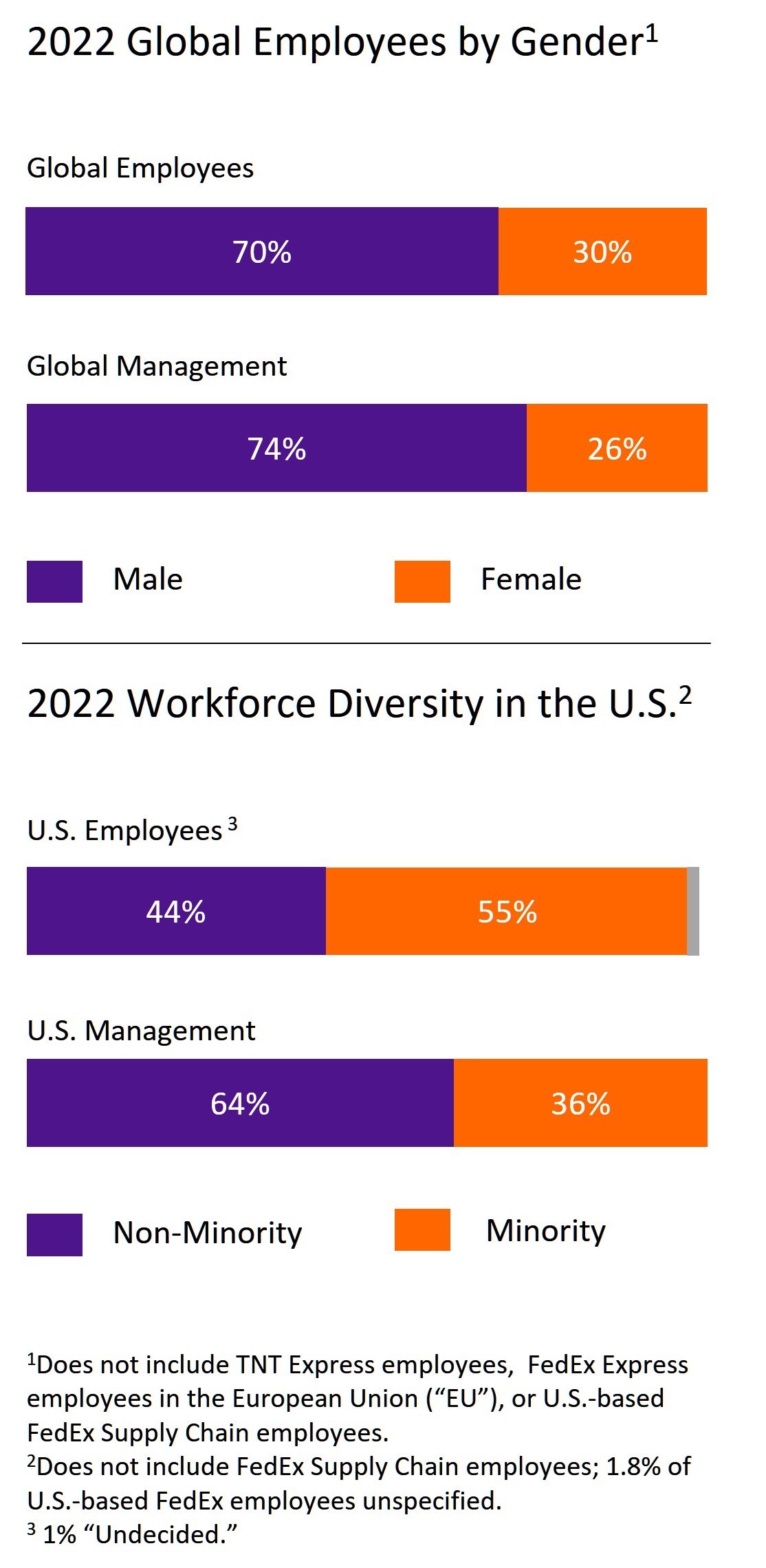 |
- 7 -
To support team members’ mental health and well-being, we offer 24/7 confidential counseling services to employees, eligible dependents, and all household members, even if they are not participating plan members. We frequently communicate with employees on how to access these resources to promote their use across the enterprise, with an increased focus on mental health resources in recent years.
Learning and Development
As our team members commit to delivering the Purple Promise, we remain committed to providing all our employees with learning and development opportunities to advance their careers at FedEx. Training and development begins with our enterprise-wide content for new employees—Core New Employee Orientation—which provides a consistent onboarding experience across our operating companies on topics such as safety, security, compliance, sustainability, and DEI. Beyond training opportunities, we provide ongoing career development tools, opportunities, and education for all full-time employees. Each operating company designs and manages its own leadership and development programs in support of its unique needs.
We are committed to supporting team members who wish to pursue higher education in a variety of ways. In 2021, we provided over $17 million in tuition assistance to nearly 11,000 employees to further their education. In addition, Learning inspired by FedEx (LiFE)—a partnership between multiple FedEx operating companies and The University of Memphis—continues to allow many employees the opportunity to earn a tuition-free, fully online degree. Eligible employees include all FedEx Express employees at all hub and airport locations in the U.S. as well as all U.S.-based FedEx Logistics and all Memphis-based FedEx Supply Chain employees. In 2021, we expanded the LiFE program by adding a mentoring component and extending coverage to over 100 majors and concentrations. The program currently has more than 2,000 enrolled employee participants.
In cooperation with key organizations, we are working to advance opportunities for team members from a variety of backgrounds to build a workforce reflective of the world and the communities we serve. For example, FedEx Express has launched OnDeck, a training and development program that provides frontline workers with skills to prepare for management roles.
Employee Engagement
We value feedback from our team members, looking to understand their concerns and expectations and, where appropriate, acting on them. We provide several avenues to listen to and engage with our team, including annual surveys, employee networks, and direct feedback. FedEx conducts annual engagement surveys to measure employee satisfaction on Culture, Engagement, and Diversity and we share the results with senior leaders to inform leadership development plans and additional changes as needed. All surveys included DEI questions in 2021, such as “I am treated with respect and dignity at work” (88% favorability rating) and “FedEx has an environment where people of diverse backgrounds are welcome” (86% favorability rating), to capture team member perspectives on inclusion in the workplace. FedEx Ground, our most diverse employee population, also added DEI as a standard goal in the 2022 team member annual performance review process.
Due to the COVID-19 pandemic, we have reevaluated how and where team members work and, where appropriate, have provided more flexibility to increase effectiveness and optimize our workspaces.
Tenure, Promotion, and Turnover
Every day, we work hard to earn and maintain the loyalty of our team members by creating a workplace culture that supports their aspirations and provides benefits and opportunities to support their quality of life and development. Globally, FedEx hired nearly 367,000 full- and part-time team members in 2021, largely to keep up with increased shipping volumes. Turnover for part-time team members, primarily package handlers at our sorting locations, was 200%, while full-time team member turnover was 32% in 2022. Turnover rates among part-time frontline workers in a number of industries are historically higher than among other employee groups. Within the ground transportation industry, many part-time workers pursue temporary employment opportunities that allow them to exit and re-enter the workforce more frequently based on their needs. These traditionally higher rates have recently been further exacerbated by the highly competitive labor market and the conditions created by the COVID-19 pandemic.
Other Information
As of May 31, 2022, FedEx employed approximately 345,000 permanent full-time and approximately 202,000 permanent part-time employees and FedEx Ground utilized over 6,000 contracted service providers.
- 8 -
The pilots at FedEx Express, who are a small number of its total employees, are employed under a collective bargaining agreement that took effect on November 2, 2015, and became amendable in November 2021. Bargaining for a successor agreement began in May 2021 and continues. Other than the pilots at FedEx Express and drivers at one FedEx Freight, Inc. facility, our U.S. employees have thus far chosen not to unionize (we acquired FedEx Supply Chain in 2015, which already had a small number of employees who are members of unions). Additionally, certain of FedEx Express’s non-U.S. employees are unionized. For additional information, see “FedEx Express Segment” and “Regulation” below and “Item 1A. Risk Factors.”
Our Community
FedEx is committed to actively supporting the communities we serve worldwide through the strategic investment of our people, resources, and network. Through FedEx Cares, our global community engagement program, we support non-profit organizations working to solve social challenges relevant to our business, customers, and team members. We pair donations with charitable shipping and access to our global network, team member volunteers, subject matter expertise, influence, and connections to meet social and business goals, and make our biggest investments in areas where we can address significant issues and apply our unique business capabilities. Real change takes significant investment, authentic support for communities, and a commitment to continuous learning. FedEx Cares focuses on three major giving portfolios:
-
Delivering for Good: Lending our global network and unparalleled logistics expertise to organizations with mission-critical needs in times of disaster and helping communities heal, learn, and thrive.
-
Global Entrepreneurship: Advancing women and minority-owned small businesses globally through training and increased access to resources, capital, and new markets.
-
Sustainable Logistics: Accelerating process innovations such as public transportation and technological innovations such as natural carbon capture and clean energy to reduce the environmental impact of the logistics industry.
Additionally, our commitments to DEI and team member volunteerism are foundational to FedEx Cares.
In 2020 we launched FedEx Cares 50 by 50 with the goal of positively impacting 50 million people around the world by our 50th anniversary in 2023. As of May 31, 2022, we have positively impacted approximately 40 million people. FedEx also supports communities throughout the U.S. with its annual FedEx Cares United Way giving campaign.
We believe the investments we make in our communities today, combined with team member engagement, set the stage for a brighter tomorrow. For additional information on our community involvement and our FedEx Cares strategy, visit fedexcares.com.
The Environment
At FedEx, we remain committed to minimizing the impacts our business has on the environment. Our “Practical Sustainability” philosophy and “Reduce, Replace, Revolutionize” approach guide our efforts to mitigate environmental impacts, increase efficiency, reduce costs, and protect against future risks. We understand the impacts climate change poses to our business, such as intensifying weather events, emerging greenhouse gas (“GHG”) emissions regulations, increased media and investor attention, and enhanced customer demands to address environmental challenges. We identify and evaluate physical and transition climate-related risks through our enterprise risk management process and align our assessment and reporting approach with the recommendations from the Global Reporting Initiative, Sustainability Accounting Standards Board, and the Task Force on Climate-related Financial Disclosures.
In 2021 we announced our goal to achieve carbon neutrality by calendar 2040 across our global operations’ Scope 1 and Scope 2 emissions and our Scope 3 contracted transportation GHG emissions. To help reach this goal, we are investing more than $2.0 billion in vehicle electrification, sustainable energy, and carbon sequestration, including a pledge of $100 million to Yale University to help establish the Yale Center for Natural Carbon Capture. In addition, we continue to leverage other approaches to reduce vehicle emissions, such as increased intermodal rail usage at FedEx Ground and FedEx Freight.
Vehicle Electrification
We are leveraging various innovative technologies to transition our pickup-and-delivery and last-mile fleets to electric vehicles. We plan to transition the entire FedEx parcel pickup-and-delivery fleet to zero-emission electric vehicles by calendar 2040, using a phased approach to replace existing vehicles. For example, by calendar 2025, we expect 50% of FedEx Express global pickup-and-delivery vehicle purchases will be electric, rising to 100% of all purchases by calendar 2030, subject to availability.
- 9 -
In 2021 FedEx Express agreed to purchase 500 electric vehicles from General Motors’ BrightDrop, and in January 2022 we expanded our agreement to acquire 2,000 additional electric vans over the next several years. We are currently working on a plan to add up to 20,000 more, subject to further negotiations and execution of a definitive purchase agreement. FedEx Ground is developing a comprehensive strategy to facilitate the electric vehicle transition for our independent service providers, and we are developing innovative charging infrastructures to support the continued rollout of electric vehicles by FedEx and independent service providers.
To advance progress towards our electrification goal and enhance our intelligent logistics system, we are working to leverage advanced technology to increase vehicle efficiency. See “FedEx Services Segment — Customer-Driven Technology — Autonomous Delivery Technology” below for additional information on Roxo, the FedEx SameDay Bot and other innovative specialty delivery technologies we are exploring. In addition, we continue to electrify forklifts, airport ground service equipment, and other non-road vehicles across our operating companies.
We strive to employ the most advanced vehicle technologies to efficiently and safely move packages across our networks. FedEx Express has established a goal to increase vehicle fuel efficiency by 50% from a 2005 baseline by calendar 2025. Through 2021, our efforts collectively resulted in a 42% improvement in FedEx Express vehicle fuel efficiency from our 2005 baseline.
Sustainable Fuels
We continue to invest in, and seek the development of, viable, cost-effective alternative fuels to reduce aircraft and vehicle emissions. Our global fleet includes more than 4,100 alternative fuel vehicles, including hybrid, electric, liquified or compressed natural gas, liquified petroleum gas, and hydrogen fuel cell vehicles, and we will continue to grow our alternative fuel fleet in the coming years, subject to availability. We have also established a goal of obtaining 30% of our jet fuel from alternative fuels by calendar 2030.
Aircraft Fuel Conservation and Fleet Modernization
To reduce the cost of fuel use and associated GHG emissions, we have implemented efficiencies in flight operations through our global FedEx Fuel Sense program and are replacing many of our older airplanes with more fuel-efficient models. Our team members remain committed to improving our fuel efficiency and reducing our environmental impact, which led to 65 million gallons of jet fuel savings from our FedEx Fuel Sense program in 2021. Additionally, we are modernizing our aircraft fleet to reduce costs, enhance reliability and operational adaptability, improve fuel efficiency, and reduce emissions. We retired our MD-10-10 fleet at the end of 2021 and plan to retire our MD-10-30 fleet during 2023. We took delivery of four Boeing 777 Freighter (“B777F”) aircraft in 2022, and plan to deploy an additional eight B777F aircraft between 2023 and 2025. Similarly, we took delivery of 12 Boeing 767-300 Freighter (“B767F”) aircraft in 2022, and plan to deploy an additional 38 B767F aircraft between 2023 and 2025. Delays could impact these timelines. We are also deploying 30 new ATR 72-600F aircraft for shorter feeder routes to replace our aging ATR-42 aircraft and introducing 50 Cessna SkyCourier 408 cargo aircraft to help reduce the number of planes needed per feeder route and further improve our fuel efficiency.
A global increase in shipping volume exacerbated by the COVID-19 pandemic delayed the retirement of certain older aircraft and led us to fall short of our goal to reduce aircraft emissions intensity by 30% from a 2005 baseline by calendar 2020. Due to the increased demand for essential deliveries, e-commerce, and other global shipments in 2021, our aircraft emissions increased 12% compared to our 2020 performance. However, we have reduced our overall aircraft emissions intensity by 27% since 2005.
Facilities
We strive to sustainably operate our more than 5,000 air and ground hubs, local stations, freight service centers, and retail locations through continued investments in efficiency, renewable energy, and other energy management programs. Our facility energy management strategy is more important than ever as our energy demand increases to support electric vehicle deployment. We increase the efficiency of our facilities through energy management systems that monitor, control, and optimize our lighting, heating, ventilation, and air-conditioning equipment. In 2021, we generated on- and off-site solar energy at a total of 26 global locations across our operating companies. Where appropriate, we adopt the Leadership in Energy and Environmental Design (“LEED”) standard in the U.S. and the Building Research Establishment Environmental Assessment Method (“BREEAM”) in Europe to guide efficient facility design. FedEx Express and FedEx Freight seek LEED certification on all new construction, and in total FedEx has 39 LEED-certified facilities and 13 BREEAM-certified facilities across our operating companies.
In addition, we aim to minimize our operational waste footprint. FedEx recognizes that the long-term health of our business is directly connected to the health of the planet and local communities, and each operating company has robust programs and policies in place to help mitigate adverse impacts on the local environment from facility operations.
- 10 -
Sustainable Customer Solutions
FedEx works with customers to evaluate offering end-to-end sustainability for our supply chains through options such as carbon-neutral shipping offerings and sustainable packaging solutions. We help customers ship packages responsibly by offering free packaging options for FedEx Express shipments that are reusable, recyclable, and made from recycled content. All FedEx-branded cardboard packaging is 100% recyclable. In addition, during 2021 the third-party certified content percentage of our packaging materials was 75% and all paper purchased by FedEx Office was from vendors with responsible forest-management practices.
For additional information on the ways we are minimizing our impact on the environment, see fedex.com/en-us/sustainability.html.
Governance
The FedEx Board of Directors is comprised of a majority of independent directors and is committed to the highest quality corporate governance and accountability to stockholders. Our Board of Directors periodically reviews all aspects of our governance policies and practices, including our Corporate Governance Guidelines (the “Guidelines”) and our Code of Conduct, in light of best practices and makes whatever changes it deems appropriate to further our longstanding commitment to the highest standards of corporate governance. The Guidelines and the Code of Conduct, which apply to all of our directors, officers, and employees, including our principal executive officer and senior financial officers, are available under the ESG heading under “Governance” on the Investor Relations page of our website at investors.fedex.com. We will post under the ESG heading on the Investor Relations page of our website information regarding any amendment to, or waiver from, the provisions of the Code of Conduct to the extent such disclosure is required.
Business Segments
The following describes in more detail the operations of each of our principal operating segments:
FedEx Express Segment
FedEx Express
Overview
FedEx Express invented express distribution nearly 50 years ago in 1973 and remains the industry leader, providing rapid, reliable, time-definite delivery of packages and freight to more than 220 countries and territories through an integrated global network.
FedEx Express offers a wide range of U.S. domestic and international shipping services for delivery of packages and freight, connecting markets that generate more than 99% of the world’s gross domestic product through door-to-door, customs-cleared service, historically with a money-back guarantee. As of July 15, 2022, the money-back guarantee remains suspended for certain FedEx Express services in order to balance our focus on service and safety. FedEx Express’s unmatched air route authorities and extensive transportation infrastructure, combined with leading-edge information technologies, make it the world’s largest express transportation company. As of May 31, 2022, FedEx Express employed nearly 250,000 employees and had approximately 74,000 drop-off locations (including FedEx Office stores and FedEx OnSite locations, such as approximately 19,000 Walgreens, Dollar General, and Albertsons stores), 696 aircraft, and approximately 86,000 vehicles in its global network.
FedEx Express also provides time-critical shipment services through FedEx Custom Critical, Inc. (“FedEx Custom Critical”) and cross-border enablement and technology solutions and e-commerce transportation solutions. FedEx Cross Border Holdings, Inc. was merged into FedEx Express during 2022.
Services
FedEx Express offers a wide range of U.S. domestic and international shipping services for delivery of packages and freight. FedEx Express offers three U.S. domestic overnight package delivery services: FedEx First Overnight, FedEx Priority Overnight, and FedEx Standard Overnight. FedEx SameDay service is available 365 days a year throughout all 50 states for urgent shipments up to 150 pounds. FedEx Express also offers U.S. express overnight and deferred freight services to handle the needs of the time-definite freight market.
- 11 -
International express and deferred package delivery is available to more than 220 countries and territories, with a variety of time-definite services to meet distinct customer needs. FedEx International Economy provides time-definite delivery typically in two to five business days. FedEx International First provides time-definite delivery to select postal codes in more than 25 countries and territories, with delivery to select U.S. ZIP Codes as early as 8:00 a.m. from nearly 200 countries and territories in one or two business days, delivery by 10:00 a.m. in one business day from the U.S. to Canada, and by 11:00 a.m. in one business day from the U.S. to Mexico. FedEx Express also offers domestic pickup-and-delivery services within certain non-U.S. countries, including France, the United Kingdom, Australia, Brazil, Italy, Canada, Mexico, Poland, India, China, and South Africa. In addition, FedEx Express offers comprehensive international express and deferred freight services, real-time tracking, and advanced customs clearance.
Our FedEx International Priority service provides end-of-day time-definite delivery in one to three business days to more than 220 countries and territories, and our FedEx International Priority Express service provides midday time-definite delivery in one to three business days to more than 20 countries and territories. Additionally, FedEx International Connect Plus, a contractual e-commerce service currently available from nearly 50 origin countries to over 130 destination countries, provides day-definite delivery typically within two to five business days.
For information regarding FedEx Express e-commerce tools and solutions, such as FedEx Delivery Manager and FedEx Returns Technology, see “FedEx Services Segment — Customer-Driven Technology — E-Commerce Solutions.”
International Expansion
Over the years, FedEx Express has added capabilities in important international markets that have given us more robust transportation networks. Our 2016 acquisition of TNT Express accelerated our European and global growth; substantially enhanced our global footprint through TNT Express’s lower-cost road networks in Europe, the Middle East, and Asia; and expanded our capabilities and solutions for our customers. The completion of the physical network integration of TNT Express into FedEx Express in 2022 and consolidation of flights into our Paris hub allow us to significantly improve operational efficiency. We are currently in the process of migrating customers from services offered by TNT Express to the FedEx Express portfolio of services. Additionally, we continue to execute initiatives to transform and optimize the FedEx Express international business, particularly in Europe. For more information regarding our international strategy and related costs, see “Item 1A. Risk Factors” and “Item 7. Management’s Discussion and Analysis of Results of Operations and Financial Condition” of this Annual Report.
We also have expanded our capabilities in the Asia-Pacific markets, including through the establishment of our Asia-Pacific hub at the Guangzhou Baiyun International Airport in southern China; our North Pacific regional hub at the Kansai International Airport in Osaka, Japan, which serves as a consolidation point for shipments from northern Asia to the U.S.; and our International Express and Cargo Hub in Shanghai at Shanghai’s Pudong International Airport. During 2020, we added 14 new Asia-Pacific origin markets for FedEx International First service to the U.S. and Canada. These developments allow us to continue to better serve our global customers doing business in the Asia-Pacific markets.
In December 2021, FedEx Express entered into a strategic alliance with Delhivery, a leading logistics and supply chain services company in India. See “Item 7. Management’s Discussion and Analysis of Results of Operations and Financial Condition” of this Annual Report for more information.
To facilitate the use of our growing international network, we offer a full range of international trade consulting services and a variety of online tools that enable customers to more easily determine and comply with international shipping requirements.
U.S. Postal Service Agreement
In 2013, FedEx Express entered into a new seven-year agreement with the U.S. Postal Service (“USPS”) under which FedEx Express provides airport-to-airport transportation of USPS First Class Mail, Priority Mail Express, and Priority Mail within the U.S. In 2017, the parties entered into an amendment to the agreement whereby the initial renewal period provided in the agreement was exercised in part and the agreement’s period of performance was extended through September 29, 2024. FedEx Express also provides transportation and delivery for the USPS’s international delivery service called Global Express Guaranteed under a separate agreement. For more information about our relationship with the USPS, see “Item 1A. Risk Factors” of this Annual Report.
Pricing
FedEx Express periodically publishes updates to the list prices for the majority of its services in its Service Guides. In general, shipping rates are based on the service selected, origin, destination, weight, size, any ancillary service charge, and whether the customer charged the shipment to a FedEx account. Effective January 3, 2022, FedEx Express implemented a 5.9% average list price increase for U.S. domestic, U.S. export, and U.S. import services.
- 12 -
In order to manage demand and capacity constraints in connection with the COVID-19 pandemic, between April 2020 and November 2020 FedEx Express implemented temporary surcharges on all international package and airfreight shipments. These surcharges continued as peak surcharges beginning in November 2020 and remain in effect. Additionally, beginning in June 2020 FedEx Express has implemented a series of peak surcharges generally applying to U.S. domestic shipments that are oversized or require additional handling, and to residential packages for customers meeting a certain volume threshold. Specific applicable surcharges have been adjusted periodically since their implementation, and higher surcharges were applied during the 2022 holiday peak season. Effective January 17, 2022, the U.S. domestic holiday peak surcharges were no longer in effect, and an additional residential surcharge was applied for customers who met certain volume thresholds. These changes reflect incremental costs associated with the challenging operating environment, while enabling FedEx Express to continue investing in service enhancement, fleet maintenance, technology innovations, and other areas to serve customers more effectively and efficiently.
FedEx Express has an indexed fuel surcharge for U.S. domestic and U.S. outbound shipments and for shipments originating internationally, where legally and contractually possible. FedEx Express fuel surcharges are adjusted on a weekly basis. The fuel surcharge is based on a weekly fuel price from two weeks prior to the week in which it is assessed. Some FedEx Express international fuel surcharges incorporate a timing lag of approximately six to eight weeks. The fuel surcharge for U.S. domestic freight services is assessed per pound of shipment. Effective June 21, 2021, November 1, 2021, and April 4, 2022, the tables used to determine fuel surcharges at FedEx Express were updated. The weighted-average U.S. domestic and outbound fuel surcharges for the past three years were: 2022 — 13.1%; 2021 — 4.9%; and 2020 — 6.3%. See the “Results of Operations and Outlook — Consolidated Results — Fuel” section of “Item 7. Management’s Discussion and Analysis of Results of Operations and Financial Condition” of this Annual Report for more information.
Operations
FedEx Express’s primary sorting facility, located in Memphis, serves as the center of the company’s multiple hub-and-spoke system. A second national hub facility is located in Indianapolis. We are making investments over multiple years in our facilities to expand and modernize our Indianapolis hub and Memphis World Hub. See the “Financial Condition — Liquidity Outlook” section of “Item 7. Management’s Discussion and Analysis of Results of Operations and Financial Condition” of this Annual Report for more information. In addition to these national hubs, FedEx Express operates regional hubs in Fort Worth, Newark, Oakland, and Greensboro and major metropolitan sorting facilities in Chicago and Los Angeles.
Facilities in Anchorage, Paris, Cologne, Guangzhou, and Osaka serve as sorting facilities for express package and freight traffic moving to and from Asia, Europe, and North America. Additional major sorting and freight handling facilities are located at Narita Airport in Tokyo and Stansted Airport outside London. The facilities in Paris, Cologne, Guangzhou, and Osaka are also designed to serve as regional hubs for their respective market areas. A facility in Miami — the Miami Gateway Hub — serves our South Florida, Latin American, and Caribbean markets. A central air hub near Liege, Belgium connects specific large European markets. In addition to its worldwide air network, FedEx Express operates road networks in North America, Europe, the Middle East, Asia, Australia, and South America. FedEx Express’s unique European road network connects more than 40 countries and territories through 19 transit hubs and over 540 stations.
Throughout its worldwide network, FedEx Express operates city stations and employs a staff of customer service agents, cargo handlers, and couriers who pick up and deliver shipments in the station’s service area. In some international areas, independent agents (“Global Service Participants”) have been selected to complete deliveries and to pick up packages. For more information about our sorting and handling facilities, see “Item 2. Properties” of this Annual Report under the caption “FedEx Express Segment.”
FedEx Office offers retail access to FedEx Express shipping services at all of its retail locations. FedEx Express also has alliances with certain other retailers to provide in-store drop-off sites, including at more than 19,000 Walgreens, Dollar General, and Albertsons stores. Our unstaffed FedEx Drop Boxes provide customers the opportunity to drop off packages in office buildings, shopping centers, and corporate or industrial parks.
Fuel Supplies and Costs
During 2022, FedEx Express purchased jet fuel from various suppliers under contracts that vary in length and which provide for estimated amounts of fuel to be delivered. The fuel represented by these contracts is purchased at market prices. We do not have any jet fuel hedging contracts. See “Pricing” above.
- 13 -
The following table sets forth FedEx Express’s costs for jet fuel and its percentage of FedEx Corporation consolidated revenues for the last five fiscal years:
| Fiscal Year | Total Jet Fuel Cost (in millions) | Percentage of Consolidated Revenue | ||||||
| 2022 | $ | 3,867 | 4.1 | % | ||||
| 2021 | 2,065 | 2.5 | ||||||
| 2020 | 2,265 | 3.3 | ||||||
| 2019 | 2,847 | 4.1 | ||||||
| 2018 | 2,460 | 3.8 |
Most of FedEx Express’s vehicle fuel needs are satisfied by retail purchases with various discounts.
Competition
As described in “Item 1A. Risk Factors” of this Annual Report, the express package and freight markets are both highly competitive and sensitive to price and service, especially in periods of little or no macroeconomic growth. The ability to compete effectively depends upon price, frequency, reliability, capacity and speed of scheduled service, ability to track packages, extent of geographic coverage, innovative service offerings, and the fit within the customer’s overall supply chain.
Competitors within the U.S. include other package delivery concerns, principally United Parcel Service, Inc. (“UPS”), passenger airlines offering express package services, regional delivery companies, air freight forwarders, and the USPS. FedEx Express’s principal international competitors are DHL, UPS, DPD (a subsidiary of France’s La Poste’s GeoPost), General Logistics Systems (a Royal Mail-owned parcel delivery group), foreign postal authorities, passenger airlines, air freight forwarders, regional carriers, and all-cargo airlines. FedEx Express also competes with startup companies that combine technology with crowdsourcing to focus on local market needs. In addition, some high-volume package shippers, such as Amazon.com, are developing and implementing in-house delivery capabilities and utilizing independent contractors for deliveries, and may be considered competitors. For example, Amazon.com has established a network of hubs, aircraft, and vehicles and has expressed an intention to offer its internal delivery capabilities broadly to third parties. Many of FedEx Express’s international competitors are government-owned, -controlled, or -subsidized carriers, which may have greater resources, lower costs, less profit sensitivity, and more favorable operating conditions than FedEx Express. For more information, see “Item 1A. Risk Factors” of this Annual Report.
Employees
Donald F. Colleran is the President and Chief Executive Officer of FedEx Express, which is headquartered in Memphis, Tennessee. Mr. Colleran will serve as President and Chief Executive Officer through August 31, 2022 and remain at FedEx Express as FedEx Express CEO Executive Advisor until his retirement on December 31, 2022. Richard W. Smith, who previously served as Regional President, The Americas and Executive Vice President, Global Support of FedEx Express, was appointed President and Chief Executive Officer—Elect of FedEx Express effective April 1, 2022, and will succeed Mr. Colleran as President and Chief Executive Officer of FedEx Express effective September 1, 2022. As of May 31, 2022, FedEx Express employed approximately 191,000 permanent full-time and approximately 58,000 permanent part-time employees.
The pilots of FedEx Express, who are a small number of its total employees, are represented by the Air Line Pilots Association, International (“ALPA”) and are employed under a collective bargaining agreement that took effect in November 2015. The collective bargaining agreement became amendable in November 2021. Bargaining for a successor agreement began in May 2021 and continues. In addition to our pilots at FedEx Express, certain of FedEx Express’s non-U.S. employees are unionized. In June 2022, the Transport Workers Union filed an application with the National Mediation Board requesting an election to represent approximately 130 Global Operations Control (“GOC”) specialists who perform flight dispatching functions in FedEx Express’s GOC center. FedEx Express has raised objections to the application in its response. FedEx Express believes its employee relations are excellent. See “Item 1A. Risk Factors” of this Annual Report for more information.
FedEx Custom Critical
FedEx Custom Critical provides a range of expedited, time-specific freight-shipping services throughout the U.S., Canada, and Mexico. Among its services are Surface Expedite, providing exclusive-use shipping and time-definite services; Air Expedite, offering an array of expedited air solutions to meet customers’ critical delivery times; and White Glove Services, for shipments that require extra care in handling, temperature control, or specialized security. Service from FedEx Custom Critical is available 24 hours a day, 365 days a year. FedEx Custom Critical continuously monitors shipments through an integrated proprietary shipment-control system, including two-way satellite communications on exclusive-use shipments.
- 14 -
FedEx Ground Segment
Overview
By leveraging the FedEx brand, maintaining a low-cost structure, and efficiently using information technology and advanced automation systems, FedEx Ground continues to enhance its competitive position as a leading provider of business and residential money-back guaranteed ground package delivery services. As of July 15, 2022, the money-back guarantee for all FedEx Ground services remains temporarily suspended in order to balance our focus on service and safety. FedEx Ground serves customers in the North American small-package market, focusing on business and residential delivery of packages weighing up to 150 pounds. Ground service is provided to 100% of the continental U.S. population and overnight service of up to 400 miles to nearly 100% of the continental U.S. population. Service is also provided to nearly 100% of the Canadian population. In addition, FedEx Ground offers service to Alaska and Hawaii through a ground and air network operation coordinated with other transportation providers. FedEx Ground provides seven-day-per-week residential delivery to virtually all of the U.S. population.
The company offers FedEx Home Delivery service, which reaches 100% of U.S. residences. FedEx Home Delivery is dedicated to meeting the delivery needs of residential customers and provides routine Saturday and evening delivery and premium options such as day-specific, appointment, and signature delivery. Sunday delivery is also provided for virtually all of the U.S. population. FedEx Home Delivery brings unmatched services to residential shippers and their customers and is the first residential ground package delivery service to have offered a money-back guarantee. FedEx Ground Economy service is available for the consolidation and delivery of high volumes of low-weight, less time-sensitive business-to-consumer packages to any residential address or PO Box in the U.S.
Pricing
FedEx Ground periodically publishes updates to the list prices for the majority of its services in its Service Guide. In general, U.S. shipping rates are based on the service selected, origin, destination, weight, size, any ancillary service charge, and whether the customer charged the shipment to a FedEx account. Effective January 3, 2022, FedEx Ground and FedEx Home Delivery implemented a 5.9% average list price increase. FedEx Ground Economy average list prices also increased.
To manage demand and capacity constraints in connection with the COVID-19 pandemic, beginning in June 2020 FedEx Ground implemented a series of surcharges generally applying to shipments that are oversized, unauthorized, or require additional handling; to residential packages for customers meeting a certain volume threshold; and to FedEx Ground Economy shipments. Specific applicable surcharges have been adjusted periodically since their implementation, and higher surcharges were applied during the 2022 holiday peak season. Effective January 17, 2022, the holiday peak surcharges were no longer in effect, and additional surcharges were applied to residential shipments for customers who met certain volume thresholds and to packages delivered or returned using FedEx Ground Economy services. These changes reflect incremental costs associated with the challenging operating environment, while enabling FedEx Ground to continue investing in service enhancement, equipment maintenance, technology innovations, and other areas to serve customers more effectively and efficiently.
FedEx Ground has an indexed fuel surcharge, which is adjusted on a weekly basis. The fuel surcharge is based on a weekly fuel price from two weeks prior to the week in which it is assessed. Effective June 21, 2021, November 1, 2021, and April 4, 2022, the tables used to determine fuel surcharges at FedEx Ground were updated. See the “Results of Operations and Outlook — Consolidated Results — Fuel” section of “Item 7. Management’s Discussion and Analysis of Results of Operations and Financial Condition” of this Annual Report for more information.
Operations
FedEx Ground operates a highly flexible network of over 680 sortation and distribution facilities, including approximately 160 fully automated stations, in the U.S. and Canada as of May 31, 2022. FedEx Ground conducts its operations primarily with more than 100,000 vehicles owned or leased by independent service providers. To provide FedEx Home Delivery service and FedEx Ground Economy service, FedEx Ground leverages its pickup operation and hub and linehaul network.
In recent years, FedEx Ground’s network expansion has substantially increased the company’s daily capacity through the addition of new facilities featuring the latest automated sorting technology as well as the expansion or relocation of existing hubs and other facilities. FedEx Ground has also made significant operational enhancements to ensure safe and reliable handling of large and heavy items. These changes include designing new facilities, adding equipment to certain facilities, and making other operational adjustments.
- 15 -
FedEx Ground continues to leverage opportunities to maximize utilization of existing facilities and deploy new technologies to enhance operational efficiency. Advanced automated unloading and sorting technology is used to streamline the handling of millions of packages daily. FedEx Ground yard management systems, which interact with GPS tags on each trailer and create geofences around FedEx Ground facilities, automatically notify the control center when a trailer arrives and departs. Using overhead laser and six-sided camera-based bar code scan technology, hub conveyors electronically guide packages to their appropriate destination chute, where they are loaded for transport to their respective destination stations for local delivery. FedEx Ground is implementing dynamic scheduling tools to match sort staffing headcount with volumes, and is introducing capabilities to allow certain packages to bypass station sortation and proceed directly to vehicles, which helps to maximize station capacity. Additionally, FedEx Ground is testing autonomous, driverless technologies in the handling of large, non-conveyable packages.
Advanced route optimization technology provides service providers near real-time data that can be used to plan efficient delivery routes and make decisions about vehicle mix and workforce. Additionally, software systems and internet-based applications are deployed to offer customers new ways to connect internal package data with external delivery information. FedEx Ground provides shipment tracing and proof-of-delivery signature functionality through the FedEx website, fedex.com. For additional information regarding FedEx Ground e-commerce tools and solutions, including FedEx Delivery Manager and FedEx Returns Technology, see “FedEx Services Segment — Customer-Driven Technology — E-Commerce Solutions.”
FedEx Ground has recently introduced new vehicle safety technologies and incentives for adoption by its service providers, as well as new eligibility standards for drivers employed by service providers.
FedEx Office offers retail access to FedEx Ground shipping services at all of its retail locations. FedEx Ground is also available as a service option at all FedEx Authorized ShipCenters and other FedEx OnSite locations, including at approximately 19,000 Walgreens, Dollar General, and Albertsons stores.
As of May 31, 2022, FedEx Ground employed approximately 66,000 permanent full-time and approximately 134,000 permanent part-time employees. In addition, FedEx Ground contracts with over 6,000 independent small businesses to conduct its linehaul and pickup-and-delivery operations, as the use of these service providers is well suited to the needs of the ground delivery business and its customers.
FedEx Ground is defending lawsuits in which it is alleged that FedEx Ground should be treated as an employer or joint employer of drivers employed by service providers engaged by FedEx Ground. We continue to believe that FedEx Ground is not an employer or joint employer of the drivers of these independent businesses. For a description of these proceedings, see “Item 1A. Risk Factors” of this Annual Report and Note 19 of the consolidated financial statements included in “Item 8. Financial Statements and Supplementary Data” of this Annual Report.
John A. Smith is the President and Chief Executive Officer of FedEx Ground. FedEx Ground is headquartered in the Pittsburgh, Pennsylvania area, and its primary competitors are UPS, the USPS, and regional delivery carriers. FedEx Ground also competes with startup companies that combine technology with crowdsourcing to focus on local market needs. In addition, some high-volume package shippers, such as Amazon.com, are developing and implementing in-house delivery capabilities and utilizing independent contractors for deliveries. For example, Amazon.com has established a network of hubs and vehicles and has expressed an intention to offer its internal delivery capabilities broadly to third parties. For more information, see “Item 1A. Risk Factors” of this Annual Report.
FedEx Freight Segment
Overview
FedEx Freight is a leading North American provider of LTL freight services, offering choice, simplicity, and reliability to meet the needs of LTL shippers — FedEx Freight Priority, when speed is critical to meet a customer’s supply chain needs; FedEx Freight Economy, when a customer can trade time for cost savings; and FedEx Freight Direct, a service to meet the needs of the growing e-commerce market for delivery of heavy, bulky products to or through the door for residences and businesses. Through one comprehensive network of service centers and advanced information systems, FedEx Freight provides service to virtually every U.S. ZIP Code (including Alaska and Hawaii) with industry-leading transit times. FedEx Freight Priority has the fastest published transit times of any nationwide LTL service. Internationally, FedEx Freight Canada offers FedEx Freight Priority service, serving most points in Canada, as well as FedEx Freight Priority and FedEx Freight Economy service between Canada and the U.S. In addition, FedEx Freight serves Mexico, Puerto Rico, and the U.S. Virgin Islands via alliances. As of July 15, 2022, the money-back guarantee for all FedEx Freight services remains temporarily suspended in order to balance our focus on service and safety.
- 16 -
Through its many service offerings, FedEx Freight can match customers’ time-critical needs with industry-leading transit times. With the expansion of FedEx electronic solutions, LTL shippers have the convenience of a single shipping and tracking solution for FedEx Freight, FedEx Express, and FedEx Ground. These solutions make freight shipping easier and provide customers easy access to their account information. The FedEx Freight Advance Notice feature available on FedEx Freight Priority shipments uses the company’s innovative technology systems to proactively notify FedEx Freight customers via the internet, e-mail, or fax when a shipment may be delayed beyond its estimated delivery date, providing customers with greater visibility and control of their LTL freight shipments. Customers can also process cross-border LTL shipments to and from Canada and Mexico, as well as intra-Canada and -Mexico shipments, through FedEx Ship Manager at fedex.com, FedEx Ship Manager Software, FedEx Ship Manager Server, and FedEx Web Services. Additionally, FedEx Freight A.M. Delivery offers freight delivery by 10:30 a.m. within and between the U.S. and Canada. FedEx Freight also offers LTL Select, a free cloud-based, multi-carrier transportation management system that provides customers with visibility into all available carriers and their pricing in one location, as well as the ability to book service and make payments.
FedEx Freight Direct addresses the growing e-commerce market for heavy bulky products and supports ongoing collaboration between FedEx Freight and FedEx Ground. It has four service levels to meet customer needs, with basic and basic by appointment available to nearly 100% of the U.S. population and standard and premium available to 90% of the continental U.S. population.
FedEx Freight continues to expand its use of DIM technology to more accurately capture freight profile, which improves the company’s ability to cost and price shipments. FedEx Freight also uses radio frequency identification technology and customized software to improve shipment visibility on its docks and enhance custodial control at the handling unit level.
As of May 31, 2022, the FedEx Freight segment was operating more than 30,000 vehicles from a network of approximately 400 service centers and had approximately 47,000 employees. Lance D. Moll is the President and Chief Executive Officer of FedEx Freight, which is based in Memphis, Tennessee. FedEx Freight’s primary competitors are YRC Worldwide Inc. (which includes YRC Regional Transportation and YRC Freight), XPO Logistics, Inc., Old Dominion Freight Line, Inc., ABF Freight (an ArcBest company), SAIA, Inc., and TFI International Inc.
We are currently bargaining with the International Brotherhood of Teamsters at one FedEx Freight facility.
Pricing
FedEx Freight periodically publishes updates to the list prices for the majority of its services in its 100 Rules Tariff. In general, shipping rates are based on the service selected, origin, destination, weight, class, any ancillary service charge, and whether the customer charged the shipment to a FedEx account. On January 3, 2022, FedEx Freight implemented a 5.9% average list price increase for customers who use FXF PZONE and FXF EZONE rates and a 7.9% average list price increase for customers who use FXF 1000 and FXF 501. These increases apply for shipments within the U.S. and between the contiguous U.S. and Canada.
In order to manage demand and capacity constraints, beginning in July 2021 FedEx Freight implemented a peak surcharge applying to specific delivery points within the U.S. The peak surcharge has been adjusted periodically since implementation. Effective November 15, 2021, FedEx Freight increased applicable length surcharges. Effective January 17, 2022, FedEx Freight added a surcharge that applies when a pickup is performed and no shipment is tendered to the carrier.
FedEx Freight has an indexed fuel surcharge, which is adjusted on a weekly basis. The fuel surcharge is based on a weekly fuel price from two days prior to the day in which it is assessed. Effective November 1, 2021 and April 4, 2022, the tables used to determine fuel surcharges at FedEx Freight were updated. See the “Results of Operations and Outlook — Consolidated Results — Fuel” section of “Item 7. Management’s Discussion and Analysis of Results of Operations and Financial Condition” of this Annual Report for more information.
FedEx Services Segment
FedEx Services provides our other companies with sales, marketing, information technology, communications, customer service, technical support, billing and collection services, and certain other back-office support. Through FedEx Services, we provide a convenient single point of access for many customer support functions, enabling us to more effectively sell the entire portfolio of transportation services and to help ensure a consistent and outstanding experience for our customers.
Brie A. Carere and Robert B. Carter each serve as the Co-President and Co-Chief Executive Officer of FedEx Services, which is based in Memphis, Tennessee. As of May 31, 2022, the FedEx Services segment had approximately 15,000 employees.
- 17 -
Customer-Driven Technology
FedEx is a world leader in technology, and FedEx founder Frederick W. Smith’s vision that “the information about a package is as important as the delivery of the package itself” remains at the core of our comprehensive technology strategy. We strive to build technology solutions that will solve our customers’ business problems with simplicity, convenience, speed, and reliability. Additionally, FedEx stands at the nexus of digital and physical networks, a crucial intersection for the success of e-commerce deliveries. We continue to expand our e-commerce convenience network and explore innovative alternatives to help customers and businesses deliver. During 2022 we continued to advance a major information technology transition from traditional mainframe computing to cloud-based systems, which is delivering significant benefits in terms of flexibility, security, speed to market, and resiliency. See “FedEx Dataworks Operating Segment” below for more information on the solutions we are creating to “Innovate for Tomorrow.”
Shipping Management and Precision Tracking
The fedex.com website is widely recognized for its speed, ease of use, and customer-focused features. The advanced tracking capability within FedEx Tracking provides customers with a consolidated view of inbound and outbound shipments. FedEx Virtual Assistant on fedex.com is an artificial-intelligence-enabled service that provides answers to customer shipping questions, allowing our customer service representatives and sales professionals to focus on higher-value customer interactions.
SenseAware, a FedEx innovation currently available in nearly 90 countries worldwide, allows customers to stay connected to their critical shipments by providing real-time updates regarding current location, precise temperature, relative humidity, barometric pressure readings, light exposure, and shock events. Additionally, FedEx SenseAware ID is a lightweight sensor-based logistics device that delivers a new level of precision tracking. The enhanced location visibility provided by FedEx SenseAware ID will create opportunities for FedEx customers to reimagine their supply chains through real-time updates on a package’s location within the FedEx Express network. FedEx is currently expanding access to FedEx SenseAware ID and plans to eventually make FedEx SenseAware ID available for a broad range of premium FedEx Express services.
FedEx Mobile is a suite of solutions including the FedEx mobile application, FedEx mobile website, and SMS text messaging. The FedEx Mobile app provides convenience for recipients to track packages and access FedEx Delivery Manager to customize home deliveries. Shippers can easily get rates and estimated delivery times and swiftly create a shipping label. All users can quickly find the nearest FedEx location for Hold at Location or drop-off. It is available on Android™ and Apple devices. The FedEx Mobil app has expanded to more than 220 countries and territories and 40 languages. SMS Notifications allows customers to track or follow a package via text messaging, and it is currently available in five countries.
Additionally, our FedEx Ship Manager suite of solutions offers a wide range of options to help our customers manage their parcel and LTL shipping and associated processes.
E-Commerce Solutions
FedEx Delivery Manager allows our U.S. residential customers to customize home deliveries to fit their schedule by providing a range of options to schedule dates, locations, and times of delivery. Additionally, FedEx Returns Technology, a comprehensive solution for returns management, provides high-volume merchants and e-tailers complete visibility into returns and an easy way to track shipments, manage inventory, analyze returns trends, and make more informed decisions based on shoppers’ returns behaviors.
FedEx OnSite, our retail convenience network, utilizes third-party retailers to receive and hold packages for FedEx customers. As of July 15, 2022, the FedEx OnSite network has grown to include approximately 19,000 Walgreens, Dollar General, and Albertsons stores in addition to our approximately 2,200 FedEx Office locations. In addition to allowing for an easy returns and drop-off experience for shoppers, the FedEx OnSite network is well positioned to serve as a “buy online, pickup in store” network for small and medium merchants without brick-and-mortar locations. We have also added FedEx Returns Technology to the Walgreens retail network, which allows for in-store printing of return shipping labels and eliminates the need to include a return label in every package.
We have expanded e-commerce delivery options for retailers with FedEx Extra Hours, a service that enables participating retailers to fulfill e-commerce orders into the evening and receive late pickups by FedEx Express, with next-day local delivery and two-day shipping to any address in the continental U.S. FedEx Extra Hours, which is currently available to select customers, allows retailers to extend evening order cutoff times by five to eight hours, with some as late as midnight, depending on their current order fulfillment process.
In June 2022, FedEx announced the launch of Picture Proof of Delivery for express and ground residential deliveries in the U.S. and Canada that are released without a signature in advance of the 2023 holiday peak season.
- 18 -
Autonomous Delivery Technology
FedEx is exploring the use of autonomous delivery technology within its operations. Roxo, the FedEx SameDay Bot, an autonomous delivery device designed to help retailers make on-demand same-day and last-mile deliveries to their customers, continues development and testing in select markets. In 2021, we announced a multi-year, multi-phase agreement to test Nuro’s next-generation autonomous delivery vehicle within FedEx operations. The collaboration with Nuro will explore various use cases for on-road autonomous vehicle logistics such as multi-stop and appointment-based deliveries.
In 2022, we began a pilot program with Aurora Innovation, Inc. (“Aurora”) and PACCAR Inc. to test Aurora’s autonomous driving technology in PACCAR autonomous vehicle platform-equipped trucks within FedEx linehaul operations. Additionally, FedEx Express is developing plans to test Elroy Air’s autonomous air cargo system within the company’s middle-mile logistics operations, moving shipments between sortation locations. We are also working with major national retailers, fast food restaurants, and drug stores to help assess different customers’ autonomous delivery needs.
Marketing
The FedEx brand name symbolizes outstanding service, reliability, and speed. Emphasis is continually placed on promoting and protecting the FedEx brand, one of our most important assets. As a result, FedEx is one of the most widely recognized brands in the world. In addition to television, print, and digital advertising, we promote the FedEx brand through sponsorships and special events. For example, FedEx sponsors:
-
The UEFA Champions League, which is broadcast in over 200 countries and territories worldwide.
-
The season-long FedExCup competition on the PGA Tour, including the FedEx St. Jude Championship, a PGA Tour event that has raised millions of dollars for St. Jude Children’s Research Hospital and is one of three annual FedExCup playoff events.
-
The #11 Joe Gibbs Racing Toyota Camry driven by Denny Hamlin in the NASCAR Cup Series.
Additionally, FedEx is the “Official Delivery Service Sponsor” and “Official Office Services Provider” of the NFL, through which we conduct events and other activities to promote the FedEx brand, such as the “FedEx Air & Ground” NFL Players of the Week and Players of the Year Awards.
Information Security
FedEx Services has a team of highly qualified professionals dedicated to securing information about our customers’ shipments and protecting our customers’, vendors’, and employees’ privacy, and we strive to provide a safe, secure online environment for our customers. We are committed to compliance with applicable information security laws, regulations, and industry standards. For a description of risks related to information security, see “Item 1A. Risk Factors” of this Annual Report.
FedEx Office Operating Segment
As of May 31, 2022, FedEx Office operated approximately 2,200 customer-facing stores, providing convenient access to printing and shipping expertise with reliable service.
The FedEx Office brick-and-mortar network features retail stores, FedEx Office locations inside Walmart stores, manufacturing plants, corporate on-site print centers, and on-site business centers at colleges and universities, hotels, convention centers, corporate campuses, and healthcare campuses. Many of these locations are open later in the evenings to accommodate urgent printing projects and delivery drop-offs. FedEx Office has designed a suite of printing and shipping management solutions that are flexible and scalable, allowing customers to meet their unique printing and shipping needs. The network provides an adaptable cost model helping to save time, labor, and overhead by freeing up resources and avoiding fixed costs associated with large-scale printing and e-commerce parcel volumes. This is especially valuable to our enterprise customers looking to outsource their print supply chain. Services include digital printing, professional finishing, document creation, design services, direct mail, signs and graphics, custom-printed boxes, copying, computer rental, free Wi-Fi, corporate print solutions, expedited U.S. passport processing and renewal through a collaboration with a registered U.S. passport agency, and fully digital notarization services through FedEx Office Online Notary.
With the FedEx Office Print On Demand solution, customers can use their laptops or mobile devices to design their print needs or access their personal cloud accounts, and print directly to any FedEx Office location in the U.S., or have their order delivered right to their door. Customers also have the flexibility of using FedEx Office’s Print & Go solutions to print at self-serve locations from USBs, the cloud, or through email. Print & Go solutions allow customers to access files using popular cloud providers Google Drive™, Box, Microsoft OneDrive®, and from FedEx Office’s own My Online Documents, making printing easy.
- 19 -
FedEx Office has prioritized our e-commerce and digital offerings as a growth opportunity for the enterprise/large, medium, and small business customers we serve. FedEx Office has partnered with a content and creative design platform to form a digital design-to-print marketplace offering millions of images and illustrations, an extensive library of templates, and a simple drag-and-drop interface to create custom business materials from fedex.com on any device, with next-day printing on many requests available at FedEx Office stores. Additionally, FedEx Office has partnered with a leading marketing solutions company to introduce an online branded promotional products marketplace that allows businesses to customize and purchase high-quality promotional products. FedEx Office has also made investments in new machines and technology, enhancing capabilities in narrow format color, grand format, large format, color management, enhanced finishing, and other technologies.
FedEx Office provides customers convenient access to the full range of FedEx Express and FedEx Ground shipping services. Customers may have their FedEx Express and FedEx Ground packages delivered to any FedEx Office customer-facing location nationwide through the Hold at FedEx Location service, free of charge, and may redirect packages to these locations through Redirect to Hold or AutoRedirect to Hold services. FedEx Office facilitates e-commerce and returns through FedEx Returns Technology, which allows for in-store printing of return shipping labels. Additionally, FedEx SameDay City is available in over 1,800 cities in 34 markets across the U.S., offering door-to-door residential and business delivery of time-sensitive parcels within hours by FedEx Office uniformed team members in branded FedEx Office delivery vehicles. Industries such as healthcare, life sciences, manufacturing, finance, perishables, travel, and automotive rely on same-day services for critical delivery needs.
FedEx Office also offers packing services, and packing supplies and boxes are included in its retail offerings. By allowing customers to have items professionally packed by specially trained FedEx Office team members and then shipped using FedEx Ground day-definite shipping or time-definite global FedEx Express shipping services, FedEx Office offers a complete “pack-and-ship” solution. FedEx Office also offers FedEx Pack Plus, which includes custom box building capabilities and techniques; a robust assortment of specialty boxes; and additional packing supplies, equipment, and tools to serve our customers’ needs.
Almost all FedEx Office locations provide local pickup-and-delivery service for print jobs completed by FedEx Office. A FedEx courier picks up a customer’s print job at the customer’s location and then returns the finished product to the customer. Options and services vary by location.
Brian D. Philips is the President and Chief Executive Officer of FedEx Office, which is based in Plano, Texas. As of May 31, 2022, FedEx Office had approximately 13,000 employees. FedEx Office is an operating segment that is included in “Corporate, other, and eliminations” in our segment reporting.
FedEx Logistics Operating Segment
The FedEx Logistics operating segment plays a key role within the FedEx portfolio with a comprehensive suite of integrated logistics solutions, providing air and ocean cargo transportation, specialty transportation, customs brokerage, and trade management tools and data through FedEx Trade Networks Transport & Brokerage, as well as third party logistics and supply chain solutions through FedEx Supply Chain. FedEx Logistics has the unique ability to leverage the power of the FedEx transportation networks as well as its global network of service providers. Additionally, FedEx Logistics provides international trade advisory services.
Dr. Udo Lange is the President and Chief Executive Officer of FedEx Logistics, which is based in Memphis, Tennessee. As of May 31, 2022, the FedEx Logistics organization had approximately 21,000 employees. FedEx Supply Chain has a small number of employees who are members of unions. FedEx Logistics is an operating segment that is included in “Corporate, other, and eliminations” in our segment reporting.
FedEx Trade Networks Transport & Brokerage
FedEx Trade Networks Transport & Brokerage provides international trade services, specializing in customs brokerage, global ocean and air freight forwarding, and managed transportation. Additionally, FedEx Trade Networks Transport & Brokerage provides customs clearance services for FedEx Express at its major U.S. hub facilities and border customs clearance for FedEx Ground and FedEx Freight. FedEx Trade Networks Transport & Brokerage also offers global door-to-door air charter solutions collaborating with FedEx Express and U.S. import door-to-door less-than-container-load ocean solutions collaborating with FedEx Freight.
As trade throughout the world grows, so does the FedEx Trade Networks Transport & Brokerage solutions portfolio. As of May 31, 2022, FedEx Trade Networks Transport & Brokerage operated approximately 150 offices and facilities in 34 countries and territories throughout North America and in Africa, Asia-Pacific, Europe, India, Latin America, the Middle East, and Australia/New Zealand. FedEx Trade Networks Transport & Brokerage maintains a network of air and ocean freight-forwarding service providers and has entered into strategic alliances to provide services in certain countries in which it does not have owned offices.
FedEx Trade Networks Transport & Brokerage offers customized trade solutions that enable improved compliance practices through FedEx Trade Solutions.
- 20 -
FedEx Supply Chain
FedEx Supply Chain is a supply chain solutions provider specializing in Product Lifecycle Logistics® for technology, retail, consumer and industrial goods, and healthcare industries. With approximately 15,000 employees at approximately 100 facilities as of May 31, 2022, FedEx Supply Chain provides a comprehensive range of integrated logistics services to enable growth, minimize cost, mitigate supply chain risk, and improve customer services. Service offerings include inbound logistics, warehousing and distribution, fulfillment, contract packaging and product configuration, systems integration, returns process and disposition, test, repair, refurbishment, and product liquidation.
FedEx Fulfillment is an e-commerce solution that helps small and medium-sized businesses fulfill orders from multiple channels, including websites and online marketplaces, and manage inventory for their retail stores. The FedEx Fulfillment platform is designed to be an easy-to-use and all-in-one logistics solution through which customers have complete visibility into their products, giving them an easy way to track items, manage inventory, analyze trends, and make more informed decisions by better understanding shoppers’ spending behaviors.
FedEx Dataworks Operating Segment
The FedEx Dataworks operating segment is focused on putting our data into context and using it to transform the digital and physical experiences of our customers and team members. The size and scale of our global network gives us a bird’s-eye view of global supply chains and trends. This foundation provides an immense amount of data we can use to build better insights, increase visibility, and improve the customer experience. FedEx Dataworks is creating solutions that allow us to “Innovate for Tomorrow” by collaborating across the FedEx enterprise to integrate the technology and services integral to the success of our customers. Further, FedEx Dataworks will help to facilitate an open and collaborative e-commerce ecosystem that helps merchants provide seamless end-to-end experiences for their customers. In 2022, we enhanced tracking capabilities on fedex.com based on an advanced machine learning and artificial intelligence model developed by FedEx Dataworks. This new experience delivers greater estimated delivery date accuracy, including updates for early or delayed shipments.
ShopRunner is an e-commerce platform that directly connects brands and merchants with online shoppers. ShopRunner members enjoy benefits that include free two-day shipping, free returns, member-exclusive discounts, and seamless checkout. ShopRunner’s data-driven marketing and omnichannel enablement capabilities also help brands and merchants acquire high-value customers and accelerate their digital innovation by using ShopRunner’s e-commerce platform. We believe the complementary nature of ShopRunner’s pre-purchase offerings combined with FedEx’s post-purchase logistics intelligence will enable brands and merchants to attract and engage consumers at scale by providing innovative online shopping experiences.
FedEx Surround allows any business to enhance visibility into its supply chain by leveraging data to provide near-real-time analytics into shipment tracking, which will drive more precise logistics and inventory management.
Through innovative partnerships, FedEx Dataworks seeks to open pathways to e-commerce and empower customers with differentiated insights and tools. In April 2021, we announced a multi-year collaboration with Adobe, starting with the integration of ShopRunner with Adobe Commerce’s Magento platform. By integrating their online storefronts with ShopRunner, Adobe merchants are able to offer seamless checkout, two-day shipping, easy returns, and exclusive offers to shippers. The collaboration also gives merchants access to FedEx post-purchase logistics intelligence, allowing for better management of supply chains. In September 2021, we announced a multi-year partnership with Salesforce that integrates Salesforce Commerce Cloud and Salesforce Order Management with innovative capabilities from FedEx and ShopRunner.
In January 2022, FedEx and Microsoft announced a new cross-platform logistics solution for e-commerce aimed at increasing merchant competitiveness in the e-commerce space by improving customer engagement and providing enhanced shipping options, which is expected to be available to customers in the U.S. in the second half of calendar 2022. Additionally, in June 2022 FedEx and FourKites announced a strategic alliance to provide businesses with new, more robust real-time supply chain visibility capabilities.
Sriram Krishnasamy is the President and Chief Executive Officer of FedEx Dataworks, which is based in Memphis, Tennessee. As of May 31, 2022, FedEx Dataworks had approximately 400 employees. FedEx Dataworks is an operating segment that is included in “Corporate, other, and eliminations” in our segment reporting.
Seasonality
For information on the seasonality of our business, see the “Results of Operations and Outlook — Consolidated Results — Seasonality of Business” section of “Item 7. Management’s Discussion and Analysis of Results of Operations and Financial Condition” of this Annual Report.
- 21 -
Trademarks
The “FedEx” trademark, service mark, and trade name are essential to our worldwide business. FedEx, FedEx Express, FedEx Ground, FedEx Freight, FedEx Services, FedEx Office, FedEx Logistics, FedEx Dataworks, FedEx Trade Networks Transport & Brokerage, FedEx Supply Chain, FedEx Custom Critical, and ShopRunner, among others, are trademarks, service marks, and trade names of Federal Express Corporation or the respective companies for which registrations, or applications for registration, are on file, as applicable. We have authorized, through licensing arrangements, the use of certain of our trademarks, service marks, and trade names by our contractors and Global Service Participants to support our business. In addition, we license the use of certain of our trademarks, service marks, and trade names on promotional items for the primary purpose of enhancing brand awareness.
Regulation
Air. Under the Federal Aviation Act of 1958, as amended (the “Federal Aviation Act”), both the U.S. Department of Transportation (“DOT”) and the Federal Aviation Administration (“FAA”) exercise regulatory authority over FedEx Express.
The FAA’s regulatory authority relates primarily to operational aspects of air transportation, including aircraft standards and maintenance, as well as personnel and ground facilities, which may from time to time affect the ability of FedEx Express to operate its aircraft in the most efficient manner. FedEx Express holds an air carrier certificate granted by the FAA pursuant to Part 119 of the federal aviation regulations. This certificate is of unlimited duration and remains in effect so long as FedEx Express maintains its standards of safety and meets the operational requirements of the regulations.
The DOT’s authority relates primarily to economic aspects of air transportation. The DOT’s jurisdiction extends to aviation route authority and to other regulatory matters, including the transfer of route authority between carriers. FedEx Express holds various certificates issued by the DOT, authorizing FedEx Express to engage in U.S. and international air transportation of property and mail on a worldwide basis.
Under the Aviation and Transportation Security Act of 2001, as amended, the Transportation Security Administration (“TSA”), an agency within the Department of Homeland Security, has responsibility for aviation security. The TSA requires FedEx Express to comply with a Full All-Cargo Aircraft Operator Standard Security Plan, which contains evolving and strict security requirements. These requirements are not static, but change periodically as the result of regulatory and legislative requirements, imposing additional security costs and creating a level of uncertainty for our operations. It is reasonably possible that these rules or other future security requirements could impose material costs on us.
FedEx Express participates in the Civil Reserve Air Fleet (“CRAF”) program. Under this program, the U.S. Department of Defense may requisition for military use certain of FedEx Express’s wide-bodied aircraft in the event of a declared need, including a national emergency. FedEx Express is compensated for the operation of any aircraft requisitioned under the CRAF program at standard contract rates established each year in the normal course of awarding contracts. Through its participation in the CRAF program, FedEx Express is entitled to bid on peacetime military cargo charter business. FedEx Express, together with a consortium of other carriers, currently contracts with the U.S. government for such charter flights.
See “Item 1A. Risk Factors” of this Annual Report for discussion of regulations related to pilots, including the proposed pilot flight and duty time regulations, that could affect our business.
Ground. The ground transportation performed by FedEx Express is integral to its air transportation services. The enactment of the Federal Aviation Administration Authorization Act of 1994 abrogated the authority of states to regulate the rates, routes, or services of intermodal all-cargo air carriers and most motor carriers. States may now only exercise jurisdiction over safety and insurance. FedEx Express is registered in those states that require registration.
The operations of FedEx Ground, FedEx Freight, and FedEx Custom Critical in interstate commerce are currently regulated by the DOT and the Federal Motor Carrier Safety Administration, which retain limited oversight authority over motor carriers. Federal legislation preempts regulation by the states of rates, routes, and services in interstate freight transportation.
Like other interstate motor carriers, our operations, including those at FedEx Express, are subject to certain DOT safety requirements governing interstate operations. In addition, vehicle weight and dimensions remain subject to both federal and state regulations.
- 22 -
International. FedEx Express’s international authority permits it to carry cargo and mail from points in its U.S. route system to numerous points throughout the world. The DOT regulates international routes and practices and is authorized to investigate and take action against discriminatory treatment of U.S. air carriers abroad. The right of a U.S. carrier to serve foreign points is subject to the DOT’s approval and generally requires a bilateral agreement between the U.S. and the foreign government. In addition, the carrier must then be granted the permission of such foreign government to provide specific flights and services. The regulatory environment for global aviation rights may from time to time impair the ability of FedEx Express to operate its air network in the most efficient manner, and efficient operations often utilize open skies provisions of aviation agreements. Additionally, global air cargo carriers, such as FedEx Express, are subject to current and potential additional aviation security regulation by U.S. and foreign governments.
Our operations outside of the U.S., such as FedEx Express’s international domestic operations, are also subject to current and potential regulations, including certain postal regulations and licensing requirements, that restrict, make difficult, and sometimes prohibit, the ability of foreign-owned companies such as FedEx Express to compete effectively in parts of the international domestic transportation and logistics market.
Communication. Because of the extensive use of radio and other communication facilities in its aircraft and ground transportation operations, FedEx Express is subject to the Federal Communications Commission Act of 1934, as amended. Additionally, the Federal Communications Commission (“FCC”) regulates and licenses FedEx Express’s activities pertaining to satellite communications, and also manages the spectrum allocation and licensing process. The FCC recently expanded the use of the 3.7 to 4.2 gigahertz (“GHz”) spectrum band, which has historically been reserved for aviation, to support the implementation of “5G” cellular networks across the U.S. In December 2021, following concerns of potential interference with aircraft radio altimeters by the expanded use of the 3.7 to 4.2 GHz spectrum band, the FAA issued airworthiness directives prohibiting U.S. aircraft operators from operating at U.S. airports affected by 5G cellular networks unless authorized via an alternative means of compliance. FedEx Express’s U.S. air operations have continued to operate with minimal interruption due to the FAA’s issuance of alternative means of compliance based on voluntary mitigations agreed to by the telecommunication companies implementing 5G cellular networks. While the voluntary mitigations remain in effect as of July 18, 2022, the telecommunication companies are expected to fully implement 5G cellular networks over the course of the next calendar year. Accordingly, it is possible that the FAA may take additional action to address aviation safety concerns related to 5G implementation, which could adversely affect FedEx Express’s U.S. domestic air operations. We continue to engage with the FAA and other industry stakeholders on this issue.
Environmental. Pursuant to the Federal Aviation Act, the FAA, with the assistance of the U.S. Environmental Protection Agency (“EPA”), is authorized to establish standards governing aircraft noise. FedEx Express’s aircraft fleet is in compliance with current noise standards of the federal aviation regulations. In addition to federal regulation of aircraft noise, certain airport operators have local noise regulations, which limit aircraft operations by type of aircraft and time of day. These regulations have had a restrictive effect on FedEx Express’s aircraft operations in some of the localities where they apply but do not have a material effect in any of FedEx Express’s significant markets. Congress’s passage of the Airport Noise and Capacity Act of 1990 established a National Noise Policy, which enabled FedEx Express to plan for noise reduction and better respond to local noise constraints. FedEx Express’s international operations are also subject to noise regulations in certain of the countries in which it operates.
Concern over climate change, including the impact of global warming, has led to significant U.S. and international legislative and regulatory efforts to limit GHG emissions, including our aircraft and vehicle engine emissions. Increasingly, state and local governments are also considering GHG regulatory requirements.
Compliance with such regulation and the associated potential cost is complicated by the fact that various countries and regions are following different approaches to the regulation of climate change. For example, the EU has established the Emissions Trading System (“ETS”) to regulate GHG emissions in the EU and adopted a directive in 2008 requiring each EU member state to extend the ETS to aviation operations. Efforts by the EU in 2009 to regulate flights arriving from or departing for airports outside of the EU were postponed. The EU extended its stay on the extra-territorial application of the EU ETS as applied to international flights to and from the European Economic Area (“EEA”) through the end of calendar 2023, contingent on successful implementation of the Carbon Offsetting and Reduction Scheme for International Aviation (“CORSIA”).
- 23 -
In 2016, the International Civil Aviation Organization (“ICAO”) passed a resolution adopting CORSIA, which is a global, market-based measure for purchasing credits to offset carbon dioxide emissions and intended to aid in meeting the ICAO’s goal of carbon neutral growth starting in calendar 2020 by complementing industry efforts in infrastructure upgrades, technology, operations, and sustainable aviation fuel. In June 2018, the ICAO adopted standards pertaining to country-by-country implementation including the collection and reporting of information on international aviation emissions beginning in calendar 2019. In furtherance of these efforts, in 2019 the FAA issued notice of a CORSIA program enabling U.S. carriers to submit emissions data used to set the initial global industry emissions baseline. Beginning in calendar 2021, requirements commenced for carriers subject to CORSIA to offset international aviation emissions above the industry baseline by purchasing and retiring eligible carbon credits and/or utilizing sustainable aviation fuel. In response to the creation of the CORSIA program, in December 2017, the EU adopted a proposal that indefinitely excludes from the ETS flights operating fully or partly outside the EU and gradually reduces the number of aviation allowances from calendar 2021. The EU has indicated that it will assess CORSIA implementation and determine the future status of the ETS as applied to international aviation to and from the EEA. We expect compliance with CORSIA to increase FedEx operating expenses. The amount of such increase will ultimately depend on a number of factors, including the number of our flights subject to CORSIA, the fuel efficiency of our fleet, the average growth of the aviation sector, our ability to utilize sustainable aviation fuels in the future, and the price of ICAO-eligible emission units or offsets required to be purchased by FedEx.
Additionally, in calendar 2016, the EPA issued a finding that aircraft engine GHG emissions cause or contribute to air pollution that may reasonably be anticipated to endanger public health or welfare. In 2017, ICAO adopted new carbon dioxide emissions standards that would apply not only to new aircraft types as of calendar 2020, but also to new deliveries of current in-production aircraft types from calendar 2023. Additionally, a cutoff date of calendar 2028 for production of aircraft that do not comply with proposed standards was adopted. These standards are considered to be especially stringent for larger aircraft weighing over 60 tons. In 2021, the EPA adopted its own aircraft and aircraft engine GHG emissions standards, which are aligned with the 2017 ICAO emissions standards. In the past, the U.S. Congress has also considered bills that would regulate GHG emissions, and some form of federal climate change legislation is possible in the future. In 2021 the U.S. reentered the Paris climate accord, an agreement among 197 countries to reduce GHG emissions. The effect of the reentry on future U.S. policy regarding GHG emissions and on other GHG regulation is uncertain. Additionally, the extent to which other countries implement that agreement could have an adverse direct or indirect effect on our business.
We are also subject to international, federal, state, and local environmental laws and regulations relating to, among other things, the shipment of dangerous goods and contingency planning for spills of petroleum products. Additionally, we are subject to numerous regulations dealing with underground fuel storage tanks, hazardous waste handling, vehicle and equipment emissions and noise, and the discharge of effluents from our properties and equipment. FedEx Express has an environmental management system based on International Standardization 14001 designed to maintain compliance with these regulations and minimize our operational environmental footprint.
Export Controls*.* In recent years, the U.S. government has increased the number of companies and persons subject to U.S. export control regulations. Such regulations can restrict the types of items that FedEx customers are permitted to ship to certain entities, and in some instances may prohibit FedEx from serving certain entities altogether. Violations of these regulations can result in significant monetary and other penalties. For example, the Export Control Reform Act of 2018 (the “ECRA”) and its implementing regulations, the Export Administration Regulations (the “EARs”), hold carriers such as FedEx strictly liable for shipments that may violate the EARs without requiring evidence that the carriers had knowledge of any violations. Violations of the ECRA can result in criminal penalties of up to $1 million and civil penalties of $305,000 (or twice the value of the transaction) per individual violation. FedEx is investing in improvements and updates to its export control compliance programs. However, the heightened focus on export controls by the U.S. government increases FedEx’s exposure to potential regulatory penalties and could result in higher compliance costs.
In June 2019 FedEx filed suit in U.S. District Court in the District of Columbia seeking to enjoin the U.S. Department of Commerce (the “DOC”) from enforcing prohibitions contained in the EARs against FedEx. FedEx believes that the EARs violate common carriers’ rights to due process under the Fifth Amendment of the U.S. Constitution as they unreasonably hold common carriers strictly liable for shipments that may violate the EARs without requiring evidence that the carriers had knowledge of any violations. In September 2020 the court granted the DOC’s motion to dismiss the lawsuit. In November 2020 we appealed this decision. On July 8, 2022, the U.S. Court of Appeals for the District of Columbia Circuit affirmed the dismissal of the lawsuit.
Customs*.* Our activities, including customs brokerage and freight forwarding, are subject to regulation by U.S. Customs and Border Protection and the TSA within the Department of Homeland Security (customs brokerage and security issues), the U.S. Federal Maritime Commission (ocean freight forwarding), and the DOT (air freight forwarding). Our offshore operations are subject to similar regulation by the regulatory authorities of foreign jurisdictions.
- 24 -
Labor*.* All U.S. employees at FedEx Express are covered by the Railway Labor Act of 1926, as amended (the “RLA”), while labor relations within the U.S. at our other companies are governed by the National Labor Relations Act of 1935, as amended (the “NLRA”). Under the RLA, groups that wish to unionize must do so across nationwide classes of employees. The RLA also requires mandatory government-led mediation of contract disputes supervised by the National Mediation Board before a union can strike or an employer can replace employees or impose contract terms. This part of the RLA helps minimize the risk of strikes that would shut down large portions of the economy. Under the NLRA, employees can unionize in small localized groups, and government-led mediation is not a required step in the negotiation process.
The RLA was originally passed to govern railroad and express carrier labor negotiations. As transportation systems evolved, the law expanded to cover airlines, which are the dominant national transportation systems of today. As an air express carrier with an integrated air/ground network, FedEx Express and its employees have been covered by the RLA since the founding of the company. The purpose of the RLA is to offer employees a process by which to unionize (if they choose) and engage in collective bargaining while also protecting global commerce from damaging work stoppages and delays. Specifically, the RLA ensures that an entire transportation system, such as at FedEx Express, cannot be shut down by the actions of a local segment of the network.
The U.S. Congress has, in the past, considered adopting changes in labor laws that would make it easier for unions to organize units of our employees. For example, there is always a possibility that Congress could remove most FedEx Express employees from the jurisdiction of the RLA, thereby exposing the FedEx Express network to sporadic labor disputes and the risk that small groups of employees could disrupt the entire air/ground network. In addition, federal and state governmental agencies, such as the National Mediation Board and the National Labor Relations Board (“NLRB”), have and may continue to take actions that could make it easier for our employees, and employees of service providers contracting with FedEx Ground, to organize under the RLA or NLRA. For a description of these and other potential labor law changes, see “Item 1A. Risk Factors” of this Annual Report.
Data Protection. There has recently been heightened regulatory and enforcement focus relating to the collection, use, retention, transfer, and processing of personal data in the U.S. (at both the state and federal level) and internationally. For more information regarding data protection regulation, see “Item 1A. Risk Factors” of this Annual Report.
- 25 -
Previous: Cover and table of contents · Next: Item 1A. RISK FACTORS