 filings.tools
Item 2. Management’s Discussion and Analysis of Results of Operations and Financial Condition
95K characters. Original on sec.gov · Markdown
Item 2. Management’s Discussion and Analysis of Results of Operations and Financial Condition
GENERAL
The following Management’s Discussion and Analysis of Results of Operations and Financial Condition (“MD&A”) describes the principal factors affecting the results of operations, liquidity, capital resources, and critical accounting estimates of FedEx Corporation (“FedEx”). This discussion should be read in conjunction with the accompanying quarterly unaudited condensed consolidated financial statements and our Annual Report on Form 10-K for the year ended May 31, 2023 (“Annual Report”). Our Annual Report includes additional information about our significant accounting policies, practices, and the transactions that underlie our financial results, as well as a detailed discussion of the most significant risks and uncertainties associated with our financial condition and operating results.
We provide a broad portfolio of transportation, e-commerce, and business services, offering integrated business solutions through operating companies competing collectively, operating collaboratively, and innovating digitally as one FedEx. Our primary operating companies are Federal Express Corporation (“FedEx Express”), the world’s largest express transportation company; FedEx Ground Package System, Inc. (“FedEx Ground”), a leading North American provider of small-package ground delivery services; and FedEx Freight Corporation (“FedEx Freight”), a leading North American provider of less-than-truckload (“LTL”) freight transportation services. These companies represent our major service lines and, along with FedEx Corporate Services, Inc. (“FedEx Services”), constitute our reportable segments.
Our FedEx Services segment provides sales, marketing, information technology, communications, customer service, technical support, billing and collection services, and certain back-office functions that support our operating segments. For the international regions of FedEx Express, some of these functions are performed on a regional basis and reported by FedEx Express in their natural expense line items. See “Reportable Segments” for further discussion. Additional information on our businesses can be found in our Annual Report.
Except as otherwise specified, references to years indicate our fiscal year ending May 31, 2024 or ended May 31 of the year referenced, and comparisons are to the corresponding period of the prior year. References to our transportation segments include, collectively, the FedEx Express segment, the FedEx Ground segment, and the FedEx Freight segment.
The key indicators necessary to understand our operating results include:
the overall customer demand for our various services based on macroeconomic factors and the global economy;
the volumes of transportation services provided through our networks, primarily measured by our average daily volume and shipment weight and size;
the mix of services purchased by our customers;
the prices we obtain for our services, primarily measured by yield (revenue per package or pound or revenue per shipment or hundredweight for LTL freight shipments);
our ability to manage our cost structure (capital expenditures and operating expenses) to match shifting volume levels; and
the timing and amount of fluctuations in fuel prices and our ability to recover incremental fuel costs through our fuel surcharges.
Trends Affecting Our Business
The following trends significantly affect the indicators discussed above, as well as our business and operating results. See the risk factors identified under Part I, Item 1A. “Risk Factors” in our Annual Report, as updated by our quarterly reports on Form 10-Q, for more information. Additionally, see “Results of Operations – Consolidated Results – Business Optimization and Realignment Costs and – Outlook” and “Financial Condition – Liquidity Outlook” below for additional information on efforts we are taking to mitigate adverse trends.
Macroeconomic Conditions
While macroeconomic risks apply to most companies, we are particularly vulnerable. The transportation industry is highly cyclical and especially susceptible to trends in economic activity. Our primary business is to transport goods, so our business levels are directly tied to the purchase and production of goods and the rate of global trade growth. The decline in U.S. imports of consumer goods that started in late 2022, along with slowed global industrial production, has contributed to weakened economic conditions for the transportation industry. Consequently, this environment has led to lower package and freight volumes at FedEx Express and FedEx Freight, negatively affecting our results in the third quarter and nine months of 2024.
- 22 -
Inflation and Interest Rates
During the third quarter and nine months of 2024, global inflation decelerated year over year but continues to be above historical levels. Additionally, global interest rates remained elevated in an effort to curb inflation. We are experiencing a decline in demand for our transportation services as elevated inflation and interest rates are negatively affecting consumer and business spending. We expect inflation and high interest rates to continue to negatively affect our results of operations for the remainder of 2024.
Fuel
We must purchase large quantities of fuel to operate our aircraft and vehicles, and the price and availability of fuel is beyond our control and can be highly volatile. The timing and amount of fluctuations in fuel prices and our ability to recover incremental fuel costs through our fuel surcharges can significantly affect our operating results either positively or negatively in the short term. Lower fuel prices negatively affected yields through lower fuel surcharges and drove a decrease in fuel expense during the third quarter and nine months of 2024 at all of our transportation segments.
Geopolitical Conflicts
Given the nature of our global operations, geopolitical conflicts may adversely affect our business and results of operations. While we do not expect ongoing geopolitical conflicts to have a direct material effect on our business or results of operations, the broader consequences are adversely affecting the global economy and may also have the effect of heightening other risks disclosed in our Annual Report.
RESULTS OF OPERATIONS
Many of our operating expenses are directly affected by revenue and volume levels, and we expect these operating expenses to fluctuate on a year-over-year basis consistent with changes in revenue and volumes. Therefore, the discussion of operating expense captions focuses on the key drivers and trends affecting expenses other than those factors strictly related to changes in revenue and volumes. The line item “Other operating expense” includes costs associated with outside service contracts (such as information technology services, temporary labor, facilities services, and security), insurance, professional fees, and operational supplies.
- 23 -
CONSOLIDATED RESULTS
The following tables compare summary operating results and changes in revenue and operating results (dollars in millions, except per share amounts) for the periods ended February 29, 2024 and February 28, 2023:
| Three Months Ended | Percent | Nine Months Ended | Percent | |||||||||||||||||||||||
| 2024 | 2023 | Change | 2024 | 2023 | Change | |||||||||||||||||||||
| Revenue | $ | 21,738 | $ | 22,169 | (2 | ) | $ | 65,584 | $ | 68,225 | (4 | ) | ||||||||||||||
| Operating income (loss): | ||||||||||||||||||||||||||
| FedEx Express segment | 233 | 119 | 96 | 575 | 634 | (9 | ) | |||||||||||||||||||
| FedEx Ground segment | 942 | 844 | 12 | 2,945 | 2,136 | 38 | ||||||||||||||||||||
| FedEx Freight segment | 340 | 386 | (12 | ) | 1,308 | 1,477 | (11 | ) | ||||||||||||||||||
| Corporate, other, and eliminations | (272 | ) | (307 | ) | 11 | (824 | ) | (838 | ) | 2 | ||||||||||||||||
| Consolidated operating income | 1,243 | 1,042 | 19 | 4,004 | 3,409 | 17 | ||||||||||||||||||||
| Operating margin: | ||||||||||||||||||||||||||
| FedEx Express segment | 2.3 | % | 1.2 | % | 110 | bp | 1.9 | % | 2.0 | % | (10 | ) | bp | |||||||||||||
| FedEx Ground segment | 10.8 | % | 9.7 | % | 110 | bp | 11.4 | % | 8.5 | % | 290 | bp | ||||||||||||||
| FedEx Freight segment | 16.0 | % | 17.7 | % | (170 | ) | bp | 19.3 | % | 20.1 | % | (80 | ) | bp | ||||||||||||
| Consolidated operating margin | 5.7 | % | 4.7 | % | 100 | bp | 6.1 | % | 5.0 | % | 110 | bp | ||||||||||||||
| Consolidated net income | $ | 879 | $ | 771 | 14 | $ | 2,857 | $ | 2,434 | 17 | ||||||||||||||||
| Diluted earnings per share | $ | 3.51 | $ | 3.05 | 15 | $ | 11.31 | $ | 9.46 | 20 |
| Year-over-Year Changes | ||||||||||||||||
| Revenue | Operating Results | |||||||||||||||
| Three Months Ended | Nine Months Ended | Three Months Ended | Nine Months Ended | |||||||||||||
| FedEx Express segment | $ | (244 | ) | $ | (1,896 | ) | $ | 114 | $ | (59 | ) | |||||
| FedEx Ground segment | 45 | 551 | 98 | 809 | ||||||||||||
| FedEx Freight segment | (61 | ) | (587 | ) | (46 | ) | (169 | ) | ||||||||
| FedEx Services segment | (23 | ) | (24 | ) | — | — | ||||||||||
| Corporate, other, and eliminations | (148 | ) | (685 | ) | 35 | 14 | ||||||||||
| $ | (431 | ) | $ | (2,641 | ) | $ | 201 | $ | 595 |
Overview
Operating income improved 19% in the third quarter and 17% in the nine months of 2024 due to the execution of our DRIVE program initiatives and our continued focus on revenue quality, partially offset by reduced demand and lower fuel surcharges, driven by challenging macroeconomic conditions. Our DRIVE initiatives in the third quarter of 2024 included continued benefits from increasing linehaul efficiencies and improving dock productivity at FedEx Ground, as well as network rationalization at FedEx Express, including structural flight takedowns and route optimization, and improvements in hub sort efficiency. Operating income was also positively impacted by one additional operating day at FedEx Express and FedEx Freight in the third quarter of 2024.
Operating income includes expenses of $114 million ($87 million, net of tax, or $0.35 per diluted share) in the third quarter and $364 million ($278 million, net of tax, or $1.10 per diluted share) in the nine months of 2024 associated with our business optimization strategy announced in 2023. We recognized $120 million ($92 million, net of tax, or $0.36 per diluted share) of expenses in the third quarter and $180 million ($138 million, net of tax, or $0.53 per diluted share) of expenses in the nine months of 2023 under this program. Operating income includes business realignment costs of $3 million ($2 million, net of tax, or $0.01 per diluted share) in the third quarter and $17 million ($13 million, net of tax, or $0.05 per diluted share) in the nine months of 2023 associated with our workforce reduction plan in Europe previously announced in 2021. See the “Business Optimization and Realignment Costs” section of this MD&A for more information.
In December 2021, our Board of Directors authorized a stock repurchase program of up to $5 billion of FedEx common stock. As part of the repurchase program, we completed an accelerated share repurchase (“ASR”) agreement with a bank during the third quarter of 2024 to repurchase an aggregate of $1 billion of our common stock. During the nine months ended February 29, 2024, we repurchased 8.0 million shares of FedEx common stock under ASR agreements at an average price of $250.95 per share for a total of $2.0 billion. Share repurchases had a benefit of $0.09 per diluted share for the third quarter and $0.16 per diluted share for the nine months of 2024. As of February 29, 2024, $564 million remained available for repurchases under the 2021 stock repurchase authorization. In March 2024, our Board of Directors authorized a new stock repurchase program for additional repurchases of up to $5 billion. See Note 1 of the accompanying unaudited condensed consolidated financial statements, “Financial Condition – Liquidity and – Liquidity Outlook” below, and Part II, Item 2. “Unregistered Sales of Equity Securities and Use of Proceeds” of this Form 10-Q for additional information.
- 24 -
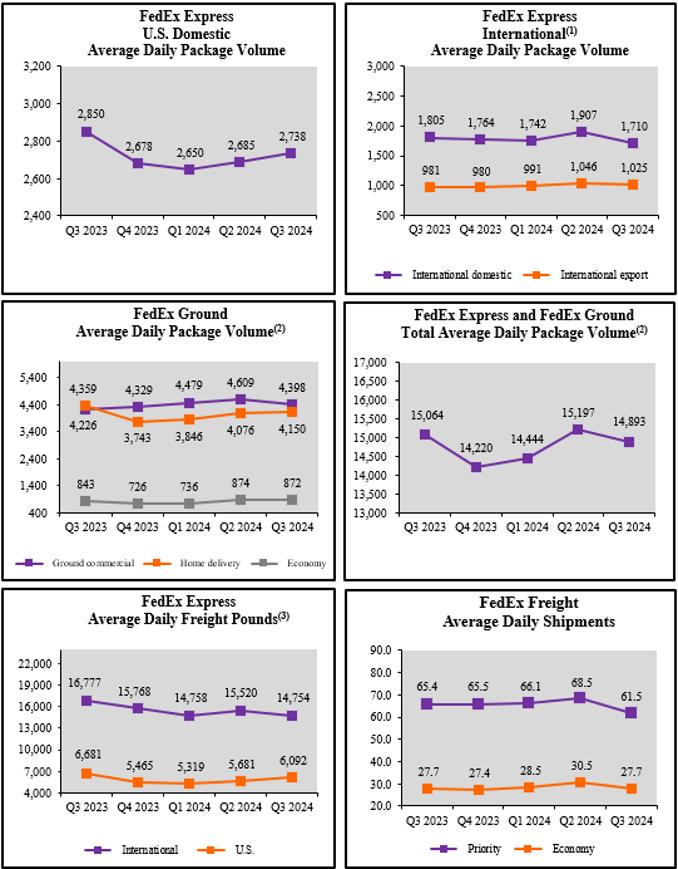
The following graphs for FedEx Express, FedEx Ground, and FedEx Freight show selected volume trends (in thousands) over the five most recent quarters:
(1)
International domestic average daily package volume relates to our international intra-country operations. International export average daily package volume relates to our international priority and economy services.
(2)
Ground commercial average daily package volume is calculated on a 5-day-per-week basis, while home delivery and economy average daily package volumes are calculated on a 7-day-per-week basis.
(3)
International average daily freight pounds relate to our international priority, economy, and airfreight services.
- 25 -
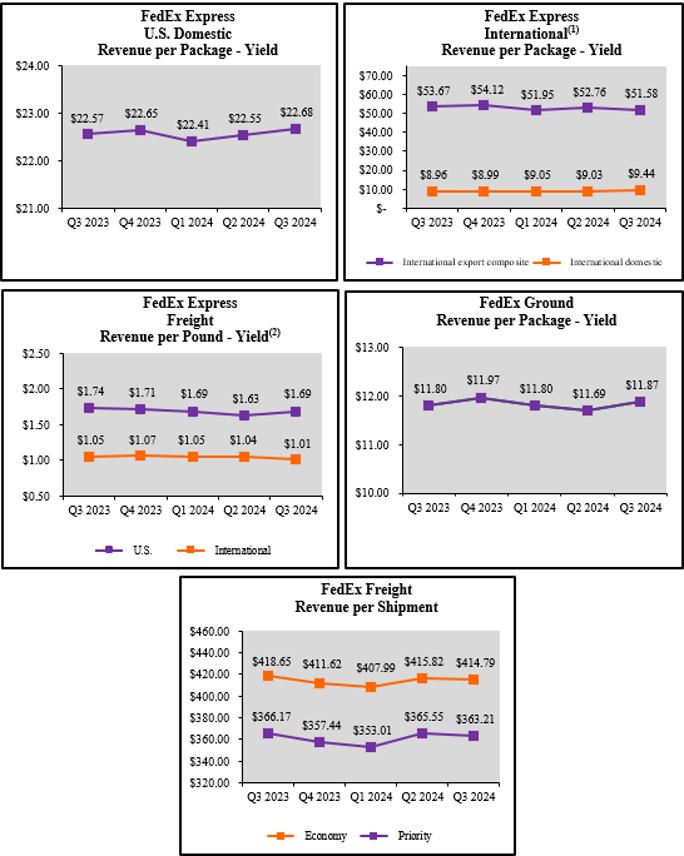
The following graphs for FedEx Express, FedEx Ground, and FedEx Freight show selected yield trends over the five most recent quarters:
(1)
International export revenue per package relates to our international priority and economy services. International domestic revenue per package relates to our international intra-country operations.
(2)
International freight revenue per pound relates to our international priority, economy, and airfreight services.
- 26 -
Revenue
Revenue decreased 2% in the third quarter and 4% in the nine months of 2024 primarily due to lower fuel surcharges at all of our transportation segments and decreased volumes at FedEx Express and FedEx Freight, partially offset by base yield improvement at FedEx Ground and FedEx Freight. In addition, one additional operating day at FedEx Express and FedEx Freight positively impacted revenue in the third quarter of 2024.
FedEx Express revenue decreased 2% in the third quarter and 6% in the nine months of 2024 primarily due to volume declines, lower fuel surcharges, reduced demand surcharges, and unfavorable international service mix, partially offset by improved U.S. domestic base yields. Revenue at Corporate, other, and eliminations decreased during the third quarter and nine months of 2024 primarily due to lower yields and reduced volume at FedEx Logistics, Inc. (“FedEx Logistics”). FedEx Freight revenue decreased 3% in the third quarter and 8% in the nine months of 2024 primarily due to lower shipments, fuel surcharges, and weight per shipment, partially offset by base yield improvement. FedEx Ground revenue increased 1% during the third quarter and 2% in the nine months of 2024 primarily due to yield improvement. The nine-month increase in FedEx Ground revenue was also due to higher volumes.
Operating Expenses
The following table compares operating expenses expressed as dollar amounts (in millions) and as a percent of revenue for the periods ended February 29, 2024 and February 28, 2023:
| Three Months Ended | Percent | Nine Months Ended | Percent | |||||||||||||||||||||
| 2024 | 2023 | Change | 2024 | 2023 | Change | |||||||||||||||||||
| Operating expenses: | ||||||||||||||||||||||||
| Salaries and employee benefits | $ | 7,693 | $ | 7,817 | (2 | ) | $ | 23,311 | $ | 23,468 | (1 | ) | ||||||||||||
| Purchased transportation | 5,345 | 5,402 | (1 | ) | 15,776 | 16,834 | (6 | ) | ||||||||||||||||
| Rentals and landing fees | 1,145 | 1,205 | (5 | ) | 3,434 | 3,559 | (4 | ) | ||||||||||||||||
| Depreciation and amortization | 1,072 | 1,031 | 4 | 3,183 | 3,101 | 3 | ||||||||||||||||||
| Fuel | 1,140 | 1,350 | (16 | ) | 3,569 | 4,765 | (25 | ) | ||||||||||||||||
| Maintenance and repairs | 804 | 789 | 2 | 2,482 | 2,575 | (4 | ) | |||||||||||||||||
| Business optimization and realignment costs | 114 | 123 | (7 | ) | 364 | 197 | 85 | |||||||||||||||||
| Other | 3,182 | 3,410 | (7 | ) | 9,461 | 10,317 | (8 | ) | ||||||||||||||||
| Total operating expenses | 20,495 | 21,127 | (3 | ) | 61,580 | 64,816 | (5 | ) | ||||||||||||||||
| Operating income | $ | 1,243 | $ | 1,042 | 19 | $ | 4,004 | $ | 3,409 | 17 |
| Percent of Revenue | ||||||||||||||||
| Three Months Ended | Nine Months Ended | |||||||||||||||
| 2024 | 2023 | 2024 | 2023 | |||||||||||||
| Operating expenses: | ||||||||||||||||
| Salaries and employee benefits | 35.4 | % | 35.3 | % | 35.5 | % | 34.4 | % | ||||||||
| Purchased transportation | 24.6 | 24.4 | 24.1 | 24.7 | ||||||||||||
| Rentals and landing fees | 5.3 | 5.4 | 5.2 | 5.2 | ||||||||||||
| Depreciation and amortization | 4.9 | 4.6 | 4.9 | 4.5 | ||||||||||||
| Fuel | 5.3 | 6.1 | 5.4 | 7.0 | ||||||||||||
| Maintenance and repairs | 3.7 | 3.6 | 3.8 | 3.8 | ||||||||||||
| Business optimization and realignment costs | 0.5 | 0.5 | 0.6 | 0.3 | ||||||||||||
| Other | 14.6 | 15.4 | 14.4 | 15.1 | ||||||||||||
| Total operating expenses | 94.3 | 95.3 | 93.9 | 95.0 | ||||||||||||
| Operating margin | 5.7 | % | 4.7 | % | 6.1 | % | 5.0 | % |
Our DRIVE program initiatives, as well as base yield improvements at FedEx Ground and FedEx Freight, more than offset volume declines at FedEx Freight and FedEx Express, which led to an increase in operating income of 19% in the third quarter and 17% in the nine months of 2024. Operating income was also positively impacted by one additional operating day at FedEx Express and FedEx Freight in the third quarter of 2024.
Fuel expense decreased 16% in the third quarter and 25% in the nine months of 2024 primarily due to lower fuel prices and usage. Purchased transportation decreased 1% in the third quarter and 6% in the nine months of 2024 primarily due to lower volumes and fuel prices and a shift from third-party over-the-road transportation to rail usage, partially offset by unfavorable currency exchange rates. Other operating expenses decreased 7% in the third quarter and 8% in the nine months of 2024 primarily due to lower professional fees and self-insurance accruals. Additionally, other operating expenses for the nine months of 2024 were positively impacted by lower bad debt expense.
- 27 -
Business Optimization and Realignment Costs
In the second quarter of 2023, FedEx announced DRIVE, a comprehensive program to improve the company’s long-term profitability. This program includes a business optimization plan to drive efficiency among our transportation segments, lower our overhead and support costs, and transform our digital capabilities. We plan to consolidate our sortation facilities and equipment, reduce pickup-and-delivery routes, and optimize our enterprise linehaul network by moving beyond discrete collaboration to an end-to-end optimized network through Network 2.0, the multi-year effort to improve the efficiency with which FedEx picks up, transports, and delivers packages in the U.S. and Canada.
In the fourth quarter of 2023, we announced one FedEx, a consolidation plan to bring FedEx Express, FedEx Ground, and FedEx Services into Federal Express Corporation, becoming a single company operating a unified, fully integrated air-ground express network under the respected FedEx brand. FedEx Freight, Inc., a wholly owned subsidiary of FedEx Freight Corporation, will continue to provide LTL freight transportation services as a stand-alone and separate company under Federal Express Corporation. The organizational redesign will be implemented in phases with the new legal structure complete by June 2024. One FedEx will help facilitate our DRIVE transformation program to improve long-term profitability, including Network 2.0.
FedEx is making progress with Network 2.0, as the company has implemented Network 2.0 optimization in more than 50 locations in the U.S. In some markets, contracted service providers will handle the pickup and delivery of FedEx Ground and FedEx Express packages. In others, pickup and delivery will be handled exclusively by employee couriers.
We incurred costs associated with our business optimization activities of $114 million ($87 million, net of tax, or $0.35 per diluted share) in the third quarter and $364 million ($278 million, net of tax, or $1.10 per diluted share) in the nine months of 2024. These costs were primarily related to professional services and severance. We recognized $120 million ($92 million, net of tax, or $0.36 per diluted share) of expenses in the third quarter and $180 million ($138 million, net of tax, or $0.53 per diluted share) of expenses in the nine months of 2023 under this program. These costs were primarily related to consulting services, severance and related costs associated with organizational changes announced in the third quarter of 2023, and idling our operations in Russia. Business optimization costs are included in Corporate, other, and eliminations, FedEx Ground, and FedEx Express. The identification of these costs as business optimization-related expenditures is subject to our disclosure controls and procedures. We expect the pre-tax cost of our business optimization activities to be approximately $530 million in 2024 and approximately $2.0 billion through 2025. The timing and amount of our business optimization expenses may change as we revise and implement our plans.
In 2021, FedEx Express announced a workforce reduction plan in Europe related to the network integration of TNT Express. The plan affected approximately 5,000 employees in Europe across operational teams and back-office functions and was completed during 2023. We incurred costs associated with our business realignment activities of $3 million ($2 million, net of tax, or $0.01 per diluted share) in the third quarter and $17 million ($13 million, net of tax, or $0.05 per diluted share) in the nine months of 2023. These costs were related to certain employee severance arrangements. The pre-tax cost of our business realignment activities through 2023 was approximately $430 million.
Income Taxes
Our effective tax rate was 25.7% for the third quarter and 25.0% for the nine months of 2024, compared to 24.6% for the third quarter and 24.8% for the nine months of 2023. The 2024 tax rates were unfavorably affected by revisions of prior-year tax estimates for actual tax return results.
We are subject to taxation in the U.S. and various U.S. state, local, and foreign jurisdictions. We are currently under examination by the Internal Revenue Service for the 2016 through 2019 tax years. It is reasonably possible that certain income tax return proceedings will be completed during the next 12 months and could result in a change in our balance of unrecognized tax benefits. However, we believe we have recorded adequate amounts of tax, including interest and penalties, for any adjustments expected to occur.
During 2021, we filed suit in U.S. District Court for the Western District of Tennessee challenging the validity of a tax regulation related to the one-time transition tax on foreign earnings not repatriated, which was enacted as part of the Tax Cuts and Jobs Act (“TCJA”). Our lawsuit seeks to have the court declare this regulation invalid and order the refund of overpayments of U.S. federal income taxes for 2018 and 2019 attributable to the denial of foreign tax credits under the regulation. We have recorded a cumulative benefit of $226 million through the third quarter of 2024 attributable to our interpretation of the TCJA and the Internal Revenue Code. In March 2023, the District Court ruled that the regulation is invalid and contradicts the plain terms of the tax code. We continue to work towards obtaining a final judgment for the applicable refund amounts due to the regulation being invalid. Once the District Court enters a final judgment, the U.S. government could file an appeal with the U.S. Court of Appeals for the Sixth Circuit. If we are ultimately unsuccessful in defending our position, we may be required to reverse the benefit previously recorded.
- 28 -
Outlook
In the remainder of 2024, we expect revenue will continue to be pressured by volatile macroeconomic conditions negatively affecting customer demand for our services and constraining yield growth. At FedEx Express, we expect a continued shift in service mix and lower international demand surcharges to negatively affect revenue and operating income in 2024.
We will continue to execute on our DRIVE program initiatives focused on aligning our cost base with demand, reducing our permanent cost structure, and increasing the flexibility of our network. We will also continue to execute on our revenue quality strategy to mitigate yield pressures through surcharge management and optimizing our customer and service mix. We expect the benefits from DRIVE and revenue quality initiatives to be partially offset by the effect of macroeconomic pressures on revenue, as well as expense headwinds related to higher global inflation.
See the “Business Optimization and Realignment Costs” section of this MD&A for additional information.
Our capital expenditures for 2024 are expected to be approximately $5.4 billion, a decrease of $0.7 billion from 2023, as we continue to reduce our capital intensity relative to revenue. We expect lower aircraft spend and reduced investments in capacity projects to be partially offset by investments to optimize our networks and modernize our facilities.
We will continue to evaluate our investments in critical long-term strategic projects to ensure our capital expenditures are expected to generate high returns on investment and are balanced with our outlook for global economic conditions. For additional details on key 2024 capital projects, refer to the “Financial Condition – Capital Resources” and “Financial Condition – Liquidity Outlook” sections of this MD&A.
The current contract for FedEx Express to provide the U.S. Postal Service (“USPS”) transportation services within the United States expires on September 29, 2024. The parties are in negotiations for a new multi-year agreement for FedEx Express to provide airport-to-airport transportation services for the USPS within the United States. See “Item 1A. Risk Factors” for more information.
The uncertainty of a slowdown in the global economy, global inflation, geopolitical challenges, and the effects these factors will have on the rate of growth of global trade, supply chains, fuel prices, and our business in particular, make any expectations for the remainder of 2024 inherently less certain. See “Item 1A. Risk Factors” for more information.
See the “Trends Affecting Our Business,” “Critical Accounting Estimates,” and “Forward-Looking Statements” sections of this MD&A for additional information.
RECENT ACCOUNTING GUIDANCE
See Note 1 of the accompanying unaudited condensed consolidated financial statements for a discussion of recent accounting guidance.
- 29 -
REPORTABLE SEGMENTS
FedEx Express, FedEx Ground, and FedEx Freight represent our major service lines and, along with FedEx Services, constitute our reportable segments. Our reportable segments include the following businesses:
| FedEx Express Segment | FedEx Express (express transportation, small-package ground delivery, and freight transportation) |
| FedEx Custom Critical, Inc. (time-critical transportation) | |
| FedEx Ground Segment | FedEx Ground (small-package ground delivery) |
| FedEx Freight Segment | FedEx Freight (LTL freight transportation) |
| FedEx Services Segment | FedEx Services (sales, marketing, information technology, communications, customer service, technical support, billing and collection services, and back-office functions) |
In the fourth quarter of 2023, FedEx announced one FedEx, a consolidation plan to bring FedEx Express, FedEx Ground, and FedEx Services into Federal Express Corporation, becoming a single company operating a unified, fully integrated air-ground express network under the respected FedEx brand. The organizational redesign will be implemented in phases with the new legal structure complete by June 2024. During the implementation process in 2024, each of our current reportable segments will continue to have discrete financial information that will be regularly reviewed when evaluating performance and making resource allocation decisions, and aligns with our management reporting structure and our internal financial reporting. In the first quarter of 2025, when the consolidation plan has been completed, we expect to begin reporting a new segment structure that will align with an updated management reporting structure and how management will evaluate performance and make resource allocation decisions under one FedEx.
FEDEX SERVICES SEGMENT
The FedEx Services segment provides direct and indirect support to our operating segments, and we allocate all of the net operating costs of the FedEx Services segment to reflect the full cost of operating our businesses in the results of those segments. We review and evaluate the performance of our transportation segments based on operating income (inclusive of FedEx Services segment allocations). For the FedEx Services segment, performance is evaluated based on the effect of its total allocated net operating costs on our operating segments.
Operating expenses for each of our transportation segments include the allocations from the FedEx Services segment to the respective transportation segments. These allocations include charges and credits for administrative services provided between operating companies. The allocations of net operating costs are based on metrics such as relative revenue or estimated services provided. We believe these allocations approximate the net cost of providing these functions. Our allocation methodologies are refined periodically, as necessary, to reflect changes in our businesses.
CORPORATE, OTHER, AND ELIMINATIONS
Corporate and other includes corporate headquarters costs for executive officers and certain legal and finance functions, certain other costs and credits not attributed to our core business, and certain costs associated with developing our “innovate digitally” strategic pillar through our FedEx Dataworks, Inc. (“FedEx Dataworks”) operating segment. FedEx Dataworks is focused on creating solutions to transform the digital and physical experiences of our customers and team members.
Also included in Corporate and other are the FedEx Office and Print Services, Inc. (“FedEx Office”) operating segment, which provides an array of document and business services and retail access to our customers for our package transportation businesses, and the FedEx Logistics operating segment, which provides integrated supply chain management solutions, specialty transportation, customs brokerage, and global ocean and air freight forwarding.
The results of Corporate, other, and eliminations are not allocated to the other business segments.
Operating results in Corporate, other, and eliminations improved in the third quarter and nine months of 2024. The improvement in operating results in the third quarter of 2024 was primarily due to decreased business optimization expenses at FedEx Corporate. The improvement in operating results in the nine months of 2024 was primarily due to improved operating results at FedEx Office and FedEx Logistics, partially offset by an increase in salaries and employee benefits expense at FedEx Corporate. The improved operating results at FedEx Office and FedEx Logistics were primarily due to lower volume-related operating expenses, partially offset by decreased revenue.
- 30 -
Certain FedEx operating companies provide transportation and related services for other FedEx companies outside their reportable segment in order to optimize our resources. For example, during the third quarter and nine months of 2024 FedEx Ground provided delivery support for certain FedEx Express packages as part of our last-mile optimization efforts, and FedEx Freight provided road and intermodal support for both FedEx Ground and FedEx Express. In addition, FedEx Express works with FedEx Logistics to secure air charters and other cargo space for U.S. customers. Billings for such services are based on negotiated rates, which we believe approximate fair value, and are reflected as revenue of the billing segment. These rates are adjusted from time to time based on market conditions. Such intersegment revenue and expenses are eliminated in our consolidated results and are not separately identified in the following segment information because the amounts are not material.
FEDEX EXPRESS SEGMENT
FedEx Express offers a wide range of U.S. domestic and international shipping services for delivery of packages and freight including priority, deferred, and economy services, which provide delivery on a time-definite or day-definite basis. The following table compares revenue, operating expenses, operating income (dollars in millions), operating margin, and operating expenses as a percent of revenue for the periods ended February 29, 2024 and February 28, 2023:
| Three Months Ended | Percent | Nine Months Ended | Percent | ||||||||||||||||||||||
| 2024 | 2023 | Change | 2024 | 2023 | Change | ||||||||||||||||||||
| Revenue: | |||||||||||||||||||||||||
| Package: | |||||||||||||||||||||||||
| U.S. overnight box | $ | 2,145 | $ | 2,165 | (1 | ) | $ | 6,491 | $ | 6,718 | (3 | ) | |||||||||||||
| U.S. overnight envelope | 450 | 478 | (6 | ) | 1,382 | 1,477 | (6 | ) | |||||||||||||||||
| U.S. deferred | 1,317 | 1,346 | (2 | ) | 3,712 | 3,886 | (4 | ) | |||||||||||||||||
| Total U.S. domestic package revenue | 3,912 | 3,989 | (2 | ) | 11,585 | 12,081 | (4 | ) | |||||||||||||||||
| International priority | 2,318 | 2,566 | (10 | ) | 7,035 | 8,286 | (15 | ) | |||||||||||||||||
| International economy | 1,014 | 698 | 45 | 3,123 | 2,116 | 48 | |||||||||||||||||||
| Total international export package revenue | 3,332 | 3,264 | 2 | 10,158 | 10,402 | (2 | ) | ||||||||||||||||||
| International domestic(1) | 1,016 | 1,003 | 1 | 3,126 | 3,013 | 4 | |||||||||||||||||||
| Total package revenue | 8,260 | 8,256 | — | 24,869 | 25,496 | (2 | ) | ||||||||||||||||||
| Freight: | |||||||||||||||||||||||||
| U.S. | 648 | 719 | (10 | ) | 1,814 | 2,299 | (21 | ) | |||||||||||||||||
| International priority | 520 | 687 | (24 | ) | 1,642 | 2,387 | (31 | ) | |||||||||||||||||
| International economy | 389 | 358 | 9 | 1,236 | 1,123 | 10 | |||||||||||||||||||
| International airfreight | 31 | 47 | (34 | ) | 92 | 126 | (27 | ) | |||||||||||||||||
| Total freight revenue | 1,588 | 1,811 | (12 | ) | 4,784 | 5,935 | (19 | ) | |||||||||||||||||
| Other | 253 | 278 | (9 | ) | 787 | 905 | (13 | ) | |||||||||||||||||
| Total revenue | 10,101 | 10,345 | (2 | ) | 30,440 | 32,336 | (6 | ) | |||||||||||||||||
| Operating expenses: | |||||||||||||||||||||||||
| Salaries and employee benefits | 3,911 | 4,015 | (3 | ) | 11,858 | 12,003 | (1 | ) | |||||||||||||||||
| Purchased transportation | 1,459 | 1,373 | 6 | 4,291 | 4,283 | — | |||||||||||||||||||
| Rentals and landing fees | 511 | 588 | (13 | ) | 1,562 | 1,751 | (11 | ) | |||||||||||||||||
| Depreciation and amortization | 537 | 533 | 1 | 1,617 | 1,566 | 3 | |||||||||||||||||||
| Fuel | 996 | 1,177 | (15 | ) | 3,105 | 4,133 | (25 | ) | |||||||||||||||||
| Maintenance and repairs | 459 | 456 | 1 | 1,449 | 1,552 | (7 | ) | ||||||||||||||||||
| Business optimization and realignment costs | 23 | 3 | 667 | 74 | 28 | 164 | |||||||||||||||||||
| Intercompany charges | 464 | 459 | 1 | 1,425 | 1,420 | 0 | |||||||||||||||||||
| Other | 1,508 | 1,622 | (7 | ) | 4,484 | 4,966 | (10 | ) | |||||||||||||||||
| Total operating expenses | 9,868 | 10,226 | (4 | ) | 29,865 | 31,702 | (6 | ) | |||||||||||||||||
| Operating income | $ | 233 | $ | 119 | 96 | $ | 575 | $ | 634 | (9 | ) | ||||||||||||||
| Operating margin | 2.3 | % | 1.2 | % | 110 | bp | 1.9 | % | 2.0 | % | (10 | ) | bp |
(1)
International domestic revenue relates to our international intra-country operations.
- 31 -
| Percent of Revenue | ||||||||||||||||
| Three Months Ended | Nine Months Ended | |||||||||||||||
| 2024 | 2023 | 2024 | 2023 | |||||||||||||
| Operating expenses: | ||||||||||||||||
| Salaries and employee benefits | 38.7 | % | 38.8 | % | 39.0 | % | 37.1 | % | ||||||||
| Purchased transportation | 14.5 | 13.3 | 14.1 | 13.2 | ||||||||||||
| Rentals and landing fees | 5.1 | 5.7 | 5.1 | 5.4 | ||||||||||||
| Depreciation and amortization | 5.3 | 5.1 | 5.3 | 4.8 | ||||||||||||
| Fuel | 9.9 | 11.4 | 10.2 | 12.8 | ||||||||||||
| Maintenance and repairs | 4.5 | 4.4 | 4.8 | 4.8 | ||||||||||||
| Business optimization and realignment costs | 0.2 | — | 0.2 | 0.1 | ||||||||||||
| Intercompany charges | 4.6 | 4.4 | 4.7 | 4.4 | ||||||||||||
| Other | 14.9 | 15.7 | 14.7 | 15.4 | ||||||||||||
| Total operating expenses | 97.7 | 98.8 | 98.1 | 98.0 | ||||||||||||
| Operating margin | 2.3 | % | 1.2 | % | 1.9 | % | 2.0 | % |
- 32 -
The following table compares selected statistics (in thousands, except yield amounts) for the periods ended February 29, 2024 and February 28, 2023:
| Three Months Ended | Percent | Nine Months Ended | Percent | |||||||||||||||||||||
| 2024 | 2023 | Change | 2024 | 2023 | Change | |||||||||||||||||||
| Package Statistics | ||||||||||||||||||||||||
| Average daily package volume (ADV): | ||||||||||||||||||||||||
| U.S. overnight box | 1,219 | 1,255 | (3 | ) | 1,230 | 1,275 | (4 | ) | ||||||||||||||||
| U.S. overnight envelope | 415 | 454 | (9 | ) | 433 | 466 | (7 | ) | ||||||||||||||||
| U.S. deferred | 1,104 | 1,141 | (3 | ) | 1,027 | 1,084 | (5 | ) | ||||||||||||||||
| Total U.S. domestic ADV | 2,738 | 2,850 | (4 | ) | 2,690 | 2,825 | (5 | ) | ||||||||||||||||
| International priority | 663 | 701 | (5 | ) | 665 | 712 | (7 | ) | ||||||||||||||||
| International economy | 362 | 280 | 29 | 356 | 275 | 29 | ||||||||||||||||||
| Total international export ADV | 1,025 | 981 | 4 | 1,021 | 987 | 3 | ||||||||||||||||||
| International domestic(1) | 1,710 | 1,805 | (5 | ) | 1,786 | 1,819 | (2 | ) | ||||||||||||||||
| Total ADV | 5,473 | 5,636 | (3 | ) | 5,497 | 5,631 | (2 | ) | ||||||||||||||||
| Revenue per package (yield): | ||||||||||||||||||||||||
| U.S. overnight box | $ | 27.92 | $ | 27.81 | — | $ | 27.62 | $ | 27.74 | — | ||||||||||||||
| U.S. overnight envelope | 17.22 | 17.01 | 1 | 16.72 | 16.69 | — | ||||||||||||||||||
| U.S. deferred | 18.93 | 19.02 | — | 18.92 | 18.86 | — | ||||||||||||||||||
| U.S. domestic composite | 22.68 | 22.57 | — | 22.54 | 22.51 | — | ||||||||||||||||||
| International priority | 55.43 | 59.05 | (6 | ) | 55.39 | 61.24 | (10 | ) | ||||||||||||||||
| International economy | 44.51 | 40.20 | 11 | 45.96 | 40.51 | 13 | ||||||||||||||||||
| International export composite | 51.58 | 53.67 | (4 | ) | 52.10 | 55.47 | (6 | ) | ||||||||||||||||
| International domestic(1) | 9.44 | 8.96 | 5 | 9.17 | 8.72 | 5 | ||||||||||||||||||
| Composite package yield | $ | 23.96 | $ | 23.63 | 1 | $ | 23.69 | $ | 23.83 | (1 | ) | |||||||||||||
| Freight Statistics | ||||||||||||||||||||||||
| Average daily freight pounds: | ||||||||||||||||||||||||
| U.S. | 6,092 | 6,681 | (9 | ) | 5,693 | 7,170 | (21 | ) | ||||||||||||||||
| International priority | 4,352 | 5,290 | (18 | ) | 4,405 | 5,702 | (23 | ) | ||||||||||||||||
| International economy | 9,598 | 10,345 | (7 | ) | 9,868 | 10,738 | (8 | ) | ||||||||||||||||
| International airfreight | 804 | 1,142 | (30 | ) | 735 | 1,014 | (28 | ) | ||||||||||||||||
| Total average daily freight pounds | 20,846 | 23,458 | (11 | ) | 20,701 | 24,624 | (16 | ) | ||||||||||||||||
| Revenue per pound (yield): | ||||||||||||||||||||||||
| U.S. | $ | 1.69 | $ | 1.74 | (3 | ) | $ | 1.67 | $ | 1.69 | (1 | ) | ||||||||||||
| International priority | 1.89 | 2.10 | (10 | ) | 1.95 | 2.20 | (11 | ) | ||||||||||||||||
| International economy | 0.64 | 0.56 | 14 | 0.66 | 0.55 | 20 | ||||||||||||||||||
| International airfreight | 0.62 | 0.66 | (6 | ) | 0.66 | 0.66 | — | |||||||||||||||||
| Composite freight yield | $ | 1.21 | $ | 1.25 | (3 | ) | $ | 1.21 | $ | 1.27 | (5 | ) |
(1)
International domestic statistics relate to our international intra-country operations.
- 33 -
FedEx Express Segment Revenue
FedEx Express segment revenue decreased 2% in the third quarter and 6% in the nine months of 2024 primarily due to volume declines, lower fuel surcharges, reduced demand surcharges, and a decline in international priority base yields, partially offset by improved U.S. domestic and international economy base yields and favorable currency exchange rates. Revenue also benefited from one additional operating day in the third quarter of 2024.
Global average daily freight pounds decreased 11% in the third quarter and 16% in the nine months of 2024 primarily as a result of weak global economic conditions as well as lower volume from the USPS. U.S. domestic average daily package volumes declined 4% in the third quarter and 5% in the nine months of 2024 as global economic factors led to reduced demand for our services. These declines were partially offset by an increase in international export package volume of 4% in the third quarter and 3% in the nine months of 2024.
Lower fuel surcharges had a significant negative effect on yield across all package and freight services during the third quarter and nine months of 2024. In addition, international export composite package yield decreased 4% in the third quarter and 6% in the nine months of 2024 driven by reduced demand surcharges, a larger mix of e-commerce volume, and an increase in lower-yielding deferred volume related to the full reopening of the international economy service. Composite freight yield decreased 3% in the third quarter and 5% in the nine months of 2024 due to reduced demand surcharges and an increased mix of deferred freight, also driven by the reopening of international economy service. Favorable currency exchange rates positively affected international package and freight yields during the nine months of 2024.
FedEx Express Segment Operating Income
FedEx Express segment operating income increased 96% in the third quarter of 2024 due to lower operating expenses, partially offset by reduced revenue. FedEx Express operating income decreased 9% in the nine months of 2024 due to reduced revenue, partially offset by lower operating expenses. The reduction in operating expenses during the third quarter and nine months of 2024 was a result of lower volumes, as well as continued benefits from DRIVE initiatives that drove a reduction in our permanent cost structure. These initiatives include network rationalization through structural flight takedowns and route optimization, along with improvements in hub sort efficiency. Operating income was also positively impacted by one additional operating day in the third quarter of 2024. Currency exchange rates had a positive effect on revenue and a negative effect on expenses and operating income in the third quarter and nine months of 2024.
Fuel expense decreased 15% in the third quarter and 25% in the nine months of 2024 due to decreases in fuel prices and usage. Other operating expense decreased 7% in the third quarter and 10% in the nine months of 2024 primarily due to lower bad debt expense and lower outside service contracts expense resulting from a decrease in temporary labor usage. Fewer aircraft leases as a result of lower volumes drove a decrease in rentals and landing fees of 13% in the third quarter and 11% in the nine months of 2024. Salaries and employee benefits decreased 3% in the third quarter and 1% in the nine months of 2024 primarily due to decreased staffing to align with lower volume, partially offset by higher wage rates. Additionally, salaries and employee benefits were negatively affected by increased variable incentive compensation in the nine months of 2024. Purchased transportation increased 6% in the third quarter of 2024 primarily due to an increase in commercial linehaul driven by the reopening of the international economy service.
FedEx Express segment results include business optimization costs of $23 million in the third quarter and $74 million in the nine months of 2024 associated with our plan to drive efficiency and lower our overhead and support costs. No business optimization costs were incurred in the third quarter of 2023 at FedEx Express. FedEx Express segment results include business optimization costs of $11 million in the nine months of 2023, which includes costs associated with idling our business in Russia. FedEx Express segment results include costs associated with our business realignment activities of $3 million in the third quarter and $17 million in the nine months of 2023 associated with our workforce reduction plan in Europe.
In July 2023, FedEx Express’s pilots failed to ratify the tentative successor agreement that was approved by the Air Line Pilots Association, International’s FedEx Express Master Executive Council in June 2023. Ongoing mediated negotiations for a successor agreement continue and have no effect on our operations. See Note 1 of the accompanying unaudited condensed consolidated financial statements for additional information.
- 34 -
FEDEX GROUND SEGMENT
FedEx Ground service offerings include day-certain delivery to businesses in the U.S. and Canada and to 100% of U.S. residences. The following table compares revenue, operating expenses, operating income (dollars in millions), operating margin, selected package statistics (in thousands, except yield amounts), and operating expenses as a percent of revenue for the periods ended February 29, 2024 and February 28, 2023:
| Three Months Ended | Percent | Nine Months Ended | Percent | ||||||||||||||||||||||
| 2024 | 2023 | Change | 2024 | 2023 | Change | ||||||||||||||||||||
| Revenue | $ | 8,703 | $ | 8,658 | 1 | $ | 25,762 | $ | 25,211 | 2 | |||||||||||||||
| Operating expenses: | |||||||||||||||||||||||||
| Salaries and employee benefits | 1,755 | 1,759 | — | 5,161 | 5,123 | 1 | |||||||||||||||||||
| Purchased transportation | 3,666 | 3,722 | (2 | ) | 10,775 | 11,263 | (4 | ) | |||||||||||||||||
| Rentals | 442 | 426 | 4 | 1,298 | 1,230 | 6 | |||||||||||||||||||
| Depreciation and amortization | 284 | 258 | 10 | 836 | 753 | 11 | |||||||||||||||||||
| Fuel | 9 | 9 | — | 25 | 28 | (11 | ) | ||||||||||||||||||
| Maintenance and repairs | 180 | 155 | 16 | 512 | 472 | 8 | |||||||||||||||||||
| Business optimization costs | 22 | — | NM | 75 | — | NM | |||||||||||||||||||
| Intercompany charges | 486 | 483 | 1 | 1,483 | 1,466 | 1 | |||||||||||||||||||
| Other | 917 | 1,002 | (8 | ) | 2,652 | 2,740 | (3 | ) | |||||||||||||||||
| Total operating expenses | 7,761 | 7,814 | (1 | ) | 22,817 | 23,075 | (1 | ) | |||||||||||||||||
| Operating income | $ | 942 | $ | 844 | 12 | $ | 2,945 | $ | 2,136 | 38 | |||||||||||||||
| Operating margin | 10.8 | % | 9.7 | % | 110 | bp | 11.4 | % | 8.5 | % | 290 | bp | |||||||||||||
| Average daily package volume (ADV)(1): | |||||||||||||||||||||||||
| Ground commercial | 4,398 | 4,226 | 4 | 4,495 | 4,372 | 3 | |||||||||||||||||||
| Home delivery | 4,150 | 4,359 | (5 | ) | 4,023 | 4,115 | (2 | ) | |||||||||||||||||
| Economy | 872 | 843 | 3 | 827 | 800 | 3 | |||||||||||||||||||
| Total ADV | 9,420 | 9,428 | — | 9,345 | 9,287 | 1 | |||||||||||||||||||
| Revenue per package (yield) | $ | 11.87 | $ | 11.80 | 1 | $ | 11.78 | $ | 11.61 | 1 |
(1)
Ground commercial ADV is calculated on a 5-day-per-week basis, while home delivery and economy ADV are calculated on a 7-day-per-week basis.
| Percent of Revenue | ||||||||||||||||
| Three Months Ended | Nine Months Ended | |||||||||||||||
| 2024 | 2023 | 2024 | 2023 | |||||||||||||
| Operating expenses: | ||||||||||||||||
| Salaries and employee benefits | 20.2 | % | 20.3 | % | 20.0 | % | 20.3 | % | ||||||||
| Purchased transportation | 42.1 | 43.0 | 41.8 | 44.7 | ||||||||||||
| Rentals | 5.1 | 4.9 | 5.0 | 4.9 | ||||||||||||
| Depreciation and amortization | 3.3 | 3.0 | 3.3 | 3.0 | ||||||||||||
| Fuel | 0.1 | 0.1 | 0.1 | 0.1 | ||||||||||||
| Maintenance and repairs | 2.1 | 1.8 | 2.0 | 1.9 | ||||||||||||
| Business optimization costs | 0.2 | — | 0.3 | — | ||||||||||||
| Intercompany charges | 5.6 | 5.6 | 5.8 | 5.8 | ||||||||||||
| Other | 10.5 | 11.6 | 10.3 | 10.8 | ||||||||||||
| Total operating expenses | 89.2 | 90.3 | 88.6 | 91.5 | ||||||||||||
| Operating margin | 10.8 | % | 9.7 | % | 11.4 | % | 8.5 | % |
FedEx Ground Segment Revenue
FedEx Ground segment revenue increased 1% in the third quarter and 2% in the nine months of 2024 primarily due to yield improvement. The nine-month increase was also due to higher volumes. FedEx Ground yield increased 1% in the third quarter and nine months of 2024 primarily due to base yield improvement, partially offset by lower fuel surcharges. Total average daily volume increased 1% in the nine months of 2024 primarily due to increased demand for our commercial services related to changing market conditions.
- 35 -
FedEx Ground Segment Operating Income
FedEx Ground segment operating income increased 12% in the third quarter and 38% in the nine months of 2024. The third quarter increase was primarily due to lower self-insurance accruals and yield improvement. The nine-month increase was primarily due to yield improvement, lower purchased transportation expense, higher volume, and lower self-insurance accruals. FedEx Ground lowered costs in the third quarter and nine months of 2024 through continued benefits from DRIVE initiatives focused on increasing linehaul efficiencies and improving dock productivity. In addition, FedEx Ground also continued to realize benefits from consolidated sort operations and reduced Sunday deliveries during the nine months of 2024.
Purchased transportation expense decreased 2% in the third quarter and 4% in the nine months of 2024 primarily due to lower fuel prices and a shift to increased third-party rail usage, partially offset by higher base rates. Other operating expense decreased 8% in the third quarter and 3% in the nine months of 2024 primarily due to lower self-insurance accruals, partially offset by higher bad debt expense. Depreciation and rentals expense increased 10% and 4%, respectively, in the third quarter and 11% and 6%, respectively, in the nine months of 2024 primarily due to the completion of previously committed multi-year expansion projects. Maintenance and repairs expense increased 16% in the third quarter and 8% in the nine months of 2024 primarily due to higher costs associated with vehicle parts, outside vendor labor, and facility maintenance.
FedEx Ground segment results include business optimization costs of $22 million in the third quarter and $75 million in the nine months of 2024 associated with its plan to drive efficiency and lower our overhead and support costs.
FEDEX FREIGHT SEGMENT
FedEx Freight LTL service offerings include priority services when speed is critical and economy services when time can be traded for savings. The following table compares revenue, operating expenses, operating income (dollars in millions), operating margin, selected statistics, and operating expenses as a percent of revenue for the periods ended February 29, 2024 and February 28, 2023:
| Three Months Ended | Percent | Nine Months Ended | Percent | ||||||||||||||||||||||
| 2024 | 2023 | Change | 2024 | 2023 | Change | ||||||||||||||||||||
| Revenue | $ | 2,125 | $ | 2,186 | (3 | ) | $ | 6,776 | $ | 7,363 | (8 | ) | |||||||||||||
| Operating expenses: | |||||||||||||||||||||||||
| Salaries and employee benefits | 949 | 946 | — | 2,929 | 3,044 | (4 | ) | ||||||||||||||||||
| Purchased transportation | 158 | 172 | (8 | ) | 470 | 580 | (19 | ) | |||||||||||||||||
| Rentals | 69 | 67 | 3 | 205 | 198 | 4 | |||||||||||||||||||
| Depreciation and amortization | 107 | 74 | 45 | 295 | 283 | 4 | |||||||||||||||||||
| Fuel | 133 | 162 | (18 | ) | 436 | 601 | (27 | ) | |||||||||||||||||
| Maintenance and repairs | 78 | 76 | 3 | 246 | 244 | 1 | |||||||||||||||||||
| Intercompany charges | 129 | 131 | (2 | ) | 394 | 393 | — | ||||||||||||||||||
| Other | 162 | 172 | (6 | ) | 493 | 543 | (9 | ) | |||||||||||||||||
| Total operating expenses | 1,785 | 1,800 | (1 | ) | 5,468 | 5,886 | (7 | ) | |||||||||||||||||
| Operating income | $ | 340 | $ | 386 | (12 | ) | $ | 1,308 | $ | 1,477 | (11 | ) | |||||||||||||
| Operating margin | 16.0 | % | 17.7 | % | (170 | ) | bp | 19.3 | % | 20.1 | % | (80 | ) | bp | |||||||||||
| Average daily shipments (in thousands): | |||||||||||||||||||||||||
| Priority | 61.5 | 65.4 | (6 | ) | 65.4 | 71.7 | (9 | ) | |||||||||||||||||
| Economy | 27.7 | 27.7 | — | 28.9 | 30.3 | (5 | ) | ||||||||||||||||||
| Total average daily shipments | 89.2 | 93.1 | (4 | ) | 94.3 | 102.0 | (8 | ) | |||||||||||||||||
| Weight per shipment (lbs): | |||||||||||||||||||||||||
| Priority | 974 | 1,014 | (4 | ) | 979 | 1,034 | (5 | ) | |||||||||||||||||
| Economy | 885 | 890 | (1 | ) | 880 | 924 | (5 | ) | |||||||||||||||||
| Composite weight per shipment | 946 | 977 | (3 | ) | 949 | 1,001 | (5 | ) | |||||||||||||||||
| Revenue per shipment: | |||||||||||||||||||||||||
| Priority | $ | 363.21 | $ | 366.17 | (1 | ) | $ | 360.47 | $ | 365.88 | (1 | ) | |||||||||||||
| Economy | 414.79 | 418.65 | (1 | ) | 412.84 | 419.35 | (2 | ) | |||||||||||||||||
| Composite revenue per shipment | $ | 379.26 | $ | 381.77 | (1 | ) | $ | 376.53 | $ | 381.75 | (1 | ) | |||||||||||||
| Revenue per hundredweight: | |||||||||||||||||||||||||
| Priority | $ | 37.31 | $ | 36.12 | 3 | $ | 36.80 | $ | 35.40 | 4 | |||||||||||||||
| Economy | 46.89 | 47.06 | — | 46.92 | 45.37 | 3 | |||||||||||||||||||
| Composite revenue per hundredweight | $ | 40.10 | $ | 39.08 | 3 | $ | 39.68 | $ | 38.13 | 4 |
- 36 -
| Percent of Revenue | ||||||||||||||||
| Three Months Ended | Nine Months Ended | |||||||||||||||
| 2024 | 2023 | 2024 | 2023 | |||||||||||||
| Operating expenses: | ||||||||||||||||
| Salaries and employee benefits | 44.7 | % | 43.3 | % | 43.2 | % | 41.3 | % | ||||||||
| Purchased transportation | 7.4 | 7.8 | 7.0 | 7.9 | ||||||||||||
| Rentals | 3.2 | 3.0 | 3.0 | 2.7 | ||||||||||||
| Depreciation and amortization | 5.0 | 3.4 | 4.4 | 3.8 | ||||||||||||
| Fuel | 6.3 | 7.4 | 6.4 | 8.2 | ||||||||||||
| Maintenance and repairs | 3.7 | 3.5 | 3.6 | 3.3 | ||||||||||||
| Intercompany charges | 6.1 | 6.0 | 5.8 | 5.3 | ||||||||||||
| Other | 7.6 | 7.9 | 7.3 | 7.4 | ||||||||||||
| Total operating expenses | 84.0 | 82.3 | 80.7 | 79.9 | ||||||||||||
| Operating margin | 16.0 | % | 17.7 | % | 19.3 | % | 20.1 | % |
FedEx Freight Segment Revenue
FedEx Freight segment revenue decreased 3% in the third quarter and 8% in the nine months of 2024 primarily due to lower shipments, fuel surcharges, and weight per shipment, partially offset by base yield improvement. Revenue also benefited from one additional operating day in the third quarter of 2024.
Average daily shipments decreased 4% in the third quarter and 8% in the nine months of 2024 due to reduced demand for our services, primarily resulting from macroeconomic conditions. Revenue per shipment decreased 1% in the third quarter and nine months of 2024 primarily due to lower fuel surcharges, partially offset by base yield improvement resulting from our continued focus on revenue quality.
FedEx Freight Segment Operating Income
FedEx Freight segment operating income decreased 12% in the third quarter and 11% in the nine months of 2024 primarily due to lower shipments and fuel surcharges, partially offset by base yield improvement. Operating income was also positively impacted by one additional operating day in the third quarter of 2024.
Fuel expense decreased 18% in the third quarter and 27% in the nine months of 2024 due to lower fuel prices and decreased shipments. Salaries and benefits decreased 4% in the nine months of 2024 primarily due to lower staffing to align with decreased shipments and an increase in productivity, partially offset by higher wage rates. Purchased transportation expense decreased 8% in the third quarter and 19% in the nine months of 2024 primarily due to decreased shipments and lower fuel prices. Other operating expense decreased 6% in the third quarter and 9% in the nine months of 2024 primarily due to lower self-insurance accruals. Depreciation expense increased 45% in the third quarter primarily due to a gain on the sale of a facility in the third quarter of 2023. Depreciation expense increased 4% in the nine months of 2024 primarily due to investments in information technology and transportation equipment.
- 37 -
FINANCIAL CONDITION
LIQUIDITY
Cash and cash equivalents totaled $5.6 billion at February 29, 2024, compared to $6.9 billion at May 31, 2023. The following table provides a summary of our cash flows for the nine-month periods ended February 29, 2024 and February 28, 2023 (in millions):
| 2024 | 2023 | |||||||
| Operating activities: | ||||||||
| Net income | $ | 2,857 | $ | 2,434 | ||||
| Business optimization and realignment costs, net of payments | (50 | ) | 20 | |||||
| Other noncash charges and credits | 5,777 | 6,204 | ||||||
| Changes in assets and liabilities | (2,970 | ) | (3,257 | ) | ||||
| Cash provided by operating activities | 5,614 | 5,401 | ||||||
| Investing activities: | ||||||||
| Capital expenditures | (3,974 | ) | (4,420 | ) | ||||
| Purchase of investments | (110 | ) | (82 | ) | ||||
| Proceeds from sale of investments | 24 | — | ||||||
| Proceeds from asset dispositions and other | 94 | 72 | ||||||
| Cash used in investing activities | (3,966 | ) | (4,430 | ) | ||||
| Financing activities: | ||||||||
| Principal payments on debt | (143 | ) | (123 | ) | ||||
| Proceeds from stock issuances | 265 | 114 | ||||||
| Dividends paid | (949 | ) | (888 | ) | ||||
| Purchase of treasury stock | (2,000 | ) | (1,500 | ) | ||||
| Other, net | (7 | ) | 1 | |||||
| Cash used in financing activities | (2,834 | ) | (2,396 | ) | ||||
| Effect of exchange rate changes on cash | (26 | ) | (99 | ) | ||||
| Net decrease in cash and cash equivalents | $ | (1,212 | ) | $ | (1,524 | ) | ||
| Cash and cash equivalents at the end of period | $ | 5,644 | $ | 5,373 |
Cash flows from operating activities increased $213 million in the nine months of 2024 primarily due to working capital changes, driven by an increase in accrued incentive compensation, other liabilities, and accounts payable, partially offset by a decrease in accounts receivable from the nine months of 2023. Capital expenditures decreased during the nine months of 2024 primarily due to decreased spending on package handling and ground support equipment and facilities and other at FedEx Ground and information technology at FedEx Services, partially offset by increased spending on facilities and other and aircraft and related equipment at FedEx Express. See “Capital Resources” for a discussion of capital expenditures during 2024 and 2023.
In December 2021, our Board of Directors authorized a stock repurchase program of up to $5 billion of FedEx common stock. As part of the repurchase program, we completed an ASR transaction during the third quarter of 2024 with a bank to repurchase an aggregate of $1 billion of our common stock. During the nine months of 2024, we repurchased 8.0 million shares of FedEx common stock under ASR agreements at an average price of $250.95 per share for a total of $2.0 billion. See Note 1 of the accompanying unaudited condensed consolidated financial statements, “Liquidity Outlook” below, and Part II, Item 2. “Unregistered Sales of Equity Securities and Use of Proceeds” for additional information. As of February 29, 2024, $564 million remained available for repurchases under the 2021 repurchase program.
In March 2024, our Board of Directors authorized a new stock repurchase program for additional repurchases of up to $5 billion. Shares under the 2021 and 2024 repurchase programs may be repurchased from time to time in the open market or in privately negotiated transactions. The timing and volume of repurchases are at the discretion of management based on the capital needs of the business, the market price of FedEx common stock, and general market conditions. No time limits were set for the completion of the programs, and the programs may be suspended or discontinued at any time.
- 38 -
CAPITAL RESOURCES
Our operations are capital intensive, characterized by significant investments in aircraft, package handling and sort equipment, vehicles and trailers, technology, and facilities. The amount and timing of capital investments depend on various factors, including pre-existing contractual commitments, anticipated volume growth, domestic and international economic conditions, new or enhanced services, geographical expansion of services, availability of satisfactory financing, and actions of regulatory authorities.
The following table compares capital expenditures by asset category and reportable segment for the periods ended February 29, 2024 and February 28, 2023 (in millions):
| Percent Change | ||||||||||||||||||||||||
| Three Months Ended | Nine Months Ended | Three Months | Nine Months | |||||||||||||||||||||
| 2024 | 2023 | 2024 | 2023 | Ended | Ended | |||||||||||||||||||
| Aircraft and related equipment | $ | 329 | $ | 389 | $ | 1,484 | $ | 1,263 | (15 | ) | 17 | |||||||||||||
| Package handling and ground support equipment | 217 | 383 | 644 | 1,324 | (43 | ) | (51 | ) | ||||||||||||||||
| Vehicles and trailers | 243 | 154 | 539 | 503 | 58 | 7 | ||||||||||||||||||
| Information technology | 142 | 111 | 437 | 560 | 28 | (22 | ) | |||||||||||||||||
| Facilities and other | 448 | 241 | 870 | 770 | 86 | 13 | ||||||||||||||||||
| Total capital expenditures | $ | 1,379 | $ | 1,278 | $ | 3,974 | $ | 4,420 | 8 | (10 | ) | |||||||||||||
| FedEx Express segment | $ | 934 | $ | 653 | 2,687 | $ | 2,177 | 43 | 23 | |||||||||||||||
| FedEx Ground segment | 224 | 456 | 702 | 1,469 | (51 | ) | (52 | ) | ||||||||||||||||
| FedEx Freight segment | 139 | 104 | 280 | 344 | 34 | (19 | ) | |||||||||||||||||
| FedEx Services segment | 58 | 37 | 233 | 334 | 57 | (30 | ) | |||||||||||||||||
| Other | 24 | 28 | 72 | 96 | (14 | ) | (25 | ) | ||||||||||||||||
| Total capital expenditures | $ | 1,379 | $ | 1,278 | $ | 3,974 | $ | 4,420 | 8 | (10 | ) |
Capital expenditures increased in the third quarter of 2024 primarily due to increased spending on facilities and other and vehicles and trailers at FedEx Express, partially offset by decreased spending on package handling and ground support equipment at FedEx Ground. Capital expenditures decreased in the nine months of 2024 primarily due to decreased spending on package handling and ground support equipment and facilities and other at FedEx Ground and information technology at FedEx Services, partially offset by increased spending on facilities and other and aircraft and related equipment at FedEx Express.
GUARANTOR FINANCIAL IN****FORMATION
We are providing the following information in compliance with Rule 13-01 of Regulation S-X, “Financial Disclosures about Guarantors and Issuers of Guaranteed Securities” with respect to our senior unsecured debt securities and Pass-Through Certificates, Series 2020-1AA (the “Certificates”).
The $19.2 billion principal amount of the senior unsecured notes were issued by FedEx under a shelf registration statement and are guaranteed by certain direct and indirect subsidiaries of FedEx (“Guarantor Subsidiaries”). FedEx owns, directly or indirectly, 100% of each Guarantor Subsidiary. The guarantees are (1) unsecured obligations of the respective Guarantor Subsidiary, (2) rank equally with all of their other unsecured and unsubordinated indebtedness, and (3) are full and unconditional and joint and several. If we sell, transfer, or otherwise dispose of all of the capital stock or all or substantially all of the assets of a Guarantor Subsidiary to any person that is not an affiliate of FedEx, the guarantee of that Guarantor Subsidiary will terminate, and holders of debt securities will no longer have a direct claim against such subsidiary under the guarantee.
Additionally, FedEx fully and unconditionally guarantees the payment obligation of FedEx Express in respect of the $788 million principal amount of the Certificates. See Note 4 of the accompanying unaudited condensed consolidated financial statements and Note 6 to the financial statements included in our Annual Report for additional information regarding the terms of the Certificates.
- 39 -
The following tables present summarized financial information for FedEx (as Parent) and the Guarantor Subsidiaries on a combined basis after transactions and balances within the combined entities have been eliminated.
Parent and Guarantor Subsidiaries
The following table presents the summarized balance sheet information as of February 29, 2024 and May 31, 2023 (in millions):
| February 29, 2024 | May 31, 2023 | |||||||
| Current Assets | $ | 9,216 | $ | 10,758 | ||||
| Intercompany Receivable | 4,197 | 3,566 | ||||||
| Total Assets | 82,752 | 89,947 | ||||||
| Current Liabilities | 9,698 | 9,933 | ||||||
| Intercompany Payable | — | — | ||||||
| Total Liabilities | 53,076 | 59,837 |
The following table presents the summarized statement of income information for the nine months of 2024 (in millions):
| Revenue | $ | 49,350 | ||
| Intercompany Charges, net | (2,864 | ) | ||
| Operating Income | 3,441 | |||
| Intercompany Charges, net | 155 | |||
| Income Before Income Taxes | 3,036 | |||
| Net Income | $ | 2,282 |
The following tables present summarized financial information for FedEx (as Parent Guarantor) and FedEx Express (as Subsidiary Issuer) on a combined basis after transactions and balances within the combined entities have been eliminated.
Parent Guarantor and Subsidiary Issuer
The following table presents the summarized balance sheet information as of February 29, 2024 and May 31, 2023 (in millions):
| February 29, 2024 | May 31, 2023 | |||||||
| Current Assets | $ | 2,980 | $ | 4,408 | ||||
| Intercompany Receivable | — | — | ||||||
| Total Assets | 72,140 | 70,016 | ||||||
| Current Liabilities | 5,953 | 5,100 | ||||||
| Intercompany Payable | 11,354 | 11,011 | ||||||
| Total Liabilities | 50,151 | 48,246 |
The following table presents the summarized statement of income information for the nine months of 2024 (in millions):
| Revenue | $ | 16,761 | ||
| Intercompany Charges, net | (1,739 | ) | ||
| Operating Income | (332 | ) | ||
| Intercompany Charges, net | 11 | |||
| Income Before Income Taxes | 998 | |||
| Net Income | $ | 1,078 |
- 40 -
LIQUIDITY OUTLOOK
In response to current business and economic conditions as referenced above in the “Outlook” section of this MD&A, we are continuing to actively manage and optimize our capital allocation in response to the slowdown in the economy, inflationary pressures, changing fuel prices, and geopolitical conflicts. We had $5.6 billion in cash at February 29, 2024, and $3.5 billion in available liquidity under our credit agreements, and we believe that our cash and cash equivalents, cash from operations, and available financing sources will be adequate to meet our liquidity needs, which include operational requirements, expected capital expenditures, and dividend payments.
On March 15, 2024, we replaced our previously existing $1.5 billion three-year credit agreement and $2.0 billion five-year credit agreement with a $1.75 billion three-year credit agreement (the “New Three-Year Credit Agreement”) and a $1.75 billion five-year credit agreement (the “New Five-Year Credit Agreement” and together with the New Three-Year Credit Agreement, the “New Credit Agreements”). The New Three-Year Credit Agreement and the New Five-Year Credit Agreement expire in March 2027 and March 2029, respectively. Each of the New Credit Agreements has a $125 million letter of credit sublimit. The New Credit Agreements are available to finance our operations and other cash flow needs. See Note 4 of the accompanying unaudited condensed consolidated financial statements, as well as Part II, Item 5. “Other Information,” for additional information on the New Credit Agreements.
We executed an ASR agreement in December 2023 to repurchase an aggregate of $1 billion of our common stock that was completed in February 2024, resulting in repurchases totaling $2.0 billion for the nine months of 2024. We expect to repurchase an additional $500 million of our common stock in 2024. In March 2024, our Board of Directors authorized $5 billion of additional repurchases. See Note 1 of the accompanying unaudited condensed consolidated financial statements for more information.
Our cash and cash equivalents balance at February 29, 2024 includes $3.2 billion of cash in foreign jurisdictions associated with our permanent reinvestment strategy. We are able to access the majority of this cash without a material tax cost and do not believe that the indefinite reinvestment of these funds impairs our ability to meet our U.S. domestic debt or working capital obligations.
Our capital expenditures for 2024 are expected to be approximately $5.4 billion, a decrease of $0.7 billion from 2023, as we continue to reduce our capital intensity relative to revenue. We expect lower aircraft spend and reduced capacity investment to be partially offset by investments to optimize our networks and modernize our facilities.
There have been no material changes to the contractual commitments described in Part II, Item 7 in our Annual Report. We do not have any guarantees or other off-balance sheet financing arrangements, including variable interest entities, which we believe could have a material effect on our financial condition or liquidity.
We have several aircraft modernization programs under way that are supported by the purchase of Boeing 777 Freighter and Boeing 767-300 Freighter aircraft. These aircraft are significantly more fuel-efficient per unit than the aircraft types previously utilized, and these expenditures are necessary to achieve significant long-term operating savings and to replace older aircraft. Our ability to delay the timing of these aircraft-related expenditures is limited without incurring significant costs to modify existing purchase agreements.
We have a shelf registration statement filed with the Securities and Exchange Commission (“SEC”) that allows us to sell, in one or more future offerings, any combination of our unsecured debt securities and common stock and allows pass-through trusts formed by FedEx Express to sell, in one or more future offerings, pass-through certificates.
During the nine months of 2024, we made voluntary contributions totaling $800 million to our tax-qualified U.S. domestic pension plan (“U.S. Pension Plan”). We do not anticipate making additional voluntary contributions during the remainder of 2024. There are currently no required minimum contributions to our U.S. Pension Plan, and we maintain a credit balance related to our cumulative excess voluntary pension contributions over those required that exceeds $3.0 billion. The credit balance is subtracted from plan assets to determine the minimum funding requirements. Therefore, we have the flexibility to eliminate all required contributions to our principal U.S. Pension Plan for several years. Our U.S. Pension Plan has ample funds to meet expected benefit payments.
Standard & Poor’s has assigned us a senior unsecured debt credit rating of BBB, a Certificates rating of AA-, a commercial paper rating of A-2, and a ratings outlook of “stable.” Moody’s Investors Service has assigned us an unsecured debt credit rating of Baa2, a Certificates rating of Aa3, a commercial paper rating of P-2, and a ratings outlook of “stable.” Our interest expense may increase in the event of a reduction in our credit rating. If our unsecured debt or commercial paper ratings are reduced to below investment grade, our access to the capital markets may become limited.
- 41 -
CRITICAL ACCOUNTING ESTIMATES
The preparation of financial statements in accordance with accounting principles generally accepted in the United States requires management to make significant judgments and estimates to develop amounts reflected and disclosed in the financial statements. In many cases, there are alternative policies or estimation techniques that could be used. We maintain a thorough process to review the application of our accounting policies and to evaluate the appropriateness of the many estimates that are required to prepare the financial statements of a complex, global corporation. However, even under optimal circumstances, estimates routinely require adjustment based on changing circumstances and new or better information.
GOODWILL. Goodwill is tested for impairment between annual tests whenever events or circumstances make it more likely than not that the fair value of a reporting unit has fallen below its carrying value. We do not believe there has been any change of events or circumstances that would indicate that a reevaluation of the goodwill of our reporting units is required as of February 29, 2024, nor do we believe the goodwill of our reporting units is at risk of failing impairment testing. For additional details on goodwill impairment testing, refer to Note 1 to the financial statements included in our Annual Report.
Information regarding our critical accounting estimates can be found in our Annual Report, including Note 1 to the financial statements therein. Management has discussed the development and selection of these critical accounting estimates with the Audit and Finance Committee of our Board of Directors and with our independent registered public accounting firm.
FORWARD-LOOKING STATEMENTS
Certain statements in this report, including (but not limited to) those contained in “Trends Affecting Our Business,” “Business Optimization and Realignment Costs,” “Income Taxes,” “Outlook,” “Liquidity Outlook,” “Critical Accounting Estimates,” “Legal Proceedings,” and “Risk Factors” and the “General,” “Financing Arrangements,” “Retirement Plans,” “Commitments,” and “Contingencies” notes to our unaudited condensed consolidated financial statements, are “forward-looking” statements within the meaning of the Private Securities Litigation Reform Act of 1995 with respect to our financial condition, results of operations, cash flows, plans, objectives, future performance, and business and the assumptions underlying such statements. Forward-looking statements include those preceded by, followed by, or that include the words “will,” “may,” “could,” “would,” “should,” “believes,” “expects,” “anticipates,” “plans,” “estimates,” “targets,” “forecasts,” “projects,” “intends,” or similar expressions. These forward-looking statements involve risks and uncertainties. Actual results may differ materially from those contemplated (expressed or implied) by such forward-looking statements because of, among other things, potential risks and uncertainties, such as:
economic conditions in the global markets in which we operate;
significant changes in the volumes of shipments transported through our networks, customer demand for our various services, or the prices we obtain for our services;
geopolitical developments and additional changes in international trade policies and relations;
the price and availability of jet and vehicle fuel;
failure to successfully implement our business strategy and effectively respond to changes in market dynamics and customer preferences;
our ability to execute our DRIVE transformation program, including Network 2.0, and one FedEx consolidation plan in the expected time frame and at the expected cost and achieve the expected operational efficiencies and network flexibility, alignment of our cost base with demand, cost savings and reductions to our permanent cost structure, and other benefits while managing the potential risks associated with DRIVE and the one FedEx consolidation plan;
a significant data breach or other disruption to our technology infrastructure, and our ability to mitigate the technological, operational, legal and regulatory, and reputational risks related to emerging technologies such as autonomous technology and artificial intelligence;
our relationship with the USPS or changes in its business or financial soundness, including strategic changes to its operations to reduce its reliance on the air network of FedEx Express;
the future rate of e-commerce growth and our ability to successfully expand our e-commerce services portfolio;
increased insurance and claims expenses related to vehicle accidents, workers’ compensation claims, property and cargo loss, general business liabilities, and benefits paid under employee disability programs;
failure to receive or collect expected insurance coverage;
the effect of any international conflicts or terrorist activities on the United States and global economies in general, the transportation industry, or FedEx in particular;
- 42 -
widespread outbreak of an illness or any other communicable disease or any other public health crisis, including the continuing impact of the COVID-19 pandemic;
our ability to manage our network capacity and cost structure for capital expenditures and operating expenses, and match it to shifting and future customer volume levels;
damage to our reputation or loss of brand equity;
the effect of intense competition on our ability to maintain or increase our prices (including our fuel surcharges) or to maintain or grow our revenue and market share;
our ability to execute and effectively operate, integrate, leverage, and grow acquired businesses, and to continue to support the value we allocate to these acquired businesses;
noncash impairment charges related to our goodwill and certain deferred tax assets;
failure to attract and retain employee talent and our ability to meet our labor and purchased transportation needs while controlling related costs and maintain our company culture;
our ability to maintain good relationships with our employees and avoid attempts by labor organizations to organize groups of our employees, which could significantly increase our operating costs and reduce our operational flexibility, as well as the outcome of negotiations to reach new collective bargaining agreements (including with the pilots of FedEx Express);
the effect of costs related to lawsuits in which it is alleged that FedEx Ground should be treated as an employer of drivers employed by service providers engaged by FedEx Ground;
increasing costs, the volatility of costs and funding requirements, and other legal mandates for employee benefits, especially pension and healthcare benefits;
the effects of global climate change;
our ability to achieve or demonstrate progress on our goal of carbon neutrality for our global operations by calendar 2040;
our ability to quickly and effectively restore operations following adverse weather or a localized disaster or disturbance in a key geography;
any effects on our businesses resulting from evolving or new U.S. domestic or international government regulations, laws, policies, and actions, which could be unfavorable to our business, including labor (such as joint employment standards or changes to the Railway Labor Act of 1926, as amended, affecting FedEx Express employees); regulatory or other actions affecting data protection; global aviation or other transportation rights; increased air cargo, pilot flight and duty time, and other security or safety requirements; import and export controls; the use of new technology and accounting; trade (such as protectionist measures or restrictions on free trade); foreign exchange intervention in response to currency volatility; environmental (such as global climate change legislation); or postal rules;
adverse changes in tax laws, regulations, and interpretations or challenges to our tax positions;
increasing costs related to changing and heightened regulations and enforcement related to data protection;
the increasing costs of compliance with federal, state, and foreign governmental agency mandates (including the Foreign Corrupt Practices Act and the U.K. Bribery Act) and defending against inappropriate or unjustified enforcement or other actions by such agencies;
changes in foreign currency exchange rates, especially in the euro, Chinese yuan, British pound, Canadian dollar, Hong Kong dollar, Australian dollar, Japanese yen, and Mexican peso, which can affect our sales levels and foreign currency sales prices;
loss or delay in the collection of accounts receivable;
any liability resulting from and the costs of defending against class-action, derivative, and other litigation, such as wage-and-hour, joint employment, securities, vehicle accident, and discrimination and retaliation claims, claims related to our reporting and disclosure of climate change and other environmental, social, and governance topics, and any other legal or governmental proceedings, including the matters discussed in Note 9 of the accompanying unaudited condensed consolidated financial statements;
adverse rulings on appeals and in other future judicial decisions, subsequent adverse jury findings, and changes in judicial precedent;
- 43 -
the sufficiency of insurance coverage we purchase;
contract disputes with third-party vendors;
the effect of technology developments on our operations and on demand for our services, and our ability to continue to identify and eliminate unnecessary information-technology redundancy and complexity throughout the organization;
disruptions in global supply chains, which can limit the access of FedEx and our service providers to vehicles and other key capital resources and increase our costs;
difficulties experienced by the companies with which we contract to fly smaller regional “feeder” aircraft in attracting and retaining pilots, which could cause a reduction of service offered to certain locations, service disruptions, increased costs of operations, and other difficulties;
governmental underinvestment in transportation infrastructure, which could increase our costs and adversely affect our service levels due to traffic congestion, prolonged closure of key thoroughfares, or sub-optimal routing of our vehicles and aircraft;
successful completion of our planned stock repurchases;
constraints, volatility, or disruption in the capital markets, our ability to maintain our current credit ratings, commercial paper ratings, and senior unsecured debt and pass-through certificate credit ratings, and our ability to meet credit agreement financial covenants; and
other risks and uncertainties you can find in our press releases and SEC filings, including the risk factors identified under Part I, Item IA. “Risk Factors” in our Annual Report, as updated by our quarterly reports on Form 10-Q and current reports on Form 8-K.
As a result of these and other factors, no assurance can be given as to our future results and achievements. Accordingly, a forward-looking statement is neither a prediction nor a guarantee of future events or circumstances and those future events or circumstances may not occur. You should not place undue reliance on the forward-looking statements, which speak only as of the date of this report. We are under no obligation, and we expressly disclaim any obligation, to update or alter any forward-looking statements, whether as a result of new information, future events, or otherwise.
Previous: Cover and table of contents · Next: Item 3. Quantitative and Qualitative Disclosures About Market Risk