 filings.tools
FirstEnergy 10-K 2019-12-31
Filed 2020-02-10. 22 sections, 733K characters. Original on sec.gov · Markdown · JSON
Cover and table of contents
UNITED STATES SECURITIES AND EXCHANGE COMMISSION
Washington, D.C. 20549
FORM 10-K
(Mark One)
☑ ANNUAL REPORT PURSUANT TO SECTION 13 OR 15(d) OF THE SECURITIES EXCHANGE ACT OF 1934
For the FISCAL YEAR ended December 31, 2019
OR
☐ TRANSITION REPORT PURSUANT TO SECTION 13 OR 15(d) OF THE SECURITIES EXCHANGE ACT OF 1934
For the transition period from ___________________ to ___________________
| Commission | Registrant; State of Incorporation; | I.R.S. Employer | |||||
| File Number | Address; and Telephone Number | Identification No. | |||||
| 333-21011 | FIRSTENERGY CORP | 34-1843785 | |||||
| (An | Ohio | Corporation) | |||||
| 76 South Main Street | |||||||
| Akron | OH | 44308 | |||||
| Telephone | (800) | 736-3402 | |||||
SECURITIES REGISTERED PURSUANT TO SECTION 12(b) OF THE ACT:
| Title of Each Class | Trading Symbol | Name of Each Exchange on Which Registered | ||
| Common Stock, $0.10 par value per share | FE | New York Stock Exchange |
SECURITIES REGISTERED PURSUANT TO SECTION 12(g) OF THE ACT:
None.
Indicate by check mark if the registrant is a well-known seasoned issuer, as defined in Rule 405 of the Securities Act.
| Yes | ☑ | No | ☐ |
Indicate by check mark if the registrant is not required to file reports pursuant to Section 13 or Section 15(d) of the Act.
| Yes | ☐ | No | ☑ |
Indicate by check mark whether the registrant (1) has filed all reports required to be filed by Section 13 or 15(d) of the Securities Exchange Act of 1934 during the preceding 12 months (or for such shorter period that the registrant was required to file such reports), and (2) has been subject to such filing requirements for the past 90 days.
| Yes | ☑ | No | ☐ |
Indicate by check mark whether the registrant has submitted electronically every Interactive Data File required to be submitted pursuant to Rule 405 of Regulation S-T (§232.405 of this chapter) during the preceding 12 months (or for such shorter period that the registrant was required to submit such files).
| Yes | ☑ | No | ☐ |
Indicate by check mark whether the registrant is a large accelerated filer, an accelerated filer, a non-accelerated filer, a smaller reporting company, or an emerging growth company. See the definitions of “large accelerated filer,” “accelerated filer,” “smaller reporting company,” and "emerging growth company" in Rule 12b-2 of the Exchange Act.
| Large Accelerated Filer | ☑ |
| Accelerated Filer | ☐ |
| Non-accelerated Filer | ☐ |
| Smaller Reporting Company | ☐ |
| Emerging Growth Company | ☐ |
If an emerging growth company, indicate by check mark if the registrant has elected not to use the extended transition period for complying with any new or revised financial accounting standards provided pursuant to Section 13(a) of the Exchange Act. ☐
Indicate by check mark whether the registrant is a shell company (as defined in Rule 12b-2 of the Act).
| Yes | ☐ | No | ☑ |
State the aggregate market value of the voting and non-voting common equity held by non-affiliates computed by reference to the price at which the common equity was last sold, or the average bid and ask price of such common equity, as of the last business day of the registrant’s most recently completed second fiscal quarter.
$22,724,895,037 as of June 30, 2019
Indicate the number of shares outstanding of each of the registrant’s classes of common stock, as of the latest practicable date:
| CLASS | AS OF JANUARY 31, 2020 | ||
| Common Stock, $0.10 par value | 540,713,909 |
Documents Incorporated By Reference
| PART OF FORM 10-K INTO WHICH | ||
| DOCUMENT | DOCUMENT IS INCORPORATED | |
| Proxy Statement for 2020 Annual Meeting of Shareholders of FirstEnergy Corp. to be held May 19, 2020 | Part III |
i
ii
GLOSSARY OF TERMS
The following abbreviations and acronyms are used in this report to identify FirstEnergy Corp. and its current and former subsidiaries:
| AE | Allegheny Energy, Inc., a Maryland utility holding company that merged with a subsidiary of FirstEnergy on February 25, 2011, which subsequently merged with and into FE on January 1, 2014 |
| AESC | Allegheny Energy Service Corporation, a subsidiary of FirstEnergy Corp. |
| AE Supply | Allegheny Energy Supply Company, LLC, an unregulated generation subsidiary |
| AGC | Allegheny Generating Company, formerly a generation subsidiary of AE Supply that became a wholly owned subsidiary of MP in May 2018 |
| ATSI | American Transmission Systems, Incorporated, formerly a direct subsidiary of FE that became a subsidiary of FET in April 2012, which owns and operates transmission facilities |
| BSPC | Bay Shore Power Company |
| CEI | The Cleveland Electric Illuminating Company, an Ohio electric utility operating subsidiary |
| CES | Competitive Energy Services, formerly a reportable operating segment of FirstEnergy |
| FE | FirstEnergy Corp., a public utility holding company |
| FELHC | FirstEnergy License Holding Company |
| FENOC | FirstEnergy Nuclear Operating Company, a subsidiary of FE, which operates NG's nuclear generating facilities |
| FES | FirstEnergy Solutions Corp., together with its consolidated subsidiaries, FG, NG, FE Aircraft Leasing Corp., Norton Energy Storage L.L.C., and FGMUC, which provides energy-related products and services |
| FES Debtors | FES and FENOC |
| FESC | FirstEnergy Service Company, which provides legal, financial and other corporate support services |
| FET | FirstEnergy Transmission, LLC, formerly known as Allegheny Energy Transmission, LLC, which is the parent of ATSI, MAIT and TrAIL, and has a joint venture in PATH |
| FEV | FirstEnergy Ventures Corp., which invests in certain unregulated enterprises and business ventures |
| FG | FirstEnergy Generation, LLC, a wholly owned subsidiary of FES, which owns and operates non-nuclear generating facilities |
| FGMUC | FirstEnergy Generation Mansfield Unit 1 Corp., a wholly owned subsidiary of FG, which has certain leasehold interests in a portion of Unit 1 at the Bruce Mansfield plant |
| FirstEnergy | FirstEnergy Corp., together with its consolidated subsidiaries |
| Global Holding | Global Mining Holding Company, LLC, a joint venture between FEV, WMB Marketing Ventures, LLC and Pinesdale LLC |
| Global Rail | Global Rail Group, LLC, a subsidiary of Global Holding that owns coal transportation operations near Roundup, Montana |
| GPU | GPU, Inc., former parent of JCP&L, ME and PN, that merged with FE on November 7, 2001 |
| GPUN | GPU Nuclear, Inc., a subsidiary of FE, which operates TMI-2 |
| JCP&L | Jersey Central Power & Light Company, a New Jersey electric utility operating subsidiary |
| MAIT | Mid-Atlantic Interstate Transmission, LLC, a subsidiary of FET, which owns and operates transmission facilities |
| ME | Metropolitan Edison Company, a Pennsylvania electric utility operating subsidiary |
| MP | Monongahela Power Company, a West Virginia electric utility operating subsidiary |
| NG | FirstEnergy Nuclear Generation, LLC, a wholly owned subsidiary of FES, which owns nuclear generating facilities |
| OE | Ohio Edison Company, an Ohio electric utility operating subsidiary |
| Ohio Companies | CEI, OE and TE |
| PATH | Potomac-Appalachian Transmission Highline, LLC, a joint venture between FE and a subsidiary of AEP |
| PATH-Allegheny | PATH Allegheny Transmission Company, LLC |
| PATH-WV | PATH West Virginia Transmission Company, LLC |
| PE | The Potomac Edison Company, a Maryland and West Virginia electric utility operating subsidiary |
| Penn | Pennsylvania Power Company, a Pennsylvania electric utility operating subsidiary of OE |
| Pennsylvania Companies | ME, PN, Penn and WP |
| PN | Pennsylvania Electric Company, a Pennsylvania electric utility operating subsidiary |
| Signal Peak | Signal Peak Energy, LLC, an indirect subsidiary of Global Holding that owns mining operations near Roundup, Montana |
| TE | The Toledo Edison Company, an Ohio electric utility operating subsidiary |
| TrAIL | Trans-Allegheny Interstate Line Company, a subsidiary of FET, which owns and operates transmission facilities |
| Transmission Companies | ATSI, MAIT and TrAIL |
| Utilities | OE, CEI, TE, Penn, JCP&L, ME, PN, MP, PE and WP |
| WP | West Penn Power Company, a Pennsylvania electric utility operating subsidiary |
iii
| The following abbreviations and acronyms are used to identify frequently used terms in this report: | ||||
| ACE | Affordable Clean Energy | EDC | Electric Distribution Company | |
| ADIT | Accumulated Deferred Income Taxes | EDCP | Executive Deferred Compensation Plan | |
| AEP | American Electric Power Company, Inc. | EDIS | Electric Distribution Investment Surcharge | |
| AFS | Available-for-sale | EE&C | Energy Efficiency and Conservation | |
| AFUDC | Allowance for Funds Used During Construction | EGS | Electric Generation Supplier | |
| ALJ | Administrative Law Judge | EGU | Electric Generation Units | |
| AMT | Alternative Minimum Tax | EmPOWER Maryland | EmPOWER Maryland Energy Efficiency Act | |
| ANI | American Nuclear Insurers | ENEC | Expanded Net Energy Cost | |
| AOCI | Accumulated Other Comprehensive Income | EPA | United States Environmental Protection Agency | |
| ARO | Asset Retirement Obligation | EPS | Earnings per Share | |
| ARP | Alternative Revenue Program | ERO | Electric Reliability Organization | |
| ASC | Accounting Standard Codification | ESOP | Employee Stock Ownership Plan | |
| ASU | Accounting Standards Update | ESP IV | Electric Security Plan IV | |
| AYE DCD | Allegheny Energy, Inc. Amended and Restated Revised Plan for Deferral of Compensation of Directors | Facebook® | Facebook is a registered trademark of Facebook, Inc. | |
| AYE Director's Plan | Allegheny Energy, Inc. Non-Employee Director Stock Plan | FASB | Financial Accounting Standards Board | |
| Bankruptcy Court | U.S. Bankruptcy Court in the Northern District of Ohio in Akron | FE Tomorrow | FirstEnergy's initiative launched in late 2016 to identify its optimal organizational structure and properly align corporate costs and systems to efficiently support a fully regulated company going forward | |
| Bath County | Bath County Pumped Storage Hydro-Power Station | FERC | Federal Energy Regulatory Commission | |
| BGS | Basic Generation Service | FES Bankruptcy | FES Debtors' voluntary petitions for bankruptcy protection under Chapter 11 of the U.S. Bankruptcy Code with the Bankruptcy Court | |
| BNSF | BNSF Railway Company | Fitch | Fitch Ratings | |
| bps | Basis points | FMB | First Mortgage Bond | |
| CAA | Clean Air Act | FPA | Federal Power Act | |
| CBA | Collective Bargaining Agreement | FTR | Financial Transmission Right | |
| CCR | Coal Combustion Residuals | GAAP | Accounting Principles Generally Accepted in the United States of America | |
| CERCLA | Comprehensive Environmental Response, Compensation, and Liability Act of 1980 | GHG | Greenhouse Gases | |
| CFL | Compact Fluorescent Light | IBEW | International Brotherhood of Electrical Workers | |
| CFR | Code of Federal Regulations | ICP 2007 | FirstEnergy Corp. 2007 Incentive Compensation Plan | |
| CO2 | Carbon Dioxide | ICP 2015 | FirstEnergy Corp. 2015 Incentive Compensation Plan | |
| CPP | EPA's Clean Power Plan | IIP | Infrastructure Investment Program | |
| CSAPR | Cross-State Air Pollution Rule | IRS | Internal Revenue Service | |
| CSX | CSX Transportation, Inc. | ISO | Independent System Operator | |
| CTA | Consolidated Tax Adjustment | JCP&L Reliability Plus | JCP&L Reliability Plus IIP | |
| CWA | Clean Water Act | kV | Kilovolt | |
| D.C. Circuit | United States Court of Appeals for the District of Columbia Circuit | KWH | Kilowatt-hour | |
| DCPD | Deferred Compensation Plan for Outside Directors | LBR | Little Blue Run | |
| DCR | Delivery Capital Recovery | LED | Light Emitting Diode | |
| DMR | Distribution Modernization Rider | LIBOR | London Interbank Offered Rate | |
| DPM | Distribution Platform Modernization | LOC | Letter of Credit | |
| DSIC | Distribution System Improvement Charge | LS Power | LS Power Equity Partners III, LP | |
| DSP | Default Service Plan | LSE | Load Serving Entity | |
| DTA | Deferred Tax Asset | LTIIPs | Long-Term Infrastructure Improvement Plans | |
| E&P | Earnings and Profits | MDPSC | Maryland Public Service Commission |
iv
| MGP | Manufactured Gas Plants | PPB | Parts per Billion | |
| MISO | Midcontinent Independent System Operator, Inc. | PPUC | Pennsylvania Public Utility Commission | |
| mmBTU | One Million British Thermal Units | PUCO | Public Utilities Commission of Ohio | |
| Moody’s | Moody’s Investors Service, Inc. | PURPA | Public Utility Regulatory Policies Act of 1978 | |
| MW | Megawatt | RCRA | Resource Conservation and Recovery Act | |
| MWH | Megawatt-hour | REC | Renewable Energy Credit | |
| NAAQS | National Ambient Air Quality Standards | Regulation FD | Regulation Fair Disclosure promulgated by the SEC | |
| NAV | Net Asset Value | RFC | ReliabilityFirst Corporation | |
| NDT | Nuclear Decommissioning Trust | RFP | Request for Proposal | |
| NEIL | Nuclear Electric Insurance Limited | RGGI | Regional Greenhouse Gas Initiative | |
| NERC | North American Electric Reliability Corporation | ROE | Return on Equity | |
| NJBPU | New Jersey Board of Public Utilities | RSS | Rich Site Summary | |
| NMB | Non-Market Based | RSU | Restricted Stock Unit | |
| NOL | Net Operating Loss | RTEP | Regional Transmission Expansion Plan | |
| NOx | Nitrogen Oxide | RTO | Regional Transmission Organization | |
| NPDES | National Pollutant Discharge Elimination System | S&P | Standard & Poor’s Ratings Service | |
| NRC | Nuclear Regulatory Commission | SBC | Societal Benefits Charge | |
| NSR | New Source Review | SCOH | Supreme Court of Ohio | |
| NUG | Non-Utility Generation | SEC | United States Securities and Exchange Commission | |
| NYPSC | New York State Public Service Commission | SIP | State Implementation Plan(s) Under the Clean Air Act | |
| OCA | Office of Consumer Advocate | SO2 | Sulfur Dioxide | |
| OCC | Ohio Consumers' Counsel | SOS | Standard Offer Service | |
| OEPA | Ohio Environmental Protection Agency | SPE | Special Purpose Entity | |
| OMAEG | Ohio Manufacturers' Association Energy Group | SREC | Solar Renewable Energy Credit | |
| OPEB | Other Post-Employment Benefits | SSO | Standard Service Offer | |
| OPEIU | Office and Professional Employees International Union | SVC | Static Var Compensator | |
| OPIC | Other Paid-in Capital | Tax Act | Tax Cuts and Jobs Act adopted December 22, 2017 | |
| OSHA | Occupational Safety and Health Administration | TMI-2 | Three Mile Island Unit 2 | |
| OVEC | Ohio Valley Electric Corporation | Twitter® | Twitter is a registered trademark of Twitter, Inc. | |
| PA DEP | Pennsylvania Department of Environmental Protection | UCC | Official committee of unsecured creditors appointed in connection with the FES Bankruptcy | |
| PCRB | Pollution Control Revenue Bond | UWUA | Utility Workers Union of America | |
| PJM | PJM Interconnection, L.L.C. | VEPCO | Virginia Electric and Power Company | |
| PJM Region | The aggregate of the zones within PJM | VIE | Variable Interest Entity | |
| PJM Tariff | PJM Open Access Transmission Tariff | VMS | Vegetation Management Surcharge | |
| POLR | Provider of Last Resort | VSCC | Virginia State Corporation Commission | |
| POR | Purchase of Receivables | WVPSC | Public Service Commission of West Virginia | |
| PPA | Purchase Power Agreement |
v
PART I
Item 1. BUSINESS
The Companies
FE was incorporated under Ohio law in 1996. FE’s principal business is the holding, directly or indirectly, of all of the outstanding equity of its principal subsidiaries: OE, CEI, TE, Penn (a wholly owned subsidiary of OE), JCP&L, ME, PN, FESC, AE Supply, MP, AGC, PE, WP, and FET and its principal subsidiaries (ATSI, MAIT and TrAIL). In addition, FE holds all of the outstanding equity of other direct subsidiaries including: AESC, FirstEnergy Properties, Inc., FEV, FELHC, Inc., GPUN, Allegheny Ventures, Inc., and Suvon, LLC doing business as both FirstEnergy Home and FirstEnergy Advisors.
FE and its subsidiaries are principally involved in the transmission, distribution and generation of electricity. FirstEnergy’s ten utility operating companies comprise one of the nation’s largest investor-owned electric systems, based on serving over six million customers in the Midwest and Mid-Atlantic regions. FirstEnergy’s transmission operations include approximately 24,500 miles of lines and two regional transmission operation centers. AGC, JCP&L and MP control 3,790 MWs of total capacity.
FirstEnergy’s revenues are primarily derived from electric service provided by the Utilities and Transmission Companies.
Regulated Utility Operating Subsidiaries
The Utilities’ combined service areas encompass approximately 65,000 square miles in Ohio, Pennsylvania, West Virginia, Maryland, New Jersey and New York. The areas they serve have a combined population of approximately 13.3 million.
OE was organized under Ohio law in 1930 and owns property and does business as an electric public utility in that state. OE engages in the distribution and sale of electric energy to communities in a 7,000 square mile area of central and northeastern Ohio. The area it serves has a population of approximately 2.3 million.
OE owns all of Penn’s outstanding common stock. Penn was organized under Pennsylvania law in 1930 and owns property and does business as an electric public utility in that state. Penn is also authorized to do business in Ohio. Penn furnishes electric service to communities in 1,100 square miles of western Pennsylvania. The area it serves has a population of approximately 0.4 million.
CEI was organized under Ohio law in 1892 and does business as an electric public utility in that state. CEI engages in the distribution and sale of electric energy in an area of 1,600 square miles in northeastern Ohio. The area it serves has a population of approximately 1.6 million.
TE was organized under Ohio law in 1901 and does business as an electric public utility in that state. TE engages in the distribution and sale of electric energy in an area of 2,300 square miles in northwestern Ohio. The area it serves has a population of approximately 0.7 million.
JCP&L was organized under New Jersey law in 1925 and owns property and does business as an electric public utility in that state. JCP&L provides transmission and distribution services in 3,200 square miles of northern, western and east central New Jersey. The area it serves has a population of approximately 2.7 million. JCP&L also has a 50% ownership interest (210 MWs) in the Yard's Creek hydroelectric generating facility.
ME was organized under Pennsylvania law in 1917 and owns property and does business as an electric public utility in that state. ME provides distribution services in 3,300 square miles of eastern and south central Pennsylvania. The area it serves has a population of approximately 1.2 million.
PN was organized under Pennsylvania law in 1919 and owns property and does business as an electric public utility in that state. PN provides distribution services in 17,600 square miles of western, northern and south central Pennsylvania. Also, PN, as lessee of the property of its subsidiary, The Waverly Electric Light & Power Company, serves approximately 4,000 customers in the Waverly, New York vicinity. The area PN serves has a population of approximately 1.2 million.
PE was organized under Maryland law in 1923 and under Virginia law in 1974. PE is authorized to do business in Virginia, West Virginia and Maryland. PE owns property and does business as an electric public utility in those states. PE provides transmission and distribution services in portions of Maryland and West Virginia and provides transmission services in Virginia in an area totaling approximately 5,500 square miles. The area it serves has a population of approximately 0.9 million.
MP was organized under Ohio law in 1924 and owns property and does business as an electric public utility in the state of West Virginia. MP provides generation, transmission and distribution services in 13,000 square miles of northern West Virginia. The area it serves has a population of approximately 0.8 million. MP is contractually obligated to provide power to PE to meet its load obligations in West Virginia. MP owns or contractually controls 3,580 MWs of generation capacity that is supplied to its electric utility business, including a 16.25% undivided interest in the Bath County, Virginia pumped-storage hydroelectric generation facility (487 MWs) through AGC, which was organized under Virginia law in 1981 and became a wholly owned subsidiary of MP in May 2018.
WP was organized under Pennsylvania law in 1916 and owns property and does business as an electric public utility in that state. WP provides transmission and distribution services in 10,400 square miles of southwestern, south-central and northern Pennsylvania. The area it serves has a population of approximately 1.5 million.
Regulated Transmission Operating Subsidiaries
ATSI was organized under Ohio law in 1998. ATSI owns high-voltage transmission facilities, which consist of approximately 7,890 circuit miles of transmission lines with nominal voltages of 345 kV, 138 kV and 69 kV in the PJM Region.
TrAIL was organized under Maryland law and Virginia law in 2006. TrAIL was formed to finance, construct, own, operate and maintain high-voltage transmission facilities in the PJM Region and has several transmission facilities in operation, including a 500 kV transmission line extending approximately 150 miles from southwestern Pennsylvania through West Virginia to a point of interconnection with VEPCO in northern Virginia.
MAIT was organized under Delaware law in 2015. MAIT owns high-voltage transmission facilities, which consist of approximately 4,260 circuit miles of transmission lines with nominal voltages of 500 kV, 345 kV, 230 kV, 138 kV, 115 kV, 69 kV and 46 kV in the PJM Region.
Service Company
FESC provides legal, financial and other corporate support services at cost, in accordance with its cost allocation manual, to affiliated FirstEnergy companies. In addition, pursuant to the FES Bankruptcy settlement agreement discussed below, FE will extend the availability of shared services to the FES Debtors until no later than June 30, 2020, subject to reductions in services if requested by the FES Debtors.
Legacy CES Subsidiaries
On March 31, 2018, the FES Debtors announced that, in order to facilitate an orderly financial restructuring, they filed voluntary petitions under Chapter 11 of the United States Bankruptcy Code with the Bankruptcy Court. As a result of the bankruptcy filings, FirstEnergy concluded that it no longer had a controlling interest in the FES Debtors as the entities are subject to the jurisdiction of the Bankruptcy Court and, accordingly, as of March 31, 2018, the FES Debtors were deconsolidated from FirstEnergy’s consolidated financial statements. Since such time, FE has accounted and will account for its investments in the FES Debtors at fair values of zero. FE concluded that in connection with the disposal, the FES Debtors became discontinued operations.
AE Supply was organized under Delaware law in 1999. AE Supply previously provided energy-related products and services primarily to wholesale customers. As part of the FES Bankruptcy settlement agr
Showing the first 8K of 102K characters. Open the full section
Item 1A. RISK FACTORS
We operate in a business environment that involves significant risks, many of which are beyond our control. Management regularly evaluates the most significant risks of its businesses and reviews those risks with the Board of Directors and appropriate Committees of the Board. The following risk factors and all other information contained in this report should be considered carefully when evaluating FirstEnergy. These risk factors could affect our financial results and cause such results to differ materially from those expressed in any forward-looking statements made by or on behalf of us. Below, we have identified risks we consider material. Additional information on risk factors is included in “Item 1. Business,” “Item 7. Management’s Discussion and Analysis of Financial Condition and Results of Operations,” and in other sections of this Form 10-K that include forward-looking and other statements involving risks and uncertainties that could impact our business and financial results.
Risks Associated with Regulation
We Have Taken a Series of Actions to Focus on Growing Our Regulated Distribution and Regulated Transmission Operations. Whether This Investment Strategy Will Deliver the Desired Result Is Subject to Certain Risks Which Could Adversely Affect Our Results of Operations and Financial Condition
We focus on capitalizing on investment opportunities available to our Regulated Distribution and Regulated Transmission operations as we focus on delivering enhanced customer service and reliability. The success of these efforts will depend, in part, on successful recovery of our transmission investments. Factors that may affect rate recovery of our transmission investments include: (1) FERC’s timely approval of rates to recover such investments; (2) whether the investments are included in PJM's RTEP; (3) FERC's evolving policies with respect to incentive rates for transmission assets; (4) FERC's evolving policies with respect to the calculation of the base ROE component of transmission rates; (5) consideration and potential impact of the objections of those who oppose such investments and their recovery; and (6) timely development, construction, and operation of the new facilities.
The success of these efforts will also depend, in part, on any future distribution rate cases or other filings seeking cost recovery for distribution system enhancements in the states where our Utilities operate and transmission rate filings at FERC. Any denial of, or delay in, the approval of any future distribution or transmission rate requests could restrict us from fully recovering our cost of service, may impose risks on the Regulated Distribution and Regulated Transmission operations, and could have a material adverse effect on our regulatory strategy, results of operations and financial condition.
Our efforts also could be impacted by our ability to finance the proposed expansion projects while maintaining adequate liquidity. There can be no assurance that our efforts to reflect a more regulated business profile will deliver the desired result which could adversely affect our results of operations and financial condition.
Complex and Changing Government Regulations and Actions, Including Those Associated with Rates, Could Have a Negative Impact on Our Business, Financial Condition, Results of Operations and Cash Flows
We are subject to comprehensive regulation by various federal, state and local regulatory agencies that significantly influence our operating environment. Changes in, or reinterpretations of, existing laws or regulations, or the imposition of new laws or regulations, could require us to incur additional costs or change the way we conduct our business, and therefore could have a material adverse impact on our results of operations and financial condition.
Our Utilities and Transmission Companies currently provide service at rates approved by one or more regulatory commissions. Thus, the rates the Utilities and Transmission Companies are allowed to charge may be decreased as a result of actions taken by FERC or by a state regulatory commission in which the utility operates. Also, these rates may not be set to recover such applicable utility's expenses at any given time. Additionally, there may also be a delay between the timing of when costs are incurred and when costs are recovered, if at all. For example, we may be unable to timely recover the costs for our energy efficiency investments or expenses and additional capital or lost revenues resulting from the implementation of aggressive energy efficiency programs. While rate regulation is premised on providing an opportunity to earn a reasonable return on invested capital and recovery of operating expenses, there can be no assurance that the applicable regulatory commission will determine that all of our costs have been prudently incurred or that the regulatory process in which rates are determined will always result in rates that will produce full recovery of our costs in a timely manner. Further, there can be no assurance that we will retain the expected recovery in future rate cases.
State Rate Regulation May Delay or Deny Full Recovery of Costs and Impose Risks on Our Operations. Any Denial of or Delay in Cost Recovery Could Have an Adverse Effect on Our Business, Results of Operations, Liquidity, Cash Flows and Financial Condition
Each of the Utilities' retail rates are set by its respective regulatory agency for utilities in the state in which it operates - in Maryland by the MDPSC, in New Jersey by the NJBPU, in Ohio by the PUCO, in Pennsylvania by the PPUC, in West Virginia by the WVPSC and in New York by the NYPSC - through traditional, cost-based regulated utility ratemaking. As a result, any of the Utilities may not be permitted to recover its costs and, even if it is able to do so, there may be a significant delay between the time it incurs such costs and the time it is allowed to recover them. Factors that may affect outcomes in the distribution rate cases include: (i) the value
of plant in service; (ii) authorized rate of return; (iii) capital structure (including hypothetical capital structures); (iv) depreciation rates; (v) the allocation of shared costs, including consolidated deferred income taxes and income taxes payable across the Utilities; (vi) regulatory approval of rate recovery mechanisms for capital spending programs; and (vii) the accuracy of forecasts used for ratemaking purposes in "future test year" cases.
FirstEnergy can provide no assurance that any base rate request filed by any of the Utilities will be granted in whole or in part. Any denial of, or delay in, any base rate request could restrict the applicable utility from fully recovering its costs of service, may impose risks on its operations, and may negatively impact its results of operations, cash flows and financial condition. In addition, to the extent that any of the Utilities seeks rate increases after an extended period of frozen or capped rates, pressure may be exerted on the applicable legislators and regulators to take steps to control rate increases, including through some form of rate increase moderation, reduction or freeze. Any related public discourse and debate can increase uncertainty associated with the regulatory process, the level of rates and revenues that are ultimately obtained, and the ability of the Utility to recover costs. Such uncertainty may restrict operational flexibility and resources, reduce liquidity and increase financing costs.
Federal Rate Regulation May Delay or Deny Full Recovery of Costs and Impose Risks on Our Operations. Any Denial or Reduction of, or Delay in Cost Recovery Could Have an Adverse Effect on Our Business, Results of Operations, Cash Flows and Financial Condition
FERC policy currently permits recovery of prudently-incurred costs associated with cost-of-service-based wholesale power rates and the expansion and updating of transmission inf
Showing the first 8K of 66K characters. Open the full section
Item 1B. UNRESOLVED STAFF COMMENTS
None.
Item 2. PROPERTIES
The first mortgage indentures for the Ohio Companies, Penn, MP, PE and WP constitute direct first liens on substantially all of the respective physical property, subject only to excepted encumbrances, as defined in the first mortgage indentures. See Note 11, "Capitalization," of the Notes to Consolidated Financial Statements for information concerning financing encumbrances affecting certain of the Utilities’ properties.
FirstEnergy controls the following generation sources as of December 31, 2019, shown in the table below. Except for the OVEC participation referenced in the footnotes to the table, the Corp/Other units are owned by AE Supply and the Regulated Distribution segment generating units are owned by either JCP&L or MP.
| Plant (Location) | Unit | Total | Corp/Other | Regulated Distribution | |||||||
| Net Demonstrated Capacity (MW) | |||||||||||
| Super-critical Coal-fired: | |||||||||||
| Harrison (Haywood, WV) | 1-3 | 1,984 | — | 1,984 | |||||||
| Pleasants (Willow Island, WV) | 1-2 | 1,300 | (1) | 1,300 | — | ||||||
| Fort Martin (Maidsville, WV) | 1-2 | 1,098 | — | 1,098 | |||||||
| 4,382 | 1,300 | 3,082 | |||||||||
| Sub-critical and Other Coal-fired: | |||||||||||
| OVEC (Cheshire, OH) (Madison, IN) | 1-11 | 78 | (2) | 67 | 11 | ||||||
| Pumped-storage Hydro: | |||||||||||
| Bath County (Warm Springs, VA) | 1-6 | 487 | (3) | — | 487 | ||||||
| Yard’s Creek (Blairstown Twp., NJ) | 1-3 | 210 | (4) | — | 210 | ||||||
| 697 | — | 697 | |||||||||
| Total | 5,157 | 1,367 | 3,790 |
| (1) | On August 26, 2018, FirstEnergy, the FES Key Creditor Groups, the FES Debtors and the UCC entered into a FES Bankruptcy settlement agreement which included the transfer of the Pleasants Power Station and related assets to FES or its designee for the benefit of FES' creditors. Prior to the transfer, which was completed on January 30, 2020, and beginning January 1, 2019, FES acquired the economic interests in Pleasants and AE Supply operated Pleasants until the transfer. |
| (2) | Represents AE Supply's 3.01% and MP's 0.49% entitlement based on their participation in OVEC. |
| (3) | Represents AGC's 16.25% undivided interest in Bath County. The station is operated by VEPCO. |
| (4) | Represents JCP&L’s 50% ownership interest. |
The above generating plants and load centers are connected by a transmission system with various voltage ratings ranging from 23 kV to 500 kV. FirstEnergy's overhead and underground transmission lines aggregate 24,486 circuit miles.
The Utilities’ electric distribution systems include 269,691 miles of overhead pole line and underground conduit carrying primary, secondary and street lighting circuits.
FirstEnergy owns substations with a total installed transformer capacity of 156,115,196 kV-amperes.
All of FirstEnergy's transmission, distribution and generation assets operate in PJM.
FirstEnergy’s distribution and transmission systems as of December 31, 2019, consist of the following:
| Distribution Lines**(1)** | Transmission Lines**(1)** | Substation Transformer Capacity**(2)** | ||||||
| kV Amperes | ||||||||
| OE | 67,340 | 379 | 7,228,811 | |||||
| Penn | 13,609 | — | 915,584 | |||||
| CEI | 33,037 | — | 9,296,048 | |||||
| TE | 19,039 | 73 | 2,941,606 | |||||
| JCP&L | 23,680 | 2,598 | 21,375,598 | |||||
| ME | 18,983 | — | 4,804,655 | |||||
| PN | 27,670 | — | 6,828,636 | |||||
| ATSI(3) | — | 7,889 | 37,985,722 | |||||
| WP | 24,737 | 4,331 | 14,266,148 | |||||
| MP | 22,322 | 2,612 | 13,314,783 | |||||
| PE | 19,274 | 2,086 | 10,514,104 | |||||
| TrAIL | — | 262 | 13,643,600 | |||||
| MAIT | — | 4,256 | 12,999,901 | |||||
| Total | 269,691 | 24,486 | 156,115,196 |
| (1) | Circuit Miles |
| (2) | Top rating of in-service power transformers only. Excludes grounding banks, station power transformers, and generator and customer-owned transformers. |
| (3) | Represents transmission line assets of 69 kV and greater located in the service territories of the Ohio Companies and Penn. |
Item 3. LEGAL PROCEEDINGS
Reference is made to Note 14, "Regulatory Matters," and Note 15, "Commitments, Guarantees and Contingencies," of the Notes to Consolidated Financial Statements for a description of certain legal proceedings involving FirstEnergy.
Item 4. MINE SAFETY DISCLOSURES
Not applicable.
PART II
Item 5. MARKET FOR REGISTRANT’S COMMON EQUITY, RELATED STOCKHOLDER MATTERS AND ISSUER PURCHASES OF EQUITY SECURITIES
The information required by Item 5 regarding FirstEnergy’s market information, including stock exchange listings, dividend information, shareholder return and holders of common stock is included in Item 6, "Selected Financial Data."
FirstEnergy had no transactions regarding purchases of FE common stock during the fourth quarter of 2019.
FirstEnergy does not have any publicly announced plan or program for share purchases.
Item 6. SELECTED FINANCIAL DATA
| For the Years Ended December 31, | 2019 | 2018 | 2017 | 2016 | 2015 | |||||||||||||||
| (In millions, except per share amounts) | ||||||||||||||||||||
| Revenues | $ | 11,035 | $ | 11,261 | $ | 10,928 | $ | 10,700 | $ | 10,583 | ||||||||||
| Income (Loss) From Continuing Operations | $ | 904 | $ | 1,022 | $ | (289 | ) | $ | 551 | $ | 383 | |||||||||
| Net Income (Loss) Attributable to Common Stockholders | $ | 908 | $ | 981 | $ | (1,724 | ) | $ | (6,177 | ) | $ | 578 | ||||||||
| Earnings (Loss) per Share of Common Stock: | ||||||||||||||||||||
| Basic - Continuing Operations | $ | 1.69 | $ | 1.33 | $ | (0.65 | ) | $ | 1.29 | $ | 0.91 | |||||||||
| Basic - Discontinued Operations | 0.01 | 0.66 | (3.23 | ) | (15.78 | ) | 0.46 | |||||||||||||
| Basic - Net Income (Loss) Attributable to Common Stockholders | $ | 1.70 | $ | 1.99 | $ | (3.88 | ) | $ | (14.49 | ) | $ | 1.37 | ||||||||
| Diluted - Continuing Operations | $ | 1.67 | $ | 1.33 | $ | (0.65 | ) | $ | 1.29 | $ | 0.91 | |||||||||
| Diluted - Discontinued Operations | 0.01 | 0.66 | (3.23 | ) | (15.78 | ) | 0.46 | |||||||||||||
| Diluted - Net Income (Loss) Attributable to Common Stockholders | $ | 1.68 | $ | 1.99 | $ | (3.88 | ) | $ | (14.49 | ) | $ | 1.37 | ||||||||
| Weighted Average Number of Common Shares Outstanding: | ||||||||||||||||||||
| Basic | 535 | 492 | 444 | 426 | 422 | |||||||||||||||
| Diluted | 542 | 494 | 444 | 426 | 424 | |||||||||||||||
| Dividends Declared per Share of Common Stock | $ | 1.53 | $ | 1.82 | $ | 1.44 | $ | 1.44 | $ | 1.44 | ||||||||||
| As of December 31, | ||||||||||||||||||||
| Total Assets | $ | 42,301 | $ | 40,063 | $ | 42,257 | $ | 43,148 | $ | 52,094 | ||||||||||
| Capitalization: | ||||||||||||||||||||
| Total Equity | $ | 6,975 | $ | 6,814 | $ | 3,925 | $ | 6,241 | $ | 12,422 | ||||||||||
| Long-Term Debt and Other Long-Term Obligations | 19,618 | 17,751 | 18,687 | 15,251 | 16,444 | |||||||||||||||
| Total Capitalization | $ | 26,593 | $ | 24,565 | $ | 22,612 | $ | 21,492 | $ | 28,866 |
COMMON STOCK
The common stock of FirstEnergy Corp. is listed on the New York Stock Exchange under the symbol “FE” and is traded on other registered exchanges.
SHAREHOLDER RETURN
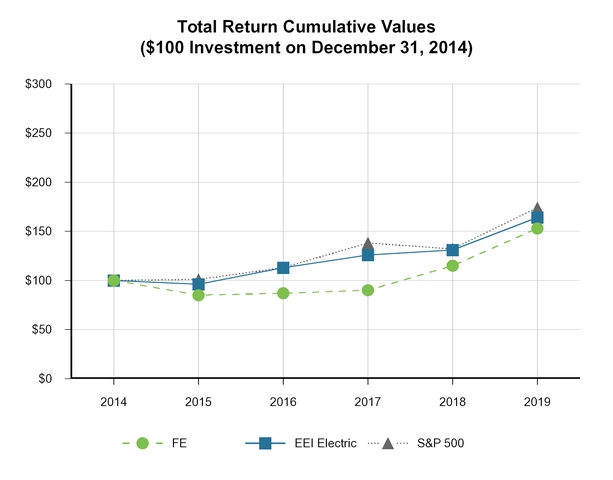
The following graph shows the total cumulative return from a $100 investment on December 31, 2014, in FE’s common stock compared with the total cumulative returns of EEI’s Index of Investor-Owned Electric Utility Companies and the S&P 500.
HOLDERS OF COMMON STOCK
There were 70,622 holders of 540,652,222 shares of FE’s common stock as of December 31, 2019, and 70,327 holders of 540,713,909 shares of FE's common stock as of January 31, 2020. We have historically paid quarterly cash dividends on our common stock. Dividend payments are subject to declaration by the Board and future dividend decisions determined by the Board may be impacted by earnings growth, cash flows, credit metrics and other business conditions. Information regarding retained earnings available for payment of cash dividends is given in Note 11, "Capitalization," of the Notes to Consolidated Financial Statements.
Item 7. MANAGEMENT’S DISCUSSION AND ANALYSIS OF FINANCIAL CONDITION AND RESULTS OF OPERATIONS
Forward-Looking Statements: This Form 10-K includes forward-looking statements within the meaning of the Private Securities Litigation Reform Act of 1995 based on information currently available. Such statements are subject to certain risks and uncertainties and readers are cautioned not to place undue reliance on these forward-looking statements. These statements include declarations regarding management's intents, beliefs and current expectations, and typically contain, but are not limited to, the terms “anticipate,” “potential,” “expect,” "forecast," "target," "will," "intend," “believe,” "project," “estimate," "plan" and similar words. Forward-looking statements involve estimates, assumptions, known and unknown risks, uncertainties and other factors that may cause actual results, performance or achievements to be materially different from any future results, performance or achievements expressed or implied by such forward-looking statements, which may include the following (see Glossary of Terms for definitions of capitalized terms):
| • | The ability to successfully execute an exit from commodity-based generation, including, without limitation, mitigating exposure for remedial activities associated with formerly owned generation assets. |
| • | The ability to accomplish or realize anticipated benefits from strategic and financial goals, including, but not limited to, our strategy to operate and grow as a fully regulated business, to execute our transmission and distribution investment plans, to continue to reduce costs, and to improve our credit metrics, strengthen our balance sheet and grow earnings. |
| • | Legislative and regulatory developments, including, but not limited to, matters related to rates, compliance and enforcement activity. |
| • | Economic and weather conditions affecting future operating results, such as significant weather events and other natural disasters, and associated regulatory events or actions. |
| • | Changes in assumptions regarding economic conditions within our territories, the reliability of our transmission and distribution system, or the availability of capital or other resources supporting identified transmission and distribution investment opportunities. |
| • | Changes in customers’ demand for power, including, but not limited to, the impact of climate change or energy efficiency and peak demand reduction mandates. |
| • | Changes in national and regional economic conditions affecting us and/or our major industrial and commercial customers or others with which we do business. |
| • | The risks associated with cyber-attacks and other disruptions to our information technology system, which may compromise our operations, and data security breaches of sensitive data, intellectual property and proprietary or personally identifiable information. |
| • | The ability to comply with applicable reliability standards and energy efficiency and peak demand reduction mandates. |
| • | Changes to environmental laws and regulations, including, but not limited to, those related to climate change. |
| • | Changing market conditions affecting the measurement of certain liabilities and the value of assets held in our pension trusts and other trust funds, or causing us to make contributions sooner, or in amounts that are larger, than currently anticipated. |
| • | The risks associated with the FES Bankruptcy that could adversely affect us, our liquidity or results of operations, including, without limitation, that conditions to the FES Bankruptcy settlement agreement may not be met or that the FES Bankruptcy settlement agreement may not be otherwise consummated, and if so, the potential for litigation and payment demands against us by FES or FENOC or their creditors. |
| • | The risks associated with the decommissioning of our retired and former nuclear facilities. |
| • | The risks and uncertainties associated with litigation, arbitration, mediation and like proceedings. |
| • | Labor disruptions by our unionized workforce. |
| • | Changes to significant accounting policies. |
| • | Any changes in tax laws or regulations, or adverse tax audit results or rulings. |
| • | The ability to access the public securities and other capital and credit markets in accordance with our financial plans, the cost of such capital and overall condition of the capital and credit markets affecting us, including the increasing number of financial institutions evaluating the impact of climate change on their investment decisions. |
| • | Actions that may be taken by credit rating agencies that could negatively affect either our access to or terms of financing or our financial condition and liquidity. |
| • | The risks and other factors discussed from time to time in our SEC filings. |
Dividends declared from time to time on our common stock during any period may in the aggregate vary from prior periods due to circumstances considered by our Board of Directors at the time of the actual declarations. A security rating is not a recommendation to buy or hold securities and is subject to revision or withdrawal at any time by the assigning rating agency. Each rating should be evaluated independently of any other rating.
These forward-looking statements are also qualified by, and should be read together with, the risk factors included in (a) Item 1A. Risk Factors, (b) Item 7. Management’s Discussion and Analysis of Financial Condition and Results of Operations, and (c) other factors discussed herein and in FirstEnergy's other filings with the SEC. The foregoing review of factors also should not be construed as exhaustive. New factors emerge from time to time, and it is not possible for management to predict all such factors, nor assess the impact of any such factor on our business or the extent to which any factor, or combination of factors, may cause results to differ materially from those contained in any forward-looking statements. We expressly disclaim any obligation to update or revise,
except as required by law, any forward-looking statements contained herein or in the information incorporated by reference as a result of new information, future events or otherwise.
FIRSTENERGY CORP.
MANAGEMENT’S DISCUSSION AND ANALYSIS OF
FINANCIAL CONDITION AND RESULTS OF OPERATIONS
FIRSTENERGY’S BUSINESS
FE and its subsidiaries are principally involved in the transmission, distribution and generation of electricity through its reportable segments, Regulated Distribution and Regulated Transmission.
The Regulated Distribution segment distributes electricity through FirstEnergy’s ten utility operating companies, serving approximately six million customers within 65,000 square miles of Ohio, Pennsylvania, West Virginia, Maryland, New Jersey and New York, and purchases power for its POLR, SOS, SSO and default service requirements in Ohio, Pennsylvania, New Jersey and Maryland. This segment also controls 3,790 MWs of regulated electric generation capacity located primarily in West Virginia, Virginia and New Jersey. The segment's results reflect the costs of securing and delivering electric generation from transmission facilities to customers, including the deferral and amortization of certain related costs.
The service areas of, and customers served by, FirstEnergy's regulated distribution utilities as of December 31, 2019, are summarized below (in thousands):
| Company | Area Served | **Customer |
Showing the first 8K of 188K characters. Open the full section
Item 7A. QUANTITATIVE AND QUALITATIVE DISCLOSURES ABOUT MARKET RISK
The information required by Item 7A relating to market risk is set forth in Item 7, "Management's Discussion and Analysis of Financial Condition and Results of Operations."
Item 8. FINANCIAL STATEMENTS AND SUPPLEMENTARY DATA
Management’s Report on Internal Control Over Financial Reporting
Management is responsible for establishing and maintaining adequate internal control over financial reporting as defined in Rules 13a-15(f) and 15d-15(f) of the Securities Exchange Act of 1934. Using the criteria set forth by the Committee of Sponsoring Organizations of the Treadway Commission in Internal Control - Integrated Framework published in 2013, management conducted an evaluation of the effectiveness of their internal control over financial reporting under the supervision of the chief executive officer and chief financial officer. Based on that evaluation, management concluded that FirstEnergy's internal control over financial reporting was effective as of December 31, 2019. The effectiveness of FirstEnergy’s internal control over financial reporting, as of December 31, 2019, has been audited by PricewaterhouseCoopers LLP, an independent registered public accounting firm, as stated in their report included herein.
Report of Independent Registered Public Accounting Firm
To the Stockholders and Board of Directors of FirstEnergy Corp.
Opinions on the Financial Statements and Internal Control over Financial Reporting
We have audited the accompanying consolidated balance sheets of FirstEnergy Corp. and its subsidiaries (the “Company”) as of December 31, 2019 and 2018, and the related consolidated statements of income (loss), of comprehensive income (loss), of stockholders’ equity and of cash flows for each of the three years in the period ended December 31, 2019, including the related notes and financial statement schedule listed in the index appearing under Item 15(a)(2) (collectively referred to as the “consolidated financial statements”). We also have audited the Company's internal control over financial reporting as of December 31, 2019, based on criteria established in Internal Control - Integrated Framework (2013) issued by the Committee of Sponsoring Organizations of the Treadway Commission (COSO).
In our opinion, the consolidated financial statements referred to above present fairly, in all material respects, the financial position of the Company as of December 31, 2019 and 2018, and the results of its operations and its cash flows for each of the three years in the period ended December 31, 2019 in conformity with accounting principles generally accepted in the United States of America. Also in our opinion, the Company maintained, in all material respects, effective internal control over financial reporting as of December 31, 2019, based on criteria established in Internal Control - Integrated Framework (2013) issued by the COSO.
Basis for Opinions
The Company's management is responsible for these consolidated financial statements, for maintaining effective internal control over financial reporting, and for its assessment of the effectiveness of internal control over financial reporting, included in the accompanying Management’s Report on Internal Control over Financial Reporting. Our responsibility is to express opinions on the Company’s consolidated financial statements and on the Company's internal control over financial reporting based on our audits. We are a public accounting firm registered with the Public Company Accounting Oversight Board (United States) (PCAOB) and are required to be independent with respect to the Company in accordance with the U.S. federal securities laws and the applicable rules and regulations of the Securities and Exchange Commission and the PCAOB.
We conducted our audits in accordance with the standards of the PCAOB. Those standards require that we plan and perform the audits to obtain reasonable assurance about whether the consolidated financial statements are free of material misstatement, whether due to error or fraud, and whether effective internal control over financial reporting was maintained in all material respects.
Our audits of the consolidated financial statements included performing procedures to assess the risks of material misstatement of the consolidated financial statements, whether due to error or fraud, and performing procedures that respond to those risks. Such procedures included examining, on a test basis, evidence regarding the amounts and disclosures in the consolidated financial statements. Our audits also included evaluating the accounting principles used and significant estimates made by management, as well as evaluating the overall presentation of the consolidated financial statements. Our audit of internal control over financial reporting included obtaining an understanding of internal control over financial reporting, assessing the risk that a material weakness exists, and testing and evaluating the design and operating effectiveness of internal control based on the assessed risk. Our audits also included performing such other procedures as we considered necessary in the circumstances. We believe that our audits provide a reasonable basis for our opinions.
Definition and Limitations of Internal Control over Financial Reporting
A company’s internal control over financial reporting is a process designed to provide reasonable assurance regarding the reliability of financial reporting and the preparation of financial statements for external purposes in accordance with generally accepted accounting principles. A company’s internal control over financial reporting includes those policies and procedures that (i) pertain to the maintenance of records that, in reasonable detail, accurately and fairly reflect the transactions and dispositions of the assets of the company; (ii) provide reasonable assurance that transactions are recorded as necessary to permit preparation of financial statements in accordance with generally accepted accounting principles, and that receipts and expenditures of the company are being made only in accordance with authorizations of management and directors of the company; and (iii) provide reasonable assurance regarding prevention or timely detection of unauthorized acquisition, use, or disposition of the company’s assets that could have a material effect on the financial statements.
Because of its inherent limitations, internal control over financial reporting may not prevent or detect misstatements. Also, projections of any evaluation of effectiveness to future periods are subject to the risk that controls may become inadequate because of changes in conditions, or that the degree of compliance with the policies or procedures may deteriorate.
Critical Audit Matters
The critical audit matter communicated below is a matter arising from the current period audit of the consolidated financial statements that was communicated or required to be communicated to the audit committee and that (i) relates to accounts or disclosures that are material to the consolidated financial statements and (ii) involved our especially challenging, subjective, or complex judgments. The communication of critical audit matters does not alter in any way our opinion on the consolidated financial statements, taken
as a whole, and we are not, by communicating the critical audit matter below, providing a separate opinion on the critical audit matter or on the accounts or disclosures to which it relates.
Recoverability of Regulatory Assets That Do Not Have an Order for Recovery
As described in Note 1 to the consolidated financial statements, the Company accounts for the effects of regulation through the application of regulatory accounting to its regulated distribution and transmission subsidiaries as their rates are established by a third-party regulator with the authority to set rates that bind customers, are cost-based and can be charged to and collected from customers. This ratemaking process results in the recording of regulatory assets and liabilities based on anticipated future cash inflows and outflows. Management assesses the probability of recovery of regulatory asset
Showing the first 8K of 302K characters. Open the full section
Item 9. CHANGES IN AND DISAGREEMENTS WITH ACCOUNTANTS ON ACCOUNTING AND FINANCIAL DISCLOSURE
None.
Item 9A. CONTROLS AND PROCEDURES
Evaluation of Disclosure Controls and Procedures
The management of FirstEnergy, with the participation of the chief executive officer and chief financial officer, has reviewed and evaluated the effectiveness of their registrant's disclosure controls and procedures, as defined in the Securities Exchange Act of 1934, Rules 13a-15(e) and 15d-15(e), as of the end of the period covered by this report. Based on that evaluation, the chief executive officer and chief financial officer have concluded that FirstEnergy’s disclosure controls and procedures were effective as of the end of the period covered by this report.
Management’s Report on Internal Control over Financial Reporting
See Management’s Report on Internal Control over Financial Reporting under Item 8, "Financial Statements and Supplementary Data". Management is required to assess the effectiveness of FirstEnergy's internal control over financial reporting. Based on that assessment, management concluded that FirstEnergy's internal control over financial reporting was effective as of December 31, 2019.
Changes in Internal Control over Financial Reporting
During the quarter ended December 31, 2019, there were no changes in internal control over financial reporting that have materially affected, or are reasonably likely to materially affect, FirstEnergy's internal control over financial reporting.
Item 9B. OTHER INFORMATION
None.
PART III
Item 10. DIRECTORS, EXECUTIVE OFFICERS AND CORPORATE GOVERNANCE
The information required by Item 10 is incorporated herein by reference to FirstEnergy's 2020 Proxy Statement to be filed with the SEC pursuant to Regulation 14A under the Securities Exchange Act of 1934.
Item 11. EXECUTIVE COMPENSATION
The information required by Item 11 is incorporated herein by reference to FirstEnergy’s 2020 Proxy Statement to be filed with the SEC pursuant to Regulation 14A under the Securities Exchange Act of 1934.
Item 12. SECURITY OWNERSHIP OF CERTAIN BENEFICIAL OWNERS AND MANAGEMENT AND RELATED STOCKHOLDER MATTERS
The Item 403 of Regulation S-K information required by Item 12 is incorporated herein by reference to FirstEnergy's 2020 Proxy Statement to be filed with the SEC pursuant to Regulation 14A under the Securities Exchange Act of 1934.
The following table contains information as of December 31, 2019, regarding compensation plans for which shares of FE common stock may be issued.
| Plan category | Number of Securities to be Issued Upon Exercise of Outstanding Options, Warrants and Rights | Weighted-Average Exercise Price of Outstanding Options, Warrants and Rights | Number of Securities Remaining Available for Future Issuance Under Equity Compensation Plans (Excluding Securities Reflected in First Column) | ||||||||
| Equity compensation plans approved by security holders | 4,316,337 | (1) | $ | 37.75 | (2) | 3,947,410 | (3) | ||||
| Equity compensation plans not approved by security holders(4) | — | N/A | — | ||||||||
| Total | 4,316,337 | $ | 37.75 | 3,947,410 |
(1) Represents shares of common stock that could be issued upon exercise of outstanding options granted under the ICP 2007 and ICP 2015. This number also includes 1,930,139 shares subject to outstanding awards of stock based RSUs granted under the ICP 2015 if paid at target for the three outstanding cycles, as well as 1,930,139 additional shares assuming maximum performance metrics are achieved for the 2017-2019, 2018-2020 and 2019-2021 cycles of stock based RSUs, 2,883 outstanding FE Amended and Restated EDCP related shares to be paid in stock and 372,919 shares related to the FE DCPD that will be paid in stock. Not reflected in the table are 21,282 shares related to the AYE Director's Plan and AYE DCD that will be paid in stock per the election of the recipient.
(2) Only FirstEnergy options were included in the calculation for determining the weighted-average exercise price.
(3) Represents shares available for issuance, assuming maximum performance metrics are achieved (or approximately 5,877,549 available assuming performance at target) for the 2017-2019, 2018-2020, and 2019-2021 cycles of stock-based RSUs, with respect to future awards under the ICP 2015 and future accruals of dividends on awards outstanding under ICP 2015. Additional shares may become available under the ICP 2015 due to cancellations, forfeitures, cash settlements or other similar circumstances with respect to outstanding awards. In addition, nominal amounts of shares may be issued in the future under the AYE Director's Plan and AYE DCD to cover future dividends that may accrue on amounts previously deferred and payable in stock, but new awards are no longer being granted under the Allegheny plans or the ICP 2007.
(4) All equity compensation plans have been approved by security holders.
Item 13. CERTAIN RELATIONSHIPS AND RELATED TRANSACTIONS, AND DIRECTOR INDEPENDENCE
The information required by Item 13 is incorporated herein by reference to FirstEnergy’s 2020 Proxy Statement to be filed with the SEC pursuant to Regulation 14A under the Securities Exchange Act of 1934.
Item 14. PRINCIPAL ACCOUNTING FEES AND SERVICES
A summary of the audit and audit-related fees for services rendered by PricewaterhouseCoopers LLP for the years ended December 31, 2019 and 2018, are as follows:
| Audit Fees**(1)** | Audit-Related Fees | |||||||||||||||
| 2019 | 2018 | 2019 | 2018 | |||||||||||||
| (In thousands) | ||||||||||||||||
| FirstEnergy | $ | 6,952 | $ | 7,345 | $ | — | $ | 163 |
| (1) | Professional services rendered for the audits of FirstEnergy's annual financial statements and reviews of unaudited financial statements included in FirstEnergy's Quarterly Reports on Form 10-Q and for services in connection with statutory and regulatory filings or engagements, including comfort letters, agreed upon procedures and consents for financings and filings made with the SEC. |
Tax Fees and All Other Fees
There were no tax-related fees paid to PricewaterhouseCoopers LLP in 2019 compared to $120,000 in 2018. PricewaterhouseCoopers LLP performed no other services in 2019 or 2018, however, FirstEnergy paid approximately $6,725 and $6,300 in software subscription fees to PricewaterhouseCoopers LLP for 2019 and 2018, respectively.
Additional information required by this item is incorporated herein by reference to FirstEnergy’s 2020 Proxy Statement to be filed with the SEC pursuant to Regulation 14A under the Securities Exchange Act of 1934.
PART IV
Item 15. EXHIBITS, FINANCIAL STATEMENT SCHEDULE
(a) The following documents are filed as a part of this report on Form 10-K:
1. Financial Statements:
Management’s Report on Internal Control Over Financial Reporting for FirstEnergy Corp. is listed under Item 8, "Financial Statements and Supplementary Data" herein.
Report of Independent Registered Public Accounting Firm for FirstEnergy Corp. is listed under Item 8, "Financial Statements and Supplementary Data," herein.
The financial statements filed as a part of this report for FirstEnergy Corp. are listed under Item 8, "Financial Statements and Supplementary Data," herein.
2. Financial Statement Schedule:
Report of Independent Registered Public Accounting Firm for FirstEnergy Corp. (including the schedule referenced below) is listed under Item 8, "Financial Statements and Supplementary Data," herein on page:
| Page |
| 74 |
Schedule II — Consolidated Valuation and Qualifying Accounts for each of the three years in the period ended December 31, 2019, are listed herein on page:
| Page |
| 142 |
Pursuant to paragraph (b)(4)(iii)(A) of Item 601 of Regulation S-K, FirstEnergy has not filed as an exhibit to this Form 10-K any instrument with respect to long-term debt if the respective total amount of securities authorized thereunder does not exceed 10% of its respective total assets, but hereby agrees to furnish to the SEC on request any such documents.
Item 16. FORM 10-K SUMMARY
None.
SCHEDULE II
FIRSTENERGY CORP.
CONSOLIDATED VALUATION AND QUALIFYING ACCOUNTS
FOR THE YEARS ENDED DECEMBER 31, 2019**,** 2018 AND 2017
| Additions | ||||||||||||||||||||
| Description | Beginning Balance | Charged to Income | Charged to Other Accounts | (1) | Deductions | (2) | Ending Balance | |||||||||||||
| (In thousands) | ||||||||||||||||||||
| Year Ended December 31, 2019: | ||||||||||||||||||||
| Accumulated provision for uncollectible accounts — customers | $ | 49,798 | $ | 81,107 | $ | 47,306 | $ | 132,031 | $ | 46,180 | ||||||||||
| — other | $ | 1,778 | $ | 26,654 | $ | 1,474 | $ | 8,509 | $ | 21,397 | ||||||||||
| — affiliated companies (4) | $ | 919,851 | $ | 143,276 | $ | — | $ | — | $ | 1,063,127 | ||||||||||
| Valuation allowance on various DTAs (3) | $ | 394,112 | $ | 46,526 | $ | — | $ | — | $ | 440,638 | ||||||||||
| Year Ended December 31, 2018: | ||||||||||||||||||||
| Accumulated provision for uncollectible accounts — customers | $ | 48,937 | $ | 77,254 | $ | 60,307 | $ | 136,700 | $ | 49,798 | ||||||||||
| — other | $ | 990 | $ | 12,487 | $ | — | $ | 11,699 | $ | 1,778 | ||||||||||
| — affiliated companies (4) | $ | — | $ | — | $ | — | $ | 919,851 | $ | 919,851 | ||||||||||
| Valuation allowance on state and local DTAs | $ | 312,135 | $ | 81,977 | $ | — | $ | — | $ | 394,112 | ||||||||||
| Year Ended December 31, 2017: | ||||||||||||||||||||
| Accumulated provision for uncollectible accounts — customers | $ | 48,409 | $ | 73,486 | $ | 49,728 | $ | 122,686 | $ | 48,937 | ||||||||||
| — other | $ | 884 | $ | 6,461 | $ | — | $ | 6,355 | $ | 990 | ||||||||||
| Valuation allowance on state and local DTAs | $ | 240,289 | $ | 71,846 | $ | — | $ | — | $ | 312,135 |
| (1) | Represents recoveries and reinstatements of accounts previously written off for uncollectible accounts. |
| (2) | Represents the write-off of accounts considered to be uncollectible. |
| (3) | Starting in 2018, valuation allowances are now being recorded against federal and state DTA's related to disallowed business interest and certain employee remuneration, in addition to the state and local DTA's in the prior years presented. |
| (4) | Amounts relate to the FES Debtors and are included in discontinued operations. See Note 3, "Discontinued Operations" for additional information. |
SIGNATURES
Pursuant to the requirements of Section 13 or 15(d) of the Securities Exchange Act of 1934, the registrant has duly caused this report to be signed on its behalf by the undersigned, thereunto duly authorized.
| FIRSTENERGY CORP. | |||
| BY: | /s/ Charles E. Jones | ||
| Charles E. Jones | |||
| President and Chief Executive Officer |
Date: February 10, 2020
SIGNATURES
Pursuant to the requirements of the Securities Exchange Act of 1934, this report has been signed below by the following persons on behalf of the registrant and in the capacities and on the date indicated:
| /s/ Charles E. Jones | |||
| Charles E. Jones | |||
| President and Chief Executive Officer and Director | |||
| (Principal Executive Officer) | |||
| /s/ Donald T. Misheff | |||
| Donald T. Misheff | |||
| Director | |||
| (Non-Executive Chairman of Board) | |||
| /s/ Steven E. Strah | /s/ Jason J. Lisowski | ||
| Steven E. Strah | Jason J. Lisowski | ||
| Senior Vice President and Chief Financial Officer | Vice President, Controller and Chief Accounting Officer | ||
| (Principal Financial Officer) | (Principal Accounting Officer) | ||
| /s/ Michael J. Anderson | /s/ Christopher D. Pappas | ||
| Michael J. Anderson | Christopher D. Pappas | ||
| Director | Director | ||
| /s/ Steven J. Demetriou | /s/ Sandra Pianalto | ||
| Steven J. Demetriou | Sandra Pianalto | ||
| Director | Director | ||
| /s/ Julia L. Johnson | /s/ Luis A. Reyes | ||
| Julia L. Johnson | Luis A. Reyes | ||
| Director | Director | ||
| /s/ Thomas N. Mitchell | /s/ Leslie M. Turner | ||
| Thomas N. Mitchell | Leslie M. Turner | ||
| Director | Director | ||
| /s/ James F. O'Neil III | |||
| James F. O'Neil III | |||
| Director |
Date: February 10, 2020