 filings.tools
FirstEnergy 10-K 2023-12-31
Filed 2024-02-13. 24 sections, 882K characters. Original on sec.gov · Markdown · JSON
Cover and table of contents
UNITED STATES SECURITIES AND EXCHANGE COMMISSION
Washington, D.C. 20549
FORM 10-K
(Mark One)
☑ ANNUAL REPORT PURSUANT TO SECTION 13 OR 15(d) OF THE SECURITIES EXCHANGE ACT OF 1934
For the FISCAL YEAR ended December 31, 2023
OR
☐ TRANSITION REPORT PURSUANT TO SECTION 13 OR 15(d) OF THE SECURITIES EXCHANGE ACT OF 1934
For the transition period from ___________________ to ___________________

| Commission | Registrant; State of Incorporation; | I.R.S. Employer | |||||||||||||||||||||
| File Number | Address; and Telephone Number | Identification No. | |||||||||||||||||||||
| 333-21011 | FIRSTENERGY CORP | 34-1843785 | |||||||||||||||||||||
| (An | Ohio | Corporation) | |||||||||||||||||||||
| 76 South Main Street | |||||||||||||||||||||||
| Akron | OH | 44308 | |||||||||||||||||||||
| Telephone | (800) | 736-3402 | |||||||||||||||||||||
SECURITIES REGISTERED PURSUANT TO SECTION 12(b) OF THE ACT:
| Title of Each Class | Trading Symbol | Name of Each Exchange on Which Registered | ||||||||||||
| Common Stock, $0.10 par value per share | FE | New York Stock Exchange |
SECURITIES REGISTERED PURSUANT TO SECTION 12(g) OF THE ACT:
None.
Indicate by check mark if the registrant is a well-known seasoned issuer, as defined in Rule 405 of the Securities Act.
| Yes | ☑ | No | ☐ |
Indicate by check mark if the registrant is not required to file reports pursuant to Section 13 or Section 15(d) of the Act.
| Yes | ☐ | No | ☑ |
Indicate by check mark whether the registrant (1) has filed all reports required to be filed by Section 13 or 15(d) of the Securities Exchange Act of 1934 during the preceding 12 months (or for such shorter period that the registrant was required to file such reports), and (2) has been subject to such filing requirements for the past 90 days.
| Yes | ☑ | No | ☐ |
Indicate by check mark whether the registrant has submitted electronically every Interactive Data File required to be submitted pursuant to Rule 405 of Regulation S-T (§232.405 of this chapter) during the preceding 12 months (or for such shorter period that the registrant was required to submit such files).
| Yes | ☑ | No | ☐ |
Indicate by check mark whether the registrant is a large accelerated filer, an accelerated filer, a non-accelerated filer, a smaller reporting company, or an emerging growth company. See the definitions of “large accelerated filer,” “accelerated filer,” “smaller reporting company,” and "emerging growth company" in Rule 12b-2 of the Exchange Act.
| Large Accelerated Filer | ☑ | ||||
| Accelerated Filer | ☐ | ||||
| Non-accelerated Filer | ☐ | ||||
| Smaller Reporting Company | ☐ | ||||
| Emerging Growth Company | ☐ |
If an emerging growth company, indicate by check mark if the registrant has elected not to use the extended transition period for complying with any new or revised financial accounting standards provided pursuant to Section 13(a) of the Exchange Act.☐
Indicate by check mark whether the registrant has filed a report on and attestation to its management’s assessment of the effectiveness of its internal control over financial reporting under Section 404(b) of the Sarbanes-Oxley Act (15 U.S.C. 7262(b)) by the registered public accounting firm that prepared or issued its audit report. ☑
If securities are registered pursuant to Section 12(b) of the Act, indicate by check mark whether the financial statements of the registrant included in the filing reflect the correction of an error to previously issued financial statements. ☐
Indicate by check mark whether any of those error corrections are restatements that required a recovery analysis of incentive-based compensation received by any of the registrant’s executive officers during the relevant recovery period pursuant to §240.10D-1(b). ☐
Indicate by check mark whether the registrant is a shell company (as defined in Rule 12b-2 of the Act).
| Yes | ☐ | No | ☑ |
State the aggregate market value of the voting and non-voting common equity held by non-affiliates computed by reference to the price at which the common equity was last sold, or the average bid and asked price of such common equity, as of the last business day of the registrant’s most recently completed second fiscal quarter.
$22,261,707,443 as of June 30, 2023
Indicate the number of shares outstanding of each of the registrant’s classes of common stock, as of the latest practicable date:
| CLASS | AS OF JANUARY 31, 2024 | |||||||
| Common Stock, $0.10 par value | 574,440,850 |
Documents Incorporated By Reference
| PART OF FORM 10-K INTO WHICH | ||||||||
| DOCUMENT | DOCUMENT IS INCORPORATED | |||||||
| Portions of the Definitive Proxy Statement for the 2024 Annual Meeting of Shareholders of FirstEnergy Corp. to be held May 22, 2024. | Part III |
TABLE OF CONTENTS
| Page | |||||
| Glossary of Terms | iii | ||||
| Part I | |||||
| Item 1. Business | 1 | ||||
| The Companies | 1 | ||||
| Capital Requirements | 4 | ||||
| Supply Plan | 4 | ||||
| System Demand | 5 | ||||
| Regional Reliability | 5 | ||||
| Competition | 5 | ||||
| Seasonality | 5 | ||||
| Human Capital | 6 | ||||
| Information About Our Executive Officers | 8 | ||||
| FirstEnergy Website and Other Social Media Sites and Applications | 9 | ||||
| Item 1A. Risk Factors | 10 | ||||
| Item 1B. Unresolved Staff Comments | 24 | ||||
| Item 1C. Cybersecurity | 24 | ||||
| Item 2. Properties | 26 | ||||
| Item 3. Legal Proceedings | 27 | ||||
| Item 4. Mine Safety Disclosures | 27 | ||||
| Part II | 28 | ||||
| Item 5. Market for Registrant’s Common Equity, Related Stockholder Matters and Issuer Purchases of Equity Securities | 28 | ||||
| Item 6. [Reserved] | 28 | ||||
| Item 7. Management’s Discussion and Analysis of Financial Condition and Results of Operations | 29 | ||||
| Item 7A. Quantitative and Qualitative Disclosures About Market Risk | 77 | ||||
| Item 8. Financial Statements and Supplementary Data | 77 | ||||
| Report of Independent Registered Public Accounting Firm | 78 | ||||
| Financial Statements | |||||
| Consolidated Statements of Income | 80 | ||||
| Consolidated Statements of Comprehensive Income | 81 | ||||
| Consolidated Balance Sheets | 82 | ||||
| Consolidated Statements of Stockholders' Equity | 83 | ||||
| Consolidated Statements of Cash Flows | 84 | ||||
| Notes to Consolidated Financial Statements | 85 | ||||
| Item 9. Changes In and Disagreements with Accountants on Accounting and Financial Disclosure | 135 | ||||
| Item 9A. Controls and Procedures | 135 | ||||
| Item 9B. Other Information | 135 | ||||
i
| Item 9C. Disclosure Regarding Foreign Jurisdictions That Prevent Inspections | 136 | ||||
| Part III | 136 | ||||
| Item 10. Directors, Executive Officers and Corporate Governance | 136 | ||||
| Item 11. Executive Compensation | 136 | ||||
| Item 12. Security Ownership of Certain Beneficial Owners and Management and Related Stockholder Matters | 136 | ||||
| Item 13. Certain Relationships and Related Transactions, and Director Independence | 136 | ||||
| Item 14. Principal Accountant Fees and Services | 137 | ||||
| Part IV | 137 | ||||
| Item 15. Exhibit and Financial Statement Schedules | 137 | ||||
| Item 16. Form 10-K Summary | 142 |
ii
GLOSSARY OF TERMS
The following abbreviations and acronyms are used in this report to identify FirstEnergy Corp. and its current and former subsidiaries:
| AE Supply | Allegheny Energy Supply Company, LLC, an unregulated generation subsidiary of FE | ||||
| AGC | Allegheny Generating Company, a generation subsidiary of MP | ||||
| ATSI | American Transmission Systems, Incorporated, a transmission subsidiary of FET | ||||
| CEI | The Cleveland Electric Illuminating Company, an Ohio electric utility subsidiary of FE | ||||
| FE | FirstEnergy Corp., a public utility holding company | ||||
| FENOC | Energy Harbor Nuclear Corp. (formerly known as FirstEnergy Nuclear Operating Company), a subsidiary of EH, which operates EH’s nuclear generating facilities | ||||
| FE PA | FirstEnergy Pennsylvania Electric Company, a Pennsylvania electric utility subsidiary of FirstEnergy Pennsylvania Holding Company LLC, a wholly owned subsidiary of FE | ||||
| FES | Energy Harbor LLC (formerly known as FirstEnergy Solutions Corp.), a subsidiary of EH, which provides energy-related products and services | ||||
| FESC | FirstEnergy Service Company, which provides legal, financial, and other corporate support services | ||||
| FES Debtors | FENOC, FES, and FES’ subsidiaries as of March 31, 2018 | ||||
| FET | FirstEnergy Transmission, LLC a consolidated VIE of FE, and the parent company of ATSI, MAIT and TrAIL, and having a joint venture in PATH | ||||
| FEV | FirstEnergy Ventures Corp., which invests in certain unregulated enterprises and business ventures | ||||
| FirstEnergy | FirstEnergy Corp., together with its consolidated subsidiaries | ||||
| Global Holding | Global Mining Holding Company, LLC, a joint venture between FEV, WMB Marketing Ventures, LLC and Pinesdale LLC | ||||
| JCP&L | Jersey Central Power & Light Company, a New Jersey electric utility subsidiary of FE | ||||
| KATCo | Keystone Appalachian Transmission Company, a transmission subsidiary of FE | ||||
| MAIT | Mid-Atlantic Interstate Transmission, LLC, a transmission subsidiary of FET | ||||
| ME | Metropolitan Edison Company, a former Pennsylvania electric utility subsidiary of FE, which merged with and into FE PA on January 1, 2024 | ||||
| MP | Monongahela Power Company, a West Virginia electric utility subsidiary of FE | ||||
| OE | Ohio Edison Company, an Ohio electric utility subsidiary of FE | ||||
| Ohio Companies | CEI, OE and TE | ||||
| PATH | Potomac-Appalachian Transmission Highline, LLC, a joint venture between FE and a subsidiary of AEP | ||||
| PATH-Allegheny | PATH Allegheny Transmission Company, LLC | ||||
| PATH-WV | PATH West Virginia Transmission Company, LLC | ||||
| PE | The Potomac Edison Company, a Maryland and West Virginia electric utility subsidiary of FE | ||||
| Penn | Pennsylvania Power Company, a former Pennsylvania electric utility subsidiary of OE, which merged with and into FE PA on January 1, 2024 | ||||
| Pennsylvania Companies | ME, PN, Penn and WP, each of which merged with and into FE PA on January 1, 2024 | ||||
| PN | Pennsylvania Electric Company, a former Pennsylvania electric utility subsidiary of FE, which merged with and into FE PA on January 1, 2024 | ||||
| Signal Peak | Signal Peak Energy, LLC, an indirect subsidiary of Global Holding that owns mining operations near Roundup, Montana | ||||
| TE | The Toledo Edison Company, an Ohio electric utility subsidiary of FE | ||||
| TrAIL | Trans-Allegheny Interstate Line Company, a transmission subsidiary of FET | ||||
| Transmission Companies | ATSI, KATCo, MAIT and TrAIL | ||||
| Utilities | OE, CEI, TE, Penn, JCP&L, ME, PN, MP, PE and WP | ||||
| WP | West Penn Power Company, a former Pennsylvania electric utility subsidiary of FE, which merged with and into FE PA on January 1, 2024 | ||||
iii
| The following abbreviations and acronyms are used to identify frequently used terms in this report: | |||||
| 2021 Credit Facilities | Collectively, the six separate senior unsecured five-year syndicated revolving credit facilities entered into by FE, the Utilities and the Transmission Companies, on October 18, 2021, as amended through October 20, 2023 | ||||
| 2023 Credit Facilities | Collectively, the FET Revolving Facility and KATCo Revolving Facility | ||||
| 2026 Convertible Notes | FE's 4.00% convertible senior notes, due 2026 | ||||
| 2031 Notes | FE’s 7.375% Notes, Series C, due 2031 | ||||
| A&R FET LLC Agreement | Fourth Amended and Restated Limited Liability Company Operating Agreement of FET | ||||
| ACE | Affordable Clean Energy | ||||
| AEP | American Electric Power Company, Inc. | ||||
| AFS | Available-for-sale | ||||
| AFSI | Adjusted Financial Statement Income | ||||
| AFUDC | Allowance for Funds Used During Construction | ||||
| AMI | Advanced Metering Infrastructure | ||||
| AMT | Alternative Minimum Tax | ||||
| AOCI | Accumulated Other Comprehensive Income (Loss) | ||||
| ARO | Asset Retirement Obligation | ||||
| ASC | Accounting Standards Codification | ||||
| ASU | Accounting Standards Update | ||||
| Bankruptcy Court | U.S. Bankruptcy Court in the Northern District of Ohio in Akron | ||||
| BGS | Basic Generation Service | ||||
| Brookfield | North American Transmission Company II L.P., a controlled investment vehicle entity of Brookfield Infrastructure Partners | ||||
| Brookfield Guarantors | Brookfield Super-Core Infrastructure Partners L.P., Brookfield Super-Core Infrastructure Partners (NUS) L.P., and Brookfield Super-Core Infrastructure Partners (ER) SCSp | ||||
| CAA | Clean Air Act | ||||
| CCR | Coal Combustion Residual | ||||
| CERCLA | Comprehensive Environmental Response, Compensation, and Liability Act of 1980 | ||||
| CFIUS | Committee on Foreign Investments in the United States | ||||
| CFR | Code of Federal Regulations | ||||
| CISO | Chief Information Security Officer | ||||
| CO2 | Carbon Dioxide | ||||
| COVID-19 | Coronavirus disease | ||||
| CPP | EPA's Clean Power Plan | ||||
| CSAPR | Cross-State Air Pollution Rule | ||||
| CTA | Consolidated Tax Adjustment | ||||
| D.C. Circuit | United States Court of Appeals for the District of Columbia Circuit | ||||
| DCPD | FE Deferred Compensation Plan for Outside Directors | ||||
| DCR | Delivery Capital Recovery | ||||
| DEI | Diversity, Equity and Inclusion | ||||
| DMR | Distribution Modernization Rider | ||||
| DPA | Deferred Prosecution Agreement entered into on July 21, 2021 between FE and the U.S. Attorney’s Office for the S.D. Ohio | ||||
| DSIC | Distribution System Improvement Charge | ||||
| EDC | Electric Distribution Company | ||||
| EDCP | FE Amended and Restated Executive Deferred Compensation Plan | ||||
| EDIS | Electric Distribution Investment Surcharge | ||||
| EE&C | Energy Efficiency and Conservation | ||||
| EEI | The Edison Electric Institute | ||||
| EESG | Employee, Environmental, Social and Corporate Governance |
iv
| EGS | Electric Generation Supplier | ||||
| EGU | Electric Generation Unit | ||||
| EH | Energy Harbor Corp. | ||||
| ELG | Effluent Limitation Guidelines | ||||
| EmPOWER Maryland | EmPOWER Maryland Energy Efficiency Act | ||||
| ENEC | Expanded Net Energy Cost | ||||
| Energize365 | FirstEnergy's Transmission and Distribution Infrastructure Investment Program. | ||||
| EnergizeNJ | JCP&L's second Infrastructure Investment Program | ||||
| EPA | United States Environmental Protection Agency | ||||
| EPS | Earnings per Share | ||||
| ESP IV | Electric Security Plan IV | ||||
| ESP V | Electric Security Plan V | ||||
| Exchange Act | Securities and Exchange Act of 1934, as amended | ||||
| FASB | Financial Accounting Standards Board | ||||
| FE Board | FE Board of Directors | ||||
| FE Revolving Facility | FE and the Utilities’ former five-year syndicated revolving credit facility, as amended, and replaced by the 2021 Credit Facilities on October 18, 2021 | ||||
| FERC | Federal Energy Regulatory Commission | ||||
| FET Board | FET Board of Directors | ||||
| FET LLC Agreement | Third Amended and Restated Limited Liability Company Operating Agreement of FET | ||||
| FET Minority Equity Interest Sale | Sale of an additional 30% membership interest of FET, such that Brookfield will own 49.9% of FET | ||||
| FET P&SA I | Purchase and Sale Agreement entered into on November 6, 2021, by and between FE, FET, Brookfield and the Brookfield Guarantors | ||||
| FET P&SA II | Purchase and Sale Agreement entered into on February 2, 2023, by and between FE, FET, Brookfield, and the Brookfield Guarantors | ||||
| FET Revolving Facility | FET’s five-year syndicated revolving credit facility, dated as of October 20, 2023 | ||||
| Fitch | Fitch Ratings Service | ||||
| FMB | First Mortgage Bond | ||||
| FTR | Financial Transmission Right | ||||
| GAAP | Generally Accepted Accounting Principles in the United States of America | ||||
| GHG | Greenhouse Gas | ||||
| HB 6 | House Bill 6, as passed by Ohio's 133rd General Assembly | ||||
| IBEW | International Brotherhood of Electrical Workers | ||||
| ICP 2015 | FirstEnergy Corp. 2015 Incentive Compensation Plan | ||||
| ICP 2020 | FirstEnergy Corp. 2020 Incentive Compensation Plan | ||||
| IRA of 2022 | Inflation Reduction Act of 2022 | ||||
| IRS | Internal Revenue Service | ||||
| KATCo Revolving Facility | KATCo’s four-year syndicated revolving credit facility, dated as of October 20, 2023 | ||||
| kV | Kilovolt | ||||
| kWh | Kilowatt-hour | ||||
| LOC | Letter of Credit | ||||
| LTIIP | Long-Term Infrastructure Improvement Plan | ||||
| MDPSC | Maryland Public Service Commission | ||||
| MGP | Manufactured Gas Plants | ||||
| Moody’s | Moody’s Investors Service, Inc. | ||||
| MW | Megawatt | ||||
| MWh | Megawatt-hour | ||||
| NAV | Net Asset Value | ||||
| NCI | Noncontrolling Interest |
v
| N.D. Ohio | Federal District Court, Northern District of Ohio | ||||
| NERC | North American Electric Reliability Corporation | ||||
| NJBPU | New Jersey Board of Public Utilities | ||||
| NOL | Net Operating Loss | ||||
| NOx | Nitrogen Oxide | ||||
| NSR | New Source Review | ||||
| NUG | Non-Utility Generation | ||||
| NYPSC | New York State Public Service Commission | ||||
| OAG | Ohio Attorney General | ||||
| OCC | Ohio Consumers' Counsel | ||||
| ODSA | Ohio Development Service Agency | ||||
| Ohio Stipulation | Stipulation and Recommendation, dated November 1, 2021, entered into by and among the Ohio Companies, the OCC, PUCO Staff, and several other signatories | ||||
| OOCIC | Ohio Organized Crime Investigations Commission, which is composed of members of the Ohio law enforcement community and is chaired by the OAG | ||||
| OPEB | Other Postemployment Benefits | ||||
| OPEIU | Office and Professional Employees International Union | ||||
| OSMRE | United States Department of the Interior, Office of Surface Mining Reclamation and Enforcement | ||||
| OVEC | Ohio Valley Electric Corporation | ||||
| PA Consolidation | Consolidation of the Pennsylvania Companies | ||||
| PEER | FirstEnergy's Program for Enhanced Employee Retirement | ||||
| PJM | PJM Interconnection, LLC, an RTO | ||||
| PJM Region | The territory that PJM coordinates the movement of electricity through, including all or parts of Delaware, Illinois, Indiana, Kentucky, Maryland, Michigan, New Jersey, North Carolina, Ohio, Pennsylvania, Tennessee, Virginia, West Virginia and the District of Columbia. | ||||
| PJM Tariff | PJM Open Access Transmission Tariff | ||||
| POLR | Provider of Last Resort | ||||
| PPA | Purchase Power Agreement | ||||
| PPUC | Pennsylvania Public Utility Commission | ||||
| PUCO | Public Utilities Commission of Ohio | ||||
| Regulation FD | Regulation Fair Disclosure promulgated by the SEC | ||||
| RFC | ReliabilityFirst Corporation | ||||
| ROE | Return on Equity | ||||
| RTO | Regional Transmission Organization | ||||
| S.D. Ohio | Federal District Court, Southern District of Ohio | ||||
| SEC | United States Securities and Exchange Commission | ||||
| SEET | Significantly Excessive Earnings Test | ||||
| SIP | State Implementation Plan(s) under the CAA | ||||
| SLC | Special Litigation Committee of the FE Board | ||||
| SO2 | Sulfur Dioxide | ||||
| SOFR | Secured Overnight Financing Rate | ||||
| SOS | Standard Offer Service | ||||
| SPE | Special Purpose Entity | ||||
| SSO | Standard Service Offer | ||||
| S&P | Standard & Poor’s Ratings Service | ||||
| S&P 500 | Standard & Poor’s 500 index | ||||
| Tax Act | Tax Cuts and Jobs Act adopted December 22, 2017 | ||||
| UWUA | Utility Workers Union of America | ||||
| VEPCO | Virginia Electric and Power Company | ||||
| VIE | Variable Interest Entity |
vi
| VSCC | Virginia State Corporation Commission | ||||
| WVPSC | Public Service Commission of West Virginia |
vii
PART I
Item 1. BUSINESS
The Companies
FE and its subsidiaries are principally involved in the transmission, distribution, and generation of electricity. FirstEnergy’s utility operating companies comprise one of the nation’s largest investor-owned electric systems, serving over six million customers in the Midwest and Mid-Atlantic regions. FirstEnergy’s transmission operations include more than 24,000 miles of transmission lines and two regional transmission operation centers. AGC and MP control 3,580 MWs of total capacity.
FirstEnergy’s revenues are derived primarily from electric service provided by the Utilities and Transmission Companies, which were reported under two operating segments: Regulated Distribution and Regulated Transmission.
Regulated Utility Operating Subsidiaries
The Utilities’ combined service areas encompass approximately 65,000 square miles in Ohio, Pennsylvania, West Virginia, Maryland, New Jersey, and New York. The areas they serve have a combined population of approximately 14 million. The Utilities' serve approximately 6.2 million customers with a rate base of approximately $27.3 billion. On January 1, 2024, FirstEnergy consolidated the Pennsylvania Companies into FE PA, including OE subsidiary, Penn, making FE PA a new, single operating entity. In addition to merging each of the Pennsylvania Companies with and into FE PA, with FE PA surviving such mergers as the successor-in-interest to all assets and liabilities of the Pennsylvania Companies, (i) WP transferred certain of its Pennsylvania-based transmission assets to KATCo, and (ii) PN and ME contributed their respective Class B equity interests of MAIT to FE. FE PA, as of January 1, 2024, is FE’s only regulated distribution utility in Pennsylvania encompassing the operations previously conducted individually by the Pennsylvania Companies and serves an area with a population of approximately 4.5 million. FE PA operates under the rate districts of the former Pennsylvania Companies. FirstEnergy is also evaluating the legal, financial, operational and branding benefits of consolidating the Ohio Companies into a single Ohio utility company.
OE owns property and does business as an electric public utility in Ohio, providing distribution services to approximately 1.1 million customers in central and northeastern Ohio, with a rate base of $2.1 billion. OE has 1,056 employees and serves an area that has a population of approximately 2.3 million.
Penn, a former subsidiary of OE, owned property and conducted business as an electric public utility in Pennsylvania, providing distribution services to approximately 0.2 million customers in western Pennsylvania, with a rate base of $0.6 billion. Penn had 179 employees and served an area that had a population of approximately 0.4 million. On January 1, 2024, Penn merged with and into FE PA.
CEI owns property and does business as an electric public utility in Ohio, providing distribution services to approximately 0.8 million customers in northeastern Ohio, with a rate base of $1.7 billion. CEI has 829 employees and serves an area that has a population of approximately 1.6 million.
TE owns property and does business as an electric public utility in Ohio, providing distribution services to approximately 0.3 million customers in northwestern Ohio, with a rate base of $0.5 billion. TE has 328 employees and serves an area that has a population of approximately 0.7 million.
JCP&L owns property and does business as an electric public utility in New Jersey, providing distribution services to approximately 1.2 million customers, as well as transmission services in northern, western, and east central New Jersey, with a combined rate base of $4.2 billion. JCP&L has 1,328 employees and serves an area that has a population of approximately 2.8 million.
ME owned property and conducted business as an electric public utility in Pennsylvania, providing distribution services to approximately 0.6 million customers in eastern and south central Pennsylvania, with a rate base of $2.0 billion. ME had 591 employees and served an area that had a population of approximately 1.3 million. On January 1, 2024, ME merged with and into FE PA.
PN owned property and conducted business as an electric public utility in Pennsylvania, providing distribution services to approximately 0.6 million customers in western, northern, and south-central Pennsylvania, and western New York, with a rate base of $2.1 billion. PN had 713 employees and served an area that had a population of approximately 1.2 million in Pennsylvania and approximately 4,000 in New York. On January 1, 2024, PN merged with and into FE PA.
PE owns property and does business as an electric public utility in Maryland, Virginia, and West Virginia, providing distribution services to approximately 0.4 million customers in Maryland and West Virginia and provides transmission services in Maryland, West Virginia and Virginia, with a combined rate base of approximately $1.4 billion. PE has 512 employees and serves an area that has a population of approximately 1.0 million.
MP owns property and does business as an electric public utility in West Virginia, providing distribution services to approximately 0.4 million customers, as well as generation and transmission services in northern West Virginia, with a combined rate base of $3.1 billion. MP has 1,004 employees and serves an area with a population of approximately 0.8 million. MP is contractually obligated to provide power to PE to meet its load obligations in West Virginia. MP owns or contractually controls 3,580 MWs of generation capacity that is supplied to its electric utility business, including a 16.25% undivided interest in the Bath County pumped-storage hydroelectric generation facility in Virginia (487 MWs) through its wholly owned subsidiary AGC.
WP owned property and conducted business as an electric public utility in Pennsylvania, providing distribution services to approximately 0.7 million customers, as well as transmission services in southwestern, south-central, and northern Pennsylvania, with a combined rate base of $2.3 billion. WP had 634 employees and served an area with a population of approximately 1.6 million. On January 1, 2024, WP transferred certain of its Pennsylvania-based transmission assets to KATCo before merging with and into FE PA.
Regulated Transmission Operating Subsidiaries
FET, the parent of ATSI, MAIT, PATH, and TrAIL, is a subsidiary of FE which holds 80.1% of its issued and outstanding membership interests. Brookfield owns the remaining 19.9% of the issued and outstanding membership interests of FET. Through its subsidiaries, FET owns and operates high-voltage transmission facilities in the PJM Region. FET's subsidiaries are subject to regulation by FERC and applicable state regulatory authorities.
On February 2, 2023, FE, along with FET, entered into the FET P&SA II with Brookfield and the Brookfield Guarantors, pursuant to which FE agreed to sell to Brookfield at the closing, and Brookfield agreed to purchase from FE, an incremental 30% equity interest in FET for a purchase price of $3.5 billion. The majority of the purchase price is expected to be paid in cash upon closing, and the remainder will be payable by the issuance of a promissory note, which is expected to be repaid by the end of 2024. As a result of the consummation of the transaction, Brookfield’s interest in FET will increase from 19.9% to 49.9%, while FE will retain the remaining 50.1% ownership interests of FET. The transaction is subject to customary closing conditions, including approval from the PPUC. In addition, pursuant to the FET P&SA II, FirstEnergy made the necessary filings with the applicable regulatory authorities for the PA Consolidation. The FET Minority Equity Interest Sale is expected to close by the end of the first quarter of 2024. Upon closing, FET will continue to be consolidated in FirstEnergy’s financial statements.
ATSI owns high-voltage transmission facilities in PJM, which consist of approximately 7,900 circuit miles of transmission lines with nominal voltages of 345 kV, 138 kV and 69 kV in Ohio and Pennsylvania and has a rate base of $3.8 billion.
TrAIL owns high-voltage transmission facilities in PJM, which consists of approximately 260 circuit miles of transmission lines, including a 500 kV transmission line extending approximately 150 miles from southwestern Pennsylvania through West Virginia to a point of interconnection with VEPCO in northern Virginia, and has a rate base of $1.4 billion.
MAIT owns high-voltage transmission facilities in PJM, which consist of approximately 4,300 circuit miles of transmission lines with nominal voltages of 500 kV, 345 kV, 230 kV, 138 kV, 115 kV, 69 kV and 46 kV in Pennsylvania, and has a rate base of $2.1 billion.
KATCo was formed to accommodate new transmission construction in the WP, MP and PE footprint and did not own or operate any transmission assets as of December 31, 2023. On January 1, 2024, WP transferred certain of its Pennsylvania-based transmission assets to KATCo.
Service Company
FESC provides corporate support and other services, including executive administration, accounting and finance, risk management, human resources, corporate affairs, communications, information technology, legal services and other similar services at cost, in accordance with its cost allocation manual, to affiliated FirstEnergy companies under FESC agreements.
Operating Segments
FirstEnergy's reportable operating segments are comprised of the Regulated Distribution and Regulated Transmission segments.
The Regulated Distribution segment distributes electricity through FirstEnergy’s utility operating companies, serving approximately six million customers within 65,000 square miles of Ohio, Pennsylvania, West Virginia, Maryland, New Jersey and New York, and purchases power for its POLR, SOS, SSO and default service requirements in Ohio, Pennsylvania, New Jersey, and Maryland. This segment also controls 3,580 MWs of regulated electric generation capacity located primarily in West Virginia and Virginia. The segment's results reflect the costs of securing and delivering electric generation from transmission facilities to customers, including the deferral and amortization of certain related costs.
The Regulated Transmission segment provides transmission infrastructure owned and operated by the Transmission Companies and certain of FirstEnergy's utilities (JCP&L, MP, PE and WP) to transmit electricity from generation sources to distribution facilities. The segment's revenues are derived from primarily forward-looking formula rates, pursuant to which the
revenue requirement is updated annually based on a projected rate base and projected costs, which is subject to an annual true-up based on actual rate base and costs. The segment's results also reflect the net transmission expenses related to the delivery of electricity on FirstEnergy's transmission facilities. As described above, Brookfield holds 19.9% of the issued and outstanding membership interests of FET and has entered into an agreement to purchase from FE, an incremental 30% equity interest in FET, such that Brookfield’s interest in FET will increase from 19.9% to 49.9%, while FE will retain the remaining 50.1%. The transaction is subject to customary closing conditions, including PPUC approval, and is expected to close by the end of the first quarter of 2024. Upon closing, FET will continue to be consolidated in FirstEnergy’s financial statements.
Corporate/Other reflects corporate support and other costs not charged or attributable to the Utilities or Transmission Companies, including FE's retained Pension and OPEB assets and liabilities of former subsidiaries, interest expense on FE’s holding company debt and other investments or businesses that do not constitute an operating segment, including FEV's investment of 33-1/3% equity ownership in Global Holding. Additionally, reconciling adjustments for the elimination of inter-segment transactions are included in Corporate/Other. As of December 31, 2023, 67 MWs of electric generating capacity, representing AE Supply's OVEC capacity entitlement, was also included in Corporate/Other for segment reporting. As of December 31, 2023, Corporate/Other had approximately $7.1 billion of external FE holding company debt.
In 2024, FirstEnergy changed its reportable segments to include the following:
-
Distribution Segment, which will consist of the Ohio Companies and FE PA;
-
Integrated Segment, which will consist of MP, PE and JCP&L; and
-
Stand-Alone Transmission Segment, which will consist of FE's ownership in FET and KATCo.
On January 1, 2024, WP transferred certain of its Pennsylvania-based transmission assets to KATCo. Corporate/Other will continue to reflect corporate support and other support costs not charged or attributable to the Utilities or Transmission Companies, including FE's retained Pension and OPEB assets and liabilities of former subsidiaries, interest expense on FE's holding company debt and other investments or businesses that do not constitute an operating segment, including FEV's investment of 33-1/3% equity ownership in Global Holding.
Regulatory Accounting
FirstEnergy accounts for the effects of regulation through the application of regulatory accounting to the Utilities and the Transmission Companies as their rates are established by a third-party regulator with the authority to set binding rates that are cost-based and can be charged to and collected from customers.
The Utilities and the Transmission Companies recognize, as regulatory assets and regulatory liabilities, costs that FERC and the various state utility commissions, as applicable, have authorized for recovery from or return to customers in future periods or for which authorization is probable. Without the probability of such authorization, costs currently recorded as regulatory assets and regulatory liabilities would have been charged or credited to income as incurred. All regulatory assets and liabilities are expected to be recovered from or returned to customers. Based on current ratemaking procedures, the Utilities and the Transmission Companies continue to collect cost-based rates for their distribution and transmission services; accordingly, it is appropriate that the Utilities and the Transmission Companies continue the application of regulatory accounting to those operations. Regulatory accounting is applied only to the parts of the business that meet the above criteria. If a portion of the business applying regulatory accounting no longer meets those requirements, previously recorded regulatory assets and liabilities are removed from the balance sheet in accordance with GAAP.
State Regulation
The following table summarizes the allowed regulated distribution ROE and the aggregate actual ROE of the Utilities by state as determined for regulatory purposes as of December 31, 2023:
| State | Allowed ROE | Actual ROE | ||||||||||||
| Maryland | 9.5% | 4.7% | ||||||||||||
| New Jersey | 9.6% settled | 4.1%(1) | ||||||||||||
| Ohio | 10.5% | 5.8% | ||||||||||||
| Pennsylvania | Settled(2) | 9.2% | ||||||||||||
| West Virginia | Settled(2) | 7.7%(3) |
(1) As updated in pending rate case.
(2) Commission-approved settlement agreement did not disclose ROE rates.
(3) As filed in pending rate case and includes generation and transmission.
See "Outlook - State Regulation" in Item 7, "Management's Discussion and Analysis of Financial Condition and Results of Operations" for additional information and discussion.
Federal Regulation
See "Outlook - FERC Regulatory Matters" in Item 7, "Management's Discussion and Analysis of Financial Condition and Results of Operations" for additional information and discussion.
Environmental Matters
See "Outlook - Environmental Matters" in Item 7, "Management's Discussion and Analysis of Financial Condition and Results of Operations" for additional information and discussion.
Capital Requirements
FirstEnergy’s business is capital intensive, requiring significant resources to fund operating expenses, construction and other investment expenditures, scheduled debt maturities and interest payments, dividend payments and potential contributions to its pension plan. See "Capital Resources and Liquidity" in Item 7, "Management's Discussion and Analysis of Financial Condition and Results of Operations" for additional information and discussion.
Supply Plan
Supply Chain
Post-pandemic economic conditions have increased supply chain lead times across numerous material categories, with some as much as tripling from pre-pandemic lead times. Several key suppliers have struggled with labor shortages and raw material availability, which along with inflationary pressures, have increased costs and decreased the availability of certain materials, equipment, and contractors. FirstEnergy has taken steps to mitigate these risks and does not currently expect service disruptions or any material impact on its capital spending plan. However, a prolonged continuation or further increase in supply chain disruptions could have an adverse effect on FirstEnergy’s results, including operations, cash flow and financial condition. FirstEnergy continues to monitor supply chain risk as it anticipates these challenges continuing into 2024, and is mitigating these risks by:
-
Utilizing a cross-functional team to forecast potential impacts to operations and programs;
-
Expanding supply base to increase resiliency;
-
Enhancing the demand management and material reservation process;
-
Evaluating substitute products, reserving production capacity, and buying ahead in targeted categories; and
-
Participating in discussions and initiatives with other utilities through EEI, which has a long history of mutual assistance in the electric utility industry.
Default Service
Certain of the Utilities have default service obligations to provide power to non-shopping customers who have elected to continue to receive service under regulated retail tariffs. These default service plans vary by state and service territory, and volume of sales can vary depending on the level of shopping that occurs. JCP&L’s default service, or BGS supply, is secured through a statewide competitive procurement process approved by the NJBPU. Default service for the Ohio Companies, Pennsylvania Companies and PE's Maryland jurisdiction are provided through a competitive procurement process approved by the PUCO (under ESP IV), PPUC (under the Default Service Plan) and MDPSC (under the SOS), respectively. If any supplier fails to deliver power to any one of those Utilities’ service areas, the Utility serving that area may need to procure the required power in the market in their role as the default Load Serving Entity. West Virginia electric generation continues to be regulated by the WVPSC.
Fuel Supply
MP currently has coal contracts with various terms to purchase approximately 6.1 million tons of coal for the year 2024, which, along with its 2023 year-end inventory levels, accounts for all of its forecasted 2024 coal requirements. MP has the ability to acquire additional tonnage through options available in its current contracts, as well as purchases through the spot market. The contracts expire at various times through 2025. This contracted coal is produced primarily from mines located in Pennsylvania, Illinois and West Virginia. In order to meet emission requirements, MP holds contracts for a variety of reagents expiring at various times through 2026, as well as the ability to purchase additional reagents through the spot market. Additionally, MP is granted emission allowances by the EPA and purchases additional allowances as needed to meet emission requirements. See "Outlook - Environmental Matters" in Item 7, "Management's Discussion and Analysis of Financial Condition and Results of Operations" for additional information pertaining to the impact of increased environmental regulations on fuel supply.
System Demand
The maximum hourly demand for each of the Utilities was:
| For the Years Ended December 31, | ||||||||||||||||||||
| System Demand | 2023 | 2022 | 2021 | |||||||||||||||||
| (In MWs) | ||||||||||||||||||||
| CEI | 3,868 | 4,266 | 4,253 | |||||||||||||||||
| JCP&L | 5,731 | 6,122 | 5,902 | |||||||||||||||||
| ME | 2,890 | 3,021 | 2,976 | |||||||||||||||||
| MP | 2,051 | 2,124 | 2,114 | |||||||||||||||||
| OE | 5,192 | 5,652 | 5,598 | |||||||||||||||||
| PE | 3,103 | 3,514 | 2,905 | |||||||||||||||||
| Penn | 900 | 944 | 889 | |||||||||||||||||
| PN | 2,763 | 2,838 | 2,908 | |||||||||||||||||
| TE | 2,220 | 2,277 | 2,265 | |||||||||||||||||
| WP | 3,706 | 3,827 | 3,827 |
Regional Reliability
All of FirstEnergy's facilities are located within the PJM Region and operate under the reliability oversight of a regional entity known as RFC. This regional entity operates under the oversight of NERC in accordance with a delegation agreement approved by FERC.
Competition
Within FirstEnergy’s Regulated Distribution segment, generally there is no competition for electric distribution service in the Utilities’ respective service territories in Ohio, Pennsylvania, West Virginia, Maryland, New Jersey and New York. Additionally, there has traditionally been no competition for transmission service in the PJM Region. However, pursuant to FERC’s Order No. 1000 and subject to state and local siting and permitting approvals, non-incumbent developers now can compete for certain PJM transmission projects in the service territories of FirstEnergy’s Regulated Transmission segment. This could result in additional competition to build transmission facilities in the Regulated Transmission segment’s service territories while also allowing the Regulated Transmission segment the opportunity to seek to build facilities in non-incumbent service territories.
Seasonality
The sale of electric power is generally a seasonal business, and weather patterns can have a material impact on FirstEnergy’s Regulated Distribution segment operating results. Demand for electricity in our service territories historically peaks during the summer and winter months. Accordingly, FirstEnergy’s annual results of operations and liquidity position may depend disproportionately on its operating performance during the summer and winter. Mild weather conditions may result in lower power sales and consequently lower revenue, earnings and cash flow.
Human Capital
FirstEnergy focuses on a number of human capital resources, measures and objectives in managing its business, including: integrity, safety, DEI, workplace flexibility, employee development and compensation and benefits. During 2023, FirstEnergy continued to enhance its dedicated focus on employees by providing employees with additional opportunities to improve belonging, inclusion and engagement within our workforce.
Employees and Collective Bargaining Agreements
As of December 31, 2023, FirstEnergy had 12,042 employees, all of whom were located in the United States as follows:
| Total Employees | Bargaining Unit Employees | ||||||||||
| FESC | 4,868 | 453 | |||||||||
| CEI | 829 | 566 | |||||||||
| JCP&L | 1,328 | 1,026 | |||||||||
| ME(1) | 591 | 451 | |||||||||
| MP | 1,004 | 379 | |||||||||
| OE | 1,056 | 642 | |||||||||
| PE | 512 | 251 | |||||||||
| Penn(1) | 179 | 129 | |||||||||
| PN(1) | 713 | 489 | |||||||||
| TE | 328 | 233 | |||||||||
| WP(1) | 634 | 477 | |||||||||
| Total | 12,042 | 5,096 |
(1) On January 1, 2024, employees of the Pennsylvania Companies became employees of FE PA as discussed further above.
As of December 31, 2023, the IBEW, the UWUA and the OPEIU unions collectively represented approximately 45% of FirstEnergy’s employees. There are 15 collective bargaining agreements between FirstEnergy’s subsidiaries and its unions, which have three, four or five-year terms. In 2023, FirstEnergy’s subsidiaries reached new agreements with two IBEW locals, covering 482 employees, and one UWUA local, covering 821 employees. Additionally, in 2023, FirstEnergy’s subsidiaries extended the agreements of two IBEW locals, covering 263 employees and five UWUA locals, covering 1,305 employees.
Safety
Safety is a core value of FirstEnergy. FirstEnergy employees have the power and responsibility to keep each other safe and eliminate life-changing events, which are injuries that have life-changing impacts or fatal results. Safety metrics, such as injuries that result in days away or restricted time and life-changing events, are regularly monitored, internally reported, and are included in the annual incentive compensation program to reinforce that a safe work environment is crucial to FirstEnergy’s success.
FirstEnergy continues to focus on mitigating life-changing event exposure to strengthen FirstEnergy’s safety-first culture and drive safer decisions from an engaged workforce who puts safety first. FirstEnergy continues to embed its "Leading with Safety" learnings and experiences and continues to enhance and reinforce leader and employee safety training and exposure control concepts to improve job site exposure identification, communication and mitigation to prevent life changing events. Further, FirstEnergy continues to expand its “Leading with Safety” experiences with its employees to achieve excellence in personal, contractor and public safety.
Diversity, Equity and Inclusion
DEI is a core value, as well as a corporate objective because a diverse, equitable and inclusive work environment delivers better service to customers, strong operational performance, innovation, and a safe, rewarding work experience for employees. FirstEnergy is focused on building a diverse workforce for the future, advancing a culture of equity, inclusion and belonging, and enhancing our diversity focus with our customers, in our communities and with our suppliers.
Affirmative steps taken at FirstEnergy to promote the core value of DEI include:
-
FirstEnergy sponsors an executive DEI council consisting of senior management and other leaders across the company;
-
Conducted “Employee Engagement Survey” to capture employees’ perspectives on their work experience and progress toward embracing a more inclusive culture. The survey results are discussed with employees in order to drive initiatives and action plans for improvement. This includes:
-
a cross-functional working group to oversee the development and implementation of DEI action plans company-wide;
-
additional teams of employees embedded throughout FirstEnergy to implement local actions supporting DEI;
-
FirstEnergy’s employees have established multiple employee business resource groups, known as "EBRGs," to further support DEI objectives through networking, mentoring, coaching, recruiting, development and community outreach;
-
Employees are provided ongoing training and education on a variety of DEI topics;
-
Enhanced transparency of DEI data, and talent processes;
-
Enhancements to the recruiting processes to increase the number of diverse candidates considered for open positions and expand the diversity of teams interviewing those candidates. These enhancements include:
▪expanded relationship building with key diverse professional organizations, colleges and universities through the FirstEnergy Ambassador Network;
▪a more strategic approach to proactive talent sourcing in an effort to increase diversity of candidate slates presented to hiring managers;
▪expanded diversity of teams interviewing those candidates.
- FirstEnergy has increased leadership accountability through the continuation of including DEI metrics in FirstEnergy’s annual incentive compensation program.
Workplace Flexibility
FirstEnergy is committed to supporting employees’ work/life balance by providing flexible work arrangements for many of its employees and encouraging career growth as well as personal balance. In the fall of 2022, FirstEnergy formally adopted guidelines to facilitate flexible work arrangements for eligible full-time and part-time non-bargaining employees. Flexible work arrangements, such as permitting certain employees to work from alternate locations or to begin and end work at variable times, offer a variety of approaches to the way employees work. As part of this commitment, FirstEnergy has begun an implementation of a facility optimization strategy, in which we are reducing the number of office buildings based on the number of employees that are mobile and work from home. These approaches can help employees achieve their priorities and meet customer and business needs while promoting enhanced convenience and balance between work and personal commitments.
Employee Development
FirstEnergy’s employees are empowered to take ownership of their careers with increased openness into FirstEnergy’s internal and external hiring process and greater availability of tools and processes that support career management, talent reviews, succession planning and leadership selection. FirstEnergy is committed to preparing its high-performing workforce for the future and helping employees reach their full potential, which includes developing employee skills and competencies and preparing aspiring, emerging and experienced leaders for future leadership responsibilities.
Understanding FirstEnergy’s rapidly changing industry and strategy is key to its employees’ ability to support FirstEnergy’s mission and meet its customers’ evolving needs. Key FirstEnergy development programs include:
-
a mentoring program;
-
new supervisor and manager development program;
-
experienced leader program;
-
aspiring leader program;
-
external partnership with the Center for Creative Leadership® and BeingFirst® for senior and executive leadership development,
-
"Educate to Elevate," which provides access to post-secondary education and a path to both Associate’s and Bachelor’s degrees for employees; and
-
an apprentice line worker program designed to attract technical entry-level talent to FirstEnergy.
Compensation and Benefits
FirstEnergy’s total rewards program is designed to attract, motivate, retain and reward employees for their role in the success of FirstEnergy. The base pay program is designed to provide individual base pay levels that balance an employee’s value to FirstEnergy with comparable jobs at peer companies. FirstEnergy aims to ensure that its internal policies and processes support pay equity, which was confirmed in a third-party review of practices in 2019 and continues to be part of the normal ongoing process. The annual incentive compensation program is designed to reward the achievement of near-term corporate and business unit objectives, as well as outstanding individual performance. Additionally, FirstEnergy’s long-term incentive compensation program is designed to reward eligible leaders for FirstEnergy’s achievement of longer-term goals intended to drive shareholder value and growth. In addition to base pay and incentive compensation plans, FirstEnergy offers a comprehensive benefits program, including a 401(k) savings plan and a defined benefit pension plan to eligible employees.
Information About Our Executive Officers (as of February 13, 2024)
| Name | Age | Positions Held During Past Five Years | Dates | |||||||||||||||||
| Brian X. Tierney | 56 | President and Chief Executive Officer (A) (B) | 2023-Present | |||||||||||||||||
| Blackstone Infrastructure Partners, Senior Managing Director | 2021-2023 | |||||||||||||||||||
| AEP, Executive Vice President - Strategy | 2021 | |||||||||||||||||||
| AEP, Executive Vice President and Chief Financial Officer | *-2020 | |||||||||||||||||||
| Christine L. Walker | 58 | Senior Vice President, Chief Human Resources Officer and Corporate Services (B) | 2021-Present | |||||||||||||||||
| Senior Vice President and Chief Human Resources Officer (B) | 2019-2021 | |||||||||||||||||||
| Vice President, Human Resources (B) | *-2019 | |||||||||||||||||||
| Hyun Park | 62 | Senior Vice President and Chief Legal Officer (A) (B) | 2021-Present | |||||||||||||||||
| Senior Vice President and General Counsel (C) (D) (E) | 2021-2022 | |||||||||||||||||||
| LimNexus, Partner and General Counsel | 2019-2021 | |||||||||||||||||||
| Latham & Watkins, Of Counsel | *-2019 | |||||||||||||||||||
| Jason J. Lisowski | 42 | Vice President, Controller and Chief Accounting Officer (A) (B) | *-Present | |||||||||||||||||
| Vice President and Controller (C) (E) (F) | *-Present | |||||||||||||||||||
| K. Jon Taylor | 50 | Senior Vice President, Chief Financial Officer and Strategy (A) (B) | 2021-Present | |||||||||||||||||
| Senior Vice President and Chief Financial Officer (C) (E) (F) | 2020-Present | |||||||||||||||||||
| Senior Vice President and Chief Financial Officer (A) (B) | 2020-2021 | |||||||||||||||||||
| Vice President, Utility Operations (B) | 2019-2020 | |||||||||||||||||||
| President (D) | 2019-2020 | |||||||||||||||||||
| President, Ohio Operations (B) | *-2019 | |||||||||||||||||||
| Vice President (C) | *-2019 | |||||||||||||||||||
| Toby L. Thomas | 52 | Chief Operating Officer (A) (B) | 2023-Present | |||||||||||||||||
| AEP, Senior Vice President | 2021-2023 | |||||||||||||||||||
| Indiana Michigan Power, President and Chief Operating Officer | *-2021 | |||||||||||||||||||
| A. Wade Smith | 59 | President, FirstEnergy Utilities (A) (B) | 2023-Present | |||||||||||||||||
| Puget Sound Energy, Inc., Executive Vice President and Chief Operating Officer | 2022-2023 | |||||||||||||||||||
| Pacific Gas & Electric, Senior Vice President | 2021-2022 | |||||||||||||||||||
| AEP, Senior Vice President | *-2021 |
| * Indicates position held at least since January 1, 2019 | ||
| (A) Denotes position held at FE | ||
| (B) Denotes position held at FESC | ||
| (C) Denotes position held at the Ohio Companies, the Pennsylvania Companies(1), MP, PE, FET, KATCo, TrAIL and ATSI | ||
| (D) Denotes position held at AGC | ||
| (E) Denotes position held at MAIT | ||
| (F) Denotes position held at FE PA(1) |
(1) On January 1, 2024, FirstEnergy consolidated the Pennsylvania Companies into FE PA, making it a new, single operating entity. Upon consolidation, current executive officers of the Pennsylvania Companies were named executive officers of FE PA.
FirstEnergy Website and Other Social Media Sites and Applications
FirstEnergy's Annual Reports on Form 10-K, Quarterly Reports on Form 10-Q, Current Reports on Form 8-K, amendments to those reports, and all other documents filed with or furnished to the SEC pursuant to Section 13(a) of the Exchange Act are made available free of charge on or through the "Investors" page of FirstEnergy’s website at www.firstenergycorp.com. These documents are also available to the public from commercial document retrieval services and the website maintained by the SEC at www.sec.gov.
These SEC filings are posted on the website as soon as reasonably practicable after they are electronically filed with or furnished to the SEC. Additionally, FirstEnergy routinely posts additional important information, including press releases, investor presentations, investor factbooks and notices of upcoming events under the "Investors" section of FirstEnergy’s website and recognizes FirstEnergy’s website as a channel of distribution to reach public investors and as a means of disclosing (including initially or exclusively) material non-public information for complying with disclosure obligations under Regulation FD. Investors may be notified of postings to the website by signing up for email alerts and Rich Site Summary feeds on the “Investors” page of FirstEnergy’s website. FirstEnergy also uses X (the social networking site formerly known as Twitter®), LinkedIn®, YouTube® and Facebook® as additional channels of distribution to reach public investors and as a supplemental means of disclosing material non-public information for complying with its disclosure obligations under Regulation FD. Information contained on FirstEnergy’s website, X (the social networking site formerly known as Twitter®) handle, LinkedIn® profile, YouTube® channel or Facebook® page, and any corresponding applications of those sites, shall not be deemed incorporated into, or to be part of, this report.
Item 1A. RISK FACTORS
We operate in a business environment that involves significant risks, many of which are beyond our control. Management regularly evaluates the most significant risks of its businesses and reviews those risks with the FE Board and appropriate Committees of the FE Board. The following risk factors and all other information contained in this report should be considered carefully when evaluating FirstEnergy. These risk factors could affect our financial results and cause such results to differ materially from those expressed in any forward-looking statements made by or on behalf of us. Below, we have identified risks we consider material. The risks that we face are not limited to those in this section. There may be additional risks and uncertainties (either currently unknown or not currently believed to be material) that could adversely affect our business, financial condition, results of operations, liquidity or cash flows. Although the risks are organized by headings, and each risk is discussed separately, many are interrelated. These risk factors should be read in conjunction with Item 1, "Business,” Item 7, "Management’s Discussion and Analysis of Financial Condition and Results of Operations,” and in other sections of this Form 10-K that include forward-looking and other statements involving risks and uncertainties that could impact our business, financial condition, results of operations, liquidity or cash flows.
Risks Associated with Damage to Our Reputation and HB 6 Related Litigation and Investigations
Damage to our reputation may arise from numerous sources making us vulnerable to negative customer perception, adverse regulatory outcomes, or other consequences, which could materially adversely affect our business, results of operations, and financial condition.
Our reputation is important. Damage to our reputation could materially adversely affect our business, results of operations, and financial condition and may arise from numerous sources further discussed below, including a breach of the DPA, negative outcomes associated with the SEC investigation or other HB 6 litigation or investigations, a significant cyber-attack, data security or physical security breach, failure to provide safe and reliable service, and negative perceptions regarding the operation of coal-fired generation, particularly GHG emissions. Any damage to our reputation may lead to negative customer perception, which may make it difficult for us to compete successfully for new opportunities, or could adversely impact our ability to launch new sophisticated technology-driven solutions to meet our customer expectations. A damaged reputation could further result in FERC, the PUCO, and other regulatory and legislative authorities being less likely to view us in a favorable light, and could negatively impact the rates we charge customers or otherwise cause us to be susceptible to unfavorable legislative and regulatory outcomes, as well as increased regulatory oversight and more stringent legislative or regulatory requirements. See "Risks Associated with Climate Change, GHG Emission and Other Environmental Matters" below.
If we violate our DPA that we entered into on July 20, 2021, it could have a material adverse effect on our reputation, consolidated financial statements, and our ability to access capital and our liquidity.
On July 21, 2021, we entered into a three-year DPA with the U.S. Attorney’s Office that, subject to court proceedings, resolves the previously disclosed U.S. Attorney’s Office investigation into us relating to our lobbying and governmental affairs activities concerning HB 6. Under the DPA, the U.S. Attorney’s Office filed a single charge alleging that we conspired to commit honest services wire fraud. The DPA provides that the U.S. Attorney’s Office will defer any prosecution of such conspiracy charge and any other criminal or civil case against us in connection with the matters identified therein for a three-year period subject to certain obligations of ours, including, but not limited to, the following: (i) continued cooperation with the U.S. Attorney’s Office in all matters relating to the conduct described in the DPA and other conduct under investigation by the U.S. government; (ii) payment of a criminal monetary penalty totaling $230 million; (iii) publication a list of all payments made in 2021 to either 501(c)(4) entities or to entities known by FirstEnergy to be operating for the benefit of a public official, either directly or indirectly, and updating of the same on a quarterly basis during the term of the DPA; (iv) publication of a public acknowledgement of our conduct, including a statement, as dictated in the DPA, regarding our use of 501(c)(4) entities; and (v) continued implementation and review of our compliance and ethics program, internal controls, policies and procedures designed, implemented and enforced to prevent and detect violations of the U.S. laws throughout its operations, and to take certain related remedial measures. If we are found to have breached the terms of the DPA, the U.S. Attorney’s Office may elect to prosecute, or bring a civil action against, us for conduct alleged in the DPA or known to the government, which could result in fines or penalties and could have a material adverse impact on our reputation or relationships with regulatory and legislative authorities, customers and other stakeholders, as well as our consolidated financial statements. Failure to comply with the DPA, including alleged failures to comply with anti-corruption and anti-bribery laws, may also result in a breach of certain covenants contained in our credit agreements and could result in an event of default under such agreements, and we would not be able to access our credit facilities for additional borrowings and letters of credit during the existence of any such default.
The SEC investigation and HB 6 related litigation could have a material adverse effect on our reputation, business, financial condition, results of operations, liquidity or cash flows.
Following the announcement by the U.S. Attorney’s Office for the S.D. Ohio of the investigation surrounding HB 6 in July 2020, certain of our stockholders and customers filed several lawsuits against us and certain current and former directors, officers and other employees, including the federal securities class action litigation In re FirstEnergy Corp. Securities Litigation (Federal District Court, S.D. Ohio). The investigations and litigation related to HB 6 could divert management’s focus and have resulted in, and could continue to result in substantial investigation expenses, and the commitment of substantial corporate resources. The
outcome, duration, scope, result or related costs of the investigations and related litigation of the government investigations, particularly the SEC investigation and the securities class action lawsuit discussed below, are inherently uncertain. Therefore, any of these risks could impact us significantly beyond expectations. See Note 14, "Commitments, Guarantees and Contingencies" of the Notes to Consolidated Financial Statements and “Management’s Discussion and Analysis of Financial Condition and Results of Operations—Critical Accounting Policies and Estimates.” Moreover, we are unable to predict the potential for any additional investigations or litigation, any of which could exacerbate these risks or expose us to potential criminal or civil liabilities, sanctions or other remedial measures, and could have a material adverse effect on our reputation, business, financial condition, results of operations, liquidity or cash flows.
On August 10, 2020, the SEC, through its Division of Enforcement, issued an order directing an investigation of possible securities laws violations by FirstEnergy, and on September 1, 2020, issued subpoenas to FirstEnergy and certain of its officers. We continue to cooperate with the SEC in their ongoing investigation
Showing the first 8K of 95K characters. Open the full section
Item 1B. UNRESOLVED STAFF COMMENTS
None.
Item 1C. CYBERSECURITY
FirstEnergy seeks to protect its customers, employees, facilities and the ongoing reliability of the electric system. FirstEnergy works closely with state and federal agencies and its peers in the electric utility industry to identify physical and cyber security
risks, exchange information, and put safeguards in place to comply with strict reliability and security standards. From a security standpoint, the electric utility sector is one of the most regulated industries.
Risk Management and Strategy
FirstEnergy has established a broad framework to assess, identify and manage material risks from cyber security threats. This program is established at the executive level, with regular reporting to, and oversight by, the FE Board as described below. At the highest level, FirstEnergy’s program includes multi-layered governance by management, the Audit Committee, the Operations and Safety Committee, and the FE Board, as described in greater detail below.
Central management and coordination of the program helps FirstEnergy to comprehensively evaluate and protect against cyber threats. FirstEnergy’s policies and procedures identify how cyber security measures and controls are developed, implemented, and regularly reviewed and updated. FirstEnergy aims to align its cyber security program with national standards. For example, FirstEnergy has implemented and maintains a set of controls to manage cyber security risk based on the National Institute of Standards and Technology Cyber Security Framework and, for Bulk Electric System assets, the NERC Critical Infrastructure Protection standards. FirstEnergy also complies with various state laws and regulations on cyber security.
FirstEnergy’s Cyber Security Program identifies security controls and user responsibilities for the organization to identify and manage the risk of a cyber security incident. FirstEnergy also conducts various internal and external risk assessments each year, which are based on nationally accepted standards. These can include annual compliance required assessments, such as requirements under the Sarbanes-Oxley Act and Payment Card Industry compliance audits, as well as ad-hoc assessments driven by emerging risks, changes in FirstEnergy’s environment, or benchmark/roadmap needs. Risks identified in such assessments are considered for inclusion in FirstEnergy’s risk portfolio, or incorporated directly into the Cyber Security Program, and are then prioritized and addressed as needed through the organization’s policies and procedures. The risk assessment along with risk-based analysis and judgment are used to select security controls to address risks. During this process, the following factors, among others, are considered: likelihood and severity of risk, impact on FirstEnergy and others, such as vendors and customers, if a risk materializes, feasibility and cost of controls, and impact of controls on operations and others. FirstEnergy also regularly evaluates the adequacy and sufficiency of specific controls.
To further protect its information and cyber assets, FirstEnergy has required since late 2022 that applicable prospective third-party vendors complete a privacy impact assessment, which is designed to identify potential privacy and cyber security risks for those vendors requiring access to personally identifiable information, and based on the results, include appropriate contractual provisions to mitigate any identified risks. FirstEnergy is also currently evaluating its current third-party vendors to identify which vendors have similar access to personally identifiable information and expects to complete its analysis by the end of 2024.
FirstEnergy conducts cyber security exercises and training. For example, all personnel with any form of computer system access must complete cyber security training on a recurring basis, which educates the personnel on FirstEnergy’s policies and procedures for using FirstEnergy systems, keeping FirstEnergy information secure, and for safe, reliable operation of electric utility systems. FirstEnergy also conducts various tests of its cyber incident response plans, disaster recovery plans and business continuity plans with key stakeholders and responders for various areas of FirstEnergy’s utility and business functions. FirstEnergy’s management also holds executive cyber security incident tabletop exercises to train on cyber security incident response.
Additionally, FirstEnergy leverages third-party security firms in various capacities to assist with various aspects of FirstEnergy’s cyber security program, including risk assessments, vulnerability scans, and penetration testing. FirstEnergy uses a variety of processes to address cyber security threats related to the use of third-party technology and services, such as reviewing independent assessments of the third party’s cyber/information security controls, such as Systems and Organization Controls 2 audits or other standards-based assessments, where appropriate. As part of FirstEnergy’s process to continuously improve its cyber and information security programs, FirstEnergy also engages third-party subject matter experts to assess and evaluate the effectiveness of various aspects of such programs.
In addition to the aforementioned efforts, FirstEnergy also strongly considers cyber security risks as a part of its overall strategy and invests heavily in sophisticated and layered security measures that use both technology and hard defenses to protect critical transmission facilities and its digital communications networks. For example, security enhancements to FirstEnergy’s transmission infrastructure, such as enhanced cyber security monitoring and alarming are a key component of FirstEnergy’s transmission investment program.
Despite the security measures and safeguards FirstEnergy has employed, including certain measures implemented pursuant to mandatory NERC Critical Infrastructure Protection standards, FirstEnergy’s infrastructure may be increasingly vulnerable to such attacks as a result of the rapidly evolving and increasingly sophisticated means by which attempts to defeat security measures and gain access to information technology systems may be made. Also, FirstEnergy, or its vendors and service providers, may be at an increased risk of a cyber-attack and/or data security breach due to the nature of its business. Any such cyber incident could result in significant lost revenue, the inability to conduct critical business functions and serve customers for a significant period of time, the use of significant management resources, legal claims or proceedings, regulatory penalties, significant remediation costs, increased regulation, increased capital costs, increased protection costs for enhanced cyber security systems
or personnel, damage to FirstEnergy's reputation and/or the rendering of its internal controls ineffective, all of which could materially adversely affect FirstEnergy's business, results of operations, financial condition and reputation.
Board Governance and Management
The FE Board has identified cyber security as a key enterprise risk and prioritizes the mitigation of this risk through FirstEnergy’s enterprise risk management process. Responsibility for oversight of risk management generally lies with the FE Board and the Audit Committee has primary responsibility to oversee enterprise risk management. To effectively manage oversight of FirstEnergy’s cyber security risk management practices, since 2022, the FE Board has delegated oversight authority to each of FirstEnergy’s Audit and Operations and Safety Committees, respectively, as detailed in each Committees’ charters. The Audit Committee has primary responsibility to oversee the disclosure of material cyber security incidents, as well as the general obligation to ensure the proper risk oversight structure of cyber security as part of the FirstEnergy’s overall enterprise risk management program and the internal controls applicable to cyber security matters. The Operations and Safety Oversight Committee has primary responsibility to oversee the operational aspects of FirstEnergy’s cyber security policies, programs, initiatives and strategies, as well as operational risk considerations related to cyber security matters. FirstEnergy’s CISO regularly provides reports at the Audit Committee, Operations and Safety Oversight Committee, and the full FE Board. Each such Committee and the full FE Board work collaboratively to ensure fulsome oversight with the proper focus of each respective Board body. These reports include, among other things, current and emerging cyber security risks to FirstEnergy, incidents that were escalated to management during the prior quarter, including those that did not require immediate escalation to the appropriate Committee and/or full FE Board, internal and external assessments of FirstEnergy’s cyber security program, and a roadmap of projects to manage its cyber security posture.
At the executive and management level, the CISO has primary responsibility for the development, operation, and maintenance of FirstEnergy’s cyber security program. The CISO has 5 years of experience in technology risk management, all of which have been with FirstEnergy, and an additional 23 years of experience in information technology. The CISO has passed examinations and received the International Information System Security Certification Consortium Certified Information Systems Security Professional certification. The CISO reports directly to FirstEnergy’s Chief Information Officer. Under the CISO’s oversight, FirstEnergy’s cyber security team implements and provides governance and functional oversight for cyber security controls and services. Cyber security processes include escalation of certain risks and incidents, including those that originate or occur at third parties, to the Chief Information Officer, legal, and the executive leaders as appropriate based on the severity of any such risk or incident. In addition, regular updates from the cyber security teams, in conjunction with real-time escalation on an as-needed basis, are also used to update the risk landscape.
In the event of any significant cyber security incident, FirstEnergy’s Cyber Security Incident Response Plan provides for a severity determination by a cyber security incident response team based on factors such as the number of assets affected, the likelihood of inappropriate data exposure, operational impact, reliability impact, and regulatory impact. Dependent upon the severity of an incident, it is FirstEnergy’s practice to escalate the incident to the Chief Information Officer, Chief Risk Officer, and the FE senior leadership team, including the Chief Legal Officer, Chief Financial Officer, and Chief Executive Officer. Such members of management then determine whether, based on various factors, the incident requires immediate escalation to the Audit and Operations and Safety Committees or full FE Board.
Although the risks from cyber threats have not materially affected FirstEnergy’s business strategy, results of operations, or financial condition to date, FirstEnergy continues to closely monitor cyber risk. Overall, FirstEnergy has implemented tactical processes for assessing, identifying, and managing material risks from cyber security threats to FirstEnergy including governance at the executive and board level of FirstEnergy’s Cyber Security Program, including FE’s risk management strategy and the controls designed to protect its operations. Additionally, FirstEnergy, through its Disclosure Committee, has updated its disclosure controls and procedures to ensure appropriate disclosure of any material cyber security incidents. See Item 1A. Risk Factors for additional information regarding FirstEnergy’s cyber security risks. Those sections of Item 1A. Risk Factors should be read in conjunction with this Item 1C. Cybersecurity.
Item 2. PROPERTIES
The first mortgage indentures for the Ohio Companies, Penn, MP, PE and WP constitute direct first liens on substantially all of the respective physical property, subject only to excepted encumbrances, as defined in the first mortgage indentures. The outstanding debt under the FMBs of specific FE PA predecessors (WP and Penn) were assumed by FE PA in connection with the PA Consolidation. See Note 11, "Capitalization," of the Notes to Consolidated Financial Statements for information concerning financing encumbrances affecting certain of the Utilities’ properties.
FirstEnergy controls the following generation sources as of December 31, 2023, shown in the table below, and operates in the PJM Region. Except for the OVEC participation referenced in the footnotes to the table, the Regulated Distribution segment generating units are owned by MP.
| Plant (Location) | Unit | Total | Corp / Other | Regulated Distribution | Total | Corp / Other | Regulated Distribution | |||||||||||||||||||||||||||||||||||||
| Net Maximum Capacity (MW) | Net**(3)** Generation for the year ended December 31, 2023 (Thousand MWh) | |||||||||||||||||||||||||||||||||||||||||||
| Super-critical Coal-fired: | ||||||||||||||||||||||||||||||||||||||||||||
| Harrison (Haywood, WV) | 1-3 | 1,984 | — | 1,984 | 11,193 | — | 11,193 | |||||||||||||||||||||||||||||||||||||
| Fort Martin (Maidsville, WV) | 1-2 | 1,098 | — | 1,098 | 4,368 | — | 4,368 | |||||||||||||||||||||||||||||||||||||
| 3,082 | — | 3,082 | 15,561 | — | 15,561 | |||||||||||||||||||||||||||||||||||||||
| Sub-critical and Other Coal-fired: | ||||||||||||||||||||||||||||||||||||||||||||
| OVEC (Cheshire, OH) (Madison, IN)(1) | 1-11 | 78 | 67 | 11 | 335 | 288 | 47 | |||||||||||||||||||||||||||||||||||||
| Pumped-storage Hydro: | ||||||||||||||||||||||||||||||||||||||||||||
| Bath County (Warm Springs, VA)(2) | 1-6 | 487 | — | 487 | 656 | — | 656 | |||||||||||||||||||||||||||||||||||||
| Total | 3,647 | 67 | 3,580 | 16,552 | 288 | 16,264 |
(1) Represents AE Supply's 3.01% and MP's 0.49% entitlement based on their participation in OVEC.
(2) Represents AGC's 16.25% undivided interest in Bath County. The station is operated by VEPCO.
(3) Each plant is net of station use, except for Bath County, which is shown gross of pumping usage.
MP and PE are constructing 50 MWs of solar generation at five sites in West Virginia. The WVPSC approved the construction of three of the five solar sites. The first solar generation site, located in Maidsville, West Virginia, was completed and placed in-service on January 8, 2024, representing 19 MWs of capacity. Construction of the remaining four sites is expected to be completed no later than the end of 2025. The remaining four sites are expected to provide 31 MWs of capacity.
As of December 31, 2023, FirstEnergy’s distribution and transmission circuit miles are located in PJM and were as follows:
| Distribution Line Miles**(1)** | Transmission Line Miles | |||||||||||||||||||
| ATSI | — | 7,950 | ||||||||||||||||||
| CEI | 33,662 | — | ||||||||||||||||||
| JCP&L | 24,567 | 2,596 | ||||||||||||||||||
| MAIT | — | 4,287 | ||||||||||||||||||
| ME(2) | 19,316 | — | ||||||||||||||||||
| MP | 22,946 | 2,607 | ||||||||||||||||||
| OE | 68,357 | — | ||||||||||||||||||
| PE | 20,096 | 2,087 | ||||||||||||||||||
| Penn(2) | 13,757 | — | ||||||||||||||||||
| PN(2) | 28,172 | — | ||||||||||||||||||
| TE | 19,323 | — | ||||||||||||||||||
| TrAIL | — | 269 | ||||||||||||||||||
| WP(2)(3) | 25,564 | 4,318 | ||||||||||||||||||
| Total | 275,760 | 24,114 |
(1) Includes overhead pole line and underground conduit carrying primary, secondary and street lighting circuits.
(2) On January 1, 2024, FirstEnergy consolidated the Pennsylvania Companies into FE PA, making it a new, single operating entity.
(3) On January 1, 2024, certain of WP's Pennsylvania-based transmission assets were transferred to KATCo
Item 3. LEGAL PROCEEDINGS
Reference is made to Note 13, "Regulatory Matters," and Note 14, "Commitments, Guarantees and Contingencies," of the Notes to Consolidated Financial Statements for a description of certain legal proceedings involving FirstEnergy.
Item 4. MINE SAFETY DISCLOSURES
Not applicable.
PART II
Item 5. MARKET FOR REGISTRANT’S COMMON EQUITY, RELATED STOCKHOLDER MATTERS AND ISSUER PURCHASES OF EQUITY SECURITIES
COMMON STOCK
The common stock of FirstEnergy Corp. is listed on the New York Stock Exchange under the symbol “FE” and is traded on other registered exchanges.
HOLDERS OF COMMON STOCK
There were 57,291 holders of 574,335,396 shares of FE’s common stock as of December 31, 2023, and 57,291 holders of 574,440,850 shares of FE's common stock as of January 31, 2024. FE has historically paid quarterly cash dividends on its common stock. Dividend payments are subject to declaration by the FE Board and future dividend decisions determined by the FE Board may be impacted by earnings growth, cash flows, credit metrics, risks and uncertainties of the government investigations and other business conditions. Information regarding retained earnings available for payment of cash dividends is given in Note 11, "Capitalization," of the Notes to Consolidated Financial Statements.
SHAREHOLDER RETURN
The following graph shows the total cumulative return from a $100 investment on December 31, 2018, in FE’s common stock compared with the total cumulative returns of EEI’s Index of Investor-Owned Electric Utility Companies and the S&P 500.
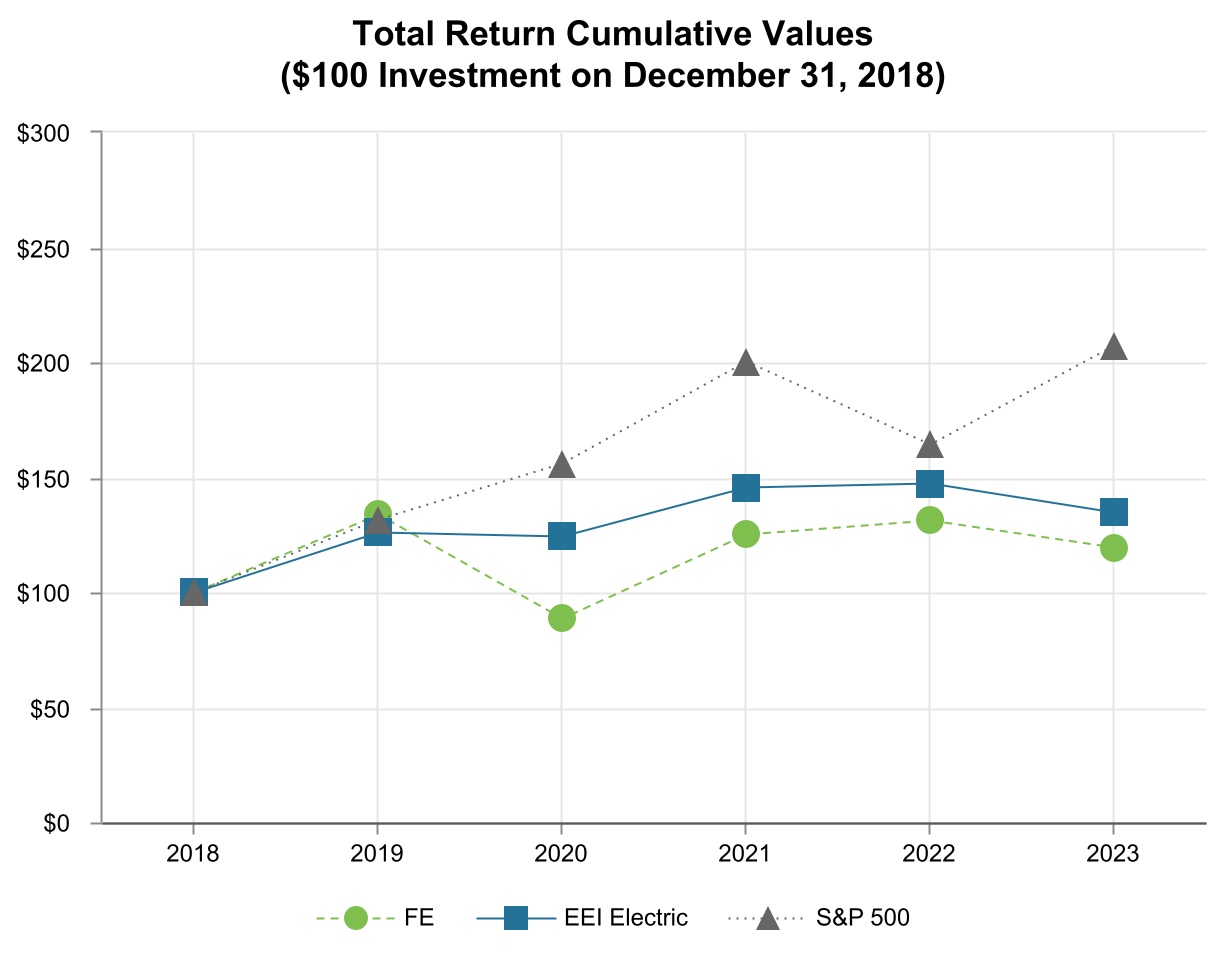
FirstEnergy had no transactions regarding purchases of FE common stock during the fourth quarter of 2023.
FirstEnergy does not have any publicly announced plan or program for share purchases.
Item 6. [RESERVED]
Item 7. MANAGEMENT’S DISCUSSION AND ANALYSIS OF FINANCIAL CONDITION AND RESULTS OF OPERATIONS
Forward-Looking Statements: This Form 10-K includes forward-looking statements within the meaning of the Private Securities Litigation Reform Act of 1995 based on information currently available to management. Such statements are subject to certain risks and uncertainties and readers are cautioned not to place undue reliance on these forward-looking statements. These statements include declarations regarding management's intents, beliefs and current expectations. These statements typically contain, but are not limited to, the terms “anticipate,” “potential,” “expect,” "forecast," "target," "will," "intend," “believe,” "project," “estimate," "plan" and similar words. Forward-looking statements involve estimates, assumptions, known and unknown risks, uncertainties and other factors that may cause actual results, performance or achievements to be materially different from any future results, performance or achievements expressed or implied by such forward-looking statements, which may include the following (see Glossary of Terms for definitions of capitalized terms):
-
The potential liabilities, increased costs and unanticipated developments resulting from government investigations and agreements, including those associated with compliance with or failure to comply with the DPA.
-
The risks and uncertainties associated with government investigations and audits regarding HB 6 and related matters, including potential adverse impacts on federal or state regulatory matters, including, but not limited to, matters relating to rates.
-
The risks and uncertainties associated with litigation, arbitration, mediation and similar proceedings, particularly regarding HB 6 related matters, including risks associated with obtaining dismissal of the derivative shareholder lawsuits.
-
Changes in national and regional economic conditions, including recession, rising interest rates, inflationary pressure, supply chain disruptions, higher energy costs, and workforce impacts, affecting us and/or our customers and those vendors with which we do business.
-
Weather conditions, such as temperature variations and severe weather conditions, or other natural disasters affecting future operating results and associated regulatory actions or outcomes in response to such conditions.
-
Legislative and regulatory developments, including, but not limited to, matters related to rates, compliance and enforcement activity, cyber security, and climate change.
-
The risks associated with physical attacks, such as acts of war, terrorism, sabotage or other acts of violence, and cyber-attacks and other disruptions to our, or our vendors’, information technology system, which may compromise our operations, and data security breaches of sensitive data, intellectual property and proprietary or personally identifiable information.
-
The ability to meet our goals relating to EESG opportunities, improvements, and efficiencies, including our GHG reduction goals.
-
The ability to accomplish or realize anticipated benefits through establishing a culture of continuous improvement and our other strategic and financial goals, including, but not limited to, overcoming current uncertainties and challenges associated with the ongoing government investigations, executing Energize365*,* our transmission and distribution investment plan, executing on our rate filing strategy, controlling costs, improving our credit metrics, growing earnings, strengthening our balance sheet, and satisfying the conditions necessary to close the FET Minority Equity Interest Sale.
-
Changing market conditions affecting the measurement of certain liabilities and the value of assets held in our pension trusts may negatively impact our forecasted growth rate, results of operations, and may also cause us to make contributions to our pension sooner or in amounts that are larger than currently anticipated.
-
Mitigating exposure for remedial activities associated with retired and formerly owned electric generation assets.
-
Changes to environmental laws and regulations, including, but not limited to, those related to climate change.
-
Changes in customers’ demand for power, including, but not limited to, economic conditions, the impact of climate change, emerging technology, particularly with respect to electrification, energy storage and distributed sources of generation.
-
The ability to access the public securities and other capital and credit markets in accordance with our financial plans, the cost of such capital and overall condition of the capital and credit markets affecting us, including the increasing number of financial institutions evaluating the impact of climate change on their investment decisions.
-
Future actions taken by credit rating agencies that could negatively affect either our access to or terms of financing or our financial condition and liquidity.
-
Changes in assumptions regarding factors such as economic conditions within our territories, the reliability of our transmission and distribution system, or the availability of capital or other resources supporting identified transmission and distribution investment opportunities.
-
The potential of non-compliance with debt covenants in our credit facilities.
-
The ability to comply with applicable reliability standards and energy efficiency and peak demand reduction mandates.
-
Human capital management challenges, including among other things, attracting and retaining appropriately trained and qualified employees and labor disruptions by our unionized workforce.
-
Changes to significant accounting policies.
-
Any changes in tax laws or regulations, including, but not limited to, the IRA of 2022, or adverse tax audit results or rulings.
-
The risks and other factors discussed from time to time in our SEC filings.
Dividends declared from time to time on our common stock during any period may in the aggregate vary from prior periods due to circumstances considered by the FE Board at the time of the actual declarations. A security rating is not a recommendation to
buy or hold securities and is subject to revision or withdrawal at any time by the assigning rating agency. Each rating should be evaluated independently of any other rating.
These forward-looking statements are also qualified by, and should be read together with, the risk factors included in (a) Item 1A. Risk Factors, (b) Item 7. Management’s Discussion and Analysis of Financial Condition and Results of Operations, and (c) other factors discussed herein and in FirstEnergy's other filings with the SEC. The foregoing review of factors also should not be construed as exhaustive. New factors emerge from time to time, and it is not possible for management to predict all such factors, nor assess the impact of any such factor on our business or the extent to which any factor, or combination of factors, may cause results to differ materially from those contained in any forward-looking statements. We expressly disclaim any obligation to update or revise, except as required by law, any forward-looking statements contained herein or in the information incorporated by reference as a result of new information, future events or otherwise.
Forward-looking and other statements in this Annual Report on Form 10-K regarding our Climate Strategy, including our GHG emission reduction goals, are not an indication that these statements are necessarily material to investors or required to be disclosed in our filings with the SEC. In addition, historical, current and forward-looking statements regarding climate matters, including GHG emissions, may be based on standards for measuring progress that are still developing, internal controls and processes that continue to evolve and assumptions that are subject to change in the future.
FIRSTENERGY CORP.
MANAGEMENT’S DISCUSSION AND ANALYSIS OF
FINANCIAL CONDITION AND RESULTS OF OPERATIONS
FIRSTENERGY’S BUSINESS
FE and its subsidiaries are princ
Showing the first 8K of 282K characters. Open the full section
Item 7A. QUANTITATIVE AND QUALITATIVE DISCLOSURES ABOUT MARKET RISK
The information required by Item 7A relating to market risk is set forth in Item 7, "Management's Discussion and Analysis of Financial Condition and Results of Operations."
Item 8. FINANCIAL STATEMENTS AND SUPPLEMENTARY DATA
The consolidated financial statements and supplementary data of FirstEnergy required in this item are set forth beginning on page 80.
Report of Independent Registered Public Accounting Firm
To the Board of Directors and Stockholders of FirstEnergy Corp.
Opinions on the Financial Statements and Internal Control over Financial Reporting
We have audited the accompanying consolidated balance sheets of FirstEnergy Corp. and its subsidiaries (the “Company”) as of December 31, 2023 and 2022, and the related consolidated statements of income, of comprehensive income, of stockholders’ equity and of cash flows for each of the three years in the period ended December 31, 2023, including the related notes (collectively referred to as the “consolidated financial statements”). We also have audited the Company's internal control over financial reporting as of December 31, 2023, based on criteria established in Internal Control - Integrated Framework (2013) issued by the Committee of Sponsoring Organizations of the Treadway Commission (COSO).
In our opinion, the consolidated financial statements referred to above present fairly, in all material respects, the financial position of the Company as of December 31, 2023 and 2022, and the results of its operations and its cash flows for each of the three years in the period ended December 31, 2023 in conformity with accounting principles generally accepted in the United States of America. Also in our opinion, the Company maintained, in all material respects, effective internal control over financial reporting as of December 31, 2023, based on criteria established in Internal Control - Integrated Framework (2013) issued by the COSO.
Basis for Opinions
The Company's management is responsible for these consolidated financial statements, for maintaining effective internal control over financial reporting, and for its assessment of the effectiveness of internal control over financial reporting, included in Management’s Report on Internal Control over Financial Reporting appearing under Item 9A. Our responsibility is to express opinions on the Company’s consolidated financial statements and on the Company's internal control over financial reporting based on our audits. We are a public accounting firm registered with the Public Company Accounting Oversight Board (United States) (PCAOB) and are required to be independent with respect to the Company in accordance with the U.S. federal securities laws and the applicable rules and regulations of the Securities and Exchange Commission and the PCAOB.
We conducted our audits in accordance with the standards of the PCAOB. Those standards require that we plan and perform the audits to obtain reasonable assurance about whether the consolidated financial statements are free of material misstatement, whether due to error or fraud, and whether effective internal control over financial reporting was maintained in all material respects.
Our audits of the consolidated financial statements included performing procedures to assess the risks of material misstatement of the consolidated financial statements, whether due to error or fraud, and performing procedures that respond to those risks. Such procedures included examining, on a test basis, evidence regarding the amounts and disclosures in the consolidated financial statements. Our audits also included evaluating the accounting principles used and significant estimates made by management, as well as evaluating the overall presentation of the consolidated financial statements. Our audit of internal control over financial reporting included obtaining an understanding of internal control over financial reporting, assessing the risk that a material weakness exists, and testing and evaluating the design and operating effectiveness of internal control based on the assessed risk. Our audits also included performing such other procedures as we considered necessary in the circumstances. We believe that our audits provide a reasonable basis for our opinions.
Definition and Limitations of Internal Control over Financial Reporting
A company’s internal control over financial reporting is a process designed to provide reasonable assurance regarding the reliability of financial reporting and the preparation of financial statements for external purposes in accordance with generally accepted accounting principles. A company’s internal control over financial reporting includes those policies and procedures that (i) pertain to the maintenance of records that, in reasonable detail, accurately and fairly reflect the transactions and dispositions of the assets of the company; (ii) provide reasonable assurance that transactions are recorded as necessary to permit preparation of financial statements in accordance with generally accepted accounting principles, and that receipts and expenditures of the company are being made only in accordance with authorizations of management and directors of the company; and (iii) provide reasonable assurance regarding prevention or timely detection of unauthorized acquisition, use, or disposition of the company’s assets that could have a material effect on the financial statements.
Because of its inherent limitations, internal control over financial reporting may not prevent or detect misstatements. Also, projections of any evaluation of effectiveness to future periods are subject to the risk that controls may become inadequate because of changes in conditions, or that the degree of compliance with the policies or procedures may deteriorate.
Critical Audit Matters
The critical audit matter communicated below is a matter arising from the current period audit of the consolidated financial statements that was communicated or required to be communicated to the audit committee and that (i) relates to accounts or disclosures that are material to the consolidated financial statements and (ii) involved our especially challenging, subjective, or complex judgments. The communication of critical audit matters does not alter in any way our opinion on the consolidated financial statements, taken as a whole, and we are not, by communicating the critical audit matter below, providing a separate opinion on the critical audit matter or on the accounts or disclosures to which it relates.
Accounting for the Effects of Rate Regulation
As described in Note 1 to the consolidated financial statements, the Company’s Regulated Distribution and Regulated Transmission segments are subject to regulation that sets the prices (rates) the Company is permitted to charge customers based on costs that the regulatory agencies determine are permitted to be recovered. At times, regulatory agencies permit the future recovery of costs that would be currently charged to expense by an unregulated company. The ratemaking process results in the recording of regulatory assets and liabilities based on anticipated future cash inflows and outflows. Management reviews the probability of recovery of regulatory assets, and settlement of regulatory liabilities, at each balance sheet date and whenever new events occur. Factors that may affect probability include changes in the regulatory environment, issuance of a regulatory commission order, or passage of new legislation. Upon material changes to these factors, where applicable, management will record new regulatory assets or liabilities and will assess whether it is probable that currently recorded regulatory assets and liabilities will be recovered or settled in future rates. As of December 31, 2023, there were $369 million of regulatory assets and $1,214 million of regulatory liabilities.
The principal considerations for our determination that performing procedures relating to management’s accounting for the effects of rate regulation is a critical audit matter are the significant audit effort in assessing the impact of regulation on accounting for
Showing the first 8K of 361K characters. Open the full section
Item 9. CHANGES IN AND DISAGREEMENTS WITH ACCOUNTANTS ON ACCOUNTING AND FINANCIAL DISCLOSURE
None.
Item 9A. CONTROLS AND PROCEDURES
Evaluation of Disclosure Controls and Procedures
FirstEnergy, through the oversight of its Disclosure Committee, has established disclosure controls and procedures to ensure that information is accumulated and communicated to management, including the chief executive officer and chief financial officer, as appropriate to allow timely decisions regarding required disclosure, and ensure that information required to be disclosed in the reports FirstEnergy files or submits under the Exchange Act, is recorded, processed, summarized and reported, within the time periods specified in the SEC’s rules and forms.
The management of FirstEnergy, with the participation of the chief executive officer and chief financial officer, has evaluated the effectiveness of its disclosure controls and procedures (as defined in Rules 13a-15(e) and 15d-15(e) under the Exchange Act, as of December 31, 2023. Based on that evaluation, the chief executive officer and chief financial officer of FirstEnergy have concluded that its disclosure controls and procedures were effective as of December 31, 2023.
Management’s Report on Internal Control over Financial Reporting
Management of FirstEnergy is responsible for establishing and maintaining adequate internal control over financial reporting as defined in Rules 13a-15(f) and 15d-15(f) under the Exchange Act. FirstEnergy’s internal control over financial reporting is a process designed to provide reasonable assurance regarding the reliability of financial reporting and the preparation of financial statements for external purposes in accordance with generally accepted accounting principles. Because of its inherent limitations, internal control over financial reporting may not prevent or detect misstatements. Also, projections of any evaluation of effectiveness to future periods are subject to the risk that controls may become inadequate because of changes in conditions, or that the degree of compliance with the policies or procedures may deteriorate.
Management conducted an evaluation of the effectiveness of FirstEnergy's internal control over financial reporting as of December 31, 2023, based on the framework in "Internal Control-Integrated Framework" (2013) issued by the Committee of Sponsoring Organizations of the Treadway Commission (COSO). Based on that evaluation, management concluded that FirstEnergy's internal control over financial reporting was effective as of December 31, 2023.
The effectiveness of FirstEnergy’s internal control over financial reporting as of December 31, 2023 has been audited by PricewaterhouseCoopers LLP, an independent registered public accounting firm, as stated in their report, which is included herein.
Changes in Internal Control over Financial Reporting
During the quarter ended December 31, 2023, there were no changes in internal control over financial reporting (as defined in Rules 13a-15(f) and 15d-15(f) under the Exchange Act) that have materially affected, or are reasonably likely to materially affect, FirstEnergy's internal control over financial reporting.
Item 9B. OTHER INFORMATION
Trading Arrangements
During the quarter ended December 31, 2023, no director or officer (as defined in Rule 16a-1(f) promulgated under the Exchange Act) of FE adopted or terminated a “Rule 10b5-1 trading arrangement” or “non-Rule 10b5-1 trading arrangement” (as each term is defined in Item 408 of Regulation S-K).
Director Resignation
On February 7, 2024, Sean Klimczak notified the FE Board of his intention to resign as a director of FE, effective the earlier of (i) the appointment of his replacement, or (ii) February 29, 2024. Mr. Klimczak’s resignation was not the result of any dispute or disagreement with FE or the FE Board on any matter relating to the operations, policies or practices of FirstEnergy. BIP Securities II-B L.P. intends to designate a substitute director acceptable to the FE Board to be appointed to the FE Board.
Pursuant to that certain Common Stock Purchase Agreement with BIP Securities II-B L.P., an affiliate of Blackstone Infrastructure Partners L.P., dated as of November 6, 2021, so long as BIP Securities II-B L.P. beneficially owns at least 75% of the shares of FE common stock acquired by it pursuant to the Common Stock Purchase Agreement, BIP Securities II-B L.P. will have the right to nominate one natural person for election to the FE Board.
Item 9C. DISCLOSURE REGARDING FOREIGN JURISDICTIONS THAT PREVENT INSPECTIONS
Not applicable.
PART III
Item 10. DIRECTORS, EXECUTIVE OFFICERS AND CORPORATE GOVERNANCE
The information required by Item 10 is incorporated herein by reference to FirstEnergy's 2024 Proxy Statement to be filed with the SEC pursuant to Regulation 14A under the Exchange Act.
Item 11. EXECUTIVE COMPENSATION
The information required by Item 11 is incorporated herein by reference to FirstEnergy’s 2024 Proxy Statement to be filed with the SEC pursuant to Regulation 14A under the Exchange Act.
Item 12. SECURITY OWNERSHIP OF CERTAIN BENEFICIAL OWNERS AND MANAGEMENT AND RELATED STOCKHOLDER MATTERS
The Item 403 of Regulation S-K information required by Item 12 is incorporated herein by reference to FirstEnergy's 2024 Proxy Statement to be filed with the SEC pursuant to Regulation 14A under the Exchange Act.
The following table contains information as of December 31, 2023, regarding compensation plans for which shares of FE common stock may be issued.
| Plan category | Number of Securities to be Issued Upon Exercise of Outstanding Options, Warrants and Rights | Weighted-Average Exercise Price of Outstanding Options, Warrants and Rights | Number of Securities Remaining Available for Future Issuance Under Equity Compensation Plans (Excluding Securities Reflected in First Column) | ||||||||||||||||||||
| Equity compensation plans approved by security holders | 4,111,762 | (1) | $ | — | (2) | 10,060,406 | (3) | ||||||||||||||||
| Equity compensation plans not approved by security holders(4) | — | $ | — | — | |||||||||||||||||||
| Total | 4,111,762 | $ | — | 10,060,406 |
(1) This number includes 1,918,675 shares subject to outstanding awards of stock based Restricted Stock Units granted under the ICP 2020 if paid at target for the three outstanding cycles, as well as 1,918,675 additional shares assuming maximum performance metrics are achieved for the 2021-2023, 2022-2024, and 2023-2025 cycles of stock based Restricted Stock Units, and 274,412 shares related to the DCPD that will be paid in stock.
(2) There are no outstanding options, therefore, no consideration is required from participants for the exercise or vesting of any outstanding equity compensation awards.
(3) Represents shares available for issuance, assuming maximum performance metrics are achieved (or approximately 4,841,463 under ICP 2015 and 7,137,618 under ICP 2020, available assuming performance at target) for the 2021-2023, 2022-2024, and 2023-2025 cycles of stock-based Restricted Stock Units, with respect to future awards under the ICP 2020 and future accruals of dividends on awards outstanding under ICP 2020. Additional shares may become available under the ICP 2020 due to cancellations, forfeitures, cash settlements or other similar circumstances with respect to outstanding awards.
(4) All equity compensation plans have been approved by security holders.
Item 13. CERTAIN RELATIONSHIPS AND RELATED TRANSACTIONS, AND DIRECTOR INDEPENDENCE
The information required by Item 13 is incorporated herein by reference to FirstEnergy’s 2024 Proxy Statement to be filed with the SEC pursuant to Regulation 14A under the Exchange Act.
Item 14. PRINCIPAL ACCOUNTANT FEES AND SERVICES
A summary of the audit and all other fees for services rendered by PricewaterhouseCoopers LLP are as follows:
| For the Years Ended December 31, | |||||||||||
| 2023 | 2022 | ||||||||||
| (In thousands) | |||||||||||
| Audit Fees(1) | $ | 9,915 | $ | 7,523 | |||||||
| Audit-Related Fees(2) | — | 190 | |||||||||
| Tax Fees(3) | 110 | 220 | |||||||||
| All Other Fees(4) | 282 | 720 | |||||||||
| Total Fees | $ | 10,307 | $ | 8,653 | |||||||
(1) Professional services rendered for the audits of FirstEnergy's and certain of its subsidiary annual financial statements and reviews of unaudited financial statements included in FirstEnergy's Quarterly Reports on Form 10-Q filings made with the SEC, and for services in connection with statutory and regulatory filings or engagements, including comfort letters, agreed upon procedures and consents for financings. 2023 audit fees also include newly required regulatory audits for certain subsidiaries and additional audit services to support the planned registration of certain subsidiaries with the SEC during 2024.
(2) Audit-related fees in 2022 were related to services rendered for EESG reporting assessments.
(3) Tax fees in 2023 and 2022 were primarily related to the performance of tax services related to the sale of interest in FET.
(4) All other fees in 2023 primarily reflect certain costs related to the ongoing SEC investigation. All other fees in 2022 primarily reflect certain costs incurred as a result of system implementation quality assurance services, the ongoing SEC investigation and software subscription fees.
Additional information required by this item is incorporated herein by reference to FirstEnergy’s 2024 Proxy Statement to be filed with the SEC pursuant to Regulation 14A under the Exchange Act.
PART IV
Item 15. EXHIBIT AND FINANCIAL STATEMENT SCHEDULES
(a) The following documents are filed as a part of this report on Form 10-K:
1. Financial Statements:
Management’s Report on Internal Control Over Financial Reporting for FirstEnergy Corp. is listed under Item 9A, "Controls and Procedures" herein.
Report of Independent Registered Public Accounting Firm (PCAOB ID 238) for FirstEnergy Corp. is listed under Item 8, "Financial Statements and Supplementary Data," herein.
The financial statements filed as a part of this report for FirstEnergy Corp. are listed under Item 8, "Financial Statements and Supplementary Data," herein.
2. Financial Statement Schedules:
N/A - Schedules not included are omitted because of the absence of conditions under which they are required or because the required information is provided in the consolidated financial statements, including the notes thereto.
3. Exhibits
Pursuant to paragraph (b)(4)(iii)(A) of Item 601 of Regulation S-K, FirstEnergy has not filed as an exhibit to this Form 10-K any instrument with respect to long-term debt if the respective total amount of securities authorized thereunder does not exceed 10% of its respective total assets, but hereby agrees to furnish to the SEC on request any such documents.
Item 16. FORM 10-K SUMMARY
None.
SIGNATURES
Pursuant to the requirements of Section 13 or 15(d) of the Securities Exchange Act of 1934, the registrant has duly caused this report to be signed on its behalf by the undersigned, thereunto duly authorized.
| FIRSTENERGY CORP. | |||||||||||
| BY: | /s/ Brian X. Tierney | ||||||||||
| Brian X. Tierney | |||||||||||
| President and Chief Executive Officer |
Date: February 13, 2024
SIGNATURES
Pursuant to the requirements of the Securities Exchange Act of 1934, this report has been signed below by the following persons on behalf of the registrant and in the capacities and on the date indicated:
| FIRSTENERGY CORP. | ||||||||
| /s/ Brian X. Tierney | ||||||||
| Brian X. Tierney | ||||||||
| President and Chief Executive Officer | ||||||||
| (Principal Executive Officer) | ||||||||
| /s/ John W. Somerhalder II | ||||||||
| John W. Somerhalder II | ||||||||
| Non-Executive Chair | ||||||||
| /s/ Lisa Winston Hicks | ||||||||
| Lisa Winston Hicks | ||||||||
| Lead Independent Director | ||||||||
| /s/ K. Jon Taylor | /s/ Jason J. Lisowski | |||||||
| K. Jon Taylor | Jason J. Lisowski | |||||||
| Senior Vice President, Chief Financial Officer and Strategy | Vice President, Controller and Chief Accounting Officer | |||||||
| (Principal Financial Officer) | (Principal Accounting Officer) | |||||||
| /s/ Jana T. Croom | /s/ James F. O'Neil III | |||||||
| Jana T. Croom | James F. O'Neil III | |||||||
| Director | Director | |||||||
| /s/ Steven J. Demetriou | /s/ Leslie M. Turner | |||||||
| Steven J. Demetriou | Leslie M. Turner | |||||||
| Director | Director | |||||||
| /s/ Paul Kaleta | /s/ Melvin D. Williams | |||||||
| Paul Kaleta | Melvin D. Williams | |||||||
| Director | Director | |||||||
| /s/ Sean T. Klimczak | ||||||||
| Sean T. Klimczak | ||||||||
| Director | ||||||||
Date: February 13, 2024