 filings.tools
Fair Isaac 10-K 2021-09-30
Filed 2021-11-10. 21 sections, 447K characters. Original on sec.gov · Markdown · JSON
Cover and table of contents
UNITED STATES
SECURITIES AND EXCHANGE COMMISSION
Washington, D.C. 20549
Form 10-K
(Mark One)
| ☒ | ANNUAL REPORT PURSUANT TO SECTION 13 OR 15(d) OF THE SECURITIES EXCHANGE ACT OF 1934 |
For the fiscal year ended September 30, 2021
| ☐ | TRANSITION REPORT PURSUANT TO SECTION 13 OR 15(d) OF THE SECURITIES EXCHANGE ACT OF 1934 |
For the transition period from to
Commission File Number 1-11689
Fair Isaac Corporation
(Exact name of registrant as specified in its charter)
| Delaware | 94-1499887 | |||||||
| (State or other jurisdiction of incorporation or organization) | (I.R.S. Employer Identification No.) |
| 5 West Mendenhall, Suite 105 | |||||||||||
| Bozeman, | Montana | 59715 | |||||||||
| (Address of principal executive offices) | (Zip Code) |
Registrant’s telephone number, including area code:
406-982-7276
Securities registered pursuant to Section 12(b) of the Act:
| Title of each Class | Trading Symbol(s) | Name of each exchange on which registered | ||||||
| Common Stock, $0.01 par value per share | FICO | New York Stock Exchange |
Securities registered pursuant to Section 12(g) of the Act:
None
Indicate by check mark if the registrant is a well-known seasoned issuer, as defined in Rule 405 of the Securities Act. Yes ☒ No ☐
Indicate by check mark if the registrant is not required to file reports pursuant to Section 13 or Section 15(d) of the Act. Yes ☐ No ☒
Indicate by check mark whether the registrant (1) has filed all reports required to be filed by Section 13 or 15(d) of the Securities Exchange Act of 1934 during the preceding 12 months (or for such shorter period that the registrant was required to file such reports), and (2) has been subject to such filing requirements for the past 90 days. Yes ☒ No ☐
Indicate by check mark whether the registrant has submitted electronically every Interactive Data File required to be submitted pursuant to Rule 405 of Regulation S-T (§ 232.405 of this chapter) during the preceding 12 months (or for such shorter period that the registrant was required to submit such files). Yes ☒ No ☐
Indicate by check mark whether the registrant is a large accelerated filer, an accelerated filer, a non-accelerated filer, a smaller reporting company or an emerging growth company. See the definitions of “large accelerated filer,” “accelerated filer,” “smaller reporting company,” and “emerging growth company” in Rule 12b-2 of the Exchange Act:
| Large Accelerated Filer | ☒ | Accelerated Filer | ☐ | ||||||||||||||
| Non-Accelerated Filer | ☐ | Smaller Reporting Company | ☐ | ||||||||||||||
| Emerging Growth Company | ☐ |
If an emerging growth company, indicate by check mark if the registrant has elected not to use the extended transition period for complying with any new or revised financial accounting standards provided pursuant to Section 13(a) of the Act. ☐
Indicate by check mark whether the registrant has filed a report on and attestation to its management’s assessment of the effectiveness of its internal control over financial reporting under Section 404(b) of the Sarbanes-Oxley Act (15 U.S.C. 7262(b)) by the registered public accounting firm that prepared or issued its audit report. ☒
Indicate by check mark whether the registrant is a shell company (as defined in Rule 12b-2 of the Exchange Act).
| ☐ | Yes | ☒ | No |
As of March 31, 2021, the aggregate market value of the registrant’s common stock held by non-affiliates of the registrant was $11,138,645,215 based on the last transaction price as reported on the New York Stock Exchange on such date. This calculation does not reflect a determination that certain persons are affiliates of the registrant for any other purposes.
The number of shares of common stock outstanding on October 29, 2021 was 27,358,353 (excluding 61,498,430 shares held by the Company as treasury stock).
DOCUMENTS INCORPORATED BY REFERENCE
Portions of the Registrant’s definitive proxy statement relating to its 2022 Annual Meeting of Stockholders (“2022 Proxy Statement”) are incorporated by reference into Part III of this Annual Report on Form 10-K where indicated. The 2022 Proxy Statement will be filed with the U.S. Securities and Exchange Commission within 120 days after the end of the fiscal year to which this report relates.
TABLE OF CONTENTS
FORWARD-LOOKING STATEMENTS
Statements contained in this report that are not statements of historical fact should be considered forward-looking statements within the meaning of the Private Securities Litigation Reform Act of 1995 (the “PSLRA”). In addition, certain statements in our future filings with the Securities and Exchange Commission (“SEC”), in press releases, and in oral and written statements made by us or with our approval that are not statements of historical fact constitute forward-looking statements within the meaning of the PSLRA. Examples of forward-looking statements include, but are not limited to: (i) projections of revenue, income or loss, expenses, earnings or loss per share, the payment or nonpayment of dividends, share repurchases, capital structure and other statements concerning future financial performance; (ii) statements of our plans and objectives by our management or Board of Directors, including those relating to products or services, research and development, and the sufficiency of capital resources; (iii) statements of assumptions underlying such statements, including those related to economic conditions; (iv) statements regarding results of business combinations or strategic divestitures; (v) statements regarding business relationships with vendors, customers or collaborators, including the proportion of revenues generated from international as opposed to domestic customers; and (vi) statements regarding products, their characteristics, performance, sales potential or effect in the hands of customers. Words such as “believes,” “anticipates,” “expects,” “intends,” “targeted,” “should,” “potential,” “goals,” “strategy,” “outlook,” “plan,” “estimated,” “will,” variations of these terms and similar expressions are intended to identify forward-looking statements, but are not the exclusive means of identifying such statements. Forward-looking statements involve risks and uncertainties that may cause actual results to differ materially from those in such statements. Factors that could cause actual results to differ from those discussed in the forward-looking statements include, but are not limited to, those described in Part I, Item 1A, “Risk Factors,” below. The performance of our business and our securities may be adversely affected by these factors and by other factors common to other businesses and investments, or to the general economy. Forward-looking statements are qualified by some or all of these risk factors. Therefore, you should consider these risk factors with caution and form your own critical and independent conclusions about the likely effect of these risk factors on our future performance. Such forward-looking statements speak only as of the date on which statements are made, and we undertake no obligation to update any forward-looking statement to reflect events or circumstances after the date on which such statement is made to reflect the occurrence of unanticipated events or circumstances. Readers should carefully review the disclosures and the risk factors described in this and other documents we file from time to time with the SEC, including our Quarterly Reports on Forms 10-Q and Current Reports on Forms 8-K.
PART I
Item 1. Business
GENERAL
Fair Isaac Corporation (NYSE: FICO) (together with its consolidated subsidiaries, the “Company,” which may also be referred to in this report as “we,” “us,” “our,” and “FICO”) is a leading applied analytics company. We were founded in 1956 on the premise that data, used intelligently, can improve business decisions. Today, FICO’s software and the widely used FICO® Score operationalize analytics, enabling thousands of businesses in nearly 120 countries to uncover new opportunities, make timely decisions that matter, and execute them at scale. Most leading banks and credit card issuers rely on our solutions, as do insurers, retailers, telecommunications providers, automotive companies, public agencies, and organizations in other industries. We also serve consumers through online services that enable people to access and understand their FICO Scores, the standard measure in the U.S. of consumer credit risk, empowering them to increase financial literacy and manage their financial health. More information about us can be found on our website, www.fico.com. We make our Annual Reports on Forms 10-K, Quarterly Reports on Forms 10-Q, and Current Reports on Forms 8-K, as well as amendments to those reports, available free of charge through our website as soon as reasonably practicable after we electronically file them with the U.S. Securities and Exchange Commission (“SEC”). References to our website address in this report do not constitute an incorporation by reference. Information on our website is not part of this report.
PRODUCTS AND SERVICES
Our business consists of two operating segments: Scores and Software.
Our Scores segment includes our business-to-business (“B2B”) scoring solutions and services which give our clients access to predictive credit and other scores that can be easily integrated into their transaction streams and decision-making processes. This segment also includes our business-to-consumer (“B2C”) scoring solutions, including our myFICO.com subscription offerings.
Our Software segment includes pre-configured analytic and decision management solutions designed for a specific type of business need or process — such as account origination, customer management, customer engagement, fraud detection, financial crimes compliance, and marketing — as well as associated professional services. This segment also includes FICO® Platform, a modular software offering designed to support advanced analytic and decision use cases, as well as stand-alone analytic and decisioning software that can be configured by our customers to address a wide variety of business use cases. Our offerings are available to our customers as software-as-a-service (“SaaS”) or as on-premises software.
Scores
Our B2B scoring solutions include the FICO® Score, which is the standard measure of consumer credit risk in the U.S. It is used in most U.S. credit decisions, by nearly all major banks, credit card issuers, mortgage lenders, and auto loan originators. Our B2B scoring solutions are primarily distributed through major consumer reporting agencies worldwide. Our B2C scores are sold directly to consumers through our myFICO.com website and other direct-to-consumer channels.
The FICO® Score is a three-digit number ranging from 300-850. Our proprietary analytic algorithms are applied to credit data collected and maintained by the three U.S. national consumer reporting agencies — Experian, TransUnion and Equifax — to produce standard scores that are used across the credit lifecycle, including in origination, account management and consumer marketing. Users of our scores generally pay the consumer reporting agencies a fee for each individual score generated by our algorithms, and the consumer reporting agencies pay an associated fee to us. Except for product development using de-personalized data, FICO does not collect or store the consumer credit data used in the calculation of our scores, and in most cases, we do not sell our scores directly to lenders or other end-users.
Since the introduction of the FICO® Score in the U.S. in 1989, we have regularly updated the score to take advantage of newly available data and enhanced analytics. Our most recent and most predictive scores, FICO® Score 10 and 10T, were introduced in January 2020. To increase its predictive power, FICO Score 10T builds on FICO Score 10 but also incorporates trended credit data. Trended data considers a longer historical view, giving lenders even more insight into how individuals are managing their credit. When we introduced FICO® Score 9 in 2015, it also made use of newly available data such as reported rental payment history, while also de-emphasizing medical debt and disregarding paid collections.
Most of our scores distributed today are FICO® Score 8 and FICO® Score 9. While our newer scores generally provide greater predictive accuracy than the scores they replace, we ensure that new versions of the standard FICO® Score are compatible with prior versions of the FICO Score.
In addition to the FICO® Score, we offer several other broad-based scores, including specific FICO® Industry Scores. For example, in July 2021 we introduced Bankcard and Auto Industry versions of FICO® Score 10. We also develop various custom scores for our financial services clients.
The FICO® Resilience Index is a recently introduced offering designed to complement FICO® Score models by identifying those consumers who are more resilient to economic stress relative to other consumers within the same FICO Score bands. The FICO Resilience Index is designed to enable lenders to continue to lend and better manage risk by providing a more precise assessment of loan default risk during periods of economic stress.
FICO has invested significant resources in the development of scores that can help expand credit access and lower borrowing costs for consumers that have limited credit history or who have sparse or inactive credit files. These scores use alternative data sources to enhance conventional credit bureau data and generate scores for otherwise un-scorable consumers and in many cases improve the credit scores of scorable consumers.
-
FICO® Score XD uses public records and property data, and a consumer’s history with mobile phone, landline phone and cable payments, to generate scores on the same 300-850 scale as standard FICO® Scores. FICO Score XD is available to lenders through our distribution partners, LexisNexis Risk Solutions and Equifax.
-
The UltraFICOTM Score uses consumer-permissioned data such as checking, savings, or money market account data, to generate scores on the same 300-850 scale as standard FICO® Scores. Incorporating consumer-permissioned data helps empower consumers to establish or improve their creditworthiness by using data that reflects sound financial activity, but that is not part of a conventional credit report.
Both scores maintain the same score to risk relationship as standard FICO® Scores, enhancing their compatibility with existing credit underwriting systems and models.
Outside the U.S., we offer FICO® Scores for consumer loans, and in some cases for small and medium business loans. These scores are typically sold to end-users through consumer reporting agencies in those countries, as they are in the U.S. We have also developed client-specific versions of the FICO Score in over ten countries that we sell directly to end-user customers. FICO Scores are currently in use or being implemented in 30 different countries across five continents outside the U.S.
We also provide FICO® Scores to consumers in the U.S. through our B2C scoring solutions. These Scores are distributed directly by us through our myFICO.com subscription offering and indirectly through our licensed distribution partners, including Experian and certain lenders through the FICO® Score Open Access Program. Through myFICO.com and other direct-to-consumer channels, consumers can purchase their FICO Scores, including credit reports associated with the scores, explanations of the factors affecting their scores, and customized educational information on how to manage their scores. Consumers can use products to simulate how taking specific actions could affect their FICO Score. Consumers can also subscribe to credit monitoring, which deliver alerts via email and text when changes to a user’s FICO Scores or other credit report content are detected. In addition, consumers can purchase identity theft monitoring products that alert them to potential risks of identity fraud.
Software
Our software harnesses the power of analytics and digital decisioning technology to help businesses automate, improve, and connect decisions across their enterprise. Most of our solutions address customer engagement, including acquisition and pricing, onboarding, servicing and management, and fraud protection. We also help businesses improve non-customer facing decisions such as supply chain optimization, scheduling management and policy adherence.
FICO provides software solutions to business customers in more than 120 countries around the world. Our software can be deployed in the cloud as SaaS utilizing FICO’s infrastructure or third-party cloud services, or on-premises using our customers’ IT infrastructure. We typically sell our software as multi-year subscriptions, with payments based on usage metrics such as the number of accounts, transactions or decisioning use cases deployed, often subject to contracted minimum payments.
A significant and growing number of our software solutions run natively on FICO® Platform, a modular software offering designed to support advanced analytics and decisioning use cases. While not all our software runs on FICO Platform today, we are investing significant development resources to enable substantially all of our software to run on FICO Platform in the future.
Principal Areas of Expertise
We specialize in solutions that empower businesses to operationalize analytics to uncover new opportunities, make timely decisions that matter, and execute them at scale. With more than 60 years of analytics and software experience, we have found that bringing human and digital intelligence together allows our customers to target and acquire customers more efficiently, increase customer value, reduce fraud and credit losses, lower operating expenses, and enter new markets more profitably.
Our principal areas of research and development expertise are focused on the following four analytic domains.
- Predictive Modeling
Predictive modeling identifies and mathematically represents underlying relationships in historical data to make predictions or classifications about future events. Predictive models typically analyze current and historical data about individuals to produce easily understood metrics such as scores. These scores rank-order individuals or specific transactions against a particular variable such as the likelihood of making credit payments on time, the likelihood of a transaction being fraudulent or the probability of responding to a particular offer for services. Our predictive models are frequently used in mission-critical transactional systems and drive decisions and actions in near real time.
Several analytic methodologies underlie our products in this area. These include proprietary applications of both linear and nonlinear optimization algorithms, advanced neural systems, machine learning and AI. We also apply various statistical techniques for analysis and pattern detection within large datasets and can derive insights and predictive features from various forms of data, including unstructured data.
- Decision Analysis and Optimization
Decision analysis refers to the broad quantitative field that deals with modeling, analyzing, and optimizing decisions made by individuals, groups, and organizations. Whereas predictive models analyze multiple aspects of individual behavior to forecast future behavior, decision analysis analyzes multiple aspects of a given decision to identify the most effective action to take to reach a desired result. This is often referred to as prescriptive analytics. Our integrated approach to decision analysis incorporates a decision model that mathematically maps the entire decision structure; proprietary optimization technology that identifies the most effective strategies, given both the performance objective and constraints; testing and simulation required for active, continuous learning; and the robust extrapolation of an optimized strategy to a wider set of scenarios than historically encountered. Our optimization capabilities also include native support for Python modeling, as well as our own proprietary mathematical modeling and programming language, an easy-to-use authoring environment, a configurable business simulation and scenario management interface and a set of pre-built optimization algorithms.
- Transaction Profiling
Transaction profiling is a patent-protected technique used to extract meaningful information and reduce the complexity of transaction data used in modeling. Many of our products operate using transactional data, such as credit card purchase transactions, consumer interactions, or other types of data that change over time. In its raw form, this data is very difficult to use in predictive models for several reasons. First, an isolated transaction contains very little information about the behavior of the individual who generated the transaction. Second, transaction patterns change rapidly over time. Third, this type of data can often be highly complex. To overcome these issues, we have developed a set of techniques that transform raw transactional data into a mathematical representation that reveals latent information, and which make the data more usable by predictive models. This profiling technology accumulates data across multiple transactions of many types to create and update profiles of transaction patterns. These profiles enable our neural network models to efficiently and effectively make accurate assessments of, for example, fraud risk and credit risk within real-time transaction streams.
- Customer Data Integration
Decisions made about customers or prospects can benefit from data stored in multiple sources, both inside and outside the enterprise. In the areas of analytics and digital decisioning, more data is generally better. We have developed proprietary data ingestion and management tools that are able to assemble and integrate disparate data sources into a unified view of the customer, household, or other subject through the application of persistent keying technology. This data can include structured or unstructured data. In addition, our technology can integrate multiple data sources in real-time and make them available for rapid analysis and decisions such as credit approval, fraud detection and “next best offer” workflows.
We believe our analytic tools and solutions are among the best commercially available, and that we are uniquely positioned to integrate advanced analytic, software and data technologies into mission-critical business solutions that offer superior returns on investment.
FICO**®** Platform
FICO® Platform is an analytic and decisioning environment that empowers businesses to configure solutions that orchestrate and operationalize high velocity decisions that matter, at scale. Users of FICO Platform can bring together data from multiple sources, apply advanced analytics to derive insights, and translate those insights into actions and workflows that can be executed in real-time. Based on a modular cloud architecture, FICO Platform can be configured by our customers to solve a vast array of business challenges. FICO Platform delivers increasing value to our customers over time as they add additional analytic capabilities, configure their own solutions or utilize pre-configured solutions to address a diverse set of use cases and integrate disparate analytic and decisioning silos onto a centralized, scalable platform. This drives additional subscription software revenue for FICO over time as customers purchase more FICO Platform capabilities and pay for more usage of those capabilities.
Our goal is to move substantially all of FICO’s current software products onto FICO® Platform. For example, FICO’s industry leading rules-based decisioning engine, FICO® Blaze Advisor® decision rules management system, is now available on FICO Platform as FICO® Decision Modeler. Some FICO pre-configured solutions are now available on FICO Platform, including FICO® Originations Solution and FICO® Strategy Director. We believe this strategy of moving our software products to FICO Platform will result in revenue growth through follow-on “land and expand” sales to existing Platform customers and more sales to medium-sized businesses typically served through value-added resellers and systems integrators.
Our annual recurring revenue (“ARR”) from FICO® Platform based products was $75.2 million as of September 30, 2021, representing 14% of our total software ARR.
Our Offerings
We sell our software primarily as analytic and decisioning software or pre-configured solutions. Our software offerings are sold both individually and as integrated bundles of multiple products.
Analytic and Decisioning Software
FICO analytic and decisioning software offerings use proprietary and open source microservices and capabilities to enable both business users and data scientists to develop and execute advanced analytics and decision modeling. Our key products in this category include:
-
FICO® Decision Modeler and FICO® Blaze Advisor® are our core decision rules modeling tools, which enable users to flexibly author and manage decision rules and strategies. FICO Decision Modeler delivers the functionality of our industry leading FICO Blaze Advisor product, with the added benefit of seamless integration into FICO® Platform. FICO Blaze Advisor, the predecessor to FICO Decision Modeler, is available as an off-platform product.
-
FICO® Xpress Optimization provides operations research professionals and business analysts with world-class solvers and productivity tools to determine optimal outcomes for a wide range of industry problems. FICO Xpress Optimization includes a powerful modeling and programming language to quickly model and solve even the largest optimization problems. FICO Xpress Optimization runs on FICO® Platform.
-
FICO® Analytics WorkbenchTM is a predictive analytics tool that allows businesses to create and deploy explainable machine learning models for use in decisions that typically require strict governance and compliance, often including regulatory oversight. FICO Analytics Workbench runs on FICO® Platform.
-
FICO® Studio is a powerful, low-code / no-code application development environment that gives users the ability to quickly build enterprise-grade decision applications using FICO® Platform.
-
FICO® Data Orchestrator is a data retrieval and mapping solution that can access, gather, and transform data from corporate or public facing information services, such as credit reference agencies. FICO Data Orchestrator runs on FICO® Platform.
-
FICO® DMP Streaming is a real-time and batch data ingestion solution that uniquely delivers in-stream analytics for real-time data insights and complex event processing.
-
FICO® Business Outcome Simulator enables business users to run a wide variety of insightful scenarios to assess how their business is likely to perform under varying conditions and assumptions. It unlocks insights into how key outcomes will likely shift in the face of changing competitor strategy, macroeconomic changes, evolving customer preferences, and more. FICO Business Outcome Simulator runs on FICO® Platform.
-
FICO® Decision Optimizer helps business users understand how different customers will react to a variety of different actions that are being considered. Once that link is understood, FICO Decision Optimizer identifies the combination of actions most likely to lead to the desired portfolio outcomes through decisions such as who to offer a new product, what limit and/or price to offer, or how to treat delinquent customers. FICO Decision Optimizer runs on FICO® Platform.
Pre-Configured Solutions
FICO's pre-configured solutions optimize customer interactions in real-time, driving greater customer engagement and improving business results. They enable acquisition and growth marketing, account activation and management, omni-channel communication, risk assessment, fraud detection and prevention, and financial crime compliance. Key FICO solutions offered today include:
-
FICO® Fraud and Financial Crimes Solutions help our clients detect and prevent transactional financial fraud and violations of global financial compliance regulations. Our solutions analyze activities such as credit card transactions and account openings to generate real time recommendations for immediate action. These defenses are critical to identifying and mitigating identity fraud, payments fraud and money laundering. Our models that identify transaction fraud are continually improved using a proprietary, global data set of transaction data contributed by more than 9,000 institutions that participate in the FICO® Falcon® Intelligence Network. FICO® Falcon® X is a suite of some of our Fraud and Compliance capabilities that run on FICO® Platform. We plan to offer most of our Fraud and Compliance solutions as platform-native Falcon X products in the future.
-
FICO® Originations Solution is an application-to-decision credit originations solution. It enables banks, credit unions, finance companies, online lenders, auto lenders, and other companies to automate and improve the processing of requests for credit. Our Originations Solution increases the speed, consistency and efficiency with which requests are handled, reducing losses, and increasing approval rates through the application of sophisticated policies and analytics that assess applicant risk and reduce the need for manual review by underwriters. The current version of FICO Originations Solution runs on FICO® Platform.
-
FICO® Customer Communication Service is an intelligent omnichannel digital communication manager for resolving customer interactions. It enables businesses to automate individualized customer dialogues with the same consistency and regulatory compliance as their human agents. With Customer Communication Service, businesses can be available 24/7 for one-way or two-way communication through any channel their consumers choose. Businesses can rapidly launch mobile alerts, messaging, virtual agents, self-service options, and other auto-resolution capabilities. It helps make the full customer journey more efficient and raises the level of data-driven digital intelligence behind lifecycle communications. Certain Customer Communication products are available on FICO Platform today, and we plan to make additional Customer Communication products available on FICO® Platform in the future.
-
FICO® Strategy Director and FICO® TRIAD® Customer Manager enable businesses to automate and improve risk-based decisions for their existing credit customers. These products help businesses apply advanced analytics in credit account and customer decisions to increase portfolio revenue and reduce risk exposure and losses, while improving customer retention. They also allow users to manage risk and communications at both the account and customer level from a single place. FICO Strategy Director runs on FICO® Platform. FICO TRIAD Customer Manager, the predecessor to FICO Strategy Director, is available as an off-platform product.
FICO® Professional Services
FICO offers a range of professional services designed to help customers install and configure our software, develop and deploy advanced analytics using our software, and improve customer satisfaction and retention.
-
FICO® Implementation Services. We often sell software implementation and configuration services in conjunction with our software license and SaaS subscriptions. The FICO implementation services team leverages their deep expertise in our products and their extensive industry-specific knowledge to help our customers implement and configure FICO software rapidly and effectively.
-
FICO® Analytic Services. We build custom analytics, decision models and related analytics, and perform machine learning projects for clients in multiple industries. These analytic services help to improve critical business processes and operationalize analytics using FICO software products. Most of our engagements utilize predictive analytics, decision modeling and optimization to provide greater insight into customer preferences and help predict future customer behavior.
-
FICO® Advisors. FICO Advisors are business consultants accelerating the practical use of FICO solutions through data-driven analytics, strategic design, and software applications. Our seasoned practitioners are uniquely valued for their credit lifecycle risk and fraud knowledge and can help drive measurable results in an ever-dynamic economic market.
Our professional services are sold on an hourly time and materials basis or for a fixed project fee.
MARKETS AND CUSTOMERS
Our scores and software products and services serve clients in multiple industries, including banking, insurance, retail, healthcare and public agencies. End users of our products include 96 of the 100 largest financial institutions in the U.S., and two-thirds of the largest 100 banks in the world. Our clients also include more than 600 insurers, including nine of the top ten U.S. property and casualty insurers; more than 300 retailers and general merchandisers; and more than 200 government or public agencies. All top ten companies on the 2021 Fortune 500 list use one or more of our solutions. In addition, our consumer solutions are marketed to an estimated 200 million U.S. consumers whose credit relationships are reported to the three major U.S. consumer reporting agencies.
The majority of our scores are marketed and sold through consumer reporting agencies. During fiscal 2021, 2020 and 2019, revenues generated from our agreements with Experian, TransUnion and Equifax collectively accounted for 38%, 33% and 29% of our total revenues, respectively. We also sell our scores and credit monitoring directly to consumers through our myFICO.com on-line subscription offerings. Outside of the U.S., we sell our scores through consumer reporting agencies, other third-party distributors, and in some cases directly to large end-users.
We market our software products and services primarily through our own direct sales organization that is organized around vertical and geographic markets. Sales teams are based in our headquarters and in field offices strategically located around the world. We also market our products through indirect channels, including alliance partners and other resellers. As more of our products are made available on FICO® Platform, we expect our sales through indirect channels to grow. We are investing significant resources to develop our indirect channel relationships.
Our largest market segment is financial services, representing 89% of our total revenue in 2021. Our largest geographic market is the Americas, representing 80% of our total revenue in 2021.
COMPETITION
The market for our solutions is intensely competitive and is constantly changing. Our competitors vary both in size and in the scope of the products and services they offer. We encounter competition from several sources, including:
-
in-house analytic and systems developers;
-
neural network developers and artificial intelligence system builders;
-
fraud and compliance solution providers;
-
scoring model builders;
-
providers of credit reports and credit scores;
-
software companies supplying predictive analytic modeling, rules, or analytic development tools;
-
entity resolution and social network analysis solutions providers;
-
providers of customer engagement and risk management solutions;
-
providers of account/workflow management software;
-
business process management and decision rules management providers;
-
enterprise resource planning and customer relationship management solutions providers;
-
business intelligence solutions providers;
-
providers of automated application processing services; and
-
third-party professional services and consulting organizations.
We believe we offer customers a unique mix of products, expertise and capabilities that allows us to compete effectively in our target markets. However, many of our competitors are larger than FICO, have more development, sales and marketing resources than FICO, and some have larger shares of our target geographic or product markets.
We believe the principal competitive factors affecting our markets include technical performance; access to unique proprietary analytical models and data; product attributes like adaptability, scalability, interoperability, functionality, and ease-of-use; on-premises and SaaS product availability; product price; customer service and support; the effectiveness of sales and marketing efforts; existing market penetration; and reputation. Although we believe our products and services compete favorably with respect to these factors, we may not be able to maintain our competitive position against current and future competitors.
Scores
In our Scores segment, we compete with both outside suppliers and in-house analytics. Primary competitors among outside suppliers of scoring models are the three major consumer reporting agencies in the U.S. and Canada, which are also our partners in offering our scoring solutions, and VantageScore (a joint venture entity established by the major U.S. consumer reporting agencies). Additional competitors include consumer reporting agencies outside the U.S. like CRIF Ratings, which operates in the European Union, and other data providers like LexisNexis and ChoicePoint, some of which also are our partners.
For our offerings that deliver credit scores, credit reports and consumer credit education solutions directly to consumers, we compete with other direct to consumer credit and identity services such as Credit Karma, Credit Sesame, Experian and TransUnion, some of which are also our partners.
Software
The competition in our Software segment varies by application. In the fraud and financial crimes market for banking, we compete primarily with Nice Actimize, Experian, Pegasystems, BAE Systems Applied Intelligence, SAS, ACI Worldwide, IBM, Feedzai and Featurespace. In the customer origination market, we compete with Experian, Equifax, Moody’s, Meridian Link, and CGI, among others. In the customer management market, we compete with Experian and SAS, among others. In the marketing services market, we compete with Pegasystems, Equifax, Experian, SAS, Adobe and Salesforce, among others.
PRODUCT PROTECTION AND TRADEMARKS
We rely on a combination of patent, copyright, trademark and trade secret laws and confidentiality agreements and procedures to protect our proprietary rights.
We retain the title to and protect the suite of models and software used to develop scoring models as a trade secret. We also restrict access to our source code and limit access to and distribution of our software, documentation, and other proprietary information. We have generally relied upon the laws protecting trade secrets and upon contractual nondisclosure safeguards and restrictions on transferability to protect our software and proprietary interests in our product and service methodology and know-how. Our confidentiality procedures include invention assignment and proprietary information agreements with our employees and independent contractors, and nondisclosure agreements with our distributors, strategic partners, and customers. We also claim copyright protection for certain proprietary software and documentation.
We have patents on many of our technologies and have patent applications pending on other technologies. The patents we hold may not be upheld as valid and may not prevent the development of competitive products. In addition, patents may never be issued on our pending patent applications or on any future applications that we may submit. We currently hold 190 U.S. and 18 foreign patents with 82 applications pending.
Despite our precautions, it may be possible for competitors or users to copy or reproduce aspects of our software or to obtain information that we regard as trade secrets. In addition, the laws of some foreign countries do not protect proprietary rights to the same extent as do the laws of the U.S. Patents and other protections for our intellectual property are important, but we believe our success and growth will depend principally on such factors as the knowledge, ability, experience and creative skills of our personnel, new products, frequent product enhancements and name recognition.
We have developed technologies for research projects conducted under agreements with various U.S. government agencies or their subcontractors. Although we have acquired commercial rights to these technologies, the U.S. government typically retains ownership of intellectual property rights and licenses in the technologies that we develop under these contracts. In some cases, the U.S. government can terminate our rights to these technologies if we fail to commercialize them on a timely basis. In addition, under U.S. government contracts, the government may make the results of our research public, which could limit our competitive advantage with respect to future products based on funded research.
We have used, registered and/or applied to register certain trademarks and service marks for our technologies, products and services. We currently have 31 trademarks registered in the U.S. and select foreign countries.
GOVERNMENTAL REGULATION
We are subject to a number of U.S. federal, state, local and foreign laws and regulations that involve matters central to our business. Laws and governmental regulation affect how our business is conducted and, in some cases, subject us to the possibility of government supervision and future lawsuits arising from our products and services. Laws and governmental regulations also influence our current and prospective customers’ activities, as well as their expectations and needs in relation to our products and services. Laws and regulations that may affect our business and our current and prospective customers’ activities include, but are not limited to, those summarized below.
Many U.S. and foreign jurisdictions have passed, or are currently contemplating, a variety of consumer protection, privacy, and data security laws and regulations that may relate to our business or affect the demand for our products and services. For example, the United Kingdom (“U.K.”) and European Union (“E.U.”) General Data Protection Regulation (the “GDPR”) impose, among other things, strict obligations and restrictions on the ability to collect, analyze and transfer U.K. and E.U. personal data, a requirement for prompt notice of data breaches in certain circumstances, and possible substantial fines for any violations (including possible fines for certain violations of up to the greater of 20 million Euros or 4% of total worldwide annual revenue under the E.U. GDPR and up to the greater of 17.5 million Pounds or 4% of annual global turnover under the U.K. GDPR). A decision in July 2020 by the Court of Justice of the European Union (i.e., Schrems II), called into question certain data transfer mechanisms between the E.U. and the U.S. In June 2021, the European Commission issued new standard contractual clauses (“SCCs”) governing cross-border data transfers and data exchanges among controllers and processors, which reflect more recent data protection laws, such as the GDPR, and account for the analysis in the Schrems II decision. Our transition to the new SCCs, which may involve interpretive issues and may have an adverse impact on cross-border transfers of personal data, may subject us to additional scrutiny from E.U. regulators or may increase our costs of compliance. Brazil, India, South Africa, Japan, China, Israel, Canada, and several other countries have introduced and, in some cases, enacted, similar privacy and data security laws.
The California Consumer Privacy Act of 2018 (“CCPA”) gives California residents certain privacy rights in the collection and disclosure of their personal information and requires businesses to make certain disclosures and take certain other acts in furtherance of those rights. Additionally, effective starting January 1, 2023, the California Privacy Rights Act (the “CPRA”) will revise and significantly expand the scope of the CCPA. The CPRA also creates a new California data protection agency authorized to implement and enforce the CCPA and the CPRA, which could result in increased privacy and information security enforcement. Other U.S. states have considered and/or enacted similar privacy laws, including Virginia and Colorado, which passed new consumer privacy laws in 2021.
The Gramm-Leach-Bliley Act ("GLBA") regulates, among other things, the receipt, use, disclosure, and security of non-public personal information of consumers held by “financial institutions” and applies indirectly to companies that provide services to financial institutions. As a provider of services to financial institutions, portions of our business are subject to obligations to comply with certain GLBA provisions, including limitations on the use or disclosure of the underlying data and rules relating to the technological, physical and administrative safeguarding of non-public personal information.
The Health Insurance Portability and Accountability Act of 1996, as amended by the American Recovery and Reinvestment Act of 2009 (“HIPAA”) and the Health Information Technology for Economic and Clinical Health Act (“HITECH”) and their respective implementing regulations impose specified requirements relating to the privacy, security and transmission of individually identifiable health information. Among other things, HITECH makes HIPAA’s security standards directly applicable to “business associates.” We function as a business associate for certain of our customers that are HIPAA-covered entities and service providers and, in that context, we are regulated as a business associate for the purposes of HIPAA.
The Dodd-Frank Wall Street Reform and Consumer Protection Act (“Dodd-Frank Act”) prohibits unfair, deceptive, or abusive acts or practices (“UDAAP”) with respect to consumer financial services practices and provides the Consumer Financial Protection Bureau (the “CFPB”) with enforcement authority to enforce those provisions. In certain circumstances, the CFPB also has examination and supervision powers with respect to service providers who provide a material service to a financial institution offering consumer financial products and services. Further, the CFPB has authority to designate non-depository “larger participants” in certain markets for consumer financial services and products for purposes of the CFPB’s supervisory authority under the Dodd-Frank Act. Such designated “larger participants” are subject to reporting and on-site compliance examinations by the CFPB, which may result in increased compliance costs and potentially greater enforcement risks based on these supervisory activities. In addition, the regulators of some of our largest financial institution customers may require them to exercise greater oversight and perform more rigorous audits of their key service providers such as us.
The Federal Trade Commission Act (the “FTC Act”) prohibits unfair methods of competition and unfair or deceptive acts or practices. Under the FTC Act, the FTC’s jurisdiction includes the ability to bring enforcement actions based on the security measures we employ to safeguard the personal data of consumers. Allegations that we failed to safeguard or handle such data in a reasonable manner may subject us to regulatory scrutiny or enforcement action.
The U.S. Fair Credit Reporting Act (the “FCRA”) applies to consumer reporting agencies, as well as data furnishers, and users of consumer reports such as banks and other companies, many of which are our customers. The FCRA provisions govern the accuracy, fairness and privacy of information in the files of consumer reporting agencies that engage in the practice of assembling or evaluating information relating to consumers for certain specified purposes. The FCRA limits the type of information that may be reported by consumer reporting agencies, limits the distribution and use of consumer reports, establishes consumer rights to access and dispute their own credit files, includes provisions designed to prevent identity theft and assist fraud victims, requires consumer reporting agencies to make a free annual credit report available to consumers and imposes many other requirements on consumer reporting agencies, data furnishers and users of consumer report information. These requirements can affect the manner and extent to which our customers use our products and services.
A number of states have enacted requirements similar to the FCRA. Some of these state laws impose additional, or more stringent, requirements than the FCRA, especially in connection with investigations and responses to reported inaccuracies in consumer reports. The FCRA preempts some of these state laws, but the scope of preemption continues to be defined by the courts. Various consumer credit laws and regulations in the foreign countries where we conduct business also affect the products and services we offer to our customers.
The Credit Repair Organizations Act (the “CROA”) regulates companies that claim to be able to assist consumers in improving their credit standing. There have been efforts to apply the CROA to credit monitoring services offered by consumer reporting agencies and others, which may impact certain of our products and services.
Special requirements may apply to us when providing services directly or indirectly to U.S. federal, state and local government agencies. The applicable requirements depend upon the monetary value of the awarded contract, the particular government agency awarding or funding the contract, the scope of services to be delivered, and the level of access that the agency will need to provide to us to enable us to perform the contract. For example, we may need to abide by the Privacy Act of 1974, the Internal Revenue Service’s Publication 4812, and the Federal Acquisition Regulation and associated supplemental contract clauses. Each of these laws, regulations and contract clauses imposes certain requirements, including measures for the protection of personal information or information that is otherwise categorized as sensitive by the government. Government agencies frequently modify or supplement these requirements, and consequences for violations of applicable requirements may include penalties, civil liability and for severe infractions, criminal liability.
Additional laws and regulations that may affect our business and our current and prospective customers’ activities include, but are not limited to, those in the following significant regulatory areas:
-
Laws and regulations that limit the use of credit scoring models (e.g., state “mortgage trigger” or “inquiries” laws, state insurance restrictions on the use of credit-based insurance scores, and the E.U. Consumer Credit Directive).
-
Fair lending laws (e.g., the Equal Credit Opportunity Act and Regulation B, and the Fair Housing Act).
-
The Cybersecurity Act of 2015; the U.S. Department of Commerce’s National Institute of Standards and Technology’s Cybersecurity Framework; the Clarifying Lawful Overseas Use of Data Act; and identity theft, file freezing, and similar state privacy laws.
-
Laws and regulations related to extension of credit to consumers through the Electronic Fund Transfers Act and Regulation E, as well as non‑governmental VISA and MasterCard electronic payment standards.
-
Laws and regulations applicable to secondary market participants (e.g., The Federal National Mortgage Association (“Fannie Mae”) and The Federal Home Loan Mortgage Corporation (“Freddie Mac”)) that could have an impact on our scoring products and revenues, including 12 CFR Part 1254 (Validation and Approval of Credit Score Models) issued by the Federal Housing Finance Agency in accordance with Section 310 of the Economic Growth, Regulatory Relief, and Consumer Protection Act (Public Law 115-174), and any regulations, standards or criteria established pursuant to such laws or regulations.
-
Laws and regulations applicable to our customer communication clients and their use of our products and services (e.g., the Telemarketing Sales Rule, Telephone Consumer Protection Act, the CAN-SPAM Act, the Fair Debt Collection Practices Act, and regulations promulgated thereunder).
-
Laws and regulations applicable to our insurance clients and their use of our insurance products and services.
-
The application or extension of consumer protection laws, including implementing regulations (e.g., the Consumer Financial Protection Act, the Truth In Lending Act and Regulation Z, the Fair Debt Collection Practices Act, the Servicemembers Civil Relief Act, and the Military Lending Act).
-
Laws and regulations governing the use of the Internet and social media, telemarketing, advertising, endorsements and testimonials.
-
Anti-money laundering laws and regulations (e.g., the Bank Secrecy Act and the USA PATRIOT Act).
-
Laws and regulations restricting transactions with sanctioned parties and regarding export controls as they apply to FICO products delivered in non-U.S. countries (e.g., Office of Foreign Asset Control sanctions, and Export Administration Regulations).
We are also subject to federal and state laws that are generally applicable to any U.S. business with national or international operations, such as antitrust laws, the Foreign Corrupt Practices Act, the Americans with Disabilities Act, state unfair or deceptive practices acts and various employment laws.
HUMAN CAPITAL RESOURCES
Our People
As of September 30, 2021, we employed 3,662 persons across 31 countries. Of these, our largest representation includes 1,299 (36%) based in the United States, 1,296 (35%) based in India and 331 (9%) based in the United Kingdom. Other than to the extent mandated by applicable law in certain foreign jurisdictions, none of our employees are covered by a collective bargaining agreement, and no work stoppages were experienced during fiscal 2021.
Our Board of Directors (our “Board”) and executive leadership team believe that our people are vital to our success. The Leadership Development and Compensation Committee (the “LDCC”) of our Board oversees all human capital management policies, programs and strategies, including but not limited to those regarding talent recruitment, development and retention, health and safety, organizational culture, employee engagement, diversity, equity and inclusion, and compensation and benefits. The LDCC also periodically reviews and reports to the Board with respect to succession planning for our Chief Executive Officer and other senior management positions. In addition, our Chief Human Resources Officer reports to our Board periodically on people-focused programs.
Employee Engagement
For much of the past decade, we have conducted quarterly workforce surveys to measure employee engagement and gain feedback and insights from our people about ways to improve the employee experience and the effectiveness of our business operations. The results and insights of these studies are shared with the work team, executive team and our Board and are leveraged to drive positive organizational change.
Examples of organizational changes that have been driven by the insights from these surveys include investments in expanded workforce capacity, targeted recruiting of under-represented groups, broadened and more frequent company-wide communications, expanded employee stock ownership, expanded benefit programs including paid parental leave, enhanced incentive plan funding and expanded investments in professional development and culture-based initiatives to promote inclusiveness and belonging.
Diversity, Equity and Inclusion
FICO is committed to building and reinforcing a culture where individual differences and perspectives are valued. We believe that diverse teams can better relate to and deliver against the many and varied needs of our clients. We also believe that promoting a culture where individual differences are both welcomed and valued allows us to attract the best talent while allowing people to reach their full potential.
Foundationally, we have adopted a “Commitment to Inclusion and Belonging Policy” which provides that all employment-related decisions be made in compliance with established equal opportunity statutes. Accordingly, all decisions to employ, transfer, promote, train, compensate or otherwise provide access to benefit programs are to be made in accordance with these statutes. In addition, in the United States we have established an Affirmative Action Program and underlying plans for office locations with 50 or more employees to formally measure, report on and identify needed actions to close any gaps involving the utilization and advancement of women, minorities, disabled persons and veterans. All employees receive mandatory training and testing on this and other foundational and compliance policies during the on-boarding process and every two years thereafter, with people managers receiving training regarding their unique leadership responsibilities. As examples, we have a mandatory training program to identify, prevent and combat prohibited harassment, as well as training and “dialogue sessions” designed to build understanding of unconscious biases and strategies to overcome them.
Building on this foundation, we sponsor and provide dedicated funding to multiple employee resource groups (“ERGs”) that help support our goals of workforce engagement and a strong sense of inclusion and belonging. FICO ERGs focus on women, race/ethnicity, LGBTQ+ and community support groups. Our FICO Cares ERG encourages our people to connect with and contribute to their community. We encourage employees to participate in volunteer activities by providing work schedule flexibility and paid Community Volunteer Leave. We also support employee cash donations to qualified charitable organizations through our Corporate Matching Gift Program.
As one strategy to accelerate progress in expanding workforce diversity, we engaged in targeted campus recruiting efforts. In the United States, we formed a new partnership with the Management Leadership for Tomorrow (MLT.org) organization, which helped us connect with Black, Latinx and Native American college students for summer internships followed by offers of full-time employment upon graduation.
Additional information on our diversity metrics and programs, including our EEO-1 survey results, will be available soon
on the Corporate Responsibility page of our website at www.fico.com/en/corporate-responsibility. Information contained on our website is not deemed part of or incorporated by reference into this Annual Report on Form 10-K.
Talent Recruitment
We leverage our organizational culture as a competitive advantage in our efforts to attract talent from the broadest possible pool. We deploy structured selection practices to ensure strong alignment between candidate qualifications and knowledge and skills needed for success in each role, while avoiding unconscious biases.
Professional Development
To support professional development, we offer a structured onboarding program with training specific to a variety of identified career paths to help new employees become rapidly engaged and productive. We have invested in building the FICO Integrated Learning Organization (“ILO”), which is led by our Chief Learning Officer. The ILO develops customized learning content for colleagues, clients and partners around the world. We deliver high quality, targeted new hire onboarding, technology and product skill training, compliance and management and leadership education through this “FICO Learning” platform. This allows our employees to obtain the knowledge and skills to effectively perform in their current roles, while also preparing them for new opportunities. We also offer financial support for degreed programs through a tuition reimbursement program.
Compensation and Benefit Programs
We regularly participate in market-based compensation surveys and seek the advice of outside experts to ensure that our base pay and incentive structures are competitive. We create a strong sense of shared purpose by having our CEO and each member of our executive leadership team participate in the same annual cash incentive bonus plan, as all non-sales employees across our organization.
Over the course of the past five years, we’ve steadily and significantly expanded participation in our annual performance-based equity program from 7% to nearly 25% of our workforce. In addition, two years ago, we adopted an Employee Stock Purchase Plan for eligible employees designed to promote even broader equity participation.
We offer competitive health and welfare benefit plans with significant company subsidies to offset premiums, retirement plans with a competitive company match to encourage participation and flexible paid-time-off programs including vacation, sick time and disability time. We have adopted paid Maternity and Parental Leave benefits totaling up to 12 weeks.
Health and Safety
We are committed to providing a safe and healthy workplace. We continuously strive to meet or exceed compliance with all laws, regulations and accepted practices pertaining to workplace safety. All employees and contractors are required to comply with established safety policies, standards and procedures.
As the COVID-19 pandemic persists, our focus remains on promoting employee health and safety, serving our customers and ensuring business continuity. Beginning in March 2020, our employees were instructed to work from home in each country where we operate. As certain offices have reopened due to the lifting of local government restrictions, we have maintained a “Voluntary Work-From-Home Policy” providing our people with valued flexibility. In addition, we have implemented a post-pandemic “Remote Work Policy” permitting our people in countries other than India to elect to work primarily from home on an ongoing basis with 75 percent of eligible employees electing to do so. We have also substantially reduced employee travel to only essential business needs in favor of ongoing video-based meetings.
Item 1A. Risk Factors
Business, Market and Strategy Risks
The effects of the COVID-19 pandemic have negatively affected how we and our customers are operating our businesses. The duration of these effects, and the extent to which they will impact our future revenues, results of operations and overall financial performance, remain uncertain.
The COVID-19 pandemic has resulted in a widespread health crisis that has adversely affected the global economy, leading to reduced consumer spending and lending activities and disruptions and volatility in the global capital markets. COVID-19 has caused shutdowns to businesses and cities worldwide and has disrupted supply chains, business operations, travel, and consumer confidence.
As a result of the COVID-19 pandemic, we temporarily closed the majority of our offices (including our corporate headquarters in the United States), but are in the process of re-opening them while extending our company-wide voluntary work from home policy until early January 2022 and allowing the majority of our workforce the flexibility to work remotely on an ongoing basis. In addition, we continue to impose certain travel restrictions where applicable. Both of these actions have disrupted how we operate our business. Due in part to anticipated post-pandemic workforce patterns, in late fiscal 2020 and early fiscal 2021, we permanently closed certain non-core offices, reduced certain other office space and reduced our global workforce. Our operations may be further negatively affected by a range of external factors related to the COVID-19 pandemic that are not within our control. For example, many cities, counties, states, and countries may impose or continue to impose requirements and restrictions related to COVID-19 that affect us, including a wide range of restrictions on our employees’, partners’ and customers’ physical movement to limit the spread of COVID-19. We postponed, canceled or shifted certain of our customer, employee or industry events to virtual-only experiences and may decide to do so in the future. If the COVID-19 pandemic has a substantial impact on our employees’, partners’ or customers’ productivity or ability to collaborate, our results of operations and overall financial performance may be harmed.
The situation surrounding the COVID-19 pandemic is constantly evolving and both the short-term and long-term effects remain unknown. Our customers, and therefore our business and revenues, are sensitive to negative changes in general economic conditions and lending activities. The COVID-19 pandemic may affect the rate of spending on our solutions and could adversely affect our customers’ ability or willingness to purchase our products and services, cause prospective customers to change product selections or term commitments, delay or cancel their purchasing decisions, extend sales cycles, and potentially increase payment defaults, all of which could adversely affect our future revenues, results of operations and overall financial performance. COVID-19 has adversely affected certain segments and originations volume, which may impact future revenue. We are unable to accurately predict the complete impact that COVID-19 will have on our future results of operations, financial condition, liquidity and cash flows due to numerous uncertainties, including the severity and transmission rate of the virus and its variants, the duration and any resurgence of the outbreak, the extent and effectiveness of containment actions, the effectiveness and acceptance of any medical treatment and prevention options, and the impact of these and other factors on us, our employees, customers, partners and vendors, and on worldwide and U.S. economic conditions. If we are not able to respond to and manage these impacts effectively, our business may be harmed to a material extent.
We may not be successful in executing our business strategy, which could cause our growth prospects and results of operations to suffer.
We have increasingly focused our business strategy on investing significant development resources to enable substantially all of our software to run on FICO® Platform, our modular software offering designed to support advanced analytics and decisioning use cases. Our business strategy is designed to enable us to increase our business by selling multiple connectable and extensible products to clients, as well as to enable the development of custom client solutions and to allow our clients to more easily expand their usage and the use cases they enable over time. The market may be unreceptive to our general business approach, including being unreceptive to our cloud-based offerings, unreceptive to purchasing multiple products from us, or unreceptive to our customized solutions. As we continue to pursue our business strategy, we may experience volatility in our revenues and operating results caused by various factors, including differences in revenue recognition treatment between our cloud-based offerings and on-premises software licenses, the timing of investments and other expenditures necessary to develop and operate our cloud-based offerings, and the adoption of new sales and delivery methods. If our business strategy is not successful, we may not be able to grow our business, growth may occur more slowly than we anticipate, or our revenues and profits may decline.
We derive a substantial portion of our revenues from a small number of products and services, and if the market does not continue to accept these products and services, our revenues will decline.
We expect that revenues derived from our scoring solutions, fraud solutions, customer communication services, customer management solutions and decision management software will continue to account for a substantial portion of our total revenues for the foreseeable future. Our revenues will decline if the market does not continue to accept these products and services. Factors that might affect the market acceptance of these products and services include the following:
-
changes in the business analytics industry;
-
changes in technology;
-
our inability to obtain or use key data for our products;
-
saturation or contraction of market demand;
-
loss of key customers;
-
industry consolidation;
-
failure to successfully adopt cloud-based technologies;
-
our inability to obtain regulatory approvals for our products and services, including credit score models;
-
the increasing availability of free or relatively inexpensive consumer credit, credit score and other information from public or commercial sources;
-
failure to execute our selling approach; and
-
inability to successfully sell our products in new vertical markets.
Our revenues depend, to a great extent, upon conditions in the banking (including consumer credit) industry. If our clients’ industry experiences uncertainty, it will likely harm our business, financial condition or results of operations.
During fiscal 2021, 89% of our revenues were derived from sales of products and services to the banking industry. Periods of global economic uncertainty experienced in the past have produced substantial stress, volatility, illiquidity and disruption of global credit and other financial markets, resulting in the bankruptcy or acquisition of, or government assistance to, several major domestic and international financial institutions. The potential for future stress and disruptions, including in connection with the COVID-19 pandemic, presents considerable risks to our businesses and operations. These risks include potential bankruptcies or credit deterioration of financial institutions, many of which are our customers. Such disruption would result in a decline in the revenue we receive from financial and other institutions. In addition, if consumer demand for financial services and products and the number of credit applications decrease, the demand for our products and services could also be materially reduced. Thes
Showing the first 8K of 68K characters. Open the full section
Item 1B. Unresolved Staff Comments
Not applicable.
Item 2. Properties
The Company’s headquarters are located in Bozeman, Montana. As of September 30, 2021, the Company leased office facilities in geographically dispersed locations primarily for corporate functions, sales, research and development, data centers and other purposes. The Company believes its existing facilities, which are used by both reportable segments, are in good operating condition and are suitable to meet operating needs.
Item 3. Legal Proceedings
Not applicable.
Item 4. Mine Safety Disclosures
Not applicable.
PART II
Item 5. Market for Registrant’s Common Equity, Related Stockholder Matters and Issuer Purchases of Equity Securities
Market Information
Our common stock trades on the New York Stock Exchange under the symbol: FICO. According to records of our transfer agent, at October 29, 2021, we had 301 stockholders of record of our common stock.
Unregistered Sales of Equity Securities and Use of Proceeds
Not applicable.
Issuer Purchases of Equity Securities
| Period | Total Number of Shares Purchased (1) | Average Price Paid per Share | Total Number of Shares Purchased as Part of Publicly Announced Plans or Programs (2) | Maximum Dollar Value of Shares that May Yet Be Purchased Under the Plans or Programs (2) | |||||||||||||||||||
| July 1, 2021 through July 31, 2021 | 1,373 | $ | 528.56 | — | $ | 221,344,762 | |||||||||||||||||
| August 1, 2021 through August 31, 2021 | 689,649 | $ | 448.14 | 685,420 | $ | 243,139,026 | |||||||||||||||||
| September 1, 2021 through September 30, 2021 | 160,256 | $ | 437.29 | 160,000 | $ | 173,176,417 | |||||||||||||||||
| Total | 851,278 | $ | 446.23 | 845,420 | $ | 173,176,417 |
(1)Includes 5,858 shares delivered in satisfaction of the tax withholding obligations resulting from the vesting of restricted stock units held by employees during the quarter ended September 30, 2021.
(2)In March 2021, our Board of Directors approved a stock repurchase program following the completion of our previous program. This program was open-ended and authorized repurchases of shares of our common stock up to an aggregate cost of $500.0 million in the open market or in negotiated transactions. As part of the broader share repurchase program, we entered into the accelerated share repurchase agreement (“ASR Agreement”) with a financial institution in June 2021 to repurchase $200.0 million of our common stock. Pursuant to the ASR Agreement, we paid $200.0 million to the financial institution and received an initial delivery of 319,400 shares of common stock, which approximated 80% of the total number of expected shares to be repurchased under the ASR Agreement. In August 2021, we settled the ASR Agreement and received 70,127 additional shares. In total, 389,527 shares were repurchased under the ASR Agreement. In August 2021, our Board of Directors approved a new stock repurchase program following the termination of the March 2021 program. This new program is open-ended and authorizes repurchases of shares of our common stock up to an aggregate cost of $500.0 million in the open market or in negotiated transactions. In August 2021, we entered into a stock repurchase agreement with an institutional shareholder, pursuant to which we repurchased 515,293 shares of our common stock for $225.0 million.
Performance Graph
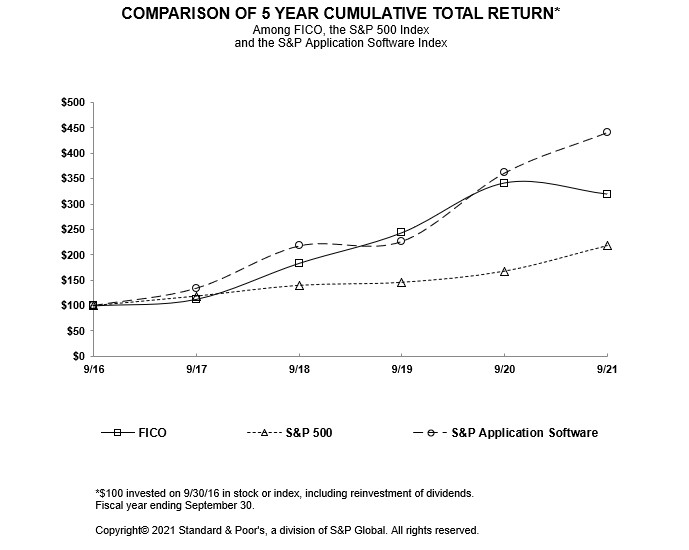
The following graph shows the total stockholder return of an investment of $100 in cash on September 30, 2016, in (a) the Company’s common stock, (b) the Standard & Poor’s 500 Stock Index and (c) the Standard & Poor’s 500 Application Software Index, in each case with reinvestment of dividends. Our past performance may not be indicative of future performance.
Item 6. [Reserved]
Item 7. Management’s Discussion and Analysis of Financial Condition and Results of Operations
Our Management’s Discussion and Analysis of Financial Condition and Results of Operations (“MD&A”) includes the following: a business overview that provides a high-level summary of our strategies and initiatives, highlights from fiscal year 2021 and key performance metrics for our Software segment; a more detailed analysis of our results of operations; our capital resources and liquidity, which discusses key aspects of our statements of cash flows, changes in our balance sheets and our financial commitments; and a summary of our critical accounting policies and estimates we believe are important to understanding the assumptions and judgments incorporated in our reported financial results. Our MD&A should be read in conjunction with Item 8, Financial Statements and Supplementary Data, of this Annual Report on Form 10-K. The following discussion contains forward-looking statements that are subject to risks and uncertainties. Actual results may differ from those referred to herein due to a number of factors, including but not limited to risks described in Item 1A, Risk Factors, in this Annual Report on Form 10-K.
BUSINESS OVERVIEW
Strategies and Initiatives
In fiscal 2021, our B2B scoring solutions, including the flagship FICO® Score, continued to be the standard measure of consumer credit risk in the U.S. In January 2020 we introduced our most predictive scores, FICO® Score 10 and 10T. We also created the FICO® Resilience Index, a complement to FICO Scores that identifies consumers who are more resilient to economic stress relative to other consumers within the same FICO Score bands. We continued to develop scores that use alternative data to enhance conventional credit bureau data and generate scores for otherwise un-scorable consumers.
During fiscal 2021, we continued to advance our platform-first, cloud delivered strategy in our Software segment. This led us to exit less strategic areas of our business in order to facilitate incremental investment in higher value, more strategic areas. As part of this process, we divested the non-platform-based Collections and Recovery (“C&R”) business, sold all assets related to our cyber risk score operations, and sold certain assets related to our Software operations to an affiliated joint venture in China.
During fiscal 2020, we changed our business practice of selling term software licenses with separate license and maintenance components to a single software subscription contract with license and maintenance bundled. This transition was substantially completed by the end of the first quarter of our fiscal 2021. The timing of our revenue recognition on these subscription sales changed, resulting in less revenue recognized upfront and more revenue recognized over the term of these subscriptions. This change led to a negative impact of our revenue recognized from term software licenses in our fiscal 2021 but does not affect total revenue recognized over the life of a contract. In addition, this change does not negatively impact our cash flows.
We also continue to enhance stockholder value by returning cash to stockholders through our stock repurchase programs. In June 2021, following the divestiture of our C&R business, we entered into an accelerated share repurchase agreement (“ASR Agreement”) to repurchase $200.0 million of our common stock. In August 2021, we entered into a stock repurchase agreement with an institutional shareholder pursuant to which we repurchased $225.0 million of our common stock. We also repurchased shares in other open market transactions under our stock repurchase programs. During fiscal 2021, we repurchased 1.9 million shares at a total repurchase price of $882.2 million. As of September 30, 2021, we had $173.2 million remaining under our current stock repurchase program.
Due to the COVID-19 pandemic, we continue to conduct business with substantial modifications to employee travel and work locations and also the virtualization of sales and marketing events. We expect these modifications to remain in place throughout calendar year 2021, along with substantially modified interactions with customers and suppliers, among other adjustments. As certain offices reopened due to the lifting of local government restrictions and a small number of employees started returning to work locations on a limited basis during fiscal 2021, we have maintained a “Voluntary Work-From-Home Policy” providing our people with valued flexibility. While we have not experienced material disruptions to our operations from the COVID-19 pandemic, we are unable to predict the full impact that the COVID-19 pandemic will have on our operations and future financial performance, including demand for our offerings, impact to our customers and partners, actions that may be taken by governmental authorities, and other factors identified in “Risk Factors” in Part I, Item 1A of this Report.
Highlights from Fiscal Year 2021
-
Total GAAP revenue was $1.32 billion during fiscal year 2021, a 2% increase from fiscal year 2020.
-
Total revenue for our Scores segment was $654.1 million during fiscal year 2021, a 24% increase from fiscal year 2020.
-
Annual Recurring Revenue for our Software segment as of September 30, 2021 was $524.0 million, a 6% increase from September 30, 2020, excluding divestitures.
-
Dollar-Based Net Retention Rate for our Software segment during the fourth quarter of fiscal 2021 was 106%, excluding divestitures.
-
Cash and cash equivalents was $195.4 million as of September 30, 2021, compared with $157.4 million as of September 30, 2020.
-
Operating income, which included $100.1 million gains on product line asset sales and business divestiture, was $505.5 million during fiscal year 2021, a 71% increase from fiscal 2020.
-
Net income was $392.1 million during fiscal year 2021, a 66% increase from fiscal 2020.
-
Cash flow from operations was $423.8 during fiscal year 2021, compared with $364.9 million generated during the prior year.
-
Total debt balance was $1.268 billion as of September 30, 2021, compared with $845 million as of September 30, 2020.
-
$882.2 million was spent on share repurchases, compared with $235.2 million spent during the prior year.
Key performance metrics for Software segment
Annual Contract Value Bookings (“ACV Bookings”)
Management regards ACV Bookings as an important indicator of future revenues, but they are not comparable to, nor are they a substitute for, an analysis of, our revenues. We define ACV Bookings as the average annualized value of software contracts signed in the current reporting period that generate current and future on-premises and SaaS software revenue. We only include contracts with an initial term of at least 24 months and we exclude perpetual licenses and other revenues that are non-recurring in nature. For renewals of existing software subscription contracts, we count only incremental annual revenue expected over the current contract as ACV Bookings.
ACV Bookings is calculated by dividing the total expected contract value by the contract term in years. The expected contract value equals the fixed amount — including guaranteed minimums — stated in the contract, plus estimates of future usage-based fees. We develop estimates from discussions with our customers and examinations of historical data from similar products and customer arrangements. Differences between estimates and actual results occur due to variability in the estimated usage. This variability is primarily caused by the economic trends in our customers’ industries; individual performance of our customers relative to their competitors; and regulatory and other factors that affect the business environment in which our customers operate.
We disclose estimated revenue expected to be recognized in the future related to remaining performance obligations in Note 12 to the accompanying consolidated financial statements. However, we believe ACV Bookings is a more
Showing the first 8K of 95K characters. Open the full section
Item 7A. Quantitative and Qualitative Disclosures about Market Risk
Market Risk Disclosures
We are exposed to market risk related to changes in interest rates and foreign exchange rates. We do not use derivative financial instruments for speculative or trading purposes.
Interest Rate
We maintain an investment portfolio consisting of bank deposits and money market funds. The funds provide daily liquidity and may be subject to interest rate risk and fall in value if market interest rates increase. We do not expect our operating results or cash flows to be affected to any significant degree by a sudden change in market interest rates. The following table presents the principal amounts and related weighted-average yields for our investments with interest rate risk at September 30, 2021 and 2020:
| September 30, 2021 | September 30, 2020 | ||||||||||||||||||||||||||||||||||
| Cost Basis | Carrying Amount | Average Yield | Cost Basis | Carrying Amount | Average Yield | ||||||||||||||||||||||||||||||
| (Dollars in thousands) | |||||||||||||||||||||||||||||||||||
| Cash and cash equivalents | $ | 195,354 | $ | 195,354 | 0.04 | % | $ | 157,394 | $ | 157,394 | 0.05 | % |
On May 8, 2018, we issued $400 million of senior notes in a private offering to qualified institutional investors (the “2018 Senior Notes”). On December 6, 2019, we issued $350 million of senior notes in a private offering to qualified institutional investors (the “2019 Senior Notes,” and with the 2018 Senior Notes, the “Senior Notes”). The fair value of the Senior Notes may increase or decrease due to various factors, including fluctuations in market interest rates and fluctuations in general economic conditions. See Management’s Discussion and Analysis of Financial Condition and Results of Operations — Capital Resources and Liquidity for additional information on the Senior Notes. The following table presents the carrying amounts and fair values for the Senior Notes at September 30, 2021 and 2020:
| September 30, 2021 | September 30, 2020 | ||||||||||||||||||||||
| Face Value (*) | Fair Value | Face Value (*) | Fair Value | ||||||||||||||||||||
| (In thousands) | |||||||||||||||||||||||
| The 2018 Senior Notes | 400,000 | 453,000 | 400,000 | 442,000 | |||||||||||||||||||
| The 2019 Senior Notes | 350,000 | 357,000 | 350,000 | 358,750 | |||||||||||||||||||
| Total | $ | 750,000 | $ | 810,000 | $ | 750,000 | $ | 800,750 |
(*) The carrying value of the Senior Notes was the face value reduced by the net debt issuance costs of $9.0 million and $10.6 million at September 30, 2021 and 2020, respectively.
We have interest rate risk with respect to our $600 million unsecured revolving line of credit. Interest on amounts borrowed under the credit facility is based on (i) a base rate, which is the greater of (a) the prime rate and (b) the Federal Funds rate plus 0.500% and (c) the one-month LIBOR rate plus 1.000%, plus, in each case, an applicable margin, or (ii) an adjusted LIBOR rate plus an applicable margin. The applicable margin for base rate borrowings ranges from 0% to 0.750% and for LIBOR borrowings ranges from 1.000% to 1.750% and is determined based on our consolidated leverage ratio. A change in interest rates on this variable rate debt impacts the interest incurred and cash flows, but does not impact the fair value of the instrument. We had $518.0 million in borrowings outstanding at a weighted-average interest of 1.212% under the credit facility as of September 30, 2021.
Foreign Currency Forward Contracts
We use derivative instruments to manage risks caused by fluctuations in foreign exchange rates. The primary objective of our derivative instruments is to protect the value of foreign-currency-denominated receivable and cash balances from the effects of volatility in foreign exchange rates that might occur prior to conversion to their functional currencies. We principally utilize foreign currency forward contracts, which enable us to buy and sell foreign currencies in the future at fixed exchange rates and economically offset changes in foreign exchange rates. We routinely enter into contracts to offset exposures denominated in the British pound, Euro and Singapore dollar.
Foreign-currency-denominated receivable and cash balances are remeasured at foreign exchange rates in effect on the balance sheet date with the effects of changes in foreign exchange rates reported in other income, net. The forward contracts are not designated as hedges and are marked to market through other income, net. Fair value changes in the forward contracts help mitigate the changes in the value of the remeasured receivable and cash balances attributable to changes in foreign exchange rates. The forward contracts are short-term in nature and typically have average maturities at inception of less than three months.
The following tables summarize our outstanding foreign currency forward contracts, by currency, at September 30, 2021 and 2020:
| September 30, 2021 | ||||||||||||||||||||
| Contract Amount | Fair Value | |||||||||||||||||||
| Foreign Currency | USD | USD | ||||||||||||||||||
| (In thousands) | ||||||||||||||||||||
| Sell foreign currency: | ||||||||||||||||||||
| Euro (EUR) | EUR | 17,100 | $ | 19,829 | — | |||||||||||||||
| Buy foreign currency: | ||||||||||||||||||||
| British pound (GBP) | GBP | 11,467 | $ | 15,400 | — | |||||||||||||||
| Singapore dollar (SGD) | SGD | 6,650 | $ | 4,900 | — |
| September 30, 2020 | |||||||||||||||||
| Contract Amount | Fair Value | ||||||||||||||||
| Foreign Currency | USD | USD | |||||||||||||||
| (In thousands) | |||||||||||||||||
| Sell foreign currency: | |||||||||||||||||
| Euro (EUR) | EUR | 15,000 | $ | 17,656 | — | ||||||||||||
| Buy foreign currency: | |||||||||||||||||
| British pound (GBP) | GBP | 16,555 | $ | 21,300 | — | ||||||||||||
| Singapore dollar (SGD) | SGD | 7,815 | $ | 5,700 | — |
The foreign currency forward contracts were entered into on September 30 of each fiscal year; therefore, the fair value was $0 on September 30, 2021 and 2020.
Item 8. Financial Statements and Supplementary Data
REPORT OF INDEPENDENT REGISTERED PUBLIC ACCOUNTING FIRM
To the stockholders and the Board of Directors of
Fair Isaac Corporation
Bozeman, Montana
Opinions on the Financial Statements and Internal Control over Financial Reporting
We have audited the accompanying consolidated balance sheets of Fair Isaac Corporation and subsidiaries (the "Company") as of September 30, 2021 and 2020, the related consolidated statements of income and comprehensive income, stockholders' equity (deficit), and cash flows, for each of the three years in the period ended September 30, 2021, and the related notes (collectively referred to as the "financial statements"). We also have audited the Company’s internal control over financial reporting as of September 30, 2021, based on criteria established in Internal Control — Integrated Framework (2013) issued by the Committee of Sponsoring Organizations of the Treadway Commission (COSO).
In our opinion, the financial statements referred to above present fairly, in all material respects, the financial position of the Company as of September 30, 2021 and 2020, and the results of operations and cash flows for each of the three years in the period ended September 30, 2021, in conformity with accounting principles generally accepted in the United States of America. Also, in our opinion, the Company maintained, in all material respects, effective internal control over financial reporting as of September 30, 2021, based on criteria established in Internal Control — Integrated Framework (2013) issued by COSO.
Basis for Opinions
The Company’s management is responsible for these financial statements, for maintaining effective internal control over financial reporting, and for its assessment of the effectiveness of internal control over financial reporting, included in the accompanying Management’s report on Internal Control over Financial Reporting. Our responsibility is to express an opinion on these financial statements and an opinion on the Company’s internal control over financial reporting based on our audits. We are a public accounting firm registered with the Public Company Accounting Oversight Board (United States) (PCAOB) and are required to be independent with respect to the Company in accordance with the U.S. federal securities laws and the applicable rules and regulations of the Securities and Exchange Commission and the PCAOB.
We conducted our audits in accordance with the standards of the PCAOB. Those standards require that we plan and perform the audits to obtain reasonable assurance about whether the financial statements are free of material misstatement, whether due to error or fraud, and whether effective internal control over financial reporting was maintained in all material respects.
Our audits of the financial statements included performing procedures to assess the risks of material misstatement of the financial statements, whether due to error or fraud, and performing procedures to respond to those risks. Such procedures included examining, on a test basis, evidence regarding the amounts and disclosures in the financial statements. Our audits also included evaluating the accounting principles used and significant estimates made by management, as well as evaluating the overall presentation of the financial statements. Our audit of internal control over financial reporting included obtaining an understanding of internal control over financial reporting, assessing the risk that a material weakness exists, and testing and evaluating the design and operating effectiveness of internal control based on the assessed risk. Our audits also included performing such other procedures as we considered necessary in the circumstances. We believe that our audits provide a reasonable basis for our opinions.
Definition and Limitations of Internal Control over Financial Reporting
A company’s internal control over financial reporting is a process designed to provide reasonable assurance regarding the reliability of financial reporting and the preparation of financial statements for external purposes in accordance with generally accepted accounting principles. A company’s internal control over financial reporting includes those policies and procedures that (1) pertain to the maintenance of records that, in reasonable detail, accurately and fairly reflect the transactions and dispositions of the assets of the company; (2) provide reasonable assurance that transactions are recorded as necessary to permit preparation of financial statements in accordance with generally accepted accounting principles, and that receipts and expenditures of the company are being made only in accordance with authorizations of management and directors of the company; and (3) provide reasonable assurance regarding prevention or timely detection of unauthorized acquisition, use, or disposition of the company’s assets that could have a material effect on the financial statements.
Because of its inherent limitations, internal control over financial reporting may not prevent or detect misstatements. Also, projections of any evaluation of effectiveness to future periods are subject to the risk that controls may become inadequate because of changes in conditions, or that the degree of compliance with the policies or procedures may deteriorate.
Critical Audit Matter
The critical audit matter communicated below is a matter arising from the current-period audit of the financial statements that was communicated or required to be communicated to the audit committee and that (1) relate to accounts or disclosures that are material to the financial statements and (2) involved our especially challenging, subjective, or complex judgments. The communication of critical audit matter does not alter in any way our opinion on the financial statements, taken as a whole, and
we are not, by communicating the critical audit matter below, providing separate opinion on the critical audit matter or on the accounts or disclosures to which it relates.
Revenue Recognition – Contracts with Customers – Refer to Note 1 and Note 12 to the financial statements
Critical Audit Matter Description
The Company recognizes revenue when control of the promised goods or services in a contract is transferred to the customer, in an amount that reflects the consideration to which the Company expects to be entitled to in exchange for those goods or services. The Company’s revenue is primarily derived from term-based or perpetual licensing of software and scoring products and solutions, and associated maintenance; software-as-a-service (SaaS) subscription services; scoring and credit monitoring services for consumers; and professional services.
The Company’s contracts with customers often include promises to transfer multiple products and services to a customer. For contracts with customers that contain various combinations of products and services, the Company evaluates whether the products or services are distinct. Distinct products or services will be accounted for as separate performance obligations, while non-distinct products or services are combined with others to form a single performance obligation.
For transactional revenue, the transaction price for contracts with customers typically includes a fixed consideration in the form of a guaranteed minimum that allows up to a certain level of usage and a variable consideration in the form of usage or transaction-based fees in excess of the minimum threshold; or usage or transaction-based variable amount not subject to a minimum threshold.
For contracts with multiple performance obligations, the transaction price is allocated to each performance obligation on a relative standalone selling price (“SSP”) basis. The Company determines the SSP using data from historical standalone sales, or, in instances where such information is not available, the Company considers factors such as the stated contract prices, their
Showing the first 8K of 165K characters. Open the full section
Item 9. Changes in and Disagreements with Accountants on Accounting and Financial Disclosure
Not applicable.
Item 9A. Controls and Procedures
Evaluation of Disclosure Controls and Procedures
An evaluation was carried out under the supervision and with the participation of FICO’s management, including the Chief Executive Officer (“CEO”) and Chief Financial Officer (“CFO”), of the effectiveness of the design and operation of FICO’s disclosure controls and procedures (as defined in Rules 13a-15(e) or 15d-15(e) under the Securities Exchange Act of 1934, as amended (the “Exchange Act”)) as of the end of the period covered by this annual report. Based on that evaluation, the CEO and CFO have concluded that FICO’s disclosure controls and procedures were effective as of September 30, 2021 to ensure that information required to be disclosed by FICO in reports that it files or submits under the Exchange Act is recorded, processed, summarized and reported within the time periods specified in SEC rules and forms. In addition, the disclosure controls and procedures are designed to ensure that information required to be disclosed is accumulated and communicated to management, including the CEO and CFO, allowing timely decisions regarding required disclosure.
Changes in Internal Control over Financial Reporting
No change in FICO’s internal control over financial reporting was identified in connection with the evaluation required by Rule 13a-15(d) of the Exchange Act that occurred during the quarter ended September 30, 2021, that has materially affected, or is reasonably likely to materially affect, FICO’s internal control over financial reporting.
Management’s Report on Internal Control over Financial Reporting
Our management is responsible for establishing and maintaining adequate internal control over financial reporting, as defined in Rules 13a-15(f) and 15d-15(f) under the Exchange Act. Under the supervision and with the participation of management, including our CEO and CFO, we conducted an evaluation of the effectiveness of our internal control over financial reporting as of September 30, 2021 based on the guidelines established in Internal Control – Integrated Framework (2013) issued by the Committee of Sponsoring Organizations of the Treadway Commission. Based on this evaluation management has concluded that our internal control over financial reporting was effective as of September 30, 2021.
Deloitte & Touche LLP, an independent registered public accounting firm that audited the consolidated financial statements included in this Annual Report on Form 10-K, has also audited the effectiveness of our internal control over financial reporting as of September 30, 2021, as stated in their attestation report included in Part II, Item 8 of this Annual Report on Form 10-K.
Item 9B. Other Information
Not applicable.
PART III
Item 10. Directors, Executive Officers and Corporate Governance
The required information regarding our Directors is incorporated by reference from the information under the caption “Our Director Nominees” in our 2022 Proxy Statement to be filed with the SEC within 120 days after September 30, 2021.
Our current executive officers are as follows:
| Name | Positions Held | Age | ||||||
| William J. Lansing | January 2012-present, Chief Executive Officer and member of the Board of Directors of the Company. February 2009-November 2010, Chief Executive Offer and President, Infospace, Inc. 2004-2007, Chief Executive Officer and President, ValueVision Media, Inc. 2001-2003, General Partner, General Atlantic LLC. 2000-2001, Chief Executive Officer, NBC Internet, Inc. 1998-2000, President/Chief Executive Officer, Fingerhut Companies, Inc. 1996-1998, Vice President, Corporate Business Development, General Electric Company. 1996, Executive Vice President, Chief Operating Office, Prodigy, Inc. 1986-1995, various positions, McKinsey & Company, Inc. | 63 | ||||||
| Michael I. McLaughlin | August 2019-present, Executive Vice President, Chief Financial Officer of the Company. May 2007-August 2019, Managing Director, Head of Technology Corporate Finance of Morgan Stanley. January 2004-May 2007, Managing Director, Head of Enterprise Systems and Supply Chain Coverage of BofA Securities. January 2001-January 2004, Executive Director, Head of Enterprise Hardware and Supply Chain of UBS Investment Bank. 1997-2001, founder and co-Chief Executive Officer of Stampede Ventures, LLC. 1993-1997, Vice President of Montgomery Securities. 1990-1993, Associate of The First Boston Corporation. 1986-1988, Analyst of The First Boston Corporation. | 57 | ||||||
| Thomas A. Bowers | August 2020-present, Executive Vice President, Corporate Strategy of the Company. September 2019-August 2020, Vice President, Business Consulting of the Company. April 2018-September 2019, Founder and Managing Partner, M Cubed Development, LLC. August 2012-March 2018, Executive Vice President, American Savings Bank. 1987-2012, Senior partner and various positions, McKinsey & Company, Inc. | 66 | ||||||
| Stephanie Covert | October 2020-present, Executive Vice President, Sales & Marketing of the Company. June 2016-October 2020, Vice President, Global Sales Operations of the Company. December 2015-May 2016, Vice President, Solution Success of the Company. June 2015-December 2015, Senior Director, Solution Success, Americas & EMEA of the Company. May 2014-June 2015, Senior Director, Solution Success, Americas of the Company. March 2013-May 2014, Senior Director, Sales Operations, Apttus. March 2012-March 2013, Sales Operations Director, Oracle Corporation. June 2007-March 2012, various positions, RightNow Technologies, Inc. | 42 | ||||||
| Richard S. Deal | November 2015-present, Executive Vice President, Chief Human Resources Officer of the Company. August 2007-November 2015, Senior Vice President, Chief Human Resources Officer of the Company. January 2001-August 2007, Vice President, Human Resources of the Company. 1998-2001, Vice President, Human Resources, Arcadia Financial, Ltd. 1993-1998, managed broad range of human resources corporate and line consulting functions with U.S. Bancorp. | 54 | ||||||
| Michael S. Leonard | November 2011-present, Vice President, Chief Accounting Officer of the Company. November 2007-November 2011, Senior Director, Finance of the Company. July 2000-November 2007, Director, Finance of the Company. 1998-2000, Controller of Natural Alternatives International, Inc. 1994-1998, various audit staff positions at KPMG LLP. | 57 | ||||||
| Claus Moldt | August 2019-present, Executive Vice President, Chief Technology Officer of the Company. March 2016-August 2019, Chief Information Officer of the Company. June 2013-March 2016, Chief Executive Officer of mPath. October 2006-June 2013, Global Chief Information Officer and Senior Vice President of Technical Operations of Salesforce.com. November 2002-September 2006, Senior Director Operations Infrastructure and Project Delivery of eBay. May 2001-May 2002, Manager Database and System Administration, LoudCloud/Opsware. | 58 | ||||||
| Mark R. Scadina | February 2009-present, Executive Vice President and General Counsel and Corporate Secretary of the Company. June 2007-February 2009, Senior Vice President and General Counsel and Corporate Secretary of the Company. 2003-2007, various senior positions including Executive Vice President, General Counsel and Corporate Secretary, Liberate Technologies, Inc. 1999-2003, various leadership positions including Vice President and General Counsel, Intertrust Technologies Corporation. 1994-1999, Associate, Pennie and Edmonds LLP. | 52 | ||||||
| James M. Wehmann | April 2012-present, Executive Vice President, Scores of the Company. November 2003-March 2012, Vice President/Senior Vice President, Global Marketing, Digital River, Inc. March 2002-June 2003, Vice President, Marketing, Brylane, Inc. September 2000-March 2002, Senior Vice President, Marketing, New Customer Acquisition, Bank One. 1993-2000, various roles, including Senior Vice President, Marketing, Fingerhut Companies, Inc. | 56 |
The required information regarding compliance with Section 16(a) of the Securities Exchange Act is incorporated by reference from the information in our 2022 Proxy Statement to be filed with the SEC within 120 days after September 30, 2021.
FICO has adopted a Code of Ethics for Senior Financial Management that applies to the Company’s Chief Executive Officer, Chief Financial Officer, Controller and other employees performing similar functions who have been identified by the Chief Executive Officer. We have posted the Code of Ethics on our website located at www.fico.com. FICO intends to satisfy the disclosure requirement under Item 5.05 of Form 8-K regarding an amendment to, or a waiver from, this Code of Ethics by posting such information on its website. FICO also has a Code of Conduct and Business Ethics applicable to all directors, officers and employees, which is also available at the website cited above.
The required information regarding the Company’s audit committee is incorporated by reference from the information under the caption “Board Committees” in our 2022 Proxy Statement to be filed with the SEC within 120 days after September 30, 2021.
Item 11. Executive Compensation
The information required by this Item is incorporated by reference from the information under the captions “Director Compensation for Fiscal 2021” and “Executive Compensation” in our 2022 Proxy Statement to be filed with the SEC within 120 days after September 30, 2021.
Item 12. Security Ownership of Certain Beneficial Owners and Management and Related Stockholder Matters
The information required by this Item is incorporated by reference from the information under the caption “Security Ownership of Certain Beneficial Owners and Management” and “Executive Compensation Plan Information” in our 2022 Proxy Statement to be filed with the SEC within 120 days after September 30, 2021.
Item 13. Certain Relationships and Related Transactions, and Director Independence
The information required by this Item is incorporated by reference from the information under the caption “Certain Relationships and Related Persons Transactions” in our 2022 Proxy Statement to be filed with the SEC within 120 days after September 30, 2021.
Item 14. Principal Accountant Fees and Services
The information required by this Item is incorporated by reference from the information under the caption “Ratification of Independent Registered Public Accounting Firm” in our 2022 Proxy Statement to be filed with the SEC within 120 days after September 30, 2021.
PART IV
Item 15. Exhibits and Financial Statement Schedules
1. Consolidated Financial Statements:
2. Financial Statement Schedules
All financial statement schedules are omitted as the required information is not applicable or as the information required is included in the consolidated financial statements and related notes.
3. Exhibits:
| 31.2* | Rule 13a-14(a)/15d-14(a) Certifications of CFO. | ||||
| 32.1* | Section 1350 Certification of CEO. | ||||
| 32.2* | Section 1350 Certification of CFO. | ||||
| 101.INS* | Inline XBRL Instance Document - the instance document does not appear in the Interactive Data File because XBRL tags are embedded within the Inline XBRL document. | ||||
| 101.SCH* | Inline XBRL Taxonomy Extension Schema Document. | ||||
| 101.CAL* | Inline XBRL Taxonomy Extension Calculation Linkbase Document. | ||||
| 101.DEF* | Inline XBRL Taxonomy Extension Definition Linkbase Document. | ||||
| 101.LAB* | Inline XBRL Taxonomy Extension Label Linkbase Document. | ||||
| 101.PRE* | Inline XBRL Taxonomy Extension Presentation Linkbase Document. | ||||
| 104* | Cover Page Interactive Data File (formatted as Inline XBRL and contained in Exhibit 101). |
(1)Management contract or compensatory plan or arrangement.
| * | Filed herewith. |
SIGNATURES
Pursuant to the requirements of Section 13 or 15(d) of the Securities Exchange Act of 1934, as amended, the Registrant has duly caused this report to be signed on its behalf by the undersigned, thereunto duly authorized.
| FAIR ISAAC CORPORATION | ||||||||
| By | /s/ MICHAEL I. MCLAUGHLIN | |||||||
| Michael I. McLaughlin | ||||||||
| Executive Vice President and Chief Financial Officer |
DATE: November 10, 2021
POWER OF ATTORNEY
KNOW ALL PERSONS BY THESE PRESENTS, that each person whose signature appears below constitutes and appoints Michael I. McLaughlin his or her attorney-in-fact, with full power of substitution, for him or her in any and all capacities, to sign any amendments to this Annual Report on Form 10-K and to file the same, with exhibits thereto and other documents in connection therewith, with the Securities and Exchange Commission, hereby ratifying and confirming all that said attorney-in-fact, or his substitute or substitutes, may do or cause to be done by virtue hereof.
Pursuant to the requirements of the Securities Exchange Act of 1934, as amended, this report has been signed below by the following persons on behalf of the registrant and in the capacities and on the dates indicated.
| /s/ WILLIAM J. LANSING | Chief Executive Officer (Principal Executive Officer) and Director | November 10, 2021 | ||||||
| William J. Lansing | ||||||||
| /s/ MICHAEL I. MCLAUGHLIN | Executive Vice President and Chief Financial Officer (Principal Financial Officer) | November 10, 2021 | ||||||
| Michael I. McLaughlin | ||||||||
| /s/ MICHAEL S. LEONARD | Vice President and Chief Accounting Officer (Principal Accounting Officer) | November 10, 2021 | ||||||
| Michael S. Leonard | ||||||||
| /s/ FABIOLA R. ARREDONDO | Director | November 10, 2021 | ||||||
| Fabiola R. Arredondo | ||||||||
| /s/ BRADEN R. KELLY | Director | November 10, 2021 | ||||||
| Braden R. Kelly | ||||||||
| /s/ JAMES D. KIRSNER | Director | November 10, 2021 | ||||||
| James D. Kirsner | ||||||||
| /s/ EVA MANOLIS | Director | November 10, 2021 | ||||||
| Eva Manolis | ||||||||
| /s/ MARC F. MCMORRIS | Director | November 10, 2021 | ||||||
| Marc F. McMorris | ||||||||
| /s/ JOANNA REES | Director | November 10, 2021 | ||||||
| Joanna Rees | ||||||||
| /s/ DAVID A. REY | Director | November 10, 2021 | ||||||
| David A. Rey |