 filings.tools
Fidelity National Information Services 10-K 2018-12-31
Filed 2019-02-21. 18 sections, 442K characters. Original on sec.gov · Markdown · JSON
Cover and table of contents
10-K 1 a10-k2018.htm 10-K
UNITED STATES SECURITIES AND EXCHANGE COMMISSION
Washington, D.C. 20549
Form 10-K
| x | ANNUAL REPORT PURSUANT TO SECTION 13 OR 15(d) OF THE SECURITIES EXCHANGE ACT OF 1934 | |
| For the fiscal year ended December 31, 2018 | ||
| or | ||
| o | TRANSITION REPORT PURSUANT TO SECTION 13 OR 15(d) OF THE SECURITIES EXCHANGE ACT OF 1934 | |
| For the transition period from to |
Commission File No. 001-16427
Fidelity National Information Services, Inc.
(Exact name of registrant as specified in its charter)
| Georgia (State or other jurisdiction of incorporation or organization) | 37-1490331 (I.R.S. Employer Identification No.) | |
| 601 Riverside Avenue Jacksonville, Florida (Address of principal executive offices) | 32204 (Zip Code) |
(904) 438-6000
(Registrant’s telephone number, including area code)
Securities registered pursuant to Section 12(b) of the Act:
| Title of Each Class: | Name of Each Exchange on Which Registered: | |
| Common Stock, par value $0.01 per share | New York Stock Exchange |
Securities registered pursuant to Section 12(g) of the Act: None
(Title of Class)
Indicate by check mark if the registrant is a well-known seasoned issuer, as defined in Rule 405 of the Securities Act. Yes x No o
Indicate by check mark if the registrant is not required to file reports pursuant to Section 13 or Section 15(d) of the Act. Yes o No x
Indicate by check mark whether the registrant (1) has filed all reports required to be filed by Section 13 or 15(d) of the Securities Exchange Act of 1934 during the preceding 12 months (or for such shorter period that the registrant was required to file such reports), and (2) has been subject to such filing requirements for the past 90 days. Yes x No o
Indicate by check mark whether the registrant has submitted electronically and posted on its corporate Web site, if any, every Interactive Data File required to be submitted and posted pursuant to Rule 405 of Regulation S-T (§ 232.405 of this chapter) during the preceding 12 months (or for such shorter period that the registrant was required to submit and post such files). Yes x No o
Indicate by check mark if disclosure of delinquent filers pursuant to Item 405 of Regulation S-K is not contained herein, and will not be contained, to the best of registrant’s knowledge, in definitive proxy or information statements incorporated by reference in Part III of this Form 10-K or any amendment to this Form 10-K. o
Indicate by check mark whether the registrant is a large accelerated filer, an accelerated filer, a non-accelerated filer, a smaller reporting company, or an emerging growth company. See the definitions of “large accelerated filer,” “accelerated filer,” “smaller reporting company” and "emerging growth company" in Rule 12b-2 of the Exchange Act. (Check one):
| Large accelerated filer x | Accelerated filer o | Non-accelerated filer o (Do not check if a smaller reporting company) | Smaller reporting company o | Emerging growth company o |
If an emerging growth company, indicate by check mark if the registrant has elected not to use the extended transition period for complying with any new or revised financial accounting standards provided pursuant to Section 13(a) of the Exchange Act. o
Indicate by check mark whether the registrant is a shell company (as defined in Rule 12b-2 of the Exchange Act) Yes o No x
As of June 30, 2018, the last business day of the registrant’s most recently completed second fiscal quarter, the aggregate market value of the registrant’s common stock held by nonaffiliates was $34,947,896,958 based on the closing sale price of $106.03 on that date as reported by the New York Stock Exchange. For the purposes of the foregoing sentence only, all directors and executive officers of the registrant were assumed to be affiliates. The number of shares outstanding of the registrant’s common stock, $0.01 par value per share, was 322,920,584 as of February 19, 2019.
The information in Part III hereof is incorporated herein by reference to the registrant’s Proxy Statement on Schedule 14A for the fiscal year ended December 31, 2018, to be filed within 120 days after the close of the fiscal year that is the subject of this Report.
FIDELITY NATIONAL INFORMATION SERVICES, INC.
2018 FORM 10-K ANNUAL REPORT
TABLE OF CONTENTS
Unless stated otherwise or the context otherwise requires, all references to "FIS," "we," the "Company" or the "registrant" are to Fidelity National Information Services, Inc., a Georgia corporation, and its subsidiaries.
PART I
Item 1. Business
Overview
FIS is a global leader in financial services technology, providing solutions and services to clients in the retail and institutional banking, payments, capital markets, asset management and wealth and retirement markets. Through the depth and breadth of our solutions portfolio, global capabilities and domain expertise, FIS serves clients in over 130 countries. Headquartered in Jacksonville, Florida, FIS employs more than 47,000 people worldwide and holds leadership positions in payment processing, financial software and banking solutions. Providing software, services and outsourcing of the technology that empowers the financial world, FIS is a Fortune 500 company and is a member of the Standard & Poor’s 500® Index.
FIS is incorporated under the laws of the State of Georgia as Fidelity National Information Services, Inc. and our stock is traded on the New York Stock Exchange under the trading symbol "FIS."
We have grown organically, as well as through acquisitions, which have contributed critical applications and services that complement or enhance our existing offerings, diversifying our revenue by customer, geography and service offering. Our solutions include core processing solutions; digital solutions; fraud, risk management and compliance solutions; electronic funds transfer and network services; card and retail payment solutions; corporate liquidity solutions; wealth and retirement solutions; item processing and output services; government payments solutions; ePayment solutions; securities processing and finance solutions; global trading solutions; asset management and insurance solutions; and global commercial services for financial institutions and credit unions, as well as companies and governmental entities. We sell certain of these solutions to domestic companies, as well as to global organizations and companies domiciled both within and outside of North America, where our solutions are able to be deployed across multiple regions. Our strategic acquisitions have enabled us to broaden our available solution sets, scale our operations, expand and diversify our customer base and strengthen our competitive position.
Financial Information About Operating Segments and Geographic Areas
FIS reports its financial performance based on three segments: Integrated Financial Solutions ("IFS"), Global Financial Solutions ("GFS") and Corporate and Other. For information about our revenues and assets by geographic area see Notes 2(n), 3 and 19 of the Notes to Consolidated Financial Statements.
Competitive Strengths
We believe our competitive strengths include the following:
| • | Brand - FIS has built a global brand known for innovation and thought leadership in the financial services sector. |
| • | Global Distribution and Scale - Our worldwide presence, array of solution offerings, customer breadth, established infrastructure and employee depth enable us to leverage our client relationships and global scale to drive revenue growth and operating efficiency. We are a global leader in the markets we serve, supported by a large, knowledgeable talent pool of employees around the world. |
| • | Extensive Domain Expertise and Extended Portfolio Depth - FIS has a significant number and wide range of high-quality software applications and service offerings that have been developed over many years with substantial input from our customers. Our broad portfolio of solutions includes a wide range of flexible service arrangements for the deployment and support of our software, from managed processing arrangements, either at the customer's site or at an FIS location, including data centers or our private cloud, to traditional license and maintenance fee approaches. This broad solution set allows us to bundle tailored or integrated services to compete effectively. In addition, FIS is able to use the modular nature of our software applications and our ability to integrate many of our services with the services of others to provide customized solutions that respond to individualized customer needs. We understand the needs of our customers and have developed and acquired innovative solutions that can give them a competitive advantage and reduce their operating costs. We have made significant investment in modernizing our platforms and solutions and |
moving our server compute into our private cloud located in our strategic data centers to increase our competitiveness in the global marketplace.
| • | Excellent and Long-Term Relationship with Customers - A significant percentage of FIS’ business with our customers relates to applications and services provided under multi-year, recurring contracts. The nature of these relationships allows us to develop close partnerships with these customers, resulting in high client retention rates. As the breadth of FIS’ service offerings has expanded, we have found that our access to key customer personnel is increasing, presenting greater opportunities for cross-selling and providing integrated, total solutions to our customers. |
Strategy
Our mission is to deliver superior solutions and services to our clients and to expand our client base, which will result in sustained revenue and earnings growth for our shareholders. Our strategy to achieve this goal has been and continues to be built on the following pillars:
| • | Build, Buy, or Partner to Add Solutions to Cross-Sell Existing Clients and Win New Clients - We continue to invest in growth through internal software development, as well as through acquisitions and equity investments that complement and extend our existing solutions and capabilities, providing us with additional solutions to cross-sell existing clients and capture the interest of new clients. We also partner from time to time with other entities to provide comprehensive offerings to our prospects and customers. By investing in solution innovation and integration, we continue to expand our value proposition to our prospects and clients. |
| • | Support Our Clients Through Innovation - Changing market dynamics, particularly in the areas of information security, regulation and innovation, are transforming the way our clients operate, which is driving incremental demand for our integrated solutions and services around our intellectual property. As prospects and customers evaluate technology, business process changes and vendor risks, our depth of services capabilities enables us to become involved earlier in their planning and design process and assist them as they manage through these changes. |
| • | Continually Improve to Drive Margin Expansion - We strive to optimize our performance through investments in infrastructure enhancements, our workforce and other measures that are designed to drive margin expansion. |
| • | Expand Client Relationships - The overall market we serve continues to gravitate beyond single-application purchases to multi-solution partnerships. As the market dynamics shift, we expect our clients and prospects to rely more on our multidimensional service offerings. Our leveraged solutions and processing expertise can produce meaningful value and cost savings for our clients through more efficient operating processes, improved service quality and convenience for our clients' customers. |
| • | Build Global Diversification - We continue to deploy resources in global markets where we expect to achieve meaningful scale. |
Revenues by Segment
The table below summarizes our revenues by reporting segment (in millions):
| 2018 | 2017 | 2016 | |||||||||
| IFS | $ | 4,401 | $ | 4,260 | $ | 4,178 | |||||
| GFS | 3,718 | 4,050 | 4,183 | ||||||||
| Corporate and Other | 304 | 358 | 470 | ||||||||
| Total Consolidated Revenues | $ | 8,423 | $ | 8,668 | $ | 8,831 |
Integrated Financial Solutions ("IFS")
The IFS segment is focused primarily on serving North American clients for transaction and account processing, payment solutions, channel solutions, digital channels, fraud, risk management and compliance solutions, lending and wealth and retirement solutions, and corporate liquidity, capitalizing on the continuing trend to outsource these solutions. Clients in this segment include regional and community banks, credit unions and commercial lenders, as well as government institutions,
merchants and other commercial organizations. These markets are primarily served through integrated solutions and characterized by multi-year processing contracts that generate highly recurring revenue. The predictable nature of cash flows generated from this segment provides opportunities for further investments in innovation, integration, information and security, and compliance in a cost effective manner.
Our solutions in this segment include the following:
| • | Core Processing and Ancillary Applications. Our core processing software applications are designed to run banking processes for our financial institution clients, including deposit and lending systems, customer management, and other central management systems, serving as the system of record for processed activity. Our diverse selection of market-focused core systems enables FIS to compete effectively in a wide range of markets. We continue to invest in our core modernization efforts to further differentiate our offerings for the long-term. We also offer a number of services that are ancillary to the primary applications listed above, including branch automation, back-office support systems and compliance support. |
| • | Digital Solutions, Including Internet, Mobile and eBanking. Our comprehensive suite of retail delivery applications enables financial institutions to integrate and streamline customer-facing operations and back-office processes, thereby improving customer interaction across all channels (e.g., branch offices, Internet, ATM, Mobile, call centers). FIS' focus on consumer access has driven significant market innovation in this area, with multi-channel and multi-host solutions and a strategy that provides tight integration of services and a seamless customer experience. We are now adding functionality and offering Digital One, an integrated digital banking platform, to our community bank clients to provide a consistent, omnichannel experience for consumers of banking services across self-service channels like mobile banking and online banking, as well as supporting channels for bank staff operating in bank branches and contact centers. The uniform customer experience will extend to support a broad range of financial services including opening new accounts; servicing of existing accounts; providing money movement services; personal financial management; as well as a broad range of other consumer, small business and commercial banking capabilities. Digital One will be integrated into and will extend the core banking platforms offered by FIS and will also be offered to customers of non-FIS core banking systems. |
| • | Fraud, Risk Management and Compliance Solutions. Our decision solutions offer a spectrum of options that cover the account lifecycle from helping to identify qualified account applicants to managing existing customer accounts and fraud. Our applications include know-your-customer, new account decisioning and opening, account and transaction management, fraud management and collections. Our risk management services use our proprietary risk management models and data sources to assist in detecting fraud and assessing the risk of opening a new account. Our systems use a combination of advanced authentication procedures, predictive analytics, artificial intelligence modeling and proprietary and shared databases to assess and detect fraud risk for deposit transactions for financial institutions. |
| • | Electronic Funds Transfer and Network Services. Our electronic funds transfer and debit card processing businesses offer settlement and card management solutions for financial institution card issuers. We provide traditional ATM-based debit network access through NYCE and emerging real-time payment alternatives. NYCE connects millions of cards and point-of-sale locations nationwide, providing consumers with secure, real-time access to their money. Also through NYCE, clients such as financial institutions, retailers and independent ATM operators can capitalize on the efficiency, consumer convenience and security of electronic real-time payments, real-time account-to-account transfers, and strategic alliances such as surcharge-free ATM network arrangements. |
| • | Card and Retail Payment Solutions. Approximately 5,500 financial institutions use a combination of our technology and/or services to issue VISA®, MasterCard® or American Express® branded credit and debit cards or other electronic payment cards for use by both consumer and business accounts. Card transactions continue to increase as a percentage of total point-of-sale payments, which fuels continuing demand for card-related services. We offer Europay, MasterCard and VISA ("EMV") integrated circuit cards, often referred to as smart cards or chip cards, as well as a variety of stored-value card types and loyalty/reward programs. Our integrated services range from card production and activation to processing to an extensive range of fraud management services and value-added loyalty programs designed to increase card usage and fee-based revenues for financial institutions and merchants. The majority of our programs are full service, including most of the operations and support necessary for an issuer to operate a credit card program. We do not make credit decisions for our card issuing clients. We are also a leading provider of prepaid card services, which include gift cards and reloadable cards, with end-to-end solutions for development, processing and administration of stored-value programs. Our closed loop gift card solutions and loyalty programs provide merchants compelling solutions to drive consumer loyalty. In addition, our merchant processing service provides a merchant or |
financial institution a comprehensive solution to manage its merchant card activities, including point-of-sale equipment, transaction authorization, draft capture, settlement, charge-back processing and reporting.
| • | Corporate Liquidity. Our corporate liquidity solutions help chief financial officers and treasurers manage working capital by increasing visibility to cash, reducing risk and improving communication and response time between a company’s buyers, suppliers, banks and other stakeholders. Our end-to-end collaborative financial management framework helps bring together receivables, treasury and payments for a single view of cash and risk, which helps our clients optimize business processes for enhanced liquidity management. |
| • | Wealth and Retirement. We provide wealth and retirement solutions that help banks, trust companies, brokerage firms, insurance firms, retirement plan professionals, benefit administrators and independent advisors acquire, service and grow their client relationships. We provide solutions for client acquisition, transaction management, trust accounting and recordkeeping that can be deployed stand-alone or as part of an integrated wealth or retirement platform, or on an outsourced basis. |
| • | Item Processing and Output Services. Our item processing services furnish financial institutions with the technology needed to capture data from checks, transaction tickets and other items; image and sort items; process exceptions through keying; and perform balancing, archiving and the production of statements. Our item processing services are performed at one of our multiple item processing centers located throughout the U.S. or on-site at client locations. Our extensive solutions include distributed (i.e., non-centralized) data capture, mobile deposit capture, check and remittance processing, fraud detection, and document and report management. Clients encompass banks and corporations of all sizes, from de novo banks to the largest financial institutions and corporations. We offer a number of output services that are ancillary to the primary solutions we provide, including print and mail capabilities, document composition software and solutions, and card personalization fulfillment services. Our print and mail services offer complete computer output solutions for the creation, management and delivery of print and fulfillment needs. We provide our card personalization fulfillment services for branded credit cards and branded and non-branded debit and prepaid cards. |
| • | Government Payments Solutions. We provide comprehensive, customized electronic service applications for government agencies, including Internal Revenue Service ("IRS") payment services and government food stamp and nutrition programs known as Supplemental Nutrition Assistance Program ("SNAP") and Women, Infants and Children ("WIC"). We also facilitate the collection of state income taxes, real estate taxes, utility bills, vehicle registration fees, driver’s license renewal fees, parking tickets, traffic citations, tuition payments, court fees and fines, hunting and fishing license fees, as well as various business licenses. |
| • | ePayment Solutions. We provide reliable and scalable bill publishing and bill consolidation technology for our clients, generating and facilitating the payment of millions of monthly bills, servicing both billers and financial institution clients. Online bill payment functionality includes credit and debit card-based expedited payments. Our end-to-end presentment and payment solution provides an all-in-one solution to meet billers’ needs for the distribution and collection of bills and other customer documents. FIS also provides Automated Clearing House ("ACH") processing. |
Global Financial Solutions ("GFS")
The GFS segment is focused on serving the largest global financial institutions and/or international financial institutions with a broad array of capital markets (including asset managers, buy- and sell-side securities and trading firms), asset management and insurance solutions, as well as banking and payments solutions.
GFS clients include the largest global financial institutions, including those headquartered in the United States, as well as international financial institutions we serve as clients in more than 130 countries around the world, and asset managers, buy- and sell-side securities and trading firms, insurers and private equity firms. These institutions face unique business and regulatory challenges and account for the majority of financial institution information technology spend globally. The purchasing patterns of GFS clients vary from those of IFS clients who typically purchase solutions on an outsourced basis. GFS clients purchase our solutions and services in various ways including licensing and managing technology "in-house," using consulting and third-party service providers as well as fully outsourced end-to-end solutions. We have long-established relationships with many of these financial institutions that generate significant recurring revenue. This segment included the Company's consolidated Brazilian Venture until the joint venture with Banco Bradesco was unwound and the assets we continue to own were spun-off to a new wholly-owned FIS subsidiary on December 31, 2018 (see Note 16 of the Notes to Consolidated Financial Statements).
Our solutions in this segment include the following:
| • | Securities Processing and Finance. Our offerings help financial institutions to increase the efficiency, transparency and control of their back-office trading operations, post-trade processing and settlement including derivative solutions, risk management, securities lending, syndicated lending, tax processing, and regulatory compliance. The breadth of our offerings also facilitates advanced business intelligence and market data distribution based on our extensive market data access. |
| • | Global Trading. Our trading solutions provide trade execution, data and network solutions to financial institutions, corporations and municipalities in North America, Europe and other global markets across a variety of asset classes. Our trade execution and network solutions help both buy- and sell-side firms improve execution quality, decrease overall execution costs and address today’s trade connectivity challenges. |
| • | Asset Management and Insurance. We offer solutions that help institutional investors, insurance companies, hedge funds, private equity firms, fund administrators and securities transfer agents improve both investment decision-making and operational efficiency, while managing risk and increasing transparency. Our asset management solutions support every stage of the investment process, from research and portfolio management, to valuation, risk management, compliance, investment accounting, transfer agency and client reporting. Our insurance solutions help support front-office and back-office functions including actuarial risk calculations, policy administration and financial and investment accounting and reporting for a variety of insurance lines, including life and health, annuities and pensions, property and casualty, reinsurance, and asset management. |
| • | Retail Banking and Payments Services. Our GFS operations leverage existing applications and provide services for the specific business needs of our customers in targeted global markets. Services are delivered from our operation centers around the world. Our banking solution services include fully outsourced core bank processing arrangements including an integrated digital banking platform, application management, software licensing and maintenance and facilities management. Our payment solution services include fully outsourced card-issuer services and customer support, payment processing (including real-time payments) and switching services, prepaid and debit card processing, software licensing and maintenance, outsourced ATM management and retail point-of-sale payment services. |
| • | Strategic Consulting Services. We completed the sale of a majority stake in Capco, which comprised our Strategic Consulting Services, on July 31, 2017 (see Note 16 of the Notes to Consolidated Financial Statements). |
Corporate and Other Segment
The Corporate and Other segment consists of corporate overhead expense, certain leveraged functions and miscellaneous expenses that are not included in the operating segments, as well as certain non-strategic businesses. The overhead and leveraged costs relate to marketing, corporate finance and accounting, human resources, legal, and amortization of acquisition-related intangibles and other costs that are not considered when management evaluates revenue generating segment performance, such as acquisition integration and other costs. At the end of 2018, the only business unit remaining in this segment is our Global Commercial Services business described below:
| • | Global Commercial Services. Our global commercial services include solutions, both onshore and offshore, designed to meet the technology challenges facing clients, large or small, including financial institutions and non-financial institutions. These solutions range in scope from operations support for a single application to full management of information technology infrastructures. We also provide outsourcing teams to manage costs, improve operational efficiency and transform our clients' back-office and customer service processes. |
The non-strategic business solutions in this segment have been divested as described below:
| • | Retail Check Processing. Effective August 31, 2018, FIS sold substantially all the assets of the Certegy Check Services business unit in North America (see Note 5 of the Notes to Consolidated Financial Statements). |
| • | Public Sector and Education. We completed the sale of our Public Sector and Education business to portfolio companies of Vista Equity Partners on February 1, 2017 (see Note 16 of the Notes to Consolidated Financial Statements). |
Sales and Marketing
We have experienced sales personnel with expertise in particular services and markets, as well as in the needs of particular types of customers. We believe that focusing our expertise in specific markets (e.g., global financial institutions, North American financial institutions) and tailoring integrated solution sets of particular value to participants in those markets enables us to leverage opportunities to cross-sell and up-sell. We continue to realign our sales teams to better match our solution expertise with the market opportunity and customer demand. We target the majority of our potential customers via direct and/or indirect field sales, as well as inbound and outbound lead generation and telesales efforts.
Our global marketing strategy is to develop and lead the execution of the IFS and GFS strategic marketing plans in support of their revenue and profitability goals and the FIS brand. Key components include thought leadership, integrated programs with consistent message development, internal and external communications, client conference content management, web content creation and management, trade shows, demand generation campaigns and collateral development and management.
Patents, Copyrights, Trademarks and Other Intellectual Property
The Company owns intellectual property, including trademarks, trade names, copyrights and patents, which we believe is important to our future success. Although we acquired the trademarks and trade names used by SunGard through the acquisition by FIS and certain of its wholly owned subsidiaries of SunGard and SunGard Capital Corp. II (collectively, "SunGard") on November 30, 2015 (the "SunGard acquisition"), we note that following the split-off of the Availability Services ("AS") business by SunGard in 2014, AS has the right to use the Sungard Availability Services name, which does not include the right to use the SunGard name or its derivatives.
We rely on a combination of contractual restrictions, internal security practices, patents, copyrights and applicable law to establish and protect our software, technology and expertise worldwide. We rely on trademark law to protect our rights in our brands. We intend to continue taking appropriate measures to protect our intellectual property rights, including by legal action when necessary and appropriate. In general, we own the proprietary rights necessary for the conduct of our business, although we do license certain items from third parties under arms-length agreements for varying terms, including some "open source" licenses.
Competition
The markets for our solutions and services are intensely competitive. Depending on the business line, in both our IFS and GFS segments, our primary competitors include internal technology departments within financial institutions, retailers, data processing or software development departments of large companies or large computer manufacturers, companies that deliver software and integrated services to the financial services industry, third-party payment processors, securities exchanges, asset managers, card associations, clearing networks or associations, trust companies, independent computer services firms, companies that develop and deploy software applications, companies owned by global banks selling new competitive solutions, companies that provide customized development, implementation and support services, disruptive technology innovators, and business process outsourcing companies. Many of these companies compete with us across multiple solutions, markets and geographies. Some of these competitors possess greater financial, sales and marketing resources than we do. Competitive factors impacting the success of our services across our segments include the quality of the technology-based application or service, application features and functions, ease of delivery and integration, the ability to maintain, enhance and support the applications or services, price and overall relationship management. We believe we compete favorably in each of these categories. In addition, we believe our financial services industry expertise, combined with our ability to offer multiple applications, services and integrated solutions to individual clients, enhances our competitiveness against companies with more limited offerings.
Research and Development
Our research and development activities have related primarily to the modernization of our proprietary core systems, design and development of next generation digital and innovative solutions and development of processing systems and related software applications and risk management platforms. We expect to continue our practice of investing an appropriate level of resources to maintain, enhance and extend the functionality of our proprietary systems and existing software applications, to develop new and innovative software applications and systems to address emerging technology trends in response to the needs of our clients and to enhance the capabilities of our outsourcing infrastructure. In addition, we intend to offer services compatible with new and emerging delivery channels.
As part of our research and development process, we evaluate current and emerging technology for compatibility with our existing and future software platforms. To this end, we engage with various hardware and software vendors in evaluation of various infrastructure components. Where appropriate, we use third-party technology components in the development of our software applications and service offerings. In the case of nearly all of our third-party software, enterprise license agreements exist for the third-party component and either alternative suppliers exist or transfer rights exist to ensure the continuity of supply. As a result, we are not materially dependent upon any third-party technology components. Third-party software may be used for highly specialized business functions, which we may not be able to develop internally within time and budget constraints. Additionally, third-party software may be used for commodity-type functions within a technology platform environment. We work with our clients to determine the appropriate timing and approach to introducing technology or infrastructure changes to our applications and services. During the years ended December 31, 2018, 2017 and 2016 approximately 3% to 4% of revenues were non-capitalizable research and development expense.
Government Regulation
Our services are subject to a broad range of complex federal, state, and foreign regulation and requirements, as well as requirements under the rules of self-regulatory organizations, including federal truth-in-lending and truth-in-savings rules, Regulation AA (Unfair or Deceptive Acts or Practices), data protection and privacy laws, usury laws, laws governing state trust charters, the Equal Credit Opportunity Act, the Electronic Funds Transfer Act, the Fair Credit Reporting Act, the Fair Debt Collection Practices Act, the Bank Secrecy Act, the USA Patriot Act, the Internal Revenue Code, the Employee Retirement Income Security Act, the Health Insurance Portability and Accountability Act, the Community Reinvestment Act and the Dodd-Frank Wall Street Reform and Consumer Protection Act (the "Dodd-Frank Act"), the Securities Exchange Act of 1934 (the "1934 Act"), the Investment Advisors Act of 1940 (the "1940 Act"), anti-corruption laws including the U.S. Foreign Corrupt Practices Act and U.K. Bribery Act, the rules and regulations of the Financial Industry Regulatory Authority ("FINRA"), the Securities and Exchange Commission ("SEC") and the Financial Conduct Authority in the U.K. ("FCA"). The compliance of our services and applications with these and other applicable laws and regulations depends on a variety of factors, including the manner in which our clients use them. In some cases, we are directly subject to regulatory oversight and examination. In other cases, our clients are contractually responsible for determining what is required of them under applicable laws and regulations and utilize our products and services to achieve compliance with those laws and regulations. In either case, the failure of our services to comply with applicable laws and regulations may result in restrictions on our ability to provide those services and/or the imposition of civil fines and/or criminal penalties. The principal areas of regulation impacting our business are the following:
| • | Oversight by Banking Regulators. As a provider of electronic data processing and back-office services to financial institutions, FIS is subject to regulatory oversight and examination by the Federal Banking Agencies ("FBA"), including the Federal Deposit Insurance Corporation ("FDIC"), the Office of the Comptroller of the Currency ("OCC"), the Board of Governors of the Federal Reserve System ("FRB"), the National Credit Union Administration ("NCUA") and the Consumer Financial Protection Bureau ("CFPB") as part of the Multi-Regional Data Processing Servicer Program ("MDPS"). The MDPS program includes technology suppliers that provide mission critical applications for a large number of financial institutions that are regulated by multiple regulatory agencies. Periodic information technology examination assessments are performed using FBA Interagency guidelines to identify potential risks that could adversely affect serviced financial institutions, determine compliance with applicable laws and regulations that affect the services provided to financial institutions and ensure the services we provide to financial institutions do not create systemic risk to the banking system or impact the safe and sound operation of the financial institutions we process. In addition, independent auditors annually review several of our operations to provide reports on internal controls for our clients’ auditors and regulators. We are also subject to review and examination by state and international regulatory authorities under state and foreign laws and rules that regulate many of the same activities that are described above, including electronic data processing, payments and back-office services for financial institutions and the use of consumer information. |
Our U.S.-based wealth and retirement businesses held charters in 2018 in the states of Georgia and Delaware, which made us subject to the regulatory compliance requirements of the Georgia Department of Banking and Finance and the State of Delaware Office of the State Bank Commissioner. As a result, we are also authorized to provide trust services in various additional states subject to additional applicable state regulations. We divested Reliance Trust Company of Delaware effective December 31, 2018, which was our only charter in Delaware.
| • | Oversight by Securities Regulators. Our subsidiary that conducts our broker-dealer business in the U.S. is registered as a broker-dealer with the SEC, is a member of FINRA, and is registered as a broker-dealer in numerous states. Our broker-dealer is subject to regulation and oversight by the SEC. In addition, FINRA, a self-regulatory organization |
that is subject to oversight by the SEC, adopts and enforces rules governing the conduct, and examines the activities, of its member firms, including our broker-dealer. State securities regulators, the Municipal Securities Rulemaking Board, and various exchanges, including the New York Stock Exchange, also have regulatory or oversight authority over our broker-dealer. Broker-dealers are subject to regulations that cover all aspects of the securities business, including sales methods, trade practices among broker-dealers, public and private securities offerings, use and safekeeping of customers’ funds and securities, capital structure, record keeping, the financing of customers’ purchases and the conduct and qualifications of directors, officers and employees. In particular, as a registered broker-dealer and member of a self-regulatory organization, we are subject to the SEC’s uniform net capital rule, Rule 15c3-1. Rule 15c3-1 specifies the minimum level of net capital a broker-dealer must maintain and also requires that a significant part of a broker-dealer’s assets be kept in relatively liquid form. The SEC and various self-regulatory organizations impose rules that require notification when net capital falls below certain predefined criteria, limit the ratio of subordinated debt to equity in the regulatory capital composition of a broker-dealer and constrain the ability of a broker-dealer to expand its business under certain circumstances. Additionally, the SEC’s uniform net capital rule imposes certain requirements that may have the effect of prohibiting a broker-dealer from distributing or withdrawing capital and requiring prior notice to the SEC for certain withdrawals of capital.
Our subsidiaries also include an SEC-registered transfer agent. Our registered transfer agent is subject to the 1934 Act and the rules and regulations promulgated thereunder. These laws and regulations generally grant the SEC and other supervisory bodies broad administrative powers to address non-compliance with regulatory requirements. Sanctions that may be imposed for non-compliance with these requirements include the suspension of individual employees, limitations on engaging in certain activities for specified periods of time or for specified types of clients, the revocation of registrations, other censures and significant fines.
Subsidiaries engaged in activities outside the U.S. are regulated by various government agencies in the particular jurisdiction where they are chartered, incorporated and/or conduct their business activity. For example, pursuant to the U.K. Financial Services and Markets Act 2000 ("FSMA"), certain of our subsidiaries are subject to regulations promulgated and administered by the FCA. The FSMA and rules promulgated thereunder govern all aspects of the U.K. investment business, including sales, research and trading practices, provision of investment advice, use and safekeeping of client funds and securities, regulatory capital, record keeping, margin practices and procedures, approval standards for individuals, anti-money laundering, periodic reporting and settlement procedures.
| • | Privacy and Data Protection. The Company is subject to an increasing number of privacy and data protection laws, regulations and directives globally (referred to collectively as "Privacy Laws"), many of which place restrictions on the Company’s ability to efficiently transfer, access and use personal data across its business. The legislative and regulatory landscape for privacy and data protection continues to evolve. |
Our financial institution clients operating in the United States are required to comply with privacy regulations imposed under the Gramm-Leach-Bliley Act (referred to as "GLBA") and numerous similar state laws. GLBA and those state laws place restrictions on the use of non-public personal information. All financial institutions must disclose detailed privacy policies to their customers and offer them the opportunity to direct the financial institution not to share information with third parties. The regulations under GLBA, however, permit financial institutions to share information with non-affiliated parties who perform services for the financial institutions. As a provider of services to financial institutions, we are required to comply with the privacy laws and are bound by the same limitations on disclosure of the information received from our clients as apply to the financial institutions themselves. A determination that there have been violations of privacy laws could expose us to significant damage awards, fines and other penalties that could, individually or in the aggregate, materially harm our business and reputation.
In July 2016, the European Commission formally approved and adopted the EU-US Privacy Shield, providing a compliance framework for organizations to transfer personal data regarding citizens of the European Union (the "EU") to the U.S. While we have certified certain lines of business under the Privacy Shield, we have chosen to adopt EU model clauses published by the European Commission as the primary basis for the export of data from the EU to the U.S.
New and proposed data protection legislation and regulations also significantly affect our business. The General Data Protection Regulation ("GDPR"), which became effective on May 25, 2018 imposes a strict data compliance regime and extends the scope of the EU data protection law to all foreign companies processing data of EU residents. We have amended thousands of client and vendor contracts and put into place a thorough compliance program to comply with this new comprehensive privacy law. Although the GDPR applies across the EU without a need for local
implementing legislation, as has been the case under the current data protection regime, local data protection authorities ("DPAs") will still have the ability to interpret the GDPR, which has the potential to create inconsistencies on a country-by-country basis. The Company will also be subject to the California Consumer Privacy Act ("CCPA"), which comes into effect on January 1, 2020 and provides California residents additional data protection rights including the right to be informed about the personal information collected by third parties and the use of that personal data. Further, certain operations of the Company will be subject to the Brazil General Personal Data Protection Act, which is also scheduled to become effective in 2020. The Company has adopted a comprehensive global privacy program to assess and manage these evolving risks.
| • | Money Transfer. Elements of our cash access and money transmission businesses are registered as a Money Services Business and are subject to the USA Patriot Act and reporting requirements of the Bank Secrecy Act and U.S. Treasury Regulations. These businesses may also be subject to certain state, local and licensing requirements. The Financial Crimes Enforcement Network, state attorneys general, and other agencies have enforcement responsibility over laws relating to money laundering, currency transmission, and licensing. In applicable states, we have obtained money transmitter licenses. However, changes to state money transmission laws and regulations, including changing interpretations and the implementation of new or varying regulatory requirements, may result in the need for additional money transmitter licenses or for the requirement that we change the way in which we deliver certain services. |
We are also subject to certain economic and trade sanctions programs that are administered by the U.S. Treasury’s Office of Foreign Assets Control (referred to as "OFAC"), which prohibit or restrict transactions to or from or dealings with specified countries, their governments, and in certain circumstances, their nationals, and with individuals and entities that are specially-designated nationals of those countries, narcotics traffickers, and terrorists or terrorist organizations. Similar anti-money laundering laws apply to movements of currency and payments through electronic transactions and to dealings with persons specified in lists maintained by the country equivalents to OFAC in several other countries. We have implemented policies, procedures, and internal controls that are designed to comply with the regulations and economic sanctions programs administered by OFAC. Outside the U.S., applicable laws, rules and regulations similarly require designated types of financial institutions to implement anti-money laundering programs. We have implemented policies, procedures and internal controls that are designed to comply with all applicable anti-money laundering laws and regulations.
| • | Consumer Reporting and Protection. Our decision solutions subsidiary (ChexSystems) maintains a database of consumer information used to provide various account opening services including credit scoring analysis and is subject to the Federal Fair Credit Reporting Act ("FCRA") and similar state laws. The FCRA regulates consumer reporting agencies ("CRAs"), including ChexSystems, and governs the accuracy, fairness, and privacy of information in the files of CRAs that engage in the practice of assembling or evaluating certain information relating to consumers for certain specified purposes. CRAs are required to follow reasonable procedures to assure maximum possible accuracy of information concerning the individual about whom the report relates and if a consumer disputes the accuracy of any information in the consumer’s file, to conduct a reasonable investigation within statutory timelines. The FCRA imposes many other requirements on CRAs and users of consumer report information. Regulatory enforcement of the FCRA is under the purview of the United States Federal Trade Commission ("FTC"), the CFPB, and state attorneys general, acting alone or in concert with one another. In furtherance of our objectives of data accuracy, fair treatment of consumers, protection of consumers’ personal information, and compliance with these laws, we strive to, and have made considerable investment to, maintain a high level of security for our computer systems in which consumer data resides, and we maintain consumer relations call centers to facilitate efficient handling of consumer requests for information and handling disputes. We also are focused on ensuring our operating environments safeguard and protect consumer's personal information in compliance with these laws. |
Our consumer reporting and facing businesses are subject to CFPB Bulletin 2013-7 (an update to the former Regulation A - Unfair Deceptive Acts or Practices), which states the definition of Unfair, Deceptive or Abusive Acts or Practices ("UDAAP"). This specific bulletin states that UDAAPs can cause significant financial injury to consumers, erode consumer confidence, and undermine fair competition in the financial marketplace. Original creditors and other covered persons and service providers under the Dodd-Frank Act involved in collecting debt related to any consumer financial product or service are subject to the prohibition against UDAAPs in the Dodd-Frank Act.
| • | Debt Collection. Our collection services are subject to the Federal Fair Debt Collection Practices Act and various state collection laws and licensing requirements. The FTC, as well as state attorneys general and other agencies, have enforcement responsibility over the collection laws, as well as the various credit reporting laws. |
| • | Anti-Corruption. FIS is subject to applicable anti-corruption laws, such as the U.S. Foreign Corrupt Practices Act and the U.K. Bribery Act, in the jurisdictions in which it operates. Anti-corruption laws generally prohibit offering, promising, giving, or authorizing others to give anything of value, either directly or indirectly, to a government official or private party in order to influence official action or otherwise gain an unfair business advantage, such as to obtain or retain business. FIS has implemented policies, procedures, and internal controls that are designed to comply with such laws, rules and regulations. |
The foregoing list of laws and regulations to which our Company is subject is not exhaustive, and the regulatory framework governing our operations changes continuously. Enactment of new laws and regulations may increasingly affect the operations of our business, directly and indirectly, which could result in substantial regulatory compliance costs, litigation expense, adverse publicity, and/or loss of revenue.
Information Security
Globally, attacks on information technology systems continue to grow in frequency, complexity and sophistication. This is a trend we expect to continue. Such attacks have become a point of focus for individuals, businesses and governmental entities. The objectives of these attacks include, among other things, gaining unauthorized access to systems to facilitate financial fraud, disrupt operations, cause denial of service events, corrupt data, and steal non-public information. These circumstances present both a threat and an opportunity for FIS. As part of our business, we electronically receive, process, store and transmit a wide range of confidential information, including sensitive customer information and personal consumer data. We also operate payment, cash access and prepaid card systems.
FIS remains focused on making strategic investments in information security to protect our clients and our information systems. This includes both capital expenditures and operating expenses on hardware, software, personnel and consulting services. We also participate in industry and governmental initiatives to improve information security for our clients. Through the expertise we have gained with this ongoing focus and involvement, we have developed fraud, security, risk management and compliance solutions to target this growth opportunity in the financial services industry.
For more information on Information Security, see "Item 7. Management's Discussion and Analysis of Financial Condition and Results of Operations."
Employees
As of December 31, 2018, we had more than 47,000 employees, including approximately 29,000 employees principally employed outside of the U.S. None of our U.S. workforce currently is unionized. Approximately 6,000 of our employees, primarily in Brazil, Germany, Tunisia, France, Italy, Mexico and Chile, are represented by labor unions or works councils. We consider our relations with our employees to be good.
Available Information
Our internet website address is www.fisglobal.com. We make our Annual Reports on Form 10-K, Quarterly Reports on Form 10-Q, and Current Reports on Form 8-K, and any amendments to those reports, available, free of charge, on that website as soon as reasonably practicable after we file or furnish them to the Securities and Exchange Commission. Our Corporate Governance Policy and Code of Business Conduct and Ethics are also available on our website and are available in print, free of charge, to any shareholder who mails a request to the Corporate Secretary, Fidelity National Information Services, Inc., 601 Riverside Avenue, Jacksonville, FL 32204 USA. Other corporate governance-related documents can be found at our website as well. However, the information found on our website is not a part of this or any other report.
Item 1A. Risk Factors
In addition to the normal risks of business, we are subject to significant risks and uncertainties, including those listed below and others described elsewhere in this Annual Report on Form 10-K. Any of the risks described herein could result in a significant adverse effect on our results of operations and financial condition.
Risks Related to Our Business and Operations
Security breaches or attacks, or our failure to comply with information security laws or regulations or industry security requirements, could harm our business by disrupting our delivery of services and damaging our reputation and could result in a breach of one or more client contracts.
We electronically receive, process, store and transmit sensitive business information of our clients. In addition, we collect personal consumer data, such as names and addresses, social security numbers, driver's license numbers, cardholder data and payment history records. Such information is necessary to support our clients’ transaction processing and to conduct our check authorization and collection businesses. The uninterrupted operation of our information systems, as well as the confidentiality of the customer/consumer information that resides on such systems, is critical to our successful operation. For that reason, cybersecurity is one of the principal operational risks we face as a provider of services to financial institutions. If we fail to maintain an adequate security infrastructure, adapt to emerging security threats, or implement sufficient security standards and technology to protect against security breaches, the confidentiality of the information we secure could be compromised. Unauthorized access to our computer systems or databases could result in the theft or publication of confidential information, the deletion or modification of records, damages from legal actions from clients and/or their customers, or otherwise cause interruptions in our operations and damage to our reputation. These risks are greater with increased information transmission over the Internet and the increasing level of sophistication posed by cyber criminals.
As a provider of services to financial institutions and a provider of card processing services, we are bound by the same limitations on disclosure of the information we receive from our clients as apply to the clients themselves. If we fail to comply with these regulations and industry security requirements, we could be exposed to damages from legal actions from clients and/or their customers, governmental proceedings, governmental notice requirements, and the imposition of fines or prohibitions on card processing services. In addition, if more restrictive privacy laws, rules or industry security requirements are adopted in the future on the Federal or State level, or by a specific industry body, they could have an adverse impact on us through increased costs or restrictions on business processes. Any inability to prevent security or privacy breaches, or the perception that such breaches may occur, could cause our existing clients to lose confidence in our systems and terminate their agreements with us, inhibit our ability to attract new clients, result in increasing regulation, or bring about other adverse consequences from the government agencies that regulate our business.
Entity mergers or consolidations and business failures in the banking and financial services industry could adversely affect our business by eliminating some of our existing and potential clients and making us more dependent on a more limited number of clients.
There has been and continues to be substantial consolidation activity in the banking and financial services industry. In addition, certain financial institutions that experienced negative operating results, including some of our clients, have failed. These consolidations and failures reduce our number of potential clients and may reduce our number of existing clients, which could adversely affect our revenues, even if the events do not reduce the aggregate activities of the consolidated entities. Further, if our clients fail and/or merge with or are acquired by other entities that are not our clients, or that use fewer of our services, they may discontinue or reduce use of our services. It is also possible that larger financial institutions resulting from consolidations would have greater leverage in negotiating terms or could decide to perform in-house some or all of the services we currently provide or could provide. Any of these developments could have an adverse effect on our business, results of operations and financial condition.
If we fail to innovate or adapt our services to changes in technology or in the marketplace, or if our ongoing efforts to upgrade our technology are not successful, we could lose clients or our clients could lose customers and we could have difficulty attracting new clients for our services.
The markets for our services are characterized by constant technological changes, frequent introductions of new services and evolving industry standards. Our future success will be significantly affected by our ability to enhance our current solutions and develop and introduce new solutions and services that address the increasingly sophisticated needs of our clients and their customers. In addition, as more of our revenue and market demand shifts to software as a service ("SaaS"), business process as a service ("BPaaS"), cloud, and new disruptive technologies, the need to keep pace with rapid technology changes becomes more acute. These initiatives carry the risks associated with any new solution development effort, including cost overruns, delays in delivery, and performance issues. There can be no assurance that we will be successful in developing, marketing and selling new solutions or enhancements that meet these changing demands, that we will not experience difficulties that could delay or prevent the successful development, introduction, and marketing of these solutions or enhancements, or that our new solutions and enhancements will adequately meet the demands of the marketplace and achieve market acceptance. Any of these developments could have an adverse impact on our future revenues and/or business prospects.
We operate in a competitive business environment and if we are unable to compete effectively our results of operations and financial condition may be adversely affected.
The market for our services is intensely competitive. Our competitors vary in size and in the scope and breadth of the solutions and services they offer. Some of our competitors have substantial resources. We face direct competition from third parties, and since many of our larger potential clients have historically developed their key applications in-house and therefore view their system requirements from a make-versus-buy perspective, we also often compete against our potential clients’ in-house capacities. In addition, the markets in which we compete have recently attracted increasing competition from smaller start-ups with disruptive technologies, which are receiving increasing investments, global banks (and businesses controlled by combinations of global banks) and global internet companies that are introducing competitive products and services into the marketplace, particularly in the payments area. Emerging technologies and increased competition may also have the effect of unbundling bank solutions and result in picking off solutions we are currently providing from our legacy systems. International competitors are also now targeting and entering the U.S. market with greater force. There can be no assurance that we will be able to compete successfully against current or future competitors or that the competitive pressures we face in the markets in which we operate will not materially adversely affect our business, financial condition, and results of operations. See "Item 1. Business, Competition."
Global ec
Showing the first 8K of 78K characters. Open the full section
Item 1B. Unresolved Staff Comments
None.
Item 2. Properties
FIS’ corporate headquarters is located at 601 Riverside Avenue, Jacksonville, Florida. In addition, FIS owns or leases support centers, data processing facilities and other facilities at approximately 177 locations. We believe our facilities and
equipment are generally well maintained and are in good operating condition. We believe that the computer equipment that we own and our various facilities are adequate for our present and foreseeable business needs.
Item 3. Legal Proceedings
In the ordinary course of business, the Company is involved in various pending and threatened litigation matters related to its business and operations, some of which include claims for punitive or exemplary damages. The Company believes no such currently pending or threatened actions are likely to have a material adverse effect on its consolidated financial position. With respect to litigation in which the Company is involved generally, please note the following:
| • | These matters raise difficult and complicated factual and legal issues and are subject to many uncertainties and complexities. |
| • | The Company reviews all of its litigation on an on-going basis and follows the authoritative provision for accounting for contingencies when making accrual and disclosure decisions. A liability must be accrued if (a) it is probable that a liability has been incurred and (b) the amount of loss can be reasonably estimated. If one of these criteria has not been met, disclosure is required when there is at least a reasonable possibility that a material loss may be incurred. When assessing reasonably possible and probable outcomes, the Company bases decisions on the assessment of the ultimate outcome following all appeals. Legal fees associated with defending litigation matters are expensed as incurred. |
Indemnifications and Warranties
The Company generally indemnifies its clients, subject to certain limitations and exceptions, against damages and costs resulting from claims of patent, copyright, or trademark infringement associated solely with its customers' use of the Company's software applications or services. Historically, the Company has not made any material payments under such indemnifications, but continues to monitor the conditions that are subject to the indemnifications to identify whether it is probable that a loss has occurred and would recognize any such losses when they are estimable. In addition, the Company warrants to customers that its software operates substantially in accordance with the software specifications. Historically, no material costs have been incurred related to software warranties and no accruals for warranty costs have been made.
Item 4. Mine Safety Disclosures
Not applicable.
PART II
Item 5. Market for Registrant’s Common Equity, Related Stockholder Matters and Issuer Purchases of Equity Securities
Our common stock trades on the New York Stock Exchange under the ticker symbol "FIS."
As of January 31, 2019, there were approximately 10,660 shareholders of record of our common stock.
We currently expect to continue to pay quarterly dividends. However, the amount, declaration and payment of future dividends is at the discretion of the Board of Directors and depends on, among other things, our investment opportunities, results of operations, financial condition, cash requirements, future prospects, and other factors that may be considered relevant by our Board of Directors, including legal and contractual restrictions. A regular quarterly dividend of $0.35 per common share is payable on March 29, 2019, to shareholders of record as of the close of business on March 15, 2019.
Item 12. of Part III contains information concerning securities authorized for issuance under our equity compensation plans.
Our Board of Directors has approved a series of plans authorizing repurchases of our common stock in the open market at prevailing market prices or in privately negotiated transactions, the most recent of which on July 20, 2017, authorized repurchases of up to $4.0 billion through December 31, 2020. This share repurchase authorization replaced any existing share repurchase authorization plan. Approximately $2.7 billion of plan capacity remained available for repurchases as of December 31, 2018.
The following table summarizes purchases of equity securities by the issuer during the three-month period ended December 31, 2018 (in millions, except per share amounts):
| Approximate dollar | |||||||||||||||
| value of shares that | |||||||||||||||
| Total cost of shares | may yet be | ||||||||||||||
| purchased as part of | purchased under | ||||||||||||||
| Total number of | Average price | publicly announced | the plans or | ||||||||||||
| Month ended | shares purchased | paid per share | plans or programs | programs | |||||||||||
| October 31, 2018 | 1.4 | $ | 105.31 | $ | 150 | $ | 2,680 |
There were no share repurchases in November and December 2018.
The graph below compares the cumulative 5-year total return of holders of Fidelity National Information Services, Inc.'s common stock with the cumulative total returns of the S&P 500 index and S&P Supercap Data Processing & Outsourced Services index. The graph assumes that the value of the investment in our common stock and in each index was $100 on December 31, 2013 and tracks it (including reinvestment of dividends) through December 31, 2018.
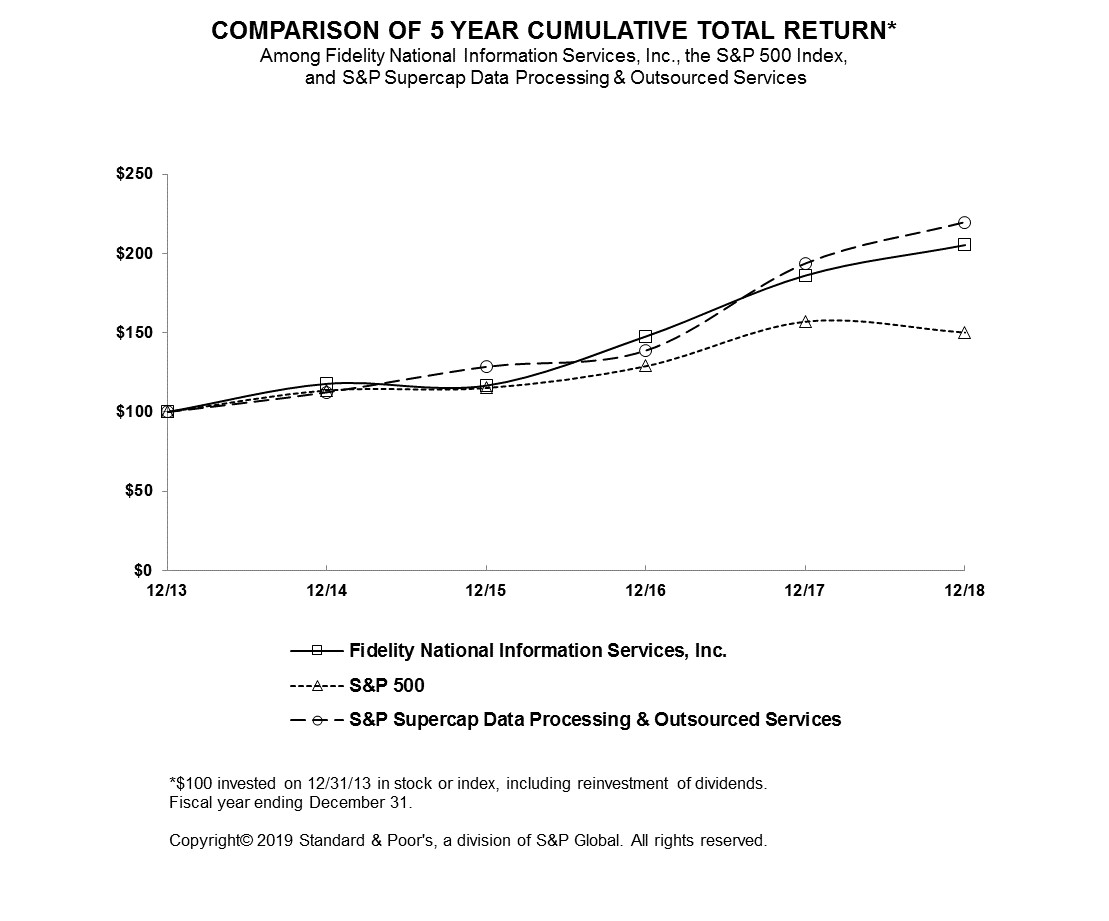
| 12/13 | 12/14 | 12/15 | 12/16 | 12/17 | 12/18 | |||||||
| Fidelity National Information Services, Inc. | 100.00 | 117.87 | 116.70 | 147.80 | 186.28 | 205.49 | ||||||
| S&P 500 | 100.00 | 113.69 | 115.26 | 129.05 | 157.22 | 150.33 | ||||||
| S&P Supercap Data Processing & Outsourced Services | 100.00 | 112.46 | 128.51 | 138.77 | 193.67 | 219.65 | ||||||
The stock price performance included in this graph is not necessarily indicative of future stock price performance.
Item 6. Selected Financial Data
The selected financial data set forth below constitutes historical financial data of FIS and should be read in conjunction with "Item 7. Management’s Discussion and Analysis of Financial Condition and Results of Operations" and "Item 8. Financial Statements and Supplementary Data" included elsewhere in this report.
On September 28, 2018, FIS entered into an agreement with Banco Bradesco to unwind the Brazilian Venture. The transaction closed on December 31, 2018. As a result of the transaction, the Brazilian Venture spun-off certain assets of the business that also provide services to non-Bradesco clients to a new wholly-owned FIS subsidiary. Also as a result of the transaction, Banco Bradesco owns 100% of the entity that previously housed the Brazilian Venture and its remaining assets that relate to card processing for Banco Bradesco, which Banco Bradesco will perform internally. In the third quarter of 2018, FIS incurred impairment charges of $95 million related to the expected disposal, including impairments of its contract intangible asset, goodwill and its assets held for sale to fair value less cost to sell. Upon closing of the transaction, FIS recorded an additional pre-tax loss of $12 million related to the business divested, removed FIS' noncontrolling interest balance of $90 million, and recorded a $57 million increase to additional paid in capital for the business spun-off into the new wholly-owned FIS subsidiary. The impairment loss and pre-tax loss on disposal were recorded in the Corporate and Other segment. The Brazilian Venture business divested was included within the GFS segment as part of the consolidated Brazilian Venture results recorded by FIS through the transaction date. The transaction did not meet the standard necessary to be reported as discontinued operations; therefore, the impairment loss, pre-tax loss and related prior period earnings remain reported within earnings from continuing operations.
Effective August 31, 2018, FIS sold substantially all the assets of the Certegy Check Services business unit in North America, resulting in a pre-tax loss of $54 million, including goodwill distributed through the sale of business of $43 million.
Effective January 1, 2018, we adopted the new revenue recognition accounting standard, Topic 606, as described further in "Item 7. Management’s Discussion and Analysis of Financial Condition and Results of Operations, Recent Accounting Pronouncements." Amounts for the years ended December 31, 2017, 2016, and 2015 were recast to reflect our retrospective applications of the new standard.
On July 31, 2017, FIS closed on the sale of a majority ownership stake in its Capco consulting business and risk and compliance consulting business to Clayton, Dubilier & Rice L.P., by and through certain funds that it manages ("CD&R"), for cash proceeds of approximately $469 million, resulting in a pre-tax loss of $41 million. The divestiture is consistent with our strategy to focus on our IP-led businesses. CD&R acquired preferred units convertible into 60% of the common units of the venture, Cardinal Holdings, L.P. ("Cardinal") and FIS obtained common units representing the remaining 40%, in each case before equity is issued to management. The preferred units are entitled to a quarterly dividend at an annual rate of 12%, payable in cash (if available) or additional preferred units at FIS' option. The businesses sold were included within the GFS and IFS segments. The sale did not meet the standard necessary to be reported as discontinued operations; therefore, the pre-tax loss and related prior period earnings remain reported within earnings from continuing operations.
FIS' 40% ownership in Cardinal was initially valued at $172 million and was recorded as an equity method investment included within other noncurrent assets on the Consolidated Balance Sheet. After the sale on July 31, 2017, FIS began to recognize the earnings in after-tax equity method investment earnings outside of operating income and segment Adjusted EBITDA. For periods prior to July 31, 2017, the Capco consulting business and risk and compliance consulting business were included within operating income and segment Adjusted EBITDA.
On February 1, 2017, FIS completed the sale of the Public Sector and Education ("PS&E") business for $850 million, resulting in a pre-tax gain of $85 million. The transaction included all PS&E solutions, which provided a comprehensive set of technology solutions to address public safety and public administration needs of government entities as well as the needs of
K-12 school districts. The divestiture is consistent with our strategy to serve the financial services markets. Cash proceeds were used to reduce outstanding debt (see Note 10 of the Notes to Consolidated Financial Statements). Net cash proceeds, after payment of taxes and transaction-related expenses, were approximately $500 million. The PS&E business was included in the Corporate and Other segment. The sale did not meet the standard necessary to be reported as discontinued operations; therefore, the pre-tax gain and related prior period earnings remain reported within earnings from continuing operations.
On November 30, 2015, we completed the SunGard acquisition. The results of operations and financial position of SunGard are included in the Consolidated Financial Statements since the date of acquisition.
During the second quarter of 2015, we sold certain assets associated with our gaming industry check warranty business, resulting in a pre-tax gain of $139 million, which is included in Other income (expense), net. The sale did not meet the standard necessary to be reported as discontinued operations; therefore, the gain and related prior period earnings remain reported within earnings from continuing operations.
We have engaged in share repurchases in the periods presented. In 2018, 2017, 2015 and 2014, we repurchased a total of approximately 12.0 million shares for $1,215 million, 1.1 million shares for $105 million, 5 million shares for $300 million and 9 million shares for $476 million, respectively. There were no share repurchases in 2016.
The effective tax rate for the 2018 period included the impact of the reduction in the U.S. federal income tax rate from 35% to 21% due to tax reform enacted December 22, 2017. The effective tax rate for the 2017 period included a net benefit of $761 million related to tax reform items including $48 million of tax credits due to tax planning strategies implemented in the fourth quarter and a net detriment of $180 million due to the book basis in excess of the tax basis of certain businesses sold during the year. The effective tax rate for the 2015 period included a net detriment of $90 million due to the book basis in excess of the tax basis of a business sold during the year. The effective tax rate for the 2016 through 2014 periods did not include a net benefit for the recognition of excess tax benefit for stock compensation as the effective date of ASU 2016-09 was for reporting periods beginning after December 15, 2016.
| Year Ended December 31, | |||||||||||||||||||
| 2018 | 2017 | 2016 | 2015 | 2014 | |||||||||||||||
| (In millions, except per share data) | |||||||||||||||||||
| Statement of Earnings Data: | |||||||||||||||||||
| Revenue | $ | 8,423 | $ | 8,668 | $ | 8,831 | $ | 6,260 | $ | 6,413 | |||||||||
| Cost of revenue | 5,569 | 5,794 | 5,895 | 4,071 | 4,327 | ||||||||||||||
| Gross profit | 2,854 | 2,874 | 2,936 | 2,189 | 2,086 | ||||||||||||||
| Selling, general and administrative expenses | 1,301 | 1,442 | 1,707 | 1,102 | 815 | ||||||||||||||
| Asset impairments | 95 | — | — | — | — | ||||||||||||||
| Operating income | 1,458 | 1,432 | 1,229 | 1,087 | 1,271 | ||||||||||||||
| Total other income (expense), net | (354 | ) | (456 | ) | (392 | ) | (62 | ) | (218 | ) | |||||||||
| Earnings from continuing operations before income taxes and equity method investment earnings (loss) | 1,104 | 976 | 837 | 1,025 | 1,053 | ||||||||||||||
| Provision (benefit) for income taxes | 208 | (321 | ) | 291 | 375 | 335 | |||||||||||||
| Equity method investment earnings (loss) | (15 | ) | (3 | ) | — | — | — | ||||||||||||
| Earnings from continuing operations, net of tax | 881 | 1,294 | 546 | 650 | 718 | ||||||||||||||
| Earnings (loss) from discontinued operations, net of tax | — | — | 1 | (7 | ) | (11 | ) | ||||||||||||
| Net earnings | 881 | 1,294 | 547 | 643 | 707 | ||||||||||||||
| Net (earnings) loss attributable to noncontrolling interest | (35 | ) | (33 | ) | (22 | ) | (19 | ) | (28 | ) | |||||||||
| Net earnings attributable to FIS common stockholders | $ | 846 | $ | 1,261 | $ | 525 | $ | 624 | $ | 679 | |||||||||
| Net earnings per share — basic from continuing operations attributable to FIS common stockholders | $ | 2.58 | $ | 3.82 | $ | 1.61 | $ | 2.21 | $ | 2.42 | |||||||||
| Net earnings (loss) per share — basic from discontinued operations attributable to FIS common stockholders | — | — | — | (0.03 | ) | (0.04 | ) | ||||||||||||
| Net earnings per share — basic attributable to FIS common stockholders * | $ | 2.58 | $ | 3.82 | $ | 1.61 | $ | 2.19 | $ | 2.38 | |||||||||
| Weighted average shares — basic | 328 | 330 | 326 | 285 | 285 | ||||||||||||||
| Net earnings per share — diluted from continuing operations attributable to FIS common stockholders | $ | 2.55 | $ | 3.75 | $ | 1.59 | $ | 2.18 | $ | 2.39 | |||||||||
| Net earnings (loss) per share — diluted from discontinued operations attributable to FIS common stockholders | — | — | — | (0.03 | ) | (0.04 | ) | ||||||||||||
| Net earnings per share — diluted attributable to FIS common stockholders * | $ | 2.55 | $ | 3.75 | $ | 1.59 | $ | 2.16 | $ | 2.35 | |||||||||
| Weighted average shares — diluted | 332 | 336 | 330 | 289 | 289 | ||||||||||||||
| Amounts attributable to FIS common stockholders: | |||||||||||||||||||
| Earnings from continuing operations, net of tax | $ | 846 | $ | 1,261 | $ | 524 | $ | 631 | $ | 690 | |||||||||
| Earnings (loss) from discontinued operations, net of tax | — | — | 1 | (7 | ) | (11 | ) | ||||||||||||
| Net earnings attributable to FIS common stockholders | $ | 846 | $ | 1,261 | $ | 525 | $ | 624 | $ | 679 |
- Amounts may not sum due to rounding.
| As of December 31, | |||||||||||||||||||
| 2018 | 2017 | 2016 | 2015 | 2014 | |||||||||||||||
| (In millions, except per share data) | |||||||||||||||||||
| Balance Sheet Data: | |||||||||||||||||||
| Cash and cash equivalents | $ | 703 | $ | 665 | $ | 683 | $ | 682 | $ | 493 | |||||||||
| Goodwill | 13,545 | 13,730 | 14,178 | 14,745 | 8,878 | ||||||||||||||
| Intangible assets, net | 3,132 | 3,885 | 4,590 | 5,080 | 1,268 | ||||||||||||||
| Total assets | 23,770 | 24,526 | 26,026 | 26,185 | 14,521 | ||||||||||||||
| Total debt | 8,985 | 8,763 | 10,478 | 11,444 | 5,068 | ||||||||||||||
| Total FIS stockholders’ equity | 10,215 | 10,711 | 9,675 | 9,298 | 6,557 | ||||||||||||||
| Noncontrolling interest | 7 | 109 | 104 | 86 | 135 | ||||||||||||||
| Total equity | 10,222 | 10,820 | 9,779 | 9,384 | 6,692 | ||||||||||||||
| Cash dividends declared per share | $ | 1.28 | $ | 1.16 | $ | 1.04 | $ | 1.04 | $ | 0.96 |
Selected Quarterly Financial Data
Selected unaudited quarterly financial data is as follows:
| Quarter Ended | |||||||||||||||
| March 31 | June 30 | September 30 | December 31 | ||||||||||||
| (In millions, except per share data) | |||||||||||||||
| 2018 | |||||||||||||||
| Revenue | $ | 2,066 | $ | 2,106 | $ | 2,084 | $ | 2,167 | |||||||
| Gross profit | 652 | 692 | 720 | 790 | |||||||||||
| Earnings from continuing operations before income taxes and equity method investment earnings (loss) | 225 | 276 | 204 | 400 | |||||||||||
| Net earnings attributable to FIS common stockholders | 182 | 212 | 154 | 299 | |||||||||||
| Net earnings per share — basic attributable to FIS common stockholders | $ | 0.55 | $ | 0.64 | $ | 0.47 | $ | 0.92 | |||||||
| Net earnings per share — diluted attributable to FIS common stockholders | $ | 0.54 | $ | 0.64 | $ | 0.47 | $ | 0.91 | |||||||
| 2017 | |||||||||||||||
| Revenue | $ | 2,148 | $ | 2,258 | $ | 2,096 | $ | 2,166 | |||||||
| Gross profit | 657 | 738 | 710 | 768 | |||||||||||
| Earnings from continuing operations before income taxes and equity method investment earnings (loss) | 209 | 283 | 119 | 365 | |||||||||||
| Net earnings attributable to FIS common stockholders | 129 | 139 | 59 | 934 | |||||||||||
| Net earnings per share — basic attributable to FIS common stockholders | $ | 0.39 | $ | 0.42 | $ | 0.18 | $ | 2.81 | |||||||
| Net earnings per share — diluted attributable to FIS common stockholders | $ | 0.39 | $ | 0.42 | $ | 0.18 | $ | 2.77 |
Item 7. Management’s Discussion and Analysis of Financial Condition and Results of Operations
The following section discusses management’s view of the financial condition and results of operations of FIS and its consolidated subsidiaries as of December 31, 2018 and 2017 and for the years ended December 31, 2018, 2017 and 2016.
This section should be read in conjunction with the audited Consolidated Financial Statements and related Notes of FIS included elsewhere in this Annual Report. Management’s Discussion and Analysis of Financial Condition and Results of Operations contains forward-looking statements. See "Forward-Looking Statements" and "Risk Factors" for a discussion of the uncertainties, risks and assumptions associated with these forward-looking statements that could cause future results to differ materially from those reflected in this section.
Overview
FIS is a global leader in financial services technology, providing solutions and services to clients in the retail and institutional banking, payments, capital markets, asset management, and wealth and retirement markets. Through the depth and breadth of our solutions portfolio, global capabilities and domain expertise, FIS serves clients in over 130 countries. Headquartered in Jacksonville, Florida, FIS employs more than 47,000 people worldwide and holds leadership positions in payment processing, financial software and banking solutions. Providing software, services and outsourcing of the technology that empowers the financial world, FIS is a Fortune 500 company and is a member of the Standard & Poor’s 500® Index.
We have grown organically, as well as through acquisitions, which have contributed critical applications and services that complement or enhance our existing offerings, diversifying our revenue by customer, geography and service offering. We evaluate possible acquisitions that might contribute to our growth or performance on an ongoing basis.
FIS reports its financial performance based on three segments: Integrated Financial Solutions ("IFS"), Global Financial Solutions ("GFS") and Corporate and Other. A description of these segments is included in Note 19 to the Notes to Consolidated Financial Statements. Revenue by segment and the adjusted EBITDA of our segments are discussed below in Segment Results of Operations.
Business Trends and Conditions
Our revenue is primarily derived from a combination of recurring technology and processing services, professional services and software license fees. The majority of our revenue has historically been recurring, and has been provided under multi-year contracts that contribute relative stability to our revenue stream. These services, in general, are considered critical to our clients' operations. A considerable portion of our recurring revenue is derived from transaction processing fees that fluctuate with the level of accounts and card transactions, among other variable measures, associated with consumer, commercial and capital markets activity. Professional services revenue is typically non-recurring, and sales of software licenses are less predictable, a portion of which can be regarded as discretionary spending by our clients.
We continue to assist financial institutions in migrating to outsourced integrated technology solutions to improve their profitability and address increasing and ongoing regulatory requirements. As a provider of outsourcing solutions, we benefit from multi-year recurring revenue streams, which help moderate the effects of broader year-to-year economic and market changes that otherwise might have a larger impact on our results of operations. We believe our integrated solutions and outsourced services are well positioned to address this outsourcing trend across the markets we serve.
Over the last three years, we have moved approximately 50% of our server compute to our FIS cloud located in our strategic data centers and our goal is to increase that percentage to 65% by the end of 2019 and 80% by the end of 2021. This allows us to further enhance security for our clients’ data and increases the flexibility and speed with which we can provide services and solutions to our clients, eventually at lesser cost. Concurrently, we have continued to consolidate our data centers, closing 10 additional data centers in 2018. Our consolidation has generated a savings for the Company as of year-end 2018 exceeding $100 million in run rate annual expense reduction since the program’s inception in mid-2016. We plan to close and consolidate approximately 20 more data centers by 2021, which should result in additional run rate annual expense reduction of about $150 million.
We continue to invest in modernization, innovation and integrated solutions and services in order to meet the demands of the markets we serve and compete with global banks, international providers, and disruptive technology innovators. We invest both organically and through investment opportunities in companies building complementary technologies in the financial services space. Our internal efforts in research and development activities have related primarily to the modernization of our proprietary core systems, design and development of next generation digital and innovative solutions and development of
processing systems and related software applications and risk management platforms. We have increased our investments in these areas in each of the last three years. We expect to continue our practice of investing an appropriate level of resources to maintain, enhance and extend the functionality of our proprietary systems and existing software applications, to develop new and innovative software applications and systems to address emerging technology trends in response to the needs of our clients and to enhance the capabilities of our outsourcing infrastructure.
Consumer preference continues to shift from traditional branch banking services to digital banking solutions, and our clients seek to provide a single integrated banking experience through their branch, mobile, internet and voice banking channels. We have been providing our large regional banking customers in the U.S. with Digital One, an integrated digital banking platform, and are now adding functionality and offering Digital One to our community bank clients to provide a consistent, omnichannel experience for consumers of banking services across self-service channels like mobile banking and online banking, as well as supporting channels for bank staff operating in bank branches and contact centers. The uniform customer experience will extend to support a broad range of financial services including opening new accounts; servicing of existing accounts; providing money movement services; personal financial management; as well as a broad range of other consumer, small business and commercial banking capabilities. Digital One will be integrated into and will extend the core banking platforms offered by FIS and will also be offered to customers of non-FIS core banking systems.
We continue to see demand for innovative solutions in the payments market that will deliver faster, more convenient payment solutions in mobile channels, internet applications and cards. We believe digital payments will grow and partially replace existing payment tender volumes over time as consumers and merchants embrace the convenience, incremental services and benefits. Additionally, new formidable non-traditional payments competitors and large merchants are investing in and innovating digital payment technologies to address the emerging market opportunity, and it is unclear the extent to which particular technologies or services will succeed. We believe the growth of digital payments continues to present both an opportunity and a risk to us as the market develops. Although we cannot predict which digital payment technologies or solutions will be successful, we cautiously believe our client relationships, payments infrastructure and experience, adapted solutions and emerging solutions are well positioned to ma
Showing the first 8K of 74K characters. Open the full section
Item 7A. Quantitative and Qualitative Disclosure About Market Risks
Market Risk
We are exposed to market risks primarily from changes in interest rates and foreign currency exchange rates. We periodically use certain derivative financial instruments, including interest rate swaps and foreign currency forward contracts, to manage interest rate and foreign currency risk. We do not use derivatives for trading purposes, to generate income or to engage in speculative activity.
Interest Rate Risk
In addition to existing cash balances and cash provided by operating activities, we use fixed-rate and variable-rate debt to finance our operations. We are exposed to interest rate risk on these debt obligations and related interest rate swaps.
The senior notes (as described in Note 10 of the Notes to Consolidated Financial Statements) represent the majority of our fixed-rate long-term debt obligations as of December 31, 2018. The carrying value excluding unamortized discounts of the senior notes was $8,476 million as of December 31, 2018. The fair value of the senior notes was approximately $8,336 million as of December 31, 2018. The potential reduction in fair value of the senior notes from a hypothetical 10 percent increase in market interest rates would not be material to the overall fair value of the debt.
Our floating rate risk principally relates to borrowings under our Commercial Paper Program and Revolving Credit Facility (as defined in Note 10 of the Notes to Consolidated Financial Statements) and an interest swap on our fixed-rate long-term debt. At December 31, 2018, our weighted-average cost of debt was 3.3% with a weighted-average maturity of 7.5 years; 89% of our debt was fixed-rate and the remaining 11% of our debt was floating rate. A 100 basis point increase in the weighted-average interest rate on our floating rate debt would have increased our 2018 interest expense by $10 million. We performed the foregoing sensitivity analysis based solely on the principal amount of our floating rate debt as of December 31, 2018. This
sensitivity analysis does not take into account any changes that occurred in the prior 12 months or that may take place in the next 12 months in the amount of our outstanding debt. Further, this sensitivity analysis assumes the change in interest rates is applicable for an entire year. For comparison purposes, based on principal amounts of floating rate debt outstanding as of December 31, 2017, and calculated in the same manner as set forth above, an increase of 100 basis points in the weighted-average interest rate would have increased our annual interest expense by approximately $2 million.
As of December 31, 2018, we entered into the following interest rate swap transaction converting the interest rate exposure on our Senior Euro Notes due July 2024 from fixed to variable (in millions):
| Bank pays | FIS pays | |||||||||||
| Effective Date | Maturity Date | Notional | fixed rate of | variable rate of | ||||||||
| December 21, 2018 | July 15, 2024 | € | 500 | 1.100 | % | 3-month Euribor + .878% | (1) |
(1) 0.507% in effect as of December 31, 2018.
We designated the interest rate swap as a fair value hedge for accounting purposes as described in Note 11 of the Notes to Consolidated Financial Statements. A 100 basis point increase in the 3-month Euribor rate would increase our annual interest expense by approximately $6 million.
Foreign Currency Risk
We are exposed to foreign currency risks that arise from normal business operations. These risks include the translation of local currency balances of foreign subsidiaries, transaction gains and losses associated with intercompany loans with foreign subsidiaries and transactions denominated in currencies other than a location's functional currency. We manage the exposure to these risks through a combination of normal operating activities and the use of foreign currency forward contracts and non-derivative and derivative investment hedges. Contracts are denominated in currencies of major industrial countries.
Our exposure to foreign currency exchange risks generally arises from our non-U.S. operations, to the extent they are conducted in local currency. Changes in foreign currency exchange rates affect translations of revenue denominated in currencies other than the U.S. Dollar. During the years ended December 31, 2018, 2017 and 2016, we generated approximately $1,542 million, $1,821 million and $1,908 million, respectively, in revenue denominated in currencies other than the U.S. Dollar. The major currencies to which our revenues are exposed are the Brazilian Real, the Euro, the British Pound Sterling and the Indian Rupee. A 10% move in average exchange rates for these currencies (assuming a simultaneous and immediate 10% change in all of such rates for the relevant period) would have resulted in the following increase or decrease in our reported revenue for the years ended December 31, 2018, 2017 and 2016 (in millions):
| Currency | 2018 | 2017 | 2016 | |||||||||
| Pound Sterling | $ | 34 | $ | 41 | $ | 44 | ||||||
| Euro | 30 | 33 | 38 | |||||||||
| Real | 38 | 39 | 34 | |||||||||
| Rupee | 13 | 14 | 12 | |||||||||
| Total increase or decrease | $ | 115 | $ | 127 | $ | 128 |
While our results of operations have been impacted by the effects of currency fluctuations, our international operations' revenue and expenses are generally denominated in local currency, which reduces our economic exposure to foreign exchange risk in those jurisdictions.
Revenue included $40 million of unfavorable and $16 million of favorable foreign currency impact during 2018 and 2017, respectively, resulting from changes in the U.S. Dollar. Net earnings attributable to FIS common stockholders included $12 million of unfavorable and $2 million of favorable foreign currency impact during 2018 and 2017, respectively, resulting from changes in the U.S. Dollar. For the full year of 2019, we anticipate an approximate $45 million adverse impact to revenue due to foreign currency translation, although the actual amount of impact is uncertain due to the many factors that affect exchange rates.
Our foreign exchange risk management policy permits the use of derivative instruments, such as forward contracts and options, to reduce volatility in our results of operations and/or cash flows resulting from foreign exchange rate fluctuations. We do not enter into foreign currency derivative instruments for trading purposes or to engage in speculative activity. We do periodically enter into foreign currency forward exchange contracts to hedge foreign currency exposure to intercompany loans and other balance sheet items. We did not have any significant forward contracts as of December 31, 2018 or 2017. The Company also utilizes organic foreign currency denominated debt and cross-currency interest rate swaps designated as net investment hedges in order to reduce the volatility of the net investment value of certain of its Euro and Pound Sterling functional subsidiaries (see Note 11 of the Notes to Consolidated Financial Statements).
Item 8. Financial Statements and Supplementary Data
FIDELITY NATIONAL INFORMATION SERVICES, INC.
AND SUBSIDIARIES
INDEX TO FINANCIAL INFORMATION
REPORT OF INDEPENDENT REGISTERED PUBLIC ACCOUNTING FIRM
To the stockholders and board of directors
Fidelity National Information Services, Inc.:
Opinion on Internal Control Over Financial Reporting
We have audited Fidelity National Information Services, Inc. and subsidiaries’ (the “Company”) internal control over financial reporting as of December 31, 2018, based on criteria established in Internal Control - Integrated Framework (2013) issued by the Committee of Sponsoring Organizations of the Treadway Commission. In our opinion, the Company maintained, in all material respects, effective internal control over financial reporting as of December 31, 2018, based on criteria established in Internal Control - Integrated Framework (2013) issued by the Committee of Sponsoring Organizations of the Treadway Commission.
We also have audited, in accordance with the standards of the Public Company Accounting Oversight Board (United States) (“PCAOB”), the consolidated balance sheets of the Company as of December 31, 2018 and 2017, the related consolidated statements of earnings, comprehensive earnings, equity, and cash flows for each of the years in the three-year period ended December 31, 2018, and the related notes (collectively, the “consolidated financial statements”), and our report dated February 21, 2019 expressed an unqualified opinion on those consolidated financial statements.
Basis for Opinion
The Company’s management is responsible for maintaining effective internal control over financial reporting and for its assessment of the effectiveness of internal control over financial reporting, included in the accompanying Management’s Report on Internal Control over Financial Reporting. Our responsibility is to express an opinion on the Company’s internal control over financial reporting based on our audit. We are a public accounting firm registered with the PCAOB and are required to be independent with respect to the Company in accordance with the U.S. federal securities laws and the applicable rules and regulations of the Securities and Exchange Commission and the PCAOB.
We conducted our audit in accordance with the standards of the PCAOB. Those standards require that we plan and perform the audit to obtain reasonable assurance about whether effective internal control over financial reporting was maintained in all material respects. Our audit of internal control over financial reporting included obtaining an understanding of internal control over financial reporting, assessing the risk that a material weakness exists, and testing and evaluating the design and operating effectiveness of internal control based on the assessed risk. Our audit also included performing such other procedures as we considered necessary in the circumstances. We believe that our audit provides a reasonable basis for our opinion.
Definition and Limitations of Internal Control Over Financial Reporting
A company’s internal control over financial reporting is a process designed to provide reasonable assurance regarding the reliability of financial reporting and the preparation of financial statements for external purposes in accordance with generally accepted accounting principles. A company’s internal control over financial reporting includes those policies and procedures that (1) pertain to the maintenance of records that, in reasonable detail, accurately and fairly reflect the transactions and dispositions of the assets of the company; (2) provide reasonable assurance that transactions are recorded as necessary to permit preparation of financial statements in accordance with generally accepted accounting principles, and that receipts and expenditures of the company are being made only in accordance with authorizations of management and directors of the company; and (3) provide reasonable assurance regarding prevention or timely detection of unauthorized acquisition, use, or disposition of the company’s assets that could have a material effect on the financial statements.
Because of its inherent limitations, internal control over financial reporting may not prevent or detect misstatements. Also, projections of any evaluation of effectiveness to future periods are subject to the risk that controls may become inadequate because of changes in conditions, or that the degree of compliance with the policies or procedures may deteriorate.
/s/ KPMG LLP
Jacksonville, Florida
February 21, 2019
REPORT OF INDEPENDENT REGISTERED PUBLIC ACCOUNTING FIRM
To the stockholders and board of directors
Fidelity National Information Services, Inc.:
Opinion on the Consolidated Financial Statements
We have audited the accompanying consolidated balance sheets of Fidelity National Information Services, Inc. and subsidiaries (the “Company”) as of December 31, 2018 and 2017, the related consolidated statements of earnings, comprehensive earnings, equity, and cash flows for each of the years in the three-year period ended December 31, 2018, and the related notes (collectively, “the consolidated financial statements”). In our opinion, the consolidated financial statements present fairly, in all material respects, the financial position of the Company as of December 31, 2018 and 2017, and the results of its operations and its cash flows for each of the years in the three-year period ended December 31, 2018, in conformity with U.S. generally accepted accounting principles.
We also have audited, in accordance with the standards of the Public Company Accounting Oversight Board (United States) (“PCAOB”), the Company’s internal control over financial reporting as of December 31, 2018, based on criteria established in Internal Control - Integrated Framework (2013) issued by the Committee of Sponsoring Organizations of the Treadway Commission, and our report dated February 21, 2019 expressed an unqualified opinion on the effectiveness of the Company’s internal control over financial reporting.
Basis for Opinion
These consolidated financial statements are the responsibility of the Company’s management. Our responsibility is to express an opinion on these consolidated financial statements based on our audits. We are a public accounting firm registered with the PCAOB and are required to be independent with respect to the Company in accordance with the U.S. federal securities laws and the applicable rules and regulations of the Securities and Exchange Commission and the PCAOB.
We conducted our audits in accordance with the standard
Showing the first 8K of 166K characters. Open the full section
Item 9. Changes in and Disagreements with Accountants on Accounting and Financial Disclosure
None.
Item 9A. Controls and Procedures
As of the end of the year covered by this report, we carried out an evaluation, under the supervision and with the participation of our principal executive officer and principal financial officer, of the effectiveness of the design and operation of our disclosure controls and procedures, as such term is defined in Rule 13a-15 (e) under the Securities Exchange Act of 1934, as amended (the "Exchange Act"). Based on this evaluation, our principal executive officer and principal financial officer concluded that our disclosure controls and procedures were effective to ensure that information required to be disclosed by us in the reports that we file or submit under the Exchange Act is (a) recorded, processed, summarized and reported within the time periods specified in the Commission’s rules and forms; and (b) accumulated and communicated to management, including our principal executive and principal financial officers, as appropriate to allow timely decisions regarding required disclosure.
There were no changes in our internal control over financial reporting that occurred during the most recent fiscal quarter that have materially affected, or are reasonably likely to materially affect, our internal control over financial reporting.
MANAGEMENT’S REPORT ON INTERNAL CONTROL OVER FINANCIAL REPORTING
Management is responsible for establishing and maintaining adequate internal control over financial reporting, as such term is defined in Exchange Act Rules 13a-15(f). Under the supervision and with the participation of our management, including our principal executive officer and principal financial officer, we conducted an evaluation of the effectiveness of our internal control over financial reporting. Management has adopted the framework in Internal Control - Integrated Framework issued by the Committee of Sponsoring Organizations of the Treadway Commission ("COSO"). Based on our evaluation under this framework, our management concluded that our internal control over financial reporting was effective as of December 31, 2018. KPMG LLP, an independent registered public accounting firm, has issued an attestation report on our internal control over financial reporting as set forth in Item 8.
Item 9B. Other Information
None.
PART III
Items 10-14.
Within 120 days after the close of its fiscal year, the Company intends to file with the Securities and Exchange Commission a definitive proxy statement pursuant to Regulation 14A of the Securities Exchange Act of 1934, as amended, which will include the matters required by these items.
PART IV
Item 15. Exhibits and Financial Statement Schedules
| (1) | Financial Statement Schedules: All schedules have been omitted because they are not applicable or the required information is included in the Consolidated Financial Statements or Notes to Consolidated Financial Statements. |
| (2) | Exhibits: The following is a complete list of exhibits included as part of this report, including those incorporated by reference. A list of those documents filed with this report is set forth on the Exhibit Index appearing elsewhere in this report and is incorporated by reference. |
(1) Management contract or compensatory plan or arrangement.
*Filed or furnished herewith
+ Pursuant to Rule 406T of Regulation S-T, the Interactive Data Files on Exhibit 101 hereto are deemed not filed or part of a registration statement or prospectus for purposes of Sections 11 or 12 of the Securities Act of 1933, as amended, are deemed not filed for purposes of Section 18 of the Securities Exchange Act of 1934, as amended, and otherwise are not subject to liability under those sections.
Item 16. Form 10-K Summary
None.
SIGNATURES
Pursuant to the requirements of Section 13 or 15(d) of the Securities Exchange Act of 1934, the registrant has duly caused this report to be signed on its behalf by the undersigned, thereunto duly authorized.
| FIDELITY NATIONAL INFORMATION SERVICES, INC. | |||
| Date: | February 21, 2019 | By: | /s/ GARY A. NORCROSS |
| Gary A. Norcross | |||
| President and Chief Executive Officer |
Pursuant to the requirements of the Securities Exchange Act of 1934, this report has been signed below by the following persons on behalf of the registrant and in the capacities and on the dates indicated.
| Date: | February 21, 2019 | By: | /s/ JAMES W. WOODALL |
| James W. Woodall | |||
| Corporate Executive Vice President and | |||
| Chief Financial Officer (Principal Financial Officer) | |||
| Date: | February 21, 2019 | By: | /s/ KATY T. THOMPSON |
| Katy T. Thompson | |||
| Chief Accounting Officer | |||
| (Principal Accounting Officer) | |||
| Date: | February 21, 2019 | By: | /s/ GARY A. NORCROSS |
| Gary A. Norcross | |||
| President, Chief Executive Officer and Executive Chairman of the Board | |||
| Date: | February 21, 2019 | By: | /s/ ELLEN R. ALEMANY |
| Ellen R. Alemany | |||
| Director | |||
| Date: | February 21, 2019 | By: | /s/ KEITH W. HUGHES |
| Keith W. Hughes | |||
| Director | |||
| Date: | February 21, 2019 | By: | /s/ DAVID K. HUNT |
| David K. Hunt | |||
| Director | |||
| Date: | February 21, 2019 | By: | /s/ STEPHAN A. JAMES |
| Stephan A. James | |||
| Director | |||
| Date: | February 21, 2019 | By: | /s/ LESLIE M. MUMA |
| Leslie M. Muma | |||
| Director | |||
| Date: | February 21, 2019 | By: | /s/ ALEXANDER NAVAB |
| Alexander Navab | |||
| Director | |||
| Date: | February 21, 2019 | By: | /s/ LOUISE M. PARENT |
| Louise M. Parent | |||
| Director |
| Date: | February 21, 2019 | By: | /s/ BRIAN T. SHEA |
| Brian T. Shea | |||
| Director | |||
| Date: | February 21, 2019 | By: | /s/ JAMES B. STALLINGS, JR. |
| James B. Stallings, Jr. | |||
| Director |