 filings.tools
Fiserv 10-K 2019-12-31
Filed 2020-02-27. 21 sections, 503K characters. Original on sec.gov · Markdown · JSON
Cover and table of contents
UNITED STATES
SECURITIES AND EXCHANGE COMMISSION
WASHINGTON, DC 20549
FORM 10-K
| ☑ | ANNUAL REPORT PURSUANT TO SECTION 13 OR 15(d) OF THE SECURITIES EXCHANGE ACT OF 1934 | |
| For the fiscal year ended: | December 31, 2019 |
OR
| ☐ | TRANSITION REPORT PURSUANT TO SECTION 13 OR 15(d) OF THE SECURITIES EXCHANGE ACT OF 1934 For the transition period from to |
Commission file number: 1-38962
Fiserv, Inc.
(Exact Name of Registrant as Specified in Its Charter)
| Wisconsin | 39-1506125 | |
| (State or Other Jurisdiction of Incorporation or Organization) | (I. R. S. Employer Identification No.) |
| 255 Fiserv Drive | Brookfield, | WI | 53045 |
| (Address of Principal Executive Offices and zip code) |
(262) 879-5000
(Registrant’s Telephone Number, Including Area Code)
Securities registered pursuant to Section 12(b) of the Act:
| Title of each class | Trading Symbol(s) | Name of each exchange on which registered | ||
| Common Stock, par value $0.01 per share | FISV | The NASDAQ Stock Market LLC | ||
| 0.375% Senior Notes due 2023 | FISV23 | The NASDAQ Stock Market LLC | ||
| 1.125% Senior Notes due 2027 | FISV27 | The NASDAQ Stock Market LLC | ||
| 1.625% Senior Notes due 2030 | FISV30 | The NASDAQ Stock Market LLC | ||
| 2.250% Senior Notes due 2025 | FISV25 | The NASDAQ Stock Market LLC | ||
| 3.000% Senior Notes due 2031 | FISV31 | The NASDAQ Stock Market LLC |
Securities registered pursuant to Section 12(g) of the Act: None
Indicate by check mark if the registrant is a well-known seasoned issuer, as defined in Rule 405 of the Securities Act. Yes ☑ No ☐
Indicate by check mark if the registrant is not required to file reports pursuant to Section 13 or 15(d) of the Act. Yes ☐ No ☑
Indicate by check mark whether the registrant: (1) has filed all reports required to be filed by Section 13 or 15(d) of the Securities Exchange Act of 1934 during the preceding 12 months (or for such shorter period that the registrant was required to file such reports), and (2) has been subject to such filing requirements for the past 90 days. Yes ☑ No ☐
Indicate by check mark whether the registrant has submitted electronically every Interactive Data File required to be submitted pursuant to Rule 405 of Regulation S-T during the preceding 12 months (or for such shorter period that the registrant was required to submit such files). Yes ☑ No ☐
Indicate by check mark whether the registrant is a large accelerated filer, an accelerated filer, a non-accelerated filer, a smaller reporting company, or an emerging growth company. See the definitions of “large accelerated filer,” “accelerated filer,” “smaller reporting company,” and “emerging growth company” in Rule 12b-2 of the Exchange Act.
| Large accelerated filer | ☑ | Accelerated filer | ☐ | |
| Non-accelerated filer | ☐ | Smaller reporting company | ☐ | |
| Emerging growth company | ☐ |
If an emerging growth company, indicate by check mark if the registrant has elected not to use the extended transition period for complying with any new or revised financial accounting standards provided pursuant to Section 13(a) of the Exchange Act. ☐
Indicate by check mark whether the registrant is a shell company (as defined in Rule 12b-2 of the Exchange Act). Yes ☐ No ☑
The aggregate market value of the common stock of the registrant held by non-affiliates as of June 28, 2019 (the last trading day of the second fiscal quarter) was $35,699,320,202 based on the closing price of the registrant’s common stock on the NASDAQ Global Select Market on that date. The number of shares of the registrant’s common stock, $0.01 par value per share, outstanding at February 21, 2020 was 679,098,783.
DOCUMENTS INCORPORATED BY REFERENCE
Part III of this report incorporates information by reference to the registrant’s proxy statement for its 2020 annual meeting of shareholders, which proxy statement will be filed with the Securities and Exchange Commission no later than 120 days after the close of the fiscal year ended December 31, 2019.
TABLE OF CONTENTS
i
FORWARD-LOOKING STATEMENTS
This Annual Report on Form 10-K contains “forward-looking statements” intended to qualify for the safe harbor from liability established by the Private Securities Litigation Reform Act of 1995. Forward-looking statements include those that express a plan, belief, expectation, estimation, anticipation, intent, contingency, future development or similar expression, and can generally be identified as forward-looking because they include words such as “believes,” “anticipates,” “expects,” “could,” “should” or words of similar meaning. Statements that describe our future plans, objectives or goals are also forward-looking statements. The forward-looking statements in this report involve significant risks and uncertainties, and a number of factors, both foreseen and unforeseen, could cause actual results to differ materially from our current expectations. The factors that may affect our results include, among others: the possibility that we may be unable to achieve expected synergies and operating efficiencies from the acquisition of First Data Corporation (“First Data”) within the expected time frames or at all or to successfully integrate the operations of First Data into our operations; such integration may be more difficult, time-consuming or costly than expected; profitability following the transaction may be lower than expected, including due to unexpected costs, charges or expenses resulting from the transaction; operating costs, customer loss and business disruption (including, without limitation, difficulties in maintaining relationships with employees, customers, clients or suppliers) may be greater than expected following the transaction; unforeseen risks relating to our liabilities or those of First Data may exist; our ability to meet expectations regarding the accounting and tax treatments of the transaction; our ability to compete effectively against new and existing competitors and to continue to introduce competitive new products and services on a timely, cost-effective basis; changes in customer demand for our products and services; the ability of our technology to keep pace with a rapidly evolving marketplace; the successful management of our merchant alliance program which involves several alliances not under our sole control; the impact of a security breach or operational failure on our business including disruptions caused by other participants in the global financial system; the failure of our vendors and merchants to satisfy their obligations; the successful management of credit and fraud risks in our business and merchant alliances; changes in local, regional, national and international economic or political conditions and the impact they may have on us and our customers; the effect of proposed and enacted legislative and regulatory actions affecting us or the financial services industry as a whole; our ability to comply with government regulations and applicable card association and network rules; the protection and validity of intellectual property rights; the outcome of pending and future litigation and governmental proceedings; our ability to successfully identify, complete and integrate acquisitions, and to realize the anticipated benefits associated with the same; the impact of our strategic initiatives; our ability to attract and retain key personnel; changes in the interest rate environment that increase interest on our borrowings or the interest rate at which we can refinance our borrowings; adverse impacts from currency exchange rates or currency controls; and other factors identified in this Annual Report on Form 10-K for the year ended December 31, 2019 and in other documents that we file with the Securities and Exchange Commission. You should consider these factors carefully in evaluating forward-looking statements and are cautioned not to place undue reliance on such statements, which speak only as of the date of this report. We undertake no obligation to update forward-looking statements to reflect events or circumstances occurring after the date of this report. We are not including the information provided on the websites referenced herein as part of, or incorporating such information by reference into, this Annual Report on Form 10-K.
PART I
In this report, all references to “we,” “us,” “our” and “Fiserv” refer to Fiserv, Inc. (“Fiserv”), a Wisconsin corporation, and, unless the context otherwise requires, its consolidated subsidiaries.
Item 1. Business
Overview
Fiserv, Inc. is a leading global provider of financial services technology. We are publicly traded on the NASDAQ Global Select Market and part of the S&P 500 Index. We serve clients around the globe, including banks, credit unions, other financial institutions and merchants. We provide account processing systems; electronic payments processing products and services, such as electronic bill payment and presentment services, account-to-account transfers, person-to-person payments, debit network solutions, debit card processing and services, general purpose credit, retail private label and commercial credit card processing and services, and payments infrastructure services; internet and mobile banking systems; and related services, including card and print personalization services, item processing and source capture services, loan origination and servicing products, stored value network solutions and fraud and risk management products and services. We also provide retail point-of-sale (“POS”) merchant acquiring and e-commerce services as well as next-generation offerings such as mobile payment services, and our cloud-based Clover® line of payment solutions and related applications. Most of the services we provide are necessary for our clients to operate their businesses and are, therefore, non-discretionary in nature. We service our global client base by working among our geographic teams across various regions: the United States and Canada; Europe, Middle East and Africa; Latin America; and Asia Pacific.
In 2019, we had $10.2 billion in total revenue, $1.6 billion in operating income and $2.8 billion of net cash provided by operating activities from continuing operations. Processing and services revenue, which in 2019 represented 84% of our total revenue, is primarily generated from account- and transaction-based fees under multi-year contracts that generally have high renewal rates. We have operations and offices located both within the United States (the “U.S.” or “domestic”) and outside of the U.S. (“international”) with revenues from domestic and international products and services as a percentage of total revenue as follows for the years ended December 31:
| 2019 | 2018 | 2017 | ||||||||||
| Total revenue | $ | 10,187 | $ | 5,823 | $ | 5,696 | ||||||
| Domestic | 88 | % | 94 | % | 95 | % | ||||||
| International | 12 | % | 6 | % | 5 | % |
We have grown our business by developing highly specialized product and service enhancements, extending our capabilities geographically and through innovation, welcoming new clients, selling additional products and services to existing clients and acquiring businesses that complement ours, all of which have enabled us to deliver a wide range of integrated products and services and have created new opportunities for growth.
We originally incorporated in Delaware in 1984 and reincorporated as a Wisconsin corporation in 1992. Our headquarters are located at 255 Fiserv Drive, Brookfield, Wisconsin 53045, and our telephone number is (262) 879-5000.
Our operations are comprised of the First Data segment, the Payments and Industry Products (“Payments”) segment and the Financial Institution Services (“Financial”) segment.
First Data
On July 29, 2019, we completed the acquisition of First Data Corporation (“First Data”), a global leader in commerce-enabling technology and solutions for merchants, financial institutions and card issuers. The businesses in our First Data segment primarily provide merchant acquiring, e-commerce, mobile commerce and other business solutions at the point-of-sale to businesses of all sizes and types; credit card and loan account processing, commercial payments, customer communications, plastics solutions, customer service and other products to support issuers; and a range of network solutions and security, risk and fraud management solutions to business and financial institution clients, including U.S. debit card processing, our STAR® network, stored value commerce solutions (both closed-loop and open-loop), and our suite of security and fraud products and services. The businesses in the First Data segment are subject to a modest level of seasonality, with the first quarter experiencing the lowest level of revenue and the fourth quarter experiencing the highest level of revenue. Our products and services in the First Data segment include:
Global Business Solutions (“GBS”)
The businesses within GBS provide a wide range of solutions to merchants around the world, including physical retail POS merchant acquiring and e-commerce services, next-generation offerings such as mobile payment services, our cloud-based Clover® POS operating system, which includes a marketplace for proprietary and third-party business applications, and check validation. We serve nearly six million business locations globally. We typically provide these services as part of a broader commerce-enabling solution to our business clients across three primary channels:
| • | Retail POS - Physical businesses or storefront locations, such as retailers, supermarkets, restaurants and petroleum stations with brick and mortar facilities |
| • | Online POS (e-commerce) - Online businesses or website locations, such as retailers, digital content providers, and mobile application developers with Internet-based storefronts that can be accessed through a personal computer or a mobile device |
| • | Mobile POS - Physical businesses with remote or wireless storefront locations, such as retailers and service providers that use mobile devices to accept electronic payments |
Revenues within GBS are primarily derived from processing credit and debit card transactions for merchants and other business clients and include fees for providing processing, loyalty and software services and sales or leases of POS devices. GBS revenues and earnings are impacted by the number of transactions and payment volume, the mix of consumer use of credit and debit cards and the size of the merchant or other business client.
Global Financial Solutions (“GFS”)
The businesses within GFS provide financial institutions, which include bank and non-bank issuers such as retailers with proprietary card portfolios, with a broad range of technology solutions that enable them to offer financial products and solutions to their customers. These solutions include general purpose credit, retail private label, commercial card and loan processing globally, as well as licensed financial software systems, such as our VisionPLUS processing application. Businesses within GFS also provide financial institutions with a suite of account services including card personalization and embossing, customer communications, professional services and customer servicing, including call center solutions and back-office processing. Globally, GFS revenues are diversified across financial institutions of various sizes and geographies and are typically generated on the basis of number of total and active accounts on file, volume of customer communications, volume of plastics issued or license fees.
Network & Security Solutions (“NSS”)
The businesses within NSS provide a range of network services and security, risk and fraud management products to business and financial institution clients in our GBS and GFS businesses, and independently to financial institutions, businesses, governments, processors and other clients. These products and services include our EFT network solutions (STAR® network and debit card processing), our stored value network solutions (Money Network® and gift solutions) and our security and fraud solutions (TransArmor® and TeleCheck®). The businesses within NSS also support our other digital strategies, including online and mobile banking, and our business supporting mobile wallets.
Payments
The businesses in our Payments segment provide financial institutions and other companies with the products and services required to process electronic payment transactions and to offer their customers access to financial services and transaction capability through digital channels. Financial institutions and other companies have increasingly relied on third-party providers for those products and services, primarily on an outsourced basis. This is driven by the increasing number of payment transactions being completed electronically as our clients’ customers seek the convenience of 24-hour digital access to their financial accounts. Within the Payments segment, we primarily provide electronic bill payment and presentment services, internet and mobile banking software and services, account-to-account transfers, person-to-person payment services, debit and credit card processing and services, payments infrastructure services and other electronic payments software and services. Our businesses in this segment also provide card and print personalization services, investment account processing services for separately managed accounts, and fraud and risk management products and services. Our products and services in the Payments segment include:
Electronic Payments
Our electronic payments business is comprised of electronic bill payment and presentment services and other electronic payment services for businesses and consumers, such as person-to-person payments, account-to-account transfers, and account
opening and funding. Our principal electronic bill payment and presentment product, CheckFree® RXP®, allows our clients’ customers: to manage household bills via an easy-to-use, online tool; to view billing and payment information; to pay and manage all of their bills in one place; and to complete same-day or next-day bill payments to a wide range of billers and others.
Our person-to-person payments and account-to-account services allow consumers a convenient way to send and receive money while offering financial institutions the opportunity to generate new transaction-based revenue, attract new accounts and increase loyalty among existing customers. Approximately 2,500 financial institutions have agreed to offer person-to-person payments services through Fiserv to their customers as of December 31, 2019. In addition to Fiserv’s own service, Popmoney®, we partner with Early Warning Services, LLC to offer a turnkey implementation of its Zelle® real-time person-to-person payments service. Our turnkey solution simplifies the implementation of Zelle by providing interface, risk management, alerting, settlement and other services to clients.
Digital Channels
Our principal digital consumer and business banking products are Architect™, Corillian Online®, Corillian® Business Online, Mobiliti™, Mobiliti Business™, and SecureNow™. Our Corillian product suite supports multiple lines of banking businesses and has been designed to be highly scalable to meet the evolving needs of our clients. This structure enables our clients to deploy new services by adding and integrating applications, such as electronic bill payment, person-to-person payments and personal financial management tools, to any internet connected point-of-presence. Our Mobiliti product suite provides a variety of mobile banking and payments services to our clients and their customers via mobile browser, downloadable application for smartphones and tablets, text message, and Amazon® Alexa voice banking. Our Architect product suite supports online, mobile and tablet banking for retail and small business customers on a single platform. Each of these suites enables customers to complete balance inquiries, view their transaction history, make bill payments, and transfer funds between accounts and other people. As of December 31, 2019, we had approximately 2,300 hosted Mobiliti clients. Our SecureNow product delivers real-time cybersecurity defense capability designed specifically for digital financial services and integrates industry-leading controls into a single platform, and is pre-integrated with key Fiserv digital assets, including Corillian Online, Architect and other Fiserv platforms for rapid deployment.
Biller Solutions
Our biller business provides electronic billing and payment services to companies that deliver bills to their customer base, such as utilities, telephone and cable companies, lending institutions, and insurance providers, enabling our biller clients to reduce costs, collect payments faster through multiple channels, increase customer satisfaction, and provide customers flexible, easy-to-use ways to view and pay their bills. Our clients’ customers access our electronic billing and payment systems by viewing or paying a bill through a financial institution’s bill payment application, using a biller’s website, mobile application, automated phone system or customer service representative, leveraging www.mycheckfree.com, or by paying in person at one of more than 30,000 nationwide walk-in payment locations operated by our agents. These diverse options allow our clients’ customers to view and pay bills wherever, whenever and however they feel most comfortable. Furthermore, because our biller clients are able to receive all of these services from us, we can eliminate the operational complexity and expense of supporting multiple vendor systems or in-house developed systems.
Card Services
Our card services business is a leader in electronic funds transfer services and provides a total payments solution through a variety of products and services. We provide thousands of financial institution clients with a full range of credit and debit processing services, including: ATM driving, tokenization, loyalty and reward programs, real-time person-to-person payments, customized authorization processing, gateway processing to payment networks, and risk management products. We own and operate the Accel® network, which serves more than 3,000 financial institutions with funds access at over 500,000 ATMs and which incorporates CardFree CashSM access as well as EMV™ chip and traditional magnetic stripe cards. Our Accel network POS support delivers comprehensive coverage of PIN and signature authentication support at physical and e-commerce merchants across the country. Our digital enablement capability provides our clients’ customers with mobile-based, customizable card management and alert tools that drive engagement and revenue for card issuers, and our risk management tools and portfolio management services are integrated with real-time fraud decisioning. In 2018, we acquired the debit card processing, ATM Managed Services, and MoneyPass® surcharge-free network of Elan Financial Services, a unit of U.S. Bancorp, enabling access to over 61,000 surcharge-free ATMs.
Output Solutions
Our output solutions business provides business communication products and services to clients across a wide variety of industries, including financial services, healthcare, retail, utilities, and travel and entertainment. Our products and services include: electronic document management through our electronic document delivery products and services; card manufacturing, personalization and mailing; statement production and mailing; design and fulfillment of direct mail services; forms distribution; laser printing and mailing; branded merchandise; and office supplies.
Risk Management and Other Solutions
Our risk management business provides financial and risk management products and services that deliver operating efficiencies and management insight that enable our clients to protect and grow their businesses. Our enterprise performance management and financial control offerings include budgeting and planning, financial accounting, and automated reconciliation and account certification tools to facilitate a robust assessment environment and efficient close process for our clients. These solutions are further complemented by fraud detection and mitigation through our predictive analytics service, Fraud Risk and Anti-Money Laundering Compliance Management. Our deposit liquidity solutions enable our clients to retain, monetize and grow their deposit account base while responding to increased demand for short-term liquidity. Our enterprise payments business also provides financial institutions with the infrastructure they need to process non-card-based electronic payments, including ACH, wire and instant payments, and to manage associated information flows. Clients may use the Dovetail payment platform applications on a licensed or hosted basis, and as an add-on to existing legacy technology or as a stand-alone comprehensive modern payments platform.
Investment Services
The investment services business provides technology products and services to financial service organizations, including broker dealers, registered investment advisors, banks, asset managers and insurance companies that deliver financial advice and managed account products to U.S. retail investors. The business’ primary product, the Unified Wealth Platform, is a real-time portfolio management, trading and reporting system used by some of the largest brokerage firms and asset managers in the U.S. offering managed accounts. On February 18, 2020, we completed the sale of a 60% interest in this business to a group of investors.
Financial
The businesses in our Financial segment provide financial institutions with the products and services they need to run their operations. By licensing software from third parties or outsourcing their processing requirements by contracting with third-party processors, financial institutions are typically able to reduce costs and enhance their products, services, capacity and capabilities. For example, the licensing of software reduces the need for costly technical expertise within a financial institution, and outsourcing processing operations reduces the infrastructure and other costs required to operate systems internally. Within the Financial segment, we provide financial institutions with account processing services, item processing and source capture services, loan origination and servicing products, cash management and consulting services, and other products and services that support numerous types of financial transactions. Many of the products and services that we sell are integrated with solutions from our Payments segment such as electronic bill payment and presentment, internet and mobile banking, debit processing and network services, and person-to-person payments. Our products and services in the Financial segment include:
Account Processing
We provide account servicing and management technology products and services to our depository institution clients, as well as a range of integrated, value-added banking products and services. Account processing solutions enable a financial institution to operate systems that process customer deposit and loan accounts, an institution’s general ledger, central information files and other financial information. These solutions also include extensive security, report generation and other features that financial institutions need to process transactions for their customers, as well as to facilitate compliance with applicable regulations. Although many of our clients contract to obtain a majority of their processing requirements from us, our software design allows clients to start with one application and, as needed, add applications and features developed by us or by third parties. We support a broad range of client-owned peripheral devices manufactured by a variety of vendors, which reduce a new client’s initial conversion expenses, enhance existing clients’ ability to change technology and broaden our market opportunity.
The principal account processing solutions used by our bank clients are Cleartouch®, DNA®, Precision®, Premier® and Signature®. The principal account processing solutions primarily used by our credit union clients are DNA, Portico®, Spectrum®, XP2®, DataSafe®, Galaxy®, CUnify™, CharlotteSM, OnCU®, CubicsPlus®, CUSA® and Reliance. The Signature and DNA solutions are available both domestically and internationally. Account processing solutions are offered primarily as an outsourced service for installation on client-owned or -hosted computer systems.
Item Processing
Through the Fiserv® Clearing Network, we provide check clearing and image exchange services. Other products and services include image archive with online retrieval, in-clearings, exceptions and returns, statements and fraud detection. We also provide consulting services, business operations services and related software products that promote change in deposit behavior to transition check capture from branch and teller channels to digital self-service deposit channels, including mobile, merchant and ATM.
Lending and Other Solutions
In 2018, we sold a majority interest of our Lending Solutions business. We currently maintain a minority interest in two joint ventures, one that offers the LoanServ™ mortgage and consumer loan servicing platform and another that offers automotive loan origination and servicing products. Other business solutions include products and services for ACH and treasury management, case management and resolution, and source capture optimization to the financial services industry. Our offerings include Immediate FundsSM, PEP+®, and our remote deposit capture solutions branded as Source Capture Solutions®.
Our Strategy
Our aspiration is to move money and information in a way that moves the world. Our purpose is to deliver superior value for our clients through leading technology, targeted innovation and excellence in everything we do. We are focused on operating businesses where we have: deep industry expertise that enables us to serve the market with high effectiveness; a strong competitive position, currently or via a clear path in the foreseeable future; long-term, trusted client relationships that are based on recurring services and transactions; differentiated solutions that deliver value to our clients through integration and innovation; and strong management to execute strategies in a disciplined manner. Consistent with this focus, we continue to operate our business in accordance with the following strategic framework:
| • | Operational Effectiveness and Integration of First Data. We believe we can improve the quality of our client delivery while reducing our costs by using the opportunities created by our size and scale and by effectively integrating the operations of First Data. By streamlining our overall cost structure, including the rationalization of duplicate costs, we expect to meet or exceed planned cost synergies and improve the quality of products and services that we provide to our clients. |
| • | Portfolio Management. We expect to acquire businesses when we identify: a compelling strategic need, such as a product, service or technology that helps meet client demand; an opportunity to change industry dynamics; a way to achieve business scale; or similar considerations. We expect to divest businesses that are not in line with our market, product or financial strategies. |
| • | Client Relationship Value. We plan to increase the number and breadth of our client relationships by, among other actions: continuing to integrate our products and services; introducing new products and services that are aligned with market needs; combining products and services to deliver enhanced, integrated value propositions; and improving the quality of our client service and support. |
| • | Capital Discipline. We intend to make capital allocation decisions that offer the best prospects for our long-term growth and profitability, which may include, among other matters, internal investment, repayment of debt, repurchases of our own shares or acquisitions. |
| • | Innovation. We seek to be an innovation leader, utilizing our assets and capabilities to be at the forefront of our industry and enable our clients to deliver best-in-class results. |
Servicing the Market
The financial technology industry is highly dynamic, with new innovations entering the market and driving the expectations of our clients globally. The markets for our solutions have specific needs and requirements, with strong emphasis placed by clients on quality, security, service reliability, timely introduction of new capabilities and features, flexibility and value. This requires us to continue our strong emphasis on solution development to meet and exceed the specific needs of our clients. We believe that our financial strength and decades of specialized market knowledge enable us to support our clients to meet their changing preferences. In addition, we believe that our focus on quality, innovation, client service and our commitment of substantial resources to training and technical support helps us to identify and fulfill the needs of our clients.
Product Development
To meet the changing technology needs of our clients, we continually develop, maintain and enhance our products and systems. Our development and technology operations apply the expertise of multiple teams to design, develop and maintain specialized processing systems. Our solutions are designed to meet the preferences and diverse requirements of the international, national, regional or local market-specific financial service environments of our clients. In developing our products, we use current software development principles, such as service-oriented architecture, to create efficiencies, and we stress interaction with and responsiveness to the needs of our clients.
Intellectual Property
We regard our software, transaction processing services and related products as proprietary, and we use a combination of patent, copyright, trademark and trade secret laws, internal security practices and employee and third-party non-disclosure agreements to protect our intellectual property assets. Our patents cover innovations relating to numerous financial software products and services, and we continue, where appropriate, to seek and secure patents with respect to our ongoing innovations. We believe that we possess all proprietary rights necessary to conduct our business.
Competition
The market for technology products and services in the financial industry is highly competitive. Our principal competitors include other vendors of financial services technology, data processing affiliates of large companies, and processing centers owned and operated as user cooperatives. Outside the U.S., our primary competitors include global and local IT product and services companies, as well as payment service providers and processors. We expect competition to continue to increase as new companies enter our markets and existing competitors expand their product lines and services. Some of these competitors possess substantially greater financial, sales and marketing resources than we do and have substantial flexibility in competing with us, including through the use of integrated product offerings and through pricing. Competitive factors for our business include product quality, security, breadth of features and functionality, integration with other product lines, global reach, multiple distribution channels, service reliability, timely introduction of new products and features, platform scalability and flexibility and value. We believe that we compete favorably in each of these categories. Additional information about competition in our segments is provided below.
First Data
The businesses in our First Data segment compete with merchant acquirers, including Fidelity National Information Services, Inc. (“FIS”) and Global Payments Inc. (“Global Payments”), as well as with financial institutions that provide acquiring and processing services to businesses on their own, such as Paymentech, LLC (“Paymentech”) , Elavon Inc. (a subsidiary of U.S. Bancorp) and Barclaycard. In many cases, our alliance and commercial partners compete against each other. Additionally, payment networks such as Visa Inc. (“Visa”) and Mastercard Incorporated (“Mastercard”) are increasingly offering products and services that compete with our suite of merchant acquiring solutions. We also compete with card issuer processors, such as Global Payments, FIS and Worldline SA, the card issuer processing businesses of the global payment networks, such as Visa and Mastercard, as well as various software or custom designed solutions that some financial institutions use to perform these services in-house. We compete with networks such as Visa, Mastercard and Discover Financial Services, Inc. for debit network services, and with FIS for debit network and check verification and guarantee services.
Payments
The businesses in our Payments segment compete with a number of traditional and emerging competitors that provide a wide range of POS and non-POS payments solutions. Existing and potential financial institution and biller clients could also develop and use their own in-house systems instead of our products and services. In addition, many companies that provide solutions to the financial services industry are consolidating, creating larger competitors with greater resources and broader product lines.
Financial
Our products and services in the Financial segment compete in several different market segments and geographies, including with large, diversified software and service companies and independent suppliers of software products. Existing and potential financial institution clients could also develop and use their own in-house systems. In addition, we compete with vendors that offer similar transaction processing products and services to financial institutions, including Computer Services, Inc., Finastra Limited, FIS, Infosys Ltd., International Business Machines Corporation, Jack Henry and Associates Inc., NCR Corporation, Oracle Corporation, SAP SE and Temenos AG.
Government Regulation
Our operations, and the products and services that we offer, are subject to various U.S. federal, state and local regulation, as well as regulation outside the U.S., and to other rules, such as those promulgated by various payment networks and banking authorities. Failure to comply with these rules and regulations may result in the suspension or revocation of licenses or registrations, the limitation, suspension or termination of service and/or the imposition of civil and criminal penalties, including fines. In addition, we may be required, among other things, to make significant additional investments to comply with such rules and regulations, to modify our products or services or the manner in which they are provided, or to limit or change the amount or types of revenue we are able to generate.
The Dodd-Frank Act. The Dodd-Frank Wall Street Reform and Consumer Protection Act of 2010 (“Dodd-Frank Act”) in the United States resulted in significant changes to the regulation of the financial services industry. Among other things, the Dodd-Frank Act established a new, independent regulatory agency known as the Consumer Financial Protection Bureau (“CFPB”) which is empowered to conduct rule-making and supervision related to, and enforcement of, “federal consumer financial laws,” some of which apply to products and services offered by our clients. The CFPB conducts direct examinations of, and has issued guidance that applies to, “supervised banks and nonbanks” as well as “supervised service providers” like us. Separately, pursuant to the Dodd-Frank Act: debit interchange rates for card issuers operating in the United States with assets of $10 billion or more have been capped; debit payment card networks are banned from prohibiting an issuer from contracting with any other payment card network that may process an electronic debit transaction involving an issuer’s debit cards; card issuers and payment networks are prohibited from limiting the ability of merchants to direct the routing of debit card transactions over any network that can process the transaction; all debit card issuers in the United States are required to participate in at least two unaffiliated debit payment card networks; and network exclusivity arrangements are generally prohibited for prepaid card and healthcare debit card issuers. These Dodd-Frank Act regulations impact our card processing businesses and our clients’ ability to generate revenue.
Association and Network Rules. We are subject to rules of Mastercard, Visa, INTERAC, PULSE and other payment networks. In order to provide processing services, a number of our subsidiaries are registered with Visa and/or Mastercard as service providers for member institutions. A number of our subsidiaries outside the U.S. are direct members or associate members of Visa and Mastercard for purposes of conducting merchant acquiring. Various subsidiaries are also processor level members of numerous debit and electronic benefits transaction networks or are otherwise subject to various network rules in connection with processing services and other services we provide. As such, we are subject to applicable card association, network and national scheme rules that could subject us to fines or penalties. We are subject to network operating rules promulgated by the National Automated Clearing House Association relating to payment transactions processed by us using the Automated Clearing House Network and to various federal and state laws regarding such operations, including laws pertaining to electronic benefits transactions.
Financial Institution Regulations. Because a number of our businesses provide data processing services for financial institutions, we are subject to examination by the Federal Financial Institutions Examination Council (“FFIEC”), which is a formal interagency body empowered to examine significant service providers to financial institutions. The member agencies of the FFIEC include the Federal Reserve Board, the Federal Deposit Insurance Corporation, the National Credit Union Administration, the Office of the Comptroller of the Currency, and the CFPB.
Under the Second Payment Services Directive (2015/2366/EC) in the European Union (PSD2), a number of our subsidiaries hold either payment institution licenses or electronic money licenses in the European Union member states in which such subsidiaries do business. As payment institutions or electronic money institutions, we are subject to regulation and oversight in the applicable European Union member state, which includes, among other obligations, a requirement to maintain specified regulatory capital.
One of our subsidiaries in the United Kingdom (“U.K.”) is regulated by the U.K. Financial Conduct Authority and is therefore required to comply with certain prudential, conduct of business and reporting requirements. The subsidiary arranges and advises on certain insurance contracts for the purpose of arranging insurance taken out by its issuer clients’ cardholders; engages in certain credit activities related to its issuer services and merchant terminal leasing businesses; engages in credit administration and debt collections activities on behalf of its card issuing clients through calls and correspondence with the cardholders; and operates a consumer hire business for the purpose of leasing POS devices to merchants. We own a subsidiary in Germany that is regulated as a processor for German debit card transactions. Failure to comply with the technical requirements set forth by the regulators may result in suspension or termination of services. Further, several subsidiaries provide services such as acquiring, issuing, factoring and/or settlement that make them subject to regulation by local financial services supervisory agencies, including the National Bank of Poland, the Reserve Bank of Australia, and the German Federal Financial Supervision Agency.
We own a subsidiary that engages in certain trust activities and is subject to regulation, examination, and oversight by the Division of Banking of the Colorado Department of Regulatory Agencies. However, because the subsidiary is not a “bank” under the Bank Holding Company Act of 1956, as amended (“BHCA”), our affiliation with it does not cause us to be regulated as a bank holding company or financial holding company under the BHCA.
Privacy and Information Security Regulations. We provide services that are subject to various federal, state and foreign privacy laws and regulations which govern, among other things, the collection, processing, storage, use and disclosure of personal information. These laws contain a variety of obligations including the safeguarding of personal information, the provision of notices and use and disclosure rights. The regulations are complex and can provide for significant financial penalties for non-compliance.
Credit Reporting and Debt Collections Regulations. Our TeleCheck business is subject to the U.S. federal Fair Credit Reporting Act and various similar state laws. The collection business within TRS Recovery Services, Inc. (“TRS”) is subject to the U.S. federal Fair Debt Collection Practices Act and various similar state laws. TRS maintains licenses in a number of states in order to engage in collection in those states. TeleCheck and TRS are also subject to regulation, supervision and examination from the CFPB. Additional regulations may be imposed in the future, including laws regulating activities with respect to current or emerging technology such as automated dialers or pre-recorded messaging or calls to cellular phones, which could impair the collection by TRS of returned checks and those purchased under TeleCheck’s guarantee services. Moreover, reducing or eliminating access to or the use of certain information or proscribing the maintenance or use of consumer databases could reduce the effectiveness of TeleCheck’s risk management tools or otherwise increase its costs of doing business. In addition, several of our subsidiaries are subject to comparable local laws regarding collection activities and obtaining credit reports.
Unfair Trade Practice Regulations. We and our clients are subject to various federal, state and foreign laws prohibiting unfair or deceptive trade practices. Various regulatory enforcement agencies, including the U.S. Federal Trade Commission (“FTC”) and state attorneys general, have authority to take action against parties that engage in unfair or deceptive trade practices or violate other laws, rules and regulations. If we process payments for a client in violation of laws, rules and regulations, we would be subject to enforcement actions and incur losses and liabilities that may impact our business. For example, TeleCheck and TRS are subject to a consent decree with the FTC which, among other items, addresses the timeliness of certain actions that they take.
Anti-Money Laundering, Anti-Bribery, and Sanctions Regulations. We are subject to anti-money laundering laws and regulations, including the Bank Secrecy Act (the “BSA”). Among other things, the BSA requires money services businesses (such as money transmitters, issuers of money orders and official checks and providers of prepaid access) to develop and implement anti-money laundering programs. In the European Union, our global solutions businesses are subject to various laws implementing European anti-money laundering legislation.
We are subject to anti-corruption laws and regulations, including the United States Foreign Corrupt Practices Act (“FCPA”) and similar laws outside of the United States, that prohibit the making or offering of improper payments to foreign government officials and political figures. The FCPA has a broad reach and requires maintenance of appropriate records and adequate internal controls to prevent and detect possible FCPA violations.
We are subject to certain economic and trade sanctions programs that are administered by the Treasury Department’s Office of Foreign Assets Control (“OFAC”), which prohibit or restrict transactions to or from or dealings with specified countries, governments, individuals and entities that are specially-designated nationals of those countries, narcotics traffickers and terrorists or terrorist organizations. Other group entities may be subject to additional local sanctions requirements in other relevant jurisdictions.
Similar anti-money laundering, counter terrorist financing and proceeds of crime laws apply to movements of currency and payments through electronic transactions and to dealings with persons specified in lists maintained by the country equivalents to OFAC lists in several other countries and require specific data retention obligations to be observed by intermediaries in the payment process. Our businesses in those jurisdictions are subject to those data retention obligations.
Money Transmission and Payment Instrument Licensing and Regulations. We are subject to various U.S. federal, state and foreign laws and regulations governing money transmission and the issuance and sale of payment instruments, including some of our prepaid products. In the U.S., most states license money transmitters and issuers of payment instruments. Many states exercise authority over the operations of our services related to money transmission and payment instruments and, as part of this authority, subject us to periodic examinations. Many states require money transmitters, issuers of payment instruments and
their agents to comply with federal and state anti-money laundering laws and regulations and often require the licensee to maintain certain levels of net worth.
Communications Laws. We are subject to various federal and state laws that govern telephone calls and the issuance of text messages to clients and consumers in the U.S. as well as to regulations that impose requirements on marketing emails sent to U.S residents. Our international subsidiaries are subject to equivalent laws in applicable jurisdictions.
Indirect Regulatory Requirements. A number of our clients are subject to various regulations and compliance obligations that do not apply directly to us but impact the services that we provide to our clients. To remain competitive, we have expended, and expect to expend in the future, significant resources to develop and update our products and services to assist our clients to meet various compliance obligations. In addition, independent auditors annually review many of our operations to provide internal control evaluations for our clients and their auditors.
Employees
At December 31, 2019, we employed over 44,000 employees on a full-time basis. Approximately 16,000 of our employees are employed outside of the U.S., with a small percentage of those employees being represented by local unions and works councils. None of our employees in the U.S. are represented by any labor organization. The service nature of our business makes our employees an important corporate asset. Although the market for qualified personnel is competitive, we have not experienced significant difficulty with hiring or retaining our staff of top industry professionals.
Available Information
Our website address is www.fiserv.com. We are not including the information provided on our website as a part of, or incorporating it by reference into, this Annual Report on Form 10-K. We make available free of charge (other than an investor’s own internet access charges) through our website our annual reports on Form 10-K, quarterly reports on Form 10-Q, current reports on Form 8-K, and amendments to these reports, as soon as reasonably practicable after we electronically file such material with, or furnish such material to, the Securities and Exchange Commission.
Item 1A. Risk Factors
You should carefully consider each of the risks described below, together with all of the other information contained in this Annual Report on Form 10-K, before making an investment decision with respect to our securities. If any of the following risks develop into actual events, our business, results of operations or financial condition could be materially and adversely affected, and you may lose all or part of your investment.
Risks Relating to our Business
We operate in a competitive business environment and may not be able to compete effectively.
The markets for our products and services are highly competitive from new and existing competitors. Our principal competitors include other vendors of financial services technology and payment systems, data processing affiliates of large companies, processing centers owned and operated as user cooperatives, financial institutions, independent sales organizations (“ISOs”), independent software vendors, and payments companies. Our competitors vary in size and in the scope and breadth of the services they offer. Many of our larger existing and potential clients have historically developed their key applications in-house. As a result, we often compete against our existing or potential clients’ in-house capabilities. In addition, we expect that the markets in which we compete will continue to attract new technologies and well-funded competitors, including large technology, telecommunication, media and other companies not historically in the financial services and payments industries, start-ups and international providers of products and services similar to ours. In addition, participants in the financial services, payments and technology industries may merge, create joint ventures or form other business combinations that may strengthen their existing business services or create new payment services that compete with our services. We cannot provide any assurance that we will be able to compete successfully against current or future competitors or that competitive pressures faced by us in the markets in which we operate will not materially and adversely affect our business, results of operations and financial condition.
If we fail to keep pace with technological change we could lose clients or have trouble attracting new clients, and our ability to grow may be limited.
The markets for our products and services are characterized by constant and rapid technological change, frequent introduction of new products and services, and increasing client expectations. Our ability to enhance our current products and services and to develop and introduce innovative products and services will significantly affect our future success. We may not be successful in developing, marketing or selling new products and services that meet these demands or achieve market acceptance. We must anticipate and respond to these changes in order to remain competitive within our relevant markets. For example, our ability to provide innovative point-of-sale technology to our merchant clients could have an impact on our merchant acquiring business, and new services and technologies that we develop may be impacted by industry-wide solutions and standards related to tokenization or other safety and security technologies. If we are unable to anticipate or respond to technological changes or evolving industry standards on a timely basis, our ability to remain competitive could be materially adversely affected. In addition, the success of certain of our products and services rely, in part, on financial institutions, billers and other third parties to promote the use of our products and services by their customers. If we are unsuccessful in offering products or services that gain market acceptance and compete effectively, or if third parties insufficiently promote our products and services, it would likely have a material adverse effect on our ability to retain existing clients, to attract new ones and to grow profitably.
If we are unable to renew client contracts at favorable terms, we could lose clients and our results of operations and financial condition may be adversely affected.
Failure to achieve favorable renewals of client contracts could negatively impact our business. At the end of the contract term, clients have the opportunity to renegotiate their contracts with us or to consider whether to engage one or more of our competitors to provide products and services or to perform the services in-house. Some of our competitors may offer more attractive fees or other services that we do not offer, and some clients may desire to perform the services themselves. Larger clients may be able to seek lower prices from us when they renew or extend a contract or the client’s business has significant volume changes. In addition, larger clients may reduce the services we provide if they decide to move services in-house. Further, our small merchant business clients may exert pricing pressure due to pricing competition or other economic needs or pressures such clients experience from their customers. On some occasions, these factors result in lower revenue from a client than we had anticipated based on our previous agreement with that client. If we are not successful in achieving high renewal rates and favorable contract terms, our results of operations and financial condition may be materially and adversely affected.
Our business depends, in part, on our merchant and financial institution relationships and alliances, and if we are unable to maintain these relationships and alliances, our business may be adversely affected.
Under our alliance program, a bank or other institution forms an alliance with us, generally on an exclusive basis, either contractually or through a separate legal entity. Merchant contracts may be contributed to the alliance by us and/or the bank or institution. The banks and other institutions generally provide card association sponsorship, clearing and settlement services and typically act as a merchant referral source when the institution has an existing banking or other relationship with such merchant. We provide transaction processing and related functions to the alliance. Both we and our alliance partners may also provide management, sales, marketing and other administrative services. The alliance structure allows us to be the processor for multiple financial institutions, any one of which may be selected by the merchant as its bank partner. Our merchant acquiring business depends, in part, on our merchant relationships, alliances and other distribution channels. There can be no guarantee that we will achieve growth in our merchant relationships, alliances or other distribution channels. In addition, our contractual arrangements with merchants and merchant alliance partners are for fixed terms and may allow for early termination upon the occurrence of certain events. There can be no assurance that we will be able to renew our contractual arrangements with these merchants or merchant alliance partners on similar terms or at all. In addition, we rely on various financial institutions to provide clearing services in connection with our settlement activities. If such financial institutions stop providing clearing services or limit our volumes we would need to find other financial institutions to provide those services. The loss of merchant relationships or alliance and financial institution partners could negatively impact our business and have a material adverse effect on our results of operations and financial condition.
Consolidations in the banking and financial services industry could adversely affect our revenue by eliminating existing or potential clients and making us more dependent on fewer clients.
Mergers, consolidations and failures of financial institutions reduce the number of our clients and potential clients, which could adversely affect our revenue. If our clients merge with or are
Showing the first 8K of 61K characters. Open the full section
Item 1B. Unresolved Staff Comments
None.
Item 2. Properties
At December 31, 2019, we owned 20 properties and leased over 200 properties globally. These locations are used for operational, sales, management and administrative purposes. We believe these properties are suitable for our current business needs. We periodically review our requirements and may choose to acquire properties to meet the needs of our business or consolidate existing operations to enhance business integration.
Item 3. Legal Proceedings
In the normal course of business, we or our subsidiaries are named as defendants in lawsuits in which claims are asserted against us. In the opinion of management, the liabilities, if any, which may ultimately result from such lawsuits are not expected to have a material adverse effect on our consolidated financial statements.
Item 4. Mine Safety Disclosures
Not applicable.
INFORMATION ABOUT OUR EXECUTIVE OFFICERS
The names of our executive officers as of February 27, 2020, together with their ages, positions and business experience are described below:
| Name | Age | Title |
| Jeffery W. Yabuki | 59 | Chairman, Chief Executive Officer and Director |
| Frank J. Bisignano | 60 | President, Chief Operating Officer and Director |
| Guy Chiarello | 60 | Chief Administrative Officer |
| Christopher M. Foskett | 62 | Executive Vice President, Global Sales |
| Robert W. Hau | 54 | Chief Financial Officer and Treasurer |
| Lynn S. McCreary | 60 | Chief Legal Officer and Secretary |
| Devin B. McGranahan | 50 | Executive Vice President, Senior Group President |
| Byron C. Vielehr | 56 | Executive Vice President, Senior Group President |
Mr. Yabuki has been a director and Chief Executive Officer since 2005 and Chairman since July 2019. He served as president from 2005 until July 2019. Before joining Fiserv, Mr. Yabuki served as executive vice president and chief operating officer of H&R Block, Inc., a financial services firm, from 2002 to 2005. From 2001 to 2002, he served as executive vice president of H&R Block and from 1999 to 2001, he served as the president of H&R Block International. From 1987 to 1999, Mr. Yabuki held various executive positions with the American Express Company, a financial services firm, including president and chief executive officer of American Express Tax and Business Services, Inc.
Mr. Bisignano has been a director, President and Chief Operating Officer since July 2019. Mr. Bisignano joined Fiserv as part of the acquisition of First Data Corporation, where he served as chief executive officer since 2013 and chairman since 2014. From 2005 to 2013, he held various executive positions with JPMorgan Chase & Co., a global financial services firm, including co-chief operating officer, chief executive officer of mortgage banking and chief administrative officer. From 2002 to 2005, Mr. Bisignano served as chief executive officer for Citigroup’s Global Transactions Services business and a member of Citigroup’s Management Committee.
Mr. Chiarello has served as Chief Administrative Officer since July 2019. Mr. Chiarello joined Fiserv as part of the acquisition of First Data Corporation, where he served as president since 2013. From 2008 to 2013, he served as chief information officer of JPMorgan Chase & Co., a global financial services firm. From 1985 to 2008, Mr. Chiarello served in various technology roles at Morgan Stanley, a global financial services firm.
Mr. Foskett has served as Executive Vice President, Global Sales since July 2019. Mr. Foskett joined Fiserv as part of the acquisition of First Data Corporation, where he served as executive vice president, head of corporate and business development since 2015 and co-head of global financial services since 2018. He joined First Data Corporation in 2014 as head of global, strategic and national accounts. From 2011 to 2014, Mr. Foskett served as managing director, head of North American treasury services and global head of sales for treasury services at JPMorgan Chase & Co., a global financial services firm. From 2009 to 2011, he was managing director, global head of financial institutions at National Australia Bank, an Australian financial institution. From 1991 to 2008, Mr. Foskett was managing director in Citigroup’s Corporate & Investment Bank leading several global businesses. Prior to that, he was employed by Goldman Sachs & Co. and Merrill Lynch & Co. focusing on mergers and acquisitions.
Mr. Hau has served as Chief Financial Officer and Treasurer since 2016. Before joining Fiserv, Mr. Hau served as executive vice president and chief financial officer at TE Connectivity Ltd., a global technology and manufacturing company, from 2012 to 2016. From 2009 to 2012, he served as executive vice president and chief financial officer at Lennox International Inc., a provider of products and services in the heating, air conditioning, and refrigeration markets; and from 2006 to 2009, he served as vice president and chief financial officer for the aerospace business group of Honeywell International, Inc., a technology and manufacturing company. Mr. Hau joined Honeywell (initially AlliedSignal) in 1987 and served in a variety of senior financial leadership positions, including vice president and chief financial officer for the company’s aerospace electronic systems unit and for its specialty materials business group.
Ms. McCreary has served as Chief Legal Officer and Secretary since 2013. Ms. McCreary joined Fiserv in 2010 as senior vice president and deputy general counsel. Prior to joining Fiserv, Ms. McCreary was a partner with the law firm of Bryan Cave LLP from 1996 to 2010, including serving as managing partner of its San Francisco, California office from its opening in 2008 to 2010. Ms. McCreary began her career in financial services with positions at Citicorp Person-to-Person and Metropolitan Life Insurance Company’s mortgage subsidiary, Metmor Financial, Inc.
Mr. McGranahan has served as Executive Vice President, Senior Group President since 2018 and joined Fiserv in 2016 as group president, Billing and Payments Group. Before joining Fiserv, Mr. McGranahan served as a senior partner at McKinsey & Company, a global management consulting firm. While there, he held a variety of senior management roles, including leader of the global insurance practice from 2013 to 2016 and co-chair of the global senior partner election committee from 2013 to 2015. In addition, Mr. McGranahan served as co-leader of the North America financial services practice from 2009 to 2016. He joined McKinsey in 1992 and served in a variety of other leadership positions prior to 2009, including leader of the North American property and casualty practice and managing partner of the Pittsburgh office.
Mr. Vielehr has served as Executive Vice President, Senior Group President since July 2019. Mr. Vielehr joined Fiserv in 2013 as group president, Depository Institution Services Group, and from 2018 to 2019 served as chief administrative officer. Prior to joining Fiserv, from 2005 to 2013, Mr. Vielehr served in a succession of senior executive positions with The Dun & Bradstreet Corporation, a provider of commercial information and business insight solutions, most recently as president of international and global operations. He also previously served as president and chief operating officer of Northstar Systems International, Inc., a developer of wealth management software (now part of SEI Investments Company), from 2004 to 2005. Mr. Vielehr has more than 25 years of experience in the financial services and technology industries, including a variety of executive leadership roles at Merrill Lynch & Co. and Strong Capital Management.
PART II
| Item 5. | Market for Registrant’s Common Equity, Related Stockholder Matters and Issuer Purchases of Equity Securities |
Market Price Information
Our common stock is traded on the NASDAQ Global Select Market under the symbol “FISV.” At December 31, 2019, our common stock was held by 1,732 shareholders of record and by a significantly greater number of shareholders who hold shares in nominee or street name accounts with brokers. We have never paid dividends on our common stock and we do not anticipate paying dividends in the foreseeable future. For additional information regarding our expected use of capital, refer to the discussion in this report under the heading “Management’s Discussion and Analysis of Financial Condition and Results of Operations – Liquidity and Capital Resources.”
Issuer Purchases of Equity Securities
The table below sets forth information with respect to purchases made by or on behalf of us or any “affiliated purchaser” (as defined in Rule 10b-18(a)(3) under the Securities Exchange Act of 1934) of shares of our common stock during the three months ended December 31, 2019:
| Period | Total Number of Shares Purchased | Average Price Paid per Share | Total Number of Shares Purchased as Part of Publicly Announced Plans or Programs (1) | Maximum Number of Shares that May Yet Be Purchased Under the Plans or Programs (1) | |||||||||
| October 1-31, 2019 | 985,000 | $ | 104.00 | 985,000 | 22,994,000 | ||||||||
| November 1-30, 2019 | 630,000 | 111.08 | 630,000 | 22,364,000 | |||||||||
| December 1-31, 2019 | 567,000 | 115.39 | 567,000 | 21,797,000 | |||||||||
| Total | 2,182,000 | 2,182,000 |
| (1) | On August 8, 2018, our board of directors authorized the purchase of up to 30.0 million shares of our common stock. This authorization does not expire. |
In connection with the vesting of restricted stock awards, shares of common stock are delivered to the Company by employees to satisfy tax withholding obligations. The following table summarizes such purchases of common stock during the three months ended December 31, 2019:
| Period | Total Number of Shares Purchased | Average Price Paid per Share | Total Number of Shares Purchased as Part of Publicly Announced Plans or Programs | Maximum Number of Shares that May Yet Be Purchased Under the Plans or Programs | |||||||||
| October 1-31, 2019 | — | (1) | $ | — | — | — | |||||||
| November 1-30, 2019 | — | — | — | — | |||||||||
| December 1-31, 2019 | 23,368 | (1) | 115.63 | — | — | ||||||||
| Total | 23,368 | — |
| (1) | Shares surrendered to us to satisfy tax withholding obligations in connection with the vesting of restricted stock awards issued to employees. |
Stock Performance Graph
The stock performance graph and related information presented below is not deemed to be “soliciting material” or to be “filed” with the Securities and Exchange Commission or subject to Regulation 14A or 14C under the Securities Exchange Act of 1934 or to the liabilities of Section 18 of the Securities Exchange Act of 1934 and will not be deemed to be incorporated by reference into any filing under the Securities Act of 1933 or the Securities Exchange Act of 1934, except to the extent we specifically incorporate it by reference into such a filing.
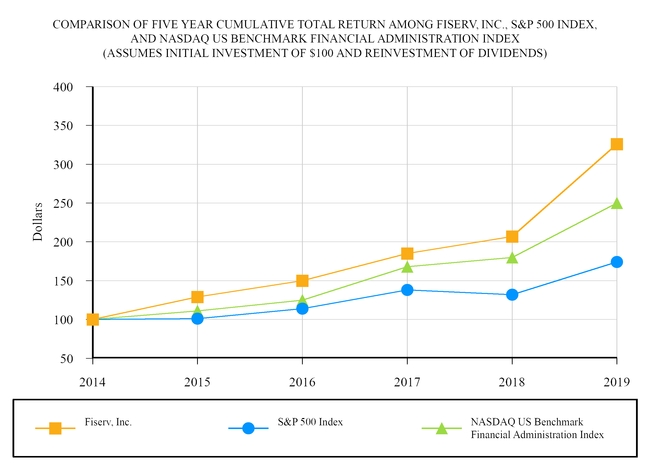
The following graph compares the cumulative total shareholder return on our common stock for the five years ended December 31, 2019 with the S&P 500 Index and the NASDAQ US Benchmark Financial Administration Index. The graph assumes that $100 was invested on December 31, 2014 in our common stock and each index and that all dividends were reinvested. No cash dividends have been declared on our common stock. The comparisons in the graph are required by the Securities and Exchange Commission and are not intended to forecast or be indicative of possible future performance of our common stock.
| December 31, | |||||||||||||||||||||||
| 2014 | 2015 | 2016 | 2017 | 2018 | 2019 | ||||||||||||||||||
| Fiserv, Inc. | $ | 100 | $ | 129 | $ | 150 | $ | 185 | $ | 207 | $ | 326 | |||||||||||
| S&P 500 Index | 100 | 101 | 114 | 138 | 132 | 174 | |||||||||||||||||
| NASDAQ US Benchmark Financial Administration Index | 100 | 111 | 125 | 168 | 180 | 250 |
Item 6. Selected Financial Data
The following data should be read in conjunction with the consolidated financial statements and accompanying notes and the sections entitled “Management’s Discussion and Analysis of Financial Condition and Results of Operations” contained in this Annual Report on Form 10-K. The selected historical data presented below has been affected by the First Data and other acquisitions, dispositions and transactional gains recorded by our unconsolidated affiliates, debt financing activities, foreign currency fluctuations, the tax effects related to share-based payment awards and by the Tax Cuts and Jobs Act enacted in December 2017. In addition, effective January 1, 2019, we adopted Accounting Standards Update (“ASU”) No. 2016-02, Leases (Topic 842), and its related amendments using the optional transition method applied to all leases. Under this transition approach, prior period amounts have not been restated. Effective January 1, 2018, we adopted ASU No. 2014-09, Revenue from Contracts with Customers, and its related amendments using the modified retrospective transition approach applied to all contracts. Under this transition approach, prior period amounts have not been restated. All per share amounts are presented on a split-adjusted basis to retroactively reflect the two-for-one stock split that was completed in the first quarter of 2018.
| (In millions, except per share data) | 2019 | 2018 | 2017 | 2016 | 2015 | ||||||||||||||
| Total revenue | $ | 10,187 | $ | 5,823 | $ | 5,696 | $ | 5,505 | $ | 5,254 | |||||||||
| Income from continuing operations | $ | 914 | $ | 1,187 | $ | 1,232 | $ | 930 | $ | 712 | |||||||||
| Income from discontinued operations, net of income taxes | — | — | 14 | — | — | ||||||||||||||
| Net income | 914 | 1,187 | 1,246 | 930 | 712 | ||||||||||||||
| Less: Net income attributable to noncontrolling interests | 21 | — | — | — | — | ||||||||||||||
| Net income attributable to Fiserv, Inc. | $ | 893 | $ | 1,187 | $ | 1,246 | $ | 930 | $ | 712 | |||||||||
| Net income attributable to Fiserv, Inc. per share - basic: | |||||||||||||||||||
| Continuing operations | $ | 1.74 | $ | 2.93 | $ | 2.92 | $ | 2.11 | $ | 1.52 | |||||||||
| Discontinued operations | — | — | 0.03 | — | — | ||||||||||||||
| Total | $ | 1.74 | $ | 2.93 | $ | 2.95 | $ | 2.11 | $ | 1.52 | |||||||||
| Net income attributable to Fiserv, Inc. per share - diluted: | |||||||||||||||||||
| Continuing operations | $ | 1.71 | $ | 2.87 | $ | 2.86 | $ | 2.08 | $ | 1.49 | |||||||||
| Discontinued operations | — | — | 0.03 | — | — | ||||||||||||||
| Total | $ | 1.71 | $ | 2.87 | $ | 2.89 | $ | 2.08 | $ | 1.49 | |||||||||
| Total assets | $ | 77,539 | $ | 11,262 | $ | 10,289 | $ | 9,743 | $ | 9,340 | |||||||||
| Long-term debt (including short-term and current maturities) | 21,899 | 5,959 | 4,900 | 4,562 | 4,293 | ||||||||||||||
| Fiserv, Inc. shareholders’ equity | 32,979 | 2,293 | 2,731 | 2,541 | 2,660 |
Item 7. Management’s Discussion and Analysis of Financial Condition and Results of Operations
Management’s discussion and analysis of financial condition and results of operations is provided as a supplement to our consolidated financial statements and accompanying notes to help provide an understanding of our financial condition, the changes in our financial condition and our results of operations. Our discussion is organized as follows:
| • | Overview. This section contains background information on our company and the services and products that we provide, acquisitions and dispositions, our enterprise priorities, and the trends affecting our industry in order to provide context for management’s discussion and analysis of our financial condition and results of operations. |
| • | Critical accounting policies and estimates. This section contains a discussion of the accounting policies that we believe are important to our financial condition and results of operations and that require judgment and estimates on the part of management in their application. In addition, all of our significant accounting policies, including critical accounting policies, are summarized in Note 1 to the accompanying consolidated financial statements. |
| • | Results of operations. This section contains an analysis of our results of operations presented in the accompanying consolidated statements of income by comparing the results for the year ended December 31, 2019 to the results |
for the year ended December 31, 2018 and by comparing the results for the year ended December 31, 2018 to the results for the year ended December 31, 2017.
| • | Liquidity and capital resources. This section provides an analysis of our cash flows and a discussion of our outstanding debt and commitments at December 31, 2019. |
Overview
Company Background
We are a leading global provider of financial services technology. We provide account processing systems; electronic payments processing products and services; internet and mobile banking systems; merchant transaction processing and acquiring, including the Clover® line of payment solutions and related applications; prepaid and payroll services; and check verification. We serve clients around the globe, including banks, credit unions, other financial institutions and merchants.
Our operations are comprised of the First Data segment, the Payments and Industry Products (“Payments”) segment and the Financial Institution Services (“Financial”) segment.
On July 29, 2019, we completed the acquisition of First Data Corporation (“First Data”), a global leader in commerce-enabling technology and solutions for merchants, financial institutions and card issuers. The First Data segment primarily provides merchant acquiring, e-commerce, mobile commerce, and other business solutions at the point-of-sale (“POS”) to businesses of all sizes and types; credit card and loan account processing, commercial payments, customer communications, plastics products and services, customer service, and other products to support issuers; and a range of network solutions and security, risk and fraud management products and services to business and financial institution clients, including U.S. debit card processing, our STAR® network, stored value commerce solutions (both closed-loop and open-loop), and our suite of security and fraud products and services. The businesses in the First Data segment are subject to a modest level of seasonality, with the first quarter experiencing the lowest level of revenue and the fourth quarter experiencing the highest level of revenue.
The Payments segment primarily provides electronic bill payment and presentment services, internet and mobile banking software and services, account-to-account transfers, person-to-person payment services, debit and credit card processing and services, payments infrastructure services, and other electronic payments software and services. Our businesses in this segment also provide card and print personalization services, and fraud and risk management products and services.
The Financial segment primarily provides financial institutions with account processing services, item processing and source capture services, loan origination and servicing products, cash management and consulting services, and other products and services that support numerous types of financial transactions. Our Payments and Financial segment operations are principally located in the U.S. The majority of our revenue within these segments is generated from recurring account- and transaction-based fees under multi-year contracts with high renewal rates. Most of the services we provide within our segments are necessary for our clients to operate their businesses and are, therefore, non-discretionary in nature.
Corporate and Other primarily consists of intercompany eliminations, amortization of acquisition-related intangible assets, unallocated corporate expenses of the combined company and other activities that are not considered when management evaluates segment performance, such as gains on sales of businesses and associated transition services. We expect to realign our business segments in the first quarter of 2020 when our new reporting structure and First Data integration plans are finalized.
On February 21, 2018, our board of directors declared a two-for-one stock split of our common stock and a proportionate increase in the number of our authorized shares of common stock. The additional shares were distributed on March 19, 2018 to shareholders of record at the close of business on March 5, 2018. Our common stock began trading at the split-adjusted price on March 20, 2018. All share and per share amounts are retroactively presented on a split-adjusted basis.
Acquisitions and Dispositions
We frequently review our portfolio to ensure we have the right set of businesses to execute on our strategy. We expect to acquire businesses when we identify: a compelling strategic need, such as a product, service or technology that helps meet client demand; an opportunity to change industry dynamics; a way to achieve business scale; or similar considerations. We expect to divest businesses that are not in line with our market, product or financial strategies.
Acquisitions
On July 29, 2019, we completed the acquisition of First Data Corporation for a total purchase price of $46.5 billion by acquiring 100% of the First Data stock that was issued and outstanding as of the date of acquisition. As a result of the
acquisition, First Data stockholders received 286 million shares of common stock of Fiserv, Inc., at an exchange ratio of 0.303 shares of Fiserv, Inc. for each share of First Data common stock, with cash paid in lieu of fractional shares. We also converted 15 million outstanding First Data equity awards into corresponding equity awards relating to common stock of Fiserv, Inc. in accordance with the exchange ratio. In addition, concurrent with the closing of the acquisition, we made a cash payment of $16.4 billion to repay existing First Data debt. We funded the transaction-related expenses and the repayment of First Data debt through a combination of available cash on-hand, proceeds from the issuance of senior notes and term loan and revolving credit facility borrowings. The acquisition of First Data increases our footprint as a global payments and financial technology provider by expanding the portfolio of services provided to financial institutions, corporate and merchant clients and consumers.
In October 2018, we acquired the debit card processing, ATM Managed Services, and MoneyPass® surcharge-free network of Elan Financial Services, a unit of U.S. Bancorp, for approximately $659 million including post-closing working capital adjustments, estimated contingent consideration related to earn-out provisions and future payments under a transition services agreement in excess of estimated fair value. This acquisiti
Showing the first 8K of 92K characters. Open the full section
Item 7A. Quantitative and Qualitative Disclosures About Market Risk
Market risk refers to the risk that a change in the level of one or more market prices, interest rates, currency exchange rates, indices, correlations or other market factors, such as liquidity, will result in losses for a certain financial instrument or group of financial instruments. We are exposed primarily to interest rate risk and market price risk on outstanding debt, investments of subscriber funds and foreign currency. Our senior management actively monitors these risks.
Interest Rate Risk
We manage our debt structure and interest rate risk through the use of fixed- and floating-rate debt. Based on our outstanding debt balances and interest rates at December 31, 2019, a 1% increase in variable interest rates would increase annual interest expense by approximately $48 million.
In connection with processing electronic payments transactions, the funds we receive from subscribers are invested into short-term, highly liquid investments from the time we collect the funds until payments are made to the applicable recipients. A 1% decrease in variable interest rates would decrease annual interest-related income related to settlement assets by approximately $32 million.
Foreign Currency Risk
We conduct business globally and are exposed to foreign currency risk from changes in the value of underlying assets and liabilities of our non-U.S. dollar-denominated foreign investments and foreign currency transactions. We manage the exposure to these risks through the use of foreign currency forward exchange contracts and non-derivative net investment hedges.
Our exposure to foreign currency exchange risks generally arise from our non-U.S. operations to the extent they are conducted in local currency. In 2019, approximately 12% of our total revenue was generated outside the U.S. The major currencies to which our revenues are exposed are the Euro, the British Pound, the Indian Rupee and the Argentine Peso. A movement of 10% in foreign currency rates against the U.S. dollar relative to the currencies in which our revenue and profits are denominated at
December 31, 2019, would have resulted in an increase or decrease in our reported pre-tax income, including the results of First Data from the date of acquisition, of approximately $25 million as follows:
| (In millions) | 2019 | ||||
| Euro | $ | 7 | |||
| British Pound | 4 | ||||
| Indian Rupee | 3 | ||||
| Argentine Peso | 2 | ||||
| Other | 9 | ||||
| Total increase or decrease | $ | 25 |
We have entered into foreign currency forward exchange contracts, which have been designated as cash flow hedges, to hedge foreign currency exposure to our operating costs in India. At December 31, 2019, the notional amount of these derivatives was approximately $178 million. In addition, we designated our foreign currency-denominated senior notes as net investment hedges to reduce exposure to changes in the value of our net investments in certain foreign subsidiaries due to changes in foreign currency exchange rates.
Item 8. Financial Statements and Supplementary Data
Index to Consolidated Financial Statements
Fiserv, Inc.
Consolidated Statements of Income
| In millions, except per share data | ||||||||||||
| Year ended December 31, | 2019 | 2018 | 2017 | |||||||||
| Revenue: | ||||||||||||
| Processing and services (1) | $ | 8,573 | $ | 4,975 | $ | 4,833 | ||||||
| Product | 1,614 | 848 | 863 | |||||||||
| Total revenue | 10,187 | 5,823 | 5,696 | |||||||||
| Expenses: | ||||||||||||
| Cost of processing and services | 4,016 | 2,324 | 2,291 | |||||||||
| Cost of product | 1,293 | 745 | 733 | |||||||||
| Selling, general and administrative | 3,284 | 1,228 | 1,150 | |||||||||
| Gain on sale of businesses | (15 | ) | (227 | ) | (10 | ) | ||||||
| Total expenses | 8,578 | 4,070 | 4,164 | |||||||||
| Operating income | 1,609 | 1,753 | 1,532 | |||||||||
| Interest expense, net | (473 | ) | (189 | ) | (175 | ) | ||||||
| Debt financing activities | (47 | ) | (14 | ) | — | |||||||
| Other (expense) income | (6 | ) | 5 | 1 | ||||||||
| Income from continuing operations before income taxes and income from investments in unconsolidated affiliates | 1,083 | 1,555 | 1,358 | |||||||||
| Income tax provision | (198 | ) | (378 | ) | (158 | ) | ||||||
| Income from investments in unconsolidated affiliates | 29 | 10 | 32 | |||||||||
| Income from continuing operations | 914 | 1,187 | 1,232 | |||||||||
| Income from discontinued operations, net of income taxes | — | — | 14 | |||||||||
| Net income | 914 | 1,187 | 1,246 | |||||||||
| Less: Net income attributable to noncontrolling interests and redeemable noncontrolling interests | 21 | — | — | |||||||||
| Net income attributable to Fiserv, Inc. | $ | 893 | $ | 1,187 | $ | 1,246 | ||||||
| Net income attributable to Fiserv, Inc. per share - basic: | ||||||||||||
| Continuing operations | $ | 1.74 | $ | 2.93 | $ | 2.92 | ||||||
| Discontinued operations | — | — | 0.03 | |||||||||
| Total | $ | 1.74 | $ | 2.93 | $ | 2.95 | ||||||
| Net income attributable to Fiserv, Inc. per share - diluted: | ||||||||||||
| Continuing operations | $ | 1.71 | $ | 2.87 | $ | 2.86 | ||||||
| Discontinued operations | — | — | 0.03 | |||||||||
| Total | $ | 1.71 | $ | 2.87 | $ | 2.89 | ||||||
| Shares used in computing net income attributable to Fiserv, Inc. per share: | ||||||||||||
| Basic | 512.3 | 405.5 | 422.3 | |||||||||
| Diluted | 522.6 | 413.7 | 431.3 |
| (1) | Includes processing and other fees charged to related party investments accounted for under the equity method of $112 million, $28 million and $0 million for the years ended December 31, 2019, 2018 and 2017, respectively (see Notes 9 and 20). |
See accompanying notes to consolidated financial statements.
Fiserv, Inc.
Consolidated Statements of Comprehensive Income
| In millions | ||||||||||||
| Year ended December 31, | 2019 | 2018 | 2017 | |||||||||
| Net income | $ | 914 | $ | 1,187 | $ | 1,246 | ||||||
| Other comprehensive (loss) income: | ||||||||||||
| Fair market value adjustment on cash flow hedges, net of income tax (benefit) provision of ($46 million), ($2 million) and $2 million | (134 | ) | (5 | ) | 4 | |||||||
| Reclassification adjustment for net realized gains on cash flow hedges included in cost of processing and services, net of income tax benefit of $0 and $0 | (1 | ) | (1 | ) | — | |||||||
| Reclassification adjustment for net realized losses on cash flow hedges included in net interest expense, net of income tax provision of $3 million, $2 million and $4 million | 10 | 4 | 6 | |||||||||
| Unrealized loss on defined benefit pension plans, net of income tax benefit of $1 million | (4 | ) | — | — | ||||||||
| Foreign currency translation | 8 | (11 | ) | 12 | ||||||||
| Total other comprehensive (loss) income | (121 | ) | (13 | ) | 22 | |||||||
| Comprehensive income | $ | 793 | $ | 1,174 | $ | 1,268 | ||||||
| Less: Net income attributable to noncontrolling interests and redeemable noncontrolling interests | 21 | — | — | |||||||||
| Less: Other comprehensive loss attributable to noncontrolling interests | (8 | ) | — | — | ||||||||
| Comprehensive income attributable to Fiserv, Inc. | $ | 780 | $ | 1,174 | $ | 1,268 |
See accompanying notes to consolidated financial statements.
Fiserv, Inc.
Consolidated Balance Sheets
| In millions | ||||||||
| December 31, | 2019 | 2018 | ||||||
| Assets | ||||||||
| Cash and cash equivalents | $ | 893 | $ | 415 | ||||
| Trade accounts receivable, less allowance for doubtful accounts | 2,782 | 1,049 | ||||||
| Prepaid expenses and other current assets | 1,503 | 274 | ||||||
| Settlement assets | 11,868 | 486 | ||||||
| Total current assets | 17,046 | 2,224 | ||||||
| Property and equipment, net | 1,606 | 398 | ||||||
| Customer relationships, net | 14,042 | 1,348 | ||||||
| Other intangible assets, net | 3,600 | 795 | ||||||
| Goodwill | 36,038 | 5,702 | ||||||
| Contract costs, net | 533 | 419 | ||||||
| Investments in unconsolidated affiliates | 2,720 | 65 | ||||||
| Other long-term assets | 1,954 | 311 | ||||||
| Total assets | $ | 77,539 | $ | 11,262 | ||||
| Liabilities and Equity | ||||||||
| Accounts payable and accrued expenses | $ | 3,080 | $ | 1,146 | ||||
| Short-term and current maturities of long-term debt | 287 |
Showing the first 8K of 230K characters. Open the full section
Item 9. Changes in and Disagreements with Accountants on Accounting and Financial Disclosure
Not applicable.
Item 9A. Controls and Procedures
| (a) | Disclosure Controls and Procedures |
Our management, with the participation of our chief executive officer and chief financial officer, evaluated the design and operation of our disclosure controls and procedures (as defined in Rules 13a-15(e) and 15d-15(e) under the Securities Exchange Act of 1934). Based on this evaluation, our chief executive officer and chief financial officer concluded that our disclosure controls and procedures were effective as of December 31, 2019.
| (b) | Management Report on Internal Control Over Financial Reporting |
Management’s Annual Report on Internal Control Over Financial Reporting
Our management is responsible for establishing and maintaining adequate internal control over financial reporting, as such term is defined in Rule 13a-15(f) under the Securities Exchange Act of 1934. Our internal control over financial reporting is designed to provide reasonable assurance regarding the reliability of financial reporting and the preparation of financial statements for external purposes in accordance with generally accepted accounting principles.
Because of its inherent limitations, internal control over financial reporting may not prevent or detect misstatements. Also, projections of any evaluation of effectiveness to future periods are subject to risk that controls may become inadequate because of changes in conditions.
Our management assessed the effectiveness of our internal control over financial reporting as of December 31, 2019. In making this assessment, management used the criteria set forth by the Committee of Sponsoring Organizations of the Treadway Commission in Internal Control – Integrated Framework (2013). Based on management’s assessment, our management believes that, as of December 31, 2019, our internal control over financial reporting was effective based on those criteria.
On July 29, 2019, we acquired First Data (see Note 4 “Acquisitions and Dispositions” to the accompanying consolidated financial statements for additional information). As a result of the timing of the acquisition and as permitted by the Securities and Exchange Commission, we have excluded internal controls at First Data from our assessment of the internal control over financial reporting as of December 31, 2019. Total assets and revenue of First Data that were excluded from our assessment constitute 26% and 40%, respectively, of our consolidated financial statement amounts as of and for the year ended December 31, 2019. We are in the process of integrating the acquired business into our existing operations and evaluating the internal controls over financial reporting of the acquired business.
Our independent registered public accounting firm has issued their attestation report on our internal control over financial reporting. The report is included below under the heading “Report of Independent Registered Public Accounting Firm on Internal Control Over Financial Reporting.”
| (c) | Changes in Internal Control Over Financial Reporting |
During the year ended December 31, 2019, we acquired First Data. As part of our ongoing integration activities, we are incorporating our controls and procedures into this recently acquired business concurrent with the augmentation of our Company-wide controls. Other than the changes that have and may continue to result from the integration activities described above, there were no other changes in internal control over financial reporting that occurred during the quarter ended December 31, 2019 that have materially affected, or are reasonably likely to materially affect, our internal control over financial reporting.
| (d) | Report of Independent Registered Public Accounting Firm on Internal Control Over Financial Reporting |
Our independent registered public accounting firm, Deloitte & Touche LLP, assessed the effectiveness of our internal control over financial reporting and has issued their report as set forth below.
REPORT OF INDEPENDENT REGISTERED PUBLIC ACCOUNTING FIRM
To the Board of Directors and Shareholders of Fiserv, Inc.:
Opinion on Internal Control over Financial Reporting
We have audited the internal control over financial reporting of Fiserv, Inc. and subsidiaries (the “Company”) as of December 31, 2019, based on criteria established in Internal Control - Integrated Framework (2013) issued by the Committee of Sponsoring Organizations of the Treadway Commission (COSO). In our opinion, the Company maintained, in all material respects, effective internal control over financial reporting as of December 31, 2019, based on criteria established in Internal Control - Integrated Framework (2013) issued by COSO.
We have also audited, in accordance with the standards of the Public Company Accounting Oversight Board (United States) (PCAOB), the consolidated financial statements as of and for the year ended December 31, 2019, of the Company and our report dated February 27, 2020, expressed an unqualified opinion on those financial statements and included explanatory paragraphs regarding the Company’s adoption of new accounting standards.
As described in Management’s Annual Report on Internal Control Over Financial Reporting, management excluded from its assessment the internal control over financial reporting at First Data, which was acquired on July 29, 2019, and whose financial statements constitute 26% of total assets and 40% of total revenue of the consolidated financial statement amounts as of and for the year ended December 31, 2019. Accordingly, our audit did not include the internal control over financial reporting at First Data.
Basis for Opinion
The Company’s management is responsible for maintaining effective internal control over financial reporting and for its assessment of the effectiveness of internal control over financial reporting, included in the accompanying Management’s Annual Report on Internal Control Over Financial Reporting. Our responsibility is to express an opinion on the Company’s internal control over financial reporting based on our audit. We are a public accounting firm registered with the PCAOB and are required to be independent with respect to the Company in accordance with the U.S. federal securities laws and the applicable rules and regulations of the Securities and Exchange Commission and the PCAOB.
We conducted our audit in accordance with the standards of the PCAOB. Those standards require that we plan and perform the audit to obtain reasonable assurance about whether effective internal control over financial reporting was maintained in all material respects. Our audit included obtaining an understanding of internal control over financial reporting, assessing the risk that a material weakness exists, testing and evaluating the design and operating effectiveness of internal control based on the assessed risk, and performing such other procedures as we considered necessary in the circumstances. We believe that our audit provides a reasonable basis for our opinion.
Definition and Limitations of Internal Control over Financial Reporting
A company’s internal control over financial reporting is a process designed to provide reasonable assurance regarding the reliability of financial reporting and the preparation of financial statements for external purposes in accordance with generally accepted accounting principles. A company’s internal control over financial reporting includes those policies and procedures that (1) pertain to the maintenance of records that, in reasonable detail, accurately and fairly reflect the transactions and dispositions of the assets of the company; (2) provide reasonable assurance that transactions are recorded as necessary to permit preparation of financial statements in accordance with generally accepted accounting principles, and that receipts and expenditures of the company are being made only in accordance with authorizations of management and directors of the company; and (3) provide reasonable assurance regarding prevention or timely detection of unauthorized acquisition, use, or disposition of the company’s assets that could have a material effect on the financial statements.
Because of its inherent limitations, internal control over financial reporting may not prevent or detect misstatements. Also, projections of any evaluation of effectiveness to future periods are subject to the risk that controls may become inadequate because of changes in conditions, or that the degree of compliance with the policies or procedures may deteriorate.
/s/ Deloitte & Touche LLP
Milwaukee, Wisconsin
February 27, 2020
Item 9B. Other Information
None.
PART III
Item 10. Directors, Executive Officers and Corporate Governance
Except for information concerning our executive officers included in Part I of this Form 10-K under the caption “Information About Our Executive Officers,” which is incorporated by reference herein, and the information regarding our Code of Conduct below, the information required by Item 10 is incorporated by reference to the information set forth under the captions “Our Board of Directors,” “Nominees for Election,” “Corporate Governance – Committees of the Board of Directors – Audit Committee,” and “Corporate Governance – Nominations of Directors” in our definitive proxy statement for our 2020 annual meeting of shareholders, which will be filed with the Securities and Exchange Commission no later than 120 days after the close of the fiscal year ended December 31, 2019.
Our board of directors has adopted a Code of Conduct and Business Ethics (“Code of Conduct”) that applies to all of our directors and our chief executive officer, chief financial officer, chief accounting officer and other persons performing similar functions as well as our other executive officers. The Code of Conduct also applies to our other employees except for a group of First Data employees who remain subject to the First Data Code of Conduct, which has also been adopted by our board of directors. We have posted a copy of our Code of Conduct and the First Data Code of Conduct on the “About – Investor Relations – Corporate Governance – Governance Documents” section of our website at www.fiserv.com. We intend to satisfy the disclosure requirements under Item 5.05 of Form 8-K regarding amendments to, or waivers from, the Code of Conduct by posting such information on the “About – Investor Relations” section of our website at www.fiserv.com. We are not including the information contained on our website as part of, or incorporating it by reference into, this report.
Item 11. Executive Compensation
The information required by Item 11 is incorporated by reference to the information set forth under the captions “Director Compensation,” “Compensation Discussion and Analysis,” “Compensation Committee Report,” “Compensation Committee Interlocks and Insider Participation,” “Executive Compensation,” and “Pay Ratio” in our definitive proxy statement for our 2020 annual meeting of shareholders, which will be filed with the Securities and Exchange Commission no later than 120 days after the close of the fiscal year ended December 31, 2019.
Item 12. Security Ownership of Certain Beneficial Owners and Management and Related Stockholder Matters
The information set forth under the caption “Security Ownership of Certain Beneficial Owners and Management” in our definitive proxy statement for our 2020 annual meeting of shareholders, which will be filed with the Securities and Exchange Commission no later than 120 days after the close of the fiscal year ended December 31, 2019, is incorporated by reference herein.
Equity Compensation Plan Information
The table below sets forth information with respect to compensation plans under which equity securities are authorized for issuance as of December 31, 2019.
| (a) | (b) | (c) | |
| Plan Category | Number of shares to be issued upon exercise of outstanding options, warrants and rights | Weighted-average exercise price of outstanding options, warrants and rights | Number of shares remaining available for future issuance under equity compensation plans (excluding securities reflected in column (a)) |
| Equity compensation plans approved by our shareholders (1) | 11,175,475 (2) | 43.34 (3) | 33,193,365 (4) |
| Equity compensation plans not approved by our shareholders | N/A | N/A | N/A |
| Total (5) | 11,175,475 (2) | 43.34 (3) | 33,193,365 (4) |
| (1) | Columns (a) and (c) of the table above do not include 1,561,995 unvested restricted stock units outstanding under the Amended and Restated Fiserv, Inc. 2007 Omnibus Incentive Plan (the “Incentive Plan”) or 24,744,268 shares authorized for issuance under the Fiserv, Inc. Amended and Restated Employee Stock Purchase Plan. |
| (2) | Consists of options outstanding under the Incentive Plan; 102,048 shares subject to performance share units under the Incentive Plan at the actual award level where the conditions to vesting have been satisfied; 1,204,174 shares subject to performance share units under the Incentive Plan at the target award level where the conditions to vesting have not yet been satisfied; and 97,361 shares subject to non-employee director deferred compensation notional units under the Incentive Plan. |
| (3) | Represents the weighted-average exercise price of outstanding options under the Incentive Plan and does not take into account outstanding performance share units or non-employee director deferred compensation notional units under the Incentive Plan. |
| (4) | Reflects the number of shares available for future issuance under the Incentive Plan. |
| (5) | This table does not include 6,216,518 options outstanding under the 2007 Stock Incentive Plan for Key Employees of First Data Corporation and its Affiliates (the “2007 First Data Plan”) and the First Data Corporation 2015 Omnibus Incentive Plan (the “2015 First Data Plan” and together with the 2007 First Data Plan, the “First Data Plans”) as of December 31, 2019 at a weighted-average exercise price of $42.04. We assumed the First Data Plans in connection with our acquisition of First Data Corporation on July 29, 2019 and converted certain outstanding First Data equity awards into corresponding equity awards relating to common stock of Fiserv, Inc. in accordance with an exchange ratio in the merger agreement as further described in Note 4 to the accompanying consolidated financial statements. This table also does not include 6,279,096 shares of restricted stock and restricted stock units outstanding under the 2015 First Data Plan, as of December 31, 2019. No additional equity awards will be made under the First Data Plans. |
Item 13. Certain Relationships and Related Transactions, and Director Independence
The information required by Item 13 is incorporated by reference to the information set forth under the captions “Corporate Governance – Director Independence,” and “Corporate Governance – Review, Approval or Ratification of Transactions with Related Persons,” in our definitive proxy statement for our 2020 annual meeting of shareholders, which will be filed with the Securities and Exchange Commission no later than 120 days after the close of the fiscal year ended December 31, 2019.
Item 14. Principal Accounting Fees and Services
The information required by Item 14 is incorporated by reference to the information set forth under the captions “Independent Registered Public Accounting Firm and Fees” and “Audit Committee Pre-Approval Policy” in our definitive proxy statement for our 2020 annual meeting of shareholders, which will be filed with the Securities and Exchange Commission no later than 120 days after the close of the fiscal year ended December 31, 2019.
PART IV
Item 15. Exhibits, Financial Statement Schedules
Financial Statement Schedules
Financial statement schedules have been omitted because they are not applicable or the required information is shown in the consolidated financial statements or accompanying notes.
Exhibits
The exhibits listed in the accompanying exhibit index are filed as part of this Annual Report on Form 10-K.
EXHIBIT INDEX
| 31.1 | Certification of the Chief Executive Officer pursuant to Section 302 of the Sarbanes-Oxley Act of 2002 | |
| 31.2 | Certification of the Chief Financial Officer pursuant to Section 302 of the Sarbanes‑Oxley Act of 2002 | |
| 32.1 | Certification of the Chief Executive Officer and the Chief Financial Officer pursuant to Section 906 of the Sarbanes-Oxley Act of 2002 | |
| 101.INS** | Inline XBRL Instance Document - The XBRL Instance Document does not appear in the interactive data file because its XBRL tags are embedded within the Inline XBRL document. | |
| 101.SCH** | Inline XBRL Taxonomy Extension Schema Document | |
| 101.CAL** | Inline XBRL Taxonomy Extension Calculation Linkbase Document | |
| 101.DEF** | Inline XBRL Taxonomy Extension Definition Linkbase Document | |
| 101.LAB** | Inline XBRL Taxonomy Extension Label Linkbase Document | |
| 101.PRE** | Inline XBRL Taxonomy Extension Presentation Linkbase Document | |
| 104 | Cover Page Interactive Data File (formatted as Inline XBRL and contained in Exhibit 101) |
_____
- This exhibit is a management contract or compensatory plan or arrangement.
| ** | Filed with this Annual Report on Form 10-K are the following documents formatted in iXBRL (Inline Extensible Business Reporting Language): (i) the Consolidated Statements of Income for the years ended December 31, 2019, 2018, and 2017, (ii) the Consolidated Statements of Comprehensive Income for the years ended December 31, 2019, 2018, and 2017, (iii) the Consolidated Balance Sheets at December 31, 2019 and 2018, (iv) the Consolidated Statements of Equity for the years ended December 31, 2019, 2018, and 2017, (v) the Consolidated Statements of Cash Flows for the years ended December 31, 2019, 2018, and 2017, and (vi) Notes to Consolidated Financial Statements. |
| (1) | Previously filed as an exhibit to the Company’s Current Report on Form 8-K filed on January 18, 2019, and incorporated herein by reference. |
| (2) | Previously filed as an exhibit to the Company’s Current Report on Form 8-K filed on February 27, 2018, and incorporated herein by reference. |
| (3) | Previously filed as an exhibit to the Company’s Current Report on Form 8-K filed on July 29, 2019, and incorporated herein by reference. |
| (4) | Previously filed as an exhibit to the Company’s Current Report on Form 8-K filed on September 20, 2018, and incorporated herein by reference. |
| (5) | Previously filed as an exhibit to the Company’s Current Report on Form 8-K filed on February 7, 2019, and incorporated herein by reference. |
| (6) | Previously filed as an exhibit to the Company’s Annual Report on Form 10-K filed on February 21, 2019, and incorporated herein by reference. |
| (7) | Previously filed as an exhibit to the Company’s Registration Statement on Form S-3 (File No. 333‑147309) filed on November 13, 2007, and incorporated herein by reference. |
| (8) | Previously filed as an exhibit to the Company’s Current Report on Form 8-K filed on June 14, 2011, and incorporated herein by reference. |
| (9) | Previously filed as an exhibit to the Company’s Current Report on Form 8-K filed on September 25, 2012, and incorporated herein by reference. |
| (10) | Previously filed as an exhibit to the Company’s Current Report on Form 8-K filed on May 22, 2015, and incorporated herein by reference. |
| (11) | Previously filed as an exhibit to the Company’s Current Report on Form 8-K filed on September 25, 2018, and incorporated herein by reference. |
| (12) | Previously filed as an exhibit to the Company’s Current Report on Form 8-K filed on June 24, 2019, and incorporated herein by reference. |
| (13) | Previously filed as an exhibit to the Company’s Current Report on Form 8-K filed on July 1, 2019, and incorporated herein by reference. |
| (14) | Previously filed as an exhibit to the Company’s Current Report on Form 8-K filed on September 9, 2019, and incorporated herein by reference. |
| (15) | Previously filed as an exhibit to the Company’s Quarterly Report on Form 10-Q filed on May 2, 2018, and incorporated herein by reference. |
| (16) | Previously filed as an exhibit to the Company’s Annual Report on Form 10-K filed on February 24, 2012, and incorporated herein by reference. |
| (17) | Previously filed as an exhibit to the Company’s Annual Report on Form 10-K filed on February 23, 2017, and incorporated herein by reference. |
| (18) | Previously filed as an exhibit to the Company’s Annual Report on Form 10-K filed on February 20, 2015, and incorporated herein by reference. |
| (19) | Previously filed as an exhibit to the Company’s Quarterly Report on Form 10-Q filed on August 2, 2017, and incorporated herein by reference. |
| (20) | Previously filed as an exhibit to the Company’s Current Report on Form 8-K filed on December 1, 2017, and incorporated herein by reference. |
| (21) | Previously filed as an exhibit to the Company’s Post-Effective Amendment No. 1 on Form S-8 to the Form S-4 Registration Statement of Fiserv, Inc. filed July 29, 2019, and incorporated herein by reference. |
| (22) | Previously filed as an exhibit to the Company’s Quarterly Report on Form 10-Q filed on November 7, 2019, and incorporated herein by reference. |
| (23) | Previously filed as an exhibit to the Company’s Current Report on Form 8-K filed on December 23, 2008, and incorporated herein by reference. |
| (24) | Previously filed as an exhibit to the Company’s Annual Report on Form 10-K filed on February 27, 2009, and incorporated herein by reference. |
| (25) | Previously filed as an exhibit to the Company’s Current Report on Form 8-K filed on December 30, 2009, and incorporated herein by reference. |
| (26) | Previously filed as an exhibit to the Company’s Current Report on Form 8-K filed on April 1, 2016, and incorporated herein by reference. |
| (27) | Previously filed as an exhibit to the Company’s Quarterly Report on Form 10-Q filed on October 30, 2013, and incorporated herein by reference. |
| (28) | Previously filed as an exhibit to the Company’s Annual Report on Form 10-K filed on February 20, 2014, and incorporated herein by reference. |
| (29) | Previously filed as an exhibit to the Company’s Current Report on Form 8-K filed on February 16, 2016, and incorporated herein by reference. |
| (30) | Previously filed as an exhibit to the Company’s Quarterly Report on Form 10-Q filed on May 6, 2016, and incorporated herein by reference. |
| (31) | Previously filed as an exhibit to First Data Corporation’s Annual Report on Form 10-K filed on February 27, 2015 and incorporated herein by reference. |
| (32) | Previously filed as an exhibit to the Company’s Annual Report on Form 10-K filed on February 28, 2008, and incorporated herein by reference. |
Item 16. Form 10-K Summary
None.
SIGNATURES
Pursuant to the requirements of Section 13 or 15(d) of the Securities Exchange Act of 1934, the registrant has duly caused this report to be signed on its behalf by the undersigned, thereunto duly authorized on February 27, 2020.
| FISERV, INC. | ||
| By: | /s/ Jeffery W. Yabuki | |
| Jeffery W. Yabuki | ||
| Chairman and Chief Executive Officer |
Pursuant to the requirements of the Securities Exchange Act of 1934, this report has been signed below by the following persons on behalf of the registrant and in the capacities indicated on February 27, 2020.
| Name | Capacity | |
| /s/ Jeffery W. Yabuki | Chairman and Chief Executive Officer (Principal Executive Officer) | |
| Jeffery W. Yabuki | ||
| /s/ Robert W. Hau | Chief Financial Officer and Treasurer (Principal Financial Officer) | |
| Robert W. Hau | ||
| /s/ Kenneth F. Best | Chief Accounting Officer (Principal Accounting Officer) | |
| Kenneth F. Best | ||
| /s/ Frank J. Bisignano | President and Chief Operating Officer, Director | |
| Frank J. Bisignano | ||
| /s/ Alison Davis | Director | |
| Alison Davis | ||
| /s/ Henrique De Castro | Director | |
| Henrique De Castro | ||
| /s/ Harry F. DiSimone | Director | |
| Harry F. DiSimone | ||
| /s/ Dennis F. Lynch | Director | |
| Dennis F. Lynch | ||
| /s/ Heidi G. Miller | Director | |
| Heidi G. Miller | ||
| /s/ Scott C. Nuttall | Director | |
| Scott C. Nuttall | ||
| /s/ Denis J. O’Leary | Director | |
| Denis J. O’Leary | ||
| /s/ Doyle R. Simons | Director | |
| Doyle R. Simons | ||