 filings.tools
Fifth Third Bancorp 10-K 2021-12-31
Filed 2022-02-25. 22 sections, 1211K characters. Original on sec.gov · Markdown · JSON
Cover and table of contents
UNITED STATES
SECURITIES AND EXCHANGE COMMISSION
Washington, D.C. 20549
FORM 10-K
ANNUAL REPORT PURSUANT TO SECTION 13 OR 15(d) OF
THE SECURITIES EXCHANGE ACT OF 1934
For the fiscal year ended December 31, 2021
Commission File Number 001-33653

(Exact name of Registrant specified in its charter)
| Ohio | 31-0854434 | ||||
| (State or other jurisdiction of incorporation or organization) | (I.R.S. Employer Identification Number) |
38 Fountain Square Plaza
Cincinnati, Ohio 45263
(Address of principal executive offices)
Registrant's telephone number, including area code: (800) 972-3030
Securities registered pursuant to Section 12(b) of the Act:
| Title of each class: | Trading Symbol(s): | Name of each exchange on which registered: | ||||||||||||||||||
| Common Stock, Without Par Value | FITB | The | NASDAQ | Stock Market LLC | ||||||||||||||||
| Depositary Shares Representing a 1/1000th Ownership Interest in a Share of | ||||||||||||||||||||
| 6.625% Fixed-to-Floating Rate Non-Cumulative Perpetual Preferred Stock, Series I | FITBI | The | NASDAQ | Stock Market LLC | ||||||||||||||||
| Depositary Shares Representing a 1/40th Ownership Interest in a Share of | ||||||||||||||||||||
| 6.00% Non-Cumulative Perpetual Class B Preferred Stock, Series A | FITBP | The | NASDAQ | Stock Market LLC | ||||||||||||||||
| Depositary Shares Representing a 1/1000th Ownership Interest in a Share of | ||||||||||||||||||||
| 4.95% Non-Cumulative Perpetual Preferred Stock, Series K | FITBO | The | NASDAQ | Stock Market LLC |
Indicate by check mark if the registrant is a well-known seasoned issuer, as defined in Rule 405 of the Securities Act. Yes: ☒ No: ☐
Indicate by check mark if the registrant is not required to file reports pursuant to Section 13 or Section 15(d) of the Act. Yes: ☐ No: ☒
Indicate by check mark whether the registrant (1) has filed all reports required to be filed by Section 13 or 15(d) of the Securities Exchange Act of 1934 during the preceding 12 months (or for such shorter period that the registrant was required to file such reports), and (2) has been subject to such filing requirements for the past 90 days. Yes: ☒ No: ☐
Indicate by check mark whether the registrant has submitted electronically every Interactive Data File required to be submitted pursuant to Rule 405 of Regulation S-T (§232.405 of this chapter) during the preceding 12 months (or for such shorter period that the registrant was required to submit such files). Yes: ☒ No: ☐
Indicate by check mark whether the registrant is a large accelerated filer, an accelerated filer, a non-accelerated filer, a smaller reporting company or an emerging growth company. See definitions of “large accelerated filer,” “accelerated filer,” “smaller reporting company” and “emerging growth company” in Rule 12b-2 of the Exchange Act.
Large accelerated filer ☒ Accelerated filer ☐ Non-accelerated filer ☐ Smaller reporting company ☐ Emerging growth company ☐
If an emerging growth company, indicate by check mark if the registrant has elected not to use the extended transition period for complying with any new or revised financial accounting standards provided pursuant to Section 13(a) of the Exchange Act. ☐
Indicate by check mark whether the registrant has filed a report on and attestation to its management’s assessment of the effectiveness of its internal control over financial reporting under Section 404(b) of the Sarbanes-Oxley Act (15 U.S.C. 7262(b)) by the registered public accounting firm that prepared or issued its audit report. ☒
Indicate by check mark whether the registrant is a shell company (as defined in Rule 12b-2 of the Act). Yes: ☐ No: ☒
There were 683,679,363 shares of the Bancorp’s Common Stock, without par value, outstanding as of January 31, 2022. The Aggregate Market Value of the Voting Stock held by non-affiliates of the Bancorp was $23,662,337,082 as of June 30, 2021.
17 Fifth Third Bancorp
DOCUMENTS INCORPORATED BY REFERENCE
This report incorporates into a single document the requirements of the U.S. Securities and Exchange Commission (the “SEC”) with respect to annual reports on Form 10-K and annual reports to shareholders. Sections of the Bancorp’s Proxy Statement for the 2022 Annual Meeting of Shareholders are incorporated by reference into Part III of this report.
Only those sections of this 2021 Annual Report to Shareholders that are specified in this Cross Reference Index constitute part of the registrant’s Form 10-K for the year ended December 31, 2021. No other information contained in this 2021 Annual Report to Shareholders shall be deemed to constitute any part of this Form 10-K nor shall any such information be incorporated into the Form 10-K and shall not be deemed “filed” as part of the registrant’s Form 10-K.
10-K CROSS REFERENCE INDEX
18 Fifth Third Bancorp
FORWARD-LOOKING STATEMENTS
This report contains statements that we believe are “forward-looking statements” within the meaning of Section 27A of the Securities Act of 1933, as amended, and Rule 175 promulgated thereunder, and Section 21E of the Securities Exchange Act of 1934, as amended, and Rule 3b-6 promulgated thereunder. All statements other than statements of historical fact are forward-looking statements. These statements relate to our financial condition, results of operations, plans, objectives, future performance, capital actions or business. They usually can be identified by the use of forward-looking language such as “will likely result,” “may,” “are expected to,” “is anticipated,” “potential,” “estimate,” “forecast,” “projected,” “intends to,” or may include other similar words or phrases such as “believes,” “plans,” “trend,” “objective,” “continue,” “remain,” or similar expressions, or future or conditional verbs such as “will,” “would,” “should,” “could,” “might,” “can,” or similar verbs. You should not place undue reliance on these statements, as they are subject to risks and uncertainties, including but not limited to the risk factors set forth in the Risk Factors section in Item 1A in this Annual Report on Form 10-K. When considering these forward-looking statements, you should keep in mind these risks and uncertainties, as well as any cautionary statements we may make. Moreover, you should treat these statements as speaking only as of the date they are made and based only on information then actually known to us. We undertake no obligation to release revisions to these forward-looking statements or reflect events or circumstances after the date of this document. There are a number of important factors that could cause future results to differ materially from historical performance and these forward-looking statements. Factors that might cause such a difference include, but are not limited to: (1) effects of the global COVID-19 pandemic; (2) deteriorating credit quality; (3) loan concentration by location or industry of borrowers or collateral; (4) problems encountered by other financial institutions; (5) inadequate sources of funding or liquidity; (6) unfavorable actions of rating agencies; (7) inability to maintain or grow deposits; (8) limitations on the ability to receive dividends from subsidiaries; (9) cyber-security risks; (10) Fifth Third’s ability to secure confidential information and deliver products and services through the use of computer systems and telecommunications networks; (11) failures by third-party service providers; (12) inability to manage strategic initiatives and/or organizational changes; (13) inability to implement technology system enhancements; (14) failure of internal controls and other risk management systems; (15) losses related to fraud, theft, misappropriation or violence; (16) inability to attract and retain skilled personnel; (17) adverse impacts of government regulation; (18) governmental or regulatory changes or other actions; (19) failures to meet applicable capital requirements; (20) regulatory objections to Fifth Third’s capital plan; (21) regulation of Fifth Third’s derivatives activities; (22) deposit insurance premiums; (23) assessments for the orderly liquidation fund; (24) replacement of LIBOR; (25) weakness in the national or local economies; (26) global political and economic uncertainty or negative actions; (27) changes in interest rates; (28) changes and trends in capital markets; (29) fluctuation of Fifth Third’s stock price; (30) volatility in mortgage banking revenue; (31) litigation, investigations, and enforcement proceedings by governmental authorities; (32) breaches of contractual covenants, representations and warranties; (33) competition and changes in the financial services industry; (34) changing retail distribution strategies, customer preferences and behavior; (35) difficulties in identifying, acquiring or integrating suitable strategic partnerships, investments or acquisitions; (36) potential dilution from future acquisitions; (37) loss of income and/or difficulties encountered in the sale and separation of businesses, investments or other assets; (38) results of investments or acquired entities; (39) changes in accounting standards or interpretation or declines in the value of Fifth Third’s goodwill or other intangible assets; (40) inaccuracies or other failures from the use of models; (41) effects of critical accounting policies and judgments or the use of inaccurate estimates; (42) weather-related events, other natural disasters, or health emergencies (including pandemics); (43) the impact of reputational risk created by these or other developments on such matters as business generation and retention, funding and liquidity; (44) changes in law or requirements imposed by Fifth Third’s regulators impacting our capital actions, including dividend payments and stock repurchases; and (45) Fifth Third’s ability to meet its sustainability targets, goals and commitments. We expressly disclaim any obligation or undertaking to release publicly any updates or revisions to any forward-looking statements contained herein to reflect any change in our expectations or any changes in events, conditions or circumstances on which any such statement is based, except as may be required by law, and we claim the protection of the safe harbor for forward-looking statements contained in the Private Securities Litigation Reform Act of 1995. The information contained herein is intended to be reviewed in its totality, and any stipulations, conditions or provisos that apply to a given piece of information in one part of this report should be read as applying mutatis mutandis to every other instance of such information appearing herein.
19 Fifth Third Bancorp
PART I
Item 1. BUSINESS
General Information
Fifth Third Bancorp (the “Bancorp” or “Fifth Third”), an Ohio corporation organized in 1975, is a bank holding company (“BHC”) as defined by the Bank Holding Company Act of 1956, as amended (the “BHCA”), and has elected to be treated as a financial holding company (“FHC”) under the Gramm-Leach-Bliley Act of 1999 (“GLBA”) and regulations of the Board of Governors of the Federal Reserve System (the “FRB”).
The Bancorp is a diversified financial services company headquartered in Cincinnati, Ohio and is the indirect holding company of Fifth Third Bank, National Association (the “Bank”). As of December 31, 2021, Fifth Third had $211 billion in assets and operates 1,117 full-service Banking Centers and 2,322 Fifth Third branded ATMs in Ohio, Kentucky, Indiana, Michigan, Illinois, Florida, Tennessee, West Virginia, Georgia, North Carolina and South Carolina. The Bancorp operates four main businesses: Commercial Banking, Branch Banking, Consumer Lending and Wealth & Asset Management. Fifth Third is among the largest money managers in the Midwest and, as of December 31, 2021, had $554 billion in assets under care, of which it managed $65 billion for individuals, corporations and not-for-profit organizations. Investor information and press releases can be viewed on the Bancorp’s Investor Relations website at ir.53.com. Information on or accessible through our website is not deemed to be incorporated into this Annual Report on Form 10-K. Website references in this Annual Report are merely textual references. Fifth Third’s common stock is traded on the NASDAQ® Global Select Market under the symbol “FITB.”
The Bancorp’s subsidiaries provide a wide range of financial products and services to the commercial, financial, retail, governmental, educational, energy and healthcare sectors. This includes a variety of checking, savings and money market accounts, wealth management solutions, payments and commerce solutions, insurance services and credit products such as commercial loans and leases, mortgage loans, credit cards, installment loans and auto loans. These products and services are delivered through a variety of channels including the Bancorp’s banking centers, other offices, telephone sales, the internet and mobile applications. The Bank has deposit insurance provided by the Federal Deposit Insurance Corporation (the “FDIC”) through the Deposit Insurance Fund (the “DIF”). Refer to Exhibit 21 filed as an attachment to this Annual Report on Form 10-K for a list of subsidiaries of the Bancorp as of February 15, 2022.
Additional information regarding the Bancorp’s businesses is included in Management’s Discussion and Analysis of Financial Condition and Results of Operations.
Availability of Financial Information
The Bancorp files reports with the SEC. Those reports include the annual report on Form 10-K, quarterly reports on Form 10-Q, current reports on Form 8-K and annual proxy statement, as well as any amendments to those reports. The SEC maintains an internet site that contains reports, proxy and information statements and other information regarding issuers that file electronically with the SEC at www.sec.gov. The Bancorp’s annual report on Form 10-K, quarterly reports on Form 10-Q, current reports on Form 8-K, annual proxy statement and amendments to those reports filed or furnished pursuant to section 13(a) or 15(d) of the Exchange Act are accessible at no cost on the Bancorp’s Investor Relations website at ir.53.com on a same day basis after they are electronically filed with or furnished to the SEC.
Information about the Bancorp’s Code of Business Conduct and Ethics (as amended from time to time), is available on Fifth Third’s corporate website at www.53.com. In addition, any future waivers from a provision of the Fifth Third Code of Business Conduct and Ethics covering any of Fifth Third’s directors or executive officers (including Fifth Third’s principal executive officer, principal financial officer, and principal accounting officer or controller) will be posted at this internet address.
Competition
The Bancorp, primarily through the Bank, competes for deposits, loans and other banking services in its principal geographic markets as well as in selected national markets as opportunities arise. In addition to traditional financial institutions, the Bancorp competes with securities dealers, brokers, mortgage bankers, investment advisors, specialty finance, telecommunications, technology and insurance companies as well as large retailers. These companies compete across geographic boundaries and provide customers with meaningful alternatives to traditional banking services in nearly all significant products. The increasingly competitive environment is a result primarily of changes in regulation, changes in technology, product delivery systems and the accelerating pace of consolidation among financial service providers. These competitive trends are likely to continue.
Human Capital Resources
The Bancorp’s human capital programs are designed to attract, develop and retain a workforce that reflects the communities it serves. At December 31, 2021, the Bancorp had 19,112 full-time equivalent employees, compared to 19,872 at December 31, 2020. These employees support Fifth Third’s Vision to be the One Bank people most value and trust by upholding its four Core Values: Be Respectful & Inclusive, Take Accountability, Work as One Bank and Act with Integrity.
In 2021, the Bancorp continued to face a rapidly changing work environment and workforce, complicated by the ongoing pandemic. The Human Capital division responded proactively and kept employee health and wellness, flexibility, and inclusion and diversity at the forefront of its strategic actions and decisions.
20 Fifth Third Bancorp
Equity, Equality, and Inclusion
Fifth Third believes that inclusion and diversity are essential to living its Core Values, serving its customers, delivering financial performance and being recognized as a leader in building an engaging workplace, a strong supplier base and vibrant communities. As of December 31, 2021, the Bancorp’s employees were approximately 59% female and approximately 27% persons of color: 73% White, 13% Black/African American, 7% Hispanic/Latino, 5% Asian, and 2% Other.
In 2020, the Bancorp outlined Six Bold Goals to support our vision of inclusion and diversity throughout our workforce and among our suppliers. The Bancorp continues to make progress toward these goals that it plans to achieve by 2025:
-
Complete** Unconscious Bias Awareness training for 100% of employees
-
Ensure** the diversity of the Bancorp’s workforce matches the markets it serves
-
Grow** leadership positions at each management level for women and persons of color
-
Create** a work environment where there is no disparity in race or gender
-
Advance** the Bancorp as a leader in diversity and inclusion
-
Achieve and sustain** a 10% supplier diversity spend
To support its commitment, the Bancorp has invested in the ongoing growth and expansion of its employee Business Resource Groups (“BRGs”). Since 2018, these efforts have resulted in a 20% increase in employee participation and engagement in our BRGs. These groups: African American, Asian & Pacific Islander, Individuals with Disabilities, Latino, LGBTQ+, Military, Women’s and Young Professionals, support the Bancorp’s three BRG Pillars; to drive business innovation, community volunteerism and provide an environment that supports employee engagement and networking.
The Bancorp has continued its efforts to accelerate racial equality, equity and inclusion guided by its Executive Diversity Leadership Council and has developed dashboards to monitor, measure and drive a culture of inclusion. These efforts support the Bancorp’s goals to be differentiated in the marketplace and recognized as an employer of choice.
*Engage
Showing the first 8K of 65K characters. Open the full section
Item 1A. RISK FACTORS
The risks and uncertainties listed below present risks that could have a material impact on the Bancorp’s financial condition, the results of its operations or its business. Some of these risks and uncertainties are interrelated and the occurrence of one or more of them may exacerbate the effect of others. The risks and uncertainties described below are not the only ones Fifth Third faces. Additional risks and uncertainties not presently known to Fifth Third or that Fifth Third currently believes to be immaterial may also adversely affect its business. See “Cautionary Note Regarding Forward-Looking Statements” elsewhere in this Annual Report on Form 10-K for more information.
RISK FACTORS SUMMARY
The following is a summary of the Risk Factors disclosure in this Item 1A:
CREDIT RISKS
-
Deteriorating credit quality has adversely impacted Fifth Third in the past and may adversely impact Fifth Third in the future.
-
Fifth Third may have more credit risk and higher credit losses to the extent loans are concentrated by location or industry of the borrowers or collateral.
-
Problems encountered by financial institutions larger than or similar to Fifth Third could adversely affect financial markets generally and have direct and indirect adverse effects on Fifth Third.
LIQUIDITY RISKS
-
Fifth Third must maintain adequate sources of funding and liquidity.
-
Fifth Third and/or the holders of its securities could be adversely affected by unfavorable ratings from rating agencies.
-
If Fifth Third is unable to maintain or grow its deposits, it may be subject to paying higher funding costs.
-
The Bancorp’s ability to receive dividends from its subsidiaries accounts for most of its revenue and could affect its liquidity and ability to pay dividends.
OPERATIONAL RISKS
-
Fifth Third is exposed to cyber security risks that create both operational and reputational risk for the Bank and its customers across all lines of business.
-
Fifth Third relies on its systems and certain third-party service providers and certain failures (including those driven by climate-related weather events) could materially adversely affect operations.
-
Fifth Third may not be able to effectively manage organizational changes and implement key initiatives in a timely fashion, or at all, due to competing priorities which could adversely affect its business, results of operations, financial condition and reputation.
-
Fifth Third may not be able to successfully implement future information technology system enhancements, which could adversely affect Fifth Third’s business operations and profitability.
-
Fifth Third’s framework for managing risks may not be effective in mitigating its risk and loss.
-
Fifth Third may experience losses related to fraud, theft or violence.
-
Fifth Third could suffer if it fails to attract and retain skilled personnel.
-
Fifth Third may experience operational disruption from the effects of climate change.
LEGAL AND REGULATORY COMPLIANCE RISKS
-
Fifth Third and/or its affiliates are or may become involved from time to time in information-gathering requests, investigations and litigation, regulatory or other enforcement proceedings by various governmental regulatory agencies and law enforcement authorities, as well as self-regulatory agencies which may lead to adverse consequences.
-
Fifth Third may be required to repurchase residential mortgage loans or reimburse investors and others as a result of breaches in contractual representations and warranties.
-
Fifth Third is subject to extensive governmental regulation which could adversely impact Fifth Third or the businesses in which Fifth Third is engaged.
-
Fifth Third could suffer from unauthorized use of intellectual property.
-
Fifth Third is subject to various regulatory requirements that may limit its operations and potential growth.
-
Fifth Third could face serious negative consequences if its third-party service providers, business partners or investments fail to comply with applicable laws, rules or regulations.
-
As a regulated entity, the Bancorp is subject to certain capital requirements that may limit its operations, potential growth and ability to pay or increase dividends on its common stock or to repurchase its capital stock.
-
Regulation of Fifth Third by the Commodity Futures Trading Commission (“CFTC”) imposes additional operational and compliance costs.
-
Deposit insurance premiums levied against the Bank may increase if the number of bank failures increase or the cost of resolving failed banks increases.
31 Fifth Third Bancorp
- If an orderly liquidation of a systemically important BHC or non-bank financial company were triggered, Fifth Third could face assessments for the Orderly Liquidation Fund.
MARKET RISKS: INTEREST RATE RISKS AND PRICE RISKS
-
The replacement of LIBOR could adversely affect Fifth Third’s revenue or expenses and the value of those assets or obligations.
-
Weakness in the U.S. economy, including within Fifth Third’s geographic footprint, has adversely affected Fifth Third in the past and may adversely affect Fifth Third in the future.
-
Global and domestic political, social and economic uncertainties and changes may adversely affect Fifth Third.
-
Changes in interest rates could affect Fifth Third’s income and cash flows.
-
Changes and trends in the capital markets may affect Fifth Third’s income and cash flows.
-
Fifth Third’s stock price is volatile.
-
Fifth Third’s mortgage banking net revenue can be volatile from quarter to quarter.
STRATEGIC RISKS
-
If Fifth Third does not respond to intense competition and rapid changes in the financial services industry or otherwise adapt to changing customer preferences, its financial performance may suffer.
-
Changes in retail distribution strategies and consumer behavior may adversely impact Fifth Third’s investments in its bank premises and equipment and other assets and may lead to increased expenditures to change its retail distribution channel.
-
Difficulties in identifying suitable opportunities or combining the operations of acquired entities or assets with Fifth Third’s own operations or assessing the effectiveness of businesses in which Fifth Third makes strategic investments or with which Fifth Third enters into strategic contractual relationships may prevent Fifth Third from achieving the expected benefits from these acquisitions, investments or relationships.
-
Future acquisitions may dilute current shareholders’ ownership of Fifth Third and may cause Fifth Third to become more susceptible to adverse economic events.
-
Fifth Third may sell or consider selling one or more of its businesses or investments. Should it determine to sell such a business or investment, it may not be able to generate gains on sale or related increase in shareholders’ equity commensurate with desirable levels. Moreover, if Fifth Third sold such businesses or investments, the loss of income could have an adverse effect on its earnings and future growth.
REPUTATION RISKS
-
Damage to Fifth Third’s reputation could harm its business.
-
Fifth Third is subject to environmental, social and governance (“ESG”) risks that could adversely affect its reputation, the trading price of its common stock and/or its business, operations, and earnings.
GENERAL BUSINESS RISKS
-
Changes in accounting standards or interpretations could impact Fifth Third’s reported earnings and financial condition.
-
Fifth Third uses models for business planning purposes that may not adequately predict future results.
-
The preparation of financial statements requires Fifth Third to make subjective determinations and use estimates that may vary from actual results and materially impact its results of operations or financial position.
-
Global climate change, other natural disasters, or health emergencies may have an effect on the pe
Showing the first 8K of 112K characters. Open the full section
Item 1B. UNRESOLVED STAFF COMMENTS
There are no SEC staff comments regarding the Bancorp’s periodic or current reports under the Exchange Act that are pending resolution.
Item 2. PROPERTIES
The Bancorp’s executive offices and the main office of the Bank are located on Fountain Square Plaza in downtown Cincinnati, Ohio in a 32-story office tower and a five-story office building with an attached parking garage known as the Fifth Third Center and the William S. Rowe Building, respectively. The Bancorp’s main operations campus is located in Cincinnati, Ohio, and is comprised of a three-story building with an attached parking garage known as the George A. Schaefer, Jr. Operations Center, and a two-story building with surface parking known as the Madisonville Office Building. The Bank owns 100% of these buildings.
At December 31, 2021, the Bancorp, through its banking and non-banking subsidiaries, operated 1,117 banking centers, of which 767 were owned, 224 were leased and 126 for which the buildings are owned but the land is leased. The banking centers are located in the states of Ohio, Kentucky, Indiana, Michigan, Illinois, Florida, Tennessee, West Virginia, Georgia, North Carolina and South Carolina. The Bancorp’s significant owned properties are owned free from mortgages and major encumbrances.
Item 3. LEGAL PROCEEDINGS
Refer to Note 19 of the Notes to Consolidated Financial Statements in Part II, Item 8 of this report for information regarding legal proceedings, which is incorporated herein by reference.
Item 4. MINE SAFETY DISCLOSURES
Not applicable.
49 Fifth Third Bancorp
INFORMATION ABOUT OUR EXECUTIVE OFFICERS
Officers are appointed annually by the Board of Directors at the meeting of Directors immediately following the Annual Meeting of Shareholders. The names, ages and positions of the Executive Officers of the Bancorp as of February 25, 2022 are listed below along with their business experience during the past five years:
Greg D. Carmichael, 60. Chairman of the Board since February 2018 and Chief Executive Officer of the Bancorp since November 2015. Previously, Mr. Carmichael was President of the Bancorp from September 2012 to October 2020, Chief Operating Officer of the Bancorp from June 2006 to August 2015, Executive Vice President of the Bancorp from June 2006 to September 2012 and Chief Information Officer of the Bancorp from June 2003 to June 2006.
Kristine R. Garrett, 63. Executive Vice President and Head of Wealth & Asset Management since November 2020. Previously she was Senior Vice President and Head of Wealth & Asset Management from July 2019 to November 2020 and Head of Fifth Third Private Bank from October 2017 until July 2019. Previously, she was President of Private Wealth in Chicago at CIBC U.S. from 2009 to 2017.
Kala J. Gibson, 49. Executive Vice President and Chief Corporate Social Responsibility Officer since February 2022. Mr. Gibson has been an Executive Vice President of the Bancorp since June 2019. Previously, Mr. Gibson served as Head of Business Banking and Chief Enterprise Corporate Responsibility Officer from December 2020 to February 2022, Head of Business Banking from September 2013 to December 2020, Senior Vice President from September 2011 to June 2019, and Business Banking Executive for Fifth Third’s East Michigan Region from July 2011 to September 2013.
Howard Hammond, 56. Executive Vice President and Head of Consumer Bank since February 2021. Previously, he was Senior Vice President and Head of Retail Banking and Retail Brokerage from April 2020 through February 2021, Head of Retail and Brokerage Distribution from June 2019 through April 2020, and Head Managing Director of Fifth Third Securities from March 2006 through June 2019.
Mark D. Hazel, 56. Executive Vice President and Controller of the Bancorp since February 2010. Mr. Hazel has been an Executive Vice President of the Bancorp since September 2021. Previously, Mr. Hazel was the Assistant Bancorp Controller since 2006 and was the Controller of Nonbank entities since 2003.
Kevin P. Lavender, 60. Executive Vice President and Head of Commercial Banking of the Bancorp since January 2020. Mr. Lavender has been Executive Vice President of the Bank since 2016 and was the Head of Corporate Banking from 2016 to January 2020. Previously, Mr. Lavender was Senior Vice President and Managing Director of Large Corporate and Specialized Lending from January 2009 to 2016 and the Senior Vice President and Head of National Healthcare Lending from December 2005 to January 2009.
James C. Leonard, 52. Executive Vice President and Chief Financial Officer since November 2020. Mr. Leonard has been an Executive Vice President of the Bancorp since September 2015. Previously, Mr. Leonard was Chief Risk Officer from February 2020 to November 2020, Treasurer of the Bancorp from October 2013 to January 2020, Senior Vice President from October 2013 to September 2015, the Director of Business Planning and Analysis from 2006 to 2013 and the Chief Financial Officer of the Commercial Banking Division from 2001 to 2006.
Nancy C. Pinckney, 58. Executive Vice President and Chief Human Resources Officer since September 2021. Previously, Ms. Pinckney was Senior Vice President and Director of Human Capital Business Consulting from February 2012 through September 2021 and Director of Employee Relations from March 2010 to February 2012. Prior to that, she held various positions within Fifth Third’s human resources division.
Jude A. Schramm, 49. Executive Vice President and Chief Information Officer since March 2018. Previously, Mr. Schramm served as Chief Information Officer for GE Aviation and held various positions at GE beginning in 2001.
Robert P. Shaffer, 52. Executive Vice President and Chief Risk Officer since November 2020. Previously, Mr. Shaffer was Chief Human Resource Officer from February 2017 to November 2020 and Chief Auditor from August 2007 to February 2017. He was named Executive Vice President in 2010 and Senior Vice President in 2004. Prior to that, he held various positions within Fifth Third’s audit division.
Timothy N. Spence, 43. President since October 2020. Previously, Mr. Spence was Executive Vice President and Head of Consumer Bank, Payments, and Strategy of the Bancorp from August 2018 to October 2020, Head of Payments, Strategy and Digital Solutions from 2017 to 2020, and Chief Strategy Officer of the Bancorp from September 2015 to October 2020. He also previously served as a senior partner in the Financial Services practice at Oliver Wyman since 2006, a global strategy and risk management consulting firm.
Richard L. Stein, 52. Executive Vice President and Chief Credit Officer since November 2020. Mr. Stein has been an Executive Vice President of the Bancorp since April 2016. Previously, Mr. Stein was Chief Credit Officer from March 2018 through November 2020, Head of the Commercial Bank from March 2016 through March 2018 and Senior Vice President and Chief Credit Officer from November 2014 through March 2016.
50 Fifth Third Bancorp
Melissa S. Stevens, 47. Executive Vice President and Chief Digital Officer and Head of Digital, Marketing, Design and Innovation since November 2020. Previously, Ms. Stevens served as Senior Vice President, Chief Digital Officer, and Head of Omnichannel Banking Experiences, Design, and Innovation from May 2016 through November 2020. Prior to joining Fifth Third, she served in several senior management positions at Citigroup, including Chief Operating Officer and Managing Director of Citi FinTech from November 2015 through April 2016.
Susan B. Zaunbrecher, 62. Executive Vice President and Chief Legal Officer of the Bancorp since May 2018. Previously, Ms. Zaunbrecher was a partner at the law firm Dinsmore and Shohl LLP, where she practiced for 28 years and served as the Chair of the Corporate Department and a member of the firm’s board of directors and executive committee.
51 Fifth Third Bancorp
PART II
Item 5. MARKET FOR REGISTRANT’S COMMON EQUITY, RELATED STOCKHOLDER MATTERS AND ISSUER PURCHASES OF EQUITY SECURITIES
The Bancorp’s common stock is traded in the over-the-counter market and is listed under the symbol “FITB” on the NASDAQ® Global Select Market System.
See a discussion of dividend limitations that the subsidiaries can pay to the Bancorp discussed in Note 3 of the Notes to Consolidated Financial Statements, which is incorporated herein by reference. Additionally, as of December 31, 2021, the Bancorp had 35,266 common shareholders of record.
| Issuer Purchases of Equity Securities | |||||||||||||||||||||||
| Period | Total Number of Shares Purchased*(a)* | Average Price Paid Per Share | Total Number of Shares Purchased as Part of Publicly Announced Plans or Programs | Maximum Number of Shares that May Yet be Purchased Under the Plans or Programs | |||||||||||||||||||
| October 1 - October 31, 2021 | 6,302,831 | $ | 43.39 | 6,211,841 | 41,857,841 | ||||||||||||||||||
| November 1 - November 30, 2021 | 18,150 | 44.30 | — | 41,857,841 | |||||||||||||||||||
| December 1 - December 31, 2021 | 1,133,783 | 43.37 | 1,072,572 | 40,785,269 | |||||||||||||||||||
| Total | 7,454,764 | $ | 43.39 | 7,284,413 | 40,785,269 |
*(a)*Include 170,351 shares repurchased during the fourth quarter of 2021 in connection with various employee compensation plans of the Bancorp. These purchases do not count against the maximum number of shares that may yet be purchased under the Board of Directors’ authorization.
See further discussion on share repurchase transactions and stock-based compensation in Note 24 and Note 25 of the Notes to Consolidated Financial Statements, which is incorporated herein by reference.
52 Fifth Third Bancorp
The following performance graphs do not constitute soliciting material and should not be deemed filed or incorporated by reference into any other Company filing under the Securities Act of 1933 or the Securities Exchange Act of 1934, except to the extent the Bancorp specifically incorporates the performance graphs by reference therein.
Total Return Analysis
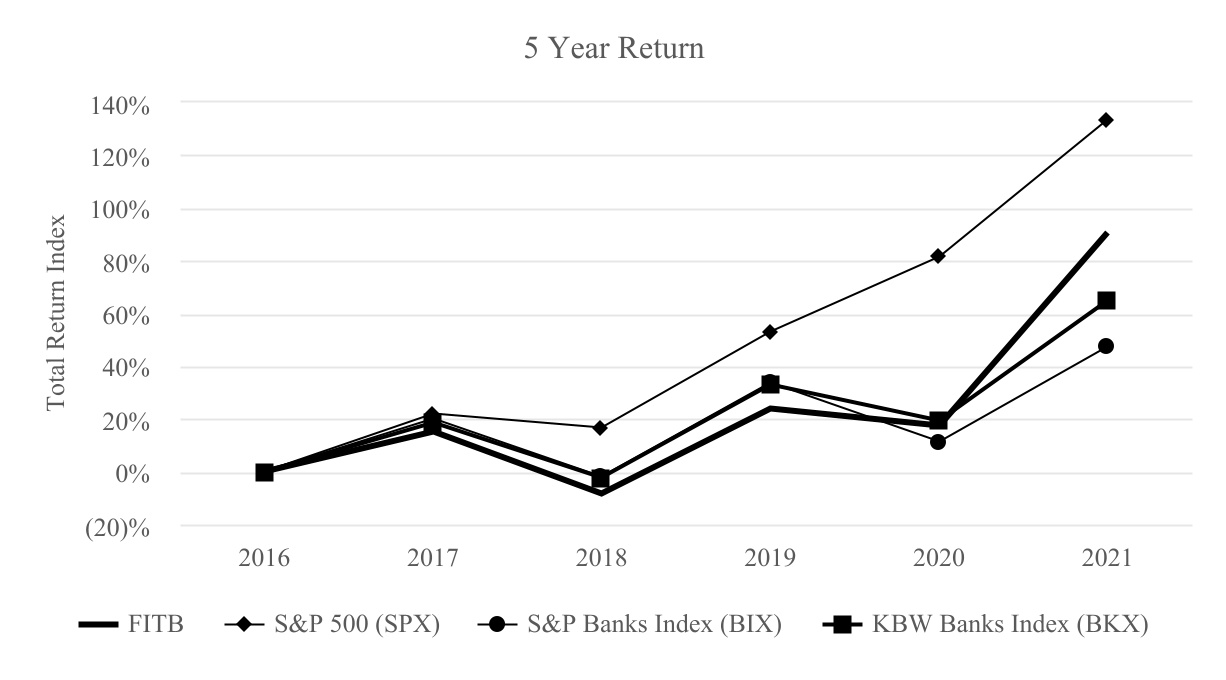
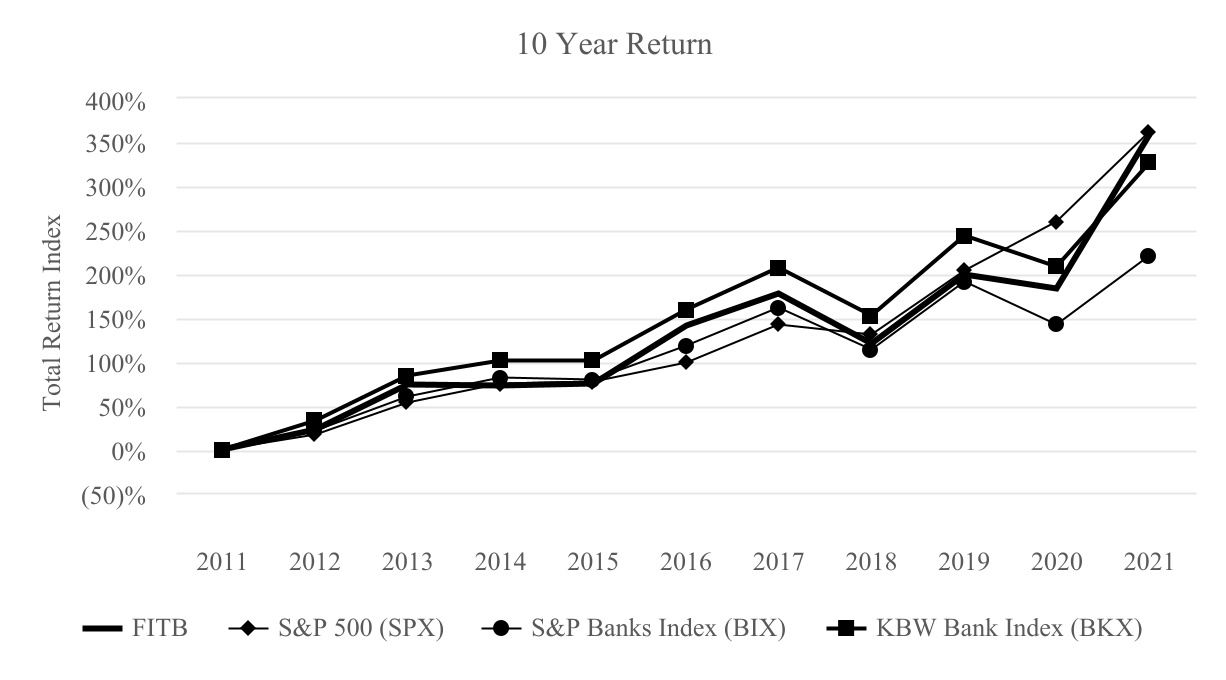
The graphs below summarize the cumulative return experienced by the Bancorp’s shareholders over the five and ten year periods ended December 31, 2021, respectively, compared to the S&P 500 Stock, the S&P Banks and the KBW Banks indices.
FIFTH THIRD BANCORP VS. MARKET INDICES
53 Fifth Third Bancorp
2021 ANNUAL REPORT
FINANCIAL CONTENTS
54 Fifth Third Bancorp
GLOSSARY OF ABBREVIATIONS AND ACRONYMS
Fifth Third Bancorp provides the following list of abbreviations and acronyms as a tool for the reader that are used in Management’s Discussion and Analysis of Financial Condition and Results of Operations, the Consolidated Financial Statements and the Notes to Consolidated Financial Statements.
| ACL: Allowance for Credit Losses | IPO: Initial Public Offering | ||||
| AFS: Available-For-Sale | IRC: Internal Revenue Code | ||||
| ALCO: Asset Liability Management Committee | IRLC: Interest Rate Lock Commitment | ||||
| ALLL: Allowance for Loan and Lease Losses | IRS: Internal Revenue Service | ||||
| AOCI: Accumulated Other Comprehensive Income (Loss) | ISDA: International Swaps and Derivatives Association, Inc. | ||||
| APR: Annual Percentage Rate | LIBOR: London Interbank Offered Rate | ||||
| ARM: Adjustable Rate Mortgage | LIHTC: Low-Income Housing Tax Credit | ||||
| ASC: Accounting Standards Codification | LLC: Limited Liability Company | ||||
| ASU: Accounting Standards Update | LTV: Loan-to-Value Ratio | ||||
| ATM: Automated Teller Machine | MD&A: Management’s Discussion and Analysis of Financial | ||||
| BHC: Bank Holding Company | Condition and Results of Operations | ||||
| BOLI: Bank Owned Life Insurance | MSR: Mortgage Servicing Right | ||||
| bps: Basis Points | N/A: Not Applicable | ||||
| CARES: Coronavirus Aid, Relief and Economic Security | NAV: Net Asset Value | ||||
| CCAR: Comprehensive Capital Analysis and Review | NII: Net Interest Income | ||||
| CD: Certificate of Deposit | NM: Not Meaningful | ||||
| CDC: Fifth Third Community Development Corporation | OAS: Option-Adjusted Spread | ||||
| CECL: Current Expected Credit Loss | OCC: Office of the Comptroller of the Currency | ||||
| CET1: Common Equity Tier 1 | OCI: Other Comprehensive Income (Loss) | ||||
| CFPB: United States Consumer Financial Protection Bureau | OREO: Other Real Estate Owned | ||||
| C&I: Commercial and Industrial | OTTI: Other-Than-Temporary Impairment | ||||
| DCF: Discounted Cash Flow | PCD: Purchased Credit Deteriorated | ||||
| DTCC: Depository Trust & Clearing Corporation | PPP: Paycheck Protection Program | ||||
| DTI: Debt-to-Income Ratio | PSA: Performance Share Award | ||||
| ERM: Enterprise Risk Management | RCC: Risk and Compliance Committee | ||||
| ERMC: Enterprise Risk Management Committee | ROU: Right-of-Use | ||||
| EVE: Economic Value of Equity | RSA: Restricted Stock Award | ||||
| FASB: Financial Accounting Standards Board | RSU: Restricted Stock Unit | ||||
| FDIC: Federal Deposit Insurance Corporation | SAR: Stock Appreciation Right | ||||
| FHA: Federal Housing Administration | SBA: Small Business Administration | ||||
| FHLB: Federal Home Loan Bank | SEC: United States Securities and Exchange Commission | ||||
| FHLMC: Federal Home Loan Mortgage Corporation | SOFR: Secured Overnight Financing Rate | ||||
| FICO: Fair Isaac Corporation (credit rating) | TBA: To Be Announced | ||||
| FINRA: Financial Industry Regulatory Authority | TDR: Troubled Debt Restructuring | ||||
| FNMA: Federal National Mortgage Association | TILA: Truth in Lending Act | ||||
| FOMC: Federal Open Market Committee | TRA: Tax Receivable Agreement | ||||
| FRB: Federal Reserve Bank | TruPS: Trust Preferred Securities | ||||
| FTE: Fully Taxable Equivalent | U.S.: United States of America | ||||
| FTP: Funds Transfer Pricing | USD: United States Dollar | ||||
| FTS: Fifth Third Securities, Inc. | U.S. GAAP: United States Generally Accepted Accounting | ||||
| GDP: Gross Domestic Product | Principles | ||||
| GNMA: Government National Mortgage Association | VA: United States Department of Veterans Affairs | ||||
| GSE: United States Government Sponsored Enterprise | VIE: Variable Interest Entity | ||||
| HTM: Held-To-Maturity | VRDN: Variable Rate Demand Note |
55 Fifth Third Bancorp
MANAGEMENT’S DISCUSSION AND ANALYSIS OF FINANCIAL CONDITION AND RESULTS OF OPERATIONS
Item 7. MANAGEMENT’S DISCUSSION AND ANALYSIS OF FINANCIAL CONDITION AND RESULTS OF OPERATIONS
The following is Management’s Discussion and Analysis of Financial Condition and Results of Operations of certain significant factors that have affected Fifth Third Bancorp’s (the “Bancorp” or “Fifth Third”) financial condition and results of operations during the periods included in the Consolidated Financial Statements, which are a part of this filing. Reference to the Bancorp incorporates the parent holding company and all consolidated subsidiaries. The Bancorp’s banking subsidiary is referred to as the Bank.
OVERVIEW
This overview of MD&A highlights selected information in the financial results of the Bancorp and may not contain all of the information that is important to you. For a more complete understanding of trends, events, commitments, uncertainties, liquidity, capital resources and critical accounting policies and estimates, you should carefully read this entire document. Each of these items could have an impact on the Bancorp’s financial condition, results of operations and cash flows. In addition, refer to the Glossary of Abbreviations and Acronyms in this report for a list of terms included as a tool for the reader of this Annual Report on Form 10-K. The abbreviations and acronyms identified therein are used throughout this MD&A, as well as the Consolidated Financial Statements and Notes to Consolidated Financial Statements.
Net interest income, net interest margin, net interest rate spread and the efficiency ratio are presented in MD&A on an FTE basis. The FTE basis adjusts for the tax-favored status of income from certain loans and leases and securities held by the Bancorp that are not taxable for federal income tax purposes. The Bancorp believes this presentation to be the preferred industry measurement of net interest income as it provides a relevant comparison between taxable and non-taxable amounts. The FTE basis for presenting net interest income is a non-GAAP measure. For further information, refer to the Non-GAAP Financial Measures section of MD&A.
The Bancorp’s revenues are dependent on both net interest income and noninterest income. For the year ended December 31, 2021, net interest income on an FTE basis and noninterest income provided 61% and 39% of total revenue, respectively. The Bancorp derives the majority of its revenues within the U.S. from customers domiciled in the U.S. Revenue from foreign countries and external customers domiciled in foreign countries was immaterial to the Consolidated Financial Statements for the year ended December 31, 2021. Changes in interest rates, credit quality, economic trends and the capital markets are primary factors that drive the performance of the Bancorp. As discussed later in the Risk Management section of MD&A, risk identification, measurement, monitoring, control and reporting are important to the management of risk and to the financial performance and capital strength of the Bancorp.
Net interest income is the difference between interest income earned on assets such as loans, leases and securities, and interest expense incurred on liabilities such as deposits, other short-term borrowings and long-term debt. Net interest income is affected by the general level of interest rates, the relative level of short-term and long-term interest rates, changes in interest rates and changes in the amount and composition of interest-earning assets and interest-bearing liabilities. Generally, the rates of interest the Bancorp earns on its assets and pays on its liabilities are established for a period of time. The change in market interest rates over time exposes the Bancorp to interest rate risk through potential adverse changes to net interest income and financial position. The Bancorp manages this risk by continually analyzing and adjusting the composition of its assets and liabilities based on their payment streams and interest rates, the timing of their maturities and their sensitivity to changes in market interest rates. Additionally, in the ordinary course of business, the Bancorp enters into certain derivative transactions as part of its overall strategy to manage its interest rate and prepayment risks. The Bancorp is also exposed to the risk of loss on its loan and lease portfolio as a result of changing expected cash flows caused by borrower credit events, such as loan defaults and inadequate collateral.
Noninterest income is derived from commercial banking revenue, service charges on deposits, wealth and asset management revenue, card and processing revenue, leasing business revenue, mortgage banking net revenue, other noninterest income and net securities gains or losses. Noninterest expense includes compensation and benefits, technology and communications, net occupancy expense, equipment expense, leasing business expense, marketing expense, card and processing expense and other noninterest expense.
COVID-19 Global Pandemic
The COVID-19 pandemic created significant economic uncertainty and financial disruptions during the year ended December 31, 2020, which continued during 2021. Government and public responses to the COVID-19 pandemic, including temporary closures of businesses and the implementation of social distancing protocols, caused reductions and instability in economic activity that resulted in increased unemployment levels in certain industries and volatility in the financial markets. Markets continue to remain volatile as a result of the pandemic and its evolving impacts, including inflationary concerns as well as stresses in labor markets and supply chains. During the years ended December 31, 2021 and 2020, low interest rates, reduced economic activity and market volatility have had the most immediate negative impacts on the Bancorp’s performance. The Bancorp is unable to estimate the extent of the impact that these factors have had on its operating results since the pandemic began and these factors may adversely impact its future operating results.
Although the increased availability of COVID-19 vaccinations has begun to mitigate the public health effects of the pandemic, there has been a rise of certain variants of COVID-19 and slowing progress on vaccination rates. The recovery from the related economic crisis continues to disproportionately affect certain industries, geographies and demographics more than others, and when combined with the unprecedented nature of the government response to the pandemic, it becomes difficult to predict the extent to which the pandemic will continue to adversely impact the Bancorp and its customers. Furthermore, resurgence risk remains as new virus variants are identified. The Bancorp continues to closely monitor the pandemic and its effects on customers, employees, communities and markets.
56 Fifth Third Bancorp
MANAGEMENT’S DISCUSSION AND ANALYSIS OF FINANCIAL CONDITION AND RESULTS OF OPERATIONS
The Bancorp has provided a variety of relief options for both commercial and consumer customers that were affected by the COVID-19 pandemic, including loan covenant relief, loan maturity extensions, payment deferrals, forbearances and fee waivers. For further information about these programs, refer to the Credit Risk Management subsection of the Risk Management section of MD&A included herein, and also Note 1 of the Notes to Consolidated Financial Statements.
Government Response to the COVID-19 Pandemic
Congress, the FRB and the other U.S. state and federal financial regulatory agencies have taken actions to mitigate disruptions to economic activity and financial stability resulting from the COVID-19 pandemic. The descriptions below summarize certain significant government actions taken in response to the COVID-19 pandemic. The descriptions are qualified in their entirety by reference to the particular statutory or regulatory provisions or government programs summarized.
The CARES Act
The Coronavirus Aid, Relief and Economic Security (“CARE
Showing the first 8K of 379K characters. Open the full section
Item 7A. QUANTITATIVE AND QUALITATIVE DISCLOSURES ABOUT MARKET RISK
This information is set forth in the Interest Rate and Price Risk Management section of Item 7 (Management’s Discussion and Analysis of Financial Condition and Results of Operations) of this Report and is incorporated herein by reference. This information contains certain statements that we believe are forward-looking statements. Refer to page 19 for cautionary information regarding forward-looking statements.
Item 8. FINANCIAL STATEMENTS AND SUPPLEMENTARY DATA
123 Fifth Third Bancorp
REPORT OF INDEPENDENT REGISTERED PUBLIC ACCOUNTING FIRM
To the shareholders and the Board of Directors of Fifth Third Bancorp:
Opinion on the Financial Statements
We have audited the accompanying consolidated balance sheets of Fifth Third Bancorp and subsidiaries (the “Bancorp”) as of December 31, 2021 and 2020, the related consolidated statements of income, comprehensive income, changes in equity, and cash flows for each of the three years in the period ended December 31, 2021, and the related notes (collectively referred to as the “financial statements”). In our opinion, the financial statements present fairly, in all material respects, the financial position of the Bancorp as of December 31, 2021 and 2020, and the results of its operations and its cash flows for each of the three years in the period ended December 31, 2021, in conformity with accounting principles generally accepted in the United States of America.
We have also audited, in accordance with the standards of the Public Company Accounting Oversight Board (United States) (PCAOB), the Bancorp’s internal control over financial reporting as of December 31, 2021, based on criteria established in Internal Control—Integrated Framework (2013) issued by the Committee of Sponsoring Organizations of the Treadway Commission and our report dated February 25, 2022 expressed an unqualified opinion on the Bancorp’s internal control over financial reporting.
Change in Accounting Principle
As discussed in Note 1 to the Consolidated Financial Statements, the Bancorp has changed its method of accounting for financial assets measured at amortized cost in 2020 due to adoption of ASU 2016-13, Financial Instruments - Credit Losses (Topic 326): Measurement of Credit Losses on Financial Instruments.
Basis for Opinion
These financial statements are the responsibility of the Bancorp’s management. Our responsibility is to express an opinion on the Bancorp’s financial statements based on our audits. We are a public accounting firm registered with the PCAOB and are required to be independent with respect to the Bancorp in accordance with the U.S. federal securities laws and the applicable rules and regulations of the Securities and Exchange Commission and the PCAOB.
We conducted our audits in accordance with the standards of the PCAOB. Those standards require that we plan and perform the audit to obtain reasonable assurance about whether the financial statements are free of material misstatement, whether due to error or fraud. Our audits included performing procedures to assess the risks of material misstatement of the financial statements, whether due to error or fraud, and performing procedures that respond to those risks. Such procedures included examining, on a test basis, evidence regarding the amounts and disclosures in the financial statements. Our audits also included evaluating the accounting principles used and significant estimates made by management, as well as evaluating the overall presentation of the financial statements. We believe that our audits provide a reasonable basis for our opinion.
Critical Audit Matter
The critical audit matter communicated below is a matter arising from the current-period audit of the financial statements that was communicated or required to be communicated to the audit committee and that (1) relates to accounts or disclosures that are material to the financial statements and (2) involved our especially challenging, subjective, or complex judgments. The communication of critical audit matters does not alter in any way our opinion on the financial statements, taken as a whole, and we are not, by communicating the critical audit matter below, providing a separate opinion on the critical audit matter or on the accounts or disclosures to which it relates.
Allowance for Loan and Lease Losses (“ALLL”) — Qualitative Factors — Commercial Loans—Refer to Note 1 and Note 6 of the Notes to Consolidated Financial Statements
Critical Audit Matter Description
The Bancorp maintains the ALLL to absorb the amount of credit losses that are expected to be incurred over the remaining contractual terms of the related loans and leases. The Bancorp’s methodology for determining the ALLL includes an estimate of expected credit losses on a collective basis for groups of loans and leases with similar risk characteristics and specific allowances for loans and leases which are individually evaluated.
For loans that are not individually evaluated, the Bancorp develops its estimate of expected credit losses using quantitative models, subject to certain qualitative adjustments. The expected credit loss models consider historical credit loss experience, current market and economic conditions, and forecasted changes in market and economic conditions to the extent such forecasts are considered reasonable and supportable.
124 Fifth Third Bancorp
Qualitative factors are used to capture characteristics in the portfolio that impact expected credit losses but that are not fully captured within the Bancorp’s quantitative models.
At December 31, 2021, the key qualitative factors included adjustments associated with the current economic environment and the COVID-19 pandemic. These qualitative factors primarily address the incremental loss exposures relating to commercial borrowers in certain industries which have been severely impacted by the COVID-19 pandemic or are otherwise experiencing prolonged distress.
The ALLL for the commercial portfolio segment was $1.1 billion at December 31, 2021, which includes adjustments for the qualitative factors noted above.
Considering the estimation and judgment in determining adjustments for such qualitative factors, our audit of the ALLL and the related disclosures involved subjective judgment about the qualitative adjustments to the commercial portfolio segment ALLL.
How the Critical Audit Matter Was Addressed in the Audit
Our audit procedures related to the qualitative adjustments for the commercial portfolio segment ALLL included the following, among others:
-
We tested the effectiveness of the Bancorp’s controls over the qualitative adjustments to the ALLL.
-
We assessed the reasonableness of, and evaluated support for, key qualitative adjustments based on market conditions, external market data and commercial portfolio performance metrics.
-
We tested the completeness and accuracy and evaluated the relevance of the key data used as inputs to the direct impact qualitative adjustment estimation process, including:
◦Portfolio segment loan balances and other borrower-specific data
◦Relevant macroeconomic indicators and data
- With the assistance of our credit specialists, we evaluated the methodology and tested the mathematical accuracy of the underlying support used as a basis for the qualitative adjustments.
/s/ Deloitte & Touche LLP
Cincinnati, Ohio
February 25, 2022
We have served as the Company’s auditor since 1970.
125 Fifth Third Bancorp
CONSOLIDATED BALANCE SHEETS
| As of December 31 ($ in millions, except share data) | 2021 | 2020 | ||||||
| Assets | ||||||||
| Cash and due from banks | $ | 2,994 | 3,147 | |||||
| Other short-term investments*(a)* | 34,572 | 33,399 | ||||||
| Available-for-sale debt and other securities*(b)* | 38,110 | 37,513 | ||||||
| Held-to-maturity securities*(c)* | 8 | 11 | ||||||
| Trading debt securities | 512 | 560 | ||||||
| Equity securities | 376 | 313 | ||||||
| Loans and leases held for sale*(d)* | 4,415 | 4,741 | ||||||
| Po |
Showing the first 8K of 534K characters. Open the full section
Item 9. CHANGES IN AND DISAGREEMENTS WITH ACCOUNTANTS ON ACCOUNTING AND FINANCIAL DISCLOSURE
None.
Item 9A. CONTROLS AND PROCEDURES
EVALUATION OF DISCLOSURE CONTROLS AND PROCEDURES
The Bancorp conducted an evaluation, under the supervision and with the participation of the Bancorp’s management, including the Bancorp’s Chief Executive Officer and Chief Financial Officer, of the effectiveness of the design and operation of the Bancorp’s disclosure controls and procedures (as defined in Rules 13a-15(e) and 15d-15(e) under the Securities Exchange Act of 1934). Based on the foregoing, as of the end of the period covered by this report, the Bancorp’s Chief Executive Officer and Chief Financial Officer concluded that the Bancorp’s disclosure controls and procedures were effective, in all material respects, to ensure that information required to be disclosed in the reports the Bancorp files and submits under the Securities Exchange Act of 1934 is recorded, processed, summarized and reported as and when required and information is accumulated and communicated to management including its Chief Executive Officer and Chief Financial Officer, as appropriate to allow timely decisions regarding required disclosure.
MANAGEMENT’S ASSESSMENT AS TO THE EFFECTIVENESS OF INTERNAL CONTROL OVER FINANCIAL REPORTING
The management of Fifth Third Bancorp is responsible for establishing and maintaining adequate internal control, designed to provide reasonable assurance regarding the reliability of financial reporting and the preparation of financial statements for external purposes in accordance with accounting principles generally accepted in the United States of America. The Bancorp’s management assessed the effectiveness of the Bancorp’s internal control over financial reporting as of December 31, 2021. Management’s assessment is based on the criteria established in the Internal Control — Integrated Framework (2013) issued by the Committee of Sponsoring Organizations of the Treadway Commission and was designed to provide reasonable assurance that the Bancorp maintained effective internal control over financial reporting as of December 31, 2021. Based on this assessment, management believes that the Bancorp maintained effective internal control over financial reporting as of December 31, 2021. The Bancorp’s independent registered public accounting firm, that audited the Bancorp’s consolidated financial statements included in this annual report, has issued an audit report on our internal control over financial reporting as of December 31, 2021. This report appears on page 226 of the annual report.
CHANGES IN INTERNAL CONTROLS
The Bancorp’s management also conducted an evaluation of internal control over financial reporting to determine whether any changes occurred during the year covered by this report that have materially affected, or are reasonably likely to materially affect, the Bancorp’s internal control over financial reporting. Based on this evaluation, there has been no such change during the year covered by this report.
| /s/ Greg D. Carmichael | /s/ James C. Leonard | |||||||
| Greg D. Carmichael | James C. Leonard | |||||||
| Chairman and Chief Executive Officer | Executive Vice President and Chief Financial Officer | |||||||
| February 25, 2022 | February 25, 2022 |
225 Fifth Third Bancorp
REPORT OF INDEPENDENT REGISTERED PUBLIC ACCOUNTING FIRM
To the shareholders and Board of Directors of Fifth Third Bancorp:
Opinion on Internal Control over Financial Reporting
We have audited the internal control over financial reporting of Fifth Third Bancorp and subsidiaries (the “Bancorp”) as of December 31, 2021, based on criteria established in Internal Control — Integrated Framework (2013) issued by the Committee of Sponsoring Organizations of the Treadway Commission (COSO). In our opinion, the Bancorp maintained, in all material respects, effective internal control over financial reporting as of December 31, 2021, based on criteria established in Internal Control — Integrated Framework (2013) issued by COSO.
We have also audited, in accordance with the standards of the Public Company Accounting Oversight Board (United States) (PCAOB), the consolidated financial statements as of and for the year ended December 31, 2021, of the Bancorp and our report dated February 25, 2022 expressed an unqualified opinion on those consolidated financial statements.
Basis for Opinion
The Bancorp’s management is responsible for maintaining effective internal control over financial reporting and for its assessment of the effectiveness of internal control over financial reporting, included in the accompanying Management’s Assessment as to the Effectiveness of Internal Control over Financial Reporting. Our responsibility is to express an opinion on the Bancorp’s internal control over financial reporting based on our audit. We are a public accounting firm registered with the PCAOB and are required to be independent with respect to the Bancorp in accordance with the U.S. federal securities laws and the applicable rules and regulations of the Securities and Exchange Commission and the PCAOB.
We conducted our audit in accordance with the standards of the PCAOB. Those standards require that we plan and perform the audit to obtain reasonable assurance about whether effective internal control over financial reporting was maintained in all material respects. Our audit included obtaining an understanding of internal control over financial reporting, assessing the risk that a material weakness exists, testing and evaluating the design and operating effectiveness of internal control based on the assessed risk, and performing such other procedures as we considered necessary in the circumstances. We believe that our audit provides a reasonable basis for our opinion.
Definition and Limitations of Internal Control over Financial Reporting
A company’s internal control over financial reporting is a process designed to provide reasonable assurance regarding the reliability of financial reporting and the preparation of financial statements for external purposes in accordance with generally accepted accounting principles. A company’s internal control over financial reporting includes those policies and procedures that (1) pertain to the maintenance of records that, in reasonable detail, accurately and fairly reflect the transactions and dispositions of the assets of the company; (2) provide reasonable assurance that transactions are recorded as necessary to permit preparation of financial statements in accordance with generally accepted accounting principles, and that receipts and expenditures of the company are being made only in accordance with authorizations of management and directors of the company; and (3) provide reasonable assurance regarding prevention or timely detection of unauthorized acquisition, use, or disposition of the company’s assets that could have a material effect on the financial statements.
Because of its inherent limitations, internal control over financial reporting may not prevent or detect misstatements. Also, projections of any evaluation of effectiveness to future periods are subject to the risk that controls may become inadequate because of changes in conditions, or that the degree of compliance with the policies or procedures may deteriorate.
/s/ Deloitte & Touche LLP
Cincinnati, Ohio
February 25, 2022
226 Fifth Third Bancorp
Item 9B. OTHER INFORMATION
On February 22, 2022, the Board of Directors of the Bancorp approved an annual base salary of $500,000, a variable compensation target of $500,000 and a long-term incentive target of $600,000 for Lars Anderson’s 2022 fiscal year compensation. Mr. Anderson will continue to serve as Executive Vice President & Vice Chairman of Commercial Banking, Strategic Growth Initiatives.
Item 9C. DISCLOSURE REGARDING FOREIGN JURISDICTIONS THAT PREVENT INSPECTION
Not applicable.
PART III
Item 10. DIRECTORS, EXECUTIVE OFFICERS AND CORPORATE GOVERNANCE
The information required by this item relating to the Executive Officers of the Registrant is included in PART I under “INFORMATION ABOUT OUR EXECUTIVE OFFICERS.”
The information required by this item concerning Directors and the nomination process is incorporated herein by reference under the caption “Election of Directors” of the Bancorp’s Proxy Statement for the 2022 Annual Meeting of Shareholders.
The information required by this item concerning the Audit Committee and Code of Business Conduct and Ethics is incorporated herein by reference under the captions “Corporate Governance” and “Board of Directors, Its Committees, Meetings, and Functions” of the Bancorp’s Proxy Statement for the 2022 Annual Meeting of Shareholders. Fifth Third’s Code of Business Conduct and Ethics is available on Fifth Third’s corporate website at www.53.com. In addition, any future amendments to, or waivers from, a provision of the Fifth Third Code of Business Conduct and Ethics that applies to Fifth Third’s directors or executive officers (including Fifth Third’s principal executive officer, principal financial officer, and principal accounting officer or controller) will be posted at this internet address.
The information required by this item concerning Delinquent Section 16(a) Reports is incorporated herein by reference under the caption “Delinquent Section 16(a) Reports” of the Bancorp’s Proxy Statement for the 2022 Annual Meeting of Shareholders.
Item 11. EXECUTIVE COMPENSATION
The information required by this item is incorporated herein by reference under the captions “Compensation Discussion and Analysis,” “Compensation of Named Executive Officers,” “Board of Directors Compensation,” “CEO Pay Ratio,” “Human Capital and Compensation Committee Report” and “Compensation Committee Interlocks and Insider Participation” of the Bancorp’s Proxy Statement for the 2022 Annual Meeting of Shareholders.
Item 12. SECURITY OWNERSHIP OF CERTAIN BENEFICIAL OWNERS AND MANAGEMENT AND RELATED STOCKHOLDER MATTERS
Security ownership information of certain beneficial owners and management is incorporated herein by reference under the captions “Certain Beneficial Owners,” “Election of Directors,” “Compensation Discussion and Analysis,” “Board of Directors Compensation,” and “Compensation of Named Executive Officers” of the Bancorp’s Proxy Statement for the 2022 Annual Meeting of Shareholders.
The information required by this item concerning Equity Compensation Plan information is included in Note 25 of the Notes to Consolidated Financial Statements.
Item 13. CERTAIN RELATIONSHIPS AND RELATED TRANSACTIONS, AND DIRECTOR INDEPENDENCE
The information required by this item is incorporated herein by reference under the captions “Certain Transactions”, “Election of Directors”, “Corporate Governance” and “Board of Directors, Its Committees, Meetings, and Functions” of the Bancorp’s Proxy Statement for the 2022 Annual Meeting of Shareholders.
Item 14. PRINCIPAL ACCOUNTING FEES AND SERVICES
The information required by this item is incorporated herein by reference under the caption “Principal Independent External Audit Firm Fees” of the Bancorp’s Proxy Statement for the 2022 Annual Meeting of Shareholders. The Bancorp’s principal independent external audit firm is Deloitte & Touche LLP, whose PCAOB Firm ID is 34.
227 Fifth Third Bancorp
PART IV
Item 15. EXHIBITS, FINANCIAL STATEMENT SCHEDULES
| Pages | |||||
| Public Accounting Firm | 124, 226 | ||||
| Fifth Third Bancorp and Subsidiaries Consolidated Financial Statements | 126 | ||||
| Notes to Consolidated Financial Statements | 132 |
The schedules for the Bancorp and its subsidiaries are omitted because of the absence of conditions under which they are required, or because the information is set forth in the Consolidated Financial Statements or the notes thereto.
The following lists the Exhibits to the Annual Report on Form 10-K:
228 Fifth Third Bancorp
229 Fifth Third Bancorp
230 Fifth Third Bancorp
231 Fifth Third Bancorp
*(1)*Fifth Third Bancorp also entered into an identical security on March 4, 2008 representing an additional $500,000,000 of its 8.25% Subordinated Notes due 2038.
*(2)*Fifth Third Bancorp also entered into an identical security on November 20, 2013 representing an additional $250,000,000 in principal amount of its 4.30% Subordinated Notes due 2024.
** Denotes management contract or compensatory plan or arrangement.*
*** An application for confidential treatment for selected portions of this exhibit has been filed with the SEC.*
**** Selected portions of this exhibit have been omitted in accordance with Item 601(b)(10) of Regulation S-K.*
Item 16. FORM 10–K SUMMARY
None.
232 Fifth Third Bancorp
SIGNATURES
Pursuant to the requirements of Section 13 or 15(d) of the Securities Exchange Act of 1934, the Registrant has duly caused this report to be signed on its behalf by the undersigned, thereunto duly authorized.
FIFTH THIRD BANCORP
Registrant
| /s/ Greg D. Carmichael | ||
| Greg D. Carmichael | ||
| Chairman and CEO | ||
| Principal Executive Officer | ||
| February 25, 2022 |
Pursuant to requirements of the Securities Exchange Act of 1934, this report has been signed on February 25, 2022 by the following persons on behalf of the Registrant and in the capacities indicated.
OFFICERS:
| /s/ Greg D. Carmichael | ||
| Greg D. Carmichael | ||
| Chairman and CEO | ||
| Principal Executive Officer | ||
| /s/ James C. Leonard | ||
| James C. Leonard | ||
| Executive Vice President and CFO | ||
| Principal Financial Officer | ||
| /s/ Mark D. Hazel | ||
| Mark D. Hazel | ||
| Executive Vice President and Controller | ||
| Principal Accounting Officer |
DIRECTORS:
| /s/ Greg D. Carmichael | ||
| Greg D. Carmichael | ||
| Chairman | ||
| /s/ Marsha C. Williams | ||
| Marsha C. Williams | ||
| Lead Independent Director |
| /s/ Nicholas K. Akins | ||
| Nicholas K. Akins | ||
| /s/ B. Evan Bayh III | ||
| B. Evan Bayh III | ||
| /s/ Jorge L. Benitez | ||
| Jorge L. Benitez | ||
| /s/ Katherine B. Blackburn | ||
| Katherine B. Blackburn | ||
| /s/ Emerson L. Brumback | ||
| Emerson L. Brumback | ||
| /s/ Linda W. Clement-Holmes | ||
| Linda W. Clement-Holmes | ||
| /s/ C. Bryan Daniels | ||
| C. Bryan Daniels | ||
| /s/ Mitchell S. Feiger | ||
| Mitchell S. Feiger | ||
| /s/ Thomas H. Harvey | ||
| Thomas H. Harvey | ||
| /s/ Gary R. Heminger | ||
| Gary R. Heminger | ||
| /s/ Jewell D. Hoover | ||
| Jewell D. Hoover | ||
| /s/ Eileen A. Mallesch | ||
| Eileen A. Mallesch | ||
| /s/ Michael B. McCallister | ||
| Michael B. McCallister |
233 Fifth Third Bancorp
CONSOLIDATED TEN YEAR COMPARISON
| AVERAGE ASSETS FOR THE YEARS ENDED DECEMBER 31 ($ IN MILLIONS) | |||||||||||||||||||||||
| Interest-Earning Assets | |||||||||||||||||||||||
| Year | Loans and Leases | Other Short-Term Investments | Investment Securities | Total | Cash and Due from Banks | Other Assets | Total Average Assets | ||||||||||||||||
| 2021 | $ | 114,117 | 33,243 | 37,018 | 184,378 | 3,055 | 21,050 | 206,324 | |||||||||||||||
| 2020 | 114,411 | 21,935 | 36,342 | 172,688 | 2,978 | 20,933 | 194,230 | ||||||||||||||||
| 2019 | 107,794 | 2,140 | 35,470 | 145,404 | 2,748 | 16,903 | 163,936 | ||||||||||||||||
| 2018 | 93,876 | 1,476 | 33,553 | 128,905 | 2,200 | 12,203 | 142,183 | ||||||||||||||||
| 2017 | 92,731 | 1,390 | 32,172 | 126,293 | 2,224 | 13,236 | 140,527 | ||||||||||||||||
| 2016 | 94,320 | 1,866 | 30,099 | 126,285 | 2,303 | 14,870 | 142,173 | ||||||||||||||||
| 2015 | 93,339 | 3,258 | 26,987 | 123,584 | 2,608 | 15,100 | 139,999 | ||||||||||||||||
| 2014 | 91,127 | 3,043 | 21,823 | 115,993 | 2,892 | 14,443 | 131,847 | ||||||||||||||||
| 2013 | 89,093 | 2,417 | 16,444 | 107,954 | 2,482 | 15,025 | 123,704 | ||||||||||||||||
| 2012 | 84,822 | 1,495 | 15,319 | 101,636 | 2,355 | 15,643 | 117,562 |
| AVERAGE DEPOSITS AND SHORT-TERM BORROWINGS FOR THE YEARS ENDED DECEMBER 31 ($ IN MILLIONS) | |||||||||||||||||||||||||||||
| Deposits | |||||||||||||||||||||||||||||
| Year | Demand | Interest Checking | Savings | Money Market | Certificates of Deposit**(a)** | Foreign Office and Other | Total | Short-Term Borrowings**(b)** | Total | ||||||||||||||||||||
| 2021 | $ | 62,028 | 45,850 | 20,531 | 30,631 | 3,744 | 164 | 162,948 | 1,440 | 164,388 | |||||||||||||||||||
| 2020 | 47,111 | 46,890 | 16,440 | 29,879 | 7,455 | 256 | 148,031 | 2,094 | 150,125 | ||||||||||||||||||||
| 2019 | 34,343 | 36,658 | 14,041 | 25,879 | 9,974 | 474 | 121,369 | 2,313 | 123,682 | ||||||||||||||||||||
| 2018 | 32,634 | 29,818 | 13,330 | 21,769 | 6,532 | 839 | 104,922 | 3,120 | 108,042 | ||||||||||||||||||||
| 2017 | 35,093 | 26,382 | 13,958 | 20,231 | 6,335 | 665 | 102,664 | 3,715 | 106,379 | ||||||||||||||||||||
| 2016 | 35,862 | 25,143 | 14,346 | 19,523 | 6,745 | 830 | 102,449 | 3,351 | 105,800 | ||||||||||||||||||||
| 2015 | 35,164 | 26,160 | 14,951 | 18,152 | 6,920 | 874 | 102,221 | 2,641 | 104,862 | ||||||||||||||||||||
| 2014 | 31,755 | 25,382 | 16,080 | 14,670 | 7,691 | 1,828 | 97,406 | 2,331 | 99,737 | ||||||||||||||||||||
| 2013 | 29,925 | 23,582 | 18,440 | 9,467 | 10,099 | 1,518 | 93,031 | 3,527 | 96,558 | ||||||||||||||||||||
| 2012 | 27,196 | 23,096 | 21,393 | 4,903 | 7,408 | 1,555 | 85,551 | 4,806 | 90,357 |
| INCOME FOR THE YEARS ENDED DECEMBER 31 ($ IN MILLIONS, EXCEPT PER SHARE DATA) | ||||||||||||||||||||||||||
| Per Share | ||||||||||||||||||||||||||
| Year | Interest Income | Interest Expense | Noninterest Income | Noninterest Expense | Net Income Available to Common Shareholders | Earnings | Diluted Earnings | Dividends Declared | ||||||||||||||||||
| 2021 | $ | 5,211 | 441 | 3,118 | 4,748 | 2,659 | 3.78 | 3.73 | 1.14 | |||||||||||||||||
| 2020 | 5,572 | 790 | 2,830 | 4,718 | 1,323 | 1.84 | 1.83 | 1.08 | ||||||||||||||||||
| 2019 | 6,254 | 1,457 | 3,536 | 4,660 | 2,419 | 3.38 | 3.33 | 0.94 | ||||||||||||||||||
| 2018 | 5,183 | 1,043 | 2,790 | 3,958 | 2,118 | 3.11 | 3.06 | 0.74 | ||||||||||||||||||
| 2017 | 4,489 | 691 | 3,224 | 3,782 | 2,105 | 2.86 | 2.81 | 0.60 | ||||||||||||||||||
| 2016 | 4,193 | 578 | 2,696 | 3,737 | 1,472 | 1.92 | 1.91 | 0.53 | ||||||||||||||||||
| 2015 | 4,028 | 495 | 3,003 | 3,643 | 1,610 | 2.00 | 1.97 | 0.52 | ||||||||||||||||||
| 2014 | 4,030 | 451 | 2,473 | 3,619 | 1,384 | 1.65 | 1.63 | 0.51 | ||||||||||||||||||
| 2013 | 3,973 | 412 | 3,227 | 3,978 | 1,799 | 2.05 | 2.02 | 0.47 | ||||||||||||||||||
| 2012 | 4,107 | 512 | 2,999 | 4,083 | 1,541 | 1.69 | 1.66 | 0.36 |
| MISCELLANEOUS AT DECEMBER 31 ($ IN MILLIONS, EXCEPT PER SHARE DATA) | ||||||||||||||||||||||||||||||||
| Equity | ||||||||||||||||||||||||||||||||
| Year | Common Shares Outstanding | Common Stock | Preferred Stock | Capital Surplus | Retained Earnings | Accumulated Other Comprehensive Income (Loss) | Treasury Stock | Total | Book Value Per Share | Allowance for Loan and Lease Losses | ||||||||||||||||||||||
| 2021 | 682,777,664 | $ | 2,051 | 2,116 | 3,624 | 20,236 | 1,207 | (7,024) | 22,210 | 29.43 | 1,892 | |||||||||||||||||||||
| 2020 | 712,760,325 | 2,051 | 2,116 | 3,635 | 18,384 | 2,601 | (5,676) | 23,111 | 29.46 | 2,453 | ||||||||||||||||||||||
| 2019 | 708,915,629 | 2,051 | 1,770 | 3,599 | 18,315 | 1,192 | (5,724) | 21,203 | 27.41 | 1,202 | ||||||||||||||||||||||
| 2018 | 646,630,857 | 2,051 | 1,331 | 2,873 | 16,578 | (112) | (6,471) | 16,250 | 23.07 | 1,103 | ||||||||||||||||||||||
| 2017 | 693,804,893 | 2,051 | 1,331 | 2,790 | 14,957 | 73 | (5,002) | 16,200 | 21.43 | 1,196 | ||||||||||||||||||||||
| 2016 | 750,479,299 | 2,051 | 1,331 | 2,756 | 13,290 | 59 | (3,433) | 16,054 | 19.62 | 1,253 | ||||||||||||||||||||||
| 2015 | 785,080,314 | 2,051 | 1,331 | 2,666 | 12,224 | 197 | (2,764) | 15,705 | 18.31 | 1,272 | ||||||||||||||||||||||
| 2014 | 824,046,952 | 2,051 | 1,331 | 2,646 | 11,034 | 429 | (1,972) | 15,519 | 17.22 | 1,322 | ||||||||||||||||||||||
| 2013 | 855,305,745 | 2,051 | 1,034 | 2,561 | 10,156 | 82 | (1,295) | 14,589 | 15.85 | 1,582 | ||||||||||||||||||||||
| 2012 | 882,152,057 | 2,051 | 398 | 2,758 | 8,768 | 375 | (634) | 13,716 | 15.10 | 1,854 | ||||||||||||||||||||||
| (a) Includes CDs $250,000 or less and CDs over $250,000. | ||||||||||||||||||||||||||||||||
| (b) Includes federal funds purchased and other short-term borrowings. |
234 Fifth Third Bancorp
DIRECTORS AND OFFICERS
| FIFTH THIRD BANCORP DIRECTORS | FIFTH THIRD BANCORP OFFICERS | REGIONAL PRESIDENTS | ||||||||||||
| Greg D. Carmichael | Greg D. Carmichael | Michael Ash David Briggs Joseph DiRocco Timothy Elsbrock Lee Fite David Girodat Kimberly Halbauer Francie Henry Mark Hoppe Randy Koporc Cary Putrino Jim Weiss Thomas G. Welch, Jr. Joseph Yurosek | ||||||||||||
| Chairman & Chief Executive Officer | Chairman & | |||||||||||||
| Fifth Third Bancorp | Chief Executive Officer | |||||||||||||
| Marsha C. Williams, Lead Director | Kristine R. Garrett Executive Vice President & Head of Wealth & Asset Management | |||||||||||||
| Retired Chief Financial Officer | ||||||||||||||
| Orbitz Worldwide, Inc. | ||||||||||||||
| Nicholas K. Akins Chairman, President & Chief Executive Officer American Electric Power Company | Kala J. Gibson Executive Vice President & Chief Corporate Social Responsibility Officer | |||||||||||||
| B. Evan Bayh, III Senior Advisor Apollo Global Management | ||||||||||||||
| Howard Hammond Executive Vice President & Head of Consumer Bank | FIFTH THIRD BANCORP BOARD COMMITTEES Audit Committee Eileen A. Mallesch, Chair Katherine B. Blackburn Thomas H. Harvey Jewell D. Hoover Michael B. McCallister Finance Committee Gary R. Heminger, Chair Nicholas K. Akins Jorge L. Benitez Emerson L. Brumback Eileen A. Mallesch Michael B. McCallister Marsha C. Williams Human Capital and Compensation Committee Michael B. McCallister, Chair Emerson L. Brumback Gary R. Heminger Eileen A. Mallesch Marsha C. Williams Nominating and Corporate Governance Committee Nicholas K. Akins, Chair B. Evan Bayh, III Jorge L. Benitez Katherine B. Blackburn Thomas H. Harvey Marsha C. Williams Risk and Compliance Committee Emerson L. Brumback, Chair Linda W. Clement-Holmes C. Bryan Daniels Gary R. Heminger Jewell D. Hoover Eileen A. Mallesch Technology Committee Jorge L. Benitez, Chair Nicholas K. Akins B. Evan Bayh, III Linda W. Clement-Holmes C. Bryan Daniels Thomas H. Harvey | |||||||||||||
| Jorge L. Benitez Retired Chief Executive Officer North America of Accenture plc | ||||||||||||||
| Mark D. Hazel Executive Vice President & Controller | ||||||||||||||
| Katherine B. Blackburn Executive Vice President Cincinnati Bengals, Inc. | ||||||||||||||
| Kevin P. Lavender Executive Vice President & Head of Commercial Banking | ||||||||||||||
| Emerson L. Brumback Retired President & Chief Operating Officer M&T Bank | ||||||||||||||
| James C. Leonard Executive Vice President & Chief Financial Officer | ||||||||||||||
| Linda W. Clement-Holmes Retired Chief Information Officer The Procter & Gamble Company | ||||||||||||||
| Nancy A. Pinckney Executive Vice President & Chief Human Resource Officer | ||||||||||||||
| C. Bryan Daniels Founding Partner Prairie Capital | ||||||||||||||
| Jude A. Schramm Executive Vice President & Chief Information Officer | ||||||||||||||
| Mitchell S. Feiger Retired CEO and President MB Financial, Inc. | ||||||||||||||
| Robert P. Shaffer Executive Vice President & Chief Risk Officer | ||||||||||||||
| Thomas H. Harvey Chief Executive Officer Energy Innovation: Policy and Technology, LLC | ||||||||||||||
| Timothy N. Spence President | ||||||||||||||
| Gary R. Heminger Retired Chief Executive Officer & Chairman Marathon Petroleum Corporation | Richard L. Stein Executive Vice President & Chief Credit Officer | |||||||||||||
| Jewell D. Hoover Retired Senior Official Comptroller of the Currency | Melissa S. Stevens Executive Vice President & Head of Digital, Marketing, Design and Innovation | |||||||||||||
| Eileen A. Mallesch Retired Chief Financial Officer Nationwide Property & Casualty Segment, Nationwide Mutual Insurance Company | ||||||||||||||
| Susan B. Zaunbrecher Executive Vice President & Chief Legal Officer | ||||||||||||||
| Michael B. McCallister Retired Chairman & Chief Executive Officer Humana, Inc. | ||||||||||||||
235 Fifth Third Bancorp