 filings.tools
Flex 10-K 2020-03-31
Filed 2020-05-28. 22 sections, 517K characters. Original on sec.gov · Markdown · JSON
Cover and table of contents
Use these links to rapidly review the document
UNITED STATES SECURITIES AND EXCHANGE COMMISSION
Washington, D.C. 20549
Form 10-K
| (Mark One) | ||
| ☒ | ANNUAL REPORT PURSUANT TO SECTION 13 OR 15(d) OF THE SECURITIES EXCHANGE ACT OF 1934 |
For the fiscal year ended March 31, 2020
| Or | ||
| ☐ | TRANSITION REPORT PURSUANT TO SECTION 13 OR 15(d) OF THE SECURITIES EXCHANGE ACT OF 1934 |
Commission file number 000-23354
FLEX LTD.
(Exact name of registrant as specified in its charter)
| Singapore | Not Applicable | |
| (State or other jurisdiction of incorporation or organization) | (I.R.S. Employer Identification No.) | |
| 2 Changi South Lane, | ||
| Singapore | 486123 | |
| (Address of registrant's principal executive offices) | (Zip Code) |
Registrant's telephone number, including area code
(65) 6876-9899
Securities registered pursuant to Section 12(b) of the Act:
| Title of each class | Trading Symbol(s) | Name of each exchange on which registered | ||
| Ordinary Shares, No Par Value | FLEX | The Nasdaq Stock Market LLC |
Securities registered pursuant to Section 12(g) of the Act—NONE
Indicate by check mark if the registrant is a well-known seasoned issuer, as defined in Rule 405 of the Securities Act. Yes ☒ No ☐
Indicate by check mark if the registrant is not required to file reports pursuant to Section 13 or Section 15(d) of the Exchange Act. Yes ☐ No ☒
Indicate by check mark whether the registrant: (1) has filed all reports required to be filed by Section 13 or 15(d) of the Securities Exchange Act of 1934 during the preceding 12 months (or for such shorter period that the registrant was required to file such reports), and (2) has been subject to such filing requirements for the past 90 days. Yes ☒ No ☐
Indicate by check mark whether the registrant has submitted electronically every Interactive Data File required to be submitted pursuant to Rule 405 of Regulation S-T during the preceding 12 months (or for such shorter period that the registrant was required to submit such files). Yes ☒ No ☐
Indicate by check mark whether the registrant is a large accelerated filer, an accelerated filer, a non-accelerated filer, smaller reporting company, or an emerging growth company. See definitions of "large accelerated filer," "accelerated filer", "smaller reporting company" and "emerging growth company" in Rule 12b-2 of the Exchange Act.
| Large Accelerated Filer | ☒ | Accelerated filer | ☐ | Non-accelerated filer | ☐ | Smaller reporting company | ☐ |
| Emerging growth company | ☐ |
If an emerging growth company, indicate by check mark if the registrant has elected not to use the extended transition period for complying with any new or revised financial accounting standards provided pursuant to Section 13(a) of the Exchange Act. o
Indicate by check mark whether the registrant is a shell company (as defined in Rule 12b-2 of the Exchange Act). Yes ☐ No ☒
As of September 27, 2019, the aggregate market value of the Company's ordinary shares held by non-affiliates of the registrant was approximately $5.3 billion based upon the closing sale price as reported on the Nasdaq Global Select Market.
Indicate the number of shares outstanding of each of the registrant's classes of common stock, as of the latest practicable date.
| Class | Outstanding at May 20, 2020 | |
| Ordinary Shares, No Par Value | 497,611,169 |
DOCUMENTS INCORPORATED BY REFERENCE
| Document | Parts into Which Incorporated | |
| Proxy Statement to be delivered to shareholders in connection with the Registrant's 2020 Annual General Meeting of Shareholders | Part III |
TABLE OF CONTENTS
PART I
FORWARD-LOOKING STATEMENTS
Unless otherwise specifically stated, references in this report to "Flex," "the Company," "we," "us," "our" and similar terms mean Flex Ltd. and its subsidiaries.
Except for historical information contained herein, certain matters included in this annual report on Form 10-K are, or may be deemed to be forward-looking statements within the meaning of Section 21E of the Securities Exchange Act of 1934 and Section 27A of the Securities Act of 1933. The words "will," "may," "designed to," "believe," "should," "anticipate," "plan," "expect," "intend," "estimate" and similar expressions identify forward-looking statements, which speak only as of the date of this annual report. These forward-looking statements are contained principally under Item 1, "Business," and under Item 7, "Management's Discussion and Analysis of Financial Condition and Results of Operations." Because these forward-looking statements are subject to risks and uncertainties, actual results could differ materially from the expectations expressed in the forward-looking statements. Important factors that could cause actual results to differ materially from the expectations reflected in the forward-looking statements include those described in Item 1A, "Risk Factors" and Item 7, "Management's Discussion and Analysis of Financial Condition and Results of Operations." In addition, new risks emerge from time to time and it is not possible for management to predict all such risk factors or to assess the impact of such risk factors on our business. Given these risks and uncertainties, the reader should not place undue reliance on these forward-looking statements. We undertake no obligation to update or revise these forward-looking statements to reflect subsequent events or circumstances.
Item 1. BUSINESS
OVERVIEW
Flex is the manufacturing partner of choice that helps a diverse customer base design and build products that improve the world. Through the collective strength of a global workforce across approximately 30 countries and responsible, sustainable operations, Flex delivers technology innovation, supply chain, and manufacturing solutions to diverse industries and end markets. As of March 31, 2020, our reporting business segments were as follows:
| • | High Reliability Solutions ("HRS"), which is comprised of our health solutions business, including surgical equipment, drug delivery, diagnostics, telemedicine, disposable devices, imaging and monitoring, patient mobility and ophthalmology; and our automotive business, including vehicle electrification, connectivity, autonomous, and smart technologies; |
| • | Industrial and Emerging Industries ("IEI"), which is comprised of energy including advanced metering infrastructure, energy storage, smart lighting, smart solar energy; and industrial, including semiconductor and capital equipment, office solutions, household industrial and lifestyle, industrial automation and kiosks; |
| • | Communications & Enterprise Compute ("CEC"), which includes our telecom business of radio access base stations, remote radio heads and small cells for wireless infrastructure; our networking business, which includes optical, routing, and switching products for data and video networks; our server and storage platforms for both enterprise and cloud-based deployments; next generation storage and security appliance products; and rack-level solutions, converged infrastructure and software-defined product solutions; and |
| • | Consumer Technologies Group ("CTG"), which includes our consumer-related businesses in IoT enabled devices, audio and consumer power electronics, mobile devices; and various supply chain solutions for consumer, computing and printing devices. |
These segments represent components of the Company for which separate financial information is available that is utilized on a regular basis by the Chief Operating Decision Maker (“CODM”). Our segments are determined based on several factors, including the nature of products and services, the nature of production processes, customer bases, delivery channels and similar economic characteristics. Refer to note 20 to the consolidated financial statements in Item 8, "Financial Statements and Supplementary Data" for additional information on our operating segments.
In March 2020, we announced a change in organization structure as part of our strategy to further drive growth and productivity with two focused delivery models. As a result, beginning in fiscal year 2021, we expect to report our financial performance based on two reportable segments (Flex Agility Solutions Group and Flex Reliability Solutions Group) and analyze operating income as the measure of segment profitability.
We provide design, manufacturing and supply chain services through a network of over 100 locations in approximately 30 countries across five continents. We have established global scale through an extensive network of innovation labs, design centers, manufacturing and services sites in the world's major consumer and enterprise products markets (Asia, the Americas, and Europe) in order to serve the supply chain needs of both multinational and regional companies. Our services provide customers with a competitive advantage by delivering leading-edge manufacturing technology, supply chain expertise, improved product quality, increased flexibility, faster time to market, and overall value. Our customers leverage our services to meet their requirements throughout their products' entire life cycles. For the fiscal year ended March 31, 2020, we had revenue of $24.2 billion and net income of $88 million.
Flex offers solutions that span from initial design through ramp-up and volume manufacturing as well as through end of life and circularity offerings. This full range of capabilities provides our customers with expertise across the entire value chain. Technology innovation is at the center of delivering these end-to-end capabilities.
We believe that the combination of our design and engineering services, advanced supply chain management solutions and manufacturing technology capabilities along with our global scale and regional presence provide us with a competitive advantage.
INDUSTRY OVERVIEW
Our areas of expertise are design, manufacturing and supply chain services for a broad range of products, from medical devices, connected automotive systems and smart home appliances to cloud and data center infrastructures. As such, the closest broad definition of our industry remains the outsourced EMS industry.
In recent years, we have seen an increased level of diversification by many companies, in the technology, automotive and healthcare industries along with the convergence of many industries being transformed by technology advances. Increasingly complex products require highly customized solutions, in turn resulting in significant changes to the overall manufacturing and supply chain landscape. The estimated growth of the EMS industry for calendar year 2019 was minimal at approximately 1%.
The intensely competitive nature of the electronics industry, the increasing complexity and sophistication of electronics products, and pressures on OEMs to reduce product costs and shorten product life cycles are all factors that encourage OEMs to utilize supply chain service providers as part of their business and manufacturing strategies. Utilizing global manufacturing and service providers allows OEMs to take advantage of the global design, manufacturing and supply chain management expertise of outsource providers, and enables OEMs to concentrate on product research, development, marketing, and sales. We believe that OEMs realize a number of important benefits through their strategic relationships with EMS providers, including:
| • | Improved inventory management and purchasing power; |
| • | Access to worldwide design, engineering, manufacturing, and after-market service capabilities; |
| • | Ability to focus on core branding and R&D initiatives; |
| • | Accelerated time to market and time-to-volume production; |
| • | Improved efficiency and optimized production costs; |
| • | Improved product quality through advanced design and production at scale; and |
| • | Reduced capital investment requirements and fixed costs; |
We believe that growth in the EMS industry will be largely driven by the need for OEMs to respond to rapidly changing industries, markets and technologies, as well as the increasing complexity of supply chains and the continued pressure to be innovative and cost competitive. Additionally, we believe that there are significant opportunities for global EMS providers to win additional business from OEMs in markets or industry segments that have yet to substantially outsource manufacturing. Finally, we believe that the COVID-19 pandemic is highlighting numerous new vulnerabilities and challenges for OEMs, which will require OEMs from all markets and industries to value and evaluate their supply chain resiliency, which may drive further growth opportunities.
SERVICE OFFERINGS
We offer a broad range of customizable services to our customers. We believe that Flex has the broadest worldwide product development lifecycle capabilities in the industry, from concept design to manufacturing to aftermarket services. We
believe our key competitive advantages are our people, our processes, and our capabilities for making products, systems and solutions for our customers:
| • | Speed: Our sophisticated supply chain management tools and expertise allow us to provide customers with access to real-time information that increases visibility throughout the entire product lifecycle, reducing risk while accelerating execution. Our experience with new product introductions and manufacturing ramps provides customers with a time to market advantage. |
| • | Scope: Our full range of services, from Sketch-to-Scale®, include innovation and design, engineering, manufacturing, forward and reverse logistics, and circular economy supply chain management. Our deep cross-industry knowledge and multi-domain expertise accelerate the production of increasingly complex products for increasingly interconnected industries. |
| • | Scale: Our physical infrastructure includes over 100 facilities in approximately 30 countries, staffed by approximately 160,000 employees, providing our customers with truly global scale and strategic geographic distribution capabilities. |
We offer global economies of scale in advanced materials and technology sourcing, manufacturing and after-market services, as well as market-focused expertise and capabilities in design and engineering. As a result of our extensive experience in specific markets, we have developed deep understanding of complex market dynamics, giving us the ability to anticipate trends that impact our customers' businesses. Our expertise can help improve our customers' market positioning by effectively adjusting product plans and roadmaps to efficiently and cost-effectively deliver high quality products that meet their geographic and time to market requirements.
Our services include all processes necessary to design, build, ship, and service a wide range of products for our customers. These services include:
Innovation Services. We provide a comprehensive set of services that enable companies to successfully ideate, create new products and solutions, and gain access to new markets. These services span the entire product introduction and solution lifecycle by providing access to new cross-industry and technology platforms and building block technologies, accelerating innovation and product development from early concepts to final production-ready design, and providing advanced manufacturing and testing for new product introduction and market access to grow our customers' offerings.
| • | Innovation and Design Centers. Our Innovation and Design Centers specialize in supporting customer design and product development. Customers gain access to our design and engineering facilities, technical subject matter expertise, and rapid prototyping resources such as metal and plastic 3D printers and soft tooling capabilities. |
| • | Cross-industry Technologies. Along with our portfolio of specific building block technologies in electrical/electronics, electromechanical, and software, we also have deep technical expertise in cross-industry technologies including: Human Machine Interface (HMI), Audio and Video, System in Package (SIP), Miniaturization, IoT Platforms and Power Management. |
| • | Systems Integration Services. Through systems integration, we design and integrate advanced data center servers, storage and networking equipment, and data center appliances. These systems provide engineering and design services with an emphasis on multivendor integration and open technologies that promote interoperability at a lower cost. |
Design and Engineering Services. We offer a comprehensive range of value-added design and engineering services, tailored to specific industries and markets, and the needs of our customers.
Our design and engineering services are provided by our global market-based engineering teams and cover a broad range of technical competencies:
| • | System Architecture, User Interface and Industrial Design; |
| • | Hardware Design; |
| • | Software Design; and |
| • | Design for Excellence. |
We are exposed to different or greater potential liabilities from our various design services than those we typically face in our core assembly and manufacturing services. See "Risk Factors—The success of certain of our activities depends on our ability to protect our intellectual property rights; claims of infringement or misuse of intellectual property and/or breach of license agreement provisions against our customers or us could harm our business."
Systems Assembly and Manufacturing. Our assembly and manufacturing operations, which generate the majority of our revenues, include printed circuit board assembly and assembly of systems and subsystems that incorporate printed circuit boards and complex electromechanical components. We assemble electronics products with custom electronic enclosures on either a build-to-order or configure-to-order basis. In these operations, we employ just-in-time, ship-to-stock and ship-to-line programs, continuous flow manufacturing, demand flow processes, and statistical process controls. As our customers seek to provide greater functionality in physically smaller products, they increasingly require more sophisticated manufacturing technologies and processes. Our investment in advanced manufacturing equipment and our expertise in innovative miniaturization, packaging and interconnect technologies, enables us to offer a variety of leading-edge manufacturing solutions. We support a wide range of product demand profiles, from low-volume, high-complexity programs, to high-volume production. Our systems assembly and manufacturing capabilities includes the following:
| • | Enclosures. We offer a comprehensive set of custom electronics enclosures and related products and services. Our services include the design, manufacture, integration and deployment of electronics packaging systems, including custom enclosure systems, power and thermal subsystems, interconnect subsystems, cabling, and cases. In addition to standard sheet metal and plastic fabrication services, we assist in the design of electronics packaging systems that protect sensitive electronics and enhance functionality. Our enclosure design services focus on functionality, manufacturability, and testing. These services are integrated with our other assembly and manufacturing services to provide our customers with improved overall supply chain management. |
| • | Testing Services. We offer computer-aided testing services for assembled printed circuit boards, systems, and subsystems. These services significantly improve our ability to deliver high-quality products on a consistent basis. Our test services include management defect analysis, in-circuit testing and functional testing as well as environmental stress tests of board and system assemblies. We also offer design for test, manufacturing, and environmental services to jointly improve customer product design and manufacturing. |
| • | Materials Procurement and Inventory Management. Our manufacturing and assembly operations capitalize on our materials inventory management expertise and volume procurement capabilities. As a result, we believe that we are able to achieve highly competitive cost reductions and shorten total manufacturing cycle times for our customers. Materials procurement and management consists of the planning, purchasing, expediting, and warehousing of components and materials used in the manufacturing process. In addition, our strategy includes having third-party suppliers of custom components located in our industrial parks to reduce material and transportation costs, simplify logistics, and facilitate inventory management. We also use a sophisticated automated manufacturing resource planning system and enhanced electronic data interchange capabilities to ensure inventory control and optimization. Electronic data interchange allows customers to share demand and product forecasts, deliver purchase orders and assists suppliers with satisfying just-in-time delivery and supplier-managed inventory requirements. There are a number of sources for these materials, including customers for whom we are providing systems assembly and manufacturing services. On some occasions, there have been shortages of certain electronic components, most recently for connectors, capacitors, LCD panels and memory (both DRAM and Flash). As a result of the COVID-19 pandemic, we experienced component shortages and other supply chain constraints in the fourth quarter of our fiscal year 2020, and such component shortages and supply chain constraints have continued to a lesser extent in the first quarter of our fiscal year 2021. See "Risk Factors—We may be adversely affected by supply chain issues, including shortages of required electronic components." |
Power Modules. We offer a full-service power supply business that provides a range of solutions from custom to highly scalable system solutions. We have expertise in high efficiency and high-density switching power supplies ranging from 1 to 3,000 watts. Our product portfolio includes chargers for smartphones and tablets, adapters for notebooks and gaming systems, and power supplies for the server, storage, and networking markets. Our Power Modules business designs and manufactures a wide range of isolated DC/DC converters and non-isolated Point of Load (PoL) converters intended primarily, although not exclusively, for the Information and Communications Technology market, including Servers and High-Performance Computing applications. We also offer specialized power module solutions suitable for other markets. Our products are fully compliant with environmental and Energy Star requirements that drive efficiency specifications in our industry.
Logistics. Through our Flex Global Services business, we provide after-market and forward supply chain logistics services. Our suite of services is tailored to customers operating in the computing, consumer digital, infrastructure, industrial, mobile, automotive and medical industries. Our expansive global infrastructure includes over 30 sites strategically located throughout the Americas, Europe, and Asia. We provide multiple logistics solutions including supplier-managed inventory, inbound freight management, product postponement, build/configure to order, order fulfillment and distribution, asset tracking, and supply chain network design.
Reverse Logistics and Repair Services. We offer a suite of integrated reverse logistics and repair solutions that use globally consistent processes, which help increase our customers' brand loyalty by improving turnaround times and raising end-customer satisfaction levels. Our reverse logistics and repair solutions include returns management, exchange programs, complex repair, asset recovery, recycling and e-waste management. We provide repair expertise to multiple product lines such as consumer and midrange products, printers, smart phones, consumer medical devices, notebook personal computers, set-top boxes, game consoles and highly complex infrastructure products.
STRATEGY
We help our customers responsibly build products that create value and improve people’s lives. We do this by providing our customers with product development lifecycle services, from innovation, design, and engineering, to manufacturing, supply chain solutions, logistics, and circularity offerings. Our strategy is to enable and scale innovation for our customers, maintain our leadership in our capabilities, and build extended offerings in high-growth industries and markets.
Talent. To maintain our competitiveness and world-class capabilities, we focus on hiring and retaining the world's best talent. We have taken steps to attract the best engineering, functional and operational leaders and have accelerated efforts to develop the future leaders of the company.
Customer Focus. We believe that building strong partnerships with our customer and delivering on our commitments strengthens trust and customer retention. Our customers come first, and we have a relentless focus on delivering distinctive products and services in a cost-effective manner with fast time to market. We are highly collaborative and leverage our global system and processes to operate with speed and responsiveness to provide our customers with a reliant supply chain partner.
Market Focus. We focus on companies that are leaders in their industry and value our superior capabilities in design, manufacturing, and supply chain services. We focus on high-growth industries and markets where we have distinctive competence and compelling value propositions. Examples include our investments in specific technologies and industries including healthcare, automotive, industrial markets, and energy. Our market-focused approach to managing our business increases our customers' competitiveness by leveraging our deep vertical industry and cross-industry expertise, as well as global scale, regional presence and agility to respond to changes in market dynamics.
Global Operations Capabilities. We continue to invest in maintaining the leadership of our world-class manufacturing and services capabilities including automation, new product introduction and large-scale manufacturing. We continue to capitalize on our industrial park concept, where we co-locate our design, manufacturing, and service resources globally in lower-cost regions, to provide a competitive advantage by minimizing logistics, manufacturing costs, and cycle times while increasing flexibility and responsiveness.
COMPETITIVE STRENGTHS
We continue to enhance our business through the development and expansion of our product and service offerings. We strive to maintain the efficiency and flexibility of our organization, with repeatable execution that adapts to macro-economic changes to provide clear value to our customers, while increasing their competitiveness. We have a focused strategy on delivering value to our customers through innovation and design services, manufacturing technology, supply chain solutions, and domain expertise.
Significant Scope and Global Scale. We believe that global scale and regional capability are a significant competitive advantage, as our customers increasingly require a broad range of manufacturing and supply chain services and solutions globally. Increasingly, our customers are transitioning to regional based supply chains to take advantage of time to market and specific customization required to win in those markets. Additionally, our procurement and global supply chain capability provides us with an ability to use our worldwide supplier relationships to achieve leading-edge technologies, access, supply chain flexibility and advantageous pricing for our customers.
Digitized Supply Chain Solutions. We offer a comprehensive range of worldwide supply chain services that simplify and improve global product development processes, providing meaningful time and cost savings to our customers.
Long-Standing Customer Relationships. We believe that our long-term relationships with key customers is a result of our track record of meeting commitments and delivering value that increases our customers' competitiveness.
Extensive Design and Engineering Capabilities. We have an industry-leading global design service offering, with extensive product design engineering resources, that provides design services, product developments, and solutions to satisfy a wide array of customer requirements across all of our key industries and markets.
Geographic, Customer and End Market Diversification. We believe that we are operating one of the most well-balanced and diversified portfolio from a product, geographical and customer diversification perspective. We have no customer accounting for more than 10% and our ten largest accounted for 39% of our net sales in fiscal year 2020. We believe we are well-positioned through our diverse portfolio and global footprint to grow faster than the industry average.
Customer and Product Innovation Hubs. We have established state-of-the art innovation hubs in the Americas, Asia and Europe, with differentiated offerings and specialized services for specific industries and markets. These innovation hubs offer our customers a geographically focused version of our design services, taking their product from concept to volume production and go-to-market in a rapid, cost effective and low risk manner.
Industrial Parks; Cost-Efficient Manufacturing Services. We have developed self-contained campuses that co-locate our manufacturing and logistics operations with our suppliers in various cost-efficient locations. These sites enhance our supply chain management efficiency, while providing multi-technology solution value for our customers.
We have deployed manufacturing operations in regions around the world to provide our customers with a wide array of solutions where our customers and/or their customers are located. As of March 31, 2020, approximately 81% of our manufacturing capacity was located in emerging markets, including Brazil, China, Hungary, India, Indonesia, Malaysia, Mexico, Poland, Romania, and Ukraine.
CUSTOMERS
Our customers include many of the world's leading technology companies. We have focused on establishing long-term relationships with our customers and have been successful in expanding our relationships to incorporate additional product lines and services.
As our business spans multiple end markets, we believe that we are well-positioned through our market diversification to grow faster than the industry average and successfully navigate through difficult economic times such as the current COVID-19 pandemic. As examples, we serve the following key customers across our diverse business groups: health solutions customers Abbott, Philips and Johnson & Johnson and auto customers Ford, Nexteer and Fiat Chrysler in our HRS segment; Teradyne, Dyson and Xerox in our IEI segment; Cisco, Nokia Solutions and Ericsson in our CEC segment; and Lenovo/Motorola, HP and Bose in our CTG segment.
In fiscal year 2020, our ten largest customers accounted for approximately 39% of net sales. No customer accounted for greater than 10% of the Company's net sales in fiscal year 2020.
BACKLOG
Although we obtain firm purchase orders from our customers, OEM customers typically do not place firm orders for delivery of products more than 30 to 90 days in advance. In addition, OEM customers may reschedule or cancel firm orders depending on contractual arrangements. Therefore, we do not believe that the backlog of expected product sales covered by firm purchase orders is a meaningful measure of future sales.
COMPETITION
Our market is extremely competitive and includes many companies, several of which have achieved substantial market share. We compete against numerous domestic and foreign manufacturing service providers, as well as our current and prospective customers, who evaluate our capabilities in light of their own capabilities and cost structures. We face particular competition from Asian-based competitors, including Taiwanese Original Design Manufacturing ("ODM") suppliers who compete in a variety of our end markets and have a substantial share of global information technology hardware production.
We also compete with different companies depending on the type of service we are providing or the geographic area in which an activity takes place. We believe that the principal competitive factors in the manufacturing services market are quality and range of services; design and technological capabilities; cost; location of sites; and responsiveness and flexibility. We believe we are extremely competitive with regard to all of these factors.
CORPORATE SOCIAL RESPONSIBILITY
Sustainability remains central to who we are and how we operate. Our sustainability governance principles are a core part of our business operations. Through innovation and smart technologies, our sustainable solutions positively impact people and the environment.
Since February 2018, we have been participants of the United Nations Global Compact ("UNGC"), the world's largest corporate sustainability initiative, to showcase our commitment to integrate sustainability throughout our company and across our entire supply chain. Our commitment aims to help customers, partners and other businesses increase their own efforts to build a more sustainable future.
Our strategy and global efforts, through our sustainability programs and multi-year objectives are aligned with the principles set forth in the UNGC, and the 2030 Sustainable Development Goals ("SDGs"). While our global efforts contribute to most of the SDGs, we have prioritized them and focus on decent work, quality education, clean energy and responsible consumption and production.
The Flex Social and Environmental framework is based upon the principles, policies, and standards prescribed by the Responsible Business Alliance (“RBA”), a worldwide association of electronics companies committed to promoting an industry code of conduct for global electronics supply chains to improve working and environmental, health and safety conditions, as well as other relevant international standards (e.g., ISO 14001, United Nations Guiding Principles on Business and Human Rights). Flex is a founding member of the RBA and a member of the Global Business Initiative Human Rights and the Business for Social Responsibility Network. Social responsibility is also an area of increasing concern, with specific regulations such as the California Transparency in Supply Chains Act, the U.S. Federal Acquisition Regulation on Human Trafficking and the U.K. Modern Slavery Act of 2015, all creating new compliance and disclosure obligations for the Company and for our customers.
We are committed to providing a positive work environment for Flex employees, respecting their dignity and striving to advance human rights around the world. Our foremost focus in our response to the COVID-19 pandemic has been the health and safety of our employees. Our philosophy, strategies, and policies in human rights, health and safety, diversity and inclusion, support the inclusion of all people in our working environment. Some of the cornerstone specific goals through which we measure our performance include increasing employee development, social and environmental management system audits, human rights policy training completion, RBA compliance for rest day requirements and decreasing incident rates.
We work with nonprofits, community leaders and governments to promote inclusive and sustainable economic growth, employment and decent work for all. We help protect the environment, support resource conservation and provide disaster relief. We accomplish this through grants from the Flex Foundation, corporate and employee donations and volunteerism. Our multi-year goals in this area cover increasing volunteer hours and the percentage of sites with community activities and Flex Foundation community grants. In response to the COVID-19 pandemic, the Flex Foundation has been working with leading organizations and making financial contributions to help support efforts in combating COVID-19 in the countries where we have a presence.
All of these activities are the subject of our annual sustainability reporting, done in accordance with the Global Reporting Initiative’s (“GRI”) standards, and further information can be found in our annual sustainability executive and GRI reports posted on our website.
ENVIRONMENTAL REGULATION
Our operations are regulated under various federal, state, local and international laws governing the environment, including laws governing the discharge of pollutants into the air and water, the management and disposal of hazardous substances and wastes and the cleanup of contaminated sites. We have implemented processes and procedures to ensure that our operations are in compliance with all applicable environmental regulations. We do not believe that costs of compliance with these laws and regulations will have a material adverse effect on our capital expenditures, operating results, or competitive position. In addition, we are responsible for cleanup of contamination at some of our current and former manufacturing facilities and at some third-party sites. We engage environmental consulting firms to assist us in the evaluation of environmental liabilities associated with our ongoing operations, historical disposal activities and closed sites in order to establish appropriate accruals in our financial statements. We determine the amount of our accruals for environmental matters by analyzing and estimating the probability of occurrence and the reasonable possibility of incurring costs in light of information currently available.
The imposition of more stringent standards or requirements under environmental laws or regulations, the results of future testing and analysis undertaken by us at our operating facilities, or a determination that we are potentially responsible for the release of hazardous substances at other sites could result in expenditures in excess of amounts currently estimated to be required for such matters. Additionally, we could be required to alter our operations in order to comply with any new standards or requirements under environmental laws or regulations. There can be no assurance that additional environmental matters will not arise in the future or that costs will not be incurred with respect to sites as to which no issue is currently known.
We are also required to comply with an increasing number of product environmental compliance regulations focused upon the restriction of certain hazardous substances. The electronics industry is subject to various regulations based on region or country. For example:
| • | Restrictions on Hazardous Substances ("RoHS") 2011/65/EU |
| • | Waste Electrical and Electronic Equipment ("WEEE") 2012/19/EU directives |
| • | The regulation EC 1907/2006 EU Directive REACH ("Registration, Evaluation, Authorization, and Restriction of Chemicals") |
| • | China RoHS entitled, Management Methods for Controlling Pollution for Electronic Information Products ("EIPs"). |
Similar legislation has been or may be enacted in other jurisdictions, including the United States. Our business requires close collaboration with our customers and suppliers to mitigate risks of non-compliance. We have developed rigorous compliance programs designed to meet the needs and specifications of our customers as well as the regulations. These programs vary from collecting compliance or material data from our Flex controlled or managed suppliers to full laboratory testing, and we include compliance requirements in our standard supplier contracts. Non-compliance could result in significant costs and/or penalties.
RoHS and other similar legislation ban or restrict the use of lead, mercury and certain other specified substances in electronics products and WEEE requires EU importers and/or producers to assume responsibility for the collection, recycling and management of waste electronic products and components. In the case of WEEE, although the compliance responsibility rests primarily with the EU importers and/or producers rather than with EMS companies, OEMs may turn to EMS companies for assistance in meeting their WEEE obligations. Flex continues to monitor developments related to product environmental compliance and is working with our customers and other technical organizations to anticipate and minimize any impacts to our operations.
EMPLOYEES
Our policies, philosophy and strategies support the inclusion of all people in our working environment. We’re committed to respecting the human rights of our employees and improving their quality of life. We encourage our people to engage in lifelong learning and growth. And we give them opportunities to perform to the best of their abilities.
As of March 31, 2020, our global workforce totaled approximately 160,000 employees including our contractor workforce. In certain international locations, our employees are represented by labor unions and by work councils. Although we have experienced various work stoppages due to the pandemic outlined below, we have never experienced a significant work stoppage due to strike, and we believe that our employee relations are good.
Our success depends to a large extent upon the continued services of key managerial and technical employees. The loss of such personnel could seriously harm our business, results of operations and business prospects. To date, we have not experienced significant difficulties in attracting or retaining such personnel.
In response to the COVID-19 outbreak, we deployed our contingency and resiliency plans that are encompassed in our business continuity programs. Our resiliency advisory and crisis management teams defined work streams and set up “war” rooms with hundreds of employees, organizing across our global footprint, and coordinating and communicating with our suppliers and customers. Our leadership teams initiated enhanced health and safety measures across all facilities, as our foremost focus has been the health and safety of our employees. We modified practices at our manufacturing locations and offices to require personal protective equipment, sanitization measures, temperature checks and social distancing well before these measures were mandated. Our protocols to protect employees and safely operate our facilities have been in partnership with several governments, including in China, Mexico, Malaysia, Brazil and Europe. These measures also have enabled us to continue to conduct operations which are considered to be essential services, including but not limited to the manufacture of critical health care products.
INTELLECTUAL PROPERTY
We own or license various United States and foreign patents relating to a variety of technologies. For certain of our proprietary processes, inventions, and works of authorship, we rely on trade secret or copyright protection. We also maintain trademark rights (including registrations) for our corporate name and several other trademarks and service marks that we use in our business in the United States and other countries throughout the world. We have implemented appropriate policies and procedures (including both technological means and training programs for our employees) to identify and protect our intellectual property, as well as that of our customers and suppliers. As of March 31, 2020, and 2019, the carrying value of our intellectual property was not material.
Although we believe that our intellectual property assets and licenses are sufficient for the operation of our business as we currently conduct it, from time to time third parties assert patent infringement claims against us or our customers. In addition, we provide design and engineering services to our customers and also design and make our own products. As a consequence of these activities, our customers are sometimes requiring us to take responsibility for intellectual property to a greater extent than in our manufacturing and assembly businesses. If and when third parties make assertions regarding the ownership or right to use intellectual property, we could be required to either enter into licensing arrangements or to resolve the issue through litigation. Such license rights might not be available to us on commercially acceptable terms, if at all, and any such litigation might not be resolved in our favor. Additionally, litigation could be lengthy and costly and could materially harm our financial condition regardless of the outcome. We also could be required to incur substantial costs to redesign a product or re-perform design services. See "Risk Factors - The success of certain of our activities depends on our ability to protect our intellectual property rights; claims of infringement or misuse of intellectual property and/or breach of license agreement provisions against our customers or us could harm our business."
ADDITIONAL INFORMATION
Our Internet address is https://www.flex.com. We make available through our Internet website the Company's annual reports on Form 10-K, quarterly reports on Form 10-Q, current reports on Form 8-K and amendments to those reports filed or furnished pursuant to Section 13(a) of the Securities Exchange Act of 1934 as soon as reasonably practicable after we electronically file such material with, or furnish it to, the Securities and Exchange Commission.
We were incorporated in the Republic of Singapore in May 1990. Our principal corporate office is located at 2 Changi South Lane, Singapore 486123. Our U.S. corporate headquarters is located at 6201 America Center Drive, San Jose, CA 95002.
Item 1A. RISK FACTORS
The COVID-19 pandemic has materially and adversely affected our business and results of operations. The duration and extent to which it will continue to adversely impact our business and results of operations remains uncertain and could be material.
The COVID-19 pandemic has resulted in a widespread public health crisis and numerous disease control measures being taken to limit its spread, including travel bans and restrictions, quarantines, shelter-in-place orders, and shutdowns. These measures have materially impacted and are continuing to impact our workforce and operations, the operations of our customers, and those of our respective vendors and suppliers. We have significant operations worldwide, including in China, Mexico, the United States, Brazil, India, Malaysia and Europe, and each of these geographies has been affected by the outbreak and has taken measures to try to contain it, resulting in disruptions at many of our manufacturing operations and facilities. Further measures may be implemented and there can be no assurance as to when any such restrictions may be eased or lifted. The impact of the pandemic on our business has included and could in the future include:
| • | disruptions to or restrictions on our ability to ensure the continuous provision of our manufacturing services and solutions; |
| • | temporary closures or reductions in operational capacity of our manufacturing facilities; |
| • | reductions in our capacity utilization levels; |
| • | temporary closures of our direct and indirect suppliers, resulting in adverse effects to our supply chain, and other supply chain disruptions, which adversely affect our ability to procure sufficient inventory to support customer orders; |
| • | temporary shortages of skilled employees available to staff manufacturing facilities due to shelter-in-place orders and travel restrictions within as well as into and out of countries; |
| • | restrictions or disruptions of transportation, such as reduced availability of air transport, port closures, and increased border controls or closures; |
| • | increases in operational expenses and other costs related to requirements implemented to mitigate the impact of the pandemic; |
| • | delays or limitations on the ability of our customers to perform or make timely payments; |
| • | reductions in short- and long-term demand for our manufacturing services and solutions, or other disruptions in technology buying patterns; |
| • | workforce disruptions due to illness, quarantines, governmental actions, other restrictions, and/or the social distancing measures we have taken to mitigate the impact of COVID-19 at our locations around the world in an effort to protect the health and well-being of our employees, customers, suppliers and of the communities in which we operate (including working from home, restricting the number of employees attending events or meetings in person, limiting the number of people in our buildings and factories at any one time, further restricting access to our facilities and suspending employee travel); and |
| • | our management team continuing to commit significant time, attention and resources to monitoring the COVID-19 pandemic and seeking to mitigate its effects on our business and workforce. |
The global spread of COVID-19 also has created significant macroeconomic uncertainty, volatility and disruption, which may adversely affect our and our customers’ and suppliers’ liquidity, cost of capital and ability to access the capital markets. As a result, the continued spread of COVID-19 could cause further disruptions in our supply chain and customer demand, and could adversely affect the ability of our customers to perform, including in making timely payments to us, which could further adversely impact our business, financial condition and results of operations. In addition, the COVID-19 pandemic has caused an economic slowdown that is likely to continue and is highly likely to cause a global recession. Even after the COVID-19 pandemic has subsided, we may continue to experience adverse impacts to our business as a result of the pandemic’s global economic impact, including any recession, economic downturn, government spending cuts, tightening of credit markets or increased unemployment that has occurred or may occur in the future, which could cause our customers and potential customers to postpone or reduce spending on our manufacturing services and solutions.
The extent to which the COVID-19 pandemic will continue to impact our business and financial results going forward will be dependent on future developments such as the length and severity of the crisis, the potential resurgence of COVID-19 in the future, future government actions in response to the crisis and the overall impact of the COVID-19 pandemic on the global economy and capital markets, among many other factors, all of which remain highly uncertain and unpredictable. We cannot at this time quantify or forecast the business impact of COVID-19, and there can be no assurance that the COVID-19 pandemic will not have a material and adverse effect on our business, financial results and financial condition. In addition, the COVID-19 pandemic increases the likelihood and potential severity of other risks described in this “Risk Factors” section.
Weak global economic conditions, geopolitical uncertainty and instability in financial markets may adversely affect our business, results of operations, financial condition, and access to capital markets.
Our revenue and gross margin depend significantly on general economic conditions and the demand for products in the markets in which our customers compete. Adverse worldwide economic conditions and geopolitical uncertainty may create challenging conditions in the electronics industry, which has occurred and may continue to occur as a result of the COVID-19 pandemic.
Additionally, the withdrawal of the United Kingdom from the EU ("Brexit") may also adversely impact worldwide economic conditions. The U.K. left the EU on January 31, 2020, and is currently in an 11-month transition period following which it will leave the single market and customs union pursuant to terms of a trade agreement currently being negotiated by the U.K. and the EU. The terms of this trade agreement are uncertain, and the political and economic instability created by Brexit caused and may continue to cause significant volatility in global markets. Additionally, conditions may be adversely impacted by and the actions that the U.S. or other countries have taken or may take with respect to certain treaty and trade relationships with other countries. The U.S. has thus far signaled a desire to reach a broad trade deal with a post-Brexit U.K. this year, but demands for concessions on issues like tariffs, non-tariff barriers, tax policies, and market access could present obstacles to achieving an agreement. Disagreements over similar issues, including market access, non-tariff barriers, and digital
service taxes continue to raise the possibility of the U.S. imposing more tariffs on EU goods, even as the U.S. government signals a desire to reach a trade deal with the EU. The COVID-19 pandemic has served to further delay any potential progress on any U.S.-U.K. and U.S.-EU trade deal. Meetings between U.S. and U.K. trade officials to discuss a bilateral trade deal, which were scheduled for the end of March, then postponed indefinitely, as both countries instead dealt with the COVID-19 pandemic.
These conditions may result in reduced consumer and business confidence and spending in many countries, a tightening in the credit markets, a reduced level of liquidity in many financial markets, high volatility in
Showing the first 8K of 88K characters. Open the full section
Item 1B. UNRESOLVED STAFF COMMENTS
None.
Item 2. PROPERTIES
Our facilities consist of a global network of industrial parks, regional manufacturing operations, and design, engineering and product introduction centers, providing approximately 27 million square feet of productive capacity as of March 31, 2020. We do not identify or allocate assets by operating segment, as they are interchangeable in nature and used by multiple operating segments.
The composition of the square footage of our facilities, by region, is as follows:
| Leased (Manufacturing) | Owned (Manufacturing) | Total (Manufacturing) | Non-manufacturing | Total | ||||||||||
| (in million square feet) | ||||||||||||||
| Americas | 3.8 | 5.6 | 9.4 | 8.8 | 18.2 | |||||||||
| Asia | 6.8 | 5.9 | 12.7 | 7.8 | 20.5 | |||||||||
| Europe | 2.3 | 2.6 | 4.9 | 4.9 | 9.8 | |||||||||
| Total | 12.9 | 14.1 | 27.0 | 21.5 | 48.5 |
Our facilities include large industrial parks, ranging in size from approximately 100,000 to 5.7 million square feet in Brazil, China, India, and Mexico. We also have regional manufacturing operations, generally ranging in size from under 100,000 to approximately 2.7 million square feet in Austria, Brazil, Canada, China, Denmark, Hungary, India, Indonesia, Ireland, Israel, Italy, Japan, Malaysia, Mexico, The Netherlands, Poland, Romania, Singapore, Spain, Switzerland, Ukraine and the United States. We also have smaller design and engineering centers, innovation centers and product introduction centers at a number of locations in the world's major industrial and electronics markets.
Our facilities are well maintained and suitable for the operations conducted. The productive capacity of our plants is adequate for current needs.
Item 3. LEGAL PROCEEDINGS
For a description of our material legal proceedings, see note 13 "Commitments and Contingencies" to the consolidated financial statements included under Item 8, which is incorporated herein by reference.
Item 4. MINE SAFETY DISCLOSURES
Not applicable
PART II
Item 5. MARKET FOR REGISTRANT'S COMMON EQUITY, RELATED SHAREHOLDER MATTERS AND ISSUER PURCHASES OF EQUITY SECURITIES
MARKET AND SHAREHOLDER INFORMATION
Our ordinary shares are quoted on the Nasdaq Global Select Market under the symbol "FLEX."
As of May 20, 2020 there were 2,994 holders of record of our ordinary shares. This does not include persons whose stock is in nominee or "street name" accounts through brokers.
DIVIDENDS
Since inception, we have not declared or paid any cash dividends on our ordinary shares. We currently do not have plans to pay any dividends in fiscal year 2021.
STOCK PRICE PERFORMANCE GRAPH
The following stock price performance graph and accompanying information is not deemed to be "soliciting material" or to be "filed" with the SEC or subject to Regulation 14A under the Securities Exchange Act of 1934 or to the liabilities of Section 18 of the Securities Exchange Act of 1934, and will not be deemed to be incorporated by reference into any filing under the Securities Act of 1933 or the Securities Exchange Act of 1934, regardless of any general incorporation language in any such filing.
The graph below compares the cumulative total shareholder return on our ordinary shares, the Standard & Poor's 500 Stock Index and a peer group comprised of Benchmark Electronics, Inc., Celestica Inc., Jabil Inc., and Sanmina Corporation.
The graph below assumes that $100 was invested in our ordinary shares, in the Standard & Poor's 500 Stock Index and in the peer group described above on March 31, 2015 and reflects the annual return through March 31, 2020, assuming dividend reinvestment.
The comparisons in the graph below are based on historical data and are not indicative of, or intended to forecast, the possible future performances of our ordinary shares.
COMPARISON OF 5 YEAR CUMULATIVE TOTAL RETURN
Flex, the S&P 500 Index, and Peer Group
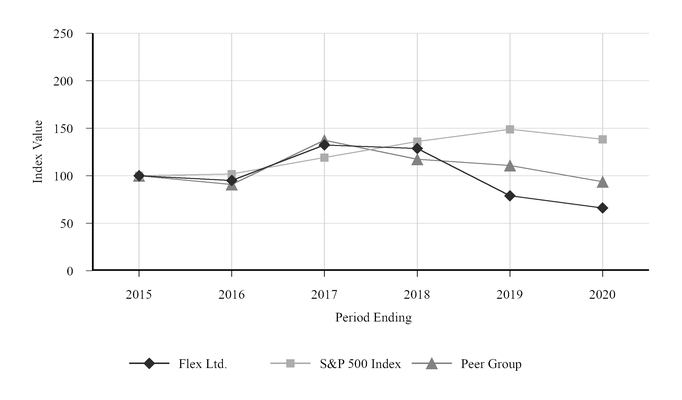
| 3/15 | 3/16 | 3/17 | 3/18 | 3/19 | 3/20 | ||||||||||||
| Flex Ltd. | 100.00 | 95.11 | 132.49 | 128.79 | 78.86 | 66.05 | |||||||||||
| S&P 500 Index | 100.00 | 101.78 | 119.26 | 135.95 | 148.86 | 138.47 | |||||||||||
| Peer Group | 100.00 | 90.70 | 137.35 | 117.24 | 110.69 | 93.72 |
Prepared by Zacks Investment Research, Inc. Used with permission. All rights reserved. Copyright 1980-2020
Index Data: Copyright Standard and Poor's, Inc. Used with permission. All rights reserved.
Issuer Purchases of Equity Securities
The following table provides information regarding purchases of our ordinary shares made by us for the period from January 1, 2020 through March 31, 2020.
| Period (2) | Total Number of Shares Purchased (1) | Average Price Paid per Share | Total Number of Shares Purchased as Part of Publicly Announced Plans or Programs | Approximate Dollar Value of Shares that May Yet Be Purchased Under the Plans or Programs | ||||||||||
| January 1 - January 31, 2020 | 727,887 | $ | 13.05 | 727,887 | $ | 392,523,252 | ||||||||
| February 1 - February 28, 2020 | 3,690,995 | 12.98 | 3,690,995 | 344,627,426 | ||||||||||
| February 29 - March 31, 2020 | 3,015,107 | 9.75 | 3,015,107 | 315,227,484 | ||||||||||
| Total | 7,433,989 | 7,433,989 |
| (1) | During the period from January 1, 2020 through March 31, 2020 all purchases were made pursuant to the program discussed below in open market transactions. All purchases were made in accordance with Rule 10b-18 under the Securities Exchange Act of 1934. |
| (2) | On August 20, 2019, our Board of Directors authorized repurchases of our outstanding ordinary shares for up to $500 million. This is in accordance with the share purchase mandate whereby our shareholders approved a repurchase limit of 20% of our issued ordinary shares outstanding at the Annual General Meeting held on the same date as the Board authorization. As of March 31, 2020, shares in the aggregate amount of $315.2 million were available to be repurchased under the current plan. |
RECENT SALES OF UNREGISTERED SECURITIES
None.
INCOME TAXATION UNDER SINGAPORE LAW
Dividends. Singapore does not impose a withholding tax on dividends. All dividends on our ordinary shares are not taxable in Singapore to shareholders, provided that any dividends are paid to shareholders outside of Singapore for this purpose and such dividends are not received or deemed to be received in Singapore by shareholders and are not derived by shareholders pursuant to any trade or business carried on in Singapore. Certain tax exemptions are available for foreign-sourced dividends received by Singapore tax residents, subject to conditions. Since inception, we have not declared or paid any cash dividends on our ordinary shares, and we currently do not have plans to pay any dividends.
Gains on Disposal. Under current Singapore tax law there is no tax on capital gains, and thus any profits from the disposal of shares are not taxable in Singapore unless the gains arising from the disposal of shares are income in nature and subject to tax, especially if they arise from activities which the Inland Revenue Authority of Singapore regards as the carrying on of a trade or business in Singapore (in which case, the profits on the sale would be taxable as trade profits rather than capital gains).
Shareholders who apply, or who are required to apply, the Singapore Financial Reporting Standard 39 Financial Instruments—Recognition and Measurement ("FRS 39") for the purposes of Singapore income tax may be required to recognize gains or losses (not being gains or losses in the nature of capital) in accordance with the provisions of FRS 39 (as modified by the applicable provisions of Singapore income tax law) even though no sale or disposal of shares is made.
Stamp Duty. There is no stamp duty payable for holding shares, and no duty is payable on the issue of new shares. When existing shares are acquired in Singapore, a stamp duty of 0.2% is payable on the instrument of transfer of the shares at market value. The stamp duty is borne by the purchaser unless there is an agreement to the contrary. If the instrument of transfer is executed outside of Singapore, the stamp duty must be paid only if the instrument of transfer is received in Singapore.
Estate Taxation. The estate duty was abolished for deaths occurring on or after February 15, 2008. For deaths prior to February 15, 2008 the following rules apply:
If an individual who is not domiciled in Singapore dies on or after January 1, 2002, no estate tax is payable in Singapore on any of our shares held by the individual.
If property passing upon the death of an individual domiciled in Singapore includes our shares, Singapore estate duty is payable to the extent that the value of the shares aggregated with any other assets subject to Singapore estate duty exceeds S$600,000. Unless other exemptions apply to the other assets, for example, the separate exemption limit for residential properties, any excess beyond S$600,000 will be taxed at 5% on the first S$12,000,000 of the individual's chargeable assets and thereafter at 10%.
An individual shareholder who is a U.S. citizen or resident (for U.S. estate tax purposes) will have the value of the shares included in the individual's gross estate for U.S. estate tax purposes. An individual shareholder generally will be entitled to a tax credit against the shareholder's U.S. estate tax to the extent the individual shareholder actually pays Singapore estate tax on the value of the shares; however, such tax credit is generally limited to the percentage of the U.S. estate tax attributable to the inclusion of the value of the shares included in the shareholder's gross estate for U.S. estate tax purposes, adjusted further by a pro rata apportionment of available exemptions. Individuals who are domiciled in Singapore should consult their own tax advisors regarding the Singapore estate tax consequences of their investment.
Tax Treaties Regarding Withholding. There is no reciprocal income tax treaty between the U.S. and Singapore regarding withholding taxes on dividends and capital gains.
Item 6. SELECTED FINANCIAL DATA
These historical results are not necessarily indicative of the results to be expected in the future. The following selected consolidated financial data set forth below was derived from our historical audited consolidated financial statements and is qualified by reference to, and should be read in conjunction with, Item 7, "Management's Discussion and Analysis of Financial Condition and Results of Operations" and Item 8, "Financial Statements and Supplementary Data." On April 1, 2018, we adopted the new revenue standard and as a result we recognized the cumulative effect of initially applying the new revenue standard as an adjustment to the opening balance of retained earnings. The comparative information has not been restated and continues to be reported under the accounting standards in effect at the time. (Amounts may not sum due to rounding).
| Fiscal Year Ended March 31, | |||||||||||||||||||
| 2020 | 2019 | 2018 | 2017 | 2016 | |||||||||||||||
| (In millions, except per share amounts) | |||||||||||||||||||
| CONSOLIDATED STATEMENT OF OPERATIONS DATA: | |||||||||||||||||||
| Net sales | $ | 24,210 | $ | 26,211 | $ | 25,441 | $ | 23,863 | $ | 24,419 | |||||||||
| Cost of sales | 22,681 | 24,594 | 23,778 | 22,303 | 22,811 | ||||||||||||||
| Restructuring charges (3) | 190 | 99 | 67 | 39 | — | ||||||||||||||
| Gross profit | 1,338 | 1,518 | 1,596 | 1,521 | 1,608 | ||||||||||||||
| Selling, general and administrative expenses | 834 | 953 | 1,019 | 937 | 955 | ||||||||||||||
| Intangible amortization | 64 | 74 | 79 | 81 | 66 | ||||||||||||||
| Restructuring charges (3) | 26 | 14 | 24 | 11 | — | ||||||||||||||
| Interest and other, net | 164 | 183 | 123 | 100 | 84 | ||||||||||||||
| Other charges (income), net (1) | 92 | 110 | (170 | ) | 21 | 48 | |||||||||||||
| Income before income taxes | 158 | 182 | 521 | 371 | 455 | ||||||||||||||
| Provision for income taxes | 71 | 89 | 92 | 51 | 11 | ||||||||||||||
| Net income | $ | 88 | $ | 93 | $ | 429 | $ | 320 | $ | 444 | |||||||||
| Diluted earnings per share: | |||||||||||||||||||
| Total | $ | 0.17 | $ | 0.18 | $ | 0.80 | $ | 0.59 | $ | 0.79 |
| As of March 31, | |||||||||||||||||||
| 2020 | 2019 | 2018 | 2017 | 2016 | |||||||||||||||
| (In millions) | |||||||||||||||||||
| CONSOLIDATED BALANCE SHEET DATA: | |||||||||||||||||||
| Working capital (2) | $ | 1,875 | $ | 1,506 | $ | 1,902 | $ | 1,883 | $ | 1,743 | |||||||||
| Total assets | 13,690 | 13,499 | 13,716 | 12,593 | 12,385 | ||||||||||||||
| Total long-term debt, excluding current portion (4) | 2,689 | 2,422 | 2,898 | 2,891 | 2,709 | ||||||||||||||
| Shareholders' equity | 2,831 | 2,972 | 3,019 | 2,678 | 2,606 |
| (1) | For fiscal years 2020, 2019 and 2018, refer to note 16 to the consolidated financial statements in Item 8, "Financial Statements and Supplementary Data" for further discussion. |
During fiscal year 2016, the Company incurred non-cash losses of $47.7 million primarily due to a $26.8 million loss on the disposition of a non-strategic Western European manufacturing facility, which included a non-cash foreign currency translation loss of $25.3 million, and a $21.8 million loss from the impairment of a non-core investment offset by immaterial currency translation gains.
| (2) | Working capital is defined as current assets, less current liabilities. |
| (3) | The Company initiated restructuring plans during fiscal years 2020, 2019, 2018 and 2017. For the restructuring plans initiated during fiscal years 2020, 2019, and 2018, refer to note 15 to the consolidated financial statements in Item 8, "Financial Statements |
and Supplementary Data" for further discussion. During fiscal year 2017, the Company initiated a restructuring plan to accelerate its ability to support more Sketch-to-Scale® efforts across the Company and reposition away from historical legacy programs and structures through rationalizing its current footprint at existing sites and at corporate SG&A functions. The Company recognized restructuring charges of approximately $49.4 million primarily for employee termination costs under the above plan. Of these total charges, approximately $38.8 million was recognized in cost of sales.
| (4) | In May 2020, the Company issued $425 million aggregate principal amount of 3.750% Notes due February 2026, at 99.617% of face value, and $325 million aggregate principal amount of 4.875% Notes due May 2030, at 99.562% of face value. Refer to note 8 to the consolidated financial statement in Item 8, "Financial Statements and Supplementary Data" |
Item 7. MANAGEMENT'S DISCUSSION AND ANALYSIS OF FINANCIAL CONDITION AND RESULTS OF OPERATIONS
This report on Form 10-K contains forward-looking statements within the meaning of Section 21E of the Securities Exchange Act of 1934, as amended, and Section 27A of the Securities Act of 1933, as amended. The words "expects," "anticipates," "believes," "intends," "plans" and similar expressions identify forward-looking statements. In addition, any statements which refer to expectations, projections or other characterizations of future events or circumstances are forward-looking statements. We undertake no obligation to publicly disclose any revisions to these forward-looking statements to reflect events or circumstances occurring subsequent to filing this Form 10-K with the Securities and Exchange Commission. These forward-looking statements are subject to risks and uncertainties, including, without limitation, those discussed in this section and in Item 1A, "Risk Factors." In addition, new risks emerge from time to time and it is not possible for management to predict all such risk factors or to assess the impact of such risk factors on our business. Accordingly, our future results may differ materially from historical results or from those discussed or implied by these forward-looking statements. Given these risks and uncertainties, the reader should not place undue reliance on these forward-looking statements.
OVERVIEW
We are the manufacturing partner of choice that helps a diverse customer base design and build products that improve the world. Through the collective strength of a global workforce across approximately 30 countries and responsible, sustainable operations, we deliver technology innovation, supply chain, and manufacturing solutions to diverse industries and end markets. As of March 31, 2020, our reporting business segments were as follows:
| • | High Reliability Solutions ("HRS"), which is comprised of our health solutions business, including surgical equipment, drug delivery, diagnostics, telemedicine, disposable devices, imaging and monitoring, patient mobility and ophthalmology; and our automotive business, including vehicle electrification, connectivity, autonomous, and smart technologies; |
| • | Industrial and Emerging Industries ("IEI"), which is comprised of energy including advanced metering infrastructure, energy storage, smart lighting, smart solar energy; and industrial, including semiconductor and capital equipment, office solutions, household industrial and lifestyle, industrial automation and kiosks; |
| • | Communications & Enterprise Compute ("CEC"), which includes our telecom business of radio access base stations, remote radio heads and small cells for wireless infrastructure; our networking business, which includes optical, routing, and switching products for data and video networks; our server and storage platforms for both enterprise and cloud-based deployments; next generation storage and security appliance products; and rack-level solutions, converged infrastructure and software-defined product solutions; and |
| • | Consumer Technologies Group ("CTG"), which includes our consumer-related businesses in IoT enabled devices, audio and consumer power electronics, mobile devices; and various supply chain solutions for consumer, computing and printing devices. |
These segments represent components of the Company for which separate financial information is available that is utilized on a regular basis by our Chief Operating Decision Maker (“CODM”). Our segments are determined based on several factors, including the nature of products and services, the nature of production processes, customer base, delivery channels and similar economic characteristics. Refer to note 20 to the consolidated financial statements in Item 8, "Financial Statements and Supplementary Data" for additional information on our operating segments.
In March 2020, we announced a change in organization structure as part of our strategy to further drive growth and productivity with two focused delivery models. As a result, beginning in fiscal year 2021, we expect to report our financial performance based on two reportable segments (Flex Agility Solutions Group and Flex Reliability Solutions Group) and analyze operating income as the measure of segment profitability.
Our strategy is to provide customers with a full range of cost competitive, vertically-integrated global supply chain solutions through which we can design, build, ship and service a complete packaged product for our customers. This enables our customers to leverage our supply chain solutions to meet their product requirements throughout the entire product life cycle.
Over the past few years, we have seen an increased level of diversification by many companies, primarily in the technology sector. Some companies that have historically identified themselves as software providers, Internet service providers or e-commerce retailers have entered the highly competitive and rapidly evolving technology hardware markets, such as mobile devices, home entertainment and wearable devices. This trend has resulted in a significant change in the manufacturing and supply chain solutions requirements of such companies. While the products have become more complex, the supply chain solutions required by such companies have become more customized and demanding, and it has changed the manufacturing and supply chain landscape significantly.
We use a portfolio approach to manage our extensive service offerings. As our customers change the way they go to market, we have the capability to reorganize and rebalance our business portfolio in order to align with our customers' needs and requirements in an effort to optimize operating results. The objective of our business model is to allow us to be flexible and redeploy and reposition our assets and resources as necessary to meet specific customer's supply chain solutions needs across all the markets we serve and earn a return on our invested capital above the weighted average cost of that capital.
During the past several years, we have evolved our long-term portfolio towards a mix of businesses which possess longer product life cycles and higher segment operating margins as reflected in our IEI and HRS businesses. We have expanded our design and engineering relationships through our product innovation centers and global design centers.
During fiscal year 2019, we took actions to optimize our portfolio with greater focus to be placed on higher margin, less volatile businesses. During the first half of fiscal year 2020, in connection with the recent geopolitical developments and uncertainties, primarily impacting one customer in China, we experienced a reduction in demand for products assembled for that customer. As a result, we accelerated our strategic decision to reduce our exposure to certain high-volatility products in both China and India. We also initiated targeted activities to restructure our business to further reduce and streamline our cost structure. We recognized $216 million of charges during the fiscal year 2020, comprised of approximately $159 million of cash charges predominantly for employee severance, and $57 million of non-cash charges primarily related to asset impairments. While the bulk of the restructuring activities were executed in fiscal year 2020 and prior, we may be required to execute additional restructuring activities as we continue to streamline our cost structure while focusing on higher margin, less volatile businesses and in response to the economic challenges in light of recent events with COVID-19 as discussed below.
We believe that our continued business transformation is strategically positioning us to take advantage of the long-term, future growth prospects for outsourcing of advanced manufacturing capabilities, design and engineering services and after-market services.
Impact of COVID-19 on Our Business
The COVID-
Showing the first 8K of 105K characters. Open the full section
Item 7A. QUANTITATIVE AND QUALITATIVE DISCLOSURES ABOUT MARKET RISK
INTEREST RATE RISK
A portion of our exposure to market risk for changes in interest rates relates to our highly liquid investment portfolio, with maturities of three months or less from original dates of purchase and are classified as cash equivalents on our consolidated balance sheet. We do not use derivative financial instruments in our highly liquid investment portfolio. We place cash and cash equivalents with various major financial institutions and highly rated money market accounts. Our investment policy has strict guidelines focusing on preservation of capital. The portfolio is comprised of various instruments including term deposits with banks, marketable securities and money market accounts. Our cash is principally invested in the U.S. dollar and China renminbi serving as a natural hedge of our renminbi denominated costs. As of March 31, 2020, the outstanding amount in the highly liquid investment portfolio was $0.4 billion, the largest components of which were U.S. dollar, Brazilian real, China renminbi and Indian rupee denominated money market accounts with an average return of 2.72%. A hypothetical 10% change in interest rates would not be expected to have a material effect on our financial position, results of operations and cash flows over the next fiscal year.
We had variable rate debt outstanding of approximately $1.0 billion as of March 31, 2020. Variable rate debt obligations consisted of borrowings under our term loans. Interest on these obligations is discussed in note 8 to the consolidated financial statements in Item 8, "Financial Statements and Supplementary Data".
Our variable rate debt instruments create exposures for us related to interest rate risk. Primarily due to the current low interest rates, a hypothetical 10% change in interest rates would not be expected to have a material effect on our financial position, results of operations and cash flows over the next fiscal year.
As of March 31, 2020, the approximate average fair value of our debt outstanding under our term loan facilities that mature in June 2022, and Notes due February 2023, June 2025 and June 2029 was 98.3% of the face value of the debt obligations based on broker trading prices.
In July 2017, the Financial Conduct Authority (“FCA”) that regulates LIBOR announced it intends to stop compelling banks to submit rates for the calculation of LIBOR after 2021. As a result, the Federal Reserve Board and the Federal Reserve Bank of New York organized the Alternative Reference Rates Committee which identified the Secured Overnight Financing Rate ("SOFR") as its preferred alternative to USD-LIBOR in derivatives and other financial contracts. We are not able to predict when LIBOR will cease to be published or precisely how SOFR will be calculated and published. Any changes adopted by FCA or other governing bodies in the method used for determining LIBOR may result in a sudden or prolonged increase or decrease in reported LIBOR. If that were to occur, our interest payments could change.
If a contract is not transitioned to an alternative rate and LIBOR is discontinued, the impact is likely to vary by contract. If LIBOR is discontinued or if the method of calculating LIBOR changes from its current form, interest rates on our current or future indebtedness may be adversely affected. While we expect LIBOR to be available in substantially its current form until the end of 2021, it is possible that LIBOR will become unavailable prior to that point. This could result, for example, if sufficient banks decline to make submissions to the LIBOR administrator. In that case, the risks associated with the transition to an alternative reference rate will be accelerated and magnified.
FOREIGN CURRENCY EXCHANGE RISK
We transact business in various foreign countries and are, therefore, subject to risk of foreign currency exchange rate fluctuations. We have established a foreign currency risk management policy to manage this risk. To the extent possible, we manage our foreign currency exposure by evaluating and using non-financial techniques, such as currency of invoice, leading and lagging payments and receivables management. In addition, we may borrow in various foreign currencies and enter into short-term foreign currency derivative contracts, including forward, swap, and option contracts to hedge only those currency exposures associated with certain assets and liabilities, mainly accounts receivable and accounts payable, and cash flows denominated in non-functional currencies.
We endeavor to maintain a partial or fully hedged position for certain transaction exposures. These exposures are primarily, but not limited to, revenues, customer and vendor payments and inter-company balances in currencies other than the functional currency unit of the operating entity. The credit risk of our foreign currency derivative contracts is minimized since all contracts are with large financial institutions and accordingly, fair value adjustments related to the credit risk of the counter-party financial institution were not material. The gains and losses on foreign currency derivative contracts generally offset the losses and gains on the assets, liabilities and transactions hedged. The fair value of currency derivative contracts is reported on the balance sheet. The aggregate notional amount of outstanding contracts as of March 31, 2020 amounted to $9.8 billion and the recorded fair values of the associated assets and liabilities were not material. The majority of these foreign exchange contracts expire in less than three months and all expire within one year. They will settle primarily in the Brazilian real, British
pound, China renminbi, Euro, Hungarian forint, Indian rupee, Israeli shekel, Malaysian ringgit, Mexican peso, Swedish krona, and U.S. dollar.
Based on our overall currency rate exposures as of March 31, 2020, including the derivative financial instruments intended to hedge the nonfunctional currency-denominated monetary assets, liabilities and cash flows, and other factors, a 10% appreciation or depreciation of the U.S. dollar from its cross-functional rates would not be expected, in the aggregate, to have a material effect on our financial position, results of operations and cash flows in the near-term.
Item 8. FINANCIAL STATEMENTS AND SUPPLEMENTARY DATA
REPORT OF INDEPENDENT REGISTERED PUBLIC ACCOUNTING FIRM
To the Board of Directors and Shareholders of Flex Ltd., Singapore
Opinion on the Financial Statements
We have audited the accompanying consolidated balance sheets of Flex Ltd. and subsidiaries (the "Company") as of March 31, 2020 and 2019, and the related consolidated statements of operations, comprehensive income, shareholders' equity, and cash flows for each of the three years in the period ended March 31, 2020, and the related notes (collectively referred to as the “financial statements”). In our opinion, the financial statements present fairly, in all material respects, the financial position of the Company as of March 31, 2020 and 2019, and the results of its operations and its cash flows for each of the three years in the period ended March 31, 2020, in conformity with accounting principles generally accepted in the United States of America.
We have also audited, in accordance with the standards of the Public Company Accounting Oversight Board (United States) (PCAOB), the Company's internal control over financial reporting as of March 31, 2020, based on the criteria established in Internal Control-Integrated Framework (2013) issued by the Committee of Sponsoring Organizations of the Treadway Commission and our report dated May 28, 2020, expressed an unqualified opinion on the Company's internal control over financial reporting.
Change in Accounting Principles
As discussed in Note 2 to the financial statements, the Company changed its method of accounting for leases in fiscal year 2020 due to the adoption of Accounting Standard Update (ASU) No. 2016-02, Leases. In fiscal year 2019, the Company changed its method of accounting for revenue from contracts with customers due to the adoption of ASU No. 2014-09, Revenue from Contracts with Customers, using the modified retrospective approach.
Basis of Opinion
These financial statements are the responsibility of the Company's management. Our responsibility is to express an opinion on these financial statements based on our audits. We are a public accounting firm registered with the PCAOB and are required to be independent with respect to the Company in accordance with the US federal securities laws and the applicable rules and regulations of the Securities and Exchange Commission and the PCAOB.
We conducted our audits in accordance with the standards of the PCAOB. Those standards require that we plan and perform the audit to obtain reasonable assurance about whether the financial statements are free of material misstatement, whether due to error or fraud. Our audits included performing procedures to assess the risks of material misstatement of the financial statements, whether due to error or fraud, and performing procedures that respond to those risks. Such procedures included examining, on a test basis, evidence supporting the amounts and disclosures in the financial statements. Our audits also included assessing the accounting principles used and significant estimates made by management, as well as evaluating the overall financial statement presentation. We believe that our audits provide a reasonable basis for our opinion.
Critical Audit Matters
The critical audit matters communicated below are matters arising from the current-period audit of the financial statements that were communicated or required to be communicated to the audit committee and that (1) relate to accounts or disclosures that are material to the financial statements and (2) involved our especially challenging, subjective, or complex judgments. The communication of critical audit matters does not alter in any way our opinion on the financial statements, taken as a whole, and we are not, by communicating the critical audit matters below, providing separate opinions on the critical audit matters or on the accounts or disclosures to which they relate.
Goodwill - Consumer Technologies Group and Communications & Enterprise Compute Reporting Units - Refer to Note 2 to the financial statements
Critical Audit Matter Description
The Company’s evaluation of goodwill for impairment involves the comparison of the fair value of each reporting unit to its carrying value. The Company determines the fair value of its reporting units using a combination of a discounted cash flow model and the market approach. The determination of the fair value using the discounted cash flow model and market approach requires management to make significant judgments and assumptions related to forecasts of future revenues, earnings before interest, taxes, depreciation, and amortization (EBITDA), and capital expenditures, and the selection of the discount rate.
As of March 31, 2020, the goodwill balance was approximately $1.1 billion, of which $103.3 million and $129.3 million was allocated to the Consumer Technologies Group (“CTG”) and Communications & Enterprise Compute (“CEC”) reporting units, respectively. The fair values of the CTG and CEC reporting units exceeded their carrying values as of the measurement date and, therefore, no impairment was recognized.
We identified the goodwill valuation for CTG and CEC as a critical audit matter due to the relatively small excess of each reporting unit’s fair value over its book value, the significant judgments and assumptions made by management to estimate the fair value of the reporting units, and the inherent uncertainty of future forecasts that are dependent on the Company executing against its strategy for CTG and CEC. These factors required a high degree of auditor judgement and an increased extent of effort, including the need to involve our fair value specialists, when performing audit procedures to evaluate the reasonableness of management’s judgments and assumptions related to forecasts of future revenues, EBITDA and capital expenditures, and the selection of the discount rate. For these reasons we identified the valuation of CTG and CEC goodwill as a critical audit matter.
How the Critical Audit Matter Was Addressed in the Audit
Our audit procedures related to the forecasts of the CTG and CEC reporting units’ future revenues, EBITDA and capital expenditures, and the selection of the discount rate, included the following, among others:
| • | We tested the effectiveness of internal controls over management’s goodwill impairment evaluation, including those over the forecasts of future revenue, EBITDA and capital expenditures, and selection of the discount rate. |
| • | We evaluated the reasonableness of management’s revenue, EBITDA and capital expenditures forecasts by comparing the forecasts to: |
| • | Historical revenues, EBITDA, and capital expenditures; |
| • | Internal communications to management and the Board of Directors; |
| • | Forecasted information included in Company press releases as well as in analyst and industry reports of the Company and companies in its peer group. |
| • | With the assistance of our fair value specialists, we evaluated the reasonableness of (1) the valuation methodology and (2) the discount rate by: |
| • | Testing the source information underlying the determination of the discount rate and the mathematical accuracy of the calculation; |
| • | Developing a range of independent estimates and comparing those to the discount rate selected by management. |
Revenue - Customer Contracts and Related Obligations - Refer to Notes 2 and 4 to the financial statements
Critical Audit Matter Description
Certain of the Company’s customer agreements include potential price adjustments which are accounted for as variable consideration under the relevant accounting literature. For arrangements that include potential price adjustments the Company limits the amount of revenue recognized to that am
Showing the first 8K of 219K characters. Open the full section
Item 9. CHANGES IN AND DISAGREEMENTS WITH ACCOUNTANTS ON ACCOUNTING AND FINANCIAL DISCLOSURE
Not applicable.
Item 9A. CONTROLS AND PROCEDURES
| (a) | Evaluation of Disclosure Controls and Procedures |
The Company's management, with the participation of the Chief Executive Officer and Chief Financial Officer has evaluated the effectiveness of the Company's disclosure controls and procedures (as defined in Rule 13a-15(e) under the Exchange Act) as of March 31, 2020. Based on that evaluation, the Company's Chief Executive Officer and Chief Financial Officer concluded that, as of March 31, 2020, the Company's disclosure controls and procedures were effective in ensuring that information required to be disclosed by the Company in reports that it files or submits under the Securities Exchange Act of 1934, as amended, is (i) recorded, processed, summarized and reported within the time periods specified in the Securities and Exchange Commission's rules and forms and (ii) accumulated and communicated to our management, including our principal executive officer and principal financial officer, as appropriate to allow timely decisions regarding required disclosure.
| (b) | Management's Annual Report on Internal Control over Financial Reporting |
Management is responsible for establishing and maintaining adequate internal control over financial reporting, as such term is defined in Rule 13a-15(f) under the Securities Exchange Act of 1934, as amended. Internal control over financial reporting consists of policies and procedures that: (1) pertain to the maintenance of records that, in reasonable detail, accurately and fairly reflect the transactions and dispositions of the assets of the Company; (2) are designed and operated to provide reasonable assurance regarding the reliability of the Company's financial reporting and the Company's process for the preparation of financial statements for external purposes in accordance with generally accepted accounting principles and that receipts and expenditures of the Company are being made only in accordance with authorizations of management and directors of the Company; and (3) provide reasonable assurance regarding prevention or timely detection of unauthorized acquisition, use or disposition of the Company’s assets that could have a material effect on the financial statements. Because of its inherent limitations, a system of internal control over financial reporting can provide only reasonable assurance and may not prevent or detect misstatements or prevent or detect instances of fraud. These inherent limitations include the realities that judgments in decision-making can be faulty, and that breakdowns can occur because of simple error or mistake. Additionally, controls may be circumvented by the individual acts of some persons, by collusion of two or more people, or by management override of the control. The projections of any evaluation of effectiveness to future periods are subject to the risk that controls may become inadequate because of changes in conditions, or that the degree of compliance with the policies or procedures may deteriorate.
As of March 31, 2020, under the supervision and with the participation of management, including the Company's Chief Executive Officer and Chief Financial Officer, an evaluation was conducted of the effectiveness of the Company's internal control over financial reporting based on the framework in Internal Control—Integrated Framework (2013) issued by the Committee of Sponsoring Organizations of the Treadway Commission ("COSO"). Based on that evaluation, management concluded that the Company's internal control over financial reporting was effective as of March 31, 2020.
| (c) | Attestation Report of the Registered Public Accounting Firm |
The effectiveness of the Company's internal control over financial reporting as of March 31, 2020 has been audited by Deloitte & Touche LLP, an independent registered public accounting firm, as stated in their report which appears in this Item under the heading "Report of Independent Registered Public Accounting Firm."
| (d) | Changes in Internal Control Over Financial Reporting |
There were no changes in our internal control over financial reporting that occurred during the fourth quarter ended March 31, 2020 that materially affected, or are reasonably likely to materially affect, our internal control over financial reporting.
REPORT OF INDEPENDENT REGISTERED PUBLIC ACCOUNTING FIRM
To the Board of Directors and Shareholders of Flex Ltd., Singapore
Opinion on Internal Control over Financial Reporting
We have audited the internal control over financial reporting of Flex Ltd. and subsidiaries (the "Company") as of March 31, 2020, based on criteria established in Internal Control - Integrated Framework (2013) issued by the Committee of Sponsoring Organizations of the Treadway Commission (COSO). In our opinion, the Company maintained, in all material respects, effective internal control over financial reporting as of March 31, 2020, based on criteria established in Internal Control - Integrated Framework (2013) issued by COSO.
We have also audited, in accordance with the standards of the Public Company Accounting Oversight Board (United States) (PCAOB), the consolidated financial statements as of and for the year ended March 31, 2020 of the Company and our report dated May 28, 2020, expressed an unqualified opinion on those financial statements and included an explanatory paragraph related to the Company’s change in method of accounting for leases in fiscal year 2020 due to the adoption of Accounting Standard Update (ASU) No. 2016-02, Leases, and change in method of accounting for revenue from contracts with customers in fiscal year 2019 due to the adoption of ASU No. 2014-09, Revenue from Contracts with Customers.
Basis for Opinion
The Company's management is responsible for maintaining effective internal control over financial reporting and for its assessment of the effectiveness of internal control over financial reporting, included in the accompanying Management’s Annual Report on Internal Control over Financial Reporting. Our responsibility is to express an opinion on the Company's internal control over financial reporting based on our audit. We are a public accounting firm registered with the PCAOB and are required to be independent with respect to the Company in accordance with the U.S. federal securities laws and the applicable rules and regulations of the Securities and Exchange Commission and the PCAOB.
We conducted our audit in accordance with the standards of the PCAOB. Those standards require that we plan and perform the audit to obtain reasonable assurance about whether effective internal control over financial reporting was maintained in all material respects. Our audit included obtaining an understanding of internal control over financial reporting, assessing the risk that a material weakness exists, testing and evaluating the design and operating effectiveness of internal control based on the assessed risk, and performing such other procedures as we considered necessary in the circumstances. We believe that our audit provides a reasonable basis for our opinion.
Definition and Limitations of Internal Control over Financial Reporting
A company's internal control over financial reporting is a process designed to provide reasonable assurance regarding the reliability of financial reporting and the preparation of financial statements for external purposes in accordance with generally accepted accounting principles. A company's internal control over financial reporting includes those policies and procedures that (1) pertain to the maintenance of records that, in reasonable detail, accurately and fairly reflect the transactions and dispositions of the assets of the company; (2) provide reasonable assurance that transactions are recorded as necessary to permit preparation of financial statements in accordance with generally accepted accounting principles, and that receipts and expenditures of the company are being made only in accordance with authorizations of management and directors of the company; and (3) provide reasonable assurance regarding prevention or timely detection of unauthorized acquisition, use, or disposition of the company's assets that could have a material effect on the financial statements.
Because of its inherent limitations, internal control over financial reporting, may not prevent or detect misstatements. Also, projections of any evaluation of effectiveness to future periods are subject to the risk that controls may become inadequate because of changes in conditions, or that the degree of compliance with the policies or procedures may deteriorate.
/s/ DELOITTE & TOUCHE LLP
San Jose, California
May 28, 2020
Item 9B. OTHER INFORMATION
Not applicable.
PART III
Item 10. DIRECTORS, EXECUTIVE OFFICERS AND CORPORATE GOVERNANCE
Information with respect to this item may be found in the Company's definitive proxy statement to be delivered to shareholders in connection with the Company's 2020 Annual General Meeting of Shareholders. Such information is incorporated by reference.
Item 11. EXECUTIVE COMPENSATION
Information with respect to this item may be found in the Company's definitive proxy statement to be delivered to shareholders in connection with the Company's 2020 Annual General Meeting of Shareholders. Such information is incorporated by reference.
Item 12. SECURITY OWNERSHIP OF CERTAIN BENEFICIAL OWNERS AND MANAGEMENT AND RELATED SHAREHOLDER MATTERS
Information with respect to this item may be found in the Company's definitive proxy statement to be delivered to shareholders in connection with the Company's 2020 Annual General Meeting of Shareholders. Such information is incorporated by reference.
Item 13. CERTAIN RELATIONSHIPS AND RELATED TRANSACTIONS, AND DIRECTOR INDEPENDENCE
Information with respect to this item may be found in the Company's definitive proxy statement to be delivered to shareholders in connection with the Company's 2020 Annual General Meeting of Shareholders. Such information is incorporated by reference.
Item 14. PRINCIPAL ACCOUNTANT FEES AND SERVICES
Information with respect to this item may be found in the Company's definitive proxy statement to be delivered to shareholders in connection with the Company's 2020 Annual General Meeting of Shareholders. Such information is incorporated by reference.
PART IV
Item 15. EXHIBITS AND FINANCIAL STATEMENT SCHEDULES
| (a) | Documents filed as part of this annual report on Form 10-K: |
- Financial Statements. See Item 8, "Financial Statements and Supplementary Data."
| 2. | Financial Statement Schedules. "Schedule II—Valuation and Qualifying Accounts" is included in the financial statements, see Concentration of Credit Risk in Note 2, "Summary of Accounting Policies" of the Notes to Consolidated Financial Statements in Item 8, "Financial Statements and Supplementary Data." |
- Exhibits. Reference is made to Item 15(b) below.
| (b) | Exhibits. The Exhibit Index, which immediately precedes the signature page to this annual report on Form 10-K, is incorporated by reference into this annual report on Form 10-K. |
| (c) | Financial Statement Schedules. Reference is made to Item 15(a)(2) above. |
Item 16. FORM 10-K SUMMARY
None
EXHIBIT INDEX
| Incorporated by Reference | ||||||||||||
| Exhibit No. | Exhibit | Form | File No. | Filing Date | Exhibit No. | Filed Herewith | ||||||
| 3.01 | Constitution of the Registrant (incorporating all amendments as at August 20, 2019) | 10-Q | 000-23354 | 10/30/2019 | 3.01 | |||||||
| 4.01 | Indenture, dated as of February 20, 2013, by and between the Registrant, the Guarantors party thereto and U.S. Bank National Association, as Trustee, related to the Registrant's 5.000% Notes due 2023 | 8-K | 000-23354 | 2/22/2013 | 4.1 | |||||||
| 4.02 | Form of 5.000% Note due 2023 | 8-K | 000-23354 | 2/22/2013 | 4.1 | |||||||
| 4.03 | First Supplemental Indenture, dated as of March 28, 2013, among the Registrant, the Guarantor party thereto and U.S. Bank National Association, as Trustee, to the Indenture, dated as of February 20, 2013, by and between the Registrant, the Guarantors party thereto and U.S. Bank National Association, as Trustee, related to the Registrant's 5.000% Notes due 2023 | 10-K | 000-23354 | 5/28/2013 | 4.11 | |||||||
| 4.04 | Second Supplemental Indenture, dated as of August 25, 2014, among the Registrant, the Guarantor party thereto and U.S. Bank National Association, as Trustee, to the Indenture, dated as of February 20, 2013, by and between the Registrant, the Guarantors party thereto and U.S. Bank National Association, as Trustee, related to the Registrant's 5.000% Notes due 2023 | 10-Q | 000-23354 | 10/30/2014 | 4.01 | |||||||
| 4.05 | Third Supplemental Indenture, dated as of September 11, 2015, among the Registrant, the Guarantor party thereto and U.S. Bank National Association, as Trustee, related to the Registrant’s 5.000% Notes due 2023 | S-4 | 333-207067 | 9/22/2015 | 4.11 |
| Incorporated by Reference | ||||||||||||
| Exhibit No. | Exhibit | Form | File No. | Filing Date | Exhibit No. | Filed Herewith | ||||||
| 4.06 | Indenture, dated as of June 8, 2015, by and between the Registrant, the Guarantors party thereto and U.S. Bank National Association, as Trustee | 8-K | 000-23354 | 6/8/2015 | 4.1 | |||||||
| 4.07 | Form of 4.750% Note due 2025 | 8-K | 000-23354 | 6/8/2015 | 4.1 | |||||||
| 4.08 | First Supplemental Indenture, dated as of September 11, 2015, among the Registrant, the Guarantor party thereto and U.S. Bank National Association, as Trustee, related to the Registrant’s 4.750% Notes due 2025 | S-4 | 333-207067 | 9/22/2015 | 4.04 | |||||||
| 4.09 | Indenture, dated as of June 6, 2019, by and between the Company and U.S. Bank National Association, as trustee | 8-K | 000-23354 | 6/6/2019 | 4.1 | |||||||
| 4.10 | First Supplemental Indenture, dated as of June 6, 2019, by and between the Company and U.S. Bank National Association, as trustee | 8-K | 000-23354 | 6/6/2019 | 4.2 | |||||||
| 4.11 | Form of 4.875% Global Note due 2029 (included in Exhibit 4.10) | 8-K | 000-23354 | 6/6/2019 | 4.3 | |||||||
| 4.12 | Second Supplemental Indenture, dated as of November 7, 2019, by and between the Company and U.S. Bank National Association, as trustee | 8-K | 000-23354 | 11/7/2019 | 4.3 | |||||||
| 4.13 | Form of 4.875% Global Note due 2029 (included in Exhibit 4.12) | 8-K | 000-23354 | 11/7/2019 | 4.4 | |||||||
| 4.14 | Description of Registrant's Securities | X | ||||||||||
| 10.01 | Credit Agreement, dated as of June 30, 2017, among Flex Ltd. and certain of its subsidiaries, from time to time party thereto, as borrowers, Bank of America, N.A., as Administrative Agent and Swing Line Lender, and the other Lenders party thereto | 8-K | 000-23354 | 6/30/2017 | 10.01 | |||||||
| 10.02 | First Amendment to Credit Agreement, dated as of January 28, 2020 among Flex Ltd., the lenders party thereto, and Bank of America, N.A., as Administrative Agent | X | ||||||||||
| 10.03 | Form of Indemnification Agreement between the Registrant and its Directors and certain officers† | 10-K | 000-23354 | 5/20/2009 | 10.01 | |||||||
| 10.04 | Form of Indemnification Agreement between Flextronics Corporation and Directors and certain officers of the Registrant† | 10-K | 000-23354 | 5/20/2009 | 10.02 | |||||||
| 10.05 | Flex Ltd. 2010 Equity Incentive Plan† | 8-K | 000-23354 | 7/28/2010 | 10.01 | |||||||
| 10.06 | Form of Share Option Award Agreement under 2010 Equity Incentive Plan† | 10-Q | 000-23354 | 8/5/2010 | 10.02 | |||||||
| 10.07 | Flex Ltd. 2017 Equity Incentive Plan† | DEF 14A | 000-23354 | 7/5/2017 | Annex A | |||||||
| 10.08 | Form of Restricted Share Unit Award Agreement under the 2017 Equity Incentive Plan for time-based vesting awards† | 10-Q | 000-23354 | 10/30/2017 | 10.05 | |||||||
| 10.09 | Form of Restricted Share Unit Award Agreement under the 2017 Equity Incentive Plan for performance-based vesting awards† | 10-Q | 000-23354 | 10/30/2017 | 10.06 | |||||||
| 10.10 | Flextronics International USA, Inc. Third Amended and Restated 2005 Senior Management Deferred Compensation Plan† | 10-Q | 000-23354 | 2/6/2009 | 10.02 |
| Incorporated by Reference | ||||||||||||
| Exhibit No. | Exhibit | Form | File No. | Filing Date | Exhibit No. | Filed Herewith | ||||||
| 10.11 | Flextronics International USA, Inc. Third Amended and Restated Senior Executive Deferred Compensation Plan† | 10-Q | 000-23354 | 2/6/2009 | 10.01 | |||||||
| 10.12 | Summary of Directors' Compensation† | 10-Q | 000.23354 | 10/30/2017 | 10.02 | |||||||
| 10.13 | Executive Incentive Compensation Recoupment Policy† | 10-Q | 000-23354 | 8/5/2010 | 10.06 | |||||||
| 10.14 | 2010 Flextronics International USA, Inc. Deferred Compensation Plan† | 10-Q | 000-23354 | 11/3/2010 | 10.04 | |||||||
| 10.15 | Form of Award Agreement under 2010 Deferred Compensation Plan† | 10-Q | 000-23354 | 7/30/2012 | 10.01 | |||||||
| 10.16 | Summary of Compensation Arrangements of Certain Executive Officers of Flex Ltd.† | X | ||||||||||
| 10.17 | Form of Restricted Share Unit Award Agreement under the 2010 Equity Incentive Plan for time-based vesting awards† | 10-Q | 000-23354 | 11/1/2013 | 10.02 | |||||||
| 10.18 | Form of 2010 Deferred Compensation Plan Award Agreement (performance targets, cliff vesting)† | 10-Q | 000-23354 | 8/2/2013 | 10.02 | |||||||
| 10.19 | Form of 2010 Deferred Compensation Plan Award Agreement (non-performance, periodic vesting, continuing Participant)† | 10-Q | 000-23354 | 8/2/2013 | 10.03 | |||||||
| 10.20 | Award Agreement under the 2010 Deferred Compensation Plan† | 10-Q | 000-23354 | 7/28/2014 | 10.01 | |||||||
| 10.21 | Form of Restricted Share Unit Award Agreement under the 2017 Equity Incentive Plan for retention performance-based vesting awards† | 10-Q | 000-23354 | 2/6/2019 | 10.01 | |||||||
| 10.22 | Form of Restricted Share Unit Award Agreement under the 2017 Equity Incentive Plan for retention service-based vesting awards† | 10-K | 000-23354 | 5/21/2019 | 10.23 | |||||||
| 10.23 | Form of Restricted Share Unit Award Agreement under the 2017 Equity Incentive Plan for performance-based vesting awards (20-day trading average)† | 10-Q | 000-23354 | 7/26/2019 | 10.02 | |||||||
| 10.24 | Description of Annual Incentive Bonus Plan for Fiscal 2020† | 10-Q | 000-23354 | 7/26/2019 | 10.01 | |||||||
| 10.25 | NEXTracker Inc. 2014 Equity Incentive Plan† | S-8 | 333-207325 | 10/7/2015 | 99.01 | |||||||
| 10.26 | BrightBox Technologies, Inc. 2013 Stock Incentive Plan† | S-8 | 333-212267 | 6/27/2016 | 99.01 | |||||||
| 10.27 | Flex Ltd. Executive Severance Plan† | 10-K | 000-23354 | 5/21/2019 | 10.27 | |||||||
| 10.28 | Separation and Release of Claims dated December 24, 2018 between Flex Ltd. and Michael M. McNamara† | 10-Q | 000-23354 | 2/6/2019 | 10.02 | |||||||
| 10.29 | Scott Offer Amended Offer Letter, dated as of January 27, 2019† | X | ||||||||||
| 10.30 | Revathi Advaithi Offer Letter, dated February 7, 2019† | 10-K | 000-23354 | 5/21/2019 | 10.29 | |||||||
| 10.31 | Francois Barbier Relocation Expenses Addendum, dated as of July 8, 2019† | X | ||||||||||
| 21.01 | Subsidiaries of Registrant | X | ||||||||||
| 23.01 | Consent of Deloitte & Touche LLP | X |
| Incorporated by Reference | ||||||||||||
| Exhibit No. | Exhibit | Form | File No. | Filing Date | Exhibit No. | Filed Herewith | ||||||
| 24.01 | Power of Attorney (included on the signature page to this Form 10-K) | X | ||||||||||
| 31.01 | Certification of Chief Executive Officer pursuant to Rule 13a-14(a) of the Exchange Act | X | ||||||||||
| 31.02 | Certification of Chief Financial Officer pursuant to Rule 13a-14(a) of the Exchange Act | X | ||||||||||
| 32.01 | Certification of Chief Executive Officer and Chief Financial Officer pursuant to Rule 13a-14(b) of the Exchange Act and 18 U.S.C. Section 1350* | X | ||||||||||
| 101.INS | Inline XBRL Instance Document | X | ||||||||||
| 101.SCH | Inline XBRL Taxonomy Extension Scheme Document | X | ||||||||||
| 101.CAL | Inline XBRL Taxonomy Extension Calculation Linkbase Document | X | ||||||||||
| 101.DEF | Inline XBRL Taxonomy Extension Definition Linkbase Document | X | ||||||||||
| 101.LAB | Inline XBRL Taxonomy Extension Label Linkbase Document | X | ||||||||||
| 101.PRE | Inline XBRL Taxonomy Extension Presentation Linkbase Document | X | ||||||||||
| 104 | Cover Page Interactive Data File (formatted as inline XBRL with applicable taxonomy extension information contained in Exhibits 101) | X |
| * | This exhibit is furnished with this Annual Report on Form 10-K, is not deemed filed with the Securities and Exchange Commission, and is not incorporated by reference into any filing of Flex Ltd. under the Securities Act of 1933, as amended, or the Securities Exchange Act of 1934, as amended, whether made before or after the date hereof and irrespective of any general incorporation language contained in such filing. |
| † | Management contract, compensatory plan or arrangement. |
SIGNATURES
Pursuant to the requirement of Section 13 or 15(d) of the Securities Exchange Act of 1934, the Registrant has duly caused this Report to be signed on its behalf by the undersigned, thereunto duly authorized.
| Flex Ltd. | |||
| By: | /s/ REVATHI ADVAITHI | ||
| Revathi Advaithi Chief Executive Officer |
Date: May 28, 2020
POWER OF ATTORNEY
KNOW ALL PERSONS BY THESE PRESENTS, that each person whose signature appears below constitutes and appoints jointly and severally, Revathi Advaithi and Christopher E. Collier and each one of them, her or his attorneys-in-fact, each with the power of substitution, for her or him in any and all capacities, to sign any and all amendments to this Report, and to file the same, with exhibits thereto and other documents in connection therewith, with the Securities and Exchange Commission, hereby ratifying and confirming all that each of said attorneys-in-fact, or her or his substitutes, may do or cause to be done by virtue hereof.
Pursuant to the requirements of the Securities Exchange Act of 1934, this report has been signed below by the following persons on behalf of the Registrant and in the capacities and on the dates indicated.
| Signature | Title | Date | ||
| /s/ REVATHI ADVAITHI | Chief Executive Officer and Director (Principal Executive Officer) | May 28, 2020 | ||
| Revathi Advaithi | ||||
| /s/ CHRISTOPHER E. COLLIER | Chief Financial Officer (Principal Financial Officer) | May 28, 2020 | ||
| Christopher E. Collier | ||||
| /s/ DAVID P. BENNETT | Senior Vice President and Chief Accounting Officer (Principal Accounting Officer) | May 28, 2020 | ||
| David P. Bennett | ||||
| /s/ MICHAEL D. CAPELLAS | Chairman of the Board | May 28, 2020 | ||
| Michael D. Capellas | ||||
| /s/ JILL A. GREENTHAL | Director | May 28, 2020 | ||
| Jill A. Greenthal | ||||
| /s/ JENNIFER LI | Director | May 28, 2020 | ||
| Jennifer Li | ||||
| /s/ MARC A. ONETTO | Director | May 28, 2020 | ||
| Marc A. Onetto | ||||
| /s/ WILLY C. SHIH, PH.D. | Director | May 28, 2020 | ||
| Willy C. Shih, Ph.D. | ||||
| /s/ CHARLES K. STEVENS, III | Director | May 28, 2020 | ||
| Charles K. Stevens, III | ||||
| /s/ LAY KOON TAN | Director | May 28, 2020 | ||
| Lay Koon Tan | ||||
| /s/ WILLIAM D. WATKINS | Director | May 28, 2020 | ||
| William D. Watkins | ||||
| /s/ LAWRENCE A. ZIMMERMAN | Director | May 28, 2020 | ||
| Lawrence A. Zimmerman |