 filings.tools
First Solar 10-K 2020-12-31
Filed 2021-02-26. 22 sections, 633K characters. Original on sec.gov · Markdown · JSON
Cover and table of contents
UNITED STATES SECURITIES AND EXCHANGE COMMISSION
Washington, D.C. 20549
Form 10-K
(Mark one)
☒ ANNUAL REPORT PURSUANT TO SECTION 13 OR 15(d) OF THE SECURITIES EXCHANGE ACT OF 1934
For the fiscal year ended December 31, 2020
or
☐ TRANSITION REPORT PURSUANT TO SECTION 13 OR 15(d) OF THE SECURITIES EXCHANGE ACT OF 1934
For the transition period from to
Commission file number: 001-33156
First Solar, Inc.
(Exact name of registrant as specified in its charter)
| Delaware | 20-4623678 | ||||
| (State or other jurisdiction of incorporation or organization) | (I.R.S. Employer Identification No.) |
350 West Washington Street, Suite 600
Tempe, Arizona 85281
(Address of principal executive offices, including zip code)
(602) 414-9300
(Registrant’s telephone number, including area code)
Securities registered pursuant to Section 12(b) of the Act:
| Title of each class | Trading symbol(s) | Name of each exchange on which registered | ||||||
| Common stock, $0.001 par value | FSLR | The NASDAQ Stock Market LLC |
Securities registered pursuant to Section 12(g) of the Act:
None
Indicate by check mark if the registrant is a well-known seasoned issuer, as defined in Rule 405 of the Securities Act. Yes ☒ No ☐
Indicate by check mark if the registrant is not required to file reports pursuant to Section 13 or Section 15(d) of the Act. Yes ☐ No ☒
Indicate by check mark whether the registrant (1) has filed all reports required to be filed by Section 13 or 15(d) of the Securities Exchange Act of 1934 during the preceding 12 months (or for such shorter period that the registrant was required to file such reports), and (2) has been subject to such filing requirements for the past 90 days. Yes ☒ No ☐
Indicate by check mark whether the registrant has submitted electronically every Interactive Data File required to be submitted pursuant to Rule 405 of Regulation S-T (§232.405 of this chapter) during the preceding 12 months (or for such shorter period that the registrant was required to submit such files). Yes ☒ No ☐
Indicate by check mark whether the registrant is a large accelerated filer, an accelerated filer, a non-accelerated filer, a smaller reporting company, or an emerging growth company. See the definitions of “large accelerated filer,” “accelerated filer,” “smaller reporting company,” and “emerging growth company” in Rule 12b-2 of the Exchange Act.
| Large accelerated filer | ☒ | Accelerated filer | ☐ | Non-accelerated filer | ☐ | ||||||||||||
| Smaller reporting company | ☐ | Emerging growth company | ☐ |
If an emerging growth company, indicate by check mark if the registrant has elected not to use the extended transition period for complying with any new or revised financial accounting standards provided pursuant to Section 13(a) of the Exchange Act. ☐
Indicate by check mark whether the registrant has filed a report on and attestation on its management’s assessment of the effectiveness of its internal control over financial reporting under Section 404(b) of the Sarbanes-Oxley Act (15 U.S.C. 7262(b)) by the registered public accounting firm that prepared or issued its audit report. ☒
Indicate by check mark whether the registrant is a shell company (as defined in Rule 12b-2 of the Act). Yes ☐ No ☒
The aggregate market value of the registrant’s common stock held by non-affiliates of the registrant as of June 30, 2020, the last business day of the registrant’s most recently completed second fiscal quarter, was approximately $4.1 billion (based on the closing price of the registrant’s common stock on that date). As of February 19, 2021, 105,986,398 shares of the registrant’s common stock, $0.001 par value per share, were outstanding.
DOCUMENTS INCORPORATED BY REFERENCE
The information required by Part III of this Form 10-K, to the extent not set forth herein, is incorporated by reference from the registrant’s definitive proxy statement relating to the Annual Meeting of Shareholders to be held in 2021, which will be filed with the Securities and Exchange Commission within 120 days after the end of the fiscal year to which this Form 10-K relates.
FIRST SOLAR, INC.
FORM 10-K FOR THE YEAR ENDED DECEMBER 31, 2020
TABLE OF CONTENTS
Throughout this Annual Report on Form 10-K, we refer to First Solar, Inc. and its consolidated subsidiaries as “First Solar,” “the Company,” “we,” “us,” and “our.” When referring to our manufacturing capacity, total sales, and solar module sales, the unit of electricity in watts for megawatts (“MW”) and gigawatts (“GW”) is direct current (“DC” or “DC”) unless otherwise noted. When referring to our projects or systems, the unit of electricity in watts for MW and GW is alternating current (“AC” or “AC”) unless otherwise noted.
NOTE REGARDING FORWARD-LOOKING STATEMENTS
This Annual Report on Form 10-K contains forward-looking statements within the meaning of the Securities Exchange Act of 1934, as amended (the “Exchange Act”), and the Securities Act of 1933, as amended (the “Securities Act”), which are subject to risks, uncertainties, and assumptions that are difficult to predict. All statements in this Annual Report on Form 10-K, other than statements of historical fact, are forward-looking statements. These forward-looking statements are made pursuant to safe harbor provisions of the Private Securities Litigation Reform Act of 1995. The forward-looking statements include statements, among other things, concerning: the length and severity of the ongoing COVID-19 (novel coronavirus) outbreak, including its impacts across our businesses on demand, manufacturing, project development, construction, operations and maintenance, financing, and our global supply chains, actions that may be taken by governmental authorities to contain the COVID-19 outbreak or to treat its impacts, and the ability of our customers, suppliers, equipment vendors, and other counterparties to fulfill their contractual obligations to us; effects resulting from certain module manufacturing changes; our business strategy, including anticipated trends and developments in and management plans for our business and the markets in which we operate; future financial results, operating results, revenues, gross margin, operating expenses, products, projected costs (including estimated future module collection and recycling costs), warranties, solar module technology and cost reduction roadmaps, restructuring, product reliability, investments, and capital expenditures; our ability to continue to reduce the cost per watt of our solar modules; the impact of public policies, such as tariffs or other trade remedies imposed on solar cells and modules; effects resulting from pending litigation; our ability to expand manufacturing capacity worldwide; our ability to reduce the costs to develop and construct photovoltaic (“PV”) solar power systems; research and development (“R&D”) programs and our ability to improve the wattage of our solar modules; sales and marketing initiatives; and competition. In some cases, you can identify these statements by forward-looking words, such as “estimate,” “expect,” “anticipate,” “project,” “plan,” “intend,” “seek,” “believe,” “forecast,” “foresee,” “likely,” “may,” “should,” “goal,” “target,” “might,” “will,” “could,” “predict,” “continue,” and the negative or plural of these words, and other comparable terminology. Forward-looking statements are only predictions based on our current expectations and our projections about future events. All forward-looking statements included in this Annual Report on Form 10-K are based upon information available to us as of the filing date of this Annual Report on Form 10-K and therefore speak only as of the filing date. You should not place undue reliance on these forward-looking statements. We undertake no obligation to update any of these forward-looking statements for any reason, whether as a result of new information, future developments, or otherwise. These forward-looking statements involve known and unknown risks, uncertainties, and other factors that may cause our actual results, levels of activity, performance, or achievements to differ materially from those expressed or implied by these statements, including, but not limited to:
-
structural imbalances in global supply and demand for PV solar modules;
-
our competitive position and other key competitive factors;
-
the market for renewable energy, including solar energy;
-
the reduction, elimination, or expiration of government subsidies, policies, and support programs for solar energy projects;
-
our ability to execute on our solar module technology and cost reduction roadmaps;
-
our ability to improve the wattage of our solar modules;
-
the impact of public policies, such as tariffs or other trade remedies imposed on solar cells and modules;
-
the severity and duration of the COVID-19 pandemic, including its potential impact on the Company’s business, financial condition, and results of operations;
-
interest rate fluctuations and both our and our customers’ ability to secure financing;
-
our ability to execute on our long-term strategic plans;
-
the loss of any of our large customers, or the ability of our customers and counterparties to perform under their contracts with us;
-
the creditworthiness of our off-take counterparties and the ability of our off-take counterparties to fulfill their contractual obligations to us;
-
the satisfaction of conditions precedent in our sales agreements;
-
our ability to attract new customers and to develop and maintain existing customer and supplier relationships;
-
claims under our limited warranty obligations;
-
the supply and price of components and raw materials, including CdTe;
-
our ability to convert existing or construct production facilities to support new product lines;
-
future collection and recycling costs for solar modules covered by our module collection and recycling program;
-
our ability to protect our intellectual property;
-
our continued investment in R&D;
-
our ability to successfully develop and complete our systems business projects;
-
our ability to attract and retain key executive officers and associates;
-
changes in, or the failure to comply with, government regulations and environmental, health, and safety requirements;
-
general economic and business conditions, including those influenced by U.S., international, and geopolitical events;
-
environmental responsibility, including with respect to cadmium telluride (“CdTe”) and other semiconductor materials;
-
our ability to prevent and/or minimize the impact of cyber-attacks or other breaches of our information systems;
-
effects arising from pending litigation; and
-
all other matters discussed in Item 1A. “Risk Factors” and elsewhere in this Annual Report on Form 10-K, our subsequently filed Quarterly Reports on Form 10-Q, and our other filings with the Securities and Exchange Commission (the “SEC”).
You should carefully consider the risks and uncertainties described under this section.
PART I
Item 1. Business
Company Overview
We are a leading global provider of PV solar energy solutions. We design, manufacture, and sell PV solar modules with an advanced thin film semiconductor technology. In certain markets, we also develop and sell PV solar power systems that primarily use the modules we manufacture and provide operations and maintenance (“O&M”) services to system owners. We have substantial, ongoing R&D efforts focused on various technology innovations. We are the world’s largest thin film PV solar module manufacturer and the largest PV solar module manufacturer in the Western Hemisphere.
In addressing the overall global demand for electricity, our CdTe modules, which leverage our Series 6TM (“Series 6”) module technology, compete favorably on an economic basis with traditional forms of energy generation and provide low cost electricity to end users. Our diverse capabilities facilitate the sale of these solutions and the adoption of our technology in key markets around the world. We believe our strategies and points of differentiation provide the foundation for our competitive position and enable us to remain one of the preferred providers of PV solar modules.
Business Strategy
Differentiated Technology
As a field-proven technology, our CdTe solar modules offer certain advantages over conventional crystalline silicon solar modules by delivering competitive efficiency, higher real-world energy yield, and long-term reliability. Proven to deliver up to 8% more usable energy per nameplate watt than crystalline silicon technologies in certain geographic markets and with a record of reliable system performance, our CdTe technology delivers more energy over the lifetime of a PV solar power system. Our Series 6 module technology, with its combination of high wattage, low manufacturing costs, and balance of systems (“BoS”) component compatibility, has further enhanced our competitive position since the launch of such technology in 2018.
In terms of energy yield, in many climates our CdTe solar modules provide an energy production advantage over crystalline silicon solar modules of equivalent efficiency rating. For example, our CdTe solar modules provide a superior temperature coefficient, which results in stronger system performance in typical high insolation climates as the majority of a system’s generation, on average, occurs when module temperatures are well above 25°C (standard test conditions). In addition, our CdTe solar modules provide a superior spectral response in humid environments where atmospheric moisture alters the solar spectrum relative to laboratory standards. Our CdTe solar modules also provide a better partial shading response than conventional crystalline silicon solar modules, which may experience significantly lower energy generation than CdTe solar modules when partial shading occurs. As a result of these and other factors, our PV solar modules typically produce more annual energy in real world field conditions than conventional modules with the same nameplate capacity. Furthermore, our thin-film CdTe semiconductor technology is immune to cell cracking and its resulting power output loss, a common failure often observed in crystalline silicon modules caused by poor manufacturing, handling, weather, or other conditions.
Manufacturing Process
Our modules are manufactured in a high-throughput, automated environment that integrates all manufacturing steps into a continuous flow line. Such manufacturing process eliminates the multiple supply chain operators and resource-intensive batch processing steps that are used to produce crystalline silicon solar modules, which typically occur over several days and across multiple factories. At the outset of the production of our modules, a sheet of glass enters the production line and in a matter of hours is transformed into a completed module, which is flash tested,
packaged, and ready for shipment. With more than 30 GWDC of modules sold worldwide, we have a demonstrated history of manufacturing success and innovation. We have a global manufacturing footprint with facilities based in the United States, Malaysia, and Vietnam.
Diversified Capabilities
We are diversified across the solar value chain. Many of the efficiencies and capabilities that we deliver to our customers are not easily replicable for other industry participants that are not diversified in a similar manner. Accordingly, our operational model offers PV solar energy solutions that benefit from our wide range of capabilities, including advanced PV solar module manufacturing and, in certain markets, project development, construction management services, and O&M services.
Financial Viability
We are committed to creating long-term shareholder value through a decision-making framework that delivers a balance of growth, profitability, and liquidity. This framework has enabled us to fund our Series 6 manufacturing and capacity expansion initiatives using cash flows generated by our operations despite substantial downward pressure on the price of solar modules and systems due to competition, demand fluctuations, and significant overcapacity in the industry. Our financial viability provides strategic optionality as we evaluate how to invest in our business and generate returns for our shareholders. Our financial viability and bankability also enable us to offer meaningful warranties, which provide us with a competitive advantage relative to many of our peers in the solar industry in the context of project financing and offering PV solar energy solutions to long-term owners. Furthermore, we expect our financial discipline and ability to manage operating costs to enhance our profitability as we continue to scale our business.
Sustainability
In addition to our financial commitments, we are also committed to minimizing the environmental impacts and enhancing the social and economic benefits of our products across their life cycle, from raw material sourcing through end-of-life module recycling. Our thin film modules are manufactured in a high-throughput, automated environment that integrates all manufacturing steps into a continuous-flow operation, using less energy, water, and semiconductor material than conventional crystalline silicon. Accordingly, our modules and systems provide an ecologically leading solution to climate change, energy security, and water scarcity, which also enables our customers to achieve their sustainability objectives. On a lifecycle basis, our thin film module technology has the fastest energy payback time, smallest carbon footprint, and lowest water use of any PV solar technology on the market.
The energy payback time, which is the amount of time a system must operate to recover the energy required to produce it, of our module technology is facilitated by our specialized manufacturing process. In less than six months under high irradiance conditions, our systems produce more energy than was required to create them. This energy payback time represents a 50-fold energy return on investment over a theoretical 25-year system lifetime and an abundant net energy gain to the electricity grid. Furthermore, our module technology displaces up to 98% of greenhouse gas emissions and other air pollutants when replacing traditional forms of energy generation. Our modules also use up to 400 times less water per MW hour than conventional energy sources and up to 24 times less water than other PV solar modules. In addition, our industry-leading recycling process further enhances our sustainability advantage by recovering approximately 90% of the glass for reuse in new glass products and over 90% of the semiconductor material for reuse in new modules. During 2020 our Series 6 modules became the world’s first PV product to be included in the Electronic Products Environmental Assessment Tool (“EPEAT”) Registry’s Photovoltaic and Inverters product category. The EPEAT Registry enables the identifica
Showing the first 8K of 75K characters. Open the full section
Item 1A. Risk Factors
An investment in our stock involves a high degree of risk. You should carefully consider the following information, together with the other information in this Annual Report on Form 10-K, before buying shares of our stock. If any of the following risks or uncertainties occur, our business, financial condition, and results of operations could be materially and adversely affected and the trading price of our stock could decline.
Summary of Risk Factors
The following is a summary of the principal risks and uncertainties that could materially adversely affect our business, financial condition, and results of operations and make an investment in our stock speculative or risky. You should read this summary together with the more detailed description of each risk factor contained below.
Risks Related to Our Markets and Customers
-
Competition in solar markets globally and across the solar value chain is intense, and could remain that way for an extended period of time. An increased global supply of PV modules has caused and may continue to cause structural imbalances in which global PV module supply exceeds demand. If our competitors reduce module pricing to levels near or below their manufacturing costs, or are able to operate at minimal or negative operating margins for sustained periods of time, or if demand for PV modules does not grow sufficiently to justify the current production supply, our business, financial condition, and results of operations could be adversely affected.
-
PV solar and related technologies may not be suitable for continued adoption at economically attractive rates of return. Sufficient additional demand for solar modules, related technologies, and systems may not develop or may take longer to develop than we anticipate, causing our net sales and profit to flatten or decline and threatening our ability to sustain profitability.
-
The reduction, elimination, or expiration of government subsidies, economic incentives, tax incentives, renewable energy targets, and other support for on-grid solar electricity applications, or other public policies could negatively impact demand and/or price levels for our solar modules and systems. The imposition of tariffs on our products could materially increase our costs to perform under our contracts with customers, which could adversely affect our results of operations.
-
An increase in interest rates or tightening of the supply of capital in the global financial markets (including a reduction in total tax equity availability) could make it difficult for customers to finance the cost of a PV solar power system and could reduce the demand for our modules or systems and/or lead to a reduction in the average selling price for such offerings.
Risks Related to Our Operations, Manufacturing, and Technology
-
We face intense competition from manufacturers of crystalline silicon solar modules; if global supply exceeds global demand, it could lead to a further reduction in the average selling price for PV solar modules, which could reduce our net sales and adversely affect our results of operations.
-
Problems with product quality or performance may cause us to incur significant and/or unexpected contractual damages and/or warranty and related expenses, damage our market reputation, and prevent us from maintaining or increasing our market share.
-
Our failure to further refine our technology, reduce module manufacturing and BoS costs, and develop and introduce improved PV products could render our solar modules or systems uncompetitive and reduce our net sales, profitability, and/or market share.
-
Several of our key raw materials components, particularly CdTe, and manufacturing equipment are either single-sourced or sourced from a limited number of suppliers, and their failure to perform could cause manufacturing delays and impair our ability to deliver solar modules to customers in the required quality and quantities and at a price that is profitable to us.
Risks Related to Our Systems Business
-
Project development or construction activities may not be successful; projects under development may not receive required permits, real property rights, PPAs, interconnection, and transmission arrangements; or financing or construction may not commence or proceed as scheduled, which could increase our costs and impair our ability to recover our investments.
-
We may be unable to acquire or lease land, obtain necessary interconnection and transmission rights, and/or obtain the approvals, licenses, permits, and electric transmission grid interconnection and transmission rights necessary to build and operate PV solar power systems in a timely and cost effective manner, and regulatory agencies, local communities, labor unions, tribes, or other third parties may delay, prevent, or increase the cost of construction and operation of the system we intend to build.
-
We may not be able to obtain long-term contracts for the sale of power produced by our projects at prices and on other terms favorable to attract financing and other investments, adversely affecting our results of operations.
-
Lack of transmission capacity availability, potential upgrade costs to the transmission grid, and other system constraints could significantly impact our ability to build PV solar power systems and generate solar electricity power sales.
Risks Related to Regulations
- Existing regulations and policies, changes thereto, and new regulations and policies may present technical, regulatory, and economic barriers to the purchase and use of PV solar products or systems, which may significantly reduce demand for our modules, systems, or services.
Risks Related to the COVID-19 Pandemic
- The extent to which the COVID-19 pandemic could impact us is highly uncertain and will depend largely on the severity and duration of the pandemic, measures taken to contain the spread of the virus, and policies implemented by governmental authorities to ease restrictions in a phased manner.
General Risk Factors
-
If our long-lived assets or project related assets become impaired, we may be required to record significant charges to earnings.
-
Our credit agreements contain covenant restrictions that may limit our ability to operate our business.
Risks Related to Our Markets and Customers
Competition in solar markets globally and across the solar value chain is intense, and could remain that way for an extended period of time. An increased global supply of PV modules has caused and may continue to cause structural imbalances in which global PV module supply exceeds demand, which could have a material adverse effect on our business, financial condition, and results of operations.
In the aggregate, we believe manufacturers of solar cells and modules have significant installed production capacity, relative to global demand, and the ability for additional capacity expansion. For example, we estimate that in 2020 approximately 50 GWDC of capacity was added by solar module manufacturers, primarily but not exclusively in Asia. We believe the solar industry may from time to time experience periods of structural imbalance between supply and demand (i.e., where production capacity exceeds global demand), and that such periods will continue to put pressure on pricing. During the past several years, industry average selling prices per watt have declined in many markets, at times significantly, both at the module and system levels, as competitors have reduced prices to sell inventories worldwide. There may be additional pressure on global demand and average selling prices in the future resulting from fluctuating demand in certain major solar markets, such as China. If our competitors reduce module pricing to levels near or below their manufacturing costs, or are able to operate at minimal or negative operating margins for sustained periods of time, or if demand for PV modules does not grow sufficiently to justify the cur
Showing the first 8K of 122K characters. Open the full section
Item 1B. Unresolved Staff Comments
None.
Item 2. Properties
As of December 31, 2020, our principal properties consisted of the following:
| Nature | Primary Segment(s) Using Property | Location | Held | |||||||||||||||||
| Corporate headquarters | Modules & Systems | Tempe, Arizona, United States | Lease | |||||||||||||||||
| Manufacturing plant, R&D facility, and administrative offices (1) | Modules | Perrysburg, Ohio, United States | Own | |||||||||||||||||
| Administrative offices | Systems | San Francisco, California, United States | Lease | |||||||||||||||||
| R&D facility | Modules & Systems | Santa Clara, California, United States | Lease | |||||||||||||||||
| Manufacturing plant and administrative offices | Modules | Kulim, Kedah, Malaysia | Lease land, own buildings | |||||||||||||||||
| Administrative offices | Modules & Systems | Georgetown, Penang, Malaysia | Lease | |||||||||||||||||
| Manufacturing plant | Modules | Ho Chi Minh City, Vietnam | Lease land, own buildings | |||||||||||||||||
| Manufacturing plant (2) | Modules | Frankfurt/Oder, Germany | Own |
——————————
(1)Includes our manufacturing plant located in Lake Township, Ohio, a short distance from our plant in Perrysburg, Ohio.
(2)In December 2012, we ceased manufacturing at our German plant. Since its closure, we have, from time to time, marketed such property for sale.
Item 3. Legal Proceedings
See Note 13. “Commitments and Contingencies – Legal Proceedings” to our consolidated financial statements for information regarding legal proceedings and related matters.
Item 4. Mine Safety Disclosures
None.
PART II
Item 5. Market for Registrant’s Common Equity, Related Stockholder Matters, and Issuer Purchases of Equity Securities
Market Information
Our common stock is listed on The Nasdaq Stock Market LLC under the symbol FSLR.
Holders
As of February 19, 2021, there were 47 record holders of our common stock, which does not reflect beneficial owners of our shares.
Dividend Policy
We have never paid and do not expect to pay dividends on our common stock for the foreseeable future. Furthermore, our Revolving Credit Facility imposes restrictions on our ability to declare or pay dividends. The declaration and payment of dividends is subject to the discretion of our board of directors and depends on various factors, including our net income, financial condition, cash requirements, and future prospects as well as the restrictions under our Revolving Credit Facility and other factors considered relevant by our board of directors. We expect to prioritize our working capital requirements, capacity expansion and other capital expenditure needs, project development and construction, and merger and acquisition opportunities prior to returning capital to our shareholders.
Stock Price Performance Graph
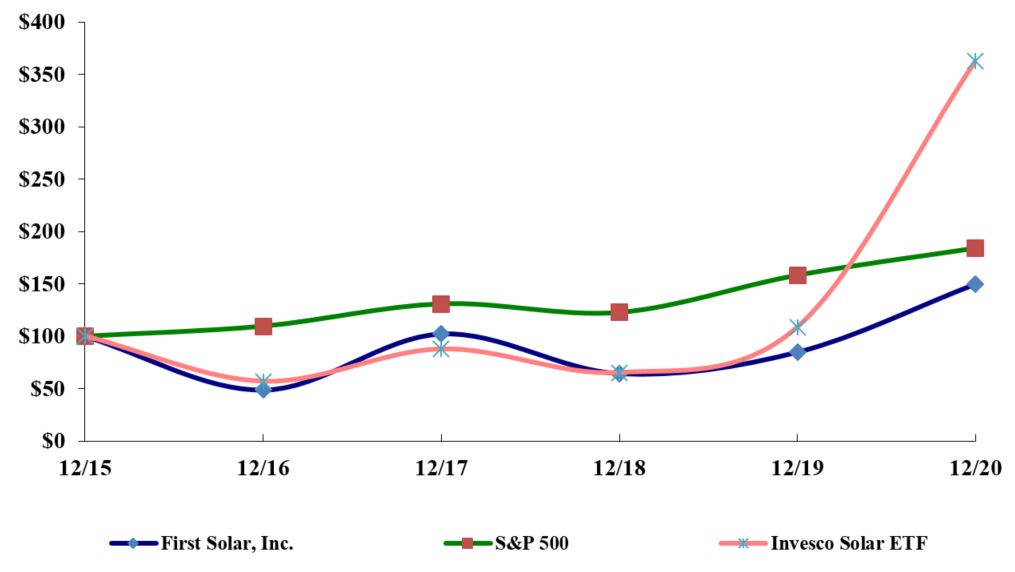
The following graph compares the five-year cumulative total return on our common stock relative to the cumulative total returns of the S&P 500 Index and the Invesco Solar ETF, which represents a peer group of solar companies. For purposes of the graph, an investment of $100 (with reinvestment of all dividends) is assumed to have been made in our common stock, the S&P 500 Index, and the Invesco Solar ETF on December 31, 2015, and its relative performance is tracked through December 31, 2020. This graph is not “soliciting material,” is not deemed filed with the SEC, and is not to be incorporated by reference in any filing by us under the Securities Act or the Exchange Act, whether made before or after the date hereof, and irrespective of any general incorporation language in any such filing. The stock price performance shown in the graph represents past performance and is not necessarily indicative of future stock price performance.
COMPARISON OF FIVE-YEAR CUMULATIVE TOTAL RETURN*
Among First Solar, the S&P 500 Index,
and the Invesco Solar ETF
——————————
- $100 invested on December 31, 2015 in stock or index, including reinvestment of dividends. Index calculated on a month-end basis.
Recent Sales of Unregistered Securities
None.
Purchases of Equity Securities by the Issuer and Affiliate Purchases
None.
Item 6. Selected Financial Data
The following tables set forth our selected financial data for the periods and at the dates indicated. The selected financial data from the consolidated statements of operations and consolidated statements of cash flows for the years ended December 31, 2020, 2019, and 2018 and the selected financial data from the consolidated balance sheets as of December 31, 2020 and 2019 have been derived from the audited consolidated financial statements included in this Annual Report on Form 10-K. The selected financial data from the consolidated statements of operations and consolidated statements of cash flows for the years ended December 31, 2017 and 2016 and the selected financial data from the consolidated balance sheets as of December 31, 2018, 2017, and 2016 have been derived from audited consolidated financial statements not included in this Annual Report on Form 10-K. The information presented below should also be read in conjunction with our consolidated financial statements and the related notes thereto and Item 7. “Management’s Discussion and Analysis of Financial Condition and Results of Operations.”
| Years Ended December 31, | ||||||||||||||||||||||||||||||||
| 2020 | 2019 | 2018 | 2017 | 2016 | ||||||||||||||||||||||||||||
| (In thousands, except per share amounts) | ||||||||||||||||||||||||||||||||
| Net sales | $ | 2,711,332 | $ | 3,063,117 | $ | 2,244,044 | $ | 2,941,324 | $ | 2,904,563 | ||||||||||||||||||||||
| Gross profit | 680,673 | 549,212 | 392,177 | 548,947 | 638,418 | |||||||||||||||||||||||||||
| Operating income (loss) | 317,489 | (161,785) | 40,113 | 177,851 | (568,151) | |||||||||||||||||||||||||||
| Net income (loss) | 398,355 | (114,933) | 144,326 | (165,615) | (416,112) | |||||||||||||||||||||||||||
| Net income (loss) per share: | ||||||||||||||||||||||||||||||||
| Basic | $ | 3.76 | $ | (1.09) | $ | 1.38 | $ | (1.59) | $ | (4.05) | ||||||||||||||||||||||
| Diluted | $ | 3.73 | $ | (1.09) | $ | 1.36 | $ | (1.59) | $ | (4.05) | ||||||||||||||||||||||
| Cash dividends declared per common share | $ | — | $ | — | $ | — | $ | — | $ | — | ||||||||||||||||||||||
| Net cash provided by (used in) operating activities | $ | 37,120 | $ | 174,201 | $ | (326,809) | $ | 1,340,677 | $ | 206,753 | ||||||||||||||||||||||
| Net cash (used in) provided by investing activities | (131,227) | (362,298) | (682,714) | (626,802) | 144,520 | |||||||||||||||||||||||||||
| Net cash (used in) provided by financing activities | (82,587) | 74,943 | 255,228 | 192,045 | (136,393) |
| December 31, | ||||||||||||||||||||||||||||||||
| 2020 | 2019 | 2018 | 2017 | 2016 | ||||||||||||||||||||||||||||
| (In thousands) | ||||||||||||||||||||||||||||||||
| Cash and cash equivalents | $ | 1,227,002 | $ | 1,352,741 | $ | 1,403,562 | $ | 2,268,534 | $ | 1,347,155 | ||||||||||||||||||||||
| Marketable securities | 520,066 | 811,506 | 1,143,704 | 720,379 | 607,991 | |||||||||||||||||||||||||||
| Total assets | 7,108,931 | 7,515,689 | 7,121,362 | 6,864,501 | 6,824,368 | |||||||||||||||||||||||||||
| Total long-term debt | 279,231 | 471,697 | 466,791 | 393,540 | 188,388 | |||||||||||||||||||||||||||
| Total liabilities | 1,588,003 | 2,418,922 | 1,908,959 | 1,765,804 | 1,606,019 | |||||||||||||||||||||||||||
| Total stockholders’ equity | 5,520,928 | 5,096,767 | 5,212,403 | 5,098,697 | 5,218,349 |
Item 7. Management’s Discussion and Analysis of Financial Condition and Results of Operations
The following discussion and analysis of our financial condition and results of operations should be read in conjunction with our consolidated financial statements and the related notes thereto included in this Annual Report on Form 10-K. In addition to historical financial information, the following discussion and analysis contains forward-looking statements that involve risks, uncertainties, and assumptions as described under the “Note Regarding Forward-Looking Statements” that appears earlier in this Annual Report on Form 10-K. Our actual results could differ materially from those anticipated by these forward-looking statements as a result of many factors, including those discussed under Item 1A. “Risk Factors,” and elsewhere in this Annual Report on Form 10-K. This discussion and analysis does not address certain items in respect of the year ended December 31, 2018 in reliance on amendments to disclosure requirements adopted by the SEC in 2019. See Item 7. “Management’s Discussion and Analysis of Financial Condition and Results of Operations” in our Annual Report on Form 10-K for the year ended December 31, 2019 for comparative discussions of our results of operations and liquidity and capital resources for the years ended December 31, 2019 and 2018.
Executive Overview
We are a leading global provider of PV solar energy solutions. We design, manufacture, and sell PV solar modules with an advanced thin film semiconductor technology and also develop and sell PV solar power systems that primarily use the modules we manufacture. Additionally, in certain markets we provide O&M services to system owners. We have substantial, ongoing R&D efforts focused on various technology innovations. We are the world’s largest thin film PV solar module manufacturer and one of the world’s largest PV solar module manufacturers.
Certain of our financial results and other key operational developments for the year ended December 31, 2020 include the following:
-
Net sales for 2020 decreased by 11% to $2.7 billion compared to $3.1 billion in 2019. The decrease in net sales was primarily attributable to the completion of substantially all construction activities at the Sun Streams, Phoebe, Sunshine Valley, Rosamond, Seabrook, and Lake Hancock projects in 2019, the sale of the Beryl and Little Bear projects in 2019, and lower construction activities at the GA Solar 4 project in the current period, partially offset by the sale of the Ishikawa, American Kings, Miyagi, Anamizu, Tungabhadra, and Anantapur projects in 2020 and an increase in the volume of modules sold to third parties.
-
Gross profit increased 7.2 percentage points to 25.1% during 2020 from 17.9% during 2019 primarily due to higher gross profit on third-party module sales and improved throughput of our manufacturing facilities from the successful ramp of various Series 6 manufacturing lines, partially offset by the higher benefit from reductions to our product warranty liability in the prior period and an impairment loss for certain module manufacturing equipment.
-
During late 2020, we completed the capacity expansion of our manufacturing facility in Perrysburg, Ohio. As of December 31, 2020 we had 6.3 GWDC of total installed Series 6 nameplate production capacity across all our facilities. We produced 6.1 GWDC of solar modules during 2020, which represented a 59% increase in Series 6 module production from 2019. The increase in Series 6 production was primarily driven by the production capacity added in 2019 at our second facility in Ho Chi Minh City, Vietnam and our facility in Lake Township, Ohio as well as higher throughput at various facilities. We expect to produce between 7.4 GWDC and 7.6 GWDC of Series 6 modules during 2021.
-
In response to the COVID-19 pandemic, governmental authorities have recommended or ordered the limitation or cessation of certain business or commercial activities in jurisdictions in which we operate, including the United States, Malaysia, and Vietnam. At this time, such limitations have had limited effect on our Series 6 manufacturing facilities. However, these orders are subject to continuous revision, and our
understanding of the applicability of these orders and any potential exemptions may change at any time. To enable the continuity of our operations, we have implemented a wide range of safety measures intended to inhibit the spread of COVID-19 at our manufacturing, administrative, and other sites and facilities.
-
Following an evaluation of the long-term cost structure, competitiveness, and risk-adjusted returns of our O&M services business, we received an offer to purchase certain portions of the business and determined it is in the best interest of our stockholders to pursue this transaction. As a result, in August 2020 we entered into an agreement with Clairvest for the sale of our North American O&M operations. The completion of the transaction is contingent on a number of closing conditions, including the receipt of certain third-party consents and other customary closing conditions. Assuming satisfaction of such closing conditions, we expect the sale to be completed in the first half of 2021.
-
Following an evaluation of the long-term cost structure, competitiveness, and risk-adjusted returns of our U.S. project development business, we have determined it is in the best interest of our stockholders to pursue the sale of this business. On January 24, 2021, we entered into an agreement with OMERS for the sale of our U.S. project development operations, which comprises the business of developing, contracting for the construction of, and selling utility-scale PV solar power systems. The transaction includes our approximately 10 GWAC utility-scale solar project pipeline, including the advanced-stage Horizon, Madison, Ridgely, Rabbitbrush, and Oak Trail projects that are expected to commence construction in the next two years; the 30 MWAC Barilla Solar project, which is operational; and certain other equipment. In addition, OMERS has agreed to certain module purchase commitments. The completion of the transaction is contingent on a number of closing conditions, including the receipt of regulatory approval from FERC, the expiration of the mandatory waiting period under U.S. antitrust laws, a review of the transaction by CFIUS, and other customary closing conditions. Assuming satisfaction of such closing conditions, we expect the sale to be completed in the first half of 2021.
-
In January 2020, we entered into a Memorandum of Understanding (“MOU”) to settle a class action lawsuit filed in 2012 in the United States District Court for the District of Arizona (hereafter “Arizona District Court”) against the Company and certain of our current and former officers and directors (the “Class Action”). Pursuant to the MOU, we paid a total of $350 million to settle the claims brought on behalf of all persons who purchased or otherwise acquired the Company’s shares during a specified period, in exchange for mutual releases and a dismissal with prejudice of the complaint upon court approval of the settlement. The settlement contained no admission of liability, wrongdoing, or responsibility by any of the parties. The Arizona District Court entered an order in June 2020 that granted final approval of the settlement and dismissed the Class Action with prejudice.
-
In June 2020, we entered into an agreement in principle to settle certain claims filed in 2015 in the Arizona District Court by putative stockholders that opted out of the Class Action (the “Opt-Out Action”). In July 2020, the parties executed a definitive settlement agreement pursuant to which we agreed to pay a total of $19 million in exchange for mutual releases and a dismissal with prejudice of the Opt-Out Action. The agreement contained no admission of liability, wrongdoing, or responsibility by any of the parties. In July 2020, First Solar funded the settlement and the parties filed a joint stipulation of
Showing the first 8K of 102K characters. Open the full section
Item 7A. Quantitative and Qualitative Disclosures about Market Risk
Foreign Currency Exchange Risk
Cash Flow Exposure. We expect certain of our subsidiaries to have future cash flows that will be denominated in currencies other than the subsidiaries’ functional currencies. Changes in the exchange rates between the functional currencies of our subsidiaries and the other currencies in which they transact will cause fluctuations in the cash flows we expect to receive or pay when these cash flows are realized or settled. Accordingly, we enter into foreign exchange forward contracts to hedge a portion of these forecasted cash flows. These foreign exchange forward
contracts qualify for accounting as cash flow hedges in accordance with ASC 815 and we designated them as such. We initially report unrealized gains or losses for such contracts in “Accumulated other comprehensive loss” and subsequently reclassify amounts into earnings when the hedged transaction occurs and impacts earnings. For additional details on our derivative hedging instruments and activities, see Note 8. “Derivative Financial Instruments” to our consolidated financial statements.
Certain of our international operations, such as our manufacturing facilities in Malaysia and Vietnam, pay a portion of their operating expenses, including associate wages and utilities, in local currencies, which exposes us to foreign currency exchange risk for such expenses. Our manufacturing facilities are also exposed to foreign currency exchange risk for purchases of certain equipment from international vendors. To the extent we expand into new markets, particularly emerging markets, our total foreign currency exchange risk, in terms of both size and exchange rate volatility, and the number of foreign currencies we are exposed to could increase significantly.
For the year ended December 31, 2020, 22% of our net sales were denominated in foreign currencies, including Japanese yen and Euro. As a result, we have exposure to foreign currencies with respect to our net sales, which has historically represented one of our primary foreign currency exchange risks. A 10% change in the U.S. dollar to Japanese yen and Euro exchange rates would have had an aggregate impact on our net sales of $53.8 million, excluding the effect of our hedging activities.
Transaction Exposure. Many of our subsidiaries have assets and liabilities (primarily cash, receivables, deferred taxes, payables, accrued expenses, and solar module collection and recycling liabilities) that are denominated in currencies other than the subsidiaries’ functional currencies. Changes in the exchange rates between the functional currencies of our subsidiaries and the other currencies in which these assets and liabilities are denominated will create fluctuations in our reported consolidated statements of operations and cash flows. We may enter into foreign exchange forward contracts or other financial instruments to economically hedge assets and liabilities against the effects of currency exchange rate fluctuations. The gains and losses on such foreign exchange forward contracts will economically offset all or part of the transaction gains and losses that we recognize in earnings on the related foreign currency denominated assets and liabilities. For additional details on our economic hedging instruments and activities, see Note 8. “Derivative Financial Instruments” to our consolidated financial statements.
As of December 31, 2020, a 10% change in the U.S. dollar relative to our primary foreign currency exposures would not have had a significant impact to our net foreign currency income or loss, including the effect of our hedging activities.
Interest Rate Risk
Variable Rate Debt Exposure. We are exposed to interest rate risk as certain of our project specific debt financings have variable interest rates, exposing us to variability in interest expense and cash flows. See Note 12. “Debt” to our consolidated financial statements for additional information on our long-term debt borrowing rates. An increase in relevant interest rates would increase the cost of borrowing under certain of our project specific debt financings. If such variable interest rates changed by 100 basis points, our interest expense for the year ended December 31, 2020 would have changed by $1.2 million, including the effect of our hedging activities.
Customer Financing Exposure. We are also indirectly exposed to interest rate risk because many of our customers depend on debt financings to purchase modules or systems. An increase in interest rates could make it challenging for our customers to obtain the capital necessary to make such purchases on favorable terms, or at all. Such factors could reduce demand or lower the price we can charge for our modules and systems, thereby reducing our net sales and gross profit. In addition, we believe that a significant percentage of our customers purchase systems as an investment, funding the initial capital expenditure through a combination of equity and debt. An increase in interest rates could lower an investor’s return on investment in a system or make alternative investments more attractive relative to PV solar power systems, which, in either case, could cause these end-users to seek alternative investments with higher risk-adjusted returns.
Marketable Securities and Restricted Marketable Securities Exposure. We invest in various debt securities, which exposes us to interest rate risk. The primary objectives of our investment activities are to preserve principal and provide liquidity, while at the same time maximizing the return on our investments. Many of the securities in which we invest may be subject to market risk. Accordingly, a change in prevailing interest rates may cause the market value of such investments to fluctuate. For example, if we hold a security that was issued with an interest rate fixed at the then-prevailing rate and the prevailing interest rate subsequently rises, the market value of our investment may decline.
For the year ended December 31, 2020, our marketable securities earned a return of 2%, including the impact of fluctuations in the price of the underlying securities, and had a weighted-average maturity of 8 months as of the end of the period. Based on our investment positions as of December 31, 2020, a hypothetical 100 basis point change in interest rates would have resulted in a $0.8 million change in the market value of our investment portfolio. For the year ended December 31, 2020, our restricted marketable securities earned a return of 19%, including the impact of fluctuations in the price of the underlying securities, and had a weighted-average maturity of approximately 15 years as of the end of the period. Based on our restricted marketable securities positions as of December 31, 2020, a hypothetical 100 basis point change in interest rates would have resulted in a $40.2 million change in the market value of our restricted marketable securities portfolio.
Commodity and Component Risk
We are exposed to price risks for the raw materials, components, services, and energy costs used in the manufacturing and transportation of our solar modules and BoS parts used in our systems. Additionally, some of our raw materials and components are sourced from a limited number of suppliers or a single supplier. We evaluate our suppliers using a robust qualification process. In some cases, we also enter into long-term supply contracts for raw materials and components. Accordingly, we are exposed to price changes in the raw materials and components used in our solar modules and systems. From time to time, we may utilize derivative hedging instruments to mitigate such raw material price changes. In addition, the failure of a key supplier could disrupt our supply chain, which could result in higher prices and/or a disruption in our manufacturing or construction processes. We may be unable to pass along changes in the costs of the raw materials and components for our modules and systems to our customers and may be in default of our delivery obligations if we experience a manufacturing or construction disruption.
Credit Risk
We have certain financial and derivative instruments that subject us to credit risk. These consist primarily of cash, cash equivalents, marketable securities, accounts receivable, restricted cash and investments, notes receivable, foreign exchange forward contracts, and commodity swap contracts. We are exposed to credit losses in the event of nonperformance by the counterparties to our financial and derivative instruments. We place cash, cash equivalents, marketable securities, restricted cash, restricted marketable securities, foreign exchange forward contracts, and commodity swap contracts with various high-quality financial institutions and limit the amount of credit risk from any one counterparty. We continuously evaluate the credit standing of our counterparty financial institutions. We monitor the financial condition of our customers and perform credit evaluations whenever considered necessary. Depending upon the sales arrangement, we may require some form of payment security from our customers, including, but not limited to, advance payments, parent guarantees, standby letters of credit, bank guarantees, surety bonds, or commercial letters of credit. We also have PPAs that subject us to credit risk in the event our off-take counterparties are unable to fulfill their contractual obligations, which may adversely affect our project assets and certain receivables. Accordingly, we closely monitor the credit standing of existing and potential off-take counterparties to limit such risks.
Item 8. Financial Statements and Supplementary Data
Consolidated Financial Statements
Our consolidated financial statements as required by this item are included in Item 15. “Exhibits and Financial Statement Schedules.” See Item 15(a) for a list of our consolidated financial statements.
Selected Quarterly Financial Data (Unaudited)
The following selected quarterly financial data should be read in conjunction with our consolidated financial statements and the related notes thereto and Item 7. “Management’s Discussion and Analysis of Financial Condition and Results of Operations.” This information has been derived from our unaudited consolidated financial statements that, in our opinion, reflect all recurring adjustments necessary to fairly present the information when read in conjunction with our consolidated financial statements. The results of operations for any quarter are not necessarily indicative of the results to be expected for any future period.
| Quarters Ended | ||||||||||||||||||||||||||||||||||||||||||||||||||
| Dec 31, 2020 | Sep 30, 2020 | Jun 30, 2020 | Mar 31, 2020 | Dec 31, 2019 | Sep 30, 2019 | Jun 30, 2019 | Mar 31, 2019 | |||||||||||||||||||||||||||||||||||||||||||
| (In thousands, except per share amounts) | ||||||||||||||||||||||||||||||||||||||||||||||||||
| Net sales | $ | 609,232 | $ | 927,565 | $ | 642,411 | $ | 532,124 | $ | 1,399,377 | $ | 546,806 | $ | 584,956 | $ | 531,978 | ||||||||||||||||||||||||||||||||||
| Gross profit | 159,860 | 293,015 | 137,460 | 90,338 | 333,555 | 138,363 | 77,182 | 112 | ||||||||||||||||||||||||||||||||||||||||||
| Production start-up | 16,716 | 13,019 | 6,311 | 4,482 | 7,351 | 18,605 | 10,437 | 9,522 | ||||||||||||||||||||||||||||||||||||||||||
| Litigation loss | — | — | 6,000 | — | 363,000 | — | — | — | ||||||||||||||||||||||||||||||||||||||||||
| Operating income (loss) | 57,774 | 207,163 | 50,896 | 1,656 | (117,866) | 41,304 | (8,584) | (76,639) | ||||||||||||||||||||||||||||||||||||||||||
| Net income (loss) | 115,703 | 155,037 | 36,911 | 90,704 | (59,408) | 30,622 | (18,548) | (67,599) | ||||||||||||||||||||||||||||||||||||||||||
| Net income (loss) per share: | ||||||||||||||||||||||||||||||||||||||||||||||||||
| Basic | $ | 1.09 | $ | 1.46 | $ | 0.35 | $ | 0.86 | $ | (0.56) | $ | 0.29 | $ | (0.18) | $ | (0.64) | ||||||||||||||||||||||||||||||||||
| Diluted | $ | 1.08 | $ | 1.45 | $ | 0.35 | $ | 0.85 | $ | (0.56) | $ | 0.29 | $ | (0.18) | $ | (0.64) |
Item 9. Changes in and Disagreements with Accountants on Accounting and Financial Disclosure
None.
Item 9A. Controls and Procedures
Evaluation of Disclosure Controls and Procedures
We carried out an evaluation, under the supervision and with the participation of management, including our Chief Executive Officer and Chief Financial Officer, of the effectiveness of our “disclosure controls and procedures” as defined in Exchange Act Rule 13a-15(e) and 15d-15(e). Based on that evaluation, our Chief Executive Officer and Chief Financial Officer concluded that as of December 31, 2020 our disclosure controls and procedures were effective to ensure that information required to be disclosed by us in reports that we file or submit under the Exchange Act is recorded, processed, summarized, and reported within the time periods specified in SEC rules and forms, and that such information is accumulated and communicated to our management, including our Chief Executive Officer and Chief Financial Officer, as appropriate, to allow timely decisions regarding required disclosure.
Management’s Report on Internal Control over Financial Reporting
Our management is responsible for establishing and maintaining adequate “internal control over financial reporting,” as defined in Exchange Act Rule 13a-15(f) and 15d-15(f). We also carried out an evaluation, under the supervision and with the participation of management, including our Chief Executive Officer and Chief Financial Officer, of the effectiveness of our internal control over financial reporting as of December 31, 2020 based on the criteria established in Internal Control – Integrated Framework (2013) issued by the Committee of Sponsoring Organizations of the Treadway Commission (“COSO”). Our internal control over financial reporting is a process designed to provide reasonable assurance regarding the reliability of financial reporting and the preparation of financial statements for external purposes in accordance with U.S. GAAP. Based on such evaluation, our management concluded that our internal control over financial reporting was effective as of December 31, 2020. The effectiveness of our internal control over financial reporting as of December 31, 2020 has also been audited by PricewaterhouseCoopers LLP, an independent registered public accounting firm, as stated in its report which appears herein.
Changes in Internal Control over Financial Reporting
We also carried out an evaluation, under the supervision and with the participation of management, including our Chief Executive Officer and Chief Financial Officer, of our “internal control over financial reporting” to determine whether any changes in our internal control over financial reporting occurred during the quarter ended December 31, 2020 that materially affected, or are reasonably likely to materially affect, our internal control over financial reporting. Based on that evaluation, there were no such changes in our internal control over financial reporting that occurred during the quarter ended December 31, 2020.
Limitations on the Effectiveness of Controls
Control systems, no matter how well designed and operated, can provide only reasonable, not absolute, assurance that the control systems’ objectives are being met. Further, the design of any system of controls must reflect the fact that there are resource constraints, and the benefits of all controls must be considered relative to their costs. Because of the inherent limitations in all control systems, no evaluation of controls can provide absolute assurance that all control issues and instances of fraud, if any, within our Company have been detected. These inherent limitations include the realities that judgments in decision-making can be faulty and that breakdowns can occur because of error or mistake. Control systems can also be circumvented by the individual acts of some persons, by collusion of two or more people, or by management override of the controls. The design of any system of controls is also based in part upon certain assumptions about the likelihood of future events, and there can be no assurance that any design will succeed in achieving its stated goals under all potential future conditions. Over time, controls may become inadequate because of changes in conditions or deterioration in the degree of compliance with policies or procedures.
Item 9B. Other Information
None.
PART III
Item 10. Directors, Executive Officers, and Corporate Governance
For information with respect to our executive officers, see Item 1. “Business – Information about Our Executive Officers.” Information concerning our board of directors and audit committee of our board of directors will appear in our 2021 Proxy Statement, under the sections “Directors” and “Corporate Governance,” and information concerning Section 16(a) beneficial ownership reporting compliance will appear in our 2021 Proxy Statement under the section “Section 16(a) Beneficial Ownership Reporting Compliance.” We have adopted a Code of Business Conduct and Ethics that applies to all directors, officers, and associates of First Solar. Information concerning this code will appear in our 2021 Proxy Statement under the section “Corporate Governance.” The information in such sections of the Proxy Statement is incorporated by reference into this Annual Report on Form 10-K.
Item 11. Executive Compensation
Information concerning executive compensation and related information will appear in our 2021 Proxy Statement under the section “Executive Compensation,” and information concerning the compensation committee of our board of directors (the “compensation committee”) will appear under the sections “Corporate Governance” and “Compensation Committee Report.” The information in such sections of the 2021 Proxy Statement is incorporated by reference into this Annual Report on Form 10-K.
Item 12. Security Ownership of Certain Beneficial Owners and Management and Related Stockholder Matters
Information concerning the security ownership of certain beneficial owners and management and related stockholder matters, including certain information regarding our equity compensation plans, will appear in our 2021 Proxy Statement under the section “Security Ownership of Certain Beneficial Owners and Management and Related Stockholder Matters.” The information in such section of the Proxy Statement is incorporated by reference into this Annual Report on Form 10-K.
Equity Compensation Plans
The following table sets forth certain information as of December 31, 2020 concerning securities authorized for issuance under our equity compensation plans:
| Plan Category | Number of Securities to be Issued Upon Exercise of Outstanding Options and Rights (a)(1) | Weighted-Average Exercise Price of Outstanding Options and Rights (b)(2) | Number of Securities Remaining Available for Future Issuance Under Equity Compensation Plans (Excluding Securities Reflected in Column (a)) (c) | |||||||||||||||||
| Equity compensation plans approved by stockholders | 1,852,256 | $ | — | 6,608,877 | ||||||||||||||||
| Equity compensation plans not approved by stockholders | — | — | — | |||||||||||||||||
| Total | 1,852,256 | $ | — | 6,608,877 |
——————————
(1)Includes 1,852,256 shares issuable upon vesting of restricted stock units (“RSUs”) granted under our 2020 Omnibus Incentive Compensation Plan (“2020 Omnibus Plan”).
(2)The weighted-average exercise price does not take into account the shares issuable upon vesting of outstanding RSUs, which have no exercise price.
See Note 16. “Share-Based Compensation” to our consolidated financial statements for further discussion on our equity compensation plans.
Item 13. Certain Relationships and Related Transactions, and Director Independence
Information concerning certain relationships and related party transactions will appear in our 2021 Proxy Statement under the section “Certain Relationships and Related Party Transactions,” and information concerning director independence will appear in our 2021 Proxy Statement under the section “Corporate Governance.” The information in such sections of the Proxy Statement is incorporated by reference into this Annual Report on Form 10-K.
Item 14. Principal Accounting Fees and Services
Information concerning principal accounting fees and services and the audit committee of our board of directors’ pre-approval policies and procedures for these items will appear in our 2021 Proxy Statement under the section “Principal Accounting Fees and Services.” The information in such section of the Proxy Statement is incorporated by reference into this Annual Report on Form 10-K.
PART IV
Item 15. Exhibits and Financial Statement Schedules
(a)Documents. The following documents are filed as part of this Annual Report on Form 10-K:
Report of Independent Registered Public Accounting Firm
Consolidated Balance Sheets
Consolidated Statements of Operations
Consolidated Statements of Comprehensive Income
Consolidated Statements of Stockholders’ Equity
Consolidated Statements of Cash Flows
Notes to Consolidated Financial Statements
(b)Exhibits. Unless otherwise noted, the exhibits listed on the accompanying Index to Exhibits are filed with or incorporated by reference into this Annual Report on Form 10-K.
(c)Financial Statement Schedules. All financial statement schedules have been omitted as the required information is not applicable or is not material to require presentation of the schedule, or because the information required is included in the consolidated financial statements and notes thereto of this Annual Report on Form 10-K.
Report of Independent Registered Public Accounting Firm
To the Board of Directors and Stockholders of First Solar, Inc.
Opinions on the Financial Statements and Internal Control over Financial Reporting
We have audited the accompanying consolidated balance sheets of First Solar, Inc. and its subsidiaries (“the Company”) as of December 31, 2020 and 2019, and the related consolidated statements of operations, comprehensive income, stockholders’ equity and cash flows for each of the three years in the period ended December 31, 2020, including the related notes (collectively referred to as the “consolidated financial statements”). We also have audited the Company’s internal control over financial reporting as of December 31, 2020, based on criteria established in Internal Control – Integrated Framework (2013) issued by the Committee of Sponsoring Organizations of the Treadway Commission (“COSO”).
In our opinion, the consolidated financial statements referred to above present fairly, in all material respects, the financial position of the Company as of December 31, 2020 and 2019, and the results of its operations and its cash flows for each of the three years in the period ended December 31, 2020 in conformity with accounting principles generally accepted in the United States of America. Also in our opinion, the Company maintained, in all material respects, effective internal control over financial reporting as of December 31, 2020, based on criteria established in Internal Control – Integrated Framework (2013) issued by the COSO.
Basis for Opinions
The Company’s management is responsible for these consolidated financial statements, for maintaining effective internal control over financial reporting, and for its assessment of the effectiveness of internal control over financial reporting, included in Management’s Report on Internal Control over Financial Reporting appearing under Item 9A. Our responsibility is to express opinions on the Company’s consolidated financial statements and on the Company’s internal control over financial reporting based on our audits. We are a public accounting firm registered with the Public Company Accounting Oversight Board (United States) (“PCAOB”) and are required to be independent with respect to the Company in accordance with the U.S. federal securities laws and the applicable rules and regulations of the Securities and Exchange Commission (“SEC”) and the PCAOB.
We conducted our audits in accordance with the standards of the PCAOB. Those standards require that we plan and perform the audits to obtain reasonable assurance about whether the consolidated financial statements are free of material misstatement, whether due to error or fraud, and whether effective internal control over financial reporting was maintained in all material respects.
Our audits of the consolidated financial statements included performing procedures to assess the risks of material misstatement of the consolidated financial statements, whether due to error or fraud, and performing procedures that respond to those risks. Such procedures included examining, on a test basis, evidence regarding the amounts and disclosures in the consolidated financial statements. Our audits also included evaluating the accounting principles used and significant estimates made by management, as well as evaluating the overall presentation of the consolidated financial statements. Our audit of internal control over financial reporting included obtaining an understanding of internal control over financial reporting, assessing the risk that a material weakness exists, and testing and evaluating the design and operating effectiveness of internal control based on the assessed risk. Our audits also included performing such other procedures as we considered necessary in the circumstances. We believe that our audits provide a reasonable basis for our opinions.
Definition and Limitations of Internal Control over Financial Reporting
A company’s internal control over financial reporting is a process designed to provide reasonable assurance regarding the reliability of financial reporting and the preparation of financial statements for external purposes in accordance with generally accepted accounting principles. A company’s internal control over financial reporting includes those policies and procedures that (i) pertain to the maintenance of records that, in reasonable detail, accurately and fairly reflect the transactions and dispositions of the assets of the company; (ii) provide reasonable assurance that transactions are recorded as necessary to permit preparation of financial statements in accordance with generally accepted accounting principles, and that receipts and expenditures of the company are being made only in accordance with authorizations of management and directors of the company; and (iii) provide reasonable assurance regarding prevention or timely detection of unauthorized acquisition, use, or disposition of the company’s assets that could have a material effect on the financial statements.
Because of its inherent limitations, internal control over financial reporting may not prevent or detect misstatements. Also, projections of any evaluation of effectiveness to future periods are subject to the risk that controls may become inadequate because of changes in conditions, or that the degree of compliance with the policies or procedures may deteriorate.
Critical Audit Matters
The critical audit matters communicated below are matters arising from the current period audit of the consolidated financial statements that were communicated or required to be communicated to the audit committee and that (i) relate to accounts or disclosures that are material to the consolidated financial statements and (ii) involved our especially challenging, subjective, or complex judgments. The communication of critical audit matters does not alter in any way our opinion on the consolidated financial statements, taken as a whole, and we are not, by communicating the critical audit matters below, providing separate opinions on the critical audit matters or on the accounts or disclosures to which they relate.
Solar Module Collection and Recycling Liability
As described in Note 11 to the consolidated financial statements, certain of the Company’s legacy sales were covered by a module collection and recycling program, which was previously established to collect and recycle modules sold and covered under such program once the modules reach the end of their useful lives. The Company’s accrued solar module collection and recycling liability was $130.7 million as of December 31, 2020. Management estimates the cost of collection and recycling obligations based on the present value of the expected future cost of collecting and recycling the solar modules, which includes estimates for the cost of packaging materials; the cost of freight from the solar module installation sites to a recycling center; material, labor, and capital costs; and by-product credits
Showing the first 8K of 283K characters. Open the full section
Item 16. Form 10-K Summary
None.
SIGNATURES
Pursuant to the requirements of Section 13 or 15(d) of the Securities Exchange Act of 1934, the registrant has duly caused this report to be signed on its behalf by the undersigned, thereunto duly authorized.
| FIRST SOLAR, INC. | |||||||||||
| Date: February 25, 2021 | By: | /s/ BYRON JEFFERS | |||||||||
| Name: | Byron Jeffers | ||||||||||
| Title: | Chief Accounting Officer |
Pursuant to the requirements of the Securities Exchange Act of 1934, this report has been signed below by the following persons on behalf of the registrant and in the capacities and on the dates indicated.
| Signature | Title | Date | ||||||||||||
| /s/ MARK R. WIDMAR | Chief Executive Officer and Director | February 25, 2021 | ||||||||||||
| Mark R. Widmar | ||||||||||||||
| /s/ ALEXANDER R. BRADLEY | Chief Financial Officer | February 25, 2021 | ||||||||||||
| Alexander R. Bradley | ||||||||||||||
| /s/ MICHAEL J. AHEARN | Chairman of the Board of Directors | February 25, 2021 | ||||||||||||
| Michael J. Ahearn | ||||||||||||||
| /s/ SHARON L. ALLEN | Director | February 25, 2021 | ||||||||||||
| Sharon L. Allen | ||||||||||||||
| /s/ RICHARD D. CHAPMAN | Director | February 25, 2021 | ||||||||||||
| Richard D. Chapman | ||||||||||||||
| /s/ GEORGE A. HAMBRO | Director | February 25, 2021 | ||||||||||||
| George A. Hambro | ||||||||||||||
| /s/ MOLLY E. JOSEPH | Director | February 25, 2021 | ||||||||||||
| Molly E. Joseph | ||||||||||||||
| /s/ CRAIG KENNEDY | Director | February 25, 2021 | ||||||||||||
| Craig Kennedy | ||||||||||||||
| /s/ WILLIAM J. POST | Director | February 25, 2021 | ||||||||||||
| William J. Post | ||||||||||||||
| /s/ PAUL H. STEBBINS | Director | February 25, 2021 | ||||||||||||
| Paul H. Stebbins | ||||||||||||||
| /s/ MICHAEL SWEENEY | Director | February 25, 2021 | ||||||||||||
| Michael Sweeney |