 filings.tools
General Dynamics 10-K 2021-12-31
Filed 2022-02-09. 23 sections, 372K characters. Original on sec.gov · Markdown · JSON
Cover and table of contents

UNITED STATES SECURITIES AND EXCHANGE COMMISSION
Washington, D.C. 20549
FORM 10-K
(Mark One)
[☑] ANNUAL REPORT PURSUANT TO SECTION 13 OR 15(d) OF THE SECURITIES EXCHANGE ACT OF 1934
For the fiscal year ended December 31, 2021
OR
[☐] TRANSITION REPORT PURSUANT TO SECTION 13 OR 15(d) OF THE SECURITIES EXCHANGE ACT OF 1934
For the transition period from _______ to _______
Commission File Number 1-3671
GENERAL DYNAMICS CORPORATION
(Exact name of registrant as specified in its charter)
| Delaware | 13-1673581 | ||||||||||||||||
| State or other jurisdiction of incorporation or organization | I.R.S. Employer Identification No. | ||||||||||||||||
| 11011 Sunset Hills Road | Reston, | Virginia | 20190 | ||||||||||||||
| Address of principal executive offices | Zip code |
| (703) | 876-3000 |
Registrant’s telephone number, including area code
Securities registered pursuant to Section 12(b) of the Act:
| Title of each class | Trading Symbol(s) | Name of each exchange on which registered | ||||||
| Common Stock | GD | New York Stock Exchange |
Securities registered pursuant to Section 12(g) of the Act:
| None |
Indicate by check mark if the registrant is a well-known seasoned issuer, as defined in Rule 405 of the Securities Act. Yes ü No ___
Indicate by check mark if the registrant is not required to file reports pursuant to Section 13 or Section 15(d) of the Act. Yes ___ No ü
Indicate by check mark whether the registrant (1) has filed all reports required to be filed by Section 13 or 15(d) of the Securities Exchange Act of 1934 during the preceding 12 months (or for such shorter period that the registrant was required to file such reports), and (2) has been subject to such filing requirements for the past 90 days. Yes ü No ___
Indicate by check mark whether the registrant has submitted electronically every Interactive Data File required to be submitted pursuant to Rule 405 of Regulation S-T (§232.405 of this chapter) during the preceding 12 months (or for such shorter period that the registrant was required to submit such files). Yes ü No ___
Indicate by check mark whether the registrant is a large accelerated filer, an accelerated filer, a non-accelerated filer, a smaller reporting company, or an emerging growth company. See the definitions of “large accelerated filer,” “accelerated filer,” “smaller reporting company,” and “emerging growth company” in Rule 12b-2 of the Exchange Act.
Large accelerated filer ü Accelerated filer ___ Non-accelerated filer ___ Smaller reporting company ___☐ Emerging growth company ___☐
If an emerging growth company, indicate by check mark if the registrant has elected not to use the extended transition period for complying with any new or revised financial accounting standards provided pursuant to Section 13(a) of the Exchange Act. ___
Indicate by check mark whether the registrant has filed a report on and attestation to its management’s assessment of the effectiveness of its internal control over financial reporting under Section 404(b) of the Sarbanes-Oxley Act (15 U.S.C. 7262(b)) by the registered public accounting firm that prepared or issued its audit report. Yes ü☑No ___
Indicate by check mark whether the registrant is a shell company (as defined in Rule 12b-2 of the Exchange Act). Yes ___☐No ü☑
The aggregate market value of the voting common equity held by non-affiliates of the registrant was $46,753,289,081 as of July 4, 2021 (based on the closing price of the shares on the New York Stock Exchange).
277,697,967 shares of the registrant’s common stock, $1 par value per share, were outstanding on January 30, 2022.
DOCUMENTS INCORPORATED BY REFERENCE:
Part III incorporates by reference information from certain portions of the registrant’s definitive proxy statement for the 2022 annual meeting of shareholders to be filed with the Securities and Exchange Commission within 120 days after the close of the fiscal year.
INDEX
PART I
Item 1. BUSINESS
(Dollars in millions, except per-share amounts or unless otherwise noted)
BUSINESS OVERVIEW
General Dynamics is a global aerospace and defense company that specializes in high-end design, engineering and manufacturing to deliver state-of-the-art solutions to our customers. We offer a broad portfolio of products and services in business aviation; ship construction and repair; land combat vehicles, weapons systems and munitions; and technology products and services. Our leadership positions in attractive business aviation and defense markets enable us to deliver superior and enduring shareholder returns.
Our company consists of 10 business units, which are organized into four operating segments: Aerospace, Marine Systems, Combat Systems and Technologies. We refer to the latter three collectively as our defense segments. To optimize its market focus, customer intimacy, agility and operating expertise, each business unit is responsible for the development and execution of its strategy and operating results. This structure allows for a lean corporate function, which sets the overall strategy and governance for the company and is responsible for allocating and deploying capital.
Our business units seek to deliver superior operating results by endeavoring to build industry-leading franchises. To achieve this goal, we invest in advanced technologies, pursue a culture of continuous improvement, and strive to be the low-cost, high-quality provider in each of our markets. The result is long-term value creation measured by strong earnings and cash flow and an attractive return on capital.
Over the past nine years, we have invested approximately $22 billion to create, renew or expand our portfolio of products and services across our businesses to drive long-term growth and shareholder value creation. This includes product development investments in Aerospace to bring to market an all-new lineup of business jet aircraft, capital investments in Marine Systems to support significant growth in U.S. Navy ship and submarine construction plans over the next two decades, development of next-generation platforms and technologies to meet customers’ emerging requirements in Combat Systems, and strategic acquisitions to achieve critical mass and build out a complete spectrum of solutions for our Technologies customers.
Following is additional information on each of our operating segments. For a supplemental discussion of segment performance and backlog, see Management’s Discussion and Analysis of Financial Condition and Results of Operations in Item 7.
AEROSPACE
Our Aerospace segment is recognized as a leading producer of business jets and the standard bearer in aircraft repair, support and completion services. The segment consists of our Gulfstream and Jet Aviation business units. We have earned our reputation through:
-
superior aircraft design, quality, performance, safety and reliability;
-
technologically advanced flight deck and cabin systems; and
-
industry-leading customer support.
We believe the key to long-term value creation in the business jet industry is steady investment in new aircraft models and technologies and in customer service capabilities. As a result, since we acquired Gulfstream over 20 years ago, we have made significant investments in research and development (R&D), state-of-the-art manufacturing facilities, and maintenance and support through a combination of product development efforts, capital expansion and the acquisition of Jet Aviation’s global support network.
We are committed to continual investment in R&D to create new aircraft that consistently broaden customer offerings while raising the bar for safety and performance. The result is the unprecedented development of an all-new lineup of the most technologically advanced business jet aircraft in the world. The Gulfstream family of aircraft offer industry-leading cabin, cockpit and safety technologies and the longest ranges at the fastest speeds in their respective classes.
The following represents Gulfstream’s current product line, along with the maximum range, maximum speed, cabin length (excluding baggage), and total number of city-pair speed records held for each aircraft:

The most recent additions to the in-service Gulfstream fleet are two new large-cabin aircraft, the G500 and G600, which entered service in 2018 and 2019, respectively. These clean-sheet (i.e., all-new) aircraft replace the G450 and G550 models, whose combined family has an installed base of more than 1,650 aircraft around the world. Our investment included development of a new wing, new avionics,
new fuselage and new ergonomically designed larger interiors, as well as systems and technologies to improve the manufacturing process and quality of the platform. As a result, the G500 and G600 are faster, more fuel efficient and have greater cabin volume, more range and improved flight controls compared with the aircraft they are replacing. At year-end 2021, cumulative deliveries for these aircraft totaled almost 150.
The next model to join the Gulfstream lineup is the ultra-long-range, ultra-large-cabin G700. It combines our most spacious cabin with our advanced Symmetry Flight Deck, the industry’s most technologically advanced flight deck, which we launched on our G500 and G600 aircraft, and the superior high-speed performance of all-new engines to create best-in-class capabilities. Gulfstream is in the process of flight testing and certification of the G700, which currently has over 2,200 test hours. We expect the G700 to enter service in the fourth quarter of 2022 pending certification from the U.S. Federal Aviation Administration (FAA).
In October 2021, we introduced two new aircraft, the ultra-long-range, ultra-large-cabin G800 and large-cabin G400, completing a nearly two-decade effort to develop an all-new family of Gulfstream aircraft. Both aircraft combine our industry-leading high-speed range and efficiency, safety enhancements, and our advanced Symmetry Flight Deck. The G800 is Gulfstream’s longest-range aircraft, with an 8,000 nautical mile range at Mach 0.85, and it is expected to enter service in 2023 pending FAA certification. The G400 is a clean-sheet design developed in concert with the G500 and G600, thus expanding the commonality across the Gulfstream family of aircraft. Expected to enter service in 2025 pending FAA certification, the G400 will join a market segment in which Gulfstream has not participated for several decades.
The ultra-long-range, ultra-large-cabin G650 and G650ER continue to generate significant customer interest, with more than 470 aircraft of this family currently operating in 50 countries. Since the first G650 entered service in December 2012, its capabilities and reliability have led to significant sales and expansion of our installed base around the globe. Gulfstream’s current product line holds more than 270 city-pair speed records, more than any other business jet manufacturer, led by the G650ER, which holds the National Aeronautic Association’s polar and westbound around-the-world speed records.
Our disciplined and consistent approach to new product development has allowed us to introduce repeatedly first-to-market capabilities that set industry standards for safety, performance, quality, speed and comfort. Product enhancement and development efforts include initiatives in advanced avionics, composites, flight-control and vision systems, acoustics, and cabin technologies.
Gulfstream designs, develops and manufactures aircraft in Savannah, Georgia, including all large-cabin models. The mid-cabin G280 is assembled by a non-U.S. partner. All models are outfitted in Gulfstream’s U.S. facilities. As Gulfstream’s aircraft portfolio and customer base have grown and become increasingly global in reach over the years, we have invested in our facilities and operations around the world. At our Savannah campus, we added new purpose-built manufacturing facilities, increased aircraft service capacity, and opened a customer-support distribution center and a dedicated R&D campus.
We offer comprehensive support for the more than 3,000 Gulfstream aircraft in service around the world and operate the largest factory-owned service network in the industry. We continue to invest in these maintenance, repair and overhaul (MRO) facilities and inventory to accommodate fleet growth. We also operate a 24/7 year-round customer support center and offer on-call Gulfstream aircraft technicians ready to deploy around the world for customer service requirements under our Field and Airborne Support Team (FAST) rapid-response unit.
In addition to expanding the reach of Gulfstream’s aircraft maintenance network outside the United States, Jet Aviation provides a comprehensive suite of innovative aircraft services for aircraft owners and operators around the world. With approximately 50 locations throughout North America, Europe, the Middle East and the Asia-Pacific region, our offerings include maintenance, aircraft management, charter, staffing and fixed-base operator (FBO) services.
Jet Aviation manages nearly 300 business aircraft globally on behalf of individuals and corporate owners. We operate a leading global FBO network and support all aircraft types with the full range of maintenance services, including 24/7 global aircraft-on-ground support. We also operate one of the world’s largest custom completion and refurbishment centers for both narrow- and wide-body aircraft and perform modifications, upgrades and lifecycle sustainment support for various government fleets. We continue to grow our global footprint through acquisitions, expansions and significant renovations in key business aviation markets.
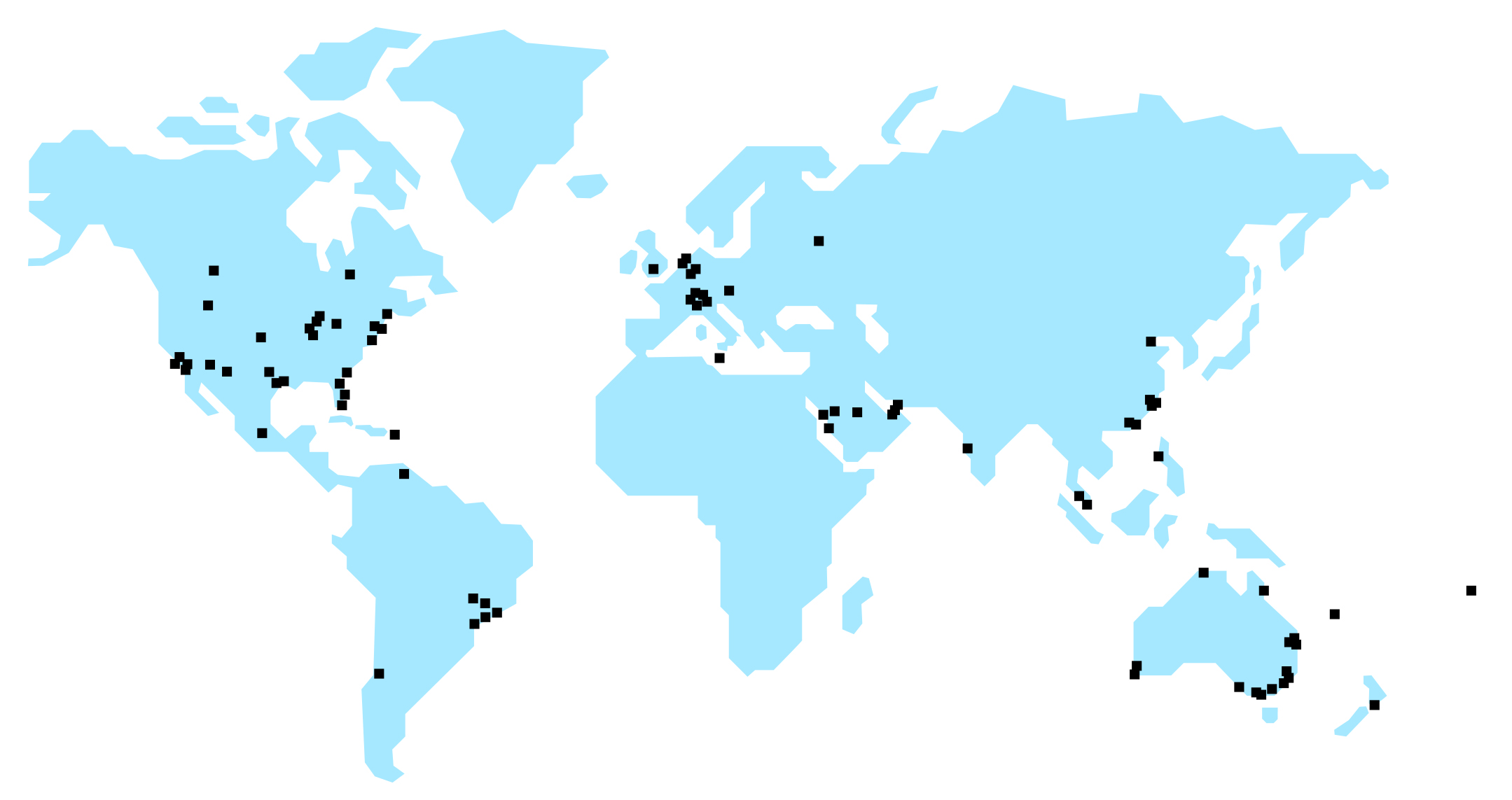
The following map displays the broad reach of our combined Gulfstream and Jet Aviation services network, including authorized service centers:
The Aerospace segment is committed to sustainability and the reduction of aviation’s carbon footprint. In support of this strategy, Gulfstream and Jet Aviation offer sustainable aviation fuel through our combined services network and lead the industry in total gallons supplied to the business jet market. Furthermore, we offer carbon offset credits and book and claim options to our customers, enabling them to operate aircraft on a carbon-neutral basis.
Revenue for the Aerospace segment was 21% of our consolidated revenue in 2021 and 2020 and 25% in 2019. Revenue by major products and services was as follows:
| Year Ended December 31 | 2021 | 2020 | 2019 | ||||||||||||||
| Aircraft manufacturing | $ | 5,864 | $ | 6,115 | $ | 7,541 | |||||||||||
| Aircraft services | 2,271 | 1,960 | 2,260 | ||||||||||||||
| Total Aerospace | $ | 8,135 | $ | 8,075 | $ | 9,801 |
MARINE SYSTEMS
Our Marine Systems segment is the leading designer and builder of nuclear-powered submarines and a leader in surface combatant and auxiliary ship design and construction for the U.S. Navy. We also provide maintenance, modernization and lifecycle support services for Navy ships and maintain the most sophisticated marine engineering expertise in the world to support future capabilities. Our ability to design, build and maintain our nation’s most technologically sophisticated warships is a critical element of the U.S. defense industrial base. In addition to Navy ships, we design and build ocean-going Jones Act ships for commercial customers. Marine Systems consists of three business units — Electric Boat, Bath Iron Works and NASSCO.
In support of our Navy customer’s significant increase in demand for submarines and surface ships, we are making substantial investments to expand our facilities, grow and train our workforce, and expand our supply chain. The resulting increase in capacity and capabilities will support the unprecedented growth expected in our shipbuilding business, particularly submarines, for the next two decades.
Electric Boat is the prime contractor and lead shipyard on all Navy nuclear-powered submarine programs. The business is responsible for all aspects of design and engineering and leads the construction of both the Virginia-class attack submarine and the Columbia-class ballistic-missile submarine.
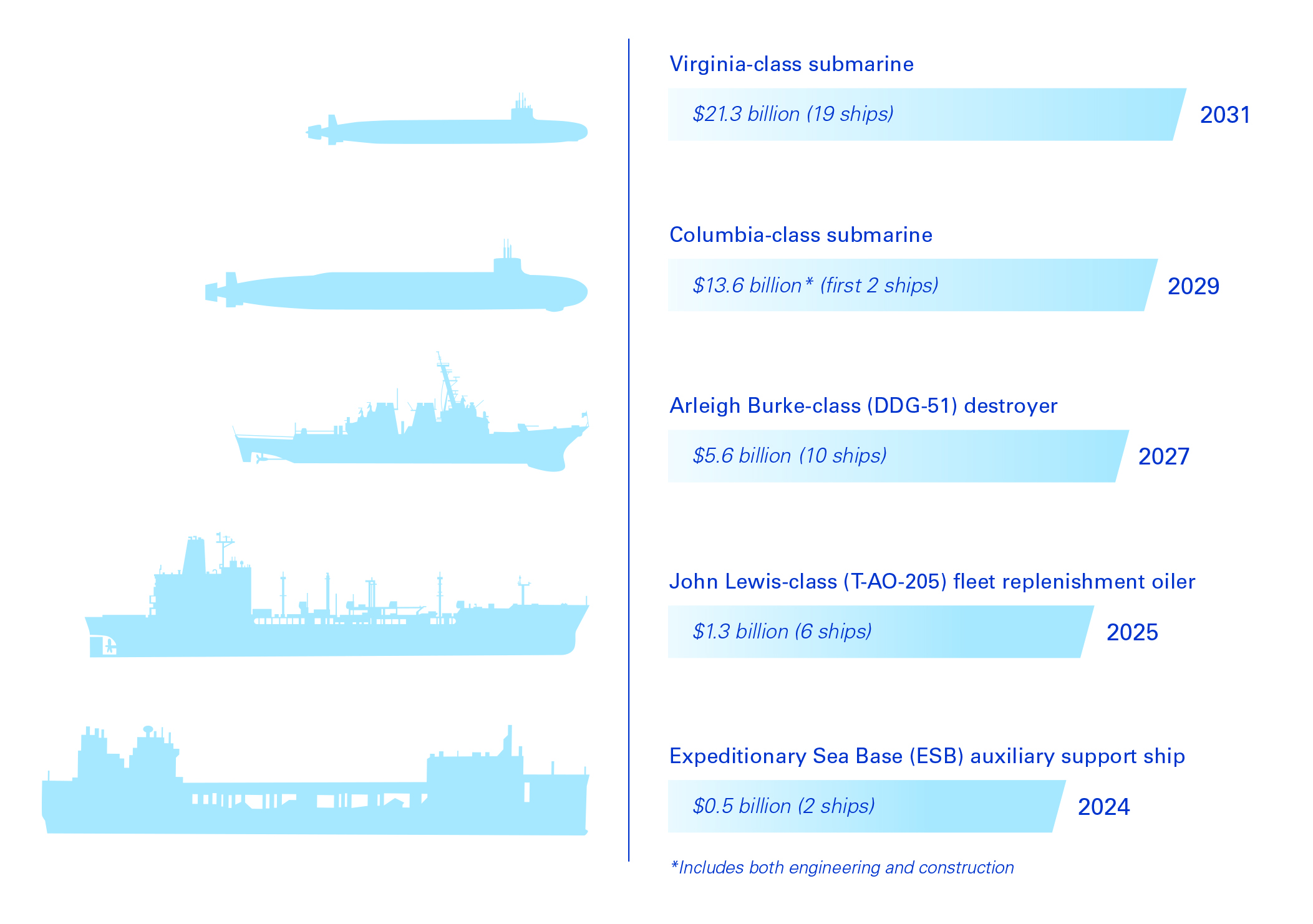
The Navy procures Virginia-class submarines in multi-boat blocks, currently at a two-per-year rate. We are currently working on Blocks IV and V in the program, with 19 Virginia-class submarines in our backlog scheduled for delivery through 2031. Nine of the boats in Block V include the Virginia Payload Module (VPM), an 84-foot Electric Boat-designed-and-built hull section that adds four additional payload tubes, more than tripling the strike capacity of these submarines and providing unique capabilities to support special missions.
The Columbia-class ballistic-missile submarine is a 12-boat program that the Navy considers its top acquisition priority. Accordingly, the program has received the highest possible rating from the government’s Defense Priorities and Allocations System (DPAS). These submarines will provide strategic deterrent capabilities for decades, with the first boat delivering in 2027 to begin replacement of the current Ohio-class ballistic-missile submarine fleet as it reaches the end of its service life. Construction is scheduled to continue for two decades, and the value of the Navy’s program of record is in excess of $110 billion. The submarine’s design was more than 80% complete at the time we began construction of the first boat in 2020, nearly twice as mature as any of the Navy’s previous submarine programs at the start of construction.
We are investing $1.8 billion of capital in expanded and modernized facilities at Electric Boat to support the growth in submarine construction and expect the projects to be substantially complete by the end of 2023. Equal to the commitment of capital is our commitment to our Electric Boat workforce, which is on track to grow approximately 25% in the current decade, particularly in support of Columbia-class production. Along with strong contributions from the states of Connecticut and Rhode Island, we continue to invest in the training and tools necessary for our employees to be prepared to deliver these next-generation submarines to the Navy on time and on budget. We are also working with our network of approximately 3,000 suppliers — mostly small businesses — to support concurrent production of the two submarine programs.
Bath Iron Works builds the Arleigh Burke-class (DDG-51) guided-missile destroyers and manages modernization and lifecycle support for the class. We have a total of 10 ships in backlog scheduled for delivery through 2027.
NASSCO specializes in Navy auxiliary and support ships and is currently building the Expeditionary Sea Base (ESB), which serves as an afloat forward-staging base for U.S. Marines and special operations forces, and the John Lewis-class (T-AO-205) fleet replenishment oiler. Work on the two ESBs in backlog will continue into 2024, while the initial ships in the T-AO-205 program have deliveries planned into 2025. NASSCO has also designed and built crude oil and product tankers and container and cargo ships for commercial customers, satisfying Jones Act requirements that ships carrying cargo between U.S. ports be built in U.S. shipyards.
On December 31, 2021, backlog for our major ship construction programs and the scheduled final delivery date of ships currently in backlog were as follows:
In addition to design and construction activities, our Marine Systems segment provides comprehensive post-delivery services to modernize and extend the service life of these and other Navy ships. NASSCO conducts full-service maintenance and surface-ship repair operations in Navy fleet concentration areas in San Diego, California; Norfolk, Virginia; Mayport, Florida; and Bremerton, Washington. Electric Boat provides submarine maintenance and modernization services in a variety of U.S. locations, and Bath Iron Works provides lifecycle support services for Navy surface ships in both U.S. and overseas ports. In support of allied navies, we offer program management, planning, engineering and design support for submarine and surface-ship construction programs.
Revenue for the Marine Systems segment was 27% of our consolidated revenue in 2021, 26% in 2020 and 23% in 2019. Revenue by major products and services was as follows:
| Year Ended December 31 | 2021 | 2020 | 2019 | ||||||||||||||
| Nuclear-powered submarines | $ | 7,117 | $ | 6,938 | $ | 6,254 | |||||||||||
| Surface ships | 2,328 | 2,055 | 1,912 | ||||||||||||||
| Repair and other services | 1,081 | 986 | 1,017 | ||||||||||||||
| Total Marine Systems | $ | 10,526 | $ | 9,979 | $ | 9,183 |
COMBAT SYSTEMS
Our Combat Systems segment is a premier manufacturer and integrator of land combat solutions worldwide, including wheeled and tracked combat vehicles, weapons systems and munitions. The segment consists of three business units — Land Systems, European Land Systems (ELS), and Ordnance and Tactical Systems (OTS).
Combat Systems creates long-term value through operational excellence — high-quality, on-schedule and on-budget performance — combined with investments in innovative technologies that modernize existing platforms and develop next-generation capabilities to meet our customers’ rapidly evolving requirements. We maintain our market-leading position by focusing on innovation, affordability and speed to market to deliver increased survivability, performance and lethality on the battlefield. Our large installed base of wheeled and tracked vehicles around the world and expertise gained from research, engineering and production programs position us well for modernization programs, support and sustainment services, and future development programs.
Land Systems is the sole-source producer of two foundational products central to the U.S. Army’s warfighting capabilities — the M1A2 Abrams main battle tank and Stryker wheeled combat vehicle. Both of these platforms are critical to the multi-domain, joint war fight envisioned on the battlefield of the future.
We are maximizing the effectiveness and lethality of the Army’s tank fleet with next-generation Abrams upgrades, providing technological advancements in communications, power generation, fuel efficiency, optics and armor. Even as we are delivering this modernized platform in the System Enhanced Package Version 3 (SEPv3) configuration, we are developing an Abrams SEPv4 configuration with additional advanced capabilities, including incorporating next-generation electronic architecture technology that will allow this platform to adapt and incorporate transformative capabilities into the future. We are also upgrading Abrams tanks for several non-U.S. partners.
The Stryker is an eight-wheeled, medium-weight combat vehicle that combines lethality, mobility and survivability. Land Systems continues to develop upgrades and enhancements to this highly versatile and combat-proven platform to address the Army’s evolving operational needs. We are fielding a new-generation Stryker that includes the double-V-hull (DVH) for survivability, increased power, improved cross-country mobility and an advanced digital, in-vehicle network. We have completed fielding these vehicles for the first of nine Army brigades, as well as for the Army’s Ranger Regiment. In addition, coordination continues with the Army for next-generation upgrades to the platform and new uses for the vehicle. Leveraging our rapid prototyping expertise and customer intimacy, we continue to expand the mission capabilities of this platform, including an air defense mission package (M-SHORAD), a state-of-the-art electronic warfare suite, a high-energy laser, a high-power microwave, and several command post options.
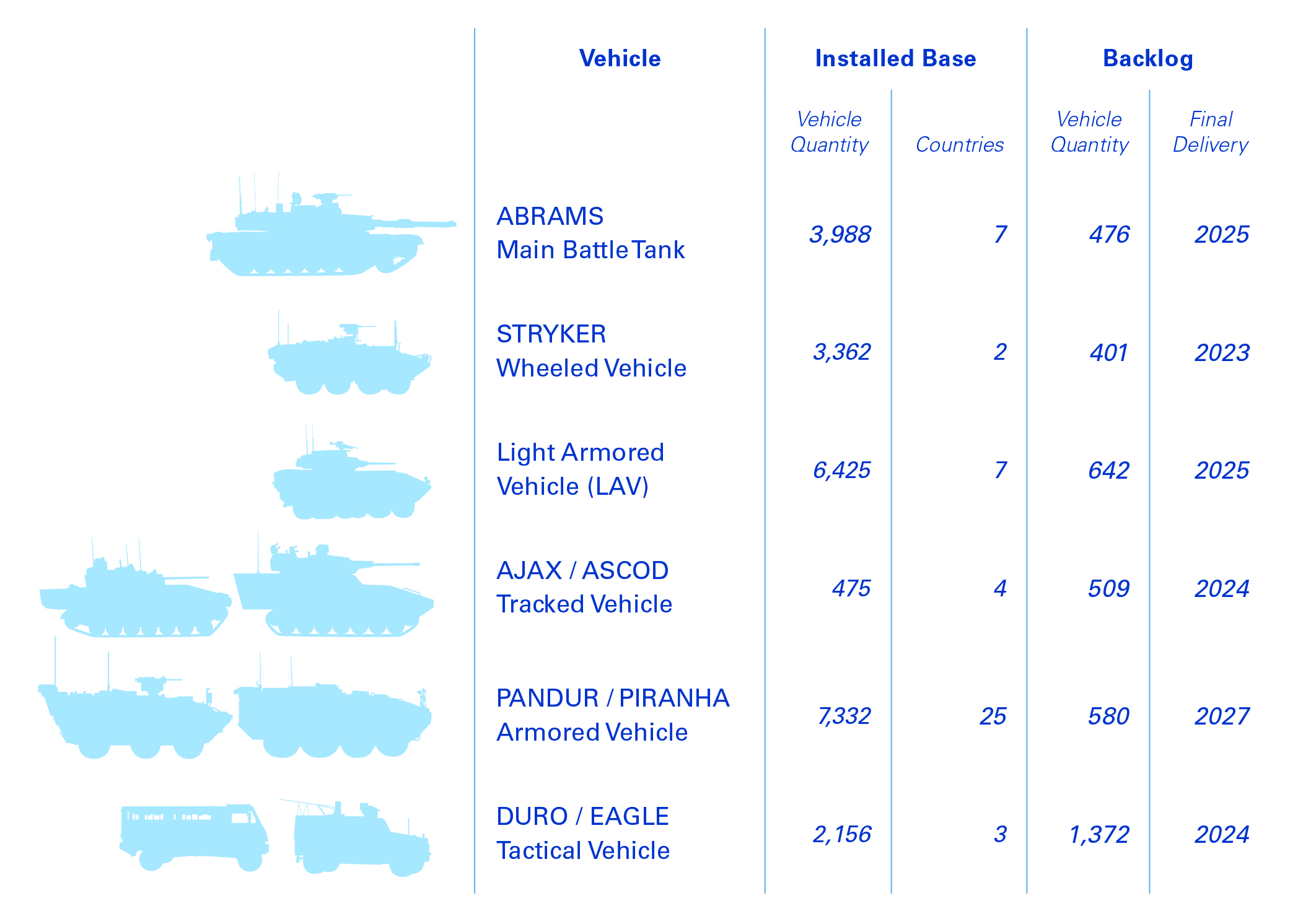
Combat Systems provides similar capabilities for U.S. allies through export opportunities and through our operations in several countries around the world, including Canada, the United Kingdom, Spain, Switzerland, Austria and Germany. As a result, we have a market-leading position in light armored vehicles (LAVs) with approximately 14,000 of the high-mobility, versatile Pandur, Piranha and other LAVs in service worldwide.
Land Systems is producing 360 new LAVs in eight variants, including ambulances, command posts, maintenance and recovery vehicles, and troop-carrying vehicles, for the Canadian Army, as well as upgrading its existing fleet. Land Systems is also producing the British Army’s AJAX armored fighting vehicle, a next-generation, medium-weight tracked combat vehicle. With six variants, including a reconnaissance vehicle, an armored personnel carrier, and various support platforms, the AJAX family of vehicles offers advanced electronic architecture and proven technology for an unparalleled balance of survivability, lethality and mobility, along with high reliability for a vehicle in its weight class.
ELS is producing and upgrading Piranha vehicles, a premier 8x8 armored combat vehicle, around the world. We are currently providing Piranha 5 vehicles for several countries, including Denmark, Romania and Spain. Additionally, we provide mobile bridge systems with payloads ranging from 100 kilograms to 100 tons to customers worldwide. We offer the ASCOD, a highly versatile tracked combat vehicle with multiple versions, including the Spanish Pizarro and the Austrian Ulan. ELS also offers Duro and Eagle tactical vehicles in a range of options and weight classes and is currently producing these vehicles for Denmark, Luxembourg, Switzerland and Germany, while providing a full range of product support for the German armed forces.
We are expanding our platform capabilities through continued investment in robotic and autonomous vehicle technology. We have the Multi-Utility Tactical Transport (MUTT), a semi-autonomous robotic platform that can be equipped with an array of modular mission payloads for use alongside dismounted soldiers. This platform was selected as the U.S. Army’s first robotic vehicle program of record and is officially designated as the Small Multipurpose Equipment Transport (SMET). Additionally, we have the Tracked Robot 10-ton (TRX) prototype, a medium-sized, semi-autonomous combat vehicle that enables critical battlefield roles, such as direct and indirect fire, autonomous resupply, reconnaissance and other battlefield missions.
On December 31, 2021, the installed base for our major vehicle programs, as well as the quantity and scheduled final delivery date of vehicles and vehicle upgrades currently in backlog were as follows:
Complementing these military-vehicle offerings, OTS designs, develops and produces a comprehensive array of sophisticated weapon systems for ground forces, including the M2/M2-A1 heavy machine guns and MK19/MK47 grenade launchers. OTS also produces next-generation weapon systems for shipboard and aircraft applications, including high-speed Gatling guns for all U.S. fighter aircraft, including the F-35 Joint Strike Fighter.
OTS’s munitions portfolio covers the full breadth of naval, air and ground forces applications across all calibers and weapon platforms for the U.S. government and its non-U.S. partners. Globally, we maintain a market-leading position in the supply of Hydra-70 rockets, general-purpose bombs and bomb bodies, large-caliber tank ammunition, medium-caliber ammunition, military propellants, mortar, and artillery projectiles. OTS is also the systems integrator for the next generation of artillery solutions in support of the Army’s Indirect Fire Modernization objectives. Additionally, OTS maintains a leading position providing missile subsystems in support of U.S. tactical and strategic missiles, provisioning both legacy and next-generation missiles with critical aerostructures, control actuators, high-performance warheads and cutting-edge hypersonic rocket cases.
Revenue for the Combat Systems segment was 19% of our consolidated revenue in 2021 and 2020 and 18% in 2019. Revenue by major products and services was as follows:
| Year Ended December 31 | 2021 | 2020 | 2019 | ||||||||||||||
| Military vehicles | $ | 4,699 | $ | 4,687 | $ | 4,620 | |||||||||||
| Weapons systems, armament and munitions | 2,006 | 1,991 | 1,906 | ||||||||||||||
| Engineering and other services | 646 | 545 | 481 | ||||||||||||||
| Total Combat Systems | $ | 7,351 | $ | 7,223 | $ | 7,007 |
TECHNOLOGIES
Our Technologies segment provides a full spectrum of services, technologies and products to an expanding market that increasingly seeks solutions combining leading-edge electronic hardware with specialized software. The segment is organized into two business units — Information Technology (GDIT) and Mission Systems. Together they serve a wide range of military, intelligence and federal civilian customers with a diverse portfolio that includes:
-
information technology (IT) solutions and mission-support services;
-
mobile communication, computers, command-and-control and cyber (C5) mission systems; and
-
intelligence, surveillance and reconnaissance (ISR) solutions.
This market has experienced a series of structural shifts in recent years, and our response to those trends has further solidified our position as a market leader. Over the past decade, the Department of Defense (DoD), the intelligence community and federal civilian agencies have increasingly prioritized technology solutions as a critical element of their missions. Cloud computing capabilities, cyber security threats, and advancements in artificial intelligence have transformed technology resources from short-cycle back-office support functions to a strategic priority for this customer community. The result is a significant increase in federal IT modernization and technology investments in recent years and a shift to large-scale, end-to-end, highly engineered solutions that require critical mass and a broad array of technology services and hardware offerings to meet these customer demands. The coronavirus (COVID-19) pandemic has only accelerated these trends, which have included an expansion of remote connectivity and added urgency to required technology investments.
These market shifts have resulted in significant consolidation in the industry in recognition of the scale and breadth of capabilities required to meet this growing demand. In response to these market dynamics, in 2015 we combined our C5 and ISR operations into a single Mission Systems business unit, and in 2018 we acquired CSRA, Inc. (CSRA), which doubled the size of our IT services business, brought critical capabilities and repositioned the segment as a leader in this market.
During the four years following the acquisition of CSRA, GDIT and Mission Systems carried out considerable portfolio shaping and realignment. At the top level, the two businesses share the same defense, intelligence and federal civilian customer base and increasingly go to market together to meet the ever-changing information-systems and mission-support needs of these customers. In addition, with the convergence of digital technologies, the two businesses have considerable commonality and benefit from significant complementary pull-through in their core offerings and solution sets, particularly in the areas of cloud computing; artificial intelligence and machine learning (AI/ML); big data analytics; development, security and operations (DevSecOps); software-defined networks; and everything as-a-service (XaaS).
With a broad network of global partners, the segment develops solutions that keep its customers at the leading edge of technology in support of their missions. The segment’s highly skilled workforce is one of its key differentiators and comprises approximately 40,000 employees, including technologists, engineers, mission experts and cleared personnel dedicated to solving the toughest security and technology challenges facing the United States and its allies.
GDIT modernizes large-scale IT enterprises and deploys the latest technologies to optimize and protect customer networks, data and information. Operating hundreds of complex digital modernization programs across the federal government, GDIT’s expansive portfolio includes cloud strategy and services, cybersecurity, network modernization, managed services, AI/ML, application development, and high-performance computing.
Mission Systems offers solutions across all domains and produces a unique combination of products and capabilities that are purpose-built for essential C5ISR applications. Our technologies and products are often built into platforms and integrated systems on which our customers rely. The business’ portfolio includes prime contract programs to provide innovative defense-electronics solutions as well as subcontract efforts that enhance the capabilities of large-scale land, air, sea and space platforms.
The Technologies segment leverages its scale, partnerships and deep knowledge of its customers’ missions and challenges to bring innovation to those customers across a portfolio of thousands of contracts. While no individual contract is material to the segment’s results, the following highlights provide a sampling of the value of this combined business.
GDIT delivers a full spectrum of cloud solutions and services to modernize customers’ legacy IT infrastructures and systems. These cloud capabilities advance security and accelerate access to cutting-edge technologies such as high-performance computing and AI/ML. For the DoD, GDIT is delivering, integrating and supporting Microsoft’s cloud-based productivity suite, Microsoft Office 365, under the Defense Enterprise Office Systems (DEOS) contract, which secures and streamlines email and collaborative tools across the DoD enterprise. In the federal civilian market, GDIT is delivering a scalable, hybrid multi-cloud platform to modernize the United States Patent and Trademark Office’s IT infrastructure and services.
We apply AI/ML to expand the human capacity to make better decisions and implement smarter actions as we automate, secure and enhance our customers’ operations. For the Department of Veterans Affairs (VA), GDIT leverages managed services and AI/ML to accelerate veteran benefits claims processing, develops applications and software to improve the veteran user experience, and provides on-demand 24/7/365 IT support to more than 500,000 VA personnel nationwide. In the federal civilian sector, GDIT supports some of the fastest supercomputers in the world, responsible for biomedical research, weather forecasting and climate modeling.
To adapt to a constantly evolving threat landscape, GDIT embeds cyber solutions into every aspect of digital modernization. More than 3,000 cyber professionals support cyber projects across 30 agencies in the federal government. This work includes modernizing the IT infrastructure for the U.S. Southern Command’s (USSOUTHCOM) secured networks with a full range of capabilities, including cyber security, cloud computing and software development.
Mission Systems develops and manufactures combat-proven global positioning systems (GPS) for the U.S. Army. This includes capabilities to ensure reliable satellite connectivity in any location and a suite of Assured Position, Navigation and Timing capabilities, which provide military forces the ability to synchronize communications utilizing trusted data, even when GPS signals are degraded or denied.
We are working with our Army customer to adapt elements of 5G technology to address battlefield realities such as jamming, spoofing, cyberattacks and lack of ground connectivity. We also provide similar capabilities to non-U.S. customers, including Canada and the United Kingdom.
On the platform side, we have a more than 60-year legacy of providing advanced fire-control systems for the Navy’s submarine programs. We are developing and integrating commercial off-the-shelf software and hardware upgrades to improve the tactical control capabilities for several submarine classes, including the Columbia and U.K. Dreadnought ballistic-missile submarines.
Mission Systems is also investing in autonomous capabilities, opening in 2021 a new Unmanned Undersea Vehicle (UUV) Manufacturing and Assembly Center of Excellence in Taunton, Massachusetts. The facility will provide manufacturing, assembly, integration and testing capabilities for Mission Systems’ Knifefish and Bluefin Robotics UUVs.
Revenue for the Technologies segment was 33% of our consolidated revenue in 2021 and 34% in 2020 and 2019. Revenue by major products and services was as follows:
| Year Ended December 31 | 2021 | 2020 | 2019 | ||||||||||||||
| IT services | $ | 8,069 | $ | 7,892 | $ | 8,422 | |||||||||||
| C5ISR solutions | 4,388 | 4,756 | 4,937 | ||||||||||||||
| Total Technologies | $ | 12,457 | $ | 12,648 | $ | 13,359 |
CUSTOMERS
In 2021, 70% of our consolidated revenue was from the U.S. government, 12% was from U.S. commercial customers, 10% was from non-U.S. government customers and the remaining 8% was from non-U.S. commercial customers.
U.S. GOVERNMENT
Our primary customer is the DoD. We also contract with other U.S. government customers, including the intelligence community and the Departments of Homeland Security and Health and Human Services. Our revenue from the U.S. government was as follows:
| Year Ended December 31 | 2021 | 2020 | 2019 | ||||||||||||||
| DoD | $ | 21,386 | $ | 20,840 | $ | 19,864 | |||||||||||
| Non-DoD | 4,862 | 4,726 | 5,254 | ||||||||||||||
| Foreign military sales (FMS)* | 598 | 737 | 689 | ||||||||||||||
| Total U.S. government | $ | 26,846 | $ | 26,303 | $ | 25,807 | |||||||||||
| % of total revenue | 70 | % | 69 | % | 66 | % |
*In addition to our direct non-U.S. sales, we sell to non-U.S. governments through the FMS program. Under the FMS program, we contract with and are paid by the U.S. government, and the U.S. government assumes the risk of collection from the non-U.S. government customer.
Our U.S. government revenue is derived from fixed-price, cost-reimbursement and time-and-materials contracts. Our production contracts are primarily fixed-price. Under these contracts, we agree to perform a specific scope of work for a fixed amount. Contracts for research, engineering, repair and maintenance, and other services are typically cost-reimbursement or time-and-materials. Under cost-reimbursement contracts, the customer reimburses contract costs incurred and pays a fixed, incentive or award-based fee. These fees are determined by our ability to achieve targets set in the contract, such as
cost, quality, schedule and performance. Under time-and-materials contracts, the customer pays a fixed hourly rate for direct labor and generally reimburses us for the cost of materials.
Of our U.S. government revenue, fixed-price contracts accounted for 57% in 2021 and 59% in 2020 and 2019; cost-reimbursement contracts accounted for 36% in 2021 and 35% in 2020 and 2019; and time-and-materials contracts accounted for 7% in 2021 and 6% in 2020 and 2019.
For information on the advantages and disadvantages of each of these contract types, see Note B to the Consolidated Financial Statements in Item 8.
U.S. COMMERCIAL
Our U.S. commercial revenue was $4.8 billion in 2021, $4.9 billion in 2020 and $6 billion in 2019, which represented 12%, 13% and 15% of our consolidated revenue in each of the respective years. The majority of this revenue was for business jet aircraft and related services where our customer base consists of individuals and public and privately held companies across a wide range of industries.
NON-U.S.
Our revenue from non-U.S. government and commercial customers was $6.8 billion in 2021, $6.7 billion in 2020 and $7.6 billion in 2019, which represented 18% of our consolidated revenue in 2021 and 2020 and 19% in 2019.
We conduct business with customers around the world. Our non-U.S. defense subsidiaries maintain long-term relationships with their customers and have established themselves as principal regional suppliers and employers, providing a broad portfolio of products and services.
Our non-U.S. commercial revenue consists primarily of business jet aircraft exports and worldwide aircraft services. While the installed base of aircraft is concentrated in North America, orders from customers outside North America represent a significant portion of our aircraft business with approximately 45% of the Aerospace segment’s aircraft backlog on December 31, 2021.
COMPETITION
Several factors determine our ability to compete successfully in the defense and business-aviation markets. While customers’ evaluation criteria vary, the principal competitive elements include:
-
the technical excellence, reliability, safety and cost competitiveness of our products and services;
-
our ability to innovate and develop new products and technologies that improve mission performance and adapt to dynamic threats;
-
successful program execution and on-time delivery of complex, integrated systems;
-
our global footprint and accessibility to customers;
-
the reputation and customer confidence derived from past performance; and
-
the successful management of customer relationships.
DEFENSE MARKET COMPETITION
The U.S. government contracts with numerous domestic and non-U.S. companies for products and services. We compete against other contractors as well as smaller companies that specialize in a particular technology or capability. Outside the United States, we compete with global defense contractors’ exports and the offerings of private and state-owned defense manufacturers. Our Marine Systems segment has one primary competitor with which it also partners on the Virginia-class
submarine program, and to which it subcontracts on the Columbia-class submarine program. Our Combat Systems segment competes with a large number of U.S. and non-U.S. businesses. Our Technologies segment competes with many companies, from large government contracting and commercial technology companies to small niche competitors with specialized technologies or expertise. The operating cycle of many of our major programs can result in sustained periods of program continuity when we perform successfully.
We are involved in teaming and subcontracting relationships with some of our competitors. Competitions for major defense and other government contracting programs often require companies to form teams to bring together a spectrum of capabilities to meet the customer’s requirements. Opportunities associated with these programs include roles as the program’s integrator, overseeing and coordinating the efforts of all participants on a team, or as a provider of a specific component or subsystem.
BUSINESS JET AIRCRAFT MARKET COMPETITION
The Aerospace segment has several competitors for each of its Gulfstream products. Key competitive factors include aircraft safety, reliability and performance; comfort and in-flight productivity; service quality, global footprint and responsiveness; technological and new-product innovation; and price. We believe that Gulfstream competes effectively in all of these areas.
The Aerospace segment competes worldwide in the business jet aircraft services market primarily on the basis of quality, price and timeliness. While competition for each type of service varies somewhat, the segment faces a number of competitors of varying sizes for each of its offerings.
INTELLECTUAL PROPERTY
We develop technology, manufacturing processes and systems-integration practices. In addition to owning a large portfolio of proprietary intellectual property, we license some intellectual property rights to and from others. The U.S. government holds licenses to many of our patents developed in the performance of U.S. government contracts, and it may use or authorize others to use the inventions covered by these patents. Although these intellectual property rights are important to the operation of our business, no existing patent, license or other intellectual property right is of such importance that its loss or termination would have a material impact on our business.
HUMAN CAPITAL MANAGEMENT
Our company consists of a community of approximately 103,100 employees dedicated to our ethos of transparency, trust, honesty and alignment. These four values drive how we operate our business; govern how we interact with each other and our customers, partners, and suppliers; guide the way that we treat our workforce; and determine how we connect with our communities. Our commitment to ethical business practices is outlined in our Standards of Business Ethics and Conduct, commonly known as our Blue Book. The Blue Book states our expectation that all employees conduct business in accordance with our Ethos, applicable laws and our policies; each employee is asked to acknowledge receipt, understanding of and compliance with our standards.
Due to the highly specialized nature of our business, we are required to hire and train skilled and qualified personnel to design and build the products and perform the services required by our customers. We recognize that our success as a company depends on our ability to attract, develop and retain a
qualified workforce. As such, we promote the health, welfare and safety of our employees. Part of our responsibility includes treating all employees with dignity and respect and providing them with fair, market-based, competitive and equitable compensation. We recognize and reward the performance of our employees in line with our pay-for-performance philosophy and provide a comprehensive suite of benefit options that enables our employees and their dependents to live healthy and productive lives.
Safety in our workplaces is paramount. Across our businesses, we take measures to prevent workplace hazards, encourage safe behaviors and enforce a culture of continuous improvement to ensure our processes help reduce incidents and illnesses and comply with governing health and safety laws. These efforts continue to be of the utmost importance as we address the ongoing challenges presented by the COVID-19 pandemic.
We are committed to promoting diversity of thought, experience, perspectives, backgrounds and capabilities to drive innovation and strengthen the solutions we deliver to our customers because we believe the results lead to a better outcome. We proudly support a culture of inclusion and encourage a work environment that respects diverse opinions, values individual skills and celebrates the unique experiences our employees bring. We are dedicated to equal employment opportunity that fosters and supports diversity in a principled, productive and inclusive work environment. We stand for basic universal human rights, including that employment must be voluntary. We track, measure and analyze our workforce trends to establish accountability for continuing to cultivate diverse and inclusive environments across our businesses and at every level of our company.
Our values motivate us to promote strong workplace practices with opportunities for development and training. Our training and development efforts focus on ensuring that the workforce is appropriately trained on critical job skills as well as leadership behaviors that are consistent with our ethos. We conduct rigorous succession planning exercises to ensure that key positions have the appropriate level of bench strength to provide for future key positions and leadership transitions. We listen to our workforce to assess areas of concern and levels of engagement.
2021 WORKFORCE STATISTICS
-
Approximately 85% of our employees are based in the United States, of which roughly 70% are white, 30% are people of color and 20% are veterans of the U.S. armed forces. The remaining 15% of our workforce is based internationally in over 65 countries with the primary concentrations in North America and Europe.
-
Our global workforce is 76% male and 24% female with our senior leadership teams across the business represented by 74% males and 26% females. During 2021, the diversity profile of our workforce continued to improve across our businesses as we hired approximately 21,300 individuals of which 69% were male and 31% were female. For our 2021 U.S.-based hires, 61% were white and 39% were people of color.
RAW MATERIALS AND SUPPLIERS
We depend on suppliers and subcontractors for raw materials, components and subsystems. Our U.S. government customer is a supplier on some of our programs. These supply networks can experience price fluctuations and capacity constraints, which can put pressure on our costs. Effective management and oversight of suppliers and subcontractors is an important element of our successful performance. If our sources of supply are disrupted, particularly in instances where we rely on only one or two sources of supply, our ability to meet our customer commitments could be adversely impacted. We attempt to
mitigate risks with our suppliers by entering into long-term agreements and leveraging company-wide agreements to achieve economies of scale and by negotiating flexible pricing terms in our customer contracts. We have not experienced, and do not foresee, significant difficulties in obtaining the materials, components or supplies necessary for our business operations.
REGULATORY MATTERS
U.S. GOVERNMENT CONTRACTS
U.S. government contracts are subject to procurement laws and regulations. The Federal Acquisition Regulation (FAR) and the Cost Accounting Standards (CAS) govern the majority of our contracts. The FAR mandates uniform policies and procedures for U.S. government acquisitions and purchased services. Also, individual agencies can have acquisition regulations that provide implementing language for the FAR or that supplement the FAR. For example, the DoD implements the FAR through the Defense Federal Acquisition Regulation Supplement (DFARS). For all federal government entities, the FAR regulates the phases of any product or service acquisition, including:
-
acquisition planning;
-
competition requirements;
-
contractor qualifications;
-
protection of source selection and supplier information; and
-
acquisition procedures.
In addition, the FAR addresses the allowability of our costs, while the CAS addresses the allocation of those costs to contracts. The FAR and CAS subject us to audits and other government reviews covering issues such as cost, performance, internal controls and accounting practices relating to our contracts.
NON-U.S. REGULATORY
Our non-U.S. operations are subject to the applicable government regulations and procurement policies and practices, as well as U.S. policies and regulations. We are also subject to regulations governing investments, exchange controls, repatriation of earnings and import-export control.
BUSINESS JET AIRCRAFT
The Aerospace segment is subject to FAA regulation in the United States and other similar aviation regulatory authorities internationally, including the Civil Aviation Administration of Israel (CAAI), the European Aviation Safety Agency (EASA) and the Civil Aviation Administration of China (CAAC). For an aircraft to be manufactured and sold, the model must receive a type certificate from the appropriate aviation authority, and each aircraft must receive a certificate of airworthiness. Aircraft outfitting and completions also require approval by the appropriate aviation authority, which is often accomplished through a supplemental type certificate. Aviation authorities can require changes to a specific aircraft or model type before granting approval. Maintenance facilities and charter operations must be licensed by aviation authorities as well.
ENVIRONMENTAL
We are subject to a variety of federal, state, local and foreign environmental laws and regulations. These laws and regulations cover the discharge, treatment, storage, disposal, investigation and remediation of materials, substances and wastes identified in the laws and regulations. We are directly or indirectly
involved in environmental investigations or remediation at some of our current and former facilities and at third-party sites that we do not own but where we have been designated a potentially responsible party (PRP) by the U.S. Environmental Protection Agency or a state environmental agency. As a PRP, we are potentially liable to the government or third parties for the cost of remediating contamination. In cases where we have been designated a PRP, we generally seek to mitigate these environmental liabilities through available insurance coverage and by pursuing appropriate cost-recovery actions. In the unlikely event that we are required to fully fund the remediation of a site, the current statutory framework would allow us to pursue contributions from other PRPs. We regularly assess our compliance status and management of environmental matters.
Operating and maintenance costs associated with environmental compliance and management of contaminated sites are a normal, recurring part of our operations. Historically, these costs have not been material. In addition, we could be affected by future laws or regulations imposed in response to concerns over climate change, the timing and effect of which are difficult to assess.
Changes in environmental and climate change laws or regulations, including laws relating to greenhouse gas emissions, could lead to new or additional investment in product designs or facilities and could increase environmental compliance expenditures, including increased energy and raw materials costs. Environmental costs are often recoverable under our contracts with the U.S. government. Based on information currently available and current U.S. government policies relating to cost recovery, we do not expect continued compliance with environmental regulations, including costs associated with changes in environmental and climate change laws or regulations, to have a material impact on our results of operations, financial condition or cash flows. For additional information relating to the impact of environmental matters, see Note M to the Consolidated Financial Statements in Item 8.
AVAILABLE INFORMATION
We file reports and other information with the Securities and Exchange Commission (SEC) pursuant to Section 13(a) or 15(d) of the Securities Exchange Act of 1934, as amended. These reports and information include an annual report on Form 10-K, quarterly reports on Form 10-Q, current reports on Form 8-K and proxy statements. Free copies of these items are made available on our website (www.gd.com) as soon as practicable. The SEC maintains a website (www.sec.gov) that contains reports, proxy and information statements, and other information.
In addition to the information contained in this Form 10-K, information about the company can be found on our website and our Investor Relations website (investorrelations.gd.com). Our Investor Relations website contains a significant amount of information about the company, including financial information, our corporate governance principles and practices, and other information for investors. We encourage investors to visit our website, as we frequently update and post new information about our company, and it is possible that this information could be deemed to be material information.
References to our website and the SEC’s website in this Form 10-K do not constitute, and should not be viewed as, incorporation by reference of the information contained on, or available through, the websites. The information should not be considered a part of this Form 10-K, unless otherwise expressly incorporated by reference.
Item 1A. RISK FACTORS
An investment in our common stock or debt securities is subject to risks and uncertainties. Investors should consider the following factors, in addition to the other information contained in this Annual Report on Form 10-K, before deciding whether to purchase our securities.
Investment risks can be market-wide as well as unique to a specific industry or company. The market risks faced by an investor in our stock are similar to the uncertainties faced by investors in a broad range of industries. There are some risks that apply more specifically to our business.
Our revenue is concentrated with the U.S. government. This customer relationship involves some specific risks. In addition, our sales to non-U.S. customers expose us to different financial and legal risks. Despite the varying nature of our government and commercial operations and the markets they serve, each segment shares some common risks, such as the ongoing development of high-technology products and the price, availability and quality of commodities and subsystems.
Risks Relating to Our Business and Industry
The U.S. government provides a significant portion of our revenue. In 2021, 70% of our consolidated revenue was from the U.S. government. Levels of U.S. defense spending are driven by threats to national security. Competing demands for federal funds can pressure various areas of spending. Decreases in U.S. government defense and other spending or changes in spending allocation or priorities could result in one or more of our programs being reduced, delayed or terminated, which could impact our financial performance.
For additional information relating to U.S. budget matters, see the Business Environment section of Management’s Discussion and Analysis of Financial Condition and Results of Operations in Item 7.
U.S. government contracts are not always fully funded at inception, and any funding is subject to disruption or delay. Our U.S. government revenue is funded by agency budgets that operate on an October-to-September fiscal year. Early each calendar year, the President of the United States presents to the Congress the budget for the upcoming fiscal year. This budget proposes funding levels for every federal agency and is the result of months of policy and program reviews throughout the executive branch. For the remainder of the year, the Appropriations and Authorization Committees of the Congress review the President’s budget proposals and establish the funding levels for the upcoming fiscal year. Once these levels are enacted into law, the Executive Office of the President administers the funds to the agencies.
There are two primary risks associated with the U.S. government budget cycle. First, the annual process may be delayed or disrupted. If the annual budget is not approved by the beginning of the government fiscal year, portions of the U.S. government can shut down or operate under a continuing resolution that maintains spending at prior-year levels, which can impact funding for our programs and timing of new awards. Second, the Congress typically appropriates funds on a fiscal-year basis, even though contract performance may extend over many years. Future revenue under existing multi-year contracts is conditioned on the continuing availability of congressional appropriations. Changes in appropriations in subsequent years may impact the funding available for these programs. Delays or changes in funding can impact the timing of available funds or lead to changes in program content.
Our government contracts are subject to termination rights by the customer. U.S. government contracts generally permit the government to terminate a contract, in whole or in part, for convenience. If a contract is terminated for convenience, a contractor usually is entitled to receive payments for its
allowable costs incurred and the proportionate share of fees or earnings for the work performed. The government may also terminate a contract for default in the event of a breach by the contractor. If a contract is terminated for default, the government in most cases pays only for the work it has accepted. Many foreign contracts have similar termination rights by customers. The termination of multiple or large programs could have a material adverse effect on our future revenue and earnings.
Government contractors operate in a highly regulated environment and are subject to audit by the U.S. government. Numerous U.S. government agencies routinely audit and review government contractors. These agencies review a contractor’s performance under its contracts and compliance with applicable laws, regulations and standards. The U.S. government also reviews the adequacy of, and compliance with, internal control systems and policies, including the contractor’s purchasing, property, estimating, material, earned value management and accounting systems. In some cases, audits may result in delayed payments or contractor costs not being reimbursed or subject to repayment. If an audit or investigation were to result in allegations against a contractor of improper or illegal activities, civil or criminal penalties and administrative sanctions could result, including termination of contracts, forfeiture of profits, suspension of payments, fines and suspension or prohibition from doing business with the U.S. government. In addition, reputational harm could result if allegations of impropriety were made. In some cases, audits may result in disputes with the respective government agency that can result in negotiated settlements, arbitration or litigation. Moreover, new laws, regulations or standards, or changes to existing ones, can increase our performance and compliance costs and reduce our profitability.
Our Aerospace segment is subject to changing customer demand for business aircraft. The business jet market is driven by the demand for business-aviation products and services by corporate, individual and government customers in the United States and around the world. The Aerospace segment’s results also depend on other factors, including general economic conditions, the availability of credit, pricing pressures and trends in capital goods markets. In addition, if customers default on existing contracts and the contracts are not replaced, the segment’s anticipated revenue and profitability could be reduced materially.
Earnings and margin depend on our ability to perform on our contracts. When agreeing to contractual terms, our management team makes assumptions and projections about future conditions and events. The accounting for our contracts and programs requires assumptions and estimates about these conditions and events. These projections and estimates assess:
-
the productivity and availability of labor;
-
the complexity of the work to be performed;
-
the cost and availability of materials and components; and
-
schedule requirements.
If there is a significant change in one or more of these circumstances, estimates or assumptions, or if the risks under our contracts are not managed adequately, the profitability of contracts could be adversely affected. This could affect earnings and margin materially.
Earnings and margin depend in part on subcontractor and supplier performance. We rely on other companies to provide materials, components and subsystems for our products. Subcontractors also perform some of the services that we provide to our customers. We depend on these subcontractors and suppliers to meet our contractual obligations in full compliance with customer requirements and applicable law. Misconduct by subcontractors, such as a failure to comply with procurement regulations or engaging in unauthorized activities, may harm our future revenue and earnings. We manage our
supplier base carefully to avoid or minimize customer issues. We sometimes rely on only one or two sources of supply that, if disrupted, could have an adverse effect on our ability to meet our customer commitments. Our ability to perform our obligations may be materially adversely affected if one or more of these suppliers is unable to provide the agreed-upon materials, perform the agreed-upon services in a timely and cost-effective manner, or engages in misconduct or other improper activities.
Our future success depends in part on our ability to develop new products and technologies and maintain a qualified workforce to meet the needs of our customers. Many of the products and services we provide involve sophisticated technologies and engineering, with related complex manufacturing and system-integration processes. Our customers’ requirements change and evolve regularly. Accordingly, our future performance depends in part on our ability to continue to develop, manufacture and provide innovative products and services and bring those offerings to market quickly at cost-effective prices. Some new products, particularly in our Aerospace segment, must meet extensive and time-consuming regulatory requirements that are often outside our control and may result in unanticipated delays. Additionally, due to the highly specialized nature of our business, we must hire and retain the skilled and qualified personnel necessary to perform the services required by our customers. To the extent that the demand for skilled personnel exceeds supply, we could experience higher labor, recruiting or training costs in order to attract and retain such employees. If we were unable to develop new products that meet customers’ changing needs and satisfy regulatory requirements in a timely manner or successfully attract and retain qualified personnel, our future revenue and earnings may be materially adversely affected.
Risks Relating to Our International Operations
Sales and operations outside the United States are subject to different risks that may be associated with doing business in foreign countries. In some countries there is increased chance for economic, legal or political changes, and procurement procedures may be less robust or mature, which may complicate the contracting process. Our non-U.S. operations may be sensitive to and impacted by changes in a foreign government’s national policies and priorities, political leadership and budgets, which may be influenced by changes in threat environments, geopolitical uncertainties, volatility in economic conditions and other economic and political factors. Changes and developments in any of these matters or factors may occur suddenly and could impact funding for programs or delay purchasing decisions or customer payments. Non-U.S. transactions can involve increased financial and legal risks arising from foreign exchange rate variability and differing legal systems. Our non-U.S. operations are subject to U.S. and foreign laws and regulations, including laws and regulations relating to import-export controls, technology transfers, the Foreign Corrupt Practices Act (FCPA) and other anti-corruption laws, and the International Traffic in Arms Regulations (ITAR). An unfavorable event or trend in any one or more of these factors or a failure to comply with U.S. or foreign laws could result in administrative, civil or criminal liabilities, including suspension or debarment from government contracts or suspension of our export privileges, and could materially adversely affect revenue and earnings associated with our non-U.S. operations.
In addition, some non-U.S. government customers require contractors to enter into letters of credit, performance or surety bonds, bank guarantees and other similar financial arrangements. We may also be required to agree to specific in-country purchases, manufacturing agreements or financial support arrangements, known as offsets, that require us to satisfy investment or other requirements or face penalties. Offset requirements may extend over several years and could require us to team with local companies to fulfill these requirements. If we do not satisfy these financial or offset requirements, our future revenue and earnings may be materially adversely affected.
Risks Relating to Our Acquisitions and Similar Investment Activities
We have made and expect to continue to make investments, including acquisitions and joint ventures, that involve risks and uncertainties. When evaluating potential acquisitions and joint ventures, we make judgments regarding the value of business opportunities, technologies and other assets, and the risks and costs of potential liabilities based on information available to us at the time of the transaction. Whether we realize the anticipated benefits from these transactions depends on multiple factors, including our integration of the businesses involved; the performance of the underlying products, capabilities, or technologies; market conditions following the acquisition; and acquired liabilities, including some that may not have been identified prior to the acquisition. These factors could materially adversely affect our financial results.
Changes in business conditions may cause goodwill and other intangible assets to become impaired. Goodwill represents the purchase price paid in excess of the fair value of net tangible and intangible assets acquired in a business combination. Goodwill is not amortized and remains on our balance sheet indefinitely unless there is an impairment or a sale of a portion of the business. We review goodwill for impairment annually at each of our reporting units or when circumstances indicate that the likelihood of an impairment is greater than 50%. Such circumstances include a significant adverse change in the business climate for one of our reporting units or a decision to dispose of a reporting unit or a significant portion of a reporting unit. We face some uncertainty in our business environment due to a variety of challenges, including changes in government spending. We may experience unforeseen circumstances that adversely affect the value of our goodwill or intangible assets and trigger an evaluation of the amount of the recorded goodwill and intangible assets. Future write-offs of goodwill or other intangible assets as a result of an impairment in the business could materially adversely affect our results of operations and financial condition.
Other Business and Operational Risks
Our business could be negatively impacted by cybersecurity events and other disruptions. We face various cybersecurity threats, including threats to our IT infrastructure and attempts to gain unauthorized access to our proprietary or classified information, denial-of-service attacks, as well as threats to the physical security of our facilities and employees, and threats from terrorist acts. We also design and manage IT systems and products that contain IT systems for various customers. We generally face the same security threats for these systems as for our own internal systems. In addition, we face cyber threats from entities that may seek to target us through our customers, suppliers, subcontractors and other third parties with whom we do business. Accordingly, we maintain information security staff, policies and procedures for managing risk to our information systems; we conduct employee training on cybersecurity to mitigate persistent and continuously evolving cybersecurity threats; and we report cybersecurity events or losses of customer data to affected customers and applicable regulatory authorities. However, there can be no assurance that any such actions, or the safeguards put in place by our customers, suppliers, subcontractors and other parties on which we rely, will be sufficient to detect, prevent and mitigate cybersecurity breaches or disruptions, or the unauthorized release of sensitive information or corruption of data.
We have experienced cybersecurity events and disruptions such as viruses and attacks targeting our IT systems. Such prior events have not had a material impact on our financial condition, results of operations or liquidity. However, future threats could, among other things, cause harm to our business and our reputation; disrupt our operations; expose us to potential liability, regulatory actions and loss of business; challenge our eligibility for future work on sensitive or classified systems for government customers; and impact our results of operations materially. Due to the evolving nature of these security
threats, the potential impact of any future incident cannot be predicted. Our insurance coverage may not be adequate to cover all the costs related to cybersecurity attacks or disruptions resulting from such events.
Our business may continue to be negatively impacted by the coronavirus (COVID-19) pandemic or other similar outbreaks. The COVID-19 pandemic has had, and could continue to have, a negative effect on our business, results of operations and financial condition. Effects include disruptions or restrictions on our employees’ ability to work effectively, temporary closures of our facilities or the facilities of our customers, and supply-chain disruptions, which could affect our ability to perform on our contracts. In addition, the U.S. government’s federal contractor vaccine mandate could adversely affect our ability, and our subcontractors’ ability, to hire and retain highly skilled employees to work on U.S. government programs. Any cost increases that result from these effects may not be fully recoverable on our contracts or adequately covered by insurance, which could impact our profitability. In addition, the COVID-19 pandemic has resulted in a widespread health crisis that is adversely affecting the economies and financial markets of many countries, which could result in a prolonged economic downturn that may negatively affect demand for our products and services. The imposition of quarantine and travel restrictions has negatively affected and, if reimposed, may continue to negatively affect portions of our business, particularly our Aerospace and Technologies segments. The extent to which COVID-19 continues to impact our business, results of operations and financial condition is highly uncertain and will depend on future developments. Such developments may include the geographic spread and duration of the virus, including the emergence of new variants, the severity of the disease, vaccination rates and the actions that may be taken by various governmental authorities and other third parties in response to the pandemic. Other outbreaks of contagious diseases or other adverse public health developments in countries where we operate or our customers are located could similarly affect our business in the future.
Increased regulation related to global climate change could negatively affect our business. Increased public awareness and concern regarding global climate change may result in state, federal or international requirements to reduce or mitigate global warming, such as the imposition of carbon pricing mechanisms or stricter limits on greenhouse gas emissions. If environmental or climate-change laws or regulations are adopted or changed that impose significant new costs, operational restrictions or compliance requirements upon our business or our products, they could increase our capital expenditures, reduce our margins and adversely affect our financial position.
FORWARD-LOOKING STATEMENTS
This Annual Report on Form 10-K contains forward-looking statements that are based on management’s expectations, estimates, projections and assumptions. Words such as “expects,” “anticipates,” “plans,” “believes,” “scheduled,” “outlook,” “estimates,” “should” and variations of these words and similar expressions are intended to identify forward-looking statements. Examples include projections of revenue, earnings, operating margin, segment performance, cash flows, contract awards, aircraft production, deliveries and backlog. In making these statements, we rely on assumptions and analyses based on our experience and perception of historical trends, current conditions and expected future developments as well as other factors we consider appropriate under the circumstances. We believe our estimates and judgments are reasonable based on information available to us at the time. Forward-looking statements are made pursuant to the safe harbor provisions of the Private Securities Litigation Reform Act of 1995, as amended. These statements are not guarantees of future performance and involve risks and uncertainties that are difficult to predict. Therefore, actual future results and trends
may differ materially from what is forecast in forward-looking statements due to a variety of factors, including, without limitation, the risk factors discussed in this Form 10-K.
All forward-looking statements speak only as of the date of this report or, in the case of any document incorporated by reference, the date of that document. All subsequent written and oral forward-looking statements attributable to General Dynamics or any person acting on our behalf are qualified by the cautionary statements in this section. We do not undertake any obligation to update or publicly release any revisions to forward-looking statements to reflect events, circumstances or changes in expectations after the date of this report. These factors may be revised or supplemented in subsequent reports on SEC Forms 10-Q and 8-K.
Item 1B. UNRESOLVED STAFF COMMENTS
None.
Item 2. PROPERTIES
We operate in a number of offices, manufacturing plants, laboratories, warehouses and other facilities in the United States and abroad. We believe our facilities are adequate for our present needs and, given planned improvements and construction, expect them to remain adequate for the foreseeable future.
On December 31, 2021, our segments had material operations at the following locations:
-
Aerospace** – Van Nuys, California; West Palm Beach, Florida; Brunswick and Savannah, Georgia; Cahokia, Illinois; Westfield, Massachusetts; Teterboro, New Jersey; New York, New York; Tulsa, Oklahoma; Dallas, Texas; Dulles, Virginia; Appleton, Wisconsin; Sydney, Australia; Beijing, China; Mexicali, Mexico; Singapore; Basel, Switzerland; Farnborough, United Kingdom.
-
Marine Systems** – San Diego, California; Groton and New London, Connecticut; Jacksonville, Florida; Honolulu, Hawaii; Bath and Brunswick, Maine; Middletown and North Kingstown, Rhode Island; Norfolk and Portsmouth, Virginia; Bremerton, Washington; Mexicali, Mexico.
-
Combat Systems** – Anniston, Alabama; East Camden, Arkansas; Healdsburg, California; Crawfordsville, St. Petersburg and Tallahassee, Florida; Marion, Illinois; Saco, Maine; Sterling Heights, Michigan; Lima, Ohio; Eynon and Scranton, Pennsylvania; Garland, Texas; Joint Base Lewis-McChord, Washington; Vienna, Austria; La Gardeur, London and Valleyfield, Canada; Kaiserslautern, Germany; Madrid, Sevilla and Trubia, Spain; Kreuzlingen and Tägerwilen, Switzerland; Merthyr Tydfil, United Kingdom.
-
Technologies – Daleville, Alabama; Scottsdale, Arizona; Orlando, Florida; Bossier City, Louisiana; Annapolis Junction, Maryland; Dedham, Pittsfield and Taunton, Massachusetts; Bloomington, Minnesota; Rensselaer, New York; Greensboro, North Carolina; Chesapeake and Marion, Virginia; multiple locations in Northern Virginia; Ottawa, Canada; Oakdale and St. Leonards, United Kingdom.
A summary of floor space by segment on December 31, 2021, follows:
| (Square feet in millions) | Company-owned Facilities | Leased Facilities | Government-owned Facilities | Total | |||||||||||||||||||
| Aerospace | 6.0 | 9.3 | 0.5 | 15.8 | |||||||||||||||||||
| Marine Systems | 8.4 | 4.5 | — | 12.9 | |||||||||||||||||||
| Combat Systems | 5.8 | 4.0 | 5.0 | 14.8 | |||||||||||||||||||
| Technologies | 3.1 | 7.4 | 0.9 | 11.4 | |||||||||||||||||||
| Total square feet | 23.3 | 25.2 | 6.4 | 54.9 |
Item 3. LEGAL PROCEEDINGS
For information relating to legal proceedings, see Note M to the Consolidated Financial Statements in Item 8.
Item 4. MINE SAFETY DISCLOSURES
Not applicable.
INFORMATION ABOUT OUR EXECUTIVE OFFICERS
All of our executive officers are appointed annually. None of our executive officers were selected pursuant to any arrangement or understanding between the officer and any other person. The name, age, offices and positions of our executives held for at least the past five years as of February 9, 2022, were as follows (references are to positions with General Dynamics Corporation, unless otherwise noted):
| Name, Position and Office | Age | ||||
| Jason W. Aiken - Senior Vice President and Chief Financial Officer since January 2014; Vice President of the company and Chief Financial Officer of Gulfstream Aerospace Corporation, September 2011 - December 2013; Vice President and Controller, April 2010 - August 2011; Staff Vice President, Accounting, July 2006 - March 2010 | 49 | ||||
| Christopher J. Brady - Vice President of the company and President of General Dynamics Mission Systems since January 2019; Vice President, Engineering of General Dynamics Mission Systems, January 2015 - December 2018; Vice President, Engineering of General Dynamics C4 Systems, May 2013 - December 2014; Vice President, Assured Communications Systems of General Dynamics C4 Systems, August 2004 - May 2013 | 59 | ||||
| Mark L. Burns - Vice President of the company and President of Gulfstream Aerospace Corporation since July 2015; Vice President of the company since February 2014; President, Product Support of Gulfstream Aerospace Corporation, June 2008 - June 2015 | 62 | ||||
| Danny Deep - Vice President of the company and President of General Dynamics Land Systems since April 2020; Chief Operating Officer of General Dynamics Land Systems, September 2018 - April 2020; Vice President of General Dynamics Land Systems – Canada, January 2011 - September 2018 | 52 | ||||
| Gregory S. Gallopoulos - Senior Vice President, General Counsel and Secretary since January 2010; Vice President and Deputy General Counsel, July 2008 - January 2010; Managing Partner of Jenner & Block LLP, January 2005 - June 2008 | 62 | ||||
| M. Amy Gilliland - Senior Vice President of the company since April 2015; President of General Dynamics Information Technology since September 2017; Deputy for Operations of General Dynamics Information Technology, April 2017 - September 2017; Senior Vice President, Human Resources and Administration, April 2015 - March 2017; Vice President, Human Resources, February 2014 - March 2015; Staff Vice President, Strategic Planning, January 2013 - February 2014; Staff Vice President, Investor Relations, June 2008 - January 2013 | 47 | ||||
| Kevin M. Graney - Vice President of the company and President of Electric Boat Corporation since October 2019; Vice President of the company and President of NASSCO, January 2017 - October 2019; Vice President and General Manager of NASSCO, November 2013 - January 2017 | 57 | ||||
| Kimberly A. Kuryea - Senior Vice President, Human Resources and Administration since April 2017; Vice President and Controller, September 2011 - March 2017; Chief Financial Officer of General Dynamics Advanced Information Systems, November 2007 - August 2011; Staff Vice President, Internal Audit, March 2004 - October 2007 | 54 | ||||
| Christopher Marzilli - Executive Vice President, Technologies since December 2020; Executive Vice President, Information Technology and Mission Systems, January 2019 - December 2020; Vice President of the company and President of General Dynamics Mission Systems, January 2015 - December 2018; Vice President of the company and President of General Dynamics C4 Systems, January 2006 - December 2014; Senior Vice President and Deputy General Manager of General Dynamics C4 Systems, November 2003 - January 2006 | 62 | ||||
| William A. Moss - Vice President and Controller since April 2017; Staff Vice President, Internal Audit, May 2015 - March 2017; Staff Vice President, Accounting, August 2010 - May 2015 | 58 | ||||
| Phebe N. Novakovic - Chairman and Chief Executive Officer since January 2013; President and Chief Operating Officer, May 2012 - December 2012; Executive Vice President, Marine Systems, May 2010 - May 2012; Senior Vice President, Planning and Development, July 2005 - May 2010; Vice President, Strategic Planning, October 2002 - July 2005 | 64 | ||||
| Mark C. Roualet - Executive Vice President, Combat Systems, since March 2013; Vice President of the company and President of General Dynamics Land Systems, October 2008 - March 2013; Senior Vice President and Chief Operating Officer of General Dynamics Land Systems, July 2007 - October 2008 | 63 | ||||
| Robert E. Smith - Executive Vice President, Marine Systems, since July 2019; Vice President of the company and President of Jet Aviation, January 2014 - July 2019; Vice President and Chief Financial Officer of Jet Aviation, July 2012 - January 2014 | 54 | ||||
PART II
Item 5. MARKET FOR THE COMPANY’S COMMON EQUITY, RELATED STOCKHOLDER MATTERS AND ISSUER PURCHASES OF EQUITY SECURITIES
Our common stock is listed on the New York Stock Exchange under the trading symbol “GD.”
On January 30, 2022, there were approximately 10,000 holders of record of our common stock.
For information regarding securities authorized for issuance under our equity compensation plans, see Note R to the Consolidated Financial Statements contained in Item 8.
We did not make any unregistered sales of equity securities in 2021.
The following table provides information about our fourth-quarter purchases of equity securities that are registered pursuant to Section 12 of the Securities Exchange Act of 1934, as amended:
| Total Number of Shares Purchased as Part of Publicly Announced Program | Maximum Number of Shares That May Yet Be Purchased Under the Program | |||||||||||||||||||||||||
| Period | Total Number of Shares | Average Price per Share | ||||||||||||||||||||||||
| Shares Purchased Pursuant to Share Buyback Program | ||||||||||||||||||||||||||
| 10/4/21-10/31/21 | 24,637 | $ | 202.94 | 24,637 | 13,809,785 | |||||||||||||||||||||
| 11/1/21-11/28/21 | 449,553 | 200.19 | 449,553 | 13,360,232 | ||||||||||||||||||||||
| 11/29/21-12/31/21 | 1,305,295 | 201.90 | 1,305,295 | 12,054,937 | ||||||||||||||||||||||
| Shares Delivered or Withheld Pursuant to Restricted Stock Vesting* | ||||||||||||||||||||||||||
| 10/4/21-10/31/21 | — | — | ||||||||||||||||||||||||
| 11/1/21-11/28/21 | — | — | ||||||||||||||||||||||||
| 11/29/21-12/31/21 | 378 | 196.31 | ||||||||||||||||||||||||
| 1,779,863 | $ | 201.48 |
*Represents shares withheld by, or delivered to, us pursuant to provisions in agreements with recipients of restricted stock granted under our equity compensation plans that allow us to withhold, or the recipient to deliver to us, the number of shares with a fair value equal to the statutory tax withholding due upon vesting of the restricted shares.
On June 2, 2021, the board of directors authorized management to repurchase up to 10 million additional shares of the company’s outstanding common stock on the open market. We repurchased 1.8 million shares in the fourth quarter of 2021. On December 31, 2021, 12.1 million shares remained authorized by our board of directors for repurchase.
For additional information relating to our purchases of common stock during the past three years, see Note N to the Consolidated Financial Statements in Item 8.
The following performance graph compares the cumulative total return to shareholders on our common stock, assuming reinvestment of dividends, with similar returns for the Standard & Poor’s 500 Index and the Standard & Poor’s Aerospace & Defense Index, both of which include General Dynamics.
Cumulative Total Return
Based on Investments of $100 Beginning December 31, 2016
(Assumes Reinvestment of Dividends)
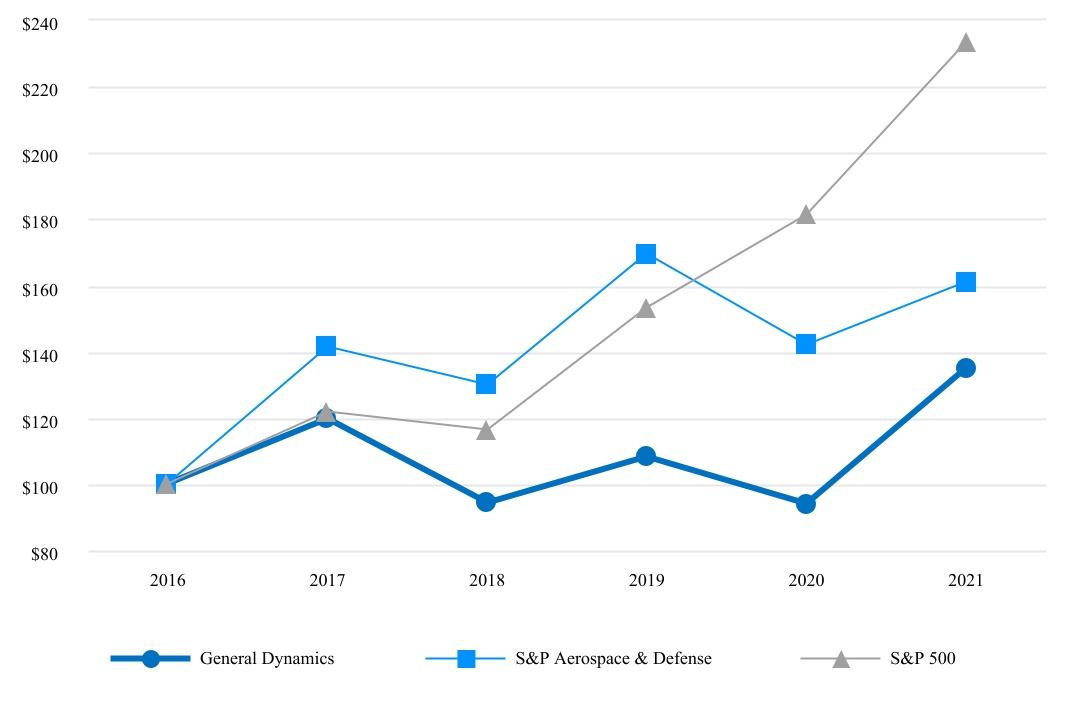
Item 6. [RESERVED]
Item 7. MANAGEMENT’S DISCUSSION AND ANALYSIS OF FINANCIAL CONDITION AND RESULTS OF OPERATIONS
(Dollars in millions, except per-share amounts or unless otherwise noted)
For an overview of our operating segments, including a discussion of our major products and services, see the Business discussion contained in Item 1. The following discussion of our financial condition and results of operations for 2021 compared with 2020 should be read in conjunction with our Consolidated Financial Statements included in Item 8, while a discussion of 2020 compared with 2019 can be found in Item 7 of our Annual Report on Form 10-K for the year ended December 31, 2020.
BUSINESS ENVIRONMENT
GLOBAL PANDEMIC UPDATE
The coronavirus (COVID-19) pandemic has caused significant disruptions to national and global economies and government activities since March 2020. During this time, we have continued to conduct our operations while responding to the pandemic with actions to mitigate adverse consequences to our employees, business, supply chain and customers. Consistent with our prioritization of the health and safety of our employees, we continue to encourage and promote vaccination across the company. Any long-term impact to our business is currently unknown due to the uncertainty around the pandemic’s duration and its broader impact. For additional information, see the Risk Factors in Part I, Item 1A.
The United States and other governments have taken several steps to respond to the pandemic. On September 9, 2021, the president signed Executive Order 14042, initiating a process whereby covered federal contractors and subcontractors must implement federally required vaccine mandates. A clause implementing the federal contractor vaccine mandate has been incorporated into a number of our federal contracts. In light of certain court orders, however, the Office of Management and Budget has stated that the U.S. government will not take action to enforce this clause until further notice. If ultimately upheld, this federal contract requirement may affect various business units differently. We are working closely with our customer to ensure that we minimize disruptions and potential employee attrition in the event that applicable contract modifications are enforceable and as additional modifications are received that could trigger implementation. To the extent that we or our subcontractors experience employee attrition and/or work stoppages, our costs could increase, schedules could slip on affected programs and our ability to perform under some contracts could be negatively affected, particularly in those instances where we cannot receive cost reimbursement.
Our Aerospace segment’s operating results have experienced the most significant impact from the pandemic. New aircraft deliveries in 2021 reflected our decision in 2020 to reduce production rates to accommodate supply chain challenges and reduced demand due to the pandemic. However, aircraft demand has been strong in 2021, with orders reaching their highest level in over a decade. Similarly, demand for aircraft services has improved as air travel has increased, but remains below pre-pandemic levels in some regions of the world. Our U.S. government business continues to experience some disruption from the COVID-19 pandemic, particularly in our Technologies segment. The Review of Operating Segments includes additional information on the impacts of the pandemic for the affected segments.
OUR MARKETS
With approximately 70% of our revenue from the U.S. government, government spending levels — particularly defense spending — influence our financial performance. The Congress has not yet passed a defense appropriations bill for the government’s fiscal year (FY) 2022 despite the fact that the new year began on October 1, 2021. However, on December 3, 2021, a continuing resolution (CR) was signed into law, providing funding for federal agencies through February 18, 2022. When the government operates under a CR, all programs of record are funded at the prior year’s appropriated levels, and the Department of Defense (DoD) is prohibited from starting new programs. While this could result in delayed revenue growth as programs that were expected to have increased funding levels continue to operate at the prior-year levels until the current-year appropriations bill is passed, we do not anticipate that the current CR, or any subsequent extensions, will have a material impact on our results of operations, financial condition or cash flows.
The long-term outlook for our U.S. defense business is influenced by the U.S. military’s funding priorities, the diversity of our programs and customers, our insight into customer requirements stemming from our incumbency on core programs, our ability to evolve our products to address a fast-changing threat environment and our proven track record of successful contract execution.
International demand for military equipment and technologies presents opportunities for our non-U.S. operations and exports from our North American businesses. While the revenue potential can be significant, there are risks to doing business in foreign countries, including changing budget priorities and overall spending pressures unique to each country.
In our Aerospace segment, we expect our investment in the development of new aircraft products and technologies to support the segment’s long-term growth. Similarly, we believe the aircraft services business will be a source of steady revenue growth as the global business jet fleet continues to grow and the impact of the pandemic subsides.
OTHER LEGISLATIVE ACTIVITY
In November 2021, the U.S. House of Representatives passed the Build Back Better Act (BBBA), which provides for changes to U.S. corporate income taxation. BBBA would delay until 2026 the requirement to capitalize and amortize over five years certain research and experimental expenditures beginning in 2022 that were previously deductible immediately.
We cannot determine whether some or all of the proposals that were included in BBBA will be enacted into law or what, if any, change may be made to such proposals prior to enactment. If the requirement to capitalize and amortize research and experimental expenditures were delayed via passage of BBBA or other legislation, it would delay the temporary increase in our tax payments otherwise beginning in 2022 that would be caused by the capitalization requirement.
RESULTS OF OPERATIONS
INTRODUCTION
The following paragraphs explain how we recognize revenue and operating costs in our operating segments and the terminology we use to describe our operating results.
In the Aerospace segment, we record revenue on contracts for new aircraft when the customer obtains control of the asset, which is generally upon delivery and acceptance by the customer of the fully
outfitted aircraft. Revenue associated with the segment’s custom completions of narrow-body and wide-body aircraft and the segment’s services businesses is recognized as work progresses or upon delivery of services. Fluctuations in revenue from period to period result from the number and mix of new aircraft deliveries, progress on aircraft completions, and the level and type of aircraft services performed during the period.
The majority of the Aerospace segment’s operating costs relates to new aircraft production on firm orders and consists of labor, material, subcontractor and overhead costs. The costs are accumulated in production lots, recorded in inventory and recognized as operating costs at aircraft delivery based on the estimated average unit cost in a production lot. While changes in the estimated average unit cost for a production lot impact the level of operating costs, the amount of operating costs reported in a given period is based largely on the number and type of aircraft delivered. Operating costs in the Aerospace segment’s completions and services businesses are recognized generally as incurred.
For new aircraft, operating earnings and margin are a function of
Showing the first 8K of 66K characters. Open the full section
Item 7A. QUANTITATIVE AND QUALITATIVE DISCLOSURES ABOUT MARKET RISK
We are exposed to market risk, primarily from foreign currency exchange rates, interest rates, commodity prices and investments. See Note Q to the Consolidated Financial Statements in Item 8 for a discussion of commodity price risk. The following quantifies the market risk exposure arising from hypothetical changes in foreign currency exchange rates and interest rates.
On December 31, 2021, we had notional forward exchange contracts outstanding of $6.8 billion. On December 31, 2020, we had notional forward exchange and interest rate swap contracts outstanding of $9.4 billion. A 10% unfavorable rate movement in our portfolio of forward exchange and interest rate swap contracts would have resulted in the following hypothetical, incremental pretax (losses) gains:
| (Dollars in millions) | 2021 | 2020 | |||||||||
| Recognized | $ | (1) | $ | 44 | |||||||
| Unrecognized | (196) | (344) |
Foreign Currency Risk. Our exchange-rate sensitivity relates primarily to changes in the Canadian dollar, euro and Swiss franc exchange rates. These losses and gains would be offset by corresponding gains and losses in the remeasurement of the underlying transactions being hedged. We believe these foreign currency forward exchange contracts and the offsetting underlying commitments, when taken together, do not create material market risk.
Interest Rate Risk. On December 31, 2021, we had $11.5 billion principal amount of fixed-rate debt. Our fixed-rate debt obligations are not putable, and we do not trade these securities in the market. A 10% unfavorable interest rate movement would not have a material impact on the fair value of our fixed-rate debt.
Investment Risk. Our investment policy allows for purchases of fixed-income securities with an investment-grade rating and a maximum maturity of up to five years. On December 31, 2021 and 2020, we held $1.6 billion and $2.8 billion in cash and equivalents, respectively, but held no marketable securities other than those held in trust to meet some of our obligations under workers’ compensation and non-qualified pension plans. On December 31, 2021 and 2020, we held marketable securities in trust of $191 and $211, respectively. These marketable securities are reflected at fair value on the Consolidated Balance Sheet in other current and noncurrent assets.
Item 8. FINANCIAL STATEMENTS AND SUPPLEMENTARY DATA
CONSOLIDATED STATEMENT OF EARNINGS
| Year Ended December 31 | |||||||||||||||||
| (Dollars in millions, except per-share amounts) | 2021 | 2020 | 2019 | ||||||||||||||
| Revenue: | |||||||||||||||||
| Products | $ | 22,428 | $ | 22,188 | $ | 23,130 | |||||||||||
| Services | 16,041 | 15,737 | 16,220 | ||||||||||||||
| 38,469 | 37,925 | 39,350 | |||||||||||||||
| Operating costs and expenses: | |||||||||||||||||
| Products | (18,524) | (18,192) | (18,611) | ||||||||||||||
| Services | (13,537) | (13,408) | (13,752) | ||||||||||||||
| General and administrative (G&A) | (2,245) | (2,192) | (2,417) | ||||||||||||||
| (34,306) | (33,792) | (34,780) | |||||||||||||||
| Operating earnings | 4,163 | 4,133 | 4,570 | ||||||||||||||
| Other, net | 134 | 82 | 92 | ||||||||||||||
| Interest, net | (424) | (477) | (460) | ||||||||||||||
| Earnings before income tax | 3,873 | 3,738 | 4,202 | ||||||||||||||
| Provision for income tax, net | (616) | (571) | (718) | ||||||||||||||
| Net earnings | $ | 3,257 | $ | 3,167 | $ | 3,484 | |||||||||||
| Earnings per share | |||||||||||||||||
| Basic | $ | 11.61 | $ | 11.04 | $ | 12.09 | |||||||||||
| Diluted | $ | 11.55 | $ | 11.00 | $ | 11.98 |
The accompanying Notes to Consolidated Financial Statements are an integral part of these financial statements.
CONSOLIDATED STATEMENT OF COMPREHENSIVE INCOME
| Year Ended December 31 | ||||||||||||||||||||
| (Dollars in millions) | 2021 | 2020 | 2019 | |||||||||||||||||
| Net earnings | $ | 3,257 | $ | 3,167 | $ | 3,484 | ||||||||||||||
| (Losses) gains on cash flow hedges | (174) | 366 | 97 | |||||||||||||||||
| Foreign currency translation adjustments | (103) | 353 | 186 | |||||||||||||||||
| Change in retirement plans’ funded status | 2,365 | (453) | (857) | |||||||||||||||||
| Other comprehensive income (loss), pretax | 2,088 | 266 | (574) | |||||||||||||||||
| (Provision) benefit for income tax, net | (458) | 2 | 156 | |||||||||||||||||
| Other comprehensive income (loss), net of tax | 1,630 | 268 | (418) | |||||||||||||||||
| Comprehensive income | $ | 4,887 | $ | 3,435 | $ | 3,066 |
The accompanying Notes to Consolidated Financial Statements are an integral part of these financial statements.
CONSOLIDATED BALANCE SHEET
| December 31 | |||||||||||
| (Dollars in millions) | 2021 | 2020 | |||||||||
| ASSETS | |||||||||||
| Current assets: | |||||||||||
| Cash and equivalents | $ | 1,603 | $ | 2,824 | |||||||
| Accounts receivable | 3,041 | 3,161 | |||||||||
| Unbilled receivables | 8,498 | 8,024 | |||||||||
| Inventories | 5,340 | 5,745 | |||||||||
| Other current assets | 1,505 | 1,789 | |||||||||
| Total current assets | 19,987 | 21,543 | |||||||||
| Noncurrent assets: | |||||||||||
| Property, plant and equipment, net | 5,417 | 5,100 | |||||||||
| Intangible assets, net | 1,978 | 2,117 | |||||||||
| Goodwill | 20,098 | 20,053 | |||||||||
| Other assets | 2,593 | 2,495 | |||||||||
| Total noncurrent assets | 30,086 | 29,765 | |||||||||
| Total assets | $ | 50,073 | $ | 51,308 | |||||||
| LIABILITIES AND SHAREHOLDERS’ EQUITY | |||||||||||
| Current liabilities: | |||||||||||
| Short-term debt and current portion of long-term debt | $ | 1,005 | $ | 3,003 | |||||||
| Accounts payable | 3,167 | 2,952 | |||||||||
| Customer advances and deposits | 6,266 | 6,276 | |||||||||
| Other current liabilities | 3,540 | 3,733 | |||||||||
| Total current liabilities | 13,978 | 15,964 | |||||||||
| Noncurrent liabilities: | |||||||||||
| Long-term debt | 10,490 | 9,995 | |||||||||
| Other liabilities | 7,964 | 9,688 | |||||||||
| Commitments and contingencies (see Note M) | |||||||||||
| Total noncurrent liabilities | 18,454 | 19,683 | |||||||||
| Shareholders’ equity: | |||||||||||
| Common stock | 482 | 482 | |||||||||
| Surplus | 3,278 | 3,124 | |||||||||
| Retained earnings | 35,420 | 33,498 | |||||||||
| Treasury stock | (19,619) | (17,893) | |||||||||
| Accumulated other comprehensive loss | (1,920) | (3,550) | |||||||||
| Total shareholders’ equity | 17,641 | 15,661 | |||||||||
| Total liabilities and shareholders’ equity | $ | 50,073 | $ | 51,308 |
The accompanying Notes to Consolidated Financial Statements are an integral part of these financial statements.
CONSOLIDATED STATEMENT OF CASH FLOWS
| Year Ended December 31 | |||||||||||||||||
| (Dollars in millions) | 2021 | 2020 | 2019 | ||||||||||||||
| Cash flows from operating activities - continuing operations: | |||||||||||||||||
| Net earnings | $ | 3,257 | $ | 3,167 | $ | 3,484 | |||||||||||
| Adjustments to reconcile net earnings to net cash from operating activities: | |||||||||||||||||
| Depreciation of property, plant and equipment | 568 | 523 | 466 | ||||||||||||||
| Amortization of intangible and finance lease right-of-use assets | 322 | 355 | 363 | ||||||||||||||
| Equity-based compensation expense | 126 | 128 | 133 | ||||||||||||||
| Deferred income tax (benefit) provision | (66) | (127) | 92 | ||||||||||||||
| (Increase) decrease in assets, net of effects of business acquisitions: | |||||||||||||||||
| Accounts receivable | 138 | 371 | 176 | ||||||||||||||
| Unbilled receivables | (410) | (116) | (1,303) | ||||||||||||||
| Inventories |
Showing the first 8K of 162K characters. Open the full section
Item 9. CHANGES IN AND DISAGREEMENTS WITH ACCOUNTANTS ON ACCOUNTING AND FINANCIAL DISCLOSURE
None.
Item 9A. CONTROLS AND PROCEDURES
EVALUATION OF DISCLOSURE CONTROLS AND PROCEDURES
Our management, under the supervision and with the participation of the Chief Executive Officer and the Chief Financial Officer, evaluated the effectiveness of our disclosure controls and procedures (as defined in Rule 13a-15(e) and Rule 15d-15(e) under the Securities Exchange Act of 1934, as amended) as of December 31, 2021. Based on this evaluation, the Chief Executive Officer and Chief Financial Officer concluded that, on December 31, 2021, our disclosure controls and procedures were effective.
The certifications of the company’s Chief Executive Officer and Chief Financial Officer required under Section 302 of the Sarbanes-Oxley Act have been filed as Exhibits 31.1 and 31.2 to this report.
MANAGEMENT’S REPORT ON INTERNAL CONTROL OVER FINANCIAL REPORTING
To the Shareholders of General Dynamics Corporation:
The management of General Dynamics Corporation is responsible for establishing and maintaining adequate internal control over financial reporting and for its assessment of the effectiveness of internal control over financial reporting as defined in Rules 13a-15(f) and 15d-15(f) under the Exchange Act. Our internal control system was designed to provide reasonable assurance to our management and board of directors regarding the preparation and fair presentation of published financial statements.
Because of its inherent limitations, internal control over financial reporting may not prevent or detect misstatements. Also, projections of any evaluation of effectiveness to future periods are subject to the risk that controls may become inadequate because of changes in conditions, or that the degree of compliance with the policies or procedures may deteriorate.
Our management evaluated the effectiveness of our internal control over financial reporting as of December 31, 2021. In making this evaluation, we used the criteria set forth by the Committee of Sponsoring Organizations of the Treadway Commission in Internal Control – Integrated Framework (2013). Based on our evaluation we believe that, as of December 31, 2021, our internal control over financial reporting is effective based on those criteria.
KPMG LLP has issued an audit report on the effectiveness of our internal control over financial reporting. The KPMG report immediately follows this report.
| /s/ Phebe N. Novakovic | /s/ Jason W. Aiken | |||||||||||||
| Phebe N. Novakovic | Jason W. Aiken | |||||||||||||
| Chairman and Chief Executive Officer | Senior Vice President and Chief Financial Officer |
REPORT OF INDEPENDENT REGISTERED PUBLIC ACCOUNTING FIRM
To the Board of Directors and Shareholders of General Dynamics Corporation:
Opinion on Internal Control Over Financial Reporting
We have audited General Dynamics Corporation and subsidiaries’ (the Company) internal control over financial reporting as of December 31, 2021, based on criteria established in Internal Control – Integrated Framework (2013) issued by the Committee of Sponsoring Organizations of the Treadway Commission. In our opinion, the Company maintained, in all material respects, effective internal control over financial reporting as of December 31, 2021, based on criteria established in Internal Control – Integrated Framework (2013) issued by the Committee of Sponsoring Organizations of the Treadway Commission.
We also have audited, in accordance with the standards of the Public Company Accounting Oversight Board (United States) (PCAOB), the Consolidated Balance Sheet of the Company as of December 31, 2021 and 2020, the related Consolidated Statements of Earnings, Comprehensive Income, Cash Flows, and Shareholders’ Equity for each of the years in the three-year period ended December 31, 2021, and the related notes (collectively, the consolidated financial statements), and our report dated February 9, 2022 expressed an unqualified opinion on those consolidated financial statements.
Basis for Opinion
The Company’s management is responsible for maintaining effective internal control over financial reporting and for its assessment of the effectiveness of internal control over financial reporting, included in the accompanying Management’s Report on Internal Control over Financial Reporting. Our responsibility is to express an opinion on the Company’s internal control over financial reporting based on our audit. We are a public accounting firm registered with the PCAOB and are required to be independent with respect to the Company in accordance with the U.S. federal securities laws and the applicable rules and regulations of the Securities and Exchange Commission and the PCAOB.
We conducted our audit in accordance with the standards of the PCAOB. Those standards require that we plan and perform the audit to obtain reasonable assurance about whether effective internal control over financial reporting was maintained in all material respects. Our audit of internal control over financial reporting included obtaining an understanding of internal control over financial reporting, assessing the risk that a material weakness exists, and testing and evaluating the design and operating effectiveness of internal control based on the assessed risk. Our audit also included performing such other procedures as we considered necessary in the circumstances. We believe that our audit provides a reasonable basis for our opinion.
Definition and Limitations of Internal Control Over Financial Reporting
A company’s internal control over financial reporting is a process designed to provide reasonable assurance regarding the reliability of financial reporting and the preparation of financial statements for external purposes in accordance with generally accepted accounting principles. A company’s internal control over financial reporting includes those policies and procedures that (1) pertain to the maintenance of records that, in reasonable detail, accurately and fairly reflect the transactions and dispositions of the assets of the company; (2) provide reasonable assurance that transactions are recorded as necessary to permit preparation of financial statements in accordance with generally accepted accounting principles, and that receipts and expenditures of the company are being made only in accordance with authorizations of management and directors of the company; and (3) provide
reasonable assurance regarding prevention or timely detection of unauthorized acquisition, use, or disposition of the company’s assets that could have a material effect on the financial statements.
Because of its inherent limitations, internal control over financial reporting may not prevent or detect misstatements. Also, projections of any evaluation of effectiveness to future periods are subject to the risk that controls may become inadequate because of changes in conditions, or that the degree of compliance with the policies or procedures may deteriorate.
| /s/ KPMG LLP | ||||||||
| McLean, Virginia | ||||||||
| February 9, 2022 |
CHANGES IN INTERNAL CONTROL OVER FINANCIAL REPORTING
There were no changes in our internal control over financial reporting that occurred during the quarter ended December 31, 2021, that have materially affected, or are reasonably likely to materially affect, our internal control over financial reporting.
Item 9B. OTHER INFORMATION
None.
Item 9C. DISCLOSURE REGARDING FOREIGN JURISDICTIONS THAT PREVENT INSPECTIONS
Not applicable.
PART III
Item 10. DIRECTORS, EXECUTIVE OFFICERS AND CORPORATE GOVERNANCE
The information required to be set forth herein, except for the information included under Information About Our Executive Officers in Part I, is included in the sections entitled “Election of the Board of Directors of the Company,” “Governance of the Company – Ethos,” “Audit Committee Report” and, if included, “Other Information – Delinquent Section 16(a) Reports” in our definitive proxy statement for our 2022 annual shareholders meeting (the Proxy Statement), which sections are incorporated herein by reference.
Item 11. EXECUTIVE COMPENSATION
The information required to be set forth herein is included in the sections entitled “Governance of the Company – Director Compensation,” “Compensation Discussion and Analysis,” “Executive Compensation” and “Compensation Committee Report” in our Proxy Statement, which sections are incorporated herein by reference.
Item 12. SECURITY OWNERSHIP OF CERTAIN BENEFICIAL OWNERS AND MANAGEMENT AND RELATED STOCKHOLDER MATTERS
The information required to be set forth herein is included in the sections entitled “Security Ownership of Management” and “Security Ownership of Certain Beneficial Owners” in our Proxy Statement, which sections are incorporated herein by reference.
The information required to be set forth herein with respect to securities authorized for issuance under our equity compensation plans is included in the section entitled “Equity Compensation Plan Information” in our Proxy Statement, which section is incorporated herein by reference.
Item 13. CERTAIN RELATIONSHIPS AND RELATED TRANSACTIONS, AND DIRECTOR INDEPENDENCE
The information required to be set forth herein is included in the sections entitled “Governance of the Company – Related Person Transactions Policy” and “Election of the Board of Directors of the Company – Director Independence” in our Proxy Statement, which sections are incorporated herein by reference.
Item 14. PRINCIPAL ACCOUNTANT FEES AND SERVICES
Our independent registered public accounting firm is KPMG LLP, McLean, VA, Auditor ID: 185.
The information required to be set forth herein is included in the section entitled “Advisory Vote on the Selection of Independent Auditors – Audit and Non-Audit Fees” in our Proxy Statement, which section is incorporated herein by reference.
PART IV
Item 15. EXHIBITS AND FINANCIAL STATEMENT SCHEDULES
1. Consolidated Financial Statements
| Consolidated Statement of Earnings | ||
| Consolidated Statement of Comprehensive Income | ||
| Consolidated Balance Sheet | ||
| Consolidated Statement of Cash Flows | ||
| Consolidated Statement of Shareholders’ Equity | ||
| Notes to Consolidated Financial Statements (A to S) |
2. Index to Exhibits - General Dynamics Corporation
Commission File No. 1-3671
Exhibits listed below, which have been filed with the Securities and Exchange Commission (SEC) pursuant to the Securities Act of 1933, as amended, or the Securities Exchange Act of 1934, as
amended, and which were filed as noted below, are hereby incorporated by reference and made a part of this report with the same effect as if filed herewith.
- Indicates a management contract or compensatory plan or arrangement required to be filed pursuant to Item 15(b) of Form 10-K.
** Filed or furnished electronically herewith.
In accordance with Item 601(b)(4)(iii)(A) of Regulation S-K, copies of certain instruments defining the rights of holders of long-term debt of the company are not filed herewith. Pursuant to this regulation, we hereby agree to furnish a copy of any such instrument to the SEC upon request.
Item 16. FORM 10-K SUMMARY
None.
SIGNATURES
Pursuant to the requirements of Section 13 or 15(d) of the Securities Exchange Act of 1934, the Registrant has duly caused this report to be signed on its behalf by the undersigned thereunto duly authorized.
| GENERAL DYNAMICS CORPORATION | ||||||||
| by | /s/ William A. Moss | |||||||
| William A. Moss | ||||||||
| Vice President and Controller | ||||||||
| Dated: February 9, 2022 |
Pursuant to the requirements of the Securities Exchange Act of 1934, this report has been signed below on February 9, 2022, by the following persons on behalf of the Registrant and in the capacities indicated.
| /s/ Phebe N. Novakovic | Chairman, Chief Executive Officer and Director | ||||
| Phebe N. Novakovic | (Principal Executive Officer) | ||||
| /s/ Jason W. Aiken | Senior Vice President and Chief Financial Officer | ||||
| Jason W. Aiken | (Principal Financial Officer) | ||||
| /s/ William A. Moss | Vice President and Controller | ||||
| William A. Moss | (Principal Accounting Officer) | ||||
| * | |||||
| James S. Crown | Director | ||||
| * | |||||
| Rudy F. deLeon | Director | ||||
| * | |||||
| Cecil D. Haney | Director | ||||
| * | |||||
| Mark M. Malcolm | Director | ||||
| * | |||||
| James N. Mattis | Director | ||||
| * | |||||
| C. Howard Nye | Director | ||||
| * | |||||
| Catherine B. Reynolds | Director | ||||
| * | |||||
| Laura J. Schumacher | Director | ||||
| * | |||||
| Robert K. Steel | Director | ||||
| * | |||||
| John G. Stratton | Director | ||||
| * | |||||
| Peter A. Wall | Director |
- By Gregory S. Gallopoulos pursuant to a Power of Attorney executed by the directors listed above, which Power of Attorney has been filed as an exhibit hereto and incorporated herein by reference thereto.
| /s/ Gregory S. Gallopoulos | |||||||||||
| Gregory S. Gallopoulos | |||||||||||
| Senior Vice President, General Counsel and Secretary |