 filings.tools
GoDaddy 10-K 2024-12-31
Filed 2025-02-20. 24 sections, 573K characters. Original on sec.gov · Markdown · JSON
Cover and table of contents
UNITED STATES
SECURITIES AND EXCHANGE COMMISSION
Washington, D.C. 20549
FORM 10-K
(Mark One)
| ☒ | ANNUAL REPORT PURSUANT TO SECTION 13 OR 15(d) OF THE SECURITIES EXCHANGE ACT OF 1934 |
For the fiscal year ended December 31, 2024
or
| ☐ | TRANSITION REPORT PURSUANT TO SECTION 13 OR 15(d) OF THE SECURITIES EXCHANGE ACT OF 1934 |
For the transition period from __________ to __________
Commission File Number: 001-36904
GoDaddy Inc.
(Exact name of registrant as specified in its charter)
| Delaware | 46-5769934 | |||||||||||||
| (State or other jurisdiction of incorporation or organization) | (I.R.S. Employer Identification Number) | |||||||||||||
100 S. Mill Ave, Suite 1600
Tempe, Arizona 85281
(Address of principal executive offices, including zip code)
(480) 505-8800
(Registrant's telephone number, including area code)
Securities registered pursuant to Section 12(b) of the Act:
| Title of each class | Trading Symbol(s) | Name of each exchange on which registered | ||||||||||||
| Class A Common Stock, par value $0.001 per share | GDDY | New York Stock Exchange |
Securities registered pursuant to Section 12(g) of the Act: None
Indicate by check mark if the registrant is a well-known seasoned issuer, as defined in Rule 405 of the Securities Act. Yes x No ☐
Indicate by check mark if the registrant is not required to file reports pursuant to Section 13 or 15(d) of the Act. Yes ☐ No x
Indicate by check mark whether the registrant (1) has filed all reports required to be filed by Section 13 or 15(d) of the Securities Exchange Act of 1934 during the preceding 12 months (or for such shorter period that the registrant was required to file such reports) and (2) has been subject to such filing requirements for the past 90 days. Yes x No ☐
Indicate by check mark whether the registrant has submitted electronically every Interactive Data File required to be submitted pursuant to Rule 405 of Regulation S-T (§232.405 of this chapter) during the preceding 12 months (or for such shorter period that the registrant was required to submit such files). Yes x No ☐
Indicate by check mark whether the registrant is a large accelerated filer, an accelerated filer, a non-accelerated filer, a smaller reporting company or an emerging growth company. See the definitions of "large accelerated filer," "accelerated filer," "smaller reporting company" and "emerging growth company" in Rule 12b-2 of the Exchange Act.
| Large accelerated filer | x | Accelerated filer | ☐ | |||||||||||
| Non-accelerated filer | ☐ | Smaller reporting company | ☐ | |||||||||||
| Emerging growth company | ☐ |
If an emerging growth company, indicate by check mark if the registrant has elected not to use the extended transition period for complying with any new or revised financial accounting standards provided pursuant to Section 13(a) of the Exchange Act. ☐
Indicate by check mark whether the registrant has filed a report on and attestation to its management's assessment of the effectiveness of its internal control over financial reporting under Section 404(b) of the Sarbanes-Oxley Act (15 U.S.C. 7262(b)) by the registered public accounting firm that prepared or issued its audit report. x
If securities are registered pursuant to Section 12(b) of the Act, indicate by check mark whether the financial statements of the registrant included in the filing reflect the correction of an error to previously issued financial statements. ☐
Indicate by check mark whether any of those error corrections are restatements that required a recovery analysis of incentive-based compensation received by any of the registrant’s executive officers during the relevant recovery period pursuant to §240.10D-1(b). ☐
Indicate by check mark whether the registrant is a shell company (as defined in Rule 12b-2 of the Exchange Act). Yes ☐ No x
As of June 30, 2024, the aggregate market value of the registrant's Class A common stock held by non-affiliates, based upon the closing sales price for the registrant's Class A common stock as reported by the New York Stock Exchange, was approximately $19.7 billion. For the purpose of calculating the aggregate market value of shares held by non-affiliates, we have assumed that all outstanding shares are held by non-affiliates, except for shares beneficially owned by each of our executive officers and directors.
As of February 14, 2025, there were 141,355,906 shares of GoDaddy Inc.'s Class A common stock, $0.001 par value per share, outstanding.
DOCUMENTS INCORPORATED BY REFERENCE
Portions of the registrant's Definitive Proxy Statement relating to the Annual Meeting of Stockholders are incorporated by reference into Part III of this Annual Report on Form 10-K where indicated. Such Definitive Proxy Statement will be filed with the Securities and Exchange Commission within 120 days after the end of the registrant's fiscal year ended December 31, 2024.
GoDaddy Inc.
Annual Report on Form 10-K
Year Ended December 31, 2024
TABLE OF CONTENTS
NOTE ABOUT FORWARD-LOOKING STATEMENTS
This Annual Report on Form 10-K (Annual Report), including the sections titled "Business," "Risk Factors" and "Management's Discussion and Analysis of Financial Condition and Results of Operations," contains certain forward-looking statements within the meaning of Section 27A of the Securities Act of 1933, as amended (the Securities Act), and Section 21E of the Securities Exchange Act of 1934, as amended (the Exchange Act), involving substantial risks and uncertainties. The words "believe," "may," "will," "potentially," "plan," "could," "should," "predict," "ongoing," "estimate," "continue," "anticipate," "intend," "project," "expect," "seek," or the negative of these words, or terms or similar expressions conveying uncertainty of future events or outcomes, or that concern our expectations, strategy, plans or intentions, are intended to identify forward-looking statements. Forward-looking statements involve risks and uncertainties that could cause actual results to differ materially from those projected, anticipated, or expected. When considering forward-looking statements, you should keep in mind the risk factors and other cautionary statements discussed under the heading "Risk Factors" in Part I, Item 1A, and in our publicly available filings and press releases. These statements include, among other things, those regarding:
-
our ability to continue to increase sales to new and existing customers;
-
our ability to develop new solutions and bring them to market in a timely manner;
-
our ability to timely and effectively scale and adapt our existing solutions;
-
our ability to deploy new and evolving technologies, such as artificial intelligence, generative artificial intelligence, agentic artificial intelligence, machine learning, and similar tools (collectively, AI) in our offerings;
-
our dependence on establishing and maintaining a strong brand;
-
the occurrence of service interruptions and security or privacy incidents and related remediation efforts and fines;
-
system failures or capacity constraints;
-
the rate of growth of, and anticipated trends and challenges in, our business and in the market for our products;
-
our future financial performance, including our expectations regarding our revenue, cost of revenue, operating expenses, including changes in technology and development, marketing and advertising, general and administrative and customer care expenses, and our ability to maintain future profitability;
-
our ability to maintain our high customer retention rates and grow the level of our customers' lifetime spend;
-
our ability to provide high quality customer care;
-
the effects of increased competition in our markets and our ability to compete effectively;
-
our ability to grow internationally;
-
the impact of fluctuations in foreign currency exchange rates on our business and our ability to effectively manage the exposure to such fluctuations;
-
our ability to effectively manage our growth and associated investments, including the migration of applications and services to the public cloud;
-
our ability to integrate acquisitions, our entry into new lines of business and our ability to achieve expected results from our integrations and new lines of business;
-
our ability to complete desired or proposed divestitures;
-
our ability to maintain our relationships with our partners;
-
adverse consequences of our level of indebtedness and our ability to repay our debt;
-
our ability to maintain, protect and enhance our intellectual property;
-
our ability to maintain or improve our market share;
-
sufficiency of cash and cash equivalents to meet our needs for at least the next 12 months;
-
beliefs and objectives for future operations;
-
our ability to stay in compliance with laws, rules and regulations currently applicable to, or which may become applicable to, our business both in the United States (U.S.) and internationally;
-
economic and industry trends or trend analysis;
NOTE ABOUT FORWARD-LOOKING STATEMENTS (continued)
-
our ability to attract and retain qualified employees and key personnel;
-
anticipated income tax rates, tax estimates and tax standards;
-
our future taxable income and ability to realize our deferred tax assets;
-
interest rate changes;
-
the future trading prices of our Class A common stock;
-
our expectations regarding the outcome of any regulatory investigation or litigation;
-
the amount and timing of future repurchases of our Class A common stock under any share repurchase program; and
-
the potential impact of shareholder activism on our business and operations.
as well as other statements regarding our future operations, financial condition, growth prospects and business strategies.
We operate in very competitive and rapidly changing environments, and new risks emerge from time-to-time. It is not possible for us to predict all risks, nor can we assess the impact of all factors on our business or the extent to which any factor, or combination of factors, may cause actual results to differ materially from those contained in any forward-looking statements we may make. In light of these risks, uncertainties and assumptions, the forward-looking events discussed in this Annual Report may not occur, and actual results could differ materially and adversely from those implied in our forward-looking statements.
You should not rely upon forward-looking statements as predictions of future events. Although we believe the expectations reflected in our forward-looking statements are reasonable, we cannot guarantee the future results, levels of activity, performance or events and circumstances described in the forward-looking statements will be achieved or occur. Neither we, nor any other person, assume responsibility for the accuracy and completeness of the forward-looking statements. We undertake no obligation to publicly update any forward-looking statements for any reason after the date of this Annual Report to conform such statements to actual results or to changes in our expectations, except as required by law. Given these risks and uncertainties, readers are cautioned not to place undue reliance on such forward-looking statements. Investors and others should note that we use our Investor Relations website (https://investors.godaddy.net) as a means of disclosing material financial information. Accordingly, investors should monitor our Investor Relations website, in addition to following press releases, Securities and Exchange Commission filings, public conference calls and webcasts.
Unless expressly indicated or the context suggests otherwise, references to "GoDaddy," "company," "we," "us" and "our" refer to GoDaddy Inc. and its consolidated subsidiaries, including Desert Newco, LLC and its subsidiaries (Desert Newco).
Part I.
Item 1. Business
Overview
GoDaddy is a global leader serving a large market of entrepreneurs, developing and delivering easy-to-use solutions as a one-stop shop provider, alongside personalized guidance. We serve small businesses, individuals, organizations, developers, designers and domain investors. Our vision is to radically shift the global economy toward life-fulfilling entrepreneurial ventures. Our mission is to empower entrepreneurs everywhere, making opportunity more inclusive for all. We are passionate about our mission and honored that entrepreneurs trust their ideas with us. Our 20.5 million customers are passionate and determined to transform their ideas into something meaningful. Our ability to evolve and build products to meet our customers' needs uniquely positions us to help our customers navigate their journey as small business owners.
Our customers' journeys tend to be non-linear and each phase can be iterative in nature. We design our solutions to help across all aspects of our customers’ businesses and to assist them in improving and growing across what we call the "Entrepreneur's Wheel." The Entrepreneur's Wheel represents our customers' needs within three key focuses areas: Identity, Presence and Commerce.
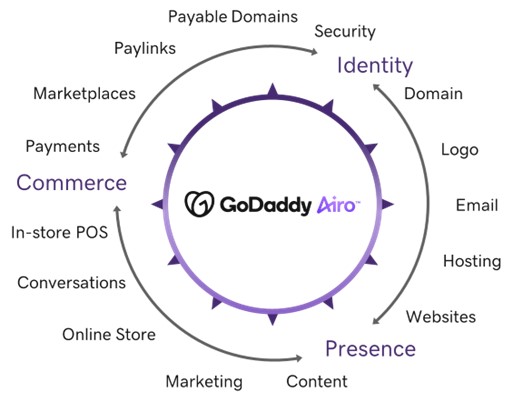
Our customers often start with the most intimate of brand considerations, their Identity, which includes their company name, domain name, logo and email address. The domain name continues to be an important initial step for customers as they start and grow their business. We provide products to support their brand through our domain services that blend seamlessly into their connected social identities and online presence. In addition, with the help of GoDaddy Airo® (Airo), entrepreneurs can more easily establish their identity through AI-powered domain name searches and logo creation.
We also help our customers manage and grow their Presence while connecting with their customers through our expanded service offerings and access to relevant third-party products and platforms. We offer a suite of Presence-based solutions, most of which are enhanced by Airo, including website building and hosting, marketplace syndication, social media, search engine visibility, security, business products and email and other services.
Finally, we have built a suite of Commerce solutions that enable our customers to sell directly online, in-person and across multiple channels, such as marketplaces and social platforms, and to integrate dynamic information everywhere they engage with current and potential customers. These solutions include GoDaddy Payments, point-of-sale systems that unify transaction management for both in-person and online sales, and an inventory and order dashboard for easier management of our customers' businesses.
At GoDaddy, we believe our customers should have both great technology and great support at every point on the Entrepreneur's Wheel. With AI-powered experiences such as Airo and customer centric assistance such as our GoDaddy Guides, we can provide intelligent, proactive experiences within our GoDaddy solutions. For example, Airo can help small businesses build and grow with domain searches, logo and image creation, website and social media posts, ad design and email marketing campaigns. In addition, we help set our customers up for success with personalized guidance from our GoDaddy Guides via phone and digital experiences, thousands of daily conversations and our gathering of valuable feedback to enable us to continually evolve our products and solutions and respond to our customers' changing needs.
Our people and unique culture have been integral to our success. We live by the same principles that enable our customers' ideas to survive and thrive, including owning outcomes, building value, joining forces, working courageously and living passionately. We take pride in delivering successful outcomes based on data-driven decisions, which we believe is a key factor driving our financial performance.
Our Customers and Solutions
GoDaddy is built to serve the needs of customers by providing easy-to-use products on an integrated technology platform wrapped with personalized guidance.
Our Customers
We serve several customer populations: (i) Independents, (ii) WebPros, (iii) Domain Investors, and (iv) Domain Registrars, Third Party Registrars and Corporate Domain Portfolio owners. While these customer populations tend to utilize many of the same GoDaddy product offerings, there are meaningful differences in their journeys, what they value, their goals and how they communicate with their current and potential customers. We aim to establish and provide solutions that address these differences.
Our largest customer population, Independents, consists mostly of microbusinesses and non-commercial endeavors. Microbusiness owners have an entrepreneurial spirit, strong work ethic and, above all, passion for their ideas, yet their specific needs vary depending on the type of their idea and the phase of their journey. Independents range from individuals who have an initial business idea and those thinking about starting a business, to established ventures that need help attracting customers, growing their sales, processing payments, managing their online presence or expanding their operations. Most Independents have fewer than five employees, and most self-identify as having little to no technology or design skills. These customers need our help to create a unique and secure identity, especially with the more technical aspects of their online presence. Although our customers have differing degrees of resources and technical capabilities, they all share a desire to find tools to help them bring their ideas to life, enhance connections with their audience, sell their products and services and provide a seamless experience for both existing and new customers.
Our second largest customer population, WebPros, are website designers and developers who build websites on behalf of businesses and noncommercial organizations. We estimate that half of all global website builds occur through a third party, such as our WebPros, on a do-it-for-you basis. WebPros are often freelancers, moonlighters or teams within website design agencies that often have website design as one of multiple streams of income. WebPros generally have more technical acumen and look for tools that provide greater amounts of flexibility, such as the WordPress content management system (CMS). Although WebPros have a need for technical depth and flexibility, they also benefit from our simplicity and guidance as tools to increase their throughput and maximize the use of their time. We help our WebPros customers in a number of ways beyond our product suite and services, including providing tools to help them save time, make money and exceed client expectations. These client management applications aim to make it easier for WebPros to manage their clients' websites at any host, or on GoDaddy products such as Managed WordPress. Our solutions are built to assist WebPros in more easily managing their overall business with capabilities such as client billing, administrative access and shopping features, making it easier for them to buy and manage multiple products for their clients, as well as make use of enhanced technical support and discounts for reselling GoDaddy products. We support a variety of third-party control panels and content management tools favored by WebPros including cPanel, Plesk, Drupal, Joomla and more.
Our third largest customer population is Domain Investors. Domain Investors are individuals or organizations who manage a portfolio of registered domains for the purpose of selling via secondary markets. These investors bring a unique and valuable resource to our business in the form of liquidity and the ability to help our other populations (Independent
Showing the first 8K of 83K characters. Open the full section
Item 1A. Risk Factors
You should carefully consider the risks described below before making an investment decision in our common stock. Our operations and financial results are subject to various risks and uncertainties, including those described below and the other information in this Annual Report on Form 10-K and in our other public filings. If any of the following risks occur, our business, financial condition, reputation, operating results and growth prospects could be materially and adversely affected. Additional risks and uncertainties not currently known to us or that we currently deem immaterial may also materially adversely affect our business, operating results, financial condition, reputation and growth prospects.
Risk Factor Summary
The following is a summary of the principal risks that could materially and adversely affect our business, financial condition, operating results and growth prospects.
-
If we are unable to attract and retain customers and increase sales to new and existing customers, our business and operating results would be harmed.
-
If we do not successfully develop and market products that anticipate or respond timely to the needs of our customers, our business and operating results may suffer.
-
The use of new and evolving technologies, such as AI, in our offerings may result in reputational harm and liability.
-
We face significant competition for our products, which we expect will continue to intensify, and we may not be able to maintain or improve our competitive position or market share.
-
Our pricing decisions may adversely affect our ability to attract and retain customers.
-
The future growth of our business depends in part on our international revenue. Our continued international presence could subject us to additional risks.
-
We have taken significant actions to support profitable growth. These actions may not succeed. If we do not effectively manage future growth, our operating results will be adversely affected.
-
Acquisitions and other strategic transactions, including investments or entries into new businesses, joint ventures, divestitures or other transactions, could require significant management attention, disrupt our business, dilute stockholder value and adversely affect our operating results.
-
We are exposed to the risk of system failures and capacity constraints.
-
We rely on information technology systems, including third-party cloud computing systems, and data centers to deliver many of our products and services. These information technology systems and data centers may experience outages, disruptions or degradations, and we may otherwise lose access to the services third-party service providers provide to us, any of which could impact our services, products and technology infrastructure.
-
An actual or perceived cybersecurity incident could impair our ability to conduct business, provide our products or services, protect data, and comply with contractual or legal obligations, and may cause us to incur substantial costs, or subject us to significant liability.
-
We rely on our marketing efforts and channels to maintain awareness of our brand and acquire new customers. These efforts may require significant expense and may not be successful or cost-effective.
-
Our ability to increase sales of our products is highly dependent on the quality of our customer care. Our failure to provide high-quality customer care would have an adverse effect on our business, brand and operating results.
-
Our failure to properly register or maintain our customers' domain names or comply with applicable laws, rules and regulations relating to domain name registration and maintenance could subject us to additional liability, regulatory action, expenses, claims of loss or negative publicity that could have a material adverse effect on our business.
-
Our quarterly and annual operating results may be adversely affected due to a variety of factors, which could make our future results difficult to predict and could cause our operating results to fall below investor or analyst expectations.
-
Our level of indebtedness could adversely affect our financial condition, our ability to raise additional capital to fund our operations, our ability to operate our business and our ability to react to changes in the economy or our industry, as well as divert our cash flow from operations for debt payments and prevent us from meeting our debt obligations.
-
Laws, regulations, policies or claims concerning the domain name registration system and the Internet in general, and industry reactions to those policies or claims, may cause instability in the industry and disrupt our business.
-
We are subject to local and international laws, rules, regulations and orders relating to the operation and security of our computer network and the processing of data, including personal data.
-
Our business depends on our customers' continued and unimpeded access to the Internet and the development and maintenance of Internet infrastructure. Internet access providers may be able to block, degrade or charge for access to certain of our products, which could lead to additional expenses and the loss of customers.
-
Our business could be affected by new governmental regulations regarding the Internet.
-
We may face liability or become involved in disputes over registration and transfer of domain names and control over websites.
-
Our payments-related operations, including GoDaddy Payments, are subject to various laws, regulations, and restrictions. Our failure to comply with such rules, regulations, and restrictions regarding our payments-related operations or properly manage the risks inherent to such operations could materially harm our business.
-
Our share price may be volatile, and you may lose all or part of your investment.
Strategic Risks
If we are unable to attract and retain customers and increase sales to new and existing customers, our business and operating results would be harmed.
Our success depends on our ability to attract and retain customers and increase sales to new and existing customers. Although our total customers and revenue have grown rapidly in the past, in recent periods our growth rates have slowed or declined, reflecting the larger size, scale and maturity of parts of our business. We cannot be assured that we will achieve increasing growth rates in future periods as our total customers and revenue could decline or grow slower than we expect as a result of a number of factors, such as lower demand or satisfaction with our solutions, the timeliness and success of new products or product enhancements, pricing of our solutions compared to our competitors, competitive conditions, customer spending levels, changes in the type and size of our customer base, the reliability and availability of our customer support, general economic and global market conditions, or other factors that are not known to us at this time.
We have experienced growth in recent years, due in large part to sustained subscription growth and strong levels of subscription renewals, including customers who expand their use of our integrated platform over time. Our costs associated with renewals are lower than costs associated with acquiring new customers and selling additional products to existing customers. Therefore, our inability to attract new customers, or a reduction in renewals, even if offset by an increase in other revenue could reduce our operating margins in the near term and could have a material adverse effect on our business, growth prospects and operating results.
Moreover, we focus our operations on entrepreneurs, customers with new ventures and those with established small and medium-sized businesses. We aim to grow our revenues by adding new customers, selling additional business solutions to these customers and encouraging them to continue to use and purchase our products and services. However, these customers often have
Showing the first 8K of 174K characters. Open the full section
Item 1B. Unresolved Staff Comments
None.
Item 1C. Cybersecurity
GoDaddy maintains an enterprise-wide cybersecurity program designed to manage cybersecurity risk.
Board and Audit and Finance Committee Governance
Our board of directors (the Board) manages cybersecurity risks as part of the company's overall risk management framework. The Board oversees the company's cybersecurity risk management program through the Board's Audit and Finance Committee (the Audit Committee). The Audit Committee receives verbal and written reports at least quarterly from GoDaddy's Chief Information Security Officer (CISO) regarding our company's cybersecurity risk management program and cybersecurity-related risks. The Audit Committee consists of Board members with diverse expertise in risk management, technology, finance and cybersecurity, including oversight of security teams. Our CISO provides the full Board with written quarterly and annual reports on our cybersecurity program and material cybersecurity-related risks, and the chair of the Audit Committee provides a quarterly summary of the Audit Committee's cybersecurity discussion to the full Board.
Management of Cybersecurity Risk
Our senior management is responsible for identifying, assessing, and managing the company's material cybersecurity risks. Our CISO oversees our programs for identifying, assessing, and managing our cybersecurity risks. Our CISO reports to our Chief Operating Officer (COO) and regularly provides updates to our CEO on significant cybersecurity-related matters. Our CISO also provides written monthly and quarterly reports on our cybersecurity program and risks to the CEO, Chief Technology Officer, and other key executives. Our CISO has more than 19 years' experience in cybersecurity, networking, and related technologies. Our CEO has more than 28 years' experience in e-commerce technology, engineering, and other related areas.
Our CISO works with an enterprise-wide cybersecurity team that provides 24/7/365 support. Our cybersecurity policies, procedures, and strategies primarily are implemented by our information security department. Other personnel and departments in the company also assist with cybersecurity risk management, including but not limited to our technology organization and our privacy, legal, vendor risk management, and corporate audit services teams. We have also developed processes to integrate cybersecurity risk management within the company's product and software development processes. In addition, product teams and business unit leaders are involved in product-related cybersecurity risk management.
Third-Party Consultants and Auditors
We use uses third-party auditors and consultants in connection with obtaining and maintaining industry certifications for certain products and services. We also have engaged third-party consultants in the past and may engage third-party consultants in
the future for specific projects and engagements, such as responding to cybersecurity incidents. Our third-party financial auditors also include material cybersecurity risks and events as part of their financial audits.
Third-Party Cybersecurity Risk Management
We engage with third parties to provide us with hardware, software, and services to operate our information systems and run our business. We also rely on third parties to provide hardware, software, and services relating to our cybersecurity program. When engaging a third-party vendor or service provider, we use a variety of processes and controls to identify and oversee risks relating to that engagement, which may include one or more of the following:
-
including provisions in vendor contracts that set minimum cybersecurity requirements;
-
installing monitoring software to detect malicious software and activities in third party systems;
-
monitoring for and applying patches to third-party hardware and software to address vulnerabilities; and
-
performing security assessments before engaging new vendors or acquiring new hardware and software.
Despite our efforts, our control over and ability to monitor the security of third parties is limited and there can be no assurance that we can prevent, mitigate or remediate the risk of any compromise or failure in the security infrastructure owned or controlled by third parties. Additionally, any contractual protections with such third parties may be limited or insufficient to prevent a negative impact on our business from such compromise or failure.
Cybersecurity Threat Monitoring and Incident Response
We monitor for threats to our information systems through a combination of automated intrusion detection monitoring solutions, review of log data, and other activities. We require security training for all company personnel, including instructions regarding the proper methods for reporting potential cybersecurity incidents. We also provide mechanisms for interested third parties, including security researchers and law enforcement, to provide notice of potential cybersecurity threats. In addition, we monitor third-party sources for notice of cybersecurity incidents that may affect company vendors and other parties with whom we do business.
Potential and actual cybersecurity incidents are primarily handled by our internal incident response team, which is supervised by our CISO. Our incident response team is responsible for assessing the potential risk posed by an incident, providing notice to appropriate stakeholders in the company based on the perceived risk, and coordinating the assessment, containment, mitigation, and remediation efforts. Depending on the severity and scope of the incident, we also may engage external consultants. Security personnel and consultants retained by our service providers also may be involved in cases where our vendors experience a cybersecurity incident. We have processes for escalating an incident to determine whether it is material and requires notification required under applicable laws, rules and regulations.
Item 2. Properties.
Our corporate headquarters, which we lease, are located in Tempe, Arizona. We lease customer care centers and offices located throughout the U.S. as well as internationally, most significantly in Bulgaria, Germany, Romania, Serbia and the UK.
We provide our cloud-based products via a network of data centers including (i) a data center we own and operate in Phoenix, Arizona; (ii) co-location data centers located throughout the U.S., most significantly in Virginia; and (iii) co-location international data centers, most significantly in France, Germany, the Netherlands and Singapore. Our data center leases expire on various dates through 2028.
We believe our existing facilities are sufficient for our current needs. Although we have recently closed or consolidated certain of our facilities, in the future, we may need to add new facilities or expand our existing facilities to meet our evolving business needs.
Item 3. Legal Proceedings
On June 7, 2022, IBEW Local Union 481 Defined Contribution Plan and Trust, a purported shareholder (the Plaintiff), filed a shareholder derivative complaint in the Delaware Court of Chancery against certain current and former officers and directors of the company and the company as a nominal defendant. The complaint asserts claims of breach of fiduciary duty and
corporate waste relating to the approval of certain settlement and release agreements we entered into with respect to certain Tax Receivable Agreements (TRAs) entered into with our pre-IPO owners. The complaint seeks monetary damages and restitution from the defendants on behalf of the company, an order directing the company to implement changes to its corporate governance and internal procedures, and an award of attorneys’ fees and costs. The Plaintiff filed an amended complaint in lieu of opposing the company's initial motion on November 4, 2022. The company filed a motion to dismiss the amended complaint on January 6, 2023; briefing was completed on April 27, 2023. On August 24, 2023, the Court denied the company's motion to dismiss the amended complaint. On September 21, 2023, the company's board of directors resolved to form a Special Litigation Committee (the SLC) vested with the full authority of the board of directors, to take any such action with respect to the litigation that the SLC, in its sole discretion, deems to be in the best interests of the company. The SLC completed its investigation and concluded, in the exercise of its business judgment, that dismissal of the action with prejudice would be in the best interests of the company and its shareholders. On December 13, 2024, the SLC moved to terminate the action. The motion is pending further proceedings before the court.
Other information regarding our legal proceedings required by this item is provided in Note 13 to our financial statements and is incorporated herein by reference.
We are currently involved in, and may in the future be involved in, legal proceedings, claims, regulatory inquiries, audits, and governmental investigations incidental to our business (Proceedings), including patent infringement litigation and trademark infringement claims, as well as putative class actions, employment, commercial and consumer protection claims and other Proceedings. Although the results of any such current or future Proceedings, regardless of the underlying nature of the claims or facts, cannot be predicted with certainty, the final outcome of any current or future Proceedings we face could adversely affect our business, financial condition and results of operations.
Regardless of the final outcome, defending lawsuits, claims and other Proceedings in which we are involved is costly and can impose a significant burden on management and employees. We may receive unfavorable preliminary or interim rulings in the course of such Proceedings, and there can be no assurances that favorable final outcomes will be obtained.
Item 4. Mine Safety Disclosures
Not applicable.
Part II.
Item 5. Market for Registrant's Common Equity, Related Stockholder Matters and Issuer Purchases of Equity Securities
Our Class A common stock trades on the NYSE under the symbol "GDDY".
Stock Performance Graph
The following performance graph and related information shall not be deemed to be "soliciting material" or "filed" for purposes of Section 18 of the Exchange Act nor shall such information be incorporated by reference into any filing of GoDaddy Inc. under the Exchange Act or the Securities Act, except to the extent we specifically incorporate it by reference in such filing.
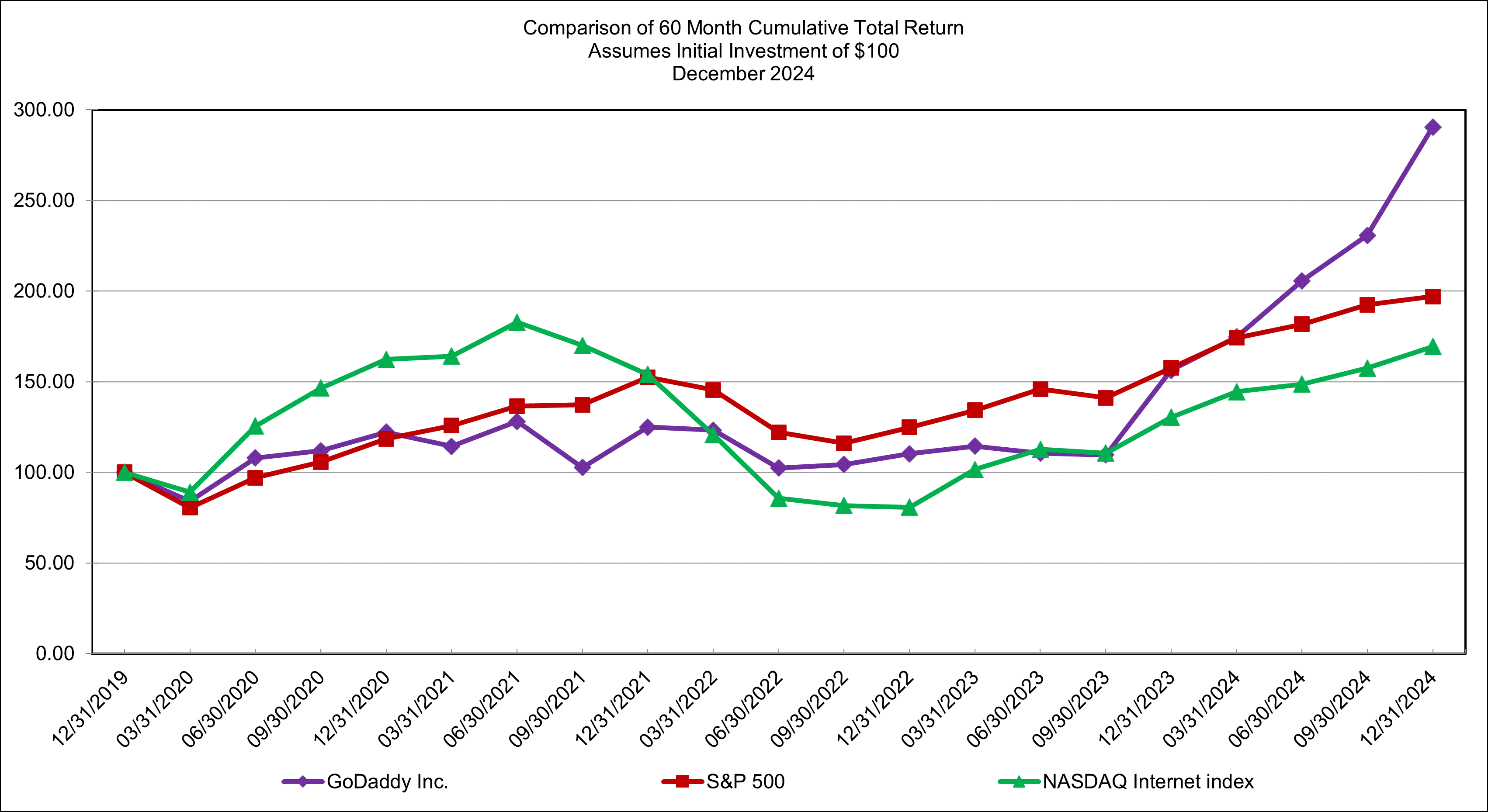
The following graph compares, for the five year period ending December 31, 2024, the cumulative total return to stockholders on our Class A common stock relative to the cumulative total returns of the Standard & Poor's 500 Index (S&P 500) and the NASDAQ Internet Index. An investment of $100 (with reinvestment of all dividends) is assumed to have been made in our Class A common stock and in each index. The returns shown are based on historical results and are not intended to suggest future performance. See the disclosures in Part I, Item 1A. "Risk Factors."
Holders of Record
As of December 31, 2024, there were 16 holders of record of our Class A common stock, although we believe there are a significantly larger number of beneficial owners because many shares are held by brokers and other institutions on behalf of stockholders.
Dividend Policy
We have not paid any dividends on our Class A common stock and we currently do not intend to pay dividends. If, however, we decide to pay a dividend in the future, we would need to cause our subsidiaries to make distributions to us in an amount sufficient to cover such dividend.
Our ability to pay dividends is also limited by the covenants of our existing indebtedness. See "Management's Discussion and Analysis of Financial Condition and Results of Operations—Liquidity and Capital Resources."
Share Repurchases
Our board of directors has authorized the share repurchase programs described in Note 5 to our financial statements. There was no share repurchase activity during the three months ended December 31, 2024 pursuant to our share repurchase programs.
Item 6. [Reserved]
Item 7. Management's Discussion and Analysis of Financial Condition and Results of Operations
The following discussion and analysis of our financial condition and results of operations should be read together with our financial statements and related notes included in "Financial Statements and Supplementary Data." Some of the information contained in this discussion and analysis, including information with respect to our plans and strategies for our business, includes forward-looking statements involving significant risks and uncertainties. As a result of many factors, such as those set forth in "Risk Factors," actual results may differ materially from the results described in, or implied by, these forward-looking statements.
This section generally discusses 2024 and 2023 items and year-to-year comparisons between 2024 and 2023. Discussion of 2022 items and comparisons between 2023 and 2022 that are not included in this Form 10-K can be found in "Management's Discussion and Analysis of Financial Condition and Results of Operations" in our Form 10-K for the year ended December 31, 2023.
(Throughout the tables and this discussion and analysis, dollars are in millions, excluding average revenue per user (ARPU), and shares are in thousands.)
Overview
We serve a large market of entrepreneurs, through the development and delivery of easy-to-use products in a one stop shop solution alongside personalized guidance. We serve small businesses, individuals, organizations, developers, designers and domain investors. We manage and report our business in the following two segments:
-
Applications and Commerce (A&C)**, which primarily consists of sales of products containing proprietary software, notably our website building products, as well as our proprietary commerce solutions and third-party email and productivity solutions and sales of certain products when they are included in bundled offerings of our proprietary software products.
-
Core Platform (Core)**, which primarily consists of sales of domain registrations and renewals, aftermarket domain sales, domain protection, website hosting products and website security products when not included in bundled offerings of our proprietary software products as well as sales of products not containing a software component.
We have developed a stable and durable business model driven by strong brand recognition, seamless technology, scale of our business and customer care. We generate bookings and revenue, which help us measure the success of our efforts, from the sales of our product subscriptions. In addition, we monitor total bookings as we believe it is an indicator of the expected growth in our revenue and is a supplemental measure of the operating performance of our business. Total bookings and revenue derived from both of our product categories have increased in each of the last three years, with many of our non-domains products growing faster in recent periods.
The primary factors driving growth in our business are pricing and bundling, seamless technology experience, commerce, cost optimization and retention of high intent customers. Our key priorities, developments and highlights in these areas include:
Seamless Technology and Airo. We continue to expand our AI-powered experiences, including Airo, and incorporate AI innovations into our products, services and throughout our operations to make use of efficiencies and increase productivity. We remain focused on expanding our solutions and operations to stay up to date with these developments in order to maintain and grow our business.
Cost Optimization and Profitability. During the year ended December 31, 2024, the Company engaged in cost optimization initiatives, including reductions in headcount, decreases in rent and utilities expenses, and reductions in costs associated with data center and systems infrastructure as we continue to migrate to a cloud-based infrastructure.
Pricing and Bundling. During the year ended December 31, 2024, pricing and bundling initiatives resulted in an increase in bookings and continued strong growth in A&C revenue. We aim to continue to experiment and utilize various pricing strategies and price points for our solutions. In addition, as we continue to incorporate AI innovations into our solutions, monetization trends could be affected.
Commerce. We continue to grow our commerce offerings with tailored OmniCommerce solutions, including point-of-sale systems and SaaS plans with premium features and discounted transaction fees to merchants. We also continue to enhance our offerings with new AI-powered features that simplify operations for our customers.
Customer Composition. Strong customer retention continues to drive our business. Our marketing efforts set out to educate current and potential customers about the depth and breadth of our offerings. We aim to attract high-intent customers that attach more at the outset of our relationship and over time. Our onboarding paths and seamless technology are designed to help customers more easily navigate the solutions for their one-stop-shop experience through an integrated platform. We have focused our efforts here because we know through our long history and vast amount of data that customers with a greater number of products with us retain at higher rates and produce higher lifetime value. For the year ended December 31, 2024, our customer retention rate was approximately 84%, a slight reduction from the approximate 85% in each of the four years prior, due to divestitures, migrations and the end of life of certain products as part of our efforts to streamline brands outside the GoDaddy platform. For the year ended December 31, 2024, customer retention for customers within the GoDaddy platform, which represents the vast majority of our customers, was approximately 87%. In addition, the retention rate for our customers who had been with us for over three years as of December 31, 2024 was approximately 90%. Greater than 89% of our total revenue was generated by customers who were also customers in the prior year.
We believe the breadth and depth of our solutions, the intelligent and proactive AI-powered experiences and the high quality and responsiveness of our customer care team builds strong relationships with our customers and are key to our high level of customer retention. To that end, we continue to monitor our customer cohorts to ensure growth and stability of our customer base. We track revenue and retention rates generated by our annual customer cohorts over time, as well as corresponding marketing and advertising spend.
Financial Highlights
Below are our key consolidated financial highlights for 2024, with comparisons to 2023.
-
Total revenue of $4,573.2 million, an increase of 7.5% on a reported and constant currency basis(1).
-
International revenue of $1,459.8 million, an increase of 5.7%, or approximately 5.8% on a constant currency basis(1).
-
Total bookings of $5,038.8 million, an increase of 9.5%, or approximately 9.7% on a constant currency basis(1).
-
Operating income of $893.5 million, an increase of 63.2%.(2)
-
Net income of $936.9 million, a decrease of 31.9%.(2)
-
Normalized EBITDA(3) of $1,395.9 million, an increase of 23.0%.
-
Net cash provided by operating activities of $1,287.7 million, an increase of 22.9%.
(1) Discussion of constant currency is set forth in "Quantitative and Qualitative Disclosures about Market Risk."
(2) Our operating results for the year ended December 31, 2024 and December 31, 2023 included $39.4 million and $90.8 million, respectively, in restructuring and other charges, as further discussed in Note 14 to our financial statements. Net income for the year ended December 31, 2023 included a $971.8 million benefit for income taxes primarily due to a $1,014.0 million release of the majority of our domestic valuation allowance.
(3) *A reconciliation of Normalized EBITDA to net income, its most directly comparable GAAP financial measure, is set forth in "Reconciliation of NEBITDA"
Showing the first 8K of 67K characters. Open the full section
Item 7A. Quantitative and Qualitative Disclosures About Market Risk
We are exposed to market risk in the ordinary course of business. Market risk represents the risk of loss that may impact our financial position due to adverse changes in financial market prices and rates. Our market risk exposure is primarily a result of fluctuations in foreign currency exchange rates and variable interest rates. Consequently, we may employ policies and procedures to mitigate such risks, including the use of derivative financial instruments, which are discussed in more detail in Note 11 to our financial statements. We do not enter into derivative transactions for speculative or trading purposes.
As a result of the use of derivative instruments, we are exposed to the risk that counterparties to our contracts may fail to meet their contractual obligations. To mitigate such counterparty credit risk, we enter into contracts only with carefully selected financial institutions based upon ongoing evaluations of their creditworthiness. As a result, we do not believe we are exposed to any undue concentration of counterparty risk with respect to our derivative contracts as of December 31, 2024.
Foreign Currency Risk
We manage our exposure to changes in foreign currency exchange rates through the use of foreign exchange forward contracts and cross-currency swap contracts. See Note 11 to our financial statements for a summary of the notional amounts and fair values of such arrangements. The effect of a hypothetical 10% change in foreign currency exchange rates applicable to our business would not have had a material impact on our cash and cash equivalents.
Foreign Exchange Forward Contracts
A portion of our bookings, revenue and operating expenses is denominated in foreign currencies, which are subject to exchange rate fluctuations. Our most significant foreign currency exposures are the British pound, the Euro and the Canadian dollar. Our reported bookings, revenues and operating results may be impacted by fluctuations in foreign currency exchange rates. Fluctuations in exchange rates may also cause us to recognize transaction gains and losses in our statements of operations; however, such amounts were not material during the current period. As our international business continues to grow, our exposure to fluctuations in exchange rates will increase, which may increase the costs associated with this growth. During 2024, our total bookings growth in constant currency would have been approximately 20 basis points higher and our total revenue growth would have had an insignificant impact. Constant currency is calculated by translating bookings and revenue for each month in the current period using the foreign currency exchange rates for the corresponding month in the prior period, excluding any hedging gains or losses realized during the period. We believe constant currency information is useful in analyzing underlying trends in our business by eliminating the impact of fluctuations in foreign currency exchange rates and allows for period-to-period comparisons of our performance.
From time-to-time, we may utilize foreign exchange forward contracts to manage the volatility of our bookings and revenue related to foreign currency transactions. These forward contracts reduce, but do not eliminate, the impact of adverse currency exchange rate fluctuations. We generally designate these forward contracts as cash flow hedges for accounting purposes. Changes in the intrinsic value of designated hedges are recorded as a component of accumulated other comprehensive income (loss) (AOCI). Gains and losses, once realized, are recorded as a component of AOCI and are amortized to revenue over the same period in which the underlying hedged amounts are recognized. At December 31, 2024, the realized gain and unrealized gain included in AOCI were $2.0 million and $33.2 million, respectively.
Cross-Currency Swaps
In order to manage variability due to movements in foreign currency exchange rates related to a Euro-denominated intercompany loan, we entered into five-year cross-currency swaps in April 2017. In March 2022, we entered into a transaction to extend the maturity of these swaps to August 31, 2027, as described in Note 11 to our financial statements. The cross-currency swaps had an aggregate amortizing notional amount of €1,146.9 million at December 31, 2024 (approximately $1,187.4 million).
The swaps designated as cash flow hedging relationships convert the Euro-denominated interest and principal receipts on the intercompany loan into fixed U.S. dollar interest and principal receipts, thereby reducing our exposure to fluctuations between the Euro and U.S. dollar. Changes to the fair value of the cross-currency swaps due to changes in the value of the U.S. dollar relative to the Euro would be largely offset by the net change in the fair values of the underlying hedged items.
The swaps designated as net investment hedging relationships hedge the foreign currency exposure of our net investment in certain Euro denominated functional currency subsidiaries. At maturity, the Euro notional value will be exchanged for the U.S. dollar notional value.
Interest Rate Risk
Interest rate risk reflects our exposure to movements in interest rates associated with our variable-rate debt. We manage our exposure to changes in interest payments related to the portion of variable-rate debt through the use of interest rate swaps, all of which are designated as cash flow hedges. For the balance of our long-term debt not subject to interest rate swaps, the effect of a hypothetical 10% change in interest rates would not have had a material impact on our interest expense. See Note 10 to our financial statements for additional information regarding our long-term debt.
Total borrowings under our 2031 Term Loans were $995.0 million as of December 31, 2024. The amortization rate for the 2031 Term Loans is 1.00% per annum and the 2031 Term Loans were issued at an applicable margin of (i) 1.75% for the term loans that are Secured Overnight Financing Rate (SOFR) loans and (ii) 0.75% for the term loans that are ABR loans.
Total borrowings under our 2029 Term Loans were $1,458.9 million as of December 31, 2024. The amortization rate for the 2029 Term Loans is 1.00% per annum and the 2029 Term Loans were issued at an applicable margin of (i) 1.75% for the term loans that are SOFR loans and (ii) 0.75% for the term loans that are ABR loans.
In January, May, and December of 2024, we entered into amendments to the Credit Facility to refinance the 2029 and 2031 Term Loans, as discussed in Note 10 to our financial statements.
All SOFR-based interest rates under the Credit Facility are subject to a 0.0% floor.
In April 2017, we entered into a five-year pay-fixed rate, receive-floating rate interest rate swap arrangement to effectively convert a portion of the variable-rate borrowings under the 2029 Term Loans to a fixed rate. Prior to this arrangement's contractual maturity date of April 3, 2022, in March 2022, we entered into a transaction to extend the maturity of these swaps to August 31, 2027, as described in Note 11 to our financial statements. In addition, in conjunction with the refinancing of a portion of our debt in November 2022, the hedged debt index of the swaps was changed from LIBOR to SOFR. These interest rate swaps, which had a notional amount of $1,222.7 million as of December 31, 2024, serve to convert a portion of the variable-rate borrowings under the 2029 Term Loans to a fixed rate of 4.81%.
In August 2020, we entered into seven-year pay-fixed rate, receive-floating rate interest rate swap arrangements to effectively convert a portion of the variable rate borrowings under the 2027 Term Loans to a fixed rate of 0.705%. In May 2023, in conjunction with the concurrent Credit Facility amendment discussed in Note 10, we terminated these swaps and entered into new SOFR-based interest rate swaps with a fixed rate of 0.672%. These interest rate swaps, which mature on August 10, 2027, had an aggregate notional amount of $716.3 million at December 31, 2024.
Item 8. Financial Statements and Supplementary Data
| Index to Consolidated Financial Statements | |||||
| Page | |||||
| Report of Independent Registered Public Accounting Firm (PCAOB ID: 42) | 74 | ||||
| Consolidated Balance Sheets | 76 | ||||
| Consolidated Statements of Operations | 77 | ||||
| Consolidated Statements of Comprehensive Income | 78 | ||||
| Consolidated Statements of Stockholders' Equity (Deficit) | 79 | ||||
| Consolidated Statements of Cash Flows | 81 | ||||
| Notes to Consolidated Financial Statements | 82 |
Report of Independent Registered Public Accounting Firm
To the Stockholders and the Board of Directors of GoDaddy Inc.
Opinion on the Financial Statements
We have audited the accompanying consolidated balance sheets of GoDaddy Inc. (the Company) as of December 31, 2024 and 2023, the related consolidated statements of operations, comprehensive income, stockholders' equity (deficit), and cash flows for each of the three years in the period ended December 31, 2024, and the related notes (collectively referred to as the "consolidated financial statements"). In our opinion, the consolidated financial statements present fairly, in all material respects, the financial position of the Company at December 31, 2024 and 2023, and the results of its operations and its cash flows for each of the three years in the period ended December 31, 2024, in conformity with U.S. generally accepted accounting principles.
We also have audited, in accordance with the standards of the Public Company Accounting Oversight Board (United States) (PCAOB), the Company's internal control over financial reporting as of December 31, 2024, based on criteria established in Internal Control-Integrated Framework issued by the Committee of Sponsoring Organizations of the Treadway Commission (2013 framework) and our report dated February 20, 2025 expressed an unqualified opinion thereon.
Basis for Opinion
These consolidated financial statements are the responsibility of the Company's management. Our responsibility is to express an opinion on the Company’s consolidated financial statements based on our audits. We are a public accounting firm registered with the PCAOB and are required to be independent with respect to the Company in accordance with the U.S. federal securities laws and the applicable rules and regulations of the Securities and Exchange Commission and the PCAOB.
We conducted our audits in accordance with the standards of the PCAOB. Those standards require that we plan and perform the audit to obtain reasonable assurance about whether the consolidated financial statements are free of material misstatement, whether due to error or fraud. Our audits included performing procedures to assess the risks of material misstatement of the consolidated financial statements, whether due to error or fraud, and performing procedures that respond to those risks. Such procedures included examining, on a test basis, evidence regarding the amounts and disclosures in the consolidated financial statements. Our audits also included evaluating the accounting principles used and significant estimates made by management, as well as evaluating the overall presentation of the consolidated financial statements. We believe that our audits provide a reasonable basis for our opinion.
Critical Audit Matter
The critical audit matter communicated below is a matter arising from the current period audit of the consolidated financial statements that was communicated or required to be communicated to the audit committee and that: (1) relates to accounts or disclosures that are material to the consolidated financial statements and (2) involved our especially challenging, subjective, or complex judgments. The communication of the critical audit matter does not alter in any way our opinion on the consolidated financial statements, taken as a whole, and we are not, by communicating the critical audit matter below, providing a separate opinion on the critical audit matter or on the accounts or disclosures to which it relates.
| Revenue Recognition | ||||||||
| Description of the Matter | As more fully described in Note 2 to the consolidated financial statements, the Company generates its revenue primarily from fees for domain registrations, website hosting, website security, and applications and commerce products, which are generally recognized ratably over the related contractual terms. The majority of the Company's revenue recognition process involves the use of numerous systems responsible for the processing and recording of significant volumes of data and transactions, as well as the calculation of revenue in accordance with the Company's accounting policies. Auditing certain portions of the Company's revenue recognition process was challenging and complex due to the high volume of transactions and the dependency on the design and operation of multiple proprietary information technology systems. | |||||||
| How We Addressed the Matter in Our Audit | We obtained an understanding, evaluated the design, and tested the operating effectiveness of internal controls over certain portions of the Company's revenue recognition process. We tested controls over the initiation and billing of sales, the recognition of revenue and deferred revenue and the Company's cash to billings reconciliation process. We also tested, with involvement from information technology professionals, application controls related to appropriate revenue recognition and application controls related to the interfaces between key systems, which included controls related to access, data and the configuration of the key systems. Our audit procedures included, among others, testing on a sample basis the completeness and accuracy of the underlying data within the Company’s billing and revenue systems, testing samples of sales transactions to source documentation, performing substantive analytical procedures and testing the Company's cash to billings reconciliations. We also evaluated the appropriateness of the Company's related disclosures in the consolidated financial statements. |
/s/ Ernst & Young LLP
We have served as the Company’s auditor since 2004.
Phoenix, Arizona
February 20, 2025
GoDaddy Inc.
Consolidated Balance Sheets
(In millions, except shares in thousands and per share amounts)
| December 31, | |||||||||||
| 2024 | 2023 | ||||||||||
| Assets | |||||||||||
| Current assets: | |||||||||||
| Cash and cash equivalents | $ | 1,089.0 | $ | 458.8 | |||||||
| Short-term investments | — | 40.0 | |||||||||
| Accounts and other receivables | 91.1 | 76.6 | |||||||||
| Registry deposits | 34.5 | 37.3 | |||||||||
| Prepaid domain name registry fees | 492.0 | 466.0 | |||||||||
| Prepaid expenses and other current assets | 245.2 | 177.2 | |||||||||
| Total current assets | 1,951.8 | 1,255.9 | |||||||||
| Property and e |
Showing the first 8K of 174K characters. Open the full section
Item 9. Changes in and Disagreements with Accountants on Accounting and Financial Disclosure
None.
Item 9A. Controls and Procedures
Evaluation of Disclosure Controls and Procedures
We maintain disclosure controls and procedures that are designed to provide reasonable assurance that information we are required to disclose in reports we file or submit under the Exchange Act is recorded, processed, summarized and reported within the time periods specified in the SEC's rules and forms, and that such information is accumulated and communicated to our management, including our Chief Executive Officer (CEO) and Chief Financial Officer (CFO), as appropriate, to allow timely decisions regarding required disclosure.
Our management, with the participation of our CEO and our CFO, who are our principal executive officer and principal financial officer, respectively, evaluated the effectiveness of our disclosure controls and procedures pursuant to Rule 13a-15 under the Exchange Act, as of the end of the period covered by this Annual Report on Form 10-K. Based on this evaluation, our CEO and CFO concluded that, as of December 31, 2024, our disclosure controls and procedures were effective.
Limitations on Effectiveness of Controls and Procedures
In designing and evaluating the disclosure controls and procedures, management recognizes that any controls and procedures, no matter how well designed and operated, can provide only reasonable, not absolute, assurance of achieving the desired control objectives. In addition, the design of disclosure controls and procedures must reflect the fact that there are resource constraints and management is required to apply its judgment in evaluating the benefits of possible controls and procedures relative to their costs. The design of any disclosure controls and procedures is also based in part upon certain assumptions about the likelihood of future events, and there can be no assurance that any design will succeed in achieving its stated goals under all potential future conditions.
Management's Report on Internal Control over Financial Reporting
Our management is responsible for establishing and maintaining adequate internal control over financial reporting (as defined in Rule 13a-15(f) and 15d-15(f) of the Exchange Act). Our management assessed the effectiveness of our internal control over financial reporting as of December 31, 2024, using the criteria set forth by the Committee of Sponsoring Organizations of the Treadway Commission in Internal Control—Integrated Framework (2013 framework). Based on our assessment under this framework, our management concluded that our internal control over financial reporting was effective as of December 31, 2024. As part of our assessment of the effectiveness of our internal control over financial reporting as of December 31, 2024, management has performed adequate testing to conclude that the material weakness in the design of our controls related to the accounting for income taxes and related disclosures with regard to management review controls and the completeness and accuracy of information used in the execution of those controls identified in the prior fiscal year has been remediated as of December 31, 2024. This material weakness did not result in any material misstatements to our consolidated financial statements or any changes to previously filed financial statements.
A material weakness is a deficiency, or a combination of deficiencies, in internal control over financial reporting, such that there is a reasonable possibility that a material misstatement of our annual or interim financial statements will not be prevented or detected on a timely basis. The effectiveness of our internal control over financial reporting as of December 31, 2024 has been audited by Ernst & Young LLP (EY) (PCAOB ID: 42), an independent registered public accounting firm, as stated in their report included herein.
Remediation Efforts with Respect to Material Weakness
Management has taken the following actions to remediate the material weakness described above.
-
Completed our review of and rationalized the number of key reports used in the operation of controls related to the calculation of the tax provision to increase efficiency and lower the complexity of how data is being utilized in the operation of controls;
-
Enhanced the design of existing controls relating to key reports and implemented new controls to ensure that the information contained within the reports related to the tax provision is complete and accurate;
-
Expanded and enhanced existing documentation to demonstrate the level of precision and procedures performed in the operation of management review controls; and
-
Enhanced the design and operating effectiveness of management review controls designed to validate the completeness and accuracy of key reports and other data used in the computation of the tax provision.
These remediation actions have been in place for a sufficient period of time, and management has performed adequate testing to conclude that the material weakness has been remediated as of December 31, 2024.
Changes in Internal Control Over Financial Reporting
Except for the remediation efforts described above, there were no changes in our internal control over financial reporting during the quarter ended December 31, 2024 that materially affected, or which are reasonably likely to materially affect, our internal control over financial reporting.
Report of Independent Registered Public Accounting Firm
To the Stockholders and the Board of Directors of GoDaddy Inc.
Opinion on Internal Control over Financial Reporting
We have audited GoDaddy Inc.'s internal control over financial reporting as of December 31, 2024, based on criteria established in Internal Control-Integrated Framework issued by the Committee of Sponsoring Organizations of the Treadway Commission (2013 framework) (the COSO criteria). In our opinion, GoDaddy Inc. (the Company) maintained, in all material respects, effective internal control over financial reporting as of December 31, 2024, based on the COSO criteria.
We also have audited, in accordance with the standards of the Public Company Accounting Oversight Board (United States) (PCAOB), the consolidated balance sheets of the Company as of December 31, 2024 and 2023, the related consolidated statements of operations, comprehensive income, stockholders' equity (deficit), and cash flows for each of the three years in the period ended December 31, 2024 and the related notes and our report dated February 20, 2025 expressed an unqualified opinion thereon.
Basis for Opinion
The Company's management is responsible for maintaining effective internal control over financial reporting, and for its assessment of the effectiveness of internal control over financial reporting included in the accompanying Management's Report on Internal Control Over Financial Reporting. Our responsibility is to express an opinion on the Company's internal control over financial reporting based on our audit. We are a public accounting firm registered with the PCAOB and are required to be independent with respect to the Company in accordance with the U.S. federal securities laws and the applicable rules and regulations of the Securities and Exchange Commission and the PCAOB.
We conducted our audit in accordance with the standards of the PCAOB. Those standards require that we plan and perform the audit to obtain reasonable assurance about whether effective internal control over financial reporting was maintained in all material respects.
Our audit included obtaining an understanding of internal control over financial reporting, assessing the risk that a material weakness exists, testing and evaluating the design and operating effectiveness of internal control based on the assessed risk, and performing such other procedures as we considered necessary in the circumstances. We believe that our audit provides a reasonable basis for our opinion.
Definition and Limitations of Internal Control Over Financial Reporting
A company's internal control over financial reporting is a process designed to provide reasonable assurance regarding the reliability of financial reporting and the preparation of financial statements for external purposes in accordance with generally accepted accounting principles. A company's internal control over financial reporting includes those policies and procedures that (1) pertain to the maintenance of records that, in reasonable detail, accurately and fairly reflect the transactions and dispositions of the assets of the company; (2) provide reasonable assurance that transactions are recorded as necessary to permit preparation of financial statements in accordance with generally accepted accounting principles, and that receipts and expenditures of the company are being made only in accordance with authorizations of management and directors of the company; and (3) provide reasonable assurance regarding prevention or timely detection of unauthorized acquisition, use, or disposition of the company's assets that could have a material effect on the financial statements.
Because of its inherent limitations, internal control over financial reporting may not prevent or detect misstatements. Also, projections of any evaluation of effectiveness to future periods are subject to the risk that controls may become inadequate because of changes in conditions, or that the degree of compliance with the policies or procedures may deteriorate.
/s/ Ernst & Young LLP
Phoenix, Arizona
February 20, 2025
Item 9B. Other Information
None.
Item 9C. Disclosure Regarding Foreign Jurisdictions that Prevent Inspections
Not applicable.
Part III.
Item 10. Directors, Executive Officers and Corporate Governance
The information required by this item will be included in our Proxy Statement for the 2025 Annual Meeting of Stockholders (the 2025 Proxy Statement) to be filed with the SEC within 120 days of the year ended December 31, 2024 and is incorporated herein by reference. The information required by this item regarding delinquent filers pursuant to Item 405 of Regulation S-K will be included under the caption "Delinquent Section 16(a) Reports" in the 2025 Proxy Statement and is incorporated herein by reference.
Code of Ethics
We have adopted a Code of Business Conduct and Ethics applicable to all of our employees, executive officers and directors. Our Code of Business Conduct and Ethics is available on our website under the 'Governance Documents' heading, within the Governance section of our Investor Relations site (https://aboutus.godaddy.net/investor-relations/governance/default.aspx). To the extent mandated by legal requirements, we intend to disclose on our website any amendments to our Code of Business Conduct and Ethics, or any waivers of its requirements.
Item 11. Executive Compensation
The information required by this item will be included in the 2025 Proxy Statement and is incorporated herein by reference.
Item 12. Security Ownership of Certain Beneficial Owners and Management and Related Stockholder Matters
The information required by this item will be included in the 2025 Proxy Statement and is incorporated herein by reference.
Item 13. Certain Relationships and Related Transactions, and Director Independence
The information required by this item will be included in the 2025 Proxy Statement and is incorporated herein by reference.
Item 14. Principal Accountant Fees and Services
The information required by this item will be included in the 2025 Proxy Statement and is incorporated herein by reference.
Part IV.
Item 15. Exhibits and Financial Statement Schedules
We have filed the following documents as part of this Annual Report on Form 10-K:
Financial Statements
Our financial statements are listed in the "Index to Consolidated Financial Statements" under Item 8 "Financial Statements and Supplementary Data."
Financial Statement Schedules
All other schedules have been omitted because they are either not required, not applicable or the required information is otherwise included.
Exhibit Index
| Incorporated by Reference | ||||||||||||||||||||
| Exhibit Number | Exhibit Description | Form | Exhibit | Filing Date | ||||||||||||||||
| 31.2***** | Certification of Chief Financial Officer pursuant to Exchange Act Rules 13a-14(a) and 15d-14(a), as adopted pursuant to Section 302 of the Sarbanes-Oxley Act of 2002 | |||||||||||||||||||
| 32.1****** | Certifications of Chief Executive Officer and Chief Financial Officer pursuant to 18 U.S.C. Section 1350, as adopted pursuant to Section 906 of the Sarbanes-Oxley Act of 2002 | |||||||||||||||||||
| 97.1 | Policy Relating to Recovery of Erroneously Awarded Compensation | 10-K | 97.1 | 2/29/2024 | ||||||||||||||||
| 101.INS | Inline XBRL Instance Document (the instance document does not appear in the Interactive Data File because its XBRL tags are embedded within the Inline XBRL document) | |||||||||||||||||||
| 101.SCH* | Inline XBRL Taxonomy Extension Schema Document | |||||||||||||||||||
| 101.CAL* | Inline XBRL Taxonomy Extension Calculation Linkbase Document | |||||||||||||||||||
| 101.DEF* | Inline XBRL Taxonomy Definition Linkbase Document | |||||||||||||||||||
| 101.LAB* | Inline XBRL Taxonomy Extension Labels Linkbase Document | |||||||||||||||||||
| 101.PRE* | Inline XBRL Taxonomy Extension Presentation Linkbase Document | |||||||||||||||||||
| 104 | Cover Page Interactive Data File (formatted as inline XBRL and contained in Exhibit 101) |
| + | Indicates management contract or compensatory plan or arrangement. | |||||||
| ***** | Filed herewith. | |||||||
| ****** | The certifications attached as Exhibit 32.1 accompanying this Annual Report on Form 10-K are deemed furnished and not filed with the Securities and Exchange Commission and are not to be incorporated by reference into any filing of GoDaddy Inc. under the Securities Act of 1933, as amended, or the Securities Exchange Act of 1934, as amended, whether made before or after the date of this Annual Report on Form 10-K, irrespective of any general incorporation language contained in such filing. | |||||||
| ******* | Certain provisions or terms of the agreement have been redacted pursuant to Item 601(b)(10)(iv) of Regulation S-K. GoDaddy Inc. agrees to furnish supplementally to the SEC a copy of any omitted schedule or exhibit upon request. |
Item 16. Form 10-K Summary
None.
SIGNATURES
Pursuant to the requirements of Section 13 or 15(d) of the Securities Exchange Act of 1934, the registrant has duly caused this report to be signed on its behalf by the undersigned, thereunto duly authorized.
| GODADDY INC. | ||||||||
| Date: | February 20, 2025 | /s/ Aman Bhutani | ||||||
| Aman Bhutani Chief Executive Officer |
POWER OF ATTORNEY
Each person whose signature appears below constitutes and appoints Aman Bhutani and Mark McCaffrey, and each of them, as his or her true and lawful attorney-in-fact and agent, with full power of substitution and resubstitution, for him or her and in his or her name, place and stead, in any and all capacities, to sign any and all amendments to this Annual Report on Form 10-K, and to file the same, with all exhibits thereto, and other documents in connection therewith, with the Securities and Exchange Commission, granting unto said attorneys-in-fact and agents, and each of them, full power and authority to do and perform each and every act and thing requisite and necessary to be done in connection therewith, as fully to all intents and purposes as he or she might or could do in-person, hereby ratifying and confirming all that said attorneys-in-fact and agents, or any of them, or their or his substitutes, may lawfully do or cause to be done by virtue thereof.
Pursuant to the requirements of the Securities Exchange Act of 1934, this report has been signed below by the following persons on behalf of the registrant and in the capacities and on the dates indicated:
| Signature | Title | Date | |||||||||||||||
| /s/ Aman Bhutani | Chief Executive Officer and Director (Principal Executive Officer) | February 20, 2025 | |||||||||||||||
| Aman Bhutani | |||||||||||||||||
| /s/ Mark McCaffrey | Chief Financial Officer (Principal Financial Officer) | February 20, 2025 | |||||||||||||||
| Mark McCaffrey | |||||||||||||||||
| /s/ Phontip Palitwanon | Chief Accounting Officer (Principal Accounting Officer) | February 20, 2025 | |||||||||||||||
| Phontip Palitwanon | |||||||||||||||||
| /s/ Brian H. Sharples | Chairman of the Board of Directors | February 20, 2025 | |||||||||||||||
| Brian H. Sharples | |||||||||||||||||
| /s/ Herald Y. Chen | Director | February 20, 2025 | |||||||||||||||
| Herald Y. Chen | |||||||||||||||||
| /s/ Caroline F. Donahue | Director | February 20, 2025 | |||||||||||||||
| Caroline F. Donahue | |||||||||||||||||
| /s/ Mark Garrett | Director | February 20, 2025 | |||||||||||||||
| Mark Garrett | |||||||||||||||||
| /s/ Leah Sweet | Director | February 20, 2025 | |||||||||||||||
| Leah Sweet | |||||||||||||||||
| /s/ Graham Smith | Director | February 20, 2025 | |||||||||||||||
| Graham Smith | |||||||||||||||||
| /s/ Srini Tallapragada | Director | February 20, 2025 | |||||||||||||||
| Srini Tallapragada | |||||||||||||||||
| /s/ Sigal Zarmi | Director | February 20, 2025 | |||||||||||||||
| Sigal Zarmi |