 filings.tools
GE HealthCare Technologies 10-K 2023-12-31
Filed 2024-02-06. 24 sections, 654K characters. Original on sec.gov · Markdown · JSON
Cover and table of contents
UNITED STATES SECURITIES AND EXCHANGE COMMISSION
Washington, D.C. 20549
FORM 10-K
☑ ANNUAL REPORT PURSUANT TO SECTION 13 or 15(d) OF THE SECURITIES EXCHANGE ACT OF 1934
For the fiscal year ended December 31, 2023
Commission file number 001-41528

GE HEALTHCARE TECHNOLOGIES INC.
(Exact name of registrant as specified in its charter)
| Delaware | 88-2515116 | |||||||
| (State or other jurisdiction of incorporation or organization) | (I.R.S. Employer Identification No.) | |||||||
| 500 W. Monroe Street, Chicago, IL | 60661 | |||||||
| (Address of principal executive offices) | (Zip Code) |
(Registrant’s telephone number, including area code) (833) 735-1139
Securities Registered Pursuant to Section 12(b) of the Act:
| Title of each class | Trading Symbol(s) | Name of each exchange on which registered | ||||||
| Common stock, par value $0.01 per share | GEHC | The Nasdaq Stock Market LLC |
Indicate by check mark if the registrant is a well-known seasoned issuer, as defined in Rule 405 of the Securities Act. Yes ☑ No ☐
Indicate by check mark if the registrant is not required to file reports pursuant to Section 13 or Section 15(d) of the Act. Yes ☐ No ☑
Indicate by check mark whether the registrant (1) has filed all reports required to be filed by Section 13 or 15(d) of the Securities Exchange Act of 1934 during the preceding 12 months (or for such shorter period that the registrant was required to file such reports), and (2) has been subject to such filing requirements for the past 90 days. Yes ☑ No ☐
Indicate by check mark whether the registrant has submitted electronically every Interactive Data File required to be submitted pursuant to Rule 405 of Regulation S-T during the preceding 12 months (or for such shorter period that the registrant was required to submit such files). Yes ☑ No ☐
Indicate by check mark whether the registrant is a large accelerated filer, an accelerated filer, a non-accelerated filer, a smaller reporting company or an emerging growth company. See definitions of “large accelerated filer,” “accelerated filer,” “smaller reporting company” and “emerging growth company” in Rule 12b-2 of the Exchange Act.
| Large accelerated filer | ☑ | Accelerated filer | ☐ | ||||||||
| Non-accelerated filer | ☐ | Smaller reporting company | ☐ | ||||||||
| Emerging growth company | ☐ |
If an emerging growth company, indicate by check mark if the registrant has elected not to use the extended transition period for complying with any new or revised financial accounting standards provided pursuant to Section 13(a) of the Exchange Act. ☐
Indicate by check mark whether the registrant has filed a report on and attestation to its management’s assessment of the effectiveness of its internal control over financial reporting under Section 404(b) of the Sarbanes-Oxley Act (15 U.S.C. 7262(b)) by the registered public accounting firm that prepared or issued its audit report. ☑
If securities are registered pursuant to Section 12(b) of the Act, indicate by check mark whether the financial statements of the registrant included in the filing reflect the correction of an error to previously issued financial statements. ☐
Indicate by check mark whether any of those error corrections are restatements that required a recovery analysis of incentive-based compensation received by any of the registrant’s executive officers during the relevant recovery period pursuant to §240.10D-1(b). ☐
Indicate by check mark whether the registrant is a shell company (as defined in Rule 12b-2 of the Act). Yes ☐ No ☑
The aggregate market value of the outstanding common stock of the Registrant held by non-affiliates as of June 30, 2023, the last day of the registrants most recently completed second fiscal quarter, was approximately $32 billion. There were 455,357,229 shares of common stock with a par value of $0.01 per share outstanding as of January 30, 2024.
DOCUMENTS INCORPORATED BY REFERENCE
The definitive proxy statement relating to the registrant’s Annual Meeting of Shareholders, to be held May 21, 2024, is incorporated by reference into Part III of this Annual Report on Form 10-K to the extent described therein.
FORWARD-LOOKING STATEMENTS
This Annual Report on Form 10-K contains forward-looking statements. These forward-looking statements might be identified by words, and variations of words, such as “will,” “expect,” “may,” “would,” “could,” “plan,” “believe,” “anticipate,” “intend,” “estimate,” “potential,” “position,” “forecast,” “target,” “guidance,” “outlook,” and similar expressions. These forward-looking statements may include, but are not limited to, statements about our business; information related to our business segment portfolios and strategies; human capital management and environmental, social, and governance (“ESG”) strategies and initiatives; financial performance, financial condition, and results of operations, including revenue, revenue growth, profit, taxes, earnings per share, and cash flows; the impacts of macroeconomic and market conditions and volatility on our business operations, financial results, and financial position and on supply chains and the world economy; our strategy, innovation, and investments, including research and development activities; our cost structure; our funding and liquidity; the impacts on our business of manufacturing, sourcing, and supply chain management; the Russia and Ukraine conflict; our operations as a stand-alone company; and risks related to foreign currency exchange, interest rates, and commodity price volatility. These forward-looking statements involve risks and uncertainties, many of which are beyond our control. Factors that could cause our actual results to differ materially from those described in our forward-looking statements include, but are not limited to, operating in highly competitive markets; our ability to successfully complete strategic transactions; the actions or inactions of third parties with whom we partner and the various collaboration, licensing, and other partnerships and alliances we have with third parties; demand for our products, services, or solutions and factors that affect that demand; management of our supply chain and our ability to cost-effectively secure the materials we need to operate our business; disruptions in our operations; changes in third-party and government reimbursement processes, rates, contractual relationships, and mix of public and private payers, including related to government shutdowns; our ability to attract and/or retain key personnel and qualified employees; global geopolitical and economic instability, including as a result of the conflict between Ukraine and Russia, the conflict in Israel and surrounding areas, and the actions in the Red Sea region; public health crises, epidemics, and pandemics, such as the Coronavirus Disease 2019 (“COVID-19”) and their effects on our business; maintenance and protection of our intellectual property (“IP”) rights, as well as maintenance of successful research and development efforts with respect to commercially successful products and technologies; the impact of potential information technology, cybersecurity, or data security breaches; compliance with the various legal, regulatory, tax, privacy, and other laws to which we are subject, such as the Foreign Corrupt Practices Act (the “FCPA”) and similar anti-corruption and anti-bribery laws globally, and related changes, claims, inquiries, investigations, or actions; our ability to control increases in healthcare costs and any subsequent effect on demand for our products, services, or solutions; the impacts related to our increasing focus on and investment in cloud, edge, artificial intelligence (“AI”), and software offerings; the impact of potential product liability claims; ESG matters; our ability to operate effectively as an independent, publicly traded company; and our level of indebtedness, as well as our general ability to comply with covenants under our debt instruments, and any related effect on our business. Please also see the “Risk Factors” section of this Annual Report on Form 10-K filed with the United States (“U.S.”) Securities and Exchange Commission (“SEC”) and any updates or amendments we make in future filings. There may be other factors not presently known to us or which we currently consider to be immaterial that could cause our actual results to differ materially from those projected in any forward-looking statements we make. We do not undertake any obligation to update or revise our forward-looking statements except as required by applicable law or regulation.
PART I
Item 1. BUSINESS
GE HealthCare Technologies Inc. (“GE HealthCare,” the “Company,” “our,” or “we”) is a leading global medical technology, pharmaceutical diagnostics, and digital solutions innovator. We have approximately 51,000 colleagues dedicated to our mission to create a world where healthcare has no limits. We operate at the center of the healthcare ecosystem, enabling precision care by increasing health system capacity, enhancing productivity, digitizing healthcare delivery, and improving clinical outcomes while serving patients’ demand for greater efficiency, access, and personalized medicine. Our products, services, and solutions are designed to enable clinicians to make more informed decisions quickly and efficiently, improving patient care from diagnosis to therapy to monitoring. We have more than 125 years of experience and one of the strongest reputations in the global healthcare industry, built from our demonstrated record of delivering industry-defining innovation. This is complemented by our broad service capabilities and dedication to quality and integrity with a strong operational culture, deeply embedded in lean continuous improvement.
We generate revenue from the sale of medical devices, consumable products, service capabilities, and digital solutions. Precision care is expected to drive continued demand and the need for novel technologies and future innovation, as healthcare providers and researchers seek new solutions and tools for managing existing and new care pathways. The pursuit of precision care opportunities significantly expands our addressable industries to include integrated diagnostics, AI and machine learning-based clinical decision support, highly personalized therapies enabled by more precise diagnostics, and remote patient monitoring. The scale and breadth of our portfolio, combined with our innovation capabilities, position us to be a leading enabler of precision care.
GE HealthCare has extensive reach throughout the global healthcare system for medical technology, pharmaceutical diagnostics, and digital solutions, underpinned by resilient, sustainable practices and products, and a commitment to growing access to care. We serve customers in approximately 160 countries with a global team of 9,900 sales professionals, 8,100 field service engineers, and a network of 43 manufacturing, assembly, and pharmaceutical production sites across 17 countries.
Our customers are healthcare providers and researchers, including public, private, and academic institutions. We are organized into four business segments that are aligned with the industries we serve: Imaging, Ultrasound, Patient Care Solutions (“PCS”), and Pharmaceutical Diagnostics (“PDx”). Our portfolio of solutions addresses the biggest challenges facing healthcare providers and patients today, including helping to drive better patient outcomes and improved productivity for customers. These qualities foster strong trust, loyalty, and partnership with our global customer base.
GE HealthCare Technologies Inc. is a Delaware corporation with corporate headquarters in Chicago, Illinois. On January 3, 2023, the General Electric Company (“GE”) completed the previously announced spin-off of GE HealthCare (the “Spin-Off”). Refer to Note 1, “Organization and Basis of Presentation” for further information regarding the Spin-Off.
OUR SEGMENTS
We develop, manufacture, and market a broad portfolio of products, services, and complementary digital solutions used in the diagnosis, treatment, and monitoring of patients. We have a large, global installed base of medical imaging, ultrasound, and patient monitoring systems.
Our business is comprised of four segments:
IMAGING.
GE HealthCare is a global leader in medical imaging with a comprehensive portfolio of scanning devices, clinical applications, service capabilities, and digital solutions. Our Imaging portfolio spans the care continuum and provides critical tools for physicians, from initial screening and diagnosis, through therapeutic decision-making and monitoring of patient progression. Our products support providers in the delivery of care for a broad spectrum of clinical specialties, including oncology, cardiology, neurology, nuclear medicine, orthopedics, women’s health, pediatrics, and surgery.
Our Imaging portfolio is comprised of six product lines and associated service capabilities: Molecular Imaging, Computed Tomography, Magnetic Resonance, Image-Guided Therapies, Women’s Health, and X-ray. We manage our Molecular Imaging and Computed Tomography product lines together (“MI/CT”) and our Women’s Health and X-ray product lines together (“WH/XR”).
-
Molecular imaging (“MI”) enables the visualization, characterization, and quantification of functional processes taking place at the cellular and subcellular levels within patients. The images produced by MI systems allow clinicians to study the cellular and molecular pathways and mechanisms of disease in patients. We offer a complete MI solution from cyclotrons, chemistry synthesis, positron emission tomography (“PET”), computed tomography (“PET/CT”), PET/MR, and nuclear medicine to advanced digital solutions. Our Molecular Imaging team works closely with the PDx segment and their innovations and collaborations with pharmaceutical companies.
-
Computed tomography (“CT”) scans render 3D anatomical images of structures, such as bone, soft tissue, and air cavities using an X-ray tube that rotates around a patient. The images are used in a wide variety of applications, including the detection of tumors or lesions, blocked blood vessels in the brain, abnormal heart conditions, complex bone fractures, and internal injuries from trauma. Our comprehensive Computed Tomography portfolio includes multi-purpose and specialty scanners.
-
Magnetic resonance (“MR”) is a non-invasive imaging technology that produces detailed anatomical images of almost every internal structure in the human body, such as the brain, spinal cord, heart, breast, kidneys, muscles, ligaments, and tendons. MR can also be used for functional imaging, and it is well-suited for disease detection, diagnosis, and treatment monitoring of a variety of conditions, including stroke, cancer, trauma, aneurysm, multiple sclerosis, cardiomyopathy, and congenital disorders. Our Magnetic Resonance portfolio includes scanners for a range of clinical capabilities through different bore sizes, magnetic field strengths, and scalable platforms.
-
Our Image-Guided Therapies business provides technologies that assist clinicians and surgeons during open surgeries and minimally-invasive endovascular procedures. Intraoperative imaging systems are used to visualize procedures that involve implants and devices, such as stents, balloons, pacemakers, and artificial joints. Our Image-Guided Therapies business includes two business lines: interventional systems and surgery systems. Our interventional systems are comprised of a broad portfolio of products that provide real-time advanced X-ray imaging and integrate with other imaging and diagnostic technologies that support clinicians in planning, guiding, and assessing minimally-invasive procedures. Our surgical systems are comprised of a broad portfolio of mobile surgical C-arms that meet the varying clinical and environmental needs for surgical imaging around the world.
-
Women’s Health products use X-ray technology to help clinicians screen for and diagnose breast cancer as well as bone and metabolic diseases in women. The product portfolio includes imaging and biopsy positioning systems designed to image the breast and dual energy X-ray absorptiometry scanners designed to image bones with low mineral density.
-
X-ray systems are used by clinicians to perform first-line diagnostic imaging examinations of anatomical structures in the body, such as bones, lungs, and the gastrointestinal tract. Our X-ray product portfolio includes systems for three distinct clinical situations: fixed room ra
Showing the first 8K of 65K characters. Open the full section
Item 1A. RISK FACTORS
SUMMARY OF RISK FACTORS.
An investment in our company is subject to a number of risks. These risks relate to our business, the healthcare industry, data privacy, laws and regulations, financing and capital markets activities, our Spin-Off from GE, our common stock, and the securities market. Any of these risks and other risks could materially and adversely affect our business, results of operations, cash flows, and financial condition and the actual outcome of matters as to which forward-looking statements are made in this Annual Report on Form 10-K. Some of the more significant challenges and risks we face include the following:
-
We operate in highly competitive markets, competition may increase in the future, and our industry may be disrupted, requiring us to lower prices or resulting in a loss of market share.
-
Our business dealings involve third-party partners in various markets, and the actions or inactions of these third parties could adversely affect our business.
-
Our inability to successfully complete strategic transactions could adversely affect our business.
-
Our inability to manage our supply chain or obtain supplies of components or raw materials has restricted, and could continue to restrict, the manufacturing of products, cause delays in delivery, or significantly increase our costs.
-
Any interruption in the operations of our manufacturing facilities, or our suppliers’ or customers’ facilities, may impair our ability to deliver products or provide services.
-
We rely on third parties to help perform logistics, transportation, shipping, warehousing, and services functions on our behalf, and disruptions at these third-party providers could adversely affect our business.
-
We have significant postretirement benefit liabilities, including pension, healthcare, and life insurance benefits obligations, and the actual costs and related cash flows of these obligations are uncertain and could exceed current estimates.
-
If we are unable to attract or retain key personnel and qualified employees or maintain relations with our employees, unions, and other employee representatives it could adversely affect our business.
-
Public health crises, epidemics, and pandemics, such as the COVID-19 pandemic, have had and in the future may have a material adverse impact on our business, as well as on the operations and financial performance of some of the customers and suppliers in industries that we serve.
-
Our research and development efforts may not succeed in developing commercially successful products and technologies, which could adversely affect our business.
-
We may be unable to obtain, maintain, protect, or effectively enforce our IP rights.
-
Increased cybersecurity requirements, vulnerabilities, threats, and more sophisticated and targeted computer crimes pose a risk to our systems, networks, products, solutions, services, and data, as well as our reputation, which could adversely affect our business.
-
We are subject to stringent privacy laws and information security policies and regulations.
-
Our increasing focus on and investment in cloud, edge, AI, and software offerings present risks to our business.
-
Failure to comply with the FCPA and similar anti-corruption and anti-bribery laws globally has resulted and could continue to result in civil or criminal sanctions and adversely affect our business.
-
We are subject to anti-kickback and false claims laws, and failure to comply with these laws could adversely affect our business.
-
We are subject to antitrust and competition laws that can result in sanctions and conditions on the way we conduct our business.
-
If we do not successfully manage our collaboration arrangements, licensing arrangements, joint ventures, or strategic alliances with third parties, we may not realize the expected benefits from such arrangements, which could adversely affect our business.
-
Efforts by public and private payers to control increases in healthcare costs may lead to lower reimbursements or increased utilization controls related to the use of our products by healthcare providers, which may affect the price of and demand for our products, services, or solutions.
-
We are exposed to risks associated with product liability claims that have been and may be brought against us or as a result of the actions or inactions of our customers or third parties that are outside of our control.
-
We may become involved in litigation, arbitration, and governmental proceedings, including those stemming from third-party conduct beyond our control.
-
Global geopolitical and economic instability, as well as continuing uncertainties and challenging conditions in regional economies, could adversely affect our business.
-
Our business operations are subject to extensive laws and regulations, and any changes thereto or violations thereof could have a material adverse effect on our business.
-
Increasing attention to ESG matters, including environmental, health, and safety (“EH&S”) matters, may impose additional costs on our business and expose us to new risks.
-
Our level of indebtedness, as well as our general ability to comply with covenants under our debt instruments, could adversely affect our business, results of operations, cash flows, and financial condition.
-
Substantial sales of our common stock, including the disposition by GE of our shares of common stock that it retained after our Spin-Off, could cause our stock price to decline or be volatile.
You should carefully consider the following risks and other information in this Annual Report on Form 10-K in evaluating GE HealthCare and GE HealthCare’s common stock. Any of the following risks could materially and adversely affect GE HealthCare’s business, financial condition, or results of operations.
RISKS RELATED TO OUR BUSINESS AND OUR INDUSTRY.
Risks Relating to Our Operations
We operate in highly competitive markets, competition may increase in the future, and our industry may be disrupted, requiring us to lower prices or resulting in a loss of market share.
Healthcare markets are characterized by rapidly evolving technology, frequent introduction of new products, intense competition, and pricing pressures. We face substantial competition from international and domestic companies of all sizes; these competitors often differ across our businesses. Competition is primarily focused on cost effectiveness, price, service, product performance, and technological innovation. Our ability to compete successfully may be adversely affected by factors such as:
-
the introduction of new or more affordable products or product enhancements by competitors, including products that could substitute for our products;
-
the development of new technology, the application of known or unknown technology, advances in medicine, or new developments in the treatment or diagnosis of disease that transform our industry or render a product line obsolete;
-
competitors responding more quickly or effectively to new technology, or changes in customer requirements and industry trends;
-
a failure to satisfy local market conditions and regulations, such as mandatory IP transfers, protectionist measures, and other government policies supporting increased local competition;
-
the application of new or innovative business models to our industry;
-
the emergence of new market entrants, including those with innovative technology or substantial financial resources, such as startups or established technology companies;
-
a failure to maintain or expand relationships with existing customers or attract new customers;
-
cost of production or delivery, whether due to geographic location, currency fluctuations, taxes, duties, or otherwise, which may enable our competitors to offer greater discounts or lower prices;
-
the perception of our brand and image in the market;
-
the strengthening of independent service organizations (“ISOs”) and companies speciali
Showing the first 8K of 172K characters. Open the full section
Item 1B. UNRESOLVED STAFF COMMENTS
None.
Item 1C. CYBERSECURITY
CYBERSECURITY RISK MANAGEMENT.
GE HealthCare employs practices, processes, and procedures to proactively and comprehensively manage risks, including risks related to cybersecurity, through its enterprise risk management (“ERM”) program. We aim to identify material cybersecurity risks via multiple strategies, including user and external reporting, audit and assessment activities, and technology programs. We utilize risk identification and risk mitigation strategies.
-
Risk identification begins with understanding the devices and equipment in use across the company, including laptops and other data devices, industrial equipment and machinery, and associated risks related to the use of those devices and equipment.
-
Risk mitigation entails protecting our data and operational systems via a system of controls. We monitor and collect data about the devices and users that touch our network resources, reviewing this data for anomalies. When we identify anomalies, we investigate to determine if the anomaly represents a threat. We have a process to contain and remediate identified threats. As discussed further below, we have incident response processes in place to utilize in case of threats or incidents. We conduct regular crisis simulations.
Our processes also address cybersecurity threat risks associated with our use of third-party service providers, including those in our supply chain or who have access to our customer and employee data or our systems. Third-party risks are included within our ERM assessment program as well as our cybersecurity-specific risk identification program, as discussed above. In addition, cybersecurity considerations affect the selection and oversight of our third-party service providers. We perform diligence on third parties that have access to our systems, data, or facilities that house such systems or data, and monitor cybersecurity threat risks identified through such diligence.
We have a dedicated team of cyber professionals who report to our Chief Information Security Officer (“CISO”). This team publishes information technology and security policies, measures compliance, and operates a program to mitigate risks and threats. Our risk mitigation activities include network segmentation, cyber protection and containment, detection and reaction, and recovery. This team operates to decrease the risk of cyber incidents having a material impact. We measure our programs against the National Institute of Standards and Technology Cyber Security Framework and regularly test our controls and incident response plans.
We maintain incident response plans that guide our activities in preparing for, detecting, responding to, and recovering from cybersecurity incidents. These plans cover the range of activities we undertake in connection with responding to cybersecurity incidents, including assessment, investigation, containment, remediation, and mitigation, as well as compliance with legal obligations including any necessary regulatory reporting.
As part of these processes, we regularly engage with assessors, consultants, auditors, and other third parties to review our cybersecurity program to help identify areas for continued focus, improvement, and compliance.
We describe whether and how cybersecurity-related risks could materially affect our business under the heading “Increased cybersecurity requirements, vulnerabilities, threats, and more sophisticated and targeted computer crimes pose a risk to our systems, networks, products, solutions, services, and data, as well as our reputation, which could adversely affect our business” under Item 1A. “Risk Factors.”
CYBERSECURITY GOVERNANCE.
Cybersecurity is an important part of our risk management processes and an area of focus for our Board and management. The Audit Committee of our Board is responsible for the oversight of cybersecurity-related risks. The Audit Committee regularly receives reports from management on our cybersecurity threat risk management and strategy processes, including on topics such as our data security posture, results from third-party assessments, progress towards pre-determined risk-mitigation-related goals, incident response plans, and cybersecurity threat risks or incidents and developments, as well as the steps management has taken to respond to these risks. The Audit Committee received reports from our Chief Information Officer (“CIO”) and/or CISO four times in 2023.
Our cybersecurity risk management and strategy processes, which are discussed in greater detail above, are led by our CISO. The CISO works closely with the CIO, Chief Privacy Officer (“CPO”), and other members of the legal team who report to the General Counsel to review the cybersecurity program while monitoring global data protection regulations and cyber security laws. The CISO, CIO, and CPO, collectively, have over 35 years of work experience in various roles involving managing information security, developing cybersecurity strategy, and implementing effective information and cybersecurity programs. Our CISO is currently a board member for the National Technology Security Coalition, a non-profit, non-partisan trade association serving as the voice of CISOs to help improve national cybersecurity and has served on the board of advisors of many security technology companies.
Item 2. PROPERTIES
GE HealthCare is a global organization with major centers in or near Chicago, Milwaukee, Paris, Bangalore, and Shanghai, and is headquartered in Chicago, Illinois. We own or lease over 300 facilities around the world excluding third-party logistics sites. We have 43 manufacturing facilities, of which 31 are owned. We have 16 manufacturing facilities located in the United States and 27 located outside of the United States, including in China, India, Israel, Mexico, Brazil, Austria, Denmark, France, Germany, Ireland, the Netherlands, Norway, Sweden, Finland, South Korea, and Japan. Many of these facilities serve more than one business line and may be used for multiple purposes, such as administration, sales, research, manufacturing, warehousing, service, and distribution. We consider our facilities suitable and adequate for the purposes for which they are used and do not anticipate difficulty in renewing existing leases as they expire or in finding alternative facilities.
Item 3. LEGAL PROCEEDINGS
Information on material pending legal proceedings is incorporated herein by reference to the information set forth in Note 14, “Commitments, Guarantees, Product Warranties, and Other Loss Contingencies” to the financial statements included elsewhere in this Annual Report on Form 10-K.
Item 4. MINE SAFETY DISCLOSURES
Not applicable.
PART II
Item 5. MARKET FOR REGISTRANT’S COMMON EQUITY, RELATED STOCKHOLDER MATTERS AND ISSUER PURCHASES OF EQUITY SECURITIES
PRINCIPAL MARKET
The principal market on which GE HealthCare’s common stock is traded is The Nasdaq Stock Market LLC (“Nasdaq”) under the symbol “GEHC”.
A “when issued” trading market for GE HealthCare’s common stock began on Nasdaq on December 16, 2022, and “regular way” trading of GE HealthCare’s common stock began on January 4, 2023. Prior to December 16, 2022 there was no public market for GE HealthCare’s common stock.
SHAREHOLDERS
There were 198,387 shareholders of record of GE HealthCare common stock as of January 30, 2024.
DIVIDENDS
We declared and paid a quarterly dividend of $0.03 per share to our stockholders of record for the first, second, and third quarter of 2023. In the fourth quarter of 2023, we declared a dividend of $0.03 to be paid in the first quarter of 2024.
The timing, declaration, amount, and payment of future dividends to stockholders, if any, will fall within the discretion of the Board of Directors taking into consideration matters such as the capital needs of GE HealthCare and opportunities to retain future earnings for use in the operation of our business and to fund future growth.
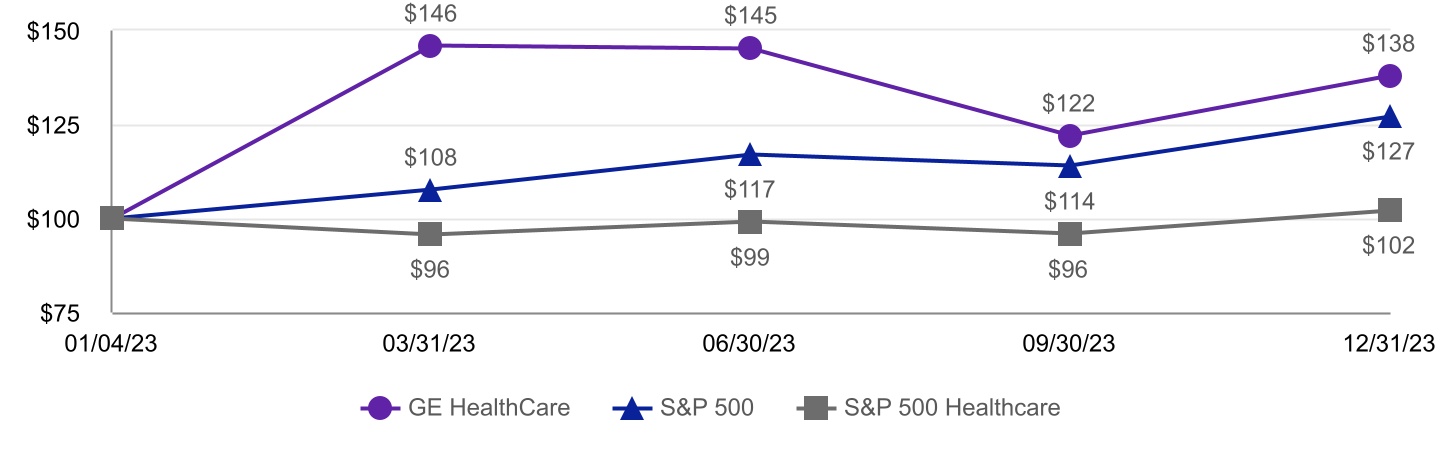
STOCK PERFORMANCE GRAPH
The following graph compares the total return on the Company’s common stock for the last 12 months with the Standard & Poor’s (“S&P”) 500 and S&P 500 Healthcare indices. The graph assumes $100 was invested in each of these indices on the first day of “regular way” trading for our common stock, and that all dividends were reinvested.
Item 6. [RESERVED]
Item 7. MANAGEMENT’S DISCUSSION AND ANALYSIS OF FINANCIAL CONDITION AND RESULTS OF OPERATIONS
| Part II. Financial Information | |||||
| Index | |||||
| Item 7. Management’s Discussion and Analysis of Financial Condition and Results of Operations (“MD&A”) | Page | ||||
| Trends and Factors Impacting Our Performance | 48 | ||||
| Summary of Key Performance Measures | 49 | ||||
| Results of Operations | 50 | ||||
| Results of Operations – Segments | 53 | ||||
| Non-GAAP Financial Measures | 54 | ||||
| Liquidity and Capital Resources | 58 | ||||
| Recently Issued Accounting Pronouncements | 59 | ||||
| Critical Accounting Estimates | 59 |
MANAGEMENT’S DISCUSSION AND ANALYSIS OF FINANCIAL CONDITION AND RESULTS OF OPERATIONS
The following discussion and analysis of our financial condition and results of operations should be read in conjunction with the consolidated and combined financial statements and corresponding notes included elsewhere in this Annual Report on Form 10-K. The following discussion and analysis provide information management believes to be relevant to understanding the financial condition and results of operations of GE HealthCare Technologies Inc. (“GE HealthCare,” the “Company,” “our,” or “we”) for the years ended December 31, 2023 and 2022. For additional information on the year ended December 31, 2021 and year-over-year comparisons to December 31, 2022, refer to Management’s Discussion and Analysis of Financial Condition and Results of Operations included in our Annual Report on Form 10-K for the fiscal year ended December 31, 2022. This discussion contains forward-looking statements that are based upon current expectations and are subject to uncertainty and changes in circumstances. Our actual results could differ materially from the results contemplated by these forward-looking statements due to a number of factors, including those discussed below and elsewhere in this Annual Report on Form 10-K, and particularly in Item 1A. “Risk Factors”. Actual results may differ materially from these expectations; see “Forward-Looking Statements.”
The following tables are presented in millions of United States (“U.S.”) dollars unless otherwise stated, except for per-share amounts which are presented in U.S. dollars.
Unless the context otherwise requires, references to “GE HealthCare,” “we,” “us,” “our,” and the “Company” refer to (1) General Electric Company’s (“GE’s”) healthcare business prior to the previously announced spin-off of the Company on January 3, 2023 (the “Spin-Off”) as a carve-out business of GE with related combined financial statements and (2) GE HealthCare Technologies Inc. and its subsidiaries following the Spin-Off with related consolidated financial statements.
GE HealthCare’s operations are organized and managed through four reportable segments: Imaging, Ultrasound, Patient Care Solutions (“PCS”), and Pharmaceutical Diagnostics (“PDx”) and we evaluate their operating performance using revenue and Segment EBIT. For additional information on the nature of our business see Item 1. “Business.”
TRENDS AND FACTORS IMPACTING OUR PERFORMANCE
We believe that our performance and future success depend on a number of factors that present significant opportunities for us but also pose risks and challenges, including those discussed below and particularly in Item 1A. “Risk Factors.”
KEY TRENDS AFFECTING RESULTS OF OPERATIONS.
Manufacturing, Sourcing, and Supply Chain Management
Our suppliers must provide us with quality products in substantial quantities, in compliance with regulatory requirements, at acceptable costs and on a timely basis. Trends affecting the supply chain for the previous two years include the impact of increasing prices of labor and raw materials, limitations on capacity, and increased cost of shipping. While we have seen some easing of these pressures in 2023, continued cost inflation or the return of material scarcity in our supply chain could have adverse impacts on our future results.
Russia and Ukraine Conflict
We had $153 million and $143 million of assets in, or directly related to, Russia and Ukraine as of December 31, 2023 and December 31, 2022, respectively, none of which are subject to sanctions that impact the carrying value of the assets. We generated revenues of $340 million and $395 million from customers in these two countries for the years ended December 31, 2023 and December 31, 2022, respectively. The potential inability to repatriate earnings from these two countries will not have a material impact on our ability to operate.
We continue to monitor the effects of Russia’s invasion of Ukraine, including the consideration of financial impact, cybersecurity risks, the applicability and effect of sanctions, and the employee base in Ukraine and Russia. In May 2023, the U.S. Department of Commerce implemented expanded measures that require us to obtain a license for the export, re-export, or transfer of specified medical equipment and spare parts to customers in Russia. The European Union and other countries have also expanded licensing requirements for certain spare parts and other items. We have successfully applied and continue to apply for the licenses required to supply to these customers. The implementation of these measures affected our ability to supply customers in Russia during the last three quarters of 2023 and will continue to do so as we continue to obtain licenses. There is no guarantee we will obtain all of the licenses for which we applied, that any approvals we obtain will be on a timely basis, or that our business in Russia will not be further disrupted due to evolving legal or operational considerations. The Board, together with management, will continue to assess whether developments related to the conflict have had, or are reasonably likely to have, a material impact on the Company.
Seasonality
Our revenues and operating profits vary from quarter to quarter. Revenues in the fourth quarter have historically been higher than in other quarters due to the spending patterns of our customers. In addition, cash from operating activities is typically higher in the fourth quarter sequentially as inventories are lower as a result of higher revenues.
OPERATION AS A STAND-ALONE COMPANY.
Financial Presentation Under GE Ownership
GE HealthCare utilized allocations and carve-out methodologies through the date of the Spin-Off to prepare historical combined financial statements. The combined financial statements herein for periods prior to the Spin-Off may not be indicative of our future performance, do not necessarily include the actual expenses that would have been incurred by us, and may not reflect our results of operations, financial position, and cash flows had we been a separate, stand-alone company during the historical periods presented. For additional information, see Note 1, “Organization and Basis of Presentation” to the consolidated and combined financial statements.
Stand-Alone Company Expenses
As a result of the Spin-Off, we are subject to the requirements of the federal and state securities laws and stock exchange requirements. We have established additional procedures
Showing the first 8K of 75K characters. Open the full section
Item 7A. QUANTITATIVE AND QUALITATIVE DISCLOSURES ABOUT MARKET RISK
We are exposed to market risk primarily from changes in interest rates, foreign currency exchange rates, commodity prices, and equity prices, which may impact future income, cash flows, and fair value of our business. In certain situations, we may seek to reduce cash flow volatility associated with changes in foreign currency exchange rates, the foreign currency risk associated with our net investment in foreign operations, or the fair value interest rate risk of our financial instruments bearing fixed interest by entering into financial arrangements intended to provide a hedge against a portion of the risks associated with such risks. We continue to have exposure to such risks to the extent they are not hedged. We enter into derivative contracts to the extent they meet the objectives described above, and not for speculative purposes.
FOREIGN CURRENCY RISK.
As a result of our global operations, we generate and incur a significant portion of our revenues and expenses, including those arising from intercompany transactions, in currencies other than the functional currency of our foreign operations creating exposure to foreign currency translation risk. Such principal currencies include the Euro, the Chinese Renminbi, the Japanese Yen, the Norwegian Krone, and the British Pound Sterling, among others. Operating entities with functional currencies other than the USD also create exposure to foreign currency risk realized upon their sale or a complete or substantially complete liquidation.
We use a number of techniques to manage the effects of currency exchange, including hedging of significant currency exposures. We use cash flow hedging primarily to reduce or eliminate the effects of foreign currency exchange rate changes on purchase and sale contracts and economic hedges when we have exposures to currency exchange risk for which we are unable to meet the requirements for hedge accounting. We use net investment hedging to hedge the foreign currency risk of our net investment in foreign operations against adverse movements in exchange rates against the USD. As a result of the above mitigating activities, we have been able to significantly reduce the financial impact of volatility from currency fluctuations.
The potential decrease in fair value of our foreign currency derivative contracts from a 10% decrease in USD spot rates against other applicable currencies would have been $13 million as of December 31, 2023. This excludes foreign currency derivative contracts designated as net investment hedges as changes in the fair value of those contracts are not expected to impact earnings. The sensitivity analysis assumes a uniform weakening of USD spot rates against the other applicable currencies, compared to the actual exchange rates applied as of December 31, 2023, with all other factors remaining constant. This sensitivity analysis disregards the offsetting change in value of the underlying hedged currency exposures in earnings.
The effect arising from foreign currency transactions, including the remeasurement of derivatives mentioned above, can result in significant fluctuations at points in time, but generally will be offset as the underlying hedged item is recognized in earnings. The global nature of our customer base and manufacturing footprint allows for the natural offset of certain income and costs denominated in foreign currencies. See Note 2, “Summary of Significant Accounting Policies” for net gains (losses) from foreign currency transactions for the years ended December 31, 2023, 2022, and 2021.
INTEREST RATE RISK.
We are exposed to interest rate risk due to changes in benchmark interest rates, related to the fair value of our borrowings bearing fixed interest rates and variability of cash flows related to our investments and borrowings bearing variable interest rates.
As of December 31, 2023, we have $8,250 million of fixed-rate debt and $1,150 million outstanding on the Term Loan Facility which carries a variable interest rate. As of December 31, 2023, we have $2,504 million of Cash, cash equivalents, and restricted cash, which are invested in short-term investments that generate income based on variable interest rates.
A change in interest rates would impact the fair value of our fixed-rate debt and would impact our earnings and cash flows associated with our floating-rate debt. A hypothetical change of interest rates by 100 basis points would increase or decrease our annual interest expense by approximately $22 million, partially offset by the change in interest income from our cash investments.
We primarily manage interest rate risk by using a mix of fixed-rate and variable-rate debt that we deem appropriate. We entered into interest-rate swap contracts in the fourth quarter of 2023, to synthetically convert $1,000 million of our senior unsecured notes from fixed rates to variable rates as part of our interest rate risk management strategy.
COMMODITY RISK.
We rely upon supplies of certain raw materials including helium, iodine, and rare earth minerals. Worldwide demand, availability, and pricing of these raw materials have been volatile, and we expect that availability and pricing will continue to fluctuate in the future. If supply of these materials is restricted or if prices increase, this could constrain our manufacturing of affected products, reduce our profit margins, or otherwise adversely affect our business, our customers, and patients who may rely on our products.
Similarly, commodities and energy prices are subject to significant volatility. If the costs of certain commodities or of energy, shipping, or transportation increase and we are unable to pass along these costs to our customers, our profit margins would be adversely affected. Furthermore, increasing our prices to our customers could result in long-term sales declines or loss of market share if our customers find alternative suppliers, which could have a material adverse effect on our results of operations.
Disruptions in deliveries, capacity constraints, production disruptions up- or down-stream, price increases, or decreased availability of raw materials or commodities (including as a result of war, natural disasters, climate change-related physical and transitional risks, actual or threatened public health emergencies, or other business continuity events) adversely affect our operations and, depending on the length and severity of the disruption, can limit our ability to meet our commitments to customers or significantly impact our operating profit or cash flows.
We may from time to time engage in hedging transactions to reduce the impact to earnings from commodity price fluctuations. The impact of commodity hedges is recognized in earnings in the applicable current period.
EQUITY RISK.
As of December 31, 2023, we have $269 million of deferred compensation liabilities subject to the risk of changes in equity prices. A change in the U.S equity markets would result in a corresponding change in the fair value of these deferred compensation liabilities, which would impact our earnings and cash flows. We may from time to time engage in hedging transactions to reduce the impact to earnings from equity price fluctuations.
See Note 13, “Financial Instruments and Fair Value Measurements” to the consolidated and combined financial statements for further information about our risk exposures, our use of derivatives, and the effects of this activity on our consolidated and combined financial statements.
Item 8. FINANCIAL STATEMENTS AND SUPPLEMENTARY DATA
REPORT OF INDEPENDENT REGISTERED PUBLIC ACCOUNTING FIRM
To the shareholders and the Board of Directors of GE HealthCare Technologies, Inc.
Opinion on the Financial Statements
We have audited the accompanying consolidated and combined statements of financial position of GE HealthCare Technologies, Inc. (the “Company”) as of December 31, 2023 and 2022, the related consolidated and combined statements of income, comprehensive income (loss), changes in equity, and cash flows, for each of the three years in the period ended December 31, 2023, and the related notes (collectively referred to as the “financial statements”). In our opinion, the financial statements present fairly, in all material respects, the fi
Showing the first 8K of 255K characters. Open the full section
Item 9. CHANGES IN AND DISAGREEMENTS WITH ACCOUNTANTS ON ACCOUNTING AND FINANCIAL DISCLOSURE
None.
Item 9A. CONTROLS AND PROCEDURES
EVALUATION OF DISCLOSURE CONTROLS AND PROCEDURES.
Under the supervision and with the participation of the Company’s management, including the Chief Executive Officer and Chief Financial Officer, the Company conducted an evaluation of its disclosure controls and procedures as defined under Rules 13a-15(e) and 15d-15(e) under the Exchange Act. Based on this evaluation, the Chief Executive Officer and Chief Financial Officer concluded that the Company’s disclosure controls and procedures were effective as of December 31, 2023, and that the information required to be disclosed by the Company in the reports that it files or submits under the Exchange Act is recorded, processed, summarized, and reported, within the time periods specified in the SEC’s rules and forms, and that such information is accumulated and communicated to management, including the Chief Executive Officer and Chief Financial Officer, as appropriate, to allow timely decisions regarding required disclosure.
MANAGEMENT’S REPORT ON INTERNAL CONTROL OVER FINANCIAL REPORTING.
The Company’s management is responsible for establishing and maintaining adequate internal control over financial reporting. Management has evaluated the effectiveness of the internal controls over financial reporting, based on the framework and criteria established in Internal Control – Integrated Framework (2013) issued by the Committee of Sponsoring Organizations of the Treadway Commission, and concluded that they were effective as of December 31, 2023. All internal control systems have inherent limitations; as such, they may not prevent or detect all misstatements or fraud. Therefore, even those internal controls systems determined to be effective can provide only reasonable assurance with respect to financial statements preparation and reporting. Additionally, projections of any evaluation of effectiveness to future periods are subject to the risk that the current control structure may become inadequate for changes in conditions or the degree of compliance with the policies may deteriorate.
The effectiveness of such controls has been audited by Deloitte & Touche LLP, our independent registered public accounting firm, as stated in their report included in Item 8, “Financial Statements and Supplementary Data” of this Annual Report on Form 10-K.
CHANGES IN INTERNAL CONTROL OVER FINANCIAL REPORTING.
In the fourth quarter of 2023, the Company exited from various transition services arrangements with GE related to IT systems that impact financial reporting. Responsibility for execution of related internal controls transferred to the Company. Management has evaluated effectiveness of these controls as part of its overall internal control over financial reporting evaluation. Besides those previously discussed, there were no other changes in the Company’s internal control over financial reporting that occurred during the quarter ended December 31, 2023 that materially affected or are reasonably likely to materially affect our internal control over financial reporting.
Item 9B. OTHER INFORMATION
None.
Item 9C. DISCLOSURE REGARDING FOREIGN JURISDICTIONS THAT PREVENT INSPECTIONS
Not applicable.
PART III
Item 10. DIRECTORS, EXECUTIVE OFFICERS AND CORPORATE GOVERNANCE
The information required under this item, with the exception of “Information About Our Executive Officers” and “Ethics and Governance” located under Item 1 of this Annual Report on Form 10-K, is incorporated by reference to the Company’s definitive proxy statement pursuant to Regulation 14A, which will be filed with the Securities and Exchange Commission no later than 120 days after the close of the Company’s fiscal year ended December 31, 2023.
Item 11. EXECUTIVE COMPENSATION
The information required under this item is incorporated by reference to the Company’s definitive proxy statement pursuant to Regulation 14A, which will be filed with the Securities and Exchange Commission no later than 120 days after the close of the Company’s fiscal year ended December 31, 2023.
Item 12. SECURITY OWNERSHIP OF CERTAIN BENEFICIAL OWNERS AND MANAGEMENT AND RELATED STOCKHOLDER MATTERS
The information required under this item is incorporated by reference to the Company’s definitive proxy statement pursuant to Regulation 14A, which will be filed with the Securities and Exchange Commission no later than 120 days after the close of the Company’s fiscal year ended December 31, 2023.
Item 13. CERTAIN RELATIONSHIPS AND RELATED TRANSACTIONS, AND DIRECTOR INDEPENDENCE
The information required under this item is incorporated by reference to the Company’s definitive proxy statement pursuant to Regulation 14A, which will be filed with the Securities and Exchange Commission no later than 120 days after the close of the Company’s fiscal year ended December 31, 2023.
Item 14. PRINCIPAL ACCOUNTANT FEES AND SERVICES
The information required under this item is incorporated by reference to the Company’s definitive proxy statement pursuant to Regulation 14A, which will be filed with the Securities and Exchange Commission no later than 120 days after the close of the Company’s fiscal year ended December 31, 2023.
PART IV
Item 15. EXHIBITS AND FINANCIAL STATEMENT SCHEDULES
FINANCIAL STATEMENTS.
Refer to Item 8, “Financial Statements and Supplementary Data” for a listing of our financial statements.
FINANCIAL SCHEDULES.
Schedules required by Regulation S-X (17 CFR 210) are omitted because they are either not applicable or the financial information is already included within the financial statements or notes thereto.
EXHIBITS.
| 31.1 | Certification of the Registrant’s Chief Executive Officer pursuant to Rule 13a-14(a)/15d-14(a) of the Securities Exchange Act of 1934, as amended, as adopted pursuant to Section 302 of the Sarbanes-Oxley Act of 2002. | ||||
| 31.2 | Certification of the Registrant’s Chief Financial Officer pursuant to Rule 13a-14(a)/15d-14(a) of the Securities Exchange Act of 1934, as amended, as adopted pursuant to Section 302 of the Sarbanes-Oxley Act of 2002. | ||||
| 32.1 | Certifications of the Registrant’s Chief Executive Officer and Chief Financial Officer pursuant to 18 U.S.C. 1350, as adopted pursuant to Section 906 of the Sarbanes-Oxley Act of 2002. | ||||
| 97.1 | GE HealthCare Technologies Inc. Clawback Policy. | ||||
| 101 | The following materials from GE HealthCare Technologies Inc.’s Annual Report on Form 10-K for the fiscal year ended December 31, 2023, formatted inline XBRL (eXtensible Business Reporting Language): (1) Consolidated and Combined Statements of Income for the years ended December 31, 2023, 2022, and 2021; (2) Consolidated and Combined Statements of Comprehensive Income (Loss) for years ended December 31, 2023, 2022, and 2021; (3) Consolidated and Combined Statements of Financial Position as of December 31, 2023 and 2022; (4) Consolidated and Combined Statements of Changes in Equity for the years ended December 31, 2023, 2022, and 2021; (5) Consolidated and Combined Statements of Cash Flows for the years ended December 31, 2023, 2022, and 2021; and (6) Notes to the Consolidated and Combined Financial Statements. | ||||
| 104 | Cover Page Interactive Data File (formatted as Inline XBRL). | ||||
| † | Certain portions of this exhibit have been redacted pursuant to Item 601(b)(2)(ii) and Item 601(b)(10)(iv) of Regulation S-K, as applicable. The Company agrees to furnish supplementally an unredacted copy of the exhibit to the Securities and Exchange Commission upon its request. | ||||
| * | Management contract or compensatory plan or arrangement. |
Item 16. FORM 10-K SUMMARY
Registrants may voluntarily include a summary of information required by Form 10-K under this Item 16. The Company has elected to not include such summary information.
SIGNATURES
Pursuant to the requirements of Section 13 or 15(d) of the Securities Exchange Act of 1934, the Registrant has duly caused this report to be signed on its behalf by the undersigned, thereunto duly authorized.
| GE HealthCare Technologies Inc. | ||||||||
| (Registrant) | ||||||||
| February 6, 2024 | /s/ James K. Saccaro | |||||||
| Date | James K. Saccaro, Vice President & Chief Financial Officer (Principal Financial Officer) |
Pursuant to the requirements of the Securities Exchange Act of 1934, this report has been signed below by the following persons on behalf of the Registrant and in the capacities indicated on February 6, 2024.
| Signature | /s/ Peter J. Arduini | |||||||
| Title | Peter J. Arduini, President & Chief Executive Officer and Director (Principal Executive Officer) | |||||||
| /s/ James K. Saccaro | ||||||||
| James K. Saccaro, Vice President & Chief Financial Officer (Principal Financial Officer) | ||||||||
| /s/ George A. Newcomb | ||||||||
| George A. Newcomb, Chief Accounting Officer (Principal Accounting Officer) | ||||||||
| /s/ H. Lawrence Culp, Jr. | ||||||||
| H. Lawrence Culp, Jr., Chairman of the Board of Directors | ||||||||
| /s/ Rodney F. Hochman | ||||||||
| Rodney F. Hochman, Director | ||||||||
| /s/ Lloyd W. Howell, Jr. | ||||||||
| Lloyd W. Howell, Jr., Director | ||||||||
| /s/ Risa Lavizzo-Mourey | ||||||||
| Risa Lavizzo-Mourey, Director | ||||||||
| /s/ Catherine Lesjak | ||||||||
| Catherine Lesjak, Director | ||||||||
| /s/ Anne T. Madden | ||||||||
| Anne T. Madden, Director | ||||||||
| /s/ Tomislav Mihaljevic | ||||||||
| Tomislav Mihaljevic, Director | ||||||||
| /s/ William J. Stromberg | ||||||||
| William J. Stromberg, Director | ||||||||
| /s/ Phoebe L. Yang | ||||||||
| Phoebe L. Yang, Director |