 filings.tools
Item 11. Executive Compensation
139K characters. Original on sec.gov · Markdown
Item 11. Executive Compensation
Executive Compensation and Related Information
COMPENSATION DISCUSSION & ANALYSIS (CD&A)
This compensation discussion and analysis describes the material elements of Symantec’s executive compensation program for fiscal 2015. For fiscal 2015, our named executive officers (“NEOs”) include the following current officers:
| • | Michael A. Brown, President and Chief Executive Officer |
|---|
| • | Thomas J. Seifert, Executive Vice President and Chief Financial Officer |
|---|
| • | Balaji Yelamanchili, Executive Vice President and General Manager, Enterprise Security |
|---|
| • | Scott C. Taylor, Executive Vice President, General Counsel and Corporate Secretary |
|---|
| • | Francis C. Rosch, Executive Vice President, Norton Business Unit |
|---|
Our NEOs also include, pursuant to applicable SEC rules, the following former executive officer:
| • | Stephen E. Gillett, former Executive Vice President and Chief Operating Officer |
|---|
Our Compensation Philosophy and Practices
The overriding principle driving our compensation programs continues to be our belief that it benefits our employees, customers, partners and stockholders to have management’s compensation tied to our current and long-term performance. The following factors demonstrate our continued commitment to pay-for-performance and to corporate governance best practices:
| • | We reward performance that meets our predetermined goals. Our compensation plans do not have guaranteed payout levels, and our named executive officers do not receive any payouts under performance-based cash or equity awards if the goals are not met. Our compensation plans are also capped to discourage excessive or inappropriate risk-taking by our executive officers. |
|---|
| • | We continue to grant performance-based restricted stock units (“PRUs”) to our named executive officers as a regular part of our annual executive compensation program. We do not award any stock options to our executives. |
|---|
| • | Our various incentive plans use multiple, non-duplicative measures that correlate to stockholder value, such that no single metric is overly emphasized in determining payouts. |
|---|
| • | Our peer group consists primarily of businesses with a focus on software development, or software and engineering-driven companies that compete with us for talent. Our peer group companies are comparable to us in terms of complexity, global reach, revenue and market capitalization. |
|---|
| • | We have long-standing stock ownership guidelines for our named executive officers, requiring them to hold a minimum value in shares so that they have an even greater financial stake in our company, thereby further aligning the interests of our executive officers with those of our stockholders. We also prohibit the sale of any shares (except to meet tax withholding obligations) if doing so would cause them to fall below the required ownership levels. |
|---|
| • | We do not provide for gross-ups of excise tax values under Section 4999 of the Internal Revenue Code. |
|---|
| • | We limit any potential cash severance payments to not more than 3x our executive officers’ total target cash compensation. |
|---|
| • | We have clawback provisions in all of our executive compensation plans (providing for the return of any excess compensation received by an executive officer if our financial statements are the subject of a restatement due to error or misconduct). |
|---|
| • | Our executive officers are prohibited from short-selling Symantec stock or engaging in transactions involving Symantec-based derivative securities, and are also prohibited from pledging their Symantec stock. |
|---|
| • | Our equity incentive plan prohibits the repricing or exchange of equity awards without stockholder approval. |
|---|
| • | We seek stockholder feedback on our executive compensation through an annual advisory vote and ongoing stockholder engagement. |
|---|
Summary of Compensation Matters During Fiscal 2015
Business Changes and Performance in Fiscal 2015
Fiscal 2015 was a transformative year for our company:
| • | After conducting a broad and thorough search, the Board appointed Michael Brown, our then-serving interim President and CEO, the Company’s President and CEO on September 24, 2014. |
|---|
| • | On October 9, 2014, we announced plans to separate our business into two independent companies: one focused on security and one focused on information management. |
|---|
Table of Contents
| • | We hired five new executives, who bring valuable skills in analytics, backup and recovery software, sales, security, strategy, and human resources. |
|---|
| • | While undergoing significant leadership transitions and allocating substantial resources to internal initiatives in connection with the separation of our business into two independent companies, we improved our profitability and laid the foundation for future growth by achieving our profitability targets, focusing on returning to growth, and right-sizing our cost structure; |
|---|
| • | We returned nearly $1.0 billion of cash to our stockholders in fiscal 2015: (a) paying quarterly cash dividends of $0.15 per share of common stock for a total of $413 million to stockholders; and (b) repurchasing 21 million shares of our common stock for an aggregate amount of $500 million. |
|---|
Financial and Compensation Metrics, Performance Achievement and Incentive Plan Earnings
During fiscal 2015, we used three core financial operating metrics as well as total shareholder return (“TSR”) relative to the S&P 500 to assess company performance and determine incentive compensation amounts earned by our officers. The operating metrics used in our executive compensation programs are: non-GAAP operating income, non-GAAP revenue and non-GAAP earnings per share (“EPS”). These metrics were selected because we believe they are strongly correlated to enterprise value for companies in our sector and promote the appropriate behaviors for our leadership team while driving company performance. For a significant portion of the long-term equity incentive compensation component of our core executive compensation program, we also used two other metrics that more directly align the interests of our executive officers to those of our stockholders: our stock price and TSR ranking for our company as compared to the S&P 500. In addition, individual performance was a factor in the potential annual incentive awards of our named executive officers, other than our CEO, under our Executive Annual Incentive Plan.
For our fiscal 2015 incentive plans, performance and resulting earning levels are as follows:
| Incentive Plan | Fiscal 2015 Performance | Incentive Award Outcome | ||||||
| FY15 Executive Annual Incentive Plan | • | Our non-GAAP operating income(1) was $1,853 million, which was 97.3% achievement of the targeted performance level; and our non-GAAP revenue was $6,649 million, which was 98.7% achievement of the targeted performance level. | • | Our non-GAAP operating income metric funded at 82% of target and non-GAAP revenue funded at 88% of target. | ||||
| • | Our NEOs received strong individual performance ratings that resulted in total payouts of 85% - 119% of targets | |||||||
| Fiscal 2015 PRU Grants | • | Our non-GAAP EPS(1) was 99.8% of our targeted performance level of $1.96 for the full fiscal year | • | 98.3% of the targeted number of shares are eligible to be earned, subject to modification on final shares earned based on Symantec’s 2- and 3-year relative TSR versus the S&P 500 |
| (1) | Consistent with the presentation in our quarterly earnings releases and supplemental materials, under our executive compensation programs, we define (i) non-GAAP operating income as gross profit less operating expenses before interest and taxes, adjusted to exclude stock-based compensation expense, charges related to the amortization of intangible assets, certain other income and expense items that management considers unrelated to the Company’s core operations, and the associated income tax effects of the adjustments; (ii) non-GAAP revenue as adjusted to exclude EDS & NDI settlement; and (iii) non-GAAP EPS as diluted net income per share as adjusted to exclude the items described above, as well as non-cash interest expense, value-added tax refunds a tax from the China tax bureau, certain other tax benefits, and the related tax impact of these adjustments. |
|---|
For purposes of calculating achievement of these metrics, consistent with the presentation of non-GAAP operating income in our quarterly supplemental materials, foreign exchange movements were held constant at plan rates, pursuant to the terms of the plans.
NEO Compensation
Our named executive officers were compensated in a manner consistent with our core pay-for-performance compensation philosophy. The following are some important elements of our named executive officers’ compensation for fiscal 2015:
Table of Contents
| • | Majority of pay mix at risk. For fiscal 2015, approximately 94% of our CEO’s target total direct compensation was at risk and approximately 88% of the target total direct compensation for our other named executive officers, on average, was at risk. |
|---|
| • | Short-term incentive compensation linked directly to Company financial results. Our executive annual incentive compensation was structured to emphasize performance. Under the FY15 Executive Annual Incentive Plans, the named executive officers were eligible to receive performance-based incentive cash awards based on our company’s achievement of targeted non-GAAP operating income for fiscal 2015 and targeted non-GAAP revenue during fiscal 2015. |
|---|
| • | Long-term incentive compensation is 100% equity-based. For fiscal 2015, the long-term compensation component of our named executive officers’ compensation packages consisted entirely of long-term equity incentive awards. |
|---|
| • | Performance measures are non-duplicative. In fiscal 2015, the cash annual incentive plan metric were non-GAAP operating income and non-GAAP revenue, which we believe our executives have a more direct ability to affect. |
|---|
“Say on Pay” Advisory Vote on Executive Compensation and Stockholder Engagement
We hold an advisory vote on executive compensation, commonly known as “Say-on-Pay,” on an annual basis. While these votes are not binding, we believe that it is important for our stockholders to have an opportunity to express their views regarding our executive compensation programs and philosophy as disclosed in our proxy statement on an annual basis. The Compensation Committee values our stockholders’ opinions and the Board and the Compensation Committee consider the outcome of each vote when making future compensation decisions for our named executive officers. In addition to the annual advisory vote on executive compensation, we are committed to ongoing engagement with our stockholders on executive compensation matters generally. These engagement efforts take place through telephone calls, in-person meetings and correspondence with our stockholders.
Although historically we have received approximately 98%, 97% and 97% of the votes cast on the advisory vote in favor of our executive compensation (in fiscal 2011, fiscal 2012 and fiscal 2013, respectively), we received approximately 76% of the votes cast in fiscal 2014. Based on stockholder feedback, we believe this lower vote was due to the acceleration of all of our former CEO’s performance-contingent stock units (“PCSUs”) upon his termination in March 2014. In consideration of the results of the most recent advisory vote and direct input from our stockholders, the Board and the Compensation Committee no longer award PCSUs and none of our NEOs’ equity grants accelerate 100% upon termination (except in certain circumstances following a change in control as described in more detail below). The results of the most recent advisory vote had no other impact on our compensation decisions and policies for fiscal 2015 and no other material changes have been made to our executive compensation philosophy and programs as the Board and the Compensation Committee deemed the above-referenced vote results were favorable and convey our stockholders’ support of our existing executive compensation philosophy and programs.
Roles of Our Compensation Committee, Independent Directors, Executive Officers and Consultants in our Compensation Process
The Compensation Committee, which is comprised entirely of independent directors, is responsible for overseeing all of Symantec’s compensation programs, including the review and recommendation to the independent directors of our Board of all compensation arrangements for our CEO and the review and approval of the compensation payable to our other named executive officers.
The independent directors of the Board evaluate the CEO’s performance and the Compensation Committee then reviews and recommends to the independent members of the Board all compensation arrangements for the CEO. After discussion, the independent members of the Board determine the CEO’s compensation. The Compensation Committee also discusses the performance of the other named executive officers with the CEO, reviews the compensation recommendations that the CEO submits for the other named executive officers, makes any appropriate adjustments, and approves their compensation. While our CEO provides input and makes compensation recommendations with respect to executive officers other than himself, our CEO does not make recommendations with respect to his own compensation or participate in the deliberations regarding the setting of his own compensation by the Board or the Compensation Committee.
Since fiscal 2004, the Compensation Committee has engaged Mercer, an outside consulting firm, to provide advice and ongoing recommendations on executive compensation matters. The Compensation Committee oversees Mercer’s engagement. Mercer representatives meet informally with the Compensation Committee Chair and the Chief Human Resources Officer and also with the Compensation Committee during its regular meetings, including in executive sessions from time to time without any members of management present.
Table of Contents
As part of its engagement in fiscal 2015, Mercer provided, among other services, advice and recommendations on the amount and form of executive and director compensation. For example, Mercer evaluated and advised the Compensation Committee on the peer group that the Compensation Committee uses to develop a market composite for purposes of establishing named executive officer pay levels (as described below), the competitiveness of our executive and director compensation programs, the design of awards and proposed performance metrics and opportunity ranges for incentive plans, compensation-related trends and developments in our industry and the broader talent market and regulatory developments relating to compensation practices.
We paid Mercer approximately $236,000 for executive compensation services in fiscal 2015. In addition, with the Compensation Committee’s approval, management engaged and Symantec paid Mercer and its affiliates for other services, including approximately $3.459 million for other unrelated consulting and business services. We also reimbursed Mercer and its affiliates for reasonable travel and business expenses. The Compensation Committee did not review or approve the other services provided by Mercer and its affiliates to Symantec, as those services were approved by management in the normal course of business. Based in part on policies and procedures implemented by Mercer to ensure the objectivity of its executive compensation consultants and the Compensation Committee’s assessment of Mercer’s independence pursuant to the SEC rules, the Compensation Committee concluded that the consulting advice it receives from Mercer is objective and not influenced by Mercer and its affiliates’ other relationships with Symantec and that no conflict of interest exists that will prevent Mercer from being independent consultants to the Compensation Committee.
The Compensation Committee establishes our compensation philosophy, approves our compensation programs and solicits input and advice from several of our executive officers and Mercer. As mentioned above, our CEO provides the Board of Directors and the Compensation Committee with feedback on the performance of our executive officers and makes compensation recommendations (other than with respect to his own compensation) that go to the Compensation Committee for their approval. Our CEO, Chief Human Resources Officer and General Counsel regularly attend the Compensation Committee’s meetings to provide their perspectives on competition in the industry, the needs of the business, information regarding Symantec’s performance, and other advice specific to their areas of expertise. In addition, at the Compensation Committee’s direction, Mercer works with our Chief Human Resources Officer and other members of management to obtain information necessary for Mercer to make their own recommendations as to various matters as well as to evaluate management’s recommendations.
FACTORS WE CONSIDER IN DETERMINING OUR COMPENSATION PROGRAMS
We apply a number of compensation policies and analytic tools in implementing our compensation principles. These policies and tools guide the Compensation Committee in determining the mix and value of the compensation components for our named executive officers, consistent with our compensation philosophy. They include:
Focus on Pay-for-Performance: Our executive compensation program is designed to reward executives for results. As described below, the pay mix for our named executive officers emphasizes variable pay in the form of short-term cash and long-term equity awards. For cash awards, short-term results are measured by annual non-GAAP operating income, annual non-GAAP revenue and, for all our named executive officers other than our CEO, individual performance. A significant portion of equity grants for our named executive officers are directly performance based, with base-level grants set by performance versus non-GAAP EPS targets, modified over an extended term by the achievement of the total stockholder return ranking for our company as compared to the S&P 500. The value to the employee of the remainder equity grants to our named executive officers depends on the company share price performance.
A Total Rewards Approach: Elements of the total rewards offered to our executive officers include base salary, short- and long-term incentives including equity awards, health benefits, a deferred compensation program and a consistent focus on individual professional growth and opportunities for new challenges.
Appropriate Market Positioning: Our general pay positioning strategy is to target the levels of base salary, annual short-term cash incentive structure and long-term equity incentive opportunities and benefits for our named executive officers with reference to the relevant market data for each position. The Compensation Committee may set the actual components for an individual named executive officer above or below the positioning benchmark based on factors such as experience, performance achieved, specific skills or competencies, the desired pay mix (e.g., emphasizing short- or long-term results), and our budget.
Table of Contents
Competitive Market Assessments: Market competitiveness is one factor that the Compensation Committee considers each year in determining a named executive officer’s overall compensation package, including pay mix. The Compensation Committee relies on various data sources to evaluate the market competitiveness of each pay element, including publicly-disclosed data from a peer group of companies (see discussion below) and published survey data from a broader set of information technology companies that the Compensation Committee, based on the advice of Mercer, believes represent Symantec’s competition in the broader talent market. The peer group’s proxy statements provide detailed pay data for the top five positions. Survey data, which we obtain from the Radford Global Technology Survey, provides compensation information on a broader group of executives and from a broader group of information technology companies, with positions matched based on specific job scope and responsibilities. The Compensation Committee considers data from these sources as a framework for making compensation decisions for each named executive officer’s position.
The information technology industry in which we compete is characterized by rapid rates of change and intense competition from small and large companies, and the companies within this industry have significant cross-over in leadership talent needs. As such, we compete for executive talent with leading software and services companies as well as in the broad information technology industry. We face particularly intense competition with companies located in the geographic areas where Symantec operates, regardless of specific industry focus or company size. Further, in part because we believe that stockholders measure our performance against a wide array of technology peers, the Compensation Committee uses a peer group that consists of a broad group of high technology companies in different market segments that are of a comparable size to us. The Compensation Committee uses this peer group, as well as other relevant market data, to evaluate named executive officer pay levels.
The Compensation Committee reviews our peer group on an annual basis, with input from Mercer, and the group may be adjusted from time to time based on, among other inputs, a comparison of revenues, market capitalization, industry, peer group performance and stockholder input. The following criteria were used to select our updated peer group:
| • | Businesses with a software development focus |
|---|
| • | Similar breadth of complexity and global reach as Symantec |
|---|
| • | Annual revenue of $1.5 billion - $20.0 billion |
|---|
| • | Market capitalization of $4.0 billion - $61.0 billion |
|---|
| • | Software and engineering-driven companies in the Silicon Valley or elsewhere with which we compete for executive and broader talent |
|---|
The Compensation Committee did not make any changes to our peer group for fiscal 2015. The following companies were used in setting the compensation for our named executive officers for fiscal 2015:
| Fiscal 2015 Symantec Peer Group | ||||
| Activision Blizzard, Inc. | eBay Inc. | Nuance Communications, Inc. | ||
| Adobe Systems Incorporated | Electronic Arts Inc. | salesforce.com, inc. | ||
| Autodesk, Inc. | EMC Corporation | Synopsys, Inc. | ||
| BMC Software, Inc. | Intuit Inc. | VMware, Inc. | ||
| CA, Inc. | NetApp, Inc. | Yahoo! Inc. | ||
| Citrix Systems, Inc. |
The Compensation Committee uses these peer companies for comparative purposes, as discussed above. In fiscal 2015, compensation for individual executive officers was not dependent on how we performed relative to these peers with respect to particular financial metrics. Further information regarding the financial results and performance of any of the peer companies may be found in periodic reports those companies file with the SEC.
Appropriate Pay Mix: Consistent with our pay-for-performance philosophy, our executive officers’ compensation is structured so that a large portion of their total direct compensation paid based on the performance of our company and individual achievement. In determining the mix of the various reward elements and the value of each component, the Compensation Committee takes into account the executive’s role, the competitiveness of the market for executive talent, company performance, individual performance, internal pay equity and historical compensation. In making its determinations with regard to compensation, the Compensation Committee reviews the various compensation elements for the CEO and our other named executive officers (including base salary, target annual bonus, and the value of vested and unvested equity awards actually or potentially issued).
Table of Contents
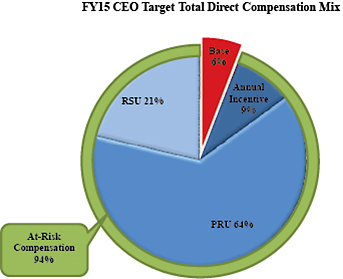
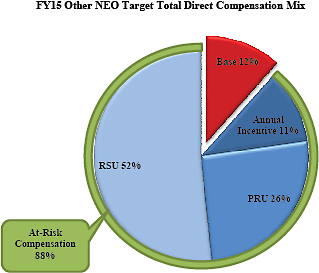
The percentage of an executive officer’s compensation opportunity that is “at-risk,” or variable instead of fixed, is based primarily on the officer’s level of influence at Symantec. Executive officers generally have a greater portion of their pay at risk through short- and long-term incentive programs than the rest of our employee population because of their relatively greater responsibility and ability to influence our company’s performance. Typically, a higher proportion of the CEO’s compensation opportunity is at-risk relative to our other named executive officers because the nature of his role and ability to influence our company’s performance. As illustrated by the following charts, for fiscal 2015, approximately 94% of our CEO’s target total direct compensation (sum of base salary, target annual incentive and grant date fair value of equity award) was at-risk, and on average approximately 88% of our other named executive officers’ compensation opportunity was at-risk compensation.
 |  |
Form and Mix of Long-Term Equity Incentive Compensation: The long-term equity incentive compensation component of our regular annual executive compensation program typically consists of PRUs and RSUs for all of our named executive officers. We believed these allocations would strike the appropriate balance between performance and retention for long-term equity incentive awards.
For fiscal 2015, our CEO received approximately 64% of the value of his target total direct compensation in the form of PRUs and 21% in RSUs. Other named executive officers, received on average, approximately 29% of the target total direct compensation in the form of PRUs and 47% in RSUs. We view the meaningfully higher weighting of PRUs for the CEO and lower weighting of base salary as part of total direct compensation, as compared to the weighting for the other NEOs, to be appropriate given both the level of total direct compensation and the broader level of influence over company performance associated with the CEO role.
These percentages (and other percentage-based equity awards values discussed below) are based on the grant date fair value of the shares of common stock underlying the RSUs, and the grant date fair value of the PRUs at the target level award size. The awards made to our named executive officers, other than the CEO, are determined by the Compensation Committee after reviewing recommendations made by the CEO. In determining its recommendations to the independent directors of the Board, in the case of CEO compensation, and in making compensation decisions with respect to other named executive officers, the Compensation Committee may consider factors such as the individual’s responsibilities, the individual’s performance, industry experience, current pay mix, total compensation competitiveness, long-term equity awards previously granted to the individual, retention considerations, and other factors.
Compensation Risk Assessment: The Compensation Committee, in consultation with Mercer, has conducted its annual risk analysis on Symantec’s compensation policies and practices, and does not believe that our compensation programs encourage excessive or inappropriate risk taking by our executives or are reasonably likely to have a material adverse effect on Symantec.
COMPENSATION COMPONENTS
The major components of compensation for our named executive officers during fiscal 2015 were: (i) base salary, (ii) short-term cash incentive awards, and (iii) long-term equity incentive awards.
Table of Contents
I. Base Salary
The Compensation Committee reviews the named executive officers’ salaries annually as part of its overall competitive market assessment and may make adjustments based on talent, experience, performance, contribution levels, individual role, positioning relative to market, and our overall salary budget. The independent members of the Board of Directors review the CEO’s salary in executive session (i.e., without any executives present), and changes are considered in light of market pay assessments and the Board’s annual CEO performance evaluation, in each case without the participation of our CEO. In setting the base salaries for the other named executive officers, the Compensation Committee also considers the recommendations of the CEO based upon his annual review of their performance. Although the Compensation Committee takes into account the factors and information described above during its review and determination of the base salary for each executive officer, it does not assign a specific weight to any element and does not measure individual performance against an objective standard in the evaluation of an executive officer’s base salary. Instead, these reviews and determinations are based on the Compensation Committee’s subjective judgment taking into account all available information, including the competitive market assessment.
In connection with the appointment of our Chief Executive Officer in September 2014, the independent members of the Board negotiated an employment arrangement with him that provides for an annual base salary of $1,000,000. In negotiating and setting his base salary, the Board roughly targeted the median for CEOs within our peer group for fiscal 2015 and also took into consideration his performance as interim CEO and leadership experience.
Mr. Yelamanchili’s annual base salary was determined outside the Compensation Committee’s annual review process, using different methodology. In his case, the Compensation Committee targeted an overall compensation level to compete with the overall compensation level he was receiving with his then-current employer, and based on market data for Mr. Yelamanchili’s position and after taking into account his experience, set his annual base salary to $700,000.
Following evaluation in connection with the Compensation Committee’s annual review process, Mr. Seifert’s base salary remained the same from the previous year, as his annual base salary was deemed effective in continuing to achieve the Compensation Committee’s goals for this component of his executive compensation. Mr. Taylor received a 36.9% increase in base salary as part of his annual review, and to align his base salary with approximately the median of the market based on his experience and contributions. Mr. Rosch was appointed as our Executive Vice President, Norton Business Unit in connection with our transition to a new organizational structure in connection with the announcement of our plan to separate our business into two independent companies. In connection with his promotion to this new position, he received a 10% increase in recognition of the increase in his responsibilities. The following table presents each named executive officer’s base salary for fiscal 2015 as compared to fiscal 2014:
| Change | FY15 Annual | |||||||
| Name of NEO | in Salary | Salary ($) | Description | |||||
| Michael A. Brown | n/a | 1,000,000 | (1) | Mr. Brown was appointed President and Chief Executive Officer in September 2014. The Compensation Committee roughly targeted the median for CEOs within our peer group and took into consideration his performance as interim CEO and leadership experience. | ||||
| Thomas J. Seifert | — | 720,000 | Mr. Seifert did not receive a base salary increase in fiscal 2015, as it was deemed effective in continuing to achieve the Compensation Committee’s goals for this component of his executive compensation. | |||||
| Balaji Yelamanchili | n/a | 700,000 | (2) | Mr. Yelamanchili was hired as Executive Vice President and General Manager, Enterprise Security in November 2014. The Compensation Committee deems his salary as competitive and appropriate for his position. | ||||
| Scott C. Taylor | 36.9% | 575,000 | Mr. Taylor received a 36.9% increase in base salary as part of his annual review, and to align his base salary with approximately the median of the market based on his experience and contributions. | |||||
| Francis C. Rosch | 10% | 440,000 | (3) | Mr. Rosch’s base salary increased by 10% in connection with his promotion to Executive Vice President, Norton Business Unit in May 2014. | ||||
| Former Officer | ||||||||
| Stephen E. Gillett | — | 875,000 | Mr. Gillett did not receive a base salary increase in fiscal 2015. |
Table of Contents
| (1) | Mr. Brown received a salary of $100,000 per month until June 1, 2015 when the Board increased his base salary to $200,000 per month in recognition of his efforts and increased time commitment in his interim President and Chief Executive Officer role during fiscal 2015. This higher base salary was also designed to compensate him for serving without any variable compensation or equity award while he served as interim CEO. Following his appointment as our permanent President and Chief Executive Officer in September 2014, he earned a prorated portion of his $1,000,000 annual base salary for the remainder of fiscal 2015. |
|---|
| (2) | Mr. Yelamanchili received a prorated salary of $281,345 based on his period of employment as our Executive Vice President and General Manager, Enterprise Security. |
|---|
| (3) | Mr. Rosch received a prorated salary of $435,923 in fiscal 2015, as his adjusted salary went into effect following the beginning of fiscal 2015. |
|---|
II. Executive Annual Incentive Plan
The Executive Annual Incentive Plans for our executive officers are adopted pursuant to the Senior Executive Incentive Plan (“SEIP”) most recently approved by our stockholders in 2013. The Executive Annual Incentive Plans adopted under the SEIP are annual cash incentive plans that are designed to reward named executive officers (and other participants) for generating strong financial results for our Company in the short term. To align our senior executives’ incentive awards with key drivers of the Company’s financial performance, all named executive officers earn incentive compensation based on performance against pre-determined corporate goals described below. The Compensation Committee typically measures the achievement of named executive officers (other than our CEO) against individual performance targets as well.
Executive Annual Incentive Plan Target Opportunities: Under the Executive Annual Incentive Plans for a given fiscal year, each named executive officer has a target award opportunity, expressed as a percentage of base salary, with the ability to earn above or below that target based on actual performance. Target award opportunities for our Executive Annual Incentive Plans are established by the Compensation Committee using the various inputs described below. The following table presents each named executive officer’s target bonus opportunity (on an actual and percentage of base salary basis) for fiscal 2015:
| FY15 Target | FY15 Target | |||||||
| Name of NEO | % of Base | ($) | ||||||
| Michael A. Brown | 150 | 1,500,000 | ||||||
| Thomas J. Seifert | 100 | 720,000 | ||||||
| Balaji Yelamanchili | 125 | 875,000 | ||||||
| Scott C. Taylor | 70 | 402,500 | ||||||
| Francis C. Rosch | 80 | 352,000 | ||||||
| Former officer | ||||||||
| Stephen E. Gillett | 125 | 1,093,750 |
In general, the award opportunities for fiscal 2015 were determined based on the relevant market data, desired market positions, the desired mix between cash and equity-based incentive pay, internal pay equity goals, and the role of the named executive officer.
At the time award opportunities are established, there is no assurance that the amount of the target awards will be realized. As explained below, each named executive officer must achieve threshold performance for each metric established in the named executive officer’s executive annual incentive plan to receive any payment for such metric. The payout under the Executive Annual Incentive Plan is also capped at different levels based on the relevant performance metric.
Executive Annual Incentive Plan Performance Measures and Target Setting: Executive Annual Incentive Plan performance targets are established within the first 90 days of each plan year. Our management develops goals to propose to the Compensation Committee, after taking into account a variety of factors, including our historical performance, internal budgets, market and peer performance, and external expectations for our performance. The Compensation Committee reviews, adjusts as necessary, and approves the goals, the range of performance to be rewarded, and the weighting of the goals. Following the end of each fiscal year, the Compensation Committee reviews our actual performance against the performance measures established in the fiscal year’s Executive Annual Incentive Plans (after making any appropriate adjustments to such measures for the effects of corporate events that were not anticipated in establishing the performance measures), determines the extent of achievement and approves the payment of annual cash incentives, if warranted.
Table of Contents
For fiscal 2015, the Executive Annual Incentive Plan was funded by two primary measures: non-GAAP operating income and non-GAAP revenue. We used the above performance metrics because:
| • | Over time, we believe that non-GAAP operating income and non-GAAP revenue measures have strongly correlated with stockholder value creation for Symantec; |
|---|
| • | the non-GAAP operating income and non-GAAP revenue measures are transparent to investors and are included in our quarterly earnings releases and supplemental materials; |
|---|
| • | the non-GAAP operating income and non-GAAP revenue measures are designed to balance growth and profitability; and |
|---|
| • | the performance goals used for the individual performance component align with our operational and strategic objectives. |
|---|
These measures were also used in fiscal 2015 because profitability and growth were strategic priorities as our business underwent its transformative changes as noted in above. Additionally, the non-GAAP operating income metric was selected because it can be measured at various sub-business unit levels within our company.
The determination of achievement of the non-GAAP operating income and non-GAAP revenue metrics is formulaic, while the individual performance metric is determined based on a qualitative evaluation of the individual’s performance against pre-established objectives with input from our CEO. In rating the individual’s performance, the Compensation Committee gives weight to the input of our CEO, but final decisions about the compensation of our named executive officers are made solely by the Compensation Committee. Although the Compensation Committee has the discretion to adjust awards as appropriate, it did not exercise such discretion for fiscal 2015.
For the non-GAAP operating income and non-GAAP revenue metrics: (a) at the threshold achievement level of 90% of target, the funding level is 40%; (b) above the threshold achievement level, the funding level increases incrementally, up to a funding level of 100% at a target achievement level of 100%; (c) above the target achievement level, funding increases incrementally, up to a cap of a 200% funding based on a maximum achievement level of at least 106.5% of target; and (d) there is zero funding below the threshold achievement level of 90%. The non-GAAP operating income and non-GAAP revenue metrics are tested and funded independently of each other and are weighted equally. With the exception of our CEO, the actual individual payouts are further modified based on the individual performance factor generally in the range of 0-140% based on the performance achievement against pre-established goals for the fiscal year. The following illustrates the calculation used to determine the individual payout amount, if any:

The following table summarizes the foregoing discussion of threshold, target and maximum performance levels and the relative funding levels at each level under the FY15 Executive Annual Incentive Plans:
| Non-GAAP Operating Income (%) | Non-GAAP revenue (%) | Individual Performance Modifier (%) | Total Payout as a Percentage of Target (%) | |||||||||||||
| Threshold | 40 | 40 | 35 | 14 | ||||||||||||
| Target | 100 | 100 | 100 | 100 | ||||||||||||
| Maximum | 200 | 200 | 140 | 280 |
Non-GAAP operating income and non-GAAP revenue performance targets were established based on a range of inputs, including external market economic conditions, growth outlooks for our product portfolio, the competitive environment, our internal budgets, and market expectations.
The individual award is determined based on an assessment of individual performance results and impact against both quantitative and qualitative expectations for the executive’s role. The individual performance modifier does not apply to the CEO’s payout opportunity.
Table of Contents
An executive’s performance is evaluated based on both quantitative and qualitative results in the following key areas:
| • | financial and operational goals for their area of responsibility and the entire company; |
|---|
| • | leadership qualities as well as functional competencies and knowledge for their area of responsibility; and |
|---|
| • | development and management of their team of employees. |
|---|
Leadership skills are a common component to each of these objectives and are a significant factor in the assessment of individual performance. The executive’s willingness to contribute to cross-functional initiatives outside his or her primary area of responsibility, and the executive’s contribution to our company’s performance-based culture, are also extremely important aspects of the individual performance assessment.
The CEO evaluates the performance level of each named executive officer’s performance against the pre-determined goals following the end of fiscal year and then makes a recommendation to the Compensation Committee. The Compensation Committee then reviews the CEO’s compensation recommendations for the other named executive officers, makes any appropriate adjustments, and approves their compensation, if warranted.
Achievement of Fiscal Year 2015 Performance Metrics:
For fiscal 2015, our non-GAAP operating income target was $1,905 million and our non-GAAP revenue target was $6,737 million. The Compensation Committee determined that we achieved 97.3% of the non-GAAP operating income metric, resulting in 82% funding for that portion of the plan based on the plan target amount, and 98.7% for the non-GAAP revenue metric, resulting in 88% funding for that portion of the plan based on the plan target amount. For purposes of calculating achievement of these metrics, consistent with the presentation of non-GAAP operating income in our quarterly supplemental materials, foreign exchange movements were held constant at plan rates, pursuant to the terms of the plans.
For fiscal 2015, the individual performance payout level for Messrs. Seifert, Yelamanchili, Taylor and Rosch reflected strong performance ratings as measured by the objectives for the key areas described above, with a particular emphasis on their strong leadership skills that were demonstrated during our transformation in fiscal 2015. We did not assess the individual performance of Mr. Gillett, who was terminated in December 2014 as a result of his role being eliminated in connection with the separation of the businesses. Pursuant to our Executive Severance Plan, Mr. Gillett is entitled to receive 75% of his prorated annual incentive amount based on his termination date of December 6, 2014. Our named executive officers’ fiscal 2015 annual incentive payout level by performance metric, total payout as percentage of target opportunity and total payout amounts are provided in the table below:
| Non-GAAP Operating Income Funding (%) | Non-GAAP revenue Funding (%) | Individual Performance Modifier Funding (%) | Total Payout as % of Target Opportunity (%) | Payout Amount ($) | ||||||||||||||||
| Michael A. Brown | 82 | 88 | n/a | 85 | 658,176 | |||||||||||||||
| Thomas J. Seifert | 82 | 88 | 100 | 85 | 612,000 | |||||||||||||||
| Balaji Yelamanchili | 82 | 88 | 115 | 97.8 | 342,125 | |||||||||||||||
| Scott C. Taylor | 82 | 88 | 125 | 106.3 | 392,900 | |||||||||||||||
| Francis C. Rosch | 82 | 88 | 140 | 119 | 409,715 | |||||||||||||||
| Former Officer | ||||||||||||||||||||
| Stephen E. Gillett | n/a | n/a | n/a | 75 | 556,482 | * |
| * | Mr. Gillett is entitled to receive pursuant to our Executive Severance Plan. |
|---|
III. Equity Incentive Awards
The primary purpose of our equity incentive awards is to align the interests of our named executive officers with those of our stockholders by rewarding the named executive officers for creating stockholder value over the long-term. By compensating our executives with equity incentive awards, our executives hold a stake in the Company’s financial future. The gains realized in the long term depend on our executives’ ability to drive the financial performance of the Company. Equity incentive awards are also a useful vehicle for attracting and retaining executive talent in the highly competitive market for talent in which we compete.
Table of Contents
Our 2013 Equity Incentive Plan (the “2013 Plan”) provides for the award of stock options, stock appreciation rights, restricted stock, and restricted stock units (including PRUs). For fiscal 2015, the equity incentive component of our executive compensation program consisted of PRUs and RSUs for all of our named executive officers, except for Mr. Yelamanchili who received RSUs only for his new hire grant due to his start date with us which was more than halfway through the first year of the three-year performance period under the PRUs granted for fiscal 2015. We also offer all employees the opportunity to participate in the 2008 Employee Stock Purchase Plan, which allows for the purchase of our stock at a discount to the fair market value through payroll deductions. This plan is designed to comply with Section 423 of the Code. During fiscal 2015, two of the named executive officers participated in the 2008 Employee Stock Purchase Plan.
We seek to provide equity incentive awards that are competitive with companies in our peer group and the other information technology companies that the Compensation Committee includes in its competitive market assessment. As such, we establish target equity incentive award grant guideline levels for the named executive officers based on competitive market assessments. When making annual equity awards to named executive officers, we consider corporate results during the past year, the role, responsibility and performance of the individual named executive officer, the competitive market assessment described above, prior equity awards, and the level of vested and unvested equity awards then held by each named executive officer. In making equity awards, we also generally take into consideration gains recognizable by the executive from equity awards made in prior years. Mercer provides the Compensation Committee with market data on these matters, as well as providing to the Compensation Committee summaries of the prior grants made to the individual named executive officers.
As discussed below, the Compensation Committee believes that for fiscal 2015, a mix of PRUs and time-vested RSUs is the appropriate long-term equity incentive for named executive officers. For fiscal 2015, approximately 75% of our CEO’s equity incentive award value was granted in the form of PRUs and approximately 25% in the form of RSUs, reflecting our philosophy to allocate a significantly larger portion of the value of the CEO’s target total long-term equity incentive award in the form of PRUs than time-vested RSUs. While our philosophy is to allocate a an equal target value of PRUs and RSUs to our other named executive officers, on average 33% of the other named executive officers’ equity incentive award value was granted in the form of PRUs and approximately 67% in the form of RSUs due to the impact of new hire RSU grants and additional RSU granted to promote retention as described below.
Restricted Stock Units (RSUs): RSUs represent the right to receive one share of Symantec common stock for each RSU vested upon the settlement date, which is the date on which certain conditions, such as continued employment with us for a pre-determined length of time, are satisfied. The Compensation Committee believes that RSUs align the interests of the named executive officers with the interests of our stockholders because the value of these awards appreciates if the trading price of our common stock appreciates, and these awards also have retention value even during periods in which our trading price does not appreciate, which supports continuity in the senior management team.
Shares of our stock are issued to RSU holders as the awards vest. The vesting schedule for regular RSUs granted to our named executive officers in fiscal 2015 as part of the annual review process provide that each award vests in four equal annual installments. In fiscal 2015, we awarded additional RSU grants to three executive officers, reflecting the Compensation Committee’s desire to retain these executive officers in a competitive environment. Mr. Taylor’s and Mr. Gillett’s retention-based RSU grants vest in two equal annual installments from the grant date of June 2014. Mr. Seifert’s retention-based RSU grant vests 50% after approximately two years from the grant date and in two equal annual installments thereafter. The Compensation Committee granted Mr. Yelamanchili’s a new hire RSU grant in an amount designed to help make him whole for the value of equity he forfeited at his former employer. This new hire RSU grant vested 20% in March 2015 and will vest as to 50% in December 2015 and as to the remainder in two equal annual installments in December 2016 and December 2017. (Details of RSUs granted to the named executive officers in fiscal 2015 are disclosed in the Summary Compensation Table and Grants of Plan-Based Awards table on pages 27 and 30, respectively.)
Table of Contents
Performance-based Restricted Stock Units (PRUs): The Compensation Committee grants PRUs in furtherance of our pay for performance philosophy. Our Compensation Committee established this program to enhance our pay-for-performance culture with a component directly linked to our total stockholder return over two- and three-year periods. Unlike our restricted stock unit awards, the shares underlying the PRUs awarded for fiscal 2015 are eligible to be earned only if we achieve a threshold of non-GAAP EPS. Depending on our achievement of this metric, 0% to 133% of the target shares will be eligible to be earned at the end of fiscal 2016 and 2017, based on, and subject to further adjustment as a result of, the achievement of the TSR ranking for our company as compared to the S&P 500. If any target shares become eligible (the “eligible shares”) to be earned in fiscal 2016 and 2017 as a result of achievement of the non-GAAP EPS metric for fiscal 2015, then 50% to 150% of one-half of the eligible shares may be earned based on the achievement of the TSR goal for the two years ended April 1, 2016 and 50% to 150% of one-half of the eligible shares (plus any eligible shares not earned on April 1, 2016 if less than 100% of the TSR goal is achieved for the two-year period then ended) may be earned based on the achievement of the TSR goal for the three years ended March 31, 2017. Subject to certain exceptions (including acceleration of vesting upon a change in control of our company under the terms of the Symantec Executive Retention Plan, as amended), the award shall vest, if at all, only at the end of the third year of the performance period (i.e., fiscal 2017), and the named executive officer must be employed by us at the end of such period in order to vest in the award. The following table summarizes the foregoing discussion of threshold, target and maximum performance levels and payouts at each level:
| EPS Performance as a Percentage of Target (%) | EPS Payout as a Percentage of Target (%) | TSR Percentile Rank against S&P500 | TSR Payout as a Percentage of Target (%) | |||||||||||||
| Threshold Level Payout % | 70 | 50 | 35th | 50 | ||||||||||||
| Target Level Payout % | 100 | 100 | 50th | 100 | ||||||||||||
| Maximum Payout % | 120 | 133 | 75th | 150 |
For fiscal 2015, our non-GAAP EPS target under the PRUs was $1.96 per share. The Compensation Committee determined that we achieved 99.8% of this metric, resulting in 98.3% of the target shares becoming eligible to be earned based on achievement of the multi-year relative TSR performance goals under the PRUs. Pursuant to the terms of these awards, each NEO will be eligible to receive at least half of the eligible shares if he remains employed by Symantec through the last day of fiscal 2017 even if we fail to achieve those TSR performance goals, and could receive up to 150% of such shares, depending upon the degree to which we achieve of those goals and the same employment condition is met.
Below is the summary of our PRU performance metrics achievements since fiscal 2013. The PRU awards granted in fiscal 2013 finished the 3-year performance period at the end of fiscal 2015 resulting in an overall payout of 70% of the target award level.
| Non-GAAP EPS | 2-Year TSR | 3-Year TSR | ||||||||||||||||||||||||||
| Grant Year | Performance as % of Target | Eligible Shares as % of Target Shares | S&P 500 Percentile Ranking | Payout as % of Targets | S&P 500 Percentile Ranking | Payout as % of Targets | Overall Payout | |||||||||||||||||||||
| Fiscal 2013 Award | 108 | % | 112 | % | 17th | 50 | % | 27th | 50 | % | 70 | % | ||||||||||||||||
| Fiscal 2014 Award | 99 | % | 98 | % | 11th | 50 | % | TBD | ||||||||||||||||||||
| Fiscal 2015 Award | 99.8 | % | 98.3 | % | TBD |
The following table summarizes the number of shares granted in fiscal 2015, value of each award and the total value of the equity awards for each named executive officer as of the Grant Date (all values of restricted stock unit awards are based upon the closing price for a share of our common stock of $21.29 on June 10, 2014, except Mr. Brown’s RSU grant was made on September 24, 2014 with a closing price of $24.15 per share and Mr. Yelamanchili’s RSU grant was made on December 10, 2014 with a closing price of $25.51 per share).
| Name of NEO | Target PRUs (#) | PRU Value at Grant Date ($) | RSUs (#) | Retention-Based RSUs (#) | RSU Value at Grant Date ($) | Total Target Equity Incentive Awards Value at Grant Date($) | ||||||||||||||||||
| Michael A. Brown | 344,717 | 10,609,355 | 147,736 | n/a | 3,567,824 | 14,177,180 | ||||||||||||||||||
| Thomas J. Seifert | 99,298 | 2,490,592 | 89,443 | n/a | 1,904,241 | 4,394,834 | ||||||||||||||||||
| Balaji Yelamanchili* | — | — | 276,028 | n/a | 7,042,854 | 7,042,854 | ||||||||||||||||||
| Scott C. Taylor | 55,785 | 1,399,199 | 37,190 | 6,346 | 926,881 | 2,326,081 | ||||||||||||||||||
| Francis C. Rosch | 55,785 | 1,399,199 | 37,190 | n/a | 791,775 | 2,190,974 | ||||||||||||||||||
| Former Officer | ||||||||||||||||||||||||
| Stephen E. Gillett | 97,624 | 2,448,605 | 65,083 | 25,423 | 1,926,873 | 4,375,478 |
| * | Mr. Yelamanchili did not receive a PRU grant due to his start date. |
|---|
Table of Contents
Burn Rate and Dilution: We closely manage how we use our equity to compensate employees. We think of “gross burn rate” as the total number of shares granted under all of our equity incentive plans during a period divided by the weighted average number of shares of common stock outstanding during that period and expressed as a percentage. We think of “net burn rate” as the total number of shares granted under all of our equity incentive plans during a period, minus the total number of shares returned to such plans through awards cancelled during that period, divided by the weighted average number of shares of common stock outstanding during that period, and expressed as a percentage. “Overhang” we think of as the total number of shares underlying options and awards outstanding plus shares available for issuance under all of our equity incentive plans at the end of a period divided by the weighted average number of shares of common stock outstanding during that period and expressed as a percentage. The Compensation Committee determines the percentage of equity to be made available for our equity programs with reference to the companies in our market composite. In addition, the Compensation Committee considers the accounting costs that will be reflected in our financial statements when establishing the forms of equity to be granted and the size of the overall pool available. For fiscal 2015, our gross burn rate was 2.79%, our net burn rate was 1.76%, and our overhang was 14.23%.
Equity Grant Practices: The Compensation Committee generally approves grants to the named executive officers at its first meeting of each fiscal year, or shortly thereafter through subsequent action. The grant date for all equity grants made to employees, including the named executive officers, is generally the 10th day of the month following the applicable meeting. If the 10th day is not a business day, the grant is generally made on the previous business day. The Compensation Committee does not coordinate the timing of equity awards with the release of material, nonpublic information. RSUs may be granted from time to time throughout the year, but all RSUs generally vest on either March 1, June 1, September 1 or December 1 for administrative reasons. PRUs are currently granted once a year and, subject to certain exceptions, vesting occurs only after a three-year performance period.
Change of Control and Severance Arrangements: The vesting of certain stock options, RSUs and PRUs held by our named executive officers will accelerate if they experience an involuntary (including constructive) termination of employment under certain circumstances. For additional information about these arrangements, see “—Other Benefits—Change of Control and Severance Arrangements” below and “Potential Payments Upon Termination or Change in Control,” below.
Other Awards
Certain business conditions may warrant using additional compensation approaches to attract, retain or motivate executives. Such conditions include acquisitions and divestitures, attracting or retaining specific or unique talent, and recognition for exceptional contributions. In these situations, the Compensation Committee considers the business needs and the potential costs and benefits of special rewards. For example, in fiscal 2015, the Compensation Committee determined that it should offer special incentives to attract Mr. Yelamanchili because it believed that we would need to offer him compensation that would neutralize the cash impact of his departure from his then-current employer. In this regard, the Compensation Committee awarded Mr. Yelamanchili a one-time sign-on bonus of $1,000,000 as an inducement to accept our offer of employment. Mr. Yelamanchili received $500,000 on March 31, 2015 and will receive the other $500,000 on August 31, 2015, provided that he does not voluntarily leave our company and is not terminated for cause prior to August 31, 2015.
Other Benefits
All named executive officers are eligible to participate in our 401(k) plan (which includes our matching contributions), health and dental coverage, life insurance, disability insurance, paid time off, and paid holidays on the same terms as are available to all employees generally. These rewards are designed to be competitive with overall market practices, and are in place to attract and retain the talent needed in the business. In addition, named executive officers are eligible to participate in the deferred compensation plan, and to receive other benefits described below.
Deferred Compensation: Symantec’s named executive officers are eligible to participate in a nonqualified deferred compensation plan that provides management employees on our U.S. payroll with a base salary of $150,000 or greater (including our named executive officers) the opportunity to defer up to 75% of base salary and 100% of cash bonuses for payment at a future date. This plan is provided to be competitive in the executive talent market, and to provide executives with a tax-efficient alternative for receiving earnings. One of our named executive officers participated in this plan during fiscal 2015. The plan is described further under “Non-Qualified Deferred Compensation in Fiscal 2015,” on page 34.
Additional Benefits: Symantec’s named executive officers typically do not receive perquisites, except in limited circumstances when deemed appropriate by the Compensation Committee. For example, an additional benefit available to named executive officers is reimbursement for up to $10,000 for financial planning services. In addition, Mr. Seifert received reasonable reimbursement for certain relocation expenses associated with his move to the San Francisco Bay Area. The Compensation Committee provides certain perquisites because it believes they are for business-related purposes or are prevalent in the marketplace for executive talent. The value of the perquisites we provide is taxable to the named executive officers and the incremental cost to us for providing these perquisites is reflected in the Summary Compensation Table. (These benefits are disclosed in the All Other Compensation column of the Summary Compensation Table on page 27).
Table of Contents
Change of Control and Severance Arrangements: Our Executive Retention Plan provides (and, in the case of PRUs, the terms of the PRUs provide) participants with double trigger acceleration of equity awards and, if applicable, become immediately exercisable, where equity vesting and exercisability is only accelerated in the event the individual’s employment is terminated without cause, or is constructively terminated, within 12 months after a change in control of our company (as defined in the plan). In the case of PRUs, PRUs will vest at target if the change in control occurs prior to the first performance period, will vest as to eligible shares if the change in control occurs following the first performance period but before achievement is determined with respect to the second performance period, and will vest as to the sum of the eligible shares determined to be earned for the second performance period plus 50% of the eligible shares if the change in control occurs following the second performance period but before achievement is determined with respect to the third performance period.
We believe that the double trigger acceleration provision appropriately achieves the intent of the applicable plan without providing an undue benefit to executives who continue to be employed following a change in control transaction. The intent of the plan is to enable named executive officers to have a balanced perspective in making overall business decisions in the context of a potential acquisition of our company, as well as to be competitive with market practices. The Compensation Committee believes that change in control benefits, if structured appropriately, serve to minimize the distraction caused by a potential transaction and reduce the risk that key talent would leave our company before a transaction closes.
Following the end of fiscal 2012, the Compensation Committee conducted an ordinary course review of the change in control and severance arrangements applicable to our executive officers. Taking into account consolidation within our industry and the practices prevalent within our peer group, the Compensation Committee modified these arrangements in order to improve retention of our senior executives whose roles would likely be eliminated in connection with a change in control of our company. Specifically, our Executive Retention Plan was amended to provide for the payment of a cash severance benefit for the named executive officers equal to one times such officer’s base salary and target payout under the Executive Annual Incentive Plan applicable to such named executive officer under the same circumstances equity awards would accelerate under the Executive Retention Plan. In addition, the Compensation Committee adopted the Symantec Corporation Executive Severance Plan, which provides certain severance benefits to our executive offers, including the named executive officers, in the event that such executive officers are involuntarily terminated other than for cause (as defined in the plan). Under the terms of this plan, eligible executive officers are entitled to receive a severance payment equal to one year of base salary. Payment of the foregoing benefit is subject to the applicable officer returning a release of claims. The Compensation Committee determined to modify these arrangements for the same reason it adopted our Executive Retention Plan. In fiscal 2015, the Compensation Committee revised the plan to provide an additional payment equivalent to 75% of the executive officer’s prorated target incentive bonus under the Executive Annual Incentive Plan in effect for such fiscal year to the executive officer who was terminated in the second half of such fiscal year and was employed in good standing for a minimum of six (6) months prior to his or her termination date.
In connection with his appointment to President and CEO in September 2014, we entered into an employment agreement with Michael Brown that provides him with certain benefits upon the involuntary termination of his employment under certain circumstances, including severance payments in connection with a change in control.
The change in control and severance benefits described above do not influence and are not influenced by the other elements of compensation as these benefits serve different objectives than the other elements. We do not provide for gross-ups of excise tax values under Section 4999 of the Internal Revenue Code. Rather, we allow the named executive officer to reduce the benefit received or waive the accelerated vesting of options to avoid excess payment penalties.
Details of each individual named executive officer’s benefits, including estimates of amounts payable in specified circumstances in effect as of the end of fiscal 2015, are disclosed under “Potential Payments Upon Termination or Change in Control” below.
SUPPLEMENTARY POLICIES AND CONSIDERATIONS
We use several additional policies to ensure that the overall compensation structure is responsive to stockholder interests and competitive with the market. Specific policies include:
Table of Contents
Stock Ownership Requirements
We believe that in order to align the interests of our executive officers with those of our stockholders, our executive officers should have a financial stake in our company. We have maintained stock ownership requirements for our executive officers since October 2005. For fiscal 2015 our executive officers were required to hold the following minimum number of shares:
| • | CEO: 5x base salary |
|---|
| • | CFO, COO and President, Products and Services: 3x base salary |
|---|
| • | Executive Vice Presidents: 2x base salary |
|---|
Stock options and unvested RSUs and PRUs do not count toward stock ownership requirements.
The executive officer is required to acquire and thereafter maintain the stock ownership required within four years of becoming an executive officer of Symantec (or four years following the adoption date of these revised guidelines). During the four-year transitional period, each executive officer must retain at least 50% of all net (after-tax) equity grants until the required stock ownership level has been met.
As of July 1, 2015, Messrs. Rosch and Taylor reached the stated ownership requirements for fiscal 2015. Mr. Brown has until September 2018, Mr. Seifert has until March 2018 and Mr. Yelamanchili has until November 2018 to meet the stated thresholds. See the table below for individual ownership levels relative to the executive’s ownership requirement.
| Named Executive Officer | Ownership Requirement(1) (# of shares) | Holdings as of July 1, 2015 | ||||||
| Michael A. Brown | 215,424 | 136,153 | ||||||
| Thomas J. Seifert | 93,063 | 10,330 | ||||||
| Balaji Yelamanchili | 60,318 | 32,227 | ||||||
| Scott C. Taylor | 51,701 | 98,375 | ||||||
| Francis C. Rosch | 45,239 | 48,729 |
| (1) | Based on the closing price for a share of our common stock of $23.21 on July 1, 2015 |
|---|
Recoupment Policies (Clawbacks)
Since fiscal 2009, we have included provisions within our executive annual incentive plans to the effect that we will seek reimbursement of excess incentive cash compensation if our financial statements are the subject of a restatement due to error or misconduct.
Insider Trading, Hedging and Pledging Policies
Our Insider Trading Policy prohibits all directors and employees from short-selling Symantec stock or engaging in transactions involving Symantec-based derivative securities, including, but not limited to, trading in Symantec-based option contracts (for example, buying and/or writing puts and calls). It also prohibits pledging Symantec stock as collateral for a loan.
In addition, our Insider Trading Policy prohibits our directors, officers, employees and contractors from purchasing or selling Symantec securities while in possession of material, non-public information. It also requires that each of our directors, our Chief Executive Officer and our Chief Financial Officer conduct open market sales of our securities only through use of stock trading plans adopted pursuant to Rule 10b5-1 of the Exchange Act. Rule 10b5-1 allows insiders to sell and diversify their holdings in our stock over a designated period by adopting pre-arranged stock trading plans at a time when they are not aware of material nonpublic information about us, and thereafter sell shares of our common stock in accordance with the terms of their stock trading plans without regard to whether or not they are in possession of material nonpublic information about the Company at the time of the sale. All other executives are strongly encouraged to trade using 10b5-1 plans.
Tax and Accounting Considerations on Compensation
The financial reporting and income tax consequences to the Company of individual compensation elements are important considerations for the Compensation Committee when it reviews compensation practices and makes compensation decisions. While structuring compensation programs that result in more favorable tax and financial reporting treatment is a general principle, the Compensation Committee balances these goals with other business needs that may be inconsistent with obtaining the most favorable tax and accounting treatment for each component of its compensation.
Table of Contents
Deductibility by Symantec. Under Section 162(m) of the Internal Revenue Code, we may not receive a federal income tax deduction for compensation that is not performance-based (as defined in the Section 162(m) rules) paid to the Chief Executive Officer and the next three most highly compensated executive officers (other than our Chief Financial Officer) to the extent that any of these persons receives more than $1,000,000 in nonperformance-based compensation in any one year. However, we strive to maximize the tax deductibility of our compensation awards since our philosophy is to provide the largest proportion of compensation as performance-based. While the Compensation Committee considers the deductibility of awards as one factor in determining our executive compensation, it also looks at other factors in making its executive compensation decisions and retains the flexibility to grant awards or pay compensation the Compensation Committee determines to be consistent with its goals for Symantec’s executive compensation program even if the awards may not be deductible by Symantec for tax purposes.
Tax Implications for Officers. Section 409A of the Internal Revenue Code imposes additional income taxes on executive officers for certain types of deferred compensation that do not comply with Section 409A. The Company attempts in good faith to structure compensation so that it either conforms with the requirements of or qualifies for an exception under Code Section 409A. Section 280G of the Internal Revenue Code imposes an excise tax on payments to executives of severance or change of control compensation that exceed the levels specified in the Section 280G rules. Our named executive officers could receive the amounts shown in the section entitled “Potential Payments Upon Termination or Change in Control” (beginning on page 34 below) as severance or change of control payments that could implicate this excise tax. As mentioned above, we do not offer our officers as part of their change of control benefits any gross-ups related to this excise tax under Code Section 4999.
Accounting Considerations. The Compensation Committee also considers the accounting and cash flow implications of various forms of executive compensation. In its financial statements, the Company records salaries and performance-based compensation incentives as expenses in the amount paid, or to be paid, to the named executive officers. Accounting rules also require the Company to record an expense in its financial statements for equity awards, even though equity awards are not paid as cash to employees. The accounting expense of equity awards to employees is calculated in accordance with the requirements of FASB Accounting Standards Codification Topic 718. The Compensation Committee believes, however, that the many advantages of equity compensation, as discussed above, more than compensate for the non-cash accounting expense associated with them.
Compensation Committee Interlocks and Insider Participation
The members of the Compensation Committee during fiscal 2015 were Geraldine B. Laybourne, David L. Mahoney, Robert S. Miller and Daniel H. Schulman. None of the members of the Compensation Committee in fiscal 2015 were at any time during fiscal 2015 or at any other time an officer or employee of Symantec or any of its subsidiaries, and none had or have any relationships with Symantec that are required to be disclosed under Item 404 of Regulation S-K. None of Symantec’s executive officers has served as a member of the board of directors, or as a member of the compensation or similar committee, of any entity that has one or more executive officers who served on our Board of Directors or Compensation Committee during fiscal 2015.
Compensation Committee Report
The information contained in the following report of Symantec’s Compensation Committee is not considered to be “soliciting material,” “filed” or incorporated by reference in any past or future filing by Symantec under the Securities Exchange Act of 1934 or the Securities Act of 1933 unless and only to the extent that Symantec specifically incorporates it by reference.
The Compensation Committee has reviewed and discussed with management the Compensation Discussion and Analysis (“CD&A”) contained in proxy statement. Based on this review and discussion, the Compensation Committee has recommended to the Board that the CD&A be included in this Annual Report on Form 10-K for the fiscal year ended April 3, 2015.
By: The Compensation and Leadership Development Committee of the Board of Directors:
Geraldine B. Laybourne
Robert S. Miller (Chair)
David L. Mahoney
Daniel H. Schulman
Table of Contents
Summary of Compensation
The following table shows for the fiscal year ended April 3, 2015, compensation awarded to or paid to, or earned by, our Chief Executive Officer or Chief Financial Officer during fiscal 2015, the three most highly compensated executive officers who were serving as executive officers (other than as our Chief Executive Officer or Chief Financial Officer) at the end of fiscal 2015 and a former executive officer who would have been among our most highly compensated executive officers had he remained an executive officer through the end of the fiscal year (the “named executive officers”).
Summary Compensation Table for Fiscal 2015
| Name and Principal Position | Fiscal Year | Salary ($) | Bonus ($) | Stock Awards ($)(1) | Option Awards ($) | Non-Equity Incentive Plan Compensation ($) | All Other Compensation ($) | Total ($) | ||||||||||||||||||||||||
| Michael A. Brown President and Chief Executive Officer | 2015 | 1,473,077 | (2) | — | 14,177,180 | (3) | — | 658,176 | (4) | 22,000 | (5) | 16,318,432 | ||||||||||||||||||||
| 2014 | 36,364 | (6) | — | — | — | — | 340,000 | (7) | 376,364 | |||||||||||||||||||||||
| Thomas J. Seifert Executive Vice President, Chief Financial Officer | 2015 | 720,000 | — | 4,394,834 | (3) | — | 612,000 | (4) | 174,055 | (8) | 5,900,888 | |||||||||||||||||||||
| 2014 | 30,000 | (9) | 1,800,000 | (10) | — | — | — | 14,702 | (11) | 1,844,702 | ||||||||||||||||||||||
| Balaji Yelamanchili Executive Vice President and General Manager, Enterprise Security | 2015 | 281,345 | (12) | 500,000 | (13) | 7,042,854 | (3) | — | 342,125 | (4) | 13,531 | (14) | 8,179,855 | |||||||||||||||||||
| Scott C. Taylor Executive Vice President, General Counsel and Corporate Secretary | 2015 | 536,250 | (15) | — | 2,326,081 | (3) | — | 392,900 | (4) | 63,323 | (16) | 3,310,865 | ||||||||||||||||||||
| 2014 | 420,000 | — | 2,136,428 | (3) | — | — | 28,443 | (17) | 2,584,871 | |||||||||||||||||||||||
| 2013 | 420,000 | — | 883,575 | (3) | — | 289,380 | (18) | 14,599 | (19) | 1,607,554 | ||||||||||||||||||||||
| Francis C. Rosch Executive Vice President, Norton Business Unit | 2015 | 435,923 | (20) | — | 2,190,974 | (3) | — | 409,715 | (4) | 2,070 | (21) | 4,295,172 | ||||||||||||||||||||
| Former officer | ||||||||||||||||||||||||||||||||
| Stephen E. Gillett Executive Vice President and Chief Operating Officer | 2015 | 600,160 | (22) | — | 4,375,478 | (3) | — | — | 1,464,351 | (23) | 4,513,116 | |||||||||||||||||||||
| 2014 | 875,000 | — | 3,101,493 | (3) | — | — | 318,679 | (24) | 4,295,172 | |||||||||||||||||||||||
| 2013 | 241,951 | (25) | 3,865,000 | (26) | 1,021,506 | — | 321,858 | (18) | 270,000 | (27) | 5,720,315 |
| (1) | Amounts shown in this column reflect the aggregate full grant date fair calculated in accordance with FASB Accounting Standards Codification (“FASC”) Topic 718 for restricted stock unit awards (“RSU”s) and performance-based restricted unit awards (“PRU”s) in fiscal years presented. The grant date fair values for RSUs were determined based on the closing share price of our common stock on the date of grant. For a discussion of the valuation methodology used to value the PRUs awarded during the fiscal years 2013-2015, see footnote 3 to the Summary Compensation Table below. |
|---|
| (2) | This amount reflects payments based on his interim President and Chief Executive Officer base salary for the first six months of fiscal 2015 and his adjusted salary for the remainder of fiscal 2015. |
|---|
| (3) | The PRUs awarded in fiscal years presented are based on a three-year performance period. The PRUs are eligible to be earned if we achieve at least 70% of the target level non-GAAP EPS performance. Depending on our achievement of this metric, 0% to 133% of the target shares will be eligible to be earned at the end of the fiscal year of grant, based on, and subject to further adjustment as a result of, the achievement of the TSR ranking for our company as compared to the S&P 500 (the market-related component) in the subsequent fiscal years. If any target shares become eligible (the “eligible shares”) to be earned at the end of the fiscal year of grant as a result of achievement of the performance-related component, then 50% to 150% of one-half of the eligible shares may be earned based on the achievement of the TSR goal for the first and second fiscal years and 50% to 150% of one-half of the eligible shares (plus any eligible shares not earned at the end of the second fiscal year if less than 100% of the TSR goal is achieved for the two-year period then ended) may be earned based on the achievement of the TSR goal for the first, second and third fiscal years. Because the performance-related component is based on separate measurements of our financial performance only in the first year of the three-year performance period, FASC Topic 718 requires the grant date fair value to be calculated at the commencement of the performance period. Consistent with FASC Topic 718, the full grant date fair value for the market-related component, or the TSR adjustment, for the entire three-year performance cycle is included in the amounts shown for the year of grant and was determined using a Monte Carlo simulation option pricing model (“Monte Carlo model”) on the date the PRUs were awarded in fiscal years 2013-2015. |
|---|
Table of Contents
The table below sets forth the grant date fair value determined in accordance with FASC Topic 718 principles established in fiscal years 2013-2015 for the performance-related component of these awards (i) based upon the probable outcome of the fiscal years 2013-2015 performance-related component as of the grant date, and (ii) based upon achieving the maximum level of performance under the fiscal years 2013-2015 performance-related component as of the grant date. Also set forth below are the grant date fair values pertaining to the market-related component or the TSR adjustment and significant inputs and assumptions used in the Monte Carlo model, determined upon grant in fiscal years 2013-2015, and which is not subject to probable or maximum outcome assumptions.
| Name | Fiscal Year | Probable Outcome of Performance Conditions Grant Date Fair Value ($) | Maximum Outcome of Performance Conditions Grant Date Fair Value ($) | Market- Related Component Grant Date Fair Value ($) | ||||||||||||
| Michael A. Brown | 2015 | 9,017,952 | 14,110,442 | 10,609,355 | ||||||||||||
| Thomas J. Seifert | 2015 | 2,540,404 | 3,312,488 | 2,490,592 | ||||||||||||
| Balaji Yelamanchili | 2015 | — | — | — | ||||||||||||
| Scott C. Taylor | 2015 2014 2013 | 1,427,183 606,769 538,670 | 1,860,935 849,476 607,145 | 1,399,199 638,704 456,500 | ||||||||||||
| Francis C. Rosch | 2015 | 1,427,183 | 1,860,935 | 1,399,199 | ||||||||||||
| Stephen E. Gillett | 2015 2014 | 2,497,577 1,820,331 | 3,256,645 2,548,464 | 2,448,605 1,916,138 |
| Grant Date | Grant DateFair Value ($) | Volatility (%) | Risk-FreeInterest Rate (%) | |||||||||||
| 5/10/2012 | 16.60 | 32.21 | 0.36 | |||||||||||
| 5/20/2013 | 26.03 | 28.80 | 0.38 | |||||||||||
| 6/10/2014 | 25.08 | 26.20 | 0.84 | |||||||||||
| 9/24/2014 | 30.78 | 22.89 | 0.84 |
| (4) | Represents the executive officer’s annual bonus under the Executive Annual Incentive Plan for fiscal 2015, which was earned in fiscal 2015 and paid in fiscal 2016. |
|---|
| (5) | Represents (a) $10,000 for reimbursement for tax services, and (b) $12,000 for the Company’s contributions to Mr. Brown’s account under its 401(k) plan. |
|---|
| (6) | Mr. Brown received a prorated salary of $36,364 based on his period of employment as our interim President and Chief Executive Officer in fiscal 2014. |
|---|
| (7) | Represents the following non-employee director compensation paid to Mr. Brown prior to his becoming our interim President and Chief Executive Officer in March 2014: |
|---|
| Fees Earned or Paid in Cash ($)* | Stock Awards ($)† | Total ($) | ||||||
| 105,023†† | 234,978 | 340,000 |
| * | Mr. Brown received the following annual fees: (i) $50,000 annual retainer fee; (ii) $15,000 for serving on the Compensation Committee; (ii) $15,000 for serving on the Nominating and Governance Committee; and (iii) $25,000 for chairing the Compensation Committee. |
|---|
| † | Amounts shown in this column reflect the aggregate full grant date fair value calculated in accordance with FASC Topic 718 for awards granted during the fiscal year. |
|---|
| †† | Includes cash payout of $22.50 for fractional share from non-employee director stock award grant. |
|---|
Table of Contents
| (8) | Represents (a) $154,730 in relocation expenses occurred in fiscal 2015, (b) $7,925 for reimbursement for tax services, and (c) $11,400 for the Company’s contributions to Mr. Seifert’s account under its 401(k) plan. |
|---|
| (9) | Mr. Seifert received a prorated salary of $30,000 based on his period of employment as our Executive Vice President and Chief Financial Officer in fiscal 2014. His annual base salary is $720,000. |
|---|
| (10) | Represents a one-time sign-on bonus, which Mr. Seifert is obligated to repay all or a portion of the sign-on bonus if he voluntarily leaves the Company or is terminated for cause prior to March 17, 2017. |
|---|
| (11) | Represents relocation expenses incurred in fiscal 2014. |
|---|
| (12) | Mr. Yelamanchili received a prorated salary of $281,345 based on his period of employment as our Executive Vice President and General Manager, Enterprise Security in fiscal 2015. His annual base salary is $700,000. |
|---|
| (13) | Represents half of a one-time sign-on bonus of $1,000,000 as an inducement to accept our offer of employment. Mr. Yelamanchili received $500,000 on March 31, 2015 and will receive the other $500,000 on August 31, 2015, provided that he does not voluntarily leave our company or is terminated for cause prior to August 31, 2015. |
|---|
| (14) | Represents (a) $8,281 for dividend equivalent payment on stock awards, and (b) $5,250 for the Company’s contributions to Mr. Yelamanchili’s account under its 401(k) plan. |
|---|
| (15) | This amount includes a prorated increase in base salary as part of Mr. Taylor’s annual review. |
|---|
| (16) | Represents (a) $4,284 for coverage of expenses related to attendance at the FY14 sales achiever’s trip, (b) $36,817 for dividend equivalent payment on stock awards, (c) $1,178 for membership fees, (d) $13,357 for reimbursement for tax services, and (e) $7,688 for the Company’s contributions to Mr. Taylor’s account under its 401(k) plan. |
|---|
| (17) | Represents (a) $7,350 for dividend equivalent payment on stock awards, (b) $1,121 for membership fees, (c) $13,971 for reimbursement for tax services, and (d) $6,000 for the Company’s contributions to Mr. Taylor’s account under its 401(k) plan. |
|---|
| (18) | Represents the executive officer’s annual bonus under the Executive Annual Incentive Plan for fiscal 2013, which was earned in fiscal 2013 and paid in fiscal 2014. |
|---|
| (19) | Represents (a) $959 for coverage of expenses related to attendance at the FY12 Board retreat, (b) $1,111 for membership fees, (c) $6,529 for reimbursement for tax services, and (d) $6,000 for the Company’s contributions to Mr. Taylor’s account under its 401(k) plan. |
|---|
| (20) | Mr. Rosch received a prorated salary of $435,923 based on his period of employment as our Executive Vice President, Norton Business Unit in fiscal 2015. Mr. Rosch’s base annual salary increased from $400,000 to $440,000 in July 2014 in connection with his promotion to our Executive Vice President, Norton Business Unit. |
|---|
| (21) | Represents (a) 12,145 for coverage of expenses related to attendance at the FY14 sales achiever’s trip, (b) $32,030 for dividend equivalent payment on stock awards, (c) $2,070 for spousal medical benefits, (d) $1,800 for reimbursement for tax services, (e) $6,800 for the Company’s contributions to Mr. Rosch’s account under its 401(k) plan, and (f) $40 for an appreciation award. |
|---|
| (22) | Represents salary paid through the effective date of Mr. Gillett’s termination on December 6, 2014. |
|---|
| (23) | Represents (a) $65,002 for dividend equivalent payment on stock awards, (b) $28,669 for coverage of expenses related to attendance at the FY14 sales achiever’s trip, and (c) $1,435,682 in cash severance pay pursuant to our Executive Severance Plan. For more information regarding Mr. Gillett’s cash severance pay, see “Potential Payments Upon Termination or Change in Control” below. |
|---|
| (24) | Represents (a) $5,764 for dividend equivalent payment on stock awards, (b) $46,272 for coverage of expenses related to attendance at the FY13 sales achiever’s trip, and (c) $266,643 for relocation expenses. |
|---|
Table of Contents
| (25) | Mr. Gillett received a prorated salary of $241,951 based on his period of employment as our Executive Vice President and Chief Operating Officer in fiscal 2013. His annual base salary is $875,000. |
|---|
| (26) | Represents two one-time sign-on bonuses designed to partially offset Mr. Gillett’s forfeiture of various bonuses, including $2,552,000 of previously-paid bonuses that he was obligated to repay in full, as a result of his departure from his former employer. Mr. Gillett was obligated to repay all or a portion of these sign-on bonuses if he voluntarily left the Company or was terminated for cause prior to December 21, 2017. |
|---|
| (27) | Represents the following non-employee director compensation paid to Mr. Gillett prior to his becoming our Executive Vice President and Chief Operating Officer in December 2012: |
|---|
| Fees Earned or Paid in Cash ($)* | Stock Awards ($)†** | Total ($) | ||||||
| 20,013†† | 249,987 | †† | 270,000 |
| * | Mr. Gillett received an annual fee of $20,000 for serving on the Audit Committee. |
|---|
| † | Amounts shown in this column reflect the aggregate full grant date fair value calculated in accordance with FASC Topic 718 for awards granted during the fiscal year. |
|---|
| ** | Mr. Gillett was granted 12,547 RSUs on May 7, 2012, with a per share fair value of $15.94 and a full grant date fair value of $199,999. |
|---|
| †† | In lieu of cash, Mr. Gillett received 100% of his annual retainer fee of $50,000 in the form of our common stock. Accordingly, pursuant to the terms of the 2000 Director Equity Incentive Plan, he was granted 3,136 shares at a per share fair value of $15.94 and a full grant date fair value of $49,988. The balance of his fee, $13.00, was paid in cash as reported in the “Fees Earned or Paid in Cash” column in the table above. |
|---|
The following table shows for the fiscal year ended April 3, 2015, certain information regarding grants of plan-based awards to our named executive officers from our incentive plans:
Grants of Plan-Based Awards in Fiscal 2015
| All Other | All Other | |||||||||||||||||||||||||||||||||||||||||||
| Stock | Option | |||||||||||||||||||||||||||||||||||||||||||
| Awards: | Awards: | Grant Date | ||||||||||||||||||||||||||||||||||||||||||
| Number of | Number of | Exercise or | Fair Value | |||||||||||||||||||||||||||||||||||||||||
| Estimated Future Payouts Under Non-Equity Incentive Plan Awards(2) | Estimated Future Payouts Under Equity Incentive Plan Awards(3) | Shares of Stock or | Securities Underlying | Base Price of Option | of Stock and Option | |||||||||||||||||||||||||||||||||||||||
| Grant | Threshold | Target | Maximum | Threshold | Target | Maximum | Units(4) | Options | Awards | Awards | ||||||||||||||||||||||||||||||||||
| Name | Date(1) | ($) | ($) | ($) | (#) | (#) | (#) | (#) | (#) | ($/Sh) | ($) | |||||||||||||||||||||||||||||||||
| Michael A. Brown | 09/24/14 | 600,000 | 1,500,000 | 3,000,000 | — | — | — | 147,736(4) | — | — | 3,567,824 | |||||||||||||||||||||||||||||||||
| 09/24/14 | 172,358 | 344,717 | 687,710 | — | — | — | 10,609,355 | |||||||||||||||||||||||||||||||||||||
| Thomas J. Seifert | 06/10/14 | 100,800 | 720,000 | 2,016,000 | — | — | — | 66,199(5) | — | — | 1,409,377 | |||||||||||||||||||||||||||||||||
| 06/10/14 | — | — | — | 23,244(6) | — | — | 494,865 | |||||||||||||||||||||||||||||||||||||
| 06/10/14 | 49,649 | 99,298 | 198,099 | — | — | — | 2,490,592 | |||||||||||||||||||||||||||||||||||||
| Balaji Yelamanchili | 12/10/14 | 122,500 | 875,000 | 2,450,000 | — | — | — | 276,028(7) | — | — | 7,042,854 | |||||||||||||||||||||||||||||||||
| Scott C. Taylor | 06/10/14 | 51,744 | 369,600 | 1,034,880 | — | — | — | 37,190(5) | — | — | 791,775 | |||||||||||||||||||||||||||||||||
| 06/10/14 | — | — | — | 6,346(8) | — | — | 135,106 | |||||||||||||||||||||||||||||||||||||
| 06/10/14 | 27,892 | 55,785 | 111,291 | — | — | — | 1,399,199 | |||||||||||||||||||||||||||||||||||||
| Francis C. Rosch | 06/10/14 | 48,190 | 344,216 | 963,805 | — | — | — | 37,190(5) | — | — | 791,775 | |||||||||||||||||||||||||||||||||
| 06/10/14 | 27,892 | 55,785 | 111,291 | — | — | — | 1,399,199 | |||||||||||||||||||||||||||||||||||||
| Former Officer | ||||||||||||||||||||||||||||||||||||||||||||
| Stephen E. Gillett | 06/10/14 | 153,125 | 1,093,750 | 3,062,500 | — | — | — | 65,083(5) | — | — | 1,385,617 | |||||||||||||||||||||||||||||||||
| 06/10/14 | — | — | — | 25,423(8) | — | — | 541,256 | |||||||||||||||||||||||||||||||||||||
| 06/10/14 | 48,812 | 97,624 | 194,759 | — | — | — | 2,448,605 |
Table of Contents
| (1) | Represents grant date of stock awards. |
|---|
| (2) | Represents threshold, target and maximum payouts with respect to each applicable metric under the FY15 Executive Annual Incentive Plan. |
|---|
| (3) | The amounts shown in these rows reflect, in share amounts, the threshold, target, and maximum potential eligible shares to be earned (based on performance for the fiscal 2015 period) at the end of fiscal 2016 and 2017, based on, and subject to further adjustment as a result of, the achievement of the TSR ranking for our company as compared to the S&P 500, as further described in the CD&A section beginning on page 22. In May 2014 all named executive officers were awarded a PRU under the 2013 Equity Incentive Plan, eligible to be earned if we achieve at least 70% of the target level non-GAAP EPS performance, with a threshold award equal to 50% of the target eligible shares and a maximum award equal to 200% of the target eligible shares. For fiscal 2015, the Compensation Committee determined that we achieved 99.8% of our non-GAAP EPS target under the PRUs, resulting in 98.3% of the target eligible shares becoming eligible to be earned based on achievement of the TSR performance goals under the PRUs. Pursuant to the terms of these awards, each NEO will be eligible to receive at least half of the eligible shares if he remains employed by us through the last day of fiscal 2017 even if we fail to achieve those TSR performance goals, and could receive up to 150% of such shares, depending upon the degree to which we achieve of those goals and the same employment condition is met. For additional detail on the grant date fair value of the PRUs, see footnote 2 to the Summary Compensation Table above. |
|---|
| (4) | This RSU grant was granted under the 2013 Plan and vests over three years: 30% to vest on the first and second anniversaries of the grant date and the remainder vests on the third anniversary of the grant date, and is settled in shares on the vesting date. |
|---|
| (5) | This RSU grant was granted under the 2013 Plan and vests in four equal annual installments on each of the first through fourth anniversaries of the date of grant, and is settled in shares on the vesting date. |
|---|
| (6) | This RSU grant was granted under the 2013 Plan and vests over four years: 50% to vest on the second anniversary of the grant date and the remainder vests in equal annual installments over the next two years, and is settled in shares on the vesting date. |
|---|
| (7) | This RSU grant was granted under the 2013 Plan and vests over four years: 20% vested on March 1, 2015, 50% vests on December 1, 2015, 15% vests on December 1, 2016 and 15% vests on December 1, 2017, and is settled in shares on the vesting date. |
|---|
| (8) | This RSU grant was granted under the 2013 Plan and vests in two equal annual installments on each of the first and second anniversaries of the date of grant, and is settled in shares on the vesting date. |
|---|
For a summary of the terms of the FY15 Executive Annual Incentive Plan, see “Compensation Discussion & Analysis (CD&A) — Compensation Components — Executive Annual Incentive Plans” above. Details of acceleration of the equity awards described are disclosed under “Compensation Discussion & Analysis (CD&A) — Other Benefits — Change in Control and Severance Arrangements” above and “Potential Payments Upon Termination or Change in Control” below.
The following table shows for the fiscal year ended April 3, 2015, certain information regarding outstanding equity awards at fiscal year end for our named executive officers.
Table of Contents
Outstanding Equity Awards At Fiscal Year-End 2015
| Option Awards | Stock Awards | |||||||||||||||||||||||||||||||||||
| Name | Grant Date | Number of Securities Underlying Unexercised Options (#) Exercisable | Number of Securities Underlying Unexercised Options (#) Unexercisable | Option Exercise Price ($) | Option Expiration Date | Number of Shares or Units of Stock That Have Not Vested (#) | Market Value of Shares or Units of Stock That Have Not Vested ($)* | Equity Incentive Plan Awards: Number of Unearned Shares, Units or Other Rights that Have Not Yet Vested (#) | Equity Incentive Plan Awards: Value of Unearned Shares, Units or Other Rights that Have Not Yet Vested ($)* | |||||||||||||||||||||||||||
| Michael A. Brown | 9/24/2014 | — | — | — | — | 147,736 | (1) | 3,479,183 | 338,856 | (2) | 7,980,059 | |||||||||||||||||||||||||
| Thomas J. Seifert | 6/10/2014 | — | — | — | — | 66,199 | (3) | 1,558,986 | 97,609 | (2) | 2,298,692 | |||||||||||||||||||||||||
| 6/10/2014 | — | — | — | — | 23,244 | (4) | 547,396 | — | — | |||||||||||||||||||||||||||
| Balaji Yelamanchili | 12/10/2014 | — | — | — | — | 220,822 | (5) | 5,200,358 | ||||||||||||||||||||||||||||
| Scott C. Taylor | 5/11/2009 | 26,000 | — | 15.32 | 5/11/2016 | — | — | — | — | |||||||||||||||||||||||||||
| 6/10/2010 | 72,000 | — | 14.44 | 6/10/2017 | — | — | — | — | ||||||||||||||||||||||||||||
| 5/10/2012 | — | — | — | — | 13,750 | (6) | 323,813 | — | — | |||||||||||||||||||||||||||
| 5/20/2013 | — | — | — | — | 18,405 | (7) | 433,438 | 12,025 | (8) | 283,189 | ||||||||||||||||||||||||||
| 2/10/2014 | — | — | — | — | 32,493 | (9) | 765,210 | |||||||||||||||||||||||||||||
| 6/10/2014 | — | — | — | — | 37,190 | (10) | 875,825 | 54,836 | (2) | 1,291,388 | ||||||||||||||||||||||||||
| 6/10/2014 | — | — | — | — | 6,346 | (11) | 149,448 | — | ||||||||||||||||||||||||||||
| Francis C. Rosch | 9/10/2010 | 28,000 | — | 14.86 | 9/10/2017 | — | — | — | — | |||||||||||||||||||||||||||
| 6/10/2011 | 37,500 | 2,500 | (12) | 18.50 | 6/10/2018 | — | — | — | — | |||||||||||||||||||||||||||
| 5/10/2012 | — | — | — | — | 8,333 | (13) | 196,242 | — | — | |||||||||||||||||||||||||||
| 7/10/2012 | — | — | — | — | 5,000 | (14) | 117,750 | — | ||||||||||||||||||||||||||||
| 5/20/2013 | — | — | — | — | 15,338 | (15) | 361,210 | 10,020 | (8) | 235,971 | ||||||||||||||||||||||||||
| 6/10/2013 | — | — | — | — | 6,264 | (16) | 147,517 | — | — | |||||||||||||||||||||||||||
| 10/10/2013 | — | — | — | — | 29,801 | (17) | 701,814 | — | — | |||||||||||||||||||||||||||
| 2/10/2014 | — | — | — | — | 32,493 | (18) | 765,210 | — | — | |||||||||||||||||||||||||||
| 6/10/2014 | — | — | — | — | 37,190 | (19) | 875,825 | 54,836 | (2) | 1,291,388 | ||||||||||||||||||||||||||
| Former Officer: | ||||||||||||||||||||||||||||||||||||
| Stephen E. Gillett | — | — | — | — | — | — | — | — | — |
| * | The market value of the equity awards that have not vested is calculated by multiplying the number of units that have not vested by the closing price of our common stock on April 3, 2015, which was $23.55. |
|---|
| (1) | 44,321 shares to vest on 9/1/2015, 44,321 shares to vest on 9/1/2016, and 59,094 shares to vest on 9/1/2017. |
|---|
| (2) | Vests on 3/31/2017 based on, and subject to further adjustment as a result of, the achievement of the TSR ranking for our company as compared to the S&P 500. The number of shares and the payout value for the fiscal 2015 PRUs set forth above reflect the target potential payout which represents 98.3% of the target number of PRUs. Each PRU is subject to the Compensation Committee’s certification when approving the settlement thereof. |
|---|
| (3) | 16,550 shares to vest on 6/1/2015, 16,550 shares to vest on 6/1/2016, 16,550 shares to vest on 6/1/2017, and 16,549 shares to vest on 6/1/2018. |
|---|
| (4) | 11,622 shares to vest on 6/1/2016, 5,811 shares to vest on 6/1/2017, and 5,811 shares to vest on 6/1/2018. |
|---|
| (5) | 138,014 shares to vest on 12/1/2015, 41,404 shares to vest on 12/1/2016, and 41,404 shares to vest on 12/1/2017. |
|---|
| (6) | 6,875 shares to vest on 6/1/2015, and 6,875 shares to vest on 6/1/2016. |
|---|
| (7) | 6,135 shares to vest on 6/1/2015, 6,135 shares to vest on 6/1/2016, and 6,135 shares to vest on 6/1/2017. |
|---|
| (8) | Vests on 4/1/2016 based on, and subject to further adjustment as a result of, the achievement of the TSR ranking for our company as compared to the S&P 500. The number of shares and the payout value for the fiscal 2014 PRUs set forth above reflect the threshold potential payout which represents 50% of the eligible shares of these PRUs. Each PRU is subject to the Compensation Committee’s certification when approving the settlement thereof. |
|---|
| (9) | 10,831 shares to vest on 3/1/2016, 10,831 shares to vest on 3/1/2017, and 10,831 shares to vest on 3/1/2018. |
|---|
| (10) | 9,298 shares to vest on 6/1/2015, 9,298 shares to vest on 6/1/2016, 9,297 shares to vest on 6/1/2017, and 9,297 shares to vest on 6/1/2018. |
|---|
| (11) | 3,173 shares to vest on 6/1/2015, and 3,173 shares to vest on 6/1/2016. |
|---|
| (12) | Unvested options vest in equal installments monthly on the 10th of each month ending on 6/10/2015. |
|---|
| (13) | 4,167 shares to vest on 6/1/2015, and 4,166 shares to vest on 6/1/2016. |
|---|
| (14) | 2,500 shares to vest on 6/1/2015, and 2,500 shares to vest on 6/1/2016. |
|---|
| (15) | 5,113 shares to vest on 6/1/2015, 5,113 shares to vest on 6/1/2016, and 5,112 shares to vest on 6/1/2017. |
|---|
| (16) | 2,088 shares to vest on 6/1/2015, 2,088 shares to vest on 6/1/2016, and 2,088 shares to vest on 6/1/2017. |
|---|
| (17) | 9,934 shares to vest on 9/1/2015, 9,934 shares to vest on 9/1/2016, and 9,933 shares to vest on 9/1/2017. |
|---|
| (18) | 10,831 shares to vest on 3/1/2016, 10,831 shares to vest on 3/1/2017, and 10,831 shares to vest on 3/1/2018. |
|---|
| (19) | 9,298 shares to vest on 6/1/2015, 9,298 shares to vest on 6/1/2016, 9,297 shares to vest on 6/1/2017, and 9,297 shares to vest on 6/1/2018. |
|---|
Table of Contents
The following table shows for the fiscal year ended April 3, 2015, certain information regarding option exercises and stock vested during the last fiscal year with respect to our named executive officers:
Option Exercises and Stock Vested in Fiscal 2015
| Option Awards | Stock Awards | |||||||||||||||
| Name | Number of Shares Acquired on Exercise (#) | Value Realized on Exercise ($) | Number of Shares Acquired on Vesting (#) | Value Realized on Vesting ($) | ||||||||||||
| Michael A. Brown | 12,000 | 40,293 | — | — | ||||||||||||
| Thomas J. Seifert | — | — | — | — | ||||||||||||
| Balaji Yelamanchili | — | — | 55,206 | 1,388,983 | ||||||||||||
| Scott C. Taylor | 46,000 | 224,436 | 49,343 | 1,205,519 | ||||||||||||
| Francis C. Rosch | — | — | 50,050 | 1,202,659 | ||||||||||||
| Former officer | ||||||||||||||||
| Stephen E. Gillett Stephen M. Bennett | — | — | 67,166 | 1,687,071 |
Table of Contents
Non-Qualified Deferred Compensation in Fiscal 2015
The table below provides information on the non-qualified deferred compensation of the named executive officers for the fiscal year ended April 3, 2015.
| Non-Qualified Deferred Compensation | ||||||||||||||||||||
| Name | Executive Contributions in Last Fiscal Year ($) | Registrant Contributions in Last Fiscal Year ($) | Aggregate Earnings in Last Fiscal Year ($) | Aggregate Withdrawals/ Distributions ($) | Aggregate Balance at Last Fiscal Year-End ($) | |||||||||||||||
| Michael A. Brown | — | — | — | — | — | |||||||||||||||
| Thomas J. Seifert | — | — | — | — | — | |||||||||||||||
| Balaji Yelamanchili | — | — | — | — | — | |||||||||||||||
| Scott C. Taylor | — | — | — | — | — | |||||||||||||||
| Francis C. Rosch | 14,845 | (1) | — | 1,003 | (2) | — | 36,677 | |||||||||||||
| Former Officer | — | — | — | — | — | |||||||||||||||
| Stephen E. Gillett | — | — | — | — | — |
| (1) | Represents $14,845 reported under the “Salary” column of the Summary Compensation Table. |
|---|
| (2) | Amount reflected is not included in the Summary Compensation Table because the earnings are not preferential or above-market. |
|---|
In fiscal 2015, certain management employees on our U.S. payroll with a base salary of $150,000 or greater, including each of the named executive officers, are eligible to participate in the Symantec Corporation Deferred Compensation Plan. The plan provides the opportunity for participants to defer up to 75% of base salary and 100% of variable pay each year. Variable pay includes all bonus and commission payments. Deferral elections must be made prior to the beginning of a calendar year and cannot be revoked as of the day immediately prior to commencement of that year. The plan is “unfunded” and all deferrals are general assets of Symantec. Amounts deferred by each participant under the plan are credited to a bookkeeping account maintained on behalf of each participant. The bookkeeping account under the plan will then be adjusted based on the performance of the measurement funds that have been selected by the participant. The measurement funds available under the plan are substantially identical to the investment funds available under our 401(k) plan. Each participant may change their measurement fund selections on a daily basis. The plan requires that benefits accumulated in the bookkeeping accounts for each participant not meeting a 5-year service requirement to be distributed to the participant following his or her termination of employment with us for any reason. If a 5-year service requirement has been met, accumulated benefits will be distributed according to the participant’s designated payment election. The plan permits us to terminate the plan and make such a distribution in the event of a change in control of Symantec. We intend to take such action in the event of a change in control of Symantec.
Potential Payments Upon Termination or Change-In-Control
Set forth below is a description of the plans and agreements (other than the Deferred Compensation Plan) that could result in potential payouts to our named executive officers in the case of their termination of employment and/or a change in control of Symantec.
Symantec Executive Retention Plan
In January 2001, the Board approved the Symantec Executive Retention Plan, to deal with employment termination resulting from a change in control of the Company. The plan was modified by the Board in July 2002, April 2006, June 2007, April 2012 and February 2015. Under the terms of the plan, all equity compensation awards (including, among others, stock options, RSUs and PRUs) granted by the Company to the Company’s Section 16(b) officers (including our named executive officers) would become fully vested (at target or to the extent of achievement for PRUs) and, if applicable, exercisable following a change in control of the Company (as defined in the plan) after which the officer’s employment is terminated without cause or constructively terminated by the acquirer within 12 months after the change in control. In the case of PRUs, PRUs will vest at target if the change in control occurs prior to the first performance period, will vest as to eligible shares if the change in control occurs following the first performance period but before achievement is determined with respect to the second performance period, and will vest as to the sum of the eligible shares determined to be earned for the second performance period plus 50% of the eligible shares if the change in control occurs following the second performance period but before achievement is determined with respect to the third performance period. Additionally, in accordance with the terms of the PRU award agreement, in the case that an executive’s employment with the Company terminates by reason of the executive’s death, total and permanent disability or an involuntary termination by the Company other than for cause (as defined in the award agreement) after the end of the first year of the performance period but prior to the end of the third year of the performance period, then the executive will be entitled to payment of a prorated number of PRUs based on the number of months in the three-year performance period during with the executive was employed by the Company, provided that the Company’s performance met at least the threshold level of non-GAAP EPS performance during the first year of the performance period.
Table of Contents
In April 2012, the Compensation Committee revised the plan to provide for the payment of a cash severance benefit for our named executive officers equal to one times such officer’s base salary and target payout under the Executive Annual Incentive Plan applicable to such named executive officer in the circumstances described above (i.e., following a change in control of the Company after which the officer’s employment is terminated without cause or constructively terminated by the acquirer within 12 months after the change in control.)
Symantec Executive Severance Plan
In April 2012, the Compensation Committee adopted the Symantec Executive Severance Plan, effective as of April 30, 2012, to provide severance benefits to specified officers of Symantec, including our named executive officers. The executive officers must meet certain criteria in order to participate in the plan, including, among other criteria, (i) the executive officer was involuntarily terminated from active employment other than for cause (as defined in the plan); (ii) the executive officer was not terminated due to the sale of a business, part of a business, divestiture or spin-off and offered employment upon terms and conditions substantially identical to those in effect immediately prior to such sale, divestiture or spin-off; and (iii) the executive officer is not entitled to severance under any other plan, fund, program, policy, arrangement or individualized written agreement providing for severance benefits that is sponsored or funded by Symantec.
Under the terms of the plan, the executive officer will receive severance payments equal to one times the sum of his or her base salary in effect at the time of his or her involuntary termination. The executive officer will also receive a one-time bonus of $15,000, minus taxes and other legally required deductions. The executive officer is also entitled to receive six months of outplacement services, including counseling and guidance. The executive officer is solely responsible for all COBRA premiums for his or her continuation coverage.
In fiscal 2015, the Compensation Committee revised the plan to provide an additional payment equivalent to 75% of the executive officer’s prorated target incentive bonus under the Executive Annual Incentive Plan in effect for such fiscal year to the executive officer who was terminated in the second half of such fiscal year and was employed in good standing for a minimum of six (6) months prior to his or her termination date. This payment was added to standardize benefits to all of our executive officers and to be competitive with overall market practices.
Payment of severance payments, one-time bonus payment, outplacement services and 75% of the prorated target bonus under the Executive Annual Incentive Plan pursuant to the Symantec Executive Severance Plan is subject to the applicable executive officer returning a release of claims against Symantec.
Michael A. Brown
The following table summarizes the value of the payouts to Mr. Brown pursuant to the Symantec Executive Retention Plan and the Symantec Executive Severance Plan, assuming a qualifying termination as of April 3, 2015:
| Severance Pay | COBRA Premiums | Option Vesting | RSU Vesting | PRU Vesting | ||||||||||||||||
| Involuntary Termination Because of Market Conditions or Division Performance | $ | 7,500,000 | — | — | — | $ | 2,660,020 | |||||||||||||
| Termination Without Cause or Constructive Termination Within 12 Months of a Change of Control | $ | 5,000,000 | $ | 35,910 | — | $ | 3,479,183 | $ | 7,980,059 | |||||||||||
| Termination Without Cause | $ | 7,500,000 | $ | 35,910 | — | — | $ | 2,660,020 | ||||||||||||
| Termination Due to Death or Disability | — | — | — | $ | 3,479,183 | $ | 2,660,020 |
Table of Contents
Thomas J. Seifert
The following table summarizes the value of the payouts to Mr. Seifert pursuant to the Symantec Executive Retention Plan and the Symantec Executive Severance Plan, assuming a qualifying termination as of April 3, 2015:
| Severance Pay | COBRA Premiums | Option Vesting | RSU Vesting | PRU Vesting | ||||||||||||||||
| Involuntary Termination Because of Market Conditions or Division Performance | $ | 1,279,200 | — | — | — | $ | 766,223 | |||||||||||||
| Termination Without Cause or Constructive Termination Within 12 Months of a Change of Control | $ | 1,440,000 | — | — | $ | 2,106,383 | $ | 2,298,692 | ||||||||||||
| Termination Without Cause | $ | 1,279,200 | — | — | — | $ | 766,223 | |||||||||||||
| Termination Due to Death or Disability | — | — | — | — | $ | 766,223 |
Balaji Yelamanchili
The following table summarizes the value of the payouts to Mr. Yelamanchili pursuant to the Symantec Executive Retention Plan and the Symantec Executive Severance Plan, assuming a qualifying termination as of April 3, 2015:
| Severance Pay | COBRA Premiums | Option Vesting | RSU Vesting | PRU Vesting | ||||||||||||||||
| Involuntary Termination Because of Market Conditions or Division Performance | $ | 981,700 | — | — | — | — | ||||||||||||||
| Termination Without Cause or Constructive Termination Within 12 Months of a Change of Control | $ | 1,575,000 | — | — | $ | 5,200,358 | — | |||||||||||||
| Termination Without Cause | $ | 981,700 | — | — | — | — | ||||||||||||||
| Termination Due to Death or Disability | — | — | — | — | — |
Scott C. Taylor
The following table summarizes the value of the payouts to Mr. Taylor pursuant to the Symantec Executive Retention Plan and the Symantec Executive Severance Plan, assuming a qualifying termination as of April 3, 2015:
| Severance Pay | COBRA Premiums | Option Vesting | RSU Vesting | PRU Vesting | ||||||||||||||||
| Involuntary Termination Because of Market Conditions or Division Performance | $ | 871,541 | — | — | — | $ | 619,239 | |||||||||||||
| Termination Without Cause or Constructive Termination Within 12 Months of a Change of Control | $ | 977,500 | — | — | $ | 2,547,733 | $ | 1,857,765 | ||||||||||||
| Termination Without Cause | $ | 871,541 | — | — | — | $ | 619,239 | |||||||||||||
| Termination Due to Death or Disability | — | — | — | — | $ | 619,239 |
Table of Contents
Francis C. Rosch
The following table summarizes the value of the payouts to Mr. Rosch pursuant to the Symantec Executive Retention Plan and the Symantec Executive Severance Plan, assuming a qualifying termination as of April 3, 2015:
| Severance Pay | COBRA Premiums | Option Vesting | RSU Vesting | PRU Vesting | ||||||||||||||||
| Involuntary Termination Because of Market Conditions or Division Performance | $ | 717,423 | — | — | — | $ | 587,769 | |||||||||||||
| Termination Without Cause or Constructive Termination Within 12 Months of a Change of Control | $ | 792,000 | — | $ | 12,625 | $ | 3,165,567 | $ | 1,763,353 | |||||||||||
| Termination Without Cause | $ | 717,423 | — | — | — | $ | 587,769 | |||||||||||||
| Termination Due to Death or Disability | — | — | — | — | $ | 587,769 |
Former officer:
Stephen E. Gillett
The following table summarizes the value of payouts to Mr. Gillett in accordance with the Symantec Executive Retention Plan and the Symantec Executive Severance Plan in connection with his involuntary termination. He received a cash severance payment equal to one year’s annual base salary, 75% of his target FY15 Executive Annual Incentive Plan bonus, reimbursement of COBRA premiums for 12 months, and six months of outplacement services.
| Severance Pay | COBRA Premiums | Option Vesting | RSU Vesting | PRU Vesting | ||||||||||||||||
| Involuntary Termination | $ | 1,435,682 | $ | 22,901 | — | — | $ | 1,079,767 |
Director Compensation
The following table provides information for fiscal year 2015 compensation for all of our non-employee directors:
Fiscal Year 2015 Director Compensation
| Name | Fees Earned or Paid in Cash ($)(1)(2) | Stock Awards ($)(3)(4) | Option Awards ($)(5) | Total ($) | ||||||||||||
| Frank E. Dangeard | 85,018 | 234,983 | — | 320,000 | ||||||||||||
| Geraldine B. Laybourne | 65,018 | 234,983 | — | 300,000 | ||||||||||||
| David L. Mahoney | 95,018 | 234,983 | — | 330,000 | ||||||||||||
| Robert S. Miller | 75,038 | 234,983 | (6) | — | 310,020 | |||||||||||
| Anita M. Sands | 70,018 | 234,983 | — | 305,000 | ||||||||||||
| Daniel H. Schulman | 180,018 | 234,983 | — | 415,000 | ||||||||||||
| V. Paul Unruh | 95,018 | 234,983 | — | 330,000 | ||||||||||||
| Suzanne M. Vautrinot | 70,018 | 234,983 | — | 305,000 |
| (1) | Non-employee directors receive an annual retainer fee of $50,000 plus an additional annual fee of $15,000 (Compensation Committee and Nominating and Governance Committee) or $20,000 (Audit Committee) for membership on each committee. The chair of each committee receives an additional annual fee of $15,000 (Nominating and Governance Committee) or $25,000 (Audit Committee and Compensation Committee). |
|---|
| (2) | Includes cash payout of $17.50 for fractional share from stock awards granted to each non-employee director. |
|---|
| (3) | Amounts shown in this column reflect the aggregate full grant date fair value calculated in accordance with FASC Topic 718 for awards granted during the fiscal year. |
|---|
| (4) | Each non-employee director was granted 11,058 RSUs on May 13, 2014, with a per share fair value of $21.25 and a full grant date fair value of $234,983. |
|---|
| (5) | Only one non-employee director held stock options at 2015 fiscal year-end: Mr. Miller (12,000). |
|---|
Table of Contents
| (6) | In lieu of cash, Mr. Miller received 100% of his annual retainer fee of $50,000 in the form of our common stock. Accordingly, pursuant to the terms of the 2000 Director Equity Incentive Plan, he was granted 2,352 shares at a per share fair value of $21.25 and a full grant date fair value of $49,980. The balance of his fee was paid in cash as reported in the “Fees Earned or Paid in Cash” column in the table above. |
|---|
The policy of the Board is that compensation for independent directors should be a mix of cash and equity-based compensation. Symantec does not pay employee directors for Board service in addition to their regular employee compensation. Independent directors may not receive consulting, advisory or other compensatory fees from the Company. The Compensation Committee, which consists solely of independent directors, has the primary responsibility to review and consider any revisions to directors’ compensation.
Director Stock Ownership Guidelines: Since May 2007, the Compensation Committee has instituted the following stock ownership guidelines to better align our directors’ interests with those of our stockholders:
| • | Directors must maintain a minimum holding of 10,000 shares of Company stock; |
|---|
| • | New directors will have three years to reach the minimum holding level; and |
|---|
| • | Notwithstanding the foregoing, directors may sell enough shares to cover their income tax liability on vested grants. |
|---|
Annual Fees: In accordance with the recommendation of the Compensation Committee, the Board determined the non-employee directors’ compensation for fiscal year 2014 as follows:
| • | $50,000 annual cash retainer |
|---|
| • | $15,000 annual fee for committee membership ($20,000 for Audit membership) |
|---|
| • | $25,000 annual fee for chairing a committee of the Board ($15,000 for chairing the Nominating and Governance Committee) |
|---|
| • | $100,000 annual fee for the Lead Independent Director/Independent Chairman |
|---|
The payment of the annual cash retainer is subject to the terms of the 2000 Director Equity Incentive Plan, as amended, which allows directors to choose to receive common stock in lieu of cash for all or a portion of the retainer payable to each director for serving as a member. We pay the annual retainer fee and any additional annual fees to each director at the beginning of the fiscal year. Directors who join the Company after the beginning of the fiscal year receive a prorated cash payment in respect of their annual retainer fee and fees. These payments are considered earned when paid. Accordingly, we do not require them to be repaid in the event a director ceases serving in the capacity for which he or she was compensated.
Annual Equity Awards. Pursuant to a Non-Employee Director Grant Policy adopted by our Board, each non-employee member of the Board receives an annual award of fully-vested restricted stock under the 2013 Plan having a fair market value on the grant date equal to a pre-determined dollar value, which was $235,000. The restricted stock awards granted for fiscal year 2015 were granted on May 13, 2014 and are fully vested.
Symantec stock ownership information for each of our directors is shown under the heading “Security Ownership of Certain Beneficial Owners and Management” in Item 12 of this annual report.
Previous: Item 10. Directors, Executive Officers and Corporate Governance · Next: Item 12. Security Ownership of Certain Beneficial Owners and Management and Related Stockholder Matters