 filings.tools
Gen Digital 2014 10-K Annual Report
GEN · CIK 849399 · Form 10-K · Fiscal year ended March 28, 2014 · Filed May 16, 2014
21 sections, 399K characters. Original on sec.gov · Markdown · JSON
Cover and table of contents
10-K 1 d714308d10k.htm 10-K
Table of Contents
UNITED STATES SECURITIES AND EXCHANGE COMMISSION
Washington, D.C. 20549
Form 10-K
(Mark One)
| þ | ANNUAL REPORT PURSUANT TO SECTION 13 OR 15(d) OF THE SECURITIES EXCHANGE ACT OF 1934 |
|---|
| For the Fiscal Year Ended March 28, 2014 |
|---|
OR
| ¨ | TRANSITION REPORT PURSUANT TO SECTION 13 OR 15(d) OF THE SECURITIES EXCHANGE ACT OF 1934 |
|---|
| For the Transition Period from to . |
|---|
Commission File Number 000-17781
SYMANTEC CORPORATION
(Exact name of the registrant as specified in its charter)
| Delaware | 77-0181864 | |
| (State or other jurisdiction of incorporation or organization) | (I.R.S. Employer Identification No.) | |
| 350 Ellis Street, | 94043 | |
| Mountain View, California (Address of principal executive offices) | (zip code) |
Registrant’s telephone number, including area code:
(650) 527-8000
Securities registered pursuant to Section 12(b) of the Act:
| Common Stock, par value $0.01 per share (Title of each class) | The NASDAQ Stock Market LLC (Name of each exchange on which registered) |
Securities registered pursuant to Section 12(g) of the Act:
None
(Title of class)
Indicate by check mark if the registrant is a well-known seasoned issuer, as defined in Rule 405 of the Securities Act. Yes þ No ¨
Indicate by check mark if the registrant is not required to file reports pursuant to Section 13 or 15(d) of the Exchange Act. Yes ¨ No þ
Indicate by check mark whether the registrant (1) has filed all reports required to be filed by Section 13 or 15(d) of the Securities Exchange Act of 1934 during the preceding 12 months (or for such shorter period that the registrant was required to file such reports), and (2) has been subject to such filing requirements for the past 90 days. Yes þ No ¨
Indicate by check mark whether the registrant has submitted electronically and posted on its corporate Web site, if any, every Interactive Data File required to be submitted and posted pursuant to Rule 405 of Regulation S-T (§ 232.405 of this chapter) during the preceding 12 months (or for such shorter period that the registrant was required to submit and post such files). Yes þ No ¨
Indicate by check mark if disclosure of delinquent filers pursuant to Item 405 of Regulation S-K is not contained herein, and will not be contained, to the best of registrant’s knowledge, in definitive proxy or information statements incorporated by reference in Part III of this Form 10-K or any amendment to this Form 10-K. ¨
Indicate by check mark whether the registrant is a large accelerated filer, an accelerated filer, a non-accelerated filer, or a smaller reporting company. See the definitions of “large accelerated filer,” “accelerated filer” and “smaller reporting company” in Rule 12b-2 of the Exchange Act. (Check one):
| Large accelerated filer þ | Accelerated filer ¨ | Non-accelerated filer ¨ | Smaller reporting company ¨ | |||
| (Do not check if a smaller reporting company) |
Indicate by check mark whether the registrant is a shell company (as defined in Rule 12b-2 of the Exchange Act). Yes ¨ No þ
Aggregate market value of the voting stock held by non-affiliates of the registrant, based upon the closing sale price of Symantec common stock on September 27, 2013 as reported on the NASDAQ Global Select Market: $17,261,356,899.
Number of shares outstanding of the registrant’s common stock as of April 25, 2014: 691,693,986
DOCUMENTS INCORPORATED BY REFERENCE
The information called for by Part III will be included in an amendment to this Form 10-K or incorporated by reference from the registrant’s definitive Proxy Statement to be filed pursuant to Regulation 14A.
Table of Contents
SYMANTEC CORPORATION
FORM 10-K
For the Fiscal Year Ended March 28, 2014
TABLE OF CONTENTS
PART I
“Symantec,” “we,” “us,” “our,” and “the Company” refer to Symantec Corporation and all of its subsidiaries. Symantec, the Symantec Logo, Norton, and Veritas are trademarks or registered trademarks of Symantec in the United States (“U.S.”) and other countries. Other names may be trademarks of their respective owners.
Table of Contents
FORWARD-LOOKING STATEMENTS AND FACTORS THAT MAY AFFECT FUTURE RESULTS
The discussion below contains forward-looking statements, which are subject to safe harbors under the Securities Act of 1933, as amended (the “Securities Act”), and the Securities Exchange Act of 1934, as amended (the “Exchange Act”). Forward-looking statements include references to our ability to utilize our deferred tax assets, as well as statements including words such as “expects,” “plans,” “anticipates,” “believes,” “estimates,” “predicts,” “projects,” and similar expressions. In addition, statements that refer to projections of our future financial performance, anticipated growth and trends in our businesses and in our industries, the anticipated impacts of acquisitions, our intent to pay quarterly cash dividends in the future, the actions we intend to take as part of our new strategy, the expected impact of our new strategy and other characterizations of future events or circumstances are forward-looking statements. These statements are only predictions, based on our current expectations about future events and may not prove to be accurate. We do not undertake any obligation to update these forward-looking statements to reflect events occurring or circumstances arising after the date of this report. These forward-looking statements involve risks and uncertainties, and our actual results, performance, or achievements could differ materially from those expressed or implied by the forward-looking statements on the basis of several factors, including those that we discuss under Item 1A, Risk Factors. We encourage you to read that section carefully.
Table of Contents
PART I
Item 1. Business
Overview
Symantec Corporation protects the world’s information and is a global leader in security, backup and availability solutions. Our market leading products and services protect people and information in any environment – from the smallest mobile device, to the enterprise data center, to cloud-based systems. Founded in April 1982, Symantec operates one of the largest global threat-intelligence networks, and provides leading security, backup and availability solutions. The company has more than 20,000 employees in more than 50 countries. Our Internet home page is www.symantec.com. Other than the information expressly set forth in this annual report, the information contained or referred to on our website is not part of this annual report.
Strategy
The recent transformation of business and consumer technologies has driven pervasive mobility and an explosion of data resulting in the need for a new approach to protecting devices, applications, data and users. Further, the emergence of the Internet of Things, where new devices and everyday objects are becoming networked and connected to the Internet for the first time, highlights the need for comprehensive information security and management solutions to protect valuable data. We believe that the market for security and management solutions will benefit from these trends. As a platform-independent software company without bias to any individual operating system or hardware environment, Symantec helps customers manage more technologies with greater efficiency and on a wide range of virtual and mobile platforms.
In January 2013, we announced our strategy to transition from being device-centric or protecting endpoints and the data center, to having a broader focus of protecting and managing digital information. We track a vast number of threat indicators across the Internet and continuously collect new telemetry from hundreds of millions of mobile devices, endpoints, and servers across the globe. This massive amount of security data, combined with our years of experience analyzing such data allows us to provide advanced intelligence and protection for all of our customers.
During fiscal year 2014, we implemented changes in three areas: simplifying our organizational structure; redesigning our Go-To-Market (“GTM”) strategy, and changing our product offerings.
Simplifying our Organizational Structure
We aligned our organization by functional areas, rather than by market segments in order to reduce complexity, remove redundancies, increase the speed of decision making, and improve accountability and execution. We reduced the number of management layers from our previous structure and increased the average span of control for managers.
Redesigning our Go-To-Market Strategy
We split our direct field sales team into security and information management specialists focused on new business only and expanded their territories to be more effective for our enterprise customers. We also built a renewals group in order to extend the customer relationship and make it easier to renew and do business with us. We redesigned our global channel strategy focused on building partner competency, rewarding performance, and customer satisfaction.
Table of Contents
Changing our Product Offerings
With a portfolio of leading products, we focused our development efforts on making our point solutions better, designing new integrated solutions, and expanding our offerings by partnering with network security vendors to offer solutions that provide multi-tier protection.
Business Highlights
During fiscal 2014, we took the following actions in support of our business:
| • | We released new solutions. Storage Foundation includes a disruptive new capability that abstracts in-server memory, allowing the sharing of flash storage across servers without the need for expensive storage hardware. We offer a vendor-agnostic solution providing these benefits so customers can run any storage configuration while managing performance and redundancy entirely through software. NetBackup is designed for enterprise level scale, which can accommodate hundreds of thousands of virtual machines and petabytes of data while giving customers faster recovery capabilities. As IT organizations move to software-defined data centers, they can now simplify and automate the protection of massive and complex physical, virtual, and cloud environments which are the building blocks of a modern data center. Mobile App Center is an important enhancement to our integrated mobile workforce productivity solution and includes our Sealed program which delivers enterprise-class security and control for both internally-developed and third- party apps on both iOS and Android operating systems. Our new Disarm technology uses a technique to protect companies from targeted attacks and is included in our messaging offering. Norton solutions include new advanced repair capabilities, compatibility with the new features of Windows 8.1, and protect against new and evolving threats. |
|---|
| • | We entered into key partnerships. We are working with Cisco to integrate technology into their Application Centric Infrastructure (ACI) architecture and extend into the infrastructure automation space. We continue to work with several customers to integrate next-generation firewalls with Symantec Endpoint Protection using our Managed Security Service. This initiative will seek to provide a new set of enhanced advanced threat detection capabilities that will enable our customers to automatically prioritize and provide comprehensive contextual intelligence for incidents based on correlation between network-based advanced threat detection, endpoint security, and Symantec’s Global Intelligence Network. |
|---|
| • | We enhanced our eBusiness platform into a digital experience that enables existing and potential customers to discover, purchase, and receive product help online with real-time customer care. This improves our ability to reach and acquire a new set of customers by expanding our payment options, expanding our eBusiness platform on a global basis, and advancing our search capabilities. |
|---|
| • | We attracted new technology executives, who bring valuable skills in holistic information protection product design, integrated IT implementation, cloud infrastructure, eCommerce, global operations, and customer experience. |
|---|
| • | We implemented a capital allocation strategy pursuant to which we expect to return over time approximately 50% of free cash flow to stockholders through a combination of dividends and share repurchases, while still enabling our company to invest in its future. As part of this program we initiated a quarterly cash dividend, targeting a yield of approximately 2.5% based on our closing stock price on May 1, 2013. On May 2, 2013, our board of directors approved a quarterly dividend of $0.15 per share of common stock, the first dividend in Symantec’s history. |
|---|
| • | Our board of directors approved an additional $1.0 billion stock repurchase program. This program does not have an expiration date. As of March 28, 2014, we repurchased 21 million shares of our common stock for an aggregate amount of $500 million and $658 million remained authorized for future repurchases. |
|---|
Table of Contents
Operating Segments and Products
Our current operating segments are strategic business units that offer different products and services distinguished by customer needs. In the first quarter of fiscal 2014, we modified our segment reporting structure to more readily match the new operating structure. The three operating segments are: User Productivity & Protection, Information Security, and Information Management.
User Productivity & Protection
Symantec’s User Productivity & Protection segment focuses on making it simple for customers to be productive and protected at home and at work. These products include our Norton solutions, endpoint security and management, encryption, and mobile offerings.
Our Norton products help customers protect against increasingly complex threats and address the need for identity protection, while also managing the rapid increase in mobile and digital data, such as personal financial records, photos, music, and videos. Our endpoint security and management offerings support the evolving endpoint, providing advanced threat protection while helping reduce cost and complexity. Our mobile solutions help organizations secure corporate data while gaining visibility into and control of all mobile platforms and enforcing security policies.
Information Security
Symantec’s Information Security segment protects organizations so they can securely conduct business while leveraging new platforms and data. These products include Secure Socket Layer (“SSL”) Certificates, authentication, mail and web security, data center security, data loss prevention, and information security services offerings.
These products and services help our customers ensure their confidential information is secure wherever it resides in the network path, from the user’s device to the data’s resting place. In doing so, these products protect customer data from sophisticated threats such as advanced protection threats, malicious spam and phishing attacks, malware, drive-by website infections, hackers, and cyber criminals. In addition, these products help to prevent the loss of confidential data by insiders, and help customers achieve compliance with laws and regulations. These solutions are delivered through various methods, such as software, appliance, SaaS, and managed services.
Information Management
Symantec’s Information Management segment focuses on backup and recovery, archiving and eDiscovery, storage and high availability solutions, helping to ensure that our customers’ IT infrastructure and mission-critical applications are protected, managed and available.
Our products enable customers to reduce cost and complexity as we improve the way information is managed through the ever-evolving cloud and virtualized environments. Our products are designed to ensure successful backup, recovery, availability, eDiscovery and archiving of information, applications, and systems for organizations ranging from small business to large enterprise.
Financial Information by Segment and Geographic Region
For information regarding our revenue by segment, revenue by geographical area, and property and equipment by geographical area, see Note 10 of the Notes to Consolidated Financial Statements in this annual report. For information regarding the amount and percentage of our revenue contributed by each of our segments and our financial information, including information about geographic areas in which we operate, see Item 7,
Table of Contents
Management’s Discussion and Analysis of Financial Condition and Results of Operations and Note 10 of the Notes to Consolidated Financial Statements in this annual report. For information regarding risks associated with our international operations, see Item 1A, Risk Factors.
Sales and Go-To-Market Strategy
In fiscal year 2014, we made changes to our GTM strategy, reorganizing our direct sales force into specialist areas of security and information management focused on selling new business. Concurrently, we created a dedicated renewals team that is focused on extending customer relationships and renewing our contracts. We also streamlined our indirect sales strategy to have fewer, more focused partners with specialized partner programs to enhance sales. We believe these changes provide customers with a high-quality sales and post-sales support experience, while also enabling us to expand our business.
Our GTM network includes a direct sales force, broad eCommerce capabilities, and indirect sales resources that support our global partner ecosystem. We also maintain important relationships with a number of Original Equipment Manufacturers (“OEMs”), Internet Service Providers (“ISPs”), and retail and online stores by which we market and sell our products.
We also made changes to our GTM marketing structure. We created a new Brand, Digital and Advertising team, focused on three GTM areas so that we can effectively market our different products and services distinguished by customer needs. Our three GTM focus areas are as follows: Consumer and Small Business, Commercial, and Enterprise.
Our Brand, Digital and Advertising team develops marketing activation plans to increase awareness, engagement, consideration, purchase, retention, and advocacy for our brands. Our Brand efforts include digital marketing, social media, paid advertising (i.e. search, print, digital), search engine optimization, brand partnerships, CRM, video and other content production, and other forms of demand generation and retention marketing. We also invest in cooperative marketing campaigns with distributors, resellers, retailers, OEMs, and industry partners.
Consumer and Small Business
We sell our consumer products and services to individuals, households and small businesses globally. We bring these products to market through our eCommerce platform, distributors, direct marketers, Internet-based resellers, system builders, ISPs, wireless carriers, and retailers worldwide. We also have partnerships with OEMs globally to distribute our Internet security suites and our online backup offerings.
Commercial
We sell and market our products and related services to small, medium and large enterprise customers through field sales and inside sales leveraging indirect sales partners around the world who are specifically trained and certified to sell our solutions. These partners include national solution providers, regional solution providers, national account resellers, global/federal system integrators and managed service providers. Our products are also available on our eCommerce platform, as well as through authorized distributors and OEMs who incorporate our technologies into their products, bundle our products with their offerings, or serve as authorized resellers of our products.
Enterprise
We sell and market our products and related services to the largest of enterprise organizations, including government and public sector customers, through our field sales force. This field sales team is responsible for approximately 2,000 named accounts around the world, leveraging our global partner ecosystem primarily targeting senior executives and IT department personnel responsible for managing a company’s highest-order IT initiatives.
Table of Contents
Research and Development
Symantec embraces a global research and development (“R&D”) strategy to drive organic innovation. Engineers and researchers throughout the Company pursue advanced projects to translate R&D into customer solutions by creating new technologies and integrating our unique set of technology assets. Symantec focuses on short, medium, and long-term applied research, develops new products in emerging areas, participates in government-funded research projects, drives industry standards, and partners with universities to conduct research supporting Symantec’s strategy.
Symantec’s Security Technology and Response organization is a global team of security engineers, threat analysts, and researchers that provides the underlying functionality, content, and support for many of our consumer, small business and enterprise security products. Our security experts monitor malicious code reports collected through the Global Intelligence Network to provide insight into emerging attacks, malicious code activity, phishing, spam, and other threats. The team uses this vast amount of data and insights to develop new technologies and approaches, such as Symantec’s reputation-based security technology, to protect customer information.
Research and development expenses, exclusive of in-process research and development associated with acquisitions, were $1,038 million, $1,012 million, and $969 million in fiscal 2014, 2013, and 2012, respectively, representing approximately 16% of revenue in fiscal 2014 and 15% and 14% of revenue in fiscal 2013 and 2012, respectively. We believe that technical leadership is essential to our success and we expect to continue to commit substantial resources to R&D.
Support
Symantec has support facilities throughout the world, staffed by technical product experts knowledgeable in the operating environments in which our products are deployed. Our technical support experts assist customers with issue resolution and threat detection.
We provide consumers with various levels of support offerings. Consumers that subscribe to LiveUpdate receive automatic downloads of the latest virus definitions, application bug fixes, and patches for most of our consumer products. Our standard consumer support program provides self-help online services and phone, chat, and email support to consumers worldwide. Our Norton One membership features elite-level support, which includes an under two-minute wait time for phone calls, an instant call back feature, and virus protection assurance.
We provide customers various levels of enterprise support offerings. Our enterprise security support program offers annual maintenance support contracts, including content, upgrades, and technical support. Our standard technical support includes: self-service options delivered by telephone or electronically during the contracted-for hours, immediate patches for severe problems, periodic software updates, and access to our technical knowledge base and frequently asked questions.
Customers
In fiscal 2014, 2013 and 2012, there were no customers that accounted for more than 10% of our total net revenue.
Acquisitions
Our strategy will be complemented by business combinations that fit strategically and meet specific profitability hurdles. Our acquisitions are designed to enhance the features and functionality of our existing products and extend our product leadership in core markets. We consider time-to-market, synergies with existing products, and potential market share gains when evaluating the economics of acquisitions of technologies, product lines, or companies. We may acquire or dispose of other technologies, products, and companies in the future.
Table of Contents
We did not make any material acquisitions during fiscal 2014.
Competition
Our markets are consolidating, highly competitive, and subject to rapid changes in technology. The competitive landscape has changed significantly over the past few years, with new competition arising. Much of the market growth has come from startups whose focus is on solving a specific customer issue or delivering a specific niche-oriented product and from larger integration providers that increasingly are looking to put various types of protection, whether it is backup, high availability or security, into their platforms. We are focused on delivering comprehensive customer solutions, integrating across our broad product portfolio and partnering with other technology providers to differentiate ourselves from the competition. We believe that the principal competitive factors necessary to be successful in our industry include product quality and effectiveness, time-to-market, price, reputation, financial stability, breadth of product offerings, customer support, brand recognition, and effective sales and marketing efforts.
In addition to the competition we face from direct competitors, we face indirect or potential competition from retailers, application providers, operating system providers, network equipment manufacturers, and other OEMs who may provide various solutions and functions in their current and future products. We also compete for access to retail distribution channels and for spending at the retail level and in corporate accounts. In addition, we compete with other software companies, operating system providers, network equipment manufacturers, and other OEMs to acquire technologies, products, or companies and to publish software developed by third parties. We also compete with other software companies in our effort to place our products on the computer equipment sold to consumers and enterprises by OEMs.
The competitive environments for our security and management products are described below.
Security
Most of the channels in which our security products are offered are highly competitive. Some of our consumer competitors are intensely focused on customer acquisition, which has led competitors to offer their technology for free, engage in aggressive marketing, or enter into competitive partnerships. Our primary security competitors are McAfee, Inc., owned by Intel Corporation, Microsoft Corporation (“Microsoft”), and Trend Micro Inc. There are also several freeware providers and regional security companies that we compete against. For our consumer backup offerings, our primary competitors are Carbonite, Inc. and Mozy, Inc., owned by EMC Corporation (“EMC”). In the authentication services market, our primary competitors are Comodo Group, Inc., RSA, the security division of EMC, Entrust, Inc., and GoDaddy.com, Inc. In the Software-as-a-Service (“SaaS”) security market, our primary competitors are Google Inc.’s Postini Services and Microsoft. Our primary competitors in the managed services business are SecureWorks, Inc., owned by Dell, Inc., and Verizon Communications, Inc.
Information Management
The markets for storage management, backup, archiving, and eDiscovery are intensely competitive. Our primary competitors are CommVault Systems, Inc., EMC, Hewlett-Packard Company, IBM, Oracle, and Veeam Software.
Intellectual Property
Protective Measures
We regard some of the features of our internal operations, software, and documentation as proprietary and rely on copyright, patent, trademark and trade secret laws, confidentiality procedures, contractual arrangements, and other measures to protect our proprietary information. Our intellectual property is an important and valuable asset that enables us to gain recognition for our products, services, and technology and enhance our competitive position.
Table of Contents
As part of our confidentiality procedures, we generally enter into non-disclosure agreements with our employees, distributors, and corporate partners and we enter into license agreements with respect to our software, documentation, and other proprietary information. These license agreements are generally non-transferable and have either a perpetual or subscription based time limited term. We also educate our employees on trade secret protection and employ measures to protect our facilities, equipment, and networks.
Trademarks, Patents, Copyrights, and Licenses
Symantec and the Symantec logo are trademarks or registered trademarks in the U.S. and other countries. In addition to Symantec and the Symantec logo, we have used, registered, or applied to register other specific trademarks and service marks to help distinguish our products, technologies, and services from those of our competitors in the U.S. and foreign countries and jurisdictions. We enforce our trademark, service mark, and trade name rights in the U.S. and abroad. The duration of our trademark registrations varies from country to country, and in the U.S. we generally are able to maintain our trademark rights and renew any trademark registrations for as long as the trademarks are in use.
We have more than 2,200 patents, in addition to foreign patents and pending U.S. and foreign patent applications, which relate to various aspects of our products and technology. The duration of our patents is determined by the laws of the country of issuance and for the U.S. is typically 17 years from the date of issuance of the patent or 20 years from the date of filing of the patent application resulting in the patent, which we believe is adequate relative to the expected lives of our products.
Our products are protected under U.S. and international copyright laws and laws related to the protection of intellectual property and proprietary information. We take measures to label such products with the appropriate proprietary rights notices, and we actively enforce such rights in the U.S. and abroad. However, these measures may not provide sufficient protection, and our intellectual property rights may be challenged. In addition, we license some intellectual property from third parties for use in our products, and generally must rely on the third party to protect the licensed intellectual property rights. While we believe that our ability to maintain and protect our intellectual property rights is important to our success, we also believe that our business as a whole is not materially dependent on any particular patent, trademark, license, or other intellectual property right.
Seasonality
As is typical for many large software companies, our business is seasonal. Software license and maintenance orders are generally higher in our third and fourth fiscal quarters and lower in our first and second fiscal quarters. A decline in license and maintenance orders is typical in the first quarter of our fiscal year as compared to license and maintenance orders in the fourth quarter of the prior fiscal year. In addition, we generally receive a higher volume of software license and maintenance orders in the last month of a quarter, with orders concentrated in the latter part of that month. We believe that this seasonality primarily reflects customer spending patterns and budget cycles, as well as the impact of compensation incentive plans for our sales personnel. Revenue generally reflects similar seasonal patterns but to a lesser extent than orders because revenue is not recognized until an order is shipped or services are performed and other revenue recognition criteria are met, and because a significant portion of our in-period revenue comes from our deferred revenue balance.
Employees
As of March 28, 2014, we employed more than 20,800 people worldwide, approximately 44% of whom reside in the U.S. Approximately 6,600 employees work in sales and marketing, 7,000 in research and development, 5,400 in support and services, and 1,800 in management, manufacturing, and administration.
Table of Contents
Available Information
Our Internet address is www.symantec.com. We make available free of charge our annual reports on Form 10-K, quarterly reports on Form 10-Q, current reports on Form 8-K, and amendments to those reports as soon as reasonably practicable after we electronically file such material with the Securities and Exchange Commission (“SEC”) on our investor relations website located at www.symantec.com/invest. The information contained, or referred to, on our website is not part of this annual report unless expressly noted. The SEC maintains a website that contains reports, proxy and information statements, and other information regarding our filings at http://www.sec.gov
Item 1A. Risk Factors
A description of the risk factors associated with our business is set forth below. The list is not exhaustive and you should carefully consider these risks and uncertainties before investing in our common stock.
If we are unsuccessful at addressing our business challenges, our business and results of operations may be adversely affected and our ability to invest in and grow our business could be limited.
In January 2013, under the direction of our then-new chief executive officer, we commenced a plan to revitalize our business model, with a focus on operations, sales and organizational structure with the goal of improving our existing products and services. At the same time we laid out a roadmap to develop new, innovative products and services that solve important unmet or underserved needs. One set of challenges relates to leadership under our new business model as, in recent periods, we have experienced transitions of several senior officers, including our chief executive officer. While our board of directors remains committed to our strategic direction, management transitions can be disruptive and result in loss of institutional focus and employee morale, making execution of business strategies more difficult. We are also in the process of seeking to address the challenges of dynamic and accelerating market trends, such as the decline in the PC market, the market shift towards tablets within mobility and architectural shifts in the provision of security and storage solutions, all of which has made it more difficult for us to compete effectively and requires us to improve our product and service offerings. A third set of challenges relates to GTM execution as we have significantly reorganized our sales structure and have only recently announced our new product strategy. We may experience delays in the anticipated timing of activities related to our efforts to address these challenges and higher than expected or unanticipated execution costs. In addition, we are vulnerable to increased risks associated with these efforts given our multiple business units and the broad range of geographic regions in which we and our customers and partners operate. If we do not succeed in these efforts, or if these efforts are more costly or time-consuming than expected, our business and results of operations may be adversely affected, which could limit our ability to invest in and grow our business.
If we are unable to attract and retain qualified employees, lose key personnel, fail to integrate replacement personnel successfully, or fail to manage our employee base effectively, we may be unable to develop new and enhanced products and services, effectively manage or expand our business, or increase our revenues.
Our future success depends upon our ability to recruit and retain key management, technical, sales, marketing, finance, and other personnel. Our officers and other key personnel are employees-at-will, and we cannot assure you that we will be able to retain them. Competition for people with the specific skills that we require is significant. In order to attract and retain personnel in a competitive marketplace, we believe that we must provide a competitive compensation package, including cash and equity-based compensation. The volatility in our stock price may from time to time adversely affect our ability to recruit or retain employees. In addition, we may be unable to obtain required stockholder approvals of future increases in the number of shares available for issuance under our equity compensation plans, and accounting rules require us to treat the issuance of equity-based compensation as compensation expense. As a result, we may decide to issue fewer equity-based incentives and may be impaired in our efforts to attract and retain necessary personnel. If we are unable to hire and retain qualified employees, or conversely, if we fail to manage employee performance or reduce staffing levels when required by market conditions, our business and operating results could be adversely affected.
Table of Contents
Effective succession planning is also important to our long-term success. Failure to ensure effective transfer of knowledge and smooth transitions involving key employees could hinder our strategic planning and execution. From time to time, key personnel leave our company and the incidence of this increased in recent periods following the transition within the office of the chief executive officer (“CEO”) in 2013. In addition, we could experience similar departures following our recent chief executive officer transition. While we strive to reduce the negative impact of such changes, the loss of any key employee could result in significant disruptions to our operations, including adversely affecting the timeliness of product releases, the successful implementation and completion of company initiatives, the effectiveness of our disclosure controls and procedures and our internal control over financial reporting, and the results of our operations. In addition, hiring, training, and successfully integrating replacement sales and other personnel could be time consuming, may cause additional disruptions to our operations, and may be unsuccessful, which could negatively impact future revenues. These risks may be exacerbated by the uncertainty associated with the successive transitions in the office of the chief executive officer.
Fluctuations in demand for our products and services are driven by many factors, and a decrease in demand for our products could adversely affect our financial results.
We are subject to fluctuations in demand for our products and services due to a variety of factors, including general economic conditions, competition, product obsolescence, technological change, shifts in buying patterns, financial difficulties and budget constraints of our current and potential customers, levels of broadband usage, awareness of security threats to IT systems, and other factors. While such factors may, in some periods, increase product sales, fluctuations in demand can also negatively impact our product sales. If demand for our products and solutions declines, whether due to general economic conditions or a shift in buying patterns, our revenues and margins would likely be adversely affected.
If we are unable to develop new and enhanced products and services that achieve widespread market acceptance, or if we are unable to continually improve the performance, features, and reliability of our existing products and services or adapt our business model to keep pace with industry trends, our business and operating results could be adversely affected.
Our future success depends on our ability to respond to the rapidly changing needs of our customers by developing or introducing new products, product upgrades, and services on a timely basis. We have in the past incurred, and will continue to incur, significant research and development expenses as we strive to remain competitive. New product development and introduction involves a significant commitment of time and resources and is subject to a number of risks and challenges including:
| • | Managing the length of the development cycle for new products and product enhancements, which has frequently been longer than we originally expected |
|---|
| • | Adapting to emerging and evolving industry standards and to technological developments by our competitors and customers |
|---|
| • | Extending the operation of our products and services to new and evolving platforms, operating systems and hardware products, such as mobile devices |
|---|
| • | Entering into new or unproven markets with which we have limited experience |
|---|
| | • | | Managing new product and service strategies, including integrating our various security and storage technologies, manag
Showing the first 8K of 67K characters. Open the full section
Item 1B. Unresolved Staff Comments
There are currently no unresolved issues with respect to any Commission staff’s written comments that were received at least 180 days before the end of our fiscal year to which this report relates and that relate to our periodic or current reports under the Exchange Act.
Item 2. Properties
Our properties consist primarily of owned and leased office facilities for sales, research and development, administrative, customer service, and technical support personnel. Our corporate headquarters is located in Mountain View, California where we occupy facilities totaling approximately 1,067,000 square feet, of which
Table of Contents
724,000 square feet is owned and 343,000 square feet is leased. We also lease an additional 89,000 square feet in the San Francisco Bay Area. Our leased facilities are occupied under leases that expire on various dates beyond fiscal 2023. The following table presents the approximate square footage of our facilities as of March 28, 2014:
| Approximate Total Square Footage(1) | ||||||||
| Owned | Leased | |||||||
| (In thousands) | ||||||||
| Americas (U.S., Canada and Latin America) | 1,546 | 1,335 | ||||||
| EMEA (Europe, Middle East, Africa) | 307 | 550 | ||||||
| Asia Pacific/Japan | 251 | 1,986 | ||||||
| Total | 2,104 | 3,871 | ||||||
| (1) | Included in the total square footage above are vacant, available-for-lease properties totaling approximately 33,000 square feet. Total square footage excludes approximately 35,000 square feet relating to facilities subleased to third parties. |
|---|
We believe that our existing facilities are adequate for our current needs and that the productive capacity of our facilities is substantially utilized.
Item 3. Legal Proceedings
Information with respect to this Item may be found under the heading “Litigation Contingencies” in Note 8 of the Notes to Consolidated Financial Statements in this annual report which information is incorporated into this Item 3 by reference.
Item 4. Mine Safety Disclosures
Item 5. Market for Registrant’s Common Equity, Related Stockholder Matters and Issuer Purchases of Equity Securities
Price Range of Common Stock
Our common stock is traded on the NASDAQ Global Select Market under the symbol “SYMC.” The high and low sales prices set forth below are as reported on the NASDAQ Global Select Market during each quarter of the two most recent years.
| Fiscal 2014 | Fiscal 2013 | |||||||||||||||||||||||||||||||
| Fourth Quarter | Third Quarter | Second Quarter | First Quarter | Fourth Quarter | Third Quarter | Second Quarter | First Quarter | |||||||||||||||||||||||||
| High | $ | 23.97 | $ | 25.06 | $ | 26.44 | $ | 24.45 | $ | 24.73 | $ | 19.09 | $ | 19.20 | $ | 18.80 | ||||||||||||||||
| Low | $ | 18.20 | $ | 21.20 | $ | 21.93 | $ | 21.06 | $ | 18.82 | $ | 17.33 | $ | 13.18 | $ | 13.89 |
Stockholders
As of March 28, 2014, there were 2,098 stockholders of record.
Dividends
During fiscal 2014 we declared and paid common stock dividends of $418 million or $0.60 per share. Dividends declared and paid each quarter during fiscal 2014 were $0.15 per share. No dividends and dividend equivalents were paid in any periods prior to fiscal 2014. Each quarterly dividend was recorded as a reduction to additional paid-in capital. In addition, our board of directors approved dividend equivalent rights entitling holders of restricted stock and performance-based stock to dividend equivalents to be paid in the form of cash upon vesting, for each share of the underlying units. On May 8, 2014, we announced a quarterly dividend in the amount of $0.15 per share of common stock to be paid on June 25, 2014 to all stockholders of record as of June 10, 2014. All future dividends and dividend equivalents are subject to the approval of our board of directors.
Repurchases of our equity securities
Stock repurchases during the three months ended March 28, 2014 were as follows:
| Total Number of Shares Purchased | Average Price Paid per Share | Total Number of Shares Purchased Under Publicly Announced Plans or Programs | Maximum Dollar Value of Shares That May Yet Be Purchased Under the Plans or Programs | |||||||||||||
| (In millions, except per share data) | ||||||||||||||||
| December 28, 2013 to January 24, 2014 | 4 | $ | 23.17 | 4 | $ | 695 | ||||||||||
| January 25, 2014 to February 21, 2014 | 2 | $ | 22.14 | 2 | $ | 658 | ||||||||||
| February 22, 2014 to March 28, 2014 | - | $ | - | - | $ | 658 | ||||||||||
| Total | 6 | $ | 22.85 | 6 | ||||||||||||
Through our stock repurchase programs we have repurchased shares on a quarterly basis since the fourth quarter of fiscal 2004. During the fourth quarter of fiscal 2013, our board of directors authorized a new $1.0 billion stock repurchase program which commenced in fiscal 2014. Our active stock repurchase programs have $658 million remaining authorized for future repurchase as of March 28, 2014, and neither program has an expiration date.
Table of Contents
Stock performance graph
This performance graph shall not be deemed “filed” for purposes of Section 18 of the Exchange Act or otherwise subject to the liabilities under that Section, and shall not be deemed to be incorporated by reference into any filing of Symantec under the Securities Act or the Exchange Act.
The graph below compares the cumulative total stockholder return on our common stock with the cumulative total return on the S&P 500 Composite Index and the S&P Information Technology Index for the five years ended March 28, 2014 (assuming the investment of $100 in our common stock and in each of the other indices on the last day of trading for the fiscal 2009, and the reinvestment of all dividends). The comparisons in the graph below are based on historical data and are not intended to forecast the possible future performance of our common stock.
COMPARISON OF FIVE-YEAR CUMULATIVE TOTAL RETURN
Among Symantec Corporation, The S&P 500 Index
And The S&P Information Technology Index
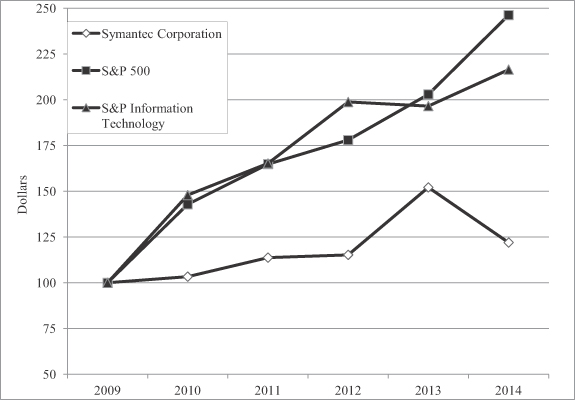
| 2009 | 2010 | 2011 | 2012 | 2013 | 2014 | |||||||||||||||||||
| Symantec Corporation | 100.00 | 103.33 | 113.74 | 115.22 | 152.06 | 121.93 | ||||||||||||||||||
| S&P 500 | 100.00 | 142.85 | 164.80 | 177.99 | 202.84 | 246.25 | ||||||||||||||||||
| S&P Information Technology | 100.00 | 147.92 | 165.20 | 198.77 | 196.53 | 216.41 |
Item 6. Selected Financial Data
The following selected consolidated financial data is derived from our Consolidated Financial Statements. This data should be read in conjunction with our Consolidated Financial Statements and related notes included in
Table of Contents
this annual report and with Item 7, Management’s Discussion and Analysis of Financial Condition and Results of Operations. Historical results may not be indicative of future results.
Five-Year Summary
| Fiscal (a) | ||||||||||||||||||||
| 2014 | 2013 | 2012 | 2011 | 2010 | ||||||||||||||||
| (In millions, except per share data) | ||||||||||||||||||||
| Consolidated Statements of Income Data: | ||||||||||||||||||||
| Net revenue | $ | 6,676 | $ | 6,906 | $ | 6,730 | $ | 6,190 | $ | 5,985 | ||||||||||
| Operating income (b) | 1,183 | 1,106 | 1,104 | 927 | 927 | |||||||||||||||
| Net income attributable to Symantec Corporation stockholders (b)(c) | $ | 898 | $ | 755 | $ | 1,187 | $ | 626 | $ | 711 | ||||||||||
| Net income per share attributable to Symantec Corporation stockholders — basic (b)(c) | $ | 1.29 | $ | 1.08 | $ | 1.60 | $ | 0.80 | $ | 0.88 | ||||||||||
| Net income per share attributable to Symantec Corporation stockholders — diluted (b)(c) | $ | 1.28 | $ | 1.06 | $ | 1.59 | $ | 0.76 | $ | 0.87 | ||||||||||
| Weighted-average shares outstanding attributable to Symantec Corporation stockholders — basic | 696 | 701 | 741 | 778 | 810 | |||||||||||||||
| Weighted-average shares outstanding attributable to Symantec Corporation stockholders — diluted | 704 | 711 | 748 | 786 | 819 | |||||||||||||||
| Cash dividends per share attributable to Symantec Corporation (g) | $ | 0.60 | $ | - | $ | - | $ | - | $ | - | ||||||||||
| Consolidated Balance Sheet Data: | ||||||||||||||||||||
| Cash and cash equivalents | $ | 3,707 | $ | 4,685 | $ | 3,162 | $ | 2,950 | $ | 3,029 | ||||||||||
| Total assets (b) | 13,539 | 14,508 | 13,158 | 12,841 | 11,317 | |||||||||||||||
| Deferred revenue | 3,322 | 3,496 | 3,444 | 3,321 | 2,835 | |||||||||||||||
| Current portion of long-term debt (d) | - | 997 | - | 596 | - | |||||||||||||||
| Long-term debt(d) (e) | 2,095 | 2,094 | 2,039 | 1,987 | 1,871 | |||||||||||||||
| Long-term deferred revenue (f) | 581 | 584 | 596 | 565 | 436 | |||||||||||||||
| Symantec Corporation stockholders’ equity (b) (f) (g) (h) | $ | 5,797 | $ | 5,476 | $ | 5,159 | $ | 4,558 | $ | 4,567 | ||||||||||
| Noncontrolling interest in subsidiary | - | - | 78 | 77 | - | |||||||||||||||
| Total stockholders’ equity (b) (f) (g) | $ | 5,797 | $ | 5,476 | $ | 5,237 | $ | 4,635 | $ | 4,567 |
| (a) | We have a 52/53-week fiscal year. Fiscal 2014, 2013, 2012, 2011, and 2010 each consisted of 52 weeks. |
|---|
| (b) | Effective March 30, 2013, we changed our accounting policy for sales commissions that are incremental and directly related to customer sales contracts in which revenue is deferred. The adoption of this accounting policy change has been applied retrospectively for all periods presented. See Note 1 of the Notes to Consolidated Financial Statements in this annual report for information regarding the change in accounting policy for sales commissions. |
|---|
| (c) | In fiscal 2008, we formed a joint venture with a subsidiary of Huawei Technologies Co., Limited (“Huawei”). In fiscal 2012, we sold our 49% ownership interest in the joint venture to Huawei for $530 million in cash. The gain of $530 million, offset by costs to sell the joint venture of $4 million, was included in gain from sale of joint venture in our fiscal 2012 Consolidated Statements of Income. |
|---|
| (d) | In the first quarter of fiscal 2007, we issued $1.0 billion in principal amount of 1.00% Convertible Senior Notes (“1.00% notes”), due in June 2013. On June 15, 2013, the principal balance on those notes matured and was settled by a cash payment of $1 billion, along with the $5 million semi-annual interest payment. In addition, we elected to pay the conversion value above par value of the 1.00% notes in cash in the amount of |
|---|
Table of Contents
| $189 million. Concurrently with the payment of the conversion value we received $189 million from the note hedge we entered into at the time of the issuance of the 1.00% notes. At the time of issuance of the 1.00% notes, we granted warrants to affiliates of certain initial purchasers of the notes whereby they had the option to purchase up to 52.7 million shares of our common stock at a price of $27.1330 per share. All the warrants expired unexercised on various dates during the second quarter of fiscal 2014 and there was no dilutive impact from the warrants on our earnings per share for fiscal 2014. |
|---|
| (e) | In fiscal 2011, we issued $350 million in principal amount of 2.75% senior notes due September 2015 (“2.75% notes due 2015”) and $750 million in principal amount of 4.20% senior notes due September 2020 (“4.20% notes”). In fiscal 2013, we issued $600 million in principal amount of 2.75% senior notes due June 2017 (“2.75% notes due 2017”) and $400 million in principal amount of 3.95% senior notes due June 2022 (“3.95% notes”). |
|---|
| (f) | See Note 1 of the Notes to Consolidated Financial Statements in this annual report for information regarding the correction of an error related to deferred revenue. The out-of-period effect on net income of correcting this error in fiscal 2014 is $22 million and the effect on Symantec Corporation stockholders’ equity as of the beginning of fiscal 2012 was $49 million. Long-term deferred revenue and Total stockholders’ equity as of fiscal 2011 and 2010 have also been adjusted. However, income statement data for fiscal years 2011 and 2010 have not been adjusted as the impact on Net income in each of these years was not material. |
|---|
| (g) | During fiscal 2014, we declared and paid common stock cash dividends. Dividends were recorded as a reduction to additional paid-in capital. No dividends or dividend equivalents were paid prior to fiscal 2014. See Note 5 of the Notes to Consolidated Financial Statements in this annual report for information regarding dividends and dividend equivalents. |
|---|
| (h) | During fiscal 2012, we recorded an impairment of $19 million as a cumulative-effect adjustment in accumulated deficit, related to an implied fair value measurement made for our former Services reporting unit upon the adoption of a new accounting standard. |
|---|
Item 7. Management’s Discussion and Analysis of Financial Condition and Results of Operations
OVERVIEW
Our business
Symantec Corporation protects the world’s information and is a global leader in security, backup and availability solutions. Our market leading products and services protect people and information in any environment – from the smallest mobile device, to the enterprise data center, to cloud-based systems. Founded in April 1982, Symantec operates one of the largest global threat-intelligence networks, and provides leading security, backup and availability solutions. The company has more than 20,000 employees in more than 50 countries. Our Internet home page is www.symantec.com. Other than the information expressly set forth in this annual report, the information contained or referred to on our website is not part of this annual report.
Fiscal calendar
We have a 52/53-week fiscal year ending on the Friday closest to March 31. Unless otherwise stated, references to years in this report relate to fiscal year and periods ended March 28, 2014, March 29, 2013 and March 30, 2012. Fiscal 2014, 2013, and 2012 each consisted of 52 weeks. Our 2015 fiscal year will consist of 53 weeks and will end on April 3, 2015.
Table of Contents
Strategy
The recent transformation of business and consumer technologies has driven pervasive mobility and an explosion of data resulting in the need for a new approach to protecting devices, applications, data and users. Further, the emergence of the Internet of Things, where new devices and everyday objects are becoming networked and connected to the Internet for the first time, highlights the need for comprehensive information security and management solutions to protect valuable data. We believe that the market for security and management solutions will benefit from these trends. As a platform-independent software company without bias to any individual operating system or hardware environment, Symantec helps customers manage more technologies with greater efficiency and on a wide range of virtual and mobile platforms.
In January 2013, we announced our strategy to transition from being device-centric or protecting endpoints and the data center, to having a broader focus of protecting and managing digital information. We track a vast number of threat indicators across the Internet and continuously collect new telemetry from hundreds of millions of mobile devices, endpoints, and servers across the globe. This massive amount of security data, combined with our years of experience analyzing such data allows us to provide advanced intelligence and protection for all of our customers.
During fiscal year 2014, we implemented changes in three areas: simplifying our organizational structure, redesigning our GTM strategy, and changing our product offerings.
Simplifying our Organizational Structure
We aligned our organization by functional areas, rather than by market segments in order to reduce complexity, remove redundancies, increase the speed of decision making, and improve accountability and execution. We reduced the number of management layers from our previous structure and increased the average span of control for managers.
Redesigning our Go-To-Market Strategy
We split our direct field sales team into security and information management specialists focused on new business only and expanded their territories to be more effective for our enterprise customers. We also built a renewals group in order to extend the customer relationship and make it easier to renew and do business with us. We redesigned our global channel strategy focused on building partner competency, rewarding performance, and customer satisfaction.
Changing our Product Offerings
With a portfolio of leading products, we focused our development efforts on making our point solutions better, designing new integrated solutions, and expanding our offerings by partnering with network security vendors to offer solutions that provide multi-tier protection.
Financial Implications of New Strategy
We have developed a three-pronged approach to our product offering strategy which includes managing our portfolio of point solutions and reallocating resources to the offerings we estimate have the greatest growth potential, expanding our total addressable market by delivering innovative new offerings that integrate our technologies to solve our customers’ most significant problems, and focusing on developing relationships with other industry leaders that will begin the process of building ecosystems that delivers more value to our customers.
We believe that sales and marketing of our innovative and differentiated products are enhanced by knowledgeable salespeople who can convey the strong value of our technology. As such, we restructured the
Table of Contents
sales organization into new and renewals business teams. We also reorganized our direct sales force into functional areas of information security and information management. The focus of these specialized teams is to generate new business through new customer acquisition or through broadening existing customer relationships. We expect that by separating our direct sales force into specialized teams and focusing on new business, we will improve the efficiency and effectiveness of our sales process. Concurrently, we created a dedicated renewals team that is focused on extending existing customer relationships and renewing contracts.
We are also investing in our indirect sales channels to build stronger, more strategic relationships that enable us to better serve consumers, small business and mid-market customers. Through our channel partner program we are seeking to align our offerings with the optimal route to market, leveraging our channel partner capabilities. We also plan to align the economics and incentives under these relationships based on the value created by the partner and their commitment to Symantec and our customers. We believe these changes will help us provide our end customer with high-quality sales and post-sales support experiences while expanding our business.
As part of our enhanced capital allocation strategy, in fiscal 2014 we initiated a quarterly cash dividend in addition to our on-going share repurchases activity. We paid a quarterly dividend in the amount of $0.15 per share of common stock in each quarter of fiscal 2014, for an aggregate of $418 million or $0.60 per share, during fiscal 2014. All shares of common stock issued and outstanding, and unvested restricted stock and performance-based stock as of the record date for any dividend will be entitled to the dividend and dividend equivalents, respectively. Any future dividends and dividend equivalents will be subject to the approval of our board of directors.
Our revenue, income and cash flows may be impacted by severance, other charges, and capital expenditures as we execute our organic growth strategy.
New enterprise resource planning system
During the third quarter of fiscal 2014, following our final testing and data conversion stages, we implemented the critical financial reporting module of a new enterprise resource planning (“ERP”) system. The costs, other than capital expenditures, associated with this first phase of implementation of the core operating systems have been recorded in operating expenses as restructuring and transition expenses.
Change in management
On March 20, 2014, the board of directors of the Company appointed board member Michael A. Brown as interim president and CEO, following the termination of Stephen M. Bennett as the Company’s president and chief executive officer. Mr. Bennett also resigned from the Company’s board of directors. This change within our management leadership team resulted in certain severance and accelerated stock based compensation expenses.
Our operating segments
Our current operating segments are strategic business units that offer different products and services distinguishe
Showing the first 8K of 90K characters. Open the full section
Item 7A. Quantitative and Qualitative Disclosures about Market Risk
We are exposed to various market risks related to fluctuations in interest rates, foreign currency exchange rates, and equity prices. We may use derivative financial instruments to mitigate certain risks in accordance with our investment and foreign exchange policies. We do not use derivatives or other financial instruments for trading or speculative purposes.
Interest rate risk
As of March 28, 2014, we had $2.10 billion in principal amount of fixed-rate senior notes outstanding, with a carrying amount of $2.10 billion and a fair value of $2.17 billion, which fair value is based on level 2 inputs of market prices for similar debt instruments and resulting yields. We have performed sensitivity analyses as of March 28, 2014 by using a modeling technique that measures the change in the fair values arising from a hypothetical 50 bps movement in the levels of interest rates across the entire yield curve, with all other variables held constant. On March 28, 2014, a hypothetical 50 bps increase or decrease in market interest rates would change the fair value of the fixed-rate senior notes by a decrease of approximately $48 million and an increase of approximately $49 million, respectively. However, this hypothetical change in interest rates would not impact the interest expense on the fixed-rate debt.
Foreign currency exchange rate risk
We conduct business in 38 currencies through our worldwide operations and, as such, we are exposed to foreign currency risk. Foreign currency risks are associated with our cash and cash equivalents, investments, receivables, and payables denominated in foreign currencies. Our exposure to foreign currency transaction gains
Table of Contents
and losses is the result of certain net receivables due from our foreign subsidiaries and customers being denominated in currencies other than the functional currency of the subsidiary, primarily the Euro and Singapore dollar. Our foreign subsidiaries conduct their businesses in local currency. We have entered into foreign exchange forward contracts with up to six months in duration, to offset the foreign exchange risk on certain monetary assets and liabilities denominated in currencies other than the functional currency of the subsidiary. We considered the historical trends in currency exchange rates and determined that it was reasonably possible that adverse changes in exchange rates for all currencies could be experienced. The estimated impacts of a five or ten percent appreciation or depreciation in value are as follows:
| Value of Contracts Given X% Appreciation of Foreign Currency | Notional Amount | Value of Contracts Given X% Depreciation of Foreign Currency | ||||||||||||||||||
| Foreign Forward Exchange Contracts | 10% | 5% | (5)% | (10)% | ||||||||||||||||
| (Dollars in millions) | ||||||||||||||||||||
| Purchased, March 28, 2014 | $ | 168 | $ | 161 | $ | 154 | $ | 146 | $ | 137 | ||||||||||
| Sold, March 28, 2014 | $ | 218 | $ | 228 | $ | 240 | $ | 252 | $ | 266 |
We do not use derivative financial instruments for speculative trading purposes, nor do we hedge our foreign currency exposure in a manner that entirely offsets the effects of the changes in foreign exchange rates.
Item 8. Financial Statements and Supplementary Data
Annual financial statements
The Consolidated Financial Statements and related disclosures included in Part IV, Item 15 of this annual report are incorporated by reference into this Item 8.
Selected quarterly financial data
| Fiscal 2014 | Fiscal 2013 | |||||||||||||||||||||||||||||||
| Mar. 28, 2014 | Dec. 27, 2013 | Sep. 27, 2013 | Jun. 28, 2013 | Mar. 29, 2013 | Dec. 28, 2012 | Sep. 28, 2012 | Jun. 29, 2012 | |||||||||||||||||||||||||
| (In millions, except per share data) | ||||||||||||||||||||||||||||||||
| Net revenue | $ | 1,625 | $ | 1,705 | $ | 1,637 | $ | 1,709 | $ | 1,748 | $ | 1,791 | $ | 1,699 | $ | 1,668 | ||||||||||||||||
| Gross profit | 1,343 | 1,422 | 1,353 | 1,409 | 1,440 | 1,492 | 1,415 | 1,384 | ||||||||||||||||||||||||
| Operating income | 306 | 405 | 248 | 224 | 255 | 304 | 297 | 250 | ||||||||||||||||||||||||
| Net income | 217 | 283 | 241 | 157 | 190 | 216 | 189 | 160 | ||||||||||||||||||||||||
| Less: Income (loss) attributable to noncontrolling interest | - | - | - | - | - | - | - | - | ||||||||||||||||||||||||
| Net income attributable to Symantec Corporation stockholders | $ | 217 | $ | 283 | $ | 241 | $ | 157 | $ | 190 | $ | 216 | $ | 189 | $ | 160 | ||||||||||||||||
| Net income per share attributable to Symantec Corporation stockholders — basic | $ | 0.31 | $ | 0.41 | $ | 0.34 | $ | 0.23 | $ | 0.27 | $ | 0.31 | $ | 0.27 | $ | 0.22 | ||||||||||||||||
| Net income per share attributable to Symantec Corporation stockholders — diluted | $ | 0.31 | $ | 0.40 | $ | 0.34 | $ | 0.22 | $ | 0.27 | $ | 0.31 | $ | 0.27 | $ | 0.22 |
Table of Contents
Item 9. Changes in and Disagreements with Accountants on Accounting and Financial Disclosure
None.
Item 9A. Controls and Procedures
| a) | Evaluation of Disclosure Controls and Procedures |
|---|
The SEC defines the term “disclosure controls and procedures” to mean a company’s controls and other procedures that are designed to ensure that information required to be disclosed in the reports that it files or submits under the Exchange Act is recorded, processed, summarized, and reported, within the time periods specified in the SEC’s rules and forms. “Disclosure controls and procedures” include, without limitation, controls and procedures designed to ensure that information required to be disclosed by an issuer in the reports that it files or submits under the Exchange Act is accumulated and communicated to the issuer’s management, including its principal executive and principal financial officers, or persons performing similar functions, as appropriate to allow timely decisions regarding required disclosure. Our disclosure controls and procedures are designed to provide reasonable assurance that such information is accumulated and communicated to our management. Our management (with the participation of our interim Chief Executive Officer and Chief Financial Officer) has conducted an evaluation of the effectiveness of our disclosure controls and procedures (as defined in Rules 13a-15(e) and 15d-15(e) of the Securities Exchange Act). Based on such evaluation, our interim Chief Executive Officer and our Chief Financial Officer have concluded that our disclosure controls and procedures were effective at the reasonable assurance level as of the end of the period covered by this report.
| b) | Management’s Report on Internal Control over Financial Reporting |
|---|
Our management is responsible for establishing and maintaining adequate internal control over financial reporting (as defined in Rules 13a-15(f) and 15d-15(f) of the Exchange Act) for Symantec. Our management, with the participation of our interim Chief Executive Officer and our Chief Financial Officer, has conducted an evaluation of the effectiveness of our internal control over financial reporting as of March 28, 2014, based on criteria established in Internal Control — Integrated Framework (1992) issued by the Committee of Sponsoring Organizations of the Treadway Commission (“COSO”).
Our management has concluded that, as of March 28, 2014, our internal control over financial reporting was effective based on these criteria.
The Company’s independent registered public accounting firm has issued an attestation report regarding its assessment of the Company’s internal control over financial reporting as of March 28, 2014, which is included in Part IV, Item 15 of this annual report.
| c) | Changes in Internal Control over Financial Reporting |
|---|
There were no changes in our internal control over financial reporting during the quarter ended March 28, 2014 that have materially affected, or are reasonably likely to materially affect, our internal control over financial reporting.
| d) | Limitations on Effectiveness of Controls |
|---|
Our management, including our interim Chief Executive Officer and Chief Financial Officer, does not expect that our disclosure controls and procedures or our internal controls will prevent all errors and all fraud. A control system, no matter how well conceived and operated, can provide only reasonable, not absolute, assurance that the objectives of the control system are met. Further, the design of a control system must reflect the fact that there are resource constraints, and the benefits of controls must be considered relative to their costs. Because of
Table of Contents
the inherent limitations in all control systems, no evaluation of controls can provide absolute assurance that all control issues and instances of fraud, if any, within our company have been detected.
Item 9B. Other Information
Item 10. Directors, Executive Officers and Corporate Governance
The information required by this item will be included in an amendment to this annual report on Form 10-K or incorporated by reference from Symantec’s definitive proxy statement to be filed pursuant to Regulation 14A.
Item 11. Executive Compensation
The information required by this item will be included in an amendment to this annual report on Form 10-K or incorporated by reference from Symantec’s definitive proxy statement to be filed pursuant to Regulation 14A.
Item 12. Security Ownership of Certain Beneficial Owners and Management and Related Stockholder Matters
The information required by this item will be included in an amendment to this annual report on Form 10-K or incorporated by reference from Symantec’s definitive proxy statement to be filed pursuant to Regulation 14A.
Item 13. Certain Relationships and Related Transactions, and Director Independence
The information required by this item will be included in an amendment to this annual report on Form 10-K or incorporated by reference from Symantec’s definitive proxy statement to be filed pursuant to Regulation 14A.
Item 14. Principal Accountant Fees and Services
The information required by this item will be included in an amendment to this annual report on Form 10-K or incorporated by reference from Symantec’s definitive proxy statement to be filed pursuant to Regulation 14A.
Table of Contents
PART IV
Item 15. Exhibits, Financial Statement Schedules
Upon written request, we will provide, without charge, a copy of this annual report, including the Consolidated Financial Statements and financial statement schedule. All requests should be sent to:
Symantec Corporation
Attn: Investor Relations
350 Ellis Street
Mountain View, California 94043
650-527-8000
The following documents are filed as part of this report:
| Page Number | ||||
| 1. | Consolidated Financial Statements: | |||
| Report of Independent Registered Public Accounting Firm | 56 | |||
| Consolidated Balance Sheets as of March 28, 2014 and March 29, 2013 | 57 | |||
| Consolidated Statements of Income for the years ended March 28, 2014, March 29, 2013 and March 30, 2012 | 58 | |||
| Consolidated Statements of Comprehensive Income for the years ended March 28, 2014, March 29, 2013 and March 30, 2012 | 59 | |||
| Consolidated Statements of Stockholders’ Equity for the years ended March 28, 2014, March 29, 2013 and March 30, 2012 | 60 | |||
| Consolidated Statements of Cash Flows for the years ended March 28, 2014, March 29, 2013 and March 30, 2012 | 61 | |||
| Notes to Consolidated Financial Statements | 62 | |||
| 2. | Financial Statement Schedule: The following financial statement schedule of Symantec Corporation for the years ended March 28, 2014, March 29, 2013 and March 30, 2012 is filed as part of this Form 10-K and should be read in conjunction with the Consolidated Financial Statements of Symantec Corporation | |||
| Schedule II: Valuation and Qualifying Accounts | 97 | |||
| Schedules other than those listed above have been omitted since they are either not required, not applicable, or the information is otherwise included. | ||||
| 3. | Exhibits: The information required by this Item is set forth in the Exhibit Index that follows the signature page of this Annual Report. |
Table of Contents
REPORT OF INDEPENDENT REGISTERED PUBLIC ACCOUNTING FIRM
The Board of Directors and Stockholders
Symantec Corporation:
We have audited the accompanying consolidated balance sheets of Symantec Corporation and subsidiaries as of March 28, 2014 and March 29, 2013, and the related consolidated statements of income, comprehensive income, stockholders’ equity, and cash flows for each of the years in the three-year period ended March 28, 2014. In connection with our audits of the consolidated financial statements, we have also audited the related financial statement schedule listed in Item 15. We also have audited the internal control over financial reporting of Symantec Corporation as of March 28, 2014, based on criteria established in Internal Control – Integrated Framework (1992) issued by the Committee of Sponsoring Organizations of the Treadway Commission (COSO). Management of Symantec Corporation is responsible for these consolidated financial statements, the financial statement schedule, for maintaining effective internal control over financial reporting, and for its assessment of the effectiveness of internal control over financial reporting, included in Management’s Report on Internal Control over Financial Reporting appearing under Item 9A.b). Our responsibility is to express an opinion on these consolidated financial statements, the financial statement schedule and an opinion on the internal control over financial reporting of Symantec Corporation based on our audits.
We conducted our audits in accordance with the standards of the Public Company Accounting Oversight Board (United States). Those standards require that we plan and perform the audits to obtain reasonable assurance about whether the financial statements are free of material misstatement and whether effective internal control over financial reporting was maintained in all material respects. Our audits of the consolidated financial statements included examining, on a test basis, evidence supporting the amounts and disclosures in the financial statements, assessing the accounting principles used and significant estimates made by management, and evaluating the overall financial statement presentation. Our audit of internal control over financial reporting included obtaining an understanding of internal control over financial reporting, assessing the risk that a material weakness exists, and testing and evaluating the design and operating effectiveness of internal control based on the assessed risk. Our audits also included performing such other procedures as we considered necessary in the circumstances. We believe that our audits provide a reasonable basis for our opinions.
A company’s internal control over financial reporting is a process designed to provide reasonable assurance regarding the reliability of financial reporting and the preparation of financial statements for external purposes in accordance with generally accepted accounting principles. A company’s internal control over financial reporting includes those policies and procedures that (1) pertain to the maintenance of records that, in reasonable detail, accurately and fairly reflect the transactions and dispositions of the assets of the company; (2) provide reasonable assurance that transactions are recorded as necessary to permit preparation of financial statements in accordance with generally accepted accounting principles, and that receipts and expenditures of the company are being made only in accordance with authorizations of management and directors of the company; and (3) provide reasonable assurance regarding prevention or timely detection of unauthorized acquisition, use, or disposition of the company’s assets that could have a material effect on the financial statements.
Because of its inherent limitations, internal control over financial reporting may not prevent or detect misstatements. Also, projections of any evaluation of effectiveness to future periods are subject to the risk that controls may become inadequate because of changes in conditions, or that the degree of compliance with the policies or procedures may deteriorate.
In our opinion, the consolidated financial statements referred to above present fairly, in all material respects, the financial position of Symantec Corporation and subsidiaries as of March 28, 2014 and March 29, 2013, and the results of their operations and their cash flows for each of the years in the three-year period ended March 28, 2014, in conformity with U.S. generally accepted accounting principles. Also in our opinion, the related financial statement schedule, when considered in relation to the basic consolidated financial statements taken as a whole, presents fairly, in all material respects, the information set forth therein. Also in our opinion, Symantec Corporation maintained, in all material respects, effective internal control over financial reporting as of March 28, 2014, based on criteria established in Internal Control – Integrated Framework (1992) issued by the Committee of Sponsoring Organizations of the Treadway Commission (COSO).
As discussed in Note 1 to the consolidated financial statements, Symantec Corporation has elected to change its method of accounting for sales commissions. The adoption of this accounting policy change has been applied retrospectively to all periods presented.
/s/ KPMG LLP
Santa Clara, California
May 16, 2014
Table of Contents
SYMANTEC CORPORATION
CONSOLIDATED BALANCE SHEETS
| March 28, 2014 | March 29, 2013 | |||||||
| (In millions, except par value) | ||||||||
| ASSETS | ||||||||
| Current assets: | ||||||||
| Cash and cash equivalents | $ | 3,707 | $ | 4,685 | ||||
| Short-term investments | 37 |
Showing the first 8K of 180K characters. Open the full section