 filings.tools
Gen Digital 10-K 2015-04-03
Filed 2015-05-22. 21 sections, 344K characters. Original on sec.gov · Markdown · JSON
Cover and table of contents
10-K 1 symc4315-10k.htm 10-K
UNITED STATES SECURITIES AND EXCHANGE COMMISSION
Washington, D.C. 20549
Form 10-K
(Mark One)
| þ | ANNUAL REPORT PURSUANT TO SECTION 13 OR 15(d) OF THE SECURITIES EXCHANGE ACT OF 1934 |
For the Fiscal Year Ended April 3, 2015
or
| o | TRANSITION REPORT PURSUANT TO SECTION 13 OR 15(d) OF THE SECURITIES EXCHANGE ACT OF 1934 |
For the Transition Period from to
Commission File Number 000-17781
Symantec Corporation
(Exact name of the registrant as specified in its charter)
| Delaware | 77-0181864 | |
| (State or other jurisdiction of incorporation or organization) | (I.R.S. employer Identification no.) | |
| 350 Ellis Street, | ||
| Mountain View, California | 94043 | |
| (Address of principal executive offices) | (zip code) |
Registrant’s telephone number, including area code:
(650) 527-8000
Securities registered pursuant to Section 12(b) of the Act:
| Common Stock, par value $0.01 per share (Title of each class) | The NASDAQ Stock Market LLC (Name of each exchange on which registered) |
Securities registered pursuant to Section 12(g) of the Act:
None
(Title of class)
Indicate by check mark if the registrant is a well-known seasoned issuer, as defined in Rule 405 of the Securities Act. Yes þ No o
Indicate by check mark if the registrant is not required to file reports pursuant to Section 13 or 15(d) of the Exchange Act. Yes o No þ
Indicate by check mark whether the registrant (1) has filed all reports required to be filed by Section 13 or 15(d) of the Securities Exchange Act of 1934 during the preceding 12 months (or for such shorter period that the registrant was required to file such reports), and (2) has been subject to such filing requirements for the past 90 days. Yes þ No o
Indicate by check mark whether the registrant has submitted electronically and posted on its corporate Web site, if any, every Interactive Data File required to be submitted and posted pursuant to Rule 405 of Regulation S-T (§ 232.405 of this chapter) during the preceding 12 months (or for such shorter period that the registrant was required to submit and post such files). Yes þ No o
Indicate by check mark if disclosure of delinquent filers pursuant to Item 405 of Regulation S-K is not contained herein, and will not be contained, to the best of registrant’s knowledge, in definitive proxy or information statements incorporated by reference in Part III of this Form 10-K or any amendment to this Form 10-K. þ
Indicate by check mark whether the registrant is a large accelerated filer, an accelerated filer, a non-accelerated filer, or a smaller reporting company. See the definitions of “large accelerated filer,” “accelerated filer” and “smaller reporting company” in Rule 12b-2 of the Exchange Act. (Check one):
| Large accelerated filer þ | Accelerated filer o | Non-accelerated filer o | Smaller reporting company o | |||
| (Do not check if a smaller reporting company) |
Indicate by check mark whether the registrant is a shell company (as defined in Rule 12b-2 of the Exchange Act). Yes o No þ
Aggregate market value of the voting stock held by non-affiliates of the registrant, based upon the closing sale price of Symantec common stock on October 3, 2014 as reported on the NASDAQ Global Select Market: $16,119,850,545.
Number of shares outstanding of the registrant’s common stock as of May 1, 2015: 680,727,932
DOCUMENTS INCORPORATED BY REFERENCE
The information called for by Part III will be included in an amendment to this Form 10-K or incorporated by reference from the registrant’s definitive Proxy Statement to be filed pursuant to Regulation 14A.
SYMANTEC CORPORATION
FORM 10-K
For the Fiscal Year Ended April 3, 2015
TABLE OF CONTENTS
“Symantec,” “we,” “us,” “our,” and “the Company” refer to Symantec Corporation and all of its subsidiaries. Symantec, the Symantec Logo, Norton, and Veritas are trademarks or registered trademarks of Symantec in the United States (“U.S.”) and other countries. Other names may be trademarks of their respective owners.
FORWARD-LOOKING STATEMENTS AND FACTORS THAT MAY AFFECT FUTURE RESULTS
The discussion below contains forward-looking statements, which are subject to safe harbors under the Securities Act of 1933, as amended (the “Securities Act”) and the Exchange Act of 1934, as amended (the “Exchange Act”). Forward-looking statements include references to our ability to utilize our deferred tax assets, as well as statements including words such as “expects,” “plans,” “anticipates,” “believes,” “estimates,” “predicts,” “projects,” and similar expressions. In addition, statements that refer to our plans to distribute shares of our information management business to shareholders, projections of our future financial performance, anticipated growth and trends in our businesses and in our industries, the anticipated impacts of acquisitions, our intent to pay quarterly cash dividends in the future, the actions we intend to take as part of our new strategy, the expected impact of our new strategy and other characterizations of future events or circumstances are forward-looking statements. These statements are only predictions, based on our current expectations about future events and may not prove to be accurate. We do not undertake any obligation to update these forward-looking statements to reflect events occurring or circumstances arising after the date of this report. These forward-looking statements involve risks and uncertainties, and our actual results, performance, or achievements could differ materially from those expressed or implied by the forward-looking statements on the basis of several factors, including those that we discuss under Item 1A, Risk Factors. We encourage you to read that section carefully.
PART I
Item 1. Business
Overview
Symantec Corporation is a global leader in security, backup and availability solutions. Our market leading products and services protect people and information in any environment – from the mobile device in your pocket, to the enterprise data center, to cloud-based systems. Founded in April 1982, Symantec operates one of the largest global threat-intelligence networks. The company has more than 19,000 employees in more than 50 countries. Our Internet home page is www.symantec.com.
Strategy
In our security business, we operate a global civilian cyber intelligence threat network and track a vast number of threats across the Internet from hundreds of millions of mobile devices, endpoints, and servers across the globe. We believe one of our competitive advantages is our database of threat indicators which allows us to reduce the number of false positives and provide faster and better protection for customers through our products. We are leveraging our capabilities in threat protection and data loss prevention and extending them into our core security offerings. We are also pioneering new solutions in growing markets like cloud, advanced threat protection, information protection and cyber security services.
Our security strategy is to leverage our unique assets to provide best-in-class consumer and enterprise security products; deliver a unified security analytics platform that provides big data analytics, utilizes our vast telemetry, provides visibility into real-time global threats, and powers Symantec and third-party security analytics applications; and offer cyber security services that provide a full-suite of services from monitoring to incident response to threat intelligence supported by over 500 cyber security experts and nine global threat centers.
In our information management business, with a global installed customer base, we have a comprehensive portfolio that spans backup and recovery, storage management and archiving. Our information availability offerings help customers keep their data and systems available where they need them, when they need them, and irrespective of their location. Our information insight solutions help customers know what data they have and leverage that knowledge to help manage such data better and inform strategic decisions.
Our information management product strategy is to expand our best-in-class foundational portfolio across backup, storage management, business continuity, archiving and eDiscovery through software, integrated appliances and the cloud; deliver next-generation availability solutions through a coordinated orchestration architecture focused on managing and moving mission-critical data in a hybrid cloud world; and enable next-generation insight solutions that provide visibility, action, and automated control across an organization’s information landscape through an intelligent information fabric that integrates our portfolio and third-party ecosystems.
In fiscal 2015, we focused on five priorities: running our businesses with a portfolio approach by managing certain businesses for operating margin; prioritizing investments for growth; further reducing costs and improving efficiencies; attracting top talent to our executive team; and continuing to return significant cash to shareholders. We are optimizing some of our businesses by methodically evaluating every product line to balance our profitability targets against our objectives. In order to prioritize investments for growth, we are realigning our research and development budgets to apply the best resources to the most promising market opportunities. To further reduce costs and improve efficiencies, we are consolidating our global footprint, data centers and product support capabilities as well as streamlining the way we run our businesses with initiatives to increase research and development efficiencies and sales productivity. We are focused on continuing to attract talented business and technology leaders to the company. We remain committed to returning significant cash to shareholders in the form of dividends and share buybacks.
The Planned Separation of Information Management from the Security Business
On October 9, 2014, we announced plans to separate our business into two independent publicly-traded companies: one focused on security and one focused on information management. The transaction is intended to take the form of a tax-free distribution to Symantec shareholders of all of the capital stock of our information management business. We expect to complete the legal separation on January 2, 2016, subject to market, regulatory and certain other conditions. John Gannon has been appointed as General Manager of the information management business, and Don Rath has been appointed as acting Chief Financial Officer. After the transaction, Michael Brown and Thomas Seifert will continue to lead Symantec as Chief Executive Officer and Chief Financial Officer, respectively. For additional separation cost information, see Note 6 of the Notes to Consolidated Financial Statements included in this annual report.
Business Highlights
During fiscal 2015, we took the following actions in support of our business:
| • | We announced plans to separate our business into two independent publicly-traded companies: one focused on security and one focused on information management. |
| • | We released new products and services. |
| ◦ | In Information Management, we launched our NetBackup 5330 appliance, which delivers twice the performance and capacity of our prior models, making the management of information simpler and less expensive; and we released Backup Exec 2014, which delivers powerful, flexible, and easy-to-use backup and recovery to protect a customer’s physical, virtual, or hybrid environment for a mixture of applications and operating systems. |
| ◦ | In Consumer Security, we simplified our product portfolio by streamlining our core products into a single Norton Security offering. |
| ◦ | In Enterprise Security, we launched our managed advanced threat protection service, which helps customers triangulate threat indicators from our endpoint protection and third-party security products to provide more comprehensive threat detection. We also introduced our managed incident response service, which provides emergency on-demand service to help customers recover from a breach. In addition, we introduced our managed adversary and threat intelligence service, which offers customers a deeper understanding of specific threat actors and attacks. |
| • | We hired five new executives, who bring valuable skills in analytics, backup and recovery software, sales, security, strategy, and human resources. |
| • | We remained committed to a capital allocation strategy pursuant to which we expect to return over time approximately 50% of free cash flow to stockholders through a combination of dividends and share repurchases, while still enabling our company to invest in its future. As part of this program we paid quarterly cash dividends of $0.15 per share of common stock in fiscal 2015, paying out a total of $413 million to shareholders. |
| • | Our Board of Directors approved an additional $1.0 billion stock repurchase program in February 2015. This program does not have an expiration date. During fiscal 2015, we repurchased 21 million shares of our common stock for an aggregate amount of $500 million, and $1.2 billion remains authorized for future repurchases. |
Operating Segments and Products
Our operating segments are significant strategic business units that offer different products and services distinguished by customer needs. In the second quarter of fiscal 2015, we modified our segment reporting structure to match our new operating structure. The three reporting segments, which are the same as our operating segments, are: Consumer Security, Enterprise Security, and Information Management.
Consumer Security
Our Consumer Security segment focuses on making it simple for customers to be productive and protected at home and at work. Our Norton-branded services provide multi-layer security and identity protection on major desktop and mobile operating systems, to defend against increasingly complex online threats to individuals, families, and small businesses.
Our Norton products help customers protect against increasingly complex threats and address the need for identity protection, while also managing the rapid increase in mobile and digital data, such as personal financial records, photos, music, and videos.
Enterprise Security
Our Enterprise Security segment protects organizations so they can securely conduct business while leveraging new platforms and data. These products include Secure Socket Layer (“SSL”) Certificates, authentication, mail and web security, data center security, data loss prevention, information security services, endpoint security and management, encryption, and mobile security offerings.
These products and services help our customers secure their confidential information wherever it resides in the network path, from the user’s device to the data’s resting place. In doing so, these products protect customer data from sophisticated threats such as advanced protection threats, malicious spam and phishing attacks, malware, drive-by website infections, hackers, and cyber criminals. In addition, these products help to prevent the loss of confidential data by insiders, and help customers achieve compliance with laws and regulations. Our enterprise endpoint security and management offerings support the evolving endpoint, providing advanced threat protection while helping reduce cost and complexity. These solutions are delivered through various methods, such as software, appliance, SaaS, and managed services.
Information Management
Our Information Management segment focuses on backup and recovery, archiving and eDiscovery, storage and high availability solutions, helping to ensure that our customers’ IT infrastructure and mission-critical applications are protected, managed and available.
Our products enable customers to reduce cost and complexity as we improve the way information is managed through the ever-evolving cloud and virtualized environments. Our products are designed to ensure successful backup, recovery, availability, eDiscovery and archiving of information, applications, and systems for organizations ranging from small businesses to large enterprises.
Financial Information by Segment and Geographic Region
For information regarding our revenue by segment, revenue by geographical area, and property and equipment by geographical area, see Note 9 of the Notes to Consolidated Financial Statements in this annual report. For information regarding the amount and percentage of our revenue contributed by each of our segments and our financial information, including information about geographic areas in which we operate, see Item 7, Management’s Discussion and Analysis of Financial Condition and Results of Operations and Note 9 of the Notes to Consolidated Financial Statements in this annual report. For information regarding risks associated with our international operations, see Item 1A, Risk Factors.
Sales and Go-To-Market Strategy
Our go-to-market ("GTM") network includes direct sales forces and broad eCommerce capabilities, as well as indirect sales resources that support our global partner ecosystem. We also maintain important relationships with a number of Original Equipment Manufacturers (“OEMs”), Internet Service Providers (“ISPs”), and retail and online stores by which we market and sell our products.
Our dedicated renewals team remains focused on extending customer relationships and renewing our contracts. We also continued to streamline our indirect sales strategy to have fewer, more focused partners with specialized partner programs to enhance sales. We believe these changes provide customers with a high-quality sales and post-sales support experience, while also enabling us to expand our business.
Consumer and Small Business
We sell our consumer products and services to individuals, households and small businesses globally. We bring these products to market through our eCommerce platform, distributors, direct marketers, Internet-based resellers, system builders, ISPs, wireless carriers, and retailers worldwide. We also have a limited number of partnerships with OEMs globally to distribute our Internet security and online backup offerings.
Commercial
We sell and market our products and related services to small, medium and large enterprise customers through field sales and inside sales leveraging indirect sales partners around the world who are specifically trained and certified to sell our solutions. These partners include national solution providers, regional solution providers, national account resellers, global/federal system integrators and managed service providers. Our products are also available on our eCommerce platform, as well as through authorized distributors and OEMs who incorporate our technologies into their products, bundle our products with their offerings, or serve as authorized resellers of our products.
Enterprise
We sell and market our products and related services to large enterprises, including government and public sector customers, through our field sales force. This field sales team is responsible for approximately 2,000 named accounts around the world, leveraging our global partner ecosystem primarily targeting senior executives and IT department personnel responsible for managing a company’s highest-order IT initiatives.
Research and Development
Symantec embraces a global research and development (“R&D”) strategy to drive organic innovation. Engineers and researchers throughout the Company pursue advanced projects to translate R&D into customer solutions by creating new technologies and integrating our unique set of technology assets. Symantec focuses on short, medium, and long-term applied research, develops new products in emerging areas, participates in government-funded research projects, drives industry standards, and partners with universities to conduct research supporting Symantec’s strategy.
Symantec’s Security Technology and Response organization consists of a global team of security engineers, threat analysts, and researchers and provides the underlying functionality, content, and support for many of our consumer, small business and enterprise security products. Our security experts monitor malicious code reports collected through the Global Intelligence Network, one of the largest in the world, to provide insight into emerging attacks, malicious code activity, phishing, spam, and other threats. The team uses this vast amount of data and insights to develop new technologies and approaches, such as
Symantec’s reputation-based security technology and our forthcoming unified security analytics platform, to protect customer information.
Research and development expenses were $1,144 million, $1,039 million, and $1,026 million in fiscal 2015, 2014, and 2013, respectively, representing approximately 18% of revenue in fiscal 2015 and 16% and 15% of revenue in fiscal 2014 and 2013, respectively. The percentage fluctuates between periods as a result of a variety of factors, including changes in sales level and foreign currency exchange rates. We believe that technical leadership is essential to our success and we expect to continue to commit substantial resources to R&D.
Support
Symantec has support facilities throughout the world, staffed by technical product experts knowledgeable in the operating environments in which our products are deployed. Our technical support experts assist customers with issue resolution and threat detection.
We provide consumers with various levels of support offerings. Consumers receive automatic downloads of the latest virus definitions, application bug fixes, and patches for most of our consumer products. Our consumer support program provides self-help online services and phone, chat, and email support to consumers worldwide, and our Norton Security products come with a “Virus Protection Promise,” which in some markets provides free virus removal services to customers whose protected computers become infected.
We provide customers various levels of enterprise support offerings. Our enterprise security support program offers annual maintenance support contracts, including content, upgrades, and technical support. Our standard technical support includes: self-service options delivered by telephone or electronically during the contracted-for hours, immediate patches for severe problems, periodic software updates, and access to our technical knowledge base and frequently asked questions.
Customers
In fiscal 2015, 2014 and 2013, there were no customers that accounted for more than 10% of our total net revenue.
Acquisitions
Our strategy will be complemented by business combinations that fit strategically and meet specific profitability hurdles. Our acquisitions are designed to enhance the features and functionality of our existing products and extend our product leadership in core markets. We consider time-to-market, synergies with existing products, and potential market share gains when evaluating the economics of acquisitions of technologies, product lines, or companies. We may acquire or dispose of other technologies, products, and companies in the future.
We did not make any material acquisitions during fiscal 2015.
Competition
Our markets are consolidating, highly competitive, and subject to rapid changes in technology. The competitive landscape has changed significantly over the past few years, with new competition arising. Much of the market growth has come from startups whose focus is on solving a specific customer issue or delivering a specific niche-oriented product and from larger integration providers that increasingly are looking to put various types of protection, whether it is backup, high availability or security, into their platforms. We are focused on delivering comprehensive customer solutions, integrating across our broad product portfolio and partnering with other technology providers to differentiate ourselves from the competition. We believe that the principal competitive factors necessary to be successful in our industry include product quality and effectiveness, time-to-market, price, reputation, financial stability, breadth of product offerings, customer support, brand recognition, and effective sales and marketing efforts.
In addition to the competition we face from direct competitors, we face indirect or potential competition from retailers, application providers, operating system providers, network equipment manufacturers, and other OEMs who may provide various solutions and functions in their current and future products. We also compete for access to retail distribution channels and for spending at the retail level and in corporate accounts. In addition, we compete with other software companies, operating system providers, network equipment manufacturers, and other OEMs to acquire technologies, products, or companies and to publish software developed by third parties. We also compete with other software companies in our effort to place our products on the computer equipment sold to consumers and enterprises by OEMs.
The competitive environments for our security and information management products are described below.
Security
Most of the channels in which our security products are offered are highly competitive. Some of our consumer competitors are intensely focused on customer acquisition, which has led competitors to offer their technology for free, engage in aggressive marketing, or enter into competitive partnerships. Our primary security competitors are Intel Corporation, Microsoft Corporation (“Microsoft”), and Trend Micro Inc. There are also several freeware providers and regional security companies
that we compete against. For our consumer backup offerings, our primary competitors are Carbonite, Inc. and EMC Corporation (“EMC”). In the SSL market, our primary competitors are Comodo Group, Inc. and GoDaddy.com, Inc. In the Software-as-a-Service (“SaaS”) security market, our primary competitors are Google Inc. and Microsoft. Our primary competitors in the managed security services business are Dell Inc., IBM Corporation ("IBM"), and Hewlett-Packard Company ("HP").
Information Management
The markets for storage management, backup, archiving, and eDiscovery are intensely competitive. Our primary competitors are CommVault Systems, Inc., EMC, HP and IBM.
Intellectual Property
Protective Measures
We regard some of the features of our internal operations, software, and documentation as proprietary and rely on copyright, patent, trademark and trade secret laws, confidentiality procedures, contractual arrangements, and other measures to protect our proprietary information. Our intellectual property is an important and valuable asset that enables us to gain recognition for our products, services, and technology and enhance our competitive position.
As part of our confidentiality procedures, we generally enter into non-disclosure agreements with our employees, distributors, and corporate partners and we enter into license agreements with respect to our software, documentation, and other proprietary information. These license agreements are generally non-transferable and have either a perpetual or subscription based time limited term. We also educate our employees on trade secret protection and employ measures to protect our facilities, equipment, and networks.
Trademarks, Patents, Copyrights, and Licenses
Symantec and the Symantec logo are trademarks or registered trademarks in the U.S. and other countries. In addition to Symantec and the Symantec logo, we have used, registered, or applied to register other specific trademarks and service marks to help distinguish our products, technologies, and services from those of our competitors in the U.S. and foreign countries and jurisdictions. We enforce our trademark, service mark, and trade name rights in the U.S. and abroad. The duration of our trademark registrations varies from country to country, and in the U.S. we generally are able to maintain our trademark rights and renew any trademark registrations for as long as the trademarks are in use.
We have more than 2,700 patents, in addition to foreign patents and pending U.S. and foreign patent applications, which relate to various aspects of our products and technology. The duration of our patents is determined by the laws of the country of issuance and for the U.S. is typically 17 years from the date of issuance of the patent or 20 years from the date of filing of the patent application resulting in the patent, which we believe is adequate relative to the expected lives of our products.
Our products are protected under U.S. and international copyright laws and laws related to the protection of intellectual property and proprietary information. We take measures to label such products with the appropriate proprietary rights notices, and we actively enforce such rights in the U.S. and abroad. However, these measures may not provide sufficient protection, and our intellectual property rights may be challenged. In addition, we license some intellectual property from third parties for use in our products, and generally must rely on the third party to protect the licensed intellectual property rights. While we believe that our ability to maintain and protect our intellectual property rights is important to our success, we also believe that our business as a whole is not materially dependent on any particular patent, trademark, license, or other intellectual property right.
Seasonality
As is typical for many large technology companies, our business is seasonal. License and maintenance orders are generally higher in our third and fourth fiscal quarters and lower in our first and second fiscal quarters. A decline in license and maintenance orders is typical in the first quarter of our fiscal year as compared to license and maintenance orders in the fourth quarter of the prior fiscal year. In addition, we generally receive a higher volume of license and maintenance orders in the last month of a quarter, with orders concentrated in the latter part of that month. We believe that this seasonality primarily reflects customer spending patterns and budget cycles, as well as the impact of compensation incentive plans for our sales personnel. Revenue generally reflects similar seasonal patterns but to a lesser extent than orders because revenue is not recognized until an order is shipped or services are performed and other revenue recognition criteria are met, and because a significant portion of our in-period revenue comes from our deferred revenue balance.
Employees
As of April 3, 2015, we employed more than 19,000 people worldwide, approximately 44% of whom reside in the U.S. Approximately 6,100 employees work in sales and marketing, 6,700 in research and development, 4,900 in support and services, and 1,900 in management, manufacturing, and administration.
Available Information
Our Internet address is www.symantec.com. We make available free of charge our annual reports on Form 10-K, quarterly reports on Form 10-Q, current reports on Form 8-K, and amendments to those reports as soon as reasonably practicable after we electronically file such material with the Securities and Exchange Commission (“SEC”) on our investor relations website located at www.symantec.com/invest. The information contained, or referred to, on our website is not part of this annual report unless expressly noted. The SEC maintains a website that contains reports, proxy and information statements, and other information regarding our filings at http://www.sec.gov. In addition, you may read and copy any filing that we make with the SEC at the public reference room maintained by the SEC, located at 100 F Street, N.E., Washington, D.C. 20549. Please call the SEC at 1-800-SEC-0330 for further information about the public reference room.
Item 1A. Risk Factors
A description of the risk factors associated with our business is set forth below. The list is not exhaustive and you should carefully consider these risks and uncertainties before investing in our common stock.
If we are unsuccessful at addressing our business challenges, our business and results of operations may be adversely affected and our ability to invest in and grow our business could be limited.
For the last few years, we have experienced a number of transitions as we have attempted to revitalize our business model, improve execution, and innovate new products and services. These transitions have involved significant turnover in management and other key personnel, changes in our strategic direction and, more recently, our decision to separate into two independent publicly-traded companies. Transitions of the order we have experienced or are experiencing can be disruptive and result in loss of institutional focus and employee morale, making execution of business strategies more difficult. We are also in the process of seeking to address the challenges of dynamic and accelerating market trends, such as the decline in the PC market, the market shift towards tablets within mobility and architectural shifts in the provision of security and storage solutions, all of which has made it more difficult for us to compete effectively and requires us to improve our product and service offerings. We may experience delays in the anticipated timing of activities related to our efforts to address these challenges and higher than expected or unanticipated execution costs. In addition, we are vulnerable to increased risks associated with these efforts given our multiple business units, the proposed separation and the broad range of geographic regions in which we and our customers and partners operate. If we do not succeed in these efforts, or if these efforts are more costly or time-consuming than expected, our business and results of operations may be adversely affected, which could limit our ability to invest in and grow our business.
We are pursuing a plan to separate our information management business into a new, independent publicly-traded company. The proposed separation may not be completed on the currently contemplated timeline or at all and, if completed, may not achieve the intended benefits.
In October 2014, we announced a plan to separate into two independent publicly-traded companies through a tax-free distribution to Symantec stockholders of 100% of the capital stock of our information management business (the “spin-off”). We could be delayed or prevented from completing the proposed separation, or be forced to complete it on terms or conditions that are less favorable and/or different than expected, for a variety of reasons, including unanticipated developments, such as delays in obtaining regulatory approvals or clearances, uncertainty of the financial markets. Furthermore, any significant delays or complications in our implementation of a new enterprise resource management system and IT infrastructure for our stand-alone information management business would adversely affect our ability to effect the separation in a timely manner and could result in significant business disruption, increased costs, or both. In addition, if other opportunities were to arise for the disposition of the information business that we believe are superior to the spin-off, we may elect not to complete the spin-off. Even if the transaction is completed, we may not realize some or all of the anticipated benefits from the proposed separation. Moreover, following the proposed separation, the combined value of the common stock of the two publicly-traded companies may not be equal to or greater than what the value of our common stock would have been had the proposed separation not occurred. In addition, we expect to spend substantial time, money and effort on completing the proposed separation without any assurance that it will be completed. Our investments in terms of financial and management resources may be significantly higher than expected, which could limit our ability to pursue other business opportunities and distract us from operating our businesses as currently conducted. Our focus on completing the separation, and resource constraints resulting from that focus, could also adversely affect the execution of our business strategy.
If we are unable to attract and retain qualified employees, lose key personnel, fail to integrate replacement personnel successfully, or fail to manage our employee base effectively, we may be unable to develop new and enhanced products and services, effectively manage or expand our business, or increase our revenues.
Our future success depends upon our ability to recruit and retain key management, technical, sales, marketing, finance, and other personnel. Our officers and other key personnel are employees-at-will, and we cannot assure you that we will be able to retain them. Competition for people with the specific skills that we require is significant, and we face difficulties in attracting,
retaining and motivating employees as a result. These difficulties may increase during the pendency of the proposed separation and following its completion. In order to attract and retain personnel in a competitive marketplace, we believe that we must provide a competitive compensation package, including cash and equity-based compensation. The volatility in our stock price may from time to time adversely affect our ability to recruit or retain employees. In addition, we may be unable to obtain required stockholder approvals of future increases in the number of shares available for issuance under our equity compensation plans, and accounting rules require us to treat the issuance of equity-based compensation as compensation expense. As a result, we may decide to issue fewer equity-based incentives and may be impaired in our efforts to attract and retain necessary personnel. If we are unable to hire and retain qualified employees, or conversely, if we fail to manage employee performance or reduce staffing levels when required by market conditions, our business and operating results could be adversely affected.
Effective succession planning is also important to our long-term success. Failure to ensure effective transfer of knowledge and smooth transitions involving key employees could hinder our strategic planning and execution. From time to time, key personnel leave our company and the incidence of this increased in recent periods due to the transitions we have experienced over the last few years. While we strive to reduce the negative impact of such changes, the loss of any key employee could result in significant disruptions to our operations, including adversely affecting the timeliness of product releases, the successful implementation and completion of company initiatives, the effectiveness of our disclosure controls and procedures and our internal control over financial reporting, and our results of operations. In addition, hiring, training, and successfully integrating replacement sales and other personnel could be time consuming, may cause additional disruptions to our operations, and may be unsuccessful, which could negatively impact future revenues. These risks may be exacerbated by the uncertainty associated with the transitions we have experienced over the last few years, including the proposed separation.
Fluctuations in demand for our products and services are driven by many factors, and a decrease in demand for our products could adversely affect our financial results.
We are subject to fluctuations in demand for our products and services due to a variety of factors, including general economic conditions, competition, product obsolescence, technological change, shifts in buying patterns, financial difficulties and budget constraints of our current and potential customers, awareness of security threats to IT systems, and othe
Showing the first 8K of 77K characters. Open the full section
Item 1B. Unresolved Staff Comments
None.
Item 2. Properties
Our properties consist primarily of owned and leased office facilities for sales, research and development, administrative, customer service, and technical support personnel. Our corporate headquarters is located in Mountain View, California where we occupy facilities totaling approximately 1,074,000 square feet, of which 723,000 square feet is owned and 351,000 square feet is leased. We also lease an additional 67,000 square feet in the San Francisco Bay Area. Our leased facilities are occupied under leases that expire on various dates through fiscal 2029. The following table presents the approximate square footage of our facilities as of April 3, 2015:
| Approximate Total Square Footage(1) | |||||
| Owned | Leased | ||||
| (In thousands) | |||||
| Americas (U.S., Canada and Latin America) | 1,740 | 1,177 | |||
| EMEA (Europe, Middle East, Africa) | 285 | 541 | |||
| Asia Pacific/Japan | 235 | 1,857 | |||
| Total | 2,260 | 3,575 |
| (1) | Included in the total square footage above are vacant and available-for-lease properties totaling approximately 79,000 square feet. Total square footage excludes approximately 14,000 square feet relating to facilities subleased to third parties. |
We believe that our existing facilities are adequate for our current needs and that the productive capacity of our facilities is substantially utilized.
Item 3. Legal Proceedings
Information with respect to this Item may be found under the heading “Litigation Contingencies” in Note 7 of the Notes to Consolidated Financial Statements in this annual report which information is incorporated into this Item 3 by reference.
Item 4. Mine Safety Disclosures
Not applicable.
PART II
Item 5. Market for Registrant’s Common Equity, Related Stockholder Matters and Issuer Purchases of Equity Securities
Price Range of Common Stock
Our common stock is traded on the NASDAQ Global Select Market under the symbol “SYMC.” The high and low closing sales prices set forth below are as reported on the NASDAQ Global Select Market during each quarter of the two most recent fiscal years.
| 2015 | 2014 | ||||||||||||||||||||||||||||||
| Fourth Quarter | Third Quarter | Second Quarter | First Quarter | Fourth Quarter | Third Quarter | Second Quarter | First Quarter | ||||||||||||||||||||||||
| High | $ | 26.69 | $ | 26.58 | $ | 24.77 | $ | 23.04 | $ | 24.15 | $ | 25.41 | $ | 26.96 | $ | 25.10 | |||||||||||||||
| Low | $ | 23.28 | $ | 21.94 | $ | 22.42 | $ | 19.97 | $ | 18.20 | $ | 21.49 | $ | 22.36 | $ | 21.62 |
Stockholders
As of April 3, 2015, there were 1,996 stockholders of record.
Dividends
During fiscal 2015 and fiscal 2014 we declared and paid aggregate cash dividends of $413 million or $0.60 per common share and $418 million or $0.60 per common share, respectively. Dividends declared and paid each quarter during fiscal 2015 and fiscal 2014 were $0.15 per share. Our restricted stock and performance-based stock units have dividend equivalent rights entitling holders to dividend equivalents to be paid in the form of cash upon vesting, for each share of the underlying units. On May 14, 2015, we declared a quarterly dividend in the amount of $0.15 per share of common stock to be paid on June 24, 2015 to all stockholders of record as of June 10, 2015. All future dividends and dividend equivalents are subject to the approval of our Board of Directors.
Repurchases of our equity securities
Stock repurchases during the three months ended April 3, 2015 were as follows:
| Total Number of Shares Purchased | Average Price Paid per Share | Total Number of Shares Purchased Under Publicly Announced Plans or Programs | Maximum Dollar Value of Shares That May Yet Be Purchased Under the Plans or Programs | ||||||||||
| (In millions, except per share data) | |||||||||||||
| January 3, 2015 to January 30, 2015 | 4 | $ | 25.57 | 4 | $ | 183 | |||||||
| January 31, 2015 to February 27, 2015 | 1 | $ | 25.50 | 1 | $ | 1,158 | |||||||
| February 28, 2015 to April 3, 2015 | — | $ | — | — | $ | 1,158 | |||||||
| Total | 5 | $ | 25.55 | 5 |
Through our stock repurchase programs we have repurchased shares on a quarterly basis since the fourth quarter of fiscal 2004. During the fourth quarter of fiscal 2015, our Board of Directors authorized a new $1.0 billion stock repurchase program which commenced immediately. Our active stock repurchase programs have $1.2 billion remaining authorized for future repurchase as of April 3, 2015 and do not have an expiration date.
Stock performance graph
This performance graph shall not be deemed “filed” for purposes of Section 18 of the Exchange Act or otherwise subject to the liabilities under that Section, and shall not be deemed to be incorporated by reference into any filing of Symantec under the Securities Act or the Exchange Act.
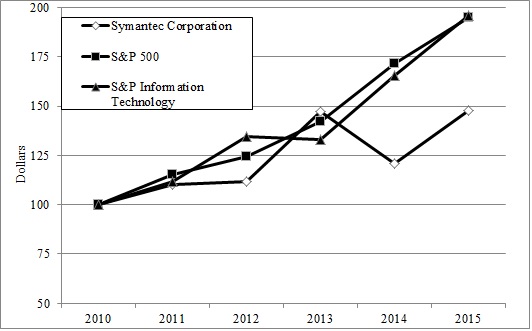
The graph below compares the cumulative total stockholder return on our common stock with the cumulative total return on the S&P 500 Composite Index and the S&P Information Technology Index for the five years ended April 3, 2015 (assuming the investment of $100 in our common stock and in each of the other indices on the last day of trading for fiscal 2010, and the reinvestment of all dividends). The comparisons in the graph below are based on historical data and are not intended to forecast the possible future performance of our common stock.
COMPARISON OF FIVE-YEAR CUMULATIVE TOTAL RETURN
Among Symantec Corporation, the S&P 500 Index
and the S&P Information Technology Index
| 2010 | 2011 | 2012 | 2013 | 2014 | 2015 | ||||||||||||||||||
| Symantec Corporation | $ | 100.00 | $ | 110.08 | $ | 111.51 | $ | 147.17 | $ | 121.12 | $ | 147.78 | |||||||||||
| S&P 500 | $ | 100.00 | $ | 115.36 | $ | 124.59 | $ | 141.99 | $ | 171.65 | $ | 194.99 | |||||||||||
| S&P Information Technology | $ | 100.00 | $ | 111.68 | $ | 134.37 | $ | 132.86 | $ | 165.49 | $ | 196.12 |
Item 6. Selected Financial Data
The following selected consolidated financial data is derived from our Consolidated Financial Statements. This data should be read in conjunction with our Consolidated Financial Statements and related notes included in this annual report and with Item 7. Management’s Discussion and Analysis of Financial Condition and Results of Operations. Historical results may not be indicative of future results.
Five-Year Summary
| Fiscal (a) | ||||||||||||||||||||
| 2015 | 2014 | 2013 | 2012 | 2011 | ||||||||||||||||
| (In millions, except per share data) | ||||||||||||||||||||
| Consolidated Statements of Income Data: | ||||||||||||||||||||
| Net revenue | $ | 6,508 | $ | 6,676 | $ | 6,906 | $ | 6,730 | $ | 6,190 | ||||||||||
| Operating income | 1,149 | 1,183 | 1,106 | 1,104 | 927 | |||||||||||||||
| Net income attributable to Symantec Corporation stockholders (b) | 878 | 898 | 755 | 1,187 | 626 | |||||||||||||||
| Net income per share attributable to Symantec Corporation stockholders: (c) | ||||||||||||||||||||
| Basic | $ | 1.27 | $ | 1.29 | $ | 1.08 | $ | 1.60 | $ | 0.80 | ||||||||||
| Diluted | $ | 1.26 | $ | 1.28 | $ | 1.06 | $ | 1.59 | $ | 0.76 | ||||||||||
| Weighted-average shares outstanding: | ||||||||||||||||||||
| Basic | 689 | 696 | 701 | 741 | 778 | |||||||||||||||
| Diluted | 696 | 704 | 711 | 748 | 786 | |||||||||||||||
| Cash dividends per share | $ | 0.60 | $ | 0.60 | $ | — | $ | — | $ | — | ||||||||||
| Consolidated Balance Sheet Data: | ||||||||||||||||||||
| Cash, cash equivalents, and short-term investments | $ | 3,891 | $ | 4,084 | $ | 4,747 | $ | 3,211 | $ | 2,958 | ||||||||||
| Total assets | 13,233 | 13,539 | 14,508 | 13,158 | 12,841 | |||||||||||||||
| Deferred revenue | 3,109 | 3,322 | 3,496 | 3,444 | 3,321 | |||||||||||||||
| Current portion of long-term debt (c)(d) | 350 | — | 997 | — | 596 | |||||||||||||||
| Long-term debt (c)(d) | 1,746 | 2,095 | 2,094 | 2,039 | 1,987 | |||||||||||||||
| Long-term deferred revenue | 555 | 581 | 584 | 596 | 565 | |||||||||||||||
| Total stockholders’ equity (e) | 5,935 | 5,797 | 5,476 | 5,237 | 4,635 |
| (a) | We have a 52/53-week fiscal year. Our fiscal 2015 was a 53-week year whereas fiscal 2014, 2013, 2012, and 2011 each consisted of 52 weeks. |
| (b) | In fiscal 2008, we formed a joint venture with a subsidiary of Huawei Technologies Co., Limited (“Huawei”). In fiscal 2012, we sold our 49% ownership interest in the joint venture to Huawei for $530 million in cash. The gain of $530 million, offset by costs to sell the joint venture of $4 million, was included in gain from sale of joint venture in our fiscal 2012 Consolidated Statements of Income. |
| (c) | In the first quarter of fiscal 2007, we issued $1.0 billion in principal amount of 1.00% Convertible Senior Notes (“1.00% notes”), due in June 2013. On June 15, 2013, the principal balance on those notes matured and was settled by a cash payment of $1 billion, along with the $5 million semi-annual interest payment. In addition, we elected to pay the conversion value above par value of the 1.00% notes in cash in the amount of $189 million. Concurrently with the payment of the conversion value we received $189 million from the note hedge we entered into at the time of the issuance of the 1.00% notes. At the time of issuance of the 1.00% notes, we granted warrants to affiliates of certain initial purchasers of the notes whereby they had the option to purchase up to 52.7 million shares of our common stock at a price of $27.1330 per share. All the warrants expired unexercised on various dates during the second quarter of fiscal 2014 and there was no dilutive impact from the warrants on our earnings per share for fiscal 2014. |
| (d) | In fiscal 2011, we issued $350 million in principal amount of 2.75% senior notes due September 2015 (“2.75% notes due 2015”) and $750 million in principal amount of 4.20% senior notes due September 2020 (“4.20% notes”). In fiscal 2013, we issued $600 million in principal amount of 2.75% senior notes due June 2017 (“2.75% notes due 2017”) and $400 million in principal amount of 3.95% senior notes due June 2022 (“3.95% notes”). |
| (e) | Includes noncontrolling interest in subsidiary of $78 million and $77 million in fiscal 2012 and fiscal 2011, respectively. |
Item 7. Management’s Discussion and Analysis of Financial Condition and Results of Operations
OVERVIEW
Our business
Symantec Corporation is a global leader in security, backup and availability solutions. Our market leading products and services protect people and information in any environment – from the mobile device in your pocket, to the enterprise data center, to cloud-based systems. Founded in April 1982, Symantec operates one of the largest global threat-intelligence networks. The company has more than 19,000 employees in more than 50 countries.
Fiscal calendar
We have a 52/53-week fiscal year ending on the Friday closest to March 31. Unless otherwise stated, references to years in this report relate to fiscal year and periods ended April 3, 2015, March 28, 2014 and March 29, 2013. Our fiscal 2015 was a 53-week year whereas our fiscal 2014 and 2013 were 52-week years.
Strategy
In our security business, we operate a global civilian cyber intelligence threat network and track a vast number of threats across the Internet from hundreds of millions of mobile devices, endpoints, and servers across the globe. We believe one of our competitive advantages is our database of threat indicators which allows us to reduce the number of false positives and provide faster and better protection for customers through our products. We are leveraging our capabilities in threat protection and data loss prevention and extending them into our core security offerings. We are also pioneering new solutions in growing markets like cloud, advanced threat protection, information protection and cyber security services.
Our security strategy is to leverage our unique assets to provide best-in-class consumer and enterprise security products; deliver a unified security analytics platform that provides big data analytics, utilizes our vast telemetry, provides visibility into real-time global threats, and powers Symantec and third-party security analytics applications; and offer cyber security services that provide a full-suite of services from monitoring to incident response to threat intelligence supported by over 500 cyber security experts and nine global threat centers.
In our information management business, with a global installed customer base, we have a comprehensive portfolio that spans backup and recovery, storage management and archiving. Our information availability offerings help customers keep their data and systems available where they need them, when they need them, and irrespective of their location. Our information insight solutions help customers know what data they have and leverage that knowledge to help manage such data better and inform strategic decisions.
Our information management product strategy is to expand our best-in-class foundational portfolio across backup, storage management, business continuity, archiving and eDiscovery through software, integrated appliances and the cloud; deliver next-generation availability solutions through a coordinated orchestration architecture focused on managing and moving mission-critical data in a hybrid cloud world; and enable next-generation insight solutions that provide visibility, action, and automated control across an organization’s information landscape through an intelligent information fabric that integrates our portfolio and third-party ecosystems.
In fiscal 2015, we focused on five priorities: running our businesses with a portfolio approach by managing certain businesses for operating margin; prioritizing investments for growth; further reducing costs and improving efficiencies; attracting top talent to our executive team; and continuing to return significant cash to shareholders. We are optimizing some of our businesses by methodically evaluating every product line to balance our profitability targets against our objectives. In order to prioritize investments for growth, we are realigning our research and development budgets to apply the best resources to the most promising market opportunities. To further reduce costs and improve efficiencies, we are consolidating our global footprint, data centers and product support capabilities as well as streamlining the way we run our businesses with initiatives to increase research and development efficiencies and sales productivity. We are focused on continuing to attract talented business and technology leaders to the company. We remain committed to returning significant cash to shareholders in the form of dividends and share buybacks.
The Planned Separation of Information Management from the Security Business
On October 9, 2014, we announced plans to separate our business into two independent publicly-traded companies: one focused on security and one focused on information management. The transaction is intended to take the form of a tax-free distribution to Symantec shareholders of all of the capital stock of our information management business. We expect to complete the legal separation on January 2, 2016, subject to market, regulatory and certain other conditions. John Gannon has been appointed as General Manager of the information management business, and Don Rath has been appointed as acting Chief Financial Officer. After the transaction, Michael Brown and Thomas Seifert will continue to lead Symantec as Chief Executive Officer and Chief Financial Officer, respectively. For additional separation cost information, see Note 6 of the Notes to Consolidated Financial Statements in this annual report.
Our operating segments
Our operating segments are significant strategic business units that offer different products and services distinguished by customer needs. In the second quarter of fiscal 2015, we modified our segment reporting structure to match our new operating structure. The three reporting segments, which are the same as our operating segments, are:
| • | Consumer Security: Our Consumer Security segment focuses on making it simple for customers to be productive and protected at home and at work. Our Norton-branded services provide multi-layer security and identity protection on major desktop and mobile operating systems, to defend against increasingly complex online threats to individuals, families, and small businesses. |
| • | Enterprise Security: Our Enterprise Security segment protects organizations so they can securely conduct business while leveraging new platforms and data. These products include Secure Socket Layer (“SSL”) Certificates, authentication, mail and web security, data center security, data loss prevention, information security services, endpoint security and management, encryption, and mobile security offerings. |
| • | Information Management: Our Information Management segment focuses on backup and recovery, archiving and eDiscovery, storage and high availability solutions, helping to ensure that our customers’ IT infrastructure and mission-critical applications are protected, managed and available. |
For further description of our operating segments see Note 9 of the Notes to Consolidated Financial Statements in this annual report.
Financial results and trends
The following table provides an overview of key financial metrics for each of the last three fiscal years:
| 2015 | 2014 | 2013 | |||||||||
| (In millions, except percentages) | |||||||||||
| Consolidated Income Statement Data: | |||||||||||
| Total net revenue | $ | 6,508 | $ | 6,676 | $ | 6,906 | |||||
| Gross profit | 5,355 | 5,527 | 5,731 | ||||||||
| Operating income | 1,149 | 1,183 | 1,106 | ||||||||
| Operating margin percentage | 18 | % | 18 | % | 16 | % | |||||
| Consolidated Cash Flow and Balance Sheet Data: | |||||||||||
| Cash flow from operations | 1,312 | 1,281 | 1,593 |
Showing the first 8K of 76K characters. Open the full section
Item 7A. Quantitative and Qualitative Disclosures about Market Risk
We are exposed to various market risks related to fluctuations in interest rates and foreign currency exchange rates. We may use derivative financial instruments to mitigate certain risks in accordance with our investment and foreign exchange policies. We do not use derivatives or other financial instruments for trading or speculative purposes.
Interest rate risk
As of April 3, 2015 and March 28, 2014, we had $2.1 billion in principal amount of fixed-rate senior notes outstanding, with a carrying amount of $2.1 billion and a fair value of $2.2 billion, which fair value is based on level 2 inputs. We have performed sensitivity analyses as of April 3, 2015 and March 28, 2014 by using a modeling technique that measures the change in the fair values arising from a hypothetical 50 bps movement in the levels of market interest rates, with all other variables held constant. On April 3, 2015 and March 28, 2014, a hypothetical 50 bps increase or decrease in market interest rates would change the fair value of the fixed-rate senior notes by a decrease of approximately $39 million and $48 million, respectively and an increase of approximately $40 million and $49 million, respectively. However, this hypothetical change in market interest rates would not impact the interest expense on the fixed-rate debt.
Foreign currency exchange rate risk
We conduct business in 43 currencies through our worldwide operations and, as such, we are exposed to foreign currency risk. Foreign currency risks are associated with our cash and cash equivalents, investments, receivables, and payables denominated in foreign currencies. Our exposure to foreign currency transaction gains and losses is the result of certain net receivables due from our foreign subsidiaries and customers being denominated in currencies other than the functional currency of the subsidiary, primarily the Euro and Singapore dollar. Our foreign subsidiaries conduct their businesses in local currency. We have entered into foreign exchange forward contracts with up to six months in duration, to offset the foreign exchange risk on certain monetary assets and liabilities denominated in currencies other than the functional currency of the subsidiary. We
considered the historical trends in currency exchange rates and determined that it was reasonably possible that adverse changes in exchange rates for all currencies could be experienced. The estimated impacts of a ten percent appreciation or depreciation of foreign currency are as follows:
| April 3, 2015 | March 28, 2014 | |||||||||||||||||||||||
| Change in Fair Value Due to 10% | Change in Fair Value Due to 10% | |||||||||||||||||||||||
| Foreign Exchange Forward Contract | Notional Amount | Appreciation | Depreciation | Notional Amount | Appreciation | Depreciation | ||||||||||||||||||
| (Dollars in millions) | ||||||||||||||||||||||||
| Purchased | $ | 102 | $ | 10 | $ | (10 | ) | $ | 154 | $ | 15 | $ | (15 | ) | ||||||||||
| Sold | (195 | ) | (19 | ) | 19 | (240 | ) | (24 | ) | 24 | ||||||||||||||
| Total net outstanding contracts | $ | (93 | ) | $ | (9 | ) | $ | 9 | $ | (86 | ) | $ | (9 | ) | $ | 9 |
We do not use derivative financial instruments for speculative trading purposes, nor do we hedge our foreign currency exposure in a manner that entirely offsets the effects of the changes in foreign exchange rates.
Item 8. Financial Statements and Supplementary Data
Annual financial statements
The Consolidated Financial Statements and related disclosures included in Part IV, Item 15 of this annual report are incorporated by reference into this Item 8.
Selected quarterly financial data
| Fiscal 2015 | Fiscal 2014 | ||||||||||||||||||||||||||||||
| Apr. 3, 2015 | Jan. 2, 2015 | Oct. 3, 2014 | Jul. 4, 2014 | Mar. 28, 2014 | Dec. 27, 2013 | Sep. 27, 2013 | Jun. 28, 2013 | ||||||||||||||||||||||||
| (In millions, except per share data) | |||||||||||||||||||||||||||||||
| Net revenue | $ | 1,518 | $ | 1,638 | $ | 1,617 | $ | 1,735 | $ | 1,625 | $ | 1,705 | $ | 1,637 | $ | 1,709 | |||||||||||||||
| Gross profit | 1,231 | 1,359 | 1,339 | 1,426 | 1,343 | 1,422 | 1,353 | 1,409 | |||||||||||||||||||||||
| Operating income | 152 | 327 | 348 | 322 | 306 | 405 | 248 | 224 | |||||||||||||||||||||||
| Net income | 176 | 222 | 244 | 236 | 217 | 283 | 241 | 157 | |||||||||||||||||||||||
| Net income per share — basic | 0.26 | 0.32 | 0.35 | 0.34 | 0.31 | 0.41 | 0.34 | 0.23 | |||||||||||||||||||||||
| Net income per share — diluted | 0.25 | 0.32 | 0.35 | 0.34 | 0.31 | 0.40 | 0.34 | 0.22 |
Item 9. Changes in and Disagreements with Accountants on Accounting and Financial Disclosure
None.
Item 9A. Controls and Procedures
a) Evaluation of Disclosure Controls and Procedures
The SEC defines the term “disclosure controls and procedures” to mean a company’s controls and other procedures that are designed to ensure that information required to be disclosed in the reports that it files or submits under the Exchange Act is recorded, processed, summarized, and reported, within the time periods specified in the SEC’s rules and forms. “Disclosure controls and procedures” include, without limitation, controls and procedures designed to ensure that information required to be disclosed by an issuer in the reports that it files or submits under the Exchange Act is accumulated and communicated to the issuer’s management, including its principal executive and principal financial officers, or persons performing similar functions, as appropriate to allow timely decisions regarding required disclosure. Our disclosure controls and procedures are designed to provide reasonable assurance that such information is accumulated and communicated to our management. Our management (with the participation of our Chief Executive Officer and Chief Financial Officer) has conducted an evaluation of the effectiveness of our disclosure controls and procedures (as defined in Rules 13a-15(e) and 15d-15(e) of the Securities Exchange Act). Based on such evaluation, our Chief Executive Officer and our Chief Financial Officer have concluded that our disclosure controls and procedures were effective at the reasonable assurance level as of the end of the period covered by this report.
b) Management’s Report on Internal Control over Financial Reporting
Our management is responsible for establishing and maintaining adequate internal control over financial reporting (as defined in Rules 13a-15(f) and 15d-15(f) of the Exchange Act) for Symantec. Our management, with the participation of our Chief Executive Officer and our Chief Financial Officer, has conducted an evaluation of the effectiveness of our internal control over financial reporting as of April 3, 2015, based on criteria established in Internal Control — Integrated Framework (1992) issued by the Committee of Sponsoring Organizations of the Treadway Commission (“COSO”).
Our management has concluded that, as of April 3, 2015, our internal control over financial reporting was effective based on these criteria.
The Company’s independent registered public accounting firm has issued an attestation report regarding its assessment of the Company’s internal control over financial reporting as of April 3, 2015, which is included in Part IV, Item 15 of this annual report.
c) Changes in Internal Control over Financial Reporting
There were no changes in our internal control over financial reporting during the quarter ended April 3, 2015 that have materially affected, or are reasonably likely to materially affect, our internal control over financial reporting.
d) Limitations on Effectiveness of Controls
Our management, including our Chief Executive Officer and Chief Financial Officer, does not expect that our disclosure controls and procedures or our internal controls will prevent all errors and all fraud. A control system, no matter how well conceived and operated, can provide only reasonable, not absolute, assurance that the objectives of the control system are met. Further, the design of a control system must reflect the fact that there are resource constraints, and the benefits of controls must be considered relative to their costs. Because of the inherent limitations in all control systems, no evaluation of controls can provide absolute assurance that all control issues and instances of fraud, if any, within our company have been detected.
Item 9B. Other Information
None.
PART III
Item 10. Directors, Executive Officers and Corporate Governance
The information required by this item will be included in an amendment to this annual report on Form 10-K or incorporated by reference from Symantec’s definitive proxy statement to be filed pursuant to Regulation 14A.
Item 11. Executive Compensation
The information required by this item will be included in an amendment to this annual report on Form 10-K or incorporated by reference from Symantec’s definitive proxy statement to be filed pursuant to Regulation 14A.
Item 12. Security Ownership of Certain Beneficial Owners and Management and Related Stockholder Matters
The information required by this item will be included in an amendment to this annual report on Form 10-K or incorporated by reference from Symantec’s definitive proxy statement to be filed pursuant to Regulation 14A.
Item 13. Certain Relationships and Related Transactions, and Director Independence
The information required by this item will be included in an amendment to this annual report on Form 10-K or incorporated by reference from Symantec’s definitive proxy statement to be filed pursuant to Regulation 14A.
Item 14. Principal Accounting Fees and Services
The information required by this item will be included in an amendment to this annual report on Form 10-K or incorporated by reference from Symantec’s definitive proxy statement to be filed pursuant to Regulation 14A.
PART IV
Item 15. Exhibits, Financial Statement Schedules
Upon written request, we will provide, without charge, a copy of this annual report, including the Consolidated Financial Statements and financial statement schedule. All requests should be sent to:
Symantec Corporation
Attn: Investor Relations
350 Ellis Street
Mountain View, California 94043
650-527-8000
The following documents are filed as part of this report:
REPORT OF INDEPENDENT REGISTERED PUBLIC ACCOUNTING FIRM
The Board of Directors and Stockholders
Symantec Corporation:
We have audited the accompanying consolidated balance sheets of Symantec Corporation and subsidiaries as of April 3, 2015 and March 28, 2014, and the related consolidated statements of income, comprehensive income, stockholders’ equity, and cash flows for each of the years in the three-year period ended April 3, 2015. We also have audited the internal control over financial reporting of Symantec Corporation as of April 3, 2015, based on criteria established in Internal Control – Integrated Framework (1992) issued by the Committee of Sponsoring Organizations of the Treadway Commission (COSO). The management of Symantec Corporation is responsible for these consolidated financial statements for maintaining effective internal control over financial reporting, and for its assessment of the effectiveness of internal control over financial reporting, included in Management’s Report on Internal Control over Financial Reporting appearing under Item 9A.b). Our responsibility is to express an opinion on these consolidated financial statements and an opinion on the internal control over financial reporting of Symantec Corporation based on our audits.
We conducted our audits in accordance with the standards of the Public Company Accounting Oversight Board (United States). Those standards require that we plan and perform the audits to obtain reasonable assurance about whether the financial statements are free of material misstatement and whether effective internal control over financial reporting was maintained in all material respects. Our audits of the consolidated financial statements included examining, on a test basis, evidence supporting the amounts and disclosures in the financial statements, assessing the accounting principles used and significant estimates made by management, and evaluating the overall financial statement presentation. Our audit of internal control over financial reporting included obtaining an understanding of internal control over financial reporting, assessing the risk that a material weakness exists, and testing and evaluating the design and operating effectiveness of internal control based on the assessed risk. Our audits also included performing such other procedures as we considered necessary in the circumstances. We believe that our audits provide a reasonable basis for our opinions.
A company’s internal control over financial reporting is a process designed to provide reasonable assurance regarding the reliability of financial reporting and the preparation of financial statements for external purposes in accordance with generally accepted accounting principles. A company’s internal control over financial reporting includes those policies and procedures that (1) pertain to the maintenance of records that, in reasonable detail, accurately and fairly reflect the transactions and dispositions of the assets of the company; (2) provide reasonable assurance that transactions are recorded as necessary to permit preparation of financial statements in accordance with generally accepted accounting principles, and that receipts and expenditures of the company are being made only in accordance with authorizations of management and directors of the company; and (3) provide reasonable assurance regarding prevention or timely detection of unauthorized acquisition, use, or disposition of the company’s assets that could have a material effect on the financial statements.
Because of its inherent limitations, internal control over financial reporting may not prevent or detect misstatements. Also, projections of any evaluation of effectiveness to future periods are subject to the risk that controls may become inadequate because of changes in conditions, or that the degree of compliance with the policies or procedures may deteriorate.
In our opinion, the consolidated financial statements referred to above present fairly, in all material respects, the financial position of Symantec Corporation and subsidiaries as of April 3, 2015 and March 28, 2014, and the results of their operations and their cash flows for each of the years in the three-year period ended April 3, 2015, in conformity with U.S. generally accepted accounting principles. Also in our opinion, Symantec Corporation maintained, in all material respects, effective internal control over financial reporting as of April 3, 2015, based on criteria established in Internal Control – Integrated Framework (1992) issued by the Committee of Sponsoring Organizations of the Treadway Commission (COSO).
/s/ KPMG LLP
Santa Clara, California
May 22, 2015
SYMANTEC CORPORATION
CONSOLIDATED BALANCE SHEETS
| April 3, 2015 | March 28, 2014 | ||||||
| (In millions, except par value) | |||||||
| ASSETS | |||||||
| Current assets: | |||||||
| Cash and cash equivalents | $ | 2,874 | $ | 3,707 | |||
| Short-term investments | 1,017 | 377 | |||||
| Trade accounts receivable, net of allowance for doubtful accounts of $7 and $7, respectively | 993 | 1,007 | |||||
| Deferred income taxes | 152 | 142 | |||||
| Deferred commissions | 131 | 115 | |||||
| Other current assets | 255 | 304 | |||||
| Total current assets | 5,422 | 5,652 | |||||
| Property and equipment, net | 1,205 | 1,116 | |||||
| Intangible assets, net | 628 | 768 | |||||
| Goodwill | 5,847 | 5,858 | |||||
| Long-term deferred commissions | 26 | 21 | |||||
| Other long-term assets | 105 | 124 | |||||
| Total assets | $ | 13,233 | $ | 13,539 | |||
| LIABILITIES AND STOCKHOLDERS’ EQUITY | |||||||
| Current liabiliti |
Showing the first 8K of 132K characters. Open the full section