 filings.tools
Gen Digital 10-K 2020-04-03
Filed 2020-05-28. 22 sections, 389K characters. Original on sec.gov · Markdown · JSON
Cover and table of contents
UNITED STATES SECURITIES AND EXCHANGE COMMISSION
Washington, D.C. 20549
Form 10-K
(Mark One)
| ☑ | ANNUAL REPORT PURSUANT TO SECTION 13 OR 15(d) OF THE SECURITIES EXCHANGE ACT OF 1934 |
For the Fiscal Year Ended April 3, 2020
or
| ☐ | TRANSITION REPORT PURSUANT TO SECTION 13 OR 15(d) OF THE SECURITIES EXCHANGE ACT OF 1934 |
For the Transition Period from to
Commission File Number 000-17781
NortonLifeLock Inc.
(Exact name of registrant as specified in its charter)
| Delaware | 77-0181864 | ||||
| (State or other jurisdiction of incorporation or organization) | (I.R.S. Employer Identification No.) | ||||
| 60 E. Rio Salado Parkway, | Suite 1000, | Tempe, | Arizona | 85281 | |
| (Address of principal executive offices) | (Zip code) |
Registrant’s telephone number, including area code:
(650) 527-8000
Securities registered pursuant to Section 12(b) of the Act:
| Title of each class | Trading symbol(s) | Name of each exchange on which registered | |
| Common Stock, | par value $0.01 per share | NLOK | The Nasdaq Stock Market LLC |
Securities registered pursuant to Section 12(g) of the Act:
None
(Title of class)
Indicate by check mark if the registrant is a well-known seasoned issuer, as defined in Rule 405 of the Securities Act. Yes ☐ No ☑
Indicate by check mark if the registrant is not required to file reports pursuant to Section 13 or 15(d) of the Exchange Act. Yes ☐ No ☑
Indicate by check mark whether the registrant (1) has filed all reports required to be filed by Section 13 or 15(d) of the Securities Exchange Act of 1934 during the preceding 12 months (or for such shorter period that the registrant was required to file such reports), and (2) has been subject to such filing requirements for the past 90 days. Yes ☑ No ☐
Indicate by check mark whether the registrant has submitted electronically every Interactive Data File required to be submitted pursuant to Rule 405 of Regulation S-T (§ 232.405 of this chapter) during the preceding 12 months (or for such shorter period that the registrant was required to submit such files). Yes ☑ No ☐
Indicate by check mark whether the registrant is a large accelerated filer, an accelerated filer, a non-accelerated filer, a smaller reporting company, or an emerging growth company. See the definitions of “large accelerated filer,” “accelerated filer,” “smaller reporting company,” and “emerging growth company” in Rule 12b-2 of the Exchange Act.
| Large accelerated filer | ☑ | Accelerated filer | ☐ | Non-accelerated filer | ☐ | Smaller reporting company | ☐ |
| Emerging growth company | ☐ |
If an emerging growth company, indicate by check mark if the registrant has elected not to use the extended transition period for complying with any new or revised financial accounting standards provided pursuant to Section 13(a) of the Exchange Act. ☐
Indicate by check mark whether the registrant is a shell company (as defined in Rule 12b-2 of the Act). Yes ☐ No ☑
Aggregate market value of the voting stock held by non-affiliates of the registrant, based upon the closing sale price of NortonLifeLock common stock on October 4, 2019 as reported on the Nasdaq Global Select Market: $8,798,715,226. Solely for purposes of this disclosure, shares of common stock held by each executive officer, director, and holder of 5% or more of the outstanding common stock have been excluded as of such date because such persons may be deemed to be affiliates. This determination of possible affiliate status is not a conclusive determination for any other purposes.
The number of shares of NortonLifeLock common stock, $0.01 par value per share, outstanding as of May 12, 2020 was 589,028,713 shares.
DOCUMENTS INCORPORATED BY REFERENCE
Portions of the registrant’s definitive proxy statement for the 2020 annual meeting of stockholders are incorporated herein by reference into Part III of this Annual Report on Form 10-K where indicated. Such Proxy Statement will be filed with the Securities and Exchange Commission within 120 days of the registrant’s fiscal year ended April 3, 2020.
NORTONLIFELOCK INC.
FORM 10-K
For the Fiscal Year Ended April 3, 2020
TABLE OF CONTENTS
“NortonLifeLock,” “we,” “us,” “our,” and “the Company” refer to NortonLifeLock Inc. and all of its subsidiaries. NortonLifeLock, the NortonLifeLock Logo, the Checkmark Logo, Norton, LifeLock, and the LockMan Logo are trademarks or registered trademarks of NortonLifeLock Inc. or its affiliates in the United States (U.S.) and other countries. Other names may be trademarks of their respective owners.
FORWARD-LOOKING STATEMENTS AND FACTORS THAT MAY AFFECT FUTURE RESULTS
The discussion below contains forward-looking statements, which are subject to safe harbors under the Securities Act of 1933, as amended (the Securities Act) and the Exchange Act of 1934, as amended (the Exchange Act). Forward-looking statements include references to our ability to utilize our deferred tax assets, as well as statements including words such as “expects,” “plans,” “anticipates,” “believes,” “estimates,” “predicts,” “goal,” “intent,” “momentum,” “projects,” and similar expressions. In addition, projections of our future financial performance; anticipated growth and trends in our businesses and in our industries; the anticipated impacts of acquisitions, restructurings, stock repurchases, and investment activities; the outcome or impact of pending litigation, claims or disputes; our intent to pay quarterly cash dividends in the future; plans for and anticipated benefits of our solutions; matters arising out of the ongoing U.S. Securities and Exchange Commission (the SEC) investigation; the impact of the Covid-19 pandemic on our business operations and target markets; and other characterizations of future events or circumstances are forward-looking statements. These statements are only predictions, based on our current expectations about future events and may not prove to be accurate. We do not undertake any obligation to update these forward-looking statements to reflect events occurring or circumstances arising after the date of this report. These forward-looking statements involve risks and uncertainties, and our actual results, performance, or achievements could differ materially from those expressed or implied by the forward-looking statements on the basis of several factors.
These and other risks are described under Item 1A. Risk Factors. We encourage you to read that section carefully.
PART I
Item 1. Business
Overview
NortonLifeLock is a trusted brand and leading provider of Cyber Safety solutions for consumers worldwide. Our business is built around the prevention, detection and restoration of potential damages caused by cyber criminals. The need for NortonLifeLock’s products is more critical than ever in today’s increasingly digital world, as people transition to remote work environments, conduct virtual meetings, and engage in online gaming, streaming, shopping, telemedicine and numerous other online transactions and activities on a daily basis. With each new digital interaction comes increased risk for consumers as cyber criminals look to take advantage of this accelerating trend. NortonLifeLock stands between today’s cyber criminals and consumers, helping secure the devices, identities, online privacy, and home and family needs of nearly 50 million consumers globally. We are a trusted ally for our customers in a complex digital world and are committed to advancing our mission of protecting each element of their digital lives.
We offer subscription-based Cyber Safety solutions to consumers under the NortonLifeLock brand, with our integrated cyber safety platform Norton 360. Norton 360’s integrated experience, and substantial scale and reach, provide extensive cyber safety coverage to our members. In addition to Norton 360, we also offer standalone products for device security, privacy, identity, and home and family protection in certain channels and geographies.
We sell our products primarily direct-to-consumer through our in-house e-commerce platform, and indirectly through partner relationships with retailers, telecom service providers, hardware original equipment manufacturers (OEMs), and employee benefit providers. Most of our subscriptions are sold on either annual or monthly terms. As of April 3, 2020, we served over 20 million direct customers and approximately 30 million more through partners or other indirect channels. Our annual retention rate was 85% for fiscal 2020. Please see “Performance Metrics” under “Management’s Discussion and Analysis of Financial Condition and Results of Operations” in Item 7.
Our transformation into a pure-play consumer company follows the sale of our enterprise assets and name change from Symantec Corporation to NortonLifeLock Inc. Founded in 1982, we formerly did business under the Symantec Corporation name as the Consumer Cyber Safety division. The sale of our Enterprise Security assets to Broadcom Inc. (Broadcom) and the sale of our ID Analytics business to LexisNexis Risk Solutions, part of RELX Inc., were completed in fiscal year 2020.
Industry Overview
Cyber crime, and the ways in which cyber criminals target consumers, continue to evolve along with behaviors and technology. Cyber crime encompasses any crime committed digitally over the internet and includes crimes where (i) malicious software or unauthorized access is detected on a device, network or online account (including email, social media, online banking, online retail, etc.); (ii) an individual is digitally victimized through a data breach, cyber theft, cyber extortion, or fraud (stolen personally identifiable information, identity theft); or (iii) online stalking, bullying, or harassment is inflicted.
As cyber crime becomes an intensifying threat to our world, consumers are increasingly concerned. Our annual NortonLifeLock Cyber Safety Insights Report evaluates current cyber crime trends to provide a snapshot of the impact of cyber crime. According to the 2019 report, which is based on research conducted online by The Harris Poll on behalf of us, almost 500 million consumers have been the victim of a cyber crime, with nearly 350 million in the last year alone. While many report having taken at least one step to protect their online activities and personal information, most people are taking only basic steps (clearing cookies, limiting information shared on social media) and few are going to greater lengths such as using anonymous payment methods, deleting social media accounts, or using a virtual private network (VPN).
For more insights or information related to our NortonLifeLock Cyber Safety Insights Report, please visit https://us.norton.com/nortonlifelock-cyber-safety-report. The information contained, or referred to, on our website, including our Cyber Safety Insights Report, is not part of this annual report unless expressly noted.
Cyber Safety Solutions and Services
We help consumers by providing Cyber Safety subscription solutions with an integrated user experience under the NortonLifeLock brand, called Norton 360. Our Norton 360 subscriptions include multiple levels of membership tiers that incorporate solutions from each of our Cyber Safety categories: Device Security, Identity Protection, Online Privacy, and Home and Family Safety. We also provide these solutions as standalone products in certain channels and geographies. Our Consumer Cyber Safety solutions include the following offerings:
| • | Device Security (Norton Security): Our Norton Security solution provides real-time protection for PCs, Macs and mobile devices against malware, viruses, adware, ransomware and other online threats. It monitors and blocks unauthorized traffic from the internet to the device to help protect private and sensitive information when customers are online. For mobile devices, Norton Security alerts customers of risky apps, safeguards against fraudulent and malicious websites, identifies Wi-Fi networks that are under attack, enables stolen device recovery, and blocks unwanted spam and potential fraud calls. Norton Security includes 24x7 support by trained support agents. We provide on-call support and offer a money-back guarantee if we cannot remove viruses from infected devices through our Virus Protection Promise. |
| • | Identity Protection (LifeLock Identity Theft Protection): Our LifeLock identity theft protection solution includes monitoring, alerts and restoration services to protect the safety of our customers. We monitor events that may present a risk of identity theft, such as new account openings and applications. If we detect that a customer’s personally identifiable |
information is being used, we deliver notifications and alerts to our customers about potentially suspicious activity. In the event of identity theft, we assign an Identity Restoration Specialist to work directly with customers to help restore their identities. Customers are further protected by our Million Dollar Protection Package, which provides reimbursement for stolen funds and coverage for personal expenses.
| • | Online Privacy (Norton Secure VPN and SurfEasy VPN): As people are exchanging more sensitive information through digital channels - be it personal healthcare information to enable tele-health or financial information for personal accounting, having a VPN has become even more crucial. Our Norton Secure VPN and SurfEasy VPN enhance security and online privacy by providing an encrypted data tunnel. This allows customers to securely transmit and access private information such as passwords, bank details and credit card numbers when using public Wi-Fi on PCs, Macs and mobile iOS and Android devices. Our VPN service allows customers to browse the Web anonymously to protect their online privacy and prevent tracking by online advertisers and other companies. Customers can also change their virtual location when they are traveling internationally to allow them to connect to their favorite apps, websites and online streaming services as if they are in their home-country. |
| • | Home and Family (Norton Family): As entire households now spend hours online, whether for school, work, or personal use, protecting the home and family in a simple way is even more of a need. Norton Family brings the protection and security of our products to every member of the family across multiple devices and platforms. Norton Family also provides Parental Controls tools for parents to monitor kids’ online activities, including videos watched, websites visited, terms searched, and apps downloaded. Parents can manage how much time kids spend online and block access to inappropriate websites. Norton Family also provides GPS location monitoring for mobile devices and content filtering for PCs. |
Our Strategy
Our goal is to be the trusted cyber security partner for consumers across the globe and enable them to manage their digital lives safely. The threat landscape is larger, more complicated and more connected than ever before, exposing consumers to an increased risk to their security, online privacy, home networks and identities. As the risks to consumers continue to expand from device-based attacks to more sophisticated threats such as fraud, ransomware, identity theft and privacy risks, our solutions have evolved to provide a multi-layered approach in protecting against threats, detecting attacks and helping customers manage across their digital footprint, including their technology, applications, networks and identities.
The cornerstone of our strategy is to provide consumers with a platform that brings together superior software and service capabilities to enable all facets of Cyber Safety, including device security, identity protection, online privacy, and home and family safety. By combining and leveraging our portfolio of Norton and LifeLock offerings, we are able to deliver an industry-leading set of Cyber Safety solutions. The key elements of our strategy to achieve this goal include the following:
Extend our leadership position through continued enhancement of our solutions and services. The Cyber Safety industry is large and expanding, which provides a significant growth opportunity. We intend to grow our business by investing in research and development and making acquisitions to expand the solutions and services we offer into new cohorts, territories and sectors. We believe there are many additional areas where we can both offer new solutions, as well as use our core capabilities to deliver offerings to new customers and markets.
Grow our customer base. We intend to leverage our expertise in digital marketing, as well as existing and new strategic partnerships, to grow our customer base. We believe that continued investments in these areas, as well as our product offerings and infrastructure, will allow us to further enhance our leading brand and superior products, increase awareness of our consumer services and enhance our ability to efficiently acquire new customers.
Continue our focus on customer retention. We plan to invest in increasing customer retention by optimizing and expanding the value we provide through actionable alerts, education on timely topics, and new capabilities. We aim to provide our customers with peace of mind and convenience, demonstrating the value of our solutions. We plan to offer an integrated mobile application experience to improve customer experience from purchase, through onboarding and use. We have a global customer services organization, and we leverage frequent communication and feedback from our customers to continually improve our solutions and services.
Increase sales to existing customers. We believe the strong customer satisfaction we maintain with our customers provides us with the opportunity to engage them in new services offerings. We introduced Norton 360 in April 2019, with various tiers of membership, and we are actively engaging with customers of standalone products to move them into a Norton 360 membership. We also believe a substantial opportunity exists to increase the penetration of our premium-level consumer solutions. Over time, we plan to add additional offerings and services for our customers to drive further growth.
Sales and Marketing
We execute a global, multi-channel direct acquisition and brand marketing program. We sell our products primarily direct-to-consumer through our in-house e-commerce platform, and indirectly through partner relationships with retailers, telecom service providers, hardware OEMs, and employee benefit providers. This program is designed to grow our customer base by increasing brand awareness and understanding of our superior products, as well as maximizing our reach to prospective customers.
Direct-to-consumer. We use advertising and direct response marketing to elevate our brand, attract new customers, and generate significant demand for our services. This program drives most bookings.
We use a variety of marketing programs to target customers, including digital marketing and online display advertising; paid search and search-engine optimization; radio, television, and print advertisements; direct mail campaigns; press coverage for our company and our services; third-party endorsements; and education programs.
Indirect partner distribution channels. We use strategic and affiliate partner distribution channels to refer prospective customers to us and expand our reach to our partners’ and affiliates’ customer bases. We have developed and implemented a global partner sales organization that targets new, as well as existing, partners to enhance our partner distribution channels. These channels include: retailers, telecom service providers, hardware OEMs, and employee benefit providers. Physical retail and OEM partners represent a small portion of our distribution, which minimizes the impacts of supply chain disruptions.
Competition
We operate in a highly competitive and rapidly evolving business environment. We believe that the competitive factors in our market include access to a breadth of identity and consumer transaction data, broad and effective service offerings, brand recognition, technology, effective and cost-efficient customer acquisition, having a large customer base and strong retention rate, customer satisfaction, price, convenience of purchase, ease of use, frequency of upgrades and updates, and quality and reliable customer service. Our competitors vary by offering, geography, and channel.
Our principal competitors are set forth below:
| • | Device Security. Our principal competitors in this market are Avast, Kaspersky, McAfee, Microsoft, Sophos, and Trend Micro. |
| • | Identity Protection. Our principal competitors in this market are credit bureaus Equifax, Experian, and TransUnion, as well as certain credit monitoring and identity theft protection solutions from others such as Allstate, Credit Karma, and McAfee. |
| • | Online Privacy. Our principal competitors in this market are Avast, Kape, ExpressVPN, McAfee, NordVPN, and Pango. |
| • | Home and Family. Our principal competitors in this market are Avast, Life360, and McAfee. |
| • | Other Competitors. In addition to competition from large consumer security companies such as Avast and McAfee, we also face competition from smaller companies that may develop competing products. |
We believe we compete favorably with our competitors on the strength of our technology, people, product offerings and integration across all the Cyber Safety pillars. However, some of our competitors have substantially greater financial, technical, marketing, distribution, and other resources than we possess that afford them competitive advantages. As a result, they may be able to devote greater resources to develop, promote and sell their offerings; deliver competitive offerings at lower prices or for free; and introduce new solutions and respond to market developments and customer requirements more quickly than we can. For more information on the risks associated with our competitors, please see “Risk Factors” in Item 1A.
Research and Development
As cyber threats evolve, we are focused on delivering a portfolio that protects each element of our customers’ digital lives. To do this, we embrace innovation and have developed a global research and development strategy across our Cyber Safety platform. Our engineering and product management teams are focused on delivering new versions of existing offerings, as well as developing entirely new offerings to drive the company’s global leadership in Cyber Safety. We have a technology research organization focused on applied research projects, with the goal of rapidly creating new products to address consumer trends and grow the business, including defending consumer digital privacy. Also, NortonLifeLock’s threat response and security technology organization is a global organization made up of leading threat and security researchers supported by advanced systems to innovate security technology and threat intelligence as the consumer ally for Cyber Safety, protecting our customers against known and emerging threats.
NortonLifeLock has a long history of innovation and we plan to invest in research and development to drive our long-term success.
Intellectual Property
We are a leader amongst Cyber Safety solutions for consumers in pursuing patents and currently have a portfolio of over 1,000 U.S. and international patents issued with many pending. We protect our intellectual property rights and investments in a variety of ways to safeguard our technologies and our long-term success. We work actively in the U.S. and internationally to ensure the enforcement of copyright, trademark, trade secret and other protections that apply to our software products and services. The term of the patents we hold is, on average, twelve years. From time to time, we enter into cross-license agreements with other technology companies covering broad groups of patents; we have an additional portfolio of over 2,500 U.S. and international patents cross-licensed to us as part of our arrangement with Broadcom as a result of the asset sale of our former enterprise security business.
Circumstances outside our control could pose a threat to our intellectual property rights. Effective intellectual property protection may not be available, and the efforts we have taken to protect our proprietary rights may not be sufficient or effective. Any significant impairment of our intellectual property rights could harm our business or our ability to compete. In addition, protecting our intellectual property rights is costly and time consuming. Any unauthorized disclosure or use of our intellectual property could make it more expensive to do business and harm our operating results.
Companies in the technology industry may own a large number of patents, copyrights, and trademarks and may frequently request license agreements, threaten litigation, or file suit against us based on allegations of infringement or other violations of
intellectual property rights. From time to time, we face, and we expect to face in the future, allegations that we have infringed the trademarks, copyrights, patents, and other intellectual property rights of third parties, including our competitors. As we face increasing competition and as our business grows, we may face more claims of infringement. For more information on the risks associated with our intellectual property, please see “Risk Factors” in Item 1A.
Third-Party Service Providers
We are heavily reliant on our technology and infrastructure to provide our products and services to our customers. For example, we host many of our products using third-party data center facilities, and we do not control the operation of these facilities. In addition, our endpoint security solution has historically relied upon certain threat analytics software engines and other software (Engine-Related Services) that have been developed and provided by engineering teams that have transferred to Broadcom as part of the Broadcom sale. The technology, including source code, at issue is shared, and pursuant to the terms of the Broadcom sale, we retain rights to use, modify, enhance and create derivative works from such technology. Broadcom has committed to provide these Engine-Related Services under a transition services agreement, substantially to the same extent and in substantially the same manner, as has been historically provided. For information on the risks associated with our dependence on such third-party service providers, please see “Risk Factors” in Item 1A.
Governmental Regulation
We collect, use, store or disclose an increasingly high volume, variety, and velocity of personal information, including from employees and customers, in connection with the operation of our business, particularly, in relation to our identity and information protection offerings, which rely on large data repositories of personal information and consumer transactions. The personal information we process is subject to an increasing number of federal, state, local, and foreign laws regarding privacy and data security. For information on the risks associated with complying with privacy and data security laws, please see “Risk Factors” in Item 1A.
Seasonality
As is typical for many consumer technology companies, our business is subject to seasonality. Our third and fourth quarters are seasonally higher due to the holidays in our third quarter, and follow-on holiday purchases and the U.S. tax filing season in our fourth quarter.
Corporate Responsibility
Our annual Corporate Responsibility Report can be found via the NortonLifeLock website at https://www.nortonlifelock.com/about/corporate-responsibility. The information contained, or referred to, on our website, including our Corporate Responsibility Report, is not part of this annual report unless expressly noted.
Employees
As of April 3, 2020, we employed more than 3,600 people worldwide. None of our employees are represented by a labor union or covered by a collective bargaining agreement. We consider our relationship with employees to be good, and are focused on effective attraction, development, and retention of, and compensation and benefits to, human resource talent, including workforce and management development, diversity and inclusion initiatives, succession planning, and corporate culture and leadership quality, morale and development, which are vital to the success of our innovation-driven growth strategy. The Compensation and Leadership Development Committee of our Board of Directors oversees workforce and senior management development and our Board of Directors monitors the culture of the company and leadership quality, morale and development.
Available information
Our Internet home page is located at https://www.nortonlifelock.com. We make available free of charge our annual reports on Form 10-K, quarterly reports on Form 10-Q, current reports on Form 8-K, and amendments to those reports as soon as reasonably practicable after we electronically file such material with the Securities and Exchange Commission (SEC) on our investor relations website located at https://investor.nortonlifelock.com/About/Investors/default.aspx/. The information contained, or referred to, on our website is not part of this annual report unless expressly noted. The SEC maintains a website that contains reports, proxy and information statements, and other information regarding our filings at http://www.sec.gov.
Item 1A. Risk Factors
RISKS RELATED TO OUR BUSINESS STRATEGY AND INDUSTRY
The COVID-19 pandemic has affected how we are operating our business, and the duration and extent to which this will impact our future results of operations and overall financial performance remains uncertain.
The COVID-19 pandemic is having widespread, rapidly evolving, and unpredictable impacts on global society, economies, financial markets, and business practices. Federal and state governments have implemented measures to contain the virus, including social distancing, travel restrictions, border closures, limitations on public gatherings, work from home, and closure of non-essential businesses. To protect the health and well-being of our employees, partners and third-party service providers, we have implemented a near company-wide work-from-home requirement for most employees until further notice, made substantial modifications to employee travel policies, and cancelled or shifted our conferences and other marketing events to virtual-only for the foreseeable future. While we continue to monitor the situation and may adjust our current policies as more information and public health guidance become available, such precautionary measures could negatively affect our customer success efforts, sales and marketing efforts, or create operational or other challenges, such as a reduction in employee productivity because of the work from home requirement, any of which could harm our business and results of operations. Further, if the COVID-19
pandemic has a substantial impact on our employees, partners or third-party service providers’ health, attendance or productivity, our results of operations and overall financial performance may be adversely impacted. Additionally, if employees, partners or third-party services providers return to work during the COVID-19 pandemic, the risk of inadvertent transmission of COVID-19 through human contact could still occur and result in litigation*.*
Beginning in March 2020, the U.S. and global economies have reacted negatively in response to worldwide concerns due to the economic impacts of the COVID-19 pandemic. Although we have not yet experienced a material increase in customers cancellations or a material reduction in our retention rate in 2020, we may experience such an increase or reduction in the future, especially in the event of a prolonged economic down turn as a result of the COVID-19 pandemic. A prolonged economic downturn could result adversely affect demand for our offerings, retention rates and harm our business and results of operations, particularly in light of the fact that our solutions are discretionary purchases and thus may be more susceptible to macroeconomic pressures, as well impact the value of our common stock, ability to refinance our debt, and our access to capital.
The duration and extent of the impact from the COVID-19 pandemic depends on future developments that cannot be accurately forecasted at this time, such as the severity and transmission rate of the disease, the extent and effectiveness of containment actions and the impact of these and other factors on our employees, customers, partners and third-party service providers. If we are not able to respond to and manage the impact of such events effectively and if the macroeconomic conditions of the general economy or the industries in which we operate do not improve, or deteriorate further, our business, operating results, financial condition and cash flows could be adversely affected.
If we are unable to develop new and enhanced solutions, or if we are unable to continually improve the performance, features, and reliability of our existing solutions, our competitive position may weaken, and our business and operating results could be adversely affected.
Our future success depends on our ability to effectively respond to evolving threats to consumers, as well as competitive technological developments and industry changes, by developing or introducing new and enhanced solutions on a timely basis.
We have in the past incurred, and will continue to incur, significant research and development expenses as we strive to remain competitive, and as we focus on organic growth through internal innovation. Following the Broadcom sale (as defined below), our resources for research and development have decreased, which could put us at a competitive disadvantage. Nevertheless, we believe that we must continue to dedicate a significant amount of resources to our research and development efforts to maintain our competitive position, which include, for example, decreasing our reliance on third parties for our Engine-Related Services. If we are unable to anticipate or react to competitive challenges or if existing or new competitors gain market share in any of our markets, our competitive position could weaken, and we could experience a decline in our revenues that could adversely affect our business and operating results. If we do not achieve the benefits anticipated from these investments, or if the achievement of these benefits is delayed, our operating results may be adversely affected. Additionally, we must continually address the challenges of dynamic and accelerating market trends and competitive developments. Customers may require features and capabilities that our current solutions do not have. Our failure to develop new solutions and improve our existing solutions to satisfy customer preferences and effectively compete with other market offerings in a timely and cost-effective manner may harm our ability to retain our customers and to create or increase demand for our solutions, which may adversely impact our operating results.
The development and introduction of new solutions involve a significant commitment of time and resources and are subject to a number of risks and challenges including but not limited to:
| • | Lengthy development cycles; |
| • | Evolving industry and regulatory standards and technological developments by our competitors and customers; |
| • | Rapidly changing customer preferences; |
| • | Evolving platforms, operating systems, and hardware products, such as mobile devices, and related product and service interoperability challenges; |
| • | Entering into new or unproven markets; and |
| • | Executing new product and service strategies. |
If we are not successful in managing these risks and challenges, or if our new or improved solutions are not technologically competitive or do not achieve market acceptance, our business and operating results could be adversely affected.
We operate in a highly competitive environment, and our competitors may gain market share in the markets for our solutions that could adversely affect our business and cause our revenues to decline.
We operate in intensely competitive markets that experience frequent technological developments, changes in industry and regulatory standards, changes in customer requirements, and frequent new product introductions and improvements. If we are unable to anticipate or react to these competitive challenges, or if existing or new competitors gain market share in any of our markets, our competitive position could weaken, and we could experience a decline in our revenues that could adversely affect our business and operating results. To compete successfully, we must maintain an innovative research and development effort to develop new solutions and enhance our existing solutions, effectively adapt to changes in the technology or product rights held by our competitors, appropriately respond to competitive strategies, and effectively adapt to technological changes and changes in the ways that our information is accessed, used, and stored by our customers. If we are unsuccessful in responding to our
competitors or to changing technological and cust
Showing the first 8K of 73K characters. Open the full section
Item 1B. Unresolved Staff Comments
None.
Item 2. Properties
Not applicable.
Item 3. Legal Proceedings
Information with respect to this Item may be found under the heading “Litigation contingencies” in Note 18 to the Consolidated Financial Statements in this Annual Report on Form 10-K which information is incorporated into this Item 3 by reference.
Item 4. Mine Safety Disclosures
Not applicable.
PART II
Item 5. Market for Registrant’s Common Equity, Related Stockholder Matters and Issuer Purchases of Equity Securities
Stock symbol and stockholders of record
Our common stock is traded on the Nasdaq Global Select Market under the symbol “NLOK”. As of April 3, 2020, there were 1,534 stockholders of record. A substantially greater number of holders of our common stock are "street name" or beneficial holders, whose shares of record are held by banks, brokers, and other financial institutions
S****tock performance graph
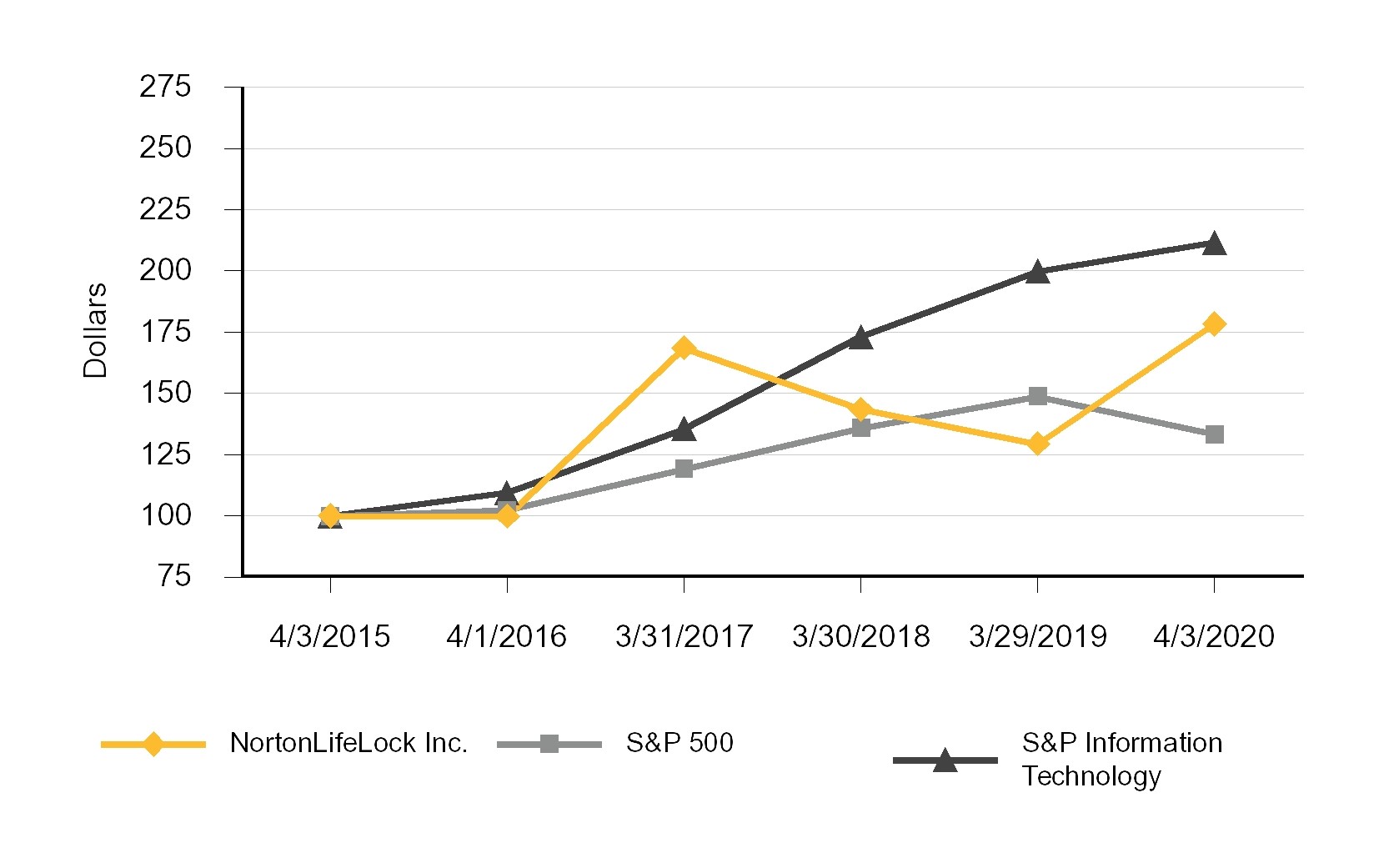
The graph below compares the cumulative total stockholder return on our common stock with the cumulative total return on the S&P 500 Composite Index and the S&P Information Technology Index for the five fiscal years ended April 3, 2020 (assuming the initial investment of $100 in our common stock and in each of the other indices on the last day of trading for fiscal 2015 and the reinvestment of all dividends). The comparisons in the graph below are based on historical data and are not indicative of, nor intended to forecast the possible future performance of our common stock.
COMPARISON OF FIVE-YEAR CUMULATIVE TOTAL RETURN
Among NortonLifeLock Inc., the S&P 500 Index
and the S&P Information Technology Index
This performance graph shall not be deemed “filed” for purposes of Section 18 of the Exchange Act or otherwise subject to the liabilities under that Section and shall not be deemed to be incorporated by reference into any filing of NortonLifeLock under the Securities Act or the Exchange Act.
Unregistered sale of equity securities
On January 6, 2020, we issued 1 million shares of our common stock to three individuals upon the accelerated vesting of stock awards issued in connection with our acquisition of Luminate Security in February 2019.
The issuance of the above securities was deemed to be exempt from registration under the Securities Act in reliance upon Section 4(a)(2) of the Securities Act (or Regulation D or Regulation S promulgated thereunder) as transactions by an issuer not involving any public offering.
Repurchases of our equity securities
Under our stock repurchase programs, shares may be repurchased on the open market and through accelerated stock repurchase transactions. In August 2019, our Board of Directors increased the share repurchase authorization to $1,600 million. As of April 3, 2020, we have $578 million remaining authorized to be completed in future periods with no expiration date. Stock repurchases during the three months ended April 3, 2020, were as follows:
| (In millions, except per share data) | Total Number of Shares Purchased (1) | Average Price Paid per Share | Total Number of Shares Purchased as Part of Publicly Announced Program | Maximum Dollar Value of Shares That May Yet Be Purchased Under the Plans or Programs | |||||||||
| January 4, 2020 to January 31, 2020 | 15 | $ | 27.10 | 15 | $ | 836 | |||||||
| February 1, 2020 to February 28, 2020 | 1 | $ | 18.36 | 1 | $ | 814 | |||||||
| February 29, 2020 to April 3, 2020 | 13 | $ | 17.89 | 13 | $ | 578 | |||||||
| Total number of shares repurchased | 29 | 29 |
(1) The number of shares purchased is reported on trade date. Repurchases of 1 million shares, which were executed prior to January 4, 2020, settled during the period of January 4, 2020 to January 31, 2020.
Item 6. Selected Financial Data
The following selected consolidated financial data is derived from our Consolidated Financial Statements. This data should be read in conjunction with our Consolidated Financial Statements and related notes included in this annual report and with Item 7. Management’s Discussion and Analysis of Financial Condition and Results of Operations. Historical results may not be indicative of future results.
Five-Year Summary
| Summary of Operations: | Year Ended (1) | ||||||||||||||||||
| (In millions, except per share data) | April 3, 2020 (2) | March 29, 2019 (3) | March 30, 2018 (4) | March 31, 2017 (5) | April 1, 2016 (6) | ||||||||||||||
| Net revenues | $ | 2,490 | $ | 2,456 | $ | 2,559 | $ | 2,091 | $ | 2,080 | |||||||||
| Operating income (loss) | $ | 355 | $ | 158 | $ | (154 | ) | $ | (152 | ) | $ | 167 | |||||||
| Income (loss) from continuing operations | $ | 578 | $ | (110 | ) | $ | 964 | $ | (138 | ) | $ | (1,013 | ) | ||||||
| Income from discontinued operations (5) | $ | 3,309 | $ | 141 | $ | 174 | $ | 32 | $ | 3,501 | |||||||||
| Net income (loss) | $ | 3,887 | $ | 31 | $ | 1,138 | $ | (106 | ) | $ | 2,488 | ||||||||
| Income (loss) per share - basic: (7) | |||||||||||||||||||
| Continuing operations | $ | 0.94 | $ | (0.17 | ) | $ | 1.56 | $ | (0.22 | ) | $ | (1.51 | ) | ||||||
| Discontinued operations | $ | 5.38 | $ | 0.22 | $ | 0.28 | $ | 0.05 | $ | 5.23 | |||||||||
| Net income (loss) per share - basic | $ | 6.32 | $ | 0.05 | $ | 1.85 | $ | (0.17 | ) | $ | 3.71 | ||||||||
| Income (loss) per share - diluted: (7) | |||||||||||||||||||
| Continuing operations | $ | 0.90 | $ | (0.17 | ) | $ | 1.44 | $ | (0.22 | ) | $ | (1.51 | ) | ||||||
| Discontinued operations | $ | 5.15 | $ | 0.22 | $ | 0.26 | $ | 0.05 | $ | 5.23 | |||||||||
| Net income (loss) per share - diluted | $ | 6.05 | $ | 0.05 | $ | 1.70 | $ | (0.17 | ) | $ | 3.71 | ||||||||
| Cash dividends declared per common share | $ | 12.40 | $ | 0.30 | $ | 0.30 | $ | 0.30 | $ | 4.60 |
| Consolidated Balance Sheets Data: | |||||||||||||||||||
| (In millions) | April 3, 2020 | March 29, 2019 | March 30, 2018 | March 31, 2017 | April 1, 2016 | ||||||||||||||
| Cash, cash equivalents and short-term investments | $ | 2,263 | $ | 2,043 | $ | 2,162 | $ | 4,256 | $ | 6,025 | |||||||||
| Total assets | $ | 7,735 | $ | 15,938 | $ | 15,759 | $ | 18,174 | $ | 11,767 | |||||||||
| Long-term debt | $ | 3,465 | $ | 3,961 | $ | 5,026 | $ | 6,876 | $ | 2,207 | |||||||||
| Total stockholders’ equity | $ | 10 | $ | 5,738 | $ | 5,023 | $ | 3,487 | $ | 3,676 |
| (1) | We have a 52/53-week fiscal year. Our fiscal 2020 was a 53-week year, whereas fiscal 2019, 2018, 2017, and 2016 each consisted of 52 weeks. |
| (2) | In fiscal 2020, we completed the sale of certain assets and the assumption of certain liabilities of our Enterprise Security business to Broadcom Inc. (the Broadcom sale) and recognized a gain of $5,434 million before income taxes, which is presented within income from income from discontinued operations. In connection with the Broadcom sale, we made a distribution to our stockholders through a special dividend of $12 per share of common stock. The aggregate amount of such dividend payments was $7.2 billion. We also recognized gains of $379 million and $250 million before income taxes on our sale of equity interest in DigiCert and divestiture of ID Analytics, respectively. Both gains were recognized within continuing operations. |
| (3) | In the first quarter of fiscal 2019, we adopted the new revenue recognition accounting standard on a modified retrospective basis. The results for fiscal 2020 and 2019 are presented under the new revenue recognition accounting standard, while prior years are not adjusted. |
| (4) | In fiscal 2018, we sold Website Security and Public Key Infrastructure solutions and recognized a gain of $653 million before income taxes associated with the sale (see Note 3 to the Consolidated Financial Statements), and we recognized an income tax benefit of $659 million as a result of the enactment of the Tax Cuts and Jobs Act (H.R.1). |
| (5) | In fiscal 2017, we acquired Blue Coat and LifeLock, and the results of operations of those entities were included from their respective dates of acquisition. |
| (6) | In fiscal 2016, we recorded $1.1 billion in income tax expense related to unremitted earnings of foreign subsidiaries from the proceeds of the sale of our Veritas information management business. This charge was recognized within continuing operations. As a result of the sale of Veritas, a net gain of $3.0 billion was recognized within discontinued operations, net of income taxes. |
| (7) | Net income per share amounts may not add due to rounding. |
Item 7. Management’s Discussion and Analysis of Financial Condition and Results of Operations
Please read the following discussion and analysis of our financial condition and results of operations together with our Consolidated Financial Statements and related Notes thereto included under Item 15 of this Annual Report on Form 10-K.
OVERVIEW
We are a leading provider of Cyber Safety solutions for consumers. During fiscal year 2020, we completed the sale of our Enterprise Security assets to Broadcom Inc. (Broadcom) and the sale of our ID Analytics solutions to LexisNexis Risk Solutions, part of RELX Inc. With the sale of our enterprise assets, we have transformed ourselves into a pure consumer company. Our NortonLifeLock branded solutions help customers protect their devices, online privacy, identity and home networks.
Fiscal Year Highlights
| • | In October 2019, we sold our equity interest in DigiCert Parent Inc. for $380 million and realized a gain of $379 million, on which we paid income taxes of $53 million. |
| • | On November 4, 2019, we completed the Broadcom sale under which Broadcom purchased certain of our Enterprise Security assets and assumed certain liabilities for a purchase price of $10.7 billion. As a result, we realized a gain of $5,434 million on which we paid income taxes of $1.9 billion as of April 3, 2020. |
The divestiture of our Enterprise Security business allowed us to shift our operational focus to our consumer business and represented a strategic shift in our operations. As a result, the results of our Enterprise Security business are classified as discontinued operations in our Consolidated Statements of Operations and thus are excluded from both continuing operations for all periods presented. Accordingly, we now have one reportable segment. Revenues and associated costs of our ID Analytics solutions, which were formerly included in the Enterprise Security segment, were included in our remaining reportable segment.
| • | In November 2019, we entered into a credit facility and drew down $500 million of a 5-year term loan to repay an existing term loan of $500 million. The credit facility also provides a revolving a line of credit of $1.0 billion and a delayed 5-year term loan commitment of $750 million through September 15, 2020. |
| • | In November 2019, our Board of Directors approved a restructuring plan in connection with the strategic decision to divest our Enterprise Security business. We incurred costs of $423 million under this plan in fiscal 2020, primarily related to workforce reduction, contract termination, and asset write-offs and impairment charges. |
| • | In connection with the Broadcom sale, in January 2020, we made a distribution to our stockholders through a special dividend of $12 per share of common stock. The aggregate amount of such dividend payments was $7.2 billion. |
| • | In January 2020, we completed the sale of our ID Analytics solutions for $375 million in net cash proceeds, resulting in a gain of $250 million. |
| • | In February 2020, we exchanged $250 million of our 2.5% Convertible Notes and $625 million of our 2.0% Convertible Notes for new convertible notes of the same principal amounts and paid the holders of the new convertible notes a total cash consideration of $546 million in lieu of conversion price adjustments related to our $12 special dividend to the exchanged notes. We adjusted the conversion price of the remaining $250 million of our 2.5% Convertible Notes and the remaining $625 million of our 2.0% Convertible Notes and extended the maturity date by one year. |
| • | In March 2020, we settled $250 million of our 2.5% Convertible Notes for $566 million, which included a cash settlement of the equity conversion feature. |
Subsequent event
In May 2020, we settled the principal and conversion rights of $625 million of our 2.0% Convertible Notes for $1.18 billion in cash.
Fiscal calendar and basis of presentation
We have a 52/53-week fiscal year ending on the Friday closest to March 31. Fiscal 2020, 2019 and 2018 in this report refers to fiscal year ended April 3, 2020, March 29, 2019, and March 30, 2018, respectively. Fiscal 2020 was a 53-week year whereas fiscal 2019 and 2018 each consisted of 52 weeks.
Key financial metrics
The following table provides our key financial metrics for fiscal 2020 compared with fiscal 2019:
| (In millions, except for per share amounts) | Fiscal 2020 | Fiscal 2019 | |||||
| Net revenues | $ | 2,490 | $ | 2,456 | |||
| Operating income | $ | 355 | $ | 158 | |||
| Income (loss) from continuing operations | $ | 578 | $ | (110 | ) | ||
| Income from discontinued operations | $ | 3,309 | $ | 141 | |||
| Net income | $ | 3,887 | $ | 31 | |||
| Net income per share from continuing operations - diluted | $ | 0.90 | $ | (0.17 | ) | ||
| Net income per share from discontinued operations - diluted | $ | 5.15 | $ | 0.22 | |||
| Net income per share - diluted | $ | 6.05 | $ | 0.05 | |||
| Net cash provided by (used in) operating activities | $ | (861 | ) | $ | 1,495 | ||
| As of | |||||||
| (in millions) | April 3, 2020 | March 29, 2019 | |||||
| Cash, cash equivalents and short-term investments | $ | 2,263 | $ | 2,043 | |||
| Contract liabilities | $ | 1,076 | $ | 1,059 |
| • | Net revenues increased $34 million primarily due to the favorable impact from the additional week in the fiscal 2020. |
| • | Operating income increased $197 million primarily due to lower compensation expense, lower outside service expense, and lower technical support expense that we achieved as a result of our cost reduction programs, partially offset by higher advertising and promotional expense and higher costs recognized in connection with our restructuring plans. |
| • | Income (loss) from continuing operations increased $688 million primarily due to higher operating income and the gains on the sale of the DigiCert equity method investment and our ID Analytics solutions, partially offset by higher income tax expense. |
| • | Income from discontinued operations increased $3,168 million, net of taxes, primarily due to the gain on the Broadcom sale. |
| • | Net income and net income per share increased primarily due to higher income from both continuing operations and discontinued operations for the reasons discussed above. |
| • | Net cash used in operating activities was $861 million, compared to cash provided by operating activities of $1,495 million in fiscal 2019, primarily due to income tax payments related to our gains on the divestitures described above. |
| • | Cash, cash equivalents and short-term investments increased $220 million compared to March 29, 2019, primarily due to cash proceeds from the divestitures described above, largely offset by payments of quarterly and special dividends, stock repurchases, and net cash used in operating activities. |
| • | Contract liabilities increased $17 million compared to March 29, 2019, reflecting higher billings than recognized net revenues. |
COVID-19 UPDATE
The COVID-19 pandemic is having widespread, rapidly evolving, and unpredictable impacts on global society, economies, financial markets, and business practices. Federal and state governments have implemented measures to contain the virus, including social distancing, travel restrictions, border closures, limitations on public gatherings, work from home, and closure of non-essential businesses. Further, beginning in March 2020, the U.S. and global economies have reacted negatively in response to worldwide concerns due to the economic impacts of the COVID-19 pandemic.
To protect the health and well-being of our employees, partners and third-party service providers, we have implemented a near company-wide work-from-home requirement for most employees until further notice, made substantial modifications to employee travel policies, and cancelled or shifted our conferences and other marketing events to virtual-only for the foreseeable future. While we continue to monitor the situation and may adjust our current policies as more information and public health guidance become available, such precautionary measures could negatively affect our customer success efforts, sales and marketing efforts, or create operational or other challenges, such as a reduction in employee productivity because of the work from home requirement, any of which could harm our business and results of operations. Further, if the COVID-19 pandemic has a substantial impact on our employees, partners or third-party service providers’ health, attendance or productivity, our results of operations and overall financial performance may be adversely impacted. Additionally, if employees, partners or third-party services providers return to work during the COVID-19 pandemic, the risk of inadvertent transmission of COVID-19 through human contact could still occur and result in litigation*.* Although we have not yet experienced a material increase in customers cancellations or a material reduction in our retention rate in 2020, a prolonged economic downturn could result adversely affect demand for our offerings, retention rates and harm our business and results of operations, particularly in light of the fact that our
solutions are discretionary purchases and thus may be more susceptible to macroeconomic pressures, as well impact the value of our common stock, our ability to refinance our debt, and our access to capital.
The duration and extent of the impact from the COVID-19 pandemic depends on future developments that cannot be accurately forecasted at this time, such as the severity and transmission rate of the disease, the extent and effectiveness of containment actions and the impact of these and other factors on our employees, customers, partners and third-party service providers. For more information on the risks associated with the COVID-19 pandemic, please see “Risk Factors” in Item 1A.
CRITICAL ACCOUNTING POLICIES AND ESTIMATES
The preparation of our Consolidated Financial Statements and related notes in accordance with generally accepted accounting principles in the U.S. (GAAP) requires us to make estimates, including judgments and assumptions that affect the reported amounts of assets, liabilities, revenue and expenses, and related disclosure of contingent assets and liabilities. We have based our estimates on historical experience and on various assumptions that we believe to be reasonable under the circumstances. We evaluate our estimates on a regular basis and make changes accordingly. Management believes that the accounting estimates employed, and the resulting amounts are reasonable; however, actual results may differ from these estimates. Making estimates and judgments about future events is inherently unpredictable and is subject to significant uncertainties, some of which are beyond our control. Should any of these estimates and assumptions change or prove to have been incorrect, it could have a material impact on our results of operations, financial position, and cash flows.
A summary of our significant accounting policies is included in Note 1 of the Notes to Consolidated Financial Statements included in this Annual Report on Form 10-K. An accounting policy is deemed to be critical if it requires an accounting estimate to be made based on assumptions about matters that are highly uncertain at the time the estimate is made, if different estimates reasonably could have been used, or if changes in the estimate that are reasonably possible could materially impact the financial statements. Management believes the following critical accounting policies reflect the significant estimates and assumptions used in the preparation of our Consolidated Financial Statements.
Business combinations
We allocate the purchase price of acquired businesses to the tangible and identifiable intangible assets acquired and liabilities assumed based on their estimated fair values on the acquisition date. Any residual purchase price is recorded as goodwill. The allocation of purchase price requires management to make significant estimates and assumptions in determining the fair values of the assets acquired and liabilities assumed especially with respect to intangible assets.
Critical estimates in valuing intangible assets include, but are not limited to, future expected cash flows from customer relationships, developed technology, trade names, and acquired patents; and discount rates. Management estimates of fair value are based upon assumptions believed to be reasonable, but which are inherently uncertain and unpredictable. Unanticipated events and circumstances may occur which may affect the accuracy or validity of such assumptions, estimates, or actual results.
Income taxes
We are subject to tax in multiple U.S. and foreign tax jurisdictions. We are required to estimate the current tax exposure as well as assess the temporary differences between the accounting and tax treatment of assets and liabilities, including items such as accruals and allowances not currently deductible for tax purposes. We apply judgment in the recognition and measurement of current and deferred income taxes which includes the following critical accounting estimates.
We use a two-step process to recognize liabilities for uncertain tax positions. The first step is to evaluate the tax position for recognition by determining if the weight of available evidence indicates that it is more likely than not that the position will be sustained on audit, including resolution of related appeals or litigation processes, if any. If we determine that the tax position will more likely than not be sustained on audit, the second step requires us to estimate and measure the tax benefit as the largest amount that is more than 50% likely to be realized upon ultimate settlement. It is inherently difficult and subjective to estimate such amounts, as this requires us to determine the probability of various outcomes. We re-evaluate these uncertain tax positions on a quarterly basis. This evaluation is based on factors including, but not limited to, changes in facts or circumstances, changes in tax law, effectively settled issues under audit, and new audit activity. Such a change in recognition or measurement would result in the recognition of a tax benefit or an additional charge to the tax provision in the period.
Loss contingencies
We are subject to contingencies that expose us to losses, including various legal and regulatory proceedings, asserted and potential claims that arise in the ordinary course of business. An estimated loss from such contingencies is recognized as a charge to income if it is probable that a liability has been incurred and the amount of the loss can be reasonably estimated. Judgment is required in both the determination of probability and the determination as to whether a loss is reasonably estimable. We review the status of each significant matter quarterly, and we may revise our estimates. Until the final resolution of such matters, there may be an exposure to loss in excess of the amount recorded, and such amounts could be material. Should any of our estimates and assumptions change or prove to have been incorrect, it could have a material impact on our consolidated financial statements for that reporting period.
Discontinued Operations
We review the presentation of planned business dispositions in the Consolidated Financial Statements based on the available information and events that have occurred. The review consists of evaluating whether the business meets the definition of a
component for which the operations and cash flows are clearly distinguishable from the other components of the business, and if so, whether it is anticipated that after the disposal the cash flows of the component would be eliminated from continuing operations and whether the disposition represents a strategic shift that has a major effect on operations and financial results. In addition, we evaluate whether the business has met the criteria as a business held for sale. In order for a planned disposition to be classified as a business held for sale, the established criteria must be met as of the reporting date, including an active program to market the business and the expected disposition of the business within one year.
Planned business dispositions are presented as discontinued operations when all the criteria described above are met. For those divestitures that qualify as discontinued operations, all comparative periods presented are reclassified in the Consolidated Balance Sheets. Additionally, the results of operations of a discontinued operation are reclassified to income from discontinued operations, net of tax, for all periods presented. Results of discontinued operations include all revenues and expenses directly derived from such businesses; general corporate overhead is not allocated to discontinued operations. See Note 3 - Divestiture and Discontinued Operations in our Notes to Consolidated Financial statements for additional information.
RESULTS OF OPERATIONS
The following table sets forth our Consolidated Statements of Operations data as a percentage of net revenues for the periods indicated:
| Fiscal Year | ||||||||
| 2020 | 2019 | 2018 | ||||||
| Net revenues | 100 | % | 100 | % | 100 | % | ||
| Cost of revenues | 16 | 19 | 18 | |||||
| Gross profit | 84 | 81 | 82 | |||||
| Operating expenses: | ||||||||
| Sales and marketing | 28 | 29 | 33 | |||||
| Research and development | 13 | 17 | 18 | |||||
| General and administrative | 15 | 17 | 19 | |||||
| Amortization of intangible assets | 3 | 3 | 3 | |||||
| Restructuring, transition and other costs | 11 | 9 | 15 | |||||
| Total operating expenses | 70 | 75 | 88 | |||||
| Operating income (loss) | 14 | 6 | (6 | ) | ||||
| Interest expense | (8 | ) | (8 | ) | (10 | ) | ||
| Other income (expense), net | 27 | (2 | ) | 26 | ||||
| Income (loss) from continuing operations before income taxes | 33 | (4 | ) | 10 | ||||
| Income tax expense (benefit) | 10 | — | (28 | ) | ||||
| Income (loss) from continuing operations | 23 | (4 | ) | 38 | ||||
| Income from discontinued operations | 133 | 6 | 7 | |||||
| Net income | 156 | % | 1 | % | 44 | % |
Note: The percentages may not add due to rounding.
Net revenues
| Fiscal Year | Variance in % | ||||||||||||||||
| (In millions, except for percentages) | 2020 | 2019 | 2018 | 2020 vs. 2019 | 2019 vs. 2018 | ||||||||||||
| Net revenues | $ | 2,490 | $ | 2,456 | $ | 2,559 | 1 | % | (4 | )% |
Fiscal 2020 compared to fiscal 2019
Net revenues increased $34 million primarily due to approximately $44 million of revenues from the additional week in fiscal 2020.
Fiscal 2019 compared to fiscal 2018
Net revenues decreased $103 million primarily due to a $238 million decrease as a result of the divestiture of our website security (WSS) and public key infrastructure (PKI) solutions and $33 million decrease in revenue from our consumer security solutions, partially offset by a $161 million increase in revenues of our identity and information protection solutions.
Performance Metrics
We regularly monitor a number of metrics in order to measure our current performance and estimate our future performance. Our metrics may be calculated in a manner different than similar metrics used by other companies.
The following table summarizes supplemental key performance metrics for our solutions:
| Fiscal Year | ||||||||||
| (In millions, except for per user amounts and percentages) | 2020 | 2019 | 2018 | |||||||
| Direct customer revenue | $ | 2,204 | $ | 2,168 | $2,037/$2,097 (2) | |||||
| Average direct customer count | 20.2 | 20.7 | 21.2 | |||||||
| Direct average revenue per user (ARPU) | $8.90 (1) | $ | 8.74 | $7.99/$8.23 (2) | ||||||
| Annual retention rate | 85 | % | 85 | % | 83 | % |
(1) ARPU in fiscal 2020 was normalized to exclude the impact of the extra week on direct revenue, which we estimate to be approximately $41 million of direct customer revenue. Excluding this adjustment, APRU would have been $9.07 in fiscal 2020
(2) Represents a non-GAAP financial measure. Estimated net revenue generated from direct customers during fiscal year 2018 used in the calculation of ARPU excluded a reduction in revenue related to contract liability purchase accounting adjustments required by GAAP, as further discussed below.
We define direct customer revenues as revenues from sales of our consumer solutions to direct customers, which we define as those customers who have a direct billing relationship with us. Such customer sources include online acquisition and retention, affiliates, co-marketing, and original equipment manufacturer channels. Direct customers excludes customers of our partners, and our ID Analytics solutions and WSS and PKI solutions, all of which have now been divested. The excluded revenues are summarized in the following table:
| Fiscal Year | |||||||||||
| (In millions) | 2020 | 2019 | 2018 | ||||||||
| Partner revenues | $ | 240 | $ | 240 | $ | 243 | |||||
| ID Analytics revenues | $ | 46 | $ | 48 | $ | 41 | |||||
| WSS and PKI revenues | $ | — | $ | — | $ | 238 |
Average direct customer count presents the average of the total number of direct customers at the beginning and end of the fiscal year.
ARPU is calculated as estimated direct customer revenues for the period divided by the average direct customer count for the same period, expressed as a monthly figure. Non-GAAP fiscal 2018 estimated direct customer revenues used in the calculation of ARPU is adjusted only to exclude a reduction in revenue of $60 million related to purchase accounting adjustments related to the February 2017 acquisition of LifeLock, Inc. ARPU for fiscal 2018 would have been $7.99 without this adjustment. We believe the adjustment is useful to investors to reflect ARPU trends in our business by improving the comparability of ARPU between periods. Fiscal 2020 and 2019 did not include any adjustments to estimated direct customer revenue as the purchase accounting adjustments were fully amortized prior to fiscal 2019. Non-GAAP estimated direct customer revenues and ARPU have limitations as analytical tools and should not be considered in isolation or as a substitute for GAAP estimated direct customer revenues or other GAAP measures. We monitor APRU because it helps us understand the rate at which we are monetizing our consumer customer base.
Annual retention rate is defined as the number of direct customers who have more than a one-year tenure as of the end of the most recently completed fiscal period divided by the total number of direct customers as of the end of the period from one year ago. We monitor annual retention rate to evaluate the effectiveness of our strategies to improve renewals of subscriptions.
Net revenues by geographic region
Percentage of revenue by geographic region as presented below is based on the billing location of the customer.
| Fiscal Year | ||||||||
| 2020 | 2019 | 2018 | ||||||
| Americas | 74 | % | 73 | % | 68 | % | ||
| EMEA | 15 | % | 16 | % | 18 | % | ||
| APJ | 11 | % | 11 | % | 13 | % |
Percentages may not add to 100% due to rounding.
The Americas include U.S., Canada, and Latin America; EMEA includes Europe, Middle East, and Africa; APJ includes Asia Pacific and Japan.
Percentage of revenue by geographic region in fiscal 2020 was similar to fiscal 2019. Americas revenues as a percentage of total revenues increased in fiscal 2019 compared to fiscal 2018 as a result of the sale of our WSS and PKI solutions which proportionally had more revenues in EMEA and APJ than the remaining solutions and higher revenues from our identity and information protection solutions in U.S. during fiscal 2019.
Cost of revenues
| Fiscal Year | Variance in % | ||||||||||||||||
| (In millions, except for percentages) | 2020 | 2019 | 2018 | 2020 vs. 2019 | 2019 vs. 2018 | ||||||||||||
| Cost of revenues | $ | 393 | $ | 455 | $ | 463 | (14 | )% | (2 | )% |
Fiscal 2020 compared to fiscal 2019
Our cost of revenues decreased $62 million primarily due to decreases in technical support costs and service costs, partially offset by an increase in royalty charges. In addition, during fiscal 2019, we recorded higher inventory write-offs of $10 million due to our discontinuation of our consumer hardware product line.
Fiscal 2019 compared to fiscal 2018
Our cost of revenues decreased $8 million primarily due to a $37 million decrease from the divestiture of our WSS and PKI solutions, partially offset by higher inventory and royalty write-offs due to our discontinuation of our consumer hardware product line in fiscal 2019 and higher fulfillment costs.
Operating expenses
| Fiscal Year | Variance in % | ||||||||||||||||
| (In millions, except for percentages) | 2020 | 2019 | 2018 | 2020 vs. 2019 | 2019 vs. 2018 | ||||||||||||
| Sales and marketing | $ | 701 | $ | 712 | $ | 841 | (2 | )% | (15 | )% | |||||||
| Research and development | 328 | 420 | 455 | (22 | )% | (8 | )% | ||||||||||
| General and administrative | 368 | 410 | 487 | (10 | )% | (16 | )% | ||||||||||
| Amortization of intangible assets | 79 | 80 | 87 | (1 | )% | (8 | )% | ||||||||||
| Restructuring, transition and other costs | 266 | 221 | 380 | 20 | % | (42 | )% | ||||||||||
| Total | $ | 1,742 | $ | 1,843 | $ | 2,250 | (5 | )% | (18 | )% |
Fiscal 2020 compared to fiscal 2019
Sales and marketing expense decreased $11 million primarily due to a $75 million decrease in compensation expense and allocated corporate costs, reflecting our cost reduction initiatives. These decreases were partially offset by a $64 million increase in advertising and promotional expense reflecting our higher investments in direct marketing programs.
Research and development expense decreased $92 million primarily due to a $77 million decrease in compensation expense and allocated corporate costs, and a $23 million decrease in outside services, reflecting our cost reduction initiatives.
General and administrative expense decreased $42 million primarily due to a $34 million decrease in compensation expense other than stock-based compensation and allocated corporate costs, and a $18 million decrease in stock-based compensation expense.
Amortization of intangible assets was relatively flat compared to fiscal 2019.
Restructuring, transition and other costs increased $45 million primarily due to $101 million of contract cancellation charges incurred in fiscal 2020, a $71 million increase in severance costs, a $45 million increase in asset impairments, and a $20 million increase in stock-based compensation. These increases were partially offset by $185 million costs related to transition projects incurred in fiscal 2019 that were completed by the end of that period. See Note 12 to the Consolidated Financial Statements for further information on our restructuring plans.
Fiscal 2019 compared to fiscal 2018
Sales and marketing expense decreased $129 million primarily due to a $41 million decrease as a result of the divestiture of our WSS and PKI solutions, a $40 million decrease in advertising and promotional expense, a $23 million decrease in compensation expense other than stock-based compensation, and a $20 million decrease in stock-based compensation expense.
Research and development expense decreased $35 million primarily due to a $30 million decrease in stock-based compensation expense and a $20 million decrease as a result of the divestiture of our WSS and KPI solutions, partially offset by a $15 million increase in outside services.
General and administrative expense decreased $77 million primarily due to an $85 million decrease in stock-based compensation expense, partially offset by a $10 million increase in compensation expense other than stock-based compensation.
Amortization of intangible assets decreased $7 million primarily due to the intangible assets sold with the divestiture of WSS and PKI solutions.
Restructuring, transition and other costs decreased $159 million primarily due to a $75 million decrease in severance and other restructuring costs. In addition, fiscal 2018 costs included $88 million of transition related costs related to our fiscal 2018 divestiture of our WSS and PKI solutions compared to $3 million in fiscal 2019.
Non-operating income (expense), net
| Fiscal Year | Variance in $ | ||||||||||||||||||
| (In millions) | 2020 | 2019 | 2018 | 2020 vs. 2019 | 2019 vs. 2018 | ||||||||||||||
| Interest expense | $ | (196 | ) | $ | (208 | ) | $ | (256 | ) | $ | 12 | $ | 48 | ||||||
| Interest income | 80 | 42 | 24 | 38 | 18 | ||||||||||||||
| Loss from equity interest | (31 | ) | (101 | ) | (26 | ) | 70 | (75 | ) | ||||||||||
| Foreign exchange loss | (6 | ) | (11 | ) | (18 | ) | 5 | 7 | |||||||||||
| Gain on divestitures | 250 | — | 653 | 250 | (653 | ) | |||||||||||||
| Gain on sale of equity method investment | 379 | — | — | 379 | — | ||||||||||||||
| Transition service expense, net | (19 | ) | — | — | (19 | ) | — | ||||||||||||
| Other | 7 | 13 | 21 | (6 | ) | (8 | ) | ||||||||||||
| Non-operating income (expense), net | $ | 464 | $ | (265 | ) | $ | 398 | $ | 729 | $ | (663 | ) |
Fiscal 2020 compared to fiscal 2019
Non-operating income, net of expense, increased $729 million primarily due to a $379 million gain on the sale of the DigiCert equity method investment and a $250 million gain on the sale of our ID Analytics solutions in fiscal 2020. In addition, our loss from equity interest that was divested in fiscal 2020 decreased $70 million and our interest income increased $38 million as a result of higher investments in money market funds purchased with proceeds from the Broadcom sale.
Fiscal 2019 compared to fiscal 2018
Non-operating income, net of expense, decreased $663 million primarily due to the absence of the $653 million gain on the divestiture of our WSS and PKI solutions in fiscal 2018. In addition, our loss from our equity interest that was acquired in the third quarter of fiscal 2018 increased $75 million. Interest expense decreased $48 million as a result of lower outstanding borrowings during fiscal 2019 due to repayments.
Provision for income taxes
We are a U.S.-based multinational company subject to tax in multiple U.S. and international tax jurisdictions. A substantial portion of our international earnings were generated from subsidiaries organized in Ireland and Singapore. Our results of operations would be adversely affected to the extent that our geographical mix of income becomes more weighted toward jurisdictions with higher tax rates and would be favorably affected to the extent the relative geographic mix shifts to lower tax jurisdictions. Any change in our mix of earnings is dependent upon many factors and is therefore difficult to predict.
| Fiscal Year | |||||||||||
| (In millions, except for percentages) | 2020 | 2019 | 2018 | ||||||||
| Income (loss) from continuing operations before income taxes | $ | 819 | $ | (107 | ) | $ | 244 | ||||
| Provision for (benefit from) income taxes | $ | 241 | $ | 3 | (720 | ) | |||||
| Effective tax rate on income from continuing operations | 29 | % | (3 | )% | (295 | )% |
Fiscal 2020 compared to fiscal 2019
Our effective tax rate increased primarily due to an increase in income taxes from non-deductible goodwill, and an increase in income taxes as a result of the Altera Ninth Circuit Opinion. See Note 13 to the Consolidated Financial Statements for information about the Altera Ninth Circuit Opinion.
Fiscal 2019 compared to fiscal 2****018
Our effective tax rate increased primarily due to one-time benefits from Tax Cuts and Jobs Act (H.R.1) (the 2017 Tax Act) in fiscal 2018. In addition, increases in tax expense in fiscal 2019 are attributable to the valuation allowance on capital losses for which we cannot yet recognize a tax benefit.
Discontinued operations
| Fiscal Year | Variance in % | ||||||||||||||||
| (In millions, except for percentages) | 2020 | 2019 | 2018 | 2020 vs. 2019 | 2019 vs. 2018 | ||||||||||||
| Net revenues | $ | 1,368 | $ | 2,288 | $ | 2,329 | (40 | )% | (2 | )% | |||||||
| Gross profit | $ | 1,035 | $ | 1,693 | $ | 1,737 | (39 | )% | (3 | )% | |||||||
| Operating income | $ | 4 | $ | 234 | $ | 214 | (98 | )% | 9 | % | |||||||
| Gain on sale | $ | 5,434 | $ | — | $ | — | N/A | N/A | |||||||||
| Income before income taxes | $ | 5,431 | $ | 228 | $ | 203 | 2,282 | % | 12 | % | |||||||
| Income tax expense | $ | 2,122 | $ | 87 | $ | 29 | 2,339 | % | 200 | % | |||||||
| Income from discontinued operations | $ | 3,309 | $ | 141 | $ | 174 | 2,247 | % | (19 | )% |
Fiscal 2020 compared to fiscal 2019
Income from discontinued operations in fiscal 2020 reflects a $5,434 million gain on the Broadcom sale and $2,122 million income tax expense primarily related to the gain. In addition, we recognized $261 million restructuring, transition and other costs in fiscal 2020, compared to $20 million in fiscal 2019.
Fiscal 2019 compared to fiscal 2018
Income from discontinued operations decreased in fiscal 2019 compared to fiscal 2018, primarily due to higher income tax expense as we had higher foreign tax benefit and stock-based compensation windfalls in fiscal 2018.
LIQUIDITY, CAPITAL RESOURCES AND CASH REQUIREMENTS
Liquidity
We have historically relied on cash generated from operations, borrowings under credit facilities, issuances of debt, and proceeds from divestitures for our liquidity needs.
As of April 3, 2020, we had cash, cash equivalents and short-term investments of $2.3 billion, of which $0.9 billion was held by our foreign subsidiaries. Our cash, cash equivalents and short-term investments are managed with the objective to preserve principal, maintain liquidity, and generate investment returns. The participation exemption system under current U.S. federal tax regulations generally allows us to make distributions of non-U.S. earnings to the U.S. without incurring additional U.S. federal tax; however, these distributions may be subject to applicable state or non-U.S. taxes. We have recognized deferred income taxes for local country income and withholding taxes that could be incurred on distributions of certain non-U.S. earnings or for outside basis differences in our subsidiaries.
We also have an undrawn revolving credit facility of $1.0 billion which expires in November 2024.
Our principal cash requirements are primarily to meet our working capital needs and support on-going business activities, including payment of taxes and cash dividends, funding capital expenditures, servicing existing debt, repurchasing our common stock, and investing in business acquisitions.
Our capital allocation strategy is to balance driving stockholder returns, managing financial risk, and preserving our flexibility to pursue strategic options, including acquisitions. Historically, this has included a quarterly cash dividend, the repayment of debt, and the repurchase of our common stock.
Sale of equity method investment
On October 16, 2019, Clearlake Capital Group, L.P., a private investment firm, and TA Associates, an existing investor of DigiCert and a private equity firm, completed an investment in DigiCert. As a result, we received $380 million in cash for our equity investment in DigiCert and made income tax payments of approximately $53 million as a result of the transaction.
Divestiture of Enterprise Security business
On November 4, 2019, we completed the Broadcom sale under which we received cash proceeds of $10.6 billion. In connection with the transaction, we incurred direct costs of approximately $39 million. In fiscal 2020, we paid approximately $1.9 billion of U.S. and foreign income taxes and we expect to pay additional income taxes of $85 million in fiscal 2021 as a result of the transaction.
As a result of the divestiture, on January 31, 2020, we made a distribution to our stockholders through a special dividend of $12 per share of common stock in an aggregate amount of $7.2 billion.
Sale of ID Analytics solutions
On January 31, 2020, we completed the sale of our ID Analytics solutions for approximately $375 million in net cash proceeds.
Debt
In November 2019, we entered into a credit facility and drew down $500 million of a 5-year term loan to repay an existing term loan of $500 million.
In March 2020, we settled the $250 million principal and conversion rights of our 2.5% Convertible Notes for $566 million in cash.
In May 2020, we settled the $625 million principal and conversion rights of our 2.0% Convertible Notes for $1.18 billion in cash.
Share Repurchase Program
During fiscal 2020, we executed repurchases of 68 million shares of our common stock, under our existing share repurchase program for an aggregate amount of $1.6 billion. We have $578 million remaining under our existing share repurchase authorization.
Cash flows
The following table summarizes our cash flow activities in fiscal 2020, 2019 and 2018:
| Fiscal Year | |||||||||||
| (In millions) | 2020 | 2019 | 2018 | ||||||||
| Net cash provided by (used in): | |||||||||||
| Operating activities | $ | (861 | ) | $ | 1,495 | $ | 950 | ||||
| Investing activities | $ | 11,379 | $ | (241 | ) | $ | (21 | ) | |||
| Financing activities | $ | (10,123 | ) | $ | (1,209 | ) | $ | (3,475 | ) | ||
| Increase (decrease) in cash and cash equivalents | $ | 386 | $ | 17 | $ | (2,473 | ) |
Cash from operating activities
Fiscal 2020
Our cash used in fiscal 2020 reflected net income of $3,887 million adjusted by items, consisting primarily of gains on divestitures of $5,684 million and a gain on the sale of our equity method investment of $379 million, amortization and depreciation of $361 million, and stock-based compensation of $312 million.
Changes in operating assets and liabilities during fiscal 2020 consisted primarily of the following:
Accounts receivable decreased $583 million, primarily due to the collections of receivables related to our Enterprise Security solutions. Such receivables were not included in the assets that were sold in connection with the Broadcom sale.
Contract liabilities decreased $121 million, primarily due to seasonally higher recognized revenue from our Enterprise Security solutions than billings during the period prior to the Broadcom sale.
Accrued compensation and benefits decreased $117 million, primarily due to a decrease in headcount as a result of the Broadcom sale and our restructuring activities.
Income taxes payable increased $383 million primarily due to taxes owed on the Broadcom sale and the sale of our DigiCert equity method investment. During fiscal 2020, we made aggregate tax payments of $2 billion related to these transactions.
Fiscal 2019
Our cash flows for fiscal 2019 reflected net income of $31 million, adjusted by non-cash items, primarily consisting of amortization and depreciation of $615 million, stock-based compensation of $352 million, and loss from equity interest of $101 million.
Changes in operating assets and liabilities during fiscal 2019 consisted primarily of the following:
Accounts receivable decreased $113 million, reflecting lower billings and higher collections in the last months of fiscal 2019 compared to the corresponding period in fiscal 2018.
Contract liabilities increased $196 million, reflecting higher billings versus recognized revenue.
Fiscal 2018
Our cash flows for fiscal 2018 reflected net income of $1.1 billion, adjusted by non-cash amortization and depreciation of $640 million, stock-based compensation expense of $610 million, and offset by a deferred tax benefit of $1.8 billion, primarily as a result of the enactment of the 2017 Tax Act in December 2017, and a gain on divestiture of $653 million.
Changes in operating assets and liabilities during fiscal 2018 consisted primarily of the following:
Accounts receivable increased $170 million, reflecting higher billings in the last months of fiscal 2018 and our shift in sales to solutions with ratable revenue recognition related to our Enterprise Security solutions.
Contract liabilities increased $491 million, reflecting our shift in sales to contracts related to our Enterprise Security solutions with longer durations subject to ratable versus point in time revenue recognition. This resulted in less in-period revenue recognized and higher billings towards the end of the fiscal year due to the seasonal sales cycles for those solutions. These factors were primarily offset by a decrease of $319 million related to our fiscal 2018 divestiture of our WSS and PKI solutions.
Income taxes payable increased $880 million, reflecting the one-time transition tax of $896 million under the 2017 Tax Act.
Cash from investing activities
Our cash flows from investing activities in fiscal 2020 consisted primarily of $10.9 billion in net proceeds from the Broadcom sale and the divestiture of ID Analytics solutions and $380 million from the sale of our equity method investment in DigiCert.
Our investing activities in fiscal 2019 consisted primarily of capital expenditures of $207 million, payments for acquisitions of $180 million, partially offset by proceeds from maturities and sales of short-term investments of $139 million.
Our investing activities in fiscal 2018 consisted primarily of $933 million in net proceeds from divestiture of our WSS and PKI solutions, partially offset by payment for acquisitions of $401 million and net purchases of $387 million of short-term investments.
Cash from financing activities
Our financing activities in fiscal 2020 consisted primarily of payments of dividends and dividend equivalents of $7.5 billion, repurchases of common stock of $1.6 billion, debt repayments of $868 million, consisting of $552 million in principal and a $316 million cash settlement of the equity rights associated with our Senior Convertible notes, and cash consideration of $546 million paid in connection with the exchange of convertible debt.
Our financing activities in fiscal 2019 primarily included debt repayments of $600 million, repurchases of common stock of $234 million, payments of dividends and dividend equivalents of $217 million, and tax payments related to vesting equity awards of $173 million.
Our financing activities in fiscal 2018 primarily included debt repayments of $3.2 billion.
Cash requirements
Debt - As of April 3, 2020, our total outstanding principal amount of indebtedness is summarized as follows. See Note 10 to the Consolidated Financial Statements for further information about our debt.
| (In millions) | April 3, 2020 | ||
| Senior Term Loan | $ | 500 | |
| Senior Notes | 2,250 | ||
| Convertible Senior Notes | 1,500 | ||
| Total debt | $ | 4,250 |
In May 2020, we repaid $625 million of our 2.0% Convertible Notes.
In our second quarter of fiscal 2021, we plan to borrow $750 million under the delayed draw term loan, which will mature in November 2024, and use the proceeds to repay in full our 4.2% Senior Notes, which are due in September 2020.
Debt covenant compliance - The credit agreement we entered into in November 2019 contains customary representations and warranties, non-financial covenants for financial reporting, affirmative and negative covenants, including a covenant that we maintain a consolidated leverage ratio of not more than 5.25 to 1.0, or 5.75 to 1.0 if we acquire assets or business in an aggregate amount greater than $250 million, and restrictions on indebtedness, liens, investments, stock repurchases, and dividends (with exceptions permitting our regular quarterly dividend and other specific capital returns). As of April 3, 2020, we were in compliance with all debt covenants.
Dividends - On May 14, 2020, we announced a cash dividend of $0.125 per share of common stock to be paid in June 2020. Any future dividends will be subject to the approval of our Board of Directors.
Stock repurchases - Under our stock repurchase program, we may purchase shares of our outstanding common stock through accelerated stock repurchase transactions, open market transactions (including through trading plans intended to qualify under Rule 10b5-1 under the Exchange Act,) and privately-negotiated transactions. As of April 3, 2020, the remaining balance of our stock repurchase authorization is $578 million and does not have an expiration date. The timing and actual number of shares repurchased will depend on a variety of factors, including price, general business and market conditions, and other investment opportunities.
Restructuring. Under our restructuring plans approved by our Board of Directors in August and November 2019, we have incurred and expect to incur cash expenditures for severance and termination benefits and contract terminations. The August 2019 Plan was completed in fiscal 2020 with total cash payments of $50 million. As of April 3, 2020, we estimate that we will incur total costs of $550 million in connection with the November 2019 Plan, excluding stock-based compensation expense, of which up to $200 million is expected to consist of cash expenditures for severance and termination benefits and $110 million of cash expenditures for contract terminations, and up to $240 million is expected to consist of asset write-offs and other restructuring costs. During fiscal 2020, we made $196 million in cash payments related to the November 2019 Plan. These
actions are expected to be completed by September 2020. See Note 12 to the Consolidated Financial Statements for additional cash flow information associated with our restructuring activities.
Contractual obligations
The following is a schedule of our significant contractual obligations as of April 3, 2020, including those associated with our discontinued operations. The expected timing of payments of the obligations in the following table is estimated based on current information. Timing of payments and actual amounts paid may be different, depending on the time of receipt of goods or services, or changes to agreed-upon amounts for some obligations.
| Payments Due by Period | |||||||||||||||||||
| (In millions) | Total | Less than 1 Year | 1 - 3 Years | 3 - 5 Years | Over 5 Years | ||||||||||||||
| Debt (1) | $ | 4,250 | $ | 756 | $ | 1,950 | $ | 444 | $ | 1,100 | |||||||||
| Interest payments on debt (2) | 508 | 136 | 210 | 135 | 27 | ||||||||||||||
| Purchase obligations (3) | 439 | 347 | 53 | 33 | 6 | ||||||||||||||
| Long-term income taxes payable (4) | 683 | 68 | 136 | 299 | 180 | ||||||||||||||
| Operating leases (5) | 114 | 34 | 44 | 27 | 9 | ||||||||||||||
| Total | $ | 5,994 | $ | 1,341 | $ | 2,393 | $ | 938 | $ | 1,322 |
| (1) | In May 2020, we repaid $625 million of our 2.0% Convertible Notes. See Note 10 and Note 19 to the Consolidated Financial Statements for further information on our debt. |
| (2) | Interest payments were calculated based on the contractual terms of the related Senior Notes, Convertible Senior Notes, and credit facility. Interest on variable rate debt was calculated using the interest rate in effect as of April 3, 2020. See Note 10 to the Consolidated Financial Statements for further information on the Senior Notes, Convertible Senior Notes, and credit facility. |
| (3) | These amounts are associated with agreements for purchases of goods or services generally including agreements that are enforceable and legally binding and that specify all significant terms, including fixed or minimum quantities to be purchased; fixed, minimum, or variable price provisions; and the approximate timing of the transaction. The table above also includes agreements to purchase goods or services that have cancellation provisions requiring little or no payment. The amounts under such contracts are included in the table above because management believes that cancellation of these contracts is unlikely, and we expect to make future cash payments according to the contract terms or in similar amounts for similar materials. |
| (4) | These amounts represent the transition tax on previously untaxed foreign earnings of foreign subsidiaries under the 2017 Tax Act which may be paid through July 2025. |
| (5) | We have entered into various non-cancelable operating lease agreements that expire on various dates through fiscal 2029. The amounts in the table above exclude expected sublease income. See Note 9 to the Consolidated Financial Statements for further information on leases. |
Due to the uncertainty with respect to the timing of future cash flows associated with our unrecognized tax benefits and other long-term taxes as of April 3, 2020, we are unable to make reasonably reliable estimates of the period of cash settlement with the respective taxing authorities. Therefore, $695 million in long-term income taxes payable has been excluded from the contractual obligations table. See Note 13 to the Consolidated Financial Statements for further information.
Indemnifications
In the ordinary course of business, we may provide indemnifications of varying scope and terms to customers, vendors, lessors, business partners, subsidiaries, and other parties with respect to certain matters, including, but not limited to, losses arising out of our breach of agreements or representations and warranties made by us. In connection with the sale of Veritas and the sale of our Enterprise Security business to Broadcom, we assigned several leases to Veritas Technologies LLC or Broadcom and/or their related subsidiaries. Refer to Note 18 to the Consolidated Financial Statements for further information on our indemnifications.
Item 7A. Quantitative and Qualitative Disclosures about Market Risk
We are exposed to various market risks related to fluctuations in interest rates and foreign currency exchange rates. We may use derivative financial instruments to mitigate certain risks in accordance with our investment and foreign exchange policies. We do not use derivatives or other financial instruments for trading or speculative purposes.
Interest rate risk
Our short-term investments and cash equivalents primarily consist of corporate bonds and certificate of deposits, respectively. A change in interest could have an adverse impact on their market value. As of April 3, 2020, the carrying value and fair value of our short-term investments and cash equivalents was $434 million. A hypothetical change in the yield curve of 100 basis points would not result in a significant reduction in fair value.
As of April 3, 2020, we had $3.8 billion in aggregate principal amount of fixed-rate Senior Notes and convertible debt outstanding, with a carrying amount and a fair value of $3.6 billion, based on Level 2 inputs. Since these notes bear interest at fixed rates, they do not result in any financial statement risk associated with changes in interest rates. However, the fair value of these notes fluctuates when interest rates change.
As of April 3, 2020, we also had $500 million outstanding debt with variable interest rates based on the London InterBank Offered Rate (LIBOR). A reasonably possible hypothetical adverse change of 100 basis points in LIBOR would not result in a significant increase in interest expense on an annualized basis.
In addition, we have a $1.0 billion revolving credit facility that if drawn bears interest at a variable rate based on LIBOR and would be subject to the same risks associated with adverse changes in LIBOR.
Foreign currency exchange rate risk
We conduct business in numerous currencies through our worldwide operations, and our entities hold monetary assets or liabilities, earn revenues, or incur costs in currencies other than the entity’s functional currency, primarily in Euro, Japanese Yen, British Pound, and Indian Rupee. In addition, we charge our international subsidiaries for their use of intellectual property and technology and for certain corporate services we provide. Our cash flow, results of operations and certain of our intercompany balances that are exposed to foreign exchange rate fluctuations may differ materially from expectations, and we may record significant gains or losses due to foreign currency fluctuations and related hedging activities. As a result, we are exposed to foreign exchange gains or losses which impacts our operating results.
We have a foreign exchange exposure management program designed to identify material foreign currency exposures, manage these exposures, and reduce the potential effects of currency fluctuations on our results of operations through which we enter into foreign exchange forward contracts on our assets and liabilities denominated in currencies other than the functional currency of our subsidiaries with up to twelve months in duration. We do not use derivative financial instruments for speculative trading purposes, nor do we hedge our foreign currency exposure in a manner that entirely offsets the effects of the changes in foreign exchange rates. The gains and losses on these foreign exchange contracts are recorded in interest and other, net in our statement of operations.
As of April 3, 2020 and March 29, 2019, we had open foreign currency forward contracts with notional amounts of $419 million and $1.1 billion, respectively, to hedge foreign currency balance sheet exposure, with an insignificant fair value. A hypothetical ten percent depreciation of foreign currency would result in a reduction in fair value of our forward contracts of $30 million and $84 million for fiscal 2020 and fiscal 2019, respectively. This analysis disregards the possibilities that the rates can move in opposite directions and that losses from one geographic area may be offset by gains from another geographic area.
Additional information with respect to our derivative instruments is included in Note 9 to the Consolidated Financial Statements in this Annual Report on Form 10-K.
Item 8. Financial Statements and Supplementary Data
The Consolidated Financial Statements and related disclosures included in Part IV, Item 15 of this annual report are incorporated by reference into this Item 8.
Selected Quarterly Financial Data (Unaudited)
| Fiscal 2020 | Fiscal 2019 | ||||||||||||||||||||||||||||||
| (In millions, except per share data) | Fourth Quarter (1) | Third Quarter (2) | Second Quarter | First Quarter | Fourth Quarter | Third Quarter | Second Quarter | First Quarter | |||||||||||||||||||||||
| Net revenues | $ | 614 | $ | 618 | $ | 608 | $ | 650 | $ | 617 | $ | 615 | $ | 612 | $ | 612 | |||||||||||||||
| Gross profit | $ | 517 | $ | 515 | $ | 511 | $ | 554 | $ | 493 | $ | 505 | $ | 499 | $ | 504 | |||||||||||||||
| Operating income (loss) | $ | 44 | $ | 62 | $ | 109 | $ | 140 | $ | 72 | $ | 62 | $ | 48 | $ | (24 | ) | ||||||||||||||
| Income tax expense (benefit) | $ | 108 | $ | 57 | $ | 22 | $ | 54 | $ | (17 | ) | $ | 10 | $ | 34 | $ | (24 | ) | |||||||||||||
| Income (loss) from continuing operations | $ | 149 | $ | 353 | $ | 38 | $ | 38 | $ | 37 | $ | (19 | ) | $ | (61 | ) | $ | (67 | ) | ||||||||||||
| Income (loss) from discontinued operations | $ | 82 | $ | 2,492 | $ | 747 | $ | (12 | ) | $ | (3 | ) | $ | 84 | $ | 53 | $ | 7 | |||||||||||||
| Net income (loss) | $ | 231 | $ | 2,845 | $ | 785 | $ | 26 | $ | 34 | $ | 65 | $ | (8 | ) | $ | (60 | ) | |||||||||||||
| Income (loss) per share - basic: (2) | |||||||||||||||||||||||||||||||
| Continuing operations | $ | 0.25 | $ | 0.57 | $ | 0.06 | $ | 0.06 | $ | 0.06 | $ | (0.03 | ) | $ | (0.10 | ) | $ | (0.11 | ) | ||||||||||||
| Discontinued operations | $ | 0.14 | $ | 4.01 | $ | 1.20 | $ | (0.02 | ) | $ | — | $ | 0.13 | $ | 0.08 | $ | 0.01 | ||||||||||||||
| Net income (loss) per share - basic | $ | 0.39 | $ | 4.58 | $ | 1.27 | $ | 0.04 | $ | 0.05 | $ | 0.10 | $ | (0.01 | ) | $ | (0.10 | ) | |||||||||||||
| Income (loss) per share - diluted: (2) | |||||||||||||||||||||||||||||||
| Continuing operations | $ | 0.23 | $ | 0.55 | $ | 0.06 | $ | 0.06 | $ | 0.06 | $ | (0.03 | ) | $ | (0.10 | ) | $ | (0.11 | ) | ||||||||||||
| Discontinued operations | $ | 0.13 | $ | 3.85 | $ | 1.16 | $ | (0.02 | ) | $ | — | $ | 0.13 | $ | 0.08 | $ | 0.01 | ||||||||||||||
| Net income (loss) per share - diluted | $ | 0.36 | $ | 4.40 | $ | 1.22 | $ | 0.04 | $ | 0.05 | $ | 0.10 | $ | (0.01 | ) | $ | (0.10 | ) |
| (1) | During the fourth quarter of fiscal 2020, we recognized a pre-tax gain of $250 million on our divestiture of ID Analytics solutions, which is presented as part of income (loss) from continuing operations. |
| (2) | During the third quarter of fiscal 2020, we completed the sale of certain assets and the assumption of certain liabilities of our Enterprise Security business to Broadcom for a net gain of $2.6 billion, which is presented as part of income (loss) from discontinued operations. In addition, we recognized a pre-tax gain of $379 million on our sale of our DigiCert equity method investment, which is presented as part of income (loss) from continuing operations. |
| (3) | Net income (loss) per share amounts may not add due to rounding. |
Item 9. Changes in and Disagreements with Accountants on Accounting and Financial Disclosure
None.
Item 9A. Controls and Procedures
a) Evaluation of Disclosure Controls and Procedures
The SEC defines the term “disclosure controls and procedures” to mean a company’s controls and other procedures that are designed to ensure that information required to be disclosed in the reports that it files or submits under the Exchange Act is recorded, processed, summarized, and reported, within the time periods specified in the SEC’s rules and forms. “Disclosure controls and procedures” include, without limitation, controls and procedures designed to ensure that information required to be disclosed by an issuer in the reports that it files or submits under the Exchange Act is accumulated and communicated to the issuer’s management, including its principal executive and principal financial officers, or persons performing similar functions, as appropriate to allow timely decisions regarding required disclosure. Our disclosure controls and procedures are designed to provide reasonable assurance that such information is accumulated and communicated to our management. Our management (with the participation of our Chief Executive Officer and Chief Financial Officer) has conducted an evaluation of the effectiveness of our disclosure controls and procedures (as defined in Rules 13a-15(e) and 15d-15(e) of the Securities Exchange Act). Based on such evaluation, our Chief Executive Officer and our Chief Financial Officer have concluded that our disclosure controls and procedures were effective at the reasonable assurance level as of the end of the period covered by this report.
b) Management’s Report on Internal Control over Financial Reporting
Our management is responsible for establishing and maintaining adequate internal control over financial reporting (as defined in Rules 13a-15(f) and 15d-15(f) of the Exchange Act) for NortonLifeLock. Our management, with the participation of our Chief Executive Officer and our Chief Financial Officer, has conducted an evaluation of the effectiveness of our internal control over financial reporting as of April 3, 2020, based on criteria established in Internal Control - Integrated Framework (2013) issued by the Committee of Sponsoring Organizations of the Treadway Commission (COSO).
Our management has concluded that, as of April 3, 2020, our internal control over financial reporting was effective at the reasonable assurance level based on these criteria.
The effectiveness of our internal control over financial reporting as of April 3, 2020 has been audited by KPMG LLP, an independent registered public accounting firm, as stated in their report, which is included in Part IV, Item 15 of this Annual Report on Form 10-K.
c) Changes in Internal Control over Financial Reporting
There were no changes in our internal control over financial reporting during the quarter ended April 3, 2020, that have materially affected, or are reasonably likely to materially affect, our internal control over financial reporting.
d) Limitations on Effectiveness of Controls
Our management, including our Chief Executive Officer and Chief Financial Officer, does not expect that our disclosure controls and procedures or our internal controls will prevent all errors and all fraud. A control system, no matter how well conceived and operated, can provide only reasonable, not absolute, assurance that the objectives of the control system are met. Further, the design of a control system must reflect the fact that there are resource constraints, and the benefits of controls must be considered relative to their costs. Because of the inherent limitations in all control systems, no evaluation of controls can provide absolute assurance that all control issues and instances of fraud, if any, within our company have been detected.
Item 9B. Other Information
The information below is reported in lieu of information that would be reported under Items 5.03 under Form 8-K.
On May 22, 2020, we executed and filed a Certificate of Elimination of Series A Junior Preferred Stock (the “Junior Preferred Stock”) with the Secretary of State of the State of Delaware, to remove the Certificate of Designations of the Junior Preferred Stock from our Amended and Restated Certificate of Incorporation. The Certificate of Elimination became effective upon filing. No shares of the Junior Preferred Stock were issued or outstanding upon filing of the Certificate of Elimination. A copy of the Certificate of Elimination is attached hereto as Exhibit 3.06 and is incorporated into this Item 9B by reference.
The information below is reported in lieu of information that would be reported under Item 5.02 under Form 8-K.
On May 28, 2020, we and Samir Kapuria, our President, entered into an amendment agreement to the letter agreement between Mr. Kapuria and us dated December 5, 2019 (the Amendment). Under the Amendment, we agreed to terminate Mr. Kapuria other than for Cause by December 31, 2020, upon which time Mr. Kapuria shall be entitled to the benefits set forth in the letter agreement and the Amendment. The foregoing description of the Amendment is qualified in its entirety by reference to the full text of the Amendment, which will be filed as an exhibit to our Quarterly Report on Form 10-Q for the fiscal quarter ending July 3, 2020.
PART III
Item 10. Directors, Executive Officers and Corporate Governance
The information required by this item will be included under the caption “Directors, Executive Officers, and Corporate Governance” in our proxy statement for the 2020 Annual Meeting to be filed with the SEC within 120 days of the fiscal year ended April 3, 2020 (the 2020 Proxy Statement) and is incorporated herein by reference. With regard to the information required by this item regarding compliance with Section 16(a) of the Exchange Act, we will provide disclosure of delinquent Section 16(a) reports, if any, in the 2020 Proxy Statement, and such disclosure, if any, is incorporated herein by reference.
Item 11. Executive Compensation
The information required by this item will be included under the caption “Executive Compensation” in our 2020 Proxy Statement and is incorporated herein by reference.
Item 12. Security Ownership of Certain Beneficial Owners and Management and Related Stockholder Matters
The information required by this item will be included under the caption “Security Ownership of Certain Beneficial Owners and Management and Related Stockholder Matters” in our 2020 Proxy Statement and is incorporated herein by reference.
Item 13. Certain Relationships and Related Transactions, and Director Independence
The information required by this item will be included under the caption “Certain Relationships and Related Transactions, and Director Independence” in our 2020 Proxy Statement and is incorporated herein by reference.
Item 14. Principal Accounting Fees and Services
The information required by this item will be included under the caption “Principal Accountant Fees and Services” in our 2020 Proxy Statement and is incorporated herein by reference.
PART IV
Item 15. Exhibits, Financial Statement Schedules
(a)
(1). Financial Statements
Upon written request, we will provide, without charge, a copy of this annual report, including the Consolidated Financial Statements and financial statement schedule. All requests should be sent to:
NortonLifeLock Inc.
Attn: Investor Relations
60 E. Rio Salado, Suite 1000
Tempe, Arizona 85281
(650) 527-8000
The following documents are filed as part of this report:
Report of Independent Registered Public Accounting Firm
To the Stockholders and Board of Directors
NortonLifeLock Inc.:
Opinions on the Consolidated Financial Statements and Internal Control Over Financial Reporting
We have audited the accompanying consolidated balance sheets of NortonLifeLock Inc. and subsidiaries (the Company) as of April 3, 2020 and March 29, 2019, the related consolidated statements of operations, comprehensive income (loss), stockholders’ equity, and cash flows for each of the years in the three-year period ended April 3, 2020, and the related notes (collectively, the consolidated financial statements). We also have audited the Company’s internal control over financial reporting as of April 3, 2020, based on criteria established in Internal Control - Integrated Framework (2013) issued by the Committee of Sponsoring Organizations of the Treadway Commission.
In our opinion, the consolidated financial statements referred to above present fairly, in all material respects, the financial position of the Company as of April 3, 2020 and March 29, 2019 and the results of its operations and its cash flows for each of the years in the three-year period ended April 3, 2020, in conformity with U.S. generally accepted accounting principles. Also in our opinion, the Company maintained, in all material respects, effective internal control over financial reporting as of April 3, 2020 based on criteria established in Internal Control - Integrated Framework (2013) issued by the Committee of Sponsoring Organizations of the Treadway Commission.
Change in Accounting Principle
As discussed in Note 2 and 9 to the consolidated financial statements, the Company has changed its method of accounting for leases as of March 30, 2019, due to the adoption of Financial Accounting Standards Board’s Accounting Standards Codification (ASC) Topic 842, Leases.
As discussed in Note 1 to the consolidated financial statements, the Company has changed its method of accounting for revenue from contracts with customers as of March 31, 2018, due to the adoption of ASC Topic 606, Revenue from Contracts with Customers.
Basis for Opinions
The Company’s management is responsible for these consolidated financial statements, for maintaining effective internal control over financial reporting, and for its assessment of the effectiveness of internal control over financial reporting, included in the accompanying Management’s Report on Internal Control over Financial Reporting under Item 9A. Our responsibility is to express an opinion on the Company’s consolidated financial statements and an opinion on the Company’s internal control over financial reporting based on our audits. We are a public accounting firm registered with the Public Company Accounting Oversight Board (United States) (PCAOB) and are required to be independent with respect to the Company in accordance with the U.S. federal securities laws and the applicable rules and regulations of the Securities and Exchange Commission and the PCAOB.
We conducted our audits in accordance with the standards of the PCAOB. Those standards require that we plan and perform the audits to obtain reasonable assurance about whether the consolidated financial statements are free of material misstatement, whether due to error or fraud, and whether effective internal control over financial reporting was maintained in all material respects.
Our audits of the consolidated financial statements included performing procedures to assess the risks of material misstatement of the consolidated financial statements, whether due to error or fraud, and performing procedures that respond to those risks. Such procedures included examining, on a test basis, evidence regarding the amounts and disclosures in the
Showing the first 8K of 199K characters. Open the full section
Item 16. Form 10-K Summary
None.
SIGNATURES
Pursuant to the requirements of Section 13 or 15(d) of the Securities Exchange Act of 1934, the Registrant has duly caused this report to be signed on its behalf by the undersigned, thereunto duly authorized, in the City of Mountain View, State of California, on the 28th day of May 2020.
| NORTONLIFELOCK INC. | ||
| By: | /s/ Vincent Pilette | |
| Vincent Pilette Chief Executive Officer and Director |
KNOW ALL PERSONS BY THESE PRESENTS, that each person whose signature appears below constitutes and appoints Vincent Pilette, Matthew Brown, and Bryan Ko, and each or any of them, his or her attorneys-in-fact, each with the power of substitution, for him or her in any and all capacities to sign any and all amendments to this report on Form 10-K and any other documents in connection therewith, with the Securities and Exchange Commission, granting unto said attorneys-in-fact, and each of them, full power and authority to do and perform each and every act and thing requisite and necessary to be done in and about the premises, as fully to all intents and purposes as he or she might or could do in person, hereby ratifying and confirming all that such attorneys-in-fact, or his or their substitute or substitutes, may lawfully do or cause to be done by virtue hereof. This Power of Attorney may be signed in several counterparts.
Pursuant to the requirements of the Securities Exchange Act of 1934, this report has been signed below by the following persons on behalf of the Registrant and in the capacities and on the dates indicated below.
| Signature | Title | Date | ||
| /s/ Vincent Pilette | Chief Executive Officer and Director (Principal Executive Officer) | May 28, 2020 | ||
| Vincent Pilette | ||||
| /s/ Matthew Brown | Vice President and Interim Chief Financial Officer (Principal Financial Officer and Principal Accounting Officer) | May 28, 2020 | ||
| Matthew Brown | ||||
| /s/ Frank E. Dangeard | Chairman of the Board | May 28, 2020 | ||
| Frank E. Dangeard | ||||
| /s/ Sue Barsamian | Director | May 28, 2020 | ||
| Sue Barsamian | ||||
| /s/ Eric K. Brandt | Director | May 28, 2020 | ||
| Eric K. Brandt | ||||
| /s/ Nora Denzel | Director | May 28, 2020 | ||
| Nora Denzel | ||||
| /s/ Peter A. Feld | Director | May 28, 2020 | ||
| Peter A. Feld | ||||
| /s/ Kenneth Y. Hao | Director | May 28, 2020 | ||
| Kenneth Y. Hao | ||||
| /s/ David W. Humphrey | Director | May 28, 2020 | ||
| David W. Humphrey | ||||
| /s/ V. Paul Unruh | Director | May 28, 2020 | ||
| V. Paul Unruh |