 filings.tools
GE Vernova 2024 10-K Annual Report
GEV · CIK 1996810 · Form 10-K · Fiscal year ended December 31, 2024 · Filed February 6, 2025
24 sections, 548K characters. Original on sec.gov · Markdown · JSON
Cover and table of contents
UNITED STATES SECURITIES AND EXCHANGE COMMISSION
Washington, D.C. 20549
FORM 10-K
☑ ANNUAL REPORT PURSUANT TO SECTION 13 OR 15(d) OF THE SECURITIES EXCHANGE ACT OF 1934
For the fiscal year ended December 31, 2024
☐ TRANSITION REPORT PURSUANT TO SECTION 13 OR 15(d) OF THE SECURITIES EXCHANGE ACT OF 1934
Commission file number 001-41966
GE Vernova Inc.
(Exact name of registrant as specified in its charter)
| Delaware | 92-2646542 | |||
| (State or other jurisdiction of incorporation or organization) | (I.R.S. Employer Identification No.) | |||
| 58 Charles Street, | Cambridge, | MA | 02141 | |
| (Address of principal executive offices) | (Zip Code) |
(Registrant’s telephone number, including area code) (617) 674-7555
Securities Registered Pursuant to Section 12(b) of the Act:
| Title of each class | Trading Symbol(s) | Name of each exchange on which registered |
| Common stock, par value $0.01 per share | GEV | New York Stock Exchange |
Indicate by check mark if the registrant is a well-known seasoned issuer, as defined in Rule 405 of the Securities Act. Yes ☐ No ☑
Indicate by check mark if the registrant is not required to file reports pursuant to Section 13 or Section 15(d) of the Act. Yes ☐ No ☑
Indicate by check mark whether the registrant (1) has filed all reports required to be filed by Section 13 or 15(d) of the Securities Exchange
Act of 1934 during the preceding 12 months (or for such shorter period that the registrant was required to file such reports), and (2) has
been subject to such filing requirements for the past 90 days. Yes ☑ No ☐
Indicate by check mark whether the registrant has submitted electronically every Interactive Data File required to be submitted pursuant to
Rule 405 of Regulation S-T (§232.405 of this chapter) during the preceding 12 months (or for such shorter period that the registrant was
required to submit such files). Yes ☑ No ☐
Indicate by check mark whether the registrant is a large accelerated filer, an accelerated filer, a non-accelerated filer, a smaller reporting
company or an emerging growth company. See definitions of “large accelerated filer,” “accelerated filer,” “smaller reporting company” and
"emerging growth company" in Rule 12b-2 of the Exchange Act. (Check one):
| Large accelerated filer | ☐ | Accelerated filer | ☐ |
| Non-accelerated filer | ☑ | Smaller reporting company | ☐ |
| Emerging growth company | ☐ |
If an emerging growth company, indicate by check mark if the registrant has elected not to use the extended transition period for complying
with any new or revised financial accounting standards provided pursuant to Section 13(a) of the Exchange Act. ☐
Indicate by check mark whether the registrant has filed a report on and attestation to its management's assessment of the effectiveness of
its internal control over financial reporting under Section 404(b) of the Sarbanes-Oxley Act (15 U.S.C. 7262(b)) by the registered public
accounting firm that prepared or issued its audit report. ☐
If securities are registered pursuant to Section 12(b) of the Act, indicate by check mark whether the financial statements of the registrant
included in the filing reflect the correction of an error to previously issued financial statements. ☐
Indicate by check mark whether any of those error corrections are restatements that required a recovery analysis of incentive-based
compensation received by any of the registrant’s executive officers during the relevant recovery period pursuant to §240.10D-1(b). ☐
Indicate by check mark whether the registrant is a shell company (as defined in Rule 12b-2 of the Act). Yes ☐ No ☑
The aggregate market value of the outstanding common equity of the registrant not held by affiliates as of the last business day of the
registrant’s most recently completed second fiscal quarter (June 28, 2024) was approximately $47.1 billion. There were 275,900,754 shares
of common stock with a par value of $0.01 outstanding at January 15, 2025.
DOCUMENTS INCORPORATED BY REFERENCE
Portions of the definitive proxy statement relating to the registrant's 2025 Annual Meeting of Stockholders to be filed pursuant to Regulation
14A within 120 days after the end of the registrant’s fiscal year ended December 31, 2024, are incorporated by reference into Part III of this
Annual Report on Form 10-K to the extent described therein.
TABLE OF CONTENTS
| Page | |||||
| Forward-Looking Statements | 3 | ||||
| Part I | 4 | ||||
| Item 1. Business | 4 | ||||
| Item 1A. Risk Factors | 10 | ||||
| Item 1B. Unresolved Staff Comments | 31 | ||||
| Item 1C. Cybersecurity | 31 | ||||
| Item 2. Properties | 32 | ||||
| Item 3. Legal Proceedings | 33 | ||||
| Item 4. Mine Safety Disclosures | 33 | ||||
| Part II | 34 | ||||
| Item 5. Market for Registrant’s Common Equity, Related Stockholder Matters, and Issuer Purchases of Equity Securities | 34 | ||||
| Item 6. [Reserved] | 34 | ||||
| Item 7. Management's Discussion and Analysis of Financial Condition and Results of Operations | 34 | ||||
| Item 7A. Quantitative and Qualitative Disclosures About Market Risk | 47 | ||||
| Item 8. Financial Statements and Supplementary Data | 49 | ||||
| Auditor's Report | 49 | ||||
| Consolidated and Combined Statement of Income (Loss) | 51 | ||||
| Consolidated and Combined Statement of Financial Position | 52 | ||||
| Consolidated and Combined Statement of Cash Flows | 53 | ||||
| Consolidated and Combined Statement of Comprehensive Income (Loss) | 54 | ||||
| Consolidated and Combined Statement of Changes in Equity | 55 | ||||
| Note | 1 | Organization and Basis of Presentation | 56 | ||
| Note | 2 | Summary of Significant Accounting Policies | 57 | ||
| Note | 3 | Dispositions and Businesses Held for Sale | 61 | ||
| Note | 4 | Current and Long-Term Receivables | 62 | ||
| Note | 5 | Inventories, Including Deferred Inventory Costs | 62 | ||
| Note | 6 | Property, Plant, and Equipment | 63 | ||
| Note | 7 | Leases | 63 | ||
| Note | 8 | Acquisitions, Goodwill, and Other Intangible Assets | 64 | ||
| Note | 9 | Contract and Other Deferred Assets & Contract Liabilities and Deferred Income | 64 | ||
| Note | 10 | Current and All Other Assets | 65 | ||
| Note | 11 | Equity Method Investments | 66 | ||
| Note | 12 | Accounts Payable and Equipment Project Payables | 67 | ||
| Note | 13 | Postretirement Benefit Plans | 67 | ||
| Note | 14 | Current and All Other Liabilities | 72 | ||
| Note | 15 | Income Taxes | 72 | ||
| Note | 16 | Accumulated Other Comprehensive Income (Loss) (AOCI) and Common Stock | 75 | ||
| Note | 17 | Share-Based Compensation | 76 | ||
| Note | 18 | Earnings Per Share Information | 77 | ||
| Note | 19 | Other Income (Expense) – Net | 77 | ||
| Note | 20 | Financial Instruments | 77 | ||
| Note | 21 | Variable Interest Entities (VIEs) | 80 | ||
| Note | 22 | Commitments, Guarantees, Product Warranties, and Other Loss Contingencies | 80 | ||
| Note | 23 | Restructuring Charges and Separation Costs | 81 | ||
| Note | 24 | Related Parties | 82 | ||
| Note | 25 | Segment and Geographical Information | 83 | ||
| Item 9. Changes in and Disagreements With Accountants on Accounting and Financial Disclosure | 86 | ||||
| Item 9A. Controls and Procedures | 86 | ||||
| Item 9B. Other Information | 86 | ||||
| Item 9C. Disclosure Regarding Foreign Jurisdictions that Prevent Inspections | 86 | ||||
| Part III | 87 | ||||
| Item 10. Directors, Executive Officers, and Corporate Governance | 87 | ||||
| Item 11. Executive Compensation | 87 | ||||
| Item 12. Security Ownership of Certain Beneficial Owners and Management and Related Stockholder Matters | 87 | ||||
| Item 13. Certain Relationships and Related Transactions and Director Independence | 87 | ||||
| Item 14. Principal Accountant Fees and Services | 87 | ||||
| Part IV | 88 | ||||
| Item 15. Exhibits and Financial Statement Schedules | 88 | ||||
| Item 16. Form 10-K Summary | 89 | ||||
| Signatures | 90 |
2024 FORM 10-K 3
FORWARD-LOOKING STATEMENTS. This annual report contains forward-looking statements within the meaning of the Private
Securities Litigation Reform Act of 1995 and other securities laws that are subject to risks and uncertainties. These statements may include
words such as “believe”, “expect”, “guidance”, “anticipate”, “intend”, “plan”, “estimate”, “will”, “may”, and negatives or derivatives of these or
similar expressions. These forward-looking statements include, among others, statements about the benefits GE Vernova Inc. (the
Company, GE Vernova, our, we, or us) expects from our lean operating model; our expectations regarding the energy transition; the
demand for our products and services; our expectations of future increased business, revenues, and operating results; our ability to
innovate and anticipate and address customer demands; our ability to increase production capacity, efficiencies, and quality; our
underwriting and risk management; the experiences we believe we are gaining across our Haliade-X backlog related to installation
timelines and related remediation plans; benefits we expect to receive from the Inflation Reduction Act of 2022 (IRA); current and future
customer orders and projects; our actual and planned investments, including in research and development, capital expenditures, joint
ventures and other collaborations with third parties; our ability to meet our sustainability goals and targets; levels of global infrastructure
spending; government policies that further or limit the global energy transition; our expected cash generation; our capital allocation
framework, including share repurchases and dividends; our restructuring programs and strategies to reduce operational costs; our ability to
novate or assign credit support provided by General Electric Company; disputes, litigation, arbitration, and governmental proceedings
involving us; the sufficiency and expected uses of our cash, liquidity, and financing arrangements; and our credit ratings.
Forward-looking statements reflect our current expectations, are based on judgments and assumptions, are inherently uncertain and are
subject to risks, uncertainties, and other factors, which could cause our actual results, performance, or achievements to differ materially
from current expectations. Some of the risks, uncertainties, and other factors that may cause actual results to differ materially from those
expressed or implied by forward-looking statements include the following:
-
Our ability to successfully execute our lean operating model;
-
Our ability to innovate and successfully identify and meet customer demands and needs;
-
Our ability to successfully compete;
-
Significant disruptions in our supply chain, including the high cost or unavailability of raw materials, components, and products
essential to our business;
-
Significant disruptions to our manufacturing and production facilities and distribution networks;
-
Changes in government policies and priorities that reduce funding and demand for energy equipment and services;
-
Shifts in demand, market expectations, and other dynamics related to energy, electrification, decarbonization, and sustainability;
-
Global economic trends, competition, and geopolitical risks, including conflicts, trade policies, and other constraints on economic
activity;
-
Product quality issues or product or safety failures related to our complex and specialized products, solutions, and services;
-
Our ability to obtain required permits, licenses, and registrations;
-
Our ability to attract and retain highly qualified personnel;
-
Our ability to develop, deploy, and protect our intellectual property rights;
-
Our capital allocation plans, including the timing and amount of any dividends, share repurchases, acquisitions, organic
investments, and other priorities;
- Our ability to successfully identify, complete, integrate, and obtain benefits from any acquisitions, joint ventures and other
investments;
-
The price, availability, and trading volumes of our common stock;
-
Downgrades of our credit ratings or ratings outlooks;
-
The amount and timing of our cash flows and earnings;
-
Our ability to meet our sustainability goals;
-
The impact from cybersecurity or data security incidents;
-
Changes in law, regulation, or policy that may affect our businesses and projects, or impose additional costs;
-
Natural disasters, weather conditions and events, public health events, or other emergencies;
-
Tax law and policy changes;
-
Adverse outcomes in legal, regulatory, and administrative proceedings, actions, and disputes; and
-
Other changes in macroeconomic and market conditions and volatility.
These or other uncertainties may cause our actual future results to be materially different than those expressed in our forward-looking
statements, and these and other factors are more fully discussed elsewhere in this Annual Report on Form 10-K, including in Item 1A. "Risk
Factors" and Item 7. "Management's Discussion and Analysis of Financial Condition and Results of Operations," as may be updated from
time to time in our Securities and Exchange Commission (SEC) filings and as posted on our website at www.gevernova.com/investors/fls.
We do not undertake any obligation to update or revise our forward-looking statements except as may be required by law or regulation.
2024 FORM 10-K 4
PART I
Item 1. BUSINESS.
INTRODUCTION. GE Vernova Inc. (the Company, GE Vernova, our, we, or us) is a global leader in the electric power industry, with
products and services that generate, transfer, orchestrate, convert, and store electricity. We design, manufacture, deliver, and service
technologies to create a more reliable, secure, and sustainable electric power system, enabling electrification and decarbonization,
underpinning the progress and prosperity of the communities we serve. We are a purpose-built company, positioned with a unique scope
and scale of solutions to help accelerate the energy transition, while servicing and growing our installed base and strengthening our own
profitability and stockholder returns. We have a strong history of innovation, which is a key strength enabling us to meet our customers’
needs.
The breadth of our portfolio also enables us to provide an extensive range of technologies and integrated solutions to help advance our
customers’ energy and sustainability goals. Our installed base generates approximately 25% of the world’s electricity. We build, modernize,
and service power systems to help our customers electrify their operations and economies, meet power demand growth, improve system
reliability and resiliency, and navigate the energy transition through limiting and reducing emissions. The portfolio of equipment and
services that we deliver is diversified across technology types and is adaptable based on electric power market conditions and demand.
GE Vernova Inc. is a Delaware corporation with corporate headquarters in Cambridge, Massachusetts. On April 2, 2024, General Electric
Company (GE), which now operates as GE Aerospace, completed the previously announced spin-off (the Spin-Off) of GE Vernova. In
connection with the Spin-Off, GE distributed all of the shares of our common stock to its stockholders and we became an independent
company. See Note 1 in the Notes to the consolidated and combined financial statements for further information regarding the Spin-Off.
COMPANY STRATEGY. GE Vernova is positioned as an industry leader to fulfill the growing demand for electrical power, while driving
the energy transition forward. Our focus is on supplying our customers with products and services necessary to deliver reliable, affordable,
and sustainable electricity. We expect significant growth in demand for the offerings we provide to the electric power industry.
Our company strategy is focused on:
- Delivering on global sustainability, by developing, providing, and servicing technologies that enable electrification and
decarbonization.
- Maintaining and enhancing strong relationships with many of the leading and largest utilities, developers, governments, and
electricity users.
- Servicing the existing installed base and delivering new technologies and processes, which improve customer outcomes while
driving increased profitability and cash flow.
-
Improving margins and lowering risk through better underwriting.
-
Streamlining our product portfolio to focus on core workhorse products, which will improve both cost and quality going forward.
-
Using Lean to improve our cost structure and productivity levels across our business and corporate functions.
-
Innovating and investing, along with third parties, in new offerings and technologies that will help customers electrify and
decarbonize the world.
- Allocating capital as a whole and within our various businesses – focused on generating cash flow to enable attractive stockholder
returns, with a commitment to return at least 1/3 of our free cash flow* to our stockholders.
SUSTAINABILITY. As a company whose technology base helps generate approximately 25% of the world’s electricity, our integration of
sustainability into our core business strategy and culture reflects our strategic imperative to electrify and decarbonize the world and to play
a crucial role in the energy transition. Our sustainability framework is guided by our commitment to help the energy sector address the
energy trilemma of reliability, affordability, and sustainability.
To operationalize this commitment, we have built the sustainability governance framework of “the Control Room.” The Control Room is led
by our Chief Sustainability Officer, who supervises a cross-functional, global team, and chairs our Sustainability Council. Further, we have a
Safety and Sustainability Committee of the Board of Directors, which guides and oversees our sustainability goals, impacts, risks, and
efforts. Our operational efforts are aligned with our business strategy, the priorities of our stakeholders, our commitments, and our aim to
deliver innovative technologies to create a more sustainable electric power system.
The four pillars of our sustainability framework: Electrify, Decarbonize, Conserve, and Thrive:
- Electrify: Catalyze access to more secure, sustainable, reliable, and affordable electricity, while helping to drive global**
economic development. We seek to add power generation and grid capacity to strengthen current electricity infrastructure and
provide critical redundancy, support electrification in underserved regions, and encourage economic development.
- Decarbonize: Invent, deploy, and service technology to help decarbonize and electrify the world.** We seek to advance both
the near-term impact by improving the trajectory on carbon intensity and the long-term impact by deploying products that are
increasingly capable of lower carbon emissions once supporting infrastructure is deployed at scale.
- Conserve: Innovate more while using less.** We are working to reduce both our direct and indirect greenhouse gas emissions
and have set a goal to achieve carbon neutrality for our Scope 1 and Scope 2 emissions by 2030. We also support the transition
to a more circular economy and recognize the importance of critical raw materials and nature in our mission. We are working to
track 90% of our top products as part of our circularity framework by 2030, including principles such as eco-design.
- Thrive: Advance safe, responsible,** and inclusive working conditions in our operations and across our value chain. We
are committed to prioritizing safety, building and fostering an inclusive workplace globally and in the communities in which we
operate, promoting a culture of compliance and ethics, and advancing human rights across our supply chain.
*Non-GAAP Financial Measure
2024 FORM 10-K 5
The global shift towards a variety of energy sources, evolving and increased environmental regulations and requirements, and climate
change effects, present both challenges and opportunities that may impact our business. See Item 1A. "Risk Factors" for further information
about these risks.
COMPETITION. We believe GE Vernova's businesses' ability to supply the electric power industry with a broad array of advanced
technologies for an intelligent, sustainable power system that help customers accelerate the energy transition is a key differentiator among
various of our competitors. Due to increasing demand exceeding available capacity for products and services that supply the electrical
power industry, we face growing competition from emerging threats. The continuing ability to reduce cycle times and ensure available
capacity is expected to allow us to remain competitive as demand for our products and services grows significantly. In addition, continued
investment in our products and services and emerging technologies is necessary for us to successfully compete and deliver economic
value and performance to our customers through efficiency, reliability, and affordability.
Our businesses operate in highly competitive markets. We compete based on product performance, quality, branding, service and/or price
across the industries and geographies served. Various companies compete with us across single or multiple products and services.
Key Power segment competitors include Siemens Energy, Mitsubishi Power, Westinghouse, Framatome, and Rolls-Royce.
Key Wind segment competitors include Vestas, Siemens-Gamesa, and Nordex.
Key Electrification segment competitors include Hitachi Energy, Siemens Energy, Siemens, Schneider Electric, Mitsubishi Electric, and
ABB.
SEGMENTS**.** We report three business segments that are aligned with the nature of equipment and services they provide, specifically
Power, Wind, and Electrification.
Power. Our Power segment serves power generation, industrial, government, and other customers worldwide with products and services
related to energy production. Our products and technologies harness resources such as natural gas, oil, diesel, water, and nuclear to
produce electric power and include gas and steam turbines, full balance of plant, upgrade, and service solutions.
Gas Power - offers a wide spectrum of heavy-duty and aeroderivative gas turbines for utilities, independent power producers, and
numerous industrial applications, ranging from small, mobile power to utility scale power plants. Gas Power also delivers maintenance and
service solutions across total plant assets and over their operational lifecycle.
Nu**clear Power - provides nuclear technology solutions for boiling water reactors including reactor design, reactor fuel and support services,
and the design and development of small modular reactors through joint ventures with Hitachi, Ltd.
Hydro Power - provides a portfolio of solutions and services for hydropower generation for both large hydropower plants and small
hydropower solutions.
Steam Power - offers a comprehensive range of steam turbine technologies and services primarily for nuclear power plants in North
America and coal-fired power plants, helping our customers deliver reliable energy, and supporting coal-fired plant customers transitioning
to a lower-carbon future.
We believe that gas power plays an essential role in the energy transition, serving as a fundamental source of reliable and dispatchable
power. Despite evolving market factors related to the energy transition, such as increased renewable energy penetration and new climate
change-related legislation and policies, we anticipate the gas power industry will grow over the next decade. We expect gas power
generation to increase at low-single digit rates, playing a critical role supporting load growth, maintaining grid stability, and energy security.
During the year ended December 31, 2024, GE Vernova's gas turbine installed base utilization was flat compared to the same period last
year. Growth in Asia from fewer outages and more HA units commissioned and higher utilization in the United States (U.S.) were offset by
Europe where increased nuclear, hydro, and renewable energy drove lower gas operations in the year. Global electricity demand increased
by low-single digits.
As of December 31, 2024, our fundamentals remained strong with approximately $73.4 billion in remaining performance obligations (RPO)
and a gas turbine installed base of approximately 7,000 units with approximately 1,700 units under long-term service agreements and an
average remaining contract life of approximately 10 years. As of December 31, 2024, we had 32 HA-Turbines in RPO, 30 being installed
and commissioned, and 115 HA-Turbines in our installed base with approximately 2.9 million operating hours.
We maintain a strong focus on our underwriting discipline and risk management to secure deals that meet our financial hurdles and ensure
we deliver confidently for our customers. Operating in emerging markets presents uncertainties in deal closures due to financing and other
complexities. Given the long-cycle nature of our business and the ongoing challenges from inflationary pressures, our Power segment has
proactively implemented lean initiatives to sustain cost productivity, collaborated closely with suppliers, and adjusted product and service
pricing in line with market demand, inflation, and industry dynamics.
We continue to invest in new product development. In Nuclear Power, we have an agreement with a customer for the deployment of small
modular nuclear reactor (SMR) technology, making it the first commercial contract of its kind in North America. SMRs have the potential to
reduce nuclear power plant costs and cycle times through their standardized and modularized design. In Gas Power, we are committed to
long-term investments to meet our growing demand from our customers by enhancing production capacity at existing factories to address
the increasing need for both equipment and services. We continue to invest in technologies and decarbonization pathways to deliver lower
carbon-emitting and more reliable power. In the fourth quarter, we secured an agreement in the United Kingdom for one of the world's first
commercial-scale gas-fired power stations with carbon capture, aiming to capture up to 2 million tons of CO2 annually and contributing to
the United Kingdom's net-zero goals. We are committed to advancing decarbonization technologies that we believe will provide our
customers with options for more renewable and more dependable energy.
2024 FORM 10-K 6
Wind. Our Wind segment includes our wind generation technologies, inclusive of onshore and offshore wind turbines and blades. In our
Wind segment, we engineer, manufacture, and commercialize wind turbines, an important technology playing a role in the energy transition
as we seek to decarbonize the world's energy sector.
Onshore Wind - delivers wind turbines, technology, and services for the onshore wind power industry by focusing on work-horse products in
select geographies, while continuing to innovate the technology to create wind turbines suitable for various markets and environmental
conditions. Our workhorse products include our 2.8-127m, 3.6-154m, and 6.1-158m onshore units. Wind services assist customers in
improving cost, capacity, and performance of their assets over the lifetime of their fleets, utilizing digital infrastructure to monitor, predict,
and optimize wind farm energy performance.
Offshore Wind - provides offshore wind power technologies and wind farm development for the offshore wind power sector. Our workhorse
product in the offshore market is our Haliade-X 220m offshore unit.
LM Wind Power - designs, produces, and tests wind turbine blades.
As we focus on providing carbon-free electricity reliably and at scale, we have simplified our segment management structure and portfolio
of product offerings, focusing on fewer and more reliable workhorse products. Our workhorse products account for approximately 70% of
our equipment RPO at December 31, 2024. Included in our RPO are services agreements on approximately 23,000 of our onshore wind
turbines, from an installed base of approximately 57,000 units.
At Onshore Wind, we are focused on improving our overall fleet availability. We are reducing product variants and deploying repairs and
other corrective measures across the fleet. Concurrently, we intend to operate in fewer geographies and focus on those geographic regions
that align better with our products and supply chain footprint, positioning our workhorse products to targeted countries. Our volume mix has
shifted towards the U.S., currently representing approximately 75% of Onshore Wind's equipment RPO, while our international volume has
become smaller and more profitable. Specifically in the U.S., the IRA introduced new, and extended existing, tax incentives, significantly
improving project economics for our customers and turbine producers. Our projects in the U.S. generally benefit from incentives available to
our customers and broadly available IRA incentives. We will continue to monitor government actions for any changes that could adversely
impact the market for wind turbine manufacturers. Finally, we are continuing our restructuring program to reduce our operating costs and
are seeing the benefits both operationally and financially.
At Offshore Wind, we continue to experience pressure related to our product and project costs and execution timelines, as we deliver on
our existing backlog. We are committed to driving quality improvements, installation efficiencies, and cost productivity. Similar to Onshore
Wind, we have embarked on a restructuring program to reduce our operating costs.
Electrification. Our Electrification segment includes grid solutions, power conversion, solar and storage solutions, which we collectively
refer to as Electrification Systems, and Electrification Software, that provide products and services required for the transmission,
distribution, conversion, storage, and orchestration of electricity from point of generation to point of consumption. Several of the key
offerings in this segment, for example, include our high-voltage direct current transmission (HVDC) products, power transformers,
switchgear, and our grid automation related products and services.
Grid Solutions - enables power utilities and industries worldwide to effectively manage electricity from the point of generation to
consumption, helping the reliability, efficiency, and resiliency of the grid. Offerings include a comprehensive portfolio of equipment,
hardware, protection and control, automation, and digital services. Grid Solutions also addresses the challenges of the energy transition by
safely and reliably connecting intermittent renewable energy generation to transmission networks.
Power Conversion - applies the science and systems of power conversion to provide motors, generators, automation, and control
equipment, and drives for energy intensive industries such as marine, oil and gas, mining, rail, metals, and test systems.
Solar & Storage Solutions - provides integration of renewable energies that drive stability to the grid and integrates storage and renewable
energy generation sources.
Electrification Software - supports the transmission, distribution, conversion, storage, and orchestration of electricity from point of
generation to point of consumption.
We continue to experience robust demand for our systems, equipment, and services. Demand remains strong for large scale transmission-
related equipment to interconnect renewables and move bulk power. We also continue to benefit from higher growth in orders from other
transmission activities within our Grid Solutions business.
Our Grid Solutions business is positioned to support grid expansion and modernization needs globally. We participate in the onshore
interconnection sector and the rapidly growing offshore interconnection sector with new products and technology. We have developed and
seek to continue developing new technologies with the intention of solving for a denser, more resilient, stable, and efficient electric grid with
lower future greenhouse gas emissions.
We adjust pricing and contractual terms of our products and services based on demand, inflation, and industry dynamics. Customer lead-
times have increased as a result of demand outstripping supply, though we are proactively managing this by deploying lean initiatives to
reduce lead-times and drive cost productivity. In addition, we are making investments to expand our capacity and capabilities to support this
continued growth while benefiting from synergies across our Electrification businesses.
RESEARCH AND DEVELOPMENT. GE Vernova’s R&D efforts focus on driving the energy transition. We are engineering the
technologies, forging the partnerships, and delivering innovations to electrify and decarbonize the world. We expect to invest approximately
$5 billion of cumulative R&D from 2025 through 2028 across our businesses. Approximately half of this R&D is focused on continuously
2024 FORM 10-K 7
industrializing existing products and supporting our installed base for this decade. The other half is focused on long-term innovation to
deliver our next generation of differentiated products.
R&D is performed within each of our businesses, and at multiple locations around the world, including at our research facilities in
Niskayuna, New York and Bangalore, India, which we refer to collectively as Advanced Research. Advanced Research partners with our
businesses on programs to create the technology breakthroughs that will feed our future product roadmaps. They are guided by our
customers’ demands for sustainable, affordable, resilient, and secure energy. Additionally, Advanced Research partners with other
established and start-up companies and educational institutions to incubate and commercialize new technology and launch new
businesses in markets that are key to the energy transition but go beyond GE Vernova’s core businesses.
INTELLECTUAL PROPERTY. We have a substantial portfolio of intellectual property (IP) assets, registered and unregistered, that
protect both our investments in R&D across our businesses as well as our products and services. To protect our innovation, we rely on a
variety of IP rights and data protection measures, as well as monitor the activities of third parties to ensure that unauthorized use of IP does
not go unremedied.
Patents are an important part of our IP strategy. They protect our inventions around the world. We shape and reposition our patent portfolio
to cover emerging and other technologies that drive our core businesses. Software, which is important to all of our businesses, but is
especially central to the IP position of the Electrification businesses, is protected by a combination of copyrights, patents, and contractual
protections.
We protect our trade secrets and confidential know-how by actively enforcing our internal policies for data classification and protection and
by requiring and enforcing specific innovation and proprietary information agreements and non-disclosure agreements. We also utilize
contemporary cybersecurity tools and systems, as well as physical security measures, that safeguard our most valuable data from insider
threats and third-party concentrated efforts to misappropriate our IP. See Item 1C. "Cybersecurity" for further information.
While our patents and other IP protections are important to our operations, we do not consider any single IP asset or group of assets to be
of material significance to any of our financial segments or our businesses as a whole. However, we believe that we derive a sustained
competitive advantage both from our IP portfolio as well as technical know-how embedded in our products and manufacturing techniques
developed over decades. We further believe that our understanding of our customers’ needs, technology expertise, and manufacturing
know-how are critical to our business.
In addition to our IP portfolio, we have a license to use certain IP from GE Aerospace, including the GE name and the GE Monogram. The
license applies to our products and services, as well as to natural extensions and evolutions thereof. See “Certain Relationships and
Related Person Transactions—Agreements with GE—Agreements Governing Intellectual Property” in our information statement dated
March 8, 2024, which was attached as Exhibit 99.1 to a Current Report on Form 8-K furnished with the SEC on March 8, 2024 (the
Information Statement).
GLOBAL SUPPLY CHAIN. Annually, we purchase approximately $20 billion in materials and components sourced from over 100
countries. We face various supply chain challenges, many of which are industry-wide or arise from geopolitical and economic conditions
beyond our control. These include global conflicts, global economic trends, geopolitical dynamics like sanctions, tariffs and other trade
tensions, inflation, logistics issues, human rights landscape shifts, and regulatory changes. Additionally, potential disruptions such as
natural disasters and other extreme weather conditions, global pandemics, and cyber-attacks could significantly impact our operations,
financial performance, and ability to meet customer commitments.
To address these challenges, we maintain strong supplier relationships and prioritize opportunities to localize our supply chain to serve our
distinct geographies, while at the same time allowing us to maintain a globally diverse supply chain for operational resiliency. Our risk-
based supplier onboarding process involves thorough due diligence, focusing on performance, labor standards, ethical sourcing, and
human rights, supported by an audit program. We are expanding these efforts to consider environmental impact and environmental, social
and governance (ESG) regulations, along with alignment to our GE Vernova sustainability framework.
Internally, we manage risks through cyber mitigation, business continuity planning, and crisis management. We have developed cross-
business councils for supply chain and procurement to proactively share best practices around supply chain resiliency. We are also
enhancing our risk management tools to leverage technology for better market trend analysis and risk mitigation concerning commodity
pricing, availability, lead-times, country specific tariff impacts, and ESG compliance. Specifically, to minimize inflationary impacts, we have a
sourcing process to monitor commodity price fluctuations across the ferrous, non-ferrous, precious metals, and energy commodities. We
continue to employ and evolve lean practices across our operations to enhance safety, quality, and delivery performance, building new
capabilities to scale our supply chain aligned to our business growth.
HUMAN CAPITAL. GE Vernova is a global workforce of approximately 75,000 employees, with approximately 70% of our employees
specializing in manufacturing, engineering, or services. In addition, we have approximately 1,800 employees in Quality or environmental,
health, and safety (EHS) roles, critical disciplines for our success as a company. Our culture enables us to deliver on our purpose and drive
performance. We operate according to a set of shared principles that guide how we aspire to speak, behave, interact, and make decisions.
We call these five principles the GE Vernova Way:
-
We drive innovation in everything we do to electrify and decarbonize the world.
-
We serve our customers with pride and a focus on mutual success and long-term impact.
-
We challenge ourselves to be better every day; l****ean is how we work.
-
We break boundaries and cross borders to win as one team.
-
We remain accountable individually and collectively to deliver on our purpose and commitments.
2024 FORM 10-K 8
As we strive to live the GE Vernova Way, we create a more respectful, inclusive culture where we can each contribute to meaningful work.
Additional human capital priorities include:
-
Protecting the health and safety of our workforce and contractors.
-
Driving continuous improvement and eliminating waste through lean.
-
Operating as one GE Vernova.
-
Driving sustainable high performance.
-
Attracting and developing talent with the variety of skills to innovate and grow our business; fostering an inclusive culture.
We trace our beginnings to the Edison General Electric Company, a manufacturer of electric lighting fixtures, sockets, and other electric
lighting devices. We carry forward that legacy today as a developer, manufacturer, and service provider of power generating and
decarbonizing solutions. GE Vernova’s portfolio also includes Advanced Research with hundreds of technologists and cross-discipline
experts focused on enabling ground-breaking innovations destined to shape the energy transition.
Our footprint is truly global with approximately 24,000 employees in Europe, 19,000 employees in the U.S., 18,000 employees in Asia, and
7,000 employees in Latin America. GE Vernova’s relationship with employee-representative organizations around the world takes many
forms.
- Within the U.S., we have approximately 1,300 union-represented production and maintenance employees who are covered by a
four-year collective bargaining agreement that was ratified for a two-year extension in 2023 and expires in June of 2025.
- In Europe, we engage with approximately 100 representative organizations such as works councils and trade unions, in
accordance with local law. Social dialogue, including information, consultation, and negotiation, is a key component of doing
business in Europe and a driver of sustainable business growth for us in the region.
- In addition to the U.S. and Europe, we also engage with employee representative bodies in China (2,200 employees), India (2,000
employees), Canada (700 employees), Brazil (600 employees), and Mexico (150 employees).
We strive to build and maintain productive relationships with all trade unions and employee-representative organizations with which we
engage. More broadly, our relationship with every employee, regardless of functional discipline, geography or representation status, is a
priority. The purpose, passion, and expertise our employees embody every day is fundamental to providing essential electricity around the
world and for the future of our environment. It is our mission to inspire, engage, and develop our employees to their fullest potential.
ENVIRONMENTAL, HEALTH, AND SAFETY MATTERS. GE Vernova is committed to providing and promoting a safe and healthy
working environment, using natural resources and energy in a sustainable way, and avoiding an adverse impact to employees and
contractors, our customers, the environment, and the communities where we do business. We support our customers by maintaining the
highest standards in safeguarding our employees, our contracting partners, and the environment.
In addition to our own internal enterprise standards and core requirements on various EHS topics, we are subject to international, national,
state, and local EHS laws, regulations, and industry and customer standards, including EHS licensing and authorization requirements.
These EHS laws apply to a broad range of activities across our whole product lifecycle and our entire global organization, including those
related to:
-
protection of the environment and use of natural resources;
-
occupational health and safety;
-
the use, management, release, storage, transportation, remediation, and disposal of, and exposure to, hazardous substances and
waste;
-
our products, including the use of certain chemicals in our products and production processes;
-
emissions to air and water; and
-
climate change and greenhouse gas emissions.
EHS laws vary by jurisdiction and have become increasingly stringent over time. These requirements impose certain responsibilities on our
business, including the obligation to install pollution control technologies and obtain and maintain various environmental permits, the cost of
which may be substantial. Satisfying such local EHS requirements is often a minimum requirement for us, and we commit extensive
resources to maintaining our compliance with these requirements. For example, by applying our enterprise standards and core
requirements everywhere (except where local regulations are more stringent), we often go beyond local compliance requirements,
especially where local standards are weak or lacking. Safety is incorporated into our lean operating method and we prioritize safeguarding
our employees and contractors. We also enhance our internal enterprise standards and core requirements regularly through a culture of
continuous improvement and documenting opportunities to improve through internal and external audits.
Our EHS management system includes measures to verify that we are monitoring adherence to GE Vernova EHS standards and regulatory
requirements through audits and inspections. Operations are assessed on a regular basis as part of our management of change (MOC)
process to mitigate safety risks. EHS operational reviews at both the business and GE Vernova level address progress on program
execution as well as strategy discussions related to emerging EHS risks.
REGULATION**.** We are a manufacturer and servicer of energy products, a participant in the energy supply chain, a large publicly traded
U.S. corporation that operates globally, a government contractor, and an employer of a large global workforce. As such, our businesses and
operations are affected by global laws, regulations, and standards that impact each of these capacities.
- Manufacturer and Servicer.** Our production cycle and products are subject to global regulations, such as permitting, quality
controls, environmental and eco-design regulations, health and safety regulations, export control laws, product specifications,
market-related policies, and distribution regulations in countries in which our products are manufactured or sold. We maintain
processes and procedures that comply with such applicable global laws and regulations as they pertain to the various stages of
2024 FORM 10-K 9
our production life cycle, including the development of our products. Our ability to design, market, sell, and distribute our products
globally depends upon our compliance with laws and regulations in each jurisdiction.
We design and manufacture sophisticated, innovative products and services for the energy sector, which are subject to EHS and
sustainability regulations. These regulations, such as the Registration, Evaluation, Authorisation and Restriction of Chemicals
(REACH) regulation of the European Union (EU), include those governing chemicals and components used or generated by
products or manufacturing processes, such as per/polyfluoroalkyl substances (PFAS), contained in components and products
sourced in connection with manufacturing and services operations. In addition, some of our operations involve the handling, use,
transportation, and disposal of radioactive and hazardous materials, including nuclear fuel, nuclear power devices and their
components. We are subject to international, federal, state, and local regulations governing the handling, use, transportation, and
disposal of such materials.
Some of our businesses are subject to product regulatory regimes specific to their sector. In particular:
◦Nuclear. Our nuclear products and technologies are regulated through country-specific laws and regulations and are
subject to various safety-related requirements imposed by the U.S. Government, the Department of Energy, and the
Nuclear Regulatory Commission (NRC). In the U.S., the NRC oversees the licensing, permitting, and decommissioning of
nuclear sites. Our Nuclear business’s standard process is to work with the national regulatory commissions in order to
comply with all aspects of regulations from permitting at the time of site selection to decommissioning requirements at the
end of life.
◦Offshore Wind. The U.S. Bureau of Safety and Environmental Enforcement (BSEE) is a U.S. federal agency that
oversees the safe and environmentally responsible exploration and development of U.S. offshore energy resources. Our
Offshore Wind business is subject to BSEE regulatory oversight and enforcement in connection with the Vineyard Wind
offshore wind farm off the coast of Massachusetts. For Vineyard Wind, we are the manufacturer and supplier of our newly
developed Haliade-X 220m wind turbines (Haliade-X). In July 2024, a wind turbine blade event occurred at the Vineyard
Wind offshore wind farm as a result of a manufacturing deviation. See Item 7. "Management's Discussion and Analysis of
Financial Condition and Results of Operations" for further information. The Health and Safety Executive (HSE) is the
authority that oversees health and safety issues in the offshore energy sector in England, Wales, and Scotland. The
Marine Management Organisation (MMO) oversees environmental issues affecting the offshore energy sector in the
United Kingdom. Our Offshore Wind business is subject to HSE and MMO regulatory oversight and enforcement in
connection with the Dogger Bank offshore wind farm off the coast of England. For Dogger Bank, we are the manufacturer
and supplier of our Haliade-X.
◦Electrification Software. Our Electrification Software business builds software and solutions that enable our customers to
use data and technology to, among other things, orchestrate reliable and efficient power transmission and delivery.
Beyond delivering innovative solutions that ensure grid resiliency such as GridOS, our Electrification Software business
has made significant investments in compliance programs and security systems, allowing our products and services to
comply with the applicable privacy, data, and cybersecurity regulations.
◦Financial Services. In connection with certain business activities, an entity of our Financial Services business has
registered with the SEC as an investment adviser under the Investment Advisers Act of 1940, as amended (Advisers Act),
and another entity has become a registered broker-dealer under the Securities Exchange Act, as amended (Exchange
Act), and a Financial Industry Regulatory Authority (FINRA) member firm. These registered entities are subject to a
number of laws and regulations from the SEC, FINRA, and state securities regulators, as applicable, which impose
various compliance, disclosure, qualification, recordkeeping, reporting, and other requirements. In addition, under the
Advisers Act, our registered investment adviser entity has fiduciary duties to its clients, is subject to restrictions on its
ability to engage in principal and agency cross transactions, and may be inspected by the SEC to determine whether we
are conducting our activities in compliance with applicable law.
- Participant in the Global Energy Supply Chain.** As a participant in the global energy supply chain, our businesses and
operations must comply with global sanctions regimes, as well as an increasing number of global laws and regulations that extend
to our sourcing, purchasing, and life cycles. Our import activities are governed by the unique customs laws and regulations in each
of the countries where we operate. Pursuant to their laws and regulations, governments may impose economic sanctions against
certain countries, persons, and entities that may restrict or prohibit transactions involving such countries, persons, and entities,
which may limit or prevent our conduct of business in certain jurisdictions. The scope of these regulations extends to product
circularity and extended producer responsibility, sustainability disclosure requirements such as the EU Corporate Sustainability
Reporting Directive (CSRD), carbon emissions (including the EU Carbon Board Adjustment Mechanism), labor and employment,
deforestation (such as the EU Deforestation Act), human rights due diligence, modern slavery, forced labor, child labor, supply
chain due diligence including the EU Corporate Sustainability Due Diligence Directive (CSDDD), and whistleblower directives. In
addition to complying with such regulations with respect to our own operations, a growing number of sourcing regulations apply
these regulatory requirements across our full value chain, including global regulations about human rights and environmental due
diligence conducted with respect to suppliers.
- Government Contractor.** Many of our sales are made to U.S. or foreign governments, regulated entities such as public utilities,
state-owned companies, and other public sector customers. These types of sales often entail additional compliance obligations,
such as public procurement laws. For example, a bidder may be required to demonstrate that it has been active as a local
registered company or has sufficient capitalization or technical qualifications. For contracts with the U.S. federal government, with
certain exceptions, we must comply with the Federal Acquisition Regulation and applicable agency rules, regulations governing
Federal Financial Assistance Agreements, rules and regulations issued by the Office of Federal Contract Compliance Programs,
the Procurement Integrity Act, the Buy American Act, the Trade Agreements Act, and/or presidential executive orders. The U.S.
federal government could invoke the Defense Production Act, requiring that we accept and prioritize contracts for materials
deemed necessary for national defense, regardless of loss in revenue incurred on such contracts. From time to time, we may also
need to comply with the EU’s Foreign Subsidies Regulation, which imposes mandatory notification and approval requirements on
companies bidding on large public tenders in the EU.
2024 FORM 10-K 10
- Global, Publicly Traded Energy Company.** As a publicly traded company in the U.S, we are subject to the laws and regulations
of the SEC as well as the rules of the New York Stock Exchange, on which our common stock is listed**.** As a global enterprise
operating in over 100 countries, we must abide by laws and regulations applicable to entities across many jurisdictions, including
those governing antitrust and competition, as well as:
◦Cybersecurity, Data Privacy, and Artificial Intelligence. We are subject to rapidly evolving laws and regulations governing
cybersecurity and data privacy in many jurisdictions, including those imposed by federal and state regulators in the U.S.,
such as the Federal Trade Commission and state agencies, and the General Data Protection Regulation in Europe. As
artificial intelligence (AI) is an emerging area, we expect to see increased legislation, such as the EU Artificial Intelligence
Act, and additional regulatory obligations across the jurisdictions in which we operate.
◦Anti-bribery and Anti-corruption. The U.S. Foreign Corrupt Practices Act (FCPA), the United Kingdom (U.K.) Bribery Act of
2010, the Brazil Clean Companies Act, China’s Unfair Competition Law, India’s Prevention of Corruption Act, and similar
anti-corruption and anti-bribery laws in other jurisdictions generally prohibit companies and their intermediaries from
making improper payments to government officials for the purpose of obtaining or retaining business.
- Employer.** As an employer of full-time, part-time, seasonal, unionized and non-unionized labor, we are required to create
compensation programs, employment policies, and other administrative programs that comply with the laws of multiple countries.
In addition, there are diverse global regulations regarding our independent and third-party contractor workforce. Our operations
are subject to global labor and employment laws, including minimum wage and living wage laws and directives, wage and hour
laws, health and safety laws such as Occupational Safety and Health Administration (OSHA), immigration laws, and laws relating
to minimum age child labor, modern slavery, and forced labor. Federal and local labor laws also govern our interactions with
employee-representative organizations around the world. We also have significant obligations and liabilities with respect to our
postretirement benefit plans, including pension, healthcare, and life insurance benefits obligations, all of which are subject to
applicable laws and regulations.
These laws and regulations are subject to change at any time. We make the necessary adjustments to our processes in order to maintain
compliance with the regulatory environment impacting all aspects of our businesses. Complying with requirements can impose significant
costs, especially in jurisdictions where we do not have a significant physical presence. See Item 1A. "Risk Factors" for further information
regarding risks and costs associated with such compliance.
AVAILABLE INFORMATION. Our corporate headquarters is located at 58 Charles Street, Cambridge, Massachusetts 02141, and our
telephone number is (617) 674-7555. Our website address is www.gevernova.com. Our Annual Report on Form 10-K, Quarterly Reports on
Form 10-Q, Current Reports on Form 8-K, and amendments to those reports filed or furnished pursuant to Section 13(a) or 15(d) of the
Exchange Act, are available, without charge, on our website, as soon as reasonably practicable after they are electronically filed with, or
furnished to, the SEC. Information contained on, or that can be accessed through, our website is not part of, and is not incorporated into,
this Annual Report on Form 10-K or any other filings we make with the SEC. Our website at www.gevernova.com/investors contains a
significant amount of information about GE Vernova, including financial and other information for investors. We encourage investors to visit
this website from time to time, as information is updated, and new information is posted.
Item 1A. RISK FACTORS.
SUMMARY OF RISK FACTORS
An investment in our company is subject to a number of risks. These risks relate to our business and strategy, industry dynamics, laws and
regulations, the Spin-Off, our common stock, and the securities market. Any of these risks and other risks as more fully described below
under this Item 1A. "Risk Factors" and elsewhere in this Annual Report on Form 10-K could materially and adversely affect our business,
results of operations, cash flows, financial condition, and the actual outcome of matters as to which forward-looking statements are made in
this Annual Report on Form 10-K. These risks include, but are not limited to, the following:
- We provide complex and specialized products, solutions, and services, and we could be adversely affected by actual or perceived
quality issues or safety failures.
- If our ongoing efforts to achieve our anticipated operational cost savings and implement initiatives to control or reduce our
operating costs are not successful, our financial results and cash flows may be adversely affected.
- Significant disruptions in our supply chain, including the high cost or unavailability of raw materials, components, and products
essential to our business, and significant disruptions to our manufacturing and production facilities and distribution networks could
adversely affect our future financial results and our ability to execute our operations on a timely basis.
-
Our failure to manage customer relationships and customer contracts could adversely affect our financial results.
-
Our ability to maintain our investment grade credit ratings could affect our ability to access capital, could increase our interest
rates, and could limit our ability to secure new contracts or business opportunities.
- The strategic priorities and financial performance of many of our businesses are subject to market and other dynamics related to
decarbonization, which can pose risks in addition to opportunities.
- Policies may alter the demand mix for our products in unfavorable ways, and any reductions or the elimination of governmental
incentives or policies that support renewable energy could have a material adverse effect on our business, results of operations,
cash flows, financial condition, and prospects.
-
Our business is exposed to risks associated with the volatile global economic environment and geopolitical conditions.
-
We operate in highly competitive environments. Our failure to compete successfully could adversely affect our results of
operations, cash flows, and financial condition.
- Our business strategy may include acquisitions, investments, joint ventures, partnerships, or divestitures to support our growth
and financial performance, and our failure to successfully execute these transactions could adversely affect our business.
- There are risks associated with our joint venture arrangements, consortiums, and similar collaborations with third parties for
certain projects, which could impose additional costs and obligations on us.
- Our future success will depend, in part, on our ability to develop and introduce new technologies.
2024 FORM 10-K 11
- Failure to meet ESG (including sustainability) expectations or standards or achieve our ESG goals could adversely affect our
business, results of operations, cash flows, and financial condition.
- Our operations are subject to various EHS laws and regulations, and potential litigation, and non-compliance with, or liabilities
under, such laws and regulations could result in substantial costs, fines, sanctions, claims, additional regulatory oversight,
suspension of operations, and reputational harm.
- We are subject to laws and regulations governing government contracts, public procurement, and government reimbursements in
many jurisdictions, and the failure to comply could adversely affect our business.
- If we are unable to attract and retain highly qualified personnel, we may not be able to execute our business strategy effectively
and our operations and financial results could be adversely affected.
-
We may be unable to obtain, maintain, protect, or effectively enforce our IP rights.
-
Increased cybersecurity requirements, vulnerabilities, threats, and more sophisticated and targeted computer crimes pose a risk to
our systems, networks, products, solutions, services, and data, as well as our reputation, which could adversely affect our
business.
- Failure to comply with evolving data privacy and data protection laws and regulations or to otherwise protect personal information
in the jurisdictions in which we operate, may adversely impact our business and financial results.
-
Volatility in currency exchange rates may adversely affect our financial condition, results of operations, and cash flows.
-
We may be unable to achieve some or all of the benefits that we expect to achieve from the Spin-Off.
-
Our stock price may fluctuate significantly.
You should carefully consider the following risks and other information set forth in this Annual Report on Form 10-K in evaluating GE
Vernova and GE Vernova’s common stock. The risks and uncertainties described below are not the only risks and uncertainties we face.
Additional risks and uncertainties not presently known to us or that we presently deem less significant may also adversely affect our
business.
Risks Relating to Our Business and Our Industry
Risks Relating to Operations and Supply Chain
We provide complex and specialized products, solutions, and services, and we could be adversely affected by actual or
perceived quality issues or safety failures. We produce highly sophisticated and leading-edge products and provide specialized
solutions and services for complex technology and engineered products and projects, including both products and software. Many of our
products, solutions, and services involve complex industrial machinery or infrastructure projects, such as gas turbines, onshore and
offshore wind turbines, grid infrastructure, or nuclear power generation. A serious product or execution failure could result in a range of
adverse outcomes, including injuries or death, widespread power outages, suspension of power production, installation or fleet delivery
delays, environmental impacts, or similar systemic issues and could have a material adverse effect on our business, reputation, financial
position, cash flows, and results of operations. Actual or perceived design, production, performance, or other quality issues related to new
product introductions or existing product lines have resulted and can result in direct warranty, maintenance, and other claims for damages,
including costs associated with project delays, repairs, or replacements, some of which have been and can in the future be for significant
amounts. For example, during the summer of 2024, a wind turbine blade event occurred, related to a manufacturing deviation, at the
Vineyard Wind offshore wind farm where we are the manufacturer and supplier of our newly developed Haliade-X 220m wind turbines
(Haliade-X). See Item 7. "Management's Discussion and Analysis of Financial Condition and Results of Operations — Offshore Wind" for
additional information. Quality issues can also result in reputational harm to our business with a potential loss of attractiveness of our
products, solutions, and services to new and existing customers. A widespread fleet issue could result in revenue loss while the associated
product is suspended from operation. This risk is pronounced in connection with the introduction of new technology. For example, due to
the difficulties associated with scaling up production of new products and components, the challenges of servicing our substantial installed
fleet of onshore wind turbines and the difficulties of servicing our offshore wind turbines, a widespread fleet product quality issue with our
wind turbines could cause us to inc
Showing the first 8K of 84K characters. Open the full section
Item 7. "Management's Discussion and Analysis of Financial Condition and Results of Operations — Offshore Wind" for further information.
We may be impacted by material changes in EHS regulations or subject to substantial liability for environmental impacts, both of which may
require increased capital expenditures. We may also be subject to increasingly stringent environmental standards in the future, particularly
as greenhouse gas emissions, and climate change regulations and initiatives increase and EHS laws and regulations grow in number and
complexity. Such laws and regulations may impose additional liability on industrial manufacturers for the use or generation of chemicals,
such as per/polyfluoroalkyl substances (PFAS), contained in components and products sourced in connection with manufacturing and
services operations, and if adopted, may create additional liability, impact product design, manufacturing, and/or servicing and negatively
affect financial results. Environmental laws also generally impose liability for investigation, remediation, and removal of hazardous materials
and other waste products on property owners and those who dispose of materials at waste sites, whether or not the waste was disposed of
legally at the time in question. Some environmental laws provide for joint and several or strict liability for remediation of releases of
hazardous substances, which could result in us incurring a liability for environmental damage without regard to our negligence or fault.
Such laws and regulations could expose us to liability arising out of the conduct of operations or conditions caused by others, or for our acts
which were in compliance with all applicable laws at the time the acts were performed.
2024 FORM 10-K 21
Our nuclear operations expose us to various additional environmental, regulatory, and financial risks, including:
- potential liabilities relating to harmful effects on the environment and human health resulting from nuclear operations and the
storage, handling and disposal of radioactive materials;
- unplanned expenditures relating to maintenance, operation, security, defects, upgrades and repairs required by the NRC and
other government agencies;
- limitations on the amounts and types of insurance commercially available to cover losses that might arise in connection with
nuclear operations; and
- potential liabilities arising out of a nuclear, radiological or criticality incident, whether or not it is within our control.
Our nuclear operations are subject to various safety-related requirements imposed by the U.S. Government, the Department of Energy, and
the NRC. In the event of non-compliance, these agencies might increase regulatory oversight, impose fines or shut down our operations,
depending upon the assessment of the severity of the situation. Revised security and safety requirements promulgated by these agencies
could necessitate substantial capital and other expenditures. In addition, we must comply with and are affected by laws and regulations
relating to the award, administration, and performance of U.S. Government contracts. Government contract laws and regulations affect how
we do business with our customers and, in some instances, impose added costs on our business. A violation of specific laws and
regulations could result in the imposition of fines and penalties or the termination of our contracts or debarment from bidding on contracts.
We may be subject to periodic claims, litigation, regulatory proceedings, and enforcement actions, which may adversely affect
our business and financial performance. From time to time, we are involved in claims, lawsuits, regulatory proceedings, investigations,
and enforcement actions brought or threatened against us in the ordinary course of business. Our business is subject to the risk of claims
involving current and former employees, affiliates, subcontractors, suppliers, competitors, stockholders, government regulatory agencies or
others through private actions, class actions, whistleblower claims, administrative proceedings, regulatory actions, investigations, or other
proceedings. Additionally, we have had, and expect in the future to have, customers who assert contractual or other claims related to the
performance or design of our products, timeliness of delivery or other aspects of our commercial relationships. Given the nature of our
business, which often involves large projects and long-term commercial relationships, such claims, whether asserted in commercial
discussions, litigation or other types of proceedings, can be for significant amounts.
Global enforcement of anti-corruption laws, such as the FCPA, has increased substantially in recent years, with more frequent voluntary
self-disclosure by companies, aggressive investigations (including coordinated investigations across countries and governmental
authorities) and enforcement proceedings by U.S. and non-U.S. governmental agencies, and assessment of significant civil and criminal
fines, penalties, and other sanctions against companies and individuals. We may face liability under anti-corruption laws based upon
actions or inactions even when they are not subject to our control. Our global activities can also subject us to legacy legal proceedings and
legal compliance risks that relate to claimed anti-competitive conduct or improper payments of certain companies we acquire during the
pre-acquisition periods. Such investigations or government scrutiny may also impact our ability to participate in various governmental
financing programs and could limit our access to project financing from multilateral development banks and the World Bank.
Due to the inherent uncertainties associated with the resolution of claims, litigation, regulatory proceedings, investigations, and
enforcement actions, it is often difficult to accurately predict the ultimate outcome of any such actions or proceedings. The outcome of such
claims, actions, lawsuits, investigations, and proceedings, is often difficult to assess or quantify, as plaintiffs or regulatory agencies may
seek injunctive relief or recovery of very large or indeterminate amounts, and the magnitude of the potential loss may remain unknown for
substantial periods of time or until the time of a final judgment, award, order or settlement. Given that our business involves large scale
infrastructure projects and products and service contracts with a long duration, we are involved in commercial litigation or disputes from
time to time where the initial amounts claimed by counterparties have been and may be large, even if ultimately our liability or settlement
amounts to resolve such claims is significantly lower. In addition, plaintiffs in many types of actions may seek punitive damages, civil
penalties, consequential damages or other losses, or injunctive or declaratory relief.
Activist stockholders advocating for certain governance or strategic changes may also bring actions against us. These proceedings or
actions could result in substantial cost and may require us to devote substantial resources to defend ourselves and distract our
management from the operation of our business.
While we maintain insurance for certain potential liabilities, such insurance does not cover all types and amounts of potential liabilities and
is subject to various exclusions as well as caps on amounts recoverable. We may therefore incur significant expenses defending any such
suit or government charge and may be required to pay amounts or otherwise change our operations in ways that could adversely affect our
results of operations, and cash flows, and financial condition. For further information on material pending legal proceedings, see Note 22 in
the Notes to the consolidated and combined financial statements.
We are subject to antitrust and competition laws that can result in sanctions and conditions on the way we conduct our business.
We are subject to antitrust and competition laws, which generally prohibit certain types of conduct deemed to be anti
Showing the first 8K of 92K characters. Open the full section
Item 1B. UNRESOLVED STAFF COMMENTS. None.
Item 1C. CYBERSECURITY. The description in this section addresses certain cybersecurity matters relating to GE Vernova following
the Spin-Off.
GE Vernova has processes for assessing, identifying, and managing cybersecurity risks that are built into our risk management program
and IT functions. These processes are designed to help protect our information assets from internal and external cyber threats, protect
employee information from unauthorized access or attack, and secure our networks, systems, and products. We have developed and
implemented a cybersecurity framework intended to assess, identify, and manage risks from threats to the security of our information,
systems, products, and networks using a risk-based approach. The framework is informed in part by industry standards such as the
National Institute of Standards and Technology (NIST) Cybersecurity Framework and International Organization for Standardization 27001
(ISO 27001) Framework. This approach does not imply that GE Vernova meets all technical standards, specifications, or requirements
under the NIST Cybersecurity Framework or ISO 27001.
2024 FORM 10-K 32
Our key cybersecurity processes include:
- Risk-based controls for information systems and information on our network.** We seek to maintain an IT infrastructure that
implements physical, administrative, and technical controls that are calibrated based on risk and designed to protect the
confidentiality, integrity, and availability of our information systems and information stored on the Company’s networks, including
customer information, employee information, IP, and proprietary information.
- Cybersecurity incident response plan and testing.** We have a cybersecurity incident response plan and a dedicated team to
respond to cybersecurity incidents. When a cybersecurity incident occurs or a vulnerability is identified, GE Vernova has cross-
functional teams that are responsible for leading the initial assessment of priority and severity. External experts may also be
engaged as appropriate. GE Vernova’s cybersecurity team assists in responding to incidents depending on severity levels and
seeks to improve our cybersecurity incident management plan through periodic tabletops or simulations at the enterprise and
business levels.
- Training.** We provide security awareness training to help employees understand their information protection and cybersecurity
responsibilities. We also provide additional role-based training to applicable employees based on customer requirements,
regulatory obligations, and industry risks.
- Supplier risk assessments.** We have implemented a third-party risk management process that includes expectations regarding
information protection and cybersecurity. That process, among other things, provides for GE Vernova to perform cybersecurity
assessments on certain suppliers based on their risk profile and a related rating process. GE Vernova also seeks contractual
commitments from key suppliers to appropriately secure and maintain their IT systems and protect our information that is
processed on their systems.
- Third-party assessments.** We have third-party cybersecurity companies engaged to periodically assess GE Vernova’s
cybersecurity posture and assist in identifying and remediating risks from cybersecurity threats.
GE Vernova considers cybersecurity, along with other top risks, within our enterprise risk management framework. The enterprise risk
management framework includes internal reporting at the enterprise level with consideration of key risk indicators, trends, and
countermeasures for cybersecurity and other types of significant risks. GE Vernova does not believe that there are currently any known
incidents from cybersecurity threats that are reasonably likely to materially affect GE Vernova or its business strategy, results of operations,
or financial condition. As is the case for all large, global companies, we face certain ongoing risks from cybersecurity threats that, if
realized, are reasonably likely to materially affect the Company, including our operations, business strategy, results of operations, or
financial condition. See Item 1A. "Risk Factors—Risks Relating to Technology and Intellectual Property" for further information about these
risks. We outsource certain cybersecurity functions and will continue to look for opportunities to utilize managed security service providers.
In addition, we collaborate with GE Aerospace on certain cybersecurity functions and will continue to do so during a transition period
following our Spin-Off. These arrangements increase our overall cyber risk given the degree of our interconnectedness with these third
parties and the potential impact on our outsourced functions that could be caused by an attack on them.
The Audit Committee of the GE Vernova’s Board of Directors is responsible for board-level oversight of cybersecurity risk, and the Audit
Committee reports back to the full Board about this and other areas within its responsibility. As part of its oversight role, the Audit
Committee receives reporting about GE Vernova’s practices, programs, notable threats or incidents, and other developments related to
cybersecurity throughout the year, including through periodic updates from our Chief Information Security Officer (CISO). The Audit
Committee also receives information about cybersecurity risks as part of GE Vernova’s enterprise risk management framework and
reporting. In addition to receiving reports from the Audit Committee, the Board also periodically receives direct reports from the CISO on the
Company's cybersecurity risk management.
GE Vernova’s CISO reports to GE Vernova’s Chief Information Officer and leads our overall cybersecurity function. The CISO has over 20
years of experience in managing and leading IT or cybersecurity teams and participates in various cyber security organizations. The CISO
collaborates with business unit CISOs to identify and analyze cybersecurity risks to GE Vernova; consider industry trends; implement
controls, as appropriate and feasible, to mitigate these risks; and enable business leaders to make risk-based business decisions that
implicate cybersecurity considerations. The CISO meets with senior leadership to review and discuss GE Vernova’s cybersecurity program,
including emerging cyber risks, threats, and industry trends. The CISO also supervises efforts to prevent, detect, mitigate, and remediate
cybersecurity risks and incidents through various means, including by collaborating with internal security personnel and business
stakeholders, and incorporating threat intelligence and other information obtained from governmental, public, or private sources to inform
our cybersecurity technologies and processes.
Item 2. PROPERTIES. GE Vernova is headquartered in Cambridge, Massachusetts and occupies approximately 600 sites in 465 cities
and 95 countries. Approximately 85% of the sites are leased and 15% are owned. GE Vernova periodically reviews the portfolio of facilities
for opportunities to optimize and best align our footprint needs.
Within this portfolio of properties, GE Vernova's subsidiaries operate 91 manufacturing sites, 18 of which are located in the U.S. and 73 are
located internationally. The manufacturing facilities are used by GE Vernova's segments as follows:
| SEGMENT | Number of Facilities |
| Power | 38 |
| Wind | 19 |
| Electrification | 34 |
| Total | 91 |
2024 FORM 10-K 33
The locations of GE Vernova's manufacturing locations by geographic region are as follows:
| GEOGRAPHIC REGION | Number of Facilities |
| Americas | 29 |
| Association of Southeast Asian Nations (ASEAN) | 25 |
| Europe, the Middle East, and Africa (EMEA) | 37 |
| Total | 91 |
In addition to the manufacturing facilities described above, GE Vernova maintains many offices, warehouses, and distribution facilities
globally.
Many of our facilities serve several of our businesses and may be used for multiple purposes, such as for administration, sales, research,
laboratory matters, manufacturing, and service operations. We consider our facilities suitable and adequate for their respective purposes
and do not anticipate difficulty in renewing existing leases as they expire or finding alternative facilities if necessary.
Item 3. LEGAL PROCEEDINGS. We are reporting the following matter in compliance with SEC requirements to disclose
administrative proceedings arising under laws that regulate the discharge of materials into the environment where a governmental authority
is a party and that involve potential monetary sanctions of $300,000 or greater. In March 2024, one of our Australian subsidiaries received
notice from the Australian Department of Climate Change, Energy, the Environment and Water (DCCEEW) of its intention to issue
infringement notices imposing administrative fines on the subsidiary for importing equipment containing SF6 gas without an equipment
license, as required by local law related to synthetic greenhouse gas management and seek a court order to impose civil penalties for
delinquent reporting under such law. The applicable local law regulates the import to Australia of synthetic greenhouse gases in equipment,
including certain of our switchgear products, and our subsidiary had neglected to renew the import license required under the law. We
responded to DCCEEW, and following discussions with the agency, paid approximately $0.3 million in fines in connection with the
infringement notices during the three months ended June 30, 2024. Discussions with DCCEEW regarding a court-issued civil penalty order
are pending and we expect additional fines and related costs associated with such order may be more than $300,000. See Note 22 in the
Notes to the consolidated and combined financial statements for additional information relating to legal matters.
Item 4. MINE SAFETY DISCLOSURES. None.
2024 FORM 10-K 34
PART II
Item 5. MARKET FOR REGISTRANT'S COMMON EQUITY, RELATED STOCKHOLDER MATTERS, AND ISSUER
PURCHASES OF EQUITY SECURITIES.
GE Vernova common stock is listed on the New York Stock Exchange under the ticker symbol "GEV." As of January 15, 2025, there were
approximately 175,000 stockholders of record.
| FOUR-QUARTER PERFORMANCE GRAPH |
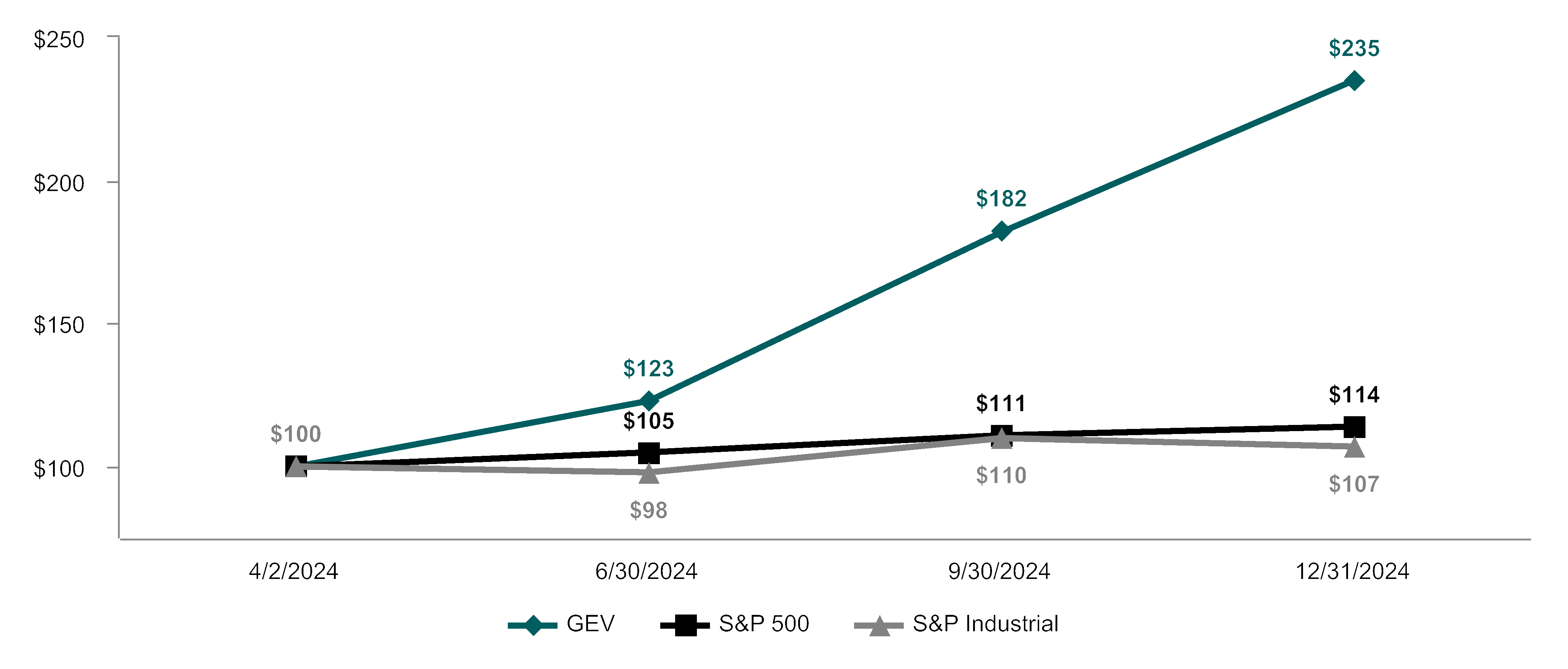
The annual changes for the four-quarter period shown in the above graph are based on the assumption that $100 had been invested in GE
Vernova common stock, the Standard & Poor’s 500 Stock Index (S&P 500) and the Standard & Poor’s 500 Industrials Stock Index (S&P
Industrial) on April 2, 2024, and that all quarterly dividends were reinvested. On April 2, 2024, the Company began trading as an
independent, publicly traded company under the stock symbol “GEV” on the New York Stock Exchange. The cumulative dollar returns
shown on the graph represent the value that such investments would have had on the date indicated.
On December 10, 2024, the Board of Directors declared a $0.25 per share quarterly dividend on the outstanding common stock of the
Company, which we paid on January 28, 2025 to stockholders of record as of December 20, 2024. The Company currently expects
quarterly dividends to continue in future periods, although they remain subject to determination and declaration by the Board of Directors.
The payment of future dividends, if any, will be based on several factors, including the Company’s financial performance, outlook and
liquidity.
PURCHASES OF EQUITY SECURITIES BY THE ISSUER AND AFFILIATED PURCHASERS. On December 10, 2024, we
announced that the Board of Directors had authorized up to $6 billion of common stock repurchases. We repurchased 8 thousand shares
for $3 million during the three months ended December 31, 2024 under this authorization.
| Period (Dollars in millions, except per share amounts) | Total number of shares purchased | Average price paid per share | Total number of shares purchased as part of our share repurchase authorization | Approximate dollar value of shares that may yet be purchased under our share repurchase authorization |
| December | 8,000 | $337.39 | 8,000 | $5,997 |
| Total | 8,000 | $337.39 | 8,000 | $5,997 |
Item 6. [RESERVED].
ITEM 7. MANAGEMENT'S DISCUSSION AND ANALYSIS OF FINANCIAL CONDITION AND RESULTS OF
OPERATIONS. The following discussion and analysis of our financial condition and results of operations should be read in conjunction
with our consolidated and combined financial statements, which are prepared in conformity with U.S. generally accepted accounting
principles (GAAP), and corresponding notes included elsewhere in this Annual Report on Form 10-K. The following discussion and analysis
provides information that management believes to be relevant to understanding the financial condition and results of operations of the
Company for the years ended December 31, 2024 and 2023. Unless otherwise noted, tables are presented in U.S. dollars in millions,
except for per-share amounts which are presented in U.S. dollars. Certain columns and rows within tables may not add due to the use of
rounded numbers. Percentages presented in this report are calculated from the underlying numbers in millions. Unless otherwise noted,
statements related to changes in operating results relate to the corresponding period in the prior year. Refer to the "Management's
2024 FORM 10-K 35
Discussion and Analysis of Financial Condition and Results of Operations" included in the Information Statement for discussions of results
for the years ended December 31, 2023 versus 2022.
In the accompanying analysis of financial information, we sometimes use information derived from consolidated and combined financial
data but not presented in our financial statements prepared in accordance with GAAP. Certain of these data are considered “non-GAAP
financial measures” under SEC rules. For the reasons we use these non-GAAP financial measures and the reconciliations to their most
directly comparable GAAP financial measures, see "—Non-GAAP Financial Measures."
TRENDS AND FACTORS IMPACTING OUR PERFORMANCE. We believe our performance and future success depends on a
number of factors that present significant opportunities for us but also pose risks and challenges, including those discussed below and in
Item 1A. "Risk Factors."
Our worldwide operations are affected by regional and global factors impacting energy demand, including industry trends like
decarbonization, an increasing demand for renewable energy alternatives, and changes in broader economic and geopolitical conditions.
These trends, along with the growing focus on the digitization and sustainability of the electricity infrastructure, drive growth across each of
our business segments. We believe that our industry-defining technologies and commitment to innovation position us well to capitalize on
these long-term trends:
- Demand growth for electricity generation – Significant investment, infrastructure, and supply diversity will be essential to help meet
forecasted energy demand growth arising from population and global economic growth.
- Decarbonization – The urgency to combat climate change is fueling technology advancements that improve the economic viability and
efficiency of renewable energy alternatives and facilitate the transition to a more sustainable power sector.
- Evolving generation mix – The power industry is shifting from coal generation to more electricity generated from zero- or low-carbon
energy sources, and an evolving balance of generation sources will be necessary to maintain a reliable, resilient and affordable
system.
*•*Energy resilience & security – Threats and challenges from extreme weather events, cyber-attacks, and geopolitical tensions have
increased focus on the strength and resilience of power generation and transmission and reinforced the need for a diversified mix of
energy sources.
- Grid modernization and investment – Increased demand and the integration of advanced generation and storage solutions drive the
need to update aging infrastructure with new grid integration and automation solutions.
- Regulatory and policy changes – Government policies and regulations, such as carbon pricing, renewable energy mandates, and
subsidies for renewable energy technologies, can significantly impact the power generation landscape. Staying ahead of regulatory
changes and adapting to new compliance requirements is crucial for maintaining a competitive advantage.
- Financial and investment dynamics – Access to capital and investment trends in the energy sector can influence the development and
deployment of new power generation projects. Understanding market dynamics and securing funding are key to progressing strategic
initiatives.
TRANSITION TO STAND-ALONE CO****MPANY
Financial Presentation Under GE Ownership. We completed our separation from General Electric Company (GE), which now operates
as GE Aerospace, on April 2, 2024 (the Spin-Off). In connection with the Spin-Off, GE distributed all of the shares of our common stock to
its stockholders and we became an independent company. Historically, as a business of GE, we relied on GE to manage certain of our
operations and provide certain services, the costs of which were either allocated or directly billed to us. Accordingly, our historical costs for
such services may not necessarily reflect the actual expenses we would have incurred, or will incur, as an independent company and may
not reflect our results of operations, financial position, and cash flows had we been a separate, stand-alone company during the historical
periods presented. See Note 1 in the Notes to the consolidated and combined financial statements for further information.
Stand-Alone Company Expenses. As a result of the Spin-Off, we are subject to the requirements of the federal and state securities laws
and stock exchange requirements. We have established additional procedures and practices as a stand-alone public company. As a result,
we are incurring additional costs related to external reporting, internal audit, treasury, investor relations, corporate governance, and stock
administration.
Production Tax Credit Investments. Our Financial Services business offers a wide range of financial solutions to customers and projects
that utilize our Power and Wind products and services. These solutions historically included making minority investments in projects, often
through common or preferred equity investments where we generally seek to exit as soon as practicable once a project achieves
commercial operation. Many such investments are in renewable energy U.S. tax equity vehicles that generate various tax credits, including
production tax credits (PTCs), which can be used to offset an equity partner’s tax liabilities in the U.S. and support the overall target return
on investment. In connection with the Spin-Off, GE retained all renewable energy U.S. tax equity investments of $1.2 billion and any tax
attributes from historical tax equity investing activity. We manage these investments under the Framework Investment Agreement with GE.
Additionally, during the second quarter, in connection with GE retaining the renewable energy U.S. tax equity investments, we recognized a
$0.1 billion benefit, recorded in Cost of equipment, related to deferred intercompany profit from historical equipment sales to the related
investees. See Notes 11, 21 and 23 in the Notes to the consolidated and combined financial statements for further information.
DISPOSITION ACTIVITY**.** During the second quarter of 2024, our Steam Power business completed the sale of part of its nuclear
activities to Electricité de France S.A. (EDF). In connection with the disposition, we received net cash proceeds of $0.6 billion, which is
subject to customary working capital and other post-closing adjustments. As a result, we recognized a pre-tax gain of $1.0 billion recorded
in Other income (expense) – net in our Consolidated and Combined Statement of Income (Loss). See Notes 3, 15, 16 and 19 in the Notes
to the consolidated and co
Showing the first 8K of 82K characters. Open the full section
Item 7A. QUANTITATIVE AND QUALITATIVE DISCLOSURES ABOUT MARKET RISK. We are exposed to market risk
primarily from the effect of fluctuations in foreign currency exchange rates, interest rates, and commodity prices. These exposures are
managed and mitigated with the use of financial instruments, including derivatives contracts. We apply policies to manage these risks,
including prohibitions on speculative activities.
Foreign Exchange Risk. As a result of our global operations, we generate and incur a significant portion of our revenues and expenses in
currencies other than the U.S. dollar. Such principal currencies include the euro and British pound sterling. We are also exposed to the risk
of changes in foreign exchange rates due to our net investment in foreign operations. The effects from the foreign currency exchange rate
fluctuations on the translation of net amounts to the U.S. dollar, the reporting currency, are reflected in our equity position. See Note 2 in the
Notes to the consolidated and combined financial statements for further information regarding our net gains (losses) from foreign currency
transactions.
*Non-GAAP Financial Measure
2024 FORM 10-K 48
Foreign exchange rate risk is managed with a variety of techniques, including selective use of derivatives. It is our policy to minimize
currency exposures by conducting operations either within functional currencies or using the protection of hedging strategies. A 10%
increase in exchange rates against the U.S. dollar would have decreased our net income for the year ended December 31, 2024 by
approximately $0.1 billion. This analysis considered the net currency exposure of foreign currency denominated monetary items and
hedging instruments.
Interest Rate Risk. We are subject to interest rate risks in the ordinary course of our business. The level of our interest rate risk is
dependent on our debt exposure and capital structure and is sensitive to changes in the general level of interest rates. Historical
fluctuations in interest rates have not been significant for us; however, this may vary in the future as our capital structure changes.
Commodity Risk**.** Our operations require the use of various commodities. Fluctuations in the prices and availability of these commodities
can impact our cost of equipment sold and thus our profitability. To mitigate this risk, we have implemented various strategies, including
commercial actions, diversification of supplier base, and derivative instruments. We continuously monitor our exposure to commodity price
fluctuations and adjust our risk management strategies as necessary.
See Note 20 in the Notes to the consolidated and combined financial statements for further information regarding our risk exposures, our
use of derivatives, and the effects of this activity on our consolidated and combined financial statements.
2024 FORM 10-K 49
Item 8. FINANCIAL STATEMENTS AND SUPPLEMENTARY DATA.
AUDITOR'S REPORT
Report of Independent Registered Public Accounting Firm
To the stockholders and the Board of Directors of GE Vernova Inc.
Opinion on the Financial Statements
We have audited the accompanying consolidated and combined statements of financial position of GE Vernova Inc. and subsidiaries (the
"Company") as of December 31, 2024, and 2023, the related consolidated and combined statements of income (loss), comprehensive
income (loss), changes in equity, and cash flows for each of the three years in the period ended December 31, 2024, and the related notes
(collectively referred to as the “financial statements”). In our opinion, the financial statements present fairly, in all material respects, the
financial position of the Company as of December 31, 2024, and 2023, and the results of its operations and its cash flows for each of the
three years in the period ended December 31, 2024, in conformity with accounting principles generally accepted in the United States of
America.
Basis for Opinion
These financial statements are the responsibility of the Company's management. Our responsibility is to express an opinion on the
Company's financial statements based on our audits. We are a public accounting firm registered with the Public Company Accounting
Oversight Board (United States) (PCAOB) and are required to be independent with respect to the Company in accordance with the U.S.
federal securities laws and the applicable rules and regulations of the Securities and Exchange Commission and the PCAOB.
We conducted our audits in accordance with the standards of the PCAOB. Those standards require that we plan and perform the audit to
obtain reasonable assurance about whether the financial statements are free of material misstatement, whether due to error or fraud. The
Company is not required to have, nor were we engaged to perform, an audit of its internal control over financial reporting. As part of our
audits, we are required to obtain an understanding of internal control over financial reporting but not for the purpose of expressing an
opinion on the effectiveness of the Company’s internal control over financial reporting. Accordingly, we express no such opinion.
Our audits included performing procedures to assess the risks of material misstatement of the financial statements, whether due to error or
fraud, and performing procedures that respond to those risks. Such procedures included examining, on a test basis, evidence regarding the
amounts and disclosures in the financial statements. Our audits also included evaluating the accounting principles used and significant
estimates made by management, as well as evaluating the overall presentation of the financial statements. We believe that our audits
provides a reasonable basis for our opinion.
Critical Audit Matter
The critical audit matter communicated below is a matter arising from the current-period audit of the financial statements that was
communicated or required to be communicated to the audit committee and that (1) relates to accounts or disclosures that are material to
the financial statements and (2) involved our especially challenging, subjective, or complex judgments. The communication of critical audit
matters does not alter in any way our opinion on the financial statements, taken as a whole, and we are not, by communicating the critical
audit matter below, providing a separate opinion on the critical audit matter or on the accounts or disclosures to which it relates.
Sales of services - Revenue recognition on certain Power long-term service agreements - Refer to Note****s 2 and 9 t****o the financial
statements
Critical Audit Matter Description
The Company enters into long-term service agreements with customers within its Power segment. These agreements require the Company
to provide preventative and routine maintenance services, outage services, and stand-by “warranty-type” services, which generally range
from 5 to 25 years. Revenue for these agreements is recognized using the percentage of completion method, based on costs incurred
relative to total estimated costs over the contract term. As part of the revenue recognition process, the Company estimates both customer
payments that are expected to be received and costs to perform maintenance services over the contract term. Key assumptions within
those estimates that require significant judgment from management include: (a) how the customer will utilize the assets covered over the
contract term, (b) the expected timing and extent of future maintenance and outage services, (c) the future cost of materials, labor, and
other resources, and (d) forward looking information concerning market conditions.
Given the complexity involved with evaluating the estimates, which includes significant judgment necessary to estimate future costs,
auditing management’s key assumptions within the estimates required a high degree of auditor judgment and extensive audit effort,
including the involvement of professionals with specialized skills and industry knowledge.
How the Critical Audit Matter Was Addressed in the Audit
Our auditing procedures over the estimates and key assumptions described above related to the amount and timing of revenue recognition
of the long-term service agreements, within the Power segment, included the following, among others:
- We evaluated management’s risk assessment process through observation of key meetings, including inspection of
documentation, addressing contract status and current market conditions.
- We evaluated the appropriateness and consistency of management’s methods and key assumptions to develop cost estimates,
including expected timing and extent of future maintenance and outage services as well as the future cost of materials, labor and
other resources, all of which impact contract margin.
- We tested management’s utilization assumptions for timing and extent of future maintenance and overhaul services projected for
the contract term by comparing current estimates to historical information and forward-looking market conditions.
2024 FORM 10-K 50
- We tested management’s process for estimating the timing and amount of costs associated with maintenance, outage, and other
major events throughout the contract term, including comparing estimates to historical cost experience, performing a retrospective
review, performing analytical procedures, and utilizing specialists to evaluate engineering studies used by the Company to
estimate the useful life of capital parts of certain installed equipment.
| /s/ | DELOITTE & TOUCHE LLP |
| Boston, Massachusetts | |
| February 6, 2025 | |
| We have served as the Company's auditor since 2022. |
2024 FORM 10-K 51
| CONSOLIDATED AND COMBINED STATEMENT OF INCOME (LOSS) | |||
| For the years ended December 31 (In millions, except per share amounts) | 2024 | 2023 | 2022 |
| Sales of equipment | $18,952 | $18,258 | $15,819 |
| Sales of services | 15,983 | 14,981 | 13,835 |
| Total revenues | 34,935 | 33,239 | 29,654 |
| Cost of equipment | 17,989 | 18,705 | 16,972 |
| Cost of services | 10,861 | 9,716 | 9,224 |
| Gross profit | 6,085 | 4,818 | 3,458 |
| Selling, general, and administrative expenses | 4,632 | 4,845 | 5,360 |
| Research and development expenses | 982 | 896 | 979 |
| Operating income (loss) | 471 | (923) | (2,881) |
| Interest and other financial charges – net | 120 | (98) | (151) |
| Non-operating benefit income | 536 | 567 | 188 |
| Other income (expense) – net (Note 19) | 1,372 | 324 | 370 |
| Income (loss) before income taxes | 2,498 | (130) | (2,474) |
| Provision (benefit) for income taxes (Note 15) | 939 | 344 | 248 |
| Net income (loss) | 1,559 | (474) |
Showing the first 8K of 181K characters. Open the full section
Item 9. CHANGES IN AND DISAGREEMENTS WITH ACCOUNTANTS ON ACCOUNTING AND FINANCIAL
DISCLOSURE. None.
Item 9A. CONTROLS AND PROCEDURES.
Management’s Discussion of Financial Responsibility. Management is responsible for the preparation of the consolidated and
combined financial statements and related information that are presented in this report. The consolidated and combined financial
statements, which include amounts based on management’s estimates and judgments, have been prepared in conformity with U.S.
generally accepted accounting principles.
The Company designs and maintains accounting and internal control systems to provide reasonable assurance that assets are
safeguarded against loss from unauthorized use or disposition, and that the financial records are reliable for preparing consolidated and
combined financial statements and maintaining accountability for assets. These systems are enhanced by policies and procedures, an
organizational structure providing division of responsibilities, careful selection and training of qualified personnel, and a program of internal
audits.
The Board of Directors, through its Audit Committee, which consists entirely of independent directors, meets periodically with management,
internal auditors, and our independent registered public accounting firm to ensure that each is meeting its responsibilities and to discuss
matters concerning internal controls and financial reporting. Deloitte and Touche LLP and the internal auditors each have full and free
access to the Audit Committee.
Management's Annual Report on Internal Control Over Financial Reporting. This Annual Report does not include a report of
management's assessment regarding internal control over financial reporting or an attestation report of our registered public accounting
firm due to a transition period established by rules of the U.S. Securities and Exchange Commission for newly public companies.
Disclosure Controls. Under the direction of our Chief Executive Officer and Chief Financial Officer, we evaluated our disclosure controls
and procedures as of December 31, 2024 and concluded that our disclosure controls and procedures were effective as of December 31,
Changes in Internal Control Over Financial Reporting. There have been no changes in the Company’s internal control over financial
reporting during the three months ended December 31, 2024, that have materially affected, or are reasonably likely to materially affect, its
internal control over financial reporting.
Item 9B. OTHER INFORMATION.
Disclosure provided pursuant to Item 5.02 of Form 8-K. Departure of Directors or Certain Officers; Election of Directors;
Appointment of Certain Officers; Compensatory Arrangements of Certain Officers. On January 31, 2025, GE Vernova Inc. (the
“Company”) and Rachel Gonzalez, Executive Vice President, General Counsel, and Secretary, entered into a Separation Agreement and
Release (the “Separation Agreement”). The Separation Agreement provides that Ms. Gonzalez will depart from the Company on May 16,
- She will continue to receive her current compensation and benefits until her separation.
The Separation Agreement further provides that if Ms. Gonzalez remains employed by the Company through May 16, 2025, or if prior to
May 16, 2025, the Company terminates her employment without cause, Ms. Gonzalez’s departure shall be treated as a termination without
cause, and subject to her timely execution upon her cessation of employment of a supplemental release of claims, Ms. Gonzalez will be
entitled to (i) a lump sum payment equal to eighteen (18) months of Ms. Gonzalez’s current base salary, (ii) contributions to the cost of
COBRA continuation for a period of eighteen (18) months, (iii) reimbursement of expenses reasonably incurred for relocation not to exceed
$150,000, (iv) consistent with Ms. Gonzalez’s employment offer letter with the Company, a pro-rated annual bonus for calendar year 2025
based on Company performance, and (v) consistent with the Company’s long-term incentive good leaver program: (x) continued vesting of
a pro-rated portion of each outstanding equity award over Company common stock held by Ms. Gonzalez, other than any award
designated as a one-time stock option grant, for at least one year from the applicable date of grant and (y) the right to exercise outstanding
options until the applicable option expiration date.
The preceding summary of the Separation Agreement is qualified in its entirety by reference to the Separation Agreement, which is filed as
Exhibit 10.30 to this Annual Report on Form 10-K and is incorporated herein by reference.
Director and Officer Trading Arrangements. None of our directors or officers (as defined in Rule 16a-1(f) under the Exchange
Act) adopted or terminated a Rule 10b5-1 trading arrangement or adopted or terminated a non-Rule 10b5-1 trading arrangement (as
defined in Item 408(c) of Regulation S-K) during the three months ended December 31, 2024.
Item 9C. DISCLOSURE REGARDING FOREIGN JURISDICTIONS THAT PREVENT INSPECTIONS. Not applicable.
2024 FORM 10-K 87
PART III
Item 10. DIRECTORS, EXECUTIVE OFFICERS, AND CORPORATE GOVERNANCE. Information required by this item with
respect to executive officers, directors, corporate governance, code of ethics, insider trading policies and procedures, and compliance with
Section 16(a) of the Exchange Act will be presented in the 2025 Proxy Statement in the sections titled “Election of Directors.” “Corporate
Governance,” “Executive Officers,” and “Section 16(a) Beneficial Ownership Reporting Compliance,” and such information is incorporated
herein by reference.
Item 11. EXECUTIVE COMPENSATION. Information required by this item regarding executive and director compensation will be
presented in the 2025 Proxy Statement under the section titled “Executive Compensation” and the section titled “Director Compensation,”
and such information (other than the subsection titled “Compensation Committee Report," which is deemed furnished herein by reference,
and the subsection "Pay Versus Performance") is incorporated herein by reference.
Item 12. SECURITY OWNERSHIP OF CERTAIN BENEFICIAL OWNERS AND MANAGEMENT AND RELATED
STOCKHOLDER MATTERS. Information required by this item regarding security ownership of certain beneficial owners and
management and related stockholder matters, as well as equity compensation plan information, will be presented in the 2025 Proxy
Statement under the sections titled “Stock Ownership Information” and “Equity Compensation Plan Information,” and such information is
incorporated herein by reference.
Item 13. CERTAIN RELATIONSHIPS AND RELATED TRANSACTIONS AND DIRECTOR INDEPENDENCE. Information
required by this item regarding certain relationships and related transactions and director independence will be presented in the 2025 Proxy
Statement under the sections titled “Certain Relationships and Related-Party and Other Transactions” and “Other Governance Policies and
Practices,” and such information is incorporated herein by reference.
Item 14. PRINCIPAL ACCOUNTANT FEES AND SERVICES. Information required by this item regarding principal accounting fees
and services of our principal accountant, Deloitte & Touche LLP (PCAOB ID No. 34), will be presented in the 2025 Proxy Statement under
the sections titled “Independent Auditor,” and such information is incorporated herein by reference.
2024 FORM 10-K 88
PART IV
Item 15. EXHIBITS AND FINANCIAL STATEMENT SCHEDULES.
FINANCIAL STATEMENTS. See Item 8. "Financial Statements and Supplementary Data" for a listing of our financial statements.
FINANCIAL SCHEDULES. Schedules required by Regulation S-X (17 CFR 210) are omitted because they are either not applicable or
the financial information is already included within the financial statements or notes thereto.
2024 FORM 10-K 89
Item 16. FORM 10-K SUMMARY. None.
2024 FORM 10-K 90
SIGNATURES
Pursuant to the requirements of Section 13 or 15(d) of the Securities Exchange Act of 1934, the registrant has duly caused this report to be
signed on its behalf by the undersigned, thereunto duly authorized.
GE Vernova Inc.
| By: | /s/ Kenneth Parks |
| Kenneth Parks Chief Financial Officer (Principal Financial Officer) |
Pursuant to the requirements of the Securities Exchange Act of 1934, this report has been signed below by the following persons on behalf
of the registrant and in the capacities and on the dates indicated.
| Signer | Title | Date | |||
| /s/ Scott Strazik | Chief Executive Officer and Director | February 6, 2025 | |||
| Scott Strazik | (Principal Executive Officer) | ||||
| /s/ Kenneth Parks | Chief Financial Officer | February 6, 2025 | |||
| Kenneth Parks | (Principal Financial Officer) | ||||
| /s/ Matthew Potvin | Vice President, Controller and Chief Accounting Officer | February 6, 2025 | |||
| Matthew Potvin | (Principal Accounting Officer) | ||||
| /s/ Stephen Angel | Non-Executive Chair of the Board | February 6, 2025 | |||
| Stephen Angel | |||||
| /s/ Nicholas K. Akins | Director | February 6, 2025 | |||
| Nicholas K. Akins | |||||
| /s/ Arnold W. Donald | Director | February 6, 2025 | |||
| Arnold W. Donald | |||||
| /s/ Matthew Harris | Director | February 6, 2025 | |||
| Matthew Harris | |||||
| /s/ Martina Hund-Mejean | Director | February 6, 2025 | |||
| Martina Hund-Mejean | |||||
| /s/ Kim K.W. Rucker | Director | February 6, 2025 | |||
| Kim K.W. Rucker | |||||
| /s/ Jesus Malave | Director | February 6, 2025 | |||
| Jesus Malave | |||||
| /s/ Paula Rosput Reynolds | Director | February 6, 2025 | |||
| Paula Rosput Reynolds | |||||