 filings.tools
Gilead Sciences 10-K 2018-12-31
Filed 2019-02-26. 22 sections, 468K characters. Original on sec.gov · Markdown · JSON
Cover and table of contents
10-K 1 a2018form10-k.htm FORM 10-K
UNITED STATES
SECURITIES AND EXCHANGE COMMISSION
Washington, D.C. 20549
FORM 10-K
(Mark One)
| ý | ANNUAL REPORT PURSUANT TO SECTION 13 OR 15(d) OF THE SECURITIES EXCHANGE ACT OF 1934 |
For the fiscal year ended December 31, 2018
or
| o | TRANSITION REPORT PURSUANT TO SECTION 13 OR 15(d) OF THE SECURITIES EXCHANGE ACT OF 1934 |
For the transition period from to
Commission File No. 000-19731
GILEAD SCIENCES, INC.
(Exact name of registrant as specified in its charter)
| Delaware | 94-3047598 |
| (State or Other Jurisdiction of Incorporation or Organization) | (I.R.S. Employer Identification No.) |
| 333 Lakeside Drive, Foster City, California | 94404 |
| (Address of principal executive offices) | (Zip Code) |
Registrant’s telephone number, including area code: 650-574-3000
SECURITIES REGISTERED PURSUANT TO SECTION 12(b) OF THE ACT:
| Title of each class | Name of each exchange on which registered |
| Common Stock, $0.001 par value per share | The Nasdaq Global Select Market |
SECURITIES REGISTERED PURSUANT TO SECTION 12(g) OF THE ACT: NONE
Indicate by check mark if the registrant is a well-known seasoned issuer, as defined in Rule 405 of the Securities Act. Yes x No ¨
Indicate by check mark if the registrant is not required to file reports pursuant to Section 13 or Section 15(d) of the Act. Yes ¨ No x
Indicate by check mark whether the registrant (1) has filed all reports required to be filed by Section 13 or 15(d) of the Securities Exchange Act of 1934 during the preceding 12 months (or for such shorter period that the registrant was required to file such reports), and (2) has been subject to such filing requirements for the past 90 days. Yes ý No ¨
Indicate by check mark whether the registrant has submitted electronically every Interactive Data File required to be submitted pursuant to Rule 405 of Regulation S-T (§ 232.405 of this chapter) during the preceding 12 months (or for such shorter period that the registrant was required to submit and post such files). Yes ý No ¨
Indicate by check mark if disclosure of delinquent filers pursuant to Item 405 of Regulation S-K (§ 229.405) is not contained herein, and will not be contained, to the best of registrant’s knowledge, in definitive proxy or information statements incorporated by reference in Part III of this Form 10-K or any amendment to this Form 10-K. ¨
Indicate by check mark whether registrant is a large accelerated filer, an accelerated filer, a non-accelerated filer, or a smaller reporting company. See the definitions of “large accelerated filer,” “accelerated filer,” “smaller reporting company” and “emerging growth company” in Rule 12b-2 of the Exchange Act.
Large accelerated filer ý Accelerated filer ¨ Non-accelerated filer ¨
Smaller reporting company ¨ Emerging growth company ¨
If an emerging growth company, indicate by check mark if the registrant has elected not to use the extended transition period for complying with any new or revised financial accounting standards provided pursuant to Section 13(a) of the Exchange Act. ¨
Indicate by check mark whether the registrant is a shell company (as defined in Rule 12b-2 of the Exchange Act). Yes ¨ No ý
The aggregate market value of the voting and non-voting common equity held by non-affiliates of the registrant based upon the closing price of its Common Stock on the Nasdaq Global Select Market on June 29, 2018 was $79,506,595,778.*
The number of shares outstanding of the registrant’s Common Stock on February 15, 2019 was 1,275,510,558.
DOCUMENTS INCORPORATED BY REFERENCE
Specified portions of the registrant’s proxy statement, which will be filed with the Commission pursuant to Regulation 14A in connection with the registrant’s 2019 Annual Meeting of Stockholders, to be held on May 8, 2019, are incorporated by reference into Part III of this Report.
- Based on a closing price of $70.84 per share on June 29, 2018. Excludes 173,576,690 shares of the registrant’s Common Stock held by executive officers, directors and any stockholders whose ownership exceeds 5% of registrant’s common stock outstanding at June 29, 2018. Exclusion of such shares should not be construed to indicate that any such person possesses the power, direct or indirect, to direct or cause the direction of the management or policies of the registrant or that such person is controlled by or under common control with the registrant.
GILEAD SCIENCES, INC.
2018 Form 10-K Annual Report
Table of Contents
We own or have rights to various trademarks, copyrights and trade names used in our business, including the following: GILEAD®, GILEAD SCIENCES®, AMBISOME®, ATRIPLA®, BIKTARVY®, CAYSTON®, COMPLERA®, DESCOVY®, EMTRIVA®, EPCLUSA®, EVIPLERA®, GENVOYA®, HARVONI®, HEPSERA®, LETAIRIS®, ODEFSEY®, RANEXA®, SOVALDI®, STRIBILD®, TRUVADA®, TRUVADAFORPREP®, TYBOST®, VEMLIDY®, VIREAD®, VOSEVI®, YESCARTA® and ZYDELIG®. LEXISCAN® is a registered trademark of Astellas U.S. LLC. MACUGEN® is a registered trademark of Eyetech, Inc. SYMTUZA® is a registered trademark of Janssen Sciences Ireland UC. TAMIFLU® is a registered trademark of Hoffmann-La Roche Inc. This report also includes other trademarks, service marks and trade names of other companies.
This Annual Report on Form 10-K, including the section entitled “Management’s Discussion and Analysis of Financial Condition and Results of Operations,” contains forward-looking statements regarding future events and our future results that are subject to the safe harbors created under the Securities Act of 1933, as amended (the Securities Act), and the Securities Exchange Act of 1934, as amended (the Exchange Act). Words such as “expect,” “anticipate,” “target,” “goal,” “project,” “hope,” “intend,” “plan,” “believe,” “seek,” “estimate,” “continue,” “may,” “could,” “should,” “might,” "forecast," variations of such words and similar expressions are intended to identify such forward-looking statements. In addition, any statements other than statements of historical fact are forward-looking statements, including statements regarding overall trends, operating cost and revenue trends, liquidity and capital needs and other statements of expectations, beliefs, future plans and strategies, anticipated events or trends and similar expressions.
We have based these forward-looking statements on our current expectations about future events. These statements are not guarantees of future performance and involve risks, uncertainties and assumptions that are difficult to predict. Our actual results may differ materially from those suggested by these forward-looking statements for various reasons, including those identified in Part I, Item 1A of this Annual Report on Form 10-K under the heading “Risk Factors.” Given these risks and uncertainties, you are cautioned not to place undue reliance on forward-looking statements. The forward-looking statements included in this report are made only as of the date hereof. Except as required under federal securities laws and the rules and regulations of the Securities and Exchange Commission (SEC), we do not undertake, and specifically decline, any obligation to update any of these statements or to publicly announce the results of any revisions to any forward-looking statements after the distribution of this report, whether as a result of new information, future events, changes in assumptions or otherwise.
PART I
Item 1. BUSINESS
Overview
Gilead Sciences, Inc. (Gilead, we, our or us), incorporated in Delaware on June 22, 1987, is a research-based biopharmaceutical company that discovers, develops and commercializes innovative medicines in areas of unmet medical need. With each new discovery and investigational drug candidate, we strive to transform and simplify care for people with life-threatening illnesses around the world. We have operations in more than 35 countries worldwide, with headquarters in Foster City, California. Gilead’s primary areas of focus include HIV/AIDS, liver diseases, hematology/oncology and inflammation/respiratory diseases. We seek to add to our existing portfolio of products through our internal discovery and clinical development programs, product acquisition, in-licensing and strategic collaborations.
2018 Highlights
2018 was marked by operational excellence and transition as we positioned ourselves for the future growth of our business. We continued to develop and deliver innovative medicines to help people with life-threatening illnesses around the world. Highlights of our 2018 performance include:
| • | HIV: We achieved record sales of our HIV products in 2018, with HIV product revenues increasing by 19% in the United States and 12% worldwide compared to 2017. This growth was driven by the successful launch of Biktarvy® and the continued strong uptake of our single tablet regimens containing tenofovir alafenamide (TAF) for the treatment of HIV infection as well as Truvada® for a pre-exposure prophylaxis (PrEP) indication for HIV prevention. Biktarvy, a once-daily single tablet regimen containing bictegravir, emtricitabine and TAF for the treatment of HIV infection in adults, was approved by the U.S. Food and Drug Administration (FDA) in February and by the European Commission in June. |
| • | Liver Diseases: Our revenues from our chronic hepatitis C virus (HCV) products became more predictable in 2018. Because we wanted to introduce a lower-priced alternative to our HCV products without significant disruption to the healthcare system and our business, we authorized the launch of generic versions of Epclusa® and Harvoni® in the United States starting in January 2019 through our separate subsidiary, Asegua Therapeutics LLC (Asegua). We also continued to advance our clinical trials for the treatment of chronic hepatitis B virus (HBV) and nonalcoholic steatohepatitis (NASH), including completing enrollment of Phase 3 clinical trials of NASH. |
| • | Cell Therapy and Immuno-Oncology: We advanced our pipeline of cancer therapies and positioned ourselves as a leader in cell therapy. Yescarta® was approved by the European Commission in August for the treatment of relapsed or refractory diffuse large B-cell lymphoma (DLBCL) and primary mediastinal large B-cell lymphoma (PMBCL) after two or more lines of systemic therapy. We certified additional centers in the United States and Europe to provide treatment for Yescarta. In order to advance and accelerate research and development efforts in cell therapy and immuno-oncology, during the year, we entered into key strategic collaborations with the National Cancer Institute, Pfizer, Inc. (Pfizer), Sangamo Therapeutics, Inc. (Sangamo), Gadeta B.V. (Gadeta), HiFiBiO Therapeutics (HiFiBiO), Tango Therapeutics (Tango) and Agenus Inc. (Agenus). |
| • | Inflammation: We continued to advance our pipeline of novel investigational agents for inflammatory diseases, including announcing positive data on filgotinib in ongoing Phase 2 and 3 clinical trials. We also entered into a strategic collaboration with Verily Life Sciences LLC, an Alphabet company (Verily), using Verily’s Immunoscape platform to identify and better understand the immunological basis of inflammatory diseases. |
During the year, we continued to invest in and advance our research and development pipeline across our therapeutic areas. At the end of 2018, our research and development pipeline included 119 active clinical studies, of which 41 were Phase 3 clinical trials. Additionally, we completed 26 collaborations, partnerships and strategic investments in 2018, which reflects our commitment to enabling our access to new technologies and drug candidates with the potential to evolve care for people with life-threatening illnesses. Our investments in research and development reflect our commitment to expanding our pipeline across a range of diseases to address areas of significant unmet medical need and positioning ourselves for the long-term growth of our business.
Our Principal Products
Our innovative medicines represent advancements by offering enhanced modes of delivery, more convenient treatment regimens, improved resistance profiles, reduced side effects and greater efficacy. Our focus on innovation has allowed us to deliver more than 24 marketed products across our primary areas of focus: HIV/AIDS, liver diseases, hematology/oncology and inflammation/respiratory diseases.
Our principal products and the approved indications in the United States are as follows:
HIV/AIDS
| • | Biktarvy is an oral formulation dosed once a day for the treatment of HIV-1 infection in certain patients. Biktarvy is a single tablet regimen of a fixed-dose combination of our antiretroviral medications, bictegravir, emtricitabine and TAF. |
| • | Descovy® is an oral formulation indicated in combination with other antiretroviral agents for the treatment of HIV-1 infection in certain patients. Descovy is a fixed-dose combination of our antiretroviral medications, emtricitabine and TAF. |
| • | Odefsey® is an oral formulation dosed once a day for the treatment of HIV-1 infection in certain patients. Odefsey is a single tablet regimen of a fixed-dose combination of our antiretroviral medications, emtricitabine and TAF, and rilpivirine marketed by Janssen Sciences Ireland UC, one of the Janssen Pharmaceutical Companies of Johnson & Johnson (Janssen). |
| • | Genvoya® is an oral formulation dosed once a day for the treatment of HIV-1 infection in certain patients. Genvoya is a single tablet regimen of a fixed-dose combination of our antiretroviral medicines, elvitegravir, cobicistat, emtricitabine and TAF. |
| • | Stribild® is an oral formulation dosed once a day for the treatment of HIV-1 infection in certain patients. Stribild is a single tablet regimen of a fixed-dose combination of our antiretroviral medications, elvitegravir, cobicistat, tenofovir disoproxil fumarate (TDF) and emtricitabine. |
| • | Complera®/Eviplera® is an oral formulation dosed once a day for the treatment of HIV-1 infection in certain patients. The product, marketed in the United States as Complera and in Europe as Eviplera, is a single tablet regimen of a fixed-dose combination of our antiretroviral medications, TDF and emtricitabine, and Janssen’s rilpivirine hydrochloride. |
| • | Atripla® is an oral formulation indicated as a complete regimen for the treatment of HIV-1 infection in certain patients. Atripla is a fixed-dose combination of our antiretroviral medications, TDF and emtricitabine, and Bristol-Myers Squibb Company’s (BMS’s) efavirenz. |
| • | Truvada® is an oral formulation indicated in combination with other antiretroviral agents for the treatment of HIV-1 infection in certain patients. It is a fixed-dose combination of our antiretroviral medications, TDF and emtricitabine. FDA also approved Truvada for a PrEP indication, in combination with safer sex practices, to reduce the risk of sexually acquired HIV-1 infection in certain at-risk patients. |
Liver Diseases
| • | Vosevi® is an oral formulation of a once-daily, single tablet regimen of sofosbuvir, velpatasvir and voxilaprevir for the re-treatment of chronic HCV infection in adults: (i) with genotype 1, 2, 3, 4, 5 or 6 previously treated with an NS5A inhibitor-containing regimen or (ii) with genotype 1a or 3 previously treated with a sofosbuvir-containing regimen without an NS5A inhibitor. |
| • | Vemlidy® is an oral formulation of TAF dosed once a day for the treatment of chronic HBV infection in adults with compensated liver disease. |
| • | Epclusa® is an oral formulation of a once-daily single tablet regimen of sofosbuvir and velpatasvir for the treatment of chronic HCV infection in adults with genotype 1, 2, 3, 4, 5 or 6: (i) without cirrhosis or with compensated cirrhosis or (ii) with decompensated cirrhosis for use in combination with ribavirin. |
| • | Harvoni® is an oral formulation of a once-daily, single tablet regimen of ledipasvir and sofosbuvir for the treatment of chronic HCV infection in: (i) adults with genotype 1, 4, 5 or 6 without cirrhosis or with compensated cirrhosis, (ii) adults with genotype 1 infection with decompensated cirrhosis, in combination with ribavirin, (ii) adults with genotype 1 or 4 who are liver transplant recipients without cirrhosis or with compensated cirrhosis, in combination with ribavirin, or (iv) certain pediatric patients with genotype 1, 4, 5 or 6 without cirrhosis or with compensated cirrhosis. |
| • | Viread® is an oral formulation of TDF dosed once a day for the treatment of chronic HBV infection in adults and certain pediatric patients. |
Hematology/Oncology
| • | Yescarta (axicabtagene ciloleucel) is a CAR T cell therapy for the treatment of adult patients with relapsed or refractory large B-cell lymphoma after two or more lines of systemic therapy, including DLBCL not otherwise specified, PMBCL, high-grade B-cell lymphoma and DLBCL arising from TFL. |
| • | Zydelig® (idelalisib) is an oral formulation of a kinase inhibitor for the treatment of patients with: (i) relapsed chronic lymphocytic leukemia (CLL), in combination with rituximab, for whom rituximab alone would be considered appropriate therapy due to other co-morbidities, (ii) relapsed follicular B-cell non-Hodgkin lymphoma (FL) in patients who have received at least two prior systemic therapies or (iii) relapsed small lymphocytic lymphoma who have received at least two prior systemic therapies. |
Other
| • | Letairis® (ambrisentan) is an oral formulation of an endothelin receptor antagonist for the treatment of pulmonary arterial hypertension (PAH) (WHO Group I) (i) to improve exercise capacity and delay clinical worsening or (ii) in combination with tadalafil to reduce the risks of disease progression and hospitalization for worsening PAH, and to improve exercise ability. |
| • | Ranexa® (ranolazine) is an oral formulation of an extended-release tablet of an antianginal for the treatment of chronic angina. |
| • | AmBisome® (amphotericin B liposome for injection) is a proprietary liposomal formulation of amphotericin B, an antifungal agent, for the treatment of serious invasive fungal infections caused by various fungal species in adults. |
For information about our product revenues, including the amount of revenue contributed by each of the products listed above for each of the last three fiscal years, see Note 2, Revenues, of the Notes to Consolidated Financial Statements included in Item 8 of our Annual Report on Form 10-K.
Commercialization and Distribution
We have U.S. and international commercial sales operations, with marketing subsidiaries in more than 35 countries. Our products are marketed through our commercial teams and/or in conjunction with third-party distributors and corporate partners. Our commercial teams promote our products through direct field contact with physicians, hospitals, clinics and other healthcare providers. We generally grant our third-party distributors the exclusive right to promote our product in a territory for a specified period of time. Most of our agreements with these distributors provide for collaborative efforts between the distributor and Gilead in obtaining and maintaining regulatory approval for the product in the specified territory.
We sell and distribute most of our products in the United States exclusively through the wholesale channel. Our product sales to three large wholesalers, McKesson Corporation, AmerisourceBergen Corporation and Cardinal Health, Inc., each accounted for more than 10% of total revenues for each of the years ended December 31, 2018, 2017 and 2016. On a combined basis, in 2018, these wholesalers accounted for approximately 85% of our product sales in the United States and approximately 62% of our total worldwide revenues. We sell and distribute our products in Europe and countries outside the United States where the product is approved, either through our commercial teams, third-party distributors or corporate partners.
Competition
We operate in a highly competitive environment. We face significant competition from global pharmaceutical and biotechnology companies, specialized pharmaceutical firms and generic drug manufacturers. Our products compete with other commercially available products based primarily on efficacy, safety, tolerability, acceptance by doctors, ease of patient compliance, ease of use, price, insurance and other reimbursement coverage, distribution and marketing. As our products mature, private insurers and government payers often reduce the amount they will reimburse patients, which increases pressure on us to reduce prices. Further, as new branded or generic products are introduced into major markets, our ability to maintain pricing and market share may be affected. For a description of our competitors, see Item 1A - Risk Factors “We face significant competition.”
Research and Development
Our research and development (R&D) philosophy and strategy are to develop best-in-class drugs that improve safety or efficacy for unmet medical needs. We intend to continue committing significant resources to internal R&D opportunities and external business development activity.
Our product development efforts cover a wide range of medical conditions, including HIV/AIDS, liver diseases, hematology/oncology, and inflammation/respiratory diseases. We have research scientists engaged in the discovery and development of new molecules and technologies that we hope will lead to the approval of new medicines that will advance the current standard of care and address unmet medical needs.
The development of our product candidates is subject to various risks and uncertainties. These risks and uncertainties include our ability to enroll patients in clinical trials, the possibility of unfavorable results of our clinical trials, the need to modify or delay our clinical trials or to perform additional trials and the risk of failing to obtain regulatory approvals. As a result, our product candidates may never be successfully commercialized. Drug development is inherently risky and many product candidates fail during the drug development process.
Below is a summary of our key product candidates and their corresponding current stages of development.
Product Candidates for the Treatment of HIV/AIDS
| Product Candidates | Description | |
| Product in Phase 3 | ||
| Descovy | Descovy is being evaluated for a PrEP indication. | |
| Product in Phase 2 | ||
| GS-9131 | GS-9131, a nucleoside reverse transcriptase inhibitor, is being evaluated for the treatment of HIV infection. | |
| Products in Phase 1 | ||
| GS-6207 | GS-6207, a capsid inhibitor, is being evaluated for the treatment of HIV infection. | |
| Vesatolimod | Vesatolimod (formerly GS-9620), a TLR-7 agonist, is being evaluated as a potential cure for HIV infection. | |
| GS-9722 | GS-9722, a broadly neutralizing antibody, is being evaluated as a potential cure for HIV infection. |
Product Candidates for the Treatment of Liver Diseases
| Product Candidates | Description | |
| Product in Phase 3 | ||
| Selonsertib | Selonsertib, an ASK-1 inhibitor, is being evaluated in the STELLAR-3 trial for the treatment of NASH and bridging fibrosis. | |
| Products in Phase 2 | ||
| GS-9688 | GS-9688, a TLR-8 agonist, is being evaluated for the treatment of HBV infection. | |
| Cilofexor | Cilofexor (formerly GS-9674), a FXR agonist, is being evaluated for the treatment of NASH, primary biliary cirrhosis and primary sclerosing cholangitis. | |
| Firsocostat | Firsocostat (formerly GS-0976), an ACC inhibitor, is being evaluated for the treatment of NASH. |
Product Candidates for the Treatment of Hematology/Oncology
| Product Candidates | Description | |
| Products in Phase 3 | ||
| Axicabtagene ciloleucel | Axicabtagene ciloleucel is being evaluated for the treatment of second line diffuse large B-cell lymphoma (DLBCL). | |
| Products in Phase 2 | ||
| Axicabtagene ciloleucel | Axicabtagene ciloleucel is being evaluated for the treatment of indolent non-Hodgkin lymphoma. Axicabtagene ciloleucel is also being evaluated for the treatment of DLBCL in combination with anti-PD-L1 mAB and first line DLBCL. | |
| Tirabrutinib | Tirabrutinib, a BTK inhibitor, is being evaluated for the treatment of B-cell malignancies. | |
| KTE-X19 | KTE-X19, a CAR T cell therapy, is being evaluated for the treatment of mantle cell lymphoma and adult and pediatric acute lymphoblastic leukemia. | |
| Products in Phase 1 | ||
| KITE-718 | KITE-718, a MAGE A3/A6, is being evaluated for the treatment of solid tumors. |
Product Candidates for the Treatment of Inflammation/Respiratory Diseases
| Product Candidates | Description | |
| Product in Phase 3 | ||
| Filgotinib | Filgotinib, a JAK1 inhibitor, is being evaluated for the treatment of rheumatoid arthritis, Crohn’s disease and ulcerative colitis. | |
| Products in Phase 2 | ||
| Filgotinib | Filgotinib is being evaluated for the treatment of various inflammatory diseases. | |
| GS-9876 | GS-9876, a Syk inhibitor, is being evaluated for the treatment of Sjogren’s syndrome and lupus. | |
| Products in Phase 1 | ||
| GS-4875 | GS-4875, a TPL2 inhibitor, is being evaluated for the treatment of inflammatory bowel disease. |
Other Product Candidates
| Product Candidate | Description | |
| Product in Phase 2 | ||
| Remdesivir | Remdesivir, a Nuc inhibitor, is being evaluated for the treatment of Ebola virus infection. |
In addition to our internal discovery and clinical development programs, we seek to add to our portfolio of products through product acquisition, in-licensing and strategic collaborations. We completed 26 collaborations, partnerships and strategic investments in 2018, compared to 6 in 2017, which reflects our commitment to enabling our access to new technologies and drug candidates with the potential to evolve care for people with life-threatening illnesses.
Patents and Proprietary Rights
U.S. and European Patent Expiration
We have a number of U.S. and foreign patents, patent applications and rights to patents related to our compounds, products and technology, but we cannot be certain that issued patents will be enforceable or provide adequate protection or that pending patent applications will result in issued patents.
The following table shows the estimated expiration dates (including patent term extensions, supplementary protection certificates and/or pediatric exclusivity where granted) in the United States and the European Union for the primary (typically compound) patents for our Phase 3 product candidates. For our product candidates that are fixed-dose combinations of single tablet regimens, the estimated patent expiration date provided corresponds to the latest expiring compound patent for one of the active ingredients in the single tablet regimen.
| Phase 3 Product Candidates | Patent Expiration | |||||
| Product Candidate for the Treatment of HIV/AIDS | U.S. | E.U. | ||||
| Descovy for PrEP | 2022* | 2021* | ||||
| Product Candidate for the Treatment of Liver Diseases | ||||||
| Selonsertib for the treatment of NASH | 2033 | 2033 | ||||
| Product Candidates for the Treatment of Hematology/Oncology | ||||||
| Axicabtagene ciloleucel for the treatment of second line diffuse large B-cell lymphoma | 2027 | ** | ||||
| Product Candidate for the Treatment of Inflammation/Respiratory Diseases | ||||||
| Filgotinib for the treatment of rheumatoid arthritis, Crohn’s disease and ulcerative colitis | 2030 | 2030 | ||||
| _______________________ | ||||||
| *An application for patent term extension was filed in the United States that if granted would extend the U.S. expiration date to 2025. Applications for supplementary protection certificates were filed in the European Union that if granted would extend the E.U. expiration date to 2026. | ||||||
| ** The composition of matter patent has expired in the European Union. In the European Union and the United States, patent applications are pending relating to Kite’s proprietary manufacturing processes. |
The following table shows the actual or estimated expiration dates (including patent term extensions, supplementary protection certificates and/or pediatric exclusivity where granted) in the United States and the European Union for the primary (typically compound) patents for our principal products. For our products that are fixed-dose combinations or single tablet regimens, the estimated patent expiration dates provided correspond to the latest expiring compound patent for one of the active ingredients in the single tablet regimen.
| Products | Patent Expiration | ||||
| U.S. | E.U. | ||||
| Letairis | 2018 | (1) | 2020 | ||
| Ranexa | 2019 | (2) | 2023 | ||
| Atripla | 2021 | (3) | 2017 | ||
| Truvada | 2021 | (3) | 2017 | (4) | |
| Descovy | 2022 | (7) | 2021 | (7) | |
| Vemlidy | 2022 | (7) | 2021 | (7) | |
| Complera/Eviplera | 2025 | 2022 | (6) | ||
| Zydelig | 2025 | (6) | 2025 | (6) | |
| Odefsey | 2025 | 2022 | (6) | ||
| Yescarta | 2027 | (6) | - | (5) | |
| Stribild | 2029 | 2027 | (6) | ||
| Genvoya | 2029 | 2027 | (6) | ||
| Harvoni | 2030 | 2030 | (6) | ||
| Epclusa | 2032 | 2032 | |||
| Biktarvy | 2033 | 2033 | |||
| Vosevi | 2034 | 2033 | |||
| _______________________ | |||||
| These estimated expiration dates do not include any potential additional exclusivity (e.g., patent term extensions, supplementary protection certificates or pediatric exclusivity) that has not yet been granted. |
Notes:
| (1) | In 2017, Gilead and Watson Laboratories, Inc. reached an agreement to settle a patent litigation matter related to Letairis. |
| (2) | In 2013, Gilead and Lupin Limited (Lupin) reached an agreement to settle a patent litigation matter related to Ranexa. |
| (3) | In 2014, Gilead and Teva Pharmaceuticals reached an agreement to settle the patent litigation concerning patents that protect emtricitabine in our Truvada and Atripla products. |
| (4) | Supplementary protection certificates (SPCs) have been granted in several European countries. The validity of these SPCs has been challenged by several generic manufacturers, many of whom launched their competing product in 2017. The validity of these SPCs is being considered in national courts and by the Court of Justice for the European Union. |
| (5) | The composition of matter patent has expired in the European Union. In the European Union and the United States, patent applications are pending relating to Kite’s proprietary manufacturing processes. |
| (6) | Applications for patent term extensions are pending in the United States and/or SPCs are pending in one or more countries in the European Union for these products. |
| (7) | An application for patent term extension was filed in the United States that, if granted, would extend the U.S. expiration date to 2025. Applications for SPCs were filed in the European Union that, if granted, would extend the E.U. expiration date to 2026. |
Patent Protection and Certain Challenges
Patents and other proprietary rights are very important to our business. If we have a properly drafted and enforceable patent, it can be more difficult for our competitors to use our technology to create competitive products and more difficult for our competitors to obtain a patent that prevents us from using technology we create. As part of our business strategy, we actively seek patent protection both in the United States and internationally and file additional patent applications, when appropriate, to cover improvements in our compounds, products and technology.
Patents covering certain of the active pharmaceutical ingredients (API) of most of our HIV products as well as Yescarta, Letairis and Ranexa are held by third parties. We acquired exclusive rights to these patents in the agreements we have with these parties. We do not own patents covering ranolazine, the active ingredient of Ranexa. Instead, when it was discovered that only a sustained-release formulation of ranolazine would achieve therapeutic plasma levels, we obtained patents on those formulations and the characteristic plasma levels they achieve.
We may obtain patents for certain products many years before marketing approval is obtained. Because patents have a limited life that may begin to run prior to the commercial sale of the related product, the commercial value of the patent may be limited. However, we may be able to apply for patent term extensions or supplementary protection certificates in some countries. For
example, extensions for the patents or supplementary protection certificates on many of our products have been granted in the United States and in a number of European countries, compensating in part for delays in obtaining marketing approval. Similar patent term extensions may be available for other products we are developing, but we cannot be certain we will obtain them in some countries.
It is also important that we do not infringe the valid patents of third parties. If we infringe the valid patents of third parties, our reputations may be harmed and we may be required to pay significant monetary damages, we may be prevented from commercializing products or we may be required to obtain licenses from these third parties. We may not be able to obtain alternative technologies or any required license on reasonable terms or at all. If we fail to obtain these licenses or alternative technologies, we may be unable to develop or commercialize some or all of our products. For example, we are aware of patents and patent applications owned by other parties that such parties may claim to cover the use of sofosbuvir, axicabtagene ciloleucel and bictegravir.
Because patent applications are confidential for a period of time until a patent is issued, we may not know if our competitors have filed patent applications for technology covered by our pending applications or if we were the first to invent or first to file an application directed toward the technology that is the subject of our patent applications. Competitors may have filed patent applications or received patents and may obtain additional patents and proprietary rights that block or compete with our products. In addition, if competitors file patent applications covering our technology, we may have to participate in interference/derivation proceedings or litigation to determine the right to a patent. Litigation and interference/derivation proceedings are unpredictable and expensive, such that, even if we are ultimately successful, our results of operations may be adversely affected by such events.
Patents relating to pharmaceutical, biopharmaceutical and biotechnology products, compounds and processes such as those that cover our existing compounds, products and processes and those that we will likely file in the future, do not always provide complete or adequate protection. Future litigation or other proceedings regarding the enforcement or validity of our existing patents or any future patents could result in the invalidation of our patents or substantially reduce their protection. From time to time, certain individuals or entities may challenge our patents.
Our pending patent applications and the patent applications filed by our collaborative partners may not result in the issuance of any patents or may result in patents that do not provide adequate protection. As a result, we may not be able to prevent third parties from developing compounds or products that are closely related to those which we have developed or are developing. In addition, certain countries do not provide effective enforcement of our patents, and third-party manufacturers may be able to sell generic versions of our products in those countries.
For a description of our significant pending legal proceedings, see Note 13, Commitments and Contingencies - Legal Proceedings of the Notes to Consolidated Financial Statements included in Item 8 of our Annual Report on Form 10-K.
Trade Secrets
We also rely on unpatented trade secrets and improvements, unpatented internal know-how and technological innovation. For example, a great deal of our liposomal manufacturing expertise, which is a key component of our liposomal technology, is not covered by patents but is instead protected as a trade secret. We protect these rights mainly through confidentiality agreements with our corporate partners, employees, consultants and vendors. These agreements provide that all confidential information developed or made known to an individual during the course of their relationship with us will be kept confidential and will not be used or disclosed to third parties except in specified circumstances. In the case of employees, the agreements provide that all inventions made by an individual while employed by us will be our exclusive property. We cannot be certain that these parties will comply with these confidentiality agreements, that we have adequate remedies for any breach or that our trade secrets will not otherwise become known or be independently discovered by our competitors. Under some of our R&D agreements, inventions become jointly owned by us and our corporate partner and in other cases become the exclusive property of one party. In certain circumstances, it can be difficult to determine who owns a particular invention and disputes could arise regarding those inventions. If our trade secrets or confidential information become known or independently discovered by competitors, or if we enter into disputes over ownership of inventions, our business and results of operations could be adversely affected.
Manufacturing and Raw Materials
Our products are manufactured either at our own facilities or by third-party contract manufacturers. We depend on third parties to perform manufacturing activities for the majority of our API and drug products. For most of our products, including our HIV and HCV products, we use multiple third-party contract manufacturers so that we have primary and back-up suppliers and manufacturing sites. For Letairis, we are the exclusive manufacturer of the ambrisentan API, but we have another qualified supplier to make this API. For Yescarta, we have established clinical and commercial manufacturing facilities for the cell processing activities. For our future products, we continue to develop additional manufacturing capabilities and establish additional third-party suppliers to manufacture sufficient quantities of our product candidates to undertake clinical trials and to manufacture sufficient quantities of any product that is approved for commercial sale.
Our Manufacturing Facilities
We own or lease manufacturing facilities in Foster City, San Dimas, La Verne, Oceanside and El Segundo, California; Dublin and Cork, Ireland; and Edmonton, Alberta, Canada, where we manufacture and distribute certain products and API for clinical and/or commercial uses.
| • | Foster City, California: We conduct process chemistry research and development activities, manufacture API for our clinical trials and oversee our third-party contract manufacturers. |
| • | San Dimas and La Verne, California: We manufacture AmBisome (in San Dimas), package and label the majority of our commercial products and distribute our products to the Americas and Pacific Rim. |
| • | Oceanside, California: We utilize the facility for clinical manufacture and process development of our biologics candidates. |
| • | El Segundo, California: We utilize the facility for clinical and commercial manufacture and processing of Yescarta. |
| • | Cork and Dublin, Ireland: We utilize the Cork facility for commercial manufacture, packaging and labeling of our antiviral products. We also perform quality control testing, labeling, packaging and final release of many of our products for distribution to the European Union and other international markets. The Dublin facility is also responsible for distribution activities of our products. |
| • | Edmonton, Alberta, Canada: We conduct process chemistry research and scale-up activities of our clinical development candidates, manufacture API for both investigational and commercial products and conduct chemical development activities to improve existing commercial manufacturing processes. |
Third-Party Manufacturers
We believe the technology we use to manufacture our products is proprietary. For products manufactured by our third-party contract manufacturers, we have disclosed all necessary aspects of this technology to enable them to manufacture the products for us. We have agreements with these third-party manufacturers that are intended to restrict them from using or revealing this technology, but we cannot be certain that these third-party manufacturers will comply with these restrictions. In addition, these third-party manufacturers could develop their own technology related to the work they perform for us that we may need to manufacture our products. We could be required to enter into additional agreements with these third-party manufacturers if we want to use that technology ourselves or allow another manufacturer to use that technology. The third-party manufacturer could refuse to allow us to use their technology or could demand terms to use their technology that are not acceptable to us.
For more information about our third-party manufacturers, see Item 1A - Risk Factors “Manufacturing problems, including at our third-party manufacturers and corporate partners, could cause inventory shortages and delay product shipments and regulatory approvals, which may adversely affect our results of operations.”
Regulation of Manufacturing Process
The manufacturing process for pharmaceutical products is highly regulated and regulators may shut down manufacturing facilities that they believe do not comply with regulations. We, our third-party manufacturers and our corporate partners are subject to current Good Manufacturing Practices, which are extensive regulations governing manufacturing processes, stability testing, record keeping and quality standards as defined by FDA and the European Medicines Agency (EMA). Similar regulations are in effect in other jurisdictions. Our manufacturing operations are subject to routine inspections by regulatory agencies.
For Yescarta, we are required by FDA to comply with the Risk Evaluation and Mitigation Strategy program, which includes educating and certifying medical personnel regarding the therapy procedures and the potential side effect profile of our therapy, such as the potential adverse side effects related to cytokine release syndrome and neurologic toxicities. Additionally, we are required to maintain a complex chain of identity and custody with respect to patient material as such material moves to the manufacturing facilities, through the manufacturing process, and back to the patient.
Access to Raw Materials
We need access to certain raw materials to conduct our clinical trials and manufacture our products. These raw materials are generally available from multiple sources, purchased worldwide and normally available in quantities adequate to meet the needs of our business. We attempt to manage the risks associated with our supply chain by inventory management, relationship management and evaluation of alternative sources when feasible. For more information, see Item 1A - Risk Factors “We may not be able to obtain materials or supplies necessary to conduct clinical trials or to manufacture and sell our products, which would limit our ability to generate revenues.”
Seasonality of Operations and Backlog
Our worldwide product sales do not reflect any significant degree of seasonality in end-user demand. In the United States, fluctuations in wholesaler inventory levels have impacted our product sales. We have observed that strong wholesaler and sub-
wholesaler purchases of our products in the fourth quarter have resulted in inventory draw-down by wholesalers and sub-wholesalers in the subsequent first quarter. Several other factors, including government budgets, annual grant cycles for federal and state funds and other buying patterns, have impacted the product sales recorded in a particular quarter. For more information, see Item 1A - Risk Factors “Our inability to accurately predict demand for our products, uptake of new products or fluctuations in customer inventories makes it difficult for us to accurately forecast sales and may cause our forecasted revenues and earnings to fluctuate, which could adversely affect our financial results and our stock price.”
For the most part, we operate in markets characterized by short lead times and the absence of significant backlogs. We do not believe that backlog information is material to our business as a whole.
Government Regulation
Our operations and activities are subject to extensive regulation by numerous government authorities in the United States, the European Union and other countries, including laws and regulations governing the testing, manufacture, safety, efficacy, labeling, storage, record keeping, approval, advertising and promotion of our products. As a result of these regulations, product development and product approval processes are very expensive and time consuming. The regulatory requirements applicable to drug development and approval are subject to change. Any legal and regulatory changes may impact our operations in the future.
A country’s regulatory agency, such as FDA in the United States and EMA/European Commission for the European Union, must approve a drug before it can be sold in the respective country or countries. The general process for drug approval in the United States is summarized below. Many other countries, including countries in the European Union, have similar regulatory structures.
Preclinical Testing
Before we can test a drug candidate in humans, we must study the drug in laboratory experiments and in animals to generate data to support the drug candidate’s potential benefits and safety. We submit this data to FDA in an investigational new drug (IND) application seeking its approval to test the compound in humans.
Clinical Trials
If FDA accepts the IND, the drug candidate can then be studied in human clinical trials to determine if the drug candidate is safe and effective. These clinical trials involve three separate phases that often overlap, can take many years and are very expensive. These three phases, which are subject to considerable regulation, are as follows:
| • | Phase 1. The drug candidate is given to a small number of healthy human control subjects or patients suffering from the indicated disease, to test for safety, dose tolerance, pharmacokinetics, metabolism, distribution and excretion. |
| • | Phase 2. The drug candidate is given to a limited patient population to determine the effect of the drug candidate in treating the disease, the best dose of the drug candidate, and the possible side effects and safety risks of the drug candidate. It is not uncommon for a drug candidate that appears promising in Phase 1 clinical trials to fail in the more rigorous and extensive Phase 2 clinical trials. |
| • | Phase 3. If a drug candidate appears to be effective and safe in Phase 2 clinical trials, Phase 3 clinical trials are commenced to confirm those results. Phase 3 clinical trials are conducted over a longer term, involve a significantly larger population, are conducted at numerous sites in different geographic regions and are carefully designed to provide reliable and conclusive data regarding the safety and benefits of a drug candidate. It is not uncommon for a drug candidate that appears promising in Phase 2 clinical trials to fail in the more rigorous and extensive Phase 3 clinical trials. |
FDA Approval Process
When we believe that the data from our clinical trials show an acceptable benefit-risk profile, we submit the appropriate filing, usually in the form of a New Drug Application (NDA) or supplemental NDA, with FDA seeking approval to sell the drug candidate for a particular use. FDA may hold a public hearing where an independent advisory committee of expert advisors asks additional questions and makes recommendations regarding the drug candidate. This committee makes a recommendation to FDA that is not binding but is generally followed by FDA. If FDA agrees that the compound has met the required level of safety and efficacy for a particular use, it will allow us to sell the drug candidate in the United States for that use. It is not unusual, however, for FDA to reject an application because it believes that the drug candidate is not safe enough or efficacious enough or because it does not believe that the data submitted is reliable or conclusive.
At any point in this process, the development of a drug candidate can be stopped for a number of reasons including safety concerns and lack of treatment benefit. We cannot be certain that any clinical trials that we are currently conducting or any that we conduct in the future will be completed successfully or within any specified time period. We may choose, or FDA may require us, to delay or suspend our clinical trials at any time if it appears that the patients are being exposed to an unacceptable health risk or if the drug candidate does not appear to have sufficient treatment benefit.
FDA may also require Phase 4 non-registrational studies to explore scientific questions to further characterize safety and efficacy during commercial use of our drug. FDA may also require us to provide additional data or information, improve our manufacturing processes, procedures or facilities or may require extensive surveillance to monitor the safety or benefits of our product candidates if it determines that our filing does not contain adequate evidence of the safety and benefits of the drug. In addition, even if FDA approves a drug, it could limit the uses of the drug. FDA can withdraw approvals if it does not believe that we are complying with regulatory standards or if problems are uncovered or occur after approval.
In addition to obtaining FDA approval for each drug, we obtain FDA approval of the manufacturing facilities for any drug we sell, including those of companies who manufacture our drugs for us. All of these facilities are subject to periodic inspections by FDA. FDA must also approve foreign establishments that manufacture products to be sold in the United States and these facilities are subject to periodic regulatory inspection. Our manufacturing facilities located in California also must be licensed by the State of California in compliance with local regulatory requirements. Our manufacturing facilities in Canada and Ireland also must obtain local licenses and permits in compliance with local regulatory requirements.
Drugs that treat serious or life-threatening diseases and conditions that are not adequately addressed by existing drugs, and for which the development program is designed to address the unmet medical need, may be designated as fast track candidates by FDA and may be eligible for priority review. Drugs for the treatment of HIV infection that are designated for use under the U.S. President’s Emergency Plan for AIDS Relief may also qualify for an expedited review.
European Union Approval Process
Drugs are also subject to extensive regulation outside of the United States. In the European Union, there is a centralized approval procedure that authorizes marketing of a product in all countries of the European Union. If this centralized approval procedure is not used, approval in one country of the European Union can be used to obtain approval in another country of the European Union under one of two simplified application processes: the mutual recognition procedure or the decentralized procedure, both of which rely on the principle of mutual recognition. After receiving regulatory approval through any of the European registration procedures, separate pricing and reimbursement approvals are also required in most countries. The European Union also has requirements for approval of manufacturing facilities for all products that are approved for sale by the European regulatory authorities.
Pricing and Reimbursement
Successful commercialization of our products depends, in part, on the availability of governmental and third-party payer reimbursement for the cost of such products and related treatments in the markets where we sell our products. Government health authorities, private health insurers and other organizations generally provide reimbursement. In the United States, the European Union and other significant or potentially significant markets for our products and product candidates, government authorities and third-party payers are increasingly attempting to limit or regulate the price of medical products and services. A significant portion of our sales of the majority of our products are subject to substantial discounts from the list prices. As a result, the price increases we implement from time to time on certain products may have a limited effect on our product sales in certain markets. In addition, standard reimbursement structures may not adequately reimburse for innovative therapies.
As our products mature, private insurers and government payers often reduce the amount they will reimburse patients, which increases pressure on us to reduce prices. Further, as new branded or generic products are introduced into major markets, our ability to maintain pricing and market share may be affected.
For more information, see Item 1A - Risk Factors “Our existing products are subject to reimbursement from government agencies and other third parties. Pharmaceutical pricing and reimbursement pressures may reduce profitability.” and “Our inability to accurately predict demand for our products, uptake of new products or fluctuations in customer inventories make it difficult for us to accurately forecast sales and may cause our forecasted revenues and earnings to fluctuate, which could adversely affect our financial results and our stock price.”
Patient Assistance Programs
Recently, there has been enhanced scrutiny of company-sponsored patient assistance programs, including insurance premium and co-pay assistance programs and donations to third-party charities that provide such assistance. There has also been enhanced scrutiny by governments on reimbursement support offerings, clinical education programs and promotional speaker programs. If we, or our agents, vendors or donation recipients, are deemed to have failed to comply with laws, regulations or government guidance in any of these areas, we could be subject to criminal and civil sanctions. Any similar violations by our competitors could also negatively impact our industry reputation and increase scrutiny over our business and our products.
Health Care Fraud and Abuse Laws; Anti-Bribery Laws
We are subject to various federal and state laws pertaining to health care “fraud and abuse,” including anti-kickback laws and false claim laws. Anti-kickback laws make it illegal for a prescription drug manufacturer to solicit, offer, receive or pay any remuneration in exchange for, or to induce, the referral of business, including the purchase or prescription of a particular drug. Due to the breadth of the statutory provisions and the increasing attention being given to them by law enforcement authorities, it is possible that certain of our practices may be challenged under anti-kickback or similar laws. False claims laws generally prohibit anyone from knowingly presenting, or causing to be presented, a false or fraudulent claim for payment by federal and certain state payers (including Medicare and Medicaid), or knowingly making, using or causing to be made or used, a false record or statement material to a false or fraudulent claim. Our sales, marketing, patient support and medical activities may be subject to scrutiny under these laws.
In addition, the U.S. Foreign Corrupt Practices Act and similar worldwide anti-bribery laws generally prohibit companies and their intermediaries from making improper payments for the purpose of obtaining or retaining business. Our policies mandate compliance with these anti-bribery laws. We operate in parts of the world that have experienced governmental corruption to some degree. In certain circumstances, strict compliance with anti-bribery laws may conflict with local customs and practices or may require us to interact with doctors and hospitals, some of which may be state controlled, in a manner that is different than local custom.
Despite our training and compliance program, our internal control policies and procedures may not protect us from reckless or criminal acts committed by our employees or agents. Violations of fraud and abuse laws or anti-bribery laws may be punishable by criminal and/or civil sanctions, including fines and civil monetary penalties, as well as the possibility of exclusion from federal health care programs (including Medicare and Medicaid). Violations can also lead to the imposition of a Corporate Integrity Agreement or similar government oversight program.
U.S. Healthcare Reform
The U.S. federal and state governments continue to propose and pass legislation designed to regulate the healthcare industry, including legislation that seeks to indirectly or directly regulate pharmaceutical drug pricing.
For more information, see Item 1A - Risk Factors “Our results of operations may be adversely affected by current and potential future healthcare legislative and regulatory actions” and “Laws and regulations applicable to the health care industry could impose new obligations on us, require us to change our business practices and restrict our operations in the future.”
Employees
As of January 31, 2019, we had approximately 11,000 employees. We believe we have good relations with our employees.
Environment
We are subject to a number of laws and regulations that require compliance with federal, state, and local regulations for the protection of the environment. The regulatory landscape continues to evolve, and we anticipate additional regulations in the near future. Laws and regulations are implemented and under consideration to mitigate the effects of climate change mainly caused by greenhouse gas emissions. Our business is not energy intensive. Therefore, we do not anticipate being subject to a cap and trade system or other mitigation measure that would materially impact our capital expenditures, operations or competitive position.
Other Information
We are subject to the information requirements of the Exchange Act. Therefore, we file periodic reports, proxy and information statements and other information with the SEC. The SEC maintains a website (http://www.sec.gov) that contains reports, proxy and information statements and other information regarding issuers that file electronically with the SEC.
The mailing address of our headquarters is 333 Lakeside Drive, Foster City, California 94404, and our telephone number at that location is 650-574-3000. Our website is www.gilead.com. Through a link on the “Investors” page of our website (under “SEC Filings” section), we make available the following filings free of charge as soon as reasonably practicable after they are electronically filed with or furnished to the SEC: our Annual Reports on Form 10-K; Quarterly Reports on Form 10-Q; Current Reports on Form 8-K; and any amendments to those reports filed or furnished pursuant to Section 13(a) or 15(d) of the Exchange Act.
Transactions with Iran
We did not engage in any transactions within Iran during 2018 that would require disclosure in this Annual Report on Form 10-K.
Item 1A. RISK FACTORS
In evaluating our business, you should carefully consider the following risks in addition to the other information in this Annual Report on Form 10-K. A manifestation of any of the following risks could materially and adversely affect our business, results of operations and financial condition. We note these factors for investors as permitted by the Private Securities Litigation Reform Act of 1995. It is not possible to predict or identify all such factors and, therefore, you should not consider the following risks to be a complete statement of all the potential risks or uncertainties that we face.
A substantial portion of our revenues is derived from sales of products to treat HIV and HCV. If we are unable to increase HIV sales or if HCV sales decrease more than anticipated, then our results of operations may be adversely affected.
We receive a substantial portion of our revenue from sales of our products for the treatment of HIV infection. During the year ended December 31, 2018, sales of our HIV products accounted for approximately 67% of our total product sales, and we expect our HIV products to account for a higher percentage of our total product sales in 2019 than in 2018. Most of our HIV products contain tenofovir alafenamide (TAF), tenofovir disoproxil fumarate (TDF) and/or emtricitabine, which belong to the nucleoside class of antiviral therapeutics. If the treatment paradigm for HIV changes, causing nucleoside-based therapeutics to fall out of favor, or if we are unable to maintain or increase our HIV product sales, our results of operations would likely suffer and we would likely need to scale back our operations, including our future drug development and spending on research and development (R&D) efforts.
During the year ended December 31, 2018, sales of our products for the treatment of chronic hepatitis C virus (HCV) infection accounted for approximately 17% of our total product sales. Our HCV revenues have declined, and we expect a further decline in product sales in 2019, compared to 2018, in major markets. The drivers of our HCV product revenues are patient starts, net pricing, market share and treatment duration. With treatment duration stabilizing and pricing largely stabilizing, we expect to continue to compete for market share across market segments and geographies. We anticipate patient starts to continue to steadily decline and be more predictable. Any unexpected and adverse changes to these drivers, including any larger than anticipated shifts, may adversely impact our HCV product revenues.
In addition, future sales of our HIV and HCV products depend, in part, on the extent of reimbursement of our products by private and public payers. We may continue to experience global pricing pressure that could result in larger discounts or rebates on our products or delayed reimbursement, which negatively impacts our product sales and results of operations. Also, private and public payers can choose to exclude our products from their formulary coverage lists or limit the types of patients for whom coverage will be provided, which would negatively impact the demand for, and revenues of, our products. Any change in the formulary coverage, reimbursement levels or discounts or rebates offered on our products to payers may impact our anticipated revenues. If we are unable to achieve our forecasted HIV and HCV sales, our stock price could be adversely impacted.
We may be unable to sustain or increase sales of our HIV or HCV products for any number of reasons including, but not limited to, the reasons discussed above and the following:
| • | As our products are used over a longer period of time in many patients and in combination with other products, and additional studies are conducted, new issues with respect to safety, resistance and interactions with other drugs may arise, which could cause us to provide additional warnings or contraindications on our labels, narrow our approved indications or halt sales of a product, each of which could reduce our revenues. |
| • | As our products mature, private insurers and government payers often reduce the amount they will reimburse patients for these products, which increases pressure on us to reduce prices. |
| • | If physicians do not see the benefit of our HIV or HCV products, the sales of our HIV or HCV products will be limited. |
| • | As new branded or generic products are introduced into major markets, our ability to maintain pricing and market share may be affected. |
If we fail to commercialize new products or expand the indications for existing products, our prospects for future revenues and our results of operations may be adversely affected.
If we do not introduce new products or increase sales of our existing products, we will not be able to increase or maintain our total revenues nor continue to expand our R&D efforts, and our results of operations may be adversely affected. Drug development is inherently risky and many product candidates fail during the drug development process. We may decide to terminate product development after expending significant resources and effort. For example, we recently announced that our KITE-585, an anti- B-cell maturation antigen (anti-BCMA) being evaluated for the treatment of multiple myeloma, will not be moving forward. We also recently announced that STELLAR-4, a Phase 3 study evaluating the safety and efficacy of selonsertib in patients with compensated cirrhosis due to nonalcoholic steatohepatitis (NASH), did not meet the pre-specified week 48 primary endpoint. In addition, if we are unable to obtain regulatory approval for product candidates, our future revenue growth and results of operations may be adversely impacted.
Further, any future marketing applications we file may not be approved by the regulatory authorities on a timely basis, or at all. Even if marketing approval is granted, there may be significant limitations on their use.
Our inability to accurately predict demand for our products, uptake of new products or fluctuations in customer inventories makes it difficult for us to accurately forecast sales and may cause our forecasted revenues and earnings to fluctuate, which could adversely affect our financial results and stock price.
We may be unable to accurately predict demand for our products, including the uptake of new products, as demand depends on a number of factors. For example, the non-retail sector in the United States, which includes government institutions, including state AIDS Drug Assistance Programs (ADAPs), the U.S. Department of Veterans Affairs, correctional facilities and large health maintenance organizations, tends to be even less consistent in terms of buying patterns and often causes quarter-over-quarter fluctuations that do not necessarily mirror patient demand for our products. Federal and state budget pressures, as well as the annual grant cycles for federal and state funds, may cause purchasing patterns to not reflect patient demand of our products. For example, in the first quarters of 2018 and certain prior years, we observed large non-retail purchases of our HIV products by a number of state ADAPs that exceeded patient demand. We believe such purchases were driven by the grant cycle for federal ADAP funds. We expect to continue to experience fluctuations in the purchasing patterns of our non-retail customers which may result in fluctuations in our product sales, revenues and earnings in the future. In light of the budget crises faced by many European countries, we have observed variations in purchasing patterns induced by cost containment measures in Europe. We believe these measures have caused some government agencies and other purchasers to reduce inventory of our products in the distribution channels, which has decreased our revenues and caused fluctuations in our product sales and earnings. We may cont
Showing the first 8K of 69K characters. Open the full section
Item 1B. UNRESOLVED STAFF COMMENTS
Not applicable.
Item 2. PROPERTIES
Our corporate headquarters is located in Foster City, California, where we house our administrative, manufacturing and R&D activities. We also have R&D facilities in Emeryville, Oceanside, Santa Monica, California; Gaithersburg, Maryland; Seattle, Washington; Edmonton, Alberta, Canada; and Amsterdam, Netherlands and manufacturing facilities in El Segundo, La Verne, Oceanside, San Dimas, California; Alberta, Canada; and Dublin and Cork, Ireland. Our global operations include offices in Europe, North America, Asia, South America, Africa, Australia and the Middle East.
We believe that our existing properties, including both owned and leased sites, are in good condition and suitable for the conduct of our business. We believe our capital resources are sufficient to purchase, lease or construct any additional facilities required to meet our expected long-term growth needs.
Item 3. LEGAL PROCEEDINGS
For a description of our significant pending legal proceedings, please see Note 13, Commitments and Contingencies - Legal Proceedings of the Notes to Consolidated Financial Statements included in Item 8 of our Annual Report on Form 10-K, which is incorporated herein by reference.
Item 4. MINE SAFETY DISCLOSURES
Not applicable.
PART II
Item 5. MARKET FOR REGISTRANT’S COMMON EQUITY, RELATED STOCKHOLDER MATTERS AND ISSUER PURCHASES OF EQUITY SECURITIES
Our common stock is traded on the Nasdaq Global Select Market under the symbol “GILD.”
As of February 15, 2019, we had 1,275,510,558 shares of common stock outstanding held by approximately 375 stockholders of record, which include shares held by a broker, bank or other nominee.
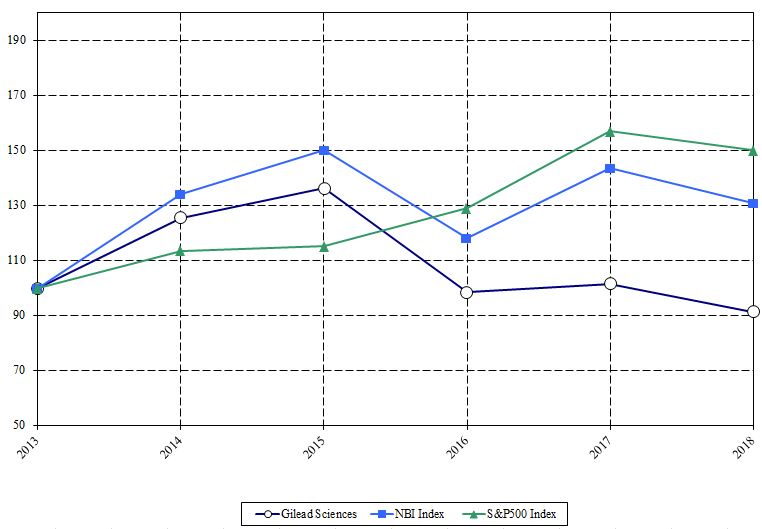
Performance Graph (1)
The following graph compares our cumulative total stockholder return for the past five years to two indices: the Standard & Poor’s 500 Stock Index (S&P 500 Index) and the Nasdaq Biotechnology Index (NBI Index). The stockholder return shown on the graph below is not necessarily indicative of future performance, and we do not make or endorse any predictions as to future stockholder returns.
Comparison of Cumulative Total Return on Investment for the Past Five Years (2)
Notes:
| (1) | This section is not “soliciting material,” is not deemed “filed” with the SEC and is not to be incorporated by reference in any of our filings under the Securities Act or the Exchange Act whether made before or after the date hereof and irrespective of any general incorporation language in any such filing. |
| (2) | Shows the cumulative return on investment assuming an investment of $100 in our common stock, the NBI Index and the S&P 500 Index on December 31, 2013, and assuming that all dividends were reinvested. |
Equity Compensation Plan Information
The following table provides certain information with respect to our equity compensation plans in effect as of December 31, 2018:
| Plan Category | Number of Common Shares to be Issued Upon Exercise of Outstanding Options, Warrants and Rights (a) (in thousands) | Weighted-average Exercise Price of Outstanding Options, Warrants and Rights (b) (1) (in dollars) | Number of Common Shares Remaining Available for Issuance Under Equity Compensation Plans (Excluding Securities Reflected in Column (a) (c) (in thousands) | |||||||
| Equity Compensation plans approved by security holders : | ||||||||||
| 2004 Equity Incentive Plan | 23,524 | $ | 53.80 | 91,441 | ||||||
| Employee Stock Purchase Plan (2) | 10,491 | |||||||||
| Total equity compensation plans approved by security holders | 23,524 | $ | 53.80 | 101,932 | ||||||
| Equity Compensation plans not approved by security holders | — | — | — | |||||||
| Total | 23,524 | $ | 53.80 | 101,932 | ||||||
| _________________________________________ |
Notes:
| (1) | Does not take into account 16 million restricted stock and stock unit awards, performance share units and phantom shares granted under our 2004 Equity Incentive Plan. |
| (2) | Under our Employee Stock Purchase Plan, participants are permitted to purchase our common stock at a discount on certain dates through payroll deductions within a pre-determined purchase period. Accordingly, these numbers are not determinable. |
Issuer Purchases of Equity Securities
In the first quarter of 2016, our Board of Directors authorized a $12.0 billion share repurchase program (2016 Program) under which repurchases may be made in the open market or in privately negotiated transactions. We started repurchases under the 2016 Program in April 2016.
During 2018, we repurchased and retired 40 million shares of our common stock for $2.9 billion through open market transactions under the 2016 Program.
The table below summarizes our stock repurchase activity for the three months ended December 31, 2018:
| Total Number of Shares Purchased (in thousands) | Average Price Paid per Share (in dollars) | Total Number of Shares Purchased as Part of a Publicly Announced Program (in thousands) | Maximum Fair Value of Shares that May Yet Be Purchased Under the Program (in millions) | |||||||||||
| October 1 - October 31, 2018 | 804 | $ | 73.96 | 751 | $ | 6,053 | ||||||||
| November 1 - November 30, 2018 | 5,922 | $ | 69.16 | 5,696 | $ | 5,660 | ||||||||
| December 1 - December 31, 2018 | 7,642 | $ | 67.39 | 7,608 | $ | 5,147 | ||||||||
| Total | 14,368 | (1) | $ | 68.49 | 14,055 | (1) | ||||||||
| _________________________________________ |
Notes:
| (1) | The difference between the total number of shares purchased and the total number of shares purchased as part of a publicly announced program is due to shares of common stock withheld by us from employee restricted stock unit awards in order to satisfy applicable tax withholding obligations. |
Item 6. SELECTED FINANCIAL DATA
GILEAD SCIENCES, INC.
SELECTED CONSOLIDATED FINANCIAL DATA
(in millions, except per share data)
| Year Ended December 31, | |||||||||||||||||||
| 2018 | 2017 | 2016 | 2015 | 2014 | |||||||||||||||
| CONSOLIDATED STATEMENT OF INCOME DATA(1): | |||||||||||||||||||
| Total revenues (2) | $ | 22,127 | $ | 26,107 | $ | 30,390 | $ | 32,639 | $ | 24,890 | |||||||||
| Total costs and expenses | $ | 13,927 | $ | 11,983 | $ | 12,757 | $ | 10,446 | $ | 9,625 | |||||||||
| Income from operations | $ | 8,200 | $ | 14,124 | $ | 17,633 | $ | 22,193 | $ | 15,265 | |||||||||
| Provision for income taxes(3) | $ | 2,339 | $ | 8,885 | $ | 3,609 | $ | 3,553 | $ | 2,797 | |||||||||
| Net income(2)(3) | $ | 5,460 | $ | 4,644 | $ | 13,488 | $ | 18,106 | $ | 12,059 | |||||||||
| Net income attributable to Gilead(2)(3) | $ | 5,455 | $ | 4,628 | $ | 13,501 | $ | 18,108 | $ | 12,101 | |||||||||
| Net income per share attributable to Gilead common stockholders - basic(2)(3) | $ | 4.20 | $ | 3.54 | $ | 10.08 | $ | 12.37 | $ | 7.95 | |||||||||
| Shares used in per share calculation - basic | 1,298 | 1,307 | 1,339 | 1,464 | 1,522 | ||||||||||||||
| Net income per share attributable to Gilead common stockholders - diluted(2)(3) | $ | 4.17 | $ | 3.51 | $ | 9.94 | $ | 11.91 | $ | 7.35 | |||||||||
| Shares used in per share calculation - diluted | 1,308 | 1,319 | 1,358 | 1,521 | 1,647 | ||||||||||||||
| Cash dividends declared per share | $ | 2.28 | $ | 2.08 | $ | 1.84 | $ | 1.29 | $ | — |
| December 31, | |||||||||||||||||||
| 2018 | 2017 | 2016 | 2015 | 2014 | |||||||||||||||
| CONSOLIDATED BALANCE SHEET DATA(1): | |||||||||||||||||||
| Cash, cash equivalents and marketable debt securities(4) | $ | 31,512 | $ | 36,694 | $ | 32,380 | $ | 26,208 | $ | 11,726 | |||||||||
| Working capital(4)(5) | $ | 25,231 | $ | 20,188 | $ | 10,370 | $ | 14,044 | $ | 11,453 | |||||||||
| Total assets(4)(6) | $ | 63,675 | $ | 70,283 | $ | 56,977 | $ | 51,716 | $ | 34,601 | |||||||||
| Other long-term obligations(5) | $ | 1,040 | $ | 558 | $ | 297 | $ | 395 | $ | 594 | |||||||||
| Long-term debt, including current portion(4)(6) | $ | 27,322 | $ | 33,542 | $ | 26,346 | $ | 22,055 | $ | 12,341 | |||||||||
| Retained earnings(2)(3) | $ | 19,024 | $ | 19,012 | $ | 18,154 | $ | 18,001 | $ | 12,732 | |||||||||
| Total stockholders’ equity(2)(3) | $ | 21,534 | $ | 20,501 | $ | 19,363 | $ | 19,113 | $ | 15,819 |
| ____________________ | ||
| Notes: | ||
| (1) | See Management’s Discussion and Analysis of Financial Condition and Results of Operations included in Item 7 of this Annual Report on Form 10-K for a description of our results of operations for 2018. | |
| (2) | In 2018, we adopted Accounting Standards Update No. 2014-09 (Topic 606) “Revenue from Contracts with Customers” using the modified retrospective method applied to those contracts which were not completed as of January 1, 2018. As such, results for 2018 are presented under Topic 606, while the information for prior periods has not been adjusted and continues to be reported in accordance with our historical accounting under Topic 605 “Revenue Recognition”. The impact as a result of applying Topic 606 in place of Topic 605 was not material for the year ended December 31, 2018. See Note 1, Organization and Summary of Significant Accounting Policies, and Note 2, Revenues, of the Notes to Consolidated Financial Statements included in Item 8 of our Annual Report on Form 10-K for further information. | |
| (3) | In December 2017, we recorded an estimated $5.5 billion net charge related to the enactment of the Tax Cuts and Jobs Act. See Note 18, Income Taxes of the Notes to Consolidated Financial Statements included in Item 8 of this Annual Report on Form 10-K for additional details. | |
| (4) | In 2018, we repaid $1.8 billion principal amount of our senior unsecured notes at maturity and repaid $4.5 billion of term loans borrowed in connection with our acquisition of Kite Pharma, Inc. (Kite). | |
| In 2017, in connection with the acquisition of Kite, we issued $3.0 billion aggregate principal amount of senior unsecured notes in a registered offering and drew on a $6.0 billion aggregate principal amount term loan facility credit agreement, of which $1.5 billion was repaid in December 2017. | ||
| In 2016, we issued $5.0 billion principal amount of senior unsecured notes in a registered offering. We also repaid $285 million of principal balance of convertible senior notes due in May 2016 and $700 million of principal balance of senior unsecured notes due in December 2016. | ||
| In 2015, we issued $10.0 billion principal amount of senior unsecured notes in a registered offering. We also repaid $213 million of principal balance of convertible senior notes due in May 2016. | ||
| In 2014, we issued $8.0 billion principal amount of senior unsecured notes in registered offerings. We also repaid $912 million of principal balance of convertible senior notes due in May 2014, $750 million of principal balance of senior unsecured notes due in December 2014 and $600 million under our five-year revolving credit facility agreement. | ||
| (5) | In 2017, we retrospectively adopted Accounting Standards Update No. 2015-17 “Balance Sheet Classification of Deferred Taxes,” which requires deferred tax assets and liabilities be classified as noncurrent on the balance sheet. As a result, we reclassified deferred tax assets from Total current assets to Other long-term assets and our deferred tax liabilities from Other accrued liabilities to Other long-term obligations for each of the years presented. | |
| (6) | In 2016, we retrospectively adopted Accounting Standards Update No. 2015-03 “Simplifying the Presentation of Debt Issuance Costs,” which requires presentation of debt issuance costs as a direct deduction from the carrying amount of a recognized debt liability on the balance sheet. As a result, we reclassified unamortized debt issuance costs from assets to Long-term debt, including current portion for each of the years presented. | |
Item 7. MANAGEMENT’S DISCUSSION AND ANALYSIS OF FINANCIAL CONDITION AND RESULTS OF OPERATIONS
The following Management’s Discussion and Analysis of Financial Condition and Results of Operations (MD&A) is intended to help the reader understand our results of operations and financial condition. MD&A is provided as a supplement to, and should be read in conjunction with, our audited Consolidated Financial Statements and the accompanying Notes to Consolidated Financial Statements and other disclosures included in this Annual Report on Form 10-K (including the disclosures under Part I, Item 1A, “Risk Factors”). Our Consolidated Financial Statements have been prepared in accordance with U.S. generally accepted accounting principles and are presented in U.S. dollars.
Management Overview
Gilead Sciences, Inc. (Gilead, we, our or us), incorporated in Delaware on June 22, 1987, is a research-based biopharmaceutical company that discovers, develops and commercializes innovative medicines in areas of unmet medical need. With each new discovery and investigational drug candidate, we strive to transform and simplify care for people with life-threatening illnesses around the world. We have operations in more than 35 countries worldwide, with headquarters in Foster City, California. Gilead’s primary areas of focus include HIV/AIDS, liver diseases, hematology/oncology and inflammation/respiratory diseases. We seek to add to our existing portfolio of products through our internal discovery and clinical development programs, product acquisition, in-licensing and strategic collaborations.
Our portfolio of marketed products includes AmBisome®, Atripla®, Biktarvy®, Cayston®, Complera®/Eviplera®, Descovy®, Emtriva®, Epclusa®, Genvoya®, Harvoni®, Hepsera®, Letairis®, Odefsey®, Ranexa®, Sovaldi®, Stribild®, Truvada®, Tybost®, Vemlidy®, Viread®, Vosevi®, Yescarta® and Zydelig®. We also sell and distribute certain products through our corporate partners under collaborative agreements.
2018 Business Highlights
2018 was marked by operational excellence and transition as we positioned ourselves for the future growth of our business. We continued to develop and deliver innovative medicines to help people with life-threatening illnesses around the world. Highlights of our 2018 performance include:
| • | HIV: We achieved record sales of our HIV products in 2018, with HIV product revenues increasing by 19% in the United States and 12% worldwide compared to 2017. This growth was driven by the successful launch of Biktarvy and the continued strong uptake of our single tablet regimens containing tenofovir alafenamide (TAF) for the treatment of HIV infection as well as Truvada for a pre-exposure prophylaxis (PrEP) indication for HIV prevention. Biktarvy, a once-daily single tablet regimen containing bictegravir, emtricitabine (FTC) and TAF for the treatment of HIV infection in adults, was approved by the U.S. Food and Drug Administration (FDA) in February and by the European Commission in June. |
| • | Liver Diseases: Our revenues from our chronic hepatitis C virus (HCV) products became more predictable in 2018. Because we wanted to introduce a lower-priced alternative to our HCV products without significant disruption to the healthcare system and our business, we authorized the launch of generic versions of Epclusa and Harvoni in the United States starting in January 2019 through our separate subsidiary, Asegua Therapeutics LLC (Asegua). We also continued to advance our clinical trials for the treatment of chronic hepatitis B virus (HBV) and nonalcoholic steatohepatitis (NASH), including completing enrollment of Phase 3 clinical trials of NASH. |
| • | Cell Therapy and Immuno-Oncology: We advanced our pipeline of cancer therapies and positioned ourselves as a leader in cell therapy. Yescarta was approved by the European Commission in August for the treatment of relapsed or refractory diffuse large B-cell lymphoma (DLBCL) and primary mediastinal large B-cell lymphoma (PMBCL) after two or more lines of systemic therapy. We certified additional centers in the United States and Europe to provide treatment for Yescarta. In order to advance and accelerate research and development efforts in cell therapy and immuno-oncology, during the year, we entered into key strategic collaborations with the National Cancer Institute, Pfizer, Inc. (Pfizer), Sangamo Therapeutics, Inc. (Sangamo), Gadeta B.V. (Gadeta), HiFiBiO Therapeutics (HiFiBiO), Tango Therapeutics (Tango) and Agenus Inc. (Agenus). |
| • | Inflammation: We continued to advance our pipeline of novel investigational agents for inflammatory diseases, including announcing positive data on filgotinib in ongoing Phase 2 and 3 clinical trials. We also entered into a strategic collaboration with Verily Life Sciences LLC, an Alphabet company (Verily), using Verily’s Immunoscape platform to identify and better understand the immunological basis of inflammatory diseases. |
During the year, we continued to invest in and advance our research and development pipeline across our therapeutic areas. At the end of 2018, our research and development pipeline included 119 active clinical studies, of which 41 were Phase 3 clinical trials. Additionally, we completed 26 collaborations, partnerships and strategic investments in 2018, which reflects our commitment to enabling our access to new technologies and drug candidates with the potential to evolve care for people with life-threatening illnesses. Our investments in research and development reflect our commitment to expanding our pipeline across a range of diseases to address areas of significant unmet medical need and positioning ourselves for the long-term growth of our business.
Recent key announcements include:
HIV and Liver Diseases Programs
| • | FDA and European Commission granted marketing authorization for Biktarvy for the treatment of HIV-1 infection. |
| • | FDA approved Truvada - in combination with safer sex practices - to reduce the risk of sexually acquired HIV-1 in at-risk adolescents. |
| • | China National Drug Administration (CDA, succeeded by China National Medical Products Administration (NMPA)) approved Genvoya in China for the treatment of HIV-1 infection. |
| • | NMPA approved Descovy in China for the treatment of HIV-1 infection in adults and adolescents. |
| • | We entered into an agreement with Japan Tobacco Inc. (Japan Tobacco) to expand our rights to develop and commercialize elvitegravir to include Japan and to acquire from Japan Tobacco the rights to market and distribute certain products in our HIV portfolio in Japan effective January 1, 2019. |
| • | We entered into a research collaboration and license agreement with Hookipa Biotech AG (Hookipa) that grants us exclusive rights to Hookipa’s TheraT® and Vaxwave® arenavirus vector-based immunization technologies for chronic HBV infection and HIV infection. |
| • | We announced plans to launch authorized generic versions of Epclusa and Harvoni in the United States through our separate subsidiary, Asegua. |
| • | NMPA approved Harvoni in China for the treatment of chronic HCV infection with genotype 1-6 in adults and adolescents aged 12 to 18 years. |
| • | CDA approved Epclusa in China for the treatment of adults with genotype 1-6 chronic HCV infection. The CDA also approved Epclusa in combination with ribavirin for adults with chronic HCV infection and decompensated cirrhosis. |
| • | NMPA approved Vemlidy in China for the treatment of chronic HBV infection in adults and adolescents. |
| • | We entered into a strategic collaboration with Precision BioSciences (Precision) to develop therapies targeting the in vivo elimination of chronic HBV infection with Precision’s proprie |
Showing the first 8K of 77K characters. Open the full section
Item 7A. QUANTITATIVE AND QUALITATIVE DISCLOSURES ABOUT MARKET RISK
We are exposed to market risks that may result from changes in foreign currency exchange rates, interest rates, credit risks and market price. To reduce certain of these risks, we enter into various types of foreign currency or interest rate derivative hedging transactions, follow investment guidelines and monitor outstanding receivables as part of our risk management program.
Foreign Currency Exchange Risk
Our operations include manufacturing and sales activities in the United States, Canada and Ireland as well as sales activities in countries outside the United States, including Europe and Asia Pacific. As a result, our financial results could be significantly affected by factors such as changes in foreign currency exchange rates or weak economic conditions in the foreign markets in which we distribute our products. Our operating results are exposed to changes in foreign currency exchange rates between the U.S. dollar and various foreign currencies, the most significant of which is the Euro. When the U.S. dollar strengthens against
these currencies, the relative value of sales made in the respective foreign currency decreases. Conversely, when the U.S. dollar weakens against these currencies, the relative amounts of such sales increase. Overall, we are a net receiver of foreign currencies and, therefore, benefit from a weaker U.S. dollar and are adversely affected by a stronger U.S. dollar relative to those foreign currencies in which we transact significant amounts of business.
Approximately 25% of our product sales were denominated in foreign currencies during 2018. To partially mitigate the impact of changes in currency exchange rates on net cash flows from our foreign currency denominated sales, we may enter into foreign currency exchange forward and option contracts. We also hedge certain monetary assets and liabilities denominated in foreign currencies, which reduces but does not eliminate our exposure to currency fluctuations between the date a transaction is recorded and the date that cash is collected or paid. In general, the market risks of these contracts are offset by corresponding gains and losses on the transactions being hedged.
As of December 31, 2018 and 2017, we had open foreign currency forward contracts with notional amounts of $2.2 billion and $2.8 billion, respectively. A hypothetical 10% adverse movement in foreign currency exchange rates compared with the U.S. dollar relative to exchange rates at December 31, 2018 would have resulted in a reduction in fair value of these contracts of approximately $218 million on this date and, if realized, would negatively affect earnings over the remaining life of the contracts. The same hypothetical movement in foreign currency exchange rates compared with the U.S. dollar relative to exchange rates at December 31, 2017, would have resulted in a reduction in fair value of these contracts of approximately $285 million on this date and, if realized, would negatively affect earnings over the remaining life of the contracts. The analysis does not consider the impact that hypothetical changes in foreign currency exchange rates would have on anticipated transactions that these foreign currency sensitive instruments were designed to offset.
Interest Rate Risk
Our portfolio of available-for-sale marketable debt securities and our fixed and variable rate liabilities create an exposure to interest rate risk. With respect to our investment portfolio, we adhere to an investment policy that requires us to limit amounts invested in securities based on credit rating, maturity, industry group and investment type and issuer, except for securities issued by the U.S. government. The goals of our investment policy, in order of priority, are as follows:
| • | safety and preservation of principal and diversification of risk; |
| • | liquidity of investments sufficient to meet cash flow requirements; and |
| • | competitive after-tax rate of return. |
The following table summarizes the expected maturities and average interest rates of our interest-generating assets and interest-bearing liabilities at December 31, 2018 (in millions, except percentages):
| Expected Maturity | Total Fair Value | ||||||||||||||||||||||||||||||
| 2019 | 2020 | 2021 | 2022 | 2023 | Thereafter | Total | |||||||||||||||||||||||||
| Assets | |||||||||||||||||||||||||||||||
| Available-for-sale debt securities | $ | 22,741 | $ | 1,001 | $ | 311 | $ | 16 | $ | 30 | $ | 65 | $ | 24,164 | $ | 24,164 | |||||||||||||||
| Average interest rate | 2.61 | % | 3.10 | % | 2.97 | % | 2.89 | % | 2.54 | % | 3.47 | % | |||||||||||||||||||
| Liabilities | |||||||||||||||||||||||||||||||
| Long-term debt, including current portion(1): | |||||||||||||||||||||||||||||||
| Fixed rate | $ | 1,500 | $ | 2,500 | $ | 2,250 | $ | 1,500 | $ | 750 | $ | 17,750 | $ | 26,250 | $ | 25,886 | |||||||||||||||
| Average interest rate | 1.92 | % | 2.51 | % | 4.44 | % | 2.82 | % | 2.50 | % | 4.16 | % | |||||||||||||||||||
| Variable rate | $ | 1,250 | $ | — | $ | — | $ | — | $ | — | $ | — | $ | 1,250 | $ | 1,250 | |||||||||||||||
| Average interest rate(2) | 3.02 | % | — | % | — | % | — | % | — | % | — | % | |||||||||||||||||||
| _______________________ |
Notes:
| (1) | Amounts represent principal balances. In addition to these fixed and variable rate long-term debt, we have a $2.5 billion five-year revolving credit facility. There were no amounts outstanding under the five-year revolving credit facility as of December 31, 2018. See Note 12, Debt and Credit Facilities of the Notes to Consolidated Financial Statements included in Item 8 of this Annual Report on Form 10-K for additional information. |
| (2) | Average interest rates for our variable rate debt were based on the interest rates on the last reset date in 2018 for each debt instrument and are dependent upon several factors subject to change, including but not limited to LIBOR, the principal amount of debt outstanding and credit ratings on each reset date. |
Credit Risk
We are subject to credit risk from our portfolio of cash equivalents and marketable debt securities. Under our investment policy, we limit amounts invested in such securities by credit rating, maturity, industry group, investment type and issuer, except for securities issued by the U.S. government. We are not exposed to any significant concentrations of credit risk from these financial
instruments. The goals of our investment policy, in order of priority, are as follows: safety and preservation of principal and diversification of risk; liquidity of investments sufficient to meet cash flow requirements; and a competitive after-tax rate of return.
We are also subject to credit risk from our accounts receivable related to our product sales. The majority of our trade accounts receivable arises from product sales in the United States and Europe.
As of December 31, 2018, our accounts receivable, net, in Southern Europe, specifically Greece, Italy, Portugal and Spain, totaled approximately $161 million, of which $31 million were greater than 120 days past due, including $27 million greater than 365 days past due. As of December 31, 2017, our accounts receivable, net, in Southern Europe, specifically Greece, Italy, Portugal and Spain, totaled approximately $326 million, of which $131 million were greater than 120 days past due, including $52 million greater than 365 days past due. To date, we have not experienced significant losses with respect to the collection of our accounts receivable.
Market Price Risk
We hold shares of common stock of certain publicly traded biotechnology companies in connection with license and collaboration agreements. These equity securities are measured at fair value with any changes in fair value recognized in earnings starting on January 1, 2018 as a result of our adoption of Accounting Standards Update No. 2016-01 “Financial Instruments-Overall: Recognition and Measurement of Financial Assets and Financial Liabilities”. See Note 1, Organization and Summary of Significant Accounting Policies, of the Notes to Consolidated Financial Statements included in Item 8 of our Annual Report on Form 10-K for further information.
The fair value of these equity securities was approximately $881 million and $635 million as of December 31, 2018 and 2017, respectively. Changes in fair value of these equity securities are primarily due to the volatility of the stock market and changes in general economic conditions, among other factors. A hypothetical 20% increase or decrease in the stock prices of these equity securities would increase or decrease their fair value at December 31, 2018 and 2017 by approximately $176 million and $127 million, respectively.
Item 8. FINANCIAL STATEMENTS AND SUPPLEMENTARY DATA
GILEAD SCIENCES, INC.
INDEX TO CONSOLIDATED FINANCIAL STATEMENTS AND SUPPLEMENTARY DATA
Years ended December 31, 2018, 2017 and 2016
CONTENTS
REPORT OF INDEPENDENT REGISTERED PUBLIC ACCOUNTING FIRM
To the Shareholders and the Board of Directors of Gilead Sciences, Inc.
Opinion on the Financial Statements
We have audited the accompanying consolidated balance sheets of Gilead Sciences, Inc. (the Company) as of December 31, 2018 and 2017, the related consolidated statements of income, comprehensive income, stockholders’ equity and cash flows for each of the three years in the period ended December 31, 2018, and the related notes and financial statement schedule listed in the index at Item 15(a) (collectively referred to as the “consolidated financial statements”). In our opinion, the consolidated financial statements present fairly, in all material respects, the financial position of the Company at December 31, 2018 and 2017, and the results of its operations and its cash flows for each of the three years in the period ended December 31, 2018, in conformity with U.S. generally accepted accounting principles.
We also have audited, in accordance with the standards of the Public Company Accounting Oversight Board (United States) (PCAOB), the Company’s internal control over financial reporting as of December 31, 2018, based on criteria established in Internal Control-Integrated Framework issued by the Committee of Sponsoring Organizations of the Treadway Commission (2013 framework) and our report dated February 25, 2019 expressed an unqualified opinion thereon.
Basis for Opinion
These financial statements are the responsibility of the Company’s management. Our responsibility is to express an opinion on the Company’s financial statements based on our audits. We are a public accounting firm registered with the PCAOB and are required to be independent with respect to the Company in accordance with the U.S. federal securities laws and the applicable rules and regulations of the Securities and Exchange Commission and the PCAOB.
We conducted our audits in accordance with the standards of the PCAOB. Those standards require that we plan and perform the audit to obtain reasonable assurance about whether the financial statements are free of material misstatement, whether due to error or fraud. Our audits included performing procedures to assess the risks of material misstatement of the financial statements, whether due to error or fraud, and performing procedures that respond to those risks. Such procedures included examining, on a test basis, evidence regarding the amounts and disclosures in the financial statements. Our audits also included evaluating the accounting principles used and significant estimates made by management, as well as evaluating the overall presentation of the financial statements. We believe that our audits provide a reasonable basis for our opinion.
/s/ Ernst & Young LLP
We have served as the Company’s auditor since 1988.
San Jose, California
February 25, 2019
GILEAD SCIENCES, INC.
Consolidated Balance Sheets
(in millions, except per share amounts)
| December 31, | |||||||
| 2018 | 2017 | ||||||
| Assets | |||||||
| Current assets: | |||||||
| Cash and cash equivalents | $ | 17,940 | $ | 7,588 | |||
| Short-term marketable securities | 12,149 | 17,922 | |||||
| Accounts receivable, net of allowances of $583 and $455, respectively | 3,327 | 3,851 | |||||
| Inventories | 814 | 801 | |||||
| Prepaid and other current assets | 1,606 | 1,661 | |||||
| Total current assets | 35,836 | 31,823 | |||||
| Property, plant and equipment, net | 4,006 | 3,295 | |||||
| Long-term marketable securities | 1,423 | 11,184 | |||||
| Intangible assets, net | 15,738 | 17,100 | |||||
| Goodwill | 4,117 | 4,159 | |||||
| Other long-term assets | 2,555 | 2,722 | |||||
| Total assets | $ | 63,675 | $ | 70,283 | |||
| Liabilities and Stockholders’ Equity | |||||||
| Current liabilities: | |||||||
| Accounts payable | $ | 790 | $ | 814 | |||
| Accrued government and other rebates | 3,928 | 4,704 | |||||
| Other accrued liabilities | 3,139 | 3,370 | |||||
| Current portion of long-term debt and other obligations, net | 2,748 | 2,747 | |||||
| Total current liabilities | 10,605 | 11,635 | |||||
| Long-term debt, net | 24,574 | 30,795 | |||||
| Long-term income taxes payable | 5,922 | 6,794 | |||||
| Other long-term obligations | 1,040 | 558 | |||||
| Commitments and contingencies (Note 13) | |||||||
| Stockholders’ equity: | |||||||
| Preferred stock, par value $0.001 per share; 5 shares authorized; none outstanding | — | — | |||||
| Common stock, par value $0.001 per share; 5,600 authorized; 1,282 and 1,308 shares issued and outstanding, respectively | 1 | 1 | |||||
| Additional paid-in capital | 2,282 | 1,264 | |||||
| Accumulated other comprehensive income | 80 | 165 | |||||
| Retained earnings | 19,024 | 19,012 | |||||
| Total Gilead stockholders’ equity | 21,387 | 20,442 | |||||
| Noncontrolling interest | 147 | 59 | |||||
| Total stockholders’ equity | 21,534 | 20,501 | |||||
| Total liabilities and stockholders’ equity | $ | 63,675 | $ | 70,283 |
See accompanying notes.
GILEAD SCIENCES, INC.
Consolidated Statements of Income
(in millions, except per share amounts)
| Year Ended December 31, | ||||||||||||
| 2018 | 2017 | 2016 | ||||||||||
| Revenues: | ||||||||||||
| Product sales | $ | 21,677 | $ | 25,662 | $ | 29,953 | ||||||
| Royalty, contract and other revenues | 450 | 445 | 437 | |||||||||
| Total revenues | 22,127 | 26,107 | 30,390 | |||||||||
| Costs and expenses: | ||||||||||||
| Cost of goods sold | 4,853 | 4,371 | 4,261 | |||||||||
| Research and development expenses | 5,018 | 3,734 | 5,098 | |||||||||
| Selling, general and administrative expenses | 4,056 | 3,878 | 3,398 | |||||||||
| Total costs and expenses | 13,927 | 11,983 | 12 |
Showing the first 8K of 195K characters. Open the full section
Item 9. CHANGES IN AND DISAGREEMENTS WITH ACCOUNTANTS ON ACCOUNTING AND FINANCIAL DISCLOSURE
Not applicable.
Item 9A. CONTROLS AND PROCEDURES
(a) Evaluation of Disclosure Controls and Procedures
An evaluation as of December 31, 2018 was carried out under the supervision and with the participation of our management, including our interim Chief Executive Officer and Chief Financial Officer, of the effectiveness of our “disclosure controls and procedures,” which are defined in Rule 13a-15(e) under the Securities Exchange Act of 1934, as amended (the Exchange Act), as controls and other procedures of a company that are designed to ensure that the information required to be disclosed by a company in the reports that it files or submits under the Exchange Act is recorded, processed, summarized and reported, within the time periods specified in the Securities and Exchange Commission’s rules and forms, and that such information is accumulated and communicated to the company’s management, including its interim Chief Executive Officer and Chief Financial Officer, as appropriate, to allow timely decisions regarding required disclosure. Based upon that evaluation, our interim Chief Executive Officer and Chief Financial Officer concluded that our disclosure controls and procedures were effective at December 31, 2018.
(b) Management’s Report on Internal Control over Financial Reporting
Our management is responsible for establishing and maintaining adequate internal control over financial reporting, as such term is defined in Rule 13a-15(f) of the Exchange Act. Our internal control system is designed to provide reasonable assurance regarding the preparation and fair presentation of financial statements for external purposes in accordance with generally accepted accounting principles. All internal control systems, no matter how well designed, have inherent limitations and can provide only reasonable assurance that the objectives of the internal control system are met.
Under the supervision and with the participation of our management, including our interim Chief Executive Officer and Chief Financial Officer, we conducted an evaluation of the effectiveness of our internal control over financial reporting, based on criteria established by the Committee of Sponsoring Organizations of the Treadway Commission (COSO) in its 2013 Internal Control-Integrated Framework. Based on our evaluation, we concluded that our internal control over financial reporting was effective as of December 31, 2018.
Our independent registered public accounting firm, Ernst & Young LLP, has audited our Consolidated Financial Statements included in Item 8 of this Annual Report on Form 10-K and have issued a report on our internal control over financial reporting as of December 31, 2018. Their report on the audit of internal control over financial reporting appears below.
(c) Changes in Internal Control over Financial Reporting
Our management, including our interim Chief Executive Officer and Chief Financial Officer, has evaluated any changes in our internal control over financial reporting that occurred during the quarter ended December 31, 2018, and has concluded that there was no change during such quarter that has materially affected, or is reasonably likely to materially affect, our internal control over financial reporting.
REPORT OF INDEPENDENT REGISTERED PUBLIC ACCOUNTING FIRM
To the Shareholders and the Board of Directors of Gilead Sciences, Inc.
Opinion on Internal Control over Financial Reporting
We have audited Gilead Sciences, Inc.’s internal control over financial reporting as of December 31, 2018, based on criteria established in Internal Control-Integrated Framework issued by the Committee of Sponsoring Organizations of the Treadway Commission (2013 framework) (the COSO criteria). In our opinion, Gilead Sciences, Inc. (the Company) maintained, in all material respects, effective internal control over financial reporting as of December 31, 2018, based on the COSO criteria.
We also have audited, in accordance with the standards of the Public Company Accounting Oversight Board (United States) (PCAOB), the consolidated balance sheets of the Company as of December 31, 2018 and 2017, the related consolidated statements of income, comprehensive income, stockholders’ equity and cash flows for each of the three years in the period ended December 31, 2018, and the related notes and financial statement schedule listed in the Index at Item 15(a) and our report dated February 25, 2019 expressed an unqualified opinion thereon.
Basis for Opinion
The Company’s management is responsible for maintaining effective internal control over financial reporting and for its assessment of the effectiveness of internal control over financial reporting included in the accompanying Management’s Report on Internal Control over Financial Reporting. Our responsibility is to express an opinion on the Company’s internal control over financial reporting based on our audit. We are a public accounting firm registered with the PCAOB and are required to be independent with respect to the Company in accordance with the U.S. federal securities laws and the applicable rules and regulations of the Securities and Exchange Commission and the PCAOB.
We conducted our audit in accordance with the standards of the PCAOB. Those standards require that we plan and perform the audit to obtain reasonable assurance about whether effective internal control over financial reporting was maintained in all material respects.
Our audit included obtaining an understanding of internal control over financial reporting, assessing the risk that a material weakness exists, testing and evaluating the design and operating effectiveness of internal control based on the assessed risk, and performing such other procedures as we considered necessary in the circumstances. We believe that our audit provides a reasonable basis for our opinion.
Definition and Limitations of Internal Control Over Financial Reporting
A company’s internal control over financial reporting is a process designed to provide reasonable assurance regarding the reliability of financial reporting and the preparation of financial statements for external purposes in accordance with generally accepted accounting principles. A company’s internal control over financial reporting includes those policies and procedures that (1) pertain to the maintenance of records that, in reasonable detail, accurately and fairly reflect the transactions and dispositions of the assets of the company; (2) provide reasonable assurance that transactions are recorded as necessary to permit preparation of financial statements in accordance with generally accepted accounting principles, and that receipts and expenditures of the company are being made only in accordance with authorizations of management and directors of the company; and (3) provide reasonable assurance regarding prevention or timely detection of unauthorized acquisition, use, or disposition of the company’s assets that could have a material effect on the financial statements.
Because of its inherent limitations, internal control over financial reporting may not prevent or detect misstatements. Also, projections of any evaluation of effectiveness to future periods are subject to the risk that controls may become inadequate because of changes in conditions, or that the degree of compliance with the policies or procedures may deteriorate.
/s/ Ernst & Young LLP
San Jose, California
February 25, 2019
Item 9B. OTHER INFORMATION
Not applicable.
PART III
Item 10. DIRECTORS, EXECUTIVE OFFICERS AND CORPORATE GOVERNANCE
The information required by this Item concerning our directors and executive officers is incorporated by reference to the sections of our Definitive Proxy Statement to be filed with the Securities and Exchange Commission pursuant to Regulation 14A in connection with our 2019 Annual Meeting of Stockholders (the Proxy Statement) under the headings “The Gilead Board of Directors - Nominees,” “Board Structure,” “Executive Officers,” and “Section 16(a) Beneficial Ownership Reporting Compliance.”
Our written Code of Ethics applies to all of our directors and employees, including our executive officers, including without limitation our principal executive officer, principal financial officer, principal accounting officer or controller or persons performing similar functions. The Code of Ethics is available on our website at http://www.gilead.com in the Investors section under “Corporate Governance.” We intend to disclose future amendments to certain provisions of the Code of Ethics, and waivers of the Code of Ethics granted to executive officers and directors, on the website within four business days following the date of the amendment or waiver.
Item 11. EXECUTIVE COMPENSATION
The information required by this Item is incorporated by reference to the sections of the Proxy Statement under the headings “Executive Compensation,” “Committees of our Board of Directors,” “Compensation Committee Report,” and “Compensation of Non-Employee Board Members.”
Item 12. SECURITY OWNERSHIP OF CERTAIN BENEFICIAL OWNERS AND MANAGEMENT AND RELATED STOCKHOLDER MATTERS
The information required by this Item is incorporated by reference to Item 5 of our Annual Report on Form 10-K under the heading “Equity Compensation Plan Information” and the section of the Proxy Statement under the heading “Security Ownership of Certain Beneficial Owners and Management.”
Item 13. CERTAIN RELATIONSHIPS AND RELATED TRANSACTIONS, AND DIRECTOR INDEPENDENCE
The information required by this Item is incorporated by reference to the sections of the Proxy Statement under the headings “The Gilead Board of Directors,” and “Board Processes.”
Item 14. PRINCIPAL ACCOUNTANT FEES AND SERVICES
The information required by this Item is incorporated by reference to the section of the Proxy Statement under the heading “Principal Accountant Fees and Services.”
PART IV
Item 15. EXHIBITS AND FINANCIAL STATEMENT SCHEDULES
(a) The following documents are filed as part of this Annual Report on Form 10-K:
(1) Index list to Consolidated Financial Statements:
(2) Schedule II is included on page 91 of this report. All other schedules are omitted because they are not required or the required information is included in the financial statements or notes thereto.
(3) Exhibits.
The following exhibits are filed herewith or incorporated by reference:
| (1) | Filed as an exhibit to Registrant’s Current Report on Form 8-K filed on May 8, 2014, and incorporated herein by reference. |
| (2) | Filed as an exhibit to Registrant’s Current Report on Form 8-K filed on December 23, 2015, and incorporated herein by reference. |
| (3) | Filed as an exhibit to Registrant’s Current Report on Form 8-K filed on April 1, 2011, and incorporated herein by reference. |
| (4) | Filed as an exhibit to Registrant’s Current Report on Form 8-K filed on December 13, 2011, and incorporated herein by reference. |
| (5) | Filed as an exhibit to Registrant’s Current Report on Form 8-K filed on March 7, 2014, and incorporated herein by reference. |
| (6) | Filed as an exhibit to Registrant’s Current Report on Form 8-K filed on November 17, 2014, and incorporated herein by reference. |
| (7) | Filed as an exhibit to Registrant’s Current Report on Form 8-K filed on September 14, 2015, and incorporated herein by reference. |
| (8) | Filed as an exhibit to Registrant’s Current Report on Form 8-K filed on September 20, 2016, and incorporated herein by reference. |
| (9) | Filed as an exhibit to Registrant’s Current Report on Form 8-K filed on September 21, 2017, and incorporated herein by reference. |
| (10) | Filed as an exhibit to Registrant’s Current Report on Form 8-K filed on May 12, 2017, and incorporated herein by reference. |
| (11) | Filed as an exhibit to Registrant’s Annual Report on Form 10-K for the fiscal year ended December 31, 2007, and incorporated herein by reference. |
| (12) | Filed as an exhibit to Registrant’s Quarterly Report on Form 10-Q for the quarter ended June 30, 2009, and incorporated herein by reference. |
| (13) | Filed as an exhibit to Registrant’s Annual Report on Form 10-K for the fiscal year ended December 31, 2009, and incorporated herein by reference. |
| (14) | Filed as an exhibit to Registrant’s Quarterly Report on Form 10-Q for the quarter ended March 31, 2011, and incorporated herein by reference. |
| (15) | Filed as an exhibit to Registrant’s Quarterly Report on Form 10-Q for the quarter ended June 30, 2013, and incorporated herein by reference |
| (16) | Filed as an exhibit to Registrant’s Quarterly Report on Form 10-Q for the quarter ended June 30, 2014, and incorporated herein by reference. |
| (17) | Filed as an exhibit to Registrant’s Quarterly Report on Form 10-Q for the quarter ended March 31, 2016, and incorporated herein by reference. |
| (18) | Filed as an exhibit to Registrant’s Quarterly Report on Form 10-Q for the quarter ended March 31, 2015, and incorporated herein by reference. |
| (19) | Filed as an exhibit to Registrant’s Current Report on Form 8-K filed on May 8, 2015, and incorporated herein by reference. |
| (20) | Filed as an exhibit to Registrant’s Annual Report on Form 10-K for the fiscal year ended December 31, 2001, and incorporated herein by reference. |
| (21) | Filed as an exhibit to Registrant’s Annual Report on Form 10-K for the fiscal year ended December 31, 2008, and incorporated herein by reference. |
| (22) | Filed as an exhibit to Registrant’s Current Report on Form 8-K filed on March 11, 2016, and incorporated herein by reference. |
| (23) | Filed as an exhibit to Registrant’s Quarterly Report on Form 10-Q for the quarter ended June 30, 2018, and incorporated herein by reference. |
| (24) | Filed as an exhibit to Registrant’s Current Report on Form 8-K filed on May 17, 2016, and incorporated herein by reference. |
| (25) | Filed as an exhibit to Registrant’s Quarterly Report on Form 10-Q for the quarter ended September 30, 2018, and incorporated herein by reference. |
| (26) | Filed as an exhibit to Registrant’s Quarterly Report on Form 10-Q for the quarter ended June 30, 2008, and incorporated herein by reference. |
| (27) | Filed as an exhibit to Registrant’s Current Report on Form 8-K filed on August 7, 2018, and incorporated herein by reference. |
| (28) | Filed as an exhibit to Registrant’s Current Report on Form 8-K filed on December 10, 2018, and incorporated herein by reference. |
| (29) | Filed as an exhibit to Registrant’s Registration Statement on Form S-1 (No. 33-55680), as amended, and incorporated herein by reference. |
| (30) | Filed as an exhibit to Registrant’s Annual Report on Form 10-K for the fiscal year ended December 31, 2006, and incorporated herein by reference. |
| (31) | Filed as an exhibit to Registrant’s Annual Report on Form 10-K for the fiscal year ended March 31, 1994, and incorporated herein by reference. |
| (32) | Filed as an exhibit to Registrant’s Annual Report on Form 10-K for the fiscal year ended December 31, 2000, and incorporated herein by reference. |
| (33) | Filed as an exhibit to Registrant’s Quarterly Report on Form 10-Q for the quarter ended September 30, 2006, and incorporated herein by reference. |
| (34) | Filed as an exhibit to Registrant’s Quarterly Report on Form 10-Q for the quarter ended September 30, 2013, and incorporated herein by reference. |
| (35) | Filed as an exhibit to Triangle Pharmaceuticals, Inc.’s Quarterly Report on Form 10-Q/A filed on November 3, 1999, and incorporated herein by reference. |
| (36) | Filed as an exhibit to Registrant’s Quarterly Report on Form 10-Q for the quarter ended September 30, 2005, and incorporated herein by reference. |
| (37) | Filed as an exhibit to Registrant’s Annual Report on Form 10-K for the fiscal year ended December 31, 2014, and incorporated herein by reference. |
| (38) | Filed as an exhibit to Kite Pharma, Inc.’s Registration Statement on Form S-1/A (No. 333-196081) filed on June 17, 2014, and incorporated herein by reference. |
| * | Management contract or compensatory plan or arrangement. |
| ** | Furnished herewith. |
| *** | Filed herewith. |
| + | Certain confidential portions of this Exhibit were omitted by means of marking such portions with an asterisk (the Mark). This Exhibit has been filed separately with the Secretary of the Securities and Exchange Commission without the Mark pursuant to Registrant’s Application Requesting Confidential Treatment under Rule 24b-2 under the Securities Exchange Act of 1934, as amended. |
Item 16. FORM 10-K SUMMARY
None.
SIGNATURES
Pursuant to the requirements of Section 13 or 15(d) of the Securities Exchange Act of 1934, the registrant has duly caused this report to be signed on its behalf by the undersigned, thereunto duly authorized.
| GILEAD SCIENCES, INC. | |
| By: | /S/ GREGG H. ALTON |
| Gregg H. Alton Interim Chief Executive Officer and Chief Patient Officer |
POWER OF ATTORNEY
KNOW ALL PERSONS BY THESE PRESENTS, that each person whose signature appears below constitutes and appoints Gregg H. Alton and Brett A. Pletcher, and each of them, as his true and lawful attorneys-in-fact and agents, with full power of substitution and resubstitution, for him or her and in his or her name, place, and stead, in any and all capacities, to sign any and all amendments to this Report, and to file the same, with all exhibits thereto, and other documents in connection therewith, with the Securities and Exchange Commission, granting unto said attorneys-in-fact and agents, and each of them, full power and authority to do and perform each and every act and thing requisite and necessary to be done in connection therewith, as fully to all intents and purposes as he might or could do in person, hereby ratifying and confirming that all said attorneys-in-fact and agents, or any of them or their or his substitute or substitutes, may lawfully do or cause to be done by virtue hereof.
Pursuant to the requirements of the Securities Exchange Act of 1934, as amended, this Report has been signed below by the following persons on behalf of the registrant and in the capacities and on the dates indicated.
| Signature | Title | Date | ||
| /S/ GREGG H. ALTON | Interim Chief Executive Officer and Chief Patient Officer | February 25, 2019 | ||
| Gregg H. Alton | (Principal Executive Officer) | |||
| /S/ ROBIN L. WASHINGTON | Executive Vice President and Chief Financial Officer | February 25, 2019 | ||
| Robin L. Washington | (Principal Financial and Accounting Officer) | |||
| /S/ JOHN C. MARTIN | Chairman of the Board of Directors | February 25, 2019 | ||
| John C. Martin, Ph.D. | ||||
| /S/ JACQUELINE K. BARTON | Director | February 25, 2019 | ||
| Jacqueline K. Barton, Ph.D. | ||||
| /S/ JOHN F. COGAN | Director | February 25, 2019 | ||
| John F. Cogan, Ph.D. | ||||
| /S/ KELLY A. KRAMER | Director | February 25, 2019 | ||
| Kelly A. Kramer | ||||
| /S/ KEVIN E. LOFTON | Director | February 25, 2019 | ||
| Kevin E. Lofton | ||||
| /S/ NICHOLAS G. MOORE | Director | February 25, 2019 | ||
| Harish Manwani | ||||
| /S/ RICHARD J. WHITLEY | Director | February 25, 2019 | ||
| Richard J. Whitley, M.D. | ||||
| /S/ GAYLE E. WILSON | Director | February 25, 2019 | ||
| Gayle E. Wilson | ||||
| /S/ PER WOLD-OLSEN | Director | February 25, 2019 | ||
| Per Wold-Olsen |