 filings.tools
Globe Life 10-K 2023-12-31
Filed 2024-02-28. 23 sections, 757K characters. Original on sec.gov · Markdown · JSON
Cover and table of contents
UNITED STATES
SECURITIES AND EXCHANGE COMMISSION
Washington, D.C. 20549
FORM 10-K
(Mark one)
[ ☒ ] ANNUAL REPORT PURSUANT TO SECTION 13 OR 15(d) OF THE SECURITIES EXCHANGE ACT OF 1934
For the fiscal year ended December 31, 2023
or
[ ☐ ] TRANSITION REPORT PURSUANT TO SECTION 13 OR 15(d) OF THE SECURITIES EXCHANGE ACT OF 1934
For the transition period from to
Commission file number: 001-08052
GLOBE LIFE INC.
(Exact name of registrant as specified in its charter)
| Delaware | 63-0780404 | |||||||
| (State or other jurisdiction of incorporation or organization) | (I.R.S. Employer Identification No.) | |||||||
| 3700 South Stonebridge Drive, McKinney, TX | 75070 | |||||||
| (Address of principal executive offices) | (Zip Code) |
972-569-4000
(Registrant’s telephone number, including area code)
Securities registered pursuant to Section 12(b) of the Act:
| Title of each class | Trading Symbol(s) | Name of each exchange on which registered | ||||||
| Common Stock, $1.00 par value per share | GL | New York Stock Exchange | ||||||
| 4.250% Junior Subordinated Debentures | GL PRD | New York Stock Exchange |
Securities registered pursuant to Section 12(g) of the Act: None
Indicate by check mark if the registrant is a well-known seasoned issuer, as defined in Rule 405 of the Securities Act.
Yes x No ¨
Indicate by check mark if the registrant is not required to file reports pursuant to Section 13 or Section 15(d) of the Act.
Yes ¨ No x
Indicate by check mark whether the registrant (1) has filed all reports required to be filed by Section 13 or 15(d) of the Securities Exchange Act of 1934 during the preceding 12 months (or for such shorter period that the registrant was required to file such reports), and (2) has been subject to such filing requirements for the past 90 days.
Yes x No ¨
Indicate by check mark whether the registrant has submitted electronically every Interactive Data File required to be submitted pursuant to Rule 405 of Regulation S-T (§ 232.405 of this chapter) during the preceding 12 months (or for such shorter period that the registrant was required to submit such files).
Yes x No ¨
GL 2023 FORM 10-K
Indicate by check mark whether the registrant is a large accelerated filer, an accelerated filer, a non-accelerated filer, a smaller reporting company, or an emerging growth company. See the definitions of “large accelerated filer,” “accelerated filer,” “smaller reporting company,” and "emerging growth company" in Rule 12b-2 of the Exchange Act.:
| Large accelerated filer | x | Accelerated filer | ¨ | |||||||||||||||||
| Non-accelerated filer | ¨ | Smaller reporting company | ¨ | |||||||||||||||||
| Emerging growth company | ¨ | |||||||||||||||||||
| If an emerging growth company, indicate by check mark if the registrant has elected not to use the extended transition period for complying with any new or revised financial accounting standards provided pursuant to Section 13(a) of the Exchange Act. | ¨ |
Indicate by check mark whether the registrant has filed a report on and attestation to its management's assessment of the effectiveness of its internal control over financial reporting under Section 404(b) of the Sarbanes-Oxley Act (15 U.S.C. 7262(b)) by the registered public accounting firm that prepared or issued its audit report. x
If securities are registered pursuant to Section 12(b) of the Act, indicate by check mark whether the financial statements of the registrant included in the filing reflect the correction of an error to previously issued financial statements. x
Indicate by checkmark whether any of those error corrections are restatements that required a recovery analysis of incentive-based compensation received by any of the registrant's executive officers during the relevant recovery period pursuant to §240.10D-1(b). ☐
Indicate by check mark whether the registrant is a shell company (as defined in Rule 12b-2 of the Exchange Act).
Yes ☐ No x
As of June 30, 2023, the aggregate market value of the registrant’s common stock held by non-affiliates of the registrant was $10.4 billion based on the closing sale price as reported on the New York Stock Exchange.
Indicate the number of shares outstanding of each of the registrant’s classes of common stock, as of the latest practicable date.
| Class | Outstanding as of January 31, 2024 | |||||||
| Common Stock, $1.00 par value per share | 93,707,838 shares |
DOCUMENTS INCORPORATED BY REFERENCE
| Document | Parts Into Which Incorporated | |||||||
| Proxy Statement for the Annual Meeting of Stockholders to be held on April 25, 2024 (Proxy Statement) | Part III |
GL 2023 FORM 10-K
Globe Life Inc.
Table of Contents
GL 2023 FORM 10-K
Part I
Item 1. Business
Globe Life and the Company refer to Globe Life Inc., an insurance holding company incorporated in Delaware in 1979, and its subsidiaries and affiliates. Its primary subsidiaries are Globe Life And Accident Insurance Company, American Income Life Insurance Company, Liberty National Life Insurance Company, Family Heritage Life Insurance Company of America, and United American Insurance Company.
Globe Life's website is: www.globelifeinsurance.com. Globe Life makes available free of charge through its website, its annual report on Form 10-K, its quarterly reports on Form 10-Q, current reports on Form 8-K, and amendments to those reports as soon as reasonably practicable after they have been electronically filed with or furnished to the Securities and Exchange Commission. Other information included in Globe Life's website is not incorporated into this filing.
GL 2023 FORM 10-K
The following table presents Globe Life's business by primary marketing distribution method. Additional information concerning industry segments may be found in Management’s Discussion and Analysis and in Note 15—Business Segments within the Notes to the Consolidated Financial Statements**.
| Primary Distribution Method | Underwriting Company | Products and Target Markets | Distribution | |||||||||||||||||||||||
 | Direct to Consumer Division | Globe Life And Accident Insurance Company McKinney, Texas | Individual life and supplemental health limited-benefit insurance including juvenile and senior life coverage and Medicare Supplement to lower middle-income to middle-income Americans. | Nationwide distribution through direct to consumer channels: including direct mail, electronic media, and insert media. | ||||||||||||||||||||||
 | American Income Life Division | American Income Life Insurance Company Waco, Texas | Individual life and supplemental health limited-benefit insurance marketed to working families. | 10,579 average producing agents in the U.S., Canada, and New Zealand. | ||||||||||||||||||||||
 | Liberty National Division | Liberty National Life Insurance Company McKinney, Texas | Life and supplemental health limited-benefit insurance distributed through in-home and worksite channels. | 3,229 average producing agents in the U.S. | ||||||||||||||||||||||
 | Family Heritage Division | Family Heritage Life Insurance Company of America Cleveland, Ohio | Supplemental limited-benefit health insurance to lower middle-income to middle-income families. | 1,334 average producing agents in the U.S. | ||||||||||||||||||||||
 | United American Division | United American Insurance Company McKinney, Texas | Supplemental health Medicare coverage to beneficiaries and, to a lesser extent, supplemental limited-benefit coverage to people under age 65. | 3,223 independent producing agents in the U.S. |
GL 2023 FORM 10-K
Insurance
Life Insurance
The distribution channels for life insurance products include direct to consumer, exclusive agents, and independent agents. These methods are described in greater detail within the primary marketing distribution channel chart as shown above. The following table presents annualized premium in force for the three years ended December 31, 2023 by distribution method:
| Annualized Premium in Force**(1)** (Dollar amounts in thousands) | |||||||||||||||||
| 2023 | 2022 | 2021 | |||||||||||||||
| Direct to Consumer | $ | 933,057 | $ | 936,507 | $ | 929,197 | |||||||||||
| Exclusive agents: | |||||||||||||||||
| American Income | 1,654,197 | 1,553,003 | 1,458,408 | ||||||||||||||
| Liberty National | 390,693 | 360,963 | 341,332 | ||||||||||||||
| Independent agents: | |||||||||||||||||
| United American | 6,958 | 7,609 | 8,426 | ||||||||||||||
| Other | 200,840 | 203,438 | 205,822 | ||||||||||||||
| $ | 3,185,745 | $ | 3,061,520 | $ | 2,943,185 |
(1)See definition of annualized premium in force under Results of Operations in Management's Discussion & Analysis**.
Globe Life's insurance subsidiaries write a variety of nonparticipating ordinary life insurance products. These include traditional whole life, term life, and other life insurance. The Company does not currently sell interest-sensitive whole life products. The following tables present selected information about Globe Life's life insurance products.
| Annualized Premium in Force (Dollar amounts in thousands) | |||||||||||||||||||||||||||||||||||
| 2023 | 2022 | 2021 | |||||||||||||||||||||||||||||||||
| Amount | % of Total | Amount | % of Total | Amount | % of Total | ||||||||||||||||||||||||||||||
| Whole life: | |||||||||||||||||||||||||||||||||||
| Traditional | $ | 2,213,816 | 69 | $ | 2,106,878 | 69 | $ | 2,011,349 | 68 | ||||||||||||||||||||||||||
| Interest-sensitive | 29,929 | 1 | 31,838 | 1 | 33,912 | 1 | |||||||||||||||||||||||||||||
| Term | 753,261 | 24 | 756,471 | 25 | 750,005 | 26 | |||||||||||||||||||||||||||||
| Other | 188,739 | 6 | 166,333 | 5 | 147,919 | 5 | |||||||||||||||||||||||||||||
| $ | 3,185,745 | 100 | $ | 3,061,520 | 100 | $ | 2,943,185 | 100 |
| Policy Count and Average Face Amount Per Policy (Dollar amounts in thousands) | |||||||||||||||||||||||||||||||||||
| 2023 | 2022 | 2021 | |||||||||||||||||||||||||||||||||
| Policy Count | Average Face Amount per Policy | Policy Count | Average Face Amount per Policy | Policy Count | Average Face Amount per Policy | ||||||||||||||||||||||||||||||
| Whole life: | |||||||||||||||||||||||||||||||||||
| Traditional | 9,050,091 | $ | 16.0 | 9,011,227 | $ | 15.7 | 8,963,774 | $ | 15.3 | ||||||||||||||||||||||||||
| Interest-sensitive | 176,339 | 20.4 | 183,887 | 20.4 | 191,536 | 20.4 | |||||||||||||||||||||||||||||
| Term | 4,680,364 | 15.1 | 4,720,870 | 15.3 | 4,731,044 | 15.3 | |||||||||||||||||||||||||||||
| Other | 479,664 | 17.3 | 453,515 | 16.1 | 432,372 | 15.3 | |||||||||||||||||||||||||||||
| 14,386,458 | $ | 15.8 | 14,369,499 | $ | 15.6 | 14,318,726 | $ | 15.3 |
GL 2023 FORM 10-K
Health Insurance
The following table presents Globe Life's health insurance annualized premium in force for the three years ended December 31, 2023 by distribution channel.
| Annualized Premium in Force (Dollar amounts in thousands) | |||||||||||||||||
| 2023 | 2022 | 2021 | |||||||||||||||
| Direct to Consumer | $ | 70,249 | $ | 72,161 | $ | 74,627 | |||||||||||
| Exclusive agents: | |||||||||||||||||
| Liberty National | 200,160 | 196,336 | 196,783 | ||||||||||||||
| American Income | 116,962 | 113,087 | 111,102 | ||||||||||||||
| Family Heritage | 418,693 | 387,897 | 363,226 | ||||||||||||||
| Independent agents: | |||||||||||||||||
| United American | 579,237 | 558,373 | 540,340 | ||||||||||||||
| $ | 1,385,301 | $ | 1,327,854 | $ | 1,286,078 |
Globe Life offers Medicare Supplement and limited-benefit supplemental health insurance products that include accident, cancer, critical illness, heart, and intensive care products. These products are designed to supplement health coverage that applicants already own. Medicare Supplements are offered to enrollees in the traditional fee-for-service Medicare program. Medicare Supplement plans are standardized by federal regulation and are designed to pay deductibles and co-payments not paid by Medicare.
The following table presents supplemental health annualized premium in force information for the three years ended December 31, 2023 by product category.
| Annualized Premium in Force (Dollar amounts in thousands) | |||||||||||||||||||||||||||||||||||
| 2023 | 2022 | 2021 | |||||||||||||||||||||||||||||||||
| Amount | % of Total | Amount | % of Total | Amount | % of Total | ||||||||||||||||||||||||||||||
| Limited-benefit plans | $ | 782,424 | 56 | $ | 735,858 | 55 | $ | 700,767 | 54 | ||||||||||||||||||||||||||
| Medicare Supplement | 602,877 | 44 | 591,996 | 45 | 585,311 | 46 | |||||||||||||||||||||||||||||
| $ | 1,385,301 | 100 | $ | 1,327,854 | 100 | $ | 1,286,078 | 100 |
Annuities
Annuity products include single-premium and flexible-premium deferred annuities. Annuities in each of the three years ended December 31, 2023, comprised less than 1% of premium. The Company does not currently market stand-alone fixed or deferred annuity products.
Pricing
Premium rates for life and health insurance products are established using assumptions as to future mortality, morbidity, persistency, investment income, expenses, and target profit margins. These assumptions are based on Company experience and projected investment earnings rates. Revenues for individual life and health insurance products are primarily derived from premium income, and, to a lesser extent, through policy charges to the policyholder account values on annuity products and certain individual life products. Profitability is affected by actual experience deviations from the established assumptions and to the extent investment income varies from that required for policy reserves.
Collections for annuity products and certain life products are not recognized as revenues, but are added to policyholder account values. Revenues from these products are derived from charges to the account balances for insurance risk and administrative costs. Profits are earned to the extent these revenues exceed actual costs. Profits are also earned from investment income in excess of the amounts required for policy reserves.
GL 2023 FORM 10-K
Underwriting
The underwriting standards of Globe Life's insurance subsidiaries are established by management. Each subsidiary uses information obtained from the application, and in some cases additional information such as, telephone interviews with applicants, inspection reports, pharmacy data, motor vehicle records, responses to both medical and non-medical questions, doctors’ statements and/or medical examinations. This information is used to determine whether a policy should be issued in accordance with the application, with a different rating, with a rider, with reduced coverage, or rejected.
Reserves
The life insurance policy reserves reflected in Globe Life's consolidated financial statements as future policy benefits are calculated based on accounting principles generally accepted in the United States of America (GAAP). These reserves, with future premiums and the associated interest compounded at assumed rates, are expected to be sufficient to cover policy and contract obligations as they mature. Generally, the mortality and lapse assumptions used in the calculations of reserves are based on Company experience. Similar reserves are held on most of the health insurance policies written by Globe Life's insurance subsidiaries, since these policies generally are issued on a guaranteed-renewable basis. The assumptions used in the calculation of Globe Life's reserves are reported in Note 1—Significant Accounting Policies**. Reserves for annuity products and certain life products consist of the policyholders’ account values and are increased by policyholder deposits and interest credited and are decreased by policy charges and benefit payments.
Reinsurance
Globe Life has historically participated in very limited third-party reinsurance as a result of the low face amounts of the policies sold by the Company. See Schedule IV**, Note 5—Commitments and Contingencies**, Note 6—Policy Liabilities**, and Note 8—Liability for Unpaid Claims for more information.
Investments
The nature, quality, and percentage mix of insurance company investments are regulated by state laws. The investments of Globe Life insurance subsidiaries consist predominantly of high-quality, investment-grade securities. Approximately 91% of our invested assets, at fair value, are fixed maturities at December 31, 2023 (see Note 4—Investments and Management’s Discussion and Analysis).
Competition
Globe Life competes with other insurance carriers through policyholder service, price, product design, and sales efforts. While there are insurance companies competing with Globe Life, no individual company dominates any of Globe Life's life or health insurance markets.
Globe Life's health insurance products compete with, in addition to the products of other health insurance carriers, health maintenance organizations, preferred provider organizations, and other health care-related institutions which provide medical benefits based on contractual agreements.
The Company effectively competes with other carriers, in part, due to its ability to operate at lower policy acquisition and administrative expense levels than peer companies. This allows Globe Life to have competitive rates while maintaining higher underwriting margins.
Regulation
Insurance—Insurance companies are subject to regulation and supervision in the states in which they do business. The laws of the various states establish agencies with broad administrative and supervisory powers which include, among other things, granting and revoking licenses to transact business, regulating trade practices, licensing agents, approving policy forms, approving certain premium rates, setting minimum reserve and loss ratio requirements, determining the form and content of required financial statements, and prescribing the type and amount of investments permitted. Insurance companies are also required to file detailed annual reports with supervisory agencies, and records of their business are subject to examination at any time. Under the rules of the
GL 2023 FORM 10-K
National Association of Insurance Commissioners (NAIC), insurance companies are examined periodically by one or more of the supervisory agencies.
Risk-Based Capital (RBC)—The NAIC requires that a risk-based capital formula be applied to all life and health insurers. The risk-based capital formula is a threshold formula rather than a target capital formula. It is designed only to identify companies that require regulatory attention and is not to be used to rate or rank companies that are adequately capitalized. All Globe Life's insurance subsidiaries are more than adequately capitalized under the risk-based capital formula. See further discussion of RBC in Capital Resources**.
Holding Company—States have enacted legislation requiring registration and periodic reporting by insurance companies domiciled within their respective jurisdictions that control or are controlled by other corporations so as to constitute a holding company system. Globe Life Inc. and its subsidiaries have registered as a holding company system pursuant to such legislation in Indiana, Nebraska, Ohio, and New York.
Insurance holding company system statutes and regulations impose various limitations on investments in subsidiaries, and may require prior regulatory approval for material transactions between insurers and affiliates and for the payment of certain dividends and other distributions.
Environmental, Social, and Governance (ESG)
Globe Life’s sustainable business practices are a driver of the success and longevity that our Company has experienced since its origin. We plan to advance our sustainable business practices by further developing the Company's ESG strategy and have aligned disclosures with the Sustainability Accounting Standards Board (SASB) standards and the Task Force on Climate-related Financial Disclosures (TCFD) recommendations.
Environmental responsibility and sustainability are key components of our overall corporate responsibility efforts. We strive to reduce our impact on the environment by implementing green building initiatives at our corporate facilities, placing a company-wide emphasis on recycling and reducing waste generally, and focusing on efforts to reduce the use of paper and water. With respect to social matters, our focus continues to be on supporting a culture that is inclusive and attractive for all of our employees and independent sales agents. We are committed to maintaining a diverse workforce that reflects the communities in which we work. In addition, to enable the Company to appropriately respond to ESG-related challenges and opportunities, the Company has in place an ESG Committee, and the Board and its committees regularly engage with senior management on relevant ESG-related issues.
Human Capital Management
Globe Life's talent base encompasses a broad range of experience that possesses the depth of critical skills to efficiently and effectively accomplish our business purpose and mission, serve our policyholders, and protect our shareholders' interests. Maintaining superior human capital is a key driver to the success and longevity that our Company has experienced since its origins dating back to the early 1900s. As of December 31, 2023, the Company had 3,636 full time, part-time, and temporary employees, a 3% increase over the prior year. The increase in headcount in 2023 was primarily to support the increased growth in recent periods, as well as lower attrition levels than normal. The Company engages over 15,400 independently-contracted insurance agents. Refer to Management's Discussion & Analysis for exclusive agent counts.
People, Culture, and Community
At Globe Life, we are united by our mission to—Make Tomorrow Better**1 and this starts with our employees and agents. Beyond providing insurance protection for millions of individuals, serving our policyholders and generating financial results for our shareholders, we focus on cultivating a healthy, positive culture and a thriving community within and among our campuses that is inclusive of and attractive for all. Globe Life promotes a diverse work force, where differences are celebrated and inclusiveness is embraced, to better enable our employees to consistently achieve outstanding individual and collective results. Our commitment to diversity starts at the top; of the 10 independent Board members, 60% are women and 30% are racial/ethnic minorities as of December 31, 2023.
1Per the Globe Life Employee Handbook, the Globe Life mission statement is "We help families Make Tomorrow Better by working to protect their financial future."
GL 2023 FORM 10-K
As of December 31, 2023 and 2022, the Globe Life employees, (excluding independently-contracted agents) identify as follows:
| 2023 | |||||||||||||||||||||||
| Ethnicity/Race | Gender | Generations | |||||||||||||||||||||
| White | 52 | % | Female | 68 | % | Baby Boomers (1946-1964) | 16 | % | |||||||||||||||
| Black or African American | 24 | Male | 32 | Gen X (1965-1977) | 29 | ||||||||||||||||||
| Hispanic or Latino | 13 | Millennials (1978-1995) | 45 | ||||||||||||||||||||
| Asian | 9 | Gen Z (1996-2012) | 10 | ||||||||||||||||||||
| American Indian or Alaskan Native | 1 | ||||||||||||||||||||||
| Native Hawaiian or Pacific Islander | — | ||||||||||||||||||||||
| Other or Not Specified | 1 | ||||||||||||||||||||||
| Total | 100 | % | 100 | % | 100 | % |
| 2022 | |||||||||||||||||||||||
| Ethnicity/Race | Gender | Generations | |||||||||||||||||||||
| White | 54 | % | Female | 68 | % | Baby Boomers (1946-1964) | 18 | % | |||||||||||||||
| Black or African American | 22 | Male | 32 | Gen X (1965-1977) | 30 | ||||||||||||||||||
| Hispanic or Latino | 13 | Millennials (1978-1995) | 43 | ||||||||||||||||||||
| Asian | 9 | Gen Z (1996-2012) | 9 | ||||||||||||||||||||
| American Indian or Alaskan Native | 1 | ||||||||||||||||||||||
| Native Hawaiian or Pacific Islander | — | ||||||||||||||||||||||
| Other or Not Specified | 1 | ||||||||||||||||||||||
| Total | 100 | % | 100 | % | 100 | % |
We conduct a confidential survey biennially to give our employees the opportunity to provide candid feedback about their experiences at the Company, including but not limited to, confidence in the Company and leadership, competitiveness of our compensation and benefit package, and departmental relationships. The results are shared with our employees, reviewed by senior leadership, and used to identify areas for improvement and create action plans based on the employee feedback received.
We strive to Make Tomorrow Better, in part by giving financial and service contributions to programs that provide hands-on assistance in the communities where we live, work, serve, and visit. We focus our charitable giving on organizations that support children, families, veterans, and seniors, as well as those that work to ensure people are able to live full, healthy lives. These categories align with our mission to help families Make Tomorrow Better by working to protect their financial future. In 2023, we provided financial support of approximately $4.3 million to organizations within that focus, including charities that support underserved communities, provide scholarships to youth, and advance equity and diversity efforts.
Talent Development
At Globe Life, we believe investing in our employees through training and development is paramount to their success. We have developed a learning ecosystem that includes a multitude of professional development opportunities, including online, self-directed, and instructor-led courses on a variety of topics. An education assistance program is also offered to facilitate growth in an area related to one's current position with the Company.
Health, Safety, and Wellness
We strive to provide a safe and healthy work environment for every employee. We furnish employees with numerous tools and trainings throughout the year to help ensure they have, at their fingertips, the best information to safely engage with co-workers, customers, and third parties. In furtherance of our commitment to our employees, we offer a comprehensive employee benefits package that includes competitive monetary benefits, retirement
GL 2023 FORM 10-K
benefits through a Section 401(k) plan and a qualified pension to eligible employees, fitness center reimbursement, paid-time-off (based on years of service), health insurance, dental and vision insurance, employee resource program, health savings and flexible spending accounts, family leave, and tuition assistance.
The Company remains committed to the well-being and safety of its employees, agents, customers, guests, vendors and shareholders in our resolve to maintain a stable and secure business environment.
GL 2023 FORM 10-K
Item 1A. Risk Factors
Risks Related to Our Business
The following is a summary of the material risks and uncertainties that could adversely affect our business, financial condition and results of operations.
Business and Operational Risks
The development and maintenance of our various distribution channels are critical to growth in product sales and profits.
Our future success depends, in substantial part, on our ability to recruit, hire, and motivate highly-skilled insurance personnel. Further, the development and retention of producing agents are critical to supporting sales growth in our agency operations because our insurance sales are primarily made to individuals.
A failure to effectively develop new methods of reaching consumers, realize cost efficiencies or generate an attractive value proposition in our Direct to Consumer Division business could result in reduced sales and profits. In addition, if we do not provide an attractive career opportunity with competitive compensation as well as motivation for producing agents to increase sales of our products, our growth could be impeded. Doing so may be difficult due to many factors, including but not limited to, fluctuations in economic and industry conditions and the effectiveness of our compensation programs and competition among other companies.
Our life insurance products are sold in niche markets. We are at risk should any of these markets diminish.
We have several life distribution channels that focus on distinct market niches, three of which are labor unions, affinity groups, and sales via Direct to Consumer solicitations. Deterioration of our relationships with either organized labor union groups or affinity groups, or adverse changes in the public’s receptivity to Direct to Consumer marketing initiatives could negatively affect our life insurance business.
Actual or alleged misclassification of independent contractors at our insurance subsidiaries could result in adverse legal, tax or financial consequences.
A significant portion of our sales agents are independent contractors. Although we believe we have properly classified such individuals, a risk nevertheless exists that a court, the Internal Revenue Service or other authority will take the position that our sales agents are employees. From time-to-time, we are subject to civil litigation, including class and collective action litigation, alleging that we have improperly classified certain of our sales agents as independent contractors. A future adverse judgment in connection with such litigation could result in substantial damages. Future changes in rules, regulations or interpretations of existing rules and regulations could require us to reclassify all or a portion of our agents as employees and the impact could significantly increase our operating costs and negatively impact our insurance business.
The use of third-party vendors to support the Company's operations makes the Company susceptible to the operational risk of those third parties, which could lower revenues, increase costs, reduce profits, disrupt business, or damage the Company’s reputation.
The Company utilizes third-party vendors to provide certain business support services and functions, which exposes the Company to risks outside the control of the Company that may lead to business disruptions. The reliance on these third-party vendors creates a number of business risks, such as the risk that the Company may not maintain service quality, control or effective management of the outsourced business operations and that the Company cannot control the information systems, facilities or networks of such third-party vendors. Additionally, the Company is at risk of being unable to meet legal, regulatory, financial or customer obligations if the information systems, facilities or networks of a third-party vendor are disrupted, damaged or fail, whether due to physical disruptions, such as fire, natural disaster, pandemic or power outage, or due to cybersecurity incidents, ransomware or other impacts to vendors, including labor strikes, political unrest and terrorist attacks. The Company may be adversely affected by a third-party vendor who operates in a poorly controlled manner or fails to deliver contracted services, which could lower revenues, increase costs, reduce profits, disrupt business, or damage the Company’s reputation.
GL 2023 FORM 10-K
Financial and Strategic Risks
Our investments are subject to market and credit risks. Significant downgrades, delinquencies and defaults in our investment portfolio could potentially result in lower net investment income and increased realized and unrealized investment losses.
Our invested assets are subject to the customary risks of defaults, downgrades, and changes in market values. Our investment portfolio consists predominately of fixed income investments, where we are exposed to the risk that individual issuers will not have the ability to make required interest or principal payments. A concentration of these investments in any particular issuer, industry, group of related industries or geographic areas could increase this risk. Factors that may affect both market and credit risks include interest rate levels (consisting of both treasury rate and credit spread), financial market performance, disruptions in credit markets, general economic conditions, legislative changes, particular circumstances affecting the businesses or industries of each issuer and other factors beyond our control.
Additionally, as the majority of our investments are long-term fixed maturities that we typically hold until maturity, a significant increase in interest rates and/or credit spreads could cause a material temporary decline in the fair value of our fixed investment portfolio, even with regard to performing assets. These declines could cause a material increase in unrealized losses in our investment portfolio. Significant unrealized losses could substantially reduce our capital position and shareholders’ equity. It is possible our investment in certain of these securities with unrealized losses could experience a credit event where an allowance for credit loss is recorded, reducing net income.
We cannot be assured that any particular issuer, regardless of industry, will be able to make required interest and principal payments on a timely basis or at all. Significant downgrades or defaults of issuers could negatively impact our risk-based capital ratios, leading to potential downgrades of the Company by rating agencies, potential reduction in future dividend capacity from our insurance subsidiaries, and/or higher financing costs at Globe Life Inc. (Parent Company) should additional statutory capital be required.
Changes in interest rates could negatively affect income**.**
Declines in interest rates expose insurance companies to the risk that they will fail to earn the level of interest on investments assumed in pricing products and in setting discount rates used to calculate policy liabilities, which could have a negative impact on income. Significant decreases in interest rates could result in calls by issuers of investments, where such features are available to issuers. Any such calls could result in a decline in our investment income, as reinvestment of the proceeds would likely be at lower interest rates.
An increase in interest rates could result in certain policyholders surrendering their life or annuity policies for cash, thereby potentially requiring our insurance subsidiaries to liquidate invested assets if other sources of liquidity are not available to meet their obligations. In such a case, realized losses could result from the sale of the invested assets and could adversely affect our statutory income, required capital levels, and results of operations.
Our ability to fund operations is substantially dependent on available funds from our insurance subsidiaries.
As a holding company with no direct operations, our principal asset is the capital stock of our insurance subsidiaries, which periodically declare and distribute dividends on their capital stock. Moreover, our liquidity, including our ability to pay our operating expenses and to make principal and interest payments on debt securities or other indebtedness owed by us, as well as our ability to pay dividends on our common stock or any preferred stock, depends significantly upon the surplus and earnings of our insurance subsidiaries and the ability of these subsidiaries to pay dividends or to advance or repay funds to us.
The principal sources of our insurance subsidiaries’ liquidity are insurance premiums, as well as investment income, maturities, repayments and other cash flow from our investment portfolio. Our insurance subsidiaries are subject to various state statutory and regulatory restrictions applicable to insurance companies that limit the amount of cash dividends, loans, and advances that those subsidiaries may pay to us, including laws establishing minimum solvency and liquidity thresholds. For example, in the states where our companies are domiciled, an insurance company generally may pay dividends only out of its unassigned surplus as reflected in its statutory financial statements filed in that state. Additionally, dividends paid by insurance subsidiaries are restricted based on
GL 2023 FORM 10-K
regulations by their states of domicile. Accordingly, impairments in assets or disruptions in our insurance subsidiaries’ operations that reduce their capital or cash flow could limit or disallow the payment of dividends, a principal source of our cash flow, to us.
Other sources of liquidity include a variety of short-term and long-term instruments, including our credit facility, commercial paper, long-term debt, Federal Home Loan Bank (FHLB), intercompany financing and reinsurance.
Changes in laws or regulations in the states in which our companies are domiciled could constrain the ability of our insurance subsidiaries to pay dividends or to advance or repay funds to us in sufficient amounts and at times necessary to pay our debt obligations, corporate expenses, or dividends on our capital stock.
We are subject to liquidity risks associated with sourcing a concentration of our funding from the Federal Home Loan Bank (“FHLB”).
We use institutional funding agreements originating from FHLB, which from time to time serve as a significant source of our liquidity. Additionally, we use agreements with the FHLB to meet near-term liquidity needs. If the FHLB were to change its definition of eligible collateral, we could be required to post additional amounts of collateral in the form of cash or other assets. Additionally, if our creditworthiness falls below the FHLB’s requirements or if legislative or other political actions cause changes to the FHLB’s mandate or to the eligibility of life insurance companies to be members of the FHLB system, we could be required to find other sources to replace this funding, which may prove difficult and increase our liquidity risk.
Adverse capital and credit market conditions may significantly affect our ability to meet liquidity needs or access capital, as well as affect our cost of capital.
Should interest rates increase in the future, the higher interest expense on any newly issued debt may reduce net income. In addition, if the credit and capital markets were to experience significant disruption, uncertainty and instability, these conditions could adversely affect our access to capital. Such market conditions could limit our ability to replace maturing debt obligations in a timely manner, or at all, and/or access the capital necessary to grow our business and maintain required capital levels and credit ratings.
In the event that current sources of liquidity do not satisfy our needs, we may have to seek additional financing or raise capital. The availability and cost of additional financing or capital depend on a variety of factors such as market conditions, the general availability of credit or capital, the volume of trading activities, the overall availability of credit to the insurance industry and our credit ratings and credit capacity. Additionally, customers, lenders or investors could develop a negative perception of our financial prospects if we were to incur large investment losses or if the level of our business activity decreased due to a market downturn. Our access to funds may also be impaired if regulatory authorities or rating agencies take negative actions against us. If our internal sources of liquidity prove to be insufficient, we may not be able to successfully obtain additional financing on favorable terms or at all. As such, we may be forced to delay raising capital, issue shorter term securities than we would prefer or bear an unattractive cost of capital which could decrease our profitability and significantly reduce our financial flexibility. If so, our results of operations, financial condition, consolidated RBC, and cash flows could be materially negatively affected.
Industry Risks
Variations in actual-to-expected rates of mortality, morbidity and policyholder behavior could materially negatively affect our results of operations and financial condition.
We establish policy reserves to pay future policyholder benefits. These reserves do not represent an exact calculation of liability, but rather are actuarial estimates based on models and accounting requirements that include many assumptions and projections which are inherently uncertain. The reserve assumptions involve the exercise of significant judgment with respect to levels or trends of mortality, morbidity, lapses, and discount rates. Changes in assumptions could materially impact our financial condition and results of operations. Further, actual results may differ significantly from the levels assumed, which could result in increased policy obligations and expenses and thus negatively affect our profit margins and income.
GL 2023 FORM 10-K
A ratings downgrade or other negative action by a rating agency could materially affect our business, financial condition, and results of operations.
Various rating agencies review the financial performance and condition of insurers, including our insurance subsidiaries, and publish their financial strength ratings as indicators of an insurer’s ability to fulfill its contractual obligations. These ratings are important to maintaining public confidence in our insurance products. A downgrade or other negative action by a rating agency with respect to the financial strength ratings of our insurance subsidiaries could negatively affect us by limiting or restricting the ability of our insurance subsidiaries to pay dividends to us and reducing our sales by adversely affecting our ability to sell insurance products through independent insurance agencies.
Obtaining timely and appropriate premium rate increases for certain supplemental health insurance policies is critical.
A significant percentage of the supplemental health insurance premiums that our insurance subsidiaries earn is from Medicare Supplement insurance. Medicare Supplement insurance, including conditions under which the premiums for such policies may be increased, is highly regulated at both the state and federal level. As a result, Medicare Supplement business is characterized by lower profit margins than life insurance and requires strict administrative discipline and economies of scale for success. Since Medicare Supplement policies are coordinated with the federal Medicare program, which commonly experiences health care inflation every year, annual premium rate increases for the Medicare Supplement policies are typically necessary. Accordingly, the inability to obtain approval of appropriate premium rate increases for supplemental health insurance plans in a timely manner from state insurance regulatory authorities could adversely impact their profitability and thus our business, financial condition, and results of operations.
Our business is subject to the risk of the occurrence of catastrophic events that could adversely affect our financial condition or operations.
Our insurance policies are issued to and held by a large number of policyholders throughout the United States in relatively low-face amounts. Accordingly, it is unlikely that a large portion of our policyholder base would be affected by a single natural disaster. However, our insurance operations could be exposed to the risk of catastrophic mortality or morbidity caused by events such as a pandemic or other public health issues, hurricane, earthquake, or man-made catastrophes, including acts of terrorism or war, which may produce significant claims in larger areas, especially those that are heavily populated. Claims resulting from natural or man-made catastrophic events could cause substantial volatility in our financial results for any fiscal quarter or year and could materially reduce our profitability or harm our financial condition. In addition, government, business and consumer reactions to public health events could result in material negative impacts to our business and operations.
Our life and health insurance products are particularly exposed to risks of catastrophic mortality, such as a pandemic or other events that result in a large number of deaths. In addition, the occurrence of such an event in a concentrated geographic area could have a severe disruptive effect on our workforce and business operations. The likelihood and severity of such events cannot be predicted and are difficult to estimate. In such an event, the impact to our operations could have a material adverse impact on our ability to conduct business and on our results of operations and financial condition, particularly if those problems affect our producing agents or our employees performing operational tasks and supporting computer-based data processing, or impair or destroy our capability to transmit, store, and retrieve valuable data. In addition, in the event that a significant number of our management were unavailable following a disaster, the achievement of our strategic objectives could be negatively impacted.
We are exposed to model risk, which is the risk of financial loss or reputational damage or adverse regulatory impacts caused by model errors or limitations, incorrect implementation of models, or misuse of or overreliance upon models.
Models are utilized by our businesses and corporate areas primarily to project future cash flows associated with pricing products, calculating reserves and valuing assets, as well as in evaluating risk and determining capital requirements, among other uses. These models may not operate properly and may rely on assumptions and projections that are inherently uncertain. As our businesses continue to grow and evolve, the number and complexity of models we utilize expands, increasing our exposure to error in the design, implementation or use of models, including the associated input data and assumptions.
GL 2023 FORM 10-K
Our business is subject to the risk of direct or indirect effects of climate change.
Climate change may increase the frequency and severity of weather-related events and natural disasters, which may adversely impact our mortality and morbidity rates and disrupt our business operations. In addition, climate change and climate change regulation may affect the prospects of companies and other entities whose securities we hold, or our willingness to continue to hold their securities. Climate change may also influence investor sentiment with respect to the Company and investments in our portfolio.
Legal, Regulatory, and Compliance Risks
Our businesses are heavily regulated and changes in regulation may reduce our profitability and growth.
Insurance companies, including our insurance subsidiaries, are subject to extensive supervision and regulation in the states in which they conduct business. The primary purpose of this supervision and regulation is the protection of policyholders, not investors. Regulatory agencies have broad administrative power over numerous aspects of our business, including premium rates for our life, Medicare Supplement and other supplement health products, as well as other terms and conditions included in the insurance policies offered by our insurance subsidiaries, marketing practices, advertising, agent licensing, policy forms, capital adequacy, solvency, reserves and permitted investments. Also, regulatory authorities have relatively broad discretion to grant, renew or revoke licenses or approvals. The insurance laws, regulations and policies currently affecting our companies may change at any time, possibly having an adverse effect on our business. Should regulatory changes occur, we may be unable to maintain all required licenses and approvals, or fully comply with the wide variety of applicable laws and regulations or the relevant authority’s interpretation of such laws and regulations. If we do not have the requisite licenses and approvals or do not comply with applicable regulatory requirements, the insurance regulatory authorities could preclude or temporarily suspend some or all of our business activities and/or impose substantial fines.
Changes in accounting standards issued by accounting standard-setting bodies may affect our financial statements, reduce our reported profitability and change the timing of profit recognition.
Our financial statements are subject to the application of GAAP and accounting practices as promulgated by the National Association of Insurance Commissioners’ statutory accounting practices (NAIC SAP), which principles are periodically revised and/or expanded. Accordingly, from time to time we are required to adopt new or revised accounting standards or guidance issued by recognized authoritative bodies. Future accounting standards that we are required to adopt could change the current accounting treatment that we apply to our consolidated financial statements. These changes, including underlying assumptions, projections, estimates or judgments/interpretations by management, could have a material adverse effect on our business, financial condition, and results of operations. (Refer to Note 1—Significant Accounting Policies under the caption Accounting Pronouncements Yet to be Adopted)
Non-compliance with laws or regulations related to customer and consumer privacy and information security, including a failure to ensure that our business associates with access to sensitive customer and consumer information maintain its confidentiality, could materially adversely affect our reputation and business operations.
The collection, maintenance, use, disclosure, and disposal of personally identifiable information by our insurance subsidiaries are regulated at the international, federal, and state levels. Applicable laws and rules are subject to change by legislation or administrative or judicial interpretation. We are subject to the privacy and security provisions of federal laws including, but not limited to, the Gramm-Leach-Biley Act of 1999 (GLBA), the Health Information Technology for Economic and Clinical Health Act (HITECH), and the Health Insurance Portability and Accountability Act of 1996 (HIPAA). HIPAA additionally requires that we impose privacy and security requirements on our business associates. Various state laws also address the use and disclosure of personally identifiable information, to the extent they are more restrictive than these and other federal laws. Further, approximately half of the states have adopted a form of the National Association of Insurance Commissioners’ data security model law, which imposes security requirements. Noncompliance with these laws, whether by us or by one of our business associates, could have a material adverse effect on our business, reputation, and results of operations and could result in material fines and penalties, various forms of damages, consent orders regarding our privacy and security practices, adverse actions against our licenses to do business, and injunctive relief.
GL 2023 FORM 10-K
General Risk Factors
The failure to maintain effective and efficient information systems at the Company could adversely affect our financial condition and results of operations.
Our business is highly dependent upon the internet, third-party service providers, and information systems to operate in an efficient and resilient manner. We gather and maintain data for the purpose of conducting marketing, actuarial analysis, sales, and policy administration functions.
Malicious third parties, employee or agent errors or disasters affecting our information systems could impair our business operations, regulatory compliance, and financial condition. Employee or agent malfeasance or errors in the handling of our information systems may result in unauthorized access to customer or proprietary information, or an inability to use our information systems to efficiently support business operations.
As a result of more frequent and sophisticated cyberattacks and the highly regulated nature of the insurance industry, we must continually implement new, and maintain existing, technology or adapt existing technology to protect against security and privacy incidents and to meet compliance requirements of new and proposed regulations. Our ability to modernize and maintain our information technology systems and infrastructure requires us to commit significant resources and effective planning and execution.
Any incident affecting confidential information systems resulting from the above factors could damage our reputation in the marketplace, deter potential customers from purchasing our products, result in the loss of existing customers, subject us to significant civil and criminal liability, constrain cash flows, or require us to incur significant technical, legal, or other expenses. In addition, should we be unable to implement or maintain our technology effectively, efficiently, or in a timely manner, it could result in poor customer experience, poor agent experience, additional expenses, reputational harm, legal and regulatory actions, and other adverse consequences. This could also result in the inability to effectively support business operations.
Changes in U.S. federal income tax law could increase our tax costs or negatively impact our insurance subsidiaries' capital.
Changes to the Internal Revenue Code, administrative rulings, or court decisions affecting the insurance industry, including the products insurers offer, could increase our effective tax rate and lower our net income, adversely impact our insurance subsidiaries' capital, or limit the ability of our insurance subsidiaries to sell certain of their products.
Damage to the brand and reputation of Globe Life or its subsidiaries could affect our ability to conduct business.
Negative publicity through traditional media, internet, social media and other public forums could damage our brand or reputation and adversely impact our agent recruiting efforts, the ability to market our products and the persistency of in-force policies.
We may fail to meet expectations relating to corporate responsibility and sustainability standards and practices.
Certain existing or potential investors, customers and regulators evaluate our business or other practices according to a variety of corporate responsibility and sustainability standards and expectations. Certain of our regulators have proposed or adopted, or may propose or adopt, certain corporate responsibility and sustainability rules or standards that would apply to our business. Our practices may be judged by these standards that are continually evolving and not always clear. Our decisions or priorities are made with the considerations of all stakeholders. Prevailing corporate responsibility and sustainability standards and expectations may also reflect contrasting or conflicting values or agendas. We may fail to meet our commitments or targets, and our policies and processes to evaluate and manage these standards in coordination with other business priorities may not prove completely effective or satisfy investors, customers, regulators, or others. Additionally, we could fail to report accurately or achieve progress on our metrics on a timely basis, or at all, which in-turn could adversely affect our reputation, business, financial performance and growth. We may face adverse regulatory, investor, customer, media, or public scrutiny leading to business, reputational, or legal challenges.
GL 2023 FORM 10-K
Item 1B. Unresolved Staff Comments
As of December 31, 2023, Globe Life had no unresolved SEC staff comments.
Item 1C. Cybersecurity
Risk Management and Strategy
We have implemented a comprehensive Enterprise Risk Management (“ERM”) process to identify, assess and manage risks related to our overall organization, including material risks from cybersecurity threats. Our ERM process takes a holistic view of our specific risks and our strategy to anticipate and manage possible risks. Our Executive Vice President, General Counsel and Chief Risk Officer (“CRO”) oversees our ERM program and execution of our risk strategy, including as it relates to cyber risk. The Chief Information Security Officer ("CISO"), who reports to the CRO, leads our cyber risk management and strategy and the Information Security Department.
Our cyber risk management and information security strategy includes elements to identify threats, assess risks, implement protective controls, detect attempts from threat actors to compromise the confidentiality, integrity, and availability of information and information systems, respond to those events and ultimately recover from incidents. We use a threat-based approach to identify and assess cyber risks. This approach includes membership in threat intelligence organizations such as the FS-ISAC (Financial Services Information Sharing and Analysis Center) to identify standard and emerging cyber-threats to financial services organizations and specifically to insurance companies. We also monitor for threats through vendor alerts, manufacturer bulletins, and government advisories.
Identified threats are analyzed using a recognized risk assessment model to consistently assess the likelihood and impact of these threats. We then map these threats to a well-established industry model called MITRE ATT&CK to identify areas of vulnerability. This analysis produces a likelihood score that is used in conjunction with an impact analysis to calculate the preliminary level of risk. The impact analysis includes factors such as disruption to business operations, employee and customer data, legal issues, reputational harm, and regulatory compliance. Based on the preliminary level of risk, we also analyze compensating controls and other factors to arrive at a residual risk level. If appropriate, additional mitigations may be planned based on this risk level.
We manage identified cyber risks by designing and implementing information security policies and controls addressing a wide range of current cyber threats. These policies and associated standards are designed to comply with current applicable legal and regulatory requirements and align with recognized frameworks for cybersecurity risk management. We review and update these policies and controls regularly in order to confirm ongoing alignment with the constantly changing threat landscape and evolving compliance requirements.
We assess the effectiveness of our policies and controls internally as well as through the engagement of third parties to conduct regular reviews, penetration tests, and vulnerability scans of information systems and applications. Results from these assessments help inform updates to risk assessments, changes to security controls and processes, and updates to policies and standards as appropriate. We employ a variety of measures to detect, prevent, and reduce the frequency and severity of cybersecurity incidents, which may include, but are not limited to, the use of encryption, intrusion prevention, endpoint security, password protection, multi-factor authentication, internal phishing testing and security awareness training, and vulnerability scanning and penetration testing.
In addition, we have implemented a third-party risk management program to assess our vendors’ ability to adequately protect information, which includes requiring agreements with our vendors that address cybersecurity. We periodically review and assess certain third parties’ adherence to these agreements and review for information security (including cybersecurity) incidents experienced by our third-party vendors.
Due to the type and volume of information that we collect and store to provide insurance coverage to prospective and current policyholders, we are an attractive target for cyber threat actors seeking financial gain. Our failure to maintain the safety of our policyholder’s information could have a material adverse effect on our reputation, financial condition and results of operations. To date, we have not experienced a cybersecurity incident that resulted in a material adverse effect on our business strategy, results of operations, or financial condition; however, there can be no guarantee that we will not experience such an incident in the future. Although we maintain cybersecurity insurance, the costs and expenses related to cybersecurity incidents may not be fully insured. We describe whether
GL 2023 FORM 10-K
and how risks from identified cybersecurity threats, including as a result of previous cybersecurity incidents, have materially affected or are reasonably likely to materially affect us, including our business strategy, results of operations, or financial condition under Item 1A. Risk Factors, General Risk Factors, "The failure to maintain effective and efficient information systems at the Company could adversely affect our financial condition and results of operations."
Governance
Our Board of Directors considers information security to be an enterprise-wide risk management issue and oversees material cybersecurity risks through the Audit Committee. The Audit Committee is designated with the responsibility to monitor and periodically report to the full Board regarding management’s risk management and information security processes. The ERM Committee and the Operational Risk Committee (“ORC”) are the senior management-level entities designated with the responsibility to oversee the execution of our risk strategy, including as it relates to cyber risk. These Committees are composed of an enterprise-wide representative group of the Company’s Executive and Senior Vice Presidents, as well as other essential directors and personnel. The ERM Committee is chaired by our CRO, and the ORC is chaired by our Chief Security Officer (“CSO”). The Chief Information Officer (“CIO”) and CISO serve on both Committees. Our CRO has over a decade of experience managing risks at the Company, including risks from cybersecurity threats. Our current CIO has over 15 years of experience managing risks, including risks from cybersecurity threats. Our current CSO has a Certified Information Systems Security Professional certification, a Certified Information Systems Auditor certification, a Certified in Risk and Information Systems Control certification, and over 20 years of experience in cybersecurity. The CISO serves on both Committees and leads cyber governance and strategy, as well as cyber risk and incident management. The current CISO holds a master's degree in cybersecurity, has a Certified Information Systems Security Professional certification, and has over a decade of experience in cybersecurity.
The CISO assesses cyber risk and provides recommendations for management decision(s) by the ORC on a routine basis. The CISO briefs the Audit Committee on a quarterly basis. These updates include compliance with applicable regulations as well as current or planned changes to the regulations, an overview of the current cyber threats, risk management activities, and discussions of cyber incident investigations that warrant the attention of the Board. The CISO also provides an annual update to the entire Board of Directors on changes in cybersecurity, top threats facing the Company, key risks and mitigation efforts, and any potential material cybersecurity incidents. The Chair of the Audit Committee also provides a quarterly report to the Board on any information security topics presented to the Audit Committee by management.
Incident Management
The Company maintains and tests a cybersecurity incident response plan that outlines steps for the containment, investigation of, response to and recovery from cyber events. The plan also includes information pertaining to roles and responsibilities, escalation, third party support, documentation, reporting, and law enforcement engagement. Escalation is designed to raise awareness of events that may require disclosure to help ensure assessments are performed without unreasonable delay. In alignment with our plan, we maintain playbooks that outline processes for responding to certain incidents commonly observed in the insurance industry. In addition, we have implemented a formal crisis management process, which outlines an incident response communication plan with executive leadership as well as criteria for communication with the chair of the Audit Committee and the Lead Director of the Board.
Item 2. Properties
Globe Life Inc., through its subsidiaries, owns or leases buildings that are used in the normal course of business. Globe Life Inc. owns and occupies approximately 480,000 combined square feet in McKinney, Texas (headquarters) and at the Waco, Texas and Oklahoma City, Oklahoma campuses. Additionally, the Company leases other buildings across the U.S.
GL 2023 FORM 10-K
Item 3. Legal Proceedings
Discussion regarding litigation and unclaimed property audits is provided in Note 5—Commitments and Contingencies.
Item 4. Mine Safety Disclosures
Not Applicable.
GL 2023 FORM 10-K
Part II
Item 5. Market for Registrant's Common Equity, Related Stockholder Matters and Issuer Purchases of Equity Securities
Market Price of and Dividends on the Registrant’s Common Equity and Related Stockholder Matters
The principal market in which Globe Life's common stock is traded is the New York Stock Exchange (NYSE: GL). There were 1,924 shareholders of record on December 31, 2023, excluding shareholder accounts held in nominee form.
The line graph shown below compares Globe Life's cumulative total return on its common stock with the cumulative total returns of the Standard & Poor’s 500 Stock Index (S&P 500) and a Life Insurance Index. Globe Life's stock is included within the S&P 500 Index.
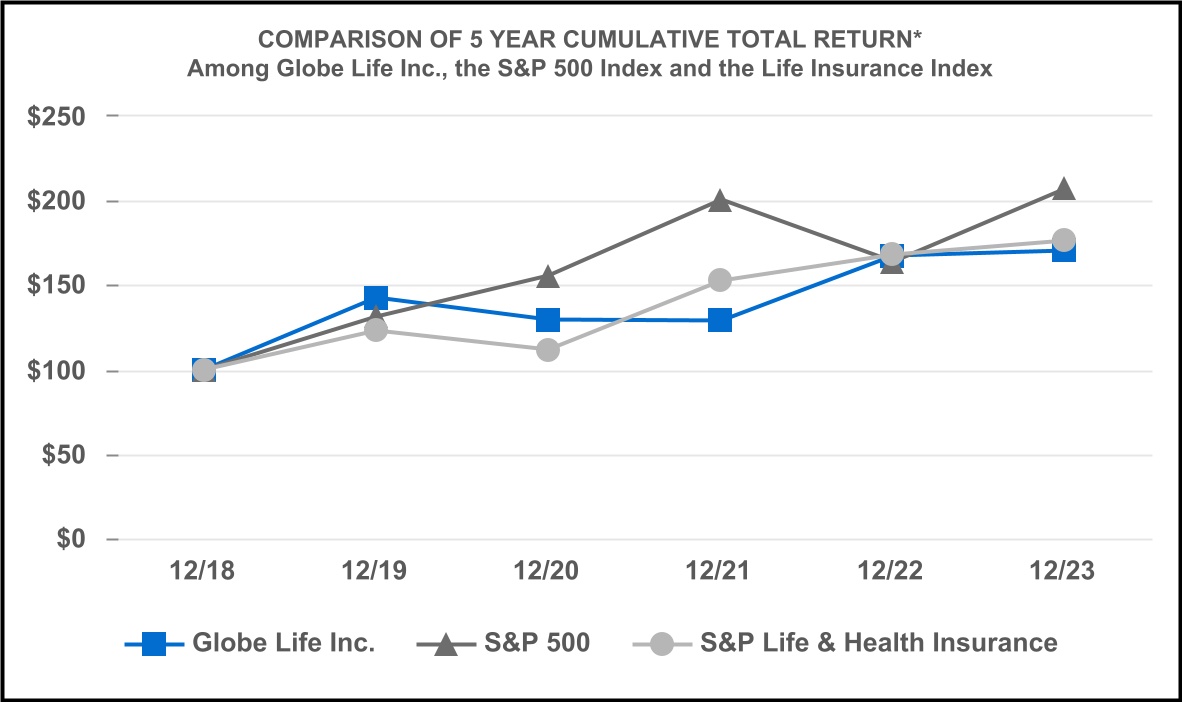
*$100 invested on 12/31/2018 in stock or index, including reinvestment of dividends. Fiscal year ended December 31.
Copyright© 2023 Standard & Poor's, a division of S&P Global. All rights reserved.
GL 2023 FORM 10-K
Purchases of Certain Equity Securities by the Issuer and affiliated purchasers for the Fourth Quarter 2023
| (a) | (b) | (c) | (d) | |||||||||||||||||||||||
| Period | Total Number of Shares Purchased | Average Price Paid Per Share | Total Number of Shares Purchased as Part of Publicly Announced Plans or Programs | Maximum Number of Shares (or Approximate Dollar Amount) that May Yet Be Purchased Under the Plans or Programs | ||||||||||||||||||||||
| October 1-31, 2023 | 235,678 | $ | 109.75 | 235,678 | — | |||||||||||||||||||||
| November 1-30, 2023 | 437,158 | 118.25 | 437,158 | — | ||||||||||||||||||||||
| December 1-31, 2023 | 541,892 | 122.96 | 541,892 | — |
Item 6. [Reserved]
GL 2023 FORM 10-K
CAUTIONARY STATEMENTS
We caution readers regarding certain forward-looking statements contained in the foregoing discussion and elsewhere in this document, and in any other statements made by, or on behalf of Globe Life whether or not in future filings with the Securities and Exchange Commission. Any statement that is not a historical fact, or that might otherwise be considered an opinion or projection concerning the Company or its business, whether express or implied, is meant as and should be considered a forward-looking statement. Such statements represent management's opinions concerning future operations, strategies, financial results or other developments. We specifically disclaim any obligation to update or revise any forward-looking statement because of new information, future developments, or otherwise.
Forward-looking statements are based upon estimates and assumptions that are subject to significant business, economic and competitive uncertainties, many of which are beyond our control, including uncertainties related to the impact of the recent pandemic and associated direct and indirect effects on our business operations, financial results, and financial condition. If these estimates or assumptions prove to be incorrect, the actual results of Globe Life may differ materially from the forward-looking statements made on the basis of such estimates or assumptions. Whether or not actual results differ materially from forward-looking statements may depend on numerous foreseeable and unforeseeable events or developments, which may be national in scope, related to the insurance industry generally, or applicable to the Company specifically. Such events or developments could include, but are not necessarily limited to:
1.Economic and other conditions, including the impact of inflation, geopolitical events, and the recent pandemic on the U.S. economy, leading to unexpected changes in lapse rates and/or sales of our policies, as well as levels of mortality, morbidity, and utilization of health care services that differ from Globe Life's assumptions;
2.Regulatory developments, including changes in accounting standards or governmental regulations (particularly those impacting taxes and changes to the Federal Medicare program that would affect Medicare Supplement);
3.Market trends in the senior-aged health care industry that provide alternatives to traditional Medicare (such as Health Maintenance Organizations and other managed care or private plans) and that could affect the sales of traditional Medicare Supplement insurance;
4.Interest rate changes that affect product sales, financing costs, and/or investment portfolio yield;
5.General economic, industry sector or individual debt issuers’ financial conditions (including developments and volatility arising from geopolitical events, particularly in certain industries that may comprise part of our investment portfolio) that may affect the current market value of securities we own, or that may impair an issuer’s ability to make principal and/or interest payments due on those securities;
6.Changes in the competitiveness of the Company's products and pricing;
7.Litigation results;
8.Levels of administrative and operational efficiencies that differ from our assumptions (including any reduction in efficiencies resulting from increased costs arising from the impact of higher than anticipated inflation);
9.The ability to obtain timely and appropriate premium rate increases for health insurance policies from our regulators;
10.The customer response to new products and marketing initiatives;
11.Reported amounts in the consolidated financial statements which are based on management estimates and judgments which may differ from the actual amounts ultimately realized;
12.Compromise by a malicious actor or other event that causes a loss of data from, or inaccessibility to, our computer and other information technology systems;
13.The severity, magnitude, and impact of natural or man-made catastrophic events, including but not limited to pandemics, tornadoes, hurricanes, earthquakes, war and terrorism, on our operations and personnel, commercial activity, level of claims, and demand for our products; and
14.Our ability to access the commercial paper and debt markets, particularly if such markets become unpredictable or unstable for a certain period.
Readers are also directed to consider other risks and uncertainties described in other documents on file with the Securities and Exchange Commission.
GL 2023 FORM 10-K
GLOBE LIFE INC.
Management's Discussion & Analysis
Item 7. Management's Discussion and Analysis of Financial Condition and Results of Operations
The following discussion should be read in conjunction with Globe Life's Consolidated Financial Statements and Notes thereto appearing elsewhere in this report. The results included herein reflect the adoption of ASU 2018-12, Financial Services - Insurance (Topic 944): Targeted Improvements to the Accounting for Long-Duration Contracts. Globe Life Inc. implemented the standard on January 1, 2023 using the modified retrospective transition method at adoption. As a result of this election, the prior year figures have been retrospectively adjusted as of January 1, 2021 with significant impacts to shareholders' equity, net income, underwriting margins, and net operating income. While the impacts of the new accounting guidance are significant, we do not consider it a fundamental change to the overall business.
Unless impacted by the adoption noted above, the following management discussion will only include comparison to prior year. For discussion regarding activity from 2021 for the items not impacted by the new standard, please refer to the prior filed Form 10-Ks at www.sec.gov.
Additional information on the effects of the adoption has been included in Note 1—Significant Accounting Policies.
"Globe Life" and the "Company" refer to Globe Life Inc. and its subsidiaries and affiliates.
Results of Operations
 | How Globe Life Views Its Operations. Globe Life Inc. is the holding company for a group of insurance companies that market primarily individual life and supplemental health insurance to lower middle to middle-income households throughout the United States. We view our operations by segments, which are the insurance product lines of life, supplemental health, and annuities, and the investment segment that supports the product lines. Segments are aligned based on their common characteristics, comparability of the profit margins, and management techniques used to operate each segment. | |||||||
 | Insurance Product Line Segments. The insurance product line segments involve the marketing, underwriting, and administration of policies. Each product line is further segmented by the various distribution channels that market the insurance policies. Each distribution channel operates in a niche market offering insurance products designed for that particular market. Whether analyzing profitability of a segment as a whole, or the individual distribution channels within the segment, the measure of profitability used by management is the underwriting margin, as seen below: | |||||||
| Premium revenue (Policy obligations) (Policy acquisition costs and commissions) Underwriting margin | ||||||||
 | Investment Segment. The investment segment involves the management of our capital resources, including investments and the management of liquidity. Our measure of profitability for the investment segment is excess investment income, as seen below: | |||||||
| Net investment income (Required interest on policy liabilities) Excess investment income |
GL 2023 FORM 10-K
GLOBE LIFE INC.
Management's Discussion & Analysis
Current Highlights.
-
Net income as a return on equity (ROE) for the year ended December 31, 2023 was 23.2% and net operating income as an ROE, excluding accumulated other comprehensive income(1) was 14.7%.
-
Total premium increased 3% over the same period in the prior year. Life premium increased 4% for the period from $3.03 billion in 2022 to $3.14 billion in 2023.
-
Net investment income increased 7% over the same period in the prior year.
-
Total net sales increased 6% over the same period in the prior year from $722 million in 2022 to $768 million in 2023. The average producing agent count across all of the exclusive agencies increased 13% over the prior year.
-
Book value per share increased 18% over the same period in the prior year from $40.05 to $47.10. Book value per share, excluding accumulated other comprehensive income**(1)**, increased 11% over the prior year from $68.35 in 2022 to $76.21 in 2023.
-
For the year ended December 31, 2023, the Company repurchased 3.4 million shares of Globe Life Inc. common stock at a total cost of $380 million for an average share price of $112.84.
The following graphs represent net income and net operating income for the three years ended December 31, 2023.
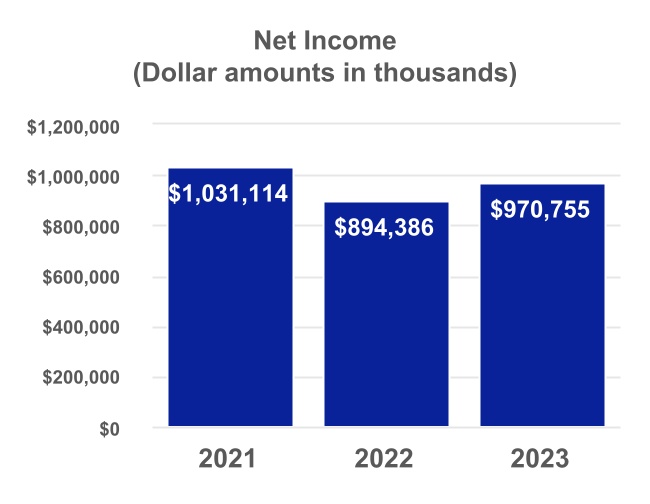
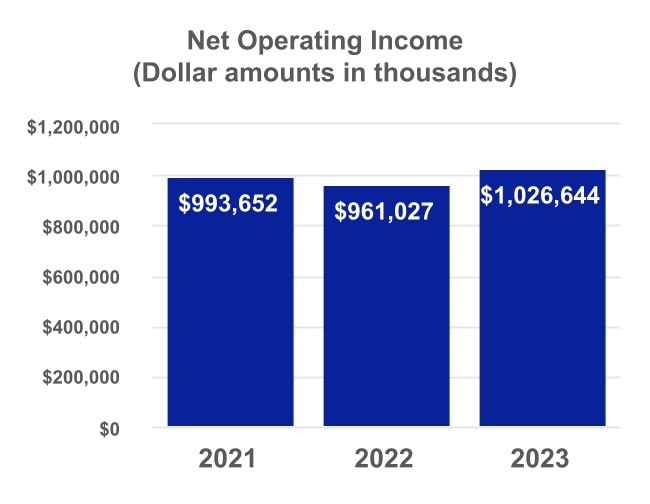
(1)As shown in the charts above, net operating income is the consolidated total of segment profits after tax and as such is considered a non-GAAP measure. It has been used consistently by Globe Life's management for many years to evaluate the operating performance of the Company. It differs from net income primarily because it excludes certain non-operating items such as realized gains and losses and certain significant and unusual items included in net income. Net income is the most directly comparable GAAP measure.
Net operating income as an ROE, excluding accumulated other comprehensive income (AOCI), is considered a non-GAAP measure. Management utilizes this measure to view the business without the effect of changes in AOCI, which are primarily attributable to fluctuation in interest rates. The impact of the adjustment to exclude AOCI is $(2.77) billion and $(2.79) billion for the year ended December 31, 2023 and 2022, respectively.
Book value per share, excluding AOCI, is also considered a non-GAAP measure. Management utilizes this measure to view the book value of the business without the effect of changes in AOCI, which are primarily attributable to fluctuation in interest rates. The impact of the adjustment to exclude AOCI is $(29.11) and $(28.30) for the year ended December 31, 2023 and 2022, respectively.
Refer to Analysis of Profitability by Segment for non-GAAP reconciliation to GAAP.
GL 2023 FORM 10-K
GLOBE LIFE INC.
Management's Discussion & Analysis
Summary of Operations. Net income increased 9% to $971 million in 2023, compared with $894 million in 2022. In 2022, net income decreased 13% from $1.03 billion in 2021. On a diluted per common share basis, net income per common share for 2023 increased from $9.04 to $10.07. In 2022, net income per common share, on a diluted per common share basis, decreased to $9.04 from $9.99.
Net operating income increased 7% to $1.03 billion in 2023, compared with $961 million in 2022. In 2022, net operating income decreased 3% from $994 million in 2021. On a diluted per common share basis, net operating income per common share for 2023 increased from $9.71 to $10.65, an increase of 10%. In 2022, net income per common share, on a diluted per common share basis, increased 1% from $9.63. Net operating income is the consolidated total of segment profits after tax and as such is considered a non-GAAP measure. Net income is the most directly comparable GAAP measure. We do not consider realized gains and losses to be a component of our core insurance operations or operating segments. Additionally, net income in 2023, 2022 and 2021 was affected by certain significant and unusual non-operating items. We do not view these items as components of core operating results because they are not indicative of past
Showing the first 8K of 148K characters. Open the full section
Item 7A. Quantitative and Qualitative Disclosures About Market Risk
Item 8. FINANCIAL STATEMENTS AND SUPPLEMENTARY DATA
Consolidated Financial Statements Index
GL 2023 FORM 10-K
REPORT OF INDEPENDENT REGISTERED PUBLIC ACCOUNTING FIRM
To the Shareholders and the Board of Directors of Globe Life Inc.
Opinion on the Financial Statements
We have audited the accompanying consolidated balance sheets of Globe Life Inc. and subsidiaries (the "Company") as of December 31, 2023 and 2022, the related consolidated statements of operations, comprehensive income (loss), shareholders’ equity, and cash flows, for each of the three years in the period ended December 31, 2023, and the related notes and the schedules listed in the Index at Item 15 (collectively referred to as the "financial statements"). In our opinion, the financial statements present fairly, in all material respects, the financial position of the Company as of December 31, 2023 and 2022, and the results of its operations and its cash flows for each of the three years in the period ended December 31, 2023, in conformity with accounting principles generally accepted in the United States of America.
We have also audited, in accordance with the standards of the Public Company Accounting Oversight Board (United States) (PCAOB), the Company's internal control over financial reporting as of December 31, 2023, based on criteria established in Internal Control — Integrated Framework (2013) issued by the Committee of Sponsoring Organizations of the Treadway Commission and our report dated February 28, 2024, expressed an unqualified opinion on the Company’s internal control over financial reporting.
Change in Accounting Principle
As discussed in Note 1 to the financial statements, the Company changed its method of accounting, measurement, and disclosure of long-duration contracts effective January 1, 2023, using the modified retrospective method applied as of the transition date of January 1, 2021, due to adoption of ASU 2018-12, Financial Services - Insurance (Topic 944): Targeted Improvements to the Accounting for Long-Duration Contracts (“ASU 2018-12”). The adoption is also communicated as a critical audit matter below.
Basis for Opinion
These financial statements are the responsibility of the Company's management. Our responsibility is to express an opinion on the Company's financial statements based on our audits. We are a public accounting firm registered with the PCAOB and are required to be independent with respect to the Company in accordance with the U.S. federal securities laws and the applicable rules and regulations of the Securities and Exchange Commission and the PCAOB.
We conducted our audits in accordance with the standards of the PCAOB. Those standards require that we plan and perform the audit to obtain reasonable assurance about whether the financial statements are free of material misstatement, whether due to error or fraud. Our audits included performing procedures to assess the risks of material misstatement of the financial statements, whether due to error or fraud, and performing procedures that respond to those risks. Such procedures included examining, on a test basis, evidence regarding the amounts and disclosures in the financial statements. Our audits also included evaluating the accounting principles used and significant estimates made by management, as well as evaluating the overall presentation of the financial statements. We believe that our audits provide a reasonable basis for our opinion.
Critical Audit Matters
The critical audit matters communicated below are matters arising from the current-period audit of the financial statements that were communicated or required to be communicated to the audit committee and that (1) relate to accounts or disclosures that are material to the financial statements and (2) involved our especially challenging, subjective, or complex judgments. The communication of critical audit matters does not alter in any way our opinion on the financial statements, taken as a whole, and we are not, by communicating the critical audit matters below, providing separate opinions on the critical audit matters or on the accounts or disclosures to which they relate.
GL 2023 FORM 10-K
Adoption of Accounting Pronouncements - Targeted Improvements to the Accounting for Long-Duration Contracts - Refer to Note 1 to the Financial Statements (also see Change in Accounting Principle explanatory paragraph above)
Critical Audit Matter Description
The Company adopted ASU 2018-12 on January 1, 2023 using the modified retrospective application as of the transition date of January 1, 2021.
The adoption of ASU 2018-12 significantly modified the Company’s accounting for and disclosure of long-duration life and health insurance contracts. We identified the adoption of ASU 2018-12 as a critical audit matter because of the need to involve actuarial specialists to evaluate assumptions and valuation models, the extent of audit effort required, and the inherent complexity involved in the selection and application of new accounting policies.
How the Critical Audit Matter Was Addressed in the Audit
Our audit procedures related to the adoption of ASU 2018-12 included the following, among others:
-
We tested the effectiveness of controls over the application of new accounting policies and disclosure of the impact of adoption discussed in Note 1 to the financial statements, including controls over the valuation models and assumptions used to estimate the liability for future policy benefits and amortization of deferred acquisition costs.
-
We evaluated the appropriateness of the Company’s selection and application of accounting policies in connection with the adoption of the ASU 2018-12.
-
With the assistance of our actuarial specialists, we evaluated the reasonableness of the valuation models and assumptions used to estimate the liability for future policy benefits and amortization of deferred acquisition costs.
Future Policy Benefits at Current Discount Rates and Amortization of Deferred Acquisition Costs — Certain Underlying Assumptions for Certain Products – Refer to Notes 1, 6 and 7 to the Financial Statements
Critical Audit Matter Description
The Company estimates the liability for future policy benef
Showing the first 8K of 445K characters. Open the full section
Item 9. CHANGES IN AND DISAGREEMENTS WITH ACCOUNTANTS ON ACCOUNTING AND FINANCIAL DISCLOSURES
None.
Item 9A. Controls and Procedures
Evaluation of Disclosure Controls and Procedures: Globe Life Inc., under the direction of the Co-Chairmen and Chief Executive Officers and the Executive Vice President and Chief Financial Officer, has established disclosure controls and procedures that are designed to ensure that information required to be disclosed by Globe Life in the reports that it files or submits under the Securities Exchange Act of 1934 is recorded, processed, summarized and reported within the time periods specified in the SEC’s rules and forms. The disclosure controls and procedures are also intended to ensure that such information is accumulated and communicated to Globe Life's management, including the Co-Chairmen and Chief Executive Officers and the Executive Vice President and Chief Financial Officer, as appropriate to allow timely decisions regarding required disclosures.
As of the end of the fiscal year completed December 31, 2023, an evaluation was performed under the supervision and with the participation of Globe Life management, including the Co-Chairmen and Chief Executive Officers and the Executive Vice President and Chief Financial Officer, of the disclosure controls and procedures (as those terms are defined in Rule 13a-15(e) under the Securities Exchange Act of 1934). Based upon their evaluation, the Co-Chairmen and Chief Executive Officers and the Executive Vice President and Chief Financial Officer have concluded that disclosure controls and procedures are effective as of the date of this Form 10-K. In compliance with Section 302 of the Sarbanes Oxley Act of 2002 (18 U.S.C. § 1350), each of these officers executed a Certification included as an exhibit to this Form 10-K.
Management's Annual Report on Internal Control over Financial Reporting: Management is responsible for establishing and maintaining adequate internal control over financial reporting as defined in Rule 13a-15(f) under the Securities Exchange Act of 1934. Management evaluated the design and operating effectiveness of the Company's internal control over financial reporting based on the criteria established in Internal Control—Integrated Framework (2013) issued by the Committee of Sponsoring Organizations (COSO) of the Treadway Commission. Based upon their evaluation as of December 31, 2023, the Co-Chairmen and Chief Executive Officers and the Executive Vice President and Chief Financial Officer have concluded that Globe Life's internal control over financial reporting is effective as of the date of this Form 10-K. In compliance with Section 302 of the Sarbanes-Oxley Act of 2002 (18 U.S.C. § 1350), each of these officers executed a Certification included as an exhibit to this Form 10-K.
Changes in Internal Control over Financial Reporting: During the period ended December 31, 2023 there have not been any changes to Globe Life Inc.'s internal control over financial reporting, or in other factors that could significantly affect the internal control over financial reporting subsequent to the date of their evaluation, which have materially affected, or are reasonably likely to materially affect, internal control over financial reporting.
Refer to Deloitte & Touche LLP's, independent registered public accounting firm, attestation report on the Company's internal controls over financial reporting.
GL 2023 FORM 10-K
MANAGEMENT'S REPORT ON INTERNAL CONTROL OVER FINANCIAL REPORTING
Management at Globe Life is responsible for establishing and maintaining adequate internal control over financial reporting for the Company and for assessing the effectiveness of internal control on an annual basis. As a framework for assessing internal control over financial reporting, the Company utilizes the criteria for effective internal control over financial reporting described in Internal Control—Integrated Framework (2013) issued by the Committee of Sponsoring Organizations of the Treadway Commission.
There are inherent limitations in the effectiveness of any internal control, including the possibility of human error and the circumvention or overriding of controls. Accordingly, even effective internal controls can provide only reasonable assurance with respect to financial statement preparation. Further, because of changes in conditions, the effectiveness of internal control may vary over time.
Management evaluated the Company’s internal control over financial reporting, and based on its assessment, determined that the Company’s internal control over financial reporting was effective as of December 31, 2023. The Company’s independent registered public accounting firm has issued an attestation report on the Company’s internal control over financial reporting as stated in their report which is included herein.
| /s/ J. Matthew Darden | |||||
| J. Matthew Darden Co-Chairman and Chief Executive Officer | |||||
| /s/ Frank M. Svoboda | |||||
| Frank M. Svoboda Co-Chairman and Chief Executive Officer | |||||
| /s/ Thomas P. Kalmbach | |||||
| Thomas P. Kalmbach Executive Vice President and Chief Financial Officer |
February 28, 2024
GL 2023 FORM 10-K
REPORT OF INDEPENDENT REGISTERED PUBLIC ACCOUNTING FIRM
To the Shareholders and the Board of Directors of Globe Life Inc.
Opinion on Internal Control over Financial Reporting
We have audited the internal control over financial reporting of Globe Life Inc. and subsidiaries (the “Company”) as of December 31, 2023, based on criteria established in Internal Control — Integrated Framework (2013) issued by the Committee of Sponsoring Organizations of the Treadway Commission (COSO). In our opinion, the Company maintained, in all material respects, effective internal control over financial reporting as of December 31, 2023, based on criteria established in Internal Control — Integrated Framework (2013) issued by COSO.
We have also audited, in accordance with the standards of the Public Company Accounting Oversight Board (United States) (PCAOB), the consolidated financial statements and financial statement schedules as of and for the year ended December 31, 2023 of the Company and our report dated February 28, 2024, expressed an unqualified opinion on those financial statements and financial statement schedules and included an explanatory paragraph regarding the Company’s adoption of a new accounting standard.
Basis for Opinion
The Company’s management is responsible for maintaining effective internal control over financial reporting and for its assessment of the effectiveness of internal control over financial reporting, included in the accompanying Management's Report on Internal Control over Financial Reporting. Our responsibility is to express an opinion on the Company’s internal control over financial reporting based on our audit. We are a public accounting firm registered with the PCAOB and are required to be independent with respect to the Company in accordance with the U.S. federal securities laws and the applicable rules and regulations of the Securities and Exchange Commission and the PCAOB.
We conducted our audit in accordance with the standards of the PCAOB. Those standards require that we plan and perform the audit to obtain reasonable assurance about whether effective internal control over financial reporting was maintained in all material respects. Our audit included obtaining an understanding of internal control over financial reporting, assessing the risk that a material weakness exists, testing and evaluating the design and operating effectiveness of internal control based on the assessed risk, and performing such other procedures as we considered necessary in the circumstances. We believe that our audit provides a reasonable basis for our opinion.
Definition and Limitations of Internal Control over Financial Reporting
A company’s internal control over financial reporting is a process designed to provide reasonable assurance regarding the reliability of financial reporting and the preparation of financial statements for external purposes in accordance with generally accepted accounting principles. A company’s internal control over financial reporting includes those policies and procedures that (1) pertain to the maintenance of records that, in reasonable detail, accurately and fairly reflect the transactions and dispositions of the assets of the company; (2) provide reasonable assurance that transactions are recorded as necessary to permit preparation of financial statements in accordance with generally accepted accounting principles, and that receipts and expenditures of the company are being made only in accordance with authorizations of management and directors of the company; and (3) provide reasonable assurance regarding prevention or timely detection of unauthorized acquisition, use, or disposition of the company’s assets that could have a material effect on the financial statements.
Because of its inherent limitations, internal control over financial reporting may not prevent or detect misstatements. Also, projections of any evaluation of effectiveness to future periods are subject to the risk that controls may become inadequate because of changes in conditions, or that the degree of compliance with the policies or procedures may deteriorate.
/s/ Deloitte & Touche LLP
Dallas, Texas
February 28, 2024
GL 2023 FORM 10-K
Item 9B. Other Information
(b) Trading arrangements
During the three months ended December 31, 2023, none of our directors or officers adopted or terminated a Rule 10b5-1 trading arrangement or a Non-Rule 10b5-1 trading arrangement, as each term is defined under Item 408(a) of Regulation S-K.
Item 9C. Disclosure Regarding Foreign Jurisdictions that Prevent Inspections
Not Applicable.
PART III
Item 10. DIRECTORS, EXECUTIVE OFFICERS AND CORPORATE GOVERNANCE
Information required by this item is incorporated by reference from the sections entitled “PROPOSAL NUMBER 1 - Election of Directors,” “Director Nominee Profiles,” "Director Nominee Skills and Qualifications," “Executive Officers,” “AUDIT COMMITTEE REPORT,” “Governance Guidelines and Codes of Ethics,” "Committees of the Board of Directors," “Qualifications of Directors,” “Procedures for Director Nominations by Shareholders,” and “DELINQUENT SECTION 16(a) REPORTS” in the Proxy Statement for the Annual Meeting of Shareholders to be held April 25, 2024 (the Proxy Statement), which is to be filed with the Securities and Exchange Commission (SEC).
Item 11. EXECUTIVE COMPENSATION
Information required by this item is incorporated by reference from the sections entitled “EXECUTIVE COMPENSATION - COMPENSATION DISCUSSION AND ANALYSIS,” “COMPENSATION COMMITTEE REPORT,” “SUMMARY COMPENSATION TABLE,” “2023 GRANTS OF PLAN-BASED AWARDS,” “OUTSTANDING EQUITY AWARDS AT FISCAL YEAR-END 2023,” “OPTION EXERCISES AND STOCK VESTED DURING FISCAL YEAR ENDED DECEMBER 31, 2023,” “PENSION BENEFITS AT DECEMBER 31, 2023,” “POTENTIAL PAYMENTS UPON TERMINATION OR CHANGE-IN-CONTROL,” "PAY VERSUS PERFORMANCE," "CEO PAY RATIO," “2023 DIRECTOR COMPENSATION,” and “PAYMENTS TO DIRECTORS” in the Proxy Statement, which is to be filed with the SEC.
Item 12. SECURITY OWNERSHIP OF CERTAIN BENEFICIAL OWNERS AND MANAGEMENT AND RELATED STOCKHOLDER MATTERS
1. Equity Compensation Plan Information as of December 31, 2023
| (a) | (b) | (c) | ||||||||||||||||||
| Plan Category | Number of securities to be issued upon exercise of outstanding options, warrants, and rights | Weighted-average exercise price of outstanding options, warrants, and rights | Number of securities remaining available for future issuance under equity compensation plans (excluding securities in column (a)) | |||||||||||||||||
| Equity compensation plans approved by security holders | 5,940,320 | $ | 96.19 | 2,331,316 | ||||||||||||||||
| Equity compensation plans not approved by security holders | ||||||||||||||||||||
| Total | 5,940,320 | $ | 96.19 | 2,331,316 |
2. Security ownership of certain beneficial owners:
Information required by this item is incorporated by reference from the section entitled “PRINCIPAL SHAREHOLDERS” in the Proxy Statement, which is to be filed with the SEC.
3. Security ownership of management:
Information required by this item is incorporated by reference from the section entitled “Stock Ownership” in the Proxy Statement, which is to be filed with the SEC.
GL 2023 FORM 10-K
4. Changes in control:
Globe Life knows of no arrangements, including any pledges by any person of its securities, the operation of which may at a subsequent date result in a change of control.
Item 13. CERTAIN RELATIONSHIPS AND RELATED TRANSACTIONS AND DIRECTOR INDEPENDENCE
Information required by this item is incorporated by reference from the sections entitled “RELATED PARTY TRANSACTION POLICY AND TRANSACTIONS” and “Director Independence Determinations” in the Proxy Statement, which is to be filed with the SEC.
Item 14. PRINCIPAL ACCOUNTANT FEES AND SERVICES
Information required by this Item is incorporated by reference from the section entitled “PRINCIPAL ACCOUNTING FIRM FEES” and “PRE-APPROVAL POLICY FOR ACCOUNTING FEES” in the Proxy Statement, which is to be filed with the SEC.
PART IV
Item 15. EXHIBITS AND FINANCIAL STATEMENT SCHEDULES
Index of documents filed as a part of this report:
| Page of this report | |||||
| Financial Statements: | |||||
| Globe Life Inc. and Subsidiaries: | |||||
| Report of Independent Registered Public Accounting Firm | 54 | ||||
| Consolidated Balance Sheets at December 31, 2023 and 2022 | 57 | ||||
| Consolidated Statements of Operations for each of the three years in the period ended December 31, 2023 | 58 | ||||
| Consolidated Statements of Comprehensive Income for each of the three years in the period ended December 31, 2023 | 59 | ||||
| Consolidated Statements of Shareholders’ Equity for each of the three years in the period ended December 31, 2023 | 60 | ||||
| Consolidated Statements of Cash Flows for each of the three years in the period ended December 31, 2023 | 61 | ||||
| Notes to Consolidated Financial Statements | 62 | ||||
| Schedules Supporting Financial Statements for each of the three years in the period ended December 31, 2023: | |||||
| II. Condensed Financial Information of Registrant (Parent Company) | 150 | ||||
| IV. Reinsurance (Consolidated) | 154 | ||||
| Schedules not referred to have been omitted as inapplicable or not required by Regulation S-X. |
GL 2023 FORM 10-K
EXHIBITS
Showing the first 8K of 62K characters. Open the full section