 filings.tools
Corning 2023 10-K Annual Report
GLW · CIK 24741 · Form 10-K · Fiscal year ended December 31, 2023 · Filed February 12, 2024
24 sections, 412K characters. Original on sec.gov · Markdown · JSON
Risk FactorsBusinessMD&AFinancial StatementsWhat changed vs 2022
Cover and table of contents
UNITED STATES
SECURITIES AND EXCHANGE COMMISSION
WASHINGTON, D.C. 20549
Form 10-K
| ☒ | ANNUAL REPORT PURSUANT TO SECTION 13 OR 15(d) OF THE SECURITIES EXCHANGE ACT OF 1934 |
|---|
For the fiscal year ended December 31, 2023
OR
| ☐ | TRANSITION REPORT PURSUANT TO SECTION 13 OR 15(d) OF THE SECURITIES EXCHANGE ACT OF 1934 |
|---|
For the transition period from ___ to ___
Commission file number: 1-3247
CORNING INCORPORATED
(Exact name of registrant as specified in its charter)
| New York | 16-0393470 |
|---|---|
| (State or other jurisdiction of incorporation or organization) | (I.R.S. Employer Identification No.) |
| One Riverfront Plaza, Corning, New York | 14831 |
|---|---|
| (Address of principal executive offices) | (Zip Code) |
607-974-9000
(Registrant’s telephone number, including area code)
Securities registered pursuant to Section 12(b) of the Act:
| Title of each class | Trading Symbol(s) | Name of each exchange on which registered | ||
|---|---|---|---|---|
| Common Stock, $0.50 par value per share | GLW | New York Stock Exchange | ||
| 3.875% Notes due 2026 | GLW26 | New York Stock Exchange | ||
| 4.125% Notes due 2031 | GLW31 | New York Stock Exchange |
Securities registered pursuant to Section 12(g) of the Act: None
Indicate by check mark if the registrant is a well-known seasoned issuer, as defined in Rule 405 of the Securities Act.
Yes ☒ No ☐
Indicate by check mark if the registrant is not required to file reports pursuant to Section 13 or Section 15(d) of the Exchange Act.
Yes ☐ No ☒
Indicate by check mark whether the registrant (1) has filed all reports required to be filed by Section 13 or 15(d) of the Exchange Act of 1934 during the preceding 12 months (or for such shorter period that the registrant was required to file such reports), and (2) has been subject to such filing requirements for the past 90 days.
Yes ☒ No ☐
Indicate by check mark whether the registrant has submitted electronically every Interactive Data File required to be submitted pursuant to Rule 405 of Regulation S-T (§ 232.405 of this chapter) during the preceding 12 months (or for such shorter period that the registrant was required to submit such files.)
Yes ☒ No ☐
Indicate by check mark whether the registrant is a large accelerated filer, an accelerated filer, a non-accelerated filer, smaller reporting company, or an emerging growth company. See the definitions of “large accelerated filer,” “accelerated filer,” “smaller reporting company,” and “emerging growth company” in Rule 12b-2 of the Exchange Act.
| Large accelerated filer | ☒ | Accelerated filer | ☐ |
|---|---|---|---|
| Non-accelerated filer | ☐ | Emerging growth company | ☐ |
| Smaller reporting company | ☐ |
If an emerging growth company, indicate by check mark if the registrant has elected not to use the extended transition period for complying with any new or revised financial accounting standards provided pursuant to Section 13(a) of the Exchange Act. ☐
Indicate by check mark whether the registrant has filed a report on and attestation to its management’s assessment of the effectiveness of its internal control over financial reporting under Section 404(b) of the Sarbanes-Oxley Act (15 U.S.C. 7262(b)) by the registered public accounting firm that prepared or issued its audit report. ☒
If securities are registered pursuant to Section 12(b) of the Exchange Act, indicate by check mark whether the financial statements of the registrant included in the filing reflect the correction of an error to previously issued financial statements. ☐
Indicate by check mark whether any of those error corrections are restatements that required a recovery analysis of incentive-based compensation received by any of the registrant's executive officers during the relevant recovery period pursuant to §240.10D-1(b). ☐
Indicate by check mark whether the registrant is a shell company (as defined in Rule 12b-2 of the Exchange Act).
Yes ☐ No ☒
The aggregate market value of the common stock held by non-affiliates of the registrant as of June 30, 2023 was approximately $30 billion based on the New York Stock Exchange closing price on such date.
There were 853,474,317 shares of common stock outstanding as of January 31, 2024.
DOCUMENTS INCORPORATED BY REFERENCE
Portions of Registrant's definitive Proxy Statement for its May 2, 2024 Annual Meeting of Shareholders are incorporated by reference into Part III.
PART I
Corning Incorporated and its consolidated subsidiaries are hereinafter sometimes referred to as the “Company,” the “Registrant,” “Corning,” “we,” “our,” or “us.”
This report contains forward-looking statements that involve a number of risks and uncertainties. These statements relate to plans, objectives, expectations and estimates and may contain words such as “will,” “believe,” “anticipate,” “expect,” “intend,” “plan,” “seek,” “see,” “would,” “target,” “estimate,” “forecast,” or similar expressions. Actual results could differ materially from what is expressed or forecasted in forward-looking statements. Some of the factors that could contribute to these differences include those discussed under “Forward-Looking Statements,” “Risk Factors,” “Management’s Discussion and Analysis of Financial Condition and Results of Operations,” and elsewhere in this report.
Item 1. Business
General
Corning traces its origins to a glass business established in 1851. The present corporation was incorporated in the State of New York in December 1936. The Company’s name was changed from Corning Glass Works to Corning Incorporated on April 28, 1989.
Corning is vital to progress – in the industries we help advance and in the world we share. For more than 170 years, Corning has combined its unparalleled expertise in glass science, ceramic science and optical physics with deep manufacturing and engineering capabilities to develop category-defining products that transform industries and enhance people’s lives. Our materials science and manufacturing expertise, boundless curiosity and commitment to purposeful invention place us at the center of the way the world works, learns and lives. In addition, our sustained investment in research, development and engineering capabilities means we are always ready to solve the toughest challenges alongside our customers.
Our capabilities are versatile and synergistic, allowing Corning to evolve to meet changing market needs, while also helping customers capture new opportunities in dynamic industries. Today, Corning’s markets include optical communications, mobile consumer electronics, display, automotive, solar, semiconductor and life sciences. Corning’s industry-leading products include damage-resistant cover glass for mobile devices; precision glass for advanced displays; optical fiber and cable, wireless technologies and connectivity solutions for state-of-the-art communications networks; trusted products to accelerate drug discovery and delivery; and clean-air technologies for cars and trucks.
Corning manufactures products at 124 plants in 15 countries and operates in five reportable segments: Optical Communications, Display Technologies, Specialty Materials, Environmental Technologies and Life Sciences.
Optical Communications Segment
We invented the world’s first low-loss optical fiber in 1970. Since that milestone, we have continued to pioneer optical fiber, cable and connectivity solutions. As global demand driven by video usage grows exponentially, telecommunications networks continue to migrate from copper to optical-based systems that can deliver the required cost-effective capacity. Our experience puts us in a unique position to design and deliver optical solutions that reach every edge of the communications network.
The Optical Communications segment is divided into two main product groupings – carrier network and enterprise network. The carrier network group consists primarily of products and solutions for optical-based communications infrastructure for services such as video, data and voice communications. The enterprise network group consists primarily of optical-based communication networks sold to businesses, governments and individuals for their own use.
Our carrier network product portfolio encompasses an array of optical fiber products, including Vascade® optical fibers for use in submarine networks; LEAF® optical fiber for long-haul, regional and metropolitan networks; SMF-28® ULL and TXF® fiber for more scalable long-haul and regional networks; SMF-28e+™ single-mode optical fiber providing additional transmission wavelengths in metropolitan and access networks and ClearCurve® ultra-bendable single-mode fiber for use in multiple-dwelling units and fiber-to-the-home applications. For high performance across the range of long-haul, metro, access and fiber-to-the-home network applications, SMF-28® Ultra and SMF-28® Contour fibers deliver industry-leading attenuation, compatibility and improved macrobend performance in one fiber. A portion of our optical fiber is sold directly to end users and third-party cablers globally. Our remaining fiber production is cabled internally and sold to end users as either bulk cable or as part of an integrated optical solution. Our cable products, including the RocketRibbon® and miniXtend® portfolios, support various outdoor, indoor/outdoor and indoor applications and include a broad range of loose tube, ribbon and drop cable designs with flame-retardant versions available for indoor and indoor/outdoor use including 5G networks.
In addition to optical fiber and cable, our carrier network product portfolio also includes hardware and equipment products, including cable assemblies, fiber-optic hardware, fiber-optic connectors, optical components and couplers, closures, network interface devices and other accessories. These products may be sold as individual components or as part of integrated optical connectivity solutions designed for various carrier network applications. Examples of these solutions include our Evolv™ platform, which provides pre-connectorized solutions for cost-effectively deploying fiber-to-the-home and 5G networks; and the Centrix platform, which provides a fiber management system with industry-leading density and innovative jumper routing that can be deployed in a wide variety of carrier switching centers.
In addition to our optical-based portfolio, our carrier network portfolio also contains select copper-based products including subscriber demarcation, connection and protection devices, xDSL (different variations of digital subscriber lines) passive solutions and outside plant enclosures.
Our enterprise network portfolio leverages optical fiber products, including ClearCurve® ultra-bendable multimode fiber for private and hyperscale data centers and other enterprise network applications.
Our hardware and equipment for enterprise network applications include cable assemblies, fiber-optic hardware, fiber-optic connectors, optical components and couplers, closures and other accessories. These products may be sold as individual components or as part of integrated optical connectivity solutions designed for various network applications, including hyperscale data centers. Examples of enterprise network solutions include the EDGE® platform, which provides high-density pre-connectorized cabling solutions for data center applications, supporting a path to speeds of 400G and beyond and Everon™ Network Solutions, which provide next-generation cellular connectivity products for interior spaces of all sizes.
Our optical fiber manufacturing facilities are in North Carolina, China, India and Poland. Cabling operations are in North Carolina, Poland and smaller regional locations. Our manufacturing operations for hardware and equipment products are in Texas, Mexico, Brazil, Germany, Poland and China.
Patent protection is important to the segment’s operations. The segment has an extensive portfolio of patents relating to its products, technologies and manufacturing processes. The segment licenses certain of its patents to third parties and generates revenue from these licenses, although the royalty income is not currently material to this segment’s operating results. We are licensed to use certain patents owned by others, which are considered important to the segment’s operations. Refer to the material under the heading “Patents and Trademarks” for more information.
The Optical Communications segment represented 30% of Corning’s total segment net sales in 2023.
Display Technologies Segment
The Display Technologies segment manufactures glass substrates for flat panel displays, including liquid crystal displays (“LCDs”) and organic light-emitting diodes (“OLEDs”) that are used primarily in televisions, notebook computers, desktop monitors, tablets and handheld devices. This segment develops, manufactures and supplies high quality glass substrates using technology expertise and a proprietary fusion manufacturing process, which we invented and is the cornerstone of our technology leadership in the display glass industry. Our highly automated process yields glass substrates with a pristine surface and excellent thermal stability and dimensional uniformity – essential attributes in the production of large, high-performance display panels. Our fusion process is scalable and we believe it is the most cost-effective process for producing large size substrates.
We are recognized as a world leader in precision glass innovations that enable our customers to produce larger, thinner, more flexible and higher-resolution displays. Some of the product innovations we have launched over the past ten years utilizing our world-class processes and capabilities include the following:
| • | Corning® EAGLE XG® Slim Glass, Corning’s flagship display glass product enabling thinner televisions and monitors with larger-sized screens; it is trusted by the world’s leading panel makers for LCD displays with more than 30 billion square feet sold; |
|---|
| • | Corning® Astra® Glass, an innovative glass solution designed to meet the emerging needs for high-resolution displays. This glass has been optimized for oxide thin-film transistor (“TFT”) backplanes, but enables a range of high-resolution applications from the top end of amorphous silicon (“s-Si”) TFT backplanes through low temperature poly-silicon (“LTPS”) backplanes, as well as other applications requiring precision glass; |
|---|
| • | Corning® Lotus™ NXT Glass, a high-performance display glass designed to withstand the harshest panel manufacturing process enabling highest-resolution displays in smaller and flexible devices; and |
|---|
| • | The world’s first Gen 10 and Gen 10.5 glass substrate sizes in support of improved efficiency in manufacturing large-sized displays. |
|---|
We have display glass manufacturing operations in China, South Korea, Japan and Taiwan, and service our glass customers in all regions, utilizing our manufacturing facilities throughout Asia.
Patent protection and proprietary trade secrets are important to the Display Technologies segment’s operations. Refer to the material under the heading “Patents and Trademarks” for more information.
The Display Technologies segment represented 26% of Corning’s total segment net sales in 2023.
Specialty Materials Segment
The Specialty Materials segment manufactures products that provide more than 150 material formulations for glass, glass ceramics and crystals, as well as precision metrology instruments and software to meet requirements for unique customer needs. Consequently, this segment operates in a wide variety of commercial and industrial markets including materials optimized for mobile consumer electronics, semiconductor equipment optics and consumables, aerospace and defense optics, radiation shielding products, sunglasses and telecommunications components.
Our highly durable glass, known as Corning® Gorilla® Glass, is a chemically strengthened thin glass designed specifically to function as a cover, or back-enclosure glass, for mobile consumer electronic devices such as mobile phones, tablets, laptops and smartwatches. Elegant and lightweight, Corning® Gorilla® Glass is durable enough to resist many real-world events that commonly cause wear or scratch damage and glass failure, while providing optical clarity, touch sensitivity and RF transparency, thus enabling exciting new applications in technology and design. In 2022, Corning unveiled its newest glass innovation, Corning® Gorilla® Glass Victus® 2, which delivers improved cover glass drop performance on rough surfaces like concrete, while preserving the scratch resistance of Corning® Gorilla® Glass Victus®. Corning® Gorilla® Glass is manufactured in the United States (“U.S.”), South Korea and Taiwan.
We collaborated with Apple to deliver durable glass with infused color for the back of Apple's iPhone 15 and iPhone 15 Plus devices. These devices also feature Ceramic Shield, a highly transparent, color-free glass-ceramic, which offers unparalleled durability and toughness for smartphones.
Our semiconductor optics include high-performance optical materials including Corning® HPFS® Fused Silica and Corning® ULE® Ultra-Low Expansion Glass, optical-based metrology instruments and custom optical assemblies for applications in the global semiconductor industry. Our semiconductor optics products are manufactured in New York.
We also manufacture ultra-flat, ultra-thin glass wafers and substrates for a variety of applications including augmented reality, advanced semiconductor packaging, 3D sensing and more. These products are manufactured in New York, France and China.
Other specialty glass products include tinted sunglasses and radiation shielding products that are made in France.
Patent protection is important to the segment’s operations. The segment has a growing portfolio of patents relating to its products, technologies and manufacturing processes. Brand recognition and loyalty, through well-known trademarks, are important to the segment. Refer to the material under the heading “Patents and Trademarks” for more information.
The Specialty Materials segment represented 14% of Corning’s total segment net sales in 2023.
Environmental Technologies Segment
The Environmental Technologies segment manufactures ceramic substrates and filter products for emissions control in mobile applications around the world. In the early 1970s, we developed an economical, high-performance cellular ceramic substrate that is now the standard for catalytic converters in vehicles worldwide. As global emissions control regulations tighten, we have continued to develop more effective and durable ceramic substrate and filter products for gasoline and diesel applications, most recently launching low-mass Corning® FLORA® substrates and Corning® DuraTrap® GC gasoline particulate filters. We manufacture substrate and filter products in New York, Virginia, China and Germany. We sell our ceramic substrate and filter products worldwide to catalyzers and manufacturers of emission control systems who then sell to automotive and diesel vehicle or engine manufacturers. Although most sales are made to the emission control systems manufacturers, the use of our substrates and filters is generally required by the specifications of the automotive and diesel vehicle or engine manufacturers.
Patent protection is important to the segment’s operations. The segment has an extensive portfolio of patents relating to its products, technologies and manufacturing processes. We are licensed to use certain patents owned by others, which are also considered important to the segment’s operations. Refer to the material under the heading “Patents and Trademarks” for more information.
The Environmental Technologies segment represented 13% of Corning’s total segment net sales in 2023.
Life Sciences Segment
As a leading developer, manufacturer and global supplier of laboratory products for over 105 years, the Life Sciences segment works with researchers and drug manufacturers seeking to drive innovation, increase efficiencies, reduce costs and compress timelines. Using unique expertise in the fields of materials science, polymer surface science, cell culture and cell biology, the segment provides innovative solutions that improve productivity and enable breakthrough research for traditional small molecule, or chemical, drugs, biologics, vaccines and emerging cell and gene therapies.
Life Sciences products include consumables, such as plastic vessels, liquid handling plastics, specialty surfaces, cell culture media and serum, as well as general labware, glassware and equipment. These products are used for drug discovery research and development, compound screening, diagnostics, advanced cell culture research, genomics applications and mass production of cells for clinical trials and bioproduction.
We sell life sciences products under the Corning®, Falcon®, PYREX® and Axygen® brands. The products are marketed globally, primarily through distributors, to pharmaceutical and biotechnology companies, contract manufacturing organizations, central testing labs, academic institutions, hospitals, government entities and other facilities. We manufacture these products in California, Illinois, Maine, Massachusetts, New York, North Carolina, Utah, Virginia, China, France, Mexico, Brazil and Poland.
Patent protection is important to the segment’s operations. The segment has a growing portfolio of patents relating to its products, technologies and manufacturing processes. Brand recognition and loyalty, through well-known trademarks, are important to the segment. Refer to the material under the heading “Patents and Trademarks” for more information.
The Life Sciences segment represented 7% of Corning’s total segment net sales in 2023.
Hemlock and Emerging Growth Businesses
All other businesses that do not meet the quantitative threshold for separate reporting have been grouped as Hemlock and Emerging Growth Businesses. This group is primarily comprised of the results of Hemlock Semiconductor Group (“HSG”). HSG is a leading provider of high-purity polysilicon products for the solar power and electronics industries. HSG operates in the solar power market, as polysilicon is needed in the manufacturing process to produce sustainable solar power cell, panels and arrays, and the electronics markets, as polysilicon is used to create fabricated wafers and integrated circuit chips used by leading semiconductor manufacturers.
Hemlock and Emerging Growth Businesses also includes our pharmaceutical technologies business, which produces high-quality pharmaceutical glass tubing and vials to meet the rigorous needs of the pharmaceutical industry; our automotive glass solutions business, which enhances vehicle exteriors and interiors with innovations that enable lightweight, damage-resistant windows and displays; as well as other businesses and certain corporate investments.
Hemlock and Emerging Growth Businesses represented 10% of Corning’s total segment net sales in 2023.
Additional explanation regarding Corning and its five reportable segments, as well as financial information about geographic areas, is presented in Management’s Discussion and Analysis of Financial Condition and Results of Operations and Note 17 (Reportable Segments) in the accompanying notes to the consolidated financial statements.
Competition
We compete with many large and varied manufacturers, both domestic and foreign. Some of these competitors are larger than we are, and some have broader product lines. We strive to maintain and improve our market position through technology and product innovation. For the foreseeable future, our competitive advantage lies in our commitment to research and development, deep customer relationships, reliability of supply, product quality, superior customer service and technical specification of our products. There is no assurance that we will be able to maintain or improve our market position or competitive advantage.
Optical Communications Segment
We maintain a leadership position in the segment’s principal product groups, which include carrier and enterprise networks. The competitive landscape includes industry consolidation, pricing pressure and competition for the innovation of new products. These competitive conditions are likely to persist. Our large-scale manufacturing experience, fiber process, technology leadership and intellectual property provide cost advantages relative to several of our competitors. Our principal competitors include CommScope Holding Company, Inc. and Prysmian Group S.p.A.
Display Technologies Segment
We are the largest worldwide producer of glass substrates for flat panel displays. The environment for high-performance display glass substrate products is very competitive and we have maintained our competitive advantages by investing in new products, continually improving our proprietary fusion manufacturing process and providing a consistent and reliable supply of high-quality products. Our process allows us to deliver glass that is larger, thinner and lighter, with exceptional surface quality and without heavy metals. Our principal competitors include AGC Inc. and Nippon Electric Glass Co., Ltd.
Specialty Materials Segment
We have deep capabilities in materials science, optical design, shaping, coating, finishing, metrology and optical system assembly. Our products and capabilities in this segment position us to meet the needs of a broad array of markets, including semiconductor, aerospace, defense, industrial, commercial and telecommunications. Our principal competitors include Schott AG, AGC Inc., Nippon Electric Glass Co., Ltd. and Heraeus.
Environmental Technologies Segment
We maintain a strong position in the worldwide market for automotive ceramic substrate and filter products, as well as in the heavy-duty and light-duty diesel vehicle markets. Our competitive advantage in automotive ceramic substrate products for catalytic converters and filter products for particulate emissions in exhaust systems is based on an advantaged product portfolio, collaborative engineering design services, customer service and support, strategic global presence and continued product innovation. Our principal competitors include NGK Insulators, Ltd. and Ibiden Co., Ltd.
Life Sciences Segment
We seek to maintain a competitive advantage by emphasizing product quality, global distribution, supply chain efficiency, a broad product line, technical support and superior product attributes. Our principal competitors include Thermo Fisher Scientific Inc., Avantor, Inc., Greiner AG, Eppendorf SE, Sarstedt AG & Co. KG and Danaher Corporation. Corning also faces competition from large distributors that have pursued backward integration or introduced private label products.
Raw Materials
Our manufacturing processes and products require access to uninterrupted power sources, significant quantities of industrial water, certain precious metals and various batch materials. Availability of resources, such as ores, minerals, polymers, lithium, helium and processed chemicals, required in our manufacturing operations appear to be adequate. From time to time, our suppliers may experience capacity limitations in their own operations or may eliminate certain product lines. We have adequate programs to ensure a reliable supply of raw and batch materials, as well as precious metals which are used in our production processes. For many of our materials, we have alternate suppliers that would allow operations to continue without interruption in the event of specific materials shortages.
Certain key materials and proprietary equipment used in the manufacturing of products are currently sole-sourced or available only from a limited number of suppliers. To minimize this risk, we closely monitor raw materials and equipment with limited availability or sole-sourced suppliers. However, any future difficulty in obtaining sufficient and timely delivery, or inflationary pricing, of components and/or raw materials could result in lost revenue due to delays or reductions in product shipments, or reductions in gross margin.
Patents and Trademarks
Inventions by members of our research and engineering staff continue to be important to our growth. Patents have been granted on many of these inventions in the U.S. and other countries. Some of these patents have been licensed to other manufacturers. Many of our earlier patents have now expired, but we continue to seek and obtain patents protecting our innovations. In 2023, we were granted about 520 patents in the U.S. and over 1,510 patents in countries outside the U.S.
Each business segment possesses a patent portfolio that provides certain competitive advantages in protecting our innovations. We have historically enforced, and will continue to enforce, our intellectual property rights. At the end of 2023, we owned about 12,975 unexpired patents in various countries, of which about 4,660 were U.S. patents. Between 2024 and 2026, approximately 730, or 6%, of these worldwide patents will expire, while at the same time we intend to seek patents protecting our newer innovations. Worldwide, we have about 8,370 patent applications in process, with about 2,130 in process in the U.S. Our patent portfolio will continue to provide a competitive advantage in protecting our innovations, although our competitors in each of our businesses are actively seeking patent protection as well.
While each of our reportable segments has numerous patents in various countries, no one patent is considered material to any segment. Important issued patents in our reportable segments include the following:
| • | Optical Communications: patents relating to (i) multimode and single mode optical fiber products including low-loss optical fiber, large effective area optical fiber and other high data rate optical fiber, and processes and equipment for manufacturing optical fiber, including methods for making optical fiber preforms and methods for drawing, cooling and winding optical fiber; (ii) optical fiber ribbons and methods for making such ribbon, indoor and outdoor fiber optic cable products and methods for making and installing optical fiber cable; (iii) optical fiber connectors and factory-terminated assemblies, hardware, termination and storage and associated methods of manufacture; and (iv) optical fiber and hybrid fiber-coax wireless communication systems. |
|---|
| • | Display Technologies: patents relating to glass compositions and methods for the use and manufacture of glass substrates for display applications. |
|---|
| • | Specialty Materials: patents relating to protective cover glass materials and coatings, ophthalmic glasses and polarizing dyes and semiconductor/microlithography optics and blanks, metrology instrumentation and laser/precision optics, glass polarizers, specialty fiber and refractories. |
|---|---|
| • | Environmental Technologies: patents relating to cellular ceramic honeycomb products, together with ceramic batch and binder system compositions, honeycomb extrusion and firing processes, and honeycomb extrusion dies and equipment for the high-volume, low-cost manufacture of such products. |
| • | Life Sciences: patents relating to methods and apparatus for the manufacture and use of scientific laboratory equipment including multiwell plates and cell culture products, as well as equipment and processes for cell and gene therapy research. |
|---|
The following table presents the approximate number of patents granted to our reportable segments:
| Number of patents worldwide | U.S. patents | Important U.S. patents expiring between 2024 and 2026 | ||||||||||
|---|---|---|---|---|---|---|---|---|---|---|---|---|
| Optical Communications | 4,824 | 2,213 | 31 | |||||||||
| Display Technologies | 1,135 | 154 | 9 | |||||||||
| Specialty Materials | 2,837 | 866 | 14 | |||||||||
| Environmental Technologies | 936 | 346 | 9 | |||||||||
| Life Sciences | 564 | 158 | 4 |
Many of our patents are used in operations or are licensed for use by others, and we are licensed to use patents owned by others. We have entered into cross-licensing arrangements with some major competitors, but the scope of such licenses has been limited to specific product areas or technologies.
Our principal trademarks include the following: Axygen, Celcor, ClearCurve, Corning, DuraTrap, Eagle XG, Edge8, Everon, Evolv, Falcon, Gorilla, Guardiant, HPFS, Leaf, PYREX, RocketRibbon, SMF-28e, Steuben, UniCam, Valor, Velocity, Victus and Viridian.
Protection of the Environment
We have an extensive program to ensure that our facilities comply with state, federal and foreign pollution-control regulations. This program has resulted in capital and operating expenditures each year. To maintain compliance with such regulations, capital expenditures for pollution control in operations were approximately $21.8 million in 2023 and are estimated to be $20.1 million in 2024.
Our 2023 consolidated operating results reflect approximately $69.6 million for depreciation, maintenance, waste disposal and other operating expenses associated with pollution control.
Human Capital Management Overview
At Corning, we are proud of the life-changing innovations we bring to the world. Our unparalleled expertise in our core technologies along with deep manufacturing and engineering capabilities require a talent strategy focused on attracting and retaining exceptional people, building a culture that enables innovation and collaboration and supporting long and successful careers.
Each of our 49,800 full- and part-time employees in 44 countries make an important contribution, whether in one of our manufacturing or processing facilities, research labs, sales offices or other facilities. Approximately 60% of all employees are in production and maintenance roles and more than 60% of all employees are represented by a union, works council or other representative group.
Values
Corning is guided by an enduring set of Values that defines our relationship with employees, customers and our communities: Quality, Integrity, Performance, Leadership, Innovation, Independence and the Individual. Our Values are the key to our business success, a source of pride and excitement for our employees and the factor that ultimately sets us apart from our competitors. In short, we believe that how we do things is as important as what we do. We measure how we live our Values through our annual “Voice to Action” workplace culture survey. In 2023, we had an 85% response rate with survey participation worldwide. We use the results to pinpoint recurring global themes and develop plans to drive action based on employee feedback. Corning employees all contribute to the success of the Company by Living our Values—all seven, all the time, all around the world.
Diversity, Equity and Inclusion
We are focused on building globally diverse teams and creating an inclusive environment for all. Our global workforce is comprised of 64% men and 36% women. In all regions of the world, we are continuing to invest in building our talent pipeline of women through targeted recruitment efforts, mentoring and coaching programs, networking opportunities, personalized development plans and proactive career management. As a result of these efforts, we have made significant diversity gains within our leadership teams. Since 2013, gender and ethnic diversity among members of the Corporate Management Group, which includes approximately 240 of the Company’s top global leaders, increased from 30% to 51%; corporate officer diverse representation has increased from 23% to 42%.
In 2021, we achieved 100% pay equity for all salaried men and women in our worldwide operations, having achieved it in the U.S. since 2017. Our U.S. analysis also includes minority groups compared with white employees. We continue to monitor regularly and make adjustments where appropriate to maintain our global gender pay equity.
The Office of Racial Equality and Social Unity (“ORESU”) extends our longstanding commitment to diversity, equity and inclusion at Corning into the communities in which our employees live and work. Since its creation in 2020, in addition to driving inclusive mindsets within Corning, the office leads the development and execution of programs that address racial inequalities and socioeconomic disparities in communities at the local, state and national levels. Our programs drive equity and help communities thrive by investing in education, economic growth and access to healthcare.
Talent Management
Each year we formally evaluate the talent implications of our strategic business plans and align our actions and objectives accordingly. As business needs change, we create human capital objectives to ensure we have the right people with the right skills in place to deliver that growth.
Corning strives to attract and recruit diverse qualified candidates to maintain our culture of innovation and to foster creativity. We have created a strategic talent pipeline through internships, co-ops, rotational leadership programs and partnerships with various universities, including Historically Black Colleges & Universities. In addition, we collaborate with organizations such as the Society of Women Engineers, the Society of Hispanic Professional Engineers, National Society of Black Engineers and military veterans’ groups to introduce us to talented, diverse candidates.
It is important to Corning that employees continue to grow and develop. We offer a variety of enterprise and on-demand developmental programs and experiences, targeted to all levels in the organization. We provide on-the-job learning experience, mentoring and career planning to ensure immediate application and lasting impact. Talent retention is an ongoing focus area which aligns with our strategy of encouraging and supporting longer-term careers with Corning. Historically, our salaried voluntary turnover has been consistently lower than the markets in which we compete for talent. Salaried talent retention in 2023 remained strong at 95%.
At Corning, the health and safety of our workforce is always of paramount consideration. Our safety standards meet, and often exceed, local regulatory standards. Corning continued managing Total Recordable Incident Rate (“TRIR”) performance to world class levels with an annual TRIR of just 0.35 in 2023. Globally, we promote employee health and wellbeing through wellness programs which vary by region such as nutrition and fitness-related offerings, smoking cessation programs and smoke free campuses. Corning also promotes healthy behaviors with its employees including flu and COVID vaccinations and has introduced global programs emphasizing mental health and wellness programs.
Executive Officers of the Registrant
Jaymin Amin Senior Vice President and Chief Technology Officer
Dr. Amin joined Corning in 1997 as a senior research scientist. He held numerous operational roles within Photonics before joining Corning Specialty Materials in 2004. He led product and process development, product engineering and commercial technology for Gorilla Glass and later for Mobile Consumer Electronics. In 2020, Dr. Amin was appointed vice president and general manager, Corning Gorilla Glass, Mobile Consumer Electronics, and in June 2022 he was appointed senior vice president and chief technology officer. Age 55.
John P. Bayne, Jr. Senior Vice President and General Manager, Mobile Consumer Electronics
Mr. Bayne joined Corning in 1995 as the Fallbrook plant controller, and in 1997 became an international business controller in the Optical Fiber division. From 1999 to 2003 he held a variety of management positions in Photonic Technologies. In 2003 he joined Display Technologies and in 2006, he was named president, Display Technologies, China. In 2009 he became director of strategy, Display Technologies. In 2012 he was appointed vice president and general manager for High Performance Displays and in 2014 he assumed responsibility for the Advanced Glass Innovations group. In 2015 Mr. Bayne was named vice president and general manager of the Gorilla Glass business. He was appointed senior vice president and general manager of Mobile Consumer Electronics in April 2020. Age 57.
Stefan Becker Senior Vice President and Corporate Controller
Mr. Becker joined Corning in 2000 through Corning’s acquisition of Siemens Communication Cable Division. From 2001 to 2005, he held positions as manager, Planning and Analysis and later director of Finance, Corning Cable Systems. He joined the Display Technologies division in 2005 as U.S. Controller. In 2007 he was appointed CFO, Corning Display Technologies Taiwan. In 2009 he was named director of Finance, Corning Display Technologies (“CDT”) and in 2010 was appointed division controller, CDT. Between 2012 and 2015, he served as international division vice president, Finance, Corning Glass Technologies. Mr. Becker was appointed Corning’s operations controller in 2015 and senior vice president in 2019. In 2021 he was appointed senior vice president, Finance, and corporate controller and in February 2022 he was named principal accounting officer. Age 52.
Michael A. Bell Senior Vice President and General Manager, Optical Communications
Mr. Bell joined Corning in 1991 as a process engineer for the Telecommunications Cable Plant in Hickory, North Carolina. He has held a variety of positions in manufacturing and engineering. He was appointed to CCS Americas Cable Manufacturing Manager in 2004, which expanded to include hardware manufacturing in 2009. In 2012 he was appointed senior vice president and general manager, Optical Connectivity Solutions for Corning Optical Communications. He was appointed senior vice president and general manager, Optical Communications in 2020. Age 59.
Martin J. Curran Executive Vice President and Innovation Officer
Mr. Curran joined Corning in 1984 and has held a variety of roles in finance, manufacturing and marketing. He has served as senior vice president, general manager for Corning Cable Systems Hardware and Equipment Operations in the Americas, responsible for operations in Hickory, North Carolina; Keller, Texas; Reynosa, Mexico; Shanghai, China; and the Dominican Republic. In 2007, he was appointed senior vice president and general manager of Corning Optical Fiber. Mr. Curran was appointed executive vice president and innovation officer in 2012. Age 65.
Jeffrey W. Evenson Executive Vice President and Chief Strategy Officer
Dr. Evenson joined Corning in 2011 as senior vice president and operations chief of staff. In 2015, he was named chief strategy officer. He was appointed executive vice president in 2018. He oversees corporate strategy, corporate communications and advanced analytics. Prior to joining Corning, Dr. Evenson was a senior vice president with Sanford C. Bernstein & Co., LLC, where he served as a senior analyst. Before that, Dr. Evenson was a partner at McKinsey & Company, where he led technology and market assessment for early-stage technologies. Age 58.
Li Fang Senior Vice President, Corning International and New Business Development, Solar
Mr. Fang joined Corning International in 1997 as business development manager, China. In 1999 he transferred to the Environmental Products Division and became production manager of Corning Environmental Technologies’ (CET) China Plant - Corning (Shanghai) Company Ltd. In July 2004, he was appointed operations manager and in October 2004 he was appointed director of operations and plant manager of Corning (Shanghai) Company Ltd. In 2007, Mr. Fang was appointed vice president, Corning Display Technologies China, and director of commercial operations, government affairs and supply chain. In 2009 he was named president, Corning Display Technologies China. From 2012-2021 Mr. Fang served as president and general manager of Corning Greater China. In 2021 he was appointed as president and general manager, International, Corning Incorporated and in 2023 he was appointed senior vice president, Corning International and new business development, Solar. Age 61.
Jordana D. Kammerud Senior Vice President and Chief Human Resources Officer
Ms. Kammerud joined Corning in 2023 with more than 20 years of experience leading progressive HR functions and has deep expertise in people, technology, and change on a global scale and across multiple industries. Prior to joining Corning, she served as executive vice president and chief human resources officer at Claire’s, where she was responsible for global human resources, as well as corporate strategy, and enterprise transformation management. Additionally, she led numerous technology, capability, and culture investments. Prior to that role, Ms. Kammerud served as senior vice president, chief human resources officer, at Core-Mark. She has also held human resources leadership positions with SC Johnson, American Express, and DaimlerChrysler. Age 47.
Lawrence D. McRae Vice Chairman and Corporate Development Officer
Mr. McRae joined Corning in 1985 and has held a broad range of leadership positions in finance, sales, marketing and general management across Corning’s businesses. In 1995 he was appointed vice president of Corning Consumer Products Company and president of Revere Ware Corporation. He then moved to Telecommunications Products, where he served as division vice president, Global Development, from 1996 to 2000. He was appointed vice president Corporate Development in 2000 and progressed through a series of senior leadership positions. Mr. McRae has led strategy and corporate development since 2010. He was named vice chairman in 2015 and corporate development officer in 2020. Mr. McRae retired on December 31, 2023 after 38 years of service. Age 65.
Eric S. Musser President and Chief Operating Officer
Mr. Musser joined Corning in 1986 and served in a variety of manufacturing and general management roles in Corning’s Optical Communications businesses. In 2005, he was named vice president and general manager of Optical Fiber. Mr. Musser served as general manager, Corning Greater China from 2007 to 2012 and president of Corning International from 2012 to 2014. In 2014, he was appointed executive vice president, Corning Technologies and International. In 2020, he was appointed president & chief operating officer. Age 64.
Avery H. Nelson III Senior Vice President and General Manager, Automotive & Solar
Mr. Nelson joined Corning in 1991 as shift supervisor at the Harrodsburg, Kentucky plant and subsequently served in progressive roles in Corning Display Technologies. In 2007, he joined CET as general manager, Corning (Shanghai) Company Limited. In 2009, he became general manager and regional director of China and India, CET. In 2010 he returned to the U.S. as program director, CET. In 2011, he assumed the role of business director, AAA Corning® Gorilla® Glass, New Business Development. Later that year, he was appointed division vice president, Heavy Duty Diesel (HDD). In 2013, he was appointed division vice president and business director. In 2014, Mr. Nelson was appointed vice president and general manager for Environmental Technologies and in 2018 he was named senior vice president and general manager, CET. In 2020 was appointed senior vice president and general manager, Automotive. He was appointed senior vice president and general manager, Automotive & Solar in 2023. Age 55.
Edward A. Schlesinger Executive Vice President and Chief Financial Officer
Mr. Schlesinger joined Corning in 2013 as senior vice president and chief financial officer of Corning Optical Communications. He was appointed vice president and corporate controller in September 2015 and principal accounting officer in December 2015. He was named senior vice president in 2019. In February 2022, he was appointed executive vice president and chief financial officer. Prior to joining Corning, Mr. Schlesinger served as Vice President, Finance and Sector Chief Financial Officer for the Climate Solutions Sector for Ingersoll Rand. Mr. Schlesinger’s financial career spans more than 20 years, with extensive expertise in accounting, technical financial management and reporting. Age 56.
Soumya Seetharam Senior Vice President and Chief Digital & Information Officer
Ms. Seetharam joined Corning in November 2022 as senior vice president and chief digital & information officer. Prior to joining Corning, she was vice president and general manager IT at Intel Corporation. She also served as chief systems officer at Anadarko Petroleum Corporation and senior director of Global Project Management Office and Business Intelligence at Baker Hughes. She spent 14 years in various divisions at General Electric (GE), including positions as Client CIO – GE Oil & Gas, IT Leader, IT program manager and Six Sigma Black Belt. She brings deep experience in information technology, digital and systems transformation and risk governance to Corning. Age 48.
Lewis A. Steverson Executive Vice President and Chief Legal & Administrative Officer
Mr. Steverson joined Corning in 2013 as senior vice president and general counsel. In 2018 he was named executive vice president and general counsel. He was appointed chief legal & administrative officer in 2020. Prior to joining Corning, Mr. Steverson served as senior vice president, general counsel, and corporate secretary of Motorola Solutions, Inc. During his 18 years with Motorola, he held a variety of law leadership roles across the company’s numerous business units. Prior to Motorola, Mr. Steverson was in private practice at the law firm of Arnold & Porter. Age 60.
Ronald L. Verkleeren Senior Vice President and General Manager, Life Sciences Technologies
Mr. Verkleeren joined Corning in 2001 in the Optical Communications segment. He joined the Life Sciences segment in 2004 and has held a variety of progressive roles in that segment. In 2010, he was named division vice president and director of Advanced Life Sciences. In 2012 he was named division vice president and program director for Corning Pharmaceutical Technologies. In 2015, Mr. Verkleeren became vice president and general manager of the Pharmaceutical Technologies division. He was appointed senior vice president & general manager, Life Sciences Technologies in 2020. Age 53.
Wendell P. Weeks Chairman and Chief Executive Officer
Mr. Weeks joined Corning in 1983 in the finance group. He has held a variety of financial, business development, commercial and general management roles. He was named vice president and general manager of the Optical Fiber business in 1996 and president of Corning’s Optical Communications division in 2001. He became Corning’s president and chief operation officer in 2002. Mr. Weeks has been a member of Corning’s Board of Directors since December 2000. He was named chief executive officer in 2005 and chairman of the board in 2007. Mr. Weeks is a director of Amazon.com, Inc. Age 64.
John Z. Zhang Senior Vice President and General Manager, Display & Corning Asia
Mr. Zhang joined Corning in 2008 as director, corporate development. In 2009, he was appointed director, corporate development Asia Pacific. In 2010, he further expanded his role to lead the strategy & corporate development organization of Corning International. In 2014, he was named deputy general manager, Corning Display Technologies. In 2015, Mr. Zhang was appointed senior vice president and general manager, Corning Display Technologies. In 2020, he was appointed senior vice president and general manager, Corning Display and was appointed as senior vice president and general manager, Display & Corning Asia in 2023. Age 51.
Document Availability
A copy of Corning’s 2023 Annual Report on Form 10-K filed with the United States Securities and Exchange Commission (the “SEC”) is available upon written request to Corporate Secretary, Corning Incorporated, One Riverfront Plaza, Corning, NY 14831. The Annual Report on Form 10-K, quarterly reports on Form 10-Q, current reports on Form 8-K and amendments pursuant to Section 13(a) or 15(d) of the Exchange Act of 1934 and other filings are available as soon as reasonably practicable after such material is electronically filed or furnished to the SEC, and can be accessed electronically free of charge at www.SEC.gov, or through the Investor Relations page on Corning’s website at www.corning.com. The information contained on the Company’s website is not included in, or incorporated by reference into, this Annual Report on Form 10-K.
Other
Additional information in response to Item 1 is found in Note 17 (Reportable Segments) in the accompanying notes to the consolidated financial statements.
Item 1A. Risk Factors
We operate globally in a rapidly changing economic, political and technological environment that present numerous risks. Our operations and financial results are subject to risks and uncertainties, including those described below, that could adversely affect our business, financial condition, results of operations, cash flows, our ability to successfully execute our strategy and the trading price of our common stock or debt. The following discussion identifies the most significant factors that may adversely affect the Company. This information should be read in conjunction with Management’s Discussion and Analysis of Financial Conditions and Results of Operations (“MD&A”) and the consolidated financial statements and related notes incorporated by reference into this report. The following discussion of risks is not all inclusive but is designed to highlight what we believe are important factors to consider, as these factors could cause our future results to differ from those in our forward-looking statements and from historical trends.
Risks Related to Our Business
Inflationary price pressures and uncertain availability of commodities, raw materials, utilities, labor or other inputs used by us and our suppliers, or instability in logistics and related costs, among other factors, could negatively impact our profitability
Increases in the price of commodities, raw materials, utilities, labor or other inputs that we or our suppliers use in manufacturing and supplying products, components and parts, along with logistics and other related costs, may lead to higher production and shipping costs for our products, parts and components. Further, increasing global demand for, and uncertain supply of, such materials could disrupt our or our suppliers’ ability to obtain such materials in a timely manner to meet our supply needs and/or could lead to increased costs. Any increase in the cost of inputs to our production could lead to higher costs for our products and could negatively impact our operating results, future profitability and ability to successfully deliver on our strategy. Increasing our prices to our customers may cause certain of our customers to push out, cancel or refrain from purchasing our products, which could materially adversely impact demand for our products, and thereby also negatively impact our operating results, future profitability and ability to successfully deliver on our strategy.
Factors such as supply chain disruptions, manufacturing interruptions or delays, or the failure to accurately forecast customer demand, could affect our ability to meet customer demand, lead to higher costs, or result in excess or obsolete inventory; if we are unable to obtain the necessary equipment, raw and batch materials, natural resources, utilities and other essentials required in our products or processes, our business will be negatively impacted
Corning’s business relies on the timely supply of raw materials, precious metals, natural resources or utilities including energy and industrial water, equipment, parts and components, services and related products to meet the changing technical and volume requirements of its customers, which depends in part on the timely delivery of materials, equipment and services, from suppliers and contract manufacturers. Significant or sudden increases in demand for such materials, equipment and services, as well as delays in and unpredictability of shipments due to transportation interruptions, have resulted in, and may continue to result in, a shortage of materials, equipment and services needed to manufacture Corning’s products. Such shortages have adversely impacted, and may continue to adversely impact, our suppliers’ ability to meet our demand requirements and Corning’s manufacturing operations and its ability to meet customer demand. Some key materials, equipment and services are subject to long lead-times or are available only from a single supplier or limited group of suppliers and we may not be able to find alternate sources in a timely manner. Volatility of demand for manufacturing equipment can increase capital, technical, operational and other risks for Corning and for companies throughout our supply chain, and may cause some suppliers to exit businesses, scale back or cease operations, which could impact our ability to meet customer demand and could have a material adverse effect on our business.
Corning may also experience significant interruptions of its manufacturing operations, delays in its ability to deliver products or services, increased costs or customer order cancellations as a result of:
| • | The failure or inability to accurately forecast demand and obtain sufficient quantities of materials, equipment and services on a cost-effective basis; |
|---|---|
| • | Volatility in the availability and cost of materials, equipment and services, including rising prices due to inflation or scarcity of availability; |
| • | Difficulties or delays in obtaining required import or export approvals; |
| • | Shipment delays due to transportation interruptions or capacity constraints; |
| • | A worldwide shortage of semiconductor components or other issues; |
| • | Information technology or infrastructure failures, including those of a third-party supplier or service provider; and |
| • | Natural disasters, the impacts of climate change, or other events beyond Corning’s control (such as earthquakes, utility interruptions, tsunamis, hurricanes, typhoons, floods, storms or extreme weather conditions, fires, regional economic downturns, regional or global health crisis events, geopolitical turmoil, increased trade restrictions between the U.S. and China and other countries, social unrest, political instability, terrorism, or acts of war) in locations where it or its customers or suppliers have manufacturing, research, engineering or other operations. |
Health crisis events, such as epidemics or pandemics, have adversely impacted, and may continue to impact, the economy and disrupt our operations and supply chains, which may have an adverse effect on our results of operations
Health crisis events, including epidemics or pandemics, such as COVID-19, have impacted and may further impact the economy and could have additional impacts on economic growth, supply chains, the proper functioning of financial and capital markets, foreign currency exchange rates and interest rates. Recently, the COVID-19 pandemic resulted in authorities around the world implementing numerous unprecedented measures such as travel restrictions, quarantines, shelter in place orders, vaccine mandates and facility shutdowns. These measures have impacted our workforce, operations and supply chains, and those of our customers, contract manufacturers and suppliers, and may continue to have an impact particularly in the event of another significant global health crisis. There is considerable uncertainty regarding the duration, scope and severity of a health crisis event and the impacts on our business and the economy from the effects of such an event and response measures.
Corning’s Display Technologies segment generates a significant amount of the Company’s profits and cash flow; any significant decrease in display glass pricing, volume or market share could have a material and negative impact on our financial results
Corning’s ability to generate profits and operating cash flow depends largely on the profitability of our display glass business, which is subject to pricing pressure, exchange rate movements, industry competition, potential over-capacity, development of new technologies and operational and regulatory risks. If we are not able to achieve proportionate reductions in costs and/or increases in volume or price to offset the aforementioned factors, it could have a material adverse impact on our financial results.
Because we have a concentrated customer base, future sales and cash flows could be negatively impacted by the actions or loss of one or more key customers
A relatively small number of end customers account for a high percentage of our net sales. This concentration subjects us to a variety of risks including:
| • | The loss or insolvency of one or more of our key customers, could result in a substantial loss of sales and reduction in anticipated cash flows; |
|---|
| • | Customers may possess substantial leverage in negotiating contractual obligations, including liability provisions; and |
|---|---|
| • | Mergers and consolidations between customers could result in further concentration of the customer base. |
The following table details the number of combined customers of our reportable segments that accounted for a large percentage of segment net sales:
| Number of combined end customers | % of total segment net sales in 2023 | |||||||
|---|---|---|---|---|---|---|---|---|
| Optical Communications | 2 | 21 | % | |||||
| Display Technologies | 3 | 44 | % | |||||
| Specialty Materials | 2 | 44 | % | |||||
| Environmental Technologies | 3 | 68 | % | |||||
| Life Sciences | 2 | 41 | % |
Events outside of Corning’s control, or those of our contract manufacturers, could cause a disruption to our manufacturing operations and our ability to serve our customers, resulting in a negative impact to Corning’s net sales, net income, asset values and liquidity
Disruption to our manufacturing operations, or those of our contract manufacturers, could significantly impact Corning’s ability to supply its customers and could produce a near-term severe impact on our individual business units and the Company. Given the geographical concentration of certain of the Company’s and our contract manufacturers’ plants in Asia Pacific, the highly engineered nature of the facilities and the globally dispersed talent required to run these facilities, any event that adversely affects or restricts movement into or out of a specific geographic area where we, our contract manufacturers, suppliers, or customers have a presence, could adversely impact our results. Due to the specialized nature of our products and single-site manufacturing locations, in the event such a location experiences disruption, it may not be possible to find replacement capacity or substitute production from other facilities.
We may experience difficulties in enforcing our intellectual property rights, which could result in loss of market share and decreased sales and profits, and we may be subject to claims of infringement of the intellectual property rights of others
We rely on patent and trade secret laws, copyright, trademark, confidentiality procedures, controls and contractual commitments to protect our intellectual property rights. Despite our efforts, these protections may be limited and we may encounter difficulties in protecting our intellectual property rights or obtaining rights to additional intellectual property necessary to permit us to continue or expand our businesses. We cannot provide assurance that the patents we hold or may obtain will provide meaningful protection against our competitors. Changes in or enforcement of laws concerning intellectual property may affect our ability to prevent or address the misappropriation of, or the unauthorized use of, our intellectual property, potentially resulting in loss of market share. Litigation may be necessary to enforce our intellectual property rights. Litigation is inherently uncertain and outcomes are unpredictable. If we cannot protect our intellectual property rights against unauthorized copying or use, or other misappropriation, we may not remain competitive.
The intellectual property rights of others could inhibit our ability to introduce new products. Other companies hold patents on technologies used in our industries and are aggressively seeking to expand, enforce and license their patent portfolios. We periodically receive notices from, or have lawsuits filed against us, by third parties claiming infringement, misappropriation or other misuse of their intellectual property rights and/or breach of our agreements with them. These third parties often include entities that do not have the capabilities to design, manufacture, or distribute products or entities that acquire intellectual property, including patents, for the sole purpose of monetizing their acquired intellectual property through asserting claims of infringement and misuse. Such claims of infringement or misappropriation may result in loss of revenue, substantial costs, or lead to monetary damages or injunctive relief against us.
Information technology dependency and cybersecurity vulnerabilities could lead to reduced revenue, liability claims, competitive or reputational harm, and result in material adverse effects on our operations and financial results
The Company is dependent on information technology systems and infrastructure (“IT systems”) owned and operated by the Company or managed by third-party service providers, suppliers and contract manufacturers. IT systems enable us to conduct, monitor and/or protect our business, operations, systems, data and other assets. In the ordinary course of our business, we and our providers collect, process, transmit and store sensitive data, including intellectual property, our proprietary information and that of our customers, suppliers and business partners, as well as personally identifiable information. Intrusion into a supplier or contract manufacturer system not integrated with a Corning IT system could result in service disruption and/or loss of financial control.
Our IT systems, and those of our providers, may be vulnerable to compromise or disruption due to human error or malfeasance, outdated applications, computer viruses or malware (e.g., ransomware), natural disasters, unauthorized access, cyber-attacks and other similar incidents and disruptions. Inadequate account security or organizational security practices may also result in unauthorized access. Increased work-from-home, at both the Company and our providers, presents additional operational risk. Companies that provide utilities, water, transportation, natural gas and other resources and services across our supply chain, are critical to our manufacturing operations and are vulnerable to cyber-attacks. From time to time, both we and certain of our providers, have been subject to cyberattacks and security incidents. We may be unable to anticipate, detect, prevent or remediate future attacks, particularly as attackers are becoming more sophisticated in their ability to circumvent controls and remove forensic evidence.
Any significant disruption, breakdown, intrusion, interruption or corruption, data breach, or compromise to the accessibility, security or integrity of our or our providers’ IT systems, or the misappropriation or disclosure of any confidential, proprietary or personally identifiable information, could result in the loss of data or intellectual property, equipment or systems damage, downtime, safety related issues and could have a material adverse effect on our business, including by harming our competitive position and reputation, disrupting our manufacturing, reducing the value of our investment in research and development and other strategic initiatives, impairing our ability to access suppliers, contract manufacturers, customers and cloud-based services, subjecting us to litigation or regulatory investigations or fines, increasing the costs of compliance and remediation, or otherwise adversely affecting our business. We may be required to invest significant additional resources to comply with evolving cybersecurity regulations and to modify and enhance our IT systems, information security and controls, and to investigate and remediate any security vulnerabilities. Any losses, costs or liabilities may not be covered by, or may exceed the coverage limits of, any, or all, of our applicable insurance policies.
We may not earn a positive return from our research, development and engineering investments
Developing our products through our innovation model of research and development is costly and often involves a long investment cycle. We make significant investments in research, development and engineering that may not earn an economic return. If our investments do not provide a pipeline of products or technologies that our customers demand or lower our manufacturing costs, or if our products or technologies become obsolete or disrupted by emerging technologies, it could negatively impact our revenue and operating margins for both near- and long-term.
Our innovation model depends on our ability to attract and retain specialized expertise
Our innovation model requires us to employ highly specialized experts in glass science, ceramic science and optical physics to conduct our research and development and engineer our products and design our manufacturing facilities. The loss of the services of any member of our key research and development or engineering team without adequate replacement, or the inability to attract new qualified personnel, could have a material adverse effect on our operations and financial performance.
We are subject to strict environmental regulations and regulatory changes that could result in fines or restrictions that interrupt our operations
Some of our manufacturing processes generate chemical waste, wastewater, other industrial waste or greenhouse gases, and we are subject to numerous laws and regulations relating to the use, storage, discharge and disposal of such substances. We have installed anti-pollution equipment for the treatment of chemical waste and wastewater at our facilities. We have taken steps to control and reduce the amount of greenhouse gases created by our manufacturing operations. However, we cannot provide assurance that environmental claims will not be brought against us or that government regulators will not take steps to adopt more stringent environmental standards.
Any failure on our part to comply with any present or future environmental regulations could result in the assessment of damages or imposition of fines against us, or the suspension/cessation of production or operations. In addition, environmental regulations could require us to acquire costly equipment, incur other significant compliance expenses or limit or restrict production or operations and thus materially and negatively affect our financial condition and results of operations.
Changes in regulations and the regulatory environment in the U.S. and the many other countries in which we operate, such as those resulting from the regulation and impact of climate change, CO2 abatement and emission reduction targets, may affect our businesses and results in adverse ways by, among other things, substantially increasing manufacturing costs, limiting availability of scarce resources, especially energy, or requiring limitations on production or sales of our products or those of our customers.
General Risk Factors
We may have additional tax liabilities
We are subject to income taxes in the U.S. and many foreign jurisdictions and are commonly audited by various tax authorities. There are many transactions and calculations where the ultimate tax treatment is uncertain. Judgment is required in determining our worldwide provision for income taxes. Although we believe our tax estimates are reasonable, the final determination of tax, assessments, audits and any related litigation could be materially different from our historical income tax provisions and accruals, or result in the forfeiture of funds deposited with the relevant government authorities. The results of an audit or litigation could have a material effect on our financial statements in the period or periods for which such a determination is made.
The U.S., other countries and international organizations, such as Organisation for Economic Co-operation and Development, may change their laws or issue new international tax standards that may also impact our taxes.
As a global company, we face many risks which could adversely impact our operations and financial results
We are a global company and derive a substantial portion of our revenue from, and have significant operations, outside of the U.S. Our international operations include manufacturing, assembly, sales, research and development, customer support and shared administrative service centers. Additionally, we rely on a global supply chain for key components and capabilities that are central to our ability to invent, make and sell products.
Compliance with multiple legal and regulatory requirements increases our costs. We are subject to both U.S. laws and the local laws where we operate which, among other things, include data privacy requirements, employment and labor laws, tax laws, anti-competition regulations, prohibitions on payments to governmental officials, import and trade restrictions and export requirements. Non-compliance or violations could result in fines, criminal sanctions against us, our officers or employees, and prohibitions on the conduct of our business. Such violations could result in prohibitions on our ability to offer our products and services in one or more countries and could also materially damage our reputation, our brand, our international expansion efforts, our ability to attract and retain employees, our businesses and operating results. Our success depends, in part, on our ability to anticipate and manage these risks.
Corning is exposed to risks associated with an uncertain, recessionary and inflationary global economy
Uncertain or adverse economic and business conditions, including uncertainties and volatility in the financial markets, national debt, fiscal or monetary concerns, availability of government incentives, inflation and rising interest rates in various regions, could materially adversely impact Corning’s operating results. Markets for our products depend largely on business and consumer spending and demand for network capacity, electronics and automotive products. Uncertain or adverse economic and recessionary business conditions, among other factors, that could result in decreases in consumer spending and demand, or cause us to pass on increased costs to our customers, may cause certain of our customers to push out, cancel or refrain from purchasing our products, which could materially adversely impact demand for our products and our operating results.
Similarly, changes that result in sudden increases in consumer demand for electronic products have resulted in, and may continue to result in, a shortage of parts and materials needed to manufacture our products or the products in which our products are used. Such shortages, as well as shipment delays due to transportation interruptions, have adversely impacted, and may continue to adversely impact, our ability to meet our demand requirements.
Uncertain economic and industry conditions also make it more challenging for Corning to forecast its operating results, make business decisions and identify and prioritize the risks that may affect its businesses, sources and uses of cash, financial condition and results of operations. If Corning does not appropriately manage its business operations in response to changing economic and industry conditions, it could have a significant negative impact on its business performance and financial condition. Even during periods of economic uncertainty or lower revenues, Corning must continue to invest in research and development and maintain a global business infrastructure to compete effectively and support its customers, which can have a negative impact on its operating margins and earnings.
We are also subject to a variety of other risks in managing a global organization, including those related to:
| • | The economic and political conditions in each country or region and relationships among countries; |
|---|
| • | Complex regulatory requirements affecting international trade and investment, including anti-dumping laws, export controls, the Foreign Corrupt Practices Act and local laws prohibiting improper payments. Our operations may be adversely affected by changes in the substance or enforcement of these regulatory requirements, and by actual or alleged violations of them; |
|---|
| • | Fluctuations in currency exchange rates, convertibility of currencies and restrictions involving the movement of funds between jurisdictions and countries; |
|---|
| • | Governmental protectionist policies and sovereign and political risks that may adversely affect Corning’s profitability and assets; |
|---|
| • | Tariffs, trade duties and other trade barriers including anti-dumping and countervailing duties; |
|---|
| • | Geographical concentration of our factories and operations, and regional shifts in our customer base; |
|---|
| • | Health crisis events, including epidemic or pandemic concerns; |
|---|
| • | Political unrest, geopolitical tensions, confiscation or expropriation of assets by foreign governments, terrorism and the potential for other hostilities; |
|---|
| • | Difficulty in protecting intellectual property, sensitive commercial and operations data and information technology systems; |
|---|
| • | Differing legal systems, including protection and treatment of intellectual property and patents; |
|---|
| • | Complex, changing or competing tax regimes; |
|---|
| • | Difficulty in collecting obligations owed to us; |
|---|
| • | Natural disasters such as floods, earthquakes, tsunamis and windstorms; and |
|---|
| • | Potential loss of utilities or other disruptions affecting manufacturing. |
|---|
We have significant exposure to foreign currency movements
A large portion of our sales, profit and cash flows are transacted in non-U.S. dollar currencies, primarily the Japanese yen, South Korean won, New Taiwan dollar, Chinese yuan and euro. The Company expects to continue to experience fluctuations in the U.S. dollar value of these activities if it is not possible, cost-effective or should we not elect to hedge certain currency exposure. Additionally, gains or losses may be experienced if the underlying exposure which has been hedged increases or decreases significantly.
The ultimate realized gain or loss with respect to currency fluctuations will generally depend on the size and type of cross-currency exposure that we have, the changes in exchange rates associated with those exposures, whether we have entered into foreign currency contracts to offset these exposures and other factors.
These factors could materially impact our results of operations, anticipated future results, financial position and cash flows.
We may have significant exposure to counterparties of our related derivatives portfolio
We maintain a significant portfolio of over-the-counter derivatives to hedge our projected currency exposure. We are exposed to potential losses in the event of non-performance by our counterparties to these derivative contracts. Any failure of a counterparty to pay on such a contract when due could materially impact our results of operations, financial position and cash flows.
Current or future litigation or regulatory investigations may harm our financial condition or results of operations
As a global technology and manufacturing company, we are engaged in various litigations and regulatory matters. Litigation and regulatory proceedings may be uncertain, and adverse rulings could occur, resulting in significant liabilities, penalties or damages. Any such substantial legal liability or regulatory action could have a material adverse effect on our business, financial condition, cash flows and reputation.
Our business is subject to various governmental regulations, and compliance with these regulations may cause us to incur significant expense. If we fail to maintain compliance with applicable regulations, we may be forced to cease the manufacture and distribution of certain products, and we could be subject to administrative proceedings and civil or criminal penalties
Our products and operations are also subject to regulation by U.S. and non‐U.S. regulatory agencies, such as the U.S. Federal Trade Commission. From time to time, we may also be involved or required to participate in regulatory investigations or inquiries, into certain of our contracting and business practices, which may evolve into legal or other administrative proceedings. Growing public concern over concentration of economic power in corporations is likely to result in increased anti‐competition legislation, regulation, administrative rule making and enforcement activity. Involvement in regulatory investigations or inquiries, can be costly, lengthy, complex and time consuming, diverting the attention and energies of our management and technical personnel. If any pending or future governmental investigations result in an unfavorable resolution, we could be required to cease the manufacture and sale of the subject products or technology, pay fines or disgorge profits or other payments and/or cease certain conduct and/or modify our contracting or business practices, which could have a material adverse effect on our business, financial condition and results of operations. We may be obligated to indemnify our current or former directors or employees, or former directors or employees of companies that we have acquired, in connection with regulatory investigations. These liabilities could be substantial and may include, among other things, the cost of government, law enforcement or regulatory investigations and civil or criminal fines and penalties.
Our global operations are subject to extensive trade and anti-corruption laws and regulations
Due to the international scope of our operations, we are subject to a complex system of import- and export-related laws and regulations, including U.S. regulations issued by Customs and Border Protection, the Bureau of Industry and Security, the Office of Anti-boycott Compliance, the Directorate of Defense Trade Controls and the Office of Foreign Assets Control, as well as the counterparts of these agencies in other countries. Any alleged or actual violation by an employee or the Company may subject us to government scrutiny, investigation and civil and criminal penalties, and may limit our ability to import or export our products or to provide services outside the U.S. We cannot predict the nature, scope or effect of future regulatory requirements to which our operations might be subject to, based on the way existing laws might be administered or interpreted.
In addition, the U.S. Foreign Corrupt Practices Act and similar foreign anti-corruption laws generally prohibit companies and their intermediaries from making improper payments or providing anything of value to improperly influence foreign government officials to obtain or retain business or obtain an unfair advantage. Recent years have seen a substantial increase in the global enforcement of anti-corruption laws. Our continued operation and expansion outside the U.S., including in developing countries, could increase the risk of alleged violations. Violations of these laws may result in severe criminal or civil sanctions, could disrupt our business, and result in an adverse effect on our reputation, business and results of operations or financial condition.
Moreover, several of our key customers are domiciled in areas of the world with laws, rules and business practices that may notably differ from those in the U.S., and we face the reputational and legal risk that our related partners may violate applicable laws, rules and business practices.
International trade policies may negatively impact our ability to sell and manufacture our products outside of the U.S.
Government policies on international trade and investment such as import quotas, tariffs and capital controls, whether adopted by individual governments or addressed by regional trade blocs, can affect the demand for our products and services, impact the competitive position of our products or prevent us, our equity affiliates or joint ventures, from being able to sell and manufacture products in certain countries. The implementation of more restrictive trade policies, such as higher tariffs or new barriers to entry, together with anti-dumping claims, duties, slowed regulatory approvals and other restrictions, in countries in which we import raw materials and components or sell large quantities of products and services could negatively impact our business, results of operations and financial condition. For example, a country’s adoption of nationalistic policies or retaliation by another government against such policies could have a negative impact on our results of operations. Further, these actions in conjunction with any trade tensions may restrict us from participating in a specific market or may prevent us from competing effectively.
Item 1B. Unresolved Staff Comments
None.
Item 1C. Cybersecurity
Cybersecurity Risk Management
We developed and implemented a cybersecurity risk management program intended to protect the confidentiality, integrity, and availability of our critical information technology (“IT”) systems and information.
Our cybersecurity risk management program is integrated into our overall enterprise risk management program, and shares common methodologies, incident reporting channels and governance processes that apply across the enterprise risk management program to other legal, compliance, strategic, operational and financial risk areas. We designed and continue to assess our cybersecurity program based on the National Institute of Standards and Technology Cybersecurity Framework (“NIST CSF”), which we use as a guide to help us identify, prioritize and manage the cybersecurity risks that could materially affect our business, financial condition or results of operations.
Our cybersecurity risk management program includes a cybersecurity incident response plan (“CIRP”). Corning’s CIRP provides the Company with the capability for responding, reporting and remediating cybersecurity incidents. It has been established to reduce or minimize the impact of cybersecurity incidents on the Company’s networks, IT systems, users or business processes. Corning’s Cyber Security Incident Response Team, led by the Chief Information Security Officer (“CISO”), handles the response process for all cybersecurity incidents and Corning’s Corporate Crisis Response Team (“CCRT”) is mobilized and involved in any significant incidents.
Our cybersecurity risk management program also includes:
| ● | a continuous vulnerability management process to monitor and identify threats in our environment, including our IT networks and legacy systems, that could potentially have a materially adverse impact on our critical systems, information and broader enterprise IT environment; |
|---|---|
| ● | the use of reputable cybersecurity consultants and other third-party experts to enhance our cybersecurity posture, assist us in evaluating risks, conduct security assessments and provide guidance so the Company can maintain a posture of continual enhancement of our cybersecurity management and strategy; |
| ● | cybersecurity awareness training for our employees, incident response personnel and senior management; and |
| ● | a risk management process for critical third-party service providers, suppliers and vendors that includes due diligence in selection and periodic monitoring to ensure that they adhere to applicable cybersecurity standards. |
Cybersecurity Governance
Corning’s Board of Directors (“Board”) plays a role in overseeing risks associated with cybersecurity threats. In particular, the IT Committee of the Board is responsible for cybersecurity governance and has information security oversight as a key component of its charter. In all meetings, the IT Committee reviews the Company’s cybersecurity posture as well as significant cybersecurity events. Corning’s Chief Digital and Information Officer (“CDIO”), in combination with Corning’s CISO, briefs the IT Committee on cybersecurity activities and long-term cybersecurity strategies, as well as general cybersecurity trends that could have a material impact on the Company. On an annual basis, the CISO provides a cybersecurity update to the Board and participates in a joint meeting of the IT and Audit Committees to review significant cybersecurity risks and their impact, if any, on internal controls. At any time, Board members may raise concerns regarding the Company’s cybersecurity posture and recommend future changes to controls or procedures. Should a cybersecurity incident rise to the level of a corporate crisis, consistent with the Company’s CCRT escalation protocols, the Board would be engaged.
Our CDIO and our CISO lead our management team in assessing and managing our response to cybersecurity threats and incidents. Our CDIO and CISO together have over 50 years of combined experience in information technology, digital and systems transformation, cybersecurity and related risk management and governance. This team has primary responsibility for our overall cybersecurity risk management program and supervises both our internal cybersecurity personnel and our retained external cybersecurity consultants, and works with all divisional, manufacturing and functional teams within Corning on cybersecurity issues. The team’s efforts to prevent, detect, mitigate and remediate cybersecurity risks and incidents are enhanced by briefings from internal security personnel, by receipt of threat intelligence and other information obtained from governmental, public or private sources, including external consultants engaged by us, periodic assessments against the NIST CSF and through alerts and reports produced by security tools deployed in our IT environment.
While Corning has had to address various cybersecurity threats in the ordinary course of its business, we have not identified risks from cybersecurity threats, including as a result of any prior cybersecurity incidents, that have or are reasonably likely to materially affect us, including our operations, business strategy, results of operations, or financial condition.
Item 2. Properties
We operate 124 manufacturing plants and processing facilities in 15 countries, of which approximately 33% are in the U.S. We own approximately 53% of our executive and corporate buildings, with 93% located in and around Corning, New York. We also own approximately 63% of our sales and administrative office square footage, 80% of our research and development square footage, 60% of our manufacturing square footage and 8% of our warehousing square footage.
Manufacturing, sales and administrative, research and development facilities and warehouse facilities have an aggregate floor space of approximately 65.5 million square feet. The following table presents the distribution of this total area:
| (million square feet) | Total | Domestic | Foreign | |||||||||
|---|---|---|---|---|---|---|---|---|---|---|---|---|
| Manufacturing | 55.8 | 22.5 | 33.3 | |||||||||
| Sales and administrative | 2.4 | 1.8 | 0.6 | |||||||||
| Research and development | 3.9 | 1.9 | 2.0 | |||||||||
| Warehouse | 3.4 | 2.6 | 0.8 | |||||||||
| Total | 65.5 | 28.8 | 36.7 |
Total assets and capital expenditures by reportable segment are included in Note 17 (Reportable Segments) in the accompanying notes to the consolidated financial statements. Information concerning lease commitments is included in Note 5 (Leases) in the accompanying notes to the consolidated financial statements.
Item 3. Legal Proceedings
Corning is a defendant in various lawsuits and is subject to various claims that arise in the normal course of business, the most significant of which are summarized in Note 12 (Commitments, Contingencies and Guarantees) in the accompanying notes to the consolidated financial statements. In the opinion of management, the likelihood that the ultimate disposition of these matters will have a material adverse effect on the Company’s consolidated financial position, liquidity, or results of operations, is remote.
Environmental Litigation
Corning has been designated by federal or state governments under environmental laws, including Superfund, as a potentially responsible party that may be liable for cleanup costs associated with 19 hazardous waste sites. It is Corning’s policy to accrue for its estimated liability related to such hazardous waste sites and other environmental liabilities related to property owned by Corning based on expert analysis and continual monitoring by both internal and external consultants. As of December 31, 2023 and 2022, Corning had accrued approximately $88 million and $109 million, respectively, for the estimated undiscounted liability for environmental cleanup and related litigation. Based upon the information developed to date, management believes that the accrued reserve is a reasonable estimate of the Company’s liability.
Item 4. Mine Safety Disclosure
Item 5. Market for Registrant’s Common Equity, Related Shareholder Matters and Issuer Purchases of Equity Securities
| (a) | Corning Incorporated common stock is listed on the New York Stock Exchange. In addition, it is traded on the Boston, Midwest and Philadelphia stock exchanges. Common stock options are traded on the Chicago Board Options Exchange. The NYSE ticker symbol for Corning Incorporated is “GLW”. |
|---|
As of December 31, 2023, there were approximately 11,000 registered holders of common stock and approximately 777,000 beneficial shareholders.
Information with respect to securities authorized for issuance under equity compensation plans is included herein under Item 12.
Performance Graph
The following graph illustrates the cumulative total shareholder return over the last five years of Corning’s common stock compared with the cumulative total return of companies on the Standard & Poor's (“S&P’s”) 500 Stock Index and the S&P Communications Equipment companies. This graph assumes the investment of $100 on December 31, 2018 and the reinvestment of all dividends since that date.
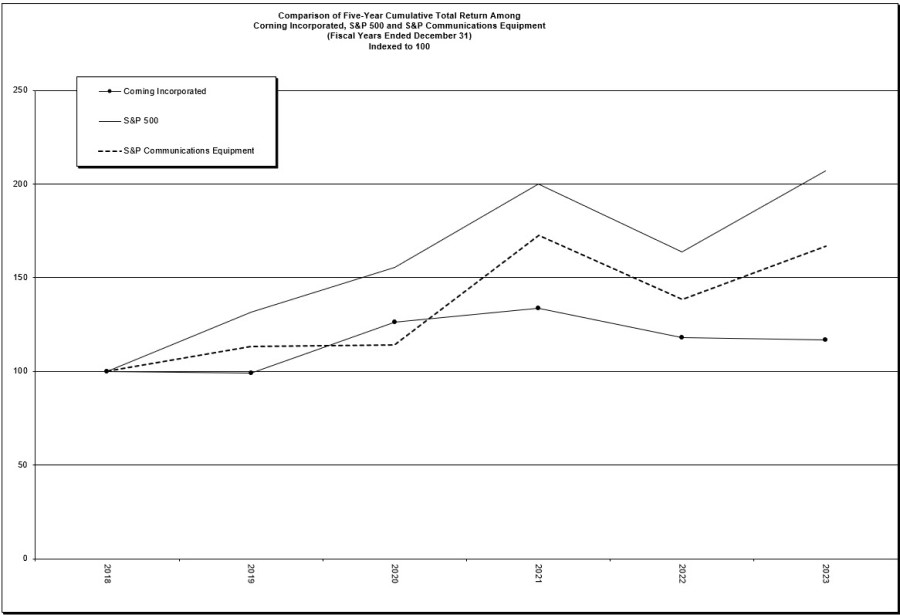
| (b) | Not applicable. |
|---|
| (c) | The following table provides information about purchases of common stock during the fourth quarter of 2023: |
|---|
Issuer Purchases of Equity Securities
| Execution date | Total number of shares purchased (1) | Average price paid per share (2) | Number of shares purchased as part of publicly announced programs | Approximate dollar value of shares that may be purchased under the publicly announced programs | ||||||||||||
|---|---|---|---|---|---|---|---|---|---|---|---|---|---|---|---|---|
| October 1-31, 2023 | 78,098 | $ | 29.94 | — | ||||||||||||
| November 1-30, 2023 | 11,783 | $ | 26.70 | — | ||||||||||||
| December 1-31, 2023 | 35,216 | $ | 29.02 | — | ||||||||||||
| Total | 125,097 | $ | 29.38 | — | $ | 3,301,085,426 |
| (1) | This column reflects: (i) 94,437 shares of common stock related to the vesting of employee restricted stock; (ii) 29,894 shares of common stock related to the vesting of employee restricted stock units; and (iii) 766 shares of common stock related to the vesting of employee performance stock units. |
|---|
| (2) | Represents the stock price at the time of surrender. |
|---|
Item 6. [Reserved]
Item 7. Management’s Discussion and Analysis of Financial Condition and Results of Operations
The following Management’s Discussion and Analysis of Financial Condition and Results of Operations (“MD&A”) was prepared to provide a historical and prospective narrative on our financial condition and results of operations through the eyes of management and should be read in conjunction with our consolidated financial statements and the accompanying notes to those financial statements. The discussion and analysis of the 2022 to 2021 year-over-year changes are not included herein and can be found in “Management’s Discussion and Analysis of Financial Conditions and Results of Operations” in our Annual Report on Form 10-K for the year ended December 31, 2022.
Our MD&A is organized as follows:
| • | Overview |
|---|
| • | Results of Operations |
|---|
| • | Segment Analysis |
|---|
| • | Core Performance Measures |
|---|
| • | Liquidity and Capital Resources |
|---|
| • | Environment |
|---|
| • | Critical Accounting Estimates |
|---|
| • | New Accounting Standards |
|---|
| • | Forward-Looking Statements |
|---|
OVERVIEW
Corning is vital to progress – in the industries we help advance and in the world we share. For more than 170 years, Corning has combined its unparalleled expertise in glass science, ceramic science and optical physics with deep manufacturing and engineering capabilities to develop category-defining products that transform industries and enhance people’s lives. Our materials science and manufacturing expertise, boundless curiosity and commitment to purposeful invention place us at the center of the way the world works, learns and lives. In addition, our sustained investment in research, development and engineering capabilities means we are always ready to solve the toughest challenges – alongside our customers.
Our capabilities are versatile and synergistic, allowing Corning to evolve to meet changing market needs, while also helping customers capture new opportunities in dynamic industries. Corning strives to be a catalyst for positive change and to help move the world forward. The Company drives profitable multiyear growth by inventing, making and selling life-changing products – all of which is based on a set of vital capabilities that are increasingly relevant to profound transformations that touch many facets of daily life. Today, Corning's markets include optical communications, mobile consumer electronics, display, automotive, solar, semiconductor and life sciences.
At the start of 2023, we introduced plans to improve profitability and cash flow. Throughout the year, we took action to restore our productivity ratios to historical levels and to raise price to more appropriately share inflation with our customers. Our results demonstrated that we continue to make solid progress advancing market leadership, strengthening our profitability, and improving our cash flow generation even in the lower-demand environment that we are experiencing.
Although demand in most of our markets is temporarily depressed due to supply chain corrections and macroeconomic factors, we are entering 2024 operationally strong and we remain confident that key industry growth drivers are intact: specifically, wireless, broadband, 5G, cloud computing and advanced artificial intelligence in Optical communications, increased screen sizes in Display Technologies, tighter emission regulations that drive more and better filtration in Environmental Technologies and the need for more and more advanced cover materials in Mobile Consumer Electronics. Additionally, we have built competitively-advantaged positions in the markets in which we participate and we believe we are the technology leader, as well as the lowest-cost producer, in those markets.
Therefore, as we expect our markets to normalize in the midterm, we believe we are well-positioned with the production capacity and technical capabilities necessary to capture this growth opportunity and deliver powerful incremental profit and cash to our shareholders.
2024 Corporate Outlook
We expect core net sales of approximately $3.1 billion for the first quarter of 2024.
RESULTS OF OPERATIONS
The following table presents selected highlights from our operations (in millions):
| Year ended December 31, | % change | |||||||||||
|---|---|---|---|---|---|---|---|---|---|---|---|---|
| 2023 | 2022 | 23 vs. 22 | ||||||||||
| Net sales | $ | 12,588 | $ | 14,189 | (11 | %) | ||||||
| Cost of sales | $ | 8,657 | $ | 9,683 | (11 | %) | ||||||
| Gross margin | $ | 3,931 | $ | 4,506 | (13 | %) | ||||||
| Gross margin % | 31 | % | 32 | % | ||||||||
| Selling, general and administrative expenses | $ | 1,843 | $ | 1,898 | (3 | %) | ||||||
| as a % of net sales | 15 | % | 13 | % | ||||||||
| Research, development and engineering expenses | $ | 1,076 | $ | 1,047 | 3 | % | ||||||
| as a % of net sales | 9 | % | 7 | % | ||||||||
| Translated earnings contract gain, net | $ | 161 | $ | 351 | (54 | %) | ||||||
| Income before income taxes | $ | 816 | $ | 1,797 | (55 | %) | ||||||
| Provision for income taxes | $ | (168 | ) | $ | (411 | ) | 59 | % | ||||
| Effective tax rate | 20.6 | % | 22.9 | % | ||||||||
| Net income attributable to Corning Incorporated | $ | 581 | $ | 1,316 | (56 | %) | ||||||
| Comprehensive income attributable to Corning Incorporated | $ | 363 | $ | 661 | (45 | %) |
Net Sales
Net sales for the year ended December 31, 2023 decreased by $1.6 billion, or 11%, when compared to the same period in 2022. The decrease was primarily driven by a decline in segment sales for Optical Communications of $1.0 billion, Life Sciences of $0.3 billion and Hemlock and Emerging Growth Businesses of $0.2 billion, partially offset by an increase in segment sales for Environmental Technologies of $0.2 billion. Refer to the “Segment Analysis” section of our MD&A below for a discussion of net sales by segment.
In 2023 and 2022, sales in international markets accounted for 67% and 65% of total net sales, respectively.
Cost of Sales / Gross Margin
The types of expenses included in cost of sales are: raw materials consumption, including direct and indirect materials; salaries, wages and benefits; depreciation and amortization; production utilities; production-related purchasing; warehousing (including receiving and inspection); repairs and maintenance; inter-location inventory transfer costs; production and warehousing facility property insurance; rent for production facilities; freight and logistics costs; and other production overhead.
Gross margin decreased by $575 million, or 13% and gross margin as a percentage of net sales decreased by 1 percentage point when compared to 2022. The decrease in gross margin is primarily driven by the decrease in net sales, as discussed above. Throughout 2023, actions were taken by management to improve profitability, including raising prices, restoring our productivity levels and normalizing inventory levels, which has resulted in improvements in gross margin as a percentage of net sales throughout the year despite the decline in sales.
Selling, General and Administrative Expenses
The types of expenses included in selling,
Showing the first 8K of 74K characters. Open the full section
Item 7A. Quantitative and Qualitative Disclosures About Market Risks
We operate and conduct business in many foreign countries and as a result are exposed to movements in foreign currency exchange rates. Our exposure to exchange rates has the following effects:
| • | Exchange rate movements on financial instruments and transactions denominated in foreign currencies that impact earnings; and |
|---|
| • | Exchange rate movements upon conversion of net assets and net income of foreign subsidiaries for which the functional currency is not the U.S. dollar. |
|---|
Our most significant foreign currency exposure relates to the Japanese yen, South Korean won, New Taiwan dollar, Chinese yuan and euro. We seek to mitigate the impact of exchange rate movements in our income statement by using over-the-counter (“OTC”) derivative instruments including foreign exchange forward and option contracts. In general, these hedges expire coincident with the timing of the underlying foreign currency commitments and transactions.
We are exposed to potential losses in the event of non-performance by our counterparties to these derivative contracts. However, we minimize this risk by maintaining a diverse group of highly-rated major financial institutions as our counterparties. We do not expect to record any losses as a result of such counterparty default. Neither we nor our counterparties are required to post collateral for these financial instruments.
Our cash flow hedging activities utilize OTC foreign exchange forward contracts to reduce the risk that movements in exchange rates will adversely affect the net cash flows resulting from the sale of products to foreign customers and purchases from foreign suppliers. We also use OTC foreign exchange forward and option contracts that are not designated as hedged instruments. These contracts are used to offset economic currency risks. The undesignated hedges limit exposure to foreign functional currency fluctuations related to certain subsidiaries’ monetary assets, monetary liabilities and net earnings in foreign currencies. A significant portion of our non-U.S. revenue is denominated in Japanese yen. When this revenue is translated back to U.S. dollars, we are exposed to foreign exchange rate movements in the Japanese yen. To protect translated earnings against movements in the Japanese yen, we have entered into a series of option contracts and average rate forwards.
We use a sensitivity analysis to assess the market risk associated with foreign currency exposure. Market risk is defined as the potential change in fair value of assets and liabilities resulting from an adverse movement in foreign currency exchange rates. As of December 31, 2023, with respect to open foreign exchange forward and option contracts and foreign denominated debt with values exposed to exchange rate movements, a 10% adverse movement in quoted foreign currency exchange rates could result in a loss in fair value of these instruments of $0.6 billion compared to $0.8 billion as of December 31, 2022. Specific to the Japanese yen, a 10% adverse movement in quoted yen exchange rates could result in a loss in fair value of these instruments of $0.3 billion and $0.4 billion as of December 31, 2023 and 2022, respectively. Management expects that these hypothetical losses from a 10% adverse movement in quoted foreign currency exchange rates on the derivative financial instruments should largely offset gains on the assets, liabilities and future transactions being hedged.
Item 8. Financial Statements and Supplementary Data
The response to this Item 8 is included in our audited consolidated financial statements and notes to consolidated financial statements, which are contained in Part IV, Item 15 of this Annual Report on Form 10-K.
Item 9. Changes in and Disagreements with Accountants on Accounting and Financial Disclosure
None.
Item 9A. Controls and Procedures
Disclosure Controls and Procedures
The Company’s principal executive and principal financial officers, after evaluating the effectiveness of disclosure controls and procedures (as defined in the Securities Exchange Act of 1934 (“Exchange Act”) Rules 13a-15(e) or 15d-15(e) as of the end of the period covered by this report, have concluded that based on the evaluation of these controls and procedures required by paragraph (b) of Exchange Act Rules 13a-15 or 15d-15, that Corning’s disclosure controls and procedures were effective.
Disclosure controls and procedures mean controls and other procedures of an issuer that are designed to ensure that information required to be disclosed by the issuer in the reports that it files or submits under the Exchange Act is recorded, processed, summarized, and reported, within the time periods specified in the SEC’s rules and forms. Corning’s disclosure controls and procedures include, without limitation, controls and procedures designed to ensure that information required to be disclosed by Corning in the reports that it files or submits under the Exchange Act is accumulated and communicated to Corning’s management, including Corning’s principal executive and principal financial officers, or other persons performing similar functions, as appropriate to allow timely decisions regarding required disclosure.
Internal Control Over Financial Reporting
| (a) | Management’s Annual Report on Internal Control Over Financial Reporting |
|---|
Management is responsible for establishing and maintaining adequate internal control over financial reporting for Corning.
Corning’s internal control over financial reporting is a process designed to provide reasonable assurance regarding the reliability of financial reporting and the preparation of financial statements for external purposes in accordance with accounting principles generally accepted in the U.S. Corning’s internal control over financial reporting includes those policies and procedures that (i) pertain to the maintenance of records that, in reasonable detail, accurately and fairly reflect the transactions and dispositions of Corning’s assets; (ii) provide reasonable assurance that transactions are recorded as necessary to permit preparation of financial statements in accordance with accounting principles generally accepted in the U.S., and that Corning’s receipts and expenditures are being made only in accordance with authorizations of Corning’s management and directors; and (iii) provide reasonable assurance regarding prevention or timely detection of unauthorized acquisition, use, or disposition of Corning’s assets that could have a material effect on the financial statements. Because of its inherent limitations, internal control over financial reporting may not prevent or detect misstatements. Also, projections of any evaluation of effectiveness to future periods are subject to the risk that controls may become inadequate because of changes in conditions, or that the degree of compliance with the policies and procedures may deteriorate.
Management conducted an evaluation of the effectiveness of the Company’s internal control over financial reporting based on the framework in Internal Control – Integrated Framework (2013) issued by the Committee of Sponsoring Organizations of the Treadway Commission.
Based on this evaluation, management concluded that the Company’s internal control over financial reporting was effective as of December 31, 2023. The effectiveness of the Company’s internal control over financial reporting as of December 31, 2023 has been audited by PricewaterhouseCoopers LLP, an independent registered public accounting firm, as stated in its report which is included in Part IV, Item 15 of this Annual Report on Form 10-K.
| (b) | Changes in Internal Control Over Financial Reporting |
|---|
There were no changes in the Company’s internal control over financial reporting identified by the evaluation required by paragraph (d) of Exchange Act Rules 13a-15 or 15d-15 that occurred during the most recently completed fiscal quarter that have materially affected, or are reasonably likely to materially affect, internal control over financial reporting.
Item 9B. Other Information
During the three months ended December 31, 2023, none of our executive officers or directors adopted, modified or terminated any contract, instruction or written plan for the purchase or sale of our securities that was intended to satisfy the affirmative defense conditions of Rule 10b5-1(c) or any “non-Rule 10b5-1 trading arrangement.”
Item 9C. Disclosure Regarding Foreign Jurisdictions that Prevent Inspections
Item 10. Directors, Executive Officers and Corporate Governance
The sections titled “Proposal 1 Election of Directors,” “Corporate Governance and the Board of Directors” and “Delinquent Section 16(a) Reports” in our Definitive Proxy Statement are incorporated by reference in this Annual Report on Form 10-K.
Executive Officers of the Registrant
Refer to Part I, Item 1. of this Annual Report on Form 10-K for a listing of executive officers.
Corning’s Board of Directors
Donald W. Blair Retired Executive Vice President and Chief Financial Officer, NIKE, Inc.
Mr. Blair was the executive vice president and chief financial officer of NIKE, Inc. from 1999 to October 2015. Prior to joining NIKE, he served 15 years at PepsiCo, Inc. in a number of senior executive-level corporate and operating unit financial assignments, including chief financial officer roles for PepsiCo Japan (based in Tokyo) and Pepsi-Cola International’s Asia Division (based in Hong Kong). He began his career in 1981 as an accountant with Deloitte Haskins & Sells. Mr. Blair joined Corning’s Board in 2014. Age 65.
Leslie A. Brun Chairman and Chief Executive Officer, Sarr Group LLC
Mr. Brun is chairman and chief executive officer of Sarr Group, LLC, co-founder, chairman and chief executive officer of Ariel Alternatives, LLC, senior advisor of G100, Council Advisors, World 50 and a member of the Council on Foreign Relations. He was also the founder of Hamilton Lane, where he served as chief executive officer and chairman from 1991 until 2005. In addition, Mr. Brun served as a managing director and co-founder of the investment banking group of Fidelity Bank and as a past vice president in the corporate finance division of E.F. Hutton & Co. Mr. Brun joined Corning’s Board in 2018. Age 71.
Stephanie A. Burns Retired Chairman and Chief Executive Officer, Dow Corning Corporation
Dr. Burns has nearly 40 years of global innovation and business leadership experience. Dr. Burns joined Dow Corning in 1983 as a researcher and specialist in organosilicon chemistry. In 1994, she became the company’s first director of women’s health. She was elected to the Dow Corning Board of Directors in 2001 and elected as president in 2003. She served as chief executive officer from 2004 until May 2011 and served as chair from 2006 until her retirement in December 2011. Dr. Burns joined Corning’s Board in 2012. Age 68.
Richard T. Clark Retired Chairman, Chief Executive Officer and President, Merck & Co., Inc. Lead Independent Director
Mr. Clark retired from Merck in 2011. He joined Merck in 1972 and held a broad range of senior management positions. He became president and chief executive officer of Merck in May 2005 and chairman of the board in April 2007. He transitioned from the chief executive officer role in January 2011 and served as Merck board chairman through November 2011. He was president of the Merck Manufacturing Division (June 2003 to May 2005) of Merck Sharp & Dohme Corp. He is chairman emeritus of the board of Project Hope and a trustee of several charitable non-profit organizations. Mr. Clark joined Corning’s Board in 2011. Age 77.
Pamela J. Craig Retired Chief Financial Officer, Accenture plc.
From 2006 through 2013, Ms. Craig served as chief financial officer of Accenture plc., a global management consulting, technology services and outsourcing company, following many other leadership roles in line management, consulting and operations during her 34 years with the company. She is also actively involved in charitable organizations focused on education and on the advancement of women in business, including The Women’s Forum of New York, New York University Stern School of Business, Junior Achievement of New Jersey and is a member of the Board of Trustees of Smith College. Ms. Craig joined Corning’s Board in 2021. Age 66.
Robert F. Cummings, Jr. Retired Vice Chairman of Investment Banking, JPMorgan Chase & Co.
Mr. Cummings retired as vice chairman of Investment Banking at JPMorgan Chase & Co. in 2016. He had served in that role since 2010, advising on client opportunities across sectors and industry groups. Mr. Cummings began his business career in the investment banking division of Goldman, Sachs & Co. in 1973 and was a partner of that firm from 1986 to 1998. He served as an advisory director at Goldman Sachs until 2002. Mr. Cummings joined Corning’s Board in 2006. Age 74.
Roger W. Ferguson, Jr. Steven A. Tananbaum Distinguished Fellow for International Economics, council on Foreign Relations
Mr. Ferguson is the Steven A. Tananbaum Distinguished Fellow for International Economics at the Council on Foreign Relations. He is also a partner and the Chief Investment Officer of Red Cell Partners, an incubation and venture capital enterprise focused on the health care and defense sectors. He is the past President and Chief Executive Officer of TIAA, a position he held from 2008 to 2021. He is also the former Vice Chairman of the Board of Governors of the U.S. Federal Reserve System. Prior to joining TIAA in April 2008, Mr. Ferguson was head of financial services for Swiss Re and Chairman of Swiss Re America Holding Corporation. From 1984 to 1997, he was an Associate and Partner at McKinsey & Company. He began his career as an attorney at the New York City office of Davis Polk & Wardwell. Mr. Ferguson joined Corning’s Board in 2021. Age 72.
Thomas D. French Senior Partner Emeritus, McKinsey & Company, Inc.
Mr. French retired as a Senior Partner of McKinsey & Company in December 2019, and currently is Senior Partner Emeritus. Over the course of his 33-year career in consulting, he served leading technology-driven industrial companies on issues of strategy, marketing, corporate governance, and organization design. He led the firm’s Global Marketing and Sales Practice for five years, the Americas Practice for seven years, and served on multiple firm governance committees. He is a trustee of several non-profit organizations. Mr. French joined Corning’s Board in 2023. Age 64.
Deborah A. Henretta Retired Group President of Global E-Business, Procter & Gamble Company
Ms. Henretta has nearly 40 years of business leadership experience across both developed and developing markets, as well as expertise in brand building, marketing, philanthropic program development and government relations. She joined Procter & Gamble (P&G) in 1985. In 2005, she was appointed President of P&G’s business in ASEAN, Australia and India. She was appointed group president, P&G Asia in 2007, group president of P&G Global Beauty Sector in 2013 and group president of P&G E-Business in 2015. She retired from P&G in 2015. Ms. Henretta joined Corning’s Board in 2013. Age 62.
Daniel P. Huttenlocher Dean, MIT Stephen A. Schwarzman College of Computing
Dr. Huttenlocher is the Dean of the MIT Schwarzman College of Computing. Prior to joining MIT, Dr. Huttenlocher served as dean and vice provost of Cornell Tech from 2012 – 2019 and worked for Cornell University from 1988 to 2012 in various positions. Before Cornell, Dr. Huttenlocher worked at Xerox Palo Alto Research Center and was Chief Technology Officer at Intelligent Markets, Inc. He has also served as the Chair of the John D. and Catherine T. MacArthur Foundation, an independent foundation that makes grants and impact investments to support non-profit organizations addressing global social challenges. Dr. Huttenlocher holds a Ph.D. in computer science and a Master of Science degree in Electrical Engineering, both from the Massachusetts Institute of Technology. Dr. Huttenlocher joined Corning’s Board in 2015. Age 65.
Kurt M. Landgraf Retired President, Washington College
From July 2017 to July 2020, Mr. Landgraf was president of Washington College. He previously served as president and chief executive officer of Educational Testing Service (ETS), a private non-profit educational testing and measurement organization, from 2000 until 2013. Prior to that, he was executive vice president and chief operating officer of E.I. Du Pont de Nemours and Company (DuPont), where he held a number of senior leadership positions, including chief financial officer. Mr. Landgraf joined Corning’s Board in 2007. Age 77.
Kevin J. Martin Vice President, US Public Policy, Meta Platforms, Inc.
Mr. Martin is Vice President, US Public Policy at Meta Platforms, Inc. Prior to joining Meta, he was a partner and co-chair of the telecommunications practice at Squire Patton Boggs, an international law firm from 2009 to 2015. From March 2005 to January 2009, he was chairman of the Federal Communications Commission (FCC). Prior to that, he was a special assistant to the president for Economic Policy and served on the staff of the National Economic Council, focusing on commerce and technology policy issues. He served as the official U.S. government representative to the G-8’s Digital Opportunity Task Force. Mr. Martin joined Corning’s Board in 2013. Age 57.
Deborah D. Rieman Retired Executive Chairman, Metamarkets Group
Dr. Rieman has more than 34 years of experience in the software and information technology industries. In 2016, she retired as executive chairman of Metamarkets Group. Previously, she was managing director of Equus Management Company, a private investment fund. From 1995 to 1999, she served as president and chief executive officer of Check Point Software Technologies, Incorporated. Dr. Rieman joined Corning’s Board in 1999. Age 74.
Hansel E. Tookes II Retired Chairman and Chief Executive Officer, Raytheon Aircraft Company
Mr. Tookes retired from Raytheon Company in December 2002. He joined Raytheon in 1999 and served as president of Raytheon International, chairman and chief executive officer of Raytheon Aircraft and executive vice president of Raytheon Company. From 1980 to 1999, Mr. Tookes served United Technologies Corporation as president of Pratt and Whitney’s Large Military Engines Group and in a variety of other leadership positions. He is a former Lieutenant Commander and military pilot in the United States Navy and former commercial pilot with United Airlines. He is also a former member of the National Academies Aeronautics and Space Engineering Board. Mr. Tookes joined Corning’s Board in 2001. Age 76.
Wendell P. Weeks Chairman and Chief Executive Officer
Mr. Weeks has served as the Chief Executive Officer of Corning Incorporated since April 2005 and Chairman of the Board of Directors since April 2007. He has held a variety of financial, commercial, business development and general management positions across Corning’s businesses and technologies since he joined the company in 1983. Mr. Weeks joined Corning’s Board in 2000. Age 64.
Mark S. Wrighton Professor and Chancellor Emeritus, Washington University in St. Louis
Dr. Wrighton has nearly 30 years of leadership experience overseeing large research universities. He currently serves as professor and chancellor emeritus of Washington University in St. Louis where he served 24 years as its chief executive officer and 14 years as chancellor. He served as president at George Washington University from January 2022 to June 2023 while on sabbatical from Washington University in St. Louis. Before joining Washington University in St. Louis, he was a researcher and professor at the Massachusetts Institute of Technology, where he was head of the Department of Chemistry from 1987 to 1990, and then provost from 1990 to 1995. Dr. Wrighton served as a presidential appointee to the National Science Board from 2000 to 2006. He is also a past chair of the Association of American Universities, the Business Higher Education Forum and the Consortium on Financing Higher Education. He was elected to membership in the American Academy of Arts and Sciences and the American Philosophical Society and he is a Fellow of the American Association for the Advancement of Science. Dr. Wrighton joined Corning’s Board in 2009. Age 74.
Code of Ethics
Our Board of Directors adopted the Code of Ethics (“Code”) for the Chief Executive Officer and Financial Executives. This Code has been in existence for more than ten years. The Code applies to our Chief Executive Officer, Chief Financial Officer, Controller and other financial executives. During 2023, no amendments to or waivers of the provisions of the Code were made with respect to any of our directors or executive officers. A copy of the Code of Ethics is available on our website at http://www.corning.com/worldwide/en/about-us/investor-relations/codes-of-conduct-ethics.html. We will also provide a copy of the Code of Ethics to shareholders without charge upon written request to Corporate Secretary, Corning Incorporated, One Riverfront Plaza, Corning, NY 14831. We will disclose future amendments to, or waivers from, the Code of Ethics on our website within four business days following the date of such amendment or waiver.
Item 11. Executive Compensation
The sections titled “Compensation Discussion and Analysis,” “Director Compensation” and “Compensation and Talent Management Committee Interlocks and Insider Participation” in our Definitive Proxy Statement are incorporated by reference in this Annual Report on Form 10-K.
Item 12. Security Ownership of Certain Beneficial Owners and Management and Related Stockholder Matters
The section titled “Beneficial Ownership Table” in our Definitive Proxy Statement is incorporated by reference in this Annual Report on Form 10-K.
Equity Compensation Plan Information
The following table provides information about the Company’s equity compensation plans as of December 31, 2023:
| Number of securities to be issued upon exercise of outstanding options, warrants and rights | Weighted-average exercise price of outstanding options, warrants and rights | Number of securities remaining available for future issuance under equity compensation plans (1) | ||||||||||
|---|---|---|---|---|---|---|---|---|---|---|---|---|
| Equity compensation plans approved by security holders (2) | 7,498,941 | $ | 23.82 | 22,612,070 | ||||||||
| Equity compensation plans not approved by security holders | ||||||||||||
| Total | 7,498,941 | $ | 23.82 | 22,612,070 |
| (1) | Excludes 7.5 million of securities to be issued upon exercise of outstanding options, warrants and rights. |
|---|---|
| (2) | Shares indicated are total grants under the most recent shareholder approved plans. |
Item 13. Certain Relationships and Related Transactions and Director Independence
The sections titled “Policy on Transactions with Related Persons,” “Director Independence” and “Corporate Governance and the Board of Directors-Committees” in our Definitive Proxy Statement are incorporated by reference into this Annual Report on Form 10-K.
Item 14. Principal Accounting Fees and Services
The sections titled “Fees Paid to Independent Registered Public Accounting Firm” and “Policy Regarding Audit Committee Pre-Approval of Audit and Permitted Non-Audit Services of Independent Registered Public Accounting Firm” in our Definitive Proxy Statement are incorporated by reference in this Annual Report on Form 10-K.
Item 15. Exhibits
| (a) | Documents filed as part of this report: | ||||
|---|---|---|---|---|---|
| Page | |||||
| 1. | Financial statements | 57 | |||
| See separate index to financial statements | |||||
| (b) | Exhibits filed as part of this report: |
Item 16. Form 10-K Summary.
None.
Pursuant to the requirements of Section 13 or 15(d) of the Securities and Exchange Act of 1934, the Registrant has duly caused his report to be signed on its behalf by the undersigned, thereunto duly authorized.
| Corning Incorporated | ||
| Date: February 12, 2024 | By: | /s/ Wendell P. Weeks |
| Wendell P. Weeks | ||
| Chairman of the Board of Directors, | ||
| Chief Executive Officer |
KNOW ALL PERSONS BY THESE PRESENTS, that each person whose signature appears below constitutes and appoints Edward A. Schlesinger, Lewis A. Steverson and Stefan Becker, jointly and severally, his or her attorneys-in-fact, each with the power of substitution, for him or her in any and all capacities, to sign any amendments to this Annual Report on Form 10-K, and to file the same, with exhibits thereto and other documents in connection therewith, with the Securities and Exchange Commission, hereby ratifying and confirming all that each of said attorneys-in-fact, or his substitute or substitutes, may do or cause to be done by virtue hereof.
Pursuant to the requirements of the Securities Exchange Act of 1934, this report has been signed below by the following persons on behalf of the Registrant and in the capacities as indicated and on the 12th day of February, 2024.
| Signature | Capacity | |
|---|---|---|
| /s/ Wendell P. Weeks | Chairman of the Board of Directors, Chief Executive Officer, and Director | |
| Wendell P. Weeks | (Principal Executive Officer) | |
| /s/ Edward A. Schlesinger | Executive Vice President and Chief Financial Officer (Principal Financial Officer) | |
| Edward A. Schlesinger | ||
| /s/ Stefan Becker | Senior Vice President and Corporate Controller (Principal Accounting Officer) | |
| Stefan Becker | ||
| /s/ Donald W. Blair | Director | |
| Donald W. Blair | ||
| /s/ Leslie A. Brun | Director | |
| Leslie A. Brun | ||
| /s/ Stephanie A. Burns | Director | |
| Stephanie A. Burns | ||
| /s/ Richard T. Clark | Director | |
| Richard T. Clark | ||
| /s/ Pamela J. Craig | Director | |
| Pamela J. Craig |
| Signature | Capacity | |
|---|---|---|
| /s/ Robert F. Cummings, Jr. | Director | |
| Robert F. Cummings, Jr. | ||
| /s/ Roger W. Ferguson Jr. | Director | |
| Roger W. Ferguson Jr. | ||
| /s/ Thomas D. French | Director | |
| Thomas D. French | ||
| /s/ Deborah A. Henretta | Director | |
| Deborah A. Henretta | ||
| /s/Daniel P. Huttenlocher | Director | |
| Daniel P. Huttenlocher | ||
| /s/ Kurt M. Landgraf | Director | |
| Kurt M. Landgraf | ||
| /s/ Kevin J. Martin | Director | |
| Kevin J. Martin | ||
| /s/ Deborah D. Rieman | Director | |
| Deborah D. Rieman | ||
| /s/ Hansel E. Tookes II | Director | |
| Hansel E. Tookes II | ||
| /s/ Mark S. Wrighton | Director | |
| Mark S. Wrighton |
2023 Annual Report
Index to Financial Statements
Report of Independent Registered Public Accounting Firm
To the Board of Directors and Shareholders of Corning Incorporated
Opinions on the Financial Statements and Internal Control over Financial Reporting
We have audited the accompanying consolidated balance sheets of Corning Incorporated and its subsidiaries (the “Company”) as of December 31, 2023 and 2022, and the related consolidated statements of income, comprehensive income, changes in shareholders’ equity and cash flows for each of the three years in the period ended December 31, 2023, including the related notes (collectively referred to as the “consolidated financial statements”). We also have audited the Company’s internal control over financial reporting as of December 31, 2023, based on criteria established in Internal Control - Integrated Framework (2013) issued by the Committee of Sponsoring Organizations of the Treadway Commission (COSO).
In our opinion, the consolidated financial statements referred to above present fairly, in all material respects, the financial position of the Company as of December 31, 2023 and 2022**,** and the results of its operations and its cash flows for each of the three years in the period ended December 31, 2023 in conformity with accounting principles generally accepted in the United States of America. Also in our opinion, the Company maintained, in all material respects, effective internal control over financial reporting as of December 31, 2023, based on criteria established in Internal Control - Integrated Framework (2013) issued by the COSO.
Basis for Opinions
The Company’s management is responsible for these consolidated financial statements, for maintaining effective internal control over financial reporting, and for its assessment of the effectiveness of internal control over financial reporting, included in Management’s Annual Report on Internal Control Over Financial Reporting appearing under Item 9A. Our responsibility is to express opinions on the Company’s consolidated financial statements and on the Company’s internal control over financial reporting based on our audits. We are a public accounting firm registered with the Public Company Accounting Oversight Board (United States) (PCAOB) and are required to be independent with respect to the Company in accordance with the U.S. federal securities laws and the applicable rules and regulations of the Securities and Exchange Commission and the PCAOB.
We conducted our audits in accordance with the standards of the PCAOB. Those standards require that we plan and perform the audits to obtain reasonable assurance about whether the consolidated financial statements are free of material misstatement, whether due to error or fraud, and whether effective internal control over financial reporting was maintained in all material respects.
Our audits of the consolidated fi
Showing the first 8K of 197K characters. Open the full section