 filings.tools
General Motors 10-K 2023-12-31
Filed 2024-01-30. 19 sections, 582K characters. Original on sec.gov · Markdown · JSON
Cover and table of contents
UNITED STATES SECURITIES AND EXCHANGE COMMISSION
Washington, DC 20549
Form 10-K
| ☑ | ANNUAL REPORT PURSUANT TO SECTION 13 OR 15(d) OF THE SECURITIES EXCHANGE ACT OF 1934 |
For the fiscal year ended December 31, 2023
OR
| ☐ | TRANSITION REPORT PURSUANT TO SECTION 13 OR 15(d) OF THE SECURITIES EXCHANGE ACT OF 1934 |
For the transition period from to
Commission file number 001-34960

GENERAL MOTORS COMPANY
(Exact name of registrant as specified in its charter)
| Delaware | 27-0756180 | ||||||||||||||||||||||||||||||||||||||||
| (State or other jurisdiction of incorporation or organization) | (I.R.S. Employer Identification No.) | ||||||||||||||||||||||||||||||||||||||||
| 300 Renaissance Center, | Detroit, | Michigan | 48265 | -3000 | |||||||||||||||||||||||||||||||||||||
| (Address of principal executive offices) | (Zip Code) |
(313) 667-1500
(Registrant’s telephone number, including area code)
Securities registered pursuant to Section 12(b) of the Act:
| Title of each class | Trading Symbol(s) | Name of each exchange on which registered | ||||||
| Common Stock, $0.01 par value | GM | New York Stock Exchange | ||||||
Securities registered pursuant to Section 12 (g) of the Act: None
Indicate by check mark if the registrant is a well-known seasoned issuer, as defined in Rule 405 of the Securities Act. Yes ☑ No ☐
Indicate by check mark if the registrant is not required to file reports pursuant to Section 13 or Section 15(d) of the Act. Yes ☐ No ☑
Indicate by check mark whether the registrant (1) has filed all reports required to be filed by Section 13 or 15(d) of the Securities Exchange Act of 1934 during the preceding 12 months (or for such shorter period that the registrant was required to file such reports), and (2) has been subject to such filing requirements for the past 90 days. Yes ☑ No ☐
Indicate by check mark whether the registrant has submitted electronically every Interactive Data File required to be submitted pursuant to Rule 405 of Regulation S-T (§ 232.405 of this chapter) during the preceding 12 months (or for such shorter period that the registrant was required to submit such files). Yes ☑ No ☐
Indicate by check mark whether the registrant is a large accelerated filer, an accelerated filer, a non-accelerated filer, a smaller reporting company or an emerging growth company. See the definitions of “large accelerated filer,” “accelerated filer,” “smaller reporting company” and "emerging growth company" in Rule 12b-2 of the Exchange Act.
Large accelerated filer ☑ Accelerated filer ☐ Non-accelerated filer ☐ Smaller reporting company ☐ Emerging growth company ☐
If an emerging growth company, indicate by check mark if the registrant has elected not to use the extended transition period for complying with any new or revised financial accounting standards provided pursuant to Section 13(a) of the Exchange Act. ☐
Indicate by check mark whether the registrant has filed a report on and attestation to its management's assessment of the effectiveness of its internal control over financial reporting under Section 404(b) of the Sarbanes-Oxley Act (15 U.S.C.7262(b)) by the registered public accounting firm that prepared or issued its audit report. ☑
If securities are registered pursuant to Section 12(b) of the Act, indicate by check mark whether the financial statements of the registrant included in the filing reflect the correction of an error to previously issued financial statements. ☐
Indicate by check mark whether any of those error corrections are restatements that required a recovery analysis of incentive-based compensation received by any of the registrant's executive officers during the relevant recovery period pursuant to §240.10D-1(b). ☐
Indicate by check mark whether the registrant is a shell company (as defined in Rule 12b-2 of the Act). Yes ☐ No ☑
The aggregate market value of the voting stock held by non-affiliates of the registrant (assuming only for purposes of this computation that directors and executive officers may be affiliates) was approximately $52.9 billion as of June 30, 2023.
As of January 16, 2024 there were 1,154,433,287 shares of common stock outstanding.
DOCUMENTS INCORPORATED BY REFERENCE
Portions of the registrant's definitive Proxy Statement related to the Annual Stockholders Meeting to be filed subsequently are incorporated by reference into Part III of this Form 10-K.
INDEX
| Page | |||||||||||
| PART I | |||||||||||
| Item 1. | Business | 1 | |||||||||
| Item 1A. | Risk Factors | 13 | |||||||||
| Item 1B. | Unresolved Staff Comments | 23 | |||||||||
| Item 1C. | Cybersecurity | 23 | |||||||||
| Item 2. | Properties | 24 | |||||||||
| Item 3. | Legal Proceedings | 25 | |||||||||
| Item 4. | Mine Safety Disclosures | 25 | |||||||||
| PART II | |||||||||||
| Item 5. | Market for Registrant’s Common Equity, Related Stockholder Matters and Issuer Purchases of Equity Securities | 25 | |||||||||
| Item 6. | [Reserved] | 27 | |||||||||
| Item 7. | Management’s Discussion and Analysis of Financial Condition and Results of Operations | 27 | |||||||||
| Item 7A. | Quantitative and Qualitative Disclosures About Market Risk | 49 | |||||||||
| Item 8. | Financial Statements and Supplementary Data | 56 | |||||||||
| Consolidated Income Statements | 56 | ||||||||||
| Consolidated Statements of Comprehensive Income | 56 | ||||||||||
| Consolidated Balance Sheets | 57 | ||||||||||
| Consolidated Statements of Cash Flows | 58 | ||||||||||
| Consolidated Statements of Equity | 59 | ||||||||||
| Notes to Consolidated Financial Statements | 60 | ||||||||||
| Note 1. | Nature of Operations and Basis of Presentation | 60 | |||||||||
| Note 2. | Significant Accounting Policies | 60 | |||||||||
| Note 3. | Revenue | 67 | |||||||||
| Note 4. | Marketable and Other Securities | 68 | |||||||||
| Note 5. | GM Financial Receivables and Transactions | 69 | |||||||||
| Note 6. | Inventories | 72 | |||||||||
| Note 7. | Operating Leases | 72 | |||||||||
| Note 8. | Equity in Net Assets of Nonconsolidated Affiliates | 73 | |||||||||
| Note 9. | Property | 75 | |||||||||
| Note 10. | Goodwill and Intangible Assets | 75 | |||||||||
| Note 11. | Variable Interest Entities | 76 | |||||||||
| Note 12. | Accrued and Other Liabilities | 77 | |||||||||
| Note 13. | Debt | 78 | |||||||||
| Note 14. | Derivative Financial Instruments | 80 | |||||||||
| Note 15. | Pensions and Other Postretirement Benefits | 81 | |||||||||
| Note 16. | Commitments and Contingencies | 86 | |||||||||
| Note 17. | Income Taxes | 90 | |||||||||
| Note 18. | Restructuring and Other Initiatives | 92 | |||||||||
| Note 19. | Interest Income and Other Non-Operating Income | 93 | |||||||||
| Note 20. | Stockholders’ Equity and Noncontrolling Interests | 93 | |||||||||
| Note 21. | Earnings Per Share | 96 | |||||||||
| Note 22. | Stock Incentive Plans | 96 | |||||||||
| Note 23. | Segment Reporting | 97 | |||||||||
| Note 24. | Supplemental Information for the Consolidated Statements of Cash Flows | 100 |
| Page | |||||||||||
| Item 9. | Changes in and Disagreements with Accountants on Accounting and Financial Disclosure | 101 | |||||||||
| Item 9A. | Controls and Procedures | 101 | |||||||||
| Item 9B. | Other Information | 102 | |||||||||
| Item 9C. | Disclosure Regarding Foreign Jurisdictions that Prevent Inspections | 102 | |||||||||
| PART III | |||||||||||
| Item 10. | Directors, Executive Officers and Corporate Governance | 102 | |||||||||
| Item 11. | Executive Compensation | 102 | |||||||||
| Item 12. | Security Ownership of Certain Beneficial Owners and Management and Related Stockholder Matters | 102 | |||||||||
| Item 13. | Certain Relationships and Related Transactions, and Director Independence | 102 | |||||||||
| Item 14. | Principal Accountant Fees and Services | 102 | |||||||||
| PART IV | |||||||||||
| Item 15. | Exhibit and Financial Statement Schedules | 103 | |||||||||
| Item 16. | Form 10-K Summary | 105 | |||||||||
| Signatures | 106 |
GENERAL MOTORS COMPANY AND SUBSIDIARIES
PART I
Item 1. Business
General Motors Company (sometimes referred to as we, our, us, ourselves, the Company, General Motors, or GM) was incorporated as a Delaware corporation in 2009. We design, build and sell trucks, crossovers, cars and automobile parts and provide software-enabled services and subscriptions worldwide. Our automotive operations meet the demands of our customers through our automotive segments: GM North America (GMNA) and GM International (GMI) with vehicles developed, manufactured and/or marketed under the Buick, Cadillac, Chevrolet and GMC brands. We also have equity ownership stakes in entities that meet the demands of customers in other countries, primarily in China, with vehicles developed, manufactured and/or marketed under the Baojun, Buick, Cadillac, Chevrolet and Wuling brands. Cruise is our global segment responsible for the development and commercialization of autonomous vehicle (AV) technology. We provide automotive financing services through our General Motors Financial Company, Inc. (GM Financial) segment. Refer to Part II, Item 7. Management's Discussion and Analysis of Financial Condition and Results of Operations (MD&A) and Note 23 to our consolidated financial statements for financial information about our segments. Except for per share amounts or as otherwise specified, amounts presented within tables are stated in millions. Certain columns and rows may not add due to rounding. Forward-looking statements in this Business section are not guarantees of future performance and may involve risks and uncertainties that could cause actual results to differ materially from those projected. Refer to Item 1A. Risk Factors and the "Forward-Looking Statements" section of Part II, Item 7. MD&A for a discussion of these risks and uncertainties.
Our vision for the future is a world with zero crashes, zero emissions and zero congestion, which guides our growth-focused strategy to invest in electric vehicles (EVs) and AVs, software-enabled services and subscriptions and new business opportunities, while strengthening our market position in profitable internal combustion engine (ICE) vehicles, such as trucks and sport utility vehicles (SUVs).
We have an opportunity to grow our vehicle and financing revenue by continuing to capitalize on the strength of our established vehicle franchises and customer base and scaling our EV production through this decade. We also have the potential of growing our revenue through our software-enabled services and subscriptions, including OnStar, our advanced driver-assistance systems (ADAS), including Super Cruise driver assistance technology, and our end-to-end software platform. Additionally, we are incubating several new businesses that we believe will enable us to attract new customers and generate revenues in new areas, like GM Defense which is helping global defense and government customers transition to a more electric, autonomous and connected future.
Electric Vehicles We plan to have annual EV capacity of one million units in North America as we exit 2025. A key element in our EV strategy is Ultium, our dedicated EV propulsion architecture. This platform is flexible and will be deployed across multiple brands and vehicle sizes, styles and drive configurations, allowing for quick response to customer preferences and a shorter design and development lead time compared to our ICE vehicles. We plan to leverage Ultium to expand our EV portfolio over a wide variety of segments and price points with multiple launches planned in 2024 and additional EV entries planned for 2025 and beyond.
In 2021, we began production at GM’s Factory ZERO Detroit-Hamtramck Assembly Center (Factory ZERO), which was re-tooled into a fully dedicated EV facility to produce a variety of vehicles, including the GMC HUMMER EV Pickup and SUV, the Chevrolet Silverado EV and the upcoming Cadillac ESCALADE IQ. In January 2022, we announced that we will convert Orion Assembly in Orion Township, Michigan to build electric pickups, with the plant slated to begin production in 2025. GM is also investing in our propulsion stamping and components plants to support EV production. GM’s CAMI Assembly – Canada’s first full-scale EV manufacturing facility – is the global production home of BrightDrop's Zevo 600 and Zevo 400. Additionally, we have announced plans to mass-produce battery cells for these and other future EVs through Ultium Cells Holdings LLC (an equally owned joint venture with LG Energy Solution) in Warren, Ohio; Spring Hill, Tennessee; and Lansing, Michigan.
GM’s commitment to an all-electric future is focused not only on delivering a world-class portfolio of EVs, but investing in an ecosystem that will help enable mass EV adoption, including the development of turn-key charging solutions as well as fleet and facility energy management services. To support this goal, we are working to help ensure that our customers will have access to comprehensive energy management and fast, reliable charging solutions at home, at the workplace and in public locations. Currently, GM has integration relationships with 12 EV charging networks and GM EV drivers have access to over 174,000 chargers throughout the U.S. and Canada. Beginning in early 2024, GM’s EV drivers will gain access to 15,000 Tesla Superchargers, and growing, throughout North America. The first GM EVs will be built with the North American Charging
GENERAL MOTORS COMPANY AND SUBSIDIARIES
Standard (NACS) hardware on the vehicles beginning in 2025. In July 2023, GM also announced that it is collaborating with six other major automakers as part of a joint venture that will seek to create a high-powered charging network with a targeted installation of at least 30,000 chargers in urban and highway locations throughout North America.
Software-Enabled Services and Subscriptions Our vehicles are equipped with a suite of software-enabled services, including OnStar services, Super Cruise and others. With more than 25 years of experience, OnStar is a global leader in safety and digital services. OnStar is currently available in 15 markets globally and growing. As GM introduces more software-defined vehicles, OnStar is playing a key role as an enabler of active safety, infotainment, connectivity and driver assistance features. OnStar provides one ecosystem for retail and fleet customers to use, engage and shop through a broader set of digital technology offerings available at and after vehicle purchase. Our end-to-end software platform provides customers with software-defined features, apps and services over-the-air and will empower customers to update their ownership experiences with desirable features, software services, vehicle performance and Super Cruise. Super Cruise enables drivers of properly equipped vehicles to travel hands-free on more than 400,000 miles of compatible roads in the U.S. and Canada. Additional software-enabled features will be available later including security features, climate and comfort options, personal themes and EV ownership experience elements. Select vehicles, including the 2024 Cadillac LYRIQ and Chevrolet Silverado EV, are already employing this software platform as it begins its rollout across most products in the coming years.
Cruise GM Cruise Holdings LLC (Cruise Holdings), our majority-owned subsidiary, is pursuing the development and commercialization of AV technology. In October 2023, a hit-and-run accident involving a pedestrian and a third-party vehicle occurred, which resulted in the pedestrian being thrown into the path of a Cruise AV. During the resulting investigation, regulators perceived that Cruise representatives were not explicit about a secondary movement of the Cruise AV and, as a result, the California Department of Motor Vehicles (DMV) suspended Cruise’s permits to operate AVs in California without a safety driver. Shortly thereafter, Cruise voluntarily paused all of its driverless, supervised and manual AV operations in the U.S.
Showing the first 8K of 61K characters. Open the full section
Item 1A. Risk Factors
We have listed below the most material risk factors applicable to us. These risk factors are not necessarily in the order of importance or probability of occurrence:
Risks related to our competition and strategy
If we do not deliver new products, services, technologies and customer experiences in response to increased competition and changing consumer needs and preferences, our business could suffer. We believe that the automotive industry will continue to experience significant change in the coming years, particularly as traditional automotive original equipment manufacturers (OEMs) continue to shift resources to the development of EVs. In addition to our traditional competitors, we must also be responsive to the entrance of start-ups and other non-traditional competitors in the automotive industry, such as software and ridesharing services supported by large technology companies. These new competitors, as well as established industry participants, are disrupting the historic business model of our industry through the introduction of new technologies, products, services, direct-to-consumer sales channels, methods of transportation and vehicle ownership. To successfully execute our long-term strategy, we must continue to develop and commercialize new products and services, including products and services that are outside of our historically core ICE business, such as EVs and AVs, software-enabled connected services and other new businesses.
There can be no assurance that advances in technology will occur in a timely or feasible way, if at all, that others will not acquire similar or superior technologies sooner than we do, or that we will acquire technologies on an exclusive basis or at a significant price advantage. The process of designing and developing new technology, products and services is costly and uncertain and requires extensive capital investment. If our access to capital were to become significantly constrained, if costs of capital increased significantly, or if our ability to raise capital is challenged relative to our peers, our ability to execute on our strategic plans could be adversely affected. Further, if we are unable to prevent or effectively remedy errors, bugs, vulnerabilities or defects in our software and hardware, or fail to deploy updates to our software properly, or if we do not adequately prepare for and respond to new kinds of technological innovations, market developments and changing customer needs and preferences, our sales, profitability and long-term competitiveness may be materially harmed.
Our ability to attract and retain talented, diverse and highly skilled employees is critical to our success and competitiveness. Our success depends on our ability to recruit and retain talented and diverse employees who are highly skilled
GENERAL MOTORS COMPANY AND SUBSIDIARIES
in their areas. In particular, our vehicles and connected services increasingly rely on software and hardware that is highly technical and complex and our success in this area is dependent upon our ability to retain and recruit the best talent. The market for highly skilled workers and leaders in our industry is extremely competitive. In addition to compensation considerations, current and potential employees are increasingly placing a premium on culture and other various intangibles, such as working for companies with a clear purpose and strong brand reputation, flexible work arrangements, and other considerations, such as embracing sustainability and diversity, equity and inclusion initiatives. Failure to attract, hire, develop, motivate and retain highly qualified and diverse employees could disrupt our operations and adversely affect our strategic plans.
Our ability to maintain profitability is dependent upon our ability to timely fund and introduce new and improved vehicle models, including EVs, that are able to attract a sufficient number of consumers. We operate in a very competitive industry with market participants routinely introducing new and improved vehicle models and features, at decreasing price points, designed to meet rapidly evolving consumer expectations. Producing new and improved vehicle models, including EVs, that preserve our reputation for designing, building and selling safe, high-quality cars, crossovers, trucks and SUVs is critical to our long-term profitability. Successful launches of our new vehicles are critical to our short-term profitability. The new vehicle development process can take two years or more, and a number of factors may lengthen that time period. Because of this product development cycle and the various elements that may contribute to consumers’ acceptance of new vehicle designs, including competitors’ product introductions, technological innovations, fuel prices, general economic conditions, regulatory developments, including tax credits or other government policies in various countries, transportation infrastructure and changes in quality, safety, reliability and styling demands and preferences, an initial product concept or design may not result in a saleable vehicle or a vehicle that generates sales in sufficient quantities and at high enough prices to be profitable. Our high proportion of fixed costs, both due to our significant investment in property, plant and equipment as well as other requirements of our collective bargaining agreements, which limit our flexibility to adjust personnel costs to changes in demands for our products, may further exacerbate the risks associated with incorrectly assessing demand for our vehicles.
Our long-term strategy is dependent upon our ability to profitably deliver a strategic portfolio of EVs. The production and profitable sale of EVs has become increasingly important to our long-term business as we continue our transition to an all-electric future. Our EV strategy is dependent on our ability to deliver a strategic portfolio of high-quality EVs that are competitive and meet consumer demands; scale our EV manufacturing capabilities; reduce the costs associated with the manufacture of EVs, particularly with respect to battery cells and packs; increase vehicle range and the energy density of our batteries; efficiently source sufficient materials for the manufacture of battery cells; license and monetize our proprietary platforms and related innovations; successfully invest in new technologies relative to our peers; develop new software and services; and leverage our scale, manufacturing capabilities and synergies with existing ICE vehicles. Our progress towards these objectives has impacted, and may continue to impact, the need to record losses on our EV-related inventory, including battery cells.
In addition, the success of our long-term strategy is dependent on consumer adoption of EVs. Consumer adoption of EVs could be impacted by numerous factors, including the breadth of the portfolio of EVs available; perceptions about EV features, quality, safety, performance and cost relative to ICE vehicles; the range over which EVs may be driven on a given battery charge; the proliferation and speed of charging infrastructure, in particular with respect to public EV charging stations, and the success of the Company's charging infrastructure programs and strategic joint ventures and other relationships; cost and availability of high fuel-economy ICE vehicles; volatility, or a sustained decrease, in the cost of petroleum-based fuel; failure by governments and other third parties to make the investments necessary to make infrastructure improvements, such as greater availability of cleaner energy grids and EV charging stations, and to provide meaningful and fully utilizable economic incentives promoting the adoption of EVs, including production and consumer credits contemplated by the Inflation Reduction Act (IRA); and negative feedback from stakeholders impacting investor and consumer confidence in our company or industry. If we are unable to su
Showing the first 8K of 62K characters. Open the full section
Item 1B. Unresolved Staff Comments
None.
Item 1C. Cybersecurity
Risk Management and Strategy
Material risks from cybersecurity threats are managed across GM, GM Financial, Cruise and third-party suppliers and vendors, and monitoring such risks and threats is integrated into the Company’s overall risk management program.
GM has a Cybersecurity Management Board that brings together representatives from senior management across the Company’s Software & Services, Product Development, Information Technology, Manufacturing, Finance, Communications, Human Resources, Legal and Public Policy organizations to provide guidance and monitor overall company cybersecurity risk. The Company’s cybersecurity maturity scorecard, cybersecurity threats and certain incident information are reviewed by the Company’s Chief Cybersecurity Officer (CCO), the Risk and Cybersecurity Committee of the Company’s Board of Directors and the Cybersecurity Management Board during standing meetings as well as in impromptu sessions, when appropriate. During the reviews, various topics are discussed, which may include:
-
implementation and maturity of the Company’s cybersecurity program, risk management framework, including cybersecurity risk policies, procedures and governance;
-
cybersecurity and privacy risk, including potential impact to the Company’s employees, customers, supply chain, joint ventures and other stakeholders;
-
intelligence briefings on notable cyber events impacting the industry; and
GENERAL MOTORS COMPANY AND SUBSIDIARIES
- cybersecurity budget and resource allocation, including industry benchmarking and economic modeling of various potential cybersecurity events.
The Company maintains technical and organizational safeguards, including employee training, incident response capability reviews and exercises, cybersecurity insurance and business continuity mechanisms for the protection of the Company’s assets. From time to time, the Company’s processes are audited and validated by internal and external experts. The Company leverages a third-party cybersecurity program with the goal of minimizing disruption to the Company’s business and production operations, strengthening supply chain resilience in response to cyber-related events and supporting the integrity of components and systems used in its products and services.
As cybersecurity incidents occur, the GM Cybersecurity team focuses on responding to and containing the threat and minimizing any business impact, as appropriate. In the event of an incident, the Cybersecurity team assesses, among other factors, safety impact, supply chain and manufacturing disruption, data and personal information loss, business operations disruption, projected cost and potential for reputational harm, with support from external technical, legal and law enforcement support, as appropriate.
In the last three fiscal years, the Company has not experienced any material cybersecurity incidents and expenses incurred from cybersecurity incidents were immaterial (including penalties and settlements, of which there were none). For a discussion of whether and how any risks from cybersecurity threats, including as a result of any previous cybersecurity incidents, have materially affected or are reasonably likely to materially affect the Company, including its business strategy, results of operations or financial condition, see Item 1A. Risk Factors – "Risks related to our intellectual property, cybersecurity, information technology and data management practices", which are incorporated by reference into this Item 1C.
Governance
The GM Board of Directors is responsible for overseeing the Company’s enterprise risk, and has established its Risk and Cybersecurity Committee with specific responsibility for overseeing cybersecurity threats, among other things. The Company’s cybersecurity organization is led by the CCO, who is responsible for assessing and managing material risks from cybersecurity threats and reports to GM’s Executive Vice President, Legal, Policy, Cybersecurity, and Corporate Secretary as well as to the Risk and Cybersecurity Committee. The CCO has served in this role for four years, and has more than 11 years of experience in various roles involving managing cybersecurity functions, developing cybersecurity strategies to protect privacy, customer safety and intellectual property, and developing key capabilities such as product security engineering, risk management and cybersecurity governance. The CCO holds a bachelor’s degree in electrical engineering and a master’s degree in systems engineering, with over 10 years of previous software and hardware systems engineering experience. The CCO chairs the Automotive – Information Sharing and Analysis Center (ISAC) and serves on the Department of Homeland Security – Cybersecurity and Infrastructure Security Agency (DHS-CISA) Advisory Committee.
The CCO and the Cybersecurity Management Board monitor the prevention, mitigation, detection and remediation of cybersecurity incidents through their management of, and participation in, the cybersecurity risk management and strategy processes described above, including through the operation of the Company’s incident response plans, which include escalation to the CCO and the Cybersecurity Management Board, as appropriate. As discussed above, the CCO reports out to the Risk and Cybersecurity Committee about cybersecurity threat risks, among other cybersecurity related matters, at least quarterly.
Item 2. Properties
At December 31, 2023, we had over 100 locations in the U.S. (excluding our automotive financing operations and dealerships), which are primarily for manufacturing, assembly, distribution, warehousing, engineering and testing. We, our subsidiaries or associated companies in which we own an equity interest, own most of these properties and/or lease a portion of these properties. Leased properties are primarily composed of warehouses and administration, engineering and sales offices.
We have manufacturing, assembly, distribution, office or warehousing operations in 32 countries, including equity interests in associated companies, which perform manufacturing, assembly or distribution operations. The major facilities outside the U.S., which are principally vehicle manufacturing and assembly operations, are located in Brazil, Canada, China, Mexico and South Korea.
GENERAL MOTORS COMPANY AND SUBSIDIARIES
These facilities are used to support our automotive segments and are suitable and adequate for the conduct of our business.
GM Financial owns or leases facilities for administration and regional credit centers. GM Financial has 35 facilities, of which 22 are located in the U.S. The major facilities outside the U.S. are located in Brazil, Canada, China and Mexico.
Item 3. Legal Proceedings
SEC regulations require us to disclose certain information about environmental proceedings if a governmental authority is a party to such proceedings and such proceedings involve potential monetary sanctions that we reasonably believe will exceed a stated threshold. Pursuant to the SEC regulations, the Company will use a threshold of $1 million for purposes of determining whether disclosure of any such proceedings is required.
In February 2023, GM self-disclosed potential violations of the Toxic Substances Control Act's (TSCA) requirements applicable to the import of new chemical substances at our Ultium Cells LLC joint venture to the EPA. In November 2023, these potential violations were settled via consent agreement with the EPA, the terms of which include, among other items, payment of civil penalties currently estimated at approximately $5.1 million, which could grow depending upon import activity prior to receipt of a TSCA 5(e) order. These penalties are assessed jointly and severally to GM and Ultium Cells LLC.
The discussion under Note 16 to our consolidated financial statements is incorporated by reference into this Part I, Item 3.
Item 4. Mine Safety Disclosures
Not applicable.
PART II
Item 5. Market for Registrant’s Common Equity, Related Stockholder Matters and Issuer Purchases of Equity Securities
Market Information Shares of our common stock are publicly traded on the New York Stock Exchange under the symbol "GM".
Holders At January 16, 2024, we had 1.2 billion issued and outstanding shares of common stock held by 462 holders of record.
Dividends In September 2022, our Board of Directors reinstated a quarterly dividend of $0.09 per share of our common stock and in December 2023, increased the quarterly dividend to $0.12 per share of our common stock beginning in 2024. We anticipate that we will continue to declare and pay dividends on our common stock quarterly. However, the declaration of any dividend on our common stock is a matter to be acted upon by our Board of Directors in its sole discretion and will depend on various factors, including our financial condition, operating results, available cash, and current and anticipated cash needs, as described further in the "Liquidity and Capital Resources" section of the MD&A.
GENERAL MOTORS COMPANY AND SUBSIDIARIES
Stock Performance Graph The following graph compares the performance of our common stock to the Standard & Poor's (S&P) 500 Stock Index and the Dow Jones Automobile & Parts Titans 30 Index for the last five years. It assumes $100 was invested on December 31, 2018, with dividends being reinvested.
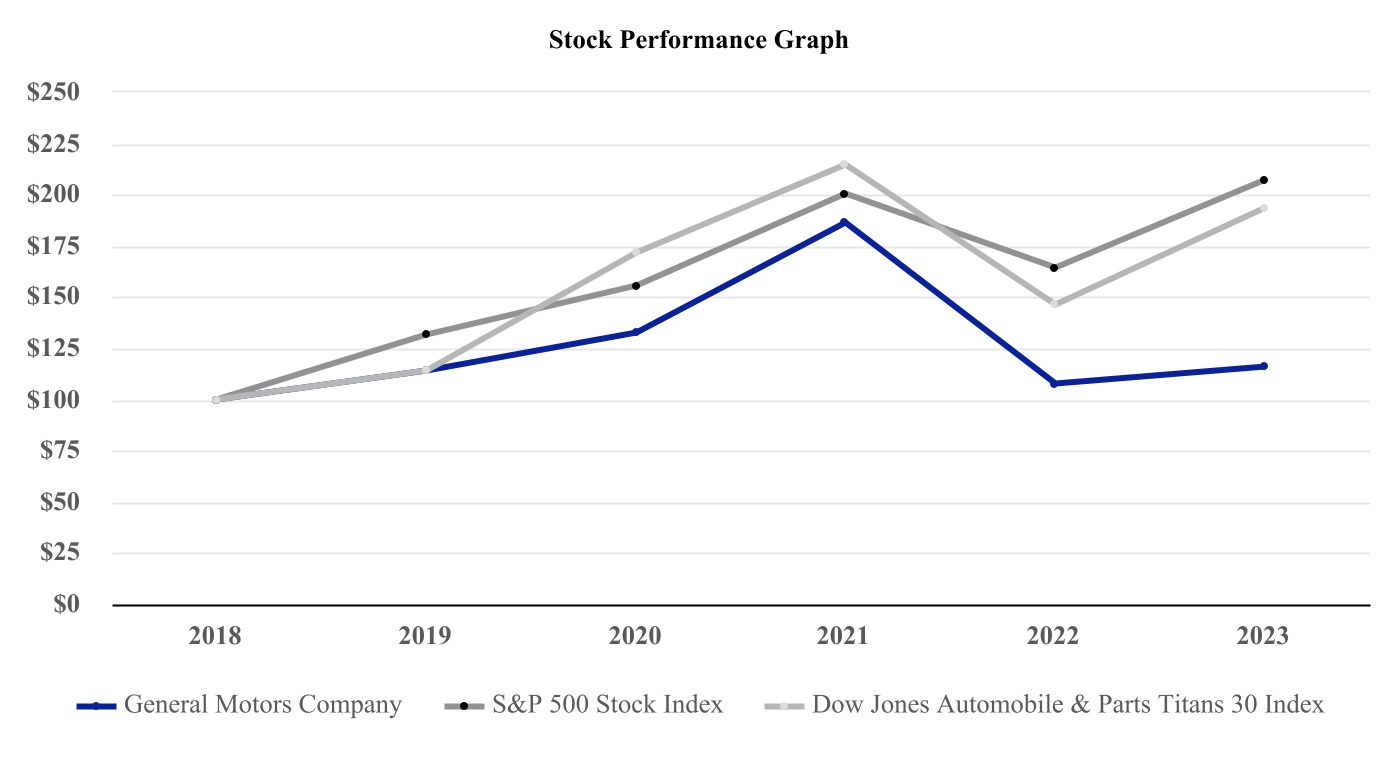
The following table summarizes stock performance graph data points in dollars:
| Years Ended December 31, | |||||||||||||||||||||||||||||||||||
| 2018 | 2019 | 2020 | 2021 | 2022 | 2023 | ||||||||||||||||||||||||||||||
| General Motors Company | $ | 100 | $ | 114 | $ | 132 | $ | 186 | $ | 107 | $ | 116 | |||||||||||||||||||||||
| S&P 500 Stock Index | $ | 100 | $ | 131 | $ | 156 | $ | 200 | $ | 164 | $ | 207 | |||||||||||||||||||||||
| Dow Jones Automobile & Parts Titans 30 Index | $ | 100 | $ | 114 | $ | 172 | $ | 215 | $ | 146 | $ | 194 |
GENERAL MOTORS COMPANY AND SUBSIDIARIES
Purchases of Equity Securities The following table summarizes our purchases of common stock in the three months ended December 31, 2023:
| Total Number of Shares Purchased(a)(b) | Weighted-Average Price Paid per Share(c) | Total Number of Shares Purchased Under Announced Programs(b) | Approximate Dollar Value of Shares That May Yet be Purchased Under Announced Programs(b) | ||||||||||||||||||||
| October 1, 2023 through October 31, 2023 | 25,399 | $ | 32.32 | — | $1.4 billion | ||||||||||||||||||
| November 1, 2023 through November 30, 2023 | — | $ | — | — | $11.4 billion | ||||||||||||||||||
| December 1, 2023 through December 31, 2023 | 215,202,490 | $ | 31.60 | 215,189,872 | $1.4 billion | ||||||||||||||||||
| Total | 215,227,889 | $ | 31.60 | 215,189,872 |
(a) Shares purchased include shares delivered by employees or directors to us for the payment of taxes resulting from issuance of common stock upon the vesting of Restricted Stock Units (RSUs) relating to compensation plans. In June 2020, our shareholders approved the 2020 Long-Term Incentive Plan (LTIP), which authorizes awards of stock options, stock appreciation rights, RSUs, Performance Stock Units (PSUs) or other stock-based awards to selected employees, consultants, advisors and non-employee Directors of the Company. Refer to Note 22 to our consolidated financial statements for additional details on employee stock incentive plans.
(b) In January 2017, we announced that our Board of Directors had authorized the purchase of up to $5.0 billion of our common stock with no expiration date. In August 2022, our Board of Directors increased the capacity to $5.0 billion from the $3.3 billion that remained as of June 30, 2022, with no expiration date. In November 2023, the Board of Directors increased the capacity under the share repurchase program by $10.0 billion to an aggregate of $11.4 billion and approved an accelerated share repurchase (ASR) program to repurchase an aggregate amount of $10.0 billion of our common stock. On December 1, 2023, pursuant to the agreements entered into in connection with the ASR (collectively, the ASR Agreements), we advanced the aggregate amount of $10.0 billion and received approximately 215 million shares of our common stock with a value of $6.8 billion, which were immediately retired. Final settlement of the transactions contemplated by the ASR Agreements is expected to occur no later than the three months ending December 31, 2024. Refer to Note 20 to our consolidated financial statements for additional details on the ASR program.
(c) The weighted-average price paid per share excludes broker commissions.
Item 6. [Reserved]
Item 7. Management’s Discussion and Analysis of Financial Condition and Results of Operations
This MD&A should be read in conjunction with the accompanying audited consolidated financial statements and notes. Forward-looking statements in this MD&A are not guarantees of future performance and may involve risks and uncertainties that could cause actual results to differ materially from those projected. Refer to the "Forward-Looking Statements" section of this MD&A and Part I, Item 1A. Risk Factors for a discussion of these risks and uncertainties. The discussion of our financial condition and results of operations for the year ended December 31, 2021 included in Item 7. Management's Discussion and Analysis of Financial Condition and Results of Operations in our Annual Report on Form 10-K for the year ended December 31, 2022 is incorporated by reference into this MD&A.
Overview Our vision for the future is a world with zero crashes, zero emissions and zero congestion. We will adapt to customer preferences while executing our growth-focused strategy to invest in EVs, hybrids, AVs, software-enabled services and other new business opportunities. To support strong margins and cash flow during this transition, we are strengthening our market position in profitable ICE vehicles, such as trucks and SUVs. We plan to execute our strategy with a steadfast commitment to good corporate citizenship through more sustainable operations and a leading health and safety culture.
Our financial performance in 2023 was driven by the success of high-margin products like full-size pick-ups and SUVs, despite several headwinds, including higher interest rates and inflationary pressures, supply chain and logistics challenges, and work stoppages associated with recent labor negotiations. This performance was due to the strength of our vehicle portfolio, strong consumer demand and execution of our core business strategy, focused on fixed cost reduction and pricing discipline.
In January 2023, we announced our intention to implement a cost reduction program to reduce automotive fixed costs by $2.0 billion on an annual run rate basis by the end of 2024. This goal includes the impact of higher expected depreciation and amortization expense and inflationary cost increases on fixed cost but excludes changes in our pension income. In March 2023,
GENERAL MOTORS COMPANY AND SUBSIDIARIES
we announced performance-based exits and a voluntary separation program (VSP) in an effort to accelerate attrition, which we believe will result in approximately $1.0 billion towards this target on an annual run rate basis. In addition to people costs, we are reducing our marketing and advertising expenses, streamlining our engineering expense by reducing complexity across the vehicle portfolio, adjusting the cadence of our EV launches due to customer demand, reducing launch-related expenses in the near-term, reprioritizing growth initiatives and reducing our overall overhead and discretionary costs.
As we continue to assess our performance and the needs of our evolving business, additional restructuring and rationalization actions could be required. These actions could give rise to future asset impairments or other charges, which may have a material impact on our operating results. Refer to the Consolidated Results and regional sections of this MD&A for additional information.
Our collective bargaining agreement with the UAW, which was ratified in October 2019, expired on September 14, 2023. On September 15, 2023, the UAW initiated a strike at certain of our U.S. facilities and intermittently expanded the strike to additional facilities, causing stoppages to some vehicle production and parts distribution activities across our U.S. operations. We estimate that the lost vehicle production volumes and parts sales due to the UAW strike had an unfavorable impact of approximately $0.8 billion on Net income attributable to stockholders and $1.1 billion on our GMNA EBIT-adjusted in the year ended December 31, 2023.
On November 16, 2023, the UAW ratified a new collective bargaining agreement (the Labor Agreement). The Labor Agreement, which continues through April 30, 2028, covers the wages, hours, benefits and other terms and conditions of employment for our UAW-represented employees. The key terms and provisions of the Labor Agreement are:
-
General wage increases of 11% upon ratification in 2023, 3% in September each of 2024, 2025 and 2026, and 5% in September 2027;
-
Consolidation of applicable wage classifications for in-progression, temporary and other employees – with employees reaching the top classification rate upon the completion of 156 weeks of active service;
-
The re-establishment of a cost-of-living allowance;
-
Lump sum ratification bonus payments of $5,000 paid to eligible employees in the three months ended December 31, 2023;
-
For members currently employed and enrolled in the Employees’ Pension Plan, an increase of $5.00 to the monthly basic benefit for past and future service provided;
-
A 3.6% increase in company contributions to eligible employees' defined contribution retirement accounts; and
-
Annual contribution of $500 to eligible retirees or surviving spouses.
Beginning in 2024 and through the end of the term of the Labor Agreement, GM will offer three separate cash severance incentive programs to UAW-represented employees that meet the normal or early retirement eligibility requirements.
On August 16, 2022, the IRA was enacted. The IRA modified climate and clean energy tax provisions and added new corporate tax credits for commercial EV purchases and investments in clean energy production, supply chains and manufacturing facilities. IRA benefits, including credits and lower material costs, are expected to materially affect net income in the future. We will continue to evaluate the IRA impacts on our financial results as additional regulatory guidance is issued.
We face continuing market, operating and regulatory challenges in several countries across the globe due to, among other factors, competitive pressures, our product portfolio offerings, heightened emission standards, labor disruptions, foreign exchange volatility, evolving trade policy and political uncertainty. Refer to Part I, Item 1A. Risk Factors for a discussion of these challenges.
For the year ending December 31, 2024, we expect EPS-diluted and EPS-diluted-adjusted of between $8.50 and $9.50, Net income attributable to stockholders of between $9.8 billion and $11.2 billion and EBIT-adjusted of between $12.0 billion and $14.0 billion. These expected financial results do not include the potential impact of future adjustments related to special items. Refer to the "Non-GAAP Measures" section of this MD&A for additional information.
GENERAL MOTORS COMPANY AND SUBSIDIARIES
The following table reconciles expected Net income attributable to stockholders under U.S. generally accepted accounting principles (GAAP) to expected EBIT-adjusted (dollars in billions):
| Year Ending December 31, 2024 | |||||
| Net income attributable to stockholders | $ 9.8-11.2 | ||||
| Income tax expense | 2.1-2.7 | ||||
| Automotive interest expense, net | 0.1 | ||||
| EBIT-adjusted(a) | $ 12.0-14.0 |
(a)We do not consider the potential future impact of adjustments on our expected financial results.
GMNA Industry sales in North America were 19.6 million units in the year ended December 31, 2023, representing an increase of 13.1% compared to the corresponding period in 2022. U.S. industry sales were 16.0 million units in the year ended December 31, 2023, representing an increase of 12.2% compared to the corresponding period in 2022.
Our total vehicle sales in the U.S., our largest market in North America, were 2.6 million units for a market share of 16.2
Showing the first 8K of 116K characters. Open the full section
Item 7A. Quantitative and Qualitative Disclosures About Market Risk
The overall financial risk management program is under the responsibility of the Chief Financial Officer with support from the Financial Risk Council, which reviews and, where appropriate, approves strategies to be pursued to mitigate these risks. The Financial Risk Council comprises members of our management and functions under the oversight of the Audit Committee and Finance Committee of the Board of Directors. The Audit Committee and Finance Committee assist and guide the Board of Directors in its oversight of our financial and risk management strategies. A risk management control framework is utilized to monitor the strategies, risks and related hedge positions in accordance with the policies and procedures approved by the Financial Risk Council. Our financial risk management policy is designed to protect against risk arising from extreme adverse market movements on our key exposures.
Automotive The following analyses provide quantitative information regarding exposure to foreign currency exchange rate risk and interest rate risk. Sensitivity analysis is used to measure the potential loss in the fair value of financial instruments with exposure to market risk. The models used assume instantaneous, parallel shifts in exchange rates and interest rate yield curves. For options and other instruments with nonlinear returns, models appropriate to these types of instruments are utilized to determine the effect of market shifts. There are certain shortcomings inherent in the sensitivity analyses presented, primarily due to the assumption that interest rates change in a parallel fashion and that spot exchange rates change instantaneously. In addition, the analyses are unable to reflect the complex market reactions that normally would arise from the market shifts modeled and do not contemplate the effects of correlations between foreign currency exposures and offsetting long-short positions in currency or other exposures, such as interest rates, which may significantly reduce the potential loss in value.
Foreign Currency Exchange Rate Risk We have foreign currency exposures related to buying, selling and financing in currencies other than the functional currencies of our operations. At December 31, 2023, our most significant foreign currency exposures were between the U.S. Dollar and the Canadian Dollar, Korean Won, Chinese Yuan, Mexican Peso and Brazilian Real. Derivative instruments such as foreign currency forwards, swaps and options are primarily used to hedge exposures with respect to forecasted revenues, costs and commitments denominated in foreign currencies. Such contracts had remaining maturities of up to 12 months at December 31, 2023 and were insignificant.
The net fair value liability of financial instruments with exposure to foreign currency risk was $0.4 billion and $0.2 billion at December 31, 2023 and 2022. These amounts are calculated utilizing a population of foreign currency exchange derivatives and foreign currency denominated debt and exclude the offsetting effect of foreign currency cash, cash equivalents and other assets. The potential loss in fair value for such financial instruments from a 10% adverse change in all quoted foreign currency exchange rates would have been insignificant at December 31, 2023 and 2022.
We are exposed to foreign currency risk due to the translation and remeasurement of the results of certain international operations into U.S. Dollars as part of the consolidation process. Fluctuations in foreign currency exchange rates can therefore create volatility in the results of operations and may adversely affect our financial condition.
GENERAL MOTORS COMPANY AND SUBSIDIARIES
The following table summarizes the amounts of automotive foreign currency translation, transaction and remeasurement (gains) losses:
| Years Ended December 31, | |||||||||||
| 2023 | 2022 | ||||||||||
| Translation (gains) losses recorded in Accumulated other comprehensive loss | $ | (169) | $ | (37) | |||||||
| Transaction and remeasurement (gains) losses recorded in earnings | $ | 344 | $ | 173 |
Interest Rate Risk We are subject to market risk from exposure to changes in interest rates related to certain financial instruments, primarily debt, finance lease obligations and certain marketable debt securities. At December 31, 2023, interest rate swap positions were used to manage interest rate exposures in our automotive operations and were insignificant. The fair value of debt and finance leases was $16.5 billion and $16.8 billion at December 31, 2023 and 2022. The potential increase in fair value resulting from a 10% decrease in quoted interest rates would have been $0.7 billion and $0.8 billion at December 31, 2023 and 2022.
We had marketable debt securities, including those held by Cruise, of $7.6 billion and $12.2 billion classified as available-for-sale at December 31, 2023 and 2022. The potential decrease in fair value from a 50 basis point increase in interest rates would have been insignificant at December 31, 2023 and 2022.
Automotive Financing - GM Financial
Interest Rate Risk Fluctuations in market interest rates can affect GM Financial's gross interest rate spread, which is the difference between interest earned on finance receivables and interest paid on debt. GM Financial is exposed to interest rate risks as financial assets and liabilities have different characteristics that may impact financial performance. These differences may include tenor, yield, repricing timing and prepayment expectations. Typically, retail finance receivables and leases purchased by GM Financial earn fixed interest and commercial finance receivables originated by GM Financial earn variable interest. GM Financial funds its business with variable or fixed rate debt. The variable rate debt is subject to adjustments to reflect prevailing market interest rates. To help mitigate interest rate risk or mismatched funding, GM Financial may employ hedging.
Quantitative Disclosure GM Financial measures the sensitivity of its net interest income to changes in interest rates by using interest rate scenarios that assume a hypothetical, instantaneous parallel shift of one hundred basis points in all interest rates across all maturities, as well as a base case that assumes that rates perform at the current market forward curve. However, interest rate changes are rarely instantaneous or parallel and rates could move more or less than the one percentage point assumed in GM Financial's analysis. Therefore, the actual impact to net interest income could be higher or lower than the results detailed in the table below. These interest rate scenarios are purely hypothetical and do not represent GM Financial's view of future interest rate movements.
At December 31, 2023 and 2022, GM Financial was liability-sensitive, meaning that more liabilities than assets were expected to reprice within the next 12 months. During a period of rising interest rates, the interest paid on liabilities would increase more than the interest earned on assets, which would initially decrease net interest income. During a period of falling interest rates, net interest income would be expected to initially increase. GM Financial's hedging strategies approved by its Global Asset Liability Committee are used to manage interest rate risk within policy guidelines.
The following table presents GM Financial's net interest income sensitivity to interest rate movement:
| Years Ended December 31, | |||||||||||
| 2023 | 2022 | ||||||||||
| One hundred basis points instantaneous increase in interest rates | $ | (7.7) | $ | (4.3) | |||||||
| One hundred basis points instantaneous decrease in interest rates(a) | $ | 7.7 | $ | 4.3 |
(a) Net interest income sensitivity given a one hundred basis point decrease in interest rates requires an assumption of negative interest rates in markets where existing interest rates are below one percent.
Additional Model Assumptions The sensitivity analysis presented is GM Financial's best estimate of the effect of the hypothetical interest rate scenarios; however, actual results could differ. The estimates are also based on assumptions including
GENERAL MOTORS COMPANY AND SUBSIDIARIES
the amortization and prepayment of the finance receivable portfolio, originations of finance receivables and leases, refinancing of maturing debt, replacement of maturing derivatives and exercise of options embedded in debt and derivatives. The prepayment projections are based on historical experience. If interest rates or other factors change, actual prepayment experience could be different than projected.
Foreign Currency Exchange Rate Risk GM Financial is exposed to foreign currency risk due to the translation and remeasurement of the results of certain international operations into U.S. Dollars as part of the consolidation process. Fluctuations in foreign currency exchange rates can therefore create volatility in the results of operations and may adversely affect GM Financial's financial condition.
GM Financial primarily finances its receivables and leased assets with debt in the same currency. When a different currency is used, GM Financial may use foreign currency swaps to convert substantially all of its foreign currency debt obligations to the local currency of the receivables and leased assets to minimize any impact to earnings. As a result, GM Financial believes its market risk exposure relating to changes in currency exchange rates at December 31, 2023 was insignificant.
GM Financial had foreign currency swaps with notional amounts of $8.0 billion and $6.9 billion at December 31, 2023 and 2022. The net fair value of these derivative financial instruments was a liability of $0.2 billion and $0.6 billion at December 31, 2023 and 2022.
The following table summarizes GM Financial's foreign currency translation, transaction and remeasurement (gains) losses:
| Years Ended December 31, | |||||||||||
| 2023 | 2022 | ||||||||||
| Translation (gains) losses recorded in Accumulated other comprehensive loss | $ | (147) | $ | 156 | |||||||
| Transaction and remeasurement (gains) losses recorded in earnings | $ | 5 | $ | (1) |
REPORT OF INDEPENDENT REGISTERED PUBLIC ACCOUNTING FIRM
To the Shareholders and the Board of Directors of General Motors Company
Opinion on the Financial Statements
We have audited the accompanying consolidated balance sheets of General Motors Company and subsidiaries (the Company) as of December 31, 2023 and 2022, the related consolidated income statements and consolidated statements of comprehensive income, cash flows and equity for each of the three years in the period ended December 31, 2023, and the related notes (collectively referred to as the “financial statements”). In our opinion, the financial statements present fairly, in all material respects, the financial position of the Company at December 31, 2023 and 2022, and the results of its operations and its cash flows for each of the three years in the period ended December 31, 2023, in conformity with U.S. generally accepted accounting principles.
We also have audited, in accordance with the standards of the Public Company Accounting Oversight Board (United States) (PCAOB), the Company's internal control over financial reporting as of December 31, 2023, based on criteria established in Internal Control-Integrated Framework issued by the Committee of Sponsoring Organizations of the Treadway Commission (2013 framework) and our report dated January 30, 2024 expressed an unqualified opinion thereon.
Basis for Opinion
These financial statements are the responsibility of the Company's management. Our responsibility is to express an opinion on the Company’s financial statements based on our audits. We are a public accounting firm registered with the PCAOB and are required to be independent with respect to the Company in accordance with the U.S. federal securities laws and the applicable rules and regulations of the Securities and Exchange Commission and the PCAOB.
We conducted our audits in accordance with the standards of the PCAOB. Those standards require that we plan and perform the audit to obtain reasonable assurance about whether the financial statements are free of material misstatement, whether due to error or fraud. Our audits included performing procedures to assess the risks of material misstatement of the financial statements, whether due to error or fraud, and performing procedures that respond to those risks. Such procedures included examining, on a test basis, evidence regarding the amounts and disclosures in the financial statements. Our audits also included evaluating the accounting principles used and significant estimates made by management, as well as evaluating the overall presentation of the financial statements. We believe that our audits provide a reasonable basis for our opinion.
Critical Audit Matters
The critical audit matters communicated below are matters arising from the current period audit of the financial statements that were communicated or required to be communicated to the audit committee and that: (1) relate to accounts or disclosures that are material to the financial statements and (2) involved our especially challenging, subjective or complex judgments. The communication of critical audit matters does not alter in any way our opinion on the financial statements, taken as a whole, and we are not, by communicating the critical audit matters below, providing separate opinions on the critical audit matters or on the accounts or disclosures to which they relate.
| Product warranty and recall campaigns | |||||
| Description of the matter | As discussed in Note 12 to the financial statements, the liabilities for product warranty and recall campaigns amount to $9.3 billion at December 31, 2023. The Company accrues for costs related to product warranty at the time of vehicle sale and accrues the estimated cost of recall campaigns when they are probable and estimable. | ||||
| Auditing these liabilities involved a high degree of subjectivity in evaluating management’s estimates due to the size, uncertainties, and potential volatility related to the estimated liabilities. Management’s estimates consider historical claims experience, including the nature, frequency, and average cost of claims of each vehicle line or each model year of the vehicle line, and the key assumptions of historical data being predictive of future activity and events, specifically the number of historical periods used and the weighting of historical data in the reserve studies. |
| How we addressed the matter in our audit | We evaluated the design and tested the operating effectiveness of internal controls over the Company’s product warranty and recall campaign processes. We tested internal controls over management’s review of the valuation models and significant assumptions for product warranty and recall, including the warranty claims forecasted based on the frequency and average cost per warranty claim for product warranty, and the cost estimates related to recall campaigns. Our audit also included the evaluation of controls that address the completeness and accuracy of the data utilized in the valuation models. | ||||
| Our audit procedures related to product warranty and recall campaigns also included, among others, evaluating the Company’s estimation methodology, the related significant assumptions and underlying data, and performing analytical procedures to corroborate cost per vehicle based on historical claims data. Furthermore, we performed sensitivity analyses to evaluate the significant judgments made by management, including cost estimates to evaluate the impact on reserves from changes in assumptions. We performed analysis over the vehicle lines and model years that had little or no claims experience to ensure the vehicle and model substitutions are comparable. We also involved actuarial specialists to evaluate the methodologies and assumptions, and to test the actuarial calculations used by the Company. | |||||
| Sales incentives | |||||
| Description of the matter | Automotive sales and revenue represents the amount of consideration to which the Company expects to be entitled in exchange for transferring goods or providing services, which is net of dealer and customer sales incentives the Company expects to pay. As discussed in Note 2 to the financial statements, provisions for dealer and customer incentives are recorded as a reduction to Automotive net sales and revenue at the time of vehicle sale. The liabilities for dealer and customer allowances, claims and discounts amount to $6.1 billion at December 31, 2023. | ||||
| Auditing the estimate of sales incentives involved a high degree of judgment. Significant factors used by the Company in estimating its liability for retail incentives include type of program, forecasted sales volumes, product mix, and the rate of customer acceptance of incentive programs, all of which are estimated based on historical experience and assumptions concerning future customer behavior and market conditions. The Company’s estimation model reflects the best estimate of the total incentive amount that the Company reasonably expects to pay at the time of sale. The estimated cost of incentives is forward-looking, and could be materially affected by future economic and market conditions. | |||||
| How we addressed the matter in our audit | We evaluated the design and tested the operating effectiveness of internal controls over the Company’s sales incentive process, including management’s review of the estimation model, the significant assumptions (e.g., incentive cost per unit, customer take rate, and market conditions), and the data inputs used in the model. Our audit procedures included, among others, the performance of analytical procedures to develop an independent range of the liability for retail incentives as of the balance sheet date. Our independent range was developed for comparison to the Company’s recorded liability, and is based on historical claims, forecasted spend, and the specific vehicle mix of current dealer stock. In addition, we performed sensitivity analyses over the cost per unit assumption developed by management to evaluate the impact on the liability resulting from a change in the assumption. Lastly, we assessed management’s forecasting process by performing quarterly hindsight analyses to assess the adequacy of prior forecasts. | ||||
| Valuation of GM Financial equipment on operating leases | |||||
| Description of the matter | GM Financial has recorded investments in vehicles leased to retail customers under operating leases. As discussed in Note 2 to the financial statements, at the beginning of the lease, management establishes an expected residual value for each vehicle at the end of the lease term. The Company’s estimated residual value of leased vehicles at the end of lease term was $22.7 billion as of December 31, 2023. |
| Auditing management’s estimate of the residual value of leased vehicles involved a high degree of judgment. Management’s estimate is based, in part, on third-party data which considers inputs including recent auction values and significant assumptions regarding the expected future volume of leased vehicles that will be returned to the Company, used car prices, manufacturer incentive programs and fuel prices. Realization of the residual values is dependent on the future ability to market the vehicles under future prevailing market conditions. | |||||
| How we addressed the matter in our audit | We evaluated the design and tested the operating effectiveness of the Company’s controls over the lease residual estimation process, including controls over management’s review of residual value estimates obtained from the Company’s third-party provider and other significant assumptions. Our procedures also included, among others, independently recalculating depreciation related to equipment on operating leases and performing sensitivity analyses related to significant assumptions. We also performed hindsight analyses to assess the propriety of management’s estimate of residual values, as well as tested the completeness and accuracy of data from underlying systems and data warehouses that are used in the estimation models. |
| /s/ Ernst & Young LLP | ||
| We have served as the Company's auditor since 2017. | ||
| Detroit, Michigan | ||
| January 30, 2024 |
REPORT OF INDEPENDENT REGISTERED PUBLIC ACCOUNTING FIRM
To the Shareholders and the Board of Directors of General Motors Company
Opinion on Internal Control Over Financial Reporting
We have audited General Motors Company and subsidiaries’ internal control over financial reporting as of December 31, 2023, based on criteria established in Internal Control-Integrated Framework issued by the Committee of Sponsoring Organizations of the Treadway Commission (2013 framework) (the COSO criteria). In our opinion, General Motors Company and subsidiaries (the Company) maintained, in all material respects, effective internal control over financial reporting as of December 31, 2023, based on the COSO criteria.
We also have audited, in accordance with the standards of the Public Company Accounting Oversight Board (United States) (PCAOB), the consolidated balance sheets of the Company as of December 31, 2023 and 2022, the related consolidated income statements and consolidated statements of comprehensive income, cash flows and equity for each of the three years in the period ended December 31, 2023, and the related notes and our report dated January 30, 2024 expressed an unqualified opinion thereon.
Basis for Opinion
The Company’s management is responsible for maintaining effective internal control over financial reporting and for its assessment of the effectiveness of internal control over financial reporting included in the accompanying Management’s Report on Internal Control over Financial Reporting. Our responsibility is to express an opinion on the Company’s internal control over financial reporting based on our audit. We are a public accounting firm registered with the PCAOB and are required to be independent with respect to the Company in accordance with the U.S. federal securities laws and the applicable rules and regulations of the Securities and Exchange Commission and the PCAOB.
We conducted our audit in accordance with the standards of the PCAOB. Those standards require that we plan and perform the audit to obtain reasonable assurance about whether effective internal control over financial reporting was maintained in all material respects.
Our audit included obtaining an understanding of internal control over financial reporting, assessing the risk that a material weakness exists, testing and evaluating the design and operating effectiveness of internal control based on the assessed risk, and performing such other procedures as we considered necessary in the circumstances. We believe that our audit provides a reasonable basis for our opinion.
Definition and Limitations of Internal Control Over Financial Reporting
A company’s internal control over financial reporting is a process designed to provide reasonable assurance regarding the reliability of financial reporting and the preparation of financial statements for external purposes in accordance with generally accepted accounting principles. A company’s internal control over financial reporting includes those policies and procedures that (1) pertain to the maintenance of records that, in reasonable detail, accurately and fairly reflect the transactions and dispositions of the assets of the company; (2) provide reasonable assurance that transactions are recorded as necessary to permit preparation of financial statements in accordance with generally accepted accounting principles, and that receipts and expenditures of the company are being made only in accordance with authorizations of management and directors of the company; and (3) provide reasonable assurance regarding prevention or timely detection of unauthorized acquisition, use, or disposition of the company’s assets that could have a material effect on the financial statements.
Because of its inherent limitations, internal control over financial reporting may not prevent or detect misstatements. Also, projections of any evaluation of effectiveness to future periods are subject to the risk that controls may become inadequate because of changes in conditions, or that the degree of compliance with the policies or procedures may deteriorate.
| /s/ Ernst & Young LLP | ||
| Detroit, Michigan | ||
| January 30, 2024 |
GENERAL MOTORS COMPANY AND SUBSIDIARIES
Item 8. Financial Statements and Supplementary Data
CONSOLIDATED INCOME STATEMENTS
(In millions, except per share amounts)
| Years Ended December 31, | |||||||||||||||||||||||
| 2023 | 2022 | 2021 | |||||||||||||||||||||
| Net sales and revenue | |||||||||||||||||||||||
| Automotive | $ | 157,658 | $ | 143,975 | $ | 113,590 | |||||||||||||||||
| GM Financial | 14,184 | 12,760 | 13,414 | ||||||||||||||||||||
| Total net sales and revenue (Note 3) | 171,842 | 156,735 | 127,004 | ||||||||||||||||||||
| Costs and expenses | |||||||||||||||||||||||
| Automotive and other cost of sales | 141,330 | 126,892 | 100,544 | ||||||||||||||||||||
| GM Financial interest, operating and other expenses | 11,374 | 8,862 | 8,582 | ||||||||||||||||||||
| Automotive and other selling, general and administrative expense | 9,840 | 10,667 | 8,554 | ||||||||||||||||||||
| Total costs and expenses | 162,544 | 146,421 | 117,680 | ||||||||||||||||||||
| Operating income (loss) | 9,298 | 10,315 | 9,324 | ||||||||||||||||||||
| Automotive interest expense | 911 | 987 | 950 | ||||||||||||||||||||
| Interest income and other non-operating income, net (Note 19) | 1,537 | 1,432 | 3,041 | ||||||||||||||||||||
| Equity income (loss) (Note 8) | 480 | 837 | 1,301 | ||||||||||||||||||||
| Income (loss) before income taxes | 10,403 | 11,597 | 12,716 | ||||||||||||||||||||
| Income tax expense (benefit) (Note 17) | 563 | 1,888 | 2,771 | ||||||||||||||||||||
| Net income (loss) | 9,840 | 9,708 | 9,945 | ||||||||||||||||||||
| Net loss (income) attributable to noncontrolling interests | 287 | 226 | 74 | ||||||||||||||||||||
| Net income (loss) attributable to stockholders | $ | 10,127 | $ | 9,934 | $ | 10,019 | |||||||||||||||||
| Net income (loss) attributable to common stockholders | $ | 10,022 | $ | 8,915 | $ | 9,837 | |||||||||||||||||
| Earnings per share (Note 21) | |||||||||||||||||||||||
| Basic earnings per common share | $ | 7.35 | $ | 6.17 | $ | 6.78 | |||||||||||||||||
| Weighted-average common shares outstanding – basic | 1,364 | 1,445 | 1,451 | ||||||||||||||||||||
| Diluted earnings per common share | $ | 7.32 | $ | 6.13 | $ | 6.70 | |||||||||||||||||
| Weighted-average common shares outstanding – diluted | 1,369 | 1,454 | 1,468 | ||||||||||||||||||||
CONSOLIDATED STATEMENTS OF COMPREHENSIVE INCOME
(In millions)
| Years Ended December 31, | |||||||||||||||||
| 2023 | 2022 | 2021 | |||||||||||||||
| Net income (loss) | $ | 9,840 | $ | 9,708 | $ | 9,945 | |||||||||||
| Other comprehensive income (loss), net of tax (Note 20) | |||||||||||||||||
| Foreign currency translation adjustments and other | 458 | (340) | 80 | ||||||||||||||
| Defined benefit plans | (2,814) | 1,677 | 4,126 | ||||||||||||||
| Other comprehensive income (loss), net of tax | (2,355) | 1,337 | 4,206 | ||||||||||||||
| Comprehensive income (loss) | 7,485 | 11,045 | 14,151 | ||||||||||||||
| Comprehensive loss (income) attributable to noncontrolling interests | 297 | 257 | 87 | ||||||||||||||
| Comprehensive income attributable to stockholders (loss) | $ | 7,781 | $ | 11,303 | $ | 14,238 |
Reference should be made to the notes to consolidated financial statements.
Amounts may not add due to rounding.
GENERAL MOTORS COMPANY AND SUBSIDIARIES
CONSOLIDATED BALANCE SHEETS
(In millions, except per share amounts)
| December 31, 2023 | December 31, 2022 | ||||||||||
| ASSETS | |||||||||||
| Current Assets | |||||||||||
| Cash and cash equivalents | $ | 18,853 | $ | 19,153 | |||||||
| Marketable debt securities (Note 4) | 7,613 | 12,150 | |||||||||
| Accounts and notes receivable, net of allowance of $298 and $260 | 12,378 | 13,333 | |||||||||
| GM Financial receivables, net of allowance of $906 and $869 (Note 5; Note 11 at VIEs) | 39,076 | 33,623 | |||||||||
| Inventories (Note 6) | 16,461 | 15,366 | |||||||||
| Other current assets (Note 4; Note 11 at VIEs) | 7,238 | 6,825 | |||||||||
| Total current assets | 101,618 | 100,451 | |||||||||
| Non-current Assets | |||||||||||
| GM Financial receivables, net of allowance of $1,438 and $1,227 (Note 5; Note 11 at VIEs) | 45,043 | 40,591 | |||||||||
| Equity in net assets of nonconsolidated affiliates (Note 8) | 10,613 | 10,176 | |||||||||
| Property, net (Note 9) | 50,321 | 45,248 | |||||||||
| Goodwill and intangible assets, net (Note 10) | 4,862 | 4,945 | |||||||||
| Equipment on operating leases, net (Note 7; Note 11 at VIEs) | 30,582 | 32,701 | |||||||||
| Deferred income taxes (Note 17) | 22,339 | 20,539 | |||||||||
| Other assets (Note 4; Note 11 at VIEs) | 7,686 | 9,386 | |||||||||
| Total non-current assets | 171,446 | 163,586 | |||||||||
| Total Assets | $ | 273,064 | $ | 264,037 | |||||||
| LIABILITIES AND EQUITY | |||||||||||
| Current Liabilities | |||||||||||
| Acco |
Showing the first 8K of 256K characters. Open the full section
Item 9. Changes in and Disagreements with Accountants on Accounting and Financial Disclosure
None.
Item 9A. Controls and Procedures
Disclosure Controls and Procedures We maintain disclosure controls and procedures designed to provide reasonable assurance that information required to be disclosed in reports filed under the Exchange Act is recorded, processed, summarized and reported within the specified time periods and accumulated and communicated to our management, including our principal executive officer and principal financial officer, as appropriate, to allow timely decisions regarding required disclosures.
Our management, with the participation of our CEO and CFO, evaluated the effectiveness of our disclosure controls and procedures (as defined in Rules 13a-15(e) or 15d-15(e) promulgated under the Exchange Act) as of December 31, 2023 as required by paragraph (b) of Rules 13a-15 or 15d-15. Based on this evaluation, our CEO and CFO concluded that our disclosure controls and procedures were effective as of December 31, 2023.
Management's Report on Internal Control over Financial Reporting Our management is responsible for establishing and maintaining effective internal control over financial reporting as defined in Rules 13a-15(f) and 15d-15(f) under the Exchange Act. This system is designed to provide reasonable assurance regarding the reliability of financial reporting and the preparation of consolidated financial statements for external purposes in accordance with U.S. GAAP. Because of the inherent limitations of internal control over financial reporting, including the possibility of collusion or improper management override of controls, misstatements due to error or fraud may not be prevented or detected on a timely basis.
Our management performed an assessment of the effectiveness of our internal control over financial reporting at December 31, 2023, utilizing the criteria discussed in the “Internal Control – Integrated Framework (2013)” issued by the Committee of Sponsoring Organizations of the Treadway Commission. The objective of this assessment was to determine whether our internal control over financial reporting was effective as of December 31, 2023. Based on management's assessment, we have concluded that our internal control over financial reporting was effective as of December 31, 2023.
The effectiveness of our internal control over financial reporting has been audited by Ernst & Young LLP (PCAOB ID: 42), an independent registered public accounting firm, as stated in its report included herein.
Changes in Internal Control over Financial Reporting There have not been any changes in our internal control over financial reporting during the three months ended December 31, 2023 that have materially affected, or are reasonably likely to materially affect, our internal control over financial reporting.
GENERAL MOTORS COMPANY AND SUBSIDIARIES
Item 9B. Other Information
None.
Item 9C. Disclosure Regarding Foreign Jurisdictions that Prevent Inspections
Not applicable.
PART III
Items 10, 11, 12, 13 and 14
Information required by Items 10, 11, 12, 13 and 14 of this Form 10-K is incorporated by reference from our definitive Proxy Statement for our 2024 Annual Meeting of Stockholders, which will be filed with the SEC, pursuant to Regulation 14A, not later than 120 days after the end of the 2023 fiscal year, all of which information is hereby incorporated by reference in, and made part of, this Form 10-K, except disclosure of our executive officers, which is included in Part I, Item 1 of this report.
GENERAL MOTORS COMPANY AND SUBSIDIARIES
PART IV
Item 15. Exhibit and Financial Statement Schedules
(a)1. All Financial Statements and Supplemental Information
- Financial Statement Schedules
All financial statement schedules are omitted as the required information is inapplicable or the information is presented in the consolidated financial statements and notes thereto in Item 8.
- Exhibits
(b)Exhibits
GENERAL MOTORS COMPANY AND SUBSIDIARIES
GENERAL MOTORS COMPANY AND SUBSIDIARIES
| † | Portions of this exhibit have been omitted pursuant to Rule 601(b)(10) of Regulation S-K. The omitted information is not material and would likely cause competitive harm to the registrant if publicly disclosed. | ||||
| * | Management contracts and compensatory plans and arrangements required to be filed as exhibits pursuant to Item 15(b) of this Report. |
Item 16. Form 10-K Summary
None.
GENERAL MOTORS COMPANY AND SUBSIDIARIES
SIGNATURES
Pursuant to the requirements of Section 13 or 15(d) of the Securities Exchange Act of 1934, the registrant has duly caused this report to be signed on its behalf by the undersigned, thereunto duly authorized.
| GENERAL MOTORS COMPANY (Registrant) | ||||||||||||||
| By: | /s/ MARY T. BARRA | |||||||||||||
| Mary T. Barra Chair and Chief Executive Officer | ||||||||||||||
| Date: | January 30, 2024 |
GENERAL MOTORS COMPANY AND SUBSIDIARIES
Pursuant to the requirements of the Securities Exchange Act of 1934, this report has been signed below on this 30th day of January 2024 by the following persons on behalf of the registrant and in the capacities indicated, including a majority of the directors.
| Signature | Title | |||||||
| /s/ MARY T. BARRA | Chair and Chief Executive Officer | |||||||
| Mary T. Barra | ||||||||
| /s/ PAUL A. JACOBSON | Executive Vice President and Chief Financial Officer | |||||||
| Paul A. Jacobson | ||||||||
| /s/ CHRISTOPHER T. HATTO | Vice President, Global Business Solutions and Chief | |||||||
| Christopher T. Hatto | Accounting Officer | |||||||
| /s/ PATRICIA F. RUSSO* | Independent Lead Director | |||||||
| Patricia F. Russo | ||||||||
| /s/ ANEEL BHUSRI* | Director | |||||||
| Aneel Bhusri | ||||||||
| /s/ WESLEY G. BUSH* | Director | |||||||
| Wesley G. Bush | ||||||||
| /s/ JOANNE C. CREVOISERAT* | Director | |||||||
| Joanne C. Crevoiserat | ||||||||
| /s/ LINDA R. GOODEN* | Director | |||||||
| Linda R. Gooden | ||||||||
| /s/ JOSEPH JIMENEZ* | Director | |||||||
| Joseph Jimenez | ||||||||
| /s/ JONATHAN MCNEILL* | Director | |||||||
| Jonathan McNeill | ||||||||
| /s/ JUDITH A. MISCIK* | Director | |||||||
| Judith A. Miscik | ||||||||
| /s/ THOMAS M. SCHOEWE* | Director | |||||||
| Thomas M. Schoewe | ||||||||
| /s/ MARK A. TATUM* | Director | |||||||
| Mark A. Tatum | ||||||||
| /s/ JAN E. TIGHE* | Director | |||||||
| Jan E. Tighe | ||||||||
| /s/ DEVIN N. WENIG* | Director | |||||||
| Devin N. Wenig |
| *By: | /s/ CRAIG B. GLIDDEN | |||||||
| Craig B. Glidden | ||||||||
| Attorney-in-Fact |