 filings.tools
Item 1. BUSINESS
38K characters. Original on sec.gov · Markdown
Item 1. BUSINESS
Introduction
We are a leading worldwide provider of payment technology and software solutions delivering innovative services to our customers globally. Our technologies, services and employee expertise enable us to provide a broad range of solutions that allow our customers to accept various payment types and operate their businesses more efficiently. We distribute our services across a variety of channels to customers in 30 countries throughout North America, Europe, the Asia-Pacific region and Brazil and operate in three reportable segments: North America, Europe and Asia-Pacific.
We were incorporated in Georgia as Global Payments Inc. in 2000 and spun-off from our former parent company in 2001. Including our time as part of our former parent company, we have been in the payment technology services business since 1967. Since our spin-off, we have grown our annual revenues from $353 million for the year ended May 31, 2001 to $4.0 billion for the year ended December 31, 2017, through internal expansion of existing operations and through acquisitions.
Headquartered in Atlanta, Georgia, we are a member of the Standard & Poor's 500 Index, and our common stock is traded on the New York Stock Exchange under the symbol "GPN."
Recent Developments
On September 1, 2017, we acquired ACTIVE Network for total purchase consideration of $1.2 billion, consisting of approximately $600 million in cash and 6.4 million shares of our common stock. ACTIVE Network delivers cloud-based enterprise software, including payment technology solutions, to event organizers in the communities and health and fitness vertical markets. This acquisition aligns with our technology-enabled, software driven strategy and adds an enterprise software business operating in two additional vertical markets that we believe offer attractive growth fundamentals. On April 22, 2016, we merged with Heartland Payment Systems, Inc. ("Heartland") in a cash-and-stock transaction for total purchase consideration of $3.9 billion. The merger significantly expanded our small and medium-sized enterprise distribution, merchant base and vertical reach in the United States. See "Note 2—Acquisitions" in the notes to the accompanying consolidated financial statements for further discussion of these and other acquisitions.
On May 2, 2017, we amended our existing corporate credit facility (the "Credit Facility") to increase the total financing capacity available under the Credit Facility to $5.2 billion. As of December 31, 2017, the Credit Facility provided for secured financing compromised of (i) a $1.5 billion term loan (the "Term A Loan"), (ii) a $1.3 billion term loan (the "Term A-2 Loan"), (iii) a $1.2 billion term loan facility (the "Term B-2 Loan") and (iv) a $1.25 billion revolving credit facility (the "Revolving Credit Facility"). See "Management's Discussion and Analysis - Liquidity and Capital Resources - Long-Term Debt and Lines of Credit" below for further discussion of our credit facilities.
Payment Technology Services and Software Solutions Overview
We provide payment technology and software solutions to customers globally. Our payment solutions are similar around the world in that we enable our customers to accept card, electronic, check and digital-based payments. Our comprehensive offerings include, but are not limited to, authorization services, settlement and funding services, customer support and help-desk functions, chargeback resolution, terminal rental, sales and deployment, payment security services, consolidated billing and statements and on-line reporting.
In addition, we offer a wide array of enterprise software solutions that streamline business operations to customers in numerous vertical markets. We also provide a variety of value-added services, including analytic and engagement tools, payroll services and reporting that assist our customers with driving demand and operating their businesses more efficiently.
Our value proposition is to provide distinctive high-quality, responsive and secure services to all of our customers. We distribute our services through multiple channels and target customers in many vertical markets in 30 countries located throughout North America, Europe, the Asia-Pacific region and in Brazil. The majority of revenues is generated by services priced as a percentage of transaction value or a specified fee per transaction, depending on the card type or the market. We also earn software licensing and subscription fees and other fees based on specific value-added services that may be unrelated to the number or value of transactions.
Direct Distribution
Our primary business model is to actively market and provide our payment services, enterprise software solutions and other value-added services directly to our customers through a variety of distribution channels. We offer high touch services that provide our customers with reliable and secure solutions coupled with high quality and responsive support services. Through our direct sales force worldwide, as well as bank partnerships, we offer our payment technology services, software and other value-added solutions directly to customers in the markets we serve. See "Business Segments" below for a description of our direct sales forces located around the world.
Many of our payment solutions are technology-enabled in that they incorporate or are incorporated into innovative, technology-driven solutions, including enterprise software solutions, designed to enable merchants to better manage their businesses. Our primary technology-enabled solutions include integrated and vertical markets, ecommerce and omnichannel and gaming solutions, each as described below.
Integrated and Vertical Markets. Our integrated and vertical market solutions provide advanced payments technology that is deeply integrated into business enterprise software solutions either owned by us or by our partners. We grow our business when new merchants implement our enterprise software solutions and when new or existing merchants enable payments services through enterprise software solutions sold by us or by our partners. We distribute our integrated payment solutions primarily through the following businesses:
| • | OpenEdge. Through OpenEdge, we offer integrated payment solutions through more than 2,000 technology partners across over 60 different verticals primarily in North America. OpenEdge enables third-party application developers to incorporate payment innovations into their enterprise business solutions. |
| • | Ezidebit. Through Ezi Holdings Pty Ltd ("Ezidebit"), we offer integrated payment solutions in the Asia-Pacific region. Ezidebit focuses on recurring payments verticals and, similar to OpenEdge, markets its services through a network of integrated software vendors and direct channels to numerous vertical markets. |
| • | ACTIVE Network. Through ACTIVE Network, we deliver cloud-based enterprise software, including payment technology solutions, to event organizers in the communities and health and fitness markets. |
| • | Education Solutions. We offer integrated payment solutions specifically designed for all levels of educational institutions. At the university level, we offer integrated commerce solutions, payment services, higher education loan services and open- and closed-loop payment solutions. For kindergarten through 12th grade, we provide ecommerce and in-person payments, cafeteria POS solutions and back-office management software, hardware, technical support and training. |
| • | Point-of-Sale Solutions. We offer leading-edge POS software solutions, integrated with our payment services and other adjacent business service applications, which may be on-premise or cloud-based, targeted primarily at the hospitality and retail verticals. |
Ecommerce and Omnichannel. We offer ecommerce and omnichannel solutions to our customers that seamlessly blend payment gateway services, retail payment acceptance infrastructure and payment technology service capabilities to allow merchants to accept various payment methods through any channel across our geographical footprint. We sell ecommerce and omnichannel solutions to customers of all sizes, from small businesses accepting payments in a single country, to enterprise and multinational businesses that have complex payment needs and operate retail and online businesses in multiple countries.
Gaming. We offer a comprehensive suite of cash access solutions to the gaming market in North America. These solutions include credit and debit card cash advance, traditional and electronic check processing and other services specific to this market. Our services allow casino patrons in North America fast access to cash with high limits to enable gaming establishments to increase the flow of money to their gaming floors and reduce risk.
Wholesale Distribution
Although our primary business model is to build high quality direct relationships with merchants, we also provide our services through a wholesale distribution channel where we do not maintain the face-to-face relationship with the merchant. Through our wholesale channel, we provide payment services to merchants through independent sales organizations ("ISOs"). The ISOs act as third-party sales groups selling our payment technology services directly to end-user merchant customers.
Credit and Debit Card Transaction Processing
Credit and debit card transaction processing includes the processing of the world's major international card brands, including American Express, Discover Card ("Discover"), JCB, MasterCard, UnionPay International ("UPI"), Visa and non-traditional payment methods, as well as certain domestic debit networks, such as Interac in Canada. Credit and debit networks establish uniform regulations that govern much of the payment card industry. During a typical payment transaction, the merchant and the card issuer do not interface directly with each other, but instead rely on payments technology companies, such as Global Payments, to facilitate transaction processing services, including authorization, electronic draft capture, file transfers to facilitate funds settlement and certain exception-based, back office support services such as chargeback and retrieval resolution.
We process funds settlement under two models, a sponsorship model and a direct membership model. Under the sponsorship model, we are designated as a Merchant Service Provider by MasterCard and as an ISO by Visa. To be designated as a certified processor, member clearing financial institutions ("Member") sponsor us and require our adherence to the standards of the networks. In certain markets, we have sponsorship or depository and clearing agreements with financial institution sponsors. These agreements allow us to route transactions under the Members' control and identification numbers to clear card transactions through MasterCard and Visa. In this model, the standards of the card networks restrict us from performing funds settlement or accessing merchant settlement funds, and, instead, require that these funds be in the possession of the Member until the merchant has been funded.
Under the direct membership model, we are direct members in various payment networks, allowing us to process and fund transactions without third-party sponsorship. In this model, we route and clear transactions directly through the card brand’s network and are not restricted from performing funds settlement. Otherwise, we process these transactions similarly to how we process transactions in the sponsorship model. We are required to adhere to the standards of the various networks in which we are direct members. We maintain relationships with financial institutions, which may also serve as our Member sponsors for other card brands or in other markets, to assist with funds settlement.
How a Card Transaction Works
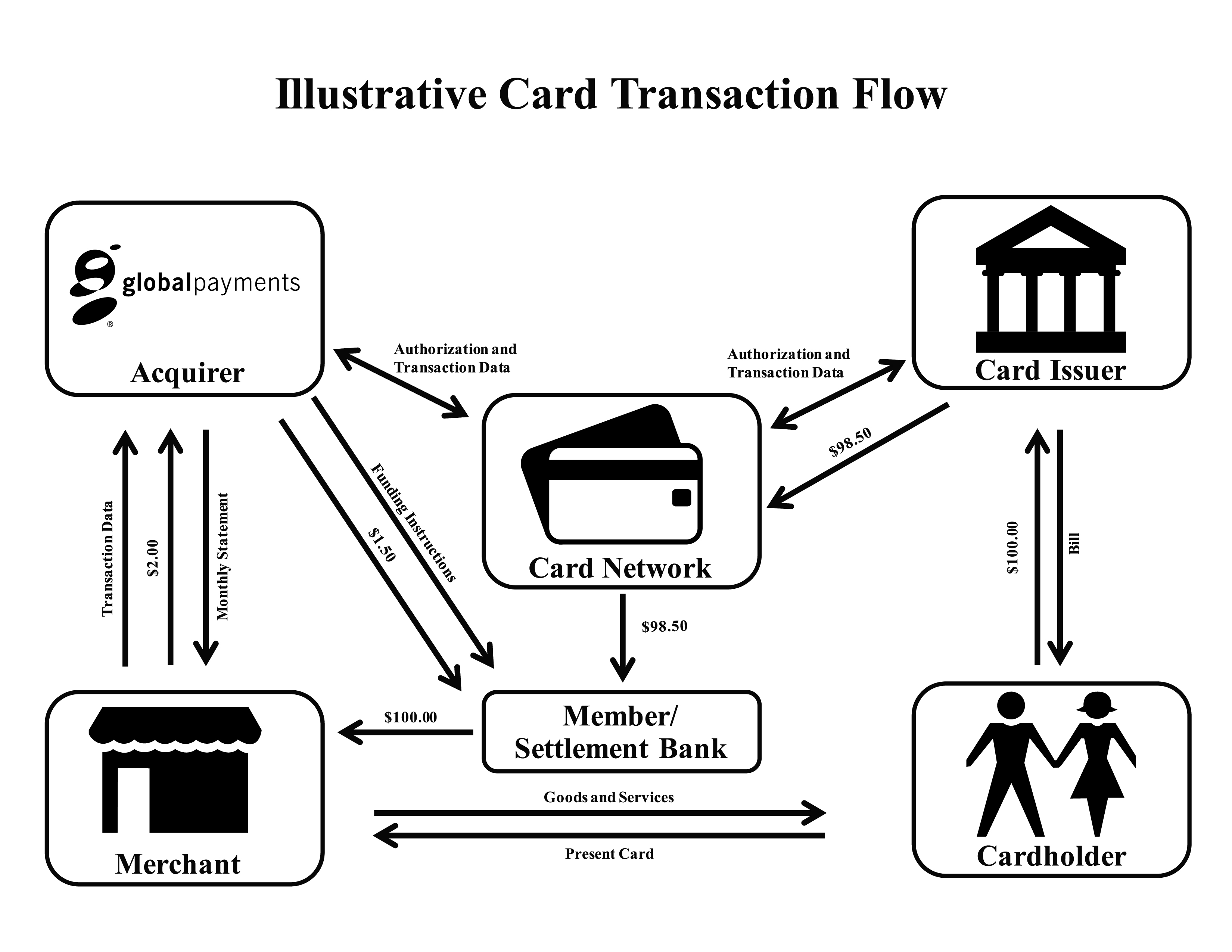
A typical payment transaction begins when a cardholder presents a card for payment at a merchant location where the card information is captured by a POS terminal card reader or mobile device card reader, which may be sold or leased to the merchant and serviced by us. Alternatively, card and transaction information may be captured and transmitted to our network through a POS device or ecommerce portal by one of a number of services that we offer directly or through a value-added reseller. The card reader electronically records sales draft information, such as the card identification number, transaction date and transaction amount.
After the card and transaction information is captured, the POS device automatically connects to our network through the internet or other communication channel in order to receive authorization of the transaction. For a credit card transaction, authorization services generally refer to the process in which the card issuer indicates whether a particular credit card is authentic and whether the impending transaction amount will cause the cardholder to exceed defined credit limits. In a debit card transaction, we obtain authorization for the transaction from the card issuer through the payment network verifying that the cardholder has sufficient funds for the transaction amount.
As an illustration, shown below, on a $100.00 card transaction, the card issuer may fund the Member, our sponsor, (indirectly through the card network) $98.50 after retaining approximately $1.50 referred to as an interchange fee. The card issuer seeks reimbursement of $100.00 from the cardholder in the cardholder's monthly credit card statement. The Member would, in turn, pay the merchant $100.00. The net settlement after this transaction would require us to advance the Member $1.50. After the end of the month, we would bill the merchant a percentage of the transaction amount, or merchant discount, to cover the full amount of the interchange fee and our fee from the transaction. If our discount rate for the merchant in the above example was 2.00%, we would bill the merchant $2.00 after the end of the month for the transaction, reimburse ourselves for $1.50 in interchange fees and retain $0.50 as our fees for the transaction. Under some arrangements, we remit the net amount of $98.50 to the merchant, rather than funding the full $100.00 and subsequently billing the merchant at the end of the month. Discount rates vary based on negotiations with merchants and the economic characteristics of transactions. Interchange rates also vary based on the economic characteristics of individual transactions. Accordingly, our fee per transaction varies across our merchant base and is subject to change based on changes in discount rates and interchange rates. Our profit on the transaction reflects the fee received less operating expenses, including payment network fees, systems cost to process the transaction and commissions paid to our sales force or ISO. Payment network fees are charged by the card brands based on the value of transactions processed through their networks.
Business Segments
We operate in three reportable segments: North America, Europe and Asia-Pacific. See "Note 15—Segment Information" in the notes to the accompanying consolidated financial statements for additional information about our segments, including revenues, operating income and depreciation and amortization by segment as well as financial information about geographic areas in which we operate. Our foreign operations subject us to various risks, including, without limitation, currency exchange risks and political, economic and regulatory risks. See "Item 1A - Risk Factors" for additional information about these risks.
North America
Approximately 73.7% of our revenues for the year ended December 31, 2017 were derived from our operations in North America, which include the United States and Canada.
Our primary mode of distribution in North America is our direct distribution channels, including an extensive direct sales force selling our services and solutions across numerous vertical markets, including, but not limited too, education, restaurant, event management, hospitality, retail, healthcare, convenience stores and petroleum, professional services, automotive and lodging.
In addition, our technology-enabled solutions represented a substantial component of our revenues in North America for the year ended December 31, 2017. Our technology-enabled distribution in North America primarily includes integrated and vertical market solutions as well as our gaming solutions business.
We also generate a portion of our revenues in North America from our wholesale distribution channel, primarily ISOs acting as third-party selling groups.
Europe
Approximately 19.3% of our revenues for the year ended December 31, 2017 were derived from our operations in Europe, which includes the United Kingdom, the Republic of Ireland, Spain, the Republic of Malta, the Czech Republic, Hungary, Slovakia, Romania and the Russian Federation. We have direct sales forces in these markets through which we sell our services
while also leveraging our bank referral relationships. Our ecommerce and omnichannel solutions represent a growing percentage of the services we sell in Europe.
Asia-Pacific
Approximately 7.0% of our revenues for the year ended December 31, 2017 were derived from our operations in the Asia-Pacific region, which includes the following countries and territories: Australia, China, Hong Kong, India, Macau, Malaysia, Maldives, New Zealand, the Philippines, Singapore, Sri Lanka and Taiwan. Our direct sales force in the Asia-Pacific region accounts for substantially all of the services we sell in the region.
Technology-enabled solutions represent a substantial and growing portion of our operations in the Asia-Pacific region, driven by Ezidebit in Australia. Our acquisition of eWay Limited in April 2016 has allowed us to further expand our ecommerce and omnichannel solutions offerings in this region.
Industry Overview
The payment technology services industry provides merchants with credit, debit, gift and loyalty card and other payment processing services, along with related information services. The industry continues to grow as a result of wider merchant acceptance, increased consumer use of credit and debit cards and advances in payment processing and telecommunications technology. The proliferation of credit and debit cards has made the acceptance of card-based payments a virtual necessity for many businesses, regardless of size, in order to remain competitive. This increased use of cards and the availability of more sophisticated technology services to all market segments has resulted in a highly competitive and specialized industry.
Competition
We are a leading provider of payments technology services in North America, where we compete primarily with Bank of America Merchant Services, LLC (a joint venture between First Data Corporation and Bank of America Corporation), Chase Paymentech Solutions, LLC, Elavon, Inc., a subsidiary of U.S. Bancorp, First Data Corporation, Total System Services, Inc., Wells Fargo Bank, N.A and Worldpay, Inc. While these are our primary competitors, some of our vertically focused business in the United States compete with other organizations.
In Europe and the Asia-Pacific region, financial institutions remain the primary providers of payment services to merchants, although the outsourcing of these services to third-party service providers is becoming more prevalent. Payment services have become increasingly complex, requiring significant capital commitments to develop, maintain and update the systems necessary to provide these advanced services at competitive prices.
Competitors in Europe include Barclays Bank PLC, Spanish banking institutions and WorldPay, Inc. Financial institutions that offer merchant acquiring services are our primary competitors in Asia-Pacific.
Emerging Trends
The payments industry continues to grow worldwide and as a result, certain large payment technology companies, including us, have expanded operations globally by pursuing acquisitions and creating alliances and joint ventures. We expect to continue to expand into new markets internationally or increase our scale and improve our competitiveness in existing markets by pursuing further acquisitions and joint ventures.
We believe that the number of electronic payment transactions will continue to grow and that an increasing percentage of these will be facilitated through emerging technologies. As a result, we expect an increasing portion of our future capital investment will be allocated to support the development of new and emerging technologies; however, we do not expect our aggregate capital spending to increase materially from our current level of spending as a result of this.
We also believe new markets will continue to develop in areas that have been previously dominated by paper-based transactions. We expect industries such as education, government and healthcare, as well as recurring payments and business-to-business payments, to continue to see transactions migrate to electronic-based solutions. We anticipate that the continued development of new services and the emergence of new vertical markets will be a factor in the growth of our business and our revenue in the future.
Strategy
We seek to leverage the adoption of, and transition to, card, electronic and digital-based payments by expanding share in our existing markets through our distribution channels and service innovation, as well as through acquisitions to improve our offerings and scale, while also seeking to enter new markets through acquisitions, alliances and joint ventures around the world. We intend to continue to invest in and leverage our technology infrastructure and our people to increase our penetration in existing markets.
Our key objectives include the following:
| • | Grow and control our direct distribution by adding new channels and partners, including expanding our ownership of additional enterprise software solutions in select vertical markets; |
| • | Deliver innovative services by developing value-added applications, enhancing existing services and developing new systems and services to blend technology with customer needs; |
| • | Leverage technology and operational advantages throughout our global footprint; |
| • | Continue to develop seamless multinational solutions for leading global customers; |
| • | Provide customer service at levels that exceed our competition, while investing in technology, training and enhancements to our service offerings; and |
| • | Pursue potential domestic and international acquisitions of, investments in and alliances with companies that have high growth potential, significant market presence, sustainable distribution platforms and/or key technological capabilities. |
Competitive Strengths
We believe that our competitive strengths include the following:
| • | Global Footprint and Distribution - Our worldwide presence allows us to focus our investments on markets with promising gross domestic product fundamentals and favorable secular trends, makes us more attractive to merchants with international operations and exposes us to emerging innovations that we can adopt globally, while diversifying our economic risk. |
| • | Technology Solutions - We provide innovative technology-based solutions, including enterprise software solutions, that enable our customers to operate their business more efficiently and simplify the payments process, regardless of the channel through which the transaction occurs. We believe our robust technology solutions will continue to differentiate us in the marketplace and will position us for continued growth. |
| • | Scalable Operating Environment and Technology Infrastructure - We operate as a single, unified international organization, with a multi-channel, global technology infrastructure, which provides scalable and innovative service offerings and a consistent service experience to our merchants and partners worldwide, while also driving sustainable operating efficiencies. |
| • | Strong, Long-lasting Partner Relationships - We have established strong, long-lasting relationships with many financial institutions, enterprise software providers, value-added resellers and other technology-based payment service providers, which facilitate lead generation and enable us to deliver a diverse solutions set to our merchant customers. |
| • | Disciplined Acquisition Approach - Our proven track record for selectively and successfully sourcing, completing and integrating acquired businesses in existing and new markets positions us well for future growth and as an attractive partner for potential acquisition targets. |
Safeguarding Our Business
Privacy and security are central to our services. We work with information security and forensics firms and employ advanced technologies to prevent, investigate and address issues relating to processing system security and availability. We also collaborate with industry third parties, regulators and law enforcement to resolve security incidents and assist in efforts to prevent unauthorized access to our processing systems.
Employees and Labor
As of December 31, 2017, we had approximately 10,000 employees, many of whom are highly skilled in technical areas specific to payment technology services.
Regulation
Various aspects of our business are subject to regulation and supervision under federal, state and local laws in the United States, as well as foreign laws, regulations and rules. In addition, we are subject to rules promulgated by the various payment networks, including American Express, Discover, Interac, MasterCard, UPI and Visa; Directive 2007/64/EC in the European Union (the "Payment Services Directive"); as well as a variety of other regulations, including escheat laws and applicable privacy and information security regulations. In addition, because we provide data processing services to banks and other financial institutions, we are subject to examination by the Federal Financial Institutions Examination Council (the "FFIEC"). Set forth below is a brief summary of some of the significant laws and regulations that apply to us. These descriptions are not exhaustive, and these laws, regulations and rules frequently change.
Dodd-Frank Act
The Dodd-Frank Wall Street Reform and Consumer Protection Act of 2010 (the "Dodd-Frank Act"), which was signed into law in the United States in 2010, resulted in significant structural and other changes to the regulation of the financial services industry. The Dodd-Frank Act directed the Board of Governors of the Federal Reserve (the "Federal Reserve Board") to regulate the debit interchange transaction fees that a card issuer or payment card network receives or charges for an electronic debit transaction. Pursuant to the so-called "Durbin Amendment" to the Dodd-Frank Act, these fees must be "reasonable and proportional" to the cost incurred by the card issuer in authorizing, clearing and settling the transaction. Pursuant to regulations promulgated by the Federal Reserve Board, debit interchange rates for card issuers with assets of $10 billion or more are capped at $0.21 per transaction and an ad valorem component of 5 basis points to reflect a portion of the issuer's fraud losses plus, for qualifying issuers, an additional $0.01 per transaction in debit interchange for fraud prevention costs. The cap on interchange fees has not had a material direct effect on our results of operations.
In addition, the Dodd-Frank Act limits the ability of payment card networks to impose certain restrictions because it allows merchants to: (i) set minimum dollar amounts (not to exceed $10) for the acceptance of a credit card (and allows federal governmental entities and institutions of higher education to set maximum amounts for the acceptance of credit cards) and (ii) provide discounts or incentives to encourage consumers to pay with cash, checks, debit cards or credit cards.
The rules also contain prohibitions on network exclusivity and merchant routing restrictions that require a card issuer to enable at least two unaffiliated networks on each debit card, prohibit card networks from entering into exclusivity arrangements and restrict the ability of issuers or networks to mandate transaction routing requirements. The prohibition on network exclusivity has not significantly affected our ability to pass on network fees and other costs to our customers, nor do we expect it to in the future.
The Dodd-Frank Act also created the Financial Stability Oversight Council (the "FSOC"), which was established to, among other things, identify risks to the stability of the U.S. financial system. The FSOC has the authority to require supervision and regulation of nonbank financial companies that the FSOC determines pose a systemic risk to the U.S. financial system. Accordingly, we may be subject to additional systemic risk-related oversight.
Payment Network Rules
We are subject to the rules of American Express, Discover, Interac, MasterCard, UPI and Visa and other payment networks. In order to provide our services, several of our subsidiaries are either registered as service providers for member institutions with MasterCard, Visa and other networks or are direct members of MasterCard, Visa and other networks. Accordingly, we are subject to card association and network rules that could subject us to a variety of fines or penalties that may be levied by the card networks for certain acts or omissions.
Banking Laws and Regulations
The FFIEC is an interagency body comprised of federal bank and credit union regulators such as the Federal Reserve Board, the Federal Deposit Insurance Corporation, the National Credit Union Administration, the Office of the Comptroller of the Currency and the Bureau of Consumer Financial Protection. The FFIEC examines large data processors in order to identify and mitigate risks associated with systemically significant service providers, including specifically the risks they may pose to the banking industry. In addition, we are subject to the Payment Services Directive, which was implemented in most European Union member states through national legislation. As a result of this legislation, we are subject to regulation and oversight in certain European Union member nations, including the requirement that we maintain specified regulatory capital; however, these regulatory capital requirements are generally insignificant to our total assets and total equity and have no material effect on our liquidity.
Privacy and Information Security Laws
We provide services that may be subject to various state, federal and foreign privacy laws and regulations. These laws and regulations include the federal Gramm-Leach-Bliley Act of 1999, which applies to a broad range of financial institutions and to companies that provide services to financial institutions in the United States, including our gaming business. We are also subject to a variety of foreign data protection and privacy laws, including, without limitation, Directive 95/46/EC, as implemented in each member state of the European Union and its successor, the General Data Protection Regulation, which becomes effective in May 2018. Among other things, these foreign and domestic laws, and their implementing regulations, in certain cases restrict the collection, processing, storage, use and disclosure of personal information, require notice to individuals of privacy practices, and provide individuals with certain rights to prevent use and disclosure of protected information. These laws also impose requirements for safeguarding and removal or elimination of personal information.
Anti-Money Laundering and Counter Terrorist Requirements
In many countries, we are legally or contractually required to comply with anti-money laundering laws and regulations, such as, in the United States, the Bank Secrecy Act, as amended by the USA PATRIOT Act of 2001 (collectively, the "BSA"), and the BSA implementing regulations of the Financial Crimes Enforcement Network ("FinCEN"), a bureau of the U.S. Department of the Treasury. A variety of similar anti-money laundering requirements apply in other countries. In some countries, we are directly subject to these requirements; in other countries, we have contractually agreed to assist our sponsor banks with their obligation to comply with anti-money laundering requirements that apply to them. These laws typically require organizations to:
| • | establish and audit anti-money laundering programs; |
| • | establish procedures for obtaining and verifying customer information; |
| • | file reports on large cash transactions; and |
| • | file suspicious activity reports if the financial institution believes a customer may be violating U.S. laws and regulations. |
Regulations issued by the Office of Foreign Assets Control ("OFAC") of the U.S. Department of Treasury place prohibitions and restrictions on all U.S. citizens and entities, including the Company, with respect to transactions by U.S. persons with specified countries and individuals and entities identified on OFAC's Specially Designated Nationals list (for example, individuals and companies owned or controlled by, or acting for or on behalf of, countries subject to certain economic and trade sanctions, as well as terrorists, terrorist organizations and narcotics traffickers identified by OFAC under programs that are not country specific). Similar requirements apply to transactions and dealings with persons and entities specified in lists maintained in other countries. We have developed procedures and controls that are designed to monitor and address legal and regulatory requirements and developments and that allow our customers to protect against having direct business dealings with such prohibited countries, individuals or entities.
Escheat Laws
We are subject to unclaimed or abandoned property state laws in the United States and in certain foreign countries that require us to transfer to certain government authorities the unclaimed property of others that we hold when that property has
been unclaimed for a certain period of time. Moreover, we are subject to audit by state and foreign regulatory authorities with regard to our escheatment practices.
Foreign Laws and Regulations
We are subject to foreign laws and regulations that affect the electronic payments industry in each of the foreign countries in which we operate. Some of these countries, such as the Russian Federation and the United Kingdom, have undergone significant political, economic and social change in recent years. In these countries, there is a greater risk of new, unforeseen changes that could result from, among other things, instability or changes in a country’s or region’s economic conditions; changes in laws or regulations or in the interpretation of existing laws or regulations, whether caused by a change in government or otherwise; increased difficulty of conducting business in a country or region due to actual or potential political or military conflict; or action by the European Union or the United States, Canada or other governments that may restrict our ability to transact business in a foreign country or with certain foreign individuals or entities, such as sanctions by or against the Russian Federation.
Debt Collection and Credit Reporting Laws
Portions of our business may be subject to the Fair Debt Collection Practices Act, the Fair Credit Reporting Act and similar state laws. These debt collection laws are designed to eliminate abusive, deceptive and unfair debt collection practices and may require licensing at the state level. The Fair Credit Reporting Act regulates the use and reporting of consumer credit information and also imposes disclosure requirements on entities that take adverse action based on information obtained from credit reporting agencies. We have procedures in place to comply with the requirements of these laws.
Where to Find More Information
We file annual and quarterly reports, proxy statements and other information with the U.S. Securities and Exchange Commission (the "SEC"). You may read and print materials that we have filed with the SEC from its website at www.sec.gov. In addition, certain of our SEC filings, including our annual reports on Form 10-K, our transition report on Form 10-K for the 2016 fiscal transition period, our quarterly reports on Form 10-Q, our current reports on Form 8-K and amendments to them can be viewed and printed from the investor relations section of our website at www.globalpaymentsinc.com free of charge. Certain materials relating to our corporate governance, including our codes of ethics applicable to our directors, senior financial officers and other employees, are also available in the investor relations section of our website. Copies of our filings, specified exhibits and corporate governance materials are also available, free of charge, by writing us using the address on the cover of this Annual Report on Form 10-K. You may also telephone our investor relations office directly at (770) 829-8478. We are not including the information on our website as a part of, or incorporating it by reference into, this Annual Report on Form 10-K.
Our SEC filings may also be viewed and copied at the following SEC public reference room and at the offices of the New York Stock Exchange.
SEC Public Reference Room
100 F Street, N.E.
Washington, DC 20549
(You may call the SEC at 1-800-SEC-0330 for further information on the public reference room.)
NYSE Euronext
20 Broad Street
New York, NY 10005
Previous: Cover and table of contents · Next: Item 1A. RISK FACTORS