 filings.tools
Global Payments 10-K 2023-12-31
Filed 2024-02-14. 21 sections, 524K characters. Original on sec.gov · Markdown · JSON
Cover and table of contents
UNITED STATES
SECURITIES AND EXCHANGE COMMISSION
Washington, D.C. 20549
FORM 10-K
☒ ANNUAL REPORT PURSUANT TO SECTION 13 OR 15(d) OF THE
SECURITIES EXCHANGE ACT OF 1934
For the fiscal year ended December 31, 2023
OR
☐ TRANSITION REPORT PURSUANT TO SECTION 13 OR 15(d) OF THE
SECURITIES EXCHANGE ACT OF 1934
For the transition period from to
Commission File No. 001-16111

GLOBAL PAYMENTS INC.
(Exact name of registrant as specified in charter)
| Georgia | 58-2567903 | |||||||
| **(**State or other jurisdiction of incorporation or organization) | (I.R.S. Employer Identification No.) |
| 3550 Lenox Road, Atlanta, Georgia | 30326 | |||||||||||||||||||
| (Address of principal executive offices) | (Zip Code) |
Registrant's telephone number, including area code: 770-829-8000
Securities registered pursuant to Section 12(b) of the Act:
| Title of each class | Trading symbol | Name of each exchange on which registered | ||||||||||||
| Common Stock, No Par Value | GPN | New York Stock Exchange | ||||||||||||
| 4.875% Senior Notes due 2031 | GPN31A | New York Stock Exchange |
Securities registered pursuant to Section 12(g) of the Act:
NONE
Indicate by check mark if the registrant is a well-known seasoned issuer, as defined in Rule 405 of the Securities Act. Yes ☒ No ☐
Indicate by check mark if the registrant is not required to file reports pursuant to Section 13 or 15(d) of the Act. Yes ☐ No ☒
Indicate by check mark whether the registrant (1) has filed all reports required to be filed by Section 13 or 15(d) of the Securities Exchange Act of 1934 during the preceding 12 months (or for such shorter period that the registrant was required to file such reports), and (2) has been subject to such filing requirements for the past 90 days. Yes ☒ No ☐
Indicate by check mark whether the registrant has submitted electronically every Interactive Data File required to be submitted pursuant to Rule 405 of Regulation S-T (§ 232.405 of this chapter) during the preceding 12 months (or for such shorter period that the registrant was required to submit such files). Yes ☒ No ☐
Indicate by check mark whether the registrant is a large accelerated filer, an accelerated filer, a non-accelerated filer, a smaller reporting company or an emerging growth company. See the definitions of “large accelerated filer,” “accelerated filer,” “smaller reporting company” and “emerging growth company" in Rule 12b-2 of the Exchange Act.
Large accelerated filer ☒ Accelerated filer ☐
Non-accelerated filer ☐ Smaller reporting company ☐
Emerging growth company ☐
If an emerging growth company, indicate by check mark if the registrant has elected not to use the extended transition period for complying with any new or revised financial accounting standards provided pursuant to Section 13(a) of the Exchange Act. ☐
Indicate by check mark whether the registrant has filed a report on and attestation to its management's assessment of the effectiveness of its internal control over financial reporting under Section 404(b) of the Sarbanes-Oxley Act (15 U.S.C. 7262(b)) by the registered public accounting firm that prepared or issued its audit report ☒
If securities are registered pursuant to Section 12(b) of the Act, indicate by check mark whether the financial statements of the registrant included in the filing reflect the correction of an error to previously issued financial statements ☐
Indicate by check mark whether any of those error corrections are restatements that required a recovery analysis of incentive-based compensation received by any of the registrant’s executive officers during the relevant recovery period pursuant to §240.10D-1(b). ☐
Indicate by check mark whether the registrant is a shell company (as defined in Rule 12b-2 of the Act). Yes ☐ No ☒
The aggregate market value of the voting and non-voting common equity held by non-affiliates computed by reference to the price at which the common equity was last sold, or the average bid and asked price of such common equity, as of the last business day of the registrant's most recently completed second fiscal quarter was $25,440,604,840. The number of shares of the registrant's common stock outstanding at February 12, 2024 was 257,984,986 shares.
DOCUMENTS INCORPORATED BY REFERENCE
Specifically identified portions of the registrant's proxy statement for the 2024 annual meeting of shareholders are incorporated by reference in Part III.
GLOBAL PAYMENTS INC.
2023 ANNUAL REPORT ON FORM 10-K
CAUTIONARY NOTICE REGARDING FORWARD-LOOKING STATEMENTS
Some of the statements we use in this report, and in some of the documents we incorporate by reference in this report, contain forward-looking statements concerning our business operations, economic performance and financial condition, including in particular: our business strategy and means to implement the strategy; measures of future results of operations, such as revenues, expenses, operating margins, income tax rates, and earnings per share; other operating metrics such as shares outstanding and capital expenditures; statements we make regarding guidance and projected financial results for the year 2024; the effects of general economic conditions on our business; statements about the benefits of our acquisitions or divestitures, including future financial and operating results and the completion and expected timing of our acquisitions or completion of anticipated benefits or strategic initiatives; our success and timing in developing and introducing new services and expanding our business; and other statements regarding our future financial performance and the company’s plans, objectives, expectations and intentions. You can sometimes identify forward-looking statements by our use of the words "believes," "anticipates," "expects," "intends," "plan," "forecast," "guidance" and similar expressions. For these statements, we claim the protection of the safe harbor for forward-looking statements contained in the Private Securities Litigation Reform Act of 1995.
Although we believe that the plans and expectations reflected in or suggested by our forward-looking statements are reasonable, those statements are based on a number of assumptions, estimates, projections or plans that are inherently subject to significant risks, uncertainties and contingencies, many of which are beyond our control, cannot be foreseen and reflect future business decisions. Accordingly, we cannot guarantee that our plans and expectations will be achieved. Our actual revenues, revenue growth rates and margins, and other results of operations could differ materially from those anticipated in our forward-looking statements as a result of many known and unknown factors, many of which are beyond our ability to predict or control. Important factors that may otherwise cause actual events or results to differ materially from those anticipated by such forward-looking statements or historical performance include, among others, the effects of global economic, political, market, health and social events or other conditions; foreign currency exchange, inflation and rising interest rate risks; difficulties, delays and higher than anticipated costs related to integrating the businesses of acquired companies, including with respect to implementing controls to prevent a material security breach of any internal systems or to successfully manage credit and fraud risks in business units; the effect of a security breach or operational failure on our business; failing to comply with the applicable requirements of Visa, Mastercard or other payment networks or card schemes or changes in those requirements; the ability to maintain Visa and Mastercard registration and financial institution sponsorship; the ability to retain, develop and hire key personnel; the diversion of management’s attention from ongoing business operations; the continued availability of capital and financing; increased competition in the markets in which we operate and our ability to increase our market share in existing markets and expand into new markets; our ability to safeguard our data; risks associated with our indebtedness; our ability to meet environmental, social and governance targets, goals and commitments; the potential effects of climate change, including natural disasters; the effects of new or changes in current laws, regulations, credit card association rules or other industry standards on us or our partners and customers, including privacy and cybersecurity laws and regulations; and other events beyond our control, and other factors presented in "Item 1A - Risk Factors" of this Annual Report on Form 10-K and subsequent filings we make with the Securities and Exchange Commissions ("SEC"), which we advise you to review.
These cautionary statements qualify all of our forward-looking statements, and you are cautioned not to place undue reliance on these forward-looking statements. Our forward-looking statements speak only as of the date they are made and should not be relied upon as representing our plans and expectations as of any subsequent date. While we may elect to update or revise forward-looking statements at some time in the future, we specifically disclaim any obligation to publicly release the results of any revisions to our forward-looking statements, except as required by law.
PART I
Item 1. BUSINESS
Global Payments Inc. and its consolidated subsidiaries are referred to collectively as "Global Payments," the "Company," "we," "our" or "us," unless the context requires otherwise.
Introduction
We are a leading payments technology company delivering innovative software and services to our customers globally, with worldwide reach spanning North America, Europe, Asia-Pacific and Latin America. Our technologies, services and team member expertise allow us to provide a broad range of solutions that enable our customers to operate their businesses more efficiently across a variety of channels around the world. Headquartered in Georgia with approximately 27,000 team members worldwide, Global Payments is a Fortune 500 company and is a member of the S&P 500. Our common stock is traded on the New York Stock Exchange under the symbol "GPN."
Business Segments
We operate in two reportable segments: Merchant Solutions and Issuer Solutions. During the second quarter of 2023, we completed the sale of the consumer portion of our Netspend business, which comprised our former Consumer Solutions segment. See "Note 18—Segment Information" in the notes to the accompanying consolidated financial statements for additional information about our segments, including revenues, operating income and depreciation and amortization by segment as well as financial information about geographic areas in which we operate.
Recent Business Acquisitions and Dispositions
Acquisition of EVO Payments, Inc.
On March 24, 2023, we completed the acquisition of EVO Payments, Inc. (“EVO”) for total purchase consideration of approximately $4 billion. EVO is a payment technology and services provider, offering payment solutions to merchants ranging from small and middle market enterprises to multinational companies and organizations across the Americas and Europe. The acquisition aligns with our technology-enabled payments strategy, expands our geographic presence in attractive markets and augments our business-to-business ("B2B") software and payment solutions business.
Disposition of Consumer Business
On April 26, 2023, we completed the sale of the consumer portion of our Netspend business for approximately $1 billion. The disposition further aligns our businesses with our strategy to focus on our core corporate customers, including merchants, financial institutions, software partners and technology leaders. Prior to disposition, the consumer business comprised our former Consumer Solutions segment and provided general purpose reloadable ("GPR") prepaid debit and payroll cards, demand deposit accounts and other financial service solutions to the underbanked and other consumers and businesses in the United States.
Disposition of Gaming Business
On April 1, 2023, we completed the sale of our gaming business for approximately $400 million. The disposition further aligns our businesses with our strategy to focus on our core corporate customers. Prior to disposition, the gaming business offered a comprehensive suite of solutions, including credit and debit card cash advance, cashless advance, iGaming solutions, traditional and digital check processing and other services specific to the gaming market in North America.
See "Note 2—Acquisitions" and “Note 3—Business Dispositions” in the notes to the accompanying consolidated financial statements for further discussion of these and other recent transactions.
Merchant Solutions Segment
Through our Merchant Solutions segment, we provide payments technology and software solutions to customers globally. Our payment technology solutions are similar around the world in that we enable our customers to accept card, check and digital-based payments. Our comprehensive offerings include, but are not limited to, authorization, settlement and funding services, customer support, chargeback resolution, terminal rental, sales and deployment, payment security services, consolidated billing and reporting.
In addition, we offer a wide array of enterprise software solutions that streamline business operations to customers in numerous vertical markets. We also provide a variety of value-added solutions and services, including specialty point-of-sale software, analytics and customer engagement, human capital management and payroll and reporting that assist our customers with driving demand and operating their businesses more efficiently.
Our value proposition is to provide distinctive high-quality, responsive and secure services to all of our customers. We distribute our Merchant Solutions services globally through multiple technology-enabled and relationship-led distribution channels and target customers in many vertical markets located throughout North America, Europe, Asia-Pacific and Latin America. The majority of our revenues is generated by services priced as a percentage of transaction value or a specified fee per transaction, depending on the payment type or the market. We also earn software subscription and licensing fees, as well as other fees for specific value-added services, which may be unrelated to the number or value of transactions.
Distribution Channels
In the Merchant Solutions segment, we actively market and provide our payment services, enterprise software solutions and other value-added services directly to our customers through a variety of technology-enabled and relationship-led distribution channels.
Technology-Enabled. Our technology-enabled distribution channel includes integrated and vertical market software solutions and ecommerce and omnichannel solutions, each as described below. Many of our payment solutions are technology-enabled in that they incorporate or are incorporated into innovative, technology-driven solutions, including enterprise software solutions, designed to enable merchants to better manage their businesses. Our technology-enabled solutions represent a substantial component of our revenues.
Integrated Solutions. Our integrated solutions provide advanced payments technology that is embedded into business management software solutions owned by our technology partners who operate in numerous vertical markets, primarily in North America. We grow our integrated solutions business when new or existing merchants enable payments services through enterprise software solutions sold by our partners, both new and existing.
Vertical Markets Software Solutions. Our vertical markets software solutions provide advanced payments technology that is integrated into business enterprise software solutions that we own. We distribute our vertical markets software solutions primarily through the following businesses:
*•*ACTIVE Network. Through ACTIVE Network, we deliver cloud-based enterprise software, including payment technology solutions, to event organizers in the communities, government services and health and fitness markets.
*•*AdvancedMD. Through AdvancedMD, we provide cloud-based enterprise solutions to small-to-medium sized ambulatory care physician practices in the United States.
*•*Education Solutions. We offer integrated payment solutions specifically designed for all levels of educational institutions. For colleges and universities, we offer integrated commerce software and payment solutions, as well as a variety of additional value added services. For institutions serving kindergarten through 12th grade levels, we provide ecommerce and in-person payments and cafeteria POS and back-office management solutions.
*•*Xenial. Through Xenial, we offer cloud-based enterprise software and hardware solutions that integrate with our payment services and other business applications to the restaurant and hospitality and stadium and event venue vertical markets.
- Zego. Through Zego, we offer a comprehensive resident experience management software and digital commerce solutions to property managers, primarily in the United States.
Ecommerce and Omnichannel. We offer ecommerce and omnichannel solutions that seamlessly blend payment gateway services, retail payment acceptance infrastructure and payment technology service capabilities through a unified commerce platform to allow merchants and partners to accept various payment methods through any channel. We sell ecommerce and omnichannel solutions to customers of all sizes, from small businesses accepting payments in a single country to payment facilitators, enterprise and multinational partners and merchants that have complex payment needs and operate retail and online businesses in multiple countries.
Relationship-Led. Through our relationship-led direct sales forces worldwide, as well as financial institution and other referral partnerships, we offer our payments technology services, software and other value-added solutions directly to customers across numerous verticals in the markets we serve. Although our primary focus is on building high-quality, direct relationships with merchants, we also provide our services to merchants through independent sales organizations ("ISOs") and financial institutions.
Credit and Debit Card Transaction Processing
Credit and debit card transaction processing includes processing the world's major international card brands, including, among others, American Express, Discover Card ("Discover"), JCB, Mastercard, UnionPay International and Visa, as well as certain domestic debit networks, such as Interac in Canada. Credit and debit networks establish uniform regulations that govern much of the payment card industry. During a typical payment transaction, the merchant and the card issuer do not interface directly with each other, but instead rely on payments technology companies, such as Global Payments, to facilitate transaction processing services, including authorization, electronic draft capture, file transfers to facilitate funds settlement and certain exception-based, back-office support services such as chargeback resolution.
We process funds settlement under two models: a sponsorship model and a direct membership model. Under the sponsorship model, member clearing financial institutions ("Members") sponsor us and require our adherence to the standards of the networks. In these markets, we have sponsorship or depository and clearing agreements with financial institution sponsors. These agreements allow us to route transactions under the Members' control and identification numbers to clear card transactions through Mastercard and Visa. In this model, the standards of the card networks restrict us from performing funds settlement or accessing merchant settlement funds, and instead, require that these funds be in the possession of the Member until the merchant has been funded.
Under the direct membership model, we are direct members in various payment networks, allowing us to process and fund transactions without third-party sponsorship. Under this model, we route and clear transactions directly through the card brand’s network and are not restricted from performing funds settlement. Otherwise, we process these transactions similarly to how we process transactions in the sponsorship model. We are required to adhere to the standards of the various networks in which we are direct members. We maintain relationships with financial institutions, which may also serve as our Member sponsors for other card brands or in other markets, to assist with funds settlement.
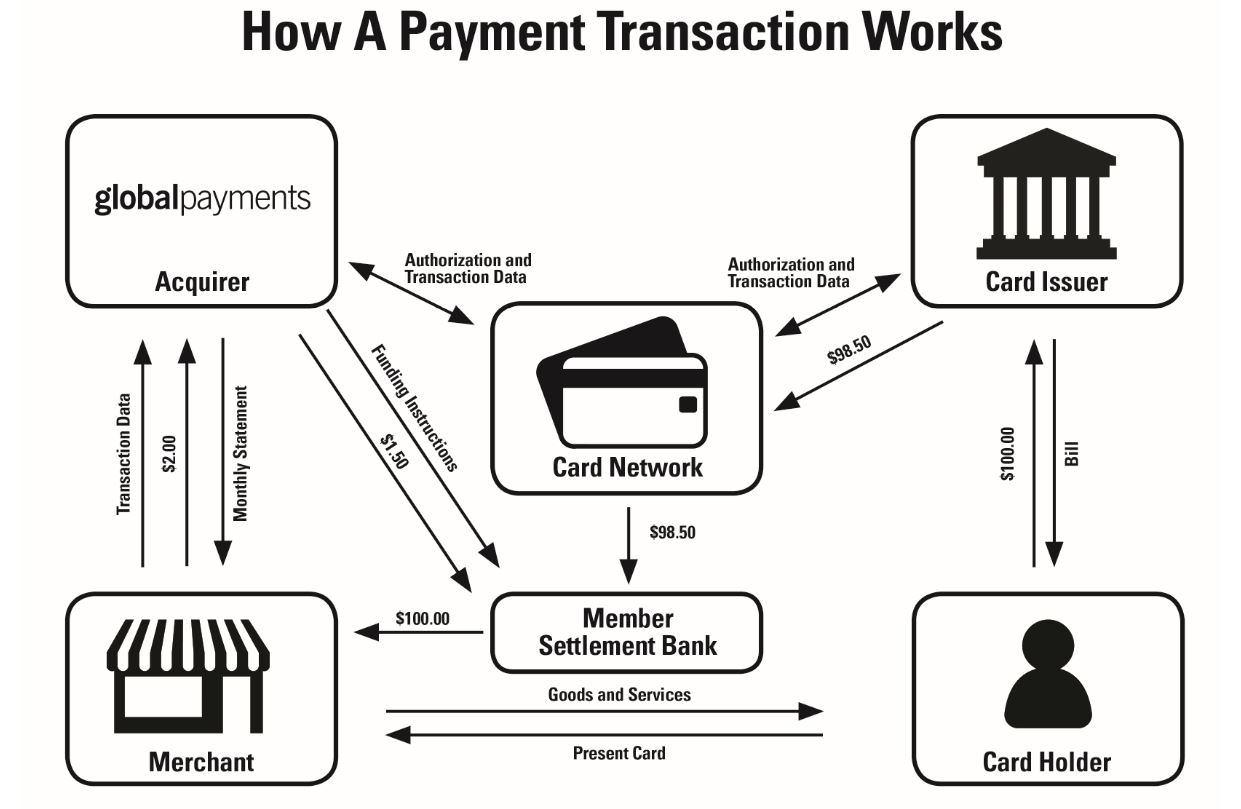
How a Card Transaction Works
A typical payment transaction begins when a cardholder presents a card for payment to a merchant at which time card and transaction information, such as the card identification number, transaction date and transaction amount, is captured and transmitted to our network. The information is captured by a point-of-sale ("POS") terminal card reader or mobile device card reader, which may be sold or leased to the merchant and serviced by us, or through a POS device or ecommerce portal by one of a number of services that we offer directly or through a value-added reseller.
After the card and transaction information is captured, the POS device or ecommerce portal automatically connects to our network through the internet or other communication channel in order to receive authorization of the transaction. For a credit card transaction, authorization services generally refer to the process in which the card issuer indicates whether a particular credit card is authentic and whether the impending transaction amount will cause the cardholder to exceed defined credit limits. In a debit card transaction, we obtain authorization for the transaction from the card issuer through the payment network verifying that the cardholder has access to sufficient funds for the transaction amount.
As an illustration, shown below in the sponsorship model, on a $100.00 card transaction the card issuer may fund the Member, our sponsor, (indirectly through the card network) $98.50 after retaining $1.50 referred to as an interchange fee. The card issuer would seek reimbursement of $100.00 from the cardholder in the cardholder's monthly credit card statement.
The Member would, in turn, pay the merchant $100.00. The net settlement after this transaction would require us to advance the $1.50 interchange fee to the Member. After the end of the month, we would bill the merchant a percentage, also known as the merchant discount, of the transaction amount to cover the full amount of the interchange fee and our fee from the transaction. Assuming the merchant discount in the above example is 2%, we bill the merchant $2.00 after the end of the month for the transaction, reimburse ourselves for $1.50 in interchange fees and retain $0.50 as our fee for the transaction. Under some arrangements, we remit the net amount of $98.00 to the merchant, rather than funding the full $100.00 and subsequently billing the merchant at the end of the month.
Discount rates vary based on negotiations with merchants and the economic characteristics of transactions and take many forms, such as interchange plus our fee or a bundled rate that includes all fees. Interchange rates also vary based on the economic characteristics of individual transactions. Accordingly, our fee per transaction varies across our merchant base and is subject to change based on changes in discount rates and interchange rates. Our profit on a transaction reflects the merchant discount less interchange fees, payment network fees and operating expenses, including systems costs to process the transaction and commissions paid to our sales force or external partner. Payment network fees are charged by the card brands, in part, based on the value of transactions processed through their networks.
Issuer Solutions Segment
Through our Issuer Solutions segment, we provide solutions that enable financial institutions and other financial service providers to manage their card portfolios, reduce technical complexity and overhead and offer a seamless experience for cardholders on a single platform. In addition, we provide flexible commercial payments, accounts payable and electronic payment alternatives solutions that support B2B payment processes for businesses and governments. We also offer complementary services, including account management and servicing, fraud solution services, analytics and business intelligence, cards, statements and correspondence, customer contact solutions and risk management solutions. Additionally, our Issuer Solutions segment provides B2B payment services and other financial service solutions marketed to businesses, including software-as-a-service (“SaaS”) offerings that automate key procurement processes, provide invoice capture, coding and approval, and enable virtual cards and integrated payments options across a variety of key vertical markets.
Issuer Solutions segment revenues are primarily derived from long-term processing contracts with financial institutions and other financial services providers. Payment processing services revenues are generated primarily from charges based on
the number of accounts on file, transactions and authorizations processed, statements generated and/or mailed, managed services, cards embossed and mailed, and other processing services for cardholder accounts on file. Most of these customer contracts have prescribed annual minimums, penalties for early termination, and service level agreements that may affect contractual fees if specified service levels are not achieved. Issuer Solutions segment revenues also include software subscription, licensing fees, loyalty redemption services and professional services.
Industry Overview
The payments technology industry provides financial institutions, businesses and consumers with payment processing services, merchant acceptance solutions and related information and other value-added services. The industry continues to grow as a result of wider merchant acceptance and increased use of credit and debit cards, advances in payment solutions and processing technology and migration to ecommerce, omnichannel and contactless payment solutions. The proliferation of credit and debit cards, as well as other digital payment solutions, has made the acceptance of digital payments a necessity for many businesses, regardless of size, in order to remain competitive. Certain macroeconomic drivers, such as the COVID-19 pandemic, have further accelerated the use of digital payments, the need for development of technologies and digital-based solutions and the expansion of ecommerce, omnichannel and contactless payment solutions. The increased use of cards and the availability of more sophisticated technology services to all market segments have resulted in an increasingly competitive and specialized industry.
Strategy
We seek to leverage the adoption of, and transition to, card and digital-based payments by expanding our share in our existing markets through our distribution channels and service innovation, as well as through acquisitions to improve our offerings and scale. We also seek to enter new markets through acquisitions, alliances and joint ventures in selected markets around the world. We intend to continue to invest in and leverage our technology infrastructure and capabilities to increase our penetration in existing markets.
Consistent with this focus, we continue to operate our business in accordance with the following strategic framework:
-
Leading with technology and innovation to deepen our competitive advantages;
-
Further scaling the four pillars of our strategy: software-driven focus, ecommerce and omnichannel solutions, exposure to faster growth markets and B2B payments;
-
Delivering commerce enablement solutions globally to broaden our leading position as a sales-driven, product-led company;
-
Providing frictionless, best-in-class customer experiences, creating longer-term relationships;
-
Nurturing our culture, values and diversity, equity and inclusion initiatives to attract, retain and motivate exceptional team members; and
-
Supporting our communities as a socially responsible company with purpose and understanding.
Competitive Strengths
We believe that our competitive strengths include the following:
- Technology Solutions - We provide innovative technology-based solutions, including enterprise software and other ecommerce enablement solutions, that enable our customers to operate their businesses more efficiently, increase sales and simplify the payments process, regardless of the channel through which the transaction occurs. We believe our robust technology solutions will continue to differentiate us in the marketplace and position us for continued growth.
*•*Global Footprint and Distribution - Our worldwide presence allows us to focus our investments on markets with promising gross domestic product fundamentals and favorable secular trends, makes us more attractive to certain customers with international operations and exposes us to emerging innovations that we can adopt globally, while diversifying our economic risk.
-
Scalable Operating Environment and Technology Infrastructure - We operate with a multi-channel, global technology infrastructure that provides scalable and innovative service offerings and a consistent service experience to our merchants, customers, financial institutions and other partners worldwide, while also driving sustainable operating efficiencies.
-
Strong, Long-lasting Partner Relationships - We have established strong, long-lasting relationships with many financial institutions, enterprise software providers, value-added resellers and other technology-based payment service providers, which enable us to deliver a set of diverse solutions to our customers.
-
Disciplined Acquisition Approach - Our proven track record for selectively and successfully sourcing, completing acquisitions and integrating acquired businesses in existing and new markets positions us well for future growth and as an attractive partner for potential acquisition targets.
Competition
In each of our business segments, we compete with a large variety of companies - financial institutions, financial technology companies, traditional payment providers, new market entrants, and others, both large and small. The markets for the services we provide are highly fragmented and competitive. Many of these providers compete with us across our segments, markets and geographies. Some of these competitors possess greater financial, sales and marketing resources than we do. We expect each of our segments to become more competitive over time, as advances in technology enable new entrants, barriers to entry fall and existing providers expand their services, both operationally and geographically.
Our Merchant Solutions segment competes with financial institutions, merchant acquirers and other financial technology companies who provide businesses with merchant acquiring and related services. In the United States, we compete with a large number of providers, including but not limited to Fiserv, Inc. ("Fiserv"), Worldpay, LLC ("Worldpay"), Chase Paymentech Solutions, LLC, Elavon, Inc., a subsidiary of U.S. Bancorp, Bank of America Merchant Services, Wells Fargo Merchant Services, Toast, Inc., Stripe, Inc., Shopify Inc. and Block Inc. While these are our primary competitors in the merchant acquiring space, our vertically focused businesses in the United States compete with numerous other providers in their respective verticals.
Internationally, financial institutions remain the primary providers of payment technology services to merchants, although the outsourcing of these services to third-party service providers is becoming more prevalent. We compete outside the U.S. with financial institutions in the markets in which we operate, as well as both large providers (such as Worldpay, Worldline, Nexi) and new entrants (such as Adyen, Block and Stripe). We have seen competition internationally increase and expect that trend to continue as new companies enter our markets and existing competitors expand or consolidate their product lines and services.
Our Issuer Solutions segment encounters competition from other third-party payment card processors, the card brands, core banking platform providers, independent software vendors, B2B providers, and various other firms that deliver services to payment card issuers in the markets we serve, as well as financial institutions who provide such services in-house. Our competitors in this segment include, but are not limited to Fiserv, FIS, Marqeta, Nexi, Worldline, i2c, Bill.com, AvidExchange, Billtrust, Adyen, Stripe and Zeta. We expect the number of competitors in this segment to continue to expand.
See the section titled “Risk Factors - Risks Related to Our Business Model and Operations” for further information on the competitive and continuously evolving markets we serve.
Safeguarding Our Business
In order to provide our services, we process and store sensitive business information and personal information, which may include credit and debit card numbers, bank account numbers, social security numbers, driver’s license numbers, names and addresses, and other types of personal information or sensitive business information. Some of this information is also processed and stored by financial institutions, merchants and other entities, as well as third-party service providers to whom we outsource certain functions and other agents, which we refer to collectively as our associated third parties. We may have responsibility to the card networks, financial institutions, and in some instances, our merchants, ISOs and/or individuals, for our failure or the failure of our associated third-party service providers (as applicable) to protect this information.
For a further discussion of our approach to cybersecurity, see "Item 1C - Cybersecurity."
Intellectual Property
Our intellectual property is an important part of our strategy to be a leading provider of payment technology and software solutions. We use a combination of internal policies, intellectual property laws and contractual provisions to protect our proprietary technologies and brands. In addition, to protect our various brands, we seek and maintain registration of U.S. and international patents, copyrights, trade secrets, trademarks, service marks and domain names that align with our brand strategy. We also enforce our trademarks against potential sources of misunderstanding that could harm our brand and ability to compete. In addition to using our intellectual property in our own operations, we grant licenses to certain of our customers to use our intellectual property.
Human Capital Management
Team Member Population
We currently do business around the world, with approximately 27,000 team members living and working in 35 countries. As of December 31, 2023, approximately 59% of our workforce resided in the Americas, 19% in Europe and 22% in Asia Pacific. Many of our team members are highly skilled in technical areas specific to payment technology and software solutions.
Our overall workforce strategies are developed and managed by our Chief Human Resources Officer, who reports to our President and CEO. More broadly, the board of directors and the Compensation Committee of our board of directors ("Compensation Committee") provide oversight on certain culture and human management topics, including diversity, equity and inclusion (“DEI”) and succession plans for critical talent. We regularly engage with our team members through a variety of forums, including periodic surveys, to help us understand their perspectives related to workplace culture, engagement, inclusion, talent management and well-being and to inform our human capital strategies and initiatives. The results of these interactions are also leveraged to further develop our talent management initiatives. Moreover, the board of directors also reviews critical feedback and receives updates on management’s plans in response thereto.
Talent Management and Retention
We place an emphasis on attracting and retaining diverse team members and having a workforce that reflects the communities in which we work and live around the world. To that end, we have implemented programs and initiatives focused on enriching new hire experiences, developing team members through extensive training and professional development opportunities, including mentorship and leadership programs, promoting team members’ wellness and safety, and providing flexible work arrangements. Furthermore, we offer comprehensive and competitive pay and benefits packages, including paid parental leave, team member assistance, savings and retirement programs and equity-based awards that vest over a period of time to support retention of key contributors. We also strive to celebrate and recognize the efforts of our team members through a combination of programs, including team appreciation activities and awards programs to honor top performers and notable contributors. Over the past several years, we have also made significant investments in modernizing our operating environments and technologies to include cloud-based systems and collaboration tools that support day-to-day engagement and execution.
Health and Well-being
The success of our business is connected to the well-being of our team members. Accordingly, we are committed to the health, safety and wellness of our team members worldwide, and we provide team members with various health and wellness programs and benefits, including employee education and assistance programs that focus on physical, financial, family, social and emotional resources.
Diversity, Equity and Inclusion
We remain committed to addressing the ever-changing needs of our team members and finding new ways to continuously enhance our culture. Our DEI strategy, led by our Chief Diversity Officer and our Chief Human Resources Officer, reflects the shift in our current workforce, changing business landscape and potential talent and is anchored by three pillars: Leadership Accountability, Inclusive Capability and Engagement. To further engrain our DEI strategy in the organization, we have established various Employee Resource Groups and diversity action teams, led by senior leaders throughout our company. These groups and teams are critical drivers in fostering organizational change, establishing dedicated focus on DEI priorities and managing the DEI program beyond our corporate function. We continue to include social and racial equity in our conversations, and aim to equip and empower our leaders with the right tools and training to lead effectively. Our Compensation Committee assists the board of directors in overseeing the Company’s DEI initiatives.
Employee Growth and Development
Our strategy to develop and retain the best talent includes an emphasis on team member development and training. We provide a variety of training and development opportunities to team members globally, including our online training platform that contains a vast array of tools and application resources for all team members to build learning experiences and skills. In order to help our team members strengthen the skills and behaviors needed for career advancement, our performance management program enables team members to drive their development with a focus on growth, performance, and well-being through regular meetings with their leaders.
Government Regulation
Various aspects of our business are subject to regulation and supervision under federal, state and local laws in the United States and foreign laws, regulations and rules. Many of these regulations and laws are evolving and their applicability and scope, as interpreted by courts and regulators, remain uncertain. These regulations and laws involve a variety of matters, including privacy and information security, data and personal information protection, money-transmission and payment instrument laws and regulations, consumer protection laws, anti-money laundering and anti-corruption laws, tax, environmental sustainability (including climate change) and human rights. In addition, we are subject to rules promulgated by the various payment networks, including Nacha, American Express, Discover, Interac, Mastercard and Visa.
Set forth below is a brief summary of some of the significant laws and regulations that apply to us. These descriptions are not exhaustive, and these laws, regulations and rules frequently change and are increasing in number. We are currently in compliance in all material respects with applicable existing legal and regulatory requirements and do not expect that maintaining compliance with these regulations will have a material effect on our capital expenditures, earnings or competitive and financial positions. For additional information about government regulation and laws applicable to our business and the potential risks associated with future changes in laws or regulations, see "Item 1A - Risk Factors" of this Annual Report on Form 10-K, including the risk factor titled "Legal, Regulatory Compliance and Tax Risks."
Dodd-Frank Act
The Dodd-Frank Wall Street Reform and Consumer Protection Act of 2010 (the "Dodd-Frank Act") restricts the amounts of debit card fees that certain institutions can charge merchants. Pursuant to regulations promulgated by the Federal Reserve Board, debit interchange rates for card issuers with assets of $10 billion or more are capped at $0.21 per transaction and an ad valorem component of 5 basis points to reflect a portion of the issuer's fraud losses plus, for qualifying issuers, an additional $0.01 per transaction in debit interchange for fraud prevention costs.
In addition, the Dodd-Frank Act limits the ability of payment card networks to impose certain restrictions because it allows merchants to: (i) set minimum dollar amounts (not to exceed $10) for the acceptance of a credit card (and allows federal governmental entities and institutions of higher education to set maximum amounts for the acceptance of credit cards) and (ii) provide discounts or incentives to encourage consumers to pay with cash, checks, debit cards or credit cards.
The rules also contain prohibitions on network exclusivity and merchant routing restrictions that require a card issuer to enable at least two unaffiliated networks on each debit card, prohibit card networks from entering into exclusivity arrangements and restrict the ability of issuers or networks to mandate transaction routing requirements. The prohibition on network exclusivity has not significantly affected our ability to pass on network fees and other costs to our customers, nor do we expect it to in the future.
Consumer Protection
The Dodd-Frank Act also created the Consumer Financial Protection Bureau ("CFPB"), which has responsibility for enforcing federal consumer protection laws, and the Financial Stability Oversight Council, which has the authority to determine whether any nonbank financial company, such as us, should be supervised by the Board of Governors of the Federal Reserve System (the "Federal Reserve") on the ground that it is "systemically important" to the U.S. financial system. Accordingly, we may be subject to additional systemic risk-related oversight in the future.
The CFPB has significant authority to regulate consumer financial products in the U.S., including consumer payments, and similar products. The FTC, state attorneys general and similar regulatory agencies in other jurisdictions may have broad consumer protection mandates that could result in the promulgation and interpretation of rules and regulations that may affect our business.
Furthermore, certain of our businesses are regulated as money transmitters or otherwise require licensing in one or more states or jurisdictions, subjecting us to various licensing, supervisory and other requirements.
Financial Institution Regulations
Because we provide digital payment processing services to banks and other financial institutions, we are subject to examination by the Federal Financial Institutions Examination Council (the "FFIEC"), an interagency body comprised primarily of federal banking regulators, and we are also subject to supervision or examination, as may be applicable, by various state and international financial regulatory agencies that supervise and regulate the financial institutions for which we provide digital payment processing and other payment related services. The FFIEC examines large data processors in order to identify and mitigate risks associated with systemically significant service providers, including specifically the risks they may pose to the banking industry.
Certain of our subsidiaries hold payment institution ("PI") licenses. These subsidiaries are subject to regulation and oversight in the jurisdictions in which they operate. As a result of the acquisition of EVO, we have added PI licenses in Poland, Greece and Germany, in addition to those previously held in Spain, Malta and the Czech Republic as well as similar licenses in the United Kingdom. As a PI, each subsidiary is subject to regulation and oversight in the applicable jurisdiction, which includes, among other obligations, a requirement to maintain specific regulatory capital and adhere to certain rules regarding the conduct and operation of their business, including the revised Payment Services Directive 2 and the forthcoming requirements under the Digital Operational Resilience Act and reporting obligations in respect of Central Electronic System of Payment Information.
Privacy, Information Security and Other Business Practices Regulation
Aspects of our business are subject, directly or indirectly, to privacy and data protection regulations in the United States, the United Kingdom, the European Union ("EU") and elsewhere. In most of the countries in which we operate, these laws impose requirements on the manner in which personal information can be collected, processed, stored and shared. They also impose requirements, which vary materially by jurisdiction, in the event of a personal data breach.
Compliance with the data protection regulations applicable to us or our customers requires increasing resources devoted to monitoring changes and developing solutions for our affected businesses. Maintaining compliance over time could require substantive technology infrastructure and process changes across many of the Company’s businesses. Noncompliance with the EU General Data Protection Regulation (“GDPR”), the Gramm-Leach-Bliley Act ("GLBA"), the California Privacy Rights Act, the U.S. Health Insurance Portability and Accountability Act of 1996 or similar regulations could lead to substantial regulatory fines and penalties, or in some cases, damages resulting from private causes of action. Evolving data localization requirements may affect how we provide services to customers in regions like the EU and Asia-Pacific. Additionally, evolving sector-specific regulations that affect the payments industry may introduce overlap or conflict with data privacy regulations, and these conflicts in regulatory requirements may affect our operations.
We also rely upon third parties to facilitate or enable our business activities and require that they are similarly in compliance with applicable regulations. Such third parties include suppliers and other partners.
New regulations (including the EU Artificial Intelligence Regulation and new state laws in the United States or a possible federal privacy law) and new interpretations of existing regulations, such as the Federal Trade Commission ("FTC") Act, GLBA, and the GDPR, could create new privacy rights for individuals and new obligations for companies handling personal information. These regulations could limit our ability to use and share personal or other data and increase costs related to compliance. In addition, emerging technologies including innovations in machine learning and artificial intelligence are expected to continue to drive regulation targeted to the specific risks anticipated from these technologies.
As our portfolio of services evolves, we may offer more services outside of our traditional business-to-business interaction context. As we interact directly with consumers, in conjunction with our existing customers and partners or directly on our own behalf, our compliance obligations under privacy regulations may expand.
Anti-Money Laundering, Anti-Corruption and Sanctions Regulations
In many countries, we are legally or contractually required to comply with the anti-money laundering laws and regulations, such as, in the United States, the Bank Secrecy Act, as amended by the USA PATRIOT Act, and similar laws of
other countries, which require that customer identifying information be obtained and verified. In some countries, we are directly subject to these requirements; in other countries, we have contractually agreed to assist our sponsor financial institutions with their obligation to comply with anti-money laundering requirements that apply to them. In addition, we and our sponsor financial institutions are subject to the laws and regulations, enforced by the Office of Foreign Assets Control, that prohibit U.S. persons from engaging in transactions with certain prohibited persons or entities. Similar requirements apply in other countries. We have developed procedures and controls that are designed to monitor and address legal and regulatory requirements and developments and that allow our customers to protect against having direct business dealings with such prohibited countries, individuals or entities.
We are subject to anti-corruption laws and regulations, including the U.S. Foreign Corrupt Practices Act (“FCPA”) and similar laws outside of the U.S., such as the U.K. Bribery Act, that prohibit the making or offering of improper payments to foreign government officials and political figures. The FCPA has a broad reach and requires maintenance of appropriate records and adequate internal controls to prevent and detect possible FCPA violations.
State Wage Payment Laws and Regulations
The use of payroll card programs as a means for an employer to remit wages or other compensation to its employees or independent contractors is governed by state labor laws related to wage payments, which laws are subject to change. The paycard portion of our business includes payroll cards and convenience checks and is designed to allow employers to comply with applicable state wage and hour laws. Most states permit the use of payroll cards as a method of paying wages to employees, either through statutory provisions allowing such use or, in the absence of specific statutory guidance, the adoption by state labor departments of formal or informal policies allowing for their use. Nearly every state allowing payroll cards places certain requirements and/or restrictions on their use as a wage payment method, the most common of which involve obtaining the prior written consent of the employee or independent contractors, limitations on fees and disclosure requirements.
Recently, some states have begun to regulate earned wage access products, including, for example by enacting new laws requiring licensure of earned wage access providers and/or requiring fee restrictions on the products, or by including earned wage access products in existing lending laws, which could also result in licensure requirements and/or fee limitations. States could also potentially regulate these products under existing wage and hour laws related to the assignment of wages. We may be subject to additional requirements and limitations under federal or state lending laws as a result of new interpretations, formal guidance or additional regulations relating to earned wage access products.
Escheat Laws
We are subject to unclaimed or abandoned property state laws in the United States and in certain foreign countries that require us to transfer to certain government authorities the unclaimed property of others that we hold when that property has been unclaimed for a certain period of time. Moreover, we are subject to audit by state and foreign regulatory authorities with regard to our escheatment practices.
Debt Collection and Credit Reporting Laws
Portions of our business may be subject to the Fair Debt Collection Practices Act, the Fair Credit Reporting Act ("FCRA") and similar state laws. These debt collection laws are designed to eliminate abusive, deceptive and unfair debt collection practices and may require licensing at the state level. The FCRA regulates the use and reporting of consumer credit information and also imposes disclosure requirements on entities that take adverse action based on information obtained from credit reporting agencies.
Telephone Consumer Protection Act
We are subject to the Telephone Consumer Protection Act ("TCPA") and various state laws to the extent we place telephone calls and short message service ("SMS") messages to customers and consumers. The TCPA regulates certain telephone calls and SMS messages placed using automatic telephone dialing systems or artificial or prerecorded voices.
Other
In addition, there are other laws, rules or regulations that may directly affect us or the activities of our merchant customers and in some cases may subject us to investigations, fees, fines and disgorgement of funds in the event we are deemed to have aided and abetted or otherwise provided the means and instrumentalities to facilitate the illegal activities of a merchant through our payment processing services.
Sustainability
Certain governments around the world are adopting laws and regulations pertaining to sustainability performance, transparency and reporting. Regulators in Europe and the U.S. have also focused efforts on increased disclosure related to climate change and mitigation efforts. The EU recently adopted the European Sustainability Reporting Standards and the Corporate Sustainability Reporting Directive that will impose disclosure of the risks and opportunities arising from social and environmental issues, and on the effect of companies’ activities on people and the environment. In October 2023, California adopted new carbon and climate-related reporting requirements for large public and private companies doing business in the state. Further, the SEC has included in its regulatory agenda potential rulemaking on climate change disclosures that, if adopted, could significantly increase compliance burdens and associated regulatory costs and complexity. International sustainability disclosure standards have also been produced (and further standards will be produced) under the auspices of the International Sustainability Standards Board, which some countries (such as the United Kingdom) have indicated they may incorporate into sustainability disclosure standards required of certain companies
We are monitoring proposed and pending climate legislation for effect and are also working to continually ensure that our sustainability agenda is integrated into our overall business strategy. As part of our annual sustainability reporting, we provide additional information about our approach to sustainability matters in our Global Responsibility Report (which is not incorporated herein), which is available in the investor relations section of our website at www.globalpayments.com.
Where to Find More Information
We file annual and quarterly reports, proxy statements and other information with the SEC. You may read and print materials that we have filed with the SEC from its website at www.sec.gov. In addition, certain of our SEC filings, including our annual reports on Form 10-K, our quarterly reports on Form 10-Q, our current reports on Form 8-K and amendments to them can be viewed and printed, free of charge, from the investor relations section of our website at www.globalpaymentsinc.com as soon as reasonably practicable after such material is electronically filed with or furnished to the SEC.
Certain materials relating to our corporate governance, including our codes of ethics applicable to our directors, senior financial officers and other employees, and our Global Responsibility Report are also available in the investor relations section of our website. Copies of our filings, specified exhibits and corporate governance materials are also available, free of charge, by writing us using the address on the cover of this Annual Report on Form 10-K. You may also telephone our investor relations office directly at (770) 829-8478. We are not including the information on our website as a part of, or incorporating it by reference into, this Annual Report on Form 10-K.
Item 1A. RISK FACTORS
An investment in our common stock involves a high degree of risk. You should consider carefully the following risks and other information contained in this Annual Report on Form 10-K and other SEC filings before you decide whether to buy our common stock. The risks identified below are not all encompassing but should be considered in establishing an opinion of our future operations. If any of the events or conditions contemplated by the following discussion of risks should occur, our business, financial condition, liquidity, results of operations and/or cash flows could suffer significantly.
Risks Factors Summary
The following is a summary of the principal risks that could materially and adversely affect our business, financial condition, liquidity, results of operations and/or cash flows.
Risks Related to Our Business Model and Operations
-
Our inability to protect our systems and data from continually evolving cybersecurity threats or other technological risks could adversely affect our ability to deliver our services; damage our reputation among our customers, card issuers, financial institutions, card networks, partners and cardholders; adversely affect our continued card network registration or membership and financial institution sponsorship; and expose us to penalties, fines, liabilities, legal claims and defense costs.
-
Software and hardware defects, failures, undetected errors, and development delays could affect our ability to deliver our services, damage customer relations, expose us to liability and have an adverse effect on our business, financial condition and results of operations.
-
Our systems or our third-party providers' systems may fail, which could interrupt our service, cause us to lose business, increase our costs and expose us to liability.
-
The payments technology industry is highly competitive and highly innovative, and some of our competitors have greater financial and operational resources than we do, which may give them an advantage with respect to the pricing of services offered to customers and the ability to develop new and disruptive technologies.
-
In order to remain competitive and to continue to increase our revenues and earnings, we must continually and quickly update our services, a process that could result in higher costs and the loss of revenues, earnings and customers if the new services do not perform as intended or are not accepted in the marketplace.
-
Our revenues from the sale of services to merchants that accept Visa and Mastercard are dependent upon our continued Visa and Mastercard registrations, financial institution sponsorship and, in some cases, continued membership in certain card networks.
-
We rely on various financial institutions to provide clearing services in connection with our settlement activities. If we are unable to maintain clearing services with these financial institutions and are unable to find a replacement, our business may be adversely affected.
-
Increased merchant, referral partner, ISO or payment facilitator attrition could cause our financial results to decline.
-
Our future growth depends in part on the continued expansion within markets in which we already operate, the emergence of new markets, and the continued availability of alliance relationships and strategic acquisition opportunities.
-
There may be a decline in the use of cards and other digital payments as a payment mechanism for consumers or other adverse developments with respect to the card industry in general.
-
Consolidation among financial institutions or among retail customers, including the merger of our customers with entities that are not our customers or the sale of portfolios by our customers to entities that are not our customers, could affect our financial condition, results of operations and cash flows.
-
If we do not renew or renegotiate our agreements on favorable terms with our customers within the Issuer Solutions segment, our business will suffer. The timing of the conversions or deconversions of card portfolios could also affect our revenues and expenses.
-
We incur chargeback losses when our merchants refuse or cannot reimburse us for chargebacks resolved in favor of their customers. Any increase in chargebacks not paid by our merchants could adversely affect our business, financial condition, results of operations and cash flows.
-
Fraud by merchants or others and losses from overdrawn cardholder accounts could have an adverse effect on our financial condition, results of operations and cash flows.
-
Increases in card network fees may result in the loss of customers and/or a reduction in our earnings.
-
The integration and conversion of our acquired operations or other future acquisitions, if any, could result in increased operating costs if the anticipated synergies of operating these businesses as one are not achieved, a loss of strategic opportunities if management is distracted by the integration process, and a loss of customers if our service levels drop during or following the integration process.
-
Our inability to complete certain divestitures or the effects of divesting a business could have a material adverse effect on our business and financial results.
Legal, Regulatory Compliance and Tax Risks
-
Our business is subject to government regulation and oversight. Any new implementation of or changes made to laws, regulations or other industry standards affecting our business in any of the geographic regions in which we operate may require significant development and compliance efforts or have an unfavorable effect on our ability to continue to offer certain services, or on our financial results and our cash flows.
-
New or revised tax regulations, unfavorable resolution of tax contingencies or changes to enacted tax rates could adversely affect our tax expense.
-
Our risk management policies and procedures may not be fully effective in mitigating our risk exposure in all market environments or against all types of risk.
Financial Risks
-
We are subject to risks associated with changes in interest rates or currency exchange rates, which could adversely affect our business, financial condition, results of operations and cash flows, and we may not effectively hedge against these risks.
-
A downgrade in the ratings of our debt could restrict our ability to access the debt capital markets and increase our interest costs.
-
Failure to maintain effective internal controls in accordance with Section 404 of the Sarbanes-Oxley Act could have a material adverse effect on our business.
Intellectual Property Risks
- We may not be able to successfully manage our intellectual property and may be subject to infringement claims.
Risks Related to Our Capital Structure
-
Our substantial indebtedness could adversely affect us and limit our business flexibility.
-
We may not be able to raise additional funds to finance our future capital needs.
-
Our balance sheet includes significant amounts of goodwill and other intangible assets. The impairment of a portion of these assets could negatively affect our business, financial condition and results of operations.
-
We may not be able to, or we may decide not to, pay dividends or repurchase shares at a level anticipated by our shareholders, which could reduce shareholder returns.
Risks Related to General Economic Conditions
- We are subject to economic and geopolitical risk, health and social events or conditions, the business cycles and credit risk of our customers and the overall level of consumer, business and government spending, which could negatively affect our business, financial condition, results of operations and cash flows.
General Risk Factors
-
If we lose key personnel or are unable to attract and hire additional qualified personnel as we grow, our business could be adversely affected.
-
The costs and effects of pending and future litigation, investigations or similar ma
Showing the first 8K of 77K characters. Open the full section
Item 1C. CYBERSECURITY
Processes for the Identification, Assessment, and Management of Material Risks from Cybersecurity Threats
Although Global Payments is unable to eliminate all risks associated with cybersecurity threats and we cannot provide full assurance that our cybersecurity risk management processes will be fully complied with or effective, we have adopted policies and procedures that are designed to facilitate the identification, assessment, and management of those risks, including any such risks that have the potential to be material.
We use multiple mechanisms to identify risks associated with cybersecurity threats, including but not limited to the following:
-
Our information security program describes three levels of risk assessment exercises to be performed or obtained on a periodic basis by the Information Security function, ranging from enterprise-level to system-level risk assessments;
-
Our Information Security function also includes a threat intelligence team that performs continual threat monitoring activities;
-
Our Business Technology Services function includes teams that provide architectural review, security advisory, and application testing services in connection with the development of new products, applications, and integrations;
-
Our Internal Audit function performs annual reviews designed to evaluate selected systems’ compliance with our information security program and/or recognized external control frameworks;
-
Independent consultants and auditors evaluate selected systems and applications on an annual basis; and
-
All team members are empowered to submit self-identified information security risks for analysis by our internal risk management professionals.
Cybersecurity risks identified through any of the foregoing mechanisms and submitted to our governance, risk, and compliance platform are assessed by our internal risk management professionals, in collaboration with appropriate subject-matter experts ("SMEs"), pursuant to standards established by our Enterprise Risk Management ("ERM") organization. Our internal risk management professionals work with the SMEs and other stakeholders to establish remediation plans for identified information security risks and to determine when risk acceptance might be a reasonable and appropriate solution. Issues relating to cybersecurity identified by Internal Audit are reported to the Technology Committee of our board of directors ("Technology Committee").
Our ERM organization, under the supervision of the Chief Risk Officer, leads our efforts to consider and assess threats to the Company and the risks that result therefrom, including cybersecurity threats and related risks. With support from Information Security, Legal, and the Privacy Office, ERM conducts periodic evaluations of our information security posture, manages regular meetings with the executive leadership team to discuss risk levels across the company, and maintains and monitors risk tolerances and escalation criteria that drive executive and the board of director communications, as further described in our disclosures related to the board of directors oversight of material risks associated with cybersecurity threats.
We manage risks associated with cybersecurity threats first and foremost through our information security program. We have implemented a comprehensive, layered security approach, across our computing environment, that is designed to facilitate the reduction of cybersecurity risk through the establishment of technical, physical and administrative controls oriented towards the maintenance of the confidentiality, integrity and availability of our information and technical assets. The structure of the information security program is informed by the NIST Cybersecurity Framework, and the program includes controls designed to facilitate the compliance of our cardholder data environments with PCI-DSS. The information security program is under the responsibility of the Chief Information Security Officer ("CISO"), while governance and oversight is provided by the Technology Committee as set forth in the Technology Committee Charter. The CISO is responsible for the strategy, execution and administration of the program and reports directly to the Chief Information Officer ("CIO"), while also maintaining reporting lines to the Technology Committee, its chair and the full board of directors. We have also established a Management Risk Committee ("MRC"), composed primarily of executive management, that is responsible for identifying, assessing, prioritizing and monitoring action plans to mitigate key risks. The MRC meets regularly.
To encourage alignment on risk identification, assessment, and management objectives throughout all levels of the company, we have implemented a security education and awareness program that is designed to reinforce key behaviors that
facilitate risk reduction and inform team members about the material cybersecurity risks facing our organization. We also include periodic training on information security to the board of directors.
Identification, Assessment, and Management of Third-Party Cybersecurity Risks
We have designed our risk identification, assessment, and management processes and procedures to account for cybersecurity risks associated with our use of third-party service providers. In addition to performing periodic assessments of vendors that include evaluating those vendors for cybersecurity risks, we endeavor to reduce supply chain cybersecurity risks by: (1) seeking to impose contractual requirements on our counterparties related to the use and security of personal data and other confidential information, as well as compliance with applicable privacy and security laws, wherever required by law to do so; and (2) requiring new software integrations and connectivity with vendors to undergo an architectural review process that involves consultation with the information security function and other relevant stakeholders. Moreover, critical vendors receive periodic comprehensive risk assessments conducted by the vendor management office (a team within ERM), in collaboration with Information Security and our Business Resiliency Governance ("BRG") team, that include a focus on the vendor’s cybersecurity practices.
Evaluation, Categorization, and Escalation of Cybersecurity Incidents
Our information security program includes an incident response plan, which establishes (1) a framework for classifying security incidents according to their severity level, taking into account the nature and scope of the incident; and (2) protocols for the escalation of incidents, including to the attention of the Technology Committee as appropriate. The incident response plan is approved annually by the board of directors. We maintain a Global Security Operations Center ("GSOC"), staffed 24/7, and a Global Critical Incident Management ("GCIM") team, and the roles and responsibilities of the GSOC and GCIM in the incident response context are established by the incident response plan, as well as in associated playbooks and other procedural documentation. On an annual basis, we retain an outside consultant to develop and administer a simulation of a cybersecurity incident designed to test our response capabilities and capacity for effective cross-functional coordination in the wake of an incident and to inform management and the Technology Committee of the results of the exercise. We maintain a business resiliency program, overseen by BRG, that is designed to facilitate our ability to respond, recover and resume services in the event of an incident that causes an operational disruption.
Discussion of Material Cybersecurity Risks and Incidents
We have not experienced any material cybersecurity incidents in the past calendar years and the expenses we have incurred from cybersecurity incidents during that period were immaterial. We have not identified risks from known cybersecurity threats, including as a result of any prior cybersecurity incidents, that have materially affected us, including our operations, business strategy, results of operations, or financial condition. We face risks from cybersecurity threats that, if realized, are reasonably likely to materially affect us, including our operations, business strategy, results of operations, or financial condition. For a full discussion of cybersecurity risks, see the section entitled "Risk Factors" in Item 1A.
Board and Management Oversight of Risks Associated with Cybersecurity Threats
The Technology Committee provides the board of director-level oversight of our information technology and information security practices and cyber-risk profile and serves as a liaison between our board of directors and the CISO and the Chief Privacy Officer with respect to such matters. The Technology Committee reviews our key initiatives and practices relating to information technology, information security, cybersecurity, disaster recovery, business continuity, data privacy and data governance, and monitors compliance with regulatory requirements and industry standards. The Technology Committee helps to ensure that our strategic business goals are aligned with our technology strategy and infrastructure and that management has adequate support for the Company's internal technology and information security needs.
At every regular meeting of the Technology Committee, the CISO provides the Technology Committee with updates and changes to the state, strategy and risks related to the information security program as well as other security news and topics. Further, the Technology Committee and Audit Committee receive quarterly reports from the Chief Risk Officer regarding our risk exposure related to significant information technology and information security practices.
The CISO and CIO meet regularly with the chair of the Technology Committee outside of committee meetings. In addition, the board of directors regularly receives information about these topics from the chair of the Technology Committee, the CIO, and management, and the board of directors is apprised directly of incidents as appropriate, pursuant to our incident response plan.
Item 2. PROPERTIES
We have properties located within the various global geographic markets in which we conduct business. Our properties include office space and data centers, most of which we lease. We believe that all of our properties are suitable and adequate for our business as presently conducted. See "Note 7—Leases" in the notes to the accompanying consolidated financial statements for further discussion of our leases.
Item 3. LEGAL PROCEEDINGS
We are party to a number of claims and lawsuits incidental to our business. In our opinion, the liabilities, if any, that may ultimately result from the outcome of such matters, individually or in the aggregate, are not expected to have a material adverse effect on our financial position, liquidity, results of operations or cash flows.
PART II
Item 5. MARKET FOR REGISTRANT'S COMMON EQUITY, RELATED STOCKHOLDER MATTERS AND ISSUER PURCHASES OF EQUITY SECURITIES
Our common stock trades on the New York Stock Exchange under the ticker symbol "GPN." As of February 12, 2024, there were 11,706 shareholders of record.
Equity Compensation Plan Information
The information regarding our compensation plans under which equity securities are authorized for issuance is set forth in "Item 12—Security Ownership of Certain Beneficial Owners and Management and Related Stockholder Matters" of this Annual Report.
Stock Performance Graph
The following graph compares our cumulative shareholder returns with the Standard & Poor's ("S&P") 500 Index and the S&P 500 Financials Index for the years ended December 31, 2023, 2022, 2021, 2020, and 2019. The line graph assumes the investment of $100 in our common stock, the S&P 500 Index and the S&P 500 Financials Index on December 31, 2018 and assumes reinvestment of all dividends.
Global Payments was reclassified by S&P to the Financials sector of the S&P 500 from the Information Technology sector under the revised Global Industry Classification Standard (GICS®) structure in March 2023. We are reflecting this sector change in the performance graph below to be consistent with the revised classification.
COMPARISON OF 5 YEAR CUMULATIVE TOTAL RETURN*
Among Global Payments Inc., the S&P 500 Index and the S&P 500 Financials Index
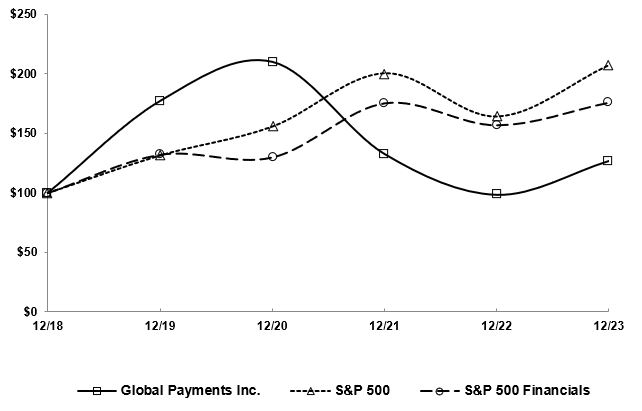
*$100 invested on December 31, 2018 in stock or index, including reinvestment of dividends.
Fiscal year ending December 31
Copyright© 2023 Standard & Poor's, a division of S&P Global. All rights reserved.
| Global Payments | S&P 500 Index | S&P 500 Financials Index | ||||||||||||||||||||||||
| December 31, 2018 | $ | 100.00 | $ | 100.00 | $ | 100.00 | ||||||||||||||||||||
| December 31, 2019 | $ | 177.25 | $ | 131.49 | $ | 132.13 | ||||||||||||||||||||
| December 31, 2020 | $ | 210.10 | $ | 155.68 | $ | 129.89 | ||||||||||||||||||||
| December 31, 2021 | $ | 132.55 | $ | 200.37 | $ | 175.40 | ||||||||||||||||||||
| December 31, 2022 | $ | 98.22 | $ | 164.08 | $ | 156.92 | ||||||||||||||||||||
| December 31, 2023 | $ | 126.72 | $ | 207.21 | $ | 175.99 |
Recent Sales of Unregistered Securities
There were no unregistered sales of equity securities during the year ended December 31, 2023.
Issuer Purchases of Equity Securities
Information about the shares of our common stock that we repurchased during the quarter ended December 31, 2023 is set forth below:
| Period | Total Number of Shares Purchased (1) | Approximate Average Price Paid per Share, excluding commission | Total Number of Shares Purchased as Part of Publicly Announced Plans or Programs | Maximum Number (or Approximate Dollar Value) of Shares that May Yet Be Purchased Under the Plans or Programs (2) | |||||||||||||||||||
| (in millions) | |||||||||||||||||||||||
| October 1-31, 2023 | 6,215 | $ | 115.44 | — | $ | — | |||||||||||||||||
| November 1-30, 2023 | 2,652 | 110.31 | — | — | |||||||||||||||||||
| December 1-31, 2023 | 4,389 | 117.92 | — | — | |||||||||||||||||||
| Total | 13,256 | $ | 109.38 | — | $ | 1,090.2 |
(1)Our board of directors authorized us to repurchase shares of our common stock through any combination of Rule 10b5-1 open-market repurchase plans, accelerated share repurchase plans, discretionary open-market purchases or privately negotiated transactions.
During the quarter ended December 31, 2023, pursuant to our employee incentive plans, we withheld 13,256 shares at an average price per share of $115.24 in order to satisfy employees' tax withholding and payment obligations in connection with the vesting of awards of restricted stock.
(2)As of December 31, 2023, the approximate dollar value of shares that may yet be purchased under our share repurchase program was $1,090.2 million. On January 25, 2024, our board of directors approved an increase to our existing share repurchase program authorization, which raised the total available authorization to $2.0 billion. The authorizations by our board of directors do not expire, but could be revoked at any time. In addition, we are not required by any of our board of directors' authorizations or otherwise to complete any repurchases by any specific time or at all.
Item 6. [RESERVED]
Item 7. MANAGEMENT'S DISCUSSION AND ANALYSIS OF FINANCIAL CONDITION AND RESULTS OF OPERATIONS
The following discussion and analysis of our financial condition and results of operations should be read in conjunction with "Item 8 - Financial Statements and Supplementary Data." This discussion and analysis contains forward-looking statements about our plans and expectations of what may happen in the future. Forward-looking statements are based on a number of assumptions and estimates that are inherently subject to significant risks and uncertainties, and our actual results could differ materially from the results anticipated by our forward-looking statements as a result of many known and unknown factors, including but not limited to, those discussed in "Item 1A - Risk Factors." See "Cautionary Notice Regarding Forward-Looking Statements" located above in "Item 1 - Business."
We operate in two reportable segments: Merchant Solutions and Issuer Solutions. During the second quarter of 2023, we completed the sale of the consumer portion of our Netspend business, which comprised our former Consumer Solutions segment. Our consolidated financial statements include the results of our former Consumer Solutions segment for periods prior to disposition. See "Note 18—Segment Information" in the notes to the accompanying consolidated financial statements for additional information about our segments.
Discussions of our results of operations for the year ended December 31, 2022 compared to the year ended December 31, 2021 that have been omitted under this item can be found in "Part II, Item 7 - Management's Discussion and Analysis of Financial Condition and Results of Operations" in our Annual Report on Form 10-K for the year ended December 31, 2022, which was filed with the United States Securities and Exchange Commission on February 17, 2023.
Executive Overview
We are a leading payments technology company delivering innovative software and services to our customers globally. Our technologies, services and team member expertise allow us to provide a broad range of solutions that enable our customers to operate their businesses more efficiently across a variety of channels around the world.
We have grown organically, as well as through acquisitions, and we continue to invest in new and innovative technology solutions, infrastructure to support our growing business and the ongoing consolidation and enhancement of our operating platforms. These investments include new product development and innovation to further enhance and differentiate our suite of technology and cloud-based solutions available to customers, along with migration of certain underlying technology platforms to cloud environments to enhance performance, improve speed to market and drive cost efficiencies. We also continue to execute on integration and other activities, such as combining business operations, streamlining technology infrastructure, eliminating duplicative corporate and operational support structures and realizing scale efficiencies.
We have furthered our business strategy through several recent key transactions during 2023 as follows:
-
We completed the acquisition of EVO Payments, Inc. (“EVO”) for total purchase consideration of $4.3 billion. EVO is a payment technology and services provider, offering payment solutions to merchants ranging from small and middle market enterprises to multinational companies and organizations across the Americas and Europe. The cash portion of the purchase consideration was funded through cash on hand and borrowings from our revolving credit facility.
-
We completed the sale of the consumer portion of our Netspend business for approximately $1 billion. In connection with the sale, we provided $675 million of seller financing and a five-year $50 million secured revolving facility that became available from the date of closing of the sale. We also completed the sale of our gaming business for approximately $400 million.
-
Our capital structure initiatives during 2023 included the issuance of Euro-denominated senior notes and the launch of a commercial paper program:
◦We issued €800 million aggregate principal amount of 4.875% senior unsecured notes due March 2031 and received net proceeds of €790.6 million, or $843.6 million based on the exchange rate on the issuance date. The net proceeds from the offering were used for general corporate purposes.
◦We established a $2.0 billion commercial paper program under which we may issue senior unsecured commercial paper notes with maturities of up to 397 days from the date of issue as a cost effective means of satisfying our short-term liquidity needs.
Highlights related to our financial condition at December 31, 2023, and results of operations for the year then ended, include the following:
-
Consolidated revenues for the year ended December 31, 2023 increased to $9,654.4 million, compared to $8,975.5 million for the prior year. The increase in consolidated revenues was primarily due to an increase in transaction volumes, including from the recently acquired EVO business, partially offset by the effects on revenue of the divested businesses.
-
Merchant Solutions and Issuer Solutions segment operating income and operating margin for the year ended December 31, 2023 increased compared to the prior year primarily due to the favorable effect of increases in revenues, since certain fixed costs do not vary with revenues, and continued expense management.
-
Consolidated operating income for the year ended December 31, 2023 included the favorable effects of the increase in revenues as compared to the prior year, partially offset by an increase in expenses primarily related to the acquisition of EVO. Consolidated operating income for the year ended December 31, 2023 also included the effects of a loss on the sale of our consumer business, which was partially offset by a gain on the sale of our gaming business.
Continuing and Emerging Trends
The payments technology industry continues to evolve and grow worldwide and as a result, certain large payment technology companies, including us, have expanded operations globally by pursuing acquisitions and creating alliances and joint ventures. We expect to continue to expand into new markets and pursue additional acquisitions and joint ventures in existing markets to increase our scale and improve our competitiveness.
The industry continues to grow globally as a result of wider merchant acceptance and increased use of credit and debit cards, advances in payment processing technology and migration to ecommerce, omnichannel and contactless payment solutions. The proliferation of credit and debit cards, as well as other digital payment solutions, has made the acceptance of digital payments a virtual necessity for many businesses, regardless of size, in order to remain competitive. Furthermore, the expanding digitization of the economy and availability and access to financial services increases the demand for cards and digital payment solutions, which in turn drives growth in acceptance and transaction volumes.
The use of digital payment solutions, the need for development of technologies and digital-based solutions and expansion of ecommerce, omnichannel and contactless payment solutions has accelerated. We believe that the number of digital payment transactions will continue to grow and that an increasing percentage of these will be facilitated through emerging technologies. As a result, we expect an increasing portion of our future capital investment will be allocated to support the development of new and emerging technologies, including technology modernization, innovation and integration through strategic partnerships.
We also believe new markets will continue to develop and expand in areas that have been previously dominated by paper-based transactions. We expect industries such as education, government and healthcare, as well as recurring payments and B2B payments, to continue to see transactions migrate to digital-based solutions. We anticipa
Showing the first 8K of 85K characters. Open the full section
Item 7A. QUANTITATIVE AND QUALITATIVE DISCLOSURES ABOUT MARKET RISK
Foreign Currency Exchange Rate Risk
Certain of our operations are conducted in foreign currencies. Consequently, a portion of our revenues and expenses may be affected by fluctuations in foreign currency exchange rates. For the year ended December 31, 2023, currency exchange rate fluctuations increased our consolidated revenues by approximately $6.1 million and increased our operating income by approximately $8.6 million compared to the prior year, calculated by converting revenues and operating income, respectively, for the current year, excluding revenues and operating income from current year acquisitions, in local currencies using exchange rates for the prior year.
Generally, the functional currency of our various subsidiaries is their local currency. We are exposed to currency fluctuations on transactions that are not denominated in the functional currency. Gains and losses on such transactions are included in determining net income for the period. We seek to mitigate our foreign currency risk through timely settlement of transactions and cash flow matching, when possible. For the year ended December 31, 2023, our transaction gains and losses were insignificant.
Additionally, we are affected by currency fluctuations in our funds settlement process on merchant payment, chargeback and card network settlement transactions that are not denominated in the currency of the underlying credit or debit card transaction. Gains and losses on these transactions are included in revenues for the period.
We are also affected by fluctuations in exchange rates on our investments in foreign operations. Relative to our net investment in foreign operations, the assets and liabilities of subsidiaries whose functional currency is a foreign currency are translated at the period-end rate of exchange. The resulting translation adjustment is recognized as a component of other comprehensive income and is included in shareholders' equity. We have designated our aggregate €800 million Euro-denominated senior notes due March 2031 as a hedge of our net investment in our Euro-denominated operations. The purpose of the net investment hedge is to offset the volatility of our net investment in our Euro-denominated operations due to changes in foreign currency exchange rates, and the foreign currency remeasurement gains and losses associated with the Euro-denominated senior notes are presented within the same components of other comprehensive income and accumulated comprehensive income.
Transaction gains and losses on intercompany balances of a long-term investment nature are also recognized as a component of other comprehensive income. When a foreign subsidiary is divested in its entirety, the associated accumulated foreign currency translation gains or losses are reclassified from the separate component of equity into our consolidated statement of income.
Interest Rate Risk
We are exposed to market risk related to changes in interest rates on certain of our long-term borrowings and cash investments. We invest our excess cash in securities that we believe are highly liquid and marketable in the short term. These investments earn a floating rate of interest and are not held for trading or other speculative purposes.
We have an unsubordinated unsecured $5.75 billion revolving credit facility, as well as a $2.0 billion commercial paper program and various lines of credit that we use to fund settlement in certain of our markets, each of which bears interest at rates that are based on market rates and fluctuate accordingly. As of December 31, 2023, the amount outstanding under these variable-rate debt arrangements and settlement lines of credit was $3,922.4 million.
The interest earned on our invested cash and the interest paid on a portion of our debt are based on variable interest rates; therefore, the exposure of our net income to a change in interest rates is partially mitigated as an increase in rates would increase both interest income and interest expense, and a reduction in rates would decrease both interest income and interest expense. Under our current policies, we may selectively use derivative instruments, such as interest rate swaps or forward rate agreements, to manage all or a portion of our exposure to interest rate changes. We have entered into interest rate swaps that reduce a portion of our exposure to market interest rate risk on certain of our variable-rate debt as discussed in "Note 10—Derivatives and Hedging Instruments" in the notes to our accompanying consolidated financial statements.
Based on balances outstanding under variable-rate debt agreements and invested cash balances at December 31, 2023, a hypothetical increase of 50 basis points in applicable interest rates as of December 31, 2023 would increase our annual interest expense by approximately $11.6 million and increase our annual interest income by approximately $4.8 million.
Item 8. FINANCIAL STATEMENTS AND SUPPLEMENTARY DATA
REPORT OF INDEPENDENT REGISTERED PUBLIC ACCOUNTING FIRM
To the shareholders and the Board of Directors of Global Payments Inc.
Opinion on the Financial Statements
We have audited the accompanying consolidated balance sheets of Global Payments Inc. and subsidiaries (the "Company") as of December 31, 2023 and 2022, the related consolidated statements of income, comprehensive income, changes in equity, and cash flows, for each of the three years in the period ended December 31, 2023, and the related notes and the schedule listed in the Index at Item 15 (collectively referred to as the "financial statements"). In our opinion, the financial statements present fairly, in all material respects, the financial position of the Company as of December 31, 2023 and 2022, and the results of its operations and its cash flows for each of the three years in the period ended December 31, 2023, in conformity with accounting principles generally accepted in the United States of America.
We have also audited, in accordance with the standards of the Public Company Accounting Oversight Board (United States) (PCAOB), the Company's internal control over financial reporting as of December 31, 2023, based on criteria established in Internal Control - Integrated Framework (2013) issued by the Committee of Sponsoring Organizations of the Treadway Commission and our report dated February 14, 2024, expressed an unqualified opinion on the Company's internal control over financial reporting.
Basis for Opinion
These financial statements are the responsibility of the Company's management. Our responsibility is to express an opinion on the Company's financial statements based on our audits. We are a public accounting firm registered with the PCAOB and are required to be independent with respect to the Company in accordance with the U.S. federal securities laws and the applicable rules and regulations of the Securities and Exchange Commission and the PCAOB.
We conducted our audits in accordance with the standards of the PCAOB. Those standards require that we plan and perform the audit to obtain reasonable assurance about whether the financial statements are free of material misstatement, whether due to error or fraud. Our audits included performing procedures to assess the risks of material misstatement of the financial statements, whether due to error or fraud, and performing procedures that respond to those risks. Such procedures included examining, on a test basis, evidence regarding the amounts and disclosures in the financial statements. Our audits also included evaluating the accounting principles used and significant estimates made by management, as well as evaluating the overall presentation of the financial statements. We believe that our audits provide a reasonable basis for our opinion.
Critical Audit Matters
The critical audit matters communicated below are matters arising from the current-period audit of the financial statements that were communicated or required to be communicated to the audit committee and that (1) relate to accounts or disclosures that are material to the financial statements and (2) involved our especially challenging, subjective, or complex judgments. The communication of critical audit matters does not alter in any way our opinion on the financial statements, taken as a whole, and we are not, by communicating the critical audit matters below, providing separate opinions on the critical audit matters or on the accounts or disclosures to which they relate.
Revenue Recognition - Issuer Solutions - Refer to Notes 1 and 4 to the financial statements.
Critical Audit Matter Description
The Company enters into long-term revenue contracts with its Issuer Solutions customers. Issuer Solutions customer contracts may include multiple promises, including processing services, loyalty redemption services and professional services to financial institutions and other financial services providers. The Company has determined that the processing services and loyalty redemption services represent stand-ready performance obligations comprising a series of distinct days of services that are substantially the same and have the same pattern of transfer to the customer. Professional services representing performance obligations are satisfied over time.
We identified the determination of performance obligations for Issuer Solutions revenue contracts as a critical audit matter, given the judgment required to determine whether any unusual and/or complex terms within the contract are identified and
evaluated appropriately. A high degree of auditor judgment was required to evaluate the Company's identification of the performance obligations in the contract.
How the Critical Audit Matter Was Addressed in the Audit
Our audit procedures related to the Company's Issuer Solutions revenue transactions, specifically its identification of the performance obligations in contracts with its customers, included the following, among others:
-
We evaluated the effectiveness of controls over Issuer Solutions contract revenues, including controls over the identification of performance obligations.
-
We selected a sample of Issuer Solutions contracts and evaluated whether the performance obligations were appropriately identified in each of the selected contracts, including whether the promised services are capable of being distinct and are distinct in the context of the contract.
Revenues - Payment processing solutions and services - Refer to Note 1 to the financial statements.
Critical Audit Matter Description
The Company's revenues from its payment processing solutions and services consist of activity-based fees made up of a significant volume of low-dollar transactions, sourced from multiple systems and applications. The processing of transactions and recording of revenues is highly automated and is based on contractual terms with merchants, financial institutions, financial service providers, payment networks, and other parties.
We identified payment processing solutions and services revenues as a critical audit matter given the increased extent of effort, including the need for us to involve professionals with expertise in information technology (IT), to identify, test, and evaluate the Company's systems, software applications, and automated controls.
How the Critical Audit Matter Was Addressed in the Audit
Our audit procedures related to the Company's systems to process payment services revenues included the following, among others:
- With the assistance of our IT specialists, we:
◦Identified the significant systems used to process revenue transactions and tested the general IT controls over each of these systems, including testing of user access controls, change management controls, and IT operations controls.
◦Tested system interface controls and automated controls within the relevant revenue streams, as well as the controls designed to ensure the accuracy and completeness of revenues.
-
We tested controls within the relevant revenue business processes, including those in place to reconcile the various reports extracted from the IT systems to the Company’s general ledger.
-
We evaluated trends in recorded revenues, including interchange fees and payment network fees.
-
For a sample of revenue transactions, we tested selected transactions by agreeing the amounts of revenue recognized to source documents and tested the mathematical accuracy of the recorded revenues.
-
We developed independent expectations of certain revenue streams and compared these to amounts recorded by the Company.
/s/ Deloitte & Touche LLP
Atlanta, Georgia
February 14, 2024
We have served as the Company's auditor since 2002.
REPORT OF INDEPENDENT REGISTERED PUBLIC ACCOUNTING FIRM
To the shareholders and the Board of Directors of Global Payments Inc.
Opinion on Internal Control over Financial Reporting
We have audited the in
Showing the first 8K of 239K characters. Open the full section
Item 9. CHANGES IN AND DISAGREEMENTS WITH ACCOUNTANTS ON ACCOUNTING AND FINANCIAL DISCLOSURE
None.
Item 9A. CONTROLS AND PROCEDURES
Evaluation of Disclosure Controls and Procedures
As of December 31, 2023, management carried out, under the supervision and with the participation of our principal executive officer and principal financial officer, an evaluation of the effectiveness of the design and operation of our disclosure controls and procedures (as defined in Rules 13a-15(e) and 15d-15(e) under the Securities Exchange Act of 1934). Based on this evaluation, our principal executive officer and principal financial officer concluded that, as of December 31, 2023, our disclosure controls and procedures were effective in ensuring that information required to be disclosed by us in the reports that we file or submit under the Securities Exchange Act of 1934, as amended, is recorded, processed, summarized and reported within the time periods specified in applicable rules and forms and are designed to ensure that information required to be disclosed in those reports is accumulated and communicated to management, including our principal executive and principal financial officers, as appropriate to allow timely decisions regarding required disclosure.
Management's Report on Internal Control over Financial Reporting
Our management team is responsible for establishing and maintaining adequate internal control over financial reporting as defined in Rules 13a-15(f) and 15d-15(f) under the Securities Exchange Act of 1934. Our management assessed the effectiveness of our internal control over financial reporting as of December 31, 2023. In making this assessment, our management used the criteria set forth by the Committee of Sponsoring Organizations of the Treadway Commission the Internal Control — Integrated Framework (2013).
Based on the results of its evaluation, management believes that as of December 31, 2023, our internal control over financial reporting is effective based on those criteria. Because of its inherent limitations, internal control over financial reporting may not prevent or detect all misstatements. Projections of any evaluation of effectiveness to future periods are subject to the risk that controls may become inadequate because of changes in conditions or that the degree of compliance with the policies or procedures may deteriorate. Internal control over financial reporting cannot provide absolute assurance of achieving financial reporting objectives because of its inherent limitations. Internal control over financial reporting is a process that involves human diligence and compliance and is subject to lapses in judgment and breakdowns resulting from human failures. Internal control over financial reporting also can be circumvented by collusion or improper management override. Due to such limitations, there is a risk that material misstatements may not be prevented or detected on a timely basis by internal control over financial reporting. However, these inherent limitations are known features of the financial reporting process. Therefore, it is possible to design into the process safeguards to reduce, though not eliminate, such risk.
Attestation Report of Public Accounting Firm
Deloitte & Touche LLP has issued an attestation report on our internal control over financial reporting, which is included herein as the Report of Independent Registered Public Accounting Firm under "Item 8 - Financial Statements and Supplementary Data" for the year ended December 31, 2023.
Changes in Internal Control over Financial Reporting
There were no changes in our internal control over financial reporting during the quarter ended December 31, 2023 that materially affected, or are reasonably likely to materially affect, our internal control over financial reporting. Our assessment of the effectiveness of our internal control over financial reporting as of December 31, 2023 includes the acquired operations of EVO.
Item 9B. OTHER INFORMATION
(c) Director and Officer Trading Plans and Arrangements
During the quarter ended December 31, 2023, none of our directors or officers notified us that they adopted, modified or terminated any Rule 10b5-1 trading arrangement or any non-Rule 10b5-1 trading arrangement as defined in Item 408(a) of Regulation S-K.
Item 9C. DISCLOSURE REGARDING FOREIGN JURISDICTIONS THAT PREVENT INSPECTIONS
Not Applicable.
PART III
Item 10. DIRECTORS, EXECUTIVE OFFICERS AND CORPORATE GOVERNANCE
We incorporate by reference in this Item 10 information about our directors, executive officers and our corporate governance contained under the headings "Proposal 1: Election of Directors," "Biographical Information About Our Executive Officers" and "Delinquent Section 16(a) Reports" from our proxy statement to be delivered in connection with our 2024 Annual Meeting of Shareholders to be held on April 25, 2024 ("2024 Proxy Statement").
We have adopted codes of ethics that apply to our senior financial officers. The senior financial officers include our Chief Executive Officer, Chief Financial Officer, Chief Accounting Officer, Controller or persons performing similar functions. The code of ethics is available in the investor relations section of our website at www.globalpaymentsinc.com and as indicated in the section entitled "Where To Find Additional Information" in Part I to this Annual Report. We intend to satisfy the disclosure requirement under Item 5.05 of Form 8-K regarding an amendment to, or a waiver from, a provision of our code of ethics by posting such information on our website at the address and location set forth above.
Item 11. EXECUTIVE COMPENSATION
We incorporate by reference in this Item 11 the information relating to executive and director compensation and the report of the Compensation Committee contained under the headings "Compensation Discussion and Analysis" and "Board and Corporate Governance-Director Compensation" from our 2024 Proxy Statement.
Item 12. SECURITY OWNERSHIP OF CERTAIN BENEFICIAL OWNERS AND MANAGEMENT AND RELATED STOCKHOLDER MATTERS
We incorporate by reference in this Item 12 the information relating to ownership of our common stock by certain persons contained under the headings "Common Stock Ownership-Common Stock Ownership by Management" and "Common Stock Ownership-Common Stock Ownership by Non-Management Shareholders" from our 2024 Proxy Statement.
The following table provides certain information as of December 31, 2023 concerning the shares of our common stock that may be issued under existing equity compensation plans. For more information on these plans, see "Note 14—Share-Based Awards and Options" in the notes to the accompanying consolidated financial statements.
| Plan category | Number of securities to be issued upon exercise of outstanding options, warrants and rights (a) | Weighted-average exercise price of outstanding options, warrants and rights (b) | Number of securities remaining available for future issuance under equity compensation plans (excluding securities reflected in column (a)) (c) | ||||||||||||||
| Equity compensation plans approved by security holders | 646,708 | $ | 96.41 | 30,209,753 | |||||||||||||
| Equity compensation plans not approved by security holders | — | — | — | ||||||||||||||
| Total | 646,708 | $ | 96.41 | 30,209,753 |
The number of securities remaining available for future issuance under equity compensation plans reflected in column (c) above includes 6,273,259 shares authorized for issuance under our 2011 Amended and Restated Incentive Plan (the "2011 Incentive Plan"), all of which are available for issuance pursuant to grants of full-value stock awards, 906,381 shares authorized under our 2000 Employee Stock Purchase Plan (the "2000 ESPP"), 13,554,740 shares authorized under our Total System Services 2017 Omnibus Plan, 7,331,435 shares authorized under our Total System Services 2012 Omnibus Plan, 1,541,327 shares authorized under our Total System Services 2007 Omnibus Plan and 602,611 shares authorized under our Amended and Restated NetSpend Holdings, Inc. 2004 Equity Incentive Plan for Options and Restricted Shares Assumed by Total System Services. We intend to issue future shares under the 2011 Incentive Plan and the 2000 ESPP only.
Item 13. CERTAIN RELATIONSHIPS AND RELATED TRANSACTIONS, AND DIRECTOR INDEPENDENCE
We incorporate by reference in this Item 13 the information regarding certain relationships and related transactions between us and our affiliates and the independence of our directors contained under the headings "Additional Information-Relationships and Related Party Transactions" and "Board and Corporate Governance-Board Independence" from our 2024 Proxy Statement.
Item 14. PRINCIPAL ACCOUNTANT FEES AND SERVICES
We incorporate by reference in this Item 14 the information regarding principal accounting fees and services contained under the heading "Proposal Three: Ratification of Reappointment of Auditors" from our 2024 Proxy Statement.
PART IV
Item 15. EXHIBITS AND FINANCIAL STATEMENT SCHEDULES
The following documents are filed as part of this Annual Report on Form 10-K:
(1) Consolidated Financial Statements
Our consolidated financial statements listed below are set forth in "Item 8 - Financial Statements and Supplementary Data" of this Annual Report on Form 10-K:
| Page Number | |||||
| Reports of Independent Registered Public Accounting Firm (PCAOB ID 34) | 55 | ||||
| Consolidated Statements of Income for the years ended December 31, 2023, 2022 and 2021 | 58 | ||||
| Consolidated Statements of Comprehensive Income for the years ended December 31, 2023, 2022 and 2021 | 59 | ||||
| Consolidated Balance Sheets as of December 31, 2023 and 2022 | 60 | ||||
| Consolidated Statements of Cash Flows for the years ended December 31, 2023, 2022 and 2021 | 61 | ||||
| Consolidated Statements of Changes in Equity for the years ended December 31, 2023, 2022 and 2021 | 62 | ||||
| Notes to Consolidated Financial Statements | 64 |
(2) Financial Statement Schedules
| Page Number | |||||
| Schedule II, Valuation and Qualifying Accounts | 111 |
All other schedules to our consolidated financial statements have been omitted because they are not required under the related instruction or are inapplicable, or because we have included the required information in our consolidated financial statements or related notes.
(3) Exhibits
The following exhibits either (i) are filed with this Annual Report on Form 10-K or (ii) have previously been filed with the SEC and are incorporated in this Item 15 by reference to those prior filings.
| * | Filed herewith. | |||||||
| + | Management contract or compensatory plan or arrangement. | |||||||
| † | Pursuant to Item 601(b)(2) of Regulation S-K, certain schedules have been omitted. The registrant hereby agrees to furnish supplementally a copy of any omitted schedule to the Securities and Exchange Commission upon request. |
(b) Exhibits
| Page Number | |||||
| Index to Exhibits | 115 |
(c) Financial Statement Schedules
See Item 15(2) above.
SIGNATURES
Pursuant to the requirements of Section 13 or 15(d) of the Securities Exchange Act of 1934, Global Payments Inc. has duly caused this report to be signed on its behalf by the undersigned, thereunto duly authorized, on February 14, 2024.
| GLOBAL PAYMENTS INC. | |||||
| By: | /s/ Cameron M. Bready | ||||
| Cameron M. Bready | |||||
| Chief Executive Officer | |||||
| (Principal Executive Officer) | |||||
| By: | /s/ Joshua J. Whipple | ||||
| Joshua J. Whipple | |||||
| Senior Executive Vice President and Chief Financial Officer | |||||
| (Principal Financial Officer) | |||||
| By: | /s/ David M. Sheffield | ||||
| David M. Sheffield | |||||
| Executive Vice President and Chief Accounting Officer | |||||
| (Principal Accounting Officer) |
Pursuant to the requirements of the Securities Exchange Act of 1934, this report has been signed below by the following persons on behalf of Global Payments Inc. and in the capacities and on the dates indicated.
| Signature | Title | Date | |||||||||||||||
| /s/ M. Troy Woods* | Chairman of the Board | February 14, 2024 | |||||||||||||||
| M. Troy Woods | |||||||||||||||||
| /s/ Connie D. McDaniel* | Lead Independent Director | February 14, 2024 | |||||||||||||||
| Connie D. McDaniel | |||||||||||||||||
| /s/ F. Thaddeus Arroyo* | Director | February 14, 2024 | |||||||||||||||
| F. Thaddeus Arroyo | |||||||||||||||||
| /s/ Robert H.B. Baldwin, Jr.* | Director | February 14, 2024 | |||||||||||||||
| Robert H.B. Baldwin, Jr. | |||||||||||||||||
| /s/ John G. Bruno* | Director | February 14, 2024 | |||||||||||||||
| John G. Bruno | |||||||||||||||||
| /s/ Joia M. Johnson* | Director | February 14, 2024 | |||||||||||||||
| Joia M. Johnson | |||||||||||||||||
| /s/ Ruth Ann Marshall* | Director | February 14, 2024 | |||||||||||||||
| Ruth Ann Marshall | |||||||||||||||||
| /s/ Kirsten Kliphouse* | Director | February 14, 2024 | |||||||||||||||
| Kirsten Kliphouse | |||||||||||||||||
| /s/ Joseph Osnoss* | Director | February 14, 2024 | |||||||||||||||
| Joseph Osnoss | |||||||||||||||||
| /s/ William B. Plummer* | Director | February 14, 2024 | |||||||||||||||
| William B. Plummer | |||||||||||||||||
| /s/ John T. Turner* | Director | February 14, 2024 | |||||||||||||||
| John T. Turner | |||||||||||||||||
| /s/ Cameron M. Bready | Director | February 14, 2024 | |||||||||||||||
| Cameron M. Bready | |||||||||||||||||
| *By: | /s/ Cameron M. Bready | Attorney-in-fact | February 14, 2024 | ||||||||||||||
| Cameron M. Bready |