 filings.tools
Garmin 10-K 2019-12-28
Filed 2020-02-19. 19 sections, 390K characters. Original on sec.gov · Markdown · JSON
Cover and table of contents
UNITED STATES
SECURITIES AND EXCHANGE COMMISSION
Washington, D.C. 20549
FORM 10-K
| [☒] | ANNUAL REPORT PURSUANT TO SECTION 13 OR 15(d) OF THE SECURITIES EXCHANGE ACT OF 1934 |
|---|
For the fiscal year ended December 28, 2019
or
| [☐] | TRANSITION REPORT PURSUANT TO SECTION 13 OR 15(d) OF THE SECURITIES EXCHANGE ACT OF 1934 |
|---|
For the transition period from to
Commission file number 0-31983
GARMIN LTD.
(Exact name of registrant as specified in its charter)

| Switzerland (State or other jurisdiction of incorporation or organization) | 98-0229227 (I.R.S. Employer Identification No.) |
| Mühlentalstrasse 2 8200 Schaffhausen Switzerland (Address of principal executive offices) | N/A (Zip Code) |
Registrant’s telephone number, including area code: +41 52 630 1600
Securities registered pursuant to Section 12(b) of the Act:
| Registered Shares, CHF 0.10 Per Share Par Value | GRMN | The Nasdaq Stock Market, LLC | ||
|---|---|---|---|---|
| (Title of each class) | (Trading Symbol) | (Name of each exchange on which registered) |
Securities registered pursuant to Section 12(g) of the Act: None
Indicate by check mark if the registrant is a well-known seasoned issuer, as defined in Rule 405 of the Securities Act. Yes [☑] NO [☐]
Indicate by check mark if the registrant is not required to file reports pursuant to Section 13 or Section 15(d) of the Act. YES [☐] No [☑]
Indicate by check mark whether the registrant (1) has filed all reports required to be filed by Section 13 or 15(d) of the Securities Exchange Act of 1934 during the preceding 12 months (or for such shorter period that the registrant was required to file such reports), and (2) has been subject to such filing requirements for the past 90 days. Yes [☑] NO [☐]
Indicate by check mark whether the registrant has submitted electronically every Interactive Data File required to be submitted pursuant to Rule 405 of Regulations S-T (§ 232.405 of this chapter) during the preceding 12 months (or for such shorter period that the registrant was required to submit such files). Yes [☑] NO [☐]
Indicate by check mark whether the registrant is a large accelerated filer, an accelerated filer, a non-accelerated filer, a smaller reporting company, or an emerging growth company. See the definitions of “large accelerated filer”, “accelerated filer”, “smaller reporting company”, and “emerging growth company” in Rule 12b-2 of the Exchange Act.
| Large Accelerated Filer | [☑] | Accelerated Filer | [☐] |
|---|---|---|---|
| Non-accelerated Filer | [☐] | Smaller reporting company | [☐] |
| Emerging growth company | [☐] |
If an emerging growth company, indicate by check mark if the registrant has elected not to use the extended transition period for complying with any new or revised financial accounting standards provided pursuant to Section 13(a) of the Exchange Act.☐
Indicate by check mark whether the registrant is a shell company (as defined in Rule 12b-2 of the Exchange Act). YES [☐] NO [☑]
Aggregate market value of the common shares held by non-affiliates of the registrant as of June 29, 2019 (based on the closing price of the registrant's common shares on the Nasdaq Stock Market for June 28, 2019) was approximately $11,181,000,000.
Number of shares outstanding of the registrant’s common shares as of February 14, 2020:
Registered Shares, CHF 0.10 par value – 190,687,357 (excluding treasury shares)
Documents incorporated by reference:
Portions of the following document are incorporated herein by reference into Part III of the Form 10-K as indicated:
| Document | Part of Form 10‑K into which Incorporated |
|---|---|
| Company's Definitive Proxy Statement for the 2020 Annual Meeting of Shareholders which will be filed no later than 120 days after December 28, 2019. | Part III |
Garmin Ltd.
2019 Form 10-K Annual Report
Table of Contents
CAUTIONARY STATEMENT WITH RESPECT TO FORWARD-LOOKING COMMENTS
The discussions set forth in this Annual Report on Form 10-K contain statements concerning potential future events. Such forward-looking statements are based upon assumptions by the Company’s management, as of the date of this Annual Report, including assumptions about risks and uncertainties faced by the Company. In addition, management may make forward-looking statements orally or in other writings, including, but not limited to, in press releases, in the annual report to shareholders and in the Company’s other filings with the Securities and Exchange Commission. Readers can identify these forward-looking statements by their use of such verbs as “expects,” “anticipates,” “believes” or similar verbs or conjugations of such verbs. Forward-looking statements include any discussion of the trends and other factors that drive our business and future results in “Item 7. Management’s Discussion and Analysis of Financial Conditions and Results of Operations.” Readers are cautioned not to place undue reliance on these forward-looking statements, which speak only as of their date. If any of management’s assumptions prove incorrect or should unanticipated circumstances arise, the Company’s actual results could materially differ from those anticipated by such forward-looking statements. The differences could be caused by a number of factors or combination of factors including, but not limited to, those factors identified under Item 1A “Risk Factors.” Readers are strongly encouraged to consider those factors when evaluating any forward-looking statements concerning the Company. Except as may be required by law, the Company does not undertake to update any forward-looking statements in this Annual Report to reflect future events or developments.
Part I
Item 1. Business
| --- | --- |
This discussion of the business of Garmin Ltd. ("Garmin" or the "Company") should be read in conjunction with, and is qualified by reference to, “Management's Discussion and Analysis of Financial Condition and Results of Operations” under Item 7 herein and the information set forth in response to Item 101 of Regulation S-K in such Item 7 is incorporated herein by reference in partial response to this Item 1. Garmin has identified five reportable segments for external reporting purposes: auto, aviation, fitness, marine, and outdoor. There are two operating segments (auto PND and auto OEM) that are not reported separately but are aggregated within the auto reportable segment. The Company’s Chief Executive Officer, who has been identified as the Chief Operating Decision Maker (CODM), allocates resources and assesses performance of each operating segment individually.
Garmin was incorporated in Switzerland on February 9, 2010 as successor to Garmin Ltd., a Cayman Islands company (“Garmin Cayman”). Garmin Cayman was incorporated on July 24, 2000 as a holding company for Garmin Corporation, a Taiwan corporation, in order to facilitate a public offering of Garmin Cayman shares in the United States. On June 27, 2010, Garmin became the ultimate parent holding company of the Garmin group of companies pursuant to a share exchange transaction effected for the purpose of changing the place of incorporation of the ultimate parent holding company of the Garmin group from the Cayman Islands to Switzerland (the “Redomestication”). Pursuant to the Redomestication, all issued and outstanding Garmin Cayman common shares were transferred to Garmin and each common share, par value U.S. $0.005 per share, of Garmin Cayman was exchanged for one registered share, par value 10 Swiss francs (CHF) per share, of Garmin. At the Company’s Annual General Meeting on June 10, 2016, the Company’s shareholders approved the cancellation of 10,000,000 registered shares of the Company held by the Company (the “Formation Shares”) and the reduction in par value of each share of the Company from CHF 10 to CHF 0.10 and the amendment of the Company’s Articles of Association to effect a corresponding share capital reduction. This share cancellation has reduced authorized shares from 208,077,418 shares to 198,077,418 shares, with an incremental 99,038,709 conditional shares that may be issued through the exercise of option rights, which are granted to Garmin employees or members of its Board of Directors. Garmin owns, directly or indirectly, all of the operating companies in the Garmin group.
Garmin’s annual report on Form 10-K, quarterly reports on Form 10-Q, current reports on Form 8-K, proxy statement and Forms 3, 4 and 5 filed by Garmin’s directors and executive officers and all amendments to those reports will be made available free of charge through the Investor Relations section of Garmin’s website (http://www.garmin.com) as soon as reasonably practicable after such material is electronically filed with, or furnished to, the Securities and Exchange Commission (the “SEC”). The SEC maintains a website (http://www.sec.gov) that contains reports, proxy and information statements, and other information regarding issuers that file electronically with the SEC.
The reference to Garmin’s website address does not constitute incorporation by reference of the information contained on this website, and such information should not be considered part of this report on Form 10-K.
Company Overview
For more than 30 years, Garmin Ltd. and subsidiaries (together, the “Company”) has pioneered new wireless devices and applications that are designed for people who live an active lifestyle, many of which feature Global Positioning System (GPS) navigation. Garmin serves five primary business units, including auto, aviation, fitness, marine, and outdoor. We believe it is through these business units that Garmin is able to achieve synergies in raw material purchases, manufacturing, distribution, research and development, and marketing efforts making for a stronger, more effective company. Garmin designs, develops, manufactures, markets, and distributes a diverse family of hand-held, wearable, portable, and fixed-mount GPS-enabled products and other navigation, communications, sensor-based and information products. Since the inception of its business, Garmin has delivered over 220 million products, which included more than 15 million products delivered during fiscal 2019.
Products
Garmin offers a broad range of solutions across its reportable segments as outlined below. In general, Garmin believes that its products are known for their value, high performance, ease of use, innovation, and ergonomics.
Many of the Company’s products utilize Global Positioning System (GPS) and other global navigation satellite systems (GNSS) receivers as a product feature that can be utilized in a variety of applications, including navigation, global positioning and tracking. GPS is a United States owned satellite network constellation that supports global positioning and navigation, providing precise geographic location and related data to both commercial and government GPS receivers. Commercial access to GPS is provided free of charge.
In addition to GPS, other global navigation satellite systems (GNSS) utilized by Garmin products include Japan’s MTSAT-based Satellite Augmentation System (MSAS), the European Geostationary Navigation Overlay Service (EGNOS) aviation Safety of Life (SoL) service, the Russian Global Navigation Satellite System (GLONASS), the European Union Galileo system, and the Chinese BeiDou Navigation Satellite System (BDS).
Some of Garmin’s products utilize a combination of global navigation satellite systems to improve navigational fix, which results in improved accuracy.
On a subscription basis, certain Garmin products offer access to the Iridium satellite network, a synchronized constellation of 66 low Earth orbit (LEO) satellites offering global data communication coverage. Iridium’s use of a LEO constellation network with 66 satellites gives it the ability to span the entire globe, offering 100 percent coverage worldwide to enable satellite-based communication.
Fitness
Garmin offers a broad range of products designed for use in fitness and lifestyle activities. Garmin currently offers the following product categories within the Fitness segment to consumers around the world:
| • | Running and Multi-sport Watches: Garmin running and multi-sport watches are offered under the Forerunner® product series. The Forerunner series offers GPS-enabled watches with features unique to each model. Depending on model, features include wrist-based heart rate monitoring, wrist-based pulse oximeter, music storage capabilities, and Garmin Pay™ contactless payment. |
|---|
| • | Cycling Products: Garmin cycling products include cycling computers, power meters, and safety and awareness equipment. Additionally, Garmin offers Tacx® indoor training equipment, including smart and basic trainers. |
|---|
| • | Activity Tracking and Smartwatch Devices: Garmin offers a wide range of activity tracking device and smartwatch devices. The Garmin product offerings include basic activity trackers, activity tracking fitness bands, GPS-enabled smartwatches, and fashion-forward hybrid smartwatches with analog style displays. The activity tracking and smartwatch devices offered by Garmin are the vívomove® series, vívoactive® series, vívosmart® series, vívofit® series, vívosport® series, and the Venu™. Each series of activity tracking and smartwatch devices offered has unique features, all to enhance and promote healthy and active lifestyles. Features of the activity tracking and smartwatch devices, depending on the series and model, include Garmin Pay, music storage capabilities, and 24/7 health monitoring. |
|---|
| • | Garmin Connect and Garmin Connect Mobile: Garmin Connect™ and Garmin Connect™ Mobile are web and mobile platforms where users can track and analyze their fitness, activities and workouts, and wellness data. In addition, users can share their accomplishments, create training groups and group challenges, and get feedback and encouragement from the Connect community. |
|---|
| • | Connect IQ: The Connect IQ™ application development platform enables third-parties to create a variety of experiences that run on a wide assortment of Garmin devices. Connect IQ provides developers with an easy-to-use software development kit (SDK) to facilitate development efforts in creating watch faces, applications, widgets, and data fields. These third-party applications are available for download by Garmin users via their mobile phone or computer and run on their compatible Garmin wearable, bike computer, golf device, or outdoor handheld. |
|---|
Outdoor
Garmin offers a broad range of products designed for use in outdoor activities. Garmin currently offers the following product categories within the Outdoor segment to consumers around the world:
| • | Outdoor Handhelds: Garmin offers outdoor handhelds under the Oregon®, Rino®, Montana®, eTrex®, GPSMAP®, Foretrex® and inReach® product lines. Handhelds range from basic waypoints navigation capabilities to advanced color touchscreen devices offering barometric altimeter, 3-axis compass, camera, preloaded maps, wi-fi and smartphone connectivity, two-way satellite communication and other features. Each series of products is designed to serve various price points. Handhelds with inReach include global satellite technology which, when combined with an active subscription, offers 2-way text messaging, S.O.S. capabilities and weather forecasts while anywhere in the world. |
|---|
| • | Adventure Watches: Garmin adventure watches include the fēnix® series, Instinct® series, tactix® series, the Descent™ Mk1, and the MARQ® collection. The fenix series offers premium multisport smartwatches with features such as wrist-based heart rate monitoring, wrist-based pulse oximeter, music storage capabilities, preloaded full-color topographical maps, Garmin Pay™, and solar charging, depending on model. The Instinct series offers a rugged and reliable outdoor GPS smartwatch with built-in sports apps, heart rate sensor, smart connectivity and wellness data. The tactix series provides preloaded full-color topographical maps and tactical features inspired by military, law enforcement, and police special operations. The Descent Mk1 is a watch style dive computer that offers divers GPS navigation, multiple dive modes, and support for up to six gasses, The MARQ series is a collection of six luxury smart tool watches with premium materials and features unique to each watch. |
|---|
| • | Golf Devices: Garmin golf devices are offered under the Approach® product line. The Approach series includes handhelds, wearables, club sensors, and laser ranging devices. Over 41,000 preloaded worldwide golf courses are available to be utilized on certain Garmin golf devices. Handheld and wearable golf devices provide yardage distances to the front, back, and middle of the green. |
|---|
| • | Dog Tracking and Training Devices: Garmin offers dog tracking and training devices under the Astro®, Alpha®, Atemos™, PRO, Sport PRO™, BarkLimiter™, and Delta® product lines. |
|---|
Aviation
The Garmin aviation segment is a leading provider of solutions to aircraft manufacturers, existing aircraft owners and operators, as well as government/defense customers and serves a range of aircraft including business aviation, general aviation, experimental/light sport, helicopters, optionally piloted vehicles (OPV), unmanned aerial vehicles (UAV) and more. Garmin’s portfolio includes autonomous flight solutions, flight displays, navigation, communication, flight control, hazard avoidance, weather radar, radar altimeter, datalink weather receivers and services, engine information systems, traffic collision avoidance systems, terrain awareness and warning systems (TAWS), controller-pilot data link (CPDLC), an expansive suite of automatic dependent surveillance broadcast (ADS-B) solutions, in-cockpit and cloud connectivity, wearables, portables, apps, training, simulation, flight planning/filing, premium trip services, aviation data services as well as other solutions that are known for innovation, reliability, and value. The list below includes a sampling of some of the aviation capabilities currently offered by Garmin around the world:
| • | Integrated Flight Decks/Flight Displays: Garmin offers a range of integrated glass flight decks from the G1000® NXi for the general aviation and business aviation markets to the G5000® for business aviation, defense and commercial applications. Integrated capabilities include navigation, communication, flight instruments, weather, terrain, traffic, ADS-B, engine information on large high-resolution color displays, and automatic flight control systems. Head-up display technology virtually mirrors the primary flight display instruments allowing for increased aircraft capability in adverse weather conditions. Additional features include: Garmin’s 3-D synthetic vision technology (SVT™), weather, Garmin’s electronic stability and protection system (ESP™), electronic flight charts, touchscreen and voice controls, CPDLC, audio and visual feedback, and animation to help pilots know exactly how the system is responding to their input. |
|---|
Garmin offers similar integrated glass flight decks for the helicopter market with the G1000H® NXi, G3000H™, and G5000H™. Basic and advanced capabilities are similar to those offered to the fixed-wing aircraft market. The helicopter offerings have been optimized for rotorcraft and offer features like helicopter synthetic vision technology (HSVT™), helicopter terrain awareness and warning system with voice call outs, radar altimeter display, helicopter-specific databases that include additional heliports and low-altitude obstacles, WireAware™ wire-strike avoidance technology, as well as high resolution terrain, tailored ADS-B traffic alerting, and the ability to display video from a forward looking infrared (FLIR) camera or other video sources.
Garmin also offers all-glass integrated flight decks to the retrofit market through G950® NXi, G1000® NXi, G3000® and G5000®. Additionally, Garmin offers electronic flight display solutions that provide essential information such as aircraft altitude, attitude and heading while also displaying data from other avionics such as weather, traffic and much more. These solutions include G3X Touch™, G500H TXi, G500 TXi, G600 TXi and G700 TXi.
| • | Electronic Flight Instruments: To help aircraft owners with aging aircraft systems while provide modern flight display capability and preserve the integrity of their original aircraft panel, Garmin offers the G5 and GI 275 electronic flight instruments. These instruments are designed to replace existing mechanical attitude indicator, attitude directional indicator (ADI), course deviation indicator (CDI), horizontal situation indicator (HSI), engine indication system (EIS), and it can serve as a standby to a number of flight displays. |
|---|
| • | Panel-mount aviation products: |
|---|
GPS/Navigation/Communication Solutions: Garmin serves the market with the GTN™ Xi series, a premium touchscreen GPS, VHF navigation and communication, and multi-function display (MFD). In addition to these core functions, this series of products combines a wealth of information for the pilot into a single display including flight planning, datalink weather, weather radar, traffic, terrain awareness and warning system (TAWS/HTAWS), charts, airport information, airspace boundaries, and much more. Additional capabilities provide advanced ADS-B “In” traffic display, including TerminalTraffic™ and patented TargetTrend™ technology as well as the ability to control the display with voice commands. Advanced GTN Xi integration capabilities provide the option to install and control a remotely located transponder and audio processor for an even more streamlined installation and single interface. The GTN Xi series also provides wireless cockpit connectivity (when properly equipped) with mobile device apps (such as Garmin Pilot™) or portable aviation navigators (such as aera® 660). Wireless cockpit connectivity features can include voice call control, text messaging, automatic wireless database updating via Database Concierge, wireless flight plan transfer, SiriusXM radio control, sharing of weather, traffic, position information and more. In 2019, Garmin introduced the GPS 175, GNC 355, and GNX 375, adding to the range of GPS navigators offered. The GPS 175 is a GPS navigator with a color touchscreen display and WAAS/LPV approach capabilities. The GNC 355 adds a built-in Comm radio to the color touchscreen GPS navigator with WAAS/LPV approach capabilities. The GNX 375 features ADS-B Out, as well as dual-link ADS-B In via a built-in transponder to the color touchscreen GPS navigator. Garmin also offers more traditional VHF navigation and VHF communication transceivers with the GNC® and GTR™ series.
Traffic Solutions: Garmin offers a comprehensive line of traffic alert and collision avoidance systems (TCAS) and traffic advisory systems (TAS) for all markets served. Advanced TCAS II systems actively identify potential aircraft threats, coordinate and instruct the pilot with a resolution advisory (RA) via a spoken command. The GTS™ series also offers TCAS I and TAS that combine active and passive surveillance data to pinpoint specific traffic threats. The systems use our patented CLEAR CAS™ technology to correlate passive automatic dependent surveillance broadcast (ADS-B) targets with active surveillance targets for a more comprehensive display to the pilot. These systems can also provide audible alerts in a spoken ATC-like format that is easily understood by the pilot and allows them to keep their eyes outside of the aircraft.
Audio Solutions: The GMA™ series of audio panels ranging from offerings with basic capabilities for the recreational pilot to advanced capabilities including voice control of audio panel and GTN™ Xi series functions, Bluetooth connectivity for wireless music input, phone calls, advanced audio effects, 3D spatial audio processing, digital voice recorder, advanced auto squelch, ambient noise based volume adjustment and independent pilot/co-pilot communications capabilities. When connected to a Garmin GTN Xi series navigator, advanced voice control functions are available, and include the ability to change page views, load destination frequencies and much more.
Transponder and ADS-B Solutions: Garmin offers solutions for all aviation markets we serve that meet and exceed both FAA and EASA’s ADS-B requirements. For business aviation aircraft, Garmin pairs the GTX™ 3000 transponder and GDL® 88 datalink for both ADS-B out and in while mitigating the need to modify the existing aircraft panel. The GTX 345 and GTX 335 are also available as an option for some business aviation aircraft.
Business aviation, general aviation, helicopters and experimental/light sport aircraft can utilize our popular GTX 345 series of all-in-one ADS-B transponders that offer options with and without GPS built-in (if the aircraft is not already equipped with the required GPS source) as well as ADS-B “In”. ADS-B “In” information can be displayed on most Garmin multi-function displays and integrated flight decks as well as select third party displays. Additionally, the GTX 345 can wirelessly transmit this data to a portable device such as a tablet using the Garmin Pilot™ app or compatible Garmin aviation portable. ADS-B “In” offers pilots basic weather information including weather radar imagery, as well as traffic information that can be enhanced with our TerminalTraffic™ and patented TargetTrend™ technology. A diversity antenna option is available that adds a second antenna on top of the aircraft for better overall system performance and/or to support applications that require sending position information to satellites.
Garmin also offers a range of FAA certified UAT-based ADS-B products within the GDL® series, including both ADS-B “Out” and ADS-B “In/Out” solutions with options for built-in GPS.
Many of the ADS-B “In” capable products provide traffic correlation with both Garmin and other compatible third-party traffic systems (such as TCAS) to provide a single, correlated display of traffic to the pilot.
Weather Solutions: Weather capabilities are delivered within our GDL®, GSR™, GSX™, GTX™ and GWX™ series. Garmin solutions include offering SiriusXM satellite data link weather information (subscription required) to an aircraft via various panel-mount Garmin displays and/or portable devices. With our GSR 56 datalink, on-demand global weather information, text/voice communications and position tracking through the Iridium satellite network (subscription required) is available. The GWX and GSX series offer solid state, real-time, airborne doppler-capable weather radar solutions. Doppler-enhanced features include ground-clutter suppression and turbulence detection. Advanced capabilities also include lightning and hail prediction, volumetric autoscanning and predictive windshear technology.
Flight Control Solutions: Garmin offers both standalone and integrated flight control solutions. Our G1000® NXi, G2000®, G3000® and G5000® platforms are integrated with our GFC™ 700 digital autopilot and optionally with our autothrottle solution. For aircraft not equipped with a Garmin integrated flight deck, we offer the GFC 600 and GFC 500 digital autopilots. The GFC 600 and GFC 500 uniquely integrate with our other retrofit avionics to allow display of the autopilot modes, flight director (FD) command cues and more. The unique design of our autopilots delivers superior in-flight characteristics, self-monitoring capabilities and minimal maintenance needs when compared to older generation autopilot systems.
| • | Autonomi™ Safety Solutions: Garmin offers autonomously activated safety solutions, when appropriately equipped, to help aid the safety of the pilot and passengers. Electronic Stability and Protection (ESP™) is a safeguard that assists pilots to maintain safe, stable flight by monitoring the aircraft’s flight condition to help prevent loss of control. Emergency Descent Mode (EDM) helps pilots and passengers in the event a pressurized cabin becomes depressurized by descending to a lower altitude. Garmin Autoland takes complete control of the flight to land the airplane in an emergency where the pilot is unable to fly. Autoland is engaged automatically or by pressing a button. It automatically searches for the nearest airport while considering weather, terrain, fuel and more. It keeps the passengers informed while communicating with ATC. It automatically engages aircraft controls like flaps, throttles, brakes to land the aircraft without any intervention from the pilot. |
|---|
| • | Portable and Wearable Solutions: Garmin offers a variety of portable aviation solutions, including our aera® series portable navigators, D2™ series pilot watches, inReach® global communicators and GDL® series remote ADS-B/SiriusXM receivers. The aera series offers aviators a touchscreen navigation device compatible with a complement of aviation databases including navigation, SafeTaxi®, FliteCharts®, airport directory and terrain/obstacles for heightened situational awareness. Advanced features can include: 3D Vision virtual perspective view of surrounding terrain, a digital document viewer, a scratch pad, geo-referenced sectional and approach charts, wireless database updating, and SiriusXM radio and weather display (subscription required). Complementing the portable display products and the Garmin Pilot™ mobile application is the GDL 52 series, which can provide a remote source of GPS, ADS-B “In” information for traffic and weather, SiriusXM weather and audio as well as backup attitude reference. |
|---|
The Garmin wearable aviation solutions include our D2 series pilot watches, which offer a built-in worldwide aviation navigation database and more alongside multisport and smartwatch features. Designed specifically for aviators, the current D2 series can display weather information (METARS and TAFs) as well as weather radar from an internet connected smartphone. Other flight information capabilities include a moving map overlaid with the aircraft’s position, HSI navigation, Zulu/UTC time and more. With a built-in baro-adjustable altimeter, vibrating alerts based on altitude can be activated to remind a pilot to activate supplemental oxygen or perform other time critical tasks. The D2 Delta series watches also include multisport features with wrist-based heart rate monitoring, smartwatch capabilities, music storage capabilities, and a wrist-based pulse oximeter sensor available on the D2 Delta PX.
inReach satellite communications and services provide the ability to stay in touch globally. Send and receive messages, navigate your route, track and share your journey and, if necessary, trigger an SOS to get emergency help from a 24/7 global monitoring center via the 100% global Iridium® satellite network. Offering additional value for pilots, inReach is integrated with FlightService’s Surveillance Enhanced Search and Rescue (SE-SAR) and Adverse Condition Alerting Service (ACAS) programs. These programs allow FlightService to track your position reports and respond quickly in an emergency situation as well as provide any adverse weather conditions that may develop on the planned route of flight.
| • | Services*:* |
|---|
Mobile Applications: Garmin Pilot™ is a premium, global app for iOS or Android mobile devices used for flight planning, filing a flight plan, in flight navigation, and automatic flight logging. It offers a comprehensive and simplified experience to access a wealth of information during any particular phase of the flight including weight and balance, performance, and trip calculations, checklists, airport information, weather, traffic, 3D Vision virtual perspective view of surrounding terrain, a digital document viewer, a scratch pad, geo-referenced sectional and approach charts, wireless database updating, ADS-B weather and traffic as well as SiriusXM radio and weather (subscription required). It incorporates global or regional navigation databases and charting options from Garmin as well as optional Jeppesen data and charts. While internet connected, the app provides access to comprehensive global weather information, as available per region, that generally includes weather radar, weather report (METARS), forecasts (TAFs/MOS), weather alerts (AIRMETS/SIGMETS), pilot reports, satellite imagery (visible and IR), winds and temperature aloft, lightning data, and notices to airmen (NOTAM). Garmin Pilot is the cornerstone of Garmin’s connected cockpit, for example when connected wirelessly with G1000® NXi, a host of benefits become available including automated database updates for the avionics, flight plan transfer, weather and traffic streaming, real-time engine information and much more. Garmin Pilot™ is also wirelessly compatible with select aera® series portables, D2™ aviator watches, G3X Touch™ flight displays, GTX™ series transponders, inReach® communicators and much more.
Additionally, the FltPlan® Go app offers pilots a free, advertisement supported, alternative to Garmin Pilot and is available for iOS, Android, and Mac. The FltTrack™ app, available for iOS and Android, allows users to view flights by aircraft registration on high-resolution, full-screen maps with weather radar. Flight details include both filed and actual departure times and filed/amended routes.
Web Services: Pilots and operators can utilize a variety of Garmin web applications before, during and after flights. FltPlan.com is the core of these applications and is trusted by pilots and flight departments to plan and file more flight plans than any other provider. It is renowned for fuel burn accuracy, reliable flight times, accurate routing and features performance profiles for more than 320 aircraft models from experimental aircraft to inter-continental business jets.
FltPlan.com offers a suite of comprehensive trip services designed to help support pilots and flight departments. Services include Pre-departure clearances, runway analysis, eAPIS, international handling, privacy services with DOT COM call signs, flight tracking, fleet management and flight logistics/scheduling.
For flight scheduling, FltLogic.com offers a comprehensive suite of features from trip requests and approvals to flight planning and post-flight reporting to meet complex and changing operational needs. FltPlan® Manager is an integrated, web-based fleet tracking program designed specifically for charter operations, large flight departments, and fractional operations. It offers operators better insight and control of their fleet from a single administrative account. FltSafety.com is a safety management system website that assists pilots and flight departments in managing potential hazards and risks and ensuring overall safety within flight operations.
Aviation Databases: Garmin offers a wide selection of databases, extended warranties and subscription services to complement our products. Our database offerings include Navigation Data, Obstacles, SafeTaxi® enhanced airport diagrams, Terrain, Basemap and more. Some of these databases are required by government regulations to be updated regularly for legal flight, and Garmin offers single updates as well as annual subscriptions for owners and operators to update all of an aircraft's qualifying avionics systems at a single price. With a database subscription and compatible avionics, owners and operators can conveniently and wirelessly transfer the latest database updates to their avionics via a mobile device running our Garmin Pilot™ application.
Extended Warranties: Garmin’s aviation product support team has been honored with top awards from two of the leading independent avionics support surveys for 16 consecutive years. To further our full product support beyond the standard product warranties, we also offer fixed price extended warranties for integrated flight decks and custom plans tailored to the owner or operator’s needs, allowing them peace of mind and predictable maintenance costs. These further our standard warranty periods with world-class factory technical service, 24/7 aircraft-on-ground (AOG) emergency service and more.
Datalink Communications: Garmin’s comprehensive satellite datalink network subscriptions provide owners and operators with compatible avionics, a global weather, voice calling, text messaging and position reporting solution. Global weather includes radar imagery, cloud cover, METARs, TAFs and much more for any point on the globe where the data is available (weather products vary by region).
Auto
Garmin designs and develops products for use in the auto market that are offered to customers around the world.
| • | Personal Navigation Devices (PND): Garmin offers personal navigation devices under the Garmin Drive™, zūmo®, dēzl™, RV, Overlander™, and Garmin fleet™ product lines. The zūmo series offers motorcycle-specific features. The RV series offers features specific to the RV enthusiast. The dēzl series offers over-the-road trucking features while the Garmin fleet series delivers an integrated tracking and dispatch fleet system. The Overlander is a rugged, all-terrain navigator with a 7-inch color touchscreen and topography maps for off-road guidance in North and South America. |
|---|
Garmin PNDs feature large screens, Amazon Alexa integration, integrated traffic receivers for traffic avoidance, map updates, spoken street names, voice activated navigation, speed limit indication, lane assist with PhotoReal junction views (thousands of high-quality photos of actual upcoming junctions), Bluetooth hands-free capability, DashCams, driver awareness alerts, and backup cameras.
| • | Original Equipment Manufacturer (OEM) Solutions: Garmin has cultivated key relationships with many automobile manufacturers to be the provider of a variety of auto OEM solutions. These range from complete embedded infotainment systems that provide a broad range of functionality, to integrated camera solutions, embedded navigation solutions, and precise positioning technology solutions. These support not only the infotainment system in the vehicle, but also key advanced driver-assistance systems (ADAS) functionality as well. |
|---|
| • | Cameras*:* Garmin offers GPS-enabled DashCams that provide high-quality video recording, provide forward collision and lane departure warnings, and automatically saves video footage with G-sensor incident detection. DashCams are offered as compact, discreet standalone cameras that can be mounted to a car windshield or built-in to certain PNDs. Garmin also offers wireless backup cameras that can be utilized with compatible PNDs to display camera footage behind the vehicle when the vehicle is in reverse. |
|---|
Marine
Garmin is a leading manufacturer of recreational marine electronics and offers a broad range of products. Garmin currently offers the following product categories within the Marine segment to consumers around the world:
| • | Chartplotters and Multi-Function Displays (MFDs): Garmin offers numerous chartplotters/MFDs under the GPSMAP® and ECHOMAP™ product lines. The offerings range from 4-inch portable and fix-mounted products to 24-inch fully-integrated Glass Helm offerings and include wireless connectivity to the ActiveCaptain® mobile app. |
|---|
| • | Cartography: Garmin is a premier supplier of cartography for the recreational marine market. Including the Garmin-owned Navionics® branded charting products, Garmin is the worldwide leader in recreational marine content for most major chartplotters and MFDs on the market. Cartography product options range from worldwide basemaps to highly detailed BlueChart® g3, BlueChart® g3 Vision, LakeVü g3 and LakeVü g3 Ultra charts, Navionics+, Platinum+ and Hotmaps Platinum products with coverage in many parts of the world, offering auto-guidance (Garmin US-patented), Navionics Dock to dock autorouting, 3-D chart views and aerial reference photos. |
|---|
| • | Fishfinders: Garmin offers an advanced line of fishfinders, the Striker™ series, which incorporate GPS technology enabling Quickdraw™ Contours, and wireless features through the ActiveCaptain mobile app. These fishfinders are available in screen sizes from 4 to 9 inches and are paired with latest technology sonar transducers offered by Garmin to provide the clearest sonar pictures on the water. |
|---|
| • | SONAR: Garmin also offers the Panoptix™ all seeing sonar smart transducer line. Panoptix provides detailed real-time, high-resolution images that can be seen in downward, 3D, and forward-looking views for locating the fish and seeing what is coming before you get there. Garmin also offers CHIRP “black-box” sounders and “smart transducers” which interface with Garmin MFDs to enhance their utility by providing the deep-water sounders and fish finder functions in a remote mounted package. The black boxes provide CHIRP traditional, Ultra High-Definition ClearVü, and Ultra High-Definition SideVü sonar, similar to our integrated sonar plotters, but can be mounted in a more convenient location away from the helm. |
|---|
| • | Autopilot Systems: Garmin offers full-featured marine autopilot systems designed for sailboats and powerboats. The systems incorporate such features as Garmin’s patented Shadow Drive™ technology, which automatically disengages the autopilot if the helm is turned, remote steering and speed control, and integration with the Volvo Penta IPS steering and propulsion system. Garmin has also introduced steer-by-wire autopilot capabilities for various steering systems. |
|---|
| • | RADAR: Garmin offers high-tech solid state Fantom™ radar with MotionScope™ Doppler technology, lowering system power consumption while greatly improving situational awareness of the captain. MotionScope can instantly show if a target is closing in or safely going the other direction. Fantom radars are available in both radomes and open array radar products with compatibility to any network-compatible Garmin chartplotter. Garmin also offers a full line of magnetron radars up to 25kW of transmit power. |
|---|
| • | Instruments: Garmin offers NMEA 2000 and NMEA 0183 compliant instrument displays that show data from multiple remote sensors on one screen. Garmin instrument displays are offered under the GNX series and GMI series. |
|---|
| • | VHF Communication Radios: Garmin offers marine VHF radios and AIS transceivers with the latest feature sets including integrated GPS receivers for the communication needs of all types of mariners. Garmin radios are NMEA 2000 compatible. Mid-range and premium radios offered are designed for larger vessels and include NMEA 0183, offer multi-station support, and monitor all AIS channels. |
|---|
| • | Handhelds and Wearable Devices: Garmin offers floating marine GPS handhelds under the GPSMAP handheld series. These marine GPS handhelds feature a 3-axis tilt-compensated electronic compass, wireless data transfer between compatible units and preloaded cartography. Some handhelds contain built-in InReach® satellatie communication and support ConnectIQ™ applications. Garmin also offers the quatix® series wearable, GPS-enabled smartwatches designed for mariners, which include marine features for navigation, sailing, stereo control, and even some autopilot functions. |
|---|
| • | Sailing: Garmin has integrated many basic and advanced sailing features into our MFD and instrument systems. These SailAssist™ features include enhanced wind rose with true and apparent wind data, pre-race guidance, synchronized race timer, virtual starting line, time to burn and lay line data fields. |
|---|
| • | Entertainment: Garmin’s entertainment brand, Fusion®, consists of marine audio head units, speakers and amplifiers. These products are designed specifically for the marine or RV environments and support many connectivity options for integrating with MFDs, smartphones, and Garmin wearables. |
|---|
| • | Digital Switching: Garmin offers a digital switching product line under the EmpirBus™ brand. The Garmin EmpirBus products provide power distribution and control solutions for marine and RV applications which enable advanced logic controls and smart electrical systems to enhance features in a boat or RV. The system features customizable graphics and user interface for the ultimate user experience. Control for EmpirBus products is integrated into Garmin’s marine multi-function displays and RV OEM products. |
|---|
| • | Trolling Motors: Garmin offers the Force™ Trolling Motor, a powerful, efficient scissor-lift style trolling motor with built-in CHIRP and Ultra High-Definition ClearVü and SideVü sonar. The Force product line also connects wirelessly to Garmin chartplotters/MFDs to provide navigation, autopilot, and anchor lock integration. |
|---|
Sales and Marketing
Garmin’s non-aviation products are sold in approximately 100 countries through a large worldwide network of independent retailers, online retailers, specialty dealers, dealers and distributors as well as through original equipment manufacturers (OEMs), who meet our sales and customer service qualifications. Garmin’s retrofit avionics and portable aviation products are sold through a large group of approved independent Sales and Service Centers around the world and, in the case of portable aviation products, also through select catalogs and pilot shops. No single customer’s purchases represented 10% or more of Garmin’s consolidated net sales in the years ended December 28, 2019, December 29, 2018, and December 30, 2017. Marketing support is provided geographically from Garmin’s offices around the world. Garmin’s distribution strategy is intended to increase Garmin’s global penetration and presence while maintaining high quality standards to ensure end-user satisfaction.
Competition
We operate in highly competitive markets though competitive conditions do vary among our diverse products and geographies. Garmin believes the principal competitive factors impacting the market for its products are design, functionality, quality and reliability, customer service, brand, price, time-to-market and availability. Garmin believes that it generally competes favorably in each of these areas and as such, is generally a significant competitor in each of our major markets.
Garmin believes that its principal competitor for portable automotive products is TomTom N.V. Garmin believes that its principal competitors for infotainment solutions are Alpine Electronics, Harman International Industries, the Mitsubishi Group, and Panasonic Corporation. Garmin believes that its principal competitors for outdoor product lines are Casio, Dogtra, Samsung, Shearwater Research, SportDOG Brand, Suunto, TAG Heuer, Tissot, and Vista Outdoor. Garmin believes that its principal competitors for fitness products are Apple, Bryton, Fitbit, Huami, Huawei, Polar Electro Oy, Samsung, Sigma Sports, Suunto, and Wahoo Fitness. For marine products, Garmin believes that its principal competitors are Flir Systems, Furuno, the Humminbird division of Johnson Outdoors, and Navico. For Garmin’s aviation product lines, Garmin considers its principal competitors to be Aspen Avionics, Avidyne Corporation, CMC Electronics, Collins Aerospace, Dynon Avionics, Genesys Aerosystems, Honeywell Aerospace & Defense, Innovative Solutions and Support Inc., L-3 Avionics Systems, Safran SA, Thales, and Universal Avionics Systems Corporation.
Research and Development
Garmin’s product innovations are driven by its strong emphasis on research and development and the close partnership between Garmin’s engineering and manufacturing teams. Garmin’s products are created by its engineering and development staff, which numbered approximately 4,500 people worldwide as of December 28, 2019. Garmin’s manufacturing staff, which numbered approximately 4,900 people worldwide as of December 28, 2019, includes manufacturing process engineers who work closely with Garmin’s design engineers to ensure manufacturability and manufacturing cost control for its products. Garmin’s development staff includes industrial designers, as well as software engineers, electrical engineers, mechanical engineers, and cartographic engineers. Garmin believes the industrial design of its products has played an important role in Garmin’s success. Once a development project is initiated and approved, a multi-disciplinary team is created to design the product and transition it into manufacturing.
Manufacturing and Operations
Garmin believes one of its core competencies and strengths is its vertically integrated manufacturing capabilities at its Taiwan facilities in Xizhi, Jhongli and LinKou, its China facility in Yangzhou, its Netherlands facility in Wassenaar, and at its U.S. facilities in Olathe, Kansas and Salem, Oregon. Garmin believes that its ownership and operation of its own manufacturing facilities and distribution networks provides significant capability and flexibility to address the breadth and depth of resources necessary to serve its diverse products and markets.
Specifically, Garmin believes that its vertical integration of its manufacturing capabilities provides advantages to product cost, quality, and time to market.
Cost: Garmin’s manufacturing resources rapidly and iteratively prototype designs, concepts, products and processes, achieving higher efficiency, resulting in lower cost. Garmin’s vertical integration approach enables leveraging of manufacturing resources across high, mid and low volume products. Sharing of these resources across product lines favorably affects Garmin’s costs to produce its range of products, with lower volume products realizing the economies of scale of higher volume products. The ownership and integration of its resources allows Garmin to optimize the design for manufacturing of its products, yielding improved cost.
Quality: Garmin’s automation and sophisticated production processes provide in-service robustness and consistent reliability standards that enable Garmin to maintain strict process and quality control of the products manufactured, thereby improving the overall quality of our products. Additionally, the immediate feedback throughout the manufacturing processes is provided to the development teams, providing integrated continuous improvement throughout design and supply chain.
Time to Market: Garmin uses multi-disciplinary teams of design engineers, process engineers, and supply chain specialists to develop products, allowing them to quickly move from concept to manufacturing. This integrated ownership provides inherent flexibility to enable faster time to market.
Garmin’s design, manufacturing, distribution, and servicing processes in its U.S., Taiwan, China and U.K. facilities are certified to ISO 9001, an international quality standard developed by the International Organization for Standardization. Garmin’s automotive operations in Taiwan, China, U.K., and Olathe have achieved IATF 16949 certification, a quality standard for automotive suppliers. Garmin’s Olathe and Salem aviation operations have achieved certification to AS9100, the quality standard for the aviation industry.
Garmin International, Inc., Garmin (Europe) Ltd., and Garmin Corporation have also achieved certification of their environmental management systems to the ISO 14001 standard, recognizing Garmin’s systems and processes which minimize or prevent harmful effects on the environment and continually strive to improve its environmental performance.
Materials
Although most components essential to Garmin’s business are generally available from multiple sources, certain key components are currently obtained by the Company from single or limited sources, which subjects Garmin to supply and pricing risks. Many of these and other key components that are available from multiple sources, including, but not limited to, NAND flash memory, dynamic random access memory (DRAM), GPS chipsets and certain LCDs, are subject, at times, to industry-wide shortages and commodity pricing fluctuations.
Garmin and other participants in the personal computer, tablet, mobile communication, aviation electronics, and consumer electronics industries also compete for various components with other industries that have experienced increased demand for their products. In addition, Garmin uses some custom components that are not common to the rest of the personal computer, tablet, mobile communication, and consumer electronics industries. New products introduced by the Company often utilize custom components available from only one source until Garmin has evaluated whether there is a need for, and subsequently qualifies, additional suppliers. When a component or product uses new technologies, initial capacity constraints may exist until the suppliers’ yields have matured or manufacturing capacity has increased. Garmin makes efforts to manage risks in these areas through the use of supply agreements and safety stock for strategically important components.
Seasonality
Our net sales are subject to seasonal fluctuation. Sales of our consumer products are generally higher in the fourth quarter due to increased demand during the holiday buying season, and, to a lesser extent, the second quarter due to increased demand during the spring and summer season. Sales of consumer products are also influenced by the timing of the release of new products. Our auto OEM and aviation products do not experience much seasonal variation, but are more influenced by the timing of auto program manufacturing, aircraft certifications, regulatory mandates, and the release of new products when the initial demand is typically the strongest.
Backlog
There is a relatively short cycle between order and shipment. Therefore, we believe that backlog information is not material to the understanding of our business. We typically ship most orders within 72 hours of receipt.
Intellectual Property
Our success and ability to compete is dependent in part on our proprietary technology. We rely on a combination of patent, copyright, trademark and trade secret laws, as well as confidentiality agreements, to establish and protect our proprietary rights. In addition, Garmin often relies on licenses of intellectual property for use in its business. For example, Garmin obtains licenses from various sources for digital cartography technology for use in our products.
As of January 10, 2020, Garmin has been issued over 1,350 patents throughout the world and holds more than 900 trademark registrations. The duration of patents varies in accordance with the provisions of applicable local law. We believe that our continued success depends on the intellectual skills of our employees and their ability to continue to innovate. Garmin will continue to file and prosecute patent applications when appropriate to attempt to protect Garmin’s rights in its proprietary technologies.
There is no assurance that our current patents, or patents which we may later acquire, may successfully withstand any challenge, in whole or in part. It is also possible that any patent issued to us may not provide us with any competitive advantages, or that the patents of others will preclude us from manufacturing and marketing certain products. Despite our efforts to protect our proprietary rights, unauthorized parties may attempt to copy aspects of our products or to obtain and use information that we regard as proprietary. Litigation may be necessary in the future to enforce our intellectual property rights, to protect our trade secrets, to determine the validity and scope of the proprietary rights of others or to defend against claims of infringement or invalidity.
Regulations
The telecommunications industry is highly regulated, and the regulatory environment in which Garmin operates is subject to change. In accordance with the United States’ Federal Communications Commission (FCC) rules and regulations, wireless transceiver products are required to be certified by the FCC and comparable authorities in foreign countries where they are sold. Garmin’s products sold in Europe are required to comply with relevant directives of the European Commission. A delay in receiving required certifications for new products, or enhancements to Garmin’s products, or losing certification for Garmin’s existing products could adversely affect our business. In addition, aviation products that are intended for installation in “type certificated aircraft” are required to be certified by the FAA, its European counterpart, the European Aviation Safety Agency, and other comparable organizations before they can be used in an aircraft.
Because Garmin Corporation, one of the Company’s principal subsidiaries, is located in Taiwan, foreign exchange control laws and regulations of Taiwan with respect to remittances into and out of Taiwan may have an impact on Garmin’s operations. The Taiwan Foreign Exchange Control Statute, and regulations thereunder, provides that all foreign exchange transactions must be executed by banks designated to handle such business by the Ministry of Finance of Taiwan and by the Central Bank of the Republic of China (Taiwan), also referred to as the CBC. Current regulations favor trade-related foreign exchange transactions. Consequently, foreign currency earned from exports of merchandise and services may now be retained and used freely by exporters, while all foreign currency needed for the import of merchandise and services may be purchased freely from the designated foreign exchange banks. Aside from trade-related foreign exchange transactions, Taiwan companies and residents may, without foreign exchange approval, remit outside and into Taiwan foreign currencies of up to $50 million and $5 million respectively, or their equivalent, each calendar year. Currency conversions within the limits are processed by the designated banks and do not have to be reviewed and approved by the CBC. The above limits apply to remittances involving a conversion between Taiwan Dollars and U.S. Dollars or other foreign currencies. The CBC typically approves foreign exchange in excess of the limits if a party applies with the CBC for review and presents legitimate business reasons justifying the currency conversion. A requirement is also imposed on all enterprises to register all medium and long-term foreign debt with the CBC.
Environmental Matters
Garmin’s operations are subject to various environmental laws, including laws addressing air and water pollution and management of hazardous substances and wastes. Substantial noncompliance with applicable environmental laws could have a material adverse effect on our business. Capital expenditures for environmental controls are included in our normal capital budget. Historically, capital expenditures associated with environmental controls have not been material and compliance with environmental laws has not had a material impact on the Company’s competitive position.
Many of Garmin's products are subject to laws relating to the chemical and material composition of our products and their energy efficiency. Garmin is also subject to laws requiring manufacturers to be financially responsible for collection, recovery and recycling of wastes from certain electronic products. Compliance with current environmental laws does not have a material impact on our business, but the impact of future enactment of environmental laws cannot yet be fully determined and could be substantial.
Garmin has implemented multiple Environmental Management System (EMS) policies in accordance with the International Organization for Standardization (ISO) 14001 standard for Environmental Health and Safety Management. Garmin’s EMS policies set forth practices, standards, and procedures to ensure compliance with applicable environmental laws and regulations at Garmin’s Kansas headquarters facility, Garmin’s European headquarters facility, and Garmin’s Taiwan and China manufacturing facilities.
Garmin continues to strive to reduce our carbon footprint by increasing our environmental sustainability efforts. Our manufacturing locations have implemented increased recycling processes that keep all obsolete Garmin manufactured material from entering the waste stream. Additionally, our newly completed facility in Olathe, Kansas has been constructed with energy efficient considerations, including reduced water consumption, LED lighting, and reflective roofing to deflect solar radiation.
Employees
As of December 28, 2019, the Company had approximately 15,000 full and part-time employees worldwide, of whom approximately 5,700 were in Americas region, 7,300 were in APAC, and 2,000 were in EMEA. Except for some of Garmin’s employees in Sweden, none of Garmin’s employees are represented by a labor union and none of Garmin's North American or Taiwan employees are covered by a collective bargaining agreement. Garmin considers its employee relations to be positive.
Item 1A. Risk Factors
| --- | --- |
The risks described below are not the only ones facing our company. Additional risks and uncertainties not presently known to us or that we currently believe to be immaterial may also impair our business operations. If any of the following risks occur, our business, financial condition or operating results could be materially adversely affected.
Risks Related to the Company
If we are not successful in the continued development, timely manufacture, and introduction of new products or product categories, demand for our products could decrease to the extent that lost sales and profits from declining segments or product categories are not entirely offset.
We expect that a significant portion of our future revenue will continue to be derived from sales of newly introduced products. This is particularly important to replace sales and profits lost in declining segments or product categories. The market for our products is characterized by rapidly changing technology, evolving industry standards and changes in customer needs. If we fail to introduce new products, or to modify or improve our existing products, in response to changes in technology, industry standards or customer needs, our products could rapidly become less competitive or obsolete. We must continue to make significant investments in research and development in order to continue to develop new products, enhance existing products and achieve market acceptance for such products. However, there can be no assurance that development stage products will be successfully completed or, if developed, will achieve significant customer acceptance.
If we are unable to successfully develop and introduce competitive new products, and enhance our existing products, our future results of operations would be adversely affected. Our pursuit of necessary technology may require substantial time and expense. We may need to license new technologies to respond to technological change. These licenses may not be available to us on terms that we can accept or may materially change the gross profits that we are able to obtain on our products. We may not succeed in adapting our products to new technologies as they emerge. Development and manufacturing schedules for technology products are difficult to predict, and there can be no assurance that we will achieve timely initial customer shipments of new products. The timely availability of these products in volume and their acceptance by customers are important to our future success. Any future challenges related to new products, whether due to product development delays, manufacturing delays, lack of market acceptance, delays in regulatory approval, or otherwise, could have a material adverse effect on our results of operations.
If we are unable to compete effectively with existing or new competitors, our resulting loss of competitive position could result in price reductions, fewer customer orders, reduced margins and loss of market share.
The markets for many of our products are highly competitive, and we expect competition to increase in the future. Some of our competitors have significantly greater financial, technical and marketing resources than we do. These competitors may be able to respond more rapidly to new or emerging technologies or changes in customer requirements. They may also be able to devote greater resources to the development, promotion and sale of their products or secure better product positioning with retailers. Increased competition could result in price reductions, fewer customer orders, reduced margins and loss of market share. Our failure to compete successfully against current or future competitors could seriously harm our business, financial condition and results of operations.
Maturation or contraction of the market for wearable devices or categories of devices could adversely affect our revenue and profits.
We have experienced growth in sales and profits in our outdoor and fitness segments, which in recent years have benefited from increased sales of wearable devices. If the overall wearable device market declines, or categories of devices within the wearable device market decline significantly, our business, financial condition or operating results could be materially adversely affected.
Our annual and quarterly financial statements will reflect fluctuations in foreign currency translation.
The operation of our subsidiaries in global markets results in exposure to movements in currency exchange rates. We have experienced significant foreign currency gains and losses due to the strengthening and weakening of the U.S. Dollar relative to certain other currencies. The potential of volatile foreign exchange rate fluctuations in the future could have a significant effect on our results of operations. We have not historically used financial instruments to hedge our foreign currency exchange rate risks.
The currencies that typically create a majority of our exchange rate exposure are the Taiwan Dollar, Euro, and British Pound Sterling. The Taiwan Dollar is the functional currency of Garmin Corporation, the U.S. Dollar is the functional currency of Garmin (Europe) Ltd., and the Euro is the functional currency of most of our other European subsidiaries, although some transactions and balances are denominated in British Pounds. Other legal entities primarily use the local currency as the functional currency. Due to the relative size of entities using a functional currency other than the Taiwan Dollar, Euro, and British Pound Sterling, fluctuations of other currencies are not expected to have a material impact on our financial statements.
We translate income and expense activity at the approximate rate of exchange at the transaction date, and all assets and liabilities at the rate of exchange in effect at the balance sheet date. Income and expense activity in a currency other than the U.S. Dollar can be impacted by exchange rate variations over time. The majority of our consolidated foreign currency gain or loss is typically driven by exchange rate impacts on the significant cash, receivables, and payables held in a currency other than the functional currency at a given legal entity. Such gain or loss will create variations in our earnings per share. However, because there is minimal cash impact caused by such exchange rate variations, management will continue to focus on our operating performance before the impact of foreign currency gains and losses.
Changes in applicable tax laws or resolutions of tax disputes could result in adverse tax consequences to the Company.
Our tax positions could be adversely impacted by changes to tax laws, tax treaties, or tax regulations or the interpretation or enforcement thereof by any tax authority in which we file income tax returns, particularly in the US, Switzerland, Taiwan, and UK. We cannot predict the outcome of any specific legislative proposals.
Global taxing standards continue to evolve as a result of the Organization for Economic Co-Operation and Development (OECD) recommendations aimed at preventing perceived base erosion and profit shifting (BEPS) by multinational corporations. While these recommendations do not change tax law, the countries where we operate may implement legislation or take unilateral actions which may result in adverse effects to our income tax provision and financial statements. Partially to respond to recent and continuing changes to global tax standards, we initiated an intercompany transaction which migrates ownership of certain consumer products intellectual property from Switzerland to the United States, which is the primary location of research, development and executive management. Due to the subjectivity inherent in transfer pricing associated with this intercompany transaction, we are pursuing an advanced pricing agreement with relevant jurisdictions to provide certainty regarding the pricing. However, we are unable to predict the outcome of
Showing the first 8K of 61K characters. Open the full section
Item 1B. Unresolved Staff Comments
| --- | --- |
None.
Item 2. Properties
| --- | --- |
Garmin and its subsidiaries own a majority of their principal properties and lease certain other properties. Depending on location, the properties could be used for manufacturing, warehousing, research and development, office space, or a combination of activities. Garmin’s principal properties are described below:
Garmin International, Inc. and Garmin USA, Inc. own and occupy facilities of approximately 1,990,000 square feet on approximately 107 acres in Olathe, Kansas, where the majority of product design and development work is conducted, the majority of aviation panel-mount products are manufactured, and products are warehoused, distributed, and supported for North, Central and South America. The 1,990,000 square feet includes a newly constructed 775,000 square foot manufacturing and distribution center. The previous manufacturing and distribution space is currently being renovated into a research and development facility and supporting office space. In connection with the bond financings for the facility in Olathe and the expansions of that facility, the City of Olathe holds the legal title to the Olathe facilities, which are leased to Garmin’s subsidiaries by the City. Upon the payment in full of the outstanding bonds, the City of Olathe is obligated to transfer title to Garmin’s subsidiaries for the aggregate sum of $200. Garmin International, Inc. has purchased all the outstanding bonds and expects to continue to hold the bonds until maturity in order to benefit from property tax abatement.
Garmin International, Inc. leases 148,000 square feet of land at New Century Airport in Gardner, Kansas under a ground lease and occupies two aircraft hangars on this land, one of which is owned (47,000 square feet) and the other leased (53,000 square feet). Both properties serve as flight test and certification facilities that are used in development and certification of aviation products.
Garmin AT, Inc. leases approximately 18 acres of land in Salem, Oregon under a ground lease. This ground lease expires in 2030, but Garmin AT, Inc. has the option to extend the ground lease until 2050. Garmin AT, Inc. owns and occupies a 115,000 square foot facility for office, development and manufacturing use and a 33,000 square foot aircraft hangar that serves as a flight test and certification facility on this land. Garmin AT, Inc. also owns and occupies an additional 66,000 square foot facility on the same property for Garmin’s West Coast customer support call center and for research and development activities.
Garmin Corporation owns and occupies 247,000 and 185,000 square foot facilities in Xizhi Dist., New Taipei City, Taiwan, a 224,000 square foot facility in Jhongli, Tao-Yang County, Taiwan, and a 576,000 square foot facility in LinKou, Tao-Yang County, Taiwan. Garmin China YangZhou Co., Ltd. leases a 204,000 square foot manufacturing facility in Yangzhou, Jiangsu, People’s Republic of China. These facilities are used for the manufacturing and warehousing of most of Garmin’s auto, fitness, marine, and outdoor products, as well as portable aviation products. These facilities are also used for some research and development activities and the marketing and support of products for Asia Pacific countries.
Garmin (Europe) Ltd. owns and occupies a 155,000 square foot building located in Totton, Southampton, England, used as offices and a distribution facility.
Garmin also owns and leases other properties, both internationally and domestically, not described above, that are used for office space, retail, and warehousing.
Item 3. Legal Proceedings
| --- | --- |
In the normal course of business, the Company and its subsidiaries are parties to various legal claims, actions, and complaints, including matters involving patent infringement, other intellectual property, product liability, customer claims and various other risks. It is not possible to predict with certainty whether or not the Company and its subsidiaries will ultimately be successful in any of these legal matters, or if not, what the impact might be. However, the Company’s management does not expect that the results in any of these legal proceedings will have a material adverse effect on the Company’s results of operations, financial position or cash flows.
The Company settled or resolved certain matters during the fiscal year ended December 28, 2019 that did not individually or in the aggregate have a material impact on the Company’s financial condition or results of operations.
Item 4. Mine Safety Disclosure
| --- | --- |
None.
Information about our Executive Officers
Pursuant to General Instruction G(3) of Form 10-K and instruction 3 to paragraph (b) of Item 401 of Regulation S-K, the following list is included as an unnumbered Item in Part I of this Annual Report on Form 10-K in lieu of being included in the Company’s Definitive Proxy Statement in connection with its annual meeting of shareholders scheduled for June 5, 2020.
Dr. Min H. Kao, age 71, has served as Executive Chairman of Garmin Ltd. since January 2013 and was previously Chairman of Garmin Ltd. from August 2004 to December 2012 and Co-Chairman of Garmin Ltd. from August 2000 to August 2004. He served as Chief Executive Officer of Garmin Ltd. from August 2002 to December 2012 and previously served as Co-Chief Executive Officer from August 2000 to August 2002. Dr. Kao served as a director and officer of various subsidiaries of the Company from August 1990 until January 2013. Dr. Kao holds Ph.D. and MS degrees in Electrical Engineering from the University of Tennessee and a BS degree in Electrical Engineering from National Taiwan University.
Clifton A. Pemble, age 54, has served as a director of Garmin Ltd. since August 2004. He has served as President and Chief Executive Officer of Garmin Ltd. since January 2013. Previously, he served as President and Chief Operating Officer of Garmin Ltd. from October 2007 to December 2012. Previously, he was Vice President, Engineering of Garmin International, Inc. from 2005 to October 2007, Director of Engineering of Garmin International, Inc. from 2003 to 2005, Software Engineering Manager of Garmin International, Inc. from 1995 to 2002, and a Software Engineer with Garmin International, Inc. from 1989 to 1995. Mr. Pemble has served as a director and officer of various Garmin subsidiaries since August 2003. Mr. Pemble holds BA degrees in Mathematics and Computer Science from MidAmerica Nazarene University.
Douglas G. Boessen, age 57, has served as Chief Financial Officer and Treasurer of Garmin Ltd. since July 2014. He previously served as Chief Financial Officer of EiKO Global, LLC from September 2013 to May 2014, as well as Collective Brands, Inc. from November 1997 to November 2012. Mr. Boessen has served as a director and officer of various Garmin subsidiaries since July 2014. Mr. Boessen is a certified public accountant and holds a BS degree in Business from the University of Central Missouri and is a graduate of the executive development program at Northwestern University’s Kellogg Graduate School of Management.
Andrew R. Etkind, age 64, has served as Vice President, General Counsel and Secretary of Garmin Ltd. since June 2009. He was previously General Counsel and Secretary of Garmin Ltd. from August 2000 to June 2009. He has been Vice President and General Counsel of Garmin International, Inc. since July 2007, General Counsel since February 1998, and Secretary since October 1998. Mr. Etkind has served as a director and officer of various Garmin subsidiaries since December 2001. Mr. Etkind holds BA, MA and LLM degrees from Cambridge University, England and a JD degree from the University of Michigan Law School.
All executive officers are elected by and serve at the discretion of the Company’s Board of Directors. None of the executive officers have an employment agreement with the Company. There are no arrangements or understandings between the executive officers and any other person pursuant to which he or she was or is to be selected as an officer. There is no family relationship among any of the executive officers.
PART II
Item 5. Market for the Company’s Common Shares, Related Shareholder Matters and Issuer Purchases of Equity Securities
| --- | --- |
Garmin’s shares have traded on The Nasdaq Stock Market, LLC under the symbol “GRMN” since its initial public offering on December 8, 2000 (the “IPO”). As of February 14, 2020, there were 199 shareholders of record.
The Board of Directors approved a share repurchase program on February 13, 2015, authorizing the Company to repurchase up to $300 million of the Company’s shares as market and business conditions warrant. The share repurchase authorization expired on December 31, 2017. The Company made no repurchases of shares during the years ended December 29, 2018 and December 28, 2019. See Note 11 in the Notes to the Consolidated Financial Statements for additional information regarding the share repurchase plan.
We refer you to Item 12 of this report under the caption “Equity Compensation Plan Information” for certain equity plan information required to be disclosed by Item 201(d) of Regulation S-K.
Stock Performance Graph
This performance graph shall not be deemed ‘‘filed’’ with the SEC or subject to Section 18 of the Securities Exchange Act of 1934, nor shall it be deemed incorporated by reference in any of our filings under the Securities Act of 1933, as amended.
The graph below matches Garmin Ltd.'s cumulative 5-Year total shareholder return on common stock with the cumulative total returns of the Nasdaq Composite index and the Nasdaq 100 index. The graph tracks the performance of a $100 investment in our common stock and in each index (with the reinvestment of all dividends) from December 31, 2014 (“12/14”) to December 31, 2019 (“12/19”).
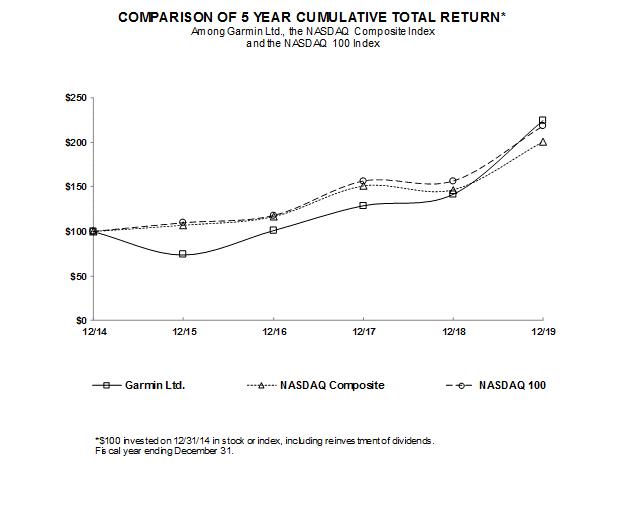
| 12/14 | 12/15 | 12/16 | 12/17 | 12/18 | 12/19 | |||||||||||||
|---|---|---|---|---|---|---|---|---|---|---|---|---|---|---|---|---|---|---|
| Garmin Ltd. | 100.00 | 73.93 | 100.99 | 128.85 | 141.51 | 223.77 | ||||||||||||
| NASDAQ Composite | 100.00 | 106.96 | 116.45 | 150.96 | 146.67 | 200.49 | ||||||||||||
| NASDAQ 100 | 100.00 | 109.75 | 117.73 | 156.58 | 156.63 | 218.44 |
The stock price performance included in this graph is not necessarily indicative of future stock price performance.
Item 6. Selected Financial Data
| --- | --- |
The following table sets forth selected consolidated financial data of the Company. The selected consolidated balance sheet data as of December 28, 2019 and December 29, 2018 and the selected consolidated statements of income data for the years ended December 28, 2019, December 29, 2018, and December 30, 2017 were derived from the Company’s audited Consolidated Financial Statements and the related notes thereto which are included in Item 8 of this annual report on Form 10-K. The selected consolidated balance sheet data as of December 30, 2017, December 31, 2016, and December 26, 2015 and the selected consolidated statements of income data for the years ended December 31, 2016 and December 26, 2015 were derived from the Company’s audited Consolidated Financial Statements, not included herein.
The information set forth below is not necessarily indicative of the results of future operations and should be read together with "Management's Discussion and Analysis of Financial Condition and Results of Operations" and the Consolidated Financial Statements and notes to those statements included in Items 7 and 8 in Part II of this Form 10-K.
The Company adopted the new accounting standard for revenue recognition, as discussed in Note 2 – Summary of Significant Accounting Policies of the Notes to Consolidated Financial Statements, effective beginning with the Company’s first quarter of 2018. Adoption of the new revenue recognition standard was applied using the full retrospective method, and information for prior periods within Items 6 and 7 in Part II of this Form 10-K have been restated accordingly.
In the table presented below, the selected consolidated statements of income and selected balance sheet data for the years ended December 30, 2017 and December 31, 2016 and the selected balance sheet data for the year ended December 26, 2015 have been restated in accordance with the Company’s adoption of the new revenue recognition standard.
| Years ended (1) | ||||||||||||||||||||
|---|---|---|---|---|---|---|---|---|---|---|---|---|---|---|---|---|---|---|---|---|
| Dec. 28, 2019 | Dec. 29, 2018 | Dec. 30, 2017 | Dec. 31, 2016 | Dec. 26, 2015 | ||||||||||||||||
| (in thousands, except per share data) | ||||||||||||||||||||
| Consolidated Statements of Income Data: | ||||||||||||||||||||
| Net sales | $ | 3,757,505 | $ | 3,347,444 | $ | 3,121,560 | $ | 3,045,797 | $ | 2,820,270 | ||||||||||
| Gross profit | 2,233,976 | 1,979,719 | 1,797,941 | 1,688,525 | 1,538,704 | |||||||||||||||
| Operating income | 945,586 | 778,343 | 683,637 | 632,864 | 549,581 | |||||||||||||||
| Net income (2) | 952,486 | 694,080 | 709,007 | 517,724 | 456,227 | |||||||||||||||
| Net income per share: | ||||||||||||||||||||
| Diluted | $ | 4.99 | $ | 3.66 | $ | 3.76 | $ | 2.73 | $ | 2.39 | ||||||||||
| Weighted average common shares outstanding: | ||||||||||||||||||||
| Diluted | 190,899 | 189,734 | 188,732 | 189,343 | 191,107 | |||||||||||||||
| Dividends declared per share (3) | $ | 2.28 | $ | 2.12 | $ | 2.04 | $ | 2.04 | $ | 2.04 | ||||||||||
| Balance Sheet Data (at end of Period): | ||||||||||||||||||||
| Cash, cash equivalents, and marketable securities | $ | 2,609,505 | $ | 2,714,844 | $ | 2,313,208 | $ | 2,327,120 | $ | 2,391,618 | ||||||||||
| Total assets | 6,166,799 | 5,382,858 | 4,948,289 | 4,484,549 | 4,478,529 | |||||||||||||||
| Total debt | — | — | — | — | — | |||||||||||||||
| Total stockholders’ equity | 4,793,496 | 4,162,974 | 3,852,419 | 3,453,259 | 3,373,734 | |||||||||||||||
| (1) Our fiscal year-end is the last Saturday of the calendar year and does not always fall on December 31. All years presented contain 52 weeks excluding fiscal 2016 which includes 53 weeks. | ||||||||||||||||||||
| (2) The following significant items are included in the Net income line that may affect comparability: In 2019, a $118.0 million income tax benefit was recognized resulting from the revaluation and step-up of certain Switzerland tax assets as a result of the enactment of Switzerland federal and Schaffhausen cantonal tax reform and related transitional measures; In 2017, a $180.0 million income tax benefit was recognized, primarily related to the revaluation of certain Switzerland deferred tax assets resulting from the Company's election to align Switzerland corporate tax positions with global tax initiatives, partially offset by $22.6 million of income tax expense due to the expiration of certain share-based awards. | ||||||||||||||||||||
| (3) Dividends declared per share refers to the cash dividend per share that has been approved by shareholders in the given fiscal year. See Note 2 - Summary of Significant Accounting Policies, Dividends for additional detail. | ||||||||||||||||||||
Item 7. Management’s Discussion and Analysis of Financial Condition and Results of Operations
| --- | --- |
The following discussion and analysis of our financial condition and results of operations focuses on and is intended to clarify the results of our operations, certain changes in our financial position, liquidity, capital structure and business developments for the periods covered by the Consolidated Financial Statements included in this Form 10-K. This discussion should be read in conjunction with, and is qualified by reference to, the other related information including, but not limited to, the audited Consolidated Financial Statements (including the notes thereto), the description of our business, all as set forth in this Form 10-K, as well as the risk factors discussed above in Item 1A.
This section provides discussion and a year-to-year comparison for the fiscal years ended December 28, 2019 and December 29, 2018. Discussion regarding our results of operations for the fiscal year ended December 30, 2017 and a year-to-year comparison between the fiscal years ended December 29, 2018 and December 30, 2017 can be found in Item 7 of our Annual Report on Form 10-K for the fiscal year ended December 29, 2018.
As previously noted, the discussion set forth below, as well as other portions of this Form 10-K, contain statements concerning potential future events. Readers can identify these forward-looking statements by their use of such verbs as “expects,” “anticipates,” “believes” or similar verbs or conjugations of such verbs. If any of our assumptions on which the statements are based prove incorrect or should unanticipated circumstances arise, our actual results could materially differ from those anticipated by such forward-looking statements. The differences could be caused by a number of factors or combination of factors including, but not limited to, those discussed above in Item 1A. Readers are strongly encouraged to consider those factors when evaluating any such forward-looking statement. Except as may be required by law, we do not undertake to update any forward-looking statements in this Form 10-K.
Garmin’s fiscal year is a 52-53 week period ending on the last Saturday of the calendar year. Fiscal years 2019, 2018 and 2017 contained 52 weeks. Unless otherwise stated, all years and dates refer to the Company’s fiscal year and fiscal periods. Unless the context otherwise requires, references in this document to "we," "us," "our" and similar terms refer to Garmin Ltd. and its subsidiaries.
Unless otherwise indicated, dollar amounts set forth in the tables are in thousands, except per share data.
Overview
We are a leading worldwide provider of navigation, communications and information devices, most of which are enabled by Global Positioning System, or GPS, technology. We operate in five reportable segments, which serve the auto, aviation, fitness, marine, and outdoor markets. Our auto reportable segment is comprised of two operating segments; auto PND and auto OEM. Each operating segment offers products through our network of subsidiary distributors and independent dealers and distributors, as well as through OEMs. Each of the operating segments is managed separately.
Since our first products were delivered in 1991, we have generated positive income from operations each year and have funded our growth from these profits.
Critical Accounting Policies and Estimates
General
Our discussion and analysis of financial condition and results of operations are based upon the Company’s Consolidated Financial Statements, which have been prepared in accordance with accounting principles generally accepted in the United States. The presentation of these financial statements requires management to make estimates and judgments that affect the reported amounts of assets, liabilities, revenues and expenses, and related disclosure of contingent assets and liabilities. On an on-going basis, we evaluate our estimates, including those related to customer sales programs and incentives, product returns, bad debts, inventories, investments, intangible assets, income taxes, warranty obligations, and contingencies and litigation. We base our estimates on historical experience and various other assumptions that are believed to be reasonable under the circumstances, the results of which form the basis for making judgments about the carrying value of assets and liabilities that are not readily apparent from other sources. Actual results may differ from these estimates under different assumptions or conditions.
Goodwill
We allocate goodwill to reporting units in proportion to the expected benefit from each business combination. Each of the Company’s operating segments (auto PND, auto OEM, aviation, fitness, marine, and outdoor) represents a distinct reporting unit. Goodwill is tested for impairment at the reporting unit level on an annual basis and between annual tests if an event occurs or circumstances change that would more likely than not reduce the fair value of a reporting unit below its carrying value. These events or circumstances could include a significant change in the operating performance indicators, competition, or expectations about future market or economic conditions.
Application of the goodwill impairment test requires significant judgment, including the identification of reporting units, assignment of assets and liabilities to reporting units, assignment of goodwill to reporting units, and determination of the fair value of each reporting unit. The fair value of each reporting unit is estimated through the use of a discounted cash flow methodology. This analysis requires significant assumptions, including discount rate, projected future revenues, projected future operating margins, and terminal growth rates. The estimates used to calculate the fair value of a reporting unit change from year to year based on operating results, market conditions, and other factors. Changes in these estimates and assumptions could materially affect the determination of fair value and goodwill impairment for each reporting unit.
Unrecognized Income Tax Benefits
We recognize liabilities associated with uncertain income tax positions, including those related to transfer pricing, based on our estimate of whether, and the extent to which, additional taxes will be due. We recognize the tax benefits from an uncertain tax position only if payment of these amounts ultimately proves to be not required or it is more likely than not that the tax position will be sustained upon examination by the taxing authorities, based on the technical merits of the position. The tax benefits recognized in the financial statements from such positions are measured based on the largest amount of benefit that is more likely than not to be realized upon ultimate settlement.
Assessing uncertain tax positions requires significant judgment, including the evaluation of unique facts and circumstances and the interpretation of laws and regulations, especially the assessment of pricing analyses that may produce various ranges of outcomes. Variations in the actual outcome of these future tax consequences could materially impact our consolidated financial statements.
Other
For further information on the Company’s critical accounting policies, refer to the discussion in the Notes to the Consolidated Financial Statements as indicated in the table below:
| Intangible Assets | Note 2 - Summary of Significant Accounting Policies |
|---|---|
| Income Taxes | Note 2 - Summary of Significant Accounting Policies & Note 6 - Income Taxes |
| Revenue Recognition | Note 2 - Summary of Significant Accounting Policies & Note 13 - Revenue |
| Product Warranty | Note 2 - Summary of Significant Accounting Policies |
| Legal and Other Contingencies | Note 2 - Summary of Significant Accounting Policies & Note 4 - Commitments and Contingencies |
Accounting Terms and Characteristics
Net Sales
Our net sales are primarily generated through sales to our retail partners, dealer and distributor network and to original equipment manufacturers (OEMs). Refer to the Revenue Recognition discussion in Note 2 to the Consolidated Financial Statements. We aim to achieve a quick turnaround on orders we receive, and we typically ship most orders within 72 hours. Therefore, we believe that backlog information is not material to the understanding of our business.
Net sales are subject to seasonal fluctuation. Typically, sales of our consumer products are highest in the fourth quarter due to increased demand during the holiday buying season, and in the second quarter, due to increased demand during the spring and summer season. Our auto OEM and aviation products do not experience much seasonal variation, but are more influenced by the timing of auto program manufacturing, aircraft certifications, regulatory mandates, and the release of new products when the initial demand is typically the strongest.
Cost of Sales/Gross Profit
Raw material costs are our most significant component of cost of goods sold. Our existing practice of performing the design and manufacture of our products in-house has enabled us to source components from different suppliers and, where possible, to redesign our products to leverage lower cost components. We believe that our flexible production model allows our Xizhi, Jhongli, and LinKou manufacturing plants in Taiwan; Yangzhou manufacturing plant in China; our Wassenaar manufacturing plant in the Netherlands; and our Olathe, Kansas, and Salem, Oregon manufacturing plants in the U.S. to experience relatively low costs of manufacturing. In general, products manufactured in Taiwan have been our highest volume products. Our manufacturing labor costs historically have been lower in Taiwan and China than in Olathe and Salem.
Sales price variability has had and can be expected to have an effect on our gross profit. Our gross profit is dependent on segment mix, and to a lesser extent, product mix within each segment.
Advertising Expense
Our advertising expenses consist primarily of costs for media advertising, cooperative advertising with our retail partners, point of sale displays, and sponsorships.
Selling, General and Administrative Expenses
Our selling, general and administrative expenses consist primarily of:
| • | salaries for sales, marketing and product support personnel; |
|---|
| • | salaries and related costs for executives and administrative personnel; |
|---|
| • | marketing, and other brand building costs; |
|---|
| • | finance and legal costs; |
|---|
| • | human resource costs; |
|---|
| • | information systems and infrastructure costs; |
|---|
| • | travel and related costs; and |
|---|
| • | occupancy and other overhead costs. |
|---|
Research and Development
The majority of our research and development costs represent salaries for our engineers and costs of test equipment and components used in product and prototype development.
We are committed to increasing the level of innovative design and development of new products as we strive for expanded ability to serve our existing consumer and aviation markets as well as new markets for active lifestyle products.
Income Taxes
We have experienced a relatively low effective income tax rate due to the proportion of our income generated by entities in tax jurisdictions with low statutory rates.
Results of Operations
The following table sets forth our results of operations as a percentage of net sales during the periods shown (the table may not foot due to rounding):
| 52-Weeks Ended | 52-Weeks Ended | 52-Weeks Ended | ||||||||||
|---|---|---|---|---|---|---|---|---|---|---|---|---|
| December 28, 2019 | December 29, 2018 | December 30, 2017 | ||||||||||
| Net sales | 100 | % | 100 | % | 100 | % | ||||||
| Cost of goods sold | 41 | % | 41 | % | 42 | % | ||||||
| Gross profit | 59 | % | 59 | % | 58 | % | ||||||
| Operating expenses: | ||||||||||||
| Advertising | 4 | % | 5 | % | 5 | % | ||||||
| Selling, general and administrative | 14 | % | 14 | % | 14 | % | ||||||
| Research and development | 16 | % | 17 | % | 16 | % | ||||||
| Total operating expenses | 34 | % | 36 | % | 36 | % | ||||||
| Operating income | 25 | % | 23 | % | 22 | % | ||||||
| Other income (expense), net | 1 | % | 1 | % | 0 | % | ||||||
| Income before income taxes | 26 | % | 25 | % | 22 | % | ||||||
| Provision (benefit) for income taxes | 1 | % | 4 | % | (0 | )% | ||||||
| Net income | 25 | % | 21 | % | 23 | % |
The following table sets forth our results of operations through operating income for each of our five segments during the period shown. The Company’s CODM uses operating income as the measure of profit or loss, combined with other measures, to assess segment performance and allocate resources. Operating income represents net sales less costs of goods sold and operating expenses. Net sales are directly attributed to each segment. Most costs of goods sold and the majority of operating expenses are also directly attributed to each segment, while certain other costs of goods sold and operating expenses are allocated to the segments in a manner appropriate to the specific facts and circumstances of the expenses being allocated. For each line item in the table, the total of the segments’ amounts equals the amount in the consolidated statements of income data included in Item 6.
As indicated in Note 8 to the Consolidated Financial Statements, the methodology used to allocate certain selling, general, and administrative expenses was refined at the beginning of the 2019 fiscal year. The amounts presented below for the 52-weeks ended December 29, 2018 and December 30, 2017 are presented here as they were originally reported. For comparative purposes, we estimate operating income for the 52-weeks ended December 29, 2018 would have been approximately $18 million less for the aviation segment, approximately $11 million more for the marine segment, approximately $7 million more for the outdoor segment, and not significantly different for the auto and fitness segments. We estimate operating income for the 52-weeks ended December 30, 2017 would have been approximately $14 million less for the aviation segment, approximately $8 million less for the fitness segment, approximately $8 million more for the marine segment, and approximately $7 million more for each of the outdoor and auto segments.
| 52-weeks ended December 28, 2019 | Fitness | Outdoor | Aviation | Auto | Marine | |||||||||||||||
|---|---|---|---|---|---|---|---|---|---|---|---|---|---|---|---|---|---|---|---|---|
| Net sales | $ | 1,047,527 | $ | 917,567 | $ | 735,458 | $ | 548,103 | $ | 508,850 | ||||||||||
| Cost of goods sold | 514,923 | 319,124 | 192,073 | 291,508 | 205,901 | |||||||||||||||
| Gross profit | 532,604 | 598,443 | 543,385 | 256,595 | 302,949 | |||||||||||||||
| Advertising expense | 71,772 | 52,171 | 5,667 | 14,435 | 20,411 | |||||||||||||||
| Selling, general and administrative expenses | 159,793 | 124,650 | 65,663 | 78,110 | 90,352 | |||||||||||||||
| Research and development expense | 109,181 | 87,581 | 219,112 | 107,182 | 82,310 | |||||||||||||||
| Total operating expenses | 340,746 | 264,402 | 290,442 | 199,727 | 193,073 | |||||||||||||||
| Operating income | $ | 191,858 | $ | 334,041 | $ | 252,943 | $ | 56,868 | $ | 109,876 | ||||||||||
| 52-weeks ended December 29, 2018 | Fitness | Outdoor | Aviation | Auto | Marine | |||||||||||||||
| Net sales | $ | 858,329 | $ | 809,883 | $ | 603,459 | $ | 634,213 | $ | 441,560 | ||||||||||
| Cost of goods sold | 386,565 | 281,629 | 153,307 | 363,420 | 182,804 | |||||||||||||||
| Gross profit | 471,764 | 528,254 | 450,152 | 270,793 | 258,756 | |||||||||||||||
| Advertising expense | 64,707 | 46,041 | 7,207 | 19,155 | 18,284 | |||||||||||||||
| Selling, general and administrative expenses | 135,096 | 120,588 | 36,139 | 88,672 | 97,682 | |||||||||||||||
| Research and development expense | 90,216 | 71,115 | 202,060 | 124,968 | 79,446 | |||||||||||||||
| Total operating expenses | 290,019 | 237,744 | 245,406 | 232,795 | 195,412 | |||||||||||||||
| Operating income | $ | 181,745 | $ | 290,510 | $ | 204,746 | $ | 37,998 | $ | 63,344 | ||||||||||
| 52-weeks ended December 30, 2017 | Fitness | Outdoor | Aviation | Auto | Marine | |||||||||||||||
| Net sales | $ | 762,194 | $ | 698,867 | $ | 501,359 | $ | 785,139 | $ | 374,001 | ||||||||||
| Cost of goods sold | 339,558 | 250,457 | 129,754 | 442,441 | 161,409 | |||||||||||||||
| Gross profit | 422,636 | 448,410 | 371,605 | 342,698 | 212,592 | |||||||||||||||
| Advertising expense | 75,660 | 41,113 | 6,180 | 25,639 | 16,101 | |||||||||||||||
| Selling, general and administrative expenses | 119,537 | 98,914 | 27,766 | 107,995 | 83,765 | |||||||||||||||
| Research and development expense | 80,674 | 58,516 | 183,726 | 126,320 | 62,398 | |||||||||||||||
| Total operating expenses | 275,871 | 198,543 | 217,672 | 259,954 | 162,264 | |||||||||||||||
| Operating income | $ | 146,765 | $ | 249,867 | $ | 153,933 | $ | 82,744 | $ | 50,328 |
Net Sales
| Net Sales | 52-Weeks Ended December 28, 2019 | Year-over-Year Change | 52-Weeks Ended December 29, 2018 | Year-over-Year Change | 52-Weeks Ended December 30, 2017 | |||||||||||||||
|---|---|---|---|---|---|---|---|---|---|---|---|---|---|---|---|---|---|---|---|---|
| Fitness | $ | 1,047,527 | 22 | % | $ | 858,329 | 13 | % | $ | 762,194 | ||||||||||
| Percentage of Total Net Sales | 28 | % | 26 | % | 24 | % | ||||||||||||||
| Outdoor | 917,567 | 13 | % | 809,883 | 16 | % | 698,867 | |||||||||||||
| Percentage of Total Net Sales | 24 | % | 24 | % | 22 | % | ||||||||||||||
| Aviation | 735,458 | 22 | % | 603,459 | 20 | % | 501,359 | |||||||||||||
| Percentage of Total Net Sales | 20 | % | 18 | % | 16 | % | ||||||||||||||
| Auto | 548,103 | (14 | %) | 634,213 | (19 | %) | 785,139 | |||||||||||||
| Percentage of Total Net Sales | 15 | % | 19 | % | 25 | % | ||||||||||||||
| Marine | 508,850 | 15 | % | 441,560 | 18 | % | 374,001 | |||||||||||||
| Percentage of Total Net Sales | 13 | % | 13 | % | 12 | % | ||||||||||||||
| Total | $ | 3,757,505 | 12 | % | $ | 3,347,444 | 7 | % | $ | 3,121,560 |
Net sales increased 12% in 2019 when compared to the year-ago period. All segments had an increase in revenue except for auto. Fitness revenue represented the largest portion of our revenue mix in 2019 at 28% compared to 26% in 2018.
Total unit sales increased 5% to 15.6 million units in 2019 from 14.9 million units in 2018.
Fitness, outdoor, aviation, and marine revenues increased 22%, 13%, 22%, and 15%, respectively when compared to the year-ago period. The fitness segment revenue increase was primarily driven by strong sales in wearables and sales from Tacx, a newly acquired group of subsidiaries that designs and manufactures indoor bike trainers. The outdoor segment revenue increase was driven by sales growth in multiple product categories, primarily led by adventure watches. Aviation segment revenue increases were driven by sales growth in both aftermarket and OEM categories. Marine segment revenue increases were driven by sales growth across multiple product categories, primarily chartplotters and SONAR products. Auto segment revenue decreased 14% from the year-ago period, due to the ongoing auto PND market contraction and lower auto OEM program sales.
Gross Profit
| Gross Profit | 52-Weeks Ended December 28, 2019 | Year-over-Year Change | 52-Weeks Ended December 29, 2018 | Year-over-Year Change | 52-Weeks Ended December 30, 2017 | |||||||||||||||
|---|---|---|---|---|---|---|---|---|---|---|---|---|---|---|---|---|---|---|---|---|
| Fitness | $ | 532,604 | 13 | % | $ | 471,764 | 12 | % | $ | 422,636 | ||||||||||
| Percentage of Segment Net Sales | 51 | % | 55 | % | 55 | % | ||||||||||||||
| Outdoor | 598,443 | 13 | % | 528,254 | 18 | % | 448,410 | |||||||||||||
| Percentage of Segment Net Sales | 65 | % | 65 | % | 64 | % | ||||||||||||||
| Aviation | 543,385 | 21 | % | 450,152 | 21 | % | 371,605 | |||||||||||||
| Percentage of Segment Net Sales | 74 | % | 75 | % | 74 | % | ||||||||||||||
| Auto | 256,595 | (5 | %) | 270,793 | (21 | %) | 342,698 | |||||||||||||
| Percentage of Segment Net Sales | 47 | % | 43 | % | 44 | % | ||||||||||||||
| Marine | 302,949 | 17 | % | 258,756 | 22 | % | 212,592 | |||||||||||||
| Percentage of Segment Net Sales | 60 | % | 59 | % | 57 | % | ||||||||||||||
| Total | $ | 2,233,976 | 13 | % | $ | 1,979,719 | 10 | % | $ | 1,797,941 | ||||||||||
| Percentage of Total Net Sales | 59 | % | 59 | % | 58 | % |
Gross profit dollars in fiscal year 2019 increased 13% while gross margin was slightly higher compared to fiscal year 2018. Gross margin increased 410 basis points in the auto segment when compared to the prior year, primarily attributable to lower license expense. Gross margin remained relatively flat within the outdoor, marine, and aviation segments. Gross margin decreased in the fitness segment primarily due to lower average selling prices and product mix.
Advertising Expenses
| Advertising | 52-Weeks Ended December 28, 2019 | Year-over-Year Change | 52-Weeks Ended December 29, 2018 | Year-over-Year Change | 52-Weeks Ended December 30, 2017 | |||||||||||||||
|---|---|---|---|---|---|---|---|---|---|---|---|---|---|---|---|---|---|---|---|---|
| Fitness | $ | 71,772 | 11 | % | $ | 64,707 | (14 | %) | $ | 75,660 | ||||||||||
| Percentage of Segment Net Sales | 7 | % | 8 | % | 10 | % | ||||||||||||||
| Outdoor | 52,171 | 13 | % | 46,041 | 12 | % | 41,113 | |||||||||||||
| Percentage of Segment Net Sales | 6 | % | 6 | % | 6 | % | ||||||||||||||
| Aviation | 5,667 | (21 | %) | 7,207 | 17 | % | 6,180 | |||||||||||||
| Percentage of Segment Net Sales | 1 | % | 1 | % | 1 | % | ||||||||||||||
| Auto | 14,435 | (25 | %) | 19,155 | (25 | %) | 25,639 | |||||||||||||
| Percentage of Segment Net Sales | 3 | % | 3 | % | 3 | % | ||||||||||||||
| Marine | 20,411 | 12 | % | 18,284 | 14 | % | 16,101 | |||||||||||||
| Percentage of Segment Net Sales | 4 | % | 4 | % | 4 | % | ||||||||||||||
| Total | $ | 164,456 | 6 | % | $ | 155,394 | (6 | %) | $ | 164,693 | ||||||||||
| Percentage of Total Net Sales | 4 | % | 5 | % | 5 | % |
Advertising expense increased 6% in absolute dollars and was relatively flat as a percent of revenue in fiscal year 2019 compared to fiscal year 2018. The overall increase in absolute dollars was primarily attributable to increased cooperative advertising in the outdoor, fitness, and marine segments and increased media advertising in the outdoor and fitness segments. These increases were partially offset by decreased cooperative advertising expense in the auto and aviation segments. All segments were relatively flat as a percent of revenue compared to the prior year.
Selling, General and Administrative Expenses
| Selling, General & Admin. Expenses | 52-Weeks Ended December 28, 2019 | Year-over-Year Change | 52-Weeks Ended December 29, 2018 | Year-over-Year Change | 52-Weeks Ended December 30, 2017 | |||||||||||||||
|---|---|---|---|---|---|---|---|---|---|---|---|---|---|---|---|---|---|---|---|---|
| Fitness | $ | 159,793 | 18 | % | $ | 135,096 | 13 | % | $ | 119,537 | ||||||||||
| Percentage of Segment Net Sales | 15 | % | 16 | % | 16 | % | ||||||||||||||
| Outdoor | 124,650 | 3 | % | 120,588 | 22 | % | 98,914 | |||||||||||||
| Percentage of Segment Net Sales | 14 | % | 15 | % | 14 | % | ||||||||||||||
| Aviation | 65,663 | 82 | % | 36,139 | 30 | % | 27,766 | |||||||||||||
| Percentage of Segment Net Sales | 9 | % | 6 | % | 6 | % | ||||||||||||||
| Auto | 78,110 | (12 | %) | 88,672 | (18 | %) | 107,995 | |||||||||||||
| Percentage of Segment Net Sales | 14 | % | 14 | % | 14 | % | ||||||||||||||
| Marine | 90,352 | (8 | %) | 97,682 | 17 | % | 83,765 | |||||||||||||
| Percentage of Segment Net Sales | 18 | % | 22 | % | 22 | % | ||||||||||||||
| Total | $ | 518,568 | 8 | % | $ | 478,177 | 9 | % | $ | 437,977 | ||||||||||
| Percentage of Total Net Sales | 14 | % | 14 | % | 14 | % |
Selling, general and administrative expense increased 8% in absolute dollars and was relatively flat as a percent of revenue when compared to the prior year. The absolute dollar increase was primarily attributable to personnel costs, legal related costs, and expenses from recent acquisitions.
As noted above and in Note 8 to the Consolidated Financial Statements, the Company refined its methodology to allocate certain selling, general and administrative expenses at the beginning of the 2019 fiscal year. The prior year amounts are presented here as originally reported. For comparative purposes, we estimate selling, general and administrative expenses for fiscal year 2018 would have been approximately $18 million more for the aviation segment, approximately $11 million less for the marine segment, approximately $7 million less for the outdoor segment, and not significantly different for the fitness and auto segments. We estimate the selling, general and administrative expense for fiscal 2017 would have been approximately $14 million more for the aviation segment, approximately $8 million more for the fitness segment, approximately $8 million less for the marine segment, and approximately $7 million less for each of the outdoor and auto segments.
In addition to the change in methodology of allocating certain selling, general and administrative expenses noted above, marine decreased in fiscal 2019, as a percent of revenue, from the previous year due to greater leverage of operating costs.
Research and Development Expense
| Research & Development | 52-Weeks Ended December 28, 2019 | Year-over-Year Change | 52-Weeks Ended December 29, 2018 | Year-over-Year Change | 52-Weeks Ended December 30, 2017 | |||||||||||||||
|---|---|---|---|---|---|---|---|---|---|---|---|---|---|---|---|---|---|---|---|---|
| Fitness | $ | 109,181 | 21 | % | $ | 90,216 | 12 | % | $ | 80,674 | ||||||||||
| Percentage of Segment Net Sales | 10 | % | 11 | % | 11 | % | ||||||||||||||
| Outdoor | 87,581 | 23 | % | 71,115 | 22 | % | 58,516 | |||||||||||||
| Percentage of Segment Net Sales | 10 | % | 9 | % | 8 | % | ||||||||||||||
| Aviation | 219,112 | 8 | % | 202,060 | 10 | % | 183,726 | |||||||||||||
| Percentage of Segment Net Sales | 30 | % | 33 | % | 37 | % | ||||||||||||||
| Auto | 107,182 | (14 | %) | 124,968 | (1 | %) | 126,320 | |||||||||||||
| Percentage of Segment Net Sales | 20 | % | 20 | % | 16 | % | ||||||||||||||
| Marine | 82,310 | 4 | % | 79,446 | 27 | % | 62,398 | |||||||||||||
| Percentage of Segment Net Sales | 16 | % | 18 | % | 17 | % | ||||||||||||||
| Total | $ | 605,366 | 7 | % | $ | 567,805 | 11 | % | $ | 511,634 | ||||||||||
| Percentage of Total Net Sales | 16 | % | 17 | % | 16 | % |
Research and development expense increased 7% in absolute dollars when compared to the year-ago period and was relatively flat as a percent of revenue. The absolute dollar increase was primarily due to engineering personnel costs related to our wearable and aviation product offerings and expenses resulting from recent acquisitions, partially offset by the capitalization of certain contractually reimbursable preproduction design and development personnel costs within the auto segment. Our research and development spending is focused on product development, improving existing software capabilities, and exploring new categories.
Operating Income
| Operating Income | 52-Weeks Ended December 28, 2019 | Year-over-Year Change | 52-Weeks Ended December 29, 2018 | Year-over-Year Change | 52-Weeks Ended December 30, 2017 | |||||||||||||||
|---|---|---|---|---|---|---|---|---|---|---|---|---|---|---|---|---|---|---|---|---|
| Fitness | $ | 191,858 | 6 | % | $ | 181,745 | 24 | % | $ | 146,765 | ||||||||||
| Percentage of Segment Net Sales | 18 | % | 21 | % | 19 | % | ||||||||||||||
| Outdoor | 334,041 | 15 | % | 290,510 | 16 | % | 249,867 | |||||||||||||
| Percentage of Segment Net Sales | 36 | % | 36 | % | 36 | % | ||||||||||||||
| Aviation | 252,943 | 24 | % | 204,746 | 33 | % | 153,933 | |||||||||||||
| Percentage of Segment Net Sales | 34 | % | 34 | % | 31 | % | ||||||||||||||
| Auto | 56,868 | 50 | % | 37,998 | -54 | % | 82,744 | |||||||||||||
| Percentage of Segment Net Sales | 10 | % | 6 | % | 11 | % | ||||||||||||||
| Marine | 109,876 | 73 | % | 63,344 | 26 | % | 50,328 | |||||||||||||
| Percentage of Segment Net Sales | 22 | % | 14 | % | 13 | % | ||||||||||||||
| Total | $ | 945,586 | 21 | % | $ | 778,343 | 14 | % | $ | 683,637 | ||||||||||
| Percentage of Total Net Sales | 25 | % | 23 | % | 22 | % |
Total operating income increased 21% in absolute dollars and increased 190 basis points as a percent of revenue when compared to fiscal year 2018. The growth in total operating income on an absolute dollar basis and as a percent of revenue was the result of revenue growth, slightly higher gross margin, and greater leverage of operating expenses, as discussed above.
Other Income (Expense)
| Other Income (Expense) | 52-Weeks Ended December 28, 2019 | 52-Weeks Ended December 29, 2018 | 52-Weeks Ended December 30, 2017 | |||||||||
|---|---|---|---|---|---|---|---|---|---|---|---|---|
| Interest income | $ | 52,817 | $ | 47,147 | $ | 36,925 | ||||||
| Foreign currency (losses) | (16,799 | ) | (7,616 | ) | (22,579 | ) | ||||||
| Other income (expense) | 5,618 | 5,373 | (912 | ) | ||||||||
| Total | $ | 41,636 | $ | 44,904 | $ | 13,434 |
The average returns on cash and investments, including interest and capital gain/loss returns during the 52-weeks ended December 28, 2019 and December 29, 2018 were 2.0% and 1.8%, respectively. Interest income increased primarily due to slightly higher yields on fixed-income securities.
Foreign currency gains and losses for the Company are typically driven by movements in the Taiwan Dollar, Euro, and British Pound Sterling in relation to the U.S. Dollar. The Taiwan Dollar is the functional currency of Garmin Corporation, the U.S. Dollar is the functional currency of Garmin (Europe) Ltd., and the Euro is the functional currency of most of our other European subsidiaries, although some transactions and balances are denominated in British Pounds. The majority of the Company’s consolidated foreign currency gain or loss is typically driven by the significant cash and marketable securities, receivables, and payables held in a currency other than the functional currency at a given legal entity. Due to the relative size of the entities using a functional currency other than the Taiwan Dollar, Euro, and British Pound Sterling, currency fluctuations related to these entities are not expected to have a material impact on the Company’s financial statements.
The $16.8 million currency loss recognized in fiscal 2019 was primarily due to the U.S. Dollar strengthening against the Euro and weakening against the Taiwan Dollar, partially offset by the U.S. Dollar weakening against the British Pound Sterling. During fiscal 2019, the U.S. Dollar strengthened 2.3% against the Euro and weakened 1.5% against the Taiwan Dollar, resulting in losses of $9.3 million and $7.1 million, respectively, while the U.S. Dollar weakened 2.9% against the British Pound Sterling, resulting in a gain of $2.8 million. The remaining net currency loss of $3.2 million was related to the timing of transactions and impacts of other currencies, each of which was individually immaterial.
The $7.6 million currency loss recognized in fiscal 2018 was primarily due to the strengthening of the U.S. Dollar against the Euro and the British Pound Sterling, offset by the U.S. Dollar strengthening against the Taiwan Dollar. During fiscal 2018, the U.S. Dollar strengthened 4.7% against the Euro and 6.0% against the British Pound Sterling, resulting in losses of $10.0 million and $1.7 million, respectively, while the U.S. Dollar strengthened 3.0% against the Taiwan Dollar, resulting in a gain of $15.1 million. The remaining net currency loss of $11.0 million was related to the timing of transactions and impacts of other currencies, each of which was individually immaterial.
Income Tax Provision
Income tax expense for the fiscal year ended December 28, 2019 was $34.7 million compared to income tax expense of $129.2 million for the fiscal year ended December 29, 2018, representing a net decrease of $94.5 million. Contributing to the decrease in income tax expense was an income tax benefit of $118.0 million associated with the revaluation and step-up of certain Switzerland tax assets as a result of the October 2019 enactment of Switzerland federal and Schaffhausen cantonal tax reform and related transitional measures. In connection with these transitional measures included in Switzerland tax reform, a reduced income tax rate will be utilized on certain Switzerland taxable income for up to five years.
In February 2020, the Company initiated a transaction between wholly-owned subsidiaries to migrate ownership of certain intellectual property from Switzerland to the United States, the primary location of research, development, and executive management. The migration, which includes a multi-year intercompany license of intellectual property, is expected to result in a favorable shift of income mix by jurisdiction and a reduction in expense related to uncertain tax positions. During the term of the license agreement, this transaction is expected to decrease the Company’s effective income tax rate as compared to the fiscal year 2019 effective income tax rate excluding the $118.0 million income tax benefit associated with the revaluation and step-up of certain Switzerland tax assets, as described above. The Company plans to pursue an Advance Pricing Agreement between relevant jurisdictions related to this transaction. At the end of the license agreement, a higher percentage of income will be recognized in the United States.
Net Income
As a result of the various factors noted above, income before taxes increased 20% to $987.2 million from $823.2 million in the prior year, while net income increased 37% to $952.5 million from $694.1 million in the prior year.
Liquidity and Capital Resources
As of December 28, 2019, we had approximately $2.6 billion of cash and cash equivalents and marketable securities. We primarily use cash flow from operations, and expect that future cash requirements may be used, to fund our capital expenditures, support our working capital requirements, pay dividends, and fund strategic acquisitions. We believe that our existing cash balances and cash flow from operations will be sufficient to meet our short- and long-term projected working capital needs, capital expenditures, and other cash requirements.
It is management’s goal to invest the on-hand cash in accordance with the investment policy, which has been approved by the Company’s Board of Directors. The investment policy’s primary purpose is to preserve capital, maintain an acceptable degree of liquidity, and maximize yield within the constraint of low credit risk. Garmin’s average interest income returns on cash and investments during fiscal 2019, 2018, and 2017 were approximately 2.0%, 1.9%, and 1.6%, respectively. The fair value of our securities varies from period to period due to changes in interest rates, in the performance of the underlying collateral and in the credit performance of the underlying issuer, among other factors. See Note 3 of the Notes to Consolidated Financial Statements for additional information regarding marketable securities.
Operating Activities
| 52-Weeks Ended | 52-Weeks Ended | 52-Weeks Ended | ||||||||||
|---|---|---|---|---|---|---|---|---|---|---|---|---|
| December 28, 2019 | December 29, 2018 | December 30, 2017 | ||||||||||
| Net cash provided by operating activities | $ | 698,549 | $ | 919,520 | $ | 660,842 |
The $221.0 million decrease in cash provided by operating activities in fiscal year 2019 compared to fiscal year 2018 was primarily due to a decrease of cash provided by working capital of $303.1 million (which included a decrease of $130.7 million in net collections of accounts receivable associated primarily with strong fourth quarter sales, a net increase of $112.4 million in cash paid for inventory associated primarily with the Company’s strategy to increase days of supply to support our increasingly diversified product lines, and a net increase of $60.0 million in cash used in other activities primarily driven by payments associated with an amendment to a license agreement) and income taxes payable of $69.4 million. The decrease was partially offset by an increase in net income of $258.4 million, reduced by other non-cash adjustments to net income of $106.9 million, which included an income tax benefit of $118.0 million associated with the revaluation and step-up of certain Switzerland tax assets.
Investing Activities
| 52-Weeks Ended | 52-Weeks Ended | 52-Weeks Ended | ||||||||||
|---|---|---|---|---|---|---|---|---|---|---|---|---|
| December 28, 2019 | December 29, 2018 | December 30, 2017 | ||||||||||
| Net cash used in investing activities | $ | (450,746 | ) | $ | (307,503 | ) | $ | (194,383 | ) |
The $143.2 million increase in cash used in investing activities in fiscal year 2019 compared to fiscal year 2018 was primarily due to increased net cash paid for acquisitions of $271.1 million, partially offset by a decrease in net purchases of marketable securities of $89.0 million and decreased cash payments for net purchases of property and equipment of $36.7 million.
Financing Activities
| 52-Weeks Ended | 52-Weeks Ended | 52-Weeks Ended | ||||||||||
|---|---|---|---|---|---|---|---|---|---|---|---|---|
| December 28, 2019 | December 29, 2018 | December 30, 2017 | ||||||||||
| Net cash used in financing activities | $ | (416,028 | ) | $ | (286,161 | ) | $ | (448,412 | ) |
The $129.9 million increase in cash used in financing activities in fiscal year 2019 compared to fiscal year 2018 was primarily due to an increase in dividend payments of $121.1 million associated with the timing of dividend payments that resulted in one more dividend payment in 2019 compared to 2018.
Our declared dividend has increased from $0.51 per share for the twelve calendar quarters beginning in June 2016 to $0.57 per share for the four calendar quarters beginning June 2019.
Contractual Obligations and Commercial Commitments
As of December 28, 2019, operating leases comprise the substance of the Company’s commercial commitments with long-term scheduled payments, as summarized below:
| Payments due by period | ||||||||||||||||||||
|---|---|---|---|---|---|---|---|---|---|---|---|---|---|---|---|---|---|---|---|---|
| Contractual Obligations | Total | Less than 1 year | 1-3 years | 3-5 years | More than 5 years | |||||||||||||||
| Operating Leases | $ | 97,319 | $ | 18,487 | $ | 30,240 | $ | 22,018 | $ | 26,574 |
The Company is party to certain other commitments, which include purchases of raw materials, capital expenditures, advertising, and other indirect purchases in connection with conducting our business. The aggregate amount of purchase orders and other commitments open as of December 28, 2019 was approximately $586.3 million. We cannot determine the aggregate amount of such purchase orders that represent contractual obligations because purchase orders may represent authorizations to purchase rather than binding agreements. Our purchase orders are generally based on our current needs and are typically fulfilled within short periods of time.
We may be required to make significant cash outlays related to unrecognized tax benefits. However, due to the uncertainty of the timing of future cash flows associated with our unrecognized tax benefits, we are unable to make reasonably reliable estimates of the period of cash settlement, if any, with the respective taxing authorities. Accordingly, unrecognized tax benefits of $101.3 million as of December 28, 2019, have been excluded from the contractual obligations table above. For further information related to unrecognized tax benefits, see Note 2 – Summary of Significant Accounting Policies, Income Taxes and Note 6 – Income Taxes to the Consolidated Financial Statements included in this Report.
Off-Balance Sheet Arrangements
We do not have any off-balance sheet arrangements.
Item 7A. Quantitative and Qualitative Disclosures About Market Risk
| --- | --- |
Market Sensitivity
We have market risk primarily in connection with the pricing of our products and services and the purchase of raw materials. Product pricing and raw materials costs are both significantly influenced by semiconductor market conditions. Historically, during cyclical industry downturns, we have been able to offset pricing declines for our products through a combination of improved product mix and success in obtaining price reductions in raw materials costs.
Inflation
We do not believe that inflation has had a material effect on our business, financial condition or results of operations. If our costs were to become subject to significant inflationary pressures, we may not be able to fully offset such higher costs through price increases. Our inability or failure to do so could adversely affect our business, financial condition and results of operations.
Foreign Currency Exchange Rate Risk
The operation of Garmin’s subsidiaries in international markets results in exposure to movements in currency exchange rates. We have experienced significant foreign currency gains and losses due to the strengthening and weakening of the U.S. dollar. The potential of volatile foreign exchange rate fluctuations in the future could have a significant effect on our results of operations. The Company has not historically used financial instruments to hedge its foreign currency exchange rate risks.
The currencies that create a majority of the Company’s exchange rate exposure are the Taiwan Dollar, Euro, and British Pound Sterling. Garmin Corporation, headquartered in Taiwan, uses the local currency as the functional currency. The Company translates all assets and liabilities at the rate of exchange in effect at the balance sheet date and income and expense activity at the approximate rate of exchange at the transaction date. In order to minimize the effect of the currency exchange fluctuations on our net assets, we have elected to retain most of our Taiwan subsidiary’s cash and investments in accounts denominated in U.S. Dollars.
Most European subsidiaries use the Euro as the functional currency. However, the functional currency of our largest European subsidiary, Garmin (Europe) Ltd., is the U.S. Dollar, and as some transactions have occurred and balances reside in British Pounds Sterling or Euros, foreign currency gains or losses have been realized historically related to the movements of those currencies relative to the U.S. Dollar. Gains and losses may become more material in the future as our European presence grows.
During fiscal year 2019, the Company incurred a net foreign currency loss of $16.8 million. The U.S. Dollar strengthening against the Euro and weakening against the Taiwan Dollar was partially offset by the U.S. Dollar weakening against the British Pound Sterling. During fiscal 2019, the U.S. Dollar strengthened 2.3% against the Euro and weakened 1.5% against the Taiwan Dollar, resulting in losses of $9.3 million and $7.1 million, respectively, while the U.S. Dollar weakened 2.9% against the British Pound Sterling, resulting in a gain of $2.8 million. The remaining net currency loss of $3.2 million was related to the timing of transactions and impacts of other currencies, each of which was individually immaterial. These and other currency moves during fiscal year 2019 also resulted in a currency translation adjustment of $8.0 million within Accumulated other comprehensive income on the Company’s Consolidated Balance Sheets.
We assessed the Company’s exposure to movements in currency exchange rates by performing a sensitivity analysis of adverse changes in exchange rates and the corresponding impact to our results of operations. Based on monetary assets and liabilities denominated in currencies other than respective functional currencies as of December 28, 2019 and December 29, 2018, hypothetical and reasonably possible adverse changes of 10% for the Taiwan Dollar, Euro, and British Pound Sterling would have resulted in an adverse impact on Income before income taxes on the Company’s Consolidated Statements of Income of approximately $90 and $109 million at December 28, 2019 and December 29, 2018, respectively.
Interest Rate Risk
We have no outstanding long-term debt as of December 29, 2018. We, therefore, have no meaningful debt-related interest rate risk.
We are exposed to interest rate risk in connection with our investments in marketable securities. As interest rates change, the unrealized gains and losses associated with those securities will fluctuate accordingly.
The Company’s investment policy targets low risk investments with the objective of minimizing the potential risk of principal loss. The Company does not intend to sell securities in an unrealized loss position and it is not more likely than not that the Company will be required to sell such investments before recovery of their amortized costs bases, which may be maturity. During 2019 and 2018, the Company did not record any material impairment charges on its outstanding securities.
We assessed the Company’s exposure to interest rate risk by performing a sensitivity analysis of a parallel shift in the yield curve and the corresponding impact to the Company’s portfolio of marketable securities. Based on balance sheet positions as of December 28, 2019 and December 29, 2018, the hypothetical and reasonably possible 100 basis point increases in interest rates across all securities would have resulted in declines in portfolio fair market value of approximately $35 million and $38 million at December 28, 2019 and December 29, 2018, respectively. Such losses would only be realized if the Company sold the investments prior to maturity.
Item 8. Financial Statements and Supplementary Data
CONSOLIDATED FINANCIAL STATEMENTS
Garmin Ltd. and Subsidiaries
Years Ended December 28, 2019, December 29, 2018, and December 30, 2017
Contents
Report of Independent Registered Public Accounting Firm
To the Stockholders and the Board of Directors of Garmin Ltd. and Subsidiaries
Opinion on the Financial Statements
We have audited the accompanying consolidated balance sheets of Garmin Ltd. and Subsidiaries (the Company) as of December 28, 2019 and December 29, 2018, the related consolidated statements of income, comprehensive income, stockholders’ equity and cash flows for each of the three years in the period ended December 28, 2019, and the related notes and financial statement schedule listed in the Index at Item 15(a) (collectively referred to as the “consolidated financial statements”). In our opinion, the consolidated financial statements present fairly, in all material respects, the financial position of the Company at December 28, 2019 and December 29, 2018, and the results of its operations and its cash flows for each of the three years in the period ended December 28, 2019, in conformity with U.S. generally accepted accounting principles.
We also have audited, in accordance with the standards of the Public Company Accounting Oversight Board (United States) (PCAOB), the Company’s internal control over financial reporting as of December 28, 2019, based on criteria established in Internal Control-Integrated Framework issued by the Committee of Sponsoring Organizations of the Treadway Commission (2013 framework) and our report dated February 19, 2020, expressed an unqualified opinion thereon.
Basis for Opinion
These financial statements are the responsibility of the Company’s management. Our responsibility is to express an opinion on the Company’s financial statements based on our audits. We are a public accounting firm registered with the PCAOB and are required to be independent with respect to the Company in accordance with the U.S. federal securities laws and the applicable rules and regulations of the Securities and Exchange Commission and the PCAOB.
We conducted our audits in accordance with the standards of the PCAOB. Those standards require that we plan and perform the audit to obtain reasonable assurance about whether the financial statements are free of material misstatement, whether due to error or fraud. Our audits included performing procedures to assess the risks of material misstatement of the financial statements, whether due to error or fraud, and performing procedures that respond to those risks. Such procedures included examining, on a test basis, evidence regarding the amounts and disclosures in the financial statements. Our audits also included evaluating the accounting principles used and significant estimates made by management, as well as evaluating the overall presentation of the financial statements. We believe that our audits provide a reasonable basis for our opinion.
Critical Audit Matters
The critical audit matters communicated below are matters arising from the current period audit of the financial statements that were communicated or required to be communicated to the audit committee and that: (1) relate to accounts or disclosures that are material to the financial statements and (2) involved our especially challenging, subjective or complex judgments. The communication of critical audit matters does not alter in any way our opinion on the consolidated financial statements, taken as a whole, and we are not, by communicating the critical audit matters below, providing separate opinions on the critical audit matters or on the accounts or disclosures to which they relate.
Valuation of Goodwill
Description of the Matter
The Company assigns goodwill acquired in business combinations to its reporting units as of each acquisition date. At December 28, 2019, the Company’s goodwill balance related to the auto personal navigation device (“auto PND”) reporting unit was approximately $80 million. As discussed in Note 2 of the consolidated financial statements, goodwill is tested for impairment at least annually at the reporting unit level. The auto PND market has declined in recent years as competing technologies have emerged and market saturation has occurred. This has resulted in periods of lower revenues and profits for the Company’s auto PND reporting unit. Considering these qualitative factors, management performed a step one quantitative impairment test of the auto PND reporting unit in the fourth quarter of 2019. Considering the uncertainty of future operating results and/or market conditions deteriorating faster or more drastically than the forecasts utilized in management’s estimation of fair value, the Company disclosed some or all of the approximately $80 million of goodwill associated with the auto PND reporting unit is at risk of future impairment.
Auditing management’s annual goodwill impairment test for the auto PND reporting unit was complex and highly judgmental due to the significant estimation required in determining the fair value of the reporting unit. In particular, the fair value estimate was sensitive to significant assumptions such as the discount rate, projected future revenues, projected future operating margins, and terminal growth rates which are affected by expectations about future market or economic conditions.
How We Addressed the Matter in Our Audit
We obtained an understanding, evaluated the design and tested the operating effectiveness of controls over the Company’s auto PND goodwill impairment review process. For example, we tested controls over management's review of the significant assumptions (e.g., discount rate, projected revenue growth rates, projected operating margins, terminal growth rates) used to develop the prospective financial information (PFI) for the quantitative analysis. We also tested management's controls to validate that the data used in the valuation was complete and accurate.
To test the estimated fair value of the Company’s auto PND reporting unit, we performed audit procedures that included, among others, assessing the methodology and testing the significant assumptions discussed above and the underlying data used by the Company in its analysis. We included valuation specialists on our team to review the Company’s model, method, and the more sensitive assumptions such as the discount rate and terminal growth assumptions. We compared the significant assumptions used by management to current industry and economic trends, changes to the Company’s business model, forecasts used in the Company’s annual operating plans and other relevant factors. We assessed the historical accuracy of management’s forecast estimates and performed sensitivity analyses of significant assumptions to evaluate the changes in the fair value of the auto PND reporting unit that would result from changes in the assumptions. We reconciled the
Showing the first 8K of 150K characters. Open the full section
Item 10. Directors, Executive Officers and Corporate Governance
| --- | --- |
Garmin has incorporated by reference certain information in response or partial response to the Items under this Part III of this Annual Report on Form 10-K pursuant to General Instruction G(3) of this Form 10-K and Rule 12b-23 under the Exchange Act. Garmin’s definitive proxy statement in connection with its annual meeting of shareholders scheduled for June 5, 2020 (the “Proxy Statement”) will be filed with the Securities and Exchange Commission no later than 120 days after December 28, 2019.
| (a) | Directors of the Company |
|---|
The information set forth in response to Item 401 of Regulation S-K under the headings “Proposal 5 – Re-election of six directors” in the Proxy Statement is hereby incorporated herein by reference in partial response to this Item 10.
| (b) | Executive Officers of the Company |
|---|
The information set forth in response to Item 401 of Regulation S-K under the heading “Information about our Executive Officers” in Part I of this Form 10-K is incorporated herein by reference in partial response to this Item 10.
| (c) | Delinquent Section 16(a) Reports |
|---|
The information set forth in response to Item 405 of Regulation S-K under the heading “Delinquent Section 16(a) Reports” in the Proxy Statement is hereby incorporated herein by reference in partial response to this Item 10.
| (d) | Audit Committee and Audit Committee Financial Expert |
|---|
The information set forth in response to Item 402 of Regulation S-K under the heading “Board Meetings and Standing Committee Meetings - Audit Committee” in the Proxy Statement is hereby incorporated herein by reference in partial response to this Item 10.
The Audit Committee consists of Joseph J. Hartnett, Charles W. Peffer and Catherine A. Lewis. Mr. Peffer serves as the Chairman of the Audit Committee. All members of the Audit Committee are “independent” within the meaning of the rules of the SEC and the Nasdaq Marketplace Rules. Garmin’s Board of Directors has determined that Mr. Hartnett, Ms. Lewis, and Mr. Peffer are “audit committee financial experts” as defined by the SEC regulations implementing Section 407 of the Sarbanes-Oxley Act of 2002.
| (e) | Code of Ethics |
|---|
Garmin’s Board of Directors has adopted the Code of Conduct of Garmin Ltd. and Subsidiaries (the “Code”). The Code is applicable to all Garmin employees including the President and Chief Executive Officer, the Chief Financial Officer, the Controller and other officers. A copy of the Code is available on Garmin’s website at: https://www8.garmin.com/aboutGarmin/invRelations/documents/Code_of_Conduct.pdf. If any amendments to the Code are made, or any waivers with respect to the Code are granted to the President and Chief Executive Officer, the Chief Financial Officer or Controller, or any person performing a similar function, such amendment or waiver will be disclosed on Garmin’s website at: https://www8.garmin.com/aboutGarmin/invRelations/documents/Code_of_Conduct.pdf.
Item 11. Executive Compensation
| --- | --- |
The information set forth in response to Item 402 of Regulation S-K under the headings “Executive Compensation Matters” and “Proposal 5 - Re-election of six directors – Non-Management Director Compensation” in the Proxy Statement is hereby incorporated herein by reference in partial response to this Item 11.
The information set forth in response to Item 407(e)(4) of Regulation S-K under the heading “Proposal 5 -Re-election of six directors – Compensation Committee Interlocks and Insider Participation; Certain Relationships” in the Proxy Statement is hereby incorporated herein by reference in partial response to this Item 11.
The information set forth in response to Item 407(e)(5) of Regulation S-K under the heading “Executive Compensation Matters – Compensation Committee Report” in the Proxy Statement is hereby incorporated herein by reference in partial response to this Item 11.
Item 12. Security Ownership of Certain Beneficial Owners and Management and Related Stockholder Matters
| --- | --- |
The information set forth in response to Item 403 of Regulation S-K under the heading “Stock Ownership of Certain Beneficial Owners and Management” in the Proxy Statement is hereby incorporated herein by reference in partial response to this Item 12.
Equity Compensation Plan Information
The following table gives information as of December 28, 2019 about the Garmin common shares that may be issued under all of the Company’s existing equity compensation plans, as adjusted for stock splits.
| A | B | C | ||||||||||
|---|---|---|---|---|---|---|---|---|---|---|---|---|
| Plan Category | Number of securities to be issued upon outstanding options, exercise of warrants and rights | Weighted- average exercise price of outstanding options, warrants and rights | Number of securities remaining available for future issuance under equity compensation plans (excluding securities reflected in column A) | |||||||||
| Equity compensation plans approved by shareholders | 1,845,357 | $ | 51.46 | 5,644,343 | ||||||||
| Equity compensation plans not approved by shareholders | — | — | — | |||||||||
| Total | 1,845,357 | $ | 51.46 | 5,644,343 |
Table consists of the Garmin Ltd. 2005 Equity Incentive Plan (as Amended and Restated Effective June 5, 2010), the Garmin Ltd. 2000 Equity Incentive Plan, the Garmin Ltd. Amended and Restated 2000 Non-Employee Directors’ Option Plan, effective June 5, 2010, the Garmin Ltd. Amended and Restated Employee Stock Purchase Plan, effective January 1, 2010 and the Garmin Ltd. 2011 Non-Employee Directors Equity Incentive Plan, effective June 3, 2011. The weighted-average exercise price does not reflect the shares that will be issued upon the payment of outstanding awards of RSUs.
The Company has no knowledge of any arrangement, the operation of which may at a subsequent date result in a change in control of the Company.
Item 13. Certain Relationships and Related Transactions, and Director Independence
| --- | --- |
The information set forth in response to Item 404 of Regulation S-K under the heading “Proposal 5 – Re-election of six directors - Compensation Committee Interlocks and Insider Participation; Certain Relationships” in the Proxy Statement is incorporated herein by reference in partial response to this Item 13.
The information set forth in response to Item 407(a) of Regulation S-K under the headings “Proposal 5 – Re-election of six directors” in the Proxy Statement is hereby incorporated herein by reference in partial response to this Item 13.
Item 14. Principal Accounting Fees and Services
| --- | --- |
The information set forth under the headings “Audit Matters -- Independent Registered Public Accounting Firm Fees” and “Pre-Approval of Services Provided by the Independent Auditor” in the Proxy Statement is hereby incorporated by reference in response to this Item 14.
PART IV
Item 15. Exhibits, and Financial Statement Schedules
| --- | --- |
(a)List of Documents filed as part of this Report
| (1) | Consolidated Financial Statements |
|---|
The consolidated financial statements and related notes, together with the reports of Ernst & Young LLP, appear in Part II, Item 8 “Financial Statements and Supplementary Data” of this Form 10-K.
| (2) | Schedule II Valuation and Qualifying Accounts |
|---|
All other schedules have been omitted because they are not applicable, are insignificant or the required information is shown in the consolidated financial statements or notes thereto.
| (3) | Exhibits -- The following exhibits are filed as part of, or incorporated by reference into, this Annual Report on Form 10-K: |
|---|
(b)Exhibits
The exhibits listed on the accompanying Exhibit Index in Item 15(a)(3) are filed as part of, or are incorporated by reference into, this Annual Report on Form 10-K.
**(c)**Financial Statement Schedules
Reference is made to Item 15(a)(2) above.
Item 16. Form 10-K Summary
| --- | --- |
None.
SCHEDULE II - VALUATION AND QUALIFYING ACCOUNTS
Garmin Ltd. and Subsidiaries
(In thousands)
| Additions | ||||||||||||||||||||
|---|---|---|---|---|---|---|---|---|---|---|---|---|---|---|---|---|---|---|---|---|
| Description | Balance at Beginning of Period | Charged to Costs and Expenses | Charged to Other Accounts | Deductions | Balance at End of Period | |||||||||||||||
| Year Ended December 28, 2019: | ||||||||||||||||||||
| Deducted from asset accounts | ||||||||||||||||||||
| Allowance for doubtful accounts | $ | 5,487 | $ | 2,029 | $ | — | $ | (762 | ) | $ | 6,754 | |||||||||
| Valuation allowance - Deferred Tax Asset | 4,568 | 1,556 | — | (1,562 | ) | 4,562 | ||||||||||||||
| Total | $ | 10,055 | $ | 3,585 | $ | — | $ | (2,324 | ) | $ | 11,316 | |||||||||
| Year Ended December 29, 2018: | ||||||||||||||||||||
| Deducted from asset accounts | ||||||||||||||||||||
| Allowance for doubtful accounts | $ | 4,168 | $ | 2,123 | $ | — | $ | (804 | ) | $ | 5,487 | |||||||||
| Valuation allowance - Deferred Tax Asset | 7,267 | 1,186 | — | (3,885 | ) | 4,568 | ||||||||||||||
| Total | $ | 11,435 | $ | 3,309 | $ | — | $ | (4,689 | ) | $ | 10,055 | |||||||||
| Year Ended December 30, 2017: | ||||||||||||||||||||
| Deducted from asset accounts | ||||||||||||||||||||
| Allowance for doubtful accounts (1) | $ | 14,669 | $ | 1,021 | $ | — | $ | (11,522 | ) | $ | 4,168 | |||||||||
| Valuation allowance - Deferred Tax Asset | 4,622 | 3,077 | — | (432 | ) | 7,267 | ||||||||||||||
| Total | $ | 19,291 | $ | 4,098 | $ | — | $ | (11,954 | ) | $ | 11,435 | |||||||||
| (1) The $11.5 million deduction from the allowance for doubtful accounts during the fiscal year ended December 30, 2017 was a result of the write-off of uncollectable accounts that had previously been fully reserved. | ||||||||||||||||||||
SIGNATURES
Pursuant to the requirements of Section 13 or 15(d) of the Securities Exchange Act of 1934, the registrant has duly caused this report to be signed on its behalf by the undersigned, thereunto duly authorized.
| GARMIN LTD. | ||
| By | /s/ Clifton A. Pemble | |
| Clifton A. Pemble | ||
| President and Chief Executive Officer |
Dated: February 19, 2020
POWER OF ATTORNEY
Know all persons by these presents, that each person whose signature appears below constitutes and appoints Clifton A. Pemble and Douglas G. Boessen and Andrew R. Etkind, and each of them, as his attorney-in-fact, with the power of substitution, for him in any and all capacities, to sign any amendments to this Annual Report on Form 10-K, and to file the same, with exhibits thereto and other documents in connection therewith, with the Securities and Exchange Commission, hereby ratifying and confirming all that said attorney-in-fact, or his substitute or substitutes, may do or cause to be done by virtue hereof.
Pursuant to the requirements of the Securities Exchange Act of 1934, this report on Form 10-K has been signed below by the following persons on behalf of the registrant and in the capacities indicated on February 19, 2020.
| /s/ Clifton A. Pemble | ||
| Clifton A Pemble | ||
| Director, President and Chief Executive Officer | ||
| (Principal Executive Officer) | ||
| /s/ Douglas G. Boessen | ||
| Douglas G. Boessen | ||
| Chief Financial Officer and Treasurer | ||
| (Principal Financial Officer and Principal Accounting Officer) | ||
| /s/ Min H. Kao | /s/ Jonathan C. Burrell | |
| Min H. Kao | Jonathan C. Burrell | |
| Executive Chairman | Director | |
| /s/ Joseph J. Hartnett | /s/ Catherine A. Lewis | |
| Joseph J. Hartnett | Catherine A. Lewis | |
| Director | Director | |
| /s/ Charles W. Peffer | ||
| Charles W. Peffer | ||
| Director |
Garmin Ltd.
2019 Form 10-K Annual Report
Exhibit Index
The following exhibits are attached hereto. See Part IV of this Annual Report on Form 10-K for a complete list of exhibits.
| Exhibit Number | Document | |
| 4.1 | Description of the Registrant's Securities Registered Pursuant to Section 12 of the Securities Exchange Act of 1934 | |
| 21.1 | List of subsidiaries | |
| 23.1 | Consent of Ernst & Young LLP | |
| 31.1 | Chief Executive Officer’s Certification pursuant to Section 302 of the Sarbanes-Oxley Act of 2002 | |
| 31.2 | Chief Financial Officer’s Certification pursuant to Section 302 of the Sarbanes-Oxley Act of 2002 | |
| 32.1 | Chief Executive Officer’s Certification pursuant to Section 906 of the Sarbanes-Oxley Act of 2002 | |
| 32.2 | Chief Financial Officer’s Certification pursuant to Section 906 of the Sarbanes-Oxley Act of 2002 | |
| Exhibit 101.INS | XBRL Instance Document – the instance document does not appear in the Interactive Data File because its XBRL tags are embedded within the Inline XBRL document. | |
| Exhibit 101.SCH | Inline XBRL Taxonomy Extension Schema | |
| Exhibit 101.CAL | Inline XBRL Taxonomy Extension Calculation Linkbase | |
| Exhibit 101.LAB | Inline XBRL Taxonomy Extension Label Linkbase | |
| Exhibit 101.PRE | Inline XBRL Taxonomy Extension Presentation Linkbase | |
| Exhibit 101.DEF | Inline XBRL Taxonomy Extension Definition Linkbase | |
| Exhibit 104 | Cover Page Interactive Data File (formatted as Inline XBRL and contained in Exhibit 101) |